

#energycrisis
energycrisis
423,198 views
1,501 Discussing
Hot
Latest

Tensions surrounding the Strait of Hormuz escalated this Monday as Iran refused to ease conditions for reopening the vital corridor after US President Donald Trump rejected Tehran's latest proposal. While Trump hinted that talks might resume later this week, European natural gas benchmark futures ticked up following a 9% drop last week.
This geopolitical standoff is critical because the Strait of Hormuz handles roughly one-fifth of global liquefied natural gas supplies. Europe faces mounting pressure to refill low gas inventories ahead of the heating season, raising fears of intensified international competition for energy supplies.
Across macro markets, prolonged energy uncertainty threatens to reignite European inflation and push global bond yields to multi-decade highs. Rising sovereign yields are already squeezing European equities, with the Stoxx 600 lagging behind the S&P 500 as fiscal risks mount.
For crypto, persistent geopolitical tension and elevated yields may restrain risk appetite in the near term. If supply bottlenecks spike inflation and delay monetary easing, $BTC and digital assets could experience tighter liquidity before finding stable footing. ⚡
#Geopolitics #EnergyCrisis #Inflation
Tensions surrounding the Strait of Hormuz escalated this Monday as Iran refused to ease conditions for reopening the vital corridor after US President Donald Trump rejected Tehran's latest proposal. While Trump hinted that talks might resume later this week, European natural gas benchmark futures ticked up following a 9% drop last week.
This geopolitical standoff is critical because the Strait of Hormuz handles roughly one-fifth of global liquefied natural gas supplies. Europe faces mounting pressure to refill low gas inventories ahead of the heating season, raising fears of intensified international competition for energy supplies.
Across macro markets, prolonged energy uncertainty threatens to reignite European inflation and push global bond yields to multi-decade highs. Rising sovereign yields are already squeezing European equities, with the Stoxx 600 lagging behind the S&P 500 as fiscal risks mount.
For crypto, persistent geopolitical tension and elevated yields may restrain risk appetite in the near term. If supply bottlenecks spike inflation and delay monetary easing, $BTC and digital assets could experience tighter liquidity before finding stable footing. ⚡
#Geopolitics #EnergyCrisis #Inflation
This geopolitical standoff is critical because the Strait of Hormuz handles roughly one-fifth of global liquefied natural gas supplies. Europe faces mounting pressure to refill low gas inventories ahead of the heating season, raising fears of intensified international competition for energy supplies.
Across macro markets, prolonged energy uncertainty threatens to reignite European inflation and push global bond yields to multi-decade highs. Rising sovereign yields are already squeezing European equities, with the Stoxx 600 lagging behind the S&P 500 as fiscal risks mount.
For crypto, persistent geopolitical tension and elevated yields may restrain risk appetite in the near term. If supply bottlenecks spike inflation and delay monetary easing, $BTC and digital assets could experience tighter liquidity before finding stable footing. ⚡
#Geopolitics #EnergyCrisis #Inflation
15

·
--
US President Donald Trump has just rejected the latest proposal from Iran, but left open the possibility of renewed talks this week, putting the European gas market into a standoff after it had fallen by more than 9% in the previous week. Tensions around the Strait of Hormuz remain a major bottleneck, given that this route accounts for about one-fifth of global LNG production.
The prolonged disruption at Hormuz is putting heavy pressure on energy reserves ahead of Europe’s heating season. If an agreement is not reached soon, the competition for global LNG supply will push energy costs higher, triggering the return of the inflation specter.
Geopolitical risk combined with the upward trend in global bond yields is weighing heavily on financial market sentiment. Yields reaching their highest level in more than 20 years is challenging equity valuation, while also creating a headwind for money flows into riskier channels.
For the crypto market, prolonged macroeconomic uncertainty may make institutional capital temporarily more cautious toward $BTC and altcoins. However, if energy-driven inflation flares up again and undermines fiat money, Bitcoin’s value-hedging narrative could quickly regain attention.
#EnergyCrisis #Geopolitics #MacroEconomics
US President Donald Trump has just rejected the latest proposal from Iran, but left open the possibility of renewed talks this week, putting the European gas market into a standoff after it had fallen by more than 9% in the previous week. Tensions around the Strait of Hormuz remain a major bottleneck, given that this route accounts for about one-fifth of global LNG production.
The prolonged disruption at Hormuz is putting heavy pressure on energy reserves ahead of Europe’s heating season. If an agreement is not reached soon, the competition for global LNG supply will push energy costs higher, triggering the return of the inflation specter.
Geopolitical risk combined with the upward trend in global bond yields is weighing heavily on financial market sentiment. Yields reaching their highest level in more than 20 years is challenging equity valuation, while also creating a headwind for money flows into riskier channels.
For the crypto market, prolonged macroeconomic uncertainty may make institutional capital temporarily more cautious toward $BTC and altcoins. However, if energy-driven inflation flares up again and undermines fiat money, Bitcoin’s value-hedging narrative could quickly regain attention.
#EnergyCrisis #Geopolitics #MacroEconomics
The prolonged disruption at Hormuz is putting heavy pressure on energy reserves ahead of Europe’s heating season. If an agreement is not reached soon, the competition for global LNG supply will push energy costs higher, triggering the return of the inflation specter.
Geopolitical risk combined with the upward trend in global bond yields is weighing heavily on financial market sentiment. Yields reaching their highest level in more than 20 years is challenging equity valuation, while also creating a headwind for money flows into riskier channels.
For the crypto market, prolonged macroeconomic uncertainty may make institutional capital temporarily more cautious toward $BTC and altcoins. However, if energy-driven inflation flares up again and undermines fiat money, Bitcoin’s value-hedging narrative could quickly regain attention.
#EnergyCrisis #Geopolitics #MacroEconomics
135

Monday European natural gas benchmark futures prices rose slightly after having fallen more than 9% over the prior week. On the geopolitical front, Iran has clearly stated that it will not ease the conditions for navigation through the Strait of Hormuz after the U.S. side rejected its latest proposal, while U.S. President Donald Trump hinted that negotiations may be restarted this week. These mutually contradictory diplomatic signals have once again exposed the fragility of global energy supply chains.
The Strait of Hormuz carries roughly one-fifth of the world’s liquefied natural gas shipments, and this standoff is particularly unfavorable for Europe. Europe is currently under severe time pressure to top up natural gas inventories ahead of the winter heating season. Earlier market optimism is being eroded by protracted negotiation deadlock, and the potential risk of global buyers scrambling for limited spot supplies has risen significantly.
Meanwhile, energy supply uncertainty coincides with global bond yields rising to a level not seen in more than two decades, directly pushing up inflation expectations and weighing on risk appetite. The year-to-date gain of Europe’s STOXX 600 index has already fallen noticeably behind the S&P 500. If elevated borrowing costs are driven by an inflation premium rather than real economic growth, the valuation midpoints of traditional assets and equity markets will face substantial downside pressure.
For crypto assets, the most concerning risk sources right now are tight macro liquidity and the shadow of stagflation. Under the dual squeeze of energy inflation and high interest rates, institutional investors’ risk appetite is constrained. $BTC is unlikely to escape a fully independent safe-haven trend in the near term; investors should also be more vigilant against the risk of passive pullbacks caused by liquidity flowing back into the U.S. dollar.
#Geopolitics #EnergyCrisis #Inflation
Monday European natural gas benchmark futures prices rose slightly after having fallen more than 9% over the prior week. On the geopolitical front, Iran has clearly stated that it will not ease the conditions for navigation through the Strait of Hormuz after the U.S. side rejected its latest proposal, while U.S. President Donald Trump hinted that negotiations may be restarted this week. These mutually contradictory diplomatic signals have once again exposed the fragility of global energy supply chains.
The Strait of Hormuz carries roughly one-fifth of the world’s liquefied natural gas shipments, and this standoff is particularly unfavorable for Europe. Europe is currently under severe time pressure to top up natural gas inventories ahead of the winter heating season. Earlier market optimism is being eroded by protracted negotiation deadlock, and the potential risk of global buyers scrambling for limited spot supplies has risen significantly.
Meanwhile, energy supply uncertainty coincides with global bond yields rising to a level not seen in more than two decades, directly pushing up inflation expectations and weighing on risk appetite. The year-to-date gain of Europe’s STOXX 600 index has already fallen noticeably behind the S&P 500. If elevated borrowing costs are driven by an inflation premium rather than real economic growth, the valuation midpoints of traditional assets and equity markets will face substantial downside pressure.
For crypto assets, the most concerning risk sources right now are tight macro liquidity and the shadow of stagflation. Under the dual squeeze of energy inflation and high interest rates, institutional investors’ risk appetite is constrained. $BTC is unlikely to escape a fully independent safe-haven trend in the near term; investors should also be more vigilant against the risk of passive pullbacks caused by liquidity flowing back into the U.S. dollar.
#Geopolitics #EnergyCrisis #Inflation
The Strait of Hormuz carries roughly one-fifth of the world’s liquefied natural gas shipments, and this standoff is particularly unfavorable for Europe. Europe is currently under severe time pressure to top up natural gas inventories ahead of the winter heating season. Earlier market optimism is being eroded by protracted negotiation deadlock, and the potential risk of global buyers scrambling for limited spot supplies has risen significantly.
Meanwhile, energy supply uncertainty coincides with global bond yields rising to a level not seen in more than two decades, directly pushing up inflation expectations and weighing on risk appetite. The year-to-date gain of Europe’s STOXX 600 index has already fallen noticeably behind the S&P 500. If elevated borrowing costs are driven by an inflation premium rather than real economic growth, the valuation midpoints of traditional assets and equity markets will face substantial downside pressure.
For crypto assets, the most concerning risk sources right now are tight macro liquidity and the shadow of stagflation. Under the dual squeeze of energy inflation and high interest rates, institutional investors’ risk appetite is constrained. $BTC is unlikely to escape a fully independent safe-haven trend in the near term; investors should also be more vigilant against the risk of passive pullbacks caused by liquidity flowing back into the U.S. dollar.
#Geopolitics #EnergyCrisis #Inflation
72
Russia's seventh-largest oil refinery, the Perm refinery located approximately 1,460 km northeast of Moscow, has halted operations following a Ukrainian drone strike on Friday. Industry sources report that the attack sparked significant fires and damaged critical infrastructure, including processing units, storage facilities, and pipelines at the site.
This disruption is a notable escalation in targeted infrastructure warfare, directly taking offline a facility processing roughly 12.6 million tons of crude annually (around 252,000 barrels per day). With annual outputs of 5.3 million tons of diesel and 2 million tons of gasoline, prolonged downtime will tighten refined fuel supplies across regional and international markets.
In broader financial markets, disruptions to Russian downstream capacity inject fresh supply-side premiums into crude and refined product prices. Persistent energy inflation risks complicating the global central bank easing trajectory, which could keep bond yields elevated and provide short-term tailwinds to the US dollar.
For crypto assets like $BTC, rising geopolitical tension and energy price shocks typically induce a cautious, risk-off sentiment in the immediate term. However, if energy-driven volatility reignites fiat debasement concerns, digital assets may see renewed inflows as alternative non-sovereign hedges once initial risk aversion subsides.
#OilMarkets #Geopolitics #EnergyCrisis
Russia's seventh-largest oil refinery, the Perm refinery located approximately 1,460 km northeast of Moscow, has halted operations following a Ukrainian drone strike on Friday. Industry sources report that the attack sparked significant fires and damaged critical infrastructure, including processing units, storage facilities, and pipelines at the site.
This disruption is a notable escalation in targeted infrastructure warfare, directly taking offline a facility processing roughly 12.6 million tons of crude annually (around 252,000 barrels per day). With annual outputs of 5.3 million tons of diesel and 2 million tons of gasoline, prolonged downtime will tighten refined fuel supplies across regional and international markets.
In broader financial markets, disruptions to Russian downstream capacity inject fresh supply-side premiums into crude and refined product prices. Persistent energy inflation risks complicating the global central bank easing trajectory, which could keep bond yields elevated and provide short-term tailwinds to the US dollar.
For crypto assets like $BTC , rising geopolitical tension and energy price shocks typically induce a cautious, risk-off sentiment in the immediate term. However, if energy-driven volatility reignites fiat debasement concerns, digital assets may see renewed inflows as alternative non-sovereign hedges once initial risk aversion subsides.
#OilMarkets #Geopolitics #EnergyCrisis
This disruption is a notable escalation in targeted infrastructure warfare, directly taking offline a facility processing roughly 12.6 million tons of crude annually (around 252,000 barrels per day). With annual outputs of 5.3 million tons of diesel and 2 million tons of gasoline, prolonged downtime will tighten refined fuel supplies across regional and international markets.
In broader financial markets, disruptions to Russian downstream capacity inject fresh supply-side premiums into crude and refined product prices. Persistent energy inflation risks complicating the global central bank easing trajectory, which could keep bond yields elevated and provide short-term tailwinds to the US dollar.
For crypto assets like $BTC , rising geopolitical tension and energy price shocks typically induce a cautious, risk-off sentiment in the immediate term. However, if energy-driven volatility reignites fiat debasement concerns, digital assets may see renewed inflows as alternative non-sovereign hedges once initial risk aversion subsides.
#OilMarkets #Geopolitics #EnergyCrisis
4

·
--
Morgan Stanley’s latest report says that power shortages have become the biggest bottleneck to AI data center growth! Training and running AI large models require massive amounts of electricity, and global energy supply is facing serious challenges. What does this mean for crypto mining and AI-related tokens? Rising energy costs could increase operating expenses, but it might also spur the development of more energy-efficient blockchain technologies. #AI #能源危机 $RNDR $BTC
Morgan Stanley just dropped a bombshell: power shortage is the biggest bottleneck for AI data center growth! AI models need massive amounts of electricity to train and run, and global energy supply is facing serious challenges. What does this mean for crypto mining and AI tokens? Rising energy costs could increase operational expenses, but might also drive more energy-efficient blockchain technologies. #AI #EnergyCrisis $RNDR $BTC
Morgan Stanley’s latest report says that power shortages have become the biggest bottleneck to AI data center growth! Training and running AI large models require massive amounts of electricity, and global energy supply is facing serious challenges. What does this mean for crypto mining and AI-related tokens? Rising energy costs could increase operating expenses, but it might also spur the development of more energy-efficient blockchain technologies. #AI #能源危机 $RNDR $BTC
Morgan Stanley just dropped a bombshell: power shortage is the biggest bottleneck for AI data center growth! AI models need massive amounts of electricity to train and run, and global energy supply is facing serious challenges. What does this mean for crypto mining and AI tokens? Rising energy costs could increase operational expenses, but might also drive more energy-efficient blockchain technologies. #AI #EnergyCrisis $RNDR $BTC
Morgan Stanley just dropped a bombshell: power shortage is the biggest bottleneck for AI data center growth! AI models need massive amounts of electricity to train and run, and global energy supply is facing serious challenges. What does this mean for crypto mining and AI tokens? Rising energy costs could increase operational expenses, but might also drive more energy-efficient blockchain technologies. #AI #EnergyCrisis $RNDR $BTC
122
Local authorities in Russia's Rostov region reported that the Novoshakhtinsk oil refinery suffered damage and suspended operations following a direct drone strike. This facility represents a key processing hub in southern Russia, and the targeted disruption marks another tangible escalation in infrastructure warfare across the region.
Energy infrastructure attacks of this scale directly threaten fuel export capacities and regional supply chains, especially when refineries are forced offline unexpectedly. Markets are growing increasingly sensitive to these disruptions as cumulative damage across Russian energy facilities raises supply risk premiums amid an already delicate balance in global fuel markets.
For broader financial assets, renewed supply friction tends to bolster crude oil benchmarks while injecting inflation concerns back into macroeconomic models. A firmer energy complex often lends support to the US dollar as a safe haven and can exert upward pressure on bond yields if headline inflation expectations begin to drift higher.
For the crypto sector, rising geopolitical friction and energy uncertainty typically trigger short-term risk aversion. While $BTC has previously shown resilience as a non-sovereign macro hedge during extended instability, immediate liquidity pressures could lead to choppy trading across digital assets as investors recalibrate risk exposure.
#OilMarkets #Geopolitics #EnergyCrisis
Local authorities in Russia's Rostov region reported that the Novoshakhtinsk oil refinery suffered damage and suspended operations following a direct drone strike. This facility represents a key processing hub in southern Russia, and the targeted disruption marks another tangible escalation in infrastructure warfare across the region.
Energy infrastructure attacks of this scale directly threaten fuel export capacities and regional supply chains, especially when refineries are forced offline unexpectedly. Markets are growing increasingly sensitive to these disruptions as cumulative damage across Russian energy facilities raises supply risk premiums amid an already delicate balance in global fuel markets.
For broader financial assets, renewed supply friction tends to bolster crude oil benchmarks while injecting inflation concerns back into macroeconomic models. A firmer energy complex often lends support to the US dollar as a safe haven and can exert upward pressure on bond yields if headline inflation expectations begin to drift higher.
For the crypto sector, rising geopolitical friction and energy uncertainty typically trigger short-term risk aversion. While $BTC has previously shown resilience as a non-sovereign macro hedge during extended instability, immediate liquidity pressures could lead to choppy trading across digital assets as investors recalibrate risk exposure.
#OilMarkets #Geopolitics #EnergyCrisis
Energy infrastructure attacks of this scale directly threaten fuel export capacities and regional supply chains, especially when refineries are forced offline unexpectedly. Markets are growing increasingly sensitive to these disruptions as cumulative damage across Russian energy facilities raises supply risk premiums amid an already delicate balance in global fuel markets.
For broader financial assets, renewed supply friction tends to bolster crude oil benchmarks while injecting inflation concerns back into macroeconomic models. A firmer energy complex often lends support to the US dollar as a safe haven and can exert upward pressure on bond yields if headline inflation expectations begin to drift higher.
For the crypto sector, rising geopolitical friction and energy uncertainty typically trigger short-term risk aversion. While $BTC has previously shown resilience as a non-sovereign macro hedge during extended instability, immediate liquidity pressures could lead to choppy trading across digital assets as investors recalibrate risk exposure.
#OilMarkets #Geopolitics #EnergyCrisis
176

·
--
Latest Friday updates show that Russia’s seventh-largest refinery, the Perm refinery, located about 1,460 kilometers northeast of Moscow, has suspended operations after being hit by a Ukrainian drone attack. According to industry insiders, the attack triggered a fire and damaged pipelines, storage facilities, and key processing equipment. As an important node in Russia’s energy infrastructure, the plant had originally planned to process about 12.6 million tonnes of crude oil in 2024 (equivalent to an average of 252,000 barrels per day), producing 2.0 million tonnes of gasoline and 0.53 million tonnes of diesel annually.
This incident is noteworthy because Ukraine’s strikes deep into Russian energy infrastructure are continuing to disrupt refined-products supply chains. Although the market had occasionally expected easing in the situation beforehand, physical damage to the core supply side means the already fragile energy balance faces a direct shock. Reduced processing capacity not only affects regional fuel availability, but could also indirectly disrupt the structure of crude oil exports.
In macro financial markets, energy supply interruptions caused by geopolitical conflicts typically directly push up international crude oil risk premiums, which in turn intensifies concerns about the stickiness of imported inflation. Rising inflation expectations often leads to temporary fluctuations in U.S. Treasury yields and the U.S. dollar index. At the same time, risk-off sentiment in commodities strengthens, and asset prices exhibit higher intraday volatility as bulls and bears contend.
For the crypto market, macro funds usually move first into a wait-and-see stance when an energy crisis or geopolitical situation escalates. If expectations for inflation rebound end up suppressing the global pace of rate cuts, liquidity for risk assets—represented in part by $BTC —may come under short-term pressure. However, some funds also view it as a decentralized inflation-hedging tool. The overall outlook still depends on the combined interplay between how quickly the energy supply side can be repaired and the global liquidity environment. ⛽️
#CrudeOil #Geopolitics #EnergyCrisis
Latest Friday updates show that Russia’s seventh-largest refinery, the Perm refinery, located about 1,460 kilometers northeast of Moscow, has suspended operations after being hit by a Ukrainian drone attack. According to industry insiders, the attack triggered a fire and damaged pipelines, storage facilities, and key processing equipment. As an important node in Russia’s energy infrastructure, the plant had originally planned to process about 12.6 million tonnes of crude oil in 2024 (equivalent to an average of 252,000 barrels per day), producing 2.0 million tonnes of gasoline and 0.53 million tonnes of diesel annually.
This incident is noteworthy because Ukraine’s strikes deep into Russian energy infrastructure are continuing to disrupt refined-products supply chains. Although the market had occasionally expected easing in the situation beforehand, physical damage to the core supply side means the already fragile energy balance faces a direct shock. Reduced processing capacity not only affects regional fuel availability, but could also indirectly disrupt the structure of crude oil exports.
In macro financial markets, energy supply interruptions caused by geopolitical conflicts typically directly push up international crude oil risk premiums, which in turn intensifies concerns about the stickiness of imported inflation. Rising inflation expectations often leads to temporary fluctuations in U.S. Treasury yields and the U.S. dollar index. At the same time, risk-off sentiment in commodities strengthens, and asset prices exhibit higher intraday volatility as bulls and bears contend.
For the crypto market, macro funds usually move first into a wait-and-see stance when an energy crisis or geopolitical situation escalates. If expectations for inflation rebound end up suppressing the global pace of rate cuts, liquidity for risk assets—represented in part by $BTC —may come under short-term pressure. However, some funds also view it as a decentralized inflation-hedging tool. The overall outlook still depends on the combined interplay between how quickly the energy supply side can be repaired and the global liquidity environment. ⛽️
#CrudeOil #Geopolitics #EnergyCrisis
This incident is noteworthy because Ukraine’s strikes deep into Russian energy infrastructure are continuing to disrupt refined-products supply chains. Although the market had occasionally expected easing in the situation beforehand, physical damage to the core supply side means the already fragile energy balance faces a direct shock. Reduced processing capacity not only affects regional fuel availability, but could also indirectly disrupt the structure of crude oil exports.
In macro financial markets, energy supply interruptions caused by geopolitical conflicts typically directly push up international crude oil risk premiums, which in turn intensifies concerns about the stickiness of imported inflation. Rising inflation expectations often leads to temporary fluctuations in U.S. Treasury yields and the U.S. dollar index. At the same time, risk-off sentiment in commodities strengthens, and asset prices exhibit higher intraday volatility as bulls and bears contend.
For the crypto market, macro funds usually move first into a wait-and-see stance when an energy crisis or geopolitical situation escalates. If expectations for inflation rebound end up suppressing the global pace of rate cuts, liquidity for risk assets—represented in part by $BTC —may come under short-term pressure. However, some funds also view it as a decentralized inflation-hedging tool. The overall outlook still depends on the combined interplay between how quickly the energy supply side can be repaired and the global liquidity environment. ⛽️
#CrudeOil #Geopolitics #EnergyCrisis
4

Russia’s Perm oil refinery, the seventh-largest in the country, has completely shut down after being hit by a Ukrainian drone attack on Friday. According to two industry sources, the plant is located about 1,460 kilometers northeast of Moscow. The strike caused a fire and damaged oil pipelines, storage facilities, and processing equipment. The refinery had originally planned to process about 12.6 million tons of crude oil in 2024 (around 252,000 barrels per day), producing 2 million tons of gasoline and 5.3 million tons of diesel annually—making it a crucial hub for refined products in Russia’s interior.
From a technical and supply-demand perspective, the attack directly cut off the refinery’s daily processing capacity of 252,000 barrels, putting additional pressure on the already tight global middle-distillate supply. Because the damaged facilities are located deep in the inland interior, the repair cycle is usually lengthy, which will inevitably support a strong supply premium for crude oil and refined products in the short term. However, it is worth noting that an interruption in crude processing may temporarily divert unprocessed crude oil within Russia to export terminals, thereby limiting the severity of extreme price spikes in international oil markets.
In traditional financial markets, the escalation of this geopolitical conflict is pushing up the risk premium for the energy sector. Brent crude has shown resilient buying absorption in key support zones. Although short-term inflation expectations may rebound slightly, the market’s pricing logic has gradually shifted from panic-driven safe-haven behavior to structural hedging. Unless energy prices break out into an uncontrolled surge, the broader direction of accommodative macro liquidity will not be materially disrupted, and the U.S. dollar index’s reaction should remain broadly manageable.
For the crypto market, short-term geopolitical volatility has not damaged the rising technical structure of core assets. $BTC , after digesting external news shocks, continues to maintain a high-level consolidation and buildup pattern, with on-chain liquidity not showing panic-driven outflows. As long as oil price spikes do not translate into persistent high-inflation pressure, the market’s risk appetite will quickly recover, and capital may instead accelerate back into high-quality crypto assets driven by both safe-haven rotation and liquidity reallocation needs.
#OilMarket #Geopolitics #EnergyCrisis
Russia’s Perm oil refinery, the seventh-largest in the country, has completely shut down after being hit by a Ukrainian drone attack on Friday. According to two industry sources, the plant is located about 1,460 kilometers northeast of Moscow. The strike caused a fire and damaged oil pipelines, storage facilities, and processing equipment. The refinery had originally planned to process about 12.6 million tons of crude oil in 2024 (around 252,000 barrels per day), producing 2 million tons of gasoline and 5.3 million tons of diesel annually—making it a crucial hub for refined products in Russia’s interior.
From a technical and supply-demand perspective, the attack directly cut off the refinery’s daily processing capacity of 252,000 barrels, putting additional pressure on the already tight global middle-distillate supply. Because the damaged facilities are located deep in the inland interior, the repair cycle is usually lengthy, which will inevitably support a strong supply premium for crude oil and refined products in the short term. However, it is worth noting that an interruption in crude processing may temporarily divert unprocessed crude oil within Russia to export terminals, thereby limiting the severity of extreme price spikes in international oil markets.
In traditional financial markets, the escalation of this geopolitical conflict is pushing up the risk premium for the energy sector. Brent crude has shown resilient buying absorption in key support zones. Although short-term inflation expectations may rebound slightly, the market’s pricing logic has gradually shifted from panic-driven safe-haven behavior to structural hedging. Unless energy prices break out into an uncontrolled surge, the broader direction of accommodative macro liquidity will not be materially disrupted, and the U.S. dollar index’s reaction should remain broadly manageable.
For the crypto market, short-term geopolitical volatility has not damaged the rising technical structure of core assets. $BTC , after digesting external news shocks, continues to maintain a high-level consolidation and buildup pattern, with on-chain liquidity not showing panic-driven outflows. As long as oil price spikes do not translate into persistent high-inflation pressure, the market’s risk appetite will quickly recover, and capital may instead accelerate back into high-quality crypto assets driven by both safe-haven rotation and liquidity reallocation needs.
#OilMarket #Geopolitics #EnergyCrisis
From a technical and supply-demand perspective, the attack directly cut off the refinery’s daily processing capacity of 252,000 barrels, putting additional pressure on the already tight global middle-distillate supply. Because the damaged facilities are located deep in the inland interior, the repair cycle is usually lengthy, which will inevitably support a strong supply premium for crude oil and refined products in the short term. However, it is worth noting that an interruption in crude processing may temporarily divert unprocessed crude oil within Russia to export terminals, thereby limiting the severity of extreme price spikes in international oil markets.
In traditional financial markets, the escalation of this geopolitical conflict is pushing up the risk premium for the energy sector. Brent crude has shown resilient buying absorption in key support zones. Although short-term inflation expectations may rebound slightly, the market’s pricing logic has gradually shifted from panic-driven safe-haven behavior to structural hedging. Unless energy prices break out into an uncontrolled surge, the broader direction of accommodative macro liquidity will not be materially disrupted, and the U.S. dollar index’s reaction should remain broadly manageable.
For the crypto market, short-term geopolitical volatility has not damaged the rising technical structure of core assets. $BTC , after digesting external news shocks, continues to maintain a high-level consolidation and buildup pattern, with on-chain liquidity not showing panic-driven outflows. As long as oil price spikes do not translate into persistent high-inflation pressure, the market’s risk appetite will quickly recover, and capital may instead accelerate back into high-quality crypto assets driven by both safe-haven rotation and liquidity reallocation needs.
#OilMarket #Geopolitics #EnergyCrisis
2
·
--
What exactly is the global diesel export ban—just a policy test or a supply chain earthquake? The refined oil market is facing a reshuffle! In this round of volatility, who’s secretly laughing and who’s panicking? Opportunities are emerging across the energy trading chain—are you ready? #能源危机 #供应链 $ETC $XRP
Is diesel export ban a policy test or supply chain earthquake? Global refined oil market could be reshuffled! Who's smiling and who's panicking? Opportunities in energy trading chain emerging, are you ready? #EnergyCrisis #SupplyChain $ETC $XRP
What exactly is the global diesel export ban—just a policy test or a supply chain earthquake? The refined oil market is facing a reshuffle! In this round of volatility, who’s secretly laughing and who’s panicking? Opportunities are emerging across the energy trading chain—are you ready? #能源危机 #供应链 $ETC $XRP
Is diesel export ban a policy test or supply chain earthquake? Global refined oil market could be reshuffled! Who's smiling and who's panicking? Opportunities in energy trading chain emerging, are you ready? #EnergyCrisis #SupplyChain $ETC $XRP
Is diesel export ban a policy test or supply chain earthquake? Global refined oil market could be reshuffled! Who's smiling and who's panicking? Opportunities in energy trading chain emerging, are you ready? #EnergyCrisis #SupplyChain $ETC $XRP
345
According to Politico, citing five sources with knowledge of the matter, the U.S. government is preparing to impose a 90-day export ban on diesel. Against the backdrop of an already fragile global energy supply chain and intensifying geopolitical rivalry, if the White House were to officially roll out such an aggressive energy-protectionist policy, it would signal that the United States is beginning to use extreme trade administrative measures to prioritize suppressing domestic inflation pressures. However, it also means dropping a major bomb into the global energy trading system.
This move is so crucial because the U.S. is one of the world’s core exporters of refined petroleum products. Cutting off the outflow of diesel for 90 days directly would seriously disrupt regions such as Europe and Latin America, which are highly dependent on fuel supplies from the Americas. It would also trigger a secondary wave of energy inflation worldwide from the supply side. Even if the policy aims to lower diesel prices and reduce logistics and transportation costs within the U.S., the price to pay is pushing the global refining market into a deeper abyss that is more fragmented and imbalanced—sparking new supply-chain conflicts among allies.
For macro financial markets, a policy that artificially distorts supply has a strong “stagflation-catalyzing” effect. The global diesel benchmark crack spread could surge sharply, raising cross-border logistics and manufacturing costs, which in turn makes the path to fighting inflation even more difficult. Rising inflation persistence would force the Federal Reserve and other major central banks to hesitate more in their interest-rate-cutting path. The U.S. dollar index and Treasury yields may remain at elevated levels amid a backlash from long-term inflation expectations, directly suppressing the valuation center across asset classes.
For the cryptocurrency market, renewed tightening of the macro liquidity environment is undoubtedly a clear warning signal. As energy costs spill over and expectations for real interest rates rise, market risk appetite will be significantly squeezed, and under risk-averse sentiment, capital is more likely to flow into lower-risk assets. If the energy crisis returns, cryptocurrencies such as $BTC may face short-term liquidity pullbacks and the pain of valuation reconfiguration. Investors should be highly alert to downside risks brought by macroeconomic black swans.
#EnergyCrisis #MacroEconomy #Inflation
According to Politico, citing five sources with knowledge of the matter, the U.S. government is preparing to impose a 90-day export ban on diesel. Against the backdrop of an already fragile global energy supply chain and intensifying geopolitical rivalry, if the White House were to officially roll out such an aggressive energy-protectionist policy, it would signal that the United States is beginning to use extreme trade administrative measures to prioritize suppressing domestic inflation pressures. However, it also means dropping a major bomb into the global energy trading system.
This move is so crucial because the U.S. is one of the world’s core exporters of refined petroleum products. Cutting off the outflow of diesel for 90 days directly would seriously disrupt regions such as Europe and Latin America, which are highly dependent on fuel supplies from the Americas. It would also trigger a secondary wave of energy inflation worldwide from the supply side. Even if the policy aims to lower diesel prices and reduce logistics and transportation costs within the U.S., the price to pay is pushing the global refining market into a deeper abyss that is more fragmented and imbalanced—sparking new supply-chain conflicts among allies.
For macro financial markets, a policy that artificially distorts supply has a strong “stagflation-catalyzing” effect. The global diesel benchmark crack spread could surge sharply, raising cross-border logistics and manufacturing costs, which in turn makes the path to fighting inflation even more difficult. Rising inflation persistence would force the Federal Reserve and other major central banks to hesitate more in their interest-rate-cutting path. The U.S. dollar index and Treasury yields may remain at elevated levels amid a backlash from long-term inflation expectations, directly suppressing the valuation center across asset classes.
For the cryptocurrency market, renewed tightening of the macro liquidity environment is undoubtedly a clear warning signal. As energy costs spill over and expectations for real interest rates rise, market risk appetite will be significantly squeezed, and under risk-averse sentiment, capital is more likely to flow into lower-risk assets. If the energy crisis returns, cryptocurrencies such as $BTC may face short-term liquidity pullbacks and the pain of valuation reconfiguration. Investors should be highly alert to downside risks brought by macroeconomic black swans.
#EnergyCrisis #MacroEconomy #Inflation
This move is so crucial because the U.S. is one of the world’s core exporters of refined petroleum products. Cutting off the outflow of diesel for 90 days directly would seriously disrupt regions such as Europe and Latin America, which are highly dependent on fuel supplies from the Americas. It would also trigger a secondary wave of energy inflation worldwide from the supply side. Even if the policy aims to lower diesel prices and reduce logistics and transportation costs within the U.S., the price to pay is pushing the global refining market into a deeper abyss that is more fragmented and imbalanced—sparking new supply-chain conflicts among allies.
For macro financial markets, a policy that artificially distorts supply has a strong “stagflation-catalyzing” effect. The global diesel benchmark crack spread could surge sharply, raising cross-border logistics and manufacturing costs, which in turn makes the path to fighting inflation even more difficult. Rising inflation persistence would force the Federal Reserve and other major central banks to hesitate more in their interest-rate-cutting path. The U.S. dollar index and Treasury yields may remain at elevated levels amid a backlash from long-term inflation expectations, directly suppressing the valuation center across asset classes.
For the cryptocurrency market, renewed tightening of the macro liquidity environment is undoubtedly a clear warning signal. As energy costs spill over and expectations for real interest rates rise, market risk appetite will be significantly squeezed, and under risk-averse sentiment, capital is more likely to flow into lower-risk assets. If the energy crisis returns, cryptocurrencies such as $BTC may face short-term liquidity pullbacks and the pain of valuation reconfiguration. Investors should be highly alert to downside risks brought by macroeconomic black swans.
#EnergyCrisis #MacroEconomy #Inflation
10
Qatar's Minister of State for Energy Affairs, Saad Sherida Al-Kaabi, officially stated that while some LNG operations could resume within weeks once the Strait of Hormuz reopens, significant damage from Iranian strikes will restrict national output for years. The attacks on the Ras Laffan export hub took roughly 17% of its capacity offline, with full repairs not expected until Q1 2027 and two damaged LNG trains requiring up to three years to recover.
This prolonged outage marks a massive structural shock to the global energy supply chain. As one of the top three LNG exporters alongside the US and Australia, Qatar's prolonged capacity constraints mean baseline energy prices will remain elevated far longer than markets previously anticipated, delaying the resolution of global supply deficits.
Sustained high natural gas costs threaten to reignite broader headline inflation across major economies, particularly in Europe and Asia. This sticky inflation environment will likely pressure central banks to maintain restrictive interest rate policies for longer, supporting the US Dollar and elevating bond yields across the curve.
For crypto markets, a prolonged 'higher-for-longer' rate environment driven by energy-fueled inflation diminishes global liquidity. As capital stays defensive in risk-off assets, $BTC and broader altcoins may experience persistent headwinds and choppy price action until clear geopolitical de-escalation materializes. ⚡
#LNG #Geopolitics #EnergyCrisis
Qatar's Minister of State for Energy Affairs, Saad Sherida Al-Kaabi, officially stated that while some LNG operations could resume within weeks once the Strait of Hormuz reopens, significant damage from Iranian strikes will restrict national output for years. The attacks on the Ras Laffan export hub took roughly 17% of its capacity offline, with full repairs not expected until Q1 2027 and two damaged LNG trains requiring up to three years to recover.
This prolonged outage marks a massive structural shock to the global energy supply chain. As one of the top three LNG exporters alongside the US and Australia, Qatar's prolonged capacity constraints mean baseline energy prices will remain elevated far longer than markets previously anticipated, delaying the resolution of global supply deficits.
Sustained high natural gas costs threaten to reignite broader headline inflation across major economies, particularly in Europe and Asia. This sticky inflation environment will likely pressure central banks to maintain restrictive interest rate policies for longer, supporting the US Dollar and elevating bond yields across the curve.
For crypto markets, a prolonged 'higher-for-longer' rate environment driven by energy-fueled inflation diminishes global liquidity. As capital stays defensive in risk-off assets, $BTC and broader altcoins may experience persistent headwinds and choppy price action until clear geopolitical de-escalation materializes. ⚡
#LNG #Geopolitics #EnergyCrisis
This prolonged outage marks a massive structural shock to the global energy supply chain. As one of the top three LNG exporters alongside the US and Australia, Qatar's prolonged capacity constraints mean baseline energy prices will remain elevated far longer than markets previously anticipated, delaying the resolution of global supply deficits.
Sustained high natural gas costs threaten to reignite broader headline inflation across major economies, particularly in Europe and Asia. This sticky inflation environment will likely pressure central banks to maintain restrictive interest rate policies for longer, supporting the US Dollar and elevating bond yields across the curve.
For crypto markets, a prolonged 'higher-for-longer' rate environment driven by energy-fueled inflation diminishes global liquidity. As capital stays defensive in risk-off assets, $BTC and broader altcoins may experience persistent headwinds and choppy price action until clear geopolitical de-escalation materializes. ⚡
#LNG #Geopolitics #EnergyCrisis
14
According to data released by the American Automobile Association (AAA) as of this past Saturday, US national average diesel prices surged past $6.50 for the first time in history, touching a record $6.505 per gallon. This aggressive rally comes less than ten days after crossing the $6.00 mark, with prices surging over 87 cents within the current month alone as geopolitical conflicts severely constrain global energy supplies.
Diesel is the lifeblood of global freight and industrial supply chains, making this spike far more damaging than standard gasoline inflation. Breaking past the previous 2022 peaks indicates that underlying logistics and production costs are about to rise sharply, directly threatening to reignite headline inflation just as central banks were preparing for policy easing.
For traditional financial markets, record diesel prices reinforce higher-for-longer interest rate expectations, putting upward pressure on Treasury yields and the US Dollar index while dampening risk appetite across equities.
For crypto markets, renewed energy-driven inflation tightens macro liquidity conditions. In the near term, $BTC may face downward volatility as traders de-risk amid broader macroeconomic uncertainty.
#DieselRecord #Inflation #EnergyCrisis
According to data released by the American Automobile Association (AAA) as of this past Saturday, US national average diesel prices surged past $6.50 for the first time in history, touching a record $6.505 per gallon. This aggressive rally comes less than ten days after crossing the $6.00 mark, with prices surging over 87 cents within the current month alone as geopolitical conflicts severely constrain global energy supplies.
Diesel is the lifeblood of global freight and industrial supply chains, making this spike far more damaging than standard gasoline inflation. Breaking past the previous 2022 peaks indicates that underlying logistics and production costs are about to rise sharply, directly threatening to reignite headline inflation just as central banks were preparing for policy easing.
For traditional financial markets, record diesel prices reinforce higher-for-longer interest rate expectations, putting upward pressure on Treasury yields and the US Dollar index while dampening risk appetite across equities.
For crypto markets, renewed energy-driven inflation tightens macro liquidity conditions. In the near term, $BTC may face downward volatility as traders de-risk amid broader macroeconomic uncertainty.
#DieselRecord #Inflation #EnergyCrisis
Diesel is the lifeblood of global freight and industrial supply chains, making this spike far more damaging than standard gasoline inflation. Breaking past the previous 2022 peaks indicates that underlying logistics and production costs are about to rise sharply, directly threatening to reignite headline inflation just as central banks were preparing for policy easing.
For traditional financial markets, record diesel prices reinforce higher-for-longer interest rate expectations, putting upward pressure on Treasury yields and the US Dollar index while dampening risk appetite across equities.
For crypto markets, renewed energy-driven inflation tightens macro liquidity conditions. In the near term, $BTC may face downward volatility as traders de-risk amid broader macroeconomic uncertainty.
#DieselRecord #Inflation #EnergyCrisis
75
·
--
Qatar’s Energy Minister Saad Sherida Al-Kaabi recently said that once the Strait of Hormuz is reopened, some of Qatar’s LNG facilities are expected to resume operations within weeks. However, he also acknowledged that because of severe damage from a previous attack, about 17% of the production capacity of Ras Laffan— the world’s largest LNG export hub—has been forced to shut down. The damaged facilities are not expected to be fully repaired until the first quarter of 2027, and the restart of two production lines could even take as long as three years.
As one of the world’s top three LNG exporters alongside the United States and Australia, Qatar’s supply-chain hit this time is clearly going to be much longer than the market had expected. While reopening the Strait of Hormuz would ease some logistical concerns in the short term, the hard damage to key infrastructure means that, in the medium to long term, global clean-energy and natural-gas supply will likely remain in a tight balance. This, in turn, adds new uncertainty to global inflation expectations.
From the perspective of macro financial markets, long-term worries about energy supply may keep commodity prices at relatively high levels, thereby delaying the pace of rate cuts by major central banks. The U.S. dollar index and Treasury yields may remain resilient under sticky inflation expectations. Meanwhile, traditional safe-haven assets and the energy sector may continue to attract risk-averse capital, which could in turn restrain the timing and pace of improvements in overall financial market liquidity.
For the crypto market, swings in macro liquidity expectations often directly affect investors’ risk appetite. Against the backdrop of traditional commodities being disrupted by geopolitical developments, core assets such as $BTC face challenges from high interest rates suppressing risk capital. At the same time, their inflation-hedging narrative and status as non-sovereign assets may be reconsidered by some capital amid market turbulence. Going forward, performance will still depend on the broader contest over overall liquidity. 🌍
#EnergyCrisis #Geopolitics #LNG
Qatar’s Energy Minister Saad Sherida Al-Kaabi recently said that once the Strait of Hormuz is reopened, some of Qatar’s LNG facilities are expected to resume operations within weeks. However, he also acknowledged that because of severe damage from a previous attack, about 17% of the production capacity of Ras Laffan— the world’s largest LNG export hub—has been forced to shut down. The damaged facilities are not expected to be fully repaired until the first quarter of 2027, and the restart of two production lines could even take as long as three years.
As one of the world’s top three LNG exporters alongside the United States and Australia, Qatar’s supply-chain hit this time is clearly going to be much longer than the market had expected. While reopening the Strait of Hormuz would ease some logistical concerns in the short term, the hard damage to key infrastructure means that, in the medium to long term, global clean-energy and natural-gas supply will likely remain in a tight balance. This, in turn, adds new uncertainty to global inflation expectations.
From the perspective of macro financial markets, long-term worries about energy supply may keep commodity prices at relatively high levels, thereby delaying the pace of rate cuts by major central banks. The U.S. dollar index and Treasury yields may remain resilient under sticky inflation expectations. Meanwhile, traditional safe-haven assets and the energy sector may continue to attract risk-averse capital, which could in turn restrain the timing and pace of improvements in overall financial market liquidity.
For the crypto market, swings in macro liquidity expectations often directly affect investors’ risk appetite. Against the backdrop of traditional commodities being disrupted by geopolitical developments, core assets such as $BTC face challenges from high interest rates suppressing risk capital. At the same time, their inflation-hedging narrative and status as non-sovereign assets may be reconsidered by some capital amid market turbulence. Going forward, performance will still depend on the broader contest over overall liquidity. 🌍
#EnergyCrisis #Geopolitics #LNG
As one of the world’s top three LNG exporters alongside the United States and Australia, Qatar’s supply-chain hit this time is clearly going to be much longer than the market had expected. While reopening the Strait of Hormuz would ease some logistical concerns in the short term, the hard damage to key infrastructure means that, in the medium to long term, global clean-energy and natural-gas supply will likely remain in a tight balance. This, in turn, adds new uncertainty to global inflation expectations.
From the perspective of macro financial markets, long-term worries about energy supply may keep commodity prices at relatively high levels, thereby delaying the pace of rate cuts by major central banks. The U.S. dollar index and Treasury yields may remain resilient under sticky inflation expectations. Meanwhile, traditional safe-haven assets and the energy sector may continue to attract risk-averse capital, which could in turn restrain the timing and pace of improvements in overall financial market liquidity.
For the crypto market, swings in macro liquidity expectations often directly affect investors’ risk appetite. Against the backdrop of traditional commodities being disrupted by geopolitical developments, core assets such as $BTC face challenges from high interest rates suppressing risk capital. At the same time, their inflation-hedging narrative and status as non-sovereign assets may be reconsidered by some capital amid market turbulence. Going forward, performance will still depend on the broader contest over overall liquidity. 🌍
#EnergyCrisis #Geopolitics #LNG
161
Qatar’s Minister of State for Energy Affairs, Saad Sherida Al-Kaabi, has recently said that after the Strait of Hormuz reopened, some of Qatar’s liquefied natural gas (LNG) facilities could resume normal operations within weeks. However, due to severe damage caused by a previous Iranian attack, Ras Laffan—the world’s largest LNG export hub—has been forced to shut down about 17% of its capacity. The damaged facilities are not expected to be fully repaired until the first quarter of 2027, and bringing two severely damaged LNG production lines back to full operation is even more likely to take up to three years.
As one of the world’s top three LNG exporters—alongside the United States and Australia—Qatar’s long-standing supply disruptions have shattered market optimism that supply chains would quickly rebound after a geopolitical crisis. The blockade of the Strait of Hormuz, together with structural damage to key infrastructure, means the global energy supply system will face a structural shortfall lasting for years, far beyond what can be explained by short-term geopolitical friction.
From a macro-financial perspective, long-term constraints on energy supply will lift the global inflation baseline and make it harder for central banks in major economies to fight inflation. Elevated energy costs may delay easing measures by central banks such as the U.S. Federal Reserve, keeping long-dated U.S. Treasury yields and the U.S. dollar resilient, which in turn will continue to weigh on global risk-asset valuations.
For the cryptocurrency market, risk assets such as $BTC are currently being squeezed from both sides: tighter liquidity and the risk of stagflation. If geopolitical risk premia continue to drive up energy costs, safe-haven capital is likely to flow more toward traditional hard assets rather than highly volatile digital assets. In the near term, the risks of deleveraging and tighter liquidity cannot be ignored.
#EnergyCrisis #Geopolitics #LNG
Qatar’s Minister of State for Energy Affairs, Saad Sherida Al-Kaabi, has recently said that after the Strait of Hormuz reopened, some of Qatar’s liquefied natural gas (LNG) facilities could resume normal operations within weeks. However, due to severe damage caused by a previous Iranian attack, Ras Laffan—the world’s largest LNG export hub—has been forced to shut down about 17% of its capacity. The damaged facilities are not expected to be fully repaired until the first quarter of 2027, and bringing two severely damaged LNG production lines back to full operation is even more likely to take up to three years.
As one of the world’s top three LNG exporters—alongside the United States and Australia—Qatar’s long-standing supply disruptions have shattered market optimism that supply chains would quickly rebound after a geopolitical crisis. The blockade of the Strait of Hormuz, together with structural damage to key infrastructure, means the global energy supply system will face a structural shortfall lasting for years, far beyond what can be explained by short-term geopolitical friction.
From a macro-financial perspective, long-term constraints on energy supply will lift the global inflation baseline and make it harder for central banks in major economies to fight inflation. Elevated energy costs may delay easing measures by central banks such as the U.S. Federal Reserve, keeping long-dated U.S. Treasury yields and the U.S. dollar resilient, which in turn will continue to weigh on global risk-asset valuations.
For the cryptocurrency market, risk assets such as $BTC are currently being squeezed from both sides: tighter liquidity and the risk of stagflation. If geopolitical risk premia continue to drive up energy costs, safe-haven capital is likely to flow more toward traditional hard assets rather than highly volatile digital assets. In the near term, the risks of deleveraging and tighter liquidity cannot be ignored.
#EnergyCrisis #Geopolitics #LNG
As one of the world’s top three LNG exporters—alongside the United States and Australia—Qatar’s long-standing supply disruptions have shattered market optimism that supply chains would quickly rebound after a geopolitical crisis. The blockade of the Strait of Hormuz, together with structural damage to key infrastructure, means the global energy supply system will face a structural shortfall lasting for years, far beyond what can be explained by short-term geopolitical friction.
From a macro-financial perspective, long-term constraints on energy supply will lift the global inflation baseline and make it harder for central banks in major economies to fight inflation. Elevated energy costs may delay easing measures by central banks such as the U.S. Federal Reserve, keeping long-dated U.S. Treasury yields and the U.S. dollar resilient, which in turn will continue to weigh on global risk-asset valuations.
For the cryptocurrency market, risk assets such as $BTC are currently being squeezed from both sides: tighter liquidity and the risk of stagflation. If geopolitical risk premia continue to drive up energy costs, safe-haven capital is likely to flow more toward traditional hard assets rather than highly volatile digital assets. In the near term, the risks of deleveraging and tighter liquidity cannot be ignored.
#EnergyCrisis #Geopolitics #LNG
96
According to the latest monitoring data released by the American Automobile Association (AAA) as of last Saturday, the national average price of diesel in the United States has officially broken through the $6.50 per gallon mark, reaching $6.505—an all-time high. Notably, it has taken less than 10 days for U.S. diesel prices to cross the $6 threshold. Just since the beginning of this month, diesel prices have surged by more than 87 cents, showing an extreme pattern of nearly continuous day-to-day increases, completely shattering the record peak set in 2022.
Diesel is the absolute lifeblood of modern industrial logistics and commercial transportation. In the short term, its violent price spike is far more damaging to the macroeconomy than ordinary gasoline. This supply-side crisis, triggered directly by geopolitical conflict and severe disruptions to the energy supply chain, has immediately pushed up baseline operating costs for U.S. trucking, agricultural production, and manufacturing. Against the backdrop of a market-wide expectation that inflation has entered a downward channel, diesel’s record-breaking surge is undoubtedly a heavy blow to the Federal Reserve’s efforts to combat inflation, and it could even completely reverse improving expectations regarding inflation persistence.
From the perspective of transmission mechanisms in traditional financial markets, the rapid rise in the risk of a second round of inflation is forcing the market to reassess its interest-rate path. The strong pass-through of energy costs into the prices of end-consumption goods will significantly shrink the Federal Reserve’s room to cut rates in the future, and it even raises the possibility that it could push the Fed back toward a more hawkish stance. U.S. Treasury yields and the U.S. dollar index are likely to remain range-bound at elevated levels, supported by renewed inflation expectations, which in turn will directly suppress valuation repair in risk assets such as U.S. stocks—while the shadow of tightening liquidity returns to once again cloud the macro market.
For the cryptocurrency market, cost-push inflation of this kind is often the most dangerous macro environment. Macro liquidity will be unable to ease materially, and when combined with the diversion of safe-haven demand caused by geopolitical crises, risk assets led by $BTC will face sustained pressure from capital outflows. Investors must remain highly cautious and must not gamble blindly on liquidity easing. With both stagflation risk and policy uncertainty hitting the market from two directions, the probability of deeper valuation pullbacks is rising sharply.
#DieselPrice #EnergyCrisis #MacroEconomy
According to the latest monitoring data released by the American Automobile Association (AAA) as of last Saturday, the national average price of diesel in the United States has officially broken through the $6.50 per gallon mark, reaching $6.505—an all-time high. Notably, it has taken less than 10 days for U.S. diesel prices to cross the $6 threshold. Just since the beginning of this month, diesel prices have surged by more than 87 cents, showing an extreme pattern of nearly continuous day-to-day increases, completely shattering the record peak set in 2022.
Diesel is the absolute lifeblood of modern industrial logistics and commercial transportation. In the short term, its violent price spike is far more damaging to the macroeconomy than ordinary gasoline. This supply-side crisis, triggered directly by geopolitical conflict and severe disruptions to the energy supply chain, has immediately pushed up baseline operating costs for U.S. trucking, agricultural production, and manufacturing. Against the backdrop of a market-wide expectation that inflation has entered a downward channel, diesel’s record-breaking surge is undoubtedly a heavy blow to the Federal Reserve’s efforts to combat inflation, and it could even completely reverse improving expectations regarding inflation persistence.
From the perspective of transmission mechanisms in traditional financial markets, the rapid rise in the risk of a second round of inflation is forcing the market to reassess its interest-rate path. The strong pass-through of energy costs into the prices of end-consumption goods will significantly shrink the Federal Reserve’s room to cut rates in the future, and it even raises the possibility that it could push the Fed back toward a more hawkish stance. U.S. Treasury yields and the U.S. dollar index are likely to remain range-bound at elevated levels, supported by renewed inflation expectations, which in turn will directly suppress valuation repair in risk assets such as U.S. stocks—while the shadow of tightening liquidity returns to once again cloud the macro market.
For the cryptocurrency market, cost-push inflation of this kind is often the most dangerous macro environment. Macro liquidity will be unable to ease materially, and when combined with the diversion of safe-haven demand caused by geopolitical crises, risk assets led by $BTC will face sustained pressure from capital outflows. Investors must remain highly cautious and must not gamble blindly on liquidity easing. With both stagflation risk and policy uncertainty hitting the market from two directions, the probability of deeper valuation pullbacks is rising sharply.
#DieselPrice #EnergyCrisis #MacroEconomy
Diesel is the absolute lifeblood of modern industrial logistics and commercial transportation. In the short term, its violent price spike is far more damaging to the macroeconomy than ordinary gasoline. This supply-side crisis, triggered directly by geopolitical conflict and severe disruptions to the energy supply chain, has immediately pushed up baseline operating costs for U.S. trucking, agricultural production, and manufacturing. Against the backdrop of a market-wide expectation that inflation has entered a downward channel, diesel’s record-breaking surge is undoubtedly a heavy blow to the Federal Reserve’s efforts to combat inflation, and it could even completely reverse improving expectations regarding inflation persistence.
From the perspective of transmission mechanisms in traditional financial markets, the rapid rise in the risk of a second round of inflation is forcing the market to reassess its interest-rate path. The strong pass-through of energy costs into the prices of end-consumption goods will significantly shrink the Federal Reserve’s room to cut rates in the future, and it even raises the possibility that it could push the Fed back toward a more hawkish stance. U.S. Treasury yields and the U.S. dollar index are likely to remain range-bound at elevated levels, supported by renewed inflation expectations, which in turn will directly suppress valuation repair in risk assets such as U.S. stocks—while the shadow of tightening liquidity returns to once again cloud the macro market.
For the cryptocurrency market, cost-push inflation of this kind is often the most dangerous macro environment. Macro liquidity will be unable to ease materially, and when combined with the diversion of safe-haven demand caused by geopolitical crises, risk assets led by $BTC will face sustained pressure from capital outflows. Investors must remain highly cautious and must not gamble blindly on liquidity easing. With both stagflation risk and policy uncertainty hitting the market from two directions, the probability of deeper valuation pullbacks is rising sharply.
#DieselPrice #EnergyCrisis #MacroEconomy
61

Verified
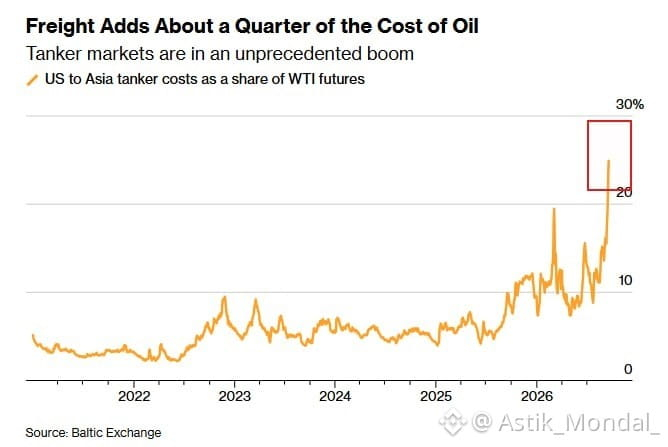
🚨 THE OIL SHIPPING CRISIS IS GETTING SERIOUS The world is running short of supertankers and the cost of moving crude is exploding. Shipping oil from Houston to Asia now costs roughly $26 per barrel. That’s nearly 25% of WTI’s entire price. Think about what that means. The problem isn’t just the price of oil. It’s the cost of physically moving it across the world. And Europe is facing an even bigger shock. Europe imported roughly 577,000 barrels per day of Saudi crude in June. Next month? ZERO, according to Bloomberg. Fewer tankers + disrupted supply routes + surging freight costs = a dangerous setup for global energy markets. If shipping capacity keeps tightening, the oil market could face another major price shock. And that could spill directly into inflation, interest rates, currencies, stocks and crypto. The oil trade is becoming a bottleneck. Watch the tankers. #Oil #CrudeOil #EnergyCrisis #Inflation #Bitcoin $CL $BZ
🚨 THE OIL SHIPPING CRISIS IS GETTING SERIOUS The world is running short of supertankers and the cost of moving crude is exploding. Shipping oil from Houston to Asia now costs roughly $26 per barrel. That’s nearly 25% of WTI’s entire price. Think about what that means. The problem isn’t just the price of oil. It’s the cost of physically moving it across the world. And Europe is facing an even bigger shock. Europe imported roughly 577,000 barrels per day of Saudi crude in June. Next month? ZERO, according to Bloomberg. Fewer tankers + disrupted supply routes + surging freight costs = a dangerous setup for global energy markets. If shipping capacity keeps tightening, the oil market could face another major price shock. And that could spill directly into inflation, interest rates, currencies, stocks and crypto. The oil trade is becoming a bottleneck. Watch the tankers. #Oil #CrudeOil #EnergyCrisis #Inflation #Bitcoin $CL $BZ
1
593

🚨 PAKISTAN ENFORCES EMERGENCY AUSTERITY AS MACRO ENERGY CRUNCH THREATENS LIQUIDITY AND IMPACTS $BTC ⚡
Pakistan rolling out emergency austerity measures—early market shutdowns, 50% fuel cuts, and travel bans—signals acute fiscal and energy supply-side stress. 📊 Squeezed by currency depreciation and geopolitical friction, sovereign reserves are taking a direct hit as import capacity deteriorates rapidly.
When emerging market energy infrastructure falters, systemic FX devaluation and sticky inflation inevitably ripple across global capital flows. 🔍 As institutional liquidity seeks safety away from distressed fiat channels, asset reallocation dynamics become critical to monitor. 💬 Do you expect this emerging market liquidity squeeze to accelerate adoption of decentralized hedging assets like $BTC ? 👇
⚠️ Not financial advice. Always manage your risk. 🛡️
🏷️ #BTC #MacroEconomy #EnergyCrisis #Liquidity #Crypto
🎯 🦈
🚨 PAKISTAN ENFORCES EMERGENCY AUSTERITY AS MACRO ENERGY CRUNCH THREATENS LIQUIDITY AND IMPACTS $BTC ⚡
Pakistan rolling out emergency austerity measures—early market shutdowns, 50% fuel cuts, and travel bans—signals acute fiscal and energy supply-side stress. 📊 Squeezed by currency depreciation and geopolitical friction, sovereign reserves are taking a direct hit as import capacity deteriorates rapidly.
When emerging market energy infrastructure falters, systemic FX devaluation and sticky inflation inevitably ripple across global capital flows. 🔍 As institutional liquidity seeks safety away from distressed fiat channels, asset reallocation dynamics become critical to monitor. 💬 Do you expect this emerging market liquidity squeeze to accelerate adoption of decentralized hedging assets like $BTC ? 👇
⚠️ Not financial advice. Always manage your risk. 🛡️
🏷️ #BTC #MacroEconomy #EnergyCrisis #Liquidity #Crypto
🎯 🦈
Pakistan rolling out emergency austerity measures—early market shutdowns, 50% fuel cuts, and travel bans—signals acute fiscal and energy supply-side stress. 📊 Squeezed by currency depreciation and geopolitical friction, sovereign reserves are taking a direct hit as import capacity deteriorates rapidly.
When emerging market energy infrastructure falters, systemic FX devaluation and sticky inflation inevitably ripple across global capital flows. 🔍 As institutional liquidity seeks safety away from distressed fiat channels, asset reallocation dynamics become critical to monitor. 💬 Do you expect this emerging market liquidity squeeze to accelerate adoption of decentralized hedging assets like $BTC ? 👇
⚠️ Not financial advice. Always manage your risk. 🛡️
🏷️ #BTC #MacroEconomy #EnergyCrisis #Liquidity #Crypto
🎯 🦈
10
·
--
Saudi Oil Pipeline Damaged: Europe’s Crude Supply Shifts From Delayed to Completely Cut Off! Oil Prices Are About to Soar—Will Inflation Explode Again?
Big trouble is about to hit the global energy market! Saudi’s 1,200km oil pipeline repair keeps getting delayed—what was originally just “shipment delays” has now turned into “a complete supply cut-off in October.”
Europe is in for it now. Winter hasn’t even arrived yet, and they’re already running out of supplies. Oil prices are surging upward, and the inflation alert is sounding again!
The crypto market may also be hit—traditional safe-haven funds could flow to gold rather than Bitcoin. In the short term, $BTC and $ETH face considerable pressure.
But don’t panic. Energy crises often bring opportunities for energy-related coins. Cross-border payment solutions like $XRP could benefit if oil and gas trade is disrupted.
#能源危机 #inflation
$BTC $ETH
Saudi oil pipeline damaged, Europe's oil supply shifts from delayed to completely cut off! Oil prices are about to skyrocket, and inflation is about to explode again?
Big trouble is about to hit the global energy market! Saudi's 1200km oil pipeline repair keeps getting delayed, what was just "shipment delays" has now become "complete supply cut-off in October".
Europe is in trouble now, winter hasn't even arrived and they're already running out of supplies. Oil prices will shoot up, and the inflation alert is sounding again!
The crypto market is likely to follow suit, with traditional safe-haven funds possibly flowing to gold rather than bitcoin. In the short term, $BTC and $ETH are under considerable pressure.
But don't panic, energy crises often mean opportunities for energy coins. $XRP might benefit from disrupted oil and gas trading.
#energycrisis #inflation
$BTC $ETH
Saudi Oil Pipeline Damaged: Europe’s Crude Supply Shifts From Delayed to Completely Cut Off! Oil Prices Are About to Soar—Will Inflation Explode Again?
Big trouble is about to hit the global energy market! Saudi’s 1,200km oil pipeline repair keeps getting delayed—what was originally just “shipment delays” has now turned into “a complete supply cut-off in October.”
Europe is in for it now. Winter hasn’t even arrived yet, and they’re already running out of supplies. Oil prices are surging upward, and the inflation alert is sounding again!
The crypto market may also be hit—traditional safe-haven funds could flow to gold rather than Bitcoin. In the short term, $BTC and $ETH face considerable pressure.
But don’t panic. Energy crises often bring opportunities for energy-related coins. Cross-border payment solutions like $XRP could benefit if oil and gas trade is disrupted.
#能源危机 #inflation
$BTC $ETH
Saudi oil pipeline damaged, Europe's oil supply shifts from delayed to completely cut off! Oil prices are about to skyrocket, and inflation is about to explode again?
Big trouble is about to hit the global energy market! Saudi's 1200km oil pipeline repair keeps getting delayed, what was just "shipment delays" has now become "complete supply cut-off in October".
Europe is in trouble now, winter hasn't even arrived and they're already running out of supplies. Oil prices will shoot up, and the inflation alert is sounding again!
The crypto market is likely to follow suit, with traditional safe-haven funds possibly flowing to gold rather than bitcoin. In the short term, $BTC and $ETH are under considerable pressure.
But don't panic, energy crises often mean opportunities for energy coins. $XRP might benefit from disrupted oil and gas trading.
#energycrisis #inflation
$BTC $ETH
Big trouble is about to hit the global energy market! Saudi’s 1,200km oil pipeline repair keeps getting delayed—what was originally just “shipment delays” has now turned into “a complete supply cut-off in October.”
Europe is in for it now. Winter hasn’t even arrived yet, and they’re already running out of supplies. Oil prices are surging upward, and the inflation alert is sounding again!
The crypto market may also be hit—traditional safe-haven funds could flow to gold rather than Bitcoin. In the short term, $BTC and $ETH face considerable pressure.
But don’t panic. Energy crises often bring opportunities for energy-related coins. Cross-border payment solutions like $XRP could benefit if oil and gas trade is disrupted.
#能源危机 #inflation
$BTC $ETH
Saudi oil pipeline damaged, Europe's oil supply shifts from delayed to completely cut off! Oil prices are about to skyrocket, and inflation is about to explode again?
Big trouble is about to hit the global energy market! Saudi's 1200km oil pipeline repair keeps getting delayed, what was just "shipment delays" has now become "complete supply cut-off in October".
Europe is in trouble now, winter hasn't even arrived and they're already running out of supplies. Oil prices will shoot up, and the inflation alert is sounding again!
The crypto market is likely to follow suit, with traditional safe-haven funds possibly flowing to gold rather than bitcoin. In the short term, $BTC and $ETH are under considerable pressure.
But don't panic, energy crises often mean opportunities for energy coins. $XRP might benefit from disrupted oil and gas trading.
#energycrisis #inflation
$BTC $ETH
241
In a recent market assessment, Takeshi Hashimoto, President of major Japanese shipping giant Mitsui O.S.K. Lines, delivered a pessimistic outlook regarding transit through the Strait of Hormuz. Hashimoto confirmed that LNG shipments through the strategic chokepoint remain virtually impossible under present conditions, leading the operator to halt tanker traffic through a vital corridor that accounts for roughly one-fifth of global LNG supply.
This prolonged disruption has already propelled Asian spot LNG prices to their highest levels since 2022. With peak winter heating demand approaching across the Northern Hemisphere, structural supply bottlenecks threaten to sustain higher energy costs over an extended horizon, squeezing Asian buyers and complicating global disinflation trajectories.
For broader financial markets, enduring maritime bottlenecks represent an unwelcome revival of cost-push inflationary pressure. Higher baseline energy costs could constrain central bank easing cycles, keeping bond yields elevated and providing sustained support to the US dollar at the expense of broader equity momentum.
For crypto assets, tight macro liquidity conditions and heightened geopolitical risk generally dampen speculative appetite. While sustained inflation highlights the long-term store-of-value thesis for $BTC, near-term capital flows may remain cautious as investors price in higher geopolitical risk premiums across risk-on markets.
#EnergyCrisis #Geopolitics #MacroEconomics
In a recent market assessment, Takeshi Hashimoto, President of major Japanese shipping giant Mitsui O.S.K. Lines, delivered a pessimistic outlook regarding transit through the Strait of Hormuz. Hashimoto confirmed that LNG shipments through the strategic chokepoint remain virtually impossible under present conditions, leading the operator to halt tanker traffic through a vital corridor that accounts for roughly one-fifth of global LNG supply.
This prolonged disruption has already propelled Asian spot LNG prices to their highest levels since 2022. With peak winter heating demand approaching across the Northern Hemisphere, structural supply bottlenecks threaten to sustain higher energy costs over an extended horizon, squeezing Asian buyers and complicating global disinflation trajectories.
For broader financial markets, enduring maritime bottlenecks represent an unwelcome revival of cost-push inflationary pressure. Higher baseline energy costs could constrain central bank easing cycles, keeping bond yields elevated and providing sustained support to the US dollar at the expense of broader equity momentum.
For crypto assets, tight macro liquidity conditions and heightened geopolitical risk generally dampen speculative appetite. While sustained inflation highlights the long-term store-of-value thesis for $BTC , near-term capital flows may remain cautious as investors price in higher geopolitical risk premiums across risk-on markets.
#EnergyCrisis #Geopolitics #MacroEconomics
This prolonged disruption has already propelled Asian spot LNG prices to their highest levels since 2022. With peak winter heating demand approaching across the Northern Hemisphere, structural supply bottlenecks threaten to sustain higher energy costs over an extended horizon, squeezing Asian buyers and complicating global disinflation trajectories.
For broader financial markets, enduring maritime bottlenecks represent an unwelcome revival of cost-push inflationary pressure. Higher baseline energy costs could constrain central bank easing cycles, keeping bond yields elevated and providing sustained support to the US dollar at the expense of broader equity momentum.
For crypto assets, tight macro liquidity conditions and heightened geopolitical risk generally dampen speculative appetite. While sustained inflation highlights the long-term store-of-value thesis for $BTC , near-term capital flows may remain cautious as investors price in higher geopolitical risk premiums across risk-on markets.
#EnergyCrisis #Geopolitics #MacroEconomics
8
CEO Irtiza Sayyed of Jera Global Energy Solutions recently revealed that major Asian buyers are actively securing alternative liquefied natural gas (LNG) supplies outside the Persian Gulf. The strategic pivot comes as escalating conflict in the Middle East severely disrupts critical maritime shipping routes through the Strait of Hormuz, a vital chokepoint responsible for handling nearly one-fifth of global cargo flows.
This aggressive search for non-Gulf suppliers highlights deepening corporate anxiety over energy supply vulnerabilities. Rather than relying on short-term spot purchases, Asian importers are actively restructuring supply contracts to insulate domestic economies from sudden geopolitical blockades and shipping bottlenecks.
From a macroeconomic perspective, maritime disruptions and supply chain diversions invariably lift freight costs and energy prices. Persistent energy inflation threatens to slow the broader disinflationary trend, potentially forcing major central banks to delay rate cuts and bolstering the US dollar.
For the crypto market, higher energy-driven inflation and geopolitical uncertainty dampen risk-taking behavior. Tighter global liquidity and elevated yields could limit speculative capital inflows, keeping $BTC and broader altcoins under consolidation until macro clarity emerges. ⚡
#EnergyCrisis #Geopolitics #MiddleEast
CEO Irtiza Sayyed of Jera Global Energy Solutions recently revealed that major Asian buyers are actively securing alternative liquefied natural gas (LNG) supplies outside the Persian Gulf. The strategic pivot comes as escalating conflict in the Middle East severely disrupts critical maritime shipping routes through the Strait of Hormuz, a vital chokepoint responsible for handling nearly one-fifth of global cargo flows.
This aggressive search for non-Gulf suppliers highlights deepening corporate anxiety over energy supply vulnerabilities. Rather than relying on short-term spot purchases, Asian importers are actively restructuring supply contracts to insulate domestic economies from sudden geopolitical blockades and shipping bottlenecks.
From a macroeconomic perspective, maritime disruptions and supply chain diversions invariably lift freight costs and energy prices. Persistent energy inflation threatens to slow the broader disinflationary trend, potentially forcing major central banks to delay rate cuts and bolstering the US dollar.
For the crypto market, higher energy-driven inflation and geopolitical uncertainty dampen risk-taking behavior. Tighter global liquidity and elevated yields could limit speculative capital inflows, keeping $BTC and broader altcoins under consolidation until macro clarity emerges. ⚡
#EnergyCrisis #Geopolitics #MiddleEast
This aggressive search for non-Gulf suppliers highlights deepening corporate anxiety over energy supply vulnerabilities. Rather than relying on short-term spot purchases, Asian importers are actively restructuring supply contracts to insulate domestic economies from sudden geopolitical blockades and shipping bottlenecks.
From a macroeconomic perspective, maritime disruptions and supply chain diversions invariably lift freight costs and energy prices. Persistent energy inflation threatens to slow the broader disinflationary trend, potentially forcing major central banks to delay rate cuts and bolstering the US dollar.
For the crypto market, higher energy-driven inflation and geopolitical uncertainty dampen risk-taking behavior. Tighter global liquidity and elevated yields could limit speculative capital inflows, keeping $BTC and broader altcoins under consolidation until macro clarity emerges. ⚡
#EnergyCrisis #Geopolitics #MiddleEast
36
Log in to explore more content
Join global crypto users on Binance Square
⚡️ Get latest and useful information about crypto.
💬 Trusted by the world’s largest crypto exchange.
👍 Discover real insights from verified creators.
Email / Phone number
Trending Topics
1
#UKFCAWinsCourtOrderToRecover851400Pounds
18,246 views
643 Discussing
2
#ChainlinkLaunchesCCIP2WithEnterpriseVerification
32,747 views
847 Discussing
3
#GoldFallsTo$4144
11,957 views
144 Discussing
4
#QNTFallsOver40%FromMorningHigh
74,006 views
1,271 Discussing
5
#USDTAdds845900HoldersInPast7Days
11,832 views
373 Discussing
6
#KospiFalls2.7%SamsungSKHynixDropOver5%
21,951 views
546 Discussing
7
#BitgetCEOConfirms$388MStolenInHack
4,865 views
41 Discussing
8
#BTCFallsBelow$83000
28,431 views
162 Discussing
9
#BitgetDetailsSecurityIncidentTimeline
40,742 views
693 Discussing
10
#BitcoinSpotETFs$2.39BWeeklyNetInflow
13,246 views
48 Discussing