News


·
--
Article
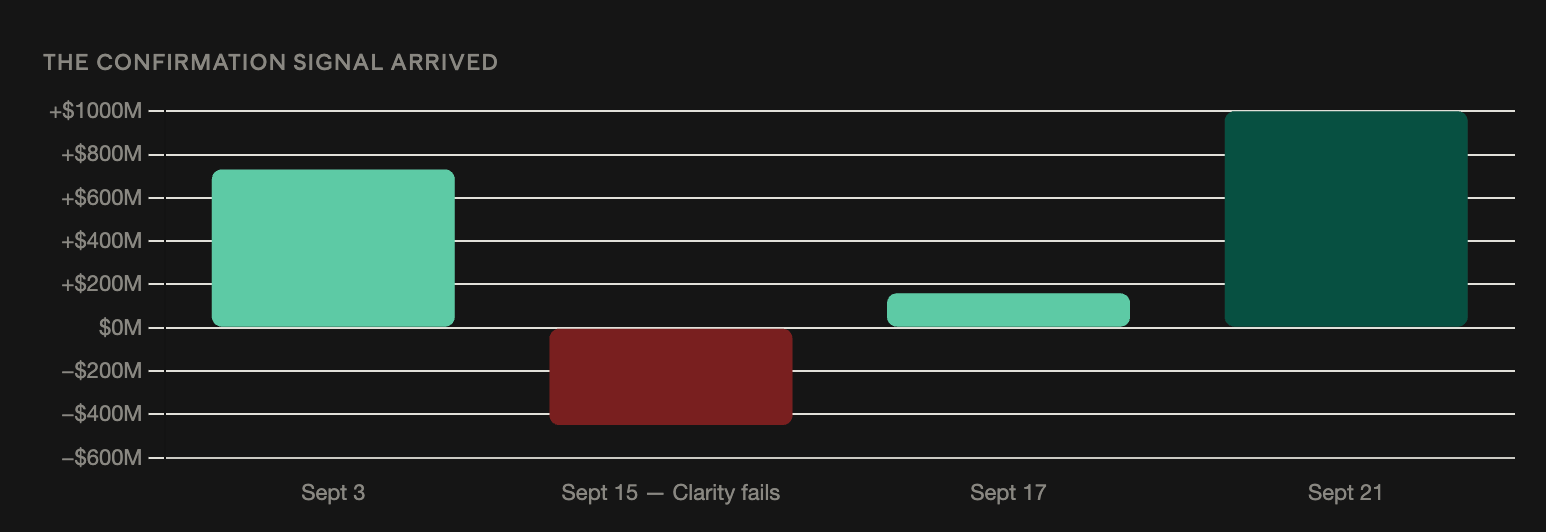
ETF News | Bitcoin ETFs Take Nearly $1 Billion, the Most Since October, as Price Nears $86,000Bitcoin ETFs Take Nearly $1 Billion, the Most Since October, as Price Nears $86,000US-listed spot Bitcoin ETFs attracted nearly $1 billion in inflows Monday, their largest single-day haul since October last year.Bitcoin traded near $86,000 after recovering from Asian-session lows around $85,000, having convincingly broken above its May high on Monday. The CoinDesk 20 Index rose 2.2% over 24 hours.The Missing Confirmation ArrivedThe inflow answers the main objection to the rally.Through last week, the move from below $75,000 leaned on short liquidations — roughly $300 million in a single hour Monday — rather than spot buying. CryptoQuant's spot demand metric sat at −145,000 BTC, and Nexo Dispatch's Ilya Kalchev named sustained ETF inflows or renewed spot buying as the signals that would confirm a breakout.A single $1 billion day is the largest institutional bid since October. For scale, the complex's previous standout was $731 million on September 3, and it shed $450 million on September 15 after the Clarity Act failed.One day does not make a trend. Kalchev's word was "sustained," and the next several sessions will show whether this was a start or a spike.The May High Was the Level That MatteredBitcoin's break above its May high removes a reference point that had been cited as the confirmation level for months.LMAX Group's Joel Kruger had identified $82,820, the May high, as the level that would confirm the recovery, with a path toward $100,000 above it. Bitcoin rejected below it on September 4 at $82,284.It has also cleared the $80,000-$82,000 band that held nearly 8% of supply, including the US spot ETF cohort's average cost basis.The next test is closer than it looks. Glassnode's Frederik Theissen placed a dense long-term holder supply zone between $83,000 and $86,000. At $86,000, Bitcoin sits at its upper edge — where holders who bought in that range can exit at breakeven after months underwater.Hormuz Is the Structural ChangeWTI crude fell more than 2% to below $90, extending its retreat from a recent high of $106.The trigger was a Kyodo report that Iran was willing to reopen the Strait of Hormuz within seven days if the US eased its blockade.That is different in kind from last week's moves. Diplomatic signals such as President Trump saying he would "probably" meet Iran's president lower the risk premium. A reopened Hormuz removes the physical constraint that cut Saudi output to 6.238 million barrels per day, the lowest since 1990, and pushed tanker rates above $1 million per day. Lower oil eases inflation pressure and weakens the case for more Fed hikes. The dot plot already signalled just one more increase in 2026."Falling oil prices and US government bond yields, rising global stock markets and optimism regarding US-China negotiations supported risk appetite," said FxPro chief market analyst Alex Kuptsikevich, pointing to a sharp rise in the Nasdaq.Derivatives Still Read as a Short SqueezeThe futures data tells a less conviction-driven story than the ETF flows.Total crypto futures volume jumped 38% to $292 billion over 24 hours while open interest rose just 1% to $157 billion, pushing the volume-to-open-interest ratio to nearly 2. Liquidations reached $768 million, mostly shorts.Every major — BTC, ETH, XRP and SOL — carries a negative 24-hour open-interest-adjusted cumulative volume delta, meaning aggressive sell-side flow outpaced buy-side flow even as prices rose. Tron was among the few exceptions.The two readings are not contradictory. ETF demand is spot buying through regulated vehicles; futures data captures leveraged traders. The spot bid arrived while the leveraged market was still covering shorts.Bitcoin futures open interest climbed to 716,000 BTC, the most since August 25 but still below the roughly 750,000 BTC average from April to July. Ether and Solana open interest remains in a downtrend that began in May, even though ether has outperformed Bitcoin this quarter.Memecoin Leverage Is the Warning SignPEPE, DOGE and SHIB were among the 10 best performers over 24 hours as Bitcoin paused.Dogecoin's open interest surged 10% in a day, the largest jump among the top 10 coins. A consistent rise in memecoin leverage has historically appeared near interim tops, as speculative appetite runs ahead of the underlying move.XRP open interest rose to 2.46 billion tokens from 2.2 billion, a 12% build on a smaller base.Coinglass whale bias reads extremely bullish on Bitcoin, bullish on ether and Solana, and bearish on XRP, Dogecoin and gold.Options Traders Are Reaching for $90,000 and $95,000Implied volatility remains contained. The 30-day BVIV and EVIV indexes sit within recent ranges and well below the February and early June peaks.Laser Digital noted the volatility curve has been flattening since last week as realised volatility picked up and spot-vol correlation turned firmly positive — volatility rising alongside price, the pattern of an upside move.Deribit's front-end risk reversals flipped strongly toward Bitcoin and ether calls late Monday as Bitcoin topped $85,000, though the call bias has since eased.The busiest Bitcoin options trades over 24 hours were calls at the $95,000 and $90,000 strikes, alongside ether calls from $2,500 to $3,000. Both Bitcoin strikes sit above the 100-week moving average near $89,000.ZetaChain Holders Voted to Retire Their Own BlockchainZetaChain holders voted Sunday to shut down the network and move the ZETA token to Solana — a rare formal decision by a blockchain to stop existing.The proposal passed with more than 99% in favour on 58% turnout, above the 40% required. One more governance vote is needed before anything moves.The chain launched in 2023 with $27 million in funding to move value between otherwise incompatible blockchains. Three years later, dozens of teams attack the same problem, and ZETA ranks 313th by market value at about $90 million.The team cited operating cost. ZetaChain runs on the Cosmos SDK, so every security flaw in that toolkit becomes its problem, requiring coordinated patches across independent operators. In August, Cosmos Labs disclosed attacks on six chains using related software, with about $6 million stolen. ZetaChain was not hit.Solana was chosen for Anuma, an AI app the team launched in February that carries user context between AI models, which it says has more than 300,000 users. Holders will lock ZETA for credits inside Anuma, turning the token from network security into prepaid app usage.ZETA doubled from roughly 4 cents into the vote, touched 7 cents, then fell 16% over 24 hours to just under 6 cents. Nearly $117 million traded against a $90 million market value — the entire float turned over more than once in a day.
ETF News | Bitcoin ETFs Take Nearly $1 Billion, the Most Since October, as Price Nears $86,000
Bitcoin ETFs Take Nearly $1 Billion, the Most Since October, as Price Nears $86,000US-listed spot Bitcoin ETFs attracted nearly $1 billion in inflows Monday, their largest single-day haul since October last year.Bitcoin traded near $86,000 after recovering from Asian-session lows around $85,000, having convincingly broken above its May high on Monday. The CoinDesk 20 Index rose 2.2% over 24 hours.The Missing Confirmation ArrivedThe inflow answers the main objection to the rally.Through last week, the move from below $75,000 leaned on short liquidations — roughly $300 million in a single hour Monday — rather than spot buying. CryptoQuant's spot demand metric sat at −145,000 BTC, and Nexo Dispatch's Ilya Kalchev named sustained ETF inflows or renewed spot buying as the signals that would confirm a breakout.A single $1 billion day is the largest institutional bid since October. For scale, the complex's previous standout was $731 million on September 3, and it shed $450 million on September 15 after the Clarity Act failed.One day does not make a trend. Kalchev's word was "sustained," and the next several sessions will show whether this was a start or a spike.The May High Was the Level That MatteredBitcoin's break above its May high removes a reference point that had been cited as the confirmation level for months.LMAX Group's Joel Kruger had identified $82,820, the May high, as the level that would confirm the recovery, with a path toward $100,000 above it. Bitcoin rejected below it on September 4 at $82,284.It has also cleared the $80,000-$82,000 band that held nearly 8% of supply, including the US spot ETF cohort's average cost basis.The next test is closer than it looks. Glassnode's Frederik Theissen placed a dense long-term holder supply zone between $83,000 and $86,000. At $86,000, Bitcoin sits at its upper edge — where holders who bought in that range can exit at breakeven after months underwater.Hormuz Is the Structural ChangeWTI crude fell more than 2% to below $90, extending its retreat from a recent high of $106.The trigger was a Kyodo report that Iran was willing to reopen the Strait of Hormuz within seven days if the US eased its blockade.That is different in kind from last week's moves. Diplomatic signals such as President Trump saying he would "probably" meet Iran's president lower the risk premium. A reopened Hormuz removes the physical constraint that cut Saudi output to 6.238 million barrels per day, the lowest since 1990, and pushed tanker rates above $1 million per day. Lower oil eases inflation pressure and weakens the case for more Fed hikes. The dot plot already signalled just one more increase in 2026."Falling oil prices and US government bond yields, rising global stock markets and optimism regarding US-China negotiations supported risk appetite," said FxPro chief market analyst Alex Kuptsikevich, pointing to a sharp rise in the Nasdaq.Derivatives Still Read as a Short SqueezeThe futures data tells a less conviction-driven story than the ETF flows.Total crypto futures volume jumped 38% to $292 billion over 24 hours while open interest rose just 1% to $157 billion, pushing the volume-to-open-interest ratio to nearly 2. Liquidations reached $768 million, mostly shorts.Every major — BTC, ETH, XRP and SOL — carries a negative 24-hour open-interest-adjusted cumulative volume delta, meaning aggressive sell-side flow outpaced buy-side flow even as prices rose. Tron was among the few exceptions.The two readings are not contradictory. ETF demand is spot buying through regulated vehicles; futures data captures leveraged traders. The spot bid arrived while the leveraged market was still covering shorts.Bitcoin futures open interest climbed to 716,000 BTC, the most since August 25 but still below the roughly 750,000 BTC average from April to July. Ether and Solana open interest remains in a downtrend that began in May, even though ether has outperformed Bitcoin this quarter.Memecoin Leverage Is the Warning SignPEPE, DOGE and SHIB were among the 10 best performers over 24 hours as Bitcoin paused.Dogecoin's open interest surged 10% in a day, the largest jump among the top 10 coins. A consistent rise in memecoin leverage has historically appeared near interim tops, as speculative appetite runs ahead of the underlying move.XRP open interest rose to 2.46 billion tokens from 2.2 billion, a 12% build on a smaller base.Coinglass whale bias reads extremely bullish on Bitcoin, bullish on ether and Solana, and bearish on XRP, Dogecoin and gold.Options Traders Are Reaching for $90,000 and $95,000Implied volatility remains contained. The 30-day BVIV and EVIV indexes sit within recent ranges and well below the February and early June peaks.Laser Digital noted the volatility curve has been flattening since last week as realised volatility picked up and spot-vol correlation turned firmly positive — volatility rising alongside price, the pattern of an upside move.Deribit's front-end risk reversals flipped strongly toward Bitcoin and ether calls late Monday as Bitcoin topped $85,000, though the call bias has since eased.The busiest Bitcoin options trades over 24 hours were calls at the $95,000 and $90,000 strikes, alongside ether calls from $2,500 to $3,000. Both Bitcoin strikes sit above the 100-week moving average near $89,000.ZetaChain Holders Voted to Retire Their Own BlockchainZetaChain holders voted Sunday to shut down the network and move the ZETA token to Solana — a rare formal decision by a blockchain to stop existing.The proposal passed with more than 99% in favour on 58% turnout, above the 40% required. One more governance vote is needed before anything moves.The chain launched in 2023 with $27 million in funding to move value between otherwise incompatible blockchains. Three years later, dozens of teams attack the same problem, and ZETA ranks 313th by market value at about $90 million.The team cited operating cost. ZetaChain runs on the Cosmos SDK, so every security flaw in that toolkit becomes its problem, requiring coordinated patches across independent operators. In August, Cosmos Labs disclosed attacks on six chains using related software, with about $6 million stolen. ZetaChain was not hit.Solana was chosen for Anuma, an AI app the team launched in February that carries user context between AI models, which it says has more than 300,000 users. Holders will lock ZETA for credits inside Anuma, turning the token from network security into prepaid app usage.ZETA doubled from roughly 4 cents into the vote, touched 7 cents, then fell 16% over 24 hours to just under 6 cents. Nearly $117 million traded against a $90 million market value — the entire float turned over more than once in a day.
17
5
49
36.1k
·
--
BNB News | BNB's Market Cap Passes BNY Mellon at $104.95 Billion, Ranking 249th GloballyBNB's market capitalisation reached approximately $104.95 billion, surpassing Bank of New York Mellon's roughly $104.41 billion, according to Odaily.That places BNB 249th globally by asset market value. BNY Mellon ranks 251st.
BNB News | BNB's Market Cap Passes BNY Mellon at $104.95 Billion, Ranking 249th Globally
BNB's market capitalisation reached approximately $104.95 billion, surpassing Bank of New York Mellon's roughly $104.41 billion, according to Odaily.That places BNB 249th globally by asset market value. BNY Mellon ranks 251st.
1
1
10
6.7k
·
--
Article
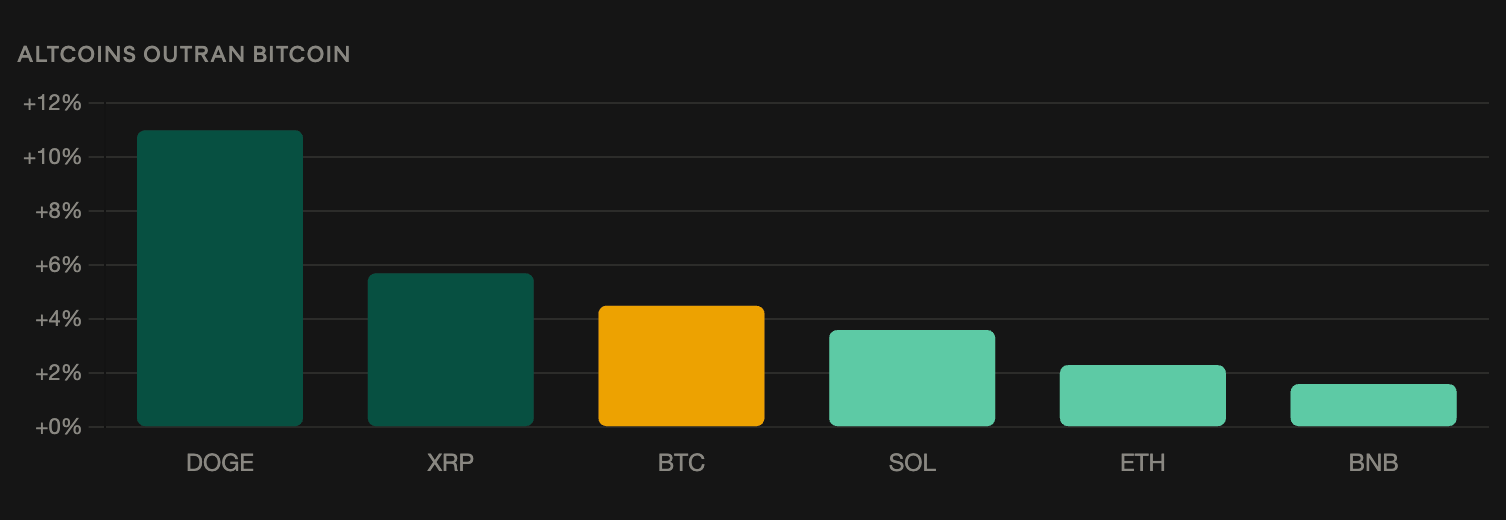
Crypto News | Crypto Market Cap Reclaims $3 Trillion as Perp Leverage Hits Its Highest Since OctoberThe total cryptocurrency market cap briefly climbed back above $3 trillion on Tuesday as Bitcoin and the largest altcoins extended a broad rally.Bitcoin traded around $86,000, up about 4.5% over 24 hours, per CoinGecko. Total market value stood just below $3 trillion at the time of writing, up about 4.3% on the day.The market was at roughly $2.66 trillion on September 18. The move to $3 trillion is a gain of about 13% in four sessions.Leverage Is Back at Record-High LevelsThe rally has brought leverage with it.Open interest in perpetual futures across crypto climbed to nearly $160 billion, the highest since late October 2025, Bloomberg reported. More than $920 million in bearish positions were liquidated Monday as prices surged.The reference point matters. Late October 2025 was when Bitcoin last traded near its record above $120,000. Hyperliquid's trader long/short ratio touched 2.71 last week, also its highest since that period.Leverage at those levels amplifies moves in either direction. The same positioning that forced shorts out on the way up becomes forced selling if price reverses.CoinDesk data showed total futures volume up 38% to $292 billion over 24 hours against a 1% rise in open interest, pushing the volume-to-open-interest ratio to nearly 2 — the signature of a short squeeze rather than fresh conviction-driven positioning.Spot Demand Arrived Alongside ItThe leverage build is only half the picture.US spot Bitcoin ETFs drew nearly $1 billion on Monday, their largest single-day inflow since October 2025. That is spot buying through regulated vehicles, not borrowed exposure.Part of that bid may be mechanical. Ledn co-founder Mauricio Di Bartolomeo noted that dealers who sold calls on BlackRock's IBIT fund cover by buying shares, and new ETF shares require buying Bitcoin — so options hedging reaches the coin itself. The headline flow figure does not separate hedging from allocation.Roughly $14 billion of Bitcoin options expire on Deribit on Friday, the largest single date this year, with call concentrations at $85,000 and $100,000.Altcoins Are Taking Share From BitcoinEther gained about 2.3% to $2,745, XRP rose 5.7% to $1.53 and Solana advanced 3.6% to $117. BNB rose 1.6%.Dogecoin was among the strongest large caps, up about 11%.At around $86,000, Bitcoin's market value is roughly $1.7 trillion — about 57% of a $3 trillion market. Bitcoin dominance stood at 59.2% earlier in September, so altcoins have gained share through the rally.That rotation carries the warning sign. Dogecoin open interest jumped 10% in a single day earlier this week, the largest rise among the top 10. A sustained build in memecoin leverage has historically appeared near interim tops, as speculative appetite runs ahead of the underlying move.AKE Shows What Speculation Looks LikeAkedo's AKE token, an AI gaming and content project, has gained about 170% over seven days, lifting its market cap to roughly $1.2 billion, per CoinMarketCap.It hit an all-time high of $0.1467 on Sunday before plunging more than 60% from its peak. Traders exchanged $108.9 million worth of AKE over 24 hours.A 170% weekly gain and a 60% drawdown from the high in the same week describe a token being traded rather than held. It is the small-cap version of the leverage story playing out across the market.The Levels That MatterBitcoin has cleared the $80,000-$82,000 band that held nearly 8% of supply and the May high of $82,820.It now sits at the upper edge of the $83,000-$86,000 long-term holder supply zone, where holders who bought in that range can exit at breakeven. The 100-week moving average near $89,000 is the next marked resistance.Oil is supplying the macro tailwind. WTI fell to $89, roughly 15% below its September high, after reports that Iran could reopen the Strait of Hormuz within seven days if the US eased its blockade.
Crypto News | Crypto Market Cap Reclaims $3 Trillion as Perp Leverage Hits Its Highest Since October
The total cryptocurrency market cap briefly climbed back above $3 trillion on Tuesday as Bitcoin and the largest altcoins extended a broad rally.Bitcoin traded around $86,000, up about 4.5% over 24 hours, per CoinGecko. Total market value stood just below $3 trillion at the time of writing, up about 4.3% on the day.The market was at roughly $2.66 trillion on September 18. The move to $3 trillion is a gain of about 13% in four sessions.Leverage Is Back at Record-High LevelsThe rally has brought leverage with it.Open interest in perpetual futures across crypto climbed to nearly $160 billion, the highest since late October 2025, Bloomberg reported. More than $920 million in bearish positions were liquidated Monday as prices surged.The reference point matters. Late October 2025 was when Bitcoin last traded near its record above $120,000. Hyperliquid's trader long/short ratio touched 2.71 last week, also its highest since that period.Leverage at those levels amplifies moves in either direction. The same positioning that forced shorts out on the way up becomes forced selling if price reverses.CoinDesk data showed total futures volume up 38% to $292 billion over 24 hours against a 1% rise in open interest, pushing the volume-to-open-interest ratio to nearly 2 — the signature of a short squeeze rather than fresh conviction-driven positioning.Spot Demand Arrived Alongside ItThe leverage build is only half the picture.US spot Bitcoin ETFs drew nearly $1 billion on Monday, their largest single-day inflow since October 2025. That is spot buying through regulated vehicles, not borrowed exposure.Part of that bid may be mechanical. Ledn co-founder Mauricio Di Bartolomeo noted that dealers who sold calls on BlackRock's IBIT fund cover by buying shares, and new ETF shares require buying Bitcoin — so options hedging reaches the coin itself. The headline flow figure does not separate hedging from allocation.Roughly $14 billion of Bitcoin options expire on Deribit on Friday, the largest single date this year, with call concentrations at $85,000 and $100,000.Altcoins Are Taking Share From BitcoinEther gained about 2.3% to $2,745, XRP rose 5.7% to $1.53 and Solana advanced 3.6% to $117. BNB rose 1.6%.Dogecoin was among the strongest large caps, up about 11%.At around $86,000, Bitcoin's market value is roughly $1.7 trillion — about 57% of a $3 trillion market. Bitcoin dominance stood at 59.2% earlier in September, so altcoins have gained share through the rally.That rotation carries the warning sign. Dogecoin open interest jumped 10% in a single day earlier this week, the largest rise among the top 10. A sustained build in memecoin leverage has historically appeared near interim tops, as speculative appetite runs ahead of the underlying move.AKE Shows What Speculation Looks LikeAkedo's AKE token, an AI gaming and content project, has gained about 170% over seven days, lifting its market cap to roughly $1.2 billion, per CoinMarketCap.It hit an all-time high of $0.1467 on Sunday before plunging more than 60% from its peak. Traders exchanged $108.9 million worth of AKE over 24 hours.A 170% weekly gain and a 60% drawdown from the high in the same week describe a token being traded rather than held. It is the small-cap version of the leverage story playing out across the market.The Levels That MatterBitcoin has cleared the $80,000-$82,000 band that held nearly 8% of supply and the May high of $82,820.It now sits at the upper edge of the $83,000-$86,000 long-term holder supply zone, where holders who bought in that range can exit at breakeven. The 100-week moving average near $89,000 is the next marked resistance.Oil is supplying the macro tailwind. WTI fell to $89, roughly 15% below its September high, after reports that Iran could reopen the Strait of Hormuz within seven days if the US eased its blockade.
4
2
17
20.5k
·
--

Article
SEC Innovation Exemption Could Let Tokenized Stock Platforms Announce Plans Next QuarterSEC Crypto Task Force Chief Legal Counsel Taylor Lindman said the first tokenized stock trading platforms could begin announcing operating plans as soon as next quarter under a newly launched innovation exemption framework. According to Odaily, the SEC has already received interest from several companies seeking to participate.
The exemption is valid for five years and would allow eligible platforms to trade tokenized U.S.-listed stocks on public, permissionless blockchains through permissioned AMMs and liquidity pools. The tokens would need to preserve traditional shareholder rights such as dividends and voting.
SEC Commissioner Hester Peirce said the current trading volume cap is sufficient to support commercial operations and described the exemption as a transitional arrangement before long-term regulatory rules are issued.
SEC Innovation Exemption Could Let Tokenized Stock Platforms Announce Plans Next Quarter
SEC Crypto Task Force Chief Legal Counsel Taylor Lindman said the first tokenized stock trading platforms could begin announcing operating plans as soon as next quarter under a newly launched innovation exemption framework. According to Odaily, the SEC has already received interest from several companies seeking to participate.
The exemption is valid for five years and would allow eligible platforms to trade tokenized U.S.-listed stocks on public, permissionless blockchains through permissioned AMMs and liquidity pools. The tokens would need to preserve traditional shareholder rights such as dividends and voting.
SEC Commissioner Hester Peirce said the current trading volume cap is sufficient to support commercial operations and described the exemption as a transitional arrangement before long-term regulatory rules are issued.
The exemption is valid for five years and would allow eligible platforms to trade tokenized U.S.-listed stocks on public, permissionless blockchains through permissioned AMMs and liquidity pools. The tokens would need to preserve traditional shareholder rights such as dividends and voting.
SEC Commissioner Hester Peirce said the current trading volume cap is sufficient to support commercial operations and described the exemption as a transitional arrangement before long-term regulatory rules are issued.
3
11
14.4k
·
--
Article
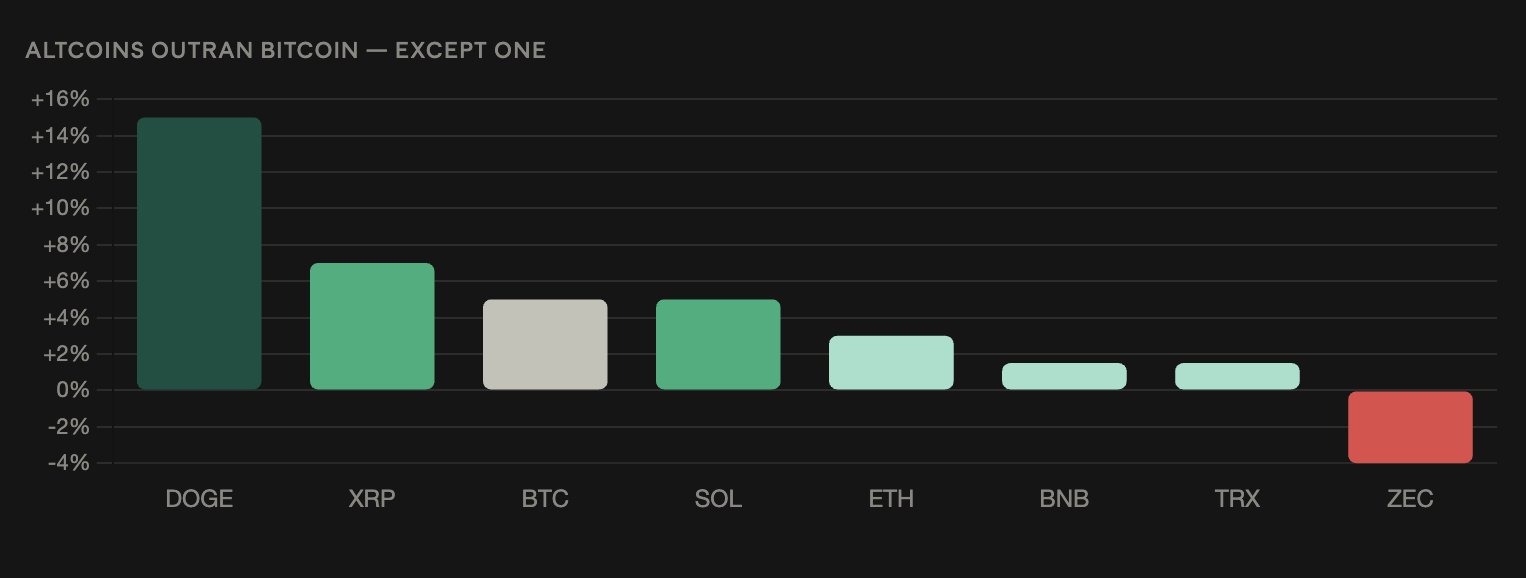
Altcoin News: Dogecoin Leads an Altcoin Surge With a 15% Jump as Memecoin Leverage BuildsDogecoin rose more than 15% to just above 10 cents in Tuesday's Asian morning, the largest gain among major tokens, CoinDesk data show.XRP added 7% to nearly $1.52 and Solana 5% to just under $117. Ether rose 3% to nearly $2,740, while BNB and Tron each gained between 1% and 2%.Zcash was the only large token to fall, down 4% to just above $1,450.Altcoins Outran BitcoinBitcoin added roughly 5% over 24 hours to just above $85,600. Dogecoin tripled that, and XRP beat it.The broader market reflects the same rotation. Total crypto market value briefly topped $3 trillion on Tuesday. With Bitcoin at around $1.7 trillion of that, its share has slipped to roughly 57% from 59.2% earlier in September.Altcoins gaining share during a rally is typical of the later, more speculative phase of a move, when capital that has already caught Bitcoin's gain looks for higher-beta exposure.Dogecoin's Leverage Is the Warning SignDogecoin's price move arrives with a build in borrowed positions behind it.Its open interest jumped 10% in a single day earlier this week, the largest rise among the top 10 coins. XRP's rose 12% over the same period, to 2.46 billion tokens from 2.2 billion.A sustained rise in memecoin leverage has historically appeared near interim tops. It signals speculative appetite running ahead of the underlying move, and it leaves those tokens exposed to sharper reversals when the leverage unwinds.Perpetual futures open interest across crypto reached nearly $160 billion, the highest since late October 2025, when Bitcoin last traded near its record above $120,000.The Forced Buying Has StoppedShort sellers funded much of the rally.Just over $1 billion of crypto positions were liquidated over the past day, per CoinGlass, and $844 million of that — 82% — belonged to shorts. Roughly 135,000 traders were closed out.Bitcoin accounted for about $608 million and ether $181 million, leaving roughly $250 million across the rest of the market.The mechanism is mechanical. When price rises far enough that a short seller's collateral no longer covers the loss, the exchange buys the token back on their behalf, lifting price and pushing the next tier of shorts past their threshold.That chain has now run its course. Liquidations over the past hour came to under $11 million, down from more than $300 million an hour at Monday's peak. For altcoins, the next leg depends on buyers choosing to buy.That is a harder test than it is for Bitcoin. Bitcoin drew nearly $1 billion into spot ETFs on Monday. Most altcoins have no comparable spot bid — and XRP's ETFs, the largest altcoin fund complex, lost about $5 million last Thursday.Zcash Turned After a 130% RunZcash's 4% decline stands out against a market where every other major rose.It follows a 130% gain over 30 days and a record high near $1,488. The single US Zcash ETF has drawn more than $230 million in September, including nearly $47 million in one session last week.A pullback in the month's strongest trade on a day the rest of the market rallied looks more like profit-taking than a change in view. Privacy remained firm elsewhere, with Monero up 13% on Monday.AI Tokens Have a New TailwindThe AI trade that drove equities higher overnight has a crypto channel.A week ago, AI and computing tokens took the heaviest losses after Anthropic CEO Dario Amodei called for the industry to slow development, with Internet Computer, Theta and NEAR among the worst performers.That has reversed. The Philadelphia Semiconductor Index has risen five straight sessions, gaining more than 4% on Monday, after Meta Platforms' new AI agent, Muse, overtook ChatGPT as the top free app on Apple's US App Store. AMD briefly topped $1 trillion in market value.NEAR led the 40 most liquid coins with a 30% gain last week, and Akedo's AKE, an AI gaming token, gained about 170% in seven days before falling more than 60% from its peak.The Next Test Is FridayRoughly $14 billion of Bitcoin options expire on Deribit on Friday, the largest single date this year.Altcoins tend to amplify whatever Bitcoin does. If dealer hedges unwind after settlement and Bitcoin pulls back, the tokens with the heaviest leverage — Dogecoin and XRP among them — carry the most exposure to the move.
Altcoin News: Dogecoin Leads an Altcoin Surge With a 15% Jump as Memecoin Leverage Builds
Dogecoin rose more than 15% to just above 10 cents in Tuesday's Asian morning, the largest gain among major tokens, CoinDesk data show.XRP added 7% to nearly $1.52 and Solana 5% to just under $117. Ether rose 3% to nearly $2,740, while BNB and Tron each gained between 1% and 2%.Zcash was the only large token to fall, down 4% to just above $1,450.Altcoins Outran BitcoinBitcoin added roughly 5% over 24 hours to just above $85,600. Dogecoin tripled that, and XRP beat it.The broader market reflects the same rotation. Total crypto market value briefly topped $3 trillion on Tuesday. With Bitcoin at around $1.7 trillion of that, its share has slipped to roughly 57% from 59.2% earlier in September.Altcoins gaining share during a rally is typical of the later, more speculative phase of a move, when capital that has already caught Bitcoin's gain looks for higher-beta exposure.Dogecoin's Leverage Is the Warning SignDogecoin's price move arrives with a build in borrowed positions behind it.Its open interest jumped 10% in a single day earlier this week, the largest rise among the top 10 coins. XRP's rose 12% over the same period, to 2.46 billion tokens from 2.2 billion.A sustained rise in memecoin leverage has historically appeared near interim tops. It signals speculative appetite running ahead of the underlying move, and it leaves those tokens exposed to sharper reversals when the leverage unwinds.Perpetual futures open interest across crypto reached nearly $160 billion, the highest since late October 2025, when Bitcoin last traded near its record above $120,000.The Forced Buying Has StoppedShort sellers funded much of the rally.Just over $1 billion of crypto positions were liquidated over the past day, per CoinGlass, and $844 million of that — 82% — belonged to shorts. Roughly 135,000 traders were closed out.Bitcoin accounted for about $608 million and ether $181 million, leaving roughly $250 million across the rest of the market.The mechanism is mechanical. When price rises far enough that a short seller's collateral no longer covers the loss, the exchange buys the token back on their behalf, lifting price and pushing the next tier of shorts past their threshold.That chain has now run its course. Liquidations over the past hour came to under $11 million, down from more than $300 million an hour at Monday's peak. For altcoins, the next leg depends on buyers choosing to buy.That is a harder test than it is for Bitcoin. Bitcoin drew nearly $1 billion into spot ETFs on Monday. Most altcoins have no comparable spot bid — and XRP's ETFs, the largest altcoin fund complex, lost about $5 million last Thursday.Zcash Turned After a 130% RunZcash's 4% decline stands out against a market where every other major rose.It follows a 130% gain over 30 days and a record high near $1,488. The single US Zcash ETF has drawn more than $230 million in September, including nearly $47 million in one session last week.A pullback in the month's strongest trade on a day the rest of the market rallied looks more like profit-taking than a change in view. Privacy remained firm elsewhere, with Monero up 13% on Monday.AI Tokens Have a New TailwindThe AI trade that drove equities higher overnight has a crypto channel.A week ago, AI and computing tokens took the heaviest losses after Anthropic CEO Dario Amodei called for the industry to slow development, with Internet Computer, Theta and NEAR among the worst performers.That has reversed. The Philadelphia Semiconductor Index has risen five straight sessions, gaining more than 4% on Monday, after Meta Platforms' new AI agent, Muse, overtook ChatGPT as the top free app on Apple's US App Store. AMD briefly topped $1 trillion in market value.NEAR led the 40 most liquid coins with a 30% gain last week, and Akedo's AKE, an AI gaming token, gained about 170% in seven days before falling more than 60% from its peak.The Next Test Is FridayRoughly $14 billion of Bitcoin options expire on Deribit on Friday, the largest single date this year.Altcoins tend to amplify whatever Bitcoin does. If dealer hedges unwind after settlement and Bitcoin pulls back, the tokens with the heaviest leverage — Dogecoin and XRP among them — carry the most exposure to the move.
1
7
18.3k
·
--

Article
Tom Lee Sees Four Factors Fueling Month-End Market RallyFundstrat head of research Tom Lee said the market is primed for a “face ripper” rally into month end, citing cooling oil prices, easing Treasury yields, a hawkish Fed that could soften, and oversold conditions. according to BeInCrypto, Lee said those factors could give the rebound real momentum as major indexes recovered from last week’s selloff.
Lee reiterated his S&P 500 target of 8,000 for this month and said crypto’s August rally often leads stock moves by about a month. He and Freedom Capital Markets’ Jay Woods agreed technology stocks are driving the bounce, but Woods said Micron’s earnings next week will be key to confirming whether the rally can broaden.
Tom Lee Sees Four Factors Fueling Month-End Market Rally
Fundstrat head of research Tom Lee said the market is primed for a “face ripper” rally into month end, citing cooling oil prices, easing Treasury yields, a hawkish Fed that could soften, and oversold conditions. according to BeInCrypto, Lee said those factors could give the rebound real momentum as major indexes recovered from last week’s selloff.
Lee reiterated his S&P 500 target of 8,000 for this month and said crypto’s August rally often leads stock moves by about a month. He and Freedom Capital Markets’ Jay Woods agreed technology stocks are driving the bounce, but Woods said Micron’s earnings next week will be key to confirming whether the rally can broaden.
Lee reiterated his S&P 500 target of 8,000 for this month and said crypto’s August rally often leads stock moves by about a month. He and Freedom Capital Markets’ Jay Woods agreed technology stocks are driving the bounce, but Woods said Micron’s earnings next week will be key to confirming whether the rally can broaden.
1
17
28k
·
--
Article
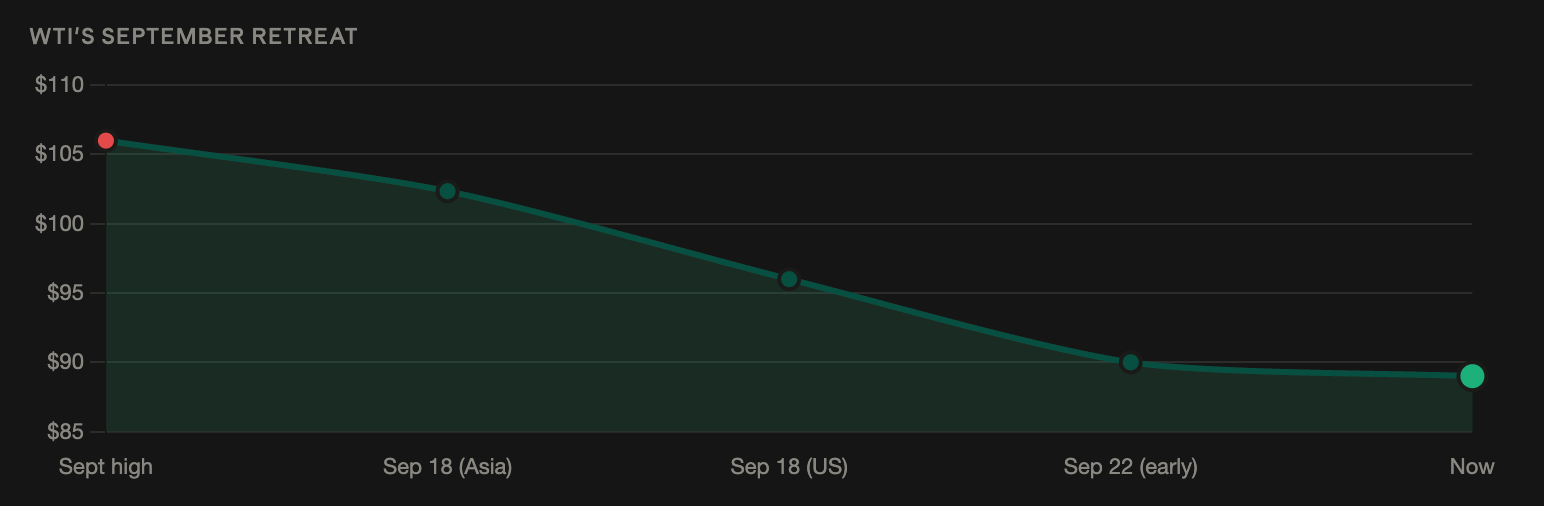
Bitcoin News | Bitcoin Faces a $14 Billion Options Expiry Friday With Calls Stacked at $85,000Roughly $14 billion of Bitcoin options expire on Deribit on Friday, the largest single expiration date this year.Mauricio Di Bartolomeo, co-founder of Ledn, which has originated more than $10 billion in Bitcoin-backed loans since 2018, argues the consequential part has already happened."Quarterly expirations like September's are a two-act event," he said.Bitcoin is consolidating around $86,000 after Monday's rally to an intraday high of $87,300.The First Act Was the IBIT ExpiryLast week, options tied to BlackRock's IBIT fund expired in what Di Bartolomeo calls the largest such expiration on record for the ETF.The book leaned heavily toward calls, with maximum pain — the price at which the most contracts expire worthless — near $40 a share. At IBIT's current Bitcoin-per-share ratio, that is roughly equivalent to $70,000 Bitcoin, well below where the market now trades.Bitcoin's run through $80,000 carried a large block of those calls above their strike prices.Dealer Hedging Reaches the Coin ItselfThe mechanism is what connects options positioning to spot price.Dealers who sold those calls sit on the losing side as price climbs, and they cover by buying the underlying asset. For IBIT, that means buying the fund's shares.Issuing new shares of a spot Bitcoin ETF requires buying Bitcoin. So hedging activity in an equity options market ends up as spot demand for the coin.That offers one explanation for the nearly $1 billion that flowed into US spot Bitcoin ETFs on Monday, the largest single day since October — though ETF inflows also include genuine allocation, and the two cannot be separated from the headline number.Friday's Book Inherits the SetupDi Bartolomeo points to heavy call concentrations on Deribit at $85,000 and $100,000 as the levels where the same mechanism repeats.Bitcoin is already trading above the first of them.Recent options flow supports the upward lean. The busiest Bitcoin trades over the past 24 hours were calls at the $90,000 and $95,000 strikes, and Deribit's front-end risk reversals flipped strongly toward calls late Monday as Bitcoin topped $85,000, before the bias eased somewhat.The Hedge Unwinds After ExpiryThe mechanism runs in reverse once contracts settle.Dealers hold Bitcoin or ETF shares as hedges against calls they sold. When those calls expire, the hedge is no longer needed, and dealers can sell it. A bid that supported price into expiry can become supply after it.That makes the days after Friday as important as Friday itself. Di Bartolomeo's view that the consequential part has passed rests on the IBIT expiry having already done its work; the Deribit settlement tests whether the unwind is orderly.Volatility pricing suggests traders expect it to be. The 30-day BVIV and EVIV indexes remain within recent ranges and well below February and early June peaks.Oil Is Adding the Second TailwindIran could reopen the Strait of Hormuz within seven days if the US eases military pressure and lifts its port blockade, according to multiple reports citing a senior Iranian official.WTI crude fell more than 2.5% to $89 a barrel, roughly 15% below its September high of $106. Brent dropped below $98.A reopened Hormuz is a structural change rather than a sentiment one. It would remove the physical constraint that cut Saudi output to 6.238 million barrels per day, the lowest since 1990, and pushed tanker rates above $1 million per day.Lower energy prices ease inflation pressure and weaken the case for further rate hikes. The Fed's dot plot already signalled just one more increase in 2026.Gold was little changed over 24 hours at approximately $4,336 an ounce.The Levels Around PriceBitcoin sits at the upper edge of the $83,000-$86,000 long-term holder supply zone Glassnode identified, where holders who bought in that range can exit at breakeven.It has cleared the May high of $82,820 and the $80,000-$82,000 band that held nearly 8% of supply. The 100-week moving average near $89,000 is the next marked resistance, sitting between the $85,000 and $100,000 call clusters.
Bitcoin News | Bitcoin Faces a $14 Billion Options Expiry Friday With Calls Stacked at $85,000
Roughly $14 billion of Bitcoin options expire on Deribit on Friday, the largest single expiration date this year.Mauricio Di Bartolomeo, co-founder of Ledn, which has originated more than $10 billion in Bitcoin-backed loans since 2018, argues the consequential part has already happened."Quarterly expirations like September's are a two-act event," he said.Bitcoin is consolidating around $86,000 after Monday's rally to an intraday high of $87,300.The First Act Was the IBIT ExpiryLast week, options tied to BlackRock's IBIT fund expired in what Di Bartolomeo calls the largest such expiration on record for the ETF.The book leaned heavily toward calls, with maximum pain — the price at which the most contracts expire worthless — near $40 a share. At IBIT's current Bitcoin-per-share ratio, that is roughly equivalent to $70,000 Bitcoin, well below where the market now trades.Bitcoin's run through $80,000 carried a large block of those calls above their strike prices.Dealer Hedging Reaches the Coin ItselfThe mechanism is what connects options positioning to spot price.Dealers who sold those calls sit on the losing side as price climbs, and they cover by buying the underlying asset. For IBIT, that means buying the fund's shares.Issuing new shares of a spot Bitcoin ETF requires buying Bitcoin. So hedging activity in an equity options market ends up as spot demand for the coin.That offers one explanation for the nearly $1 billion that flowed into US spot Bitcoin ETFs on Monday, the largest single day since October — though ETF inflows also include genuine allocation, and the two cannot be separated from the headline number.Friday's Book Inherits the SetupDi Bartolomeo points to heavy call concentrations on Deribit at $85,000 and $100,000 as the levels where the same mechanism repeats.Bitcoin is already trading above the first of them.Recent options flow supports the upward lean. The busiest Bitcoin trades over the past 24 hours were calls at the $90,000 and $95,000 strikes, and Deribit's front-end risk reversals flipped strongly toward calls late Monday as Bitcoin topped $85,000, before the bias eased somewhat.The Hedge Unwinds After ExpiryThe mechanism runs in reverse once contracts settle.Dealers hold Bitcoin or ETF shares as hedges against calls they sold. When those calls expire, the hedge is no longer needed, and dealers can sell it. A bid that supported price into expiry can become supply after it.That makes the days after Friday as important as Friday itself. Di Bartolomeo's view that the consequential part has passed rests on the IBIT expiry having already done its work; the Deribit settlement tests whether the unwind is orderly.Volatility pricing suggests traders expect it to be. The 30-day BVIV and EVIV indexes remain within recent ranges and well below February and early June peaks.Oil Is Adding the Second TailwindIran could reopen the Strait of Hormuz within seven days if the US eases military pressure and lifts its port blockade, according to multiple reports citing a senior Iranian official.WTI crude fell more than 2.5% to $89 a barrel, roughly 15% below its September high of $106. Brent dropped below $98.A reopened Hormuz is a structural change rather than a sentiment one. It would remove the physical constraint that cut Saudi output to 6.238 million barrels per day, the lowest since 1990, and pushed tanker rates above $1 million per day.Lower energy prices ease inflation pressure and weaken the case for further rate hikes. The Fed's dot plot already signalled just one more increase in 2026.Gold was little changed over 24 hours at approximately $4,336 an ounce.The Levels Around PriceBitcoin sits at the upper edge of the $83,000-$86,000 long-term holder supply zone Glassnode identified, where holders who bought in that range can exit at breakeven.It has cleared the May high of $82,820 and the $80,000-$82,000 band that held nearly 8% of supply. The 100-week moving average near $89,000 is the next marked resistance, sitting between the $85,000 and $100,000 call clusters.
2
14
20.9k
·
--
Meta's Muse Overtakes ChatGPT as Top Free iOS App After 730,000 DownloadsAccording to CNBC, Meta's Muse agent overtook ChatGPT as the leading free iOS app on Friday after the launch of Meta's new AI model, helping push the Nasdaq to a fresh record high on Monday. Meta shares logged their best day in more than a year, and the stock has risen more than 20% since details of the AI assistant were released. The broader Magnificent Seven group also moved higher, with the Roundhill Magnificent Seven ETF hitting a record level for a second straight session.
Meta's Muse Overtakes ChatGPT as Top Free iOS App After 730,000 Downloads
According to CNBC, Meta's Muse agent overtook ChatGPT as the leading free iOS app on Friday after the launch of Meta's new AI model, helping push the Nasdaq to a fresh record high on Monday. Meta shares logged their best day in more than a year, and the stock has risen more than 20% since details of the AI assistant were released. The broader Magnificent Seven group also moved higher, with the Roundhill Magnificent Seven ETF hitting a record level for a second straight session.
1
2
3
2k
·
--
Balancer Fork Proposal Goes Live as Community Discussion OpensBalancer’s official X account said a fork proposal led by MAXYZ has been posted on the forum, with liquidity, contributors, partners, and intellectual property potentially moving to a new protocol. According to ChainCatcher, the proposal is separate from the liquidation proposal.
Discussion is now open, and a Snapshot vote is expected over the weekend.
Balancer Fork Proposal Goes Live as Community Discussion Opens
Balancer’s official X account said a fork proposal led by MAXYZ has been posted on the forum, with liquidity, contributors, partners, and intellectual property potentially moving to a new protocol. According to ChainCatcher, the proposal is separate from the liquidation proposal.
Discussion is now open, and a Snapshot vote is expected over the weekend.
Discussion is now open, and a Snapshot vote is expected over the weekend.
1
2
4.4k
·
--
Article
Cardano Added to x402 Software Kit as Python Support Is Planned NextCardano has been added to the official x402 software kit, allowing developers to let applications or AI agents pay for online services with ADA or tokens issued on the network. According to NS3.AI, the TypeScript release has completed a transaction on a preproduction network, but Cardano has not yet operated on mainnet or shown commercial payments at scale. Python support is planned next.
Cardano Added to x402 Software Kit as Python Support Is Planned Next
Cardano has been added to the official x402 software kit, allowing developers to let applications or AI agents pay for online services with ADA or tokens issued on the network. According to NS3.AI, the TypeScript release has completed a transaction on a preproduction network, but Cardano has not yet operated on mainnet or shown commercial payments at scale. Python support is planned next.
1
1
25
32.7k
·
--
Article
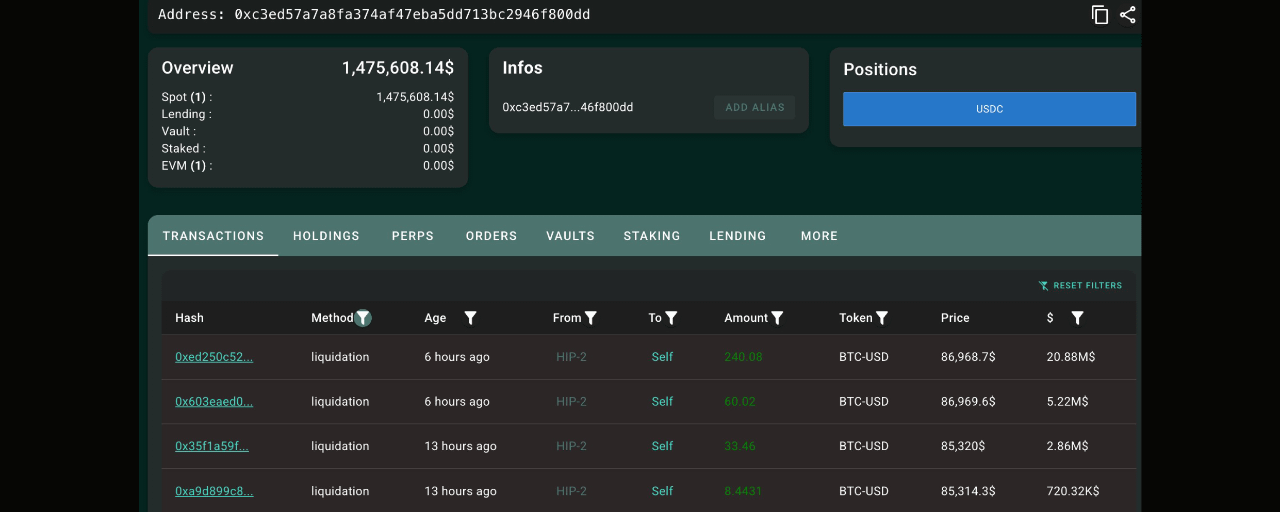
Trader Liquidated Four Times in 14 Hours as Bitcoin RisesBlockBeats reported on September 22 that a trader identified as 0xc3ed was forcibly liquidated four times in just 14 hours as Bitcoin climbed. According to BlockBeats On-chain Detection, the trader’s short position reached 375.8 Bitcoin and has now been fully wiped out.
Trader Liquidated Four Times in 14 Hours as Bitcoin Rises
BlockBeats reported on September 22 that a trader identified as 0xc3ed was forcibly liquidated four times in just 14 hours as Bitcoin climbed. According to BlockBeats On-chain Detection, the trader’s short position reached 375.8 Bitcoin and has now been fully wiped out.
3
14
40.9k
·
--
Article
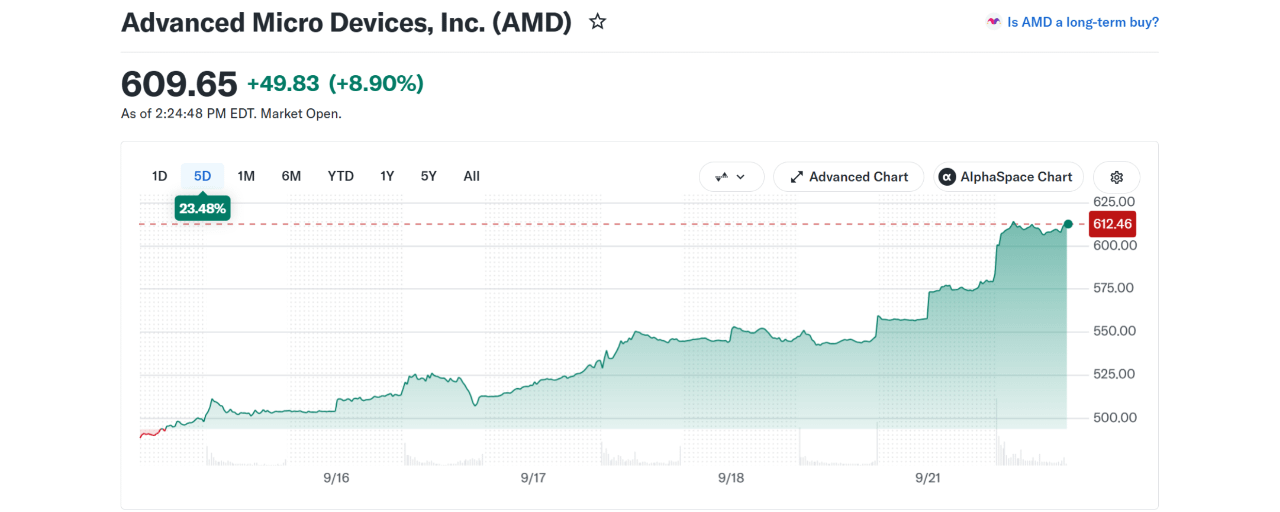
AMD Hits $1 Trillion Market Cap As Nvidia Trails AI Chip RallyAdvanced Micro Devices (AMD) touched a $1 trillion market value for the first time on Monday, peaking at $615.99 a share before easing back below that level. The stock last traded at $609.65, up over 8%, for a market capitalization of $995 billion, according to BeInCrypto, while Nvidia gained 2.33% and Intel and Arm Holdings also advanced. AMD became the fourth U.S. chipmaker valued above $1 trillion, after Nvidia, Broadcom and Micron.
Investors rotated into CPU suppliers on signs of stronger AI inference demand, while TrendForce said AMD warned customers on September 18 of price increases near 10% on AI accelerators, graphics chips and motherboard chipsets from the fourth quarter.
AMD Hits $1 Trillion Market Cap As Nvidia Trails AI Chip Rally
Advanced Micro Devices (AMD) touched a $1 trillion market value for the first time on Monday, peaking at $615.99 a share before easing back below that level. The stock last traded at $609.65, up over 8%, for a market capitalization of $995 billion, according to BeInCrypto, while Nvidia gained 2.33% and Intel and Arm Holdings also advanced. AMD became the fourth U.S. chipmaker valued above $1 trillion, after Nvidia, Broadcom and Micron.
Investors rotated into CPU suppliers on signs of stronger AI inference demand, while TrendForce said AMD warned customers on September 18 of price increases near 10% on AI accelerators, graphics chips and motherboard chipsets from the fourth quarter.
Investors rotated into CPU suppliers on signs of stronger AI inference demand, while TrendForce said AMD warned customers on September 18 of price increases near 10% on AI accelerators, graphics chips and motherboard chipsets from the fourth quarter.
6
14.3k
·
--
Replying to
Cointelegraph and 1 more
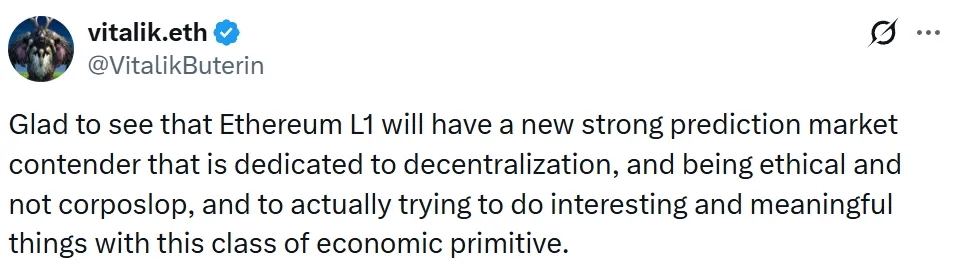
Trueo is leaving Base for Ethereum.
The prediction market platform is migrating chains, betting on bigger integrations and a next-gen oracle.
• 🎯 Post-migration priority: Attracting liquidity + rolling out next-gen oracle system
• 💡 Why Ethereum? Broader integration potential & product upside
• ⛓️ On Base: Integrations limited to the immediate ecosystem
• 📊 Current TVL: ~$795,687 — ranked 14th-largest onchain prediction market (DefiLlama)
The prediction market platform is migrating chains, betting on bigger integrations and a next-gen oracle.
• 🎯 Post-migration priority: Attracting liquidity + rolling out next-gen oracle system
• 💡 Why Ethereum? Broader integration potential & product upside
• ⛓️ On Base: Integrations limited to the immediate ecosystem
• 📊 Current TVL: ~$795,687 — ranked 14th-largest onchain prediction market (DefiLlama)
1
1.5k
·
--
US Official: Trump Open to Meeting Iranian Officials if Conditions Are RightA U.S. official familiar with the matter said U.S. President Donald Trump told advisers he would like to arrange a meeting with Iranian officials traveling to New York for the United Nations General Assembly if the conditions are right. According to Sina Finance, the official said no schedule has been finalized, and it is unclear whether Iran is willing to take part in the talks.
The official said there are internal questions about whether the proposed meeting, expected to take place on the sidelines of the General Assembly, could help the Trump administration find a way out of the U.S.-Iran war. The official also said it is unclear whether the Iranian officials attending the New York meetings have authorization from Iran's Supreme Leader Mojtaba Khamenei, who is seen as Iran's ultimate decision-maker.
Iranian Foreign Minister Abbas Araghchi and Iranian President Masoud Pezeshkian are among the members of the reduced delegation traveling to the United States for the General Assembly. U.S. Secretary of State Marco Rubio and U.S. Ambassador to the United Nations Mike Waltz both signaled that the president is open to meeting with Iran.
Rubio said on Tuesday that no meeting has been arranged, but the U.S. would welcome such talks, especially if they could produce positive results and ultimately achieve the core goal that Iran must never have nuclear weapons. Waltz said on Wednesday that Trump has always been willing to engage in dialogue.
US Official: Trump Open to Meeting Iranian Officials if Conditions Are Right
A U.S. official familiar with the matter said U.S. President Donald Trump told advisers he would like to arrange a meeting with Iranian officials traveling to New York for the United Nations General Assembly if the conditions are right. According to Sina Finance, the official said no schedule has been finalized, and it is unclear whether Iran is willing to take part in the talks.
The official said there are internal questions about whether the proposed meeting, expected to take place on the sidelines of the General Assembly, could help the Trump administration find a way out of the U.S.-Iran war. The official also said it is unclear whether the Iranian officials attending the New York meetings have authorization from Iran's Supreme Leader Mojtaba Khamenei, who is seen as Iran's ultimate decision-maker.
Iranian Foreign Minister Abbas Araghchi and Iranian President Masoud Pezeshkian are among the members of the reduced delegation traveling to the United States for the General Assembly. U.S. Secretary of State Marco Rubio and U.S. Ambassador to the United Nations Mike Waltz both signaled that the president is open to meeting with Iran.
Rubio said on Tuesday that no meeting has been arranged, but the U.S. would welcome such talks, especially if they could produce positive results and ultimately achieve the core goal that Iran must never have nuclear weapons. Waltz said on Wednesday that Trump has always been willing to engage in dialogue.
The official said there are internal questions about whether the proposed meeting, expected to take place on the sidelines of the General Assembly, could help the Trump administration find a way out of the U.S.-Iran war. The official also said it is unclear whether the Iranian officials attending the New York meetings have authorization from Iran's Supreme Leader Mojtaba Khamenei, who is seen as Iran's ultimate decision-maker.
Iranian Foreign Minister Abbas Araghchi and Iranian President Masoud Pezeshkian are among the members of the reduced delegation traveling to the United States for the General Assembly. U.S. Secretary of State Marco Rubio and U.S. Ambassador to the United Nations Mike Waltz both signaled that the president is open to meeting with Iran.
Rubio said on Tuesday that no meeting has been arranged, but the U.S. would welcome such talks, especially if they could produce positive results and ultimately achieve the core goal that Iran must never have nuclear weapons. Waltz said on Wednesday that Trump has always been willing to engage in dialogue.
3
1
2k
·
--
Binance Will Delist Seven Spot Trading Pairs and End Related Trading Bot ServicesAccording to the announcement from Binance, the exchange will remove and cease trading on seven spot trading pairs as part of its periodic review of listed markets. The affected pairs are AIXBT/USDC, DOLO/USDC, ENJ/USDC, HUMA/USDC, SXT/USDC, TNSR/USDC and TURTLE/USDC. The delisting is scheduled for 2026-09-25 03:00 (UTC). Binance said the review process is intended to protect users and maintain a high-quality trading market, and that selected pairs may be removed for reasons including poor liquidity and trading volume. The notice also states that the delisting of a spot trading pair does not affect the availability of the tokens on Binance Spot, and users may still trade the base and quote assets through other available trading pairs on the platform.
Binance also said it will terminate Spot Trading Bots services for the same spot trading pairs at 2026-09-25 03:00 (UTC) where applicable. Users were advised to update or cancel their Spot Trading Bots before the service ends to avoid potential losses. The announcement did not change the tokens’ broader availability on Binance Spot, but it confirmed that the specific pair-based trading and bot services tied to the listed markets will stop at the scheduled time. The notice was issued as a general Binance Exchange Notice and applies only to the spot trading pairs named in the announcement.
Binance Will Delist Seven Spot Trading Pairs and End Related Trading Bot Services
According to the announcement from Binance, the exchange will remove and cease trading on seven spot trading pairs as part of its periodic review of listed markets. The affected pairs are AIXBT/USDC, DOLO/USDC, ENJ/USDC, HUMA/USDC, SXT/USDC, TNSR/USDC and TURTLE/USDC. The delisting is scheduled for 2026-09-25 03:00 (UTC). Binance said the review process is intended to protect users and maintain a high-quality trading market, and that selected pairs may be removed for reasons including poor liquidity and trading volume. The notice also states that the delisting of a spot trading pair does not affect the availability of the tokens on Binance Spot, and users may still trade the base and quote assets through other available trading pairs on the platform.
Binance also said it will terminate Spot Trading Bots services for the same spot trading pairs at 2026-09-25 03:00 (UTC) where applicable. Users were advised to update or cancel their Spot Trading Bots before the service ends to avoid potential losses. The announcement did not change the tokens’ broader availability on Binance Spot, but it confirmed that the specific pair-based trading and bot services tied to the listed markets will stop at the scheduled time. The notice was issued as a general Binance Exchange Notice and applies only to the spot trading pairs named in the announcement.
Binance also said it will terminate Spot Trading Bots services for the same spot trading pairs at 2026-09-25 03:00 (UTC) where applicable. Users were advised to update or cancel their Spot Trading Bots before the service ends to avoid potential losses. The announcement did not change the tokens’ broader availability on Binance Spot, but it confirmed that the specific pair-based trading and bot services tied to the listed markets will stop at the scheduled time. The notice was issued as a general Binance Exchange Notice and applies only to the spot trading pairs named in the announcement.
5
3
17
47.7k
·
--
Bittensor Enters 'Revenue Era' as 24 to 25 Subnets Generate Commercial IncomeSubnet Summer said the August edition of its SubConnect Bittensor Revenue Index shows Bittensor has officially entered a "revenue era." According to PANews, 24 to 25 subnets are currently generating real commercial revenue, with that number expected to rise to 35 to 40 by the end of the year.
The report estimated annual ecosystem revenue at between $28 million and $35 million, and said it is expected to exceed $100 million by the end of 2026. It also said revenue is beginning to directly fund token economics, with about 14 subnets already running revenue-driven Alpha token buyback programs and that figure projected to reach 20 to 25 by year-end.
Commercial activity is concentrated in infrastructure, enterprise AI, and application AI. The report said subnet maturity is increasingly being measured by customer adoption rather than benchmark scores. It added that emissions funded Bittensor's first phase, while customers are beginning to fund the next phase.
Bittensor Enters 'Revenue Era' as 24 to 25 Subnets Generate Commercial Income
Subnet Summer said the August edition of its SubConnect Bittensor Revenue Index shows Bittensor has officially entered a "revenue era." According to PANews, 24 to 25 subnets are currently generating real commercial revenue, with that number expected to rise to 35 to 40 by the end of the year.
The report estimated annual ecosystem revenue at between $28 million and $35 million, and said it is expected to exceed $100 million by the end of 2026. It also said revenue is beginning to directly fund token economics, with about 14 subnets already running revenue-driven Alpha token buyback programs and that figure projected to reach 20 to 25 by year-end.
Commercial activity is concentrated in infrastructure, enterprise AI, and application AI. The report said subnet maturity is increasingly being measured by customer adoption rather than benchmark scores. It added that emissions funded Bittensor's first phase, while customers are beginning to fund the next phase.
The report estimated annual ecosystem revenue at between $28 million and $35 million, and said it is expected to exceed $100 million by the end of 2026. It also said revenue is beginning to directly fund token economics, with about 14 subnets already running revenue-driven Alpha token buyback programs and that figure projected to reach 20 to 25 by year-end.
Commercial activity is concentrated in infrastructure, enterprise AI, and application AI. The report said subnet maturity is increasingly being measured by customer adoption rather than benchmark scores. It added that emissions funded Bittensor's first phase, while customers are beginning to fund the next phase.
1
1
7
12.5k
·
--
ECB and EU Central Banks Oppose MiCA Rule Requiring Stablecoin Reserves in Bank DepositsEuropean Central Bank and EU national central banks said they oppose a proposal under the MiCA crypto rules that would require major stablecoin issuers to hold at least 60% of reserves in bank deposits. They said the measure could expose banks to stablecoin market volatility and weaken deposit stability. According to PANews, the central banking system suggested instead that a set share of reserve assets should be held in short-term assets maturing within one and five working days.
The central banks also said that although MiCA has taken effect, non-compliant crypto firms can still reach EU customers. They said enforcement faces major challenges and creates investor protection risks.
ECB and EU Central Banks Oppose MiCA Rule Requiring Stablecoin Reserves in Bank Deposits
European Central Bank and EU national central banks said they oppose a proposal under the MiCA crypto rules that would require major stablecoin issuers to hold at least 60% of reserves in bank deposits. They said the measure could expose banks to stablecoin market volatility and weaken deposit stability. According to PANews, the central banking system suggested instead that a set share of reserve assets should be held in short-term assets maturing within one and five working days.
The central banks also said that although MiCA has taken effect, non-compliant crypto firms can still reach EU customers. They said enforcement faces major challenges and creates investor protection risks.
The central banks also said that although MiCA has taken effect, non-compliant crypto firms can still reach EU customers. They said enforcement faces major challenges and creates investor protection risks.
3
9
6.1k
·
--
Binance Invests $100 Million in Circle and Renews USDC Partnership for Five YearsBinance Blog published a new article, announcing a $100 million equity investment in Circle Internet Group, Inc. and the renewal of their strategic partnership for a new five-year term. The updated agreement is centered on expanding USDC across Binance's global platform, with particular attention to emerging markets. Under the arrangement, Binance will lead distribution and adoption efforts, while Circle will continue providing the infrastructure services that support holding and using USDC. Binance said it purchased $100 million worth of Circle Class A common stock through a private placement at a purchase price reflecting a five percent discount to the market price of CRCL prior to closing. The move builds on the companies' existing relationship and adds a direct equity stake to their broader collaboration around the stablecoin.
Binance and Circle said the renewed partnership reflects a long-term commitment to increasing access to a stable, trusted digital dollar. Binance co-CEO Richard Teng said Circle has earned its place as one of the most credible issuers in the world spanning USDC, Arc and the infrastructure reshaping how value moves across borders. He added that the $100 million investment and five-year commitment represent long-duration conviction and support a more inclusive, transparent, and compliant digital economy. Circle co-founder, chairman and CEO Jeremy Allaire said Binance has built one of the largest and most dynamic platforms in the world for using digital currency, creating the internet's largest financial super app, and becoming the most widely used wallets in the world for dollar stablecoins. He said the companies see opportunities to use USDC to expand dollar access, support savings and investment with digital asset products, and reach people and businesses throughout global emerging markets. Circle described its platform as one of the world's leading internet financial platform companies, with services including the world's largest stablecoin network anchored by USDC, Circle Payments Network for global money movement, and Arc, an enterprise-grade blockchain designed to become the economic operating system for the internet.
Binance Invests $100 Million in Circle and Renews USDC Partnership for Five Years
Binance Blog published a new article, announcing a $100 million equity investment in Circle Internet Group, Inc. and the renewal of their strategic partnership for a new five-year term. The updated agreement is centered on expanding USDC across Binance's global platform, with particular attention to emerging markets. Under the arrangement, Binance will lead distribution and adoption efforts, while Circle will continue providing the infrastructure services that support holding and using USDC. Binance said it purchased $100 million worth of Circle Class A common stock through a private placement at a purchase price reflecting a five percent discount to the market price of CRCL prior to closing. The move builds on the companies' existing relationship and adds a direct equity stake to their broader collaboration around the stablecoin.
Binance and Circle said the renewed partnership reflects a long-term commitment to increasing access to a stable, trusted digital dollar. Binance co-CEO Richard Teng said Circle has earned its place as one of the most credible issuers in the world spanning USDC, Arc and the infrastructure reshaping how value moves across borders. He added that the $100 million investment and five-year commitment represent long-duration conviction and support a more inclusive, transparent, and compliant digital economy. Circle co-founder, chairman and CEO Jeremy Allaire said Binance has built one of the largest and most dynamic platforms in the world for using digital currency, creating the internet's largest financial super app, and becoming the most widely used wallets in the world for dollar stablecoins. He said the companies see opportunities to use USDC to expand dollar access, support savings and investment with digital asset products, and reach people and businesses throughout global emerging markets. Circle described its platform as one of the world's leading internet financial platform companies, with services including the world's largest stablecoin network anchored by USDC, Circle Payments Network for global money movement, and Arc, an enterprise-grade blockchain designed to become the economic operating system for the internet.
Binance and Circle said the renewed partnership reflects a long-term commitment to increasing access to a stable, trusted digital dollar. Binance co-CEO Richard Teng said Circle has earned its place as one of the most credible issuers in the world spanning USDC, Arc and the infrastructure reshaping how value moves across borders. He added that the $100 million investment and five-year commitment represent long-duration conviction and support a more inclusive, transparent, and compliant digital economy. Circle co-founder, chairman and CEO Jeremy Allaire said Binance has built one of the largest and most dynamic platforms in the world for using digital currency, creating the internet's largest financial super app, and becoming the most widely used wallets in the world for dollar stablecoins. He said the companies see opportunities to use USDC to expand dollar access, support savings and investment with digital asset products, and reach people and businesses throughout global emerging markets. Circle described its platform as one of the world's leading internet financial platform companies, with services including the world's largest stablecoin network anchored by USDC, Circle Payments Network for global money movement, and Arc, an enterprise-grade blockchain designed to become the economic operating system for the internet.
8
17.6k
·
--
Article
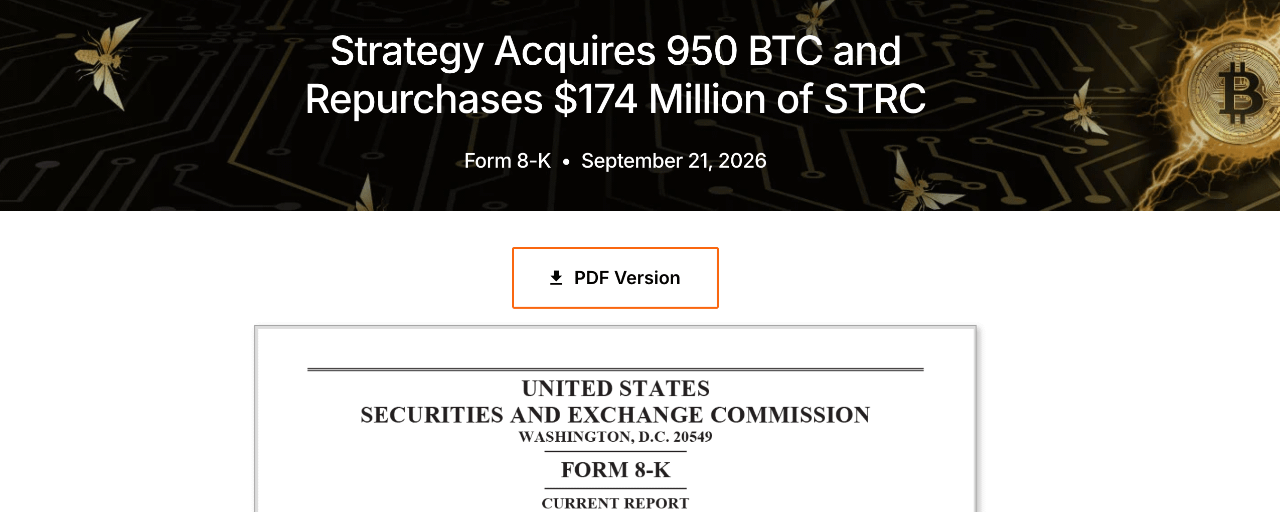
Strategy Adds 950 Bitcoin Last Week, Holdings Rise to 846,000Strategy added 950 bitcoin last week, bringing its holdings to 846,000 coins. According to Odaily, the company’s total Bitcoin holdings rose to 846,000 after the purchase.
Strategy Adds 950 Bitcoin Last Week, Holdings Rise to 846,000
Strategy added 950 bitcoin last week, bringing its holdings to 846,000 coins. According to Odaily, the company’s total Bitcoin holdings rose to 846,000 after the purchase.
1
23
51.2k
·
--
Trump Says U.S. Will Not Allow Iran to Obtain Nuclear WeaponsU.S. President Donald Trump said Iran is the world's top state sponsor of terrorism and that the United States will not allow it to obtain nuclear weapons. According to ChainCatcher, Trump said he has repeatedly urged Iran to negotiate and suggested a deal could be reached after the midterm elections.
Trump also said the United States is expanding its military protection capabilities, with ammunition reserves far above expectations, and plans to open a large ammunition factory. He added that oil flows are already at their highest level and that oil prices would fall sharply if the conflict with Iran ends.
Trump Says U.S. Will Not Allow Iran to Obtain Nuclear Weapons
U.S. President Donald Trump said Iran is the world's top state sponsor of terrorism and that the United States will not allow it to obtain nuclear weapons. According to ChainCatcher, Trump said he has repeatedly urged Iran to negotiate and suggested a deal could be reached after the midterm elections.
Trump also said the United States is expanding its military protection capabilities, with ammunition reserves far above expectations, and plans to open a large ammunition factory. He added that oil flows are already at their highest level and that oil prices would fall sharply if the conflict with Iran ends.
Trump also said the United States is expanding its military protection capabilities, with ammunition reserves far above expectations, and plans to open a large ammunition factory. He added that oil flows are already at their highest level and that oil prices would fall sharply if the conflict with Iran ends.
2
1
1k
·
--
Peter Brandt Shares XRP Chart Pointing to $5.40 as Whales AccumulateVeteran trader Peter Brandt shared a long-term XRP chart that projects an eventual move to $5.40, which would imply potential upside of 257%. According to NS3.AI, Brandt said the chart was not a trade recommendation.
Analyst Ali Martinez said XRP whales are accumulating and identified $1.60 as the next major level where profit-taking could emerge.
Peter Brandt Shares XRP Chart Pointing to $5.40 as Whales Accumulate
Veteran trader Peter Brandt shared a long-term XRP chart that projects an eventual move to $5.40, which would imply potential upside of 257%. According to NS3.AI, Brandt said the chart was not a trade recommendation.
Analyst Ali Martinez said XRP whales are accumulating and identified $1.60 as the next major level where profit-taking could emerge.
Analyst Ali Martinez said XRP whales are accumulating and identified $1.60 as the next major level where profit-taking could emerge.
1
30
55.9k
·
--
BNB Surpasses 790 USDT with a 0.06% Increase in 24 HoursOn Sep 22, 2026, 12:57 PM(UTC). According to Binance Market Data, BNB has crossed the 790 USDT benchmark and is now trading at 790.530029 USDT, with a narrowed 0.06% increase in 24 hours.
BNB Surpasses 790 USDT with a 0.06% Increase in 24 Hours
On Sep 22, 2026, 12:57 PM(UTC). According to Binance Market Data, BNB has crossed the 790 USDT benchmark and is now trading at 790.530029 USDT, with a narrowed 0.06% increase in 24 hours.
3
916
·
--
Bitwise's Europe-Listed NEAR Staking ETP Assets Exceed $100 MillionBitwise's NEAR staking exchange-traded product (ETP) launched in Europe has surpassed $100 million in assets under management. According to Foresight News, the product marks a new milestone for Bitwise's European offering.
Bitwise's Europe-Listed NEAR Staking ETP Assets Exceed $100 Million
Bitwise's NEAR staking exchange-traded product (ETP) launched in Europe has surpassed $100 million in assets under management. According to Foresight News, the product marks a new milestone for Bitwise's European offering.
1
8
8.8k
·
--
Agora Receives Preliminary OCC Approval to Form National Trust BankStablecoin issuer Agora said it has received preliminary conditional approval from the U.S. Office of the Comptroller of the Currency to form a national trust bank. According to ChainCatcher, Agora said the approval marks an early milestone on its path toward a full license and regulated stablecoin infrastructure.
Agora Receives Preliminary OCC Approval to Form National Trust Bank
Stablecoin issuer Agora said it has received preliminary conditional approval from the U.S. Office of the Comptroller of the Currency to form a national trust bank. According to ChainCatcher, Agora said the approval marks an early milestone on its path toward a full license and regulated stablecoin infrastructure.
4
2.2k
·
--
Article
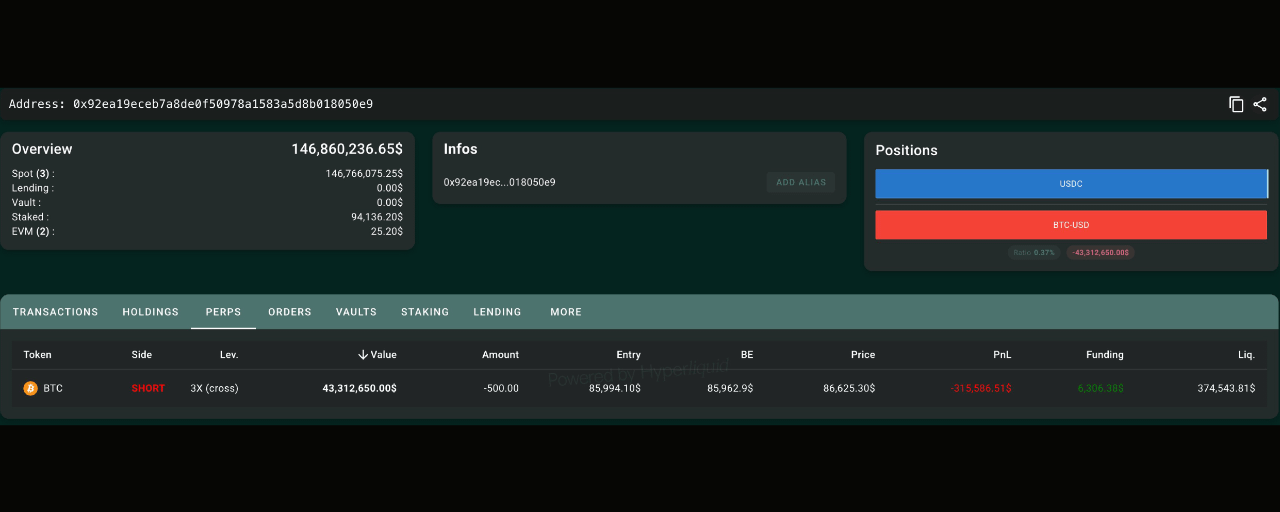
Garrett Jin Whale Closes $112 Million Bitcoin Long, Opens Short PositionA whale entity linked to Garrett Jin closed a Bitcoin long position valued at $112 million yesterday at a price of $84,455, locking in a profit of $8.38 million. According to ChainCatcher, the entity then turned bearish early today and opened a short position of 500 Bitcoin at $85,994, worth $43.31 million.
Garrett Jin Whale Closes $112 Million Bitcoin Long, Opens Short Position
A whale entity linked to Garrett Jin closed a Bitcoin long position valued at $112 million yesterday at a price of $84,455, locking in a profit of $8.38 million. According to ChainCatcher, the entity then turned bearish early today and opened a short position of 500 Bitcoin at $85,994, worth $43.31 million.
2
10
45.7k
·
--
Bonk Guy's Token Holdings Fall to About $16.6 Million After Peaking at $27.59 MillionBlockBeats reported on September 22 that well-known trader Bonk Guy currently holds tokens worth about $16.6 million, down roughly $11 million from a peak of $27.59 million on September 6. According to BlockBeats On-chain Detection, his top three spot holdings are PONS, USELESS, and MARSCOIN.
Bonk Guy's Token Holdings Fall to About $16.6 Million After Peaking at $27.59 Million
BlockBeats reported on September 22 that well-known trader Bonk Guy currently holds tokens worth about $16.6 million, down roughly $11 million from a peak of $27.59 million on September 6. According to BlockBeats On-chain Detection, his top three spot holdings are PONS, USELESS, and MARSCOIN.
1
6
14.1k
·
--
PEPE Rises 20% as Analyst Cites Inverse Head and Shoulders PatternPEPE rose 20% over 24 hours, outpacing Bitcoin and XRP, while traders watched whether FLOKI would break higher. According to NS3.AI, analyst Lana Valentis said PEPE was forming an inverse head and shoulders pattern and cited target levels from $0.00000455 to $0.00001.
FLOKI was flat on Tuesday after rising 10% the previous day and reached the 200-day EMA at $0.0000293.
PEPE Rises 20% as Analyst Cites Inverse Head and Shoulders Pattern
PEPE rose 20% over 24 hours, outpacing Bitcoin and XRP, while traders watched whether FLOKI would break higher. According to NS3.AI, analyst Lana Valentis said PEPE was forming an inverse head and shoulders pattern and cited target levels from $0.00000455 to $0.00001.
FLOKI was flat on Tuesday after rising 10% the previous day and reached the 200-day EMA at $0.0000293.
FLOKI was flat on Tuesday after rising 10% the previous day and reached the 200-day EMA at $0.0000293.
2
5
10.1k
·
--
BNB Drops Below 790 USDT with a Narrowed 0.48% Increase in 24 HoursOn Sep 22, 2026, 01:44 AM(UTC). According to Binance Market Data, BNB has dropped below 790 USDT and is now trading at 786.98999 USDT, with a narrowed narrowed 0.48% increase in 24 hours.
BNB Drops Below 790 USDT with a Narrowed 0.48% Increase in 24 Hours
On Sep 22, 2026, 01:44 AM(UTC). According to Binance Market Data, BNB has dropped below 790 USDT and is now trading at 786.98999 USDT, with a narrowed narrowed 0.48% increase in 24 hours.
6
8.7k
·
--
Trueo to Migrate From Base to Ethereum MainnetDecentralized prediction market Trueo said it will migrate from Base to the Ethereum mainnet. According to Foresight News, the team said the move is based on Ethereum's network effects and integration potential, not Base's positioning.
The migration will not interrupt the application, and the roadmap will remain unchanged. Trueo also urged users not to create new markets on Base with expiration dates later than January 31, 2027, while new markets expiring before January remain unaffected.
Trading, settlement, and redemption will continue, and TYD will keep earning yield during the transition period. Base markets that remain unexpired after the migration can still be accessed in the official app and will continue to use the existing settlement system.
The protocol token will remain TRUE, and holders can migrate to Ethereum with no deadline. Future staking and liquidity incentives will take place on Ethereum.
Trueo to Migrate From Base to Ethereum Mainnet
Decentralized prediction market Trueo said it will migrate from Base to the Ethereum mainnet. According to Foresight News, the team said the move is based on Ethereum's network effects and integration potential, not Base's positioning.
The migration will not interrupt the application, and the roadmap will remain unchanged. Trueo also urged users not to create new markets on Base with expiration dates later than January 31, 2027, while new markets expiring before January remain unaffected.
Trading, settlement, and redemption will continue, and TYD will keep earning yield during the transition period. Base markets that remain unexpired after the migration can still be accessed in the official app and will continue to use the existing settlement system.
The protocol token will remain TRUE, and holders can migrate to Ethereum with no deadline. Future staking and liquidity incentives will take place on Ethereum.
The migration will not interrupt the application, and the roadmap will remain unchanged. Trueo also urged users not to create new markets on Base with expiration dates later than January 31, 2027, while new markets expiring before January remain unaffected.
Trading, settlement, and redemption will continue, and TYD will keep earning yield during the transition period. Base markets that remain unexpired after the migration can still be accessed in the official app and will continue to use the existing settlement system.
The protocol token will remain TRUE, and holders can migrate to Ethereum with no deadline. Future staking and liquidity incentives will take place on Ethereum.
2
1.9k
·
--
MUBARAK Rises More Than 66% Over the Past 24 HoursMeme coin MUBARAK rose more than 66% over the past 24 hours and was trading at $0.0582. According to Odaily, its market capitalization increased to more than $58 million.
MUBARAK Rises More Than 66% Over the Past 24 Hours
Meme coin MUBARAK rose more than 66% over the past 24 hours and was trading at $0.0582. According to Odaily, its market capitalization increased to more than $58 million.
1
5
26.5k
·
--

Article
BitMine Adds 27,562 Ether as Tom Lee Sees Higher Institutional Crypto Exposure in Final Three Months of 2026BitMine bought another 27,562 ether last week and now holds 5.98 million tokens worth about $16.3 billion. According to NS3.AI, Chairman Tom Lee said institutions will substantially increase their crypto exposure in the final three months of 2026.
BitMine's $17.1 billion in crypto, cash and private stakes now exceeds its $15.68 billion market value.
BitMine Adds 27,562 Ether as Tom Lee Sees Higher Institutional Crypto Exposure in Final Three Months of 2026
BitMine bought another 27,562 ether last week and now holds 5.98 million tokens worth about $16.3 billion. According to NS3.AI, Chairman Tom Lee said institutions will substantially increase their crypto exposure in the final three months of 2026.
BitMine's $17.1 billion in crypto, cash and private stakes now exceeds its $15.68 billion market value.
BitMine's $17.1 billion in crypto, cash and private stakes now exceeds its $15.68 billion market value.
16
43.3k
·
--
Nvidia to Buy Another $1.5 Billion of SB Energy Shares Before IPONvidia Corp. is buying an additional $1.5 billion of shares in SB Energy Inc., a data center provider backed by SoftBank Group Corp., ahead of the company’s US initial public offering, according to Bloomberg.
Nvidia to Buy Another $1.5 Billion of SB Energy Shares Before IPO
Nvidia Corp. is buying an additional $1.5 billion of shares in SB Energy Inc., a data center provider backed by SoftBank Group Corp., ahead of the company’s US initial public offering, according to Bloomberg.
1
1
9
19.2k
·
--
Mystery Whale Swaps 200.71 Bitcoin for 6,247 Ethereum, Lookonchain SaysA mystery whale has again exchanged 200.71 Bitcoin for 6,247 Ethereum, according to Lookonchain monitoring. According to ChainCatcher, the transaction was valued at about $17.2 million.
Over the past six days, the same whale has swapped a total of 1,308 Bitcoin for 40,670 Ethereum, with a combined value of about $104 million, and has staked all of the ETH received.
Mystery Whale Swaps 200.71 Bitcoin for 6,247 Ethereum, Lookonchain Says
A mystery whale has again exchanged 200.71 Bitcoin for 6,247 Ethereum, according to Lookonchain monitoring. According to ChainCatcher, the transaction was valued at about $17.2 million.
Over the past six days, the same whale has swapped a total of 1,308 Bitcoin for 40,670 Ethereum, with a combined value of about $104 million, and has staked all of the ETH received.
Over the past six days, the same whale has swapped a total of 1,308 Bitcoin for 40,670 Ethereum, with a combined value of about $104 million, and has staked all of the ETH received.
2
2
13
21.4k
·
--
Bitwise CEO Says Solana Staking ETF BSOL Tops $60 Million in Two-Day InflowsBitwise CEO said on X that Bitwise Solana Staking ETF BSOL recorded more than $60 million in inflows over the past two days. According to Odaily, the fund’s assets under management have exceeded $1.2 billion and reached a record high.
Bitwise CEO Says Solana Staking ETF BSOL Tops $60 Million in Two-Day Inflows
Bitwise CEO said on X that Bitwise Solana Staking ETF BSOL recorded more than $60 million in inflows over the past two days. According to Odaily, the fund’s assets under management have exceeded $1.2 billion and reached a record high.
4
4.1k
·
--
Sonic Labs CEO Says Manual Token Issuance Will End, Third-Party Audit of S Supply to BeginForesight News posted on X (formerly Twitter). Sonic Labs CEO Matt Visser said the team has completed its business handover and will reorganize departments while separating technical commercialization work around the public blockchain. He said version V2.2 was launched today and adds bundled transactions, an expanded transaction guarantee mechanism, higher smart contract limits, and a new execution engine.
Visser said the company will continue focusing on Layer 1 development, on-chain financial activity, and commercializing underlying technology. SonicVM and SonicDB can be licensed externally and are not dependent on the crypto cycle. He said the company has four business lines: payment and foreign exchange channels, AI, RWA and tokenization, and prediction market infrastructure. Perpetual contracts will no longer be pursued as a separate line of business.
Regarding the S token, Visser said no new minting will take place in the future and all manual issuance increases will be canceled, leaving only automatic emissions used to pay validators. He also said an independent third party has been commissioned to audit the S supply and related reports, with results expected within weeks.
On personnel changes, Brandon Topham will oversee finance and compliance, Melvin Tan will handle Asia-Pacific business, and Charles Elliman will serve as an Africa growth adviser.
Sonic Labs CEO Says Manual Token Issuance Will End, Third-Party Audit of S Supply to Begin
Foresight News posted on X (formerly Twitter). Sonic Labs CEO Matt Visser said the team has completed its business handover and will reorganize departments while separating technical commercialization work around the public blockchain. He said version V2.2 was launched today and adds bundled transactions, an expanded transaction guarantee mechanism, higher smart contract limits, and a new execution engine.
Visser said the company will continue focusing on Layer 1 development, on-chain financial activity, and commercializing underlying technology. SonicVM and SonicDB can be licensed externally and are not dependent on the crypto cycle. He said the company has four business lines: payment and foreign exchange channels, AI, RWA and tokenization, and prediction market infrastructure. Perpetual contracts will no longer be pursued as a separate line of business.
Regarding the S token, Visser said no new minting will take place in the future and all manual issuance increases will be canceled, leaving only automatic emissions used to pay validators. He also said an independent third party has been commissioned to audit the S supply and related reports, with results expected within weeks.
On personnel changes, Brandon Topham will oversee finance and compliance, Melvin Tan will handle Asia-Pacific business, and Charles Elliman will serve as an Africa growth adviser.
Visser said the company will continue focusing on Layer 1 development, on-chain financial activity, and commercializing underlying technology. SonicVM and SonicDB can be licensed externally and are not dependent on the crypto cycle. He said the company has four business lines: payment and foreign exchange channels, AI, RWA and tokenization, and prediction market infrastructure. Perpetual contracts will no longer be pursued as a separate line of business.
Regarding the S token, Visser said no new minting will take place in the future and all manual issuance increases will be canceled, leaving only automatic emissions used to pay validators. He also said an independent third party has been commissioned to audit the S supply and related reports, with results expected within weeks.
On personnel changes, Brandon Topham will oversee finance and compliance, Melvin Tan will handle Asia-Pacific business, and Charles Elliman will serve as an Africa growth adviser.
1
14
8.3k
·
--
AI TRENDS | BVNK Adds Stellar Support for Large and Sub-Cent PaymentsStablecoin service provider BVNK has added support for Stellar, allowing users to make large payments or small payments of less than one cent through a single API. According to Foresight News, the integration is designed to let users use Stellar for both high-value transfers and very small transactions.
AI TRENDS | BVNK Adds Stellar Support for Large and Sub-Cent Payments
Stablecoin service provider BVNK has added support for Stellar, allowing users to make large payments or small payments of less than one cent through a single API. According to Foresight News, the integration is designed to let users use Stellar for both high-value transfers and very small transactions.
1.9k
·
--
Pyth Becomes External Distributor of Nasdaq Basic U.S. Stock Quotes and TradesPyth has become an external distributor of Nasdaq Basic, Nasdaq's proprietary real-time U.S. stock quote and trade product. According to Foresight News, customers of the Pyth data market can now buy licenses directly from Nasdaq to access Nasdaq Basic data through Pyth.
Any customer that wants to use Pyth as its Nasdaq Basic data provider must obtain Nasdaq's written approval before using Nasdaq basic market data. Nasdaq Basic covers all securities listed on U.S. exchanges, regardless of where they are listed.
The product also provides Nasdaq official open and close prices, which are reference prices derived from Nasdaq's opening, closing, and IPO or trading halt cross points. Many institutions use these prices to assess the value of positions at the start and end of the trading day.
Pyth Becomes External Distributor of Nasdaq Basic U.S. Stock Quotes and Trades
Pyth has become an external distributor of Nasdaq Basic, Nasdaq's proprietary real-time U.S. stock quote and trade product. According to Foresight News, customers of the Pyth data market can now buy licenses directly from Nasdaq to access Nasdaq Basic data through Pyth.
Any customer that wants to use Pyth as its Nasdaq Basic data provider must obtain Nasdaq's written approval before using Nasdaq basic market data. Nasdaq Basic covers all securities listed on U.S. exchanges, regardless of where they are listed.
The product also provides Nasdaq official open and close prices, which are reference prices derived from Nasdaq's opening, closing, and IPO or trading halt cross points. Many institutions use these prices to assess the value of positions at the start and end of the trading day.
Any customer that wants to use Pyth as its Nasdaq Basic data provider must obtain Nasdaq's written approval before using Nasdaq basic market data. Nasdaq Basic covers all securities listed on U.S. exchanges, regardless of where they are listed.
The product also provides Nasdaq official open and close prices, which are reference prices derived from Nasdaq's opening, closing, and IPO or trading halt cross points. Many institutions use these prices to assess the value of positions at the start and end of the trading day.
1.8k
·
--
Frax Finance Launches frxUSD on Robinhood ChainForesight News reported that stablecoin issuer Frax Finance said it has launched on Robinhood Chain. According to Foresight News, the first frxUSD integration is the frxUSD/aUSD pool, developed in partnership with Arrow Finance.
Frax Finance Launches frxUSD on Robinhood Chain
Foresight News reported that stablecoin issuer Frax Finance said it has launched on Robinhood Chain. According to Foresight News, the first frxUSD integration is the frxUSD/aUSD pool, developed in partnership with Arrow Finance.
1
4
4.3k
·
--
Bitcoin(BTC) Drops Below 86,000 USDT with a Narrowed 2.30% Increase in 24 HoursOn Sep 22, 2026, 09:04 AM(UTC). According to Binance Market Data, Bitcoin has dropped below 86,000 USDT and is now trading at 85,807.617188 USDT, with a narrowed narrowed 2.30% increase in 24 hours.
Bitcoin(BTC) Drops Below 86,000 USDT with a Narrowed 2.30% Increase in 24 Hours
On Sep 22, 2026, 09:04 AM(UTC). According to Binance Market Data, Bitcoin has dropped below 86,000 USDT and is now trading at 85,807.617188 USDT, with a narrowed narrowed 2.30% increase in 24 hours.
3
5
5.9k
Filter
Most Searched (6H)
USDT