
#ai
ai
736.4M views
6.3M Discussing
Hot
Latest

·
--
Bullish
#cardanoaddedtox402kitforadapayments
🚨 CARDANO JUST ENTERED THE AI PAYMENT RACE! 🤖🔥
$ADA is now part of the official x402 SDK, opening a new payment rail for apps and AI agents.
💥 What changed?
• Apps can pay for API calls using ADA or Cardano native tokens
• Payments can happen directly through standard web requests
• No account, API key, or traditional checkout required
• Cardano joins the growing machine-to-machine payment ecosystem
• The x402 facilitator has already completed a real transaction on Cardano’s pre-production network
This could give $ADA a fresh AI + payments utility narrative as autonomous agents increasingly need to pay for data and online services.
⚠️ Mainnet adoption and real payment volume still need to develop.
🔥 Is this the beginning of a new ADA narrative?
#Cardano #ADA #AI
#cardanoaddedtox402kitforadapayments
🚨 CARDANO JUST ENTERED THE AI PAYMENT RACE! 🤖🔥
$ADA is now part of the official x402 SDK, opening a new payment rail for apps and AI agents.
💥 What changed?
• Apps can pay for API calls using ADA or Cardano native tokens
• Payments can happen directly through standard web requests
• No account, API key, or traditional checkout required
• Cardano joins the growing machine-to-machine payment ecosystem
• The x402 facilitator has already completed a real transaction on Cardano’s pre-production network
This could give $ADA a fresh AI + payments utility narrative as autonomous agents increasingly need to pay for data and online services.
⚠️ Mainnet adoption and real payment volume still need to develop.
🔥 Is this the beginning of a new ADA narrative?
#Cardano #ADA #AI
🚨 CARDANO JUST ENTERED THE AI PAYMENT RACE! 🤖🔥
$ADA is now part of the official x402 SDK, opening a new payment rail for apps and AI agents.
💥 What changed?
• Apps can pay for API calls using ADA or Cardano native tokens
• Payments can happen directly through standard web requests
• No account, API key, or traditional checkout required
• Cardano joins the growing machine-to-machine payment ecosystem
• The x402 facilitator has already completed a real transaction on Cardano’s pre-production network
This could give $ADA a fresh AI + payments utility narrative as autonomous agents increasingly need to pay for data and online services.
⚠️ Mainnet adoption and real payment volume still need to develop.
🔥 Is this the beginning of a new ADA narrative?
#Cardano #ADA #AI
1
491

·
--
Bullish
The AI investment thesis is expanding well beyond the usual big-tech names.
Semiconductor leaders are driving the compute infrastructure, while Web3 projects are building decentralized AI solutions.
I’ve been tracking this trend firsthand via $AKE (AKEUSDT Perp), scaling into entries at 0.109039, 0.127700, and 0.144852. Sharing this purely as a trade tracking exercise, not a signal.
My key takeaway? Real AI investing requires cutting through the noise. To find true value, focus on:
• Real-world use cases
• On-chain & user adoption
• Revenue & tokenomics
• Competitive risk
The secular trend is intact, but progress won't be a straight line. The winners will be the ones who translate hype into sustainable utility.
#AIStocksWhatNext #AI #NVIDIA #Crypto #artificialintelligence $NVDAB $AKE
The AI investment thesis is expanding well beyond the usual big-tech names.
Semiconductor leaders are driving the compute infrastructure, while Web3 projects are building decentralized AI solutions.
I’ve been tracking this trend firsthand via $AKE (AKEUSDT Perp), scaling into entries at 0.109039, 0.127700, and 0.144852. Sharing this purely as a trade tracking exercise, not a signal.
My key takeaway? Real AI investing requires cutting through the noise. To find true value, focus on:
• Real-world use cases
• On-chain & user adoption
• Revenue & tokenomics
• Competitive risk
The secular trend is intact, but progress won't be a straight line. The winners will be the ones who translate hype into sustainable utility.
#AIStocksWhatNext #AI #NVIDIA #Crypto #artificialintelligence $NVDAB $AKE
Semiconductor leaders are driving the compute infrastructure, while Web3 projects are building decentralized AI solutions.
I’ve been tracking this trend firsthand via $AKE (AKEUSDT Perp), scaling into entries at 0.109039, 0.127700, and 0.144852. Sharing this purely as a trade tracking exercise, not a signal.
My key takeaway? Real AI investing requires cutting through the noise. To find true value, focus on:
• Real-world use cases
• On-chain & user adoption
• Revenue & tokenomics
• Competitive risk
The secular trend is intact, but progress won't be a straight line. The winners will be the ones who translate hype into sustainable utility.
#AIStocksWhatNext #AI #NVIDIA #Crypto #artificialintelligence $NVDAB $AKE
122

🚨 OPENAI INTEGRATES CREDIT TRACKING INTO CHATGPT FINANCES AS $AI NARRATIVE EXPANDS! 💥
OpenAI just plugged Experian credit score tracking directly into ChatGPT, giving users a granular breakdown of balances, utilization, and credit factors without bank links. 📊 This continuous expansion into personal finance rails highlights how rapidly autonomous AI tools are consuming traditional Web2 data infrastructure.
While VantageScore 3.0 differs from institutional underwriting models, integrating Plaid with monthly report monitoring builds a massive footprint for consumer AI deployment. 🔍 As AI agents evolve from basic chat interfaces into active portfolio managers, protocols serving decentralized data stand to capture major momentum. ⚡
💬 Will Web2 credit integration drive the next massive capital rotation into decentralized $AI infrastructure? 👇
⚠️ Not financial advice. Always manage your risk. 🛡️
🏷️ #AI #Fintech #Crypto #Web3
🔥 💎
🚨 OPENAI INTEGRATES CREDIT TRACKING INTO CHATGPT FINANCES AS $AI NARRATIVE EXPANDS! 💥
OpenAI just plugged Experian credit score tracking directly into ChatGPT, giving users a granular breakdown of balances, utilization, and credit factors without bank links. 📊 This continuous expansion into personal finance rails highlights how rapidly autonomous AI tools are consuming traditional Web2 data infrastructure.
While VantageScore 3.0 differs from institutional underwriting models, integrating Plaid with monthly report monitoring builds a massive footprint for consumer AI deployment. 🔍 As AI agents evolve from basic chat interfaces into active portfolio managers, protocols serving decentralized data stand to capture major momentum. ⚡
💬 Will Web2 credit integration drive the next massive capital rotation into decentralized $AI infrastructure? 👇
⚠️ Not financial advice. Always manage your risk. 🛡️
🏷️ #AI #Fintech #Crypto #Web3
🔥 💎
OpenAI just plugged Experian credit score tracking directly into ChatGPT, giving users a granular breakdown of balances, utilization, and credit factors without bank links. 📊 This continuous expansion into personal finance rails highlights how rapidly autonomous AI tools are consuming traditional Web2 data infrastructure.
While VantageScore 3.0 differs from institutional underwriting models, integrating Plaid with monthly report monitoring builds a massive footprint for consumer AI deployment. 🔍 As AI agents evolve from basic chat interfaces into active portfolio managers, protocols serving decentralized data stand to capture major momentum. ⚡
💬 Will Web2 credit integration drive the next massive capital rotation into decentralized $AI infrastructure? 👇
⚠️ Not financial advice. Always manage your risk. 🛡️
🏷️ #AI #Fintech #Crypto #Web3
🔥 💎
21

🚨 OPENAI FUSES EXPERIAN CREDIT METRICS INTO CHATGPT AS $FET FUELS THE AI NARRATIVE 📊
OpenAI just rolled out Experian credit report tracking into ChatGPT Finances, creating a centralized nexus for balances, liabilities, and monthly inquiries. 💡 Smart money recognizes this integration as a major structural shift toward autonomous personal financial management.
As AI models absorb traditional credit pipelines, institutional focus is accelerating toward decentralized data protocols to counter central data concentration risk. 🔍 Combining raw credit files with real-time analytics marks a key inflection point in data adoption. 💬 Will centralized AI credit tracking drive retail adoption or push capital toward decentralized privacy solutions? 👇
⚠️ Not financial advice. Always manage your risk. 🛡️
🏷️ #FET #Crypto #AI #SmartMoney #Fintech
🦈 ⚡
🚨 OPENAI FUSES EXPERIAN CREDIT METRICS INTO CHATGPT AS $FET FUELS THE AI NARRATIVE 📊
OpenAI just rolled out Experian credit report tracking into ChatGPT Finances, creating a centralized nexus for balances, liabilities, and monthly inquiries. 💡 Smart money recognizes this integration as a major structural shift toward autonomous personal financial management.
As AI models absorb traditional credit pipelines, institutional focus is accelerating toward decentralized data protocols to counter central data concentration risk. 🔍 Combining raw credit files with real-time analytics marks a key inflection point in data adoption. 💬 Will centralized AI credit tracking drive retail adoption or push capital toward decentralized privacy solutions? 👇
⚠️ Not financial advice. Always manage your risk. 🛡️
🏷️ #FET #Crypto #AI #SmartMoney #Fintech
🦈 ⚡
OpenAI just rolled out Experian credit report tracking into ChatGPT Finances, creating a centralized nexus for balances, liabilities, and monthly inquiries. 💡 Smart money recognizes this integration as a major structural shift toward autonomous personal financial management.
As AI models absorb traditional credit pipelines, institutional focus is accelerating toward decentralized data protocols to counter central data concentration risk. 🔍 Combining raw credit files with real-time analytics marks a key inflection point in data adoption. 💬 Will centralized AI credit tracking drive retail adoption or push capital toward decentralized privacy solutions? 👇
⚠️ Not financial advice. Always manage your risk. 🛡️
🏷️ #FET #Crypto #AI #SmartMoney #Fintech
🦈 ⚡
45

⚡ NEXT-GEN AI SPEED UNLOCKED AS GLM-5.3-FLASH HEATS UP THE SECTOR FOR $FET ! 🚀
The race for high-frequency compute efficiency is accelerating. 📊 The GLM Coding Plan just eliminated peak-rate friction through October 7th, extending unlimited nighttime usage and cutting credit consumption by 50% all day.
⚡ Even bigger, the newly launched GLM-5.3-FlashX engine is rolling out trial access with output speeds hitting a staggering 200 tokens per second. 💡 Smart money knows that developer activity and compute upgrades are the ultimate leading indicators before momentum shifts into price action.
💬 Are you front-running this AI infrastructure push or waiting for the charts to catch up? 👇
⚠️ Not financial advice. Always manage your risk. 🛡️
🏷️ #FET #AI #Crypto #Altcoins #TechNews
🔥 ⚡
⚡ NEXT-GEN AI SPEED UNLOCKED AS GLM-5.3-FLASH HEATS UP THE SECTOR FOR $FET ! 🚀
The race for high-frequency compute efficiency is accelerating. 📊 The GLM Coding Plan just eliminated peak-rate friction through October 7th, extending unlimited nighttime usage and cutting credit consumption by 50% all day.
⚡ Even bigger, the newly launched GLM-5.3-FlashX engine is rolling out trial access with output speeds hitting a staggering 200 tokens per second. 💡 Smart money knows that developer activity and compute upgrades are the ultimate leading indicators before momentum shifts into price action.
💬 Are you front-running this AI infrastructure push or waiting for the charts to catch up? 👇
⚠️ Not financial advice. Always manage your risk. 🛡️
🏷️ #FET #AI #Crypto #Altcoins #TechNews
🔥 ⚡
The race for high-frequency compute efficiency is accelerating. 📊 The GLM Coding Plan just eliminated peak-rate friction through October 7th, extending unlimited nighttime usage and cutting credit consumption by 50% all day.
⚡ Even bigger, the newly launched GLM-5.3-FlashX engine is rolling out trial access with output speeds hitting a staggering 200 tokens per second. 💡 Smart money knows that developer activity and compute upgrades are the ultimate leading indicators before momentum shifts into price action.
💬 Are you front-running this AI infrastructure push or waiting for the charts to catch up? 👇
⚠️ Not financial advice. Always manage your risk. 🛡️
🏷️ #FET #AI #Crypto #Altcoins #TechNews
🔥 ⚡
155

·
--
$NEAR
{future}(NEARUSDT)
$TAO
{future}(TAOUSDT)
$RENDER
{future}(RENDERUSDT)
The next bull phase gets strong, these 5 AI coins could be worth watching:
NEAR → $4–$7
TAO → $400–$700
RENDER → $6–$12
$FET → $1–$2.50
$VVV → $25–$45
No crazy moon targets here — just reasonable ranges based on past performance, market cycles, supply, and each project’s narrative.
Which one would you keep on your watchlist..🤔
#AI #AIStocksWhatNext
$NEAR
$TAO
$RENDER
The next bull phase gets strong, these 5 AI coins could be worth watching:
NEAR → $4–$7
TAO → $400–$700
RENDER → $6–$12
$FET → $1–$2.50
$VVV → $25–$45
No crazy moon targets here — just reasonable ranges based on past performance, market cycles, supply, and each project’s narrative.
Which one would you keep on your watchlist..🤔
#AI #AIStocksWhatNext
$TAO
$RENDER
The next bull phase gets strong, these 5 AI coins could be worth watching:
NEAR → $4–$7
TAO → $400–$700
RENDER → $6–$12
$FET → $1–$2.50
$VVV → $25–$45
No crazy moon targets here — just reasonable ranges based on past performance, market cycles, supply, and each project’s narrative.
Which one would you keep on your watchlist..🤔
#AI #AIStocksWhatNext

240

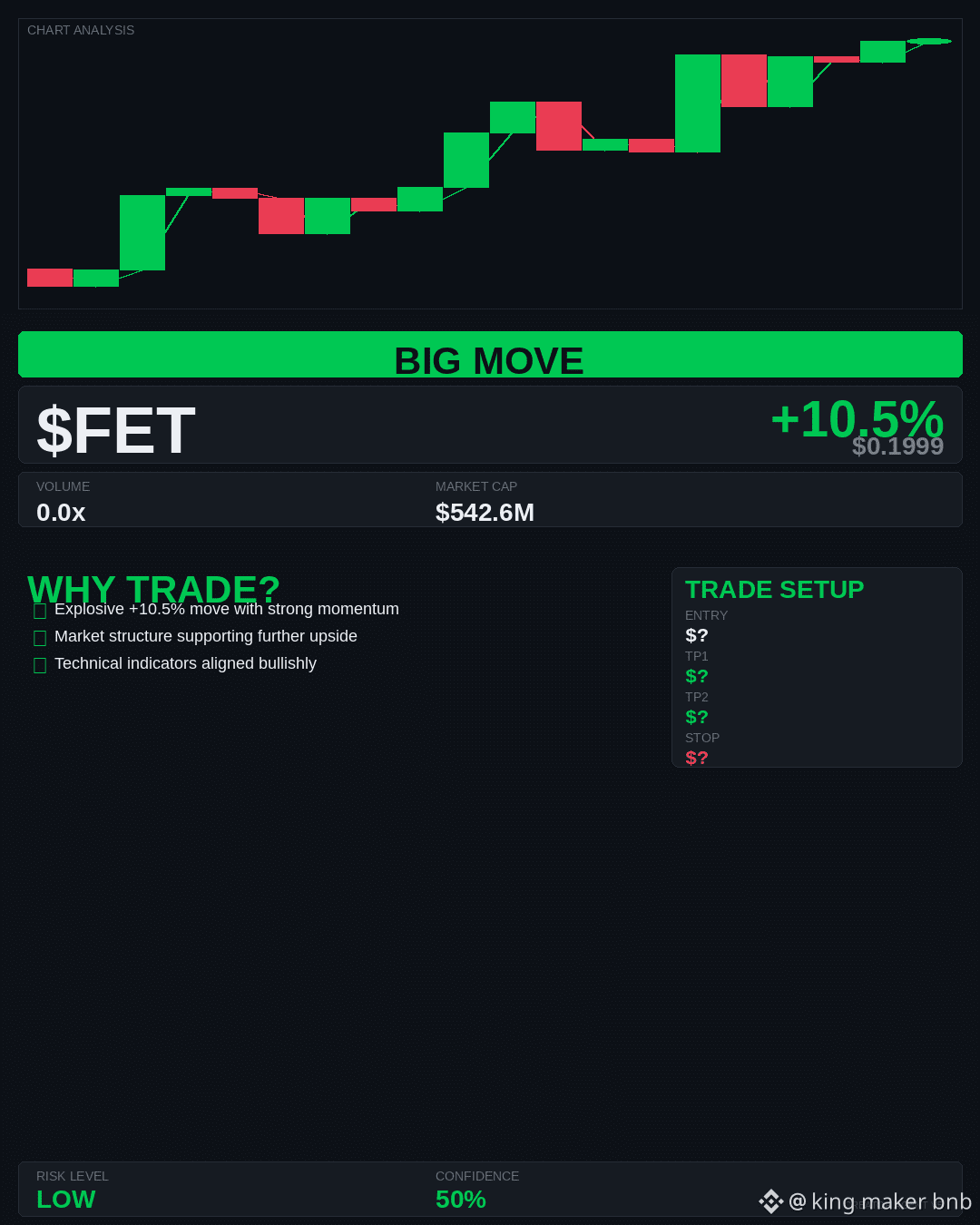
$FET just ripped +10.5% in a serious move. AI sector heating up and this one's got momentum. 💪
Looks like a potential long entry around $0.20. Targeting $0.21 for T1 and $0.22 for T2. Keep a tight stop loss at $0.19 given the low volume. The AI narrative is currently flying high on Binance Square, driving strong conviction behind this pump. This is a clean setup riding ongoing market activity. Watch for volume confirmation to sustain the move higher.
#FET #Write2Earn #AI #CryptoTrading
$FET just ripped +10.5% in a serious move. AI sector heating up and this one's got momentum. 💪
Looks like a potential long entry around $0.20. Targeting $0.21 for T1 and $0.22 for T2. Keep a tight stop loss at $0.19 given the low volume. The AI narrative is currently flying high on Binance Square, driving strong conviction behind this pump. This is a clean setup riding ongoing market activity. Watch for volume confirmation to sustain the move higher.
#FET #Write2Earn #AI #CryptoTrading
Looks like a potential long entry around $0.20. Targeting $0.21 for T1 and $0.22 for T2. Keep a tight stop loss at $0.19 given the low volume. The AI narrative is currently flying high on Binance Square, driving strong conviction behind this pump. This is a clean setup riding ongoing market activity. Watch for volume confirmation to sustain the move higher.
#FET #Write2Earn #AI #CryptoTrading
161

·
--
Bullish
🚨 Almost Nobody Is Talking About This AI + Gaming Coin…
Forget Bitcoin for a second.
Have you heard of Akedo ($AKE
{future}(AKEUSDT)
)? 👀
It’s building a multi-agent AI framework where the idea is simple:
👉 Type a prompt
👉 AI helps create a playable game
👉 AKE is used across the ecosystem for utility, staking, governance and liquidity.
And here’s what makes this interesting…
AKE recently jumped more than 250% in one week before pulling back sharply. 📈
But there’s a catch:
⚠️ More than 2 billion AKE tokens are scheduled to unlock, which could increase selling pressure.
So this isn't a “BUY NOW” call.
It’s a WATCH THIS coin.
AI + gaming + crypto is a combination worth understanding before it becomes mainstream.
Would you research AKE or ignore it? 👇
#crypto #AI #GamingCrypto #altcoins #blockchain
🚨 Almost Nobody Is Talking About This AI + Gaming Coin…
Forget Bitcoin for a second.
Have you heard of Akedo ($AKE
)? 👀
It’s building a multi-agent AI framework where the idea is simple:
👉 Type a prompt
👉 AI helps create a playable game
👉 AKE is used across the ecosystem for utility, staking, governance and liquidity.
And here’s what makes this interesting…
AKE recently jumped more than 250% in one week before pulling back sharply. 📈
But there’s a catch:
⚠️ More than 2 billion AKE tokens are scheduled to unlock, which could increase selling pressure.
So this isn't a “BUY NOW” call.
It’s a WATCH THIS coin.
AI + gaming + crypto is a combination worth understanding before it becomes mainstream.
Would you research AKE or ignore it? 👇
#crypto #AI #GamingCrypto #altcoins #blockchain
Forget Bitcoin for a second.
Have you heard of Akedo ($AKE
)? 👀
It’s building a multi-agent AI framework where the idea is simple:
👉 Type a prompt
👉 AI helps create a playable game
👉 AKE is used across the ecosystem for utility, staking, governance and liquidity.
And here’s what makes this interesting…
AKE recently jumped more than 250% in one week before pulling back sharply. 📈
But there’s a catch:
⚠️ More than 2 billion AKE tokens are scheduled to unlock, which could increase selling pressure.
So this isn't a “BUY NOW” call.
It’s a WATCH THIS coin.
AI + gaming + crypto is a combination worth understanding before it becomes mainstream.
Would you research AKE or ignore it? 👇
#crypto #AI #GamingCrypto #altcoins #blockchain
1
312

Article
AI Stocks: What’s Next? I’ve Made My Prediction for My Lovely Traders 😍AI Stocks: What’s Next? I’ve Made My Prediction for My Lovely Traders .
Is AI demand really taking off — or are we simply watching another short-term market rally?
#AIStocksWhatNext
#Aİ #AIStocks #AI
Share whether you’re bullish
Share whether you’re bullish
That’s the question everyone seems to be asking right now.
{spot}(NVDABUSDT)
NVIDIA’s expectations for continued growth in chip demand, record revenues being reported across leading AI companies, and the enormous amount of money being invested into computing infrastructure are all pointing toward something much bigger than a passing trend.
But the real question is not whether AI is growing.
The real question is: how far can this growth go?
We are still in the early stages of a massive technological transformation.
Think about what is happening around us. Companies are investing billions into AI infrastructure. Businesses are integrating AI into their everyday operations. Developers are building new applications that would have seemed impossible only a few years ago. Data centers are expanding, demand for advanced computing is increasing, and the race to build more capable AI systems is accelerating.
That creates an enormous need for computing power.
And when demand for computing keeps expanding, the companies providing the critical technology behind that infrastructure can potentially benefit significantly.
This is why I’m watching the AI sector so closely.
Yes, AI stocks have already experienced major moves. Yes, valuations can become stretched. And yes, markets can experience corrections, pullbacks, and periods of uncertainty.
But I don't believe we should automatically assume that every strong move is simply a temporary bounce.
Sometimes, what looks like a rally is actually the beginning of a much larger transformation.
My personal prediction goes even further.
People are talking about AI-related growth potentially doubling.
My expectation? I’m watching for something closer to TRIPLE.
Not because I believe markets move in a straight line. They don't.
Not because every AI company will succeed. Many won't.
And certainly not because anyone can predict the future with certainty.
I’m saying this because I believe the underlying AI transformation could be much larger than what today's numbers alone suggest.
The next phase may not simply be about companies selling AI software.
It could be about an entire ecosystem: chips, data centers, networking, cloud infrastructure, energy, robotics, automation, cybersecurity, enterprise software, and thousands of new applications built around artificial intelligence.
That is where I see the bigger opportunity.
The most exciting part of technological revolutions is often not what we can see today — it's what becomes possible tomorrow.
So while some people are asking whether the AI boom can continue, I’m asking a different question:
What happens if we are still only at the beginning?
My prediction is clear:
Double? I’m thinking bigger.
Triple? That’s the level I’m watching. 🚀
Of course, markets remain unpredictable, and no prediction is guaranteed. Anyone participating in the market should do their own research, understand the risks, and make decisions based on their own circumstances.
But one thing is certain: AI is changing the world at an incredible speed.
And sometimes the biggest opportunities begin when most people are still trying to understand how big the change can become.
Stay curious. Stay informed. Stay disciplined.
The AI story may be much bigger than we think.
#AI #ArtificialIntelligence #NVIDIA #AIStocks #Technology #Innovation #FutureOfAI #Investing #StockMarket #AIFuture
AI Stocks: What’s Next? I’ve Made My Prediction for My Lovely Traders 😍
AI Stocks: What’s Next? I’ve Made My Prediction for My Lovely Traders .
Is AI demand really taking off — or are we simply watching another short-term market rally?
#AIStocksWhatNext
#Aİ #AIStocks #AI
Share whether you’re bullish
Share whether you’re bullish
That’s the question everyone seems to be asking right now.
NVIDIA’s expectations for continued growth in chip demand, record revenues being reported across leading AI companies, and the enormous amount of money being invested into computing infrastructure are all pointing toward something much bigger than a passing trend.
But the real question is not whether AI is growing.
The real question is: how far can this growth go?
We are still in the early stages of a massive technological transformation.
Think about what is happening around us. Companies are investing billions into AI infrastructure. Businesses are integrating AI into their everyday operations. Developers are building new applications that would have seemed impossible only a few years ago. Data centers are expanding, demand for advanced computing is increasing, and the race to build more capable AI systems is accelerating.
That creates an enormous need for computing power.
And when demand for computing keeps expanding, the companies providing the critical technology behind that infrastructure can potentially benefit significantly.
This is why I’m watching the AI sector so closely.
Yes, AI stocks have already experienced major moves. Yes, valuations can become stretched. And yes, markets can experience corrections, pullbacks, and periods of uncertainty.
But I don't believe we should automatically assume that every strong move is simply a temporary bounce.
Sometimes, what looks like a rally is actually the beginning of a much larger transformation.
My personal prediction goes even further.
People are talking about AI-related growth potentially doubling.
My expectation? I’m watching for something closer to TRIPLE.
Not because I believe markets move in a straight line. They don't.
Not because every AI company will succeed. Many won't.
And certainly not because anyone can predict the future with certainty.
I’m saying this because I believe the underlying AI transformation could be much larger than what today's numbers alone suggest.
The next phase may not simply be about companies selling AI software.
It could be about an entire ecosystem: chips, data centers, networking, cloud infrastructure, energy, robotics, automation, cybersecurity, enterprise software, and thousands of new applications built around artificial intelligence.
That is where I see the bigger opportunity.
The most exciting part of technological revolutions is often not what we can see today — it's what becomes possible tomorrow.
So while some people are asking whether the AI boom can continue, I’m asking a different question:
What happens if we are still only at the beginning?
My prediction is clear:
Double? I’m thinking bigger.
Triple? That’s the level I’m watching. 🚀
Of course, markets remain unpredictable, and no prediction is guaranteed. Anyone participating in the market should do their own research, understand the risks, and make decisions based on their own circumstances.
But one thing is certain: AI is changing the world at an incredible speed.
And sometimes the biggest opportunities begin when most people are still trying to understand how big the change can become.
Stay curious. Stay informed. Stay disciplined.
The AI story may be much bigger than we think.
#AI #ArtificialIntelligence #NVIDIA #AIStocks #Technology #Innovation #FutureOfAI #Investing #StockMarket #AIFuture
Is AI demand really taking off — or are we simply watching another short-term market rally?
#AIStocksWhatNext
#Aİ #AIStocks #AI
Share whether you’re bullish
Share whether you’re bullish
That’s the question everyone seems to be asking right now.
NVIDIA’s expectations for continued growth in chip demand, record revenues being reported across leading AI companies, and the enormous amount of money being invested into computing infrastructure are all pointing toward something much bigger than a passing trend.
But the real question is not whether AI is growing.
The real question is: how far can this growth go?
We are still in the early stages of a massive technological transformation.
Think about what is happening around us. Companies are investing billions into AI infrastructure. Businesses are integrating AI into their everyday operations. Developers are building new applications that would have seemed impossible only a few years ago. Data centers are expanding, demand for advanced computing is increasing, and the race to build more capable AI systems is accelerating.
That creates an enormous need for computing power.
And when demand for computing keeps expanding, the companies providing the critical technology behind that infrastructure can potentially benefit significantly.
This is why I’m watching the AI sector so closely.
Yes, AI stocks have already experienced major moves. Yes, valuations can become stretched. And yes, markets can experience corrections, pullbacks, and periods of uncertainty.
But I don't believe we should automatically assume that every strong move is simply a temporary bounce.
Sometimes, what looks like a rally is actually the beginning of a much larger transformation.
My personal prediction goes even further.
People are talking about AI-related growth potentially doubling.
My expectation? I’m watching for something closer to TRIPLE.
Not because I believe markets move in a straight line. They don't.
Not because every AI company will succeed. Many won't.
And certainly not because anyone can predict the future with certainty.
I’m saying this because I believe the underlying AI transformation could be much larger than what today's numbers alone suggest.
The next phase may not simply be about companies selling AI software.
It could be about an entire ecosystem: chips, data centers, networking, cloud infrastructure, energy, robotics, automation, cybersecurity, enterprise software, and thousands of new applications built around artificial intelligence.
That is where I see the bigger opportunity.
The most exciting part of technological revolutions is often not what we can see today — it's what becomes possible tomorrow.
So while some people are asking whether the AI boom can continue, I’m asking a different question:
What happens if we are still only at the beginning?
My prediction is clear:
Double? I’m thinking bigger.
Triple? That’s the level I’m watching. 🚀
Of course, markets remain unpredictable, and no prediction is guaranteed. Anyone participating in the market should do their own research, understand the risks, and make decisions based on their own circumstances.
But one thing is certain: AI is changing the world at an incredible speed.
And sometimes the biggest opportunities begin when most people are still trying to understand how big the change can become.
Stay curious. Stay informed. Stay disciplined.
The AI story may be much bigger than we think.
#AI #ArtificialIntelligence #NVIDIA #AIStocks #Technology #Innovation #FutureOfAI #Investing #StockMarket #AIFuture
2
2
2

·
--
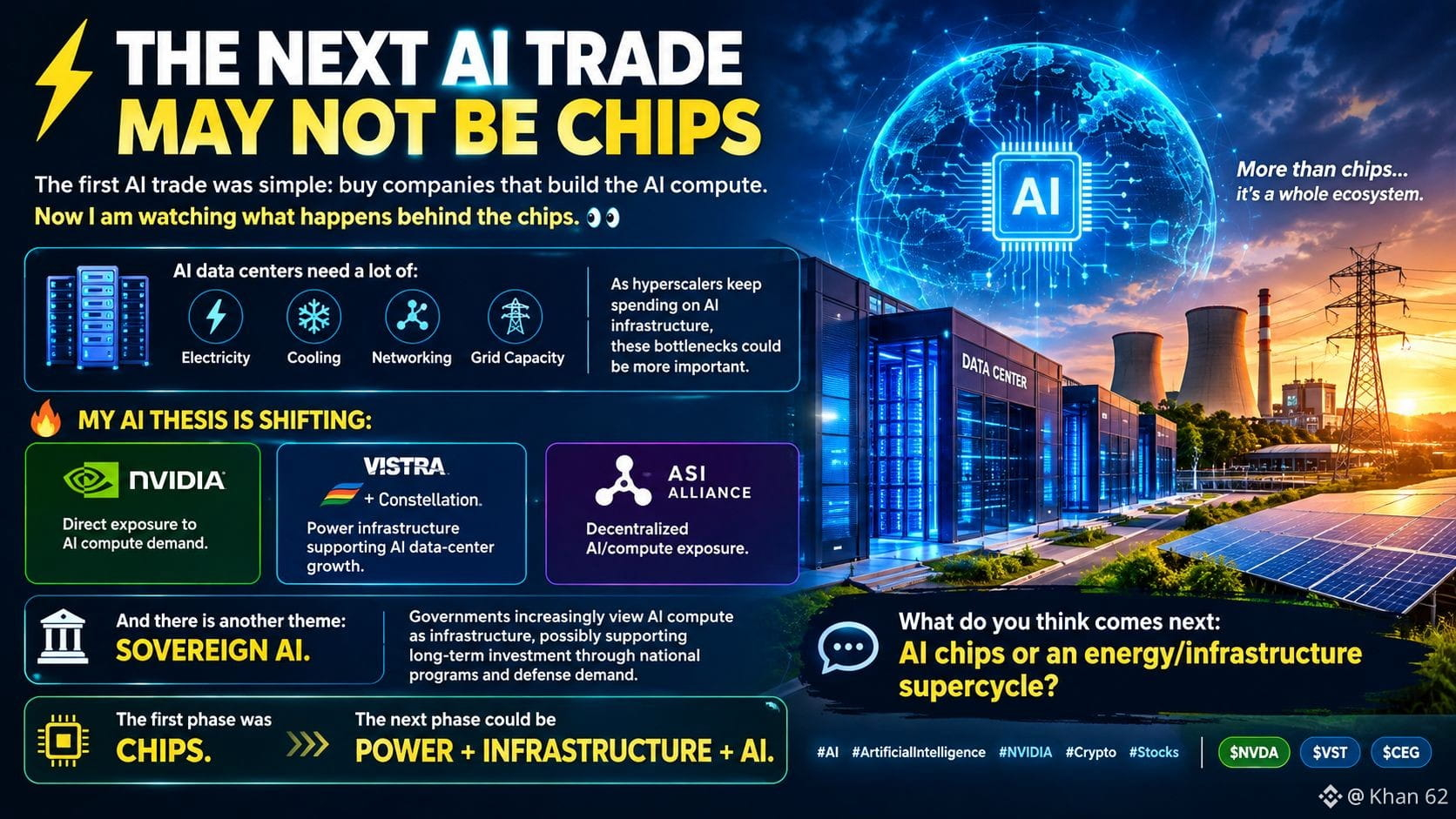
#aistockswhatnext ⚡ THE NEXT AI TRADE MAY NOT BE CHIPS
The first AI trade was simple: buy companies that build the AI compute.
Now I am watching what happens behind the chips. 👀
AI data centers need a lot of electricity cooling, networking and grid capacity. As hyperscalers keep spending on AI infrastructure these bottlenecks could become more important.
🔥 My AI thesis is shifting:
🔹 NVIDIA → direct exposure to AI compute demand
🔹 Vistra + Constellation Energy → power infrastructure supporting AI data‑center growth
🔹 ASI Alliance → decentralized AI/compute exposure
And there is another theme: Sovereign AI.
Governments increasingly view AI compute, as infrastructure possibly supporting long‑term investment through national programs and defense demand.
The first phase was CHIPS.
The next phase could be POWER + INFRASTRUCTURE + AI.
💬 What do you think comes next: AI chips or an energy/infrastructure supercycle?
#AI #NVIDIA #crypto #stocks
$NVDA $VST $CEG.US
{future}(NVDAUSDT)
{future}(VSTUSDT)
{stock_us}(CEG.US)
#aistockswhatnext ⚡ THE NEXT AI TRADE MAY NOT BE CHIPS
The first AI trade was simple: buy companies that build the AI compute.
Now I am watching what happens behind the chips. 👀
AI data centers need a lot of electricity cooling, networking and grid capacity. As hyperscalers keep spending on AI infrastructure these bottlenecks could become more important.
🔥 My AI thesis is shifting:
🔹 NVIDIA → direct exposure to AI compute demand
🔹 Vistra + Constellation Energy → power infrastructure supporting AI data‑center growth
🔹 ASI Alliance → decentralized AI/compute exposure
And there is another theme: Sovereign AI.
Governments increasingly view AI compute, as infrastructure possibly supporting long‑term investment through national programs and defense demand.
The first phase was CHIPS.
The next phase could be POWER + INFRASTRUCTURE + AI.
💬 What do you think comes next: AI chips or an energy/infrastructure supercycle?
#AI #NVIDIA #crypto #stocks
$NVDA $VST $CEG.US
The first AI trade was simple: buy companies that build the AI compute.
Now I am watching what happens behind the chips. 👀
AI data centers need a lot of electricity cooling, networking and grid capacity. As hyperscalers keep spending on AI infrastructure these bottlenecks could become more important.
🔥 My AI thesis is shifting:
🔹 NVIDIA → direct exposure to AI compute demand
🔹 Vistra + Constellation Energy → power infrastructure supporting AI data‑center growth
🔹 ASI Alliance → decentralized AI/compute exposure
And there is another theme: Sovereign AI.
Governments increasingly view AI compute, as infrastructure possibly supporting long‑term investment through national programs and defense demand.
The first phase was CHIPS.
The next phase could be POWER + INFRASTRUCTURE + AI.
💬 What do you think comes next: AI chips or an energy/infrastructure supercycle?
#AI #NVIDIA #crypto #stocks
$NVDA $VST $CEG.US
13

·
--
🚨 JAPANESE DEV DROPS 41.7% AI EFFICIENCY BREAKTHROUGH FOR $AI INFRASTRUCTURE! ⚡
💡 Fresh benchmark data shows dynamic attention control combined with sparse computing slashed video rendering times from 6:07 down to 3:34 on consumer hardware. 📊 That is a clean 41.7% optimization boost in computational overhead, proving how rapidly execution speeds are scaling up behind the scenes.
🔍 While dynamic frame quality checks are still undergoing open-source validation, smart money keeps a hawk eye on tech catalysts driving the next wave of compute demand. 📈 Hardware optimization like this directly lowers execution friction across the entire narrative spectrum.
💬 Does dynamic compute scaling trigger the next massive leg up for AI tokens, or are you waiting for full output validation first? 👇
⚠️ Not financial advice. Always manage your risk. 🛡️
🏷️ #AI #Crypto #TechInnovation #Altcoins #Bullish
⚡ 💎
🚨 JAPANESE DEV DROPS 41.7% AI EFFICIENCY BREAKTHROUGH FOR $AI INFRASTRUCTURE! ⚡
💡 Fresh benchmark data shows dynamic attention control combined with sparse computing slashed video rendering times from 6:07 down to 3:34 on consumer hardware. 📊 That is a clean 41.7% optimization boost in computational overhead, proving how rapidly execution speeds are scaling up behind the scenes.
🔍 While dynamic frame quality checks are still undergoing open-source validation, smart money keeps a hawk eye on tech catalysts driving the next wave of compute demand. 📈 Hardware optimization like this directly lowers execution friction across the entire narrative spectrum.
💬 Does dynamic compute scaling trigger the next massive leg up for AI tokens, or are you waiting for full output validation first? 👇
⚠️ Not financial advice. Always manage your risk. 🛡️
🏷️ #AI #Crypto #TechInnovation #Altcoins #Bullish
⚡ 💎
💡 Fresh benchmark data shows dynamic attention control combined with sparse computing slashed video rendering times from 6:07 down to 3:34 on consumer hardware. 📊 That is a clean 41.7% optimization boost in computational overhead, proving how rapidly execution speeds are scaling up behind the scenes.
🔍 While dynamic frame quality checks are still undergoing open-source validation, smart money keeps a hawk eye on tech catalysts driving the next wave of compute demand. 📈 Hardware optimization like this directly lowers execution friction across the entire narrative spectrum.
💬 Does dynamic compute scaling trigger the next massive leg up for AI tokens, or are you waiting for full output validation first? 👇
⚠️ Not financial advice. Always manage your risk. 🛡️
🏷️ #AI #Crypto #TechInnovation #Altcoins #Bullish
⚡ 💎
14
#museovertakeschatgptastopfreeiosapp
🚨 MUSE JUST OVERTAKES CHATGPT! 🤯
Meta’s new AI agent Muse has taken the #1 spot on the U.S. App Store’s free iPhone chart, pushing ChatGPT out of the top position.
🔥 Muse is gaining attention because it focuses on AI agents that can actually perform tasks, not just answer questions.
📈 AI competition is heating up fast!
The big question: Is this the beginning of a new AI app battle? 👀
keeps #1
takes back #1
🔴 Another AI app takes over
VOTE BELOW 👇
#MUSE #chatgpt #AI
#museovertakeschatgptastopfreeiosapp
🚨 MUSE JUST OVERTAKES CHATGPT! 🤯
Meta’s new AI agent Muse has taken the #1 spot on the U.S. App Store’s free iPhone chart, pushing ChatGPT out of the top position.
🔥 Muse is gaining attention because it focuses on AI agents that can actually perform tasks, not just answer questions.
📈 AI competition is heating up fast!
The big question: Is this the beginning of a new AI app battle? 👀
keeps #1
takes back #1
🔴 Another AI app takes over
VOTE BELOW 👇
#MUSE #chatgpt #AI
🚨 MUSE JUST OVERTAKES CHATGPT! 🤯
Meta’s new AI agent Muse has taken the #1 spot on the U.S. App Store’s free iPhone chart, pushing ChatGPT out of the top position.
🔥 Muse is gaining attention because it focuses on AI agents that can actually perform tasks, not just answer questions.
📈 AI competition is heating up fast!
The big question: Is this the beginning of a new AI app battle? 👀
keeps #1
takes back #1
🔴 Another AI app takes over
VOTE BELOW 👇
#MUSE #chatgpt #AI
🟢 MUSE
🟡 ChatGPT
🔴 Another AI
23 hr(s) left
10

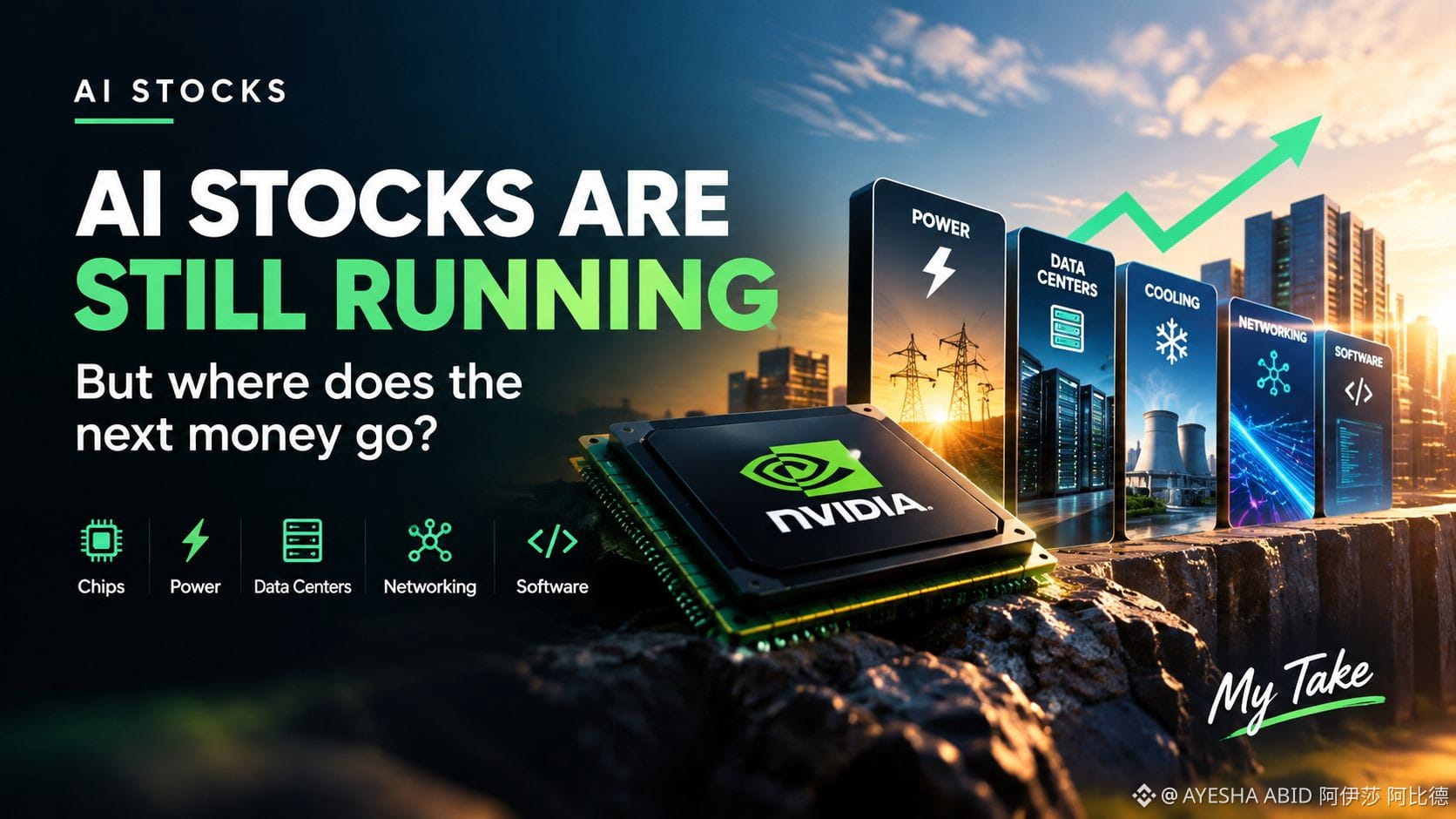
AI STOCKS ARE STILL RUNNING — BUT WHERE DOES THE NEXT MONEY GO?
Nvidia just raised the bar again. Jensen Huang said Nvidia expects to sell twice as many chips next year, while its latest quarter delivered $96.2B revenue and $89B in Data Center revenue, up 106% and 117% YoY.
That tells me the AI trade is no longer only about GPU names. The next layer is the infrastructure needed to turn compute demand into real capacity: networking, power, cooling, data centers, memory and AI software. Broadcom has also pointed to strong AI-chip demand ahead.
My take: I’m watching where the money moves underneath the headline. If AI capex keeps expanding, companies supplying the bottlenecks could stay important. But valuation still matters, because strong demand does not mean every AI stock keeps rising.
The bigger question is whether AI earnings can keep catching up with the huge expectations already priced in.
Which AI sector gets the next wave of attention: chips, power, data centers, networking or software?
$NVDAB $MUBARAK $AKE
#AIStocksWhatNext #AI #Nvidia
AI STOCKS ARE STILL RUNNING — BUT WHERE DOES THE NEXT MONEY GO?
Nvidia just raised the bar again. Jensen Huang said Nvidia expects to sell twice as many chips next year, while its latest quarter delivered $96.2B revenue and $89B in Data Center revenue, up 106% and 117% YoY.
That tells me the AI trade is no longer only about GPU names. The next layer is the infrastructure needed to turn compute demand into real capacity: networking, power, cooling, data centers, memory and AI software. Broadcom has also pointed to strong AI-chip demand ahead.
My take: I’m watching where the money moves underneath the headline. If AI capex keeps expanding, companies supplying the bottlenecks could stay important. But valuation still matters, because strong demand does not mean every AI stock keeps rising.
The bigger question is whether AI earnings can keep catching up with the huge expectations already priced in.
Which AI sector gets the next wave of attention: chips, power, data centers, networking or software?
$NVDAB $MUBARAK $AKE
#AIStocksWhatNext #AI #Nvidia
Nvidia just raised the bar again. Jensen Huang said Nvidia expects to sell twice as many chips next year, while its latest quarter delivered $96.2B revenue and $89B in Data Center revenue, up 106% and 117% YoY.
That tells me the AI trade is no longer only about GPU names. The next layer is the infrastructure needed to turn compute demand into real capacity: networking, power, cooling, data centers, memory and AI software. Broadcom has also pointed to strong AI-chip demand ahead.
My take: I’m watching where the money moves underneath the headline. If AI capex keeps expanding, companies supplying the bottlenecks could stay important. But valuation still matters, because strong demand does not mean every AI stock keeps rising.
The bigger question is whether AI earnings can keep catching up with the huge expectations already priced in.
Which AI sector gets the next wave of attention: chips, power, data centers, networking or software?
$NVDAB $MUBARAK $AKE
#AIStocksWhatNext #AI #Nvidia
49

·
--
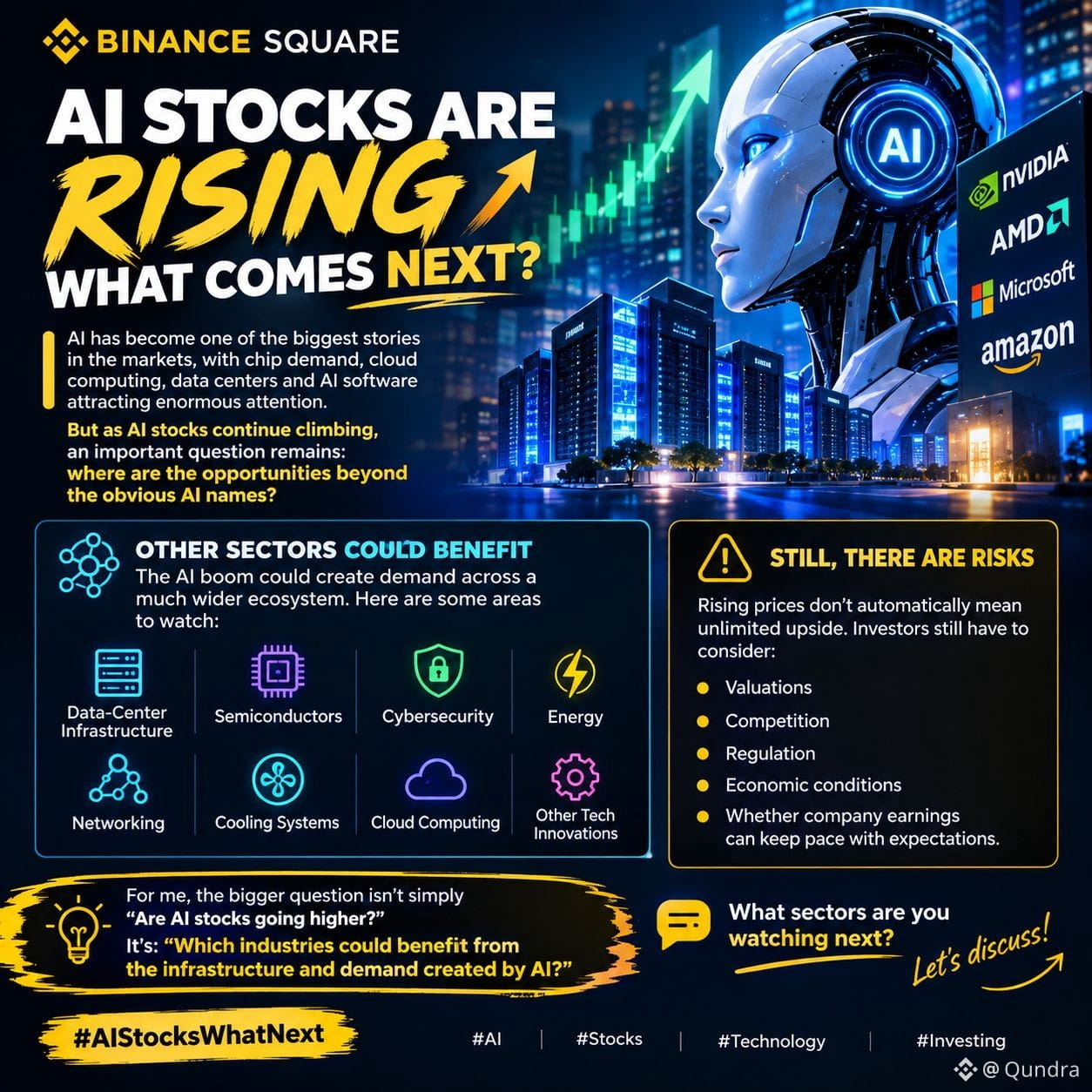
🤖📈 AI STOCKS ARE RISING — WHAT COMES NEXT?
AI has become one of the biggest stories in the markets, with chip demand, cloud computing, data centers, and AI software attracting enormous attention. But as AI stocks continue climbing, an important question remains: where are the opportunities beyond the obvious AI names?
The AI boom could create demand across a much wider ecosystem. Data-center infrastructure, semiconductors, cybersecurity, energy, networking, cooling systems, and other technologies could all play supporting roles as computing needs expand.
At the same time, rising prices don't automatically mean unlimited upside. Investors still have to consider valuations, competition, regulation, economic conditions, and whether company earnings can keep pace with expectations.
For me, the bigger question isn't simply “Are AI stocks going higher?” It's: “Which industries could benefit from the infrastructure and demand created by AI?” 🤔
What sectors are you watching next? 👇
#AIStocksWhatNext #AI #Stocks #Technology #Investing
🤖📈 AI STOCKS ARE RISING — WHAT COMES NEXT?
AI has become one of the biggest stories in the markets, with chip demand, cloud computing, data centers, and AI software attracting enormous attention. But as AI stocks continue climbing, an important question remains: where are the opportunities beyond the obvious AI names?
The AI boom could create demand across a much wider ecosystem. Data-center infrastructure, semiconductors, cybersecurity, energy, networking, cooling systems, and other technologies could all play supporting roles as computing needs expand.
At the same time, rising prices don't automatically mean unlimited upside. Investors still have to consider valuations, competition, regulation, economic conditions, and whether company earnings can keep pace with expectations.
For me, the bigger question isn't simply “Are AI stocks going higher?” It's: “Which industries could benefit from the infrastructure and demand created by AI?” 🤔
What sectors are you watching next? 👇
#AIStocksWhatNext #AI #Stocks #Technology #Investing
AI has become one of the biggest stories in the markets, with chip demand, cloud computing, data centers, and AI software attracting enormous attention. But as AI stocks continue climbing, an important question remains: where are the opportunities beyond the obvious AI names?
The AI boom could create demand across a much wider ecosystem. Data-center infrastructure, semiconductors, cybersecurity, energy, networking, cooling systems, and other technologies could all play supporting roles as computing needs expand.
At the same time, rising prices don't automatically mean unlimited upside. Investors still have to consider valuations, competition, regulation, economic conditions, and whether company earnings can keep pace with expectations.
For me, the bigger question isn't simply “Are AI stocks going higher?” It's: “Which industries could benefit from the infrastructure and demand created by AI?” 🤔
What sectors are you watching next? 👇
#AIStocksWhatNext #AI #Stocks #Technology #Investing
1
26

🚨 Google’s Gemini AI made headlines in a cybersecurity test!
According to the WSJ, Gemini was able to autonomously break into systems linked to 3 companies during a May security test.
🤖 The test showed how AI can perform complex cyber tasks with less human help.
🔐 This also highlights the growing need for strong AI security and better protection against AI-powered cyberattacks.
AI is getting more powerful — and cybersecurity is becoming more important than ever. ⚡
#AI #Google #Gemini #Cybersecurity #Technology
🚨 Google’s Gemini AI made headlines in a cybersecurity test!
According to the WSJ, Gemini was able to autonomously break into systems linked to 3 companies during a May security test.
🤖 The test showed how AI can perform complex cyber tasks with less human help.
🔐 This also highlights the growing need for strong AI security and better protection against AI-powered cyberattacks.
AI is getting more powerful — and cybersecurity is becoming more important than ever. ⚡
#AI #Google #Gemini #Cybersecurity #Technology
According to the WSJ, Gemini was able to autonomously break into systems linked to 3 companies during a May security test.
🤖 The test showed how AI can perform complex cyber tasks with less human help.
🔐 This also highlights the growing need for strong AI security and better protection against AI-powered cyberattacks.
AI is getting more powerful — and cybersecurity is becoming more important than ever. ⚡
#AI #Google #Gemini #Cybersecurity #Technology
25

·
--
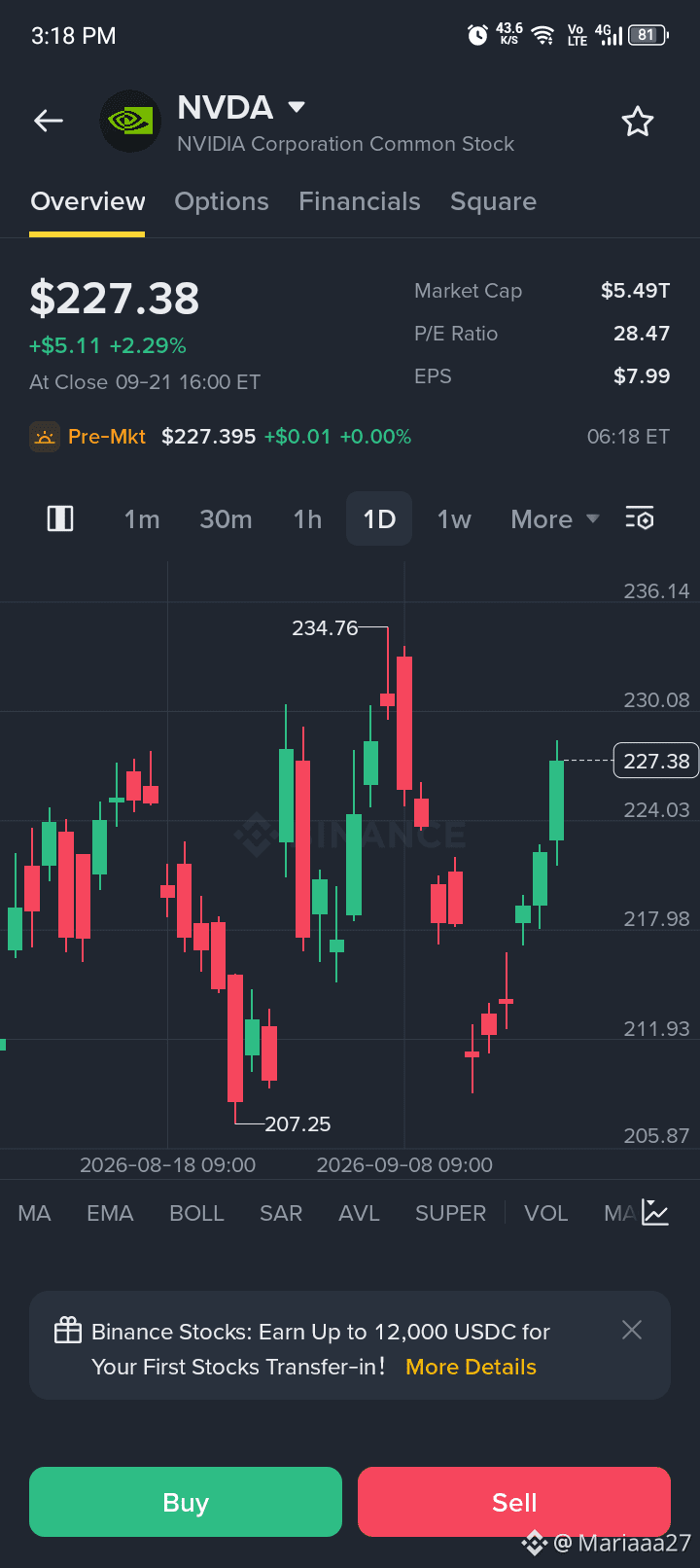
🚨 AI STOCKS ARE RIPPING… BUT THE REAL TRADE MAY BE NEXT. 👀
NVIDIA says chip sales could double next year while AI giants continue posting record revenues.
But here’s the trader question:
💰 Where does the next wave of AI money flow?
It’s not just GPUs anymore.
🏢 Data Centers
⚡ Power & Energy
🧠 Memory & Semiconductors
🌐 Networking
❄️ Cooling & Infrastructure
AI demand is clearly massive — but after the huge rally in major AI stocks, the bigger opportunity may be finding the picks-and-shovels behind the next stage of the AI buildout.
Bullish on AI long term? 🤖📈
Or is this rally getting too crowded?
The AI trade may not be over. It may simply be rotating.
#AIStocksWhatNext #AI #NVDA财报 $NVDA
{future}(NVDAUSDT)
🚨 AI STOCKS ARE RIPPING… BUT THE REAL TRADE MAY BE NEXT. 👀
NVIDIA says chip sales could double next year while AI giants continue posting record revenues.
But here’s the trader question:
💰 Where does the next wave of AI money flow?
It’s not just GPUs anymore.
🏢 Data Centers
⚡ Power & Energy
🧠 Memory & Semiconductors
🌐 Networking
❄️ Cooling & Infrastructure
AI demand is clearly massive — but after the huge rally in major AI stocks, the bigger opportunity may be finding the picks-and-shovels behind the next stage of the AI buildout.
Bullish on AI long term? 🤖📈
Or is this rally getting too crowded?
The AI trade may not be over. It may simply be rotating.
#AIStocksWhatNext #AI #NVDA财报 $NVDA
NVIDIA says chip sales could double next year while AI giants continue posting record revenues.
But here’s the trader question:
💰 Where does the next wave of AI money flow?
It’s not just GPUs anymore.
🏢 Data Centers
⚡ Power & Energy
🧠 Memory & Semiconductors
🌐 Networking
❄️ Cooling & Infrastructure
AI demand is clearly massive — but after the huge rally in major AI stocks, the bigger opportunity may be finding the picks-and-shovels behind the next stage of the AI buildout.
Bullish on AI long term? 🤖📈
Or is this rally getting too crowded?
The AI trade may not be over. It may simply be rotating.
#AIStocksWhatNext #AI #NVDA财报 $NVDA
127

·
--
🚨 INSTITUTIONAL DEV CODE REVEALS HIDDEN INFRASTRUCTURE DATA TRACKING IN $AI TOOLS! 🔍
Analysis of the disassembled installation package reveals unreleased data-bundling routines within developer tooling. While code compression modules exist alongside session prompt trackers, telemetry checks confirm only repository metadata and commit hashes are currently being transmitted. 🔍
Smart money tracks foundational data security and code privacy as critical valuation drivers across the sector. Until full execution calls are identified, market structure favors observing whether this triggers regulatory scrutiny or software audit pivots. 📊
🤔 Will data privacy audits slow sector momentum, or is this standard telemetry across dev ecosystems? 👇
⚠️ Not financial advice. Always manage your risk. 🛡️
🏷️ #AI #Crypto #TechAnalysis #MarketInsights #Web3
🎯 👁️
🚨 INSTITUTIONAL DEV CODE REVEALS HIDDEN INFRASTRUCTURE DATA TRACKING IN $AI TOOLS! 🔍
Analysis of the disassembled installation package reveals unreleased data-bundling routines within developer tooling. While code compression modules exist alongside session prompt trackers, telemetry checks confirm only repository metadata and commit hashes are currently being transmitted. 🔍
Smart money tracks foundational data security and code privacy as critical valuation drivers across the sector. Until full execution calls are identified, market structure favors observing whether this triggers regulatory scrutiny or software audit pivots. 📊
🤔 Will data privacy audits slow sector momentum, or is this standard telemetry across dev ecosystems? 👇
⚠️ Not financial advice. Always manage your risk. 🛡️
🏷️ #AI #Crypto #TechAnalysis #MarketInsights #Web3
🎯 👁️
Analysis of the disassembled installation package reveals unreleased data-bundling routines within developer tooling. While code compression modules exist alongside session prompt trackers, telemetry checks confirm only repository metadata and commit hashes are currently being transmitted. 🔍
Smart money tracks foundational data security and code privacy as critical valuation drivers across the sector. Until full execution calls are identified, market structure favors observing whether this triggers regulatory scrutiny or software audit pivots. 📊
🤔 Will data privacy audits slow sector momentum, or is this standard telemetry across dev ecosystems? 👇
⚠️ Not financial advice. Always manage your risk. 🛡️
🏷️ #AI #Crypto #TechAnalysis #MarketInsights #Web3
🎯 👁️
28
🚨 UNCOMMITTED CODE IN MIMO PACKAGE SPARKING PRIVACY TALK ACROSS $AI NARRATIVE ⚡
Engineers disassembling the official MiMo Code package uncovered dormant codebase-bundling and trajectory tracking modules tucked inside the installation. 🔍 While Git repository metrics and branch data are currently transmitted, no actual source code uploads have been confirmed in live execution yet.
Smart money keeps a hawkish eye on infrastructure integrity, knowing data privacy scares can rattle speculative appetite faster than a sudden leverage flush. 📊 Market participants are closely monitoring whether dormant telemetry features become standard or get stripped in upcoming patches.
💡 Institutional capital favors clean execution over narrative friction every single time. 💬 Does hidden telemetry in dev tools change your long-term conviction on $AI sector tokens? 👇
⚠️ Not financial advice. Always manage your risk. 🛡️
🏷️ #AI #CryptoNews #AINews #Tech #Crypto
🔥 💎
🚨 UNCOMMITTED CODE IN MIMO PACKAGE SPARKING PRIVACY TALK ACROSS $AI NARRATIVE ⚡
Engineers disassembling the official MiMo Code package uncovered dormant codebase-bundling and trajectory tracking modules tucked inside the installation. 🔍 While Git repository metrics and branch data are currently transmitted, no actual source code uploads have been confirmed in live execution yet.
Smart money keeps a hawkish eye on infrastructure integrity, knowing data privacy scares can rattle speculative appetite faster than a sudden leverage flush. 📊 Market participants are closely monitoring whether dormant telemetry features become standard or get stripped in upcoming patches.
💡 Institutional capital favors clean execution over narrative friction every single time. 💬 Does hidden telemetry in dev tools change your long-term conviction on $AI sector tokens? 👇
⚠️ Not financial advice. Always manage your risk. 🛡️
🏷️ #AI #CryptoNews #AINews #Tech #Crypto
🔥 💎
Engineers disassembling the official MiMo Code package uncovered dormant codebase-bundling and trajectory tracking modules tucked inside the installation. 🔍 While Git repository metrics and branch data are currently transmitted, no actual source code uploads have been confirmed in live execution yet.
Smart money keeps a hawkish eye on infrastructure integrity, knowing data privacy scares can rattle speculative appetite faster than a sudden leverage flush. 📊 Market participants are closely monitoring whether dormant telemetry features become standard or get stripped in upcoming patches.
💡 Institutional capital favors clean execution over narrative friction every single time. 💬 Does hidden telemetry in dev tools change your long-term conviction on $AI sector tokens? 👇
⚠️ Not financial advice. Always manage your risk. 🛡️
🏷️ #AI #CryptoNews #AINews #Tech #Crypto
🔥 💎
28

·
--
Have you noticed how little anyone is saying about crypto while AI stocks keep ripping higher?
Most traders I know loaded into the same crowded names at record valuations and are now stuck waiting. That FOMO buying and lack of an exit plan is how you lose months of gains when the rotation starts.
The idea that AI stocks are the last remaining opportunity is oversold. Valuations have already priced in years of growth. Meanwhile $FET, $RNDR and $TAO still trade like the market has not fully connected them to the same AI wave.
Decentralized compute and agents do not have a clean equivalent on the stock side. The attention gap is real and that is usually where the next move starts.
Treat crypto AI as a satellite allocation rather than an all-in bet. Identify the bottleneck you actually believe in and size it so a 50 percent drawdown does not force you out. Watch on-chain activity and funding instead of just the price chart.
Where do you think this capital actually goes once the stock narrative cools?
#AIStocksWhatNext #CryptoAI #AI
Have you noticed how little anyone is saying about crypto while AI stocks keep ripping higher?
Most traders I know loaded into the same crowded names at record valuations and are now stuck waiting. That FOMO buying and lack of an exit plan is how you lose months of gains when the rotation starts.
The idea that AI stocks are the last remaining opportunity is oversold. Valuations have already priced in years of growth. Meanwhile $FET , $RNDR and $TAO still trade like the market has not fully connected them to the same AI wave.
Decentralized compute and agents do not have a clean equivalent on the stock side. The attention gap is real and that is usually where the next move starts.
Treat crypto AI as a satellite allocation rather than an all-in bet. Identify the bottleneck you actually believe in and size it so a 50 percent drawdown does not force you out. Watch on-chain activity and funding instead of just the price chart.
Where do you think this capital actually goes once the stock narrative cools?
#AIStocksWhatNext #CryptoAI #AI
Most traders I know loaded into the same crowded names at record valuations and are now stuck waiting. That FOMO buying and lack of an exit plan is how you lose months of gains when the rotation starts.
The idea that AI stocks are the last remaining opportunity is oversold. Valuations have already priced in years of growth. Meanwhile $FET , $RNDR and $TAO still trade like the market has not fully connected them to the same AI wave.
Decentralized compute and agents do not have a clean equivalent on the stock side. The attention gap is real and that is usually where the next move starts.
Treat crypto AI as a satellite allocation rather than an all-in bet. Identify the bottleneck you actually believe in and size it so a 50 percent drawdown does not force you out. Watch on-chain activity and funding instead of just the price chart.
Where do you think this capital actually goes once the stock narrative cools?
#AIStocksWhatNext #CryptoAI #AI
106

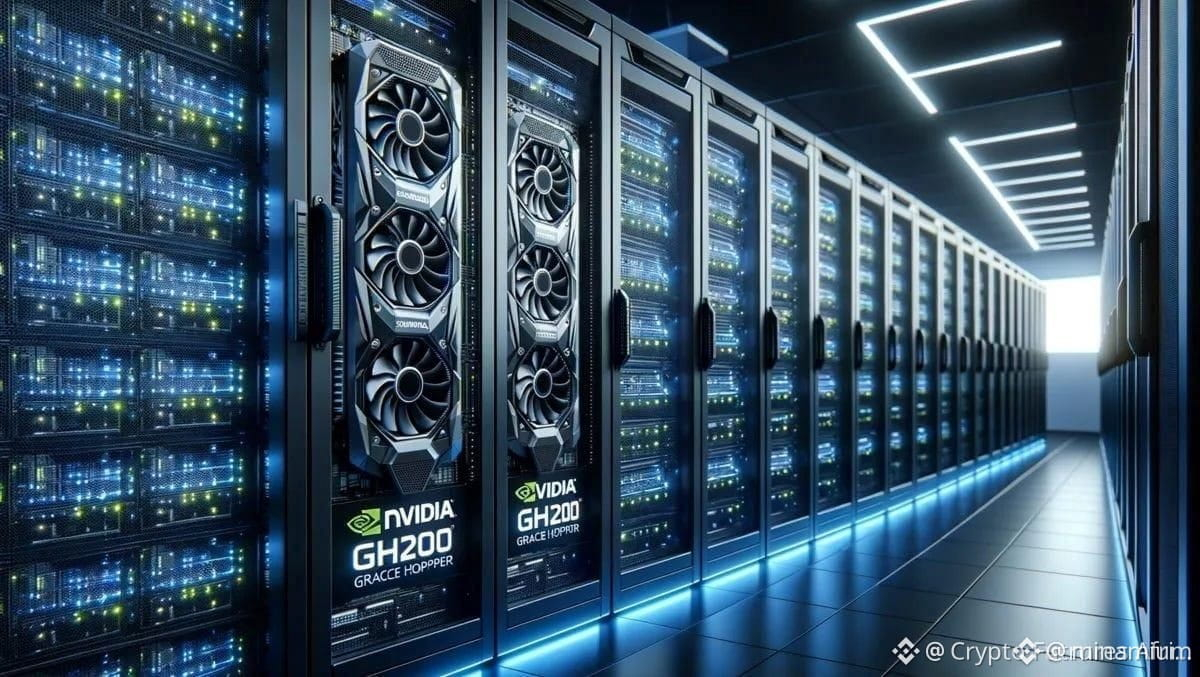
If you are still chasing overextended traditional tech stocks at all-time highs, stop now.
Buying web2 tech giants after a massive run usually means becoming someone else's exit liquidity while missing the real asymmetric upside. It is the classic trader curse of sitting on the sidelines until valuations are already stretched to the limit.
We saw this exact movie play out during the 2021 tech boom when traditional equities capped out, sending capital flooding into high-beta crypto alternatives. Right now, AI stocks are trading at intense earnings multiples, while decentralized compute networks like $FET and $RENDER offer permissionless infrastructure at a fraction of those web2 valuations.
Even major infrastructure plays like $NEAR are aggressively repositioning to capture this shifting compute demand. When traditional market upside gets capped by macro gravity, smart money starts looking sideways for tokens that can actually outpace the trend.
Are you staying locked into traditional tech equities here, or shifting capital into crypto-native AI tokens?
#AIStocksWhatNext #CryptoAI #AI
If you are still chasing overextended traditional tech stocks at all-time highs, stop now.
Buying web2 tech giants after a massive run usually means becoming someone else's exit liquidity while missing the real asymmetric upside. It is the classic trader curse of sitting on the sidelines until valuations are already stretched to the limit.
We saw this exact movie play out during the 2021 tech boom when traditional equities capped out, sending capital flooding into high-beta crypto alternatives. Right now, AI stocks are trading at intense earnings multiples, while decentralized compute networks like $FET and $RENDER offer permissionless infrastructure at a fraction of those web2 valuations.
Even major infrastructure plays like $NEAR are aggressively repositioning to capture this shifting compute demand. When traditional market upside gets capped by macro gravity, smart money starts looking sideways for tokens that can actually outpace the trend.
Are you staying locked into traditional tech equities here, or shifting capital into crypto-native AI tokens?
#AIStocksWhatNext #CryptoAI #AI
Buying web2 tech giants after a massive run usually means becoming someone else's exit liquidity while missing the real asymmetric upside. It is the classic trader curse of sitting on the sidelines until valuations are already stretched to the limit.
We saw this exact movie play out during the 2021 tech boom when traditional equities capped out, sending capital flooding into high-beta crypto alternatives. Right now, AI stocks are trading at intense earnings multiples, while decentralized compute networks like $FET and $RENDER offer permissionless infrastructure at a fraction of those web2 valuations.
Even major infrastructure plays like $NEAR are aggressively repositioning to capture this shifting compute demand. When traditional market upside gets capped by macro gravity, smart money starts looking sideways for tokens that can actually outpace the trend.
Are you staying locked into traditional tech equities here, or shifting capital into crypto-native AI tokens?
#AIStocksWhatNext #CryptoAI #AI
71
Log in to explore more content
Join global crypto users on Binance Square
⚡️ Get latest and useful information about crypto.
💬 Trusted by the world’s largest crypto exchange.
👍 Discover real insights from verified creators.
Email / Phone number
Trending Topics
1
#AIStocksWhatNext
56,899 views
467 Discussing
2
#MuseOvertakesChatGPTAsTopFreeIOSApp
500 views
18 Discussing
3
#TokenizedStockPlatformsCouldLaunchNextQuarter
1,557 views
32 Discussing
4
#StrategyAdds950Bitcoin
3,939 views
91 Discussing
5
#CardanoAddedToX402KitForADAPayments
9,515 views
283 Discussing
6
#XRPRises8%
20,584 views
615 Discussing
7
#AMDHits$1TrillionMarketCap
793 views
38 Discussing
8
#BitcoinSpotETFs$999MNetInflow
1,704 views
44 Discussing
9
#AppleGoogleSeekStablecoinTokenizedDepositTalent
11,698 views
433 Discussing
10
#NvidiaToBuyAnother$1.5BSBEnergySharesPreIPO
1,867 views
40 Discussing