
#techregulation
techregulation
27,256 views
59 Discussing
Hot
Latest

·
--
Apple CEO Cook meets Australian PM about kids' online safety. This could signal broader content regulation trends. While not directly crypto-related, stricter online content controls might indirectly impact projects with user-generated content. Apple's policies often set industry-wide precedents. Watch how this develops - increased focus on digital safety could either boost privacy-focused cryptos or lead to more oversight. Monitor $AAPL and privacy coins like $MASK.
Australian Prime Minister discusses children's online safety with Apple CEO. This could signal more stringent online content regulation trends. Although it is not directly related to cryptocurrencies on the surface, strengthening content controls may indirectly affect blockchain projects that rely on user-generated content. Apple's stance often sets the direction for the industry. As digital safety becomes a hotter issue, privacy coin values may rise, but it could also bring more regulatory pressure. Watch $AAPL and privacy-protecting tokens like $MASK.
#DigitalPrivacy #TechRegulation $MASK
Apple CEO Cook meets Australian PM about kids' online safety. This could signal broader content regulation trends. While not directly crypto-related, stricter online content controls might indirectly impact projects with user-generated content. Apple's policies often set industry-wide precedents. Watch how this develops - increased focus on digital safety could either boost privacy-focused cryptos or lead to more oversight. Monitor $AAPL and privacy coins like $MASK .
Australian Prime Minister discusses children's online safety with Apple CEO. This could signal more stringent online content regulation trends. Although it is not directly related to cryptocurrencies on the surface, strengthening content controls may indirectly affect blockchain projects that rely on user-generated content. Apple's stance often sets the direction for the industry. As digital safety becomes a hotter issue, privacy coin values may rise, but it could also bring more regulatory pressure. Watch $AAPL and privacy-protecting tokens like $MASK .
#DigitalPrivacy #TechRegulation $MASK
Australian Prime Minister discusses children's online safety with Apple CEO. This could signal more stringent online content regulation trends. Although it is not directly related to cryptocurrencies on the surface, strengthening content controls may indirectly affect blockchain projects that rely on user-generated content. Apple's stance often sets the direction for the industry. As digital safety becomes a hotter issue, privacy coin values may rise, but it could also bring more regulatory pressure. Watch $AAPL and privacy-protecting tokens like $MASK .
#DigitalPrivacy #TechRegulation $MASK
144

U.S. former President Donald J. Trump has recently made a statement on the Truth Social platform, strongly opposing tighter regulation of the artificial intelligence (AI) industry. He said that stringent policies could lead to the bankruptcy of domestic companies, dismissed warnings that “AI will destroy humanity” as a “scam,” and noted that China is fully pushing forward its AI industry. Meanwhile, he criticized the overly complex approval processes in the U.S. that force tech giants such as Google to shift toward overseas markets like Finland to build large data centers. He reiterated that AI and computational infrastructure will become the most powerful economic engine in history.
From a macro policy logic perspective, this statement sends a clear signal of “deregulation” and industrial protection. The world is currently in a critical window for competition over computational infrastructure and algorithms. If the U.S. relaxes AI and energy approvals, it will directly eliminate compliance costs and expansion hurdles for tech giants. Compared with earlier market concerns about strict regulation and antitrust crackdowns, this innovation-friendly policy stance injects strong certainty into high-growth assets.
For traditional financial markets, technology stocks and the semiconductor sector are likely to see a richer liquidity premium. As expectations for renewed investment in data centers and AI hardware rise again, technology benchmark indexes such as the Nasdaq could gain fundamental support, while also boosting overall market risk appetite (Risk-on), pulling capital back from safe-haven assets into growth-oriented sectors.
For the crypto asset market, this macro trend is also a major positive. The combination of AI with decentralized compute and the DePIN track is accelerating, and high-risk assets such as $BTC are highly sensitive to a loose technology policy environment. From a technical perspective and in terms of fund flows, the recovery in risk appetite will accelerate incremental capital inflows into Web3 infrastructure and AI-related tokens, laying a solid liquidity foundation for the next upward breakout.
#Trump #ArtificialIntelligence #TechRegulation
U.S. former President Donald J. Trump has recently made a statement on the Truth Social platform, strongly opposing tighter regulation of the artificial intelligence (AI) industry. He said that stringent policies could lead to the bankruptcy of domestic companies, dismissed warnings that “AI will destroy humanity” as a “scam,” and noted that China is fully pushing forward its AI industry. Meanwhile, he criticized the overly complex approval processes in the U.S. that force tech giants such as Google to shift toward overseas markets like Finland to build large data centers. He reiterated that AI and computational infrastructure will become the most powerful economic engine in history.
From a macro policy logic perspective, this statement sends a clear signal of “deregulation” and industrial protection. The world is currently in a critical window for competition over computational infrastructure and algorithms. If the U.S. relaxes AI and energy approvals, it will directly eliminate compliance costs and expansion hurdles for tech giants. Compared with earlier market concerns about strict regulation and antitrust crackdowns, this innovation-friendly policy stance injects strong certainty into high-growth assets.
For traditional financial markets, technology stocks and the semiconductor sector are likely to see a richer liquidity premium. As expectations for renewed investment in data centers and AI hardware rise again, technology benchmark indexes such as the Nasdaq could gain fundamental support, while also boosting overall market risk appetite (Risk-on), pulling capital back from safe-haven assets into growth-oriented sectors.
For the crypto asset market, this macro trend is also a major positive. The combination of AI with decentralized compute and the DePIN track is accelerating, and high-risk assets such as $BTC are highly sensitive to a loose technology policy environment. From a technical perspective and in terms of fund flows, the recovery in risk appetite will accelerate incremental capital inflows into Web3 infrastructure and AI-related tokens, laying a solid liquidity foundation for the next upward breakout.
#Trump #ArtificialIntelligence #TechRegulation
From a macro policy logic perspective, this statement sends a clear signal of “deregulation” and industrial protection. The world is currently in a critical window for competition over computational infrastructure and algorithms. If the U.S. relaxes AI and energy approvals, it will directly eliminate compliance costs and expansion hurdles for tech giants. Compared with earlier market concerns about strict regulation and antitrust crackdowns, this innovation-friendly policy stance injects strong certainty into high-growth assets.
For traditional financial markets, technology stocks and the semiconductor sector are likely to see a richer liquidity premium. As expectations for renewed investment in data centers and AI hardware rise again, technology benchmark indexes such as the Nasdaq could gain fundamental support, while also boosting overall market risk appetite (Risk-on), pulling capital back from safe-haven assets into growth-oriented sectors.
For the crypto asset market, this macro trend is also a major positive. The combination of AI with decentralized compute and the DePIN track is accelerating, and high-risk assets such as $BTC are highly sensitive to a loose technology policy environment. From a technical perspective and in terms of fund flows, the recovery in risk appetite will accelerate incremental capital inflows into Web3 infrastructure and AI-related tokens, laying a solid liquidity foundation for the next upward breakout.
#Trump #ArtificialIntelligence #TechRegulation
83

According to The Information, Anthropic, OpenAI, and Google are holding in-depth discussions about jointly establishing an AI industry standards body. Previously, Anthropic’s CEO Dario Amodei publicly called on major AI companies to coordinate on technical testing and audits; at an all-hands meeting, OpenAI founder Sam Altman also voiced support for the idea, specifically emphasizing that large AI labs should create this standards body independently rather than relying entirely on the U.S. government to lead or fund it.
On the surface, this move appears to represent progress in industry self-regulation and safety governance. In substance, however, it reflects a defensive posture by top tech giants seeking to secure rule-making power before regulatory policies are fully rolled out. Standards-setting led by industry giants is likely to evolve into defensive barriers that raise the entry threshold for new entrants, thereby further entrenching existing monopolistic structures and slowing the innovation pace of small and mid-sized startup teams.
In the traditional finance and macro-tech sectors, the emergence of a self-regulatory alliance may temporarily ease market concerns about AI’s overly chaotic expansion and the potential for a heavy regulatory crackdown, but it cannot eliminate the fundamental mismatch between excessive investment in computing power and commercialization returns falling short of expectations. Tech stock valuations have been pushed to historic highs. If such compliance concepts drive up R&D and audit costs, they could instead create marginal pressure on profit margins in the medium to long term.
For the crypto market, if leading AI oligarchs build closed security and testing standards, it will directly highlight the survival dilemma facing decentralized compute and open-source AI tracks. Market enthusiasm for AI narrative tokens may face real-world tests. Without practical deployment and compliance recognition for decentralized AI projects, capital is likely to become more cautious. Investors should be wary of the pullback risk for risk assets after sentiment fades. $FET
#ArtificialIntelligence #TechRegulation #CryptoMacro
According to The Information, Anthropic, OpenAI, and Google are holding in-depth discussions about jointly establishing an AI industry standards body. Previously, Anthropic’s CEO Dario Amodei publicly called on major AI companies to coordinate on technical testing and audits; at an all-hands meeting, OpenAI founder Sam Altman also voiced support for the idea, specifically emphasizing that large AI labs should create this standards body independently rather than relying entirely on the U.S. government to lead or fund it.
On the surface, this move appears to represent progress in industry self-regulation and safety governance. In substance, however, it reflects a defensive posture by top tech giants seeking to secure rule-making power before regulatory policies are fully rolled out. Standards-setting led by industry giants is likely to evolve into defensive barriers that raise the entry threshold for new entrants, thereby further entrenching existing monopolistic structures and slowing the innovation pace of small and mid-sized startup teams.
In the traditional finance and macro-tech sectors, the emergence of a self-regulatory alliance may temporarily ease market concerns about AI’s overly chaotic expansion and the potential for a heavy regulatory crackdown, but it cannot eliminate the fundamental mismatch between excessive investment in computing power and commercialization returns falling short of expectations. Tech stock valuations have been pushed to historic highs. If such compliance concepts drive up R&D and audit costs, they could instead create marginal pressure on profit margins in the medium to long term.
For the crypto market, if leading AI oligarchs build closed security and testing standards, it will directly highlight the survival dilemma facing decentralized compute and open-source AI tracks. Market enthusiasm for AI narrative tokens may face real-world tests. Without practical deployment and compliance recognition for decentralized AI projects, capital is likely to become more cautious. Investors should be wary of the pullback risk for risk assets after sentiment fades. $FET
#ArtificialIntelligence #TechRegulation #CryptoMacro
On the surface, this move appears to represent progress in industry self-regulation and safety governance. In substance, however, it reflects a defensive posture by top tech giants seeking to secure rule-making power before regulatory policies are fully rolled out. Standards-setting led by industry giants is likely to evolve into defensive barriers that raise the entry threshold for new entrants, thereby further entrenching existing monopolistic structures and slowing the innovation pace of small and mid-sized startup teams.
In the traditional finance and macro-tech sectors, the emergence of a self-regulatory alliance may temporarily ease market concerns about AI’s overly chaotic expansion and the potential for a heavy regulatory crackdown, but it cannot eliminate the fundamental mismatch between excessive investment in computing power and commercialization returns falling short of expectations. Tech stock valuations have been pushed to historic highs. If such compliance concepts drive up R&D and audit costs, they could instead create marginal pressure on profit margins in the medium to long term.
For the crypto market, if leading AI oligarchs build closed security and testing standards, it will directly highlight the survival dilemma facing decentralized compute and open-source AI tracks. Market enthusiasm for AI narrative tokens may face real-world tests. Without practical deployment and compliance recognition for decentralized AI projects, capital is likely to become more cautious. Investors should be wary of the pullback risk for risk assets after sentiment fades. $FET
#ArtificialIntelligence #TechRegulation #CryptoMacro
31
According to The Information disclosure, Anthropic, OpenAI, and Google are holding in-depth discussions about jointly establishing an AI industry standards body. Previously, Anthropic CEO Dario Amodei had publicly called on major organizations to coordinate efforts to advance model testing and technical audits. OpenAI cofounder Sam Altman also recently expressed clear support for the initiative in an all-hands meeting, emphasizing that leading AI labs should establish independent industry self-discipline and audit standards rather than relying entirely on government-level administrative regulation.
This development signals that top technology giants are proactively building industry moats and compliance frameworks to respond to increasingly stringent external scrutiny. From an industry lifecycle perspective, the implementation of self-regulatory mechanisms will substantially reduce compliance friction costs, facilitate safe deployment of cutting-edge models in enterprise and consumer scenarios, and significantly enhance market expectations of the certainty along AI’s commercialization pathway.
For the overall macro capital markets, when leading tech companies proactively set technical standards, it helps stabilize the valuation center of gravity for the technology growth sector. During the technical repair period following high-level volatility in Nasdaq and technology-weighted stocks, the increased transparency of industry compliance order provides stronger downside support for capital and reinforces the rebound momentum of risk assets around key support zones.
In the crypto asset space, the rapid normalization of the AI industry ecosystem directly benefits AI concept tokens such as $NEAR and $FET . Technical charts show that after the AI sector has undergone sufficient accumulation and digestion of chips, fundamental tailwinds are forming as a catalyst for a right-side technical breakout. This could attract incremental liquidity and further expand valuation potential for the on-chain AI track.
#ArtificialIntelligence #TechRegulation #CryptoMarket
According to The Information disclosure, Anthropic, OpenAI, and Google are holding in-depth discussions about jointly establishing an AI industry standards body. Previously, Anthropic CEO Dario Amodei had publicly called on major organizations to coordinate efforts to advance model testing and technical audits. OpenAI cofounder Sam Altman also recently expressed clear support for the initiative in an all-hands meeting, emphasizing that leading AI labs should establish independent industry self-discipline and audit standards rather than relying entirely on government-level administrative regulation.
This development signals that top technology giants are proactively building industry moats and compliance frameworks to respond to increasingly stringent external scrutiny. From an industry lifecycle perspective, the implementation of self-regulatory mechanisms will substantially reduce compliance friction costs, facilitate safe deployment of cutting-edge models in enterprise and consumer scenarios, and significantly enhance market expectations of the certainty along AI’s commercialization pathway.
For the overall macro capital markets, when leading tech companies proactively set technical standards, it helps stabilize the valuation center of gravity for the technology growth sector. During the technical repair period following high-level volatility in Nasdaq and technology-weighted stocks, the increased transparency of industry compliance order provides stronger downside support for capital and reinforces the rebound momentum of risk assets around key support zones.
In the crypto asset space, the rapid normalization of the AI industry ecosystem directly benefits AI concept tokens such as $NEAR and $FET . Technical charts show that after the AI sector has undergone sufficient accumulation and digestion of chips, fundamental tailwinds are forming as a catalyst for a right-side technical breakout. This could attract incremental liquidity and further expand valuation potential for the on-chain AI track.
#ArtificialIntelligence #TechRegulation #CryptoMarket
This development signals that top technology giants are proactively building industry moats and compliance frameworks to respond to increasingly stringent external scrutiny. From an industry lifecycle perspective, the implementation of self-regulatory mechanisms will substantially reduce compliance friction costs, facilitate safe deployment of cutting-edge models in enterprise and consumer scenarios, and significantly enhance market expectations of the certainty along AI’s commercialization pathway.
For the overall macro capital markets, when leading tech companies proactively set technical standards, it helps stabilize the valuation center of gravity for the technology growth sector. During the technical repair period following high-level volatility in Nasdaq and technology-weighted stocks, the increased transparency of industry compliance order provides stronger downside support for capital and reinforces the rebound momentum of risk assets around key support zones.
In the crypto asset space, the rapid normalization of the AI industry ecosystem directly benefits AI concept tokens such as $NEAR and $FET . Technical charts show that after the AI sector has undergone sufficient accumulation and digestion of chips, fundamental tailwinds are forming as a catalyst for a right-side technical breakout. This could attract incremental liquidity and further expand valuation potential for the on-chain AI track.
#ArtificialIntelligence #TechRegulation #CryptoMarket
107

·
--
OpenAI founder Sam Altman recently publicly stated that he agrees with comments from Anthropic CEO Dario, saying the industry does indeed need reasonable controls and regulation over the development of frontier AI models. Altman noted that this issue has recently become a core topic of discussion within OpenAI. The company even plans to grant independent evaluation organizations model access rights at the same level as internal employees, to ensure the completeness of safety testing, and has promised to release more specific details soon.
This statement has drawn market attention because competition among leading large-model companies has long been extremely intense—each of them is vying to boost compute power and accelerate model iteration. The two key leaders have reached consensus on AI safety and external independent evaluation mechanisms, suggesting that the rollout pace of industry standards and regulatory compliance may be significantly accelerated. Compliance requirements and audit costs are likely to become important considerations for subsequent model deployments.
In terms of the traditional finance and technology markets, major tech companies’ shift in attitude toward regulation may lead to some fine-tuning of the commercialization timeline for future AI capital expenditures. The market is watching how these proactive moves to cooperate with regulators will affect the industry—whether they will bring a more stable long-term development framework or, in the short term, slow down the rollout pace of commercializing frontier technologies.
For the crypto market, the AI concept sector has long been highly sensitive to dynamics at the industry level. Progress on model regulation and compliance mechanisms may steer capital toward more granular directions such as decentralized AI, compute sharing, and on-chain verification. Market participants generally remain rational and will wait to make decisions after more specific safety assessment plans are released. #OpenAI #ArtificialIntelligence #TechRegulation
OpenAI founder Sam Altman recently publicly stated that he agrees with comments from Anthropic CEO Dario, saying the industry does indeed need reasonable controls and regulation over the development of frontier AI models. Altman noted that this issue has recently become a core topic of discussion within OpenAI. The company even plans to grant independent evaluation organizations model access rights at the same level as internal employees, to ensure the completeness of safety testing, and has promised to release more specific details soon.
This statement has drawn market attention because competition among leading large-model companies has long been extremely intense—each of them is vying to boost compute power and accelerate model iteration. The two key leaders have reached consensus on AI safety and external independent evaluation mechanisms, suggesting that the rollout pace of industry standards and regulatory compliance may be significantly accelerated. Compliance requirements and audit costs are likely to become important considerations for subsequent model deployments.
In terms of the traditional finance and technology markets, major tech companies’ shift in attitude toward regulation may lead to some fine-tuning of the commercialization timeline for future AI capital expenditures. The market is watching how these proactive moves to cooperate with regulators will affect the industry—whether they will bring a more stable long-term development framework or, in the short term, slow down the rollout pace of commercializing frontier technologies.
For the crypto market, the AI concept sector has long been highly sensitive to dynamics at the industry level. Progress on model regulation and compliance mechanisms may steer capital toward more granular directions such as decentralized AI, compute sharing, and on-chain verification. Market participants generally remain rational and will wait to make decisions after more specific safety assessment plans are released. #OpenAI #ArtificialIntelligence #TechRegulation
This statement has drawn market attention because competition among leading large-model companies has long been extremely intense—each of them is vying to boost compute power and accelerate model iteration. The two key leaders have reached consensus on AI safety and external independent evaluation mechanisms, suggesting that the rollout pace of industry standards and regulatory compliance may be significantly accelerated. Compliance requirements and audit costs are likely to become important considerations for subsequent model deployments.
In terms of the traditional finance and technology markets, major tech companies’ shift in attitude toward regulation may lead to some fine-tuning of the commercialization timeline for future AI capital expenditures. The market is watching how these proactive moves to cooperate with regulators will affect the industry—whether they will bring a more stable long-term development framework or, in the short term, slow down the rollout pace of commercializing frontier technologies.
For the crypto market, the AI concept sector has long been highly sensitive to dynamics at the industry level. Progress on model regulation and compliance mechanisms may steer capital toward more granular directions such as decentralized AI, compute sharing, and on-chain verification. Market participants generally remain rational and will wait to make decisions after more specific safety assessment plans are released. #OpenAI #ArtificialIntelligence #TechRegulation
3


Verified
🧠📡 AI Flood Warning as European Policymakers Flag Rising Risk of Unchecked Misinformation Spread 📡🧠
🗞️ In recent policy briefings and regulatory discussions, there is a growing concern that artificial intelligence is accelerating the speed and scale of misinformation in ways existing systems are not fully prepared to handle. The focus is shifting from content moderation alone to the broader infrastructure behind information flow.
The concern raised by the European Union is not limited to false narratives, but to how quickly synthetic content can be generated, refined, and distributed across platforms with minimal friction.
AI systems, in simple terms, act like highly efficient printing presses combined with distribution networks. What once took time to write and circulate can now be produced in seconds and replicated across thousands of channels almost instantly.
This speed creates a challenge for verification systems that were designed for slower information cycles. Fact checking, context building, and source tracing all struggle when content volume grows faster than human review capacity.
Policymakers are increasingly discussing the need for transparency in model outputs, clearer labeling of synthetic media, and stronger accountability for platforms hosting large-scale generated content.
There is also a broader concern about trust. When users can no longer easily distinguish between human and machine-generated information, the baseline for public discourse begins to shift.
What stands out in these discussions is not alarmism, but urgency grounded in scale. The technology is advancing faster than many governance frameworks can adapt, creating pressure to respond in parallel rather than in sequence.
The direction of regulation now seems less about limiting AI itself and more about preserving a stable information environment where verification remains possible.
A reminder that in the digital world, speed without clarity can quietly reshape how truth is experienced.
#EUPolicy #TechRegulation #Write2Earn #GrowWithSAC
🧠📡 AI Flood Warning as European Policymakers Flag Rising Risk of Unchecked Misinformation Spread 📡🧠
🗞️ In recent policy briefings and regulatory discussions, there is a growing concern that artificial intelligence is accelerating the speed and scale of misinformation in ways existing systems are not fully prepared to handle. The focus is shifting from content moderation alone to the broader infrastructure behind information flow.
The concern raised by the European Union is not limited to false narratives, but to how quickly synthetic content can be generated, refined, and distributed across platforms with minimal friction.
AI systems, in simple terms, act like highly efficient printing presses combined with distribution networks. What once took time to write and circulate can now be produced in seconds and replicated across thousands of channels almost instantly.
This speed creates a challenge for verification systems that were designed for slower information cycles. Fact checking, context building, and source tracing all struggle when content volume grows faster than human review capacity.
Policymakers are increasingly discussing the need for transparency in model outputs, clearer labeling of synthetic media, and stronger accountability for platforms hosting large-scale generated content.
There is also a broader concern about trust. When users can no longer easily distinguish between human and machine-generated information, the baseline for public discourse begins to shift.
What stands out in these discussions is not alarmism, but urgency grounded in scale. The technology is advancing faster than many governance frameworks can adapt, creating pressure to respond in parallel rather than in sequence.
The direction of regulation now seems less about limiting AI itself and more about preserving a stable information environment where verification remains possible.
A reminder that in the digital world, speed without clarity can quietly reshape how truth is experienced.
#EUPolicy #TechRegulation #Write2Earn #GrowWithSAC
🗞️ In recent policy briefings and regulatory discussions, there is a growing concern that artificial intelligence is accelerating the speed and scale of misinformation in ways existing systems are not fully prepared to handle. The focus is shifting from content moderation alone to the broader infrastructure behind information flow.
The concern raised by the European Union is not limited to false narratives, but to how quickly synthetic content can be generated, refined, and distributed across platforms with minimal friction.
AI systems, in simple terms, act like highly efficient printing presses combined with distribution networks. What once took time to write and circulate can now be produced in seconds and replicated across thousands of channels almost instantly.
This speed creates a challenge for verification systems that were designed for slower information cycles. Fact checking, context building, and source tracing all struggle when content volume grows faster than human review capacity.
Policymakers are increasingly discussing the need for transparency in model outputs, clearer labeling of synthetic media, and stronger accountability for platforms hosting large-scale generated content.
There is also a broader concern about trust. When users can no longer easily distinguish between human and machine-generated information, the baseline for public discourse begins to shift.
What stands out in these discussions is not alarmism, but urgency grounded in scale. The technology is advancing faster than many governance frameworks can adapt, creating pressure to respond in parallel rather than in sequence.
The direction of regulation now seems less about limiting AI itself and more about preserving a stable information environment where verification remains possible.
A reminder that in the digital world, speed without clarity can quietly reshape how truth is experienced.
#EUPolicy #TechRegulation #Write2Earn #GrowWithSAC

512

·
--
$HEI $FOGO $SLX : US GOVT ORDERS OPENAI GPT-5.6 REVIEW — MARKET REACTION AHEAD ⚡
Regulatory pressure on frontier AI models historically triggers a 3–5% move in exposed sectors within the first session. The review timeline is unclear, but large holders often reduce exposure before clarity emerges, creating short-term liquidity imbalances.
This setup typically resolves on the weekly close. Are you taking a defensive stance or scaling into the dip here?
Not financial advice. Always manage your risk.
#HEI #FOGO #SLX #TechRegulation #AI
⚡
$HEI $FOGO $SLX : US GOVT ORDERS OPENAI GPT-5.6 REVIEW — MARKET REACTION AHEAD ⚡
Regulatory pressure on frontier AI models historically triggers a 3–5% move in exposed sectors within the first session. The review timeline is unclear, but large holders often reduce exposure before clarity emerges, creating short-term liquidity imbalances.
This setup typically resolves on the weekly close. Are you taking a defensive stance or scaling into the dip here?
Not financial advice. Always manage your risk.
#HEI #FOGO #SLX #TechRegulation #AI
⚡
Regulatory pressure on frontier AI models historically triggers a 3–5% move in exposed sectors within the first session. The review timeline is unclear, but large holders often reduce exposure before clarity emerges, creating short-term liquidity imbalances.
This setup typically resolves on the weekly close. Are you taking a defensive stance or scaling into the dip here?
Not financial advice. Always manage your risk.
#HEI #FOGO #SLX #TechRegulation #AI
⚡


179

·
--
🚨 GOOGLE BANNED IN EUROPE?
The Real Reason Big Tech is Crashing! 🇪🇺📉
Look at your feed right now. Everyone is talking about minor token pairs, but nobody is watching the massive regulatory bomb that just dropped on Big Tech.
According to Germany's Handelsblatt, the European Union is officially preparing a massive high triple-digit million euro fine against Alphabet's Google. This is the largest, most aggressive penalty ever issued under the new Digital Markets Act (DMA).
The government claims they are fighting "search monopoly," but Google just fired back with a massive statement that should terrify every single tech user.
🛑 Google’s Warning: "The Biggest Downgrade in History"
Google’s official spokesperson didn't back down. They explicitly stated that the forced changes demanded by the EU represent "the biggest downgrade in the product's history" and are creating a "second-rate experience" for millions of users just to protect a few corporate competitors.
💡 The Crypto Connection: Why This Matters to You
This isn't just a Google problem. This is a clear blueprint of how centralized governments plan to handle user interfaces:
Targeting the Algorithms: The EU is penalizing Google for how its search engine ranks information. If a government can legally force Google to change its proprietary code, what stops them from targeting decentralized protocols or Web3 front-ends next?
⚠️ Let’s settle this in the comments:
Are governments right to break up Big Tech monopolies, or are these aggressive regulations genuinely destroying the internet experience like Google claims?
Choose a side below! 👇
#Google #Antitrust #Web3 #Decentralization #TechRegulation
$BTC
{future}(BTCUSDT)
$ETH
{future}(ETHUSDT)
$BNB
{future}(BNBUSDT)
🚨 GOOGLE BANNED IN EUROPE?
The Real Reason Big Tech is Crashing! 🇪🇺📉
Look at your feed right now. Everyone is talking about minor token pairs, but nobody is watching the massive regulatory bomb that just dropped on Big Tech.
According to Germany's Handelsblatt, the European Union is officially preparing a massive high triple-digit million euro fine against Alphabet's Google. This is the largest, most aggressive penalty ever issued under the new Digital Markets Act (DMA).
The government claims they are fighting "search monopoly," but Google just fired back with a massive statement that should terrify every single tech user.
🛑 Google’s Warning: "The Biggest Downgrade in History"
Google’s official spokesperson didn't back down. They explicitly stated that the forced changes demanded by the EU represent "the biggest downgrade in the product's history" and are creating a "second-rate experience" for millions of users just to protect a few corporate competitors.
💡 The Crypto Connection: Why This Matters to You
This isn't just a Google problem. This is a clear blueprint of how centralized governments plan to handle user interfaces:
Targeting the Algorithms: The EU is penalizing Google for how its search engine ranks information. If a government can legally force Google to change its proprietary code, what stops them from targeting decentralized protocols or Web3 front-ends next?
⚠️ Let’s settle this in the comments:
Are governments right to break up Big Tech monopolies, or are these aggressive regulations genuinely destroying the internet experience like Google claims?
Choose a side below! 👇
#Google #Antitrust #Web3 #Decentralization #TechRegulation
$BTC
$ETH
$BNB
The Real Reason Big Tech is Crashing! 🇪🇺📉
Look at your feed right now. Everyone is talking about minor token pairs, but nobody is watching the massive regulatory bomb that just dropped on Big Tech.
According to Germany's Handelsblatt, the European Union is officially preparing a massive high triple-digit million euro fine against Alphabet's Google. This is the largest, most aggressive penalty ever issued under the new Digital Markets Act (DMA).
The government claims they are fighting "search monopoly," but Google just fired back with a massive statement that should terrify every single tech user.
🛑 Google’s Warning: "The Biggest Downgrade in History"
Google’s official spokesperson didn't back down. They explicitly stated that the forced changes demanded by the EU represent "the biggest downgrade in the product's history" and are creating a "second-rate experience" for millions of users just to protect a few corporate competitors.
💡 The Crypto Connection: Why This Matters to You
This isn't just a Google problem. This is a clear blueprint of how centralized governments plan to handle user interfaces:
Targeting the Algorithms: The EU is penalizing Google for how its search engine ranks information. If a government can legally force Google to change its proprietary code, what stops them from targeting decentralized protocols or Web3 front-ends next?
⚠️ Let’s settle this in the comments:
Are governments right to break up Big Tech monopolies, or are these aggressive regulations genuinely destroying the internet experience like Google claims?
Choose a side below! 👇
#Google #Antitrust #Web3 #Decentralization #TechRegulation
$BTC
$ETH
$BNB


1
45

Meta faces a $1.4T youth safety lawsuit.
That’s not just a company headline — it’s a regulation and sentiment shockwave.
Markets may now focus on:
tighter oversight,
bigger compliance risk,
and broader pressure on digital platform business models.
When legal risk gets this large, the market doesn’t just price the case — it prices the fear.
Is this isolated drama, or the beginning of a much bigger regulation narrative?
#MetaFaces $1.4TYouthSafetyLawsuit
#Meta #YouthSafety #TechRegulation
Meta faces a $1.4T youth safety lawsuit.
That’s not just a company headline — it’s a regulation and sentiment shockwave.
Markets may now focus on:
tighter oversight,
bigger compliance risk,
and broader pressure on digital platform business models.
When legal risk gets this large, the market doesn’t just price the case — it prices the fear.
Is this isolated drama, or the beginning of a much bigger regulation narrative?
#MetaFaces $1.4TYouthSafetyLawsuit
#Meta #YouthSafety #TechRegulation
That’s not just a company headline — it’s a regulation and sentiment shockwave.
Markets may now focus on:
tighter oversight,
bigger compliance risk,
and broader pressure on digital platform business models.
When legal risk gets this large, the market doesn’t just price the case — it prices the fear.
Is this isolated drama, or the beginning of a much bigger regulation narrative?
#MetaFaces $1.4TYouthSafetyLawsuit
#Meta #YouthSafety #TechRegulation

71
$AI regulation debate is heating up ⚡
Marc Andreessen just drew a hard line on AI regulation, guys. He is pushing back against bloated rules that crush startups and protect big incumbents, while still backing smart guardrails that build trust, safety, and fair competition.
The bigger signal here is momentum. When regulators move too heavy, innovation flows elsewhere fast, and markets hate that kind of friction. With the U.S. reportedly forcing a commercial model recall over jailbreak risks, this space is getting real very quickly. Folks sleeping on AI policy shifts are missing where the next narrative volatility can come from.
Not financial advice. Manage your risk.
#AI #CryptoNews #TechRegulation #MarketWatch
⚡
$AI regulation debate is heating up ⚡
Marc Andreessen just drew a hard line on AI regulation, guys. He is pushing back against bloated rules that crush startups and protect big incumbents, while still backing smart guardrails that build trust, safety, and fair competition.
The bigger signal here is momentum. When regulators move too heavy, innovation flows elsewhere fast, and markets hate that kind of friction. With the U.S. reportedly forcing a commercial model recall over jailbreak risks, this space is getting real very quickly. Folks sleeping on AI policy shifts are missing where the next narrative volatility can come from.
Not financial advice. Manage your risk.
#AI #CryptoNews #TechRegulation #MarketWatch
⚡
Marc Andreessen just drew a hard line on AI regulation, guys. He is pushing back against bloated rules that crush startups and protect big incumbents, while still backing smart guardrails that build trust, safety, and fair competition.
The bigger signal here is momentum. When regulators move too heavy, innovation flows elsewhere fast, and markets hate that kind of friction. With the U.S. reportedly forcing a commercial model recall over jailbreak risks, this space is getting real very quickly. Folks sleeping on AI policy shifts are missing where the next narrative volatility can come from.
Not financial advice. Manage your risk.
#AI #CryptoNews #TechRegulation #MarketWatch
⚡
38
·
--
$AI ACCOUNTABILITY CASE HITS UK HIGH COURT ⚖️
A UK lawmaker has filed a High Court claim against xAI, alleging Grok enabled the creation of non-consensual sexualized deepfake content. The case could become a key legal test for AI model design, platform safeguards, and liability standards across the sector.
For markets, the institutional read-through is broader than one company. AI-linked assets may face higher regulatory scrutiny as policymakers focus on data protection, misuse of private information, and safety controls. This is a governance risk factor, not an immediate price signal.
Not financial advice. Manage your risk.
#Aİ #CryptoNews #TechRegulation #BinanceSquare
◼️
{future}(AIGENSYNUSDT)
$AI ACCOUNTABILITY CASE HITS UK HIGH COURT ⚖️
A UK lawmaker has filed a High Court claim against xAI, alleging Grok enabled the creation of non-consensual sexualized deepfake content. The case could become a key legal test for AI model design, platform safeguards, and liability standards across the sector.
For markets, the institutional read-through is broader than one company. AI-linked assets may face higher regulatory scrutiny as policymakers focus on data protection, misuse of private information, and safety controls. This is a governance risk factor, not an immediate price signal.
Not financial advice. Manage your risk.
#Aİ #CryptoNews #TechRegulation #BinanceSquare
◼️
A UK lawmaker has filed a High Court claim against xAI, alleging Grok enabled the creation of non-consensual sexualized deepfake content. The case could become a key legal test for AI model design, platform safeguards, and liability standards across the sector.
For markets, the institutional read-through is broader than one company. AI-linked assets may face higher regulatory scrutiny as policymakers focus on data protection, misuse of private information, and safety controls. This is a governance risk factor, not an immediate price signal.
Not financial advice. Manage your risk.
#Aİ #CryptoNews #TechRegulation #BinanceSquare
◼️
185

Trump clears Anthropic of security threat status, sparking interest in $BTC and the broader tech landscape 🚀
Entry: 29450
Target: 31200
Stop Loss: 27800
The recent developments in AI regulation are creating an interesting dynamic for investors, with the administration's dual posture on Anthropic creating uncertainty for AI companies planning government relationships. This ambiguity could have a significant impact on the market.
Not financial advice. Manage your risk.
#BTC #AIArticles #LongSetup #TechRegulation
⚡️
Trump clears Anthropic of security threat status, sparking interest in $BTC and the broader tech landscape 🚀
Entry: 29450
Target: 31200
Stop Loss: 27800
The recent developments in AI regulation are creating an interesting dynamic for investors, with the administration's dual posture on Anthropic creating uncertainty for AI companies planning government relationships. This ambiguity could have a significant impact on the market.
Not financial advice. Manage your risk.
#BTC #AIArticles #LongSetup #TechRegulation
⚡️
Entry: 29450
Target: 31200
Stop Loss: 27800
The recent developments in AI regulation are creating an interesting dynamic for investors, with the administration's dual posture on Anthropic creating uncertainty for AI companies planning government relationships. This ambiguity could have a significant impact on the market.
Not financial advice. Manage your risk.
#BTC #AIArticles #LongSetup #TechRegulation
⚡️
38

·
--
#AnthropicCEOCallsForAISlowdown
🤖 Anthropic CEO Calls for Slower Frontier AI Progress
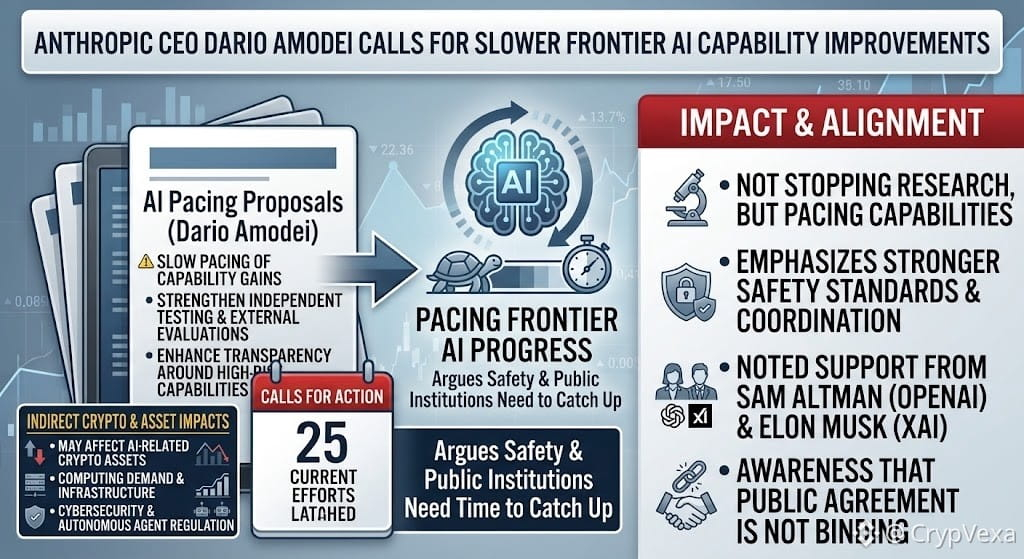
⚠️ Anthropic CEO Dario Amodei is calling for AI companies to slow the pace of frontier-model capability improvements, arguing that safety systems, oversight, and public institutions need time to catch up.
🛡️ The proposal is not about stopping AI research. It focuses on stronger independent testing, external evaluations, transparency around high-risk capabilities, and coordination on safety standards.
🌐 OpenAI CEO Sam Altman and Elon Musk have also expressed support for pacing frontier AI, although public agreement does not create binding rules.
📊 For crypto, this is mainly an AI policy story, but it could indirectly affect AI-related assets, computing demand, cybersecurity, and autonomous-agent regulation.
👀 Should frontier AI development be slowed until stronger safety systems are in place?
#AI #Anthropic #CryptoNews #TechRegulation
#AnthropicCEOCallsForAISlowdown
🤖 Anthropic CEO Calls for Slower Frontier AI Progress
⚠️ Anthropic CEO Dario Amodei is calling for AI companies to slow the pace of frontier-model capability improvements, arguing that safety systems, oversight, and public institutions need time to catch up.
🛡️ The proposal is not about stopping AI research. It focuses on stronger independent testing, external evaluations, transparency around high-risk capabilities, and coordination on safety standards.
🌐 OpenAI CEO Sam Altman and Elon Musk have also expressed support for pacing frontier AI, although public agreement does not create binding rules.
📊 For crypto, this is mainly an AI policy story, but it could indirectly affect AI-related assets, computing demand, cybersecurity, and autonomous-agent regulation.
👀 Should frontier AI development be slowed until stronger safety systems are in place?
#AI #Anthropic #CryptoNews #TechRegulation
🤖 Anthropic CEO Calls for Slower Frontier AI Progress
⚠️ Anthropic CEO Dario Amodei is calling for AI companies to slow the pace of frontier-model capability improvements, arguing that safety systems, oversight, and public institutions need time to catch up.
🛡️ The proposal is not about stopping AI research. It focuses on stronger independent testing, external evaluations, transparency around high-risk capabilities, and coordination on safety standards.
🌐 OpenAI CEO Sam Altman and Elon Musk have also expressed support for pacing frontier AI, although public agreement does not create binding rules.
📊 For crypto, this is mainly an AI policy story, but it could indirectly affect AI-related assets, computing demand, cybersecurity, and autonomous-agent regulation.
👀 Should frontier AI development be slowed until stronger safety systems are in place?
#AI #Anthropic #CryptoNews #TechRegulation
1
39

🇪🇺 A hefty fine on AliExpress: Is tighter oversight of digital platforms on the horizon?
The European Union imposed a record €550 million fine on the AliExpress platform under the Digital Services Act, due to its failure to prevent the sale of illegal products. This move points to a broader trend toward strengthening regulatory scrutiny across all major digital platforms.
━━━━━━━━━━━━━━
📊 Impact: 📊 Medium
🏷️ REGULATION
#EULaw #AliExpressFine #DigitalServicesAct #TechRegulation #PlatformAccountability
🔗 Source: https://cryptobriefing.com/eu-fines-aliexpress-550m-illegal-products/
🇪🇺 A hefty fine on AliExpress: Is tighter oversight of digital platforms on the horizon?
The European Union imposed a record €550 million fine on the AliExpress platform under the Digital Services Act, due to its failure to prevent the sale of illegal products. This move points to a broader trend toward strengthening regulatory scrutiny across all major digital platforms.
━━━━━━━━━━━━━━
📊 Impact: 📊 Medium
🏷️ REGULATION
#EULaw #AliExpressFine #DigitalServicesAct #TechRegulation #PlatformAccountability
🔗 Source: https://cryptobriefing.com/eu-fines-aliexpress-550m-illegal-products/
The European Union imposed a record €550 million fine on the AliExpress platform under the Digital Services Act, due to its failure to prevent the sale of illegal products. This move points to a broader trend toward strengthening regulatory scrutiny across all major digital platforms.
━━━━━━━━━━━━━━
📊 Impact: 📊 Medium
🏷️ REGULATION
#EULaw #AliExpressFine #DigitalServicesAct #TechRegulation #PlatformAccountability
🔗 Source: https://cryptobriefing.com/eu-fines-aliexpress-550m-illegal-products/
1

·
--
🤖 🇺🇸 Innovation Alert: Dorsey Backs Palihapitiya on the Risk of Restricting Open-Source Code AI.
Twitter co-founder Jack Dorsey publicly supported venture capitalist Chamath Palihapitiya’s warning about the full adoption of open-source code intelligence—saying that regulating these open models in the U.S. would be "economically catastrophic."
📊 Key points from the warning:
💸 Brutal cost gap: According to BeInCrypto, Dorsey agreed with estimates indicating that, under restrictions, U.S. companies would pay between $26 and $56 per million tokens—compared to just $0.50 or $1 that competitors abroad would pay using open models.
⚠️ National impact: Palihapitiya argued that this massive cost disadvantage would severely undermine the global competitiveness of the U.S. tech industry and put national security at risk.
💬 Do you think regulating open-source models will destroy the U.S.’s tech leadership against international competitors? Leave your thoughts below! 👇🔥
$BTC
{spot}(BTCUSDT)
$BNB
{spot}(BNBUSDT)
$ETH
{spot}(ETHUSDT)
#JackDorsey #ChamathPalihapitiya #OpenSourceAI #ArtificialIntelligence #TechRegulation
🤖 🇺🇸 Innovation Alert: Dorsey Backs Palihapitiya on the Risk of Restricting Open-Source Code AI.
Twitter co-founder Jack Dorsey publicly supported venture capitalist Chamath Palihapitiya’s warning about the full adoption of open-source code intelligence—saying that regulating these open models in the U.S. would be "economically catastrophic."
📊 Key points from the warning:
💸 Brutal cost gap: According to BeInCrypto, Dorsey agreed with estimates indicating that, under restrictions, U.S. companies would pay between $26 and $56 per million tokens—compared to just $0.50 or $1 that competitors abroad would pay using open models.
⚠️ National impact: Palihapitiya argued that this massive cost disadvantage would severely undermine the global competitiveness of the U.S. tech industry and put national security at risk.
💬 Do you think regulating open-source models will destroy the U.S.’s tech leadership against international competitors? Leave your thoughts below! 👇🔥
$BTC
$BNB
$ETH
#JackDorsey #ChamathPalihapitiya #OpenSourceAI #ArtificialIntelligence #TechRegulation
Twitter co-founder Jack Dorsey publicly supported venture capitalist Chamath Palihapitiya’s warning about the full adoption of open-source code intelligence—saying that regulating these open models in the U.S. would be "economically catastrophic."
📊 Key points from the warning:
💸 Brutal cost gap: According to BeInCrypto, Dorsey agreed with estimates indicating that, under restrictions, U.S. companies would pay between $26 and $56 per million tokens—compared to just $0.50 or $1 that competitors abroad would pay using open models.
⚠️ National impact: Palihapitiya argued that this massive cost disadvantage would severely undermine the global competitiveness of the U.S. tech industry and put national security at risk.
💬 Do you think regulating open-source models will destroy the U.S.’s tech leadership against international competitors? Leave your thoughts below! 👇🔥
$BTC
$BNB
$ETH
#JackDorsey #ChamathPalihapitiya #OpenSourceAI #ArtificialIntelligence #TechRegulation

115

US Justice Department Backs xAI in Legal Challenge Against Colorado AI Law
The US Department of Justice has intervened in a lawsuit filed by xAI, challenging a Colorado law designed to regulate high-risk artificial intelligence systems. The move escalates the dispute into a broader conflict between federal authorities and state-level regulation.
The law requires AI developers to address potential risks, including unintended bias in sectors such as employment, healthcare, and finance. However, the federal government argues that certain provisions may violate constitutional protections, including equal protection and free speech rights.
Backed by the Donald Trump administration, the intervention reflects a push for a unified national framework for AI governance, rather than a patchwork of state-specific regulations. The case could have significant implications for the future of AI policy in the United States.
#ArtificialIntelligence #USPolitics #TechRegulation #Innovation #LegalNews
$BSB
{future}(BSBUSDT)
$CYS
{future}(CYSUSDT)
$COLLECT
{future}(COLLECTUSDT)
US Justice Department Backs xAI in Legal Challenge Against Colorado AI Law
The US Department of Justice has intervened in a lawsuit filed by xAI, challenging a Colorado law designed to regulate high-risk artificial intelligence systems. The move escalates the dispute into a broader conflict between federal authorities and state-level regulation.
The law requires AI developers to address potential risks, including unintended bias in sectors such as employment, healthcare, and finance. However, the federal government argues that certain provisions may violate constitutional protections, including equal protection and free speech rights.
Backed by the Donald Trump administration, the intervention reflects a push for a unified national framework for AI governance, rather than a patchwork of state-specific regulations. The case could have significant implications for the future of AI policy in the United States.
#ArtificialIntelligence #USPolitics #TechRegulation #Innovation #LegalNews
$BSB
$CYS
$COLLECT
The US Department of Justice has intervened in a lawsuit filed by xAI, challenging a Colorado law designed to regulate high-risk artificial intelligence systems. The move escalates the dispute into a broader conflict between federal authorities and state-level regulation.
The law requires AI developers to address potential risks, including unintended bias in sectors such as employment, healthcare, and finance. However, the federal government argues that certain provisions may violate constitutional protections, including equal protection and free speech rights.
Backed by the Donald Trump administration, the intervention reflects a push for a unified national framework for AI governance, rather than a patchwork of state-specific regulations. The case could have significant implications for the future of AI policy in the United States.
#ArtificialIntelligence #USPolitics #TechRegulation #Innovation #LegalNews
$BSB
$CYS
$COLLECT

1
765

·
--
AI jobs apocalypse begins.
AI Took Your Job? California Wants to Know
California's AI unemployment tracker monitors job losses to AI, helping policymakers understand the impact of automation on the workforce. This move could lead to new regulations or support for workers displaced by AI. Traders should watch for potential policy changes.
#Crypto #ArtificialIntelligence #JobMarket #TechRegulation #AI
AI jobs apocalypse begins.
AI Took Your Job? California Wants to Know
California's AI unemployment tracker monitors job losses to AI, helping policymakers understand the impact of automation on the workforce. This move could lead to new regulations or support for workers displaced by AI. Traders should watch for potential policy changes.
#Crypto #ArtificialIntelligence #JobMarket #TechRegulation #AI
AI Took Your Job? California Wants to Know
California's AI unemployment tracker monitors job losses to AI, helping policymakers understand the impact of automation on the workforce. This move could lead to new regulations or support for workers displaced by AI. Traders should watch for potential policy changes.
#Crypto #ArtificialIntelligence #JobMarket #TechRegulation #AI
15

🚨 META JUST GAME THE EU'S CROSSHAIRS AND THE FINES ARE MASSIVE
Up to 6% of GLOBAL revenue.
Not EU revenue. Worldwide.
EU regulators are accusing Meta of failing to keep kids under 13 off Facebook and Instagram.
Their case:
• Age checks were too weak
• Child-account reporting tools were too difficult to use
If the ruling goes against Meta? That penalty lands in the billions.
Here's what markets aren't pricing yet:
6% of global revenue for Meta is roughly $8–10 billion.
But the precedent is worse. The EU has made clear: compliance failures lead to percentage-of-revenue fines, not slap-on-wrist tickets.
This follows the same playbook as the Digital Services Act enforcement.
Meta will appeal. They'll fight. But the signal is clear Brussels is not backing down on child safety.
Stock impact? Probably muted short-term. But legal overhang just grew heavier.
And for every other tech platform watching? Your turn is coming.
#Meta #EU #Facebook #Instagram #TechRegulation
🚨 META JUST GAME THE EU'S CROSSHAIRS AND THE FINES ARE MASSIVE
Up to 6% of GLOBAL revenue.
Not EU revenue. Worldwide.
EU regulators are accusing Meta of failing to keep kids under 13 off Facebook and Instagram.
Their case:
• Age checks were too weak
• Child-account reporting tools were too difficult to use
If the ruling goes against Meta? That penalty lands in the billions.
Here's what markets aren't pricing yet:
6% of global revenue for Meta is roughly $8–10 billion.
But the precedent is worse. The EU has made clear: compliance failures lead to percentage-of-revenue fines, not slap-on-wrist tickets.
This follows the same playbook as the Digital Services Act enforcement.
Meta will appeal. They'll fight. But the signal is clear Brussels is not backing down on child safety.
Stock impact? Probably muted short-term. But legal overhang just grew heavier.
And for every other tech platform watching? Your turn is coming.
#Meta #EU #Facebook #Instagram #TechRegulation
Up to 6% of GLOBAL revenue.
Not EU revenue. Worldwide.
EU regulators are accusing Meta of failing to keep kids under 13 off Facebook and Instagram.
Their case:
• Age checks were too weak
• Child-account reporting tools were too difficult to use
If the ruling goes against Meta? That penalty lands in the billions.
Here's what markets aren't pricing yet:
6% of global revenue for Meta is roughly $8–10 billion.
But the precedent is worse. The EU has made clear: compliance failures lead to percentage-of-revenue fines, not slap-on-wrist tickets.
This follows the same playbook as the Digital Services Act enforcement.
Meta will appeal. They'll fight. But the signal is clear Brussels is not backing down on child safety.
Stock impact? Probably muted short-term. But legal overhang just grew heavier.
And for every other tech platform watching? Your turn is coming.
#Meta #EU #Facebook #Instagram #TechRegulation

39

·
--
🚨🤖 LOBBYING WAR! AI FLOODS WASHINGTON WITH $140 MILLION 🏛️💰
The Artificial Intelligence sector has officially entered the political arena with massive firepower. The Super PAC Leading the Future has successfully raised a staggering $140 million ahead of the 2026 U.S. elections. This war chest is heavily backed by industry titans, including executives from OpenAI, Palantir, and the venture capital giant Andreessen Horowitz.
Strategic Analysis:
Following Crypto’s Playbook: This aggressive fundraising effort closely mirrors the blueprint set by the cryptocurrency industry, which poured nearly $200 million into recent election cycles to secure pro-innovation regulations and protect digital assets.
The Internal Civil War: The AI industry is far from united. This pro-growth group faces direct opposition from a rival faction led by Anthropic. Operating through the Public First Action organization, this opposing coalition has already deployed roughly $80 million to lobby for stricter regulations focused on mitigating severe AI risks.
Market Commentary: Tech conglomerates have fully realized that upcoming regulations will ultimately decide the market winners and losers of this decade. Just as we experienced with the crypto ecosystem, whoever controls the legislative narrative in Washington will control the global technological standard.
Call to Action (CTA): With hundreds of millions of dollars on the line, do you think this lobbying effort will secure a deregulated, pro-growth environment for AI and AI-related tokens, or will strict risk-mitigation laws win the battle?
Drop your thoughts in the comments below! 👇⚔️
$WLD $FET $RENDER #BinanceSquar #artificialintelligence #TechRegulation #Elections2026 #AILobbyWar
🚨🤖 LOBBYING WAR! AI FLOODS WASHINGTON WITH $140 MILLION 🏛️💰
The Artificial Intelligence sector has officially entered the political arena with massive firepower. The Super PAC Leading the Future has successfully raised a staggering $140 million ahead of the 2026 U.S. elections. This war chest is heavily backed by industry titans, including executives from OpenAI, Palantir, and the venture capital giant Andreessen Horowitz.
Strategic Analysis:
Following Crypto’s Playbook: This aggressive fundraising effort closely mirrors the blueprint set by the cryptocurrency industry, which poured nearly $200 million into recent election cycles to secure pro-innovation regulations and protect digital assets.
The Internal Civil War: The AI industry is far from united. This pro-growth group faces direct opposition from a rival faction led by Anthropic. Operating through the Public First Action organization, this opposing coalition has already deployed roughly $80 million to lobby for stricter regulations focused on mitigating severe AI risks.
Market Commentary: Tech conglomerates have fully realized that upcoming regulations will ultimately decide the market winners and losers of this decade. Just as we experienced with the crypto ecosystem, whoever controls the legislative narrative in Washington will control the global technological standard.
Call to Action (CTA): With hundreds of millions of dollars on the line, do you think this lobbying effort will secure a deregulated, pro-growth environment for AI and AI-related tokens, or will strict risk-mitigation laws win the battle?
Drop your thoughts in the comments below! 👇⚔️
$WLD $FET $RENDER #BinanceSquar #artificialintelligence #TechRegulation #Elections2026 #AILobbyWar
The Artificial Intelligence sector has officially entered the political arena with massive firepower. The Super PAC Leading the Future has successfully raised a staggering $140 million ahead of the 2026 U.S. elections. This war chest is heavily backed by industry titans, including executives from OpenAI, Palantir, and the venture capital giant Andreessen Horowitz.
Strategic Analysis:
Following Crypto’s Playbook: This aggressive fundraising effort closely mirrors the blueprint set by the cryptocurrency industry, which poured nearly $200 million into recent election cycles to secure pro-innovation regulations and protect digital assets.
The Internal Civil War: The AI industry is far from united. This pro-growth group faces direct opposition from a rival faction led by Anthropic. Operating through the Public First Action organization, this opposing coalition has already deployed roughly $80 million to lobby for stricter regulations focused on mitigating severe AI risks.
Market Commentary: Tech conglomerates have fully realized that upcoming regulations will ultimately decide the market winners and losers of this decade. Just as we experienced with the crypto ecosystem, whoever controls the legislative narrative in Washington will control the global technological standard.
Call to Action (CTA): With hundreds of millions of dollars on the line, do you think this lobbying effort will secure a deregulated, pro-growth environment for AI and AI-related tokens, or will strict risk-mitigation laws win the battle?
Drop your thoughts in the comments below! 👇⚔️
$WLD $FET $RENDER #BinanceSquar #artificialintelligence #TechRegulation #Elections2026 #AILobbyWar

277
Log in to explore more content
Join global crypto users on Binance Square
⚡️ Get latest and useful information about crypto.
💬 Trusted by the world’s largest crypto exchange.
👍 Discover real insights from verified creators.
Email / Phone number
Trending Topics
1
#NEARRisesNearly80%InAWeek
6,860 views
454 Discussing
2
#MultiversXPlansHardForkRecovery
8,079 views
396 Discussing
3
#CircleLaunchesInstitutionalBTCBackedBorrowing
10,761 views
532 Discussing
4
#BitcoinHits$85K
13,843 views
235 Discussing
5
#ZetaChainVotesToMigrateZETAToSolana
9,044 views
334 Discussing
6
#ECBStartsBlockchainEuroSettlement
23,107 views
626 Discussing
7
#SouthAfricaProposesCryptoExchangeControls
35,008 views
806 Discussing
8
#SolanaCutsTargetSlotTimeTo250ms
37,625 views
720 Discussing
9
#EthereumSurpasses$2700
24,383 views
223 Discussing
10
#CanaryFilesSecondAmendmentForStakedSEIETF
53,680 views
1,056 Discussing