

#cryptomacro
cryptomacro
392,173 views
1,775 Discussing
Hot
Latest

Everyone's talking about the next pump. Almost nobody's talking about the real story: the U.S. government is quietly treating stablecoins as a currency weapon, not a crypto product. 🎯
Bloomberg just reported Washington is weighing joint ventures with private firms to push dollar-backed stablecoins overseas — the goal isn't "crypto adoption," it's defending the dollar's reserve status and creating fresh demand for U.S. Treasuries.
Here's what most people are missing:
→ Stablecoin issuers already hold close to $200B in Treasury bills — this isn't a side effect, it's the entire point
→ The GENIUS Act already forces issuers to back tokens with cash + short-term Treasuries — this new push just scales that globally
→ Binance itself just took a $100M stake in Circle days ago — the infrastructure is already being built before the policy is even official
This is bigger than a headline. If the U.S. actively exports dollar stablecoins the way it once exported the dollar itself, every stablecoin holder becomes part of that Treasury demand chain — whether they realize it or not.
🔥 My take: this isn't confirmed policy yet — deliberations, not decisions. But the direction is clear, and markets price direction before confirmation.
💬 Do you think stablecoins become the dollar's next global weapon, or is this overhyped politics? Say it straight 👇
Save this before the next headline drops 📌
#USWeighsPromotingDollarStablecoinsAbroad #StablecoinNews #CryptoMacro
{spot}(BTCUSDT)
{spot}(SPCXBUSDT)
{spot}(GOOGLBUSDT)
Everyone's talking about the next pump. Almost nobody's talking about the real story: the U.S. government is quietly treating stablecoins as a currency weapon, not a crypto product. 🎯
Bloomberg just reported Washington is weighing joint ventures with private firms to push dollar-backed stablecoins overseas — the goal isn't "crypto adoption," it's defending the dollar's reserve status and creating fresh demand for U.S. Treasuries.
Here's what most people are missing:
→ Stablecoin issuers already hold close to $200B in Treasury bills — this isn't a side effect, it's the entire point
→ The GENIUS Act already forces issuers to back tokens with cash + short-term Treasuries — this new push just scales that globally
→ Binance itself just took a $100M stake in Circle days ago — the infrastructure is already being built before the policy is even official
This is bigger than a headline. If the U.S. actively exports dollar stablecoins the way it once exported the dollar itself, every stablecoin holder becomes part of that Treasury demand chain — whether they realize it or not.
🔥 My take: this isn't confirmed policy yet — deliberations, not decisions. But the direction is clear, and markets price direction before confirmation.
💬 Do you think stablecoins become the dollar's next global weapon, or is this overhyped politics? Say it straight 👇
Save this before the next headline drops 📌
#USWeighsPromotingDollarStablecoinsAbroad #StablecoinNews #CryptoMacro
Bloomberg just reported Washington is weighing joint ventures with private firms to push dollar-backed stablecoins overseas — the goal isn't "crypto adoption," it's defending the dollar's reserve status and creating fresh demand for U.S. Treasuries.
Here's what most people are missing:
→ Stablecoin issuers already hold close to $200B in Treasury bills — this isn't a side effect, it's the entire point
→ The GENIUS Act already forces issuers to back tokens with cash + short-term Treasuries — this new push just scales that globally
→ Binance itself just took a $100M stake in Circle days ago — the infrastructure is already being built before the policy is even official
This is bigger than a headline. If the U.S. actively exports dollar stablecoins the way it once exported the dollar itself, every stablecoin holder becomes part of that Treasury demand chain — whether they realize it or not.
🔥 My take: this isn't confirmed policy yet — deliberations, not decisions. But the direction is clear, and markets price direction before confirmation.
💬 Do you think stablecoins become the dollar's next global weapon, or is this overhyped politics? Say it straight 👇
Save this before the next headline drops 📌
#USWeighsPromotingDollarStablecoinsAbroad #StablecoinNews #CryptoMacro

194

Following the Bank of Japan's recent rate hike to 1.25%, Yoshimasa Maruyama, Chief Market Economist at SMBC Nikko Securities, noted that the central bank is poised to raise interest rates every four to five months, targeting a terminal rate of 1.75% with potential moves in January and June next year.
This aggressive pace highlights a decisive pivot away from decades of ultra-loose monetary policy. The BOJ adjusted rates just three months after its previous hike, signaling that persistent inflationary pressures could even compress the tightening cycle to three-month intervals if price risks escalate further, despite potential downside risks to domestic growth.
Global macro markets remain highly sensitive to Japanese monetary tightening due to the ongoing unwinding of the massive yen carry trade. Faster-than-expected BOJ rate hikes typically strengthen the Japanese Yen, exert upward pressure on global sovereign bond yields, and trigger liquidity contractions across traditional risk assets.
For crypto markets, accelerated tightening from Japan presents a structural liquidity headwind. As cheap yen-funded leverage unwinds, high-beta assets like $BTC could experience short-term volatility and liquidity drainage, making global macro conditions a key factor to watch heading into early next year.
#BankOfJapan #InterestRates #CryptoMacro
Following the Bank of Japan's recent rate hike to 1.25%, Yoshimasa Maruyama, Chief Market Economist at SMBC Nikko Securities, noted that the central bank is poised to raise interest rates every four to five months, targeting a terminal rate of 1.75% with potential moves in January and June next year.
This aggressive pace highlights a decisive pivot away from decades of ultra-loose monetary policy. The BOJ adjusted rates just three months after its previous hike, signaling that persistent inflationary pressures could even compress the tightening cycle to three-month intervals if price risks escalate further, despite potential downside risks to domestic growth.
Global macro markets remain highly sensitive to Japanese monetary tightening due to the ongoing unwinding of the massive yen carry trade. Faster-than-expected BOJ rate hikes typically strengthen the Japanese Yen, exert upward pressure on global sovereign bond yields, and trigger liquidity contractions across traditional risk assets.
For crypto markets, accelerated tightening from Japan presents a structural liquidity headwind. As cheap yen-funded leverage unwinds, high-beta assets like $BTC could experience short-term volatility and liquidity drainage, making global macro conditions a key factor to watch heading into early next year.
#BankOfJapan #InterestRates #CryptoMacro
This aggressive pace highlights a decisive pivot away from decades of ultra-loose monetary policy. The BOJ adjusted rates just three months after its previous hike, signaling that persistent inflationary pressures could even compress the tightening cycle to three-month intervals if price risks escalate further, despite potential downside risks to domestic growth.
Global macro markets remain highly sensitive to Japanese monetary tightening due to the ongoing unwinding of the massive yen carry trade. Faster-than-expected BOJ rate hikes typically strengthen the Japanese Yen, exert upward pressure on global sovereign bond yields, and trigger liquidity contractions across traditional risk assets.
For crypto markets, accelerated tightening from Japan presents a structural liquidity headwind. As cheap yen-funded leverage unwinds, high-beta assets like $BTC could experience short-term volatility and liquidity drainage, making global macro conditions a key factor to watch heading into early next year.
#BankOfJapan #InterestRates #CryptoMacro
8
Tensions in the Middle East flared once again today as Iranian state news agency Fars formally denied recent reports from Reuters and Kyodo regarding the reopening of the critical Strait of Hormuz. The denial directly refutes earlier optimistic headlines about constructive US-Iran negotiations, reintroducing severe geopolitical uncertainty into key maritime energy corridors.
The Strait of Hormuz is the world's most vital energy chokepoint, handling roughly a fifth of global petroleum consumption. Financial markets had briefly rallied on earlier reports that a diplomatic breakthrough might lower geopolitical premiums, making Tehran's swift rejection a sharp reality check for global supply expectations.
Broader financial markets quickly shifted back into risk-off positioning. Energy markets are recalibrating to factor in sustained supply disruptions, putting upward pressure on crude oil prices. Higher energy costs will inherently fuel sticky inflation concerns, strengthening the US dollar while keeping global sovereign bond yields elevated.
For the crypto sector, persistent macro volatility and energy-driven inflation fears remain a headwind. As liquidity tightens under persistent geopolitical stress, $BTC and broader digital assets are likely to experience choppy consolidation as institutional participants reduce overall risk exposure.
#Geopolitics #OilPrices #CryptoMacro
Tensions in the Middle East flared once again today as Iranian state news agency Fars formally denied recent reports from Reuters and Kyodo regarding the reopening of the critical Strait of Hormuz. The denial directly refutes earlier optimistic headlines about constructive US-Iran negotiations, reintroducing severe geopolitical uncertainty into key maritime energy corridors.
The Strait of Hormuz is the world's most vital energy chokepoint, handling roughly a fifth of global petroleum consumption. Financial markets had briefly rallied on earlier reports that a diplomatic breakthrough might lower geopolitical premiums, making Tehran's swift rejection a sharp reality check for global supply expectations.
Broader financial markets quickly shifted back into risk-off positioning. Energy markets are recalibrating to factor in sustained supply disruptions, putting upward pressure on crude oil prices. Higher energy costs will inherently fuel sticky inflation concerns, strengthening the US dollar while keeping global sovereign bond yields elevated.
For the crypto sector, persistent macro volatility and energy-driven inflation fears remain a headwind. As liquidity tightens under persistent geopolitical stress, $BTC and broader digital assets are likely to experience choppy consolidation as institutional participants reduce overall risk exposure.
#Geopolitics #OilPrices #CryptoMacro
The Strait of Hormuz is the world's most vital energy chokepoint, handling roughly a fifth of global petroleum consumption. Financial markets had briefly rallied on earlier reports that a diplomatic breakthrough might lower geopolitical premiums, making Tehran's swift rejection a sharp reality check for global supply expectations.
Broader financial markets quickly shifted back into risk-off positioning. Energy markets are recalibrating to factor in sustained supply disruptions, putting upward pressure on crude oil prices. Higher energy costs will inherently fuel sticky inflation concerns, strengthening the US dollar while keeping global sovereign bond yields elevated.
For the crypto sector, persistent macro volatility and energy-driven inflation fears remain a headwind. As liquidity tightens under persistent geopolitical stress, $BTC and broader digital assets are likely to experience choppy consolidation as institutional participants reduce overall risk exposure.
#Geopolitics #OilPrices #CryptoMacro
86

Bitcoin just dropped below $84k as the 10-year US bond yield hits a 19-year high! 📉 While the Fed’s additional upside opportunity is estimated at about 75%, the target is a $6 billion buyback of long-term bonds. Bitcoin is currently trading near $83,200. In this tense macro environment, do you think this trend will have a long-term spillover effect or is it just short-term volatility? 🧐
#Bitcoin #CryptoMacro #Fed #Web3 #CryptoVietnam
Bitcoin just dropped below $84k as the 10-year US bond yield hits a 19-year high! 📉 While the Fed’s additional upside opportunity is estimated at about 75%, the target is a $6 billion buyback of long-term bonds. Bitcoin is currently trading near $83,200. In this tense macro environment, do you think this trend will have a long-term spillover effect or is it just short-term volatility? 🧐
#Bitcoin #CryptoMacro #Fed #Web3 #CryptoVietnam
#Bitcoin #CryptoMacro #Fed #Web3 #CryptoVietnam

BTC-1.98%
TLTETF-0.01%

·
--
Article
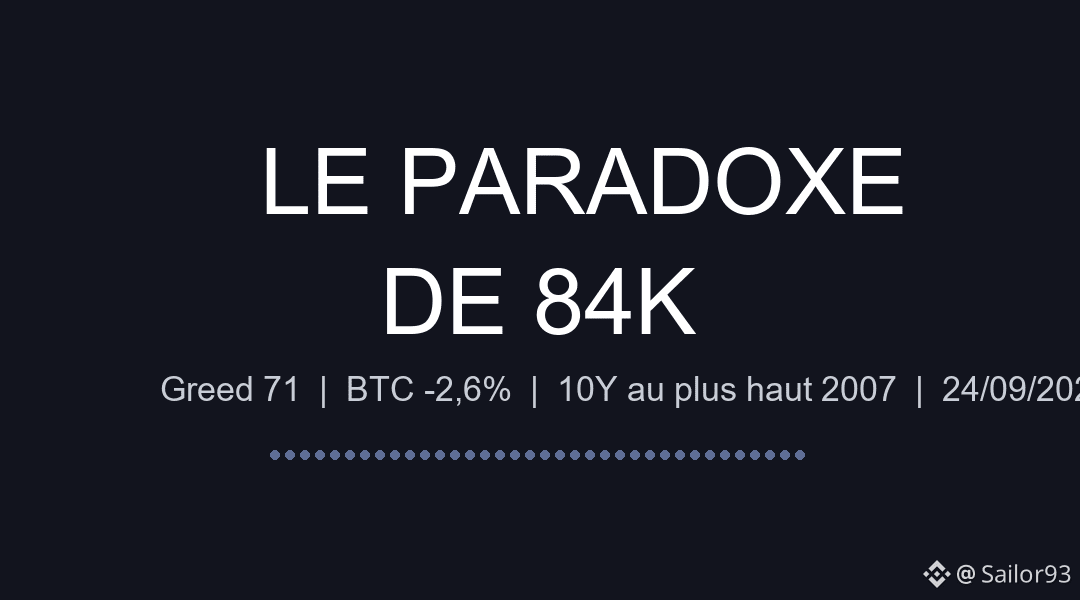
THE 84K PARADOX — Greed 71 while BTC dropsTHE 84K PARADOX — Greed 71 while BTC drops -2.6%
• BTC ~84,173$ (-2.6% in 24h) — high 86,889, low 83,626. We’ve fallen back below the 86K threshold after a rebound to 87K+ yesterday. Support at 83,500 must be held without fail.
• ETH ~2,672$ (-2.8%), BTC dominance 58.7%, volume $249.6M (2x Friday). Long liquidations: leverage is being drained, not the market.
• Macro: 10Y US Treasury yield at its highest since 2007, 70% probability of an increase in October. Hawkish FOMC + mixed ETF flows = pressure on risk.
THE 84K PARADOX — Greed 71 while BTC drops
THE 84K PARADOX — Greed 71 while BTC drops -2.6%
• BTC ~84,173$ (-2.6% in 24h) — high 86,889, low 83,626. We’ve fallen back below the 86K threshold after a rebound to 87K+ yesterday. Support at 83,500 must be held without fail.
• ETH ~2,672$ (-2.8%), BTC dominance 58.7%, volume $249.6M (2x Friday). Long liquidations: leverage is being drained, not the market.
• Macro: 10Y US Treasury yield at its highest since 2007, 70% probability of an increase in October. Hawkish FOMC + mixed ETF flows = pressure on risk.
• BTC ~84,173$ (-2.6% in 24h) — high 86,889, low 83,626. We’ve fallen back below the 86K threshold after a rebound to 87K+ yesterday. Support at 83,500 must be held without fail.
• ETH ~2,672$ (-2.8%), BTC dominance 58.7%, volume $249.6M (2x Friday). Long liquidations: leverage is being drained, not the market.
• Macro: 10Y US Treasury yield at its highest since 2007, 70% probability of an increase in October. Hawkish FOMC + mixed ETF flows = pressure on risk.
58

·
--
Verified
#bojraisesratesto31yearhigh
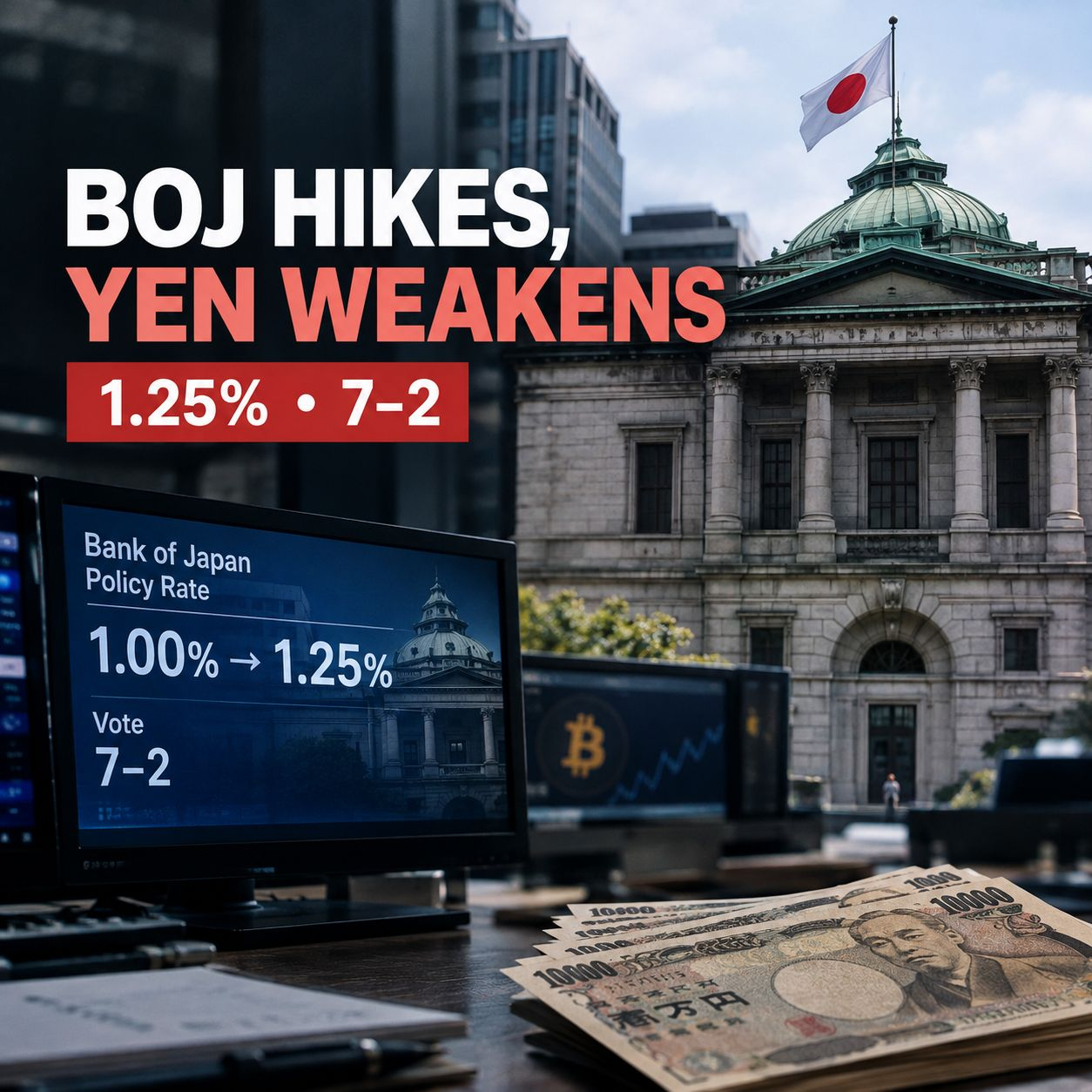
🇯🇵 BOJ just raised rates to a 31-year high. But the market reaction is the interesting part.
The Bank of Japan lifted its policy rate from 1.00% to 1.25% on September 18, the highest level since 1995.
The decision passed 7–2, with two policymakers voting against the hike. Governor Kazuo Ueda also left the door open to further increases, including consecutive hikes or a larger move if inflation risks continue to build.
So why should crypto traders care?
Japan has spent decades as a major source of cheap yen funding. Higher Japanese rates can gradually change the economics of the yen carry trade, potentially affecting global risk assets if positions are unwound.
But here's the catch: the hike was widely expected, and the yen actually weakened after the decision. That means the immediate reaction wasn't a straightforward “BOJ tightening = markets crash” scenario.
For crypto, I’d watch JPY, BTC, Nasdaq and global liquidity rather than reacting to the headline alone.
The bigger question is what happens if the BOJ keeps tightening from here.
$JPY.ETF $BTC
{spot}(BTCUSDT)
{etf_us}(JPY.ETF)
Is Japan becoming a bigger macro driver for crypto?
#BoJ #Japan #CryptoMacro
#bojraisesratesto31yearhigh
🇯🇵 BOJ just raised rates to a 31-year high. But the market reaction is the interesting part.
The Bank of Japan lifted its policy rate from 1.00% to 1.25% on September 18, the highest level since 1995.
The decision passed 7–2, with two policymakers voting against the hike. Governor Kazuo Ueda also left the door open to further increases, including consecutive hikes or a larger move if inflation risks continue to build.
So why should crypto traders care?
Japan has spent decades as a major source of cheap yen funding. Higher Japanese rates can gradually change the economics of the yen carry trade, potentially affecting global risk assets if positions are unwound.
But here's the catch: the hike was widely expected, and the yen actually weakened after the decision. That means the immediate reaction wasn't a straightforward “BOJ tightening = markets crash” scenario.
For crypto, I’d watch JPY, BTC, Nasdaq and global liquidity rather than reacting to the headline alone.
The bigger question is what happens if the BOJ keeps tightening from here.
$JPY.ETF $BTC
Is Japan becoming a bigger macro driver for crypto?
#BoJ #Japan #CryptoMacro
🇯🇵 BOJ just raised rates to a 31-year high. But the market reaction is the interesting part.
The Bank of Japan lifted its policy rate from 1.00% to 1.25% on September 18, the highest level since 1995.
The decision passed 7–2, with two policymakers voting against the hike. Governor Kazuo Ueda also left the door open to further increases, including consecutive hikes or a larger move if inflation risks continue to build.
So why should crypto traders care?
Japan has spent decades as a major source of cheap yen funding. Higher Japanese rates can gradually change the economics of the yen carry trade, potentially affecting global risk assets if positions are unwound.
But here's the catch: the hike was widely expected, and the yen actually weakened after the decision. That means the immediate reaction wasn't a straightforward “BOJ tightening = markets crash” scenario.
For crypto, I’d watch JPY, BTC, Nasdaq and global liquidity rather than reacting to the headline alone.
The bigger question is what happens if the BOJ keeps tightening from here.
$JPY.ETF $BTC
Is Japan becoming a bigger macro driver for crypto?
#BoJ #Japan #CryptoMacro
BTC-1.98%
JPYETF-0.14%
57

·
--
Bullish
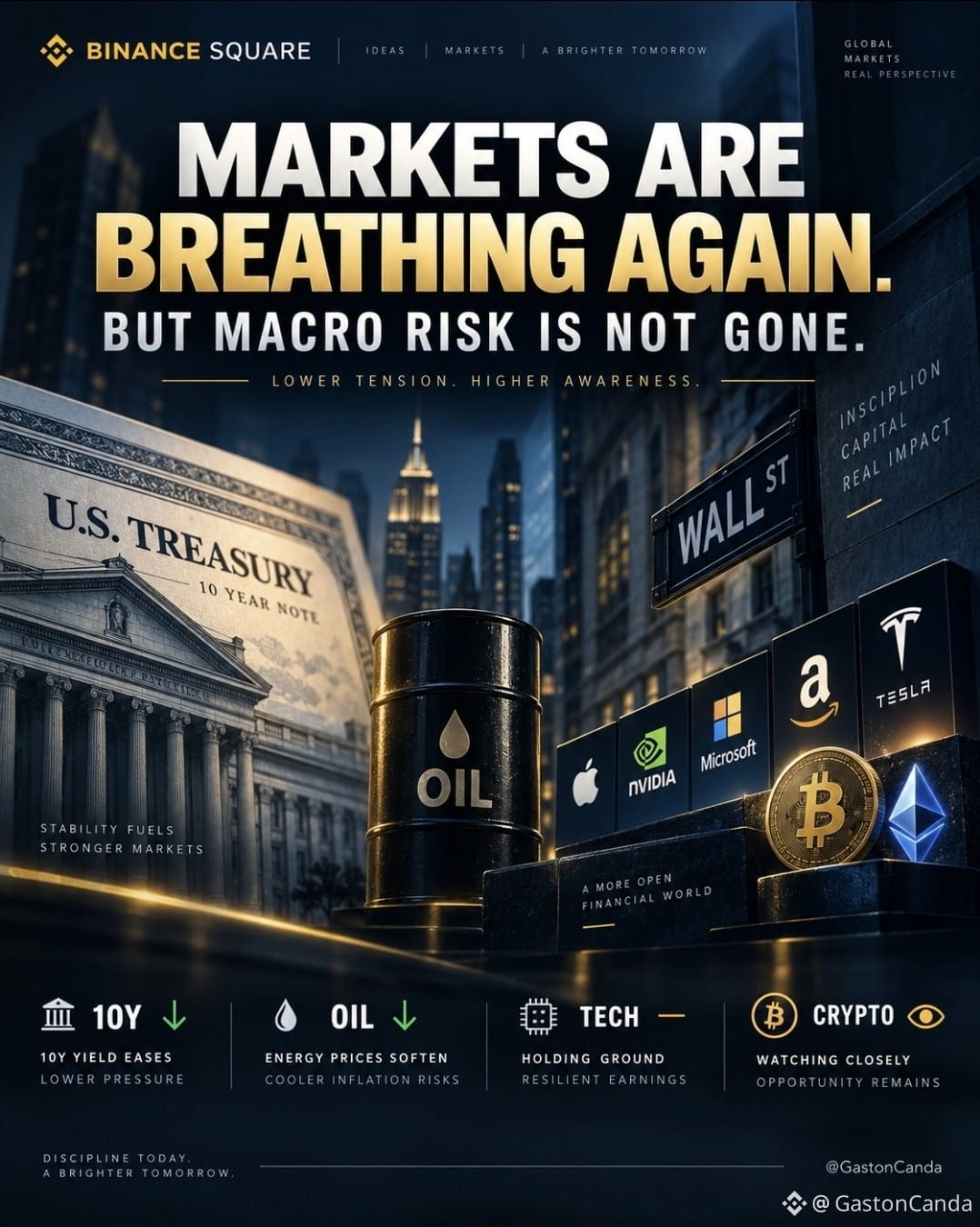
Markets are breathing again — but I wouldn’t call this risk-on yet.
Oil is pulling back.
The U.S. 10Y is easing from the 5% area.
Tech is holding up.
And that combination is giving risk assets some room to breathe.
But the bigger macro picture hasn’t changed.
The Fed just raised rates to 3.75%-4.00%, and policymakers still see room for further tightening this year.
So this market is not trading on “good news.”
It’s trading on less pressure.
That’s an important difference.
What I’m watching today:
• U.S. 10Y — can it stay below 5%?
• Oil — does the pullback continue?
• Nasdaq — does tech keep leading?
• $BTC $ETH $SOL — do they follow the improvement in risk sentiment?
My takeaway:
If yields and oil keep cooling, equities and crypto could keep finding support.
If either turns higher again, the pressure can return fast.
Relief is not the same as a full risk-on environment.
What are you watching more today: Treasuries, tech or crypto?
$BTC $ETH $SOL $NVDAB $META $TSLA
{spot}(BTCUSDT)
{spot}(QQQBUSDT)
#CryptoMacro #TradFi i #MarketUpdate
Markets are breathing again — but I wouldn’t call this risk-on yet.
Oil is pulling back.
The U.S. 10Y is easing from the 5% area.
Tech is holding up.
And that combination is giving risk assets some room to breathe.
But the bigger macro picture hasn’t changed.
The Fed just raised rates to 3.75%-4.00%, and policymakers still see room for further tightening this year.
So this market is not trading on “good news.”
It’s trading on less pressure.
That’s an important difference.
What I’m watching today:
• U.S. 10Y — can it stay below 5%?
• Oil — does the pullback continue?
• Nasdaq — does tech keep leading?
• $BTC $ETH $SOL — do they follow the improvement in risk sentiment?
My takeaway:
If yields and oil keep cooling, equities and crypto could keep finding support.
If either turns higher again, the pressure can return fast.
Relief is not the same as a full risk-on environment.
What are you watching more today: Treasuries, tech or crypto?
$BTC $ETH $SOL $NVDAB $META $TSLA
#CryptoMacro #TradFi i #MarketUpdate
Oil is pulling back.
The U.S. 10Y is easing from the 5% area.
Tech is holding up.
And that combination is giving risk assets some room to breathe.
But the bigger macro picture hasn’t changed.
The Fed just raised rates to 3.75%-4.00%, and policymakers still see room for further tightening this year.
So this market is not trading on “good news.”
It’s trading on less pressure.
That’s an important difference.
What I’m watching today:
• U.S. 10Y — can it stay below 5%?
• Oil — does the pullback continue?
• Nasdaq — does tech keep leading?
• $BTC $ETH $SOL — do they follow the improvement in risk sentiment?
My takeaway:
If yields and oil keep cooling, equities and crypto could keep finding support.
If either turns higher again, the pressure can return fast.
Relief is not the same as a full risk-on environment.
What are you watching more today: Treasuries, tech or crypto?
$BTC $ETH $SOL $NVDAB $META $TSLA
#CryptoMacro #TradFi i #MarketUpdate
3
2.6k
·
--
Bullish
The market had every excuse to panic today. It didn’t.
The U.S. Senate failed to advance the CLARITY Act.
Hours later, the Federal Reserve raised rates by 25 bps to 3.75%-4.00% and signaled that more tightening could still be ahead.
On paper, that sounds like a rough combination for risk assets.
The market did react:
• Dow: -1.21%
• S&P 500: -0.45%
• Nasdaq: -0.01%
• U.S. 10Y Treasury: around 5%
But what caught my attention wasn't the selloff.
It was the resilience underneath it.
NVDA finished the session higher.
Technology remained relatively strong.
And $SPCX gained roughly 5.1% despite the broader macro pressure.
So was the bad news already priced in?
Partly, I think so.
The Fed hike itself was widely expected. The bigger surprise was the hawkish message around what could come next.
But there's another factor I’m watching:
the U.S. economy is still showing strength.
August retail sales rose 1.2%, while core sales climbed 1.4%.
My takeaway:
Today wasn’t bullish.
Crypto clearly felt the CLARITY setback, and higher yields still matter.
But considering the amount of negative information markets had to absorb, the lack of broad capitulation is worth paying attention to.
Resilience is not the same as immunity.
Now I want to see whether this strength continues over the next few sessions — or whether today simply delayed the reaction.
What do you think: was the bad news already priced in, or is the market becoming too comfortable?
Follow me for more market observations across crypto, stocks and macro.
$BTC $SPCX
#CryptoMacro #TradFi #MarketUpdate
The market had every excuse to panic today. It didn’t.
The U.S. Senate failed to advance the CLARITY Act.
Hours later, the Federal Reserve raised rates by 25 bps to 3.75%-4.00% and signaled that more tightening could still be ahead.
On paper, that sounds like a rough combination for risk assets.
The market did react:
• Dow: -1.21%
• S&P 500: -0.45%
• Nasdaq: -0.01%
• U.S. 10Y Treasury: around 5%
But what caught my attention wasn't the selloff.
It was the resilience underneath it.
NVDA finished the session higher.
Technology remained relatively strong.
And $SPCX gained roughly 5.1% despite the broader macro pressure.
So was the bad news already priced in?
Partly, I think so.
The Fed hike itself was widely expected. The bigger surprise was the hawkish message around what could come next.
But there's another factor I’m watching:
the U.S. economy is still showing strength.
August retail sales rose 1.2%, while core sales climbed 1.4%.
My takeaway:
Today wasn’t bullish.
Crypto clearly felt the CLARITY setback, and higher yields still matter.
But considering the amount of negative information markets had to absorb, the lack of broad capitulation is worth paying attention to.
Resilience is not the same as immunity.
Now I want to see whether this strength continues over the next few sessions — or whether today simply delayed the reaction.
What do you think: was the bad news already priced in, or is the market becoming too comfortable?
Follow me for more market observations across crypto, stocks and macro.
$BTC $SPCX
#CryptoMacro #TradFi #MarketUpdate
The U.S. Senate failed to advance the CLARITY Act.
Hours later, the Federal Reserve raised rates by 25 bps to 3.75%-4.00% and signaled that more tightening could still be ahead.
On paper, that sounds like a rough combination for risk assets.
The market did react:
• Dow: -1.21%
• S&P 500: -0.45%
• Nasdaq: -0.01%
• U.S. 10Y Treasury: around 5%
But what caught my attention wasn't the selloff.
It was the resilience underneath it.
NVDA finished the session higher.
Technology remained relatively strong.
And $SPCX gained roughly 5.1% despite the broader macro pressure.
So was the bad news already priced in?
Partly, I think so.
The Fed hike itself was widely expected. The bigger surprise was the hawkish message around what could come next.
But there's another factor I’m watching:
the U.S. economy is still showing strength.
August retail sales rose 1.2%, while core sales climbed 1.4%.
My takeaway:
Today wasn’t bullish.
Crypto clearly felt the CLARITY setback, and higher yields still matter.
But considering the amount of negative information markets had to absorb, the lack of broad capitulation is worth paying attention to.
Resilience is not the same as immunity.
Now I want to see whether this strength continues over the next few sessions — or whether today simply delayed the reaction.
What do you think: was the bad news already priced in, or is the market becoming too comfortable?
Follow me for more market observations across crypto, stocks and macro.
$BTC $SPCX
#CryptoMacro #TradFi #MarketUpdate

1
880
·
--
Bullish
🚨 Fed day: my watchlist connects Wall Street and crypto.
I’m Gastón—an everyday worker building a portfolio from my paycheck and documenting what I learn.
Here’s what I’m watching today, September 16. 👇
📌 What’s happening?
The Fed’s September 15–16 meeting concludes today, with updated economic projections scheduled. That makes the outlook for rates and inflation a key focus. "Source: Federal Reserve" (https://www.federalreserve.gov/monetarypolicy/fomccalendars.htm)
📊 The market snapshot
Barron’s premarket report showed S&P 500 futures up 0.24%, Bitcoin around $75,853 and the U.S. 10-year Treasury yield at 4.975%. These are premarket readings, not closing prices. "Source: Barron’s" (https://www.barrons.com/articles/s-p-500-futures-climb-in-premarket-trading-brookfield-infrastructure-avnet-lead-b8d9e610)
🔎 Why it matters
My takeaway: the decision matters, but so does how it changes expectations for the next few meetings. I’m watching whether bonds, equities and crypto confirm the same message.
What’s on my radar:
• $BNB: relative strength against $BTC, spot volume and whether BNB Chain activity supports the price action.
• $BTC and $ETH: whether post-announcement moves attract sustained spot demand.
• S&P 500, Nvidia ($NVDA) and Micron ($MU): how equities respond to changes in yields.
• Strategy ($MSTR): its performance relative to Bitcoin.
⚠️ Thesis check
A first move can reverse. A rally without sustained demand would weaken my confidence in it.
I’ll be sharing market news and my analysis across traditional markets and crypto, with a special focus on BNB alongside BTC, ETH, SOL and XRP.
Follow along as I build, study and connect the dots.
Which will you watch first after the Fed: BNB, Bitcoin or the S&P 500?
#BNB #CryptoMacro #MarketUpdate
🚨 Fed day: my watchlist connects Wall Street and crypto.
I’m Gastón—an everyday worker building a portfolio from my paycheck and documenting what I learn.
Here’s what I’m watching today, September 16. 👇
📌 What’s happening?
The Fed’s September 15–16 meeting concludes today, with updated economic projections scheduled. That makes the outlook for rates and inflation a key focus. "Source: Federal Reserve" (https://www.federalreserve.gov/monetarypolicy/fomccalendars.htm)
📊 The market snapshot
Barron’s premarket report showed S&P 500 futures up 0.24%, Bitcoin around $75,853 and the U.S. 10-year Treasury yield at 4.975%. These are premarket readings, not closing prices. "Source: Barron’s" (https://www.barrons.com/articles/s-p-500-futures-climb-in-premarket-trading-brookfield-infrastructure-avnet-lead-b8d9e610)
🔎 Why it matters
My takeaway: the decision matters, but so does how it changes expectations for the next few meetings. I’m watching whether bonds, equities and crypto confirm the same message.
What’s on my radar:
• $BNB: relative strength against $BTC, spot volume and whether BNB Chain activity supports the price action.
• $BTC and $ETH: whether post-announcement moves attract sustained spot demand.
• S&P 500, Nvidia ($NVDA) and Micron ($MU): how equities respond to changes in yields.
• Strategy ($MSTR): its performance relative to Bitcoin.
⚠️ Thesis check
A first move can reverse. A rally without sustained demand would weaken my confidence in it.
I’ll be sharing market news and my analysis across traditional markets and crypto, with a special focus on BNB alongside BTC, ETH, SOL and XRP.
Follow along as I build, study and connect the dots.
Which will you watch first after the Fed: BNB, Bitcoin or the S&P 500?
#BNB #CryptoMacro #MarketUpdate
I’m Gastón—an everyday worker building a portfolio from my paycheck and documenting what I learn.
Here’s what I’m watching today, September 16. 👇
📌 What’s happening?
The Fed’s September 15–16 meeting concludes today, with updated economic projections scheduled. That makes the outlook for rates and inflation a key focus. "Source: Federal Reserve" (https://www.federalreserve.gov/monetarypolicy/fomccalendars.htm)
📊 The market snapshot
Barron’s premarket report showed S&P 500 futures up 0.24%, Bitcoin around $75,853 and the U.S. 10-year Treasury yield at 4.975%. These are premarket readings, not closing prices. "Source: Barron’s" (https://www.barrons.com/articles/s-p-500-futures-climb-in-premarket-trading-brookfield-infrastructure-avnet-lead-b8d9e610)
🔎 Why it matters
My takeaway: the decision matters, but so does how it changes expectations for the next few meetings. I’m watching whether bonds, equities and crypto confirm the same message.
What’s on my radar:
• $BNB: relative strength against $BTC, spot volume and whether BNB Chain activity supports the price action.
• $BTC and $ETH: whether post-announcement moves attract sustained spot demand.
• S&P 500, Nvidia ($NVDA) and Micron ($MU): how equities respond to changes in yields.
• Strategy ($MSTR): its performance relative to Bitcoin.
⚠️ Thesis check
A first move can reverse. A rally without sustained demand would weaken my confidence in it.
I’ll be sharing market news and my analysis across traditional markets and crypto, with a special focus on BNB alongside BTC, ETH, SOL and XRP.
Follow along as I build, study and connect the dots.
Which will you watch first after the Fed: BNB, Bitcoin or the S&P 500?
#BNB #CryptoMacro #MarketUpdate

1
2
297

·
--
Most traders assume a standard 25 basis point hike is already harmless noise, but historical liquidity drains show tightening cycles often hit spot portfolios hardest right when everyone gets comfortable.
Too many people lose capital trying to aggressively catch falling knives before major central bank announcements. When macro liquidity tightens, leveraged longs and late entries usually get wiped out before any real trend reversal begins.
Right now, markets are pricing in an 87% chance of a 25bp Fed rate hike at the upcoming meeting. That heavy consensus shows how deeply tighter monetary policy is baked into broader financial conditions, which directly restricts the new capital inflows needed to sustain major rallies.
When borrowing costs stay elevated, risk assets struggle to find real momentum. Even if $BTC attempts local breakouts, heavy macro pressure tends to weigh on major assets like $ETH and $BNB as institutional capital retreats toward yield and safety. Managing downside exposure during high-conviction Fed tightening is usually what separates surviving portfolios from blown accounts.
How are you adjusting your spot and leverage exposure ahead of the upcoming Fed decision?
#CryptoMacro #Bitcoin #FedRates
Most traders assume a standard 25 basis point hike is already harmless noise, but historical liquidity drains show tightening cycles often hit spot portfolios hardest right when everyone gets comfortable.
Too many people lose capital trying to aggressively catch falling knives before major central bank announcements. When macro liquidity tightens, leveraged longs and late entries usually get wiped out before any real trend reversal begins.
Right now, markets are pricing in an 87% chance of a 25bp Fed rate hike at the upcoming meeting. That heavy consensus shows how deeply tighter monetary policy is baked into broader financial conditions, which directly restricts the new capital inflows needed to sustain major rallies.
When borrowing costs stay elevated, risk assets struggle to find real momentum. Even if $BTC attempts local breakouts, heavy macro pressure tends to weigh on major assets like $ETH and $BNB as institutional capital retreats toward yield and safety. Managing downside exposure during high-conviction Fed tightening is usually what separates surviving portfolios from blown accounts.
How are you adjusting your spot and leverage exposure ahead of the upcoming Fed decision?
#CryptoMacro #Bitcoin #FedRates
Too many people lose capital trying to aggressively catch falling knives before major central bank announcements. When macro liquidity tightens, leveraged longs and late entries usually get wiped out before any real trend reversal begins.
Right now, markets are pricing in an 87% chance of a 25bp Fed rate hike at the upcoming meeting. That heavy consensus shows how deeply tighter monetary policy is baked into broader financial conditions, which directly restricts the new capital inflows needed to sustain major rallies.
When borrowing costs stay elevated, risk assets struggle to find real momentum. Even if $BTC attempts local breakouts, heavy macro pressure tends to weigh on major assets like $ETH and $BNB as institutional capital retreats toward yield and safety. Managing downside exposure during high-conviction Fed tightening is usually what separates surviving portfolios from blown accounts.
How are you adjusting your spot and leverage exposure ahead of the upcoming Fed decision?
#CryptoMacro #Bitcoin #FedRates

2

·
--
Have you noticed how most traders are completely misinterpreting the macro setup right now?
Retail keeps longing local tops right before major volatility events, only to get stopped out the second liquidity sweeps both sides of the book.
The consensus is hyper-fixated on the near 90% probability of a 25bp move following August core CPI ticking up 0.3% MoM. Everyone is treating this as a simple binary event, but reacting to the announcement itself is the easiest way to bleed capital. Instead of front-running the Fed, watch how $BTC absorbs the initial liquidity wick. If spot demand fails to defend structural support immediately after the release, high-beta assets like $ETH and $SOL will face the sharpest drawdown.
The real edge is waiting for the initial reaction to exhaust before positioning into the trend.
How are you managing your exposure ahead of the decision?
#FedRateWatch #CryptoMacro #Bitcoin
Have you noticed how most traders are completely misinterpreting the macro setup right now?
Retail keeps longing local tops right before major volatility events, only to get stopped out the second liquidity sweeps both sides of the book.
The consensus is hyper-fixated on the near 90% probability of a 25bp move following August core CPI ticking up 0.3% MoM. Everyone is treating this as a simple binary event, but reacting to the announcement itself is the easiest way to bleed capital. Instead of front-running the Fed, watch how $BTC absorbs the initial liquidity wick. If spot demand fails to defend structural support immediately after the release, high-beta assets like $ETH and $SOL will face the sharpest drawdown.
The real edge is waiting for the initial reaction to exhaust before positioning into the trend.
How are you managing your exposure ahead of the decision?
#FedRateWatch #CryptoMacro #Bitcoin
Retail keeps longing local tops right before major volatility events, only to get stopped out the second liquidity sweeps both sides of the book.
The consensus is hyper-fixated on the near 90% probability of a 25bp move following August core CPI ticking up 0.3% MoM. Everyone is treating this as a simple binary event, but reacting to the announcement itself is the easiest way to bleed capital. Instead of front-running the Fed, watch how $BTC absorbs the initial liquidity wick. If spot demand fails to defend structural support immediately after the release, high-beta assets like $ETH and $SOL will face the sharpest drawdown.
The real edge is waiting for the initial reaction to exhaust before positioning into the trend.
How are you managing your exposure ahead of the decision?
#FedRateWatch #CryptoMacro #Bitcoin

17
·
--
Bearish
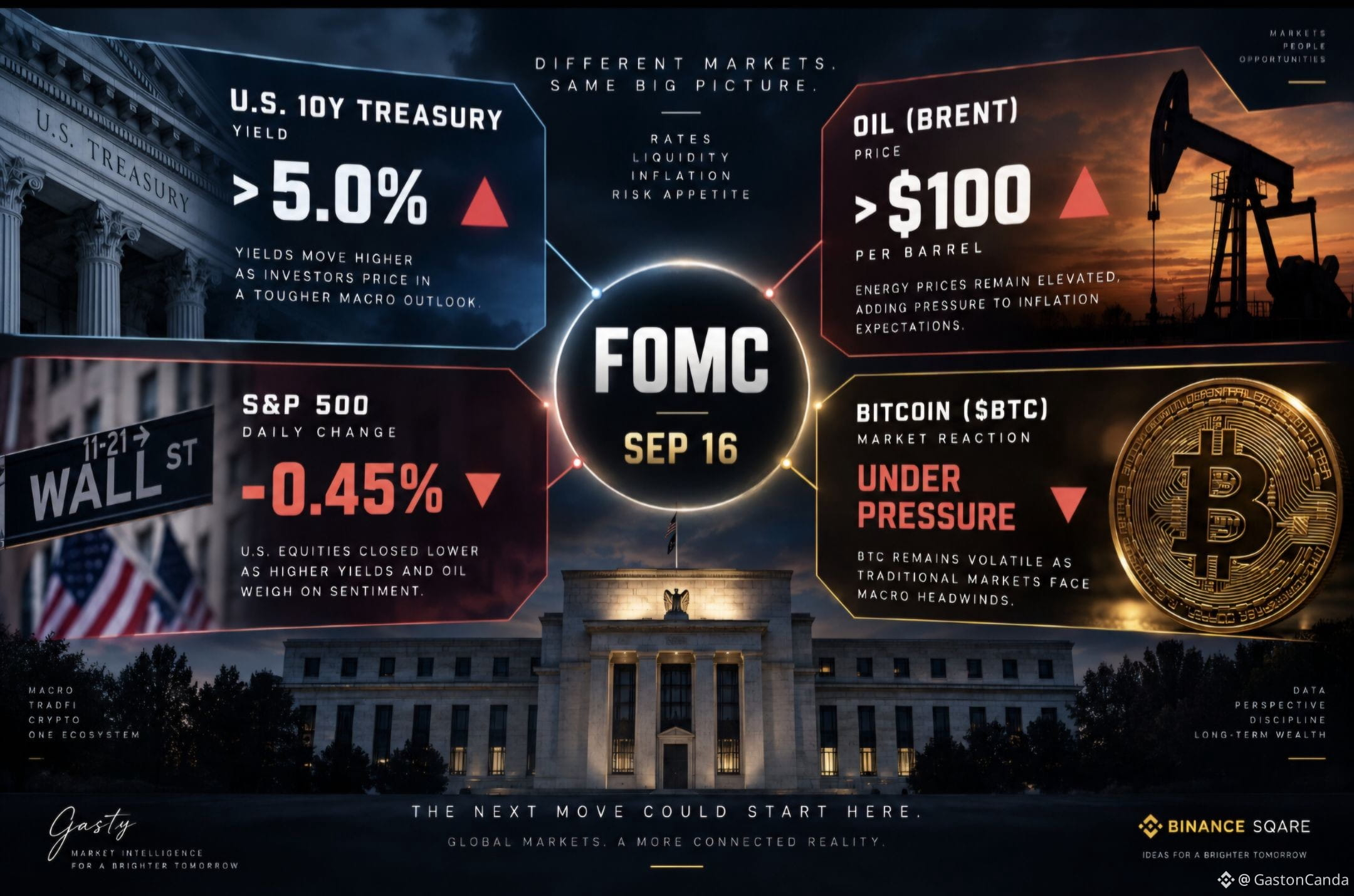
🚨 Tonight, crypto is not trading in isolation.
Wall Street closed lower as investors faced a difficult macro combination: rising Treasury yields, higher oil prices and another major Fed decision just hours away.
What happened?
• S&P 500: -0.45%
• Nasdaq: -0.78%
• Dow: -0.63%
• U.S. 10Y Treasury yield moved above 5%
• Oil remains above $100/barrel
At the same time, $BTC remains under pressure after another volatile session.
Why it matters
Higher yields increase the opportunity cost of holding risk assets.
Expensive energy can keep inflation pressure elevated.
And when both happen simultaneously, liquidity conditions become increasingly important for equities AND crypto.
What I’m watching next
Tomorrow’s Fed decision.
Not just the rate decision itself, but the message around inflation, growth and the path of monetary policy.
My takeaway:
Right now, I’m watching Treasuries → equities → crypto as one interconnected liquidity system, not three separate markets.
The next major move may start outside crypto.
Are you watching the Fed or $BTC price action more closely tomorrow?
#Bitcoin #CryptoMacro #MarketUpdate #TradFi
🚨 Tonight, crypto is not trading in isolation.
Wall Street closed lower as investors faced a difficult macro combination: rising Treasury yields, higher oil prices and another major Fed decision just hours away.
What happened?
• S&P 500: -0.45%
• Nasdaq: -0.78%
• Dow: -0.63%
• U.S. 10Y Treasury yield moved above 5%
• Oil remains above $100/barrel
At the same time, $BTC remains under pressure after another volatile session.
Why it matters
Higher yields increase the opportunity cost of holding risk assets.
Expensive energy can keep inflation pressure elevated.
And when both happen simultaneously, liquidity conditions become increasingly important for equities AND crypto.
What I’m watching next
Tomorrow’s Fed decision.
Not just the rate decision itself, but the message around inflation, growth and the path of monetary policy.
My takeaway:
Right now, I’m watching Treasuries → equities → crypto as one interconnected liquidity system, not three separate markets.
The next major move may start outside crypto.
Are you watching the Fed or $BTC price action more closely tomorrow?
#Bitcoin #CryptoMacro #MarketUpdate #TradFi
Wall Street closed lower as investors faced a difficult macro combination: rising Treasury yields, higher oil prices and another major Fed decision just hours away.
What happened?
• S&P 500: -0.45%
• Nasdaq: -0.78%
• Dow: -0.63%
• U.S. 10Y Treasury yield moved above 5%
• Oil remains above $100/barrel
At the same time, $BTC remains under pressure after another volatile session.
Why it matters
Higher yields increase the opportunity cost of holding risk assets.
Expensive energy can keep inflation pressure elevated.
And when both happen simultaneously, liquidity conditions become increasingly important for equities AND crypto.
What I’m watching next
Tomorrow’s Fed decision.
Not just the rate decision itself, but the message around inflation, growth and the path of monetary policy.
My takeaway:
Right now, I’m watching Treasuries → equities → crypto as one interconnected liquidity system, not three separate markets.
The next major move may start outside crypto.
Are you watching the Fed or $BTC price action more closely tomorrow?
#Bitcoin #CryptoMacro #MarketUpdate #TradFi
4
781
·
--
Picture this: thousands of traders spent months positioning for a swift regulatory breakthrough, only for the timeline to quietly evaporate.
Most market participants get caught holding overextended positions when macro catalysts stall, watching capital slowly bleed while hoping for a rally that has already lost its primary driver.
When markets expected the CLARITY Act to land on schedule, sentiment aggressively priced in an effortless push into uncharted territory. With the bill now delayed indefinitely, the fundamental catalyst driving that institutional momentum is off the table. Without clear statutory guardrails, $BTC faces substantial friction, keeping price action compressed below the 100,000 dollar level for much longer than the consensus anticipated.
This policy freeze extends beyond Bitcoin alone. Stalled legislative timelines tend to freeze institutional deployment across major assets like $ETH, leaving spot order books vulnerable to extended liquidity drain.
Where do you think this goes from here?
#Bitcoin #CryptoMacro #MarketAnalysis
Picture this: thousands of traders spent months positioning for a swift regulatory breakthrough, only for the timeline to quietly evaporate.
Most market participants get caught holding overextended positions when macro catalysts stall, watching capital slowly bleed while hoping for a rally that has already lost its primary driver.
When markets expected the CLARITY Act to land on schedule, sentiment aggressively priced in an effortless push into uncharted territory. With the bill now delayed indefinitely, the fundamental catalyst driving that institutional momentum is off the table. Without clear statutory guardrails, $BTC faces substantial friction, keeping price action compressed below the 100,000 dollar level for much longer than the consensus anticipated.
This policy freeze extends beyond Bitcoin alone. Stalled legislative timelines tend to freeze institutional deployment across major assets like $ETH , leaving spot order books vulnerable to extended liquidity drain.
Where do you think this goes from here?
#Bitcoin #CryptoMacro #MarketAnalysis
Most market participants get caught holding overextended positions when macro catalysts stall, watching capital slowly bleed while hoping for a rally that has already lost its primary driver.
When markets expected the CLARITY Act to land on schedule, sentiment aggressively priced in an effortless push into uncharted territory. With the bill now delayed indefinitely, the fundamental catalyst driving that institutional momentum is off the table. Without clear statutory guardrails, $BTC faces substantial friction, keeping price action compressed below the 100,000 dollar level for much longer than the consensus anticipated.
This policy freeze extends beyond Bitcoin alone. Stalled legislative timelines tend to freeze institutional deployment across major assets like $ETH , leaving spot order books vulnerable to extended liquidity drain.
Where do you think this goes from here?
#Bitcoin #CryptoMacro #MarketAnalysis

70

Recently, a critical split has emerged in the Middle East energy supply-chain situation. According to Reuters, Saudi Arabia’s east-west oil pipelines’ Pump Stations No. 8 and No. 9 were attacked last week and damaged, and the repair timeline remains uncertain. Meanwhile, the CEO of Libya’s National Oil Corporation said that temporary production cuts caused by the shutdown of three oil fields have returned to normal, with overall supply staying stable. Driven by supply-side divergence and macro-level games, the S&P 500’s Energy sector fell 3.2% intraday, marking its biggest single-day drop since June 15 of last year.
From the perspective of market structure, the market has not triggered a panic-like impulse due to geopolitical frictions in the Middle East. Although key Saudi infrastructure was damaged, the rapid return of Libyan capacity effectively hedged the supply shortfall. The pullback in the energy sector reflects that an inflation premium is being squeezed out quickly. Ahead of the Fed’s monetary policy meeting, Iranian Parliament Speaker Mohammad Bagher Qalibaf said he would incorporate the geopolitical risk premium into macro considerations; however, market pricing behavior suggests that purely geopolitical remarks are having a diminishing actual impact on the pricing framework.
The deep sell-off in energy stocks and the pressure release along the crude oil chain directly lowered expectations for macro inflation, weakening the upward momentum in long-end U.S. Treasury yields and the U.S. dollar index. The Energy sector’s 3.2% one-day decline is a typical risk-clearing signal, creating a more accommodating macro environment for risk assets from a liquidity perspective. The long-suppressed logic of inflation trades has shown signs of loosening.
For crypto assets, the easing of inflation pressure from commodities is a clear positive catalyst. $BTC With macro pressure starting to ease, funds may rotate from traditional defensive sectors back into high-volatility risk assets. As long as oil prices do not experience an extreme one-way breakout, improving expectations for macro liquidity will support the crypto market in sustaining its structural rebound trend.
#EnergySector #OilMarket #CryptoMacro
Recently, a critical split has emerged in the Middle East energy supply-chain situation. According to Reuters, Saudi Arabia’s east-west oil pipelines’ Pump Stations No. 8 and No. 9 were attacked last week and damaged, and the repair timeline remains uncertain. Meanwhile, the CEO of Libya’s National Oil Corporation said that temporary production cuts caused by the shutdown of three oil fields have returned to normal, with overall supply staying stable. Driven by supply-side divergence and macro-level games, the S&P 500’s Energy sector fell 3.2% intraday, marking its biggest single-day drop since June 15 of last year.
From the perspective of market structure, the market has not triggered a panic-like impulse due to geopolitical frictions in the Middle East. Although key Saudi infrastructure was damaged, the rapid return of Libyan capacity effectively hedged the supply shortfall. The pullback in the energy sector reflects that an inflation premium is being squeezed out quickly. Ahead of the Fed’s monetary policy meeting, Iranian Parliament Speaker Mohammad Bagher Qalibaf said he would incorporate the geopolitical risk premium into macro considerations; however, market pricing behavior suggests that purely geopolitical remarks are having a diminishing actual impact on the pricing framework.
The deep sell-off in energy stocks and the pressure release along the crude oil chain directly lowered expectations for macro inflation, weakening the upward momentum in long-end U.S. Treasury yields and the U.S. dollar index. The Energy sector’s 3.2% one-day decline is a typical risk-clearing signal, creating a more accommodating macro environment for risk assets from a liquidity perspective. The long-suppressed logic of inflation trades has shown signs of loosening.
For crypto assets, the easing of inflation pressure from commodities is a clear positive catalyst. $BTC With macro pressure starting to ease, funds may rotate from traditional defensive sectors back into high-volatility risk assets. As long as oil prices do not experience an extreme one-way breakout, improving expectations for macro liquidity will support the crypto market in sustaining its structural rebound trend.
#EnergySector #OilMarket #CryptoMacro
From the perspective of market structure, the market has not triggered a panic-like impulse due to geopolitical frictions in the Middle East. Although key Saudi infrastructure was damaged, the rapid return of Libyan capacity effectively hedged the supply shortfall. The pullback in the energy sector reflects that an inflation premium is being squeezed out quickly. Ahead of the Fed’s monetary policy meeting, Iranian Parliament Speaker Mohammad Bagher Qalibaf said he would incorporate the geopolitical risk premium into macro considerations; however, market pricing behavior suggests that purely geopolitical remarks are having a diminishing actual impact on the pricing framework.
The deep sell-off in energy stocks and the pressure release along the crude oil chain directly lowered expectations for macro inflation, weakening the upward momentum in long-end U.S. Treasury yields and the U.S. dollar index. The Energy sector’s 3.2% one-day decline is a typical risk-clearing signal, creating a more accommodating macro environment for risk assets from a liquidity perspective. The long-suppressed logic of inflation trades has shown signs of loosening.
For crypto assets, the easing of inflation pressure from commodities is a clear positive catalyst. $BTC With macro pressure starting to ease, funds may rotate from traditional defensive sectors back into high-volatility risk assets. As long as oil prices do not experience an extreme one-way breakout, improving expectations for macro liquidity will support the crypto market in sustaining its structural rebound trend.
#EnergySector #OilMarket #CryptoMacro
160

In mid-September, the U.S. Department of Commerce released the core macroeconomic data for August. Retail sales surged by 1.2% month-on-month, well above market expectations of 0.8%; the prior value was also revised from -0.6% to -0.5%. At the same time, August import price indices rose by 0.7%, significantly exceeding expectations of 0.4%; the prior value was revised from -0.4% to -0.3%.
These two key figures show that the resilience of U.S. consumer demand is far stronger than the market had priced in earlier. However, when viewed from the standpoint of inflation stickiness, strong domestic demand combined with a rebound in import prices suggests that imported inflationary pressure is not dissipating as quickly as expected. This directly undermines market optimism about the Federal Reserve being able to launch an aggressive rate-cutting cycle in the future, and may even force monetary policy to remain tight for a longer period.
In traditional financial markets, the stronger-than-expected economic resilience is pushing the U.S. dollar index and U.S. Treasury yields higher in stages, weighing on the performance of non–yielding assets such as gold. Expectations for a liquidity-loosening cycle are being pushed back, and the shadow of elevated borrowing costs continues to loom over risk-asset valuation frameworks.
For the crypto market represented by $BTC , tighter macro liquidity expectations are absolutely not a positive. With risk-free yields remaining elevated, the willingness of incremental capital entering from off-exchange is more cautious. In the near term, digital assets that lack sustained inflows may face more severe liquidity pressure and downside risks.📉
#RetailSales #Inflation #CryptoMacro
In mid-September, the U.S. Department of Commerce released the core macroeconomic data for August. Retail sales surged by 1.2% month-on-month, well above market expectations of 0.8%; the prior value was also revised from -0.6% to -0.5%. At the same time, August import price indices rose by 0.7%, significantly exceeding expectations of 0.4%; the prior value was revised from -0.4% to -0.3%.
These two key figures show that the resilience of U.S. consumer demand is far stronger than the market had priced in earlier. However, when viewed from the standpoint of inflation stickiness, strong domestic demand combined with a rebound in import prices suggests that imported inflationary pressure is not dissipating as quickly as expected. This directly undermines market optimism about the Federal Reserve being able to launch an aggressive rate-cutting cycle in the future, and may even force monetary policy to remain tight for a longer period.
In traditional financial markets, the stronger-than-expected economic resilience is pushing the U.S. dollar index and U.S. Treasury yields higher in stages, weighing on the performance of non–yielding assets such as gold. Expectations for a liquidity-loosening cycle are being pushed back, and the shadow of elevated borrowing costs continues to loom over risk-asset valuation frameworks.
For the crypto market represented by $BTC , tighter macro liquidity expectations are absolutely not a positive. With risk-free yields remaining elevated, the willingness of incremental capital entering from off-exchange is more cautious. In the near term, digital assets that lack sustained inflows may face more severe liquidity pressure and downside risks.📉
#RetailSales #Inflation #CryptoMacro
These two key figures show that the resilience of U.S. consumer demand is far stronger than the market had priced in earlier. However, when viewed from the standpoint of inflation stickiness, strong domestic demand combined with a rebound in import prices suggests that imported inflationary pressure is not dissipating as quickly as expected. This directly undermines market optimism about the Federal Reserve being able to launch an aggressive rate-cutting cycle in the future, and may even force monetary policy to remain tight for a longer period.
In traditional financial markets, the stronger-than-expected economic resilience is pushing the U.S. dollar index and U.S. Treasury yields higher in stages, weighing on the performance of non–yielding assets such as gold. Expectations for a liquidity-loosening cycle are being pushed back, and the shadow of elevated borrowing costs continues to loom over risk-asset valuation frameworks.
For the crypto market represented by $BTC , tighter macro liquidity expectations are absolutely not a positive. With risk-free yields remaining elevated, the willingness of incremental capital entering from off-exchange is more cautious. In the near term, digital assets that lack sustained inflows may face more severe liquidity pressure and downside risks.📉
#RetailSales #Inflation #CryptoMacro
5

·
--
🚨 $BTC REACTS TO 10‑YR YIELD SURGE ABOVE 5.02% 📈
The 10‑year Treasury breaching 5.02% marks the first mid‑2000s level in 16 years, a classic catalyst that forces risk assets into a liquidity hunt. Smart money 🦈 is likely tightening positions, and we see a subtle shift in order flow as sellers target the last bullish range on the 4‑hour chart.
On‑chain metrics 📊 show a growing sell‑pressure divergence, while the recent demand block around $27,800 📌 is holding as a defensive order block. If the yield stickiness persists, ⚡ a break below that zone could trigger a swift move toward the next liquidity pool near $26,500.
💬 Do you see $BTC defending this order block or slipping into the next liquidity trap? 👇
⚠️ Not financial advice. Always manage your risk. 🛡️
🏷️ #BTC #YieldShock #LiquidityHunt #CryptoMacro
🔥 💎
🚨 $BTC REACTS TO 10‑YR YIELD SURGE ABOVE 5.02% 📈
The 10‑year Treasury breaching 5.02% marks the first mid‑2000s level in 16 years, a classic catalyst that forces risk assets into a liquidity hunt. Smart money 🦈 is likely tightening positions, and we see a subtle shift in order flow as sellers target the last bullish range on the 4‑hour chart.
On‑chain metrics 📊 show a growing sell‑pressure divergence, while the recent demand block around $27,800 📌 is holding as a defensive order block. If the yield stickiness persists, ⚡ a break below that zone could trigger a swift move toward the next liquidity pool near $26,500.
💬 Do you see $BTC defending this order block or slipping into the next liquidity trap? 👇
⚠️ Not financial advice. Always manage your risk. 🛡️
🏷️ #BTC #YieldShock #LiquidityHunt #CryptoMacro
🔥 💎
The 10‑year Treasury breaching 5.02% marks the first mid‑2000s level in 16 years, a classic catalyst that forces risk assets into a liquidity hunt. Smart money 🦈 is likely tightening positions, and we see a subtle shift in order flow as sellers target the last bullish range on the 4‑hour chart.
On‑chain metrics 📊 show a growing sell‑pressure divergence, while the recent demand block around $27,800 📌 is holding as a defensive order block. If the yield stickiness persists, ⚡ a break below that zone could trigger a swift move toward the next liquidity pool near $26,500.
💬 Do you see $BTC defending this order block or slipping into the next liquidity trap? 👇
⚠️ Not financial advice. Always manage your risk. 🛡️
🏷️ #BTC #YieldShock #LiquidityHunt #CryptoMacro
🔥 💎
7

Article
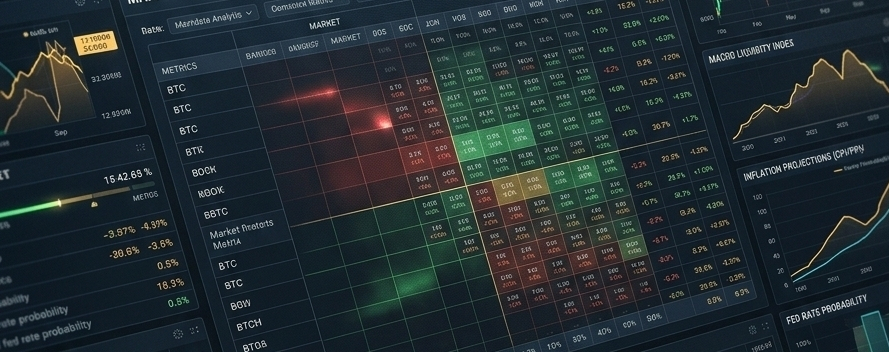
The Macro Liquidity Cycle: Why CPI, PPI, and the Fed Control the Crypto Order FlowEvery crypto cycle brings a fresh wave of technical indicators, but institutional smart money ignores the micro-noise. Instead, they focus on a singular, dominant force: Global Macro Liquidity.
If you want to understand why $BTC, $ETH, and the broader markets experience aggressive directional expansions or sudden liquidity sweeps, you must look directly at the United States macroeconomic reports—specifically CPI, PPI, and the Federal Reserve’s interest rate policy.
1. The Inflation Gauge: CPI vs. PPI
CPI (Consumer Price Index): Measures inflation from the consumer’s standpoint. When CPI prints higher than expected, it means inflation is sticky.PPI (Producer Price Index): Measures wholesale price pressures before they reach the consumer. It acts as an early warning system for future inflation.
2. The Transmission Mechanism: The Fed's Decision
When inflation metrics (CPI/PPI) heat up, the Federal Reserve is forced into a hawkish stance. They keep interest rates elevated, which effectively tightens global liquidity by making capital more expensive.
High-risk, high-beta asset classes like crypto thrive in high-liquidity environments. When the Fed tightens the tap, institutional desks rotate capital into safer, yield-bearing traditional assets, resulting in local market cooling periods. Conversely, when macro data cools down, monetary easing follows, injecting fresh liquidity back into the crypto ecosystem.
The Institutional Trading Edge
The retail market frequently gets caught off guard by trading standalone support and resistance levels right before major macro announcements. High-class execution requires waiting for the post-event volatility to settle.
Patience and a thorough understanding of global liquidity flows remain the ultimate trading edge. Trade the macro cycle, protect your capital structure, and avoid getting caught in the intraday noise.
Join the Discussion 👇
How do you position your capital ahead of major US macro data releases?
Drop a 1️⃣ in the comments if you strictly de-risk into Stablecoins and wait for order-flow confirmation! 🛡️Drop a 2️⃣ in the comments if you actively trade the high-volatility sweeps during the announcement! 🚀
Hit the Like button if this macro breakdown added value to your strategy, and Follow for institutional-grade market updates! 🌐
#CryptoMacro #FedDecision #MarketInsight #BitcoinUpdate
The Macro Liquidity Cycle: Why CPI, PPI, and the Fed Control the Crypto Order Flow
Every crypto cycle brings a fresh wave of technical indicators, but institutional smart money ignores the micro-noise. Instead, they focus on a singular, dominant force: Global Macro Liquidity.
If you want to understand why $BTC, $ETH, and the broader markets experience aggressive directional expansions or sudden liquidity sweeps, you must look directly at the United States macroeconomic reports—specifically CPI, PPI, and the Federal Reserve’s interest rate policy.
1. The Inflation Gauge: CPI vs. PPI
CPI (Consumer Price Index): Measures inflation from the consumer’s standpoint. When CPI prints higher than expected, it means inflation is sticky.PPI (Producer Price Index): Measures wholesale price pressures before they reach the consumer. It acts as an early warning system for future inflation.
2. The Transmission Mechanism: The Fed's Decision
When inflation metrics (CPI/PPI) heat up, the Federal Reserve is forced into a hawkish stance. They keep interest rates elevated, which effectively tightens global liquidity by making capital more expensive.
High-risk, high-beta asset classes like crypto thrive in high-liquidity environments. When the Fed tightens the tap, institutional desks rotate capital into safer, yield-bearing traditional assets, resulting in local market cooling periods. Conversely, when macro data cools down, monetary easing follows, injecting fresh liquidity back into the crypto ecosystem.
The Institutional Trading Edge
The retail market frequently gets caught off guard by trading standalone support and resistance levels right before major macro announcements. High-class execution requires waiting for the post-event volatility to settle.
Patience and a thorough understanding of global liquidity flows remain the ultimate trading edge. Trade the macro cycle, protect your capital structure, and avoid getting caught in the intraday noise.
Join the Discussion 👇
How do you position your capital ahead of major US macro data releases?
Drop a 1️⃣ in the comments if you strictly de-risk into Stablecoins and wait for order-flow confirmation! 🛡️Drop a 2️⃣ in the comments if you actively trade the high-volatility sweeps during the announcement! 🚀
Hit the Like button if this macro breakdown added value to your strategy, and Follow for institutional-grade market updates! 🌐
#CryptoMacro #FedDecision #MarketInsight #BitcoinUpdate
If you want to understand why $BTC, $ETH, and the broader markets experience aggressive directional expansions or sudden liquidity sweeps, you must look directly at the United States macroeconomic reports—specifically CPI, PPI, and the Federal Reserve’s interest rate policy.
1. The Inflation Gauge: CPI vs. PPI
CPI (Consumer Price Index): Measures inflation from the consumer’s standpoint. When CPI prints higher than expected, it means inflation is sticky.PPI (Producer Price Index): Measures wholesale price pressures before they reach the consumer. It acts as an early warning system for future inflation.
2. The Transmission Mechanism: The Fed's Decision
When inflation metrics (CPI/PPI) heat up, the Federal Reserve is forced into a hawkish stance. They keep interest rates elevated, which effectively tightens global liquidity by making capital more expensive.
High-risk, high-beta asset classes like crypto thrive in high-liquidity environments. When the Fed tightens the tap, institutional desks rotate capital into safer, yield-bearing traditional assets, resulting in local market cooling periods. Conversely, when macro data cools down, monetary easing follows, injecting fresh liquidity back into the crypto ecosystem.
The Institutional Trading Edge
The retail market frequently gets caught off guard by trading standalone support and resistance levels right before major macro announcements. High-class execution requires waiting for the post-event volatility to settle.
Patience and a thorough understanding of global liquidity flows remain the ultimate trading edge. Trade the macro cycle, protect your capital structure, and avoid getting caught in the intraday noise.
Join the Discussion 👇
How do you position your capital ahead of major US macro data releases?
Drop a 1️⃣ in the comments if you strictly de-risk into Stablecoins and wait for order-flow confirmation! 🛡️Drop a 2️⃣ in the comments if you actively trade the high-volatility sweeps during the announcement! 🚀
Hit the Like button if this macro breakdown added value to your strategy, and Follow for institutional-grade market updates! 🌐
#CryptoMacro #FedDecision #MarketInsight #BitcoinUpdate
67
The World Trade Organization (WTO), in its latest thematic outlook report, states that by 2040, artificial intelligence (AI) is expected to drive a cumulative increase of 13.2% in global real GDP, while expanding global trade totals by nearly 40%. Within this, the digital delivery services sector will become the strongest core growth engine. This quantitative projection provides a clear long-term macro benchmark for the global technology productivity revolution.
Judging from macro fundamentals and productivity curves, this incremental gain is far greater than the initial estimates from the past several rounds of technological innovation cycles. Productivity improvements directly affect global total factor productivity (TFP), effectively mitigating medium- to long-term structural inflation pressures. For technology-cycle assets, the fundamentals model is establishing a higher ceiling for long-term discounted cash flows, strengthening the underlying logic of tech asset valuation.
In terms of traditional finance and liquidity dimensions, expectations of a productivity dividend are expected to accelerate capital flows toward AI infrastructure, compute power centers, and high-end semiconductor industry chains. As the central tendency of potential economic growth rises, the risk premium for risk assets—equity risk premium (Equity Risk Premium)—is likely to narrow, prompting global capital to actively allocate to high-Beta growth assets at pullback points. This will provide long-term support for the U.S. stock market’s technology sector and overall risk appetite.
For the crypto asset market, the integration of AI with Web3 decentralized compute, data ownership, and smart-contract agents (AI Agents) is now entering a period of clear narrative resonance. As macro productivity dividends are gradually realized, decentralized hard assets such as $BTC and leading AI concept tokens’ on-chain liquidity will see a continued influx of incremental capital. The current consolidation structure is more conducive to building a solid medium- to long-term upward bottom formation.#ArtificialIntelligence #GlobalTrade #CryptoMacro
The World Trade Organization (WTO), in its latest thematic outlook report, states that by 2040, artificial intelligence (AI) is expected to drive a cumulative increase of 13.2% in global real GDP, while expanding global trade totals by nearly 40%. Within this, the digital delivery services sector will become the strongest core growth engine. This quantitative projection provides a clear long-term macro benchmark for the global technology productivity revolution.
Judging from macro fundamentals and productivity curves, this incremental gain is far greater than the initial estimates from the past several rounds of technological innovation cycles. Productivity improvements directly affect global total factor productivity (TFP), effectively mitigating medium- to long-term structural inflation pressures. For technology-cycle assets, the fundamentals model is establishing a higher ceiling for long-term discounted cash flows, strengthening the underlying logic of tech asset valuation.
In terms of traditional finance and liquidity dimensions, expectations of a productivity dividend are expected to accelerate capital flows toward AI infrastructure, compute power centers, and high-end semiconductor industry chains. As the central tendency of potential economic growth rises, the risk premium for risk assets—equity risk premium (Equity Risk Premium)—is likely to narrow, prompting global capital to actively allocate to high-Beta growth assets at pullback points. This will provide long-term support for the U.S. stock market’s technology sector and overall risk appetite.
For the crypto asset market, the integration of AI with Web3 decentralized compute, data ownership, and smart-contract agents (AI Agents) is now entering a period of clear narrative resonance. As macro productivity dividends are gradually realized, decentralized hard assets such as $BTC and leading AI concept tokens’ on-chain liquidity will see a continued influx of incremental capital. The current consolidation structure is more conducive to building a solid medium- to long-term upward bottom formation.#ArtificialIntelligence #GlobalTrade #CryptoMacro
Judging from macro fundamentals and productivity curves, this incremental gain is far greater than the initial estimates from the past several rounds of technological innovation cycles. Productivity improvements directly affect global total factor productivity (TFP), effectively mitigating medium- to long-term structural inflation pressures. For technology-cycle assets, the fundamentals model is establishing a higher ceiling for long-term discounted cash flows, strengthening the underlying logic of tech asset valuation.
In terms of traditional finance and liquidity dimensions, expectations of a productivity dividend are expected to accelerate capital flows toward AI infrastructure, compute power centers, and high-end semiconductor industry chains. As the central tendency of potential economic growth rises, the risk premium for risk assets—equity risk premium (Equity Risk Premium)—is likely to narrow, prompting global capital to actively allocate to high-Beta growth assets at pullback points. This will provide long-term support for the U.S. stock market’s technology sector and overall risk appetite.
For the crypto asset market, the integration of AI with Web3 decentralized compute, data ownership, and smart-contract agents (AI Agents) is now entering a period of clear narrative resonance. As macro productivity dividends are gradually realized, decentralized hard assets such as $BTC and leading AI concept tokens’ on-chain liquidity will see a continued influx of incremental capital. The current consolidation structure is more conducive to building a solid medium- to long-term upward bottom formation.#ArtificialIntelligence #GlobalTrade #CryptoMacro
With the Federal Reserve’s interest rate decision approaching this week, as mainstream Wall Street expectations lean toward further rate hikes, several well-known economists—including Mark Zandi, Chief Economist at Moody’s, Steve Englander, Head of G10 FX Research at Standard Chartered, and Michael Pearce from Oxford Economics—have publicly issued warnings. They point out that current inflation signals are conflicting, and that an ill-advised rate hike by the Fed could result in a serious policy error, urging that rates be kept unchanged.
The core logic behind this debate is that the marginal effects of the tightening cycle have entered a dangerous zone. Technical indicators from the market show that while the labor market remains resilient, excessively aggressive hikes can easily trigger a non-linear rise in unemployment and set off a negative economic feedback loop. With both a downward trend in inflation and pockets of stickiness, the sharp divergence in policy expectations actually suggests that tightening has reached its absolute peak. Even if there is one final defensive rate hike, it is unlikely to change the inevitability of the subsequent rate-cut cycle.
Looking across asset classes, the U.S. dollar index is holding high levels in the short term on expectations of rate hikes, moving in a tight range. The upside potential on the Treasury yield curve has been constrained by concerns about recession. If this week’s decision sends a “hold steady” signal—or even if a hike is framed as the “final one”—a dovish shift, the macro “ceiling” that has been weighing on risk assets will be fully lifted, and a turning point in dollar liquidity will be firmly established.
For the crypto market, if macro tightening sentiment either plays out or is disproven, improved liquidity expectations will act as a powerful catalyst. Currently, $BTC is showing a solid bottom accumulation structure at a key support level. Any clarification from policy authorities will accelerate short-seller position closures, and alongside renewed activity among on-chain funds, crypto assets are poised to be among the first to enter a strong breakout rally.📈
#Fed #InterestRates #CryptoMacro
With the Federal Reserve’s interest rate decision approaching this week, as mainstream Wall Street expectations lean toward further rate hikes, several well-known economists—including Mark Zandi, Chief Economist at Moody’s, Steve Englander, Head of G10 FX Research at Standard Chartered, and Michael Pearce from Oxford Economics—have publicly issued warnings. They point out that current inflation signals are conflicting, and that an ill-advised rate hike by the Fed could result in a serious policy error, urging that rates be kept unchanged.
The core logic behind this debate is that the marginal effects of the tightening cycle have entered a dangerous zone. Technical indicators from the market show that while the labor market remains resilient, excessively aggressive hikes can easily trigger a non-linear rise in unemployment and set off a negative economic feedback loop. With both a downward trend in inflation and pockets of stickiness, the sharp divergence in policy expectations actually suggests that tightening has reached its absolute peak. Even if there is one final defensive rate hike, it is unlikely to change the inevitability of the subsequent rate-cut cycle.
Looking across asset classes, the U.S. dollar index is holding high levels in the short term on expectations of rate hikes, moving in a tight range. The upside potential on the Treasury yield curve has been constrained by concerns about recession. If this week’s decision sends a “hold steady” signal—or even if a hike is framed as the “final one”—a dovish shift, the macro “ceiling” that has been weighing on risk assets will be fully lifted, and a turning point in dollar liquidity will be firmly established.
For the crypto market, if macro tightening sentiment either plays out or is disproven, improved liquidity expectations will act as a powerful catalyst. Currently, $BTC is showing a solid bottom accumulation structure at a key support level. Any clarification from policy authorities will accelerate short-seller position closures, and alongside renewed activity among on-chain funds, crypto assets are poised to be among the first to enter a strong breakout rally.📈
#Fed #InterestRates #CryptoMacro
The core logic behind this debate is that the marginal effects of the tightening cycle have entered a dangerous zone. Technical indicators from the market show that while the labor market remains resilient, excessively aggressive hikes can easily trigger a non-linear rise in unemployment and set off a negative economic feedback loop. With both a downward trend in inflation and pockets of stickiness, the sharp divergence in policy expectations actually suggests that tightening has reached its absolute peak. Even if there is one final defensive rate hike, it is unlikely to change the inevitability of the subsequent rate-cut cycle.
Looking across asset classes, the U.S. dollar index is holding high levels in the short term on expectations of rate hikes, moving in a tight range. The upside potential on the Treasury yield curve has been constrained by concerns about recession. If this week’s decision sends a “hold steady” signal—or even if a hike is framed as the “final one”—a dovish shift, the macro “ceiling” that has been weighing on risk assets will be fully lifted, and a turning point in dollar liquidity will be firmly established.
For the crypto market, if macro tightening sentiment either plays out or is disproven, improved liquidity expectations will act as a powerful catalyst. Currently, $BTC is showing a solid bottom accumulation structure at a key support level. Any clarification from policy authorities will accelerate short-seller position closures, and alongside renewed activity among on-chain funds, crypto assets are poised to be among the first to enter a strong breakout rally.📈
#Fed #InterestRates #CryptoMacro
45
Against the backdrop of a fierce sell-off wave across global bond markets, the benchmark 10-year U.S. Treasury yield has surged past 5.02%, setting a new high for 2023 and the highest level since 2007. Meanwhile, Japan’s 5-year government bond yield has also climbed to a record high of 2.315%, and the Japanese government is considering a major increase in defense spending to 3.5% of GDP over the next decade—an initiative that further heightens market concerns about a surge in sovereign debt supply.
The sharp rise in global long-end interest rates this round is mainly driven by the resonance of multiple inflation pressures and debt risks. Since the United States launched military action against Iran in late February that disrupted oil and gas supplies in the Middle East, energy prices have jumped, directly lifting inflation expectations. In addition, companies have issued large amounts of debt to compete for investments in AI infrastructure, raising the overall burden on the real economy and credit. As a result, the expectation that rates will remain high for a prolonged period—“Higher for Longer”—has become firmly entrenched, and rate-cut expectations have been dealt a major blow.
The runaway climb in long-end risk-free rates has seriously suppressed the global liquidity landscape. When the 10-year U.S. Treasury yield breaks through the 5% threshold, it not only signals a reconfiguration of the pricing anchor for traditional assets, but also will significantly increase financing costs for the real economy and technology companies. With elevated borrowing costs strengthening in tandem with Japanese bond yields, carry trades are being prompted to accelerate their reversal. Global capital now faces a strong pull to reflow back into low-risk, high-yield sovereign debt.
For the cryptocurrency market, the current environment is sending extremely stern signals of liquidity tightening. A break in risk-free yields above 5% will inevitably drain speculative capital from the existing market and curb investors’ willingness to deploy incremental capital into high-risk preference assets. If the sell-off momentum in global macro bond markets cannot be contained, $BTC and other risk assets may continue to face the risk of capital outflows and valuation pressure in the short term. Investors should remain highly alert to the risk of a second downside test triggered by tighter liquidity. #BondYields #InflationRisk #CryptoMacro
Against the backdrop of a fierce sell-off wave across global bond markets, the benchmark 10-year U.S. Treasury yield has surged past 5.02%, setting a new high for 2023 and the highest level since 2007. Meanwhile, Japan’s 5-year government bond yield has also climbed to a record high of 2.315%, and the Japanese government is considering a major increase in defense spending to 3.5% of GDP over the next decade—an initiative that further heightens market concerns about a surge in sovereign debt supply.
The sharp rise in global long-end interest rates this round is mainly driven by the resonance of multiple inflation pressures and debt risks. Since the United States launched military action against Iran in late February that disrupted oil and gas supplies in the Middle East, energy prices have jumped, directly lifting inflation expectations. In addition, companies have issued large amounts of debt to compete for investments in AI infrastructure, raising the overall burden on the real economy and credit. As a result, the expectation that rates will remain high for a prolonged period—“Higher for Longer”—has become firmly entrenched, and rate-cut expectations have been dealt a major blow.
The runaway climb in long-end risk-free rates has seriously suppressed the global liquidity landscape. When the 10-year U.S. Treasury yield breaks through the 5% threshold, it not only signals a reconfiguration of the pricing anchor for traditional assets, but also will significantly increase financing costs for the real economy and technology companies. With elevated borrowing costs strengthening in tandem with Japanese bond yields, carry trades are being prompted to accelerate their reversal. Global capital now faces a strong pull to reflow back into low-risk, high-yield sovereign debt.
For the cryptocurrency market, the current environment is sending extremely stern signals of liquidity tightening. A break in risk-free yields above 5% will inevitably drain speculative capital from the existing market and curb investors’ willingness to deploy incremental capital into high-risk preference assets. If the sell-off momentum in global macro bond markets cannot be contained, $BTC and other risk assets may continue to face the risk of capital outflows and valuation pressure in the short term. Investors should remain highly alert to the risk of a second downside test triggered by tighter liquidity. #BondYields #InflationRisk #CryptoMacro
The sharp rise in global long-end interest rates this round is mainly driven by the resonance of multiple inflation pressures and debt risks. Since the United States launched military action against Iran in late February that disrupted oil and gas supplies in the Middle East, energy prices have jumped, directly lifting inflation expectations. In addition, companies have issued large amounts of debt to compete for investments in AI infrastructure, raising the overall burden on the real economy and credit. As a result, the expectation that rates will remain high for a prolonged period—“Higher for Longer”—has become firmly entrenched, and rate-cut expectations have been dealt a major blow.
The runaway climb in long-end risk-free rates has seriously suppressed the global liquidity landscape. When the 10-year U.S. Treasury yield breaks through the 5% threshold, it not only signals a reconfiguration of the pricing anchor for traditional assets, but also will significantly increase financing costs for the real economy and technology companies. With elevated borrowing costs strengthening in tandem with Japanese bond yields, carry trades are being prompted to accelerate their reversal. Global capital now faces a strong pull to reflow back into low-risk, high-yield sovereign debt.
For the cryptocurrency market, the current environment is sending extremely stern signals of liquidity tightening. A break in risk-free yields above 5% will inevitably drain speculative capital from the existing market and curb investors’ willingness to deploy incremental capital into high-risk preference assets. If the sell-off momentum in global macro bond markets cannot be contained, $BTC and other risk assets may continue to face the risk of capital outflows and valuation pressure in the short term. Investors should remain highly alert to the risk of a second downside test triggered by tighter liquidity. #BondYields #InflationRisk #CryptoMacro
2
Log in to explore more content
Join global crypto users on Binance Square
⚡️ Get latest and useful information about crypto.
💬 Trusted by the world’s largest crypto exchange.
👍 Discover real insights from verified creators.
Email / Phone number
Trending Topics
1
#BinanceWillListHyperliquid(HYPE)
29,570 views
806 Discussing
2
#FedOctoberRateHikeOddsRiseTo69.7%
1,207 views
111 Discussing
3
#BitcoinFallsBelow$83,000
1,396 views
20 Discussing
4
#BitcoinFallsToAround$84,600ThisWeek
0 views
0 Discussing
5
#US30YearYieldHighestSince2004
4,960 views
167 Discussing
6
#ETHBreaksAbove$2,700
770 views
20 Discussing
7
#USWeighsPromotingDollarStablecoinsAbroad
30,709 views
991 Discussing
8
#US10YTreasuryYieldHits19YearHigh
28,589 views
764 Discussing
9
#SpotBitcoinETFsInflow$2.31BInFourDays
4,173 views
59 Discussing
10
#BitcoinRejectedAt$87,300Twice
0 views
0 Discussing