
#retailsales
retailsales
31,077 views
98 Discussing
Hot
Latest

Data released for August shows US retail sales rebounded sharply by 1.2% month-over-month, easily beating expectations and reversing the previous 0.5% contraction recorded in July. Growth was remarkably broad-based, with 12 out of 13 tracked categories posting solid gains—driven by back-to-school spending, online commerce, and fuel demand.
This robust rebound highlights the underlying resilience of the American consumer, who continues to spend despite ongoing inflationary headwinds and elevated borrowing costs. Such broad-based strength suggests household balance sheets remain relatively sturdy, complicating narratives of an imminent recession and giving policymakers little urgency to rush into aggressive monetary easing.
Across macro markets, strong consumption figures tend to support the US Dollar while putting upward pressure on Treasury yields. As resilient consumer activity keeps upside inflation risks in play, bond markets may reprice expectations toward higher-for-longer policy rates rather than rapid, deep cuts.
For crypto assets, particularly $BTC, this macroeconomic resilience presents a double-edged sword. While avoiding a sharp economic contraction reduces panic risk across risk assets, elevated yields and a firmer dollar limit immediate fiat liquidity inflows, keeping prices range-bound in the near term.
#RetailSales #USMacro #FederalReserve
Data released for August shows US retail sales rebounded sharply by 1.2% month-over-month, easily beating expectations and reversing the previous 0.5% contraction recorded in July. Growth was remarkably broad-based, with 12 out of 13 tracked categories posting solid gains—driven by back-to-school spending, online commerce, and fuel demand.
This robust rebound highlights the underlying resilience of the American consumer, who continues to spend despite ongoing inflationary headwinds and elevated borrowing costs. Such broad-based strength suggests household balance sheets remain relatively sturdy, complicating narratives of an imminent recession and giving policymakers little urgency to rush into aggressive monetary easing.
Across macro markets, strong consumption figures tend to support the US Dollar while putting upward pressure on Treasury yields. As resilient consumer activity keeps upside inflation risks in play, bond markets may reprice expectations toward higher-for-longer policy rates rather than rapid, deep cuts.
For crypto assets, particularly $BTC , this macroeconomic resilience presents a double-edged sword. While avoiding a sharp economic contraction reduces panic risk across risk assets, elevated yields and a firmer dollar limit immediate fiat liquidity inflows, keeping prices range-bound in the near term.
#RetailSales #USMacro #FederalReserve
This robust rebound highlights the underlying resilience of the American consumer, who continues to spend despite ongoing inflationary headwinds and elevated borrowing costs. Such broad-based strength suggests household balance sheets remain relatively sturdy, complicating narratives of an imminent recession and giving policymakers little urgency to rush into aggressive monetary easing.
Across macro markets, strong consumption figures tend to support the US Dollar while putting upward pressure on Treasury yields. As resilient consumer activity keeps upside inflation risks in play, bond markets may reprice expectations toward higher-for-longer policy rates rather than rapid, deep cuts.
For crypto assets, particularly $BTC , this macroeconomic resilience presents a double-edged sword. While avoiding a sharp economic contraction reduces panic risk across risk assets, elevated yields and a firmer dollar limit immediate fiat liquidity inflows, keeping prices range-bound in the near term.
#RetailSales #USMacro #FederalReserve
6
U.S. macroeconomic data released today showed a significant surprise as August retail sales jumped by 1.2%, easily beating market expectations of 0.8% and rebounding sharply from an upwardly revised -0.5% in the prior month. Alongside this, the August import price index climbed 0.7% against a 0.4% consensus, signaling persistent upstream inflationary pressure.
This resilient consumer spending print combined with rising import prices complicates the broader disinflation narrative. Market participants had anticipated a clearer slowdown in economic activity, but robust household demand suggests underlying economic momentum remains unexpectedly sturdy despite tight monetary conditions.
For traditional markets, these numbers are likely to reinforce a 'higher-for-longer' interest rate narrative, driving upward pressure on U.S. Treasury yields and lending support to the U.S. Dollar. In this environment, risk assets may face short-term headwinds as aggressive rate-cut expectations get priced out.
In the crypto space, resilient macro data could delay broader liquidity inflows into $BTC and major altcoins. While underlying economic strength reduces recession risks, high borrowing costs continue to cap speculative capital, keeping market participants cautious until clearer monetary easing signals emerge. 📊
#RetailSales #MacroEconomy #Inflation
U.S. macroeconomic data released today showed a significant surprise as August retail sales jumped by 1.2%, easily beating market expectations of 0.8% and rebounding sharply from an upwardly revised -0.5% in the prior month. Alongside this, the August import price index climbed 0.7% against a 0.4% consensus, signaling persistent upstream inflationary pressure.
This resilient consumer spending print combined with rising import prices complicates the broader disinflation narrative. Market participants had anticipated a clearer slowdown in economic activity, but robust household demand suggests underlying economic momentum remains unexpectedly sturdy despite tight monetary conditions.
For traditional markets, these numbers are likely to reinforce a 'higher-for-longer' interest rate narrative, driving upward pressure on U.S. Treasury yields and lending support to the U.S. Dollar. In this environment, risk assets may face short-term headwinds as aggressive rate-cut expectations get priced out.
In the crypto space, resilient macro data could delay broader liquidity inflows into $BTC and major altcoins. While underlying economic strength reduces recession risks, high borrowing costs continue to cap speculative capital, keeping market participants cautious until clearer monetary easing signals emerge. 📊
#RetailSales #MacroEconomy #Inflation
This resilient consumer spending print combined with rising import prices complicates the broader disinflation narrative. Market participants had anticipated a clearer slowdown in economic activity, but robust household demand suggests underlying economic momentum remains unexpectedly sturdy despite tight monetary conditions.
For traditional markets, these numbers are likely to reinforce a 'higher-for-longer' interest rate narrative, driving upward pressure on U.S. Treasury yields and lending support to the U.S. Dollar. In this environment, risk assets may face short-term headwinds as aggressive rate-cut expectations get priced out.
In the crypto space, resilient macro data could delay broader liquidity inflows into $BTC and major altcoins. While underlying economic strength reduces recession risks, high borrowing costs continue to cap speculative capital, keeping market participants cautious until clearer monetary easing signals emerge. 📊
#RetailSales #MacroEconomy #Inflation
8

·
--
The U.S. Department of Commerce has just released retail sales data for August, and the overall performance came in well above market expectations. After a 0.5% month-over-month decline in July, August retail sales rebounded strongly, recording a 1.2% month-over-month increase. The rebound was broadly based: among 13 tracked retail subcategories, 12 registered growth, spanning gas stations as well as major online retail platforms. Even the back-to-school shopping season clearly boosted spending on department stores, apparel, sporting goods, and electronics.
This data has drawn particular attention because it directly reflects the real purchasing power of typical U.S. consumers. Despite rising energy prices and persistent, stubborn inflation pressure hovering over the market, consumer demand has still shown remarkable resilience. Previously, the market broadly worried that weak consumption could drag the overall economy toward a downturn; however, the August rebound that beat expectations not only dispelled the downward shadow from the prior month, but also indicated that amid rising living costs, the household sector’s consumption demand has not immediately shown signs of stalling.
From a broader financial-market perspective, strong retail data can be a double-edged sword. On the one hand, buoyant consumer conditions suggest that the economic fundamentals still have support, reducing the risk of a hard landing in the short term. On the other hand, overheating consumption could make the path for inflation easing more complicated, which in turn would affect the Federal Reserve’s considerations regarding its policy path. After the data was released, the U.S. dollar index and Treasury yields are prone to disruptions from sticky-inflation expectations, and traditional assets continually reassess the liquidity environment expected going forward.
Turning back to the crypto market, this macro signal also feels somewhat nuanced for traders. If strong consumption supports the economy while delaying the pace of rapid liquidity easing, new incremental capital entering the crypto market in the near term may remain relatively on the sidelines. Still, a healthy economic backdrop also lowers the likelihood of extreme liquidity shocks. For players focused on $BTC and overall market conditions, the market is currently more about finding a balance between economic resilience and interest-rate expectations, and the next move will depend on further changes in the macro liquidity picture.
#RetailSales #USMacro #CryptoMarket
The U.S. Department of Commerce has just released retail sales data for August, and the overall performance came in well above market expectations. After a 0.5% month-over-month decline in July, August retail sales rebounded strongly, recording a 1.2% month-over-month increase. The rebound was broadly based: among 13 tracked retail subcategories, 12 registered growth, spanning gas stations as well as major online retail platforms. Even the back-to-school shopping season clearly boosted spending on department stores, apparel, sporting goods, and electronics.
This data has drawn particular attention because it directly reflects the real purchasing power of typical U.S. consumers. Despite rising energy prices and persistent, stubborn inflation pressure hovering over the market, consumer demand has still shown remarkable resilience. Previously, the market broadly worried that weak consumption could drag the overall economy toward a downturn; however, the August rebound that beat expectations not only dispelled the downward shadow from the prior month, but also indicated that amid rising living costs, the household sector’s consumption demand has not immediately shown signs of stalling.
From a broader financial-market perspective, strong retail data can be a double-edged sword. On the one hand, buoyant consumer conditions suggest that the economic fundamentals still have support, reducing the risk of a hard landing in the short term. On the other hand, overheating consumption could make the path for inflation easing more complicated, which in turn would affect the Federal Reserve’s considerations regarding its policy path. After the data was released, the U.S. dollar index and Treasury yields are prone to disruptions from sticky-inflation expectations, and traditional assets continually reassess the liquidity environment expected going forward.
Turning back to the crypto market, this macro signal also feels somewhat nuanced for traders. If strong consumption supports the economy while delaying the pace of rapid liquidity easing, new incremental capital entering the crypto market in the near term may remain relatively on the sidelines. Still, a healthy economic backdrop also lowers the likelihood of extreme liquidity shocks. For players focused on $BTC and overall market conditions, the market is currently more about finding a balance between economic resilience and interest-rate expectations, and the next move will depend on further changes in the macro liquidity picture.
#RetailSales #USMacro #CryptoMarket
This data has drawn particular attention because it directly reflects the real purchasing power of typical U.S. consumers. Despite rising energy prices and persistent, stubborn inflation pressure hovering over the market, consumer demand has still shown remarkable resilience. Previously, the market broadly worried that weak consumption could drag the overall economy toward a downturn; however, the August rebound that beat expectations not only dispelled the downward shadow from the prior month, but also indicated that amid rising living costs, the household sector’s consumption demand has not immediately shown signs of stalling.
From a broader financial-market perspective, strong retail data can be a double-edged sword. On the one hand, buoyant consumer conditions suggest that the economic fundamentals still have support, reducing the risk of a hard landing in the short term. On the other hand, overheating consumption could make the path for inflation easing more complicated, which in turn would affect the Federal Reserve’s considerations regarding its policy path. After the data was released, the U.S. dollar index and Treasury yields are prone to disruptions from sticky-inflation expectations, and traditional assets continually reassess the liquidity environment expected going forward.
Turning back to the crypto market, this macro signal also feels somewhat nuanced for traders. If strong consumption supports the economy while delaying the pace of rapid liquidity easing, new incremental capital entering the crypto market in the near term may remain relatively on the sidelines. Still, a healthy economic backdrop also lowers the likelihood of extreme liquidity shocks. For players focused on $BTC and overall market conditions, the market is currently more about finding a balance between economic resilience and interest-rate expectations, and the next move will depend on further changes in the macro liquidity picture.
#RetailSales #USMacro #CryptoMarket
40

The U.S. Department of Commerce’s latest release on August retail sales significantly exceeded market expectations. After a 0.5% month-on-month decline in July, August sales rebounded sharply by 1.2%. By breakdown, of the 13 tracked retail categories, as many as 12 recorded growth. This spans multiple areas, including gas stations, online retail, and department stores, apparel, sporting goods, and electronics that received a boost from the back-to-school season. This suggests that even under the twin pressures of ongoing inflation and rising energy prices, American households’ consumption resilience should not be underestimated.
However, viewed through the lens of macro policy, this seemingly strong data is not unambiguously positive. Consumer spending is a core pillar of U.S. economic growth, and its upside surprise directly weakens the market’s optimistic narrative that the economy will cool quickly enough to force the Federal Reserve to pivot toward easing. When demand remains overheated, it will be even more difficult for sticky inflation—especially a decline in core services—to cool down. As a result, the so-called “soft landing” starts to look less like the prelude to a rapid policy turn and more like a synonym for an extended tightening cycle.
In traditional financial markets, resilient consumer data is reshaping the interest-rate pricing path. Market expectations for a more aggressive rate-cutting cycle by the Fed must now be adjusted downward. U.S. Treasury yields and the U.S. dollar index have gained solid support in the near term. When risk-free asset yields remain elevated and monetary policy may stay at high rates for a longer period (“Higher for Longer”), overall financial conditions will continue to face liquidity pressure. This poses an important valuation ceiling for high-risk assets that rely on ample liquidity for their valuations.
For the cryptocurrency market, strong macro data is actually a risk signal that warrants heightened vigilance. In the absence of incremental liquidity injections, high funding costs will continue to suppress risk appetite, making it difficult for crypto assets—including $BTC —to sustain breakthrough upside momentum. Investors should be wary of the sustained liquidity drain caused by “economic overheating leading to delayed tightening.” Until a genuine macro-liquidity inflection point is firmly established, staying cautious and defensive is the core logic for managing potential volatility.📊
#RetailSales #USMacro #FedWatch
The U.S. Department of Commerce’s latest release on August retail sales significantly exceeded market expectations. After a 0.5% month-on-month decline in July, August sales rebounded sharply by 1.2%. By breakdown, of the 13 tracked retail categories, as many as 12 recorded growth. This spans multiple areas, including gas stations, online retail, and department stores, apparel, sporting goods, and electronics that received a boost from the back-to-school season. This suggests that even under the twin pressures of ongoing inflation and rising energy prices, American households’ consumption resilience should not be underestimated.
However, viewed through the lens of macro policy, this seemingly strong data is not unambiguously positive. Consumer spending is a core pillar of U.S. economic growth, and its upside surprise directly weakens the market’s optimistic narrative that the economy will cool quickly enough to force the Federal Reserve to pivot toward easing. When demand remains overheated, it will be even more difficult for sticky inflation—especially a decline in core services—to cool down. As a result, the so-called “soft landing” starts to look less like the prelude to a rapid policy turn and more like a synonym for an extended tightening cycle.
In traditional financial markets, resilient consumer data is reshaping the interest-rate pricing path. Market expectations for a more aggressive rate-cutting cycle by the Fed must now be adjusted downward. U.S. Treasury yields and the U.S. dollar index have gained solid support in the near term. When risk-free asset yields remain elevated and monetary policy may stay at high rates for a longer period (“Higher for Longer”), overall financial conditions will continue to face liquidity pressure. This poses an important valuation ceiling for high-risk assets that rely on ample liquidity for their valuations.
For the cryptocurrency market, strong macro data is actually a risk signal that warrants heightened vigilance. In the absence of incremental liquidity injections, high funding costs will continue to suppress risk appetite, making it difficult for crypto assets—including $BTC —to sustain breakthrough upside momentum. Investors should be wary of the sustained liquidity drain caused by “economic overheating leading to delayed tightening.” Until a genuine macro-liquidity inflection point is firmly established, staying cautious and defensive is the core logic for managing potential volatility.📊
#RetailSales #USMacro #FedWatch
However, viewed through the lens of macro policy, this seemingly strong data is not unambiguously positive. Consumer spending is a core pillar of U.S. economic growth, and its upside surprise directly weakens the market’s optimistic narrative that the economy will cool quickly enough to force the Federal Reserve to pivot toward easing. When demand remains overheated, it will be even more difficult for sticky inflation—especially a decline in core services—to cool down. As a result, the so-called “soft landing” starts to look less like the prelude to a rapid policy turn and more like a synonym for an extended tightening cycle.
In traditional financial markets, resilient consumer data is reshaping the interest-rate pricing path. Market expectations for a more aggressive rate-cutting cycle by the Fed must now be adjusted downward. U.S. Treasury yields and the U.S. dollar index have gained solid support in the near term. When risk-free asset yields remain elevated and monetary policy may stay at high rates for a longer period (“Higher for Longer”), overall financial conditions will continue to face liquidity pressure. This poses an important valuation ceiling for high-risk assets that rely on ample liquidity for their valuations.
For the cryptocurrency market, strong macro data is actually a risk signal that warrants heightened vigilance. In the absence of incremental liquidity injections, high funding costs will continue to suppress risk appetite, making it difficult for crypto assets—including $BTC —to sustain breakthrough upside momentum. Investors should be wary of the sustained liquidity drain caused by “economic overheating leading to delayed tightening.” Until a genuine macro-liquidity inflection point is firmly established, staying cautious and defensive is the core logic for managing potential volatility.📊
#RetailSales #USMacro #FedWatch
52

The U.S. Department of Commerce just released August retail sales data. Retail sales rebounded strongly month-over-month by 1.2%. Not only did it largely reverse the weak tone from July’s 0.5% decline, but the growth was broad-based as well: out of 13 subcategories tracked, 12 expanded. A comprehensive recovery in back-to-school spending, gas stations, and online retail directly drove the overall consumption figures to exceed expectations.
From both the macro fundamentals and the technical structure, this data carries very strong signaling value. Against a backdrop where markets are generally worried that high energy prices and ongoing inflation will erode consumers’ purchasing power, the resilience of consumer spending has broken the pessimistic expectation that the economy is about to quickly slide into a recession. This suggests that the underlying momentum of the real economy remains solid. It effectively alleviates macro-level concerns about a hard landing, providing solid fundamental support for overall risk assets.
In traditional financial markets, the upside surprise in retail data may have provided short-term rebound momentum for U.S. Treasury yields and the U.S. dollar index at their technical support levels, but the broader liquidity logic has not been undermined. Strong consumption directly supports corporate earnings expectations, keeping investors’ risk appetite for U.S. equities relatively steady. The market has started to price in the “soft landing,” or even “no landing,” as a healthy economic expansion dividend, and the risk premium is gradually narrowing.
For the crypto market, this is undoubtedly a positive signal over the medium to long term. Economic resilience rules out extreme tail risks of a sudden liquidity crisis and helps stabilize sentiment among participants. As the market gradually steps out of recession fears, institutional capital’s willingness to allocate to risk assets will strengthen again. If $BTC can complete a volume-backed stabilization at key support levels and break above the overhead resistance, there is a strong chance that—driven by a convergence of macro fundamentals and technical signals—it could kick off a new round of upside momentum.🚀
#RetailSales #MacroEconomy #CryptoTrading
The U.S. Department of Commerce just released August retail sales data. Retail sales rebounded strongly month-over-month by 1.2%. Not only did it largely reverse the weak tone from July’s 0.5% decline, but the growth was broad-based as well: out of 13 subcategories tracked, 12 expanded. A comprehensive recovery in back-to-school spending, gas stations, and online retail directly drove the overall consumption figures to exceed expectations.
From both the macro fundamentals and the technical structure, this data carries very strong signaling value. Against a backdrop where markets are generally worried that high energy prices and ongoing inflation will erode consumers’ purchasing power, the resilience of consumer spending has broken the pessimistic expectation that the economy is about to quickly slide into a recession. This suggests that the underlying momentum of the real economy remains solid. It effectively alleviates macro-level concerns about a hard landing, providing solid fundamental support for overall risk assets.
In traditional financial markets, the upside surprise in retail data may have provided short-term rebound momentum for U.S. Treasury yields and the U.S. dollar index at their technical support levels, but the broader liquidity logic has not been undermined. Strong consumption directly supports corporate earnings expectations, keeping investors’ risk appetite for U.S. equities relatively steady. The market has started to price in the “soft landing,” or even “no landing,” as a healthy economic expansion dividend, and the risk premium is gradually narrowing.
For the crypto market, this is undoubtedly a positive signal over the medium to long term. Economic resilience rules out extreme tail risks of a sudden liquidity crisis and helps stabilize sentiment among participants. As the market gradually steps out of recession fears, institutional capital’s willingness to allocate to risk assets will strengthen again. If $BTC can complete a volume-backed stabilization at key support levels and break above the overhead resistance, there is a strong chance that—driven by a convergence of macro fundamentals and technical signals—it could kick off a new round of upside momentum.🚀
#RetailSales #MacroEconomy #CryptoTrading
From both the macro fundamentals and the technical structure, this data carries very strong signaling value. Against a backdrop where markets are generally worried that high energy prices and ongoing inflation will erode consumers’ purchasing power, the resilience of consumer spending has broken the pessimistic expectation that the economy is about to quickly slide into a recession. This suggests that the underlying momentum of the real economy remains solid. It effectively alleviates macro-level concerns about a hard landing, providing solid fundamental support for overall risk assets.
In traditional financial markets, the upside surprise in retail data may have provided short-term rebound momentum for U.S. Treasury yields and the U.S. dollar index at their technical support levels, but the broader liquidity logic has not been undermined. Strong consumption directly supports corporate earnings expectations, keeping investors’ risk appetite for U.S. equities relatively steady. The market has started to price in the “soft landing,” or even “no landing,” as a healthy economic expansion dividend, and the risk premium is gradually narrowing.
For the crypto market, this is undoubtedly a positive signal over the medium to long term. Economic resilience rules out extreme tail risks of a sudden liquidity crisis and helps stabilize sentiment among participants. As the market gradually steps out of recession fears, institutional capital’s willingness to allocate to risk assets will strengthen again. If $BTC can complete a volume-backed stabilization at key support levels and break above the overhead resistance, there is a strong chance that—driven by a convergence of macro fundamentals and technical signals—it could kick off a new round of upside momentum.🚀
#RetailSales #MacroEconomy #CryptoTrading
24

·
--
A just-released US economic report shows that retail sales in August rose sharply by 1.2%, rebounding impressively after a 0.5% decline in July. This growth is broad-based, with 12 out of 13 industry groups reporting improved spending—from gas stations and online retailers to back-to-school seasonal items such as electronics, fashion, and general merchandise.
These figures far exceed analysts’ expectations, confirming that the financial health and consumer demand of Americans remains extremely resilient despite pressure from rising energy prices and persistent inflation. Domestic consumption— the main driver of US GDP—maintaining a strong growth trend suggests that the risk of an economic downturn in the near term has been significantly reduced.
For traditional financial markets, an economy that is too resilient can be a double-edged sword. Strong purchasing power may make inflation harder to cool back to target levels, providing additional justification for the US Federal Reserve (Fed) to keep its tight monetary policy stance for longer. Treasury bond yields and the DXY index are likely to continue receiving strong support.
In turn, the cryptocurrency market may face short-term liquidity pressure, as capital remains cautious toward risk assets. The volatility of $BTC during this period will be tied to the repricing of the interest-rate outlook by institutional investors.
#RetailSales #USData #MacroEconomy
A just-released US economic report shows that retail sales in August rose sharply by 1.2%, rebounding impressively after a 0.5% decline in July. This growth is broad-based, with 12 out of 13 industry groups reporting improved spending—from gas stations and online retailers to back-to-school seasonal items such as electronics, fashion, and general merchandise.
These figures far exceed analysts’ expectations, confirming that the financial health and consumer demand of Americans remains extremely resilient despite pressure from rising energy prices and persistent inflation. Domestic consumption— the main driver of US GDP—maintaining a strong growth trend suggests that the risk of an economic downturn in the near term has been significantly reduced.
For traditional financial markets, an economy that is too resilient can be a double-edged sword. Strong purchasing power may make inflation harder to cool back to target levels, providing additional justification for the US Federal Reserve (Fed) to keep its tight monetary policy stance for longer. Treasury bond yields and the DXY index are likely to continue receiving strong support.
In turn, the cryptocurrency market may face short-term liquidity pressure, as capital remains cautious toward risk assets. The volatility of $BTC during this period will be tied to the repricing of the interest-rate outlook by institutional investors.
#RetailSales #USData #MacroEconomy
These figures far exceed analysts’ expectations, confirming that the financial health and consumer demand of Americans remains extremely resilient despite pressure from rising energy prices and persistent inflation. Domestic consumption— the main driver of US GDP—maintaining a strong growth trend suggests that the risk of an economic downturn in the near term has been significantly reduced.
For traditional financial markets, an economy that is too resilient can be a double-edged sword. Strong purchasing power may make inflation harder to cool back to target levels, providing additional justification for the US Federal Reserve (Fed) to keep its tight monetary policy stance for longer. Treasury bond yields and the DXY index are likely to continue receiving strong support.
In turn, the cryptocurrency market may face short-term liquidity pressure, as capital remains cautious toward risk assets. The volatility of $BTC during this period will be tied to the repricing of the interest-rate outlook by institutional investors.
#RetailSales #USData #MacroEconomy
68
·
--
The U.S. Department of Commerce has just released the latest consumption data: in August, retail sales grew 1.2% month-over-month, the highest pace since March this year. This figure directly reflects that the spending appetite of the average American consumer remains very strong—arguably much stronger than many institutions’ prior expectations.
As a core indicator for measuring the vitality of the U.S. economy, retail data is often referred to as “terrifying data” for good reason. A 1.2% high growth rate in August suggests that even though the high-interest-rate environment has continued to weigh on demand, underlying consumer resilience is still holding up. To a large extent, this has alleviated market fears that the economy will quickly fall into a recession. At the same time, it also adds more uncertainty to the Fed’s subsequent rate-cut path.
Judging by performance in traditional financial markets, strong consumer data has cooled expectations for rate cuts. The U.S. dollar index received short-term support, and Treasury yields rebounded. Investors have begun to reassess the policy strength the Fed may adopt in upcoming meetings; market sentiment overall has been swinging back and forth between “the economy is strong” and “high rates will be maintained for longer.”
For the crypto market, this is a mixed signal. Strong economic resilience means that a systemic liquidity crisis is unlikely to emerge in the near term, but the delay in easing expectations also reduces the “flood of liquidity” effect that would otherwise immediately boost $BTC and altcoins. In the short run, crypto capital will likely continue to trade in a range with a wait-and-see stance, looking for guidance from the next key inflation indicator.
#RetailSales #USMacro #CryptoEconomy
The U.S. Department of Commerce has just released the latest consumption data: in August, retail sales grew 1.2% month-over-month, the highest pace since March this year. This figure directly reflects that the spending appetite of the average American consumer remains very strong—arguably much stronger than many institutions’ prior expectations.
As a core indicator for measuring the vitality of the U.S. economy, retail data is often referred to as “terrifying data” for good reason. A 1.2% high growth rate in August suggests that even though the high-interest-rate environment has continued to weigh on demand, underlying consumer resilience is still holding up. To a large extent, this has alleviated market fears that the economy will quickly fall into a recession. At the same time, it also adds more uncertainty to the Fed’s subsequent rate-cut path.
Judging by performance in traditional financial markets, strong consumer data has cooled expectations for rate cuts. The U.S. dollar index received short-term support, and Treasury yields rebounded. Investors have begun to reassess the policy strength the Fed may adopt in upcoming meetings; market sentiment overall has been swinging back and forth between “the economy is strong” and “high rates will be maintained for longer.”
For the crypto market, this is a mixed signal. Strong economic resilience means that a systemic liquidity crisis is unlikely to emerge in the near term, but the delay in easing expectations also reduces the “flood of liquidity” effect that would otherwise immediately boost $BTC and altcoins. In the short run, crypto capital will likely continue to trade in a range with a wait-and-see stance, looking for guidance from the next key inflation indicator.
#RetailSales #USMacro #CryptoEconomy
As a core indicator for measuring the vitality of the U.S. economy, retail data is often referred to as “terrifying data” for good reason. A 1.2% high growth rate in August suggests that even though the high-interest-rate environment has continued to weigh on demand, underlying consumer resilience is still holding up. To a large extent, this has alleviated market fears that the economy will quickly fall into a recession. At the same time, it also adds more uncertainty to the Fed’s subsequent rate-cut path.
Judging by performance in traditional financial markets, strong consumer data has cooled expectations for rate cuts. The U.S. dollar index received short-term support, and Treasury yields rebounded. Investors have begun to reassess the policy strength the Fed may adopt in upcoming meetings; market sentiment overall has been swinging back and forth between “the economy is strong” and “high rates will be maintained for longer.”
For the crypto market, this is a mixed signal. Strong economic resilience means that a systemic liquidity crisis is unlikely to emerge in the near term, but the delay in easing expectations also reduces the “flood of liquidity” effect that would otherwise immediately boost $BTC and altcoins. In the short run, crypto capital will likely continue to trade in a range with a wait-and-see stance, looking for guidance from the next key inflation indicator.
#RetailSales #USMacro #CryptoEconomy
The latest macro data released by the U.S. Department of Commerce shows that in August, the month-on-month retail sales rate in the United States recorded 1.2%, the highest increase since March of this year. This unexpectedly strong consumption data directly breaks the prevailing narrative in the market that the U.S. economy is rapidly cooling, indicating that underlying consumer demand remains more resilient than generally expected.
From a macroeconomic perspective, this rebound appears especially sensitive at the current stage. Retail sales—an essential indicator for measuring U.S. domestic demand and economic vitality—surging sharply implies that inflation stickiness may be more stubborn than what the Federal Reserve expects. The market had originally placed strong hopes on continued easing in monetary policy, but an overheated consumer sector could delay the pace of rate cuts and may even force policymakers to maintain a high interest-rate environment for a longer period to curb potential risks of second-round inflation.
In traditional financial markets, the strong retail data quickly triggered a reshaping of asset-pricing logic. U.S. Treasury yields came under upward pressure immediately, the U.S. dollar index received significant support, and expectations for aggressive easing within the year in the interest-rate swap market were notably scaled back. Funds wavered between strong macro realities and tightening expectations, and across-asset dimensions saw a renewed rise in risk-averse and defensive sentiment.
For high-risk assets such as cryptocurrencies, this undoubtedly creates an implicit headwind. A delay in the liquidity turning point will directly suppress the willingness of incremental capital to enter. In a backdrop where liquidity expectations fall short, mainstream assets such as $BTC will inevitably face near-term tests in the form of valuation pressure and heightened volatility. Until the macro policy path becomes fully clear, blindly betting on loose liquidity may carry a relatively high risk of drawdowns.
#RetailSales #FederalReserve #MacroEconomy
The latest macro data released by the U.S. Department of Commerce shows that in August, the month-on-month retail sales rate in the United States recorded 1.2%, the highest increase since March of this year. This unexpectedly strong consumption data directly breaks the prevailing narrative in the market that the U.S. economy is rapidly cooling, indicating that underlying consumer demand remains more resilient than generally expected.
From a macroeconomic perspective, this rebound appears especially sensitive at the current stage. Retail sales—an essential indicator for measuring U.S. domestic demand and economic vitality—surging sharply implies that inflation stickiness may be more stubborn than what the Federal Reserve expects. The market had originally placed strong hopes on continued easing in monetary policy, but an overheated consumer sector could delay the pace of rate cuts and may even force policymakers to maintain a high interest-rate environment for a longer period to curb potential risks of second-round inflation.
In traditional financial markets, the strong retail data quickly triggered a reshaping of asset-pricing logic. U.S. Treasury yields came under upward pressure immediately, the U.S. dollar index received significant support, and expectations for aggressive easing within the year in the interest-rate swap market were notably scaled back. Funds wavered between strong macro realities and tightening expectations, and across-asset dimensions saw a renewed rise in risk-averse and defensive sentiment.
For high-risk assets such as cryptocurrencies, this undoubtedly creates an implicit headwind. A delay in the liquidity turning point will directly suppress the willingness of incremental capital to enter. In a backdrop where liquidity expectations fall short, mainstream assets such as $BTC will inevitably face near-term tests in the form of valuation pressure and heightened volatility. Until the macro policy path becomes fully clear, blindly betting on loose liquidity may carry a relatively high risk of drawdowns.
#RetailSales #FederalReserve #MacroEconomy
From a macroeconomic perspective, this rebound appears especially sensitive at the current stage. Retail sales—an essential indicator for measuring U.S. domestic demand and economic vitality—surging sharply implies that inflation stickiness may be more stubborn than what the Federal Reserve expects. The market had originally placed strong hopes on continued easing in monetary policy, but an overheated consumer sector could delay the pace of rate cuts and may even force policymakers to maintain a high interest-rate environment for a longer period to curb potential risks of second-round inflation.
In traditional financial markets, the strong retail data quickly triggered a reshaping of asset-pricing logic. U.S. Treasury yields came under upward pressure immediately, the U.S. dollar index received significant support, and expectations for aggressive easing within the year in the interest-rate swap market were notably scaled back. Funds wavered between strong macro realities and tightening expectations, and across-asset dimensions saw a renewed rise in risk-averse and defensive sentiment.
For high-risk assets such as cryptocurrencies, this undoubtedly creates an implicit headwind. A delay in the liquidity turning point will directly suppress the willingness of incremental capital to enter. In a backdrop where liquidity expectations fall short, mainstream assets such as $BTC will inevitably face near-term tests in the form of valuation pressure and heightened volatility. Until the macro policy path becomes fully clear, blindly betting on loose liquidity may carry a relatively high risk of drawdowns.
#RetailSales #FederalReserve #MacroEconomy
5
According to the latest data released by the U.S. Department of Commerce, in August U.S. retail sales rose 1.2% month-on-month, marking the largest increase since March this year. This robust consumption-spending figure directly dispels earlier market concerns about a rapid economic slowdown, showing that underlying consumer demand in the United States still has very strong resilience.
From a macro fundamental perspective, retail sales data is often called “scary data,” as it directly reflects personal consumption conditions, which account for roughly 70% of the U.S. economy. The above-forecast performance of 1.2% not only strongly refutes the “hard landing” narrative, but also reinforces the underlying logic of a “soft landing” and even ongoing expansion. Against the backdrop of inflation gradually coming under control, strong real demand provides solid fundamental support for asset prices, rather than relying solely on illusory booms fueled by loose liquidity.
In terms of cross-market asset linkages and technicals, after the data was released, the U.S. dollar index and U.S. Treasury yields experienced a pulsed fluctuation, but it did not trigger panic-driven selloffs. Instead, the technical structure of risk assets was further strengthened. The market is digesting the ideal “Goldilocks” scenario of “strong economy + moderate rate cuts.” The S&P 500 and the Nasdaq continue to trade along the upper boundary of the rising channel, and overall market risk appetite (Risk-on) continues to heat up.
For the crypto market, the stability of the macro fundamentals injects medium-term bullish confidence into risk assets. $BTC has demonstrated solid follow-through and strong support at a key level. After consolidation with shrinking volume, the bottom structure is becoming increasingly clear. The strong economic fundamentals reduce the risk of a systemic liquidity crisis, removing major concerns for incremental capital entering from outside the market. As buy orders gradually accumulate in the dense moving-average zone, bullish momentum may break upward through the key resistance level after consolidating and building energy in a range.
#RetailSales #MacroEconomy #CryptoTrading
According to the latest data released by the U.S. Department of Commerce, in August U.S. retail sales rose 1.2% month-on-month, marking the largest increase since March this year. This robust consumption-spending figure directly dispels earlier market concerns about a rapid economic slowdown, showing that underlying consumer demand in the United States still has very strong resilience.
From a macro fundamental perspective, retail sales data is often called “scary data,” as it directly reflects personal consumption conditions, which account for roughly 70% of the U.S. economy. The above-forecast performance of 1.2% not only strongly refutes the “hard landing” narrative, but also reinforces the underlying logic of a “soft landing” and even ongoing expansion. Against the backdrop of inflation gradually coming under control, strong real demand provides solid fundamental support for asset prices, rather than relying solely on illusory booms fueled by loose liquidity.
In terms of cross-market asset linkages and technicals, after the data was released, the U.S. dollar index and U.S. Treasury yields experienced a pulsed fluctuation, but it did not trigger panic-driven selloffs. Instead, the technical structure of risk assets was further strengthened. The market is digesting the ideal “Goldilocks” scenario of “strong economy + moderate rate cuts.” The S&P 500 and the Nasdaq continue to trade along the upper boundary of the rising channel, and overall market risk appetite (Risk-on) continues to heat up.
For the crypto market, the stability of the macro fundamentals injects medium-term bullish confidence into risk assets. $BTC has demonstrated solid follow-through and strong support at a key level. After consolidation with shrinking volume, the bottom structure is becoming increasingly clear. The strong economic fundamentals reduce the risk of a systemic liquidity crisis, removing major concerns for incremental capital entering from outside the market. As buy orders gradually accumulate in the dense moving-average zone, bullish momentum may break upward through the key resistance level after consolidating and building energy in a range.
#RetailSales #MacroEconomy #CryptoTrading
From a macro fundamental perspective, retail sales data is often called “scary data,” as it directly reflects personal consumption conditions, which account for roughly 70% of the U.S. economy. The above-forecast performance of 1.2% not only strongly refutes the “hard landing” narrative, but also reinforces the underlying logic of a “soft landing” and even ongoing expansion. Against the backdrop of inflation gradually coming under control, strong real demand provides solid fundamental support for asset prices, rather than relying solely on illusory booms fueled by loose liquidity.
In terms of cross-market asset linkages and technicals, after the data was released, the U.S. dollar index and U.S. Treasury yields experienced a pulsed fluctuation, but it did not trigger panic-driven selloffs. Instead, the technical structure of risk assets was further strengthened. The market is digesting the ideal “Goldilocks” scenario of “strong economy + moderate rate cuts.” The S&P 500 and the Nasdaq continue to trade along the upper boundary of the rising channel, and overall market risk appetite (Risk-on) continues to heat up.
For the crypto market, the stability of the macro fundamentals injects medium-term bullish confidence into risk assets. $BTC has demonstrated solid follow-through and strong support at a key level. After consolidation with shrinking volume, the bottom structure is becoming increasingly clear. The strong economic fundamentals reduce the risk of a systemic liquidity crisis, removing major concerns for incremental capital entering from outside the market. As buy orders gradually accumulate in the dense moving-average zone, bullish momentum may break upward through the key resistance level after consolidating and building energy in a range.
#RetailSales #MacroEconomy #CryptoTrading
62
·
--
A just-released U.S. economic report shows retail sales in August jumped 1.2%, officially recording the strongest growth since March this year.
The figure reflects that American consumers’ purchasing power remains remarkably resilient despite high interest rates staying elevated. Consumer spending is a major driver of the size of the U.S. economy; therefore, the data immediately raises questions about whether the economy is cooling quickly enough for the Fed to loosen monetary policy decisively.
For financial markets in general, a solid economic picture is often accompanied by pressure from potentially rising inflation. Yields on Treasury bonds and the U.S. dollar index (DXY) tend to rebound when expectations for deep rate cuts are pared back, putting short-term pressure on risk assets and the stock market.
For the crypto market, this data could slow the euphoric growth momentum of $BTC and altcoins in the short term. Capital flows are likely to be more cautious ahead of upcoming rate decisions, causing prices to consolidate tightly rather than breaking out immediately. 📊
#RetailSales #USMacro #CryptoAnalysis
A just-released U.S. economic report shows retail sales in August jumped 1.2%, officially recording the strongest growth since March this year.
The figure reflects that American consumers’ purchasing power remains remarkably resilient despite high interest rates staying elevated. Consumer spending is a major driver of the size of the U.S. economy; therefore, the data immediately raises questions about whether the economy is cooling quickly enough for the Fed to loosen monetary policy decisively.
For financial markets in general, a solid economic picture is often accompanied by pressure from potentially rising inflation. Yields on Treasury bonds and the U.S. dollar index (DXY) tend to rebound when expectations for deep rate cuts are pared back, putting short-term pressure on risk assets and the stock market.
For the crypto market, this data could slow the euphoric growth momentum of $BTC and altcoins in the short term. Capital flows are likely to be more cautious ahead of upcoming rate decisions, causing prices to consolidate tightly rather than breaking out immediately. 📊
#RetailSales #USMacro #CryptoAnalysis
The figure reflects that American consumers’ purchasing power remains remarkably resilient despite high interest rates staying elevated. Consumer spending is a major driver of the size of the U.S. economy; therefore, the data immediately raises questions about whether the economy is cooling quickly enough for the Fed to loosen monetary policy decisively.
For financial markets in general, a solid economic picture is often accompanied by pressure from potentially rising inflation. Yields on Treasury bonds and the U.S. dollar index (DXY) tend to rebound when expectations for deep rate cuts are pared back, putting short-term pressure on risk assets and the stock market.
For the crypto market, this data could slow the euphoric growth momentum of $BTC and altcoins in the short term. Capital flows are likely to be more cautious ahead of upcoming rate decisions, causing prices to consolidate tightly rather than breaking out immediately. 📊
#RetailSales #USMacro #CryptoAnalysis
130
·
--
The latest macroeconomic data released by the U.S. Department of Commerce and the Department of Labor for August shows that the August retail sales month-over-month rate came in at 1.2%, clearly above the market expectation of 0.8%, and the prior figure was also revised from -0.6% to -0.5%. Meanwhile, the August import price index month-over-month rate was 0.7%, also exceeding the expected 0.4% and the prior revised figure of -0.3%.
These data indicate that the U.S. consumption side still has considerable resilience, but the rebound in import prices also suggests that imported inflation pressures have not completely faded. The retail-side growth that beat expectations implies that overall economic demand has not cooled quickly, which eases the market’s earlier concerns about an excessively rapid slowdown. At the same time, it also makes judgments about the interest-rate cut path more complicated.
In traditional financial markets, after the release of data that came in stronger than expected, the U.S. dollar index and U.S. Treasury yields saw short-term fluctuations. On one hand, resilient consumption data supports the fundamentals of the economy; on the other hand, robust price data also leaves the market weighing the timing and magnitude of the Federal Reserve’s next monetary policy moves.
For the crypto market, $BTC and major tokens are likely to continue trading in the short term in line with expectations for macro liquidity. Strong economic activity helps avoid recession-driven positioning, but ongoing debate over the timing of rate cuts may keep short-term capital on the sidelines, with both bulls and bears waiting for additional inflation indicators to confirm the bigger direction.
#RetailSales #USMacro #Inflation
The latest macroeconomic data released by the U.S. Department of Commerce and the Department of Labor for August shows that the August retail sales month-over-month rate came in at 1.2%, clearly above the market expectation of 0.8%, and the prior figure was also revised from -0.6% to -0.5%. Meanwhile, the August import price index month-over-month rate was 0.7%, also exceeding the expected 0.4% and the prior revised figure of -0.3%.
These data indicate that the U.S. consumption side still has considerable resilience, but the rebound in import prices also suggests that imported inflation pressures have not completely faded. The retail-side growth that beat expectations implies that overall economic demand has not cooled quickly, which eases the market’s earlier concerns about an excessively rapid slowdown. At the same time, it also makes judgments about the interest-rate cut path more complicated.
In traditional financial markets, after the release of data that came in stronger than expected, the U.S. dollar index and U.S. Treasury yields saw short-term fluctuations. On one hand, resilient consumption data supports the fundamentals of the economy; on the other hand, robust price data also leaves the market weighing the timing and magnitude of the Federal Reserve’s next monetary policy moves.
For the crypto market, $BTC and major tokens are likely to continue trading in the short term in line with expectations for macro liquidity. Strong economic activity helps avoid recession-driven positioning, but ongoing debate over the timing of rate cuts may keep short-term capital on the sidelines, with both bulls and bears waiting for additional inflation indicators to confirm the bigger direction.
#RetailSales #USMacro #Inflation
These data indicate that the U.S. consumption side still has considerable resilience, but the rebound in import prices also suggests that imported inflation pressures have not completely faded. The retail-side growth that beat expectations implies that overall economic demand has not cooled quickly, which eases the market’s earlier concerns about an excessively rapid slowdown. At the same time, it also makes judgments about the interest-rate cut path more complicated.
In traditional financial markets, after the release of data that came in stronger than expected, the U.S. dollar index and U.S. Treasury yields saw short-term fluctuations. On one hand, resilient consumption data supports the fundamentals of the economy; on the other hand, robust price data also leaves the market weighing the timing and magnitude of the Federal Reserve’s next monetary policy moves.
For the crypto market, $BTC and major tokens are likely to continue trading in the short term in line with expectations for macro liquidity. Strong economic activity helps avoid recession-driven positioning, but ongoing debate over the timing of rate cuts may keep short-term capital on the sidelines, with both bulls and bears waiting for additional inflation indicators to confirm the bigger direction.
#RetailSales #USMacro #Inflation
92
In mid-September, the U.S. Department of Commerce released the core macroeconomic data for August. Retail sales surged by 1.2% month-on-month, well above market expectations of 0.8%; the prior value was also revised from -0.6% to -0.5%. At the same time, August import price indices rose by 0.7%, significantly exceeding expectations of 0.4%; the prior value was revised from -0.4% to -0.3%.
These two key figures show that the resilience of U.S. consumer demand is far stronger than the market had priced in earlier. However, when viewed from the standpoint of inflation stickiness, strong domestic demand combined with a rebound in import prices suggests that imported inflationary pressure is not dissipating as quickly as expected. This directly undermines market optimism about the Federal Reserve being able to launch an aggressive rate-cutting cycle in the future, and may even force monetary policy to remain tight for a longer period.
In traditional financial markets, the stronger-than-expected economic resilience is pushing the U.S. dollar index and U.S. Treasury yields higher in stages, weighing on the performance of non–yielding assets such as gold. Expectations for a liquidity-loosening cycle are being pushed back, and the shadow of elevated borrowing costs continues to loom over risk-asset valuation frameworks.
For the crypto market represented by $BTC , tighter macro liquidity expectations are absolutely not a positive. With risk-free yields remaining elevated, the willingness of incremental capital entering from off-exchange is more cautious. In the near term, digital assets that lack sustained inflows may face more severe liquidity pressure and downside risks.📉
#RetailSales #Inflation #CryptoMacro
In mid-September, the U.S. Department of Commerce released the core macroeconomic data for August. Retail sales surged by 1.2% month-on-month, well above market expectations of 0.8%; the prior value was also revised from -0.6% to -0.5%. At the same time, August import price indices rose by 0.7%, significantly exceeding expectations of 0.4%; the prior value was revised from -0.4% to -0.3%.
These two key figures show that the resilience of U.S. consumer demand is far stronger than the market had priced in earlier. However, when viewed from the standpoint of inflation stickiness, strong domestic demand combined with a rebound in import prices suggests that imported inflationary pressure is not dissipating as quickly as expected. This directly undermines market optimism about the Federal Reserve being able to launch an aggressive rate-cutting cycle in the future, and may even force monetary policy to remain tight for a longer period.
In traditional financial markets, the stronger-than-expected economic resilience is pushing the U.S. dollar index and U.S. Treasury yields higher in stages, weighing on the performance of non–yielding assets such as gold. Expectations for a liquidity-loosening cycle are being pushed back, and the shadow of elevated borrowing costs continues to loom over risk-asset valuation frameworks.
For the crypto market represented by $BTC , tighter macro liquidity expectations are absolutely not a positive. With risk-free yields remaining elevated, the willingness of incremental capital entering from off-exchange is more cautious. In the near term, digital assets that lack sustained inflows may face more severe liquidity pressure and downside risks.📉
#RetailSales #Inflation #CryptoMacro
These two key figures show that the resilience of U.S. consumer demand is far stronger than the market had priced in earlier. However, when viewed from the standpoint of inflation stickiness, strong domestic demand combined with a rebound in import prices suggests that imported inflationary pressure is not dissipating as quickly as expected. This directly undermines market optimism about the Federal Reserve being able to launch an aggressive rate-cutting cycle in the future, and may even force monetary policy to remain tight for a longer period.
In traditional financial markets, the stronger-than-expected economic resilience is pushing the U.S. dollar index and U.S. Treasury yields higher in stages, weighing on the performance of non–yielding assets such as gold. Expectations for a liquidity-loosening cycle are being pushed back, and the shadow of elevated borrowing costs continues to loom over risk-asset valuation frameworks.
For the crypto market represented by $BTC , tighter macro liquidity expectations are absolutely not a positive. With risk-free yields remaining elevated, the willingness of incremental capital entering from off-exchange is more cautious. In the near term, digital assets that lack sustained inflows may face more severe liquidity pressure and downside risks.📉
#RetailSales #Inflation #CryptoMacro
5
The U.S. Department of Commerce has just released the core macroeconomic data for August. Retail sales rose 1.2% month-over-month, significantly beating market expectations of 0.8%; the prior figure was also revised from -0.60% to -0.5%. Meanwhile, August’s import price index increased 0.7% month-over-month, higher than the expected 0.4%. The release of this set of heavyweight data provides the latest fundamental guidance for the current complex macro trading environment.
In terms of the data structure, strong retail sales directly shattered the market’s earlier concerns about a hard landing. Although higher import price inflation adds marginal upside pressure on inflation, the consumer side’s resilience beyond expectations indicates that the U.S. fundamentals remain solid and the economy’s core has not weakened as quickly as pessimistic expectations suggested. This provides a strong bottoming rationale for risk assets.
In traditional financial markets, the strong consumption data helped the U.S. dollar index rebound in the short term and test resistance overhead, while Treasury yields shifted up along the curve. However, from the perspective of long positions, economic resilience implies that a soft landing—or even a no-landing scenario—is becoming clearer. Risk appetite has not been materially crushed, and after risk assets such as U.S. stocks digest the rate-expectation disturbances, the technical setup still has structural momentum to break higher.
For the crypto market, the resolution of macro uncertainty often comes with a reshuffling of liquidity expectations. Supported by fundamentals, risk-off sentiment is likely to cool, and risk capital may accelerate back into high-beta assets. $BTC has demonstrated very strong buy-side order absorption at a key support level. If the price stabilizes on the daily timeframe and breaks above the upper consolidation range with volume expansion, the outlook most likely points to a new round of upside trend driven by a convergence of sentiment and technical factors.
#RetailSales #MacroEconomy #CryptoTrading
The U.S. Department of Commerce has just released the core macroeconomic data for August. Retail sales rose 1.2% month-over-month, significantly beating market expectations of 0.8%; the prior figure was also revised from -0.60% to -0.5%. Meanwhile, August’s import price index increased 0.7% month-over-month, higher than the expected 0.4%. The release of this set of heavyweight data provides the latest fundamental guidance for the current complex macro trading environment.
In terms of the data structure, strong retail sales directly shattered the market’s earlier concerns about a hard landing. Although higher import price inflation adds marginal upside pressure on inflation, the consumer side’s resilience beyond expectations indicates that the U.S. fundamentals remain solid and the economy’s core has not weakened as quickly as pessimistic expectations suggested. This provides a strong bottoming rationale for risk assets.
In traditional financial markets, the strong consumption data helped the U.S. dollar index rebound in the short term and test resistance overhead, while Treasury yields shifted up along the curve. However, from the perspective of long positions, economic resilience implies that a soft landing—or even a no-landing scenario—is becoming clearer. Risk appetite has not been materially crushed, and after risk assets such as U.S. stocks digest the rate-expectation disturbances, the technical setup still has structural momentum to break higher.
For the crypto market, the resolution of macro uncertainty often comes with a reshuffling of liquidity expectations. Supported by fundamentals, risk-off sentiment is likely to cool, and risk capital may accelerate back into high-beta assets. $BTC has demonstrated very strong buy-side order absorption at a key support level. If the price stabilizes on the daily timeframe and breaks above the upper consolidation range with volume expansion, the outlook most likely points to a new round of upside trend driven by a convergence of sentiment and technical factors.
#RetailSales #MacroEconomy #CryptoTrading
In terms of the data structure, strong retail sales directly shattered the market’s earlier concerns about a hard landing. Although higher import price inflation adds marginal upside pressure on inflation, the consumer side’s resilience beyond expectations indicates that the U.S. fundamentals remain solid and the economy’s core has not weakened as quickly as pessimistic expectations suggested. This provides a strong bottoming rationale for risk assets.
In traditional financial markets, the strong consumption data helped the U.S. dollar index rebound in the short term and test resistance overhead, while Treasury yields shifted up along the curve. However, from the perspective of long positions, economic resilience implies that a soft landing—or even a no-landing scenario—is becoming clearer. Risk appetite has not been materially crushed, and after risk assets such as U.S. stocks digest the rate-expectation disturbances, the technical setup still has structural momentum to break higher.
For the crypto market, the resolution of macro uncertainty often comes with a reshuffling of liquidity expectations. Supported by fundamentals, risk-off sentiment is likely to cool, and risk capital may accelerate back into high-beta assets. $BTC has demonstrated very strong buy-side order absorption at a key support level. If the price stabilizes on the daily timeframe and breaks above the upper consolidation range with volume expansion, the outlook most likely points to a new round of upside trend driven by a convergence of sentiment and technical factors.
#RetailSales #MacroEconomy #CryptoTrading
81
·
--
The U.S. economic report released today just announced several key macroeconomic figures for August, with results far exceeding expectations. Specifically, retail sales rose sharply by 1.2% versus the forecast of 0.8% (the previous month was revised up to -0.5%), while the import price index also increased by 0.7%, higher than the predicted 0.4%.
The jump in retail sales indicates that Americans’ purchasing power and consumer demand remain extremely resilient, easing concerns about the risk of an economic recession. However, the sharp rise in the import price index signals that underlying inflationary pressure may not have cooled down as much as expected.
For financial markets, this data supports the scenario of a “soft landing,” but it also further complicates the path for monetary policy. Treasury yields and the DXY index are likely to stay at elevated levels, significantly narrowing expectations for aggressive rate cuts by the Fed.
For the crypto market, investor sentiment may experience short-term fluctuations. While a strong economy is a positive long-term tailwind for risk assets such as $BTC, pressure from a strong USD and interest rates remaining high could limit the inflow of new capital into the market over the next few weeks.
#USData #RetailSales #Inflation #MacroEconomics
The U.S. economic report released today just announced several key macroeconomic figures for August, with results far exceeding expectations. Specifically, retail sales rose sharply by 1.2% versus the forecast of 0.8% (the previous month was revised up to -0.5%), while the import price index also increased by 0.7%, higher than the predicted 0.4%.
The jump in retail sales indicates that Americans’ purchasing power and consumer demand remain extremely resilient, easing concerns about the risk of an economic recession. However, the sharp rise in the import price index signals that underlying inflationary pressure may not have cooled down as much as expected.
For financial markets, this data supports the scenario of a “soft landing,” but it also further complicates the path for monetary policy. Treasury yields and the DXY index are likely to stay at elevated levels, significantly narrowing expectations for aggressive rate cuts by the Fed.
For the crypto market, investor sentiment may experience short-term fluctuations. While a strong economy is a positive long-term tailwind for risk assets such as $BTC , pressure from a strong USD and interest rates remaining high could limit the inflow of new capital into the market over the next few weeks.
#USData #RetailSales #Inflation #MacroEconomics
The jump in retail sales indicates that Americans’ purchasing power and consumer demand remain extremely resilient, easing concerns about the risk of an economic recession. However, the sharp rise in the import price index signals that underlying inflationary pressure may not have cooled down as much as expected.
For financial markets, this data supports the scenario of a “soft landing,” but it also further complicates the path for monetary policy. Treasury yields and the DXY index are likely to stay at elevated levels, significantly narrowing expectations for aggressive rate cuts by the Fed.
For the crypto market, investor sentiment may experience short-term fluctuations. While a strong economy is a positive long-term tailwind for risk assets such as $BTC , pressure from a strong USD and interest rates remaining high could limit the inflow of new capital into the market over the next few weeks.
#USData #RetailSales #Inflation #MacroEconomics
159
·
--
The National Bureau of Statistics has just released the core macroeconomic data for August, showing a fairly clear split in performance across different sectors. The data indicate that China’s industrial value added above designated size rose by 5.2% year-on-year in August, not only higher than the previous figure of 4.50% but also significantly better than market expectations of 4.80%. At the same time, however, August social retail sales of consumer goods increased by only 0.4% year-on-year, which is below the prior figure of 0.60% and also under the market expectation of 0.80%.
These figures reflect the objective reality of the current economic operation: “the production side is warmer, while the consumption side is cooler.” In industrial manufacturing, supported by policy measures and the resilience of exports, recovery has remained relatively rapid. But residents’ consumption willingness and end-demand still appear subdued. The pace of recovery is uneven, and market attention remains on whether subsequent policies will introduce more targeted measures to boost consumption.
Judging from traditional financial market reactions, this structural performance keeps macro sentiment in a neutral observation period. A stronger industrial sector provides support for the overall economic fundamentals, but weaker retail data also limits a rapid expansion in risk appetite. Commodities, the exchange rate, and the stock market overall are seeking balance amid conflicting bullish and bearish forces, and funds are more inclined to stay on the sidelines.
As for the crypto market, the macro fundamentals’ divergence has not yet triggered any direct one-way flows. As part of risk assets, $BTC and mainstream alternative coins will continue to fluctuate in line with global liquidity preferences until there is a fundamental change in macro liquidity expectations. Market participants generally focus on the sustainability of the overall economic recovery and the subsequent monetary actions of major global central banks.
#ChinaEconomy #RetailSales #IndustrialProduction
The National Bureau of Statistics has just released the core macroeconomic data for August, showing a fairly clear split in performance across different sectors. The data indicate that China’s industrial value added above designated size rose by 5.2% year-on-year in August, not only higher than the previous figure of 4.50% but also significantly better than market expectations of 4.80%. At the same time, however, August social retail sales of consumer goods increased by only 0.4% year-on-year, which is below the prior figure of 0.60% and also under the market expectation of 0.80%.
These figures reflect the objective reality of the current economic operation: “the production side is warmer, while the consumption side is cooler.” In industrial manufacturing, supported by policy measures and the resilience of exports, recovery has remained relatively rapid. But residents’ consumption willingness and end-demand still appear subdued. The pace of recovery is uneven, and market attention remains on whether subsequent policies will introduce more targeted measures to boost consumption.
Judging from traditional financial market reactions, this structural performance keeps macro sentiment in a neutral observation period. A stronger industrial sector provides support for the overall economic fundamentals, but weaker retail data also limits a rapid expansion in risk appetite. Commodities, the exchange rate, and the stock market overall are seeking balance amid conflicting bullish and bearish forces, and funds are more inclined to stay on the sidelines.
As for the crypto market, the macro fundamentals’ divergence has not yet triggered any direct one-way flows. As part of risk assets, $BTC and mainstream alternative coins will continue to fluctuate in line with global liquidity preferences until there is a fundamental change in macro liquidity expectations. Market participants generally focus on the sustainability of the overall economic recovery and the subsequent monetary actions of major global central banks.
#ChinaEconomy #RetailSales #IndustrialProduction
These figures reflect the objective reality of the current economic operation: “the production side is warmer, while the consumption side is cooler.” In industrial manufacturing, supported by policy measures and the resilience of exports, recovery has remained relatively rapid. But residents’ consumption willingness and end-demand still appear subdued. The pace of recovery is uneven, and market attention remains on whether subsequent policies will introduce more targeted measures to boost consumption.
Judging from traditional financial market reactions, this structural performance keeps macro sentiment in a neutral observation period. A stronger industrial sector provides support for the overall economic fundamentals, but weaker retail data also limits a rapid expansion in risk appetite. Commodities, the exchange rate, and the stock market overall are seeking balance amid conflicting bullish and bearish forces, and funds are more inclined to stay on the sidelines.
As for the crypto market, the macro fundamentals’ divergence has not yet triggered any direct one-way flows. As part of risk assets, $BTC and mainstream alternative coins will continue to fluctuate in line with global liquidity preferences until there is a fundamental change in macro liquidity expectations. Market participants generally focus on the sustainability of the overall economic recovery and the subsequent monetary actions of major global central banks.
#ChinaEconomy #RetailSales #IndustrialProduction
29

·
--
🔴 HIGH IMPACT — Friday August 15
Retail Sales + Core Retail Sales MoM July
📅 8:30 AM ET · Prev: -0.4%
Is the consumer still spending after a brutal month of job losses and Iran fears? A rebound = resilient economy. A miss = spending collapsing = recession confirmed. 🛍️
#RetailSales #dyor #ConsumerSpending
{future}(BICOUSDT)
{future}(KITEUSDT)
{future}(SENTUSDT)
🔴 HIGH IMPACT — Friday August 15
Retail Sales + Core Retail Sales MoM July
📅 8:30 AM ET · Prev: -0.4%
Is the consumer still spending after a brutal month of job losses and Iran fears? A rebound = resilient economy. A miss = spending collapsing = recession confirmed. 🛍️
#RetailSales #dyor #ConsumerSpending
Retail Sales + Core Retail Sales MoM July
📅 8:30 AM ET · Prev: -0.4%
Is the consumer still spending after a brutal month of job losses and Iran fears? A rebound = resilient economy. A miss = spending collapsing = recession confirmed. 🛍️
#RetailSales #dyor #ConsumerSpending
63

·
--
Bearish
💎Trading Strategy for $BTC Bitcoin Tonight.
1. If Core Retail Sales and Retail Sales data 🟥RED => LONG📈
2. If Core Retail Sales and Retail Sales data 🟩GREEN => SHORT📉
3. If Core Retail Sales and Retail Sales is 🟩🟥MIXED => DON'T TRADE🛑
4. if not, Retail Sales actual data must be differ 100% more than <0.2 (-0.2, -0.3, -0.4, etc) => go LONG or go SHORT according to the strategy above
5. Don't be greedy, discipline Take Profits.
Data releases at 12:30 UTC+0 You can check the data on the Economic Calendar here: investing.com/economic-calendar or Investing apps (playstore/ appstore)
#NFA #DYOR 🔥
Not a Buy/Sell Signal🛑
Follow and tip if you find this helpful, unfollow and block if you are disturbed☕️
$METAB $POL #RedditToJoinSP500 #RetailSales #TRUMP
💎Trading Strategy for $BTC Bitcoin Tonight.
1. If Core Retail Sales and Retail Sales data 🟥RED => LONG📈
2. If Core Retail Sales and Retail Sales data 🟩GREEN => SHORT📉
3. If Core Retail Sales and Retail Sales is 🟩🟥MIXED => DON'T TRADE🛑
4. if not, Retail Sales actual data must be differ 100% more than <0.2 (-0.2, -0.3, -0.4, etc) => go LONG or go SHORT according to the strategy above
5. Don't be greedy, discipline Take Profits.
Data releases at 12:30 UTC+0 You can check the data on the Economic Calendar here: investing.com/economic-calendar or Investing apps (playstore/ appstore)
#NFA #DYOR 🔥
Not a Buy/Sell Signal🛑
Follow and tip if you find this helpful, unfollow and block if you are disturbed☕️
$METAB $POL #RedditToJoinSP500 #RetailSales #TRUMP
1. If Core Retail Sales and Retail Sales data 🟥RED => LONG📈
2. If Core Retail Sales and Retail Sales data 🟩GREEN => SHORT📉
3. If Core Retail Sales and Retail Sales is 🟩🟥MIXED => DON'T TRADE🛑
4. if not, Retail Sales actual data must be differ 100% more than <0.2 (-0.2, -0.3, -0.4, etc) => go LONG or go SHORT according to the strategy above
5. Don't be greedy, discipline Take Profits.
Data releases at 12:30 UTC+0 You can check the data on the Economic Calendar here: investing.com/economic-calendar or Investing apps (playstore/ appstore)
#NFA #DYOR 🔥
Not a Buy/Sell Signal🛑
Follow and tip if you find this helpful, unfollow and block if you are disturbed☕️
$METAB $POL #RedditToJoinSP500 #RetailSales #TRUMP
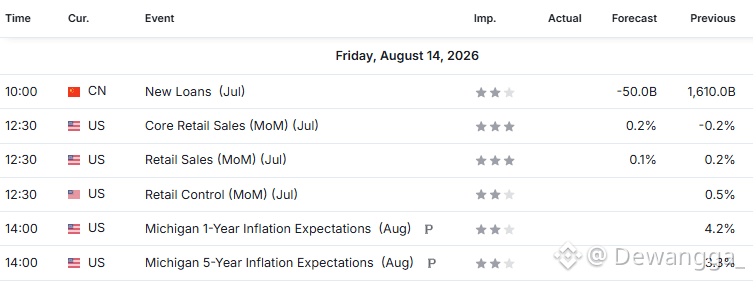
1
97

·
--
#USJulyRetailSalesFall0.6%
US July Retail Sales Fall 0.6% 📉
U.S. retail sales dropped 0.6% month-over-month in July 2026, sharply missing expectations for a 0.1% increase. It was the first monthly decline in nine months and the largest drop in 14 months.
The weakness was led by online sales (-2.2%), auto sales (-1.8%), and gas-station sales (-0.9%). The data adds to signs of softer consumer spending and could strengthen expectations that the Federal Reserve will remain cautious on rates.
#USJulyRetailSalesFall0.6% #RetailSales #USEconomy #FederalReserve #Fed #Inflation #InterestRates #Stocks #Crypto #Bitcoin
#USJulyRetailSalesFall0.6%
#USJulyRetailSalesFall0.6%
US July Retail Sales Fall 0.6% 📉
U.S. retail sales dropped 0.6% month-over-month in July 2026, sharply missing expectations for a 0.1% increase. It was the first monthly decline in nine months and the largest drop in 14 months.
The weakness was led by online sales (-2.2%), auto sales (-1.8%), and gas-station sales (-0.9%). The data adds to signs of softer consumer spending and could strengthen expectations that the Federal Reserve will remain cautious on rates.
#USJulyRetailSalesFall0.6% #RetailSales #USEconomy #FederalReserve #Fed #Inflation #InterestRates #Stocks #Crypto #Bitcoin
#USJulyRetailSalesFall0.6%
US July Retail Sales Fall 0.6% 📉
U.S. retail sales dropped 0.6% month-over-month in July 2026, sharply missing expectations for a 0.1% increase. It was the first monthly decline in nine months and the largest drop in 14 months.
The weakness was led by online sales (-2.2%), auto sales (-1.8%), and gas-station sales (-0.9%). The data adds to signs of softer consumer spending and could strengthen expectations that the Federal Reserve will remain cautious on rates.
#USJulyRetailSalesFall0.6% #RetailSales #USEconomy #FederalReserve #Fed #Inflation #InterestRates #Stocks #Crypto #Bitcoin
#USJulyRetailSalesFall0.6%

1
1
98

·
--

Article
U.S. Retail Sales Fall 0.6% in July, Missing ForecastsU.S. retail sales declined by 0.6% in July, marking the largest month-over-month drop since May of last year. This decrease was significantly below market expectations, which had forecasted a modest 0.1% increase. The data indicates that consumer spending, a critical driver of economic growth, slowed more sharply than anticipated during the month.
The decline in retail sales was broad-based, affecting various sectors including motor vehicles, clothing, and general merchandise. Experts suggest that this slowdown could signal a shift in consumer behavior, possibly influenced by rising inflation, higher interest rates, or economic uncertainties impacting household budgets.
Market analysts are closely watching these figures as they may influence Federal Reserve policy decisions. A more pronounced slowdown in consumer spending could prompt the central bank to consider further adjustments to interest rates or other monetary measures to support economic stability.
The weaker-than-expected retail performance adds to concerns about the pace of economic recovery and growth prospects in the United States, especially amid ongoing inflationary pressures and global economic uncertainties. More details are available in the official Binance Square post. #RetailSales #USEconomy #ConsumerSpending
U.S. Retail Sales Fall 0.6% in July, Missing Forecasts
U.S. retail sales declined by 0.6% in July, marking the largest month-over-month drop since May of last year. This decrease was significantly below market expectations, which had forecasted a modest 0.1% increase. The data indicates that consumer spending, a critical driver of economic growth, slowed more sharply than anticipated during the month.
The decline in retail sales was broad-based, affecting various sectors including motor vehicles, clothing, and general merchandise. Experts suggest that this slowdown could signal a shift in consumer behavior, possibly influenced by rising inflation, higher interest rates, or economic uncertainties impacting household budgets.
Market analysts are closely watching these figures as they may influence Federal Reserve policy decisions. A more pronounced slowdown in consumer spending could prompt the central bank to consider further adjustments to interest rates or other monetary measures to support economic stability.
The weaker-than-expected retail performance adds to concerns about the pace of economic recovery and growth prospects in the United States, especially amid ongoing inflationary pressures and global economic uncertainties. More details are available in the official Binance Square post. #RetailSales #USEconomy #ConsumerSpending
The decline in retail sales was broad-based, affecting various sectors including motor vehicles, clothing, and general merchandise. Experts suggest that this slowdown could signal a shift in consumer behavior, possibly influenced by rising inflation, higher interest rates, or economic uncertainties impacting household budgets.
Market analysts are closely watching these figures as they may influence Federal Reserve policy decisions. A more pronounced slowdown in consumer spending could prompt the central bank to consider further adjustments to interest rates or other monetary measures to support economic stability.
The weaker-than-expected retail performance adds to concerns about the pace of economic recovery and growth prospects in the United States, especially amid ongoing inflationary pressures and global economic uncertainties. More details are available in the official Binance Square post. #RetailSales #USEconomy #ConsumerSpending
48

·
--
Bearish
Verified
#usjulyretailsalesfall0.6%
🚨 US RETAIL SALES SLIP 0.6% 📉
U.S. retail sales fell unexpectedly 0.6% in July to $763.6B, with weakness in online shopping, autos, and gas stations.
Spending is still 5% higher year-over-year, but the monthly drop signals growing consumer fatigue.
🎯 TRADING VIEW: SELL 📉
Near-term risk sentiment could weaken if consumer spending continues to slow.
❓ Is the U.S. consumer finally losing momentum? "CLICK ON THE BELOW YELLOW COIN TAG TO GO TO DESIRED TRADING PAGE TO GET BENEFIT TRADE"$BTC $SOL $AKE
{future}(AKEUSDT)
{spot}(SOLUSDT)
{spot}(BTCUSDT)
#RetailSales #USConsumerSentimentThirdMonthDecline
#usjulyretailsalesfall0.6%
🚨 US RETAIL SALES SLIP 0.6% 📉
U.S. retail sales fell unexpectedly 0.6% in July to $763.6B, with weakness in online shopping, autos, and gas stations.
Spending is still 5% higher year-over-year, but the monthly drop signals growing consumer fatigue.
🎯 TRADING VIEW: SELL 📉
Near-term risk sentiment could weaken if consumer spending continues to slow.
❓ Is the U.S. consumer finally losing momentum? "CLICK ON THE BELOW YELLOW COIN TAG TO GO TO DESIRED TRADING PAGE TO GET BENEFIT TRADE"$BTC $SOL $AKE
#RetailSales #USConsumerSentimentThirdMonthDecline
🚨 US RETAIL SALES SLIP 0.6% 📉
U.S. retail sales fell unexpectedly 0.6% in July to $763.6B, with weakness in online shopping, autos, and gas stations.
Spending is still 5% higher year-over-year, but the monthly drop signals growing consumer fatigue.
🎯 TRADING VIEW: SELL 📉
Near-term risk sentiment could weaken if consumer spending continues to slow.
❓ Is the U.S. consumer finally losing momentum? "CLICK ON THE BELOW YELLOW COIN TAG TO GO TO DESIRED TRADING PAGE TO GET BENEFIT TRADE"$BTC $SOL $AKE
#RetailSales #USConsumerSentimentThirdMonthDecline

1
5
6.6k
Log in to explore more content
Join global crypto users on Binance Square
⚡️ Get latest and useful information about crypto.
💬 Trusted by the world’s largest crypto exchange.
👍 Discover real insights from verified creators.
Email / Phone number
Trending Topics
1
#AIStocksWhatNext
973,578 views
6,923 Discussing
2
#BitcoinRejectedAt$87,300Twice
0 views
0 Discussing
3
#BCHJumps28%OnCMEFuturesListing
20,004 views
634 Discussing
4
#WallStreetEarningsRevisionsTurnBearish
14,639 views
468 Discussing
5
#DollarIndexReclaims101
12,118 views
405 Discussing
6
#21SharesLaunchesEuropesFirstZcashETP
50,938 views
1,195 Discussing
7
#CardanoJoinsX402PaymentStandard
30,858 views
835 Discussing
8
#BitcoinTops$87KAtEightMonthHigh
13,864 views
135 Discussing
9
#ZECBreaksAbove$1600AtRecordHigh
9,679 views
108 Discussing
10
#BitwiseNEARStakingETPAssetsTop$100M
48,671 views
111 Discussing