

#chinaeconomy
chinaeconomy
359,965 views
566 Discussing
Hot
Latest

·
--
Bullish
🇨🇳 CHINA JUST UNLOCKED A $21B CAPITAL MOVE — HERE’S WHY MARKETS MAY CARE 👀
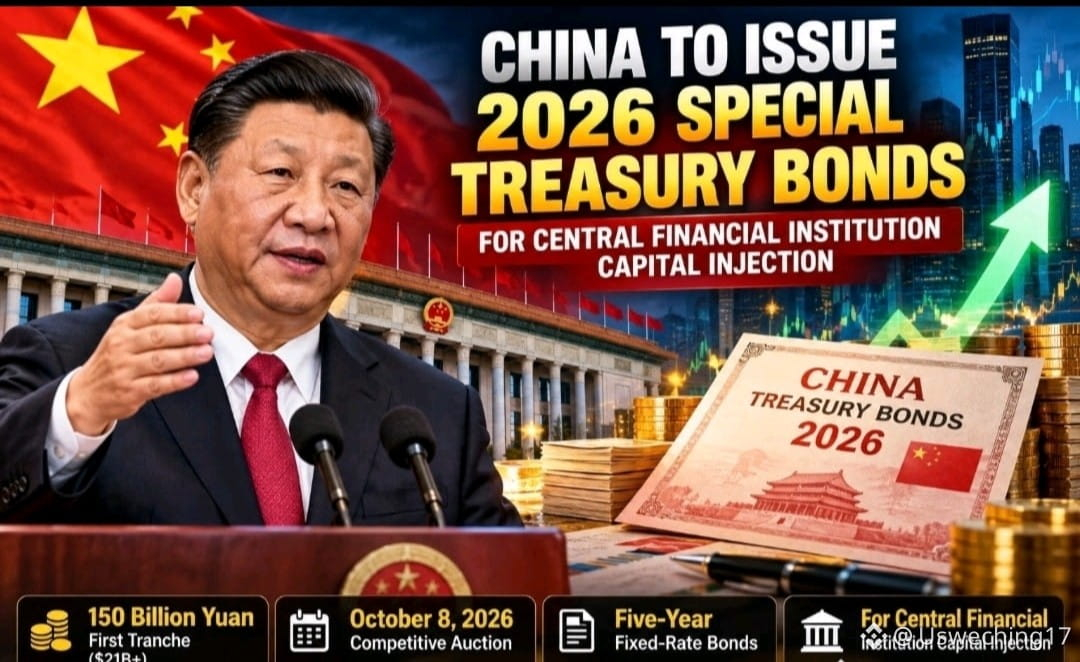
China is moving ahead with a ¥150B (~$21B+) first tranche of 5-year special treasury bonds aimed at strengthening the capital of major central financial institutions. 💰🏦
📌 Key Dates
🔹 Oct 8 — Bond auction
🔹 Oct 9 — Interest begins
🔹 Oct 13 — Trading starts
And this is only the first step.
China has announced a broader ¥300B special-bond program designed to strengthen the core capital of eight major central financial institutions.
🔥 Why could this matter?
More resilient bank balance sheets may create greater capacity for:
➡️ Credit expansion
➡️ Economic support
➡️ Increased financial-system liquidity
➡️ Stronger lending activity
🌏 THE BIG QUESTION:
Could this fresh capital eventually translate into more liquidity flowing through China’s financial system — and potentially influence global markets? 📈💧
Crypto traders should keep this development on the radar. 👀
Liquidity moves markets. The next move is worth watching.
👇 What do you think — bullish, neutral, or too early to tell?
#ChinaCrypto #ChinaEconomy #Btc #BinanceSquare
🇨🇳 CHINA JUST UNLOCKED A $21B CAPITAL MOVE — HERE’S WHY MARKETS MAY CARE 👀
China is moving ahead with a ¥150B (~$21B+) first tranche of 5-year special treasury bonds aimed at strengthening the capital of major central financial institutions. 💰🏦
📌 Key Dates
🔹 Oct 8 — Bond auction
🔹 Oct 9 — Interest begins
🔹 Oct 13 — Trading starts
And this is only the first step.
China has announced a broader ¥300B special-bond program designed to strengthen the core capital of eight major central financial institutions.
🔥 Why could this matter?
More resilient bank balance sheets may create greater capacity for:
➡️ Credit expansion
➡️ Economic support
➡️ Increased financial-system liquidity
➡️ Stronger lending activity
🌏 THE BIG QUESTION:
Could this fresh capital eventually translate into more liquidity flowing through China’s financial system — and potentially influence global markets? 📈💧
Crypto traders should keep this development on the radar. 👀
Liquidity moves markets. The next move is worth watching.
👇 What do you think — bullish, neutral, or too early to tell?
#ChinaCrypto #ChinaEconomy #Btc #BinanceSquare
China is moving ahead with a ¥150B (~$21B+) first tranche of 5-year special treasury bonds aimed at strengthening the capital of major central financial institutions. 💰🏦
📌 Key Dates
🔹 Oct 8 — Bond auction
🔹 Oct 9 — Interest begins
🔹 Oct 13 — Trading starts
And this is only the first step.
China has announced a broader ¥300B special-bond program designed to strengthen the core capital of eight major central financial institutions.
🔥 Why could this matter?
More resilient bank balance sheets may create greater capacity for:
➡️ Credit expansion
➡️ Economic support
➡️ Increased financial-system liquidity
➡️ Stronger lending activity
🌏 THE BIG QUESTION:
Could this fresh capital eventually translate into more liquidity flowing through China’s financial system — and potentially influence global markets? 📈💧
Crypto traders should keep this development on the radar. 👀
Liquidity moves markets. The next move is worth watching.
👇 What do you think — bullish, neutral, or too early to tell?
#ChinaCrypto #ChinaEconomy #Btc #BinanceSquare
1
51

On October 1, Lan Fuan, Minister of Finance of China, published an article in which he explicitly stated that, in the short term, more efforts should be made to enhance counter-cyclical policy adjustment, maintain a reasonable deficit and expenditure scale, and make good use of instruments such as government bonds, ultra-long special government bonds, and special bonds to help smooth out short-term economic fluctuations. In the long run, China will deepen reforms of the fiscal and tax system.
As the finance chief of the world’s second-largest economy, Minister Lan’s remarks send a signal that the government will support growth through more proactive fiscal expansion. The market had previously been waiting to see the specific implementation timeline for incremental fiscal tools. This policy statement sets the tone and provides clear expectations to help strengthen the subsequent fiscal policy push, which may help ease downward pressure on the macroeconomy.
However, from the perspective of macro financial markets, relying solely on bond issuance expansion often makes it difficult to quickly reverse the structural weakness in fundamentals. Although Asia-Pacific stock markets have risen on positive sentiment, large-scale bond issuance may increase volatility in sovereign bond yields. If private-sector credit demand does not meaningfully rebound, any improvement in overall risk appetite may be hard to sustain.
For the crypto market, the liquidity transmission chain from fiscal stimulus is long, making it difficult for liquidity to flow directly into digital asset markets in the short term. Against the backdrop of the U.S. Federal Reserve maintaining a hawkish stance, global liquidity conditions remain tight. Investors should be cautious about the risk of a pullback after short-term sentiment spikes, and should not chase risk assets such as <b>$BTC </b> overly blindly.📉
#FiscalPolicy #ChinaEconomy #MacroEconomics
On October 1, Lan Fuan, Minister of Finance of China, published an article in which he explicitly stated that, in the short term, more efforts should be made to enhance counter-cyclical policy adjustment, maintain a reasonable deficit and expenditure scale, and make good use of instruments such as government bonds, ultra-long special government bonds, and special bonds to help smooth out short-term economic fluctuations. In the long run, China will deepen reforms of the fiscal and tax system.
As the finance chief of the world’s second-largest economy, Minister Lan’s remarks send a signal that the government will support growth through more proactive fiscal expansion. The market had previously been waiting to see the specific implementation timeline for incremental fiscal tools. This policy statement sets the tone and provides clear expectations to help strengthen the subsequent fiscal policy push, which may help ease downward pressure on the macroeconomy.
However, from the perspective of macro financial markets, relying solely on bond issuance expansion often makes it difficult to quickly reverse the structural weakness in fundamentals. Although Asia-Pacific stock markets have risen on positive sentiment, large-scale bond issuance may increase volatility in sovereign bond yields. If private-sector credit demand does not meaningfully rebound, any improvement in overall risk appetite may be hard to sustain.
For the crypto market, the liquidity transmission chain from fiscal stimulus is long, making it difficult for liquidity to flow directly into digital asset markets in the short term. Against the backdrop of the U.S. Federal Reserve maintaining a hawkish stance, global liquidity conditions remain tight. Investors should be cautious about the risk of a pullback after short-term sentiment spikes, and should not chase risk assets such as <b>$BTC </b> overly blindly.📉
#FiscalPolicy #ChinaEconomy #MacroEconomics
As the finance chief of the world’s second-largest economy, Minister Lan’s remarks send a signal that the government will support growth through more proactive fiscal expansion. The market had previously been waiting to see the specific implementation timeline for incremental fiscal tools. This policy statement sets the tone and provides clear expectations to help strengthen the subsequent fiscal policy push, which may help ease downward pressure on the macroeconomy.
However, from the perspective of macro financial markets, relying solely on bond issuance expansion often makes it difficult to quickly reverse the structural weakness in fundamentals. Although Asia-Pacific stock markets have risen on positive sentiment, large-scale bond issuance may increase volatility in sovereign bond yields. If private-sector credit demand does not meaningfully rebound, any improvement in overall risk appetite may be hard to sustain.
For the crypto market, the liquidity transmission chain from fiscal stimulus is long, making it difficult for liquidity to flow directly into digital asset markets in the short term. Against the backdrop of the U.S. Federal Reserve maintaining a hawkish stance, global liquidity conditions remain tight. Investors should be cautious about the risk of a pullback after short-term sentiment spikes, and should not chase risk assets such as <b>$BTC </b> overly blindly.📉
#FiscalPolicy #ChinaEconomy #MacroEconomics
103


·
--
Bullish
#chinaindustrialprofitgrowthslowsfourthmonth
🇨🇳 China’s Industrial Profit Growth Cools: What Should Crypto Traders Watch?
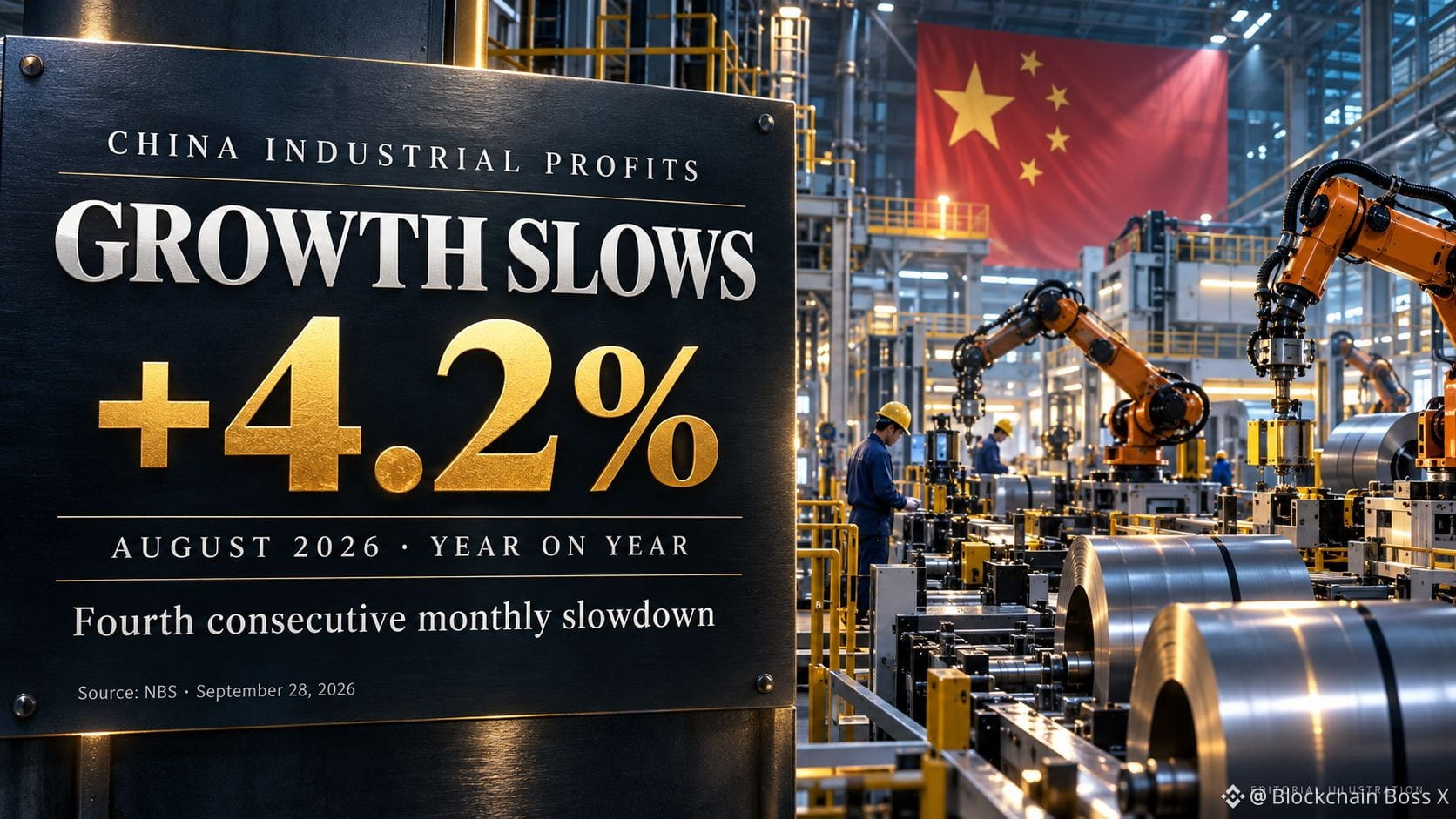
China’s large industrial firms posted 4.2% year-on-year profit growth in August, down from 11.2% in July, according to the National Bureau of Statistics. Profits remain above last year’s levels, but growth has slowed.
January–August profits increased 15.7%. The NBS said a higher comparison base contributed to August’s slowdown.
Performance also varied sharply: electronics-related manufacturing profits jumped 110%, while auto manufacturing profits fell 16% over January–August. The headline clearly masks different conditions across industries.
My take: For crypto markets, two channels deserve attention: global risk appetite and expectations of Chinese policy support. Weak growth can weigh on confidence, while stimulus expectations can lift sentiment. The balance depends on what policymakers actually deliver and whether demand responds.
I would watch manufacturing surveys, new orders and margins alongside concrete support measures. A production rebound with weak profitability would offer a different signal from a recovery supported by stronger demand across more industries.
One industrial-profit release cannot establish Bitcoin’s next direction. US monetary conditions, ETF flows and crypto positioning remain separate variables worth tracking.
What would give markets more confidence now: stronger demand or additional policy support? 👇
#ChinaIndustrialProfitGrowthSlowsFourthMonth #ChinaEconomy #CryptoMarkets
$QNT $ONE $XRP
{future}(XRPUSDT)
{future}(ONEUSDT)
{future}(QNTUSDT)
#chinaindustrialprofitgrowthslowsfourthmonth
🇨🇳 China’s Industrial Profit Growth Cools: What Should Crypto Traders Watch?
China’s large industrial firms posted 4.2% year-on-year profit growth in August, down from 11.2% in July, according to the National Bureau of Statistics. Profits remain above last year’s levels, but growth has slowed.
January–August profits increased 15.7%. The NBS said a higher comparison base contributed to August’s slowdown.
Performance also varied sharply: electronics-related manufacturing profits jumped 110%, while auto manufacturing profits fell 16% over January–August. The headline clearly masks different conditions across industries.
My take: For crypto markets, two channels deserve attention: global risk appetite and expectations of Chinese policy support. Weak growth can weigh on confidence, while stimulus expectations can lift sentiment. The balance depends on what policymakers actually deliver and whether demand responds.
I would watch manufacturing surveys, new orders and margins alongside concrete support measures. A production rebound with weak profitability would offer a different signal from a recovery supported by stronger demand across more industries.
One industrial-profit release cannot establish Bitcoin’s next direction. US monetary conditions, ETF flows and crypto positioning remain separate variables worth tracking.
What would give markets more confidence now: stronger demand or additional policy support? 👇
#ChinaIndustrialProfitGrowthSlowsFourthMonth #ChinaEconomy #CryptoMarkets
$QNT $ONE $XRP
🇨🇳 China’s Industrial Profit Growth Cools: What Should Crypto Traders Watch?
China’s large industrial firms posted 4.2% year-on-year profit growth in August, down from 11.2% in July, according to the National Bureau of Statistics. Profits remain above last year’s levels, but growth has slowed.
January–August profits increased 15.7%. The NBS said a higher comparison base contributed to August’s slowdown.
Performance also varied sharply: electronics-related manufacturing profits jumped 110%, while auto manufacturing profits fell 16% over January–August. The headline clearly masks different conditions across industries.
My take: For crypto markets, two channels deserve attention: global risk appetite and expectations of Chinese policy support. Weak growth can weigh on confidence, while stimulus expectations can lift sentiment. The balance depends on what policymakers actually deliver and whether demand responds.
I would watch manufacturing surveys, new orders and margins alongside concrete support measures. A production rebound with weak profitability would offer a different signal from a recovery supported by stronger demand across more industries.
One industrial-profit release cannot establish Bitcoin’s next direction. US monetary conditions, ETF flows and crypto positioning remain separate variables worth tracking.
What would give markets more confidence now: stronger demand or additional policy support? 👇
#ChinaIndustrialProfitGrowthSlowsFourthMonth #ChinaEconomy #CryptoMarkets
$QNT $ONE $XRP
206 Atlas:
China's macro data is noise for Bitcoin. Focus on liquidity and ETF flows, not industrial profits.
1
1
2.5k

·
--
The National Bureau of Statistics has just released the core macroeconomic data for August, showing a fairly clear split in performance across different sectors. The data indicate that China’s industrial value added above designated size rose by 5.2% year-on-year in August, not only higher than the previous figure of 4.50% but also significantly better than market expectations of 4.80%. At the same time, however, August social retail sales of consumer goods increased by only 0.4% year-on-year, which is below the prior figure of 0.60% and also under the market expectation of 0.80%.
These figures reflect the objective reality of the current economic operation: “the production side is warmer, while the consumption side is cooler.” In industrial manufacturing, supported by policy measures and the resilience of exports, recovery has remained relatively rapid. But residents’ consumption willingness and end-demand still appear subdued. The pace of recovery is uneven, and market attention remains on whether subsequent policies will introduce more targeted measures to boost consumption.
Judging from traditional financial market reactions, this structural performance keeps macro sentiment in a neutral observation period. A stronger industrial sector provides support for the overall economic fundamentals, but weaker retail data also limits a rapid expansion in risk appetite. Commodities, the exchange rate, and the stock market overall are seeking balance amid conflicting bullish and bearish forces, and funds are more inclined to stay on the sidelines.
As for the crypto market, the macro fundamentals’ divergence has not yet triggered any direct one-way flows. As part of risk assets, $BTC and mainstream alternative coins will continue to fluctuate in line with global liquidity preferences until there is a fundamental change in macro liquidity expectations. Market participants generally focus on the sustainability of the overall economic recovery and the subsequent monetary actions of major global central banks.
#ChinaEconomy #RetailSales #IndustrialProduction
The National Bureau of Statistics has just released the core macroeconomic data for August, showing a fairly clear split in performance across different sectors. The data indicate that China’s industrial value added above designated size rose by 5.2% year-on-year in August, not only higher than the previous figure of 4.50% but also significantly better than market expectations of 4.80%. At the same time, however, August social retail sales of consumer goods increased by only 0.4% year-on-year, which is below the prior figure of 0.60% and also under the market expectation of 0.80%.
These figures reflect the objective reality of the current economic operation: “the production side is warmer, while the consumption side is cooler.” In industrial manufacturing, supported by policy measures and the resilience of exports, recovery has remained relatively rapid. But residents’ consumption willingness and end-demand still appear subdued. The pace of recovery is uneven, and market attention remains on whether subsequent policies will introduce more targeted measures to boost consumption.
Judging from traditional financial market reactions, this structural performance keeps macro sentiment in a neutral observation period. A stronger industrial sector provides support for the overall economic fundamentals, but weaker retail data also limits a rapid expansion in risk appetite. Commodities, the exchange rate, and the stock market overall are seeking balance amid conflicting bullish and bearish forces, and funds are more inclined to stay on the sidelines.
As for the crypto market, the macro fundamentals’ divergence has not yet triggered any direct one-way flows. As part of risk assets, $BTC and mainstream alternative coins will continue to fluctuate in line with global liquidity preferences until there is a fundamental change in macro liquidity expectations. Market participants generally focus on the sustainability of the overall economic recovery and the subsequent monetary actions of major global central banks.
#ChinaEconomy #RetailSales #IndustrialProduction
These figures reflect the objective reality of the current economic operation: “the production side is warmer, while the consumption side is cooler.” In industrial manufacturing, supported by policy measures and the resilience of exports, recovery has remained relatively rapid. But residents’ consumption willingness and end-demand still appear subdued. The pace of recovery is uneven, and market attention remains on whether subsequent policies will introduce more targeted measures to boost consumption.
Judging from traditional financial market reactions, this structural performance keeps macro sentiment in a neutral observation period. A stronger industrial sector provides support for the overall economic fundamentals, but weaker retail data also limits a rapid expansion in risk appetite. Commodities, the exchange rate, and the stock market overall are seeking balance amid conflicting bullish and bearish forces, and funds are more inclined to stay on the sidelines.
As for the crypto market, the macro fundamentals’ divergence has not yet triggered any direct one-way flows. As part of risk assets, $BTC and mainstream alternative coins will continue to fluctuate in line with global liquidity preferences until there is a fundamental change in macro liquidity expectations. Market participants generally focus on the sustainability of the overall economic recovery and the subsequent monetary actions of major global central banks.
#ChinaEconomy #RetailSales #IndustrialProduction
31

China’s National Bureau of Statistics released August macroeconomic data showing clear structural divergence. In August, the value added of industrial production above designated size increased by 5.2% year on year in real terms, significantly better than the prior figure of 4.50% and market expectations of 4.80%. Meanwhile, retail sales of consumer goods in August rose by only 0.4% year on year, which was below the prior figure of 0.60% and the expectation of 0.80%. The industrial production side demonstrated strong resilience, while the consumer side recovery still appeared weak.
From the macro fundamentals perspective, the expansion of industrial output beyond expectations indicates that the supply-side base remains solid and that momentum in manufacturing is accelerating its repair. Although the retail data being weaker than expected suggests that domestic demand still needs to be boosted, it also reinforces market expectations for further policy support, including more cuts in reserve requirement ratios and interest rates, as well as the introduction of more forceful fiscal stimulus. For risk assets, resilience on the production side provides a bottoming support, while warming expectations for easing liquidity supply fertile ground for valuation expansion.
In traditional financial markets, a strong expansion on the supply side is conducive to strengthening medium- to long-term demand for commodities and industrial metals. As weak domestic demand forces monetary policy to further open up a window for easing, the offshore liquidity environment is expected to gradually become more abundant. This is likely to suppress real yields in the near to medium term and create favorable conditions for a recovery in risk appetite.
For crypto assets, the recovery of China’s manufacturing momentum and the strengthening expectations for ample liquidity are clearly positive signals. From the technical outlook and capital flows, a turn for the better in global liquidity expectations will directly benefit risk assets led by $BTC . If the market further confirms a resonance between the policy floor and the economic floor, abundant liquidity could drive the crypto market to enter a new round of volume-expansion breakout行情. #ChinaEconomy #MacroEconomics #CryptoLiquidity
China’s National Bureau of Statistics released August macroeconomic data showing clear structural divergence. In August, the value added of industrial production above designated size increased by 5.2% year on year in real terms, significantly better than the prior figure of 4.50% and market expectations of 4.80%. Meanwhile, retail sales of consumer goods in August rose by only 0.4% year on year, which was below the prior figure of 0.60% and the expectation of 0.80%. The industrial production side demonstrated strong resilience, while the consumer side recovery still appeared weak.
From the macro fundamentals perspective, the expansion of industrial output beyond expectations indicates that the supply-side base remains solid and that momentum in manufacturing is accelerating its repair. Although the retail data being weaker than expected suggests that domestic demand still needs to be boosted, it also reinforces market expectations for further policy support, including more cuts in reserve requirement ratios and interest rates, as well as the introduction of more forceful fiscal stimulus. For risk assets, resilience on the production side provides a bottoming support, while warming expectations for easing liquidity supply fertile ground for valuation expansion.
In traditional financial markets, a strong expansion on the supply side is conducive to strengthening medium- to long-term demand for commodities and industrial metals. As weak domestic demand forces monetary policy to further open up a window for easing, the offshore liquidity environment is expected to gradually become more abundant. This is likely to suppress real yields in the near to medium term and create favorable conditions for a recovery in risk appetite.
For crypto assets, the recovery of China’s manufacturing momentum and the strengthening expectations for ample liquidity are clearly positive signals. From the technical outlook and capital flows, a turn for the better in global liquidity expectations will directly benefit risk assets led by $BTC . If the market further confirms a resonance between the policy floor and the economic floor, abundant liquidity could drive the crypto market to enter a new round of volume-expansion breakout行情. #ChinaEconomy #MacroEconomics #CryptoLiquidity
From the macro fundamentals perspective, the expansion of industrial output beyond expectations indicates that the supply-side base remains solid and that momentum in manufacturing is accelerating its repair. Although the retail data being weaker than expected suggests that domestic demand still needs to be boosted, it also reinforces market expectations for further policy support, including more cuts in reserve requirement ratios and interest rates, as well as the introduction of more forceful fiscal stimulus. For risk assets, resilience on the production side provides a bottoming support, while warming expectations for easing liquidity supply fertile ground for valuation expansion.
In traditional financial markets, a strong expansion on the supply side is conducive to strengthening medium- to long-term demand for commodities and industrial metals. As weak domestic demand forces monetary policy to further open up a window for easing, the offshore liquidity environment is expected to gradually become more abundant. This is likely to suppress real yields in the near to medium term and create favorable conditions for a recovery in risk appetite.
For crypto assets, the recovery of China’s manufacturing momentum and the strengthening expectations for ample liquidity are clearly positive signals. From the technical outlook and capital flows, a turn for the better in global liquidity expectations will directly benefit risk assets led by $BTC . If the market further confirms a resonance between the policy floor and the economic floor, abundant liquidity could drive the crypto market to enter a new round of volume-expansion breakout行情. #ChinaEconomy #MacroEconomics #CryptoLiquidity
28

·
--
China’s National Bureau of Statistics has just released a series of important economic data for August, reflecting a clear split between two pillars of production and domestic consumption.
Specifically, the value added of large-scale industries rose 5.2% year-on-year, exceeding expectations of 4.8% and improving significantly from the 4.5% figure of the previous month. However, retail sales of consumer goods in society recorded a very modest growth rate of 0.4%, below the forecast of 0.8% and slowing from the 0.6% in the prior period. This divergence suggests that the production and export capacity of the world’s second-largest economy is still maintaining a solid recovery trend, but domestic consumer spending demand remains under heavy pressure from cautious sentiment.
For the global financial market, the weak consumption data further reinforces expectations that the People’s Bank of China (PBoC) will soon need to roll out additional fiscal stimulus packages and loosen monetary policy to support growth. This could lead to slight downward pressure on the Chinese yuan, while also keeping capital flowing in search of hedging assets in the region.
For the crypto market, China’s economic divergence is expected to have a neutral to positive impact in the medium term. Quantitative easing pressure from Asian central banks is often a factor that supports global liquidity, providing a springboard for risk assets such as $BTC k when capital seeks channels to preserve value amid the risk of depreciation of fiat currencies.
#ChinaEconomy #MacroEconomics #CryptoLiquidity
China’s National Bureau of Statistics has just released a series of important economic data for August, reflecting a clear split between two pillars of production and domestic consumption.
Specifically, the value added of large-scale industries rose 5.2% year-on-year, exceeding expectations of 4.8% and improving significantly from the 4.5% figure of the previous month. However, retail sales of consumer goods in society recorded a very modest growth rate of 0.4%, below the forecast of 0.8% and slowing from the 0.6% in the prior period. This divergence suggests that the production and export capacity of the world’s second-largest economy is still maintaining a solid recovery trend, but domestic consumer spending demand remains under heavy pressure from cautious sentiment.
For the global financial market, the weak consumption data further reinforces expectations that the People’s Bank of China (PBoC) will soon need to roll out additional fiscal stimulus packages and loosen monetary policy to support growth. This could lead to slight downward pressure on the Chinese yuan, while also keeping capital flowing in search of hedging assets in the region.
For the crypto market, China’s economic divergence is expected to have a neutral to positive impact in the medium term. Quantitative easing pressure from Asian central banks is often a factor that supports global liquidity, providing a springboard for risk assets such as $BTC k when capital seeks channels to preserve value amid the risk of depreciation of fiat currencies.
#ChinaEconomy #MacroEconomics #CryptoLiquidity
Specifically, the value added of large-scale industries rose 5.2% year-on-year, exceeding expectations of 4.8% and improving significantly from the 4.5% figure of the previous month. However, retail sales of consumer goods in society recorded a very modest growth rate of 0.4%, below the forecast of 0.8% and slowing from the 0.6% in the prior period. This divergence suggests that the production and export capacity of the world’s second-largest economy is still maintaining a solid recovery trend, but domestic consumer spending demand remains under heavy pressure from cautious sentiment.
For the global financial market, the weak consumption data further reinforces expectations that the People’s Bank of China (PBoC) will soon need to roll out additional fiscal stimulus packages and loosen monetary policy to support growth. This could lead to slight downward pressure on the Chinese yuan, while also keeping capital flowing in search of hedging assets in the region.
For the crypto market, China’s economic divergence is expected to have a neutral to positive impact in the medium term. Quantitative easing pressure from Asian central banks is often a factor that supports global liquidity, providing a springboard for risk assets such as $BTC k when capital seeks channels to preserve value amid the risk of depreciation of fiat currencies.
#ChinaEconomy #MacroEconomics #CryptoLiquidity
83
China’s National Bureau of Statistics is set to release today a series of key economic data, including August’s value-added industrial output for industries above a designated size and social retail sales. Meanwhile, in the Middle East’s geopolitical sphere, Saudi Arabia’s civil defense authorities issued an emergency warning in the Yanbu area, drawing market attention to global macro and regional security developments within the same timeframe.
As the world’s second-largest economy, China’s release of August industrial output and consumer retail data will provide a crucial benchmark for assessing the momentum of manufacturing in the Asia-Pacific region and the pace of recovery in domestic demand. After a period of sustained policy efforts, the market is closely watching whether the fundamentals show signs of stabilization and improvement. This also has flag-like significance for global expectations regarding demand for broad commodity markets.
From asset prices and the macro trading backdrop, the market is re-pricing its expectations for the Asia-Pacific economic recovery. If the data demonstrates resilience, it will effectively boost risk appetite, providing solid technical support for commodities and Asia-Pacific stock indexes. At the same time, it may help ease the one-way liquidity squeeze driven by the U.S. dollar index, encouraging cross-market capital to allocate more actively to risk assets.
For the crypto market, a more optimistic outlook for the macro liquidity environment will create a favorable bid environment for $BTC and major tokens. From a technical-structure perspective, the market is currently building up steadily above a key support level. As Asia-Pacific economic data gradually becomes clearer and risk-off sentiment cools, the return of off-exchange funds to the crypto ecosystem could accelerate, boosting the momentum for a new round of breakouts.📈
#MacroEconomics #ChinaEconomy #CryptoMarkets
China’s National Bureau of Statistics is set to release today a series of key economic data, including August’s value-added industrial output for industries above a designated size and social retail sales. Meanwhile, in the Middle East’s geopolitical sphere, Saudi Arabia’s civil defense authorities issued an emergency warning in the Yanbu area, drawing market attention to global macro and regional security developments within the same timeframe.
As the world’s second-largest economy, China’s release of August industrial output and consumer retail data will provide a crucial benchmark for assessing the momentum of manufacturing in the Asia-Pacific region and the pace of recovery in domestic demand. After a period of sustained policy efforts, the market is closely watching whether the fundamentals show signs of stabilization and improvement. This also has flag-like significance for global expectations regarding demand for broad commodity markets.
From asset prices and the macro trading backdrop, the market is re-pricing its expectations for the Asia-Pacific economic recovery. If the data demonstrates resilience, it will effectively boost risk appetite, providing solid technical support for commodities and Asia-Pacific stock indexes. At the same time, it may help ease the one-way liquidity squeeze driven by the U.S. dollar index, encouraging cross-market capital to allocate more actively to risk assets.
For the crypto market, a more optimistic outlook for the macro liquidity environment will create a favorable bid environment for $BTC and major tokens. From a technical-structure perspective, the market is currently building up steadily above a key support level. As Asia-Pacific economic data gradually becomes clearer and risk-off sentiment cools, the return of off-exchange funds to the crypto ecosystem could accelerate, boosting the momentum for a new round of breakouts.📈
#MacroEconomics #ChinaEconomy #CryptoMarkets
As the world’s second-largest economy, China’s release of August industrial output and consumer retail data will provide a crucial benchmark for assessing the momentum of manufacturing in the Asia-Pacific region and the pace of recovery in domestic demand. After a period of sustained policy efforts, the market is closely watching whether the fundamentals show signs of stabilization and improvement. This also has flag-like significance for global expectations regarding demand for broad commodity markets.
From asset prices and the macro trading backdrop, the market is re-pricing its expectations for the Asia-Pacific economic recovery. If the data demonstrates resilience, it will effectively boost risk appetite, providing solid technical support for commodities and Asia-Pacific stock indexes. At the same time, it may help ease the one-way liquidity squeeze driven by the U.S. dollar index, encouraging cross-market capital to allocate more actively to risk assets.
For the crypto market, a more optimistic outlook for the macro liquidity environment will create a favorable bid environment for $BTC and major tokens. From a technical-structure perspective, the market is currently building up steadily above a key support level. As Asia-Pacific economic data gradually becomes clearer and risk-off sentiment cools, the return of off-exchange funds to the crypto ecosystem could accelerate, boosting the momentum for a new round of breakouts.📈
#MacroEconomics #ChinaEconomy #CryptoMarkets
55
According to the latest data released in China, in August the year-on-year growth rate of the broad money supply (M2) was 7.5%, lower than the market’s prior expectation of 7.6%, and further slowed from the previous value of 7.7%. This decline in a key macro financial indicator directly reflects the ongoing downward pressure on the pace of credit expansion.
From a macroeconomic fundamentals perspective, the underwhelming M2 growth signals are far from encouraging. This suggests that, although policymakers have continued to release liquidity support, the effective financing demand from the real economy remains sluggish. The balance-sheet repair process for households and businesses is likely to take a long time; liquidity is being trapped within the banking system rather than being effectively transformed into real-economy momentum, and the clouds of deflationary risk have not yet dispersed.
For global traditional financial markets, the cooling of China’s credit cycle will further weigh on demand for commodities, while also putting pressure on the RMB exchange rate. As expectations for growth in the Asia-Pacific engines cool, it may intensify global risk-aversion sentiment, leading to an even more cautious allocation preference toward non–USD foreign-currency risk assets.
For the crypto asset market represented by $BTC , weak Asian liquidity fundamentals make it difficult to provide any substantial incremental “fresh money.” In the absence of a strong external credit-expansion cycle, the market is highly dependent on games within existing positions. Investors should be alert to the downside risks brought about by delayed global liquidity transmission. #M2MoneySupply #ChinaEconomy #MacroEconomics
According to the latest data released in China, in August the year-on-year growth rate of the broad money supply (M2) was 7.5%, lower than the market’s prior expectation of 7.6%, and further slowed from the previous value of 7.7%. This decline in a key macro financial indicator directly reflects the ongoing downward pressure on the pace of credit expansion.
From a macroeconomic fundamentals perspective, the underwhelming M2 growth signals are far from encouraging. This suggests that, although policymakers have continued to release liquidity support, the effective financing demand from the real economy remains sluggish. The balance-sheet repair process for households and businesses is likely to take a long time; liquidity is being trapped within the banking system rather than being effectively transformed into real-economy momentum, and the clouds of deflationary risk have not yet dispersed.
For global traditional financial markets, the cooling of China’s credit cycle will further weigh on demand for commodities, while also putting pressure on the RMB exchange rate. As expectations for growth in the Asia-Pacific engines cool, it may intensify global risk-aversion sentiment, leading to an even more cautious allocation preference toward non–USD foreign-currency risk assets.
For the crypto asset market represented by $BTC , weak Asian liquidity fundamentals make it difficult to provide any substantial incremental “fresh money.” In the absence of a strong external credit-expansion cycle, the market is highly dependent on games within existing positions. Investors should be alert to the downside risks brought about by delayed global liquidity transmission. #M2MoneySupply #ChinaEconomy #MacroEconomics
From a macroeconomic fundamentals perspective, the underwhelming M2 growth signals are far from encouraging. This suggests that, although policymakers have continued to release liquidity support, the effective financing demand from the real economy remains sluggish. The balance-sheet repair process for households and businesses is likely to take a long time; liquidity is being trapped within the banking system rather than being effectively transformed into real-economy momentum, and the clouds of deflationary risk have not yet dispersed.
For global traditional financial markets, the cooling of China’s credit cycle will further weigh on demand for commodities, while also putting pressure on the RMB exchange rate. As expectations for growth in the Asia-Pacific engines cool, it may intensify global risk-aversion sentiment, leading to an even more cautious allocation preference toward non–USD foreign-currency risk assets.
For the crypto asset market represented by $BTC , weak Asian liquidity fundamentals make it difficult to provide any substantial incremental “fresh money.” In the absence of a strong external credit-expansion cycle, the market is highly dependent on games within existing positions. Investors should be alert to the downside risks brought about by delayed global liquidity transmission. #M2MoneySupply #ChinaEconomy #MacroEconomics
10

·
--
Verified
#chinaaugustcpirises0.8%yoy
🇨🇳 CHINA INFLATION SURGES 0.8%: Energy Costs Drive the Spike 📊
China’s August CPI data just dropped, and while the headline figure jumped to 0.8% YoY (up from 0.5% in July), the real story lies beneath the surface.
Key Breakdown:
Upstream Costs Surge: PPI surged 3.8% YoY, largely fueled by imported price pressures in crude oil and raw industrial metals.
Energy Lifting Headline CPI: Energy inflation accelerated sharply to 4.1%, providing the main thrust behind the monthly 0.4% rise.
Core Demand Remains Quiet: Core CPI (excluding food & energy) hovered around 1.0%, proving that domestic consumer spending isn't driving this move.
The Macro & Crypto Takeaway:
This isn't a broad domestic consumption boom—it's an input-driven cost push. For crypto and risk assets, energy-led inflation creates a complex environment: it squeezes central bank liquidity levers while keeping global commodity demand elevated.
Is this the spark for broader global reflation, or just a temporary energy-driven bump? Let’s hear your thoughts below! 👇
#ChinaEconomy #BankOfAmericaGroupPilotsUSBDCStablecoin #OilRisesToHighestSinceJuly
#chinaaugustcpirises0.8%yoy
🇨🇳 CHINA INFLATION SURGES 0.8%: Energy Costs Drive the Spike 📊
China’s August CPI data just dropped, and while the headline figure jumped to 0.8% YoY (up from 0.5% in July), the real story lies beneath the surface.
Key Breakdown:
Upstream Costs Surge: PPI surged 3.8% YoY, largely fueled by imported price pressures in crude oil and raw industrial metals.
Energy Lifting Headline CPI: Energy inflation accelerated sharply to 4.1%, providing the main thrust behind the monthly 0.4% rise.
Core Demand Remains Quiet: Core CPI (excluding food & energy) hovered around 1.0%, proving that domestic consumer spending isn't driving this move.
The Macro & Crypto Takeaway:
This isn't a broad domestic consumption boom—it's an input-driven cost push. For crypto and risk assets, energy-led inflation creates a complex environment: it squeezes central bank liquidity levers while keeping global commodity demand elevated.
Is this the spark for broader global reflation, or just a temporary energy-driven bump? Let’s hear your thoughts below! 👇
#ChinaEconomy #BankOfAmericaGroupPilotsUSBDCStablecoin #OilRisesToHighestSinceJuly
🇨🇳 CHINA INFLATION SURGES 0.8%: Energy Costs Drive the Spike 📊
China’s August CPI data just dropped, and while the headline figure jumped to 0.8% YoY (up from 0.5% in July), the real story lies beneath the surface.
Key Breakdown:
Upstream Costs Surge: PPI surged 3.8% YoY, largely fueled by imported price pressures in crude oil and raw industrial metals.
Energy Lifting Headline CPI: Energy inflation accelerated sharply to 4.1%, providing the main thrust behind the monthly 0.4% rise.
Core Demand Remains Quiet: Core CPI (excluding food & energy) hovered around 1.0%, proving that domestic consumer spending isn't driving this move.
The Macro & Crypto Takeaway:
This isn't a broad domestic consumption boom—it's an input-driven cost push. For crypto and risk assets, energy-led inflation creates a complex environment: it squeezes central bank liquidity levers while keeping global commodity demand elevated.
Is this the spark for broader global reflation, or just a temporary energy-driven bump? Let’s hear your thoughts below! 👇
#ChinaEconomy #BankOfAmericaGroupPilotsUSBDCStablecoin #OilRisesToHighestSinceJuly
5
2.3k

·
--
Verified
#chinaaugustcpirises0.8%yoy
🇨🇳🔥 China’s August CPI jumped 0.8% — but the details matter more than the headline.
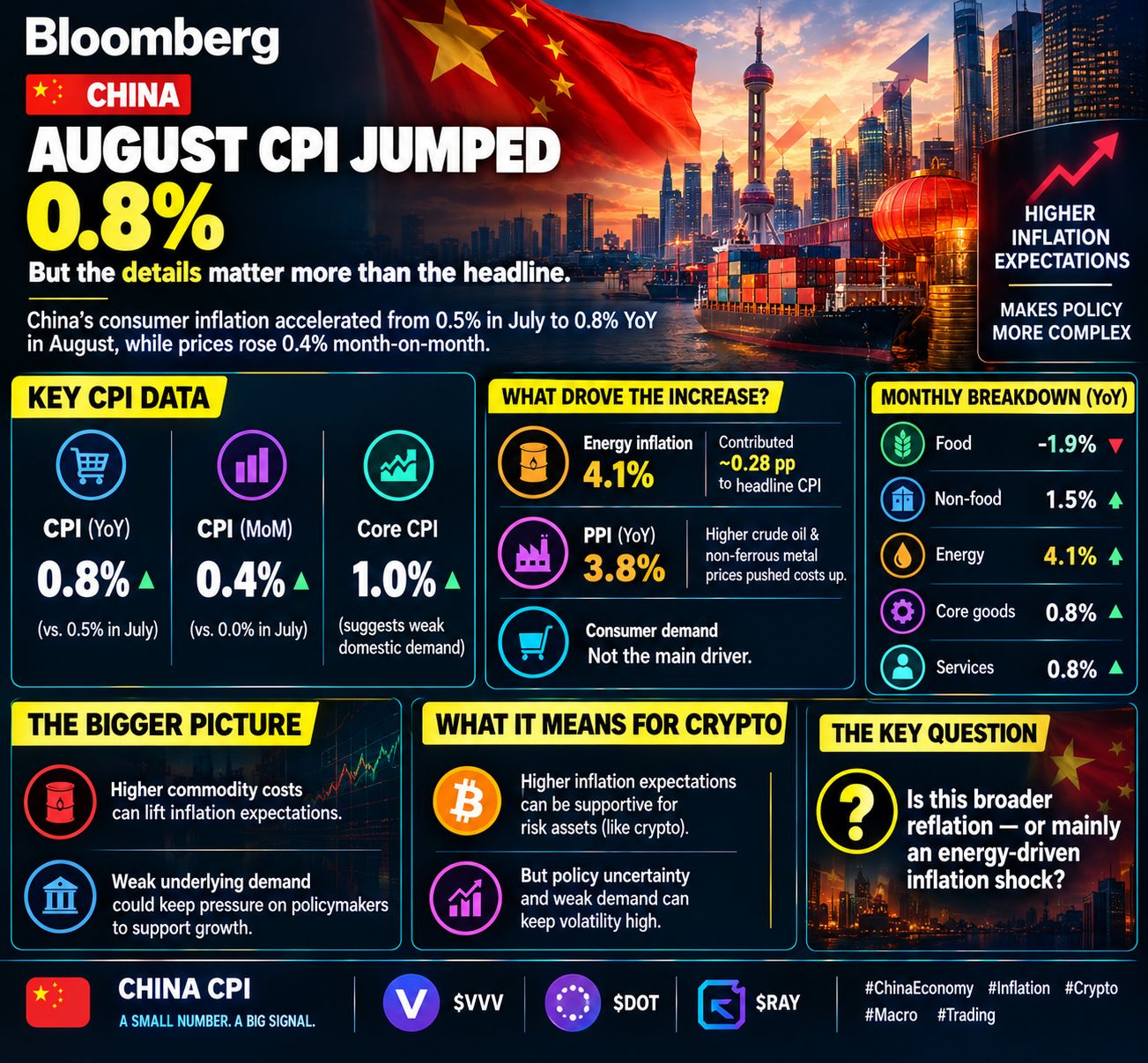
China’s consumer inflation accelerated from 0.5% in July to 0.8% YoY in August, while prices rose 0.4% month-on-month.
But here's the interesting part 👀
This wasn’t mainly driven by stronger consumer demand.
🛢️ Energy inflation hit 4.1%, contributing about 0.28 percentage points to headline CPI.
Upstream pressure was even stronger, with PPI surging 3.8% YoY, as higher crude oil and non-ferrous metal prices pushed costs higher.
Meanwhile, core CPI was just 1.0%, suggesting domestic demand is still relatively soft.
For crypto traders, this creates a mixed macro picture: higher commodity costs can lift inflation expectations, while weak underlying demand could keep pressure on policymakers to support growth.
So, is this broader reflation — or mainly an energy-driven inflation shock?
$VVV
{future}(VVVUSDT)
$DOT
{spot}(DOTUSDT)
$RAY
{spot}(RAYUSDT)
#ChinaEconomy #Inflation #Crypto #Macro #trading
#chinaaugustcpirises0.8%yoy
🇨🇳🔥 China’s August CPI jumped 0.8% — but the details matter more than the headline.
China’s consumer inflation accelerated from 0.5% in July to 0.8% YoY in August, while prices rose 0.4% month-on-month.
But here's the interesting part 👀
This wasn’t mainly driven by stronger consumer demand.
🛢️ Energy inflation hit 4.1%, contributing about 0.28 percentage points to headline CPI.
Upstream pressure was even stronger, with PPI surging 3.8% YoY, as higher crude oil and non-ferrous metal prices pushed costs higher.
Meanwhile, core CPI was just 1.0%, suggesting domestic demand is still relatively soft.
For crypto traders, this creates a mixed macro picture: higher commodity costs can lift inflation expectations, while weak underlying demand could keep pressure on policymakers to support growth.
So, is this broader reflation — or mainly an energy-driven inflation shock?
$VVV
$DOT
$RAY
#ChinaEconomy #Inflation #Crypto #Macro #trading
🇨🇳🔥 China’s August CPI jumped 0.8% — but the details matter more than the headline.
China’s consumer inflation accelerated from 0.5% in July to 0.8% YoY in August, while prices rose 0.4% month-on-month.
But here's the interesting part 👀
This wasn’t mainly driven by stronger consumer demand.
🛢️ Energy inflation hit 4.1%, contributing about 0.28 percentage points to headline CPI.
Upstream pressure was even stronger, with PPI surging 3.8% YoY, as higher crude oil and non-ferrous metal prices pushed costs higher.
Meanwhile, core CPI was just 1.0%, suggesting domestic demand is still relatively soft.
For crypto traders, this creates a mixed macro picture: higher commodity costs can lift inflation expectations, while weak underlying demand could keep pressure on policymakers to support growth.
So, is this broader reflation — or mainly an energy-driven inflation shock?
$VVV
$DOT
$RAY
#ChinaEconomy #Inflation #Crypto #Macro #trading
1
613

·
--
Bullish
China CPI Jumps 0.8%: Is Real Reflation Here, or Is Energy Driving the Story?
China’s August CPI accelerated to 0.8% year-on-year (up from 0.5% in July), with a 0.4% monthly gain. On the surface, it looks like a sign of economic warming, but the underlying breakdown tells a more nuanced story.
Breakdown of the Numbers
Energy as the Engine: Headline CPI was heavily driven by energy costs, which rose 4.1% YoY and contributed roughly 0.28 percentage points to the total figure.
Upstream Pressure: China’s PPI surged 3.8% YoY, reflecting rising input costs from imported crude oil and non-ferrous metals.
Restrained Core Demand: Core CPI (excluding volatile food and energy) sat at 1.0% YoY. This signals that broad-based consumer demand remains relatively muted despite higher input prices.
What This Means for the Macro Outlook
This data points to cost-push pressure rather than demand-pull expansion:
Policy Balancing Act: Rising commodity costs limit aggressive monetary easing, but subdued core inflation means central bank policymakers still need to support domestic consumption.
Global Market Impact: Input-driven inflation across major manufacturing hubs tends to keep global liquidity conditions cautious rather than signaling an immediate credit expansion.
Crypto Alignment: For digital assets, an energy-driven spike introduces a neutral-to-cautious macro backdrop, where traders must weigh persistent energy inflation against expectations for global central bank rate paths.
How do you view this print? Is China on the edge of a broader reflation trend, or is this primarily a temporary energy shock?
Share your analysis below! 👇
#ChinaEconomy #Inflation #CryptoMacro #MarketAnalysis
{future}(PHAUSDT)
{future}(KATUSDT)
{future}(CHIPUSDT)
China CPI Jumps 0.8%: Is Real Reflation Here, or Is Energy Driving the Story?
China’s August CPI accelerated to 0.8% year-on-year (up from 0.5% in July), with a 0.4% monthly gain. On the surface, it looks like a sign of economic warming, but the underlying breakdown tells a more nuanced story.
Breakdown of the Numbers
Energy as the Engine: Headline CPI was heavily driven by energy costs, which rose 4.1% YoY and contributed roughly 0.28 percentage points to the total figure.
Upstream Pressure: China’s PPI surged 3.8% YoY, reflecting rising input costs from imported crude oil and non-ferrous metals.
Restrained Core Demand: Core CPI (excluding volatile food and energy) sat at 1.0% YoY. This signals that broad-based consumer demand remains relatively muted despite higher input prices.
What This Means for the Macro Outlook
This data points to cost-push pressure rather than demand-pull expansion:
Policy Balancing Act: Rising commodity costs limit aggressive monetary easing, but subdued core inflation means central bank policymakers still need to support domestic consumption.
Global Market Impact: Input-driven inflation across major manufacturing hubs tends to keep global liquidity conditions cautious rather than signaling an immediate credit expansion.
Crypto Alignment: For digital assets, an energy-driven spike introduces a neutral-to-cautious macro backdrop, where traders must weigh persistent energy inflation against expectations for global central bank rate paths.
How do you view this print? Is China on the edge of a broader reflation trend, or is this primarily a temporary energy shock?
Share your analysis below! 👇
#ChinaEconomy #Inflation #CryptoMacro #MarketAnalysis
China’s August CPI accelerated to 0.8% year-on-year (up from 0.5% in July), with a 0.4% monthly gain. On the surface, it looks like a sign of economic warming, but the underlying breakdown tells a more nuanced story.
Breakdown of the Numbers
Energy as the Engine: Headline CPI was heavily driven by energy costs, which rose 4.1% YoY and contributed roughly 0.28 percentage points to the total figure.
Upstream Pressure: China’s PPI surged 3.8% YoY, reflecting rising input costs from imported crude oil and non-ferrous metals.
Restrained Core Demand: Core CPI (excluding volatile food and energy) sat at 1.0% YoY. This signals that broad-based consumer demand remains relatively muted despite higher input prices.
What This Means for the Macro Outlook
This data points to cost-push pressure rather than demand-pull expansion:
Policy Balancing Act: Rising commodity costs limit aggressive monetary easing, but subdued core inflation means central bank policymakers still need to support domestic consumption.
Global Market Impact: Input-driven inflation across major manufacturing hubs tends to keep global liquidity conditions cautious rather than signaling an immediate credit expansion.
Crypto Alignment: For digital assets, an energy-driven spike introduces a neutral-to-cautious macro backdrop, where traders must weigh persistent energy inflation against expectations for global central bank rate paths.
How do you view this print? Is China on the edge of a broader reflation trend, or is this primarily a temporary energy shock?
Share your analysis below! 👇
#ChinaEconomy #Inflation #CryptoMacro #MarketAnalysis
59

Verified
#chinaaugustcpirises0.8%yoy
🔥🇨🇳 CHINESE CPI JUMPS 0.8% : MARKETS CAN’T IGNORE THE INFLATION SIGNAL 🇨🇳🔥
When prices start to awaken, idle capital begins to pay attention.
The latest China inflation figure may seem modest, but the details tell a deeper story.
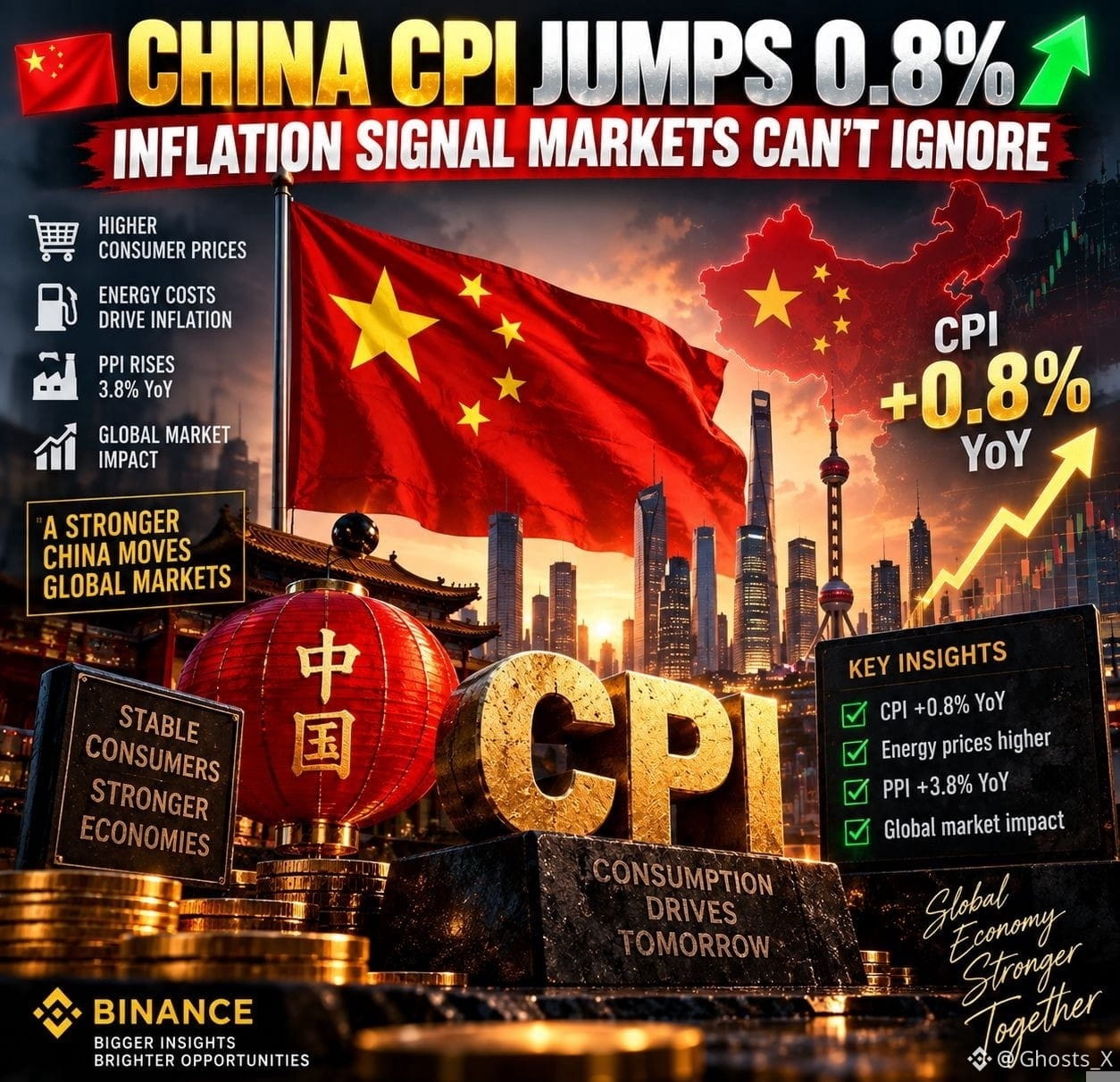
China’s CPI for August rose by 0.8% year-on-year after 0.5% in July. On a monthly basis, consumer prices increased by 0.4%.
The main driver is not a sudden surge in domestic demand. Energy prices did most of the work: energy inflation accelerated to 4.1% and contributed about 0.28 percentage point to overall CPI.
The clearest signal was visible upstream. China’s PPI jumped 3.8% year-on-year, while imported cost pressures tied to higher crude oil and non-ferrous metal prices pushed costs up across several sectors.
That said, this isn’t a “clean” stimulus story. Core CPI, excluding food and energy, was only 1.0%, suggesting that underlying domestic demand remains relatively contained.
This distinction matters for global markets. Higher raw-material costs can strengthen inflation expectations, while weak underlying demand can keep policymakers focused on supporting the economy.
For crypto, China’s data adds another macro variable to watch, as traders balance liquidity expectations against a fresh inflationary push driven by energy.
The headline says inflation is rising. The deeper message is that energy, not the strength of consumption, is doing a lot of the work.
#ChinaEconomy #Inflation #GrowWithSAC
$BTC
{future}(BTCUSDT)
$VVV
{future}(VVVUSDT)
$IOST
{future}(IOSTUSDT)
#chinaaugustcpirises0.8%yoy
🔥🇨🇳 CHINESE CPI JUMPS 0.8% : MARKETS CAN’T IGNORE THE INFLATION SIGNAL 🇨🇳🔥
When prices start to awaken, idle capital begins to pay attention.
The latest China inflation figure may seem modest, but the details tell a deeper story.
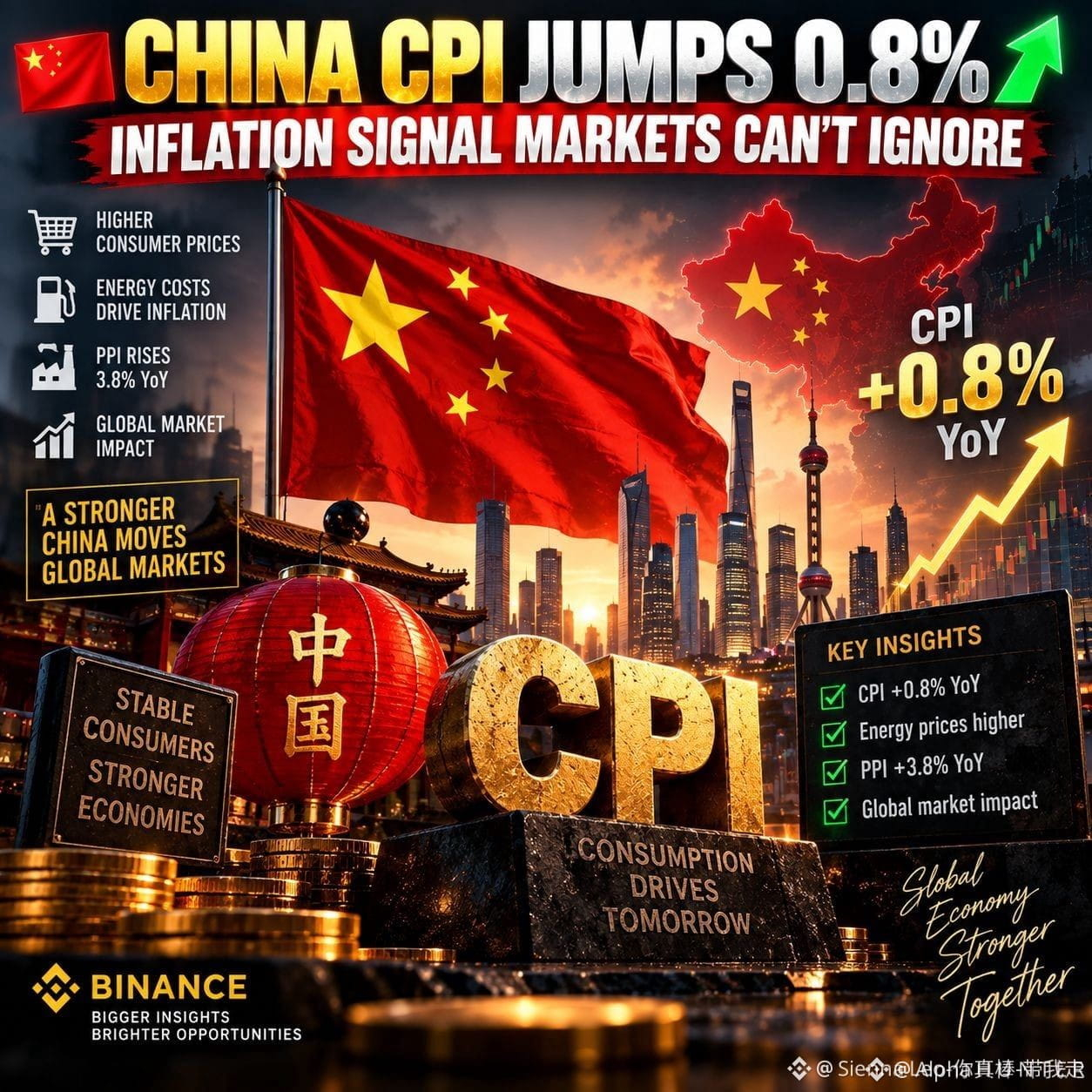
China’s CPI for August rose by 0.8% year-on-year after 0.5% in July. On a monthly basis, consumer prices increased by 0.4%.
The main driver is not a sudden surge in domestic demand. Energy prices did most of the work: energy inflation accelerated to 4.1% and contributed about 0.28 percentage point to overall CPI.
The clearest signal was visible upstream. China’s PPI jumped 3.8% year-on-year, while imported cost pressures tied to higher crude oil and non-ferrous metal prices pushed costs up across several sectors.
That said, this isn’t a “clean” stimulus story. Core CPI, excluding food and energy, was only 1.0%, suggesting that underlying domestic demand remains relatively contained.
This distinction matters for global markets. Higher raw-material costs can strengthen inflation expectations, while weak underlying demand can keep policymakers focused on supporting the economy.
For crypto, China’s data adds another macro variable to watch, as traders balance liquidity expectations against a fresh inflationary push driven by energy.
The headline says inflation is rising. The deeper message is that energy, not the strength of consumption, is doing a lot of the work.
#ChinaEconomy #Inflation #GrowWithSAC
$BTC
$VVV
$IOST
🔥🇨🇳 CHINESE CPI JUMPS 0.8% : MARKETS CAN’T IGNORE THE INFLATION SIGNAL 🇨🇳🔥
When prices start to awaken, idle capital begins to pay attention.
The latest China inflation figure may seem modest, but the details tell a deeper story.
China’s CPI for August rose by 0.8% year-on-year after 0.5% in July. On a monthly basis, consumer prices increased by 0.4%.
The main driver is not a sudden surge in domestic demand. Energy prices did most of the work: energy inflation accelerated to 4.1% and contributed about 0.28 percentage point to overall CPI.
The clearest signal was visible upstream. China’s PPI jumped 3.8% year-on-year, while imported cost pressures tied to higher crude oil and non-ferrous metal prices pushed costs up across several sectors.
That said, this isn’t a “clean” stimulus story. Core CPI, excluding food and energy, was only 1.0%, suggesting that underlying domestic demand remains relatively contained.
This distinction matters for global markets. Higher raw-material costs can strengthen inflation expectations, while weak underlying demand can keep policymakers focused on supporting the economy.
For crypto, China’s data adds another macro variable to watch, as traders balance liquidity expectations against a fresh inflationary push driven by energy.
The headline says inflation is rising. The deeper message is that energy, not the strength of consumption, is doing a lot of the work.
#ChinaEconomy #Inflation #GrowWithSAC
$BTC
$VVV
$IOST
1
2k

🇨🇳💰 China’s $53.6B Financial Capital Move
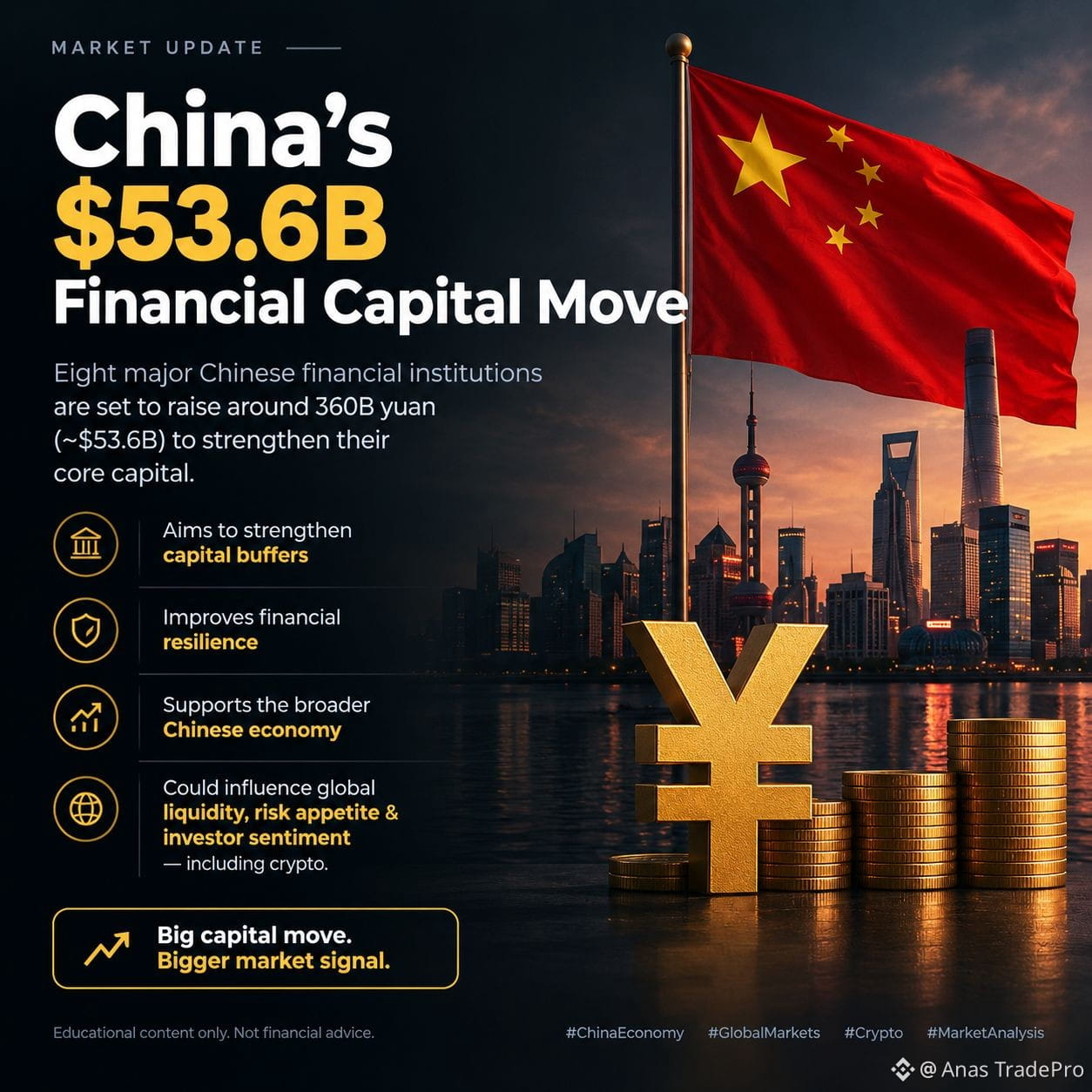
Eight major Chinese financial institutions are set to raise around 360B yuan (~$53.6B) to strengthen their core capital.
The move is designed to improve financial resilience and support the broader Chinese economy.
For global markets, stronger banking capital could influence liquidity, risk appetite and investor sentiment including crypto.
Big capital move. Bigger market signal. 👀
#ChinaEconomy #GlobalMarkets #Crypto #MarketAnalysis
🇨🇳💰 China’s $53.6B Financial Capital Move
Eight major Chinese financial institutions are set to raise around 360B yuan (~$53.6B) to strengthen their core capital.
The move is designed to improve financial resilience and support the broader Chinese economy.
For global markets, stronger banking capital could influence liquidity, risk appetite and investor sentiment including crypto.
Big capital move. Bigger market signal. 👀
#ChinaEconomy #GlobalMarkets #Crypto #MarketAnalysis
Eight major Chinese financial institutions are set to raise around 360B yuan (~$53.6B) to strengthen their core capital.
The move is designed to improve financial resilience and support the broader Chinese economy.
For global markets, stronger banking capital could influence liquidity, risk appetite and investor sentiment including crypto.
Big capital move. Bigger market signal. 👀
#ChinaEconomy #GlobalMarkets #Crypto #MarketAnalysis
50

·
--
Bullish
China’s Exports Surge on AI-Driven Demand
📈 China’s exports rose 27% year-on-year in June, far exceeding the 18.2% forecast and accelerating from 19.4% in May. Imports increased 36%, while the trade surplus widened to $125.6 billion.
💻 Growth was mainly driven by global demand for chips, electronic components, and computing equipment used in AI infrastructure. China continues to benefit from the global technology investment cycle.
🏠 However, stronger trade does not signal a broad domestic recovery. Consumption, investment, and the property sector remain weak, leaving exports to offset subdued internal demand.
⚖️ The data may support short-term sentiment toward technology stocks, exporters, and industrial commodities. Tariffs and trade tensions remain key risks to the sustainability of this momentum.
#ChinaEconomy $BTC $ETH $SOL
China’s Exports Surge on AI-Driven Demand
📈 China’s exports rose 27% year-on-year in June, far exceeding the 18.2% forecast and accelerating from 19.4% in May. Imports increased 36%, while the trade surplus widened to $125.6 billion.
💻 Growth was mainly driven by global demand for chips, electronic components, and computing equipment used in AI infrastructure. China continues to benefit from the global technology investment cycle.
🏠 However, stronger trade does not signal a broad domestic recovery. Consumption, investment, and the property sector remain weak, leaving exports to offset subdued internal demand.
⚖️ The data may support short-term sentiment toward technology stocks, exporters, and industrial commodities. Tariffs and trade tensions remain key risks to the sustainability of this momentum.
#ChinaEconomy $BTC $ETH $SOL
📈 China’s exports rose 27% year-on-year in June, far exceeding the 18.2% forecast and accelerating from 19.4% in May. Imports increased 36%, while the trade surplus widened to $125.6 billion.
💻 Growth was mainly driven by global demand for chips, electronic components, and computing equipment used in AI infrastructure. China continues to benefit from the global technology investment cycle.
🏠 However, stronger trade does not signal a broad domestic recovery. Consumption, investment, and the property sector remain weak, leaving exports to offset subdued internal demand.
⚖️ The data may support short-term sentiment toward technology stocks, exporters, and industrial commodities. Tariffs and trade tensions remain key risks to the sustainability of this momentum.
#ChinaEconomy $BTC $ETH $SOL

74

·
--
China’s official manufacturing PMI fell from 50.3 to 49.2 in July, returning to contraction territory. The non-manufacturing PMI also dropped to 49.
The problem is not production capacity; it’s demand.
New orders are weak, domestic consumption is fragile, and the real estate sector is still under pressure. At the same time, production linked to semiconductors, electric vehicles, and AI-connected technologies continues to grow.
This divergence in China could affect a wide range—from copper to oil, from Germany’s exports to emerging country markets.
Not investment advice
For informational purposes
#bitcoin #financefinancialliteracy #gold #China #ekonomi #ChinaEconomy
China’s official manufacturing PMI fell from 50.3 to 49.2 in July, returning to contraction territory. The non-manufacturing PMI also dropped to 49.
The problem is not production capacity; it’s demand.
New orders are weak, domestic consumption is fragile, and the real estate sector is still under pressure. At the same time, production linked to semiconductors, electric vehicles, and AI-connected technologies continues to grow.
This divergence in China could affect a wide range—from copper to oil, from Germany’s exports to emerging country markets.
Not investment advice
For informational purposes
#bitcoin #financefinancialliteracy #gold #China #ekonomi #ChinaEconomy
The problem is not production capacity; it’s demand.
New orders are weak, domestic consumption is fragile, and the real estate sector is still under pressure. At the same time, production linked to semiconductors, electric vehicles, and AI-connected technologies continues to grow.
This divergence in China could affect a wide range—from copper to oil, from Germany’s exports to emerging country markets.
Not investment advice
For informational purposes
#bitcoin #financefinancialliteracy #gold #China #ekonomi #ChinaEconomy
83


Article
China’s economy slows further in July as retail sales barely grow, investment slump steepens#ChinaEconomy
China’s economy lost momentum across the board in July, as consumer spending stalled and urban investment contracted at a faster pace while unemployment ticked higher, adding to pressure on Beijing to step up support in the second half.
Retail sales eked out a 0.6% growth from a year earlier, according to the National Bureau of Statistics on Monday, missing the estimated 1.5% jump in a Reuters poll, and slowing from the 1% growth in June.
China’s urban fixed-asset investment, including real estate and infrastructure, contracted 6.7% this year as of end-July from a year earlier, worse than the estimated 6% decline in the poll. The decline also steepened from the 5.7% drop in the first half of this year.
Industrial output rose 4.5% in July, undershooting the estimated 4.8% growth and slowing from 5.3% rise in June.
The urban unemployment rate stood at 5.2% in July, ticking up from 5% in June.
The data, which was released at 3 p.m. instead of the usual 10 a.m., reinforced concerns about the health of the world’s second-largest economy that has grappled with a deepening supply-demand imbalance.
Industrial production and exports tied to the global AI investment boom have helped cushion weak consumption and private investment, but July data suggest that support may be thinning.
China must “accelerate the transition to new growth drivers,” the statistics bureau said in the English statement, while calling for greater reforms and opening up further.
During the Monday presser, statistics bureau spokesperson Fu Linghui said that geopolitical pressure abroad and high temperatures domestically impacted China’s economy last month. While acknowledging that key economic metrics softened last month, Fu pointed to 5% growth in services retail sales over the first seven months of the year, versus 1.1% jump in retail sales of goods.
Exports, new growth drivers and macro policy would support China’s economy in achieving the full-year growth target, despite “shocks” from extreme weather in July, Fu added.
China’s retail sales growth has slowed sharply over the past year, with nominal growth easing to just 1.3% in the first half of this year from 5% in the same period last year, according to Goldman Sachs, as a government trade-in subsidy program that pulled purchases forward has since become a drag.
China’s consumer inflation had eased to a six-month low of 0.5% in July, while core CPI, excluding volatile food and energy prices, rose 0.9%.
Wang Guanhua, another statistics bureau spokesperson, said Monday that the softening consumer inflation in July was in part due to the dip in global crude oil prices, and cited the latest Politburo meeting’s plan for more fiscal support.
In another sign of persistent weakness in spending, new bank loans issued in July — typically a slow month for lending — recorded their largest monthly decline on record, according to Barclays. Household loans, including mortgages, shrank in July after a brief recovery in June, according to CNBC’s calculation of official figures, amid soft housing activity and a weak labor market.
Mortgage demand has weakened through the multi-year property downturn, while banks, wary of borrowers’ repayment capacity, have grown more reluctant to lend.
The jobs picture may be worse than official figures suggest. A private survey conducted by the team of Li Daokui, a professor of economics at Tsinghua University, showed China’s broad unemployment rate at 10.2% as of July, significantly higher than the official figures of around 5%.
The survey, counting in people who have been jobless for the past two years and are no longer covered in the official labor force survey, also showed that more than half of the roughly 24 million long-term unemployed are aged 16 to 24.
Official youth unemployment rate stood at 14.9% in June, the highest rate for the same month since the government excluded university students from the sample more than two years ago.
Behind the weak hiring is a slump in investment. Urban investment declined for the first time in decades last year, falling 3.8% from a year earlier, and has deteriorated further this year, as the property downturn and tighter constraints on local governments’ borrowing hampered one of China’s traditional growth drivers.
Investment in real estate declined 19.2% in the first seven months this year, while infrastructure and manufacturing investment contracted 3.6% and 1.7%, respectively.
Signaling state priorities, high-tech investments grew by 5% year on year during the first seven months of the year. The category includes information services, aerospace and equipment manufacturing.
The intensity of pullback in overall investment has been “unprecedented,” said Li, describing the contracting investment and high youth unemployment as the biggest obstacles to China meeting its growth targets.
Factory and construction activity also lost momentum in July, with the official manufacturing PMI unexpectedly contracting for the first time since February.
Amid Mideast energy disruption, crude oil production in China rose 0.8% in July from a year ago to a record-high, Fu said. He added that natural gas and electricity production remained high in July, ensuring sufficient daily supply.
China’s economy slows further in July as retail sales barely grow, investment slump steepens
#ChinaEconomy
China’s economy lost momentum across the board in July, as consumer spending stalled and urban investment contracted at a faster pace while unemployment ticked higher, adding to pressure on Beijing to step up support in the second half.
Retail sales eked out a 0.6% growth from a year earlier, according to the National Bureau of Statistics on Monday, missing the estimated 1.5% jump in a Reuters poll, and slowing from the 1% growth in June.
China’s urban fixed-asset investment, including real estate and infrastructure, contracted 6.7% this year as of end-July from a year earlier, worse than the estimated 6% decline in the poll. The decline also steepened from the 5.7% drop in the first half of this year.
Industrial output rose 4.5% in July, undershooting the estimated 4.8% growth and slowing from 5.3% rise in June.
The urban unemployment rate stood at 5.2% in July, ticking up from 5% in June.
The data, which was released at 3 p.m. instead of the usual 10 a.m., reinforced concerns about the health of the world’s second-largest economy that has grappled with a deepening supply-demand imbalance.
Industrial production and exports tied to the global AI investment boom have helped cushion weak consumption and private investment, but July data suggest that support may be thinning.
China must “accelerate the transition to new growth drivers,” the statistics bureau said in the English statement, while calling for greater reforms and opening up further.
During the Monday presser, statistics bureau spokesperson Fu Linghui said that geopolitical pressure abroad and high temperatures domestically impacted China’s economy last month. While acknowledging that key economic metrics softened last month, Fu pointed to 5% growth in services retail sales over the first seven months of the year, versus 1.1% jump in retail sales of goods.
Exports, new growth drivers and macro policy would support China’s economy in achieving the full-year growth target, despite “shocks” from extreme weather in July, Fu added.
China’s retail sales growth has slowed sharply over the past year, with nominal growth easing to just 1.3% in the first half of this year from 5% in the same period last year, according to Goldman Sachs, as a government trade-in subsidy program that pulled purchases forward has since become a drag.
China’s consumer inflation had eased to a six-month low of 0.5% in July, while core CPI, excluding volatile food and energy prices, rose 0.9%.
Wang Guanhua, another statistics bureau spokesperson, said Monday that the softening consumer inflation in July was in part due to the dip in global crude oil prices, and cited the latest Politburo meeting’s plan for more fiscal support.
In another sign of persistent weakness in spending, new bank loans issued in July — typically a slow month for lending — recorded their largest monthly decline on record, according to Barclays. Household loans, including mortgages, shrank in July after a brief recovery in June, according to CNBC’s calculation of official figures, amid soft housing activity and a weak labor market.
Mortgage demand has weakened through the multi-year property downturn, while banks, wary of borrowers’ repayment capacity, have grown more reluctant to lend.
The jobs picture may be worse than official figures suggest. A private survey conducted by the team of Li Daokui, a professor of economics at Tsinghua University, showed China’s broad unemployment rate at 10.2% as of July, significantly higher than the official figures of around 5%.
The survey, counting in people who have been jobless for the past two years and are no longer covered in the official labor force survey, also showed that more than half of the roughly 24 million long-term unemployed are aged 16 to 24.
Official youth unemployment rate stood at 14.9% in June, the highest rate for the same month since the government excluded university students from the sample more than two years ago.
Behind the weak hiring is a slump in investment. Urban investment declined for the first time in decades last year, falling 3.8% from a year earlier, and has deteriorated further this year, as the property downturn and tighter constraints on local governments’ borrowing hampered one of China’s traditional growth drivers.
Investment in real estate declined 19.2% in the first seven months this year, while infrastructure and manufacturing investment contracted 3.6% and 1.7%, respectively.
Signaling state priorities, high-tech investments grew by 5% year on year during the first seven months of the year. The category includes information services, aerospace and equipment manufacturing.
The intensity of pullback in overall investment has been “unprecedented,” said Li, describing the contracting investment and high youth unemployment as the biggest obstacles to China meeting its growth targets.
Factory and construction activity also lost momentum in July, with the official manufacturing PMI unexpectedly contracting for the first time since February.
Amid Mideast energy disruption, crude oil production in China rose 0.8% in July from a year ago to a record-high, Fu said. He added that natural gas and electricity production remained high in July, ensuring sufficient daily supply.
China’s economy lost momentum across the board in July, as consumer spending stalled and urban investment contracted at a faster pace while unemployment ticked higher, adding to pressure on Beijing to step up support in the second half.
Retail sales eked out a 0.6% growth from a year earlier, according to the National Bureau of Statistics on Monday, missing the estimated 1.5% jump in a Reuters poll, and slowing from the 1% growth in June.
China’s urban fixed-asset investment, including real estate and infrastructure, contracted 6.7% this year as of end-July from a year earlier, worse than the estimated 6% decline in the poll. The decline also steepened from the 5.7% drop in the first half of this year.
Industrial output rose 4.5% in July, undershooting the estimated 4.8% growth and slowing from 5.3% rise in June.
The urban unemployment rate stood at 5.2% in July, ticking up from 5% in June.
The data, which was released at 3 p.m. instead of the usual 10 a.m., reinforced concerns about the health of the world’s second-largest economy that has grappled with a deepening supply-demand imbalance.
Industrial production and exports tied to the global AI investment boom have helped cushion weak consumption and private investment, but July data suggest that support may be thinning.
China must “accelerate the transition to new growth drivers,” the statistics bureau said in the English statement, while calling for greater reforms and opening up further.
During the Monday presser, statistics bureau spokesperson Fu Linghui said that geopolitical pressure abroad and high temperatures domestically impacted China’s economy last month. While acknowledging that key economic metrics softened last month, Fu pointed to 5% growth in services retail sales over the first seven months of the year, versus 1.1% jump in retail sales of goods.
Exports, new growth drivers and macro policy would support China’s economy in achieving the full-year growth target, despite “shocks” from extreme weather in July, Fu added.
China’s retail sales growth has slowed sharply over the past year, with nominal growth easing to just 1.3% in the first half of this year from 5% in the same period last year, according to Goldman Sachs, as a government trade-in subsidy program that pulled purchases forward has since become a drag.
China’s consumer inflation had eased to a six-month low of 0.5% in July, while core CPI, excluding volatile food and energy prices, rose 0.9%.
Wang Guanhua, another statistics bureau spokesperson, said Monday that the softening consumer inflation in July was in part due to the dip in global crude oil prices, and cited the latest Politburo meeting’s plan for more fiscal support.
In another sign of persistent weakness in spending, new bank loans issued in July — typically a slow month for lending — recorded their largest monthly decline on record, according to Barclays. Household loans, including mortgages, shrank in July after a brief recovery in June, according to CNBC’s calculation of official figures, amid soft housing activity and a weak labor market.
Mortgage demand has weakened through the multi-year property downturn, while banks, wary of borrowers’ repayment capacity, have grown more reluctant to lend.
The jobs picture may be worse than official figures suggest. A private survey conducted by the team of Li Daokui, a professor of economics at Tsinghua University, showed China’s broad unemployment rate at 10.2% as of July, significantly higher than the official figures of around 5%.
The survey, counting in people who have been jobless for the past two years and are no longer covered in the official labor force survey, also showed that more than half of the roughly 24 million long-term unemployed are aged 16 to 24.
Official youth unemployment rate stood at 14.9% in June, the highest rate for the same month since the government excluded university students from the sample more than two years ago.
Behind the weak hiring is a slump in investment. Urban investment declined for the first time in decades last year, falling 3.8% from a year earlier, and has deteriorated further this year, as the property downturn and tighter constraints on local governments’ borrowing hampered one of China’s traditional growth drivers.
Investment in real estate declined 19.2% in the first seven months this year, while infrastructure and manufacturing investment contracted 3.6% and 1.7%, respectively.
Signaling state priorities, high-tech investments grew by 5% year on year during the first seven months of the year. The category includes information services, aerospace and equipment manufacturing.
The intensity of pullback in overall investment has been “unprecedented,” said Li, describing the contracting investment and high youth unemployment as the biggest obstacles to China meeting its growth targets.
Factory and construction activity also lost momentum in July, with the official manufacturing PMI unexpectedly contracting for the first time since February.
Amid Mideast energy disruption, crude oil production in China rose 0.8% in July from a year ago to a record-high, Fu said. He added that natural gas and electricity production remained high in July, ensuring sufficient daily supply.
62

·
--

Article
China’s Massive Liquidity Injection: What It Means for Global MarketsChina has just made a major move, injecting ¥304 billion (roughly $42 billion USD) into its banking system this week. While that headline number is impressive, the real story is what it signals for the future of the world’s second-largest economy and why it should be on your radar.
Behind the Numbers
This isn't just about shuffling cash; it’s a strategic maneuver by the People’s Bank of China (PBOC) to keep credit flowing smoothly and ensure the financial system remains stable amidst ongoing economic shifts. By boosting short-term liquidity, policymakers are aiming to lower borrowing costs, encourage corporate investment, and bolster market confidence during a delicate period of transition.
For investors, analysts, and business leaders, this injection is a clear indicator that Beijing is doubling down on its commitment to moderate, sustainable economic growth. It reflects a proactive stance to smooth out volatility and prevent liquidity crunches that could stifle recovery.
The Global Ripple Effect
Because China’s economy is so deeply integrated into the global supply chain and capital markets, these domestic policy shifts never stay domestic for long:
Market Sentiment: This infusion acts as a stabilizing force, providing a psychological buffer for global investors wary of economic stagnation.
Commodity Demand: Easier access to capital in China often acts as a precursor to increased industrial activity, which generally supports commodity prices and manufacturing demand worldwide.
Monetary Divergence: As major central banks worldwide continue to navigate their own interest rate paths, China’s decision to inject liquidity highlights a continued divergence in global monetary policy, creating unique opportunities for savvy, globally-minded portfolios.
Stay Ahead of the Curve
Macroeconomic shifts move fast, and understanding how these major interventions translate into real-world trends is essential for navigating the current landscape.
How do you think this massive injection will impact your specific industry or investment outlook for the remainder of the year? Let’s discuss your take in the comments below.
#ChinaEconomy #RippleUpdate #BitcoinBreaksBelow75KAsWarshTakesFedHelm #TrumpSaysIranDealLargelyNegotiated #Write2Earn
$BTC
{spot}(BTCUSDT)
$ETH
{spot}(ETHUSDT)
$BNB
{spot}(BNBUSDT)
China’s Massive Liquidity Injection: What It Means for Global Markets
China has just made a major move, injecting ¥304 billion (roughly $42 billion USD) into its banking system this week. While that headline number is impressive, the real story is what it signals for the future of the world’s second-largest economy and why it should be on your radar.
Behind the Numbers
This isn't just about shuffling cash; it’s a strategic maneuver by the People’s Bank of China (PBOC) to keep credit flowing smoothly and ensure the financial system remains stable amidst ongoing economic shifts. By boosting short-term liquidity, policymakers are aiming to lower borrowing costs, encourage corporate investment, and bolster market confidence during a delicate period of transition.
For investors, analysts, and business leaders, this injection is a clear indicator that Beijing is doubling down on its commitment to moderate, sustainable economic growth. It reflects a proactive stance to smooth out volatility and prevent liquidity crunches that could stifle recovery.
The Global Ripple Effect
Because China’s economy is so deeply integrated into the global supply chain and capital markets, these domestic policy shifts never stay domestic for long:
Market Sentiment: This infusion acts as a stabilizing force, providing a psychological buffer for global investors wary of economic stagnation.
Commodity Demand: Easier access to capital in China often acts as a precursor to increased industrial activity, which generally supports commodity prices and manufacturing demand worldwide.
Monetary Divergence: As major central banks worldwide continue to navigate their own interest rate paths, China’s decision to inject liquidity highlights a continued divergence in global monetary policy, creating unique opportunities for savvy, globally-minded portfolios.
Stay Ahead of the Curve
Macroeconomic shifts move fast, and understanding how these major interventions translate into real-world trends is essential for navigating the current landscape.
How do you think this massive injection will impact your specific industry or investment outlook for the remainder of the year? Let’s discuss your take in the comments below.
#ChinaEconomy #RippleUpdate #BitcoinBreaksBelow75KAsWarshTakesFedHelm #TrumpSaysIranDealLargelyNegotiated #Write2Earn
$BTC
$ETH
$BNB
Behind the Numbers
This isn't just about shuffling cash; it’s a strategic maneuver by the People’s Bank of China (PBOC) to keep credit flowing smoothly and ensure the financial system remains stable amidst ongoing economic shifts. By boosting short-term liquidity, policymakers are aiming to lower borrowing costs, encourage corporate investment, and bolster market confidence during a delicate period of transition.
For investors, analysts, and business leaders, this injection is a clear indicator that Beijing is doubling down on its commitment to moderate, sustainable economic growth. It reflects a proactive stance to smooth out volatility and prevent liquidity crunches that could stifle recovery.
The Global Ripple Effect
Because China’s economy is so deeply integrated into the global supply chain and capital markets, these domestic policy shifts never stay domestic for long:
Market Sentiment: This infusion acts as a stabilizing force, providing a psychological buffer for global investors wary of economic stagnation.
Commodity Demand: Easier access to capital in China often acts as a precursor to increased industrial activity, which generally supports commodity prices and manufacturing demand worldwide.
Monetary Divergence: As major central banks worldwide continue to navigate their own interest rate paths, China’s decision to inject liquidity highlights a continued divergence in global monetary policy, creating unique opportunities for savvy, globally-minded portfolios.
Stay Ahead of the Curve
Macroeconomic shifts move fast, and understanding how these major interventions translate into real-world trends is essential for navigating the current landscape.
How do you think this massive injection will impact your specific industry or investment outlook for the remainder of the year? Let’s discuss your take in the comments below.
#ChinaEconomy #RippleUpdate #BitcoinBreaksBelow75KAsWarshTakesFedHelm #TrumpSaysIranDealLargelyNegotiated #Write2Earn
$BTC
$ETH
$BNB
1
244

·
--
China's Central Bank Urges Lending Boost 🚀
The People's Bank of China has instructed banks to increase lending in May, according to sources, as the country struggles with persistent credit weakness. This move is aimed at stimulating economic growth and stabilizing the financial system. The directive is expected to have a positive impact on the market, as increased lending can lead to higher consumption and investment, thereby boosting economic activity. The news may also influence cryptocurrency markets, as investors seek alternative assets in response to traditional market fluctuations. Overall, the PBOC's decision is seen as a proactive step to address credit concerns and promote economic stability. #Crypto #Markets #ChinaEconomy #BTC
China's Central Bank Urges Lending Boost 🚀
The People's Bank of China has instructed banks to increase lending in May, according to sources, as the country struggles with persistent credit weakness. This move is aimed at stimulating economic growth and stabilizing the financial system. The directive is expected to have a positive impact on the market, as increased lending can lead to higher consumption and investment, thereby boosting economic activity. The news may also influence cryptocurrency markets, as investors seek alternative assets in response to traditional market fluctuations. Overall, the PBOC's decision is seen as a proactive step to address credit concerns and promote economic stability. #Crypto #Markets #ChinaEconomy #BTC
The People's Bank of China has instructed banks to increase lending in May, according to sources, as the country struggles with persistent credit weakness. This move is aimed at stimulating economic growth and stabilizing the financial system. The directive is expected to have a positive impact on the market, as increased lending can lead to higher consumption and investment, thereby boosting economic activity. The news may also influence cryptocurrency markets, as investors seek alternative assets in response to traditional market fluctuations. Overall, the PBOC's decision is seen as a proactive step to address credit concerns and promote economic stability. #Crypto #Markets #ChinaEconomy #BTC
38
·
--
China's Central Bank Slashes Cash Injection to Record Low 📉
China's central bank has reduced its daily open-market operation to a historic low, aiming to soak up excess liquidity in the financial system. This move is an extension of efforts to manage cash levels as a bond market rally gains momentum, pushing benchmark yields to their lowest levels since August. The reduction in cash injection is expected to have a ripple effect on the market, potentially influencing interest rates and overall economic activity. As the bond rally deepens, investors are closely watching the central bank's actions, anticipating how this will impact the broader financial landscape.
#Crypto #Markets #BondRally #ChinaEconomy #FinancialNews
China's Central Bank Slashes Cash Injection to Record Low 📉
China's central bank has reduced its daily open-market operation to a historic low, aiming to soak up excess liquidity in the financial system. This move is an extension of efforts to manage cash levels as a bond market rally gains momentum, pushing benchmark yields to their lowest levels since August. The reduction in cash injection is expected to have a ripple effect on the market, potentially influencing interest rates and overall economic activity. As the bond rally deepens, investors are closely watching the central bank's actions, anticipating how this will impact the broader financial landscape.
#Crypto #Markets #BondRally #ChinaEconomy #FinancialNews
China's central bank has reduced its daily open-market operation to a historic low, aiming to soak up excess liquidity in the financial system. This move is an extension of efforts to manage cash levels as a bond market rally gains momentum, pushing benchmark yields to their lowest levels since August. The reduction in cash injection is expected to have a ripple effect on the market, potentially influencing interest rates and overall economic activity. As the bond rally deepens, investors are closely watching the central bank's actions, anticipating how this will impact the broader financial landscape.
#Crypto #Markets #BondRally #ChinaEconomy #FinancialNews
54
·
--
Bullish
Is PBOC Staying Patient as China’s Recovery Remains Uneven?
📌 A Reuters poll of 30 market experts showed unanimous expectations that PBOC will keep its benchmark loan prime rates unchanged at the upcoming review, with the 1-year LPR at 3.00% and the 5-year LPR at 3.50%.
🏦 If confirmed, this would mark the 13th consecutive month of unchanged LPR settings, suggesting that policymakers are still prioritizing caution rather than moving quickly toward broader monetary easing.
📊 The key backdrop remains China’s uneven economic recovery. Manufacturing and exports continue to show relative resilience, while domestic consumption, the property sector and the labor market remain areas that require close monitoring.
🌏 For markets, the news is not a major surprise, but it reinforces the view that Beijing is still in wait-and-see mode before taking stronger action. A small rate cut later this year remains possible if domestic demand weakens more clearly.
#ChinaEconomy $POL $B2 $C
Is PBOC Staying Patient as China’s Recovery Remains Uneven?
📌 A Reuters poll of 30 market experts showed unanimous expectations that PBOC will keep its benchmark loan prime rates unchanged at the upcoming review, with the 1-year LPR at 3.00% and the 5-year LPR at 3.50%.
🏦 If confirmed, this would mark the 13th consecutive month of unchanged LPR settings, suggesting that policymakers are still prioritizing caution rather than moving quickly toward broader monetary easing.
📊 The key backdrop remains China’s uneven economic recovery. Manufacturing and exports continue to show relative resilience, while domestic consumption, the property sector and the labor market remain areas that require close monitoring.
🌏 For markets, the news is not a major surprise, but it reinforces the view that Beijing is still in wait-and-see mode before taking stronger action. A small rate cut later this year remains possible if domestic demand weakens more clearly.
#ChinaEconomy $POL $B2 $C
📌 A Reuters poll of 30 market experts showed unanimous expectations that PBOC will keep its benchmark loan prime rates unchanged at the upcoming review, with the 1-year LPR at 3.00% and the 5-year LPR at 3.50%.
🏦 If confirmed, this would mark the 13th consecutive month of unchanged LPR settings, suggesting that policymakers are still prioritizing caution rather than moving quickly toward broader monetary easing.
📊 The key backdrop remains China’s uneven economic recovery. Manufacturing and exports continue to show relative resilience, while domestic consumption, the property sector and the labor market remain areas that require close monitoring.
🌏 For markets, the news is not a major surprise, but it reinforces the view that Beijing is still in wait-and-see mode before taking stronger action. A small rate cut later this year remains possible if domestic demand weakens more clearly.
#ChinaEconomy $POL $B2 $C
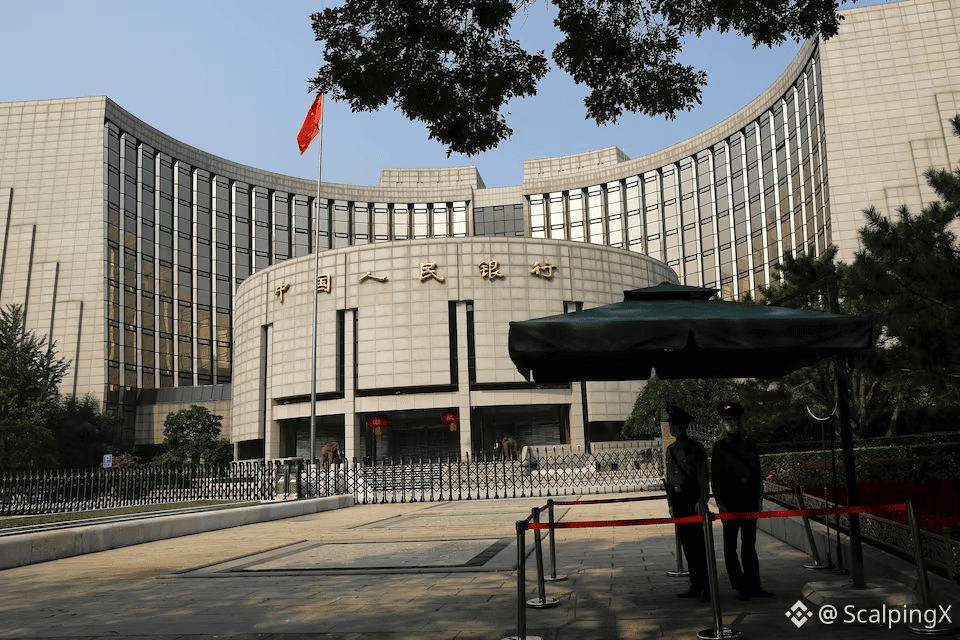
1
481
Log in to explore more content
Join global crypto users on Binance Square
⚡️ Get latest and useful information about crypto.
💬 Trusted by the world’s largest crypto exchange.
👍 Discover real insights from verified creators.
Email / Phone number
Trending Topics
1
#EtherGains70.9%InQ3
84,626 views
837 Discussing
2
#TreasuryLetsStatesFileStablecoinCertificationsEarly
4,293 views
43 Discussing
3
#US10YearYieldNears5.3%
112,461 views
937 Discussing
4
#DollarIndexHitsHighestSinceMay2025
23,400 views
489 Discussing
5
#USWeeklyJoblessClaimsFallTo197000
24,048 views
411 Discussing
6
#BitcoinETFsTake$6.34BillionInQ3
7,534 views
60 Discussing
7
#KoreaProposesTokenizingStocksAndBonds
58,704 views
748 Discussing
8
#MetaMaskExitsLidoValidatorsAfterSecurityIncident
155,020 views
1,460 Discussing
9
#MicronBeatsEarningsLiftsGuidance
77,557 views
1,061 Discussing
10
#CFTCSubmitsTwoEventContractRulesToWhiteHouse
52,977 views
792 Discussing