

#macroeconomics
macroeconomics
839,816 views
3,916 Discussing
Hot
Latest

·
--
Bullish
Macro Pressure on the Market: How DXY Strength is Restraining Crypto
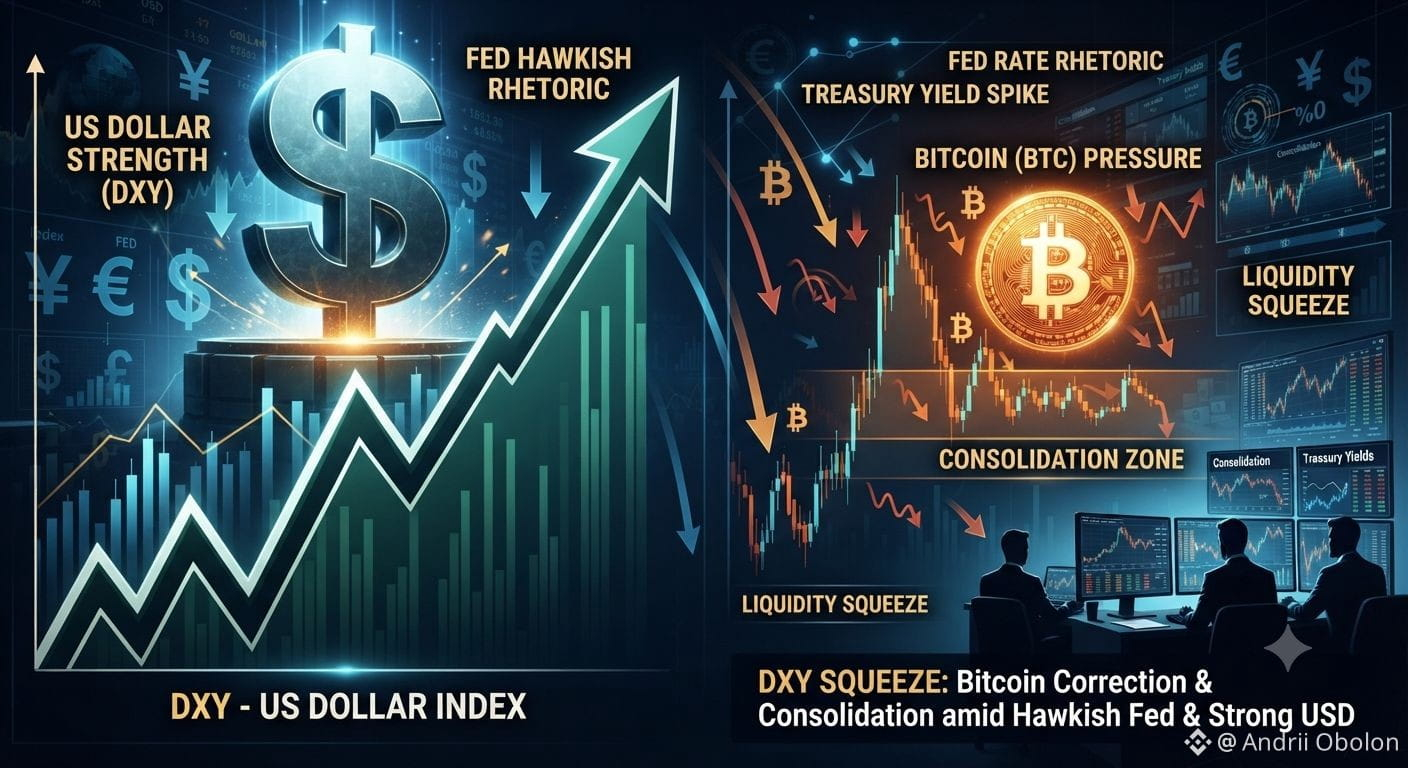
While retail traders look for quick signals amid heavy price swings, the global market has found itself under pressure from a much larger player—the U.S. Dollar Index DXY.
What's Happening in the Market: The Dollar Index DXY sharply regained ground amid the Federal Reserve's hawkish rhetoric and a rise in two-year Treasury yields to cyclical highs. This has triggered an inevitable "squeeze" effect for all risk-on assets, including cryptocurrency.
Bitcoin and Liquidity Reaction: Against the backdrop of a strengthening dollar, the primary cryptocurrency corrected following a recent test of local highs, transitioning into a healthy consolidation zone. Institutional investors are closely monitoring this level, as such macroeconomic corrections often precede genuine accumulation phases by major capital.
Why It Matters for Traders: The combination of Fed rates, global central bank monetary policies, and macroeconomic metrics impacts liquidity far more than local news about individual summits. Understanding these fundamental connections protects traders from false hopes of "instant pumps" and helps build strategies based on real data.
#CryptoNews #Bitcoin #MarketAnalysis #Macroeconomics #DYOR
$BTC
{future}(BTCUSDT)
Macro Pressure on the Market: How DXY Strength is Restraining Crypto
While retail traders look for quick signals amid heavy price swings, the global market has found itself under pressure from a much larger player—the U.S. Dollar Index DXY.
What's Happening in the Market: The Dollar Index DXY sharply regained ground amid the Federal Reserve's hawkish rhetoric and a rise in two-year Treasury yields to cyclical highs. This has triggered an inevitable "squeeze" effect for all risk-on assets, including cryptocurrency.
Bitcoin and Liquidity Reaction: Against the backdrop of a strengthening dollar, the primary cryptocurrency corrected following a recent test of local highs, transitioning into a healthy consolidation zone. Institutional investors are closely monitoring this level, as such macroeconomic corrections often precede genuine accumulation phases by major capital.
Why It Matters for Traders: The combination of Fed rates, global central bank monetary policies, and macroeconomic metrics impacts liquidity far more than local news about individual summits. Understanding these fundamental connections protects traders from false hopes of "instant pumps" and helps build strategies based on real data.
#CryptoNews #Bitcoin #MarketAnalysis #Macroeconomics #DYOR
$BTC
While retail traders look for quick signals amid heavy price swings, the global market has found itself under pressure from a much larger player—the U.S. Dollar Index DXY.
What's Happening in the Market: The Dollar Index DXY sharply regained ground amid the Federal Reserve's hawkish rhetoric and a rise in two-year Treasury yields to cyclical highs. This has triggered an inevitable "squeeze" effect for all risk-on assets, including cryptocurrency.
Bitcoin and Liquidity Reaction: Against the backdrop of a strengthening dollar, the primary cryptocurrency corrected following a recent test of local highs, transitioning into a healthy consolidation zone. Institutional investors are closely monitoring this level, as such macroeconomic corrections often precede genuine accumulation phases by major capital.
Why It Matters for Traders: The combination of Fed rates, global central bank monetary policies, and macroeconomic metrics impacts liquidity far more than local news about individual summits. Understanding these fundamental connections protects traders from false hopes of "instant pumps" and helps build strategies based on real data.
#CryptoNews #Bitcoin #MarketAnalysis #Macroeconomics #DYOR
$BTC
1
2
77

#trumprejectsiranhormuzreopening
🔥 Macro Update: The Strait of Hormuz and Its Impact on Crypto Currencies 🔥
President Trump officially rejected Iran’s proposal for seven days to reopen the Strait of Hormuz, while maintaining the U.S. naval blockade [1]. As global energy prices rise, macroeconomic uncertainty directly affects digital asset flows. Here’s the technical and fundamental breakdown of the most prominent coins:
🟠 Bitcoin ($BTC ): Inflation waves resulting from energy price spikes test the Bitcoin narrative as “digital gold.” In uncertain times, liquidity often shifts to BTC as an extra-macro hedge, reinforcing strong support levels and creating new liquidity pools.
🔵 Ethereum ($ETH ): Geopolitical volatility drives major on-chain liquidity shifts. Increased DeFi activity raises gas consumption, which accelerates the ETH burn rate and strengthens its deflationary market structure.
🟡 Binance Coin ($BNB ): Market disruption generates massive trading volumes on exchanges. As traders aggressively reposition their wallets to manage risk, BNB benefits from increased utility and transaction demand across the Binance ecosystem.
Keep an eye on the broader macro structure; these geopolitical catalysts often push toward large-scale liquidity aggregation.
Please follow for updates
#OilSupply #Geopolitics #CryptoNews #MacroEconomics
#trumprejectsiranhormuzreopening
🔥 Macro Update: The Strait of Hormuz and Its Impact on Crypto Currencies 🔥
President Trump officially rejected Iran’s proposal for seven days to reopen the Strait of Hormuz, while maintaining the U.S. naval blockade [1]. As global energy prices rise, macroeconomic uncertainty directly affects digital asset flows. Here’s the technical and fundamental breakdown of the most prominent coins:
🟠 Bitcoin ($BTC ): Inflation waves resulting from energy price spikes test the Bitcoin narrative as “digital gold.” In uncertain times, liquidity often shifts to BTC as an extra-macro hedge, reinforcing strong support levels and creating new liquidity pools.
🔵 Ethereum ($ETH ): Geopolitical volatility drives major on-chain liquidity shifts. Increased DeFi activity raises gas consumption, which accelerates the ETH burn rate and strengthens its deflationary market structure.
🟡 Binance Coin ($BNB ): Market disruption generates massive trading volumes on exchanges. As traders aggressively reposition their wallets to manage risk, BNB benefits from increased utility and transaction demand across the Binance ecosystem.
Keep an eye on the broader macro structure; these geopolitical catalysts often push toward large-scale liquidity aggregation.
Please follow for updates
#OilSupply #Geopolitics #CryptoNews #MacroEconomics
🔥 Macro Update: The Strait of Hormuz and Its Impact on Crypto Currencies 🔥
President Trump officially rejected Iran’s proposal for seven days to reopen the Strait of Hormuz, while maintaining the U.S. naval blockade [1]. As global energy prices rise, macroeconomic uncertainty directly affects digital asset flows. Here’s the technical and fundamental breakdown of the most prominent coins:
🟠 Bitcoin ($BTC ): Inflation waves resulting from energy price spikes test the Bitcoin narrative as “digital gold.” In uncertain times, liquidity often shifts to BTC as an extra-macro hedge, reinforcing strong support levels and creating new liquidity pools.
🔵 Ethereum ($ETH ): Geopolitical volatility drives major on-chain liquidity shifts. Increased DeFi activity raises gas consumption, which accelerates the ETH burn rate and strengthens its deflationary market structure.
🟡 Binance Coin ($BNB ): Market disruption generates massive trading volumes on exchanges. As traders aggressively reposition their wallets to manage risk, BNB benefits from increased utility and transaction demand across the Binance ecosystem.
Keep an eye on the broader macro structure; these geopolitical catalysts often push toward large-scale liquidity aggregation.
Please follow for updates
#OilSupply #Geopolitics #CryptoNews #MacroEconomics

1
65

Federal Reserve Chair Jerome Powell signaled during his latest address that the central bank may need to deliver one more interest rate hike to fully rein in persistent inflationary pressures. This explicit stance reinforces the Fed's determination to bring inflation down to its target, pushing back against expectations of an immediate policy pivot.
This statement is crucial as it challenges the broader market consensus that the rate-hiking cycle had already concluded. Investors had been pricing in rate cuts or an extended pause, but Powell's openness to further tightening shows policymakers remain concerned about sticky core inflation and resilient economic activity.
Across traditional financial markets, this hawkish tone is likely to put upward pressure on U.S. Treasury yields and provide fresh momentum to the U.S. Dollar Index (DXY). Equities and precious metals may face near-term headwinds as higher borrowing costs diminish risk appetite and raise discount rates on future earnings.
For the cryptocurrency market, tighter monetary policy typically translates into constrained liquidity and cautious risk-taking. While $BTC has shown decoupling tendencies at times, another rate hike could weigh on overall crypto market momentum as capital stays parked in yielding traditional assets.
#Fed #InterestRates #MacroEconomics
Federal Reserve Chair Jerome Powell signaled during his latest address that the central bank may need to deliver one more interest rate hike to fully rein in persistent inflationary pressures. This explicit stance reinforces the Fed's determination to bring inflation down to its target, pushing back against expectations of an immediate policy pivot.
This statement is crucial as it challenges the broader market consensus that the rate-hiking cycle had already concluded. Investors had been pricing in rate cuts or an extended pause, but Powell's openness to further tightening shows policymakers remain concerned about sticky core inflation and resilient economic activity.
Across traditional financial markets, this hawkish tone is likely to put upward pressure on U.S. Treasury yields and provide fresh momentum to the U.S. Dollar Index (DXY). Equities and precious metals may face near-term headwinds as higher borrowing costs diminish risk appetite and raise discount rates on future earnings.
For the cryptocurrency market, tighter monetary policy typically translates into constrained liquidity and cautious risk-taking. While $BTC has shown decoupling tendencies at times, another rate hike could weigh on overall crypto market momentum as capital stays parked in yielding traditional assets.
#Fed #InterestRates #MacroEconomics
This statement is crucial as it challenges the broader market consensus that the rate-hiking cycle had already concluded. Investors had been pricing in rate cuts or an extended pause, but Powell's openness to further tightening shows policymakers remain concerned about sticky core inflation and resilient economic activity.
Across traditional financial markets, this hawkish tone is likely to put upward pressure on U.S. Treasury yields and provide fresh momentum to the U.S. Dollar Index (DXY). Equities and precious metals may face near-term headwinds as higher borrowing costs diminish risk appetite and raise discount rates on future earnings.
For the cryptocurrency market, tighter monetary policy typically translates into constrained liquidity and cautious risk-taking. While $BTC has shown decoupling tendencies at times, another rate hike could weigh on overall crypto market momentum as capital stays parked in yielding traditional assets.
#Fed #InterestRates #MacroEconomics
6

🚨 THE HIGHEST-STAKES SUMMIT: A New Era for Global Liquidity or a Leverage Trap? 🚨
As the Chinese leadership moves into high-stakes White House bilateral meetings today with President Donald Trump, the digital asset market is bracing for massive macro volatility. Bitcoin is holding crucial support near the $83.8K–$84.5K range, shaking out weak hands and consolidating after its explosive 8-month price peak.
Beneath the surface of this localized market structure, two critical macro catalysts are developing:
1️⃣ The "Strategic Digital Dollar" Play: Capitalizing on the administration's mandate to combat national debt, U.S. officials are actively exploring public-private partnerships to aggressively scale dollar-backed stablecoins globally. Every dollar minted in $USDC or $USDT buys U.S. Treasury debt—turning crypto into a key weapon for American financial hegemony.
2️⃣ The Geopolitical Volatility Matrix: The bilateral discussions span AI safety, global trade tariffs extension, and technology supply chains. Historically, these major state visits spark intense short-term liquidity sweeps.
💼 Institutional Backing remains the baseline: Spot Bitcoin ETFs have clocked massive momentum this month. Wall Street isn't just dipping its toes; it is actively backing the U.S. push to remain the absolute global capital of digital assets.
⚠️ The Tactical Take: If you are running high leverage today, monitor your liquidation levels closely. If you are holding spot, the macro thesis remains undefeated. The temporary pullback is healthy market health before the next major macro expansion.
What is your play heading into today's White House updates? Spot accumulation or hedging? Let’s discuss below.👇
#bitcoin #CryptoMarket #MarketAnalysis #GlobalTradeSummit #MacroEconomics
{spot}(BTCUSDT)
🚨 THE HIGHEST-STAKES SUMMIT: A New Era for Global Liquidity or a Leverage Trap? 🚨
As the Chinese leadership moves into high-stakes White House bilateral meetings today with President Donald Trump, the digital asset market is bracing for massive macro volatility. Bitcoin is holding crucial support near the $83.8K–$84.5K range, shaking out weak hands and consolidating after its explosive 8-month price peak.
Beneath the surface of this localized market structure, two critical macro catalysts are developing:
1️⃣ The "Strategic Digital Dollar" Play: Capitalizing on the administration's mandate to combat national debt, U.S. officials are actively exploring public-private partnerships to aggressively scale dollar-backed stablecoins globally. Every dollar minted in $USDC or $USDT buys U.S. Treasury debt—turning crypto into a key weapon for American financial hegemony.
2️⃣ The Geopolitical Volatility Matrix: The bilateral discussions span AI safety, global trade tariffs extension, and technology supply chains. Historically, these major state visits spark intense short-term liquidity sweeps.
💼 Institutional Backing remains the baseline: Spot Bitcoin ETFs have clocked massive momentum this month. Wall Street isn't just dipping its toes; it is actively backing the U.S. push to remain the absolute global capital of digital assets.
⚠️ The Tactical Take: If you are running high leverage today, monitor your liquidation levels closely. If you are holding spot, the macro thesis remains undefeated. The temporary pullback is healthy market health before the next major macro expansion.
What is your play heading into today's White House updates? Spot accumulation or hedging? Let’s discuss below.👇
#bitcoin #CryptoMarket #MarketAnalysis #GlobalTradeSummit #MacroEconomics
As the Chinese leadership moves into high-stakes White House bilateral meetings today with President Donald Trump, the digital asset market is bracing for massive macro volatility. Bitcoin is holding crucial support near the $83.8K–$84.5K range, shaking out weak hands and consolidating after its explosive 8-month price peak.
Beneath the surface of this localized market structure, two critical macro catalysts are developing:
1️⃣ The "Strategic Digital Dollar" Play: Capitalizing on the administration's mandate to combat national debt, U.S. officials are actively exploring public-private partnerships to aggressively scale dollar-backed stablecoins globally. Every dollar minted in $USDC or $USDT buys U.S. Treasury debt—turning crypto into a key weapon for American financial hegemony.
2️⃣ The Geopolitical Volatility Matrix: The bilateral discussions span AI safety, global trade tariffs extension, and technology supply chains. Historically, these major state visits spark intense short-term liquidity sweeps.
💼 Institutional Backing remains the baseline: Spot Bitcoin ETFs have clocked massive momentum this month. Wall Street isn't just dipping its toes; it is actively backing the U.S. push to remain the absolute global capital of digital assets.
⚠️ The Tactical Take: If you are running high leverage today, monitor your liquidation levels closely. If you are holding spot, the macro thesis remains undefeated. The temporary pullback is healthy market health before the next major macro expansion.
What is your play heading into today's White House updates? Spot accumulation or hedging? Let’s discuss below.👇
#bitcoin #CryptoMarket #MarketAnalysis #GlobalTradeSummit #MacroEconomics
76
Japan’s 10-year government bond yield surged by 9 basis points to reach 3.065% during recent trading, marking a sharp jump in sovereign borrowing costs as market expectations around Bank of Japan policy adjustments intensify.
This move is critical because Japan has long anchored global ultra-loose monetary conditions. Climbing yields signal mounting pressure to normalize rates, threatening to unwind massive yen carry trades that have historically funneled cheap liquidity into international risk assets.
For broader financial markets, rising Japanese yields strengthen the Yen and exert upward pressure on global sovereign yields. Attractive domestic returns could incentivize Japanese institutional investors to repatriate capital from US Treasuries and foreign equities, tightening overall market liquidity.
In the crypto market, tighter global liquidity dynamics and carry trade unwinding pose short-term headwinds for assets like $BTC. Traders must watch whether persistent yield spikes trigger broader deleveraging across macro assets.
#BankOfJapan #BondYields #MacroEconomics
Japan’s 10-year government bond yield surged by 9 basis points to reach 3.065% during recent trading, marking a sharp jump in sovereign borrowing costs as market expectations around Bank of Japan policy adjustments intensify.
This move is critical because Japan has long anchored global ultra-loose monetary conditions. Climbing yields signal mounting pressure to normalize rates, threatening to unwind massive yen carry trades that have historically funneled cheap liquidity into international risk assets.
For broader financial markets, rising Japanese yields strengthen the Yen and exert upward pressure on global sovereign yields. Attractive domestic returns could incentivize Japanese institutional investors to repatriate capital from US Treasuries and foreign equities, tightening overall market liquidity.
In the crypto market, tighter global liquidity dynamics and carry trade unwinding pose short-term headwinds for assets like $BTC . Traders must watch whether persistent yield spikes trigger broader deleveraging across macro assets.
#BankOfJapan #BondYields #MacroEconomics
This move is critical because Japan has long anchored global ultra-loose monetary conditions. Climbing yields signal mounting pressure to normalize rates, threatening to unwind massive yen carry trades that have historically funneled cheap liquidity into international risk assets.
For broader financial markets, rising Japanese yields strengthen the Yen and exert upward pressure on global sovereign yields. Attractive domestic returns could incentivize Japanese institutional investors to repatriate capital from US Treasuries and foreign equities, tightening overall market liquidity.
In the crypto market, tighter global liquidity dynamics and carry trade unwinding pose short-term headwinds for assets like $BTC . Traders must watch whether persistent yield spikes trigger broader deleveraging across macro assets.
#BankOfJapan #BondYields #MacroEconomics
25

·
--
On September 25 close, crude oil futures on the New York Mercantile Exchange saw a clear pullback. WTI light sweet crude oil futures for November delivery fell by $2.20 to close at $92.41 per barrel, down 2.33%. Brent crude oil futures for November delivery also dropped by $2.28, to $104.32 per barrel, a decline of 2.14%. At the same time, data released by the U.S. Commodity Futures Trading Commission (CFTC) showed that, as of the week of September 22, WTI crude oil net long positions actually increased by 8,952 lots to 148,467 lots, while natural gas net short positions fell sharply by 27,105 lots to 27,158 lots.
This more-than-2% daily pullback in oil prices has drawn market attention. Energy prices that had been trading at elevated levels have been a key variable weighing on inflation expectations. A brief cooling in oil prices has, to some extent, eased concerns in the market about a resurgence of “second-round” inflation. However, judging by the CFTC positioning data, long-side capital also added to positions on dips in the earlier period. This indicates that the divergence between bulls and bears at current levels remains significant. Whether the daily pullback marks a phase of topping or is simply a high-range consolidation and “washout” is still something the market is watching.
From the perspective of macro liquidity and traditional markets, sharp fluctuations in international crude oil prices are directly tied to inflation expectations and the trajectory of U.S. Treasury yields. If energy prices continue to slide, the window for the Federal Reserve to maintain high interest rates may not be extended further, and the pace of the U.S. dollar index’s push higher could also slow down. Conversely, if oil prices merely undergo a technical pullback and then continue to surge, the liquidity environment for global risk assets would still face significant headwinds.
For the crypto market, macro variables driven by oil prices also influence market sentiment toward $BTC and altcoins. If macro inflation pressures can ease temporarily as energy prices cool, crypto investors’ risk appetite often improves, and expectations of tightened liquidity outside the market may also be alleviated. But for now, the overall environment is still in a high-interest-rate contention phase. Whether funds will choose to substantially flow back into crypto assets during the consolidation period depends on a broader assessment alongside more upcoming macro data. ⛽
#CrudeOil #MacroEconomics #CFTC
On September 25 close, crude oil futures on the New York Mercantile Exchange saw a clear pullback. WTI light sweet crude oil futures for November delivery fell by $2.20 to close at $92.41 per barrel, down 2.33%. Brent crude oil futures for November delivery also dropped by $2.28, to $104.32 per barrel, a decline of 2.14%. At the same time, data released by the U.S. Commodity Futures Trading Commission (CFTC) showed that, as of the week of September 22, WTI crude oil net long positions actually increased by 8,952 lots to 148,467 lots, while natural gas net short positions fell sharply by 27,105 lots to 27,158 lots.
This more-than-2% daily pullback in oil prices has drawn market attention. Energy prices that had been trading at elevated levels have been a key variable weighing on inflation expectations. A brief cooling in oil prices has, to some extent, eased concerns in the market about a resurgence of “second-round” inflation. However, judging by the CFTC positioning data, long-side capital also added to positions on dips in the earlier period. This indicates that the divergence between bulls and bears at current levels remains significant. Whether the daily pullback marks a phase of topping or is simply a high-range consolidation and “washout” is still something the market is watching.
From the perspective of macro liquidity and traditional markets, sharp fluctuations in international crude oil prices are directly tied to inflation expectations and the trajectory of U.S. Treasury yields. If energy prices continue to slide, the window for the Federal Reserve to maintain high interest rates may not be extended further, and the pace of the U.S. dollar index’s push higher could also slow down. Conversely, if oil prices merely undergo a technical pullback and then continue to surge, the liquidity environment for global risk assets would still face significant headwinds.
For the crypto market, macro variables driven by oil prices also influence market sentiment toward $BTC and altcoins. If macro inflation pressures can ease temporarily as energy prices cool, crypto investors’ risk appetite often improves, and expectations of tightened liquidity outside the market may also be alleviated. But for now, the overall environment is still in a high-interest-rate contention phase. Whether funds will choose to substantially flow back into crypto assets during the consolidation period depends on a broader assessment alongside more upcoming macro data. ⛽
#CrudeOil #MacroEconomics #CFTC
This more-than-2% daily pullback in oil prices has drawn market attention. Energy prices that had been trading at elevated levels have been a key variable weighing on inflation expectations. A brief cooling in oil prices has, to some extent, eased concerns in the market about a resurgence of “second-round” inflation. However, judging by the CFTC positioning data, long-side capital also added to positions on dips in the earlier period. This indicates that the divergence between bulls and bears at current levels remains significant. Whether the daily pullback marks a phase of topping or is simply a high-range consolidation and “washout” is still something the market is watching.
From the perspective of macro liquidity and traditional markets, sharp fluctuations in international crude oil prices are directly tied to inflation expectations and the trajectory of U.S. Treasury yields. If energy prices continue to slide, the window for the Federal Reserve to maintain high interest rates may not be extended further, and the pace of the U.S. dollar index’s push higher could also slow down. Conversely, if oil prices merely undergo a technical pullback and then continue to surge, the liquidity environment for global risk assets would still face significant headwinds.
For the crypto market, macro variables driven by oil prices also influence market sentiment toward $BTC and altcoins. If macro inflation pressures can ease temporarily as energy prices cool, crypto investors’ risk appetite often improves, and expectations of tightened liquidity outside the market may also be alleviated. But for now, the overall environment is still in a high-interest-rate contention phase. Whether funds will choose to substantially flow back into crypto assets during the consolidation period depends on a broader assessment alongside more upcoming macro data. ⛽
#CrudeOil #MacroEconomics #CFTC
3

Against the backdrop of intensifying global macro liquidity games, the U.S. 10-year Treasury yield continued to climb on the latest trading day and broke above 5.23%, officially setting a new high since 2007. Judging from the price action, the selloff structure in long-end U.S. Treasuries shows strong momentum, indicating that the bond market is rapidly pricing in a higher neutral interest rate.
From both a technical and macro-cycle perspective, the yield breaking through 5.23%—a more-than-a-decade high—means the risk premium of traditional fixed-income assets has been pushed into an extreme zone. This kind of turning point is often not the start of a bear market, but rather a “final sprint” characteristic at the end of a liquidity-tightening cycle. When traditional bond markets over-price a high-yield environment, it usually signals that the upside space for interest rates has been severely compressed, with a technical topping or an imminent one likely.
In traditional financial markets, the 5.23% high yield within the near term has raised the cost of U.S. dollar liquidity, putting pressure on traditional equities and gold via period discount rates. However, as selling pressure concentrates and is released near key resistance levels, market panic gradually dissipates, and upward resistance for the U.S. Dollar Index also strengthens significantly. Meanwhile, capital markets are incubating momentum that will flow back toward risk assets.
For crypto assets, this kind of extreme macro selloff actually provides an excellent window to observe liquidity bottoming. $BTC and major tokens have shown strong on-chain support and price resilience during the period when Treasury yields hit multi-year highs; under extreme testing, there was no large-scale stampede. Once long-end yields top and start to fall from above 5.23%, the suppressed liquidity will quickly spill over, laying a solid technical and capital-flow foundation for crypto markets to launch a new round of strong rebound 📈
#BondYields #MacroEconomics #CryptoMarkets
Against the backdrop of intensifying global macro liquidity games, the U.S. 10-year Treasury yield continued to climb on the latest trading day and broke above 5.23%, officially setting a new high since 2007. Judging from the price action, the selloff structure in long-end U.S. Treasuries shows strong momentum, indicating that the bond market is rapidly pricing in a higher neutral interest rate.
From both a technical and macro-cycle perspective, the yield breaking through 5.23%—a more-than-a-decade high—means the risk premium of traditional fixed-income assets has been pushed into an extreme zone. This kind of turning point is often not the start of a bear market, but rather a “final sprint” characteristic at the end of a liquidity-tightening cycle. When traditional bond markets over-price a high-yield environment, it usually signals that the upside space for interest rates has been severely compressed, with a technical topping or an imminent one likely.
In traditional financial markets, the 5.23% high yield within the near term has raised the cost of U.S. dollar liquidity, putting pressure on traditional equities and gold via period discount rates. However, as selling pressure concentrates and is released near key resistance levels, market panic gradually dissipates, and upward resistance for the U.S. Dollar Index also strengthens significantly. Meanwhile, capital markets are incubating momentum that will flow back toward risk assets.
For crypto assets, this kind of extreme macro selloff actually provides an excellent window to observe liquidity bottoming. $BTC and major tokens have shown strong on-chain support and price resilience during the period when Treasury yields hit multi-year highs; under extreme testing, there was no large-scale stampede. Once long-end yields top and start to fall from above 5.23%, the suppressed liquidity will quickly spill over, laying a solid technical and capital-flow foundation for crypto markets to launch a new round of strong rebound 📈
#BondYields #MacroEconomics #CryptoMarkets
From both a technical and macro-cycle perspective, the yield breaking through 5.23%—a more-than-a-decade high—means the risk premium of traditional fixed-income assets has been pushed into an extreme zone. This kind of turning point is often not the start of a bear market, but rather a “final sprint” characteristic at the end of a liquidity-tightening cycle. When traditional bond markets over-price a high-yield environment, it usually signals that the upside space for interest rates has been severely compressed, with a technical topping or an imminent one likely.
In traditional financial markets, the 5.23% high yield within the near term has raised the cost of U.S. dollar liquidity, putting pressure on traditional equities and gold via period discount rates. However, as selling pressure concentrates and is released near key resistance levels, market panic gradually dissipates, and upward resistance for the U.S. Dollar Index also strengthens significantly. Meanwhile, capital markets are incubating momentum that will flow back toward risk assets.
For crypto assets, this kind of extreme macro selloff actually provides an excellent window to observe liquidity bottoming. $BTC and major tokens have shown strong on-chain support and price resilience during the period when Treasury yields hit multi-year highs; under extreme testing, there was no large-scale stampede. Once long-end yields top and start to fall from above 5.23%, the suppressed liquidity will quickly spill over, laying a solid technical and capital-flow foundation for crypto markets to launch a new round of strong rebound 📈
#BondYields #MacroEconomics #CryptoMarkets
4
Global energy markets saw a sharp upward surge on September 23, with benchmark crude futures rallying significantly in New York and international exchanges. November contracts for light crude oil jumped $1.64 to settle at $92.16 per barrel, a 1.81% increase, while Brent crude for November delivery surged $3.83, or 3.86%, to break past the critical $100 psychological threshold at $103.08 per barrel.
This aggressive rebound in oil prices reignites concerns over persistent supply-side inflation just as central banks worldwide attempt to finalize their easing cycles. A sustained move above $100 for Brent directly challenges market assumptions of cooling headline inflation, raising the risk that energy-driven cost pressures could stall further disinflation progress.
Across traditional financial markets, surging crude typically drives bond yields higher and strengthens the US dollar as traders price in prolonged restrictive monetary policy. Equity markets face immediate margin compression from elevated transportation and operational costs.
For the crypto market, higher energy prices pose a headwind to broader liquidity conditions. While $BTC often shows resilient long-term hedge characteristics, short-term risk appetite remains vulnerable if tightening macroeconomic liquidity delays expected capital inflows.
#CrudeOil #MacroEconomics #Inflation
Global energy markets saw a sharp upward surge on September 23, with benchmark crude futures rallying significantly in New York and international exchanges. November contracts for light crude oil jumped $1.64 to settle at $92.16 per barrel, a 1.81% increase, while Brent crude for November delivery surged $3.83, or 3.86%, to break past the critical $100 psychological threshold at $103.08 per barrel.
This aggressive rebound in oil prices reignites concerns over persistent supply-side inflation just as central banks worldwide attempt to finalize their easing cycles. A sustained move above $100 for Brent directly challenges market assumptions of cooling headline inflation, raising the risk that energy-driven cost pressures could stall further disinflation progress.
Across traditional financial markets, surging crude typically drives bond yields higher and strengthens the US dollar as traders price in prolonged restrictive monetary policy. Equity markets face immediate margin compression from elevated transportation and operational costs.
For the crypto market, higher energy prices pose a headwind to broader liquidity conditions. While $BTC often shows resilient long-term hedge characteristics, short-term risk appetite remains vulnerable if tightening macroeconomic liquidity delays expected capital inflows.
#CrudeOil #MacroEconomics #Inflation
This aggressive rebound in oil prices reignites concerns over persistent supply-side inflation just as central banks worldwide attempt to finalize their easing cycles. A sustained move above $100 for Brent directly challenges market assumptions of cooling headline inflation, raising the risk that energy-driven cost pressures could stall further disinflation progress.
Across traditional financial markets, surging crude typically drives bond yields higher and strengthens the US dollar as traders price in prolonged restrictive monetary policy. Equity markets face immediate margin compression from elevated transportation and operational costs.
For the crypto market, higher energy prices pose a headwind to broader liquidity conditions. While $BTC often shows resilient long-term hedge characteristics, short-term risk appetite remains vulnerable if tightening macroeconomic liquidity delays expected capital inflows.
#CrudeOil #MacroEconomics #Inflation
92
In today’s global commodity and bond markets, international crude oil prices saw a sharp drop. WTI U.S. crude recorded an intraday decline of 2.00%, trading at $91.94 per barrel; Brent crude fell in sync by about 1.8%, dropping to $98.90 per barrel. Meanwhile, in the Asia-Pacific bond market, activity turned erratic: Japan’s 30-year government bond yield rose by 5 basis points to the 4.210% level.
From a technical and macro chain perspective, the steep pullback in crude prices not only effectively eased the short-term supply-side speculation premium, but also, to a large extent, reduced expectations of a rise in global secondary inflation. The rapid cooling of energy prices directly weakened the core driving force for overseas major central banks to maintain an unexpectedly tight monetary tightening cycle, opening a key window for valuation repair across risk assets.
As commodity prices came under pressure and retreated, global inflation trades cooled, and cross-asset liquidity stress began to ease noticeably. Signs of marginal weakening emerged in the upward pressure from the U.S. Dollar Index and global long-term real yields. Traditional financial markets’ risk-off sentiment gradually shifted toward more constructive pricing for a liquidity-loosening cycle, and broad asset classes are moving toward a structural rebound in risk appetite.
For the crypto market, the significant easing of energy-linked inflation pressure is an extremely positive technical signal. Improvements in the macro liquidity environment will directly boost on-chain capital’s risk appetite, providing strong macro momentum to consolidate the bottom support at $BTC and break upward through key resistance levels. The overall long-biased structure is expected to further open up upside room for the rebound. 📈
#CrudeOil #MacroEconomics #CryptoMarket
In today’s global commodity and bond markets, international crude oil prices saw a sharp drop. WTI U.S. crude recorded an intraday decline of 2.00%, trading at $91.94 per barrel; Brent crude fell in sync by about 1.8%, dropping to $98.90 per barrel. Meanwhile, in the Asia-Pacific bond market, activity turned erratic: Japan’s 30-year government bond yield rose by 5 basis points to the 4.210% level.
From a technical and macro chain perspective, the steep pullback in crude prices not only effectively eased the short-term supply-side speculation premium, but also, to a large extent, reduced expectations of a rise in global secondary inflation. The rapid cooling of energy prices directly weakened the core driving force for overseas major central banks to maintain an unexpectedly tight monetary tightening cycle, opening a key window for valuation repair across risk assets.
As commodity prices came under pressure and retreated, global inflation trades cooled, and cross-asset liquidity stress began to ease noticeably. Signs of marginal weakening emerged in the upward pressure from the U.S. Dollar Index and global long-term real yields. Traditional financial markets’ risk-off sentiment gradually shifted toward more constructive pricing for a liquidity-loosening cycle, and broad asset classes are moving toward a structural rebound in risk appetite.
For the crypto market, the significant easing of energy-linked inflation pressure is an extremely positive technical signal. Improvements in the macro liquidity environment will directly boost on-chain capital’s risk appetite, providing strong macro momentum to consolidate the bottom support at $BTC and break upward through key resistance levels. The overall long-biased structure is expected to further open up upside room for the rebound. 📈
#CrudeOil #MacroEconomics #CryptoMarket
From a technical and macro chain perspective, the steep pullback in crude prices not only effectively eased the short-term supply-side speculation premium, but also, to a large extent, reduced expectations of a rise in global secondary inflation. The rapid cooling of energy prices directly weakened the core driving force for overseas major central banks to maintain an unexpectedly tight monetary tightening cycle, opening a key window for valuation repair across risk assets.
As commodity prices came under pressure and retreated, global inflation trades cooled, and cross-asset liquidity stress began to ease noticeably. Signs of marginal weakening emerged in the upward pressure from the U.S. Dollar Index and global long-term real yields. Traditional financial markets’ risk-off sentiment gradually shifted toward more constructive pricing for a liquidity-loosening cycle, and broad asset classes are moving toward a structural rebound in risk appetite.
For the crypto market, the significant easing of energy-linked inflation pressure is an extremely positive technical signal. Improvements in the macro liquidity environment will directly boost on-chain capital’s risk appetite, providing strong macro momentum to consolidate the bottom support at $BTC and break upward through key resistance levels. The overall long-biased structure is expected to further open up upside room for the rebound. 📈
#CrudeOil #MacroEconomics #CryptoMarket
352
Brent crude oil recorded a sharp intraday surge of 3.00% today, pushing the global benchmark to $98.08 per barrel and reigniting serious concerns across global commodities markets.
This rapid spike toward the critical $100 threshold is significant because energy costs remain the primary driver of headline inflation metrics. A sustained rally in crude threatens to undo recent progress on disinflation, complicating the policy trajectory for central banks that were previously expected to ease monetary conditions.
Across traditional finance, higher oil prices are stoking fears of persistent inflation, lifting sovereign bond yields and providing fresh support to the US Dollar Index. Equity markets are feeling the strain as higher input costs squeeze corporate profit margins and increase discount rates.
For the digital asset ecosystem, rising yields and a stronger dollar present short-term liquidity headwinds. As risk appetite compresses, $BTC and altcoins may experience heightened volatility until macroeconomic clarity returns regarding energy supply dynamics and interest rate expectations. #OilSurge #MacroEconomics #Inflation
Brent crude oil recorded a sharp intraday surge of 3.00% today, pushing the global benchmark to $98.08 per barrel and reigniting serious concerns across global commodities markets.
This rapid spike toward the critical $100 threshold is significant because energy costs remain the primary driver of headline inflation metrics. A sustained rally in crude threatens to undo recent progress on disinflation, complicating the policy trajectory for central banks that were previously expected to ease monetary conditions.
Across traditional finance, higher oil prices are stoking fears of persistent inflation, lifting sovereign bond yields and providing fresh support to the US Dollar Index. Equity markets are feeling the strain as higher input costs squeeze corporate profit margins and increase discount rates.
For the digital asset ecosystem, rising yields and a stronger dollar present short-term liquidity headwinds. As risk appetite compresses, $BTC and altcoins may experience heightened volatility until macroeconomic clarity returns regarding energy supply dynamics and interest rate expectations. #OilSurge #MacroEconomics #Inflation
This rapid spike toward the critical $100 threshold is significant because energy costs remain the primary driver of headline inflation metrics. A sustained rally in crude threatens to undo recent progress on disinflation, complicating the policy trajectory for central banks that were previously expected to ease monetary conditions.
Across traditional finance, higher oil prices are stoking fears of persistent inflation, lifting sovereign bond yields and providing fresh support to the US Dollar Index. Equity markets are feeling the strain as higher input costs squeeze corporate profit margins and increase discount rates.
For the digital asset ecosystem, rising yields and a stronger dollar present short-term liquidity headwinds. As risk appetite compresses, $BTC and altcoins may experience heightened volatility until macroeconomic clarity returns regarding energy supply dynamics and interest rate expectations. #OilSurge #MacroEconomics #Inflation
253

·
--
Bullish
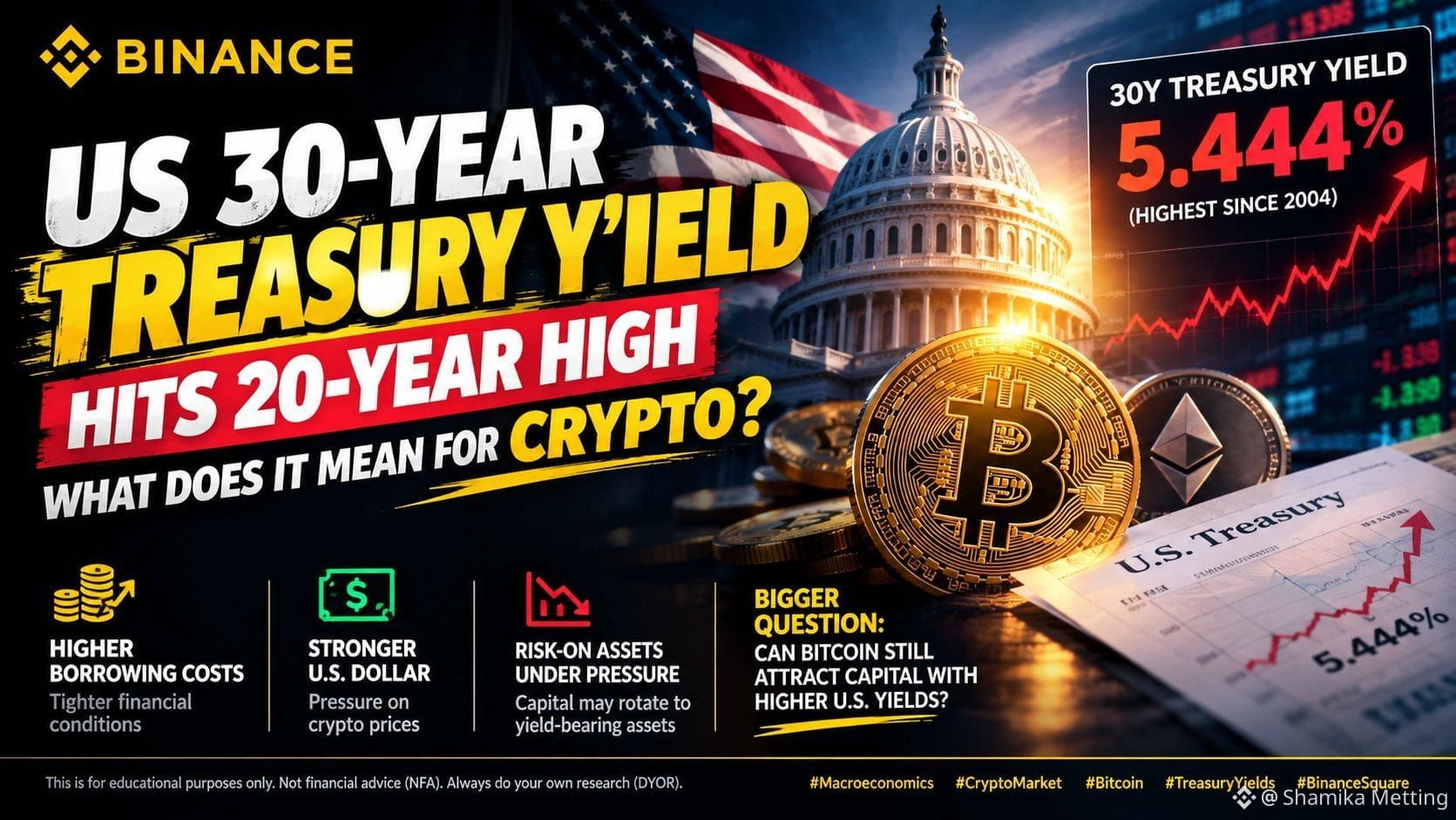
#us30yearyieldhighestsince2004 The yield on US 30-year Treasury bonds is at its highest level in 20 years — what does that mean for cryptocurrencies?
The US bond market is sending a key macro signal.
📊 Why are Treasury yields rising?
Recent market pressure is related to several factors, including:
🔹 Strong economic growth in the United States
Compelling economic data has reduced expectations of a quick drop in borrowing costs.
🔹 Inflation pressures
🔹 Government debt and financing needs
Investors demand greater compensation for holding US government debt over the longer term, which increases pressure on long-term yields.
₿ What could that mean for Bitcoin and cryptocurrencies?
1️⃣ Higher opportunity cost
When Treasury yields rise, investors can earn higher returns from traditional dollar-denominated assets. This could make speculative assets like cryptocurrencies less attractive to some institutional investors.
2️⃣ Tighter financial conditions
Higher long-term yields raise borrowing costs across the economy. Reuters notes that rising Treasury yields can tighten financial conditions globally.
Please follow me
#bitcoin #BTC #crypto #MacroEconomics #TreasuryYields #US30YearYield #CryptoMarket #FederalReserve #BinanceSquare
$METAB $EPIC $RONIN
#us30yearyieldhighestsince2004 The yield on US 30-year Treasury bonds is at its highest level in 20 years — what does that mean for cryptocurrencies?
The US bond market is sending a key macro signal.
📊 Why are Treasury yields rising?
Recent market pressure is related to several factors, including:
🔹 Strong economic growth in the United States
Compelling economic data has reduced expectations of a quick drop in borrowing costs.
🔹 Inflation pressures
🔹 Government debt and financing needs
Investors demand greater compensation for holding US government debt over the longer term, which increases pressure on long-term yields.
₿ What could that mean for Bitcoin and cryptocurrencies?
1️⃣ Higher opportunity cost
When Treasury yields rise, investors can earn higher returns from traditional dollar-denominated assets. This could make speculative assets like cryptocurrencies less attractive to some institutional investors.
2️⃣ Tighter financial conditions
Higher long-term yields raise borrowing costs across the economy. Reuters notes that rising Treasury yields can tighten financial conditions globally.
Please follow me
#bitcoin #BTC #crypto #MacroEconomics #TreasuryYields #US30YearYield #CryptoMarket #FederalReserve #BinanceSquare
$METAB $EPIC $RONIN
The US bond market is sending a key macro signal.
📊 Why are Treasury yields rising?
Recent market pressure is related to several factors, including:
🔹 Strong economic growth in the United States
Compelling economic data has reduced expectations of a quick drop in borrowing costs.
🔹 Inflation pressures
🔹 Government debt and financing needs
Investors demand greater compensation for holding US government debt over the longer term, which increases pressure on long-term yields.
₿ What could that mean for Bitcoin and cryptocurrencies?
1️⃣ Higher opportunity cost
When Treasury yields rise, investors can earn higher returns from traditional dollar-denominated assets. This could make speculative assets like cryptocurrencies less attractive to some institutional investors.
2️⃣ Tighter financial conditions
Higher long-term yields raise borrowing costs across the economy. Reuters notes that rising Treasury yields can tighten financial conditions globally.
Please follow me
#bitcoin #BTC #crypto #MacroEconomics #TreasuryYields #US30YearYield #CryptoMarket #FederalReserve #BinanceSquare
$METAB $EPIC $RONIN
36
The benchmark 10-year US Treasury yield surged to 5.04% today, touching its highest level since 2007. This sharp upward push reflects intense selling pressure across long-duration sovereign debt as markets aggressively repriced the path of global monetary policy.
Breaching the 5% threshold marks a critical psychological and macroeconomic milestone. It confirms that investors are increasingly abandoning expectations for rapid rate cuts, preparing instead for a persistent 'higher-for-longer' interest rate environment driven by resilient US economic data and heavy Treasury issuance.
Surging risk-free yields create direct headwinds across global financial markets. Higher capital costs compress equity valuations, strengthen the US dollar, and exert pressure on high-yield assets as institutional allocators find guaranteed returns of over 5% on sovereign paper increasingly attractive.
For the crypto sector, rising yields tighten global liquidity and weigh on speculative appetite. As safe-haven yields become more compelling, risk assets like $BTC face short-term valuation friction until monetary conditions stabilize.
#TreasuryYields #MacroEconomics #CryptoLiquidity
The benchmark 10-year US Treasury yield surged to 5.04% today, touching its highest level since 2007. This sharp upward push reflects intense selling pressure across long-duration sovereign debt as markets aggressively repriced the path of global monetary policy.
Breaching the 5% threshold marks a critical psychological and macroeconomic milestone. It confirms that investors are increasingly abandoning expectations for rapid rate cuts, preparing instead for a persistent 'higher-for-longer' interest rate environment driven by resilient US economic data and heavy Treasury issuance.
Surging risk-free yields create direct headwinds across global financial markets. Higher capital costs compress equity valuations, strengthen the US dollar, and exert pressure on high-yield assets as institutional allocators find guaranteed returns of over 5% on sovereign paper increasingly attractive.
For the crypto sector, rising yields tighten global liquidity and weigh on speculative appetite. As safe-haven yields become more compelling, risk assets like $BTC face short-term valuation friction until monetary conditions stabilize.
#TreasuryYields #MacroEconomics #CryptoLiquidity
Breaching the 5% threshold marks a critical psychological and macroeconomic milestone. It confirms that investors are increasingly abandoning expectations for rapid rate cuts, preparing instead for a persistent 'higher-for-longer' interest rate environment driven by resilient US economic data and heavy Treasury issuance.
Surging risk-free yields create direct headwinds across global financial markets. Higher capital costs compress equity valuations, strengthen the US dollar, and exert pressure on high-yield assets as institutional allocators find guaranteed returns of over 5% on sovereign paper increasingly attractive.
For the crypto sector, rising yields tighten global liquidity and weigh on speculative appetite. As safe-haven yields become more compelling, risk assets like $BTC face short-term valuation friction until monetary conditions stabilize.
#TreasuryYields #MacroEconomics #CryptoLiquidity
BTC+0.94%
IEFETF+0.29%
9
Significant volatility hit the U.S. Treasury market during today’s trading session. The yield on the 30-year Treasury surged to 5.4583%, breaking the highest level in nearly 22 years; meanwhile, the yield on the 2-year Treasury—more sensitive to monetary policy—also rose by 0.85 basis points to close at 4.904%. The acceleration of yields on the long end directly reflects that the fixed-income market is deeply repricing longer-term macro growth expectations and the fiscal risk premium.
From a macroeconomic standpoint, changes in the spread between long- and short-end yields not only broke through key technical resistance levels, but also indicate that the market is gradually absorbing persistent long-term inflation and the pressure from elevated supply. Notably, when long-end yields surge, it is often accompanied by the release of the term premium. In technical terms, this typically represents a “bearish exhaustion” pattern, suggesting the signal of interest rates finding a temporary top is becoming clearer, and the momentum for further sharp upside is nearing exhaustion.
In traditional financial markets, extreme readings of Treasury yields, while in the short term raising the cost of dollar liquidity and exerting a technical drag on the S&P 500, often—when long-end yields touch multi-decade historical major peaks—indicate that the Treasury sell-off may be approaching a point of exhaustion. Discount-rate pressure on risk assets is then likely to enter a marginal improvement window.
For crypto assets, especially $BTC , this extreme technical impulse has not triggered liquidity panic; instead, it has demonstrated very strong bottoming resilience. As long-end rates gradually form a technical top pattern, improving marginal liquidity expectations will become the key catalyst for the next phase of risk-asset rebounds. After the crypto market stabilizes at critical support levels, it may see a stronger return of buying.📈
#BondYields #Fed #MacroEconomics
Significant volatility hit the U.S. Treasury market during today’s trading session. The yield on the 30-year Treasury surged to 5.4583%, breaking the highest level in nearly 22 years; meanwhile, the yield on the 2-year Treasury—more sensitive to monetary policy—also rose by 0.85 basis points to close at 4.904%. The acceleration of yields on the long end directly reflects that the fixed-income market is deeply repricing longer-term macro growth expectations and the fiscal risk premium.
From a macroeconomic standpoint, changes in the spread between long- and short-end yields not only broke through key technical resistance levels, but also indicate that the market is gradually absorbing persistent long-term inflation and the pressure from elevated supply. Notably, when long-end yields surge, it is often accompanied by the release of the term premium. In technical terms, this typically represents a “bearish exhaustion” pattern, suggesting the signal of interest rates finding a temporary top is becoming clearer, and the momentum for further sharp upside is nearing exhaustion.
In traditional financial markets, extreme readings of Treasury yields, while in the short term raising the cost of dollar liquidity and exerting a technical drag on the S&P 500, often—when long-end yields touch multi-decade historical major peaks—indicate that the Treasury sell-off may be approaching a point of exhaustion. Discount-rate pressure on risk assets is then likely to enter a marginal improvement window.
For crypto assets, especially $BTC , this extreme technical impulse has not triggered liquidity panic; instead, it has demonstrated very strong bottoming resilience. As long-end rates gradually form a technical top pattern, improving marginal liquidity expectations will become the key catalyst for the next phase of risk-asset rebounds. After the crypto market stabilizes at critical support levels, it may see a stronger return of buying.📈
#BondYields #Fed #MacroEconomics
From a macroeconomic standpoint, changes in the spread between long- and short-end yields not only broke through key technical resistance levels, but also indicate that the market is gradually absorbing persistent long-term inflation and the pressure from elevated supply. Notably, when long-end yields surge, it is often accompanied by the release of the term premium. In technical terms, this typically represents a “bearish exhaustion” pattern, suggesting the signal of interest rates finding a temporary top is becoming clearer, and the momentum for further sharp upside is nearing exhaustion.
In traditional financial markets, extreme readings of Treasury yields, while in the short term raising the cost of dollar liquidity and exerting a technical drag on the S&P 500, often—when long-end yields touch multi-decade historical major peaks—indicate that the Treasury sell-off may be approaching a point of exhaustion. Discount-rate pressure on risk assets is then likely to enter a marginal improvement window.
For crypto assets, especially $BTC , this extreme technical impulse has not triggered liquidity panic; instead, it has demonstrated very strong bottoming resilience. As long-end rates gradually form a technical top pattern, improving marginal liquidity expectations will become the key catalyst for the next phase of risk-asset rebounds. After the crypto market stabilizes at critical support levels, it may see a stronger return of buying.📈
#BondYields #Fed #MacroEconomics
4

·
--
The yield on 30-year Treasuries has just touched 5.44%, a level never seen since 2004. Rising oil prices and inflation worries are pushing long-term rates higher, and this is clearly not a good sign for liquidity. As a result: BTC is down 1.9% around 84 200$ and ETH is down 1.8% toward $2 670. As long as pressure on rates persists, every rally risks staying fragile. Would you overweight cash or ETH here? #MacroEconomics #Bitcoin
The yield on 30-year Treasuries has just touched 5.44%, a level never seen since 2004. Rising oil prices and inflation worries are pushing long-term rates higher, and this is clearly not a good sign for liquidity. As a result: BTC is down 1.9% around 84 200$ and ETH is down 1.8% toward $2 670. As long as pressure on rates persists, every rally risks staying fragile. Would you overweight cash or ETH here? #MacroEconomics #Bitcoin
31

·
--
The Chairman of the U.S. Federal Reserve (Fed), Jerome Powell, has just issued a noteworthy message, saying that the agency may need to raise interest rates one more time in order to fully contain inflationary pressures. The statement immediately crushed the hopes of a portion of investors that the tightening cycle has already fully ended.
This “hawkish” move indicates that the Fed is not truly satisfied with the current pace at which inflation is cooling, especially as the U.S. economy and the labor market still show relatively strong resilience. Compared with the market’s earlier expectations of an early easing path, the latest communication forces financial players to reprice the risk that interest rates will stay high for longer than anticipated.
In traditional financial markets, this hardline stance is likely to continue supporting the strength of the U.S. dollar and push U.S. Treasury bond yields higher, thereby putting short-term pressure on the stock market as well as non-yielding assets such as gold.
For the crypto market, especially $BTC, tighter global liquidity will significantly make speculative capital more cautious. In the short term, a defensive sentiment may prevail, requiring traders to manage risk closely ahead of the next macroeconomic developments.
#Fed #InterestRates #MacroEconomics
The Chairman of the U.S. Federal Reserve (Fed), Jerome Powell, has just issued a noteworthy message, saying that the agency may need to raise interest rates one more time in order to fully contain inflationary pressures. The statement immediately crushed the hopes of a portion of investors that the tightening cycle has already fully ended.
This “hawkish” move indicates that the Fed is not truly satisfied with the current pace at which inflation is cooling, especially as the U.S. economy and the labor market still show relatively strong resilience. Compared with the market’s earlier expectations of an early easing path, the latest communication forces financial players to reprice the risk that interest rates will stay high for longer than anticipated.
In traditional financial markets, this hardline stance is likely to continue supporting the strength of the U.S. dollar and push U.S. Treasury bond yields higher, thereby putting short-term pressure on the stock market as well as non-yielding assets such as gold.
For the crypto market, especially $BTC , tighter global liquidity will significantly make speculative capital more cautious. In the short term, a defensive sentiment may prevail, requiring traders to manage risk closely ahead of the next macroeconomic developments.
#Fed #InterestRates #MacroEconomics
This “hawkish” move indicates that the Fed is not truly satisfied with the current pace at which inflation is cooling, especially as the U.S. economy and the labor market still show relatively strong resilience. Compared with the market’s earlier expectations of an early easing path, the latest communication forces financial players to reprice the risk that interest rates will stay high for longer than anticipated.
In traditional financial markets, this hardline stance is likely to continue supporting the strength of the U.S. dollar and push U.S. Treasury bond yields higher, thereby putting short-term pressure on the stock market as well as non-yielding assets such as gold.
For the crypto market, especially $BTC , tighter global liquidity will significantly make speculative capital more cautious. In the short term, a defensive sentiment may prevail, requiring traders to manage risk closely ahead of the next macroeconomic developments.
#Fed #InterestRates #MacroEconomics
8
The US Dollar Index has surged to its highest level in nearly eight weeks as financial markets sharply reprice their monetary policy expectations. According to fresh data from LSEG, traders now assign a 53% probability to a Federal Reserve interest rate hike in October, with cumulative tightening projected at 78 basis points through September 2027.
This hawkish repricing marks a notable shift in broader macroeconomic sentiment. The mounting expectation of prolonged central bank tightening has fully overshadowed the downward pressure on energy markets, where crude oil prices eased amid hopes of de-escalating tensions in the Middle East.
Across traditional financial markets, a resurgent US dollar exerts significant pressure on foreign currencies, sovereign bonds, and precious metals. Higher yields and tighter monetary conditions typically drain global dollar liquidity, raising borrowing costs across the board.
For the crypto sector, a stronger DXY creates immediate headwinds for risk assets like $BTC. As capital retreats into dollar-denominated cash yields, digital assets face compressed liquidity, making sustained bullish momentum difficult without an easing catalyst.
#FederalReserve #DXY #MacroEconomics
The US Dollar Index has surged to its highest level in nearly eight weeks as financial markets sharply reprice their monetary policy expectations. According to fresh data from LSEG, traders now assign a 53% probability to a Federal Reserve interest rate hike in October, with cumulative tightening projected at 78 basis points through September 2027.
This hawkish repricing marks a notable shift in broader macroeconomic sentiment. The mounting expectation of prolonged central bank tightening has fully overshadowed the downward pressure on energy markets, where crude oil prices eased amid hopes of de-escalating tensions in the Middle East.
Across traditional financial markets, a resurgent US dollar exerts significant pressure on foreign currencies, sovereign bonds, and precious metals. Higher yields and tighter monetary conditions typically drain global dollar liquidity, raising borrowing costs across the board.
For the crypto sector, a stronger DXY creates immediate headwinds for risk assets like $BTC . As capital retreats into dollar-denominated cash yields, digital assets face compressed liquidity, making sustained bullish momentum difficult without an easing catalyst.
#FederalReserve #DXY #MacroEconomics
This hawkish repricing marks a notable shift in broader macroeconomic sentiment. The mounting expectation of prolonged central bank tightening has fully overshadowed the downward pressure on energy markets, where crude oil prices eased amid hopes of de-escalating tensions in the Middle East.
Across traditional financial markets, a resurgent US dollar exerts significant pressure on foreign currencies, sovereign bonds, and precious metals. Higher yields and tighter monetary conditions typically drain global dollar liquidity, raising borrowing costs across the board.
For the crypto sector, a stronger DXY creates immediate headwinds for risk assets like $BTC . As capital retreats into dollar-denominated cash yields, digital assets face compressed liquidity, making sustained bullish momentum difficult without an easing catalyst.
#FederalReserve #DXY #MacroEconomics
58
·
--
Yield on Japanese government bonds (JGBs) with a 10-year maturity has just surged by 8 basis points, reaching 3.055%—the highest level since September 1996. This historic milestone marks a decisive shift in the cost-of-capital structure of the world’s fourth-largest economy after many decades of maintaining an ultra-easy monetary environment.
The JGB yield breaking through a near three-decade high indicates that pressure to normalize policy from the Bank of Japan (BOJ) is accelerating faster than expected. Global bond markets, which have long relied on borrowing in yen at extremely low costs, now have to reprice risk as Japan’s domestic yields have become significantly more attractive.
This development directly affects international liquidity flows. Rising yields encourage Japanese capital to repatriate, putting pressure on narrowing the interest-rate spread with the U.S. and creating downside pressure on Yen Carry Trade transactions. When cheap funding disappears, traditional financial assets and global stock markets face a wave of net outflows or large-scale portfolio restructuring.
For the crypto market—especially $BTC—the shift in carry-trade flows is always an underlying risk factor for short-term liquidity tightening. Sudden tightening episodes from Japan in the past have triggered sharp corrections driven by selling and deleveraging pressure on risk assets, requiring investors to maintain a cautious stance. 📉
#JapanYields #MacroEconomics #CryptoLiquidity
Yield on Japanese government bonds (JGBs) with a 10-year maturity has just surged by 8 basis points, reaching 3.055%—the highest level since September 1996. This historic milestone marks a decisive shift in the cost-of-capital structure of the world’s fourth-largest economy after many decades of maintaining an ultra-easy monetary environment.
The JGB yield breaking through a near three-decade high indicates that pressure to normalize policy from the Bank of Japan (BOJ) is accelerating faster than expected. Global bond markets, which have long relied on borrowing in yen at extremely low costs, now have to reprice risk as Japan’s domestic yields have become significantly more attractive.
This development directly affects international liquidity flows. Rising yields encourage Japanese capital to repatriate, putting pressure on narrowing the interest-rate spread with the U.S. and creating downside pressure on Yen Carry Trade transactions. When cheap funding disappears, traditional financial assets and global stock markets face a wave of net outflows or large-scale portfolio restructuring.
For the crypto market—especially $BTC —the shift in carry-trade flows is always an underlying risk factor for short-term liquidity tightening. Sudden tightening episodes from Japan in the past have triggered sharp corrections driven by selling and deleveraging pressure on risk assets, requiring investors to maintain a cautious stance. 📉
#JapanYields #MacroEconomics #CryptoLiquidity
The JGB yield breaking through a near three-decade high indicates that pressure to normalize policy from the Bank of Japan (BOJ) is accelerating faster than expected. Global bond markets, which have long relied on borrowing in yen at extremely low costs, now have to reprice risk as Japan’s domestic yields have become significantly more attractive.
This development directly affects international liquidity flows. Rising yields encourage Japanese capital to repatriate, putting pressure on narrowing the interest-rate spread with the U.S. and creating downside pressure on Yen Carry Trade transactions. When cheap funding disappears, traditional financial assets and global stock markets face a wave of net outflows or large-scale portfolio restructuring.
For the crypto market—especially $BTC —the shift in carry-trade flows is always an underlying risk factor for short-term liquidity tightening. Sudden tightening episodes from Japan in the past have triggered sharp corrections driven by selling and deleveraging pressure on risk assets, requiring investors to maintain a cautious stance. 📉
#JapanYields #MacroEconomics #CryptoLiquidity
179
·
--
Hasett (Kevin Hassett), chairman of the White House National Economic Council, has recently fired a shot at the U.S. Federal Reserve, sharply criticizing the hawkish interest-rate tightening comments made by several Fed officials in recent days. He questioned why some officials are still calling for further tightening when core inflation is already close to the 2% target. He also directly accused the Fed of being overly politicized, even naming people such as Powell and Barr and pointing to issues regarding their reappointment and retention of positions, urging that the central bank’s independence must be restored.
The core of this controversy lies in a profound disagreement over policy expectations. Recently, several Fed officials—including Barr, Collins, and Musalem—have repeatedly sent hawkish signals, suggesting that further rate hikes may be necessary to rein in inflation. In the latest economic projections, 16 officials are expected to anticipate at least one more rate increase within the year. By stepping into the public arena to challenge these views, key White House economic figures not only reflect political concerns about an excessive economic slowdown, but also further expose differences in the market’s expectations for the future path of interest rates.
From the perspective of traditional financial markets, the game between the central bank and the government often exacerbates volatility in asset prices. If the Fed holds firm against political pressure and maintains a hawkish stance, the U.S. dollar and U.S. Treasury yields may remain resilient, suppressing the valuations of risk assets. But if political pressure leads markets to start pricing in a policy shift, capital may reassess the pace of inflation persistence and the timing of peak interest rates, and U.S. stocks and gold are likely to enter a period of back-and-forth consolidation.
For the crypto market, swings in expectations for macro liquidity have consistently been a key variable driving sentiment. If the Fed truly hikes rates again, the pace at which funds return to risk assets could slow in a high borrowing-cost environment, putting pressure on major tokens such as $BTC . But if the rate debate ultimately tips in favor of easing, improvements in liquidity expectations could inject fresh rebound momentum into the market. Future performance will still need to be closely tracked against actual data and the specifics of how policy plays out.👀
#Fed #InterestRates #MacroEconomics
Hasett (Kevin Hassett), chairman of the White House National Economic Council, has recently fired a shot at the U.S. Federal Reserve, sharply criticizing the hawkish interest-rate tightening comments made by several Fed officials in recent days. He questioned why some officials are still calling for further tightening when core inflation is already close to the 2% target. He also directly accused the Fed of being overly politicized, even naming people such as Powell and Barr and pointing to issues regarding their reappointment and retention of positions, urging that the central bank’s independence must be restored.
The core of this controversy lies in a profound disagreement over policy expectations. Recently, several Fed officials—including Barr, Collins, and Musalem—have repeatedly sent hawkish signals, suggesting that further rate hikes may be necessary to rein in inflation. In the latest economic projections, 16 officials are expected to anticipate at least one more rate increase within the year. By stepping into the public arena to challenge these views, key White House economic figures not only reflect political concerns about an excessive economic slowdown, but also further expose differences in the market’s expectations for the future path of interest rates.
From the perspective of traditional financial markets, the game between the central bank and the government often exacerbates volatility in asset prices. If the Fed holds firm against political pressure and maintains a hawkish stance, the U.S. dollar and U.S. Treasury yields may remain resilient, suppressing the valuations of risk assets. But if political pressure leads markets to start pricing in a policy shift, capital may reassess the pace of inflation persistence and the timing of peak interest rates, and U.S. stocks and gold are likely to enter a period of back-and-forth consolidation.
For the crypto market, swings in expectations for macro liquidity have consistently been a key variable driving sentiment. If the Fed truly hikes rates again, the pace at which funds return to risk assets could slow in a high borrowing-cost environment, putting pressure on major tokens such as $BTC . But if the rate debate ultimately tips in favor of easing, improvements in liquidity expectations could inject fresh rebound momentum into the market. Future performance will still need to be closely tracked against actual data and the specifics of how policy plays out.👀
#Fed #InterestRates #MacroEconomics
The core of this controversy lies in a profound disagreement over policy expectations. Recently, several Fed officials—including Barr, Collins, and Musalem—have repeatedly sent hawkish signals, suggesting that further rate hikes may be necessary to rein in inflation. In the latest economic projections, 16 officials are expected to anticipate at least one more rate increase within the year. By stepping into the public arena to challenge these views, key White House economic figures not only reflect political concerns about an excessive economic slowdown, but also further expose differences in the market’s expectations for the future path of interest rates.
From the perspective of traditional financial markets, the game between the central bank and the government often exacerbates volatility in asset prices. If the Fed holds firm against political pressure and maintains a hawkish stance, the U.S. dollar and U.S. Treasury yields may remain resilient, suppressing the valuations of risk assets. But if political pressure leads markets to start pricing in a policy shift, capital may reassess the pace of inflation persistence and the timing of peak interest rates, and U.S. stocks and gold are likely to enter a period of back-and-forth consolidation.
For the crypto market, swings in expectations for macro liquidity have consistently been a key variable driving sentiment. If the Fed truly hikes rates again, the pace at which funds return to risk assets could slow in a high borrowing-cost environment, putting pressure on major tokens such as $BTC . But if the rate debate ultimately tips in favor of easing, improvements in liquidity expectations could inject fresh rebound momentum into the market. Future performance will still need to be closely tracked against actual data and the specifics of how policy plays out.👀
#Fed #InterestRates #MacroEconomics
1

The director of the U.S. National Economic Council (NEC), Kevin Hassett, has recently launched harsh criticism of the Federal Reserve’s decision-making leadership for its hawkish stance. Multiple Fed officials—including Barr, Collins, and Musalem—have recently frequently signaled tighter policy. The latest economic projections also indicate that as many as 16 officials expect at least one more rate hike within the year. In response, Hassett directly questioned why further rate hikes are still necessary when core inflation is already close to 2%. He specifically called out Powell, Barr, and others, accusing the current operations of the Fed of being highly politicized, and urged that the central bank’s independence be restored as soon as possible.
This public standoff between senior White House economic advisers and central bank officials highlights deep rifts in the U.S. macroeconomic policy path. The market had widely assumed that the rate-hiking cycle was nearing its end, but most Fed officials are far more cautious about a rebound in inflation than outsiders expected—and they have even prepared for additional tightening of liquidity. Direct political pressure at the top collides with the Fed’s strong hawkish tone from within. This not only shatters the market’s single-minded fantasy of a loosening cycle, but also sharply raises the tail risk of a hard economic landing caused by policy misjudgment.
From the perspective of macro financial markets, expectations that up to 16 officials will support another rate hike this year will directly weigh on asset pricing. Treasury yields are likely to rise rather than fall supported by tightening expectations, and the U.S. dollar index is expected to maintain high and resilient strength. This will exert direct discounting pressure on valuation models for major global assets. As long as the Fed has not officially closed the window for further rate hikes, the reality of tighter liquidity and persistently high borrowing costs will continue to have a significant suppressing effect on risk assets such as U.S. stocks and commodities.
For the cryptocurrency market, $BTC and various other risk assets face severe tests of insufficient liquidity supply. Under the shadow of high interest rates—even potential additional rate hikes—global safe-haven capital is more inclined to remain in high-yield, risk-free assets, and the appetite for incremental off-balance-sheet market inflows will be severely restrained. If the Fed ultimately chooses to validate hawkish expectations and raise rates again, extending the tightening cycle is likely to trigger another round of valuation compression and leverage unwinds. In the near term, investors will need to stay highly alert to liquidity risks at the macro level. #FederalReserve #InterestRates #MacroEconomics
The director of the U.S. National Economic Council (NEC), Kevin Hassett, has recently launched harsh criticism of the Federal Reserve’s decision-making leadership for its hawkish stance. Multiple Fed officials—including Barr, Collins, and Musalem—have recently frequently signaled tighter policy. The latest economic projections also indicate that as many as 16 officials expect at least one more rate hike within the year. In response, Hassett directly questioned why further rate hikes are still necessary when core inflation is already close to 2%. He specifically called out Powell, Barr, and others, accusing the current operations of the Fed of being highly politicized, and urged that the central bank’s independence be restored as soon as possible.
This public standoff between senior White House economic advisers and central bank officials highlights deep rifts in the U.S. macroeconomic policy path. The market had widely assumed that the rate-hiking cycle was nearing its end, but most Fed officials are far more cautious about a rebound in inflation than outsiders expected—and they have even prepared for additional tightening of liquidity. Direct political pressure at the top collides with the Fed’s strong hawkish tone from within. This not only shatters the market’s single-minded fantasy of a loosening cycle, but also sharply raises the tail risk of a hard economic landing caused by policy misjudgment.
From the perspective of macro financial markets, expectations that up to 16 officials will support another rate hike this year will directly weigh on asset pricing. Treasury yields are likely to rise rather than fall supported by tightening expectations, and the U.S. dollar index is expected to maintain high and resilient strength. This will exert direct discounting pressure on valuation models for major global assets. As long as the Fed has not officially closed the window for further rate hikes, the reality of tighter liquidity and persistently high borrowing costs will continue to have a significant suppressing effect on risk assets such as U.S. stocks and commodities.
For the cryptocurrency market, $BTC and various other risk assets face severe tests of insufficient liquidity supply. Under the shadow of high interest rates—even potential additional rate hikes—global safe-haven capital is more inclined to remain in high-yield, risk-free assets, and the appetite for incremental off-balance-sheet market inflows will be severely restrained. If the Fed ultimately chooses to validate hawkish expectations and raise rates again, extending the tightening cycle is likely to trigger another round of valuation compression and leverage unwinds. In the near term, investors will need to stay highly alert to liquidity risks at the macro level. #FederalReserve #InterestRates #MacroEconomics
This public standoff between senior White House economic advisers and central bank officials highlights deep rifts in the U.S. macroeconomic policy path. The market had widely assumed that the rate-hiking cycle was nearing its end, but most Fed officials are far more cautious about a rebound in inflation than outsiders expected—and they have even prepared for additional tightening of liquidity. Direct political pressure at the top collides with the Fed’s strong hawkish tone from within. This not only shatters the market’s single-minded fantasy of a loosening cycle, but also sharply raises the tail risk of a hard economic landing caused by policy misjudgment.
From the perspective of macro financial markets, expectations that up to 16 officials will support another rate hike this year will directly weigh on asset pricing. Treasury yields are likely to rise rather than fall supported by tightening expectations, and the U.S. dollar index is expected to maintain high and resilient strength. This will exert direct discounting pressure on valuation models for major global assets. As long as the Fed has not officially closed the window for further rate hikes, the reality of tighter liquidity and persistently high borrowing costs will continue to have a significant suppressing effect on risk assets such as U.S. stocks and commodities.
For the cryptocurrency market, $BTC and various other risk assets face severe tests of insufficient liquidity supply. Under the shadow of high interest rates—even potential additional rate hikes—global safe-haven capital is more inclined to remain in high-yield, risk-free assets, and the appetite for incremental off-balance-sheet market inflows will be severely restrained. If the Fed ultimately chooses to validate hawkish expectations and raise rates again, extending the tightening cycle is likely to trigger another round of valuation compression and leverage unwinds. In the near term, investors will need to stay highly alert to liquidity risks at the macro level. #FederalReserve #InterestRates #MacroEconomics
102
·
--
The global energy market has just witnessed sharp fluctuations in today’s trading session as Brent crude oil prices surged by 3.00%, officially reaching 98.08 USD per barrel and moving close to the sensitive 100 USD mark.
This sudden jump carries key implications for the macroeconomic picture. Higher energy costs will directly affect the supply chain, fueling concerns that a second wave of inflation could return and derail the disinflation path that central banks are working to sustain.
For traditional financial markets, the risk of energy-driven inflation often triggers fears that the Fed will keep interest rates at elevated levels for longer. This can easily push the USD Index and bond yields back up, putting pressure on equity markets.
For the crypto market, a tighter liquidity environment and risk-averse sentiment may cause institutional capital flows to be temporarily more cautious, posing challenges to the breakout momentum of $BTC in the short term. 🛢️
#CrudeOil #Inflation #MacroEconomics
The global energy market has just witnessed sharp fluctuations in today’s trading session as Brent crude oil prices surged by 3.00%, officially reaching 98.08 USD per barrel and moving close to the sensitive 100 USD mark.
This sudden jump carries key implications for the macroeconomic picture. Higher energy costs will directly affect the supply chain, fueling concerns that a second wave of inflation could return and derail the disinflation path that central banks are working to sustain.
For traditional financial markets, the risk of energy-driven inflation often triggers fears that the Fed will keep interest rates at elevated levels for longer. This can easily push the USD Index and bond yields back up, putting pressure on equity markets.
For the crypto market, a tighter liquidity environment and risk-averse sentiment may cause institutional capital flows to be temporarily more cautious, posing challenges to the breakout momentum of $BTC in the short term. 🛢️
#CrudeOil #Inflation #MacroEconomics
This sudden jump carries key implications for the macroeconomic picture. Higher energy costs will directly affect the supply chain, fueling concerns that a second wave of inflation could return and derail the disinflation path that central banks are working to sustain.
For traditional financial markets, the risk of energy-driven inflation often triggers fears that the Fed will keep interest rates at elevated levels for longer. This can easily push the USD Index and bond yields back up, putting pressure on equity markets.
For the crypto market, a tighter liquidity environment and risk-averse sentiment may cause institutional capital flows to be temporarily more cautious, posing challenges to the breakout momentum of $BTC in the short term. 🛢️
#CrudeOil #Inflation #MacroEconomics
9
Log in to explore more content
Join global crypto users on Binance Square
⚡️ Get latest and useful information about crypto.
💬 Trusted by the world’s largest crypto exchange.
👍 Discover real insights from verified creators.
Email / Phone number
Trending Topics
1
#BitwiseFilesFinalNEARSpotETFProspectus
32,412 views
902 Discussing
2
#BitgetHackerMoves$83MStolenXRP
20,270 views
124 Discussing
3
#SOLSpotETFWeeklyInflow$188M
10,971 views
93 Discussing
4
#DogecoinETFsPostBiggestWeekSinceLaunch
25,926 views
713 Discussing
5
#StrategyStriveAdd2305BitcoinThisWeek
92,795 views
1,834 Discussing
6
#TrumpRejectsIranHormuzReopening
86,592 views
1,414 Discussing
7
#CircleTetherFreezeBitgetHackerWallet
85,761 views
1,350 Discussing
8
#SECSaysTokenBuybacksNotAutoSecurities
52,717 views
798 Discussing
9
#ChinaUSAgreeOn$30BTariffCut
4,252 views
42 Discussing
10
#CoinMarketCapCompletesCoinglassAcquisition
61,294 views
911 Discussing