

#m2moneysupply
m2moneysupply
14,135 views
56 Discussing
Hot
Latest

The People's Bank of China released its August monetary data, revealing that annual M2 money supply growth slowed to 7.5%, falling short of market expectations of 7.6% and down from 7.7% in July.
This deceleration underscores ongoing sluggishness in domestic credit expansion and private sector demand despite recent supportive policy signals. A continuous slowdown in broad money growth highlights that liquidity is struggling to circulate effectively through the real economy, keeping deflationary concerns firmly in focus across mainland markets.
For broader financial markets, the weaker credit data reinforces expectations that Beijing will need to roll out more aggressive monetary easing and fiscal stimulus in the near term. Treasury yields and regional equities face near-term growth headwinds, while the Yuan may experience subdued pressure as central bank divergence with global peers widens.
For the crypto ecosystem, particularly $BTC, persistent weakness in Chinese monetary metrics presents a double-edged sword. While subdued immediate liquidity dampens local risk appetite, mounting pressure on Chinese policymakers to unleash stronger liquidity injections could eventually revive global liquidity cycles, serving as a medium-term tailwind for digital assets.
#ChinaEconomy #M2MoneySupply #MacroEconomics
The People's Bank of China released its August monetary data, revealing that annual M2 money supply growth slowed to 7.5%, falling short of market expectations of 7.6% and down from 7.7% in July.
This deceleration underscores ongoing sluggishness in domestic credit expansion and private sector demand despite recent supportive policy signals. A continuous slowdown in broad money growth highlights that liquidity is struggling to circulate effectively through the real economy, keeping deflationary concerns firmly in focus across mainland markets.
For broader financial markets, the weaker credit data reinforces expectations that Beijing will need to roll out more aggressive monetary easing and fiscal stimulus in the near term. Treasury yields and regional equities face near-term growth headwinds, while the Yuan may experience subdued pressure as central bank divergence with global peers widens.
For the crypto ecosystem, particularly $BTC , persistent weakness in Chinese monetary metrics presents a double-edged sword. While subdued immediate liquidity dampens local risk appetite, mounting pressure on Chinese policymakers to unleash stronger liquidity injections could eventually revive global liquidity cycles, serving as a medium-term tailwind for digital assets.
#ChinaEconomy #M2MoneySupply #MacroEconomics
This deceleration underscores ongoing sluggishness in domestic credit expansion and private sector demand despite recent supportive policy signals. A continuous slowdown in broad money growth highlights that liquidity is struggling to circulate effectively through the real economy, keeping deflationary concerns firmly in focus across mainland markets.
For broader financial markets, the weaker credit data reinforces expectations that Beijing will need to roll out more aggressive monetary easing and fiscal stimulus in the near term. Treasury yields and regional equities face near-term growth headwinds, while the Yuan may experience subdued pressure as central bank divergence with global peers widens.
For the crypto ecosystem, particularly $BTC , persistent weakness in Chinese monetary metrics presents a double-edged sword. While subdued immediate liquidity dampens local risk appetite, mounting pressure on Chinese policymakers to unleash stronger liquidity injections could eventually revive global liquidity cycles, serving as a medium-term tailwind for digital assets.
#ChinaEconomy #M2MoneySupply #MacroEconomics
6

According to the latest data released in China, in August the year-on-year growth rate of the broad money supply (M2) was 7.5%, lower than the market’s prior expectation of 7.6%, and further slowed from the previous value of 7.7%. This decline in a key macro financial indicator directly reflects the ongoing downward pressure on the pace of credit expansion.
From a macroeconomic fundamentals perspective, the underwhelming M2 growth signals are far from encouraging. This suggests that, although policymakers have continued to release liquidity support, the effective financing demand from the real economy remains sluggish. The balance-sheet repair process for households and businesses is likely to take a long time; liquidity is being trapped within the banking system rather than being effectively transformed into real-economy momentum, and the clouds of deflationary risk have not yet dispersed.
For global traditional financial markets, the cooling of China’s credit cycle will further weigh on demand for commodities, while also putting pressure on the RMB exchange rate. As expectations for growth in the Asia-Pacific engines cool, it may intensify global risk-aversion sentiment, leading to an even more cautious allocation preference toward non–USD foreign-currency risk assets.
For the crypto asset market represented by $BTC , weak Asian liquidity fundamentals make it difficult to provide any substantial incremental “fresh money.” In the absence of a strong external credit-expansion cycle, the market is highly dependent on games within existing positions. Investors should be alert to the downside risks brought about by delayed global liquidity transmission. #M2MoneySupply #ChinaEconomy #MacroEconomics
According to the latest data released in China, in August the year-on-year growth rate of the broad money supply (M2) was 7.5%, lower than the market’s prior expectation of 7.6%, and further slowed from the previous value of 7.7%. This decline in a key macro financial indicator directly reflects the ongoing downward pressure on the pace of credit expansion.
From a macroeconomic fundamentals perspective, the underwhelming M2 growth signals are far from encouraging. This suggests that, although policymakers have continued to release liquidity support, the effective financing demand from the real economy remains sluggish. The balance-sheet repair process for households and businesses is likely to take a long time; liquidity is being trapped within the banking system rather than being effectively transformed into real-economy momentum, and the clouds of deflationary risk have not yet dispersed.
For global traditional financial markets, the cooling of China’s credit cycle will further weigh on demand for commodities, while also putting pressure on the RMB exchange rate. As expectations for growth in the Asia-Pacific engines cool, it may intensify global risk-aversion sentiment, leading to an even more cautious allocation preference toward non–USD foreign-currency risk assets.
For the crypto asset market represented by $BTC , weak Asian liquidity fundamentals make it difficult to provide any substantial incremental “fresh money.” In the absence of a strong external credit-expansion cycle, the market is highly dependent on games within existing positions. Investors should be alert to the downside risks brought about by delayed global liquidity transmission. #M2MoneySupply #ChinaEconomy #MacroEconomics
From a macroeconomic fundamentals perspective, the underwhelming M2 growth signals are far from encouraging. This suggests that, although policymakers have continued to release liquidity support, the effective financing demand from the real economy remains sluggish. The balance-sheet repair process for households and businesses is likely to take a long time; liquidity is being trapped within the banking system rather than being effectively transformed into real-economy momentum, and the clouds of deflationary risk have not yet dispersed.
For global traditional financial markets, the cooling of China’s credit cycle will further weigh on demand for commodities, while also putting pressure on the RMB exchange rate. As expectations for growth in the Asia-Pacific engines cool, it may intensify global risk-aversion sentiment, leading to an even more cautious allocation preference toward non–USD foreign-currency risk assets.
For the crypto asset market represented by $BTC , weak Asian liquidity fundamentals make it difficult to provide any substantial incremental “fresh money.” In the absence of a strong external credit-expansion cycle, the market is highly dependent on games within existing positions. Investors should be alert to the downside risks brought about by delayed global liquidity transmission. #M2MoneySupply #ChinaEconomy #MacroEconomics
8

According to the latest data released by the People’s Bank of China, in August the year-on-year growth rate of broad money supply (M2) was 7.5%, slightly below the market’s previous expectation of 7.6% and continuing to ease from 7.7% in the prior month. From a technical and quantitative perspective, after a period of sideways consolidation, the M2 growth rate showed a modest pullback, suggesting that the current pace of domestic credit expansion remains relatively steady and that the macro liquidity environment is in a phase of structural adjustment.
Although this figure is marginally lower than market expectations, when analyzed from the perspective of liquidity cycles, it actually leaves more room for stronger counter-cyclical easing policies to be introduced later, such as further reductions in reserve requirement ratios (RRR) and interest-rate cuts. Historically, when the pace of monetary expansion slows to within the policy’s tolerance boundary, the central bank often injects incremental liquidity through RRR cuts or open market operations to offset downward pressure.
In traditional financial markets, expectations that China will step up monetary stimulus have grown significantly. The RMB exchange rate has, in the short term, remained oscillating within a reasonable technical support range. Meanwhile, commodities and major Asia-Pacific indices have formed solid bottoms near key moving averages, demonstrating strong resilience against declines and rebound momentum.
For the cryptocurrency market, $BTC and mainstream risk assets are extremely sensitive to global central banks’ liquidity cycles. If China releases easing signals as expected to boost the economy, it will further raise global overall liquidity expectations, prompting over-the-counter capital to tilt toward the crypto sector in search of higher Alpha returns—providing solid technical and capital-flow support for a rebound in risk appetite in the fourth quarter.📈
#ChinaEconomy #M2MoneySupply #Liquidity
According to the latest data released by the People’s Bank of China, in August the year-on-year growth rate of broad money supply (M2) was 7.5%, slightly below the market’s previous expectation of 7.6% and continuing to ease from 7.7% in the prior month. From a technical and quantitative perspective, after a period of sideways consolidation, the M2 growth rate showed a modest pullback, suggesting that the current pace of domestic credit expansion remains relatively steady and that the macro liquidity environment is in a phase of structural adjustment.
Although this figure is marginally lower than market expectations, when analyzed from the perspective of liquidity cycles, it actually leaves more room for stronger counter-cyclical easing policies to be introduced later, such as further reductions in reserve requirement ratios (RRR) and interest-rate cuts. Historically, when the pace of monetary expansion slows to within the policy’s tolerance boundary, the central bank often injects incremental liquidity through RRR cuts or open market operations to offset downward pressure.
In traditional financial markets, expectations that China will step up monetary stimulus have grown significantly. The RMB exchange rate has, in the short term, remained oscillating within a reasonable technical support range. Meanwhile, commodities and major Asia-Pacific indices have formed solid bottoms near key moving averages, demonstrating strong resilience against declines and rebound momentum.
For the cryptocurrency market, $BTC and mainstream risk assets are extremely sensitive to global central banks’ liquidity cycles. If China releases easing signals as expected to boost the economy, it will further raise global overall liquidity expectations, prompting over-the-counter capital to tilt toward the crypto sector in search of higher Alpha returns—providing solid technical and capital-flow support for a rebound in risk appetite in the fourth quarter.📈
#ChinaEconomy #M2MoneySupply #Liquidity
Although this figure is marginally lower than market expectations, when analyzed from the perspective of liquidity cycles, it actually leaves more room for stronger counter-cyclical easing policies to be introduced later, such as further reductions in reserve requirement ratios (RRR) and interest-rate cuts. Historically, when the pace of monetary expansion slows to within the policy’s tolerance boundary, the central bank often injects incremental liquidity through RRR cuts or open market operations to offset downward pressure.
In traditional financial markets, expectations that China will step up monetary stimulus have grown significantly. The RMB exchange rate has, in the short term, remained oscillating within a reasonable technical support range. Meanwhile, commodities and major Asia-Pacific indices have formed solid bottoms near key moving averages, demonstrating strong resilience against declines and rebound momentum.
For the cryptocurrency market, $BTC and mainstream risk assets are extremely sensitive to global central banks’ liquidity cycles. If China releases easing signals as expected to boost the economy, it will further raise global overall liquidity expectations, prompting over-the-counter capital to tilt toward the crypto sector in search of higher Alpha returns—providing solid technical and capital-flow support for a rebound in risk appetite in the fourth quarter.📈
#ChinaEconomy #M2MoneySupply #Liquidity
54

·
--
U.S. M2 Money Supply Explodes Past $23 Trillion 😳 Is A Macro Supply Shock Inbound? 😲
While retail traders are entirely fixated on lower-timeframe weekend price charts, the macro foundation backing the global digital asset ecosystem just underwent a massive expansion. Official financial data confirms that the U.S. M2 Money Supply has aggressively breached the historic $23 Trillion milestone!
High-volume VSA (Volume Spread Analysis) charts show that smart money is already moving heavily to front-run this massive surge in global fiat liquidity. Historically, whenever the M2 money supply spikes, excess capital rapidly rotates straight into high-performance, scarce risk assets. Whales are actively exploiting the quieter Sunday liquidity slots to build large structural spot long positions across the board. They are using high-volume absorption wicks to systematically dry up exchange order books, completely trapping retail day traders who have been blindly shorting local resistance levels in anticipation of a weekend rejection.
The total cryptocurrency market cap is holding firmly above its major support floors as a result of this massive liquidity influx. With central banks quietly softening their hawkish stances, the underlying monetary matrix proves that the macro floor is getting fundamentally stronger, setting the stage for a massive supply squeeze heading into late Q3.
📉 For Future Traders: Do not let short-term sideways consolidation trick you into fighting the macro liquidity trend. Avoid over-leveraged short positions down here. Watch for clean, high-volume VSA buying tails near major local demand zones to find high-probability long entries with properly managed risk.
Will this massive $23 Trillion M2 expansion act as ultimate rocket fuel for a massive summer altcoin breakout, or are you staying in cash? Let me know your trading plan below! 👇
#CryptoNews #M2MoneySupply #MacroEconomics #LiquidityShock #Bitcoin #BTC #TechnicalAnalysis #BinanceWrite2Earn
U.S. M2 Money Supply Explodes Past $23 Trillion 😳 Is A Macro Supply Shock Inbound? 😲
While retail traders are entirely fixated on lower-timeframe weekend price charts, the macro foundation backing the global digital asset ecosystem just underwent a massive expansion. Official financial data confirms that the U.S. M2 Money Supply has aggressively breached the historic $23 Trillion milestone!
High-volume VSA (Volume Spread Analysis) charts show that smart money is already moving heavily to front-run this massive surge in global fiat liquidity. Historically, whenever the M2 money supply spikes, excess capital rapidly rotates straight into high-performance, scarce risk assets. Whales are actively exploiting the quieter Sunday liquidity slots to build large structural spot long positions across the board. They are using high-volume absorption wicks to systematically dry up exchange order books, completely trapping retail day traders who have been blindly shorting local resistance levels in anticipation of a weekend rejection.
The total cryptocurrency market cap is holding firmly above its major support floors as a result of this massive liquidity influx. With central banks quietly softening their hawkish stances, the underlying monetary matrix proves that the macro floor is getting fundamentally stronger, setting the stage for a massive supply squeeze heading into late Q3.
📉 For Future Traders: Do not let short-term sideways consolidation trick you into fighting the macro liquidity trend. Avoid over-leveraged short positions down here. Watch for clean, high-volume VSA buying tails near major local demand zones to find high-probability long entries with properly managed risk.
Will this massive $23 Trillion M2 expansion act as ultimate rocket fuel for a massive summer altcoin breakout, or are you staying in cash? Let me know your trading plan below! 👇
#CryptoNews #M2MoneySupply #MacroEconomics #LiquidityShock #Bitcoin #BTC #TechnicalAnalysis #BinanceWrite2Earn
While retail traders are entirely fixated on lower-timeframe weekend price charts, the macro foundation backing the global digital asset ecosystem just underwent a massive expansion. Official financial data confirms that the U.S. M2 Money Supply has aggressively breached the historic $23 Trillion milestone!
High-volume VSA (Volume Spread Analysis) charts show that smart money is already moving heavily to front-run this massive surge in global fiat liquidity. Historically, whenever the M2 money supply spikes, excess capital rapidly rotates straight into high-performance, scarce risk assets. Whales are actively exploiting the quieter Sunday liquidity slots to build large structural spot long positions across the board. They are using high-volume absorption wicks to systematically dry up exchange order books, completely trapping retail day traders who have been blindly shorting local resistance levels in anticipation of a weekend rejection.
The total cryptocurrency market cap is holding firmly above its major support floors as a result of this massive liquidity influx. With central banks quietly softening their hawkish stances, the underlying monetary matrix proves that the macro floor is getting fundamentally stronger, setting the stage for a massive supply squeeze heading into late Q3.
📉 For Future Traders: Do not let short-term sideways consolidation trick you into fighting the macro liquidity trend. Avoid over-leveraged short positions down here. Watch for clean, high-volume VSA buying tails near major local demand zones to find high-probability long entries with properly managed risk.
Will this massive $23 Trillion M2 expansion act as ultimate rocket fuel for a massive summer altcoin breakout, or are you staying in cash? Let me know your trading plan below! 👇
#CryptoNews #M2MoneySupply #MacroEconomics #LiquidityShock #Bitcoin #BTC #TechnicalAnalysis #BinanceWrite2Earn
1
39

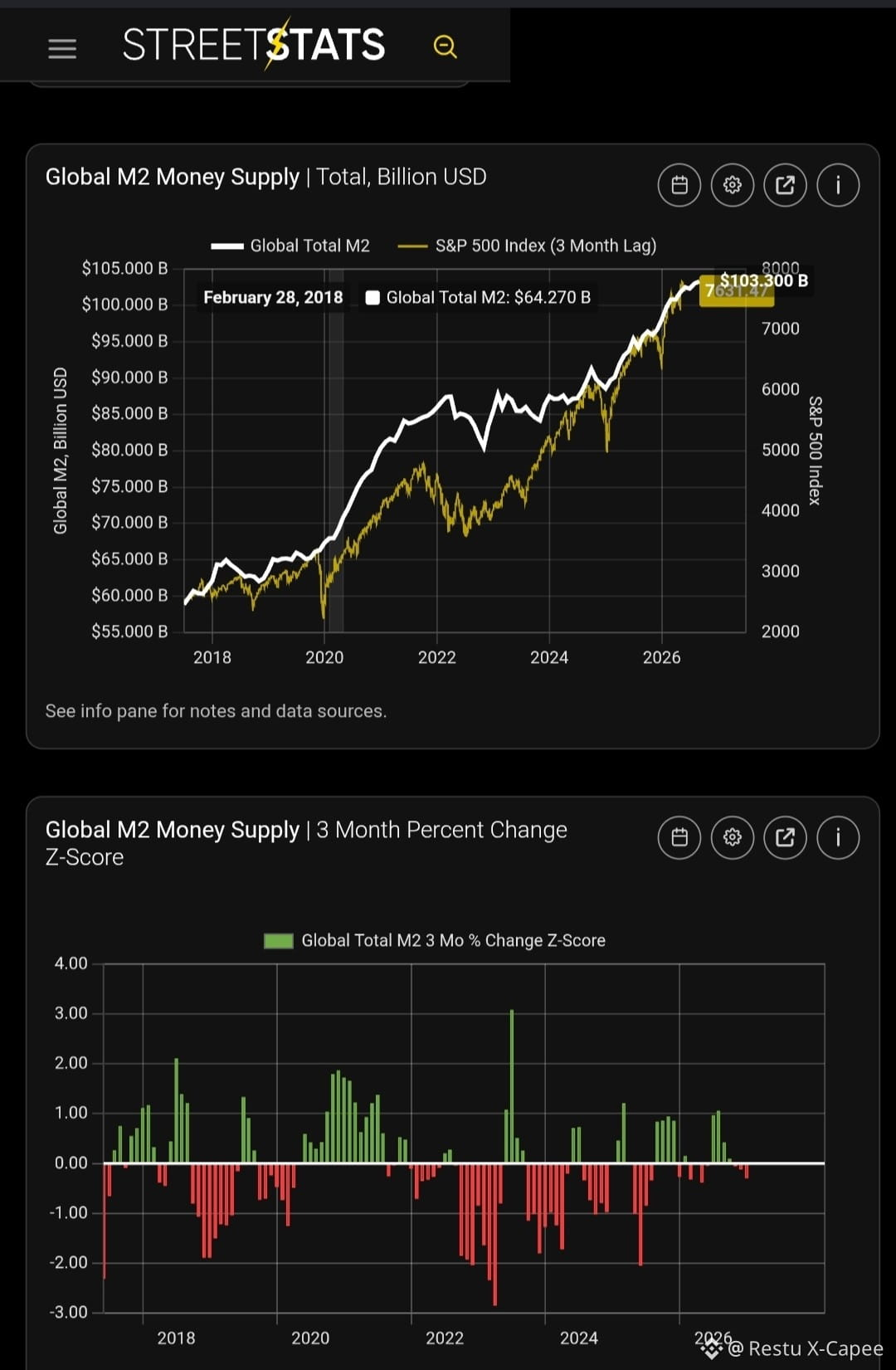

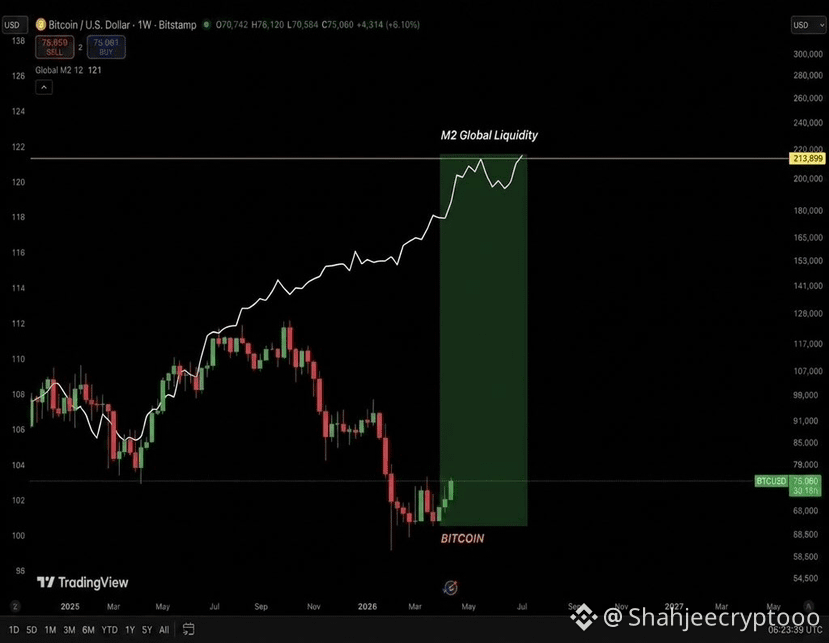

·
--
🚨 GLOBAL LIQUIDITY HITS AN ALL-TIME HIGH! 🌊🔥
Global M2 money supply has official surged to a brand-new peak, and history shows that excess liquidity always finds a home.
Here is why this is massive for Bitcoin:
💵 Money Printing: Global central banks are expanding the money supply, pushing fiat liquidity into the system.
📈 Historical Pattern: Bitcoin cycles heavily track global M2 growth, rising liquidity traditionally fuels crypto bull runs.
⚡ The Catch-Up Move: Bitcoin is currently trading below its liquidity fair value, setting the stage for an aggressive repricing rally.
🚀 Risk Assets Flying: Stocks and gold have taken the first wave; capital rotation into BTC is next.
When fiat inflates, hard money wins. The liquidity floodgates are open! 💣
👇 Are you positioned for the Bitcoin catch-up rally? Drop your target price below! 👇
#bitcoin #BTC #GlobalLiquidity #M2MoneySupply #CryptoNews $BTC
{spot}(BTCUSDT)
🚨 GLOBAL LIQUIDITY HITS AN ALL-TIME HIGH! 🌊🔥
Global M2 money supply has official surged to a brand-new peak, and history shows that excess liquidity always finds a home.
Here is why this is massive for Bitcoin:
💵 Money Printing: Global central banks are expanding the money supply, pushing fiat liquidity into the system.
📈 Historical Pattern: Bitcoin cycles heavily track global M2 growth, rising liquidity traditionally fuels crypto bull runs.
⚡ The Catch-Up Move: Bitcoin is currently trading below its liquidity fair value, setting the stage for an aggressive repricing rally.
🚀 Risk Assets Flying: Stocks and gold have taken the first wave; capital rotation into BTC is next.
When fiat inflates, hard money wins. The liquidity floodgates are open! 💣
👇 Are you positioned for the Bitcoin catch-up rally? Drop your target price below! 👇
#bitcoin #BTC #GlobalLiquidity #M2MoneySupply #CryptoNews $BTC
Global M2 money supply has official surged to a brand-new peak, and history shows that excess liquidity always finds a home.
Here is why this is massive for Bitcoin:
💵 Money Printing: Global central banks are expanding the money supply, pushing fiat liquidity into the system.
📈 Historical Pattern: Bitcoin cycles heavily track global M2 growth, rising liquidity traditionally fuels crypto bull runs.
⚡ The Catch-Up Move: Bitcoin is currently trading below its liquidity fair value, setting the stage for an aggressive repricing rally.
🚀 Risk Assets Flying: Stocks and gold have taken the first wave; capital rotation into BTC is next.
When fiat inflates, hard money wins. The liquidity floodgates are open! 💣
👇 Are you positioned for the Bitcoin catch-up rally? Drop your target price below! 👇
#bitcoin #BTC #GlobalLiquidity #M2MoneySupply #CryptoNews $BTC

197

·
--

Article
Quantum Proofing and the Global M2 Supply Engine 🌌
The long-term roadmap for $BTC
{future}(BTCUSDT)
is inherently tied to global monetary expansion and cutting-edge cryptographic security. Historically, digital asset cycles have shown an incredibly tight correlation with the global M2 money supply. 💸 As central banks expand their balance sheets to manage debt, excess fiat liquidity naturally flows directly into hard assets, pushing the scarce ledger championed by @Bitcoinworld toward new valuations as a global liquidity sponge. $BNB
{future}(BNBUSDT)
Simultaneously, the network is proactively preparing for future technological shifts, specifically quantum computing advancements. While some fear that quantum power could break traditional SHA-256 or ECDSA cryptography, the core developer community is already working on post-quantum solutions. 🛡️ Upgrading the network to quantum-resistant signature schemes can be implemented seamlessly via a soft fork long before quantum hardware poses a real threat. $USDC
{future}(USDCUSDT)
As global M2 liquidity expansions continue to debase fiat and proactive quantum-proof research safeguards its future infrastructure, the ecosystem secures its perpetual survival. 🌍
#USCryptoMarketStructureBillFacesUncertainty #QuantumComputing #M2MoneySupply #CryptoTech #MacroEconomics
Quantum Proofing and the Global M2 Supply Engine
🌌
The long-term roadmap for $BTC
is inherently tied to global monetary expansion and cutting-edge cryptographic security. Historically, digital asset cycles have shown an incredibly tight correlation with the global M2 money supply. 💸 As central banks expand their balance sheets to manage debt, excess fiat liquidity naturally flows directly into hard assets, pushing the scarce ledger championed by @Bitcoinworld toward new valuations as a global liquidity sponge. $BNB
Simultaneously, the network is proactively preparing for future technological shifts, specifically quantum computing advancements. While some fear that quantum power could break traditional SHA-256 or ECDSA cryptography, the core developer community is already working on post-quantum solutions. 🛡️ Upgrading the network to quantum-resistant signature schemes can be implemented seamlessly via a soft fork long before quantum hardware poses a real threat. $USDC
As global M2 liquidity expansions continue to debase fiat and proactive quantum-proof research safeguards its future infrastructure, the ecosystem secures its perpetual survival. 🌍
#USCryptoMarketStructureBillFacesUncertainty #QuantumComputing #M2MoneySupply #CryptoTech #MacroEconomics
The long-term roadmap for $BTC
is inherently tied to global monetary expansion and cutting-edge cryptographic security. Historically, digital asset cycles have shown an incredibly tight correlation with the global M2 money supply. 💸 As central banks expand their balance sheets to manage debt, excess fiat liquidity naturally flows directly into hard assets, pushing the scarce ledger championed by @Bitcoinworld toward new valuations as a global liquidity sponge. $BNB
Simultaneously, the network is proactively preparing for future technological shifts, specifically quantum computing advancements. While some fear that quantum power could break traditional SHA-256 or ECDSA cryptography, the core developer community is already working on post-quantum solutions. 🛡️ Upgrading the network to quantum-resistant signature schemes can be implemented seamlessly via a soft fork long before quantum hardware poses a real threat. $USDC
As global M2 liquidity expansions continue to debase fiat and proactive quantum-proof research safeguards its future infrastructure, the ecosystem secures its perpetual survival. 🌍
#USCryptoMarketStructureBillFacesUncertainty #QuantumComputing #M2MoneySupply #CryptoTech #MacroEconomics
48
·
--
U.S. Jobs Report Triggers Massive Policy Pivot 😳 Is The Crypto Bottom Officially Sealed? 😲
While short-term day traders are stressing over minor weekend sideways chop, the absolute fundamental foundation driving global institutional risk budgets just underwent a massive structural shift. The newly released U.S. Non-Farm Payrolls (NFP) report came in at a weak 57,000 jobs created—drastically below the 115,000 forecasted!
High-volume VSA (Volume Spread Analysis) charts show that the smart money immediately recognized the massive macro implications. This sharp economic slowdown is aggressively forcing the Federal Reserve into a much softer, more dovish monetary policy stance, effectively crushing expectations for aggressive rate hikes. To make matters even more explosive, the global U.S. M2 Money Supply has officially blown past the historic $23 Trillion milestone! Whales are forcefully using the quiet holiday weekend order books to front-run this massive incoming wave of fiat liquidity. They are stepping in with heavy VSA absorption blocks to quietly lock up the spot supply of high-utility layer-1 networks and blue-chip assets at deep discounts before retail wakes up to the macro reality.
The severe lack of sell-side liquidity across major exchanges means that the market's underlying structural floor is now incredibly strong. Any sudden burst of buying volume going into the new weekly session is primed to spark an immediate, explosive market-wide short squeeze.
📉 For Future Traders: Stop fighting the shifting macro liquidity matrix. Avoid opening aggressive short positions against an expanding money supply. Watch closely for clean consolidation structures near immediate macro demand floors to look for high-probability, mid-term long setups with properly managed risk.
Will the combination of weak NFP data and the $23 Trillion M2 money supply milestone trigger an unstoppable summer altcoin explosion? Drop your predictions below! 👇
#MacroEconomics #NFP #M2MoneySupply #FedPivot #Bitcoin #BTC #CryptoTrading #TechnicalAnalysis #BinanceWrite2Earn
U.S. Jobs Report Triggers Massive Policy Pivot 😳 Is The Crypto Bottom Officially Sealed? 😲
While short-term day traders are stressing over minor weekend sideways chop, the absolute fundamental foundation driving global institutional risk budgets just underwent a massive structural shift. The newly released U.S. Non-Farm Payrolls (NFP) report came in at a weak 57,000 jobs created—drastically below the 115,000 forecasted!
High-volume VSA (Volume Spread Analysis) charts show that the smart money immediately recognized the massive macro implications. This sharp economic slowdown is aggressively forcing the Federal Reserve into a much softer, more dovish monetary policy stance, effectively crushing expectations for aggressive rate hikes. To make matters even more explosive, the global U.S. M2 Money Supply has officially blown past the historic $23 Trillion milestone! Whales are forcefully using the quiet holiday weekend order books to front-run this massive incoming wave of fiat liquidity. They are stepping in with heavy VSA absorption blocks to quietly lock up the spot supply of high-utility layer-1 networks and blue-chip assets at deep discounts before retail wakes up to the macro reality.
The severe lack of sell-side liquidity across major exchanges means that the market's underlying structural floor is now incredibly strong. Any sudden burst of buying volume going into the new weekly session is primed to spark an immediate, explosive market-wide short squeeze.
📉 For Future Traders: Stop fighting the shifting macro liquidity matrix. Avoid opening aggressive short positions against an expanding money supply. Watch closely for clean consolidation structures near immediate macro demand floors to look for high-probability, mid-term long setups with properly managed risk.
Will the combination of weak NFP data and the $23 Trillion M2 money supply milestone trigger an unstoppable summer altcoin explosion? Drop your predictions below! 👇
#MacroEconomics #NFP #M2MoneySupply #FedPivot #Bitcoin #BTC #CryptoTrading #TechnicalAnalysis #BinanceWrite2Earn
While short-term day traders are stressing over minor weekend sideways chop, the absolute fundamental foundation driving global institutional risk budgets just underwent a massive structural shift. The newly released U.S. Non-Farm Payrolls (NFP) report came in at a weak 57,000 jobs created—drastically below the 115,000 forecasted!
High-volume VSA (Volume Spread Analysis) charts show that the smart money immediately recognized the massive macro implications. This sharp economic slowdown is aggressively forcing the Federal Reserve into a much softer, more dovish monetary policy stance, effectively crushing expectations for aggressive rate hikes. To make matters even more explosive, the global U.S. M2 Money Supply has officially blown past the historic $23 Trillion milestone! Whales are forcefully using the quiet holiday weekend order books to front-run this massive incoming wave of fiat liquidity. They are stepping in with heavy VSA absorption blocks to quietly lock up the spot supply of high-utility layer-1 networks and blue-chip assets at deep discounts before retail wakes up to the macro reality.
The severe lack of sell-side liquidity across major exchanges means that the market's underlying structural floor is now incredibly strong. Any sudden burst of buying volume going into the new weekly session is primed to spark an immediate, explosive market-wide short squeeze.
📉 For Future Traders: Stop fighting the shifting macro liquidity matrix. Avoid opening aggressive short positions against an expanding money supply. Watch closely for clean consolidation structures near immediate macro demand floors to look for high-probability, mid-term long setups with properly managed risk.
Will the combination of weak NFP data and the $23 Trillion M2 money supply milestone trigger an unstoppable summer altcoin explosion? Drop your predictions below! 👇
#MacroEconomics #NFP #M2MoneySupply #FedPivot #Bitcoin #BTC #CryptoTrading #TechnicalAnalysis #BinanceWrite2Earn
1
29
·
--

Article
Macro Liquidity: Global M2 Money Supply Expansion💵⚖️
When analyzing the long-term macro trajectory of $BTC
{spot}(BTCUSDT)
, the most reliable leading indicator is not traditional stock charts, but the relentless expansion of the global M2 money supply. As major central banks worldwide quietly ramp up liquidity injections to service massive debt loads, fiat currencies face structural debasement. $BNB
{spot}(BNBUSDT)
Data shows that the long-term price velocity of @bitcoin shares a powerful, near-perfect correlation with global liquidity cycles. Because the supply of BTC is strictly capped by open-source code at 21 million coins, it acts as a perfect mathematical mirror reflecting global inflation. As more paper currency floods into the global banking architecture, hard assets must reprice higher. True wealth preservation requires choosing absolute mathematical scarcity over endless printing. 🏦 $USD1
{spot}(USD1USDT)
#GlobalLiquidity #M2MoneySupply #InflationHedge #MacroEconomics #HardMoney
Macro Liquidity: Global M2 Money Supply Expansion
💵⚖️
When analyzing the long-term macro trajectory of $BTC
, the most reliable leading indicator is not traditional stock charts, but the relentless expansion of the global M2 money supply. As major central banks worldwide quietly ramp up liquidity injections to service massive debt loads, fiat currencies face structural debasement. $BNB
Data shows that the long-term price velocity of @Bitcoin shares a powerful, near-perfect correlation with global liquidity cycles. Because the supply of BTC is strictly capped by open-source code at 21 million coins, it acts as a perfect mathematical mirror reflecting global inflation. As more paper currency floods into the global banking architecture, hard assets must reprice higher. True wealth preservation requires choosing absolute mathematical scarcity over endless printing. 🏦 $USD1
#GlobalLiquidity #M2MoneySupply #InflationHedge #MacroEconomics #HardMoney
When analyzing the long-term macro trajectory of $BTC
, the most reliable leading indicator is not traditional stock charts, but the relentless expansion of the global M2 money supply. As major central banks worldwide quietly ramp up liquidity injections to service massive debt loads, fiat currencies face structural debasement. $BNB
Data shows that the long-term price velocity of @Bitcoin shares a powerful, near-perfect correlation with global liquidity cycles. Because the supply of BTC is strictly capped by open-source code at 21 million coins, it acts as a perfect mathematical mirror reflecting global inflation. As more paper currency floods into the global banking architecture, hard assets must reprice higher. True wealth preservation requires choosing absolute mathematical scarcity over endless printing. 🏦 $USD1
#GlobalLiquidity #M2MoneySupply #InflationHedge #MacroEconomics #HardMoney
95

The global money supply hits a record high of $121.9 trillion, an increase of $17.1 trillion in just two years, with growth accelerating at a rate of 7-8% annually. #M2MoneySupply
The global money supply hits a record high of $121.9 trillion, an increase of $17.1 trillion in just two years, with growth accelerating at a rate of 7-8% annually. #M2MoneySupply
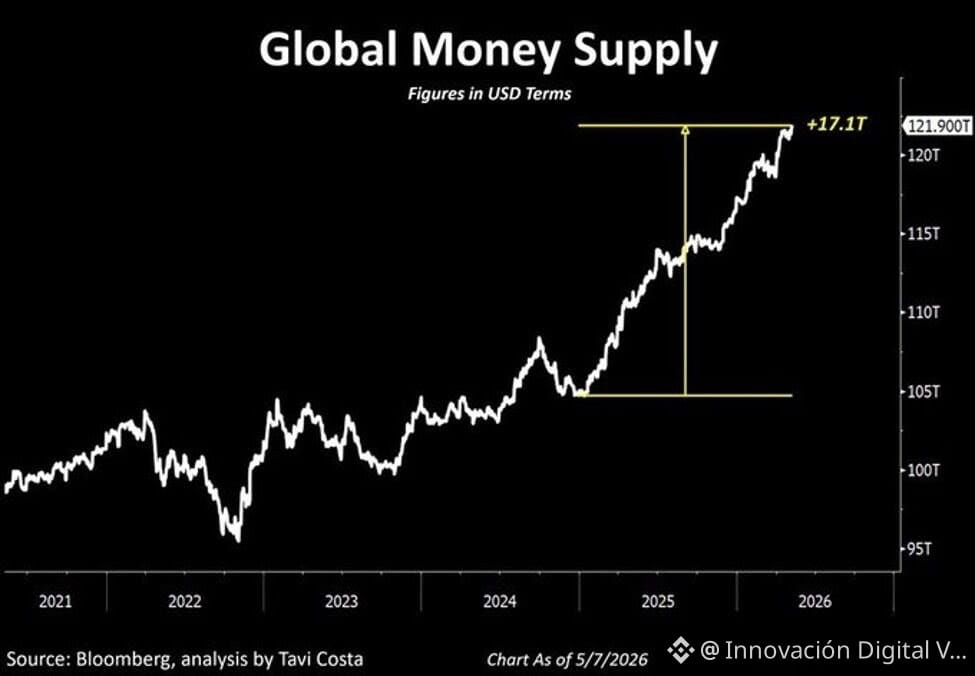
1
630
Log in to explore more content
Join global crypto users on Binance Square
⚡️ Get latest and useful information about crypto.
💬 Trusted by the world’s largest crypto exchange.
👍 Discover real insights from verified creators.
Email / Phone number
Trending Topics
1
#BitwiseFilesFinalNEARSpotETFProspectus
61,016 views
1,215 Discussing
2
#BitgetHackerMoves$83MStolenXRP
27,363 views
153 Discussing
3
#SOLSpotETFWeeklyInflow$188M
16,604 views
121 Discussing
4
#DogecoinETFsPostBiggestWeekSinceLaunch
42,555 views
876 Discussing
5
#StrategyStriveAdd2305BitcoinThisWeek
120,146 views
2,031 Discussing
6
#TrumpRejectsIranHormuzReopening
108,081 views
1,549 Discussing
7
#CircleTetherFreezeBitgetHackerWallet
98,957 views
1,447 Discussing
8
#SECSaysTokenBuybacksNotAutoSecurities
64,365 views
845 Discussing
9
#ChinaUSAgreeOn$30BTariffCut
5,138 views
45 Discussing
10
#CoinMarketCapCompletesCoinglassAcquisition
69,498 views
962 Discussing