

#coindcx
coindcx
212,580 views
350 Discussing
Hot
Latest

·
--
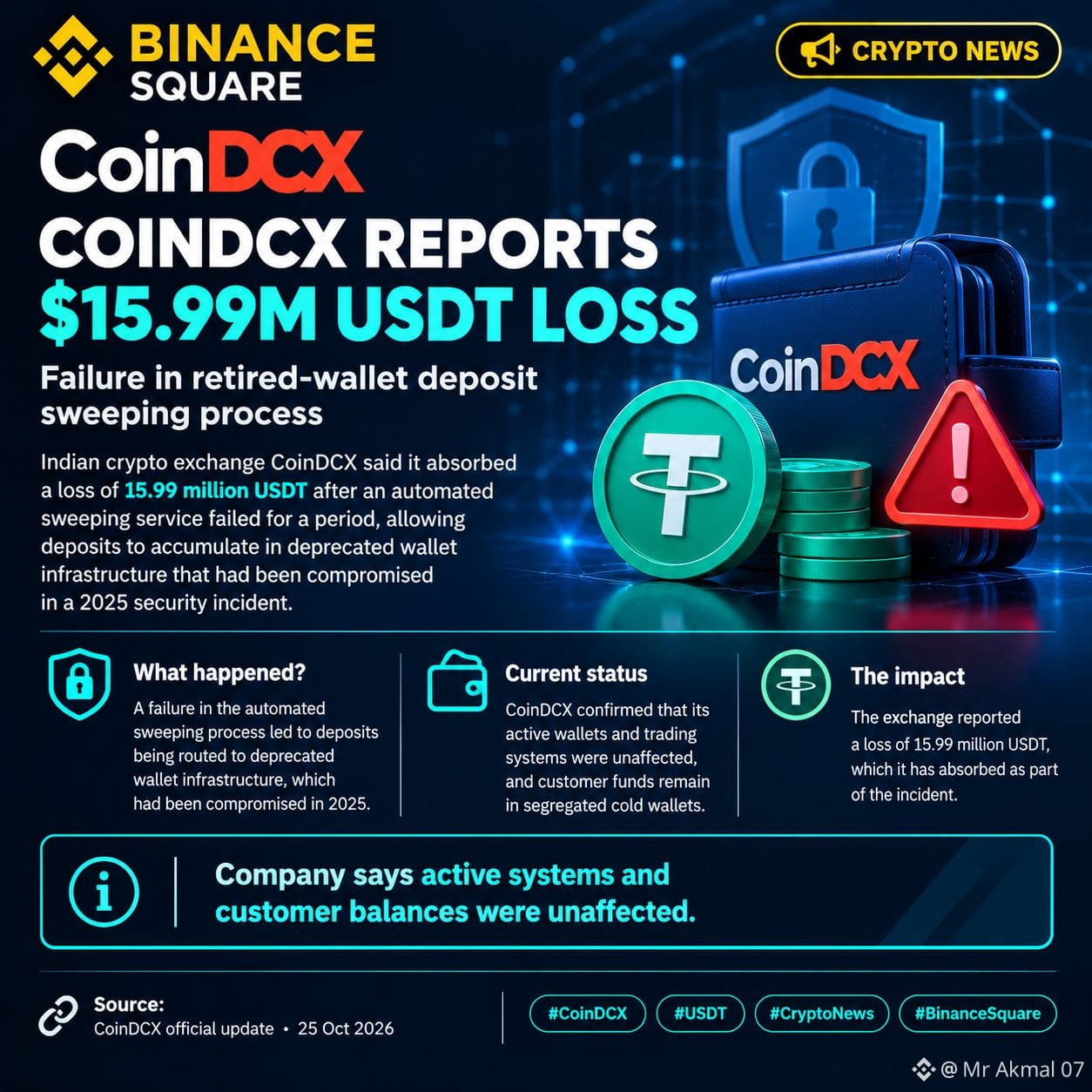
$DCX.US 🚨 COINDCX REPORTS $15.99 MILLION USDT LOSS
Indian crypto exchange CoinDCX has confirmed a loss of 15.99 million USDT linked to old wallet infrastructure affected by a previous security incident.
🔍 What happened?
• An automated service designed to move deposits from retired wallets failed for a period.
• Some deposits accumulated in the old wallet infrastructure.
• CoinDCX says the company absorbed the loss.
• The exchange says customer balances, active wallets and trading systems were unaffected.
🛡️ Why it matters: This incident highlights the importance of wallet security, monitoring legacy systems and communicating transparently when security concerns arise.
📌 These details reflect CoinDCX’s statement; the company’s claims about customer funds have not been independently verified here.
🔗 Official source: https://coindcx.com/blog/coindcx-news/on-chain-wallet-activity-update-21-oct-2026
What security measures should crypto platforms prioritize to protect users? 👇
#CoinDCX #USDT #CryptoSecurity #blockchain #CryptoNews
{stock_us}(DCX.US)
$DCX.US 🚨 COINDCX REPORTS $15.99 MILLION USDT LOSS
Indian crypto exchange CoinDCX has confirmed a loss of 15.99 million USDT linked to old wallet infrastructure affected by a previous security incident.
🔍 What happened?
• An automated service designed to move deposits from retired wallets failed for a period.
• Some deposits accumulated in the old wallet infrastructure.
• CoinDCX says the company absorbed the loss.
• The exchange says customer balances, active wallets and trading systems were unaffected.
🛡️ Why it matters: This incident highlights the importance of wallet security, monitoring legacy systems and communicating transparently when security concerns arise.
📌 These details reflect CoinDCX’s statement; the company’s claims about customer funds have not been independently verified here.
🔗 Official source: https://coindcx.com/blog/coindcx-news/on-chain-wallet-activity-update-21-oct-2026
What security measures should crypto platforms prioritize to protect users? 👇
#CoinDCX #USDT #CryptoSecurity #blockchain #CryptoNews
DCXUS+0.00%
30

·
--
⚠️ COINDCX CONFIRMS A $16M LOSS DAYS AFTER CALLING IT A "FALSE ALARM"
The Indian exchange now admits it:
→ User deposits piled up in old wallets that were retired after its $44M hack in July 2025
→ An automated fund-sweeping system failed, and about $15.99M in USDT was drained from TRON deposit addresses
→ Losses from the two incidents now total nearly $60M
CoinDCX says it will cover the loss and that user funds are safe. Onchain investigator ZachXBT, who challenged the first denials, is urging customers to withdraw.
Lesson for every platform: "retired" wallets are still wallets. If keys were compromised once, they stay compromised.
How much of your crypto do you keep on exchanges right now? 👇
#CoinDCX #CryptoSecurity #Hack #CryptoNews

16

·
--
🚨 CoinDCX Confirms $15.99 Million USDT Loss! 😱
India’s Crypto Exchange Reveals A $15.99 Million Loss After An Automated Wallet-Sweeping Failure In Previously Compromised Wallet Infrastructure. CoinDCX Says Customer Balances And Active Trading Systems Remain Unaffected. 💰🔐
#CoinDCX #cryptoindia #BreakingNews @Binance_South_Asia @Binance_News @Binance_Square_Official $NVDAB
🚨 CoinDCX Confirms $15.99 Million USDT Loss! 😱
India’s Crypto Exchange Reveals A $15.99 Million Loss After An Automated Wallet-Sweeping Failure In Previously Compromised Wallet Infrastructure. CoinDCX Says Customer Balances And Active Trading Systems Remain Unaffected. 💰🔐
#CoinDCX #cryptoindia #BreakingNews @Binance South Asia @Binance News @Binance Square Official $NVDAB
56

·
--
CoinDCX, India's largest crypto exchange, absorbed a 6 million loss after an internal sweeping process failed to move customer deposits from a retired wallet.\n\nThe wallet was deprecated following a July 2025 security incident, but users kept depositing to it. The broken sweep process left 5.99M USDT stuck, which the exchange covered.\n\nCoinDCX says all user funds remain safe in segregated cold wallets. What's your take on exchange operational risks?\n\n#CoinDCX #CryptoSecurity
CoinDCX, India's largest crypto exchange, absorbed a 6 million loss after an internal sweeping process failed to move customer deposits from a retired wallet.\n\nThe wallet was deprecated following a July 2025 security incident, but users kept depositing to it. The broken sweep process left 5.99M USDT stuck, which the exchange covered.\n\nCoinDCX says all user funds remain safe in segregated cold wallets. What's your take on exchange operational risks?\n\n#CoinDCX #CryptoSecurity

1
96

·
--
A “false alarm” that became a $16 million loss? That makes me uneasy. 😬
CoinDCX, India’s largest crypto exchange, initially dismissed reports of suspicious outflows. Now it says an internal process failure tied to a retired wallet caused a $16 million loss—and the exchange will absorb it.
I’m relieved it’s taking the hit, but that reversal deserves scrutiny. 🔍
What matters more to your trust: absorbing the loss or explaining exactly how the failure happened?
#Crypto #CoinDCX #ExchangeSecurity
101

·
--
CoinDCX just confirmed a $15.99M loss, and the details are worse than the headline.
India's largest exchange says attackers drained 15.99M $USDT from deprecated wallets left over from its July 2025 hack. An automated sweeping service failed, so user deposits kept piling up in old, vulnerable addresses until they were emptied on October 21 and routed onward to major exchanges.
The uncomfortable part is the reversal. CEO Sumit Gupta first dismissed the outflow reports as a "false alarm," only to confirm the loss days later after onchain investigators pushed back. The exchange says it absorbed the loss, user funds in segregated cold wallets are safe, and trading was never interrupted.
Oldman view: $16M is survivable for a top exchange, but a second incident on the SAME deprecated infrastructure is an operational failure, not bad luck. Until CoinDCX explains how the wallets were exploited and when the sweeps stopped, trust, not price, is the real damage here.
Risk to watch: the exploit method is still unexplained, and it is unclear whether the same actors from 2025 are involved. This is an exchange security story, not a reason to panic sell the wider market.
📌 Sharing personal opinions only, not financial advice or a recommendation to buy/sell. Crypto is highly risky; DYOR and you are solely responsible. No coin promotion.
#CoinDCX #CryptoSecurity #CryptoExchange #Binance
479

·
--
{spot}(BTCUSDT)
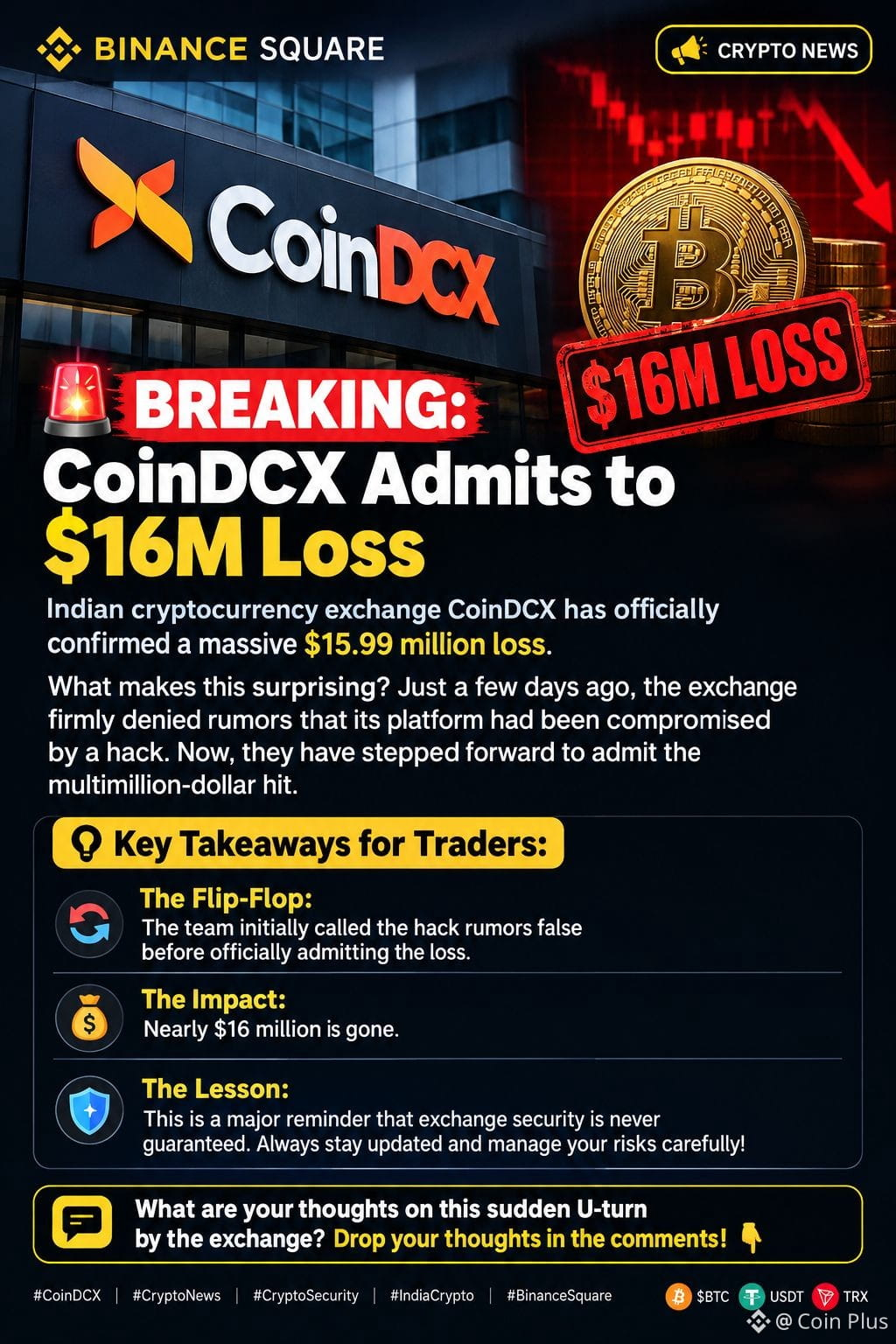
🚨 BREAKING: CoinDCX Admits to $16M Loss 🚨
Indian cryptocurrency exchange CoinDCX has officially confirmed a massive $15.99 million loss.
What makes this surprising? Just a few days ago, the exchange firmly denied rumors that its platform had been compromised by a hack. Now, they have stepped forward to admit the multimillion-dollar hit.
Key Takeaways for Traders:
🔹 The Flip-Flop: The team initially called the hack rumors false before officially admitting the loss.
🔹 The Impact: Nearly $16 million is gone.
🔹 The Lesson: This is a major reminder that exchange security is never guaranteed. Always stay updated and manage your risks carefully! 🛡️
What are your thoughts on this sudden U-turn by the exchange? Drop your thoughts in the comments! 👇
#CoinDCX #BinancePick #BİNANCESQUARE #Binace #crypto
$BTC $BNB
102

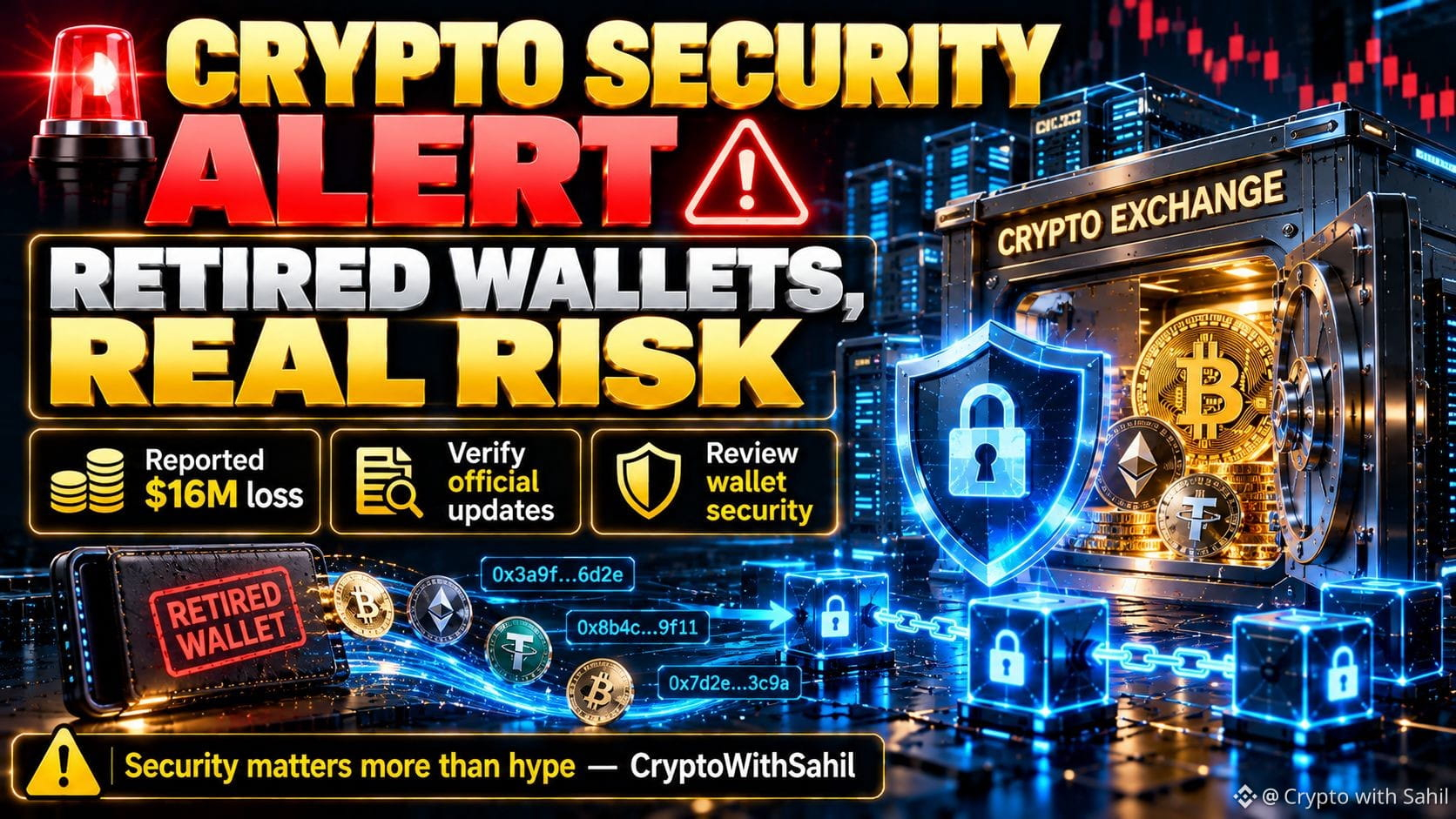
🚨 CRYPTO SECURITY ALERT: REPORTED $16M LOSS AT COINDCX! 🔐
A new report says Indian crypto exchange CoinDCX confirmed a loss of approximately $16 million involving retired wallets. The incident highlights why wallet management and security controls matter—even after addresses are no longer actively used.
🔎 3 important lessons for every crypto user:
🔐 Review wallet security: Retired addresses and old infrastructure still need proper controls.
🛡️ Verify the facts: Follow official exchange statements and avoid spreading unconfirmed claims.
⚠️ Protect yourself: Never share your seed phrase, private keys, or one-time passwords with anyone.
💬 Question for the community: Do you think crypto platforms should publish regular independent security audits? Why or why not?
🔔 Follow CryptoWithSahil for daily crypto news, market insights, and blockchain updates!
#CoinDCX #CryptoSecurity #blockchain #CryptoNews #Web3
72


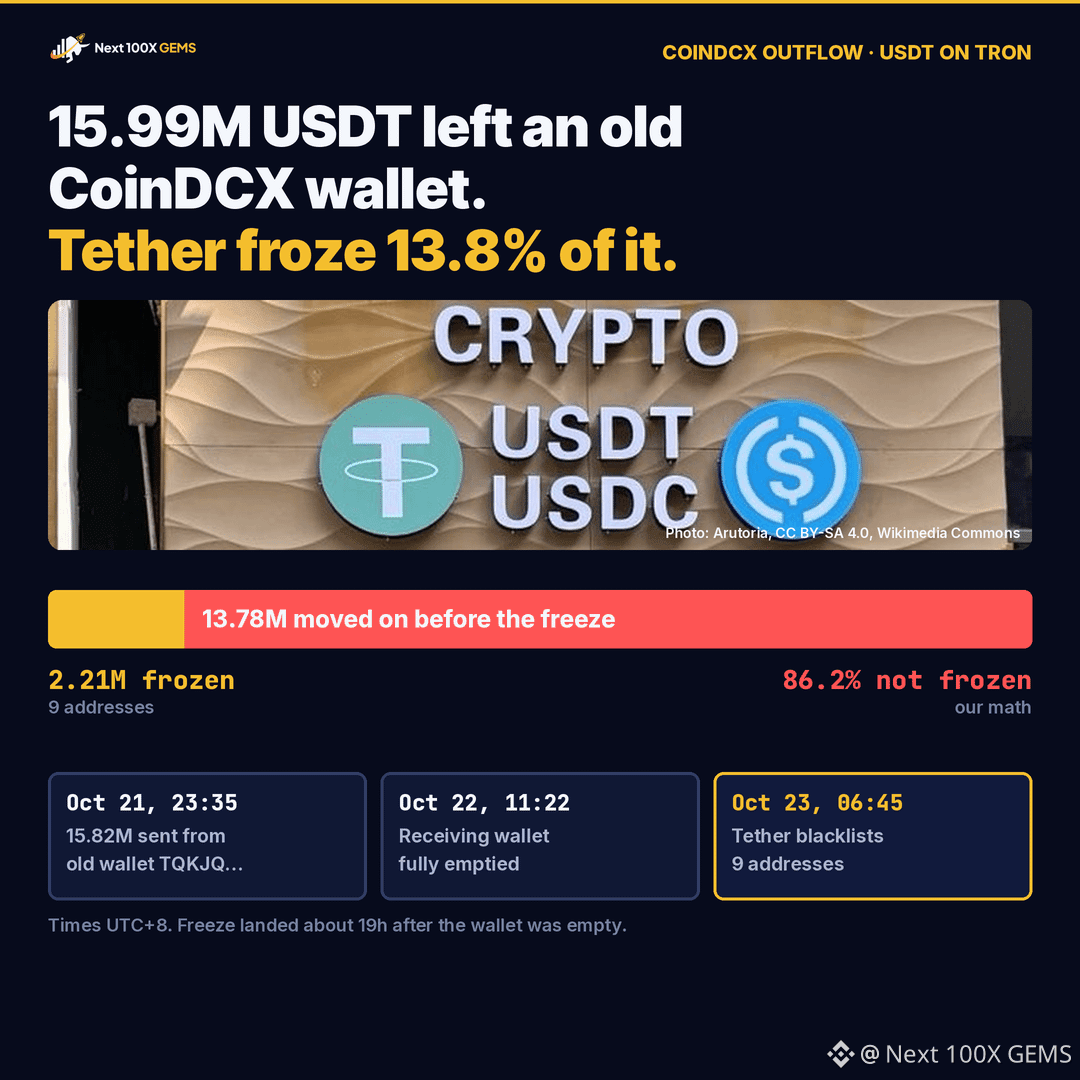
CoinDCX has now put a number on its TRON outflow: 15.99M USDT, lost from an old wallet it had called retired. Tether froze 2.21M of it. That is 13.8%.
On Oct 21 at 23:35 UTC+8, the old address TQKJQ sent 15,819,002 USDT in one transfer to a new wallet, which also took about 172,000 USDT from 39 smaller addresses. By 11:22 UTC+8 on Oct 22 that wallet had sent everything on to six addresses.
Tether blacklisted nine linked addresses at 06:45 UTC+8 on Oct 23, about 19 hours after the first wallet was empty. Those nine hold 2,212,850 USDT. By our math, about 13.78M, or 86.2%, had already moved on.
In a blog post on Oct 25, CoinDCX said the loss hit "old, deprecated wallet infrastructure which had unknown vulnerabilities", that its sweeping service had failed for a period, and that it absorbed the loss. It says customer balances are fully accounted for.
On-chain records read by CryptoWatchDesk show the same old address forwarding USDT as late as May 2026.
A freeze only catches what is still sitting still. Only deposit to the address your exchange app shows you today, never to one saved from before.
$USDT
#CoinDCX #Tether
NFA. DYOR.
144
·
--
🔴 CoinDCX Confirms $16M Loss From Its "Retired" Wallets
India's largest crypto exchange has finally put a number on it: $15.99M in $USDT drained on October 21 from legacy wallet infrastructure it says was retired after its July 2025 hack.
Why this admission matters: CoinDCX first denied a new breach. On-chain investigators led by ZachXBT then showed the "retired" address had still been sweeping user deposits as recently as May 2026. Only now, in a blog post shared Sunday, has the exchange confirmed the exact loss, saying it absorbed the cost and that customer deposits were credited and trading was unaffected.
The lesson for every exchange user is blunt: on a key-based chain, a "retired" wallet is not switched off. The key still works. If the sweep fails, funds pile up exactly where attackers already know to look.
⚠️ Honest risk: CoinDCX insists user funds are safe, but independent investigators dispute its account and no forensic report has been published. Until one appears, treat any "legacy wallet" explanation as unverified.
🔑 for self-custody, 🏦 for exchange trust. Which side are you on?
📌 Sharing personal opinions only, not financial advice or a recommendation to buy/sell. Crypto is highly risky; DYOR and you are solely responsible. No coin promotion.
#CoinDCX #CryptoSecurity #Crypto #Binance
871
·
--
$16 million in flagged outflows—and a denial. That makes me pause. 😬
Blockchain sleuths flagged suspicious outflows from addresses linked to CoinDCX, India’s largest exchange. CoinDCX denies its active wallets were hacked.
The distinction matters: suspicious transfers aren’t proof of a hack, but a denial alone doesn’t explain the movements. 🔍
I’d want a clear explanation before drawing conclusions. What would reassure you more: a wallet-by-wallet breakdown or an independent review?
#CoinDCX #CryptoSecurity #Blockchain

105

·
--
🚨 $16M $USDT Outflow: A Crypto Security Wake-Up Call?
Around $16M in USDT moved from wallets linked to CoinDCX, raising questions about wallet security and transaction monitoring.
CoinDCX says the issue involved old wallets and that customer funds remain safe.
How do you view this incident—as a warning for exchanges or a reminder to improve wallet management?
What's your view? Share your thoughts in the comments below. 👇
#CryptoSecurity #USDT #CoinDCX #Blockchain #CryptoNews
🛡️ Stronger security needed
0%
🔍 Better monitoring needed
0%
⚖️ More transparency needed
0%
🤔 Need more verified facts
0%
0 votes • Voting closed
60

·
--
🚨 $COINDCX DENIES NEW BREACH, RECALLS JULY 2025 COMPROMISED WALLETS! 📊
📌 CoinDCX’s statement draws a clear line between historic wallet compromise and today’s on‑chain chatter. The compromised addresses, first hit in July 2025, continue to move assets, but the exchange stresses no fresh intrusion into its platform. 🦈 This distinction helps dampen panic‑driven sell pressure that often follows ambiguous blockchain spikes.
🔍 Traders should watch for any liquidity sweeps triggered by these legacy wallets, yet the core risk remains confined to the original breach vector. Maintaining 2FA and regular account audits stays prudent. 💡 How are you adjusting your security posture in light of this clarification? 👇
⚠️ Not financial advice. Always manage your risk. 🛡️
🏷️ #COINDCX #Security #Exchange #Crypto
🔥 💎
2

I learned the term “retired wallet” today.
CoinDCX, India’s largest exchange. On October 21, about 15.99 million U flowed out of a batch of old deposit addresses on TRON. The first reaction was: it wasn’t a hack—these were old wallets left over from the July 2025 theft (about 44 million), and they hadn’t been used in ages.
Then ZachXBT checked the on-chain activity: one of those “old” addresses was still sweeping deposits into their hot wallet as recently as May 2026.
Once an address has been compromised, you should assume its private key is no longer yours. But nearly a year later, it was still receiving users’ funds and going through the sweeping process. You call that retired? That’s just nobody keeping an eye on it.
Later, the story changed: an automated sweeping service had malfunctioned, so funds kept piling up in the old addresses. The platform would absorb the loss, and users’ balances would remain unaffected. Tether froze about 2.2 million—just over 13%. According to on-chain posts, the rest had already been split up and sent to OKX, Binance, and Gate.
Credit where it’s due for covering the loss themselves. But the sequence says a lot: deny it first, get called out by on-chain evidence, then share the numbers. “It’s not a new vulnerability” translates to “we never fixed the old one.” That doesn’t make it sound better; it makes it look worse.
There’s just one thing retail users can do: don’t save exchange deposit addresses in your address book and reuse them. Copy the address again from the app before each deposit. You don’t know whether anyone is still monitoring the address you saved. Sometimes, they don’t know either.
#CoinDCX
406

·
--
Bearish
🚨 $16M MOVED FROM COINDCX-LINKED WALLETS — THE BIGGER WARNING IS WHAT HAPPENED AFTER THEY WERE RETIRED
CoinDCX initially rejected claims of a new hack
But on-chain investigators traced nearly $16M moving from wallets linked to the exchange
Here's the contradiction 👀
$BTC
{future}(BTCUSDT)
CoinDCX said those addresses had been retired after its 2025 breach
Yet blockchain researchers found evidence of continued deposit activity
The exchange later acknowledged that its process for sweeping deposits from old addresses had failed during a period, causing operational losses
CoinDCX says affected customer deposits were credited and user funds remain safe
The real lesson isn't whether this qualifies as a second hack
It's that retiring an address doesn't automatically stop people from sending money to it
And a broken recovery process can leave funds exposed long after an incident
$ZEC
{future}(ZECUSDT)
🔍 What I'd check
• Generate a fresh deposit address from the official exchange app
• Verify previous deposits were credited
• Report any discrepancy through official support
Security isn't just stopping the original breach
It's ensuring the old vulnerability can no longer affect users
#CoinDCX #CryptoSecurity #ExchangeRisk
🚨 $16M MOVED FROM COINDCX-LINKED WALLETS — THE BIGGER WARNING IS WHAT HAPPENED AFTER THEY WERE RETIRED
CoinDCX initially rejected claims of a new hack
But on-chain investigators traced nearly $16M moving from wallets linked to the exchange
Here's the contradiction 👀
$BTC
CoinDCX said those addresses had been retired after its 2025 breach
Yet blockchain researchers found evidence of continued deposit activity
The exchange later acknowledged that its process for sweeping deposits from old addresses had failed during a period, causing operational losses
CoinDCX says affected customer deposits were credited and user funds remain safe
The real lesson isn't whether this qualifies as a second hack
It's that retiring an address doesn't automatically stop people from sending money to it
And a broken recovery process can leave funds exposed long after an incident
$ZEC
🔍 What I'd check
• Generate a fresh deposit address from the official exchange app
• Verify previous deposits were credited
• Report any discrepancy through official support
Security isn't just stopping the original breach
It's ensuring the old vulnerability can no longer affect users
#CoinDCX #CryptoSecurity #ExchangeRisk

246

·
--
Article
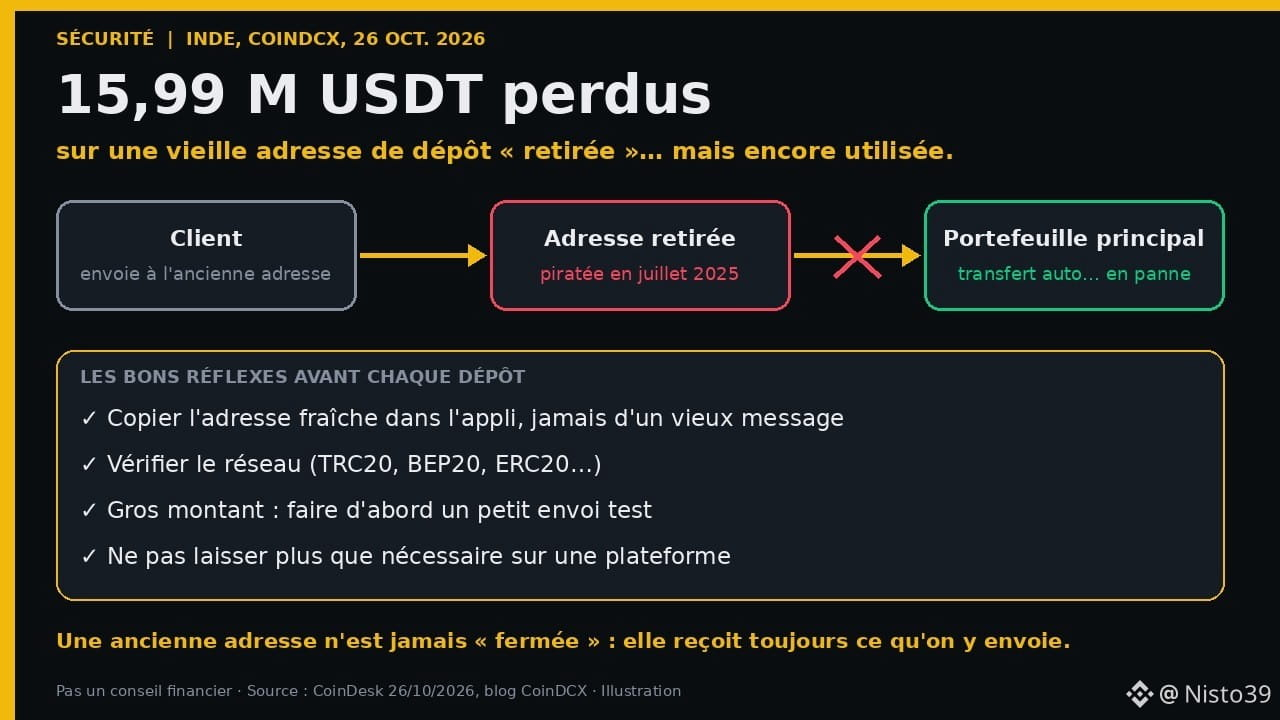
CoinDCX: 16 million USDT lost to an old address. The lesson for your depositsMariam is a seamstress in Ouagadougou. A year ago, she copied her crypto platform’s deposit address onto her phone, and ever since, she’s always sent her $USDT to that same address without checking it again. Convenient… until the day the address is no longer the right one. What just happened in India to CoinDCX shows why this small habit matters.
📋 The facts (CoinDesk, October 26, 2026)
• CoinDCX, India’s largest crypto platform by volume, says it has absorbed a loss of 15.99 million USDT (about $16 million).
CoinDCX: 16 million USDT lost to an old address. The lesson for your deposits
Mariam is a seamstress in Ouagadougou. A year ago, she copied her crypto platform’s deposit address onto her phone, and ever since, she’s always sent her $USDT to that same address without checking it again. Convenient… until the day the address is no longer the right one. What just happened in India to CoinDCX shows why this small habit matters.
📋 The facts (CoinDesk, October 26, 2026)
• CoinDCX, India’s largest crypto platform by volume, says it has absorbed a loss of 15.99 million USDT (about $16 million).
📋 The facts (CoinDesk, October 26, 2026)
• CoinDCX, India’s largest crypto platform by volume, says it has absorbed a loss of 15.99 million USDT (about $16 million).
22
The worst part of the CoinDCX incident isn’t losing $15.99 million in USDT—it’s calling it a “false alarm.”
Here’s the timeline: unusual activity was detected on October 21, and CEO Sumit Gupta came out saying the wallets hadn’t been compromised and it was a false alarm. Three days later, on October 25, they changed their story and admitted that $15.99 million in USDT was gone.
The official explanation is “an old, deprecated wallet” plus “an automated sweep service being down for a while,” which left users’ deposits piling up at old addresses where someone drained them. The problem is, these old addresses were left over from the July 19, 2025 hack. They hadn’t fully fixed the vulnerability, and they were still accepting users’ funds? And they call that “deprecated”? ZachXBT also rejects the claim that these wallets were “deprecated.”
Also, Tether froze around 13.8%; most of the rest is basically gone. They’d already lost about $44 million in the previous incident, and now this happens again.
The company says it’ll absorb the full loss and users’ balances won’t be affected. Fine—that does show some responsibility. But when they deny it first, then admit it only after on-chain investigators dig it up, how are people supposed to trust them the next time they say “everything’s fine”?
When an exchange says everything’s fine, check the chain—not Twitter.
#CoinDCX #ExchangeSecurity

·
--
【Market Update】Three days ago, they said “the wallet wasn’t hacked”; three days later, they acknowledged a loss of $15.99 million.
CoinDCX admits: An old, deprecated wallet contained an unknown vulnerability, discovered after an anomaly on October 21.
Automatic sweeps had long since stopped working, leaving funds mistakenly sent by users to old addresses stranded there.
The company will cover the loss; customer funds are unaffected, and the current system is operating normally.
The CEO denied the reports just three days ago. How many more risks are buried in old wallets? Would you still dare to keep your assets on an exchange long term?
$BTC $USDT $ETH
#CoinDCX #交易所安全 #IndiaCrypto
(Source: CryptoPotato)
⚠️Risk warning: The above is shared for market information only and does not constitute investment advice. Investing involves risks; please exercise caution when entering the market.

204

·
--
Article
CoinDCX’s old wallets and $16M: tracing it back to the deposit addresses“CoinDCX got hacked again” was circulating in chats. The figure alone comes to about 15.99 million USDT, or roughly $16 million. However, this concerns CoinDCX, the Indian exchange, and its old (decommissioned) wallets and failed automatic sweeps. It was not a Binance hack, nor is it a price signal. I’ll stick to what’s in public reports and the company’s own announcement.
❓ 【Where had the funds accumulated before they were drained?】
According to CoinDCX’s official blog (On-Chain Activity Update, 2026-10-21), suspicious activity was detected in old operational wallet infrastructure that had been decommissioned after the July 2025 security incident. Automatic sweeps—the process of moving funds deposited to old addresses into the main wallet—had been paused for a while, so deposits accumulated at the old addresses, resulting in a loss of 15.99 million USDT. The company said it covered the loss itself.
CoinDCX’s old wallets and $16M: tracing it back to the deposit addresses
“CoinDCX got hacked again” was circulating in chats. The figure alone comes to about 15.99 million USDT, or roughly $16 million. However, this concerns CoinDCX, the Indian exchange, and its old (decommissioned) wallets and failed automatic sweeps. It was not a Binance hack, nor is it a price signal. I’ll stick to what’s in public reports and the company’s own announcement.
❓ 【Where had the funds accumulated before they were drained?】
According to CoinDCX’s official blog (On-Chain Activity Update, 2026-10-21), suspicious activity was detected in old operational wallet infrastructure that had been decommissioned after the July 2025 security incident. Automatic sweeps—the process of moving funds deposited to old addresses into the main wallet—had been paused for a while, so deposits accumulated at the old addresses, resulting in a loss of 15.99 million USDT. The company said it covered the loss itself.
42

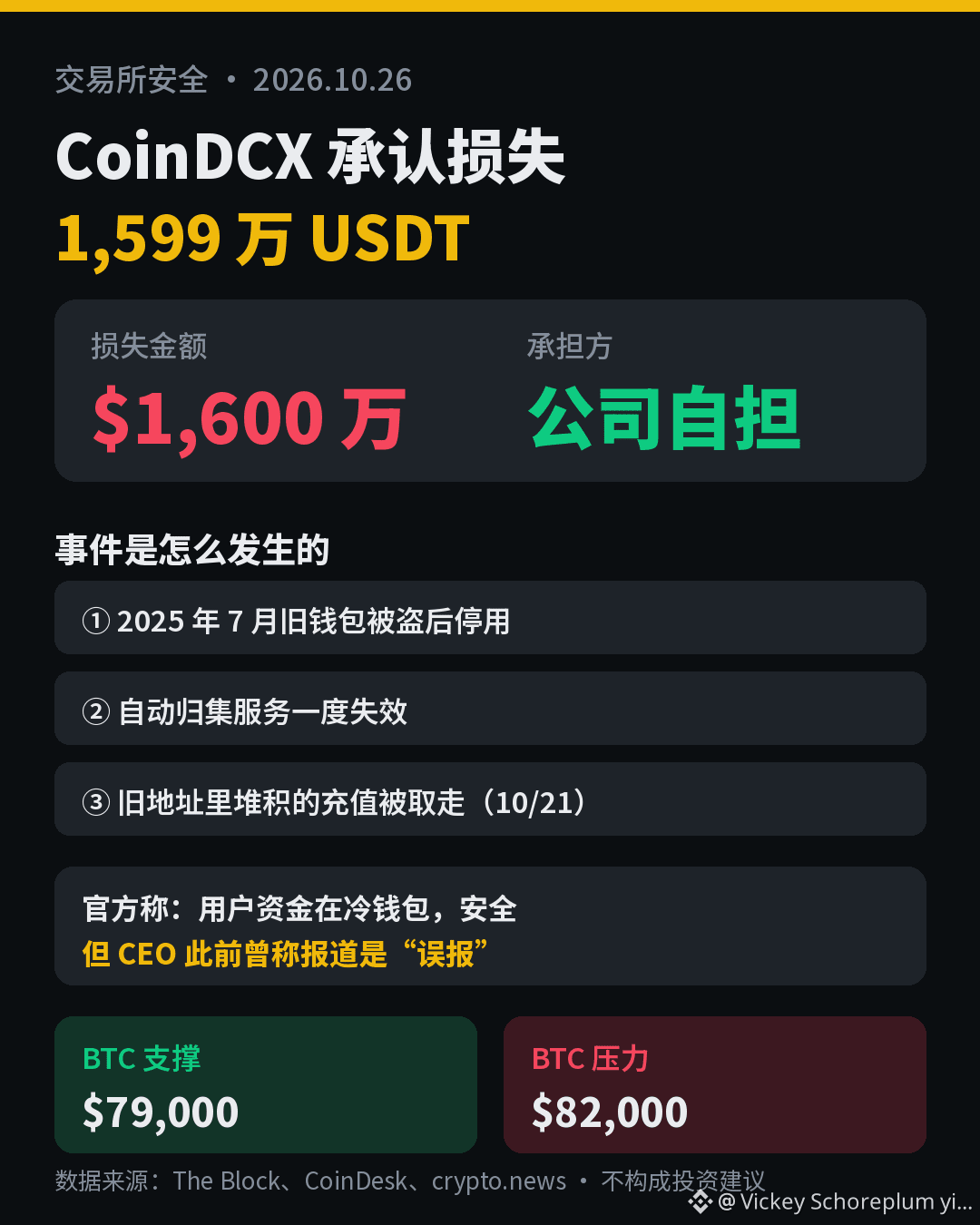
🏦 Can an exchange’s “retired wallet” cause trouble too? India’s largest exchange, CoinDCX, admits to a $15.99 million loss
India’s largest crypto exchange, CoinDCX, confirmed in an official blog post on Sunday (October 25) that a problem with its legacy wallet infrastructure led to the loss of 15.99 million USDT (about $16 million). The company will cover the entire loss itself.
📌 Key points
• An anomaly was discovered on October 21: an abandoned legacy deposit wallet (decommissioned after being hacked in July 2025) had an unknown vulnerability
• The automatic “sweeping” service briefly stopped working. Deposits sent by users to old addresses weren’t transferred in time, accumulated, and were taken by an attacker
• CoinDCX says user funds are held in segregated cold wallets, and that existing wallets, trading, and withdrawals are unaffected. All deposits for affected users have been credited
• Ironically, just days earlier, the CEO had publicly called related reports “false alarms.” On-chain investigator ZachXBT and others later challenged that claim
💡 What this means for users
• Risks often lurk in old systems that are “no longer in use”—not just in main wallets
• A platform’s transparency and speed of disclosure are important indicators of its reliability
• Build good habits yourself, too: only send funds to the deposit address currently shown by the platform, and test with a small amount before making a large transfer
📊 Market snapshot: BTC is currently around $79,800. Markets are cautious ahead of this week’s FOMC meeting (October 28), with around 79,000 as short-term support and 82,000 as resistance above.
💬 Would you move your assets because a platform “only admitted the problem afterward”? Or do you think reimbursing users is enough?
👉 Trade BTC: https://www.binance.com/zh-CN/trade/BTC_USDT
#CoinDCX #交易所安全 #USDT #Bitcoin
⚠️ The above does not constitute investment advice. Please be aware of the risks.
32
Log in to explore more content
Join global crypto users on Binance Square
⚡️ Get latest and useful information about crypto.
💬 Trusted by the world’s largest crypto exchange.
👍 Discover real insights from verified creators.
Email / Phone number
Trending Topics
1
#BinancePick
2.7M views
142,841 Discussing
2
#EarningsSeason
5M views
24,509 Discussing
3
#SouthKoreaReportedlyWeighsFourthCryptoTaxDelay
2 views
13 Discussing
4
#FranklinTempletonFilesForTwoDividendToBitcoinETFs
4,146 views
163 Discussing
5
#StrategyMSTRSurpassesNasdaqInMarketCap
4,149 views
131 Discussing
6
#CanadaProposesStablecoinRedemptionWithin3BusinessDays
141 views
14 Discussing
7
#ElectrumWalletBugLetRogueServersStealFunds
10,595 views
271 Discussing
8
#ArgentineCourtDismissesLIBRACaseAgainstMilei
21,072 views
344 Discussing
9
#SKHynixReportedlyPlansSpecialDividendFromKioxiaStakeSale
3,347 views
48 Discussing
10
#KeystoneWebsiteBreachExposesBuyersShippingAddresses
1,759 views
41 Discussing