

#usdt
usdt
2.9G views
12.7M Discussing
Hot
Latest

$USDT
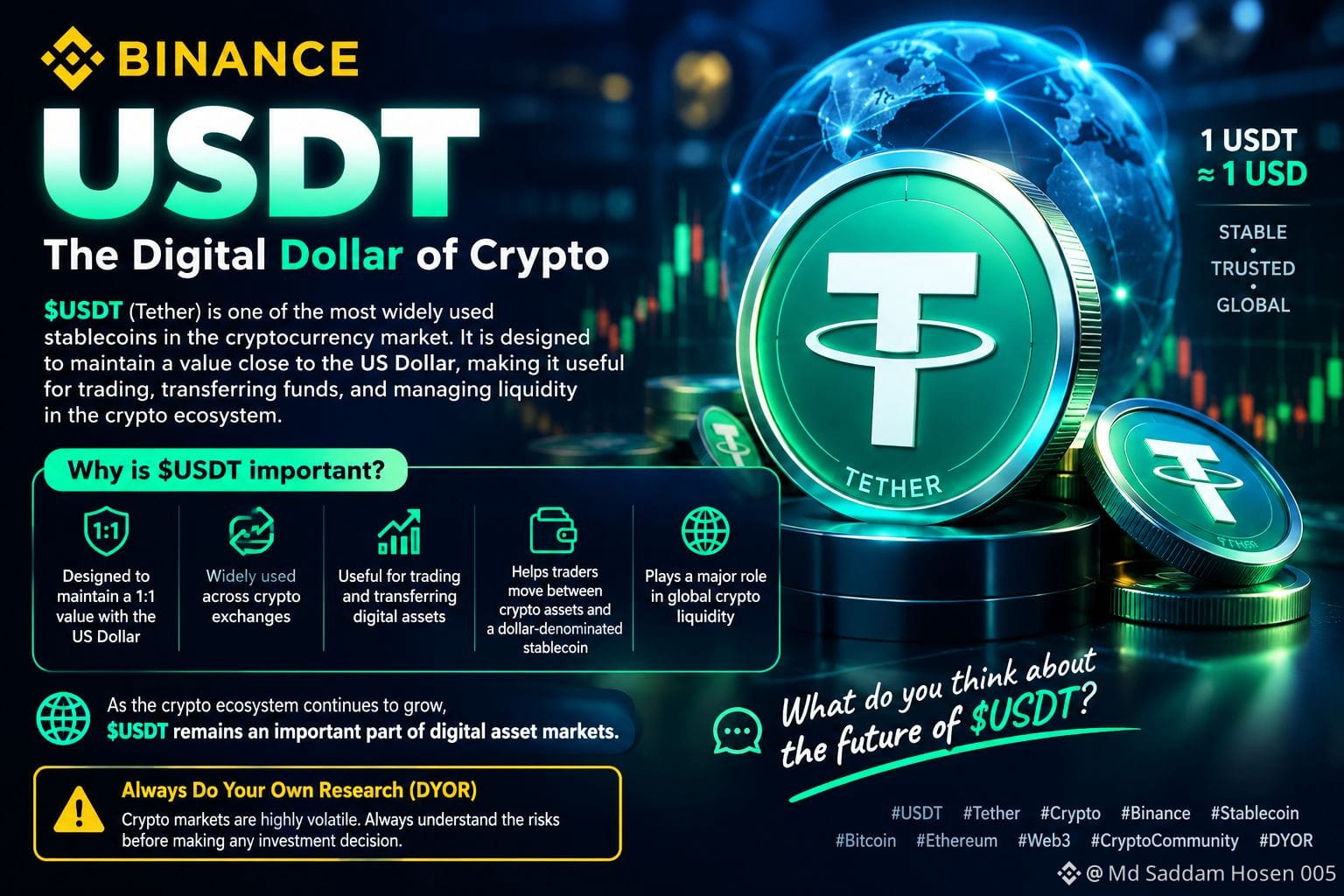
💵 USDT — The Digital Dollar of Crypto 🚀
(Tether) is one of the most widely used stablecoins in the cryptocurrency market. It is designed to maintain a value close to the US Dollar, making it useful for trading, transferring funds, and managing liquidity in the crypto ecosystem.
🔹 Why is $USDT important? • Designed to maintain a 1:1 value with the US Dollar
• Widely used across crypto exchanges
• Useful for trading and transferring digital assets
• Helps traders move between crypto assets and a dollar-denominated stablecoin
• Plays a major role in global crypto liquidity
🌐 As the crypto ecosystem continues to grow, $USDT remains an important part of digital asset markets.
📌 Always Do Your Own Research (DYOR)
Crypto markets are highly volatile. Always understand the risks before making any investment decision.
🔥 What do you think about the future of $USDT?
#USDT #Tether #DYOR
$USDT
💵 USDT — The Digital Dollar of Crypto 🚀
(Tether) is one of the most widely used stablecoins in the cryptocurrency market. It is designed to maintain a value close to the US Dollar, making it useful for trading, transferring funds, and managing liquidity in the crypto ecosystem.
🔹 Why is $USDT important? • Designed to maintain a 1:1 value with the US Dollar
• Widely used across crypto exchanges
• Useful for trading and transferring digital assets
• Helps traders move between crypto assets and a dollar-denominated stablecoin
• Plays a major role in global crypto liquidity
🌐 As the crypto ecosystem continues to grow, $USDT remains an important part of digital asset markets.
📌 Always Do Your Own Research (DYOR)
Crypto markets are highly volatile. Always understand the risks before making any investment decision.
🔥 What do you think about the future of $USDT?
#USDT #Tether #DYOR
💵 USDT — The Digital Dollar of Crypto 🚀
(Tether) is one of the most widely used stablecoins in the cryptocurrency market. It is designed to maintain a value close to the US Dollar, making it useful for trading, transferring funds, and managing liquidity in the crypto ecosystem.
🔹 Why is $USDT important? • Designed to maintain a 1:1 value with the US Dollar
• Widely used across crypto exchanges
• Useful for trading and transferring digital assets
• Helps traders move between crypto assets and a dollar-denominated stablecoin
• Plays a major role in global crypto liquidity
🌐 As the crypto ecosystem continues to grow, $USDT remains an important part of digital asset markets.
📌 Always Do Your Own Research (DYOR)
Crypto markets are highly volatile. Always understand the risks before making any investment decision.
🔥 What do you think about the future of $USDT?
#USDT #Tether #DYOR
77

·
--
🚨 FED TAKES MAJOR STEP TOWARD STABLECOIN FRAMEWORK FOR $USDT AND BEYOND! 🏦
The Federal Reserve is opening the floor for public feedback on GENIUS Act proposals, focusing directly on stablecoin reserve assets, capital requirements, and issuer oversight. 🔍
Institutional rails are tightening around $USDT liquidity issuers, laying down concrete foundation lines for smart money capital deployment. 📊 Clearing up regulatory friction could unleash unprecedented liquidity flows across the market. 🌊
💬 Does official Federal oversight signal massive institutional capital inflows or tighter restrictions for stablecoins? 👇
⚠️ Not financial advice. Always manage your risk. 🛡️
🏷️ #USDT #Stablecoins #Fed #Macro #Crypto
⚡ 🎯
🚨 FED TAKES MAJOR STEP TOWARD STABLECOIN FRAMEWORK FOR $USDT AND BEYOND! 🏦
The Federal Reserve is opening the floor for public feedback on GENIUS Act proposals, focusing directly on stablecoin reserve assets, capital requirements, and issuer oversight. 🔍
Institutional rails are tightening around $USDT liquidity issuers, laying down concrete foundation lines for smart money capital deployment. 📊 Clearing up regulatory friction could unleash unprecedented liquidity flows across the market. 🌊
💬 Does official Federal oversight signal massive institutional capital inflows or tighter restrictions for stablecoins? 👇
⚠️ Not financial advice. Always manage your risk. 🛡️
🏷️ #USDT #Stablecoins #Fed #Macro #Crypto
⚡ 🎯
The Federal Reserve is opening the floor for public feedback on GENIUS Act proposals, focusing directly on stablecoin reserve assets, capital requirements, and issuer oversight. 🔍
Institutional rails are tightening around $USDT liquidity issuers, laying down concrete foundation lines for smart money capital deployment. 📊 Clearing up regulatory friction could unleash unprecedented liquidity flows across the market. 🌊
💬 Does official Federal oversight signal massive institutional capital inflows or tighter restrictions for stablecoins? 👇
⚠️ Not financial advice. Always manage your risk. 🛡️
🏷️ #USDT #Stablecoins #Fed #Macro #Crypto
⚡ 🎯
1

·
--
🚨 FED OPENS PUBLIC COMMENTS ON GENIUS ACT STABLECOIN RESERVES AND CAPITAL RULES FOR $USDT ! ⚖️
The Federal Reserve is seeking public feedback on GENIUS Act proposals, targeting institutional reserve requirements, capital ratios, and approval frameworks for stablecoin issuers. 🦈 This regulatory clarity is laying the structural blueprint for massive institutional liquidity deployment into digital assets.
As oversight tightens around collateral backing, smart money views these capital standards as the prerequisite for corporate Treasury integration into $USDT and $USDC liquidity rails. 📊 Clear operational rules eliminate tail-risk and prepare market structure for expansion.
💬 Will strict reserve frameworks accelerate institutional stablecoin adoption or stifle yield innovation across crypto markets? 👇
⚠️ Not financial advice. Always manage your risk. 🛡️
🏷️ #USDT #USDC #Stablecoins #Fed #CryptoNews
🎯 🦈
🚨 FED OPENS PUBLIC COMMENTS ON GENIUS ACT STABLECOIN RESERVES AND CAPITAL RULES FOR $USDT ! ⚖️
The Federal Reserve is seeking public feedback on GENIUS Act proposals, targeting institutional reserve requirements, capital ratios, and approval frameworks for stablecoin issuers. 🦈 This regulatory clarity is laying the structural blueprint for massive institutional liquidity deployment into digital assets.
As oversight tightens around collateral backing, smart money views these capital standards as the prerequisite for corporate Treasury integration into $USDT and $USDC liquidity rails. 📊 Clear operational rules eliminate tail-risk and prepare market structure for expansion.
💬 Will strict reserve frameworks accelerate institutional stablecoin adoption or stifle yield innovation across crypto markets? 👇
⚠️ Not financial advice. Always manage your risk. 🛡️
🏷️ #USDT #USDC #Stablecoins #Fed #CryptoNews
🎯 🦈
The Federal Reserve is seeking public feedback on GENIUS Act proposals, targeting institutional reserve requirements, capital ratios, and approval frameworks for stablecoin issuers. 🦈 This regulatory clarity is laying the structural blueprint for massive institutional liquidity deployment into digital assets.
As oversight tightens around collateral backing, smart money views these capital standards as the prerequisite for corporate Treasury integration into $USDT and $USDC liquidity rails. 📊 Clear operational rules eliminate tail-risk and prepare market structure for expansion.
💬 Will strict reserve frameworks accelerate institutional stablecoin adoption or stifle yield innovation across crypto markets? 👇
⚠️ Not financial advice. Always manage your risk. 🛡️
🏷️ #USDT #USDC #Stablecoins #Fed #CryptoNews
🎯 🦈
·
--
FED PROPOSES NEW GENIUS ACT STABLECOIN RULES IGNITING INSTITUTIONAL LIQUIDITY WAVES FOR $USDT 🚨 🏦
The Fed just dropped proposed rules for stablecoin issuers under the GENIUS Act, cementing digital dollars into institutional rails. 🏦 Smart money sees this clear green light as a massive bridge for liquidity flowing straight into the spot market. 🌊
Clear regulatory guardrails clear out backroom uncertainty and set the foundation for major capital allocators to step in with size. 📊 When institutional issuers get a defined playbook, on-chain liquidity velocity speeds up exponentially. 💡
💬 Will this regulatory clarity fuel the next massive wave of fiat inflows into altcoins, or will compliance slow down yield protocols? 👇
⚠️ Not financial advice. Always manage your risk. 🛡️
🏷️ #USDT #Stablecoins #Fed #Macro #Crypto
🔥 💎
FED PROPOSES NEW GENIUS ACT STABLECOIN RULES IGNITING INSTITUTIONAL LIQUIDITY WAVES FOR $USDT 🚨 🏦
The Fed just dropped proposed rules for stablecoin issuers under the GENIUS Act, cementing digital dollars into institutional rails. 🏦 Smart money sees this clear green light as a massive bridge for liquidity flowing straight into the spot market. 🌊
Clear regulatory guardrails clear out backroom uncertainty and set the foundation for major capital allocators to step in with size. 📊 When institutional issuers get a defined playbook, on-chain liquidity velocity speeds up exponentially. 💡
💬 Will this regulatory clarity fuel the next massive wave of fiat inflows into altcoins, or will compliance slow down yield protocols? 👇
⚠️ Not financial advice. Always manage your risk. 🛡️
🏷️ #USDT #Stablecoins #Fed #Macro #Crypto
🔥 💎
The Fed just dropped proposed rules for stablecoin issuers under the GENIUS Act, cementing digital dollars into institutional rails. 🏦 Smart money sees this clear green light as a massive bridge for liquidity flowing straight into the spot market. 🌊
Clear regulatory guardrails clear out backroom uncertainty and set the foundation for major capital allocators to step in with size. 📊 When institutional issuers get a defined playbook, on-chain liquidity velocity speeds up exponentially. 💡
💬 Will this regulatory clarity fuel the next massive wave of fiat inflows into altcoins, or will compliance slow down yield protocols? 👇
⚠️ Not financial advice. Always manage your risk. 🛡️
🏷️ #USDT #Stablecoins #Fed #Macro #Crypto
🔥 💎
2

·
--
🚨 FED PROPOSES GENIUS ACT REGULATORY FRAMEWORK FOR $USDT AND STABLECOIN ISSUERS! 🏦
The Federal Reserve is stepping up institutional oversight, introducing a structured regulatory architecture under the GENIUS Act for major issuers. 🏦 This shift signals a crucial transition from uncoordinated liquidity flows to institutional-grade compliance standards, clearing the path for deeper capital entry. 💡
While short-term markets digest the news, smart money views clear regulatory parameters as the ultimate catalyst for long-term liquidity expansion across key pairs. 📊 Institutional players prefer predictable market infrastructure over regulatory ambiguity every single time. 🔍
💬 How do you see this regulatory framework impacting overall market liquidity in the coming quarters? 👇
⚠️ Not financial advice. Always manage your risk. 🛡️
🏷️ #USDT #Stablecoins #Crypto #Fed #Macro
🎯 🛡️
🚨 FED PROPOSES GENIUS ACT REGULATORY FRAMEWORK FOR $USDT AND STABLECOIN ISSUERS! 🏦
The Federal Reserve is stepping up institutional oversight, introducing a structured regulatory architecture under the GENIUS Act for major issuers. 🏦 This shift signals a crucial transition from uncoordinated liquidity flows to institutional-grade compliance standards, clearing the path for deeper capital entry. 💡
While short-term markets digest the news, smart money views clear regulatory parameters as the ultimate catalyst for long-term liquidity expansion across key pairs. 📊 Institutional players prefer predictable market infrastructure over regulatory ambiguity every single time. 🔍
💬 How do you see this regulatory framework impacting overall market liquidity in the coming quarters? 👇
⚠️ Not financial advice. Always manage your risk. 🛡️
🏷️ #USDT #Stablecoins #Crypto #Fed #Macro
🎯 🛡️
The Federal Reserve is stepping up institutional oversight, introducing a structured regulatory architecture under the GENIUS Act for major issuers. 🏦 This shift signals a crucial transition from uncoordinated liquidity flows to institutional-grade compliance standards, clearing the path for deeper capital entry. 💡
While short-term markets digest the news, smart money views clear regulatory parameters as the ultimate catalyst for long-term liquidity expansion across key pairs. 📊 Institutional players prefer predictable market infrastructure over regulatory ambiguity every single time. 🔍
💬 How do you see this regulatory framework impacting overall market liquidity in the coming quarters? 👇
⚠️ Not financial advice. Always manage your risk. 🛡️
🏷️ #USDT #Stablecoins #Crypto #Fed #Macro
🎯 🛡️
3

·
--
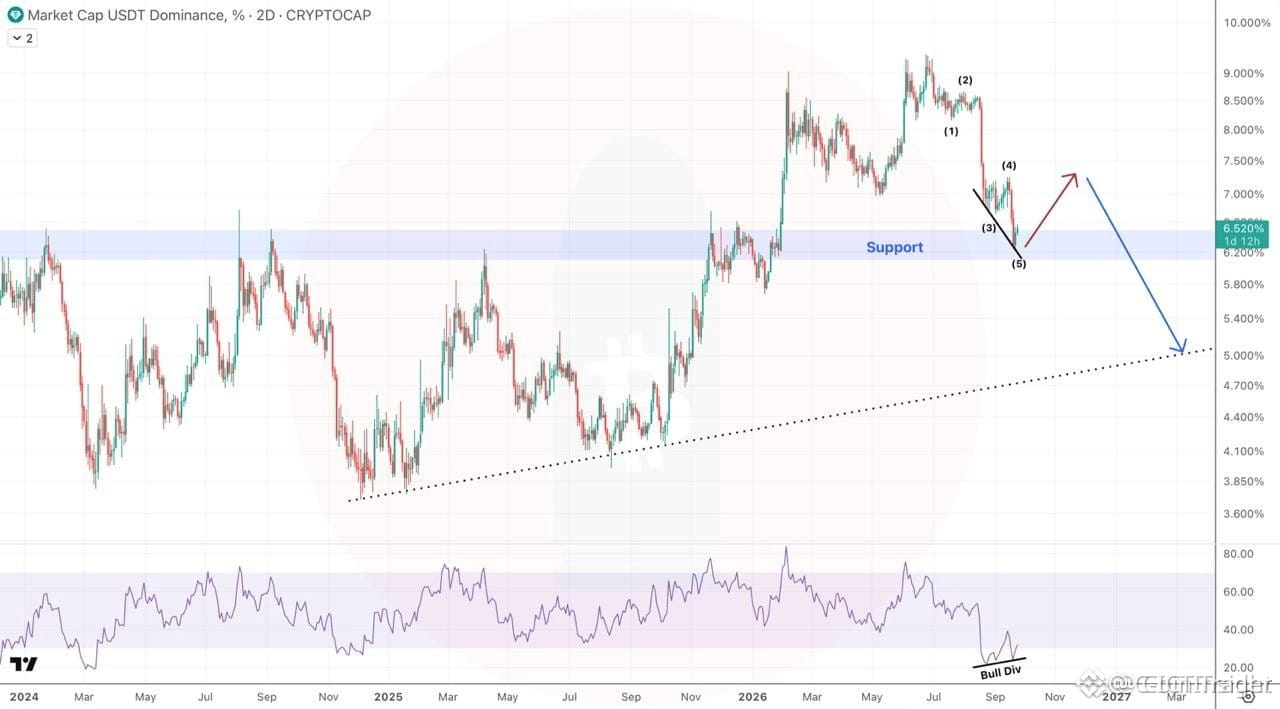
🚨 $USDT .D CONFIRMS BULLISH DIVERGENCE SIGNALING AN IMMINENT CRYPTO PULLBACK! 📉
USDT Dominance is executing a textbook structural rotation as smart money rotates into safety. 📊 The daily RSI has officially locked in a confirmed bullish divergence, signaling momentum exhaustion across broad risk assets.
This relief bounce in $USDT .D aligns directly with our market correction thesis, suggesting liquidity is being drawn away from altcoin order blocks. 🔍 As capital steps back into stablecoins, keep a close eye on key structural demand zones for spot re-accumulation. 💬 Are you hedged for this market cool-off or bidding lower key support levels? 👇
⚠️ Not financial advice. Always manage your risk. 🛡️
🏷️ #USDT .D #Crypto #MarketStructure #Pullback #TechnicalAnalysis
🐻 🔍
🚨 $USDT .D CONFIRMS BULLISH DIVERGENCE SIGNALING AN IMMINENT CRYPTO PULLBACK! 📉
USDT Dominance is executing a textbook structural rotation as smart money rotates into safety. 📊 The daily RSI has officially locked in a confirmed bullish divergence, signaling momentum exhaustion across broad risk assets.
This relief bounce in $USDT .D aligns directly with our market correction thesis, suggesting liquidity is being drawn away from altcoin order blocks. 🔍 As capital steps back into stablecoins, keep a close eye on key structural demand zones for spot re-accumulation. 💬 Are you hedged for this market cool-off or bidding lower key support levels? 👇
⚠️ Not financial advice. Always manage your risk. 🛡️
🏷️ #USDT .D #Crypto #MarketStructure #Pullback #TechnicalAnalysis
🐻 🔍
USDT Dominance is executing a textbook structural rotation as smart money rotates into safety. 📊 The daily RSI has officially locked in a confirmed bullish divergence, signaling momentum exhaustion across broad risk assets.
This relief bounce in $USDT .D aligns directly with our market correction thesis, suggesting liquidity is being drawn away from altcoin order blocks. 🔍 As capital steps back into stablecoins, keep a close eye on key structural demand zones for spot re-accumulation. 💬 Are you hedged for this market cool-off or bidding lower key support levels? 👇
⚠️ Not financial advice. Always manage your risk. 🛡️
🏷️ #USDT .D #Crypto #MarketStructure #Pullback #TechnicalAnalysis
🐻 🔍
6

·
--
Bullish
💵⚡ USDT — stability meets the crypto world! 🌐
A widely used stablecoin for trading, transferring value, and navigating the crypto market. 🚀
Stay informed, trade responsibly, and always DYOR. 📊
#USDT #Tether #Binance #crypto #Stablecoin #blockchain
@eggtartcake_grape
@Eggtartcake_
💵⚡ USDT — stability meets the crypto world! 🌐
A widely used stablecoin for trading, transferring value, and navigating the crypto market. 🚀
Stay informed, trade responsibly, and always DYOR. 📊
#USDT #Tether #Binance #crypto #Stablecoin #blockchain
@Eggtartcake_
@Eggtartcake_
A widely used stablecoin for trading, transferring value, and navigating the crypto market. 🚀
Stay informed, trade responsibly, and always DYOR. 📊
#USDT #Tether #Binance #crypto #Stablecoin #blockchain
@Eggtartcake_
@Eggtartcake_
71

🚨 STABLECOIN YIELD TRAPS EXPOSED AS TOP VENUES CAP APYS ON $USDT AND $USDC ! ⚡
Smart money moves on capital efficiency, but current yield structures on $USDT and $USDC reveal a clear trend: headline APYs like 7% to 10% are strictly gated behind micro-tier caps, while institutional size gets heavily downgraded. 📊
Top-tier exchanges are aggressive on low-tier allocations up to 1,000 units, but yields sharply drop to sub-3% once position size expands. 🔍 Tier caps, hidden fee deductions, and real-time rate adjustments mean passive yield hunters must actively manage capital across liquidity venues to maximize returns. 💡
💬 Are you constantly rotating dry powder across tier caps to optimize APY, or letting large balances sit in lower-yield brackets? 👇
⚠️ Not financial advice. Always manage your risk. 🛡️
🏷️ #USDT #USDC #Stablecoins #YieldFarming #Crypto
🔥 💎
🚨 STABLECOIN YIELD TRAPS EXPOSED AS TOP VENUES CAP APYS ON $USDT AND $USDC ! ⚡
Smart money moves on capital efficiency, but current yield structures on $USDT and $USDC reveal a clear trend: headline APYs like 7% to 10% are strictly gated behind micro-tier caps, while institutional size gets heavily downgraded. 📊
Top-tier exchanges are aggressive on low-tier allocations up to 1,000 units, but yields sharply drop to sub-3% once position size expands. 🔍 Tier caps, hidden fee deductions, and real-time rate adjustments mean passive yield hunters must actively manage capital across liquidity venues to maximize returns. 💡
💬 Are you constantly rotating dry powder across tier caps to optimize APY, or letting large balances sit in lower-yield brackets? 👇
⚠️ Not financial advice. Always manage your risk. 🛡️
🏷️ #USDT #USDC #Stablecoins #YieldFarming #Crypto
🔥 💎
Smart money moves on capital efficiency, but current yield structures on $USDT and $USDC reveal a clear trend: headline APYs like 7% to 10% are strictly gated behind micro-tier caps, while institutional size gets heavily downgraded. 📊
Top-tier exchanges are aggressive on low-tier allocations up to 1,000 units, but yields sharply drop to sub-3% once position size expands. 🔍 Tier caps, hidden fee deductions, and real-time rate adjustments mean passive yield hunters must actively manage capital across liquidity venues to maximize returns. 💡
💬 Are you constantly rotating dry powder across tier caps to optimize APY, or letting large balances sit in lower-yield brackets? 👇
⚠️ Not financial advice. Always manage your risk. 🛡️
🏷️ #USDT #USDC #Stablecoins #YieldFarming #Crypto
🔥 💎
26

HOW SMART MONEY OPTIMIZES UNALLOCATED STABLECOIN LIQUIDITY IN $USDT YIELD TIERS 🏦 📊
Institutional operators carefully monitor yield decay curves on idle stablecoins like $USDT and $USDC across top-tier venues. 🔍 Tiered yield structures heavily favor fragmented micro-allocations, capping premium APYs at low thresholds before stepping down sharply on larger balances.
Maximizing yield efficiency on dry powder requires tactical distribution rather than passive holding in a single pool. 📊 Analyzing real-time interest caps, platform fee deductions, and net yield metrics ensures structural capital preservation while staying fully liquid for high-conviction order block retests. 🤔 How are you structuring your idle stablecoin reserves while waiting for the next structural liquidity sweep?
⚠️ Not financial advice. Always manage your risk. 🛡️
🏷️ #USDT #Stablecoins #YieldStrategy #SmartMoney #Crypto
🎯 🏦
HOW SMART MONEY OPTIMIZES UNALLOCATED STABLECOIN LIQUIDITY IN $USDT YIELD TIERS 🏦 📊
Institutional operators carefully monitor yield decay curves on idle stablecoins like $USDT and $USDC across top-tier venues. 🔍 Tiered yield structures heavily favor fragmented micro-allocations, capping premium APYs at low thresholds before stepping down sharply on larger balances.
Maximizing yield efficiency on dry powder requires tactical distribution rather than passive holding in a single pool. 📊 Analyzing real-time interest caps, platform fee deductions, and net yield metrics ensures structural capital preservation while staying fully liquid for high-conviction order block retests. 🤔 How are you structuring your idle stablecoin reserves while waiting for the next structural liquidity sweep?
⚠️ Not financial advice. Always manage your risk. 🛡️
🏷️ #USDT #Stablecoins #YieldStrategy #SmartMoney #Crypto
🎯 🏦
Institutional operators carefully monitor yield decay curves on idle stablecoins like $USDT and $USDC across top-tier venues. 🔍 Tiered yield structures heavily favor fragmented micro-allocations, capping premium APYs at low thresholds before stepping down sharply on larger balances.
Maximizing yield efficiency on dry powder requires tactical distribution rather than passive holding in a single pool. 📊 Analyzing real-time interest caps, platform fee deductions, and net yield metrics ensures structural capital preservation while staying fully liquid for high-conviction order block retests. 🤔 How are you structuring your idle stablecoin reserves while waiting for the next structural liquidity sweep?
⚠️ Not financial advice. Always manage your risk. 🛡️
🏷️ #USDT #Stablecoins #YieldStrategy #SmartMoney #Crypto
🎯 🏦
3

·
--
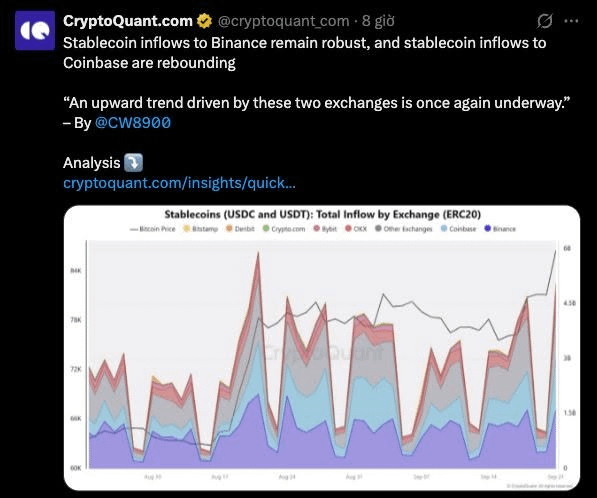
🔥 CRYPTOQUANT HIGHLIGHTS STRONG STABLECOIN FLOWS INTO BINANCE AND COINBASE
CryptoQuant highlights strong stablecoin flows, with USDC and USDT inflows into Binance remaining robust while Coinbase is showing a clear recovery based on ERC-20 onchain data.
The exchange inflow chart from August through September 2026 shows Binance (purple) and Coinbase (light blue) emerging as the main drivers, pushing overall stablecoin liquidity higher.
The data suggests that stablecoin liquidity is once again being led by two major exchanges. Historically, rising stablecoin liquidity can provide a supportive backdrop for Bitcoin and the broader crypto market, although it does not guarantee price increases.
#ThuyBNB
#stablecoin #USDT #USDC
$USDT $USDC $BNB
🔥 CRYPTOQUANT HIGHLIGHTS STRONG STABLECOIN FLOWS INTO BINANCE AND COINBASE
CryptoQuant highlights strong stablecoin flows, with USDC and USDT inflows into Binance remaining robust while Coinbase is showing a clear recovery based on ERC-20 onchain data.
The exchange inflow chart from August through September 2026 shows Binance (purple) and Coinbase (light blue) emerging as the main drivers, pushing overall stablecoin liquidity higher.
The data suggests that stablecoin liquidity is once again being led by two major exchanges. Historically, rising stablecoin liquidity can provide a supportive backdrop for Bitcoin and the broader crypto market, although it does not guarantee price increases.
#ThuyBNB
#stablecoin #USDT #USDC
$USDT $USDC $BNB
CryptoQuant highlights strong stablecoin flows, with USDC and USDT inflows into Binance remaining robust while Coinbase is showing a clear recovery based on ERC-20 onchain data.
The exchange inflow chart from August through September 2026 shows Binance (purple) and Coinbase (light blue) emerging as the main drivers, pushing overall stablecoin liquidity higher.
The data suggests that stablecoin liquidity is once again being led by two major exchanges. Historically, rising stablecoin liquidity can provide a supportive backdrop for Bitcoin and the broader crypto market, although it does not guarantee price increases.
#ThuyBNB
#stablecoin #USDT #USDC
$USDT $USDC $BNB
39

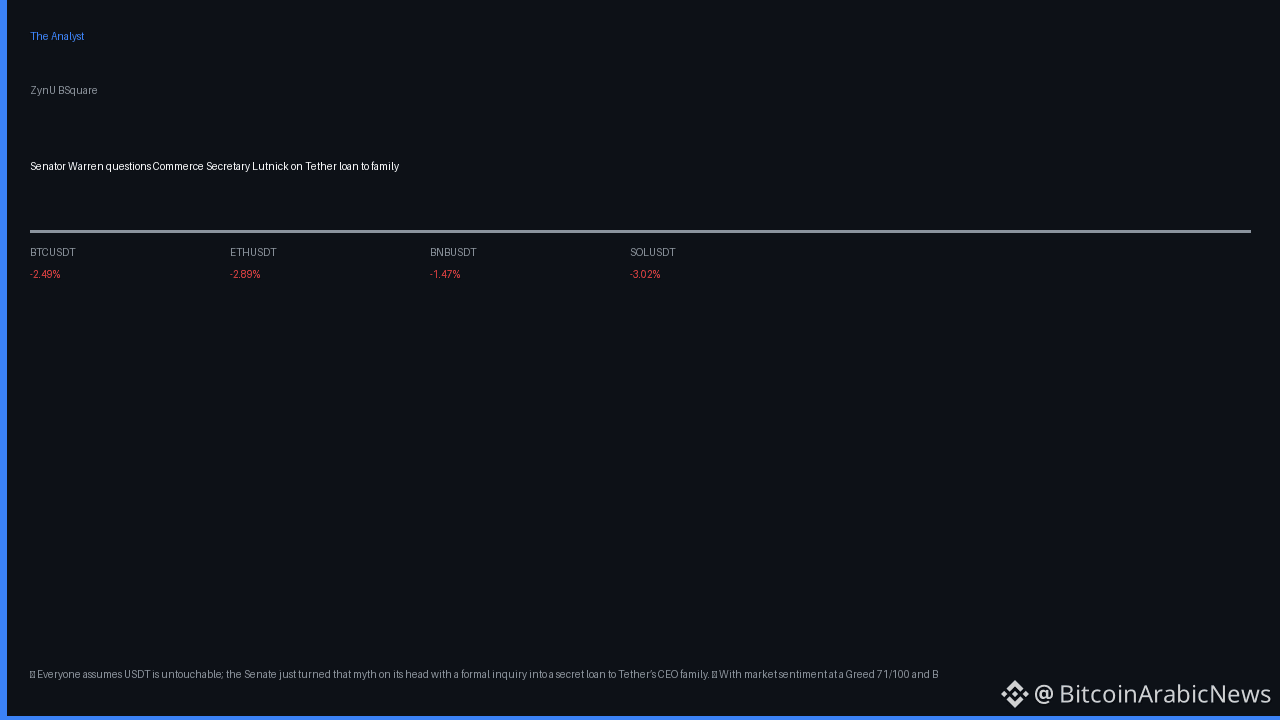
🔥 Everyone assumes USDT is untouchable; the Senate just turned that myth on its head with a formal inquiry into a secret loan to Tether’s CEO family.
📊 With market sentiment at a Greed 71/100 and BTC hovering at $83,471—down 2.49% in 24 h—any crack in the stablecoin foundation instantly ripples through risk‑on assets.
💡 Smart‑money futures still show a 66.2% net‑long bias on BTC (OI $8.03 B, funding +0.0006%) and a 74% net‑long on ETH, but the #USDT #Stablecoin #Regulation spotlight is forcing hedge funds to hedge exposure via BTC futures and pull liquidity from
🔥 Everyone assumes USDT is untouchable; the Senate just turned that myth on its head with a formal inquiry into a secret loan to Tether’s CEO family.
📊 With market sentiment at a Greed 71/100 and BTC hovering at $83,471—down 2.49% in 24 h—any crack in the stablecoin foundation instantly ripples through risk‑on assets.
💡 Smart‑money futures still show a 66.2% net‑long bias on BTC (OI $8.03 B, funding +0.0006%) and a 74% net‑long on ETH, but the #USDT #Stablecoin #Regulation spotlight is forcing hedge funds to hedge exposure via BTC futures and pull liquidity from
📊 With market sentiment at a Greed 71/100 and BTC hovering at $83,471—down 2.49% in 24 h—any crack in the stablecoin foundation instantly ripples through risk‑on assets.
💡 Smart‑money futures still show a 66.2% net‑long bias on BTC (OI $8.03 B, funding +0.0006%) and a 74% net‑long on ETH, but the #USDT #Stablecoin #Regulation spotlight is forcing hedge funds to hedge exposure via BTC futures and pull liquidity from
10

·
--
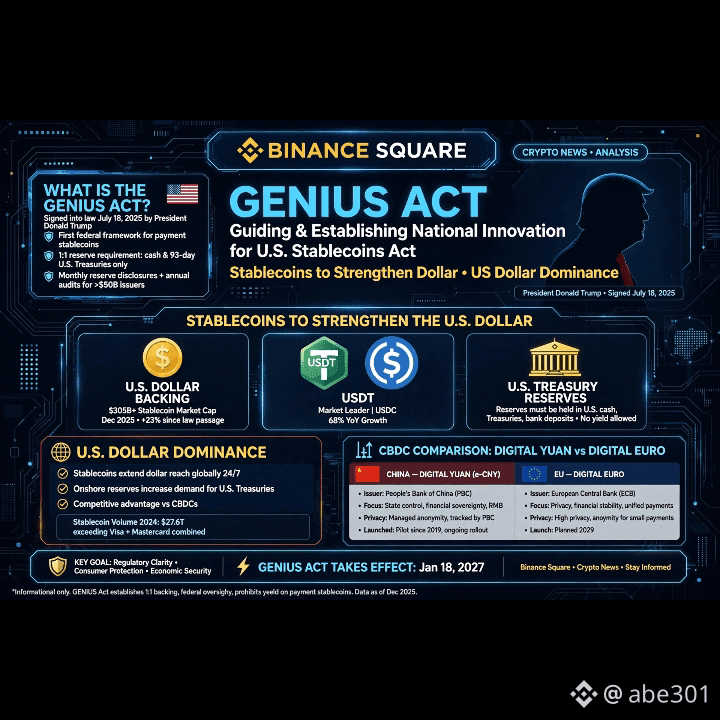
🚨 HUGE: Trump to Push Dollar Stablecoins Globally!
According to Bloomberg, the Trump administration is planning to promote US dollar stablecoins overseas to protect the dollar's dominance as world reserve currency.
The US govt may partner with private crypto firms to boost stablecoin adoption and increase demand for US Treasuries.
This is MASSIVE bullish for $USDT, $USDC and the whole crypto market!
Is this the start of Dollar dominance via Crypto?
#Stablecoin #USDT #CryptoNews #USA
$USDT $USDC $BTC .
🚨 HUGE: Trump to Push Dollar Stablecoins Globally!
According to Bloomberg, the Trump administration is planning to promote US dollar stablecoins overseas to protect the dollar's dominance as world reserve currency.
The US govt may partner with private crypto firms to boost stablecoin adoption and increase demand for US Treasuries.
This is MASSIVE bullish for $USDT, $USDC and the whole crypto market!
Is this the start of Dollar dominance via Crypto?
#Stablecoin #USDT #CryptoNews #USA
$USDT $USDC $BTC .
According to Bloomberg, the Trump administration is planning to promote US dollar stablecoins overseas to protect the dollar's dominance as world reserve currency.
The US govt may partner with private crypto firms to boost stablecoin adoption and increase demand for US Treasuries.
This is MASSIVE bullish for $USDT, $USDC and the whole crypto market!
Is this the start of Dollar dominance via Crypto?
#Stablecoin #USDT #CryptoNews #USA
$USDT $USDC $BTC .
30

·
--
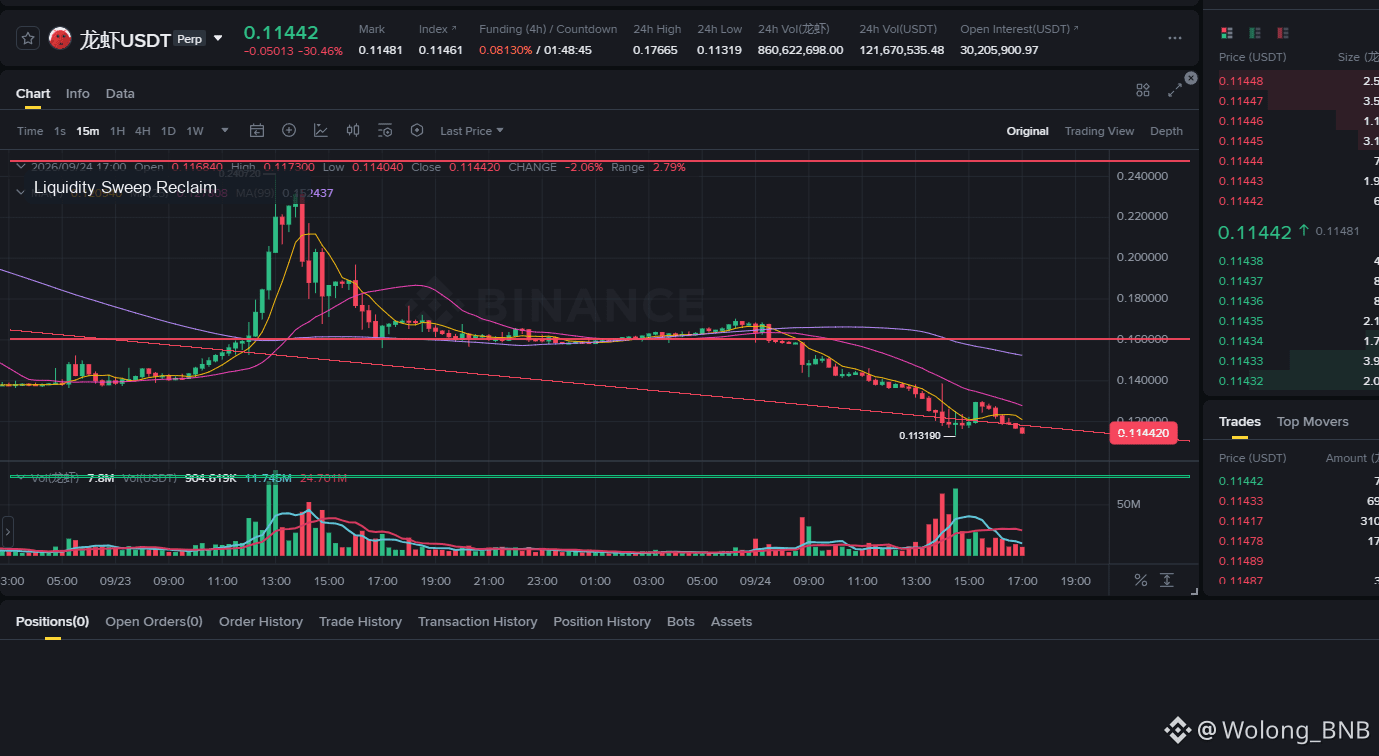
$USDT just swept a key level and reclaimed it.
The 1h/4h context still favors sellers.
For me, the cleaner trade is a rejection around $0.11534–$0.11616, not a late short underneath it. The setup is invalid if price cleanly crosses $0.11851.
Would you take the retest on $USDT, or wait for one more confirmation?
#USDT #Trading
Trade plan: SHORT
Entry: $0.11534 - $0.11616
SL: $0.11851
TP1: $0.11319
TP2: $0.11319
TP3: $0.11319
$USDT just swept a key level and reclaimed it.
The 1h/4h context still favors sellers.
For me, the cleaner trade is a rejection around $0.11534–$0.11616, not a late short underneath it. The setup is invalid if price cleanly crosses $0.11851.
Would you take the retest on $USDT, or wait for one more confirmation?
#USDT #Trading
Trade plan: SHORT
Entry: $0.11534 - $0.11616
SL: $0.11851
TP1: $0.11319
TP2: $0.11319
TP3: $0.11319
The 1h/4h context still favors sellers.
For me, the cleaner trade is a rejection around $0.11534–$0.11616, not a late short underneath it. The setup is invalid if price cleanly crosses $0.11851.
Would you take the retest on $USDT, or wait for one more confirmation?
#USDT #Trading
Trade plan: SHORT
Entry: $0.11534 - $0.11616
SL: $0.11851
TP1: $0.11319
TP2: $0.11319
TP3: $0.11319
1

·
--
🚀 $USDT SET FOR AI‑DRIVEN DEMAND SURGE! 🦈
📊 BlackRock flags that AI agents will act as a catalyst, inflating on‑chain payment traffic and stablecoin utility. 🦈 Institutional pipelines are already aligning, treating $USDT as the primary liquidity conduit for AI‑powered services.
📈 The convergence of AI workloads and blockchain settlement creates a self‑reinforcing loop: higher transaction velocity fuels deeper order‑book depth, while tighter spreads attract more capital. 🔍 Expect the demand curve to tilt bullish as smart‑money channels flow into stablecoin vaults.
💬 How will you position as AI accelerates the stablecoin liquidity engine? 👇
⚠️ Not financial advice. Always manage your risk. 🛡️
🏷️ #USDT #AI #Stablecoin #Liquidity #Crypto
🦈 💎
🚀 $USDT SET FOR AI‑DRIVEN DEMAND SURGE! 🦈
📊 BlackRock flags that AI agents will act as a catalyst, inflating on‑chain payment traffic and stablecoin utility. 🦈 Institutional pipelines are already aligning, treating $USDT as the primary liquidity conduit for AI‑powered services.
📈 The convergence of AI workloads and blockchain settlement creates a self‑reinforcing loop: higher transaction velocity fuels deeper order‑book depth, while tighter spreads attract more capital. 🔍 Expect the demand curve to tilt bullish as smart‑money channels flow into stablecoin vaults.
💬 How will you position as AI accelerates the stablecoin liquidity engine? 👇
⚠️ Not financial advice. Always manage your risk. 🛡️
🏷️ #USDT #AI #Stablecoin #Liquidity #Crypto
🦈 💎
📊 BlackRock flags that AI agents will act as a catalyst, inflating on‑chain payment traffic and stablecoin utility. 🦈 Institutional pipelines are already aligning, treating $USDT as the primary liquidity conduit for AI‑powered services.
📈 The convergence of AI workloads and blockchain settlement creates a self‑reinforcing loop: higher transaction velocity fuels deeper order‑book depth, while tighter spreads attract more capital. 🔍 Expect the demand curve to tilt bullish as smart‑money channels flow into stablecoin vaults.
💬 How will you position as AI accelerates the stablecoin liquidity engine? 👇
⚠️ Not financial advice. Always manage your risk. 🛡️
🏷️ #USDT #AI #Stablecoin #Liquidity #Crypto
🦈 💎
9

·
--
💵 USDT + USDC | Stablecoin Watch — Sep 24
🔹 $USDT : Tether’s USDT remains one of the largest dollar-pegged stablecoins, with deep liquidity and broad use across crypto markets.
🔹 $USDC : Circle reports $74.6B USDC in circulation as of Sep 21, with $74.8B in reserves. Its reserves are designed to remain highly liquid and USDC is redeemable 1:1 for USD.
📌 Key focus: USDT = liquidity & global trading | USDC = transparency & regulated infrastructure
⚠️ Analysis only — not financial advice or a buy signal.
#USDT #USDC #stablecoin #cryptouniverseofficial #Binance
{spot}(USDCUSDT)
💵 USDT + USDC | Stablecoin Watch — Sep 24
🔹 $USDT : Tether’s USDT remains one of the largest dollar-pegged stablecoins, with deep liquidity and broad use across crypto markets.
🔹 $USDC : Circle reports $74.6B USDC in circulation as of Sep 21, with $74.8B in reserves. Its reserves are designed to remain highly liquid and USDC is redeemable 1:1 for USD.
📌 Key focus: USDT = liquidity & global trading | USDC = transparency & regulated infrastructure
⚠️ Analysis only — not financial advice or a buy signal.
#USDT #USDC #stablecoin #cryptouniverseofficial #Binance
🔹 $USDT : Tether’s USDT remains one of the largest dollar-pegged stablecoins, with deep liquidity and broad use across crypto markets.
🔹 $USDC : Circle reports $74.6B USDC in circulation as of Sep 21, with $74.8B in reserves. Its reserves are designed to remain highly liquid and USDC is redeemable 1:1 for USD.
📌 Key focus: USDT = liquidity & global trading | USDC = transparency & regulated infrastructure
⚠️ Analysis only — not financial advice or a buy signal.
#USDT #USDC #stablecoin #cryptouniverseofficial #Binance

25

If you're still treating $USDT and $USDC as the same, stop now.
Most traders miss these flow splits and end up on the wrong side of the next move, watching buying power build while they sit idle or get shaken out.
Last week $USDT net inflows averaged $80.8 million a day, the highest in six months, while $USDC flowed out at $70 million daily. That gap is not noise. Inflows for $USDT rose 17.7 percent month over month as $USDC outflows jumped 27.9 percent. Total stablecoin reserves barely moved, up 0.33 percent to $43.59 billion, and the $USDT exchange supply ratio hit a six-month high of 0.4349.
Some will call this simple rotation between stables with no price impact. I see it as traders consolidating dry powder into $USDT, possibly rotating off $USDC, which has often preceded actual market action.
Where do you think this capital is heading next?
#Stablecoins #Crypto #USDT
If you're still treating $USDT and $USDC as the same, stop now.
Most traders miss these flow splits and end up on the wrong side of the next move, watching buying power build while they sit idle or get shaken out.
Last week $USDT net inflows averaged $80.8 million a day, the highest in six months, while $USDC flowed out at $70 million daily. That gap is not noise. Inflows for $USDT rose 17.7 percent month over month as $USDC outflows jumped 27.9 percent. Total stablecoin reserves barely moved, up 0.33 percent to $43.59 billion, and the $USDT exchange supply ratio hit a six-month high of 0.4349.
Some will call this simple rotation between stables with no price impact. I see it as traders consolidating dry powder into $USDT, possibly rotating off $USDC , which has often preceded actual market action.
Where do you think this capital is heading next?
#Stablecoins #Crypto #USDT
Most traders miss these flow splits and end up on the wrong side of the next move, watching buying power build while they sit idle or get shaken out.
Last week $USDT net inflows averaged $80.8 million a day, the highest in six months, while $USDC flowed out at $70 million daily. That gap is not noise. Inflows for $USDT rose 17.7 percent month over month as $USDC outflows jumped 27.9 percent. Total stablecoin reserves barely moved, up 0.33 percent to $43.59 billion, and the $USDT exchange supply ratio hit a six-month high of 0.4349.
Some will call this simple rotation between stables with no price impact. I see it as traders consolidating dry powder into $USDT, possibly rotating off $USDC , which has often preceded actual market action.
Where do you think this capital is heading next?
#Stablecoins #Crypto #USDT

5

·
--
🚨 US GLOBAL STABLECOIN EXPANSION PLAN DRIVES MASSIVE INSTITUTIONAL LIQUIDITY INTO $USDT AND $USDC ! 🏦
Policy pushes often precede macro structural shifts. Washington promoting USD-backed stablecoins internationally signals a strategic move to solidify dollar dominance through digital rails. 🏦 Smart money reads this as a massive liquidity bridge expanding order flow efficiency.
Expanding global dollar rails creates deep institutional pipelines across crypto markets. 📊 As settlement velocity accelerates, structural inefficiencies in assets like $BTC will fill rapidly under sustained capital injection.
💬 Do you view global USD stablecoin adoption as the ultimate catalyst for institutional macro capital flows? 👇
⚠️ Not financial advice. Always manage your risk. 🛡️
🏷️ #USDT #USDC #Stablecoins #Macro #Crypto
🏦 🔍
🚨 US GLOBAL STABLECOIN EXPANSION PLAN DRIVES MASSIVE INSTITUTIONAL LIQUIDITY INTO $USDT AND $USDC ! 🏦
Policy pushes often precede macro structural shifts. Washington promoting USD-backed stablecoins internationally signals a strategic move to solidify dollar dominance through digital rails. 🏦 Smart money reads this as a massive liquidity bridge expanding order flow efficiency.
Expanding global dollar rails creates deep institutional pipelines across crypto markets. 📊 As settlement velocity accelerates, structural inefficiencies in assets like $BTC will fill rapidly under sustained capital injection.
💬 Do you view global USD stablecoin adoption as the ultimate catalyst for institutional macro capital flows? 👇
⚠️ Not financial advice. Always manage your risk. 🛡️
🏷️ #USDT #USDC #Stablecoins #Macro #Crypto
🏦 🔍
Policy pushes often precede macro structural shifts. Washington promoting USD-backed stablecoins internationally signals a strategic move to solidify dollar dominance through digital rails. 🏦 Smart money reads this as a massive liquidity bridge expanding order flow efficiency.
Expanding global dollar rails creates deep institutional pipelines across crypto markets. 📊 As settlement velocity accelerates, structural inefficiencies in assets like $BTC will fill rapidly under sustained capital injection.
💬 Do you view global USD stablecoin adoption as the ultimate catalyst for institutional macro capital flows? 👇
⚠️ Not financial advice. Always manage your risk. 🛡️
🏷️ #USDT #USDC #Stablecoins #Macro #Crypto
🏦 🔍
26
🚨 US INITIATES STRATEGIC STABLECOIN PUSH TO SECURE GLOBAL DOLLAR LIQUIDITY $USDT 💥
Institutional narrative shifts fast as sovereign entities recognize stablecoin architecture as the primary vehicle for dollar liquidity expansion. 🏦 Under-the-hood backing via short-duration US Treasuries turns private issuance into a permanent bid for national debt instruments, bridging traditional capital rails directly into decentralized rails. 🌊
This structural integration effectively codifies $USDT and $USDC as institutional liquidity conduits across emerging corridors. 🔍 As global macro liquidity seeks frictionless channels, sovereign endorsement validates long-term digital asset settlement infrastructure. 💡
💬 Does state-level stablecoin integration mark the ultimate validation for crypto rail infrastructure? 👇
⚠️ Not financial advice. Always manage your risk. 🛡️
🏷️ #USDT #USDC #Stablecoins #Macro #Crypto
🎯 🦈
🚨 US INITIATES STRATEGIC STABLECOIN PUSH TO SECURE GLOBAL DOLLAR LIQUIDITY $USDT 💥
Institutional narrative shifts fast as sovereign entities recognize stablecoin architecture as the primary vehicle for dollar liquidity expansion. 🏦 Under-the-hood backing via short-duration US Treasuries turns private issuance into a permanent bid for national debt instruments, bridging traditional capital rails directly into decentralized rails. 🌊
This structural integration effectively codifies $USDT and $USDC as institutional liquidity conduits across emerging corridors. 🔍 As global macro liquidity seeks frictionless channels, sovereign endorsement validates long-term digital asset settlement infrastructure. 💡
💬 Does state-level stablecoin integration mark the ultimate validation for crypto rail infrastructure? 👇
⚠️ Not financial advice. Always manage your risk. 🛡️
🏷️ #USDT #USDC #Stablecoins #Macro #Crypto
🎯 🦈
Institutional narrative shifts fast as sovereign entities recognize stablecoin architecture as the primary vehicle for dollar liquidity expansion. 🏦 Under-the-hood backing via short-duration US Treasuries turns private issuance into a permanent bid for national debt instruments, bridging traditional capital rails directly into decentralized rails. 🌊
This structural integration effectively codifies $USDT and $USDC as institutional liquidity conduits across emerging corridors. 🔍 As global macro liquidity seeks frictionless channels, sovereign endorsement validates long-term digital asset settlement infrastructure. 💡
💬 Does state-level stablecoin integration mark the ultimate validation for crypto rail infrastructure? 👇
⚠️ Not financial advice. Always manage your risk. 🛡️
🏷️ #USDT #USDC #Stablecoins #Macro #Crypto
🎯 🦈
4

US PLANS OVERSEAS $USDT AND $USDC EXPANSION TO SECURE GLOBAL DOLLAR DOMINANCE 🏦 ⚡
Institutional order flow isn't just playing out on crypto charts—it is driving sovereign monetary strategy. Reports reveal the US is evaluating plans to push dollar-pegged stablecoins like $USDT across foreign markets to fortify reserve currency status. 🏦
This structural shift effectively turns public blockchain rails into global liquidity distribution networks for US debt instruments. 🔍 As sovereign liquidity channels expand globally, institutional adoption will permanently redefine macro digital asset dynamics. 📊
Will sovereign stablecoin integration accelerate global crypto adoption, or will regulatory rails constrain decentralization? 👇
⚠️ Not financial advice. Always manage your risk. 🛡️
🏷️ #USDT #Stablecoins #Macro #USDC #Crypto
🏛️ ⚖️
US PLANS OVERSEAS $USDT AND $USDC EXPANSION TO SECURE GLOBAL DOLLAR DOMINANCE 🏦 ⚡
Institutional order flow isn't just playing out on crypto charts—it is driving sovereign monetary strategy. Reports reveal the US is evaluating plans to push dollar-pegged stablecoins like $USDT across foreign markets to fortify reserve currency status. 🏦
This structural shift effectively turns public blockchain rails into global liquidity distribution networks for US debt instruments. 🔍 As sovereign liquidity channels expand globally, institutional adoption will permanently redefine macro digital asset dynamics. 📊
Will sovereign stablecoin integration accelerate global crypto adoption, or will regulatory rails constrain decentralization? 👇
⚠️ Not financial advice. Always manage your risk. 🛡️
🏷️ #USDT #Stablecoins #Macro #USDC #Crypto
🏛️ ⚖️
Institutional order flow isn't just playing out on crypto charts—it is driving sovereign monetary strategy. Reports reveal the US is evaluating plans to push dollar-pegged stablecoins like $USDT across foreign markets to fortify reserve currency status. 🏦
This structural shift effectively turns public blockchain rails into global liquidity distribution networks for US debt instruments. 🔍 As sovereign liquidity channels expand globally, institutional adoption will permanently redefine macro digital asset dynamics. 📊
Will sovereign stablecoin integration accelerate global crypto adoption, or will regulatory rails constrain decentralization? 👇
⚠️ Not financial advice. Always manage your risk. 🛡️
🏷️ #USDT #Stablecoins #Macro #USDC #Crypto
🏛️ ⚖️

9

·
--
US STRATEGY LEVERAGES $USDT AND $USDC TO CEMENT GLOBAL DOLLAR HEGEMONY! 🚨 🏦
The ultimate liquidity play is unfolding on the macro stage as Washington looks to weaponize offshore digital dollar expansion. 🏦 By exporting dollar-backed stablecoins worldwide, policymakers are actively laying the rails to entrench dollar dominance across emerging markets. 💡
This structural shift turns $USDT into a global monetary bridge, injecting unprecedented institutional validation into blockchain settlement layers. 📈 Capital flows thrive on clarity, and an aggressive dollar expansion could be the ultimate catalyst for broad market liquidity. 💬 Does this global push solidify crypto as the future of sovereign finance? 👇
⚠️ Not financial advice. Always manage your risk. 🛡️
🏷️ #USDT #USDC #Macro #Stablecoins #Crypto
🔥 ⚡
US STRATEGY LEVERAGES $USDT AND $USDC TO CEMENT GLOBAL DOLLAR HEGEMONY! 🚨 🏦
The ultimate liquidity play is unfolding on the macro stage as Washington looks to weaponize offshore digital dollar expansion. 🏦 By exporting dollar-backed stablecoins worldwide, policymakers are actively laying the rails to entrench dollar dominance across emerging markets. 💡
This structural shift turns $USDT into a global monetary bridge, injecting unprecedented institutional validation into blockchain settlement layers. 📈 Capital flows thrive on clarity, and an aggressive dollar expansion could be the ultimate catalyst for broad market liquidity. 💬 Does this global push solidify crypto as the future of sovereign finance? 👇
⚠️ Not financial advice. Always manage your risk. 🛡️
🏷️ #USDT #USDC #Macro #Stablecoins #Crypto
🔥 ⚡
The ultimate liquidity play is unfolding on the macro stage as Washington looks to weaponize offshore digital dollar expansion. 🏦 By exporting dollar-backed stablecoins worldwide, policymakers are actively laying the rails to entrench dollar dominance across emerging markets. 💡
This structural shift turns $USDT into a global monetary bridge, injecting unprecedented institutional validation into blockchain settlement layers. 📈 Capital flows thrive on clarity, and an aggressive dollar expansion could be the ultimate catalyst for broad market liquidity. 💬 Does this global push solidify crypto as the future of sovereign finance? 👇
⚠️ Not financial advice. Always manage your risk. 🛡️
🏷️ #USDT #USDC #Macro #Stablecoins #Crypto
🔥 ⚡

15
Log in to explore more content
Join global crypto users on Binance Square
⚡️ Get latest and useful information about crypto.
💬 Trusted by the world’s largest crypto exchange.
👍 Discover real insights from verified creators.
Email / Phone number
Trending Topics
1
#BinanceWillListHyperliquid(HYPE)
80,284 views
1,898 Discussing
2
#FedOctoberRateHikeOddsRiseTo69.7%
17,556 views
703 Discussing
3
#BitcoinFallsBelow$83,000
2,580 views
20 Discussing
4
#BitcoinFallsToAround$84,600ThisWeek
0 views
0 Discussing
5
#US30YearYieldHighestSince2004
19,274 views
572 Discussing
6
#ETHBreaksAbove$2,700
1,245 views
20 Discussing
7
#USWeighsPromotingDollarStablecoinsAbroad
50,341 views
1,466 Discussing
8
#US10YTreasuryYieldHits19YearHigh
51,380 views
1,181 Discussing
9
#SpotBitcoinETFsInflow$2.31BInFourDays
6,088 views
69 Discussing
10
#BitcoinRejectedAt$87,300Twice
0 views
0 Discussing