
#blockchain
blockchain
34.6M views
161,092 Discussing
Hot
Latest

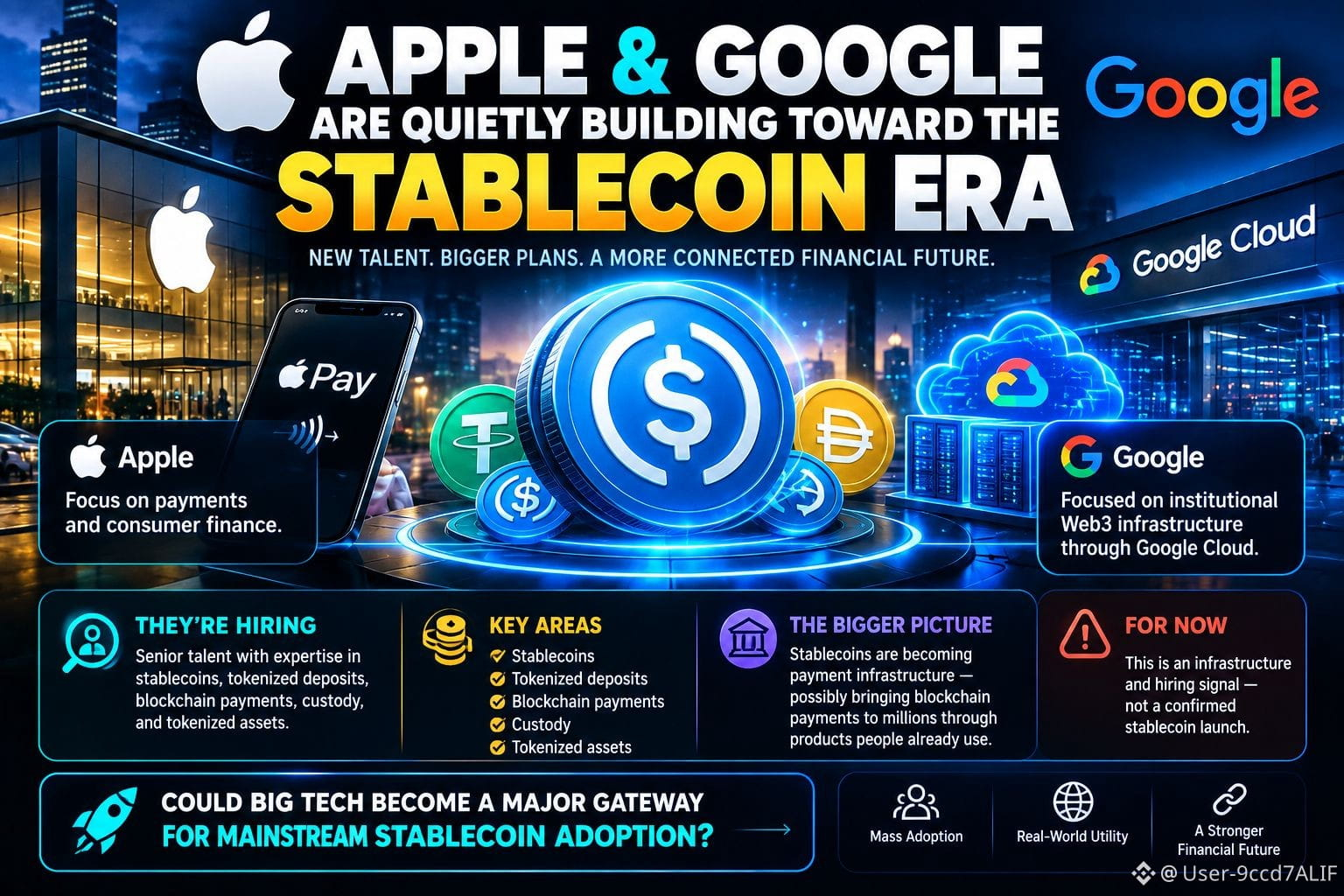
🚨 APPLE & GOOGLE ARE QUIETLY BUILDING TOWARD THE STABLECOIN ERA
Apple and Google are reportedly hiring senior talent with expertise in stablecoins, tokenized deposits, blockchain payments, custody, and tokenized assets.
🔹 Apple: Focus appears connected to payments and consumer finance
🔹 Google: More focused on institutional Web3 infrastructure through Google Cloud
🔹 Neither company has announced its own stablecoin yet.
💡 Why It Matters:
Stablecoins are increasingly becoming payment infrastructure, potentially bringing blockchain-based payments to millions of users through products they already use.
⚠️ For now, this is an infrastructure and hiring signal—not a confirmed stablecoin launch.
👀 Could Big Tech become a major gateway for mainstream stablecoin adoption?
#Apple #Google #Crypto
#blockchain #BinanceSquare
🚨 APPLE & GOOGLE ARE QUIETLY BUILDING TOWARD THE STABLECOIN ERA
Apple and Google are reportedly hiring senior talent with expertise in stablecoins, tokenized deposits, blockchain payments, custody, and tokenized assets.
🔹 Apple: Focus appears connected to payments and consumer finance
🔹 Google: More focused on institutional Web3 infrastructure through Google Cloud
🔹 Neither company has announced its own stablecoin yet.
💡 Why It Matters:
Stablecoins are increasingly becoming payment infrastructure, potentially bringing blockchain-based payments to millions of users through products they already use.
⚠️ For now, this is an infrastructure and hiring signal—not a confirmed stablecoin launch.
👀 Could Big Tech become a major gateway for mainstream stablecoin adoption?
#Apple #Google #Crypto
#blockchain #BinanceSquare
Apple and Google are reportedly hiring senior talent with expertise in stablecoins, tokenized deposits, blockchain payments, custody, and tokenized assets.
🔹 Apple: Focus appears connected to payments and consumer finance
🔹 Google: More focused on institutional Web3 infrastructure through Google Cloud
🔹 Neither company has announced its own stablecoin yet.
💡 Why It Matters:
Stablecoins are increasingly becoming payment infrastructure, potentially bringing blockchain-based payments to millions of users through products they already use.
⚠️ For now, this is an infrastructure and hiring signal—not a confirmed stablecoin launch.
👀 Could Big Tech become a major gateway for mainstream stablecoin adoption?
#Apple #Google #Crypto
#blockchain #BinanceSquare
27

🚨 WALL STREET IS GOING ON-CHAIN. ⛓️🇺🇸
TODAY marks a major step for tokenized securities.
The SEC’s five-year conditional exemption window for tokenized-stock trading begins today, allowing certain trading venues to pilot U.S. stocks on public blockchains. 👀
Think about what this means:
🏦 Traditional stocks
⛓️ Public blockchains
🌐 On-chain infrastructure
⚡ New ways to move and settle assets
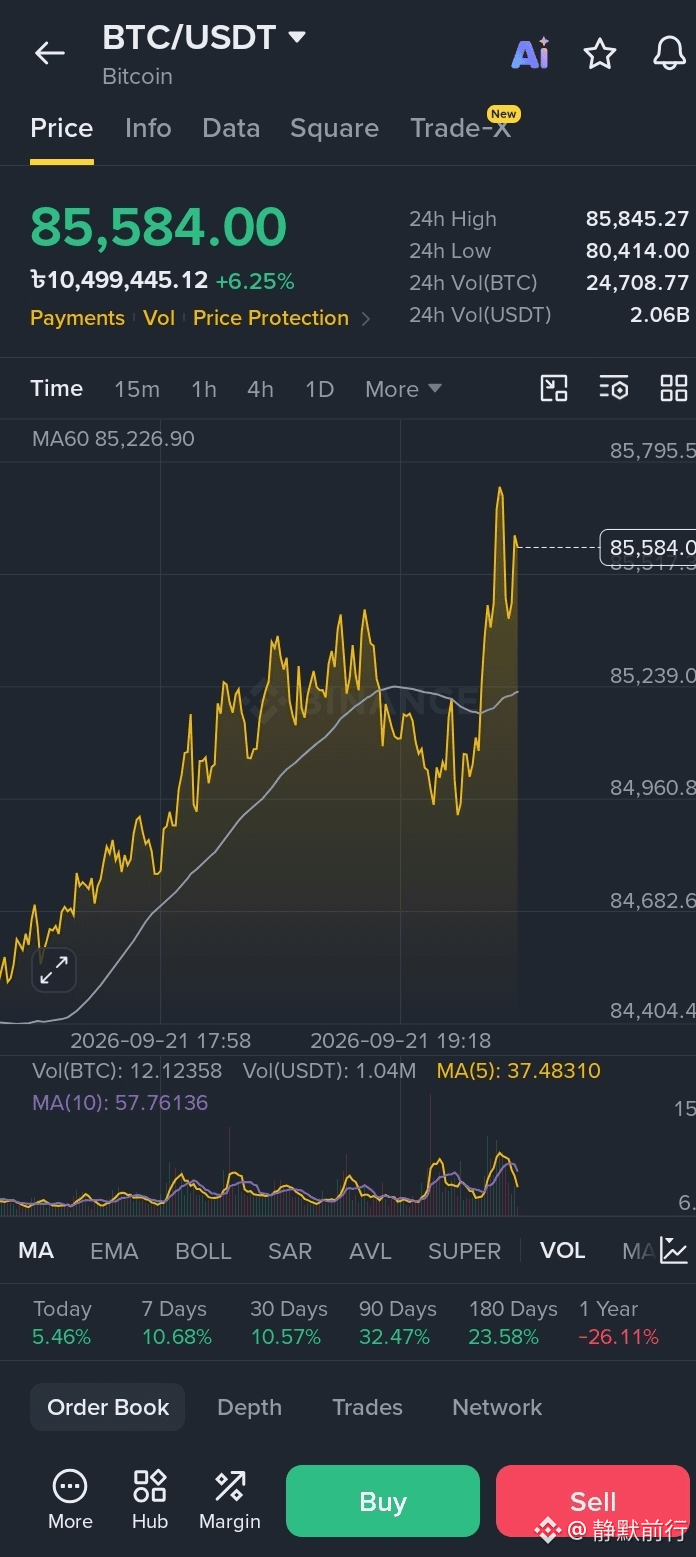
And this comes while Bitcoin is making a strong comeback, with BTC pushing above $85K and major altcoins also rallying.
The bigger story may not be one specific token.
It may be the gradual connection between traditional finance and blockchain infrastructure.
Bitcoin started the digital-asset revolution.
Now blockchain technology is moving deeper into traditional markets.
Are tokenized stocks the next major crypto narrative? 👀
#crypto #Tokenization #blockchain #bitcoin #BinanceSquare
🚨 WALL STREET IS GOING ON-CHAIN. ⛓️🇺🇸
TODAY marks a major step for tokenized securities.
The SEC’s five-year conditional exemption window for tokenized-stock trading begins today, allowing certain trading venues to pilot U.S. stocks on public blockchains. 👀
Think about what this means:
🏦 Traditional stocks
⛓️ Public blockchains
🌐 On-chain infrastructure
⚡ New ways to move and settle assets
And this comes while Bitcoin is making a strong comeback, with BTC pushing above $85K and major altcoins also rallying.
The bigger story may not be one specific token.
It may be the gradual connection between traditional finance and blockchain infrastructure.
Bitcoin started the digital-asset revolution.
Now blockchain technology is moving deeper into traditional markets.
Are tokenized stocks the next major crypto narrative? 👀
#crypto #Tokenization #blockchain #bitcoin #BinanceSquare
TODAY marks a major step for tokenized securities.
The SEC’s five-year conditional exemption window for tokenized-stock trading begins today, allowing certain trading venues to pilot U.S. stocks on public blockchains. 👀
Think about what this means:
🏦 Traditional stocks
⛓️ Public blockchains
🌐 On-chain infrastructure
⚡ New ways to move and settle assets
And this comes while Bitcoin is making a strong comeback, with BTC pushing above $85K and major altcoins also rallying.
The bigger story may not be one specific token.
It may be the gradual connection between traditional finance and blockchain infrastructure.
Bitcoin started the digital-asset revolution.
Now blockchain technology is moving deeper into traditional markets.
Are tokenized stocks the next major crypto narrative? 👀
#crypto #Tokenization #blockchain #bitcoin #BinanceSquare
75

🚨 LATEST: 🇺🇸 APPLE & GOOGLE ARE HIRING FOR CRYPTO EXPERTISE
Apple has posted a senior Apple Pay strategy role that lists stablecoins, tokenized deposits and blockchain technology among preferred qualifications.
Google Cloud is also hiring a senior Web3 architect to work with digital-asset clients, financial institutions, exchanges and custodians across Asia-Pacific. The role specifically includes stablecoin rails, tokenized deposits and RWA tokenization.
This is bigger than two job postings.
Two of the world's largest technology companies are actively building deeper expertise around the infrastructure behind the next generation of digital finance.
Apple → consumer payments
Google Cloud → institutional digital assets
Stablecoins → tokenized money
Blockchain → financial infrastructure
Neither company has announced plans to launch its own stablecoin.
But the hiring signal is impossible to ignore:
Crypto infrastructure is moving deeper into Big Tech.
The next wave of adoption may not come from crypto companies alone.
It could come through the products billions of people already use.
#Bitcoin #Crypto #Stablecoins #Blockchain #Fintech
🚨 LATEST: 🇺🇸 APPLE & GOOGLE ARE HIRING FOR CRYPTO EXPERTISE
Apple has posted a senior Apple Pay strategy role that lists stablecoins, tokenized deposits and blockchain technology among preferred qualifications.
Google Cloud is also hiring a senior Web3 architect to work with digital-asset clients, financial institutions, exchanges and custodians across Asia-Pacific. The role specifically includes stablecoin rails, tokenized deposits and RWA tokenization.
This is bigger than two job postings.
Two of the world's largest technology companies are actively building deeper expertise around the infrastructure behind the next generation of digital finance.
Apple → consumer payments
Google Cloud → institutional digital assets
Stablecoins → tokenized money
Blockchain → financial infrastructure
Neither company has announced plans to launch its own stablecoin.
But the hiring signal is impossible to ignore:
Crypto infrastructure is moving deeper into Big Tech.
The next wave of adoption may not come from crypto companies alone.
It could come through the products billions of people already use.
#Bitcoin #Crypto #Stablecoins #Blockchain #Fintech
Apple has posted a senior Apple Pay strategy role that lists stablecoins, tokenized deposits and blockchain technology among preferred qualifications.
Google Cloud is also hiring a senior Web3 architect to work with digital-asset clients, financial institutions, exchanges and custodians across Asia-Pacific. The role specifically includes stablecoin rails, tokenized deposits and RWA tokenization.
This is bigger than two job postings.
Two of the world's largest technology companies are actively building deeper expertise around the infrastructure behind the next generation of digital finance.
Apple → consumer payments
Google Cloud → institutional digital assets
Stablecoins → tokenized money
Blockchain → financial infrastructure
Neither company has announced plans to launch its own stablecoin.
But the hiring signal is impossible to ignore:
Crypto infrastructure is moving deeper into Big Tech.
The next wave of adoption may not come from crypto companies alone.
It could come through the products billions of people already use.
#Bitcoin #Crypto #Stablecoins #Blockchain #Fintech

1
63

·
--
Blockchain mempool: the waiting room before confirmation.
A mempool—short for memory pool—is where a node keeps valid but unconfirmed transactions before they are included in a block.
How the flow works:
1. You sign and broadcast a transaction.
2. Nodes validate its format, signature, balance and fee rules.
3. Valid transactions enter the node’s mempool and propagate across the network.
4. A miner or validator selects transactions for a block.
5. After confirmation, the transaction leaves the mempool and becomes part of the blockchain’s history.
What mempool activity can reveal:
• Fee pressure: many pending transactions can push fees higher.
• Network demand: a growing queue may signal increased usage—but not necessarily bullish price action.
• Replacement activity: some networks allow a sender to replace a pending transaction with a higher fee.
• Transaction priority: block producers generally prefer transactions offering better fee economics.
Important caveats:
• There is no single universal mempool. Each node sees its own local view.
• A transaction in the mempool is not final. It can be delayed, rejected or replaced.
• Mempool data is not the same as confirmed on-chain activity.
• Never share private keys or seed phrases to “speed up” a transaction.
For users, check the transaction ID on the relevant block explorer. For developers, mempool monitoring helps explain fee markets, congestion and transaction propagation.
Learn the fundamentals before building or trading on-chain.
Educational content only. Not financial advice.
#Blockchain #Mempool #CryptoEducation #BinanceAngels
Blockchain mempool: the waiting room before confirmation.
A mempool—short for memory pool—is where a node keeps valid but unconfirmed transactions before they are included in a block.
How the flow works:
1. You sign and broadcast a transaction.
2. Nodes validate its format, signature, balance and fee rules.
3. Valid transactions enter the node’s mempool and propagate across the network.
4. A miner or validator selects transactions for a block.
5. After confirmation, the transaction leaves the mempool and becomes part of the blockchain’s history.
What mempool activity can reveal:
• Fee pressure: many pending transactions can push fees higher.
• Network demand: a growing queue may signal increased usage—but not necessarily bullish price action.
• Replacement activity: some networks allow a sender to replace a pending transaction with a higher fee.
• Transaction priority: block producers generally prefer transactions offering better fee economics.
Important caveats:
• There is no single universal mempool. Each node sees its own local view.
• A transaction in the mempool is not final. It can be delayed, rejected or replaced.
• Mempool data is not the same as confirmed on-chain activity.
• Never share private keys or seed phrases to “speed up” a transaction.
For users, check the transaction ID on the relevant block explorer. For developers, mempool monitoring helps explain fee markets, congestion and transaction propagation.
Learn the fundamentals before building or trading on-chain.
Educational content only. Not financial advice.
#Blockchain #Mempool #CryptoEducation #BinanceAngels
A mempool—short for memory pool—is where a node keeps valid but unconfirmed transactions before they are included in a block.
How the flow works:
1. You sign and broadcast a transaction.
2. Nodes validate its format, signature, balance and fee rules.
3. Valid transactions enter the node’s mempool and propagate across the network.
4. A miner or validator selects transactions for a block.
5. After confirmation, the transaction leaves the mempool and becomes part of the blockchain’s history.
What mempool activity can reveal:
• Fee pressure: many pending transactions can push fees higher.
• Network demand: a growing queue may signal increased usage—but not necessarily bullish price action.
• Replacement activity: some networks allow a sender to replace a pending transaction with a higher fee.
• Transaction priority: block producers generally prefer transactions offering better fee economics.
Important caveats:
• There is no single universal mempool. Each node sees its own local view.
• A transaction in the mempool is not final. It can be delayed, rejected or replaced.
• Mempool data is not the same as confirmed on-chain activity.
• Never share private keys or seed phrases to “speed up” a transaction.
For users, check the transaction ID on the relevant block explorer. For developers, mempool monitoring helps explain fee markets, congestion and transaction propagation.
Learn the fundamentals before building or trading on-chain.
Educational content only. Not financial advice.
#Blockchain #Mempool #CryptoEducation #BinanceAngels
58

Verified
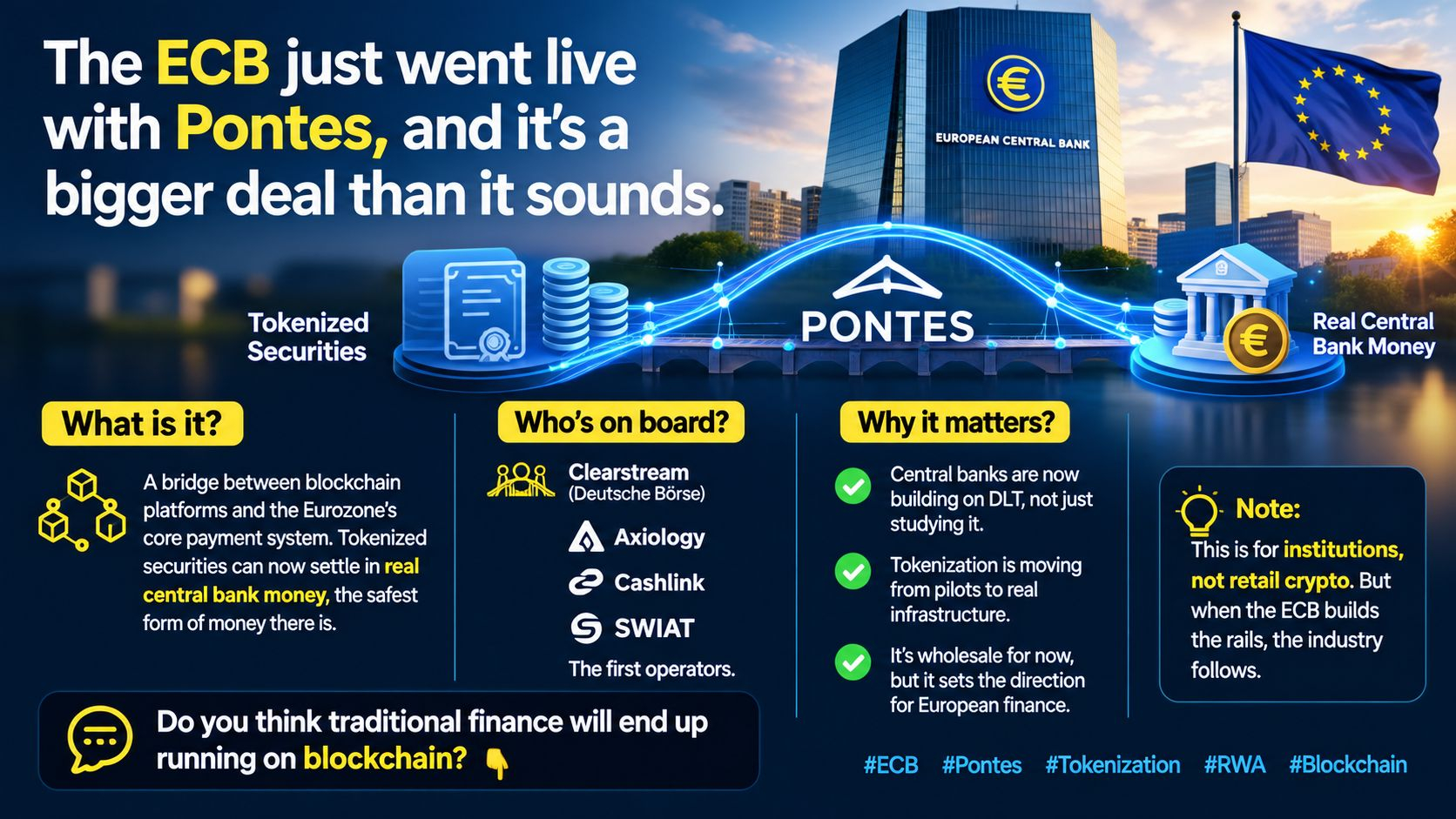
🏦 The ECB just went live with Pontes, and it's a bigger deal than it sounds.
**What is it?**
A bridge between blockchain platforms and the Eurozone's core payment system. Tokenized securities can now settle in real central bank money, the safest form of money there is.
**Who's on board?**
Clearstream (Deutsche Börse), Axiology, Cashlink and SWIAT are the first operators.
**Why it matters:**
✅ Central banks are now building on DLT, not just studying it
✅ Tokenization is moving from pilots to real infrastructure
✅ It's wholesale for now, but it sets the direction for European finance
Note: this is for institutions, not retail crypto. But when the ECB builds the rails, the industry follows.
Do you think traditional finance will end up running on blockchain? 👇
#ECB #Pontes #Tokenization #RWA #Blockchain
$AKE
{future}(AKEUSDT)
$SUI
{future}(SUIUSDT)
$DOT
{future}(DOTUSDT)
🏦 The ECB just went live with Pontes, and it's a bigger deal than it sounds.
**What is it?**
A bridge between blockchain platforms and the Eurozone's core payment system. Tokenized securities can now settle in real central bank money, the safest form of money there is.
**Who's on board?**
Clearstream (Deutsche Börse), Axiology, Cashlink and SWIAT are the first operators.
**Why it matters:**
✅ Central banks are now building on DLT, not just studying it
✅ Tokenization is moving from pilots to real infrastructure
✅ It's wholesale for now, but it sets the direction for European finance
Note: this is for institutions, not retail crypto. But when the ECB builds the rails, the industry follows.
Do you think traditional finance will end up running on blockchain? 👇
#ECB #Pontes #Tokenization #RWA #Blockchain
$AKE
$SUI
$DOT
**What is it?**
A bridge between blockchain platforms and the Eurozone's core payment system. Tokenized securities can now settle in real central bank money, the safest form of money there is.
**Who's on board?**
Clearstream (Deutsche Börse), Axiology, Cashlink and SWIAT are the first operators.
**Why it matters:**
✅ Central banks are now building on DLT, not just studying it
✅ Tokenization is moving from pilots to real infrastructure
✅ It's wholesale for now, but it sets the direction for European finance
Note: this is for institutions, not retail crypto. But when the ECB builds the rails, the industry follows.
Do you think traditional finance will end up running on blockchain? 👇
#ECB #Pontes #Tokenization #RWA #Blockchain
$AKE
$SUI
$DOT
505

·
--
Verified
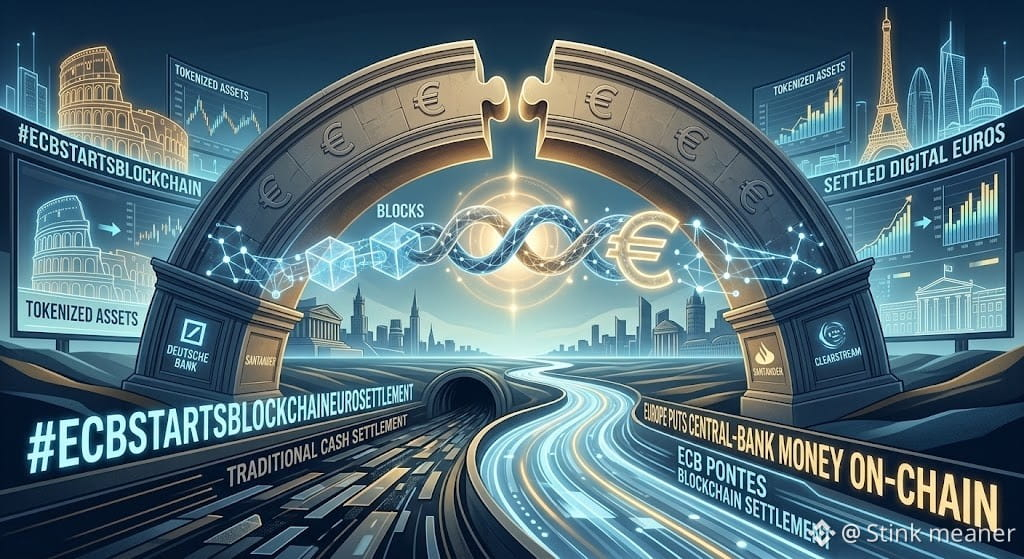
🔥🚨Europe Just Put Central-Bank Money On-Chain...
#ecbstartsblockchaineurosettlement
The ECB just launched Pontes, connecting blockchain-based financial markets to settlement in ECB-backed euros.
That changes the equation for tokenized finance.
Until now, a tokenized bond can live on a blockchain while the cash leg still depends on traditional settlement infrastructure.
Pontes is designed to close that gap:
tokenized asset
→ blockchain transaction
→ central-bank money settlement
And the ECB isn't doing this as a crypto experiment.
Deutsche Bank, Santander and Clearstream are among the first participants. The initial service runs during European business hours, with expanded functionality planned over time.
The deeper signal is what comes next.
The ECB says its 2024 experiments covered 50 trials across nine jurisdictions and roughly €1.6B of transactions, finding demand for central-bank money as the settlement anchor for tokenized markets.
So Europe isn't simply putting assets on-chain.
It's putting the risk-free settlement layer on-chain too.
And that creates the bigger question:
If central-bank money can move on the same rails as tokenized assets, how much of today's stablecoin settlement infrastructure eventually becomes optional?
$ETH $USDC $XRP
#TokenizedAssests #RWA #blockchain
🔥🚨Europe Just Put Central-Bank Money On-Chain...
#ecbstartsblockchaineurosettlement
The ECB just launched Pontes, connecting blockchain-based financial markets to settlement in ECB-backed euros.
That changes the equation for tokenized finance.
Until now, a tokenized bond can live on a blockchain while the cash leg still depends on traditional settlement infrastructure.
Pontes is designed to close that gap:
tokenized asset
→ blockchain transaction
→ central-bank money settlement
And the ECB isn't doing this as a crypto experiment.
Deutsche Bank, Santander and Clearstream are among the first participants. The initial service runs during European business hours, with expanded functionality planned over time.
The deeper signal is what comes next.
The ECB says its 2024 experiments covered 50 trials across nine jurisdictions and roughly €1.6B of transactions, finding demand for central-bank money as the settlement anchor for tokenized markets.
So Europe isn't simply putting assets on-chain.
It's putting the risk-free settlement layer on-chain too.
And that creates the bigger question:
If central-bank money can move on the same rails as tokenized assets, how much of today's stablecoin settlement infrastructure eventually becomes optional?
$ETH $USDC $XRP
#TokenizedAssests #RWA #blockchain
#ecbstartsblockchaineurosettlement
The ECB just launched Pontes, connecting blockchain-based financial markets to settlement in ECB-backed euros.
That changes the equation for tokenized finance.
Until now, a tokenized bond can live on a blockchain while the cash leg still depends on traditional settlement infrastructure.
Pontes is designed to close that gap:
tokenized asset
→ blockchain transaction
→ central-bank money settlement
And the ECB isn't doing this as a crypto experiment.
Deutsche Bank, Santander and Clearstream are among the first participants. The initial service runs during European business hours, with expanded functionality planned over time.
The deeper signal is what comes next.
The ECB says its 2024 experiments covered 50 trials across nine jurisdictions and roughly €1.6B of transactions, finding demand for central-bank money as the settlement anchor for tokenized markets.
So Europe isn't simply putting assets on-chain.
It's putting the risk-free settlement layer on-chain too.
And that creates the bigger question:
If central-bank money can move on the same rails as tokenized assets, how much of today's stablecoin settlement infrastructure eventually becomes optional?
$ETH $USDC $XRP
#TokenizedAssests #RWA #blockchain
4
1.7k

·
--
Bullish
{spot}(BTCUSDT)
🚨 Bitcoin Is More Than Just a Price!
When people hear “Bitcoin,” most immediately think about its price. 📈📉
But Bitcoin is also about decentralization, blockchain technology, limited supply, and a new way of thinking about digital money.
The real question is:
Do you understand Bitcoin—or are you just watching its price? 👀
🧠 Learn first. Research carefully. Make your own decisions.
#Bitcoin #BTC #Crypto #blockchain #BinanceSquare
🚨 Bitcoin Is More Than Just a Price!
When people hear “Bitcoin,” most immediately think about its price. 📈📉
But Bitcoin is also about decentralization, blockchain technology, limited supply, and a new way of thinking about digital money.
The real question is:
Do you understand Bitcoin—or are you just watching its price? 👀
🧠 Learn first. Research carefully. Make your own decisions.
#Bitcoin #BTC #Crypto #blockchain #BinanceSquare
When people hear “Bitcoin,” most immediately think about its price. 📈📉
But Bitcoin is also about decentralization, blockchain technology, limited supply, and a new way of thinking about digital money.
The real question is:
Do you understand Bitcoin—or are you just watching its price? 👀
🧠 Learn first. Research carefully. Make your own decisions.
#Bitcoin #BTC #Crypto #blockchain #BinanceSquare
51

·
--
🚨 ECB Blockchain Euro Update 🇪🇺
The ECB is moving forward with blockchain-based euro settlement, highlighting the growing connection between traditional finance and blockchain technology. 🌐💶
This could be an important step toward faster, more efficient digital settlement infrastructure. Crypto and blockchain adoption continues to evolve! 👀
$ETH
{spot}(ETHUSDT)
#Crypto #Blockchain #Ethereum #ECBStartsBlockchainEuroSettlement
🚨 ECB Blockchain Euro Update 🇪🇺
The ECB is moving forward with blockchain-based euro settlement, highlighting the growing connection between traditional finance and blockchain technology. 🌐💶
This could be an important step toward faster, more efficient digital settlement infrastructure. Crypto and blockchain adoption continues to evolve! 👀
$ETH
#Crypto #Blockchain #Ethereum #ECBStartsBlockchainEuroSettlement
The ECB is moving forward with blockchain-based euro settlement, highlighting the growing connection between traditional finance and blockchain technology. 🌐💶
This could be an important step toward faster, more efficient digital settlement infrastructure. Crypto and blockchain adoption continues to evolve! 👀
$ETH
#Crypto #Blockchain #Ethereum #ECBStartsBlockchainEuroSettlement
1
35

Traditional bond settlement has long been plagued by sluggish multi-day delays and heavy intermediary costs. Hana Bank just shattered this bottleneck by issuing South Korea's premier digital foreign-currency bond via Euroclear's blockchain. Trimming a three-to-five-day wait down to instant same-day settlement proves enterprise blockchain is moving past hype into practical treasury execution. Expect more major Asian financial institutions to tokenize debt instruments soon. #Blockchain #Tokenization #RWA
Traditional bond settlement has long been plagued by sluggish multi-day delays and heavy intermediary costs. Hana Bank just shattered this bottleneck by issuing South Korea's premier digital foreign-currency bond via Euroclear's blockchain. Trimming a three-to-five-day wait down to instant same-day settlement proves enterprise blockchain is moving past hype into practical treasury execution. Expect more major Asian financial institutions to tokenize debt instruments soon. #Blockchain #Tokenization #RWA
South Korea's Hana Bank just dropped a major efficiency bomb by leveraging Euroclear's blockchain for a $100M digital bond issuance. Instead of waiting up to five agonizing days for traditional settlement, transactions cleared instantly on the same day. This isn't just about speed; it highlights how institutional finance is quietly re-architecting back-office plumbing using DLT. TradFi tokenization is shifting from pilot hype to actual production scale, proving blockchain's undeniable utility. #Blockchain #Tokenization #TradFi
South Korea's Hana Bank just dropped a major efficiency bomb by leveraging Euroclear's blockchain for a $100M digital bond issuance. Instead of waiting up to five agonizing days for traditional settlement, transactions cleared instantly on the same day. This isn't just about speed; it highlights how institutional finance is quietly re-architecting back-office plumbing using DLT. TradFi tokenization is shifting from pilot hype to actual production scale, proving blockchain's undeniable utility. #Blockchain #Tokenization #TradFi

·
--
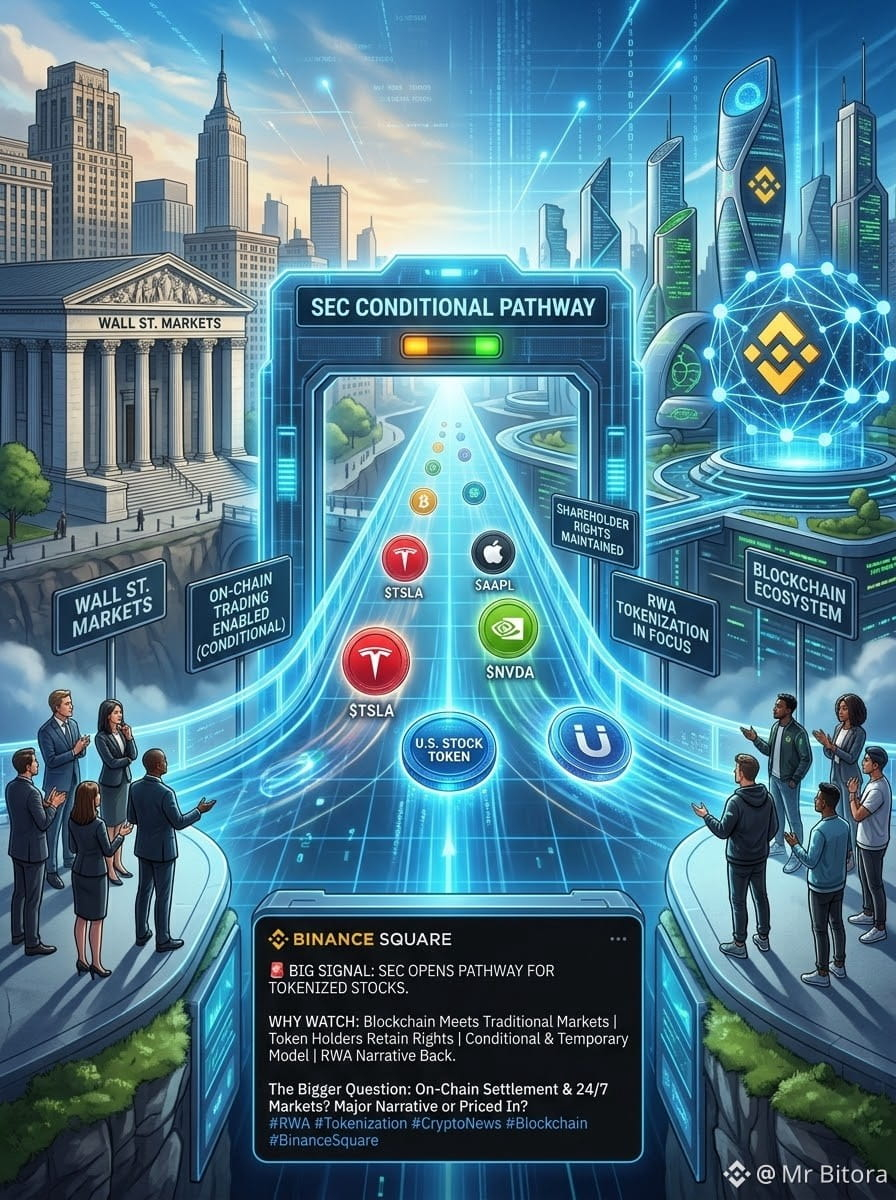
🚨 TOKENIZED STOCKS JUST GOT A BIG SIGNAL
The sec has opened a conditional pathway for on-chain trading of certain tokenized U.S. stocks.
Why crypto users are watching 👇
• It brings blockchain infrastructure closer to traditional markets
• Token holders must retain key shareholder rights under the framework
• The model is conditional and temporary—not a blanket approval
• RWA and tokenization narratives are back in focus
The bigger question: will on-chain settlement and 24/7-style market infrastructure become a mainstream direction for finance?
Is tokenization the next major crypto narrative—or already priced into the market? Comment your view.
#Tokenization #CryptoNews #Blockchain #Bitcoin #BinanceSquare
🚨 TOKENIZED STOCKS JUST GOT A BIG SIGNAL
The sec has opened a conditional pathway for on-chain trading of certain tokenized U.S. stocks.
Why crypto users are watching 👇
• It brings blockchain infrastructure closer to traditional markets
• Token holders must retain key shareholder rights under the framework
• The model is conditional and temporary—not a blanket approval
• RWA and tokenization narratives are back in focus
The bigger question: will on-chain settlement and 24/7-style market infrastructure become a mainstream direction for finance?
Is tokenization the next major crypto narrative—or already priced into the market? Comment your view.
#Tokenization #CryptoNews #Blockchain #Bitcoin #BinanceSquare
The sec has opened a conditional pathway for on-chain trading of certain tokenized U.S. stocks.
Why crypto users are watching 👇
• It brings blockchain infrastructure closer to traditional markets
• Token holders must retain key shareholder rights under the framework
• The model is conditional and temporary—not a blanket approval
• RWA and tokenization narratives are back in focus
The bigger question: will on-chain settlement and 24/7-style market infrastructure become a mainstream direction for finance?
Is tokenization the next major crypto narrative—or already priced into the market? Comment your view.
#Tokenization #CryptoNews #Blockchain #Bitcoin #BinanceSquare
23

🚨 Wall Street may have taken one of its biggest steps onto the blockchain—and it is not about buying Bitcoin.
The SEC has reportedly introduced a five-year exemption supporting platforms that trade tokenized stocks.
Why this matters:
🔸 Genuine tokenized shares must provide traditional shareholder rights
🔸 Blockchain could enable faster settlement and extended trading hours
🔸 Stablecoins may become increasingly important as settlement assets
🔸 Crypto exchanges could eventually compete more directly with traditional brokers
But investors must understand the distinction: owning a token that represents a real share is not necessarily the same as holding a synthetic token that merely follows its price.
This development validates blockchain as financial infrastructure—but it does not automatically make every tokenization project a good investment. Custody, liquidity, regulation and the rights attached to each token still matter.
Are tokenized stocks the future of investing—or an unnecessary layer of complexity?
Share your view below and follow Crypto & Capital for clear market insights.
#TokenizedStocks #RWA #Crypto #Blockchain #Investing
🚨 Wall Street may have taken one of its biggest steps onto the blockchain—and it is not about buying Bitcoin.
The SEC has reportedly introduced a five-year exemption supporting platforms that trade tokenized stocks.
Why this matters:
🔸 Genuine tokenized shares must provide traditional shareholder rights
🔸 Blockchain could enable faster settlement and extended trading hours
🔸 Stablecoins may become increasingly important as settlement assets
🔸 Crypto exchanges could eventually compete more directly with traditional brokers
But investors must understand the distinction: owning a token that represents a real share is not necessarily the same as holding a synthetic token that merely follows its price.
This development validates blockchain as financial infrastructure—but it does not automatically make every tokenization project a good investment. Custody, liquidity, regulation and the rights attached to each token still matter.
Are tokenized stocks the future of investing—or an unnecessary layer of complexity?
Share your view below and follow Crypto & Capital for clear market insights.
#TokenizedStocks #RWA #Crypto #Blockchain #Investing
The SEC has reportedly introduced a five-year exemption supporting platforms that trade tokenized stocks.
Why this matters:
🔸 Genuine tokenized shares must provide traditional shareholder rights
🔸 Blockchain could enable faster settlement and extended trading hours
🔸 Stablecoins may become increasingly important as settlement assets
🔸 Crypto exchanges could eventually compete more directly with traditional brokers
But investors must understand the distinction: owning a token that represents a real share is not necessarily the same as holding a synthetic token that merely follows its price.
This development validates blockchain as financial infrastructure—but it does not automatically make every tokenization project a good investment. Custody, liquidity, regulation and the rights attached to each token still matter.
Are tokenized stocks the future of investing—or an unnecessary layer of complexity?
Share your view below and follow Crypto & Capital for clear market insights.
#TokenizedStocks #RWA #Crypto #Blockchain #Investing

75

·
--
Article
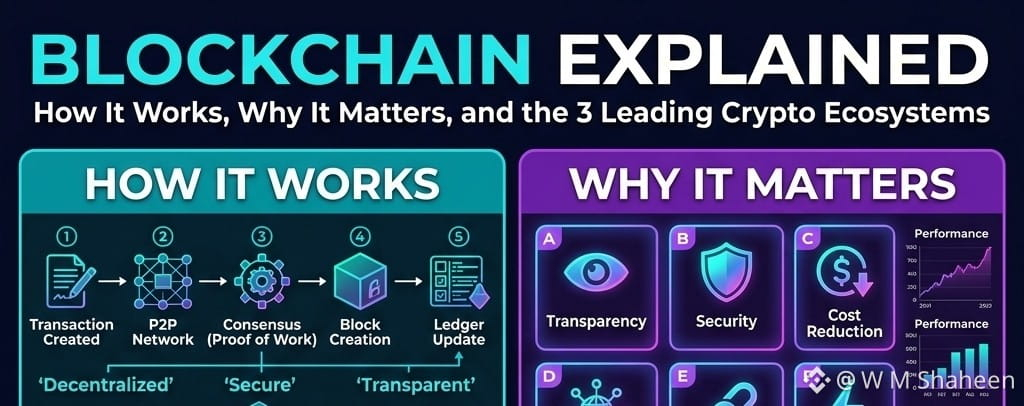
Blockchain Explained: How It Works, Why It Matters, and the 3 Leading Crypto EcosystemsBlockchain is the technology underneath many cryptocurrencies. @Bitcoin, @Ethereum, and @BNB are three major examples of crypto assets that operate within established blockchain ecosystems.
1. What is Blockchain?
A blockchain is a shared digital database that records transactions or other information across a network of computers.
The important difference from a traditional database is how the information gets maintained.
Instead of one central organization keeping the only authoritative copy, a blockchain distributes the ledger across many participating computers, called nodes. The network uses cryptography and a consensus mechanism to agree on the state of the ledger.
The word blockchain has two parts:
Block: A collection of transactions or other data.
Chain: Each block contains a cryptographic reference to the previous block, linking the blocks together.
A simplified structure looks like this:
Block 1 → Block 2 → Block 3 → Block 4 → Block 5
Each new block builds on the previous history.
2. A simple example
Imagine that five people maintain identical accounting books.
Ali sends 1 BTC to Ahmed.
The transaction gets broadcast to the network.
The network checks whether:
Ali has sufficient $BTC . Ali authorized the transaction. The transaction follows the network's rules.
After the network reaches consensus, the transaction becomes part of a block.
That block becomes part of the blockchain.
The participating computers can then update their records.
Bitcoin describes its blockchain as a shared public ledger containing confirmed transactions.
3. Why does blockchain need cryptography?
Cryptography provides several important functions.
Digital signatures help prove that the person initiating a transaction has the authority to spend the relevant assets.
Hash functions help link blocks together.
A hash is essentially a cryptographic fingerprint of data.
If someone changes important data inside an earlier block, its resulting hash changes. That breaks the chain of subsequent cryptographic references, making unauthorized alteration detectable.
This is one reason blockchain records are difficult to alter retrospectively.
4. What is a node?
A node is a computer running blockchain software and participating in the network.
Depending on the blockchain, nodes can:
Store blockchain data. Verify transactions. Verify blocks. Relay information. Participate in consensus.
Ethereum describes its nodes as computers that maintain the state of the Ethereum network and participate in processing and verifying changes to that state.
5. What is consensus?
If thousands of computers maintain a shared database, they need a mechanism for agreeing on what gets added.
That mechanism is called consensus.
Different blockchains use different consensus mechanisms.
Bitcoin uses Proof of Work.
Ethereum uses Proof of Stake.
$BNB Smart Chain uses a validator-based Proof of Staked Authority system.
This is a fundamental point:
Blockchain does not mean Proof of Work.
Proof of Work is only one type of blockchain consensus mechanism.
6. Proof of Work, Bitcoin
Bitcoin uses miners.
Miners compete to produce valid blocks by performing computational work.
This requires substantial computing resources and electricity.
The economic cost of mining helps protect the Bitcoin network from attacks.
Bitcoin therefore combines:
Cryptography Mining Economic incentives Network consensus A fixed monetary issuance model
7. Proof of Stake, Ethereum
Ethereum moved from Proof of Work to Proof of Stake.
Validators stake $ETH as economic collateral.
They participate in proposing and checking blocks. Dishonest behavior can result in penalties, including loss of staked ETH.
So the basic distinction is:
Bitcoin: Computational resources secure the network.
Ethereum: Staked economic value and validators secure the network.
8. Smart contracts
This is where blockchain becomes much more interesting.
A smart contract is a program deployed on a blockchain.
Instead of simply recording:
"Ali sent Ahmed 1 ETH."
A blockchain such as Ethereum can execute programmed rules.
For example:
IF certain conditions are satisfied, THEN perform a specified transaction or change the blockchain state.
Ethereum describes itself as a blockchain with an embedded computer, the Ethereum Virtual Machine, or EVM.
This enables decentralized applications, commonly called dApps.
9. What can blockchain be used for?
Blockchain technology can support:
Cryptocurrency payments Digital asset ownership Stablecoins Decentralized finance, DeFi Tokenized real-world assets NFTs Decentralized applications Digital identity systems Supply-chain records Gaming assets Decentralized organizations Data and storage systems
Ethereum, for example, supports applications involving payments, gaming, prediction markets, AI agents, decentralized identity, and other use cases.
BNB Chain also supports DeFi, NFTs, gaming, dApps, decentralized storage, and other applications.
10. Blockchain versus cryptocurrency
This distinction is extremely important.
Blockchain is the technology.
Cryptocurrency is one application of that technology.
For example:
Bitcoin is a cryptocurrency and Bitcoin is also the name of its blockchain network.
ETH is the native cryptocurrency of Ethereum.
BNB is the native token of the BNB Chain ecosystem.
Ethereum explicitly describes ETH as the native cryptocurrency used on the Ethereum network, including for transaction fees.
So:
Blockchain ≠ cryptocurrency.
Cryptocurrency can operate as an economic asset within a blockchain ecosystem.
11. What is a blockchain transaction?
A simplified transaction process looks like this:
You create a transaction.
↓
Your wallet signs it using your private key.
↓
The transaction enters the network.
↓
Network participants verify it.
↓
A validator or miner includes it in a block.
↓
The network reaches the required consensus.
↓
The block becomes part of the blockchain.
↓
Your transaction becomes part of the network's recorded history.
The exact process differs between blockchains.
12. What is a crypto wallet?
A wallet does not simply "store coins" in the way a physical wallet stores cash.
The blockchain records ownership or control of assets.
Your wallet primarily manages the cryptographic keys that allow you to authorize transactions.
A private key is extremely important because control of the relevant key can provide control over the associated blockchain assets.
This is why private-key security is fundamental to cryptocurrency.
13. Public key and private key
Think of them conceptually as:
Public address: Something you can share so others can send assets to you.
Private key: Secret information used to authorize transactions.
Never treat a private key or seed phrase as ordinary login information.
If someone obtains it, they may be able to control the associated assets.
14. Why blockchain is considered decentralized
Traditional banking generally depends on centralized institutions.
For example:
You → Bank → Bank database
A public blockchain can instead work approximately like:
You → Blockchain network → Distributed nodes
There is no single database that represents the entire system.
However, decentralization exists on a spectrum.
This is important.
Not every blockchain is equally decentralized.
The number and distribution of validators, node operators, developers, token ownership, governance structures, and other factors can affect how decentralized a network actually is.
15. Blockchain's major advantages
Transparency
Public blockchains can allow anyone to inspect transactions and network activity.
Global accessibility
A blockchain network can operate across national borders.
Programmability
Smart-contract blockchains can execute predefined logic.
Auditability
Blockchain records can provide a persistent transaction history.
Resistance to unilateral alteration
Changing established blockchain history can be technically and economically difficult, depending on the network.
Reduced dependence on intermediaries
Some blockchain applications can perform functions traditionally handled by financial or technological intermediaries.
16. Blockchain's major limitations
Blockchain is not automatically better than a conventional database.
Important limitations include:
Scalability
A network may struggle when transaction demand becomes extremely high.
Fees
High demand can increase transaction costs on some networks.
Complexity
Smart contracts introduce technical risks.
Security
A blockchain can be secure while an application built on it contains vulnerabilities.
Privacy
Public blockchains can make transaction histories highly visible.
Governance
Blockchain networks still require decisions about upgrades and rules.
Centralization risks
Some networks rely on relatively concentrated validator structures.
Energy consumption
Proof of Work networks such as Bitcoin require substantial computational energy.
17. The Blockchain Trilemma
A common concept in blockchain engineering is the "blockchain trilemma."
It describes the tension between:
Decentralization Security Scalability
Improving one dimension can create tradeoffs elsewhere.
Bitcoin strongly emphasizes decentralization and security.
Ethereum attempts to maintain decentralization and security while scaling through additional layers and technologies.
BNB Smart Chain emphasizes high performance and low-cost transactions while using a comparatively limited validator structure. Its official documentation describes its Proof of Staked Authority model and validator architecture.
18. Three established crypto assets to understand first
If your goal is to learn the blockchain industry, these three are particularly useful starting points:
1. Bitcoin, BTC
Bitcoin is the original major cryptocurrency and operates on the Bitcoin blockchain.
Primary concept: Decentralized digital money.
Consensus: Proof of Work.
Key characteristic: 21 million maximum supply.
Its blockchain functions primarily as a secure public ledger for Bitcoin transactions.
Bitcoin is important for understanding:
Mining Proof of Work Digital scarcity Cryptographic signatures UTXO transactions Decentralized monetary systems
2. Ethereum, ETH
Ethereum is a programmable blockchain.
ETH is its native cryptocurrency.
Primary concept: A decentralized platform for executing smart contracts and applications.
Consensus: Proof of Stake.
Key characteristic: Smart contracts and the Ethereum Virtual Machine.
ETH is also used to pay transaction fees and is involved in Ethereum's Proof of Stake security mechanism.
Ethereum is important for understanding:
Smart contracts DeFi dApps Proof of Stake Gas fees Tokenization Layer 2 scaling
3. BNB
BNB is the native token of the BNB Chain ecosystem.
BNB Smart Chain is designed for decentralized applications and supports EVM-compatible smart contracts. BNB is used for transaction fees and staking within the ecosystem.
BNB is important for understanding:
EVM-compatible blockchains Low-cost transactions DeFi Smart contracts Validator-based consensus Blockchain ecosystem economics
19. BTC vs ETH vs BNB
BTC:
Blockchain purpose: Digital monetary system.
Native asset: BTC.
Consensus: Proof of Work.
Smart contracts: Limited compared with Ethereum.
Main economic idea: Scarcity and decentralized monetary settlement.
ETH:
Blockchain purpose: Programmable decentralized computing platform.
Native asset: ETH.
Consensus: Proof of Stake.
Smart contracts: Core functionality.
Main economic idea: Demand for blockchain computation, applications, settlement, and network security.
BNB:
Blockchain ecosystem purpose: High-performance infrastructure for applications and Web3 services.
Native asset: BNB.
Consensus: Proof of Staked Authority on BNB Smart Chain.
Smart contracts: Yes, EVM compatible.
Main economic idea: Utility and activity within the BNB Chain ecosystem.
BNB Smart Chain currently describes itself as an EVM-compatible high-performance blockchain designed particularly for decentralized applications and DeFi.
20. The easiest way to remember them
BTC = digital monetary network.
{spot}(BTCUSDT)
ETH = programmable blockchain.
{spot}(ETHUSDT)
BNB = blockchain ecosystem utility token.
{spot}(BNBUSDT)
And remember this distinction:
Bitcoin is primarily about transferring and securing value.
Ethereum is about programmable value and decentralized computation.
BNB Chain is about scalable blockchain applications and ecosystem activity.
If you want to study crypto seriously, understanding these three systems gives you a strong foundation before moving into stablecoins, DeFi, Layer 2 networks, tokenomics, RWA, and smaller altcoins.
#Binance #Crypto #BlockChain
Blockchain Explained: How It Works, Why It Matters, and the 3 Leading Crypto Ecosystems
Blockchain is the technology underneath many cryptocurrencies. @Bitcoin, @Ethereum, and @BNB are three major examples of crypto assets that operate within established blockchain ecosystems.
1. What is Blockchain?
A blockchain is a shared digital database that records transactions or other information across a network of computers.
The important difference from a traditional database is how the information gets maintained.
Instead of one central organization keeping the only authoritative copy, a blockchain distributes the ledger across many participating computers, called nodes. The network uses cryptography and a consensus mechanism to agree on the state of the ledger.
The word blockchain has two parts:
Block: A collection of transactions or other data.
Chain: Each block contains a cryptographic reference to the previous block, linking the blocks together.
A simplified structure looks like this:
Block 1 → Block 2 → Block 3 → Block 4 → Block 5
Each new block builds on the previous history.
2. A simple example
Imagine that five people maintain identical accounting books.
Ali sends 1 BTC to Ahmed.
The transaction gets broadcast to the network.
The network checks whether:
Ali has sufficient $BTC . Ali authorized the transaction. The transaction follows the network's rules.
After the network reaches consensus, the transaction becomes part of a block.
That block becomes part of the blockchain.
The participating computers can then update their records.
Bitcoin describes its blockchain as a shared public ledger containing confirmed transactions.
3. Why does blockchain need cryptography?
Cryptography provides several important functions.
Digital signatures help prove that the person initiating a transaction has the authority to spend the relevant assets.
Hash functions help link blocks together.
A hash is essentially a cryptographic fingerprint of data.
If someone changes important data inside an earlier block, its resulting hash changes. That breaks the chain of subsequent cryptographic references, making unauthorized alteration detectable.
This is one reason blockchain records are difficult to alter retrospectively.
4. What is a node?
A node is a computer running blockchain software and participating in the network.
Depending on the blockchain, nodes can:
Store blockchain data. Verify transactions. Verify blocks. Relay information. Participate in consensus.
Ethereum describes its nodes as computers that maintain the state of the Ethereum network and participate in processing and verifying changes to that state.
5. What is consensus?
If thousands of computers maintain a shared database, they need a mechanism for agreeing on what gets added.
That mechanism is called consensus.
Different blockchains use different consensus mechanisms.
Bitcoin uses Proof of Work.
Ethereum uses Proof of Stake.
$BNB Smart Chain uses a validator-based Proof of Staked Authority system.
This is a fundamental point:
Blockchain does not mean Proof of Work.
Proof of Work is only one type of blockchain consensus mechanism.
6. Proof of Work, Bitcoin
Bitcoin uses miners.
Miners compete to produce valid blocks by performing computational work.
This requires substantial computing resources and electricity.
The economic cost of mining helps protect the Bitcoin network from attacks.
Bitcoin therefore combines:
Cryptography Mining Economic incentives Network consensus A fixed monetary issuance model
7. Proof of Stake, Ethereum
Ethereum moved from Proof of Work to Proof of Stake.
Validators stake $ETH as economic collateral.
They participate in proposing and checking blocks. Dishonest behavior can result in penalties, including loss of staked ETH.
So the basic distinction is:
Bitcoin: Computational resources secure the network.
Ethereum: Staked economic value and validators secure the network.
8. Smart contracts
This is where blockchain becomes much more interesting.
A smart contract is a program deployed on a blockchain.
Instead of simply recording:
"Ali sent Ahmed 1 ETH."
A blockchain such as Ethereum can execute programmed rules.
For example:
IF certain conditions are satisfied, THEN perform a specified transaction or change the blockchain state.
Ethereum describes itself as a blockchain with an embedded computer, the Ethereum Virtual Machine, or EVM.
This enables decentralized applications, commonly called dApps.
9. What can blockchain be used for?
Blockchain technology can support:
Cryptocurrency payments Digital asset ownership Stablecoins Decentralized finance, DeFi Tokenized real-world assets NFTs Decentralized applications Digital identity systems Supply-chain records Gaming assets Decentralized organizations Data and storage systems
Ethereum, for example, supports applications involving payments, gaming, prediction markets, AI agents, decentralized identity, and other use cases.
BNB Chain also supports DeFi, NFTs, gaming, dApps, decentralized storage, and other applications.
10. Blockchain versus cryptocurrency
This distinction is extremely important.
Blockchain is the technology.
Cryptocurrency is one application of that technology.
For example:
Bitcoin is a cryptocurrency and Bitcoin is also the name of its blockchain network.
ETH is the native cryptocurrency of Ethereum.
BNB is the native token of the BNB Chain ecosystem.
Ethereum explicitly describes ETH as the native cryptocurrency used on the Ethereum network, including for transaction fees.
So:
Blockchain ≠ cryptocurrency.
Cryptocurrency can operate as an economic asset within a blockchain ecosystem.
11. What is a blockchain transaction?
A simplified transaction process looks like this:
You create a transaction.
↓
Your wallet signs it using your private key.
↓
The transaction enters the network.
↓
Network participants verify it.
↓
A validator or miner includes it in a block.
↓
The network reaches the required consensus.
↓
The block becomes part of the blockchain.
↓
Your transaction becomes part of the network's recorded history.
The exact process differs between blockchains.
12. What is a crypto wallet?
A wallet does not simply "store coins" in the way a physical wallet stores cash.
The blockchain records ownership or control of assets.
Your wallet primarily manages the cryptographic keys that allow you to authorize transactions.
A private key is extremely important because control of the relevant key can provide control over the associated blockchain assets.
This is why private-key security is fundamental to cryptocurrency.
13. Public key and private key
Think of them conceptually as:
Public address: Something you can share so others can send assets to you.
Private key: Secret information used to authorize transactions.
Never treat a private key or seed phrase as ordinary login information.
If someone obtains it, they may be able to control the associated assets.
14. Why blockchain is considered decentralized
Traditional banking generally depends on centralized institutions.
For example:
You → Bank → Bank database
A public blockchain can instead work approximately like:
You → Blockchain network → Distributed nodes
There is no single database that represents the entire system.
However, decentralization exists on a spectrum.
This is important.
Not every blockchain is equally decentralized.
The number and distribution of validators, node operators, developers, token ownership, governance structures, and other factors can affect how decentralized a network actually is.
15. Blockchain's major advantages
Transparency
Public blockchains can allow anyone to inspect transactions and network activity.
Global accessibility
A blockchain network can operate across national borders.
Programmability
Smart-contract blockchains can execute predefined logic.
Auditability
Blockchain records can provide a persistent transaction history.
Resistance to unilateral alteration
Changing established blockchain history can be technically and economically difficult, depending on the network.
Reduced dependence on intermediaries
Some blockchain applications can perform functions traditionally handled by financial or technological intermediaries.
16. Blockchain's major limitations
Blockchain is not automatically better than a conventional database.
Important limitations include:
Scalability
A network may struggle when transaction demand becomes extremely high.
Fees
High demand can increase transaction costs on some networks.
Complexity
Smart contracts introduce technical risks.
Security
A blockchain can be secure while an application built on it contains vulnerabilities.
Privacy
Public blockchains can make transaction histories highly visible.
Governance
Blockchain networks still require decisions about upgrades and rules.
Centralization risks
Some networks rely on relatively concentrated validator structures.
Energy consumption
Proof of Work networks such as Bitcoin require substantial computational energy.
17. The Blockchain Trilemma
A common concept in blockchain engineering is the "blockchain trilemma."
It describes the tension between:
Decentralization Security Scalability
Improving one dimension can create tradeoffs elsewhere.
Bitcoin strongly emphasizes decentralization and security.
Ethereum attempts to maintain decentralization and security while scaling through additional layers and technologies.
BNB Smart Chain emphasizes high performance and low-cost transactions while using a comparatively limited validator structure. Its official documentation describes its Proof of Staked Authority model and validator architecture.
18. Three established crypto assets to understand first
If your goal is to learn the blockchain industry, these three are particularly useful starting points:
1. Bitcoin, BTC
Bitcoin is the original major cryptocurrency and operates on the Bitcoin blockchain.
Primary concept: Decentralized digital money.
Consensus: Proof of Work.
Key characteristic: 21 million maximum supply.
Its blockchain functions primarily as a secure public ledger for Bitcoin transactions.
Bitcoin is important for understanding:
Mining Proof of Work Digital scarcity Cryptographic signatures UTXO transactions Decentralized monetary systems
2. Ethereum, ETH
Ethereum is a programmable blockchain.
ETH is its native cryptocurrency.
Primary concept: A decentralized platform for executing smart contracts and applications.
Consensus: Proof of Stake.
Key characteristic: Smart contracts and the Ethereum Virtual Machine.
ETH is also used to pay transaction fees and is involved in Ethereum's Proof of Stake security mechanism.
Ethereum is important for understanding:
Smart contracts DeFi dApps Proof of Stake Gas fees Tokenization Layer 2 scaling
3. BNB
BNB is the native token of the BNB Chain ecosystem.
BNB Smart Chain is designed for decentralized applications and supports EVM-compatible smart contracts. BNB is used for transaction fees and staking within the ecosystem.
BNB is important for understanding:
EVM-compatible blockchains Low-cost transactions DeFi Smart contracts Validator-based consensus Blockchain ecosystem economics
19. BTC vs ETH vs BNB
BTC:
Blockchain purpose: Digital monetary system.
Native asset: BTC.
Consensus: Proof of Work.
Smart contracts: Limited compared with Ethereum.
Main economic idea: Scarcity and decentralized monetary settlement.
ETH:
Blockchain purpose: Programmable decentralized computing platform.
Native asset: ETH.
Consensus: Proof of Stake.
Smart contracts: Core functionality.
Main economic idea: Demand for blockchain computation, applications, settlement, and network security.
BNB:
Blockchain ecosystem purpose: High-performance infrastructure for applications and Web3 services.
Native asset: BNB.
Consensus: Proof of Staked Authority on BNB Smart Chain.
Smart contracts: Yes, EVM compatible.
Main economic idea: Utility and activity within the BNB Chain ecosystem.
BNB Smart Chain currently describes itself as an EVM-compatible high-performance blockchain designed particularly for decentralized applications and DeFi.
20. The easiest way to remember them
BTC = digital monetary network.
ETH = programmable blockchain.
BNB = blockchain ecosystem utility token.
And remember this distinction:
Bitcoin is primarily about transferring and securing value.
Ethereum is about programmable value and decentralized computation.
BNB Chain is about scalable blockchain applications and ecosystem activity.
If you want to study crypto seriously, understanding these three systems gives you a strong foundation before moving into stablecoins, DeFi, Layer 2 networks, tokenomics, RWA, and smaller altcoins.
#Binance #Crypto #BlockChain
1. What is Blockchain?
A blockchain is a shared digital database that records transactions or other information across a network of computers.
The important difference from a traditional database is how the information gets maintained.
Instead of one central organization keeping the only authoritative copy, a blockchain distributes the ledger across many participating computers, called nodes. The network uses cryptography and a consensus mechanism to agree on the state of the ledger.
The word blockchain has two parts:
Block: A collection of transactions or other data.
Chain: Each block contains a cryptographic reference to the previous block, linking the blocks together.
A simplified structure looks like this:
Block 1 → Block 2 → Block 3 → Block 4 → Block 5
Each new block builds on the previous history.
2. A simple example
Imagine that five people maintain identical accounting books.
Ali sends 1 BTC to Ahmed.
The transaction gets broadcast to the network.
The network checks whether:
Ali has sufficient $BTC . Ali authorized the transaction. The transaction follows the network's rules.
After the network reaches consensus, the transaction becomes part of a block.
That block becomes part of the blockchain.
The participating computers can then update their records.
Bitcoin describes its blockchain as a shared public ledger containing confirmed transactions.
3. Why does blockchain need cryptography?
Cryptography provides several important functions.
Digital signatures help prove that the person initiating a transaction has the authority to spend the relevant assets.
Hash functions help link blocks together.
A hash is essentially a cryptographic fingerprint of data.
If someone changes important data inside an earlier block, its resulting hash changes. That breaks the chain of subsequent cryptographic references, making unauthorized alteration detectable.
This is one reason blockchain records are difficult to alter retrospectively.
4. What is a node?
A node is a computer running blockchain software and participating in the network.
Depending on the blockchain, nodes can:
Store blockchain data. Verify transactions. Verify blocks. Relay information. Participate in consensus.
Ethereum describes its nodes as computers that maintain the state of the Ethereum network and participate in processing and verifying changes to that state.
5. What is consensus?
If thousands of computers maintain a shared database, they need a mechanism for agreeing on what gets added.
That mechanism is called consensus.
Different blockchains use different consensus mechanisms.
Bitcoin uses Proof of Work.
Ethereum uses Proof of Stake.
$BNB Smart Chain uses a validator-based Proof of Staked Authority system.
This is a fundamental point:
Blockchain does not mean Proof of Work.
Proof of Work is only one type of blockchain consensus mechanism.
6. Proof of Work, Bitcoin
Bitcoin uses miners.
Miners compete to produce valid blocks by performing computational work.
This requires substantial computing resources and electricity.
The economic cost of mining helps protect the Bitcoin network from attacks.
Bitcoin therefore combines:
Cryptography Mining Economic incentives Network consensus A fixed monetary issuance model
7. Proof of Stake, Ethereum
Ethereum moved from Proof of Work to Proof of Stake.
Validators stake $ETH as economic collateral.
They participate in proposing and checking blocks. Dishonest behavior can result in penalties, including loss of staked ETH.
So the basic distinction is:
Bitcoin: Computational resources secure the network.
Ethereum: Staked economic value and validators secure the network.
8. Smart contracts
This is where blockchain becomes much more interesting.
A smart contract is a program deployed on a blockchain.
Instead of simply recording:
"Ali sent Ahmed 1 ETH."
A blockchain such as Ethereum can execute programmed rules.
For example:
IF certain conditions are satisfied, THEN perform a specified transaction or change the blockchain state.
Ethereum describes itself as a blockchain with an embedded computer, the Ethereum Virtual Machine, or EVM.
This enables decentralized applications, commonly called dApps.
9. What can blockchain be used for?
Blockchain technology can support:
Cryptocurrency payments Digital asset ownership Stablecoins Decentralized finance, DeFi Tokenized real-world assets NFTs Decentralized applications Digital identity systems Supply-chain records Gaming assets Decentralized organizations Data and storage systems
Ethereum, for example, supports applications involving payments, gaming, prediction markets, AI agents, decentralized identity, and other use cases.
BNB Chain also supports DeFi, NFTs, gaming, dApps, decentralized storage, and other applications.
10. Blockchain versus cryptocurrency
This distinction is extremely important.
Blockchain is the technology.
Cryptocurrency is one application of that technology.
For example:
Bitcoin is a cryptocurrency and Bitcoin is also the name of its blockchain network.
ETH is the native cryptocurrency of Ethereum.
BNB is the native token of the BNB Chain ecosystem.
Ethereum explicitly describes ETH as the native cryptocurrency used on the Ethereum network, including for transaction fees.
So:
Blockchain ≠ cryptocurrency.
Cryptocurrency can operate as an economic asset within a blockchain ecosystem.
11. What is a blockchain transaction?
A simplified transaction process looks like this:
You create a transaction.
↓
Your wallet signs it using your private key.
↓
The transaction enters the network.
↓
Network participants verify it.
↓
A validator or miner includes it in a block.
↓
The network reaches the required consensus.
↓
The block becomes part of the blockchain.
↓
Your transaction becomes part of the network's recorded history.
The exact process differs between blockchains.
12. What is a crypto wallet?
A wallet does not simply "store coins" in the way a physical wallet stores cash.
The blockchain records ownership or control of assets.
Your wallet primarily manages the cryptographic keys that allow you to authorize transactions.
A private key is extremely important because control of the relevant key can provide control over the associated blockchain assets.
This is why private-key security is fundamental to cryptocurrency.
13. Public key and private key
Think of them conceptually as:
Public address: Something you can share so others can send assets to you.
Private key: Secret information used to authorize transactions.
Never treat a private key or seed phrase as ordinary login information.
If someone obtains it, they may be able to control the associated assets.
14. Why blockchain is considered decentralized
Traditional banking generally depends on centralized institutions.
For example:
You → Bank → Bank database
A public blockchain can instead work approximately like:
You → Blockchain network → Distributed nodes
There is no single database that represents the entire system.
However, decentralization exists on a spectrum.
This is important.
Not every blockchain is equally decentralized.
The number and distribution of validators, node operators, developers, token ownership, governance structures, and other factors can affect how decentralized a network actually is.
15. Blockchain's major advantages
Transparency
Public blockchains can allow anyone to inspect transactions and network activity.
Global accessibility
A blockchain network can operate across national borders.
Programmability
Smart-contract blockchains can execute predefined logic.
Auditability
Blockchain records can provide a persistent transaction history.
Resistance to unilateral alteration
Changing established blockchain history can be technically and economically difficult, depending on the network.
Reduced dependence on intermediaries
Some blockchain applications can perform functions traditionally handled by financial or technological intermediaries.
16. Blockchain's major limitations
Blockchain is not automatically better than a conventional database.
Important limitations include:
Scalability
A network may struggle when transaction demand becomes extremely high.
Fees
High demand can increase transaction costs on some networks.
Complexity
Smart contracts introduce technical risks.
Security
A blockchain can be secure while an application built on it contains vulnerabilities.
Privacy
Public blockchains can make transaction histories highly visible.
Governance
Blockchain networks still require decisions about upgrades and rules.
Centralization risks
Some networks rely on relatively concentrated validator structures.
Energy consumption
Proof of Work networks such as Bitcoin require substantial computational energy.
17. The Blockchain Trilemma
A common concept in blockchain engineering is the "blockchain trilemma."
It describes the tension between:
Decentralization Security Scalability
Improving one dimension can create tradeoffs elsewhere.
Bitcoin strongly emphasizes decentralization and security.
Ethereum attempts to maintain decentralization and security while scaling through additional layers and technologies.
BNB Smart Chain emphasizes high performance and low-cost transactions while using a comparatively limited validator structure. Its official documentation describes its Proof of Staked Authority model and validator architecture.
18. Three established crypto assets to understand first
If your goal is to learn the blockchain industry, these three are particularly useful starting points:
1. Bitcoin, BTC
Bitcoin is the original major cryptocurrency and operates on the Bitcoin blockchain.
Primary concept: Decentralized digital money.
Consensus: Proof of Work.
Key characteristic: 21 million maximum supply.
Its blockchain functions primarily as a secure public ledger for Bitcoin transactions.
Bitcoin is important for understanding:
Mining Proof of Work Digital scarcity Cryptographic signatures UTXO transactions Decentralized monetary systems
2. Ethereum, ETH
Ethereum is a programmable blockchain.
ETH is its native cryptocurrency.
Primary concept: A decentralized platform for executing smart contracts and applications.
Consensus: Proof of Stake.
Key characteristic: Smart contracts and the Ethereum Virtual Machine.
ETH is also used to pay transaction fees and is involved in Ethereum's Proof of Stake security mechanism.
Ethereum is important for understanding:
Smart contracts DeFi dApps Proof of Stake Gas fees Tokenization Layer 2 scaling
3. BNB
BNB is the native token of the BNB Chain ecosystem.
BNB Smart Chain is designed for decentralized applications and supports EVM-compatible smart contracts. BNB is used for transaction fees and staking within the ecosystem.
BNB is important for understanding:
EVM-compatible blockchains Low-cost transactions DeFi Smart contracts Validator-based consensus Blockchain ecosystem economics
19. BTC vs ETH vs BNB
BTC:
Blockchain purpose: Digital monetary system.
Native asset: BTC.
Consensus: Proof of Work.
Smart contracts: Limited compared with Ethereum.
Main economic idea: Scarcity and decentralized monetary settlement.
ETH:
Blockchain purpose: Programmable decentralized computing platform.
Native asset: ETH.
Consensus: Proof of Stake.
Smart contracts: Core functionality.
Main economic idea: Demand for blockchain computation, applications, settlement, and network security.
BNB:
Blockchain ecosystem purpose: High-performance infrastructure for applications and Web3 services.
Native asset: BNB.
Consensus: Proof of Staked Authority on BNB Smart Chain.
Smart contracts: Yes, EVM compatible.
Main economic idea: Utility and activity within the BNB Chain ecosystem.
BNB Smart Chain currently describes itself as an EVM-compatible high-performance blockchain designed particularly for decentralized applications and DeFi.
20. The easiest way to remember them
BTC = digital monetary network.
ETH = programmable blockchain.
BNB = blockchain ecosystem utility token.
And remember this distinction:
Bitcoin is primarily about transferring and securing value.
Ethereum is about programmable value and decentralized computation.
BNB Chain is about scalable blockchain applications and ecosystem activity.
If you want to study crypto seriously, understanding these three systems gives you a strong foundation before moving into stablecoins, DeFi, Layer 2 networks, tokenomics, RWA, and smaller altcoins.
#Binance #Crypto #BlockChain
1
88

·
--
Blockchain is for Everyone CZ
Binance founder CZ just reminded everyone why blockchain wins:
Blockchain is an open technology that anyone can use, including traditional financial institutions like banks" 99dc
It's not a threat to banks, it's an *UPGRADE*. Faster, cheaper, verifiable, and unstoppable. Even when Cloudflare crashed and Biana$ce front-ends went down, CZ pointed out: *"Blockchain kept working."*
*What it means for YOU as a Bianance user:*
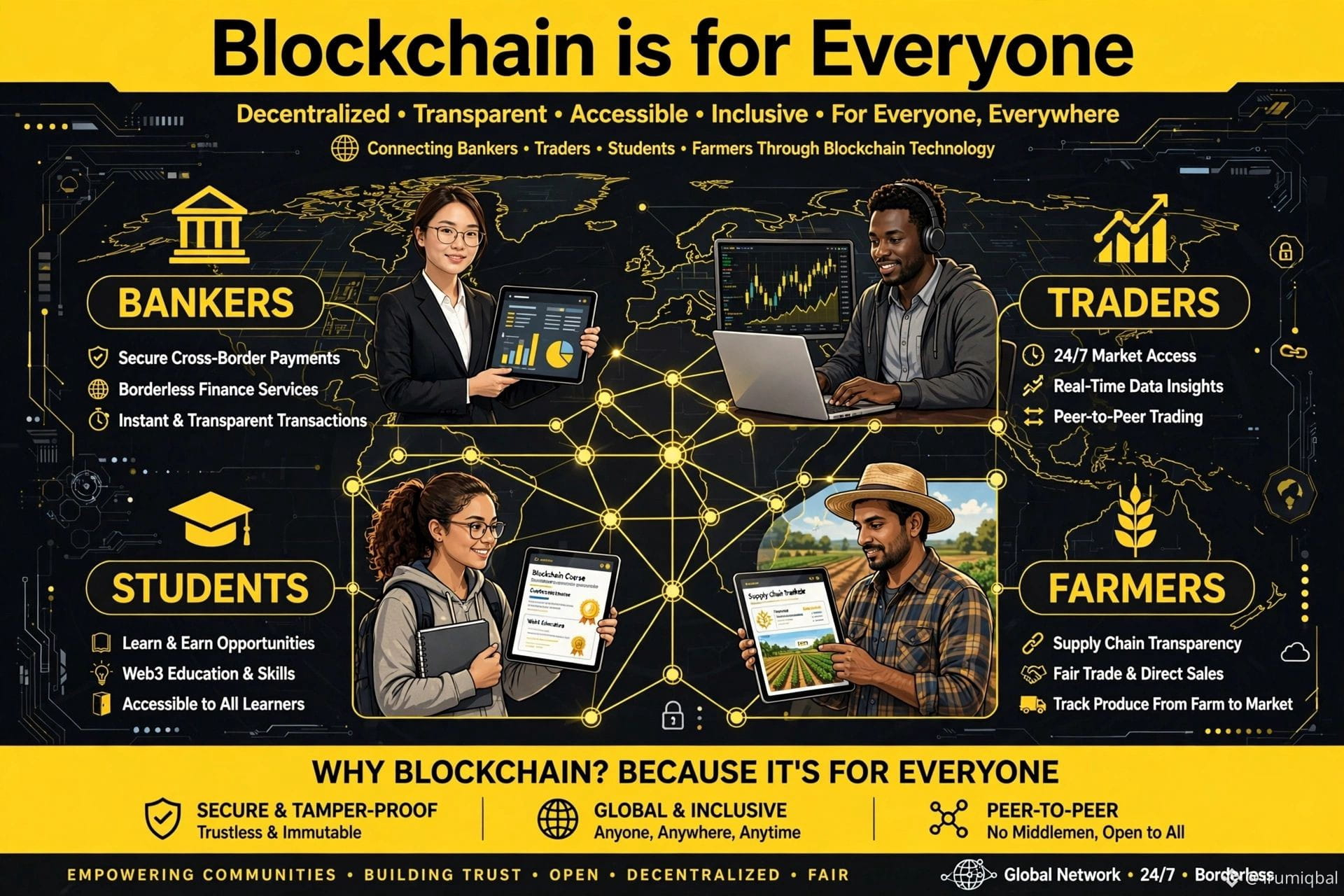
*1. Banks + Blockchain = Better Finance*
Forget days for cross-border transfers. On-chain = seconds.
*2. Traders = 24/7 Power*
No market closes. True peer-to-peer trading, real-time data.
*3. Students = Learn & Earn*
From Bianace Academy to Web3 certificates on-chain.
*4. Farmers to Founders = Same Network*
A farmer can track crops, a student can prove a degree, you can send $10 to family — all on the same rail.
CZ's vision is simple: In 2017, <6M owned crypto. Today 741M do, 323M on Bianace alone. The next billion won't be just crypto traders — they'll be everyone using tokenized stocks, ETFs, and everyday payments.
*Blockchain isn't just for degens. It's infrastructure for everyone.*
#Bianace #bnb #crypto #blockchain $BNB
Blockchain is for Everyone CZ
Binance founder CZ just reminded everyone why blockchain wins:
Blockchain is an open technology that anyone can use, including traditional financial institutions like banks" 99dc
It's not a threat to banks, it's an *UPGRADE*. Faster, cheaper, verifiable, and unstoppable. Even when Cloudflare crashed and Biana$ce front-ends went down, CZ pointed out: *"Blockchain kept working."*
*What it means for YOU as a Bianance user:*
*1. Banks + Blockchain = Better Finance*
Forget days for cross-border transfers. On-chain = seconds.
*2. Traders = 24/7 Power*
No market closes. True peer-to-peer trading, real-time data.
*3. Students = Learn & Earn*
From Bianace Academy to Web3 certificates on-chain.
*4. Farmers to Founders = Same Network*
A farmer can track crops, a student can prove a degree, you can send $10 to family — all on the same rail.
CZ's vision is simple: In 2017, <6M owned crypto. Today 741M do, 323M on Bianace alone. The next billion won't be just crypto traders — they'll be everyone using tokenized stocks, ETFs, and everyday payments.
*Blockchain isn't just for degens. It's infrastructure for everyone.*
#Bianace #bnb #crypto #blockchain $BNB
Binance founder CZ just reminded everyone why blockchain wins:
Blockchain is an open technology that anyone can use, including traditional financial institutions like banks" 99dc
It's not a threat to banks, it's an *UPGRADE*. Faster, cheaper, verifiable, and unstoppable. Even when Cloudflare crashed and Biana$ce front-ends went down, CZ pointed out: *"Blockchain kept working."*
*What it means for YOU as a Bianance user:*
*1. Banks + Blockchain = Better Finance*
Forget days for cross-border transfers. On-chain = seconds.
*2. Traders = 24/7 Power*
No market closes. True peer-to-peer trading, real-time data.
*3. Students = Learn & Earn*
From Bianace Academy to Web3 certificates on-chain.
*4. Farmers to Founders = Same Network*
A farmer can track crops, a student can prove a degree, you can send $10 to family — all on the same rail.
CZ's vision is simple: In 2017, <6M owned crypto. Today 741M do, 323M on Bianace alone. The next billion won't be just crypto traders — they'll be everyone using tokenized stocks, ETFs, and everyday payments.
*Blockchain isn't just for degens. It's infrastructure for everyone.*
#Bianace #bnb #crypto #blockchain $BNB
Felipe-Brayner:
I love you blockchain 🟦🟦🟦🟦❤️.
3
2
109
Saudi Arabia just stepped away from one of the most important experiments in the future of global payments.
According to the Financial Times, Riyadh has withdrawn from mBridge, the China-led blockchain-based platform designed to enable central banks to move digital currencies directly across borders.
The bigger story is what mBridge represents.
It was built to explore cross-border settlement without relying entirely on traditional dollar-based payment rails.
Saudi Arabia joined the project, completed its planned trial in May 2025, and then exited.
But there is an important nuance:
A person familiar with the decision cautioned against interpreting the withdrawal as a broader political signal.
Still, the development matters.
mBridge sits at the intersection of three major shifts:
Central bank digital currencies.
Blockchain-based settlement.
The future architecture of global payments.
The real battle may not be about replacing the dollar overnight.
It may be about building alternative payment infrastructure that gives countries more options.
And that competition is only getting more serious.
Saudi Arabia leaving mBridge does not kill the project.
But it shows how complicated the race to reshape cross-border payments really is.
The next financial system may be decided less by which currency wins...
And more by which payment rails the world chooses to use.
#Bitcoin #Crypto #CBDC #Blockchain #Finance
Saudi Arabia just stepped away from one of the most important experiments in the future of global payments.
According to the Financial Times, Riyadh has withdrawn from mBridge, the China-led blockchain-based platform designed to enable central banks to move digital currencies directly across borders.
The bigger story is what mBridge represents.
It was built to explore cross-border settlement without relying entirely on traditional dollar-based payment rails.
Saudi Arabia joined the project, completed its planned trial in May 2025, and then exited.
But there is an important nuance:
A person familiar with the decision cautioned against interpreting the withdrawal as a broader political signal.
Still, the development matters.
mBridge sits at the intersection of three major shifts:
Central bank digital currencies.
Blockchain-based settlement.
The future architecture of global payments.
The real battle may not be about replacing the dollar overnight.
It may be about building alternative payment infrastructure that gives countries more options.
And that competition is only getting more serious.
Saudi Arabia leaving mBridge does not kill the project.
But it shows how complicated the race to reshape cross-border payments really is.
The next financial system may be decided less by which currency wins...
And more by which payment rails the world chooses to use.
#Bitcoin #Crypto #CBDC #Blockchain #Finance
According to the Financial Times, Riyadh has withdrawn from mBridge, the China-led blockchain-based platform designed to enable central banks to move digital currencies directly across borders.
The bigger story is what mBridge represents.
It was built to explore cross-border settlement without relying entirely on traditional dollar-based payment rails.
Saudi Arabia joined the project, completed its planned trial in May 2025, and then exited.
But there is an important nuance:
A person familiar with the decision cautioned against interpreting the withdrawal as a broader political signal.
Still, the development matters.
mBridge sits at the intersection of three major shifts:
Central bank digital currencies.
Blockchain-based settlement.
The future architecture of global payments.
The real battle may not be about replacing the dollar overnight.
It may be about building alternative payment infrastructure that gives countries more options.
And that competition is only getting more serious.
Saudi Arabia leaving mBridge does not kill the project.
But it shows how complicated the race to reshape cross-border payments really is.
The next financial system may be decided less by which currency wins...
And more by which payment rails the world chooses to use.
#Bitcoin #Crypto #CBDC #Blockchain #Finance
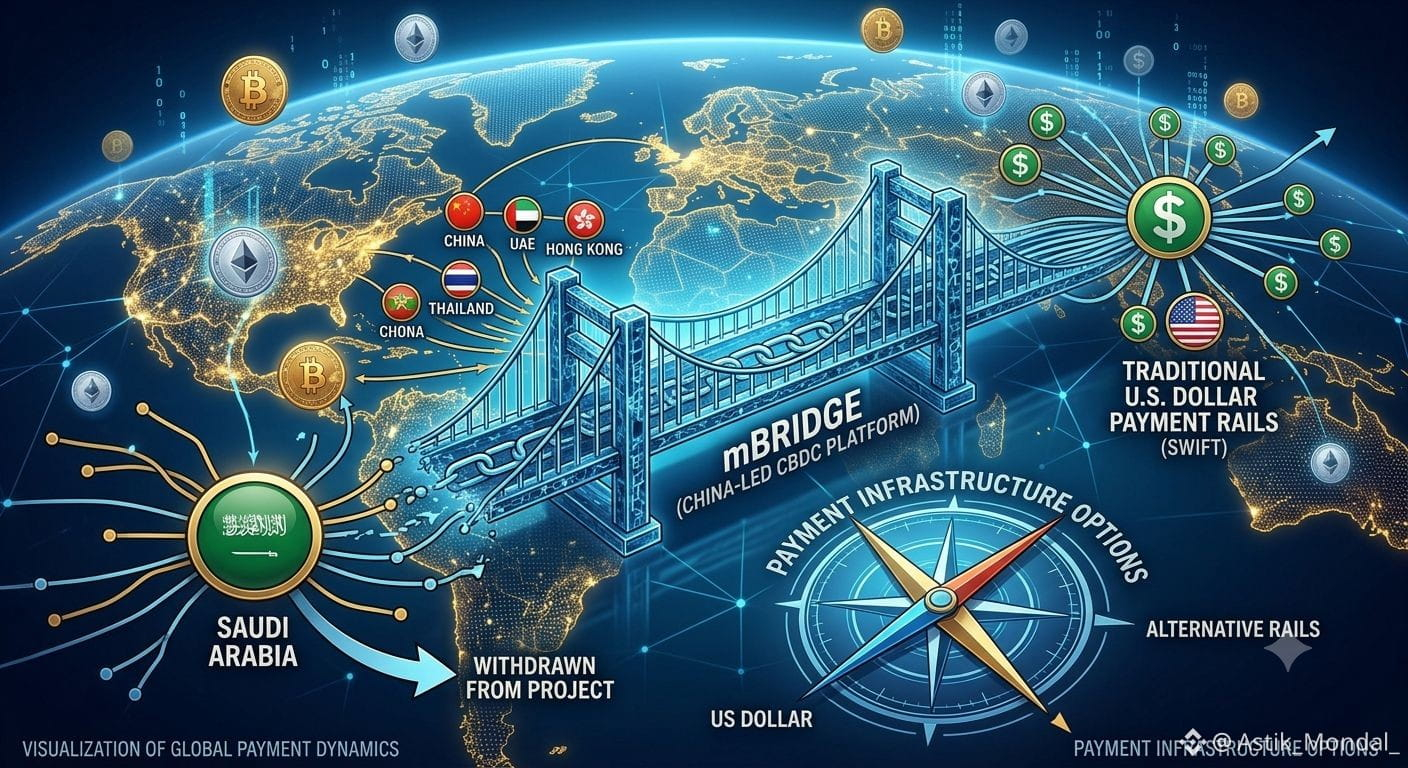
1
108

🚨 STOCKS ARE MOVING ONTO BLOCKCHAIN
The U.S. SEC has opened a new door for tokenized stocks.
The SEC is giving platforms a 5-year exemption to offer trading in blockchain-based versions of stocks.
Why is this important?
• Stocks could trade on blockchain networks • Some tokenized shares can offer dividend and voting rights • Blockchain could make trading faster and more flexible • Crypto platforms may compete more directly with traditional brokers
This is bigger than just crypto.
It shows how blockchain technology is slowly moving into traditional financial markets.
The interesting question now is:
Could stocks, bonds and other assets eventually trade on blockchain 24/7?
What do you think? 👀
#bitcoin #blockchain #Tokenization #stocks #SEC #RWA
🚨 STOCKS ARE MOVING ONTO BLOCKCHAIN
The U.S. SEC has opened a new door for tokenized stocks.
The SEC is giving platforms a 5-year exemption to offer trading in blockchain-based versions of stocks.
Why is this important?
• Stocks could trade on blockchain networks • Some tokenized shares can offer dividend and voting rights • Blockchain could make trading faster and more flexible • Crypto platforms may compete more directly with traditional brokers
This is bigger than just crypto.
It shows how blockchain technology is slowly moving into traditional financial markets.
The interesting question now is:
Could stocks, bonds and other assets eventually trade on blockchain 24/7?
What do you think? 👀
#bitcoin #blockchain #Tokenization #stocks #SEC #RWA
The U.S. SEC has opened a new door for tokenized stocks.
The SEC is giving platforms a 5-year exemption to offer trading in blockchain-based versions of stocks.
Why is this important?
• Stocks could trade on blockchain networks • Some tokenized shares can offer dividend and voting rights • Blockchain could make trading faster and more flexible • Crypto platforms may compete more directly with traditional brokers
This is bigger than just crypto.
It shows how blockchain technology is slowly moving into traditional financial markets.
The interesting question now is:
Could stocks, bonds and other assets eventually trade on blockchain 24/7?
What do you think? 👀
#bitcoin #blockchain #Tokenization #stocks #SEC #RWA
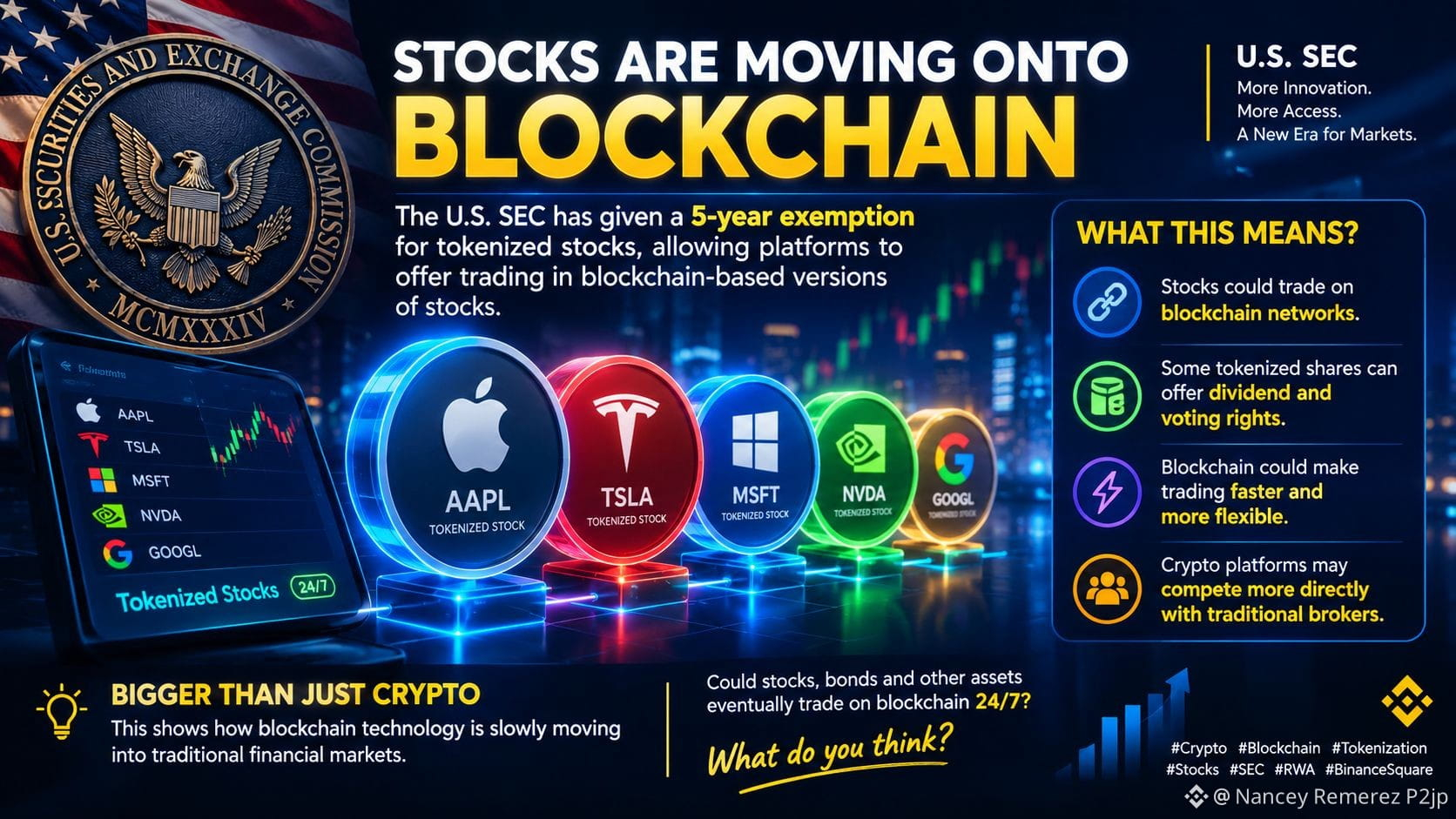
1
2
170

🔎 What Is a Blockchain Explorer?
A blockchain explorer is a search tool that makes public on-chain data easy to view and verify. Instead of reading raw blockchain data, users can search transactions, wallet addresses, blocks and other network activity through a simple interface.
🧾What Can You Check?
A blockchain explorer can show:
• Transaction status and confirmation
• Sender and recipient addresses
• Transaction fees and timestamps
• Wallet balances and transaction history
• Block numbers, hashes and timestamps
• Token transfers and smart-contract activity
🛡️Why Is It Useful?
For $BTC , explorers can help users verify whether a transaction has been confirmed and inspect its on-chain details.
For Ethereum and other smart-contract networks, explorers can also provide contract, token-transfer and network activity data.
👀 How Do You Use One?
Simply select the correct blockchain explorer and enter a transaction hash, wallet address, block number or other supported identifier. The explorer then displays the publicly recorded information associated with that input.
⚠️ Important Point
A blockchain explorer is read-only. It displays public blockchain data but does not give users access to private keys or directly transfer funds.
Understanding explorers makes it easier to verify activity rather than relying only on claims or screenshots. $ETH users, for example, can inspect transactions and smart-contract interactions directly on Ethereum explorers.
$BNB is another example where users can use a dedicated explorer to examine BNB Chain activity.
DYOR | Educational Content | Not Financial Advice
#blockchain #cryptoeducation #Onchain #Web3 #crypto
🔎 What Is a Blockchain Explorer?
A blockchain explorer is a search tool that makes public on-chain data easy to view and verify. Instead of reading raw blockchain data, users can search transactions, wallet addresses, blocks and other network activity through a simple interface.
🧾What Can You Check?
A blockchain explorer can show:
• Transaction status and confirmation
• Sender and recipient addresses
• Transaction fees and timestamps
• Wallet balances and transaction history
• Block numbers, hashes and timestamps
• Token transfers and smart-contract activity
🛡️Why Is It Useful?
For $BTC , explorers can help users verify whether a transaction has been confirmed and inspect its on-chain details.
For Ethereum and other smart-contract networks, explorers can also provide contract, token-transfer and network activity data.
👀 How Do You Use One?
Simply select the correct blockchain explorer and enter a transaction hash, wallet address, block number or other supported identifier. The explorer then displays the publicly recorded information associated with that input.
⚠️ Important Point
A blockchain explorer is read-only. It displays public blockchain data but does not give users access to private keys or directly transfer funds.
Understanding explorers makes it easier to verify activity rather than relying only on claims or screenshots. $ETH users, for example, can inspect transactions and smart-contract interactions directly on Ethereum explorers.
$BNB is another example where users can use a dedicated explorer to examine BNB Chain activity.
DYOR | Educational Content | Not Financial Advice
#blockchain #cryptoeducation #Onchain #Web3 #crypto
A blockchain explorer is a search tool that makes public on-chain data easy to view and verify. Instead of reading raw blockchain data, users can search transactions, wallet addresses, blocks and other network activity through a simple interface.
🧾What Can You Check?
A blockchain explorer can show:
• Transaction status and confirmation
• Sender and recipient addresses
• Transaction fees and timestamps
• Wallet balances and transaction history
• Block numbers, hashes and timestamps
• Token transfers and smart-contract activity
🛡️Why Is It Useful?
For $BTC , explorers can help users verify whether a transaction has been confirmed and inspect its on-chain details.
For Ethereum and other smart-contract networks, explorers can also provide contract, token-transfer and network activity data.
👀 How Do You Use One?
Simply select the correct blockchain explorer and enter a transaction hash, wallet address, block number or other supported identifier. The explorer then displays the publicly recorded information associated with that input.
⚠️ Important Point
A blockchain explorer is read-only. It displays public blockchain data but does not give users access to private keys or directly transfer funds.
Understanding explorers makes it easier to verify activity rather than relying only on claims or screenshots. $ETH users, for example, can inspect transactions and smart-contract interactions directly on Ethereum explorers.
$BNB is another example where users can use a dedicated explorer to examine BNB Chain activity.
DYOR | Educational Content | Not Financial Advice
#blockchain #cryptoeducation #Onchain #Web3 #crypto
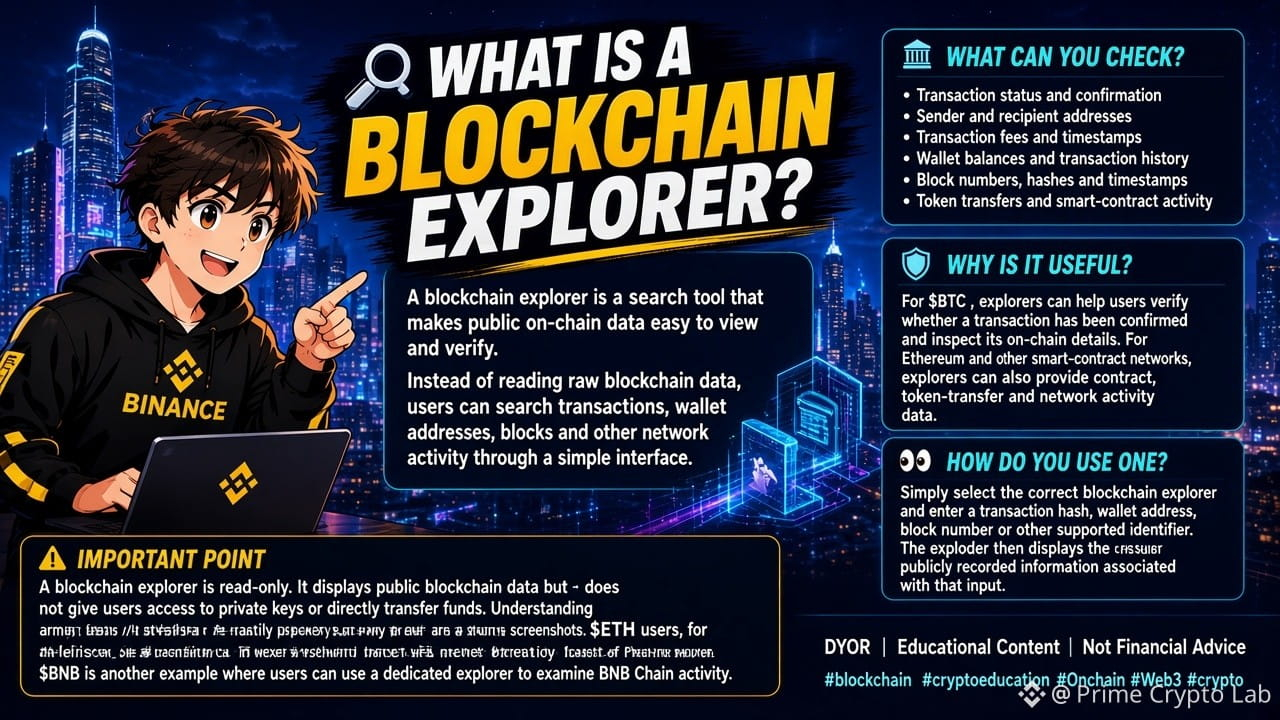
69

🚨 New York Life and CENTRIFUGE On-Chain High-Yield Bonds 🧠
📊 | $BTC | $ETH | $BNB |
- Follow, like, and comment to share your thoughts and discuss together 📈
- New York Life Asset Management partners with Centrifuge to tokenize U.S. high-yield corporate bond strategies.
- The product is built on the Avalanche chain and uses USDC for subscriptions and redemptions.
- Participation is limited to qualified institutional investors; it is not a public offering to retail investors.
- Tokenization is designed to provide blockchain settlement and ownership layers for fixed-income strategies, improving the efficiency of capital operations. 🔥
- Tokenized high-yield bonds may attract institutional capital inflows, boosting relevant on-chain liquidity in the short term.
- If the regulatory environment remains permissive, USDC subscription mechanisms may drive more credit-related assets on-chain.
- The market expects the initiative to bring some upward volatility, especially when the yield curve flattens.
- Current whale activity shows early accumulated positions; short-term, the price outlook is mildly bullish.
- How do you think the on-chaining of high-yield corporate bonds will affect the traditional fixed-income market?
- Follow us and leave a comment to share your views.
- #Crypto #Blockchain #DeFi #Whales #Yield
🚨 New York Life and CENTRIFUGE On-Chain High-Yield Bonds 🧠
📊 | $BTC | $ETH | $BNB |
- Follow, like, and comment to share your thoughts and discuss together 📈
- New York Life Asset Management partners with Centrifuge to tokenize U.S. high-yield corporate bond strategies.
- The product is built on the Avalanche chain and uses USDC for subscriptions and redemptions.
- Participation is limited to qualified institutional investors; it is not a public offering to retail investors.
- Tokenization is designed to provide blockchain settlement and ownership layers for fixed-income strategies, improving the efficiency of capital operations. 🔥
- Tokenized high-yield bonds may attract institutional capital inflows, boosting relevant on-chain liquidity in the short term.
- If the regulatory environment remains permissive, USDC subscription mechanisms may drive more credit-related assets on-chain.
- The market expects the initiative to bring some upward volatility, especially when the yield curve flattens.
- Current whale activity shows early accumulated positions; short-term, the price outlook is mildly bullish.
- How do you think the on-chaining of high-yield corporate bonds will affect the traditional fixed-income market?
- Follow us and leave a comment to share your views.
- #Crypto #Blockchain #DeFi #Whales #Yield
📊 | $BTC | $ETH | $BNB |
- Follow, like, and comment to share your thoughts and discuss together 📈
- New York Life Asset Management partners with Centrifuge to tokenize U.S. high-yield corporate bond strategies.
- The product is built on the Avalanche chain and uses USDC for subscriptions and redemptions.
- Participation is limited to qualified institutional investors; it is not a public offering to retail investors.
- Tokenization is designed to provide blockchain settlement and ownership layers for fixed-income strategies, improving the efficiency of capital operations. 🔥
- Tokenized high-yield bonds may attract institutional capital inflows, boosting relevant on-chain liquidity in the short term.
- If the regulatory environment remains permissive, USDC subscription mechanisms may drive more credit-related assets on-chain.
- The market expects the initiative to bring some upward volatility, especially when the yield curve flattens.
- Current whale activity shows early accumulated positions; short-term, the price outlook is mildly bullish.
- How do you think the on-chaining of high-yield corporate bonds will affect the traditional fixed-income market?
- Follow us and leave a comment to share your views.
- #Crypto #Blockchain #DeFi #Whales #Yield
79

·
--
Circle CEO Jeremy Allaire declared "the spectacle era of crypto is over" as blockchain becomes "invisible infrastructure."
"The most important technologies in history disappear into the background." What does that actually mean? 🤔
This means crypto may be entering a new phase.
Instead of always seeing blockchain, wallets, tokens and complicated tech, blockchain could quietly power things in the background.
Just like we use the internet without thinking about how it works, crypto may eventually become infrastructure we simply use every day.
#blockchain #tech
Circle CEO Jeremy Allaire declared "the spectacle era of crypto is over" as blockchain becomes "invisible infrastructure."
"The most important technologies in history disappear into the background." What does that actually mean? 🤔
This means crypto may be entering a new phase.
Instead of always seeing blockchain, wallets, tokens and complicated tech, blockchain could quietly power things in the background.
Just like we use the internet without thinking about how it works, crypto may eventually become infrastructure we simply use every day.
#blockchain #tech
"The most important technologies in history disappear into the background." What does that actually mean? 🤔
This means crypto may be entering a new phase.
Instead of always seeing blockchain, wallets, tokens and complicated tech, blockchain could quietly power things in the background.
Just like we use the internet without thinking about how it works, crypto may eventually become infrastructure we simply use every day.
#blockchain #tech


3
159
🚨 ECB plans to use PONTES to directly invest in tokenized securities 🧠
📊 | $BTC | $ETH | $BNB |
- Please follow, like, and share your thoughts 📈
- The ECB has started preparations and plans to allocate a small amount of tokenized euro-denominated securities within its own fund portfolio.
- The first batch of eligible assets is expected to include euro area governments, regional governments, institutions, and EU supranational issuers.
- Trade settlement will be carried out through the newly built Pontes platform within the Eurosystem, using central bank money.
- No actual purchases have been made yet; the specific implementation timeline is subject to approval by the Executive Committee. 🔥
- Tokenized assets entering the ECB’s own portfolio could increase market liquidity and trigger short-term sell pressure.
- If the central bank makes large-scale purchases, it may also boost demand for tokenized bonds and increase trading volume on related platforms.
- In the near term, whales may distribute holdings or quietly accumulate at low levels, which could heighten volatility.
- In the short term, bearish sentiment is still dominant, and the market may face further downside pressure.
- What long-term impact do you think the central bank directly holding tokenized securities would have on the euro area bond market?
- Welcome to follow us for more in-depth analysis of the crypto market and to leave your comments.
#Crypto #Blockchain #Tokenization #Whales #Markets
🚨 ECB plans to use PONTES to directly invest in tokenized securities 🧠
📊 | $BTC | $ETH | $BNB |
- Please follow, like, and share your thoughts 📈
- The ECB has started preparations and plans to allocate a small amount of tokenized euro-denominated securities within its own fund portfolio.
- The first batch of eligible assets is expected to include euro area governments, regional governments, institutions, and EU supranational issuers.
- Trade settlement will be carried out through the newly built Pontes platform within the Eurosystem, using central bank money.
- No actual purchases have been made yet; the specific implementation timeline is subject to approval by the Executive Committee. 🔥
- Tokenized assets entering the ECB’s own portfolio could increase market liquidity and trigger short-term sell pressure.
- If the central bank makes large-scale purchases, it may also boost demand for tokenized bonds and increase trading volume on related platforms.
- In the near term, whales may distribute holdings or quietly accumulate at low levels, which could heighten volatility.
- In the short term, bearish sentiment is still dominant, and the market may face further downside pressure.
- What long-term impact do you think the central bank directly holding tokenized securities would have on the euro area bond market?
- Welcome to follow us for more in-depth analysis of the crypto market and to leave your comments.
#Crypto #Blockchain #Tokenization #Whales #Markets
📊 | $BTC | $ETH | $BNB |
- Please follow, like, and share your thoughts 📈
- The ECB has started preparations and plans to allocate a small amount of tokenized euro-denominated securities within its own fund portfolio.
- The first batch of eligible assets is expected to include euro area governments, regional governments, institutions, and EU supranational issuers.
- Trade settlement will be carried out through the newly built Pontes platform within the Eurosystem, using central bank money.
- No actual purchases have been made yet; the specific implementation timeline is subject to approval by the Executive Committee. 🔥
- Tokenized assets entering the ECB’s own portfolio could increase market liquidity and trigger short-term sell pressure.
- If the central bank makes large-scale purchases, it may also boost demand for tokenized bonds and increase trading volume on related platforms.
- In the near term, whales may distribute holdings or quietly accumulate at low levels, which could heighten volatility.
- In the short term, bearish sentiment is still dominant, and the market may face further downside pressure.
- What long-term impact do you think the central bank directly holding tokenized securities would have on the euro area bond market?
- Welcome to follow us for more in-depth analysis of the crypto market and to leave your comments.
#Crypto #Blockchain #Tokenization #Whales #Markets
203
Log in to explore more content
Join global crypto users on Binance Square
⚡️ Get latest and useful information about crypto.
💬 Trusted by the world’s largest crypto exchange.
👍 Discover real insights from verified creators.
Email / Phone number
Trending Topics
1
#AIStocksWhatNext
238,411 views
2,498 Discussing
2
#BitcoinBreaksAboveMayHighNears$86K
8,614 views
147 Discussing
3
#DogecoinRises15%
22,106 views
784 Discussing
4
#$14BBitcoinOptionsExpireFriday
1,566 views
66 Discussing
5
#BNBMarketCapPassesBNYMellon
15,571 views
585 Discussing
6
#CryptoMarketCapReclaims$3Trillion
2,056 views
58 Discussing
7
#MuseOvertakesChatGPTAsTopFreeIOSApp
10,383 views
457 Discussing
8
#TokenizedStockPlatformsCouldLaunchNextQuarter
16,328 views
518 Discussing
9
#StrategyAdds950Bitcoin
21,644 views
579 Discussing
10
#CardanoAddedToX402KitForADAPayments
22,354 views
607 Discussing