
Nisto39
578 Posts

Nisto39
Report
Block User
DevUnivers

ETH Holder
Occasional Trader
3.8 Years
11 Following
56 Followers
145 Liked
Posts
All
Quotes
·
--
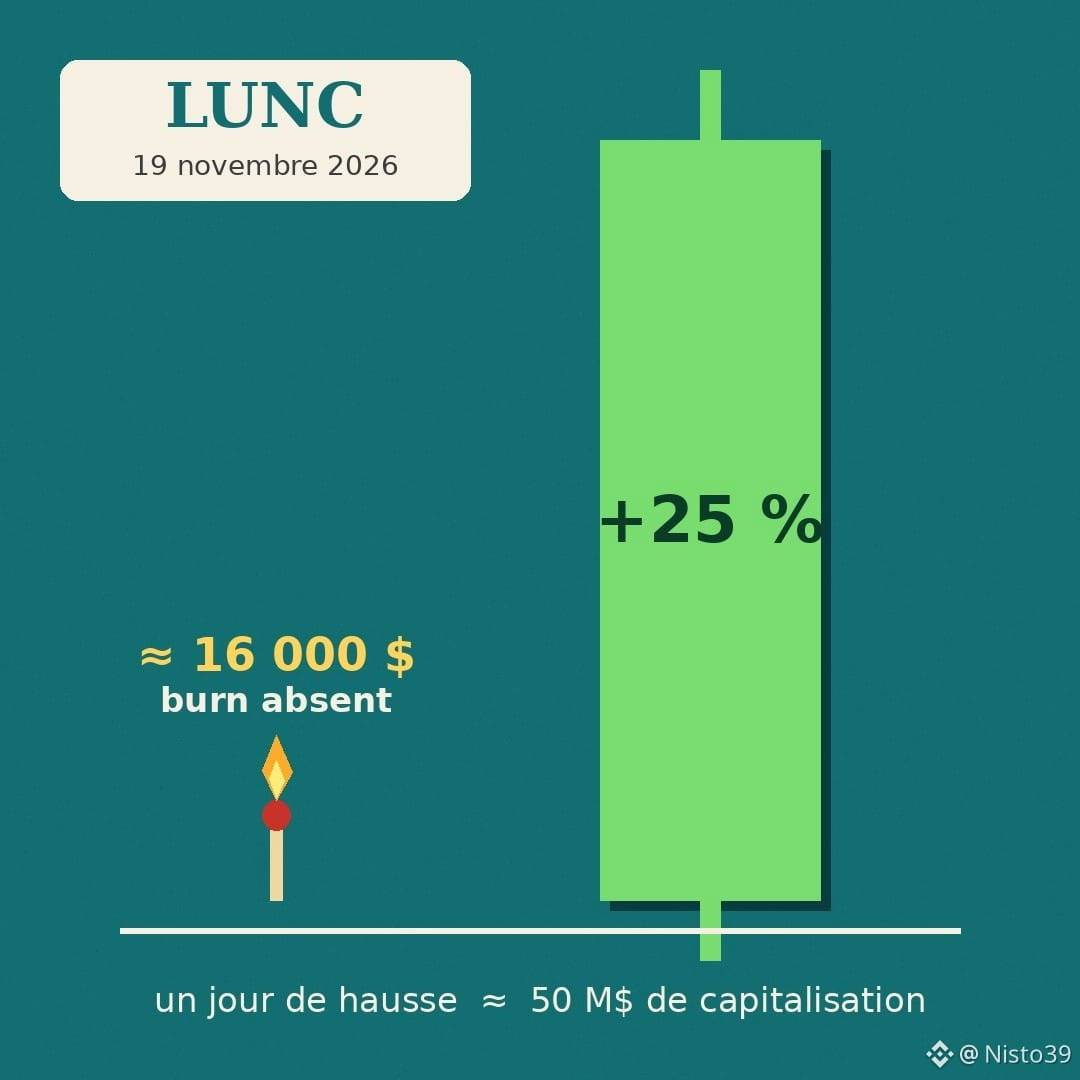
$LUNC gained 25% in 24 hours. The crypto market, meanwhile, lost 2.4% over the same period (CoinCodex, this morning).
The funniest part? This month's “bad news” for Terra Classic changed nothing. Binance didn't do its November burn, a first since March 2023.
Two figures side by side.
Binance's last burn, on October 1: 334.88 million LUNC destroyed. Sounds huge. That's 0.006% of the ~5,500 billion in circulation. At today's price ($0.000049), about $16,000.
Yesterday's rise: roughly, an extra fifty million dollars in market cap in a single day.
So the missing burn weighs more than 3,000 times less than a single day of speculation.
(A burn means sending tokens to an address for which nobody has the key: they leave circulation forever.)
Why the delay? According to Lunc Daily, LUNC withdrawals have still been suspended on Binance since the $6.3 billion hack in late October, so the exchange can't send the tokens to the burn address. No suspension of the program has been announced.
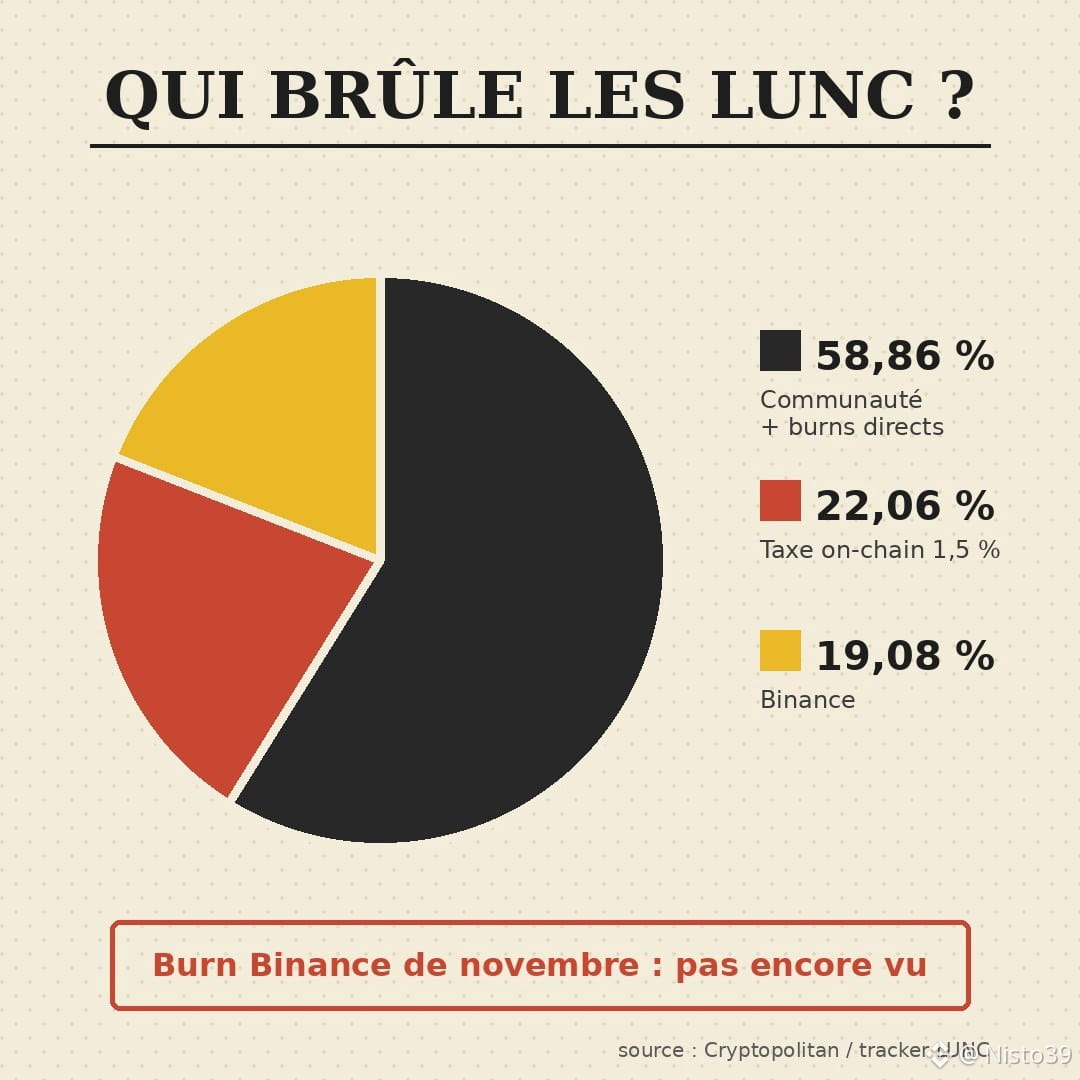
Another sobering figure: Binance accounts for only about 19% of the LUNC burned since the start. The rest comes from community burns and the 1.5% on-chain transaction tax (Cryptopolitan).
My take: the burn is a symbol of support, not a price driver. What moves $LUNC is attention. And a 25% green candle on a token that lost more than 99.99% in 2022 can just as quickly head in the other direction.
On a scale of 0 to 10, how much weight do you give burns in LUNC's price?
#LUNC #TerraClassic #Binance #Burn
$LUNC gained 25% in 24 hours. The crypto market, meanwhile, lost 2.4% over the same period (CoinCodex, this morning).
The funniest part? This month's “bad news” for Terra Classic changed nothing. Binance didn't do its November burn, a first since March 2023.
Two figures side by side.
Binance's last burn, on October 1: 334.88 million LUNC destroyed. Sounds huge. That's 0.006% of the ~5,500 billion in circulation. At today's price ($0.000049), about $16,000.
Yesterday's rise: roughly, an extra fifty million dollars in market cap in a single day.
So the missing burn weighs more than 3,000 times less than a single day of speculation.
(A burn means sending tokens to an address for which nobody has the key: they leave circulation forever.)
Why the delay? According to Lunc Daily, LUNC withdrawals have still been suspended on Binance since the $6.3 billion hack in late October, so the exchange can't send the tokens to the burn address. No suspension of the program has been announced.
Another sobering figure: Binance accounts for only about 19% of the LUNC burned since the start. The rest comes from community burns and the 1.5% on-chain transaction tax (Cryptopolitan).
My take: the burn is a symbol of support, not a price driver. What moves $LUNC is attention. And a 25% green candle on a token that lost more than 99.99% in 2022 can just as quickly head in the other direction.
On a scale of 0 to 10, how much weight do you give burns in LUNC's price?
#LUNC #TerraClassic #Binance #Burn
The funniest part? This month's “bad news” for Terra Classic changed nothing. Binance didn't do its November burn, a first since March 2023.
Two figures side by side.
Binance's last burn, on October 1: 334.88 million LUNC destroyed. Sounds huge. That's 0.006% of the ~5,500 billion in circulation. At today's price ($0.000049), about $16,000.
Yesterday's rise: roughly, an extra fifty million dollars in market cap in a single day.
So the missing burn weighs more than 3,000 times less than a single day of speculation.
(A burn means sending tokens to an address for which nobody has the key: they leave circulation forever.)
Why the delay? According to Lunc Daily, LUNC withdrawals have still been suspended on Binance since the $6.3 billion hack in late October, so the exchange can't send the tokens to the burn address. No suspension of the program has been announced.
Another sobering figure: Binance accounts for only about 19% of the LUNC burned since the start. The rest comes from community burns and the 1.5% on-chain transaction tax (Cryptopolitan).
My take: the burn is a symbol of support, not a price driver. What moves $LUNC is attention. And a 25% green candle on a token that lost more than 99.99% in 2022 can just as quickly head in the other direction.
On a scale of 0 to 10, how much weight do you give burns in LUNC's price?
#LUNC #TerraClassic #Binance #Burn
108
·
--
Article
The 12th word in your secret phrase isn’t arbitrary (I tested all 2,048)This afternoon, I wrote twenty lines of Python to answer a silly question: if I keep 11 words from a recovery phrase and choose the 12th at random from the official list, how often will the wallet accept it?
The BIP39 list (the standard published in 2013, used by most wallets $BTC and $SOL) contains 2,048 words. My intuition said: any word would work. After all, they’re words.
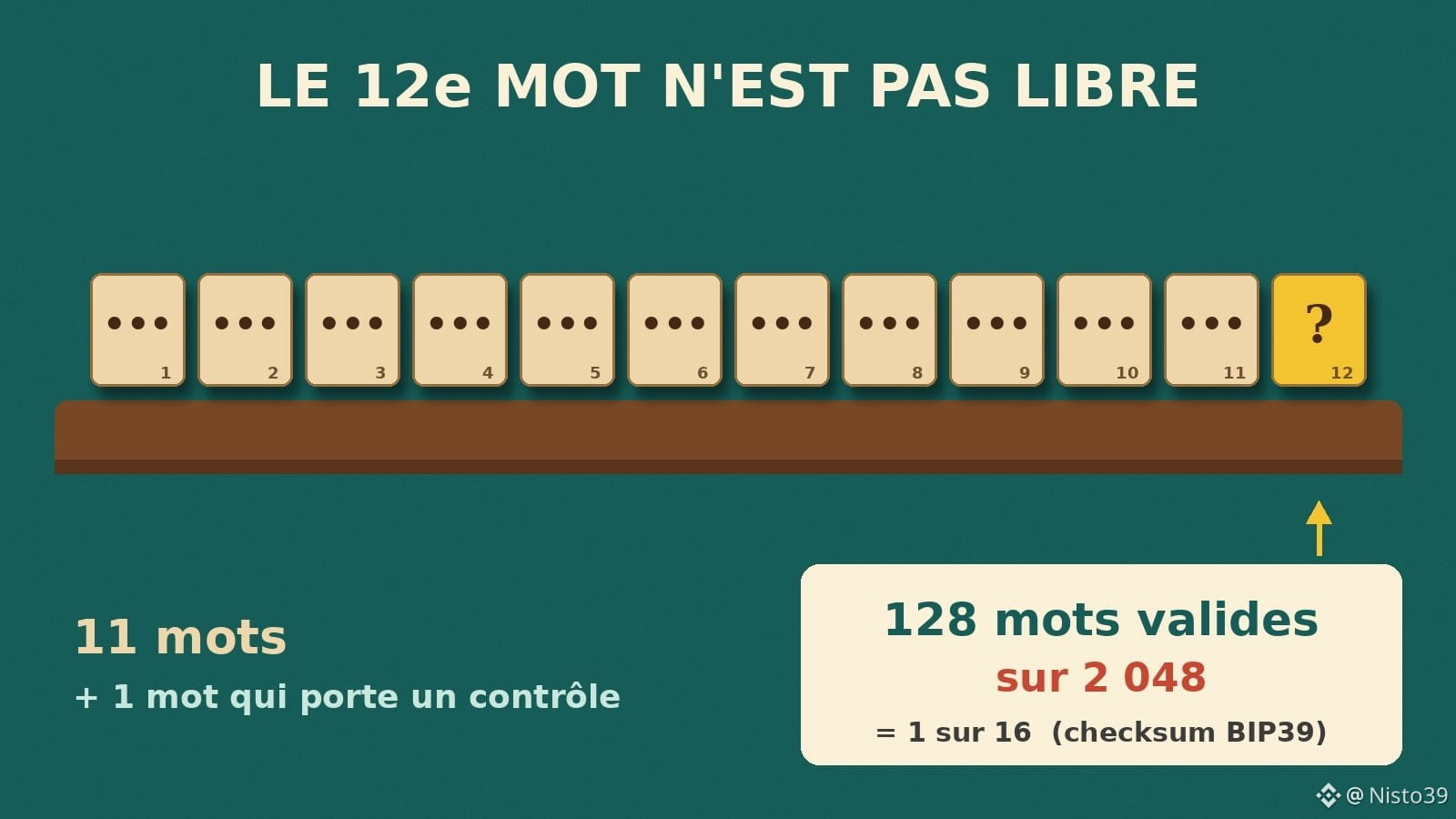
Experiment result: 128 out of 2,048. One in sixteen.
Why? Because the last word isn't entirely “random.” A 12-word phrase is 132 bits. 128 bits are pure randomness—the actual key. The last 4 bits are a checksum: a small fingerprint calculated from the other 128 (using the SHA-256 hash function). A checksum is like the two-digit check key at the end of a bank account number: it contains no new information; it’s used to verify that the rest was copied correctly.
The 12th word in your secret phrase isn’t arbitrary (I tested all 2,048)
This afternoon, I wrote twenty lines of Python to answer a silly question: if I keep 11 words from a recovery phrase and choose the 12th at random from the official list, how often will the wallet accept it?
The BIP39 list (the standard published in 2013, used by most wallets $BTC and $SOL ) contains 2,048 words. My intuition said: any word would work. After all, they’re words.
Experiment result: 128 out of 2,048. One in sixteen.
Why? Because the last word isn't entirely “random.” A 12-word phrase is 132 bits. 128 bits are pure randomness—the actual key. The last 4 bits are a checksum: a small fingerprint calculated from the other 128 (using the SHA-256 hash function). A checksum is like the two-digit check key at the end of a bank account number: it contains no new information; it’s used to verify that the rest was copied correctly.
The BIP39 list (the standard published in 2013, used by most wallets $BTC and $SOL ) contains 2,048 words. My intuition said: any word would work. After all, they’re words.
Experiment result: 128 out of 2,048. One in sixteen.
Why? Because the last word isn't entirely “random.” A 12-word phrase is 132 bits. 128 bits are pure randomness—the actual key. The last 4 bits are a checksum: a small fingerprint calculated from the other 128 (using the SHA-256 hash function). A checksum is like the two-digit check key at the end of a bank account number: it contains no new information; it’s used to verify that the rest was copied correctly.
71
·
--
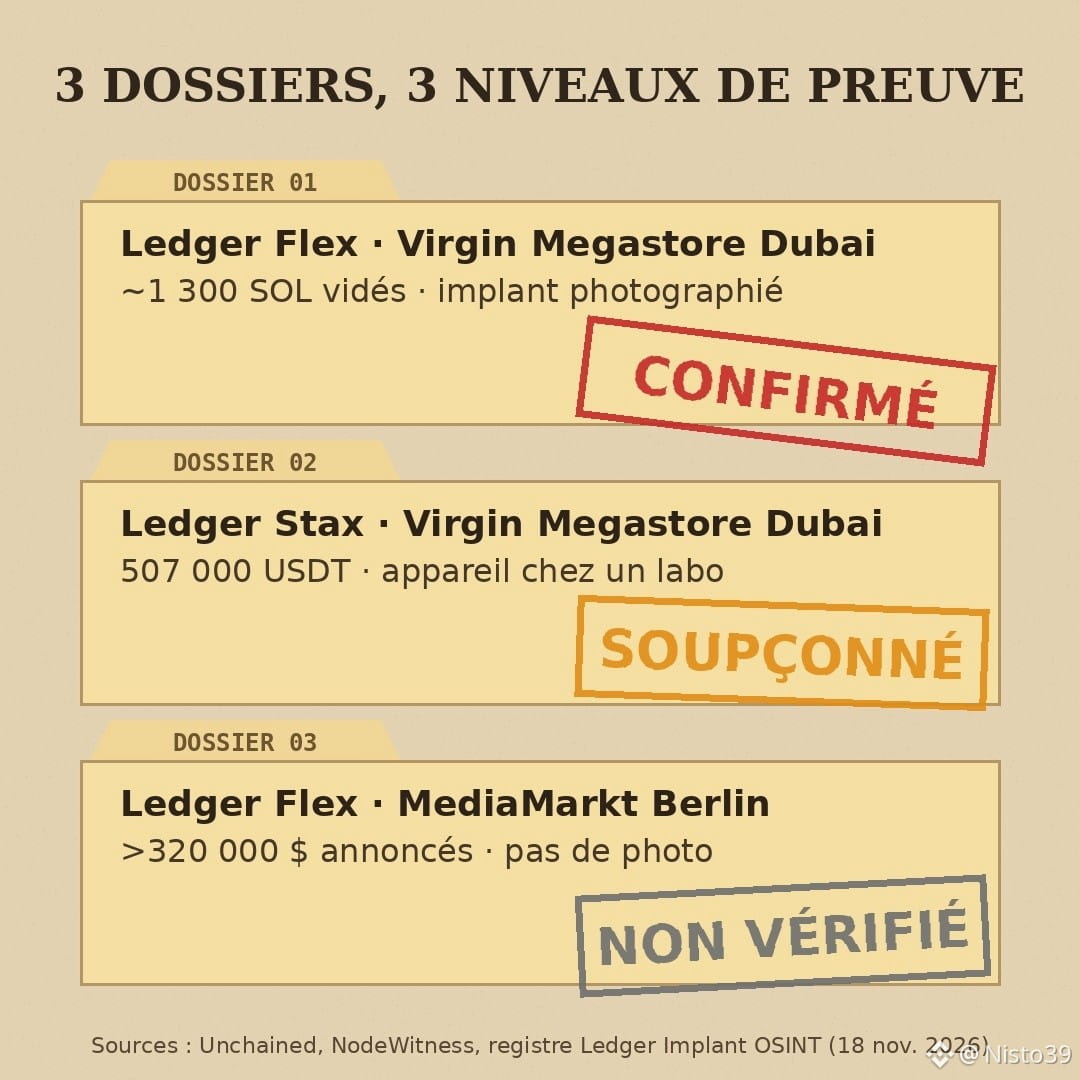
13/09/2026, 22:38. Virgin Megastore, Dubai Mall. 1 Ledger Flex, 1,030 dirhams, paid by card.
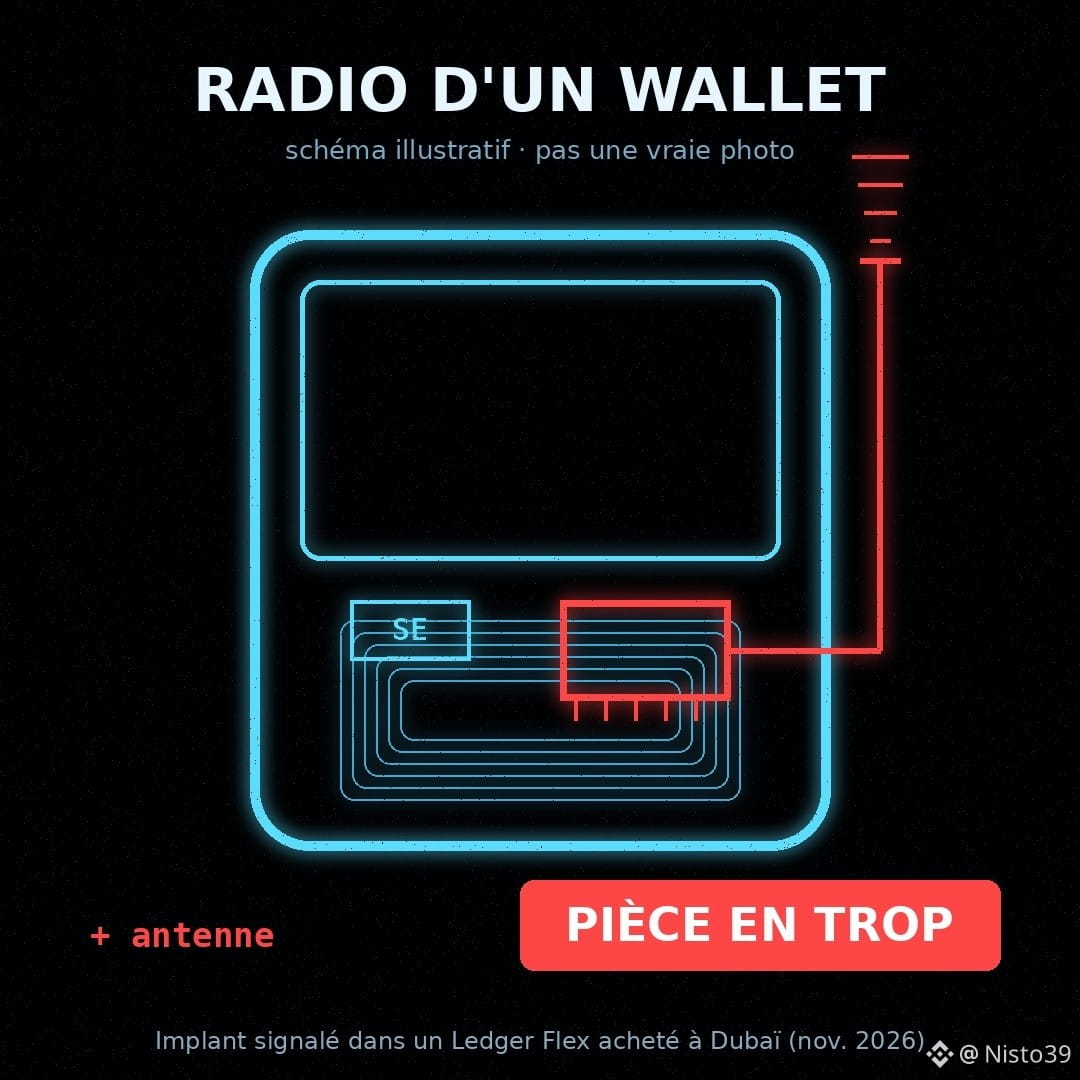
This receipt has become evidence. On November 15, its owner reports that about 1,300 $SOL had left his wallet. The next day, he opens the device: an extra circuit board, connected to an antenna stuck beneath the cover. The registry maintained by Mark Karpelès (former head of Mt. Gox) lists the implant as confirmed.
The troubling detail: Virgin Megastore is one of Ledger's authorized retailers in the UAE. Not a Telegram seller. A mall store.
Two other cases, with a grain of salt:
- a Ledger Stax bought at the same place on October 11, 507,000 $USDT drained on November 14. Implant suspected; the device is with a lab;
- a Ledger Flex from MediaMarkt Berlin, with more than $320,000 reportedly lost. Nothing verified so far.
Ledger says it has “no indication” that its systems were compromised. That may be true and still solve nothing: an implant is a bug slipped into the casing between the factory and the customer. Not into the servers.
My take: “buy from an official store” is still good advice, but it's no longer a guarantee. The shortest supply chain is from the manufacturer's website to your door. And with a new wallet, I test it first with a small amount.
Where we are, these devices often arrive in the suitcase of someone returning from Dubai or through an online reseller. The question is no longer just “is it genuine?” but “how many hands has it passed through?”
Bought a Ledger or Trezor from these stores in recent months? Karpelès advises checking the device or moving the funds.
Could you trace the journey your hardware wallet took to reach you?
#Ledger #HardwareWallet #SecuriteCrypto #Dubai
13/09/2026, 22:38. Virgin Megastore, Dubai Mall. 1 Ledger Flex, 1,030 dirhams, paid by card.
This receipt has become evidence. On November 15, its owner reports that about 1,300 $SOL had left his wallet. The next day, he opens the device: an extra circuit board, connected to an antenna stuck beneath the cover. The registry maintained by Mark Karpelès (former head of Mt. Gox) lists the implant as confirmed.
The troubling detail: Virgin Megastore is one of Ledger's authorized retailers in the UAE. Not a Telegram seller. A mall store.
Two other cases, with a grain of salt:
- a Ledger Stax bought at the same place on October 11, 507,000 $USDT drained on November 14. Implant suspected; the device is with a lab;
- a Ledger Flex from MediaMarkt Berlin, with more than $320,000 reportedly lost. Nothing verified so far.
Ledger says it has “no indication” that its systems were compromised. That may be true and still solve nothing: an implant is a bug slipped into the casing between the factory and the customer. Not into the servers.
My take: “buy from an official store” is still good advice, but it's no longer a guarantee. The shortest supply chain is from the manufacturer's website to your door. And with a new wallet, I test it first with a small amount.
Where we are, these devices often arrive in the suitcase of someone returning from Dubai or through an online reseller. The question is no longer just “is it genuine?” but “how many hands has it passed through?”
Bought a Ledger or Trezor from these stores in recent months? Karpelès advises checking the device or moving the funds.
Could you trace the journey your hardware wallet took to reach you?
#Ledger #HardwareWallet #SecuriteCrypto #Dubai
This receipt has become evidence. On November 15, its owner reports that about 1,300 $SOL had left his wallet. The next day, he opens the device: an extra circuit board, connected to an antenna stuck beneath the cover. The registry maintained by Mark Karpelès (former head of Mt. Gox) lists the implant as confirmed.
The troubling detail: Virgin Megastore is one of Ledger's authorized retailers in the UAE. Not a Telegram seller. A mall store.
Two other cases, with a grain of salt:
- a Ledger Stax bought at the same place on October 11, 507,000 $USDT drained on November 14. Implant suspected; the device is with a lab;
- a Ledger Flex from MediaMarkt Berlin, with more than $320,000 reportedly lost. Nothing verified so far.
Ledger says it has “no indication” that its systems were compromised. That may be true and still solve nothing: an implant is a bug slipped into the casing between the factory and the customer. Not into the servers.
My take: “buy from an official store” is still good advice, but it's no longer a guarantee. The shortest supply chain is from the manufacturer's website to your door. And with a new wallet, I test it first with a small amount.
Where we are, these devices often arrive in the suitcase of someone returning from Dubai or through an online reseller. The question is no longer just “is it genuine?” but “how many hands has it passed through?”
Bought a Ledger or Trezor from these stores in recent months? Karpelès advises checking the device or moving the funds.
Could you trace the journey your hardware wallet took to reach you?
#Ledger #HardwareWallet #SecuriteCrypto #Dubai
270
·
--
Article
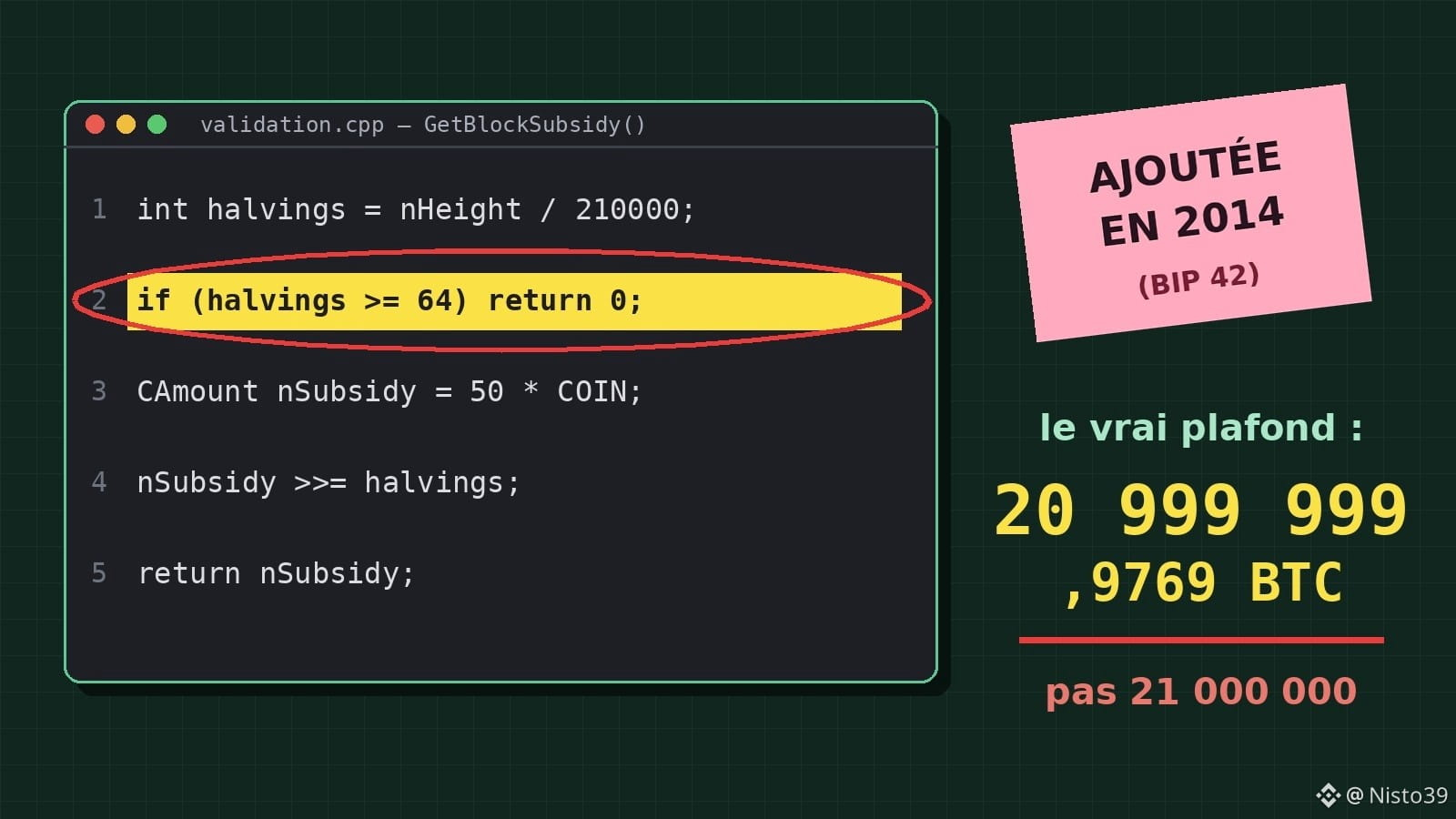
21 million bitcoins? I read the 5 lines of code that make the promiseNobody wrote “21,000,000” into the rule that creates new $BTC. Look for that number in the function that sets the miners’ reward: it isn’t there. The cap is a consequence, not a constant. And for five years, it even depended on a shaky quirk of the C++ language.
Here’s the function as it exists today in Bitcoin Core (GetBlockSubsidy). Five lines. Let’s read them one by one.
Line 1 — halvings = block height / 210,000
“Height” means the block number. Every 210,000 blocks (about 4 years, at one block every ~10 minutes), this counter goes up by 1. We’re around block 976,500: divide that by 210,000 and you get 4. Four halvings have passed; the most recent was in April 2024.
21 million bitcoins? I read the 5 lines of code that make the promise
Nobody wrote “21,000,000” into the rule that creates new $BTC . Look for that number in the function that sets the miners’ reward: it isn’t there. The cap is a consequence, not a constant. And for five years, it even depended on a shaky quirk of the C++ language.
Here’s the function as it exists today in Bitcoin Core (GetBlockSubsidy). Five lines. Let’s read them one by one.
Line 1 — halvings = block height / 210,000
“Height” means the block number. Every 210,000 blocks (about 4 years, at one block every ~10 minutes), this counter goes up by 1. We’re around block 976,500: divide that by 210,000 and you get 4. Four halvings have passed; the most recent was in April 2024.
Here’s the function as it exists today in Bitcoin Core (GetBlockSubsidy). Five lines. Let’s read them one by one.
Line 1 — halvings = block height / 210,000
“Height” means the block number. Every 210,000 blocks (about 4 years, at one block every ~10 minutes), this counter goes up by 1. We’re around block 976,500: divide that by 210,000 and you get 4. Four halvings have passed; the most recent was in April 2024.
88
·
--
“A quantum computer could drain 35% of bitcoin in an hour.”
This phrase has been circulating since yesterday. It combines two true figures and makes up a false one.
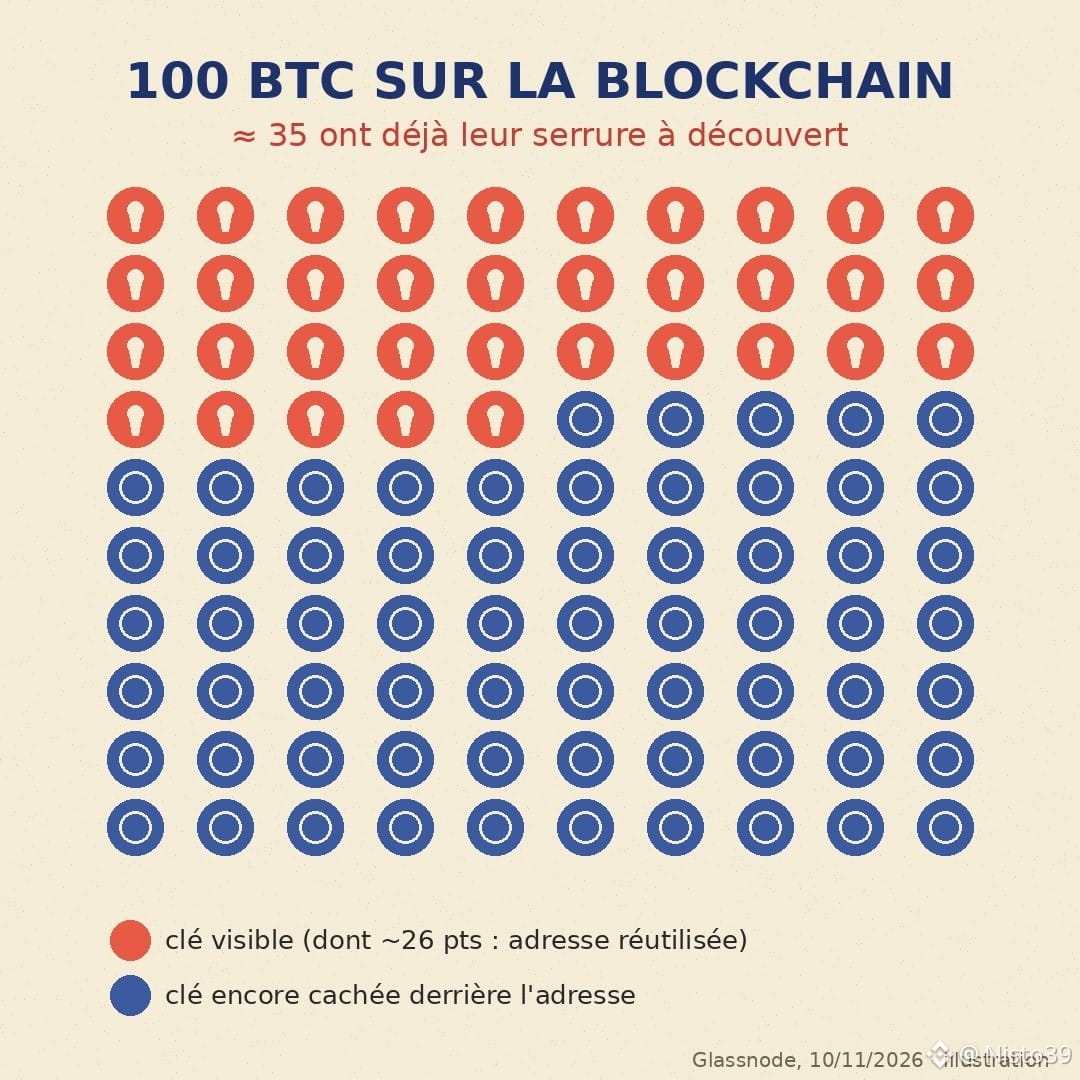
True #1: according to Glassnode (November 10), 35.4% of the $BTC supply, or around 7.12 million BTC, sits in addresses whose public key is already visible on the blockchain. A public key is like a lock that anyone can study. No computer today can work backwards from it to find the private key. A very large quantum machine theoretically could.
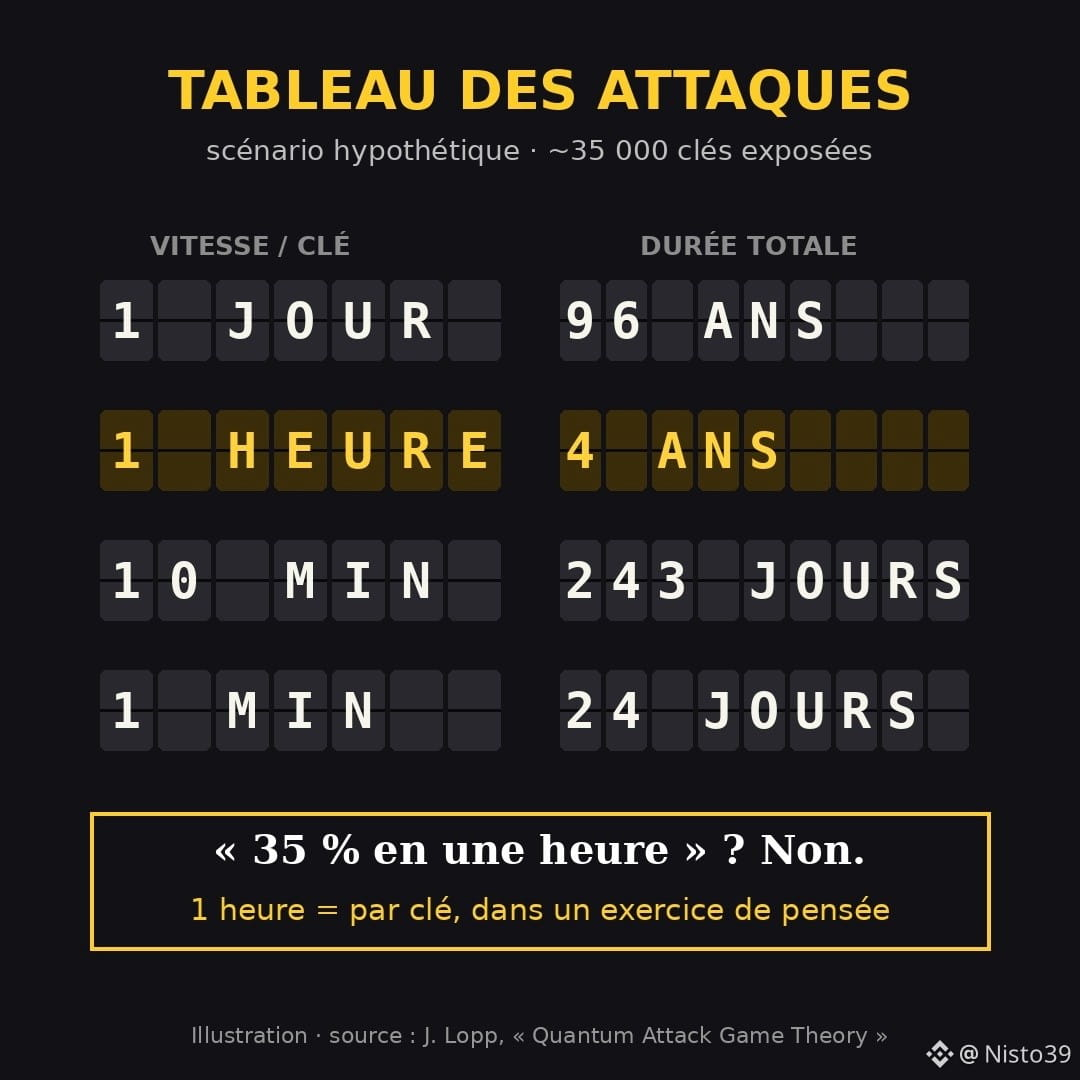
True #2: Jameson Lopp (Casa) ran the numbers as a thought experiment. Around 35,000 exposed keys, mostly belonging to coins that have been untouched for ~15 years, hold some 2.26 million BTC. At one key cracked per hour, it would take around 4 years to crack them all. At one per day: 96 years. At 10 minutes per key: 243 days.
“One hour” is therefore the time per key in a hypothetical scenario. Not the time it would take to crack a third of the network. And Lopp has already said he sees a greater than 50% chance that such a machine is more than ten years away.
My take: the real issue isn’t when, but who is exposed. According to Glassnode, 25.8% of the supply is exposed because of address reuse: you spend from an address, its public key becomes visible, and you keep receiving funds at that address. Most wallets offer a new address for each incoming payment. You just have to accept it.
The coins that can never be protected are the ones no one can move anymore. That’s where the debate will get heated, not over a well-managed wallet.
Do you still receive funds at the same address, or do you let your wallet change it?
#Bitcoin #Quantique #Securite #Glassnode
“A quantum computer could drain 35% of bitcoin in an hour.”
This phrase has been circulating since yesterday. It combines two true figures and makes up a false one.
True #1: according to Glassnode (November 10), 35.4% of the $BTC supply, or around 7.12 million BTC, sits in addresses whose public key is already visible on the blockchain. A public key is like a lock that anyone can study. No computer today can work backwards from it to find the private key. A very large quantum machine theoretically could.
True #2: Jameson Lopp (Casa) ran the numbers as a thought experiment. Around 35,000 exposed keys, mostly belonging to coins that have been untouched for ~15 years, hold some 2.26 million BTC. At one key cracked per hour, it would take around 4 years to crack them all. At one per day: 96 years. At 10 minutes per key: 243 days.
“One hour” is therefore the time per key in a hypothetical scenario. Not the time it would take to crack a third of the network. And Lopp has already said he sees a greater than 50% chance that such a machine is more than ten years away.
My take: the real issue isn’t when, but who is exposed. According to Glassnode, 25.8% of the supply is exposed because of address reuse: you spend from an address, its public key becomes visible, and you keep receiving funds at that address. Most wallets offer a new address for each incoming payment. You just have to accept it.
The coins that can never be protected are the ones no one can move anymore. That’s where the debate will get heated, not over a well-managed wallet.
Do you still receive funds at the same address, or do you let your wallet change it?
#Bitcoin #Quantique #Securite #Glassnode
This phrase has been circulating since yesterday. It combines two true figures and makes up a false one.
True #1: according to Glassnode (November 10), 35.4% of the $BTC supply, or around 7.12 million BTC, sits in addresses whose public key is already visible on the blockchain. A public key is like a lock that anyone can study. No computer today can work backwards from it to find the private key. A very large quantum machine theoretically could.
True #2: Jameson Lopp (Casa) ran the numbers as a thought experiment. Around 35,000 exposed keys, mostly belonging to coins that have been untouched for ~15 years, hold some 2.26 million BTC. At one key cracked per hour, it would take around 4 years to crack them all. At one per day: 96 years. At 10 minutes per key: 243 days.
“One hour” is therefore the time per key in a hypothetical scenario. Not the time it would take to crack a third of the network. And Lopp has already said he sees a greater than 50% chance that such a machine is more than ten years away.
My take: the real issue isn’t when, but who is exposed. According to Glassnode, 25.8% of the supply is exposed because of address reuse: you spend from an address, its public key becomes visible, and you keep receiving funds at that address. Most wallets offer a new address for each incoming payment. You just have to accept it.
The coins that can never be protected are the ones no one can move anymore. That’s where the debate will get heated, not over a well-managed wallet.
Do you still receive funds at the same address, or do you let your wallet change it?
#Bitcoin #Quantique #Securite #Glassnode
123
·
--
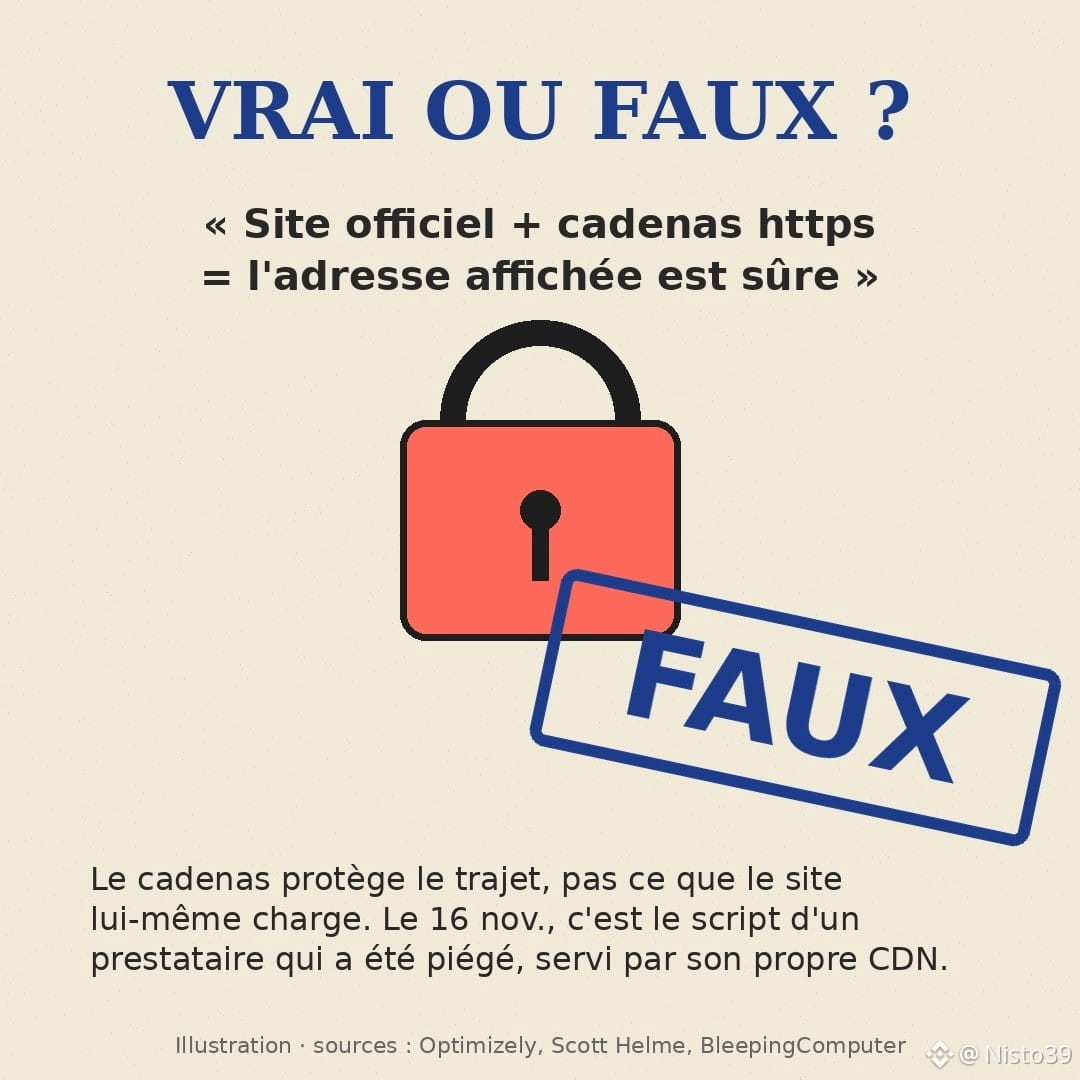
True or false: on an official website, with the https padlock, the crypto address you copy is guaranteed to be the right one.
False. And November 16 proved it on a large scale.
That day, an attacker exploited a vulnerability at Optimizely, a tool major brands use to test their pages. They slipped code into the projects of 178 organizations (identified by researcher Scott Helme). Among them: Ledger, CNN, BBC, Zoom, Salesforce, HSBC Insurance.
The script was served by Optimizely’s own CDN, with its certificate. To your browser, everything looked normal.
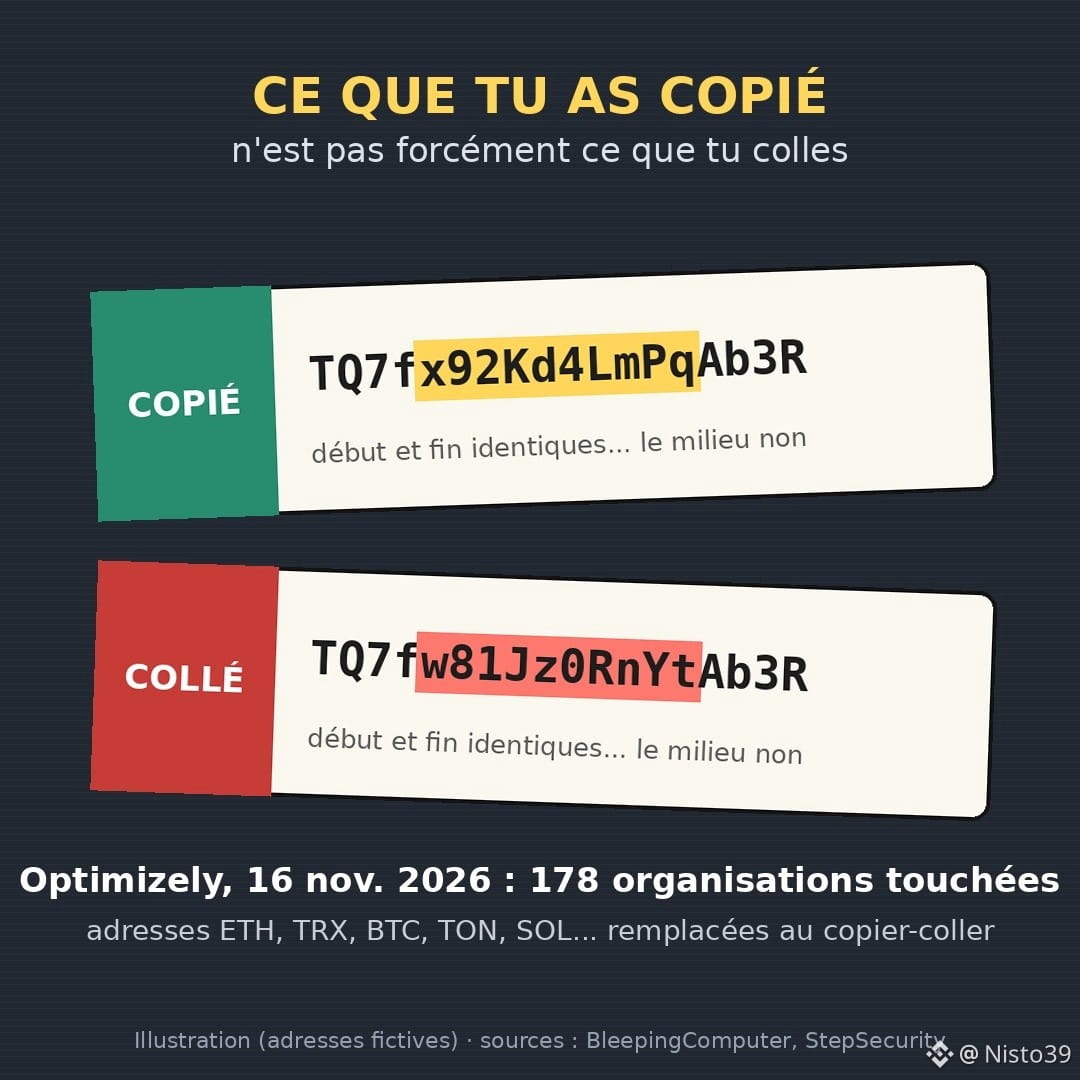
What it did: monitor the page, detect wallet addresses (ETH, TRX, BTC, TON, SOL, LTC, DOGE...) and replace them with the attacker’s. Valid addresses that pass format checks. It also stole bank card details.
Known tally so far: about $7,000 received in their wallets by November 16, according to Helme; some were already active beforehand. Optimizely says it fixed the vulnerability; everything was clean that same evening.
$7,000 isn’t much. In my view, the lesson is worth a lot more. The padlock protects the connection between you and the website, not what the website loads itself. Your only real defense is the confirmation screen in your wallet or on the exchange.
Three ten-second habits:
- compare the beginning, the end AND a few characters in the middle (clipboard hijackers often copy the beginning and end);
- save frequently used addresses in an address book / whitelist;
- for a large amount, send a small test transaction first.
This applies to $TRX or USDT on Tron just as much as to $ETH.
Do you check your address character by character, or do you trust copy and paste?
#securitecrypto #arnaque #wallet #Optimizely #cybersecurity
True or false: on an official website, with the https padlock, the crypto address you copy is guaranteed to be the right one.
False. And November 16 proved it on a large scale.
That day, an attacker exploited a vulnerability at Optimizely, a tool major brands use to test their pages. They slipped code into the projects of 178 organizations (identified by researcher Scott Helme). Among them: Ledger, CNN, BBC, Zoom, Salesforce, HSBC Insurance.
The script was served by Optimizely’s own CDN, with its certificate. To your browser, everything looked normal.
What it did: monitor the page, detect wallet addresses (ETH, TRX, BTC, TON, SOL, LTC, DOGE...) and replace them with the attacker’s. Valid addresses that pass format checks. It also stole bank card details.
Known tally so far: about $7,000 received in their wallets by November 16, according to Helme; some were already active beforehand. Optimizely says it fixed the vulnerability; everything was clean that same evening.
$7,000 isn’t much. In my view, the lesson is worth a lot more. The padlock protects the connection between you and the website, not what the website loads itself. Your only real defense is the confirmation screen in your wallet or on the exchange.
Three ten-second habits:
- compare the beginning, the end AND a few characters in the middle (clipboard hijackers often copy the beginning and end);
- save frequently used addresses in an address book / whitelist;
- for a large amount, send a small test transaction first.
This applies to $TRX or USDT on Tron just as much as to $ETH .
Do you check your address character by character, or do you trust copy and paste?
#securitecrypto #arnaque #wallet #Optimizely #cybersecurity
False. And November 16 proved it on a large scale.
That day, an attacker exploited a vulnerability at Optimizely, a tool major brands use to test their pages. They slipped code into the projects of 178 organizations (identified by researcher Scott Helme). Among them: Ledger, CNN, BBC, Zoom, Salesforce, HSBC Insurance.
The script was served by Optimizely’s own CDN, with its certificate. To your browser, everything looked normal.
What it did: monitor the page, detect wallet addresses (ETH, TRX, BTC, TON, SOL, LTC, DOGE...) and replace them with the attacker’s. Valid addresses that pass format checks. It also stole bank card details.
Known tally so far: about $7,000 received in their wallets by November 16, according to Helme; some were already active beforehand. Optimizely says it fixed the vulnerability; everything was clean that same evening.
$7,000 isn’t much. In my view, the lesson is worth a lot more. The padlock protects the connection between you and the website, not what the website loads itself. Your only real defense is the confirmation screen in your wallet or on the exchange.
Three ten-second habits:
- compare the beginning, the end AND a few characters in the middle (clipboard hijackers often copy the beginning and end);
- save frequently used addresses in an address book / whitelist;
- for a large amount, send a small test transaction first.
This applies to $TRX or USDT on Tron just as much as to $ETH .
Do you check your address character by character, or do you trust copy and paste?
#securitecrypto #arnaque #wallet #Optimizely #cybersecurity
1
72
·
--
Article
A Letter to the Man Who Paid 10,000 Bitcoins for Two PizzasDear Laszlo,
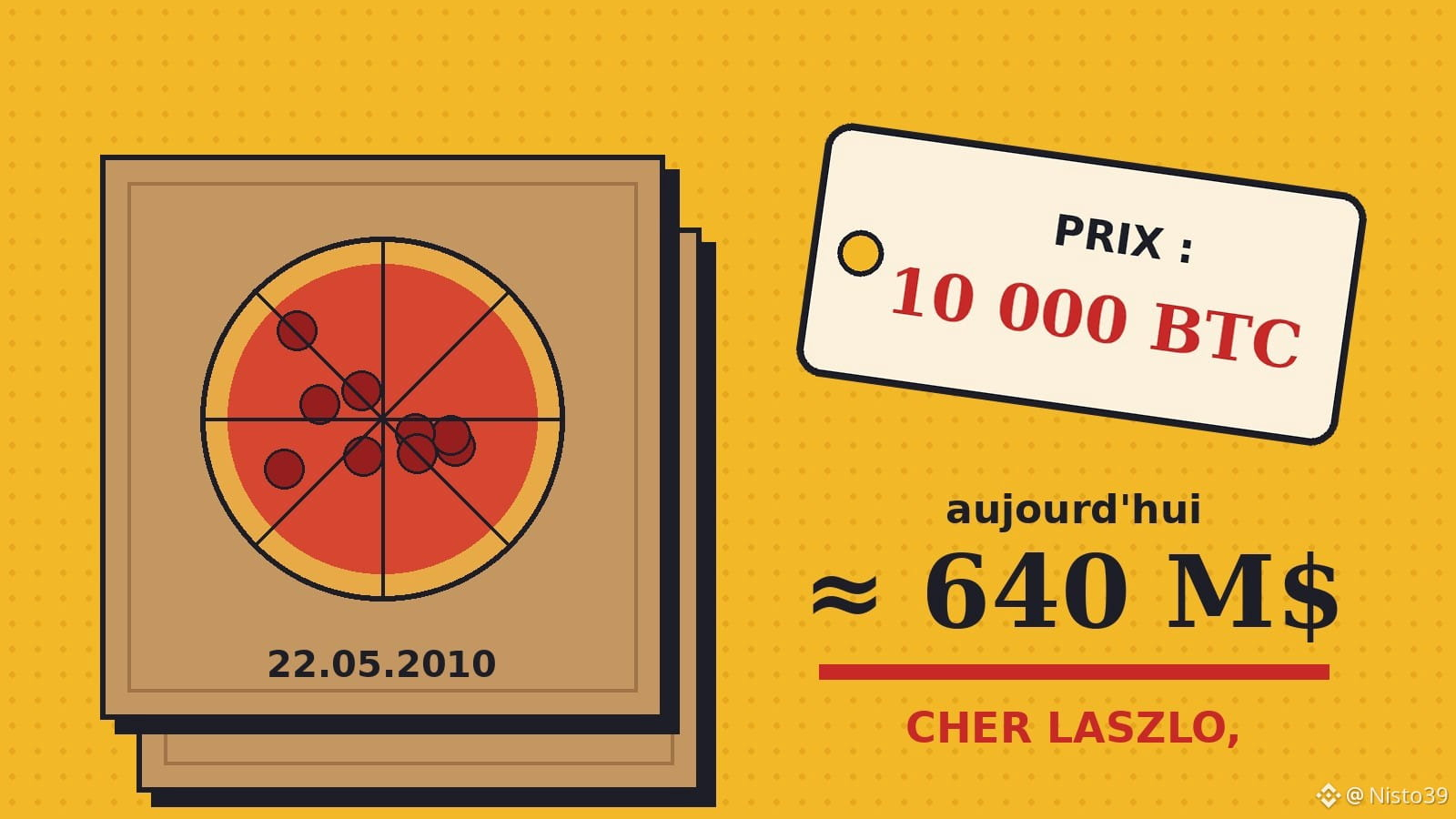
Every May 22, millions of people poke a little fun at you. On May 22, 2010, you paid for two Papa John's pizzas with 10,000 bitcoins. At today's rate (around $BTC $64,000), that's about $640 million. Two pizzas.
I wanted to write to tell you something that gets forgotten in the jokes: you didn't miss out on anything. You did the work nobody else wanted to do.
A quick recap. A few days earlier, you'd posted a simple offer on the Bitcointalk forum: 10,000 bitcoins for two large pizzas. For days, nothing. Nobody wanted them, because nobody knew what a bitcoin was worth. Then another forum member accepted, ordered the pizzas remotely, and had them delivered to you. It's considered the first known purchase of a real-world item paid for in bitcoin.
A Letter to the Man Who Paid 10,000 Bitcoins for Two Pizzas
Dear Laszlo,
Every May 22, millions of people poke a little fun at you. On May 22, 2010, you paid for two Papa John's pizzas with 10,000 bitcoins. At today's rate (around $BTC $64,000), that's about $640 million. Two pizzas.
I wanted to write to tell you something that gets forgotten in the jokes: you didn't miss out on anything. You did the work nobody else wanted to do.
A quick recap. A few days earlier, you'd posted a simple offer on the Bitcointalk forum: 10,000 bitcoins for two large pizzas. For days, nothing. Nobody wanted them, because nobody knew what a bitcoin was worth. Then another forum member accepted, ordered the pizzas remotely, and had them delivered to you. It's considered the first known purchase of a real-world item paid for in bitcoin.
Every May 22, millions of people poke a little fun at you. On May 22, 2010, you paid for two Papa John's pizzas with 10,000 bitcoins. At today's rate (around $BTC $64,000), that's about $640 million. Two pizzas.
I wanted to write to tell you something that gets forgotten in the jokes: you didn't miss out on anything. You did the work nobody else wanted to do.
A quick recap. A few days earlier, you'd posted a simple offer on the Bitcointalk forum: 10,000 bitcoins for two large pizzas. For days, nothing. Nobody wanted them, because nobody knew what a bitcoin was worth. Then another forum member accepted, ordered the pizzas remotely, and had them delivered to you. It's considered the first known purchase of a real-world item paid for in bitcoin.
72
·
--
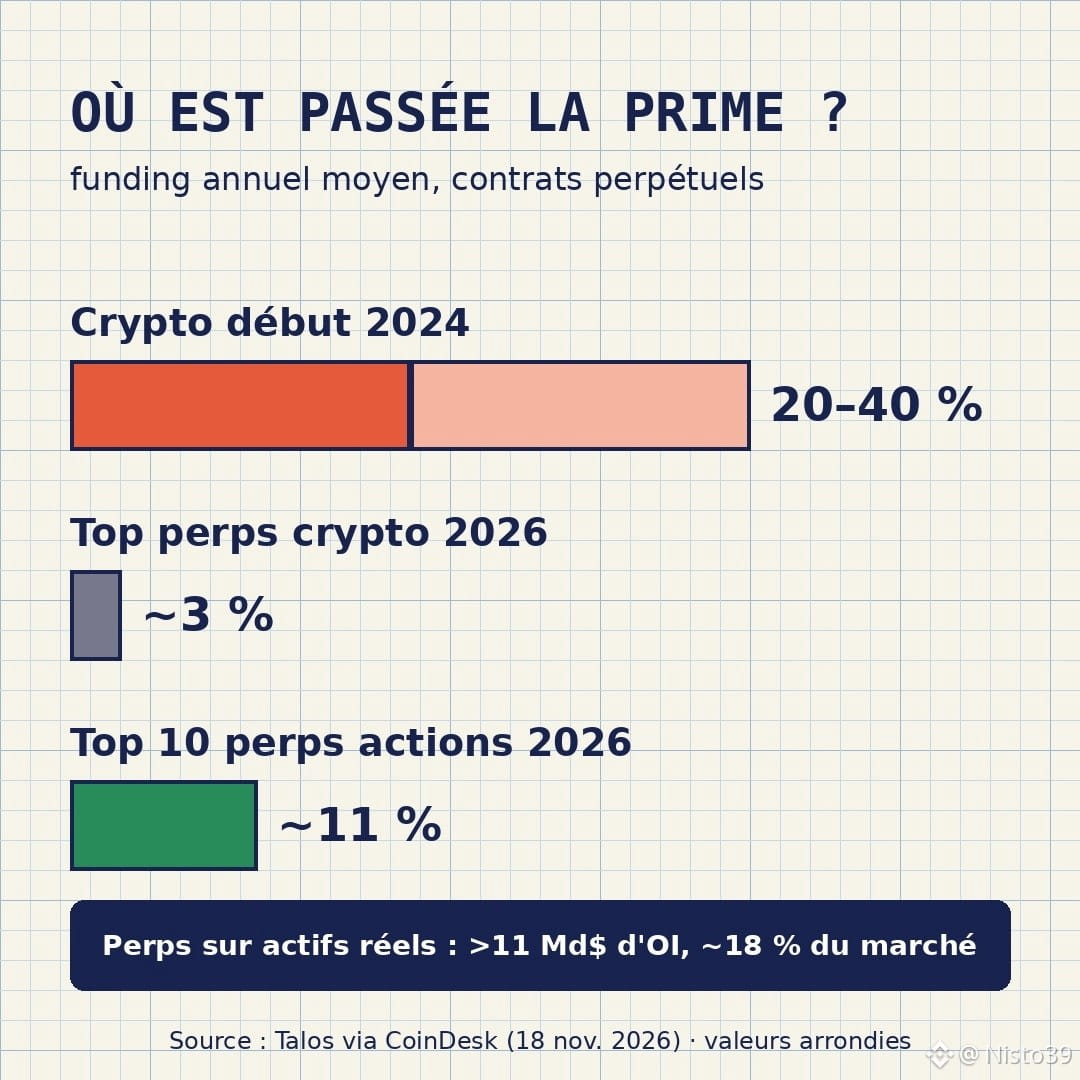
Two years ago, a crypto strategy paid 20 to 40% a year without betting on prices going up. Today, it yields about as much as a U.S. Treasury bill.
Its name: the basis trade. The idea: I buy bitcoin and, at the same time, short it using a perpetual contract (a futures contract with no expiration date). If the price rises, I gain on one side and lose on the other. What remains is the “funding”: a small fee that leveraged buyers regularly pay to sellers, as long as they outnumber them and are more eager to buy.
The figures, according to a Talos report cited by CoinDesk this morning:
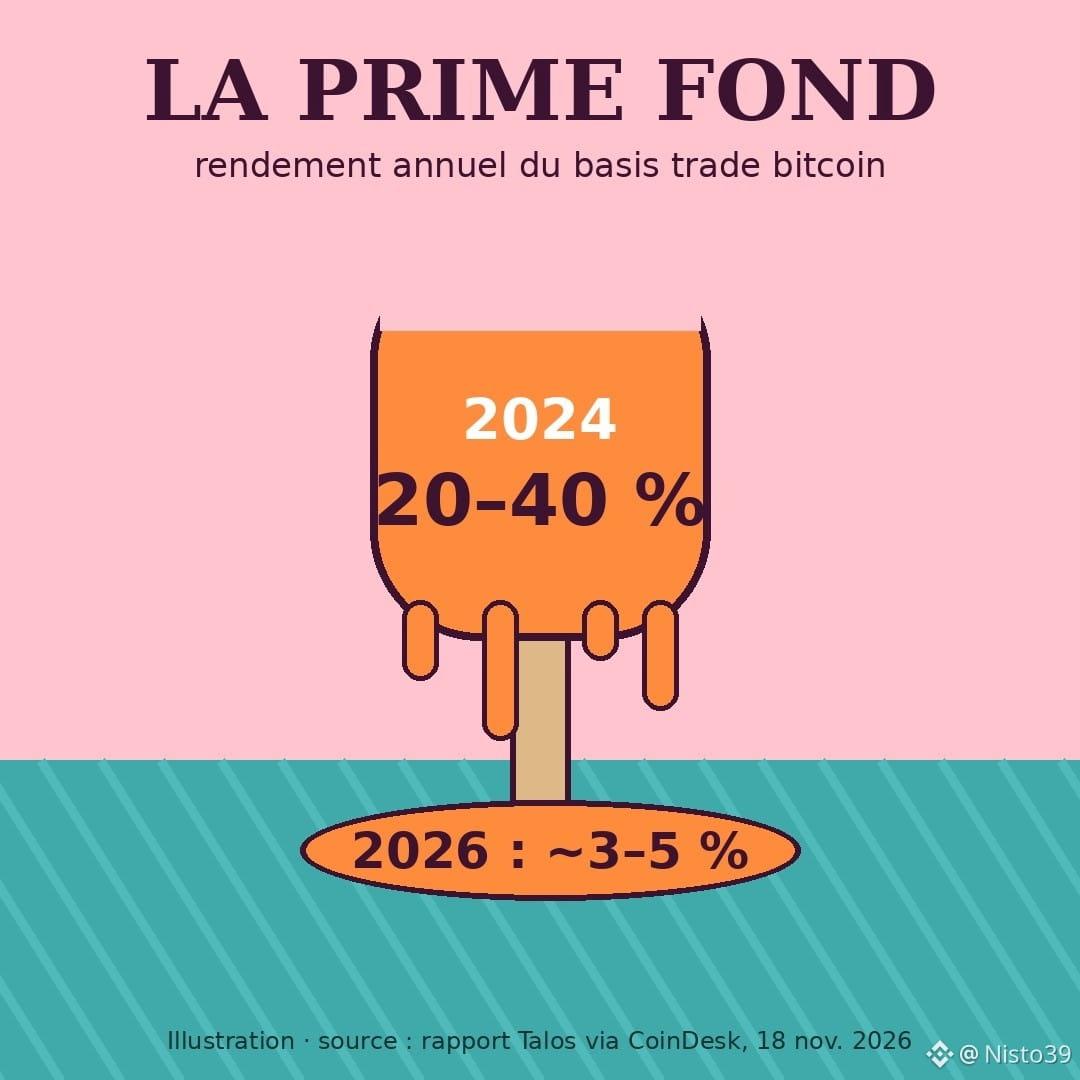
- early 2024: 20 to 40% a year
- 2026: around 3 to 5%, with even a period of negative returns in the second quarter
- equity-backed perps: around 11% a year on average for the 10 largest, versus around 3% for major crypto contracts
The money followed. Perps tied to real-world assets (mostly stocks) have more than $11 billion in open interest, about 18% of the market, split mostly between Binance and Hyperliquid.
My takeaway: this yield was never a gift from the market. It was the price of other people’s impatience. In 2024, many borrowed to buy bitcoin and were willing to pay dearly. With BTC stagnating around $65,000, those impatient buyers are few and far between, and the premium is fading along with them. It has moved to where the excitement is now: stocks.
Practical corollary: if someone offers you a “stable 30% yield” on bitcoin in 2026, ask who’s paying. The market isn’t paying that anymore.
$BTC $BNB
Do you see this calm in funding as a bottom forming, or just fatigue?
#BasisTrade #Funding #Perpetuels #Bitcoin #Talos
Two years ago, a crypto strategy paid 20 to 40% a year without betting on prices going up. Today, it yields about as much as a U.S. Treasury bill.
Its name: the basis trade. The idea: I buy bitcoin and, at the same time, short it using a perpetual contract (a futures contract with no expiration date). If the price rises, I gain on one side and lose on the other. What remains is the “funding”: a small fee that leveraged buyers regularly pay to sellers, as long as they outnumber them and are more eager to buy.
The figures, according to a Talos report cited by CoinDesk this morning:
- early 2024: 20 to 40% a year
- 2026: around 3 to 5%, with even a period of negative returns in the second quarter
- equity-backed perps: around 11% a year on average for the 10 largest, versus around 3% for major crypto contracts
The money followed. Perps tied to real-world assets (mostly stocks) have more than $11 billion in open interest, about 18% of the market, split mostly between Binance and Hyperliquid.
My takeaway: this yield was never a gift from the market. It was the price of other people’s impatience. In 2024, many borrowed to buy bitcoin and were willing to pay dearly. With BTC stagnating around $65,000, those impatient buyers are few and far between, and the premium is fading along with them. It has moved to where the excitement is now: stocks.
Practical corollary: if someone offers you a “stable 30% yield” on bitcoin in 2026, ask who’s paying. The market isn’t paying that anymore.
$BTC $BNB
Do you see this calm in funding as a bottom forming, or just fatigue?
#BasisTrade #Funding #Perpetuels #Bitcoin #Talos
Its name: the basis trade. The idea: I buy bitcoin and, at the same time, short it using a perpetual contract (a futures contract with no expiration date). If the price rises, I gain on one side and lose on the other. What remains is the “funding”: a small fee that leveraged buyers regularly pay to sellers, as long as they outnumber them and are more eager to buy.
The figures, according to a Talos report cited by CoinDesk this morning:
- early 2024: 20 to 40% a year
- 2026: around 3 to 5%, with even a period of negative returns in the second quarter
- equity-backed perps: around 11% a year on average for the 10 largest, versus around 3% for major crypto contracts
The money followed. Perps tied to real-world assets (mostly stocks) have more than $11 billion in open interest, about 18% of the market, split mostly between Binance and Hyperliquid.
My takeaway: this yield was never a gift from the market. It was the price of other people’s impatience. In 2024, many borrowed to buy bitcoin and were willing to pay dearly. With BTC stagnating around $65,000, those impatient buyers are few and far between, and the premium is fading along with them. It has moved to where the excitement is now: stocks.
Practical corollary: if someone offers you a “stable 30% yield” on bitcoin in 2026, ask who’s paying. The market isn’t paying that anymore.
$BTC $BNB
Do you see this calm in funding as a bottom forming, or just fatigue?
#BasisTrade #Funding #Perpetuels #Bitcoin #Talos
85
·
--
Article
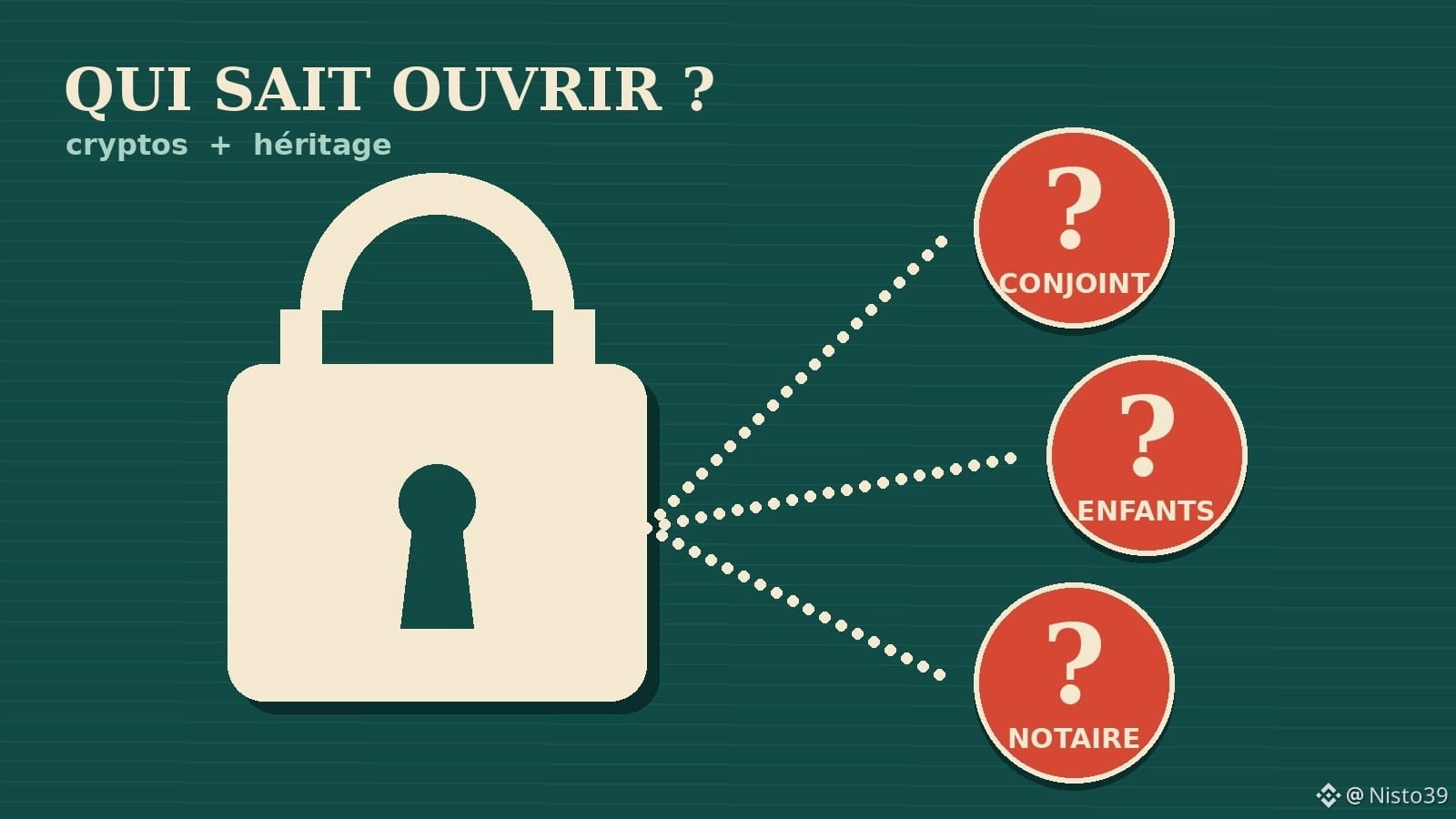
If I die tomorrow, will my family be able to recover my crypto?Awkward question, but I’d rather ask it now: if you disappeared tomorrow, who in your family would know you have crypto? And among them, who would know how to recover it?
For many of us, the honest answer is “no one.” We keep it discreet, sometimes even from our spouse. That’s understandable. But crypto without the right information is a locked door whose key went with you.
The story everyone cites in this context is QuadrigaCX, a Canadian platform. December 2018: its founder, Gerald Cotten, dies in India. The platform then explains that he alone controlled the wallets where customers’ funds were stored. For months, people told it as the tragedy of the lost keys.
If I die tomorrow, will my family be able to recover my crypto?
Awkward question, but I’d rather ask it now: if you disappeared tomorrow, who in your family would know you have crypto? And among them, who would know how to recover it?
For many of us, the honest answer is “no one.” We keep it discreet, sometimes even from our spouse. That’s understandable. But crypto without the right information is a locked door whose key went with you.
The story everyone cites in this context is QuadrigaCX, a Canadian platform. December 2018: its founder, Gerald Cotten, dies in India. The platform then explains that he alone controlled the wallets where customers’ funds were stored. For months, people told it as the tragedy of the lost keys.
For many of us, the honest answer is “no one.” We keep it discreet, sometimes even from our spouse. That’s understandable. But crypto without the right information is a locked door whose key went with you.
The story everyone cites in this context is QuadrigaCX, a Canadian platform. December 2018: its founder, Gerald Cotten, dies in India. The platform then explains that he alone controlled the wallets where customers’ funds were stored. For months, people told it as the tragedy of the lost keys.
2
3
689
·
--
“A farmer paid before the harvest season ends.”
That was the image chosen yesterday by Ajay Banga, president of the World Bank, to present a project with Citi and Circle: exploring the $USDC to disburse development funds.
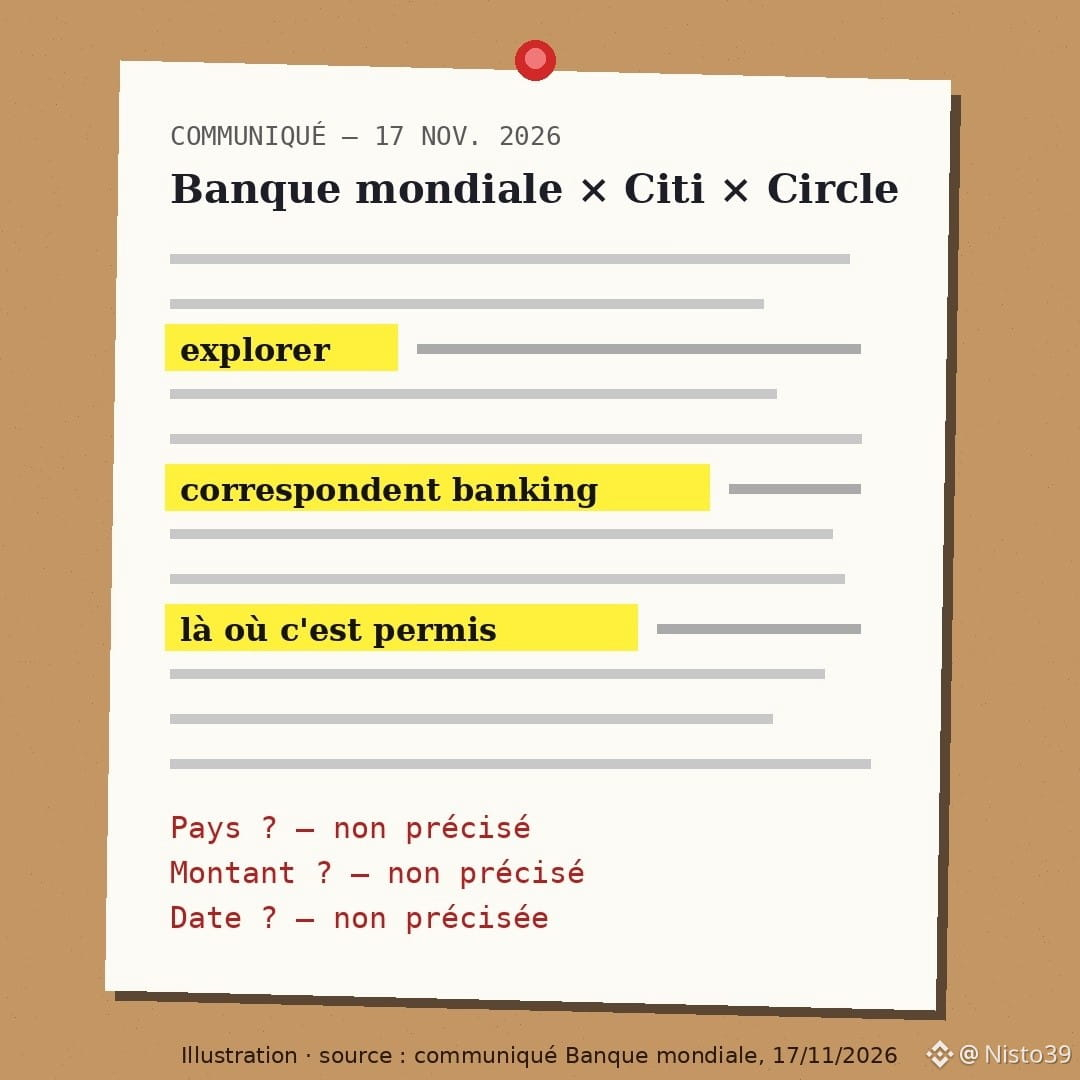
I read the November 17 press release in full. Three phrases caught my attention.
“Explore.” The word appears everywhere. The text names no countries, no amounts, no timeline. This is at the study stage, not the payment stage.
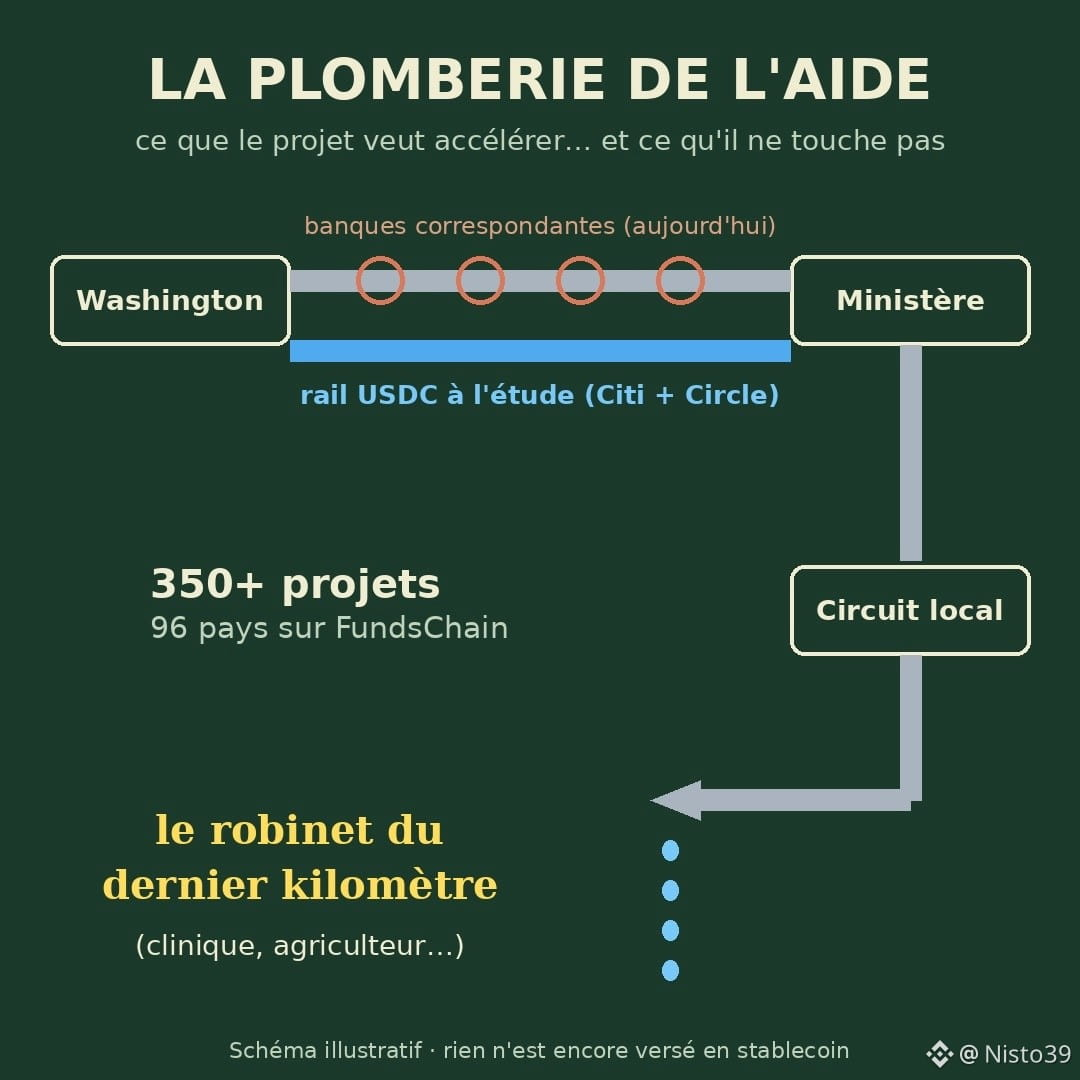
“Correspondent banking.” This is what the project aims to complement or improve: the chain of intermediary banks through which an international payment passes, each with its own delays and fees. Citi brings its banking connections; Circle issues and settles USDC (a stablecoin, meaning a digital token backed by the dollar).
“Where digital assets are permitted.” At the outset, only borrower countries that authorize these assets are covered. For part of Africa, the legal question will therefore come before the technical one.
It all relies on FundsChain, the Bank’s blockchain ledger, already used by more than 350 projects in 96 countries to track where the money goes.
My take: this is a real signal, but it affects the plumbing between institutions, not yet the farmer’s pocket. Saving a few days between Washington and a ministry is good. If the money then sits for two months in an administrative process, no stablecoin will change that. The most underestimated benefit may be traceability: it mainly bothers those who profit from opacity.
For those of you who have seen project funds pass through: does the money tend to get lost before it reaches the country, or afterward?
#WorldBank #USDC #Stablecoin #Afrique #CryptoNews
“A farmer paid before the harvest season ends.”
That was the image chosen yesterday by Ajay Banga, president of the World Bank, to present a project with Citi and Circle: exploring the $USDC to disburse development funds.
I read the November 17 press release in full. Three phrases caught my attention.
“Explore.” The word appears everywhere. The text names no countries, no amounts, no timeline. This is at the study stage, not the payment stage.
“Correspondent banking.” This is what the project aims to complement or improve: the chain of intermediary banks through which an international payment passes, each with its own delays and fees. Citi brings its banking connections; Circle issues and settles USDC (a stablecoin, meaning a digital token backed by the dollar).
“Where digital assets are permitted.” At the outset, only borrower countries that authorize these assets are covered. For part of Africa, the legal question will therefore come before the technical one.
It all relies on FundsChain, the Bank’s blockchain ledger, already used by more than 350 projects in 96 countries to track where the money goes.
My take: this is a real signal, but it affects the plumbing between institutions, not yet the farmer’s pocket. Saving a few days between Washington and a ministry is good. If the money then sits for two months in an administrative process, no stablecoin will change that. The most underestimated benefit may be traceability: it mainly bothers those who profit from opacity.
For those of you who have seen project funds pass through: does the money tend to get lost before it reaches the country, or afterward?
#WorldBank #USDC #Stablecoin #Afrique #CryptoNews
That was the image chosen yesterday by Ajay Banga, president of the World Bank, to present a project with Citi and Circle: exploring the $USDC to disburse development funds.
I read the November 17 press release in full. Three phrases caught my attention.
“Explore.” The word appears everywhere. The text names no countries, no amounts, no timeline. This is at the study stage, not the payment stage.
“Correspondent banking.” This is what the project aims to complement or improve: the chain of intermediary banks through which an international payment passes, each with its own delays and fees. Citi brings its banking connections; Circle issues and settles USDC (a stablecoin, meaning a digital token backed by the dollar).
“Where digital assets are permitted.” At the outset, only borrower countries that authorize these assets are covered. For part of Africa, the legal question will therefore come before the technical one.
It all relies on FundsChain, the Bank’s blockchain ledger, already used by more than 350 projects in 96 countries to track where the money goes.
My take: this is a real signal, but it affects the plumbing between institutions, not yet the farmer’s pocket. Saving a few days between Washington and a ministry is good. If the money then sits for two months in an administrative process, no stablecoin will change that. The most underestimated benefit may be traceability: it mainly bothers those who profit from opacity.
For those of you who have seen project funds pass through: does the money tend to get lost before it reaches the country, or afterward?
#WorldBank #USDC #Stablecoin #Afrique #CryptoNews
239
·
--
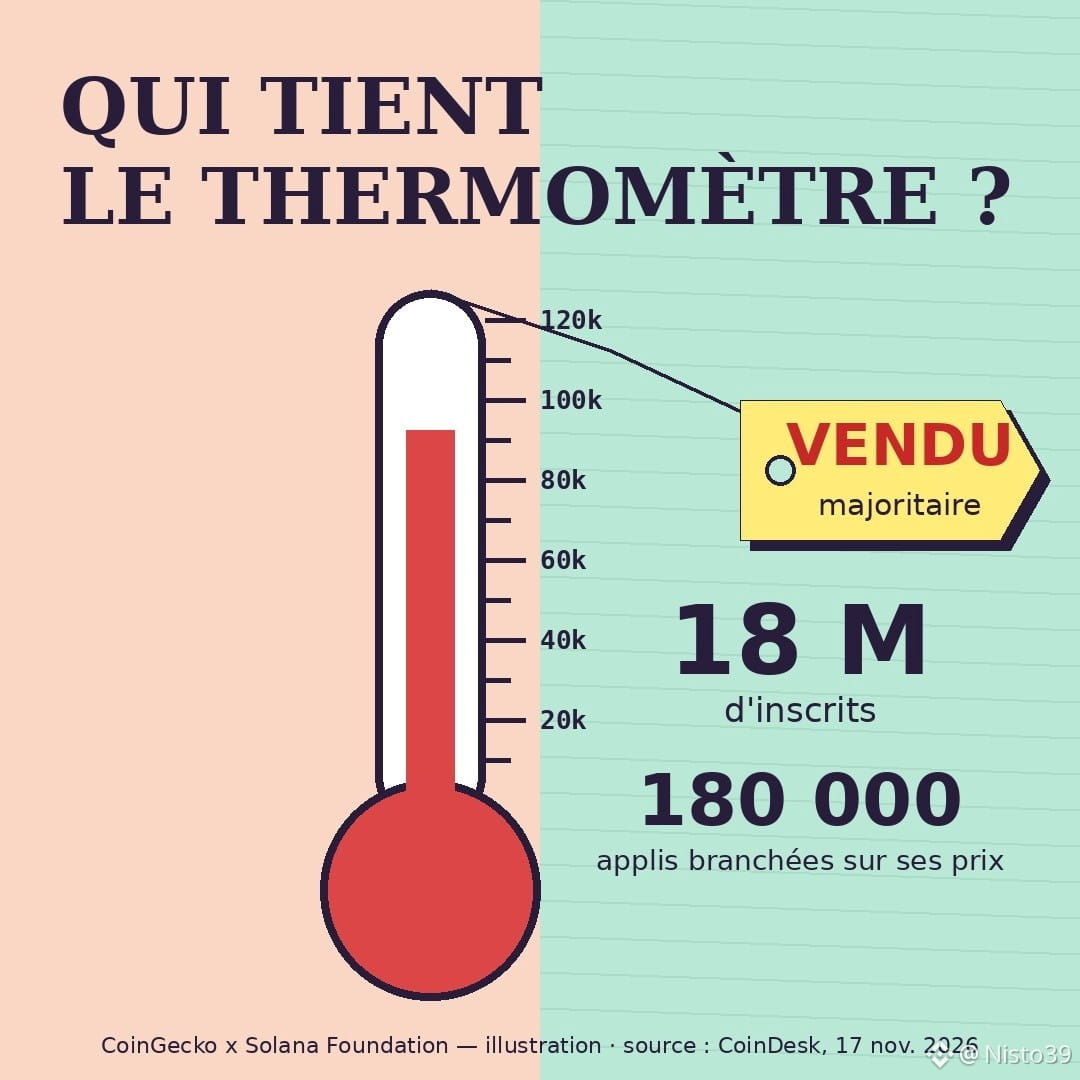
The thermometer has just changed hands.
The Solana Foundation has acquired a majority stake in CoinGecko, the site where countless people check a token’s price before doing anything else. The announcement was made at Breakpoint in London. The price paid and exact percentage were not disclosed (CoinDesk, Nov. 17).
What’s being highlighted: 18 million registered users, and market data supplied to 180,000 apps and businesses through its API (the pipeline other services use to retrieve these prices automatically).
Solana’s plan: Solana-powered trading directly on the site, GeckoTerminal, and the app. CoinGecko speaks more cautiously of an option “under consideration” and promises to keep its calculation methods public.
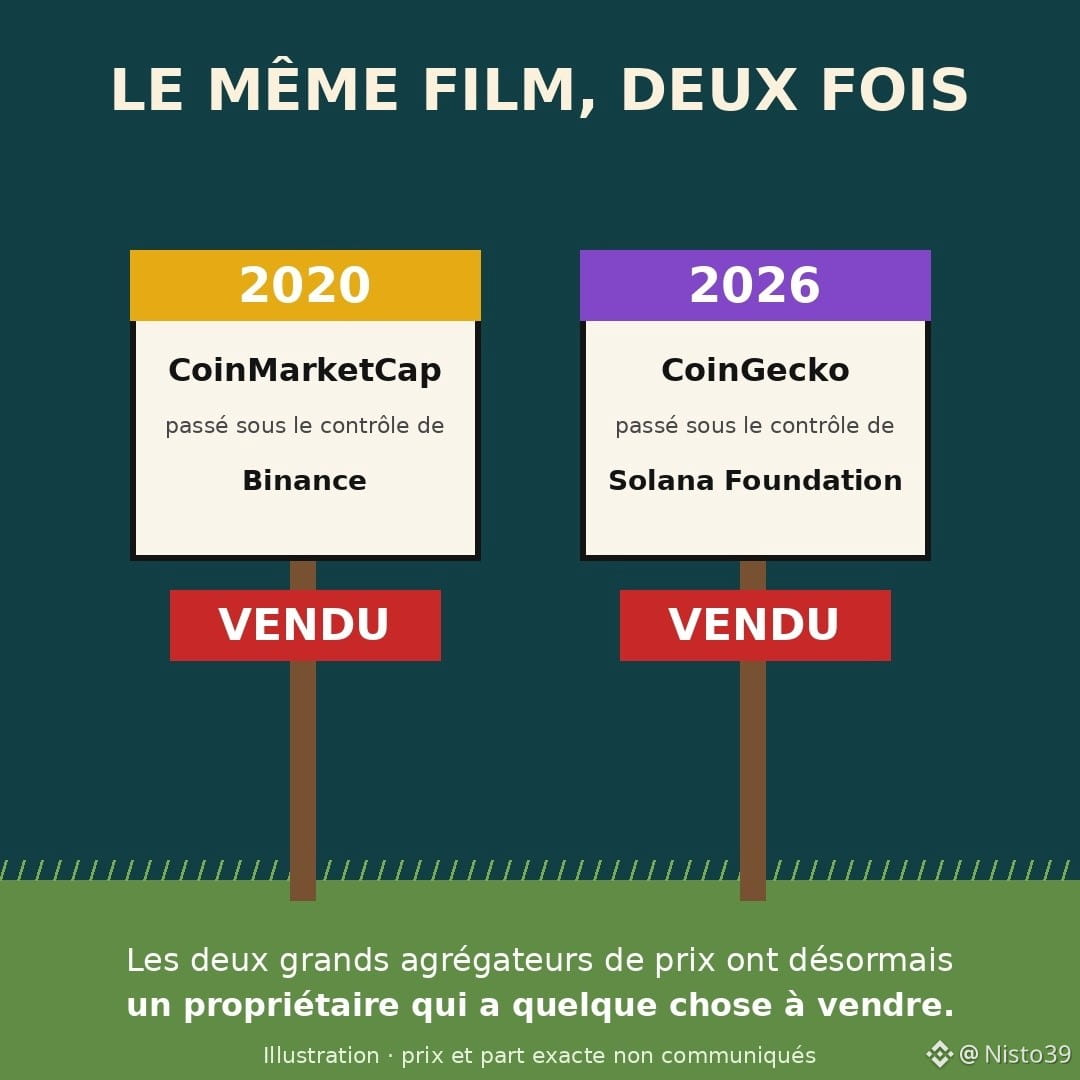
We’ve seen this movie before. In 2020, Binance acquired CoinMarketCap. As a result, the two major price aggregators now belong to someone with something to sell. An exchange on one side, a blockchain on the other.
My take: this isn’t a scandal; it’s a change in status. An independent aggregator has only one boss: its readers. An aggregator backed by an ecosystem has two. There’s no proof that rankings will be skewed. But the right question is no longer “Is this price fair?” It’s “Who decides what appears first, and next to which button?”
Things to watch: which tokens make it onto the homepage, where the “trade” button appears, and whether the methods remain public.
Many of us open CoinGecko as a neutral reference before a P2P trade. Keeping a second source handy costs nothing.
$SOL $BNB
And you, how many sites do you check before trusting a price?
#CoinGecko #Solana #Breakpoint #MarketData #Crypto
The thermometer has just changed hands.
The Solana Foundation has acquired a majority stake in CoinGecko, the site where countless people check a token’s price before doing anything else. The announcement was made at Breakpoint in London. The price paid and exact percentage were not disclosed (CoinDesk, Nov. 17).
What’s being highlighted: 18 million registered users, and market data supplied to 180,000 apps and businesses through its API (the pipeline other services use to retrieve these prices automatically).
Solana’s plan: Solana-powered trading directly on the site, GeckoTerminal, and the app. CoinGecko speaks more cautiously of an option “under consideration” and promises to keep its calculation methods public.
We’ve seen this movie before. In 2020, Binance acquired CoinMarketCap. As a result, the two major price aggregators now belong to someone with something to sell. An exchange on one side, a blockchain on the other.
My take: this isn’t a scandal; it’s a change in status. An independent aggregator has only one boss: its readers. An aggregator backed by an ecosystem has two. There’s no proof that rankings will be skewed. But the right question is no longer “Is this price fair?” It’s “Who decides what appears first, and next to which button?”
Things to watch: which tokens make it onto the homepage, where the “trade” button appears, and whether the methods remain public.
Many of us open CoinGecko as a neutral reference before a P2P trade. Keeping a second source handy costs nothing.
$SOL $BNB
And you, how many sites do you check before trusting a price?
#CoinGecko #Solana #Breakpoint #MarketData #Crypto
The Solana Foundation has acquired a majority stake in CoinGecko, the site where countless people check a token’s price before doing anything else. The announcement was made at Breakpoint in London. The price paid and exact percentage were not disclosed (CoinDesk, Nov. 17).
What’s being highlighted: 18 million registered users, and market data supplied to 180,000 apps and businesses through its API (the pipeline other services use to retrieve these prices automatically).
Solana’s plan: Solana-powered trading directly on the site, GeckoTerminal, and the app. CoinGecko speaks more cautiously of an option “under consideration” and promises to keep its calculation methods public.
We’ve seen this movie before. In 2020, Binance acquired CoinMarketCap. As a result, the two major price aggregators now belong to someone with something to sell. An exchange on one side, a blockchain on the other.
My take: this isn’t a scandal; it’s a change in status. An independent aggregator has only one boss: its readers. An aggregator backed by an ecosystem has two. There’s no proof that rankings will be skewed. But the right question is no longer “Is this price fair?” It’s “Who decides what appears first, and next to which button?”
Things to watch: which tokens make it onto the homepage, where the “trade” button appears, and whether the methods remain public.
Many of us open CoinGecko as a neutral reference before a P2P trade. Keeping a second source handy costs nothing.
$SOL $BNB
And you, how many sites do you check before trusting a price?
#CoinGecko #Solana #Breakpoint #MarketData #Crypto
46
·
--
Article
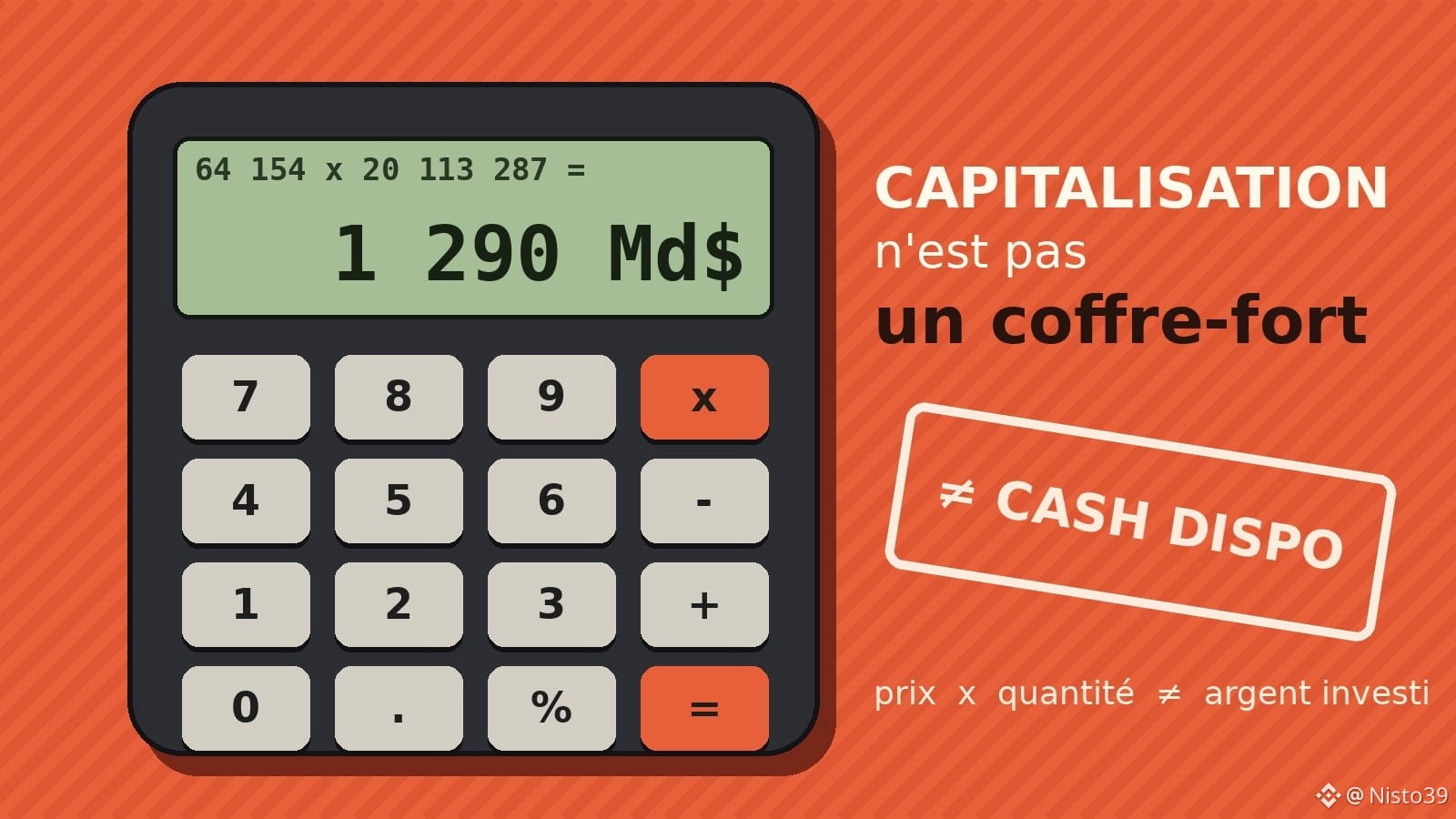
$1.29 trillion for bitcoin? That figure isn't in any vaultThe figure shown this morning for bitcoin: about $1.29 trillion in market capitalization. People read it everywhere as “the amount of money there is in $BTC .” That's wrong, and this mistake costs a lot of people dearly on small tokens.
Market capitalization is just multiplication, nothing more. Last price paid × number of units in circulation. Here: roughly $64,150 × 20.11 million BTC. Nobody put that $1.29 trillion in a vault. The last buyer paid $64,150 for ONE unit, and the formula applies that price to all the others, including those that haven't moved since 2010.
$1.29 trillion for bitcoin? That figure isn't in any vault
The figure shown this morning for bitcoin: about $1.29 trillion in market capitalization. People read it everywhere as “the amount of money there is in $BTC .” That's wrong, and this mistake costs a lot of people dearly on small tokens.
Market capitalization is just multiplication, nothing more. Last price paid × number of units in circulation. Here: roughly $64,150 × 20.11 million BTC. Nobody put that $1.29 trillion in a vault. The last buyer paid $64,150 for ONE unit, and the formula applies that price to all the others, including those that haven't moved since 2010.
Market capitalization is just multiplication, nothing more. Last price paid × number of units in circulation. Here: roughly $64,150 × 20.11 million BTC. Nobody put that $1.29 trillion in a vault. The last buyer paid $64,150 for ONE unit, and the formula applies that price to all the others, including those that haven't moved since 2010.
76
·
--
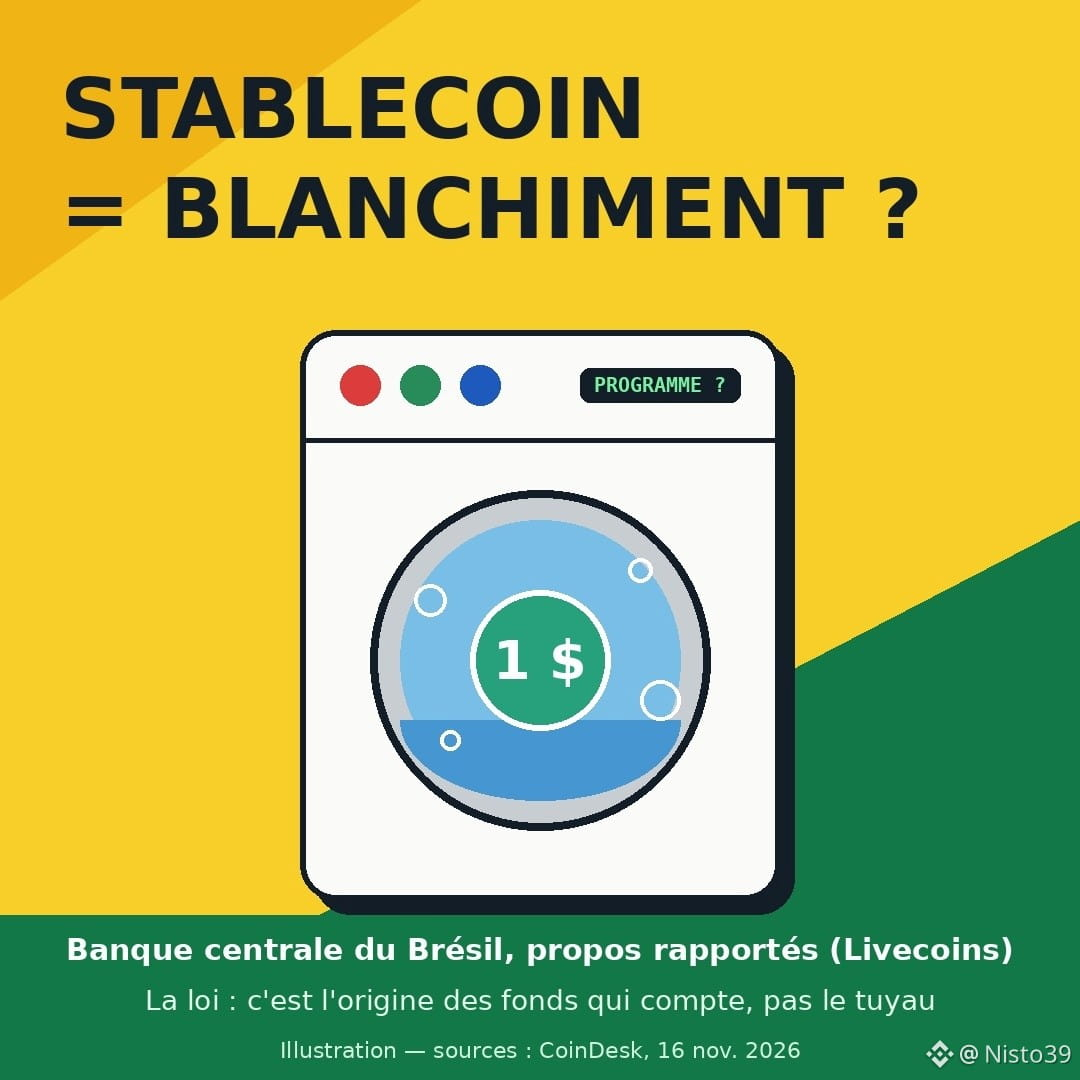
Your funds were clean. You convert them into stablecoins. Now they’re suspect.
That’s the reasoning attributed to Gerson Romantini, division chief at Brazil’s Central Bank, according to the outlet Livecoins. He reportedly even compared this market to the “dólar-cabo,” an informal channel for moving currency out of the country. He did not respond to CoinDesk.
The context: in Brazil, stablecoins (tokens meant to be worth $1, such as $USDT) accounted for around 80% of reported crypto transaction volume last year, according to the Finance Ministry.
Immediate pushback: lawmakers are preparing a request for information in Congress, the Instituto Livre Mercado is demanding the meeting minutes, and the ABToken association says that “using stablecoins, in itself, does not constitute money laundering.”
Brazilian law backs them up: money laundering means concealing the origin of money obtained through a crime. It’s the origin that matters, not the pipe.
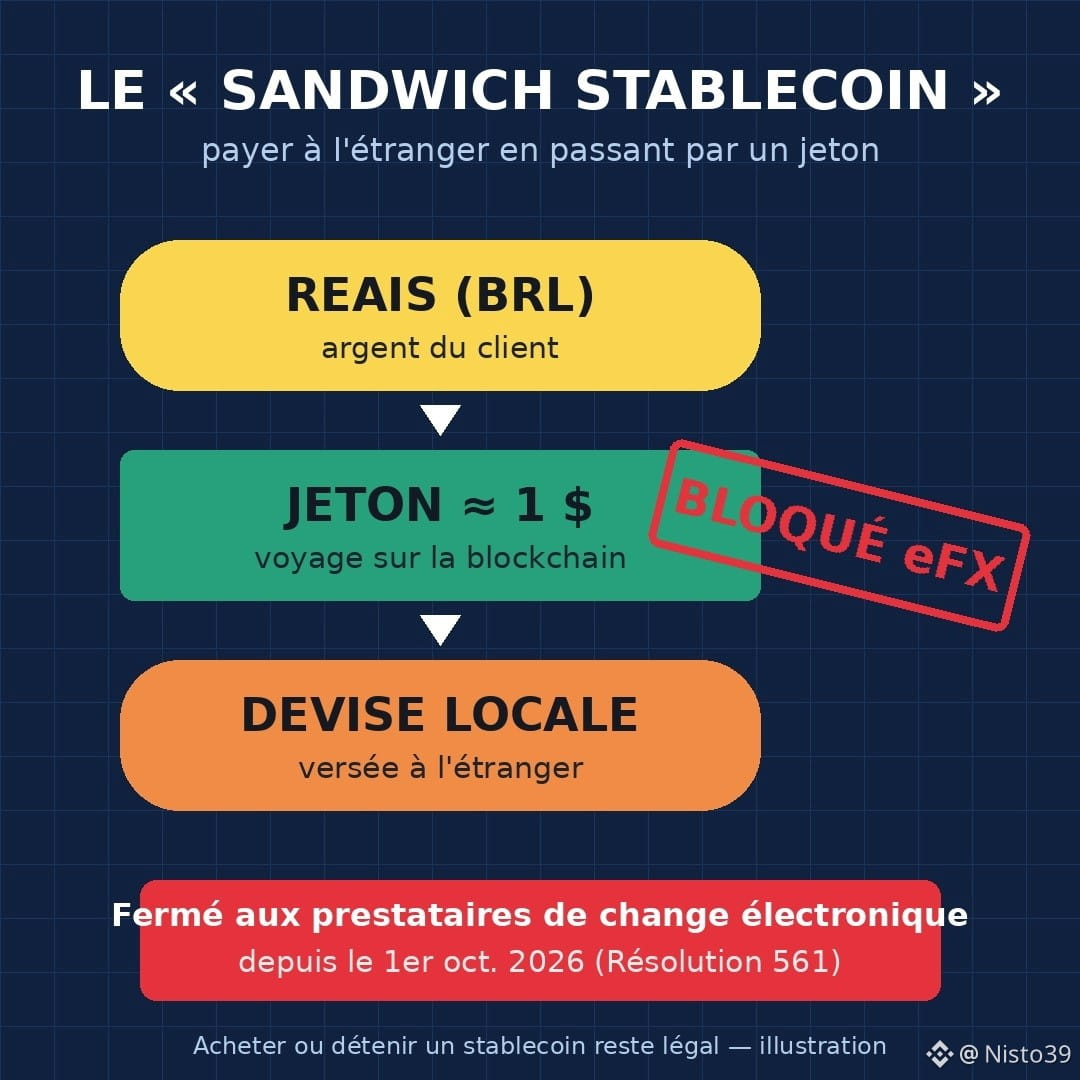
What is actually prohibited, however: since October 1 (Resolution 561), electronic foreign-exchange providers can no longer settle their international payments in crypto. The “stablecoin sandwich” (reais → token → foreign currency) is off-limits to them. Buying or holding stablecoins remains legal.
My take: conflating the tool with the crime suits a regulator that wants to keep control of foreign exchange. By the same logic, cash would be guilty by nature. And this could be said tomorrow in Lagos or Accra, where the digital dollar often serves as a shelter from a currency that’s melting away.
Legitimate wariness of a dollar it can’t control, or a monopolist reflex: which side do you think Brazil’s Central Bank is on?
#Stablecoin #Bresil #Regulation #Blanchiment #CryptoNews
Your funds were clean. You convert them into stablecoins. Now they’re suspect.
That’s the reasoning attributed to Gerson Romantini, division chief at Brazil’s Central Bank, according to the outlet Livecoins. He reportedly even compared this market to the “dólar-cabo,” an informal channel for moving currency out of the country. He did not respond to CoinDesk.
The context: in Brazil, stablecoins (tokens meant to be worth $1, such as $USDT) accounted for around 80% of reported crypto transaction volume last year, according to the Finance Ministry.
Immediate pushback: lawmakers are preparing a request for information in Congress, the Instituto Livre Mercado is demanding the meeting minutes, and the ABToken association says that “using stablecoins, in itself, does not constitute money laundering.”
Brazilian law backs them up: money laundering means concealing the origin of money obtained through a crime. It’s the origin that matters, not the pipe.
What is actually prohibited, however: since October 1 (Resolution 561), electronic foreign-exchange providers can no longer settle their international payments in crypto. The “stablecoin sandwich” (reais → token → foreign currency) is off-limits to them. Buying or holding stablecoins remains legal.
My take: conflating the tool with the crime suits a regulator that wants to keep control of foreign exchange. By the same logic, cash would be guilty by nature. And this could be said tomorrow in Lagos or Accra, where the digital dollar often serves as a shelter from a currency that’s melting away.
Legitimate wariness of a dollar it can’t control, or a monopolist reflex: which side do you think Brazil’s Central Bank is on?
#Stablecoin #Bresil #Regulation #Blanchiment #CryptoNews
That’s the reasoning attributed to Gerson Romantini, division chief at Brazil’s Central Bank, according to the outlet Livecoins. He reportedly even compared this market to the “dólar-cabo,” an informal channel for moving currency out of the country. He did not respond to CoinDesk.
The context: in Brazil, stablecoins (tokens meant to be worth $1, such as $USDT) accounted for around 80% of reported crypto transaction volume last year, according to the Finance Ministry.
Immediate pushback: lawmakers are preparing a request for information in Congress, the Instituto Livre Mercado is demanding the meeting minutes, and the ABToken association says that “using stablecoins, in itself, does not constitute money laundering.”
Brazilian law backs them up: money laundering means concealing the origin of money obtained through a crime. It’s the origin that matters, not the pipe.
What is actually prohibited, however: since October 1 (Resolution 561), electronic foreign-exchange providers can no longer settle their international payments in crypto. The “stablecoin sandwich” (reais → token → foreign currency) is off-limits to them. Buying or holding stablecoins remains legal.
My take: conflating the tool with the crime suits a regulator that wants to keep control of foreign exchange. By the same logic, cash would be guilty by nature. And this could be said tomorrow in Lagos or Accra, where the digital dollar often serves as a shelter from a currency that’s melting away.
Legitimate wariness of a dollar it can’t control, or a monopolist reflex: which side do you think Brazil’s Central Bank is on?
#Stablecoin #Bresil #Regulation #Blanchiment #CryptoNews
387
·
--
Article
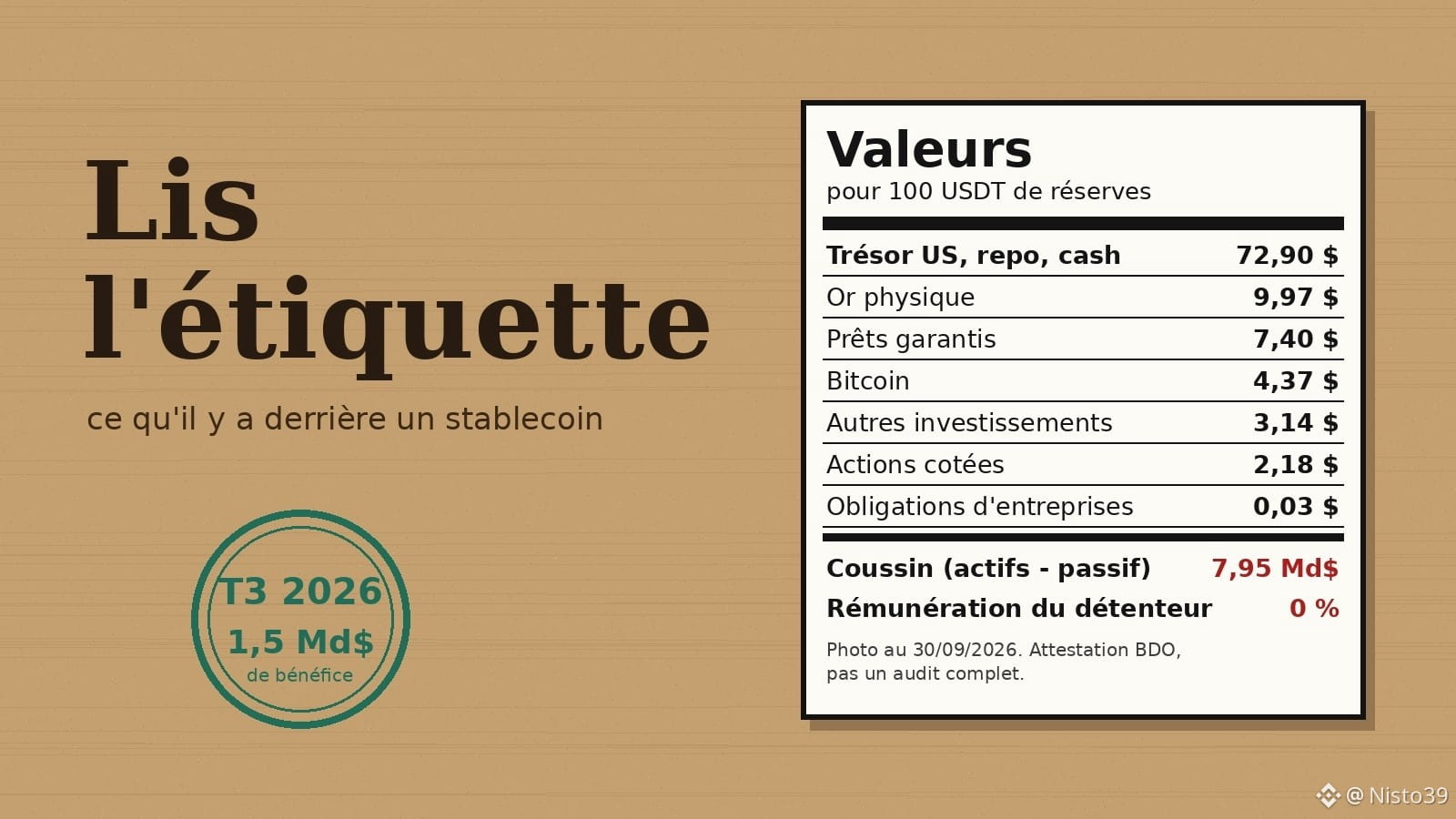
What’s really behind 100 USDT: I read the labelYour USDT earns you no interest. Tether, meanwhile, generated $1.5 billion in operating profit between July and September 2026. $4.5 billion over nine months.
These two sentences are connected. To see how, I took the attestation published on October 30 (BDO, figures as of September 30) and read it like the label on a packet of biscuits.
COMPOSITION, per $100 of reserves
$72.90: U.S. Treasury bills, repurchase agreements and cash
$9.97: physical gold bars
What’s really behind 100 USDT: I read the label
Your USDT earns you no interest. Tether, meanwhile, generated $1.5 billion in operating profit between July and September 2026. $4.5 billion over nine months.
These two sentences are connected. To see how, I took the attestation published on October 30 (BDO, figures as of September 30) and read it like the label on a packet of biscuits.
COMPOSITION, per $100 of reserves
$72.90: U.S. Treasury bills, repurchase agreements and cash
$9.97: physical gold bars
These two sentences are connected. To see how, I took the attestation published on October 30 (BDO, figures as of September 30) and read it like the label on a packet of biscuits.
COMPOSITION, per $100 of reserves
$72.90: U.S. Treasury bills, repurchase agreements and cash
$9.97: physical gold bars
1
70
·
--
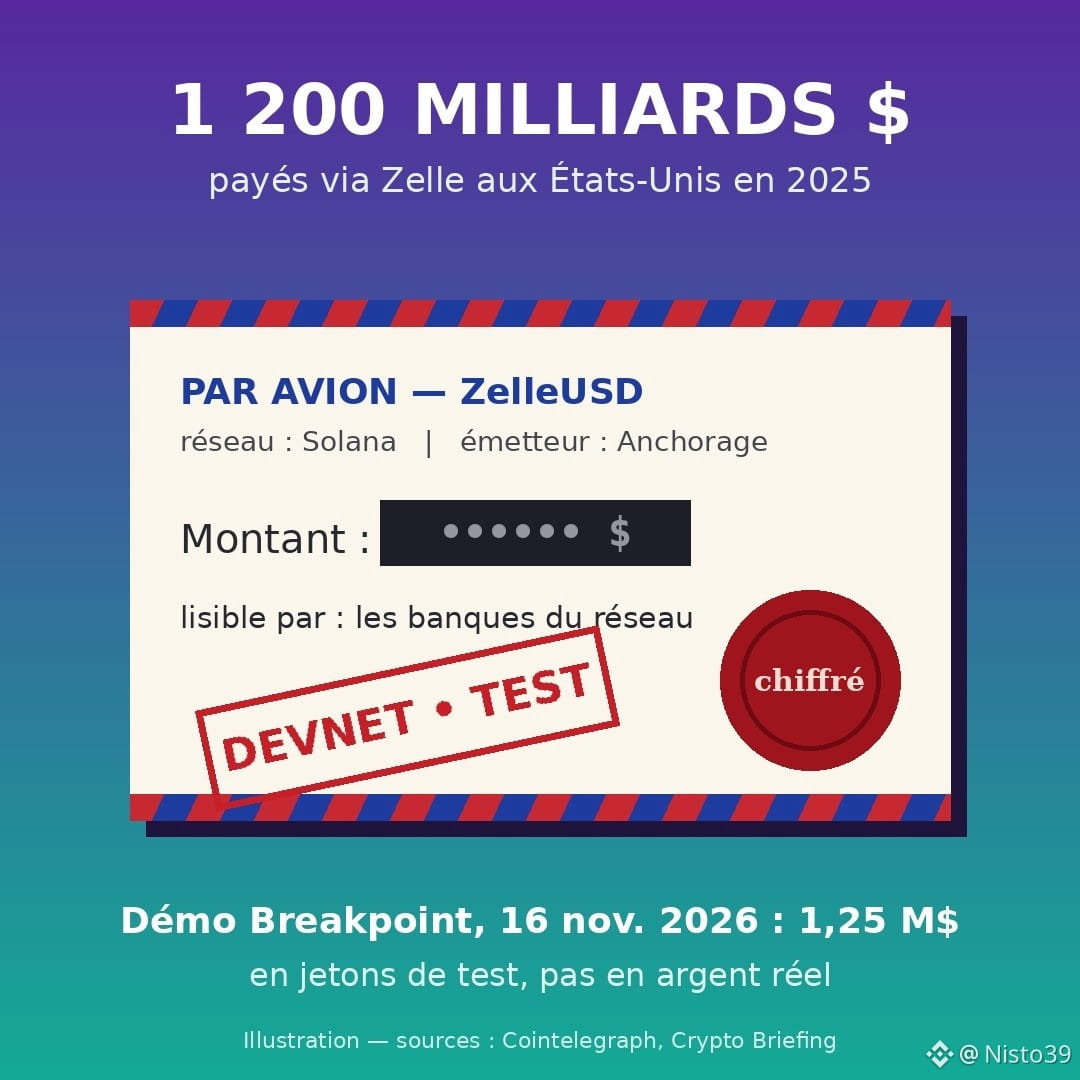
$1.2 trillion. That’s how much Zelle moved between Americans in 2025. Yesterday, on the Breakpoint stage, the bank-owned network (JPMorgan, Wells Fargo, Bank of America…) announced that its in-house stablecoin, ZelleUSD, will run on $SOL for international payments.
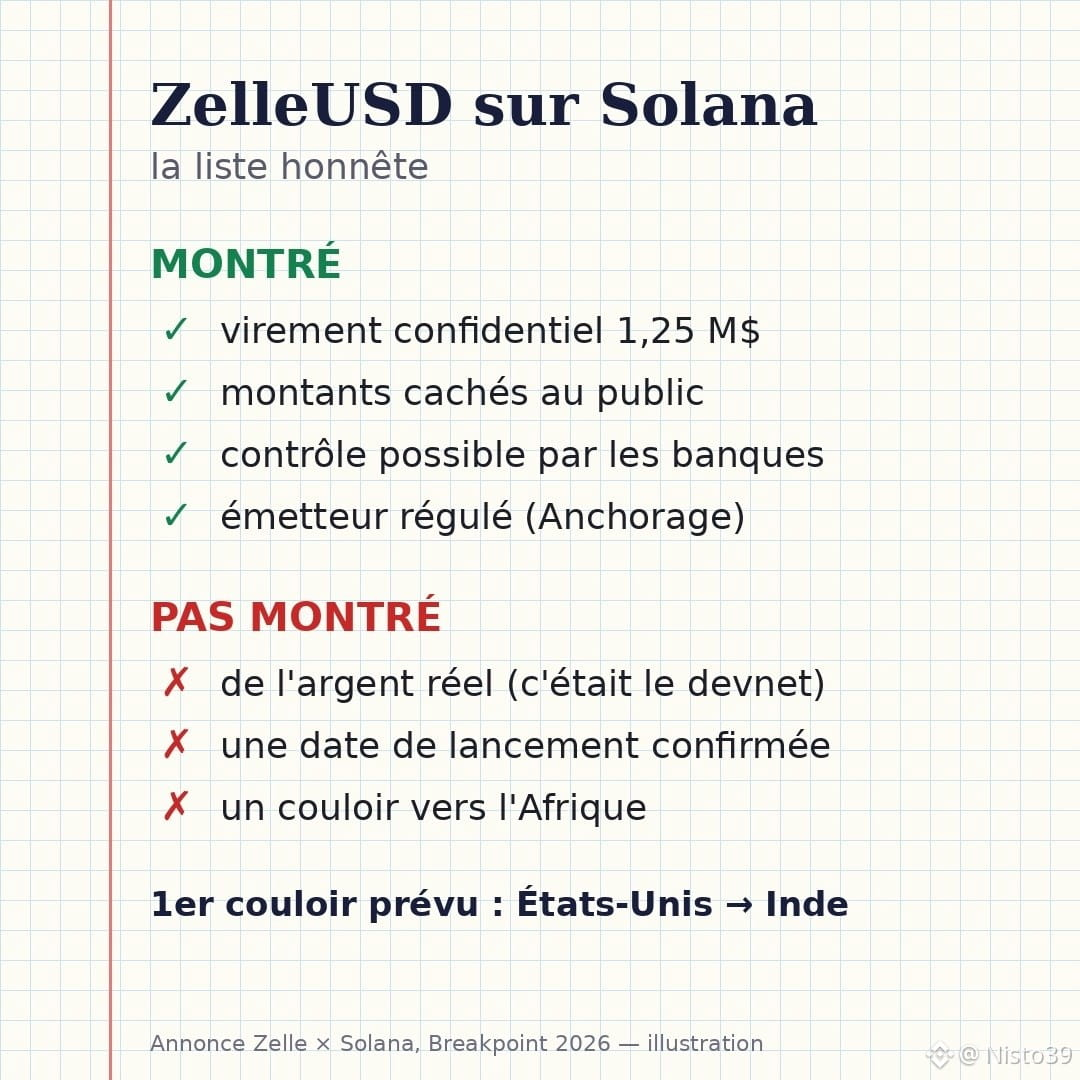
What was shown:
— a confidential $1.25 million transfer between two banks;
— an encrypted amount, invisible to the public but readable by network banks for their anti-money laundering checks;
— a regulated issuer, Anchorage Digital Bank.
What wasn’t shown:
— real money. The demo ran on the devnet, Solana’s test network, where tokens are worthless;
— a date. The first corridor, United States → India, was announced for late 2026, but nothing was confirmed on stage;
— Africa. No corridors are planned for now.
(A stablecoin is a token that’s supposed to always be worth $1, backed by reserves.)
My take: the signal isn’t technical. Not long ago, a U.S. bank sending dollars over a public blockchain would have sounded like a provocation. Today, they’re just asking for the amounts to be hidden. Privacy that’s available to banks but not the public: useful for compliance, but a long way from crypto’s original promise.
And for those receiving money from abroad, the real question is still the last mile: who converts these digital dollars into cash or mobile money, and at what cost?
A public blockchain where only banks can read the amounts: progress or a step backward?
#Solana #Stablecoin #Zelle #Paiements #CryptoNews
$1.2 trillion. That’s how much Zelle moved between Americans in 2025. Yesterday, on the Breakpoint stage, the bank-owned network (JPMorgan, Wells Fargo, Bank of America…) announced that its in-house stablecoin, ZelleUSD, will run on $SOL for international payments.
What was shown:
— a confidential $1.25 million transfer between two banks;
— an encrypted amount, invisible to the public but readable by network banks for their anti-money laundering checks;
— a regulated issuer, Anchorage Digital Bank.
What wasn’t shown:
— real money. The demo ran on the devnet, Solana’s test network, where tokens are worthless;
— a date. The first corridor, United States → India, was announced for late 2026, but nothing was confirmed on stage;
— Africa. No corridors are planned for now.
(A stablecoin is a token that’s supposed to always be worth $1, backed by reserves.)
My take: the signal isn’t technical. Not long ago, a U.S. bank sending dollars over a public blockchain would have sounded like a provocation. Today, they’re just asking for the amounts to be hidden. Privacy that’s available to banks but not the public: useful for compliance, but a long way from crypto’s original promise.
And for those receiving money from abroad, the real question is still the last mile: who converts these digital dollars into cash or mobile money, and at what cost?
A public blockchain where only banks can read the amounts: progress or a step backward?
#Solana #Stablecoin #Zelle #Paiements #CryptoNews
What was shown:
— a confidential $1.25 million transfer between two banks;
— an encrypted amount, invisible to the public but readable by network banks for their anti-money laundering checks;
— a regulated issuer, Anchorage Digital Bank.
What wasn’t shown:
— real money. The demo ran on the devnet, Solana’s test network, where tokens are worthless;
— a date. The first corridor, United States → India, was announced for late 2026, but nothing was confirmed on stage;
— Africa. No corridors are planned for now.
(A stablecoin is a token that’s supposed to always be worth $1, backed by reserves.)
My take: the signal isn’t technical. Not long ago, a U.S. bank sending dollars over a public blockchain would have sounded like a provocation. Today, they’re just asking for the amounts to be hidden. Privacy that’s available to banks but not the public: useful for compliance, but a long way from crypto’s original promise.
And for those receiving money from abroad, the real question is still the last mile: who converts these digital dollars into cash or mobile money, and at what cost?
A public blockchain where only banks can read the amounts: progress or a step backward?
#Solana #Stablecoin #Zelle #Paiements #CryptoNews
80
·
--
One line of debug code. That was all it took.
Proxima, a trading app on Solana, published its post-mortem Saturday night. The account reads like an incident log:
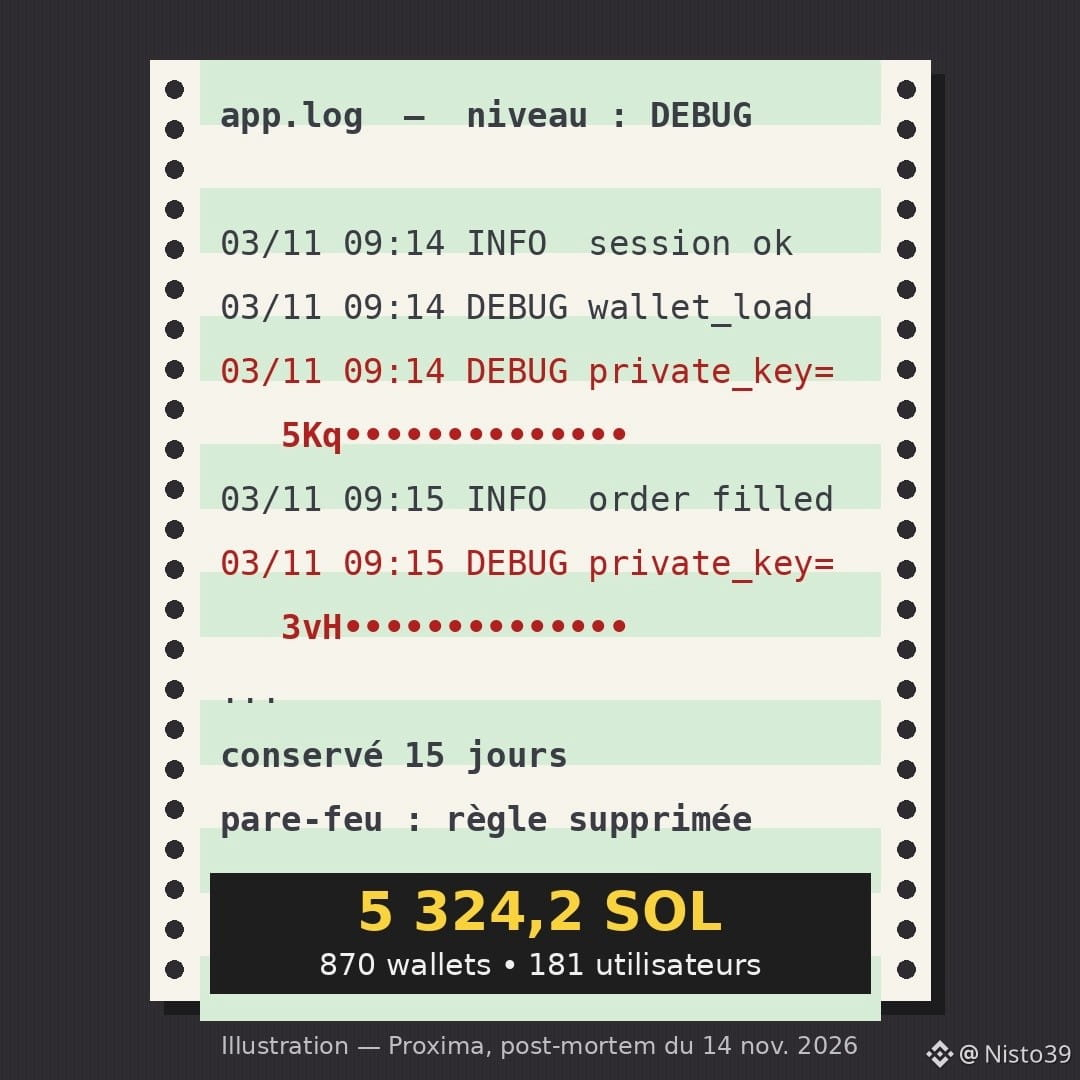
Nov. 3 — a log line intended for the beta starts writing private keys to the technical logs. It was never supposed to run in production. Someone switched the logs to “debug” mode to monitor performance.
Nov. 10 — the line is removed. Except the logs are kept for 15 days in a monitoring tool (SigNoz) whose security update had been “postponed several times.”
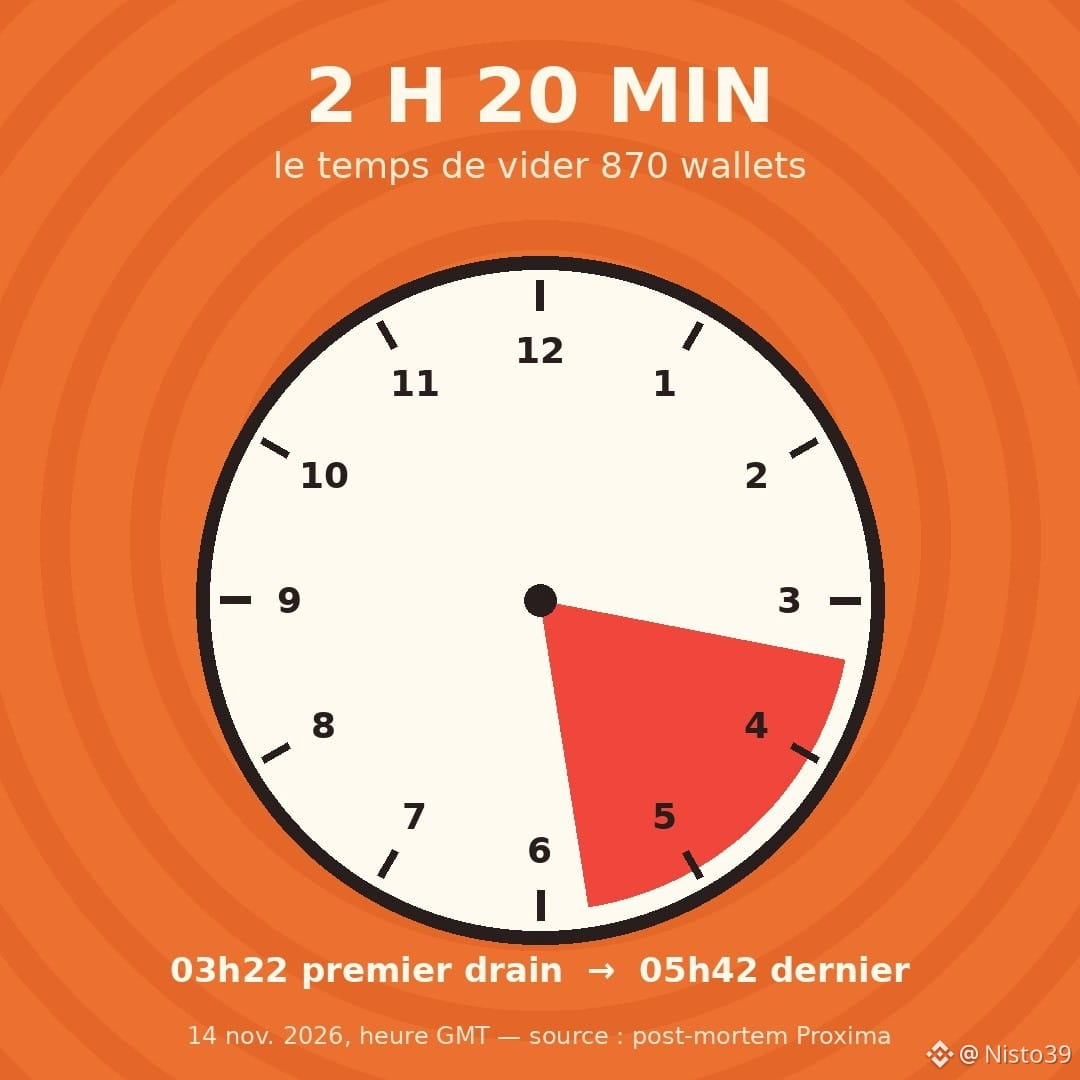
Nov. 14, 02:16 GMT — an attacker siphons off the logs. The firewall rule that was supposed to hide this tool from the internet had been “inadvertently deleted.”
03:22 — first wallet drained.
05:42 — last one.
According to Proxima: 5 324,2 $SOL taken from 870 wallets belonging to 181 users, around 0.1% of its wallets. Everyone was reimbursed from the company treasury.
One detail is troubling: the initial estimate was $200,000 to $250,000. At SOL’s price during the attack (~$75), the total is closer to $400,000 (according to Cryptowatchdesk’s calculation). The report doesn’t explain the discrepancy.
What strikes me is that none of these mistakes is particularly spectacular. A bot that buys and sells on your behalf has to keep your private key somewhere — the key is the master password that authorizes spending. Every place it passes through (a log, a server, a service provider) is one more door you can’t see.
My rule: with this kind of app, only use an amount I’m willing to lose, and never reuse elsewhere a wallet it created.
The last bot you entrusted with a wallet — could you say where it keeps your key?
#Solana #Securite #CryptoNews #TradingBot #Web3
One line of debug code. That was all it took.
Proxima, a trading app on Solana, published its post-mortem Saturday night. The account reads like an incident log:
Nov. 3 — a log line intended for the beta starts writing private keys to the technical logs. It was never supposed to run in production. Someone switched the logs to “debug” mode to monitor performance.
Nov. 10 — the line is removed. Except the logs are kept for 15 days in a monitoring tool (SigNoz) whose security update had been “postponed several times.”
Nov. 14, 02:16 GMT — an attacker siphons off the logs. The firewall rule that was supposed to hide this tool from the internet had been “inadvertently deleted.”
03:22 — first wallet drained.
05:42 — last one.
According to Proxima: 5 324,2 $SOL taken from 870 wallets belonging to 181 users, around 0.1% of its wallets. Everyone was reimbursed from the company treasury.
One detail is troubling: the initial estimate was $200,000 to $250,000. At SOL’s price during the attack (~$75), the total is closer to $400,000 (according to Cryptowatchdesk’s calculation). The report doesn’t explain the discrepancy.
What strikes me is that none of these mistakes is particularly spectacular. A bot that buys and sells on your behalf has to keep your private key somewhere — the key is the master password that authorizes spending. Every place it passes through (a log, a server, a service provider) is one more door you can’t see.
My rule: with this kind of app, only use an amount I’m willing to lose, and never reuse elsewhere a wallet it created.
The last bot you entrusted with a wallet — could you say where it keeps your key?
#Solana #Securite #CryptoNews #TradingBot #Web3
Proxima, a trading app on Solana, published its post-mortem Saturday night. The account reads like an incident log:
Nov. 3 — a log line intended for the beta starts writing private keys to the technical logs. It was never supposed to run in production. Someone switched the logs to “debug” mode to monitor performance.
Nov. 10 — the line is removed. Except the logs are kept for 15 days in a monitoring tool (SigNoz) whose security update had been “postponed several times.”
Nov. 14, 02:16 GMT — an attacker siphons off the logs. The firewall rule that was supposed to hide this tool from the internet had been “inadvertently deleted.”
03:22 — first wallet drained.
05:42 — last one.
According to Proxima: 5 324,2 $SOL taken from 870 wallets belonging to 181 users, around 0.1% of its wallets. Everyone was reimbursed from the company treasury.
One detail is troubling: the initial estimate was $200,000 to $250,000. At SOL’s price during the attack (~$75), the total is closer to $400,000 (according to Cryptowatchdesk’s calculation). The report doesn’t explain the discrepancy.
What strikes me is that none of these mistakes is particularly spectacular. A bot that buys and sells on your behalf has to keep your private key somewhere — the key is the master password that authorizes spending. Every place it passes through (a log, a server, a service provider) is one more door you can’t see.
My rule: with this kind of app, only use an amount I’m willing to lose, and never reuse elsewhere a wallet it created.
The last bot you entrusted with a wallet — could you say where it keeps your key?
#Solana #Securite #CryptoNews #TradingBot #Web3
146
·
--
Article
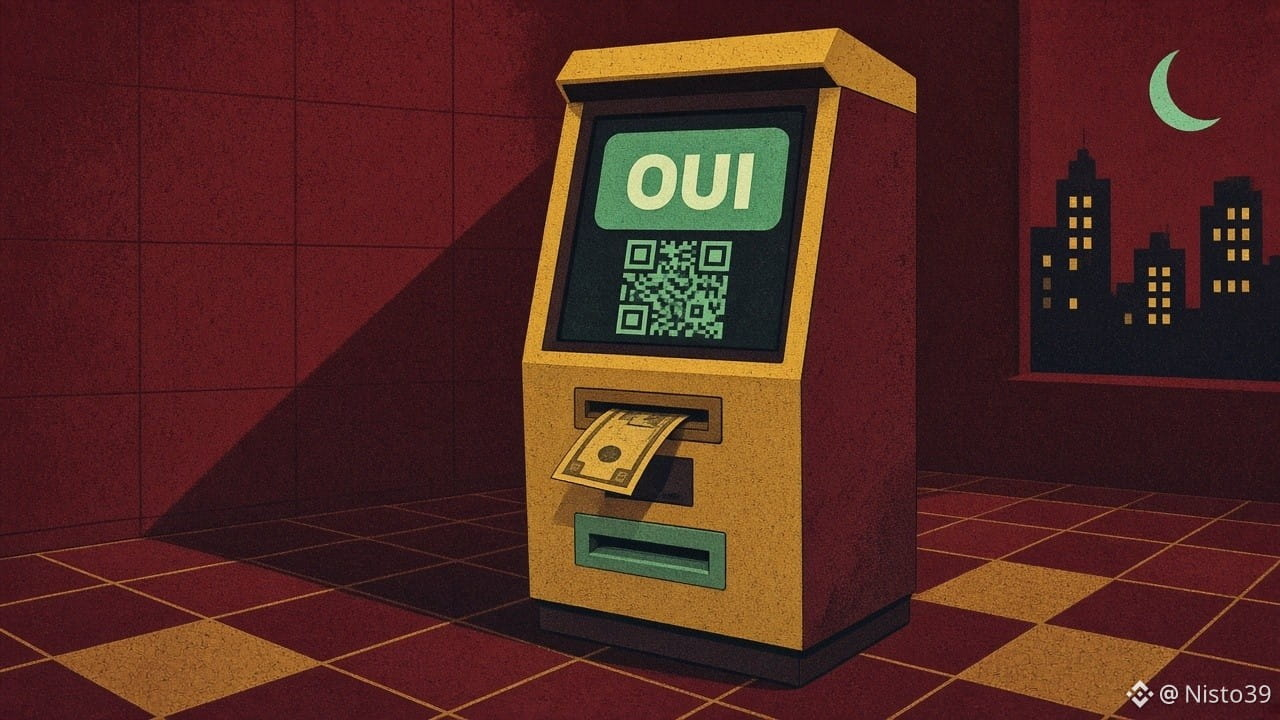
The Bitcoin ATM That Never Says NoOn October 29, 2013, a café in downtown Vancouver received a strange machine. You fed it Canadian dollars, placed your palm on a scanner, and the screen dispensed bitcoins. Limit: $3,000 per day. Dozens of curious onlookers came just to watch (CBC News).
Thirteen years later, the same idea is showing up in reports from the FBI, the U.S. FTC, and Australia’s regulator. Not as a technological breakthrough, but as scammers’ favorite cash machine.
What happened in between?
The Bitcoin ATM That Never Says No
On October 29, 2013, a café in downtown Vancouver received a strange machine. You fed it Canadian dollars, placed your palm on a scanner, and the screen dispensed bitcoins. Limit: $3,000 per day. Dozens of curious onlookers came just to watch (CBC News).
Thirteen years later, the same idea is showing up in reports from the FBI, the U.S. FTC, and Australia’s regulator. Not as a technological breakthrough, but as scammers’ favorite cash machine.
What happened in between?
Thirteen years later, the same idea is showing up in reports from the FBI, the U.S. FTC, and Australia’s regulator. Not as a technological breakthrough, but as scammers’ favorite cash machine.
What happened in between?
·
--
Your equipment is running. Your electricity bill is running. But the bitcoins are going to someone else.
That’s what happened this weekend to a little over a dozen Luxor customers, a $BTC mining provider. Nobody stole the machines. Nobody switched them off. The attacker got in through Commander, the software used to monitor and configure machines remotely, and changed just one setting: the pool.
A pool is a cooperative of miners: each contributes computing power, and the rewards are shared. Switching pools means switching cash registers. The machines were redirected to OCEAN, benefiting an address identified by hosting provider CoreX.
The figure, recorded on the blockchain: 0.243 BTC received in three payments, worth about $15,700. They hadn’t been spent as of Monday morning, according to CoinDesk.
The nastiest detail: at OCEAN, work already performed continues to be paid out over a rolling period. So even after the fix, money can keep flowing to the attacker. Those who said “they didn’t make anything” spoke too soon.
Luxor fixed the vulnerability within two hours and promised to reimburse customers. Its CEO described it as an “AI-assisted” attack, without explaining how. Be cautious with that term: it’s been heard a lot this year (Coldcard in July, BTCPay in August), but evidence has been much scarcer.
The lesson goes beyond mining: when a single dashboard decides where your money goes, that’s what you need to protect—not just your keys.
Do you ever check where your payment settings are pointed, or do you trust them as long as everything keeps running?
#Bitcoin #Mining #CyberSecurity #CryptoNews
Your equipment is running. Your electricity bill is running. But the bitcoins are going to someone else.
That’s what happened this weekend to a little over a dozen Luxor customers, a $BTC mining provider. Nobody stole the machines. Nobody switched them off. The attacker got in through Commander, the software used to monitor and configure machines remotely, and changed just one setting: the pool.
A pool is a cooperative of miners: each contributes computing power, and the rewards are shared. Switching pools means switching cash registers. The machines were redirected to OCEAN, benefiting an address identified by hosting provider CoreX.
The figure, recorded on the blockchain: 0.243 BTC received in three payments, worth about $15,700. They hadn’t been spent as of Monday morning, according to CoinDesk.
The nastiest detail: at OCEAN, work already performed continues to be paid out over a rolling period. So even after the fix, money can keep flowing to the attacker. Those who said “they didn’t make anything” spoke too soon.
Luxor fixed the vulnerability within two hours and promised to reimburse customers. Its CEO described it as an “AI-assisted” attack, without explaining how. Be cautious with that term: it’s been heard a lot this year (Coldcard in July, BTCPay in August), but evidence has been much scarcer.
The lesson goes beyond mining: when a single dashboard decides where your money goes, that’s what you need to protect—not just your keys.
Do you ever check where your payment settings are pointed, or do you trust them as long as everything keeps running?
#Bitcoin #Mining #CyberSecurity #CryptoNews
That’s what happened this weekend to a little over a dozen Luxor customers, a $BTC mining provider. Nobody stole the machines. Nobody switched them off. The attacker got in through Commander, the software used to monitor and configure machines remotely, and changed just one setting: the pool.
A pool is a cooperative of miners: each contributes computing power, and the rewards are shared. Switching pools means switching cash registers. The machines were redirected to OCEAN, benefiting an address identified by hosting provider CoreX.
The figure, recorded on the blockchain: 0.243 BTC received in three payments, worth about $15,700. They hadn’t been spent as of Monday morning, according to CoinDesk.
The nastiest detail: at OCEAN, work already performed continues to be paid out over a rolling period. So even after the fix, money can keep flowing to the attacker. Those who said “they didn’t make anything” spoke too soon.
Luxor fixed the vulnerability within two hours and promised to reimburse customers. Its CEO described it as an “AI-assisted” attack, without explaining how. Be cautious with that term: it’s been heard a lot this year (Coldcard in July, BTCPay in August), but evidence has been much scarcer.
The lesson goes beyond mining: when a single dashboard decides where your money goes, that’s what you need to protect—not just your keys.
Do you ever check where your payment settings are pointed, or do you trust them as long as everything keeps running?
#Bitcoin #Mining #CyberSecurity #CryptoNews
138
·
--
Article
Proof of reserves: one true statement, one half true, one falseFour years. FTX declared bankruptcy on November 11, 2022, and since then, we’ve all learned a new term: proof of reserves. Platforms display it, we nod, and almost no one clicks the “verify” button.
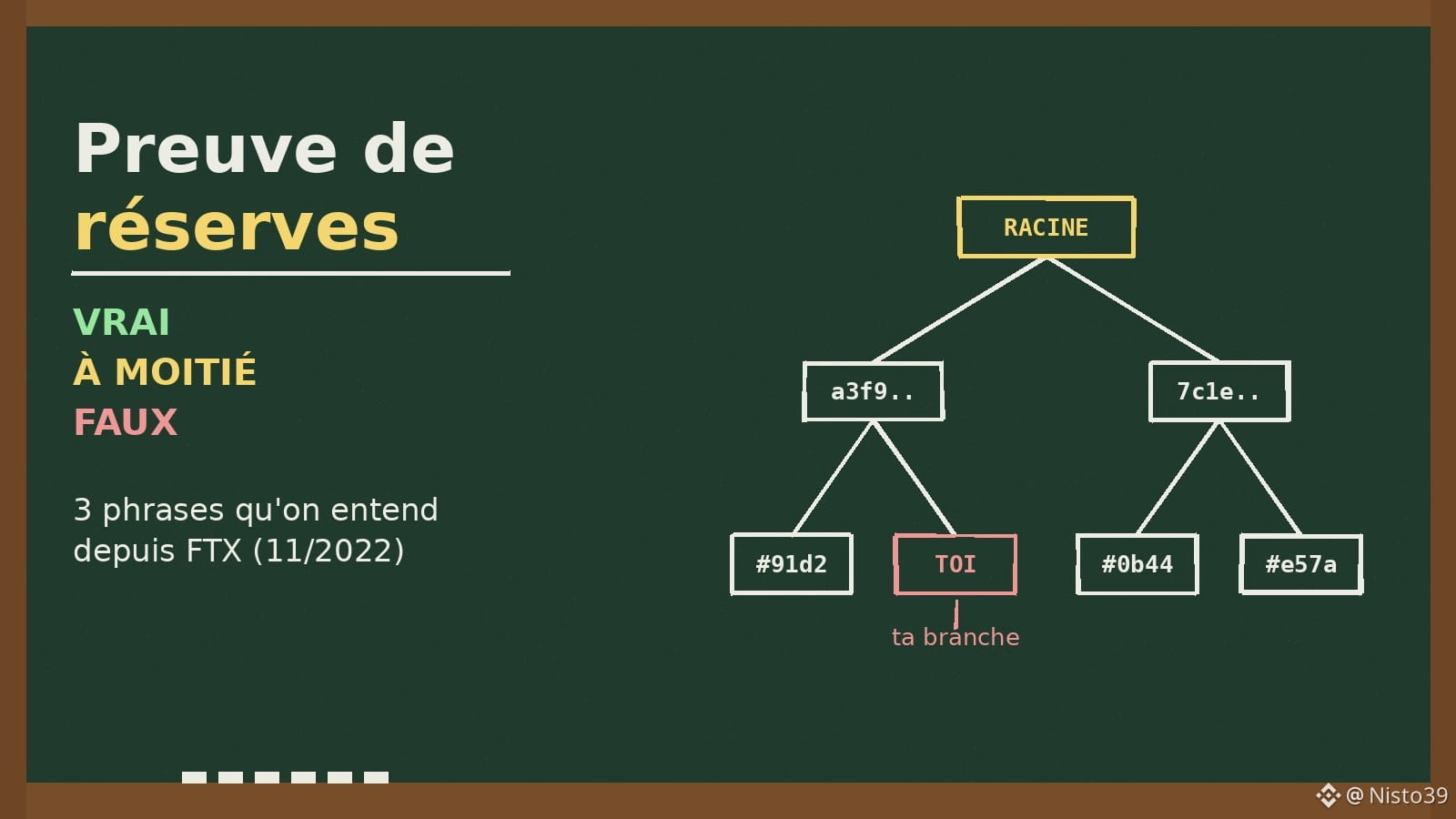
I wanted to sort through what we hear about this. Three statements come up all the time. One is true, one is half true, and one is false.
“I can verify for myself that my balance is included.” → TRUE
This is the most underrated part. The system is based on a Merkle tree: each account becomes a digital fingerprint (a hash, like a barcode that’s impossible to reverse). The fingerprints are grouped in pairs, then in pairs again, until there’s just one fingerprint at the top: the root. If someone removes or modifies your account, the root changes. You only need to see your own branch, not everyone else’s balances.
Proof of reserves: one true statement, one half true, one false
Four years. FTX declared bankruptcy on November 11, 2022, and since then, we’ve all learned a new term: proof of reserves. Platforms display it, we nod, and almost no one clicks the “verify” button.
I wanted to sort through what we hear about this. Three statements come up all the time. One is true, one is half true, and one is false.
“I can verify for myself that my balance is included.” → TRUE
This is the most underrated part. The system is based on a Merkle tree: each account becomes a digital fingerprint (a hash, like a barcode that’s impossible to reverse). The fingerprints are grouped in pairs, then in pairs again, until there’s just one fingerprint at the top: the root. If someone removes or modifies your account, the root changes. You only need to see your own branch, not everyone else’s balances.
I wanted to sort through what we hear about this. Three statements come up all the time. One is true, one is half true, and one is false.
“I can verify for myself that my balance is included.” → TRUE
This is the most underrated part. The system is based on a Merkle tree: each account becomes a digital fingerprint (a hash, like a barcode that’s impossible to reverse). The fingerprints are grouped in pairs, then in pairs again, until there’s just one fingerprint at the top: the root. If someone removes or modifies your account, the root changes. You only need to see your own branch, not everyone else’s balances.
134
·
--
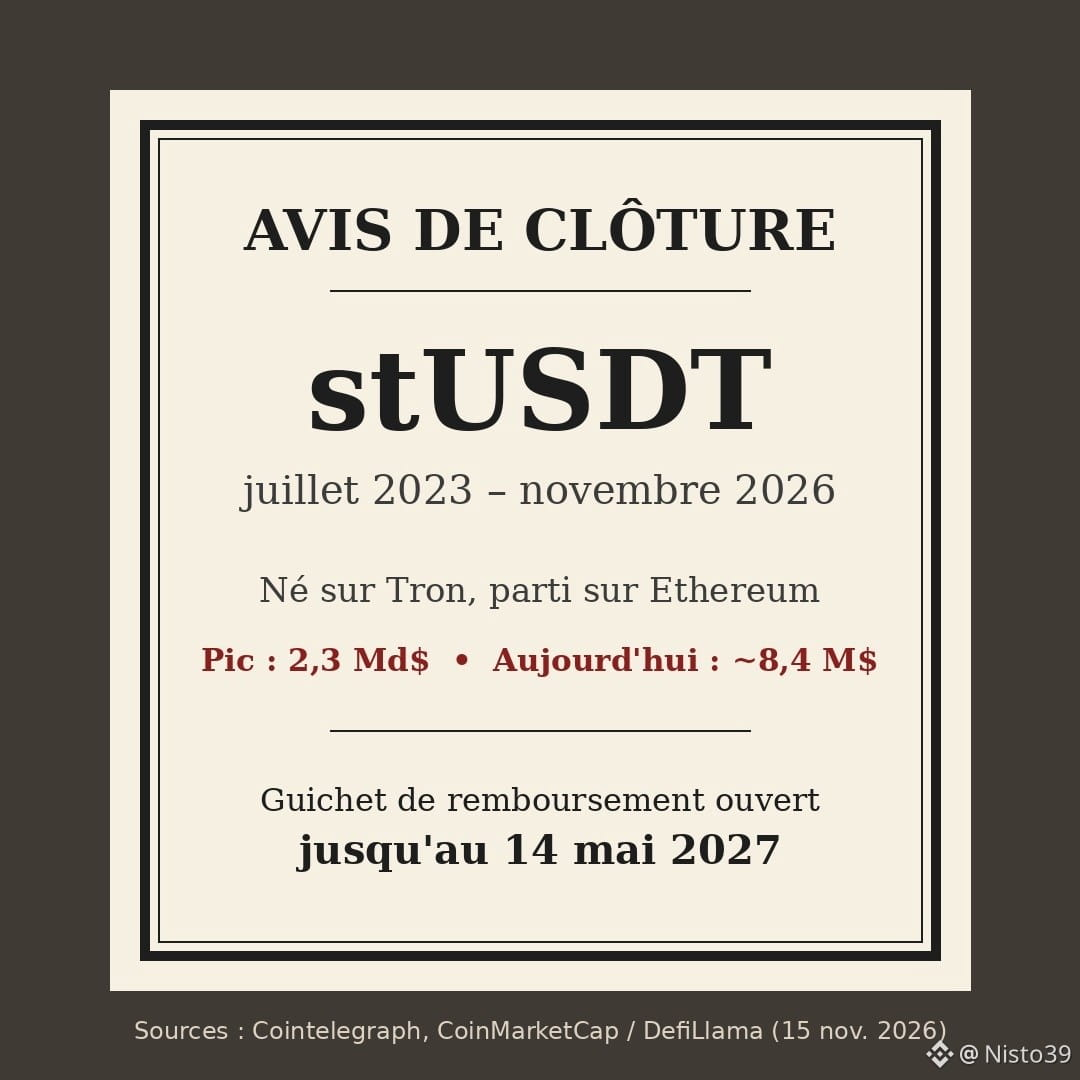
Closure notice.
stUSDT, July 2023 – November 2026. Born on Tron ($TRX), then moved to Ethereum. At its peak: $2.3 billion deposited in November 2023.
No hack, no announced bankruptcy. Just a message on Saturday: interest payments are stopping, and the redemption window will remain open until May 14, 2027.
The idea was simple: you deposited $USDT, the protocol invested it in short-term government bonds (“real-world” assets, or RWAs for short), and your balance grew automatically every day.
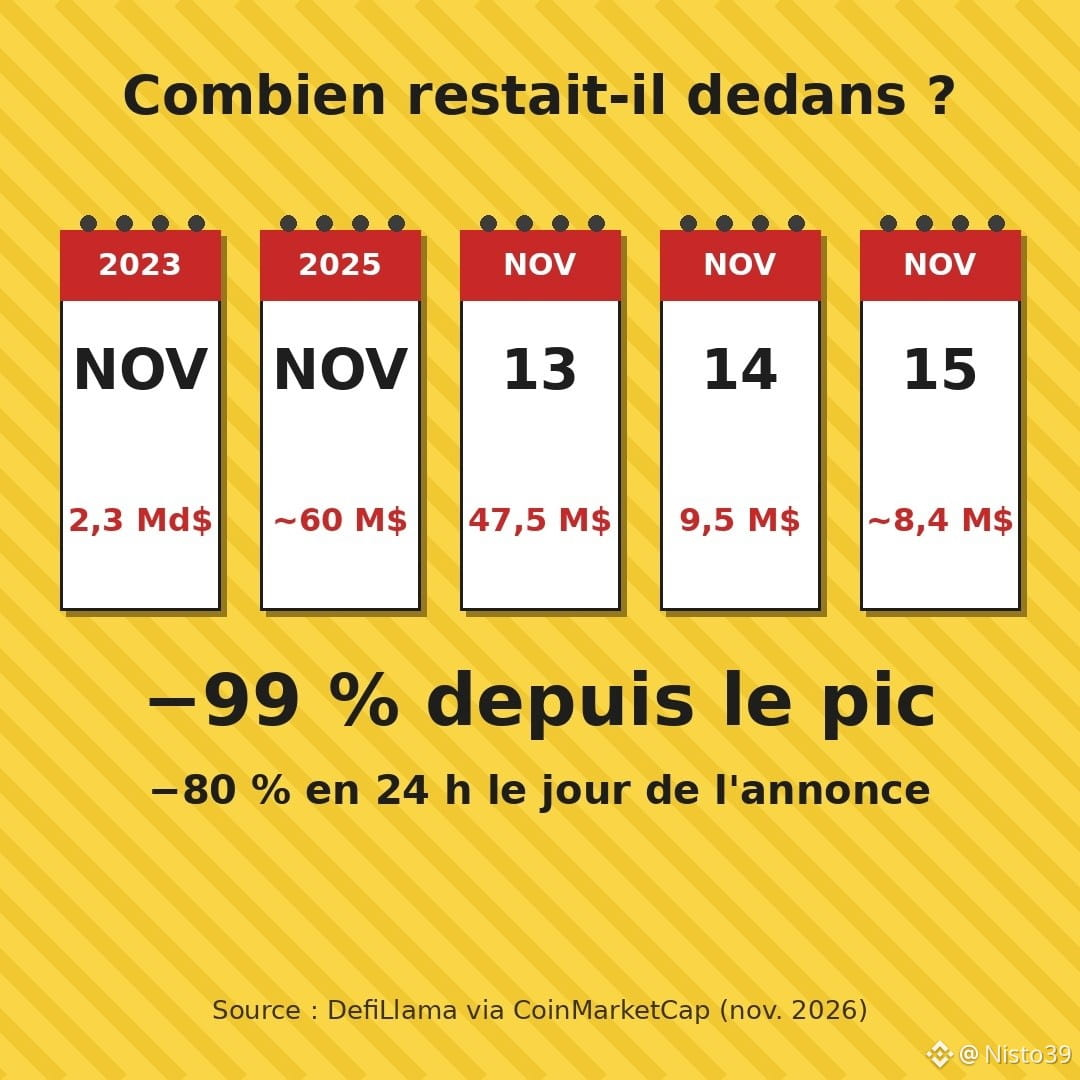
What strikes me isn’t the closure. It’s the curve:
$2.3B in November 2023
~$60M a year ago
$47.5M on November 13
$9.5M on November 14
~$8.4M this weekend (DefiLlama, via CoinMarketCap)
More than 99% of the money was already gone before the announcement. And on the day itself, those who remained withdrew 80% of what was left within 24 hours.
Two details to keep in mind if you still have tokens in there:
- the team says the assets remain fully backed, but hasn’t given any reason for the closure;
- tokens on an exchange or in a DeFi protocol? You’ll need to move them back to your own wallet first to claim. JustLend is also closing its wstUSDT market.
One last reminder that applies far beyond this case: despite its name, stUSDT was never affiliated with Tether, which denied any connection back in September 2023. A name that sounds like a familiar brand doesn’t guarantee anything.
A dollar-denominated yield quietly fading away: a clean ending, or a warning sign we should have seen coming long ago?
#stUSDT #RWA #Stablecoin #CryptoNews
Closure notice.
stUSDT, July 2023 – November 2026. Born on Tron ($TRX ), then moved to Ethereum. At its peak: $2.3 billion deposited in November 2023.
No hack, no announced bankruptcy. Just a message on Saturday: interest payments are stopping, and the redemption window will remain open until May 14, 2027.
The idea was simple: you deposited $USDT, the protocol invested it in short-term government bonds (“real-world” assets, or RWAs for short), and your balance grew automatically every day.
What strikes me isn’t the closure. It’s the curve:
$2.3B in November 2023
~$60M a year ago
$47.5M on November 13
$9.5M on November 14
~$8.4M this weekend (DefiLlama, via CoinMarketCap)
More than 99% of the money was already gone before the announcement. And on the day itself, those who remained withdrew 80% of what was left within 24 hours.
Two details to keep in mind if you still have tokens in there:
- the team says the assets remain fully backed, but hasn’t given any reason for the closure;
- tokens on an exchange or in a DeFi protocol? You’ll need to move them back to your own wallet first to claim. JustLend is also closing its wstUSDT market.
One last reminder that applies far beyond this case: despite its name, stUSDT was never affiliated with Tether, which denied any connection back in September 2023. A name that sounds like a familiar brand doesn’t guarantee anything.
A dollar-denominated yield quietly fading away: a clean ending, or a warning sign we should have seen coming long ago?
#stUSDT #RWA #Stablecoin #CryptoNews
stUSDT, July 2023 – November 2026. Born on Tron ($TRX ), then moved to Ethereum. At its peak: $2.3 billion deposited in November 2023.
No hack, no announced bankruptcy. Just a message on Saturday: interest payments are stopping, and the redemption window will remain open until May 14, 2027.
The idea was simple: you deposited $USDT, the protocol invested it in short-term government bonds (“real-world” assets, or RWAs for short), and your balance grew automatically every day.
What strikes me isn’t the closure. It’s the curve:
$2.3B in November 2023
~$60M a year ago
$47.5M on November 13
$9.5M on November 14
~$8.4M this weekend (DefiLlama, via CoinMarketCap)
More than 99% of the money was already gone before the announcement. And on the day itself, those who remained withdrew 80% of what was left within 24 hours.
Two details to keep in mind if you still have tokens in there:
- the team says the assets remain fully backed, but hasn’t given any reason for the closure;
- tokens on an exchange or in a DeFi protocol? You’ll need to move them back to your own wallet first to claim. JustLend is also closing its wstUSDT market.
One last reminder that applies far beyond this case: despite its name, stUSDT was never affiliated with Tether, which denied any connection back in September 2023. A name that sounds like a familiar brand doesn’t guarantee anything.
A dollar-denominated yield quietly fading away: a clean ending, or a warning sign we should have seen coming long ago?
#stUSDT #RWA #Stablecoin #CryptoNews
346
Log in to explore more content
Join global crypto users on Binance Square
⚡️ Get latest and useful information about crypto.
💬 Trusted by the world’s largest crypto exchange.
👍 Discover real insights from verified creators.
Email / Phone number
Trending Topics
IsAnthropic’s$1.5TMarketCapJustified?
8,652 views
74 Discussing
Anthropic Set to Open at $105 in Record Nasdaq Debut
Binance News
·11 Likes
·11.2k views
BTCRemainsUnderPressureAfterHawkishFOMCMinutes
221,705 views
2,028 Discussing
NvidiaBoardReportedlySplitOverHuang’sReturn
107,730 views
1,083 Discussing