
Next 100X GEMS
2.3k Posts

Next 100X GEMS
 Square Verified
Report
Block User
Next 100X GEMS, a Crypto-Oriented Social Media Platform, Announces Marketing Campaigns for Crypto Projects and Much More | X: @Next100XGEMS
Occasional Trader
6.6 Years
40 Following
47.0K+ Followers
71.7K+ Liked
Posts
All
Quotes
Videos
Article
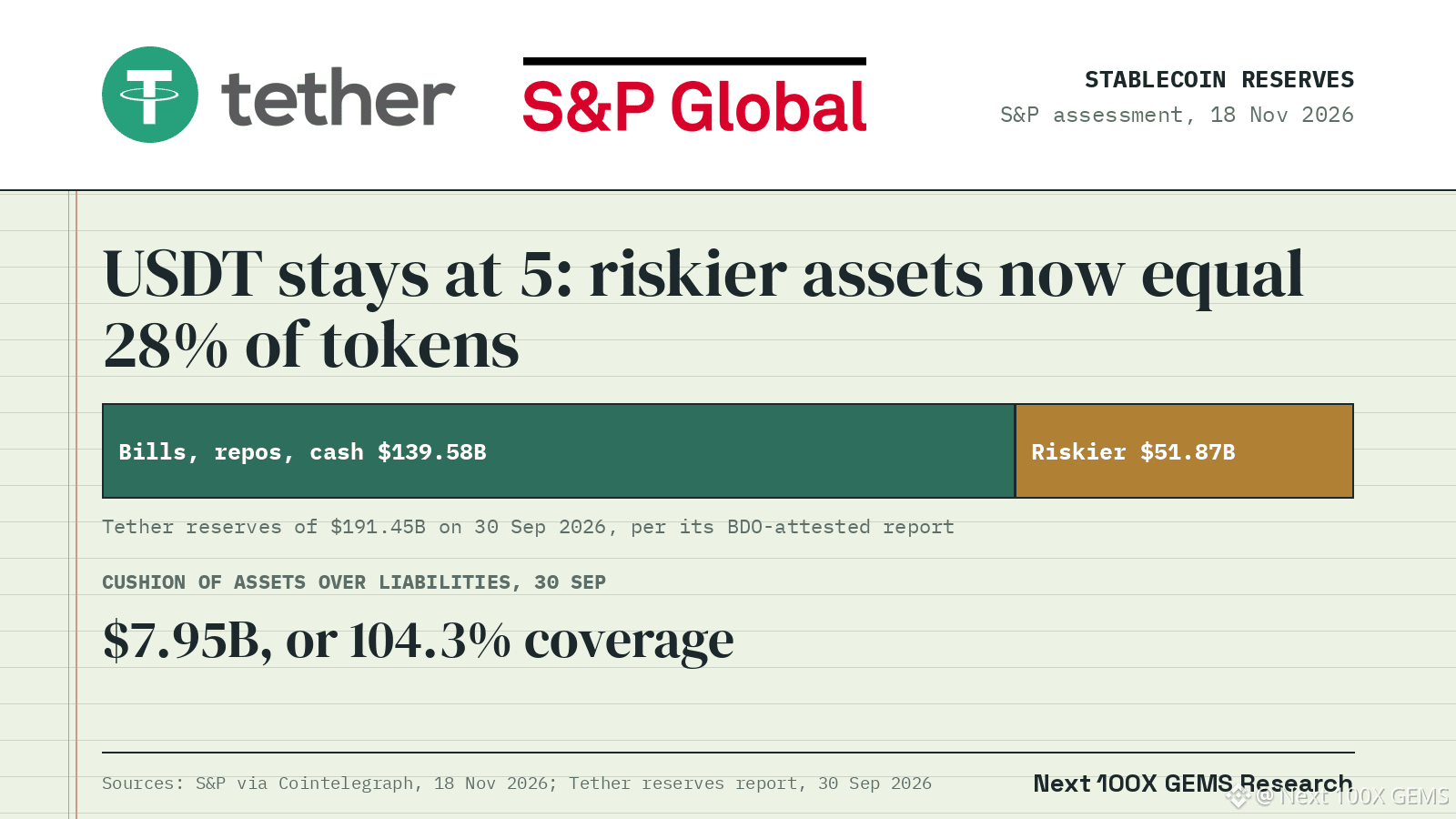
S&P keeps Tether's USDT at 5: what the 28% riskier-reserves figure actually meansS&P Global Ratings kept Tether's USDT at 5, or "weak", on 18 November, the lowest score on its five-point stablecoin stability scale and the same score it gave in November 2025. The number behind the headline is that assets S&P treats as higher risk, such as gold, bitcoin, public equities, secured loans and corporate bonds, were equal to 28% of USDT in circulation on 30 September, up from 24% a year earlier, according to the report as quoted by Cointelegraph. That does not mean 28% of USDT is unbacked. Tether's own attested figures show assets above liabilities by about 7.95 billion dollars. What S&P is pointing at is the size of the riskier pile next to that cushion.
What a 5 measures, and what it doesn't
S&P says its Stablecoin Stability Assessment is not a credit rating. It scores how well a stablecoin can hold its peg, from 1 (very strong) to 5 (weak), and compares stablecoins with each other, not with bonds. The agency starts with the quality of the backing assets, then looks at governance, the legal and regulatory setup, redeemability and liquidity, technology dependencies and track record. Those later factors can only hold the score or pull it down.
That last point shapes how to read this year's result. S&P said it found further weaknesses but made no downward adjustment "because our assessment cannot be lower than 5," Cointelegraph reported. The same report credited USDT with a good record of price stability, particularly over the past 12 months. So the score is a judgment about how exposed the peg could be under stress, not a statement that the peg is failing.
The reserve mix on 30 September
Tether's latest quarterly report, with a reasonable-assurance opinion from BDO, lists every asset category. BDO's opinion covers that single date only.
| Asset, 30 Sep 2026 | Amount | Share of total assets |
|---|---|---|
| US Treasury bills | 122.84 billion dollars | 64.2% |
| Overnight reverse repos | 9.52 billion dollars | 5.0% |
| Term reverse repos | 7.18 billion dollars | 3.7% |
| Non-US bills, cash and deposits | 0.04 billion dollars | under 0.1% |
| Precious metals (gold bars) | 19.08 billion dollars | 10.0% |
| Secured loans | 14.18 billion dollars | 7.4% |
| Bitcoin | 8.37 billion dollars | 4.4% |
| Other investments | 6.00 billion dollars | 3.1% |
| Public equities | 4.18 billion dollars | 2.2% |
| Corporate bonds | 0.06 billion dollars | under 0.1% |
| Total assets | 191.45 billion dollars | 100% |
| Liabilities | 183.50 billion dollars | |
| Excess of assets over liabilities | 7.95 billion dollars | |
Add up the six categories from gold downward and you get about 51.87 billion dollars, or 28.3% of the 183.47 billion dollars of tokens issued. That is our sum, and it lines up with S&P's 28%. S&P also tracked the shifts within it: gold up to about 19 billion dollars from 12.9 billion dollars a year earlier, bitcoin down to 8.4 billion dollars from 9.9 billion dollars, and 4.2 billion dollars of public equities that were not there before. Treasury bills and overnight repos, which S&P counts as low risk, came to 72% of circulation, down from 75%, per The Crypto Times.
The arithmetic of the cushion
Here is the simplest way to see S&P's concern, using only the 30 September figures. The cushion is 7.95 billion dollars. The riskier assets total 51.87 billion dollars. If every one of them lost value at once, a fall of about 15.3% would use up the cushion.
A narrower example. Bitcoin and gold together were 27.45 billion dollars, valued at the closing prices BDO used for that date, 83,621.23 dollarsper bitcoin and 4,157.41 dollarsper ounce of gold. A 20% drop in both, with nothing else moving, would cost about 5.49 billion dollars. The cushion would shrink to about 2.46 billion dollars and the ratio of assets to liabilities would fall from 104.3% to about 101.3%. It would take a fall of roughly 29% in both to erase the cushion on its own.
This is arithmetic on one date, not a forecast. Prices have moved since 30 September, and we have not repriced them. Tether also reported 1.5 billion dollars of net operating profit in the third quarter, which adds to the cushion over time. The secured loans are carried at amortised cost and described as over-collateralised with margin calls, so they would not move like a market price.
What S&P wants to see
Much of the report is about disclosure rather than assets. Per Cointelegraph and TokenPost, S&P noted that KPMG issued an unqualified opinion on Tether's 2025 accounts but that the audited statements and auditor's report are not public. The reserve reports do not name custodians or counterparties, and they give little detail on the credit quality of the secured loans and corporate bonds. Attestations are quarterly while other stablecoins generally report monthly. S&P also said El Salvador's rules, under which Tether now operates, require 70% of reserves in assets that can be sold within 30 days but allow assets such as gold and bitcoin, and do not require reserves to be segregated from the company's other assets.
Tether's answer
Tether rejects the framework, not the numbers. "The problem is S&P's framework, not our reserves," the company told Cointelegraph. "Their own history shows the underlying problem," it added, pointing to The Big Short, the film about the 2008 financial crisis. When Tether released its third-quarter report on 30 October, its chief executive, Paolo Ardoino, said generating 1.5 billion dollars of net operating profit while holding nearly 8 billion dollars of excess reserves "gives us a strong foundation," and that the company is building "with the liquidity to meet redemptions." The 30 September figures show a 7.95 billion dollars cushion, which Tether's release says has nearly doubled since June, and a riskier pile several times larger than that cushion.
Sources
S&P Global stablecoin assessments page
Cointelegraph on the 18 Nov report
Tether reserves report with BDO opinion, 30 Sep 2026 (PDF)
Tether Q3 release
crypto news
TokenPost
The Crypto Times
S&P keeps Tether's USDT at 5: what the 28% riskier-reserves figure actually means
S&P Global Ratings kept Tether's USDT at 5, or "weak", on 18 November, the lowest score on its five-point stablecoin stability scale and the same score it gave in November 2025. The number behind the headline is that assets S&P treats as higher risk, such as gold, bitcoin, public equities, secured loans and corporate bonds, were equal to 28% of USDT in circulation on 30 September, up from 24% a year earlier, according to the report as quoted by Cointelegraph. That does not mean 28% of USDT is unbacked. Tether's own attested figures show assets above liabilities by about 7.95 billion dollars. What S&P is pointing at is the size of the riskier pile next to that cushion.
What a 5 measures, and what it doesn't
S&P says its Stablecoin Stability Assessment is not a credit rating. It scores how well a stablecoin can hold its peg, from 1 (very strong) to 5 (weak), and compares stablecoins with each other, not with bonds. The agency starts with the quality of the backing assets, then looks at governance, the legal and regulatory setup, redeemability and liquidity, technology dependencies and track record. Those later factors can only hold the score or pull it down.
That last point shapes how to read this year's result. S&P said it found further weaknesses but made no downward adjustment "because our assessment cannot be lower than 5," Cointelegraph reported. The same report credited USDT with a good record of price stability, particularly over the past 12 months. So the score is a judgment about how exposed the peg could be under stress, not a statement that the peg is failing.
The reserve mix on 30 September
Tether's latest quarterly report, with a reasonable-assurance opinion from BDO, lists every asset category. BDO's opinion covers that single date only.
| Asset, 30 Sep 2026 | Amount | Share of total assets |
|---|---|---|
| US Treasury bills | 122.84 billion dollars | 64.2% |
| Overnight reverse repos | 9.52 billion dollars | 5.0% |
| Term reverse repos | 7.18 billion dollars | 3.7% |
| Non-US bills, cash and deposits | 0.04 billion dollars | under 0.1% |
| Precious metals (gold bars) | 19.08 billion dollars | 10.0% |
| Secured loans | 14.18 billion dollars | 7.4% |
| Bitcoin | 8.37 billion dollars | 4.4% |
| Other investments | 6.00 billion dollars | 3.1% |
| Public equities | 4.18 billion dollars | 2.2% |
| Corporate bonds | 0.06 billion dollars | under 0.1% |
| Total assets | 191.45 billion dollars | 100% |
| Liabilities | 183.50 billion dollars | |
| Excess of assets over liabilities | 7.95 billion dollars | |
Add up the six categories from gold downward and you get about 51.87 billion dollars, or 28.3% of the 183.47 billion dollars of tokens issued. That is our sum, and it lines up with S&P's 28%. S&P also tracked the shifts within it: gold up to about 19 billion dollars from 12.9 billion dollars a year earlier, bitcoin down to 8.4 billion dollars from 9.9 billion dollars, and 4.2 billion dollars of public equities that were not there before. Treasury bills and overnight repos, which S&P counts as low risk, came to 72% of circulation, down from 75%, per The Crypto Times.
The arithmetic of the cushion
Here is the simplest way to see S&P's concern, using only the 30 September figures. The cushion is 7.95 billion dollars. The riskier assets total 51.87 billion dollars. If every one of them lost value at once, a fall of about 15.3% would use up the cushion.
A narrower example. Bitcoin and gold together were 27.45 billion dollars, valued at the closing prices BDO used for that date, 83,621.23 dollarsper bitcoin and 4,157.41 dollarsper ounce of gold. A 20% drop in both, with nothing else moving, would cost about 5.49 billion dollars. The cushion would shrink to about 2.46 billion dollars and the ratio of assets to liabilities would fall from 104.3% to about 101.3%. It would take a fall of roughly 29% in both to erase the cushion on its own.
This is arithmetic on one date, not a forecast. Prices have moved since 30 September, and we have not repriced them. Tether also reported 1.5 billion dollars of net operating profit in the third quarter, which adds to the cushion over time. The secured loans are carried at amortised cost and described as over-collateralised with margin calls, so they would not move like a market price.
What S&P wants to see
Much of the report is about disclosure rather than assets. Per Cointelegraph and TokenPost, S&P noted that KPMG issued an unqualified opinion on Tether's 2025 accounts but that the audited statements and auditor's report are not public. The reserve reports do not name custodians or counterparties, and they give little detail on the credit quality of the secured loans and corporate bonds. Attestations are quarterly while other stablecoins generally report monthly. S&P also said El Salvador's rules, under which Tether now operates, require 70% of reserves in assets that can be sold within 30 days but allow assets such as gold and bitcoin, and do not require reserves to be segregated from the company's other assets.
Tether's answer
Tether rejects the framework, not the numbers. "The problem is S&P's framework, not our reserves," the company told Cointelegraph. "Their own history shows the underlying problem," it added, pointing to The Big Short, the film about the 2008 financial crisis. When Tether released its third-quarter report on 30 October, its chief executive, Paolo Ardoino, said generating 1.5 billion dollars of net operating profit while holding nearly 8 billion dollars of excess reserves "gives us a strong foundation," and that the company is building "with the liquidity to meet redemptions." The 30 September figures show a 7.95 billion dollars cushion, which Tether's release says has nearly doubled since June, and a riskier pile several times larger than that cushion.
Sources
S&P Global stablecoin assessments page
Cointelegraph on the 18 Nov report
Tether reserves report with BDO opinion, 30 Sep 2026 (PDF)
Tether Q3 release
crypto news
TokenPost
The Crypto Times
What a 5 measures, and what it doesn't
S&P says its Stablecoin Stability Assessment is not a credit rating. It scores how well a stablecoin can hold its peg, from 1 (very strong) to 5 (weak), and compares stablecoins with each other, not with bonds. The agency starts with the quality of the backing assets, then looks at governance, the legal and regulatory setup, redeemability and liquidity, technology dependencies and track record. Those later factors can only hold the score or pull it down.
That last point shapes how to read this year's result. S&P said it found further weaknesses but made no downward adjustment "because our assessment cannot be lower than 5," Cointelegraph reported. The same report credited USDT with a good record of price stability, particularly over the past 12 months. So the score is a judgment about how exposed the peg could be under stress, not a statement that the peg is failing.
The reserve mix on 30 September
Tether's latest quarterly report, with a reasonable-assurance opinion from BDO, lists every asset category. BDO's opinion covers that single date only.
| Asset, 30 Sep 2026 | Amount | Share of total assets |
|---|---|---|
| US Treasury bills | 122.84 billion dollars | 64.2% |
| Overnight reverse repos | 9.52 billion dollars | 5.0% |
| Term reverse repos | 7.18 billion dollars | 3.7% |
| Non-US bills, cash and deposits | 0.04 billion dollars | under 0.1% |
| Precious metals (gold bars) | 19.08 billion dollars | 10.0% |
| Secured loans | 14.18 billion dollars | 7.4% |
| Bitcoin | 8.37 billion dollars | 4.4% |
| Other investments | 6.00 billion dollars | 3.1% |
| Public equities | 4.18 billion dollars | 2.2% |
| Corporate bonds | 0.06 billion dollars | under 0.1% |
| Total assets | 191.45 billion dollars | 100% |
| Liabilities | 183.50 billion dollars | |
| Excess of assets over liabilities | 7.95 billion dollars | |
Add up the six categories from gold downward and you get about 51.87 billion dollars, or 28.3% of the 183.47 billion dollars of tokens issued. That is our sum, and it lines up with S&P's 28%. S&P also tracked the shifts within it: gold up to about 19 billion dollars from 12.9 billion dollars a year earlier, bitcoin down to 8.4 billion dollars from 9.9 billion dollars, and 4.2 billion dollars of public equities that were not there before. Treasury bills and overnight repos, which S&P counts as low risk, came to 72% of circulation, down from 75%, per The Crypto Times.
The arithmetic of the cushion
Here is the simplest way to see S&P's concern, using only the 30 September figures. The cushion is 7.95 billion dollars. The riskier assets total 51.87 billion dollars. If every one of them lost value at once, a fall of about 15.3% would use up the cushion.
A narrower example. Bitcoin and gold together were 27.45 billion dollars, valued at the closing prices BDO used for that date, 83,621.23 dollarsper bitcoin and 4,157.41 dollarsper ounce of gold. A 20% drop in both, with nothing else moving, would cost about 5.49 billion dollars. The cushion would shrink to about 2.46 billion dollars and the ratio of assets to liabilities would fall from 104.3% to about 101.3%. It would take a fall of roughly 29% in both to erase the cushion on its own.
This is arithmetic on one date, not a forecast. Prices have moved since 30 September, and we have not repriced them. Tether also reported 1.5 billion dollars of net operating profit in the third quarter, which adds to the cushion over time. The secured loans are carried at amortised cost and described as over-collateralised with margin calls, so they would not move like a market price.
What S&P wants to see
Much of the report is about disclosure rather than assets. Per Cointelegraph and TokenPost, S&P noted that KPMG issued an unqualified opinion on Tether's 2025 accounts but that the audited statements and auditor's report are not public. The reserve reports do not name custodians or counterparties, and they give little detail on the credit quality of the secured loans and corporate bonds. Attestations are quarterly while other stablecoins generally report monthly. S&P also said El Salvador's rules, under which Tether now operates, require 70% of reserves in assets that can be sold within 30 days but allow assets such as gold and bitcoin, and do not require reserves to be segregated from the company's other assets.
Tether's answer
Tether rejects the framework, not the numbers. "The problem is S&P's framework, not our reserves," the company told Cointelegraph. "Their own history shows the underlying problem," it added, pointing to The Big Short, the film about the 2008 financial crisis. When Tether released its third-quarter report on 30 October, its chief executive, Paolo Ardoino, said generating 1.5 billion dollars of net operating profit while holding nearly 8 billion dollars of excess reserves "gives us a strong foundation," and that the company is building "with the liquidity to meet redemptions." The 30 September figures show a 7.95 billion dollars cushion, which Tether's release says has nearly doubled since June, and a riskier pile several times larger than that cushion.
Sources
S&P Global stablecoin assessments page
Cointelegraph on the 18 Nov report
Tether reserves report with BDO opinion, 30 Sep 2026 (PDF)
Tether Q3 release
crypto news
TokenPost
The Crypto Times
1
59
Article
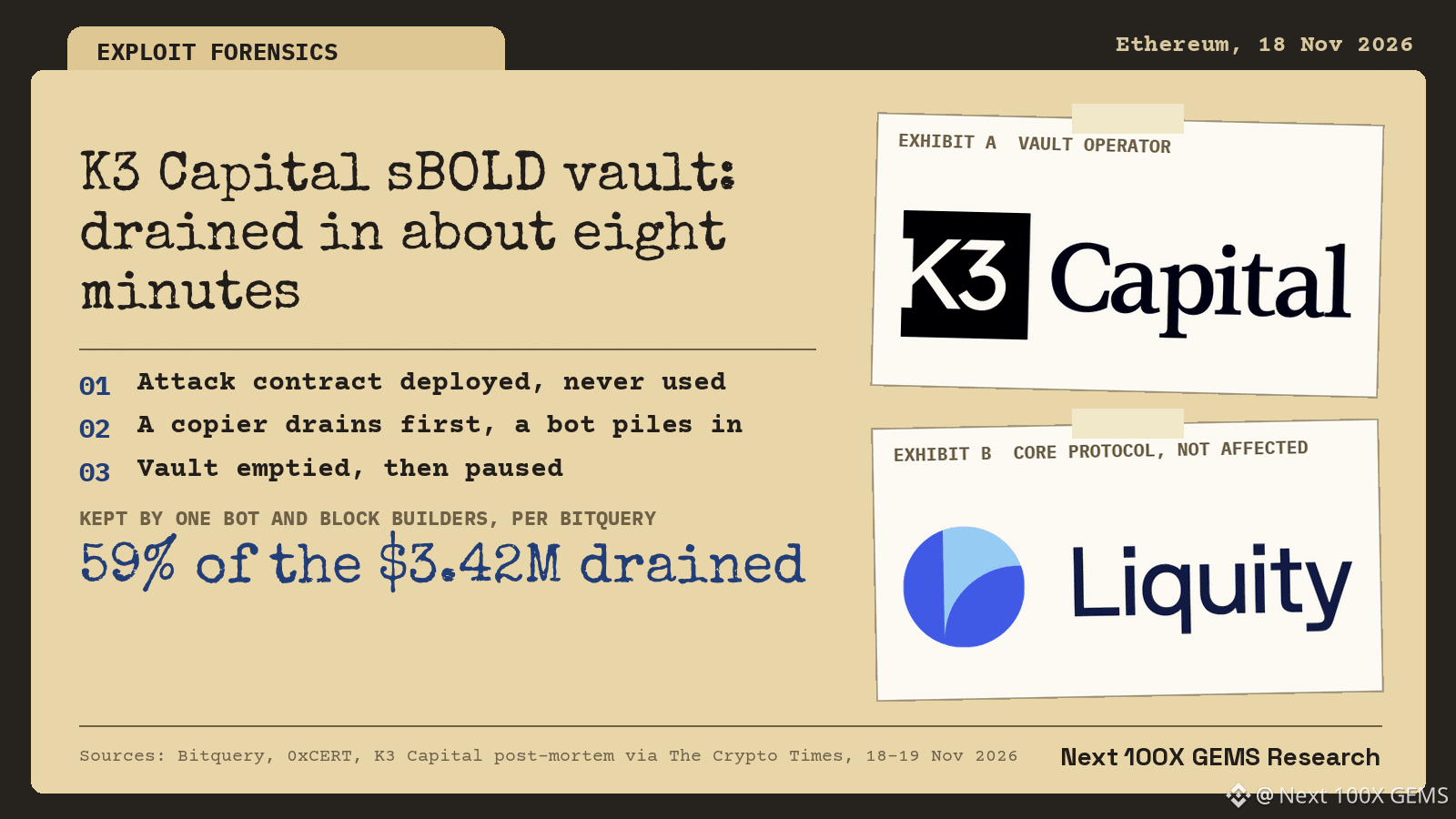
K3 Capital sBOLD vault exploit: how 3.43 million dollars left in minutes, and who actually kept itThe K3 Capital sBOLD vault exploit on 18 November emptied a Liquity BOLD savings vault on Ethereum in about eight minutes, and most of the money did not stay with the wallet that wrote the attack. Bitquery's on-chain investigation finds that block builders and one copycat bot's payout wallet kept 59% of the 3,428,799 BOLD drained, which Bitquery values at 3.42 million dollars. Blockaid's first alert, as logged by the 0xCERT advisory, put the loss at about 3.43 million dollars, and K3 Capital's own post-mortem says about 3.43 million BOLD, nearly all the vault's assets, per The Crypto Times. Liquity V2's core contracts were not affected, according to Liquity.
Exhibit A: where the money went
Bitquery traced every drain and priced ETH at 1,801 dollars. Its split:
| Destination | Value | Share |
|---|---|---|
| Block builders (Titan, BuilderNet, Ultrasound, Quasar), 986 ETH in bribes | 1.78 million dollars | 52% |
| Copycat bot's payout wallet | 231,000 dollars | 7% |
| 0xdc0e, the attack's author, to THORChain | 292,000 dollars | 9% |
| 0xdc0e group via Maya Protocol to five Bitcoin addresses | 232,000 dollars | 7% |
| 0xbabe and a fresh wallet | 216,000 dollars | 6% |
| 0xf601 | 174,000 dollars | 5% |
| 0x2324, the first copier | 75,000 dollars | 2% |
| Fees and costs | 428,000 dollars | 13% |
The bot, run from 13 wallets through one contract, sent 57 of the 97 drain transactions and pulled out 1.91 million dollars, 56% of the total. It paid about nine tenths of that to builders to put its transactions first, raising its bribe from 12.5 ETH to 44 ETH per block. K3 Capital's post-mortem, as reported by The Crypto Times, adds that builders passed 986.55 ETH to 21 validator fee recipients across 32 blocks, and that Lido's execution-layer rewards vault received 256.31 ETH across nine of them. K3 says it does not accuse the builders.
Exhibit B: the timeline
All steps fall on 18 November unless marked, shown as gaps between them.
1. Wallet 0xdc0e deploys the attack contract, then never calls it.
2. Eleven minutes later, 0x2324, a wallet Bitquery says had run as an MEV bot since late 2025, executes a byte-identical copy with its own addresses swapped in. It is the first to drain.
3. Twenty-four seconds after that, the author's own first drain lands.
4. Within about a minute and a half of the first drain, wallets 0xbabe and 0xf601 join. The copycat bot arrives in the same stretch.
5. Near the end, 0xdc0e sends 1 ETH to a second wallet, 0x8fb8, which deploys the same code and drains in three of the last four blocks.
6. About eight minutes after the first drain, almost nothing is left in the vault, per Bitquery. K3 says 99.9% of assets were gone in about 7.5 minutes.
7. About 40 minutes after the first drain, the pause transaction lands on-chain, per SigIntZero's block read. K3 posts on X that the contracts are paused.
8. 19 November: K3 publishes its post-mortem with technical analysis by ChainSecurity, the vault's auditor, and offers a 15% bounty.
The counts differ by source: about 34 transactions in Blockaid's alert, 97 in Bitquery's trace, 99 across ten operators in K3's post-mortem. Bitquery also found zero troves liquidated, which contradicts the first alerts that blamed self-liquidation.
Exhibit C: the bug, in plain words
sBOLD is an ERC-4626 vault. Its share price is the value of everything it holds divided by the shares outstanding: BOLD in Liquity's Stability Pools plus any collateral, such as WETH, priced by oracle. Push that value up while you own most of the shares and you can redeem for more than you put in.
The vault has a public swap() function meant to turn collateral back into BOLD through 1inch's router. We read the verified source on Sourcify. swap() approves the router to spend the collateral, makes a call using data the caller writes, and then checks one thing: that the vault's BOLD balance went up enough. It never checks that the collateral actually left, and it never clears the approval.
SigIntZero and K3 describe the loop. An attacker deposited a large amount of BOLD for most of the shares, sent the vault 4 WETH, then called swap() with data that paid the vault about 7,159 BOLD while the WETH stayed put. The vault now counted both the new BOLD and the WETH, so each share looked richer, and the attacker redeemed. A second swap() using the leftover approval pulled the 4 WETH back out. K3 sums it up in its post-mortem, as quoted by The Crypto Times: "The root cause is a token approval that the vault left in place after a swap that never took the collateral." A cap of 7,500 BOLD on idle collateral, per SigIntZero's on-chain read, limited each round, and K3 says gas limits held each transaction to about eight rounds.
Exhibit D: the audit question
ChainSecurity's sBOLD audit, dated 19 May 2025, rated finding CS-SBOLD-008 High. In the first audited version, collateral below the maxCollInBold threshold was left out of the share price, so an attacker could mint shares cheaply, call swap() and redeem. Early alerts and Bitquery's write-up linked the drain to that pattern, and Bitquery says it did not check which version K3 runs.
The record points elsewhere. The audit marks CS-SBOLD-008 "Code Corrected" in Version 3, where collateral is included in the valuation. The source verified on Sourcify for the vault address 0x50Bd66D5...59DD11 adds the collateral value to the BOLD total with no threshold carve-out, which matches SigIntZero's reading. On that evidence the fix was deployed, and the exploit used a different path. The audit's system overview does describe swap() checking only for the BOLD increase. We found no finding in it on the leftover approval.
Exhibit E: what K3 has done
K3 paused the contracts, and a call we made on 20 November returned paused as true with about 4.5 BOLD left. It is offering a 15% bounty on returned funds, has named a single recovery address, and says Bitcoin Suisse and Yearn have committed to help recover about 1.7 million BOLD of identified holdings. Repayment to depositors will depend on what is recovered. Pendle's sBOLD market held 12.79% of shares, and those losses are not yet quantified. Liquity advised against depositing into sBOLD. For another accounting failure from the same week, see our report on the Kava Lend exploit.
Sources
Bitquery investigation
0xCERT-2026-0376
ChainSecurity sBOLD audit (PDF)
SigIntZero
The Crypto Times on K3's post-mortem
Sourcify verified source
K3 Capital on X
Liquity on X
K3 Capital sBOLD vault exploit: how 3.43 million dollars left in minutes, and who actually kept it
The K3 Capital sBOLD vault exploit on 18 November emptied a Liquity BOLD savings vault on Ethereum in about eight minutes, and most of the money did not stay with the wallet that wrote the attack. Bitquery's on-chain investigation finds that block builders and one copycat bot's payout wallet kept 59% of the 3,428,799 BOLD drained, which Bitquery values at 3.42 million dollars. Blockaid's first alert, as logged by the 0xCERT advisory, put the loss at about 3.43 million dollars, and K3 Capital's own post-mortem says about 3.43 million BOLD, nearly all the vault's assets, per The Crypto Times. Liquity V2's core contracts were not affected, according to Liquity.
Exhibit A: where the money went
Bitquery traced every drain and priced ETH at 1,801 dollars. Its split:
| Destination | Value | Share |
|---|---|---|
| Block builders (Titan, BuilderNet, Ultrasound, Quasar), 986 ETH in bribes | 1.78 million dollars | 52% |
| Copycat bot's payout wallet | 231,000 dollars | 7% |
| 0xdc0e, the attack's author, to THORChain | 292,000 dollars | 9% |
| 0xdc0e group via Maya Protocol to five Bitcoin addresses | 232,000 dollars | 7% |
| 0xbabe and a fresh wallet | 216,000 dollars | 6% |
| 0xf601 | 174,000 dollars | 5% |
| 0x2324, the first copier | 75,000 dollars | 2% |
| Fees and costs | 428,000 dollars | 13% |
The bot, run from 13 wallets through one contract, sent 57 of the 97 drain transactions and pulled out 1.91 million dollars, 56% of the total. It paid about nine tenths of that to builders to put its transactions first, raising its bribe from 12.5 ETH to 44 ETH per block. K3 Capital's post-mortem, as reported by The Crypto Times, adds that builders passed 986.55 ETH to 21 validator fee recipients across 32 blocks, and that Lido's execution-layer rewards vault received 256.31 ETH across nine of them. K3 says it does not accuse the builders.
Exhibit B: the timeline
All steps fall on 18 November unless marked, shown as gaps between them.
1. Wallet 0xdc0e deploys the attack contract, then never calls it.
2. Eleven minutes later, 0x2324, a wallet Bitquery says had run as an MEV bot since late 2025, executes a byte-identical copy with its own addresses swapped in. It is the first to drain.
3. Twenty-four seconds after that, the author's own first drain lands.
4. Within about a minute and a half of the first drain, wallets 0xbabe and 0xf601 join. The copycat bot arrives in the same stretch.
5. Near the end, 0xdc0e sends 1 ETH to a second wallet, 0x8fb8, which deploys the same code and drains in three of the last four blocks.
6. About eight minutes after the first drain, almost nothing is left in the vault, per Bitquery. K3 says 99.9% of assets were gone in about 7.5 minutes.
7. About 40 minutes after the first drain, the pause transaction lands on-chain, per SigIntZero's block read. K3 posts on X that the contracts are paused.
8. 19 November: K3 publishes its post-mortem with technical analysis by ChainSecurity, the vault's auditor, and offers a 15% bounty.
The counts differ by source: about 34 transactions in Blockaid's alert, 97 in Bitquery's trace, 99 across ten operators in K3's post-mortem. Bitquery also found zero troves liquidated, which contradicts the first alerts that blamed self-liquidation.
Exhibit C: the bug, in plain words
sBOLD is an ERC-4626 vault. Its share price is the value of everything it holds divided by the shares outstanding: BOLD in Liquity's Stability Pools plus any collateral, such as WETH, priced by oracle. Push that value up while you own most of the shares and you can redeem for more than you put in.
The vault has a public swap() function meant to turn collateral back into BOLD through 1inch's router. We read the verified source on Sourcify. swap() approves the router to spend the collateral, makes a call using data the caller writes, and then checks one thing: that the vault's BOLD balance went up enough. It never checks that the collateral actually left, and it never clears the approval.
SigIntZero and K3 describe the loop. An attacker deposited a large amount of BOLD for most of the shares, sent the vault 4 WETH, then called swap() with data that paid the vault about 7,159 BOLD while the WETH stayed put. The vault now counted both the new BOLD and the WETH, so each share looked richer, and the attacker redeemed. A second swap() using the leftover approval pulled the 4 WETH back out. K3 sums it up in its post-mortem, as quoted by The Crypto Times: "The root cause is a token approval that the vault left in place after a swap that never took the collateral." A cap of 7,500 BOLD on idle collateral, per SigIntZero's on-chain read, limited each round, and K3 says gas limits held each transaction to about eight rounds.
Exhibit D: the audit question
ChainSecurity's sBOLD audit, dated 19 May 2025, rated finding CS-SBOLD-008 High. In the first audited version, collateral below the maxCollInBold threshold was left out of the share price, so an attacker could mint shares cheaply, call swap() and redeem. Early alerts and Bitquery's write-up linked the drain to that pattern, and Bitquery says it did not check which version K3 runs.
The record points elsewhere. The audit marks CS-SBOLD-008 "Code Corrected" in Version 3, where collateral is included in the valuation. The source verified on Sourcify for the vault address 0x50Bd66D5...59DD11 adds the collateral value to the BOLD total with no threshold carve-out, which matches SigIntZero's reading. On that evidence the fix was deployed, and the exploit used a different path. The audit's system overview does describe swap() checking only for the BOLD increase. We found no finding in it on the leftover approval.
Exhibit E: what K3 has done
K3 paused the contracts, and a call we made on 20 November returned paused as true with about 4.5 BOLD left. It is offering a 15% bounty on returned funds, has named a single recovery address, and says Bitcoin Suisse and Yearn have committed to help recover about 1.7 million BOLD of identified holdings. Repayment to depositors will depend on what is recovered. Pendle's sBOLD market held 12.79% of shares, and those losses are not yet quantified. Liquity advised against depositing into sBOLD. For another accounting failure from the same week, see our report on the Kava Lend exploit.
Sources
Bitquery investigation
0xCERT-2026-0376
ChainSecurity sBOLD audit (PDF)
SigIntZero
The Crypto Times on K3's post-mortem
Sourcify verified source
K3 Capital on X
Liquity on X
Exhibit A: where the money went
Bitquery traced every drain and priced ETH at 1,801 dollars. Its split:
| Destination | Value | Share |
|---|---|---|
| Block builders (Titan, BuilderNet, Ultrasound, Quasar), 986 ETH in bribes | 1.78 million dollars | 52% |
| Copycat bot's payout wallet | 231,000 dollars | 7% |
| 0xdc0e, the attack's author, to THORChain | 292,000 dollars | 9% |
| 0xdc0e group via Maya Protocol to five Bitcoin addresses | 232,000 dollars | 7% |
| 0xbabe and a fresh wallet | 216,000 dollars | 6% |
| 0xf601 | 174,000 dollars | 5% |
| 0x2324, the first copier | 75,000 dollars | 2% |
| Fees and costs | 428,000 dollars | 13% |
The bot, run from 13 wallets through one contract, sent 57 of the 97 drain transactions and pulled out 1.91 million dollars, 56% of the total. It paid about nine tenths of that to builders to put its transactions first, raising its bribe from 12.5 ETH to 44 ETH per block. K3 Capital's post-mortem, as reported by The Crypto Times, adds that builders passed 986.55 ETH to 21 validator fee recipients across 32 blocks, and that Lido's execution-layer rewards vault received 256.31 ETH across nine of them. K3 says it does not accuse the builders.
Exhibit B: the timeline
All steps fall on 18 November unless marked, shown as gaps between them.
1. Wallet 0xdc0e deploys the attack contract, then never calls it.
2. Eleven minutes later, 0x2324, a wallet Bitquery says had run as an MEV bot since late 2025, executes a byte-identical copy with its own addresses swapped in. It is the first to drain.
3. Twenty-four seconds after that, the author's own first drain lands.
4. Within about a minute and a half of the first drain, wallets 0xbabe and 0xf601 join. The copycat bot arrives in the same stretch.
5. Near the end, 0xdc0e sends 1 ETH to a second wallet, 0x8fb8, which deploys the same code and drains in three of the last four blocks.
6. About eight minutes after the first drain, almost nothing is left in the vault, per Bitquery. K3 says 99.9% of assets were gone in about 7.5 minutes.
7. About 40 minutes after the first drain, the pause transaction lands on-chain, per SigIntZero's block read. K3 posts on X that the contracts are paused.
8. 19 November: K3 publishes its post-mortem with technical analysis by ChainSecurity, the vault's auditor, and offers a 15% bounty.
The counts differ by source: about 34 transactions in Blockaid's alert, 97 in Bitquery's trace, 99 across ten operators in K3's post-mortem. Bitquery also found zero troves liquidated, which contradicts the first alerts that blamed self-liquidation.
Exhibit C: the bug, in plain words
sBOLD is an ERC-4626 vault. Its share price is the value of everything it holds divided by the shares outstanding: BOLD in Liquity's Stability Pools plus any collateral, such as WETH, priced by oracle. Push that value up while you own most of the shares and you can redeem for more than you put in.
The vault has a public swap() function meant to turn collateral back into BOLD through 1inch's router. We read the verified source on Sourcify. swap() approves the router to spend the collateral, makes a call using data the caller writes, and then checks one thing: that the vault's BOLD balance went up enough. It never checks that the collateral actually left, and it never clears the approval.
SigIntZero and K3 describe the loop. An attacker deposited a large amount of BOLD for most of the shares, sent the vault 4 WETH, then called swap() with data that paid the vault about 7,159 BOLD while the WETH stayed put. The vault now counted both the new BOLD and the WETH, so each share looked richer, and the attacker redeemed. A second swap() using the leftover approval pulled the 4 WETH back out. K3 sums it up in its post-mortem, as quoted by The Crypto Times: "The root cause is a token approval that the vault left in place after a swap that never took the collateral." A cap of 7,500 BOLD on idle collateral, per SigIntZero's on-chain read, limited each round, and K3 says gas limits held each transaction to about eight rounds.
Exhibit D: the audit question
ChainSecurity's sBOLD audit, dated 19 May 2025, rated finding CS-SBOLD-008 High. In the first audited version, collateral below the maxCollInBold threshold was left out of the share price, so an attacker could mint shares cheaply, call swap() and redeem. Early alerts and Bitquery's write-up linked the drain to that pattern, and Bitquery says it did not check which version K3 runs.
The record points elsewhere. The audit marks CS-SBOLD-008 "Code Corrected" in Version 3, where collateral is included in the valuation. The source verified on Sourcify for the vault address 0x50Bd66D5...59DD11 adds the collateral value to the BOLD total with no threshold carve-out, which matches SigIntZero's reading. On that evidence the fix was deployed, and the exploit used a different path. The audit's system overview does describe swap() checking only for the BOLD increase. We found no finding in it on the leftover approval.
Exhibit E: what K3 has done
K3 paused the contracts, and a call we made on 20 November returned paused as true with about 4.5 BOLD left. It is offering a 15% bounty on returned funds, has named a single recovery address, and says Bitcoin Suisse and Yearn have committed to help recover about 1.7 million BOLD of identified holdings. Repayment to depositors will depend on what is recovered. Pendle's sBOLD market held 12.79% of shares, and those losses are not yet quantified. Liquity advised against depositing into sBOLD. For another accounting failure from the same week, see our report on the Kava Lend exploit.
Sources
Bitquery investigation
0xCERT-2026-0376
ChainSecurity sBOLD audit (PDF)
SigIntZero
The Crypto Times on K3's post-mortem
Sourcify verified source
K3 Capital on X
Liquity on X
125
Verified
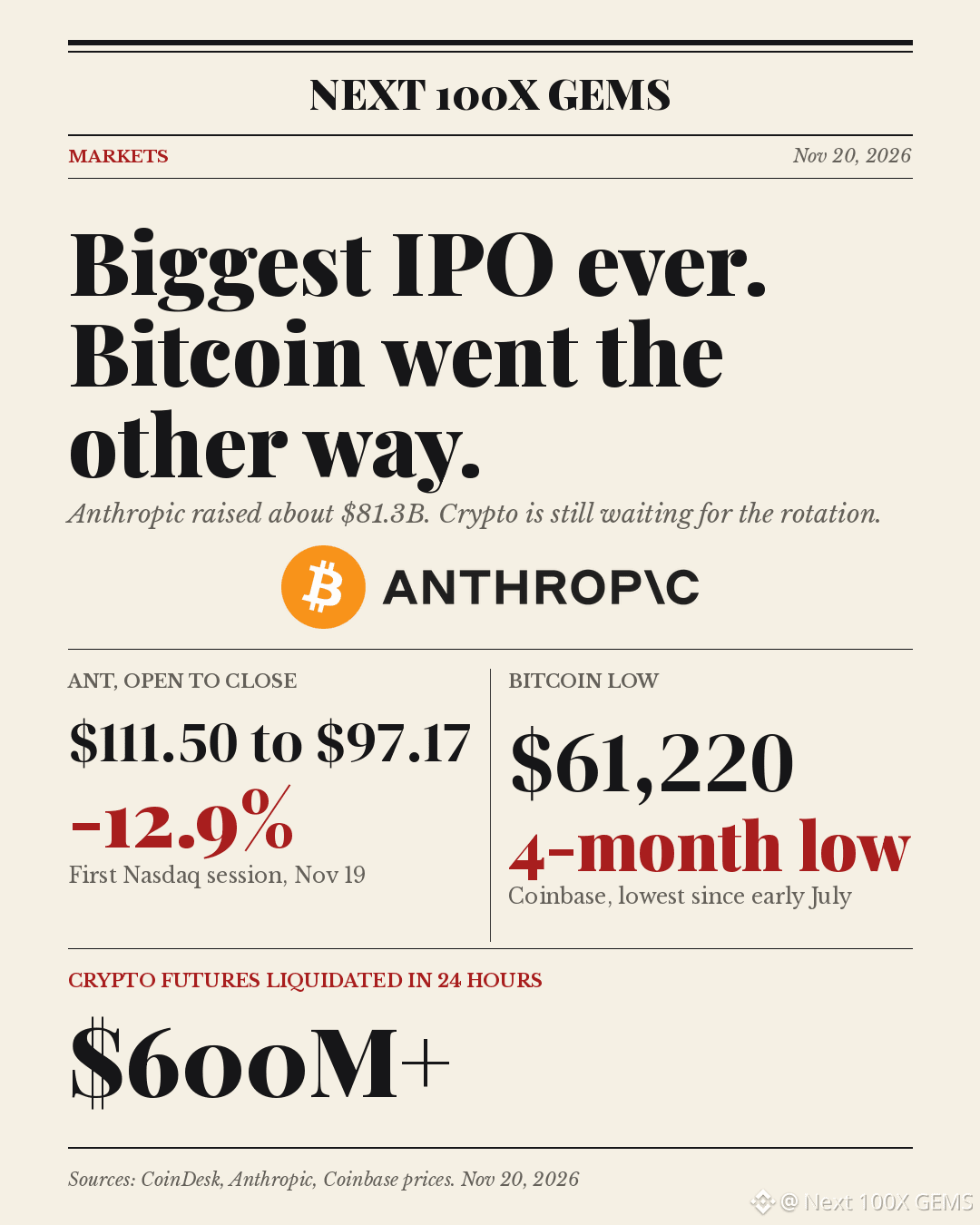
$BTC slid to its lowest price since early July while Wall Street watched Anthropic's Nasdaq debut.
The AI lab raised about 81.3 billion dollars, the largest IPO on record. Its stock opened at 111.50 and closed at 97.17. Bitcoin touched roughly 61,200 on Coinbase as over 600 million dollars of crypto futures got liquidated.
Wincent's Paul Howard told CoinDesk he expects money to rotate back into crypto now the deal is done. Buyers at the ANT open were down about 13% by the close, an odd base for the #AnthropicIPO rotation trade to grow from.
A finished IPO can free up cash. A weak tech tape can drag bitcoin with it.
NFA. DYOR.
$BTC slid to its lowest price since early July while Wall Street watched Anthropic's Nasdaq debut.
The AI lab raised about 81.3 billion dollars, the largest IPO on record. Its stock opened at 111.50 and closed at 97.17. Bitcoin touched roughly 61,200 on Coinbase as over 600 million dollars of crypto futures got liquidated.
Wincent's Paul Howard told CoinDesk he expects money to rotate back into crypto now the deal is done. Buyers at the ANT open were down about 13% by the close, an odd base for the #AnthropicIPO rotation trade to grow from.
A finished IPO can free up cash. A weak tech tape can drag bitcoin with it.
NFA. DYOR.
The AI lab raised about 81.3 billion dollars, the largest IPO on record. Its stock opened at 111.50 and closed at 97.17. Bitcoin touched roughly 61,200 on Coinbase as over 600 million dollars of crypto futures got liquidated.
Wincent's Paul Howard told CoinDesk he expects money to rotate back into crypto now the deal is done. Buyers at the ANT open were down about 13% by the close, an odd base for the #AnthropicIPO rotation trade to grow from.
A finished IPO can free up cash. A weak tech tape can drag bitcoin with it.
NFA. DYOR.
1
2.7k
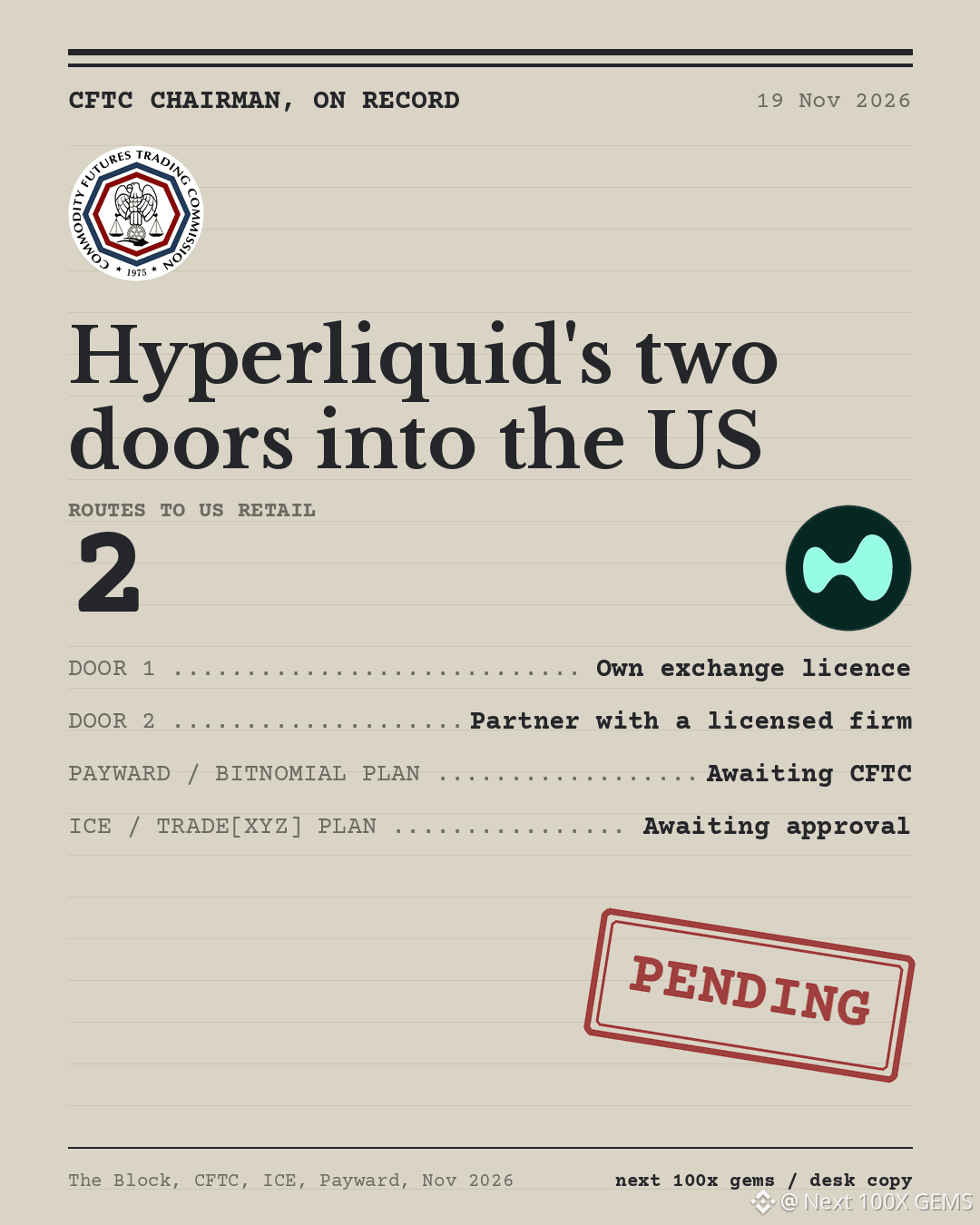
"You're going to have to come in and partner with an exchange or obtain your own exchange." CFTC Chairman Michael Selig, on how Hyperliquid and $HYPE could reach US retail traders.
That is close to the Payward plan, with Kraken's parent running #Hyperliquid markets through its licensed Bitnomial exchange. ICE has a similar deal with Trade[XYZ].
Neither has approval yet, so the next move is Selig's, not Hyperliquid's.
NFA. DYOR.
"You're going to have to come in and partner with an exchange or obtain your own exchange." CFTC Chairman Michael Selig, on how Hyperliquid and $HYPE could reach US retail traders.
That is close to the Payward plan, with Kraken's parent running #Hyperliquid markets through its licensed Bitnomial exchange. ICE has a similar deal with Trade[XYZ].
Neither has approval yet, so the next move is Selig's, not Hyperliquid's.
NFA. DYOR.
That is close to the Payward plan, with Kraken's parent running #Hyperliquid markets through its licensed Bitnomial exchange. ICE has a similar deal with Trade[XYZ].
Neither has approval yet, so the next move is Selig's, not Hyperliquid's.
NFA. DYOR.
1
342
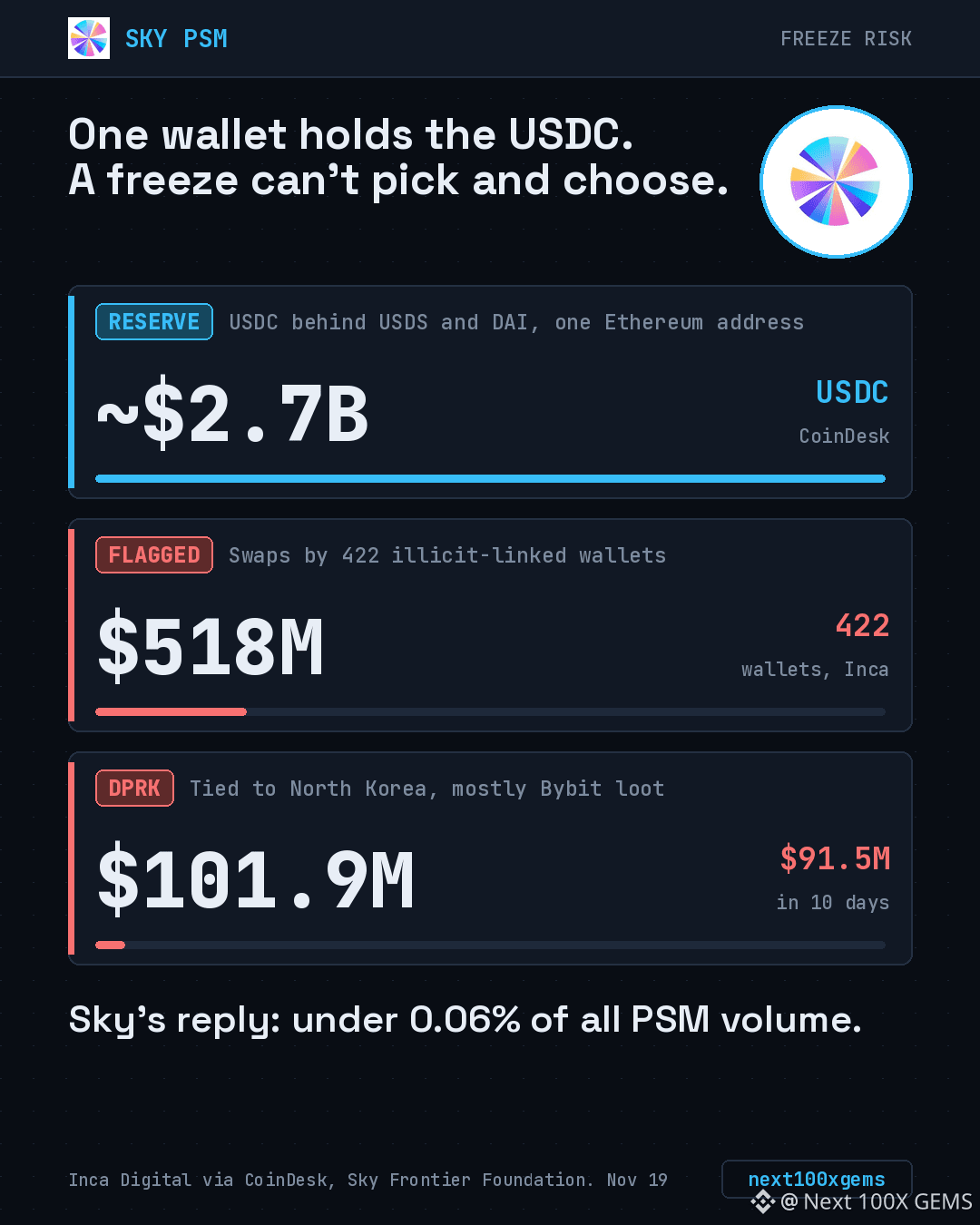
Sky's peg module has a compliance problem, and $USDC sits in the middle of it.
Inca Digital told CoinDesk that 422 wallets linked to hackers, phishing and sanctioned entities swapped 518 million dollars through it, turning freezable USDC into DAI and USDS. The #NorthKorea slice is about 101.9 million, mostly Bybit loot. Sky says that's under 0.06% of volume, none via its own apps.
The reserve worries us more. About 2.7 billion USDC backing USDS and DAI sits in one Ethereum address, and a blacklist would halt swaps both ways, clean money included.
NFA. DYOR.
Sky's peg module has a compliance problem, and $USDC sits in the middle of it.
Inca Digital told CoinDesk that 422 wallets linked to hackers, phishing and sanctioned entities swapped 518 million dollars through it, turning freezable USDC into DAI and USDS. The #NorthKorea slice is about 101.9 million, mostly Bybit loot. Sky says that's under 0.06% of volume, none via its own apps.
The reserve worries us more. About 2.7 billion USDC backing USDS and DAI sits in one Ethereum address, and a blacklist would halt swaps both ways, clean money included.
NFA. DYOR.
Inca Digital told CoinDesk that 422 wallets linked to hackers, phishing and sanctioned entities swapped 518 million dollars through it, turning freezable USDC into DAI and USDS. The #NorthKorea slice is about 101.9 million, mostly Bybit loot. Sky says that's under 0.06% of volume, none via its own apps.
The reserve worries us more. About 2.7 billion USDC backing USDS and DAI sits in one Ethereum address, and a blacklist would halt swaps both ways, clean money included.
NFA. DYOR.
498
Article
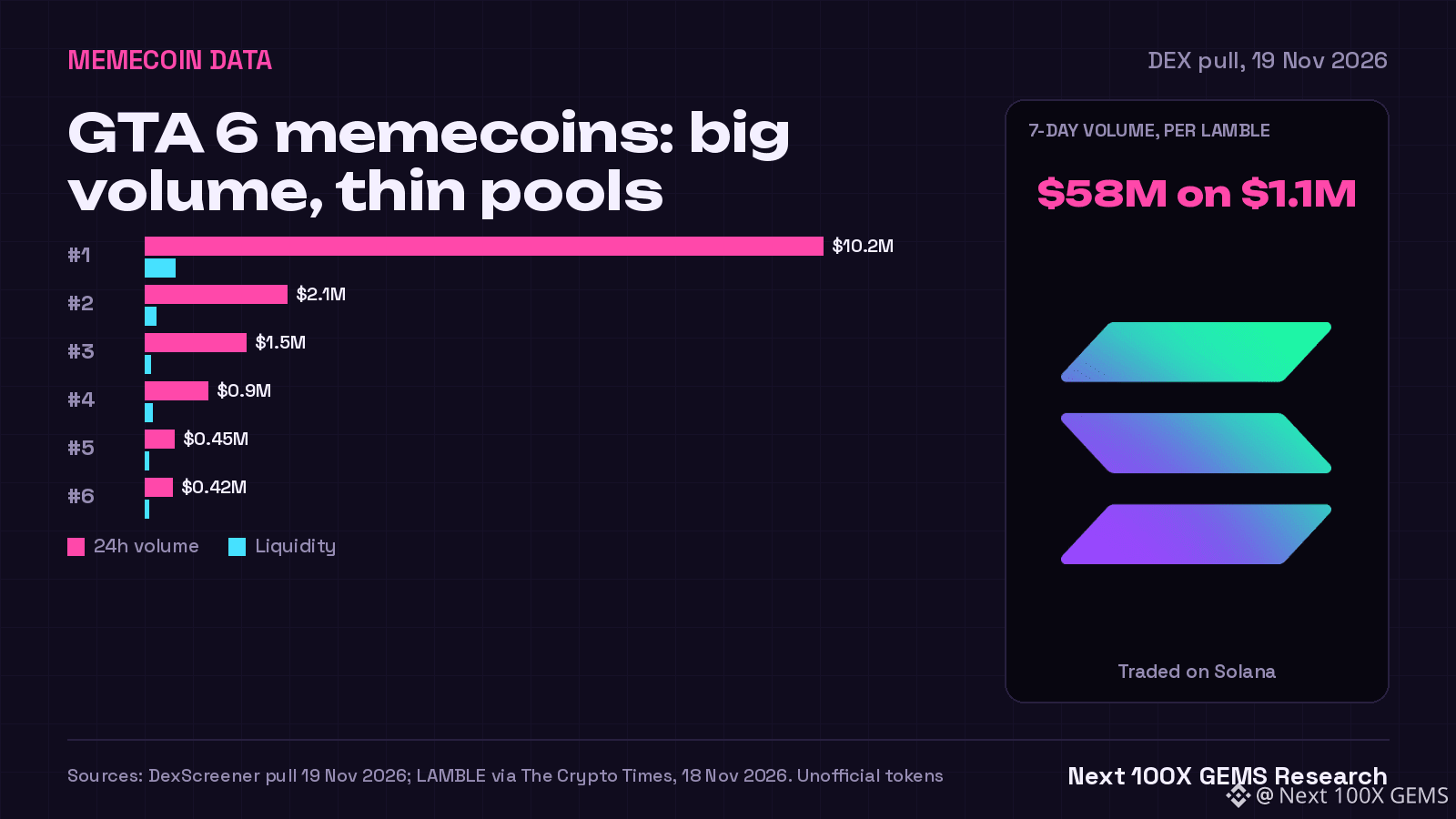
GTA 6 memecoins: 58 million dollars in launch-week volume, and how much of it is realGTA 6 memecoins: 58 million dollars in launch-week volume, and how much of it is real
GTA 6 memecoins on Solana did about 58 million dollars of trading in the seven days to 17 November, according to on-chain data from LAMBLE reported by The Crypto Times, against top-pair liquidity of only about 1.1 million dollars. None of these tokens is linked to Rockstar Games or its parent, Take-Two Interactive. We pulled the biggest ones ourselves on 19 November, release day, and ranked them.
| Rank | Token, as named on-chain | 24h volume | Liquidity | Market cap | Volume ÷ market cap |
|---|---|---|---|---|---|
| 1 | GTA VI (GTA6) | 10.19 million dollars | 465,481 dollars | 3.30 million dollars | 3.1x |
| 2 | GTA6CAT (GATO) | 2.14 million dollars | 172,862 dollars | 1.40 million dollars | 1.5x |
| 3 | The State of Leonida (Leonida) | 1.52 million dollars | 92,186 dollars | 1.42 million dollars | 1.1x |
| 4 | WASTED | 944,240 dollars | 114,654 dollars | 1.00 million dollars | 0.9x |
| 5 | Vice City Index (BAWSAQ) | 449,996 dollars | 16,667 dollars | 26,001 dollars | 17.3x |
| 6 | WASTED (a second token, same name) | 418,634 dollars | 48,388 dollars | 451,668 dollars | 0.9x |
| 7 | GTA Dollars (GTA$) | 393,964 dollars | 29,534 dollars | 42,569 dollars | 9.3x |
| 8 | Grand Theft Crew (GRAND) | 360,547 dollars | 50,126 dollars | 468,039 dollars | 0.8x |
DexScreener data, second pull on 19 Nov 2026. Volume is a rolling 24 hours summed across each token's Solana pairs, and liquidity is summed across the same pairs. Market cap is as DexScreener reports it. Tokens with less than 10,000 dollars of liquidity are left out, because a reported market cap that small can swing on a single trade.
So how much of the 58 million dollars is real? The honest answer is that public DEX data can't separate a fan from a bot. What it can show is how thin the market under those numbers is, and the table says very thin.
Reading one: it's mostly one token
The eight tokens above did about 16.41 million dollars in 24 hours on our second pull. GTA VI alone did 10.19 million dollars of that, roughly 62%. LAMBLE's own 24-hour figure, about 18.8 million dollars, covers a different window and a different set of 23 tokens, so we don't set the two side by side.
Most of GTA VI's volume ran through one pool. That pool traded 6.29 million dollars in 24 hours while holding 30,208 dollars of liquidity, so the same small pile of money changed hands about 208 times. GeckoTerminal's daily candles for the pool show the jump: about 711,800 dollars on 15 November, then 5.13 million dollars on 16 November, 6.97 million dollars on 17 November and 6.91 million dollars on 18 November.
GTA6CAT is the opposite case. It led LAMBLE's seven-day ranking with about 11.7 million dollars, but its main pool did 1.10 million dollars to 2.17 million dollars a day on GeckoTerminal from 10 November through 18 November. That's a token with a regular crowd, not a launch-week spike.
Reading two: the copycats are the crowd
Searching DexScreener for nine GTA-themed names on 19 November returned 178 distinct Solana token addresses on our second pull, up from 166 on the first. Twenty-six of them were called GTA Dollars, and the GTA Dollars in our table isn't the same contract that led that name on our first pull. Two different WASTED tokens made our top eight on their own. LAMBLE tracked 23 tokens in total, so its 58 million dollars is a measured slice of a much messier market.
Anyone reading a chart should keep that in mind. A ticker that looks like the one in the headlines may be a different contract made the same week. One token just outside the table puts "Official" in its name. The name is the only official thing about it, as far as anything we could find shows. The Crypto Times reported that none of LAMBLE's 23 tokens has a verified link to Rockstar or Take-Two, and that Rockstar hasn't announced any crypto or blockchain features for the game.
Reading three: turnover runs far ahead of value
Look at the last column. Vice City Index traded about 17 times its market cap in a day, and its price was down 94.2% over 24 hours. Below our liquidity cut it gets wilder. A token called Grand Theft Alleycat showed 900,469 dollars of volume against a reported market cap of 1,693 dollars and 1,769 dollars of liquidity, over 500 times its cap on paper. With a pool that small, one trade can move the market cap a long way, so we treat that ratio as illustrative only. LAMBLE found that tokens trading at more than 10 times their market cap made up about 43% of the group's 24-hour volume on 17 November, and it flagged two tiny tokens trading more than 240 times market caps of about 1,500 dollars.
Numbers like that can come from automated trading or wash trading, The Crypto Times noted. It also said high turnover on its own doesn't prove manipulation, and that the data doesn't show how much came from independent buyers. We agree on both counts, and we're not claiming wash trading here. What we can say is narrower. Across our eight tokens, 16.41 million dollars of daily volume sat on about 990,000 dollars of combined liquidity, roughly 17 dollars traded for every dollar in the pools.
The release-day check
Rockstar's own page lists Grand Theft Auto VI as coming on 19 November 2026. On our second pull that day, the older names were falling through the release. GTA VI was down 69.3% over 24 hours, GTA6CAT 76.1%, WASTED 47.7% and Vice City Index 94.2%. The gains sat with the newest tokens. The State of Leonida was up 57.5%, and its first pool, opened only on 18 November, did 1.98 million dollars on day one, per GeckoTerminal. Grand Theft Crew was up 1,444% and the GTA Dollars in our table 752%.
Our second pull came while 19 November's trading was still under way, so this is a release-day read, not the final word. The pattern was already clear. Volume was big, the pools under it were small, and lookalike tokens kept multiplying.
Sources
The Crypto Times, "GTA 6 Memecoin Trading Hits 58 million dollars Ahead of Game Launch," citing LAMBLE data updated 17 Nov 2026 (18 Nov 2026).
DexScreener API, token and search endpoints, pulled twice on 19 Nov 2026 (table uses the second pull).
GeckoTerminal API, daily candles for each token's busiest Solana pool, pulled twice on 19 Nov 2026.
Rockstar Games, Grand Theft Auto VI page, "Coming November 19, 2026" (checked 19 Nov 2026).
GTA 6 memecoins: 58 million dollars in launch-week volume, and how much of it is real
GTA 6 memecoins: 58 million dollars in launch-week volume, and how much of it is real
GTA 6 memecoins on Solana did about 58 million dollars of trading in the seven days to 17 November, according to on-chain data from LAMBLE reported by The Crypto Times, against top-pair liquidity of only about 1.1 million dollars. None of these tokens is linked to Rockstar Games or its parent, Take-Two Interactive. We pulled the biggest ones ourselves on 19 November, release day, and ranked them.
| Rank | Token, as named on-chain | 24h volume | Liquidity | Market cap | Volume ÷ market cap |
|---|---|---|---|---|---|
| 1 | GTA VI (GTA6) | 10.19 million dollars | 465,481 dollars | 3.30 million dollars | 3.1x |
| 2 | GTA6CAT (GATO) | 2.14 million dollars | 172,862 dollars | 1.40 million dollars | 1.5x |
| 3 | The State of Leonida (Leonida) | 1.52 million dollars | 92,186 dollars | 1.42 million dollars | 1.1x |
| 4 | WASTED | 944,240 dollars | 114,654 dollars | 1.00 million dollars | 0.9x |
| 5 | Vice City Index (BAWSAQ) | 449,996 dollars | 16,667 dollars | 26,001 dollars | 17.3x |
| 6 | WASTED (a second token, same name) | 418,634 dollars | 48,388 dollars | 451,668 dollars | 0.9x |
| 7 | GTA Dollars (GTA$) | 393,964 dollars | 29,534 dollars | 42,569 dollars | 9.3x |
| 8 | Grand Theft Crew (GRAND) | 360,547 dollars | 50,126 dollars | 468,039 dollars | 0.8x |
DexScreener data, second pull on 19 Nov 2026. Volume is a rolling 24 hours summed across each token's Solana pairs, and liquidity is summed across the same pairs. Market cap is as DexScreener reports it. Tokens with less than 10,000 dollars of liquidity are left out, because a reported market cap that small can swing on a single trade.
So how much of the 58 million dollars is real? The honest answer is that public DEX data can't separate a fan from a bot. What it can show is how thin the market under those numbers is, and the table says very thin.
Reading one: it's mostly one token
The eight tokens above did about 16.41 million dollars in 24 hours on our second pull. GTA VI alone did 10.19 million dollars of that, roughly 62%. LAMBLE's own 24-hour figure, about 18.8 million dollars, covers a different window and a different set of 23 tokens, so we don't set the two side by side.
Most of GTA VI's volume ran through one pool. That pool traded 6.29 million dollars in 24 hours while holding 30,208 dollars of liquidity, so the same small pile of money changed hands about 208 times. GeckoTerminal's daily candles for the pool show the jump: about 711,800 dollars on 15 November, then 5.13 million dollars on 16 November, 6.97 million dollars on 17 November and 6.91 million dollars on 18 November.
GTA6CAT is the opposite case. It led LAMBLE's seven-day ranking with about 11.7 million dollars, but its main pool did 1.10 million dollars to 2.17 million dollars a day on GeckoTerminal from 10 November through 18 November. That's a token with a regular crowd, not a launch-week spike.
Reading two: the copycats are the crowd
Searching DexScreener for nine GTA-themed names on 19 November returned 178 distinct Solana token addresses on our second pull, up from 166 on the first. Twenty-six of them were called GTA Dollars, and the GTA Dollars in our table isn't the same contract that led that name on our first pull. Two different WASTED tokens made our top eight on their own. LAMBLE tracked 23 tokens in total, so its 58 million dollars is a measured slice of a much messier market.
Anyone reading a chart should keep that in mind. A ticker that looks like the one in the headlines may be a different contract made the same week. One token just outside the table puts "Official" in its name. The name is the only official thing about it, as far as anything we could find shows. The Crypto Times reported that none of LAMBLE's 23 tokens has a verified link to Rockstar or Take-Two, and that Rockstar hasn't announced any crypto or blockchain features for the game.
Reading three: turnover runs far ahead of value
Look at the last column. Vice City Index traded about 17 times its market cap in a day, and its price was down 94.2% over 24 hours. Below our liquidity cut it gets wilder. A token called Grand Theft Alleycat showed 900,469 dollars of volume against a reported market cap of 1,693 dollars and 1,769 dollars of liquidity, over 500 times its cap on paper. With a pool that small, one trade can move the market cap a long way, so we treat that ratio as illustrative only. LAMBLE found that tokens trading at more than 10 times their market cap made up about 43% of the group's 24-hour volume on 17 November, and it flagged two tiny tokens trading more than 240 times market caps of about 1,500 dollars.
Numbers like that can come from automated trading or wash trading, The Crypto Times noted. It also said high turnover on its own doesn't prove manipulation, and that the data doesn't show how much came from independent buyers. We agree on both counts, and we're not claiming wash trading here. What we can say is narrower. Across our eight tokens, 16.41 million dollars of daily volume sat on about 990,000 dollars of combined liquidity, roughly 17 dollars traded for every dollar in the pools.
The release-day check
Rockstar's own page lists Grand Theft Auto VI as coming on 19 November 2026. On our second pull that day, the older names were falling through the release. GTA VI was down 69.3% over 24 hours, GTA6CAT 76.1%, WASTED 47.7% and Vice City Index 94.2%. The gains sat with the newest tokens. The State of Leonida was up 57.5%, and its first pool, opened only on 18 November, did 1.98 million dollars on day one, per GeckoTerminal. Grand Theft Crew was up 1,444% and the GTA Dollars in our table 752%.
Our second pull came while 19 November's trading was still under way, so this is a release-day read, not the final word. The pattern was already clear. Volume was big, the pools under it were small, and lookalike tokens kept multiplying.
Sources
The Crypto Times, "GTA 6 Memecoin Trading Hits 58 million dollars Ahead of Game Launch," citing LAMBLE data updated 17 Nov 2026 (18 Nov 2026).
DexScreener API, token and search endpoints, pulled twice on 19 Nov 2026 (table uses the second pull).
GeckoTerminal API, daily candles for each token's busiest Solana pool, pulled twice on 19 Nov 2026.
Rockstar Games, Grand Theft Auto VI page, "Coming November 19, 2026" (checked 19 Nov 2026).
GTA 6 memecoins on Solana did about 58 million dollars of trading in the seven days to 17 November, according to on-chain data from LAMBLE reported by The Crypto Times, against top-pair liquidity of only about 1.1 million dollars. None of these tokens is linked to Rockstar Games or its parent, Take-Two Interactive. We pulled the biggest ones ourselves on 19 November, release day, and ranked them.
| Rank | Token, as named on-chain | 24h volume | Liquidity | Market cap | Volume ÷ market cap |
|---|---|---|---|---|---|
| 1 | GTA VI (GTA6) | 10.19 million dollars | 465,481 dollars | 3.30 million dollars | 3.1x |
| 2 | GTA6CAT (GATO) | 2.14 million dollars | 172,862 dollars | 1.40 million dollars | 1.5x |
| 3 | The State of Leonida (Leonida) | 1.52 million dollars | 92,186 dollars | 1.42 million dollars | 1.1x |
| 4 | WASTED | 944,240 dollars | 114,654 dollars | 1.00 million dollars | 0.9x |
| 5 | Vice City Index (BAWSAQ) | 449,996 dollars | 16,667 dollars | 26,001 dollars | 17.3x |
| 6 | WASTED (a second token, same name) | 418,634 dollars | 48,388 dollars | 451,668 dollars | 0.9x |
| 7 | GTA Dollars (GTA$) | 393,964 dollars | 29,534 dollars | 42,569 dollars | 9.3x |
| 8 | Grand Theft Crew (GRAND) | 360,547 dollars | 50,126 dollars | 468,039 dollars | 0.8x |
DexScreener data, second pull on 19 Nov 2026. Volume is a rolling 24 hours summed across each token's Solana pairs, and liquidity is summed across the same pairs. Market cap is as DexScreener reports it. Tokens with less than 10,000 dollars of liquidity are left out, because a reported market cap that small can swing on a single trade.
So how much of the 58 million dollars is real? The honest answer is that public DEX data can't separate a fan from a bot. What it can show is how thin the market under those numbers is, and the table says very thin.
Reading one: it's mostly one token
The eight tokens above did about 16.41 million dollars in 24 hours on our second pull. GTA VI alone did 10.19 million dollars of that, roughly 62%. LAMBLE's own 24-hour figure, about 18.8 million dollars, covers a different window and a different set of 23 tokens, so we don't set the two side by side.
Most of GTA VI's volume ran through one pool. That pool traded 6.29 million dollars in 24 hours while holding 30,208 dollars of liquidity, so the same small pile of money changed hands about 208 times. GeckoTerminal's daily candles for the pool show the jump: about 711,800 dollars on 15 November, then 5.13 million dollars on 16 November, 6.97 million dollars on 17 November and 6.91 million dollars on 18 November.
GTA6CAT is the opposite case. It led LAMBLE's seven-day ranking with about 11.7 million dollars, but its main pool did 1.10 million dollars to 2.17 million dollars a day on GeckoTerminal from 10 November through 18 November. That's a token with a regular crowd, not a launch-week spike.
Reading two: the copycats are the crowd
Searching DexScreener for nine GTA-themed names on 19 November returned 178 distinct Solana token addresses on our second pull, up from 166 on the first. Twenty-six of them were called GTA Dollars, and the GTA Dollars in our table isn't the same contract that led that name on our first pull. Two different WASTED tokens made our top eight on their own. LAMBLE tracked 23 tokens in total, so its 58 million dollars is a measured slice of a much messier market.
Anyone reading a chart should keep that in mind. A ticker that looks like the one in the headlines may be a different contract made the same week. One token just outside the table puts "Official" in its name. The name is the only official thing about it, as far as anything we could find shows. The Crypto Times reported that none of LAMBLE's 23 tokens has a verified link to Rockstar or Take-Two, and that Rockstar hasn't announced any crypto or blockchain features for the game.
Reading three: turnover runs far ahead of value
Look at the last column. Vice City Index traded about 17 times its market cap in a day, and its price was down 94.2% over 24 hours. Below our liquidity cut it gets wilder. A token called Grand Theft Alleycat showed 900,469 dollars of volume against a reported market cap of 1,693 dollars and 1,769 dollars of liquidity, over 500 times its cap on paper. With a pool that small, one trade can move the market cap a long way, so we treat that ratio as illustrative only. LAMBLE found that tokens trading at more than 10 times their market cap made up about 43% of the group's 24-hour volume on 17 November, and it flagged two tiny tokens trading more than 240 times market caps of about 1,500 dollars.
Numbers like that can come from automated trading or wash trading, The Crypto Times noted. It also said high turnover on its own doesn't prove manipulation, and that the data doesn't show how much came from independent buyers. We agree on both counts, and we're not claiming wash trading here. What we can say is narrower. Across our eight tokens, 16.41 million dollars of daily volume sat on about 990,000 dollars of combined liquidity, roughly 17 dollars traded for every dollar in the pools.
The release-day check
Rockstar's own page lists Grand Theft Auto VI as coming on 19 November 2026. On our second pull that day, the older names were falling through the release. GTA VI was down 69.3% over 24 hours, GTA6CAT 76.1%, WASTED 47.7% and Vice City Index 94.2%. The gains sat with the newest tokens. The State of Leonida was up 57.5%, and its first pool, opened only on 18 November, did 1.98 million dollars on day one, per GeckoTerminal. Grand Theft Crew was up 1,444% and the GTA Dollars in our table 752%.
Our second pull came while 19 November's trading was still under way, so this is a release-day read, not the final word. The pattern was already clear. Volume was big, the pools under it were small, and lookalike tokens kept multiplying.
Sources
The Crypto Times, "GTA 6 Memecoin Trading Hits 58 million dollars Ahead of Game Launch," citing LAMBLE data updated 17 Nov 2026 (18 Nov 2026).
DexScreener API, token and search endpoints, pulled twice on 19 Nov 2026 (table uses the second pull).
GeckoTerminal API, daily candles for each token's busiest Solana pool, pulled twice on 19 Nov 2026.
Rockstar Games, Grand Theft Auto VI page, "Coming November 19, 2026" (checked 19 Nov 2026).
1
204
Article
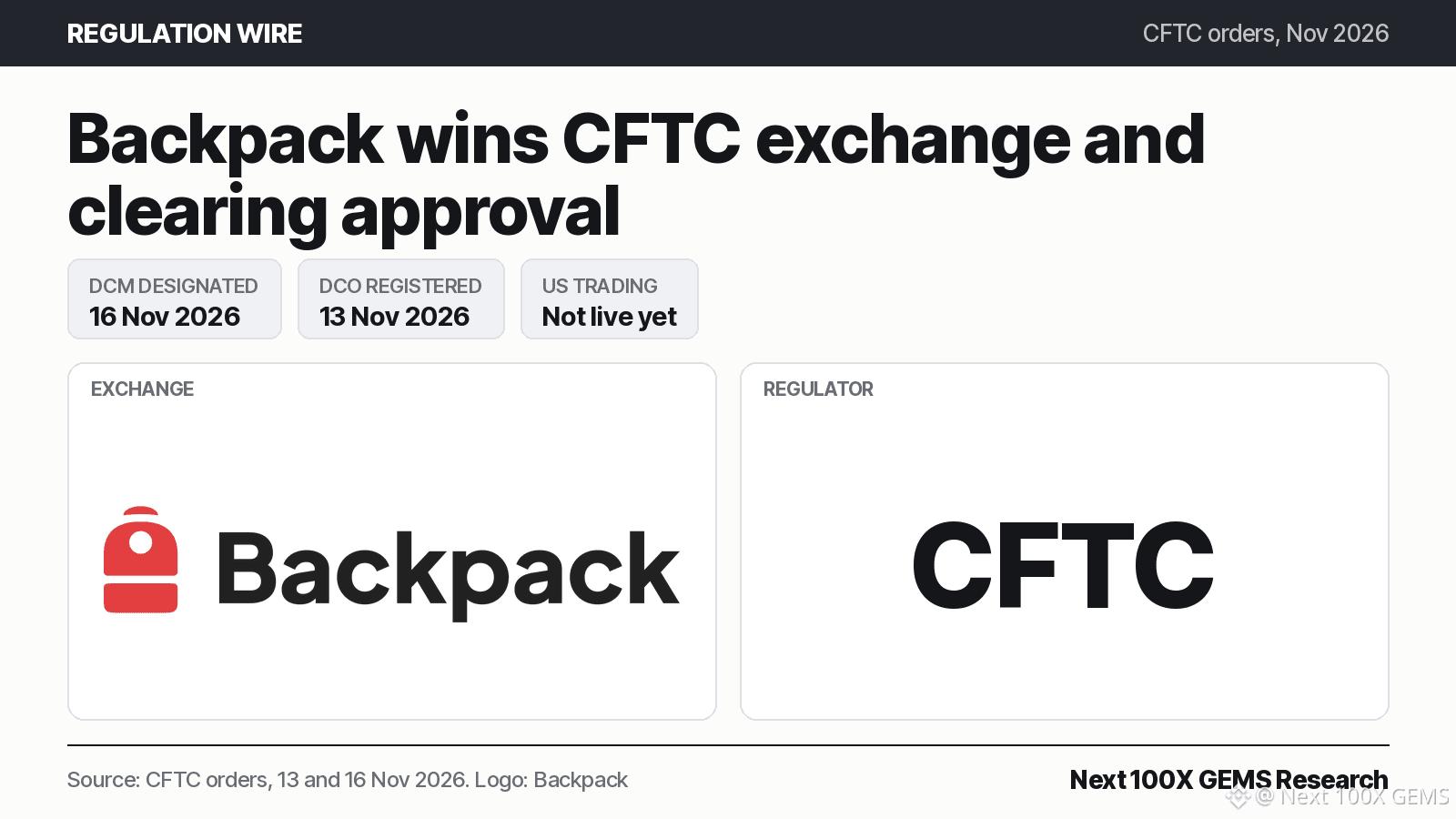
Backpack CFTC approval: what the exchange and clearing orders allow, and what isn't live yetThe Commodity Futures Trading Commission designated TLD Markets, Inc., Backpack's US exchange company, as a designated contract market (DCM) on 16 November 2026. Three days earlier, on 13 November, the CFTC registered TLD Clearing, Inc., doing business as Backpack Clearing, as a derivatives clearing organization (DCO).
Together, the two Backpack CFTC approvals give the crypto exchange the regulated venue and the clearinghouse a US futures market needs. They don't switch trading on. Backpack has published no US launch date, and neither order lists a specific contract.
What the clearing order permits
The DCO order is the one that sets product limits. It lets TLD Clearing clear "futures on a margined basis" and "fully collateralized futures, options on futures, and swaps," according to the order issued on 13 November and signed by Deputy Secretary Robert N. Sidman.
That split matters for traders. Leverage, in the form of margin, is cleared only on futures. Options on futures and swaps have to be fully collateralized, meaning the position is paid for in full up front, as defined in CFTC Regulation 39.2.
The order also requires TLD Clearing to treat funds in clearing member accounts as member property under the US Bankruptcy Code, kept separate from the company's own money. The Commission kept the right to "condition, modify, suspend, terminate, or otherwise restrict" the order on its own motion.
What the exchange order says
The DCM order covers how the venue will run. TLD Markets, a Delaware corporation, filed submissions from 27 March through 16 November 2026, the order says. It represented that it will run an anonymous electronic central limit order book and that every contract listed will be cleared by a CFTC-registered DCO.
The company also committed to monitoring trading in real time and again on a next-business-day basis, and to enforcing its own trading rules. Its board will include public directors with no material relationship to the firm. CFTC staff ran a technical evaluation of its systems before designation, per the order.
What Backpack says it will offer
Backpack's announcement on 16 November described the approval as the "First Ever Blockchain-Based Derivatives Exchange in the United States." That claim is the company's, and the CFTC's documents don't use it.
Using the two licenses, US users "will be able to trade crypto perpetual futures on a leveraged basis 24/7," Backpack said. It added that fiat and crypto would both count as collateral, and that US users would share one order book with its global market. A perpetual future is a futures contract with no expiry date, which is how it fits inside the margined futures the clearing order allows.
"From a policy perspective this is a really big deal," said Mark Wetjen, president of Backpack US, in the release. Chief executive Armani Ferrante said Backpack takes a "front door approach" in each market it enters. The company said it serves users in more than 150 countries and regions and has handled more than 450 billion dollars in trading volume. Those are Backpack's figures and aren't independently checked.
What the CFTC chair said
Chairman Michael S. Selig's statement of 16 November didn't name Backpack. It said the Commission approved a DCM and a DCO "for a firm utilizing blockchain-based architecture for execution and settlement of derivatives contracts."
Selig wrote that the Commodity Exchange Act sets core principles "without prescribing a particular technological architecture," and that firms using new technology "must satisfy the same regulatory standards" as traditional infrastructure. He listed anti-money laundering programs, customer protection and segregation, market surveillance, financial resources, risk management and system safeguards.
What isn't live yet
Backpack's 16 November release is written in the future tense, and the orders approve structures rather than products. As of 19 November, there was no start date in Backpack's announcement or in either CFTC order.
There's no contract list either. The exchange order refers to contracts in general terms and names none, so the specific perpetual futures Backpack plans to list still have to be published.
Customer onboarding is the other open piece. The two orders cover the exchange and the clearinghouse. Neither one sets out the customer-facing route, the accounts, checks and funding steps a US trader would go through, and Backpack's 16 November announcement didn't spell that out either.
Until those pieces are public, the approvals tell US traders what Backpack is allowed to build, not what they can trade today.
Sources
CFTC, Designated Contract Markets filing 60617, TLD Markets, Inc., status Designated, 16 Nov 2026.
CFTC, Order of Designation, TLD Markets, Inc. (16 Nov 2026).
CFTC, Derivatives Clearing Organizations filing 60669, TLD Clearing, Inc. (d/b/a Backpack Clearing), status Registered, 13 Nov 2026.
CFTC, Order of Registration, TLD Clearing, Inc. (13 Nov 2026).
CFTC Chairman Michael S. Selig, "Statement on American Innovation and the Future of Market Infrastructure" (16 Nov 2026).
Backpack, "Backpack Receives Landmark CFTC Approval to Establish First Ever Blockchain-Based Derivatives Exchange in the United States with Global Unified Liquidity" (16 Nov 2026).
Backpack CFTC approval: what the exchange and clearing orders allow, and what isn't live yet
The Commodity Futures Trading Commission designated TLD Markets, Inc., Backpack's US exchange company, as a designated contract market (DCM) on 16 November 2026. Three days earlier, on 13 November, the CFTC registered TLD Clearing, Inc., doing business as Backpack Clearing, as a derivatives clearing organization (DCO).
Together, the two Backpack CFTC approvals give the crypto exchange the regulated venue and the clearinghouse a US futures market needs. They don't switch trading on. Backpack has published no US launch date, and neither order lists a specific contract.
What the clearing order permits
The DCO order is the one that sets product limits. It lets TLD Clearing clear "futures on a margined basis" and "fully collateralized futures, options on futures, and swaps," according to the order issued on 13 November and signed by Deputy Secretary Robert N. Sidman.
That split matters for traders. Leverage, in the form of margin, is cleared only on futures. Options on futures and swaps have to be fully collateralized, meaning the position is paid for in full up front, as defined in CFTC Regulation 39.2.
The order also requires TLD Clearing to treat funds in clearing member accounts as member property under the US Bankruptcy Code, kept separate from the company's own money. The Commission kept the right to "condition, modify, suspend, terminate, or otherwise restrict" the order on its own motion.
What the exchange order says
The DCM order covers how the venue will run. TLD Markets, a Delaware corporation, filed submissions from 27 March through 16 November 2026, the order says. It represented that it will run an anonymous electronic central limit order book and that every contract listed will be cleared by a CFTC-registered DCO.
The company also committed to monitoring trading in real time and again on a next-business-day basis, and to enforcing its own trading rules. Its board will include public directors with no material relationship to the firm. CFTC staff ran a technical evaluation of its systems before designation, per the order.
What Backpack says it will offer
Backpack's announcement on 16 November described the approval as the "First Ever Blockchain-Based Derivatives Exchange in the United States." That claim is the company's, and the CFTC's documents don't use it.
Using the two licenses, US users "will be able to trade crypto perpetual futures on a leveraged basis 24/7," Backpack said. It added that fiat and crypto would both count as collateral, and that US users would share one order book with its global market. A perpetual future is a futures contract with no expiry date, which is how it fits inside the margined futures the clearing order allows.
"From a policy perspective this is a really big deal," said Mark Wetjen, president of Backpack US, in the release. Chief executive Armani Ferrante said Backpack takes a "front door approach" in each market it enters. The company said it serves users in more than 150 countries and regions and has handled more than 450 billion dollars in trading volume. Those are Backpack's figures and aren't independently checked.
What the CFTC chair said
Chairman Michael S. Selig's statement of 16 November didn't name Backpack. It said the Commission approved a DCM and a DCO "for a firm utilizing blockchain-based architecture for execution and settlement of derivatives contracts."
Selig wrote that the Commodity Exchange Act sets core principles "without prescribing a particular technological architecture," and that firms using new technology "must satisfy the same regulatory standards" as traditional infrastructure. He listed anti-money laundering programs, customer protection and segregation, market surveillance, financial resources, risk management and system safeguards.
What isn't live yet
Backpack's 16 November release is written in the future tense, and the orders approve structures rather than products. As of 19 November, there was no start date in Backpack's announcement or in either CFTC order.
There's no contract list either. The exchange order refers to contracts in general terms and names none, so the specific perpetual futures Backpack plans to list still have to be published.
Customer onboarding is the other open piece. The two orders cover the exchange and the clearinghouse. Neither one sets out the customer-facing route, the accounts, checks and funding steps a US trader would go through, and Backpack's 16 November announcement didn't spell that out either.
Until those pieces are public, the approvals tell US traders what Backpack is allowed to build, not what they can trade today.
Sources
CFTC, Designated Contract Markets filing 60617, TLD Markets, Inc., status Designated, 16 Nov 2026.
CFTC, Order of Designation, TLD Markets, Inc. (16 Nov 2026).
CFTC, Derivatives Clearing Organizations filing 60669, TLD Clearing, Inc. (d/b/a Backpack Clearing), status Registered, 13 Nov 2026.
CFTC, Order of Registration, TLD Clearing, Inc. (13 Nov 2026).
CFTC Chairman Michael S. Selig, "Statement on American Innovation and the Future of Market Infrastructure" (16 Nov 2026).
Backpack, "Backpack Receives Landmark CFTC Approval to Establish First Ever Blockchain-Based Derivatives Exchange in the United States with Global Unified Liquidity" (16 Nov 2026).
Together, the two Backpack CFTC approvals give the crypto exchange the regulated venue and the clearinghouse a US futures market needs. They don't switch trading on. Backpack has published no US launch date, and neither order lists a specific contract.
What the clearing order permits
The DCO order is the one that sets product limits. It lets TLD Clearing clear "futures on a margined basis" and "fully collateralized futures, options on futures, and swaps," according to the order issued on 13 November and signed by Deputy Secretary Robert N. Sidman.
That split matters for traders. Leverage, in the form of margin, is cleared only on futures. Options on futures and swaps have to be fully collateralized, meaning the position is paid for in full up front, as defined in CFTC Regulation 39.2.
The order also requires TLD Clearing to treat funds in clearing member accounts as member property under the US Bankruptcy Code, kept separate from the company's own money. The Commission kept the right to "condition, modify, suspend, terminate, or otherwise restrict" the order on its own motion.
What the exchange order says
The DCM order covers how the venue will run. TLD Markets, a Delaware corporation, filed submissions from 27 March through 16 November 2026, the order says. It represented that it will run an anonymous electronic central limit order book and that every contract listed will be cleared by a CFTC-registered DCO.
The company also committed to monitoring trading in real time and again on a next-business-day basis, and to enforcing its own trading rules. Its board will include public directors with no material relationship to the firm. CFTC staff ran a technical evaluation of its systems before designation, per the order.
What Backpack says it will offer
Backpack's announcement on 16 November described the approval as the "First Ever Blockchain-Based Derivatives Exchange in the United States." That claim is the company's, and the CFTC's documents don't use it.
Using the two licenses, US users "will be able to trade crypto perpetual futures on a leveraged basis 24/7," Backpack said. It added that fiat and crypto would both count as collateral, and that US users would share one order book with its global market. A perpetual future is a futures contract with no expiry date, which is how it fits inside the margined futures the clearing order allows.
"From a policy perspective this is a really big deal," said Mark Wetjen, president of Backpack US, in the release. Chief executive Armani Ferrante said Backpack takes a "front door approach" in each market it enters. The company said it serves users in more than 150 countries and regions and has handled more than 450 billion dollars in trading volume. Those are Backpack's figures and aren't independently checked.
What the CFTC chair said
Chairman Michael S. Selig's statement of 16 November didn't name Backpack. It said the Commission approved a DCM and a DCO "for a firm utilizing blockchain-based architecture for execution and settlement of derivatives contracts."
Selig wrote that the Commodity Exchange Act sets core principles "without prescribing a particular technological architecture," and that firms using new technology "must satisfy the same regulatory standards" as traditional infrastructure. He listed anti-money laundering programs, customer protection and segregation, market surveillance, financial resources, risk management and system safeguards.
What isn't live yet
Backpack's 16 November release is written in the future tense, and the orders approve structures rather than products. As of 19 November, there was no start date in Backpack's announcement or in either CFTC order.
There's no contract list either. The exchange order refers to contracts in general terms and names none, so the specific perpetual futures Backpack plans to list still have to be published.
Customer onboarding is the other open piece. The two orders cover the exchange and the clearinghouse. Neither one sets out the customer-facing route, the accounts, checks and funding steps a US trader would go through, and Backpack's 16 November announcement didn't spell that out either.
Until those pieces are public, the approvals tell US traders what Backpack is allowed to build, not what they can trade today.
Sources
CFTC, Designated Contract Markets filing 60617, TLD Markets, Inc., status Designated, 16 Nov 2026.
CFTC, Order of Designation, TLD Markets, Inc. (16 Nov 2026).
CFTC, Derivatives Clearing Organizations filing 60669, TLD Clearing, Inc. (d/b/a Backpack Clearing), status Registered, 13 Nov 2026.
CFTC, Order of Registration, TLD Clearing, Inc. (13 Nov 2026).
CFTC Chairman Michael S. Selig, "Statement on American Innovation and the Future of Market Infrastructure" (16 Nov 2026).
Backpack, "Backpack Receives Landmark CFTC Approval to Establish First Ever Blockchain-Based Derivatives Exchange in the United States with Global Unified Liquidity" (16 Nov 2026).
91
$BTC took the Fed minutes on the chin and got back up. The October record came out Wednesday, hours after Governor Waller told CNBC the Fed may need to "shock people" with a half-point move, and it says almost all officials see more hikes as likely appropriate, with a couple floating something bigger than a quarter point for December. Bitcoin slid from about 63,100 dollars to 62,000 on Coinbase within a few hours of the release and is back near 63,700, so the quarter-point hike that futures fully price was already in the chart. The half-point case still carries low odds, and the Dec 9 decision is where the #FOMCMinutes crowd learns whether Waller was talking to markets or to his own colleagues.
NFA. DYOR.
$BTC took the Fed minutes on the chin and got back up. The October record came out Wednesday, hours after Governor Waller told CNBC the Fed may need to "shock people" with a half-point move, and it says almost all officials see more hikes as likely appropriate, with a couple floating something bigger than a quarter point for December. Bitcoin slid from about 63,100 dollars to 62,000 on Coinbase within a few hours of the release and is back near 63,700, so the quarter-point hike that futures fully price was already in the chart. The half-point case still carries low odds, and the Dec 9 decision is where the #FOMCMinutes crowd learns whether Waller was talking to markets or to his own colleagues.
NFA. DYOR.
NFA. DYOR.
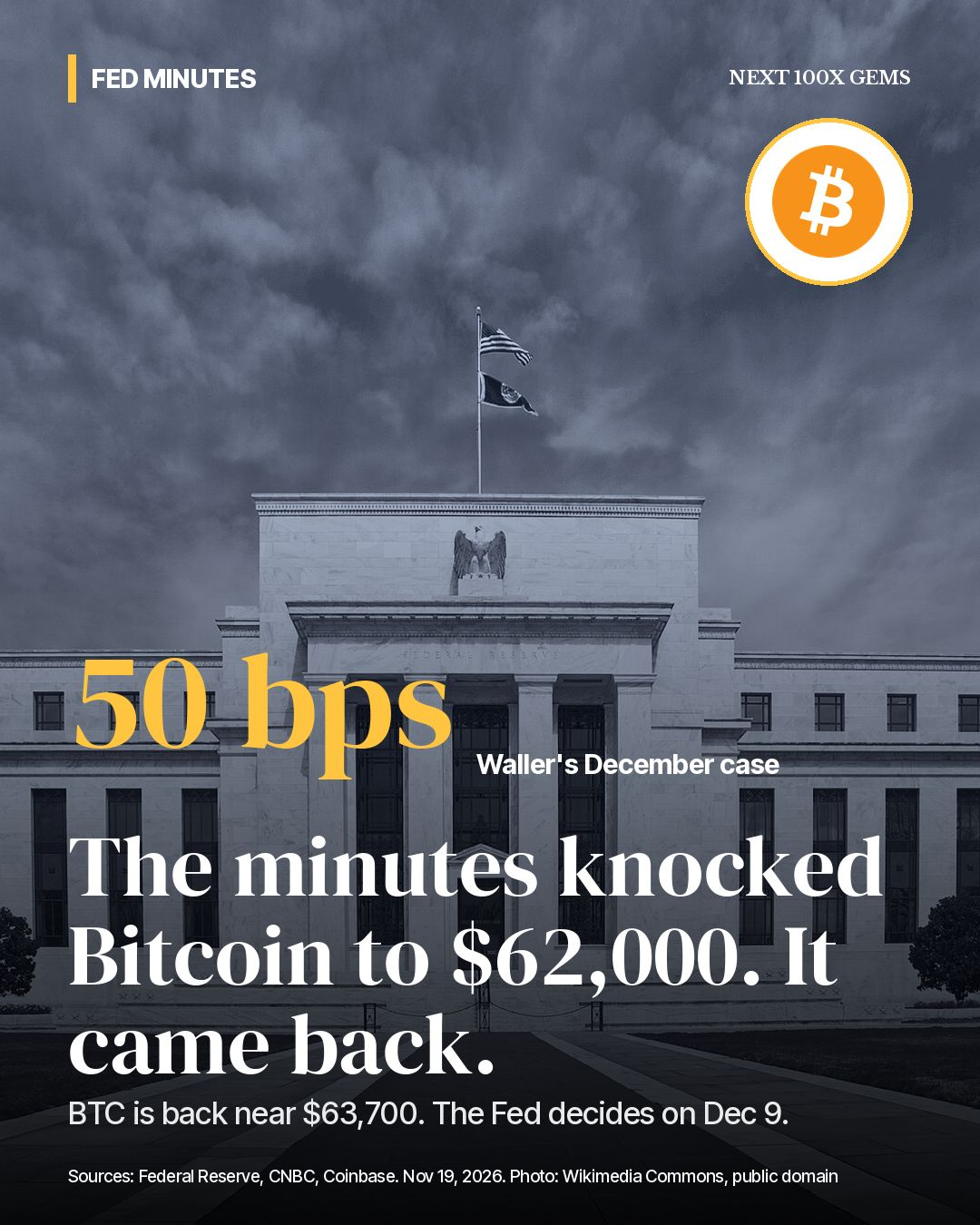
191
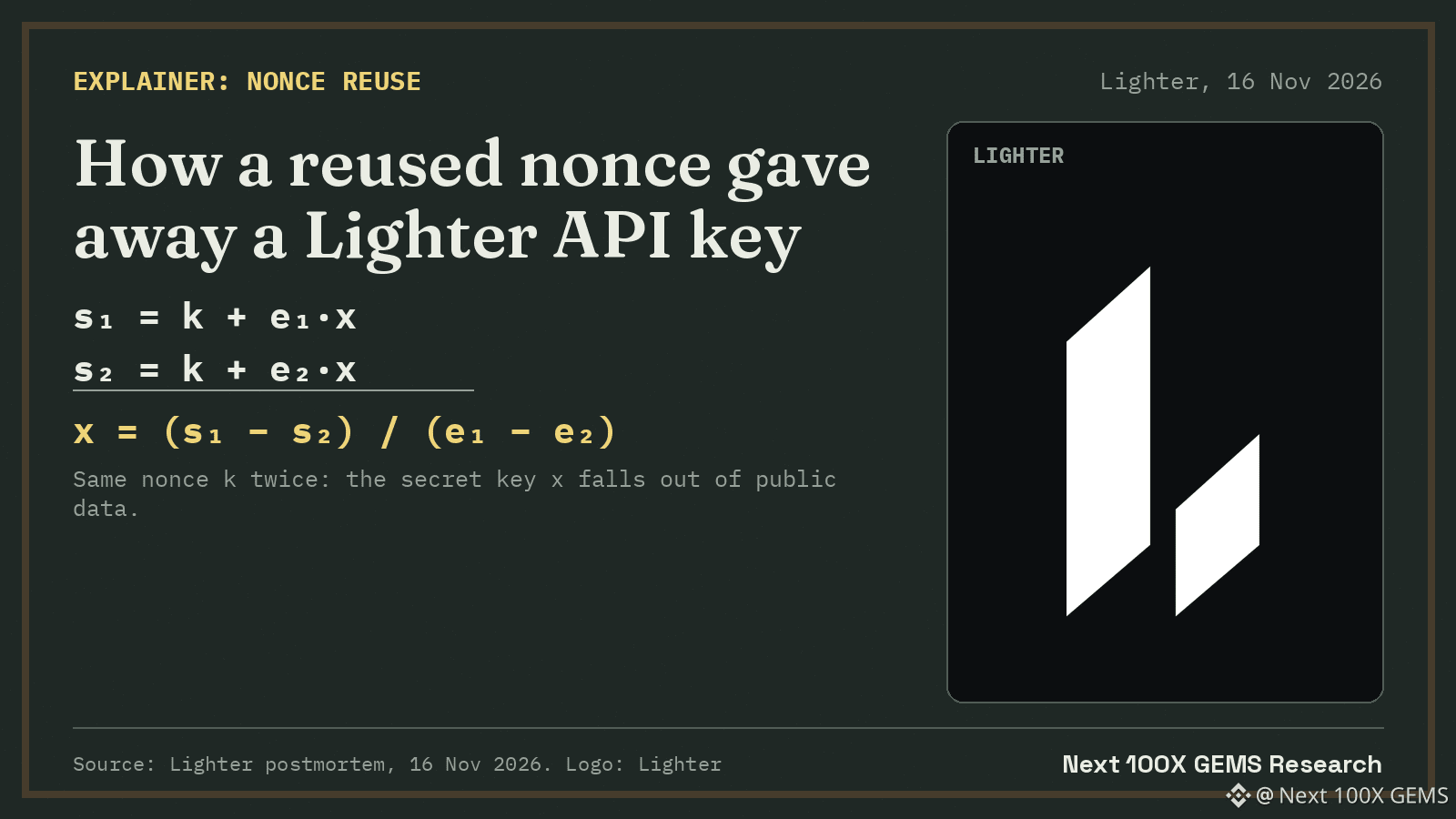
Article
Lighter API key leak: how a reused nonce gave away a trader's private keyHow do you steal a key that nobody leaked? That's the real question behind the Lighter API key leak of 16 November. Lighter, the Ethereum-based perpetual futures exchange, says its smart contracts and official software were never touched. A trader's own signing code reused nonces, and that one habit let an outsider calculate the account's private API key from signatures anyone could read.
The short version: a digital signature hides the key behind a one-off random number. Use that number twice and the hiding stops working. The rest of this piece walks through why, then follows the money and the fixes.
Step one: what a signature is hiding
Every action on Lighter is approved by a signature from an API key, Lighter's postmortem explains. Each signature blends the private key, which never leaves the trader's machine, with the message being signed. A fresh random number goes in too, called a nonce, short for "number used once." The signature itself is public.
You can picture a simplified signature as one line of school algebra:
s = k + e × x
Here x is the private key and k is the nonce. Both are secret. The value e is computed from the message, so anyone can work it out, and s is the signature everyone sees. One equation with two unknowns can't be solved. As long as k is new and unpredictable each time, an onlooker learns nothing useful about x.
Step two: what happens when the nonce repeats
Now sign a second, different message with the same nonce:
s₁ = k + e₁ × x
s₂ = k + e₂ × x
Subtract one line from the other and k cancels out. What's left is s₁ minus s₂ equals (e₁ minus e₂) times x. Every value in that line except x is public, so x falls out with one division. That's the whole attack. Nobody had to guess a password or get inside a server.
Lighter's postmortem puts it the same way: if the same nonce is used with the same key on two different transactions, "anyone can calculate the private key from those two signatures." The postmortem doesn't say which exact signature scheme its API keys use, so take the line above as the textbook form. It also notes the problem isn't specific to Lighter and applies to Bitcoin and Ethereum signatures too. Their scheme, ECDSA, has a longer formula, but the same two-equation trick works on it.
Bad randomness has bitten crypto before. A bitcoin.org alert dated 11 August 2013 warned that a weakness in how Android generated secure random numbers left every Bitcoin wallet created on Android up to that point open to theft.
Step three: turning a key into a withdrawal
A recovered API key still can't withdraw to someone else's wallet. Lighter says withdrawals only go to the account owner's own wallet. So the attacker took a side door. An API key could send funds to its account's sub-accounts, and a public pool created by the account counted as one.
According to the postmortem, the attacker used the leaked key to create a public pool from the trader's account, minted pool shares in a separate account they controlled, moved the trader's funds into the pool without minting new shares, and then redeemed their own shares and withdrew. Every share they held had become worth far more.
How much left is disputed. Bitquery traced a withdrawal of 10.39 million dollars in USDC from Lighter's Ethereum contract, swapped for ether within minutes, CoinDesk reported on 16 November. Bitquery said 1,920 ETH, about 3.5 million dollars, then moved through 12 wallets to Hyperliquid. On-chain analysts Lookonchain and Onchain Lens put losses at 15.5 million dollars, The Block reported on 17 November, and CoinDesk said that higher figure covers two market-maker accounts. Lighter hasn't confirmed either number or given a total of its own.
Some money did come back. Lighter says the anomaly triggered its smart contract Guardian, which paused withdrawals and let the Lighter Security Council return about 5 million USDC to the affected trader. Withdrawals were running again by the end of 16 November, per The Block. CoinDesk reported that Lighter's LIT token fell more than 10% to under 2.48 dollars that day before climbing back to 2.62 dollars.
What Lighter changed
Two fixes are already live, the postmortem says. Moving funds into a public pool now needs a wallet signature, so an API key alone can't do it. And API key signatures are no longer public, which takes away the raw material for this kind of maths.
More is on the way. Lighter is adding IP allowlists, so a key only works from a server you choose, along with permissions and limits you can set per key for actions and markets. It's also watching signatures for reused nonces and says it will contact affected accounts and void their keys.
The same habit, on any venue
The lesson reaches past Lighter. Anyone who runs trading code on any venue is making the same bet on how their nonces are chosen.
Lighter says its official software kits draw every nonce from a cryptographically secure random number generator. It warns against deriving a nonce from a timestamp, a counter, a weakly seeded generator, the transaction's contents or a cached value. If you can't show a nonce never repeated, Lighter's advice is to rotate every API key and switch to an official kit.
A stolen key can still do damage even when it can't withdraw. Lighter points out that a key that can trade can trade against you in thin markets or pile risky leverage onto your account. Tight permissions limit that damage.
The algebra is easy, and the expensive mistake was in the plumbing around it. The trader's key was never stored anywhere an attacker could reach. It was sitting in plain sight, one repeated number away.
Sources
Lighter, "Signing Safely on Lighter: Lessons from November 16" (16 Nov 2026).
The Block, "Lighter reopens withdrawals after trader's API key leak, returns about 5 million dollars in USDC" (17 Nov 2026).
CoinDesk, "Lighter suspends all withdrawals after a 10.4 million dollar crypto exploit" (16 Nov 2026).
Bitcoin.org, "Android Security Vulnerability" (11 Aug 2013).
Lighter API key leak: how a reused nonce gave away a trader's private key
How do you steal a key that nobody leaked? That's the real question behind the Lighter API key leak of 16 November. Lighter, the Ethereum-based perpetual futures exchange, says its smart contracts and official software were never touched. A trader's own signing code reused nonces, and that one habit let an outsider calculate the account's private API key from signatures anyone could read.
The short version: a digital signature hides the key behind a one-off random number. Use that number twice and the hiding stops working. The rest of this piece walks through why, then follows the money and the fixes.
Step one: what a signature is hiding
Every action on Lighter is approved by a signature from an API key, Lighter's postmortem explains. Each signature blends the private key, which never leaves the trader's machine, with the message being signed. A fresh random number goes in too, called a nonce, short for "number used once." The signature itself is public.
You can picture a simplified signature as one line of school algebra:
s = k + e × x
Here x is the private key and k is the nonce. Both are secret. The value e is computed from the message, so anyone can work it out, and s is the signature everyone sees. One equation with two unknowns can't be solved. As long as k is new and unpredictable each time, an onlooker learns nothing useful about x.
Step two: what happens when the nonce repeats
Now sign a second, different message with the same nonce:
s₁ = k + e₁ × x
s₂ = k + e₂ × x
Subtract one line from the other and k cancels out. What's left is s₁ minus s₂ equals (e₁ minus e₂) times x. Every value in that line except x is public, so x falls out with one division. That's the whole attack. Nobody had to guess a password or get inside a server.
Lighter's postmortem puts it the same way: if the same nonce is used with the same key on two different transactions, "anyone can calculate the private key from those two signatures." The postmortem doesn't say which exact signature scheme its API keys use, so take the line above as the textbook form. It also notes the problem isn't specific to Lighter and applies to Bitcoin and Ethereum signatures too. Their scheme, ECDSA, has a longer formula, but the same two-equation trick works on it.
Bad randomness has bitten crypto before. A bitcoin.org alert dated 11 August 2013 warned that a weakness in how Android generated secure random numbers left every Bitcoin wallet created on Android up to that point open to theft.
Step three: turning a key into a withdrawal
A recovered API key still can't withdraw to someone else's wallet. Lighter says withdrawals only go to the account owner's own wallet. So the attacker took a side door. An API key could send funds to its account's sub-accounts, and a public pool created by the account counted as one.
According to the postmortem, the attacker used the leaked key to create a public pool from the trader's account, minted pool shares in a separate account they controlled, moved the trader's funds into the pool without minting new shares, and then redeemed their own shares and withdrew. Every share they held had become worth far more.
How much left is disputed. Bitquery traced a withdrawal of 10.39 million dollars in USDC from Lighter's Ethereum contract, swapped for ether within minutes, CoinDesk reported on 16 November. Bitquery said 1,920 ETH, about 3.5 million dollars, then moved through 12 wallets to Hyperliquid. On-chain analysts Lookonchain and Onchain Lens put losses at 15.5 million dollars, The Block reported on 17 November, and CoinDesk said that higher figure covers two market-maker accounts. Lighter hasn't confirmed either number or given a total of its own.
Some money did come back. Lighter says the anomaly triggered its smart contract Guardian, which paused withdrawals and let the Lighter Security Council return about 5 million USDC to the affected trader. Withdrawals were running again by the end of 16 November, per The Block. CoinDesk reported that Lighter's LIT token fell more than 10% to under 2.48 dollars that day before climbing back to 2.62 dollars.
What Lighter changed
Two fixes are already live, the postmortem says. Moving funds into a public pool now needs a wallet signature, so an API key alone can't do it. And API key signatures are no longer public, which takes away the raw material for this kind of maths.
More is on the way. Lighter is adding IP allowlists, so a key only works from a server you choose, along with permissions and limits you can set per key for actions and markets. It's also watching signatures for reused nonces and says it will contact affected accounts and void their keys.
The same habit, on any venue
The lesson reaches past Lighter. Anyone who runs trading code on any venue is making the same bet on how their nonces are chosen.
Lighter says its official software kits draw every nonce from a cryptographically secure random number generator. It warns against deriving a nonce from a timestamp, a counter, a weakly seeded generator, the transaction's contents or a cached value. If you can't show a nonce never repeated, Lighter's advice is to rotate every API key and switch to an official kit.
A stolen key can still do damage even when it can't withdraw. Lighter points out that a key that can trade can trade against you in thin markets or pile risky leverage onto your account. Tight permissions limit that damage.
The algebra is easy, and the expensive mistake was in the plumbing around it. The trader's key was never stored anywhere an attacker could reach. It was sitting in plain sight, one repeated number away.
Sources
Lighter, "Signing Safely on Lighter: Lessons from November 16" (16 Nov 2026).
The Block, "Lighter reopens withdrawals after trader's API key leak, returns about 5 million dollars in USDC" (17 Nov 2026).
CoinDesk, "Lighter suspends all withdrawals after a 10.4 million dollar crypto exploit" (16 Nov 2026).
Bitcoin.org, "Android Security Vulnerability" (11 Aug 2013).
The short version: a digital signature hides the key behind a one-off random number. Use that number twice and the hiding stops working. The rest of this piece walks through why, then follows the money and the fixes.
Step one: what a signature is hiding
Every action on Lighter is approved by a signature from an API key, Lighter's postmortem explains. Each signature blends the private key, which never leaves the trader's machine, with the message being signed. A fresh random number goes in too, called a nonce, short for "number used once." The signature itself is public.
You can picture a simplified signature as one line of school algebra:
s = k + e × x
Here x is the private key and k is the nonce. Both are secret. The value e is computed from the message, so anyone can work it out, and s is the signature everyone sees. One equation with two unknowns can't be solved. As long as k is new and unpredictable each time, an onlooker learns nothing useful about x.
Step two: what happens when the nonce repeats
Now sign a second, different message with the same nonce:
s₁ = k + e₁ × x
s₂ = k + e₂ × x
Subtract one line from the other and k cancels out. What's left is s₁ minus s₂ equals (e₁ minus e₂) times x. Every value in that line except x is public, so x falls out with one division. That's the whole attack. Nobody had to guess a password or get inside a server.
Lighter's postmortem puts it the same way: if the same nonce is used with the same key on two different transactions, "anyone can calculate the private key from those two signatures." The postmortem doesn't say which exact signature scheme its API keys use, so take the line above as the textbook form. It also notes the problem isn't specific to Lighter and applies to Bitcoin and Ethereum signatures too. Their scheme, ECDSA, has a longer formula, but the same two-equation trick works on it.
Bad randomness has bitten crypto before. A bitcoin.org alert dated 11 August 2013 warned that a weakness in how Android generated secure random numbers left every Bitcoin wallet created on Android up to that point open to theft.
Step three: turning a key into a withdrawal
A recovered API key still can't withdraw to someone else's wallet. Lighter says withdrawals only go to the account owner's own wallet. So the attacker took a side door. An API key could send funds to its account's sub-accounts, and a public pool created by the account counted as one.
According to the postmortem, the attacker used the leaked key to create a public pool from the trader's account, minted pool shares in a separate account they controlled, moved the trader's funds into the pool without minting new shares, and then redeemed their own shares and withdrew. Every share they held had become worth far more.
How much left is disputed. Bitquery traced a withdrawal of 10.39 million dollars in USDC from Lighter's Ethereum contract, swapped for ether within minutes, CoinDesk reported on 16 November. Bitquery said 1,920 ETH, about 3.5 million dollars, then moved through 12 wallets to Hyperliquid. On-chain analysts Lookonchain and Onchain Lens put losses at 15.5 million dollars, The Block reported on 17 November, and CoinDesk said that higher figure covers two market-maker accounts. Lighter hasn't confirmed either number or given a total of its own.
Some money did come back. Lighter says the anomaly triggered its smart contract Guardian, which paused withdrawals and let the Lighter Security Council return about 5 million USDC to the affected trader. Withdrawals were running again by the end of 16 November, per The Block. CoinDesk reported that Lighter's LIT token fell more than 10% to under 2.48 dollars that day before climbing back to 2.62 dollars.
What Lighter changed
Two fixes are already live, the postmortem says. Moving funds into a public pool now needs a wallet signature, so an API key alone can't do it. And API key signatures are no longer public, which takes away the raw material for this kind of maths.
More is on the way. Lighter is adding IP allowlists, so a key only works from a server you choose, along with permissions and limits you can set per key for actions and markets. It's also watching signatures for reused nonces and says it will contact affected accounts and void their keys.
The same habit, on any venue
The lesson reaches past Lighter. Anyone who runs trading code on any venue is making the same bet on how their nonces are chosen.
Lighter says its official software kits draw every nonce from a cryptographically secure random number generator. It warns against deriving a nonce from a timestamp, a counter, a weakly seeded generator, the transaction's contents or a cached value. If you can't show a nonce never repeated, Lighter's advice is to rotate every API key and switch to an official kit.
A stolen key can still do damage even when it can't withdraw. Lighter points out that a key that can trade can trade against you in thin markets or pile risky leverage onto your account. Tight permissions limit that damage.
The algebra is easy, and the expensive mistake was in the plumbing around it. The trader's key was never stored anywhere an attacker could reach. It was sitting in plain sight, one repeated number away.
Sources
Lighter, "Signing Safely on Lighter: Lessons from November 16" (16 Nov 2026).
The Block, "Lighter reopens withdrawals after trader's API key leak, returns about 5 million dollars in USDC" (17 Nov 2026).
CoinDesk, "Lighter suspends all withdrawals after a 10.4 million dollar crypto exploit" (16 Nov 2026).
Bitcoin.org, "Android Security Vulnerability" (11 Aug 2013).
117
We went looking for the news behind the $MMT run and came back with a volume chart. Momentum's token set an all-time low near 0.0945 dollars on Nov 14 and printed 0.2833 on Nov 18, three times the price.
The team's last post on X, on Nov 17, called it "a quieter tape, not an empty one." Nothing since. Binance spot volume went from about 600,000 dollars on Nov 14 to 41.8 million on Nov 18, about 70 times.
It sits near 0.22 now, still about 95% under its launch-week high. We're logging this #MMT move as a volume event until the team gives it a reason.
NFA. DYOR.
We went looking for the news behind the $MMT run and came back with a volume chart. Momentum's token set an all-time low near 0.0945 dollars on Nov 14 and printed 0.2833 on Nov 18, three times the price.
The team's last post on X, on Nov 17, called it "a quieter tape, not an empty one." Nothing since. Binance spot volume went from about 600,000 dollars on Nov 14 to 41.8 million on Nov 18, about 70 times.
It sits near 0.22 now, still about 95% under its launch-week high. We're logging this #MMT move as a volume event until the team gives it a reason.
NFA. DYOR.
The team's last post on X, on Nov 17, called it "a quieter tape, not an empty one." Nothing since. Binance spot volume went from about 600,000 dollars on Nov 14 to 41.8 million on Nov 18, about 70 times.
It sits near 0.22 now, still about 95% under its launch-week high. We're logging this #MMT move as a volume event until the team gives it a reason.
NFA. DYOR.
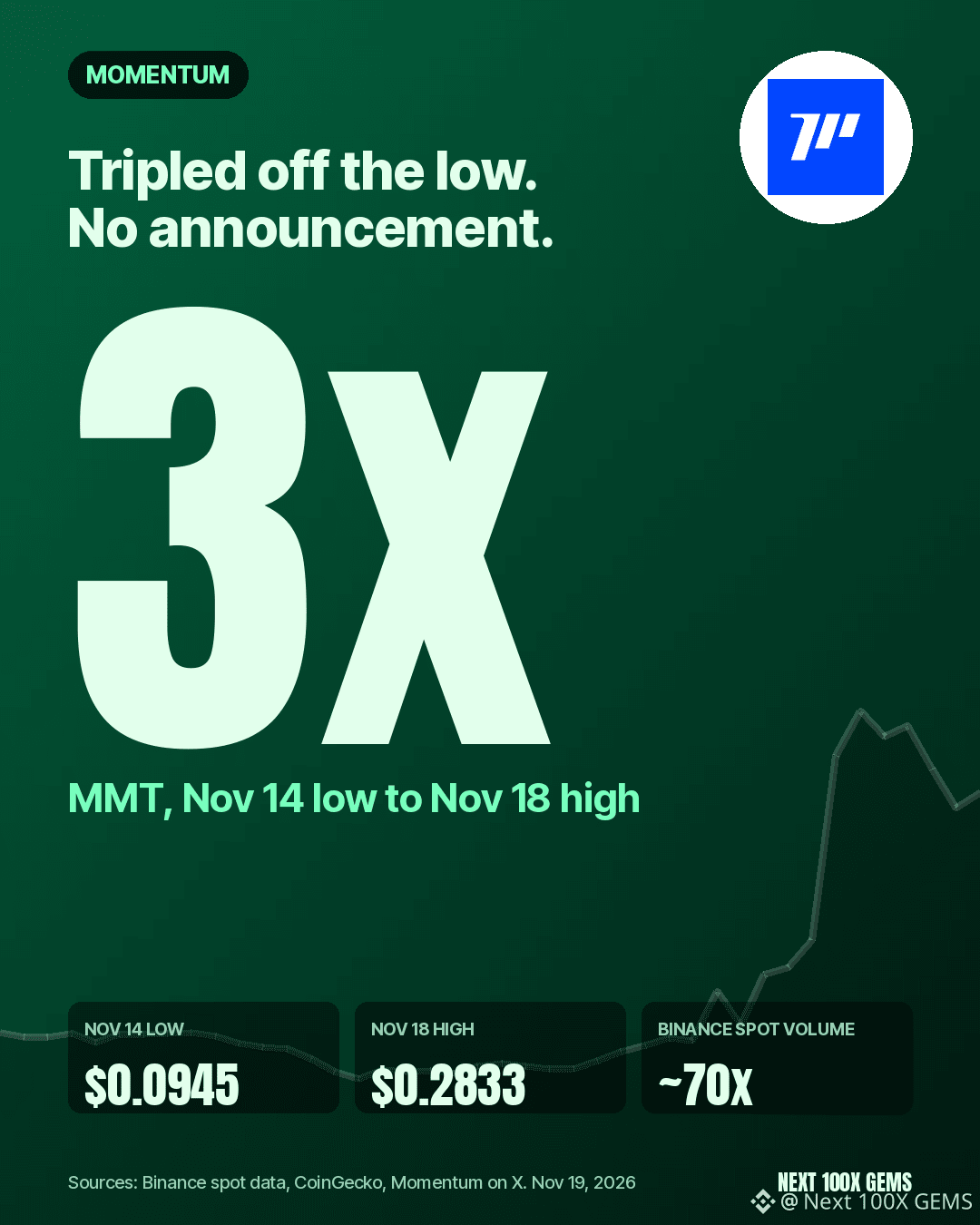
375
Verified
$SXT Most AI agent talk skips the boring part: where the numbers an agent acts on actually come from.
An agent sizing up a lending protocol needs its fee history, balances and past activity. If that data is wrong, the decision is wrong, and nobody can tell afterwards.
Space and Time's answer is Proof of SQL. A query comes back with a cryptographic proof that the result really is that SQL run over the committed data. The same idea works for tokenized funds checking the maths behind a NAV report, and for DeFi contracts setting reward eligibility or fee discounts from a wallet's past trades.
On 9 November they brought it to private business data with Space and Time Enterprise, which runs on ordinary servers so a company can prove a result without handing over its records.
SXT pays for that network work and is staked to secure validators.
#sxt $SXT @SpaceandTimeDB
$SXT Most AI agent talk skips the boring part: where the numbers an agent acts on actually come from.
An agent sizing up a lending protocol needs its fee history, balances and past activity. If that data is wrong, the decision is wrong, and nobody can tell afterwards.
Space and Time's answer is Proof of SQL. A query comes back with a cryptographic proof that the result really is that SQL run over the committed data. The same idea works for tokenized funds checking the maths behind a NAV report, and for DeFi contracts setting reward eligibility or fee discounts from a wallet's past trades.
On 9 November they brought it to private business data with Space and Time Enterprise, which runs on ordinary servers so a company can prove a result without handing over its records.
SXT pays for that network work and is staked to secure validators.
#sxt $SXT @SpaceandTime
An agent sizing up a lending protocol needs its fee history, balances and past activity. If that data is wrong, the decision is wrong, and nobody can tell afterwards.
Space and Time's answer is Proof of SQL. A query comes back with a cryptographic proof that the result really is that SQL run over the committed data. The same idea works for tokenized funds checking the maths behind a NAV report, and for DeFi contracts setting reward eligibility or fee discounts from a wallet's past trades.
On 9 November they brought it to private business data with Space and Time Enterprise, which runs on ordinary servers so a company can prove a result without handing over its records.
SXT pays for that network work and is staked to secure validators.
#sxt $SXT @SpaceandTime
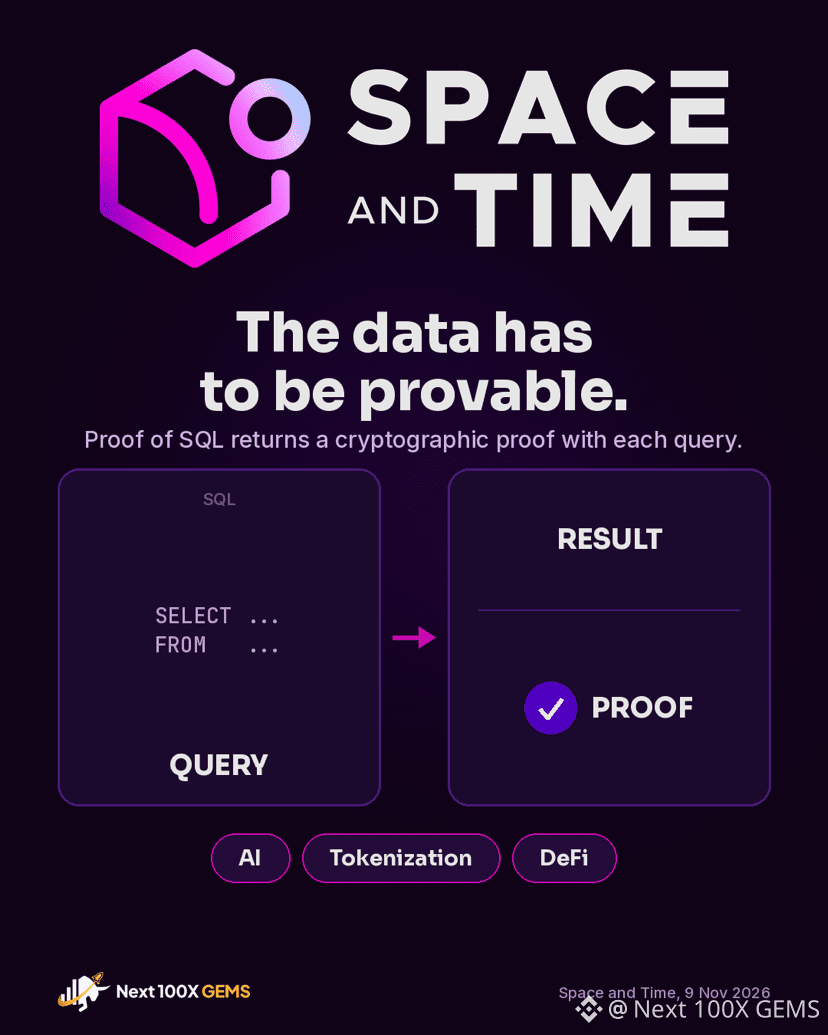
2
1.1k
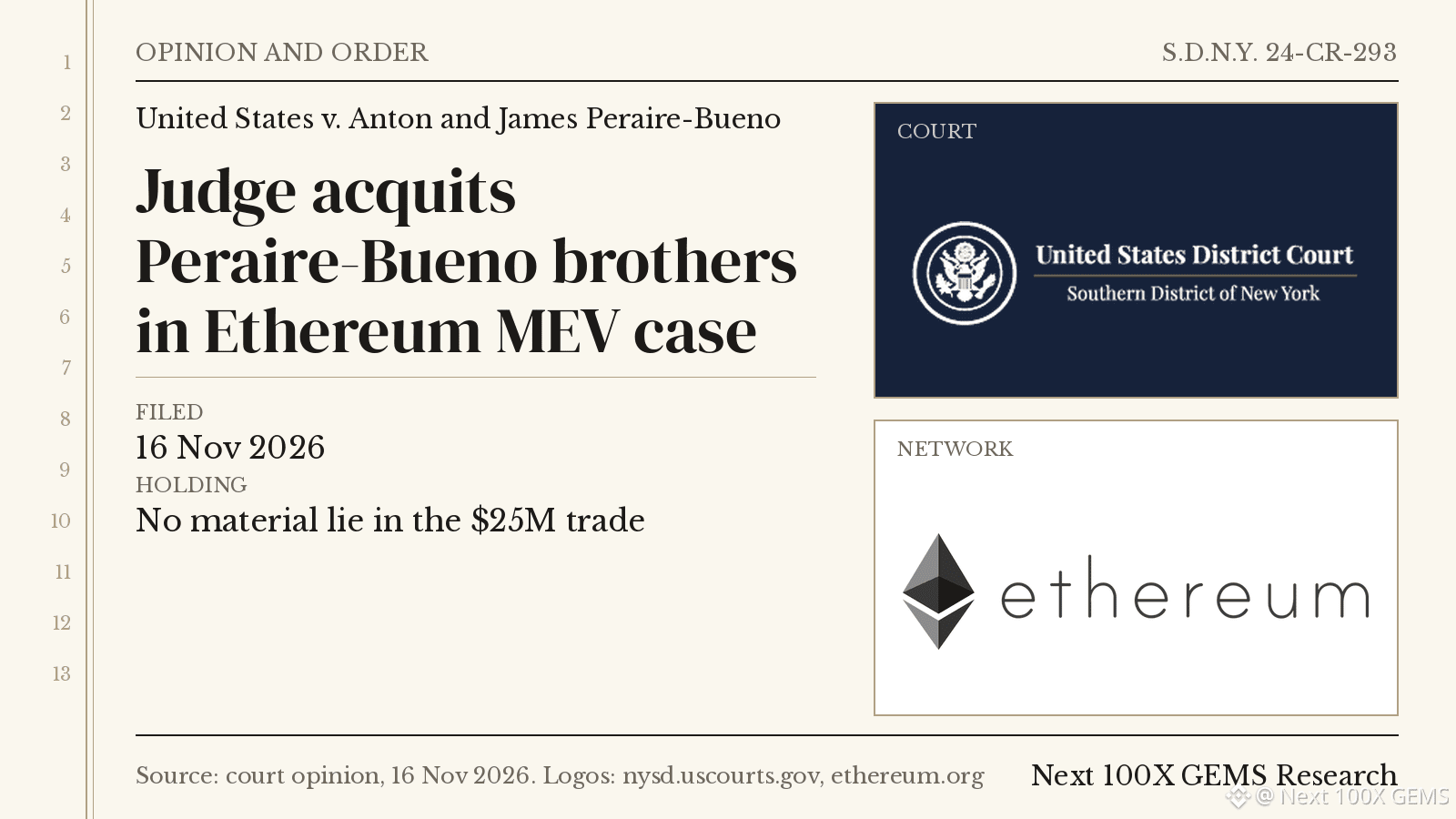
Article
Peraire-Bueno acquittal: why a judge ruled the 25 million dollar Ethereum MEV trade wasn't wire fraud"The question before the Court is not whether the Peraire-Buenos' conduct was right or moral, or even whether it violated uncharged crimes," US District Judge Jessica Clarke wrote on 16 November 2026. In the same opinion and order she acquitted Anton and James Peraire-Bueno in the Ethereum MEV case, the prosecution that said the brothers made 25 million dollars in twelve seconds by tricking sandwich bots in April 2023. The wire fraud count fell, and both conspiracy counts fell with it.
The short answer to why: wire fraud needs a material misrepresentation, a lie that could change what the victim does, and the court found the government never showed one. That isn't a finding that the trade was fair. It's a finding about what a transaction on a permissionless network does and doesn't say, and the 46-page opinion keeps coming back to that point.
What the court says happened
Most facts weren't in dispute, the opinion says. Sandwich bots watch Ethereum's public mempool for large pending trades, buy just ahead of them and sell just after. The brothers set up sixteen validators and, on 2 April 2023, sent eight lure transactions into the mempool, built so that particular bots would see a profitable sandwich. The bots took the bait.
When one of the brothers' validators got its turn to propose a block, the Ultrasound relay offered it a block containing the bots' bundles. The validator signed a block header with false values in two fields. The relay didn't check those fields before revealing the block's contents. With the bots' trades visible, the brothers built their own block, kept the bots' purchases and swapped the bait for transactions that sold into them.
What it cost the brothers was small by comparison. The validator was slashed 1 ETH, which the opinion values at a few thousand dollars. A wallet holding 3 million dollars of the proceeds was frozen, and by October 2023 the rest had been converted into dollars. Within 24 hours, Flashbots changed the relay code so a header is checked for a valid block before the contents are revealed. Prosecutors charged the brothers on 8 May 2024. A trial of nearly four weeks ended in a hung jury in November 2025, according to CoinDesk.
Three theories, three answers
The government listed six alleged lies. The court said they boiled down to three features of the scheme, and rejected each one.
The government said the lure trades implied a promise to be bundled or to execute. The court found no evidence a mempool trade carries that promise, and no rule on Ethereum creates one. The spoofing cases don't fit, because these trades were executed, not cancelled, and weren't placed on a regulated market.
The government pointed to the false signature on the block header. The court found the relay never checked the falsified fields, so the falsity "had no effect on the behavior of the relay" and couldn't be material.
The government said the validator posed as "an honest MEV-Boost validator." The court found that registering with a relay means agreeing to no terms of use and doesn't commit a validator to anything later. Undermining the software's design isn't a misrepresentation.
The money laundering conspiracy count needed wire fraud as its predicate. Without it, the opinion says, that count failed too.
The lure trades are the heart of it. The government's "key misrepresentation," in the court's words, was that a trade in the mempool signals a willingness to be bundled. Clarke turned that around: "no trader who places a transaction in the public mempool would agree to be sandwiched because being sandwiched is not in a trader's interest." The bots weren't promised anything. They assumed it.
Why rules decide the case
Take the three answers together and the same missing piece shows up each time. Spoofing convictions work because an exchange's rules turn an order into an implied statement that you mean to trade. The opinion describes Ethereum as "a trustless, highly adversarial environment with no terms of use." Where nothing defines what a transaction promises, a transaction only says what its code does.
The court leaned on the Mango Markets case, United States v. Eisenberg, where another judge acquitted on a wire fraud count because no terms of service or other rules barred the borrowing at issue. That makes two rulings now pointing the same way. If a protocol has no rules, a prosecutor reaching for wire fraud has to find an actual false statement, and code that behaves exactly as written is hard to call one.
The same question would sit under any case built on a protocol doing what its code allowed, such as the empty-market borrowing that drained Kava Lend on 14 November. The opinion doesn't mention such cases, and it's a district court ruling on the evidence in one trial, so it binds no other court.
What the ruling leaves open
Clarke was careful about what she wasn't deciding. Quoting a 2022 Second Circuit ruling, she wrote that the case wasn't about whether the conduct "was improper, objectionable, or even despicable." Her opening line leaves uncharged crimes alone. Nothing in the opinion says MEV extraction is lawful in general.
There's also a practical lesson in the record. The fix for this attack came from Flashbots, in code, within a day. The court case took more than three years and ended without a conviction. For the bot operators who lost money, the protection that actually worked was engineering. The opinion directs the court clerk to close the case. The opinion opens by quoting the government's own phrase for this, a "first of its kind" prosecution. Williams & Connolly, counsel for James Peraire-Bueno, said the acquittal ended it. As of 19 November, we found no public statement from prosecutors on next steps.
Sources
Opinion and order, United States v. Peraire-Bueno, 24-CR-293 (JGLC), US District Court for the Southern District of New York, Document 294, filed 16 Nov 2026, copy hosted by Decrypt.
Williams & Connolly, "Williams & Connolly Secures Victory on Behalf of Client James Peraire-Bueno" (Nov 2026).
CoinDesk, "US judge says Ethereum has 'no terms of use,' clears MIT brothers of 25 million dollars fraud" (18 Nov 2026).
The Block, "Peraire-Bueno brothers acquitted of wire fraud in 25 million dollars Ethereum MEV case" (16 Nov 2026).
Peraire-Bueno acquittal: why a judge ruled the 25 million dollar Ethereum MEV trade wasn't wire fraud
"The question before the Court is not whether the Peraire-Buenos' conduct was right or moral, or even whether it violated uncharged crimes," US District Judge Jessica Clarke wrote on 16 November 2026. In the same opinion and order she acquitted Anton and James Peraire-Bueno in the Ethereum MEV case, the prosecution that said the brothers made 25 million dollars in twelve seconds by tricking sandwich bots in April 2023. The wire fraud count fell, and both conspiracy counts fell with it.
The short answer to why: wire fraud needs a material misrepresentation, a lie that could change what the victim does, and the court found the government never showed one. That isn't a finding that the trade was fair. It's a finding about what a transaction on a permissionless network does and doesn't say, and the 46-page opinion keeps coming back to that point.
What the court says happened
Most facts weren't in dispute, the opinion says. Sandwich bots watch Ethereum's public mempool for large pending trades, buy just ahead of them and sell just after. The brothers set up sixteen validators and, on 2 April 2023, sent eight lure transactions into the mempool, built so that particular bots would see a profitable sandwich. The bots took the bait.
When one of the brothers' validators got its turn to propose a block, the Ultrasound relay offered it a block containing the bots' bundles. The validator signed a block header with false values in two fields. The relay didn't check those fields before revealing the block's contents. With the bots' trades visible, the brothers built their own block, kept the bots' purchases and swapped the bait for transactions that sold into them.
What it cost the brothers was small by comparison. The validator was slashed 1 ETH, which the opinion values at a few thousand dollars. A wallet holding 3 million dollars of the proceeds was frozen, and by October 2023 the rest had been converted into dollars. Within 24 hours, Flashbots changed the relay code so a header is checked for a valid block before the contents are revealed. Prosecutors charged the brothers on 8 May 2024. A trial of nearly four weeks ended in a hung jury in November 2025, according to CoinDesk.
Three theories, three answers
The government listed six alleged lies. The court said they boiled down to three features of the scheme, and rejected each one.
The government said the lure trades implied a promise to be bundled or to execute. The court found no evidence a mempool trade carries that promise, and no rule on Ethereum creates one. The spoofing cases don't fit, because these trades were executed, not cancelled, and weren't placed on a regulated market.
The government pointed to the false signature on the block header. The court found the relay never checked the falsified fields, so the falsity "had no effect on the behavior of the relay" and couldn't be material.
The government said the validator posed as "an honest MEV-Boost validator." The court found that registering with a relay means agreeing to no terms of use and doesn't commit a validator to anything later. Undermining the software's design isn't a misrepresentation.
The money laundering conspiracy count needed wire fraud as its predicate. Without it, the opinion says, that count failed too.
The lure trades are the heart of it. The government's "key misrepresentation," in the court's words, was that a trade in the mempool signals a willingness to be bundled. Clarke turned that around: "no trader who places a transaction in the public mempool would agree to be sandwiched because being sandwiched is not in a trader's interest." The bots weren't promised anything. They assumed it.
Why rules decide the case
Take the three answers together and the same missing piece shows up each time. Spoofing convictions work because an exchange's rules turn an order into an implied statement that you mean to trade. The opinion describes Ethereum as "a trustless, highly adversarial environment with no terms of use." Where nothing defines what a transaction promises, a transaction only says what its code does.
The court leaned on the Mango Markets case, United States v. Eisenberg, where another judge acquitted on a wire fraud count because no terms of service or other rules barred the borrowing at issue. That makes two rulings now pointing the same way. If a protocol has no rules, a prosecutor reaching for wire fraud has to find an actual false statement, and code that behaves exactly as written is hard to call one.
The same question would sit under any case built on a protocol doing what its code allowed, such as the empty-market borrowing that drained Kava Lend on 14 November. The opinion doesn't mention such cases, and it's a district court ruling on the evidence in one trial, so it binds no other court.
What the ruling leaves open
Clarke was careful about what she wasn't deciding. Quoting a 2022 Second Circuit ruling, she wrote that the case wasn't about whether the conduct "was improper, objectionable, or even despicable." Her opening line leaves uncharged crimes alone. Nothing in the opinion says MEV extraction is lawful in general.
There's also a practical lesson in the record. The fix for this attack came from Flashbots, in code, within a day. The court case took more than three years and ended without a conviction. For the bot operators who lost money, the protection that actually worked was engineering. The opinion directs the court clerk to close the case. The opinion opens by quoting the government's own phrase for this, a "first of its kind" prosecution. Williams & Connolly, counsel for James Peraire-Bueno, said the acquittal ended it. As of 19 November, we found no public statement from prosecutors on next steps.
Sources
Opinion and order, United States v. Peraire-Bueno, 24-CR-293 (JGLC), US District Court for the Southern District of New York, Document 294, filed 16 Nov 2026, copy hosted by Decrypt.
Williams & Connolly, "Williams & Connolly Secures Victory on Behalf of Client James Peraire-Bueno" (Nov 2026).
CoinDesk, "US judge says Ethereum has 'no terms of use,' clears MIT brothers of 25 million dollars fraud" (18 Nov 2026).
The Block, "Peraire-Bueno brothers acquitted of wire fraud in 25 million dollars Ethereum MEV case" (16 Nov 2026).
The short answer to why: wire fraud needs a material misrepresentation, a lie that could change what the victim does, and the court found the government never showed one. That isn't a finding that the trade was fair. It's a finding about what a transaction on a permissionless network does and doesn't say, and the 46-page opinion keeps coming back to that point.
What the court says happened
Most facts weren't in dispute, the opinion says. Sandwich bots watch Ethereum's public mempool for large pending trades, buy just ahead of them and sell just after. The brothers set up sixteen validators and, on 2 April 2023, sent eight lure transactions into the mempool, built so that particular bots would see a profitable sandwich. The bots took the bait.
When one of the brothers' validators got its turn to propose a block, the Ultrasound relay offered it a block containing the bots' bundles. The validator signed a block header with false values in two fields. The relay didn't check those fields before revealing the block's contents. With the bots' trades visible, the brothers built their own block, kept the bots' purchases and swapped the bait for transactions that sold into them.
What it cost the brothers was small by comparison. The validator was slashed 1 ETH, which the opinion values at a few thousand dollars. A wallet holding 3 million dollars of the proceeds was frozen, and by October 2023 the rest had been converted into dollars. Within 24 hours, Flashbots changed the relay code so a header is checked for a valid block before the contents are revealed. Prosecutors charged the brothers on 8 May 2024. A trial of nearly four weeks ended in a hung jury in November 2025, according to CoinDesk.
Three theories, three answers
The government listed six alleged lies. The court said they boiled down to three features of the scheme, and rejected each one.
The government said the lure trades implied a promise to be bundled or to execute. The court found no evidence a mempool trade carries that promise, and no rule on Ethereum creates one. The spoofing cases don't fit, because these trades were executed, not cancelled, and weren't placed on a regulated market.
The government pointed to the false signature on the block header. The court found the relay never checked the falsified fields, so the falsity "had no effect on the behavior of the relay" and couldn't be material.
The government said the validator posed as "an honest MEV-Boost validator." The court found that registering with a relay means agreeing to no terms of use and doesn't commit a validator to anything later. Undermining the software's design isn't a misrepresentation.
The money laundering conspiracy count needed wire fraud as its predicate. Without it, the opinion says, that count failed too.
The lure trades are the heart of it. The government's "key misrepresentation," in the court's words, was that a trade in the mempool signals a willingness to be bundled. Clarke turned that around: "no trader who places a transaction in the public mempool would agree to be sandwiched because being sandwiched is not in a trader's interest." The bots weren't promised anything. They assumed it.
Why rules decide the case
Take the three answers together and the same missing piece shows up each time. Spoofing convictions work because an exchange's rules turn an order into an implied statement that you mean to trade. The opinion describes Ethereum as "a trustless, highly adversarial environment with no terms of use." Where nothing defines what a transaction promises, a transaction only says what its code does.
The court leaned on the Mango Markets case, United States v. Eisenberg, where another judge acquitted on a wire fraud count because no terms of service or other rules barred the borrowing at issue. That makes two rulings now pointing the same way. If a protocol has no rules, a prosecutor reaching for wire fraud has to find an actual false statement, and code that behaves exactly as written is hard to call one.
The same question would sit under any case built on a protocol doing what its code allowed, such as the empty-market borrowing that drained Kava Lend on 14 November. The opinion doesn't mention such cases, and it's a district court ruling on the evidence in one trial, so it binds no other court.
What the ruling leaves open
Clarke was careful about what she wasn't deciding. Quoting a 2022 Second Circuit ruling, she wrote that the case wasn't about whether the conduct "was improper, objectionable, or even despicable." Her opening line leaves uncharged crimes alone. Nothing in the opinion says MEV extraction is lawful in general.
There's also a practical lesson in the record. The fix for this attack came from Flashbots, in code, within a day. The court case took more than three years and ended without a conviction. For the bot operators who lost money, the protection that actually worked was engineering. The opinion directs the court clerk to close the case. The opinion opens by quoting the government's own phrase for this, a "first of its kind" prosecution. Williams & Connolly, counsel for James Peraire-Bueno, said the acquittal ended it. As of 19 November, we found no public statement from prosecutors on next steps.
Sources
Opinion and order, United States v. Peraire-Bueno, 24-CR-293 (JGLC), US District Court for the Southern District of New York, Document 294, filed 16 Nov 2026, copy hosted by Decrypt.
Williams & Connolly, "Williams & Connolly Secures Victory on Behalf of Client James Peraire-Bueno" (Nov 2026).
CoinDesk, "US judge says Ethereum has 'no terms of use,' clears MIT brothers of 25 million dollars fraud" (18 Nov 2026).
The Block, "Peraire-Bueno brothers acquitted of wire fraud in 25 million dollars Ethereum MEV case" (16 Nov 2026).
91
About 507,671 $USDT left a Ledger Stax on Nov 14 while it sat idle, its owner says. The trail runs back to October.
Oct 9 brought the first wave: Bitquery counted about 324 drained wallets, mostly tied to devices from the reseller CryptoBilis. Ledger later said a hidden implant read seed phrases off the screen.
Two days later this Stax was bought new at Virgin Megastore in Dubai, a chain on the #Ledger authorized reseller list there.
On Nov 16 another buyer from the same chain, down about 1,300 $SOL, opened his Flex and found an extra board and antenna. The Stax sits sealed for a court lab.
Genuine Check can't vouch for the supply chain. If you bought one off a shelf this year, look inside before you set it up.
NFA. DYOR.
About 507,671 $USDT left a Ledger Stax on Nov 14 while it sat idle, its owner says. The trail runs back to October.
Oct 9 brought the first wave: Bitquery counted about 324 drained wallets, mostly tied to devices from the reseller CryptoBilis. Ledger later said a hidden implant read seed phrases off the screen.
Two days later this Stax was bought new at Virgin Megastore in Dubai, a chain on the #Ledger authorized reseller list there.
On Nov 16 another buyer from the same chain, down about 1,300 $SOL , opened his Flex and found an extra board and antenna. The Stax sits sealed for a court lab.
Genuine Check can't vouch for the supply chain. If you bought one off a shelf this year, look inside before you set it up.
NFA. DYOR.
Oct 9 brought the first wave: Bitquery counted about 324 drained wallets, mostly tied to devices from the reseller CryptoBilis. Ledger later said a hidden implant read seed phrases off the screen.
Two days later this Stax was bought new at Virgin Megastore in Dubai, a chain on the #Ledger authorized reseller list there.
On Nov 16 another buyer from the same chain, down about 1,300 $SOL , opened his Flex and found an extra board and antenna. The Stax sits sealed for a court lab.
Genuine Check can't vouch for the supply chain. If you bought one off a shelf this year, look inside before you set it up.
NFA. DYOR.
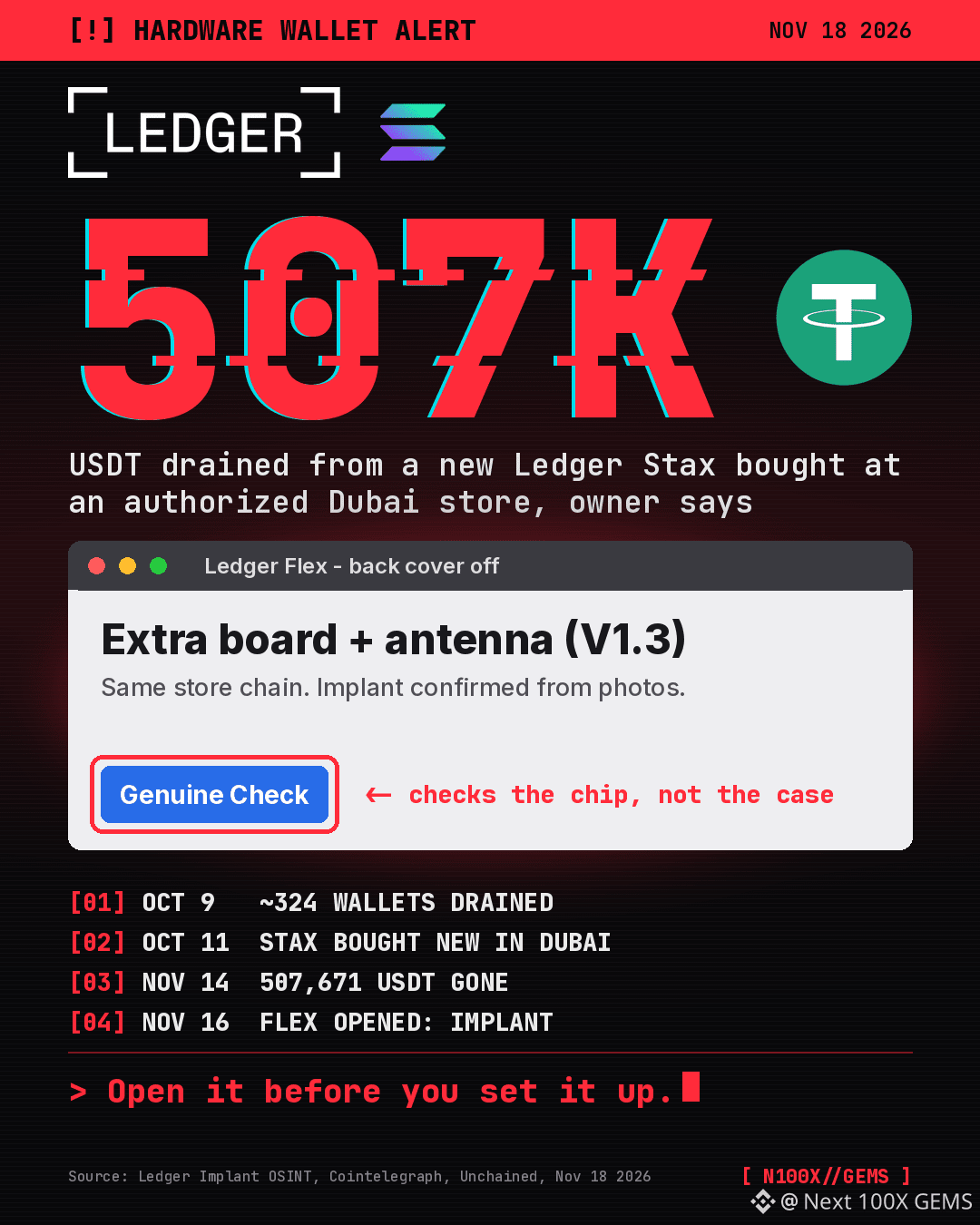
1
402
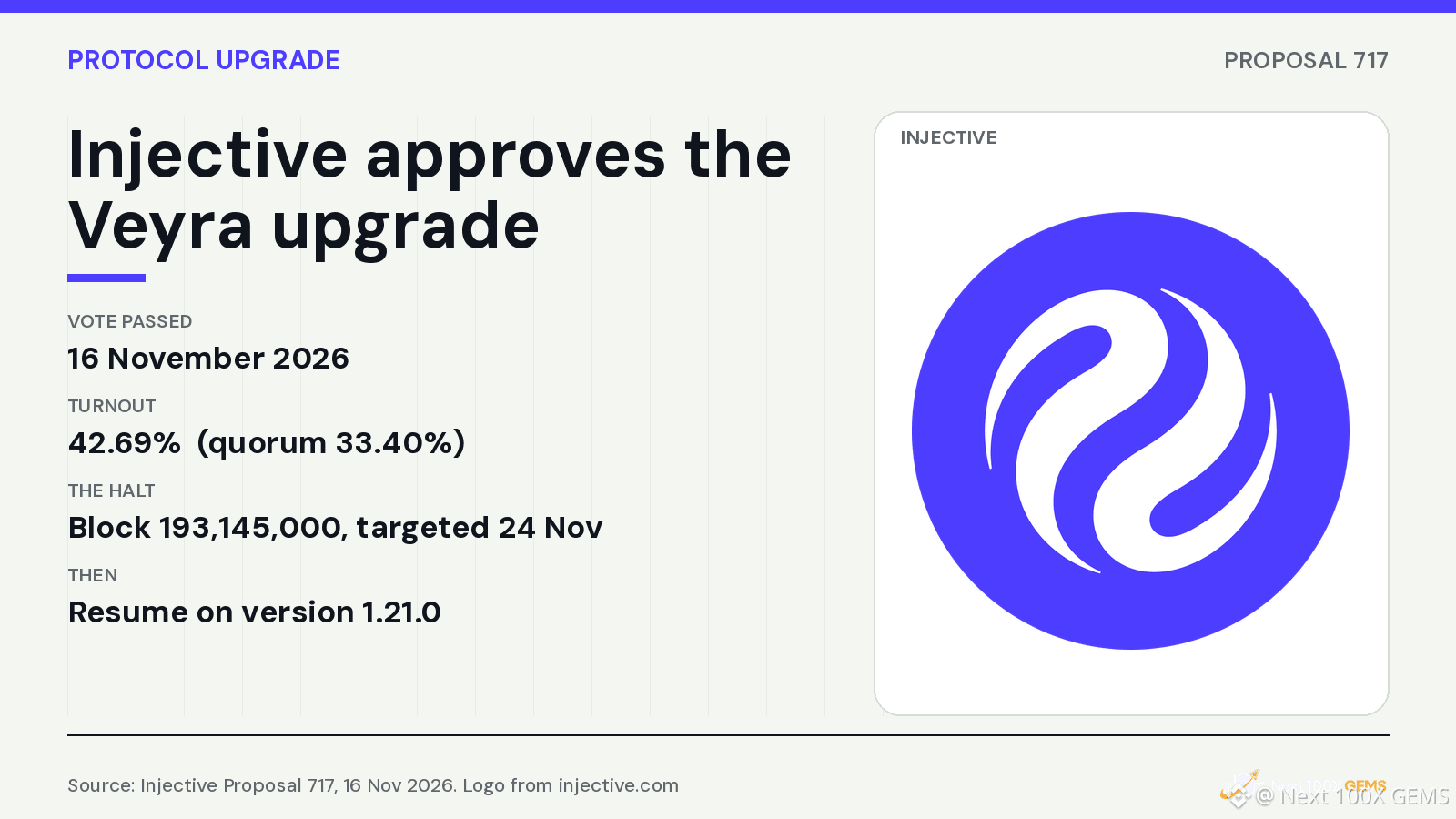
Article
Injective approves the Veyra upgrade: a halt at block 193,145,000, not a launch yetProposal 717 passed on 16 November. That is not the same thing as Veyra going live. The vote commits the Injective chain to halt at block 193,145,000, a height the proposal targets for 24 November, and to come back on application version 1.21.0. Turnout was 42.69%, above the 33.40% quorum. Of the stake that voted, 67.48% was yes and 32.19% was abstain.
The useful number, for anyone running a node or waiting on a feature, is the block height. The calendar date is an estimate of when that height will arrive.
How the vote passed
Voting opened on 12 November and closed on 16 November. The on-chain record, as shown on Valopers, puts 16,236,896 INJ in the yes column, 80,589 INJ against, one INJ as a veto, and 7,745,866 INJ as abstain. That is 24,063,352 INJ in total, or 42.69% turnout against a 33.40% quorum.
The yes share, 67.48%, looks softer than a near-unanimous upgrade until you notice the abstentions. Almost a third of the voted stake chose not to take a side. In this style of governance, those ballots still count toward the turnout figure that cleared the quorum. The no and veto totals were negligible.
The proposer disclosed, in the proposal text, that they are a member of the Injective Labs team. That does not change the tally. It is worth keeping in mind when reading the proposal's own language about institutional rails, tokenized markets and "the world's capital markets." That is the proposer speaking, not a description of software that has already shipped.
What the vote actually commits
A software-upgrade proposal on Injective is a coordinated halt, not an immediate switch. The upgrade message names version v1.21.0 and a halt at height 193,145,000. Injective's chain upgrades page describes the usual sequence: the chain stops at the specified block, validators switch to the new binary, either through Cosmovisor or a manual restart, and consensus resumes once enough of them are back on the expected version.
The 24 November date in the proposal is a target for that height, not a clock time the chain will obey. If blocks arrive faster or slower than expected, the halt moves with the height. Until the chain actually reaches 193,145,000 and comes back on v1.21.0, the approval is a commitment.
For ordinary users, a halt like this is usually a pause, not a migration. Applications and venues that follow the chain stop with it and start again once enough validators are on the new binary. The proposal does not say which exchanges or apps have already said they are ready, and it does not give a duration for the halt. That will be a function of how smoothly the restart goes.
By 17 November, the v1.21.0 mainnet binary was listed on the Injective Foundation's GitHub releases page, with a validator guide on the project's documentation site. The release notes are an operations document: versions, checksums and how to install the binary. They are not a product changelog, and they do not independently spell out the features advertised in the proposal.
What the proposal says Veyra adds
The proposal, not a separate technical paper, is the public description of what v1.21.0 is for. It says Veyra expands Injective's MultiVM setup with new Inter-Blockchain Communication capabilities, so assets can move between Injective's Ethereum Virtual Machine environment and the wider interchain ecosystem. It also says the upgrade introduces request-for-quote infrastructure and expands atomic-swap functionality. An RFQ lets a trader ask liquidity providers for a price before a trade is executed. An atomic swap is meant to settle both sides of an exchange together, or not at all.
Those are the concrete claims. The proposal frames them as support for institutional trading, settlement and tokenized assets, and as a step on from Injective Institutional Rail, a service crypto.news dates to 2 November. It also says Veyra builds on an earlier upgrade, Meridian, to prepare the network for CypherOS, a planned privacy platform. That is groundwork, not a privacy launch. The proposal does not publish a list of applications that will go live at the halt, or a test of how the new IBC or RFQ paths behave in production.
None of that is a reason to ignore the upgrade. It is a reason to keep the vote and the marketing copy in separate piles. The chain has been told to stop at a block and restart on a named binary. The rest is what the Labs-affiliated proposer says that binary is for, and it can be checked after 24 November the same way any other upgrade is checked: did the chain halt at the height, and did it resume on v1.21.0.
Injective approves the Veyra upgrade: a halt at block 193,145,000, not a launch yet
Proposal 717 passed on 16 November. That is not the same thing as Veyra going live. The vote commits the Injective chain to halt at block 193,145,000, a height the proposal targets for 24 November, and to come back on application version 1.21.0. Turnout was 42.69%, above the 33.40% quorum. Of the stake that voted, 67.48% was yes and 32.19% was abstain.
The useful number, for anyone running a node or waiting on a feature, is the block height. The calendar date is an estimate of when that height will arrive.
How the vote passed
Voting opened on 12 November and closed on 16 November. The on-chain record, as shown on Valopers, puts 16,236,896 INJ in the yes column, 80,589 INJ against, one INJ as a veto, and 7,745,866 INJ as abstain. That is 24,063,352 INJ in total, or 42.69% turnout against a 33.40% quorum.
The yes share, 67.48%, looks softer than a near-unanimous upgrade until you notice the abstentions. Almost a third of the voted stake chose not to take a side. In this style of governance, those ballots still count toward the turnout figure that cleared the quorum. The no and veto totals were negligible.
The proposer disclosed, in the proposal text, that they are a member of the Injective Labs team. That does not change the tally. It is worth keeping in mind when reading the proposal's own language about institutional rails, tokenized markets and "the world's capital markets." That is the proposer speaking, not a description of software that has already shipped.
What the vote actually commits
A software-upgrade proposal on Injective is a coordinated halt, not an immediate switch. The upgrade message names version v1.21.0 and a halt at height 193,145,000. Injective's chain upgrades page describes the usual sequence: the chain stops at the specified block, validators switch to the new binary, either through Cosmovisor or a manual restart, and consensus resumes once enough of them are back on the expected version.
The 24 November date in the proposal is a target for that height, not a clock time the chain will obey. If blocks arrive faster or slower than expected, the halt moves with the height. Until the chain actually reaches 193,145,000 and comes back on v1.21.0, the approval is a commitment.
For ordinary users, a halt like this is usually a pause, not a migration. Applications and venues that follow the chain stop with it and start again once enough validators are on the new binary. The proposal does not say which exchanges or apps have already said they are ready, and it does not give a duration for the halt. That will be a function of how smoothly the restart goes.
By 17 November, the v1.21.0 mainnet binary was listed on the Injective Foundation's GitHub releases page, with a validator guide on the project's documentation site. The release notes are an operations document: versions, checksums and how to install the binary. They are not a product changelog, and they do not independently spell out the features advertised in the proposal.
What the proposal says Veyra adds
The proposal, not a separate technical paper, is the public description of what v1.21.0 is for. It says Veyra expands Injective's MultiVM setup with new Inter-Blockchain Communication capabilities, so assets can move between Injective's Ethereum Virtual Machine environment and the wider interchain ecosystem. It also says the upgrade introduces request-for-quote infrastructure and expands atomic-swap functionality. An RFQ lets a trader ask liquidity providers for a price before a trade is executed. An atomic swap is meant to settle both sides of an exchange together, or not at all.
Those are the concrete claims. The proposal frames them as support for institutional trading, settlement and tokenized assets, and as a step on from Injective Institutional Rail, a service crypto.news dates to 2 November. It also says Veyra builds on an earlier upgrade, Meridian, to prepare the network for CypherOS, a planned privacy platform. That is groundwork, not a privacy launch. The proposal does not publish a list of applications that will go live at the halt, or a test of how the new IBC or RFQ paths behave in production.
None of that is a reason to ignore the upgrade. It is a reason to keep the vote and the marketing copy in separate piles. The chain has been told to stop at a block and restart on a named binary. The rest is what the Labs-affiliated proposer says that binary is for, and it can be checked after 24 November the same way any other upgrade is checked: did the chain halt at the height, and did it resume on v1.21.0.
The useful number, for anyone running a node or waiting on a feature, is the block height. The calendar date is an estimate of when that height will arrive.
How the vote passed
Voting opened on 12 November and closed on 16 November. The on-chain record, as shown on Valopers, puts 16,236,896 INJ in the yes column, 80,589 INJ against, one INJ as a veto, and 7,745,866 INJ as abstain. That is 24,063,352 INJ in total, or 42.69% turnout against a 33.40% quorum.
The yes share, 67.48%, looks softer than a near-unanimous upgrade until you notice the abstentions. Almost a third of the voted stake chose not to take a side. In this style of governance, those ballots still count toward the turnout figure that cleared the quorum. The no and veto totals were negligible.
The proposer disclosed, in the proposal text, that they are a member of the Injective Labs team. That does not change the tally. It is worth keeping in mind when reading the proposal's own language about institutional rails, tokenized markets and "the world's capital markets." That is the proposer speaking, not a description of software that has already shipped.
What the vote actually commits
A software-upgrade proposal on Injective is a coordinated halt, not an immediate switch. The upgrade message names version v1.21.0 and a halt at height 193,145,000. Injective's chain upgrades page describes the usual sequence: the chain stops at the specified block, validators switch to the new binary, either through Cosmovisor or a manual restart, and consensus resumes once enough of them are back on the expected version.
The 24 November date in the proposal is a target for that height, not a clock time the chain will obey. If blocks arrive faster or slower than expected, the halt moves with the height. Until the chain actually reaches 193,145,000 and comes back on v1.21.0, the approval is a commitment.
For ordinary users, a halt like this is usually a pause, not a migration. Applications and venues that follow the chain stop with it and start again once enough validators are on the new binary. The proposal does not say which exchanges or apps have already said they are ready, and it does not give a duration for the halt. That will be a function of how smoothly the restart goes.
By 17 November, the v1.21.0 mainnet binary was listed on the Injective Foundation's GitHub releases page, with a validator guide on the project's documentation site. The release notes are an operations document: versions, checksums and how to install the binary. They are not a product changelog, and they do not independently spell out the features advertised in the proposal.
What the proposal says Veyra adds
The proposal, not a separate technical paper, is the public description of what v1.21.0 is for. It says Veyra expands Injective's MultiVM setup with new Inter-Blockchain Communication capabilities, so assets can move between Injective's Ethereum Virtual Machine environment and the wider interchain ecosystem. It also says the upgrade introduces request-for-quote infrastructure and expands atomic-swap functionality. An RFQ lets a trader ask liquidity providers for a price before a trade is executed. An atomic swap is meant to settle both sides of an exchange together, or not at all.
Those are the concrete claims. The proposal frames them as support for institutional trading, settlement and tokenized assets, and as a step on from Injective Institutional Rail, a service crypto.news dates to 2 November. It also says Veyra builds on an earlier upgrade, Meridian, to prepare the network for CypherOS, a planned privacy platform. That is groundwork, not a privacy launch. The proposal does not publish a list of applications that will go live at the halt, or a test of how the new IBC or RFQ paths behave in production.
None of that is a reason to ignore the upgrade. It is a reason to keep the vote and the marketing copy in separate piles. The chain has been told to stop at a block and restart on a named binary. The rest is what the Labs-affiliated proposer says that binary is for, and it can be checked after 24 November the same way any other upgrade is checked: did the chain halt at the height, and did it resume on v1.21.0.
141
$TRUMP dinner season is back. The crowd isn't.
Record low price last weekend.
130 wallets on the final leaderboard.
About 8.6 million dollars held between them.
The first dinner pulled in bets near 148 million dollars.
One buyer made the VIP reception cut with roughly 41,000 dollars of tokens. Every seat at dinner one cost more than that, and the #TrumpCoin group chat has gone very quiet.
NFA. DYOR.
$TRUMP dinner season is back. The crowd isn't.
Record low price last weekend.
130 wallets on the final leaderboard.
About 8.6 million dollars held between them.
The first dinner pulled in bets near 148 million dollars.
One buyer made the VIP reception cut with roughly 41,000 dollars of tokens. Every seat at dinner one cost more than that, and the #TrumpCoin group chat has gone very quiet.
NFA. DYOR.
Record low price last weekend.
130 wallets on the final leaderboard.
About 8.6 million dollars held between them.
The first dinner pulled in bets near 148 million dollars.
One buyer made the VIP reception cut with roughly 41,000 dollars of tokens. Every seat at dinner one cost more than that, and the #TrumpCoin group chat has gone very quiet.
NFA. DYOR.
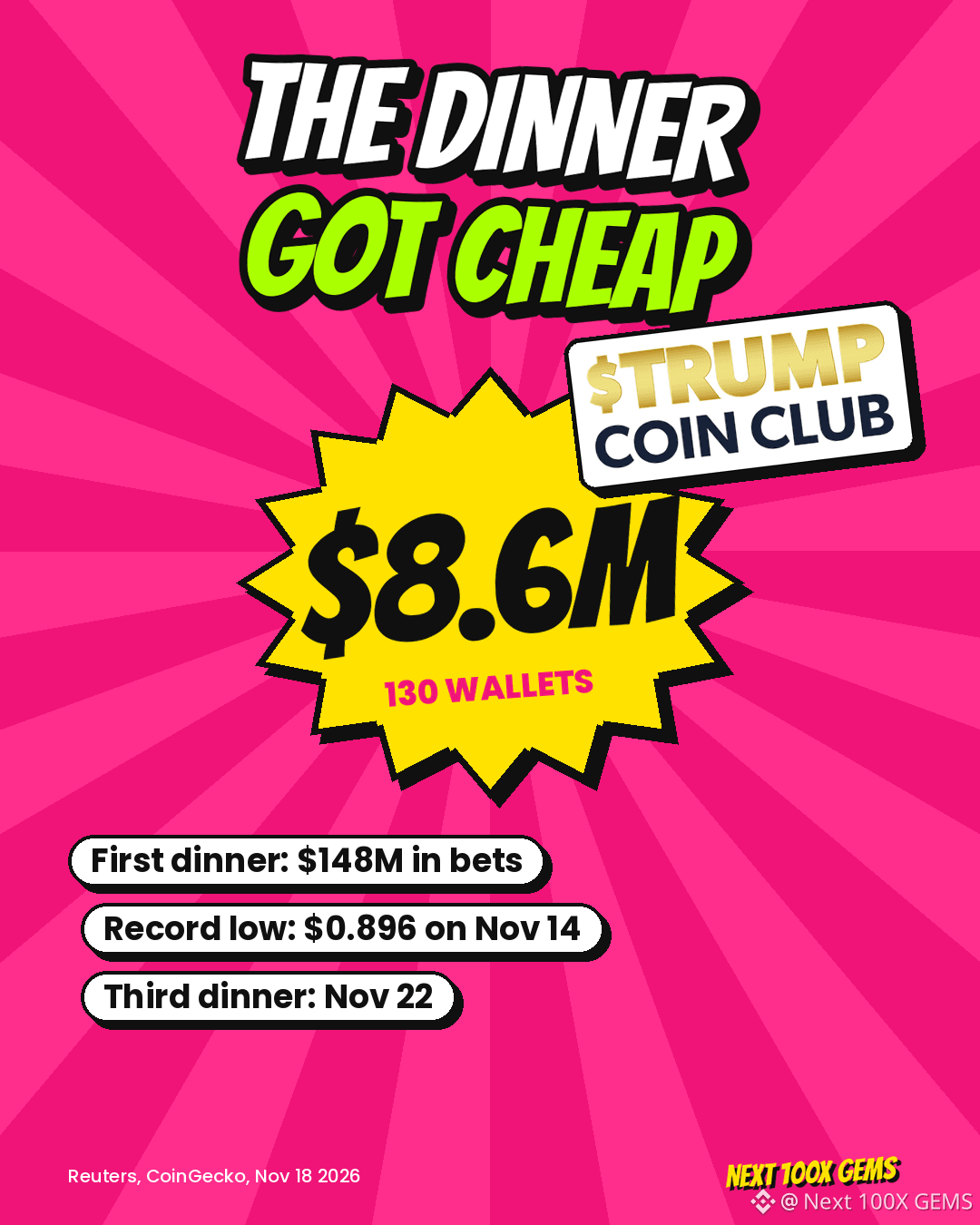
1
1.3k
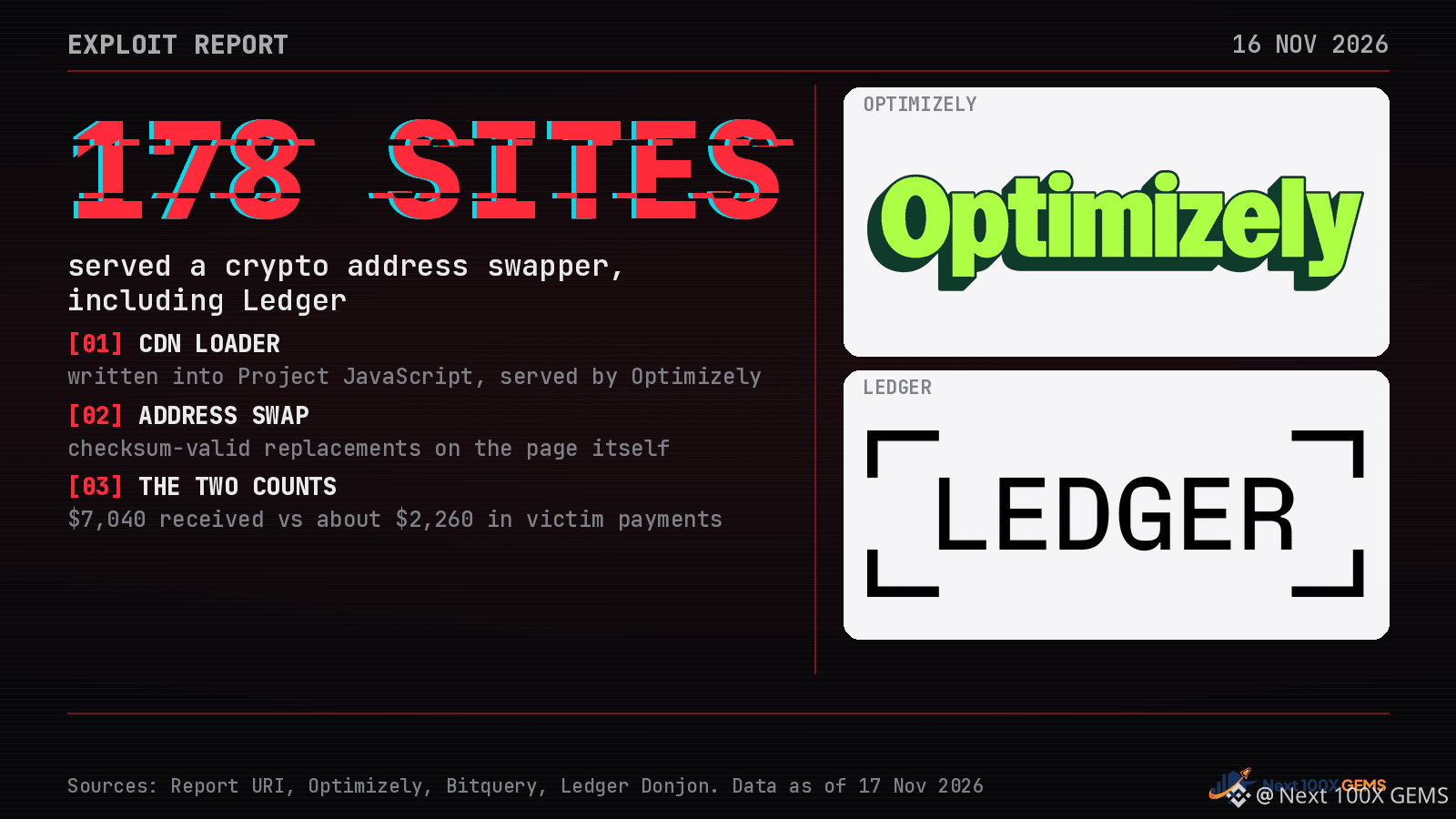
Article
How an Optimizely flaw put a crypto address swapper on 178 sites, including LedgerYou did not have to visit a shady page. On 16 November, ordinary websites belonging to 178 organizations could show a visitor the wrong crypto address. Report URI, the firm that found the campaign, named Ledger, the BBC, Zoom, CNN, Salesforce, GitLab and HSBC among them. The code was not planted by breaking into those companies' own servers. It was written into a custom-code field in Optimizely Web, a testing tool the sites already loaded, and Optimizely's own content network served it.
Optimizely later said an unauthorized party had exploited a vulnerability in its Experimentation product and added malicious JavaScript to some customer projects. First counts of the attacker's wallets, published by Report URI, put receipts at about 7,040. dollars A Bitquery review of those same wallets, published on 17 November, puts confirmed victim payments at about 2,260 dollars in 19 transfers. Both figures can be true at once, and both need the source attached.
How the code got onto the sites
Each Optimizely Web customer loads a JavaScript snippet, usually from Optimizely's content network. The file holds Optimizely's own code, the customer's experiments, and an optional Project JavaScript field: custom code that runs on every page. Scott Helme at Report URI found that the attacker had written a loader into that field and left the rest of the snippet alone. The content network served exactly what it was given; this was not a cache-poisoning attack.
Helme checked 1,611 snippets and found the loader in 188 of them, belonging to 178 organizations. Banking and finance was the largest group, with 32, and crypto and trading accounted for six, including Ledger, IG, OANDA / Coinpass, Interactive Investor and TMS Brokers. Optimizely's own homepage and login page also carried the loader.
Researchers saw more than one form of the loader, including a version that hid the host so a simple text search would miss it, and a version that could still run if that host was blocked. One snippet, on Smartsheet, was cleaned and then reinfected, which Helme reads as the attacker still having write access during the cleanup. StepSecurity puts the exposure for most sites at about 16 hours on 16 November. By the end of that day, Report URI found the infected files were clean.
What the script did to wallet addresses
The payload looked for wallet addresses on Bitcoin, Ethereum and other EVM chains, TRON, Solana, TON, Litecoin, Bitcoin Cash and Dogecoin. When nearby text contained a payment word such as wallet, deposit or send, it replaced a valid address with one of the attacker's that still passed the chain's own checksum.
The swap was not limited to the clipboard after a copy. Report URI and StepSecurity both describe the script rewriting page text, form fields, copy events and data in network requests. An address taken from an affected page could already be the attacker's by the time it was pasted into a wallet or a withdrawal form. After a swap, the script sent a screenshot, cookies that were not marked HttpOnly, and the original addresses to the attacker's host. A separate block skimmed card numbers, expiry dates and security codes. Report URI says it also loaded the Coruna and DarkSword iOS exploit kits.
Why one count is 7,040 dollars and another is 2,260 dollars
Report URI added up what the eight hard-coded wallets had received by the evening of 16 November and arrived at about 7,040, dollars mostly in bitcoin. Four of the eight addresses, those for Solana, TON, Bitcoin Cash and Dogecoin, never received a coin, according to both Report URI and Bitquery.
Bitquery followed every payment into the same wallets and split victim transfers from the attacker's own moves. It counts about 2,260 dollars paid by victims in 19 payments on 16 November. The median payment was 54, dollars and the largest was 15 litecoin, about 670. dollars
The gap with the first count is mostly one bitcoin transfer. Bitquery traces 0.076 bitcoin, about 92 percent of the bitcoin in Report URI's sum, to a swap the attacker made the same day: about 4,920 dollars of stablecoins went out, and the bitcoin came back to the same wallet. About 610 dollars of that was victim money already counted in the 2,260. dollars The rest, 4,311 USDC, was already in the wallet on 12 November and is not a loss from this incident. Take the swap out of the first count, and Bitquery gets about 2,110, dollars plus one later bitcoin payment of about 150. dollars On 17 November the bitcoin, litecoin, ether and TRON wallets were emptied. Card skimming, stolen cookies and any iOS infections are not in these totals.
What Optimizely and Ledger have said
Optimizely told BleepingComputer that the attacker exploited a vulnerability in the Experimentation account signup flow, that it had blocked the path and deployed a fix, and that it had removed the injected code, ended sessions, revoked tokens and reset access for affected accounts. It also said it had notified all affected customers. A status notice dated 17 November, still listed as monitoring, repeats the fix and the cleanup and says the company has added protections against unauthorized code being delivered.
Ledger Donjon, the company's security team, said on 17 November that it was aware of a security incident affecting Optimizely, a third-party service used on Ledger's website and on many others. The team said it had remediated the issue, that the malicious code was no longer being served through the site, and that the incident did not affect Ledger devices or the private keys they protect.
That last point is true as far as it goes, and it is easy to over-read. This campaign did not need a device key. It changed the destination address on a page the user already trusted. Anyone who copied a deposit or withdrawal address from an affected site on 16 November should check the address they actually paid, not only whether their hardware wallet is intact. Salesforce told BleepingComputer it had disabled Optimizely scripts on some of its sites as a precaution.
Optimizely's fix and the cleanup of the snippets close the window that opened on 16 November. They do not, by themselves, tell a visitor whether a payment made that day went to the address on the screen.
Sources
Report URI / Scott Helme, "World's Largest Brands Infected With Malware Via Optimizely" (16 November 2026, updated 17 November 2026)
StepSecurity / Owais Shaikh, "OPTIMJACK: Optimizely-Hosted Scripts Loaded a Crypto Clipper and Card Skimmer on 178 Organizations" (17 November 2026)
Optimizely, "Web Experimentation Security Incident" status notice (17 November 2026)
BleepingComputer, "Optimizely hack infected CNN, Fox News, BBC, Salesforce sites with malware" (16 November 2026, with Optimizely and Salesforce statements)
Bitquery, "The Optimizely hack took 2,260 dollars in crypto, in 19 payments" (on-chain figures verified 17 November 2026)
0xCERT advisory 0xCERT-2026-0365 (16 November 2026, updated 17 November 2026)
Ledger Donjon statement on the Optimizely incident, 17 November 2026, as quoted by U.Today and TokenPost
How an Optimizely flaw put a crypto address swapper on 178 sites, including Ledger
You did not have to visit a shady page. On 16 November, ordinary websites belonging to 178 organizations could show a visitor the wrong crypto address. Report URI, the firm that found the campaign, named Ledger, the BBC, Zoom, CNN, Salesforce, GitLab and HSBC among them. The code was not planted by breaking into those companies' own servers. It was written into a custom-code field in Optimizely Web, a testing tool the sites already loaded, and Optimizely's own content network served it.
Optimizely later said an unauthorized party had exploited a vulnerability in its Experimentation product and added malicious JavaScript to some customer projects. First counts of the attacker's wallets, published by Report URI, put receipts at about 7,040. dollars A Bitquery review of those same wallets, published on 17 November, puts confirmed victim payments at about 2,260 dollars in 19 transfers. Both figures can be true at once, and both need the source attached.
How the code got onto the sites
Each Optimizely Web customer loads a JavaScript snippet, usually from Optimizely's content network. The file holds Optimizely's own code, the customer's experiments, and an optional Project JavaScript field: custom code that runs on every page. Scott Helme at Report URI found that the attacker had written a loader into that field and left the rest of the snippet alone. The content network served exactly what it was given; this was not a cache-poisoning attack.
Helme checked 1,611 snippets and found the loader in 188 of them, belonging to 178 organizations. Banking and finance was the largest group, with 32, and crypto and trading accounted for six, including Ledger, IG, OANDA / Coinpass, Interactive Investor and TMS Brokers. Optimizely's own homepage and login page also carried the loader.
Researchers saw more than one form of the loader, including a version that hid the host so a simple text search would miss it, and a version that could still run if that host was blocked. One snippet, on Smartsheet, was cleaned and then reinfected, which Helme reads as the attacker still having write access during the cleanup. StepSecurity puts the exposure for most sites at about 16 hours on 16 November. By the end of that day, Report URI found the infected files were clean.
What the script did to wallet addresses
The payload looked for wallet addresses on Bitcoin, Ethereum and other EVM chains, TRON, Solana, TON, Litecoin, Bitcoin Cash and Dogecoin. When nearby text contained a payment word such as wallet, deposit or send, it replaced a valid address with one of the attacker's that still passed the chain's own checksum.
The swap was not limited to the clipboard after a copy. Report URI and StepSecurity both describe the script rewriting page text, form fields, copy events and data in network requests. An address taken from an affected page could already be the attacker's by the time it was pasted into a wallet or a withdrawal form. After a swap, the script sent a screenshot, cookies that were not marked HttpOnly, and the original addresses to the attacker's host. A separate block skimmed card numbers, expiry dates and security codes. Report URI says it also loaded the Coruna and DarkSword iOS exploit kits.
Why one count is 7,040 dollars and another is 2,260 dollars
Report URI added up what the eight hard-coded wallets had received by the evening of 16 November and arrived at about 7,040, dollars mostly in bitcoin. Four of the eight addresses, those for Solana, TON, Bitcoin Cash and Dogecoin, never received a coin, according to both Report URI and Bitquery.
Bitquery followed every payment into the same wallets and split victim transfers from the attacker's own moves. It counts about 2,260 dollars paid by victims in 19 payments on 16 November. The median payment was 54, dollars and the largest was 15 litecoin, about 670. dollars
The gap with the first count is mostly one bitcoin transfer. Bitquery traces 0.076 bitcoin, about 92 percent of the bitcoin in Report URI's sum, to a swap the attacker made the same day: about 4,920 dollars of stablecoins went out, and the bitcoin came back to the same wallet. About 610 dollars of that was victim money already counted in the 2,260. dollars The rest, 4,311 USDC, was already in the wallet on 12 November and is not a loss from this incident. Take the swap out of the first count, and Bitquery gets about 2,110, dollars plus one later bitcoin payment of about 150. dollars On 17 November the bitcoin, litecoin, ether and TRON wallets were emptied. Card skimming, stolen cookies and any iOS infections are not in these totals.
What Optimizely and Ledger have said
Optimizely told BleepingComputer that the attacker exploited a vulnerability in the Experimentation account signup flow, that it had blocked the path and deployed a fix, and that it had removed the injected code, ended sessions, revoked tokens and reset access for affected accounts. It also said it had notified all affected customers. A status notice dated 17 November, still listed as monitoring, repeats the fix and the cleanup and says the company has added protections against unauthorized code being delivered.
Ledger Donjon, the company's security team, said on 17 November that it was aware of a security incident affecting Optimizely, a third-party service used on Ledger's website and on many others. The team said it had remediated the issue, that the malicious code was no longer being served through the site, and that the incident did not affect Ledger devices or the private keys they protect.
That last point is true as far as it goes, and it is easy to over-read. This campaign did not need a device key. It changed the destination address on a page the user already trusted. Anyone who copied a deposit or withdrawal address from an affected site on 16 November should check the address they actually paid, not only whether their hardware wallet is intact. Salesforce told BleepingComputer it had disabled Optimizely scripts on some of its sites as a precaution.
Optimizely's fix and the cleanup of the snippets close the window that opened on 16 November. They do not, by themselves, tell a visitor whether a payment made that day went to the address on the screen.
Sources
Report URI / Scott Helme, "World's Largest Brands Infected With Malware Via Optimizely" (16 November 2026, updated 17 November 2026)
StepSecurity / Owais Shaikh, "OPTIMJACK: Optimizely-Hosted Scripts Loaded a Crypto Clipper and Card Skimmer on 178 Organizations" (17 November 2026)
Optimizely, "Web Experimentation Security Incident" status notice (17 November 2026)
BleepingComputer, "Optimizely hack infected CNN, Fox News, BBC, Salesforce sites with malware" (16 November 2026, with Optimizely and Salesforce statements)
Bitquery, "The Optimizely hack took 2,260 dollars in crypto, in 19 payments" (on-chain figures verified 17 November 2026)
0xCERT advisory 0xCERT-2026-0365 (16 November 2026, updated 17 November 2026)
Ledger Donjon statement on the Optimizely incident, 17 November 2026, as quoted by U.Today and TokenPost
Optimizely later said an unauthorized party had exploited a vulnerability in its Experimentation product and added malicious JavaScript to some customer projects. First counts of the attacker's wallets, published by Report URI, put receipts at about 7,040. dollars A Bitquery review of those same wallets, published on 17 November, puts confirmed victim payments at about 2,260 dollars in 19 transfers. Both figures can be true at once, and both need the source attached.
How the code got onto the sites
Each Optimizely Web customer loads a JavaScript snippet, usually from Optimizely's content network. The file holds Optimizely's own code, the customer's experiments, and an optional Project JavaScript field: custom code that runs on every page. Scott Helme at Report URI found that the attacker had written a loader into that field and left the rest of the snippet alone. The content network served exactly what it was given; this was not a cache-poisoning attack.
Helme checked 1,611 snippets and found the loader in 188 of them, belonging to 178 organizations. Banking and finance was the largest group, with 32, and crypto and trading accounted for six, including Ledger, IG, OANDA / Coinpass, Interactive Investor and TMS Brokers. Optimizely's own homepage and login page also carried the loader.
Researchers saw more than one form of the loader, including a version that hid the host so a simple text search would miss it, and a version that could still run if that host was blocked. One snippet, on Smartsheet, was cleaned and then reinfected, which Helme reads as the attacker still having write access during the cleanup. StepSecurity puts the exposure for most sites at about 16 hours on 16 November. By the end of that day, Report URI found the infected files were clean.
What the script did to wallet addresses
The payload looked for wallet addresses on Bitcoin, Ethereum and other EVM chains, TRON, Solana, TON, Litecoin, Bitcoin Cash and Dogecoin. When nearby text contained a payment word such as wallet, deposit or send, it replaced a valid address with one of the attacker's that still passed the chain's own checksum.
The swap was not limited to the clipboard after a copy. Report URI and StepSecurity both describe the script rewriting page text, form fields, copy events and data in network requests. An address taken from an affected page could already be the attacker's by the time it was pasted into a wallet or a withdrawal form. After a swap, the script sent a screenshot, cookies that were not marked HttpOnly, and the original addresses to the attacker's host. A separate block skimmed card numbers, expiry dates and security codes. Report URI says it also loaded the Coruna and DarkSword iOS exploit kits.
Why one count is 7,040 dollars and another is 2,260 dollars
Report URI added up what the eight hard-coded wallets had received by the evening of 16 November and arrived at about 7,040, dollars mostly in bitcoin. Four of the eight addresses, those for Solana, TON, Bitcoin Cash and Dogecoin, never received a coin, according to both Report URI and Bitquery.
Bitquery followed every payment into the same wallets and split victim transfers from the attacker's own moves. It counts about 2,260 dollars paid by victims in 19 payments on 16 November. The median payment was 54, dollars and the largest was 15 litecoin, about 670. dollars
The gap with the first count is mostly one bitcoin transfer. Bitquery traces 0.076 bitcoin, about 92 percent of the bitcoin in Report URI's sum, to a swap the attacker made the same day: about 4,920 dollars of stablecoins went out, and the bitcoin came back to the same wallet. About 610 dollars of that was victim money already counted in the 2,260. dollars The rest, 4,311 USDC, was already in the wallet on 12 November and is not a loss from this incident. Take the swap out of the first count, and Bitquery gets about 2,110, dollars plus one later bitcoin payment of about 150. dollars On 17 November the bitcoin, litecoin, ether and TRON wallets were emptied. Card skimming, stolen cookies and any iOS infections are not in these totals.
What Optimizely and Ledger have said
Optimizely told BleepingComputer that the attacker exploited a vulnerability in the Experimentation account signup flow, that it had blocked the path and deployed a fix, and that it had removed the injected code, ended sessions, revoked tokens and reset access for affected accounts. It also said it had notified all affected customers. A status notice dated 17 November, still listed as monitoring, repeats the fix and the cleanup and says the company has added protections against unauthorized code being delivered.
Ledger Donjon, the company's security team, said on 17 November that it was aware of a security incident affecting Optimizely, a third-party service used on Ledger's website and on many others. The team said it had remediated the issue, that the malicious code was no longer being served through the site, and that the incident did not affect Ledger devices or the private keys they protect.
That last point is true as far as it goes, and it is easy to over-read. This campaign did not need a device key. It changed the destination address on a page the user already trusted. Anyone who copied a deposit or withdrawal address from an affected site on 16 November should check the address they actually paid, not only whether their hardware wallet is intact. Salesforce told BleepingComputer it had disabled Optimizely scripts on some of its sites as a precaution.
Optimizely's fix and the cleanup of the snippets close the window that opened on 16 November. They do not, by themselves, tell a visitor whether a payment made that day went to the address on the screen.
Sources
Report URI / Scott Helme, "World's Largest Brands Infected With Malware Via Optimizely" (16 November 2026, updated 17 November 2026)
StepSecurity / Owais Shaikh, "OPTIMJACK: Optimizely-Hosted Scripts Loaded a Crypto Clipper and Card Skimmer on 178 Organizations" (17 November 2026)
Optimizely, "Web Experimentation Security Incident" status notice (17 November 2026)
BleepingComputer, "Optimizely hack infected CNN, Fox News, BBC, Salesforce sites with malware" (16 November 2026, with Optimizely and Salesforce statements)
Bitquery, "The Optimizely hack took 2,260 dollars in crypto, in 19 payments" (on-chain figures verified 17 November 2026)
0xCERT advisory 0xCERT-2026-0365 (16 November 2026, updated 17 November 2026)
Ledger Donjon statement on the Optimizely incident, 17 November 2026, as quoted by U.Today and TokenPost
1
162
"Millions of people in emerging economies already rely on stablecoins on TRON to save and send money," says $AAVE founder Stani Kulechov.
His Aave App opened early access on Android this week, with a waitlist, and the same release added USDT deposits on Tron for eligible users, iOS included. Aave advertises up to 7.25% APY, variable, with no lock-up.
He picked the right pile. DefiLlama counts about 92 billion dollars of USDT on the $TRX chain, a little over half of all USDT in existence, and Kulechov says much of it is not earning yield. A #DeFi savings app aimed straight at those wallets is new ground for Aave.
Check the rate shown for your country before moving dollars in, because Aave is not a bank and that yield floats.
NFA. DYOR.
"Millions of people in emerging economies already rely on stablecoins on TRON to save and send money," says $AAVE founder Stani Kulechov.
His Aave App opened early access on Android this week, with a waitlist, and the same release added USDT deposits on Tron for eligible users, iOS included. Aave advertises up to 7.25% APY, variable, with no lock-up.
He picked the right pile. DefiLlama counts about 92 billion dollars of USDT on the $TRX chain, a little over half of all USDT in existence, and Kulechov says much of it is not earning yield. A #DeFi savings app aimed straight at those wallets is new ground for Aave.
Check the rate shown for your country before moving dollars in, because Aave is not a bank and that yield floats.
NFA. DYOR.
His Aave App opened early access on Android this week, with a waitlist, and the same release added USDT deposits on Tron for eligible users, iOS included. Aave advertises up to 7.25% APY, variable, with no lock-up.
He picked the right pile. DefiLlama counts about 92 billion dollars of USDT on the $TRX chain, a little over half of all USDT in existence, and Kulechov says much of it is not earning yield. A #DeFi savings app aimed straight at those wallets is new ground for Aave.
Check the rate shown for your country before moving dollars in, because Aave is not a bank and that yield floats.
NFA. DYOR.
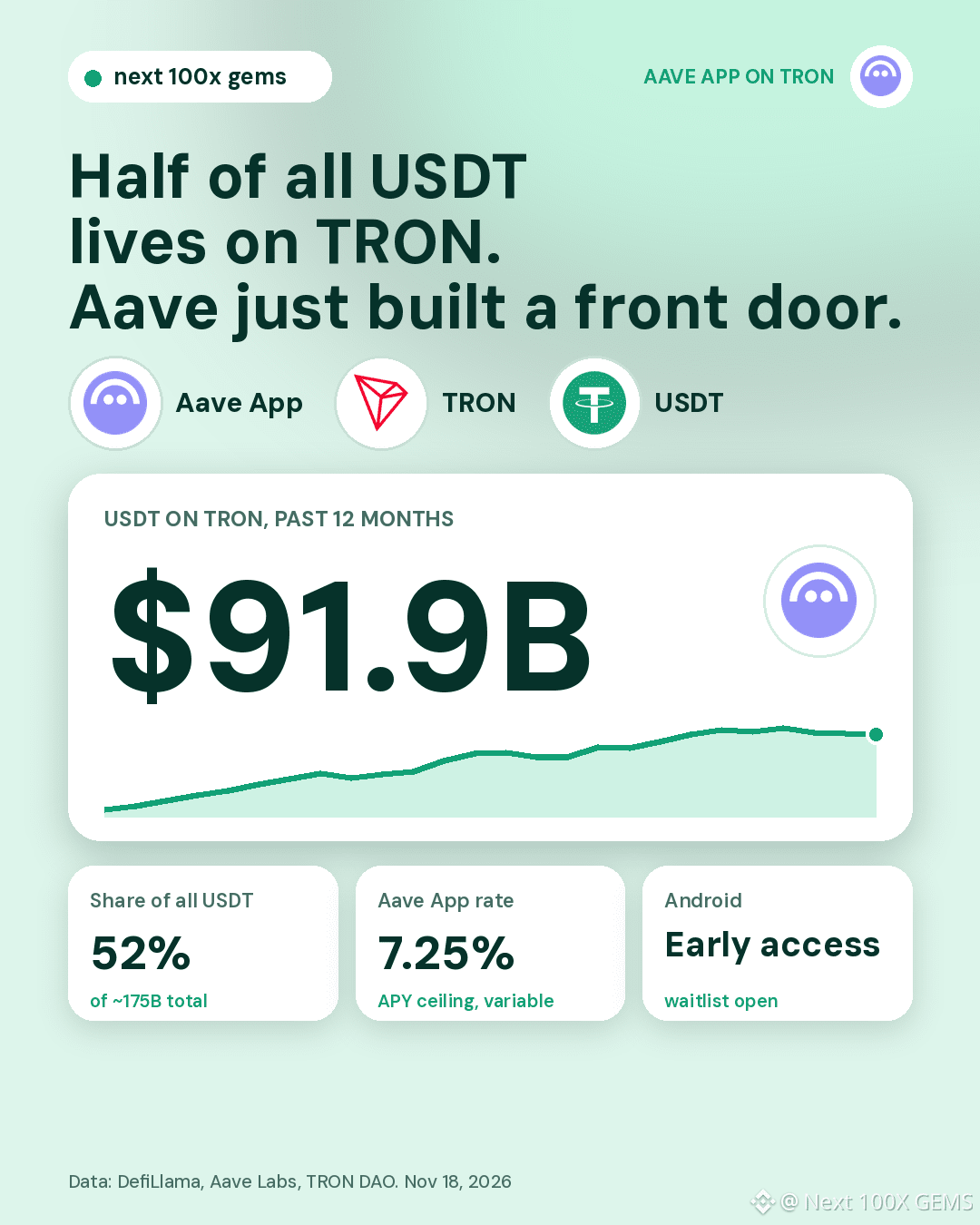
283
$ZRO traders sold it down about 10% in a day ahead of Friday, when 23.28 million tokens unlock.
We went back to LayerZero's own June write-up before reading anything into that. As of May 31, investors still held 63.8% of what had unlocked to them, and their open-market sales averaged about 4.9 million ZRO a month.
Friday sends 10.99 million to strategic partners, the group those figures cover, and most of the rest to #LayerZero core contributors.
The chart is pricing a dump their track record does not show. Exchange deposits from those wallets next week will settle it.
NFA. DYOR.
$ZRO traders sold it down about 10% in a day ahead of Friday, when 23.28 million tokens unlock.
We went back to LayerZero's own June write-up before reading anything into that. As of May 31, investors still held 63.8% of what had unlocked to them, and their open-market sales averaged about 4.9 million ZRO a month.
Friday sends 10.99 million to strategic partners, the group those figures cover, and most of the rest to #LayerZero core contributors.
The chart is pricing a dump their track record does not show. Exchange deposits from those wallets next week will settle it.
NFA. DYOR.
We went back to LayerZero's own June write-up before reading anything into that. As of May 31, investors still held 63.8% of what had unlocked to them, and their open-market sales averaged about 4.9 million ZRO a month.
Friday sends 10.99 million to strategic partners, the group those figures cover, and most of the rest to #LayerZero core contributors.
The chart is pricing a dump their track record does not show. Exchange deposits from those wallets next week will settle it.
NFA. DYOR.
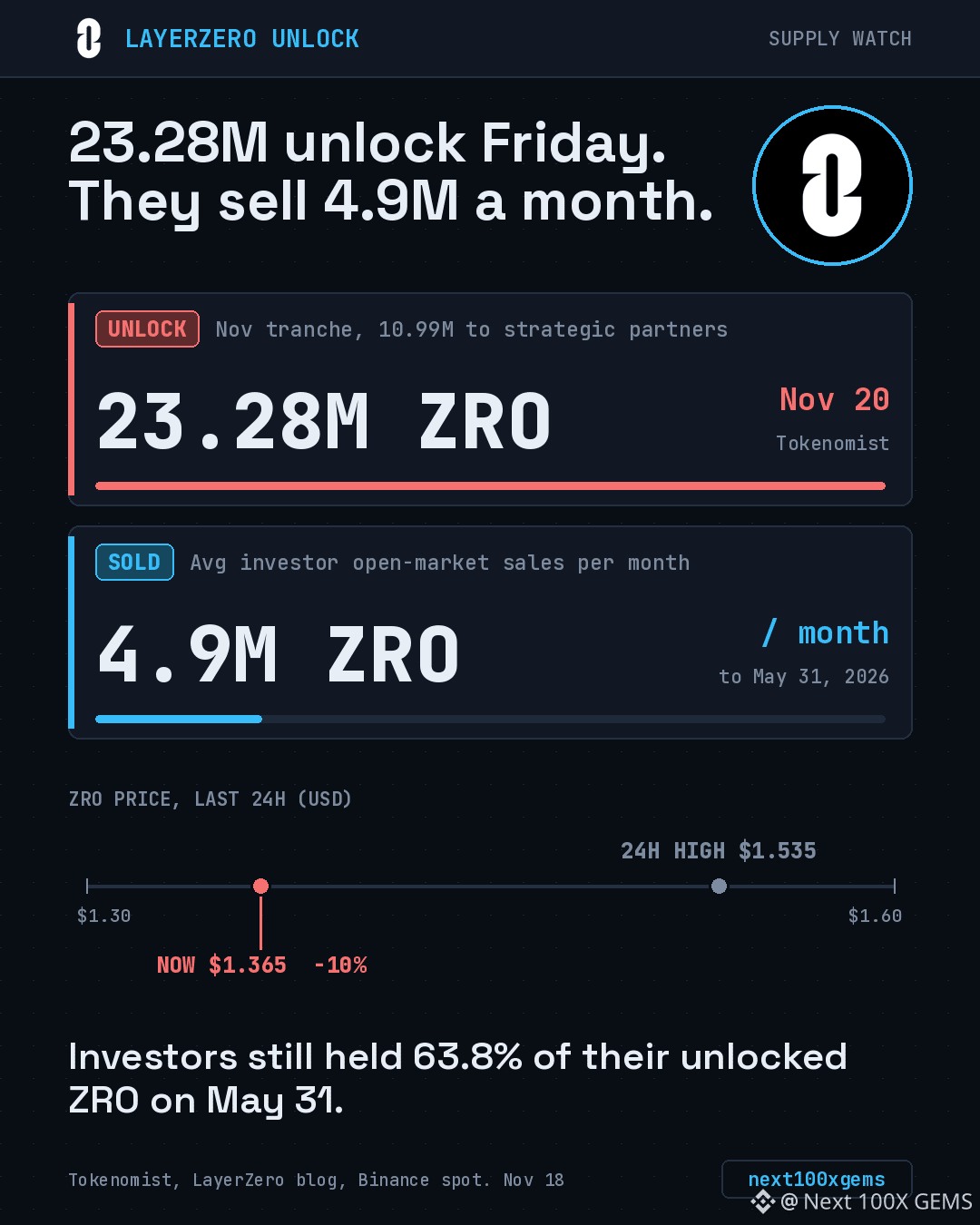
504
$BTC and $ETH are now legal buys for ordinary Russians, USDT too, but the biggest bank apps have not switched them on yet.
It came in steps. A federal crypto law took effect on 1 September, the Bank of Russia signed its ordinance on 11 September, and on 6 November it set a yearly limit of 300,000 rubles, about 3,600 dollars, per broker rather than per person.
The rule came into force on 17 November. T-Bank told TASS it is waiting for the standard knowledge test every buyer in #Russia must pass first, and VTB is still testing its app.
Exchanges may open crypto trading from 22 November. The Moscow Exchange plans a pilot on 1 December, when Sberbank also aims to launch.
Until then, the offshore desks keep the flow.
NFA. DYOR.
$BTC and $ETH are now legal buys for ordinary Russians, USDT too, but the biggest bank apps have not switched them on yet.
It came in steps. A federal crypto law took effect on 1 September, the Bank of Russia signed its ordinance on 11 September, and on 6 November it set a yearly limit of 300,000 rubles, about 3,600 dollars, per broker rather than per person.
The rule came into force on 17 November. T-Bank told TASS it is waiting for the standard knowledge test every buyer in #Russia must pass first, and VTB is still testing its app.
Exchanges may open crypto trading from 22 November. The Moscow Exchange plans a pilot on 1 December, when Sberbank also aims to launch.
Until then, the offshore desks keep the flow.
NFA. DYOR.
It came in steps. A federal crypto law took effect on 1 September, the Bank of Russia signed its ordinance on 11 September, and on 6 November it set a yearly limit of 300,000 rubles, about 3,600 dollars, per broker rather than per person.
The rule came into force on 17 November. T-Bank told TASS it is waiting for the standard knowledge test every buyer in #Russia must pass first, and VTB is still testing its app.
Exchanges may open crypto trading from 22 November. The Moscow Exchange plans a pilot on 1 December, when Sberbank also aims to launch.
Until then, the offshore desks keep the flow.
NFA. DYOR.
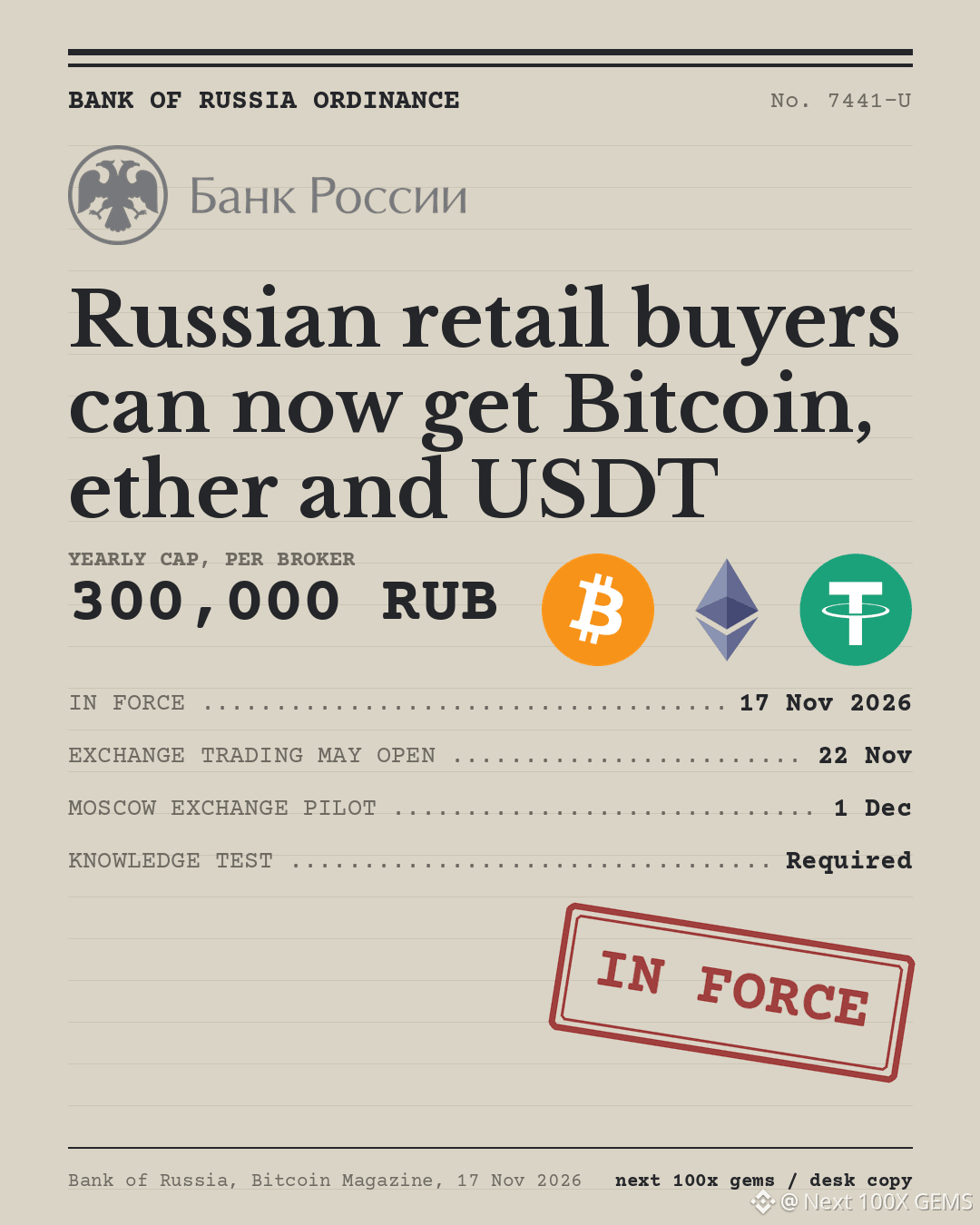
1
288
The Solana Foundation has retired the mainnet-beta label on the $SOL network and introduced Solana 1.0.
The official account put it as mainnet-beta to mainnet, ending a label in place since March 2020. The Foundation says coins, accounts, apps and history stay as they are, and holders do not need to move anything.
A protocol version does not turn on new upgrades by itself, so anyone running a #Solana validator still has to follow their own client docs.
If you just hold the coin, you can leave it where it is.
NFA. DYOR.
The Solana Foundation has retired the mainnet-beta label on the $SOL network and introduced Solana 1.0.
The official account put it as mainnet-beta to mainnet, ending a label in place since March 2020. The Foundation says coins, accounts, apps and history stay as they are, and holders do not need to move anything.
A protocol version does not turn on new upgrades by itself, so anyone running a #Solana validator still has to follow their own client docs.
If you just hold the coin, you can leave it where it is.
NFA. DYOR.
The official account put it as mainnet-beta to mainnet, ending a label in place since March 2020. The Foundation says coins, accounts, apps and history stay as they are, and holders do not need to move anything.
A protocol version does not turn on new upgrades by itself, so anyone running a #Solana validator still has to follow their own client docs.
If you just hold the coin, you can leave it where it is.
NFA. DYOR.
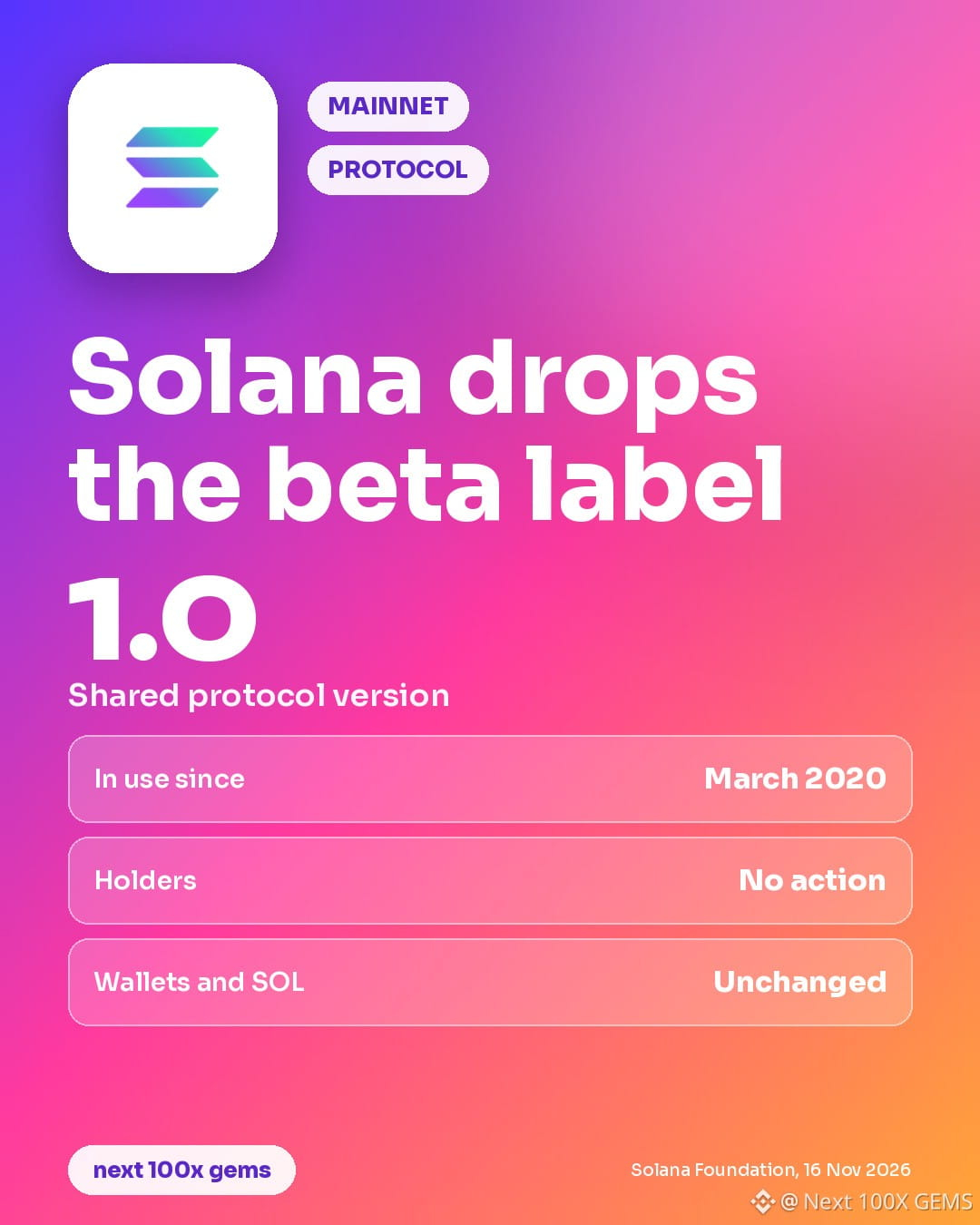
176
Log in to explore more content
Join global crypto users on Binance Square
⚡️ Get latest and useful information about crypto.
💬 Trusted by the world’s largest crypto exchange.
👍 Discover real insights from verified creators.
Email / Phone number
Trending Topics
IsAnthropic’s$1.5TMarketCapJustified?
62,775 views
324 Discussing
Anthropic Set to Open at $105 in Record Nasdaq Debut
Binance News
·16 Likes
·18.8k views
BTCBelow$62KAmidHikeFearsAndShiftToAnthropic
20,381 views
121 Discussing
NvidiaBoardReportedlySplitOverHuang’sReturn
258,674 views
2,103 Discussing