

#interestrates
interestrates
3.1M views
5,489 Discussing
Hot
Latest

·
--
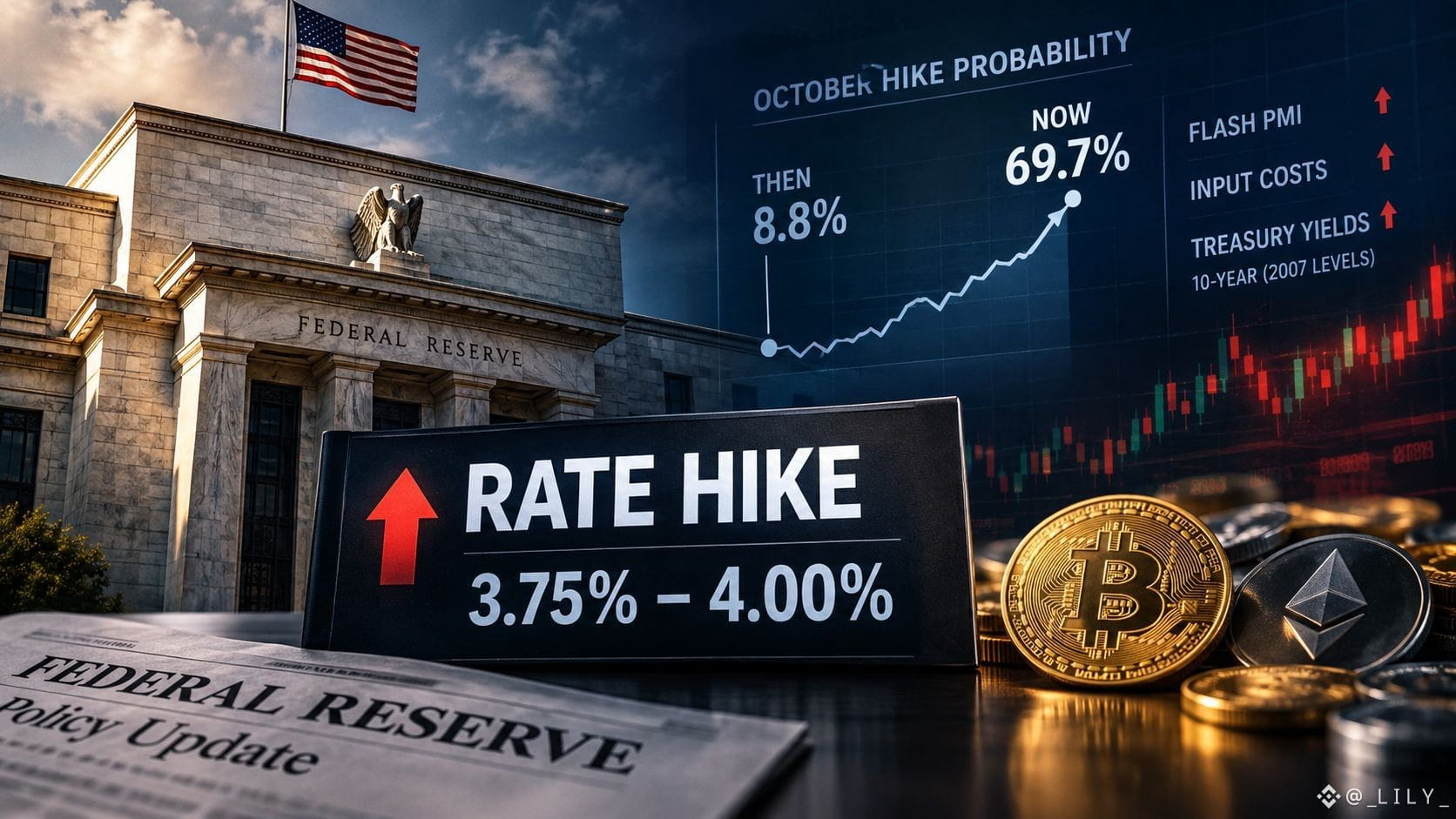
🚨 #FedOctoberRateHikeOddsRiseTo69.7%
The Fed Just Hiked — And Markets Are Already Pricing In Another One.
Just weeks after the Fed’s latest rate hike, markets are rapidly repricing the odds of another increase in October. 📈🏦
Fed-hike expectations reportedly jumped from 8.8% to 69.7%, driven by stronger economic data and renewed inflation concerns. 🔥
Higher rates generally mean tighter liquidity and tougher financial conditions for risk assets — including crypto. 📉₿
The key question now: Can Bitcoin and risk assets absorb another potential rate hike? 👀
$ONDO $IQ $PLAY
#BTC #Crypto #Bitcoin #InterestRates
🚨 #FedOctoberRateHikeOddsRiseTo69.7%
The Fed Just Hiked — And Markets Are Already Pricing In Another One.
Just weeks after the Fed’s latest rate hike, markets are rapidly repricing the odds of another increase in October. 📈🏦
Fed-hike expectations reportedly jumped from 8.8% to 69.7%, driven by stronger economic data and renewed inflation concerns. 🔥
Higher rates generally mean tighter liquidity and tougher financial conditions for risk assets — including crypto. 📉₿
The key question now: Can Bitcoin and risk assets absorb another potential rate hike? 👀
$ONDO $IQ $PLAY
#BTC #Crypto #Bitcoin #InterestRates
The Fed Just Hiked — And Markets Are Already Pricing In Another One.
Just weeks after the Fed’s latest rate hike, markets are rapidly repricing the odds of another increase in October. 📈🏦
Fed-hike expectations reportedly jumped from 8.8% to 69.7%, driven by stronger economic data and renewed inflation concerns. 🔥
Higher rates generally mean tighter liquidity and tougher financial conditions for risk assets — including crypto. 📉₿
The key question now: Can Bitcoin and risk assets absorb another potential rate hike? 👀
$ONDO $IQ $PLAY
#BTC #Crypto #Bitcoin #InterestRates
1
304

U.S. Treasury Secretary Scott Bessent recently made public remarks, urging the Federal Reserve to remain open-minded about its interest-rate path. He emphasized that productivity gains driven by artificial intelligence and regulatory easing will effectively curb inflation, and he cited precedents from the Greenspan era to call on policymakers not to tighten policy too early in a way that would choke growth. He also noted that Federal Reserve Governor Waller—nominated by Trump—fully recognizes the economic potential unleashed by this technological dividend.
From a macroeconomic game-theory perspective, Bessent’s comments are effectively an attempt to pressure the Federal Reserve, seeking to justify a more accommodative monetary environment through a narrative of “improved supply-side performance lowering inflation.” However, directly equating today’s AI boom with the 1990s productivity surge is clearly overly optimistic. Betting too early on an unproven productivity miracle is likely to obscure inflation stickiness in the services sector, thereby increasing the risk that the rate-cut cycle faces another policy misstep.
For traditional financial markets, the Treasury’s public intervention in monetary policy has heightened expectations of policy disagreement in the market. In the near term, U.S. Treasury yield curves may remain choppy, and the U.S. dollar index could experience two-way fluctuations driven by this policy tug-of-war. If the Federal Reserve gives in to political pressure and eases too early, the risk of a second wave of inflation would push up the long-end term premium, putting substantial downward pressure on the valuations of major asset classes.
For the crypto market, the Treasury’s dovish messaging may provide emotional support, but before inflation has truly declined, expectation-driven liquidity rebounds are often fragile. If the Federal Reserve maintains a hawkish stance and resists administrative interference, risk assets such as $BTC may face a deep correction as liquidity expectations fail to materialize. Investors should remain alert to the risks of false breakouts and heightened volatility under policy uncertainty.
#Fed #MacroEconomy #Inflation #InterestRates
U.S. Treasury Secretary Scott Bessent recently made public remarks, urging the Federal Reserve to remain open-minded about its interest-rate path. He emphasized that productivity gains driven by artificial intelligence and regulatory easing will effectively curb inflation, and he cited precedents from the Greenspan era to call on policymakers not to tighten policy too early in a way that would choke growth. He also noted that Federal Reserve Governor Waller—nominated by Trump—fully recognizes the economic potential unleashed by this technological dividend.
From a macroeconomic game-theory perspective, Bessent’s comments are effectively an attempt to pressure the Federal Reserve, seeking to justify a more accommodative monetary environment through a narrative of “improved supply-side performance lowering inflation.” However, directly equating today’s AI boom with the 1990s productivity surge is clearly overly optimistic. Betting too early on an unproven productivity miracle is likely to obscure inflation stickiness in the services sector, thereby increasing the risk that the rate-cut cycle faces another policy misstep.
For traditional financial markets, the Treasury’s public intervention in monetary policy has heightened expectations of policy disagreement in the market. In the near term, U.S. Treasury yield curves may remain choppy, and the U.S. dollar index could experience two-way fluctuations driven by this policy tug-of-war. If the Federal Reserve gives in to political pressure and eases too early, the risk of a second wave of inflation would push up the long-end term premium, putting substantial downward pressure on the valuations of major asset classes.
For the crypto market, the Treasury’s dovish messaging may provide emotional support, but before inflation has truly declined, expectation-driven liquidity rebounds are often fragile. If the Federal Reserve maintains a hawkish stance and resists administrative interference, risk assets such as $BTC may face a deep correction as liquidity expectations fail to materialize. Investors should remain alert to the risks of false breakouts and heightened volatility under policy uncertainty.
#Fed #MacroEconomy #Inflation #InterestRates
From a macroeconomic game-theory perspective, Bessent’s comments are effectively an attempt to pressure the Federal Reserve, seeking to justify a more accommodative monetary environment through a narrative of “improved supply-side performance lowering inflation.” However, directly equating today’s AI boom with the 1990s productivity surge is clearly overly optimistic. Betting too early on an unproven productivity miracle is likely to obscure inflation stickiness in the services sector, thereby increasing the risk that the rate-cut cycle faces another policy misstep.
For traditional financial markets, the Treasury’s public intervention in monetary policy has heightened expectations of policy disagreement in the market. In the near term, U.S. Treasury yield curves may remain choppy, and the U.S. dollar index could experience two-way fluctuations driven by this policy tug-of-war. If the Federal Reserve gives in to political pressure and eases too early, the risk of a second wave of inflation would push up the long-end term premium, putting substantial downward pressure on the valuations of major asset classes.
For the crypto market, the Treasury’s dovish messaging may provide emotional support, but before inflation has truly declined, expectation-driven liquidity rebounds are often fragile. If the Federal Reserve maintains a hawkish stance and resists administrative interference, risk assets such as $BTC may face a deep correction as liquidity expectations fail to materialize. Investors should remain alert to the risks of false breakouts and heightened volatility under policy uncertainty.
#Fed #MacroEconomy #Inflation #InterestRates
5

·
--
US Treasury Secretary Scott Bessent has just spoken out, urging Fed policymakers to be more open about their interest-rate guidance. He emphasized that core inflation is cooling steadily, and that a surge in productivity driven by AI combined with regulatory easing will help contain inflation effectively.
The move echoes a lesson from the 1990s under former Fed Chair Alan Greenspan, when the Fed allowed the economy to grow more freely thanks to a wave of technology. The new administration’s public push for this view indicates an effort to reshape market expectations, paving the way for less hawkish monetary policy.
The growth-supportive stance from the Treasury could help curb the rise in US bond yields and exert mild pressure on the US dollar. Stock markets overall would likely benefit significantly when abundant liquidity expectations combine with the AI-driven growth narrative.
For the crypto market, macro easing signals are always an important catalyst for capital flowing into $BTC and other risk assets. If the Fed truly takes this perspective on board, crypto investors’ sentiment could be strengthened more solidly over the medium term. 🚀
#Fed #Macroeconomics #InterestRates
US Treasury Secretary Scott Bessent has just spoken out, urging Fed policymakers to be more open about their interest-rate guidance. He emphasized that core inflation is cooling steadily, and that a surge in productivity driven by AI combined with regulatory easing will help contain inflation effectively.
The move echoes a lesson from the 1990s under former Fed Chair Alan Greenspan, when the Fed allowed the economy to grow more freely thanks to a wave of technology. The new administration’s public push for this view indicates an effort to reshape market expectations, paving the way for less hawkish monetary policy.
The growth-supportive stance from the Treasury could help curb the rise in US bond yields and exert mild pressure on the US dollar. Stock markets overall would likely benefit significantly when abundant liquidity expectations combine with the AI-driven growth narrative.
For the crypto market, macro easing signals are always an important catalyst for capital flowing into $BTC and other risk assets. If the Fed truly takes this perspective on board, crypto investors’ sentiment could be strengthened more solidly over the medium term. 🚀
#Fed #Macroeconomics #InterestRates
The move echoes a lesson from the 1990s under former Fed Chair Alan Greenspan, when the Fed allowed the economy to grow more freely thanks to a wave of technology. The new administration’s public push for this view indicates an effort to reshape market expectations, paving the way for less hawkish monetary policy.
The growth-supportive stance from the Treasury could help curb the rise in US bond yields and exert mild pressure on the US dollar. Stock markets overall would likely benefit significantly when abundant liquidity expectations combine with the AI-driven growth narrative.
For the crypto market, macro easing signals are always an important catalyst for capital flowing into $BTC and other risk assets. If the Fed truly takes this perspective on board, crypto investors’ sentiment could be strengthened more solidly over the medium term. 🚀
#Fed #Macroeconomics #InterestRates
155

·
--
Bullish
STOCKS | FED RATE-HIKE ODDS JUMP TO 69.7%
Hello guys..
CME FedWatch data shows traders are pricing in a 69.7% probability of a 25 bps Fed rate hike in October, while the chance of rates staying unchanged stands at 30.3%.
For December: 6.5% — No hike
38.7% — 25 bps cumulative hike
54.8% — 50 bps cumulative hike
Rising rate-hike expectations could keep stocks and risk assets sensitive to upcoming economic data.
Markets are watching the Fed closely.
#stocks #interestrates #CMEFedwatch #CryptoPatience
STOCKS | FED RATE-HIKE ODDS JUMP TO 69.7%
Hello guys..
CME FedWatch data shows traders are pricing in a 69.7% probability of a 25 bps Fed rate hike in October, while the chance of rates staying unchanged stands at 30.3%.
For December: 6.5% — No hike
38.7% — 25 bps cumulative hike
54.8% — 50 bps cumulative hike
Rising rate-hike expectations could keep stocks and risk assets sensitive to upcoming economic data.
Markets are watching the Fed closely.
#stocks #interestrates #CMEFedwatch #CryptoPatience
Hello guys..
CME FedWatch data shows traders are pricing in a 69.7% probability of a 25 bps Fed rate hike in October, while the chance of rates staying unchanged stands at 30.3%.
For December: 6.5% — No hike
38.7% — 25 bps cumulative hike
54.8% — 50 bps cumulative hike
Rising rate-hike expectations could keep stocks and risk assets sensitive to upcoming economic data.
Markets are watching the Fed closely.
#stocks #interestrates #CMEFedwatch #CryptoPatience

68

The US Treasury market is witnessing severe selling pressure as the 30-year government bond yield surged to 5.4583%, marking its highest level in 22 years. Meanwhile, the short-term 2-year Treasury yield rose by 0.85 basis points to reach 4.904%, underscoring a broad-based repricing across the entire yield curve.
This dramatic milestone reflects deepening concerns over a persistent 'higher-for-longer' interest rate environment and mounting US debt issuance. Investors are demanding higher term premiums to hold long-dated sovereign debt, challenging previous expectations that central bank tightening cycles were near an end.
Surging benchmark yields fundamentally tighten global liquidity conditions, strengthening the US dollar while putting intense valuation pressure on traditional equities and real estate. As risk-free returns approach multi-decade highs, capital naturally flows away from speculative asset classes.
For the cryptocurrency sector, rising yields create an uphill battle for liquidity. High-yield cash alternatives dampen retail and institutional appetite for risk-on assets, potentially capping upside momentum for $BTC and the broader altcoin market until macroeconomic easing becomes visible. #BondYields #MacroEconomy #InterestRates
The US Treasury market is witnessing severe selling pressure as the 30-year government bond yield surged to 5.4583%, marking its highest level in 22 years. Meanwhile, the short-term 2-year Treasury yield rose by 0.85 basis points to reach 4.904%, underscoring a broad-based repricing across the entire yield curve.
This dramatic milestone reflects deepening concerns over a persistent 'higher-for-longer' interest rate environment and mounting US debt issuance. Investors are demanding higher term premiums to hold long-dated sovereign debt, challenging previous expectations that central bank tightening cycles were near an end.
Surging benchmark yields fundamentally tighten global liquidity conditions, strengthening the US dollar while putting intense valuation pressure on traditional equities and real estate. As risk-free returns approach multi-decade highs, capital naturally flows away from speculative asset classes.
For the cryptocurrency sector, rising yields create an uphill battle for liquidity. High-yield cash alternatives dampen retail and institutional appetite for risk-on assets, potentially capping upside momentum for $BTC and the broader altcoin market until macroeconomic easing becomes visible. #BondYields #MacroEconomy #InterestRates
This dramatic milestone reflects deepening concerns over a persistent 'higher-for-longer' interest rate environment and mounting US debt issuance. Investors are demanding higher term premiums to hold long-dated sovereign debt, challenging previous expectations that central bank tightening cycles were near an end.
Surging benchmark yields fundamentally tighten global liquidity conditions, strengthening the US dollar while putting intense valuation pressure on traditional equities and real estate. As risk-free returns approach multi-decade highs, capital naturally flows away from speculative asset classes.
For the cryptocurrency sector, rising yields create an uphill battle for liquidity. High-yield cash alternatives dampen retail and institutional appetite for risk-on assets, potentially capping upside momentum for $BTC and the broader altcoin market until macroeconomic easing becomes visible. #BondYields #MacroEconomy #InterestRates
22
Federal Reserve Chair Jerome Powell signaled during his latest address that the central bank may need to deliver one more interest rate hike to fully rein in persistent inflationary pressures. This explicit stance reinforces the Fed's determination to bring inflation down to its target, pushing back against expectations of an immediate policy pivot.
This statement is crucial as it challenges the broader market consensus that the rate-hiking cycle had already concluded. Investors had been pricing in rate cuts or an extended pause, but Powell's openness to further tightening shows policymakers remain concerned about sticky core inflation and resilient economic activity.
Across traditional financial markets, this hawkish tone is likely to put upward pressure on U.S. Treasury yields and provide fresh momentum to the U.S. Dollar Index (DXY). Equities and precious metals may face near-term headwinds as higher borrowing costs diminish risk appetite and raise discount rates on future earnings.
For the cryptocurrency market, tighter monetary policy typically translates into constrained liquidity and cautious risk-taking. While $BTC has shown decoupling tendencies at times, another rate hike could weigh on overall crypto market momentum as capital stays parked in yielding traditional assets.
#Fed #InterestRates #MacroEconomics
Federal Reserve Chair Jerome Powell signaled during his latest address that the central bank may need to deliver one more interest rate hike to fully rein in persistent inflationary pressures. This explicit stance reinforces the Fed's determination to bring inflation down to its target, pushing back against expectations of an immediate policy pivot.
This statement is crucial as it challenges the broader market consensus that the rate-hiking cycle had already concluded. Investors had been pricing in rate cuts or an extended pause, but Powell's openness to further tightening shows policymakers remain concerned about sticky core inflation and resilient economic activity.
Across traditional financial markets, this hawkish tone is likely to put upward pressure on U.S. Treasury yields and provide fresh momentum to the U.S. Dollar Index (DXY). Equities and precious metals may face near-term headwinds as higher borrowing costs diminish risk appetite and raise discount rates on future earnings.
For the cryptocurrency market, tighter monetary policy typically translates into constrained liquidity and cautious risk-taking. While $BTC has shown decoupling tendencies at times, another rate hike could weigh on overall crypto market momentum as capital stays parked in yielding traditional assets.
#Fed #InterestRates #MacroEconomics
This statement is crucial as it challenges the broader market consensus that the rate-hiking cycle had already concluded. Investors had been pricing in rate cuts or an extended pause, but Powell's openness to further tightening shows policymakers remain concerned about sticky core inflation and resilient economic activity.
Across traditional financial markets, this hawkish tone is likely to put upward pressure on U.S. Treasury yields and provide fresh momentum to the U.S. Dollar Index (DXY). Equities and precious metals may face near-term headwinds as higher borrowing costs diminish risk appetite and raise discount rates on future earnings.
For the cryptocurrency market, tighter monetary policy typically translates into constrained liquidity and cautious risk-taking. While $BTC has shown decoupling tendencies at times, another rate hike could weigh on overall crypto market momentum as capital stays parked in yielding traditional assets.
#Fed #InterestRates #MacroEconomics
6

In the latest policy remarks, Federal Reserve Chair Jerome Powell and Philadelphia Fed President Patrick Harker reiterated that the Fed still needs to maintain a restrictive monetary policy to curb inflation. They also noted that the current economy is facing dual pressures from both the supply and demand sides. From the perspective of policy communication, this round of comments from senior officials continues the consistent, rigorous tone, aiming to manage the market’s irrational expectations of overly rapid rate cuts.
But this is not necessarily a bad thing for traders with a macro-technical perspective. The repeated reaffirmation of a hawkish stance, in essence, is laying a solid foundation for a smooth transition across the monetary policy cycle—fully eliminating the extreme volatility previously caused by swings in rate-cut expectations—so that long-end yields and inflation expectations gradually converge within a predictable range.
Looking at the linkage among major asset classes, the U.S. Treasury yield curve near key support levels has shown resilient stabilization, and the Dollar Index’s consolidation and buildup also gives risk assets a healthy digestion period. With no sudden withdrawal of liquidity, it suggests that traditional capital markets have already priced in the Fed’s inflation-curbing path to a considerable extent, and the overall macro fundamentals remain solid.
For the crypto market, muted macro uncertainty often serves as a buildup period for structural market opportunities. As the most aggressive phase of liquidity tightening has passed, $BTC and mainstream assets have increasingly solid buy-side carrying capacity around key technical support levels. The market’s bottom-building characteristics have become clearer, and the medium-to-long-term uptrend channel for consolidation remains intact.
#Fed #InterestRates #MacroEconomics
In the latest policy remarks, Federal Reserve Chair Jerome Powell and Philadelphia Fed President Patrick Harker reiterated that the Fed still needs to maintain a restrictive monetary policy to curb inflation. They also noted that the current economy is facing dual pressures from both the supply and demand sides. From the perspective of policy communication, this round of comments from senior officials continues the consistent, rigorous tone, aiming to manage the market’s irrational expectations of overly rapid rate cuts.
But this is not necessarily a bad thing for traders with a macro-technical perspective. The repeated reaffirmation of a hawkish stance, in essence, is laying a solid foundation for a smooth transition across the monetary policy cycle—fully eliminating the extreme volatility previously caused by swings in rate-cut expectations—so that long-end yields and inflation expectations gradually converge within a predictable range.
Looking at the linkage among major asset classes, the U.S. Treasury yield curve near key support levels has shown resilient stabilization, and the Dollar Index’s consolidation and buildup also gives risk assets a healthy digestion period. With no sudden withdrawal of liquidity, it suggests that traditional capital markets have already priced in the Fed’s inflation-curbing path to a considerable extent, and the overall macro fundamentals remain solid.
For the crypto market, muted macro uncertainty often serves as a buildup period for structural market opportunities. As the most aggressive phase of liquidity tightening has passed, $BTC and mainstream assets have increasingly solid buy-side carrying capacity around key technical support levels. The market’s bottom-building characteristics have become clearer, and the medium-to-long-term uptrend channel for consolidation remains intact.
#Fed #InterestRates #MacroEconomics
But this is not necessarily a bad thing for traders with a macro-technical perspective. The repeated reaffirmation of a hawkish stance, in essence, is laying a solid foundation for a smooth transition across the monetary policy cycle—fully eliminating the extreme volatility previously caused by swings in rate-cut expectations—so that long-end yields and inflation expectations gradually converge within a predictable range.
Looking at the linkage among major asset classes, the U.S. Treasury yield curve near key support levels has shown resilient stabilization, and the Dollar Index’s consolidation and buildup also gives risk assets a healthy digestion period. With no sudden withdrawal of liquidity, it suggests that traditional capital markets have already priced in the Fed’s inflation-curbing path to a considerable extent, and the overall macro fundamentals remain solid.
For the crypto market, muted macro uncertainty often serves as a buildup period for structural market opportunities. As the most aggressive phase of liquidity tightening has passed, $BTC and mainstream assets have increasingly solid buy-side carrying capacity around key technical support levels. The market’s bottom-building characteristics have become clearer, and the medium-to-long-term uptrend channel for consolidation remains intact.
#Fed #InterestRates #MacroEconomics
117
In his latest public remarks, Federal Reserve Chair Jerome Powell clearly emphasized that the Fed must maintain a restrictive monetary policy stance to ensure that the inflation rate continues to move back toward its target level. Meanwhile, Philadelphia Fed President Patrick Harker also noted that the current economy faces dual pressures from both the demand and supply sides. The coordinated message from these two key Fed officials once again sent the market a highly consistent, hawkish signal.
The importance of this statement lies in the fact that it directly dispels the optimistic fantasies among some market participants that the Fed might begin an easing cycle earlier than expected. From a macrofundamental perspective, the slowdown in supply-chain repair combined with the coexistence of sticky demand has made the path of inflation decline far more complex than previously anticipated. The Fed leadership’s insistence on its stance of “higher for longer” implies that the tail risk at the end of the tightening cycle has not been fully cleared, and the true turnaround in macro liquidity remains distant.
For traditional financial markets, the continued persistence of restrictive rates will keep pushing up real yields on U.S. Treasuries, providing solid support for the U.S. dollar index while further suppressing valuation recovery potential for risk assets such as U.S. stocks. Against the backdrop of persistently high interest rates, the lagged effects of surging corporate financing costs and pressure on the real economy are gradually becoming apparent. There is a risk that market volatility could be amplified again.
For the cryptocurrency market, tight macro liquidity remains the biggest headwind overhead. With risk-free yields staying elevated, institutional incremental capital inflows are clearly constrained, and the market is more likely to maintain a choppy, range-bound environment driven by competition among existing funds. Investors need to remain restrained against blindly going long and stay alert to the possibility of a deep pullback in asset prices if macro policy expectations fall short. $BTC
#Fed #InterestRates #Inflation
In his latest public remarks, Federal Reserve Chair Jerome Powell clearly emphasized that the Fed must maintain a restrictive monetary policy stance to ensure that the inflation rate continues to move back toward its target level. Meanwhile, Philadelphia Fed President Patrick Harker also noted that the current economy faces dual pressures from both the demand and supply sides. The coordinated message from these two key Fed officials once again sent the market a highly consistent, hawkish signal.
The importance of this statement lies in the fact that it directly dispels the optimistic fantasies among some market participants that the Fed might begin an easing cycle earlier than expected. From a macrofundamental perspective, the slowdown in supply-chain repair combined with the coexistence of sticky demand has made the path of inflation decline far more complex than previously anticipated. The Fed leadership’s insistence on its stance of “higher for longer” implies that the tail risk at the end of the tightening cycle has not been fully cleared, and the true turnaround in macro liquidity remains distant.
For traditional financial markets, the continued persistence of restrictive rates will keep pushing up real yields on U.S. Treasuries, providing solid support for the U.S. dollar index while further suppressing valuation recovery potential for risk assets such as U.S. stocks. Against the backdrop of persistently high interest rates, the lagged effects of surging corporate financing costs and pressure on the real economy are gradually becoming apparent. There is a risk that market volatility could be amplified again.
For the cryptocurrency market, tight macro liquidity remains the biggest headwind overhead. With risk-free yields staying elevated, institutional incremental capital inflows are clearly constrained, and the market is more likely to maintain a choppy, range-bound environment driven by competition among existing funds. Investors need to remain restrained against blindly going long and stay alert to the possibility of a deep pullback in asset prices if macro policy expectations fall short. $BTC
#Fed #InterestRates #Inflation
The importance of this statement lies in the fact that it directly dispels the optimistic fantasies among some market participants that the Fed might begin an easing cycle earlier than expected. From a macrofundamental perspective, the slowdown in supply-chain repair combined with the coexistence of sticky demand has made the path of inflation decline far more complex than previously anticipated. The Fed leadership’s insistence on its stance of “higher for longer” implies that the tail risk at the end of the tightening cycle has not been fully cleared, and the true turnaround in macro liquidity remains distant.
For traditional financial markets, the continued persistence of restrictive rates will keep pushing up real yields on U.S. Treasuries, providing solid support for the U.S. dollar index while further suppressing valuation recovery potential for risk assets such as U.S. stocks. Against the backdrop of persistently high interest rates, the lagged effects of surging corporate financing costs and pressure on the real economy are gradually becoming apparent. There is a risk that market volatility could be amplified again.
For the cryptocurrency market, tight macro liquidity remains the biggest headwind overhead. With risk-free yields staying elevated, institutional incremental capital inflows are clearly constrained, and the market is more likely to maintain a choppy, range-bound environment driven by competition among existing funds. Investors need to remain restrained against blindly going long and stay alert to the possibility of a deep pullback in asset prices if macro policy expectations fall short. $BTC
#Fed #InterestRates #Inflation
5

·
--
According to the latest market data, U.S. 10-year Treasury yields have continued to climb today, reaching as high as 5.23%, directly setting a new record for the highest level since 2007. For friends who have been keeping a long-term eye on macro indicators, this long-missed high level is definitely enough to make one’s heart tighten.
Behind this surge in yields, the key factor is that the market is continuously digesting expectations that the Federal Reserve will keep interest rates high for a longer period. People were previously debating when the rate-cut cycle would arrive, but strong economic data and sticky inflation have pushed up the yield benchmark for risk-free assets, well beyond the consensus range from the previous quarters.
Looking across the broader traditional financial markets, the 10-year U.S. Treasury yield is regarded as a benchmark anchor for global asset pricing. When its return breaks above 5.23%, investors’ willingness to move funds back into traditional fixed-income assets increases significantly; the U.S. dollar index receives support, while global equities and non-yielding assets such as gold generally face valuation re-assessment pressure.
For the crypto market, the liquidity environment will unavoidably face tests in the short term as macro funding costs rise. However, on the other hand, some investors are also starting to pay attention to the market’s resilience and stickiness under extreme high-yield conditions. How subsequent capital chooses between taking a wait-and-see approach in a risk-averse mood or making value-based allocations after dips is still worth monitoring objectively.
#BondYields #MacroEconomy #InterestRates
According to the latest market data, U.S. 10-year Treasury yields have continued to climb today, reaching as high as 5.23%, directly setting a new record for the highest level since 2007. For friends who have been keeping a long-term eye on macro indicators, this long-missed high level is definitely enough to make one’s heart tighten.
Behind this surge in yields, the key factor is that the market is continuously digesting expectations that the Federal Reserve will keep interest rates high for a longer period. People were previously debating when the rate-cut cycle would arrive, but strong economic data and sticky inflation have pushed up the yield benchmark for risk-free assets, well beyond the consensus range from the previous quarters.
Looking across the broader traditional financial markets, the 10-year U.S. Treasury yield is regarded as a benchmark anchor for global asset pricing. When its return breaks above 5.23%, investors’ willingness to move funds back into traditional fixed-income assets increases significantly; the U.S. dollar index receives support, while global equities and non-yielding assets such as gold generally face valuation re-assessment pressure.
For the crypto market, the liquidity environment will unavoidably face tests in the short term as macro funding costs rise. However, on the other hand, some investors are also starting to pay attention to the market’s resilience and stickiness under extreme high-yield conditions. How subsequent capital chooses between taking a wait-and-see approach in a risk-averse mood or making value-based allocations after dips is still worth monitoring objectively.
#BondYields #MacroEconomy #InterestRates
Behind this surge in yields, the key factor is that the market is continuously digesting expectations that the Federal Reserve will keep interest rates high for a longer period. People were previously debating when the rate-cut cycle would arrive, but strong economic data and sticky inflation have pushed up the yield benchmark for risk-free assets, well beyond the consensus range from the previous quarters.
Looking across the broader traditional financial markets, the 10-year U.S. Treasury yield is regarded as a benchmark anchor for global asset pricing. When its return breaks above 5.23%, investors’ willingness to move funds back into traditional fixed-income assets increases significantly; the U.S. dollar index receives support, while global equities and non-yielding assets such as gold generally face valuation re-assessment pressure.
For the crypto market, the liquidity environment will unavoidably face tests in the short term as macro funding costs rise. However, on the other hand, some investors are also starting to pay attention to the market’s resilience and stickiness under extreme high-yield conditions. How subsequent capital chooses between taking a wait-and-see approach in a risk-averse mood or making value-based allocations after dips is still worth monitoring objectively.
#BondYields #MacroEconomy #InterestRates
IEFETF+0.01%
Following the Bank of Japan's recent rate hike to 1.25%, Yoshimasa Maruyama, Chief Market Economist at SMBC Nikko Securities, noted that the central bank is poised to raise interest rates every four to five months, targeting a terminal rate of 1.75% with potential moves in January and June next year.
This aggressive pace highlights a decisive pivot away from decades of ultra-loose monetary policy. The BOJ adjusted rates just three months after its previous hike, signaling that persistent inflationary pressures could even compress the tightening cycle to three-month intervals if price risks escalate further, despite potential downside risks to domestic growth.
Global macro markets remain highly sensitive to Japanese monetary tightening due to the ongoing unwinding of the massive yen carry trade. Faster-than-expected BOJ rate hikes typically strengthen the Japanese Yen, exert upward pressure on global sovereign bond yields, and trigger liquidity contractions across traditional risk assets.
For crypto markets, accelerated tightening from Japan presents a structural liquidity headwind. As cheap yen-funded leverage unwinds, high-beta assets like $BTC could experience short-term volatility and liquidity drainage, making global macro conditions a key factor to watch heading into early next year.
#BankOfJapan #InterestRates #CryptoMacro
Following the Bank of Japan's recent rate hike to 1.25%, Yoshimasa Maruyama, Chief Market Economist at SMBC Nikko Securities, noted that the central bank is poised to raise interest rates every four to five months, targeting a terminal rate of 1.75% with potential moves in January and June next year.
This aggressive pace highlights a decisive pivot away from decades of ultra-loose monetary policy. The BOJ adjusted rates just three months after its previous hike, signaling that persistent inflationary pressures could even compress the tightening cycle to three-month intervals if price risks escalate further, despite potential downside risks to domestic growth.
Global macro markets remain highly sensitive to Japanese monetary tightening due to the ongoing unwinding of the massive yen carry trade. Faster-than-expected BOJ rate hikes typically strengthen the Japanese Yen, exert upward pressure on global sovereign bond yields, and trigger liquidity contractions across traditional risk assets.
For crypto markets, accelerated tightening from Japan presents a structural liquidity headwind. As cheap yen-funded leverage unwinds, high-beta assets like $BTC could experience short-term volatility and liquidity drainage, making global macro conditions a key factor to watch heading into early next year.
#BankOfJapan #InterestRates #CryptoMacro
This aggressive pace highlights a decisive pivot away from decades of ultra-loose monetary policy. The BOJ adjusted rates just three months after its previous hike, signaling that persistent inflationary pressures could even compress the tightening cycle to three-month intervals if price risks escalate further, despite potential downside risks to domestic growth.
Global macro markets remain highly sensitive to Japanese monetary tightening due to the ongoing unwinding of the massive yen carry trade. Faster-than-expected BOJ rate hikes typically strengthen the Japanese Yen, exert upward pressure on global sovereign bond yields, and trigger liquidity contractions across traditional risk assets.
For crypto markets, accelerated tightening from Japan presents a structural liquidity headwind. As cheap yen-funded leverage unwinds, high-beta assets like $BTC could experience short-term volatility and liquidity drainage, making global macro conditions a key factor to watch heading into early next year.
#BankOfJapan #InterestRates #CryptoMacro
11
·
--
In recent trading, the U.S. 10-year Treasury yield has directly surged to 5.2%, setting the highest record since 2007. Against the backdrop of a still-complex macro environment and persistent inflation stickiness, the Treasury market has once again shown this highly emblematic key move.
This data breakout is an unmistakable signal for overall macro liquidity conditions. The benchmark yield has reached a new high in more than a decade, meaning market expectations for higher rates to be maintained for longer (Higher for Longer) are being further reinforced. The sharp rise in risk-free yields also directly lifts borrowing costs and opportunity costs across global asset classes.
From the perspective of traditional financial markets, rising Treasury yields often squeeze valuations for risk assets such as U.S. equities, while also providing some support to the U.S. dollar index. Meanwhile, non-yielding assets like gold generally face increased competitive pressure for funds, and overall market liquidity is in a relatively tight, defensive posture.
For the crypto market, in a high-yield environment, the pace at which incremental capital moves in via the over-the-counter (OTC) market may be dampened, and $BTC as well as other altcoins will very likely continue to track macro liquidity-driven volatility in the short term. However, some capital may view them as independent safe-haven assets, and the subsequent price action will still depend on the actual evolution of the macro liquidity tug-of-war and market sentiment.
#BondYields #MacroEconomy #InterestRates
In recent trading, the U.S. 10-year Treasury yield has directly surged to 5.2%, setting the highest record since 2007. Against the backdrop of a still-complex macro environment and persistent inflation stickiness, the Treasury market has once again shown this highly emblematic key move.
This data breakout is an unmistakable signal for overall macro liquidity conditions. The benchmark yield has reached a new high in more than a decade, meaning market expectations for higher rates to be maintained for longer (Higher for Longer) are being further reinforced. The sharp rise in risk-free yields also directly lifts borrowing costs and opportunity costs across global asset classes.
From the perspective of traditional financial markets, rising Treasury yields often squeeze valuations for risk assets such as U.S. equities, while also providing some support to the U.S. dollar index. Meanwhile, non-yielding assets like gold generally face increased competitive pressure for funds, and overall market liquidity is in a relatively tight, defensive posture.
For the crypto market, in a high-yield environment, the pace at which incremental capital moves in via the over-the-counter (OTC) market may be dampened, and $BTC as well as other altcoins will very likely continue to track macro liquidity-driven volatility in the short term. However, some capital may view them as independent safe-haven assets, and the subsequent price action will still depend on the actual evolution of the macro liquidity tug-of-war and market sentiment.
#BondYields #MacroEconomy #InterestRates
This data breakout is an unmistakable signal for overall macro liquidity conditions. The benchmark yield has reached a new high in more than a decade, meaning market expectations for higher rates to be maintained for longer (Higher for Longer) are being further reinforced. The sharp rise in risk-free yields also directly lifts borrowing costs and opportunity costs across global asset classes.
From the perspective of traditional financial markets, rising Treasury yields often squeeze valuations for risk assets such as U.S. equities, while also providing some support to the U.S. dollar index. Meanwhile, non-yielding assets like gold generally face increased competitive pressure for funds, and overall market liquidity is in a relatively tight, defensive posture.
For the crypto market, in a high-yield environment, the pace at which incremental capital moves in via the over-the-counter (OTC) market may be dampened, and $BTC as well as other altcoins will very likely continue to track macro liquidity-driven volatility in the short term. However, some capital may view them as independent safe-haven assets, and the subsequent price action will still depend on the actual evolution of the macro liquidity tug-of-war and market sentiment.
#BondYields #MacroEconomy #InterestRates
BTC-1.59%
TLTETF+0.05%
·
--
The global financial market has just marked a notable milestone as the yield on the US government 10-year Treasury bond officially reached 5.2%, the highest level since 2007.
The benchmark 10-year Treasury yield moving above the 5.2% threshold reflects the market’s expectations that the interest-rate environment will remain high for longer (higher for longer). This is an extremely attractive risk-free yield, exerting substantial pressure on the cost of capital across the entire economy and reducing risk appetite for both traditional financial assets and alternatives.
For the broader financial market, the rise in bond yields often strengthens the US dollar and, at the same time, triggers significant adjustment pressure on the stock market when money flows tend to be restructured toward safe havens with high fixed returns.
As for the crypto market, a 5.2% yield on a risk-free asset will directly draw liquidity away from high-risk speculative channels. $BTC and the crypto market may face short-term volatility as institutional capital becomes more cautious, prioritizing capital preservation ahead of a macro liquidity reversal and renewed easing.
#TreasuryYields #MacroEconomics #InterestRates
The global financial market has just marked a notable milestone as the yield on the US government 10-year Treasury bond officially reached 5.2%, the highest level since 2007.
The benchmark 10-year Treasury yield moving above the 5.2% threshold reflects the market’s expectations that the interest-rate environment will remain high for longer (higher for longer). This is an extremely attractive risk-free yield, exerting substantial pressure on the cost of capital across the entire economy and reducing risk appetite for both traditional financial assets and alternatives.
For the broader financial market, the rise in bond yields often strengthens the US dollar and, at the same time, triggers significant adjustment pressure on the stock market when money flows tend to be restructured toward safe havens with high fixed returns.
As for the crypto market, a 5.2% yield on a risk-free asset will directly draw liquidity away from high-risk speculative channels. $BTC and the crypto market may face short-term volatility as institutional capital becomes more cautious, prioritizing capital preservation ahead of a macro liquidity reversal and renewed easing.
#TreasuryYields #MacroEconomics #InterestRates
The benchmark 10-year Treasury yield moving above the 5.2% threshold reflects the market’s expectations that the interest-rate environment will remain high for longer (higher for longer). This is an extremely attractive risk-free yield, exerting substantial pressure on the cost of capital across the entire economy and reducing risk appetite for both traditional financial assets and alternatives.
For the broader financial market, the rise in bond yields often strengthens the US dollar and, at the same time, triggers significant adjustment pressure on the stock market when money flows tend to be restructured toward safe havens with high fixed returns.
As for the crypto market, a 5.2% yield on a risk-free asset will directly draw liquidity away from high-risk speculative channels. $BTC and the crypto market may face short-term volatility as institutional capital becomes more cautious, prioritizing capital preservation ahead of a macro liquidity reversal and renewed easing.
#TreasuryYields #MacroEconomics #InterestRates
·
--
In the latest public remarks, Jerome Powell, the Chairman of the U.S. Federal Reserve, stated clearly that to bring inflation down thoroughly, the Fed may need to raise rates once more. Powell’s stance this time remains quite firm, directly shattering the market’s earlier optimistic expectations that the rate-hiking cycle had already come to a complete end.
This statement has caused a stir because the market has recently been betting on a policy shift, with funds even starting to price in a rate-cut narrative ahead of time. By putting the possibility of another rate hike back on the table at this point, it shows that the Fed’s concerns about a rebound in inflation remain substantial. The Fed would rather take the risk of an economic slowdown than allow prices to fail to return to the target level.
For traditional financial markets, these hawkish expectations have directly lifted U.S. Treasury yields and the U.S. dollar index, putting near-term pressure on risk assets such as U.S. stocks. With the shadow of potentially higher borrowing costs hanging over the market, macro liquidity is expected to remain tight, and funding conditions are likely to become even more cautious.
As for the crypto space, keeping interest rates high for longer—possibly with another rate hike as well—will, in the short term, slow the pace at which additional incremental capital moves in from outside the market. Currently, $BTC and the overall liquidity across altcoins are not particularly abundant. The market will most likely continue to maintain a choppy, tug-of-war state, with both longs and shorts waiting for more economic data to confirm whether this final rate hike will truly be implemented.
#Fed #InterestRates #Inflation
In the latest public remarks, Jerome Powell, the Chairman of the U.S. Federal Reserve, stated clearly that to bring inflation down thoroughly, the Fed may need to raise rates once more. Powell’s stance this time remains quite firm, directly shattering the market’s earlier optimistic expectations that the rate-hiking cycle had already come to a complete end.
This statement has caused a stir because the market has recently been betting on a policy shift, with funds even starting to price in a rate-cut narrative ahead of time. By putting the possibility of another rate hike back on the table at this point, it shows that the Fed’s concerns about a rebound in inflation remain substantial. The Fed would rather take the risk of an economic slowdown than allow prices to fail to return to the target level.
For traditional financial markets, these hawkish expectations have directly lifted U.S. Treasury yields and the U.S. dollar index, putting near-term pressure on risk assets such as U.S. stocks. With the shadow of potentially higher borrowing costs hanging over the market, macro liquidity is expected to remain tight, and funding conditions are likely to become even more cautious.
As for the crypto space, keeping interest rates high for longer—possibly with another rate hike as well—will, in the short term, slow the pace at which additional incremental capital moves in from outside the market. Currently, $BTC and the overall liquidity across altcoins are not particularly abundant. The market will most likely continue to maintain a choppy, tug-of-war state, with both longs and shorts waiting for more economic data to confirm whether this final rate hike will truly be implemented.
#Fed #InterestRates #Inflation
This statement has caused a stir because the market has recently been betting on a policy shift, with funds even starting to price in a rate-cut narrative ahead of time. By putting the possibility of another rate hike back on the table at this point, it shows that the Fed’s concerns about a rebound in inflation remain substantial. The Fed would rather take the risk of an economic slowdown than allow prices to fail to return to the target level.
For traditional financial markets, these hawkish expectations have directly lifted U.S. Treasury yields and the U.S. dollar index, putting near-term pressure on risk assets such as U.S. stocks. With the shadow of potentially higher borrowing costs hanging over the market, macro liquidity is expected to remain tight, and funding conditions are likely to become even more cautious.
As for the crypto space, keeping interest rates high for longer—possibly with another rate hike as well—will, in the short term, slow the pace at which additional incremental capital moves in from outside the market. Currently, $BTC and the overall liquidity across altcoins are not particularly abundant. The market will most likely continue to maintain a choppy, tug-of-war state, with both longs and shorts waiting for more economic data to confirm whether this final rate hike will truly be implemented.
#Fed #InterestRates #Inflation
103
In his latest public remarks, Jerome Powell, Chairman of the Federal Reserve, clearly conveyed a hawkish signal, emphasizing that in order to ensure inflation can continue to decline to the target range, the Fed may still need to raise rates further. This statement directly shattered the market’s earlier widespread optimism that the rate-hiking cycle had completely ended.
From a macroeconomic standpoint, Powell’s remarks are intended to manage the market’s premature move toward easier financial conditions. Currently, U.S. core inflation remains sticky. Although the labor market has cooled somewhat, it still shows resilience. If tightening is stopped too early, the risk of an inflation rebound would increase manifold. Therefore, the Fed would rather bear the cost of marginal economic slowdown, but it must fully anchor inflation expectations. The threshold for any policy shift remains extremely high.
The statement rapidly rippled through traditional financial markets, lifting U.S. Treasury yields and the U.S. dollar index while suppressing the valuation-recovery potential of risk assets such as U.S. equities. Renewed tightening expectations for liquidity mean that global capital costs will remain elevated for a longer period. As a result, companies’ and investors’ appetite for borrowing and expansion will face further pressure.
For the cryptocurrency market, the extension of tightening expectations is a direct negative. Without any substantive improvement in macro liquidity, risk assets led by $BTC are unlikely to break out of a sustained bull market. Instead, they are more likely to experience liquidity withdrawal and a deep pullback due to high interest rates and rising risk-off sentiment. Investors at this stage should remain highly cautious and watch for false breakouts and downside volatility risks.
#Fed #InterestRates #MacroEconomy
In his latest public remarks, Jerome Powell, Chairman of the Federal Reserve, clearly conveyed a hawkish signal, emphasizing that in order to ensure inflation can continue to decline to the target range, the Fed may still need to raise rates further. This statement directly shattered the market’s earlier widespread optimism that the rate-hiking cycle had completely ended.
From a macroeconomic standpoint, Powell’s remarks are intended to manage the market’s premature move toward easier financial conditions. Currently, U.S. core inflation remains sticky. Although the labor market has cooled somewhat, it still shows resilience. If tightening is stopped too early, the risk of an inflation rebound would increase manifold. Therefore, the Fed would rather bear the cost of marginal economic slowdown, but it must fully anchor inflation expectations. The threshold for any policy shift remains extremely high.
The statement rapidly rippled through traditional financial markets, lifting U.S. Treasury yields and the U.S. dollar index while suppressing the valuation-recovery potential of risk assets such as U.S. equities. Renewed tightening expectations for liquidity mean that global capital costs will remain elevated for a longer period. As a result, companies’ and investors’ appetite for borrowing and expansion will face further pressure.
For the cryptocurrency market, the extension of tightening expectations is a direct negative. Without any substantive improvement in macro liquidity, risk assets led by $BTC are unlikely to break out of a sustained bull market. Instead, they are more likely to experience liquidity withdrawal and a deep pullback due to high interest rates and rising risk-off sentiment. Investors at this stage should remain highly cautious and watch for false breakouts and downside volatility risks.
#Fed #InterestRates #MacroEconomy
From a macroeconomic standpoint, Powell’s remarks are intended to manage the market’s premature move toward easier financial conditions. Currently, U.S. core inflation remains sticky. Although the labor market has cooled somewhat, it still shows resilience. If tightening is stopped too early, the risk of an inflation rebound would increase manifold. Therefore, the Fed would rather bear the cost of marginal economic slowdown, but it must fully anchor inflation expectations. The threshold for any policy shift remains extremely high.
The statement rapidly rippled through traditional financial markets, lifting U.S. Treasury yields and the U.S. dollar index while suppressing the valuation-recovery potential of risk assets such as U.S. equities. Renewed tightening expectations for liquidity mean that global capital costs will remain elevated for a longer period. As a result, companies’ and investors’ appetite for borrowing and expansion will face further pressure.
For the cryptocurrency market, the extension of tightening expectations is a direct negative. Without any substantive improvement in macro liquidity, risk assets led by $BTC are unlikely to break out of a sustained bull market. Instead, they are more likely to experience liquidity withdrawal and a deep pullback due to high interest rates and rising risk-off sentiment. Investors at this stage should remain highly cautious and watch for false breakouts and downside volatility risks.
#Fed #InterestRates #MacroEconomy
6
In his latest public remarks, Federal Reserve Chair Jerome Powell clearly signaled a hawkish stance, saying that in order to ensure inflation can continue to fall persistently to the target range, the Fed may still need to raise rates one more time. This explicit statement quickly shattered the market’s earlier optimistic expectations that the tightening cycle had already fully ended, pushing uncertainty about the interest-rate path back to the forefront.
From a technical perspective and in terms of macro expectations, the market had already priced in a peak rate scenario. Powell’s comments are essentially a classic exercise in expectation management, aimed at preventing financial conditions from becoming prematurely and excessively loose and suppressing sticky inflation. That said, it is worth noting that this is very likely to be the “final hawk” of this tightening cycle. Overall policy room has been severely compressed, and the marginal effectiveness of further rate hikes is currently in a diminishing-returns channel.
In traditional financial markets, U.S. Treasury yields and the U.S. dollar index received short-term technical support, and risk assets saw a pulse-like pullback. However, because the broader trend of disinflation has not changed, after testing resistance levels, yields on the long end of Treasuries will most likely form a double-top structure. Liquidity upside for the dollar index is also relatively limited, and macro-level negative shocks are being rapidly absorbed.
For the crypto market, this paradoxically presents an excellent opportunity for a structural adjustment. $BTC has shown strong resilience and buy-side follow-through in a key support area, and on-chain liquidity has not experienced panic outflows. When the “last rate hike” finally lands and macro uncertainty is fully cleared, the arrival of a liquidity inflection point will directly catalyze crypto assets to kick off a new round of strong upside momentum.
#Fed #InterestRates #MacroEconomics
In his latest public remarks, Federal Reserve Chair Jerome Powell clearly signaled a hawkish stance, saying that in order to ensure inflation can continue to fall persistently to the target range, the Fed may still need to raise rates one more time. This explicit statement quickly shattered the market’s earlier optimistic expectations that the tightening cycle had already fully ended, pushing uncertainty about the interest-rate path back to the forefront.
From a technical perspective and in terms of macro expectations, the market had already priced in a peak rate scenario. Powell’s comments are essentially a classic exercise in expectation management, aimed at preventing financial conditions from becoming prematurely and excessively loose and suppressing sticky inflation. That said, it is worth noting that this is very likely to be the “final hawk” of this tightening cycle. Overall policy room has been severely compressed, and the marginal effectiveness of further rate hikes is currently in a diminishing-returns channel.
In traditional financial markets, U.S. Treasury yields and the U.S. dollar index received short-term technical support, and risk assets saw a pulse-like pullback. However, because the broader trend of disinflation has not changed, after testing resistance levels, yields on the long end of Treasuries will most likely form a double-top structure. Liquidity upside for the dollar index is also relatively limited, and macro-level negative shocks are being rapidly absorbed.
For the crypto market, this paradoxically presents an excellent opportunity for a structural adjustment. $BTC has shown strong resilience and buy-side follow-through in a key support area, and on-chain liquidity has not experienced panic outflows. When the “last rate hike” finally lands and macro uncertainty is fully cleared, the arrival of a liquidity inflection point will directly catalyze crypto assets to kick off a new round of strong upside momentum.
#Fed #InterestRates #MacroEconomics
From a technical perspective and in terms of macro expectations, the market had already priced in a peak rate scenario. Powell’s comments are essentially a classic exercise in expectation management, aimed at preventing financial conditions from becoming prematurely and excessively loose and suppressing sticky inflation. That said, it is worth noting that this is very likely to be the “final hawk” of this tightening cycle. Overall policy room has been severely compressed, and the marginal effectiveness of further rate hikes is currently in a diminishing-returns channel.
In traditional financial markets, U.S. Treasury yields and the U.S. dollar index received short-term technical support, and risk assets saw a pulse-like pullback. However, because the broader trend of disinflation has not changed, after testing resistance levels, yields on the long end of Treasuries will most likely form a double-top structure. Liquidity upside for the dollar index is also relatively limited, and macro-level negative shocks are being rapidly absorbed.
For the crypto market, this paradoxically presents an excellent opportunity for a structural adjustment. $BTC has shown strong resilience and buy-side follow-through in a key support area, and on-chain liquidity has not experienced panic outflows. When the “last rate hike” finally lands and macro uncertainty is fully cleared, the arrival of a liquidity inflection point will directly catalyze crypto assets to kick off a new round of strong upside momentum.
#Fed #InterestRates #MacroEconomics
82

·
--
🏦 Federal official: We may need to raise rates again
Bolson said the Federal Reserve may need to raise interest rates again to reduce inflation, pointing out that core inflation remains stubbornly high, with economic strength continuing.
📌 Cipher Vault: Any return to raising rates could increase pressure on high-risk assets, including digital currencies.
#Fed #Bitcoin #Crypto #InterestRates
🏦 Federal official: We may need to raise rates again
Bolson said the Federal Reserve may need to raise interest rates again to reduce inflation, pointing out that core inflation remains stubbornly high, with economic strength continuing.
📌 Cipher Vault: Any return to raising rates could increase pressure on high-risk assets, including digital currencies.
#Fed #Bitcoin #Crypto #InterestRates
Bolson said the Federal Reserve may need to raise interest rates again to reduce inflation, pointing out that core inflation remains stubbornly high, with economic strength continuing.
📌 Cipher Vault: Any return to raising rates could increase pressure on high-risk assets, including digital currencies.
#Fed #Bitcoin #Crypto #InterestRates
24
The British pound tumbled to a 12-week low against the US dollar, falling 0.6% to touch 1.3260 USD following the latest central bank policy updates from the Federal Reserve and the Bank of England.
This sharp divergence in monetary policy stances is driving market momentum. While the Fed raised interest rates by 25 basis points last week and projected at least one more hike this year, the Bank of England held rates steady with no clear signals for future tightening, further pressured by weaker-than-expected UK Purchasing Managers' Index (PMI) data.
In broader financial markets, this policy gap continues to bolster the US dollar index while putting sustained pressure on European currencies and sovereign debt yields as investors recalibrate their expectations around global growth.
For the crypto sector, a persistently strong dollar and elevated US yields often limit broader liquidity expansion. However, if macroeconomic headwinds weigh heavily on traditional fiat currencies like the pound, sovereign currency volatility may ultimately strengthen the long-term hedge narrative for $BTC.
#Fed #InterestRates #GBPUSD
The British pound tumbled to a 12-week low against the US dollar, falling 0.6% to touch 1.3260 USD following the latest central bank policy updates from the Federal Reserve and the Bank of England.
This sharp divergence in monetary policy stances is driving market momentum. While the Fed raised interest rates by 25 basis points last week and projected at least one more hike this year, the Bank of England held rates steady with no clear signals for future tightening, further pressured by weaker-than-expected UK Purchasing Managers' Index (PMI) data.
In broader financial markets, this policy gap continues to bolster the US dollar index while putting sustained pressure on European currencies and sovereign debt yields as investors recalibrate their expectations around global growth.
For the crypto sector, a persistently strong dollar and elevated US yields often limit broader liquidity expansion. However, if macroeconomic headwinds weigh heavily on traditional fiat currencies like the pound, sovereign currency volatility may ultimately strengthen the long-term hedge narrative for $BTC .
#Fed #InterestRates #GBPUSD
This sharp divergence in monetary policy stances is driving market momentum. While the Fed raised interest rates by 25 basis points last week and projected at least one more hike this year, the Bank of England held rates steady with no clear signals for future tightening, further pressured by weaker-than-expected UK Purchasing Managers' Index (PMI) data.
In broader financial markets, this policy gap continues to bolster the US dollar index while putting sustained pressure on European currencies and sovereign debt yields as investors recalibrate their expectations around global growth.
For the crypto sector, a persistently strong dollar and elevated US yields often limit broader liquidity expansion. However, if macroeconomic headwinds weigh heavily on traditional fiat currencies like the pound, sovereign currency volatility may ultimately strengthen the long-term hedge narrative for $BTC .
#Fed #InterestRates #GBPUSD

·
--
Surging US Treasury yields pushing Bitcoin below $84K! On Sept 23, Bitcoin dipped to $83,500 as US 10-year yield hit 5.11%, up 15 basis points in a single session. Hotter-than-expected business activity data is forcing investors to reassess interest rate expectations. Bitcoin now stuck in the $84K-$85K range, everyone's watching for the next move!
Surging US Treasury yields pushing Bitcoin below $84K! On Sept 23, Bitcoin dipped to $83,500 as US 10-year yield hit 5.11%, up 15 basis points in a single session. Hotter-than-expected business activity data is forcing investors to reassess interest rate expectations. Bitcoin now stuck in the $84K-$85K range, everyone's watching for the next move!
#Bitcoin #InterestRates
$BTC $USDT
Surging US Treasury yields pushing Bitcoin below $84K! On Sept 23, Bitcoin dipped to $83,500 as US 10-year yield hit 5.11%, up 15 basis points in a single session. Hotter-than-expected business activity data is forcing investors to reassess interest rate expectations. Bitcoin now stuck in the $84K-$85K range, everyone's watching for the next move!
Surging US Treasury yields pushing Bitcoin below $84K! On Sept 23, Bitcoin dipped to $83,500 as US 10-year yield hit 5.11%, up 15 basis points in a single session. Hotter-than-expected business activity data is forcing investors to reassess interest rate expectations. Bitcoin now stuck in the $84K-$85K range, everyone's watching for the next move!
#Bitcoin #InterestRates
$BTC $USDT
Surging US Treasury yields pushing Bitcoin below $84K! On Sept 23, Bitcoin dipped to $83,500 as US 10-year yield hit 5.11%, up 15 basis points in a single session. Hotter-than-expected business activity data is forcing investors to reassess interest rate expectations. Bitcoin now stuck in the $84K-$85K range, everyone's watching for the next move!
#Bitcoin #InterestRates
$BTC $USDT
In its latest interest-rate decision on September 24, the Swiss National Bank (SNB) announced that it would keep the policy rate unchanged at 0.00%, fully in line with the widely expected 0.00% outcome in the market and matching the prior value. From a technical perspective and in terms of the macro data cadence, this expected move of standing pat removes tail risks in the short-term FX and interest-rate markets.
By choosing to maintain a zero-interest benchmark, the SNB confirms that inflation pressures in Europe’s core regions have been effectively brought under control, and there is no need for further tightening of liquidity. For the global macro environment, the central bank’s continued accommodative, low-rate stance locks in stable expectations for European liquidity, avoiding an adverse impact from passive tightening on cross-market arbitrage trades (Carry Trade).
In terms of asset price linkages, this decision effectively suppresses the one-way appreciation momentum of the safe-haven currency, the Swiss franc. It is favorable for the US Dollar Index, which should continue to trade in a tight range around key support levels while digesting the move. A low-cost liquidity environment continues to help underpin global risk assets; the bond yield curve remains steady, creating room for further technical rebounds in stock indices and commodities.
For crypto assets, the main central banks’ tone of remaining accommodative or staying put acts as a catalyst supporting the continued rise in risk appetite. As funding costs remain low and the macro liquidity backdrop continues to improve at the margin, $BTC has shown strong buy-side absorption power in the key support zone. The liquidity overflow effect is expected to help the crypto market kick off a new round of breakout momentum.🚀
#SwissNationalBank #InterestRates #CryptoLiquidity
In its latest interest-rate decision on September 24, the Swiss National Bank (SNB) announced that it would keep the policy rate unchanged at 0.00%, fully in line with the widely expected 0.00% outcome in the market and matching the prior value. From a technical perspective and in terms of the macro data cadence, this expected move of standing pat removes tail risks in the short-term FX and interest-rate markets.
By choosing to maintain a zero-interest benchmark, the SNB confirms that inflation pressures in Europe’s core regions have been effectively brought under control, and there is no need for further tightening of liquidity. For the global macro environment, the central bank’s continued accommodative, low-rate stance locks in stable expectations for European liquidity, avoiding an adverse impact from passive tightening on cross-market arbitrage trades (Carry Trade).
In terms of asset price linkages, this decision effectively suppresses the one-way appreciation momentum of the safe-haven currency, the Swiss franc. It is favorable for the US Dollar Index, which should continue to trade in a tight range around key support levels while digesting the move. A low-cost liquidity environment continues to help underpin global risk assets; the bond yield curve remains steady, creating room for further technical rebounds in stock indices and commodities.
For crypto assets, the main central banks’ tone of remaining accommodative or staying put acts as a catalyst supporting the continued rise in risk appetite. As funding costs remain low and the macro liquidity backdrop continues to improve at the margin, $BTC has shown strong buy-side absorption power in the key support zone. The liquidity overflow effect is expected to help the crypto market kick off a new round of breakout momentum.🚀
#SwissNationalBank #InterestRates #CryptoLiquidity
By choosing to maintain a zero-interest benchmark, the SNB confirms that inflation pressures in Europe’s core regions have been effectively brought under control, and there is no need for further tightening of liquidity. For the global macro environment, the central bank’s continued accommodative, low-rate stance locks in stable expectations for European liquidity, avoiding an adverse impact from passive tightening on cross-market arbitrage trades (Carry Trade).
In terms of asset price linkages, this decision effectively suppresses the one-way appreciation momentum of the safe-haven currency, the Swiss franc. It is favorable for the US Dollar Index, which should continue to trade in a tight range around key support levels while digesting the move. A low-cost liquidity environment continues to help underpin global risk assets; the bond yield curve remains steady, creating room for further technical rebounds in stock indices and commodities.
For crypto assets, the main central banks’ tone of remaining accommodative or staying put acts as a catalyst supporting the continued rise in risk appetite. As funding costs remain low and the macro liquidity backdrop continues to improve at the margin, $BTC has shown strong buy-side absorption power in the key support zone. The liquidity overflow effect is expected to help the crypto market kick off a new round of breakout momentum.🚀
#SwissNationalBank #InterestRates #CryptoLiquidity
85
According to the latest data from the Chicago Mercantile Exchange (CME) FedWatch tool, market pricing for the Federal Reserve’s subsequent tightening policies has heated up significantly. The probability of the Fed keeping the interest rate unchanged at 3.75%-4.00% at the October meeting has fallen to 30.3%, while the probability of a 25-basis-point rate hike has jumped to 69.7%. For the December meeting, the probability of maintaining the current rate is only 6.5%, the probability of a cumulative 25-basis-point hike is 38.7%, and the probability of a cumulative 50-basis-point hike has reached 54.8%.
This shift in probabilities releases a macro signal of highly warning significance. The narrative of rate cuts or a pause in hikes that the market widely expected earlier has been brutally disrupted by reality. Inflation stickiness or stronger-than-expected economic data is clearly forcing traders to recalibrate their path. When the market starts actively pricing in multiple rate hikes within the year, it implies that the duration of the high-rate environment will be far longer than previously expected—directly raising the structural costs of overall macro liquidity.
In traditional financial markets, this rapid reorganization of hawkish expectations is bound to trigger another round of volatility. U.S. Treasury yields will face continued upward pressure, strengthening the U.S. dollar index’s strong position under the dual drivers of safe-haven demand and high interest rates. At the same time, traditional risk assets that rely on low discount-rate valuations will come under pressure, and the trend of capital flowing back into lower-risk fixed-income products will become increasingly pronounced. Market risk appetite is being effectively suppressed.
For the crypto market, this creates a liquidity headwind that cannot be ignored. $BTC and major tokens lack new incremental funding support under expectations of tighter liquidity, and rising leverage costs may intensify near-term selling pressure. Until the macro policy path becomes completely clear, a de-risking sentiment may dominate the secondary market. Investors should be alert to pullback risks caused by continued valuation downgrades.
#Fed #InterestRates #MacroEconomics
According to the latest data from the Chicago Mercantile Exchange (CME) FedWatch tool, market pricing for the Federal Reserve’s subsequent tightening policies has heated up significantly. The probability of the Fed keeping the interest rate unchanged at 3.75%-4.00% at the October meeting has fallen to 30.3%, while the probability of a 25-basis-point rate hike has jumped to 69.7%. For the December meeting, the probability of maintaining the current rate is only 6.5%, the probability of a cumulative 25-basis-point hike is 38.7%, and the probability of a cumulative 50-basis-point hike has reached 54.8%.
This shift in probabilities releases a macro signal of highly warning significance. The narrative of rate cuts or a pause in hikes that the market widely expected earlier has been brutally disrupted by reality. Inflation stickiness or stronger-than-expected economic data is clearly forcing traders to recalibrate their path. When the market starts actively pricing in multiple rate hikes within the year, it implies that the duration of the high-rate environment will be far longer than previously expected—directly raising the structural costs of overall macro liquidity.
In traditional financial markets, this rapid reorganization of hawkish expectations is bound to trigger another round of volatility. U.S. Treasury yields will face continued upward pressure, strengthening the U.S. dollar index’s strong position under the dual drivers of safe-haven demand and high interest rates. At the same time, traditional risk assets that rely on low discount-rate valuations will come under pressure, and the trend of capital flowing back into lower-risk fixed-income products will become increasingly pronounced. Market risk appetite is being effectively suppressed.
For the crypto market, this creates a liquidity headwind that cannot be ignored. $BTC and major tokens lack new incremental funding support under expectations of tighter liquidity, and rising leverage costs may intensify near-term selling pressure. Until the macro policy path becomes completely clear, a de-risking sentiment may dominate the secondary market. Investors should be alert to pullback risks caused by continued valuation downgrades.
#Fed #InterestRates #MacroEconomics
This shift in probabilities releases a macro signal of highly warning significance. The narrative of rate cuts or a pause in hikes that the market widely expected earlier has been brutally disrupted by reality. Inflation stickiness or stronger-than-expected economic data is clearly forcing traders to recalibrate their path. When the market starts actively pricing in multiple rate hikes within the year, it implies that the duration of the high-rate environment will be far longer than previously expected—directly raising the structural costs of overall macro liquidity.
In traditional financial markets, this rapid reorganization of hawkish expectations is bound to trigger another round of volatility. U.S. Treasury yields will face continued upward pressure, strengthening the U.S. dollar index’s strong position under the dual drivers of safe-haven demand and high interest rates. At the same time, traditional risk assets that rely on low discount-rate valuations will come under pressure, and the trend of capital flowing back into lower-risk fixed-income products will become increasingly pronounced. Market risk appetite is being effectively suppressed.
For the crypto market, this creates a liquidity headwind that cannot be ignored. $BTC and major tokens lack new incremental funding support under expectations of tighter liquidity, and rising leverage costs may intensify near-term selling pressure. Until the macro policy path becomes completely clear, a de-risking sentiment may dominate the secondary market. Investors should be alert to pullback risks caused by continued valuation downgrades.
#Fed #InterestRates #MacroEconomics
95
Log in to explore more content
Join global crypto users on Binance Square
⚡️ Get latest and useful information about crypto.
💬 Trusted by the world’s largest crypto exchange.
👍 Discover real insights from verified creators.
Email / Phone number
Trending Topics
1
#UKFCAWinsCourtOrderToRecover851400Pounds
13,179 views
567 Discussing
2
#ChainlinkLaunchesCCIP2WithEnterpriseVerification
27,054 views
774 Discussing
3
#GoldFallsTo$4144
10,491 views
130 Discussing
4
#QNTFallsOver40%FromMorningHigh
65,231 views
1,193 Discussing
5
#USDTAdds845900HoldersInPast7Days
9,286 views
326 Discussing
6
#KospiFalls2.7%SamsungSKHynixDropOver5%
18,342 views
506 Discussing
7
#BitgetCEOConfirms$388MStolenInHack
4,514 views
40 Discussing
8
#BTCFallsBelow$83000
26,049 views
157 Discussing
9
#BitgetDetailsSecurityIncidentTimeline
35,338 views
655 Discussing
10
#BitcoinSpotETFs$2.39BWeeklyNetInflow
11,756 views
46 Discussing