

#macroeconomics
macroeconomics
896,145 views
4,166 Discussing
Hot
Latest

During today's trading session, the U.S. 30-year Treasury yield surged by 6 basis points to hit 5.7041%. This move officially sets a new high not seen since 2002, signaling persistent pressure across long-duration debt.
This breakout reflects mounting market anxiety over prolonged high interest rates and massive sovereign debt issuance. Investors are demanding higher term premiums as economic resilience collides with sticky inflation concerns.
Surging long-term yields typically tighten broader financial conditions rapidly, lifting borrowing costs across mortgage and corporate credit markets. Traditional equities and speculative growth sectors face direct valuation compression under these elevated benchmark rates.
For crypto, rising risk-free yields continue to drain capital from speculative assets, keeping $BTC and altcoins under short-term pressure. Liquidity conditions remain tight as capital gravitates toward attractive yields in safe-haven sovereign debt. 📈
#BondYields #MacroEconomics #Treasury
During today's trading session, the U.S. 30-year Treasury yield surged by 6 basis points to hit 5.7041%. This move officially sets a new high not seen since 2002, signaling persistent pressure across long-duration debt.
This breakout reflects mounting market anxiety over prolonged high interest rates and massive sovereign debt issuance. Investors are demanding higher term premiums as economic resilience collides with sticky inflation concerns.
Surging long-term yields typically tighten broader financial conditions rapidly, lifting borrowing costs across mortgage and corporate credit markets. Traditional equities and speculative growth sectors face direct valuation compression under these elevated benchmark rates.
For crypto, rising risk-free yields continue to drain capital from speculative assets, keeping $BTC and altcoins under short-term pressure. Liquidity conditions remain tight as capital gravitates toward attractive yields in safe-haven sovereign debt. 📈
#BondYields #MacroEconomics #Treasury
This breakout reflects mounting market anxiety over prolonged high interest rates and massive sovereign debt issuance. Investors are demanding higher term premiums as economic resilience collides with sticky inflation concerns.
Surging long-term yields typically tighten broader financial conditions rapidly, lifting borrowing costs across mortgage and corporate credit markets. Traditional equities and speculative growth sectors face direct valuation compression under these elevated benchmark rates.
For crypto, rising risk-free yields continue to drain capital from speculative assets, keeping $BTC and altcoins under short-term pressure. Liquidity conditions remain tight as capital gravitates toward attractive yields in safe-haven sovereign debt. 📈
#BondYields #MacroEconomics #Treasury
3
The Japanese Ministry of Labor released August employment data today, revealing that Japan's real wages rose 1.5% year-on-year, marking an eighth consecutive month of sustained growth. Nominal wages increased by 3.8% alongside steady 3.8% base pay gains, while overtime compensation climbed by 5.2%.
This continuous expansion in wage growth demonstrates solid underlying labor momentum despite a minor moderation from July's revised 2.0% figure. Paired with Tokyo's core inflation hitting a 10-month peak in September, the robust wage-price cycle reinforces the macroeconomic foundation for further monetary policy tightening.
For traditional markets, these figures firmly bolster expectations that the Bank of Japan will pursue additional interest rate hikes in upcoming quarters. Higher Japanese yields typically strengthen the yen, potentially prompting international capital flows to rotate back into domestic assets and putting mild pressure on global bond markets.
A tightening BoJ stance presents a critical macro variable for crypto markets due to the risks of unwinding global yen carry trades. While tighter yen liquidity could induce short-term volatility across risk assets like $BTC, solid global economic fundamentals help mitigate sharp downside risks over the medium term. #BankOfJapan #JapanEconomy #MacroEconomics
The Japanese Ministry of Labor released August employment data today, revealing that Japan's real wages rose 1.5% year-on-year, marking an eighth consecutive month of sustained growth. Nominal wages increased by 3.8% alongside steady 3.8% base pay gains, while overtime compensation climbed by 5.2%.
This continuous expansion in wage growth demonstrates solid underlying labor momentum despite a minor moderation from July's revised 2.0% figure. Paired with Tokyo's core inflation hitting a 10-month peak in September, the robust wage-price cycle reinforces the macroeconomic foundation for further monetary policy tightening.
For traditional markets, these figures firmly bolster expectations that the Bank of Japan will pursue additional interest rate hikes in upcoming quarters. Higher Japanese yields typically strengthen the yen, potentially prompting international capital flows to rotate back into domestic assets and putting mild pressure on global bond markets.
A tightening BoJ stance presents a critical macro variable for crypto markets due to the risks of unwinding global yen carry trades. While tighter yen liquidity could induce short-term volatility across risk assets like $BTC , solid global economic fundamentals help mitigate sharp downside risks over the medium term. #BankOfJapan #JapanEconomy #MacroEconomics
This continuous expansion in wage growth demonstrates solid underlying labor momentum despite a minor moderation from July's revised 2.0% figure. Paired with Tokyo's core inflation hitting a 10-month peak in September, the robust wage-price cycle reinforces the macroeconomic foundation for further monetary policy tightening.
For traditional markets, these figures firmly bolster expectations that the Bank of Japan will pursue additional interest rate hikes in upcoming quarters. Higher Japanese yields typically strengthen the yen, potentially prompting international capital flows to rotate back into domestic assets and putting mild pressure on global bond markets.
A tightening BoJ stance presents a critical macro variable for crypto markets due to the risks of unwinding global yen carry trades. While tighter yen liquidity could induce short-term volatility across risk assets like $BTC , solid global economic fundamentals help mitigate sharp downside risks over the medium term. #BankOfJapan #JapanEconomy #MacroEconomics
78
Speaking at a TS Lombard economic event in London on Tuesday, PIMCO Senior Advisor Rupert Harrison noted that US Treasury valuations have become exceptionally attractive. This comes as benchmark 10-year and 30-year US Treasury yields surged to fresh 24-year highs this week.
The sharp run-up reflects deepening market anxiety over persistent inflation and expansive fiscal deficits. Long-term sovereign yields reaching multi-decade peaks indicate that fixed-income markets are demanding substantial term premiums, effectively resetting the risk-free rate higher across global finance.
Surging yields exert intense pressure on equity valuations, especially rate-sensitive tech stocks, while tightening financial conditions globally. However, institutional giants like PIMCO moving to lock in these elevated yields could soon establish a local ceiling for borrowing costs.
For digital assets, high risk-free yields create strong competition for capital, subduing speculative liquidity in $BTC and altcoins. Sustained macroeconomic headwinds may keep crypto range-bound until macro rates stabilize and institutional risk appetite returns.
#US её #TreasuryYields #MacroEconomics
Speaking at a TS Lombard economic event in London on Tuesday, PIMCO Senior Advisor Rupert Harrison noted that US Treasury valuations have become exceptionally attractive. This comes as benchmark 10-year and 30-year US Treasury yields surged to fresh 24-year highs this week.
The sharp run-up reflects deepening market anxiety over persistent inflation and expansive fiscal deficits. Long-term sovereign yields reaching multi-decade peaks indicate that fixed-income markets are demanding substantial term premiums, effectively resetting the risk-free rate higher across global finance.
Surging yields exert intense pressure on equity valuations, especially rate-sensitive tech stocks, while tightening financial conditions globally. However, institutional giants like PIMCO moving to lock in these elevated yields could soon establish a local ceiling for borrowing costs.
For digital assets, high risk-free yields create strong competition for capital, subduing speculative liquidity in $BTC and altcoins. Sustained macroeconomic headwinds may keep crypto range-bound until macro rates stabilize and institutional risk appetite returns.
#US её #TreasuryYields #MacroEconomics
The sharp run-up reflects deepening market anxiety over persistent inflation and expansive fiscal deficits. Long-term sovereign yields reaching multi-decade peaks indicate that fixed-income markets are demanding substantial term premiums, effectively resetting the risk-free rate higher across global finance.
Surging yields exert intense pressure on equity valuations, especially rate-sensitive tech stocks, while tightening financial conditions globally. However, institutional giants like PIMCO moving to lock in these elevated yields could soon establish a local ceiling for borrowing costs.
For digital assets, high risk-free yields create strong competition for capital, subduing speculative liquidity in $BTC and altcoins. Sustained macroeconomic headwinds may keep crypto range-bound until macro rates stabilize and institutional risk appetite returns.
#US её #TreasuryYields #MacroEconomics
27
Japan's Ministry of Finance set the coupon rate on its new 10-year benchmark government bonds at 3.1% this month, reaching its highest level since August 1996. The latest debt auction saw strong domestic absorption, with the bid-to-cover ratio advancing to 3.76 times compared to 3.29 times in the prior sale.
Crossing the 3% barrier for the first time in 30 years marks a structural departure from Japan's multi-decade ultra-easy monetary era. The quarterly step-up from 2.4% in early 2026 underscores persistent upward pressure on secondary market yields amid mounting global debt sustainability concerns.
Rising Japanese risk-free rates exert substantial pressure on global financial markets by further unwinding the classic yen carry trade. Domestic institutions now have attractive sovereign yields at home, accelerating potential capital repatriation out of foreign equities and international bonds.
In the crypto sphere, tighter global fiat liquidity and carry trade adjustments can create near-term volatility for speculative assets like $BTC. Nonetheless, escalating fiscal pressures and sovereign debt loads globally continue to reinforce Bitcoin's structural narrative as a scarce macro hedge.
#JGB #JapanEconomy #BondMarket #Macroeconomics
Japan's Ministry of Finance set the coupon rate on its new 10-year benchmark government bonds at 3.1% this month, reaching its highest level since August 1996. The latest debt auction saw strong domestic absorption, with the bid-to-cover ratio advancing to 3.76 times compared to 3.29 times in the prior sale.
Crossing the 3% barrier for the first time in 30 years marks a structural departure from Japan's multi-decade ultra-easy monetary era. The quarterly step-up from 2.4% in early 2026 underscores persistent upward pressure on secondary market yields amid mounting global debt sustainability concerns.
Rising Japanese risk-free rates exert substantial pressure on global financial markets by further unwinding the classic yen carry trade. Domestic institutions now have attractive sovereign yields at home, accelerating potential capital repatriation out of foreign equities and international bonds.
In the crypto sphere, tighter global fiat liquidity and carry trade adjustments can create near-term volatility for speculative assets like $BTC . Nonetheless, escalating fiscal pressures and sovereign debt loads globally continue to reinforce Bitcoin's structural narrative as a scarce macro hedge.
#JGB #JapanEconomy #BondMarket #Macroeconomics
Crossing the 3% barrier for the first time in 30 years marks a structural departure from Japan's multi-decade ultra-easy monetary era. The quarterly step-up from 2.4% in early 2026 underscores persistent upward pressure on secondary market yields amid mounting global debt sustainability concerns.
Rising Japanese risk-free rates exert substantial pressure on global financial markets by further unwinding the classic yen carry trade. Domestic institutions now have attractive sovereign yields at home, accelerating potential capital repatriation out of foreign equities and international bonds.
In the crypto sphere, tighter global fiat liquidity and carry trade adjustments can create near-term volatility for speculative assets like $BTC . Nonetheless, escalating fiscal pressures and sovereign debt loads globally continue to reinforce Bitcoin's structural narrative as a scarce macro hedge.
#JGB #JapanEconomy #BondMarket #Macroeconomics
50

With US Treasury yields hovering dangerously around 5%, Bitcoin's historic Q4 momentum is facing a major stress test. While softening jobs data recently offered a brief sigh of relief by cooling rate hike fears, the macro pressure cooker is far from empty. Investors are leaning hard into the debasement narrative, yet stubbornly high bond yields remain a massive hurdle for risk assets. If macro headwinds intensify, breaking past key resistance might require more than just weak employment numbers. $BTC #Bitcoin #Macroeconomics #CryptoTrading
With US Treasury yields hovering dangerously around 5%, Bitcoin's historic Q4 momentum is facing a major stress test. While softening jobs data recently offered a brief sigh of relief by cooling rate hike fears, the macro pressure cooker is far from empty. Investors are leaning hard into the debasement narrative, yet stubbornly high bond yields remain a massive hurdle for risk assets. If macro headwinds intensify, breaking past key resistance might require more than just weak employment numbers. $BTC #Bitcoin #Macroeconomics #CryptoTrading
11


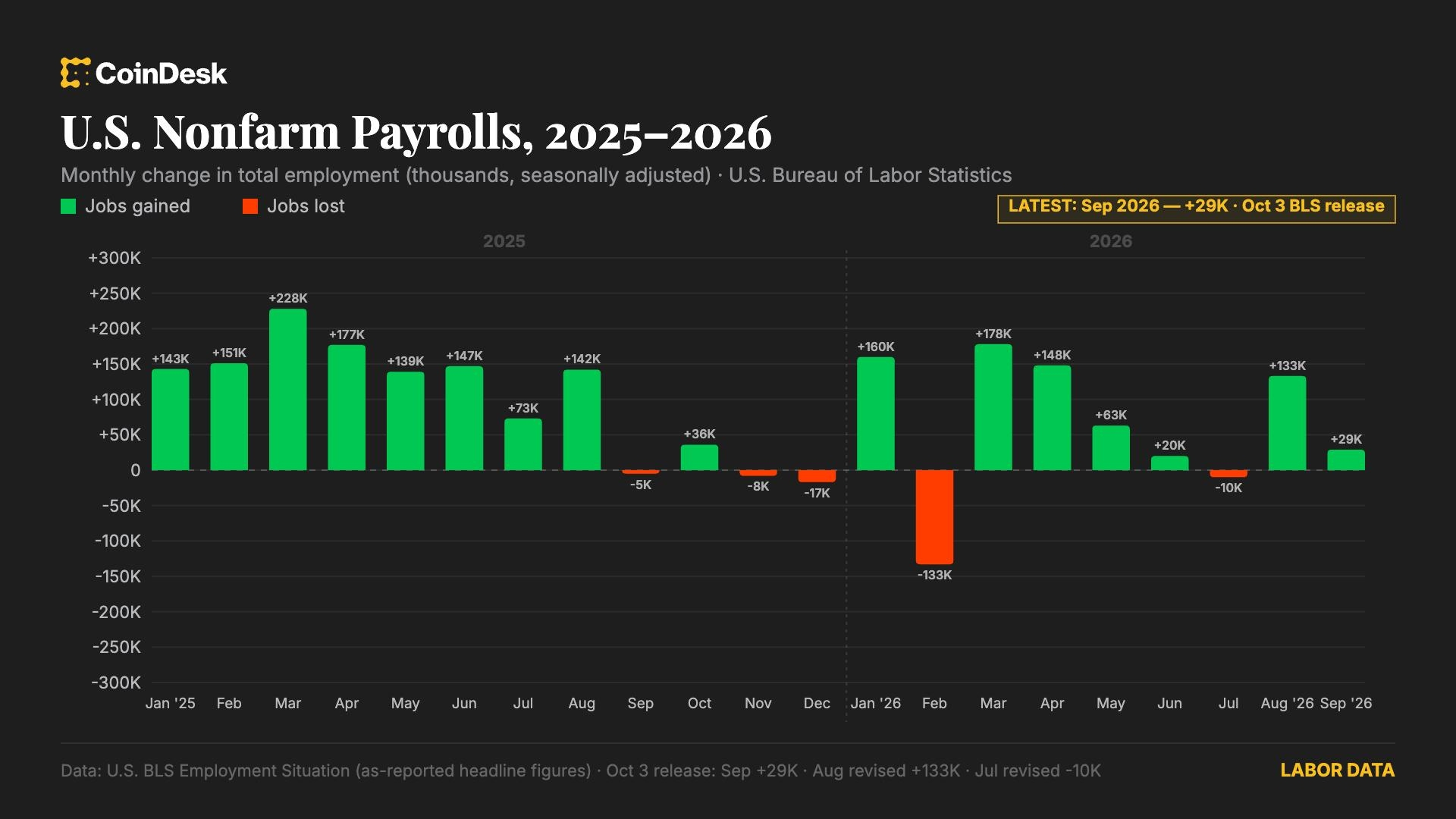
FLASH: US jobs market hits a wall. September payrolls added just 29k jobs. Unemployment ticks up to 4.2%.
• Huge macroeconomic miss triggers volatility.
• Rate cut expectations are shifting fast.
• Traders are repricing risk assets.
Watch $BTC and $ETH closely here. 🚨📉⚡
#Write2Earn #MacroEconomics #CryptoTrading
FLASH: US jobs market hits a wall. September payrolls added just 29k jobs. Unemployment ticks up to 4.2%.
• Huge macroeconomic miss triggers volatility.
• Rate cut expectations are shifting fast.
• Traders are repricing risk assets.
Watch $BTC and $ETH closely here. 🚨📉⚡
#Write2Earn #MacroEconomics #CryptoTrading
• Huge macroeconomic miss triggers volatility.
• Rate cut expectations are shifting fast.
• Traders are repricing risk assets.
Watch $BTC and $ETH closely here. 🚨📉⚡
#Write2Earn #MacroEconomics #CryptoTrading
158

In the latest trading across global financial markets today, the yield on 30-year U.S. Treasury bonds surged 6 basis points in a single day, reaching 5.7041%. This long-term benchmark rate has not only extended its recent sharp upward trend, but also directly set its highest level since 2002, signaling a major restructuring of the global risk-free rate system.
The latest surge in long-term Treasury yields to a more than 20-year high fully reflects structural concerns about persistent long-term inflation and the massive supply of government debt. Market participants are reassessing the term premium required to hold Treasuries over the long term, while optimism that the economy would quickly enter an easing cycle is being thoroughly overturned by harsh reality.
As the “anchor of global asset pricing,” the continued rise in long-term Treasury yields is having a significant tightening effect on the global financial system. Elevated risk-free returns have not only sharply increased long-term financing costs for the real economy and financial institutions, but have also weighed heavily on high-valuation equities, while accelerating the return of global liquidity to dollar-denominated fixed-income assets.
For crypto assets, marginally tighter liquidity and high borrowing costs are extremely severe macroeconomic headwinds. Against a backdrop of traditional institutional capital shifting toward high-yield fixed-income assets, risk assets such as $BTC face potential valuation pressure and liquidity outflows. Market participants must remain highly cautious about potential further downward deleveraging volatility.
#TreasuryYields #MacroEconomics #BondMarket #Bitcoin
In the latest trading across global financial markets today, the yield on 30-year U.S. Treasury bonds surged 6 basis points in a single day, reaching 5.7041%. This long-term benchmark rate has not only extended its recent sharp upward trend, but also directly set its highest level since 2002, signaling a major restructuring of the global risk-free rate system.
The latest surge in long-term Treasury yields to a more than 20-year high fully reflects structural concerns about persistent long-term inflation and the massive supply of government debt. Market participants are reassessing the term premium required to hold Treasuries over the long term, while optimism that the economy would quickly enter an easing cycle is being thoroughly overturned by harsh reality.
As the “anchor of global asset pricing,” the continued rise in long-term Treasury yields is having a significant tightening effect on the global financial system. Elevated risk-free returns have not only sharply increased long-term financing costs for the real economy and financial institutions, but have also weighed heavily on high-valuation equities, while accelerating the return of global liquidity to dollar-denominated fixed-income assets.
For crypto assets, marginally tighter liquidity and high borrowing costs are extremely severe macroeconomic headwinds. Against a backdrop of traditional institutional capital shifting toward high-yield fixed-income assets, risk assets such as $BTC face potential valuation pressure and liquidity outflows. Market participants must remain highly cautious about potential further downward deleveraging volatility.
#TreasuryYields #MacroEconomics #BondMarket #Bitcoin
The latest surge in long-term Treasury yields to a more than 20-year high fully reflects structural concerns about persistent long-term inflation and the massive supply of government debt. Market participants are reassessing the term premium required to hold Treasuries over the long term, while optimism that the economy would quickly enter an easing cycle is being thoroughly overturned by harsh reality.
As the “anchor of global asset pricing,” the continued rise in long-term Treasury yields is having a significant tightening effect on the global financial system. Elevated risk-free returns have not only sharply increased long-term financing costs for the real economy and financial institutions, but have also weighed heavily on high-valuation equities, while accelerating the return of global liquidity to dollar-denominated fixed-income assets.
For crypto assets, marginally tighter liquidity and high borrowing costs are extremely severe macroeconomic headwinds. Against a backdrop of traditional institutional capital shifting toward high-yield fixed-income assets, risk assets such as $BTC face potential valuation pressure and liquidity outflows. Market participants must remain highly cautious about potential further downward deleveraging volatility.
#TreasuryYields #MacroEconomics #BondMarket #Bitcoin
3
In her latest policy briefing, International Monetary Fund (IMF) Managing Director Kristalina Georgieva made a clear statement, stressing that the world’s major central banks must maintain a “cautiously restrictive bias” in monetary policy. She publicly endorsed the recent rate hikes by the Federal Reserve, European Central Bank and Bank of Japan, calling the tightening measures “highly appropriate,” while warning that global public debt is about to exceed 100% of global GDP.
Her remarks underscore the severe stagflationary debt pressures facing the global macroeconomic environment. Although some real-economy indicators have shown a temporary recovery, the IMF has made clear that domestic economic growth alone is unlikely to ease the massive sovereign debt burden in the short term. The endorsement of tight policy by key decision-making institutions has completely dashed market hopes that major central banks will quickly pivot to easing.
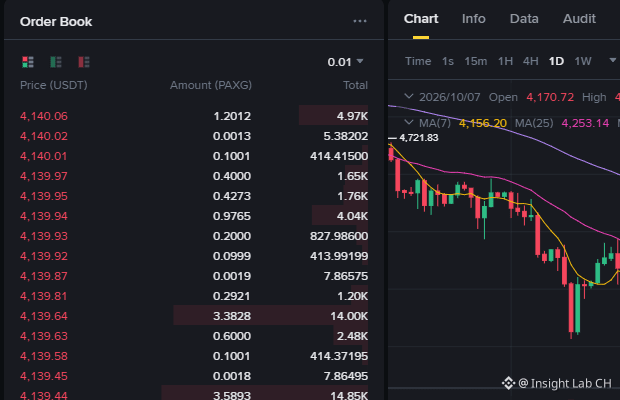
Under pressure from official hawkish rhetoric and expectations that high interest rates will persist, traditional safe-haven assets and risk markets have come under pressure at the same time. Spot gold fell sharply during the session, breaking below the $4,130-per-ounce level, down 0.81% on the day. Persistently high bond yields have not only raised financing costs for the global real economy but also strengthened the flow of capital back into the U.S. dollar, weighing on commodity rebounds.
For crypto assets, the continued tightening of liquidity by central banks worldwide poses a substantial funding headwind. With no new injection of fiat liquidity, major assets such as $BTC may face persistent liquidity shortages at elevated levels and the risk of a valuation reset. Investors should remain highly alert to the second-order downside impact of macro liquidity tightening on risk assets.
#GlobalDebt #InterestRates #MacroEconomics
In her latest policy briefing, International Monetary Fund (IMF) Managing Director Kristalina Georgieva made a clear statement, stressing that the world’s major central banks must maintain a “cautiously restrictive bias” in monetary policy. She publicly endorsed the recent rate hikes by the Federal Reserve, European Central Bank and Bank of Japan, calling the tightening measures “highly appropriate,” while warning that global public debt is about to exceed 100% of global GDP.
Her remarks underscore the severe stagflationary debt pressures facing the global macroeconomic environment. Although some real-economy indicators have shown a temporary recovery, the IMF has made clear that domestic economic growth alone is unlikely to ease the massive sovereign debt burden in the short term. The endorsement of tight policy by key decision-making institutions has completely dashed market hopes that major central banks will quickly pivot to easing.
Under pressure from official hawkish rhetoric and expectations that high interest rates will persist, traditional safe-haven assets and risk markets have come under pressure at the same time. Spot gold fell sharply during the session, breaking below the $4,130-per-ounce level, down 0.81% on the day. Persistently high bond yields have not only raised financing costs for the global real economy but also strengthened the flow of capital back into the U.S. dollar, weighing on commodity rebounds.
For crypto assets, the continued tightening of liquidity by central banks worldwide poses a substantial funding headwind. With no new injection of fiat liquidity, major assets such as $BTC may face persistent liquidity shortages at elevated levels and the risk of a valuation reset. Investors should remain highly alert to the second-order downside impact of macro liquidity tightening on risk assets.
#GlobalDebt #InterestRates #MacroEconomics
Her remarks underscore the severe stagflationary debt pressures facing the global macroeconomic environment. Although some real-economy indicators have shown a temporary recovery, the IMF has made clear that domestic economic growth alone is unlikely to ease the massive sovereign debt burden in the short term. The endorsement of tight policy by key decision-making institutions has completely dashed market hopes that major central banks will quickly pivot to easing.
Under pressure from official hawkish rhetoric and expectations that high interest rates will persist, traditional safe-haven assets and risk markets have come under pressure at the same time. Spot gold fell sharply during the session, breaking below the $4,130-per-ounce level, down 0.81% on the day. Persistently high bond yields have not only raised financing costs for the global real economy but also strengthened the flow of capital back into the U.S. dollar, weighing on commodity rebounds.
For crypto assets, the continued tightening of liquidity by central banks worldwide poses a substantial funding headwind. With no new injection of fiat liquidity, major assets such as $BTC may face persistent liquidity shortages at elevated levels and the risk of a valuation reset. Investors should remain highly alert to the second-order downside impact of macro liquidity tightening on risk assets.
#GlobalDebt #InterestRates #MacroEconomics
172
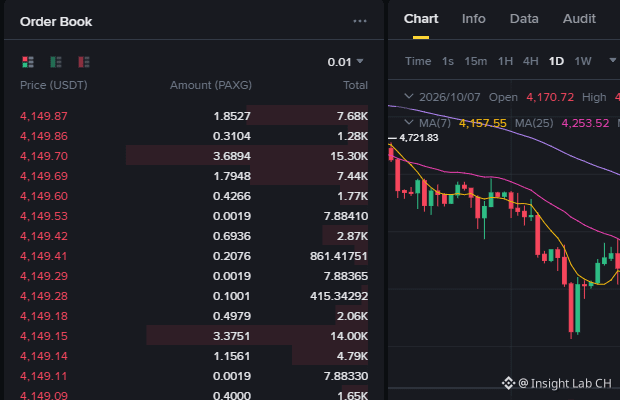
Data newly released by the People's Bank of China at the end of September showed that China's gold reserves reached 77.47 million ounces (approximately 2,409.59 tonnes), up 740,000 ounces (approximately 23.02 tonnes) from 76.73 million ounces at the end of August, marking the 23rd consecutive month of gold purchases. Meanwhile, China's foreign exchange reserves fell to $3,400.251 billion in September, down from the previous figure of $3,438.33 billion.
This sustained accumulation highlights the deepening trend of global de-dollarization and the growing demand for sovereign asset security. Against a backdrop of elevated global macroeconomic uncertainty and intensifying geopolitical tensions, shifting official reserve assets toward hard assets has become a long-term strategic choice that is difficult to reverse.
From a macro asset perspective, central banks' continued gold purchases provide strong medium- to long-term support for spot gold. However, the contraction in foreign exchange reserves and fluctuations in dollar liquidity could exacerbate valuation disagreements in global sovereign bond markets and fuel the spread of risk aversion.
For crypto markets, sovereign funds' heavy investment in hard assets reinforces the narrative of inflation hedging, but more importantly, it reflects a defensive tightening of macro liquidity conditions. High-risk assets will continue to face challenges from constrained liquidity premiums, and in the short term, $BTC is unlikely to achieve a one-way breakout based solely on safe-haven dynamics. 📊
#GoldReserves #PBOC #MacroEconomics
Data newly released by the People's Bank of China at the end of September showed that China's gold reserves reached 77.47 million ounces (approximately 2,409.59 tonnes), up 740,000 ounces (approximately 23.02 tonnes) from 76.73 million ounces at the end of August, marking the 23rd consecutive month of gold purchases. Meanwhile, China's foreign exchange reserves fell to $3,400.251 billion in September, down from the previous figure of $3,438.33 billion.
This sustained accumulation highlights the deepening trend of global de-dollarization and the growing demand for sovereign asset security. Against a backdrop of elevated global macroeconomic uncertainty and intensifying geopolitical tensions, shifting official reserve assets toward hard assets has become a long-term strategic choice that is difficult to reverse.
From a macro asset perspective, central banks' continued gold purchases provide strong medium- to long-term support for spot gold. However, the contraction in foreign exchange reserves and fluctuations in dollar liquidity could exacerbate valuation disagreements in global sovereign bond markets and fuel the spread of risk aversion.
For crypto markets, sovereign funds' heavy investment in hard assets reinforces the narrative of inflation hedging, but more importantly, it reflects a defensive tightening of macro liquidity conditions. High-risk assets will continue to face challenges from constrained liquidity premiums, and in the short term, $BTC is unlikely to achieve a one-way breakout based solely on safe-haven dynamics. 📊
#GoldReserves #PBOC #MacroEconomics
This sustained accumulation highlights the deepening trend of global de-dollarization and the growing demand for sovereign asset security. Against a backdrop of elevated global macroeconomic uncertainty and intensifying geopolitical tensions, shifting official reserve assets toward hard assets has become a long-term strategic choice that is difficult to reverse.
From a macro asset perspective, central banks' continued gold purchases provide strong medium- to long-term support for spot gold. However, the contraction in foreign exchange reserves and fluctuations in dollar liquidity could exacerbate valuation disagreements in global sovereign bond markets and fuel the spread of risk aversion.
For crypto markets, sovereign funds' heavy investment in hard assets reinforces the narrative of inflation hedging, but more importantly, it reflects a defensive tightening of macro liquidity conditions. High-risk assets will continue to face challenges from constrained liquidity premiums, and in the short term, $BTC is unlikely to achieve a one-way breakout based solely on safe-haven dynamics. 📊
#GoldReserves #PBOC #MacroEconomics
86

In its latest regular bond-purchase operation announced today, the Bank of Japan (BOJ) said it would reduce purchases of Japanese government bonds with maturities of 10–25 years to ¥85 billion (from ¥100 billion), while lowering purchases of 1–3-year bonds to ¥330 billion (from ¥355 billion).
This substantial move to scale back bond purchases is in line with market expectations that the BOJ will gradually normalize monetary policy. The pace of quantitative tightening remains steady and controlled, with no unusual spike in short-term yields, indicating that the policy transition has been very smooth.
From a macro-technical perspective, the yen has found solid support after the balance-sheet reduction was confirmed, while global carry-trade liquidity is being restructured in an orderly manner. After safe-haven sentiment eased, global risk appetite remained intact, and the overall pattern of asset prices fluctuating upward remains unchanged.
As for the crypto market, $BTC and major assets have maintained a bullish technical structure after liquidity expectations were rebalanced. Greater policy clarity has removed the uncertainty premium and, instead, laid a solid foundation for another rally in risk assets.📈
#BOJ #BondMarket #MacroEconomics
In its latest regular bond-purchase operation announced today, the Bank of Japan (BOJ) said it would reduce purchases of Japanese government bonds with maturities of 10–25 years to ¥85 billion (from ¥100 billion), while lowering purchases of 1–3-year bonds to ¥330 billion (from ¥355 billion).
This substantial move to scale back bond purchases is in line with market expectations that the BOJ will gradually normalize monetary policy. The pace of quantitative tightening remains steady and controlled, with no unusual spike in short-term yields, indicating that the policy transition has been very smooth.
From a macro-technical perspective, the yen has found solid support after the balance-sheet reduction was confirmed, while global carry-trade liquidity is being restructured in an orderly manner. After safe-haven sentiment eased, global risk appetite remained intact, and the overall pattern of asset prices fluctuating upward remains unchanged.
As for the crypto market, $BTC and major assets have maintained a bullish technical structure after liquidity expectations were rebalanced. Greater policy clarity has removed the uncertainty premium and, instead, laid a solid foundation for another rally in risk assets.📈
#BOJ #BondMarket #MacroEconomics
This substantial move to scale back bond purchases is in line with market expectations that the BOJ will gradually normalize monetary policy. The pace of quantitative tightening remains steady and controlled, with no unusual spike in short-term yields, indicating that the policy transition has been very smooth.
From a macro-technical perspective, the yen has found solid support after the balance-sheet reduction was confirmed, while global carry-trade liquidity is being restructured in an orderly manner. After safe-haven sentiment eased, global risk appetite remained intact, and the overall pattern of asset prices fluctuating upward remains unchanged.
As for the crypto market, $BTC and major assets have maintained a bullish technical structure after liquidity expectations were rebalanced. Greater policy clarity has removed the uncertainty premium and, instead, laid a solid foundation for another rally in risk assets.📈
#BOJ #BondMarket #MacroEconomics
77
Rupert Harrison, senior adviser and portfolio manager at PIMCO, said at the TS Lombard economic conference in London on Tuesday that the recent sharp rise in U.S. Treasury yields has made them exceptionally attractive for allocation. This week, both 10-year and 30-year U.S. Treasury yields hit their highest levels in nearly 24 years, reflecting persistent market concerns about sticky inflation and widening fiscal deficits.
From a technical and valuation perspective, momentum indicators have moved deep into overbought territory after long-term U.S. Treasury yields surged to 24-year highs. Statements from top institutions such as PIMCO that they are increasing their duration exposure suggest that risk-free yields may be forming a medium- to long-term peak. A peak in yields often provides strong valuation support for risk assets.
For traditional macro financial markets, if U.S. Treasury yields retreat after their sharp rise, the improved relative value of Treasuries as an allocation would effectively offset some of the pressure from a pullback in U.S. technology stocks. Expectations for a stronger dollar and tighter liquidity may also ease, opening the door to a modest loosening of overall financial conditions.
For crypto markets, a peak in risk-free yields is often a technical precursor to a rebound in high-beta assets. As resistance emerges in long-term interest rates and liquidity pressures ease, incremental sidelined capital may have greater incentive to flow back into $BTC and large-cap tokens, lifting overall bullish sentiment.
#US10Y #BondMarket #MacroEconomics
Rupert Harrison, senior adviser and portfolio manager at PIMCO, said at the TS Lombard economic conference in London on Tuesday that the recent sharp rise in U.S. Treasury yields has made them exceptionally attractive for allocation. This week, both 10-year and 30-year U.S. Treasury yields hit their highest levels in nearly 24 years, reflecting persistent market concerns about sticky inflation and widening fiscal deficits.
From a technical and valuation perspective, momentum indicators have moved deep into overbought territory after long-term U.S. Treasury yields surged to 24-year highs. Statements from top institutions such as PIMCO that they are increasing their duration exposure suggest that risk-free yields may be forming a medium- to long-term peak. A peak in yields often provides strong valuation support for risk assets.
For traditional macro financial markets, if U.S. Treasury yields retreat after their sharp rise, the improved relative value of Treasuries as an allocation would effectively offset some of the pressure from a pullback in U.S. technology stocks. Expectations for a stronger dollar and tighter liquidity may also ease, opening the door to a modest loosening of overall financial conditions.
For crypto markets, a peak in risk-free yields is often a technical precursor to a rebound in high-beta assets. As resistance emerges in long-term interest rates and liquidity pressures ease, incremental sidelined capital may have greater incentive to flow back into $BTC and large-cap tokens, lifting overall bullish sentiment.
#US10Y #BondMarket #MacroEconomics
From a technical and valuation perspective, momentum indicators have moved deep into overbought territory after long-term U.S. Treasury yields surged to 24-year highs. Statements from top institutions such as PIMCO that they are increasing their duration exposure suggest that risk-free yields may be forming a medium- to long-term peak. A peak in yields often provides strong valuation support for risk assets.
For traditional macro financial markets, if U.S. Treasury yields retreat after their sharp rise, the improved relative value of Treasuries as an allocation would effectively offset some of the pressure from a pullback in U.S. technology stocks. Expectations for a stronger dollar and tighter liquidity may also ease, opening the door to a modest loosening of overall financial conditions.
For crypto markets, a peak in risk-free yields is often a technical precursor to a rebound in high-beta assets. As resistance emerges in long-term interest rates and liquidity pressures ease, incremental sidelined capital may have greater incentive to flow back into $BTC and large-cap tokens, lifting overall bullish sentiment.
#US10Y #BondMarket #MacroEconomics
111
The U.S. Department of Commerce released the latest foreign trade data on October 7. The U.S. trade deficit widened further to $105.6 billion in August, exceeding market expectations of $102 billion. Meanwhile, the July trade deficit was also revised sharply upward, from $88.6 billion to $92.8 billion. Total imports rose to $420.8 billion in August, significantly exceeding exports of $315.2 billion.
The persistent widening of the trade deficit indicates that U.S. domestic demand remains highly dependent on overseas supply chains, while the global economic slowdown is materially curbing U.S. export momentum. The sharp deterioration in net exports will directly weigh on estimates of third-quarter real GDP growth, undermining the market’s previously overheated expectations for a soft landing in the second half of the year.
In macro financial markets, the widening deficit, combined with the risk of twin deficits, is putting short-term pressure on the U.S. dollar index, while the Treasury yield curve faces a structural reassessment. Rising concerns about downside risks to economic growth are prompting safe-haven flows into defensive assets such as government bonds, noticeably dampening risk appetite.
For crypto markets, weakening macro fundamentals may constrain liquidity injections in the short term. Although a weaker dollar usually benefits risk assets, concerns about a liquidity crisis remain elevated amid the combined pressures of slowing economic growth and the lagged effects of tight monetary policy. $BTC remains range-bound around key resistance levels, and may struggle to escape the risk of high volatility in the near term.
#TradeDeficit #MacroEconomics #CryptoLiquidity
The U.S. Department of Commerce released the latest foreign trade data on October 7. The U.S. trade deficit widened further to $105.6 billion in August, exceeding market expectations of $102 billion. Meanwhile, the July trade deficit was also revised sharply upward, from $88.6 billion to $92.8 billion. Total imports rose to $420.8 billion in August, significantly exceeding exports of $315.2 billion.
The persistent widening of the trade deficit indicates that U.S. domestic demand remains highly dependent on overseas supply chains, while the global economic slowdown is materially curbing U.S. export momentum. The sharp deterioration in net exports will directly weigh on estimates of third-quarter real GDP growth, undermining the market’s previously overheated expectations for a soft landing in the second half of the year.
In macro financial markets, the widening deficit, combined with the risk of twin deficits, is putting short-term pressure on the U.S. dollar index, while the Treasury yield curve faces a structural reassessment. Rising concerns about downside risks to economic growth are prompting safe-haven flows into defensive assets such as government bonds, noticeably dampening risk appetite.
For crypto markets, weakening macro fundamentals may constrain liquidity injections in the short term. Although a weaker dollar usually benefits risk assets, concerns about a liquidity crisis remain elevated amid the combined pressures of slowing economic growth and the lagged effects of tight monetary policy. $BTC remains range-bound around key resistance levels, and may struggle to escape the risk of high volatility in the near term.
#TradeDeficit #MacroEconomics #CryptoLiquidity
The persistent widening of the trade deficit indicates that U.S. domestic demand remains highly dependent on overseas supply chains, while the global economic slowdown is materially curbing U.S. export momentum. The sharp deterioration in net exports will directly weigh on estimates of third-quarter real GDP growth, undermining the market’s previously overheated expectations for a soft landing in the second half of the year.
In macro financial markets, the widening deficit, combined with the risk of twin deficits, is putting short-term pressure on the U.S. dollar index, while the Treasury yield curve faces a structural reassessment. Rising concerns about downside risks to economic growth are prompting safe-haven flows into defensive assets such as government bonds, noticeably dampening risk appetite.
For crypto markets, weakening macro fundamentals may constrain liquidity injections in the short term. Although a weaker dollar usually benefits risk assets, concerns about a liquidity crisis remain elevated amid the combined pressures of slowing economic growth and the lagged effects of tight monetary policy. $BTC remains range-bound around key resistance levels, and may struggle to escape the risk of high volatility in the near term.
#TradeDeficit #MacroEconomics #CryptoLiquidity
132

·
--
Japan’s Ministry of Finance completed its latest 10-year government bond auction today, setting the coupon rate at 3.1%—the highest in nearly 30 years, since August 1996. The bid-to-cover ratio rose to 3.76 from 3.29 at the previous auction, indicating that the market is reassessing pricing amid a sharp rise in yields.
The adjustment directly reflects the continued rise in government bond yields on the secondary market and a reassessment of global public debt pressures. The benchmark rate was 2.4% from April to June and rose to 2.7% from July to September. It has now surged past the 3% mark, signaling that the long-standing low-interest-rate environment is rapidly reversing.
For traditional financial markets, Japan is a major global source of low-cost funding. A jump in its risk-free yield could prompt carry-trade capital to flow back home, with subtle effects on global bond markets and dollar liquidity. Valuation frameworks for foreign exchange and equities may also be reshaped.
In crypto markets, core assets such as $BTC tend to be sensitive to shifts in global macro liquidity. As borrowing costs rise for some low-cost funding sources, speculative capital flows could be curbed. Others, however, argue that this may further highlight the long-term diversification value of inflation-resistant assets. Whether this triggers short-term selling pressure or steady accumulation remains worth watching.💡
#JapanBonds #InterestRates #MacroEconomics
Japan’s Ministry of Finance completed its latest 10-year government bond auction today, setting the coupon rate at 3.1%—the highest in nearly 30 years, since August 1996. The bid-to-cover ratio rose to 3.76 from 3.29 at the previous auction, indicating that the market is reassessing pricing amid a sharp rise in yields.
The adjustment directly reflects the continued rise in government bond yields on the secondary market and a reassessment of global public debt pressures. The benchmark rate was 2.4% from April to June and rose to 2.7% from July to September. It has now surged past the 3% mark, signaling that the long-standing low-interest-rate environment is rapidly reversing.
For traditional financial markets, Japan is a major global source of low-cost funding. A jump in its risk-free yield could prompt carry-trade capital to flow back home, with subtle effects on global bond markets and dollar liquidity. Valuation frameworks for foreign exchange and equities may also be reshaped.
In crypto markets, core assets such as $BTC tend to be sensitive to shifts in global macro liquidity. As borrowing costs rise for some low-cost funding sources, speculative capital flows could be curbed. Others, however, argue that this may further highlight the long-term diversification value of inflation-resistant assets. Whether this triggers short-term selling pressure or steady accumulation remains worth watching.💡
#JapanBonds #InterestRates #MacroEconomics
The adjustment directly reflects the continued rise in government bond yields on the secondary market and a reassessment of global public debt pressures. The benchmark rate was 2.4% from April to June and rose to 2.7% from July to September. It has now surged past the 3% mark, signaling that the long-standing low-interest-rate environment is rapidly reversing.
For traditional financial markets, Japan is a major global source of low-cost funding. A jump in its risk-free yield could prompt carry-trade capital to flow back home, with subtle effects on global bond markets and dollar liquidity. Valuation frameworks for foreign exchange and equities may also be reshaped.
In crypto markets, core assets such as $BTC tend to be sensitive to shifts in global macro liquidity. As borrowing costs rise for some low-cost funding sources, speculative capital flows could be curbed. Others, however, argue that this may further highlight the long-term diversification value of inflation-resistant assets. Whether this triggers short-term selling pressure or steady accumulation remains worth watching.💡
#JapanBonds #InterestRates #MacroEconomics
38
Japan’s Ministry of Finance today announced that the coupon rate on the latest 10-year government bonds has been set at 3.1%, the highest in nearly 30 years, since August 1996. In the 10-year bond auction held the same day, the bid-to-cover ratio rose to 3.76 from 3.29 at the previous auction, while the yield at the auction also reached a nearly 30-year high. This shows that, against a backdrop of persistently rising secondary-market yields, Japan’s benchmark government bond rate has officially broken through the 3% mark.
This landmark repricing reflects how pressure from global sovereign debt is driving a structural upward shift in the center of the range for Japanese government bond yields. The Ministry of Finance has raised the coupon rate sharply in successive quarters, from 2.4% in the second quarter to 2.7% in the previous quarter and now to 3.1%, aiming to prevent the bonds from being issued at a steep discount. The higher bid-to-cover ratio indicates that demand from buy-and-hold investors remains resilient near key support levels.
For traditional financial markets, the 10-year Japanese government bond yield rising above 3.1% has driven sovereign yields higher globally, but strong auction demand has helped ease panic. The market is gradually fully pricing in a reassessment of expectations for yen liquidity, and after sharp volatility, signs are emerging of capital flowing back into higher-risk assets. Risk assets overall are showing technical resilience.
For crypto markets, the gradual materialization of expectations for tighter macro liquidity has instead removed some tail risks. As expectations grow that traditional sovereign bond yields are nearing a peak, core digital assets such as $BTC are showing exceptionally strong downside support. Dip buyers have been active at key technical levels, creating near-term conditions for a rebound and recovery in risk assets. 📊
#JapanYield #JGB #MacroEconomics
Japan’s Ministry of Finance today announced that the coupon rate on the latest 10-year government bonds has been set at 3.1%, the highest in nearly 30 years, since August 1996. In the 10-year bond auction held the same day, the bid-to-cover ratio rose to 3.76 from 3.29 at the previous auction, while the yield at the auction also reached a nearly 30-year high. This shows that, against a backdrop of persistently rising secondary-market yields, Japan’s benchmark government bond rate has officially broken through the 3% mark.
This landmark repricing reflects how pressure from global sovereign debt is driving a structural upward shift in the center of the range for Japanese government bond yields. The Ministry of Finance has raised the coupon rate sharply in successive quarters, from 2.4% in the second quarter to 2.7% in the previous quarter and now to 3.1%, aiming to prevent the bonds from being issued at a steep discount. The higher bid-to-cover ratio indicates that demand from buy-and-hold investors remains resilient near key support levels.
For traditional financial markets, the 10-year Japanese government bond yield rising above 3.1% has driven sovereign yields higher globally, but strong auction demand has helped ease panic. The market is gradually fully pricing in a reassessment of expectations for yen liquidity, and after sharp volatility, signs are emerging of capital flowing back into higher-risk assets. Risk assets overall are showing technical resilience.
For crypto markets, the gradual materialization of expectations for tighter macro liquidity has instead removed some tail risks. As expectations grow that traditional sovereign bond yields are nearing a peak, core digital assets such as $BTC are showing exceptionally strong downside support. Dip buyers have been active at key technical levels, creating near-term conditions for a rebound and recovery in risk assets. 📊
#JapanYield #JGB #MacroEconomics
This landmark repricing reflects how pressure from global sovereign debt is driving a structural upward shift in the center of the range for Japanese government bond yields. The Ministry of Finance has raised the coupon rate sharply in successive quarters, from 2.4% in the second quarter to 2.7% in the previous quarter and now to 3.1%, aiming to prevent the bonds from being issued at a steep discount. The higher bid-to-cover ratio indicates that demand from buy-and-hold investors remains resilient near key support levels.
For traditional financial markets, the 10-year Japanese government bond yield rising above 3.1% has driven sovereign yields higher globally, but strong auction demand has helped ease panic. The market is gradually fully pricing in a reassessment of expectations for yen liquidity, and after sharp volatility, signs are emerging of capital flowing back into higher-risk assets. Risk assets overall are showing technical resilience.
For crypto markets, the gradual materialization of expectations for tighter macro liquidity has instead removed some tail risks. As expectations grow that traditional sovereign bond yields are nearing a peak, core digital assets such as $BTC are showing exceptionally strong downside support. Dip buyers have been active at key technical levels, creating near-term conditions for a rebound and recovery in risk assets. 📊
#JapanYield #JGB #MacroEconomics
53
·
--
📊 The U.S. fixed-income market saw a major shock this week, as the 30-year Treasury yield surged intraday to 5.69%, setting a nearly 24-year high. This landmark move pushed the global borrowing benchmark to a level rarely seen this century, signaling that selling pressure on ultra-long-term Treasuries remains intense in the secondary market.
A sustained break above recent highs in long-term Treasury yields carries significant macroeconomic implications, directly shattering overly optimistic market expectations that long-term borrowing costs would fall quickly. With the U.S. government continuing to expand its debt issuance and inflation remaining stubbornly elevated over the long term, global investors are demanding a higher term premium to hedge against the risk of purchasing power erosion over the coming decades.
From the perspective of macro-asset linkages, the 30-year Treasury yield is an important component of the global asset-pricing benchmark. Its sharp rise is bound to feed directly into mortgage and corporate bond markets, intensifying the valuation-discount pressure on risk assets. At the same time, stronger expectations for benchmark interest rates are providing temporary support for dollar-denominated assets, further tightening traditional financial liquidity conditions.
As for the cryptocurrency market, a risk-free yield of 5.69% will undoubtedly divert some incremental institutional capital seeking stable returns, putting short-term liquidity in $BTC and major tokens to the test. From another perspective, however, concerns about expanding sovereign debt, reflected in the continued rise in long-term Treasury yields, are keeping some investors focused on the long-term potential of crypto-native assets as a hedge.
#TreasuryYields #MacroEconomics #CryptoMarket
📊 The U.S. fixed-income market saw a major shock this week, as the 30-year Treasury yield surged intraday to 5.69%, setting a nearly 24-year high. This landmark move pushed the global borrowing benchmark to a level rarely seen this century, signaling that selling pressure on ultra-long-term Treasuries remains intense in the secondary market.
A sustained break above recent highs in long-term Treasury yields carries significant macroeconomic implications, directly shattering overly optimistic market expectations that long-term borrowing costs would fall quickly. With the U.S. government continuing to expand its debt issuance and inflation remaining stubbornly elevated over the long term, global investors are demanding a higher term premium to hedge against the risk of purchasing power erosion over the coming decades.
From the perspective of macro-asset linkages, the 30-year Treasury yield is an important component of the global asset-pricing benchmark. Its sharp rise is bound to feed directly into mortgage and corporate bond markets, intensifying the valuation-discount pressure on risk assets. At the same time, stronger expectations for benchmark interest rates are providing temporary support for dollar-denominated assets, further tightening traditional financial liquidity conditions.
As for the cryptocurrency market, a risk-free yield of 5.69% will undoubtedly divert some incremental institutional capital seeking stable returns, putting short-term liquidity in $BTC and major tokens to the test. From another perspective, however, concerns about expanding sovereign debt, reflected in the continued rise in long-term Treasury yields, are keeping some investors focused on the long-term potential of crypto-native assets as a hedge.
#TreasuryYields #MacroEconomics #CryptoMarket
A sustained break above recent highs in long-term Treasury yields carries significant macroeconomic implications, directly shattering overly optimistic market expectations that long-term borrowing costs would fall quickly. With the U.S. government continuing to expand its debt issuance and inflation remaining stubbornly elevated over the long term, global investors are demanding a higher term premium to hedge against the risk of purchasing power erosion over the coming decades.
From the perspective of macro-asset linkages, the 30-year Treasury yield is an important component of the global asset-pricing benchmark. Its sharp rise is bound to feed directly into mortgage and corporate bond markets, intensifying the valuation-discount pressure on risk assets. At the same time, stronger expectations for benchmark interest rates are providing temporary support for dollar-denominated assets, further tightening traditional financial liquidity conditions.
As for the cryptocurrency market, a risk-free yield of 5.69% will undoubtedly divert some incremental institutional capital seeking stable returns, putting short-term liquidity in $BTC and major tokens to the test. From another perspective, however, concerns about expanding sovereign debt, reflected in the continued rise in long-term Treasury yields, are keeping some investors focused on the long-term potential of crypto-native assets as a hedge.
#TreasuryYields #MacroEconomics #CryptoMarket
287
·
--
S&P Global reported in its latest release that the final U.S. services PMI for September came in at 58.8, up from 58.7 previously, while the final composite PMI held steady at 58.4. The pace of business activity expansion climbed to its highest level in more than five years, new order growth hit a four-and-a-half-year high, and job creation was the strongest since mid-2022.
These robust figures suggest that U.S. economic growth in the third quarter could approach 4%, but the other side of the coin is that inflationary pressures are beginning to re-emerge. The chief business economist noted that inflation in business input costs rose to a four-year high. Rising service prices, combined with higher fuel costs, are fueling concerns that the economy may be overheating.
In macro financial markets, the strong PMI data further dampened expectations for a rapid easing of monetary policy, keeping the U.S. dollar index and Treasury yields relatively firm in the near term. While economic fundamentals remain solid, persistent cost pressures are making the outlook for interest rates increasingly uncertain.
For crypto markets, expectations for macro liquidity remain a key driver of investor sentiment. If sticky inflation keeps interest rates elevated for longer, risk assets could face near-term valuation pressure. However, a strong macroeconomy also provides a floor for overall liquidity, and the market is still seeking a clear direction amid the ongoing tug-of-war between bulls and bears. #SPGlobalPMI #MacroEconomics #CryptoMarket
S&P Global reported in its latest release that the final U.S. services PMI for September came in at 58.8, up from 58.7 previously, while the final composite PMI held steady at 58.4. The pace of business activity expansion climbed to its highest level in more than five years, new order growth hit a four-and-a-half-year high, and job creation was the strongest since mid-2022.
These robust figures suggest that U.S. economic growth in the third quarter could approach 4%, but the other side of the coin is that inflationary pressures are beginning to re-emerge. The chief business economist noted that inflation in business input costs rose to a four-year high. Rising service prices, combined with higher fuel costs, are fueling concerns that the economy may be overheating.
In macro financial markets, the strong PMI data further dampened expectations for a rapid easing of monetary policy, keeping the U.S. dollar index and Treasury yields relatively firm in the near term. While economic fundamentals remain solid, persistent cost pressures are making the outlook for interest rates increasingly uncertain.
For crypto markets, expectations for macro liquidity remain a key driver of investor sentiment. If sticky inflation keeps interest rates elevated for longer, risk assets could face near-term valuation pressure. However, a strong macroeconomy also provides a floor for overall liquidity, and the market is still seeking a clear direction amid the ongoing tug-of-war between bulls and bears. #SPGlobalPMI #MacroEconomics #CryptoMarket
These robust figures suggest that U.S. economic growth in the third quarter could approach 4%, but the other side of the coin is that inflationary pressures are beginning to re-emerge. The chief business economist noted that inflation in business input costs rose to a four-year high. Rising service prices, combined with higher fuel costs, are fueling concerns that the economy may be overheating.
In macro financial markets, the strong PMI data further dampened expectations for a rapid easing of monetary policy, keeping the U.S. dollar index and Treasury yields relatively firm in the near term. While economic fundamentals remain solid, persistent cost pressures are making the outlook for interest rates increasingly uncertain.
For crypto markets, expectations for macro liquidity remain a key driver of investor sentiment. If sticky inflation keeps interest rates elevated for longer, risk assets could face near-term valuation pressure. However, a strong macroeconomy also provides a floor for overall liquidity, and the market is still seeking a clear direction amid the ongoing tug-of-war between bulls and bears. #SPGlobalPMI #MacroEconomics #CryptoMarket
29
Eurostat officially released data today showing that the eurozone’s Producer Price Index (PPI) rose 1.9% month over month in August, in line with market expectations but accelerating from the previous reading of 1.60%. Year over year, it rose 8.2%, slightly exceeding expectations of 8.1% and significantly above the previous reading of 5.80%.
From a macroeconomic perspective, the significant rise in the PPI confirms that industrial costs in Europe are establishing a solid technical floor. Although inflationary pressures are accelerating in the short term, this also directly reflects a rapid recovery in demand across the eurozone’s upstream manufacturing sector. The resilience of economic fundamentals is clearly stronger than previously anticipated amid pessimistic recession forecasts.
In traditional financial markets, the data directly reinforced expectations that the European Central Bank will maintain a relatively tight policy stance, pushing European bond yields modestly higher while providing key technical support for the euro. A strong rebound in commodities and energy is becoming a core driver of stabilizing and rising global inflation expectations.
For crypto markets, the stronger-than-expected PPI rebound has dispelled systemic concerns about a hard landing in Europe, effectively boosting risk appetite. As the liquidity outlook gradually becomes clearer, $BTC and major crypto assets may stabilize at key support levels and, underpinned by inflation-trading dynamics, begin a new upward move.🚀
#Eurozone #PPI #MacroEconomics
Eurostat officially released data today showing that the eurozone’s Producer Price Index (PPI) rose 1.9% month over month in August, in line with market expectations but accelerating from the previous reading of 1.60%. Year over year, it rose 8.2%, slightly exceeding expectations of 8.1% and significantly above the previous reading of 5.80%.
From a macroeconomic perspective, the significant rise in the PPI confirms that industrial costs in Europe are establishing a solid technical floor. Although inflationary pressures are accelerating in the short term, this also directly reflects a rapid recovery in demand across the eurozone’s upstream manufacturing sector. The resilience of economic fundamentals is clearly stronger than previously anticipated amid pessimistic recession forecasts.
In traditional financial markets, the data directly reinforced expectations that the European Central Bank will maintain a relatively tight policy stance, pushing European bond yields modestly higher while providing key technical support for the euro. A strong rebound in commodities and energy is becoming a core driver of stabilizing and rising global inflation expectations.
For crypto markets, the stronger-than-expected PPI rebound has dispelled systemic concerns about a hard landing in Europe, effectively boosting risk appetite. As the liquidity outlook gradually becomes clearer, $BTC and major crypto assets may stabilize at key support levels and, underpinned by inflation-trading dynamics, begin a new upward move.🚀
#Eurozone #PPI #MacroEconomics
From a macroeconomic perspective, the significant rise in the PPI confirms that industrial costs in Europe are establishing a solid technical floor. Although inflationary pressures are accelerating in the short term, this also directly reflects a rapid recovery in demand across the eurozone’s upstream manufacturing sector. The resilience of economic fundamentals is clearly stronger than previously anticipated amid pessimistic recession forecasts.
In traditional financial markets, the data directly reinforced expectations that the European Central Bank will maintain a relatively tight policy stance, pushing European bond yields modestly higher while providing key technical support for the euro. A strong rebound in commodities and energy is becoming a core driver of stabilizing and rising global inflation expectations.
For crypto markets, the stronger-than-expected PPI rebound has dispelled systemic concerns about a hard landing in Europe, effectively boosting risk appetite. As the liquidity outlook gradually becomes clearer, $BTC and major crypto assets may stabilize at key support levels and, underpinned by inflation-trading dynamics, begin a new upward move.🚀
#Eurozone #PPI #MacroEconomics
67

#FedOctoberRateHikeOddsFallTo17%
🚨 Macro Alert: Fed October Rate Hike Odds Plunge! 🚨
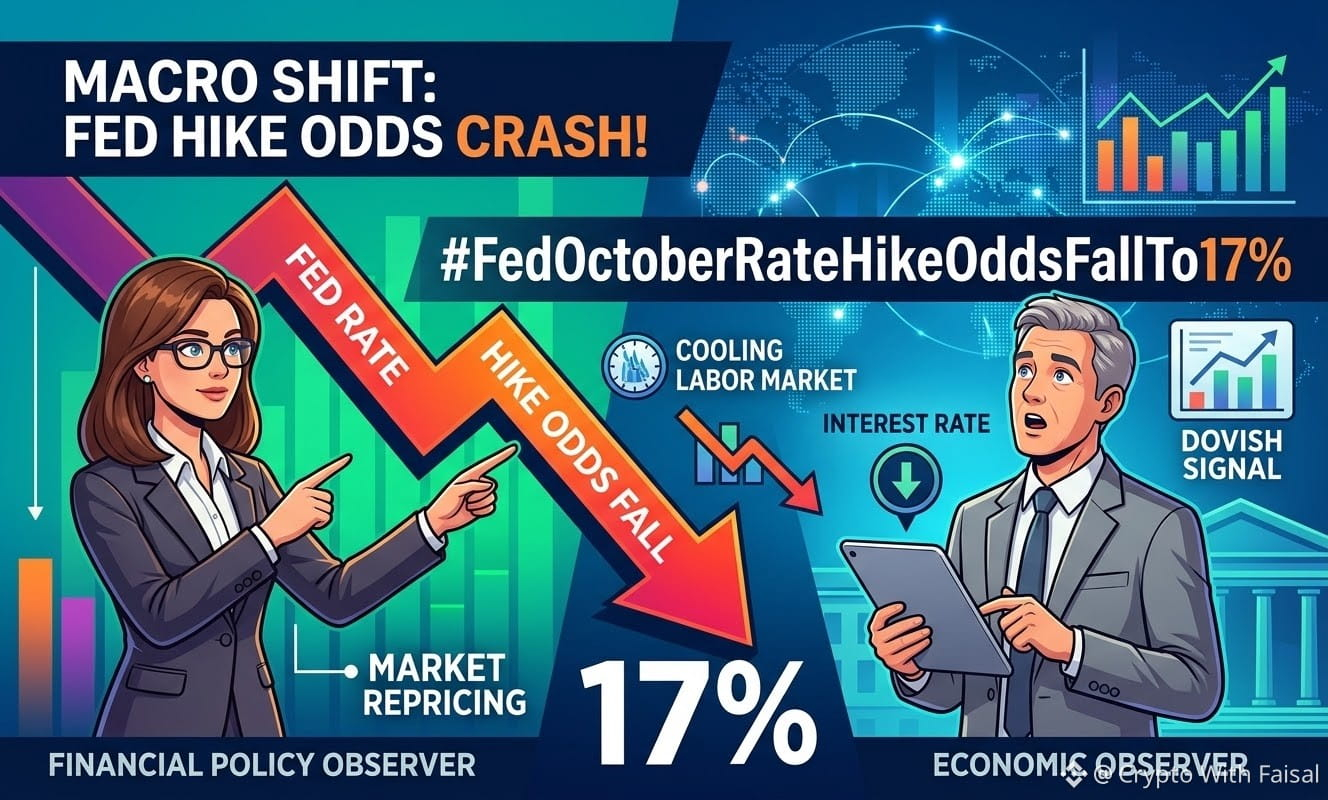
The macroeconomic landscape just shifted dramatically, and it’s massive news for crypto markets. The odds of a Federal Reserve rate hike in October have crashed to just 17%.
Here is the verified breakdown:
The Trigger: A surprisingly weak U.S. September jobs report severely reduced evidence of inflationary labor pressures.
The Numbers: CME's FedWatch tool and prediction markets now show an 83% probability that the Fed will hold rates steady, completely flipping the script from previous expectations.
Market Action: Over $23.1 million in volume rushed into Polymarket's "no change" contract as traders rapidly repriced their bets.
What does this mean for Crypto? 📉📈
When the probability of rate hikes falls, the opportunity cost of holding non-yielding risk assets like Bitcoin decreases. Tighter monetary policy is the primary macro headwind for crypto, so this sudden dovish shift often correlates with risk-on relief rallies.
With the labor market cooling, the Fed's primary justification for further tightening is fading fast.
🗣️ What is your strategy? Are you positioning for a bullish Q4, or playing it safe? Drop your thoughts below! 👇
#Crypto #MacroEconomics #BinanceSquare
$PUMPBTC
{future}(PUMPBTCUSDT)
$VELVET
{future}(VELVETUSDT)
$EVAA
{future}(EVAAUSDT)
#FedOctoberRateHikeOddsFallTo17%
🚨 Macro Alert: Fed October Rate Hike Odds Plunge! 🚨
The macroeconomic landscape just shifted dramatically, and it’s massive news for crypto markets. The odds of a Federal Reserve rate hike in October have crashed to just 17%.
Here is the verified breakdown:
The Trigger: A surprisingly weak U.S. September jobs report severely reduced evidence of inflationary labor pressures.
The Numbers: CME's FedWatch tool and prediction markets now show an 83% probability that the Fed will hold rates steady, completely flipping the script from previous expectations.
Market Action: Over $23.1 million in volume rushed into Polymarket's "no change" contract as traders rapidly repriced their bets.
What does this mean for Crypto? 📉📈
When the probability of rate hikes falls, the opportunity cost of holding non-yielding risk assets like Bitcoin decreases. Tighter monetary policy is the primary macro headwind for crypto, so this sudden dovish shift often correlates with risk-on relief rallies.
With the labor market cooling, the Fed's primary justification for further tightening is fading fast.
🗣️ What is your strategy? Are you positioning for a bullish Q4, or playing it safe? Drop your thoughts below! 👇
#Crypto #MacroEconomics #BinanceSquare
$PUMPBTC
$VELVET
$EVAA
🚨 Macro Alert: Fed October Rate Hike Odds Plunge! 🚨
The macroeconomic landscape just shifted dramatically, and it’s massive news for crypto markets. The odds of a Federal Reserve rate hike in October have crashed to just 17%.
Here is the verified breakdown:
The Trigger: A surprisingly weak U.S. September jobs report severely reduced evidence of inflationary labor pressures.
The Numbers: CME's FedWatch tool and prediction markets now show an 83% probability that the Fed will hold rates steady, completely flipping the script from previous expectations.
Market Action: Over $23.1 million in volume rushed into Polymarket's "no change" contract as traders rapidly repriced their bets.
What does this mean for Crypto? 📉📈
When the probability of rate hikes falls, the opportunity cost of holding non-yielding risk assets like Bitcoin decreases. Tighter monetary policy is the primary macro headwind for crypto, so this sudden dovish shift often correlates with risk-on relief rallies.
With the labor market cooling, the Fed's primary justification for further tightening is fading fast.
🗣️ What is your strategy? Are you positioning for a bullish Q4, or playing it safe? Drop your thoughts below! 👇
#Crypto #MacroEconomics #BinanceSquare
$PUMPBTC
$VELVET
$EVAA
452

Bad macroeconomic news is often the exact fuel that triggers the next parabolic crypto rally.
Most market participants panic the moment they see hiring slow down, selling their spot positions right before liquidity conditions ease and the real expansion begins. It is the classic mistake of confusing a cooling labor market with a dying market, leaving traders sidelined while smart money quietly accumulates the dip.
We just witnessed the US economy add a mere 29,000 jobs in September against the 90,000 forecast, with unemployment climbing to 4.2%. Even more revealing are the revisions, with August cut down to 133,000 and July plunging into negative territory with a net loss of 10,000 jobs. When jobs data deteriorates this fast, central banks lose their appetite for rate hikes and the narrative rapidly pivots toward rate cuts and monetary easing.
Having traded through multiple cycles since 2017, I have seen this exact macro setup play out before. When traditional economic growth stalls and rate hike odds collapse, capital naturally seeks asymmetric upside in assets like $BTC and high-beta plays like $ETH or $SOL as liquidity expectations shift.
How are you adjusting your spot exposure heading into the next policy decision?
#MacroEconomics #Bitcoin #CryptoMarket
Bad macroeconomic news is often the exact fuel that triggers the next parabolic crypto rally.
Most market participants panic the moment they see hiring slow down, selling their spot positions right before liquidity conditions ease and the real expansion begins. It is the classic mistake of confusing a cooling labor market with a dying market, leaving traders sidelined while smart money quietly accumulates the dip.
We just witnessed the US economy add a mere 29,000 jobs in September against the 90,000 forecast, with unemployment climbing to 4.2%. Even more revealing are the revisions, with August cut down to 133,000 and July plunging into negative territory with a net loss of 10,000 jobs. When jobs data deteriorates this fast, central banks lose their appetite for rate hikes and the narrative rapidly pivots toward rate cuts and monetary easing.
Having traded through multiple cycles since 2017, I have seen this exact macro setup play out before. When traditional economic growth stalls and rate hike odds collapse, capital naturally seeks asymmetric upside in assets like $BTC and high-beta plays like $ETH or $SOL as liquidity expectations shift.
How are you adjusting your spot exposure heading into the next policy decision?
#MacroEconomics #Bitcoin #CryptoMarket
Most market participants panic the moment they see hiring slow down, selling their spot positions right before liquidity conditions ease and the real expansion begins. It is the classic mistake of confusing a cooling labor market with a dying market, leaving traders sidelined while smart money quietly accumulates the dip.
We just witnessed the US economy add a mere 29,000 jobs in September against the 90,000 forecast, with unemployment climbing to 4.2%. Even more revealing are the revisions, with August cut down to 133,000 and July plunging into negative territory with a net loss of 10,000 jobs. When jobs data deteriorates this fast, central banks lose their appetite for rate hikes and the narrative rapidly pivots toward rate cuts and monetary easing.
Having traded through multiple cycles since 2017, I have seen this exact macro setup play out before. When traditional economic growth stalls and rate hike odds collapse, capital naturally seeks asymmetric upside in assets like $BTC and high-beta plays like $ETH or $SOL as liquidity expectations shift.
How are you adjusting your spot exposure heading into the next policy decision?
#MacroEconomics #Bitcoin #CryptoMarket

106

·
--
Article
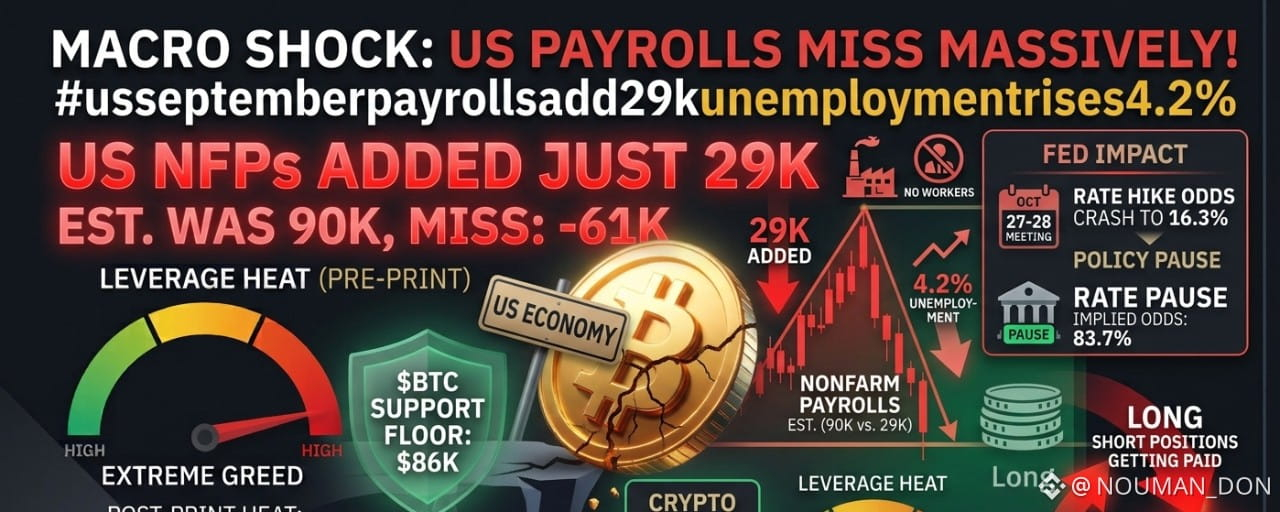
#usseptemberpayrollsadd29kunemploymentrises4.2%#usseptemberpayrollsadd29kunemploymentrises4.2% 🚨 MACRO SHOCK: US September Nonfarm Payrolls Crash to 29K! 📉🛑
The economic radar just went completely haywire! The official US Nonfarm Payrolls added just 29,000 jobs in September, completely missing the 90,000 consensus estimate by an absolute mile Crypto News | September Payrolls Crash to 29,000 — Missing ... Jobs report September 2026:. Concurrently, the US unemployment rate ticked up to 4.2% September US Jobs Report: 29,000 Rise in Payrolls, Softer ....
This is the ultimate "low-hire, low-fire" scenario playing out in real-time US job growth slows sharply in September; unemployment rate rises to 4.2%. While companies aren't aggressively firing staff, they have essentially frozen major hiring expansions US job growth slows sharply in September; unemployment rate rises to 4.2%.
💸 The Fed Interest Rate Angle:
Before this release, the odds of another interest rate hike by the Federal Reserve at the upcoming October 27-28 meeting were sitting around 30% Crypto News | September Payrolls Crash to 29,000 — Missing ... Jobs report September 2026:. This 29,000 print effectively destroys the argument for any further rate tightening. In fact, market-implied odds immediately surged to 83.7% that the Fed will leave benchmark rates completely unchanged at 3.75%-4.00% Payrolls Add Just 29000 in September, Unemployment Hits ... Jobs report September 2026:.
⚡ Crypto Market Impact:
Instead of panicking over the weak employment print, the crypto markets are treating this as macro relief. Bitcoin ($BTC) is holding strong near $86,500 despite carrying an aggressive 10% annualized leverage funding rate into the print Crypto News | September Payrolls Crash to 29,000 — Missing .... Policy ease is historically rocket fuel for risk assets, but watch the leverage levels carefully! 🌪️
👇 Let’s look at the charts in the feed:
Does this data confirm the macro bottom is behind us, or will a cooling economy eventually drag down crypto?
🟢 BULLISH INTEREST RATE PAUSE | 🔴 BEARISH ECONOMIC SLOWDOWN
#usseptemberpayrollsadd29kunemploymentrises4.2% #MacroEconomics #FedRate #BinanceSquare
#usseptemberpayrollsadd29kunemploymentrises4.2%
#usseptemberpayrollsadd29kunemploymentrises4.2% 🚨 MACRO SHOCK: US September Nonfarm Payrolls Crash to 29K! 📉🛑
The economic radar just went completely haywire! The official US Nonfarm Payrolls added just 29,000 jobs in September, completely missing the 90,000 consensus estimate by an absolute mile Crypto News | September Payrolls Crash to 29,000 — Missing ... Jobs report September 2026:. Concurrently, the US unemployment rate ticked up to 4.2% September US Jobs Report: 29,000 Rise in Payrolls, Softer ....
This is the ultimate "low-hire, low-fire" scenario playing out in real-time US job growth slows sharply in September; unemployment rate rises to 4.2%. While companies aren't aggressively firing staff, they have essentially frozen major hiring expansions US job growth slows sharply in September; unemployment rate rises to 4.2%.
💸 The Fed Interest Rate Angle:
Before this release, the odds of another interest rate hike by the Federal Reserve at the upcoming October 27-28 meeting were sitting around 30% Crypto News | September Payrolls Crash to 29,000 — Missing ... Jobs report September 2026:. This 29,000 print effectively destroys the argument for any further rate tightening. In fact, market-implied odds immediately surged to 83.7% that the Fed will leave benchmark rates completely unchanged at 3.75%-4.00% Payrolls Add Just 29000 in September, Unemployment Hits ... Jobs report September 2026:.
⚡ Crypto Market Impact:
Instead of panicking over the weak employment print, the crypto markets are treating this as macro relief. Bitcoin ($BTC) is holding strong near $86,500 despite carrying an aggressive 10% annualized leverage funding rate into the print Crypto News | September Payrolls Crash to 29,000 — Missing .... Policy ease is historically rocket fuel for risk assets, but watch the leverage levels carefully! 🌪️
👇 Let’s look at the charts in the feed:
Does this data confirm the macro bottom is behind us, or will a cooling economy eventually drag down crypto?
🟢 BULLISH INTEREST RATE PAUSE | 🔴 BEARISH ECONOMIC SLOWDOWN
#usseptemberpayrollsadd29kunemploymentrises4.2% #MacroEconomics #FedRate #BinanceSquare
The economic radar just went completely haywire! The official US Nonfarm Payrolls added just 29,000 jobs in September, completely missing the 90,000 consensus estimate by an absolute mile Crypto News | September Payrolls Crash to 29,000 — Missing ... Jobs report September 2026:. Concurrently, the US unemployment rate ticked up to 4.2% September US Jobs Report: 29,000 Rise in Payrolls, Softer ....
This is the ultimate "low-hire, low-fire" scenario playing out in real-time US job growth slows sharply in September; unemployment rate rises to 4.2%. While companies aren't aggressively firing staff, they have essentially frozen major hiring expansions US job growth slows sharply in September; unemployment rate rises to 4.2%.
💸 The Fed Interest Rate Angle:
Before this release, the odds of another interest rate hike by the Federal Reserve at the upcoming October 27-28 meeting were sitting around 30% Crypto News | September Payrolls Crash to 29,000 — Missing ... Jobs report September 2026:. This 29,000 print effectively destroys the argument for any further rate tightening. In fact, market-implied odds immediately surged to 83.7% that the Fed will leave benchmark rates completely unchanged at 3.75%-4.00% Payrolls Add Just 29000 in September, Unemployment Hits ... Jobs report September 2026:.
⚡ Crypto Market Impact:
Instead of panicking over the weak employment print, the crypto markets are treating this as macro relief. Bitcoin ($BTC) is holding strong near $86,500 despite carrying an aggressive 10% annualized leverage funding rate into the print Crypto News | September Payrolls Crash to 29,000 — Missing .... Policy ease is historically rocket fuel for risk assets, but watch the leverage levels carefully! 🌪️
👇 Let’s look at the charts in the feed:
Does this data confirm the macro bottom is behind us, or will a cooling economy eventually drag down crypto?
🟢 BULLISH INTEREST RATE PAUSE | 🔴 BEARISH ECONOMIC SLOWDOWN
#usseptemberpayrollsadd29kunemploymentrises4.2% #MacroEconomics #FedRate #BinanceSquare
2
301
Log in to explore more content
Join global crypto users on Binance Square
⚡️ Get latest and useful information about crypto.
💬 Trusted by the world’s largest crypto exchange.
👍 Discover real insights from verified creators.
Email / Phone number
Trending Topics
1
#FedMinutesFocusOnOctoberPause
80 views
44 Discussing
2
#BinanceLaunchesBinanceIntelligence
860,366 views
5,300 Discussing
3
#RobinhoodAdds$25MInBitcoinToBalanceSheet
65 views
9 Discussing
4
#SP500AndNasdaqHitRecordHighs
608 views
75 Discussing
5
#USMortgageRatesRiseTo7.49%
430 views
69 Discussing
6
#BTCFallsBelow$84K
58,699 views
163 Discussing
7
#DubaiVARAIssuesReserveAssetAuditCircular
23,398 views
676 Discussing
8
#SECApproves3XBitcoinETF
21,309 views
556 Discussing
9
#WinklevossFilesSpotZcashETFApplication
29,882 views
678 Discussing
10
#SouthKoreaAITradeLiftsWorldcoinTo$7.41B
3,373 views
50 Discussing