

#bondmarket
bondmarket
98,551 views
357 Discussing
Hot
Latest

·
--
In the latest auction session for 40-year Japanese government bonds, market demand surged to the highest level since 2020. The bid-to-cover ratio reached 3.1 times with a yield of 4.23%, far above the 12-month average of 2.67 times.
This appeal reflects investor concerns that BOJ Governor Kazuo Ueda has not yet laid out a specific tightening roadmap. Market participants expect the BOJ may have to raise interest rates more aggressively in the future to make up for the current delay.
Attractive domestic yields will encourage Japanese capital to return home rather than invest abroad. This trend poses a direct threat to Yen carry trade positions, putting pressure on global liquidity.
For crypto, the risk of tightening capital flows could hinder $BTC’s growth momentum. Investors should remain cautious ahead of the next policy moves from Tokyo.
#BankOfJapan #BondMarket #MacroEconomy
In the latest auction session for 40-year Japanese government bonds, market demand surged to the highest level since 2020. The bid-to-cover ratio reached 3.1 times with a yield of 4.23%, far above the 12-month average of 2.67 times.
This appeal reflects investor concerns that BOJ Governor Kazuo Ueda has not yet laid out a specific tightening roadmap. Market participants expect the BOJ may have to raise interest rates more aggressively in the future to make up for the current delay.
Attractive domestic yields will encourage Japanese capital to return home rather than invest abroad. This trend poses a direct threat to Yen carry trade positions, putting pressure on global liquidity.
For crypto, the risk of tightening capital flows could hinder $BTC ’s growth momentum. Investors should remain cautious ahead of the next policy moves from Tokyo.
#BankOfJapan #BondMarket #MacroEconomy
This appeal reflects investor concerns that BOJ Governor Kazuo Ueda has not yet laid out a specific tightening roadmap. Market participants expect the BOJ may have to raise interest rates more aggressively in the future to make up for the current delay.
Attractive domestic yields will encourage Japanese capital to return home rather than invest abroad. This trend poses a direct threat to Yen carry trade positions, putting pressure on global liquidity.
For crypto, the risk of tightening capital flows could hinder $BTC ’s growth momentum. Investors should remain cautious ahead of the next policy moves from Tokyo.
#BankOfJapan #BondMarket #MacroEconomy
164

Japan’s 10-year government bond (JGB) yield surged by 8 basis points to reach 3.055%, marking its highest level since September 1996. This dramatic spike represents a multi-decade milestone, signaling that global sovereign debt markets are undergoing a structural regime shift.
This breakout matters because it reflects the intensifying normalization of Japanese monetary policy after decades of aggressive easing and ultra-low rates. As domestic inflationary forces take root, Japanese debt is repricing swiftly, altering the global benchmark for risk-free returns.
Across traditional finance, higher JGB yields place upward pressure on US Treasuries and European bonds while rekindling concerns over the unwinding of the historic yen carry trade. Attractive domestic yields encourage major Japanese institutional investors to repatriate capital back home, effectively siphoning off global liquidity.
For crypto, tightening global liquidity conditions and elevated sovereign yields act as headwinds for speculative risk appetite, keeping pressure on $BTC in the short term. As macro capital reallocates, digital assets will likely face heightened volatility until bond markets find stable footing.
#JapanYields #MacroEconomy #BondMarket
Japan’s 10-year government bond (JGB) yield surged by 8 basis points to reach 3.055%, marking its highest level since September 1996. This dramatic spike represents a multi-decade milestone, signaling that global sovereign debt markets are undergoing a structural regime shift.
This breakout matters because it reflects the intensifying normalization of Japanese monetary policy after decades of aggressive easing and ultra-low rates. As domestic inflationary forces take root, Japanese debt is repricing swiftly, altering the global benchmark for risk-free returns.
Across traditional finance, higher JGB yields place upward pressure on US Treasuries and European bonds while rekindling concerns over the unwinding of the historic yen carry trade. Attractive domestic yields encourage major Japanese institutional investors to repatriate capital back home, effectively siphoning off global liquidity.
For crypto, tightening global liquidity conditions and elevated sovereign yields act as headwinds for speculative risk appetite, keeping pressure on $BTC in the short term. As macro capital reallocates, digital assets will likely face heightened volatility until bond markets find stable footing.
#JapanYields #MacroEconomy #BondMarket
This breakout matters because it reflects the intensifying normalization of Japanese monetary policy after decades of aggressive easing and ultra-low rates. As domestic inflationary forces take root, Japanese debt is repricing swiftly, altering the global benchmark for risk-free returns.
Across traditional finance, higher JGB yields place upward pressure on US Treasuries and European bonds while rekindling concerns over the unwinding of the historic yen carry trade. Attractive domestic yields encourage major Japanese institutional investors to repatriate capital back home, effectively siphoning off global liquidity.
For crypto, tightening global liquidity conditions and elevated sovereign yields act as headwinds for speculative risk appetite, keeping pressure on $BTC in the short term. As macro capital reallocates, digital assets will likely face heightened volatility until bond markets find stable footing.
#JapanYields #MacroEconomy #BondMarket
59

BOE HOLDS INTEREST RATES, HALTS SALES OF LONG-TERM BONDS
The Bank of England (BoE) has just made an important decision to reduce pressure on the financial markets.
Keep interest rates unchanged: The BoE decided to maintain the interest rate at 3.75% with a voting split of 6–3.
Stop selling long-term bonds: This landmark move helps relieve stress in the bond market.
Market reaction: The bond market immediately surged; the yield on UK government bonds with a 30-year maturity fell by about 12 bps, while the wave of rising yields worldwide cooled down.
Policy outlook: The BoE is accepting the priority of stabilizing the bond market, even though the inflation problem has not yet fully eased.
{spot}(BTCUSDT)
{spot}(XAUTUSDT)
The information above is for global macro updates only. It is absolutely not investment advice or a basis for “betting” on exchange rates. If you’ve already heard this news and jumped into “dancing along” with bonds or currency, and ended up burning your account, ad respectfully won’t be able to save your wallet—so please don’t expect condolences applause from me, okay!
#BankOfEngland #InterestRates #BondMarket #GlobalEconomy #MacroNews
BOE HOLDS INTEREST RATES, HALTS SALES OF LONG-TERM BONDS
The Bank of England (BoE) has just made an important decision to reduce pressure on the financial markets.
Keep interest rates unchanged: The BoE decided to maintain the interest rate at 3.75% with a voting split of 6–3.
Stop selling long-term bonds: This landmark move helps relieve stress in the bond market.
Market reaction: The bond market immediately surged; the yield on UK government bonds with a 30-year maturity fell by about 12 bps, while the wave of rising yields worldwide cooled down.
Policy outlook: The BoE is accepting the priority of stabilizing the bond market, even though the inflation problem has not yet fully eased.
The information above is for global macro updates only. It is absolutely not investment advice or a basis for “betting” on exchange rates. If you’ve already heard this news and jumped into “dancing along” with bonds or currency, and ended up burning your account, ad respectfully won’t be able to save your wallet—so please don’t expect condolences applause from me, okay!
#BankOfEngland #InterestRates #BondMarket #GlobalEconomy #MacroNews
The Bank of England (BoE) has just made an important decision to reduce pressure on the financial markets.
Keep interest rates unchanged: The BoE decided to maintain the interest rate at 3.75% with a voting split of 6–3.
Stop selling long-term bonds: This landmark move helps relieve stress in the bond market.
Market reaction: The bond market immediately surged; the yield on UK government bonds with a 30-year maturity fell by about 12 bps, while the wave of rising yields worldwide cooled down.
Policy outlook: The BoE is accepting the priority of stabilizing the bond market, even though the inflation problem has not yet fully eased.
The information above is for global macro updates only. It is absolutely not investment advice or a basis for “betting” on exchange rates. If you’ve already heard this news and jumped into “dancing along” with bonds or currency, and ended up burning your account, ad respectfully won’t be able to save your wallet—so please don’t expect condolences applause from me, okay!
#BankOfEngland #InterestRates #BondMarket #GlobalEconomy #MacroNews
430

After coming under sustained pressure on Thursday, global benchmark sovereign bond yields saw a slight pullback, giving the market a brief moment to catch its breath. Prior to that, the Federal Reserve officially announced an interest-rate hike, causing the yield on the U.S. 10-year Treasury to dip by 3 basis points to 4.99%, ending the previous streak of eight consecutive days of gains. Meanwhile, Australia’s government bond yields fell by 3 basis points, and Japan’s bond yields edged down by less than 1 basis point. Global traders are closely watching the Bank of Japan’s latest rate decision to be released on Friday.
From a macro perspective, this decline in yields appears more like a technical correction than a trend reversal. There remains a deep divide between the Fed’s tightening path and the market’s expectations for easing. Analyses by institutions including Laffer Tengler Investments and Vantage Global Prime have pointed out that merely calming short-term volatility cannot fundamentally address sticky inflation, concerns over the massive scale of Treasury issuance, or worries about fiscal deficits. The long-term shadow of elevated long-end yields has not yet faded.
In traditional financial markets, although the U.S. 10-year yield briefly slipped below the 5% threshold, the overall financial conditions have not materially shifted toward easing. Persistently high levels of the dollar and risk-free yields continue to squeeze valuations of risk assets. In the bond market, pricing for further tightening implies that borrowing costs will remain elevated for longer. As credit conditions tighten further, global macro liquidity will continue to face downward pressure.
For the crypto market, tight macro liquidity remains the key factor weighing on sentiment. While a pause in yield increases provides a short-term window for risk assets such as $BTC to stabilize, under the dual constraints of liquidity outflows and the Fed’s hawkish tone, rebound momentum may be limited. If subsequent BoJ decisions trigger a fresh round of selling in FX markets or the bond market, crypto assets will still need to guard against the risk of a second leg down driven by liquidity transmission.
#Fed #BondMarket #MacroEconomy
After coming under sustained pressure on Thursday, global benchmark sovereign bond yields saw a slight pullback, giving the market a brief moment to catch its breath. Prior to that, the Federal Reserve officially announced an interest-rate hike, causing the yield on the U.S. 10-year Treasury to dip by 3 basis points to 4.99%, ending the previous streak of eight consecutive days of gains. Meanwhile, Australia’s government bond yields fell by 3 basis points, and Japan’s bond yields edged down by less than 1 basis point. Global traders are closely watching the Bank of Japan’s latest rate decision to be released on Friday.
From a macro perspective, this decline in yields appears more like a technical correction than a trend reversal. There remains a deep divide between the Fed’s tightening path and the market’s expectations for easing. Analyses by institutions including Laffer Tengler Investments and Vantage Global Prime have pointed out that merely calming short-term volatility cannot fundamentally address sticky inflation, concerns over the massive scale of Treasury issuance, or worries about fiscal deficits. The long-term shadow of elevated long-end yields has not yet faded.
In traditional financial markets, although the U.S. 10-year yield briefly slipped below the 5% threshold, the overall financial conditions have not materially shifted toward easing. Persistently high levels of the dollar and risk-free yields continue to squeeze valuations of risk assets. In the bond market, pricing for further tightening implies that borrowing costs will remain elevated for longer. As credit conditions tighten further, global macro liquidity will continue to face downward pressure.
For the crypto market, tight macro liquidity remains the key factor weighing on sentiment. While a pause in yield increases provides a short-term window for risk assets such as $BTC to stabilize, under the dual constraints of liquidity outflows and the Fed’s hawkish tone, rebound momentum may be limited. If subsequent BoJ decisions trigger a fresh round of selling in FX markets or the bond market, crypto assets will still need to guard against the risk of a second leg down driven by liquidity transmission.
#Fed #BondMarket #MacroEconomy
From a macro perspective, this decline in yields appears more like a technical correction than a trend reversal. There remains a deep divide between the Fed’s tightening path and the market’s expectations for easing. Analyses by institutions including Laffer Tengler Investments and Vantage Global Prime have pointed out that merely calming short-term volatility cannot fundamentally address sticky inflation, concerns over the massive scale of Treasury issuance, or worries about fiscal deficits. The long-term shadow of elevated long-end yields has not yet faded.
In traditional financial markets, although the U.S. 10-year yield briefly slipped below the 5% threshold, the overall financial conditions have not materially shifted toward easing. Persistently high levels of the dollar and risk-free yields continue to squeeze valuations of risk assets. In the bond market, pricing for further tightening implies that borrowing costs will remain elevated for longer. As credit conditions tighten further, global macro liquidity will continue to face downward pressure.
For the crypto market, tight macro liquidity remains the key factor weighing on sentiment. While a pause in yield increases provides a short-term window for risk assets such as $BTC to stabilize, under the dual constraints of liquidity outflows and the Fed’s hawkish tone, rebound momentum may be limited. If subsequent BoJ decisions trigger a fresh round of selling in FX markets or the bond market, crypto assets will still need to guard against the risk of a second leg down driven by liquidity transmission.
#Fed #BondMarket #MacroEconomy
45

·
--
U.S. Treasury Secretary Janet Yellen will testify tonight at 22:00 at a hearing of the House Financial Services Committee on the “Annual Report on the State of the International Financial System.” At a sensitive moment when the yield on the 10-year U.S. Treasury has already broken above 5%, all eyes are on the Treasury Department’s next move.
The reason this hearing is drawing so much attention lies in the Treasury’s debt issuance plan and debt management strategy. The market is closely watching to see whether Yellen will release new signals regarding controlling the federal budget deficit, adjusting the timing of Treasury issuance, and reshaping the repo schedule—developments that directly determine whether market expectations for a long period of high interest rates need to be revised.
From a macro-asset perspective, if Yellen sends moderately reassuring signals about stabilizing the bond market and controlling the deficit, upward pressure on long-term U.S. Treasury yields may ease somewhat; otherwise, if there are clear intentions to expand fiscal spending or a higher tolerance for keeping interest rates elevated, U.S. Treasury yields and the U.S. dollar index could face another round of volatility, which would in turn influence gold prices and the direction of U.S. equities.
For the crypto market, persistently high “risk-free” interest rates continue to test liquidity conditions. Investors are staying on the sidelines, and the performance of risk assets such as $BTC will depend on subtle changes in liquidity expectations after the hearing. In the near term, the market may maintain a two-way momentum dynamic. 👀
#JanetYellen #BondMarket #InterestRates
U.S. Treasury Secretary Janet Yellen will testify tonight at 22:00 at a hearing of the House Financial Services Committee on the “Annual Report on the State of the International Financial System.” At a sensitive moment when the yield on the 10-year U.S. Treasury has already broken above 5%, all eyes are on the Treasury Department’s next move.
The reason this hearing is drawing so much attention lies in the Treasury’s debt issuance plan and debt management strategy. The market is closely watching to see whether Yellen will release new signals regarding controlling the federal budget deficit, adjusting the timing of Treasury issuance, and reshaping the repo schedule—developments that directly determine whether market expectations for a long period of high interest rates need to be revised.
From a macro-asset perspective, if Yellen sends moderately reassuring signals about stabilizing the bond market and controlling the deficit, upward pressure on long-term U.S. Treasury yields may ease somewhat; otherwise, if there are clear intentions to expand fiscal spending or a higher tolerance for keeping interest rates elevated, U.S. Treasury yields and the U.S. dollar index could face another round of volatility, which would in turn influence gold prices and the direction of U.S. equities.
For the crypto market, persistently high “risk-free” interest rates continue to test liquidity conditions. Investors are staying on the sidelines, and the performance of risk assets such as $BTC will depend on subtle changes in liquidity expectations after the hearing. In the near term, the market may maintain a two-way momentum dynamic. 👀
#JanetYellen #BondMarket #InterestRates
The reason this hearing is drawing so much attention lies in the Treasury’s debt issuance plan and debt management strategy. The market is closely watching to see whether Yellen will release new signals regarding controlling the federal budget deficit, adjusting the timing of Treasury issuance, and reshaping the repo schedule—developments that directly determine whether market expectations for a long period of high interest rates need to be revised.
From a macro-asset perspective, if Yellen sends moderately reassuring signals about stabilizing the bond market and controlling the deficit, upward pressure on long-term U.S. Treasury yields may ease somewhat; otherwise, if there are clear intentions to expand fiscal spending or a higher tolerance for keeping interest rates elevated, U.S. Treasury yields and the U.S. dollar index could face another round of volatility, which would in turn influence gold prices and the direction of U.S. equities.
For the crypto market, persistently high “risk-free” interest rates continue to test liquidity conditions. Investors are staying on the sidelines, and the performance of risk assets such as $BTC will depend on subtle changes in liquidity expectations after the hearing. In the near term, the market may maintain a two-way momentum dynamic. 👀
#JanetYellen #BondMarket #InterestRates
102
·
--
Against the backdrop of severe volatility in global bond markets, the U.S. and Japan have recently both pushed their government bond yields to multi-year highs. Data show that the U.S. 10-year Treasury yield has surged above 5.02%, the highest level since 2007. Correspondingly, Japan’s 5-year Treasury yield rose to a record high of 2.315%. Its 30-year yield increased by 5.5 basis points to 4.12%, and the 10-year yield also touched a 3% high for the first time since 1996 earlier this month.
Behind this round of global bond selloff are multiple drivers. On one hand, geopolitical tensions in the Middle East have pushed up global energy prices. Actions taken previously by the U.S. have also disrupted supply chains and heightened concerns about inflation. On the other hand, large-scale corporate bond issuance investments in the AI sector have stimulated economic activity. Meanwhile, Japan plans to raise its defense spending to 3%–3.5% of GDP to align with NATO, and market expectations that the government will expand bond issuance have lifted long-end borrowing costs.
For traditional financial markets, the return of U.S. Treasury yields to above 5% means a sharp rise in the return on risk-free assets, putting further pressure on the global liquidity environment. With the U.S. dollar and borrowing costs staying elevated, not only are equity market valuation prospects constrained, but the sustainability of sovereign debt has also become a focal point.
For the crypto market, tighter macro liquidity typically limits the pace at which new capital enters. But with high inflation expectations intertwined with geopolitical “safe-haven” behavior, market views on the positioning of assets such as $BTC may diverge. In the short term, price action is more likely to be driven by fluctuations in macro interest rates, and capital competition may remain in its usual state.
#US10Y #BondMarket #MacroEconomy
Against the backdrop of severe volatility in global bond markets, the U.S. and Japan have recently both pushed their government bond yields to multi-year highs. Data show that the U.S. 10-year Treasury yield has surged above 5.02%, the highest level since 2007. Correspondingly, Japan’s 5-year Treasury yield rose to a record high of 2.315%. Its 30-year yield increased by 5.5 basis points to 4.12%, and the 10-year yield also touched a 3% high for the first time since 1996 earlier this month.
Behind this round of global bond selloff are multiple drivers. On one hand, geopolitical tensions in the Middle East have pushed up global energy prices. Actions taken previously by the U.S. have also disrupted supply chains and heightened concerns about inflation. On the other hand, large-scale corporate bond issuance investments in the AI sector have stimulated economic activity. Meanwhile, Japan plans to raise its defense spending to 3%–3.5% of GDP to align with NATO, and market expectations that the government will expand bond issuance have lifted long-end borrowing costs.
For traditional financial markets, the return of U.S. Treasury yields to above 5% means a sharp rise in the return on risk-free assets, putting further pressure on the global liquidity environment. With the U.S. dollar and borrowing costs staying elevated, not only are equity market valuation prospects constrained, but the sustainability of sovereign debt has also become a focal point.
For the crypto market, tighter macro liquidity typically limits the pace at which new capital enters. But with high inflation expectations intertwined with geopolitical “safe-haven” behavior, market views on the positioning of assets such as $BTC may diverge. In the short term, price action is more likely to be driven by fluctuations in macro interest rates, and capital competition may remain in its usual state.
#US10Y #BondMarket #MacroEconomy
Behind this round of global bond selloff are multiple drivers. On one hand, geopolitical tensions in the Middle East have pushed up global energy prices. Actions taken previously by the U.S. have also disrupted supply chains and heightened concerns about inflation. On the other hand, large-scale corporate bond issuance investments in the AI sector have stimulated economic activity. Meanwhile, Japan plans to raise its defense spending to 3%–3.5% of GDP to align with NATO, and market expectations that the government will expand bond issuance have lifted long-end borrowing costs.
For traditional financial markets, the return of U.S. Treasury yields to above 5% means a sharp rise in the return on risk-free assets, putting further pressure on the global liquidity environment. With the U.S. dollar and borrowing costs staying elevated, not only are equity market valuation prospects constrained, but the sustainability of sovereign debt has also become a focal point.
For the crypto market, tighter macro liquidity typically limits the pace at which new capital enters. But with high inflation expectations intertwined with geopolitical “safe-haven” behavior, market views on the positioning of assets such as $BTC may diverge. In the short term, price action is more likely to be driven by fluctuations in macro interest rates, and capital competition may remain in its usual state.
#US10Y #BondMarket #MacroEconomy
4

This Tuesday, global sovereign bond markets sent key technical signals. A 20-year JGB auction conducted by Japan’s Ministry of Finance drew strong demand, with the bid-to-cover ratio reaching 4.01 times—significantly higher than the prior reading of 3.98 and well above the 12-month average of 3.73. At the same time, the tail spread narrowed to 0.15, indicating steady buy-side absorption power. Meanwhile, the Reserve Bank of India drained 1 trillion rupees (about $105 billion) in liquidity from the banking system by selling government bonds, which pushed its 5-year yield up by 13 basis points and its 10-year yield higher by 6 basis points. On the geopolitics front, Germany’s Defense Minister Boris Pistorius and U.S. Defense Secretary Lloyd Austin held defense cooperation negotiations in Washington, helping bring Europe’s localized defense-industrial capacity to fruition.
From a macro technical perspective, although the Middle East situation has recently driven up oil prices and raised concerns about imported inflation, and U.S. 10-year Treasury yields briefly broke through the important psychological level of 5.0%, buy-side feedback across major economies suggests that selling pressure at the rate end is approaching its limit. Japan’s 20-year JGB competitive bidding data came in above market expectations, directly proving that in the high-yield range, long-term allocation funds are extremely eager to step in. While the RBI has conducted a liquidity pullback at a historic level to curb inflation, this is defensive adjustment and does not change the underlying logic that global liquidity is stabilizing at support levels.
In traditional financial markets, the strong JPY bond auction results quickly narrowed losses in bond futures, effectively countering the wave of panic-driven selling across global bond markets. The yield curve rebounded after being blocked at key resistance levels, indicating that the downward pressure from the risk-free rate on the valuation of risk assets is diminishing at the margin. With the U.S. Dollar Index and Treasury yields losing momentum at extreme highs, technical indicators show signs of a bearish divergence (“top divergence”), creating breathing room for short-covering across global equities and commodities.
For crypto markets, sovereign bond yields topping out and stabilizing is the strongest catalyst for a rebound in risk appetite. As the risk of extreme rate hikes has been effectively contained, macro liquidity panic has largely cleared. Technically, $BTC firmly holds the key support moving averages, and the bottom structure of market liquidity has already been solidified. Once a downward trend in rates is confirmed, the excess allocation capital will accelerate into crypto assets, pushing the market into a new round of breakout rally. 📈
#BondMarket #MacroEconomy #CryptoTrading
This Tuesday, global sovereign bond markets sent key technical signals. A 20-year JGB auction conducted by Japan’s Ministry of Finance drew strong demand, with the bid-to-cover ratio reaching 4.01 times—significantly higher than the prior reading of 3.98 and well above the 12-month average of 3.73. At the same time, the tail spread narrowed to 0.15, indicating steady buy-side absorption power. Meanwhile, the Reserve Bank of India drained 1 trillion rupees (about $105 billion) in liquidity from the banking system by selling government bonds, which pushed its 5-year yield up by 13 basis points and its 10-year yield higher by 6 basis points. On the geopolitics front, Germany’s Defense Minister Boris Pistorius and U.S. Defense Secretary Lloyd Austin held defense cooperation negotiations in Washington, helping bring Europe’s localized defense-industrial capacity to fruition.
From a macro technical perspective, although the Middle East situation has recently driven up oil prices and raised concerns about imported inflation, and U.S. 10-year Treasury yields briefly broke through the important psychological level of 5.0%, buy-side feedback across major economies suggests that selling pressure at the rate end is approaching its limit. Japan’s 20-year JGB competitive bidding data came in above market expectations, directly proving that in the high-yield range, long-term allocation funds are extremely eager to step in. While the RBI has conducted a liquidity pullback at a historic level to curb inflation, this is defensive adjustment and does not change the underlying logic that global liquidity is stabilizing at support levels.
In traditional financial markets, the strong JPY bond auction results quickly narrowed losses in bond futures, effectively countering the wave of panic-driven selling across global bond markets. The yield curve rebounded after being blocked at key resistance levels, indicating that the downward pressure from the risk-free rate on the valuation of risk assets is diminishing at the margin. With the U.S. Dollar Index and Treasury yields losing momentum at extreme highs, technical indicators show signs of a bearish divergence (“top divergence”), creating breathing room for short-covering across global equities and commodities.
For crypto markets, sovereign bond yields topping out and stabilizing is the strongest catalyst for a rebound in risk appetite. As the risk of extreme rate hikes has been effectively contained, macro liquidity panic has largely cleared. Technically, $BTC firmly holds the key support moving averages, and the bottom structure of market liquidity has already been solidified. Once a downward trend in rates is confirmed, the excess allocation capital will accelerate into crypto assets, pushing the market into a new round of breakout rally. 📈
#BondMarket #MacroEconomy #CryptoTrading
From a macro technical perspective, although the Middle East situation has recently driven up oil prices and raised concerns about imported inflation, and U.S. 10-year Treasury yields briefly broke through the important psychological level of 5.0%, buy-side feedback across major economies suggests that selling pressure at the rate end is approaching its limit. Japan’s 20-year JGB competitive bidding data came in above market expectations, directly proving that in the high-yield range, long-term allocation funds are extremely eager to step in. While the RBI has conducted a liquidity pullback at a historic level to curb inflation, this is defensive adjustment and does not change the underlying logic that global liquidity is stabilizing at support levels.
In traditional financial markets, the strong JPY bond auction results quickly narrowed losses in bond futures, effectively countering the wave of panic-driven selling across global bond markets. The yield curve rebounded after being blocked at key resistance levels, indicating that the downward pressure from the risk-free rate on the valuation of risk assets is diminishing at the margin. With the U.S. Dollar Index and Treasury yields losing momentum at extreme highs, technical indicators show signs of a bearish divergence (“top divergence”), creating breathing room for short-covering across global equities and commodities.
For crypto markets, sovereign bond yields topping out and stabilizing is the strongest catalyst for a rebound in risk appetite. As the risk of extreme rate hikes has been effectively contained, macro liquidity panic has largely cleared. Technically, $BTC firmly holds the key support moving averages, and the bottom structure of market liquidity has already been solidified. Once a downward trend in rates is confirmed, the excess allocation capital will accelerate into crypto assets, pushing the market into a new round of breakout rally. 📈
#BondMarket #MacroEconomy #CryptoTrading
54
UK government bond yields hit historic levels today as the 30-year Gilt yield rose 2 basis points to touch 5.9506%, marking its highest level since March 1998.
This aggressive push toward multi-decade highs signals deep-seated concerns regarding long-term fiscal stability and sticky inflation. Investors are demanding a significantly higher risk premium to hold long-dated sovereign debt, reflecting skepticism over sovereign borrowing trajectories and central bank monetary easing paths.
Surging long-term yields across global benchmarks tighten financial conditions across the board, driving up borrowing costs for corporations and pressuring risk-on valuations. Higher risk-free yields make fixed income attractive while draining liquidity from equities and commodities.
For the crypto market, sustained pressure in long-duration sovereign bonds creates a liquidity headwind for risk assets like $BTC. In the short term, capital preservation dominates investor sentiment, though persistent sovereign debt distress could ultimately strengthen the narrative for decentralized, hard-cap assets as macro hedges.
#GiltYields #MacroEconomy #BondMarket
UK government bond yields hit historic levels today as the 30-year Gilt yield rose 2 basis points to touch 5.9506%, marking its highest level since March 1998.
This aggressive push toward multi-decade highs signals deep-seated concerns regarding long-term fiscal stability and sticky inflation. Investors are demanding a significantly higher risk premium to hold long-dated sovereign debt, reflecting skepticism over sovereign borrowing trajectories and central bank monetary easing paths.
Surging long-term yields across global benchmarks tighten financial conditions across the board, driving up borrowing costs for corporations and pressuring risk-on valuations. Higher risk-free yields make fixed income attractive while draining liquidity from equities and commodities.
For the crypto market, sustained pressure in long-duration sovereign bonds creates a liquidity headwind for risk assets like $BTC . In the short term, capital preservation dominates investor sentiment, though persistent sovereign debt distress could ultimately strengthen the narrative for decentralized, hard-cap assets as macro hedges.
#GiltYields #MacroEconomy #BondMarket
This aggressive push toward multi-decade highs signals deep-seated concerns regarding long-term fiscal stability and sticky inflation. Investors are demanding a significantly higher risk premium to hold long-dated sovereign debt, reflecting skepticism over sovereign borrowing trajectories and central bank monetary easing paths.
Surging long-term yields across global benchmarks tighten financial conditions across the board, driving up borrowing costs for corporations and pressuring risk-on valuations. Higher risk-free yields make fixed income attractive while draining liquidity from equities and commodities.
For the crypto market, sustained pressure in long-duration sovereign bonds creates a liquidity headwind for risk assets like $BTC . In the short term, capital preservation dominates investor sentiment, though persistent sovereign debt distress could ultimately strengthen the narrative for decentralized, hard-cap assets as macro hedges.
#GiltYields #MacroEconomy #BondMarket
9


BOND TRADERS ARE NOW BETTING ON A 5% 10-YEAR YIELD
The US Treasury market has just seen an options trade with a notional size of about $14M, betting that the 10Y yield could break above 5% as the bond sell-off continues.
Meanwhile, the 30Y yield has risen to 5.35%, the highest level since 2007. Rising oil prices are fueling inflation worries, forcing investors to step up interest-rate hedging.
According to the trade structure mentioned, if the 10Y yield rises to around 5.1%, the position would be at breakeven; at 5.2%, profits could reach roughly $15M.
My take: 5% on the Treasury 10Y is no longer a far-fetched target if inflation and oil continue to exert pressure. And if the long-term yield truly breaks out, this won’t be just a story for bond traders pricing equities—USD and even crypto will have to respond.
5% Treasury yield. That’s when risk assets start sweating.
Do you think 10Y will truly break above 5% this time, or is the bond market hedging a bit too aggressively?
#Treasury #bondmarket #bitcoin
BOND TRADERS ARE NOW BETTING ON A 5% 10-YEAR YIELD
The US Treasury market has just seen an options trade with a notional size of about $14M, betting that the 10Y yield could break above 5% as the bond sell-off continues.
Meanwhile, the 30Y yield has risen to 5.35%, the highest level since 2007. Rising oil prices are fueling inflation worries, forcing investors to step up interest-rate hedging.
According to the trade structure mentioned, if the 10Y yield rises to around 5.1%, the position would be at breakeven; at 5.2%, profits could reach roughly $15M.
My take: 5% on the Treasury 10Y is no longer a far-fetched target if inflation and oil continue to exert pressure. And if the long-term yield truly breaks out, this won’t be just a story for bond traders pricing equities—USD and even crypto will have to respond.
5% Treasury yield. That’s when risk assets start sweating.
Do you think 10Y will truly break above 5% this time, or is the bond market hedging a bit too aggressively?
#Treasury #bondmarket #bitcoin
The US Treasury market has just seen an options trade with a notional size of about $14M, betting that the 10Y yield could break above 5% as the bond sell-off continues.
Meanwhile, the 30Y yield has risen to 5.35%, the highest level since 2007. Rising oil prices are fueling inflation worries, forcing investors to step up interest-rate hedging.
According to the trade structure mentioned, if the 10Y yield rises to around 5.1%, the position would be at breakeven; at 5.2%, profits could reach roughly $15M.
My take: 5% on the Treasury 10Y is no longer a far-fetched target if inflation and oil continue to exert pressure. And if the long-term yield truly breaks out, this won’t be just a story for bond traders pricing equities—USD and even crypto will have to respond.
5% Treasury yield. That’s when risk assets start sweating.
Do you think 10Y will truly break above 5% this time, or is the bond market hedging a bit too aggressively?
#Treasury #bondmarket #bitcoin

108
TRUMP JUST THREW ANOTHER WRENCH INTO THE BOND MARKET
President Trump has pledged $5,000 for every American if the Republican Party wins the midterm election, but he did not provide details on how it would be implemented.
Timing is quite sensitive: the market is looking ahead to Thursday’s $22B 30-year Treasury auction, with bonds maturing in 2056.
The 30Y Treasury yield is currently near its highest level since the global financial crisis, while investors are already worried about the U.S. budget deficit and fiscal discipline.
My take: $5,000 sounds very appealing to recipients, but for the bond market the first question will be “where is the money coming from?”
If the market starts pricing in additional fiscal pressure and inflation, long-term yields could remain under pressure.
And ironically, the U.S. CPI is also set to be released soon, meaning the Treasury market has to deal with both the fiscal story and the inflation story at the same time.
$5,000 for every American? Bond traders just found another reason to ask “who’s paying?”
Do you think today’s $22B 30Y Treasury auction will absorb well, or will yields keep being pushed higher?
#BrainrotCrypto #Treasury #bondmarket #TRUMP
TRUMP JUST THREW ANOTHER WRENCH INTO THE BOND MARKET
President Trump has pledged $5,000 for every American if the Republican Party wins the midterm election, but he did not provide details on how it would be implemented.
Timing is quite sensitive: the market is looking ahead to Thursday’s $22B 30-year Treasury auction, with bonds maturing in 2056.
The 30Y Treasury yield is currently near its highest level since the global financial crisis, while investors are already worried about the U.S. budget deficit and fiscal discipline.
My take: $5,000 sounds very appealing to recipients, but for the bond market the first question will be “where is the money coming from?”
If the market starts pricing in additional fiscal pressure and inflation, long-term yields could remain under pressure.
And ironically, the U.S. CPI is also set to be released soon, meaning the Treasury market has to deal with both the fiscal story and the inflation story at the same time.
$5,000 for every American? Bond traders just found another reason to ask “who’s paying?”
Do you think today’s $22B 30Y Treasury auction will absorb well, or will yields keep being pushed higher?
#BrainrotCrypto #Treasury #bondmarket #TRUMP
President Trump has pledged $5,000 for every American if the Republican Party wins the midterm election, but he did not provide details on how it would be implemented.
Timing is quite sensitive: the market is looking ahead to Thursday’s $22B 30-year Treasury auction, with bonds maturing in 2056.
The 30Y Treasury yield is currently near its highest level since the global financial crisis, while investors are already worried about the U.S. budget deficit and fiscal discipline.
My take: $5,000 sounds very appealing to recipients, but for the bond market the first question will be “where is the money coming from?”
If the market starts pricing in additional fiscal pressure and inflation, long-term yields could remain under pressure.
And ironically, the U.S. CPI is also set to be released soon, meaning the Treasury market has to deal with both the fiscal story and the inflation story at the same time.
$5,000 for every American? Bond traders just found another reason to ask “who’s paying?”
Do you think today’s $22B 30Y Treasury auction will absorb well, or will yields keep being pushed higher?
#BrainrotCrypto #Treasury #bondmarket #TRUMP

48

GLOBAL BOND YIELDS ARE EXPLODING TO MULTI-DECADE HIGHS AND $BTC IS WATCHING 🚨 💣
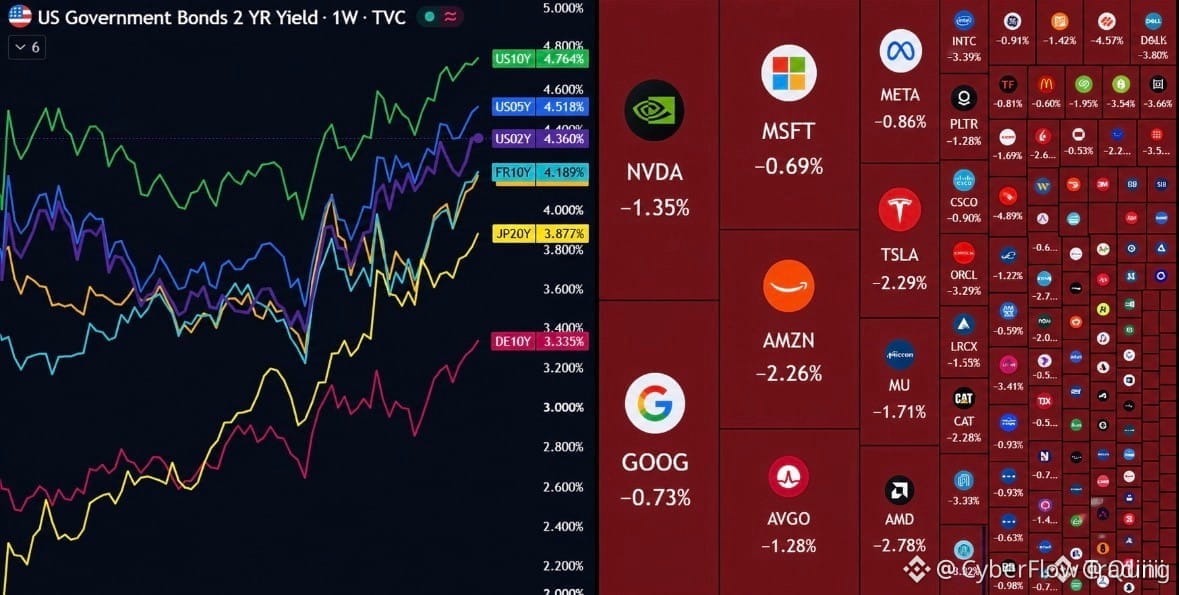
Sovereign debt markets are undergoing a massive tectonic shift as global yields hit multi-decade peaks. US 10-year yields surging to 4.79% alongside Japan 5-year yields printing 31-year highs at 2.26% signals heavy repricing across global capital. 📊
When global debt bleeds this violently, liquidity squeezes traditional finance portfolios and forces institutional capital to recalibrate risk assets. 💡 Watch closely how this macro volatility spills into crypto liquidity pools as smart money shifts positions. 📈
💬 Are you hedging your portfolio now or waiting for the ultimate volatility flush? 👇
⚠️ Not financial advice. Always manage your risk. 🛡️
🏷️ #BTC #Macro #BondMarket #Crypto
⚡ 💎
GLOBAL BOND YIELDS ARE EXPLODING TO MULTI-DECADE HIGHS AND $BTC IS WATCHING 🚨 💣
Sovereign debt markets are undergoing a massive tectonic shift as global yields hit multi-decade peaks. US 10-year yields surging to 4.79% alongside Japan 5-year yields printing 31-year highs at 2.26% signals heavy repricing across global capital. 📊
When global debt bleeds this violently, liquidity squeezes traditional finance portfolios and forces institutional capital to recalibrate risk assets. 💡 Watch closely how this macro volatility spills into crypto liquidity pools as smart money shifts positions. 📈
💬 Are you hedging your portfolio now or waiting for the ultimate volatility flush? 👇
⚠️ Not financial advice. Always manage your risk. 🛡️
🏷️ #BTC #Macro #BondMarket #Crypto
⚡ 💎
Sovereign debt markets are undergoing a massive tectonic shift as global yields hit multi-decade peaks. US 10-year yields surging to 4.79% alongside Japan 5-year yields printing 31-year highs at 2.26% signals heavy repricing across global capital. 📊
When global debt bleeds this violently, liquidity squeezes traditional finance portfolios and forces institutional capital to recalibrate risk assets. 💡 Watch closely how this macro volatility spills into crypto liquidity pools as smart money shifts positions. 📈
💬 Are you hedging your portfolio now or waiting for the ultimate volatility flush? 👇
⚠️ Not financial advice. Always manage your risk. 🛡️
🏷️ #BTC #Macro #BondMarket #Crypto
⚡ 💎
14

·
--
Bullish
🚨 BREAKING: The US Treasury just DOUBLED its debt buyback size 📈
From $2B ➡️ $4B+ per operation, starting Sept 9, targeting long-dated bonds (10-30yr) after yields spiked to levels not seen since 2007 🇺🇸
Is this a signal the bond market is under more stress than headlines admit? 👀
Bulls say: liquidity support = smart stabilization 🐂
Bears say: it's the Fed/Treasury quietly propping up a shaky market 🐻
Where do you stand? Drop your take below 👇
#Treasury #BondMarket #Macro
$NVDA
{future}(NVDAUSDT)
$SPCX
{future}(SPCXUSDT)
$BTC
{future}(BTCUSDT)
🚨 BREAKING: The US Treasury just DOUBLED its debt buyback size 📈
From $2B ➡️ $4B+ per operation, starting Sept 9, targeting long-dated bonds (10-30yr) after yields spiked to levels not seen since 2007 🇺🇸
Is this a signal the bond market is under more stress than headlines admit? 👀
Bulls say: liquidity support = smart stabilization 🐂
Bears say: it's the Fed/Treasury quietly propping up a shaky market 🐻
Where do you stand? Drop your take below 👇
#Treasury #BondMarket #Macro
$NVDA
$SPCX
$BTC
From $2B ➡️ $4B+ per operation, starting Sept 9, targeting long-dated bonds (10-30yr) after yields spiked to levels not seen since 2007 🇺🇸
Is this a signal the bond market is under more stress than headlines admit? 👀
Bulls say: liquidity support = smart stabilization 🐂
Bears say: it's the Fed/Treasury quietly propping up a shaky market 🐻
Where do you stand? Drop your take below 👇
#Treasury #BondMarket #Macro
$NVDA
$SPCX
$BTC
1
125

·
--
AMD'S $4.75B RECORD BOND DEAL — THE AI RACE JUST GOT PRICIER 💰🔥
AMD just dropped a $4.75B four-tranche bond — its largest USD debt raise ever. The 10-year tranche tightened 25bps from guidance, a clear signal institutions are hungry for AI exposure. 📊
This isn't a liquidity squeeze — with $13.1B in cash and high investment-grade status, AMD is borrowing for optionality: AI accelerators, data center scale, and the $5B Anthropic bet. 💳
The AI capex loop keeps widening. Revenue is projected above $51B (47% growth), and this raise dwarfs its $1.5B note issuance last March — the sector has entered a persistent capital expansion phase. The question: at what price does this story get fully discounted? Would you scale into $AMD on a structural pullback, or wait for confirmation? 👇
⚠️ Not financial advice. Always manage your risk. 🛡️
🏷️ $AMD #AIInfrastructure #BondMarket #Semiconductor #InstitutionalFlow
🧠💼
AMD'S $4.75B RECORD BOND DEAL — THE AI RACE JUST GOT PRICIER 💰🔥
AMD just dropped a $4.75B four-tranche bond — its largest USD debt raise ever. The 10-year tranche tightened 25bps from guidance, a clear signal institutions are hungry for AI exposure. 📊
This isn't a liquidity squeeze — with $13.1B in cash and high investment-grade status, AMD is borrowing for optionality: AI accelerators, data center scale, and the $5B Anthropic bet. 💳
The AI capex loop keeps widening. Revenue is projected above $51B (47% growth), and this raise dwarfs its $1.5B note issuance last March — the sector has entered a persistent capital expansion phase. The question: at what price does this story get fully discounted? Would you scale into $AMD on a structural pullback, or wait for confirmation? 👇
⚠️ Not financial advice. Always manage your risk. 🛡️
🏷️ $AMD #AIInfrastructure #BondMarket #Semiconductor #InstitutionalFlow
🧠💼
AMD just dropped a $4.75B four-tranche bond — its largest USD debt raise ever. The 10-year tranche tightened 25bps from guidance, a clear signal institutions are hungry for AI exposure. 📊
This isn't a liquidity squeeze — with $13.1B in cash and high investment-grade status, AMD is borrowing for optionality: AI accelerators, data center scale, and the $5B Anthropic bet. 💳
The AI capex loop keeps widening. Revenue is projected above $51B (47% growth), and this raise dwarfs its $1.5B note issuance last March — the sector has entered a persistent capital expansion phase. The question: at what price does this story get fully discounted? Would you scale into $AMD on a structural pullback, or wait for confirmation? 👇
⚠️ Not financial advice. Always manage your risk. 🛡️
🏷️ $AMD #AIInfrastructure #BondMarket #Semiconductor #InstitutionalFlow
🧠💼
62

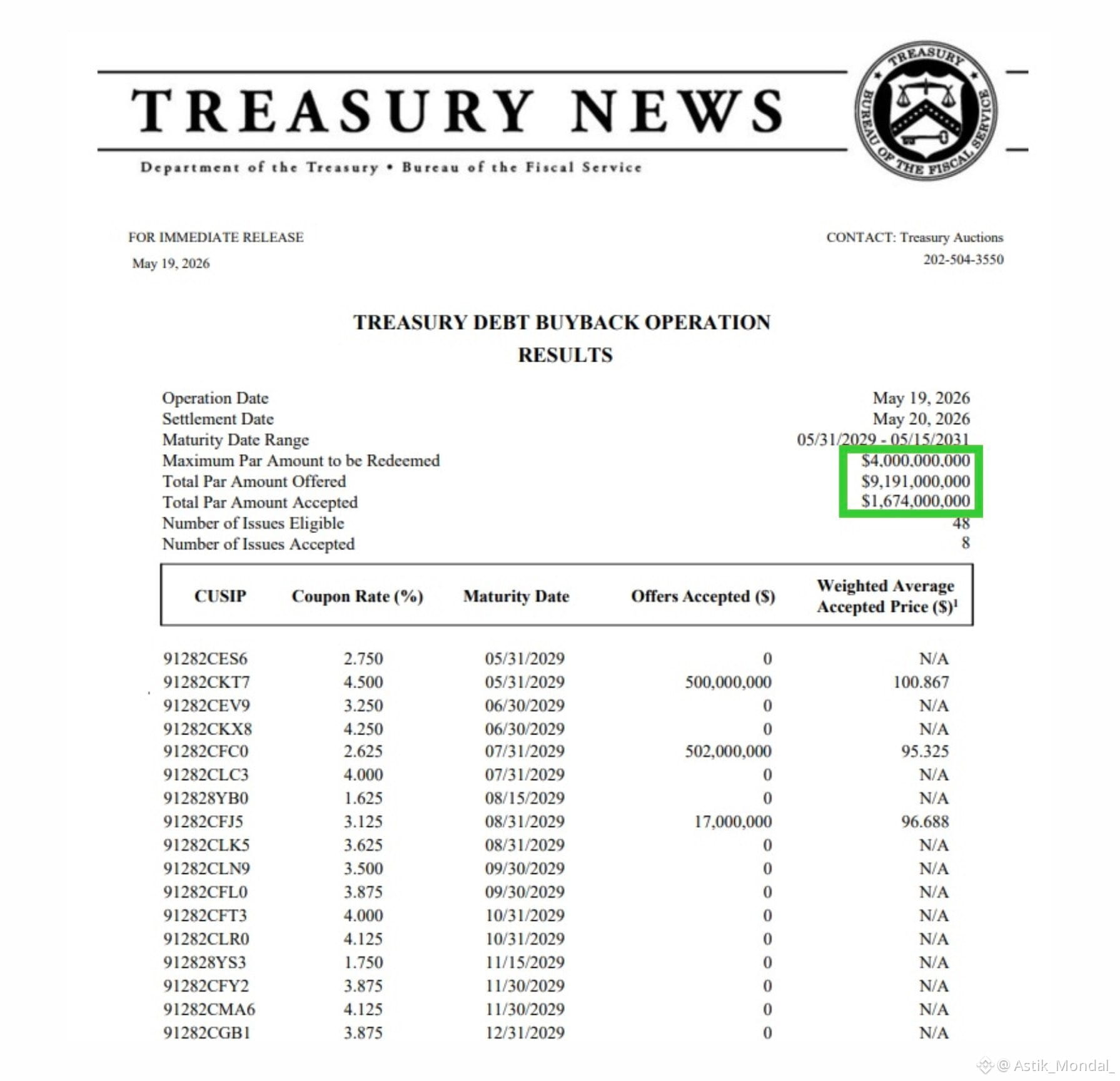
🚨 The US Treasury just spent $1,674,000,000 buying back its own debt.
Read that again.
The government is now purchasing its own IOUs and most people have zero idea what this actually means for your money.
Here's what's really happening
They're calling it a "liquidity improvement."
Translation: the bond market is getting choppy, and the Treasury is stepping in to smooth it out before something breaks.
This isn't routine housekeeping. You don't deploy $1.67 billion unless you're worried about the plumbing.
The mechanics are simple. The optics are terrifying.
When the government buys its own debt, it's injecting cash directly into the financial system without calling it QE, without a Fed meeting, without a press conference.
Quiet. Surgical. Deliberate.
The bond market has been flashing warning signs for months.
Bid-ask spreads widening. Auction demand softening. Foreign buyers stepping back.
This buyback is the Treasury saying: we'll be the buyer of last resort if we have to be.
What this means for you:
More dollars chasing the same assets. Pressure on the dollar. A Fed that's boxed in. And a bond market that increasingly needs life support to function "normally."
This is what the endgame of debt monetization looks like in slow motion.
The number that matters isn't $1.67B.
It's the precedent.
Once you normalize the government buying its own debt to "improve liquidity," where exactly does that stop?
Watch this space closely. The next move will be bigger.
#Macro #BondMarket #USTreasury #DollarCollapse #FinanceTwitter
🚨 The US Treasury just spent $1,674,000,000 buying back its own debt.
Read that again.
The government is now purchasing its own IOUs and most people have zero idea what this actually means for your money.
Here's what's really happening
They're calling it a "liquidity improvement."
Translation: the bond market is getting choppy, and the Treasury is stepping in to smooth it out before something breaks.
This isn't routine housekeeping. You don't deploy $1.67 billion unless you're worried about the plumbing.
The mechanics are simple. The optics are terrifying.
When the government buys its own debt, it's injecting cash directly into the financial system without calling it QE, without a Fed meeting, without a press conference.
Quiet. Surgical. Deliberate.
The bond market has been flashing warning signs for months.
Bid-ask spreads widening. Auction demand softening. Foreign buyers stepping back.
This buyback is the Treasury saying: we'll be the buyer of last resort if we have to be.
What this means for you:
More dollars chasing the same assets. Pressure on the dollar. A Fed that's boxed in. And a bond market that increasingly needs life support to function "normally."
This is what the endgame of debt monetization looks like in slow motion.
The number that matters isn't $1.67B.
It's the precedent.
Once you normalize the government buying its own debt to "improve liquidity," where exactly does that stop?
Watch this space closely. The next move will be bigger.
#Macro #BondMarket #USTreasury #DollarCollapse #FinanceTwitter
Read that again.
The government is now purchasing its own IOUs and most people have zero idea what this actually means for your money.
Here's what's really happening
They're calling it a "liquidity improvement."
Translation: the bond market is getting choppy, and the Treasury is stepping in to smooth it out before something breaks.
This isn't routine housekeeping. You don't deploy $1.67 billion unless you're worried about the plumbing.
The mechanics are simple. The optics are terrifying.
When the government buys its own debt, it's injecting cash directly into the financial system without calling it QE, without a Fed meeting, without a press conference.
Quiet. Surgical. Deliberate.
The bond market has been flashing warning signs for months.
Bid-ask spreads widening. Auction demand softening. Foreign buyers stepping back.
This buyback is the Treasury saying: we'll be the buyer of last resort if we have to be.
What this means for you:
More dollars chasing the same assets. Pressure on the dollar. A Fed that's boxed in. And a bond market that increasingly needs life support to function "normally."
This is what the endgame of debt monetization looks like in slow motion.
The number that matters isn't $1.67B.
It's the precedent.
Once you normalize the government buying its own debt to "improve liquidity," where exactly does that stop?
Watch this space closely. The next move will be bigger.
#Macro #BondMarket #USTreasury #DollarCollapse #FinanceTwitter

102

·
--
$XAU
{future}(XAUUSDT)
$NVDA.US
{stock_us}(NVDA.US)
Asian Bonds Slide as Rising Oil Stoking Fresh Inflation Fears ⚠️
Macro pressures are intensifying across traditional markets today.
Asian bonds followed US Treasuries lower as concerns over government finances mounted significantly, while higher oil prices continue to fuel renewed inflation fears worldwide.
When energy prices climb and bond markets face pressure, macroeconomic volatility tends to affect all risk assets, including crypto.
Keeping a close eye on these global economic shifts is crucial for proper risk management. How are you protecting your portfolio against rising inflation? 🛡️
🟢$XAU
#Inflation #MacroEconomics #bondmarket #BinanceSquare #GlobalMarkets
$XAU
$NVDA.US
Asian Bonds Slide as Rising Oil Stoking Fresh Inflation Fears ⚠️
Macro pressures are intensifying across traditional markets today.
Asian bonds followed US Treasuries lower as concerns over government finances mounted significantly, while higher oil prices continue to fuel renewed inflation fears worldwide.
When energy prices climb and bond markets face pressure, macroeconomic volatility tends to affect all risk assets, including crypto.
Keeping a close eye on these global economic shifts is crucial for proper risk management. How are you protecting your portfolio against rising inflation? 🛡️
🟢$XAU
#Inflation #MacroEconomics #bondmarket #BinanceSquare #GlobalMarkets
$NVDA.US
Asian Bonds Slide as Rising Oil Stoking Fresh Inflation Fears ⚠️
Macro pressures are intensifying across traditional markets today.
Asian bonds followed US Treasuries lower as concerns over government finances mounted significantly, while higher oil prices continue to fuel renewed inflation fears worldwide.
When energy prices climb and bond markets face pressure, macroeconomic volatility tends to affect all risk assets, including crypto.
Keeping a close eye on these global economic shifts is crucial for proper risk management. How are you protecting your portfolio against rising inflation? 🛡️
🟢$XAU
#Inflation #MacroEconomics #bondmarket #BinanceSquare #GlobalMarkets
XAU+0.53%
NVDAUS+0.19%
165

·
--
Article
Microsoft-Linked Project Odyssey Bond Draws More Than Twice the DemandThe bond issuance linked to Microsoft Corp., known as Project Odyssey, is attracting significant investor interest, with demand now exceeding twice the initial offering target. Bloomberg reports that the corporate bond sale, which is focused on financing data-center projects, may be increased to as much as $3.9 billion due to the overwhelming demand.
This bond offering is notable for offering yields that resemble those typically associated with junk bonds, which are higher than investment-grade debt. The higher yields reflect the perceived risk in the financing, aligned with the nature of the project and the sector it serves.
The strong investor appetite indicates confidence in Microsoft’s strategic investments in data-center infrastructure, despite the somewhat higher risk profile implied by the junk-like yields. The demand suggests that investors see value in the long-term growth prospects tied to cloud computing and data center expansion, especially as digital transformation accelerates.
As the potential increase in bond issuance approaches, market participants will be watching how Microsoft manages its financing strategies and whether this trend signifies broader investor interest in tech-related debt with higher yields. The success of Project Odyssey underscores the ongoing appetite for risk in the corporate bond market, driven by the expansion of digital services and infrastructure. #Microsoft #BondMarket #DataCenters
Microsoft-Linked Project Odyssey Bond Draws More Than Twice the Demand
The bond issuance linked to Microsoft Corp., known as Project Odyssey, is attracting significant investor interest, with demand now exceeding twice the initial offering target. Bloomberg reports that the corporate bond sale, which is focused on financing data-center projects, may be increased to as much as $3.9 billion due to the overwhelming demand.
This bond offering is notable for offering yields that resemble those typically associated with junk bonds, which are higher than investment-grade debt. The higher yields reflect the perceived risk in the financing, aligned with the nature of the project and the sector it serves.
The strong investor appetite indicates confidence in Microsoft’s strategic investments in data-center infrastructure, despite the somewhat higher risk profile implied by the junk-like yields. The demand suggests that investors see value in the long-term growth prospects tied to cloud computing and data center expansion, especially as digital transformation accelerates.
As the potential increase in bond issuance approaches, market participants will be watching how Microsoft manages its financing strategies and whether this trend signifies broader investor interest in tech-related debt with higher yields. The success of Project Odyssey underscores the ongoing appetite for risk in the corporate bond market, driven by the expansion of digital services and infrastructure. #Microsoft #BondMarket #DataCenters
This bond offering is notable for offering yields that resemble those typically associated with junk bonds, which are higher than investment-grade debt. The higher yields reflect the perceived risk in the financing, aligned with the nature of the project and the sector it serves.
The strong investor appetite indicates confidence in Microsoft’s strategic investments in data-center infrastructure, despite the somewhat higher risk profile implied by the junk-like yields. The demand suggests that investors see value in the long-term growth prospects tied to cloud computing and data center expansion, especially as digital transformation accelerates.
As the potential increase in bond issuance approaches, market participants will be watching how Microsoft manages its financing strategies and whether this trend signifies broader investor interest in tech-related debt with higher yields. The success of Project Odyssey underscores the ongoing appetite for risk in the corporate bond market, driven by the expansion of digital services and infrastructure. #Microsoft #BondMarket #DataCenters
37

#us30ybondauctionyieldhighestsince2001
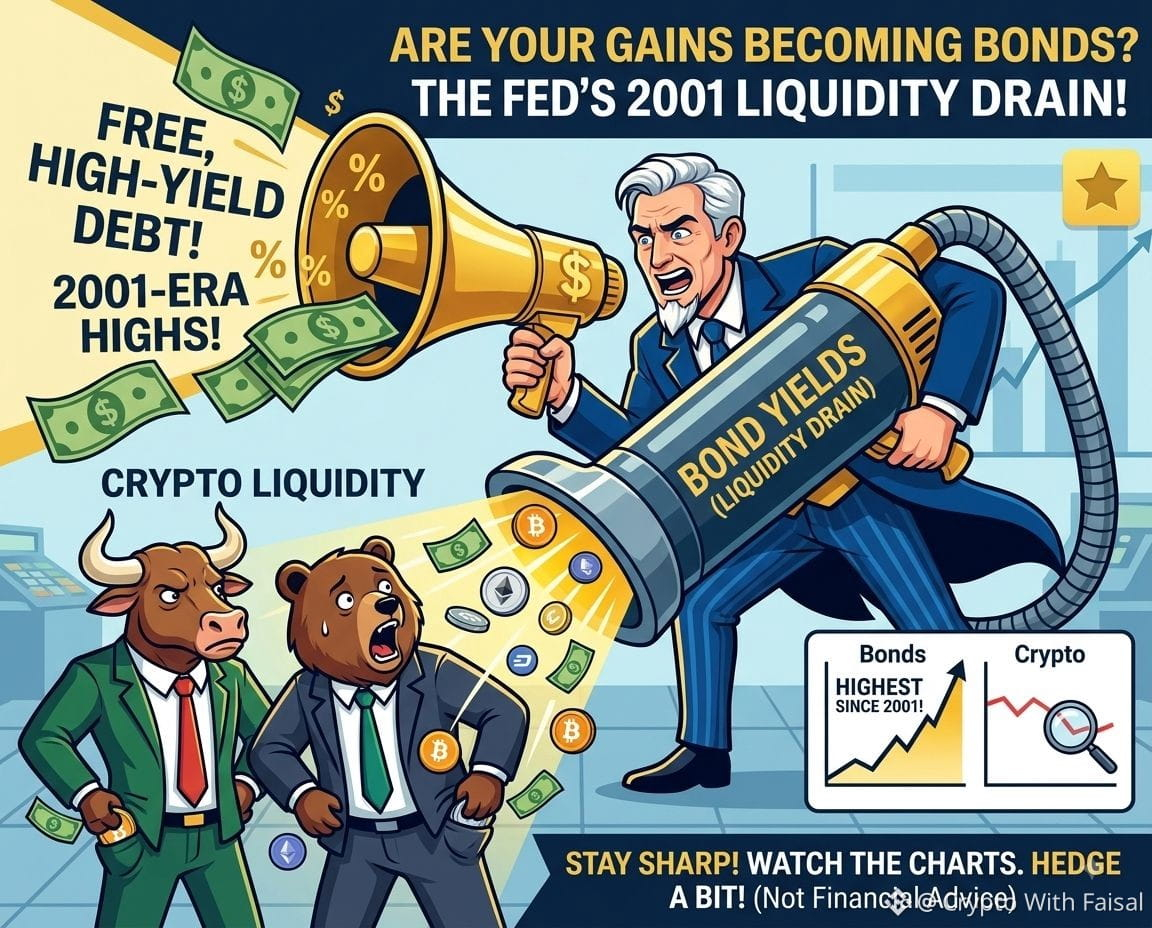
🚨 BOND MARKET SHOCKWAVE: YIELDS HIT 2001 HIGHS! 🚨
The latest US 30-Year Bond Auction just concluded, and the results are setting off alarms across the financial world. Yields have officially skyrocketed to levels we haven't witnessed since 2001! 🤯
What caused this massive spike?
A severe lack of market demand. The bid-to-cover ratio plummeted to a dismal 2.39, indicating that buyers for US debt were practically non-existent. To successfully auction off these bonds, the Treasury was forced to entice investors by offering aggressively higher interest rates. Essentially, they had to pay a premium to find buyers. 💸
The Crypto Connection:
Why should crypto traders care about government bonds? It all comes down to liquidity. Capital naturally flows toward attractive, lower-risk yields. With traditional bonds now offering such hefty payouts, we could witness a significant liquidity drain from risk-on asset classes—including crypto.
Trader Action Plan:
When macroeconomic shifts happen, preparation is key:
Stay Vigilant: Monitor the charts closely for sudden volume drops.
Manage Risk: Tighten your stop-losses.
Protect Capital: Seriously consider hedging your portfolio to brace for potential market volatility. 📉📈
(Disclaimer: This is market commentary and should not be taken as financial advice! Do your own research.)
#MacroEconomics #BondMarket #FederalReserve
$BTC
{future}(BTCUSDT)
$ETH
{future}(ETHUSDT)
$BNB
{future}(BNBUSDT)
#us30ybondauctionyieldhighestsince2001
🚨 BOND MARKET SHOCKWAVE: YIELDS HIT 2001 HIGHS! 🚨
The latest US 30-Year Bond Auction just concluded, and the results are setting off alarms across the financial world. Yields have officially skyrocketed to levels we haven't witnessed since 2001! 🤯
What caused this massive spike?
A severe lack of market demand. The bid-to-cover ratio plummeted to a dismal 2.39, indicating that buyers for US debt were practically non-existent. To successfully auction off these bonds, the Treasury was forced to entice investors by offering aggressively higher interest rates. Essentially, they had to pay a premium to find buyers. 💸
The Crypto Connection:
Why should crypto traders care about government bonds? It all comes down to liquidity. Capital naturally flows toward attractive, lower-risk yields. With traditional bonds now offering such hefty payouts, we could witness a significant liquidity drain from risk-on asset classes—including crypto.
Trader Action Plan:
When macroeconomic shifts happen, preparation is key:
Stay Vigilant: Monitor the charts closely for sudden volume drops.
Manage Risk: Tighten your stop-losses.
Protect Capital: Seriously consider hedging your portfolio to brace for potential market volatility. 📉📈
(Disclaimer: This is market commentary and should not be taken as financial advice! Do your own research.)
#MacroEconomics #BondMarket #FederalReserve
$BTC
$ETH
$BNB
🚨 BOND MARKET SHOCKWAVE: YIELDS HIT 2001 HIGHS! 🚨
The latest US 30-Year Bond Auction just concluded, and the results are setting off alarms across the financial world. Yields have officially skyrocketed to levels we haven't witnessed since 2001! 🤯
What caused this massive spike?
A severe lack of market demand. The bid-to-cover ratio plummeted to a dismal 2.39, indicating that buyers for US debt were practically non-existent. To successfully auction off these bonds, the Treasury was forced to entice investors by offering aggressively higher interest rates. Essentially, they had to pay a premium to find buyers. 💸
The Crypto Connection:
Why should crypto traders care about government bonds? It all comes down to liquidity. Capital naturally flows toward attractive, lower-risk yields. With traditional bonds now offering such hefty payouts, we could witness a significant liquidity drain from risk-on asset classes—including crypto.
Trader Action Plan:
When macroeconomic shifts happen, preparation is key:
Stay Vigilant: Monitor the charts closely for sudden volume drops.
Manage Risk: Tighten your stop-losses.
Protect Capital: Seriously consider hedging your portfolio to brace for potential market volatility. 📉📈
(Disclaimer: This is market commentary and should not be taken as financial advice! Do your own research.)
#MacroEconomics #BondMarket #FederalReserve
$BTC
$ETH
$BNB
336

·
--
$TLT OPTIONS DATA FLASHES BULLISH SIGNAL AHEAD OF FED DECISION 🚨
📊 The iShares 20+ Year Treasury Bond ETF has seen its put/call ratio drop to 0.63 — the lowest since May — with call trading volume surging to 171,000 contracts. That's triple the put activity. 💡 This isn't random retail euphoria; institutions are positioning for a potential "rate hike rally."
⚡ Citadel Securities predicts an unexpected rate hike this week. The logic? If Fed Chair Kevin Wash hikes decisively, long-term inflation expectations may collapse, driving long-term yields down and bond prices up. 🦈 That could also ignite a relief rally in rate-sensitive tech stocks like $QQQ .
💬 Do you see the Fed actually hiking, or is this a liquidity trap to force shorts to cover? 👇
⚠️ Not financial advice. Always manage your risk. 🛡️
🏷️ $TLT $QQQ #Fed #BondMarket #Nasdaq
📊 🔍
$TLT OPTIONS DATA FLASHES BULLISH SIGNAL AHEAD OF FED DECISION 🚨
📊 The iShares 20+ Year Treasury Bond ETF has seen its put/call ratio drop to 0.63 — the lowest since May — with call trading volume surging to 171,000 contracts. That's triple the put activity. 💡 This isn't random retail euphoria; institutions are positioning for a potential "rate hike rally."
⚡ Citadel Securities predicts an unexpected rate hike this week. The logic? If Fed Chair Kevin Wash hikes decisively, long-term inflation expectations may collapse, driving long-term yields down and bond prices up. 🦈 That could also ignite a relief rally in rate-sensitive tech stocks like $QQQ .
💬 Do you see the Fed actually hiking, or is this a liquidity trap to force shorts to cover? 👇
⚠️ Not financial advice. Always manage your risk. 🛡️
🏷️ $TLT $QQQ #Fed #BondMarket #Nasdaq
📊 🔍
📊 The iShares 20+ Year Treasury Bond ETF has seen its put/call ratio drop to 0.63 — the lowest since May — with call trading volume surging to 171,000 contracts. That's triple the put activity. 💡 This isn't random retail euphoria; institutions are positioning for a potential "rate hike rally."
⚡ Citadel Securities predicts an unexpected rate hike this week. The logic? If Fed Chair Kevin Wash hikes decisively, long-term inflation expectations may collapse, driving long-term yields down and bond prices up. 🦈 That could also ignite a relief rally in rate-sensitive tech stocks like $QQQ .
💬 Do you see the Fed actually hiking, or is this a liquidity trap to force shorts to cover? 👇
⚠️ Not financial advice. Always manage your risk. 🛡️
🏷️ $TLT $QQQ #Fed #BondMarket #Nasdaq
📊 🔍
TLTETF+0.28%
QQQETF-0.37%
71

·
--
BLAZING
THE NEW HAMPDEN BONDS HAVE OBLITERATED THE MARKET, WITH NEW HAMPSHIRE COUNCIL VOTING DOWN $100M BITCOIN BONDS! #BitcoinBond #BondMarket #NewHampshire
State representative Keith Ammon called the vote "short-sighted", urging the body to reconsider the measure. The decision will likely have far-reaching implications for the state's economic development and adoption of Bitcoin.
The stakes are high, with proponents of the Bitcoin-backed bonds citing the potential for significant economic growth. As the largest bond deal in New Hampshire history gets voted down, investors are left wondering what's next for the cryptocurrency market.
What does this vote mean for your Bitcoin investments? Are you prepared to capitalize on the historic shift in the bond market? It's time to get in on the action and make your move, before the flood starts! Get started with Binance today.
BLAZING
THE NEW HAMPDEN BONDS HAVE OBLITERATED THE MARKET, WITH NEW HAMPSHIRE COUNCIL VOTING DOWN $100M BITCOIN BONDS! #BitcoinBond #BondMarket #NewHampshire
State representative Keith Ammon called the vote "short-sighted", urging the body to reconsider the measure. The decision will likely have far-reaching implications for the state's economic development and adoption of Bitcoin.
The stakes are high, with proponents of the Bitcoin-backed bonds citing the potential for significant economic growth. As the largest bond deal in New Hampshire history gets voted down, investors are left wondering what's next for the cryptocurrency market.
What does this vote mean for your Bitcoin investments? Are you prepared to capitalize on the historic shift in the bond market? It's time to get in on the action and make your move, before the flood starts! Get started with Binance today.
THE NEW HAMPDEN BONDS HAVE OBLITERATED THE MARKET, WITH NEW HAMPSHIRE COUNCIL VOTING DOWN $100M BITCOIN BONDS! #BitcoinBond #BondMarket #NewHampshire
State representative Keith Ammon called the vote "short-sighted", urging the body to reconsider the measure. The decision will likely have far-reaching implications for the state's economic development and adoption of Bitcoin.
The stakes are high, with proponents of the Bitcoin-backed bonds citing the potential for significant economic growth. As the largest bond deal in New Hampshire history gets voted down, investors are left wondering what's next for the cryptocurrency market.
What does this vote mean for your Bitcoin investments? Are you prepared to capitalize on the historic shift in the bond market? It's time to get in on the action and make your move, before the flood starts! Get started with Binance today.
33
·
--
Article
Goldman Sachs: Global Bond Issuance Fell 16% Last WeekAccording to data from Goldman Sachs, global bond issuance declined by 16% last week compared to the same period last year. Despite this recent decrease, the total issuance so far this year remains 9% higher than the same timeframe in 2025, indicating resilience in the bond markets despite recent volatility.
Investment-grade corporate bond issuance experienced a significant increase of 60%, reflecting continued investor appetite for higher-quality debt securities amid uncertain economic conditions. Conversely, high-yield bond issuance fell sharply by 41%, and leveraged loan issuance nearly dried up, plunging by 88%, highlighting a cautious approach among investors toward riskier debt instruments.
The financial sector saw bond issuance rise by 38%, underscoring ongoing demand for financial institution debt, which may be driven by banks and other financial firms seeking to refinance or expand their capital bases. Structured finance issuance also showed growth, though specific figures were not detailed in the report.
Overall, while the recent weekly figures show a slowdown, the broader trend suggests stability and ongoing activity in the global bond markets, with particular strength in investment-grade issuance. Market participants are closely watching these trends for signs of shifting investor sentiment and potential impacts on borrowing costs moving forward. #BondMarket #InvestmentGrade #HighYield
Goldman Sachs: Global Bond Issuance Fell 16% Last Week
According to data from Goldman Sachs, global bond issuance declined by 16% last week compared to the same period last year. Despite this recent decrease, the total issuance so far this year remains 9% higher than the same timeframe in 2025, indicating resilience in the bond markets despite recent volatility.
Investment-grade corporate bond issuance experienced a significant increase of 60%, reflecting continued investor appetite for higher-quality debt securities amid uncertain economic conditions. Conversely, high-yield bond issuance fell sharply by 41%, and leveraged loan issuance nearly dried up, plunging by 88%, highlighting a cautious approach among investors toward riskier debt instruments.
The financial sector saw bond issuance rise by 38%, underscoring ongoing demand for financial institution debt, which may be driven by banks and other financial firms seeking to refinance or expand their capital bases. Structured finance issuance also showed growth, though specific figures were not detailed in the report.
Overall, while the recent weekly figures show a slowdown, the broader trend suggests stability and ongoing activity in the global bond markets, with particular strength in investment-grade issuance. Market participants are closely watching these trends for signs of shifting investor sentiment and potential impacts on borrowing costs moving forward. #BondMarket #InvestmentGrade #HighYield
Investment-grade corporate bond issuance experienced a significant increase of 60%, reflecting continued investor appetite for higher-quality debt securities amid uncertain economic conditions. Conversely, high-yield bond issuance fell sharply by 41%, and leveraged loan issuance nearly dried up, plunging by 88%, highlighting a cautious approach among investors toward riskier debt instruments.
The financial sector saw bond issuance rise by 38%, underscoring ongoing demand for financial institution debt, which may be driven by banks and other financial firms seeking to refinance or expand their capital bases. Structured finance issuance also showed growth, though specific figures were not detailed in the report.
Overall, while the recent weekly figures show a slowdown, the broader trend suggests stability and ongoing activity in the global bond markets, with particular strength in investment-grade issuance. Market participants are closely watching these trends for signs of shifting investor sentiment and potential impacts on borrowing costs moving forward. #BondMarket #InvestmentGrade #HighYield
17
Log in to explore more content
Join global crypto users on Binance Square
⚡️ Get latest and useful information about crypto.
💬 Trusted by the world’s largest crypto exchange.
👍 Discover real insights from verified creators.
Email / Phone number
Trending Topics
1
#SECToClarifyOnChainFundraisingRules
25 views
47 Discussing
2
#UKFCAOpensCryptoFirmAuthorization
1,096 views
95 Discussing
3
#JapanMOFStudyGroupOnTokenizedGovtBonds
1,452 views
126 Discussing
4
#QNTRises287%
25,352 views
420 Discussing
5
#TrumpRejectsAIRulesForVoluntaryAudits
19,768 views
508 Discussing
6
#BitgetHotWalletBreachTiedToThirdPartySecurityFlaw
10,497 views
344 Discussing
7
#OpenAIUnveilsAlwaysOnAgentDots
9,350 views
362 Discussing
8
#ChainlinkLaunchesBankSWIFTLedgerFramework
9,828 views
280 Discussing
9
#EarningsSeason
536,986 views
3,822 Discussing
10
#ZcashApproves$1.5MBugBounty
113 views
4 Discussing