
#japanbonds
japanbonds
14,252 views
53 Discussing
Hot
Latest

·
--
On Tuesday, volatility emerged in Japan’s government bond market, with Japanese government bond yields trending upward. The market is currently closely watching developments regarding Prime Minister Kishida’s cabinet reshuffle, as well as the government’s ongoing work on a household benefits plan and a reduction in the food consumption tax.
Katsutoshi Inadome, senior strategist at Sumitomo Mitsui Trust Asset Management, noted that as tax-cut negotiations progress, concerns about the sources of fiscal funding are becoming significantly more pronounced. The Japanese government plans to implement tax cuts and subsidies to ease pressure on households, but with the specific funding plan still unclear, investors have developed greater doubts about Japan’s already tight fiscal position, which in turn has directly driven up government bond yields.
From the perspective of traditional financial markets, the choice of the next Minister of Health, Labour and Welfare—who oversees the Government Pension Investment Fund (GPIF)—is particularly crucial in the cabinet reshuffle. Whether GPIF will adjust its future allocation weights toward JGB assets will directly influence the long-term trajectory of JGB yields and the stability of the yen. Expectations for fiscal expansion, interwoven with the bargaining over funding sources, make macro funding sentiment appear quite cautious.
For the crypto market, changes in Japanese government bond yields and the yen exchange rate have long been an important barometer for global carry trades. If JGB yields continue to rise and pull yen liquidity back, it may cause some near-term disruption to the liquidity of risk assets, but the overall impact still depends on the specific fiscal policies that follow and the actual feedback from funding conditions. $BTC
#JapanBonds #Yen #MacroEconomy
On Tuesday, volatility emerged in Japan’s government bond market, with Japanese government bond yields trending upward. The market is currently closely watching developments regarding Prime Minister Kishida’s cabinet reshuffle, as well as the government’s ongoing work on a household benefits plan and a reduction in the food consumption tax.
Katsutoshi Inadome, senior strategist at Sumitomo Mitsui Trust Asset Management, noted that as tax-cut negotiations progress, concerns about the sources of fiscal funding are becoming significantly more pronounced. The Japanese government plans to implement tax cuts and subsidies to ease pressure on households, but with the specific funding plan still unclear, investors have developed greater doubts about Japan’s already tight fiscal position, which in turn has directly driven up government bond yields.
From the perspective of traditional financial markets, the choice of the next Minister of Health, Labour and Welfare—who oversees the Government Pension Investment Fund (GPIF)—is particularly crucial in the cabinet reshuffle. Whether GPIF will adjust its future allocation weights toward JGB assets will directly influence the long-term trajectory of JGB yields and the stability of the yen. Expectations for fiscal expansion, interwoven with the bargaining over funding sources, make macro funding sentiment appear quite cautious.
For the crypto market, changes in Japanese government bond yields and the yen exchange rate have long been an important barometer for global carry trades. If JGB yields continue to rise and pull yen liquidity back, it may cause some near-term disruption to the liquidity of risk assets, but the overall impact still depends on the specific fiscal policies that follow and the actual feedback from funding conditions. $BTC
#JapanBonds #Yen #MacroEconomy
Katsutoshi Inadome, senior strategist at Sumitomo Mitsui Trust Asset Management, noted that as tax-cut negotiations progress, concerns about the sources of fiscal funding are becoming significantly more pronounced. The Japanese government plans to implement tax cuts and subsidies to ease pressure on households, but with the specific funding plan still unclear, investors have developed greater doubts about Japan’s already tight fiscal position, which in turn has directly driven up government bond yields.
From the perspective of traditional financial markets, the choice of the next Minister of Health, Labour and Welfare—who oversees the Government Pension Investment Fund (GPIF)—is particularly crucial in the cabinet reshuffle. Whether GPIF will adjust its future allocation weights toward JGB assets will directly influence the long-term trajectory of JGB yields and the stability of the yen. Expectations for fiscal expansion, interwoven with the bargaining over funding sources, make macro funding sentiment appear quite cautious.
For the crypto market, changes in Japanese government bond yields and the yen exchange rate have long been an important barometer for global carry trades. If JGB yields continue to rise and pull yen liquidity back, it may cause some near-term disruption to the liquidity of risk assets, but the overall impact still depends on the specific fiscal policies that follow and the actual feedback from funding conditions. $BTC
#JapanBonds #Yen #MacroEconomy
5

·
--

Article
Singapore Japan Bond Futures Trading Surges as Volatility RisesTrading activity in Japan bond futures in Singapore has surged significantly, driven by increased volatility and active participation from global funds and relative-value traders, according to Bloomberg. The spike in trading volumes reflects a heightened focus on Japanese debt instruments amid changing market conditions and evolving risk appetites.
Market participants are increasingly turning to Japan bond futures as a tool to hedge against or capitalize on volatile interest rate movements and currency fluctuations. The rise in trading indicates a broader shift in investor strategies, with traders seeking to manage exposure to Japanese bonds in a more dynamic environment.
The surge also highlights Singapore’s growing role as a regional hub for derivatives trading, especially for markets in Asia. With the increased activity in Japan bond futures, traders are leveraging Singapore’s liquidity and infrastructure to execute rapid transactions in response to shifting market signals.
As volatility remains elevated, the demand for futures contracts tied to Japanese bonds is likely to persist, with traders aiming to exploit short-term price movements or hedge their portfolios. This trend underscores the ongoing importance of derivatives markets in managing risk and seeking alpha in a complex global financial landscape. #JapanBonds #FuturesTrading #SingaporeMarkets
Singapore Japan Bond Futures Trading Surges as Volatility Rises
Trading activity in Japan bond futures in Singapore has surged significantly, driven by increased volatility and active participation from global funds and relative-value traders, according to Bloomberg. The spike in trading volumes reflects a heightened focus on Japanese debt instruments amid changing market conditions and evolving risk appetites.
Market participants are increasingly turning to Japan bond futures as a tool to hedge against or capitalize on volatile interest rate movements and currency fluctuations. The rise in trading indicates a broader shift in investor strategies, with traders seeking to manage exposure to Japanese bonds in a more dynamic environment.
The surge also highlights Singapore’s growing role as a regional hub for derivatives trading, especially for markets in Asia. With the increased activity in Japan bond futures, traders are leveraging Singapore’s liquidity and infrastructure to execute rapid transactions in response to shifting market signals.
As volatility remains elevated, the demand for futures contracts tied to Japanese bonds is likely to persist, with traders aiming to exploit short-term price movements or hedge their portfolios. This trend underscores the ongoing importance of derivatives markets in managing risk and seeking alpha in a complex global financial landscape. #JapanBonds #FuturesTrading #SingaporeMarkets
Market participants are increasingly turning to Japan bond futures as a tool to hedge against or capitalize on volatile interest rate movements and currency fluctuations. The rise in trading indicates a broader shift in investor strategies, with traders seeking to manage exposure to Japanese bonds in a more dynamic environment.
The surge also highlights Singapore’s growing role as a regional hub for derivatives trading, especially for markets in Asia. With the increased activity in Japan bond futures, traders are leveraging Singapore’s liquidity and infrastructure to execute rapid transactions in response to shifting market signals.
As volatility remains elevated, the demand for futures contracts tied to Japanese bonds is likely to persist, with traders aiming to exploit short-term price movements or hedge their portfolios. This trend underscores the ongoing importance of derivatives markets in managing risk and seeking alpha in a complex global financial landscape. #JapanBonds #FuturesTrading #SingaporeMarkets
1
55

On Japan’s government bond market, yields across all tenors rose across the board today. Among them, the benchmark 10-year Japanese government bond yield reached 3.035%. The ultra-long end saw the 20-year JGB yield increase by 4 basis points to 3.925%, while the 30-year JGB yield also climbed by 4 basis points, hitting a high of 4.190%.
This yield movement reflects the market’s steadily strengthening expectations for the normalization of the Bank of Japan’s monetary policy. The sharp rise in long-end yields suggests investors are reassessing how urgently Japan needs to move away from its ultra-easy policy. Borrowing costs that had been suppressed previously by negative interest rates and yield curve control (YCC) are now undergoing a structural repricing. This shift could have far-reaching implications for global liquidity.
For traditional financial markets, higher Japanese government bond yields directly undermine the foundation of yen carry trades. As the cost of borrowing in yen rises, pressure for overseas assets to return home increases significantly. This not only could lift benchmark borrowing costs across global fixed-income markets, but also may exert a persistent “drain” effect on U.S. Treasuries and globally overvalued risk assets.
In the cryptocurrency space, a marginal tightening of macro liquidity conditions has historically been a potential negative. As global risk-free rates rise and leveraged arbitrage funds unwind, marginal buying interest in high-volatility assets may come under pressure. If the yen carry spread narrows further and triggers larger-scale asset liquidations, the crypto market in the near term—represented by $BTC —could face more severe liquidity stress and valuation correction risk.
#JapanBonds #BondYields #MacroEconomy
On Japan’s government bond market, yields across all tenors rose across the board today. Among them, the benchmark 10-year Japanese government bond yield reached 3.035%. The ultra-long end saw the 20-year JGB yield increase by 4 basis points to 3.925%, while the 30-year JGB yield also climbed by 4 basis points, hitting a high of 4.190%.
This yield movement reflects the market’s steadily strengthening expectations for the normalization of the Bank of Japan’s monetary policy. The sharp rise in long-end yields suggests investors are reassessing how urgently Japan needs to move away from its ultra-easy policy. Borrowing costs that had been suppressed previously by negative interest rates and yield curve control (YCC) are now undergoing a structural repricing. This shift could have far-reaching implications for global liquidity.
For traditional financial markets, higher Japanese government bond yields directly undermine the foundation of yen carry trades. As the cost of borrowing in yen rises, pressure for overseas assets to return home increases significantly. This not only could lift benchmark borrowing costs across global fixed-income markets, but also may exert a persistent “drain” effect on U.S. Treasuries and globally overvalued risk assets.
In the cryptocurrency space, a marginal tightening of macro liquidity conditions has historically been a potential negative. As global risk-free rates rise and leveraged arbitrage funds unwind, marginal buying interest in high-volatility assets may come under pressure. If the yen carry spread narrows further and triggers larger-scale asset liquidations, the crypto market in the near term—represented by $BTC —could face more severe liquidity stress and valuation correction risk.
#JapanBonds #BondYields #MacroEconomy
This yield movement reflects the market’s steadily strengthening expectations for the normalization of the Bank of Japan’s monetary policy. The sharp rise in long-end yields suggests investors are reassessing how urgently Japan needs to move away from its ultra-easy policy. Borrowing costs that had been suppressed previously by negative interest rates and yield curve control (YCC) are now undergoing a structural repricing. This shift could have far-reaching implications for global liquidity.
For traditional financial markets, higher Japanese government bond yields directly undermine the foundation of yen carry trades. As the cost of borrowing in yen rises, pressure for overseas assets to return home increases significantly. This not only could lift benchmark borrowing costs across global fixed-income markets, but also may exert a persistent “drain” effect on U.S. Treasuries and globally overvalued risk assets.
In the cryptocurrency space, a marginal tightening of macro liquidity conditions has historically been a potential negative. As global risk-free rates rise and leveraged arbitrage funds unwind, marginal buying interest in high-volatility assets may come under pressure. If the yen carry spread narrows further and triggers larger-scale asset liquidations, the crypto market in the near term—represented by $BTC —could face more severe liquidity stress and valuation correction risk.
#JapanBonds #BondYields #MacroEconomy
77
On Tuesday, Japanese government bond yields showed an upward trend. Katsutoshi Inadome, Senior Strategist at Mitsui Sumitomo Trust Asset Management, said in Tokyo that as negotiations on food tax cuts and household subsidy plans advance, market concerns about a government funding gap have noticeably intensified. While the Japanese government has set in motion a package of tax cuts and subsidies that is expected to be finalized soon, it has yet to clearly specify the sources of funding. Meanwhile, the reshuffling of the cabinet has also changed the minister in charge of the GPIF (the Government Pension Investment Fund), heightening the market’s alertness to a possible shift in asset allocation by Japanese institutional funds.
This development is particularly worrying because the growing mismatch between Japan’s massive stockpile of sovereign debt and rigid fiscal spending obligations is becoming increasingly severe. The market broadly expects the Bank of Japan to face significant difficulty along the path of monetary normalization, while the government—without stable revenue sources—expands fiscal stimulus further, effectively directly exacerbating pressure on government bond issuance. Without large-scale absorption by national-team funds such as the GPIF, the sustainability of Japan’s long-term sovereign debt will face another stringent test.
From the perspective of traditional financial markets, rising JGB yields are certain to drive global funds back into Japan, further lifting the global risk-free rate floor and increasing the systemic risk of potential unwinds in yen carry trades. As sovereign credit risk premia are repriced, global long-dated government bond yields may face passive upward pressure, and volatility in foreign exchange markets is likely to be significantly amplified. The overall macro environment is therefore highly unfavorable for overvalued risk assets.
For the cryptocurrency market, $BTC and mainstream risk assets will face dual pressures: tighter liquidity and a rise in risk-averse sentiment. A global liquidity pullback triggered by higher sovereign bond yields easily sets off forced deleveraging of leveraged funds across markets. Against the backdrop of intertwined macro policy expectations and geopolitical risks, investors need to be highly vigilant against downside volatility caused by the transmission of liquidity. In the short term, maintaining a defensive posture is the more rational choice.
#JapanBonds #YieldCurve #MacroEconomics
On Tuesday, Japanese government bond yields showed an upward trend. Katsutoshi Inadome, Senior Strategist at Mitsui Sumitomo Trust Asset Management, said in Tokyo that as negotiations on food tax cuts and household subsidy plans advance, market concerns about a government funding gap have noticeably intensified. While the Japanese government has set in motion a package of tax cuts and subsidies that is expected to be finalized soon, it has yet to clearly specify the sources of funding. Meanwhile, the reshuffling of the cabinet has also changed the minister in charge of the GPIF (the Government Pension Investment Fund), heightening the market’s alertness to a possible shift in asset allocation by Japanese institutional funds.
This development is particularly worrying because the growing mismatch between Japan’s massive stockpile of sovereign debt and rigid fiscal spending obligations is becoming increasingly severe. The market broadly expects the Bank of Japan to face significant difficulty along the path of monetary normalization, while the government—without stable revenue sources—expands fiscal stimulus further, effectively directly exacerbating pressure on government bond issuance. Without large-scale absorption by national-team funds such as the GPIF, the sustainability of Japan’s long-term sovereign debt will face another stringent test.
From the perspective of traditional financial markets, rising JGB yields are certain to drive global funds back into Japan, further lifting the global risk-free rate floor and increasing the systemic risk of potential unwinds in yen carry trades. As sovereign credit risk premia are repriced, global long-dated government bond yields may face passive upward pressure, and volatility in foreign exchange markets is likely to be significantly amplified. The overall macro environment is therefore highly unfavorable for overvalued risk assets.
For the cryptocurrency market, $BTC and mainstream risk assets will face dual pressures: tighter liquidity and a rise in risk-averse sentiment. A global liquidity pullback triggered by higher sovereign bond yields easily sets off forced deleveraging of leveraged funds across markets. Against the backdrop of intertwined macro policy expectations and geopolitical risks, investors need to be highly vigilant against downside volatility caused by the transmission of liquidity. In the short term, maintaining a defensive posture is the more rational choice.
#JapanBonds #YieldCurve #MacroEconomics
This development is particularly worrying because the growing mismatch between Japan’s massive stockpile of sovereign debt and rigid fiscal spending obligations is becoming increasingly severe. The market broadly expects the Bank of Japan to face significant difficulty along the path of monetary normalization, while the government—without stable revenue sources—expands fiscal stimulus further, effectively directly exacerbating pressure on government bond issuance. Without large-scale absorption by national-team funds such as the GPIF, the sustainability of Japan’s long-term sovereign debt will face another stringent test.
From the perspective of traditional financial markets, rising JGB yields are certain to drive global funds back into Japan, further lifting the global risk-free rate floor and increasing the systemic risk of potential unwinds in yen carry trades. As sovereign credit risk premia are repriced, global long-dated government bond yields may face passive upward pressure, and volatility in foreign exchange markets is likely to be significantly amplified. The overall macro environment is therefore highly unfavorable for overvalued risk assets.
For the cryptocurrency market, $BTC and mainstream risk assets will face dual pressures: tighter liquidity and a rise in risk-averse sentiment. A global liquidity pullback triggered by higher sovereign bond yields easily sets off forced deleveraging of leveraged funds across markets. Against the backdrop of intertwined macro policy expectations and geopolitical risks, investors need to be highly vigilant against downside volatility caused by the transmission of liquidity. In the short term, maintaining a defensive posture is the more rational choice.
#JapanBonds #YieldCurve #MacroEconomics
107

On Tuesday, Japan’s bond market saw a clear disturbance, and Japanese government bond yields rose across the board. Katsutoshi Inadome, Senior Strategist at asset management for Sumitomo Mitsui Trust Asset Management, said that as negotiations on food tax cuts progressed, concerns about the government’s funding sources for tax reductions significantly intensified. The Japanese government plans to finalize on Tuesday its consumption tax relief and subsidy package for households, but it did not clearly specify the key funding method, which—together with personnel changes in Prime Minister Fumio Kishida’s (Kishi) cabinet and changes in the ministerial post at the Ministry of Health, Labour and Welfare, which oversees the Government Pension Investment Fund (GPIF)—has sparked strong expectations for liquidity redistribution.
From a macro perspective, fiscal expansion often comes with rising pressure on government bond supply. The market is re-pricing Japan’s fiscal health and the outlook for future issuance, while closely watching how GPIF’s future asset allocation will be oriented—whether it will increase direct buying of JGBs, which in turn directly determines the upper limit for yields and the level of support for the yen.
On the technical side, disruptions in global sovereign bond yields are reshaping the volatility structure of foreign exchange and macro risk assets. For cross-asset traders, the rise in JGB yields has not triggered panic de-leveraging. Instead, it reflects Japan’s underlying resilience as it gradually moves out of deflation and toward a new normal of fiscal stimulus. If USD/JPY were to form a phase of consolidation as a result, it would effectively ease global liquidity tightening pressures and provide a more flexible macro foundation for a rebound in risk assets.
For the crypto market, the continuation of the fiscal expansion cycle is, in essence, the dilution of fiat credit. Over the long term, it remains constructive on hard assets and the release of risk appetite. As long as there is no extreme liquidation risk in the yen carry trade, market liquidity tends to flow back into high-beta assets. $BTC is holding above a key moving-average support level, and the macro liquidity environment is gradually tilting in favor of the bulls amid the volatility; capital preference may further activate a catch-up rally in mainstream coins.
#JapanBonds #MacroEconomics #CryptoMarket
On Tuesday, Japan’s bond market saw a clear disturbance, and Japanese government bond yields rose across the board. Katsutoshi Inadome, Senior Strategist at asset management for Sumitomo Mitsui Trust Asset Management, said that as negotiations on food tax cuts progressed, concerns about the government’s funding sources for tax reductions significantly intensified. The Japanese government plans to finalize on Tuesday its consumption tax relief and subsidy package for households, but it did not clearly specify the key funding method, which—together with personnel changes in Prime Minister Fumio Kishida’s (Kishi) cabinet and changes in the ministerial post at the Ministry of Health, Labour and Welfare, which oversees the Government Pension Investment Fund (GPIF)—has sparked strong expectations for liquidity redistribution.
From a macro perspective, fiscal expansion often comes with rising pressure on government bond supply. The market is re-pricing Japan’s fiscal health and the outlook for future issuance, while closely watching how GPIF’s future asset allocation will be oriented—whether it will increase direct buying of JGBs, which in turn directly determines the upper limit for yields and the level of support for the yen.
On the technical side, disruptions in global sovereign bond yields are reshaping the volatility structure of foreign exchange and macro risk assets. For cross-asset traders, the rise in JGB yields has not triggered panic de-leveraging. Instead, it reflects Japan’s underlying resilience as it gradually moves out of deflation and toward a new normal of fiscal stimulus. If USD/JPY were to form a phase of consolidation as a result, it would effectively ease global liquidity tightening pressures and provide a more flexible macro foundation for a rebound in risk assets.
For the crypto market, the continuation of the fiscal expansion cycle is, in essence, the dilution of fiat credit. Over the long term, it remains constructive on hard assets and the release of risk appetite. As long as there is no extreme liquidation risk in the yen carry trade, market liquidity tends to flow back into high-beta assets. $BTC is holding above a key moving-average support level, and the macro liquidity environment is gradually tilting in favor of the bulls amid the volatility; capital preference may further activate a catch-up rally in mainstream coins.
#JapanBonds #MacroEconomics #CryptoMarket
From a macro perspective, fiscal expansion often comes with rising pressure on government bond supply. The market is re-pricing Japan’s fiscal health and the outlook for future issuance, while closely watching how GPIF’s future asset allocation will be oriented—whether it will increase direct buying of JGBs, which in turn directly determines the upper limit for yields and the level of support for the yen.
On the technical side, disruptions in global sovereign bond yields are reshaping the volatility structure of foreign exchange and macro risk assets. For cross-asset traders, the rise in JGB yields has not triggered panic de-leveraging. Instead, it reflects Japan’s underlying resilience as it gradually moves out of deflation and toward a new normal of fiscal stimulus. If USD/JPY were to form a phase of consolidation as a result, it would effectively ease global liquidity tightening pressures and provide a more flexible macro foundation for a rebound in risk assets.
For the crypto market, the continuation of the fiscal expansion cycle is, in essence, the dilution of fiat credit. Over the long term, it remains constructive on hard assets and the release of risk appetite. As long as there is no extreme liquidation risk in the yen carry trade, market liquidity tends to flow back into high-beta assets. $BTC is holding above a key moving-average support level, and the macro liquidity environment is gradually tilting in favor of the bulls amid the volatility; capital preference may further activate a catch-up rally in mainstream coins.
#JapanBonds #MacroEconomics #CryptoMarket
76

·
--
Bullish
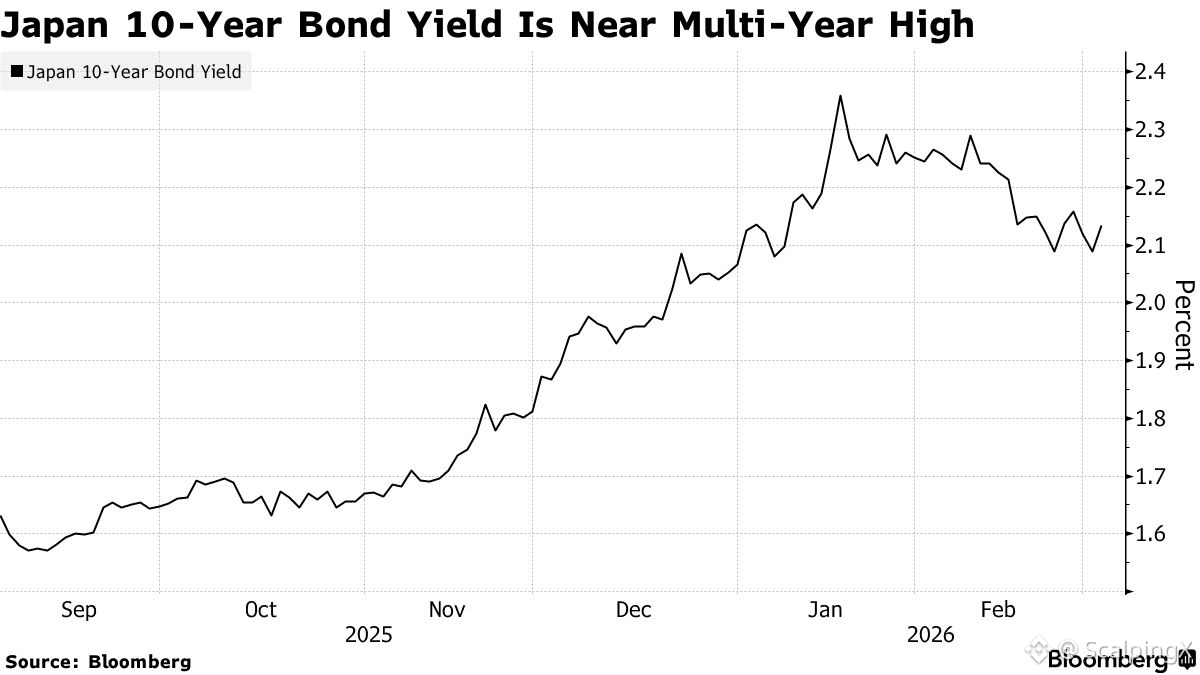
Japan 10Y JGB – Solid auction demand, but yields tick higher as oil-driven inflation risk returns.
📌 The March 3 auction of Japan’s 10-year JGB saw steady demand, with a bid-to-cover ratio of 3.3, above 3.02 in the previous sale and slightly higher than the 12-month average of 3.23.
💡 The accepted yield clustered around 2.122%–2.129%, while the 10-year benchmark yield stayed above 2.1% after a brief two-day pullback.
⚠️ The key takeaway is that geopolitical stress did not translate into a clean “safe-haven bid” for bonds, as higher oil prices revived inflation concerns and kept global yields under upward pressure.
⏱️ Domestically, attention remains on the BOJ’s normalization path, with upcoming guidance likely to shape how far investors are willing to tolerate higher yields.
✅ In the near term, core demand for JGBs still looks intact, but pricing is increasingly sensitive to oil and inflation expectations; BOJ signals will be the main risk filter.
#MacroRates #JapanBonds
Japan 10Y JGB – Solid auction demand, but yields tick higher as oil-driven inflation risk returns.
📌 The March 3 auction of Japan’s 10-year JGB saw steady demand, with a bid-to-cover ratio of 3.3, above 3.02 in the previous sale and slightly higher than the 12-month average of 3.23.
💡 The accepted yield clustered around 2.122%–2.129%, while the 10-year benchmark yield stayed above 2.1% after a brief two-day pullback.
⚠️ The key takeaway is that geopolitical stress did not translate into a clean “safe-haven bid” for bonds, as higher oil prices revived inflation concerns and kept global yields under upward pressure.
⏱️ Domestically, attention remains on the BOJ’s normalization path, with upcoming guidance likely to shape how far investors are willing to tolerate higher yields.
✅ In the near term, core demand for JGBs still looks intact, but pricing is increasingly sensitive to oil and inflation expectations; BOJ signals will be the main risk filter.
#MacroRates #JapanBonds
📌 The March 3 auction of Japan’s 10-year JGB saw steady demand, with a bid-to-cover ratio of 3.3, above 3.02 in the previous sale and slightly higher than the 12-month average of 3.23.
💡 The accepted yield clustered around 2.122%–2.129%, while the 10-year benchmark yield stayed above 2.1% after a brief two-day pullback.
⚠️ The key takeaway is that geopolitical stress did not translate into a clean “safe-haven bid” for bonds, as higher oil prices revived inflation concerns and kept global yields under upward pressure.
⏱️ Domestically, attention remains on the BOJ’s normalization path, with upcoming guidance likely to shape how far investors are willing to tolerate higher yields.
✅ In the near term, core demand for JGBs still looks intact, but pricing is increasingly sensitive to oil and inflation expectations; BOJ signals will be the main risk filter.
#MacroRates #JapanBonds
9
7.1k

·
--
🚨 $BTC AND JAPAN'S 3% BOND YIELD — THE MACRO TRIPWIRE EVERYONE'S IGNORING ⚡
Japan's 10-year bond is pressing 2.805%, and the psychological 3% line is the institutional tripwire. 🏦 Prime Minister Takaichi's fiscal expansion pulls one way while the Bank of Japan fights to defend its normalization credibility — a classic tug-of-war that global liquidity is silently pricing in right now.
Break 3% and we could see a wave of bond selling that tightens monetary conditions worldwide. 📊 That's the kind of macro shock that historically sends risk assets scrambling for cover. Institutions are watching Tokyo far closer than most retail traders realize. 🔍
The BOJ's balance sheet reduction pace is under open fire, and the independence question is louder than ever. 💡 How quickly do you think this macro pressure cascades into crypto? 💬
⚠️ Not financial advice. Always manage your risk. 🛡️
🏷️ #BTC #Macro #JapanBonds #Liquidity #Crypto
🦈 🌊
🚨 $BTC AND JAPAN'S 3% BOND YIELD — THE MACRO TRIPWIRE EVERYONE'S IGNORING ⚡
Japan's 10-year bond is pressing 2.805%, and the psychological 3% line is the institutional tripwire. 🏦 Prime Minister Takaichi's fiscal expansion pulls one way while the Bank of Japan fights to defend its normalization credibility — a classic tug-of-war that global liquidity is silently pricing in right now.
Break 3% and we could see a wave of bond selling that tightens monetary conditions worldwide. 📊 That's the kind of macro shock that historically sends risk assets scrambling for cover. Institutions are watching Tokyo far closer than most retail traders realize. 🔍
The BOJ's balance sheet reduction pace is under open fire, and the independence question is louder than ever. 💡 How quickly do you think this macro pressure cascades into crypto? 💬
⚠️ Not financial advice. Always manage your risk. 🛡️
🏷️ #BTC #Macro #JapanBonds #Liquidity #Crypto
🦈 🌊
Japan's 10-year bond is pressing 2.805%, and the psychological 3% line is the institutional tripwire. 🏦 Prime Minister Takaichi's fiscal expansion pulls one way while the Bank of Japan fights to defend its normalization credibility — a classic tug-of-war that global liquidity is silently pricing in right now.
Break 3% and we could see a wave of bond selling that tightens monetary conditions worldwide. 📊 That's the kind of macro shock that historically sends risk assets scrambling for cover. Institutions are watching Tokyo far closer than most retail traders realize. 🔍
The BOJ's balance sheet reduction pace is under open fire, and the independence question is louder than ever. 💡 How quickly do you think this macro pressure cascades into crypto? 💬
⚠️ Not financial advice. Always manage your risk. 🛡️
🏷️ #BTC #Macro #JapanBonds #Liquidity #Crypto
🦈 🌊
19
Log in to explore more content
Join global crypto users on Binance Square
⚡️ Get latest and useful information about crypto.
💬 Trusted by the world’s largest crypto exchange.
👍 Discover real insights from verified creators.
Email / Phone number
Trending Topics
1
#AIStocksWhatNext
642,350 views
4,778 Discussing
2
#21SharesLaunchesEuropesFirstZcashETP
10,167 views
371 Discussing
3
#CardanoJoinsX402PaymentStandard
7,111 views
291 Discussing
4
#BitcoinTops$87KAtEightMonthHigh
6,746 views
77 Discussing
5
#ZECBreaksAbove$1600AtRecordHigh
3,954 views
62 Discussing
6
#BitwiseNEARStakingETPAssetsTop$100M
27,085 views
79 Discussing
7
#BitcoinBreaksAboveMayHighNears$86K
27,685 views
259 Discussing
8
#DogecoinRises15%
102,017 views
1,704 Discussing
9
#$14BBitcoinOptionsExpireFriday
7,869 views
109 Discussing
10
#BNBMarketCapPassesBNYMellon
64,062 views
1,372 Discussing