

#geniusact
geniusact
17.7M views
33,862 Discussing
ChatGPT 说:
Trump has officially signed the stablecoin-related GENIUS Act at the White House, marking the beginning of the implementation phase for stablecoin regulation in the United States. What’s your take on this? Join the discussion.
Hot
Latest


·
--
Bullish
#fedproposespaymentstablecoinrules
Fed Proposes Payment Stablecoin Rules: What Would Change for Issuers?
Stablecoin adoption depends partly on confidence in the assets and systems behind each token.
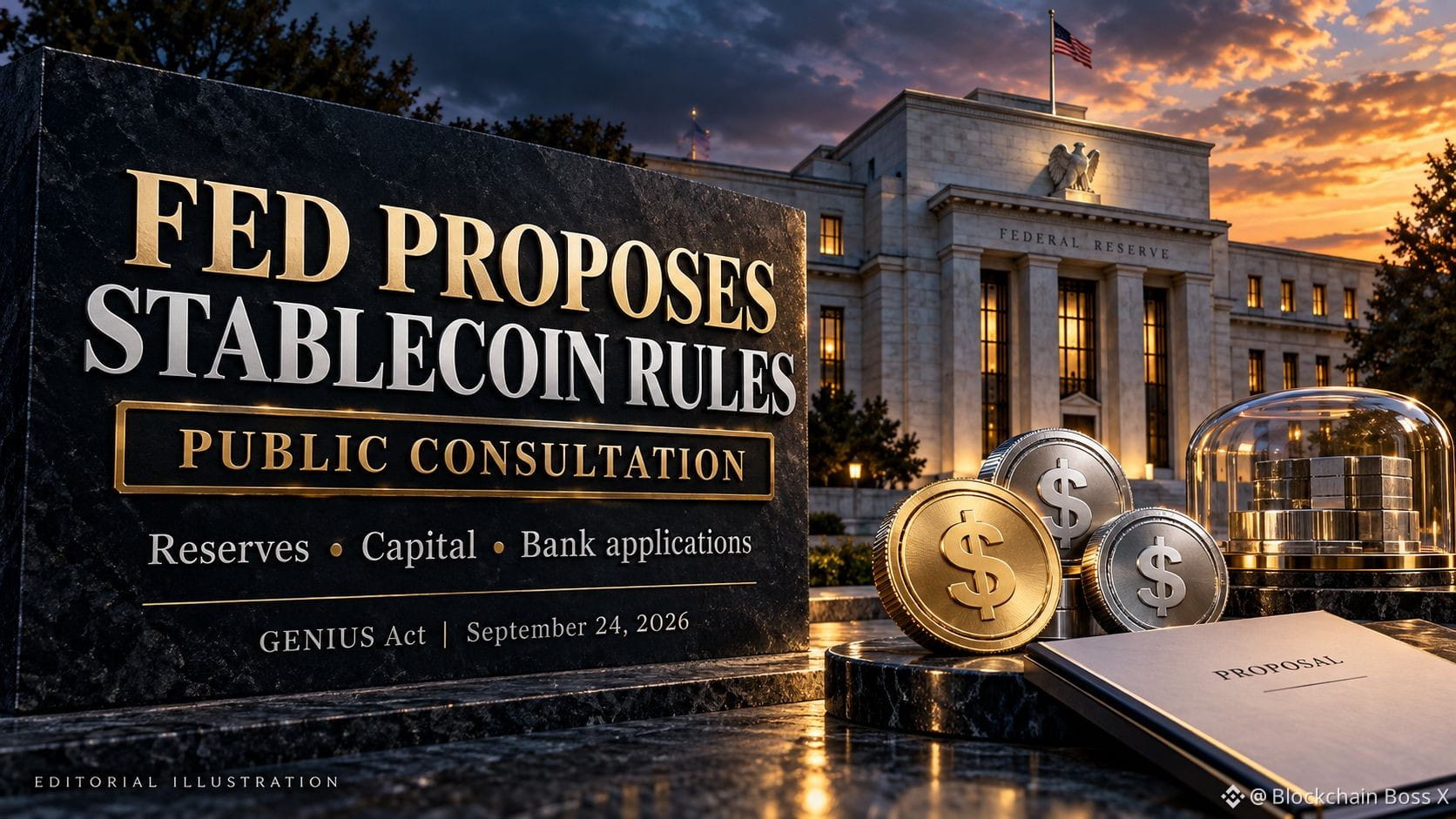
On September 24, 2026, the Federal Reserve requested public feedback on two proposals under the GENIUS Act, addressing payment stablecoin issuers under its supervision and related banking activities.
The first would require full backing with eligible reserve assets, including short-term Treasury bills. It also addresses capital requirements, risk management and the safekeeping of assets backing stablecoins.
The second would establish an application process for Fed-supervised banks seeking approval for stablecoin issuance, requiring business plans, financial information and supporting documents.
These remain proposals. The comment period closes 60 days after publication in the Federal Register, and the final requirements may change.
My take: Clearer reserve and operating requirements could help banks and businesses assess stablecoin issuers more consistently. Compliance also costs money, so the final design could influence which firms can compete and how services are priced.
For users, the practical questions remain straightforward: how accessible is redemption, who safeguards the reserves, and how reliably do operations function during stress?
I would watch whether the final framework combines stronger protections with workable entry requirements. That balance could shape competition and the usefulness of payment stablecoins.
Which matters most to you: reserve transparency, reliable redemption or greater issuer competition?
#FedProposesPaymentStablecoinRules #Stablecoins #GENIUSAct
$QNT $BTW $ONE
{future}(ONEUSDT)
{future}(BTWUSDT)
{future}(QNTUSDT)
#fedproposespaymentstablecoinrules
Fed Proposes Payment Stablecoin Rules: What Would Change for Issuers?
Stablecoin adoption depends partly on confidence in the assets and systems behind each token.
On September 24, 2026, the Federal Reserve requested public feedback on two proposals under the GENIUS Act, addressing payment stablecoin issuers under its supervision and related banking activities.
The first would require full backing with eligible reserve assets, including short-term Treasury bills. It also addresses capital requirements, risk management and the safekeeping of assets backing stablecoins.
The second would establish an application process for Fed-supervised banks seeking approval for stablecoin issuance, requiring business plans, financial information and supporting documents.
These remain proposals. The comment period closes 60 days after publication in the Federal Register, and the final requirements may change.
My take: Clearer reserve and operating requirements could help banks and businesses assess stablecoin issuers more consistently. Compliance also costs money, so the final design could influence which firms can compete and how services are priced.
For users, the practical questions remain straightforward: how accessible is redemption, who safeguards the reserves, and how reliably do operations function during stress?
I would watch whether the final framework combines stronger protections with workable entry requirements. That balance could shape competition and the usefulness of payment stablecoins.
Which matters most to you: reserve transparency, reliable redemption or greater issuer competition?
#FedProposesPaymentStablecoinRules #Stablecoins #GENIUSAct
$QNT $BTW $ONE
Fed Proposes Payment Stablecoin Rules: What Would Change for Issuers?
Stablecoin adoption depends partly on confidence in the assets and systems behind each token.
On September 24, 2026, the Federal Reserve requested public feedback on two proposals under the GENIUS Act, addressing payment stablecoin issuers under its supervision and related banking activities.
The first would require full backing with eligible reserve assets, including short-term Treasury bills. It also addresses capital requirements, risk management and the safekeeping of assets backing stablecoins.
The second would establish an application process for Fed-supervised banks seeking approval for stablecoin issuance, requiring business plans, financial information and supporting documents.
These remain proposals. The comment period closes 60 days after publication in the Federal Register, and the final requirements may change.
My take: Clearer reserve and operating requirements could help banks and businesses assess stablecoin issuers more consistently. Compliance also costs money, so the final design could influence which firms can compete and how services are priced.
For users, the practical questions remain straightforward: how accessible is redemption, who safeguards the reserves, and how reliably do operations function during stress?
I would watch whether the final framework combines stronger protections with workable entry requirements. That balance could shape competition and the usefulness of payment stablecoins.
Which matters most to you: reserve transparency, reliable redemption or greater issuer competition?
#FedProposesPaymentStablecoinRules #Stablecoins #GENIUSAct
$QNT $BTW $ONE
2
1.9k

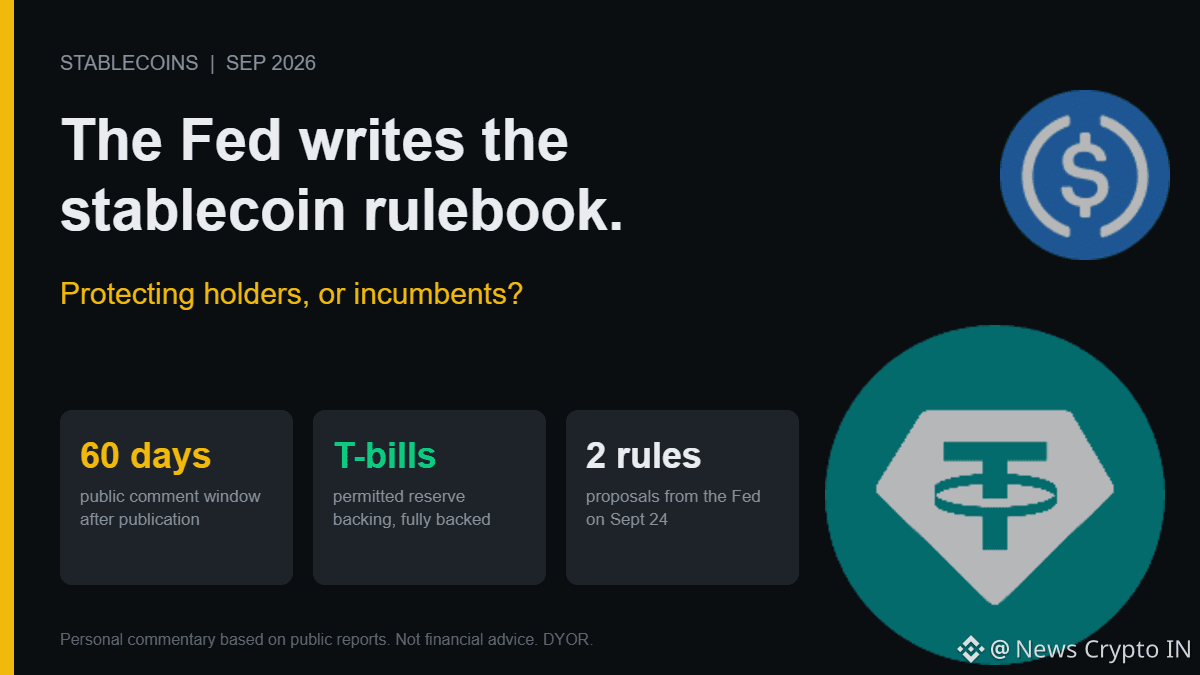
The Fed just put the first real GENIUS Act rule text on the table for stablecoin issuers, and it reads like a banking rulebook, not a crypto one.
Two proposals, announced Sept 24:
1. Reserves and capital: issuers must fully back tokens with permitted assets like short-term Treasury bills and other high-quality liquid assets, plus standardized capital requirements for credit and operational risk.
2. Applications: banks that want to issue must submit a business plan and financial information, with a formal process for appeals, hearings and final determinations.
The FDIC issued its own proposal for the institutions it supervises. Comments are open for 60 days after Federal Register publication.
Why this matters: yesterday I wrote about how fixed compliance costs favor big issuers. These proposals are what turns that forecast into rule text. Capital buffers and application dossiers are cheap for a bank with a compliance department and expensive for a crypto-native startup.
The upside is real: full T-bill backing and capital buffers make a stablecoin run less likely, and that's good for anyone parking money in one.
The open question is who ends up issuing the dollars. If the winners are bank-affiliated, "permissionless dollars" become "permitted dollars."
Are these rules protecting holders, or protecting incumbents? Both can be true.
#FedProposesPaymentStablecoinRules #GENIUSAct
The Fed just put the first real GENIUS Act rule text on the table for stablecoin issuers, and it reads like a banking rulebook, not a crypto one.
Two proposals, announced Sept 24:
1. Reserves and capital: issuers must fully back tokens with permitted assets like short-term Treasury bills and other high-quality liquid assets, plus standardized capital requirements for credit and operational risk.
2. Applications: banks that want to issue must submit a business plan and financial information, with a formal process for appeals, hearings and final determinations.
The FDIC issued its own proposal for the institutions it supervises. Comments are open for 60 days after Federal Register publication.
Why this matters: yesterday I wrote about how fixed compliance costs favor big issuers. These proposals are what turns that forecast into rule text. Capital buffers and application dossiers are cheap for a bank with a compliance department and expensive for a crypto-native startup.
The upside is real: full T-bill backing and capital buffers make a stablecoin run less likely, and that's good for anyone parking money in one.
The open question is who ends up issuing the dollars. If the winners are bank-affiliated, "permissionless dollars" become "permitted dollars."
Are these rules protecting holders, or protecting incumbents? Both can be true.
#FedProposesPaymentStablecoinRules #GENIUSAct
Two proposals, announced Sept 24:
1. Reserves and capital: issuers must fully back tokens with permitted assets like short-term Treasury bills and other high-quality liquid assets, plus standardized capital requirements for credit and operational risk.
2. Applications: banks that want to issue must submit a business plan and financial information, with a formal process for appeals, hearings and final determinations.
The FDIC issued its own proposal for the institutions it supervises. Comments are open for 60 days after Federal Register publication.
Why this matters: yesterday I wrote about how fixed compliance costs favor big issuers. These proposals are what turns that forecast into rule text. Capital buffers and application dossiers are cheap for a bank with a compliance department and expensive for a crypto-native startup.
The upside is real: full T-bill backing and capital buffers make a stablecoin run less likely, and that's good for anyone parking money in one.
The open question is who ends up issuing the dollars. If the winners are bank-affiliated, "permissionless dollars" become "permitted dollars."
Are these rules protecting holders, or protecting incumbents? Both can be true.
#FedProposesPaymentStablecoinRules #GENIUSAct
1
174

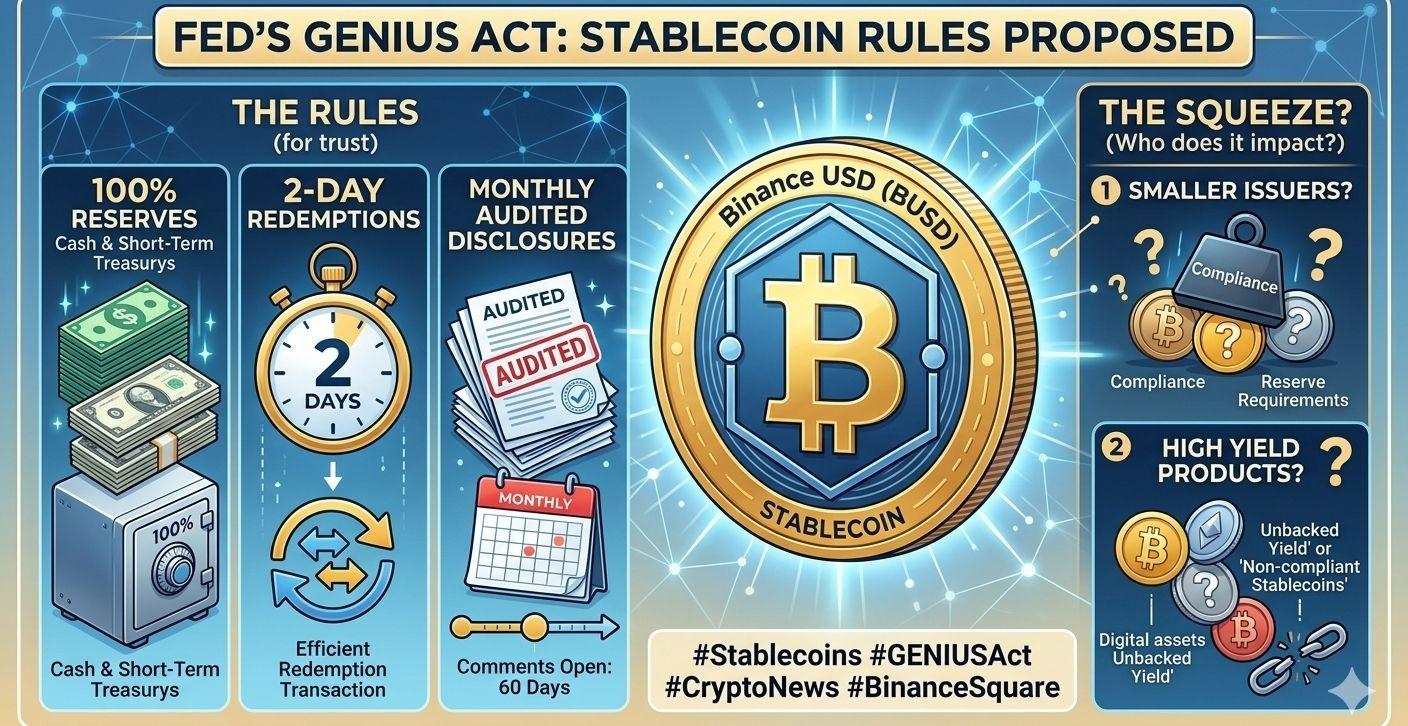
The Fed just proposed stablecoin rules under the GENIUS Act: 100% reserves in cash or short-term Treasurys, redemptions within two days, audited monthly disclosures. Comments are open for 60 days. Good for trust, but who does it squeeze?
#Stablecoins #GENIUSAct #CryptoNews #BinanceSquare
{future}(USDCUSDT)
The Fed just proposed stablecoin rules under the GENIUS Act: 100% reserves in cash or short-term Treasurys, redemptions within two days, audited monthly disclosures. Comments are open for 60 days. Good for trust, but who does it squeeze?
#Stablecoins #GENIUSAct #CryptoNews #BinanceSquare
#Stablecoins #GENIUSAct #CryptoNews #BinanceSquare
48

·
--
🚨 Fed Stablecoin Update
The U.S. Fed is proposing stricter rules for payment stablecoins under the GENIUS Act.
Issuers may need 1:1 reserves, stronger capital requirements, and faster redemption procedures during stress.
This could improve transparency and stability, but may also raise costs and favor larger, well-capitalized issuers.
👀 The 60-day comment period could shape the final rules.
#Stablecoin #Crypto #Fed #GENIUSAct
#CoinMarketCapCompletesCoinglassAcquisition
$BCH $SOL $DOGE
🚨 Fed Stablecoin Update
The U.S. Fed is proposing stricter rules for payment stablecoins under the GENIUS Act.
Issuers may need 1:1 reserves, stronger capital requirements, and faster redemption procedures during stress.
This could improve transparency and stability, but may also raise costs and favor larger, well-capitalized issuers.
👀 The 60-day comment period could shape the final rules.
#Stablecoin #Crypto #Fed #GENIUSAct
#CoinMarketCapCompletesCoinglassAcquisition
$BCH $SOL $DOGE
The U.S. Fed is proposing stricter rules for payment stablecoins under the GENIUS Act.
Issuers may need 1:1 reserves, stronger capital requirements, and faster redemption procedures during stress.
This could improve transparency and stability, but may also raise costs and favor larger, well-capitalized issuers.
👀 The 60-day comment period could shape the final rules.
#Stablecoin #Crypto #Fed #GENIUSAct
#CoinMarketCapCompletesCoinglassAcquisition
$BCH $SOL $DOGE
101

·
--
This time, stablecoins have truly been brought under control.
The U.S. Federal Reserve has officially rolled out two GENIUS Act implementation proposals, inviting public comments with a 60-day window.
First move: reserve requirements. Stablecoin issuers must keep reserves using 100% short-term U.S. Treasury securities or other top-tier highly liquid assets. Commercial paper and crypto assets are out. They must also appoint a third-party independent custodian.
Second move: opening the door. Traditional banks that want to issue stablecoins get a dedicated approval channel—submit business plans and financial materials. If an application is denied, the applicant can appeal and request a hearing.
These rules were supposed to be implemented within one year of the bill being signed (the GENIUS Act was signed last July—America’s first federal stablecoin law). They were inexplicably delayed until now to be unveiled. Even existing issuers like Circle and Tether must re-apply and be reviewed under these standards.
Data as of: 2026-09-28 08:00 UTC
Source: ChainCatcher; BlockTempo
For information sharing only and does not constitute investment advice.
#稳定币 #美联储 #GENIUSAct
This time, stablecoins have truly been brought under control.
The U.S. Federal Reserve has officially rolled out two GENIUS Act implementation proposals, inviting public comments with a 60-day window.
First move: reserve requirements. Stablecoin issuers must keep reserves using 100% short-term U.S. Treasury securities or other top-tier highly liquid assets. Commercial paper and crypto assets are out. They must also appoint a third-party independent custodian.
Second move: opening the door. Traditional banks that want to issue stablecoins get a dedicated approval channel—submit business plans and financial materials. If an application is denied, the applicant can appeal and request a hearing.
These rules were supposed to be implemented within one year of the bill being signed (the GENIUS Act was signed last July—America’s first federal stablecoin law). They were inexplicably delayed until now to be unveiled. Even existing issuers like Circle and Tether must re-apply and be reviewed under these standards.
Data as of: 2026-09-28 08:00 UTC
Source: ChainCatcher; BlockTempo
For information sharing only and does not constitute investment advice.
#稳定币 #美联储 #GENIUSAct
The U.S. Federal Reserve has officially rolled out two GENIUS Act implementation proposals, inviting public comments with a 60-day window.
First move: reserve requirements. Stablecoin issuers must keep reserves using 100% short-term U.S. Treasury securities or other top-tier highly liquid assets. Commercial paper and crypto assets are out. They must also appoint a third-party independent custodian.
Second move: opening the door. Traditional banks that want to issue stablecoins get a dedicated approval channel—submit business plans and financial materials. If an application is denied, the applicant can appeal and request a hearing.
These rules were supposed to be implemented within one year of the bill being signed (the GENIUS Act was signed last July—America’s first federal stablecoin law). They were inexplicably delayed until now to be unveiled. Even existing issuers like Circle and Tether must re-apply and be reviewed under these standards.
Data as of: 2026-09-28 08:00 UTC
Source: ChainCatcher; BlockTempo
For information sharing only and does not constitute investment advice.
#稳定币 #美联储 #GENIUSAct

180

·
--
⚡ Fed Proposes New Stablecoin Rules Under GENIUS Act
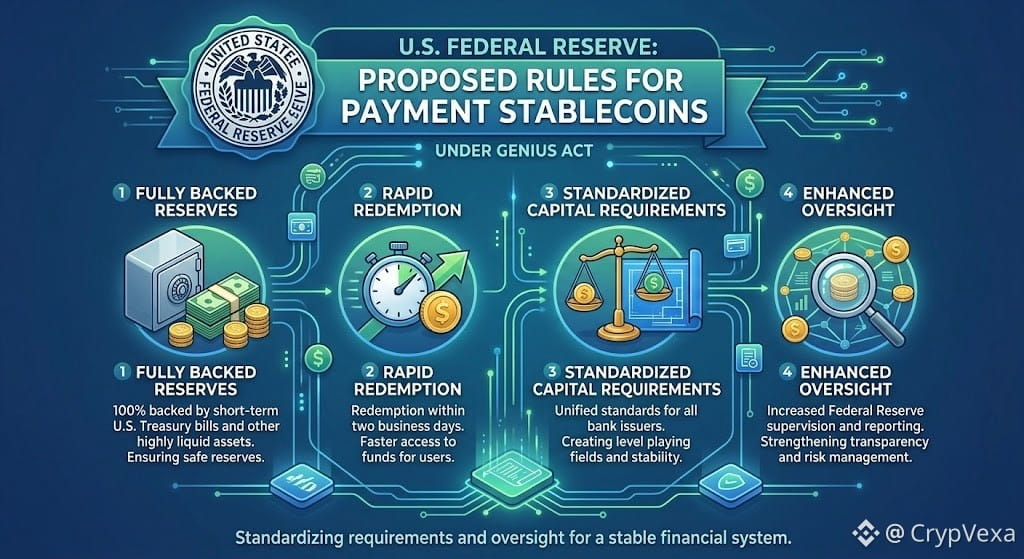
🇺🇸 The Federal Reserve has proposed rules for payment stablecoin issuers it supervises under the GENIUS Act.
💵 Stablecoins would need to be fully backed by permitted reserve assets, including short-term U.S. Treasury bills and other high-quality liquid assets.
⏱️ The proposal also includes two-business-day redemption standards, capital requirements, risk controls, and greater reserve transparency.
🏦 The framework also outlines how eligible banks could seek approval to issue payment stablecoins.
⚠️ These are proposed rules, not final regulations. Public comments are open for 60 days after Federal Register publication.
👀 Could stricter reserve and redemption rules accelerate trust in regulated stablecoins?
#Stablecoins #GENIUSAct #FederalReserve #CryptoRegulation
⚡ Fed Proposes New Stablecoin Rules Under GENIUS Act
🇺🇸 The Federal Reserve has proposed rules for payment stablecoin issuers it supervises under the GENIUS Act.
💵 Stablecoins would need to be fully backed by permitted reserve assets, including short-term U.S. Treasury bills and other high-quality liquid assets.
⏱️ The proposal also includes two-business-day redemption standards, capital requirements, risk controls, and greater reserve transparency.
🏦 The framework also outlines how eligible banks could seek approval to issue payment stablecoins.
⚠️ These are proposed rules, not final regulations. Public comments are open for 60 days after Federal Register publication.
👀 Could stricter reserve and redemption rules accelerate trust in regulated stablecoins?
#Stablecoins #GENIUSAct #FederalReserve #CryptoRegulation
🇺🇸 The Federal Reserve has proposed rules for payment stablecoin issuers it supervises under the GENIUS Act.
💵 Stablecoins would need to be fully backed by permitted reserve assets, including short-term U.S. Treasury bills and other high-quality liquid assets.
⏱️ The proposal also includes two-business-day redemption standards, capital requirements, risk controls, and greater reserve transparency.
🏦 The framework also outlines how eligible banks could seek approval to issue payment stablecoins.
⚠️ These are proposed rules, not final regulations. Public comments are open for 60 days after Federal Register publication.
👀 Could stricter reserve and redemption rules accelerate trust in regulated stablecoins?
#Stablecoins #GENIUSAct #FederalReserve #CryptoRegulation
1
55

·
--
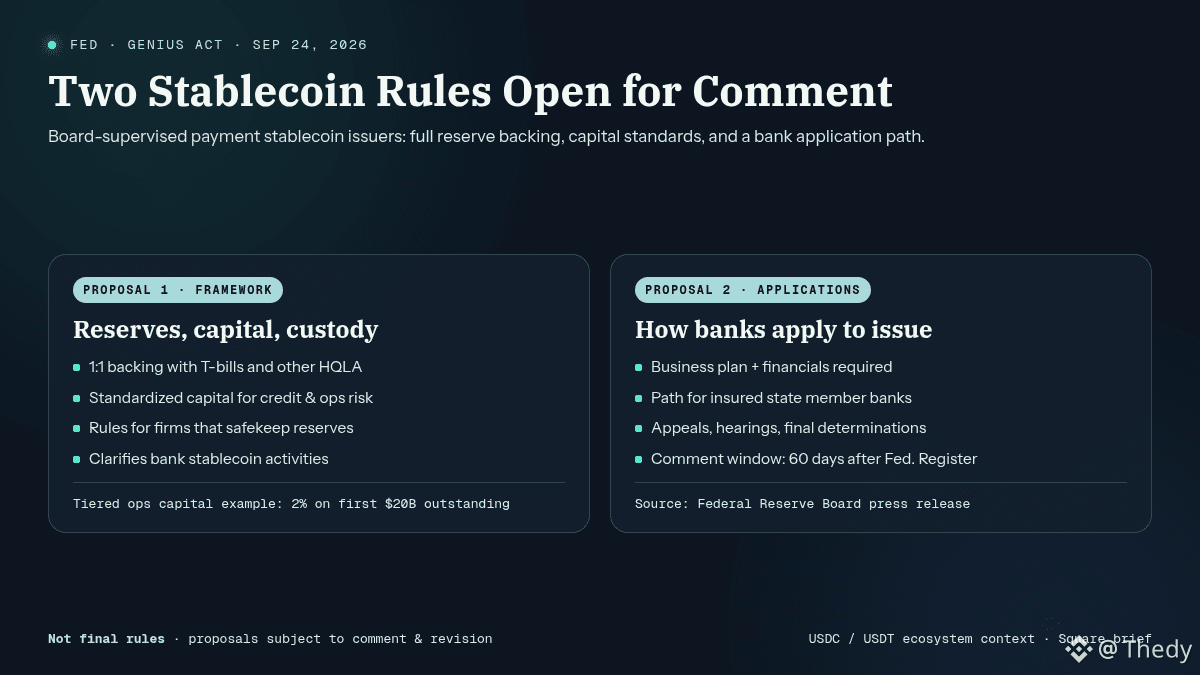
The Fed opens two proposals for stablecoin payment issuers under the GENIUS Act.
FACTS (Federal Reserve Board press release, 09/24, 2:30 p.m. EDT):
• Proposal 1: 1:1 reserves in T-bills and other highly liquid assets, standardized capital (credit / operational risks), rules for reserve custodians, and clarification of bankable activities.
• Proposal 2: application procedure for supervised banks (business plan + financial information), with calls, hearings, and final decisions.
• Comment window: 60 days after publication in the Federal Register. These are not final rules yet.
Takeaway (interpretation, not advice):
For $USDT / $USDC et any issuer that falls under Board supervision, operational capital becomes tied to the size of the float (example of a grid cited in analyses: 2% on the first $20 billion outstanding). More coins in circulation = higher capital charge, even without revenues outside reserves. The OCC is pushing a different logic (tailored capital + liquidity = 12 months of expenses). Two regulators, two calibrations: the US stables market will have to follow the comments.
Scenarios:
• A: comments that loosen the capital bands → issuer-bank(s) more comfortable with scaling.
• B: stricter calibration + Fed/OCC divergences that remain → friction for new issuers, longer-lasting status quo for stablecoins already in place.
Would you rather focus on the reserves/capital side, or the bank application procedure?
$USDT $USDC $BNB
#Stablecoins #GENIUSAct #Crypto
The Fed opens two proposals for stablecoin payment issuers under the GENIUS Act.
FACTS (Federal Reserve Board press release, 09/24, 2:30 p.m. EDT):
• Proposal 1: 1:1 reserves in T-bills and other highly liquid assets, standardized capital (credit / operational risks), rules for reserve custodians, and clarification of bankable activities.
• Proposal 2: application procedure for supervised banks (business plan + financial information), with calls, hearings, and final decisions.
• Comment window: 60 days after publication in the Federal Register. These are not final rules yet.
Takeaway (interpretation, not advice):
For $USDT / $USDC et any issuer that falls under Board supervision, operational capital becomes tied to the size of the float (example of a grid cited in analyses: 2% on the first $20 billion outstanding). More coins in circulation = higher capital charge, even without revenues outside reserves. The OCC is pushing a different logic (tailored capital + liquidity = 12 months of expenses). Two regulators, two calibrations: the US stables market will have to follow the comments.
Scenarios:
• A: comments that loosen the capital bands → issuer-bank(s) more comfortable with scaling.
• B: stricter calibration + Fed/OCC divergences that remain → friction for new issuers, longer-lasting status quo for stablecoins already in place.
Would you rather focus on the reserves/capital side, or the bank application procedure?
$USDT $USDC $BNB
#Stablecoins #GENIUSAct #Crypto
FACTS (Federal Reserve Board press release, 09/24, 2:30 p.m. EDT):
• Proposal 1: 1:1 reserves in T-bills and other highly liquid assets, standardized capital (credit / operational risks), rules for reserve custodians, and clarification of bankable activities.
• Proposal 2: application procedure for supervised banks (business plan + financial information), with calls, hearings, and final decisions.
• Comment window: 60 days after publication in the Federal Register. These are not final rules yet.
Takeaway (interpretation, not advice):
For $USDT / $USDC et any issuer that falls under Board supervision, operational capital becomes tied to the size of the float (example of a grid cited in analyses: 2% on the first $20 billion outstanding). More coins in circulation = higher capital charge, even without revenues outside reserves. The OCC is pushing a different logic (tailored capital + liquidity = 12 months of expenses). Two regulators, two calibrations: the US stables market will have to follow the comments.
Scenarios:
• A: comments that loosen the capital bands → issuer-bank(s) more comfortable with scaling.
• B: stricter calibration + Fed/OCC divergences that remain → friction for new issuers, longer-lasting status quo for stablecoins already in place.
Would you rather focus on the reserves/capital side, or the bank application procedure?
$USDT $USDC $BNB
#Stablecoins #GENIUSAct #Crypto
49

·
--
Bullish
#FedProposesRulesForBankIssuedStablecoins
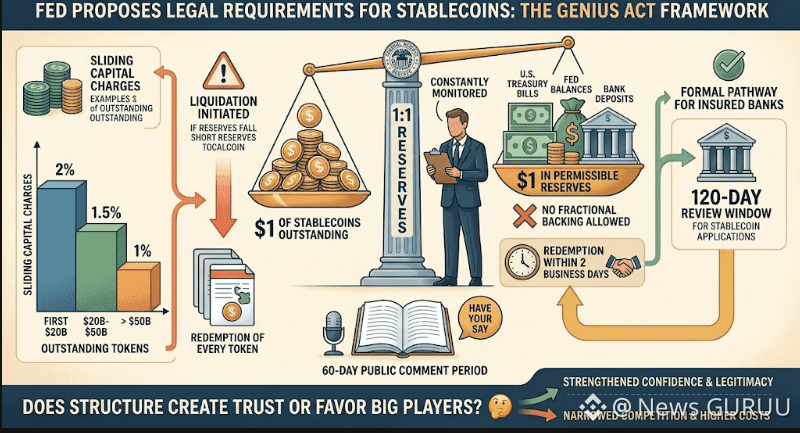
🏦 The Fed is putting real rules behind the words “fully backed.”
On September 24, the Federal Reserve proposed two frameworks under the GENIUS Act for payment stablecoins.
The core requirement: eligible issuers would have to fully back outstanding stablecoins with permitted reserve assets, including short-term Treasuries and other qualifying liquid assets. The proposals also introduce capital and risk-management standards and a formal approval process for supervised banks seeking to issue stablecoins.
The proposals are now open for 60 days of public comment before final rules are adopted.
For crypto markets, this could make stablecoin regulation more defined while also increasing compliance requirements for issuers.
🤔 Will stricter rules accelerate institutional stablecoin adoption—or make it harder for smaller issuers to compete?
TRADE $QNT $ONDO $XPL HERE
{spot}(XPLUSDT)
{spot}(ONDOUSDT)
{spot}(QNTUSDT)
#Stablecoins #GENIUSAct
#FedProposesRulesForBankIssuedStablecoins
🏦 The Fed is putting real rules behind the words “fully backed.”
On September 24, the Federal Reserve proposed two frameworks under the GENIUS Act for payment stablecoins.
The core requirement: eligible issuers would have to fully back outstanding stablecoins with permitted reserve assets, including short-term Treasuries and other qualifying liquid assets. The proposals also introduce capital and risk-management standards and a formal approval process for supervised banks seeking to issue stablecoins.
The proposals are now open for 60 days of public comment before final rules are adopted.
For crypto markets, this could make stablecoin regulation more defined while also increasing compliance requirements for issuers.
🤔 Will stricter rules accelerate institutional stablecoin adoption—or make it harder for smaller issuers to compete?
TRADE $QNT $ONDO $XPL HERE
#Stablecoins #GENIUSAct
🏦 The Fed is putting real rules behind the words “fully backed.”
On September 24, the Federal Reserve proposed two frameworks under the GENIUS Act for payment stablecoins.
The core requirement: eligible issuers would have to fully back outstanding stablecoins with permitted reserve assets, including short-term Treasuries and other qualifying liquid assets. The proposals also introduce capital and risk-management standards and a formal approval process for supervised banks seeking to issue stablecoins.
The proposals are now open for 60 days of public comment before final rules are adopted.
For crypto markets, this could make stablecoin regulation more defined while also increasing compliance requirements for issuers.
🤔 Will stricter rules accelerate institutional stablecoin adoption—or make it harder for smaller issuers to compete?
TRADE $QNT $ONDO $XPL HERE
#Stablecoins #GENIUSAct
1
82

#fedproposesrulesforbankissuedstablecoins
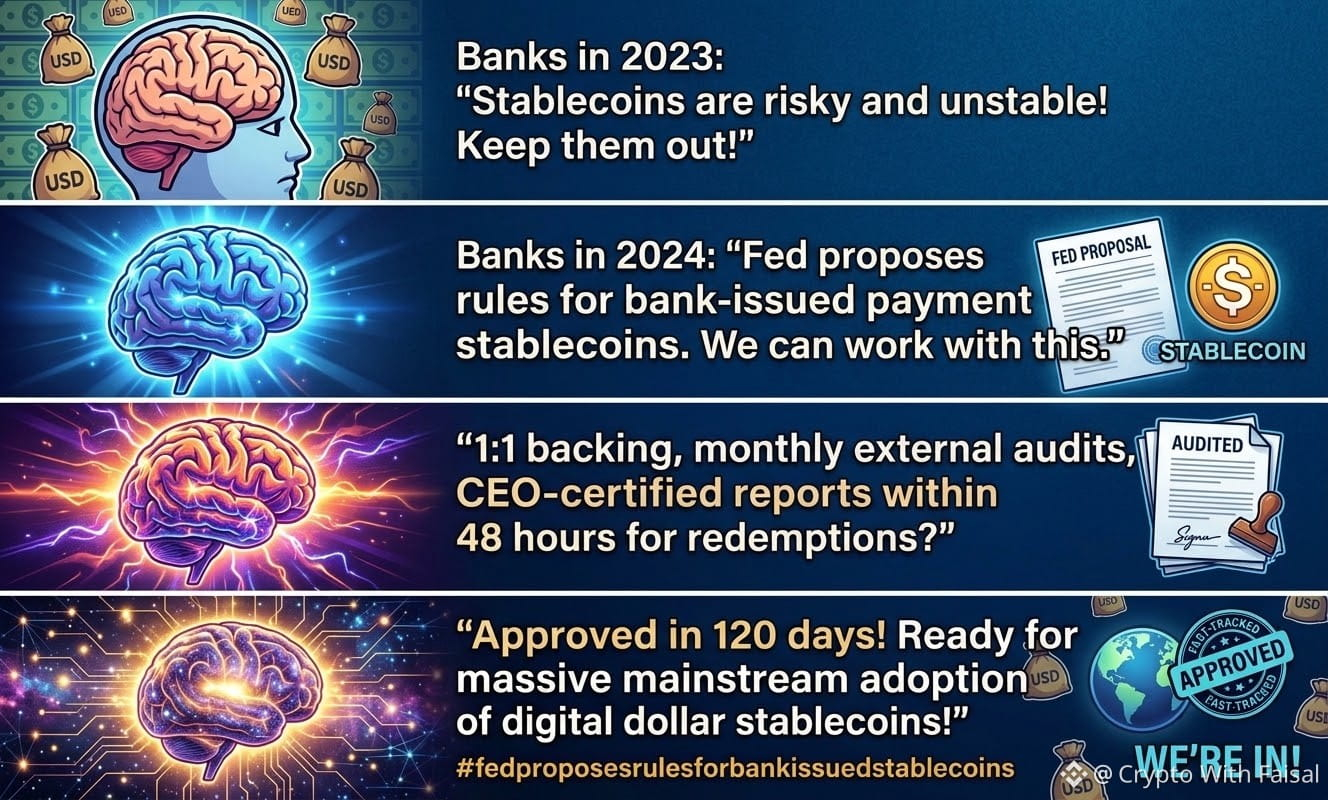
🚨 Fed Drops the Blueprint for Bank-Issued Stablecoins! 🚨
Is the U.S. banking system ready to go full on-chain? The Federal Reserve has proposed its new framework for payment stablecoins under the upcoming GENIUS Act.
Here is what the rulebook looks like:
🔒 1:1 Strict Backing: Every $1 token must be backed 100% by cash, short-term Treasuries (≤93 days), or insured deposits.
⏱️ 48-Hour Cashouts: Redemption requests must be honored within 2 business days. If reserves dip below 1:1, regulators step in immediately to enforce remediation or liquidation.
💰 Capital Buffers: Issuers must hold operational-risk reserve buffers (up to 2% based on volume) to absorb unexpected shocks.
🔎 CEO-Certified Audits: Monthly reserve reports must be audited by external CPAs—and signed off personally by the CEO & CFO.
🏦 Bank Fast-Track: Outlines how state member banks can set up issuance subsidiaries, with the Fed required to rule within 120 days.
This is the bridge connecting TradFi to digital assets ahead of 2027.
👇 Big question: Will bank-issued stablecoins drive true mass adoption, or squeeze out decentralized alternatives? Drop your view!
$BTC
{future}(BTCUSDT)
$BNB
{future}(BNBUSDT)
$SOL
{future}(SOLUSDT)
#Stablecoins #GENIUSAct #FedNews
#fedproposesrulesforbankissuedstablecoins
🚨 Fed Drops the Blueprint for Bank-Issued Stablecoins! 🚨
Is the U.S. banking system ready to go full on-chain? The Federal Reserve has proposed its new framework for payment stablecoins under the upcoming GENIUS Act.
Here is what the rulebook looks like:
🔒 1:1 Strict Backing: Every $1 token must be backed 100% by cash, short-term Treasuries (≤93 days), or insured deposits.
⏱️ 48-Hour Cashouts: Redemption requests must be honored within 2 business days. If reserves dip below 1:1, regulators step in immediately to enforce remediation or liquidation.
💰 Capital Buffers: Issuers must hold operational-risk reserve buffers (up to 2% based on volume) to absorb unexpected shocks.
🔎 CEO-Certified Audits: Monthly reserve reports must be audited by external CPAs—and signed off personally by the CEO & CFO.
🏦 Bank Fast-Track: Outlines how state member banks can set up issuance subsidiaries, with the Fed required to rule within 120 days.
This is the bridge connecting TradFi to digital assets ahead of 2027.
👇 Big question: Will bank-issued stablecoins drive true mass adoption, or squeeze out decentralized alternatives? Drop your view!
$BTC
$BNB
$SOL
#Stablecoins #GENIUSAct #FedNews
🚨 Fed Drops the Blueprint for Bank-Issued Stablecoins! 🚨
Is the U.S. banking system ready to go full on-chain? The Federal Reserve has proposed its new framework for payment stablecoins under the upcoming GENIUS Act.
Here is what the rulebook looks like:
🔒 1:1 Strict Backing: Every $1 token must be backed 100% by cash, short-term Treasuries (≤93 days), or insured deposits.
⏱️ 48-Hour Cashouts: Redemption requests must be honored within 2 business days. If reserves dip below 1:1, regulators step in immediately to enforce remediation or liquidation.
💰 Capital Buffers: Issuers must hold operational-risk reserve buffers (up to 2% based on volume) to absorb unexpected shocks.
🔎 CEO-Certified Audits: Monthly reserve reports must be audited by external CPAs—and signed off personally by the CEO & CFO.
🏦 Bank Fast-Track: Outlines how state member banks can set up issuance subsidiaries, with the Fed required to rule within 120 days.
This is the bridge connecting TradFi to digital assets ahead of 2027.
👇 Big question: Will bank-issued stablecoins drive true mass adoption, or squeeze out decentralized alternatives? Drop your view!
$BTC
$BNB
$SOL
#Stablecoins #GENIUSAct #FedNews
2
258
·
--
Bullish
#fedproposesrulesforbankissuedstablecoins
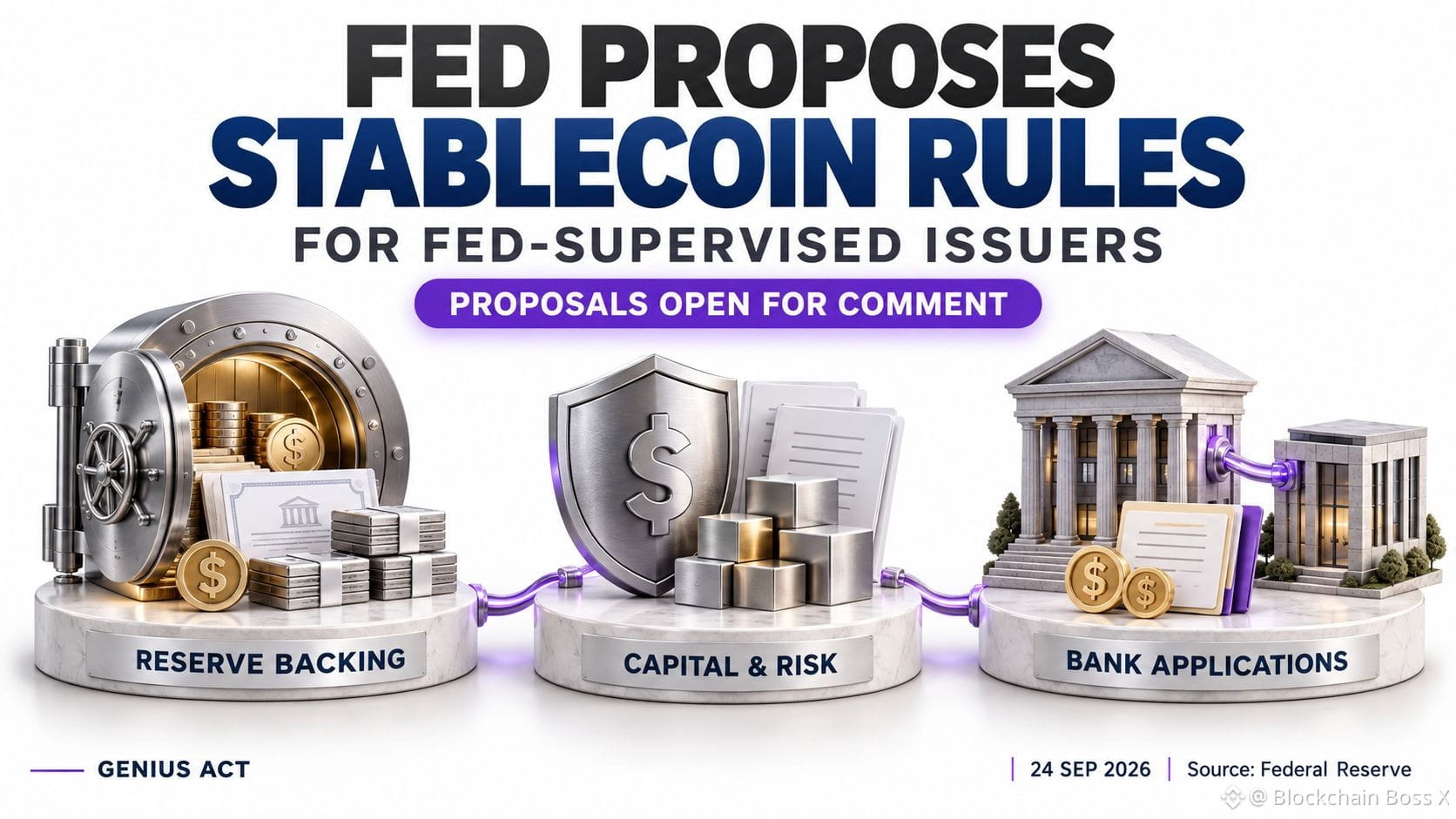
Fed Proposes Stablecoin Rules: What Would Change for Banks?
On September 24, the Federal Reserve released two proposals under the GENIUS Act for payment stablecoin issuers under its supervision.
The first would require full backing with eligible liquid reserves, including short-term Treasury bills. It also outlines capital requirements, risk management standards and rules for safeguarding reserve assets.
The second would establish an application process for supervised banks seeking approval for subsidiaries to issue stablecoins, including submitting business plans and financial information.
These remain proposals. Public comments are due 60 days after publication in the Federal Register.
My take: A clearer approval process could help banks plan stablecoin services with greater confidence. However, reserve and capital requirements would also influence operating costs, product pricing and which institutions find issuance commercially worthwhile.
For users, the practical test is reliable redemption: can they get their money back promptly, including during market stress? Governor Michael Barr specifically emphasized that concern in his response to the proposals.
I’d watch final redemption protections, reserve disclosures and actual bank launches. Clearer rules could support adoption, while payment usage, fees and customer experience would reveal whether these services deliver practical improvements.
Would you choose a bank-issued stablecoin based on the issuer’s reputation, or would redemption terms and fees matter more?
#FedProposesRulesForBankIssuedStablecoins #Stablecoins #GENIUSAct
$BTC $ETH $BNB
{future}(BNBUSDT)
{future}(ETHUSDT)
{future}(BTCUSDT)
#fedproposesrulesforbankissuedstablecoins
Fed Proposes Stablecoin Rules: What Would Change for Banks?
On September 24, the Federal Reserve released two proposals under the GENIUS Act for payment stablecoin issuers under its supervision.
The first would require full backing with eligible liquid reserves, including short-term Treasury bills. It also outlines capital requirements, risk management standards and rules for safeguarding reserve assets.
The second would establish an application process for supervised banks seeking approval for subsidiaries to issue stablecoins, including submitting business plans and financial information.
These remain proposals. Public comments are due 60 days after publication in the Federal Register.
My take: A clearer approval process could help banks plan stablecoin services with greater confidence. However, reserve and capital requirements would also influence operating costs, product pricing and which institutions find issuance commercially worthwhile.
For users, the practical test is reliable redemption: can they get their money back promptly, including during market stress? Governor Michael Barr specifically emphasized that concern in his response to the proposals.
I’d watch final redemption protections, reserve disclosures and actual bank launches. Clearer rules could support adoption, while payment usage, fees and customer experience would reveal whether these services deliver practical improvements.
Would you choose a bank-issued stablecoin based on the issuer’s reputation, or would redemption terms and fees matter more?
#FedProposesRulesForBankIssuedStablecoins #Stablecoins #GENIUSAct
$BTC $ETH $BNB
Fed Proposes Stablecoin Rules: What Would Change for Banks?
On September 24, the Federal Reserve released two proposals under the GENIUS Act for payment stablecoin issuers under its supervision.
The first would require full backing with eligible liquid reserves, including short-term Treasury bills. It also outlines capital requirements, risk management standards and rules for safeguarding reserve assets.
The second would establish an application process for supervised banks seeking approval for subsidiaries to issue stablecoins, including submitting business plans and financial information.
These remain proposals. Public comments are due 60 days after publication in the Federal Register.
My take: A clearer approval process could help banks plan stablecoin services with greater confidence. However, reserve and capital requirements would also influence operating costs, product pricing and which institutions find issuance commercially worthwhile.
For users, the practical test is reliable redemption: can they get their money back promptly, including during market stress? Governor Michael Barr specifically emphasized that concern in his response to the proposals.
I’d watch final redemption protections, reserve disclosures and actual bank launches. Clearer rules could support adoption, while payment usage, fees and customer experience would reveal whether these services deliver practical improvements.
Would you choose a bank-issued stablecoin based on the issuer’s reputation, or would redemption terms and fees matter more?
#FedProposesRulesForBankIssuedStablecoins #Stablecoins #GENIUSAct
$BTC $ETH $BNB
2
1.8k

·
--
Bullish
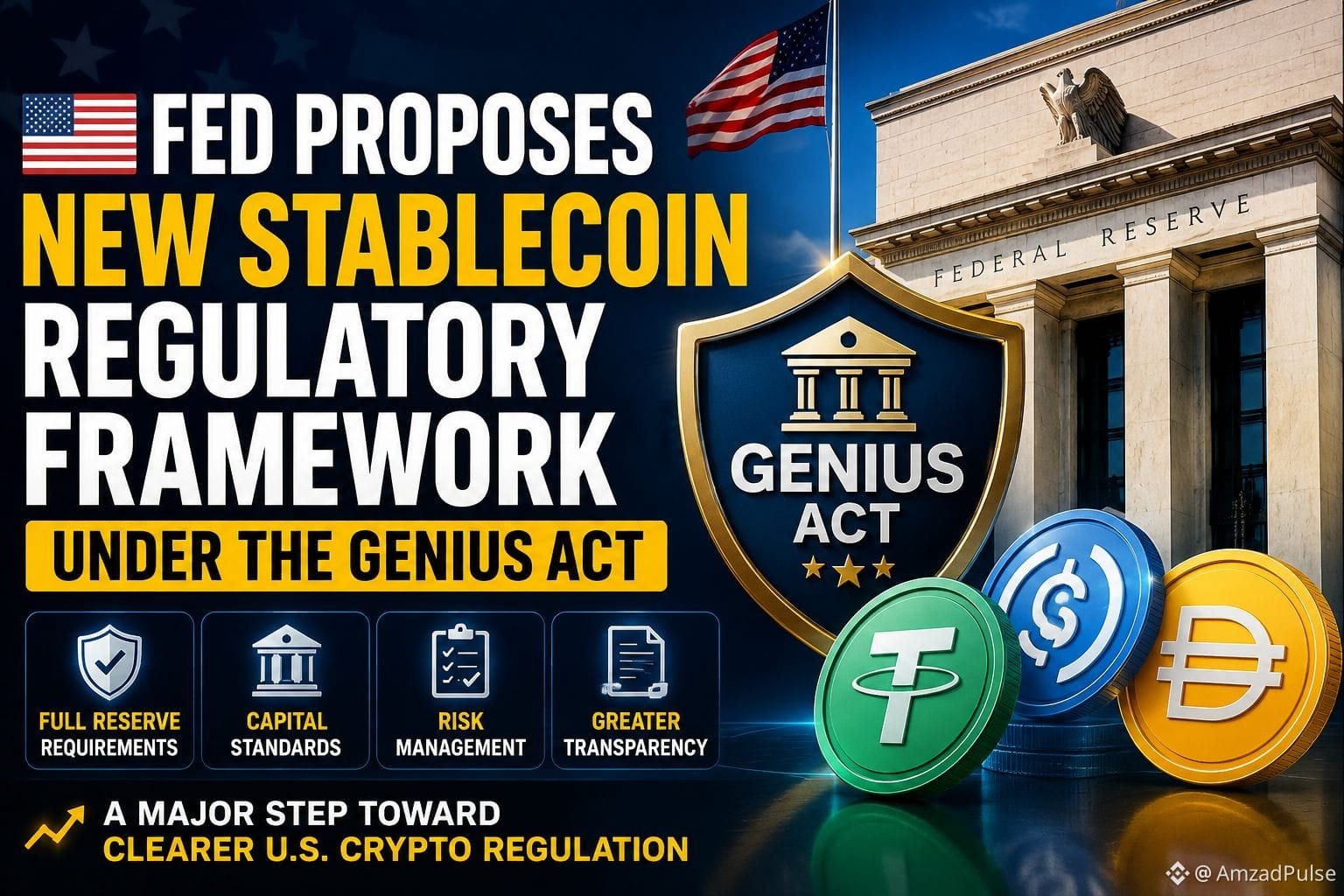
🇺🇸 FED PROPOSES NEW STABLECOIN REGULATORY FRAMEWORK UNDER THE GENIUS ACT
The new framework could introduce stronger reserve, capital and risk-management requirements—another major step toward clearer U.S. crypto regulation. 🚀
#Crypto #stablecoin #GENIUSAct
{spot}(USDCUSDT)
🇺🇸 FED PROPOSES NEW STABLECOIN REGULATORY FRAMEWORK UNDER THE GENIUS ACT
The new framework could introduce stronger reserve, capital and risk-management requirements—another major step toward clearer U.S. crypto regulation. 🚀
#Crypto #stablecoin #GENIUSAct
The new framework could introduce stronger reserve, capital and risk-management requirements—another major step toward clearer U.S. crypto regulation. 🚀
#Crypto #stablecoin #GENIUSAct
59

The Fed is proposing strict capital and redemption rules for stablecoin issuers under the GENIUS Act to enhance transparency and market stability.
#StablecoinRegulation #GENIUSAct
The Fed is proposing strict capital and redemption rules for stablecoin issuers under the GENIUS Act to enhance transparency and market stability.
#StablecoinRegulation #GENIUSAct
#StablecoinRegulation #GENIUSAct
3

#fedproposesrulesforbankissuedstablecoins
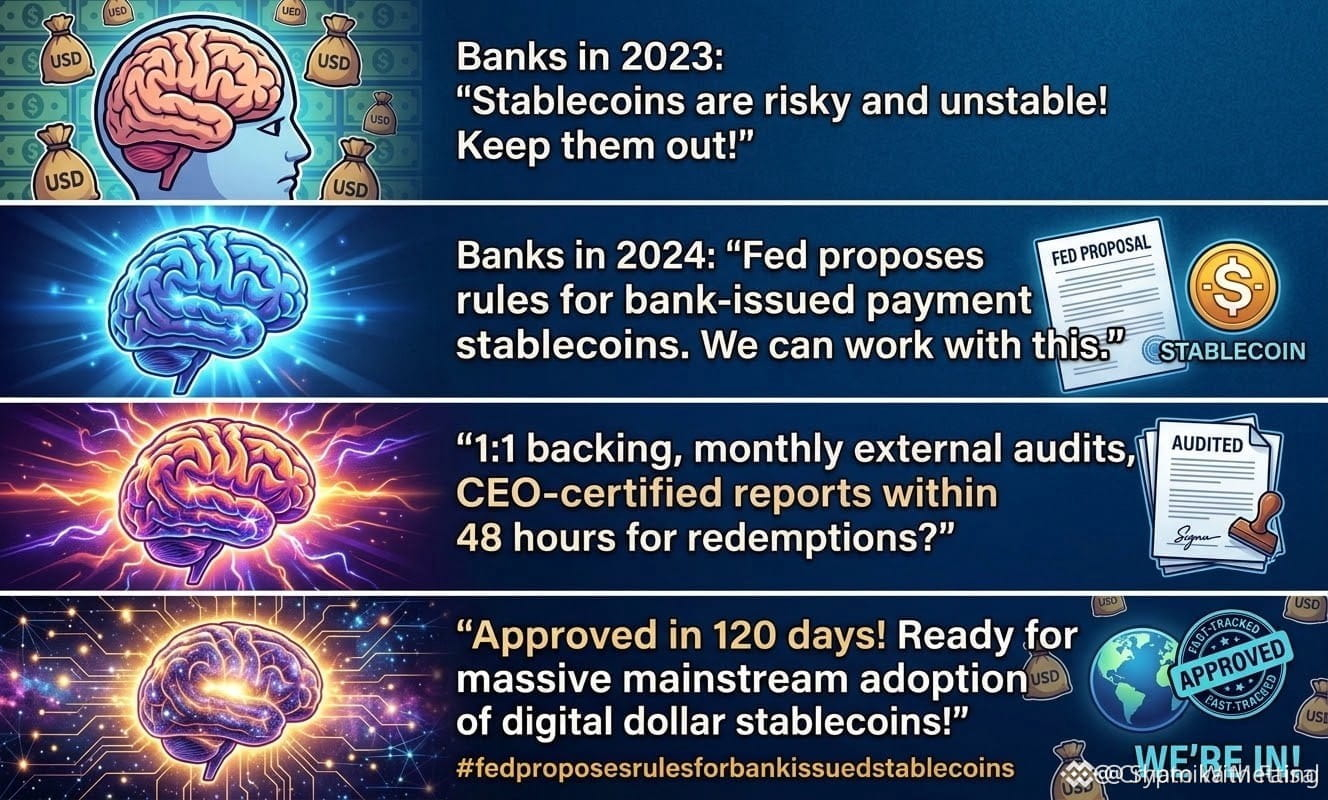
🚨 The Federal Reserve is cracking down on bank-backed stablecoins! 🚨
Is the U.S. banking system ready to fully move to the chain (on-chain)? The Federal Reserve has proposed its new framework for stablecoin payments under the upcoming GENIUS law.
Here’s what a “rulebook” looks like:
🔒 Tight 1:1 coverage: Every token worth $1 must be backed 100% by cash, short-term Treasury bills (≤ 93 days), or insured deposits.
💰 Capital buffers: Issuers must hold operating risk reserves (up to 2% based on trading volume) to absorb unexpected shocks.
🔎 CEO-approved audits: Monthly reserve reports must be audited by independent licensed public accountants (CPAs)—and must be personally signed by the CEO and CFO.
🏦 Fast-track for banks: It details how participating state banks can set up branches/subsidiaries to issue the currency, with the Federal Reserve required to make its decision within 120 days.
This is the bridge connecting traditional finance (TradFi) to digital assets before 2027.
👇 The big question: Will bank-issued stablecoins drive real mass adoption, or will they displace decentralized alternatives?
Please stay tuned
$BTC
$BNB
$SOL
#Stablecoins #GENIUSAct #FedNews
#fedproposesrulesforbankissuedstablecoins
🚨 The Federal Reserve is cracking down on bank-backed stablecoins! 🚨
Is the U.S. banking system ready to fully move to the chain (on-chain)? The Federal Reserve has proposed its new framework for stablecoin payments under the upcoming GENIUS law.
Here’s what a “rulebook” looks like:
🔒 Tight 1:1 coverage: Every token worth $1 must be backed 100% by cash, short-term Treasury bills (≤ 93 days), or insured deposits.
💰 Capital buffers: Issuers must hold operating risk reserves (up to 2% based on trading volume) to absorb unexpected shocks.
🔎 CEO-approved audits: Monthly reserve reports must be audited by independent licensed public accountants (CPAs)—and must be personally signed by the CEO and CFO.
🏦 Fast-track for banks: It details how participating state banks can set up branches/subsidiaries to issue the currency, with the Federal Reserve required to make its decision within 120 days.
This is the bridge connecting traditional finance (TradFi) to digital assets before 2027.
👇 The big question: Will bank-issued stablecoins drive real mass adoption, or will they displace decentralized alternatives?
Please stay tuned
$BTC
$BNB
$SOL
#Stablecoins #GENIUSAct #FedNews
🚨 The Federal Reserve is cracking down on bank-backed stablecoins! 🚨
Is the U.S. banking system ready to fully move to the chain (on-chain)? The Federal Reserve has proposed its new framework for stablecoin payments under the upcoming GENIUS law.
Here’s what a “rulebook” looks like:
🔒 Tight 1:1 coverage: Every token worth $1 must be backed 100% by cash, short-term Treasury bills (≤ 93 days), or insured deposits.
💰 Capital buffers: Issuers must hold operating risk reserves (up to 2% based on trading volume) to absorb unexpected shocks.
🔎 CEO-approved audits: Monthly reserve reports must be audited by independent licensed public accountants (CPAs)—and must be personally signed by the CEO and CFO.
🏦 Fast-track for banks: It details how participating state banks can set up branches/subsidiaries to issue the currency, with the Federal Reserve required to make its decision within 120 days.
This is the bridge connecting traditional finance (TradFi) to digital assets before 2027.
👇 The big question: Will bank-issued stablecoins drive real mass adoption, or will they displace decentralized alternatives?
Please stay tuned
$BTC
$BNB
$SOL
#Stablecoins #GENIUSAct #FedNews
IrumOnChain:
This is exactly the bridge we've been waiting for.
Tight 1:1 backing + CEO-signed audits = trust that TradFi was missing.
I don't think bank stablecoins will kill decentralized alternatives, they will actually onboard the next 100M users who were scared of crypto. Once they are on-chain for dollars, BTC, BNB, SOL is just one click away.
Mass adoption starts here. I'm breaking this down daily on my profile.
1
10
12.6k

·
--
⏳ Critical moment for stablecoin regulation:
U.S. GENIUS Act proposed rules enter a 60‑day public comment phase.
Regulators are gathering real‑world feedback on licensing, reserves & AML for institutional stablecoins.
📢 Industry builders: don’t sleep on this window. File your public comments.
What is your stance? Comment below 👇
#GENIUSAct #AnubisChain
⏳ Critical moment for stablecoin regulation:
U.S. GENIUS Act proposed rules enter a 60‑day public comment phase.
Regulators are gathering real‑world feedback on licensing, reserves & AML for institutional stablecoins.
📢 Industry builders: don’t sleep on this window. File your public comments.
What is your stance? Comment below 👇
#GENIUSAct #AnubisChain
U.S. GENIUS Act proposed rules enter a 60‑day public comment phase.
Regulators are gathering real‑world feedback on licensing, reserves & AML for institutional stablecoins.
📢 Industry builders: don’t sleep on this window. File your public comments.
What is your stance? Comment below 👇
#GENIUSAct #AnubisChain
68

·
--

Article
☀️ GENIUS ACT IN ACTION THE NEW RULES THAT WILL CHANGE STABLECOINS FOREVER🔥 THE LAW THAT CHANGED THE RULES OF THE GAME FOR STABLECOINS
On July 18, 2025, President Donald Trump signed the GENIUS Act, the first U.S. federal legislation on digital assets. A year later, on August 17, 2026, the U.S. Treasury published its first proposed rule to implement the law, opening a 60-day public comment period. The stablecoin market already exceeds $308 billion, and this law will define how digital dollars are issued, held in custody, and used in the coming years.
☀️ GENIUS ACT IN ACTION THE NEW RULES THAT WILL CHANGE STABLECOINS FOREVER
🔥 THE LAW THAT CHANGED THE RULES OF THE GAME FOR STABLECOINS
On July 18, 2025, President Donald Trump signed the GENIUS Act, the first U.S. federal legislation on digital assets. A year later, on August 17, 2026, the U.S. Treasury published its first proposed rule to implement the law, opening a 60-day public comment period. The stablecoin market already exceeds $308 billion, and this law will define how digital dollars are issued, held in custody, and used in the coming years.
On July 18, 2025, President Donald Trump signed the GENIUS Act, the first U.S. federal legislation on digital assets. A year later, on August 17, 2026, the U.S. Treasury published its first proposed rule to implement the law, opening a 60-day public comment period. The stablecoin market already exceeds $308 billion, and this law will define how digital dollars are issued, held in custody, and used in the coming years.
1
1
107

·
--
Many people hold stablecoins, but rarely consider one key question: who actually backs your “stability”? The GENIUS Act (the U.S. payment stablecoin regulatory law) was signed in 2025 and will officially take effect on January 18, 2027. This law is the first to set rules for stablecoins at the federal level, and it makes both protections and risks equally clear. 5 key facts: 1. Issuance thresholds tightened. Starting in January 2027, only issuers with federal or state licenses may issue payment stablecoins in the U.S. After July 2028, unlicensed projects may not offer their services to U.S. users. 2. Reserve requirements made explicit. The law mandates a 1:1 reserve (in U.S. dollars or other highly liquid assets such as short-term Treasury securities) and requires monthly public disclosure of the reserve composition. Issuers with a market value exceeding $50 billion must undergo annual audits. 3. Legal classification: stablecoins are not securities, not commodities, and not legal tender. This means they are not protected by FDIC deposit insurance and do not fall under traditional securities-investor protection frameworks. 4. KYC implemented. In June 2026, FinCEN, together with the OCC, FDIC, and other institutions, issued proposed rules requiring all licensed issuers to establish customer identification programs—collecting identity information and retaining it for 5 years. 5. Limited but existing bankruptcy protection. Coin holders have priority rights to be repaid from the issuer’s reserve assets if the issuer goes bankrupt. But the Brookings Institution notes that without federal insurance and without support from a lender of last resort, operational risks (fraud, hacking attacks, loss of private keys) are still borne by coin holders themselves. One-sentence summary: The GENIUS Act sets clear compliance boundaries for stablecoins, but “compliance” doesn’t mean “zero risk.” Before anything else, you should clarify whether the stablecoin you hold has an issuer that has applied for the required license. This question is worth addressing more than price swings. $USDC #GENIUSAct #Stablecoin Regulation
Many people hold stablecoins, but rarely consider one key question: who actually backs your “stability”? The GENIUS Act (the U.S. payment stablecoin regulatory law) was signed in 2025 and will officially take effect on January 18, 2027. This law is the first to set rules for stablecoins at the federal level, and it makes both protections and risks equally clear. 5 key facts: 1. Issuance thresholds tightened. Starting in January 2027, only issuers with federal or state licenses may issue payment stablecoins in the U.S. After July 2028, unlicensed projects may not offer their services to U.S. users. 2. Reserve requirements made explicit. The law mandates a 1:1 reserve (in U.S. dollars or other highly liquid assets such as short-term Treasury securities) and requires monthly public disclosure of the reserve composition. Issuers with a market value exceeding $50 billion must undergo annual audits. 3. Legal classification: stablecoins are not securities, not commodities, and not legal tender. This means they are not protected by FDIC deposit insurance and do not fall under traditional securities-investor protection frameworks. 4. KYC implemented. In June 2026, FinCEN, together with the OCC, FDIC, and other institutions, issued proposed rules requiring all licensed issuers to establish customer identification programs—collecting identity information and retaining it for 5 years. 5. Limited but existing bankruptcy protection. Coin holders have priority rights to be repaid from the issuer’s reserve assets if the issuer goes bankrupt. But the Brookings Institution notes that without federal insurance and without support from a lender of last resort, operational risks (fraud, hacking attacks, loss of private keys) are still borne by coin holders themselves. One-sentence summary: The GENIUS Act sets clear compliance boundaries for stablecoins, but “compliance” doesn’t mean “zero risk.” Before anything else, you should clarify whether the stablecoin you hold has an issuer that has applied for the required license. This question is worth addressing more than price swings. $USDC #GENIUSAct #Stablecoin Regulation
80

·
--
GENIUS Act Rules Get Crypto Industry Support
The Blockchain Association backed proposed Treasury rules connected to the GENIUS Act, while requesting clearer requirements around customer identification and stablecoin transactions.
#GENIUSAct #Stablecoin s #CryptoRegulation #USDC #CryptoNews
GENIUS Act Rules Get Crypto Industry Support
The Blockchain Association backed proposed Treasury rules connected to the GENIUS Act, while requesting clearer requirements around customer identification and stablecoin transactions.
#GENIUSAct #Stablecoin s #CryptoRegulation #USDC #CryptoNews
The Blockchain Association backed proposed Treasury rules connected to the GENIUS Act, while requesting clearer requirements around customer identification and stablecoin transactions.
#GENIUSAct #Stablecoin s #CryptoRegulation #USDC #CryptoNews
1
9

·
--
The U.S. Treasury, along with FinCEN, OCC, the Fed, FDIC, and NCUA, has proposed a joint initiative — stablecoin issuers will be classified as "financial institutions" under the Bank Secrecy Act (BSA), and will be required to implement KYC/AML Customer Identification Programs (CIP).
This is the rollout of the GENIUS Act (Stablecoin Bill), which means:
1. Stablecoin issuers like USDT/USDC are now officially under bank-level regulation.
2. A comprehensive Customer Identification (CIP) system must be established.
3. Compliance costs are set to soar, pushing out smaller players.
With regulatory boots hitting the ground, is this bullish or bearish for the stablecoin leaders? Let’s discuss in the comments.
#稳定币监管 #GENIUSAct
The U.S. Treasury, along with FinCEN, OCC, the Fed, FDIC, and NCUA, has proposed a joint initiative — stablecoin issuers will be classified as "financial institutions" under the Bank Secrecy Act (BSA), and will be required to implement KYC/AML Customer Identification Programs (CIP).
This is the rollout of the GENIUS Act (Stablecoin Bill), which means:
1. Stablecoin issuers like USDT/USDC are now officially under bank-level regulation.
2. A comprehensive Customer Identification (CIP) system must be established.
3. Compliance costs are set to soar, pushing out smaller players.
With regulatory boots hitting the ground, is this bullish or bearish for the stablecoin leaders? Let’s discuss in the comments.
#稳定币监管 #GENIUSAct
This is the rollout of the GENIUS Act (Stablecoin Bill), which means:
1. Stablecoin issuers like USDT/USDC are now officially under bank-level regulation.
2. A comprehensive Customer Identification (CIP) system must be established.
3. Compliance costs are set to soar, pushing out smaller players.
With regulatory boots hitting the ground, is this bullish or bearish for the stablecoin leaders? Let’s discuss in the comments.
#稳定币监管 #GENIUSAct
1
34

GENIUS Act has been enacted for 1 year: Crypto status
- The GENIUS Act, a regulation focused on stablecoins, has been law for 1 year now
- This regulation may affect the development and the display of the stablecoin market
- Opens up opportunities for blockchain projects related to crypto stability
#BinanceSquare #CryptoNews #GENIUSAct #Stablecoins
$btc $eth
#vlikevn Titanbot
Source: CoinDesk
GENIUS Act has been enacted for 1 year: Crypto status
- The GENIUS Act, a regulation focused on stablecoins, has been law for 1 year now
- This regulation may affect the development and the display of the stablecoin market
- Opens up opportunities for blockchain projects related to crypto stability
#BinanceSquare #CryptoNews #GENIUSAct #Stablecoins
$btc $eth
#vlikevn Titanbot
Source: CoinDesk
- The GENIUS Act, a regulation focused on stablecoins, has been law for 1 year now
- This regulation may affect the development and the display of the stablecoin market
- Opens up opportunities for blockchain projects related to crypto stability
#BinanceSquare #CryptoNews #GENIUSAct #Stablecoins
$btc $eth
#vlikevn Titanbot
Source: CoinDesk
1
110

·
--
🔥 **BREAKING: The Stablecoin Game Just Changed FOREVER!** 🚨
Fidelity is throwing a massive lifeline to the crypto industry, launching an exclusive Government Money Market Fund tailored specifically for stablecoin issuers. This isn’t just a new product—it’s a compliance powerhouse designed to house reserve assets under the **GENIUS Act**.
This move bridges the gap between traditional high-finance security and the lightning-fast world of digital assets. By providing a regulatory-grade home for reserves, Fidelity is officially institutionalizing stablecoins, paving the way for massive market expansion. 🚀
**The era of "wild west" crypto banking is officially over.** The giants have arrived to legitimize the space. 💼💎
#Fidelity #Stablecoins #Crypto #Finance #GENIUSAct #Web3 #Bitcoin #Investing #BreakingNews
$RE $SYN $ZEREBRO
🔥 **BREAKING: The Stablecoin Game Just Changed FOREVER!** 🚨
Fidelity is throwing a massive lifeline to the crypto industry, launching an exclusive Government Money Market Fund tailored specifically for stablecoin issuers. This isn’t just a new product—it’s a compliance powerhouse designed to house reserve assets under the **GENIUS Act**.
This move bridges the gap between traditional high-finance security and the lightning-fast world of digital assets. By providing a regulatory-grade home for reserves, Fidelity is officially institutionalizing stablecoins, paving the way for massive market expansion. 🚀
**The era of "wild west" crypto banking is officially over.** The giants have arrived to legitimize the space. 💼💎
#Fidelity #Stablecoins #Crypto #Finance #GENIUSAct #Web3 #Bitcoin #Investing #BreakingNews
$RE $SYN $ZEREBRO
Fidelity is throwing a massive lifeline to the crypto industry, launching an exclusive Government Money Market Fund tailored specifically for stablecoin issuers. This isn’t just a new product—it’s a compliance powerhouse designed to house reserve assets under the **GENIUS Act**.
This move bridges the gap between traditional high-finance security and the lightning-fast world of digital assets. By providing a regulatory-grade home for reserves, Fidelity is officially institutionalizing stablecoins, paving the way for massive market expansion. 🚀
**The era of "wild west" crypto banking is officially over.** The giants have arrived to legitimize the space. 💼💎
#Fidelity #Stablecoins #Crypto #Finance #GENIUSAct #Web3 #Bitcoin #Investing #BreakingNews
$RE $SYN $ZEREBRO

2
159
Log in to explore more content
Join global crypto users on Binance Square
⚡️ Get latest and useful information about crypto.
💬 Trusted by the world’s largest crypto exchange.
👍 Discover real insights from verified creators.
Email / Phone number
Trending Topics
1
#BitcoinClears$85200
5,955 views
163 Discussing
2
#AltcoinSeasonIndexHoldsAbove60For5Days
33,979 views
936 Discussing
3
#USADPAdds90000JobsInSeptember
15,089 views
534 Discussing
4
#USCorePCEEasesTo3%InAugust
11,842 views
431 Discussing
5
#KospiPostsWorstQuarterSince2020
8,926 views
429 Discussing
6
#SECToClarifyOnChainFundraisingRules
21,320 views
601 Discussing
7
#UKFCAOpensCryptoFirmAuthorization
22,116 views
513 Discussing
8
#JapanMOFStudyGroupOnTokenizedGovtBonds
17,563 views
406 Discussing
9
#QNTRises287%
75,475 views
860 Discussing
10
#TrumpRejectsAIRulesForVoluntaryAudits
46,465 views
760 Discussing