

Thedy
147 Posts

Thedy
Report
Block User
Crypto lover and Blockchain passionate

#BinanceTurns7
Open Trade
Occasional Trader
5.4 Years
8 Following
39 Followers
55 Liked
1 Badges
Posts
Portfolio
All
Quotes
PINNED
·
--

Article
Top Low Market Cap Cryptocurrencies with High PotentialThe cryptocurrency market continues to offer a plethora of investment opportunities, especially among low market cap tokens. These projects often carry higher risk, but their unique use cases and innovative approaches could potentially lead to significant rewards. Here’s a look at some promising low market cap cryptocurrencies worth considering:
1. Retik (RETIK)
Retik is carving a niche in the real estate sector by introducing blockchain transparency to property transactions. This token aims to streamline and secure real estate deals, making the process more efficient and trustworthy. As the real estate market gradually adopts blockchain solutions, RETIK could see substantial growth.
2. Gala (GALA)
Gala has been making waves in the gaming and entertainment industry. With a strong use case and an active community, GALA is focused on creating decentralized gaming experiences. The project’s dedication to empowering game developers and providing players with true ownership of their in-game assets sets it apart in the crowded crypto space.
3. Sei (SEI)
Known for its applications in decentralized finance (DeFi), Sei offers a robust platform for developing and managing decentralized applications (dApps). The project's emphasis on providing secure, scalable, and user-friendly DeFi solutions positions it as a strong contender in the DeFi sector.
4. Xenon (XNA)
Xenon is dedicated to enhancing security and privacy features in the cryptocurrency world. As concerns about digital privacy grow, Xenon’s focus on providing robust security solutions makes it a noteworthy project. Its potential applications in secure transactions and privacy-focused applications could drive significant interest.
5. Hello (HELLO)
Hello aims to revolutionize social media by integrating blockchain technology to ensure user privacy and data security. With increasing awareness of data privacy issues, Hello's approach to creating a decentralized social media platform could attract users looking for more control over their personal information.
6. Zephyr (ZEPH)
Zephyr is focused on providing fast and secure cross-border transactions. Its practical applications in international finance, coupled with the increasing demand for efficient global payment solutions, make ZEPH a promising project. The token’s ability to facilitate quick and low-cost transactions could drive its adoption.
7. Digital Media Labs (DML)
Digital Media Labs seeks to decentralize content creation and distribution, empowering creators through blockchain technology. By eliminating intermediaries, DML aims to give content creators more control and a fairer share of revenue. This approach could significantly impact the media and entertainment industries.
8.Velas (VLX)
Description: Velas is an EVM blockchain known for its high transaction speed and low costs, supporting decentralized applications.
9. IOTA (IOTA)
Though not as low-cap as some others, IOTA’s innovative Tangle technology offers a unique approach to the Internet of Things (IoT) sector. Its feeless and scalable nature makes it suitable for a wide range of IoT applications. IOTA's potential to disrupt the IoT industry makes it a cryptocurrency to watch.
10. Gemini (GEM)
Gemini is gaining popularity due to its unique features and potential to support various decentralized applications. The token’s versatility and strong community support could contribute to its growth. GEM's ability to facilitate different dApps makes it a valuable addition to the crypto ecosystem.
Conclusion
These cryptocurrencies are noteworthy for their potential driven by unique use cases, technological innovations, and active communities. While investing in low market cap cryptocurrencies can be highly rewarding, it is crucial to conduct thorough research and exercise caution. Always consider the risks and perform due diligence before making investment decisions.
#altcoins #DYOR
Top Low Market Cap Cryptocurrencies with High Potential
The cryptocurrency market continues to offer a plethora of investment opportunities, especially among low market cap tokens. These projects often carry higher risk, but their unique use cases and innovative approaches could potentially lead to significant rewards. Here’s a look at some promising low market cap cryptocurrencies worth considering:
1. Retik (RETIK)
Retik is carving a niche in the real estate sector by introducing blockchain transparency to property transactions. This token aims to streamline and secure real estate deals, making the process more efficient and trustworthy. As the real estate market gradually adopts blockchain solutions, RETIK could see substantial growth.
2. Gala (GALA)
Gala has been making waves in the gaming and entertainment industry. With a strong use case and an active community, GALA is focused on creating decentralized gaming experiences. The project’s dedication to empowering game developers and providing players with true ownership of their in-game assets sets it apart in the crowded crypto space.
3. Sei (SEI)
Known for its applications in decentralized finance (DeFi), Sei offers a robust platform for developing and managing decentralized applications (dApps). The project's emphasis on providing secure, scalable, and user-friendly DeFi solutions positions it as a strong contender in the DeFi sector.
4. Xenon (XNA)
Xenon is dedicated to enhancing security and privacy features in the cryptocurrency world. As concerns about digital privacy grow, Xenon’s focus on providing robust security solutions makes it a noteworthy project. Its potential applications in secure transactions and privacy-focused applications could drive significant interest.
5. Hello (HELLO)
Hello aims to revolutionize social media by integrating blockchain technology to ensure user privacy and data security. With increasing awareness of data privacy issues, Hello's approach to creating a decentralized social media platform could attract users looking for more control over their personal information.
6. Zephyr (ZEPH)
Zephyr is focused on providing fast and secure cross-border transactions. Its practical applications in international finance, coupled with the increasing demand for efficient global payment solutions, make ZEPH a promising project. The token’s ability to facilitate quick and low-cost transactions could drive its adoption.
7. Digital Media Labs (DML)
Digital Media Labs seeks to decentralize content creation and distribution, empowering creators through blockchain technology. By eliminating intermediaries, DML aims to give content creators more control and a fairer share of revenue. This approach could significantly impact the media and entertainment industries.
8.Velas (VLX)
Description: Velas is an EVM blockchain known for its high transaction speed and low costs, supporting decentralized applications.
9. IOTA (IOTA)
Though not as low-cap as some others, IOTA’s innovative Tangle technology offers a unique approach to the Internet of Things (IoT) sector. Its feeless and scalable nature makes it suitable for a wide range of IoT applications. IOTA's potential to disrupt the IoT industry makes it a cryptocurrency to watch.
10. Gemini (GEM)
Gemini is gaining popularity due to its unique features and potential to support various decentralized applications. The token’s versatility and strong community support could contribute to its growth. GEM's ability to facilitate different dApps makes it a valuable addition to the crypto ecosystem.
Conclusion
These cryptocurrencies are noteworthy for their potential driven by unique use cases, technological innovations, and active communities. While investing in low market cap cryptocurrencies can be highly rewarding, it is crucial to conduct thorough research and exercise caution. Always consider the risks and perform due diligence before making investment decisions.
#altcoins #DYOR
1. Retik (RETIK)
Retik is carving a niche in the real estate sector by introducing blockchain transparency to property transactions. This token aims to streamline and secure real estate deals, making the process more efficient and trustworthy. As the real estate market gradually adopts blockchain solutions, RETIK could see substantial growth.
2. Gala (GALA)
Gala has been making waves in the gaming and entertainment industry. With a strong use case and an active community, GALA is focused on creating decentralized gaming experiences. The project’s dedication to empowering game developers and providing players with true ownership of their in-game assets sets it apart in the crowded crypto space.
3. Sei (SEI)
Known for its applications in decentralized finance (DeFi), Sei offers a robust platform for developing and managing decentralized applications (dApps). The project's emphasis on providing secure, scalable, and user-friendly DeFi solutions positions it as a strong contender in the DeFi sector.
4. Xenon (XNA)
Xenon is dedicated to enhancing security and privacy features in the cryptocurrency world. As concerns about digital privacy grow, Xenon’s focus on providing robust security solutions makes it a noteworthy project. Its potential applications in secure transactions and privacy-focused applications could drive significant interest.
5. Hello (HELLO)
Hello aims to revolutionize social media by integrating blockchain technology to ensure user privacy and data security. With increasing awareness of data privacy issues, Hello's approach to creating a decentralized social media platform could attract users looking for more control over their personal information.
6. Zephyr (ZEPH)
Zephyr is focused on providing fast and secure cross-border transactions. Its practical applications in international finance, coupled with the increasing demand for efficient global payment solutions, make ZEPH a promising project. The token’s ability to facilitate quick and low-cost transactions could drive its adoption.
7. Digital Media Labs (DML)
Digital Media Labs seeks to decentralize content creation and distribution, empowering creators through blockchain technology. By eliminating intermediaries, DML aims to give content creators more control and a fairer share of revenue. This approach could significantly impact the media and entertainment industries.
8.Velas (VLX)
Description: Velas is an EVM blockchain known for its high transaction speed and low costs, supporting decentralized applications.
9. IOTA (IOTA)
Though not as low-cap as some others, IOTA’s innovative Tangle technology offers a unique approach to the Internet of Things (IoT) sector. Its feeless and scalable nature makes it suitable for a wide range of IoT applications. IOTA's potential to disrupt the IoT industry makes it a cryptocurrency to watch.
10. Gemini (GEM)
Gemini is gaining popularity due to its unique features and potential to support various decentralized applications. The token’s versatility and strong community support could contribute to its growth. GEM's ability to facilitate different dApps makes it a valuable addition to the crypto ecosystem.
Conclusion
These cryptocurrencies are noteworthy for their potential driven by unique use cases, technological innovations, and active communities. While investing in low market cap cryptocurrencies can be highly rewarding, it is crucial to conduct thorough research and exercise caution. Always consider the risks and perform due diligence before making investment decisions.
#altcoins #DYOR
11
2.9k
·
--
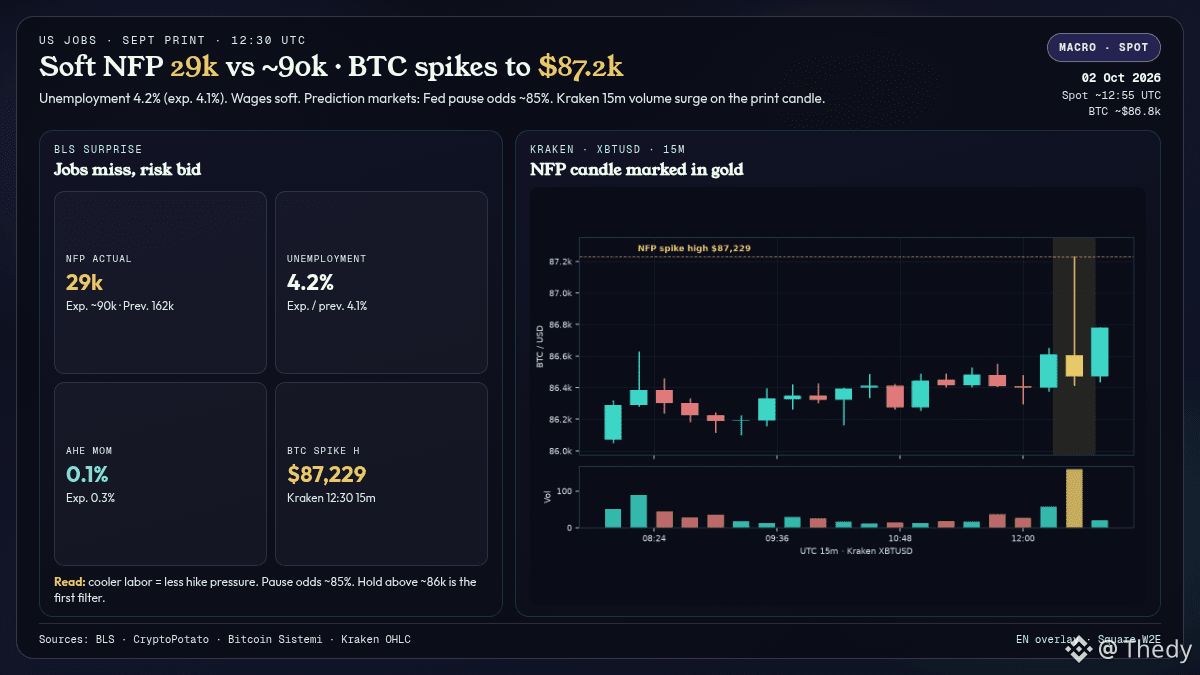
NFP soft: 29k vs ~90k expected (BLS). Unemployment 4.2% (vs 4.1%), hourly wages +0.1% MoM (vs +0.3% expected).
Immediate reaction on $BTC: the 15m Kraken candle at 12:30 UTC rolled over down to $87,229, with volume spiking. Spot ~86.8k around 12:56 UTC (+2.3% on the session), $ETH ~2 756, $SOL ~122.5.
Interpretation: a cooler jobs market = less pressure for a new rate hike. Prediction markets price in a Fed pause around ~85% (CryptoPotato). This is no longer the “NFP filter to come” from this morning: the print is out, and the first test is to hold above ~86k.
Scenarios:
• Digestion: staying above 86k / retesting the high 87.2k without a flush
• Soft invalidation: net loss below 86k with DXY / yields resuming
Does the soft print justify keeping the $BTC bid, or was it mostly a covering spike?
#Bitcoin #NFP #Crypto
NFP soft: 29k vs ~90k expected (BLS). Unemployment 4.2% (vs 4.1%), hourly wages +0.1% MoM (vs +0.3% expected).
Immediate reaction on $BTC : the 15m Kraken candle at 12:30 UTC rolled over down to $87,229, with volume spiking. Spot ~86.8k around 12:56 UTC (+2.3% on the session), $ETH ~2 756, $SOL ~122.5.
Interpretation: a cooler jobs market = less pressure for a new rate hike. Prediction markets price in a Fed pause around ~85% (CryptoPotato). This is no longer the “NFP filter to come” from this morning: the print is out, and the first test is to hold above ~86k.
Scenarios:
• Digestion: staying above 86k / retesting the high 87.2k without a flush
• Soft invalidation: net loss below 86k with DXY / yields resuming
Does the soft print justify keeping the $BTC bid, or was it mostly a covering spike?
#Bitcoin #NFP #Crypto
Immediate reaction on $BTC : the 15m Kraken candle at 12:30 UTC rolled over down to $87,229, with volume spiking. Spot ~86.8k around 12:56 UTC (+2.3% on the session), $ETH ~2 756, $SOL ~122.5.
Interpretation: a cooler jobs market = less pressure for a new rate hike. Prediction markets price in a Fed pause around ~85% (CryptoPotato). This is no longer the “NFP filter to come” from this morning: the print is out, and the first test is to hold above ~86k.
Scenarios:
• Digestion: staying above 86k / retesting the high 87.2k without a flush
• Soft invalidation: net loss below 86k with DXY / yields resuming
Does the soft print justify keeping the $BTC bid, or was it mostly a covering spike?
#Bitcoin #NFP #Crypto
118
·
--
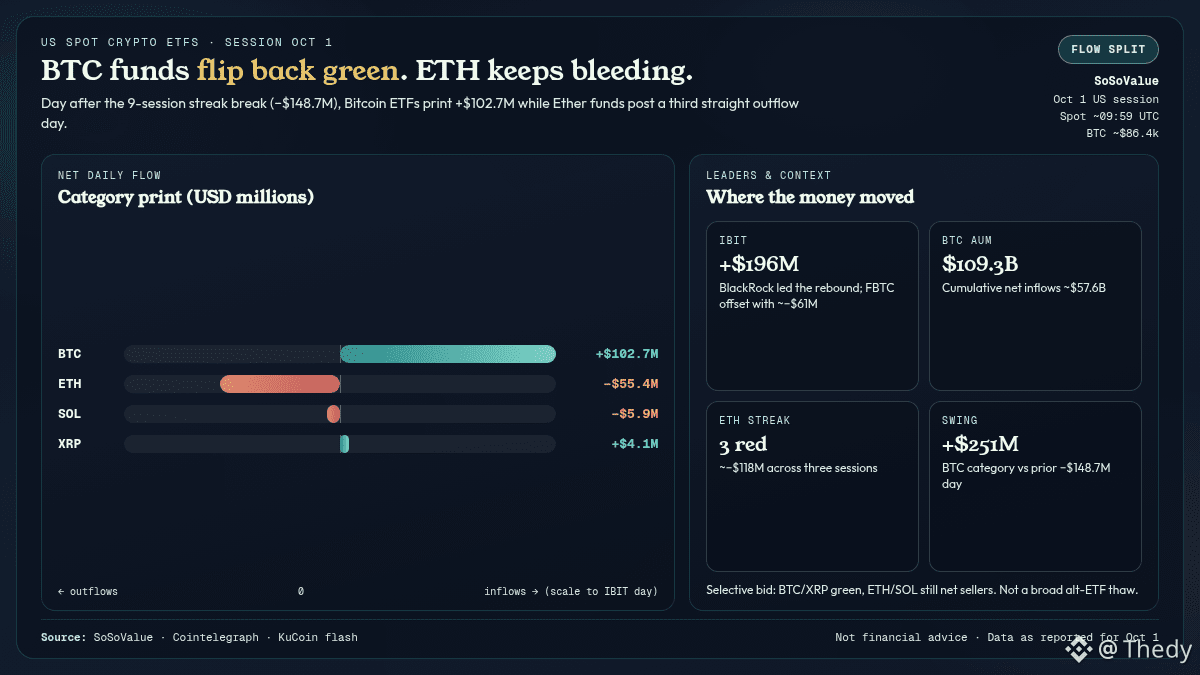
After the series break (−148.7M$ on 09/30), spot BTC ETFs $BTC US turn green again: +102.7M$ on October 1.
According to SoSoValue (reprinted by Cointelegraph / KuCoin flash), BlackRock IBIT leads with ~+196M$, partially offset by Fidelity FBTC (~−61M$). Aggregated BTC ETF AUM ~109.3B$, cumulative net flows ~57.6B$. Same session: spot ETF $ETH ~−55.4M$ (3rd consecutive red day, ~−118M$ over three sessions), $SOL ~−5.9M$, while XRP returns slightly green (~+4.1M$).
On the spot, $BTC holds around ~86.4k (Kraken ~86.36k around 09:59 UTC), well above the 82k–85k box from before the breakout. Institutional flow, meanwhile, remains selective: the bid returns to Bitcoin, not yet to Ether/Solana ETFs.
Interpretation: one green day doesn’t undo the −148.7M$ from the previous day, but the category swing (~+251M$ vs the red session) shows that the IBIT bid hasn’t disappeared. As long as ETH remains in a red series, the message is “rotation into BTC,” not an “alt season ETF.”
Scenarios:
• Digestion: next BTC sessions ≥ 0 and spot holds above ~85k
• Soft invalidation: a new BTC outflow > 100M$ while spot loses 85k
Are you seeing a real ETF bid return for $BTC, or just a technical bounce after the 09/30 flush?
#Bitcoin #ETF #Crypto
After the series break (−148.7M$ on 09/30), spot BTC ETFs $BTC US turn green again: +102.7M$ on October 1.
According to SoSoValue (reprinted by Cointelegraph / KuCoin flash), BlackRock IBIT leads with ~+196M$, partially offset by Fidelity FBTC (~−61M$). Aggregated BTC ETF AUM ~109.3B$, cumulative net flows ~57.6B$. Same session: spot ETF $ETH ~−55.4M$ (3rd consecutive red day, ~−118M$ over three sessions), $SOL ~−5.9M$, while XRP returns slightly green (~+4.1M$).
On the spot, $BTC holds around ~86.4k (Kraken ~86.36k around 09:59 UTC), well above the 82k–85k box from before the breakout. Institutional flow, meanwhile, remains selective: the bid returns to Bitcoin, not yet to Ether/Solana ETFs.
Interpretation: one green day doesn’t undo the −148.7M$ from the previous day, but the category swing (~+251M$ vs the red session) shows that the IBIT bid hasn’t disappeared. As long as ETH remains in a red series, the message is “rotation into BTC,” not an “alt season ETF.”
Scenarios:
• Digestion: next BTC sessions ≥ 0 and spot holds above ~85k
• Soft invalidation: a new BTC outflow > 100M$ while spot loses 85k
Are you seeing a real ETF bid return for $BTC , or just a technical bounce after the 09/30 flush?
#Bitcoin #ETF #Crypto
According to SoSoValue (reprinted by Cointelegraph / KuCoin flash), BlackRock IBIT leads with ~+196M$, partially offset by Fidelity FBTC (~−61M$). Aggregated BTC ETF AUM ~109.3B$, cumulative net flows ~57.6B$. Same session: spot ETF $ETH ~−55.4M$ (3rd consecutive red day, ~−118M$ over three sessions), $SOL ~−5.9M$, while XRP returns slightly green (~+4.1M$).
On the spot, $BTC holds around ~86.4k (Kraken ~86.36k around 09:59 UTC), well above the 82k–85k box from before the breakout. Institutional flow, meanwhile, remains selective: the bid returns to Bitcoin, not yet to Ether/Solana ETFs.
Interpretation: one green day doesn’t undo the −148.7M$ from the previous day, but the category swing (~+251M$ vs the red session) shows that the IBIT bid hasn’t disappeared. As long as ETH remains in a red series, the message is “rotation into BTC,” not an “alt season ETF.”
Scenarios:
• Digestion: next BTC sessions ≥ 0 and spot holds above ~85k
• Soft invalidation: a new BTC outflow > 100M$ while spot loses 85k
Are you seeing a real ETF bid return for $BTC , or just a technical bounce after the 09/30 flush?
#Bitcoin #ETF #Crypto
182
·
--
$BTC sort de la boîte $82k-$85k
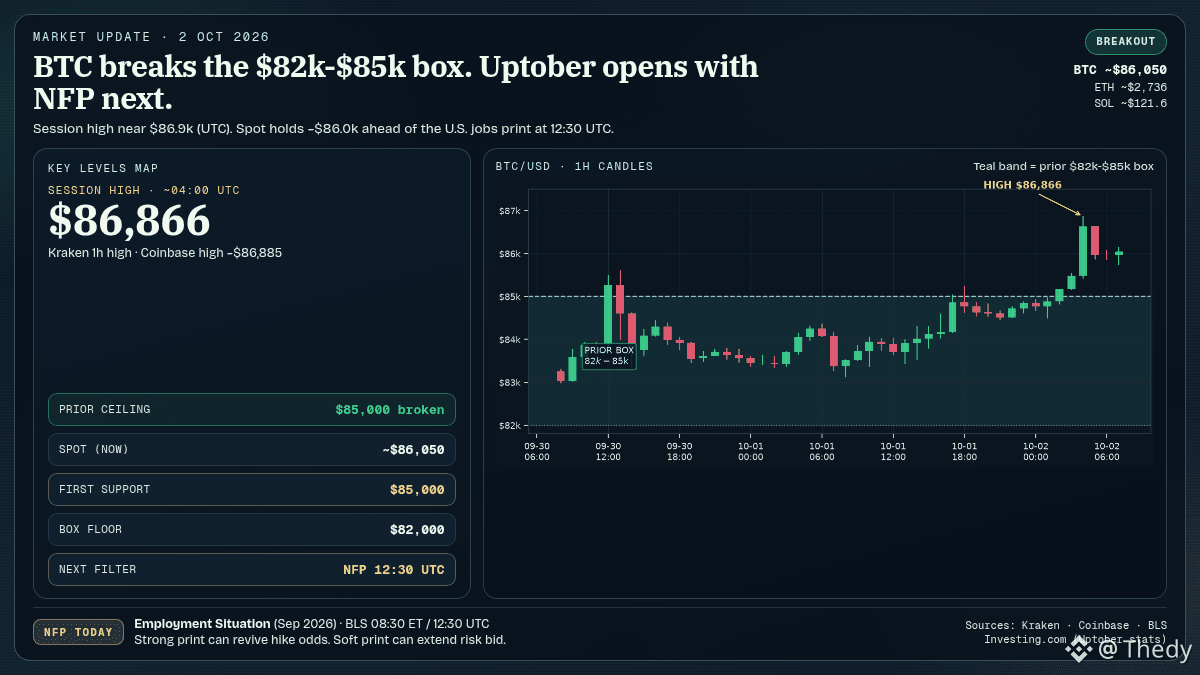
This night (UTC), Bitcoin reached a new high around $86.9k, before stabilizing around $86.1k. Even yesterday, the market was talking about consolidation just below $85k. The breakout is clear, but it comes right before the US jobs report (NFP, Oct 2, 12:30 UTC).
Facts (Kraken / Coinbase):
• 1h high ~$86,866 around 04:00 UTC (Kraken); Coinbase ~$86,885
• Spot ~$86.1k at the time of this note
• Volume clearly higher on the breakout candle
• Current week: third consecutive week of gains (Investing.com)
Why it matters:
The “Uptober” narrative is back after a strong September (+6.4%). Historically, Bitcoin has risen on 10 out of 15 Octobers (average gains ~27%, Investing.com). But today, the real filter is the NFP. An overly strong print could revive bets on a rate hike by the Fed and calm risk.
Scenarios (interpretation, not advice):
1) Hold above $85k after NFP: the old resistance becomes support, opening a path toward $88k-$90k.
2) Rejection below $85k: back into the prior range, with $82k still in view.
3) NFP surprise: two-way volatility on $BTC and $ETH, regardless of the bias.
Are you playing continuation above $85k, or fading before the print?
#Bitcoin #Uptober #Crypto
$BTC sort de la boîte $82k-$85k
This night (UTC), Bitcoin reached a new high around $86.9k, before stabilizing around $86.1k. Even yesterday, the market was talking about consolidation just below $85k. The breakout is clear, but it comes right before the US jobs report (NFP, Oct 2, 12:30 UTC).
Facts (Kraken / Coinbase):
• 1h high ~$86,866 around 04:00 UTC (Kraken); Coinbase ~$86,885
• Spot ~$86.1k at the time of this note
• Volume clearly higher on the breakout candle
• Current week: third consecutive week of gains (Investing.com)
Why it matters:
The “Uptober” narrative is back after a strong September (+6.4%). Historically, Bitcoin has risen on 10 out of 15 Octobers (average gains ~27%, Investing.com). But today, the real filter is the NFP. An overly strong print could revive bets on a rate hike by the Fed and calm risk.
Scenarios (interpretation, not advice):
1) Hold above $85k after NFP: the old resistance becomes support, opening a path toward $88k-$90k.
2) Rejection below $85k: back into the prior range, with $82k still in view.
3) NFP surprise: two-way volatility on $BTC and $ETH , regardless of the bias.
Are you playing continuation above $85k, or fading before the print?
#Bitcoin #Uptober #Crypto
This night (UTC), Bitcoin reached a new high around $86.9k, before stabilizing around $86.1k. Even yesterday, the market was talking about consolidation just below $85k. The breakout is clear, but it comes right before the US jobs report (NFP, Oct 2, 12:30 UTC).
Facts (Kraken / Coinbase):
• 1h high ~$86,866 around 04:00 UTC (Kraken); Coinbase ~$86,885
• Spot ~$86.1k at the time of this note
• Volume clearly higher on the breakout candle
• Current week: third consecutive week of gains (Investing.com)
Why it matters:
The “Uptober” narrative is back after a strong September (+6.4%). Historically, Bitcoin has risen on 10 out of 15 Octobers (average gains ~27%, Investing.com). But today, the real filter is the NFP. An overly strong print could revive bets on a rate hike by the Fed and calm risk.
Scenarios (interpretation, not advice):
1) Hold above $85k after NFP: the old resistance becomes support, opening a path toward $88k-$90k.
2) Rejection below $85k: back into the prior range, with $82k still in view.
3) NFP surprise: two-way volatility on $BTC and $ETH , regardless of the bias.
Are you playing continuation above $85k, or fading before the print?
#Bitcoin #Uptober #Crypto
154
·
--
Is the Fed really slowing down the pace?
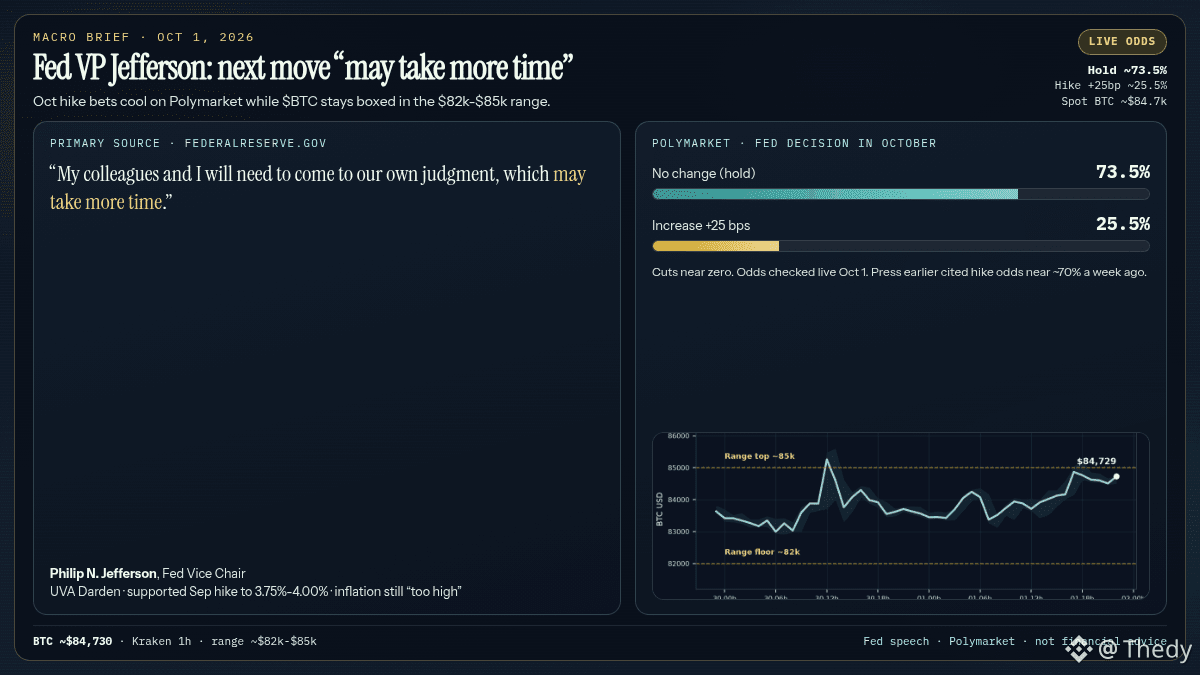
Philip Jefferson (vice president of the Fed) said on October 1 at the UVA Darden that it « may take more time » before the next policy adjustment. Primary source: federalreserve.gov (jefferson20261001a speech).
Useful context:
• He supported the September hike (target 3.75%-4.00%).
• He repeats that inflation is still too high, with risks still tilted to the upside.
• But going forward, he wants to judge based on the data, the outlook, and the balance of risks.
Market side (Polymarket, verified tonight):
• “No change” scenario for October: about 73.5%
• Hike +25 bps: about 25.5%
• Cuts are nearly zero
The press was still talking about near ~70% odds of a hike a week ago. Goldman moved its next expected hike to December.
And what about $BTC? Spot around $84.7k (Kraken/Coinbase), still stuck in the $82k-$85k box. The next US data catalyst: the jobs report (Oct 2).
Scenarios (interpretation, not advice):
1) Hold in October: relative relief on the crypto lever, but long yields remain a headwind.
2) Hike in October: risk of retesting the bottom of the range near $82k on $BTC (with satellite pressure on $ETH).
Do you lean toward holding or hiking for the Fed in October?
#Bitcoin #Fed #Crypto
Is the Fed really slowing down the pace?
Philip Jefferson (vice president of the Fed) said on October 1 at the UVA Darden that it « may take more time » before the next policy adjustment. Primary source: federalreserve.gov (jefferson20261001a speech).
Useful context:
• He supported the September hike (target 3.75%-4.00%).
• He repeats that inflation is still too high, with risks still tilted to the upside.
• But going forward, he wants to judge based on the data, the outlook, and the balance of risks.
Market side (Polymarket, verified tonight):
• “No change” scenario for October: about 73.5%
• Hike +25 bps: about 25.5%
• Cuts are nearly zero
The press was still talking about near ~70% odds of a hike a week ago. Goldman moved its next expected hike to December.
And what about $BTC ? Spot around $84.7k (Kraken/Coinbase), still stuck in the $82k-$85k box. The next US data catalyst: the jobs report (Oct 2).
Scenarios (interpretation, not advice):
1) Hold in October: relative relief on the crypto lever, but long yields remain a headwind.
2) Hike in October: risk of retesting the bottom of the range near $82k on $BTC (with satellite pressure on $ETH ).
Do you lean toward holding or hiking for the Fed in October?
#Bitcoin #Fed #Crypto
Philip Jefferson (vice president of the Fed) said on October 1 at the UVA Darden that it « may take more time » before the next policy adjustment. Primary source: federalreserve.gov (jefferson20261001a speech).
Useful context:
• He supported the September hike (target 3.75%-4.00%).
• He repeats that inflation is still too high, with risks still tilted to the upside.
• But going forward, he wants to judge based on the data, the outlook, and the balance of risks.
Market side (Polymarket, verified tonight):
• “No change” scenario for October: about 73.5%
• Hike +25 bps: about 25.5%
• Cuts are nearly zero
The press was still talking about near ~70% odds of a hike a week ago. Goldman moved its next expected hike to December.
And what about $BTC ? Spot around $84.7k (Kraken/Coinbase), still stuck in the $82k-$85k box. The next US data catalyst: the jobs report (Oct 2).
Scenarios (interpretation, not advice):
1) Hold in October: relative relief on the crypto lever, but long yields remain a headwind.
2) Hike in October: risk of retesting the bottom of the range near $82k on $BTC (with satellite pressure on $ETH ).
Do you lean toward holding or hiking for the Fed in October?
#Bitcoin #Fed #Crypto
56
·
--
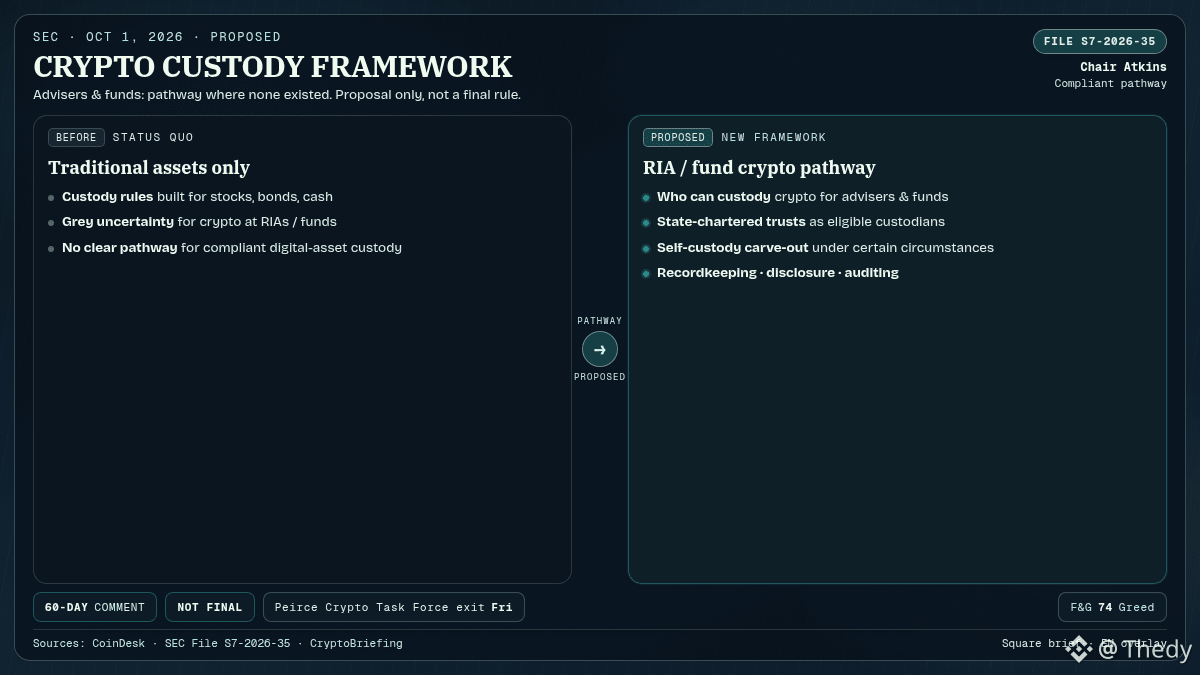
The SEC has just proposed crypto custody rules for advisers and funds.
Thursday 01/10 (evening UTC), the US regulator published a proposal (file S7-2026-35, “Adviser and Regulated Fund Custody Rules; Crypto Custody Rules”). Chair Paul Atkins talks about a “clear regulatory framework” and a “compliant pathway where none existed before”: existing rules mainly target traditional assets, leaving a gray area for crypto on the RIA and regulated funds side. Reported by CoinDesk / CryptoBriefing.
Facts (proposal, not final rule):
• Clarify who may custody crypto for advisers / funds
• Recordkeeping, disclosure, auditing
• Self-custody “under certain circumstances”
• State-chartered trusts as possible custodians
• 60 days for public comments after publication in the Federal Register
• Same week: Hester Peirce (Crypto Task Force) leaves on Friday
Interpretation: another milestone in Atkins’ digital assets agenda. Institutions that want to build RIA / fund exposure need to know who holds the assets, how custody is audited, and where the gray area ends. As long as it’s only proposed, nothing is mandatory.
Scenarios:
• Adoption after comment: operational pathway for RIA/fund custody, state trusts, and carve-out self-custody
• Revision / withdrawal: history of SEC proposals that move or slow down under feedback
Institutional custody or self-custody—who really wins for $BTC et $ETH ?
#Bitcoin #SEC #Crypto
The SEC has just proposed crypto custody rules for advisers and funds.
Thursday 01/10 (evening UTC), the US regulator published a proposal (file S7-2026-35, “Adviser and Regulated Fund Custody Rules; Crypto Custody Rules”). Chair Paul Atkins talks about a “clear regulatory framework” and a “compliant pathway where none existed before”: existing rules mainly target traditional assets, leaving a gray area for crypto on the RIA and regulated funds side. Reported by CoinDesk / CryptoBriefing.
Facts (proposal, not final rule):
• Clarify who may custody crypto for advisers / funds
• Recordkeeping, disclosure, auditing
• Self-custody “under certain circumstances”
• State-chartered trusts as possible custodians
• 60 days for public comments after publication in the Federal Register
• Same week: Hester Peirce (Crypto Task Force) leaves on Friday
Interpretation: another milestone in Atkins’ digital assets agenda. Institutions that want to build RIA / fund exposure need to know who holds the assets, how custody is audited, and where the gray area ends. As long as it’s only proposed, nothing is mandatory.
Scenarios:
• Adoption after comment: operational pathway for RIA/fund custody, state trusts, and carve-out self-custody
• Revision / withdrawal: history of SEC proposals that move or slow down under feedback
Institutional custody or self-custody—who really wins for $BTC et $ETH ?
#Bitcoin #SEC #Crypto
Thursday 01/10 (evening UTC), the US regulator published a proposal (file S7-2026-35, “Adviser and Regulated Fund Custody Rules; Crypto Custody Rules”). Chair Paul Atkins talks about a “clear regulatory framework” and a “compliant pathway where none existed before”: existing rules mainly target traditional assets, leaving a gray area for crypto on the RIA and regulated funds side. Reported by CoinDesk / CryptoBriefing.
Facts (proposal, not final rule):
• Clarify who may custody crypto for advisers / funds
• Recordkeeping, disclosure, auditing
• Self-custody “under certain circumstances”
• State-chartered trusts as possible custodians
• 60 days for public comments after publication in the Federal Register
• Same week: Hester Peirce (Crypto Task Force) leaves on Friday
Interpretation: another milestone in Atkins’ digital assets agenda. Institutions that want to build RIA / fund exposure need to know who holds the assets, how custody is audited, and where the gray area ends. As long as it’s only proposed, nothing is mandatory.
Scenarios:
• Adoption after comment: operational pathway for RIA/fund custody, state trusts, and carve-out self-custody
• Revision / withdrawal: history of SEC proposals that move or slow down under feedback
Institutional custody or self-custody—who really wins for $BTC et $ETH ?
#Bitcoin #SEC #Crypto
158
·
--
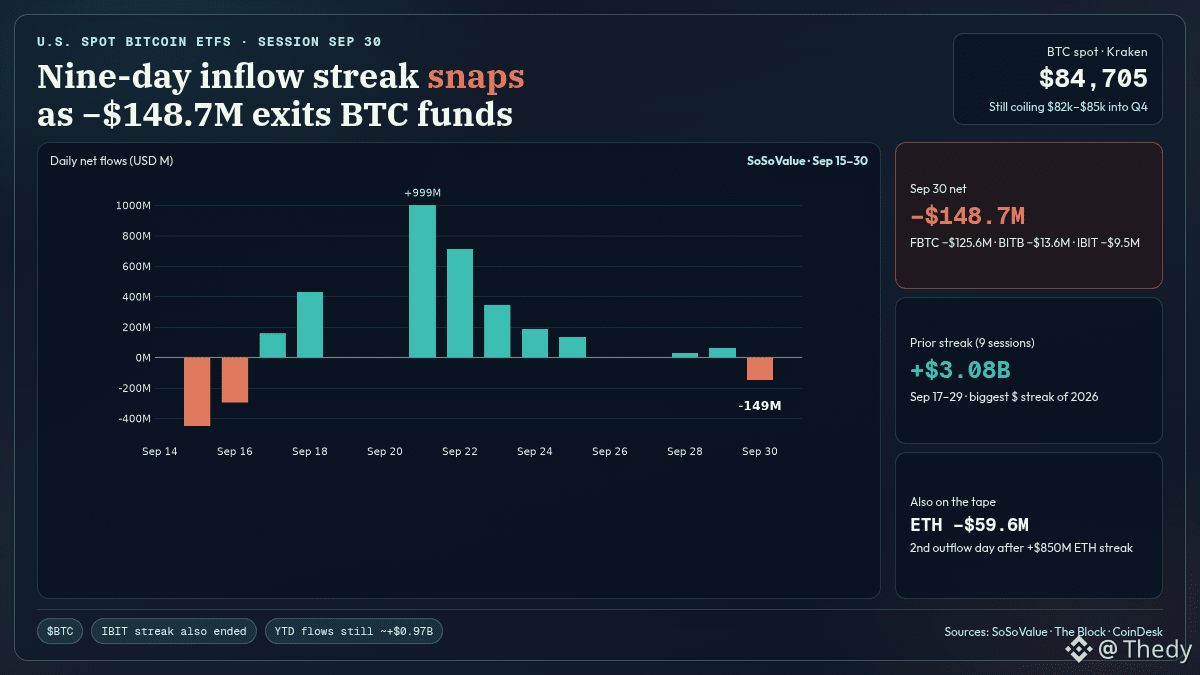
The 9-day streak of inflows into spot ETFs $BTC US breaks: −148.7M$ on 09/30.
According to SoSoValue (confirmed by The Block / CoinDesk), the funds collected ~3.08B$ from 09/17 to 09/29, the biggest dollar streak of 2026, with a peak near +999M$ on 09/21. On 09/30, the first red day: Fidelity FBTC leads (−125.6M$), followed by Bitwise BITB (−13.6M$) and BlackRock IBIT (−9.5M$). IBIT’s own clean streak also ends there.
Same session, spot ETFs $ETH withdraw ~−59.6M$ (2nd red day after a green streak of ~+850M$). On the spot, $BTC stays in the ~82k–85k band (Kraken ~84.7k at the time I’m writing), new quarter, same range.
Interpretation: an outflow of ~149M$ is small compared with the 3B$ from the streak. This isn’t a capitulation day. But the absorption pace was already slowing toward the end of the run, and the break comes right at the start of Q4. As long as flows don’t pick back up with a net positive pace, the ~85k ceiling remains harder to clear.
Scenarios:
• Digestion: next sessions in slight green, price holding above ~82k
• Soft invalidation: outflows piling up and a clear net test below ~82k
Are you seeing a healthy pause after the run, or the start of a real institutional slowdown on $BTC ?
#Bitcoin #ETF #Crypto
The 9-day streak of inflows into spot ETFs $BTC US breaks: −148.7M$ on 09/30.
According to SoSoValue (confirmed by The Block / CoinDesk), the funds collected ~3.08B$ from 09/17 to 09/29, the biggest dollar streak of 2026, with a peak near +999M$ on 09/21. On 09/30, the first red day: Fidelity FBTC leads (−125.6M$), followed by Bitwise BITB (−13.6M$) and BlackRock IBIT (−9.5M$). IBIT’s own clean streak also ends there.
Same session, spot ETFs $ETH withdraw ~−59.6M$ (2nd red day after a green streak of ~+850M$). On the spot, $BTC stays in the ~82k–85k band (Kraken ~84.7k at the time I’m writing), new quarter, same range.
Interpretation: an outflow of ~149M$ is small compared with the 3B$ from the streak. This isn’t a capitulation day. But the absorption pace was already slowing toward the end of the run, and the break comes right at the start of Q4. As long as flows don’t pick back up with a net positive pace, the ~85k ceiling remains harder to clear.
Scenarios:
• Digestion: next sessions in slight green, price holding above ~82k
• Soft invalidation: outflows piling up and a clear net test below ~82k
Are you seeing a healthy pause after the run, or the start of a real institutional slowdown on $BTC ?
#Bitcoin #ETF #Crypto
According to SoSoValue (confirmed by The Block / CoinDesk), the funds collected ~3.08B$ from 09/17 to 09/29, the biggest dollar streak of 2026, with a peak near +999M$ on 09/21. On 09/30, the first red day: Fidelity FBTC leads (−125.6M$), followed by Bitwise BITB (−13.6M$) and BlackRock IBIT (−9.5M$). IBIT’s own clean streak also ends there.
Same session, spot ETFs $ETH withdraw ~−59.6M$ (2nd red day after a green streak of ~+850M$). On the spot, $BTC stays in the ~82k–85k band (Kraken ~84.7k at the time I’m writing), new quarter, same range.
Interpretation: an outflow of ~149M$ is small compared with the 3B$ from the streak. This isn’t a capitulation day. But the absorption pace was already slowing toward the end of the run, and the break comes right at the start of Q4. As long as flows don’t pick back up with a net positive pace, the ~85k ceiling remains harder to clear.
Scenarios:
• Digestion: next sessions in slight green, price holding above ~82k
• Soft invalidation: outflows piling up and a clear net test below ~82k
Are you seeing a healthy pause after the run, or the start of a real institutional slowdown on $BTC ?
#Bitcoin #ETF #Crypto
82
·
--
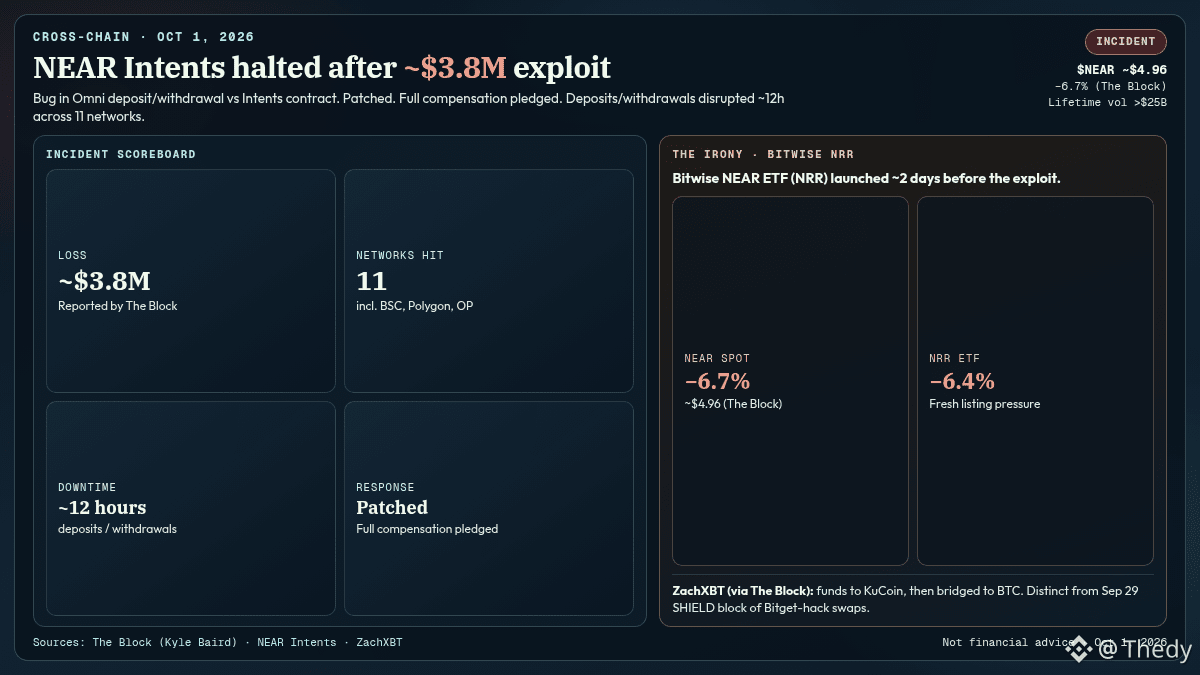
01/10: NEAR Intents stopped deposits/withdrawals after an exploit of about $3.8M (The Block, Kyle Baird). This is NOT the same topic as the 29/09 SHIELD post (blockage of swaps from the Bitget hack). Today, it was Intents itself that was targeted.
FACTS (The Block; X post NEAR Intents; ZachXBT via The Block):
• Bug between the Omni contract (deposits/withdrawals) and the Intents contract. Patch deployed. Full compensation announced.
• Disruption ~12h across 11 networks (including BSC, Polygon, Optimism).
• ZachXBT: funds sent to KuCoin, then bridged to BTC.
• Intents lifetime volume already beyond $25B.
• Ironic timing: Bitwise NEAR ETF (NRR) launched ~2 days earlier. Spot $NEAR ~4.96 (−6.7%), NRR −6.4% (The Block figures).
INTERPRETATION:
A bridge/intent rail with +$25B volume remains a concentrated cross-chain attack surface. The positive signal: rapid halt, patch, compensation promise. The negative signal: the NRR listing lands right on top of an operational incident, which weighs on the reading "ETF = validation".
SCENARIOS:
• Base: resumption of flows after the patch; credible compensation; $NEAR digests the −6–7% without a cascade
• Stress: delays in reimbursements / doubt about the Omni surface → Intents flows slower for several days
• Invalidation "one-off": if a second similar incident emerges within 1–2 weeks
Spot (Kraken ~16:54 UTC): $BTC ~84.2k · $ETH ~2.68k · Fear & Greed 74.
Question: for you, does the incident mostly change the risk of the Intents bridge, or mostly the fresh ETF NRR narrative?
#DeFi #CrossChain $NEAR $BTC
01/10: NEAR Intents stopped deposits/withdrawals after an exploit of about $3.8M (The Block, Kyle Baird). This is NOT the same topic as the 29/09 SHIELD post (blockage of swaps from the Bitget hack). Today, it was Intents itself that was targeted.
FACTS (The Block; X post NEAR Intents; ZachXBT via The Block):
• Bug between the Omni contract (deposits/withdrawals) and the Intents contract. Patch deployed. Full compensation announced.
• Disruption ~12h across 11 networks (including BSC, Polygon, Optimism).
• ZachXBT: funds sent to KuCoin, then bridged to BTC.
• Intents lifetime volume already beyond $25B.
• Ironic timing: Bitwise NEAR ETF (NRR) launched ~2 days earlier. Spot $NEAR ~4.96 (−6.7%), NRR −6.4% (The Block figures).
INTERPRETATION:
A bridge/intent rail with +$25B volume remains a concentrated cross-chain attack surface. The positive signal: rapid halt, patch, compensation promise. The negative signal: the NRR listing lands right on top of an operational incident, which weighs on the reading "ETF = validation".
SCENARIOS:
• Base: resumption of flows after the patch; credible compensation; $NEAR digests the −6–7% without a cascade
• Stress: delays in reimbursements / doubt about the Omni surface → Intents flows slower for several days
• Invalidation "one-off": if a second similar incident emerges within 1–2 weeks
Spot (Kraken ~16:54 UTC): $BTC ~84.2k · $ETH ~2.68k · Fear & Greed 74.
Question: for you, does the incident mostly change the risk of the Intents bridge, or mostly the fresh ETF NRR narrative?
#DeFi #CrossChain $NEAR $BTC
FACTS (The Block; X post NEAR Intents; ZachXBT via The Block):
• Bug between the Omni contract (deposits/withdrawals) and the Intents contract. Patch deployed. Full compensation announced.
• Disruption ~12h across 11 networks (including BSC, Polygon, Optimism).
• ZachXBT: funds sent to KuCoin, then bridged to BTC.
• Intents lifetime volume already beyond $25B.
• Ironic timing: Bitwise NEAR ETF (NRR) launched ~2 days earlier. Spot $NEAR ~4.96 (−6.7%), NRR −6.4% (The Block figures).
INTERPRETATION:
A bridge/intent rail with +$25B volume remains a concentrated cross-chain attack surface. The positive signal: rapid halt, patch, compensation promise. The negative signal: the NRR listing lands right on top of an operational incident, which weighs on the reading "ETF = validation".
SCENARIOS:
• Base: resumption of flows after the patch; credible compensation; $NEAR digests the −6–7% without a cascade
• Stress: delays in reimbursements / doubt about the Omni surface → Intents flows slower for several days
• Invalidation "one-off": if a second similar incident emerges within 1–2 weeks
Spot (Kraken ~16:54 UTC): $BTC ~84.2k · $ETH ~2.68k · Fear & Greed 74.
Question: for you, does the incident mostly change the risk of the Intents bridge, or mostly the fresh ETF NRR narrative?
#DeFi #CrossChain $NEAR $BTC
184
·
--
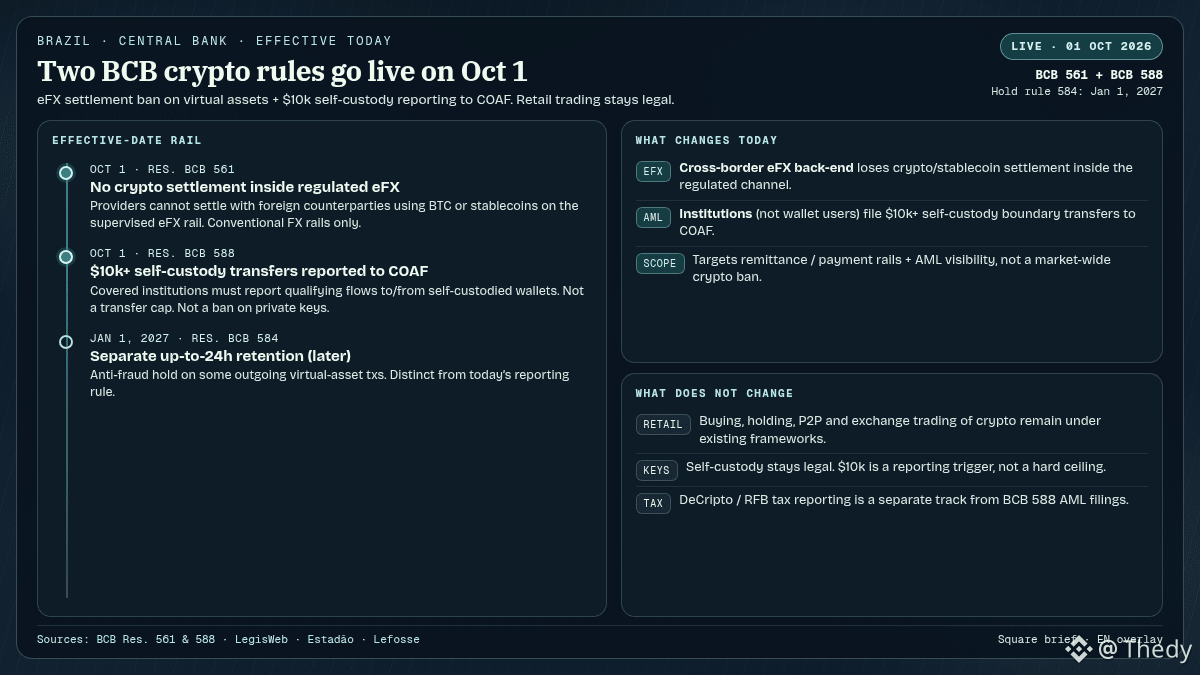
Today 01/10, two rules from the Banco Central do Brasil (BCB) come into force. This is not a “crypto ban” for retail. This is a targeted tightening on regulated rails and AML.
FACTS (sources: BCB resolutions, LegisWeb, Estadão, Lefosse):
• BCB Resolution 561: in the eFX channel (regulated payments / international transfers), no more settlement in virtual assets (bitcoin, stablecoins) between a Brazilian provider and its foreign counterparty. Return to traditional FX rails.
• BCB Resolution 588: covered institutions must report to COAF transfers of virtual assets to or from a self-custody wallet from ~10,000$ (equivalent). This is an institutional obligation, not a user threshold.
• Separately: BCB Resolution 584 (preventive withholding up to 24 hours on certain withdrawals) scheduled for 01/01/2027, distinct from today’s reporting.
INTERPRETATION:
Brazil closes a back-end use case (stablecoin/BTC settlement in supervised eFX) and increases AML visibility at the custody ↔ self-custody boundary. Retail: buying, holding, trading, and private keys remain within existing frameworks. DeCripto / RFB tax treatment = another angle.
SCENARIOS:
• Base case: impact mainly on remittances / fintechs using eFX; retail volume like Square is little affected day to day
• Stress case: stronger friction on institutional outflows → wallet ≥10k $ (delays / KYC), with no formal prohibition
• Invalidating the “ban” narrative: if the BCB expanded to trading/custody outside eFX (not today’s text)
Spot (Kraken ~14:53 UTC): $BTC ~83.8k · $ETH ~2.68k · Fear & Greed 74.
Question: for you, the real issue is the remittances/stablecoins slowdown, or the COAF reporting at $10k?
#Brazil #Regulation $USDT
Today 01/10, two rules from the Banco Central do Brasil (BCB) come into force. This is not a “crypto ban” for retail. This is a targeted tightening on regulated rails and AML.
FACTS (sources: BCB resolutions, LegisWeb, Estadão, Lefosse):
• BCB Resolution 561: in the eFX channel (regulated payments / international transfers), no more settlement in virtual assets (bitcoin, stablecoins) between a Brazilian provider and its foreign counterparty. Return to traditional FX rails.
• BCB Resolution 588: covered institutions must report to COAF transfers of virtual assets to or from a self-custody wallet from ~10,000$ (equivalent). This is an institutional obligation, not a user threshold.
• Separately: BCB Resolution 584 (preventive withholding up to 24 hours on certain withdrawals) scheduled for 01/01/2027, distinct from today’s reporting.
INTERPRETATION:
Brazil closes a back-end use case (stablecoin/BTC settlement in supervised eFX) and increases AML visibility at the custody ↔ self-custody boundary. Retail: buying, holding, trading, and private keys remain within existing frameworks. DeCripto / RFB tax treatment = another angle.
SCENARIOS:
• Base case: impact mainly on remittances / fintechs using eFX; retail volume like Square is little affected day to day
• Stress case: stronger friction on institutional outflows → wallet ≥10k $ (delays / KYC), with no formal prohibition
• Invalidating the “ban” narrative: if the BCB expanded to trading/custody outside eFX (not today’s text)
Spot (Kraken ~14:53 UTC): $BTC ~83.8k · $ETH ~2.68k · Fear & Greed 74.
Question: for you, the real issue is the remittances/stablecoins slowdown, or the COAF reporting at $10k?
#Brazil #Regulation $USDT
FACTS (sources: BCB resolutions, LegisWeb, Estadão, Lefosse):
• BCB Resolution 561: in the eFX channel (regulated payments / international transfers), no more settlement in virtual assets (bitcoin, stablecoins) between a Brazilian provider and its foreign counterparty. Return to traditional FX rails.
• BCB Resolution 588: covered institutions must report to COAF transfers of virtual assets to or from a self-custody wallet from ~10,000$ (equivalent). This is an institutional obligation, not a user threshold.
• Separately: BCB Resolution 584 (preventive withholding up to 24 hours on certain withdrawals) scheduled for 01/01/2027, distinct from today’s reporting.
INTERPRETATION:
Brazil closes a back-end use case (stablecoin/BTC settlement in supervised eFX) and increases AML visibility at the custody ↔ self-custody boundary. Retail: buying, holding, trading, and private keys remain within existing frameworks. DeCripto / RFB tax treatment = another angle.
SCENARIOS:
• Base case: impact mainly on remittances / fintechs using eFX; retail volume like Square is little affected day to day
• Stress case: stronger friction on institutional outflows → wallet ≥10k $ (delays / KYC), with no formal prohibition
• Invalidating the “ban” narrative: if the BCB expanded to trading/custody outside eFX (not today’s text)
Spot (Kraken ~14:53 UTC): $BTC ~83.8k · $ETH ~2.68k · Fear & Greed 74.
Question: for you, the real issue is the remittances/stablecoins slowdown, or the COAF reporting at $10k?
#Brazil #Regulation $USDT
183
·
--
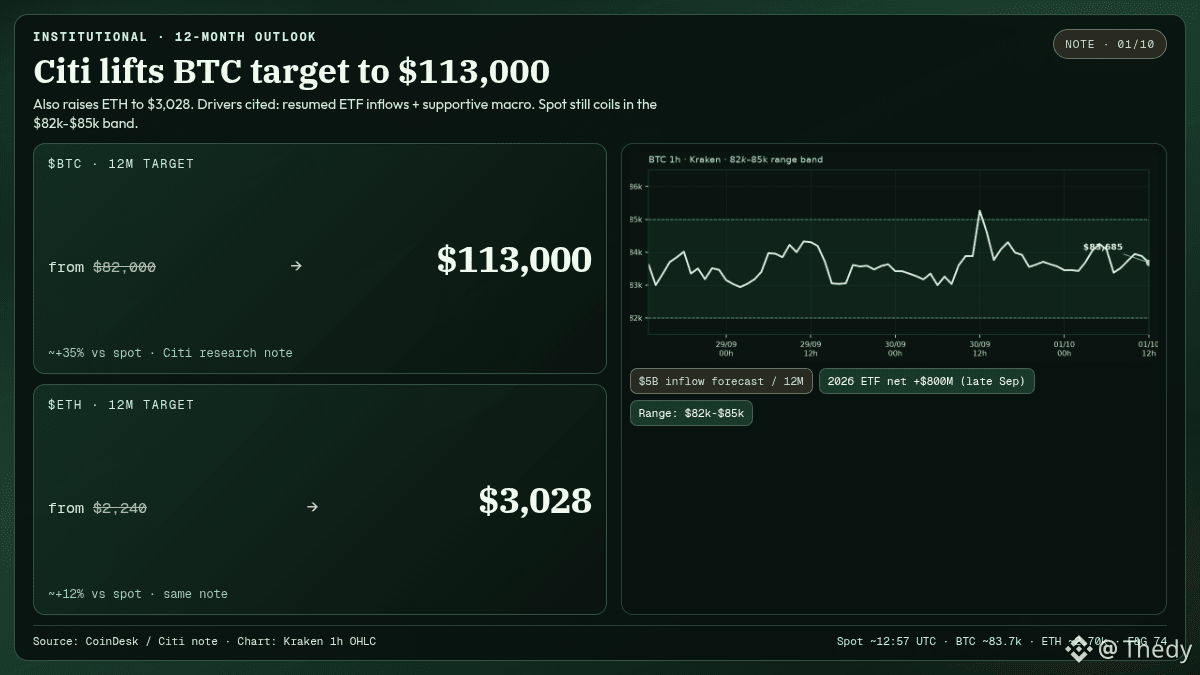
Citi raises its 12-month target to $BTC to 113,000 $ (from 82,000 $). Same rating: $ETH to 3,028 $ (from 2,240 $).
CoinDesk (01/10) summarizes a Citi note: a rebound in ETF flows + a more favorable macro. Citi’s BTC target is ~+35% vs the current spot, ETH ~+12%. Citi expects around $5 billion in inflows into crypto investment products over the next 12 months, “slow but sticky,” via advisors and brokerages.
USEFUL FACTS:
• By late September, net inflows into US spot BTC ETF 2026 were around +$800M (after −$5.8B YTD as of 13/07, according to the cited note)
• Spot has still been trading in the 82k–85k band for more than a week (Kraken 1h: brief >85k on Wednesday, then back)
• Wednesday: net ETF outflow −$148.7M (SoSoValue), ending a 9-day inflow streak (~+$3.08B), per CoinDesk
TAKEAWAY: the bank sees a higher 12-month horizon, while the short-term tape remains in a range and the ETF series has just broken. This is not an entry signal; it’s a gap between the institutional target and the spot price.
SCENARIOS:
1) Daily inflows firm up and the 82–85k range breaks to the upside
2) Outflows repeat: the 113k target remains a “paper” scenario as long as ETF absorption stays weak
3) Macro/bonds regain dominance and overwhelm the ETF narrative
Spot (~12:58 UTC, Kraken/CG): BTC~83,679 · ETH~2,692 · SOL ~117.3 · XRP ~1.486 · BNB ~769. Fear & Greed 74 (Greed).
Do you believe more in Citi’s 12-month target, or in the 82–85k range message for the next few weeks?
{spot}(BNBUSDT)
{future}(BTCUSDT)
Citi raises its 12-month target to $BTC to 113,000 $ (from 82,000 $). Same rating: $ETH to 3,028 $ (from 2,240 $).
CoinDesk (01/10) summarizes a Citi note: a rebound in ETF flows + a more favorable macro. Citi’s BTC target is ~+35% vs the current spot, ETH ~+12%. Citi expects around $5 billion in inflows into crypto investment products over the next 12 months, “slow but sticky,” via advisors and brokerages.
USEFUL FACTS:
• By late September, net inflows into US spot BTC ETF 2026 were around +$800M (after −$5.8B YTD as of 13/07, according to the cited note)
• Spot has still been trading in the 82k–85k band for more than a week (Kraken 1h: brief >85k on Wednesday, then back)
• Wednesday: net ETF outflow −$148.7M (SoSoValue), ending a 9-day inflow streak (~+$3.08B), per CoinDesk
TAKEAWAY: the bank sees a higher 12-month horizon, while the short-term tape remains in a range and the ETF series has just broken. This is not an entry signal; it’s a gap between the institutional target and the spot price.
SCENARIOS:
1) Daily inflows firm up and the 82–85k range breaks to the upside
2) Outflows repeat: the 113k target remains a “paper” scenario as long as ETF absorption stays weak
3) Macro/bonds regain dominance and overwhelm the ETF narrative
Spot (~12:58 UTC, Kraken/CG): BTC~83,679 · ETH~2,692 · SOL ~117.3 · XRP ~1.486 · BNB ~769. Fear & Greed 74 (Greed).
Do you believe more in Citi’s 12-month target, or in the 82–85k range message for the next few weeks?
CoinDesk (01/10) summarizes a Citi note: a rebound in ETF flows + a more favorable macro. Citi’s BTC target is ~+35% vs the current spot, ETH ~+12%. Citi expects around $5 billion in inflows into crypto investment products over the next 12 months, “slow but sticky,” via advisors and brokerages.
USEFUL FACTS:
• By late September, net inflows into US spot BTC ETF 2026 were around +$800M (after −$5.8B YTD as of 13/07, according to the cited note)
• Spot has still been trading in the 82k–85k band for more than a week (Kraken 1h: brief >85k on Wednesday, then back)
• Wednesday: net ETF outflow −$148.7M (SoSoValue), ending a 9-day inflow streak (~+$3.08B), per CoinDesk
TAKEAWAY: the bank sees a higher 12-month horizon, while the short-term tape remains in a range and the ETF series has just broken. This is not an entry signal; it’s a gap between the institutional target and the spot price.
SCENARIOS:
1) Daily inflows firm up and the 82–85k range breaks to the upside
2) Outflows repeat: the 113k target remains a “paper” scenario as long as ETF absorption stays weak
3) Macro/bonds regain dominance and overwhelm the ETF narrative
Spot (~12:58 UTC, Kraken/CG): BTC~83,679 · ETH~2,692 · SOL ~117.3 · XRP ~1.486 · BNB ~769. Fear & Greed 74 (Greed).
Do you believe more in Citi’s 12-month target, or in the 82–85k range message for the next few weeks?

Follow me
From Thedy
30
·
--
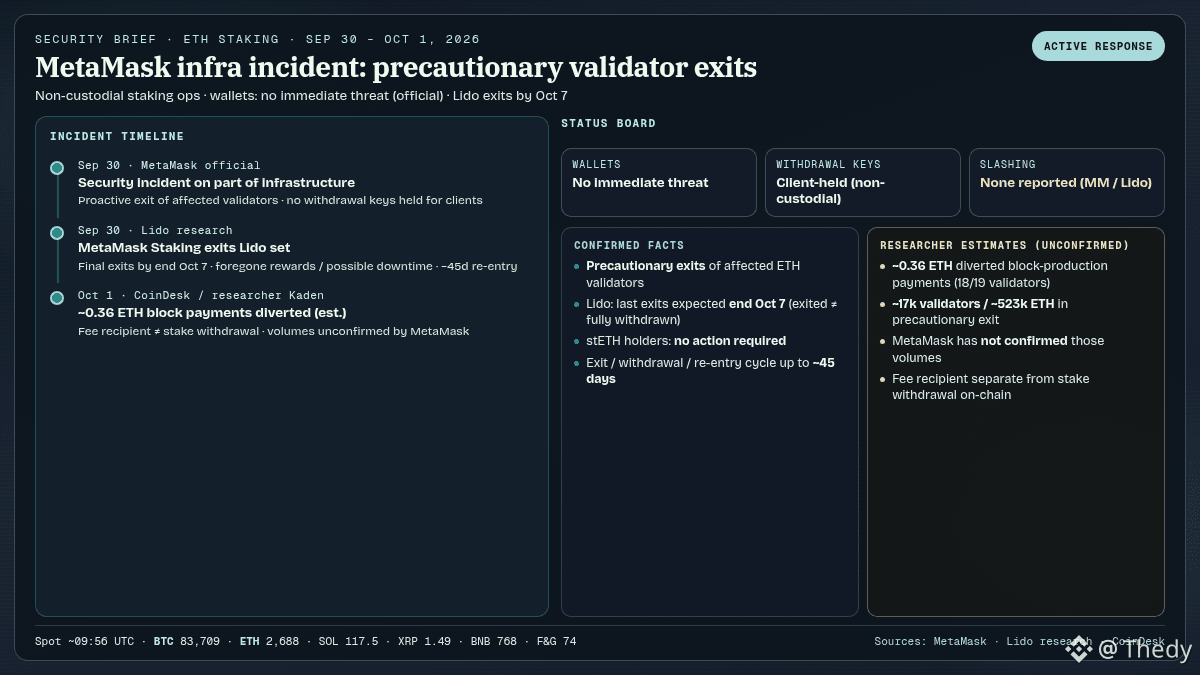
MetaMask proactively moves its Ethereum validators out. Official message: no immediate threat to wallets.
On 09/30, MetaMask confirmed a security incident affecting part of its infrastructure. Action taken: exit of the affected validators from non-custodial staking. Key point: MetaMask does not manage clients’ withdrawal keys.
At Lido’s side (forum research, 09/30): MetaMask Staking (formerly Consensys Staking) removes its validators from the set. Last exits are expected by the end of October 7 (exited, not necessarily fully withdrawn). Missed rewards + potential downtime penalties if going offline too early. Exit / withdrawal / re-entry cycle of up to ~45 days (entry queue). “No action is required from stETH holders.”
CoinDesk (01/10) cites researcher Kaden: ~0.36 ETH of block-production payments diverted (18/19 MetaMask validators having earned). Researcher estimate, NOT confirmed by MetaMask: ~17k validators / ~523k ETH in preventive exit. Fee recipient ≠ staking withdrawal destination (separate on-chain). No slashing reported by MetaMask/Lido at the time of the article.
Spot (~09:57 UTC, Kraken/CoinGecko): $BTC ~83 709 · $ETH ~2 688 · SOL ~117.55 · XRP ~1.488 · BNB ~768. Fear & Greed 74 (Greed).
Scenarios to watch:
1) Rapid remediation, contained exits, stETH unchanged for holders
2) Longer investigation, more visible foregone rewards on the operator set
3) Market confusion if you read “wallets hacked” while MetaMask explicitly says no immediate threat
Do you follow the staking signal (exits / queues) or the wallet message on $ETH ?
#Ethereum #Staking #MetaMask
MetaMask proactively moves its Ethereum validators out. Official message: no immediate threat to wallets.
On 09/30, MetaMask confirmed a security incident affecting part of its infrastructure. Action taken: exit of the affected validators from non-custodial staking. Key point: MetaMask does not manage clients’ withdrawal keys.
At Lido’s side (forum research, 09/30): MetaMask Staking (formerly Consensys Staking) removes its validators from the set. Last exits are expected by the end of October 7 (exited, not necessarily fully withdrawn). Missed rewards + potential downtime penalties if going offline too early. Exit / withdrawal / re-entry cycle of up to ~45 days (entry queue). “No action is required from stETH holders.”
CoinDesk (01/10) cites researcher Kaden: ~0.36 ETH of block-production payments diverted (18/19 MetaMask validators having earned). Researcher estimate, NOT confirmed by MetaMask: ~17k validators / ~523k ETH in preventive exit. Fee recipient ≠ staking withdrawal destination (separate on-chain). No slashing reported by MetaMask/Lido at the time of the article.
Spot (~09:57 UTC, Kraken/CoinGecko): $BTC ~83 709 · $ETH ~2 688 · SOL ~117.55 · XRP ~1.488 · BNB ~768. Fear & Greed 74 (Greed).
Scenarios to watch:
1) Rapid remediation, contained exits, stETH unchanged for holders
2) Longer investigation, more visible foregone rewards on the operator set
3) Market confusion if you read “wallets hacked” while MetaMask explicitly says no immediate threat
Do you follow the staking signal (exits / queues) or the wallet message on $ETH ?
#Ethereum #Staking #MetaMask
On 09/30, MetaMask confirmed a security incident affecting part of its infrastructure. Action taken: exit of the affected validators from non-custodial staking. Key point: MetaMask does not manage clients’ withdrawal keys.
At Lido’s side (forum research, 09/30): MetaMask Staking (formerly Consensys Staking) removes its validators from the set. Last exits are expected by the end of October 7 (exited, not necessarily fully withdrawn). Missed rewards + potential downtime penalties if going offline too early. Exit / withdrawal / re-entry cycle of up to ~45 days (entry queue). “No action is required from stETH holders.”
CoinDesk (01/10) cites researcher Kaden: ~0.36 ETH of block-production payments diverted (18/19 MetaMask validators having earned). Researcher estimate, NOT confirmed by MetaMask: ~17k validators / ~523k ETH in preventive exit. Fee recipient ≠ staking withdrawal destination (separate on-chain). No slashing reported by MetaMask/Lido at the time of the article.
Spot (~09:57 UTC, Kraken/CoinGecko): $BTC ~83 709 · $ETH ~2 688 · SOL ~117.55 · XRP ~1.488 · BNB ~768. Fear & Greed 74 (Greed).
Scenarios to watch:
1) Rapid remediation, contained exits, stETH unchanged for holders
2) Longer investigation, more visible foregone rewards on the operator set
3) Market confusion if you read “wallets hacked” while MetaMask explicitly says no immediate threat
Do you follow the staking signal (exits / queues) or the wallet message on $ETH ?
#Ethereum #Staking #MetaMask
1
169
·
--
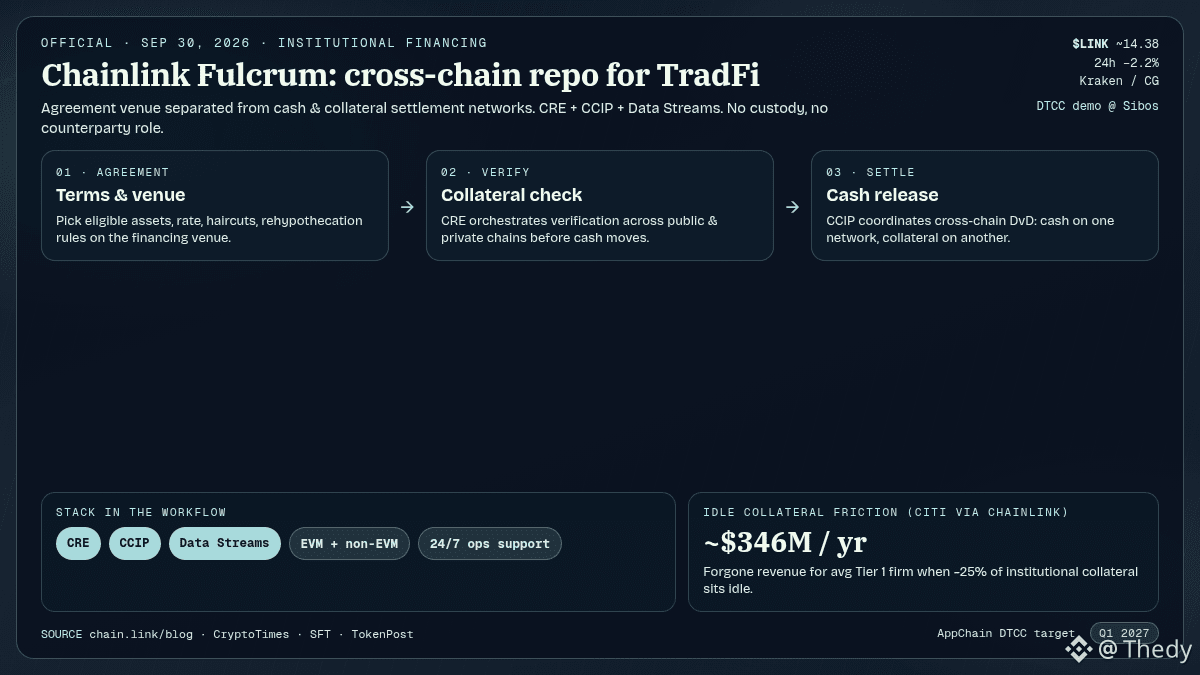
Chainlink announces Fulcrum: the cross-chain repo platform for institutions (official announcement, 30/09).
FACTS
Fulcrum is an end-to-end financing and collateral management layer on public and private blockchains. The key idea: separate the venue where the financing agreement is handled from the networks where cash and collateral are settled. Counterparties choose eligible assets, terms (e.g. a prohibition on rehypothecation), and settlement via a single gateway, with 24/7 operational support.
Stack: Chainlink Runtime Environment (CRE) to orchestrate, CCIP for messaging / cross-chain transfers, Data Streams to value collateral and haircuts. Chainlink does not custody, is not a counterparty, and does not operate a venue. Demo with DTCC at Sibos 2026; DTCC Collateral AppChain planned for T1 2027. Citi (cited by Chainlink): ~25% of institutional collateral sits idle, ~346M$ in missed revenue per year for a typical Tier 1 firm.
READING
This is not just a simple interoperability upgrade. After CCIP 2.0, Fulcrum pushes $LINK into TradFi plumbing (repo, prime brokerage, custodians, treasuries). For retail, the takeaway is infrastructure, not an immediate price catalyst. Spot ~22:56 UTC: $LINK ~14.38 (−2.2% 24h, Kraken/CG); $BTC ~83684 · $ETH ~2688.
SCENARIOS
• Base case: TradFi venue integrations + DTCC AppChain T1 2027; slow but credible adoption
• Upside: measurable first tokenized repo flows if institutions truly route through Fulcrum
• Risk: integration timelines, regulation, and “announcement > volume” as long as venues aren’t live
Do you see Fulcrum as the logical next step of CCIP, or as the real product that can anchor $LINK in TradFi?
Sources: Chainlink blog (30/09), CryptoTimes, Securities Finance Times, TokenPost
#Chainlink #RWA #Crypto
Chainlink announces Fulcrum: the cross-chain repo platform for institutions (official announcement, 30/09).
FACTS
Fulcrum is an end-to-end financing and collateral management layer on public and private blockchains. The key idea: separate the venue where the financing agreement is handled from the networks where cash and collateral are settled. Counterparties choose eligible assets, terms (e.g. a prohibition on rehypothecation), and settlement via a single gateway, with 24/7 operational support.
Stack: Chainlink Runtime Environment (CRE) to orchestrate, CCIP for messaging / cross-chain transfers, Data Streams to value collateral and haircuts. Chainlink does not custody, is not a counterparty, and does not operate a venue. Demo with DTCC at Sibos 2026; DTCC Collateral AppChain planned for T1 2027. Citi (cited by Chainlink): ~25% of institutional collateral sits idle, ~346M$ in missed revenue per year for a typical Tier 1 firm.
READING
This is not just a simple interoperability upgrade. After CCIP 2.0, Fulcrum pushes $LINK into TradFi plumbing (repo, prime brokerage, custodians, treasuries). For retail, the takeaway is infrastructure, not an immediate price catalyst. Spot ~22:56 UTC: $LINK ~14.38 (−2.2% 24h, Kraken/CG); $BTC ~83684 · $ETH ~2688.
SCENARIOS
• Base case: TradFi venue integrations + DTCC AppChain T1 2027; slow but credible adoption
• Upside: measurable first tokenized repo flows if institutions truly route through Fulcrum
• Risk: integration timelines, regulation, and “announcement > volume” as long as venues aren’t live
Do you see Fulcrum as the logical next step of CCIP, or as the real product that can anchor $LINK in TradFi?
Sources: Chainlink blog (30/09), CryptoTimes, Securities Finance Times, TokenPost
#Chainlink #RWA #Crypto
FACTS
Fulcrum is an end-to-end financing and collateral management layer on public and private blockchains. The key idea: separate the venue where the financing agreement is handled from the networks where cash and collateral are settled. Counterparties choose eligible assets, terms (e.g. a prohibition on rehypothecation), and settlement via a single gateway, with 24/7 operational support.
Stack: Chainlink Runtime Environment (CRE) to orchestrate, CCIP for messaging / cross-chain transfers, Data Streams to value collateral and haircuts. Chainlink does not custody, is not a counterparty, and does not operate a venue. Demo with DTCC at Sibos 2026; DTCC Collateral AppChain planned for T1 2027. Citi (cited by Chainlink): ~25% of institutional collateral sits idle, ~346M$ in missed revenue per year for a typical Tier 1 firm.
READING
This is not just a simple interoperability upgrade. After CCIP 2.0, Fulcrum pushes $LINK into TradFi plumbing (repo, prime brokerage, custodians, treasuries). For retail, the takeaway is infrastructure, not an immediate price catalyst. Spot ~22:56 UTC: $LINK ~14.38 (−2.2% 24h, Kraken/CG); $BTC ~83684 · $ETH ~2688.
SCENARIOS
• Base case: TradFi venue integrations + DTCC AppChain T1 2027; slow but credible adoption
• Upside: measurable first tokenized repo flows if institutions truly route through Fulcrum
• Risk: integration timelines, regulation, and “announcement > volume” as long as venues aren’t live
Do you see Fulcrum as the logical next step of CCIP, or as the real product that can anchor $LINK in TradFi?
Sources: Chainlink blog (30/09), CryptoTimes, Securities Finance Times, TokenPost
#Chainlink #RWA #Crypto
20
·
--
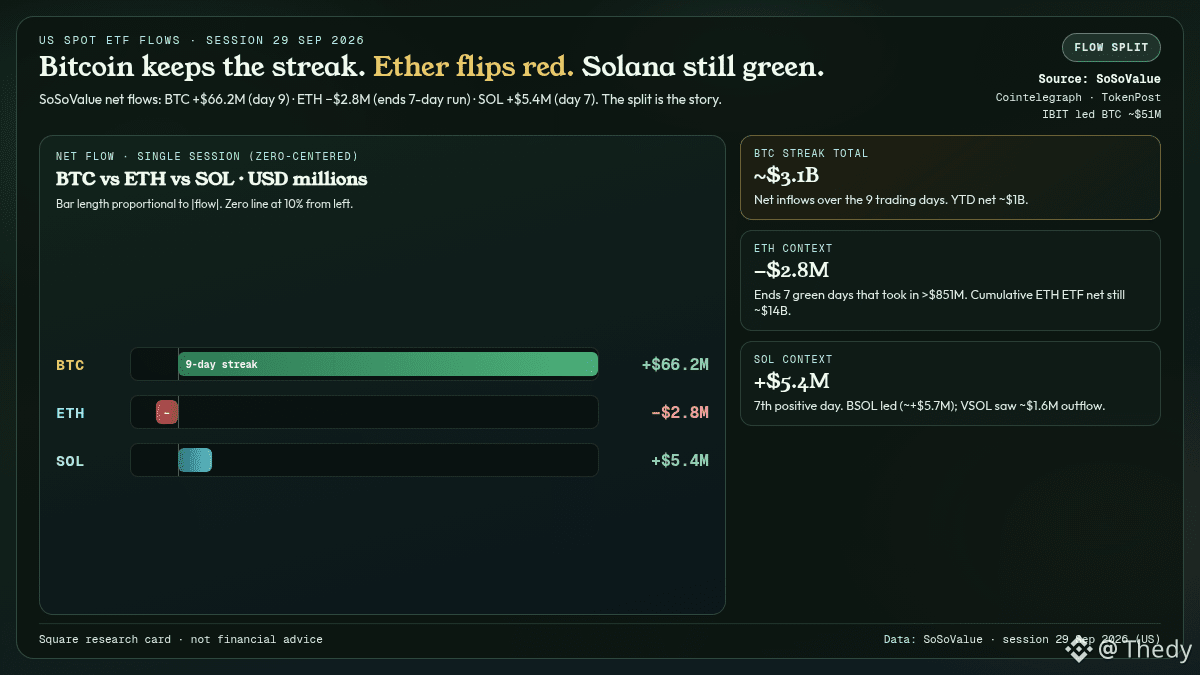
Session of 29/09: US spot ETFs no longer tell the same story.
According to SoSoValue, $BTC is still attracting another +66.2M$ (9th day in a row, ~3.1B$ over the series, ~1B$ of net inflows YTD). $ETH flips into a slight outflow (~−2.8M$) and breaks a 7-day streak of green days. $SOL remains positive (+5.4M$, 7th day).
On the Bitcoin side, IBIT concentrates most of the inflows (~51M$). On the Ether side, the pause is small compared with the ~851M$ gathered over the previous 7 sessions and ~14B$ of cumulative net flows. On Solana, BSOL leads (~+5.7M$) while VSOL sees outflows of ~1.6M$.
Interpretation: as long as $BTC extends the streak and as long as $ETH stays flat or red, the market may read a preference for “safe” crypto rather than broad risk-on. This is not a demand crash for ETH—just a session flip after a very strong week.
Scenarios to watch:
• Continuation: green BTC + hesitant ETH = defensive rotation within crypto
• Soft invalidation: one day of negative BTC, or ETH that bounces back strongly, changes the signal
Are you reading a healthy pause in $ETH, or a real preference flip toward $BTC ?
#ETF #Bitcoin #Ethereum
Session of 29/09: US spot ETFs no longer tell the same story.
According to SoSoValue, $BTC is still attracting another +66.2M$ (9th day in a row, ~3.1B$ over the series, ~1B$ of net inflows YTD). $ETH flips into a slight outflow (~−2.8M$) and breaks a 7-day streak of green days. $SOL remains positive (+5.4M$, 7th day).
On the Bitcoin side, IBIT concentrates most of the inflows (~51M$). On the Ether side, the pause is small compared with the ~851M$ gathered over the previous 7 sessions and ~14B$ of cumulative net flows. On Solana, BSOL leads (~+5.7M$) while VSOL sees outflows of ~1.6M$.
Interpretation: as long as $BTC extends the streak and as long as $ETH stays flat or red, the market may read a preference for “safe” crypto rather than broad risk-on. This is not a demand crash for ETH—just a session flip after a very strong week.
Scenarios to watch:
• Continuation: green BTC + hesitant ETH = defensive rotation within crypto
• Soft invalidation: one day of negative BTC, or ETH that bounces back strongly, changes the signal
Are you reading a healthy pause in $ETH , or a real preference flip toward $BTC ?
#ETF #Bitcoin #Ethereum
According to SoSoValue, $BTC is still attracting another +66.2M$ (9th day in a row, ~3.1B$ over the series, ~1B$ of net inflows YTD). $ETH flips into a slight outflow (~−2.8M$) and breaks a 7-day streak of green days. $SOL remains positive (+5.4M$, 7th day).
On the Bitcoin side, IBIT concentrates most of the inflows (~51M$). On the Ether side, the pause is small compared with the ~851M$ gathered over the previous 7 sessions and ~14B$ of cumulative net flows. On Solana, BSOL leads (~+5.7M$) while VSOL sees outflows of ~1.6M$.
Interpretation: as long as $BTC extends the streak and as long as $ETH stays flat or red, the market may read a preference for “safe” crypto rather than broad risk-on. This is not a demand crash for ETH—just a session flip after a very strong week.
Scenarios to watch:
• Continuation: green BTC + hesitant ETH = defensive rotation within crypto
• Soft invalidation: one day of negative BTC, or ETH that bounces back strongly, changes the signal
Are you reading a healthy pause in $ETH , or a real preference flip toward $BTC ?
#ETF #Bitcoin #Ethereum
98
·
--
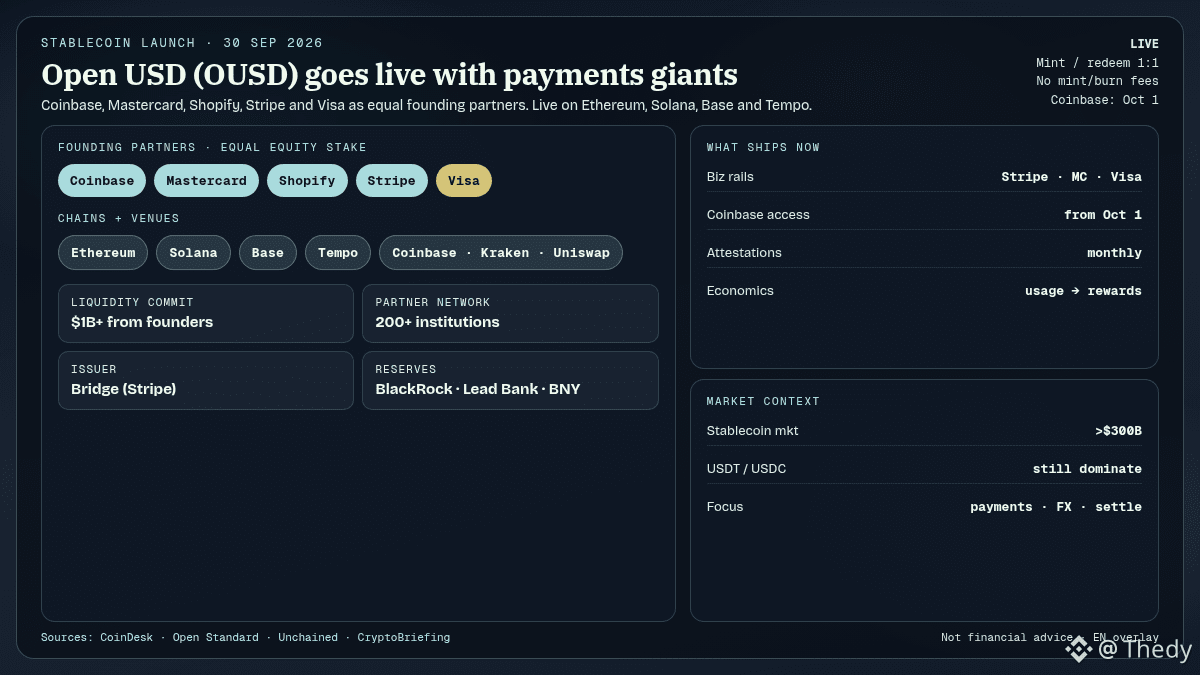
Open USD (OUSD) is live: Coinbase, Mastercard, Shopify, Stripe and Visa as 5 founding partners in equal shares.
FACTS (CoinDesk, Open Standard, Unchained, 30/09/2026)
The Open Standard dollar token runs natively on Ethereum, Solana, Base and Tempo. Issuer: Bridge (Stripe subsidiary). Reserves with BlackRock, Lead Bank and BNY, with monthly attestations planned. Mint / redeem 1:1 with no mint/burn fees. The business rails (Stripe, Mastercard, Visa Stablecoin Platform) are open now; Coinbase support announced for 1 October. Initial trading: Coinbase, Kraken, Uniswap. The founders commit more than $1B in liquidity. The partner network exceeds 200 institutions (UBS, SBI Holdings, Jeeves mentioned among the additions).
READING
This is not yet another "crypto-only" stablecoin. The pitch targets payments, FX, card settlement and banking, in a >$300B market still dominated by USDT / USDC. The economic model drives rewards (and an equity share) based on supply + activity generated, rather than a bilateral split like USDC. For $ETH et $SOL, the useful angle is multi-chain distribution + real-world usage outside DEXs, not a short-term token pump.
SCENARIOS
- Base: enterprise adoption via Stripe/Visa/MC, seeded liquidity, Coinbase expanding access from October.
- Upside: Tempo / Bridge capture large cross-border flows if fees remain competitive.
- Risk: multi-partner governance + USDT/USDC competition + real execution of the $1B liquidity commitment (engagement, not supply already on-chain verified here).
Spot (~18:51 UTC): $BTC ~83875 · $ETH ~2677 · $SOL ~118.4 · BNB ~767 (Kraken/CG). F&G 71 Greed.
Do you see OUSD more as a direct competitor to USDC, or as a TradFi payments rail that digests the stablecoin in the background?
Sources: CoinDesk (30/09), Open Standard, Unchained, CryptoBriefing
#Stablecoin #Payments #Crypto
Open USD (OUSD) is live: Coinbase, Mastercard, Shopify, Stripe and Visa as 5 founding partners in equal shares.
FACTS (CoinDesk, Open Standard, Unchained, 30/09/2026)
The Open Standard dollar token runs natively on Ethereum, Solana, Base and Tempo. Issuer: Bridge (Stripe subsidiary). Reserves with BlackRock, Lead Bank and BNY, with monthly attestations planned. Mint / redeem 1:1 with no mint/burn fees. The business rails (Stripe, Mastercard, Visa Stablecoin Platform) are open now; Coinbase support announced for 1 October. Initial trading: Coinbase, Kraken, Uniswap. The founders commit more than $1B in liquidity. The partner network exceeds 200 institutions (UBS, SBI Holdings, Jeeves mentioned among the additions).
READING
This is not yet another "crypto-only" stablecoin. The pitch targets payments, FX, card settlement and banking, in a >$300B market still dominated by USDT / USDC. The economic model drives rewards (and an equity share) based on supply + activity generated, rather than a bilateral split like USDC. For $ETH et $SOL , the useful angle is multi-chain distribution + real-world usage outside DEXs, not a short-term token pump.
SCENARIOS
- Base: enterprise adoption via Stripe/Visa/MC, seeded liquidity, Coinbase expanding access from October.
- Upside: Tempo / Bridge capture large cross-border flows if fees remain competitive.
- Risk: multi-partner governance + USDT/USDC competition + real execution of the $1B liquidity commitment (engagement, not supply already on-chain verified here).
Spot (~18:51 UTC): $BTC ~83875 · $ETH ~2677 · $SOL ~118.4 · BNB ~767 (Kraken/CG). F&G 71 Greed.
Do you see OUSD more as a direct competitor to USDC, or as a TradFi payments rail that digests the stablecoin in the background?
Sources: CoinDesk (30/09), Open Standard, Unchained, CryptoBriefing
#Stablecoin #Payments #Crypto
FACTS (CoinDesk, Open Standard, Unchained, 30/09/2026)
The Open Standard dollar token runs natively on Ethereum, Solana, Base and Tempo. Issuer: Bridge (Stripe subsidiary). Reserves with BlackRock, Lead Bank and BNY, with monthly attestations planned. Mint / redeem 1:1 with no mint/burn fees. The business rails (Stripe, Mastercard, Visa Stablecoin Platform) are open now; Coinbase support announced for 1 October. Initial trading: Coinbase, Kraken, Uniswap. The founders commit more than $1B in liquidity. The partner network exceeds 200 institutions (UBS, SBI Holdings, Jeeves mentioned among the additions).
READING
This is not yet another "crypto-only" stablecoin. The pitch targets payments, FX, card settlement and banking, in a >$300B market still dominated by USDT / USDC. The economic model drives rewards (and an equity share) based on supply + activity generated, rather than a bilateral split like USDC. For $ETH et $SOL , the useful angle is multi-chain distribution + real-world usage outside DEXs, not a short-term token pump.
SCENARIOS
- Base: enterprise adoption via Stripe/Visa/MC, seeded liquidity, Coinbase expanding access from October.
- Upside: Tempo / Bridge capture large cross-border flows if fees remain competitive.
- Risk: multi-partner governance + USDT/USDC competition + real execution of the $1B liquidity commitment (engagement, not supply already on-chain verified here).
Spot (~18:51 UTC): $BTC ~83875 · $ETH ~2677 · $SOL ~118.4 · BNB ~767 (Kraken/CG). F&G 71 Greed.
Do you see OUSD more as a direct competitor to USDC, or as a TradFi payments rail that digests the stablecoin in the background?
Sources: CoinDesk (30/09), Open Standard, Unchained, CryptoBriefing
#Stablecoin #Payments #Crypto
47
·
--
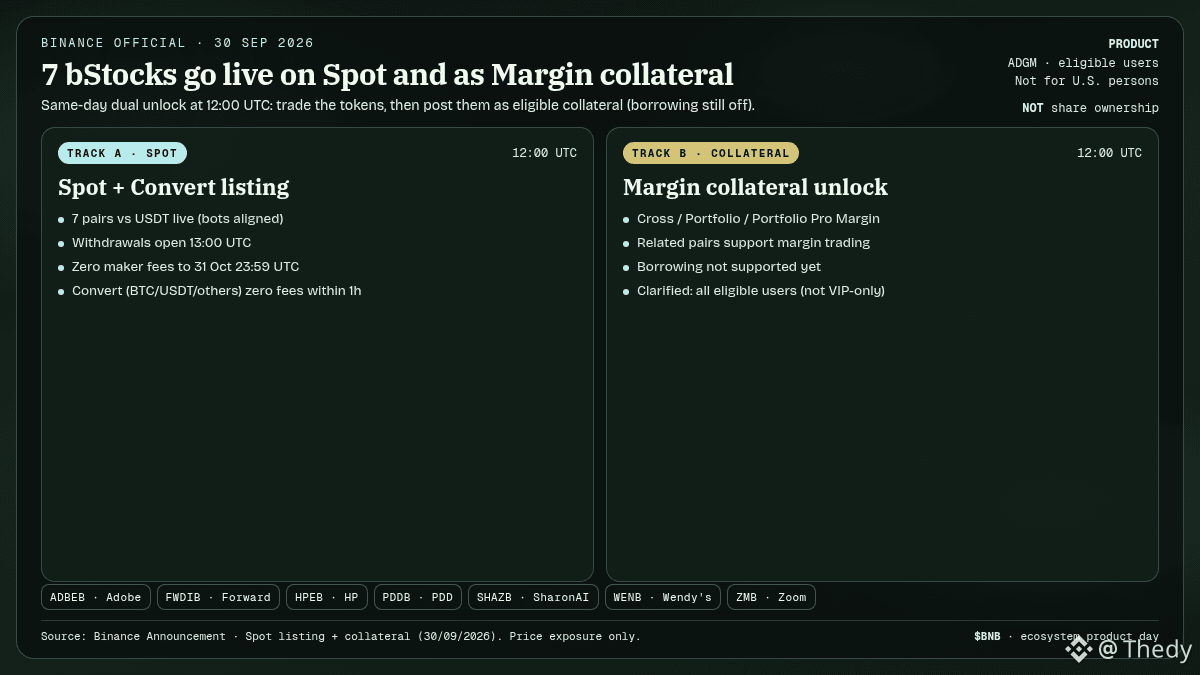
Binance active 7 bStocks on Spot et as collateral Margin on the same day (30/09, 12:00 UTC).
FACTS (official Binance announcements, 30/09/2026)
Two synchronized moves:
1) Spot / Convert: pairs ADBEB, FWDIB, HPEB, PDDB, SHAZB, WENB, ZMB against USDT opened at 12:00 UTC. Withdrawals at 13:00 UTC. Zero maker fees until 31/10/2026 23:59 UTC. Convert (including against BTC/USDT) with zero fees in the hour following the Spot listing. Algo bots aligned with the listing; Rebalancing Bots under 24h.
2) Collateral: Cross Margin, Portfolio Margin and Portfolio Margin Pro accept these 7 tokens as collateral at 12:00 UTC. The affected pairs also move to margin trading. Borrowing is not yet supported. Daily update: all eligible users (not only VIP 3+).
Tokenized underlying assets (price exposure, not direct ownership of shares): Adobe, Forward Industries, Hewlett Packard, PDD Holdings, SharonAI, Wendy's, Zoom. ADGM product / eligible users; not for US persons.
READING
$BNB pushes the tokenized TradFi layer beyond simple listing: margin collateral expands utility outside of spot. This is distinct from the already listed TradFi perps (other tickers / other product). The risk remains product + jurisdiction + volatility of the underlying: a collateral token can amplify margin calls if the stock’s underlying price declines.
SCENARIOS
- Base case: progressive Spot liquidity, collateral use concentrated on the most liquid names (e.g., ADBEB, PDDB, ZMB).
- Product upside: more bStocks collateral + borrowing later (announced as “stay tuned”).
- Risk: haircut / index methodology + restricted regions limit real adoption.
Spot snapshot (~16:55 UTC): $BTC ~84308 · $ETH ~2691 · $BNB ~770 (Kraken/CG). F&G 71 Greed.
Will you use these bStocks more for Spot trading, or as Margin collateral?
Sources: Binance Announcement (collateral + Spot listing) 30/09/2026
#Binance #bStocks #TokenizedAssets
Binance active 7 bStocks on Spot et as collateral Margin on the same day (30/09, 12:00 UTC).
FACTS (official Binance announcements, 30/09/2026)
Two synchronized moves:
1) Spot / Convert: pairs ADBEB, FWDIB, HPEB, PDDB, SHAZB, WENB, ZMB against USDT opened at 12:00 UTC. Withdrawals at 13:00 UTC. Zero maker fees until 31/10/2026 23:59 UTC. Convert (including against BTC/USDT) with zero fees in the hour following the Spot listing. Algo bots aligned with the listing; Rebalancing Bots under 24h.
2) Collateral: Cross Margin, Portfolio Margin and Portfolio Margin Pro accept these 7 tokens as collateral at 12:00 UTC. The affected pairs also move to margin trading. Borrowing is not yet supported. Daily update: all eligible users (not only VIP 3+).
Tokenized underlying assets (price exposure, not direct ownership of shares): Adobe, Forward Industries, Hewlett Packard, PDD Holdings, SharonAI, Wendy's, Zoom. ADGM product / eligible users; not for US persons.
READING
$BNB pushes the tokenized TradFi layer beyond simple listing: margin collateral expands utility outside of spot. This is distinct from the already listed TradFi perps (other tickers / other product). The risk remains product + jurisdiction + volatility of the underlying: a collateral token can amplify margin calls if the stock’s underlying price declines.
SCENARIOS
- Base case: progressive Spot liquidity, collateral use concentrated on the most liquid names (e.g., ADBEB, PDDB, ZMB).
- Product upside: more bStocks collateral + borrowing later (announced as “stay tuned”).
- Risk: haircut / index methodology + restricted regions limit real adoption.
Spot snapshot (~16:55 UTC): $BTC ~84308 · $ETH ~2691 · $BNB ~770 (Kraken/CG). F&G 71 Greed.
Will you use these bStocks more for Spot trading, or as Margin collateral?
Sources: Binance Announcement (collateral + Spot listing) 30/09/2026
#Binance #bStocks #TokenizedAssets
FACTS (official Binance announcements, 30/09/2026)
Two synchronized moves:
1) Spot / Convert: pairs ADBEB, FWDIB, HPEB, PDDB, SHAZB, WENB, ZMB against USDT opened at 12:00 UTC. Withdrawals at 13:00 UTC. Zero maker fees until 31/10/2026 23:59 UTC. Convert (including against BTC/USDT) with zero fees in the hour following the Spot listing. Algo bots aligned with the listing; Rebalancing Bots under 24h.
2) Collateral: Cross Margin, Portfolio Margin and Portfolio Margin Pro accept these 7 tokens as collateral at 12:00 UTC. The affected pairs also move to margin trading. Borrowing is not yet supported. Daily update: all eligible users (not only VIP 3+).
Tokenized underlying assets (price exposure, not direct ownership of shares): Adobe, Forward Industries, Hewlett Packard, PDD Holdings, SharonAI, Wendy's, Zoom. ADGM product / eligible users; not for US persons.
READING
$BNB pushes the tokenized TradFi layer beyond simple listing: margin collateral expands utility outside of spot. This is distinct from the already listed TradFi perps (other tickers / other product). The risk remains product + jurisdiction + volatility of the underlying: a collateral token can amplify margin calls if the stock’s underlying price declines.
SCENARIOS
- Base case: progressive Spot liquidity, collateral use concentrated on the most liquid names (e.g., ADBEB, PDDB, ZMB).
- Product upside: more bStocks collateral + borrowing later (announced as “stay tuned”).
- Risk: haircut / index methodology + restricted regions limit real adoption.
Spot snapshot (~16:55 UTC): $BTC ~84308 · $ETH ~2691 · $BNB ~770 (Kraken/CG). F&G 71 Greed.
Will you use these bStocks more for Spot trading, or as Margin collateral?
Sources: Binance Announcement (collateral + Spot listing) 30/09/2026
#Binance #bStocks #TokenizedAssets
62
·
--
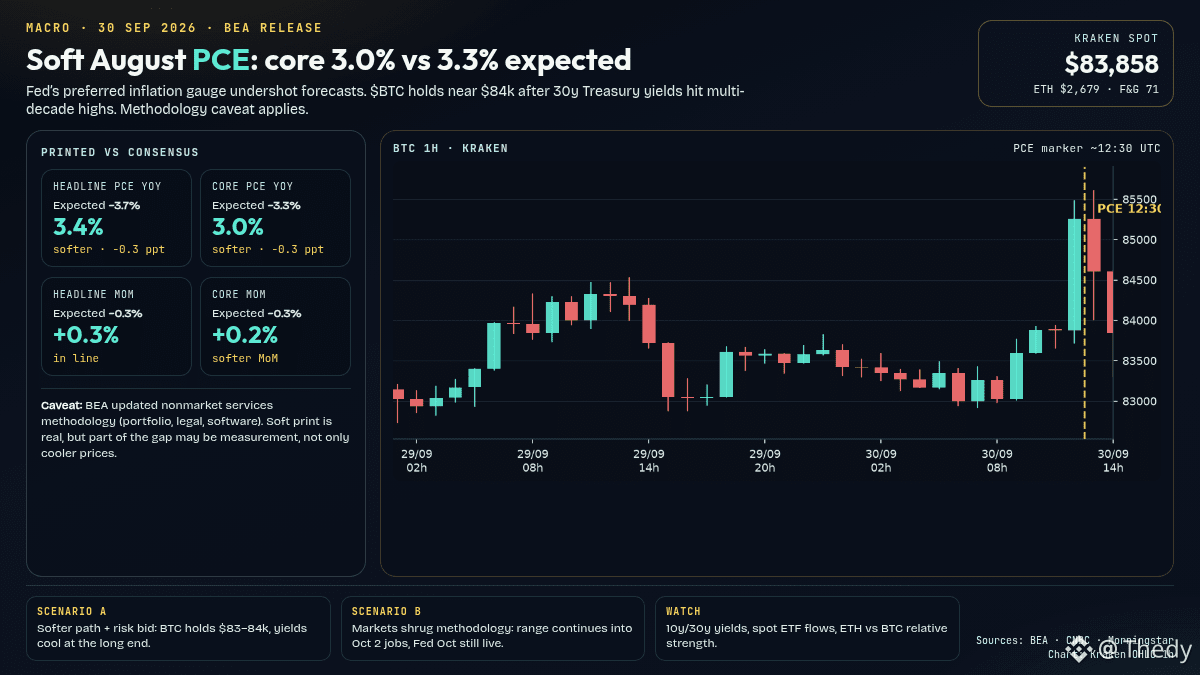
PCE softer than expected: the Fed is paying close attention, and $BTC holds near 84k.
FACTS (BEA, 30/09/2026 · CNBC / Morningstar)
The August PCE index comes in below consensus:
• Headline YoY: 3.4% (expected ~3.7%), MoM +0.3% (in line)
• Core YoY: 3.0% (expected ~3.3%), MoM +0.2% (expected ~0.3%)
This is the Fed’s preferred inflation gauge. Note: the BEA also changed its methodology for certain “non-market” services (portfolio management, legal, software). Part of the gap may therefore come from the measurement, not just calmer prices.
MARKET CONTEXT
The day before, the US 30-year yield hit ~5.62%, the highest since 2002. Spot (~14:55 UTC, Kraken): BTC ~83.9k, ETH ~2.68k, SOL ~119, XRP ~1.50; BNB ~767 (CoinGecko); Fear & Greed 71 (Greed). OKX funding for BTC/ETH still calm (~0.005%).
INTERPRETATION
A soft PCE can slightly reduce pressure for an “immediate hike,” but 3% core remains far from the 2% target. Markets are now weighing both the methodological angles and the timeline: jobs on October 2, FOMC in late October.
SCENARIOS
A) Dovish read: yields ease, BTC defends 83–84k.
B) “method noise” read: the range continues, and October remains the real test.
C) Invalidation: a clear break below ~82k if yields pick back up and ETF flows lose momentum.
And you: do you see this PCE as a real relief for crypto risk, or as a “too good to be true” print because of the BEA revision?
$BTC $ETH #PCE #Bitcoin #Macro
PCE softer than expected: the Fed is paying close attention, and $BTC holds near 84k.
FACTS (BEA, 30/09/2026 · CNBC / Morningstar)
The August PCE index comes in below consensus:
• Headline YoY: 3.4% (expected ~3.7%), MoM +0.3% (in line)
• Core YoY: 3.0% (expected ~3.3%), MoM +0.2% (expected ~0.3%)
This is the Fed’s preferred inflation gauge. Note: the BEA also changed its methodology for certain “non-market” services (portfolio management, legal, software). Part of the gap may therefore come from the measurement, not just calmer prices.
MARKET CONTEXT
The day before, the US 30-year yield hit ~5.62%, the highest since 2002. Spot (~14:55 UTC, Kraken): BTC ~83.9k, ETH ~2.68k, SOL ~119, XRP ~1.50; BNB ~767 (CoinGecko); Fear & Greed 71 (Greed). OKX funding for BTC/ETH still calm (~0.005%).
INTERPRETATION
A soft PCE can slightly reduce pressure for an “immediate hike,” but 3% core remains far from the 2% target. Markets are now weighing both the methodological angles and the timeline: jobs on October 2, FOMC in late October.
SCENARIOS
A) Dovish read: yields ease, BTC defends 83–84k.
B) “method noise” read: the range continues, and October remains the real test.
C) Invalidation: a clear break below ~82k if yields pick back up and ETF flows lose momentum.
And you: do you see this PCE as a real relief for crypto risk, or as a “too good to be true” print because of the BEA revision?
$BTC $ETH #PCE #Bitcoin #Macro
FACTS (BEA, 30/09/2026 · CNBC / Morningstar)
The August PCE index comes in below consensus:
• Headline YoY: 3.4% (expected ~3.7%), MoM +0.3% (in line)
• Core YoY: 3.0% (expected ~3.3%), MoM +0.2% (expected ~0.3%)
This is the Fed’s preferred inflation gauge. Note: the BEA also changed its methodology for certain “non-market” services (portfolio management, legal, software). Part of the gap may therefore come from the measurement, not just calmer prices.
MARKET CONTEXT
The day before, the US 30-year yield hit ~5.62%, the highest since 2002. Spot (~14:55 UTC, Kraken): BTC ~83.9k, ETH ~2.68k, SOL ~119, XRP ~1.50; BNB ~767 (CoinGecko); Fear & Greed 71 (Greed). OKX funding for BTC/ETH still calm (~0.005%).
INTERPRETATION
A soft PCE can slightly reduce pressure for an “immediate hike,” but 3% core remains far from the 2% target. Markets are now weighing both the methodological angles and the timeline: jobs on October 2, FOMC in late October.
SCENARIOS
A) Dovish read: yields ease, BTC defends 83–84k.
B) “method noise” read: the range continues, and October remains the real test.
C) Invalidation: a clear break below ~82k if yields pick back up and ETF flows lose momentum.
And you: do you see this PCE as a real relief for crypto risk, or as a “too good to be true” print because of the BEA revision?
$BTC $ETH #PCE #Bitcoin #Macro
31
·
--
PCE softer than expected: the Fed is keeping a close eye on it, and $BTC stays near 84k.
FACTS (BEA, 30/09/2026 · CNBC / Morningstar)
The August PCE index comes in below consensus:
• Headline YoY: 3.4% (expected ~3.7%), MoM +0.3% (in line)
• Core YoY: 3.0% (expected ~3.3%), MoM +0.2% (expected ~0.3%)
This is the Fed’s preferred inflation gauge. Note: the BEA also changed its methodology for some “non-market” services (portfolio management, legal, software). Part of the gap may therefore come from the measurement, not just calmer prices.
MARKET CONTEXT
The day before, the US 30-year yield had touched ~5.62%, the highest since 2002. Spot (~14:55 UTC, Kraken): BTC ~83.9k, ETH ~2.68k, SOL ~119, XRP ~1.50; BNB ~767 (CoinGecko); Fear & Greed 71 (Greed). OKX funding for BTC/ETH still calm (~0.005%).
INTERPRETATION
A softer PCE can slightly ease the pressure for an “immediate hike,” but 3% core is still far from the 2% target. Markets are now looking at the methodological path and the calendar: jobs on October 2, FOMC late October.
SCENARIOS
A) Dovish read: yields ease, BTC defends 83–84k.
B) “method noise” read: the range continues; October remains the real test.
C) Invalidation: a clean break below ~82k if yields pick back up and ETF flows fade.
And you: do you see this PCE as a real relief for crypto risk, or as a “too good to be true” print because of the BEA revision?
$BTC $ETH #PCE #Bitcoin #Macro
PCE softer than expected: the Fed is keeping a close eye on it, and $BTC stays near 84k.
FACTS (BEA, 30/09/2026 · CNBC / Morningstar)
The August PCE index comes in below consensus:
• Headline YoY: 3.4% (expected ~3.7%), MoM +0.3% (in line)
• Core YoY: 3.0% (expected ~3.3%), MoM +0.2% (expected ~0.3%)
This is the Fed’s preferred inflation gauge. Note: the BEA also changed its methodology for some “non-market” services (portfolio management, legal, software). Part of the gap may therefore come from the measurement, not just calmer prices.
MARKET CONTEXT
The day before, the US 30-year yield had touched ~5.62%, the highest since 2002. Spot (~14:55 UTC, Kraken): BTC ~83.9k, ETH ~2.68k, SOL ~119, XRP ~1.50; BNB ~767 (CoinGecko); Fear & Greed 71 (Greed). OKX funding for BTC/ETH still calm (~0.005%).
INTERPRETATION
A softer PCE can slightly ease the pressure for an “immediate hike,” but 3% core is still far from the 2% target. Markets are now looking at the methodological path and the calendar: jobs on October 2, FOMC late October.
SCENARIOS
A) Dovish read: yields ease, BTC defends 83–84k.
B) “method noise” read: the range continues; October remains the real test.
C) Invalidation: a clean break below ~82k if yields pick back up and ETF flows fade.
And you: do you see this PCE as a real relief for crypto risk, or as a “too good to be true” print because of the BEA revision?
$BTC $ETH #PCE #Bitcoin #Macro
FACTS (BEA, 30/09/2026 · CNBC / Morningstar)
The August PCE index comes in below consensus:
• Headline YoY: 3.4% (expected ~3.7%), MoM +0.3% (in line)
• Core YoY: 3.0% (expected ~3.3%), MoM +0.2% (expected ~0.3%)
This is the Fed’s preferred inflation gauge. Note: the BEA also changed its methodology for some “non-market” services (portfolio management, legal, software). Part of the gap may therefore come from the measurement, not just calmer prices.
MARKET CONTEXT
The day before, the US 30-year yield had touched ~5.62%, the highest since 2002. Spot (~14:55 UTC, Kraken): BTC ~83.9k, ETH ~2.68k, SOL ~119, XRP ~1.50; BNB ~767 (CoinGecko); Fear & Greed 71 (Greed). OKX funding for BTC/ETH still calm (~0.005%).
INTERPRETATION
A softer PCE can slightly ease the pressure for an “immediate hike,” but 3% core is still far from the 2% target. Markets are now looking at the methodological path and the calendar: jobs on October 2, FOMC late October.
SCENARIOS
A) Dovish read: yields ease, BTC defends 83–84k.
B) “method noise” read: the range continues; October remains the real test.
C) Invalidation: a clean break below ~82k if yields pick back up and ETF flows fade.
And you: do you see this PCE as a real relief for crypto risk, or as a “too good to be true” print because of the BEA revision?
$BTC $ETH #PCE #Bitcoin #Macro
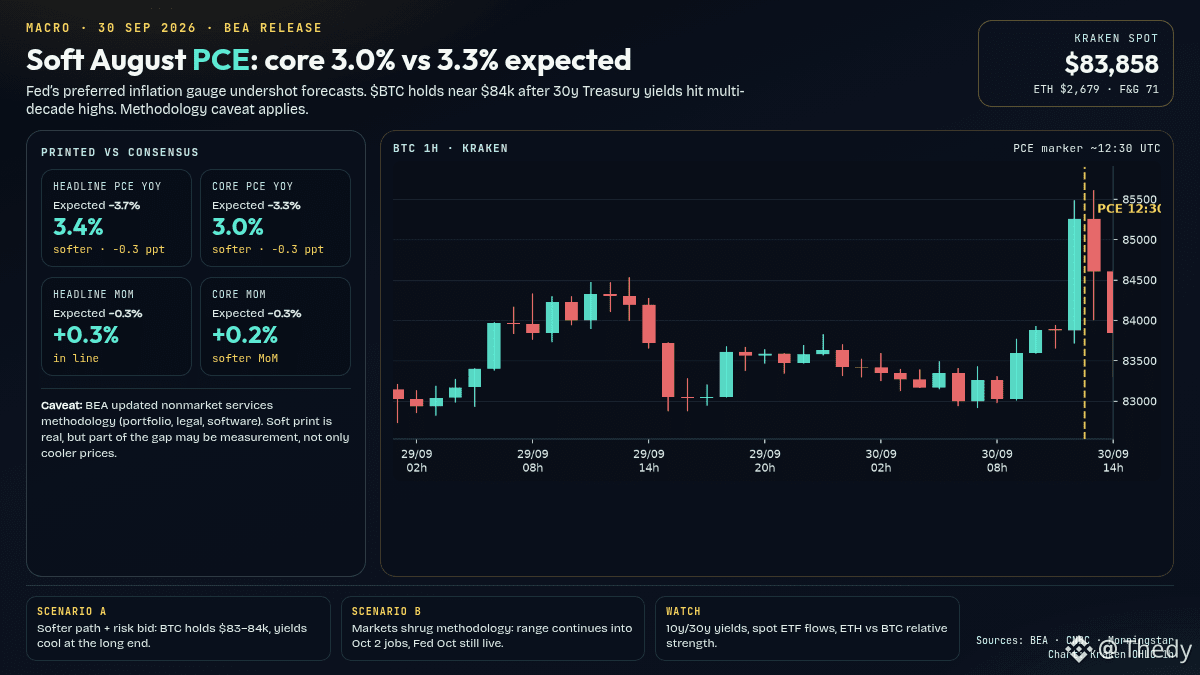
98
·
--
Robinhood announces crypto perps for eligible US clients (HOOD Summit).
FACTS (Robinhood Newsroom 09/29/2026 + The Block / CoinDesk)
At the HOOD Summit 2026 (Houston), Robinhood presented perpetual futures in its app for eligible US clients, “in the coming months.” Eight underlying assets at launch: $BTC, $ETH, SOL, XRP, DOGE, ADA, LINK, HYPE. Long or short, with no expiration date. Leverage up to 10x on BTC and ETH, 3x on the other six. Offered via Robinhood Derivatives / Bitstamp. Announced fees: 0.01% per trade through the end of 2026. Tools cited: stop-loss, take-profit, real-time liquidation price, risk alerts. Vlad Tenev called the offer “the first true US perps,” with P&L settled every 15 minutes (post X relayed). It’s not live for everyone yet: phased rollout, eligibility required. Reference spot (~12:55 UTC): $BTC ~85.4k, $ETH ~2.74k, $SOL ~122, F&G 71 (Greed).
INTERPRETATION
This isn’t a Binance listing signal. It’s the arrival of perps (already the dominant product offshore) in a US retail app with >27M funded accounts, via a regulated rail (Bitstamp / Derivatives). 10x leverage remains aggressive: a move of ~10% against the position can liquidate it. Different from TradFi perps on already-listed equities elsewhere: here the focus is on major crypto spot + liquid alts.
SCENARIOS
1. Slow rollout: restricted access, modest volumes at first, little immediate price impact.
2. Retail effect: more directional flow on $BTC / $ETH during US sessions if the UX is simple and fees stay low.
3. Risk: clustered liquidations and retail herding during volatility, especially if AI agents (announced the same day) execute without per-trade validation.
Are you already trading offshore perps, or will you wait for a US in-app offer like this?
$BTC $ETH $SOL
#Robinhood #Perps #Bitcoin
Robinhood announces crypto perps for eligible US clients (HOOD Summit).
FACTS (Robinhood Newsroom 09/29/2026 + The Block / CoinDesk)
At the HOOD Summit 2026 (Houston), Robinhood presented perpetual futures in its app for eligible US clients, “in the coming months.” Eight underlying assets at launch: $BTC , $ETH , SOL, XRP, DOGE, ADA, LINK, HYPE. Long or short, with no expiration date. Leverage up to 10x on BTC and ETH, 3x on the other six. Offered via Robinhood Derivatives / Bitstamp. Announced fees: 0.01% per trade through the end of 2026. Tools cited: stop-loss, take-profit, real-time liquidation price, risk alerts. Vlad Tenev called the offer “the first true US perps,” with P&L settled every 15 minutes (post X relayed). It’s not live for everyone yet: phased rollout, eligibility required. Reference spot (~12:55 UTC): $BTC ~85.4k, $ETH ~2.74k, $SOL ~122, F&G 71 (Greed).
INTERPRETATION
This isn’t a Binance listing signal. It’s the arrival of perps (already the dominant product offshore) in a US retail app with >27M funded accounts, via a regulated rail (Bitstamp / Derivatives). 10x leverage remains aggressive: a move of ~10% against the position can liquidate it. Different from TradFi perps on already-listed equities elsewhere: here the focus is on major crypto spot + liquid alts.
SCENARIOS
1. Slow rollout: restricted access, modest volumes at first, little immediate price impact.
2. Retail effect: more directional flow on $BTC / $ETH during US sessions if the UX is simple and fees stay low.
3. Risk: clustered liquidations and retail herding during volatility, especially if AI agents (announced the same day) execute without per-trade validation.
Are you already trading offshore perps, or will you wait for a US in-app offer like this?
$BTC $ETH $SOL
#Robinhood #Perps #Bitcoin
FACTS (Robinhood Newsroom 09/29/2026 + The Block / CoinDesk)
At the HOOD Summit 2026 (Houston), Robinhood presented perpetual futures in its app for eligible US clients, “in the coming months.” Eight underlying assets at launch: $BTC , $ETH , SOL, XRP, DOGE, ADA, LINK, HYPE. Long or short, with no expiration date. Leverage up to 10x on BTC and ETH, 3x on the other six. Offered via Robinhood Derivatives / Bitstamp. Announced fees: 0.01% per trade through the end of 2026. Tools cited: stop-loss, take-profit, real-time liquidation price, risk alerts. Vlad Tenev called the offer “the first true US perps,” with P&L settled every 15 minutes (post X relayed). It’s not live for everyone yet: phased rollout, eligibility required. Reference spot (~12:55 UTC): $BTC ~85.4k, $ETH ~2.74k, $SOL ~122, F&G 71 (Greed).
INTERPRETATION
This isn’t a Binance listing signal. It’s the arrival of perps (already the dominant product offshore) in a US retail app with >27M funded accounts, via a regulated rail (Bitstamp / Derivatives). 10x leverage remains aggressive: a move of ~10% against the position can liquidate it. Different from TradFi perps on already-listed equities elsewhere: here the focus is on major crypto spot + liquid alts.
SCENARIOS
1. Slow rollout: restricted access, modest volumes at first, little immediate price impact.
2. Retail effect: more directional flow on $BTC / $ETH during US sessions if the UX is simple and fees stay low.
3. Risk: clustered liquidations and retail herding during volatility, especially if AI agents (announced the same day) execute without per-trade validation.
Are you already trading offshore perps, or will you wait for a US in-app offer like this?
$BTC $ETH $SOL
#Robinhood #Perps #Bitcoin
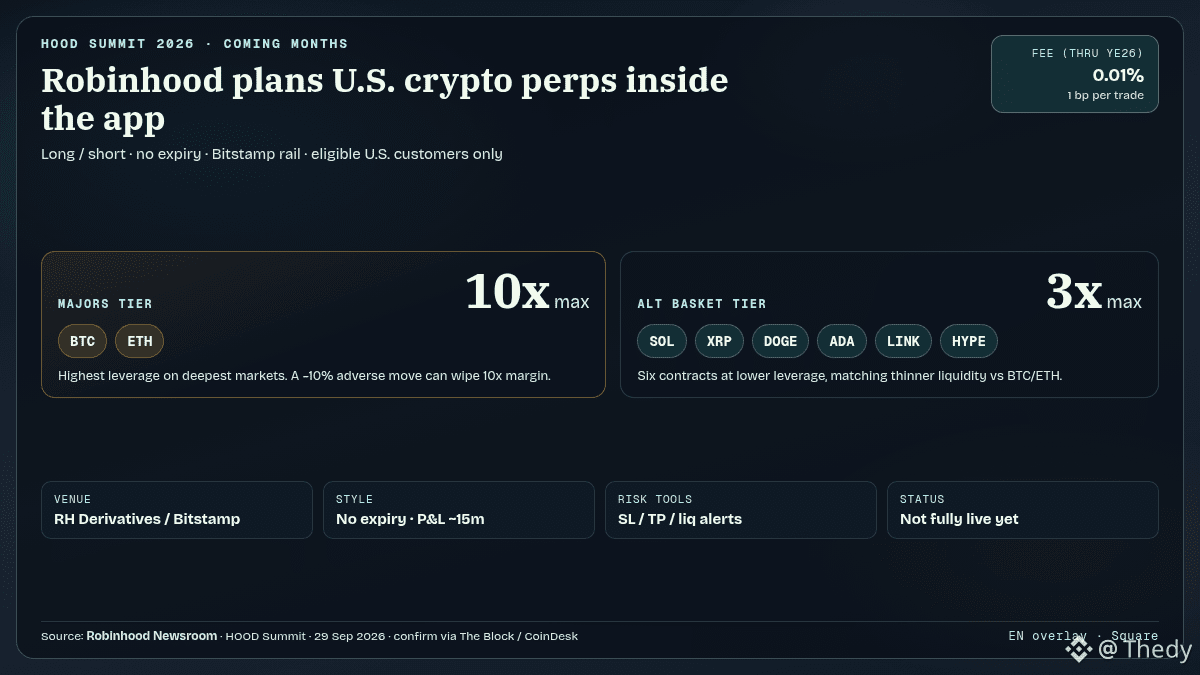
174
·
--
Verified
Japan inbound: Binance Pay enables PayPay merchants via HIVEX from 30/09.
FACTS (Binance PR Newswire + PayPay Corporation PR 30/09/2026)
Starting on September 30, 2026, eligible Binance Pay users traveling in Japan can pay at PayPay merchants (national network), via the HIVEX interoperability rail (TBCASoft). Approximately 48 million eligible Pay users in 100+ countries/regions (figure as of ~01/06/2026, excluding JP residents). Merchants receive settlement in Japanese yen; they do not need to hold crypto. QR modes: scan the merchant’s PayPay QR (MPM) or present the Binance payment code (CPM). Cited use cases: dining, shopping, lodging, travel expenses. Key eligibility point: Japan residents / Binance Japan users excluded. The Binance Japan release (Zaikei) mentions 10M+ PayPay points; the PR Newswire talks about “millions” of merchants.
INTERPRETATION
This is not a listing or a spot product. It’s a cashless bridge: crypto on the traveler’s side, yen on the merchant’s side, over one of the densest QR networks in the world. For the $BNB / Binance Pay ecosystem, the signal is real usage (inbound tourists) rather than a trading narrative. Reference spot (~09:55 UTC): $BTC ~83.6k, $BNB ~764, F&G 71 (Greed).
SCENARIOS
1. Progressive adoption: Pay volume in Japan rises with the tourist season, with no immediate price impact.
2. Asia showcase effect: other QR corridors (already mentioned for Binance Pay) gain credibility if the traveler experience is smooth.
3. Risk of confusion: many will read “PayPay × Binance” as a Binance Japan product. That’s not the case. Global Pay for visitors, not for JP residents.
Have you already been to Japan with a crypto wallet, or were you waiting for this kind of local QR rail?
$BNB $BTC
#BinancePay #PayPay #HIVEX
Japan inbound: Binance Pay enables PayPay merchants via HIVEX from 30/09.
FACTS (Binance PR Newswire + PayPay Corporation PR 30/09/2026)
Starting on September 30, 2026, eligible Binance Pay users traveling in Japan can pay at PayPay merchants (national network), via the HIVEX interoperability rail (TBCASoft). Approximately 48 million eligible Pay users in 100+ countries/regions (figure as of ~01/06/2026, excluding JP residents). Merchants receive settlement in Japanese yen; they do not need to hold crypto. QR modes: scan the merchant’s PayPay QR (MPM) or present the Binance payment code (CPM). Cited use cases: dining, shopping, lodging, travel expenses. Key eligibility point: Japan residents / Binance Japan users excluded. The Binance Japan release (Zaikei) mentions 10M+ PayPay points; the PR Newswire talks about “millions” of merchants.
INTERPRETATION
This is not a listing or a spot product. It’s a cashless bridge: crypto on the traveler’s side, yen on the merchant’s side, over one of the densest QR networks in the world. For the $BNB / Binance Pay ecosystem, the signal is real usage (inbound tourists) rather than a trading narrative. Reference spot (~09:55 UTC): $BTC ~83.6k, $BNB ~764, F&G 71 (Greed).
SCENARIOS
1. Progressive adoption: Pay volume in Japan rises with the tourist season, with no immediate price impact.
2. Asia showcase effect: other QR corridors (already mentioned for Binance Pay) gain credibility if the traveler experience is smooth.
3. Risk of confusion: many will read “PayPay × Binance” as a Binance Japan product. That’s not the case. Global Pay for visitors, not for JP residents.
Have you already been to Japan with a crypto wallet, or were you waiting for this kind of local QR rail?
$BNB $BTC
#BinancePay #PayPay #HIVEX
FACTS (Binance PR Newswire + PayPay Corporation PR 30/09/2026)
Starting on September 30, 2026, eligible Binance Pay users traveling in Japan can pay at PayPay merchants (national network), via the HIVEX interoperability rail (TBCASoft). Approximately 48 million eligible Pay users in 100+ countries/regions (figure as of ~01/06/2026, excluding JP residents). Merchants receive settlement in Japanese yen; they do not need to hold crypto. QR modes: scan the merchant’s PayPay QR (MPM) or present the Binance payment code (CPM). Cited use cases: dining, shopping, lodging, travel expenses. Key eligibility point: Japan residents / Binance Japan users excluded. The Binance Japan release (Zaikei) mentions 10M+ PayPay points; the PR Newswire talks about “millions” of merchants.
INTERPRETATION
This is not a listing or a spot product. It’s a cashless bridge: crypto on the traveler’s side, yen on the merchant’s side, over one of the densest QR networks in the world. For the $BNB / Binance Pay ecosystem, the signal is real usage (inbound tourists) rather than a trading narrative. Reference spot (~09:55 UTC): $BTC ~83.6k, $BNB ~764, F&G 71 (Greed).
SCENARIOS
1. Progressive adoption: Pay volume in Japan rises with the tourist season, with no immediate price impact.
2. Asia showcase effect: other QR corridors (already mentioned for Binance Pay) gain credibility if the traveler experience is smooth.
3. Risk of confusion: many will read “PayPay × Binance” as a Binance Japan product. That’s not the case. Global Pay for visitors, not for JP residents.
Have you already been to Japan with a crypto wallet, or were you waiting for this kind of local QR rail?
$BNB $BTC
#BinancePay #PayPay #HIVEX
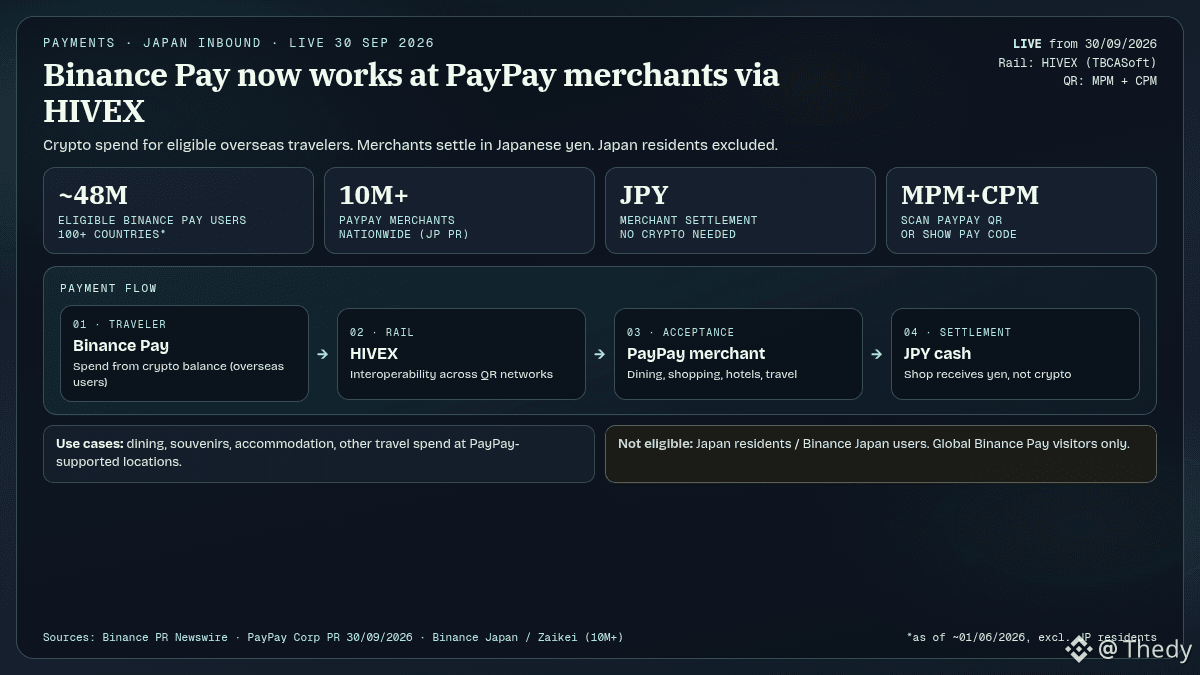
112
·
--
CryptoQuant Bull Score at 90/100… and yet demand of $BTC seems to be faltering already.
Today’s paradox (CryptoQuant report dated 29/09, reposted by CoinDesk / crypto.news on 30/09): the on-chain regime remains “extremely bullish” after the reclaim of the 365-day MA, but the buyers who pushed the high near 87.4k are stepping back.
FACTS
• Bull Score Index: 90/100
• Apparent spot demand: about −170,000 BTC over 30 days
• Growth in speculative futures demand: from ~164k to ~16k BTC in 15 days (about −90%)
• Altcoin deposits on CEX: 76,000 tx over 7 days (highest since Oct. 2025)
• Kraken spot ~83,300 $ (~07:56 UTC), far from the Kraken peak ~87,447 $
INTERPRETATION
High score = bull market structure. Contracting demand = rallies are harder to sustain without fresh inflows. Julio Moreno (CryptoQuant): without new demand, the bullish extension becomes more difficult near current levels.
SCENARIOS
• Consolidation / downward pressure if demand stays weak below the ~85k zone
• Bull remains intact as long as the 365-day MA (~80k according to CQ) holds
• Soft invalidation of the exhaustion scenario: clear rebound above recent highs with spot/futures demand picking back up
Are you more likely to look at the Bull Score, or at spot/futures demand, to judge whether this pullback remains healthy?
$BTC
#Bitcoin #CryptoQuant #OnChain
CryptoQuant Bull Score at 90/100… and yet demand of $BTC seems to be faltering already.
Today’s paradox (CryptoQuant report dated 29/09, reposted by CoinDesk / crypto.news on 30/09): the on-chain regime remains “extremely bullish” after the reclaim of the 365-day MA, but the buyers who pushed the high near 87.4k are stepping back.
FACTS
• Bull Score Index: 90/100
• Apparent spot demand: about −170,000 BTC over 30 days
• Growth in speculative futures demand: from ~164k to ~16k BTC in 15 days (about −90%)
• Altcoin deposits on CEX: 76,000 tx over 7 days (highest since Oct. 2025)
• Kraken spot ~83,300 $ (~07:56 UTC), far from the Kraken peak ~87,447 $
INTERPRETATION
High score = bull market structure. Contracting demand = rallies are harder to sustain without fresh inflows. Julio Moreno (CryptoQuant): without new demand, the bullish extension becomes more difficult near current levels.
SCENARIOS
• Consolidation / downward pressure if demand stays weak below the ~85k zone
• Bull remains intact as long as the 365-day MA (~80k according to CQ) holds
• Soft invalidation of the exhaustion scenario: clear rebound above recent highs with spot/futures demand picking back up
Are you more likely to look at the Bull Score, or at spot/futures demand, to judge whether this pullback remains healthy?
$BTC
#Bitcoin #CryptoQuant #OnChain
Today’s paradox (CryptoQuant report dated 29/09, reposted by CoinDesk / crypto.news on 30/09): the on-chain regime remains “extremely bullish” after the reclaim of the 365-day MA, but the buyers who pushed the high near 87.4k are stepping back.
FACTS
• Bull Score Index: 90/100
• Apparent spot demand: about −170,000 BTC over 30 days
• Growth in speculative futures demand: from ~164k to ~16k BTC in 15 days (about −90%)
• Altcoin deposits on CEX: 76,000 tx over 7 days (highest since Oct. 2025)
• Kraken spot ~83,300 $ (~07:56 UTC), far from the Kraken peak ~87,447 $
INTERPRETATION
High score = bull market structure. Contracting demand = rallies are harder to sustain without fresh inflows. Julio Moreno (CryptoQuant): without new demand, the bullish extension becomes more difficult near current levels.
SCENARIOS
• Consolidation / downward pressure if demand stays weak below the ~85k zone
• Bull remains intact as long as the 365-day MA (~80k according to CQ) holds
• Soft invalidation of the exhaustion scenario: clear rebound above recent highs with spot/futures demand picking back up
Are you more likely to look at the Bull Score, or at spot/futures demand, to judge whether this pullback remains healthy?
$BTC
#Bitcoin #CryptoQuant #OnChain
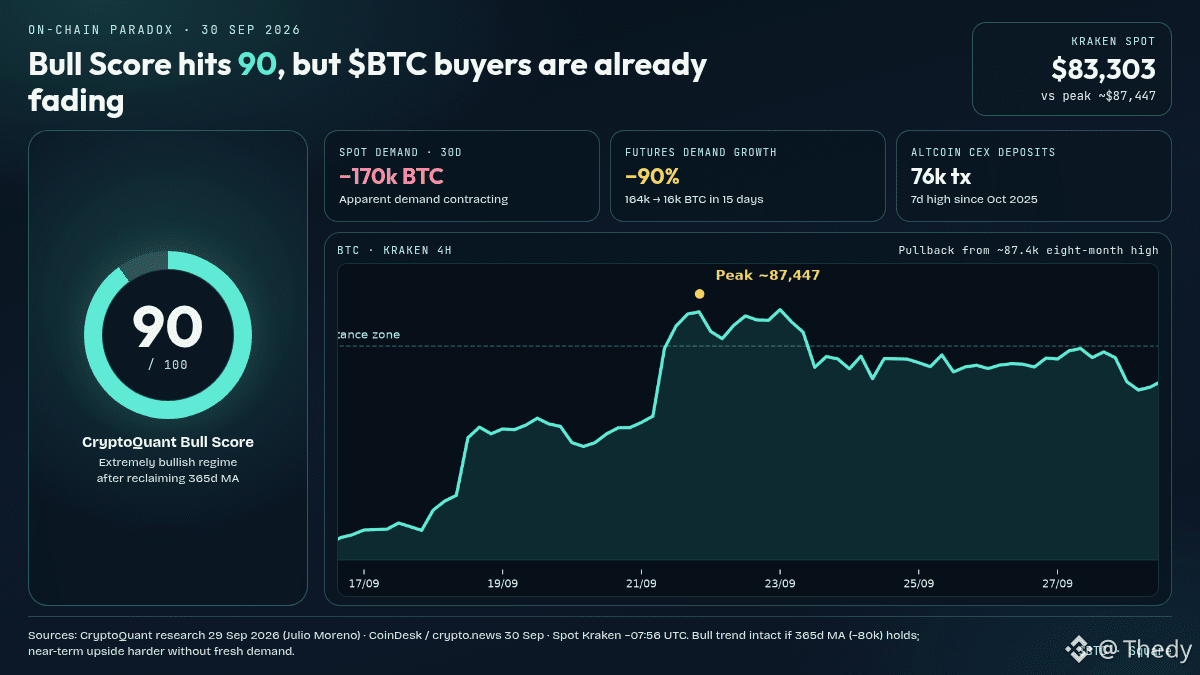
154
Log in to explore more content
Join global crypto users on Binance Square
⚡️ Get latest and useful information about crypto.
💬 Trusted by the world’s largest crypto exchange.
👍 Discover real insights from verified creators.
Email / Phone number