
#dao
dao
70.6M views
886,787 Discussing
Hot
Latest
·
--
Verified
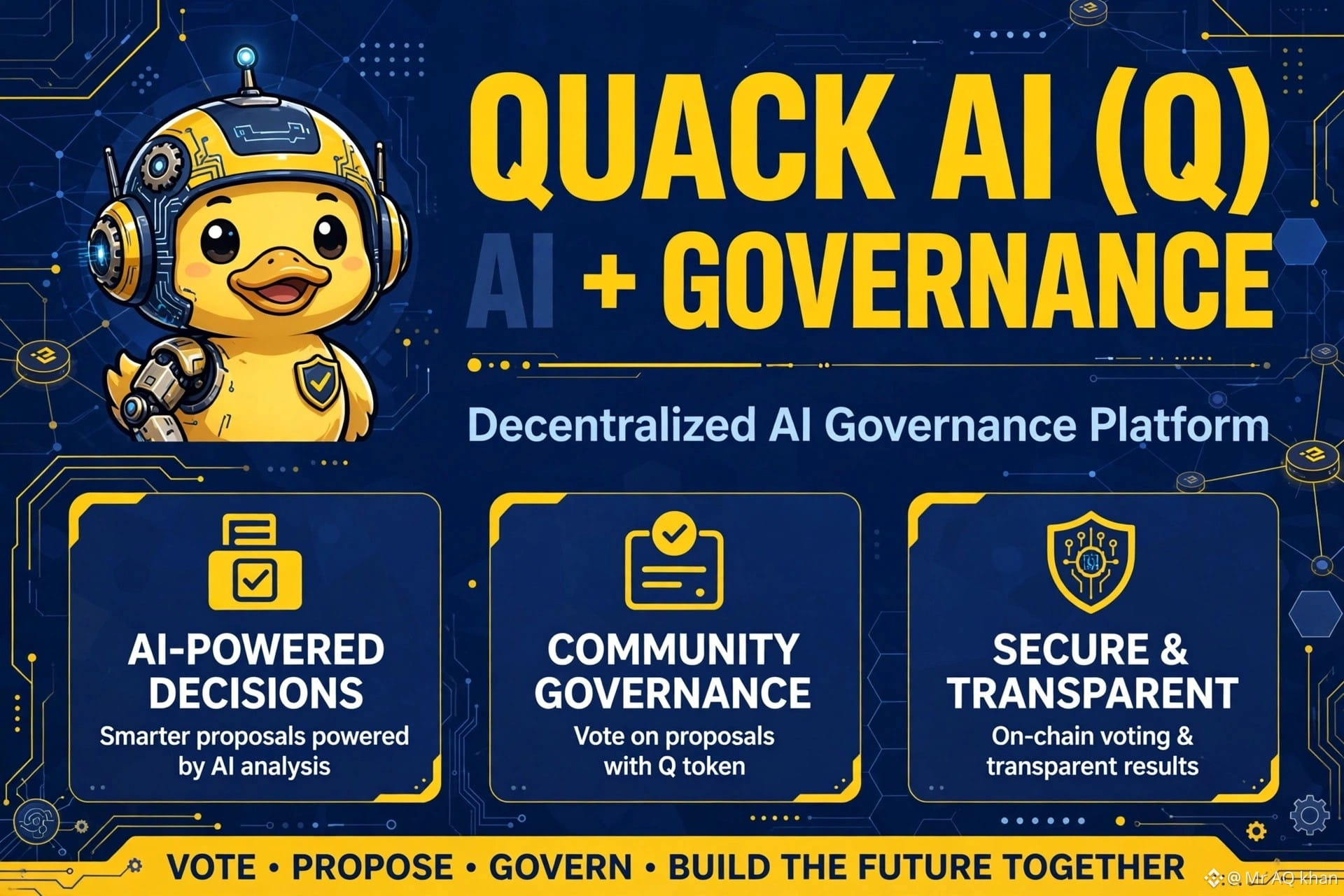
🚨🦆 QUACK AI (Q) | AI + GOVERNANCE EXPLAINED
What is $Q?
Quack AI is building AI-powered governance infrastructure for DAOs and Web3 communities.
Instead of slow, manual voting and proposals, AI agents help to:
✅ Draft proposals
✅ Analyse decisions
✅ Execute on-chain
And $Q is the utility + governance token of this ecosystem. Holders can participate in voting and help shape the future direction of the protocol.
📰 LATEST UPDATE:
$Q has now been added as a new Isolated Margin asset on KuCoin, with Q/USDT pair available. This increases visibility and trading options for the token.
📚 WHY IT MATTERS:
Governance is one of the biggest problems in crypto. Many DAOs struggle with low participation and slow decisions. Projects like Quack AI are trying to solve this with automation + AI.
This is not hype, this is infrastructure.
Do you think AI will run DAOs in the future? Yes or No? 👇
#Q #QuackAI #Crypto #AI #Governance #DAO #Web3 #BinanceSquare #CryptoEducation💡🚀 #Altcoin
585
·
--
WHAT IF AN ONLINE COMMUNITY COULD MAKE DECISIONS THROUGH A SHARED GOVERNANCE SYSTEM?This is one idea behind a Decentralized Autonomous Organization, commonly known as a DAO.
What is a DAO?
A DAO is an organization or community that coordinates through a set of governance processes, which may include blockchain-based voting and smart contracts.
Not every DAO operates in the same way.
How can it work?
A community might submit proposals about how a treasury should be used or which protocol changes should be considered.
Eligible participants vote according to the organization’s rules.
Some decisions can be executed by smart contracts, while others require additional implementation.
What can DAOs do?
✅Govern blockchain protocols
✅Coordinate community funding
✅ Support open-source projects
✅ Manage shared digital resources
✅ Organize contributor communities
What are the challenges?
⚠️ Low voter participation
⚠️ Concentration of voting power
⚠️ Poor proposal design
⚠️ Governance attacks
⚠️ Legal and accountability questions
Calling something a DAO does not automatically make it decentralized or fair.
Why is this interesting?
DAOs explore how software, governance and incentives can coordinate groups of people across borders.
The technology is important, but good decision-making and accountability remain essential.
Question: Would you trust a community to vote on how a shared treasury should be spent? What safeguards would you require?
#DAO #Blockchain #Governance #Web3
WHAT IF AN ONLINE COMMUNITY COULD MAKE DECISIONS THROUGH A SHARED GOVERNANCE SYSTEM?
This is one idea behind a Decentralized Autonomous Organization, commonly known as a DAO.
What is a DAO?
A DAO is an organization or community that coordinates through a set of governance processes, which may include blockchain-based voting and smart contracts.
Not every DAO operates in the same way.
How can it work?
A community might submit proposals about how a treasury should be used or which protocol changes should be considered.
Eligible participants vote according to the organization’s rules.
Some decisions can be executed by smart contracts, while others require additional implementation.
What can DAOs do?
✅Govern blockchain protocols
✅Coordinate community funding
✅ Support open-source projects
✅ Manage shared digital resources
✅ Organize contributor communities
What are the challenges?
⚠️ Low voter participation
⚠️ Concentration of voting power
⚠️ Poor proposal design
⚠️ Governance attacks
⚠️ Legal and accountability questions
Calling something a DAO does not automatically make it decentralized or fair.
Why is this interesting?
DAOs explore how software, governance and incentives can coordinate groups of people across borders.
The technology is important, but good decision-making and accountability remain essential.
Question: Would you trust a community to vote on how a shared treasury should be spent? What safeguards would you require?
#DAO #Blockchain #Governance #Web3
75

·
--
Decentralized Autonomous Organizations, or DAOs, are communities that make decisions together. They use voting to govern and manage their treasuries. DAOs often hold $ETH and other assets. The treasury is at a certain level, which can be used to fund projects. For example, a DAO may have 1000 $ETH sitting at a certain value. Members vote on how to use these assets. This allows for decentralized decision making. Some DAOs have thousands of members. They vote on proposals to manage the treasury and make decisions. This model is being used by many organizations. Decentralized governance is the future. DeFi is leading the way. #DeFi #DAO #Tokenomics
Decentralized Autonomous Organizations, or DAOs, are communities that make decisions together. They use voting to govern and manage their treasuries. DAOs often hold $ETH and other assets. The treasury is at a certain level, which can be used to fund projects. For example, a DAO may have 1000 $ETH sitting at a certain value. Members vote on how to use these assets. This allows for decentralized decision making. Some DAOs have thousands of members. They vote on proposals to manage the treasury and make decisions. This model is being used by many organizations. Decentralized governance is the future. DeFi is leading the way. #DeFi #DAO #Tokenomics
20

·
--
📰 SEC clarifies rules for decentralized crypto projects
On November 2, SEC staff added three questions to their guidance about who actually controls a blockchain. Participants in an open DAO vote are generally not considered a single controlling party unless they are connected by separate agreements. But the ability to unilaterally change the code, voting rules, or network access indicates centralized control.
An important caveat: this is the position of SEC staff, not a new law or binding regulatory decision. The actual authority of participants remains important when evaluating a specific token.
Source: SEC, update dated 02.11.2026: https://www.sec.gov/about/divisions-offices/division-corporation-finance/faqs-crypto-assets
#SEC #DeFi #DAO
74
·
--
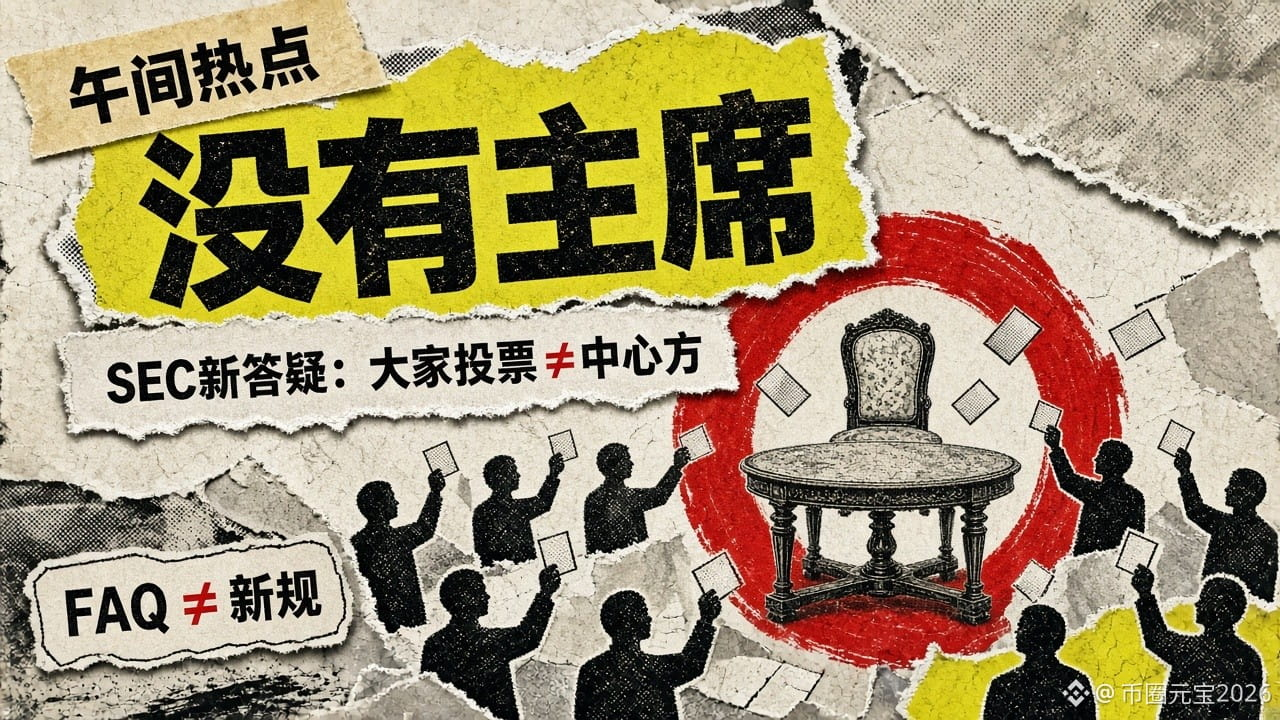
New SEC FAQ: Does voting together in DAO governance count as a “central actor”?
The SEC Division of Corporation Finance’s crypto asset FAQ added three questions on November 2. The easiest to understand is 1.4: Do people who participate in “broad governance” voting count as a “group of persons” under the definition of a “central actor”?
The answer, in essence: It depends on the specific facts and circumstances. But participants who are not affiliated with one another and have no agreement, arrangement, or understanding to act together (including through delegation) generally do not count. Even if they do count as a group of persons, they must actually have operational, economic, or voting control to qualify as a central actor.
My take:
1. This is a staff FAQ, and the page says it is not a rule.
2. It doesn’t say “DAOs are compliant,” or that “governance tokens are not securities.”
3. Coordinated voting or privately agreeing on how to vote doesn’t fall under this “generally.”
When you see a headline saying “SEC recognizes DAOs,” go back to the original and look for the word “generally.”
Were the governance votes you cast really independent?
#SEC #DAO #Regulation
5

·
--
*🚀 DeXe (DEXE) - The Future of DAO Governance!*
Friends, do you know what $DEXE is?
DeXe is a protocol that does two things at once:
1️⃣ *DAO Factory:* Create your own DAO without coding, vote, and manage your treasury. 60+ ready-to-use smart contracts! 🔨
2️⃣ *Social Trading:* Copy expert traders with one click. If they profit, you profit too! 📈
*Tokenomics:*
Total Supply: 100M Only
Chain: ETH + BNB
Use: Governance + Staking + Buyback & Burn 🔥
DEXE surged from $2 to $49 this year, and is currently consolidating around $1.48. It could be a hidden gem in the DAO narrative!
What do you think? Will the DAO sector lead the next bull run?
*#$DEXE #DAO #SocialTrading #Binance #Crypto #Altcoin #BNB*
1
199
·
--
Decentralized Autonomous Organizations, or DAOs, are communities that make decisions together. They use voting to decide on proposals. For example, a DAO might vote on how to use its treasury, which is sitting at millions of dollars in $ETH and $BTC. The treasury is funded by members who contribute tokens. Members then vote on proposals, such as funding new projects or changing rules. A well-known example is the DAO that managed over 150 million dollars in assets. DAOs provide a new way for communities to govern themselves. They are transparent and community-driven. DAOs are an important part of the DeFi ecosystem. #DeFi #DAO #Tokenomics
Decentralized Autonomous Organizations, or DAOs, are communities that make decisions together. They use voting to decide on proposals. For example, a DAO might vote on how to use its treasury, which is sitting at millions of dollars in $ETH and $BTC . The treasury is funded by members who contribute tokens. Members then vote on proposals, such as funding new projects or changing rules. A well-known example is the DAO that managed over 150 million dollars in assets. DAOs provide a new way for communities to govern themselves. They are transparent and community-driven. DAOs are an important part of the DeFi ecosystem. #DeFi #DAO #Tokenomics
22
·
--
🌐 Does a DAO really achieve decentralized governance?
DAOs let communities participate in organizational decisions through proposals, voting, and smart contracts. But having a voting mechanism doesn’t mean power is truly decentralized.
Before participating, check four things:
🗳️ Voting power: Is decision-making power concentrated in the hands of a few?
💰 Control of funds: Who actually controls the treasury?
⚙️ Proposal execution: Who is responsible for carrying out approved proposals?
🔍 Oversight: Can the community audit the flow of funds and the results of execution?
True decentralization isn’t just about giving everyone a voice. It’s also about holding power accountable and ensuring decisions are carried out.
What do you think is the biggest governance challenge facing DAOs?
#ONEA #Web3 #DAO
2
1
14
·
--
🌐 What is a DAO? Does community voting mean decentralization?
Through open rules, community governance, and blockchain tools, DAOs enable members to participate in project decisions and fund management.
But true decentralization is about more than just having a voting button.
🔹 Do a small number of addresses hold too much voting power?
🔹 Is the use of the community treasury transparent?
🔹 Are proposals actually carried out after they pass?
🔹 Do ordinary members have ample opportunities to participate?
The key to decentralization is not just letting everyone vote, but ensuring that power, responsibility, and execution are subject to oversight.
What do you think is the biggest governance challenge facing DAOs?
#ONEA #Web3 #DAO
2
1
7

·
--
The biggest problem with DAOs may not be their voting tools
Having a voting system doesn’t mean a community is well governed.
If participants don’t understand proposals, voting power is overly concentrated, or voting results can’t be effectively implemented, even the most polished interface can’t solve the underlying problems.
What really matters is transparency, incentives to participate, clearly defined rights and responsibilities, and ongoing follow-up on governance outcomes.
Decentralization isn’t just about handing the buttons over to the community.
#DAO #Web3治理 #去中心化 #区块链
17

·
--
SAND is up today, but the token-holder leaderboard can’t fully rank governance power.
As of 11:07 a.m. Beijing time on October 18, the Binance SANDUSDT perpetual contract was up about 10.6% over 24 hours. Binance Academy lists “one token, one vote” as a common model. But reducing this to “counting SAND tells you how much say everyone has” overlooks LAND holders.
The weights listed on the official DAO delegation page are: 1 SAND = 1 VP, 1 LAND = 4,500 VP. VP is voting power, and LAND is a land asset on the platform. Under these rules, LAND itself counts toward voting power; it doesn’t need to be converted to SAND first. This conversion rate is also not a promise about LAND’s sale price or exchange value.
A leaderboard that counts only SAND holdings misses the voting power from LAND, so the share of holdings cannot be directly treated as the share of governance power. These are the rules currently listed on the official page; today’s rise doesn’t prove they have just changed.
$SAND #元宇宙 #DAO
191
·
--
Verified
$ETH $ZEC $ETC 🔥 Ethereum’s biggest turning point wasn’t the ETF—it was finally closing the loop on the DAO aftermath.
In 2016, the DAO was hacked for 3.6 million ETH. A hard fork recovered the funds, and ETC split off. From that moment on, ETH chose “ecosystem stability first” over rigidly upholding immutability.
Now, dormant DAO-related funds are being put back to work: about 70,500 ETH (around $220 million) is being turned into a security fund. Of that, $13.5 million will go toward security grants, while 69,420 ETH will be staked, generating about $8 million a year to fund audits, research, and emergency response.
This isn’t crypto speculation—it’s building a “permanent blood bank” for on-chain security. Moving from reactive firefighting to proactive defense, Ethereum is turning itself into mature financial infrastructure.
{web3_wallet_create}(10xcf91b70017eabde82c9671e30e5502d312ea6eb2)
Comments below 👇 Does this count as ETH governance’s second hard fork?
#以太坊 #DAO #Web3
⚠️Not investment advice
$ETH $ZEC $ETC 🔥 Ethereum’s biggest turning point wasn’t the ETF—it was finally closing the loop on the DAO aftermath.
In 2016, the DAO was hacked for 3.6 million ETH. A hard fork recovered the funds, and ETC split off. From that moment on, ETH chose “ecosystem stability first” over rigidly upholding immutability.
Now, dormant DAO-related funds are being put back to work: about 70,500 ETH (around $220 million) is being turned into a security fund. Of that, $13.5 million will go toward security grants, while 69,420 ETH will be staked, generating about $8 million a year to fund audits, research, and emergency response.
This isn’t crypto speculation—it’s building a “permanent blood bank” for on-chain security. Moving from reactive firefighting to proactive defense, Ethereum is turning itself into mature financial infrastructure.
Comments below 👇 Does this count as ETH governance’s second hard fork?
#以太坊 #DAO #Web3
⚠️Not investment advice
5
682
What is a DAO?
A DAO (Decentralized Autonomous Organization) is a structure that operates through smart contracts on a blockchain, without bosses or a traditional hierarchy. Decisions are made by voting: anyone who holds the governance token can propose changes and vote.
Example: MakerDAO manages the DAI stablecoin. MKR holders vote on interest rates, which collateral to accept, and how to use the treasury. Everything is recorded on-chain and executed automatically.
Advantages: full transparency, no single point of failure, aligned incentives.
Limitations: those with more tokens have more power, participation is often low, and decisions can be slow.
If you trade governance tokens (UNI, AAVE, ARB), you’re speculating on the value of influence. Each major proposal can move the price.
Follow us for more guides to help you understand what you’re trading.
#DAO
192

·
--
Article
Oracle DAO stakes all product revenue in its own tokenPyth’s DAO, through a proposal numbered OP-PIP-136, puts the entire amount of product revenue into open-market buybacks of its own tokens. On October 8, the official blog disclosed the full details of this rule.
1. From one-third to the full amount
The shifting focus is on two ratios. Previously, the rules required a separate monthly vote, using one-third of the non $PYTH reserve balance. The new rule switches to a one-time long-term authorization: 100% of product revenue is used to buy tokens on the open market and inject them into reserves.
Annual authorization replaces the once-monthly vote by the full membership. What the proposal replaces is the one approved in December 2025—it locks monthly buybacks to one-third of the non-token reserve balance, with each round requiring the process to be run again.
Oracle DAO stakes all product revenue in its own token
Pyth’s DAO, through a proposal numbered OP-PIP-136, puts the entire amount of product revenue into open-market buybacks of its own tokens. On October 8, the official blog disclosed the full details of this rule.
1. From one-third to the full amount
The shifting focus is on two ratios. Previously, the rules required a separate monthly vote, using one-third of the non $PYTH reserve balance. The new rule switches to a one-time long-term authorization: 100% of product revenue is used to buy tokens on the open market and inject them into reserves.
Annual authorization replaces the once-monthly vote by the full membership. What the proposal replaces is the one approved in December 2025—it locks monthly buybacks to one-third of the non-token reserve balance, with each round requiring the process to be run again.
160

·
--
Bullish
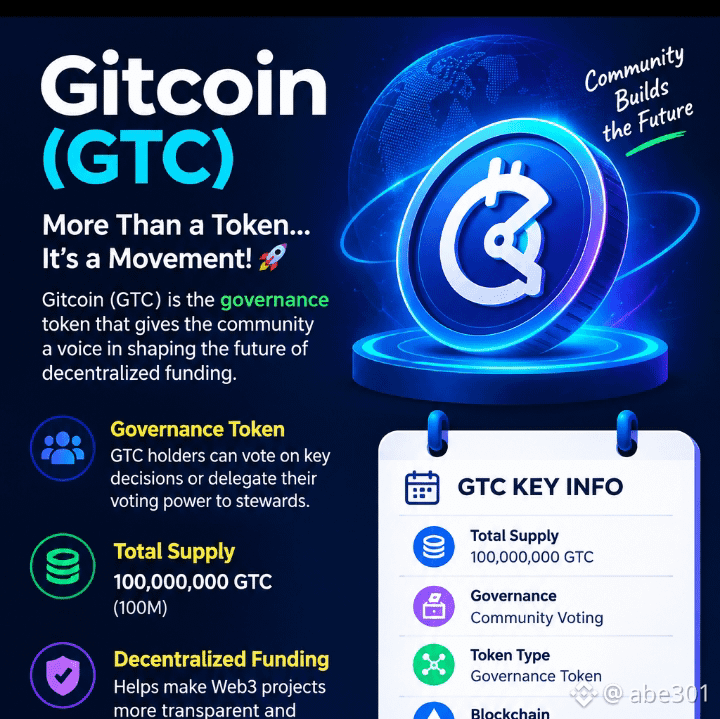
Gitcoin (GTC) — Governance Power
GTC is Gitcoin’s governance token, giving holders a voice in key decisions.
Its total supply is 100M GTC, with governance driven by community voting.
Holders can vote directly or delegate their voting power to stewards.
Gitcoin aims to make decentralized funding more community-driven and transparent.
GTC #Gitcoin #web3_binance #DAO
{future}(GTCUSDT)
Gitcoin (GTC) — Governance Power
GTC is Gitcoin’s governance token, giving holders a voice in key decisions.
Its total supply is 100M GTC, with governance driven by community voting.
Holders can vote directly or delegate their voting power to stewards.
Gitcoin aims to make decentralized funding more community-driven and transparent.
GTC #Gitcoin #web3_binance #DAO
1
281

·
--
An Arbitrum DAO proposal asks to allocate 100 million $ARB to incentives for the USDG stablecoin, after Arbitrum joined the Paxos-led Global Dollar Network, per CoinDesk.
How would you vote?
A) Yes, sharing stablecoin reserve income is worth the spend
B) Yes, but with a smaller budget
C) No, incentives tend to attract short-term capital
💬 Drop your pick below.
#Arbitrum #DAO
How would you vote?
A) Yes, sharing stablecoin reserve income is worth the spend
B) Yes, but with a smaller budget
C) No, incentives tend to attract short-term capital
💬 Drop your pick below.
#Arbitrum #DAO
114
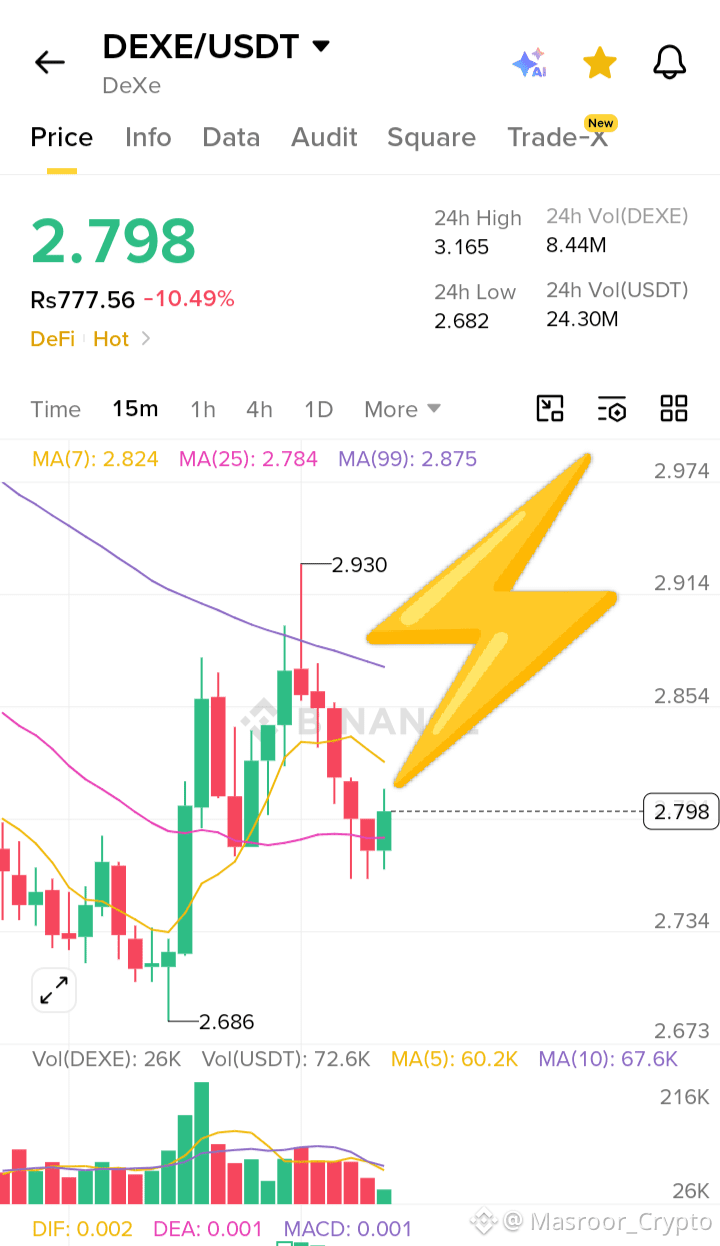
🚨While everyone is chasing hype, few are paying attention to what $DEXE is actually building.
DeXe isn't just another cryptocurrency—it's a decentralized governance protocol designed to power the next generation of DAOs and Web3 communities.
$DEXE
{spot}(DEXEUSDT)
💡 Why DEXE stands out:
🏛️ No-code DAO creation
🗳️ Transparent on-chain governance
💰 Community treasury management
🔐 Secure smart contract infrastructure
🎯 Flexible voting with tokens and NFTs
🤝 Community-driven decision making
As Web3 continues to evolve, projects with real utility and strong governance infrastructure could play an important role in the ecosystem.
📊 Price may fluctuate in the short term, but long-term value often comes from adoption, innovation, and real-world use cases.
👀 Are you accumulating $DEXE, or are you waiting for the next breakout?
#DEXE #Crypto #DAO #BinanceSquare
🚨While everyone is chasing hype, few are paying attention to what $DEXE is actually building.
DeXe isn't just another cryptocurrency—it's a decentralized governance protocol designed to power the next generation of DAOs and Web3 communities.
$DEXE
💡 Why DEXE stands out:
🏛️ No-code DAO creation
🗳️ Transparent on-chain governance
💰 Community treasury management
🔐 Secure smart contract infrastructure
🎯 Flexible voting with tokens and NFTs
🤝 Community-driven decision making
As Web3 continues to evolve, projects with real utility and strong governance infrastructure could play an important role in the ecosystem.
📊 Price may fluctuate in the short term, but long-term value often comes from adoption, innovation, and real-world use cases.
👀 Are you accumulating $DEXE , or are you waiting for the next breakout?
#DEXE #Crypto #DAO #BinanceSquare
1
152

·
--
🚨 BonkDAO hit by a governance attack! $20 million BONK stolen
Another security incident shocks the Solana ecosystem:
🔓 Attack method: malicious governance proposal
📌 The attacker used BonkDAO’s Realms governance platform to submit a “Sowellian BonkDAO” proposal
📌 The proposal was disguised as “rebuilding governance, distributing tokens,” but hidden backdoor mechanisms were included
📌 The attacker spent about $4 million to buy a large amount of BONK tokens to gain voting power
📌 After the proposal passed, 440 billion BONK (about $20 million) were transferred out of the treasury
💰 Where the funds went:
✅ Funds were transferred from a Bybit account to the attacker’s wallet
✅ As of now, the funds have not moved and have not entered a mixer
✅ Upbit and Kraken have already paused BONK deposits and withdrawals
📉 Market reaction:
BONK fell more than 11% in 24 hours and is down 93% from its all-time high
⚠️ Lessons learned:
DAO governance isn’t absolutely secure—voting power can be bought and sold. Before participating, always review proposal details carefully and watch out for “token distribution” style persuasive language.
$BONK $SOL #Solana #DAO #DeFi
132

·
--
BONK
0.05395
-1%
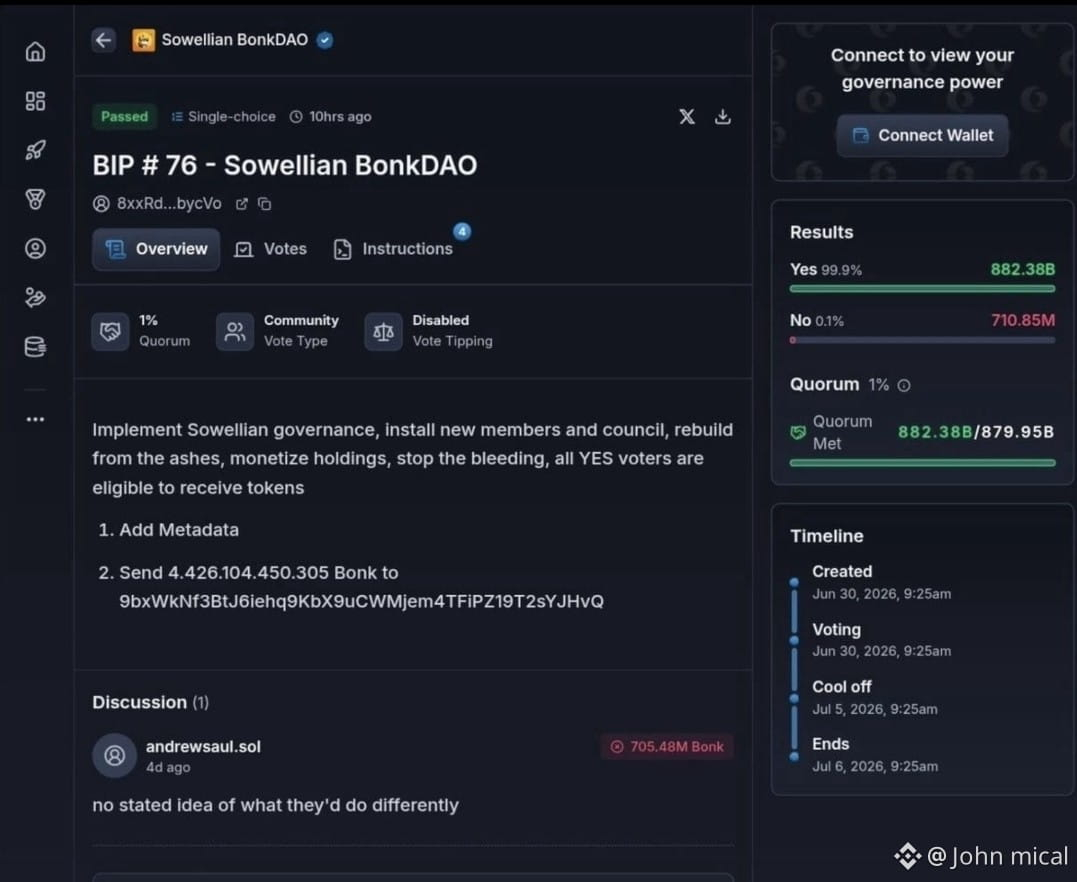
A hacker acquired $4M worth of $BONK and immediately launched a DAO proposal. This motion suggested transferring 4.4T BONK tokens to a wallet under his control. For seven full days, the proposal remained active without anyone questioning or noticing its intent. Eventually, the hacker used his own massive token bag to vote YES
The proposal successfully passed, sending the 4.4 trillion BONK straight to his address. He subsequently liquidated the assets, securing a total of $20,000,000 and walking away with a clean $16M profit. Hilariously, only one individual voted NO, leaving a comment stating that the proposal lacked any clear plan on what would be done differently. 😂
#BONK #CryptoHack #DAO #CryptoNews
75

·
--
Jito is at it again. The JTX platform has officially launched, and JTO will also kick off a full DAO buyback—pretty direct signaling here: swap protocol revenues back into tokens for real value, rather than letting them sit in the treasury and gather dust.
For holders, buybacks mean the circulating supply is passively tightened; for the Solana ecosystem, with Jito as a dual leader in MEV + LST, the path for cash-flow to flow back into tokens is finally working.
A few key points worth watching:
1)What specific business does JTX actually support, and how much sustainable revenue can it generate
2)Is the buyback pace a one-off event or a recurring mechanism
3)In terms of DAO governance, will the leadership seize the moment to push for more value-capture reforms
The narrative shifts from "airdrop tokens" to "cash-flow assets," which is a rare positive feedback loop in this round of copycat deals. Don’t just look at the price swings immediately after the announcement—watch how it gets executed over the next few quarters.
#Jito #Solana #DAO
$JTO $SOL
50
Log in to explore more content
Join global crypto users on Binance Square
⚡️ Get latest and useful information about crypto.
💬 Trusted by the world’s largest crypto exchange.
👍 Discover real insights from verified creators.
Email / Phone number
Trending Topics
1
#JobsReportRaisesHikeOdds
558,569 views
3,524 Discussing
2
#CPITestsDecemberRateOutlook
175,354 views
1,239 Discussing
3
#US Data Center Rules May Constrain AI Expansion
78,561 views
231 Discussing
4
#ARKPlans14ThematicETFsCoveringAIAndTokenizedMarkets
4,841 views
72 Discussing
5
#WillAnthropicListOnTime
171,997 views
1,453 Discussing
6
#WillUS-IranTensionsBoostSafe-HavenDemand?
81,479 views
576 Discussing
7
#BitcoinETFsSee$412MNetOutflows
16,975 views
79 Discussing
8
#HKSFCPlansToRestrictCryptoAndExchangeTerms
67,961 views
598 Discussing
9
#TradFiForBeginners
98,995 views
1,060 Discussing
10
#FinCENAndFedWithdraw$250CryptoTransferProposal
10,750 views
18 Discussing