
#boe
boe
47,668 views
111 Discussing
Hot
Latest

·
--
BoE hikes to 4%—first rate rise since 2023.
• BoE Bank Rate raised from 3.75% to 4% (+0.25 percentage points); vote 8-1
• Catherine L Mann preferred a 0.5 percentage point rise to 4.25%
• MPC expects UK CPI near about 5% by mid-2027 after 3.5% in September, citing elevated energy prices
Why it matters: UK policy tightens as energy-driven inflation risks reaccelerate—macro that often feeds into risk assets including crypto.
Source: Bank of England
Not financial advice.
💬 Does a BoE hike into an energy shock tighten liquidity for crypto risk appetite?
#BoE #InterestRates #Macro
1

·
--
🐉 Bank of England Hikes to 4%, First Rise in Over Three Years
👉 Bank Rate up 25 bps to 4.00% from 3.75%, the first BoE hike since August 2023
👉 MPC votes 8-1, with Catherine Mann dissenting for a bigger 50 bps move to 4.25%
👉 BoE sees UK inflation near 5% by mid-2027 and warns at least one more hike is likely if the Middle East conflict continues
👉 Governor Bailey says this is not the start of an inevitable long sequence of hikes
👉 BTC eased from around $80,300 at the decision to near $79,600 after, a muted reaction to a widely expected hike
#BinanceSquare #BoE #Bitcoin #Macro #Crypto
Hawkish hike, calm crypto reaction so far.
411

·
--
🚨 BREAKING: BANK OF ENGLAND SHOCK - HAWKISH SURPRISE*
According to Jin10:
Bank of England MPC Vote:
*9 votes FOR a rate hike* 😱
Expected: 7
Previous: 3
This is MASSIVE hawkish shift. All 9 members now leaning hike.
What this means:
- GBP pumps
- Inflation fight is NOT over
- Central banks NOT pivoting yet
- Pressure on $BTC, $ETH, Stocks short-term
BoE is telling the market: Rates higher for longer.
Rate hike cycle is back?
#BoE #GBP #forex #Macro $AUCTION
{spot}(AUCTIONUSDT)
🚨 BREAKING: BANK OF ENGLAND SHOCK - HAWKISH SURPRISE*
According to Jin10:
Bank of England MPC Vote:
*9 votes FOR a rate hike* 😱
Expected: 7
Previous: 3
This is MASSIVE hawkish shift. All 9 members now leaning hike.
What this means:
- GBP pumps
- Inflation fight is NOT over
- Central banks NOT pivoting yet
- Pressure on $BTC, $ETH, Stocks short-term
BoE is telling the market: Rates higher for longer.
Rate hike cycle is back?
#BoE #GBP #forex #Macro $AUCTION

2
368

·
--
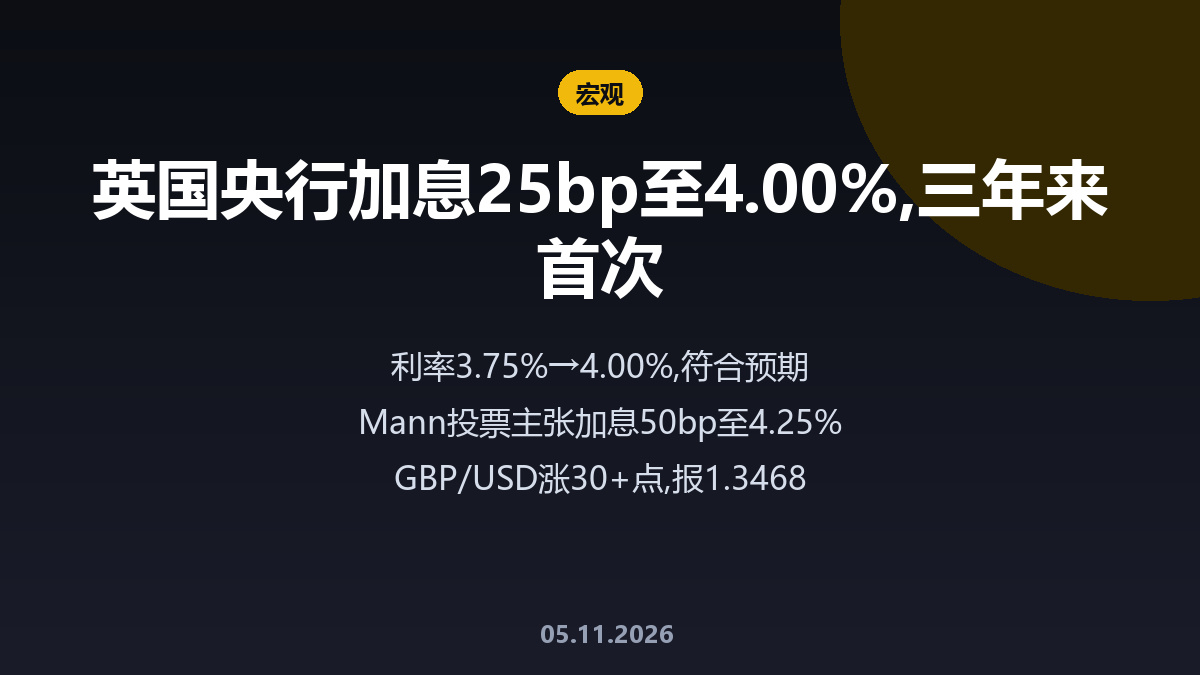
The Bank of England raised interest rates by 25 basis points on November 5, taking the rate from 3.75% to 4.00%. This was its first rate hike since August 2023.
The decision was in line with market expectations, so the real focus is on the details:
🔹 Monetary Policy Committee member Mann voted for a 50-basis-point hike, arguing for an immediate increase to 4.25%
🔹 GDP forecasts were revised up: 1.6% for 2026, 1.3% for 2027, and 1.2% for 2028
🔹 The previous forecasts in July were 1.1%, 1.1%, and 1.7%
The rate hike itself came as no surprise. But the fact that one member wanted a much bigger increase shows that committee members do not all see inflationary pressures the same way. Growth forecasts for this year and next were raised, while the 2028 forecast was cut from 1.7% to 1.2%—stronger in the short term, weaker in the long term.
The market reaction was immediate: sterling rose by more than 30 pips against the dollar, reaching 1.3468. The Fed also just raised rates on September 16, and the world’s major central banks are starting to move in the same direction. The interest rate differential between the dollar and the pound remains something to watch.
For crypto markets, a rate-hiking cycle means higher funding costs, and risk assets are usually more sensitive. Whether $BTC follows the macro trend in the short term will depend on how the dollar and Treasury yields react.
I’m personally more interested in Mann’s vote: if more members call for a hike to 4.25% at the next meeting, the pace could be faster than currently expected. Do you think the central bank will keep raising rates, or stop at 4%?
#InterestRates #GBP #BoE

178

·
--
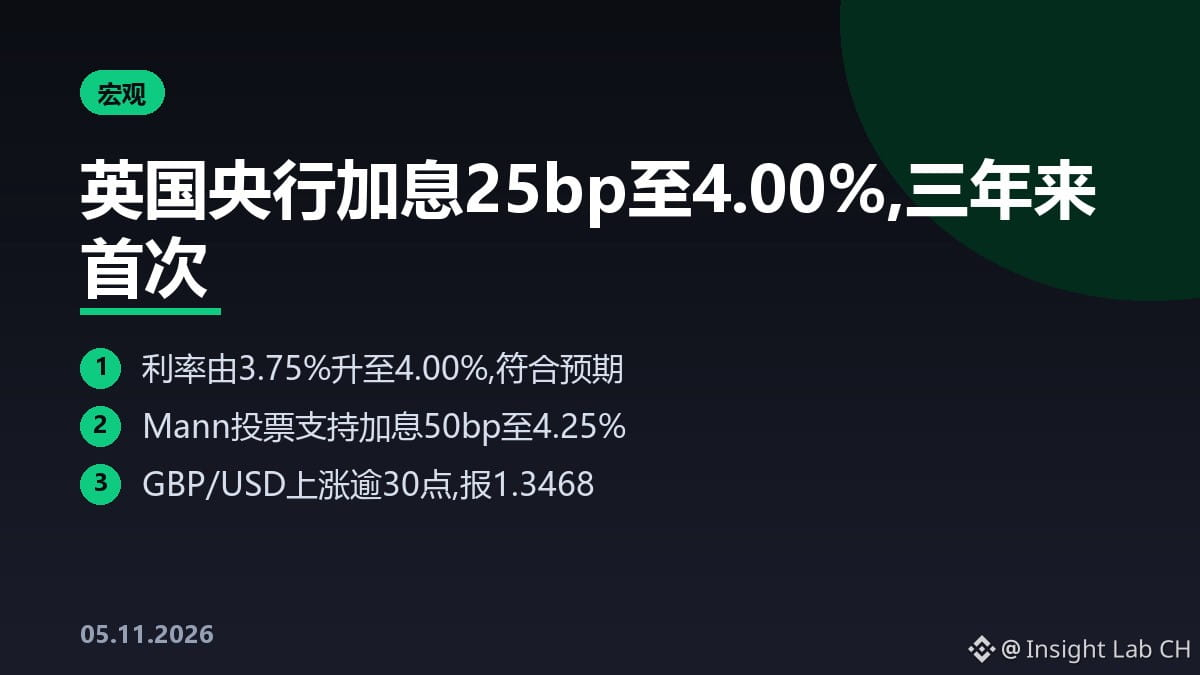
The Bank of England raised interest rates by 25 basis points to 4.00% on November 5, its first rate hike since August 2023.🔴
Markets had already expected 4.00%, so the decision was in line with expectations; the previous rate was 3.75%. The real disagreement was within the committee: Monetary Policy Committee member Mann voted for a 50-basis-point hike to 4.25%, taking a more hawkish stance than the majority.
Another signal was the upward revision to growth forecasts:
- 2026 GDP forecast: 1.6% (1.1% in July)
- 2027: 1.3% (1.1% in July)
- 2028: 1.2% (1.7% in July)
Near-term growth was revised up, while the 2028 forecast was lowered. This suggests the Bank does not expect growth to remain strong all the way through after the rate hike.
In the markets, GBP/USD rose by more than 30 pips to 1.3468. The rate hike had already been priced in, so the currency's gains were limited. The Federal Reserve also raised rates on September 16. With major central banks tightening at the same time, global liquidity conditions are becoming tighter.
For crypto markets, this is not good news. With both the UK and the US raising rates, pressure on risk-asset valuations will increase. If Mann's 50-basis-point proposal gains more support, US and UK interest rates could continue to rise, putting risk assets such as $BTC under greater pressure. My view is cautious: until there are signs that interest rates have peaked, rebounds should not be treated as a trend reversal.
Do you think the Bank of England will keep raising rates, or will it stop after this hike?
#InterestRates #BoE #GBP

146

·
--
UK interest rates have just risen to 4.00%, the first increase in over 3 years. 🇬🇧
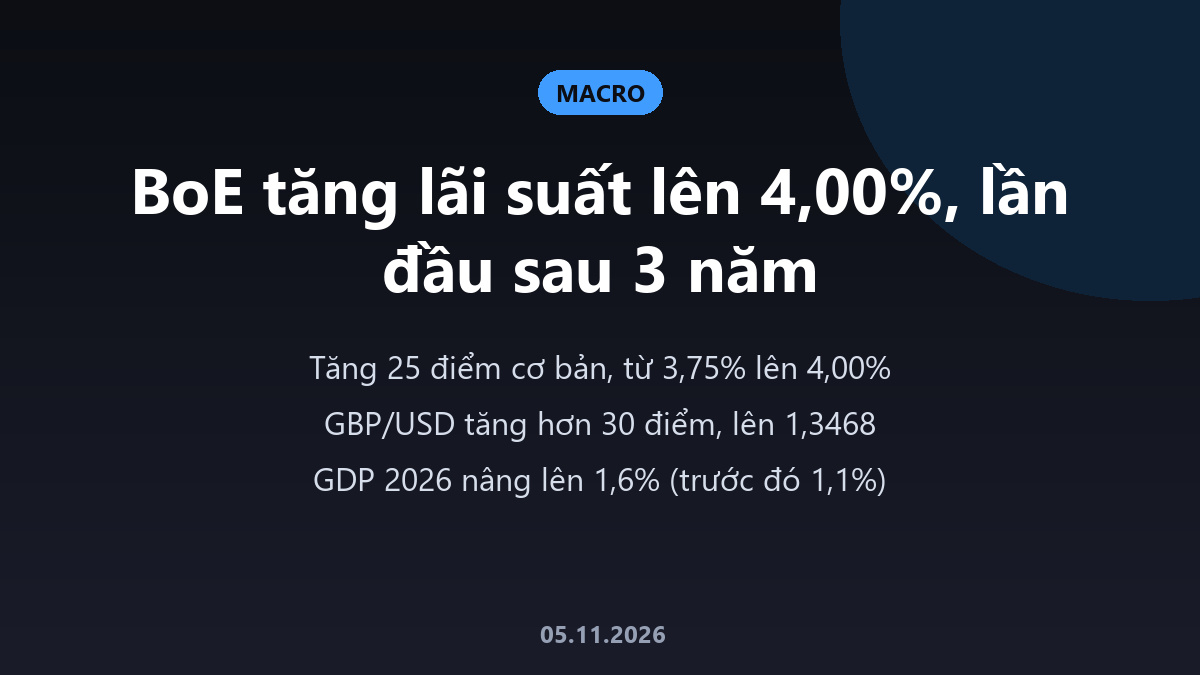
On 5 November, the Bank of England (BoE) raised rates by 25 basis points, from 3.75% to 4.00%. This was the first increase since August 2023, and it was in line with market expectations.
- GBP/USD rose more than 30 pips to 1.3468
- MPC member Mann voted for a 50-basis-point increase to 4.25%
- GDP forecasts: 1.6% (2026), 1.3% (2027), 1.2% (2028)
The July forecasts were just 1.1%, 1.1%, and 1.7%. In other words, the BoE significantly upgraded its outlook for 2026–2027 and is more confident in the economy.
The Fed also raised interest rates on 16/09. Now the BoE is following suit, so the wave of monetary tightening is spreading—it’s no longer just a US story.
For crypto, cheap money continues to dry up. $BTC often comes under pressure when major central banks tighten policy in unison. Mann’s 50-basis-point vote shows that there’s still room for the hawks to push for more.
Which central bank do you think will be next to follow suit with a rate hike?
#BoE #InterestRates #GBP

345

·
--
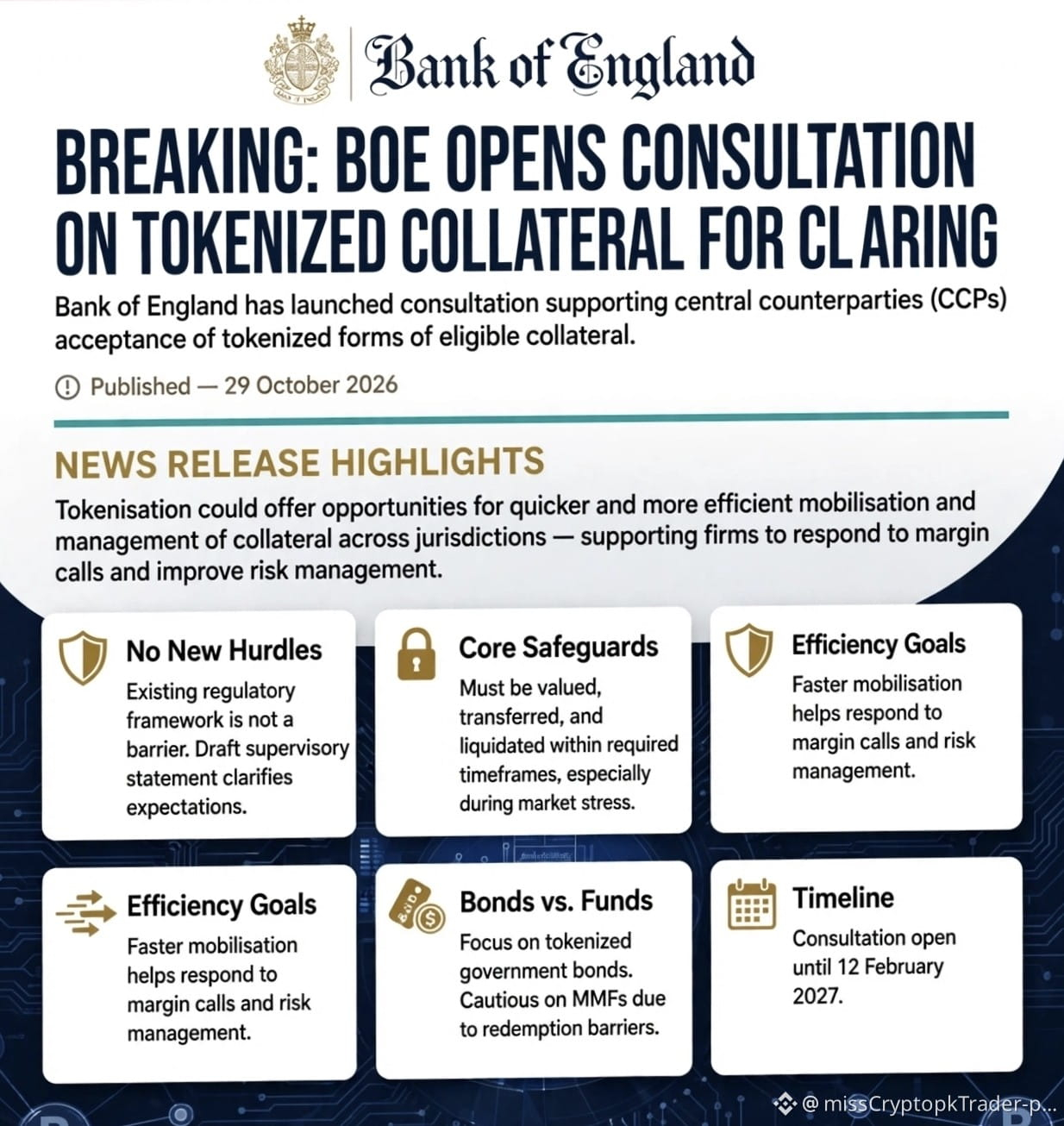
Came across an announcement from the Bank of England (BoE): it is consulting on allowing central counterparties (CCPs) to accept “tokenised versions of already eligible collateral”—the existing regulatory framework itself poses no obstacle, as long as the collateral can still be valued and transferred, and can be liquidated under stress scenarios.
The key point: rather than creating an entirely new regime, the BoE is issuing a draft supervisory statement clarifying how to assess liquidity, valuation and interoperability; settlement finality; credit and concentration risk; operational resilience; and custody. The consultation closes on 12 February 2027. The main example is already eligible assets such as tokenised government bonds. The BoE is also exploring future possibilities, including regulated stablecoins, tokenised money market funds and tokenised gold—but this consultation does not change the list of eligible collateral.
The central bank has written “same risk, same regulatory outcome” into the path for tokenising CCP collateral. If clearing really is to accept tokenised collateral, the rules are starting to take shape.
#代币化 #BoE #抵押品 #RWA

1

Article
Bank of England Ends User Limits in New Stablecoin Policy ShiftThe Bank of England has revised its proposed rules for systemic stablecoins, dropping the individual holding limits it floated last year in favor of a cap on how much any single stablecoin can issue.
Key Takeaways
The Bank of England scrapped proposed individual holding caps on systemic stablecoins.It replaced them with a temporary £40B issuance cap per stablecoin.Individuals and businesses can now hold systemic stablecoins without limits.Feedback closes September 22, 2026, with rules operational from 2027.
What the Bank of England Changed
In a policy statement published on June 22, 2026, the Bank of England set out revised draft rules for sterling-denominated systemic stablecoins, the large stablecoins used in mainstream payments rather than for crypto trading. The headline change is the removal of the holding limits proposed in the November 2025 consultation, which would have capped individuals at £20,000 and businesses at £10 million in any systemic stablecoin.
In their place, the Bank introduced a temporary issuance guardrail set initially at £40 billion (roughly $52.8 billion) per systemic stablecoin. Deputy Governor for Financial Stability Sarah Breeden described the package as "a major milestone in delivering greater choice and innovation in UK payments." The Bank says the guardrail will be reviewed regularly and removed once risks to credit provision have been addressed.
Why the Shift From Users to Issuers Matters
The distinction between the old and new approach is the core of the story. The original holding caps were a demand-side restriction: they limited what any individual or business could hold, which industry stakeholders argued would make UK stablecoins impractical for institutional and corporate use. The new issuance guardrail is a supply-side tool: it limits how large a single stablecoin can grow in total, while letting individuals and businesses use it without any limit on the size, frequency, or type of transaction.
The Bank's own framing is that the two approaches achieve a similar level of risk mitigation, the guardrail was calibrated using the same analysis that underpinned the holding limits, while being, in its words, cheaper and easier to implement. So this is best understood not as the Bank abandoning oversight, but as relocating it: from monitoring millions of individual wallets to capping issuance at the product level, which is far simpler to enforce and far less restrictive for end users.
Before and After
The Reserve Question
The other major industry complaint concerned reserves. The November 2025 proposal required systemic stablecoin issuers to hold at least 40% of their backing assets as unremunerated, meaning interest-free, deposits at the Bank of England, with up to 60% in short-term UK government debt (gilts). Industry analysis argued this was the heart of the viability problem: because the central bank deposits earned nothing, the structure carried a real cost. According to analysis by Range CEO Andres Monty reported by Decrypt, at gilt yields around 4%, the 40% interest-free floor could cost an issuer roughly £11.2 million a year for every £1 billion in circulation, a significant disadvantage versus US issuers under the GENIUS Act.
The logic is straightforward: gilts generate yield, while interest-free central bank deposits are a dead cost, so the more backing an issuer can hold in gilts rather than unremunerated deposits, the more viable the economics. Breeden had earlier acknowledged the original framework may have been "overly conservative" on this point. The exact revised split in the new draft should be confirmed against the final Code of Practice, but the direction of the Bank's rethink, reducing the drag from unremunerated reserves, is aimed squarely at the complaint that UK issuance was uncompetitive.
Who Regulates What
The framework also clarifies a two-tier structure. The Financial Conduct Authority supervises non-systemic stablecoins, which covers the bulk of stablecoin activity today, including coins used for buying and selling crypto. Only once HM Treasury recognises a stablecoin as systemic, meaning large enough that problems could threaten financial stability, does the Bank of England's regime apply, co-regulating alongside the FCA. The detailed transition framework between the two bodies, how responsibilities hand over as a stablecoin crosses into systemic territory, is one of the pieces still being finalised.
The Stakes, and the Road to 2027
Non-dollar stablecoins collectively hold less than 0.5% of a roughly $315.278 billion global market at the time of writing, according to Defillama, with sterling-denominated tokens representing only a marginal slice of that already thin share.
The original framework drew warnings that GBP stablecoins might simply be issued from friendlier jurisdictions like Dublin rather than the UK. By shifting from user caps to an issuer cap and signalling relief on reserve costs, the Bank appears to be trying to keep stablecoin issuance onshore while preserving its financial-stability guardrails. Whether that balance holds is for the market and the consultation to test.
On the timeline, feedback on the draft closes on September 22, 2026. The Bank intends to finalise the Code of Practice by the end of 2026, which would allow regulated systemic stablecoins to operate in the UK from 2027. For now, the rules are a draft open to consultation, not a finished regime, but the direction, from restricting users toward capping issuers, marks a clear reorientation of how the UK intends to regulate this corner of the market.
#BoE
Bank of England Ends User Limits in New Stablecoin Policy Shift
The Bank of England has revised its proposed rules for systemic stablecoins, dropping the individual holding limits it floated last year in favor of a cap on how much any single stablecoin can issue.
Key Takeaways
The Bank of England scrapped proposed individual holding caps on systemic stablecoins.It replaced them with a temporary £40B issuance cap per stablecoin.Individuals and businesses can now hold systemic stablecoins without limits.Feedback closes September 22, 2026, with rules operational from 2027.
What the Bank of England Changed
In a policy statement published on June 22, 2026, the Bank of England set out revised draft rules for sterling-denominated systemic stablecoins, the large stablecoins used in mainstream payments rather than for crypto trading. The headline change is the removal of the holding limits proposed in the November 2025 consultation, which would have capped individuals at £20,000 and businesses at £10 million in any systemic stablecoin.
In their place, the Bank introduced a temporary issuance guardrail set initially at £40 billion (roughly $52.8 billion) per systemic stablecoin. Deputy Governor for Financial Stability Sarah Breeden described the package as "a major milestone in delivering greater choice and innovation in UK payments." The Bank says the guardrail will be reviewed regularly and removed once risks to credit provision have been addressed.
Why the Shift From Users to Issuers Matters
The distinction between the old and new approach is the core of the story. The original holding caps were a demand-side restriction: they limited what any individual or business could hold, which industry stakeholders argued would make UK stablecoins impractical for institutional and corporate use. The new issuance guardrail is a supply-side tool: it limits how large a single stablecoin can grow in total, while letting individuals and businesses use it without any limit on the size, frequency, or type of transaction.
The Bank's own framing is that the two approaches achieve a similar level of risk mitigation, the guardrail was calibrated using the same analysis that underpinned the holding limits, while being, in its words, cheaper and easier to implement. So this is best understood not as the Bank abandoning oversight, but as relocating it: from monitoring millions of individual wallets to capping issuance at the product level, which is far simpler to enforce and far less restrictive for end users.
Before and After
The Reserve Question
The other major industry complaint concerned reserves. The November 2025 proposal required systemic stablecoin issuers to hold at least 40% of their backing assets as unremunerated, meaning interest-free, deposits at the Bank of England, with up to 60% in short-term UK government debt (gilts). Industry analysis argued this was the heart of the viability problem: because the central bank deposits earned nothing, the structure carried a real cost. According to analysis by Range CEO Andres Monty reported by Decrypt, at gilt yields around 4%, the 40% interest-free floor could cost an issuer roughly £11.2 million a year for every £1 billion in circulation, a significant disadvantage versus US issuers under the GENIUS Act.
The logic is straightforward: gilts generate yield, while interest-free central bank deposits are a dead cost, so the more backing an issuer can hold in gilts rather than unremunerated deposits, the more viable the economics. Breeden had earlier acknowledged the original framework may have been "overly conservative" on this point. The exact revised split in the new draft should be confirmed against the final Code of Practice, but the direction of the Bank's rethink, reducing the drag from unremunerated reserves, is aimed squarely at the complaint that UK issuance was uncompetitive.
Who Regulates What
The framework also clarifies a two-tier structure. The Financial Conduct Authority supervises non-systemic stablecoins, which covers the bulk of stablecoin activity today, including coins used for buying and selling crypto. Only once HM Treasury recognises a stablecoin as systemic, meaning large enough that problems could threaten financial stability, does the Bank of England's regime apply, co-regulating alongside the FCA. The detailed transition framework between the two bodies, how responsibilities hand over as a stablecoin crosses into systemic territory, is one of the pieces still being finalised.
The Stakes, and the Road to 2027
Non-dollar stablecoins collectively hold less than 0.5% of a roughly $315.278 billion global market at the time of writing, according to Defillama, with sterling-denominated tokens representing only a marginal slice of that already thin share.
The original framework drew warnings that GBP stablecoins might simply be issued from friendlier jurisdictions like Dublin rather than the UK. By shifting from user caps to an issuer cap and signalling relief on reserve costs, the Bank appears to be trying to keep stablecoin issuance onshore while preserving its financial-stability guardrails. Whether that balance holds is for the market and the consultation to test.
On the timeline, feedback on the draft closes on September 22, 2026. The Bank intends to finalise the Code of Practice by the end of 2026, which would allow regulated systemic stablecoins to operate in the UK from 2027. For now, the rules are a draft open to consultation, not a finished regime, but the direction, from restricting users toward capping issuers, marks a clear reorientation of how the UK intends to regulate this corner of the market.
#BoE
89

·
--
Bullish
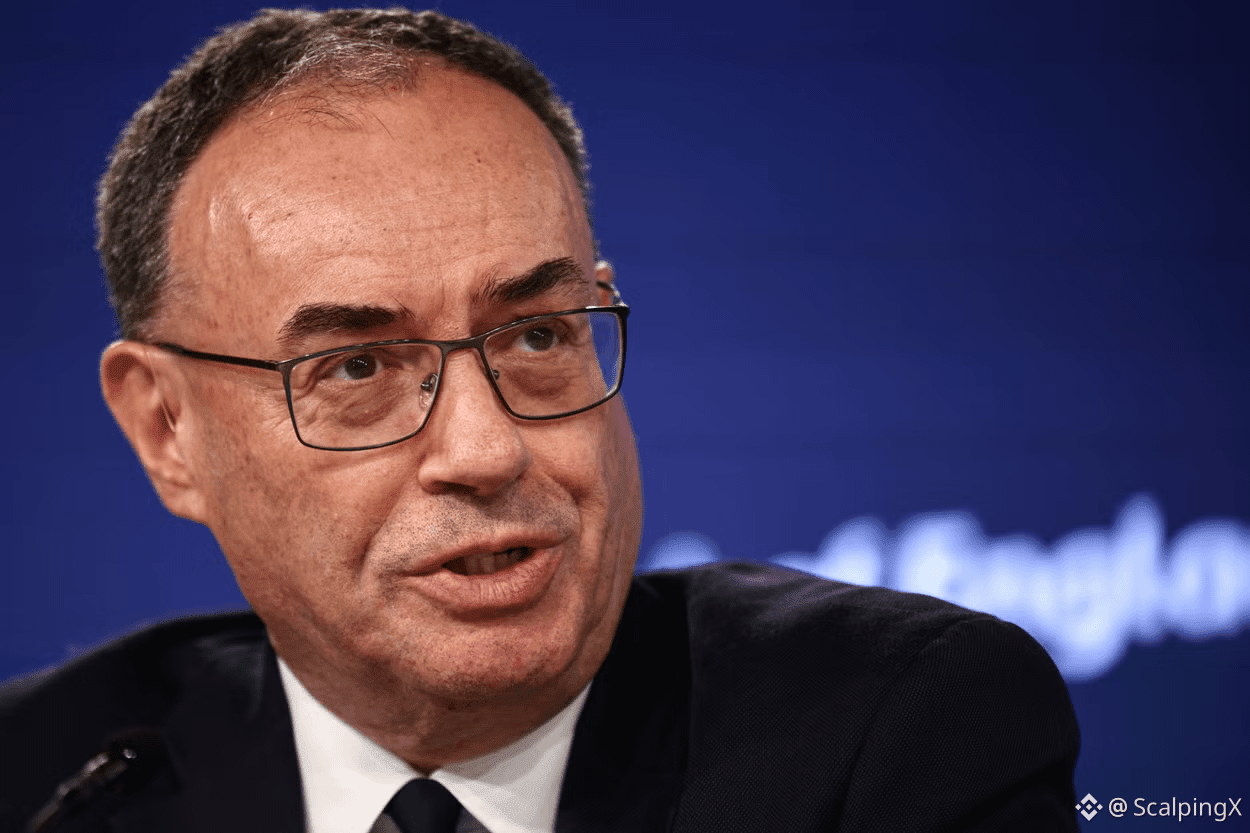
Bailey signals the BoE can remain patient as second-round inflation pressures stay limited
🏦 Bank of England Governor Andrew Bailey said the spillover from the energy price shock into wages and broader prices remains relatively muted, while the UK labour market has been softening for some time.
📉 Bailey said the BoE can continue to watch developments for now. However, he did not signal a rate cut and left open the possibility of revisiting the issue if inflation pressures begin to spread more broadly.
📊 Bank Rate currently stands at 3.75%, while July CPI rose to 2.9%. With the next policy meeting set for September 17, his comments reinforce the case for keeping rates unchanged, although the risk of a hike has not fully disappeared.
🤖 Bailey also highlighted AI and robotics as potential drivers of long-term productivity and growth in the UK, but they are unlikely to alter the near-term monetary policy path.
#BoE $NVDAB
56

BoE is assigned a new mission to support innovation in digital payments, ensuring financial stability as a priority
- The UK government is expected to expand the duties of the Bank of England (BoE) to support innovation in digital payments, including stablecoins.
- Main objective: to promote fintech technology innovation while keeping financial security as the top priority.
- This move aims to strengthen the UK’s position in the digital currency and digital payments space.
#BinanceSquare #CryptoNews #Stablecoin #BoE #UKRegulation
$btc $eth
vlikevn Titanbot
Source: CoinTelegraph
127

#BoE 's #Mann : Better to Be Slightly #Hawkish Than Under-React...........
Bank of England policymaker Catherine Mann made her hawkish stance clear today, saying it's better for interest rates to run a little too high than too low — with room to correct later if needed. She noted this reasoning was behind her vote for the 25 basis-point rate hike at the last meeting.
This comes as markets currently price in a full BoE rate hike by year-end, though only around a 15% chance of a hike at this month's meeting.
What this means for risk assets: a more hawkish BoE tone adds to the broader theme we've seen today — rate hike expectations weighing on both equities and crypto. Higher rates typically reduce appetite for non-yielding assets like Bitcoin and Ethereum, so this kind of commentary is worth watching alongside the Fed's own signals this month.
#BankOfEngland #InterestRates
👉 Follow for daily market insights! 🚀
$UNITREE
{future}(UNITREEUSDT)
$BTC
{spot}(BTCUSDT)
#BoE 's #Mann : Better to Be Slightly #Hawkish Than Under-React...........
Bank of England policymaker Catherine Mann made her hawkish stance clear today, saying it's better for interest rates to run a little too high than too low — with room to correct later if needed. She noted this reasoning was behind her vote for the 25 basis-point rate hike at the last meeting.
This comes as markets currently price in a full BoE rate hike by year-end, though only around a 15% chance of a hike at this month's meeting.
What this means for risk assets: a more hawkish BoE tone adds to the broader theme we've seen today — rate hike expectations weighing on both equities and crypto. Higher rates typically reduce appetite for non-yielding assets like Bitcoin and Ethereum, so this kind of commentary is worth watching alongside the Fed's own signals this month.
#BankOfEngland #InterestRates
👉 Follow for daily market insights! 🚀
$UNITREE
$BTC

1
469
·
--
BoE tightens into an energy shock just as US spot crypto ETFs flip back to inflowsUK Bank Rate is back at 4%, while Nov. 4 US spot bitcoin and ether ETFs both printed net inflows after multi-day outflow streaks.
$BTC $ETH
KEY TAKEAWAYS
- Bank of England MPC voted 8-1 to raise Bank Rate from 3.75% to 4% — first hike since 2023 — and expects UK CPI near about 5% by mid-2027.
- US spot bitcoin ETFs logged about +$74.6M net inflows on Nov. 4, ending three straight outflow sessions; ether ETFs added +$53.0M.
- Fidelity FBTC led bitcoin with +$236.7M while BlackRock IBIT was the only bitcoin fund in the red at about -$201.2M that day.
ANALYSIS
(Our interpretation, not confirmed fact.)
- Our reading: these two verified prints sit on different clocks. The BoE hike is a policy response to energy-driven inflation risk; the ETF print is a one-day flow flip after a short outflow streak.
- Macro tightening usually raises the discount rate on risk assets. A single ETF inflow day does not prove that channel is closed — it only shows allocators were still adding on Nov. 4 even as major central banks stay hawkish.
- The split inside bitcoin ETFs (FBTC large inflow, IBIT large outflow) matters as much as the headline net: flow leadership can rotate between issuers without a durable trend.
WHAT TO WATCH
- Whether US spot bitcoin/ether ETF net flows stay positive after the BoE decision day.
- Whether BoE minutes language on further near-term hikes coincides with softer crypto ETF demand in later sessions.
VERIFIED FACTS
- At its meeting ending Nov. 4, 2026, the Bank of England's Monetary Policy Committee voted 8-1 to raise Bank Rate by 0.25 percentage points from 3.75% to 4%, the first increase since 2023.
- Catherine L Mann dissented, preferring a 0.5 percentage point rise to 4.25%, per the Bank's Nov. 5, 2026 Monetary Policy Summary.
- US spot bitcoin ETFs recorded combined net inflows of about $74.6 million ($74.57 million per SoSoValue) on November 4, 2026, after three consecutive sessions of net outflows (October 30, November 2 and November 3).
- Fidelity's FBTC took in $236.7 million, ARK 21Shares' ARKB $19.9 million, Bitwise's BITB $15.2 million and Invesco's BTCO $4.0 million, while BlackRock's IBIT was the only fund with net outflows, at $201.2 million.
LIMITS
- ETF figures are one session (Nov. 4, 2026) from SoSoValue coverage already verified in the paired ETF item.
- BoE decision and ETF flows are not causal; this pairs macro policy with market plumbing.
- Interpretation only — not a price forecast or investment recommendation.
- This analysis is informational, based only on already-verified reports, and is not financial advice. Digital assets are volatile.
SOURCES
- https://www.bankofengland.co.uk/monetary-policy-summary-and-minutes/2026/november-2026
- https://farside.co.uk/btc/
💬 Do one-day ETF inflow flips matter when major central banks are hiking? Drop your take.
#BoE #BitcoinETF #Macro
BoE tightens into an energy shock just as US spot crypto ETFs flip back to inflows
UK Bank Rate is back at 4%, while Nov. 4 US spot bitcoin and ether ETFs both printed net inflows after multi-day outflow streaks.
$BTC $ETH
KEY TAKEAWAYS
- Bank of England MPC voted 8-1 to raise Bank Rate from 3.75% to 4% — first hike since 2023 — and expects UK CPI near about 5% by mid-2027.
- US spot bitcoin ETFs logged about +$74.6M net inflows on Nov. 4, ending three straight outflow sessions; ether ETFs added +$53.0M.
- Fidelity FBTC led bitcoin with +$236.7M while BlackRock IBIT was the only bitcoin fund in the red at about -$201.2M that day.
ANALYSIS
(Our interpretation, not confirmed fact.)
- Our reading: these two verified prints sit on different clocks. The BoE hike is a policy response to energy-driven inflation risk; the ETF print is a one-day flow flip after a short outflow streak.
- Macro tightening usually raises the discount rate on risk assets. A single ETF inflow day does not prove that channel is closed — it only shows allocators were still adding on Nov. 4 even as major central banks stay hawkish.
- The split inside bitcoin ETFs (FBTC large inflow, IBIT large outflow) matters as much as the headline net: flow leadership can rotate between issuers without a durable trend.
WHAT TO WATCH
- Whether US spot bitcoin/ether ETF net flows stay positive after the BoE decision day.
- Whether BoE minutes language on further near-term hikes coincides with softer crypto ETF demand in later sessions.
VERIFIED FACTS
- At its meeting ending Nov. 4, 2026, the Bank of England's Monetary Policy Committee voted 8-1 to raise Bank Rate by 0.25 percentage points from 3.75% to 4%, the first increase since 2023.
- Catherine L Mann dissented, preferring a 0.5 percentage point rise to 4.25%, per the Bank's Nov. 5, 2026 Monetary Policy Summary.
- US spot bitcoin ETFs recorded combined net inflows of about $74.6 million ($74.57 million per SoSoValue) on November 4, 2026, after three consecutive sessions of net outflows (October 30, November 2 and November 3).
- Fidelity's FBTC took in $236.7 million, ARK 21Shares' ARKB $19.9 million, Bitwise's BITB $15.2 million and Invesco's BTCO $4.0 million, while BlackRock's IBIT was the only fund with net outflows, at $201.2 million.
LIMITS
- ETF figures are one session (Nov. 4, 2026) from SoSoValue coverage already verified in the paired ETF item.
- BoE decision and ETF flows are not causal; this pairs macro policy with market plumbing.
- Interpretation only — not a price forecast or investment recommendation.
- This analysis is informational, based only on already-verified reports, and is not financial advice. Digital assets are volatile.
SOURCES
- https://www.bankofengland.co.uk/monetary-policy-summary-and-minutes/2026/november-2026
- https://farside.co.uk/btc/
💬 Do one-day ETF inflow flips matter when major central banks are hiking? Drop your take.
#BoE #BitcoinETF #Macro
87

London just joined the hawkish turn — and I think crypto traders should read the fine print, not the headline.
The Bank of England raised Bank Rate to 4% from 3.75% today, its first hike since August 2023. The 8–1 vote carried a twist: the lone dissenter wanted a bigger 50-point rise to 4.25%, not a hold.
Bailey said this is unlikely to be the last increase unless the Middle East conflict eases, with UK inflation seen near 5% by mid-2027.
The hike was fully priced in, so $BTC barely blinked — near $80,160 (+2.5%/24h) on Binance spot, $ETH near $2,411 (+4.1%), both flat since then. What matters is the direction of travel: a major central bank turning hawkish while energy prices climb tightens the liquidity backdrop crypto has leaned on.
Does a hawkish BoE change how you read $BTC holding $80k, or is London just catching up? NFA, DYOR.
$BTC $ETH #CryptoMarkets #BoE #RateHike #Inflation
6


·
--
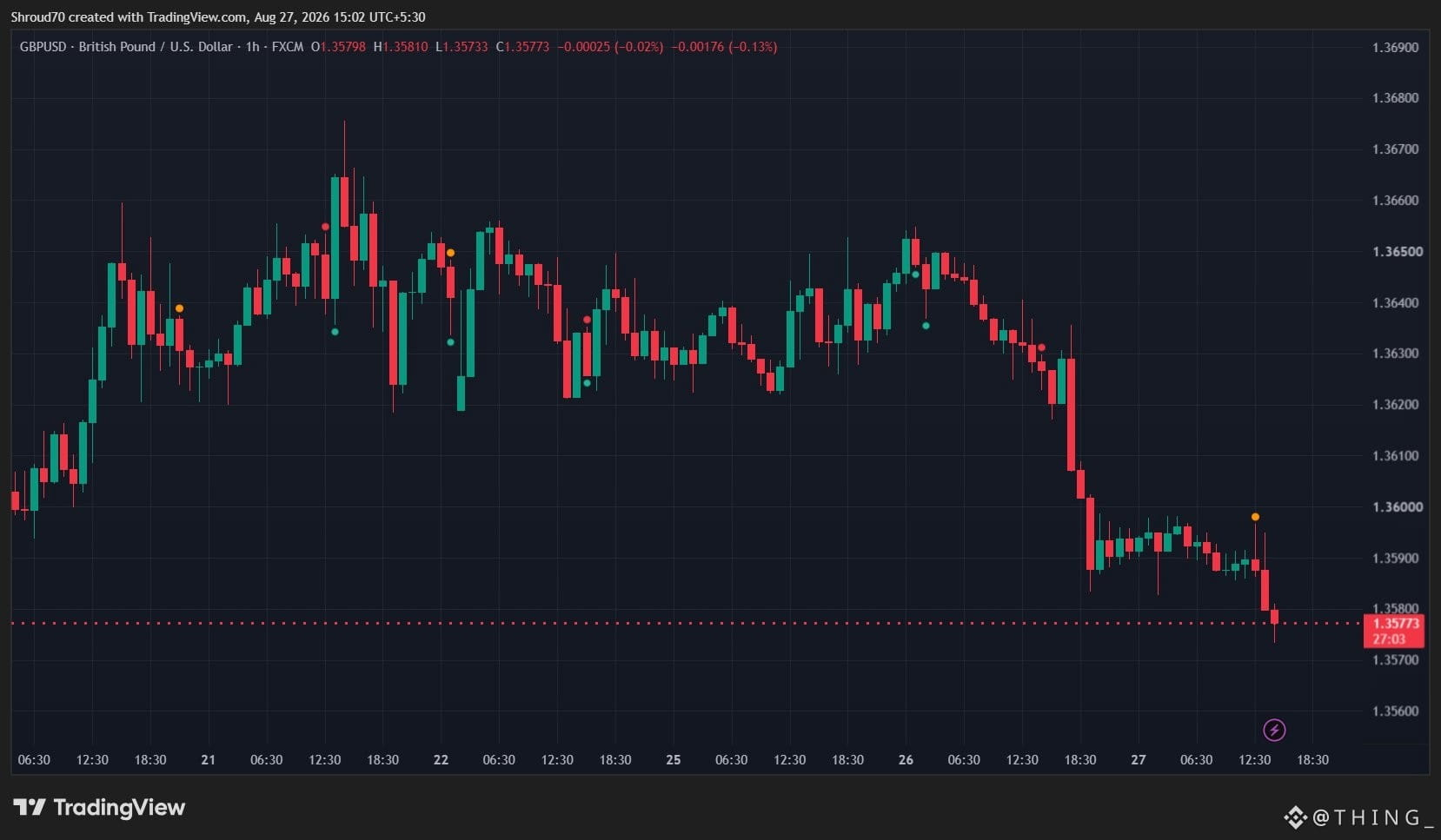
GBP getting hit, slipped back under $1.36. Looks like the market is finally pushing back BoE rate hike bets to 2027. Honestly, with inflation ticking up but the labor market staying flat, I’m not surprised. All eyes on Warsh’s Jackson Hole speech now to see what the Fed does. Market is definitely in wait-and-see mode. #GBP #Forex #Trading #BoE
GBP getting hit, slipped back under $1.36. Looks like the market is finally pushing back BoE rate hike bets to 2027. Honestly, with inflation ticking up but the labor market staying flat, I’m not surprised. All eyes on Warsh’s Jackson Hole speech now to see what the Fed does. Market is definitely in wait-and-see mode. #GBP #Forex #Trading #BoE
1
4
391

·
--
3 major catalysts stacking in silence. Nobody's talking about the big picture.
3 major catalysts are stacking in silence. Nobody's talking about the big picture.
While everyone watches BTC at $61k, three things are quietly converging:
1. Bank of England softens stablecoin rules
— UK just opened the door for regulated stablecoins. World's 6th largest economy greenlighting crypto payments.
2. Morgan Stanley launches ETH/SOL ETF at 0.14%
— 0.14% is aggressively low. Wall Street competing for ETF share in crypto.
3. F&G 22→23
— Sentiment bottoming after over a week in extreme fear.
All three are about ACCESS. More stablecoin access, more ETF access, more risk appetite.
CoinRadar data confirms:
- 15 gainers above 44%, professional money active
- Search rotated from memes to L2/infra (ARB, OP, STG, POL)
- RE (+86.6%) fresh on gainers — new capital flowing
The quietest moments before a move are the loudest in hindsight.
Positioned or waiting for confirmation?
Not financial advice. DYOR.
#BoE #ETF #STG #ARB #CoinRadar
110

·
--
BoE: USD stablecoins strengthen the dollar—and channel redemptions to the US Treasury short endBank of England FPC External Member Carolyn Wilkins’ speech at Queen’s University Belfast: the needle is sharper than the slogan—bigger USD stablecoins could, in turn, strengthen the dollar’s position—while also channeling redemption pressure into the US Treasury short end.
Official text (Sept. 15): By mid-2026, the circulation size of stablecoins will be about $300 billion; around 98% is still pegged to the US dollar. The data she cited: by the end of 2025, USDT and $USDC combined holdings of nearly $150 billion in US Treasury bills; net purchases that year were about $33 billion. In proportion to the overall Treasury market it is still small, but it has already become a player in the short-end market that cannot be ignored.
BoE: USD stablecoins strengthen the dollar—and channel redemptions to the US Treasury short end
Bank of England FPC External Member Carolyn Wilkins’ speech at Queen’s University Belfast: the needle is sharper than the slogan—bigger USD stablecoins could, in turn, strengthen the dollar’s position—while also channeling redemption pressure into the US Treasury short end.
Official text (Sept. 15): By mid-2026, the circulation size of stablecoins will be about $300 billion; around 98% is still pegged to the US dollar. The data she cited: by the end of 2025, USDT and $USDC combined holdings of nearly $150 billion in US Treasury bills; net purchases that year were about $33 billion. In proportion to the overall Treasury market it is still small, but it has already become a player in the short-end market that cannot be ignored.
Official text (Sept. 15): By mid-2026, the circulation size of stablecoins will be about $300 billion; around 98% is still pegged to the US dollar. The data she cited: by the end of 2025, USDT and $USDC combined holdings of nearly $150 billion in US Treasury bills; net purchases that year were about $33 billion. In proportion to the overall Treasury market it is still small, but it has already become a player in the short-end market that cannot be ignored.
88
·
--
The UK Office for National Statistics has released a set of key employment figures, highlighting the complex situation in the local labour market. In the three months to July, the ILO unemployment rate came in at 4.9%, matching the previous reading and slightly below market expectations of 5.0%. However, the unemployment rate edged up in August, rising to 4.4% (from 4.3% previously). At the same time, the number of people claiming unemployment benefits increased by 27.8k, while the July figure was revised from -11.0k to -11.8k.
These data suggest that the UK jobs market overall remains resilient, but signs of a gradual slowdown have begun to appear at the margin. The three-month unemployment rate coming in below expectations helps ease concerns that the economy is weakening rapidly. Nonetheless, the surge in monthly benefit claims and the slight uptick in the unemployment rate indicate that the pressure from the high-interest-rate environment on firms’ hiring and workforce demand is gradually becoming more visible.
From the perspective of macro financial markets, the mixed signals in employment data keep the Bank of England’s future rate-cut path uncertain. On the one hand, wages and overall employment have not shown a sharp deterioration, reducing the urgency for aggressive easing. On the other hand, the cooling at the labour-market margin limits the upside potential for the pound. Meanwhile, European sovereign bond markets are showing divergence: some funds seeking higher yields have started flowing into East European bonds such as those of Bulgaria and Hungary, with investors repeatedly weighing returns against liquidity risk.
For the crypto market, the subtle changes in macro employment data are mainly transmitted through US dollar liquidity and the pace of global rate cuts. In the near term, major tokens such as $BTC remain in a wait-and-see mode as the market assesses how the policy timing of the US and European central banks may affect liquidity spillovers. Under current liquidity conditions, the battle between bullish and bearish forces remains intense, and subsequent market moves will require close monitoring for further confirmation of any global liquidity inflection point.
#UKJoblessClaims #BoE #MacroEconomics
41


Article
🛢️ Crude Awakening: The $100 Oil Squeeze & The Macro Threat#CentralBanksWeighResponseAsOilNears$100 Energy markets are flashing red warning signs.
Crude oil is aggressively pushing toward the critical $100 per barrel benchmark, throwing the world’s major central banks into overdrive. To curb a fresh surge of energy-driven inflation, monetary authorities at the Fed, BoE, and BoJ may be backed into a corner—forced to aggressively hike interest rates as early as September.
This isn't just speculation. We are facing a real, compounding supply shock driven by three major forces:
🚨 Choke Point Strains: Blockades across the Red Sea and the Strait of Hormuz disrupting global shipments.
📉 Depleted Inventories: Global oil reserves are rapidly drying up, leaving virtually no safety margin.
🛑 Supply Cuts: Strict production squeezes enforced by major suppliers like Russia and Kazakhstan.
⚡ Macro Heatwave: What Should Traders Do?
With volatility on the horizon, here is your action plan to protect your portfolio and navigate the storm:
Slash Your Leverage
High volatility is guaranteed. Over-leveraged positions will get wiped out by aggressive market wicks—keep your risk low and preserve your capital.
Follow the Capital Flows
Smart money shifts with macroeconomic trends. Keep a close eye on commodities and energy-linked assets as capital pivots into inflation hedges.
Practice Tactical DCA
Avoid catching falling knives during sharp market swings. Use disciplined Dollar-Cost Averaging to build positions systematically without getting burned.
⚠️ Disclaimer: This content is for educational and informational purposes only and does not constitute financial advice. Always manage your risk responsibly!#Fed #BoJ #BoE $CL {future}(CLUSDT) $BZ $EUL {future}(EULUSDT)
🛢️ Crude Awakening: The $100 Oil Squeeze & The Macro Threat
#CentralBanksWeighResponseAsOilNears$100 Energy markets are flashing red warning signs.
Crude oil is aggressively pushing toward the critical $100 per barrel benchmark, throwing the world’s major central banks into overdrive. To curb a fresh surge of energy-driven inflation, monetary authorities at the Fed, BoE, and BoJ may be backed into a corner—forced to aggressively hike interest rates as early as September.
This isn't just speculation. We are facing a real, compounding supply shock driven by three major forces:
🚨 Choke Point Strains: Blockades across the Red Sea and the Strait of Hormuz disrupting global shipments.
📉 Depleted Inventories: Global oil reserves are rapidly drying up, leaving virtually no safety margin.
🛑 Supply Cuts: Strict production squeezes enforced by major suppliers like Russia and Kazakhstan.
⚡ Macro Heatwave: What Should Traders Do?
With volatility on the horizon, here is your action plan to protect your portfolio and navigate the storm:
Slash Your Leverage
High volatility is guaranteed. Over-leveraged positions will get wiped out by aggressive market wicks—keep your risk low and preserve your capital.
Follow the Capital Flows
Smart money shifts with macroeconomic trends. Keep a close eye on commodities and energy-linked assets as capital pivots into inflation hedges.
Practice Tactical DCA
Avoid catching falling knives during sharp market swings. Use disciplined Dollar-Cost Averaging to build positions systematically without getting burned.
⚠️ Disclaimer: This content is for educational and informational purposes only and does not constitute financial advice. Always manage your risk responsibly!#Fed #BoJ #BoE $CL $BZ $EUL
203
BoEOpensConsultationOnTokenizedCollateralForClearing 🚨
🇬🇧 Bank of England launches consultation on tokenised collateral for central clearing
🏦 The Bank of England is seeking feedback on draft supervisory expectations for central counterparties (CCPs) that want to accept tokenised versions of collateral already eligible under the proposed CCP Rulebook.
🔥 Key highlights:
🔹 The consultation does not create a separate new collateral regime; it clarifies how CCPs should demonstrate that tokenised collateral meets existing eligibility and risk-management standards.
🔹 The scope is broader than only government bonds — it can cover eligible collateral that CCPs already accept, as well as eligible types not currently accepted.
🔹 CCPs would need to show that tokenised collateral can be reliably valued, transferred, and liquidated, including during stressed market conditions.
🔹 Potential benefits include more efficient collateral management and faster support for margin requirements, subject to robust operational and financial-stability safeguards.
🔹 The consultation closes on 12 February 2027.
📈 This is a meaningful regulatory step toward integrating tokenisation into traditional market infrastructure — but it is focused on the safe use of tokenised forms of eligible assets, rather than opening clearing to any crypto asset.
💬 Could clearer CCP standards help accelerate institutional use of tokenisation in wholesale markets?
#BoE #Tokenization #Collateral #CentralClearing #BankOfEngland
1
12

🚨 CENTRAL BANKS ABOUT TO SHAKE THE MARKETS.
This week, the Fed, ECB, and BoE all drop rate decisions and the entire global economy is holding its breath.
War risks in the Middle East are already reshaping inflation outlooks, oil prices, and rate paths. One wrong word from Powell, Lagarde, or Bailey could spark a massive move.
Here's what's at stake:
Markets are showing quiet resilience. European stocks opened slightly higher this morning despite stalled U.S.-Iran peace talks and lingering uncertainty over the Strait of Hormuz.
But that calm is deceptive.
Geopolitics is injecting fresh inflation pressure through energy costs, forcing central bankers to walk a razor’s edge between growth and price stability.
The Fed meets amid questions on how far war shocks will push U.S. inflation. The ECB faces eurozone energy-driven price spikes while growth remains fragile. The BoE deals with stubborn UK inflation even as the economy shows mixed signals.
Every dot plot, every press conference comment, every hint of future hikes or holds will be dissected in real time.
This isn’t just another policy week.
It’s a convergence of monetary power and geopolitical tension that could accelerate or slam the brakes on risk assets, bonds, gold, and the dollar.
Traders are positioned. Volatility is coiled.
The decisions land this week and the fallout could define the next leg of the 2026 macro cycle.
Stay sharp. The big moves start now.
#Fed #ECB #BOE #Markets #Crypto

150
Log in to explore more content
Join global crypto users on Binance Square
⚡️ Get latest and useful information about crypto.
💬 Trusted by the world’s largest crypto exchange.
👍 Discover real insights from verified creators.
Email / Phone number
Trending Topics
1
#BinanceReopensWithdrawalsForHYPE&APT
62,229 views
824 Discussing
2
#SouthKoreaDraftLawTargets15To20%ShareholderCap
63,437 views
542 Discussing
3
#TradFiForBeginners
166,132 views
1,737 Discussing
4
#KeplrAdvisesSocialLoginUsersToTransferAssets
37,337 views
450 Discussing
5
#TetherPlans€28.8MForJuventusCapitalIncrease
23,511 views
354 Discussing
6
#JobsReportRaisesHikeOdds
816,658 views
4,368 Discussing
7
#CPITestsDecemberRateOutlook
323,350 views
1,842 Discussing
8
#US Data Center Rules May Constrain AI Expansion
122,270 views
258 Discussing
9
#ARKPlans14ThematicETFsCoveringAIAndTokenizedMarkets
8,568 views
88 Discussing
10
#WillAnthropicListOnTime
260,109 views
1,861 Discussing