
#bitcoinetf
bitcoinetf
1.9M views
4,495 Discussing
Hot
Latest

·
--
🚨 $BTC just got an interesting signal — and it’s not another “BTC to $100K tomorrow” prediction 😂
After a period of ETF outflows, money started flowing back into U.S. spot Bitcoin ETFs.
The big headline?
💰 Nearly $1B flowed into spot Bitcoin ETFs in one recent session, followed by another ~$715M the next day.
So what’s actually interesting here?
It’s not simply “institutions are bullish.”
The more useful story is the change in flow direction:
🔴 Outflows
⬇️
🟢 Flows turn positive
⬇️
💰 Large inflows return
That matters because ETF flows give us a window into demand from investors accessing Bitcoin through regulated spot products.
But there’s an important catch 👀
ETF inflows alone don’t mean Bitcoin can only go up.
Price can still be affected by macro conditions, leverage, profit-taking and broader risk appetite.
So instead of asking:
“Is Bitcoin bullish now?”
A better question might be:
“Does this renewed demand continue?”
Because one big inflow is interesting.
A sustained trend is much more meaningful. 👀
What do you think matters more from here — ETF flows continuing or Bitcoin’s price structure confirming the demand?
#Bitcoin #CryptoNews #BitcoinETF #CryptoMarket #BinanceSquare
🚨 $BTC just got an interesting signal — and it’s not another “BTC to $100K tomorrow” prediction 😂
After a period of ETF outflows, money started flowing back into U.S. spot Bitcoin ETFs.
The big headline?
💰 Nearly $1B flowed into spot Bitcoin ETFs in one recent session, followed by another ~$715M the next day.
So what’s actually interesting here?
It’s not simply “institutions are bullish.”
The more useful story is the change in flow direction:
🔴 Outflows
⬇️
🟢 Flows turn positive
⬇️
💰 Large inflows return
That matters because ETF flows give us a window into demand from investors accessing Bitcoin through regulated spot products.
But there’s an important catch 👀
ETF inflows alone don’t mean Bitcoin can only go up.
Price can still be affected by macro conditions, leverage, profit-taking and broader risk appetite.
So instead of asking:
“Is Bitcoin bullish now?”
A better question might be:
“Does this renewed demand continue?”
Because one big inflow is interesting.
A sustained trend is much more meaningful. 👀
What do you think matters more from here — ETF flows continuing or Bitcoin’s price structure confirming the demand?
#Bitcoin #CryptoNews #BitcoinETF #CryptoMarket #BinanceSquare
After a period of ETF outflows, money started flowing back into U.S. spot Bitcoin ETFs.
The big headline?
💰 Nearly $1B flowed into spot Bitcoin ETFs in one recent session, followed by another ~$715M the next day.
So what’s actually interesting here?
It’s not simply “institutions are bullish.”
The more useful story is the change in flow direction:
🔴 Outflows
⬇️
🟢 Flows turn positive
⬇️
💰 Large inflows return
That matters because ETF flows give us a window into demand from investors accessing Bitcoin through regulated spot products.
But there’s an important catch 👀
ETF inflows alone don’t mean Bitcoin can only go up.
Price can still be affected by macro conditions, leverage, profit-taking and broader risk appetite.
So instead of asking:
“Is Bitcoin bullish now?”
A better question might be:
“Does this renewed demand continue?”
Because one big inflow is interesting.
A sustained trend is much more meaningful. 👀
What do you think matters more from here — ETF flows continuing or Bitcoin’s price structure confirming the demand?
#Bitcoin #CryptoNews #BitcoinETF #CryptoMarket #BinanceSquare
🟢 ETF inflows
📈 BTC price structure
22 hr(s) left
1
75


·
--
Bearish
I’m watching the Bitcoin ETF flows closely again 👀
Nearly $1B reportedly flowed into U.S. spot Bitcoin ETFs in a single day, marking one of the strongest daily inflows of 2026.
That kind of capital doesn’t guarantee a straight-up move, but it definitely puts institutional demand back on the radar.
If these inflows keep building, BTC could have a much stronger demand backdrop than the chart alone suggests.
$BTC
{spot}(BTCUSDT)
#Bitcoin #BTC #BitcoinETF
I’m watching the Bitcoin ETF flows closely again 👀
Nearly $1B reportedly flowed into U.S. spot Bitcoin ETFs in a single day, marking one of the strongest daily inflows of 2026.
That kind of capital doesn’t guarantee a straight-up move, but it definitely puts institutional demand back on the radar.
If these inflows keep building, BTC could have a much stronger demand backdrop than the chart alone suggests.
$BTC
#Bitcoin #BTC #BitcoinETF
Nearly $1B reportedly flowed into U.S. spot Bitcoin ETFs in a single day, marking one of the strongest daily inflows of 2026.
That kind of capital doesn’t guarantee a straight-up move, but it definitely puts institutional demand back on the radar.
If these inflows keep building, BTC could have a much stronger demand backdrop than the chart alone suggests.
$BTC
#Bitcoin #BTC #BitcoinETF


52

·
--
$1 BILLION ETF INFLOW IN ONE DAY! 💰
Wall Street is buying. Biggest BTC ETF inflow since October 2025.
Retail fear = Whale accumulation. Don't miss the rotation.
#BitcoinETF #Whales #CryptoNews
$1 BILLION ETF INFLOW IN ONE DAY! 💰
Wall Street is buying. Biggest BTC ETF inflow since October 2025.
Retail fear = Whale accumulation. Don't miss the rotation.
#BitcoinETF #Whales #CryptoNews
Wall Street is buying. Biggest BTC ETF inflow since October 2025.
Retail fear = Whale accumulation. Don't miss the rotation.
#BitcoinETF #Whales #CryptoNews
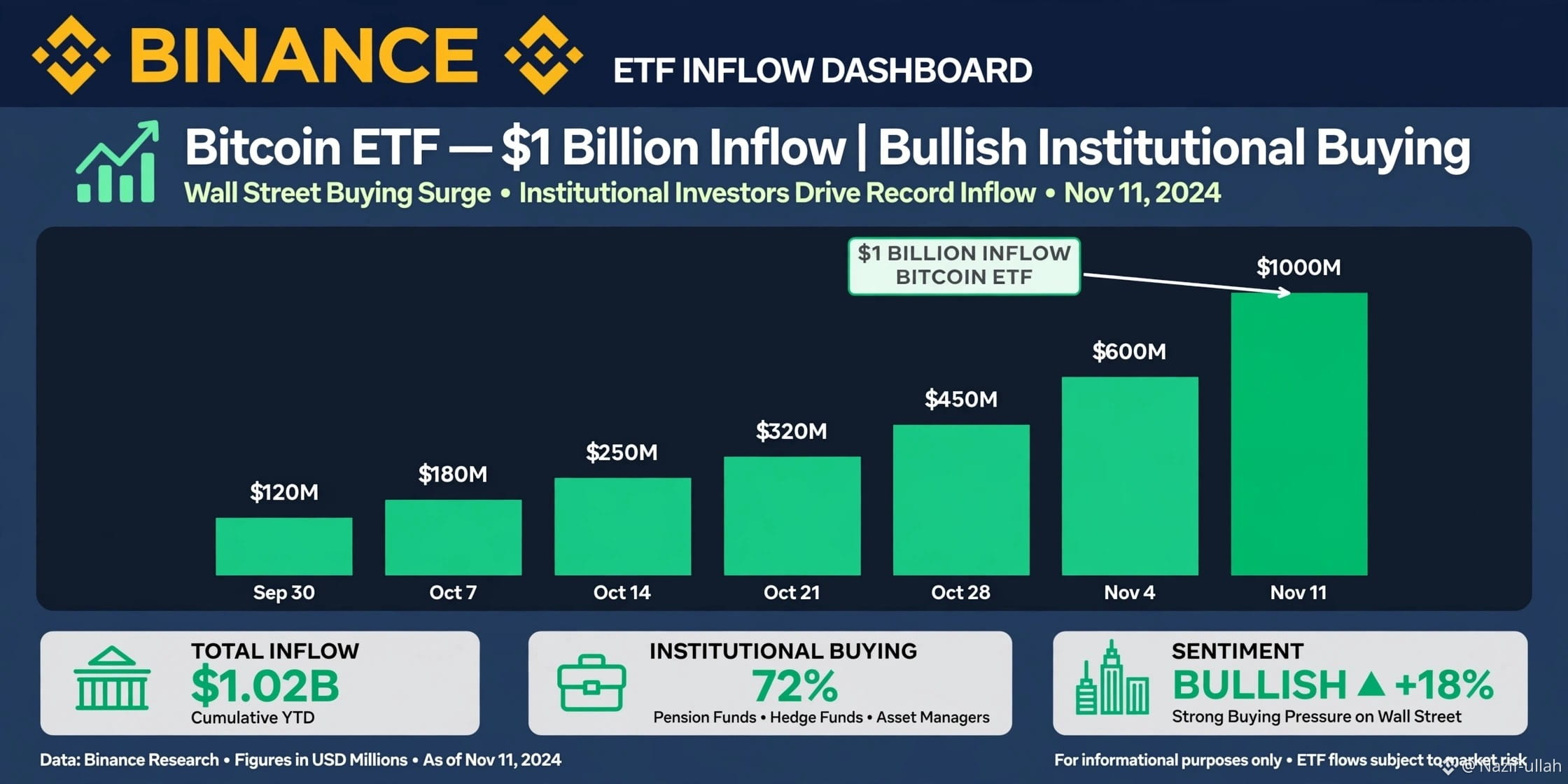
65

Bitcoin ETFs Are Buying Big Again 👀
Nearly $1 BILLION flowed into U.S. spot Bitcoin ETFs in a single day.
That’s not a small move.
On September 21, spot Bitcoin ETFs recorded around $998.95M in net inflows, marking their biggest single-day inflow since October 2025.
BlackRock’s IBIT led the charge with about $381M, followed by ARKB with $289M and Fidelity’s FBTC with nearly $239M.
At the same time, Bitcoin briefly pushed above $87K.
The interesting part? ETF flows had been much weaker just days earlier. Now institutional demand has suddenly picked up again.
If these strong inflows continue, Bitcoin demand could remain a major market story.
But one big day doesn’t confirm a trend.
BTC traders are watching the next ETF flow numbers closely. 👀
#Bitcoin #BTC #BitcoinETF
$BTC
{future}(BTCUSDT)
Bitcoin ETFs Are Buying Big Again 👀
Nearly $1 BILLION flowed into U.S. spot Bitcoin ETFs in a single day.
That’s not a small move.
On September 21, spot Bitcoin ETFs recorded around $998.95M in net inflows, marking their biggest single-day inflow since October 2025.
BlackRock’s IBIT led the charge with about $381M, followed by ARKB with $289M and Fidelity’s FBTC with nearly $239M.
At the same time, Bitcoin briefly pushed above $87K.
The interesting part? ETF flows had been much weaker just days earlier. Now institutional demand has suddenly picked up again.
If these strong inflows continue, Bitcoin demand could remain a major market story.
But one big day doesn’t confirm a trend.
BTC traders are watching the next ETF flow numbers closely. 👀
#Bitcoin #BTC #BitcoinETF
$BTC
Nearly $1 BILLION flowed into U.S. spot Bitcoin ETFs in a single day.
That’s not a small move.
On September 21, spot Bitcoin ETFs recorded around $998.95M in net inflows, marking their biggest single-day inflow since October 2025.
BlackRock’s IBIT led the charge with about $381M, followed by ARKB with $289M and Fidelity’s FBTC with nearly $239M.
At the same time, Bitcoin briefly pushed above $87K.
The interesting part? ETF flows had been much weaker just days earlier. Now institutional demand has suddenly picked up again.
If these strong inflows continue, Bitcoin demand could remain a major market story.
But one big day doesn’t confirm a trend.
BTC traders are watching the next ETF flow numbers closely. 👀
#Bitcoin #BTC #BitcoinETF
$BTC

70

Article
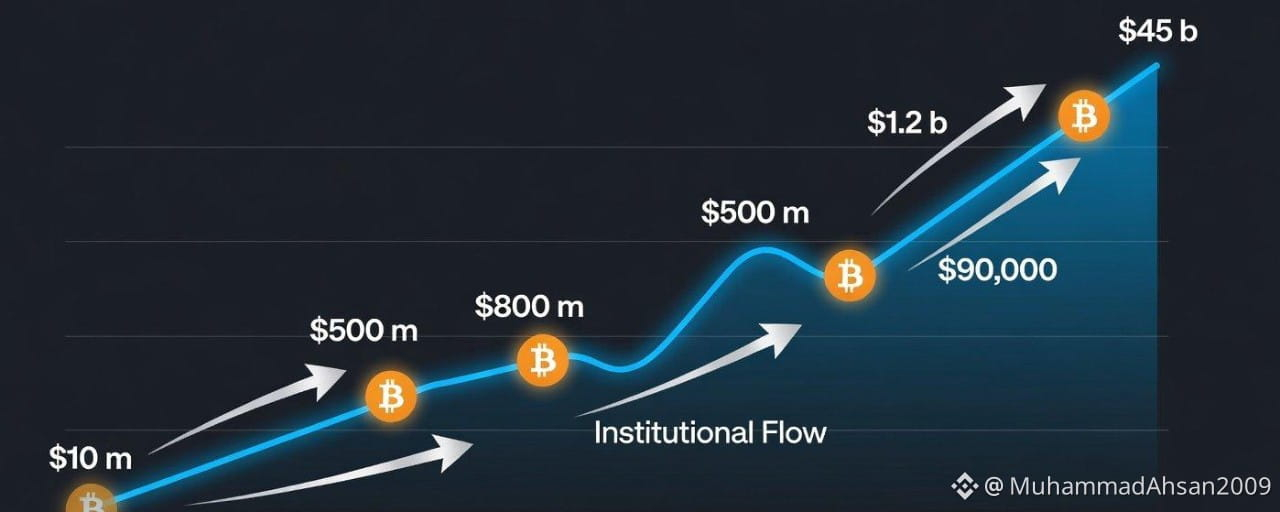
WALL STREET JUST SENT A HUGE SIGNAL TO BITCOIN! ₿🚨🚨 WALL STREET JUST SENT A HUGE SIGNAL TO BITCOIN! ₿🔥
💰 $999 MILLION flowed into U.S. Spot Bitcoin ETFs in ONE DAY!
That makes it one of the largest ETF inflow days ever. 🤯
And look where Bitcoin went next… 👀
₿ BTC pushed above $87,000
📈 Nearly $1 BILLION ETF inflow
🏦 Institutional demand is back in focus
🔥 Crypto market momentum is heating up
The big question:
Is this the beginning of Bitcoin’s next major move? 👀
👇 Drop your BTC price target!
#bitcoin #BTC #Crypto #BitcoinETF #CryptoNews #BTCNews #Binance #BinanceSquare #Ethereum #trading
$BITCOIN
$BTC
{spot}(BTCUSDT)
{alpha}(10x72e4f9f808c49a2a61de9c5896298920dc4eeea9)
WALL STREET JUST SENT A HUGE SIGNAL TO BITCOIN! ₿
🚨🚨 WALL STREET JUST SENT A HUGE SIGNAL TO BITCOIN! ₿🔥
💰 $999 MILLION flowed into U.S. Spot Bitcoin ETFs in ONE DAY!
That makes it one of the largest ETF inflow days ever. 🤯
And look where Bitcoin went next… 👀
₿ BTC pushed above $87,000
📈 Nearly $1 BILLION ETF inflow
🏦 Institutional demand is back in focus
🔥 Crypto market momentum is heating up
The big question:
Is this the beginning of Bitcoin’s next major move? 👀
👇 Drop your BTC price target!
#bitcoin #BTC #Crypto #BitcoinETF #CryptoNews #BTCNews #Binance #BinanceSquare #Ethereum #trading
$BITCOIN
$BTC
💰 $999 MILLION flowed into U.S. Spot Bitcoin ETFs in ONE DAY!
That makes it one of the largest ETF inflow days ever. 🤯
And look where Bitcoin went next… 👀
₿ BTC pushed above $87,000
📈 Nearly $1 BILLION ETF inflow
🏦 Institutional demand is back in focus
🔥 Crypto market momentum is heating up
The big question:
Is this the beginning of Bitcoin’s next major move? 👀
👇 Drop your BTC price target!
#bitcoin #BTC #Crypto #BitcoinETF #CryptoNews #BTCNews #Binance #BinanceSquare #Ethereum #trading
$BITCOIN
$BTC
72

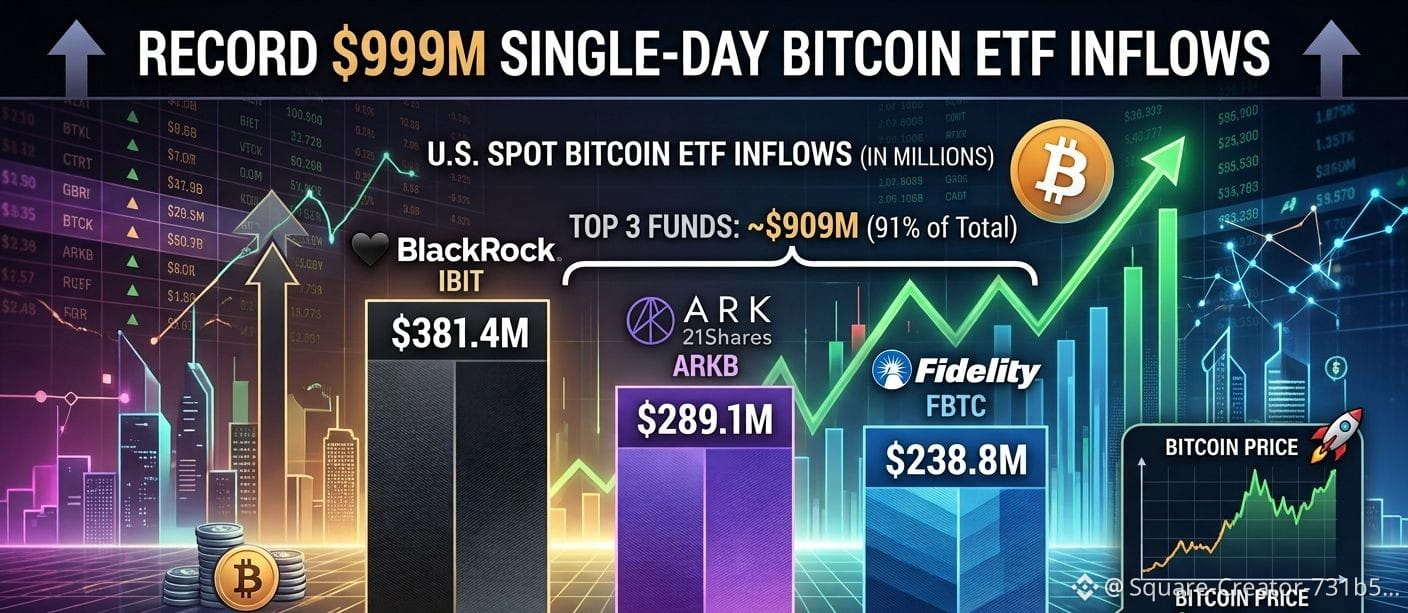
🏦₿ BlackRock, ARKB & Fidelity Drive $999M Bitcoin ETF Inflows 🚀
U.S. spot Bitcoin ETFs attracted $998.9 million on September 21, their biggest single-day inflow of 2026. 💰📈
🔥 Top three funds:
BlackRock IBIT: $381.4M
🟣 ARKB: $289.1M
🔵 Fidelity FBTC: $238.8M
Together, these three ETFs brought in about $909M, roughly 91% of the day's total Bitcoin ETF inflows. 📊
₿ The strong institutional flows came as Bitcoin climbed above $86,000, reaching its highest level since January. 🚀 The surge followed earlier September outflows and marked a sharp reversal in ETF demand.
💰 Spot Bitcoin ETFs now hold about $110.1B in net assets, with cumulative net inflows around $56.2B. 🌐
#Bitcoin ₿ #BitcoinETF 💰 #IBIT 🏦 #ARKB 📊 #FBTC 🔵 #InstitutionalInvestors 💼
🏦₿ BlackRock, ARKB & Fidelity Drive $999M Bitcoin ETF Inflows 🚀
U.S. spot Bitcoin ETFs attracted $998.9 million on September 21, their biggest single-day inflow of 2026. 💰📈
🔥 Top three funds:
BlackRock IBIT: $381.4M
🟣 ARKB: $289.1M
🔵 Fidelity FBTC: $238.8M
Together, these three ETFs brought in about $909M, roughly 91% of the day's total Bitcoin ETF inflows. 📊
₿ The strong institutional flows came as Bitcoin climbed above $86,000, reaching its highest level since January. 🚀 The surge followed earlier September outflows and marked a sharp reversal in ETF demand.
💰 Spot Bitcoin ETFs now hold about $110.1B in net assets, with cumulative net inflows around $56.2B. 🌐
#Bitcoin ₿ #BitcoinETF 💰 #IBIT 🏦 #ARKB 📊 #FBTC 🔵 #InstitutionalInvestors 💼
U.S. spot Bitcoin ETFs attracted $998.9 million on September 21, their biggest single-day inflow of 2026. 💰📈
🔥 Top three funds:
BlackRock IBIT: $381.4M
🟣 ARKB: $289.1M
🔵 Fidelity FBTC: $238.8M
Together, these three ETFs brought in about $909M, roughly 91% of the day's total Bitcoin ETF inflows. 📊
₿ The strong institutional flows came as Bitcoin climbed above $86,000, reaching its highest level since January. 🚀 The surge followed earlier September outflows and marked a sharp reversal in ETF demand.
💰 Spot Bitcoin ETFs now hold about $110.1B in net assets, with cumulative net inflows around $56.2B. 🌐
#Bitcoin ₿ #BitcoinETF 💰 #IBIT 🏦 #ARKB 📊 #FBTC 🔵 #InstitutionalInvestors 💼
1
75

·
--
💥 BITCOIN ETFs NEAR $1B AS 2026 INFLOW RECORD SHATTERS
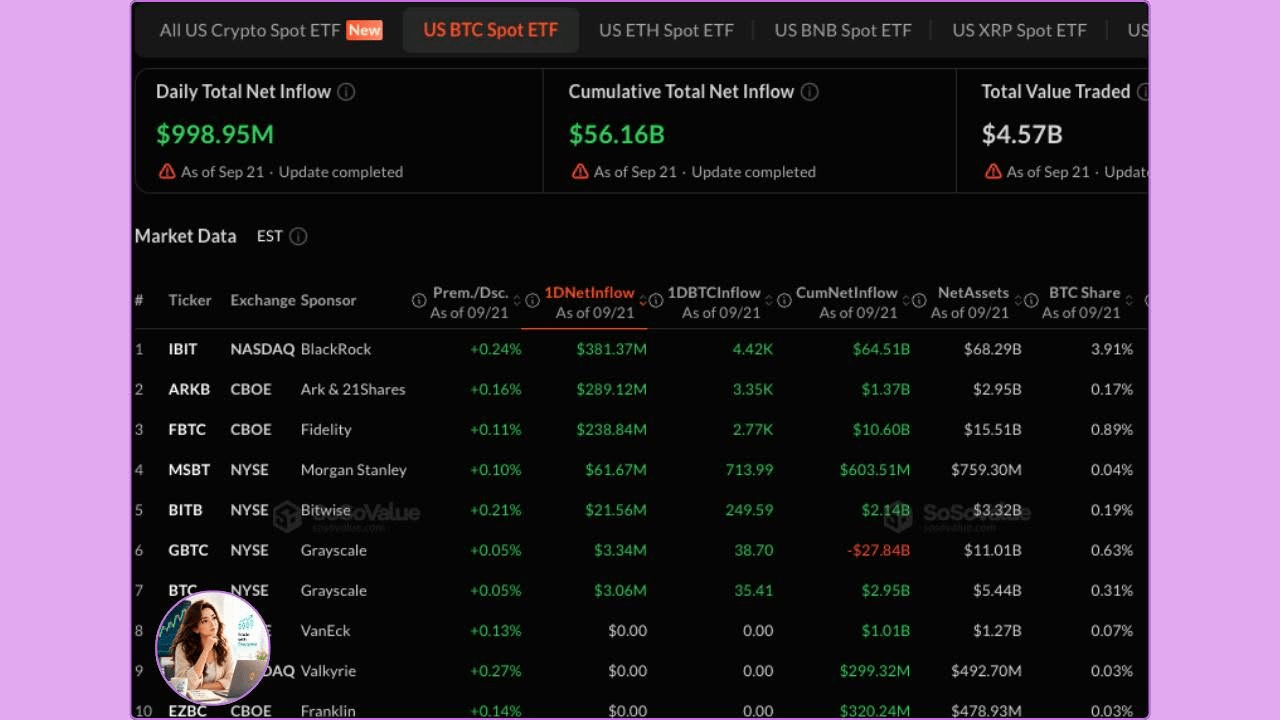
U.S. spot Bitcoin ETFs pulled in $998.9 million on Sept. 21, marking their biggest single-day inflow of 2026 and the strongest since October 2025.
The inflow surpassed the previous 2026 record of $844 million set on Jan. 14. BlackRock’s IBIT led with $381 million, followed by ARKB at $289 million and Fidelity’s FBTC at about $239 million.
The surge came as Bitcoin briefly climbed above $87,000, while ETF demand rebounded sharply after heavy outflows earlier in September.
Ether ETFs also attracted around $270 million on Monday, their strongest daily inflow of 2026.
Is this ETF demand becoming a more meaningful driver of Bitcoin’s latest recovery?
#BTC #BitcoinETF #InstitutionalDemand
#ThuyBNB
$BTC $BNB
$NEAR
💥 BITCOIN ETFs NEAR $1B AS 2026 INFLOW RECORD SHATTERS
U.S. spot Bitcoin ETFs pulled in $998.9 million on Sept. 21, marking their biggest single-day inflow of 2026 and the strongest since October 2025.
The inflow surpassed the previous 2026 record of $844 million set on Jan. 14. BlackRock’s IBIT led with $381 million, followed by ARKB at $289 million and Fidelity’s FBTC at about $239 million.
The surge came as Bitcoin briefly climbed above $87,000, while ETF demand rebounded sharply after heavy outflows earlier in September.
Ether ETFs also attracted around $270 million on Monday, their strongest daily inflow of 2026.
Is this ETF demand becoming a more meaningful driver of Bitcoin’s latest recovery?
#BTC #BitcoinETF #InstitutionalDemand
#ThuyBNB
$BTC $BNB
$NEAR
U.S. spot Bitcoin ETFs pulled in $998.9 million on Sept. 21, marking their biggest single-day inflow of 2026 and the strongest since October 2025.
The inflow surpassed the previous 2026 record of $844 million set on Jan. 14. BlackRock’s IBIT led with $381 million, followed by ARKB at $289 million and Fidelity’s FBTC at about $239 million.
The surge came as Bitcoin briefly climbed above $87,000, while ETF demand rebounded sharply after heavy outflows earlier in September.
Ether ETFs also attracted around $270 million on Monday, their strongest daily inflow of 2026.
Is this ETF demand becoming a more meaningful driver of Bitcoin’s latest recovery?
#BTC #BitcoinETF #InstitutionalDemand
#ThuyBNB
$BTC $BNB
$NEAR
28

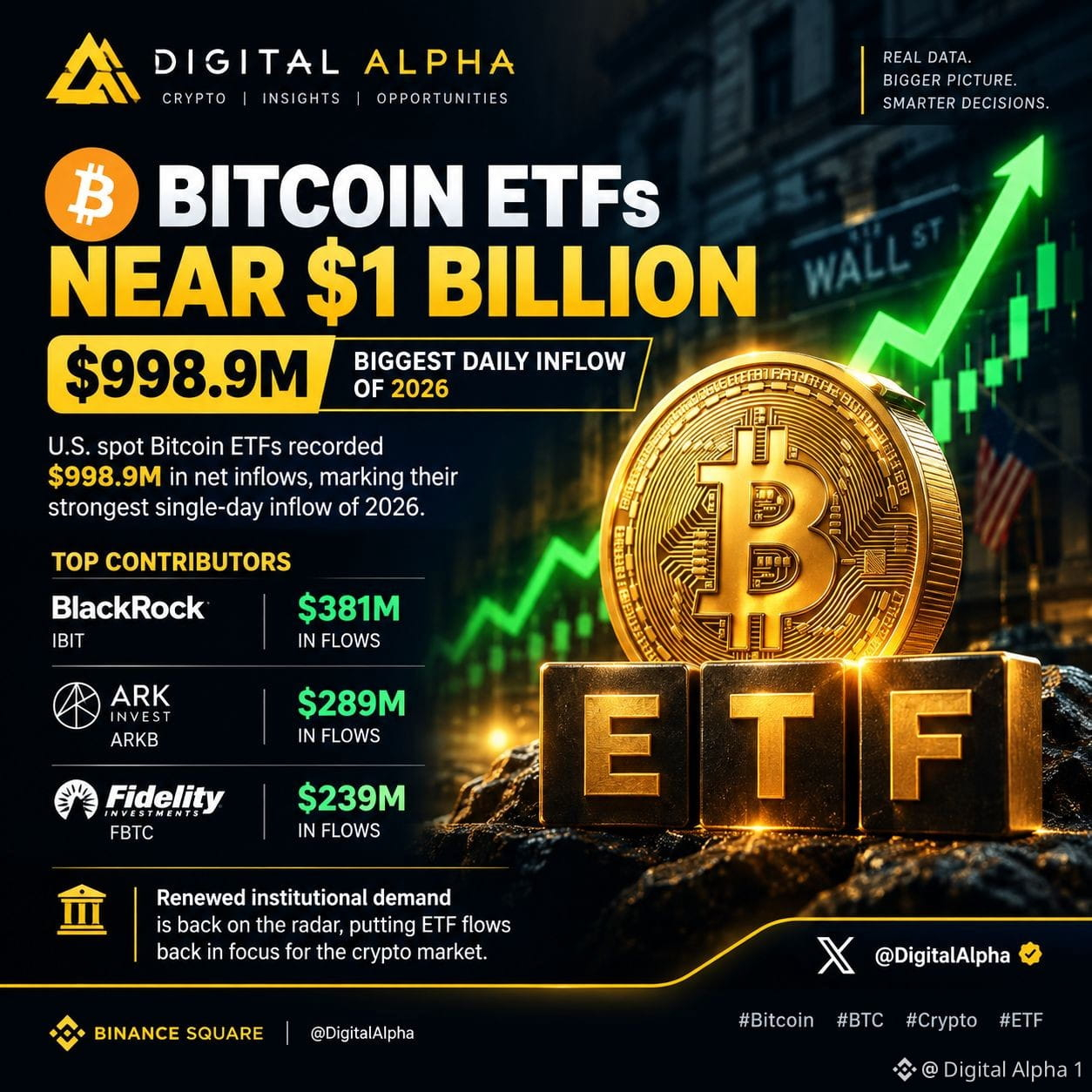
🚨 Bitcoin ETFs Near $1B in Daily Inflows
US spot Bitcoin ETFs recorded $998.9M in net inflows, marking their strongest single-day inflow of 2026.
BlackRock’s IBIT led with $381M, followed by ARKB at $289M and Fidelity’s FBTC at $239M.
The data highlights renewed institutional demand for Bitcoin, putting ETF flows back in focus for the crypto market.
Digital Alpha | Crypto • Insights • Opportunities
#BTC #BitcoinETF #DigitalAlpha #AIStocksWhatNext $BTC
{spot}(BTCUSDT)
🚨 Bitcoin ETFs Near $1B in Daily Inflows
US spot Bitcoin ETFs recorded $998.9M in net inflows, marking their strongest single-day inflow of 2026.
BlackRock’s IBIT led with $381M, followed by ARKB at $289M and Fidelity’s FBTC at $239M.
The data highlights renewed institutional demand for Bitcoin, putting ETF flows back in focus for the crypto market.
Digital Alpha | Crypto • Insights • Opportunities
#BTC #BitcoinETF #DigitalAlpha #AIStocksWhatNext $BTC
US spot Bitcoin ETFs recorded $998.9M in net inflows, marking their strongest single-day inflow of 2026.
BlackRock’s IBIT led with $381M, followed by ARKB at $289M and Fidelity’s FBTC at $239M.
The data highlights renewed institutional demand for Bitcoin, putting ETF flows back in focus for the crypto market.
Digital Alpha | Crypto • Insights • Opportunities
#BTC #BitcoinETF #DigitalAlpha #AIStocksWhatNext $BTC
26

#BitcoinSpotETFs$999MNetInflow
🚨 Bitcoin $BTC Spot ETFs Pull In $999M: Institutional Demand Roars Back 🚨
Picture the market after a long night of hesitation. Then, almost silently, nearly 1 Dollor billion flows through the ETF door in a single session, and suddenly Bitcoin's story looks different.
U.S. spot Bitcoin ETFs recorded roughly $999 million in net inflows, their strongest single-day inflow in about a year. The scale matters because ETF flows offer a direct window into institutional and traditional-market demand for BTC.
This is more than a headline number. Strong ETF buying arrives while Bitcoin has pushed above $85,000, showing that capital is returning alongside the price move rather than simply chasing a distant narrative.
My take: the primary driver here is capital flow, not supply mechanics. When regulated investment vehicles absorb meaningful spot exposure, available market liquidity can tighten and amplify price movements.
But one strong inflow should not be treated as a permanent trend. ETF demand can reverse quickly, and Bitcoin remains sensitive to macro conditions, rates, liquidity, and positioning.
The useful signal is therefore not “$999M means BTC must rise.” It is that institutional demand is currently strong enough to become a major force in Bitcoin's price discovery.
When capital changes direction, the chart usually tells the story afterward.
❓Do you think sustained ETF inflows can become the next major engine of Bitcoin's momentum?
Disclaimer: This content is for educational purposes only and is not financial advice.
#Bitcoin #BitcoinETF #GrowWithSAC $KERNEL $ONE
#BitcoinSpotETFs$999MNetInflow
🚨 Bitcoin $BTC Spot ETFs Pull In $999M: Institutional Demand Roars Back 🚨
Picture the market after a long night of hesitation. Then, almost silently, nearly 1 Dollor billion flows through the ETF door in a single session, and suddenly Bitcoin's story looks different.
U.S. spot Bitcoin ETFs recorded roughly $999 million in net inflows, their strongest single-day inflow in about a year. The scale matters because ETF flows offer a direct window into institutional and traditional-market demand for BTC.
This is more than a headline number. Strong ETF buying arrives while Bitcoin has pushed above $85,000, showing that capital is returning alongside the price move rather than simply chasing a distant narrative.
My take: the primary driver here is capital flow, not supply mechanics. When regulated investment vehicles absorb meaningful spot exposure, available market liquidity can tighten and amplify price movements.
But one strong inflow should not be treated as a permanent trend. ETF demand can reverse quickly, and Bitcoin remains sensitive to macro conditions, rates, liquidity, and positioning.
The useful signal is therefore not “$999M means BTC must rise.” It is that institutional demand is currently strong enough to become a major force in Bitcoin's price discovery.
When capital changes direction, the chart usually tells the story afterward.
❓Do you think sustained ETF inflows can become the next major engine of Bitcoin's momentum?
Disclaimer: This content is for educational purposes only and is not financial advice.
#Bitcoin #BitcoinETF #GrowWithSAC $KERNEL $ONE
🚨 Bitcoin $BTC Spot ETFs Pull In $999M: Institutional Demand Roars Back 🚨
Picture the market after a long night of hesitation. Then, almost silently, nearly 1 Dollor billion flows through the ETF door in a single session, and suddenly Bitcoin's story looks different.
U.S. spot Bitcoin ETFs recorded roughly $999 million in net inflows, their strongest single-day inflow in about a year. The scale matters because ETF flows offer a direct window into institutional and traditional-market demand for BTC.
This is more than a headline number. Strong ETF buying arrives while Bitcoin has pushed above $85,000, showing that capital is returning alongside the price move rather than simply chasing a distant narrative.
My take: the primary driver here is capital flow, not supply mechanics. When regulated investment vehicles absorb meaningful spot exposure, available market liquidity can tighten and amplify price movements.
But one strong inflow should not be treated as a permanent trend. ETF demand can reverse quickly, and Bitcoin remains sensitive to macro conditions, rates, liquidity, and positioning.
The useful signal is therefore not “$999M means BTC must rise.” It is that institutional demand is currently strong enough to become a major force in Bitcoin's price discovery.
When capital changes direction, the chart usually tells the story afterward.
❓Do you think sustained ETF inflows can become the next major engine of Bitcoin's momentum?
Disclaimer: This content is for educational purposes only and is not financial advice.
#Bitcoin #BitcoinETF #GrowWithSAC $KERNEL $ONE

1
175

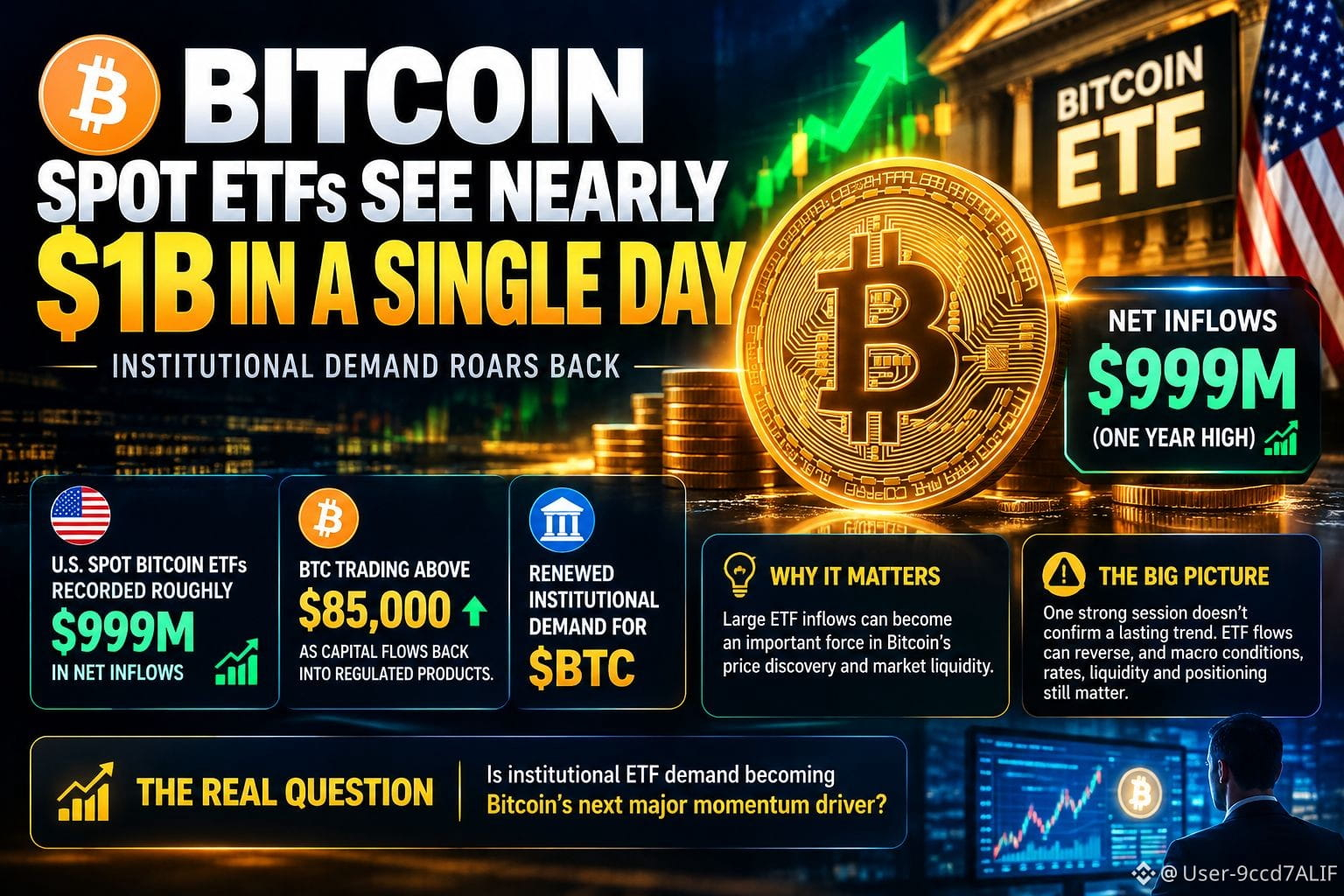
🚨 BITCOIN SPOT ETFs SEE NEARLY $1B IN A SINGLE DAY
🇺🇸 U.S. spot Bitcoin ETFs recorded roughly $999M in net inflows, marking their strongest daily inflow in about a year.
📈 The surge highlights renewed institutional demand for $BTC, with Bitcoin trading above $85,000 as capital flows back into regulated investment products.
💡 Why It Matters:
Large ETF inflows can become an important force in Bitcoin’s price discovery and market liquidity.
⚠️ One strong session does not confirm a lasting trend. ETF flows can reverse, while macro conditions, rates, liquidity, and positioning remain key factors.
🔥 Is institutional ETF demand becoming Bitcoin’s next major momentum driver?
#Bitcoin #BTC #BitcoinETF #crypto #BinanceSquare
🚨 BITCOIN SPOT ETFs SEE NEARLY $1B IN A SINGLE DAY
🇺🇸 U.S. spot Bitcoin ETFs recorded roughly $999M in net inflows, marking their strongest daily inflow in about a year.
📈 The surge highlights renewed institutional demand for $BTC, with Bitcoin trading above $85,000 as capital flows back into regulated investment products.
💡 Why It Matters:
Large ETF inflows can become an important force in Bitcoin’s price discovery and market liquidity.
⚠️ One strong session does not confirm a lasting trend. ETF flows can reverse, while macro conditions, rates, liquidity, and positioning remain key factors.
🔥 Is institutional ETF demand becoming Bitcoin’s next major momentum driver?
#Bitcoin #BTC #BitcoinETF #crypto #BinanceSquare
🇺🇸 U.S. spot Bitcoin ETFs recorded roughly $999M in net inflows, marking their strongest daily inflow in about a year.
📈 The surge highlights renewed institutional demand for $BTC, with Bitcoin trading above $85,000 as capital flows back into regulated investment products.
💡 Why It Matters:
Large ETF inflows can become an important force in Bitcoin’s price discovery and market liquidity.
⚠️ One strong session does not confirm a lasting trend. ETF flows can reverse, while macro conditions, rates, liquidity, and positioning remain key factors.
🔥 Is institutional ETF demand becoming Bitcoin’s next major momentum driver?
#Bitcoin #BTC #BitcoinETF #crypto #BinanceSquare
37

#BitcoinSpotETFs$999MNetInflow
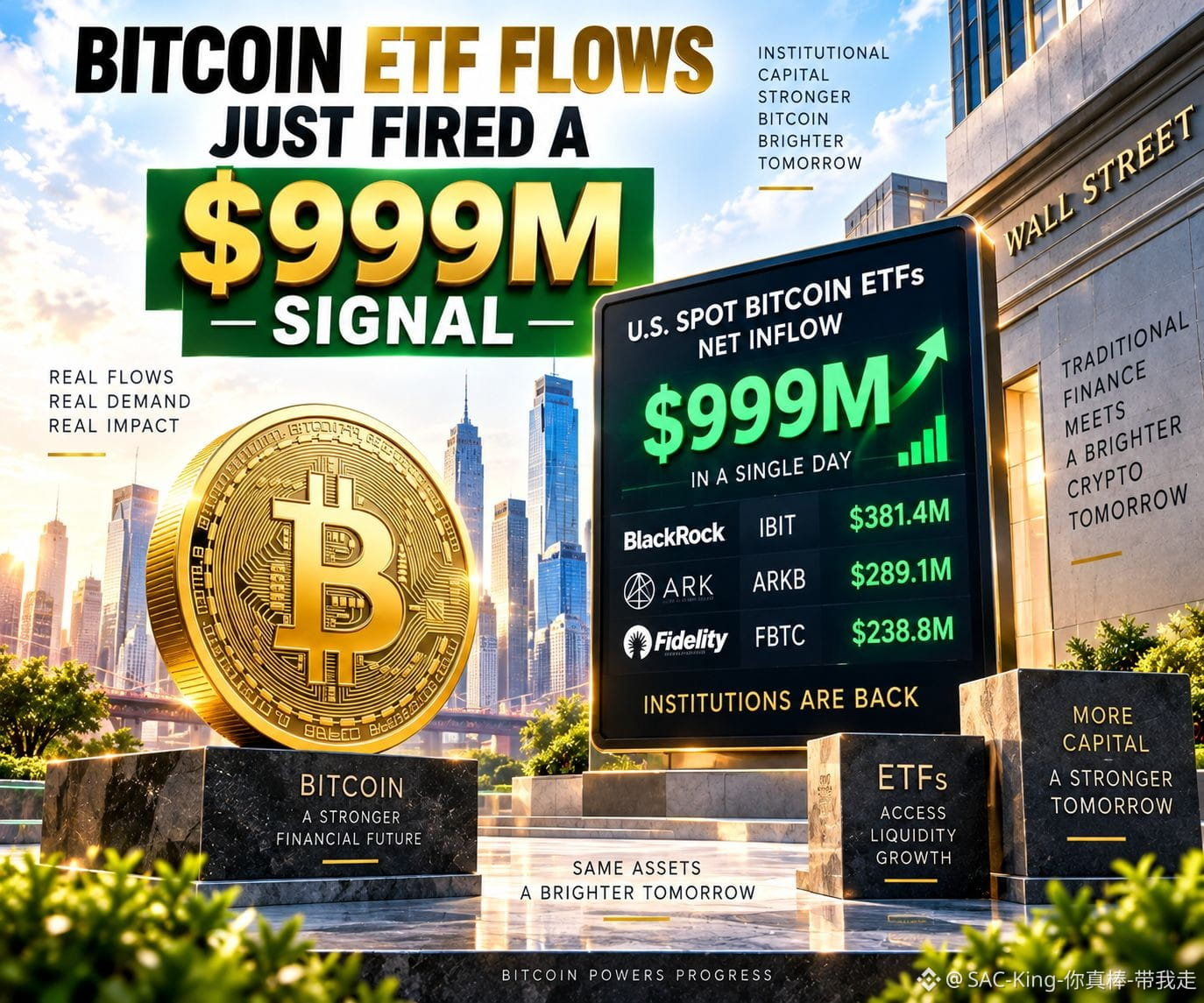
🔥 $BTC BITCOIN ETF FLOWS JUST FIRED A $999M SIGNAL 🚀
Money can whisper for weeks,
then suddenly arrive like a wave nobody can ignore.
U.S. spot Bitcoin ETFs recorded roughly $999 million in net inflows in a single day, their largest daily inflow in 12 months. BlackRock’s IBIT led with $381.4M, followed by ARKB at $289.1M and Fidelity’s FBTC at $238.8M.
My Take: The important part is not simply the size of the number. It is the speed at which institutional-style exposure returned through regulated investment vehicles.
Bitcoin also surged above $86,000 on September 21, with ETF inflows and broader market participation accompanying the move.
That creates an interesting feedback loop: stronger ETF demand can improve market liquidity and sentiment, while rising prices can attract additional attention. But flows can reverse just as quickly.
One huge inflow does not automatically establish a lasting trend. The next sessions matter because sustained inflows would provide stronger evidence that this was more than a one-day burst of demand.
The real signal is simple: capital is returning to Bitcoin through Wall Street’s regulated gateway.
❓Will ETF demand remain strong enough to support this momentum?
Disclaimer: Informational content only, not financial advice. Crypto markets remain highly volatile.
#Bitcoin #BitcoinETF #GrowWithSAC $AKE $AGT
#BitcoinSpotETFs$999MNetInflow
🔥 $BTC BITCOIN ETF FLOWS JUST FIRED A $999M SIGNAL 🚀
Money can whisper for weeks,
then suddenly arrive like a wave nobody can ignore.
U.S. spot Bitcoin ETFs recorded roughly $999 million in net inflows in a single day, their largest daily inflow in 12 months. BlackRock’s IBIT led with $381.4M, followed by ARKB at $289.1M and Fidelity’s FBTC at $238.8M.
My Take: The important part is not simply the size of the number. It is the speed at which institutional-style exposure returned through regulated investment vehicles.
Bitcoin also surged above $86,000 on September 21, with ETF inflows and broader market participation accompanying the move.
That creates an interesting feedback loop: stronger ETF demand can improve market liquidity and sentiment, while rising prices can attract additional attention. But flows can reverse just as quickly.
One huge inflow does not automatically establish a lasting trend. The next sessions matter because sustained inflows would provide stronger evidence that this was more than a one-day burst of demand.
The real signal is simple: capital is returning to Bitcoin through Wall Street’s regulated gateway.
❓Will ETF demand remain strong enough to support this momentum?
Disclaimer: Informational content only, not financial advice. Crypto markets remain highly volatile.
#Bitcoin #BitcoinETF #GrowWithSAC $AKE $AGT
🔥 $BTC BITCOIN ETF FLOWS JUST FIRED A $999M SIGNAL 🚀
Money can whisper for weeks,
then suddenly arrive like a wave nobody can ignore.
U.S. spot Bitcoin ETFs recorded roughly $999 million in net inflows in a single day, their largest daily inflow in 12 months. BlackRock’s IBIT led with $381.4M, followed by ARKB at $289.1M and Fidelity’s FBTC at $238.8M.
My Take: The important part is not simply the size of the number. It is the speed at which institutional-style exposure returned through regulated investment vehicles.
Bitcoin also surged above $86,000 on September 21, with ETF inflows and broader market participation accompanying the move.
That creates an interesting feedback loop: stronger ETF demand can improve market liquidity and sentiment, while rising prices can attract additional attention. But flows can reverse just as quickly.
One huge inflow does not automatically establish a lasting trend. The next sessions matter because sustained inflows would provide stronger evidence that this was more than a one-day burst of demand.
The real signal is simple: capital is returning to Bitcoin through Wall Street’s regulated gateway.
❓Will ETF demand remain strong enough to support this momentum?
Disclaimer: Informational content only, not financial advice. Crypto markets remain highly volatile.
#Bitcoin #BitcoinETF #GrowWithSAC $AKE $AGT
118

·
--
Bitcoin’s move toward $86K has changed the picture for US spot ETF investors. 📈
According to the report, Bitcoin’s latest rally pushed the average US Bitcoin ETF holder back into profit for the first time since January.
The estimated buys-only cost basis is around $81,722, while Bitcoin recently traded near $85K–$86K. That means the recent recovery has erased much of the unrealized loss ETF investors were carrying in September.
But there’s an important detail: ETF demand has not fully recovered yet.
Cumulative net inflows previously peaked around $61.19B before falling to roughly $55.16B. So the price recovery has moved faster than the recovery in ETF flows.
For traders, this creates an interesting question: is BTC strength being driven mainly by price momentum, while institutional demand is still rebuilding?
Do you think ETF flows will catch up with Bitcoin’s price recovery?
#Bitcoin #Crypto #BitcoinETF
$BTC
Bitcoin’s move toward $86K has changed the picture for US spot ETF investors. 📈
According to the report, Bitcoin’s latest rally pushed the average US Bitcoin ETF holder back into profit for the first time since January.
The estimated buys-only cost basis is around $81,722, while Bitcoin recently traded near $85K–$86K. That means the recent recovery has erased much of the unrealized loss ETF investors were carrying in September.
But there’s an important detail: ETF demand has not fully recovered yet.
Cumulative net inflows previously peaked around $61.19B before falling to roughly $55.16B. So the price recovery has moved faster than the recovery in ETF flows.
For traders, this creates an interesting question: is BTC strength being driven mainly by price momentum, while institutional demand is still rebuilding?
Do you think ETF flows will catch up with Bitcoin’s price recovery?
#Bitcoin #Crypto #BitcoinETF
$BTC
According to the report, Bitcoin’s latest rally pushed the average US Bitcoin ETF holder back into profit for the first time since January.
The estimated buys-only cost basis is around $81,722, while Bitcoin recently traded near $85K–$86K. That means the recent recovery has erased much of the unrealized loss ETF investors were carrying in September.
But there’s an important detail: ETF demand has not fully recovered yet.
Cumulative net inflows previously peaked around $61.19B before falling to roughly $55.16B. So the price recovery has moved faster than the recovery in ETF flows.
For traders, this creates an interesting question: is BTC strength being driven mainly by price momentum, while institutional demand is still rebuilding?
Do you think ETF flows will catch up with Bitcoin’s price recovery?
#Bitcoin #Crypto #BitcoinETF
$BTC
1
126

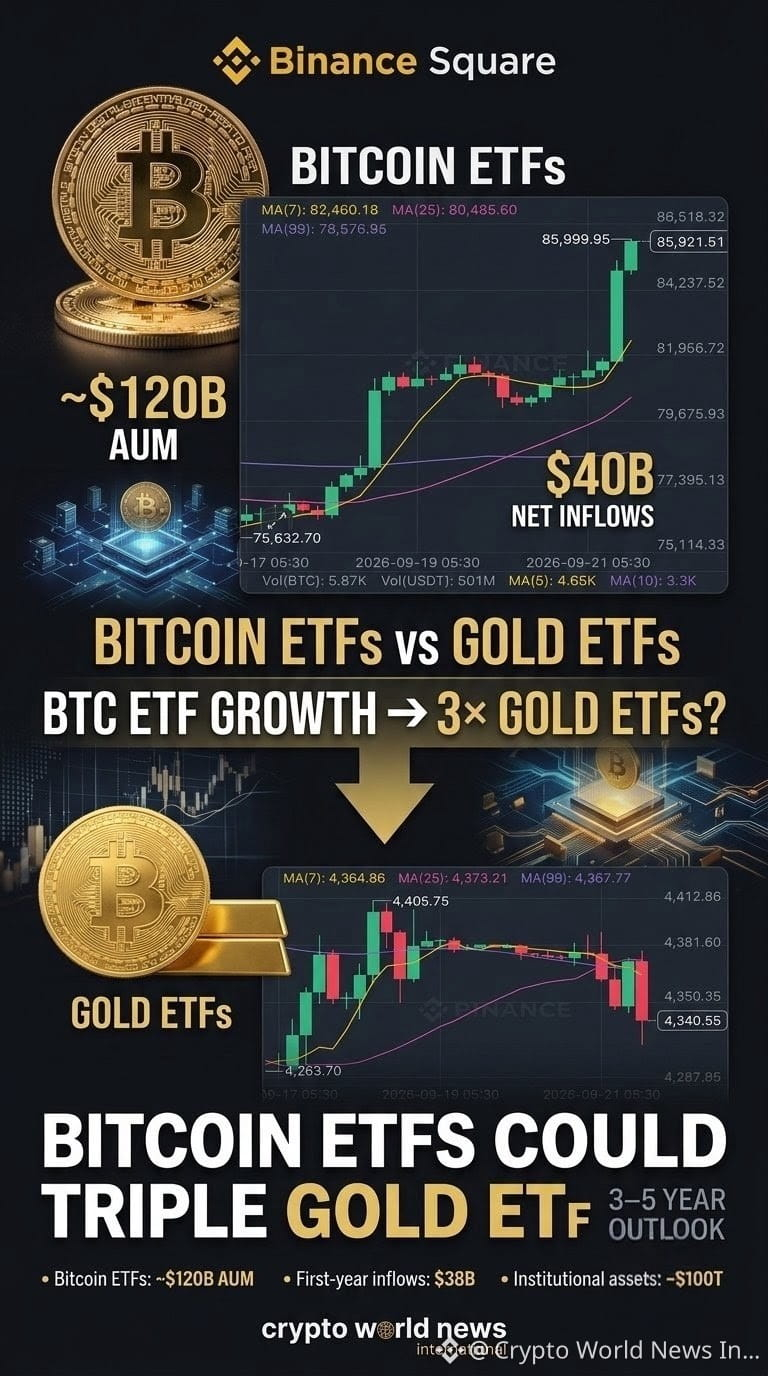
🚨 BITCOIN ETFs COULD TRIPLE GOLD ETFs WITHIN 5 YEARS
Bitcoin ETFs are rapidly closing the gap with gold ETFs. U.S. spot Bitcoin ETFs reached nearly $120B in assets in under two years, a pace that took gold ETFs more than a decade to achieve.
🔑 Key Points:
• Bitcoin ETFs reached nearly $120B AUM
• First-year net inflows: $38B
• Cumulative net inflows later reached about $40B
• Global institutions manage roughly $100T
• A 1% institutional Bitcoin allocation would equal $1T
• Bitcoin supply remains capped at 21M BTC
• Analyst Eric Balchunas says Bitcoin ETFs could potentially reach 3× gold ETF size within 3–5 years
📈 Market Insight:
The key driver is institutional adoption. Spot Bitcoin ETFs provide direct BTC exposure through traditional brokerage accounts, while avoiding the additional leverage and balance-sheet risks associated with Bitcoin treasury companies.
#Bitcoin #BitcoinETF #BinanceSquare #GOLD #GoldETF $BTC $XAU
{future}(XAUUSDT)
{future}(BTCUSDT)
🚨 BITCOIN ETFs COULD TRIPLE GOLD ETFs WITHIN 5 YEARS
Bitcoin ETFs are rapidly closing the gap with gold ETFs. U.S. spot Bitcoin ETFs reached nearly $120B in assets in under two years, a pace that took gold ETFs more than a decade to achieve.
🔑 Key Points:
• Bitcoin ETFs reached nearly $120B AUM
• First-year net inflows: $38B
• Cumulative net inflows later reached about $40B
• Global institutions manage roughly $100T
• A 1% institutional Bitcoin allocation would equal $1T
• Bitcoin supply remains capped at 21M BTC
• Analyst Eric Balchunas says Bitcoin ETFs could potentially reach 3× gold ETF size within 3–5 years
📈 Market Insight:
The key driver is institutional adoption. Spot Bitcoin ETFs provide direct BTC exposure through traditional brokerage accounts, while avoiding the additional leverage and balance-sheet risks associated with Bitcoin treasury companies.
#Bitcoin #BitcoinETF #BinanceSquare #GOLD #GoldETF $BTC $XAU
Bitcoin ETFs are rapidly closing the gap with gold ETFs. U.S. spot Bitcoin ETFs reached nearly $120B in assets in under two years, a pace that took gold ETFs more than a decade to achieve.
🔑 Key Points:
• Bitcoin ETFs reached nearly $120B AUM
• First-year net inflows: $38B
• Cumulative net inflows later reached about $40B
• Global institutions manage roughly $100T
• A 1% institutional Bitcoin allocation would equal $1T
• Bitcoin supply remains capped at 21M BTC
• Analyst Eric Balchunas says Bitcoin ETFs could potentially reach 3× gold ETF size within 3–5 years
📈 Market Insight:
The key driver is institutional adoption. Spot Bitcoin ETFs provide direct BTC exposure through traditional brokerage accounts, while avoiding the additional leverage and balance-sheet risks associated with Bitcoin treasury companies.
#Bitcoin #BitcoinETF #BinanceSquare #GOLD #GoldETF $BTC $XAU
153

·
--
🟢 Bullish
🚨 Bitcoin ETFs See Massive Inflows, Fueling Bullish Sentiment
US spot Bitcoin ETFs pulled in $433M in net inflows on September 18 alone, with Fidelity and BlackRock leading the charge. This indicates strong institutional demand for Bitcoin.
📊 Market Impact: This surge in institutional capital is a huge bullish driver for $BTC, pushing its price above $81,000. Expect continued positive sentiment as more traditional finance players enter the market, potentially driving further rallies across the board.
#BitcoinETF #InstitutionalFlows
🟢 Bullish
🚨 Bitcoin ETFs See Massive Inflows, Fueling Bullish Sentiment
US spot Bitcoin ETFs pulled in $433M in net inflows on September 18 alone, with Fidelity and BlackRock leading the charge. This indicates strong institutional demand for Bitcoin.
📊 Market Impact: This surge in institutional capital is a huge bullish driver for $BTC , pushing its price above $81,000. Expect continued positive sentiment as more traditional finance players enter the market, potentially driving further rallies across the board.
#BitcoinETF #InstitutionalFlows
🚨 Bitcoin ETFs See Massive Inflows, Fueling Bullish Sentiment
US spot Bitcoin ETFs pulled in $433M in net inflows on September 18 alone, with Fidelity and BlackRock leading the charge. This indicates strong institutional demand for Bitcoin.
📊 Market Impact: This surge in institutional capital is a huge bullish driver for $BTC , pushing its price above $81,000. Expect continued positive sentiment as more traditional finance players enter the market, potentially driving further rallies across the board.
#BitcoinETF #InstitutionalFlows
14

·
--
BTC: ETF momentum is positive, but the crowd is heating up
Although today is Sunday and U.S. ETFs are not trading, data from the September 18 session still showed spot BTC ETFs recording approximately +$433M in net inflows (~5.36K BTC), mainly driven by FBTC and IBIT. This is a positive signal for institutional demand, but one large inflow session is not enough to confirm a sustainable capital-flow trend.
Meanwhile, BTC is trading around $80.8K, suggesting that the market still needs to absorb supply as prices recover.
More notably, crowd sentiment has heated up quickly: the Fear & Greed Index is currently in the Greed zone (71). This indicates that the market is shifting from fear toward FOMO, while BTC approaches the resistance area around $81.7K–$83.6K.
🔎 The market is currently being pulled in two opposing directions: ETF/institutional demand: positive
Retail sentiment & leverage: starting to heat up
If ETF inflows continue, spot volume improves, and BTC breaks through the $81.7K–$83.6K resistance zone while leverage remains under control, the bullish structure will be further strengthened.
Conversely, if price is rejected at resistance while OI, funding, and FOMO continue to rise, a long squeeze / shakeout could occur.
Key metrics to monitor during the next U.S. session: ETF Flow + OI + Funding + Liquidations + Spot Volume.
BTC has not delivered a final answer yet. For now, capital flows remain positive, but the crowd is also becoming increasingly greedy. 👀
#Bitcoin #BTC #Crypto #Binance #BitcoinETF $BTC
{spot}(BTCUSDT)
BTC: ETF momentum is positive, but the crowd is heating up
Although today is Sunday and U.S. ETFs are not trading, data from the September 18 session still showed spot BTC ETFs recording approximately +$433M in net inflows (~5.36K BTC), mainly driven by FBTC and IBIT. This is a positive signal for institutional demand, but one large inflow session is not enough to confirm a sustainable capital-flow trend.
Meanwhile, BTC is trading around $80.8K, suggesting that the market still needs to absorb supply as prices recover.
More notably, crowd sentiment has heated up quickly: the Fear & Greed Index is currently in the Greed zone (71). This indicates that the market is shifting from fear toward FOMO, while BTC approaches the resistance area around $81.7K–$83.6K.
🔎 The market is currently being pulled in two opposing directions: ETF/institutional demand: positive
Retail sentiment & leverage: starting to heat up
If ETF inflows continue, spot volume improves, and BTC breaks through the $81.7K–$83.6K resistance zone while leverage remains under control, the bullish structure will be further strengthened.
Conversely, if price is rejected at resistance while OI, funding, and FOMO continue to rise, a long squeeze / shakeout could occur.
Key metrics to monitor during the next U.S. session: ETF Flow + OI + Funding + Liquidations + Spot Volume.
BTC has not delivered a final answer yet. For now, capital flows remain positive, but the crowd is also becoming increasingly greedy. 👀
#Bitcoin #BTC #Crypto #Binance #BitcoinETF $BTC
Although today is Sunday and U.S. ETFs are not trading, data from the September 18 session still showed spot BTC ETFs recording approximately +$433M in net inflows (~5.36K BTC), mainly driven by FBTC and IBIT. This is a positive signal for institutional demand, but one large inflow session is not enough to confirm a sustainable capital-flow trend.
Meanwhile, BTC is trading around $80.8K, suggesting that the market still needs to absorb supply as prices recover.
More notably, crowd sentiment has heated up quickly: the Fear & Greed Index is currently in the Greed zone (71). This indicates that the market is shifting from fear toward FOMO, while BTC approaches the resistance area around $81.7K–$83.6K.
🔎 The market is currently being pulled in two opposing directions: ETF/institutional demand: positive
Retail sentiment & leverage: starting to heat up
If ETF inflows continue, spot volume improves, and BTC breaks through the $81.7K–$83.6K resistance zone while leverage remains under control, the bullish structure will be further strengthened.
Conversely, if price is rejected at resistance while OI, funding, and FOMO continue to rise, a long squeeze / shakeout could occur.
Key metrics to monitor during the next U.S. session: ETF Flow + OI + Funding + Liquidations + Spot Volume.
BTC has not delivered a final answer yet. For now, capital flows remain positive, but the crowd is also becoming increasingly greedy. 👀
#Bitcoin #BTC #Crypto #Binance #BitcoinETF $BTC
1
103
The Fed’s rate hikes show no signs of stopping, yet Bitcoin hits an eight-month high—Wall Street is casting votes with real money
1. Market Overview: A wild celebration against the backdrop of tightening
On September 16, the Federal Reserve unanimously approved a 25-basis-point rate hike, 12–0, raising the federal funds rate to a range of 3.75% to 4.0%. What’s also adding to market tension is that among 17 officials, 16 are expected to raise rates at least once more before the end of the year, pushing back the timeline for inflation to return to the 2% target to 2029.
By conventional logic, such a hawkish signal should weigh on risk assets. However, the crypto market has done the exact opposite. Over the past two days, Bitcoin has surged past $87,000, setting a new eight-month high. U.S. spot Bitcoin ETFs have seen net inflows of more than $1.7 billion in two days, with Monday alone nearly reaching $1 billion—the largest single-day inflow since October 2025. BlackRock’s IBIT fund led the field with inflows of $381 million.
Behind this seemingly contradictory phenomenon is a market structure that is undergoing profound change.
2. Institutional Participation Accelerates: Crypto Assets Are Blending into the Mainstream Financial System
Over the past week, several major pieces of news have landed one after another, painting a clear picture of accelerating institutional capital entering the space.
Binance announced that it will invest $100 million in stablecoin issuer Circle, buying approximately 1.24 million shares at $80.84 per share, and also signing a five-year commercial cooperation agreement to jointly promote the adoption of USDC worldwide. This deal not only deepens the competitive landscape between the stablecoin track and Tether’s USDT, but also marks the formation of a structural alliance between the world’s largest exchange and a U.S. dollar stablecoin issuer.
Meanwhile, the CME Group announced plans to launch Bitcoin Cash and Uniswap futures contracts on October 19, including standard contracts and micro contracts. After the news was released, Bitcoin Cash jumped more than 34% in a single day, while Uniswap rose more than 16%. Both saw weekly gains of over 60%. Traditional finance giants are opening the door to derivatives for crypto assets, meaning the participation threshold for institutional investors is being significantly lowered.
3. Tokenized U.S. Stocks: A Major Trend of Traditional Assets Going On-Chain
Amid the acceleration of integration between crypto markets and traditional finance, tokenized U.S. stocks are becoming a new growth engine. Binance Web3 has already launched multiple tokenized U.S. stock products, including tokenized shares related to companies such as Moderna and Microsoft (the parent company of LinkedIn). The on-chain multiplier is close to 1:1, allowing investors to trade tokenized versions of U.S. stock assets directly through the blockchain.
This trend aligns closely with the buzz in the Square community. Currently, the window for Binance’s most热门 topic tag AIStocksWhatNext has been mentioned over 3,100 times, with more than 1,300 independent authors and total interactions exceeding 5,000, reflecting strong community interest in the intersection of AI and U.S. stocks. In Europe, 21Shares launched Europe’s first Zcash ETP product, further expanding the boundary of crypto assets within traditional financial markets.
4. Macro Outlook: Opportunities and Risks in a High-Interest-Rate Environment
The core contradiction facing the market right now is the sharp contrast between the Fed’s hawkish stance and crypto’s strong rally. Current market pricing indicates that there will still be three more 25-basis-point rate hikes before June 2027. A high interest-rate environment means liquidity continues to tighten, which is theoretically unfavorable for risk assets.
But crypto market resilience comes from several areas. First, sustained inflows into Bitcoin ETFs have created structural buy-side demand, which is fundamentally different from past rallies driven primarily by retail traders. Second, improved institutional-grade infrastructure—including the expansion of CME futures and the gradual clarification of stablecoin regulatory frameworks—enhances confidence for large capital entering the market. Third, the rise of tokenized assets is creating new investment channels, making it easier for traditional finance users to access crypto assets.
Of course, risks cannot be ignored either. Continued rate hikes by the Fed may trigger a liquidity shock at some point in the future. In addition, regulatory uncertainty—especially the failure of the U.S. Senate’s CLARITY Act—means the crypto industry will still face case-by-case regulation by the SEC and CFTC within their existing authorities.
For investors, the strategy in the current environment should be to embrace the trend while controlling position sizes. The institutional wave is an irreversible big direction, but in a high-rate environment, volatility will be amplified significantly. Tracking Bitcoin ETF inflow data, changes in CME open interest/positions, and shifts in stablecoin market size will be key indicators for judging the short-term direction of the market.
#AIStocksWhatNext #BitcoinETF #Tokenized U.S. Stocks
The Fed’s rate hikes show no signs of stopping, yet Bitcoin hits an eight-month high—Wall Street is casting votes with real money
1. Market Overview: A wild celebration against the backdrop of tightening
On September 16, the Federal Reserve unanimously approved a 25-basis-point rate hike, 12–0, raising the federal funds rate to a range of 3.75% to 4.0%. What’s also adding to market tension is that among 17 officials, 16 are expected to raise rates at least once more before the end of the year, pushing back the timeline for inflation to return to the 2% target to 2029.
By conventional logic, such a hawkish signal should weigh on risk assets. However, the crypto market has done the exact opposite. Over the past two days, Bitcoin has surged past $87,000, setting a new eight-month high. U.S. spot Bitcoin ETFs have seen net inflows of more than $1.7 billion in two days, with Monday alone nearly reaching $1 billion—the largest single-day inflow since October 2025. BlackRock’s IBIT fund led the field with inflows of $381 million.
Behind this seemingly contradictory phenomenon is a market structure that is undergoing profound change.
2. Institutional Participation Accelerates: Crypto Assets Are Blending into the Mainstream Financial System
Over the past week, several major pieces of news have landed one after another, painting a clear picture of accelerating institutional capital entering the space.
Binance announced that it will invest $100 million in stablecoin issuer Circle, buying approximately 1.24 million shares at $80.84 per share, and also signing a five-year commercial cooperation agreement to jointly promote the adoption of USDC worldwide. This deal not only deepens the competitive landscape between the stablecoin track and Tether’s USDT, but also marks the formation of a structural alliance between the world’s largest exchange and a U.S. dollar stablecoin issuer.
Meanwhile, the CME Group announced plans to launch Bitcoin Cash and Uniswap futures contracts on October 19, including standard contracts and micro contracts. After the news was released, Bitcoin Cash jumped more than 34% in a single day, while Uniswap rose more than 16%. Both saw weekly gains of over 60%. Traditional finance giants are opening the door to derivatives for crypto assets, meaning the participation threshold for institutional investors is being significantly lowered.
3. Tokenized U.S. Stocks: A Major Trend of Traditional Assets Going On-Chain
Amid the acceleration of integration between crypto markets and traditional finance, tokenized U.S. stocks are becoming a new growth engine. Binance Web3 has already launched multiple tokenized U.S. stock products, including tokenized shares related to companies such as Moderna and Microsoft (the parent company of LinkedIn). The on-chain multiplier is close to 1:1, allowing investors to trade tokenized versions of U.S. stock assets directly through the blockchain.
This trend aligns closely with the buzz in the Square community. Currently, the window for Binance’s most热门 topic tag AIStocksWhatNext has been mentioned over 3,100 times, with more than 1,300 independent authors and total interactions exceeding 5,000, reflecting strong community interest in the intersection of AI and U.S. stocks. In Europe, 21Shares launched Europe’s first Zcash ETP product, further expanding the boundary of crypto assets within traditional financial markets.
4. Macro Outlook: Opportunities and Risks in a High-Interest-Rate Environment
The core contradiction facing the market right now is the sharp contrast between the Fed’s hawkish stance and crypto’s strong rally. Current market pricing indicates that there will still be three more 25-basis-point rate hikes before June 2027. A high interest-rate environment means liquidity continues to tighten, which is theoretically unfavorable for risk assets.
But crypto market resilience comes from several areas. First, sustained inflows into Bitcoin ETFs have created structural buy-side demand, which is fundamentally different from past rallies driven primarily by retail traders. Second, improved institutional-grade infrastructure—including the expansion of CME futures and the gradual clarification of stablecoin regulatory frameworks—enhances confidence for large capital entering the market. Third, the rise of tokenized assets is creating new investment channels, making it easier for traditional finance users to access crypto assets.
Of course, risks cannot be ignored either. Continued rate hikes by the Fed may trigger a liquidity shock at some point in the future. In addition, regulatory uncertainty—especially the failure of the U.S. Senate’s CLARITY Act—means the crypto industry will still face case-by-case regulation by the SEC and CFTC within their existing authorities.
For investors, the strategy in the current environment should be to embrace the trend while controlling position sizes. The institutional wave is an irreversible big direction, but in a high-rate environment, volatility will be amplified significantly. Tracking Bitcoin ETF inflow data, changes in CME open interest/positions, and shifts in stablecoin market size will be key indicators for judging the short-term direction of the market.
#AIStocksWhatNext #BitcoinETF #Tokenized U.S. Stocks
1. Market Overview: A wild celebration against the backdrop of tightening
On September 16, the Federal Reserve unanimously approved a 25-basis-point rate hike, 12–0, raising the federal funds rate to a range of 3.75% to 4.0%. What’s also adding to market tension is that among 17 officials, 16 are expected to raise rates at least once more before the end of the year, pushing back the timeline for inflation to return to the 2% target to 2029.
By conventional logic, such a hawkish signal should weigh on risk assets. However, the crypto market has done the exact opposite. Over the past two days, Bitcoin has surged past $87,000, setting a new eight-month high. U.S. spot Bitcoin ETFs have seen net inflows of more than $1.7 billion in two days, with Monday alone nearly reaching $1 billion—the largest single-day inflow since October 2025. BlackRock’s IBIT fund led the field with inflows of $381 million.
Behind this seemingly contradictory phenomenon is a market structure that is undergoing profound change.
2. Institutional Participation Accelerates: Crypto Assets Are Blending into the Mainstream Financial System
Over the past week, several major pieces of news have landed one after another, painting a clear picture of accelerating institutional capital entering the space.
Binance announced that it will invest $100 million in stablecoin issuer Circle, buying approximately 1.24 million shares at $80.84 per share, and also signing a five-year commercial cooperation agreement to jointly promote the adoption of USDC worldwide. This deal not only deepens the competitive landscape between the stablecoin track and Tether’s USDT, but also marks the formation of a structural alliance between the world’s largest exchange and a U.S. dollar stablecoin issuer.
Meanwhile, the CME Group announced plans to launch Bitcoin Cash and Uniswap futures contracts on October 19, including standard contracts and micro contracts. After the news was released, Bitcoin Cash jumped more than 34% in a single day, while Uniswap rose more than 16%. Both saw weekly gains of over 60%. Traditional finance giants are opening the door to derivatives for crypto assets, meaning the participation threshold for institutional investors is being significantly lowered.
3. Tokenized U.S. Stocks: A Major Trend of Traditional Assets Going On-Chain
Amid the acceleration of integration between crypto markets and traditional finance, tokenized U.S. stocks are becoming a new growth engine. Binance Web3 has already launched multiple tokenized U.S. stock products, including tokenized shares related to companies such as Moderna and Microsoft (the parent company of LinkedIn). The on-chain multiplier is close to 1:1, allowing investors to trade tokenized versions of U.S. stock assets directly through the blockchain.
This trend aligns closely with the buzz in the Square community. Currently, the window for Binance’s most热门 topic tag AIStocksWhatNext has been mentioned over 3,100 times, with more than 1,300 independent authors and total interactions exceeding 5,000, reflecting strong community interest in the intersection of AI and U.S. stocks. In Europe, 21Shares launched Europe’s first Zcash ETP product, further expanding the boundary of crypto assets within traditional financial markets.
4. Macro Outlook: Opportunities and Risks in a High-Interest-Rate Environment
The core contradiction facing the market right now is the sharp contrast between the Fed’s hawkish stance and crypto’s strong rally. Current market pricing indicates that there will still be three more 25-basis-point rate hikes before June 2027. A high interest-rate environment means liquidity continues to tighten, which is theoretically unfavorable for risk assets.
But crypto market resilience comes from several areas. First, sustained inflows into Bitcoin ETFs have created structural buy-side demand, which is fundamentally different from past rallies driven primarily by retail traders. Second, improved institutional-grade infrastructure—including the expansion of CME futures and the gradual clarification of stablecoin regulatory frameworks—enhances confidence for large capital entering the market. Third, the rise of tokenized assets is creating new investment channels, making it easier for traditional finance users to access crypto assets.
Of course, risks cannot be ignored either. Continued rate hikes by the Fed may trigger a liquidity shock at some point in the future. In addition, regulatory uncertainty—especially the failure of the U.S. Senate’s CLARITY Act—means the crypto industry will still face case-by-case regulation by the SEC and CFTC within their existing authorities.
For investors, the strategy in the current environment should be to embrace the trend while controlling position sizes. The institutional wave is an irreversible big direction, but in a high-rate environment, volatility will be amplified significantly. Tracking Bitcoin ETF inflow data, changes in CME open interest/positions, and shifts in stablecoin market size will be key indicators for judging the short-term direction of the market.
#AIStocksWhatNext #BitcoinETF #Tokenized U.S. Stocks
23
Federal Reserve rate hikes didn’t curb the crypto frenzy; institutional capital swept up $1.7 billion in Bitcoin ETFs in two days
1. Macroeconomic backdrop: the Fed’s hawkish stance is confirmed, yet the market charts its own path
On September 16, the Federal Reserve passed another interest-rate hike by a unanimous vote of twelve to zero, raising the federal funds rate by 25 basis points to a range of 3.75% to 4.0%. More importantly, of the 17 officials, 16 are expected to hike at least once more before year-end, pushing back the timeline for inflation to return to the 2% target to 2029. Current market pricing indicates there will be three more 25-basis-point hikes before June 2027.
However, the crypto market has not moved lower under pressure the way traditional financial markets have. After the rate-hike announcement, Bitcoin rose rather than fell, breaking through $87,000 and hitting a new eight-month high. According to Santiment, the market’s FOMO sentiment indicator has reached its highest level since 2024. This divergence from traditional macro logic reflects that crypto assets are forming their own pricing logic.
2. Institutions accelerate into the market; Bitcoin ETFs pull in $1.7 billion in two days
The core force behind this rally comes from the institutional side. U.S. spot Bitcoin ETFs recorded more than $1.7 billion in net inflows over two trading days. On Monday alone, inflows were close to $1 billion, setting the largest single-day inflow record since October 2025. BlackRock’s IBIT fund led the pack again with $381 million in inflows, further underscoring that traditional asset-management giants are stepping up their plans in crypto.
At the same time, Binance announced a $100 million investment in Circle, buying roughly 1.24 million shares at $80.84 per share, and signing a five-year commercial agreement to promote the USDC stablecoin globally. This deal not only deepens competitive dynamics in the stablecoin space, but also marks the emergence of a structural alliance between the world’s largest exchange and the issuer of a U.S. dollar stablecoin.
3. CME expands derivatives landscape; BCH and UNI to be listed in October
Another key sign of institutionalization comes from the derivatives market. The Chicago Mercantile Exchange announced plans to launch futures contracts for Bitcoin Cash and Uniswap on October 19, including standard and mini contracts, which are currently awaiting regulatory approval. After the news broke, BCH surged more than 34% within 24 hours, while UNI rose more than 16%; both posted weekly gains of over 60%.
This suggests that traditional financial infrastructure is continuously opening the door wider to crypto assets. From Bitcoin and Ethereum to BCH and UNI today, the map of crypto assets available for institutional trading keeps expanding, creating pathways for more compliant capital to enter.
4. Tokenized U.S. stocks quietly rise; on-chain trading of traditional assets becomes a new trend
Against the backdrop of accelerating integration between crypto markets and traditional finance, tokenized U.S. stocks are becoming a new growth point. On Binance’s Web3 platform, multiple tokenized U.S. stock products are already live, covering emerging-market ETFs and well-known names such as Moderna. Investors can trade traditional U.S. stock assets on-chain 24/7. The U.S. stock token price data shows that TAKE token gained 2.36% in a single day, with trading volume exceeding 246 million USDT; MET token rose 0.38%, indicating that on-chain trading of U.S. stocks is gaining increasing liquidity.
This trend also intersects interestingly with the current investment hype around AI. The “AIStocksWhatNext” popular topic hashtag on the Square platform has accumulated over 630,000 views, with more than 1,300 users participating in the discussion—reflecting the market’s strong interest in the intersection of AI and U.S. stocks. Tokenization technology allows global investors to participate in U.S. stocks and AI concept stocks with lower barriers and greater flexibility.
5. Ongoing regulatory power struggle; the market searches for direction amid uncertainty
The CLARITY bill in the U.S. Senate failed to pass, with a vote of 49 to 50, still short of the 60-vote threshold. White House crypto advisers and Treasury officials have indicated that the bill is unlikely to pass during this congressional session. Regulatory focus will shift toward enforcement actions by the SEC and CFTC under their existing authorities.
Interestingly, the crypto market rose after this news. Analysts believe that regulatory delay may actually provide decentralized assets with more room to operate. In an environment of continued Fed rate hikes and pressure on traditional financial markets, crypto assets are charting an impressive independent course with three main lines: institutional entry, product innovation, and on-chain tokenization of U.S. stocks.
#AIStocksWhatNext #BitcoinETF #Tokenized U.S. stocks
Federal Reserve rate hikes didn’t curb the crypto frenzy; institutional capital swept up $1.7 billion in Bitcoin ETFs in two days
1. Macroeconomic backdrop: the Fed’s hawkish stance is confirmed, yet the market charts its own path
On September 16, the Federal Reserve passed another interest-rate hike by a unanimous vote of twelve to zero, raising the federal funds rate by 25 basis points to a range of 3.75% to 4.0%. More importantly, of the 17 officials, 16 are expected to hike at least once more before year-end, pushing back the timeline for inflation to return to the 2% target to 2029. Current market pricing indicates there will be three more 25-basis-point hikes before June 2027.
However, the crypto market has not moved lower under pressure the way traditional financial markets have. After the rate-hike announcement, Bitcoin rose rather than fell, breaking through $87,000 and hitting a new eight-month high. According to Santiment, the market’s FOMO sentiment indicator has reached its highest level since 2024. This divergence from traditional macro logic reflects that crypto assets are forming their own pricing logic.
2. Institutions accelerate into the market; Bitcoin ETFs pull in $1.7 billion in two days
The core force behind this rally comes from the institutional side. U.S. spot Bitcoin ETFs recorded more than $1.7 billion in net inflows over two trading days. On Monday alone, inflows were close to $1 billion, setting the largest single-day inflow record since October 2025. BlackRock’s IBIT fund led the pack again with $381 million in inflows, further underscoring that traditional asset-management giants are stepping up their plans in crypto.
At the same time, Binance announced a $100 million investment in Circle, buying roughly 1.24 million shares at $80.84 per share, and signing a five-year commercial agreement to promote the USDC stablecoin globally. This deal not only deepens competitive dynamics in the stablecoin space, but also marks the emergence of a structural alliance between the world’s largest exchange and the issuer of a U.S. dollar stablecoin.
3. CME expands derivatives landscape; BCH and UNI to be listed in October
Another key sign of institutionalization comes from the derivatives market. The Chicago Mercantile Exchange announced plans to launch futures contracts for Bitcoin Cash and Uniswap on October 19, including standard and mini contracts, which are currently awaiting regulatory approval. After the news broke, BCH surged more than 34% within 24 hours, while UNI rose more than 16%; both posted weekly gains of over 60%.
This suggests that traditional financial infrastructure is continuously opening the door wider to crypto assets. From Bitcoin and Ethereum to BCH and UNI today, the map of crypto assets available for institutional trading keeps expanding, creating pathways for more compliant capital to enter.
4. Tokenized U.S. stocks quietly rise; on-chain trading of traditional assets becomes a new trend
Against the backdrop of accelerating integration between crypto markets and traditional finance, tokenized U.S. stocks are becoming a new growth point. On Binance’s Web3 platform, multiple tokenized U.S. stock products are already live, covering emerging-market ETFs and well-known names such as Moderna. Investors can trade traditional U.S. stock assets on-chain 24/7. The U.S. stock token price data shows that TAKE token gained 2.36% in a single day, with trading volume exceeding 246 million USDT; MET token rose 0.38%, indicating that on-chain trading of U.S. stocks is gaining increasing liquidity.
This trend also intersects interestingly with the current investment hype around AI. The “AIStocksWhatNext” popular topic hashtag on the Square platform has accumulated over 630,000 views, with more than 1,300 users participating in the discussion—reflecting the market’s strong interest in the intersection of AI and U.S. stocks. Tokenization technology allows global investors to participate in U.S. stocks and AI concept stocks with lower barriers and greater flexibility.
5. Ongoing regulatory power struggle; the market searches for direction amid uncertainty
The CLARITY bill in the U.S. Senate failed to pass, with a vote of 49 to 50, still short of the 60-vote threshold. White House crypto advisers and Treasury officials have indicated that the bill is unlikely to pass during this congressional session. Regulatory focus will shift toward enforcement actions by the SEC and CFTC under their existing authorities.
Interestingly, the crypto market rose after this news. Analysts believe that regulatory delay may actually provide decentralized assets with more room to operate. In an environment of continued Fed rate hikes and pressure on traditional financial markets, crypto assets are charting an impressive independent course with three main lines: institutional entry, product innovation, and on-chain tokenization of U.S. stocks.
#AIStocksWhatNext #BitcoinETF #Tokenized U.S. stocks
1. Macroeconomic backdrop: the Fed’s hawkish stance is confirmed, yet the market charts its own path
On September 16, the Federal Reserve passed another interest-rate hike by a unanimous vote of twelve to zero, raising the federal funds rate by 25 basis points to a range of 3.75% to 4.0%. More importantly, of the 17 officials, 16 are expected to hike at least once more before year-end, pushing back the timeline for inflation to return to the 2% target to 2029. Current market pricing indicates there will be three more 25-basis-point hikes before June 2027.
However, the crypto market has not moved lower under pressure the way traditional financial markets have. After the rate-hike announcement, Bitcoin rose rather than fell, breaking through $87,000 and hitting a new eight-month high. According to Santiment, the market’s FOMO sentiment indicator has reached its highest level since 2024. This divergence from traditional macro logic reflects that crypto assets are forming their own pricing logic.
2. Institutions accelerate into the market; Bitcoin ETFs pull in $1.7 billion in two days
The core force behind this rally comes from the institutional side. U.S. spot Bitcoin ETFs recorded more than $1.7 billion in net inflows over two trading days. On Monday alone, inflows were close to $1 billion, setting the largest single-day inflow record since October 2025. BlackRock’s IBIT fund led the pack again with $381 million in inflows, further underscoring that traditional asset-management giants are stepping up their plans in crypto.
At the same time, Binance announced a $100 million investment in Circle, buying roughly 1.24 million shares at $80.84 per share, and signing a five-year commercial agreement to promote the USDC stablecoin globally. This deal not only deepens competitive dynamics in the stablecoin space, but also marks the emergence of a structural alliance between the world’s largest exchange and the issuer of a U.S. dollar stablecoin.
3. CME expands derivatives landscape; BCH and UNI to be listed in October
Another key sign of institutionalization comes from the derivatives market. The Chicago Mercantile Exchange announced plans to launch futures contracts for Bitcoin Cash and Uniswap on October 19, including standard and mini contracts, which are currently awaiting regulatory approval. After the news broke, BCH surged more than 34% within 24 hours, while UNI rose more than 16%; both posted weekly gains of over 60%.
This suggests that traditional financial infrastructure is continuously opening the door wider to crypto assets. From Bitcoin and Ethereum to BCH and UNI today, the map of crypto assets available for institutional trading keeps expanding, creating pathways for more compliant capital to enter.
4. Tokenized U.S. stocks quietly rise; on-chain trading of traditional assets becomes a new trend
Against the backdrop of accelerating integration between crypto markets and traditional finance, tokenized U.S. stocks are becoming a new growth point. On Binance’s Web3 platform, multiple tokenized U.S. stock products are already live, covering emerging-market ETFs and well-known names such as Moderna. Investors can trade traditional U.S. stock assets on-chain 24/7. The U.S. stock token price data shows that TAKE token gained 2.36% in a single day, with trading volume exceeding 246 million USDT; MET token rose 0.38%, indicating that on-chain trading of U.S. stocks is gaining increasing liquidity.
This trend also intersects interestingly with the current investment hype around AI. The “AIStocksWhatNext” popular topic hashtag on the Square platform has accumulated over 630,000 views, with more than 1,300 users participating in the discussion—reflecting the market’s strong interest in the intersection of AI and U.S. stocks. Tokenization technology allows global investors to participate in U.S. stocks and AI concept stocks with lower barriers and greater flexibility.
5. Ongoing regulatory power struggle; the market searches for direction amid uncertainty
The CLARITY bill in the U.S. Senate failed to pass, with a vote of 49 to 50, still short of the 60-vote threshold. White House crypto advisers and Treasury officials have indicated that the bill is unlikely to pass during this congressional session. Regulatory focus will shift toward enforcement actions by the SEC and CFTC under their existing authorities.
Interestingly, the crypto market rose after this news. Analysts believe that regulatory delay may actually provide decentralized assets with more room to operate. In an environment of continued Fed rate hikes and pressure on traditional financial markets, crypto assets are charting an impressive independent course with three main lines: institutional entry, product innovation, and on-chain tokenization of U.S. stocks.
#AIStocksWhatNext #BitcoinETF #Tokenized U.S. stocks
19

·
--
Bitcoin ETF saw a frenzy, pulling in $1.7B in just two days, as the BTC price broke above investors' average cost basis! Big funds are rushing in on foot, and market sentiment is blazing hot. $BTC #BitcoinETF #CryptoBull
Bitcoin ETFs raked in $1.7B in just 2 days as BTC price surged past holders' average cost basis. Big money is flooding in and market sentiment is 🔥. $BTC #BitcoinETF #CryptoBull
Bitcoin ETF saw a frenzy, pulling in $1.7B in just two days, as the BTC price broke above investors' average cost basis! Big funds are rushing in on foot, and market sentiment is blazing hot. $BTC #BitcoinETF #CryptoBull
Bitcoin ETFs raked in $1.7B in just 2 days as BTC price surged past holders' average cost basis. Big money is flooding in and market sentiment is 🔥. $BTC #BitcoinETF #CryptoBull
Bitcoin ETFs raked in $1.7B in just 2 days as BTC price surged past holders' average cost basis. Big money is flooding in and market sentiment is 🔥. $BTC #BitcoinETF #CryptoBull
114
·
--
Money is back! Bitcoin ETFs attracted nearly $1B in a single day—more than the entire previous week! Average holders are already in profit. Looks like big money is quietly stepping back in! #BitcoinETF #Crypto $BTC
Big money flowing back! Bitcoin ETFs pull in nearly $1B in a single day, more than the entire previous week when they hit record low inflows. Average holders back in profit now. #BitcoinETF #Crypto $BTC
Money is back! Bitcoin ETFs attracted nearly $1B in a single day—more than the entire previous week! Average holders are already in profit. Looks like big money is quietly stepping back in! #BitcoinETF #Crypto $BTC
Big money flowing back! Bitcoin ETFs pull in nearly $1B in a single day, more than the entire previous week when they hit record low inflows. Average holders back in profit now. #BitcoinETF #Crypto $BTC
Big money flowing back! Bitcoin ETFs pull in nearly $1B in a single day, more than the entire previous week when they hit record low inflows. Average holders back in profit now. #BitcoinETF #Crypto $BTC
106

·
--
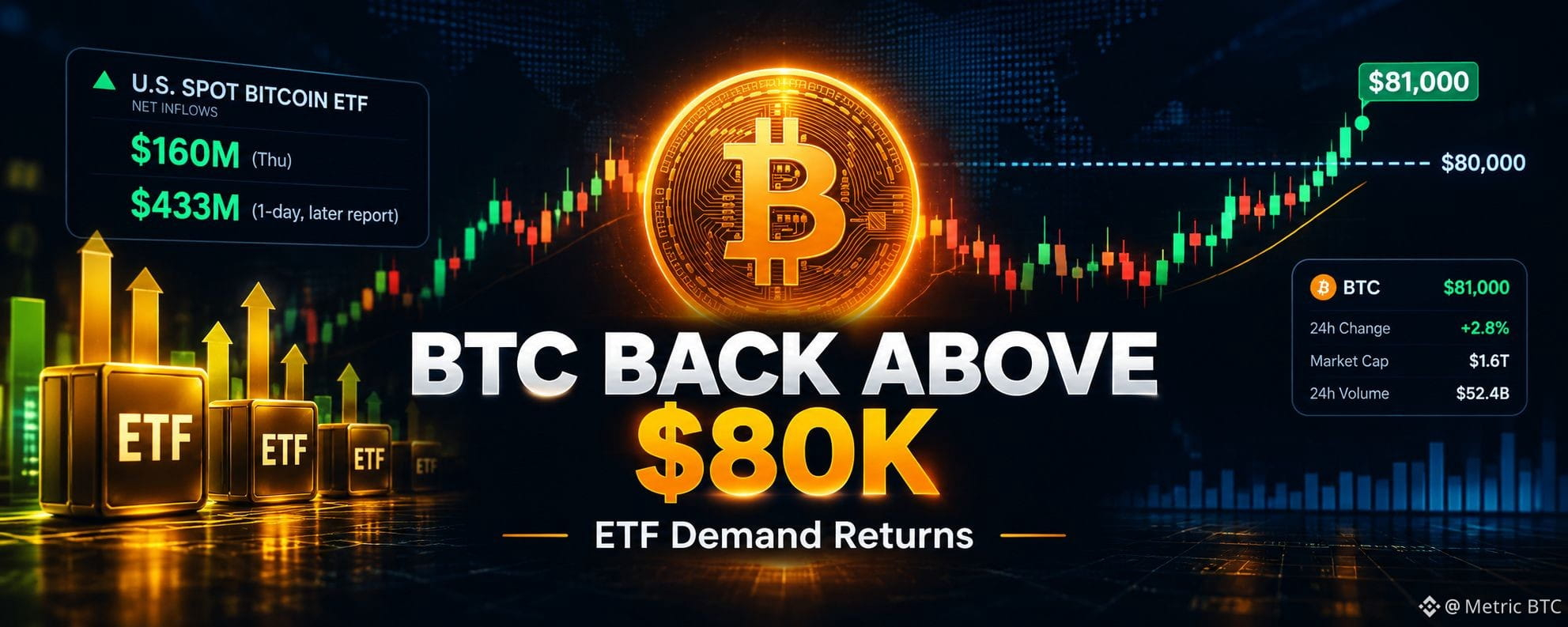
Article
🚨 Bitcoin Reclaims $80K: Is Institutional Demand Returning?Bitcoin has once again pushed back above the $80,000 level, putting the market's attention on one major question: can BTC maintain this momentum?
On September 18, U.S. spot Bitcoin ETFs recorded approximately $433 million in net inflows, led by Fidelity's FBTC with about $310.7 million and BlackRock's IBIT with about $108.4 million. �
The Block +1
📊 Why the ETF Flow Matters
ETF flows are an important indicator of institutional demand. The latest weekly data shows that Bitcoin ETFs finished the week with only about $6.2 million in net inflows, because strong Friday buying offset substantial outflows earlier in the week. �
The Block
This means the market isn't seeing a simple one-way buying trend yet. Instead, institutional demand remains volatile, with investors reacting to macroeconomic and regulatory developments.
🏦 Macro + Regulation
Bitcoin's recovery happened despite two major developments earlier in the week:
The U.S. Senate failed to advance the CLARITY Act.
The Federal Reserve raised interest rates by 25 basis points. �
24/7 Wall St. +1
Despite these developments, BTC recovered above $80K, showing that price action and investor flows can sometimes diverge from the immediate news narrative.
🎯 Levels Traders Are Watching
The $80,000 area has become an important psychological level after BTC reclaimed it.
The next major area discussed by recent market coverage is around $82,000–$83,000, where Bitcoin previously encountered selling pressure. �
CryptoRank +1
For traders, the key things to watch are:
Bullish confirmation:
BTC holds above $80K and ETF inflows remain positive.
Resistance:
$82K–$83K remains an important area to monitor.
Risk:
A rejection from resistance combined with renewed ETF outflows could increase short-term volatility.
🔥 What About Altcoins?
Bitcoin isn't the only interesting story. Recent data shows Solana ETFs have recorded 12 consecutive weeks of inflows, while Bitcoin's weekly ETF inflow was relatively small. �
24/7 Wall St.
That divergence is worth watching because sustained institutional interest in BTC and SOL could influence broader crypto-market liquidity.
Final Takeaway
Bitcoin's move back above $80K is significant, but one strong ETF inflow day doesn't confirm a sustained trend by itself. The combination of price holding above $80K, future ETF flows, and the reaction around $82K–$83K may provide a clearer picture of the market's next phase.
What are you watching right now — BTC $83K breakout, a rejection, or rotation into altcoins? 👇
#CryptoNews #BitcoinETF #Ethereum #Solan #Binance
🚨 Bitcoin Reclaims $80K: Is Institutional Demand Returning?
Bitcoin has once again pushed back above the $80,000 level, putting the market's attention on one major question: can BTC maintain this momentum?
On September 18, U.S. spot Bitcoin ETFs recorded approximately $433 million in net inflows, led by Fidelity's FBTC with about $310.7 million and BlackRock's IBIT with about $108.4 million. �
The Block +1
📊 Why the ETF Flow Matters
ETF flows are an important indicator of institutional demand. The latest weekly data shows that Bitcoin ETFs finished the week with only about $6.2 million in net inflows, because strong Friday buying offset substantial outflows earlier in the week. �
The Block
This means the market isn't seeing a simple one-way buying trend yet. Instead, institutional demand remains volatile, with investors reacting to macroeconomic and regulatory developments.
🏦 Macro + Regulation
Bitcoin's recovery happened despite two major developments earlier in the week:
The U.S. Senate failed to advance the CLARITY Act.
The Federal Reserve raised interest rates by 25 basis points. �
24/7 Wall St. +1
Despite these developments, BTC recovered above $80K, showing that price action and investor flows can sometimes diverge from the immediate news narrative.
🎯 Levels Traders Are Watching
The $80,000 area has become an important psychological level after BTC reclaimed it.
The next major area discussed by recent market coverage is around $82,000–$83,000, where Bitcoin previously encountered selling pressure. �
CryptoRank +1
For traders, the key things to watch are:
Bullish confirmation:
BTC holds above $80K and ETF inflows remain positive.
Resistance:
$82K–$83K remains an important area to monitor.
Risk:
A rejection from resistance combined with renewed ETF outflows could increase short-term volatility.
🔥 What About Altcoins?
Bitcoin isn't the only interesting story. Recent data shows Solana ETFs have recorded 12 consecutive weeks of inflows, while Bitcoin's weekly ETF inflow was relatively small. �
24/7 Wall St.
That divergence is worth watching because sustained institutional interest in BTC and SOL could influence broader crypto-market liquidity.
Final Takeaway
Bitcoin's move back above $80K is significant, but one strong ETF inflow day doesn't confirm a sustained trend by itself. The combination of price holding above $80K, future ETF flows, and the reaction around $82K–$83K may provide a clearer picture of the market's next phase.
What are you watching right now — BTC $83K breakout, a rejection, or rotation into altcoins? 👇
#CryptoNews #BitcoinETF #Ethereum #Solan #Binance
On September 18, U.S. spot Bitcoin ETFs recorded approximately $433 million in net inflows, led by Fidelity's FBTC with about $310.7 million and BlackRock's IBIT with about $108.4 million. �
The Block +1
📊 Why the ETF Flow Matters
ETF flows are an important indicator of institutional demand. The latest weekly data shows that Bitcoin ETFs finished the week with only about $6.2 million in net inflows, because strong Friday buying offset substantial outflows earlier in the week. �
The Block
This means the market isn't seeing a simple one-way buying trend yet. Instead, institutional demand remains volatile, with investors reacting to macroeconomic and regulatory developments.
🏦 Macro + Regulation
Bitcoin's recovery happened despite two major developments earlier in the week:
The U.S. Senate failed to advance the CLARITY Act.
The Federal Reserve raised interest rates by 25 basis points. �
24/7 Wall St. +1
Despite these developments, BTC recovered above $80K, showing that price action and investor flows can sometimes diverge from the immediate news narrative.
🎯 Levels Traders Are Watching
The $80,000 area has become an important psychological level after BTC reclaimed it.
The next major area discussed by recent market coverage is around $82,000–$83,000, where Bitcoin previously encountered selling pressure. �
CryptoRank +1
For traders, the key things to watch are:
Bullish confirmation:
BTC holds above $80K and ETF inflows remain positive.
Resistance:
$82K–$83K remains an important area to monitor.
Risk:
A rejection from resistance combined with renewed ETF outflows could increase short-term volatility.
🔥 What About Altcoins?
Bitcoin isn't the only interesting story. Recent data shows Solana ETFs have recorded 12 consecutive weeks of inflows, while Bitcoin's weekly ETF inflow was relatively small. �
24/7 Wall St.
That divergence is worth watching because sustained institutional interest in BTC and SOL could influence broader crypto-market liquidity.
Final Takeaway
Bitcoin's move back above $80K is significant, but one strong ETF inflow day doesn't confirm a sustained trend by itself. The combination of price holding above $80K, future ETF flows, and the reaction around $82K–$83K may provide a clearer picture of the market's next phase.
What are you watching right now — BTC $83K breakout, a rejection, or rotation into altcoins? 👇
#CryptoNews #BitcoinETF #Ethereum #Solan #Binance
1
1
140
Log in to explore more content
Join global crypto users on Binance Square
⚡️ Get latest and useful information about crypto.
💬 Trusted by the world’s largest crypto exchange.
👍 Discover real insights from verified creators.
Email / Phone number
Trending Topics
1
#AIStocksWhatNext
718,082 views
5,368 Discussing
2
#21SharesLaunchesEuropesFirstZcashETP
20,656 views
691 Discussing
3
#CardanoJoinsX402PaymentStandard
14,467 views
523 Discussing
4
#BitcoinTops$87KAtEightMonthHigh
9,571 views
107 Discussing
5
#ZECBreaksAbove$1600AtRecordHigh
5,231 views
87 Discussing
6
#BitwiseNEARStakingETPAssetsTop$100M
33,529 views
90 Discussing
7
#BitcoinBreaksAboveMayHighNears$86K
29,770 views
268 Discussing
8
#DogecoinRises15%
114,993 views
1,911 Discussing
9
#$14BBitcoinOptionsExpireFriday
8,317 views
111 Discussing
10
#BNBMarketCapPassesBNYMellon
74,877 views
1,582 Discussing