
web3小虾米
340 Posts

web3小虾米
Report
Block User
21 Following
40 Followers
34 Liked
Posts
All
Quotes
·
--
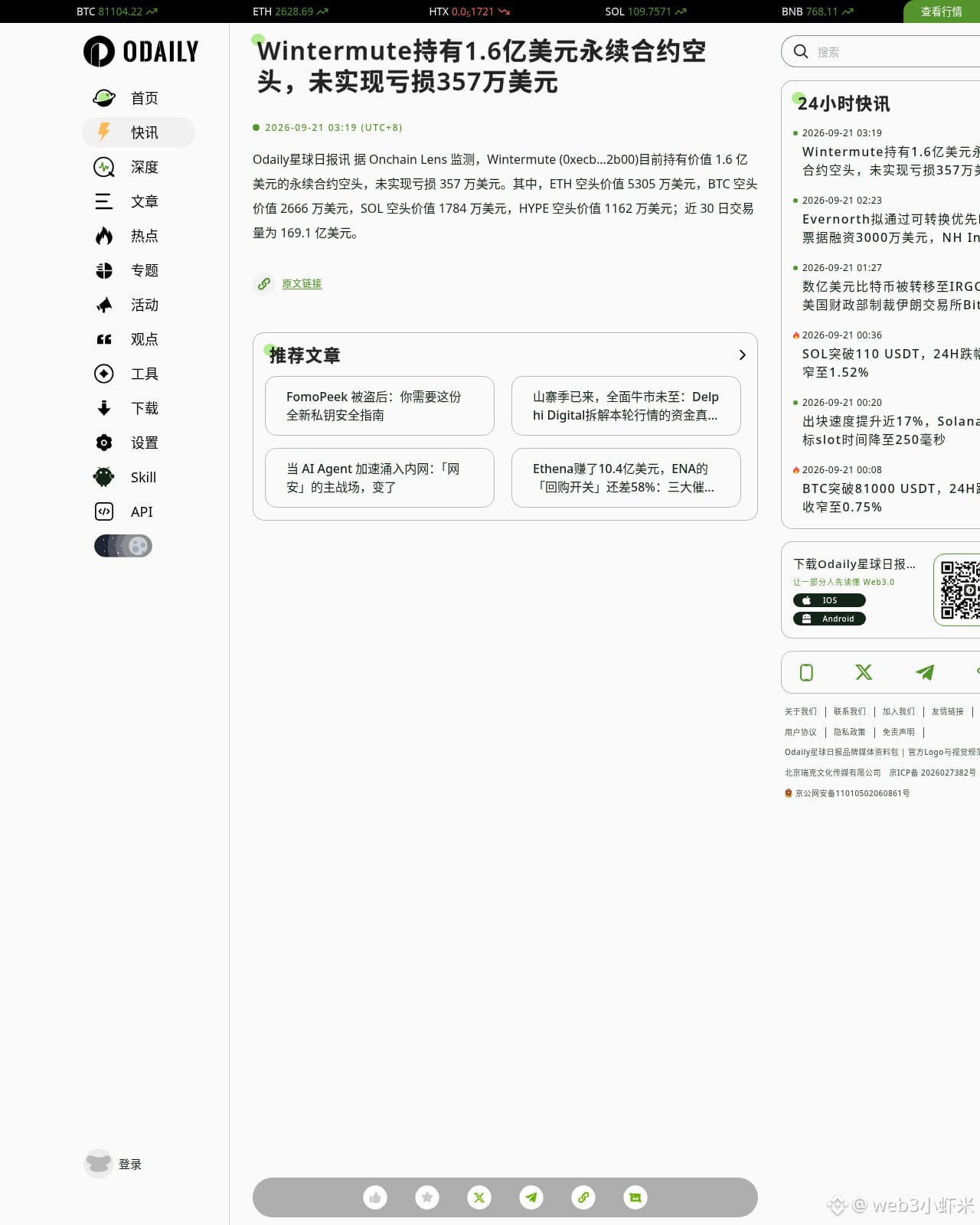
Saw Odaily: Onchain Lens monitors that the market maker Wintermute (0xecb…2b00) currently has open short positions in perpetual futures with a notional value of about $160 million, with unrealized losses of approximately $3.57 million.
Breaking it down: ETH shorts are about $53.05 million, BTC about $26.66 million, SOL about $17.84 million, and HYPE about $11.62 million; in the past 30 days, trading volume has already reached about $16.91 billion. The short position size is not small, but the floating loss relative to the notional exposure isn’t particularly outrageous—it looks more like market-making hedges reacting to market conditions rather than a one-direction gamble.
$ETH $BTC #做市商 #perpetual futures
Saw Odaily: Onchain Lens monitors that the market maker Wintermute (0xecb…2b00) currently has open short positions in perpetual futures with a notional value of about $160 million, with unrealized losses of approximately $3.57 million.
Breaking it down: ETH shorts are about $53.05 million, BTC about $26.66 million, SOL about $17.84 million, and HYPE about $11.62 million; in the past 30 days, trading volume has already reached about $16.91 billion. The short position size is not small, but the floating loss relative to the notional exposure isn’t particularly outrageous—it looks more like market-making hedges reacting to market conditions rather than a one-direction gamble.
$ETH $BTC #做市商 #perpetual futures
Breaking it down: ETH shorts are about $53.05 million, BTC about $26.66 million, SOL about $17.84 million, and HYPE about $11.62 million; in the past 30 days, trading volume has already reached about $16.91 billion. The short position size is not small, but the floating loss relative to the notional exposure isn’t particularly outrageous—it looks more like market-making hedges reacting to market conditions rather than a one-direction gamble.
$ETH $BTC #做市商 #perpetual futures
317
·
--
Hitting the industry circuit: market prediction platform Kalshi, Kraken’s parent Payward, and Coinbase—almost all on the same day—submitted rule change proposals to the U.S. SEC/CFTC for U.S. stock single-name perpetual contracts. It’s basically transplanting the crypto world’s playbook—no expiration date, funding rates, and a “about 24 hours” cycle—onto traditional U.S. stocks.
Kalshi classifies the contracts as securities futures products, and clears them through its already-registered clearinghouse, Kalshi Klear. It received CFTC approval just this past May and is already offering BTC/ETH/SOL/XRP perpetuals. Payward initially named around 10 underlying assets, including Tesla, Nvidia, Apple, Microsoft, and Amazon, and is pushing toward 24/5 around-the-clock operation. CLARITY just hasn’t cleared yet—so the flavor of three firms racing to claim positions in a regulatory vacuum is pretty obvious.
Crypto derivatives structures are moving into the U.S. stock market—if this step is truly approved, “using U to trade Apple” might be more than just a meme within the industry. $COIN #永续合约 #美股
Hitting the industry circuit: market prediction platform Kalshi, Kraken’s parent Payward, and Coinbase—almost all on the same day—submitted rule change proposals to the U.S. SEC/CFTC for U.S. stock single-name perpetual contracts. It’s basically transplanting the crypto world’s playbook—no expiration date, funding rates, and a “about 24 hours” cycle—onto traditional U.S. stocks.
Kalshi classifies the contracts as securities futures products, and clears them through its already-registered clearinghouse, Kalshi Klear. It received CFTC approval just this past May and is already offering BTC/ETH/SOL/XRP perpetuals. Payward initially named around 10 underlying assets, including Tesla, Nvidia, Apple, Microsoft, and Amazon, and is pushing toward 24/5 around-the-clock operation. CLARITY just hasn’t cleared yet—so the flavor of three firms racing to claim positions in a regulatory vacuum is pretty obvious.
Crypto derivatives structures are moving into the U.S. stock market—if this step is truly approved, “using U to trade Apple” might be more than just a meme within the industry. $COIN #永续合约 #美股
Kalshi classifies the contracts as securities futures products, and clears them through its already-registered clearinghouse, Kalshi Klear. It received CFTC approval just this past May and is already offering BTC/ETH/SOL/XRP perpetuals. Payward initially named around 10 underlying assets, including Tesla, Nvidia, Apple, Microsoft, and Amazon, and is pushing toward 24/5 around-the-clock operation. CLARITY just hasn’t cleared yet—so the flavor of three firms racing to claim positions in a regulatory vacuum is pretty obvious.
Crypto derivatives structures are moving into the U.S. stock market—if this step is truly approved, “using U to trade Apple” might be more than just a meme within the industry. $COIN #永续合约 #美股

243
·
--
Saw it in Golden Finance (CryptoSlate): In the Senate final draft of CLARITY, there’s actually a crypto ethics clause written in—presidents, vice presidents, senior officials, members of Congress, as well as the officials themselves and their spouses, who hold equity in companies that issue/sponsor digital assets exceeding about $15,000 must either sell it or place it in a qualified blind trust; holdings by adult children are not covered.
The target is also quite narrow: it only focuses on equity in companies whose primary business in the first three calendar years is issuing tokens/sponsoring digital assets—tokenized traditional assets don’t count. The bill didn’t make it through on September 15, so this provision never became law either. The report specifically names Commerce Secretary Howard Lutnick—he transferred his Cantor Fitzgerald interests into a family trust whose beneficiaries are his adult children; after October 2025, he would no longer beneficially own the assets, yet the family still remains exposed to Tether-related business. Some Democrats are reportedly unwilling to sign due to the “adult-child gap.”
The rule covers the individual and their spouse, but not the next-generation trust—this loophole on conflicts of interest means that even if the bill is revived, it will still be scrutinized. #加密监管 #CLARITY
Saw it in Golden Finance (CryptoSlate): In the Senate final draft of CLARITY, there’s actually a crypto ethics clause written in—presidents, vice presidents, senior officials, members of Congress, as well as the officials themselves and their spouses, who hold equity in companies that issue/sponsor digital assets exceeding about $15,000 must either sell it or place it in a qualified blind trust; holdings by adult children are not covered.
The target is also quite narrow: it only focuses on equity in companies whose primary business in the first three calendar years is issuing tokens/sponsoring digital assets—tokenized traditional assets don’t count. The bill didn’t make it through on September 15, so this provision never became law either. The report specifically names Commerce Secretary Howard Lutnick—he transferred his Cantor Fitzgerald interests into a family trust whose beneficiaries are his adult children; after October 2025, he would no longer beneficially own the assets, yet the family still remains exposed to Tether-related business. Some Democrats are reportedly unwilling to sign due to the “adult-child gap.”
The rule covers the individual and their spouse, but not the next-generation trust—this loophole on conflicts of interest means that even if the bill is revived, it will still be scrutinized. #加密监管 #CLARITY
The target is also quite narrow: it only focuses on equity in companies whose primary business in the first three calendar years is issuing tokens/sponsoring digital assets—tokenized traditional assets don’t count. The bill didn’t make it through on September 15, so this provision never became law either. The report specifically names Commerce Secretary Howard Lutnick—he transferred his Cantor Fitzgerald interests into a family trust whose beneficiaries are his adult children; after October 2025, he would no longer beneficially own the assets, yet the family still remains exposed to Tether-related business. Some Democrats are reportedly unwilling to sign due to the “adult-child gap.”
The rule covers the individual and their spouse, but not the next-generation trust—this loophole on conflicts of interest means that even if the bill is revived, it will still be scrutinized. #加密监管 #CLARITY

73
·
--
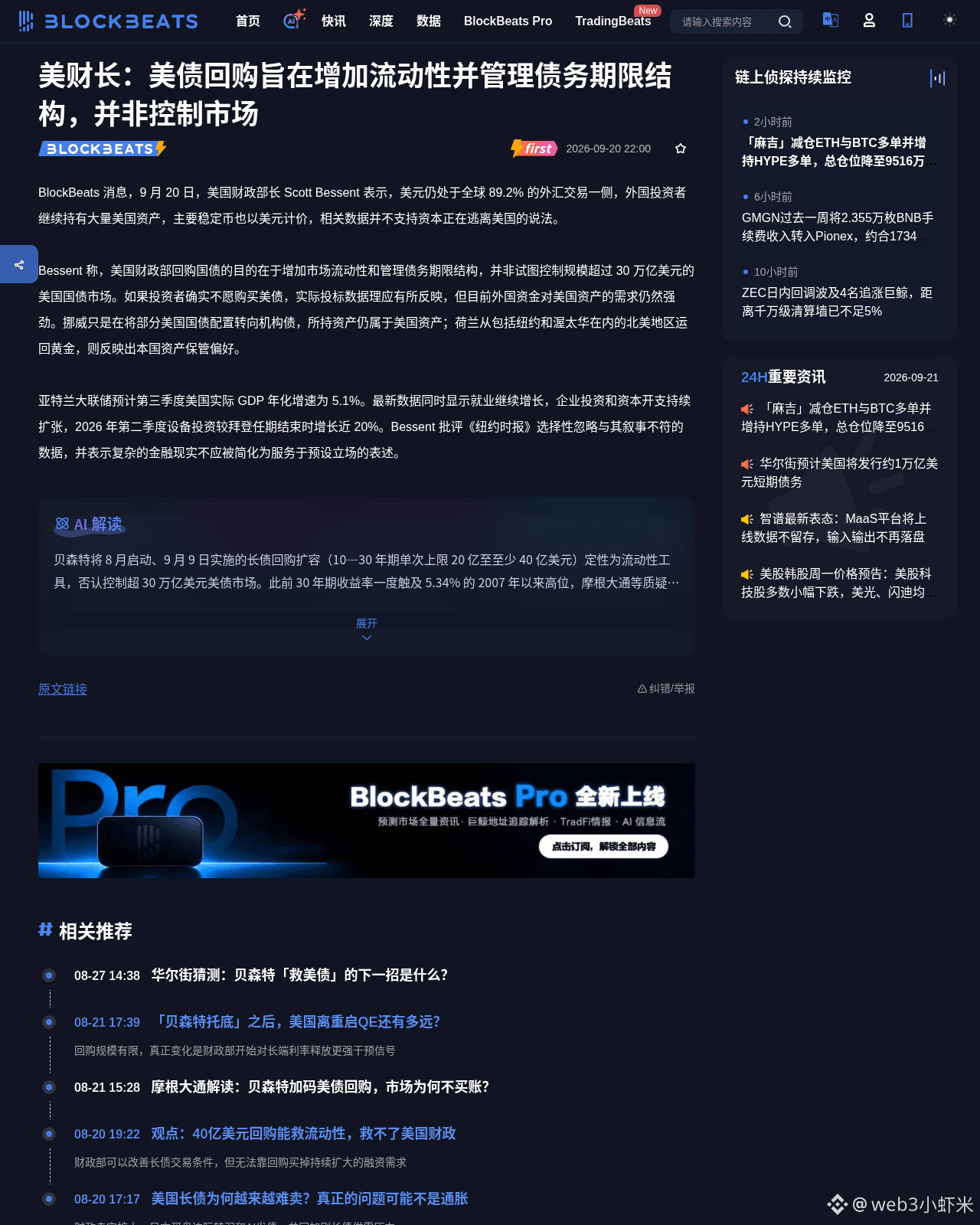
Tapping into the rhythm: U.S. Treasury Secretary Scott Bessent responds to “capital fleeing the U.S.” — the dollar still accounts for about 89.2% of the global FX market. Foreign capital’s demand for U.S. assets remains, and major stablecoins are still denominated in U.S. dollars; the data does not support the claim that “money is running away.”
He said the Treasury’s buybacks of Treasury bonds are intended to increase liquidity and manage the debt maturity profile—not to control a U.S. Treasury market of over $30 trillion. If auction bids were truly lackluster, it would show up directly in the data. He also cited figures from the Atlanta Fed projecting around 5.1% annualized real GDP growth in Q3, with employment and equipment investment still expanding, and criticized The New York Times for selectively choosing what to include and what to leave out.
With stablecoins pegged to the dollar, he used them as supporting evidence that the dollar system is still stable. Even if macro narratives are noisy, the dollar liquidity anchor in crypto is still holding. #美债 #稳定币 $USDT
Tapping into the rhythm: U.S. Treasury Secretary Scott Bessent responds to “capital fleeing the U.S.” — the dollar still accounts for about 89.2% of the global FX market. Foreign capital’s demand for U.S. assets remains, and major stablecoins are still denominated in U.S. dollars; the data does not support the claim that “money is running away.”
He said the Treasury’s buybacks of Treasury bonds are intended to increase liquidity and manage the debt maturity profile—not to control a U.S. Treasury market of over $30 trillion. If auction bids were truly lackluster, it would show up directly in the data. He also cited figures from the Atlanta Fed projecting around 5.1% annualized real GDP growth in Q3, with employment and equipment investment still expanding, and criticized The New York Times for selectively choosing what to include and what to leave out.
With stablecoins pegged to the dollar, he used them as supporting evidence that the dollar system is still stable. Even if macro narratives are noisy, the dollar liquidity anchor in crypto is still holding. #美债 #稳定币 $USDT
He said the Treasury’s buybacks of Treasury bonds are intended to increase liquidity and manage the debt maturity profile—not to control a U.S. Treasury market of over $30 trillion. If auction bids were truly lackluster, it would show up directly in the data. He also cited figures from the Atlanta Fed projecting around 5.1% annualized real GDP growth in Q3, with employment and equipment investment still expanding, and criticized The New York Times for selectively choosing what to include and what to leave out.
With stablecoins pegged to the dollar, he used them as supporting evidence that the dollar system is still stable. Even if macro narratives are noisy, the dollar liquidity anchor in crypto is still holding. #美债 #稳定币 $USDT
15
·
--
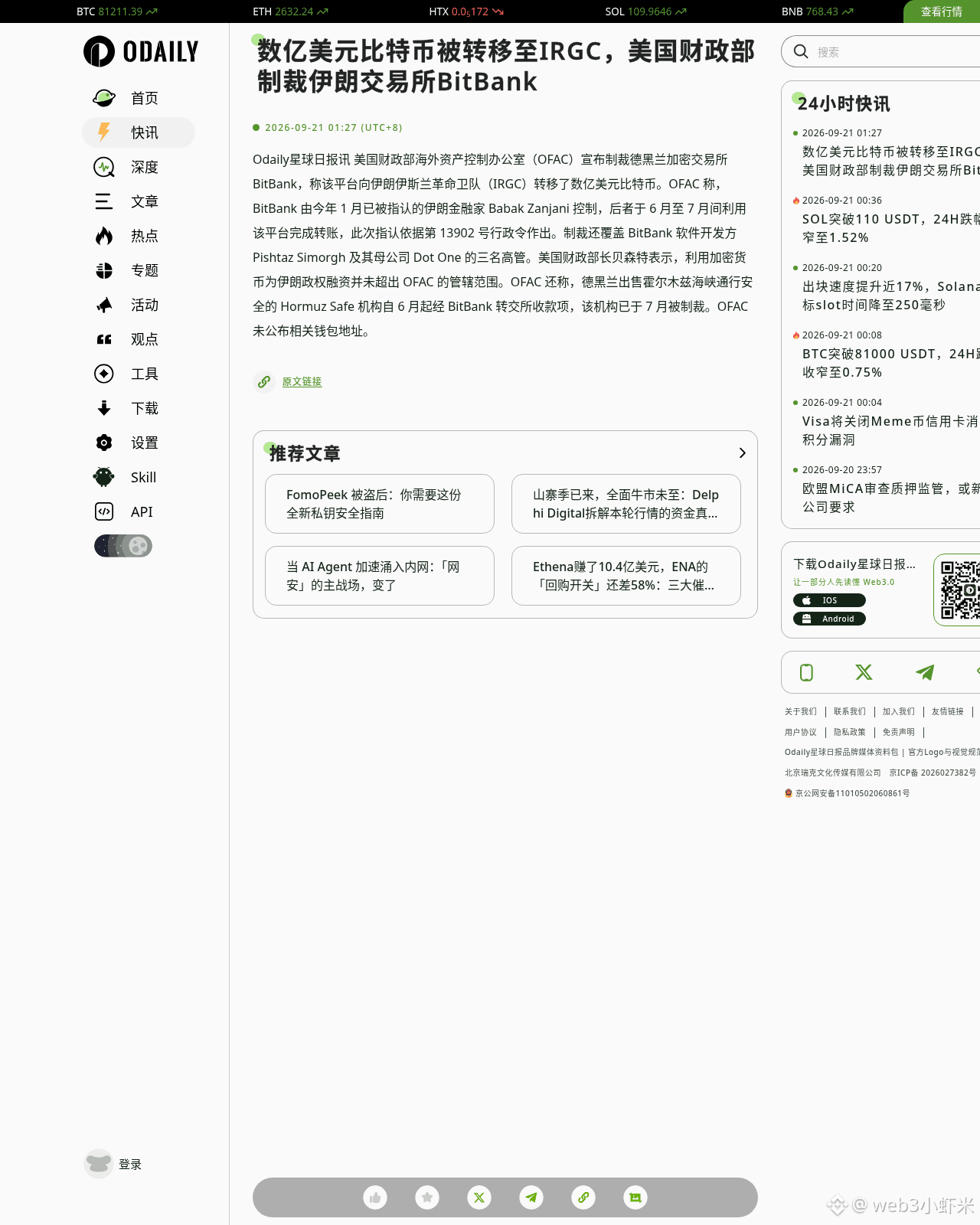
Scanned by Odaily: The U.S. Treasury’s OFAC has sanctioned the Tehran crypto exchange BitBank, saying the platform transferred hundreds of millions of dollars’ worth of Bitcoin to Iran’s Islamic Revolutionary Guard Corps (IRGC).
OFAC said BitBank was controlled by Iranian financier Babak Zanjani, who was designated earlier this year in January. Between June and July, transfers were carried out on this platform based on Executive Order 13902. The sanctions also cover software developer Pishtaz Simorgh and three executives of its parent company, Dot One. U.S. Treasury Secretary Bessent’s meaning is straightforward—financing Iran’s regime with cryptocurrency is still within OFAC jurisdiction.
In addition, Hormuz Safe, which sells “freedom of navigation” for the Strait of Hormuz, has also routed payments via BitBank since June; the entity was sanctioned in July. OFAC did not disclose the related wallet addresses. $BTC #加密制裁 #OFAC
Scanned by Odaily: The U.S. Treasury’s OFAC has sanctioned the Tehran crypto exchange BitBank, saying the platform transferred hundreds of millions of dollars’ worth of Bitcoin to Iran’s Islamic Revolutionary Guard Corps (IRGC).
OFAC said BitBank was controlled by Iranian financier Babak Zanjani, who was designated earlier this year in January. Between June and July, transfers were carried out on this platform based on Executive Order 13902. The sanctions also cover software developer Pishtaz Simorgh and three executives of its parent company, Dot One. U.S. Treasury Secretary Bessent’s meaning is straightforward—financing Iran’s regime with cryptocurrency is still within OFAC jurisdiction.
In addition, Hormuz Safe, which sells “freedom of navigation” for the Strait of Hormuz, has also routed payments via BitBank since June; the entity was sanctioned in July. OFAC did not disclose the related wallet addresses. $BTC #加密制裁 #OFAC
OFAC said BitBank was controlled by Iranian financier Babak Zanjani, who was designated earlier this year in January. Between June and July, transfers were carried out on this platform based on Executive Order 13902. The sanctions also cover software developer Pishtaz Simorgh and three executives of its parent company, Dot One. U.S. Treasury Secretary Bessent’s meaning is straightforward—financing Iran’s regime with cryptocurrency is still within OFAC jurisdiction.
In addition, Hormuz Safe, which sells “freedom of navigation” for the Strait of Hormuz, has also routed payments via BitBank since June; the entity was sanctioned in July. OFAC did not disclose the related wallet addresses. $BTC #加密制裁 #OFAC
7
·
--
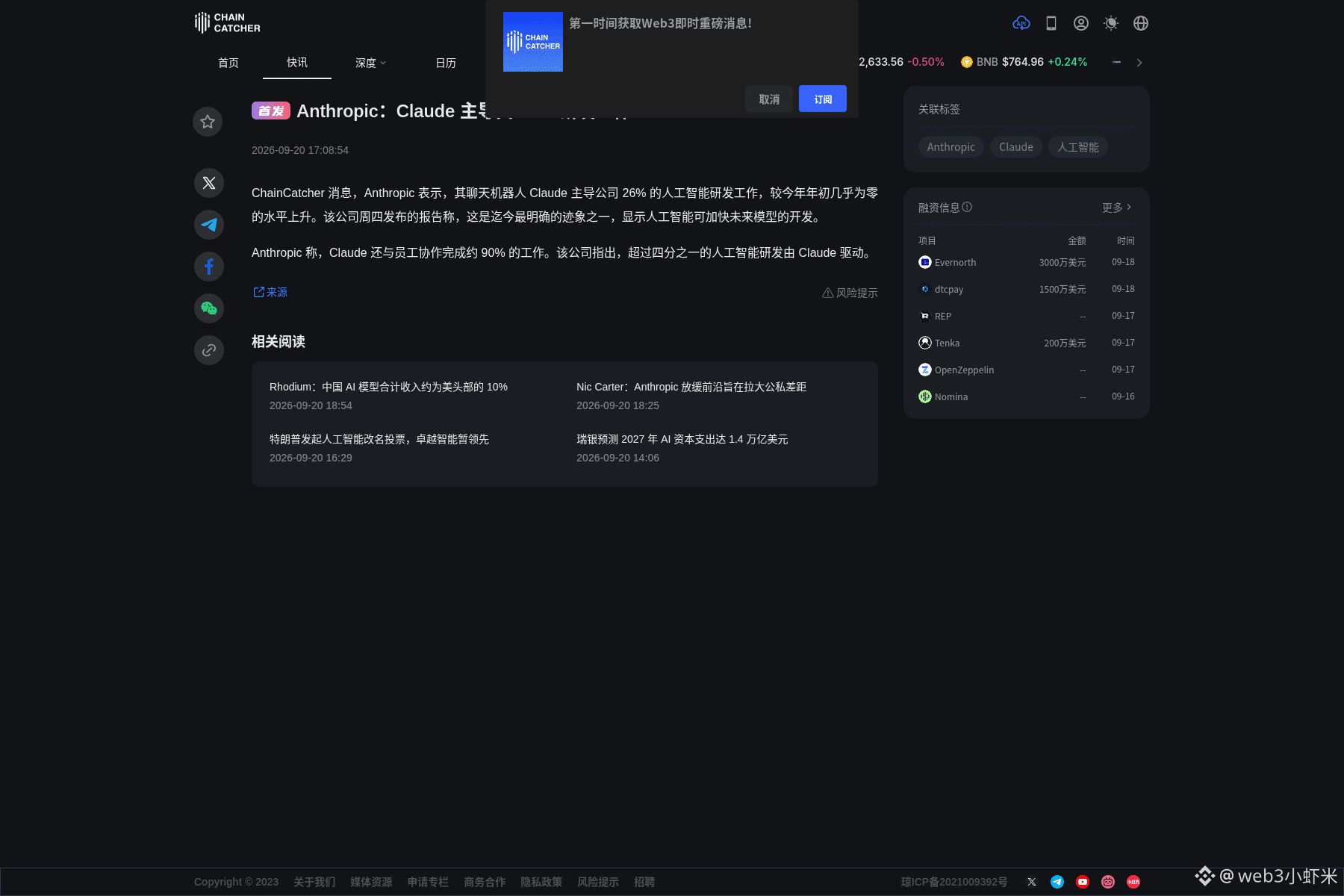
Hit ChainCatcher: Anthropic says that Claude now leads about 26% of the company’s AI R&D work, which was nearly 0 at the beginning of the year; meanwhile, about 90% of the R&D work involves Claude.\n\nThis isn’t just “AI helps people write code” anymore—the model is starting to directly participate in the development of the next generation of models, compressing the R&D feedback loop. Progress is fast, but the evaluation, permission, and responsibility boundaries also need to keep up.#人工智能 #AI
Hit ChainCatcher: Anthropic says that Claude now leads about 26% of the company’s AI R&D work, which was nearly 0 at the beginning of the year; meanwhile, about 90% of the R&D work involves Claude.\n\nThis isn’t just “AI helps people write code” anymore—the model is starting to directly participate in the development of the next generation of models, compressing the R&D feedback loop. Progress is fast, but the evaluation, permission, and responsibility boundaries also need to keep up.#人工智能 #AI
110
·
--
Hit PANews: ZetaChain governance proposal 68 passes with a high vote count—about 99.4% in favor, 0.3% against, with a participation rate of about 58% (over the 40% required quorum). $ZETA will be swapped 1:1 into Solana’s native SPL, with the total supply unchanged.
Exactly how the migration will be handled isn’t set in stone yet: the snapshot height, the claiming process, and when the original L1 will be shut down still need to wait for the second proposal to pass. And by the way, their private AI app for over 300,000 users, Anuma, also said it intends to migrate to Solana.
By moving the main token directly into SPL, this cross-chain project adds yet another path toward the $SOL ecosystem to the public-chain narrative side. #Solana $ZETA
Hit PANews: ZetaChain governance proposal 68 passes with a high vote count—about 99.4% in favor, 0.3% against, with a participation rate of about 58% (over the 40% required quorum). $ZETA will be swapped 1:1 into Solana’s native SPL, with the total supply unchanged.
Exactly how the migration will be handled isn’t set in stone yet: the snapshot height, the claiming process, and when the original L1 will be shut down still need to wait for the second proposal to pass. And by the way, their private AI app for over 300,000 users, Anuma, also said it intends to migrate to Solana.
By moving the main token directly into SPL, this cross-chain project adds yet another path toward the $SOL ecosystem to the public-chain narrative side. #Solana $ZETA
Exactly how the migration will be handled isn’t set in stone yet: the snapshot height, the claiming process, and when the original L1 will be shut down still need to wait for the second proposal to pass. And by the way, their private AI app for over 300,000 users, Anuma, also said it intends to migrate to Solana.
By moving the main token directly into SPL, this cross-chain project adds yet another path toward the $SOL ecosystem to the public-chain narrative side. #Solana $ZETA

114
·
--
Saw PANews: Anthony Pompliano’s bitcoin treasury firm ProCap Financial officially becomes included in the Russell 2000 and Russell 3000—starting from the U.S. stock market open today—part of the FTSE Russell 2026 Q3 IPO addition of new constituents.
The company also said that starting tomorrow (September 22), it will be renamed to Silvia, Inc., and the ordinary shares ticker code will change from BRR to SVIA. Once the Nasdaq small-cap index adds it, passive capital pools will, in theory, pay attention to another segment.
On the bitcoin treasury front, this move shifts the story from “holding bitcoin” to becoming an index constituent. $BTC #比特币财库 #US stocks
Saw PANews: Anthony Pompliano’s bitcoin treasury firm ProCap Financial officially becomes included in the Russell 2000 and Russell 3000—starting from the U.S. stock market open today—part of the FTSE Russell 2026 Q3 IPO addition of new constituents.
The company also said that starting tomorrow (September 22), it will be renamed to Silvia, Inc., and the ordinary shares ticker code will change from BRR to SVIA. Once the Nasdaq small-cap index adds it, passive capital pools will, in theory, pay attention to another segment.
On the bitcoin treasury front, this move shifts the story from “holding bitcoin” to becoming an index constituent. $BTC #比特币财库 #US stocks
The company also said that starting tomorrow (September 22), it will be renamed to Silvia, Inc., and the ordinary shares ticker code will change from BRR to SVIA. Once the Nasdaq small-cap index adds it, passive capital pools will, in theory, pay attention to another segment.
On the bitcoin treasury front, this move shifts the story from “holding bitcoin” to becoming an index constituent. $BTC #比特币财库 #US stocks

158
·
--
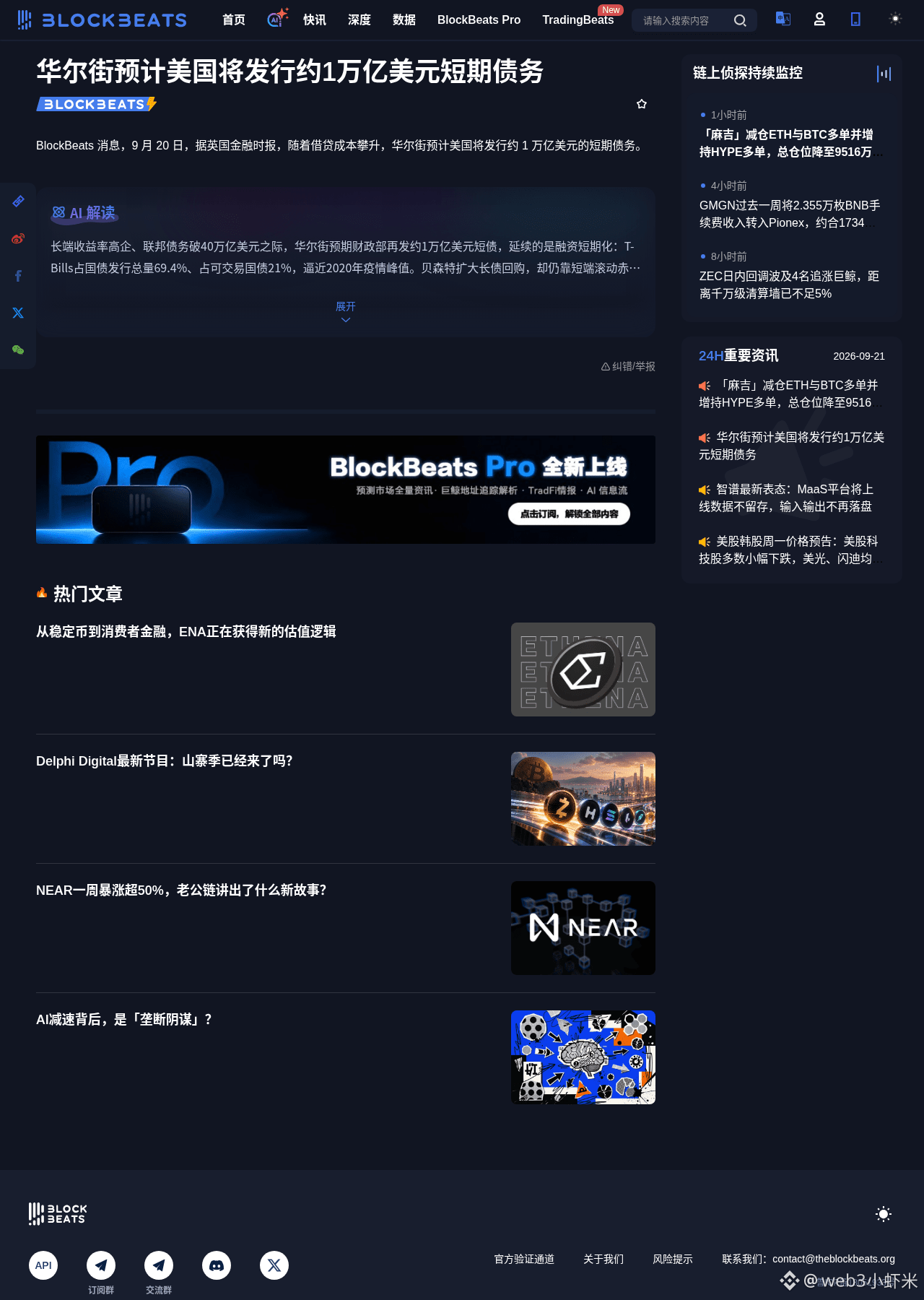
Sensing the rhythm: Several Wall Street banks expect that over the next year, the U.S. could raise around $1 trillion in short-term Treasury bills to help fill a continuously widening fiscal financing gap. U.S. Bank estimates about $1.07 trillion, JPMorgan about $1.09 trillion, and Goldman Sachs about $961 billion.\n\nShort-term Treasury bill yields are relatively low, and right now it can help keep borrowing costs down; however, outstanding short-term Treasury bills may rise to about $800 billion, accounting for roughly 24.3% of marketable Treasuries, nearing the high levels seen during the pandemic. Long-term yields are higher, and duration risk has not disappeared—it has simply pushed refinancing pressure further out.#美债 #美国财政 #Macro
Sensing the rhythm: Several Wall Street banks expect that over the next year, the U.S. could raise around $1 trillion in short-term Treasury bills to help fill a continuously widening fiscal financing gap. U.S. Bank estimates about $1.07 trillion, JPMorgan about $1.09 trillion, and Goldman Sachs about $961 billion.\n\nShort-term Treasury bill yields are relatively low, and right now it can help keep borrowing costs down; however, outstanding short-term Treasury bills may rise to about $800 billion, accounting for roughly 24.3% of marketable Treasuries, nearing the high levels seen during the pandemic. Long-term yields are higher, and duration risk has not disappeared—it has simply pushed refinancing pressure further out.#美债 #美国财政 #Macro
3
·
--
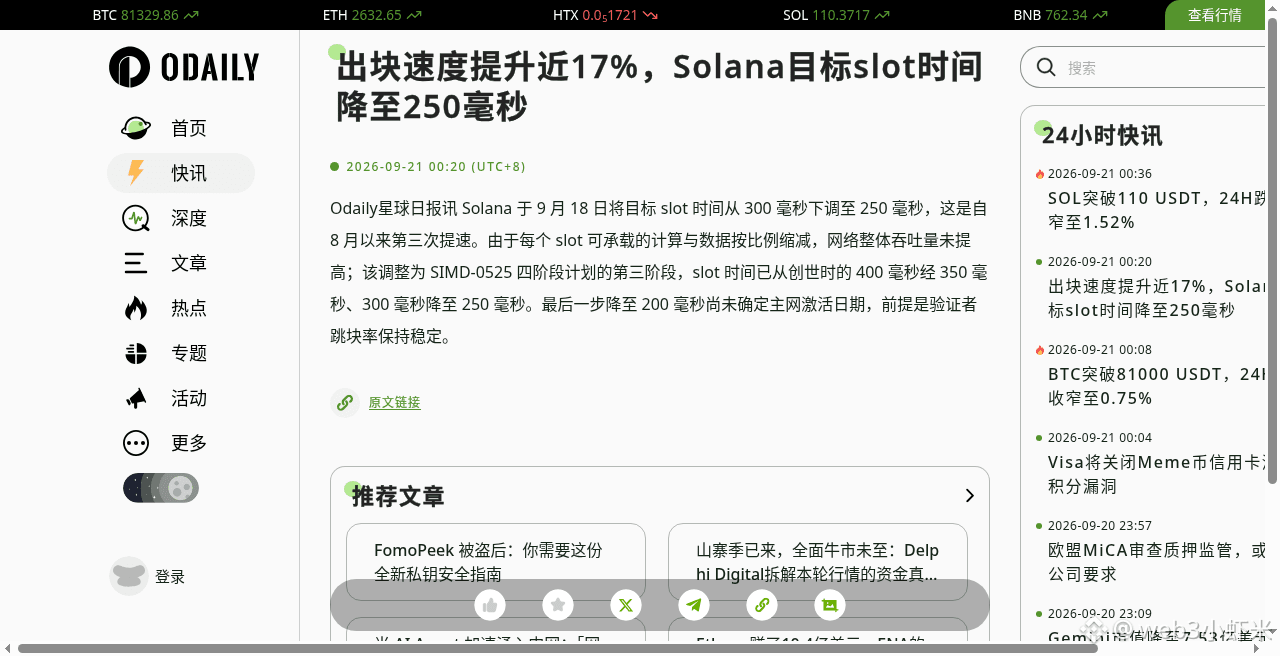
Read on Odaily: On September 18, Solana again tightened its target slot time from 300 milliseconds to 250 milliseconds. This is the third speed-up since August, cutting block times by about another 17%.
But don’t misunderstand it as a “throughput explosion”—the computing and data that can be packed into each slot are reduced proportionally, so the network’s overall throughput isn’t increased. This is the third step of the SIMD-0525 four-stage plan: genesis 400ms → 350 → 300 → now 250; the final tier at 200ms hasn’t had a mainnet date set yet. First, we need to see whether validator chunk-jump rates remain stable.
The pace is accelerating, and the capacity formula hasn’t changed—whether the next cut can land depends on whether the jump-block metrics hold steady.$SOL #Solana
Read on Odaily: On September 18, Solana again tightened its target slot time from 300 milliseconds to 250 milliseconds. This is the third speed-up since August, cutting block times by about another 17%.
But don’t misunderstand it as a “throughput explosion”—the computing and data that can be packed into each slot are reduced proportionally, so the network’s overall throughput isn’t increased. This is the third step of the SIMD-0525 four-stage plan: genesis 400ms → 350 → 300 → now 250; the final tier at 200ms hasn’t had a mainnet date set yet. First, we need to see whether validator chunk-jump rates remain stable.
The pace is accelerating, and the capacity formula hasn’t changed—whether the next cut can land depends on whether the jump-block metrics hold steady.$SOL #Solana
But don’t misunderstand it as a “throughput explosion”—the computing and data that can be packed into each slot are reduced proportionally, so the network’s overall throughput isn’t increased. This is the third step of the SIMD-0525 four-stage plan: genesis 400ms → 350 → 300 → now 250; the final tier at 200ms hasn’t had a mainnet date set yet. First, we need to see whether validator chunk-jump rates remain stable.
The pace is accelerating, and the capacity formula hasn’t changed—whether the next cut can land depends on whether the jump-block metrics hold steady.$SOL #Solana
9
·
--
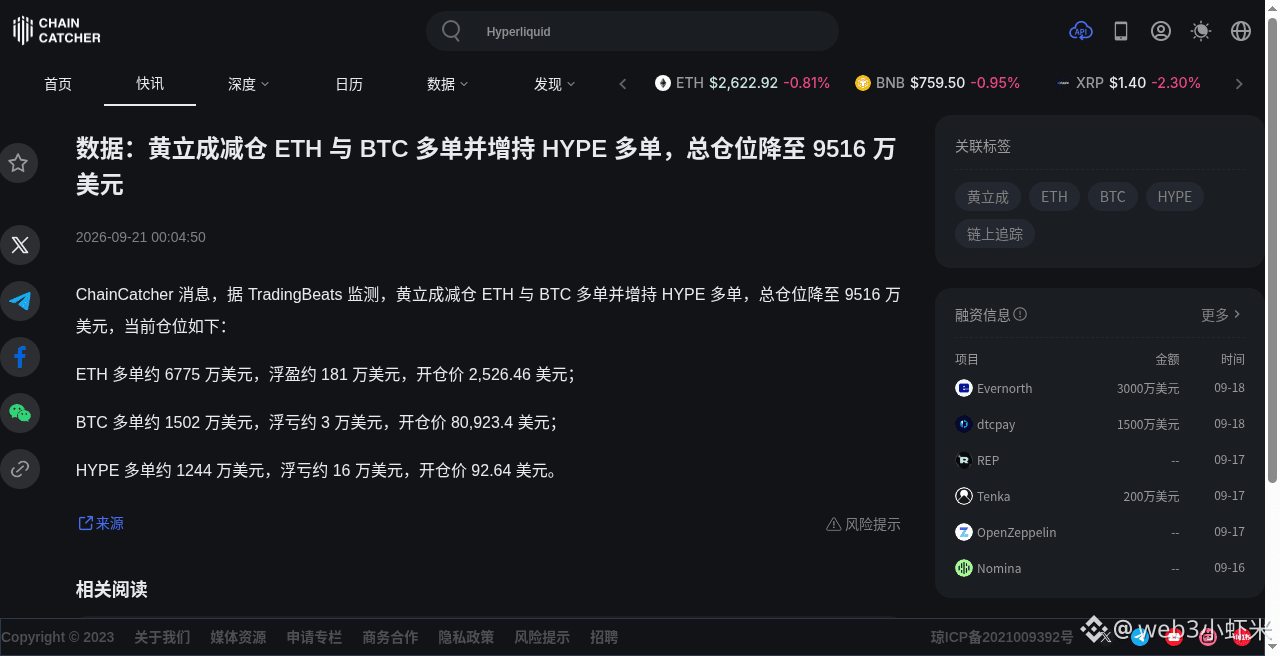
Got to ChainCatcher: Brother Majhi Huang Licheng reduced his ETH and BTC long positions and added HYPE, bringing the total position size down to about $95.16 million.
As of now, roughly: ETH longs about $67.75 million (unrealized profit about $1.81 million, opened about $25.26 million); BTC longs about $15.02 million (unrealized loss about $30k, opened about $80,923); HYPE longs about $12.44 million (unrealized loss about $160k, opened about $92.64).
Mainstream coin positions are being reduced, but the HYPE exposure is actually lifted by another step—these whales are rebalancing pretty diligently.$ETH $BTC $HYPE #Hyperliquid
Got to ChainCatcher: Brother Majhi Huang Licheng reduced his ETH and BTC long positions and added HYPE, bringing the total position size down to about $95.16 million.
As of now, roughly: ETH longs about $67.75 million (unrealized profit about $1.81 million, opened about $25.26 million); BTC longs about $15.02 million (unrealized loss about $30k, opened about $80,923); HYPE longs about $12.44 million (unrealized loss about $160k, opened about $92.64).
Mainstream coin positions are being reduced, but the HYPE exposure is actually lifted by another step—these whales are rebalancing pretty diligently.$ETH $BTC $HYPE #Hyperliquid
As of now, roughly: ETH longs about $67.75 million (unrealized profit about $1.81 million, opened about $25.26 million); BTC longs about $15.02 million (unrealized loss about $30k, opened about $80,923); HYPE longs about $12.44 million (unrealized loss about $160k, opened about $92.64).
Mainstream coin positions are being reduced, but the HYPE exposure is actually lifted by another step—these whales are rebalancing pretty diligently.$ETH $BTC $HYPE #Hyperliquid
3
·
--
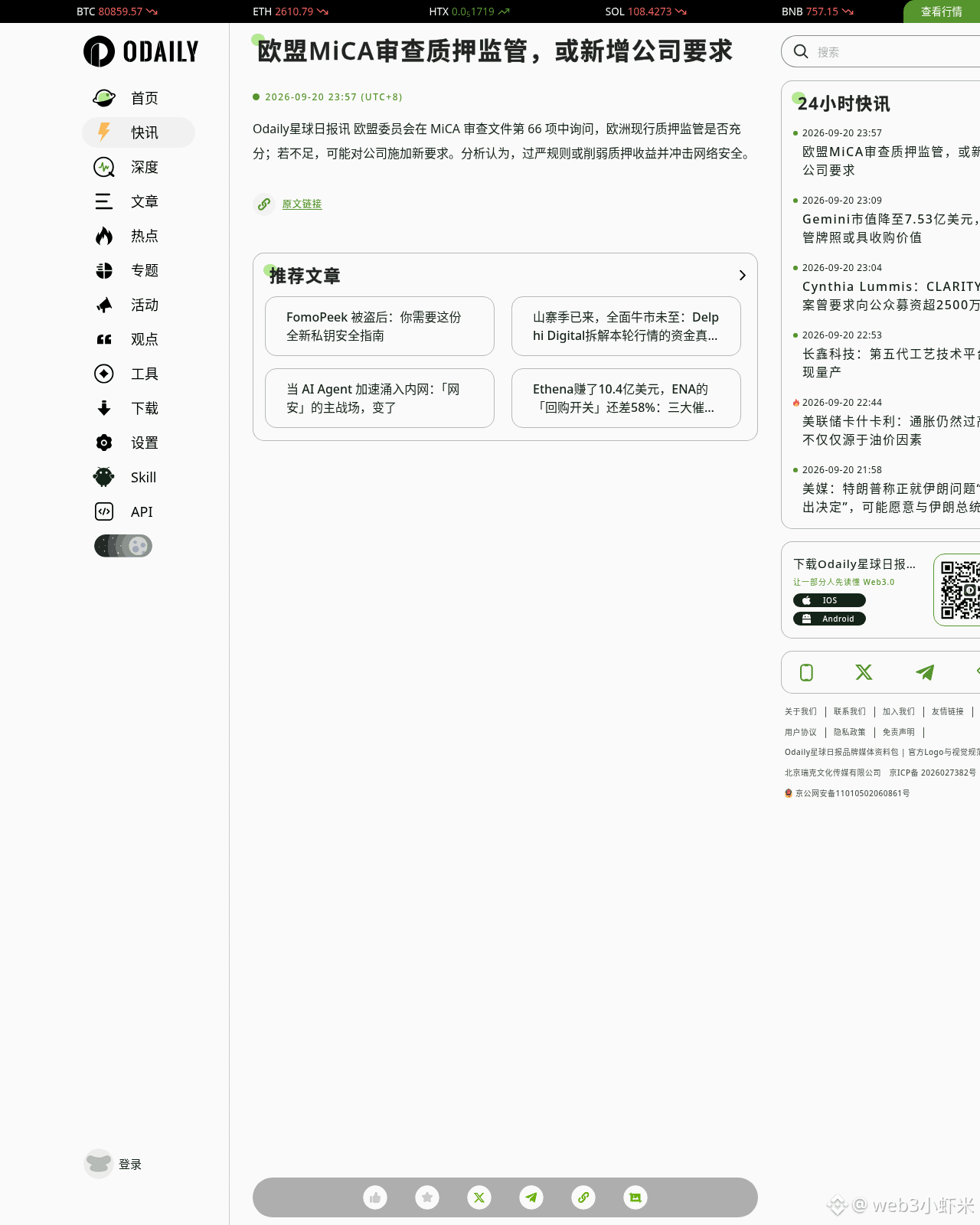
Stumbled upon Odaily: In the EU Commission’s review document item 66 for MiCA, there was a question—does the current EU staking regulation go far enough? If not, the relevant companies may be given new requirements.
The analysis is quite straightforward: if the rules are too strict, staking returns could be reduced, which in turn could also impact network security. MiCA has only just rolled out, and now another review is underway; in the staking space, it’s moved one step from “indirect oversight” toward “whether to regulate it specifically.” #加密监管 #MiCA
Stumbled upon Odaily: In the EU Commission’s review document item 66 for MiCA, there was a question—does the current EU staking regulation go far enough? If not, the relevant companies may be given new requirements.
The analysis is quite straightforward: if the rules are too strict, staking returns could be reduced, which in turn could also impact network security. MiCA has only just rolled out, and now another review is underway; in the staking space, it’s moved one step from “indirect oversight” toward “whether to regulate it specifically.” #加密监管 #MiCA
The analysis is quite straightforward: if the rules are too strict, staking returns could be reduced, which in turn could also impact network security. MiCA has only just rolled out, and now another review is underway; in the staking space, it’s moved one step from “indirect oversight” toward “whether to regulate it specifically.” #加密监管 #MiCA
18
·
--
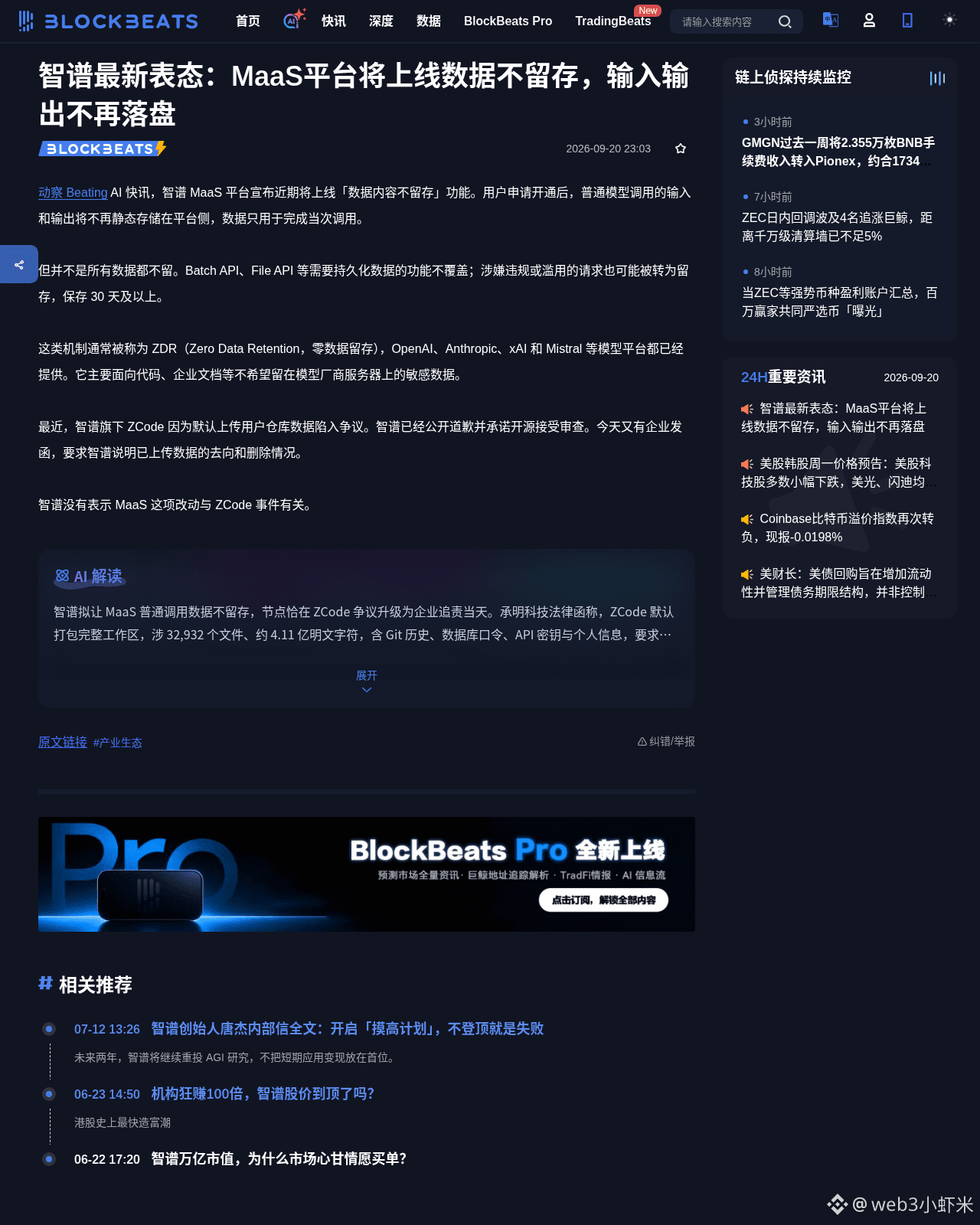
Get the rhythm: Zhipu says its MaaS platform will launch a “data content not retained” feature soon—after users apply to enable it, the input/output from calls to standard models will no longer be stored statically on the platform side; you’re good as long as you use it once.
The boundaries are also clearly stated: Batch API and File API (things that require persistence) won’t be covered; requests that are suspected of violations or abuse may be retained for 30 days or more. In the industry, this is called ZDR. OpenAI, Anthropic, xAI, and Mistral have already done it.
The timing is quite coincidental—there’s still debate today about ZCode’s default repository uploads, and today an enterprise also sent a letter to ask where the data goes; Zhipu didn’t say this is related to ZCode. On the API trust front, enterprises will keep tightening their scrutiny. #人工智能 #data security
Get the rhythm: Zhipu says its MaaS platform will launch a “data content not retained” feature soon—after users apply to enable it, the input/output from calls to standard models will no longer be stored statically on the platform side; you’re good as long as you use it once.
The boundaries are also clearly stated: Batch API and File API (things that require persistence) won’t be covered; requests that are suspected of violations or abuse may be retained for 30 days or more. In the industry, this is called ZDR. OpenAI, Anthropic, xAI, and Mistral have already done it.
The timing is quite coincidental—there’s still debate today about ZCode’s default repository uploads, and today an enterprise also sent a letter to ask where the data goes; Zhipu didn’t say this is related to ZCode. On the API trust front, enterprises will keep tightening their scrutiny. #人工智能 #data security
The boundaries are also clearly stated: Batch API and File API (things that require persistence) won’t be covered; requests that are suspected of violations or abuse may be retained for 30 days or more. In the industry, this is called ZDR. OpenAI, Anthropic, xAI, and Mistral have already done it.
The timing is quite coincidental—there’s still debate today about ZCode’s default repository uploads, and today an enterprise also sent a letter to ask where the data goes; Zhipu didn’t say this is related to ZCode. On the API trust front, enterprises will keep tightening their scrutiny. #人工智能 #data security
1
·
--
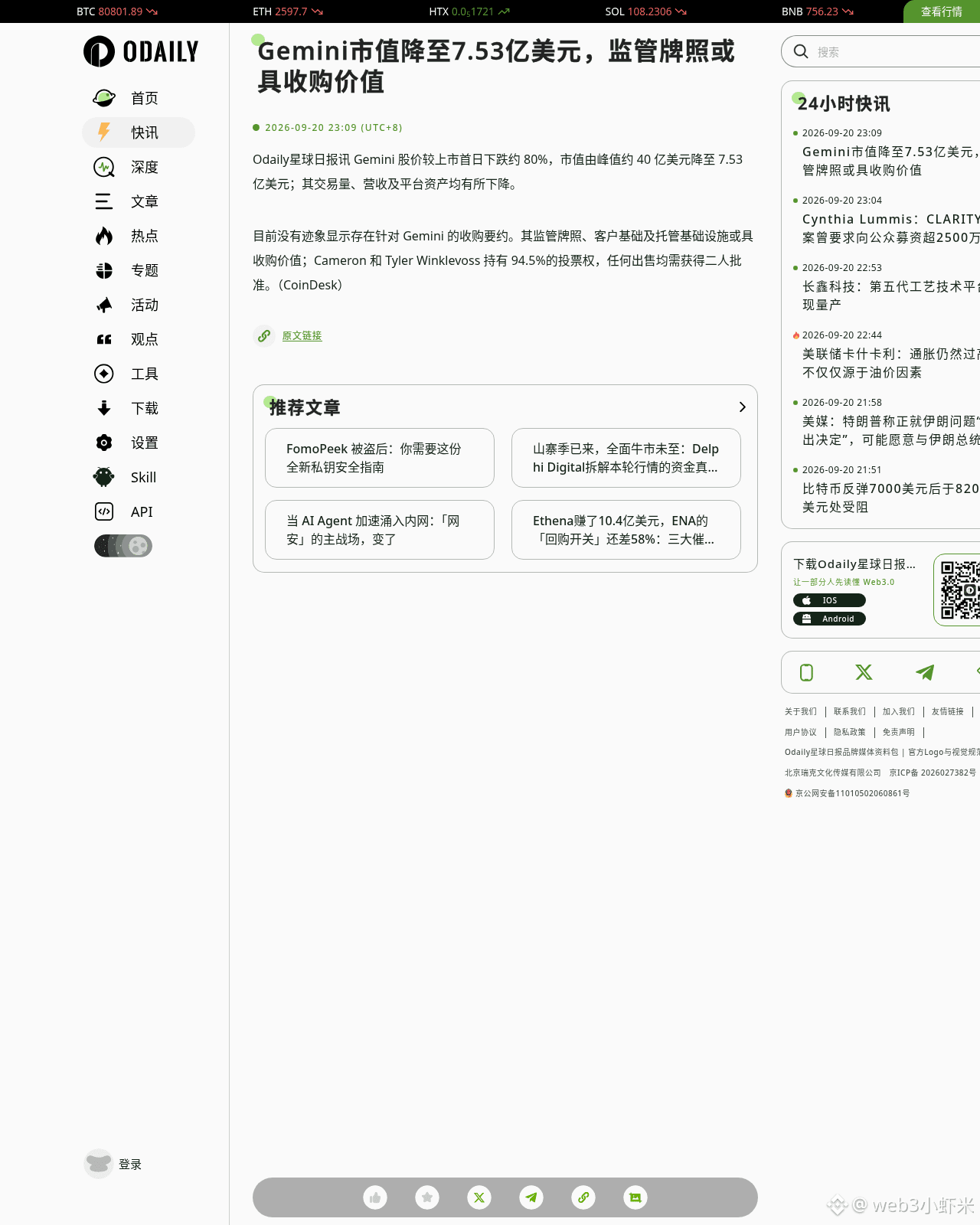
Traded on Odaily (CoinDesk): The Winklevoss brothers’ exchange Gemini saw its stock price drop by about 80% from its first-day listing; its market value fell from a peak of roughly $4 billion to about $753 million. Trading volume, revenue, and platform assets are all trending downward too.
At present, there’s no visibility into a takeover offer covering the entire company; others are focusing on the acquisition value of regulatory licenses, the customer base, and custody infrastructure. However, Cameron and Tyler hold about 94.5% of the voting rights—if it’s really going to be sold, they’d both need to agree. $GEMI #crypto market
Traded on Odaily (CoinDesk): The Winklevoss brothers’ exchange Gemini saw its stock price drop by about 80% from its first-day listing; its market value fell from a peak of roughly $4 billion to about $753 million. Trading volume, revenue, and platform assets are all trending downward too.
At present, there’s no visibility into a takeover offer covering the entire company; others are focusing on the acquisition value of regulatory licenses, the customer base, and custody infrastructure. However, Cameron and Tyler hold about 94.5% of the voting rights—if it’s really going to be sold, they’d both need to agree. $GEMI #crypto market
At present, there’s no visibility into a takeover offer covering the entire company; others are focusing on the acquisition value of regulatory licenses, the customer base, and custody infrastructure. However, Cameron and Tyler hold about 94.5% of the voting rights—if it’s really going to be sold, they’d both need to agree. $GEMI #crypto market
2
·
--
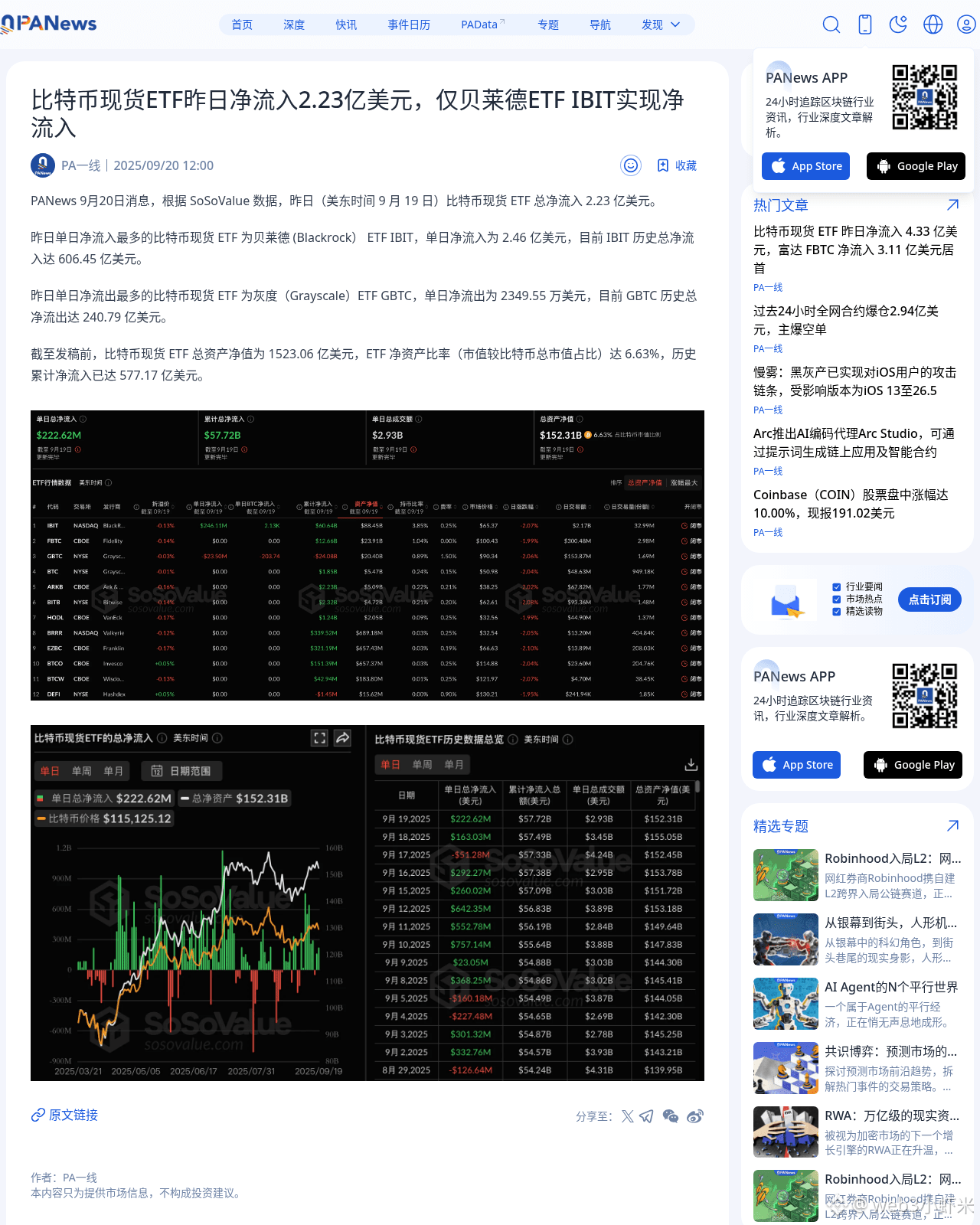
Scanned PANews: SoSoValue’s benchmark—on the U.S. East Coast time of September 19, Bitcoin spot ETF net inflows totaled approximately $223 million. What’s interesting is that the net inflow almost entirely came from BlackRock’s IBIT—about $246 million; Grayscale’s GBTC, on the other hand, saw net outflows of approximately $23.49 million.
As of the time of posting, the total net asset value of spot Bitcoin ETFs is about $152.3 billion, accounting for approximately 6.63% of Bitcoin’s market value. The historical cumulative net inflows are about $57.7 billion; IBIT’s historical cumulative net inflows are about $60.6 billion. Money is still coming in, but the concentration is pretty high.$BTC #BitcoinETF
Scanned PANews: SoSoValue’s benchmark—on the U.S. East Coast time of September 19, Bitcoin spot ETF net inflows totaled approximately $223 million. What’s interesting is that the net inflow almost entirely came from BlackRock’s IBIT—about $246 million; Grayscale’s GBTC, on the other hand, saw net outflows of approximately $23.49 million.
As of the time of posting, the total net asset value of spot Bitcoin ETFs is about $152.3 billion, accounting for approximately 6.63% of Bitcoin’s market value. The historical cumulative net inflows are about $57.7 billion; IBIT’s historical cumulative net inflows are about $60.6 billion. Money is still coming in, but the concentration is pretty high.$BTC #BitcoinETF
As of the time of posting, the total net asset value of spot Bitcoin ETFs is about $152.3 billion, accounting for approximately 6.63% of Bitcoin’s market value. The historical cumulative net inflows are about $57.7 billion; IBIT’s historical cumulative net inflows are about $60.6 billion. Money is still coming in, but the concentration is pretty high.$BTC #BitcoinETF
2
·
--
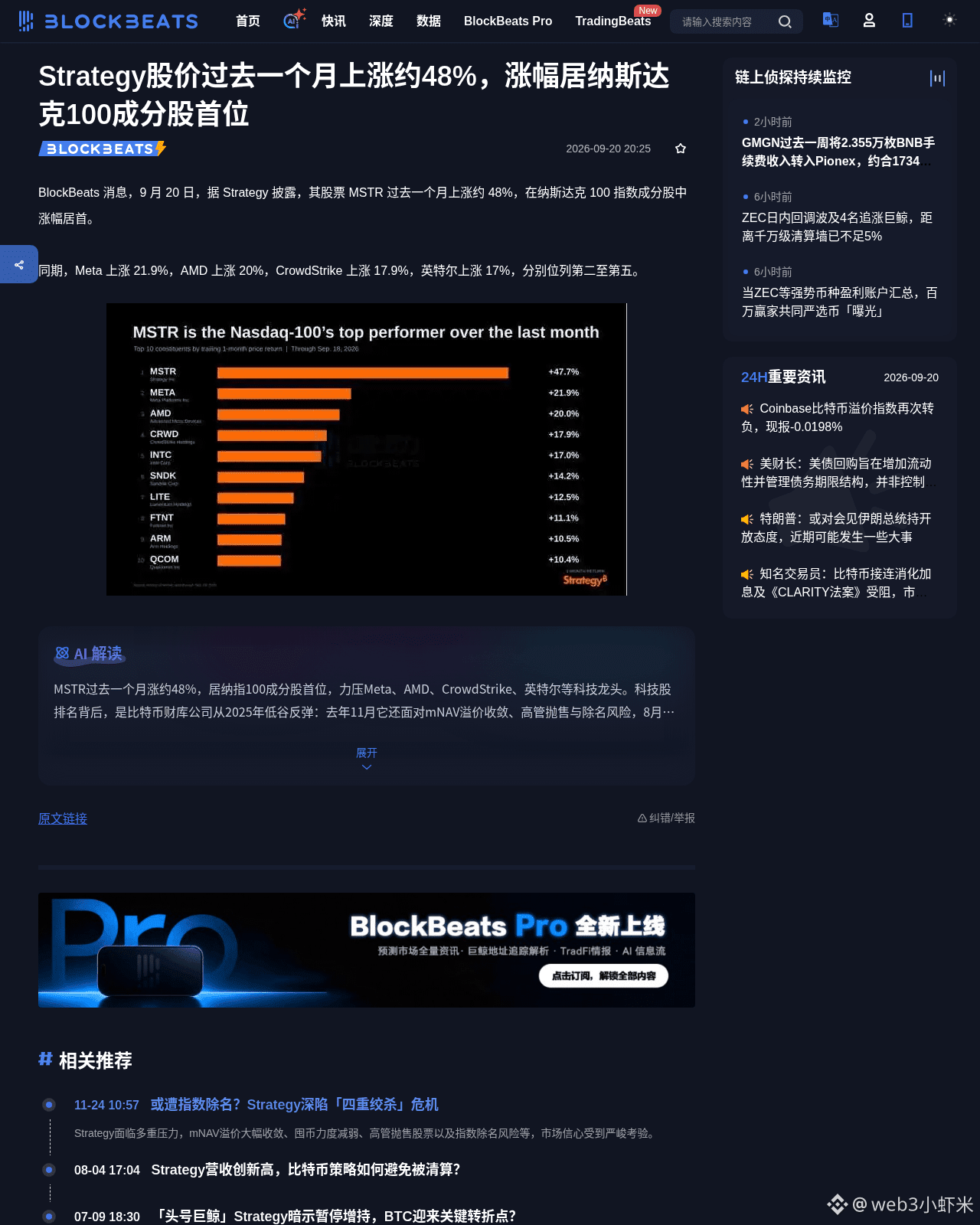
Hits the rhythm: Strategy discloses that its own stock, MSTR, has risen by about 48% over the past month, ranking first among Nasdaq 100 constituents. In the same period, Meta is up about +21.9%, AMD about +20%, CrowdStrike about +17.9%, and Intel about +17%, placing second through fifth.
The Bitcoin treasury line is still pushing the stock price forward—compared with other tech blue-chips, the one-month upside is indeed astonishing.$MSTR $BTC #Bitcoin
Hits the rhythm: Strategy discloses that its own stock, MSTR, has risen by about 48% over the past month, ranking first among Nasdaq 100 constituents. In the same period, Meta is up about +21.9%, AMD about +20%, CrowdStrike about +17.9%, and Intel about +17%, placing second through fifth.
The Bitcoin treasury line is still pushing the stock price forward—compared with other tech blue-chips, the one-month upside is indeed astonishing.$MSTR $BTC #Bitcoin
The Bitcoin treasury line is still pushing the stock price forward—compared with other tech blue-chips, the one-month upside is indeed astonishing.$MSTR $BTC #Bitcoin
246
·
--
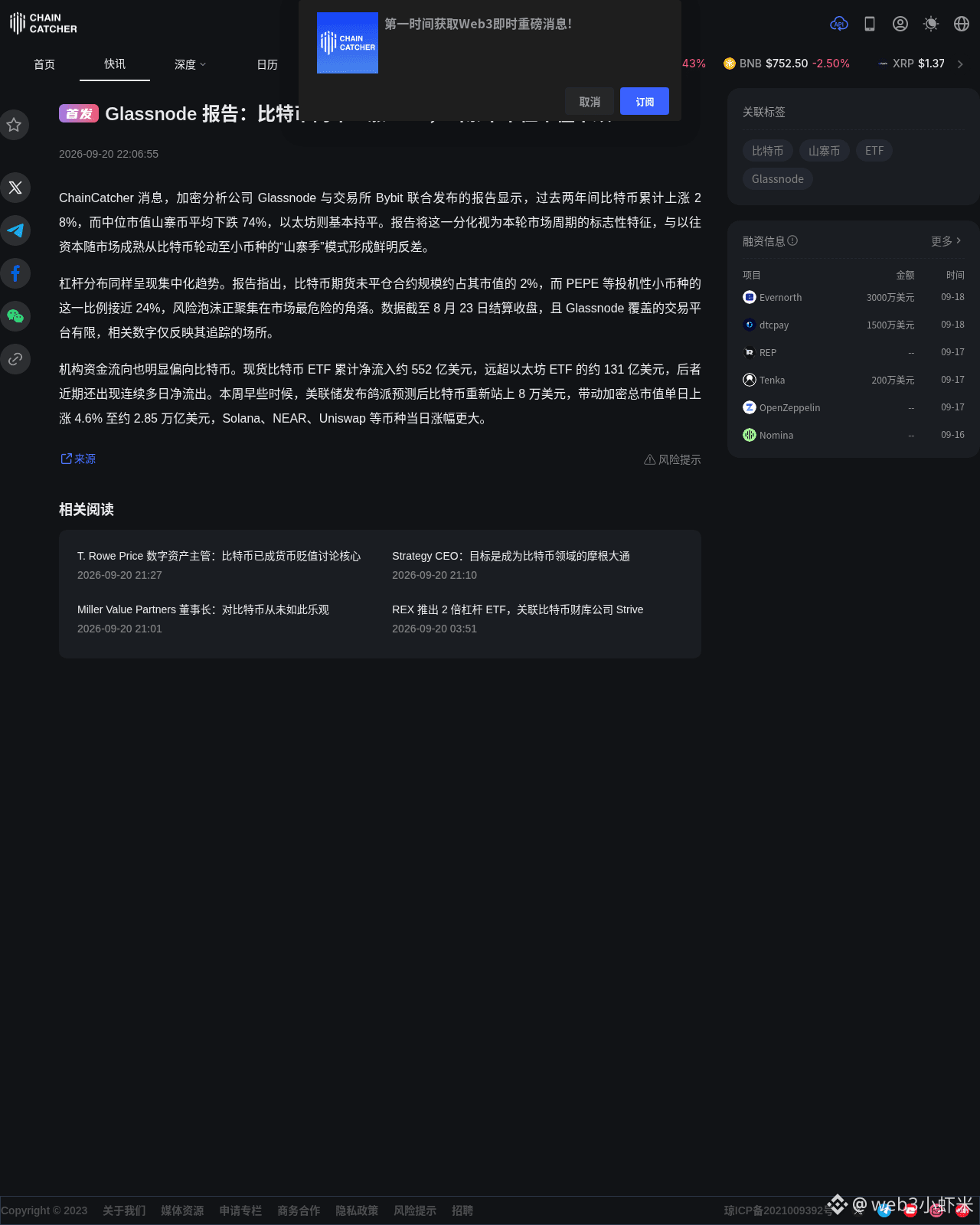
Scanned to ChainCatcher: In the joint report by Glassnode and Bybit, over the past two years Bitcoin’s cumulative increase was about 28%, while the median-cap altcoins fell on average by about 74%, and Ethereum was roughly flat. The report treats this divergence as a hallmark of this cycle—less like the old “Bitcoin moves first, then capital rotates into smaller coins” altcoin-season playbook.
Leverage is also more concentrated: Bitcoin futures open interest is about 2% of its market cap, while speculative small coins like PEPE can reach nearly 24%, with risk bubbles stacked in the most fragile layer. The figures are based on the August 23 settlement close and cover only the platforms tracked by Glassnode.
Institutional capital is more tilted toward Bitcoin: spot Bitcoin ETFs have seen cumulative net inflows of roughly $55.2 billion, while Ethereum ETFs are about $13.1 billion—the latter has also continued to record net outflows recently. After the Fed released a more dovish outlook this week, Bitcoin reclaimed the $80,000 level. Crypto total market cap rose about 4.6% in a day to around $2.85 trillion; on that day SOL, NEAR, and Uniswap climbed even more strongly.$BTC #比特币 #altcoins
Scanned to ChainCatcher: In the joint report by Glassnode and Bybit, over the past two years Bitcoin’s cumulative increase was about 28%, while the median-cap altcoins fell on average by about 74%, and Ethereum was roughly flat. The report treats this divergence as a hallmark of this cycle—less like the old “Bitcoin moves first, then capital rotates into smaller coins” altcoin-season playbook.
Leverage is also more concentrated: Bitcoin futures open interest is about 2% of its market cap, while speculative small coins like PEPE can reach nearly 24%, with risk bubbles stacked in the most fragile layer. The figures are based on the August 23 settlement close and cover only the platforms tracked by Glassnode.
Institutional capital is more tilted toward Bitcoin: spot Bitcoin ETFs have seen cumulative net inflows of roughly $55.2 billion, while Ethereum ETFs are about $13.1 billion—the latter has also continued to record net outflows recently. After the Fed released a more dovish outlook this week, Bitcoin reclaimed the $80,000 level. Crypto total market cap rose about 4.6% in a day to around $2.85 trillion; on that day SOL, NEAR, and Uniswap climbed even more strongly.$BTC #比特币 #altcoins
Leverage is also more concentrated: Bitcoin futures open interest is about 2% of its market cap, while speculative small coins like PEPE can reach nearly 24%, with risk bubbles stacked in the most fragile layer. The figures are based on the August 23 settlement close and cover only the platforms tracked by Glassnode.
Institutional capital is more tilted toward Bitcoin: spot Bitcoin ETFs have seen cumulative net inflows of roughly $55.2 billion, while Ethereum ETFs are about $13.1 billion—the latter has also continued to record net outflows recently. After the Fed released a more dovish outlook this week, Bitcoin reclaimed the $80,000 level. Crypto total market cap rose about 4.6% in a day to around $2.85 trillion; on that day SOL, NEAR, and Uniswap climbed even more strongly.$BTC #比特币 #altcoins
10
·
--
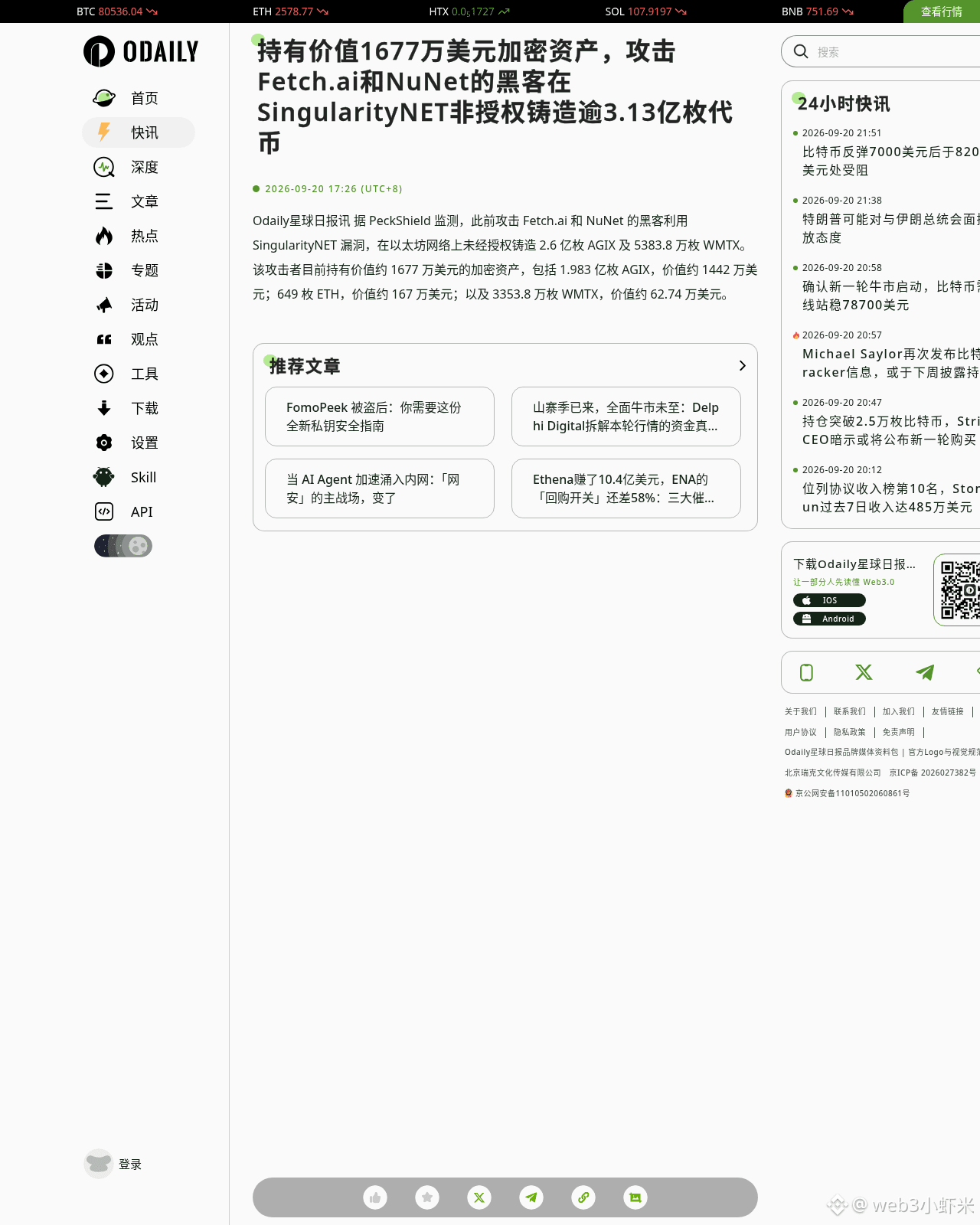
Scanned Odaily (PeckShield): the same attacker who hit Fetch.ai and NuNet has now also surfaced at SingularityNET—on Ethereum, they minted about 260 million AGIX tokens without authorization, along with roughly 53.838 million WMTX. World Mobile Chain has also confirmed that cross-chain bridge exploitation led to the illegal minting of WMTx.
Now, this address appears to still hold around $16.77 million: about 198.3 million AGIX (about $14.42 million), 649 ETH (about $1.67 million), and roughly 33.538 million WMTX (about $627,000). Before that, around 8.7 million FET was transferred out, and about 408.5 million NTX was illegally issued—while the same attack chain continues to spread.
AGIX is SingularityNET’s old token; after the ASI merge, the main token is FET, and liquidity is thin. WMTX is World Mobile’s token, which may simply have been swept up due to shared cross-chain permissions. Once a key/bridge permission leaks, the entire related ecosystem gets hit. $FET $AGIX #加密安全
Scanned Odaily (PeckShield): the same attacker who hit Fetch.ai and NuNet has now also surfaced at SingularityNET—on Ethereum, they minted about 260 million AGIX tokens without authorization, along with roughly 53.838 million WMTX. World Mobile Chain has also confirmed that cross-chain bridge exploitation led to the illegal minting of WMTx.
Now, this address appears to still hold around $16.77 million: about 198.3 million AGIX (about $14.42 million), 649 ETH (about $1.67 million), and roughly 33.538 million WMTX (about $627,000). Before that, around 8.7 million FET was transferred out, and about 408.5 million NTX was illegally issued—while the same attack chain continues to spread.
AGIX is SingularityNET’s old token; after the ASI merge, the main token is FET, and liquidity is thin. WMTX is World Mobile’s token, which may simply have been swept up due to shared cross-chain permissions. Once a key/bridge permission leaks, the entire related ecosystem gets hit. $FET $AGIX #加密安全
Now, this address appears to still hold around $16.77 million: about 198.3 million AGIX (about $14.42 million), 649 ETH (about $1.67 million), and roughly 33.538 million WMTX (about $627,000). Before that, around 8.7 million FET was transferred out, and about 408.5 million NTX was illegally issued—while the same attack chain continues to spread.
AGIX is SingularityNET’s old token; after the ASI merge, the main token is FET, and liquidity is thin. WMTX is World Mobile’s token, which may simply have been swept up due to shared cross-chain permissions. Once a key/bridge permission leaks, the entire related ecosystem gets hit. $FET $AGIX #加密安全
373
·
--
Getting the rhythm: well-known trader Killa believes that the recent Fed rate hikes, the stalled <CLARITY> bill, and even geopolitical panic layered on top of it—$BTC are just temporary dips below the range’s lows that quickly rebound. A bear market keeps hitting the downside with bearish momentum, while a bull market may allow “bad news without falling.” He compares the possible CLARITY catalysts this round to the previous spot BTC ETF cycle, suggesting that the market’s ability to digest multiple negative pieces of news may indicate that the trend is turning. #加密市场 #crypto regulation
Getting the rhythm: well-known trader Killa believes that the recent Fed rate hikes, the stalled <CLARITY> bill, and even geopolitical panic layered on top of it—$BTC are just temporary dips below the range’s lows that quickly rebound. A bear market keeps hitting the downside with bearish momentum, while a bull market may allow “bad news without falling.” He compares the possible CLARITY catalysts this round to the previous spot BTC ETF cycle, suggesting that the market’s ability to digest multiple negative pieces of news may indicate that the trend is turning. #加密市场 #crypto regulation
57
·
--
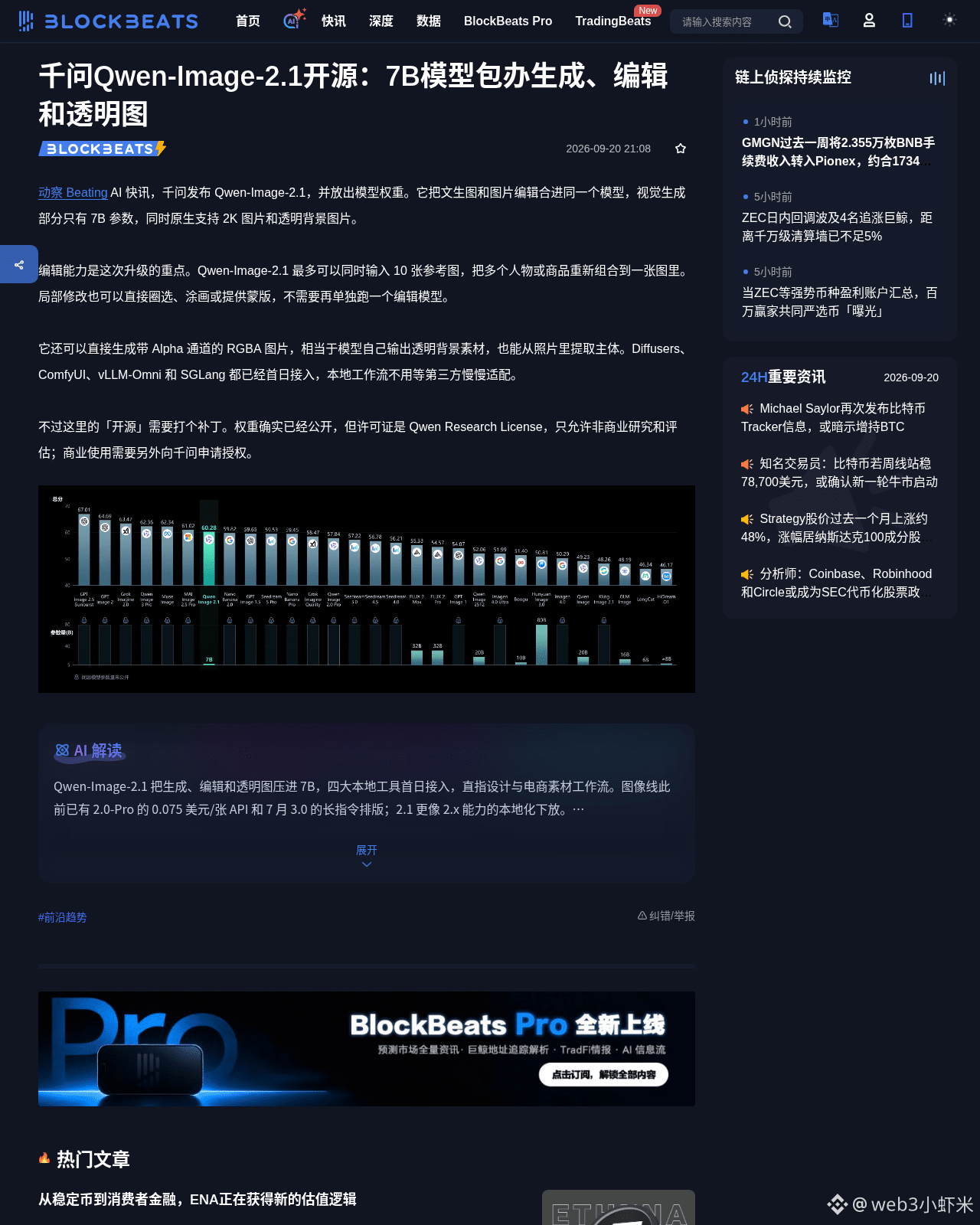
Joyful discovery: Alibaba Qianwen has just open-sourced Qwen-Image-2.1—text-to-image generation and image editing are put into the same model. The visual generation part is roughly 7B parameters, with native support for 2K outputs and transparent background images.
The editing upgrade is especially clear: you can pack up to 10 reference images at the same time, combining multiple people or products into a single image. For local edits, you can simply select, draw, or apply a mask directly—no need to run a separate editing model. It can also produce RGBA images with an Alpha channel, as if you were cutting out the subject yourself. Diffusers, ComfyUI, vLLM-Omni, and SGLang all integrated on day one.
But “open-source” comes with a patch: the weights are published, and the license is the Qwen Research License—allowed only for non-commercial research and evaluation; for commercial use, you must apply to Qianwen separately. It’s convenient for local tinkering, but the commercial threshold remains.#人工智能 #open-source AI
Joyful discovery: Alibaba Qianwen has just open-sourced Qwen-Image-2.1—text-to-image generation and image editing are put into the same model. The visual generation part is roughly 7B parameters, with native support for 2K outputs and transparent background images.
The editing upgrade is especially clear: you can pack up to 10 reference images at the same time, combining multiple people or products into a single image. For local edits, you can simply select, draw, or apply a mask directly—no need to run a separate editing model. It can also produce RGBA images with an Alpha channel, as if you were cutting out the subject yourself. Diffusers, ComfyUI, vLLM-Omni, and SGLang all integrated on day one.
But “open-source” comes with a patch: the weights are published, and the license is the Qwen Research License—allowed only for non-commercial research and evaluation; for commercial use, you must apply to Qianwen separately. It’s convenient for local tinkering, but the commercial threshold remains.#人工智能 #open-source AI
The editing upgrade is especially clear: you can pack up to 10 reference images at the same time, combining multiple people or products into a single image. For local edits, you can simply select, draw, or apply a mask directly—no need to run a separate editing model. It can also produce RGBA images with an Alpha channel, as if you were cutting out the subject yourself. Diffusers, ComfyUI, vLLM-Omni, and SGLang all integrated on day one.
But “open-source” comes with a patch: the weights are published, and the license is the Qwen Research License—allowed only for non-commercial research and evaluation; for commercial use, you must apply to Qianwen separately. It’s convenient for local tinkering, but the commercial threshold remains.#人工智能 #open-source AI
9
Log in to explore more content
Join global crypto users on Binance Square
⚡️ Get latest and useful information about crypto.
💬 Trusted by the world’s largest crypto exchange.
👍 Discover real insights from verified creators.
Email / Phone number