

#macroeconomy
macroeconomy
390,337 views
2,493 Discussing
Hot
Latest

The People's Bank of China (PBOC) released official reserve data for September today, confirming a 23rd consecutive month of gold accumulation. Gold reserves climbed to 77.47 million ounces (roughly 2,409.59 tons), up by 740,000 ounces from 76.73 million ounces recorded in August.
This steady accumulation highlights a deliberate, long-term de-dollarization strategy by major central banks. Meanwhile, China's total foreign exchange reserves dropped to $3,400.25 billion in September from $3,438.33 billion in August, reinforcing PBOC's preference for hard assets over fiat reserves.
Sustained central bank demand solidifies sovereign structural support beneath precious metals. As sovereign entities diversify away from dollar exposure, global liquidity gradually seeks alternative store-of-value instruments to hedge ongoing macro volatility.
For digital asset markets, this persistent institutional shift toward non-sovereign reserve assets strengthens the broader macro narrative for $BTC. As scarce real assets gain sovereign adoption, Bitcoin continues to benefit from expanding global portfolio diversification. 🪙
#Gold #CentralBanks #PBOC #MacroEconomy
The People's Bank of China (PBOC) released official reserve data for September today, confirming a 23rd consecutive month of gold accumulation. Gold reserves climbed to 77.47 million ounces (roughly 2,409.59 tons), up by 740,000 ounces from 76.73 million ounces recorded in August.
This steady accumulation highlights a deliberate, long-term de-dollarization strategy by major central banks. Meanwhile, China's total foreign exchange reserves dropped to $3,400.25 billion in September from $3,438.33 billion in August, reinforcing PBOC's preference for hard assets over fiat reserves.
Sustained central bank demand solidifies sovereign structural support beneath precious metals. As sovereign entities diversify away from dollar exposure, global liquidity gradually seeks alternative store-of-value instruments to hedge ongoing macro volatility.
For digital asset markets, this persistent institutional shift toward non-sovereign reserve assets strengthens the broader macro narrative for $BTC . As scarce real assets gain sovereign adoption, Bitcoin continues to benefit from expanding global portfolio diversification. 🪙
#Gold #CentralBanks #PBOC #MacroEconomy
This steady accumulation highlights a deliberate, long-term de-dollarization strategy by major central banks. Meanwhile, China's total foreign exchange reserves dropped to $3,400.25 billion in September from $3,438.33 billion in August, reinforcing PBOC's preference for hard assets over fiat reserves.
Sustained central bank demand solidifies sovereign structural support beneath precious metals. As sovereign entities diversify away from dollar exposure, global liquidity gradually seeks alternative store-of-value instruments to hedge ongoing macro volatility.
For digital asset markets, this persistent institutional shift toward non-sovereign reserve assets strengthens the broader macro narrative for $BTC . As scarce real assets gain sovereign adoption, Bitcoin continues to benefit from expanding global portfolio diversification. 🪙
#Gold #CentralBanks #PBOC #MacroEconomy
159

·
--
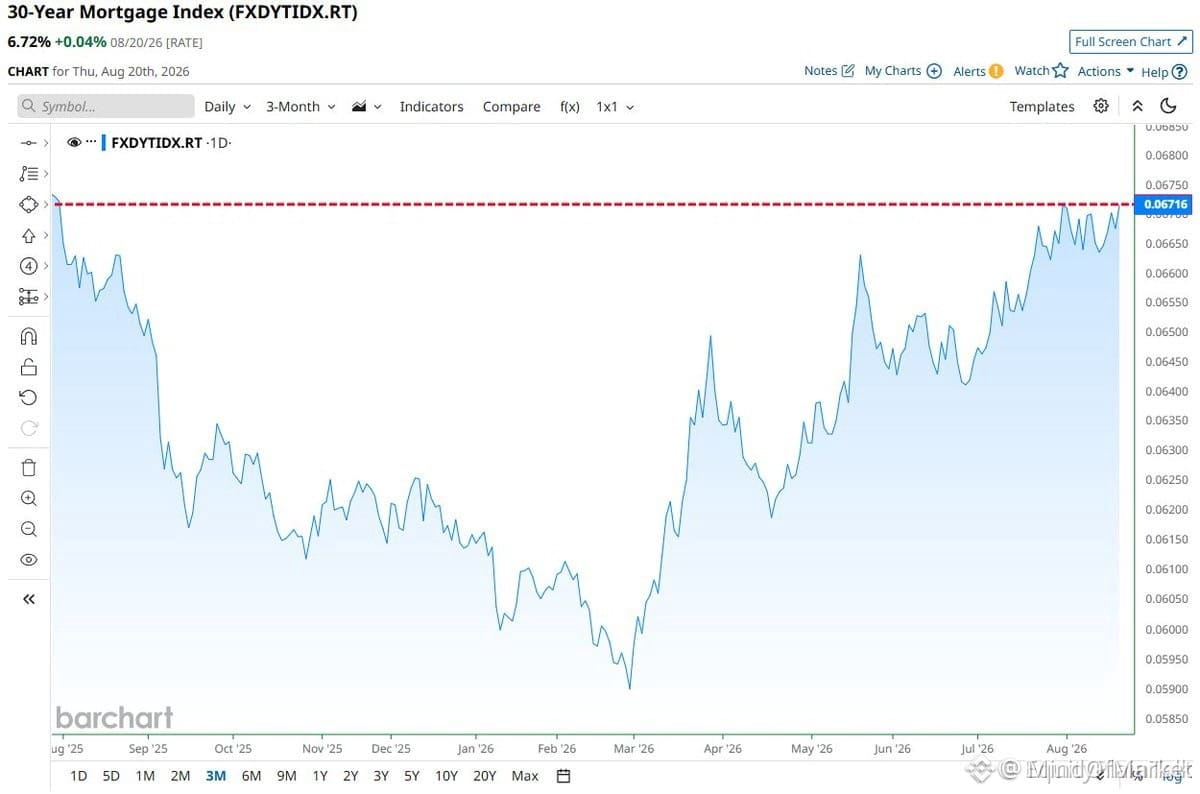
🚨 US MORTGAGE RATES HIT 6.72% AS MACRO LIQUIDITY SQUEEZES RISK ASSETS LIKE $BTC ! 📉
🏦 The 30-year US mortgage rate spiking to 6.72% marks a fresh one-year high, delivering a severe structural blow to housing affordability compared to the pandemic-era sub-3% baseline. 🔍 Institutional capital is paying close attention as surging monthly liabilities price out buyers, directly choking liquidity flow across traditional housing markets and rate-sensitive equity sectors.
💡 Higher borrowing costs inevitably ripple through global liquidity pools, tightening credit conditions and altering risk appetite across macro asset classes. 📊 As institutional capital tightens its belt under sustained interest rate pressure, real estate assets face immediate repricing velocity. 🤔 How do you see this persistent rate pressure impacting crypto market liquidity over the coming quarter? 👇
⚠️ Not financial advice. Always manage your risk. 🛡️
🏷️ #BTC #MacroEconomy #HousingMarket #InterestRates #Liquidity
🏦 📊
🚨 US MORTGAGE RATES HIT 6.72% AS MACRO LIQUIDITY SQUEEZES RISK ASSETS LIKE $BTC ! 📉
🏦 The 30-year US mortgage rate spiking to 6.72% marks a fresh one-year high, delivering a severe structural blow to housing affordability compared to the pandemic-era sub-3% baseline. 🔍 Institutional capital is paying close attention as surging monthly liabilities price out buyers, directly choking liquidity flow across traditional housing markets and rate-sensitive equity sectors.
💡 Higher borrowing costs inevitably ripple through global liquidity pools, tightening credit conditions and altering risk appetite across macro asset classes. 📊 As institutional capital tightens its belt under sustained interest rate pressure, real estate assets face immediate repricing velocity. 🤔 How do you see this persistent rate pressure impacting crypto market liquidity over the coming quarter? 👇
⚠️ Not financial advice. Always manage your risk. 🛡️
🏷️ #BTC #MacroEconomy #HousingMarket #InterestRates #Liquidity
🏦 📊
🏦 The 30-year US mortgage rate spiking to 6.72% marks a fresh one-year high, delivering a severe structural blow to housing affordability compared to the pandemic-era sub-3% baseline. 🔍 Institutional capital is paying close attention as surging monthly liabilities price out buyers, directly choking liquidity flow across traditional housing markets and rate-sensitive equity sectors.
💡 Higher borrowing costs inevitably ripple through global liquidity pools, tightening credit conditions and altering risk appetite across macro asset classes. 📊 As institutional capital tightens its belt under sustained interest rate pressure, real estate assets face immediate repricing velocity. 🤔 How do you see this persistent rate pressure impacting crypto market liquidity over the coming quarter? 👇
⚠️ Not financial advice. Always manage your risk. 🛡️
🏷️ #BTC #MacroEconomy #HousingMarket #InterestRates #Liquidity
🏦 📊
5

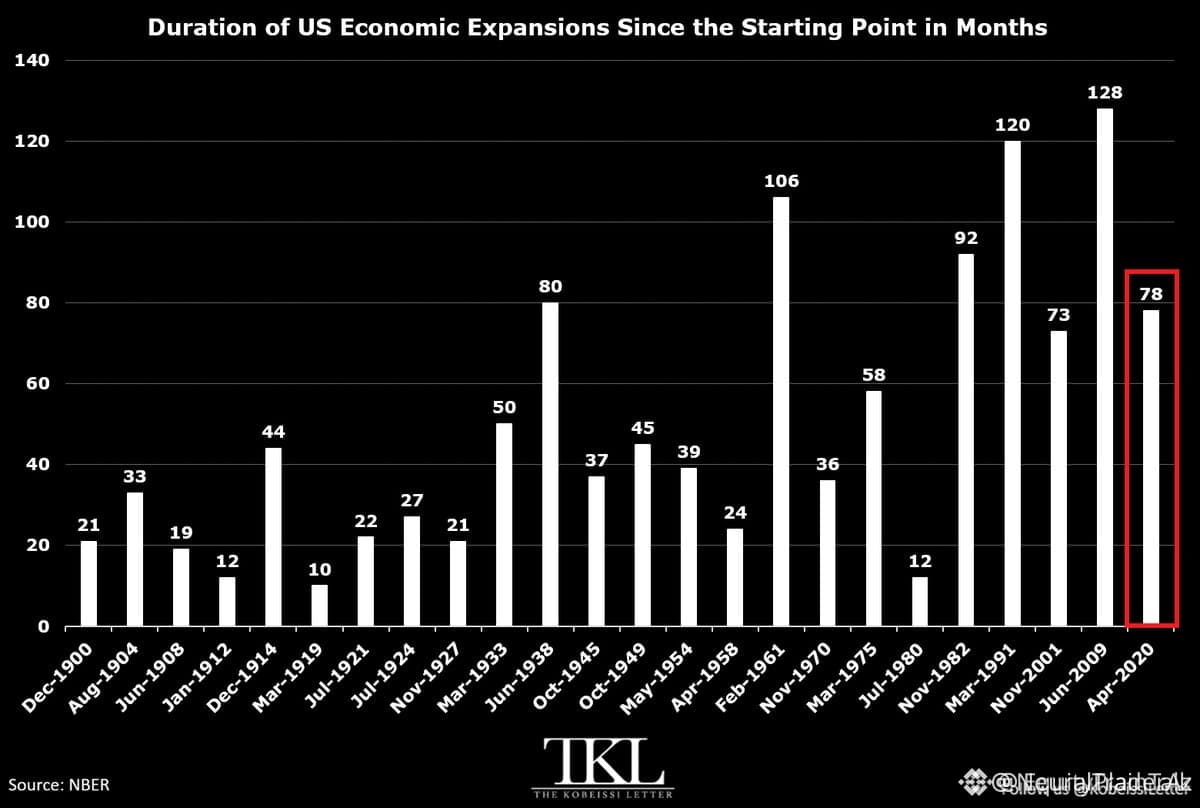
🚨 78 MONTHS OF EXPANSION: HOW MACRO CYCLES ARE SHAPING THE NEXT $BTC LIQUIDITY PIVOT 📊
📌 We are currently 78 months into an unprecedented macro expansion, stretching far beyond historical medians as institutional liquidity, fiscal deficits, and the AI boom rewrite traditional market cycles. 🔍 While structural staying power remains strong, history proves that elongated cycles do not eliminate pullbacks—they simply amplify the magnitude of the next structural turn.
💡 As smart money navigates this extended run, tracking major high-timeframe demand zones becomes essential before institutional liquidity relocates. 💬 How are you structuring your risk ahead of the next macro shift? 👇
⚠️ Not financial advice. Always manage your risk. 🛡️
🏷️ #BTC #MacroEconomy #MarketStructure #Crypto
🎯 🦈
🚨 78 MONTHS OF EXPANSION: HOW MACRO CYCLES ARE SHAPING THE NEXT $BTC LIQUIDITY PIVOT 📊
📌 We are currently 78 months into an unprecedented macro expansion, stretching far beyond historical medians as institutional liquidity, fiscal deficits, and the AI boom rewrite traditional market cycles. 🔍 While structural staying power remains strong, history proves that elongated cycles do not eliminate pullbacks—they simply amplify the magnitude of the next structural turn.
💡 As smart money navigates this extended run, tracking major high-timeframe demand zones becomes essential before institutional liquidity relocates. 💬 How are you structuring your risk ahead of the next macro shift? 👇
⚠️ Not financial advice. Always manage your risk. 🛡️
🏷️ #BTC #MacroEconomy #MarketStructure #Crypto
🎯 🦈
📌 We are currently 78 months into an unprecedented macro expansion, stretching far beyond historical medians as institutional liquidity, fiscal deficits, and the AI boom rewrite traditional market cycles. 🔍 While structural staying power remains strong, history proves that elongated cycles do not eliminate pullbacks—they simply amplify the magnitude of the next structural turn.
💡 As smart money navigates this extended run, tracking major high-timeframe demand zones becomes essential before institutional liquidity relocates. 💬 How are you structuring your risk ahead of the next macro shift? 👇
⚠️ Not financial advice. Always manage your risk. 🛡️
🏷️ #BTC #MacroEconomy #MarketStructure #Crypto
🎯 🦈
27
US 30-year Treasury yields surged to 5.69% today, marking their highest level in 24 years. This aggressive spike across the long end of the curve reflects mounting market pressure regarding structural debt issuance and prolonged restrictive monetary policy.
Investors are pricing in sustained fiscal deficits alongside a higher-for-longer rate environment. This breakout to multi-decade highs signals deep structural adjustments rather than temporary market volatility.
Surging yields strengthen the US dollar while putting significant downside pressure on risk assets, equities, and traditional bond valuations. Capital continues to seek shelter in risk-free sovereign yields, draining liquidity from broader financial markets.
For crypto markets, elevated benchmark yields pose persistent headwinds by increasing the opportunity cost of holding non-yielding assets. If liquidity continues to contract, $BTC and broader altcoins may face extended consolidation phases. #USYields #TreasuryBonds #MacroEconomy
US 30-year Treasury yields surged to 5.69% today, marking their highest level in 24 years. This aggressive spike across the long end of the curve reflects mounting market pressure regarding structural debt issuance and prolonged restrictive monetary policy.
Investors are pricing in sustained fiscal deficits alongside a higher-for-longer rate environment. This breakout to multi-decade highs signals deep structural adjustments rather than temporary market volatility.
Surging yields strengthen the US dollar while putting significant downside pressure on risk assets, equities, and traditional bond valuations. Capital continues to seek shelter in risk-free sovereign yields, draining liquidity from broader financial markets.
For crypto markets, elevated benchmark yields pose persistent headwinds by increasing the opportunity cost of holding non-yielding assets. If liquidity continues to contract, $BTC and broader altcoins may face extended consolidation phases. #USYields #TreasuryBonds #MacroEconomy
Investors are pricing in sustained fiscal deficits alongside a higher-for-longer rate environment. This breakout to multi-decade highs signals deep structural adjustments rather than temporary market volatility.
Surging yields strengthen the US dollar while putting significant downside pressure on risk assets, equities, and traditional bond valuations. Capital continues to seek shelter in risk-free sovereign yields, draining liquidity from broader financial markets.
For crypto markets, elevated benchmark yields pose persistent headwinds by increasing the opportunity cost of holding non-yielding assets. If liquidity continues to contract, $BTC and broader altcoins may face extended consolidation phases. #USYields #TreasuryBonds #MacroEconomy
27

·
--
🚨 CONSUMER CONFIDENCE CRASHES TO 10-YEAR LOWS AS MACRO LIQUIDITY SHIFTS $BTC 📉
Institutional desks are watching consumer confidence plummet 6.7 points to 81.9, marking a decade-low sentiment contraction across every income demographic. 🔍 When consumer spending—representing 70% of economic activity—taps the brakes, macro liquidity inevitably contracts, driving capital toward defensive structural pivots.
Sustained pressure from elevated goods and energy costs is forcing a tightening credit cycle that traditional risk assets cannot ignore. 📊 Smart money tracks these systematic macro shifts to anticipate order flow rebalancing before broader markets react to declining discretionary velocity.
💡 As retail demand softens, institutional desks prepare for volatility across major liquidity pools. 💬 How are you positioning your portfolio as macro conditions tighten across the board? 👇
⚠️ Not financial advice. Always manage your risk. 🛡️
🏷️ #BTC #MacroEconomy #MarketStructure #Crypto
📊 🦈
🚨 CONSUMER CONFIDENCE CRASHES TO 10-YEAR LOWS AS MACRO LIQUIDITY SHIFTS $BTC 📉
Institutional desks are watching consumer confidence plummet 6.7 points to 81.9, marking a decade-low sentiment contraction across every income demographic. 🔍 When consumer spending—representing 70% of economic activity—taps the brakes, macro liquidity inevitably contracts, driving capital toward defensive structural pivots.
Sustained pressure from elevated goods and energy costs is forcing a tightening credit cycle that traditional risk assets cannot ignore. 📊 Smart money tracks these systematic macro shifts to anticipate order flow rebalancing before broader markets react to declining discretionary velocity.
💡 As retail demand softens, institutional desks prepare for volatility across major liquidity pools. 💬 How are you positioning your portfolio as macro conditions tighten across the board? 👇
⚠️ Not financial advice. Always manage your risk. 🛡️
🏷️ #BTC #MacroEconomy #MarketStructure #Crypto
📊 🦈
Institutional desks are watching consumer confidence plummet 6.7 points to 81.9, marking a decade-low sentiment contraction across every income demographic. 🔍 When consumer spending—representing 70% of economic activity—taps the brakes, macro liquidity inevitably contracts, driving capital toward defensive structural pivots.
Sustained pressure from elevated goods and energy costs is forcing a tightening credit cycle that traditional risk assets cannot ignore. 📊 Smart money tracks these systematic macro shifts to anticipate order flow rebalancing before broader markets react to declining discretionary velocity.
💡 As retail demand softens, institutional desks prepare for volatility across major liquidity pools. 💬 How are you positioning your portfolio as macro conditions tighten across the board? 👇
⚠️ Not financial advice. Always manage your risk. 🛡️
🏷️ #BTC #MacroEconomy #MarketStructure #Crypto
📊 🦈
15

·
--
Four US macro events could swing Bitcoin this week.
The Institute for Supply Management publishes its September Services PMI today; the sector represents the largest part of the US economy and the report can materially affect expectations for growth and inflation.
A surprisingly strong reading could revive concerns that the economy remains hot enough to tolerate higher rates, while a weaker reading could reinforce the argument for the Fed to pause hikes after last week’s PCE data and jobs report.
Wednesday brings the FOMC minutes from the September 15‑16 meeting, where the Federal Reserve increased rates for the first time in three years. The minutes should detail how divided officials were over the decision and how concerned they remain about inflation, the labor market, and another possible increase later this year.
Markets, including Bitcoin investors, will watch the minutes for clues that influence Treasury yields, the dollar, and overall risk appetite.
On Thursday, the latest weekly unemployment claims data show an initial figure of 197,000 with a four‑week moving average of 200,000; an unusually low reading would suggest the labor market remains relatively resilient despite weak September payroll growth.
Friday’s event is the University of Michigan’s preliminary October consumer sentiment survey; its interpretation is not straightforward for crypto.
A dark‑horse factor could be fresh developments on the Middle East front, with both the US and Iran reportedly bracing for fresh attacks.
Which of these releases do you think will have the biggest short‑term impact on Bitcoin price?
#Bitcoin #FinTech #MacroEconomy #FederalReserve
Four US macro events could swing Bitcoin this week.
The Institute for Supply Management publishes its September Services PMI today; the sector represents the largest part of the US economy and the report can materially affect expectations for growth and inflation.
A surprisingly strong reading could revive concerns that the economy remains hot enough to tolerate higher rates, while a weaker reading could reinforce the argument for the Fed to pause hikes after last week’s PCE data and jobs report.
Wednesday brings the FOMC minutes from the September 15‑16 meeting, where the Federal Reserve increased rates for the first time in three years. The minutes should detail how divided officials were over the decision and how concerned they remain about inflation, the labor market, and another possible increase later this year.
Markets, including Bitcoin investors, will watch the minutes for clues that influence Treasury yields, the dollar, and overall risk appetite.
On Thursday, the latest weekly unemployment claims data show an initial figure of 197,000 with a four‑week moving average of 200,000; an unusually low reading would suggest the labor market remains relatively resilient despite weak September payroll growth.
Friday’s event is the University of Michigan’s preliminary October consumer sentiment survey; its interpretation is not straightforward for crypto.
A dark‑horse factor could be fresh developments on the Middle East front, with both the US and Iran reportedly bracing for fresh attacks.
Which of these releases do you think will have the biggest short‑term impact on Bitcoin price?
#Bitcoin #FinTech #MacroEconomy #FederalReserve
The Institute for Supply Management publishes its September Services PMI today; the sector represents the largest part of the US economy and the report can materially affect expectations for growth and inflation.
A surprisingly strong reading could revive concerns that the economy remains hot enough to tolerate higher rates, while a weaker reading could reinforce the argument for the Fed to pause hikes after last week’s PCE data and jobs report.
Wednesday brings the FOMC minutes from the September 15‑16 meeting, where the Federal Reserve increased rates for the first time in three years. The minutes should detail how divided officials were over the decision and how concerned they remain about inflation, the labor market, and another possible increase later this year.
Markets, including Bitcoin investors, will watch the minutes for clues that influence Treasury yields, the dollar, and overall risk appetite.
On Thursday, the latest weekly unemployment claims data show an initial figure of 197,000 with a four‑week moving average of 200,000; an unusually low reading would suggest the labor market remains relatively resilient despite weak September payroll growth.
Friday’s event is the University of Michigan’s preliminary October consumer sentiment survey; its interpretation is not straightforward for crypto.
A dark‑horse factor could be fresh developments on the Middle East front, with both the US and Iran reportedly bracing for fresh attacks.
Which of these releases do you think will have the biggest short‑term impact on Bitcoin price?
#Bitcoin #FinTech #MacroEconomy #FederalReserve

1
76

Germany’s Federal Statistical Office released the latest economic data today. Industrial production rose 2% month over month in August on a seasonally adjusted basis, far exceeding the market forecast of 0.5% and rebounding sharply from the previous reading of -1.1%. Meanwhile, industrial production adjusted for working days also climbed to 2.3% year over year in August.
As Europe’s largest economy, Germany’s 2% monthly jump in industrial output highlights the stronger-than-expected resilience of its manufacturing sector at the bottom of the cycle. Technically, this reversal has broken the previous downtrend of consecutive contractions, signaling that supply chains are recovering and capacity utilization is rapidly regaining momentum. It has significantly eased systemic concerns about a hard landing for the European economy.
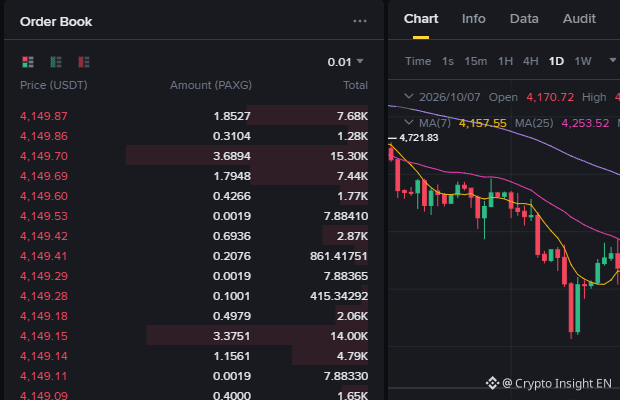
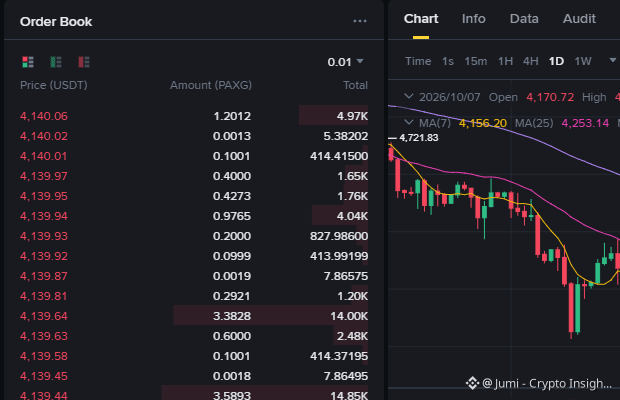
Driven by strong fundamentals, sentiment toward European assets has improved markedly, prompting healthy profit-taking and reallocation among traditional safe-haven investors. Spot gold fell below the key technical support level of $4,130 per ounce intraday, with losses reaching 0.81%. Capital is steadily flowing out of extreme safe-haven assets and back into risk assets.
The retreat in the safe-haven premium, alongside stabilizing macroeconomic fundamentals, has created an excellent liquidity backdrop for the crypto market. As risk appetite (Risk-on) broadly heats up, market participants are actively accumulating positions, and $BTC and other major cryptocurrencies may be poised for a fresh bullish breakout above key support zones.
#MacroEconomy #IndustrialProduction #MarketAnalysis
Germany’s Federal Statistical Office released the latest economic data today. Industrial production rose 2% month over month in August on a seasonally adjusted basis, far exceeding the market forecast of 0.5% and rebounding sharply from the previous reading of -1.1%. Meanwhile, industrial production adjusted for working days also climbed to 2.3% year over year in August.
As Europe’s largest economy, Germany’s 2% monthly jump in industrial output highlights the stronger-than-expected resilience of its manufacturing sector at the bottom of the cycle. Technically, this reversal has broken the previous downtrend of consecutive contractions, signaling that supply chains are recovering and capacity utilization is rapidly regaining momentum. It has significantly eased systemic concerns about a hard landing for the European economy.
Driven by strong fundamentals, sentiment toward European assets has improved markedly, prompting healthy profit-taking and reallocation among traditional safe-haven investors. Spot gold fell below the key technical support level of $4,130 per ounce intraday, with losses reaching 0.81%. Capital is steadily flowing out of extreme safe-haven assets and back into risk assets.
The retreat in the safe-haven premium, alongside stabilizing macroeconomic fundamentals, has created an excellent liquidity backdrop for the crypto market. As risk appetite (Risk-on) broadly heats up, market participants are actively accumulating positions, and $BTC and other major cryptocurrencies may be poised for a fresh bullish breakout above key support zones.
#MacroEconomy #IndustrialProduction #MarketAnalysis
As Europe’s largest economy, Germany’s 2% monthly jump in industrial output highlights the stronger-than-expected resilience of its manufacturing sector at the bottom of the cycle. Technically, this reversal has broken the previous downtrend of consecutive contractions, signaling that supply chains are recovering and capacity utilization is rapidly regaining momentum. It has significantly eased systemic concerns about a hard landing for the European economy.
Driven by strong fundamentals, sentiment toward European assets has improved markedly, prompting healthy profit-taking and reallocation among traditional safe-haven investors. Spot gold fell below the key technical support level of $4,130 per ounce intraday, with losses reaching 0.81%. Capital is steadily flowing out of extreme safe-haven assets and back into risk assets.
The retreat in the safe-haven premium, alongside stabilizing macroeconomic fundamentals, has created an excellent liquidity backdrop for the crypto market. As risk appetite (Risk-on) broadly heats up, market participants are actively accumulating positions, and $BTC and other major cryptocurrencies may be poised for a fresh bullish breakout above key support zones.
#MacroEconomy #IndustrialProduction #MarketAnalysis

·
--
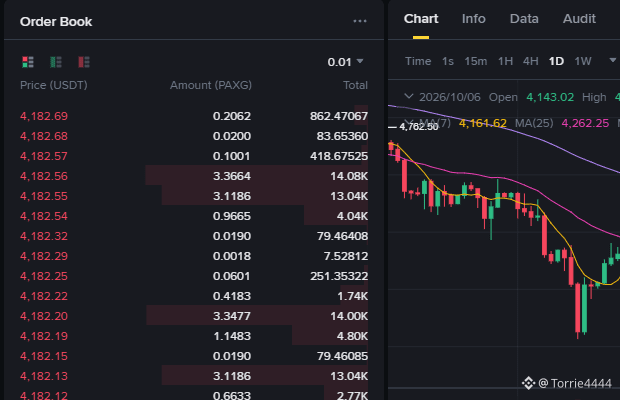
Spot gold saw a pronounced move intraday today, surging more than 1% in a rapid short-term rally and climbing above $4,182.01 per ounce. Meanwhile, newly released data from Citigroup showed that U.S. high-end credit card spending fell 6% year over year in September, marking its third consecutive month of contraction. Taken together, the two data points send intriguing signals about risk aversion and a cooling economy.
High-end spending is often seen as a barometer of consumption resilience among high-net-worth individuals. Three consecutive months of weakness suggest that even groups with greater capacity to weather risk are cutting back. Combined with gold’s sharp, high-volume surge over a short period, this suggests that uncertainty in the current macro environment is prompting some large investors to reassess their asset allocations and gravitate toward safer assets with greater certainty.
In traditional financial markets, this sentiment could directly affect the short-term direction of Treasury yields and the U.S. dollar. Growing concerns about an economic slowdown could weigh on the valuation premiums of risk assets, putting pressure on equities, while precious metals and other hedging instruments continue to attract investor interest.
In crypto markets, capital flows are still diverging, and the picture remains under observation. On the one hand, if risk aversion dominates the market, major assets such as $BTC could benefit as some investors view them as alternative reserve assets. On the other hand, if overall liquidity tightens amid macroeconomic caution, altcoins and other high-beta assets could face some liquidity pressure in the short term. It remains to be seen whether capital flows will settle on a clearer direction.🪙
#GoldPrice #MacroEconomy #CryptoMarket
Spot gold saw a pronounced move intraday today, surging more than 1% in a rapid short-term rally and climbing above $4,182.01 per ounce. Meanwhile, newly released data from Citigroup showed that U.S. high-end credit card spending fell 6% year over year in September, marking its third consecutive month of contraction. Taken together, the two data points send intriguing signals about risk aversion and a cooling economy.
High-end spending is often seen as a barometer of consumption resilience among high-net-worth individuals. Three consecutive months of weakness suggest that even groups with greater capacity to weather risk are cutting back. Combined with gold’s sharp, high-volume surge over a short period, this suggests that uncertainty in the current macro environment is prompting some large investors to reassess their asset allocations and gravitate toward safer assets with greater certainty.
In traditional financial markets, this sentiment could directly affect the short-term direction of Treasury yields and the U.S. dollar. Growing concerns about an economic slowdown could weigh on the valuation premiums of risk assets, putting pressure on equities, while precious metals and other hedging instruments continue to attract investor interest.
In crypto markets, capital flows are still diverging, and the picture remains under observation. On the one hand, if risk aversion dominates the market, major assets such as $BTC could benefit as some investors view them as alternative reserve assets. On the other hand, if overall liquidity tightens amid macroeconomic caution, altcoins and other high-beta assets could face some liquidity pressure in the short term. It remains to be seen whether capital flows will settle on a clearer direction.🪙
#GoldPrice #MacroEconomy #CryptoMarket
High-end spending is often seen as a barometer of consumption resilience among high-net-worth individuals. Three consecutive months of weakness suggest that even groups with greater capacity to weather risk are cutting back. Combined with gold’s sharp, high-volume surge over a short period, this suggests that uncertainty in the current macro environment is prompting some large investors to reassess their asset allocations and gravitate toward safer assets with greater certainty.
In traditional financial markets, this sentiment could directly affect the short-term direction of Treasury yields and the U.S. dollar. Growing concerns about an economic slowdown could weigh on the valuation premiums of risk assets, putting pressure on equities, while precious metals and other hedging instruments continue to attract investor interest.
In crypto markets, capital flows are still diverging, and the picture remains under observation. On the one hand, if risk aversion dominates the market, major assets such as $BTC could benefit as some investors view them as alternative reserve assets. On the other hand, if overall liquidity tightens amid macroeconomic caution, altcoins and other high-beta assets could face some liquidity pressure in the short term. It remains to be seen whether capital flows will settle on a clearer direction.🪙
#GoldPrice #MacroEconomy #CryptoMarket
7

·
--
The U.S. Treasury has just completed an auction of 3-year government bonds, with the high yield reaching 4.932%. Immediately after the auction, secondary-market yields eased slightly by 3.4 basis points to 4.927%.
This is the highest yield at a 3-year auction since 2006, reflecting expectations that interest rates will remain elevated for longer. Yields reaching a multi-year peak show that the market is having to pay more to absorb the massive volume of debt being issued.
Bond yields holding near historic highs continue to put pressure on the valuations of risk assets and support the strength of the U.S. dollar. Meanwhile, the Fed’s Reverse Repo (RRP) facility recorded just $414 million, indicating that excess liquidity in the system has been significantly drained.
For the crypto market, high interest rates and tight liquidity will limit new inflows into highly volatile assets such as $BTC. Investors should be cautious amid the risk that the market may continue to trade sideways and consolidate or face short-term correction pressure.
#BondYields #Fed #MacroEconomy
The U.S. Treasury has just completed an auction of 3-year government bonds, with the high yield reaching 4.932%. Immediately after the auction, secondary-market yields eased slightly by 3.4 basis points to 4.927%.
This is the highest yield at a 3-year auction since 2006, reflecting expectations that interest rates will remain elevated for longer. Yields reaching a multi-year peak show that the market is having to pay more to absorb the massive volume of debt being issued.
Bond yields holding near historic highs continue to put pressure on the valuations of risk assets and support the strength of the U.S. dollar. Meanwhile, the Fed’s Reverse Repo (RRP) facility recorded just $414 million, indicating that excess liquidity in the system has been significantly drained.
For the crypto market, high interest rates and tight liquidity will limit new inflows into highly volatile assets such as $BTC . Investors should be cautious amid the risk that the market may continue to trade sideways and consolidate or face short-term correction pressure.
#BondYields #Fed #MacroEconomy
This is the highest yield at a 3-year auction since 2006, reflecting expectations that interest rates will remain elevated for longer. Yields reaching a multi-year peak show that the market is having to pay more to absorb the massive volume of debt being issued.
Bond yields holding near historic highs continue to put pressure on the valuations of risk assets and support the strength of the U.S. dollar. Meanwhile, the Fed’s Reverse Repo (RRP) facility recorded just $414 million, indicating that excess liquidity in the system has been significantly drained.
For the crypto market, high interest rates and tight liquidity will limit new inflows into highly volatile assets such as $BTC . Investors should be cautious amid the risk that the market may continue to trade sideways and consolidate or face short-term correction pressure.
#BondYields #Fed #MacroEconomy
1
264

PIMCO senior advisor and portfolio manager Rupert Harrison said Tuesday at a TS Lombard economic briefing in London that U.S. 10-year and 30-year Treasury yields had both climbed this week to their highest levels in 24 years. Harrison stressed that, after the recent sharp rise in yields, U.S. Treasuries now offer highly attractive value for investors, and that PIMCO is currently maintaining some duration exposure.
Long-term U.S. Treasury yields have reached their highest levels in nearly a quarter-century, reflecting extreme market concerns about persistently high U.S. fiscal deficits and sticky long-term inflation. This latest bond sell-off has not only pushed up the risk-free rate benchmark but has also significantly reshaped institutions’ expectations for asset safety margins.
From a macro-financial perspective, record-high yields are powerfully siphoning off global liquidity, bolstering the resilience of the U.S. dollar index, and putting significant discount-rate pressure on richly valued equities. If economic growth slows or technology stocks undergo a deep correction, funds may flow back more quickly into high-coupon long-term Treasuries, dampening overall risk appetite.
For crypto assets, risk-free yields remaining at historically high levels mean that the opportunity cost for institutions allocating to cryptocurrencies has risen substantially. Under the combined pressures of persistently tightening macro liquidity and liquidity withdrawal, risk assets such as $BTC may face greater valuation pressure and volatility in the short term. #US10Y #BondMarket #MacroEconomy
PIMCO senior advisor and portfolio manager Rupert Harrison said Tuesday at a TS Lombard economic briefing in London that U.S. 10-year and 30-year Treasury yields had both climbed this week to their highest levels in 24 years. Harrison stressed that, after the recent sharp rise in yields, U.S. Treasuries now offer highly attractive value for investors, and that PIMCO is currently maintaining some duration exposure.
Long-term U.S. Treasury yields have reached their highest levels in nearly a quarter-century, reflecting extreme market concerns about persistently high U.S. fiscal deficits and sticky long-term inflation. This latest bond sell-off has not only pushed up the risk-free rate benchmark but has also significantly reshaped institutions’ expectations for asset safety margins.
From a macro-financial perspective, record-high yields are powerfully siphoning off global liquidity, bolstering the resilience of the U.S. dollar index, and putting significant discount-rate pressure on richly valued equities. If economic growth slows or technology stocks undergo a deep correction, funds may flow back more quickly into high-coupon long-term Treasuries, dampening overall risk appetite.
For crypto assets, risk-free yields remaining at historically high levels mean that the opportunity cost for institutions allocating to cryptocurrencies has risen substantially. Under the combined pressures of persistently tightening macro liquidity and liquidity withdrawal, risk assets such as $BTC may face greater valuation pressure and volatility in the short term. #US10Y #BondMarket #MacroEconomy
Long-term U.S. Treasury yields have reached their highest levels in nearly a quarter-century, reflecting extreme market concerns about persistently high U.S. fiscal deficits and sticky long-term inflation. This latest bond sell-off has not only pushed up the risk-free rate benchmark but has also significantly reshaped institutions’ expectations for asset safety margins.
From a macro-financial perspective, record-high yields are powerfully siphoning off global liquidity, bolstering the resilience of the U.S. dollar index, and putting significant discount-rate pressure on richly valued equities. If economic growth slows or technology stocks undergo a deep correction, funds may flow back more quickly into high-coupon long-term Treasuries, dampening overall risk appetite.
For crypto assets, risk-free yields remaining at historically high levels mean that the opportunity cost for institutions allocating to cryptocurrencies has risen substantially. Under the combined pressures of persistently tightening macro liquidity and liquidity withdrawal, risk assets such as $BTC may face greater valuation pressure and volatility in the short term. #US10Y #BondMarket #MacroEconomy
Against the backdrop of ongoing repricing of liquidity across global financial markets, the U.S. sovereign debt market sounded the alarm again during today’s trading session, with the yield on 30-year U.S. Treasury bonds surging intraday to 5.69%, setting a new high not seen in nearly 24 years. This key long-term interest rate indicator, a critical market bellwether, has moved sharply, directly upending earlier expectations that long-term borrowing costs would ease.
The long-term U.S. Treasury yield has reached a nearly quarter-century high, primarily because markets are not only absorbing the tighter policy stance but also being forced to reassess the bond supply pressures created by the U.S. federal government’s massive fiscal deficit. The term premium investors demand for holding ultra-long-dated bonds is widening sharply, reflecting large institutional investors’ deeply defensive stance toward persistent inflation and ballooning debt over the long term.
This unchecked rise in long-term borrowing costs is placing systematic pressure on global macro-financial assets. As the anchor for global asset pricing, soaring risk-free rates are significantly eroding the risk premium on equities, putting substantial valuation pressure on high-priced technology growth stocks, while also drawing in conservative capital from around the world and tightening overall financial conditions.
For the cryptocurrency ecosystem, $BTC and digital assets more broadly face a severe test of liquidity withdrawal and valuation resets. When risk-free ultra-long-term government bonds can reliably offer nominal returns close to 5.7%, institutional investors’ willingness to allocate incremental capital to highly volatile assets is bound to be seriously constrained. Until there is a turning point in the prolonged period of tightening macro liquidity, the market should remain highly alert to potential capital outflows and valuation pullbacks.
#TreasuryYields #MacroEconomy #BondMarket
Against the backdrop of ongoing repricing of liquidity across global financial markets, the U.S. sovereign debt market sounded the alarm again during today’s trading session, with the yield on 30-year U.S. Treasury bonds surging intraday to 5.69%, setting a new high not seen in nearly 24 years. This key long-term interest rate indicator, a critical market bellwether, has moved sharply, directly upending earlier expectations that long-term borrowing costs would ease.
The long-term U.S. Treasury yield has reached a nearly quarter-century high, primarily because markets are not only absorbing the tighter policy stance but also being forced to reassess the bond supply pressures created by the U.S. federal government’s massive fiscal deficit. The term premium investors demand for holding ultra-long-dated bonds is widening sharply, reflecting large institutional investors’ deeply defensive stance toward persistent inflation and ballooning debt over the long term.
This unchecked rise in long-term borrowing costs is placing systematic pressure on global macro-financial assets. As the anchor for global asset pricing, soaring risk-free rates are significantly eroding the risk premium on equities, putting substantial valuation pressure on high-priced technology growth stocks, while also drawing in conservative capital from around the world and tightening overall financial conditions.
For the cryptocurrency ecosystem, $BTC and digital assets more broadly face a severe test of liquidity withdrawal and valuation resets. When risk-free ultra-long-term government bonds can reliably offer nominal returns close to 5.7%, institutional investors’ willingness to allocate incremental capital to highly volatile assets is bound to be seriously constrained. Until there is a turning point in the prolonged period of tightening macro liquidity, the market should remain highly alert to potential capital outflows and valuation pullbacks.
#TreasuryYields #MacroEconomy #BondMarket
The long-term U.S. Treasury yield has reached a nearly quarter-century high, primarily because markets are not only absorbing the tighter policy stance but also being forced to reassess the bond supply pressures created by the U.S. federal government’s massive fiscal deficit. The term premium investors demand for holding ultra-long-dated bonds is widening sharply, reflecting large institutional investors’ deeply defensive stance toward persistent inflation and ballooning debt over the long term.
This unchecked rise in long-term borrowing costs is placing systematic pressure on global macro-financial assets. As the anchor for global asset pricing, soaring risk-free rates are significantly eroding the risk premium on equities, putting substantial valuation pressure on high-priced technology growth stocks, while also drawing in conservative capital from around the world and tightening overall financial conditions.
For the cryptocurrency ecosystem, $BTC and digital assets more broadly face a severe test of liquidity withdrawal and valuation resets. When risk-free ultra-long-term government bonds can reliably offer nominal returns close to 5.7%, institutional investors’ willingness to allocate incremental capital to highly volatile assets is bound to be seriously constrained. Until there is a turning point in the prolonged period of tightening macro liquidity, the market should remain highly alert to potential capital outflows and valuation pullbacks.
#TreasuryYields #MacroEconomy #BondMarket
BTC-2.28%
TLTETF-0.60%
259

·
--
Article
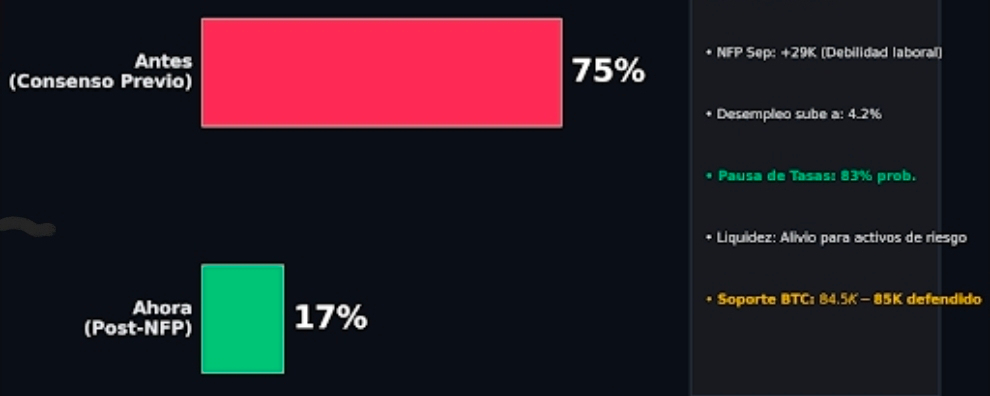
From 75% to 17%: The Fed slams on the brakes and the labor market changes the rules of the game.While most people focus on short-term noise, the derivatives and forecasting market has just executed one of the most aggressive macro turns of the quarter: the probability of a Fed rate hike for October collapsed to 17% (from a prior 75%), leaving 83% of consensus in favor of a pause.
Here are the real data behind the move and its technical impact:
1. The evidence: The break in labor market data
The trigger wasn’t speculative; it was backed by official employment figures (NFP):
From 75% to 17%: The Fed slams on the brakes and the labor market changes the rules of the game.
While most people focus on short-term noise, the derivatives and forecasting market has just executed one of the most aggressive macro turns of the quarter: the probability of a Fed rate hike for October collapsed to 17% (from a prior 75%), leaving 83% of consensus in favor of a pause.
Here are the real data behind the move and its technical impact:
1. The evidence: The break in labor market data
The trigger wasn’t speculative; it was backed by official employment figures (NFP):
Here are the real data behind the move and its technical impact:
1. The evidence: The break in labor market data
The trigger wasn’t speculative; it was backed by official employment figures (NFP):
38
U.S. labor market data released today signaled a clear cooling trend, significantly dampening hawkish policy expectations. Following the soft employment figures, CME's FedWatch Tool showed the probability of the Fed holding interest rates steady at its October meeting surged to 83%, up from 72% prior to the release, while the odds of a rate hike shrank to just 17%.
This labor market deceleration provides critical breathing room for monetary policymakers after the rate hike earlier this autumn. Fed funds futures are now pricing in a cumulative tightening of just 22.2 bps through late 2026, down from 25.5 bps previously, signaling growing consensus that peak policy rates may be near.
Traditional financial markets responded with relief as Treasury yields retreated and the dollar softened against major peers. Easing tightening pressures also reduced borrowing cost anxieties across equities, stabilizing broader risk sentiment heading into the next central bank policy cycle.
For crypto markets, cooling labor metrics and fading rate hike odds present a constructive macroeconomic backdrop. With downside liquidity risks diminishing, capital flows are likely to stabilize across major digital assets like $BTC, boosting broader investor appetite for risk on assets.
#Fed #InterestRates #MacroEconomy
U.S. labor market data released today signaled a clear cooling trend, significantly dampening hawkish policy expectations. Following the soft employment figures, CME's FedWatch Tool showed the probability of the Fed holding interest rates steady at its October meeting surged to 83%, up from 72% prior to the release, while the odds of a rate hike shrank to just 17%.
This labor market deceleration provides critical breathing room for monetary policymakers after the rate hike earlier this autumn. Fed funds futures are now pricing in a cumulative tightening of just 22.2 bps through late 2026, down from 25.5 bps previously, signaling growing consensus that peak policy rates may be near.
Traditional financial markets responded with relief as Treasury yields retreated and the dollar softened against major peers. Easing tightening pressures also reduced borrowing cost anxieties across equities, stabilizing broader risk sentiment heading into the next central bank policy cycle.
For crypto markets, cooling labor metrics and fading rate hike odds present a constructive macroeconomic backdrop. With downside liquidity risks diminishing, capital flows are likely to stabilize across major digital assets like $BTC , boosting broader investor appetite for risk on assets.
#Fed #InterestRates #MacroEconomy
This labor market deceleration provides critical breathing room for monetary policymakers after the rate hike earlier this autumn. Fed funds futures are now pricing in a cumulative tightening of just 22.2 bps through late 2026, down from 25.5 bps previously, signaling growing consensus that peak policy rates may be near.
Traditional financial markets responded with relief as Treasury yields retreated and the dollar softened against major peers. Easing tightening pressures also reduced borrowing cost anxieties across equities, stabilizing broader risk sentiment heading into the next central bank policy cycle.
For crypto markets, cooling labor metrics and fading rate hike odds present a constructive macroeconomic backdrop. With downside liquidity risks diminishing, capital flows are likely to stabilize across major digital assets like $BTC , boosting broader investor appetite for risk on assets.
#Fed #InterestRates #MacroEconomy
10

BTC : the market has just received a major piece of US data.
The September jobs report has been released.
Key figures:
• NFP: +29K
• Forecast: +90K
• Unemployment: 4.2%
• August revised: +133K
The slowdown in employment is therefore much more pronounced than expected.
BTC is trading around 86K–87K $ while traders digest this macro news.
To watch now: US yields, the dollar, and how the markets react to the next expectations for monetary policy.
Source: U.S. Bureau of Labor Statistics
#BTC #macroeconomy
{spot}(BTCUSDT)
BTC : the market has just received a major piece of US data.
The September jobs report has been released.
Key figures:
• NFP: +29K
• Forecast: +90K
• Unemployment: 4.2%
• August revised: +133K
The slowdown in employment is therefore much more pronounced than expected.
BTC is trading around 86K–87K $ while traders digest this macro news.
To watch now: US yields, the dollar, and how the markets react to the next expectations for monetary policy.
Source: U.S. Bureau of Labor Statistics
#BTC #macroeconomy
The September jobs report has been released.
Key figures:
• NFP: +29K
• Forecast: +90K
• Unemployment: 4.2%
• August revised: +133K
The slowdown in employment is therefore much more pronounced than expected.
BTC is trading around 86K–87K $ while traders digest this macro news.
To watch now: US yields, the dollar, and how the markets react to the next expectations for monetary policy.
Source: U.S. Bureau of Labor Statistics
#BTC #macroeconomy
16
The US Dollar Index (DXY) climbed to 101.66 during recent trading sessions, breaking past its July peak to mark its highest level since late June. Meanwhile, across the Atlantic, the UK housing market showed renewed signs of distress as Nationwide reported average home prices slipped 0.2% to £274,251, missing flat expectations.
This broad dollar rally highlights persistent macroeconomic resilience in the US compared to tightening consumer pressures abroad. With UK mortgage rates hovering near 6% and rising energy bills pinching household budgets, regional divergences are becoming starkly visible across global markets.
A resurgent greenback exerts immediate pressure across traditional assets, tightening global financial conditions while dampening momentum for gold and sovereign bonds. Investors are increasingly reassessing currency strength as elevated interest rates continue to punish interest-sensitive sectors like real estate.
For digital assets, sustained dollar strength typically creates short-term liquidity headwinds and caps aggressive upside momentum. If the DXY maintains its upward trajectory, risk assets including $BTC may face consolidation before broader market liquidity conditions improve. #USDollar #DXY #MacroEconomy
The US Dollar Index (DXY) climbed to 101.66 during recent trading sessions, breaking past its July peak to mark its highest level since late June. Meanwhile, across the Atlantic, the UK housing market showed renewed signs of distress as Nationwide reported average home prices slipped 0.2% to £274,251, missing flat expectations.
This broad dollar rally highlights persistent macroeconomic resilience in the US compared to tightening consumer pressures abroad. With UK mortgage rates hovering near 6% and rising energy bills pinching household budgets, regional divergences are becoming starkly visible across global markets.
A resurgent greenback exerts immediate pressure across traditional assets, tightening global financial conditions while dampening momentum for gold and sovereign bonds. Investors are increasingly reassessing currency strength as elevated interest rates continue to punish interest-sensitive sectors like real estate.
For digital assets, sustained dollar strength typically creates short-term liquidity headwinds and caps aggressive upside momentum. If the DXY maintains its upward trajectory, risk assets including $BTC may face consolidation before broader market liquidity conditions improve. #USDollar #DXY #MacroEconomy
This broad dollar rally highlights persistent macroeconomic resilience in the US compared to tightening consumer pressures abroad. With UK mortgage rates hovering near 6% and rising energy bills pinching household budgets, regional divergences are becoming starkly visible across global markets.
A resurgent greenback exerts immediate pressure across traditional assets, tightening global financial conditions while dampening momentum for gold and sovereign bonds. Investors are increasingly reassessing currency strength as elevated interest rates continue to punish interest-sensitive sectors like real estate.
For digital assets, sustained dollar strength typically creates short-term liquidity headwinds and caps aggressive upside momentum. If the DXY maintains its upward trajectory, risk assets including $BTC may face consolidation before broader market liquidity conditions improve. #USDollar #DXY #MacroEconomy
20
According to the latest interest rate swap data from CME FedWatch, the probability that the Federal Reserve will keep interest rates unchanged in October has risen to 75.1%, while the probability of a 25-basis-point hike is 24.9%. At the December meeting, the market is already pricing in a 25-basis-point hike with a probability of 61.3%, a 50-basis-point hike with a probability of 18.1%, and the probability of holding rates steady is only 20.6%.
This data indicates that market expectations of a policy shift toward easing have been thoroughly dashed. After earlier rate adjustments, sticky inflation and economic resilience have forced policymakers to maintain a hawkish stance, delaying any meaningful move toward liquidity easing.
From a macro perspective, keeping interest rates at high levels for “Higher for Longer” will continue to push up U.S. Treasury yields and the U.S. dollar index, suppressing risk appetite in traditional capital markets. Global liquidity remains constrained, and the valuation center of gravity faces further downward pressure.
For the crypto market, a high-rate environment limits the pace at which incremental fiat funds can enter. If another rate hike occurs as expected by year-end, the de-leveraging trend will continue; key risk assets such as $BTC may face the risk of episodic liquidity tightening and deeper pullbacks. Investors should be mindful of volatility caused by valuation repricing.📉
#Fed #InterestRates #MacroEconomy
According to the latest interest rate swap data from CME FedWatch, the probability that the Federal Reserve will keep interest rates unchanged in October has risen to 75.1%, while the probability of a 25-basis-point hike is 24.9%. At the December meeting, the market is already pricing in a 25-basis-point hike with a probability of 61.3%, a 50-basis-point hike with a probability of 18.1%, and the probability of holding rates steady is only 20.6%.
This data indicates that market expectations of a policy shift toward easing have been thoroughly dashed. After earlier rate adjustments, sticky inflation and economic resilience have forced policymakers to maintain a hawkish stance, delaying any meaningful move toward liquidity easing.
From a macro perspective, keeping interest rates at high levels for “Higher for Longer” will continue to push up U.S. Treasury yields and the U.S. dollar index, suppressing risk appetite in traditional capital markets. Global liquidity remains constrained, and the valuation center of gravity faces further downward pressure.
For the crypto market, a high-rate environment limits the pace at which incremental fiat funds can enter. If another rate hike occurs as expected by year-end, the de-leveraging trend will continue; key risk assets such as $BTC may face the risk of episodic liquidity tightening and deeper pullbacks. Investors should be mindful of volatility caused by valuation repricing.📉
#Fed #InterestRates #MacroEconomy
This data indicates that market expectations of a policy shift toward easing have been thoroughly dashed. After earlier rate adjustments, sticky inflation and economic resilience have forced policymakers to maintain a hawkish stance, delaying any meaningful move toward liquidity easing.
From a macro perspective, keeping interest rates at high levels for “Higher for Longer” will continue to push up U.S. Treasury yields and the U.S. dollar index, suppressing risk appetite in traditional capital markets. Global liquidity remains constrained, and the valuation center of gravity faces further downward pressure.
For the crypto market, a high-rate environment limits the pace at which incremental fiat funds can enter. If another rate hike occurs as expected by year-end, the de-leveraging trend will continue; key risk assets such as $BTC may face the risk of episodic liquidity tightening and deeper pullbacks. Investors should be mindful of volatility caused by valuation repricing.📉
#Fed #InterestRates #MacroEconomy
5
According to the latest CME FedWatch data, markets are pricing in a 61.8% probability that the Federal Reserve will hold interest rates steady through October, while the odds of a cumulative 25 bps hike stand at 38.2%. Looking ahead to December, the likelihood of rates remaining unchanged drops sharply to 13.3%, with a 56.7% chance of a 25 bps hike and a 30% probability of a 50 bps increase.
This aggressive shift in rate expectations reflects growing market conviction that inflationary pressures remain persistent. Following the Fed's resumption of rate hikes in September, traders are increasingly preparing for a higher-for-longer policy trajectory through year-end.
Across broader financial markets, these expectations will likely support US Treasury yields and maintain upward pressure on the US dollar. As the probability of cumulative tightening increases, equities and yield-sensitive assets may face ongoing headwinds.
For crypto markets, prolonged monetary tightening usually constraints speculative liquidity and creates short-term volatility for $BTC. Investors should closely monitor upcoming macro data releases to gauge whether additional rate hikes will materialize before 2027.
#Fed #InterestRates #MacroEconomy
According to the latest CME FedWatch data, markets are pricing in a 61.8% probability that the Federal Reserve will hold interest rates steady through October, while the odds of a cumulative 25 bps hike stand at 38.2%. Looking ahead to December, the likelihood of rates remaining unchanged drops sharply to 13.3%, with a 56.7% chance of a 25 bps hike and a 30% probability of a 50 bps increase.
This aggressive shift in rate expectations reflects growing market conviction that inflationary pressures remain persistent. Following the Fed's resumption of rate hikes in September, traders are increasingly preparing for a higher-for-longer policy trajectory through year-end.
Across broader financial markets, these expectations will likely support US Treasury yields and maintain upward pressure on the US dollar. As the probability of cumulative tightening increases, equities and yield-sensitive assets may face ongoing headwinds.
For crypto markets, prolonged monetary tightening usually constraints speculative liquidity and creates short-term volatility for $BTC . Investors should closely monitor upcoming macro data releases to gauge whether additional rate hikes will materialize before 2027.
#Fed #InterestRates #MacroEconomy
This aggressive shift in rate expectations reflects growing market conviction that inflationary pressures remain persistent. Following the Fed's resumption of rate hikes in September, traders are increasingly preparing for a higher-for-longer policy trajectory through year-end.
Across broader financial markets, these expectations will likely support US Treasury yields and maintain upward pressure on the US dollar. As the probability of cumulative tightening increases, equities and yield-sensitive assets may face ongoing headwinds.
For crypto markets, prolonged monetary tightening usually constraints speculative liquidity and creates short-term volatility for $BTC . Investors should closely monitor upcoming macro data releases to gauge whether additional rate hikes will materialize before 2027.
#Fed #InterestRates #MacroEconomy
31

·
--
Bullish
🤑🤑🤑📊 BIG MACRO UPDATE: INFLATION IS COOLING DOWN!
The latest US PCE Inflation data just dropped, showing a clear slowdown to 3.4% YoY (down from 3.7%)! 📉
What does this mean for Crypto & Financial Markets?🤑🤑🤑🤑
1️⃣ Fed Rate Hike Pause? With inflation easing, the Federal Reserve has a stronger case to hold interest rates steady or even pivot toward cuts.
2️⃣ Bullish Trigger for Crypto? Lower interest rates traditionally boost risk-on assets like #Bitcoin and Altcoins as liquidity enters the market.🤑🤑🤑🤑
3️⃣ Market Sentiment Shift: Investor confidence is stabilizing as macro pressures show signs of weakening.
Keep an eye on BTC andETH price action—macro factors like PCE often act as the spark for the next big move! 🚀
What’s your next move: Bullish 🐂 or Cautious 🐻? Let’s discuss below! 👇🤑🤑🤑🤑
{spot}(BTCUSDT)
#Binance #CryptoNews #Fed #PCEParty #bitcoin.” in #macroeconomy
🤑🤑🤑📊 BIG MACRO UPDATE: INFLATION IS COOLING DOWN!
The latest US PCE Inflation data just dropped, showing a clear slowdown to 3.4% YoY (down from 3.7%)! 📉
What does this mean for Crypto & Financial Markets?🤑🤑🤑🤑
1️⃣ Fed Rate Hike Pause? With inflation easing, the Federal Reserve has a stronger case to hold interest rates steady or even pivot toward cuts.
2️⃣ Bullish Trigger for Crypto? Lower interest rates traditionally boost risk-on assets like #Bitcoin and Altcoins as liquidity enters the market.🤑🤑🤑🤑
3️⃣ Market Sentiment Shift: Investor confidence is stabilizing as macro pressures show signs of weakening.
Keep an eye on BTC andETH price action—macro factors like PCE often act as the spark for the next big move! 🚀
What’s your next move: Bullish 🐂 or Cautious 🐻? Let’s discuss below! 👇🤑🤑🤑🤑
#Binance #CryptoNews #Fed #PCEParty #bitcoin.” in #macroeconomy
The latest US PCE Inflation data just dropped, showing a clear slowdown to 3.4% YoY (down from 3.7%)! 📉
What does this mean for Crypto & Financial Markets?🤑🤑🤑🤑
1️⃣ Fed Rate Hike Pause? With inflation easing, the Federal Reserve has a stronger case to hold interest rates steady or even pivot toward cuts.
2️⃣ Bullish Trigger for Crypto? Lower interest rates traditionally boost risk-on assets like #Bitcoin and Altcoins as liquidity enters the market.🤑🤑🤑🤑
3️⃣ Market Sentiment Shift: Investor confidence is stabilizing as macro pressures show signs of weakening.
Keep an eye on BTC andETH price action—macro factors like PCE often act as the spark for the next big move! 🚀
What’s your next move: Bullish 🐂 or Cautious 🐻? Let’s discuss below! 👇🤑🤑🤑🤑
#Binance #CryptoNews #Fed #PCEParty #bitcoin.” in #macroeconomy
82
The U.S. Treasury market once again faces selling pressure today, with the benchmark 10-year U.S. Treasury yield rising by 4.72 basis points intraday and now reaching a high of 5.34%. The continued climb of this key lending benchmark clearly reflects that global funding costs are being pushed higher still.
The jump in the 10-year U.S. Treasury yield to 5.34% carries very important macroeconomic implications. This indicates that the market is readjusting its pricing for prolonged high interest rates and even the continuation of tightening policy. Earlier overly optimistic expectations of easing have been thoroughly shattered, and the normalization of high funding costs is becoming the baseline assumption.
For traditional financial markets, elevated risk-free rates create significant revaluation pressure. Equity asset valuations face ongoing compression, and rising borrowing costs may further exacerbate credit vulnerability. Meanwhile, continued upward pressure on U.S. Treasury yields will likely keep supporting the return of dollar liquidity, producing a tightening effect on global FX and liquidity conditions.
In the crypto space, a risk-free yield as high as 5.34% is clearly suppressing the ability of the likes of $BTC to attract funding. With liquidity tightening and funding costs remaining high, the market faces deleveraging and downside risks. Investors should be alert to pullback pressures driven by a risk-off sentiment.#BondYields #TreasuryYields #MacroEconomy
The U.S. Treasury market once again faces selling pressure today, with the benchmark 10-year U.S. Treasury yield rising by 4.72 basis points intraday and now reaching a high of 5.34%. The continued climb of this key lending benchmark clearly reflects that global funding costs are being pushed higher still.
The jump in the 10-year U.S. Treasury yield to 5.34% carries very important macroeconomic implications. This indicates that the market is readjusting its pricing for prolonged high interest rates and even the continuation of tightening policy. Earlier overly optimistic expectations of easing have been thoroughly shattered, and the normalization of high funding costs is becoming the baseline assumption.
For traditional financial markets, elevated risk-free rates create significant revaluation pressure. Equity asset valuations face ongoing compression, and rising borrowing costs may further exacerbate credit vulnerability. Meanwhile, continued upward pressure on U.S. Treasury yields will likely keep supporting the return of dollar liquidity, producing a tightening effect on global FX and liquidity conditions.
In the crypto space, a risk-free yield as high as 5.34% is clearly suppressing the ability of the likes of $BTC to attract funding. With liquidity tightening and funding costs remaining high, the market faces deleveraging and downside risks. Investors should be alert to pullback pressures driven by a risk-off sentiment.#BondYields #TreasuryYields #MacroEconomy
The jump in the 10-year U.S. Treasury yield to 5.34% carries very important macroeconomic implications. This indicates that the market is readjusting its pricing for prolonged high interest rates and even the continuation of tightening policy. Earlier overly optimistic expectations of easing have been thoroughly shattered, and the normalization of high funding costs is becoming the baseline assumption.
For traditional financial markets, elevated risk-free rates create significant revaluation pressure. Equity asset valuations face ongoing compression, and rising borrowing costs may further exacerbate credit vulnerability. Meanwhile, continued upward pressure on U.S. Treasury yields will likely keep supporting the return of dollar liquidity, producing a tightening effect on global FX and liquidity conditions.
In the crypto space, a risk-free yield as high as 5.34% is clearly suppressing the ability of the likes of $BTC to attract funding. With liquidity tightening and funding costs remaining high, the market faces deleveraging and downside risks. Investors should be alert to pullback pressures driven by a risk-off sentiment.#BondYields #TreasuryYields #MacroEconomy
IEFETF-0.15%
1
·
--
U.S. government bond yields for the 10-year maturity continued to climb during today’s trading session, rising another 4.72 basis points to reach 5.34%. This upward momentum reflects ongoing selloff pressure in the public debt market, with no sign of abating.
With yields staying above 5.3%, the market appears to be repricing expectations for prolonged monetary policy tightening. Persistent inflation and the large scale of debt issuance by the U.S. government continue to exert upward pressure on borrowing costs beyond what had been anticipated.
The rise in benchmark bond yields has helped keep the U.S. dollar strong, while also clearly weighing on the stock market and gold. Higher and more expensive debt servicing costs directly reduce risk appetite across the entire global financial system.
For the crypto market, the risk-free yield above 5.3% is directly competing with speculative capital flows into $BTC and digital assets. Liquidity pressure may cause the crypto market to remain choppy, locked in a tug-of-war, and cautious in the near term. 📊
#BondYields #MacroEconomy #InterestRates
U.S. government bond yields for the 10-year maturity continued to climb during today’s trading session, rising another 4.72 basis points to reach 5.34%. This upward momentum reflects ongoing selloff pressure in the public debt market, with no sign of abating.
With yields staying above 5.3%, the market appears to be repricing expectations for prolonged monetary policy tightening. Persistent inflation and the large scale of debt issuance by the U.S. government continue to exert upward pressure on borrowing costs beyond what had been anticipated.
The rise in benchmark bond yields has helped keep the U.S. dollar strong, while also clearly weighing on the stock market and gold. Higher and more expensive debt servicing costs directly reduce risk appetite across the entire global financial system.
For the crypto market, the risk-free yield above 5.3% is directly competing with speculative capital flows into $BTC and digital assets. Liquidity pressure may cause the crypto market to remain choppy, locked in a tug-of-war, and cautious in the near term. 📊
#BondYields #MacroEconomy #InterestRates
With yields staying above 5.3%, the market appears to be repricing expectations for prolonged monetary policy tightening. Persistent inflation and the large scale of debt issuance by the U.S. government continue to exert upward pressure on borrowing costs beyond what had been anticipated.
The rise in benchmark bond yields has helped keep the U.S. dollar strong, while also clearly weighing on the stock market and gold. Higher and more expensive debt servicing costs directly reduce risk appetite across the entire global financial system.
For the crypto market, the risk-free yield above 5.3% is directly competing with speculative capital flows into $BTC and digital assets. Liquidity pressure may cause the crypto market to remain choppy, locked in a tug-of-war, and cautious in the near term. 📊
#BondYields #MacroEconomy #InterestRates
BTC-2.28%
IEFETF-0.15%
194
Log in to explore more content
Join global crypto users on Binance Square
⚡️ Get latest and useful information about crypto.
💬 Trusted by the world’s largest crypto exchange.
👍 Discover real insights from verified creators.
Email / Phone number
Trending Topics
1
#BinanceLaunchesBinanceIntelligence
747,110 views
4,656 Discussing
2
#BTCFallsBelow$84K
32,974 views
113 Discussing
3
#DubaiVARAIssuesReserveAssetAuditCircular
9,690 views
378 Discussing
4
#SECApproves3XBitcoinETF
8,872 views
321 Discussing
5
#WinklevossFilesSpotZcashETFApplication
18,188 views
432 Discussing
6
#SouthKoreaAITradeLiftsWorldcoinTo$7.41B
2,192 views
39 Discussing
7
#StrategyEstimates$4.1BIncomeTaxBenefit
1,444 views
22 Discussing
8
#IglooShutsDownAbstractBlockchain
7,561 views
228 Discussing
9
#StrategyMarketCapSurpassesRumble
48,468 views
952 Discussing
10
#StriveBuys2000BTCFor$169M
18,788 views
163 Discussing