
#rba
rba
3,005 views
40 Discussing
Hot
Latest


·
--
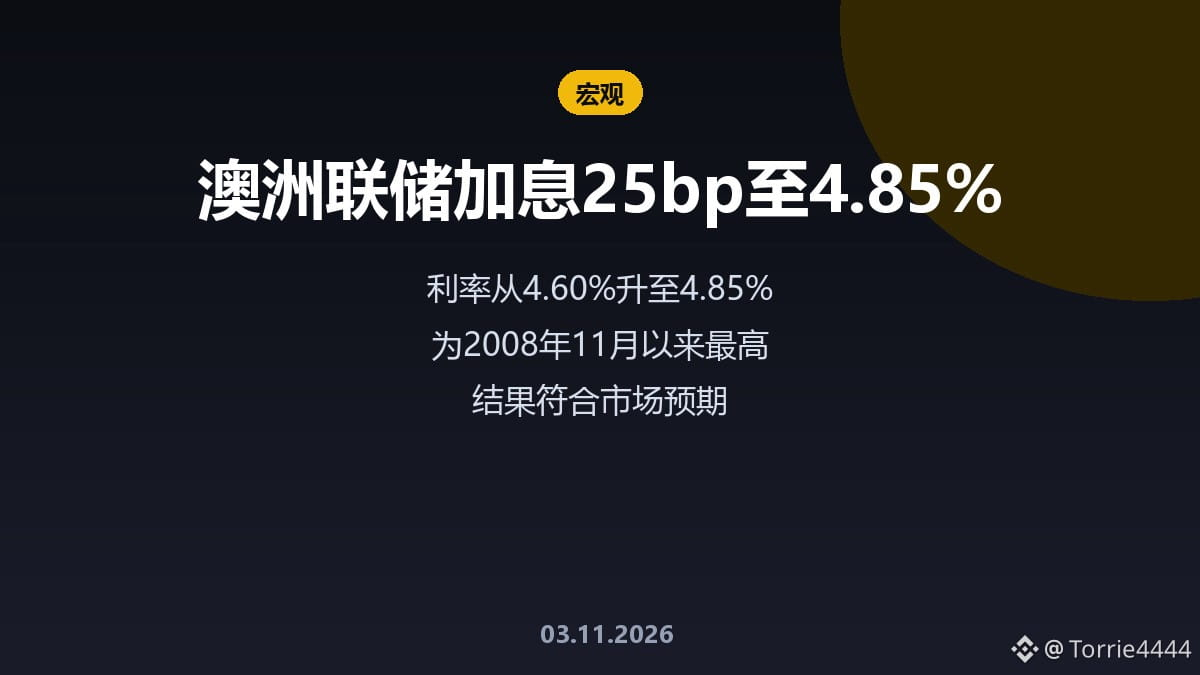
At 4.85%, Australia’s interest rate is back at its highest level since November 2008. 🇦🇺
On November 3, the Reserve Bank of Australia (RBA) announced a 25-basis-point rate hike, taking the rate from 4.60% to 4.85%. The result was exactly in line with market expectations—no surprises, no shocks.
Here’s what makes this worth watching:
- The rate is at 4.85%, its highest level in 18 years
- A 25-basis-point hike
- In line with expectations, and already priced in by the market
The Fed only just raised rates on September 16, its first hike since 2023. Now Australia is following suit, showing that more than one central bank is still tightening. At least for now, there are no clear signs that global interest rates are turning lower.
For traditional markets, an expected rate hike usually doesn’t cause much volatility. What’s more worth watching is the language going forward: will there be more hikes? The reactions of the Australian dollar, global bond yields, and the US dollar can show how investors are interpreting this signal.
For risk assets like $BTC , higher interest rates mean higher funding costs and less abundant liquidity. But this hike was already fully priced in, so its direct impact is limited. The real variable is whether other central banks follow suit.
Personally, I don’t think this one move by Australia is a big deal on its own. What matters is the pattern of “multiple central banks hiking at the same time.” Who do you think will be next to follow?
#RBA #InterestRates #Macro
60

·
--
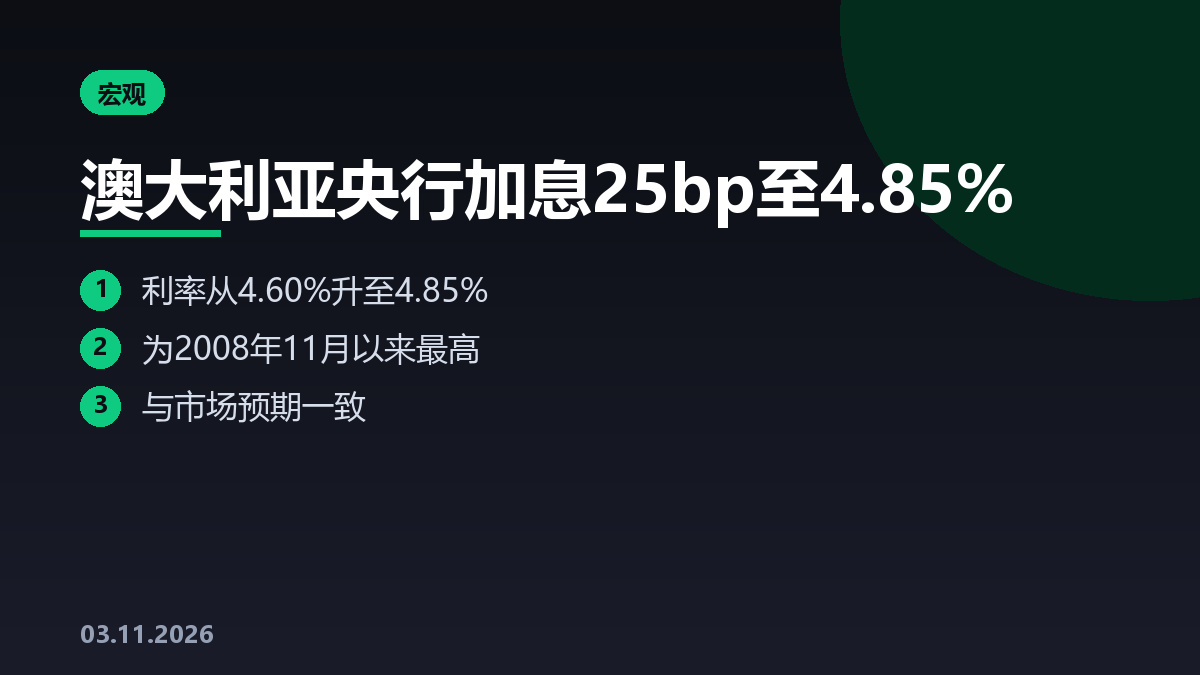
The Reserve Bank of Australia raised rates by 25 basis points on November 3, lifting the benchmark rate from 4.60% to 4.85%—its highest level since November 2008.🔴
The result was exactly in line with market expectations, with no surprises.
But I think the key point is precisely that there were “no surprises.” Rates are back at an 18-year high, showing that inflationary pressures in Australia have not truly eased. The central bank has chosen to keep tightening rather than wait and see.
Now look at the global picture: the Federal Reserve just raised rates on September 16, its first hike since 2023. With two major central banks shifting toward tighter policy one after the other, the narrative that “rate cuts are just around the corner” no longer holds up. Markets will have to readjust to an environment where “higher rates last for longer.”
For traditional markets, an expected rate hike has limited impact on its own, but it will further reinforce higher-rate pricing. The Australian dollar gets support from the interest-rate differential, bond yields are likely to rise, and the links between the U.S. dollar and interest rates in other countries will be amplified.
I’m more cautious about crypto markets. Risk assets like $BTC are highly sensitive to liquidity. Synchronized tightening by multiple countries means higher funding costs, making leveraged capital more vulnerable. If another central bank follows suit, risk appetite is likely to cool first, and any rebound may prove less sustainable.
What really matters is not this rate hike in Australia, but which central bank will be the next to raise rates. Which one do you think it will be?
#RBA #InterestRates #AUD
162

·
--
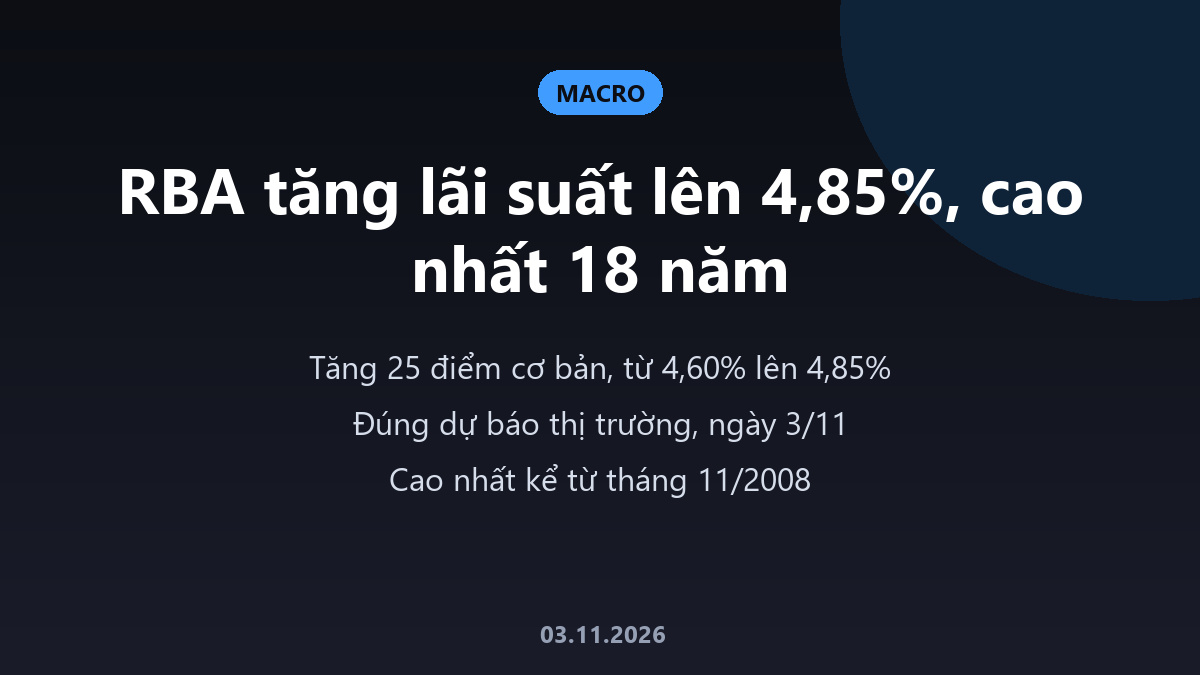
Australia has just raised interest rates to 4.85%, the highest since November 2008 ⚡
On November 3, the Reserve Bank of Australia (RBA) raised rates by 25 basis points, from 4.60% to 4.85%. The figure was in line with market expectations.
The figure came as no surprise, but 4.85% is an 18-year high. A major central bank is still opting to tighten, showing that the fight against inflation is not over. The Fed also just raised rates on September 16, for the first time since 2023.
For financial markets, the Australian dollar is often supported when interest rate differentials widen, while bond yields can remain elevated. Since the move was already priced in, the reaction may be fairly muted.
For crypto, another central bank raising rates means global liquidity is unlikely to loosen. $BTC often comes under pressure when cheap money dries up. The next thing to watch is whether the ECB or BOJ will follow suit.
How long do you think this wave of rate hikes will continue?
#RBA #InterestRates #Australia

187

·
--
The Reserve Bank of Australia released its latest policy meeting minutes on Tuesday, revealing unanimous board agreement to hike the benchmark interest rate by 25 basis points. Concurrently, Australia's NAB business confidence index for September plummeted to -13 from -8, while the business conditions gauge remained stagnant at -1.
This hawkish stance highlights the central bank's determination to suppress domestic consumer demand for an extended period to return inflation to target. The contrast between higher borrowing costs and deteriorating business sentiment indicates rising economic friction and stagflationary pressures down under.
Global bond yields saw upward pressure while the Australian dollar faced volatility amid competing forces of rate hikes and weakening domestic activity. Tighter monetary policy across major developed economies continues to drain global liquidity and weigh on risk assets.
For digital assets, persistent central bank tightening reinforces a risk-off environment and limits speculative capital inflows. $BTC and broader crypto markets may remain range-bound until global central banks signal a definitive end to restrictive policies.
#RBA #InterestRates #MacroEconomics
83

The minutes of the Reserve Bank of Australia’s latest monetary policy meeting clearly showed that all committee members unanimously agreed to raise interest rates by 25 basis points. Officials also stressed that domestic consumer demand needs to remain moderately constrained for a period of time to ensure inflation returns steadily to its target range. Meanwhile, Australia’s September NAB Business Conditions Index was unchanged at -1, while the Business Confidence Index fell further to -13 from -8 previously.
From a macroeconomic fundamentals perspective, the unanimous decision to raise rates confirms the RBA’s firm stance on fighting inflation. Although business confidence weakened, this is a typical feature of demand cooling during a tightening cycle and broadly aligns with the transmission path of policy implementation by major central banks around the world.
Foreign exchange and fixed-income markets quickly absorbed the hawkish signal. The Australian dollar showed signs of near-term technical support, while sovereign bond yields remained relatively firm and volatile at the short end of the curve. The contraction in business expectations further reduces the likelihood of a future resurgence in inflation, and markets are gradually pricing in the potential end of this tightening cycle.
For risk markets such as crypto assets, the central bank’s unanimous decision, which swiftly cleared up policy uncertainty, is instead a mildly positive signal. Technically, the late stages of deleveraging often indicate that a liquidity bottom is gradually forming, laying the macroeconomic groundwork for major assets such as $BTC to stabilize and rebound at key support levels. 📈
#RBA #InterestRates #MacroEconomics
170
·
--
In a recent decision, Philip Lowe, the Governor of the Reserve Bank of Australia, announced an increase in the interest rate from 4.35% to 4.6%, the highest level in 15 years. However, in his remarks, he said he hopes that this year’s four rate hikes will be sufficient to bring inflation back to the target level, which led the market to widely read this as a sign that the tightening cycle may be nearing its end.
This statement drew strong reaction because Australia’s current economic momentum is weakening: unemployment is nearing a five-year high and the housing market is cooling. Although the central bank raised rates as expected, the overall tone was not as hawkish as anticipated, prompting institutions such as Schroders and Franklin Templeton to move in and buy up Australian government bonds with maturities of 2 to 3 years.
From the perspective of traditional financial markets, expectations of a policy shift lifted government bond prices, leading traders to quickly scale back their bets on further rate hikes. As the peak of rate hikes becomes clearer, capital is reassessing its risk appetite and return prospects across different assets.
For the crypto market, a slowdown in the tightening pace of major global central banks usually means that liquidity pressure eases somewhat. While this may not immediately trigger a major crypto rally, the marginal loosening of the macro environment gives $BTC more room to breathe and create opportunities for strategic positioning. 🎯
#RBA #InterestRates #MacroEconomy
129

·
--
Bullish
RBA Holds Rates at 4.35%, Keeps Door Open for Further Hikes
🏦 The Reserve Bank of Australia kept the cash rate unchanged at 4.35% for a second consecutive meeting, with the decision unanimous. The outcome was broadly in line with market expectations.
📈 The RBA said inflation remains too high and maintained the possibility of further rate hikes if upside risks materialize. Inflation is not expected to return to the midpoint of the 2–3% target range until late 2027 or early 2028.
🌏 The economy is slowing as consumption weakens, the labor market gradually eases, and housing prices decline in some major cities. However, energy prices and Middle East tensions remain potential inflation risks.
💱 The AUD showed a limited reaction, holding around 0.705–0.707. Markets will now focus on inflation data and oil prices for clues on the RBA’s next move.
#RBA $RBA.US $RBB.US $RBC.US

RBAUS-1.38%
50
·
--
Reserve Bank of Australia (RBA) Governor Philip Lowe stated today that markets should not place too much weight on August CPI data, emphasizing the ongoing need for tight financial conditions. Following his remarks, the AUD/USD pair dropped sharply by over 30 pips to reach a nearly two-month low of 0.6989.
This hawkish stance signals that central banks remain committed to their tightening cycles despite short-term inflation fluctuations. Investors had hoped for a clearer pivot signal, but Lowe's cautious tone reinforces that prolonged monetary restriction remains the primary global playbook.
The sharp sell-off in the Australian dollar reflects broader foreign exchange volatility and highlights the prevailing strength of the US dollar. Bond yields and global risk sentiment continue to face downward pressure as major central banks refuse to ease their stance prematurely.
For the crypto market, sustained high interest rates worldwide limit overall liquidity inflows into digital assets. $BTC and major altcoins may continue to trade sideways in a tight range until global central banks offer concrete signals of monetary easing. 📉
#RBA #MacroEconomics #Forex
14
In his latest remarks, Philip Lowe, the Chairman of the Reserve Bank of Australia (RBA), said the market should not overinterpret August’s CPI data and clearly emphasized the need to maintain the current tight monetary environment. Driven by this hawkish stance and volatility in the FX market, AUD/USD fell sharply by more than 30 points intraday, breaking below a key technical support level and reaching a low of 0.6989 in nearly two months.
From a technical perspective and in terms of macro expectations, the market’s prior pricing had been too aggressive regarding inflation peaking and the expectation that the central bank would pivot too early. The governor personally stepped in to calibrate expectations, suppressing unbridled speculation and showing that policymakers have a very strong resolve and high transparency in controlling inflation.
In the FX and macro-asset context, the near-term drop in AUD/USD has released some stage-based profit-taking pressure. After retesting support, US dollar liquidity has shown a clearer trading range. This explicit forward guidance on policy effectively removes long-term macro uncertainty and is conducive to a technical rebound in risk assets.
For the crypto market, short-term volatility in FX markets is completing its risk release phase, and the deleveraging process appears healthier. As the macro “shoe” drops, core risk assets such as Bitcoin are demonstrating very strong bottom-picking/absorption, and the preference for liquidity is likely to shift toward a technical rebound after a period of consolidation and buildup.📈
#RBA #MacroEconomy #CryptoTrading
75
·
--
Reserve Bank of Australia Governor Philip Lowe signaled on Wednesday that four rate hikes this year should suffice to curb inflation, following a rate increase from 4.35% to 4.6%. Major funds like Schroders and Franklin Templeton quickly piled into 2- to 3-year Australian bonds, betting the tightening cycle has peaked.
This shift underscores mounting economic headwinds that limit further policy tightening. With unemployment near 5-year highs and the housing market cooling, slowing momentum is forcing a less hawkish stance.
Broader markets saw a strong rally in sovereign bonds and falling yields. As rate hike expectations fade, global fixed-income markets are beginning to price in eventual policy easing across major economies.
For crypto, the prospect of peaking global interest rates provides macro relief. Stalling bond yields typically encourage liquidity expansion, creating a more favorable backdrop for $BTC and risk assets.
#RBA #InterestRates #GlobalMacro
87

·
--

Article
Macro Radar: The Reserve Bank of Australia drops a bombshell after testing 20 use cases for asset tokenization!In one of the most significant and in-depth reports from central banks on the digitization of the financial system, the Reserve Bank of Australia (RBA) published the final report of the renowned 'Project Acacia' in collaboration with the Digital Finance Cooperative Research Centre (DFCRC), highlighting the real challenge facing the RWA flood!
📊 Breakdown of the historical Project Acacia experience:
Macro Radar: The Reserve Bank of Australia drops a bombshell after testing 20 use cases for asset tokenization!
In one of the most significant and in-depth reports from central banks on the digitization of the financial system, the Reserve Bank of Australia (RBA) published the final report of the renowned 'Project Acacia' in collaboration with the Digital Finance Cooperative Research Centre (DFCRC), highlighting the real challenge facing the RWA flood!
📊 Breakdown of the historical Project Acacia experience:
📊 Breakdown of the historical Project Acacia experience:
2
228
·
--
In his latest remarks, Philip Lowe, the Governor of the Reserve Bank of Australia (RBA), said clearly that the August CPI data should not be over-interpreted, and stressed that Australia still needs to maintain a relatively tight financial environment. Following the statement, the AUD/USD exchange rate plunged by more than 30 points, falling to a near two-month low of 0.6989.
This signals that the central bank is extremely cautious about short-term inflation pullback data, and refuses to release any easing signals too early. Behind the official commitment to a tight stance lies deep concern over the stickiness of core inflation and the repeatedly uneven progress of disinflation, which once again dashed market hopes for a policy turn.
Regarding the linkage between FX and commodities, the central bank’s hawkish tone, coupled with currency weakness, highlights ongoing pressure on non–USD currencies from tighter global liquidity. With the U.S. Dollar Index staying relatively resilient, the valuation discount pressure facing commodities and risk assets may further spread to a broader market.
As for the crypto market, major global central banks continue to maintain high-pressure policies, which is steadily squeezing marginal liquidity. Macroeconomic uncertainty will suppress risk appetite among over-the-counter funds. In the absence of a substantial easing cycle, leading crypto assets such as $BTC may continue to face valuation pressure in the near term, with a choppy pattern characterized by repeated bottoming.⚠️
#RBA #CentralBanks #MacroEconomy
112
·
--
Reserve Bank of Australia Governor Michele Bullock delivered a notably hawkish assessment today, warning that inflation may exceed earlier forecasts. She emphasized that domestic labor markets remain tighter than anticipated, requiring aggregate demand to be restrained further to ease capacity pressures.
Her statements suggest that the RBA's tightening cycle may not be finished yet, as policy lags still obscure the full economic impact. Markets had been anticipating a potential pause, but stubborn inflation risks are keeping rate hikes squarely on the table for Australia.
This hawkish stance reinforces prolonged high-rate expectations across global central banks, maintaining upward pressure on sovereign bond yields. Persistent monetary tightening in major economies continues to limit broader risk appetite and strengthens local fiat currencies against defensive assets.
For digital assets, a sustained higher-for-longer macro environment tends to suppress speculative liquidity. As global central banks signal ongoing restraint, $BTC and broader crypto markets are likely to trade within tight ranges until clear easing signals materialize.
#RBA #CentralBanks #MacroEconomy
64
·
--
The latest policy meeting minutes released by the Reserve Bank of Australia (RBA) show that all board members agreed to raise interest rates by 25 basis points. At the same time, a September survey by the National Australia Bank (NAB) recorded a sharp fall in business confidence to -13 from -8 the previous month, while the business conditions index was unchanged at -1.
The RBA’s unequivocally hawkish move reflects its determination to curb inflation by accepting a prolonged squeeze on domestic consumer demand. The marked weakening in business confidence suggests that pressure from the monetary tightening cycle is beginning to filter deeply into the real economy.
This firm stance is putting upward pressure on Australian government bond yields and supporting the AUD in the short term, while also heightening concerns about the risk of slower economic growth across the Asia-Pacific region. With borrowing costs remaining elevated, global capital flows are likely to become more defensive.
For crypto markets, signals of prolonged tightening from major central banks continue to restrict the flow of cheap liquidity into risk assets. Cautious sentiment could keep $BTC and the broader market in a consolidation phase until the global macroeconomic outlook shows clearer signs of a shift. 🌐
#RBA #InterestRates #MacroEconomics
275
·
--
In a recent public speech, Philip Lowe, Governor of the Reserve Bank of Australia (RBA), made it clear that if inflation pressures persist, the committee is always prepared to raise rates again. This hawkish remark quickly shattered market expectations that the Australian central bank was about to fully pivot toward easing, highlighting the stubborn bottom line of major central banks in dealing with inflation.
Most global central banks are currently at a crossroads in terms of policy direction, and Lowe’s comments serve as a reminder that the rate-cutting cycle may not be as smooth as people imagine. Although the market had previously bet that the tightening cycle was nearing its end, persistent core inflation still compels policymakers to keep the option of further tightening borrowing costs on the table, and policy uncertainty has risen again.
In both the foreign exchange and traditional financial markets, the Australian dollar exchange rate and short-term bond yields have turned volatile in tandem, while the U.S. Dollar Index has also received indirect support. Central bank governors’ determination to stick with higher interest rates has made the timing of the global liquidity turning point even more unclear, creating some resistance to valuation repairs in traditional risk assets.
For the crypto market, the macro liquidity environment directly affects the pace at which new incremental capital enters the market. With interest rates in major economies likely to stay higher for longer, capital tends to remain on the sidelines between $BTC and mainstream coins, and in the near term the market may continue to play out a range-bound tug-of-war.
#InterestRates #CentralBank #RBA
134
·
--
Australia’s latest labor data for August revealed an unexpected spike in the unemployment rate to a five-year high, even as job creation showed headline strength. Despite this softening in labor conditions due to rapid population growth outstripping employment gains, Oxford Economics economist Oscar Guth noted that underlying inflation risks remain persistent.
This labor market divergence is critical because it highlights a deepening stagflationary headache for the Reserve Bank of Australia. Elevated energy costs, particularly surging oil prices, continue to fuel sticky inflation, overriding signs of labor slack and keeping aggressive monetary tightening firmly on the table.
Financial markets are currently pricing in a 95% probability of a fourth rate hike by the RBA next Tuesday, potentially lifting the cash rate to 4.6%. The prospect of extended hawkish policy across developed central banks continues to bolster bond yields and underpin a stronger US dollar, while creating significant headwinds for risk assets globally.
For the cryptocurrency market, prolonged central bank tightening globally constrains broader fiat liquidity conditions. As higher sovereign yields keep institutional capital anchored in traditional risk-free cash equivalents, $BTC and digital assets are likely to face compressed trading volumes and range-bound volatility until clear global easing cycles emerge.
#RBA #MacroEconomy #CryptoMarket
34

Institutional Outflows and RBA Rate Hike Amid Persistent Inflation🙂↕️
Financial markets face fresh macroeconomic adjustments and continued digital asset withdrawals:
* IBIT Fund Flows: IBIT posted $405.3 million in net outflows.
* Crypto ETF Withdrawals: Bitcoin and Ethereum ETFs experienced sustained investor withdrawals.
* Monetary Policy: The Reserve Bank of Australia (RBA) raised rates to 4.85% as inflation persists.
For fixed-income investors, macroeconomic analysts, and digital asset traders, monitoring global central bank rate decisions alongside institutional ETF flows remains critical for navigating market volatility.
$BTC $ETH $IBIT.ETF
#CoinVahini #RBA #CryptoTrading #InterestRates #Macroeconomics
7

·
--
Bearish
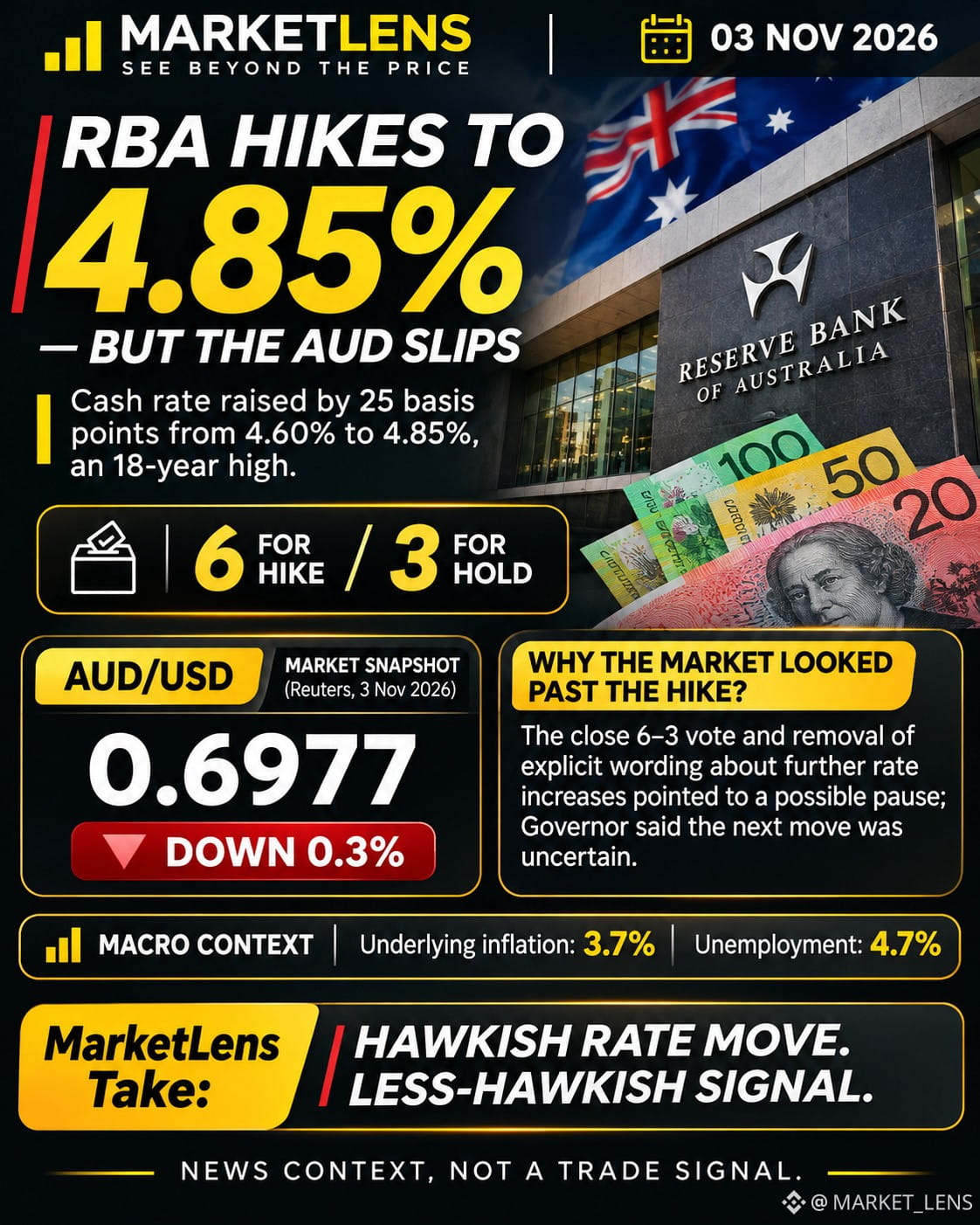
🚨 RBA HIKES TO 4.85% — BUT THE AUD SLIPS!
Australia's central bank raised rates to an 18-year high. But the 6–3 vote and softer forward guidance shifted attention towards a possible pause.
AUD/USD fell 0.3% to 0.6977 in Reuters' November 3 snapshot.
$AUD
{future}(BTCUSDT)
BTCUSDT: Bearish short-term momentum dominates the 1H chart, with downside risk over the next 24 hours, although a temporary relief bounce remains possible.
MarketLens Take: Hawkish rate move, less-hawkish signal. The next clues are inflation data and the November 17 RBA minutes.
Is 4.85% the peak, or could another hike follow?
#MarketLens #AUDUSD #RBA #ForexNews #CentralBanks
🚨 RBA HIKES TO 4.85% — BUT THE AUD SLIPS!
Australia's central bank raised rates to an 18-year high. But the 6–3 vote and softer forward guidance shifted attention towards a possible pause.
AUD/USD fell 0.3% to 0.6977 in Reuters' November 3 snapshot.
$AUD
BTCUSDT: Bearish short-term momentum dominates the 1H chart, with downside risk over the next 24 hours, although a temporary relief bounce remains possible.
MarketLens Take: Hawkish rate move, less-hawkish signal. The next clues are inflation data and the November 17 RBA minutes.
Is 4.85% the peak, or could another hike follow?
#MarketLens #AUDUSD #RBA #ForexNews #CentralBanks
1
45

·
--
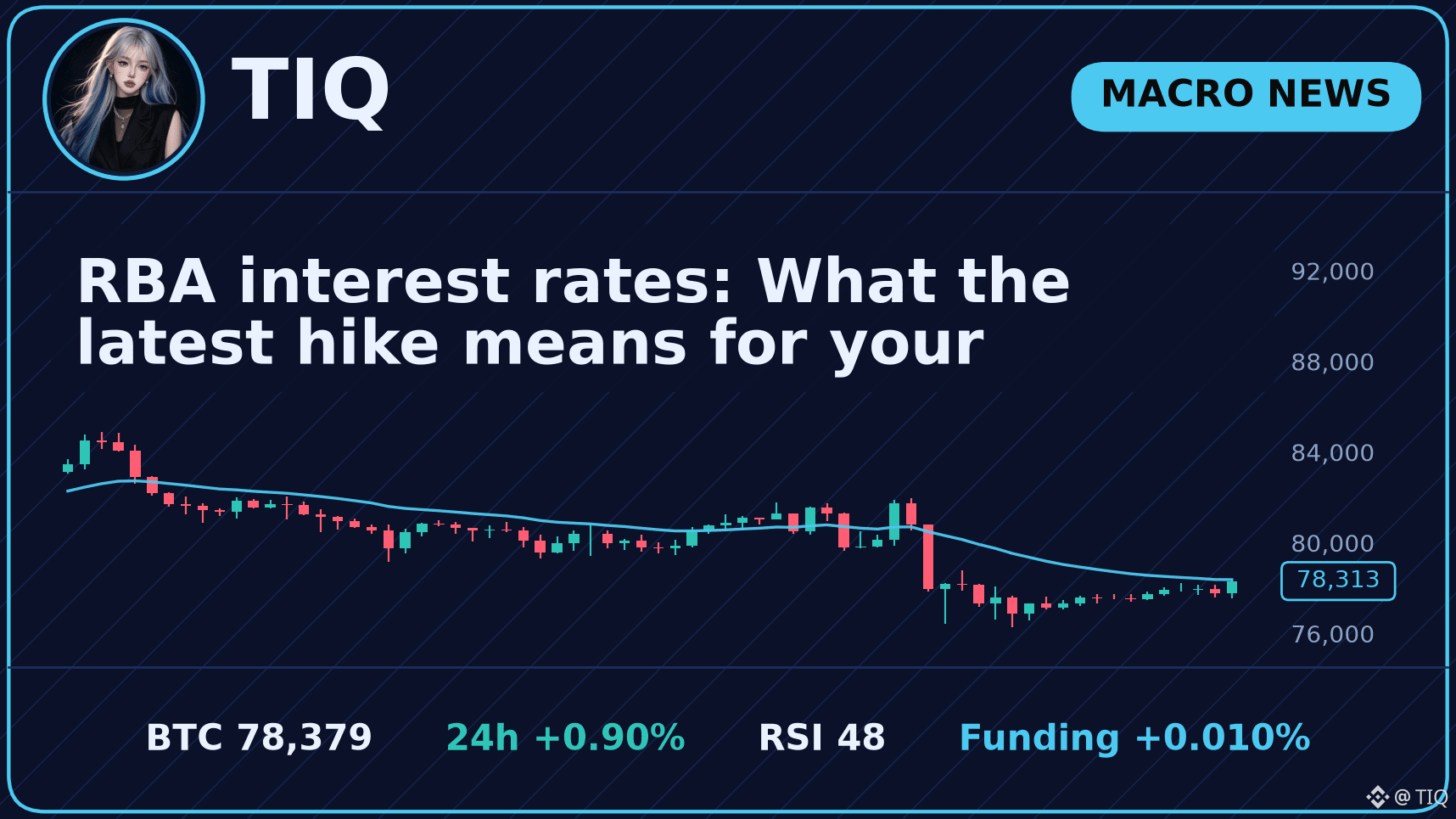
RBA interest rates: What the latest hike means for your wallet 🚨
The Reserve Bank of Australia (RBA) interest rates are expected to rise again, marking the fifth hike this year.
This move aims to manage economic pressure, though it certainly makes monthly mortgage repayments a bit heavier for many households. It looks like the central bank is sticking to its plan to cool things down, even if our bank accounts are feeling the heat. If you have been keeping an eye on your budget, now is a great time to double-check those loan repayments before the official announcement drops. 💸
Crypto traders often watch these central bank moves closely, as shifting interest rates can influence global liquidity and general risk appetite in the market. When borrowing costs rise, investors tend to reassess their positions regarding the US dollar and riskier assets.
What do you think, fam: big deal or just noise? 👇
$BTC $ETH #Macro #MacroEconomy #InterestRates #RBA #GlobalMarkets
ℹ️ News roundup from public sources, not financial advice.
185
Log in to explore more content
Join global crypto users on Binance Square
⚡️ Get latest and useful information about crypto.
💬 Trusted by the world’s largest crypto exchange.
👍 Discover real insights from verified creators.
Email / Phone number
Trending Topics
1
#SouthKoreaDraftLawTargets15To20%ShareholderCap
0 views
0 Discussing
2
#KeplrAdvisesSocialLoginUsersToTransferAssets
2,980 views
132 Discussing
3
#TetherPlans€28.8MForJuventusCapitalIncrease
2,017 views
106 Discussing
4
#JobsReportRaisesHikeOdds
649,798 views
3,964 Discussing
5
#CPITestsDecemberRateOutlook
224,996 views
1,552 Discussing
6
#US Data Center Rules May Constrain AI Expansion
91,997 views
248 Discussing
7
#ARKPlans14ThematicETFsCoveringAIAndTokenizedMarkets
5,763 views
81 Discussing
8
#WillAnthropicListOnTime
206,742 views
1,687 Discussing
9
#WillUS-IranTensionsBoostSafe-HavenDemand?
110,521 views
737 Discussing
10
#BitcoinETFsSee$412MNetOutflows
19,895 views
87 Discussing