Binance Square
#earningsseason

earningsseason

828,838 views
4,216 Discussing
Binance Square Official
·
--
Article
Earnings Season: Micron Q4 Earnings — Bullish or Bearish?Binance Square is launching the Earnings Season! Join us as we breakdown the market data before and after earnings from the hottest stocks.  Micron's FY2026 Q4 earnings are about to drop this week. The results aren't just about $MU prices, it becomes a key test of whether the whole memory supercycle narrative can hold up.  Stay tuned to Binance Square Earnings Season — be the first to know and act around the biggest earnings! What's on the Agenda? Sep 28 — [Micron FY2026 Q4 earnings preview](https://www.binance.com/en/square/post/09-28-2026-micron-heads-into-fiscal-q4-earnings-with-the-bar-and-the-stock-already-high-371493333095967): a quick look at what to watch this quarterSep 29 — [Micron Earnings Season preview livestream ](https://www.binance.com/en/square/post/371454388222161)(Chinese)Sep 30 — [Micron Earnings Season preview livestream](https://www.binance.com/en/square/post/371563664770726) (English)Oct 1 — Micron FY2026 Q4 earnings recap: digging into the market insights behind dataOct 1 — [Post-earnings analysts livestream](https://www.binance.com/en/square/audio?_ul=aHR0cHM6Ly9hcHAuYmluYW5jZS5jb20vdW5pLXFyL2NzcGEvNDY0NzY2NzcxODI5NTQ_cj1NSjZMSTFVSiZsPXpoLUNOJnNvdXJjZT1ob3N0X3NoYXJlJnVjPWFwcF9zcXVhcmVfc2hhcmVfbGluayZ1cz1jb3B5bGluaw&id=46476677182954&ref=MJ6LI1UJ&utm_campaign=app_square_share_link&utm_source=copylink) (Chinese)Oct 2 — [Post-earnings analysts livestream](https://www.binance.com/en/square/audio?_ul=aHR0cHM6Ly9hcHAuYmluYW5jZS5jb20vdW5pLXFyL2NzcGEvNDY0NzkxNTE2Njg1NDU_c291cmNlPWhvc3Rfc2hhcmUmdWM9d2ViX3NxdWFyZV9zaGFyZV9saW5rJnVzPWNvcHlsaW5rJmw9ZW4mcj1VQ0lQWjRMMA&id=46479151668545&ref=UCIPZ4L0&utm_campaign=web_square_share_link&utm_source=copylink) (English) #EarningsSeason Topic Challenge How to join: Publish a short post or article with hashtag #EarningsSeason How will you adjust your trades/positions before/after the report? Use trade-sharing cards to share your $MU trades/positions for a higher chance to earn a traffic boost.Back up your view with data or charts, and avoid AI-generated images/views.Try to answer one of the following questions in your post:Are you bullish or bearish on $MU price once Q4 earnings are out?Read [Micron FY2026 Q4 earnings preview](https://www.binance.com/en/square/post/09-28-2026-micron-heads-into-fiscal-q4-earnings-with-the-bar-and-the-stock-already-high-371493333095967), and share your take: will Micron really be able to push its gross margin past 86% in Q4? How much longer do you think the memory super cycle can run?  Submission window: Sep 29, 2026, 10:00  – Oct 1, 2026, 10:00 (UTC) Rewards: Qualified posts that comply with the above guidelines will be reviewed and may receive a random traffic boost in views. Use trade-sharing cards to share your $MU trades/positions for a higher chance to earn a traffic boost. You will receive a notification from your feed secretary if your post is selected. Get a chance to have your views featured on Binance Square Official. Need ideas for your post? Visit #EarningsSeason or the [Square Guide on How to Post for Better Reach](https://www.binance.com/en/square/post/364505922663952).

Earnings Season: Micron Q4 Earnings — Bullish or Bearish?

Binance Square is launching the Earnings Season! Join us as we breakdown the market data before and after earnings from the hottest stocks.
Micron's FY2026 Q4 earnings are about to drop this week. The results aren't just about $MU prices, it becomes a key test of whether the whole memory supercycle narrative can hold up.
Stay tuned to Binance Square Earnings Season — be the first to know and act around the biggest earnings!
What's on the Agenda?
Sep 28 — Micron FY2026 Q4 earnings preview: a quick look at what to watch this quarterSep 29 — Micron Earnings Season preview livestream (Chinese)Sep 30 — Micron Earnings Season preview livestream (English)Oct 1 — Micron FY2026 Q4 earnings recap: digging into the market insights behind dataOct 1 — Post-earnings analysts livestream (Chinese)Oct 2 — Post-earnings analysts livestream (English)
#EarningsSeason Topic Challenge
How to join:
Publish a short post or article with hashtag #EarningsSeason How will you adjust your trades/positions before/after the report? Use trade-sharing cards to share your $MU trades/positions for a higher chance to earn a traffic boost.Back up your view with data or charts, and avoid AI-generated images/views.Try to answer one of the following questions in your post:Are you bullish or bearish on $MU price once Q4 earnings are out?Read Micron FY2026 Q4 earnings preview, and share your take: will Micron really be able to push its gross margin past 86% in Q4? How much longer do you think the memory super cycle can run?
Submission window:
Sep 29, 2026, 10:00 – Oct 1, 2026, 10:00 (UTC)
Rewards:
Qualified posts that comply with the above guidelines will be reviewed and may receive a random traffic boost in views. Use trade-sharing cards to share your $MU trades/positions for a higher chance to earn a traffic boost. You will receive a notification from your feed secretary if your post is selected. Get a chance to have your views featured on Binance Square Official.
Need ideas for your post? Visit #EarningsSeason or the Square Guide on How to Post for Better Reach.
User-4c04db11:
🎁🎁🎁🎁🎁🎁🎁🎁😭😭😭😭😭
Article
​🚀 Micron ($MU) Q4 Earnings Blowout: What It Means for AI & Crypto Markets​Cold Open: The AI Hardware Boom Is Accelerating ​Semiconductor giant Micron Technology ($MU) recently released its Q4 financial earnings report, completely shattering Wall Street’s expectations across all major financial metrics. Driven by massive global demand for high-performance AI data centers and next-generation memory hardware, Micron's financial results prove that the artificial intelligence super-cycle is far from over. ​For investors, traders, and crypto market participants, this is not just another corporate earnings report—it is a vital macroeconomic indicator for where tech liquidity and speculative capital are flowing next. ​📊 Key Financial Highlights: Breaking Down the Numbers ​To understand why the market responded so positively, let’s look at the core numbers reported by Micron: ​Record Revenue Growth: Micron reported $7.75 Billion in quarterly revenue, marking an impressive ~93% increase Year-over-Year (YoY) and easily surpassing analysts' baseline expectations of $7.65 Billion.​Earnings Per Share (EPS) Beat: The company delivered an EPS of $1.18, beating Wall Street projections of $1.11. This clearly demonstrates expanding profit margins despite rising manufacturing costs.​Strong Q1 Guidance: Micron projected its upcoming quarter revenue to hit approximately $8.7 Billion, significantly higher than the consensus average estimate of $8.3 Billion.​Sold Out Capacity: Micron's High-Bandwidth Memory (HBM3e) chips—which are critical components inside NVIDIA and AMD AI graphics processing units—are completely sold out through the entire calendar year of 2025. ​💡 The TradFi Bridge: How Micron’s Rally Fuels Crypto Markets ​When traditional finance (TradFi) mega-cap tech stocks like Micron ($MU) show massive fundamentals, it creates a positive ripple effect across digital asset markets: ​TradFi Capital Inflow into Web3: As traditional tech stocks reach high valuations, institutional and retail traders often rotate profits into high-beta tech plays—specifically crypto assets like Bitcoin ($BTC) and leading AI sector tokens.​DePIN & Infrastructure Demand: Strong demand for hardware chips validates the core narrative behind Decentralized Physical Infrastructure Networks (DePIN), boosting investor interest in decentralized GPU compute solutions.​Macro Liquidity Booster: Sustained corporate profits keep global market sentiment "Risk-On," giving both equity and crypto markets room for expansion. ​🔮 What to Watch Next: Strategy & Conclusion ​As the line between Web2 traditional technology and Web3 decentralized finance continues to blur, tracking chip supply chains remains essential for comprehensive market analysis. Moving forward, traders should monitor: ​Macro liquidity conditions and capital rotation from TradFi into liquid crypto markets.​Open interest momentum across Bitcoin ($BTC) and AI-related crypto sectors.​Guidance updates from global semiconductor supply leaders. ​💬 Community Discussion ​Given Micron’s massive Q4 earnings blowout and sold-out 2025 capacity, do you think $MU will smash all-time high records in 2026 and lead the semiconductor rally? ​And on the Web3 side: Do you see TradFi liquidity rotating into spot $BTC and AI crypto tokens, or are you holding cash reserves? ​Let us know your price targets and trading strategies in the comments below! 👇 ​Sources & Data References: • Micron Technology Investor Relations (Q4 Financial Report) • Bloomberg Financial Data & MarketWatch Metrics • CoinMarketCap & CoinGecko Market Overview ​Hashtags: #EarningsSeason #TradFi #BinanceSquare #Web3AI

​🚀 Micron ($MU) Q4 Earnings Blowout: What It Means for AI & Crypto Markets

​Cold Open: The AI Hardware Boom Is Accelerating
​Semiconductor giant Micron Technology ($MU ) recently released its Q4 financial earnings report, completely shattering Wall Street’s expectations across all major financial metrics. Driven by massive global demand for high-performance AI data centers and next-generation memory hardware, Micron's financial results prove that the artificial intelligence super-cycle is far from over.
​For investors, traders, and crypto market participants, this is not just another corporate earnings report—it is a vital macroeconomic indicator for where tech liquidity and speculative capital are flowing next.
​📊 Key Financial Highlights: Breaking Down the Numbers
​To understand why the market responded so positively, let’s look at the core numbers reported by Micron:
​Record Revenue Growth: Micron reported $7.75 Billion in quarterly revenue, marking an impressive ~93% increase Year-over-Year (YoY) and easily surpassing analysts' baseline expectations of $7.65 Billion.​Earnings Per Share (EPS) Beat: The company delivered an EPS of $1.18, beating Wall Street projections of $1.11. This clearly demonstrates expanding profit margins despite rising manufacturing costs.​Strong Q1 Guidance: Micron projected its upcoming quarter revenue to hit approximately $8.7 Billion, significantly higher than the consensus average estimate of $8.3 Billion.​Sold Out Capacity: Micron's High-Bandwidth Memory (HBM3e) chips—which are critical components inside NVIDIA and AMD AI graphics processing units—are completely sold out through the entire calendar year of 2025.
​💡 The TradFi Bridge: How Micron’s Rally Fuels Crypto Markets
​When traditional finance (TradFi) mega-cap tech stocks like Micron ($MU ) show massive fundamentals, it creates a positive ripple effect across digital asset markets:
​TradFi Capital Inflow into Web3: As traditional tech stocks reach high valuations, institutional and retail traders often rotate profits into high-beta tech plays—specifically crypto assets like Bitcoin ($BTC ) and leading AI sector tokens.​DePIN & Infrastructure Demand: Strong demand for hardware chips validates the core narrative behind Decentralized Physical Infrastructure Networks (DePIN), boosting investor interest in decentralized GPU compute solutions.​Macro Liquidity Booster: Sustained corporate profits keep global market sentiment "Risk-On," giving both equity and crypto markets room for expansion.
​🔮 What to Watch Next: Strategy & Conclusion
​As the line between Web2 traditional technology and Web3 decentralized finance continues to blur, tracking chip supply chains remains essential for comprehensive market analysis. Moving forward, traders should monitor:
​Macro liquidity conditions and capital rotation from TradFi into liquid crypto markets.​Open interest momentum across Bitcoin ($BTC ) and AI-related crypto sectors.​Guidance updates from global semiconductor supply leaders.
​💬 Community Discussion
​Given Micron’s massive Q4 earnings blowout and sold-out 2025 capacity, do you think $MU will smash all-time high records in 2026 and lead the semiconductor rally?
​And on the Web3 side: Do you see TradFi liquidity rotating into spot $BTC and AI crypto tokens, or are you holding cash reserves?
​Let us know your price targets and trading strategies in the comments below! 👇
​Sources & Data References:
• Micron Technology Investor Relations (Q4 Financial Report)
• Bloomberg Financial Data & MarketWatch Metrics
• CoinMarketCap & CoinGecko Market Overview
​Hashtags:
#EarningsSeason #TradFi #BinanceSquare #Web3AI
How does Earnings Season impact Crypto? 📊🚀 We are in the middle of #EarningsSeason in traditional markets. Although many believe crypto operates completely independently, correlation with global markets remains high. 📌 Key factors to watch: 1️⃣ Tech earnings reports: Strong balance sheets from major tech companies often boost risk sentiment, positively impacting $BTC and the broader market. 2️⃣ Altcoin liquidity: When macroeconomic news drives volatility, tokens like $ETH or$BNB react quickly toward key support and resistance zones. 3️⃣ Managing volatility: During high-impact news weeks, lowering leverage and waiting for candle confirmations is key to protecting capital. 💬 Do you think the market will maintain its bullish trend for the rest of the quarter? #EarningsSeason
How does Earnings Season impact Crypto? 📊🚀

We are in the middle of #EarningsSeason in traditional markets. Although many believe crypto operates completely independently, correlation with global markets remains high.

📌 Key factors to watch:

1️⃣ Tech earnings reports: Strong balance sheets from major tech companies often boost risk sentiment, positively impacting $BTC and the broader market.

2️⃣ Altcoin liquidity: When macroeconomic news drives volatility, tokens like $ETH or$BNB react quickly toward key support and resistance zones.

3️⃣ Managing volatility: During high-impact news weeks, lowering leverage and waiting for candle confirmations is key to protecting capital.

💬 Do you think the market will maintain its bullish trend for the rest of the quarter?

#EarningsSeason
·
--
Bullish
Take a look at these numbers that just crossed the wire, because this isn't just a standard earnings report—this is a total blowout. Micron ($MU ) didn't just beat Wall Street’s expectations; they completely blew them out of the water. Micron $MU reports: • Revenue: $54.23B vs. $51.07B est. • Adjusted EPS: $33.42 vs. $31.61 est. #EarningsSeason {future}(MUUSDT)
Take a look at these numbers that just crossed the wire, because this isn't just a standard earnings report—this is a total blowout. Micron ($MU ) didn't just beat Wall Street’s expectations; they completely blew them out of the water.

Micron $MU reports:

• Revenue: $54.23B vs. $51.07B est.
• Adjusted EPS: $33.42 vs. $31.61 est.

#EarningsSeason
🚨 EARNINGS SEASON: $MU JUST CHANGED THE MEMORY STORY Micron delivered: 💰 Q4 Revenue: $54.23B 📈 Non-GAAP EPS: $33.42 🔥 Q1 FY27 Revenue Guide: $61.5B ± $1.5B But the bigger question for traders: Is AI memory demand strong enough to keep pushing the cycle higher? Watch these next: → HBM4/HBM4E progress → Memory pricing → Gross margins → FY2027 guidance Binance Square is breaking down the post-earnings reaction today. The numbers are out. Now the market has to decide what they're worth. #EarningsSeason #MU #Micron #Aİ #StockMarket
🚨 EARNINGS SEASON: $MU JUST CHANGED THE MEMORY STORY
Micron delivered:
💰 Q4 Revenue: $54.23B
📈 Non-GAAP EPS: $33.42
🔥 Q1 FY27 Revenue Guide: $61.5B ± $1.5B
But the bigger question for traders:
Is AI memory demand strong enough to keep pushing the cycle higher?
Watch these next:
→ HBM4/HBM4E progress
→ Memory pricing
→ Gross margins
→ FY2027 guidance
Binance Square is breaking down the post-earnings reaction today.
The numbers are out. Now the market has to decide what they're worth.
#EarningsSeason #MU #Micron #Aİ #StockMarket
$MU Q4 Earnings Are Out: I’m Bullish on the Fundamentals, Not Chasing the Candle The big question from #EarningsSeason was: Bullish or bearish on after Q4 earnings? My answer: Bullish on the fundamentals. But there’s an important distinction between being bullish on the business and blindly buying the first post-earnings move. Micron just delivered a monster quarter: • Q4 revenue: $54.23B • Non-GAAP EPS: $33.42 • Non-GAAP gross margin: 87% • Q1 FY2027 revenue guidance: $61.5B ± $1.5B • Q1 non-GAAP gross-margin guidance: ~86.25% The 86% gross-margin question from the original earnings preview has now been answered. Micron cleared it at 87%. But the bigger signal for me is forward guidance. Micron's Q1 revenue midpoint of $61.5B is well above the roughly $57B level analysts were expecting. Reuters also reports that Micron's long-term supply agreements increased from $22B in June to $32B, while the company expects memory supply-demand conditions to remain tighter through FY2027 and FY2028. That changes the memory-super cycle conversation. This isn't simply: “AI demand is strong.” The more important question is: Can demand remain ahead of supply long enough to sustain pricing and margins? So far, Micron's numbers are providing evidence for that thesis. However, I don't want to chase an earnings candle just because the headline numbers look incredible. My approach after the report: Fundamentals → Bullish Entry → Wait for price structure to confirm Risk → Avoid oversized exposure immediately after the gap If $MU holds its post-earnings structure and continues forming higher highs and higher lows, the bullish thesis gets further confirmation. If the stock sells off despite these numbers, that would be useful information too. Because earnings tell us what Micron delivered. Price action tells us what the market was actually willing to pay for it. That is the part I’ll be watching next. Bullish thesis. Confirmed by data. Still respecting risk. #EarningsSeason $MU {future}(MUUSDT)
$MU Q4 Earnings Are Out: I’m Bullish on the Fundamentals, Not Chasing the Candle
The big question from #EarningsSeason was:
Bullish or bearish on after Q4 earnings?
My answer: Bullish on the fundamentals.
But there’s an important distinction between being bullish on the business and blindly buying the first post-earnings move.
Micron just delivered a monster quarter:
• Q4 revenue: $54.23B
• Non-GAAP EPS: $33.42
• Non-GAAP gross margin: 87%
• Q1 FY2027 revenue guidance: $61.5B ± $1.5B
• Q1 non-GAAP gross-margin guidance: ~86.25%
The 86% gross-margin question from the original earnings preview has now been answered.
Micron cleared it at 87%.
But the bigger signal for me is forward guidance.
Micron's Q1 revenue midpoint of $61.5B is well above the roughly $57B level analysts were expecting. Reuters also reports that Micron's long-term supply agreements increased from $22B in June to $32B, while the company expects memory supply-demand conditions to remain tighter through FY2027 and FY2028.
That changes the memory-super cycle conversation.
This isn't simply:
“AI demand is strong.”
The more important question is:
Can demand remain ahead of supply long enough to sustain pricing and margins?
So far, Micron's numbers are providing evidence for that thesis.
However, I don't want to chase an earnings candle just because the headline numbers look incredible.

My approach after the report:
Fundamentals → Bullish
Entry → Wait for price structure to confirm
Risk → Avoid oversized exposure immediately after the gap
If $MU holds its post-earnings structure and continues forming higher highs and higher lows, the bullish thesis gets further confirmation.
If the stock sells off despite these numbers, that would be useful information too.
Because earnings tell us what Micron delivered.
Price action tells us what the market was actually willing to pay for it.
That is the part I’ll be watching next.
Bullish thesis. Confirmed by data. Still respecting risk.
#EarningsSeason $MU
Article
Micron stock Earnings$MUB is heading into earnings, and I think the biggest mistake would be to look at this report only through the headline numbers. Revenue, EPS and whether Micron beats estimates will obviously matter, but those figures are mostly about what has already happened. What I really want to know is what happens after this quarter. Micron has become one of the clearest beneficiaries of the AI infrastructure buildout because every new generation of AI data centers needs more advanced memory. But the market is now asking a harder question: how much further can this growth actually run? That is why HBM4 is the first thing I will be watching. HBM3 and HBM3E have already established the importance of high-bandwidth memory in AI accelerators. HBM4 is the next major step, and this is where execution becomes critical. It is one thing to have strong customer demand. It is another thing to manufacture enough HBM4 at the required quality and yield to actually capture that demand. If Micron gives investors confidence that HBM4 production is progressing well, yields are improving and meaningful capacity can come online as planned, that would strengthen the argument that the company still has another phase of AI-driven growth ahead. But if management talks about production delays, weaker yields or limited capacity, the market could start questioning whether Micron can fully participate in the next stage of the AI memory cycle. And that leads directly to the second thing I care about: 2027. I think this is where the earnings call could become much more important than the earnings release itself. The current quarter tells us how strong demand has been. Management's 2027 commentary will tell us how sustainable they believe that demand is. Are AI customers still aggressively securing memory capacity? Does Micron expect HBM demand to remain constrained by supply? Can pricing and margins remain strong as additional capacity comes online? These are the questions that can change the market's perception of $MU. A strong quarter with cautious 2027 guidance could create a very different reaction from a strong quarter accompanied by confident long-term commentary. That is something investors sometimes forget during earnings season. The market doesn't pay you for yesterday's numbers. It prices expectations for tomorrow. There is another interesting part of this setup: options pricing is implying roughly 8–10% post-earnings volatility. That doesn't tell us whether Micron will go up or down. It simply shows that the market expects the new information to matter. And I think that makes sense. Micron is sitting at an important intersection between the AI boom and the traditional memory cycle. AI has created a much stronger structural demand story for high-bandwidth memory, but memory is still a business where supply, pricing, capacity and margins can change the picture very quickly. That's why I don't think one earnings beat would automatically mean the stock's next move is higher. The more interesting scenario would be: Strong results. Strong HBM4 execution. Healthy capacity expansion. And constructive 2027 guidance. If those pieces come together, the market gets another reason to believe that Micron's AI opportunity is still expanding. But if the numbers are good while HBM4 execution or the 2027 outlook disappoints, investors may start asking whether expectations have simply moved too far ahead of the underlying cycle. For me, that's the real dividing line. I'm not trying to predict whether $MU will pump or dump immediately after earnings. I want to see whether Micron can turn today's AI demand into sustainable memory growth over the next several years. Because the biggest opportunity in this cycle isn't simply selling more memory during a shortage. It's proving that AI has fundamentally changed the demand structure enough to support stronger utilization, pricing and margins for longer than a normal memory cycle. That's the part management needs to convince the market of. So tonight, I'll be listening less to the headline number and more to the details. HBM4 tells me how well Micron is executing. 2027 guidance tells me how management sees the road ahead. Margins tell me how much of that demand is actually translating into economics. The AI memory story is still very much alive, but this earnings report could tell us whether Micron is entering another leg of growth or whether the market needs to become more selective about what comes next. No need to guess before the information arrives. Let the report come out. Listen to management. Then reassess. DYOR. #EarningsSeason

Micron stock Earnings

$MUB is heading into earnings, and I think the biggest mistake would be to look at this report only through the headline numbers.
Revenue, EPS and whether Micron beats estimates will obviously matter, but those figures are mostly about what has already happened.
What I really want to know is what happens after this quarter.
Micron has become one of the clearest beneficiaries of the AI infrastructure buildout because every new generation of AI data centers needs more advanced memory. But the market is now asking a harder question: how much further can this growth actually run?
That is why HBM4 is the first thing I will be watching.
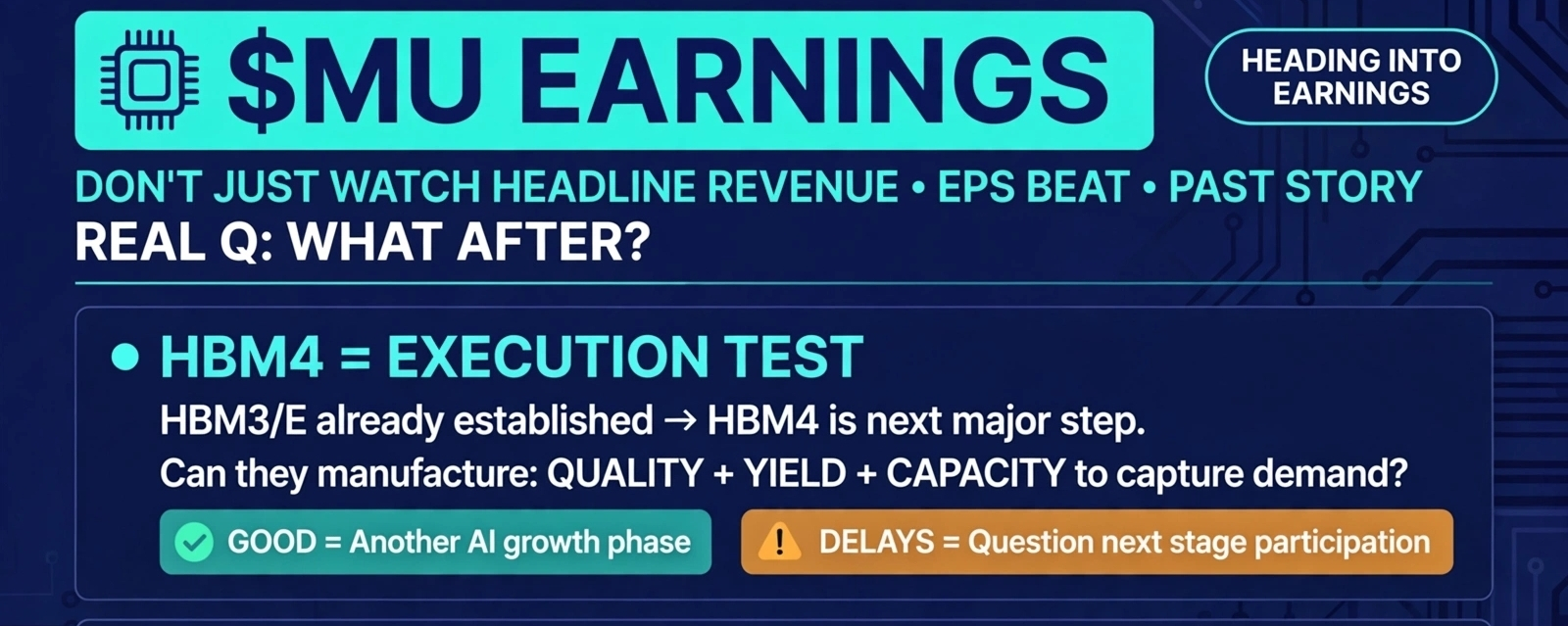
HBM3 and HBM3E have already established the importance of high-bandwidth memory in AI accelerators. HBM4 is the next major step, and this is where execution becomes critical.
It is one thing to have strong customer demand.
It is another thing to manufacture enough HBM4 at the required quality and yield to actually capture that demand.
If Micron gives investors confidence that HBM4 production is progressing well, yields are improving and meaningful capacity can come online as planned, that would strengthen the argument that the company still has another phase of AI-driven growth ahead.
But if management talks about production delays, weaker yields or limited capacity, the market could start questioning whether Micron can fully participate in the next stage of the AI memory cycle.
And that leads directly to the second thing I care about:
2027.
I think this is where the earnings call could become much more important than the earnings release itself.
The current quarter tells us how strong demand has been.
Management's 2027 commentary will tell us how sustainable they believe that demand is.
Are AI customers still aggressively securing memory capacity? Does Micron expect HBM demand to remain constrained by supply? Can pricing and margins remain strong as additional capacity comes online?
These are the questions that can change the market's perception of $MU.
A strong quarter with cautious 2027 guidance could create a very different reaction from a strong quarter accompanied by confident long-term commentary.
That is something investors sometimes forget during earnings season.
The market doesn't pay you for yesterday's numbers. It prices expectations for tomorrow.
There is another interesting part of this setup: options pricing is implying roughly 8–10% post-earnings volatility.
That doesn't tell us whether Micron will go up or down. It simply shows that the market expects the new information to matter.
And I think that makes sense.
Micron is sitting at an important intersection between the AI boom and the traditional memory cycle.
AI has created a much stronger structural demand story for high-bandwidth memory, but memory is still a business where supply, pricing, capacity and margins can change the picture very quickly.
That's why I don't think one earnings beat would automatically mean the stock's next move is higher.
The more interesting scenario would be:
Strong results.
Strong HBM4 execution.
Healthy capacity expansion.
And constructive 2027 guidance.
If those pieces come together, the market gets another reason to believe that Micron's AI opportunity is still expanding.
But if the numbers are good while HBM4 execution or the 2027 outlook disappoints, investors may start asking whether expectations have simply moved too far ahead of the underlying cycle.
For me, that's the real dividing line.
I'm not trying to predict whether $MU will pump or dump immediately after earnings.
I want to see whether Micron can turn today's AI demand into sustainable memory growth over the next several years.
Because the biggest opportunity in this cycle isn't simply selling more memory during a shortage.
It's proving that AI has fundamentally changed the demand structure enough to support stronger utilization, pricing and margins for longer than a normal memory cycle.
That's the part management needs to convince the market of.
So tonight, I'll be listening less to the headline number and more to the details.
HBM4 tells me how well Micron is executing.
2027 guidance tells me how management sees the road ahead.
Margins tell me how much of that demand is actually translating into economics.
The AI memory story is still very much alive, but this earnings report could tell us whether Micron is entering another leg of growth or whether the market needs to become more selective about what comes next.
No need to guess before the information arrives.
Let the report come out. Listen to management. Then reassess.
DYOR.
#EarningsSeason
Micron stcoksMicron is about to disclose its fourth-quarter results. To be honest, I’m not particularly concerned about the numbers themselves, because that’s not where the key lies. What will really determine the subsequent direction are two things: 1. HBM4 mass-production progress This is the dividing line for whether Micron can continue benefiting from the AI data center boom. HBM3 is already in production, but capacity is limited. HBM4 is the next generation, with both bandwidth and density set to jump to a new level. If the earnings report reveals that HBM4 yields are underwhelming, mass production is delayed, or capacity is insufficient, that would mean Micron’s growth could slow over the next two quarters. Capital would flow toward competitors such as SK hynix, which have already begun mass-producing HBM4. Conversely, if it says “HBM4 progress is ahead of expectations, with substantial capacity available next year,” $MU would have new upward momentum. 2. 2027 outlook This is what the market cares about most. What kind of guidance will Micron’s management provide? Will it say “memory demand remains strong,” or “it may slow in the second half of the year”? If the guidance is pessimistic, the stock could plunge even if the Q4 figures look good. And vice versa. Based on options-market pricing, post-earnings volatility is set at 8–10%. This range is not particularly large, suggesting that market expectations for Micron are relatively stable. But it also means that, in either direction, there are clear triggers for an 8% rise or a 10% decline. Micron’s story is definitely not over, but the inflection point has arrived. This earnings report will determine whether it remains “a beneficiary of the AI supercycle” or has “already peaked and is starting to lose steam,” whether HBM capacity can keep up with market demand, and whether it can continue benefiting from high margins next year. If the earnings report beats expectations + HBM4 progress is strong + the 2027 guidance is optimistic, $MU could have a chance to make another move. If any one of these fails to meet expectations, it would be wise to prepare for an adjustment. This is not to say that $MU is going to collapse, but rather that the direction will shift from “rising blindly” to “selective positioning.” The key now is not to rush to buy the dip or sell the top. Wait for the earnings results, see what management says, and then decide on the next position. Short-term volatility of 8–10% is possible, but the long-term thesis will still depend on HBM4 and the 2027 guidance. This earnings night will determine the dividing line between Micron as an “AI beneficiary stock” and a “cyclical memory stock.” DYOR, as risks in memory chips remain. ‍#EarningsSeason $NVDA

Micron stcoks

Micron is about to disclose its fourth-quarter results. To be honest, I’m not particularly concerned about the numbers themselves, because that’s not where the key lies.
What will really determine the subsequent direction are two things:
1. HBM4 mass-production progress This is the dividing line for whether Micron can continue benefiting from the AI data center boom. HBM3 is already in production, but capacity is limited. HBM4 is the next generation, with both bandwidth and density set to jump to a new level.
If the earnings report reveals that HBM4 yields are underwhelming, mass production is delayed, or capacity is insufficient, that would mean Micron’s growth could slow over the next two quarters. Capital would flow toward competitors such as SK hynix, which have already begun mass-producing HBM4. Conversely, if it says “HBM4 progress is ahead of expectations, with substantial capacity available next year,” $MU would have new upward momentum.
2. 2027 outlook This is what the market cares about most. What kind of guidance will Micron’s management provide? Will it say “memory demand remains strong,” or “it may slow in the second half of the year”?
If the guidance is pessimistic, the stock could plunge even if the Q4 figures look good.
And vice versa. Based on options-market pricing, post-earnings volatility is set at 8–10%.
This range is not particularly large, suggesting that market expectations for Micron are relatively stable. But it also means that, in either direction, there are clear triggers for an 8% rise or a 10% decline.
Micron’s story is definitely not over, but the inflection point has arrived.
This earnings report will determine whether it remains “a beneficiary of the AI supercycle” or has “already peaked and is starting to lose steam,” whether HBM capacity can keep up with market demand, and whether it can continue benefiting from high margins next year.
If the earnings report beats expectations + HBM4 progress is strong + the 2027 guidance is optimistic, $MU could have a chance to make another move.
If any one of these fails to meet expectations, it would be wise to prepare for an adjustment.
This is not to say that $MU is going to collapse, but rather that the direction will shift from “rising blindly” to “selective positioning.”
The key now is not to rush to buy the dip or sell the top. Wait for the earnings results, see what management says, and then decide on the next position. Short-term volatility of 8–10% is possible, but the long-term thesis will still depend on HBM4 and the 2027 guidance.
This earnings night will determine the dividing line between Micron as an “AI beneficiary stock” and a “cyclical memory stock.” DYOR, as risks in memory chips remain.
‍#EarningsSeason $NVDA
#earningsseason 🧠 $MU Q4 FY2026: Gross Margin Just Cleared 86% — Here's What It Means Going Forward #EarningsSeason The actual results (not estimates): Revenue: $54.23B, +379% YoY — beat the $50B ±$1B guide Adjusted EPS: $33.42 — beat the $31 ±$1 guide Gross margin: 87% — topped management's own ~86% target FY2026 full year: $133.19B revenue (+256% YoY), $75.52 adjusted EPS (+811% YoY) The forward signal — Q1 FY2027 guidance: Revenue midpoint: $61.5B EPS: $38.15 Gross margin: 86.25% Answering the question: will margin hold above 86%? It already did in Q4, and guidance says it holds again next quarter. The durability case rests on two things: Strategic Customer Agreements locking in pricing, and Core Data Center (the highest-margin segment) running near 90% margin and growing fastest. This isn't a one-quarter spike — it's four consecutive quarters of margin expansion alongside revenue growth, which is the harder combination to fake. How I'd think about positioning around this: going into the print, the setup was "beat priced in" — expectations were already sky-high after the Q3 guide. Post-earnings, the real tell isn't the beat itself (that happened) but whether Q1 FY27 guidance gets treated as confirmation of durability or as "as good as it gets." With MU around $935 — still ~25% off its 2026 high near $1,255 despite record numbers — the market hasn't fully re-rated the stock to the new guide yet. Where do you land — is the supercycle story intact into FY2027, or does capacity catch up with demand first? 👇 #MU #Micron #Semiconductors #AI #MemoryChips #Stocks
#earningsseason 🧠 $MU Q4 FY2026: Gross Margin Just Cleared 86% — Here's What It Means Going Forward

#EarningsSeason

The actual results (not estimates):

Revenue: $54.23B, +379% YoY — beat the $50B ±$1B guide
Adjusted EPS: $33.42 — beat the $31 ±$1 guide
Gross margin: 87% — topped management's own ~86% target
FY2026 full year: $133.19B revenue (+256% YoY), $75.52 adjusted EPS (+811% YoY)

The forward signal — Q1 FY2027 guidance:

Revenue midpoint: $61.5B
EPS: $38.15
Gross margin: 86.25%

Answering the question: will margin hold above 86%? It already did in Q4, and guidance says it holds again next quarter. The durability case rests on two things: Strategic Customer Agreements locking in pricing, and Core Data Center (the highest-margin segment) running near 90% margin and growing fastest. This isn't a one-quarter spike — it's four consecutive quarters of margin expansion alongside revenue growth, which is the harder combination to fake.

How I'd think about positioning around this: going into the print, the setup was "beat priced in" — expectations were already sky-high after the Q3 guide. Post-earnings, the real tell isn't the beat itself (that happened) but whether Q1 FY27 guidance gets treated as confirmation of durability or as "as good as it gets." With MU around $935 — still ~25% off its 2026 high near $1,255 despite record numbers — the market hasn't fully re-rated the stock to the new guide yet.

Where do you land — is the supercycle story intact into FY2027, or does capacity catch up with demand first? 👇

#MU #Micron #Semiconductors #AI #MemoryChips #Stocks
Micron Q4: Bullish or Bearish? 📊 $MU earnings are the real test for the memory supercycle. The question isn't just the quarter, it's whether AI-driven demand for HBM and DRAM can keep pricing and margins strong. 🟢 Bull case: AI demand holds, memory prices stay firm, guidance beats. 🔴 Bear case: Priced for perfection, so any guidance miss or capex worry could hit hard. I'm leaning cautiously bullish, but I'm watching guidance more than the headline numbers. Earnings moves can be sharp both ways. What's your call, bullish or bearish? 👇 #EarningsSeason #MU #Micron #stocks
Micron Q4: Bullish or Bearish? 📊

$MU earnings are the real test for the memory supercycle. The question isn't just the quarter, it's whether AI-driven demand for HBM and DRAM can keep pricing and margins strong.

🟢 Bull case: AI demand holds, memory prices stay firm, guidance beats.

🔴 Bear case: Priced for perfection, so any guidance miss or capex worry could hit hard.

I'm leaning cautiously bullish, but I'm watching guidance more than the headline numbers. Earnings moves can be sharp both ways.

What's your call, bullish or bearish? 👇

#EarningsSeason #MU #Micron #stocks
Verified
$NVDA $MU $AMD 🚨 MICRON JUST POSTED INSANE NUMBERS! Is this the start of AI Super Cycle? $54.23B Revenue Q4 FY26 (+379% YoY) vs $51.07B expected EPS $33.42 vs $31.61 - BEAT! Gross Margin 87% - Record! Q1 FY27 Guidance: $61.5B vs $56.3B expected - Raised by 9.2%! Reason? HBM3E / HBM4 demand > supply till 2027. Stock $1,015 (+266% YTD) - Website crashed after earnings! Will pump next? Bullish or overbought? {future}(MUUSDT) {stock_us}(AMD.US) {stock_us}(NVDA.US) #micronbeatsearningsliftsguidance #Micron #EarningsSeason #AI #HBM #Semiconductor
$NVDA $MU $AMD 🚨 MICRON JUST POSTED INSANE NUMBERS!

Is this the start of AI Super Cycle?

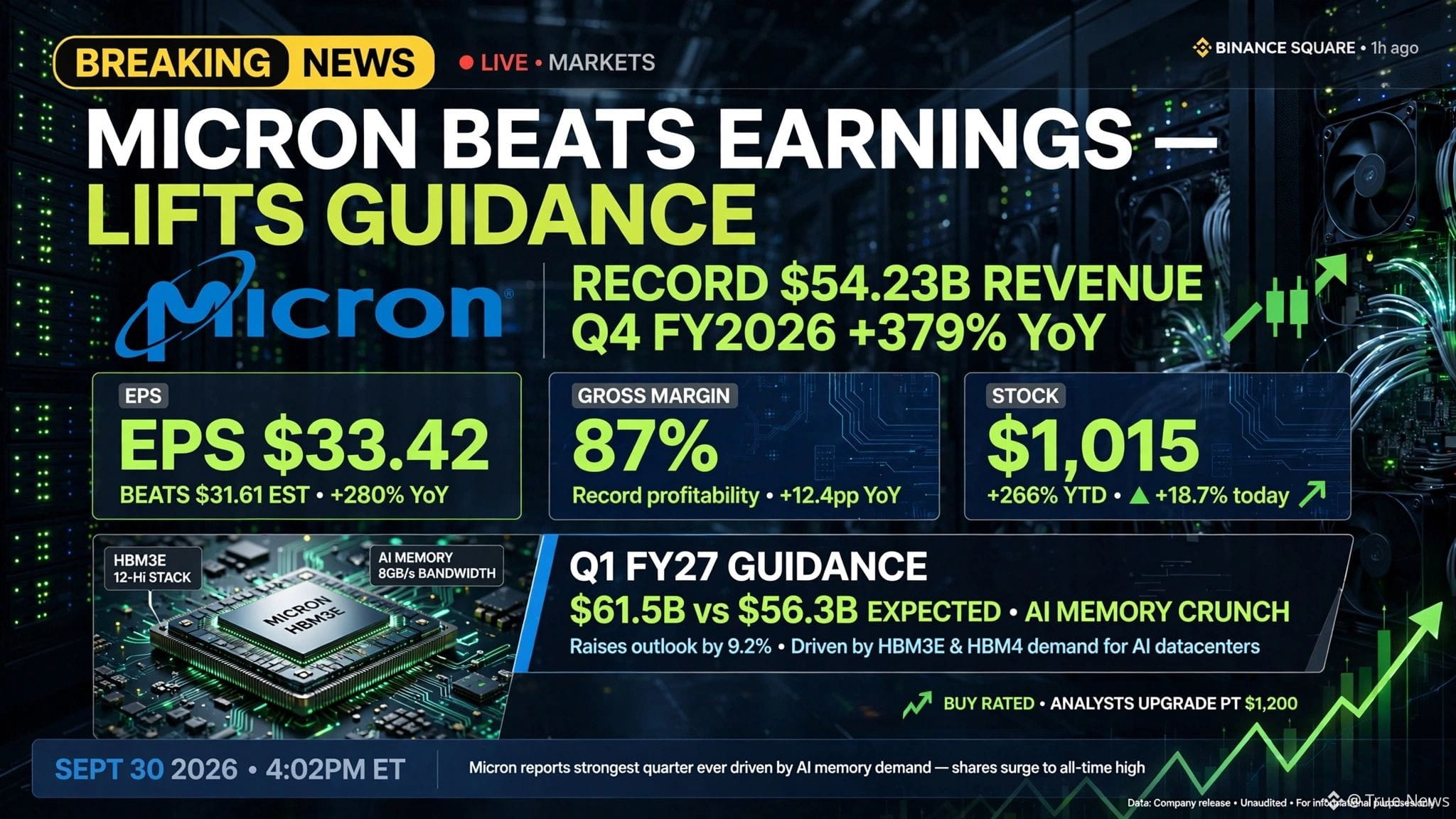
$54.23B Revenue Q4 FY26 (+379% YoY) vs $51.07B expected
EPS $33.42 vs $31.61 - BEAT!

Gross Margin 87% - Record!

Q1 FY27 Guidance: $61.5B vs $56.3B expected - Raised by 9.2%!
Reason? HBM3E / HBM4 demand > supply till 2027.

Stock $1,015 (+266% YTD) - Website crashed after earnings!

Will pump next? Bullish or overbought?


#micronbeatsearningsliftsguidance #Micron #EarningsSeason #AI #HBM #Semiconductor
MU+2.33%
AMD+0.10%
AMDUS+1.39%
Selma Humiston kdnT:
plz dear you help me
·
--
Bearish
Verified
I was honestly more curious about Micron’s margin than the headline numbers. And now we have the answer. $MU ky delivered $54.23B revenue in Q4 FY2026 and a 87% non-GAAP gross margin. That clears the 86% level the market was watching. What caught my attention even more is the next-quarter guidance: $61.5B revenue with roughly 86.25% gross margin. So for me, the bigger question has changed. It’s no longer just “can Micron post strong earnings?” It’s whether this level of AI-driven memory demand can keep margins this high as capacity expands. The numbers are strong. But I’m still watching how long this memory supercycle can actually last. What do you think — more room to run, or are expectations getting too high? #EarningsSeason #MU {future}(MUUSDT)
I was honestly more curious about Micron’s margin than the headline numbers.

And now we have the answer.

$MU ky delivered $54.23B revenue in Q4 FY2026 and a 87% non-GAAP gross margin. That clears the 86% level the market was watching.

What caught my attention even more is the next-quarter guidance: $61.5B revenue with roughly 86.25% gross margin.

So for me, the bigger question has changed.

It’s no longer just “can Micron post strong earnings?”

It’s whether this level of AI-driven memory demand can keep margins this high as capacity expands.

The numbers are strong. But I’m still watching how long this memory supercycle can actually last.

What do you think — more room to run, or are expectations getting too high?

#EarningsSeason #MU
·
--
Bullish
Verified
every number micron reported last night came in above what i'd assumed going in. my analysis was very much on point. the $33.2bn of cash it made last quarter has no customer deposits in it, which puts the business alone on a pace of about $123bn a year. long-term deals went from 16 to 26, contracted revenue went from about $100bn to about $150bn, and the new deals are priced off today's market. spending came in higher too. most of it goes into buildings that won't produce memory until late 2028. the stock moved about 2% and trades around 7 times its november quarter over a full year. still bullish. $MUB #EarningsSeason {spot}(MUBUSDT)
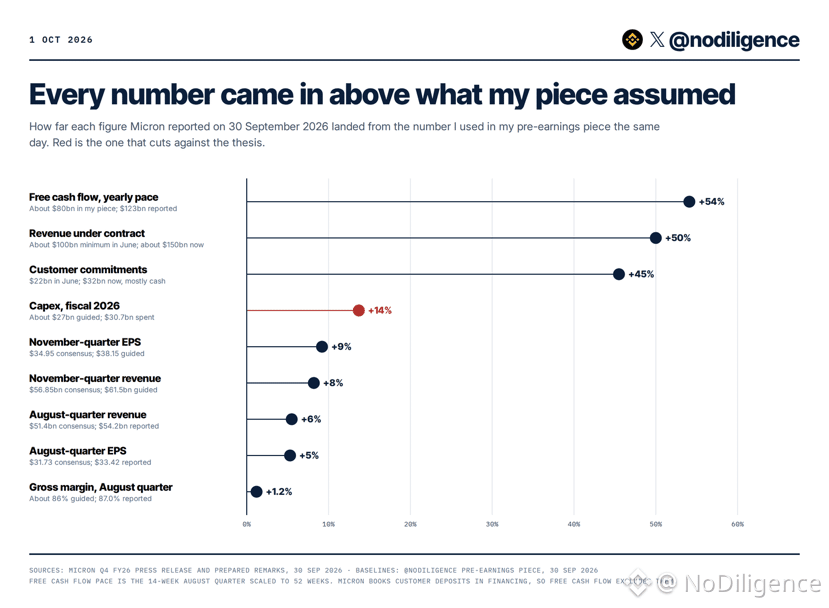
every number micron reported last night came in above what i'd assumed going in. my analysis was very much on point.

the $33.2bn of cash it made last quarter has no customer deposits in it, which puts the business alone on a pace of about $123bn a year. long-term deals went from 16 to 26, contracted revenue went from about $100bn to about $150bn, and the new deals are priced off today's market.

spending came in higher too. most of it goes into buildings that won't produce memory until late 2028.

the stock moved about 2% and trades around 7 times its november quarter over a full year. still bullish.

$MUB

#EarningsSeason
NoDiligence
·
--
Micron's memory upturn is far from over
My Thesis
Micron is keeping more of every sales dollar than NVIDIA right now, while spending a smaller share of revenue on new capacity than it has at any point in the last decade. I’m bullish on Micron going into tonight. The stock is still under 7x next year’s expected earnings, which feels way too cheap if this memory cycle still has a while to run.
Memory has become the scarcest part of the AI buildout. Supply isn’t catching up quickly either. Micron is spending a smaller share of revenue on new fabs than it has at any point in the last decade, while customers have already handed over about $18bn in cash to lock in five years of supply. You don’t give a supplier that much free money for that long if you expect prices to collapse.
HBM is also still earning less per wafer than ordinary DRAM, so those prices probably still have to move higher. Then the buyback starts in December.
Even if this cycle eventually rolls over, my bad-year number is still around 6x what Micron earned in fiscal 2025. That’s why I don’t think the current multiple is pricing the business properly.
#EarningsSeason


Read my thesis below.
The money in AI has moved to memory
For most of this build, GPUs were the obvious bottleneck, and NVIDIA's mid-70s gross margin made that easy to see. Micron is now keeping more of each sales dollar than NVIDIA. Its non-GAAP gross margin was 84.9% in the quarter to May and it has guided about 86% for tonight, while NVIDIA made 75.0% in the quarter to July and has guided about 74% for the next one.

WSTS expects memory sales of more than $800bn in a $1.51tn chip market this year. That is more than half the whole semiconductor market. On my back-calculation, memory was about 29% of 2025's $792bn of chip sales. The profit pool has moved pretty hard toward memory as supply tightened.
Using the shares Micron discloses in its 10-Q filings, its largest customer, almost certainly NVIDIA, was about 17% of revenue in November and about 7% by May. That customer's spending grew about 30%. The rest of Micron's customers grew 3.4x over the same period, so the extra money is coming from cloud, PC and phone customers too.

Micron is building less than it could afford to
Memory cycles usually break after the industry gets rich and starts building too much. Micron spent 27% of its sales on capex at the 2018 peak, then raised spending to $9.1bn in fiscal 2019 while revenue fell 23%. For the next six years capex never fell below 32% of sales, and in the loss year of 2023 it was 45%.

Micron guided about $27bn of capex for fiscal 2026, roughly 21% of about $130bn of revenue. Even if fiscal 2027 capex gets to the roughly $50bn the Street expects and sales never grow past the November quarter, capex is still only about 22% of revenue. The dollars are huge, but as a share of what Micron is earning this is still the least it has spent in a decade.
Cleanroom space is already limiting what the memory makers can add. 
Samsung has said supply growth in 2026 and 2027 is limited by cleanroom space, SK hynix's next big fab starts running in mid-2027 and Samsung's in 2028, and HBM uses about three times the wafer area of DDR5 for the same capacity. 
So even a lot of new wafer spending does not automatically turn into ordinary DRAM supply.
Customers are paying up front to lock in supply
In June Micron announced 16 multi-year agreements covering about 20% of its DRAM volume and a third of its NAND. They're take-or-pay with binding volumes. Customers are putting up about $22bn of deposits and commitments, around $18bn of it in cash, and that cash earns them nothing. At 5%, they are giving up about $900m a year of interest just to know the memory will be there. Micron's CEO has said customers want about 50% more supply than Micron can commit to.
The largest contracts cap prices near where the market was in April to June. Those customers prepaid against a ceiling that the market moved through almost immediately. TrendForce had contract prices about 15% above that level in the September quarter and is heading for about 30% above by December.

UBS carries that gap out much longer. It has the open-market price rising from $16.30 to $23.4 a gigabyte and staying above $20 until mid-2028, while the contract price sits at $10.50. On that model the shortage does not really clear for close to another two years.

Micron has also left roughly three quarters of its DRAM at market prices. In my model, taking contract coverage from 23% to 50% costs about $6.4 of yearly EPS at today's prices and about $15 if prices rise another 20%. It only helps if prices fall by more than about half. Management could have locked more volume and chose not to.

A bad year for Micron is now a profitable one
Micron lost $4.45 a share in fiscal 2023. The contracts make a repeat much harder. Management says floor pricing still gives margins well above any past peak, which was about 62%, and three different ways of backing into the floor, the margin language, the $100bn contract minimum and the covered volume, put it around half of today's price. That is roughly where the market was in February, when Micron earned $12.20 a share in the quarter.

On my numbers, that puts a bad year around $47 to $49 a share, close to six times the $8.29 Micron earned in fiscal 2025. The floor-priced contracts themselves only lock in about $11 of that. The take-or-pay volume does more work because 2023 was not just a pricing problem. Micron was carrying idle fabs and writing down inventory. Take-or-pay means fewer idle fabs if spot demand collapses.
HBM prices have to rise from here
HBM still carries the premium label, but Micron currently makes more money per wafer on ordinary DRAM. TrendForce said HBM3E used to sell for four to five times server DDR5 per bit, narrowing to one to two times by the end of 2026, while HBM still takes about three times the wafer area. Put those together and the revenue from an HBM wafer has gone from about 1.5x a DDR5 wafer to about 0.5x.

UBS has Micron at about 89% gross margin on ordinary DRAM in May and 65% on HBM. If that stays there, Micron has a pretty obvious reason to keep wafers in DDR5 until HBM pricing catches up.

TrendForce already expects HBM contract prices to rise sharply in 2027. HBM4 and HBM4E sit outside the price ceiling in Micron's agreements. 
If HBM is roughly a $100bn market in 2027 and Micron keeps a little over a fifth of it, getting HBM back to parity with DDR5 per wafer adds something like $16 a share a year on my math. If fewer HBM stacks get used per chip instead, wafers go back into server DRAM just as TrendForce raised its fourth-quarter price outlook on cloud demand. Micron is currently making more margin there anyway.
Tonight's quarter has an extra week in it
Micron's fiscal 2026 has 53 weeks, and the extra one is in the August quarter. August has 14 weeks; May and November have 13. Consensus has August at about $51.4bn of revenue and $31.73 a share, then November at $56.85bn and $34.95. As reported, revenue growth looks like it slows from 24% to 11%. Divide by weeks and it goes from about 15% to about 19%. EPS per week goes from about 17% to about 19% too.

TrendForce had contract prices up 90% to 95% in the March quarter and 58% to 63% in June, then 13% to 18% in September, and it expects 10% to 15% for December. 10% or 15% sounds a lot smaller than ninety. It is also being applied to a price level about 3.6x where December started.

Options are pricing a move of about 8% either way. If the stock drops because the November guide only looks like 10% growth, I will check the per week number before I assess anything into it.
The cash goes back to shareholders from 9 December
Micron guided free cash flow above $30bn for August, up from $18.3bn in May, even with capex rising from $7.1bn to about $10bn. A lot of that jump is customer money arriving early. Sell-side estimates put about $10bn of deposits in the quarter, and the extra week helps too.

Even if I strip the deposits out, Micron is still running at something like $80bn a year of free cash flow, about 7% of its $1.22tn market value. Include them and it is closer to 10%. From 9 December the CHIPS Act buyback restriction expires, and management has said it'll return 100% of excess cash over time. UBS models $623bn of buybacks from fiscal 2027 to 2030. On its numbers, the share count falls by about a third and fiscal 2028 EPS gets about $31 higher.

From 9 December Micron can start buying stock back, and some of the cash behind that program is coming from customers paying early for memory.
What $1,065 pays for
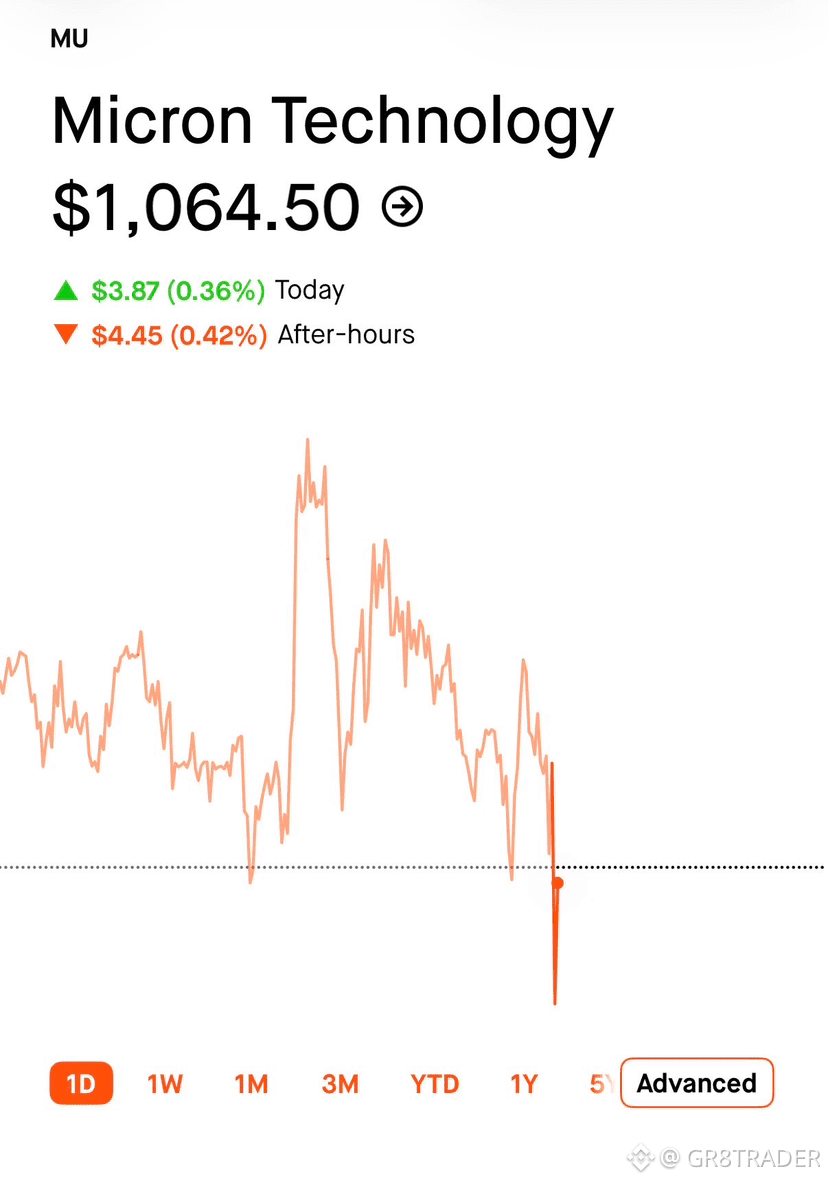
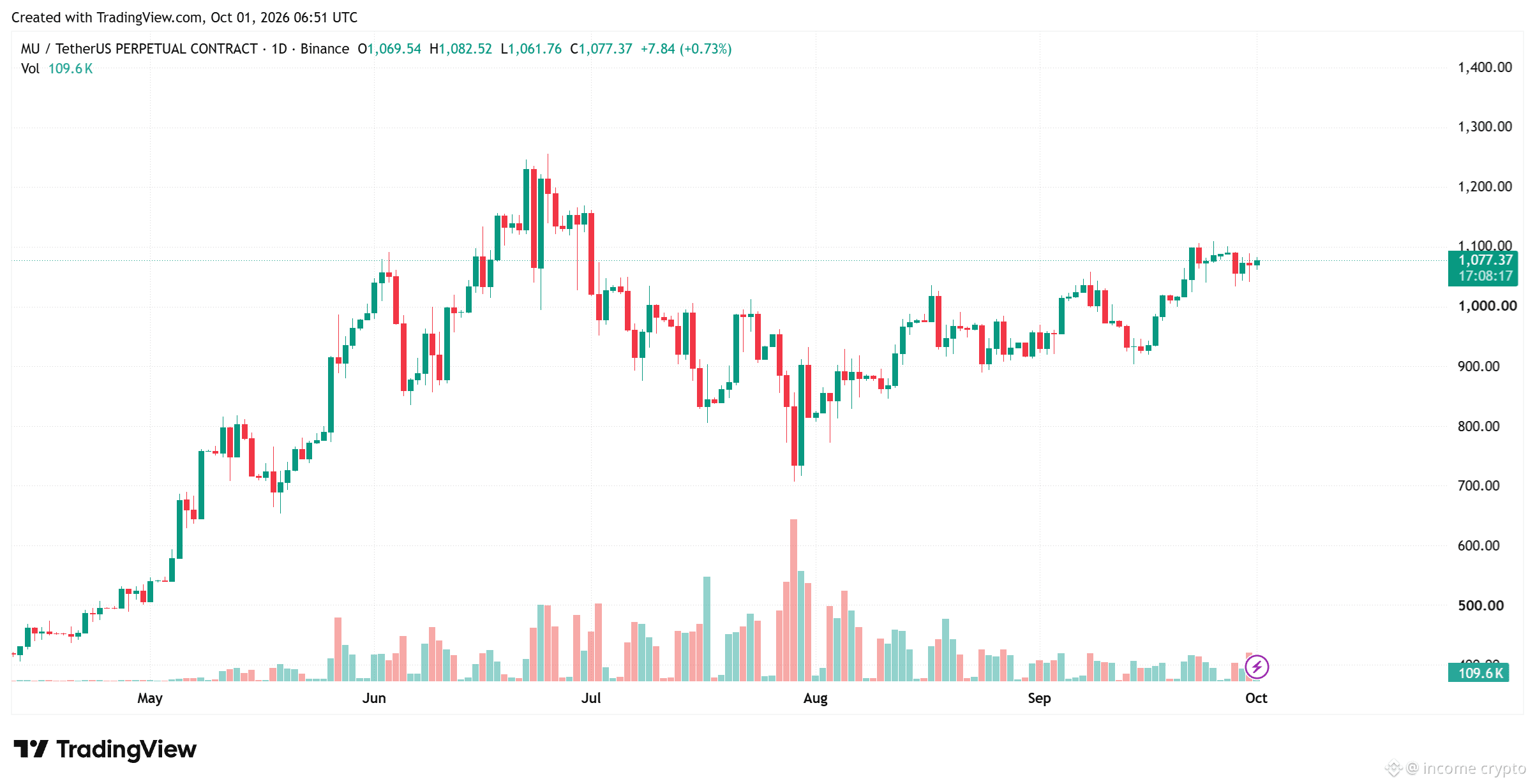
At the 29 September close of $1,065, Micron is worth about $1.22tn and trades at under seven times fiscal 2027 consensus of $159 a share. Put 10x on that number and you get about $1,590, 49% above the close.
I would rather value a memory company on something close to mid-cycle earnings than on the best year. With a bad year around $48 a share and a good one around $140 to $159, I get a middle around $95 to $105. At 12 to 15 times that, the range is about $1,130 to $1,560 before I give any credit to buybacks.

The sell-side numbers are all over the place on fiscal 2028 EPS, from about $151 to $275 across four notes this month. The targets are much closer together, and all of them sit 31% to 53% above the 29 September close.

I'm focusing more on capex and Taiwan
If this breaks, capex is probably where I see it first. A return above about 30% of sales, which means well over $65bn on fiscal 2027 revenue, would start to look like the old cycle again. I would also get nervous if contract price increases fall into low single digits before HBM reprices, or if customers start trying to renegotiate the deposits.
Taiwan is the other one. Two unions at Taoyuan and Taichung represent about 10,000 of Micron's 15,000 staff there, where most of Micron's DRAM was made in 2025. They want 15% of operating profit paid out quarterly. Mediation broke down on 21 September and a strike vote is planned for early October. Samsung settled in May at 10.5% of its chip division's operating profit for ten years, and SK hynix pays 10%.

If Micron settles around the Korean numbers, I get roughly 10% off EPS, about $16 a share on fiscal 2027 consensus. Micron can absorb that. A strike is much worse because it would hit the fabs making most of its DRAM while the company is signing more take-or-pay volume with customers.
Tonight I'm reading the November guide per week, then the contracted revenue in the 10-K and how much of it is on new products, how much of the cash flow came from deposits, fiscal 2027 capex against the roughly $50bn expectation, and whatever management says about Taiwan.
#EarningsSeason
DISCLAIMER
I am doing this independently and sharing it as part of my own research and thinking. The views here are my own and are based on the information available to me at the time. This should not be treated as investment advice or a recommendation to buy, sell, or invest in anything mentioned. Please do your own research, my analysis is my own.
AngelOfCrypto_-:
nice

I’m using Binance Square to turn my market views into extra reach. You can do it too. 👇 Binance Square has launched #EarningsSeason, and the current campaign is around Micron’s $MU earnings. The interesting part? You don’t need to be a professional analyst. You need a real market view + data + your reasoning. Here’s exactly how I’m doing it: Step 1: Go to Binance Square and find the #EarningsSeason campaign. Step 2: Pick the $MU topic and decide what you think about the earnings. Step 3: Do your own research. Look at revenue, EPS, gross margin, guidance, AI demand and the memory cycle. Step 4: Write a short post explaining your view. Don’t just say “bullish” or “bearish.” Explain WHY. Step 5: Add a relevant chart or real data to support your thesis. Step 6: If you have a $MU position, share your trade/position using the trade-sharing card. Binance says this can give eligible posts a higher chance of receiving a traffic boost. Step 7: Add #EarningsSeason and publish. The important part: this isn't a guaranteed cash-earning program. Qualified posts may receive additional traffic, and some content may be featured by Binance Square Official. And Micron has already reported strong Q4 numbers: $54.23B revenue, $33.42 non-GAAP EPS and 87% non-GAAP gross margin. So if you’re on Binance Square, don’t just watch other creators participate. Use your own analysis. Publish it. Let the market see your thinking. Are you participating in #EarningsSeason? 👇 #BinanceSquare #MU #crypto #earningsseason
I’m using Binance Square to turn my market views into extra reach. You can do it too. 👇

Binance Square has launched #EarningsSeason, and the current campaign is around Micron’s $MU earnings.

The interesting part?

You don’t need to be a professional analyst.

You need a real market view + data + your reasoning.

Here’s exactly how I’m doing it:

Step 1: Go to Binance Square and find the #EarningsSeason campaign.

Step 2: Pick the $MU topic and decide what you think about the earnings.

Step 3: Do your own research.
Look at revenue, EPS, gross margin, guidance, AI demand and the memory cycle.

Step 4: Write a short post explaining your view.
Don’t just say “bullish” or “bearish.” Explain WHY.

Step 5: Add a relevant chart or real data to support your thesis.

Step 6: If you have a $MU position, share your trade/position using the trade-sharing card. Binance says this can give eligible posts a higher chance of receiving a traffic boost.

Step 7: Add #EarningsSeason and publish.

The important part: this isn't a guaranteed cash-earning program. Qualified posts may receive additional traffic, and some content may be featured by Binance Square Official.

And Micron has already reported strong Q4 numbers: $54.23B revenue, $33.42 non-GAAP EPS and 87% non-GAAP gross margin.

So if you’re on Binance Square, don’t just watch other creators participate.

Use your own analysis. Publish it. Let the market see your thinking.

Are you participating in #EarningsSeason? 👇

#BinanceSquare #MU #crypto

#earningsseason
Here is a compelling, rules-compliant post tailored for the Binance Square #EarningsSeason challenge, complete with a poll and data-backed talking points. 📊 Micron FY2026 Q4: Can the Memory Supercycle Defy Expectations? The stakes couldn't be higher for $MU this week. With gross margins targeting unprecedented highs and AI-driven memory demand under the microscope, Q4 earnings are the ultimate stress test for the entire supercycle narrative. Are we looking at sustained structural growth, or is a peak approaching? Data Check: Keep a close eye on DRAM/NAND pricing trends and guidance for next quarter to separate hype from reality. Trade Strategy: Using trade-sharing cards to map out risk management before volatility kicks in. 👇 Cast your vote below and share your takes under #EarningsSeason $MU Dyor guys!!! 🗳️️ Poll Options Bullish: Gross margins beat 86% Bearish: Supercycle is peaking
Here is a compelling, rules-compliant post tailored for the Binance Square #EarningsSeason challenge, complete with a poll and data-backed talking points.

📊 Micron FY2026 Q4: Can the Memory Supercycle Defy Expectations?
The stakes couldn't be higher for $MU this week. With gross margins targeting unprecedented highs and AI-driven memory demand under the microscope, Q4 earnings are the ultimate stress test for the entire supercycle narrative.

Are we looking at sustained structural growth, or is a peak approaching?

Data Check: Keep a close eye on DRAM/NAND pricing trends and guidance for next quarter to separate hype from reality.

Trade Strategy: Using trade-sharing cards to map out risk management before volatility kicks in.

👇 Cast your vote below and share your takes under #EarningsSeason $MU Dyor guys!!!
🗳️️ Poll Options
Bullish: Gross margins beat 86%
Bearish: Supercycle is peaking
Bullish:Gross margins beat86%
Bearish:Supercycle is peaking
1 day(s) left
$BTC $ETH $BNB *Will Micron Earnings Pump Crypto Market?* Micron Technology will announce Q4 earnings this week and crypto market is watching closely. Micron is a leader in AI chips and memory. If Micron beats earnings, it means AI demand is still very strong. Strong AI demand is very bullish for AI crypto tokens and also for $BTC and $ETH. Market sentiment will turn positive quickly. If Micron misses earnings, we may see a short term correction of 3% to 5% before the next rally starts. Smart traders are already positioning for volatility. I expect a beat and a strong pump. What is your prediction?
$BTC $ETH $BNB

*Will Micron Earnings Pump Crypto Market?*

Micron Technology will announce Q4 earnings this week and crypto market is watching closely. Micron is a leader in AI chips and memory.

If Micron beats earnings, it means AI demand is still very strong. Strong AI demand is very bullish for AI crypto tokens and also for $BTC and $ETH. Market sentiment will turn positive quickly.

If Micron misses earnings, we may see a short term correction of 3% to 5% before the next rally starts. Smart traders are already positioning for volatility.

I expect a beat and a strong pump. What is your prediction?
#earningsseason 🚨 $MU just changed the AI memory story Micron’s latest results are getting serious attention. 📌 Q4 Revenue: $54.23B 📌 Adjusted EPS: $33.42 📌 Non-GAAP Gross Margin: 87% 📌 Q1 FY27 Revenue Guidance: $61.5B ± $1.5B The bigger story is AI demand. Micron says supply-demand conditions are expected to remain tight through FY2027 and FY2028, while data-center demand continues to drive strong results. For traders, I’m watching two things now: 1️⃣ Can $MU maintain these exceptional margins? 2️⃣ How much of the AI-driven growth is already priced in? Strong earnings can create opportunities—but they can also bring profit-taking and volatility. I’ll be watching the pullbacks rather than chasing the first move. What are you watching on $MU after earnings?
#earningsseason 🚨 $MU just changed the AI memory story

Micron’s latest results are getting serious attention.

📌 Q4 Revenue: $54.23B
📌 Adjusted EPS: $33.42
📌 Non-GAAP Gross Margin: 87%
📌 Q1 FY27 Revenue Guidance: $61.5B ± $1.5B

The bigger story is AI demand.

Micron says supply-demand conditions are expected to remain tight through FY2027 and FY2028, while data-center demand continues to drive strong results.

For traders, I’m watching two things now:

1️⃣ Can $MU maintain these exceptional margins?
2️⃣ How much of the AI-driven growth is already priced in?

Strong earnings can create opportunities—but they can also bring profit-taking and volatility.

I’ll be watching the pullbacks rather than chasing the first move.

What are you watching on $MU after earnings?
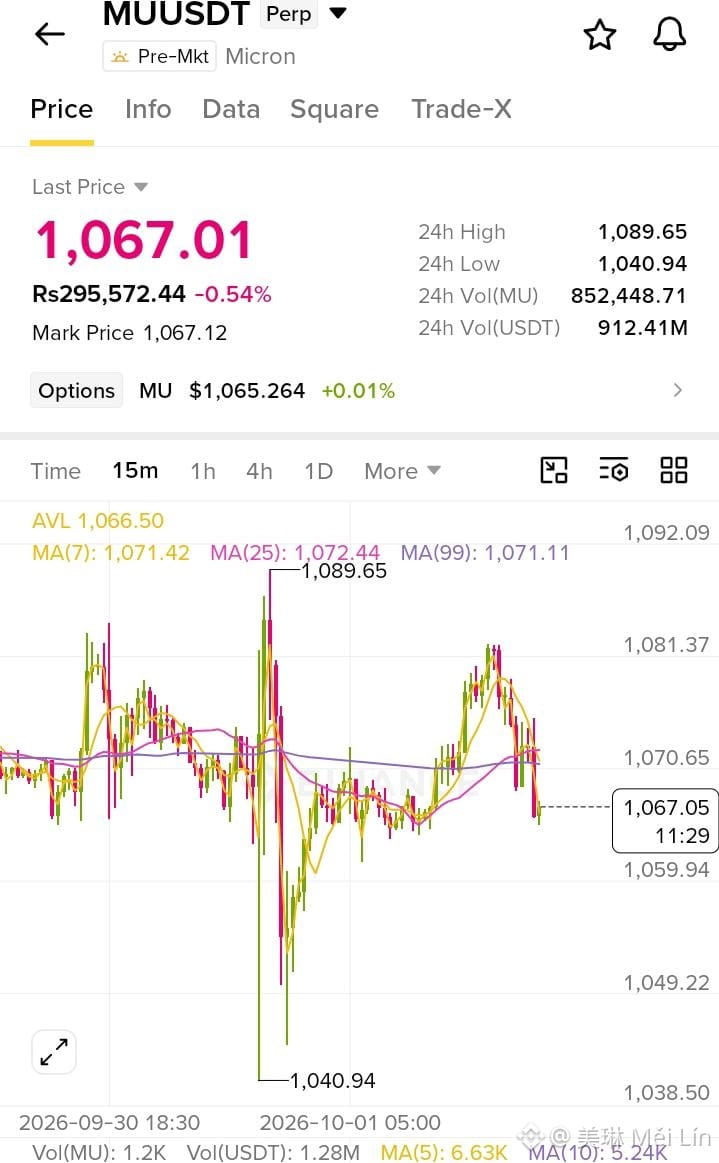
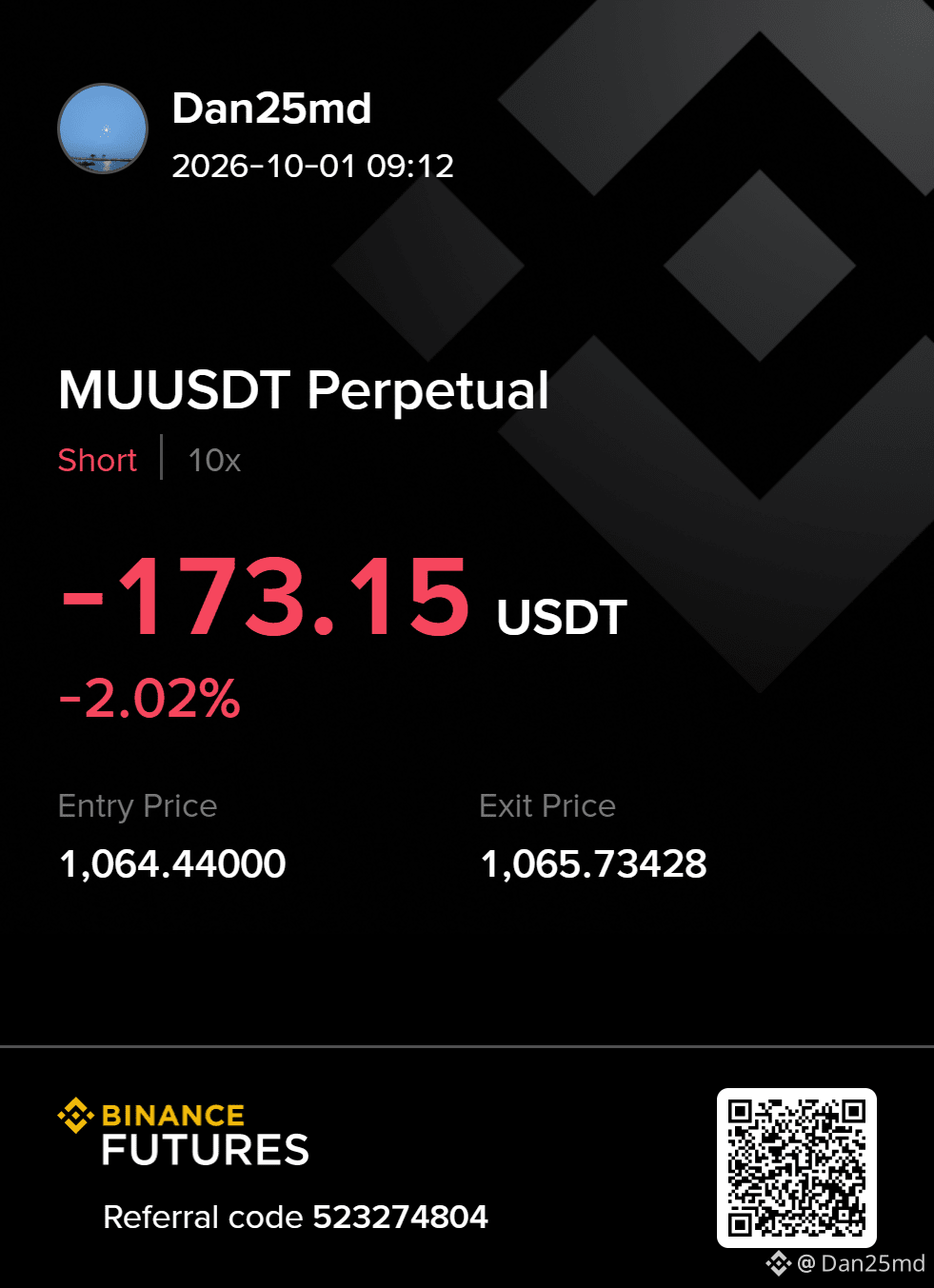
$MU is not giving easy trades before earnings. My first short worked well and I closed it in profit. I tried another short later, but that trade ended in a loss. For me, this shows how volatile and unpredictable MU is right now. I’m still slightly bearish, but I don’t want to force another trade without clear confirmation. Around earnings, protecting capital matters more than trying to catch every move. {future}(MUUSDT) #EarningsSeason #MU #Micron
$MU is not giving easy trades before earnings. My first short worked well and I closed it in profit. I tried another short later, but that trade ended in a loss. For me, this shows how volatile and unpredictable MU is right now. I’m still slightly bearish, but I don’t want to force another trade without clear confirmation.

Around earnings, protecting capital matters more than trying to catch every move.
#EarningsSeason #MU #Micron
·
--
Bullish
#earningsseason Micron Q4 Earnings: The Real Test! 🔍 $MU earnings this week = big for AI & memory sector. Bullish Outlook: AI & data center demand growing Key: DRAM & HBM segment If beat -> bullish for $NVDA $AMD $FET If miss -> short term dip What's your bet? #earningsseason #MU #BTC
#earningsseason Micron Q4 Earnings: The Real Test! 🔍

$MU earnings this week = big for AI & memory sector.

Bullish Outlook: AI & data center demand growing
Key: DRAM & HBM segment

If beat -> bullish for $NVDA $AMD $FET
If miss -> short term dip

What's your bet?

#earningsseason #MU #BTC
·
--
Bullish
Verified
One of the most important comments from One of the most important comments from $MUB earnings call was that FQ1 should be the gross margin floor for FY27. Micron expects revenue to grow sequentially every quarter in FY27, while gross margin should move higher after Q1. Pricing is still expected to improve, just at a slower pace than before. My view is that FY27 EPS can go above $200. FQ1 EPS guidance is already $38.15. If earnings keep growing from here, I don’t think $200 requires a very aggressive assumption. JPM’s channel survey had FY27 EPS around $180, while FY28 consensus was around $234. I also think FY28 earnings can continue to move higher if the current memory cycle lasts. Capital return is another thing I’m watching closely. At $200 EPS and around 1.15B diluted shares, Micron would generate roughly $230B of earnings. Even if only around half of that turns into excess free cash flow available for capital returns, the potential buyback capacity could still be very significant. Micron has already said it plans to increase capital returns from December 9, mainly through share repurchases, and will seek additional buyback authorization. On pricing, I still think there is a gap between market expectations and what I’m hearing from the industry. After talking with memory industry contacts recently, demand looks tighter than it did a few months ago. I’m hearing the same thing in China. China internet companies are even aggressively buying up memory in the secondary market, along with RTX 5090 GPUs. There has also been some discussion about a 30% quarterly cap on memory price increases. Based on my own channel checks, I have not seen evidence of a broad 30% quarterly pricing cap on conventional DRAM or NAND. #EarningsSeason
One of the most important comments from One of the most important comments from $MUB earnings call was that FQ1 should be the gross margin floor for FY27.

Micron expects revenue to grow sequentially every quarter in FY27, while gross margin should move higher after Q1. Pricing is still expected to improve, just at a slower pace than before.

My view is that FY27 EPS can go above $200.

FQ1 EPS guidance is already $38.15. If earnings keep growing from here, I don’t think $200 requires a very aggressive assumption.

JPM’s channel survey had FY27 EPS around $180, while FY28 consensus was around $234. I also think FY28 earnings can continue to move higher if the current memory cycle lasts.

Capital return is another thing I’m watching closely.

At $200 EPS and around 1.15B diluted shares, Micron would generate roughly $230B of earnings.

Even if only around half of that turns into excess free cash flow available for capital returns, the potential buyback capacity could still be very significant.

Micron has already said it plans to increase capital returns from December 9, mainly through share repurchases, and will seek additional buyback authorization.

On pricing, I still think there is a gap between market expectations and what I’m hearing from the industry.

After talking with memory industry contacts recently, demand looks tighter than it did a few months ago.

I’m hearing the same thing in China. China internet companies are even aggressively buying up memory in the secondary market, along with RTX 5090 GPUs.

There has also been some discussion about a 30% quarterly cap on memory price increases.

Based on my own channel checks, I have not seen evidence of a broad 30% quarterly pricing cap on conventional DRAM or NAND.
#EarningsSeason
AngelOfCrypto_-:
nice
Log in to explore more content
Join global crypto users on Binance Square
⚡️ Get latest and useful information about crypto.
💬 Trusted by the world’s largest crypto exchange.
👍 Discover real insights from verified creators.
Email / Phone number