

#learnwithbinance
learnwithbinance
28,221 views
421 Discussing
Hot
Latest

·
--
Article
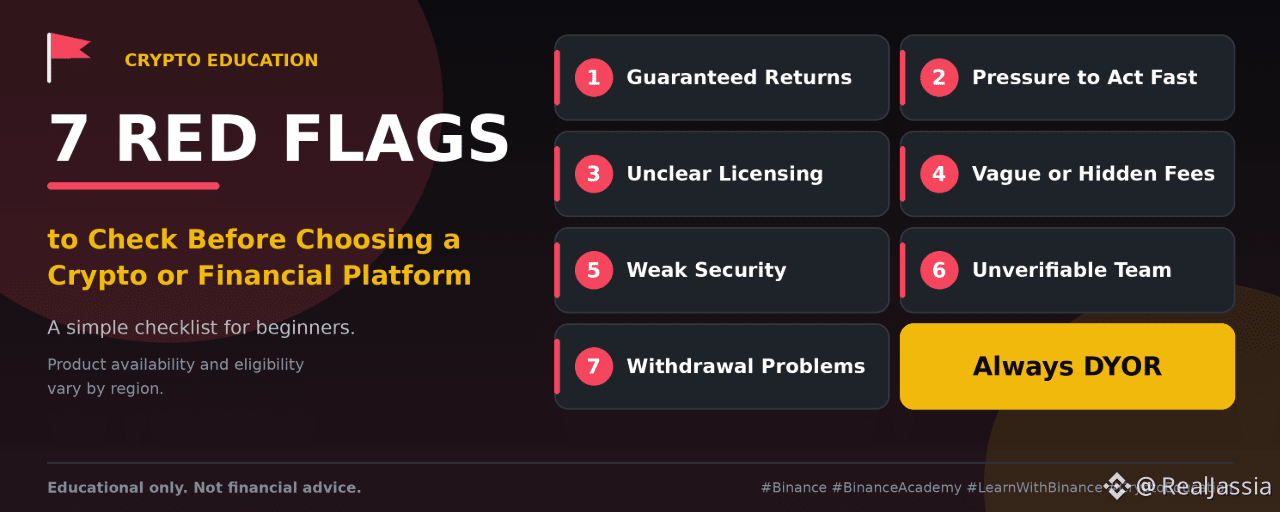
7 Red Flags to Check Before Choosing a Crypto or Financial PlatformChoosing a platform is an important step, and it helps to know what warning signs to look for. Here are 7 common red flags that beginners may want to check before signing up or depositing anything. ✅
1. Promises of Guaranteed Returns 💸
Markets can move up and down, and no legitimate platform can promise profit. If a platform or a promoter talks about guaranteed or "risk-free" returns, treat it as a reason to slow down and look closer.
2. Pressure to Act Fast ⏰
Messages like "Only 10 minutes left!" or "Join now before it's too late!" are commonly used to rush people into decisions. Taking your time to research can help you avoid choices made out of pressure.
3. Unclear Licensing or Regulation 📜
Availability and eligibility vary by region. Check whether the platform clearly explains where it operates and what licenses or registrations it holds. If this information is hard to find or vague, that may be worth noting.
5. Weak Security Features 🔐
Look for tools like two-factor authentication (2FA), anti-phishing codes, and withdrawal whitelists. A platform that offers few or no security options may leave your account more exposed.
6. Team or Company Is Hard to Verify 👤
Can you find who runs the platform, where it is based, and how to contact it? If the company details are missing or unclear, it can be harder to know who is accountable.
7. Withdrawal Problems or Unresponsive Support 🚪
Be cautious if users report trouble withdrawing, or if support is slow or hard to reach. Clear withdrawal rules and accessible customer support are commonly used signs of a well-run service.
Quick Safety Habits 🛡️
Only use official websites and apps, and double-check links.Never share your password, 2FA codes, or seed phrase with anyone.Be careful with unsolicited messages, even if they look official.Only put in an amount you are comfortable with, since all crypto activity carries risk.
Where to Learn More 📚
Before using any platform, consider reading official resources such as Binance Academy and the official Binance product pages. They explain security tips, product terms, eligibility, and risk disclosures.
Final Thoughts
Spotting red flags early can help you stay safer and make more informed choices. No checklist removes all risk, so keep learning and stay alert.
Always DYOR (Do Your Own Research). This content is for educational purposes only and is not financial advice. Product availability may vary by region.
💬 Which red flag do you think beginners miss the most? Share your thoughts below!
#Binance #BinanceAcademy #learnwithbinance #CryptoEducation💡🚀 #NFA✅
7 Red Flags to Check Before Choosing a Crypto or Financial Platform
Choosing a platform is an important step, and it helps to know what warning signs to look for. Here are 7 common red flags that beginners may want to check before signing up or depositing anything. ✅
1. Promises of Guaranteed Returns 💸
Markets can move up and down, and no legitimate platform can promise profit. If a platform or a promoter talks about guaranteed or "risk-free" returns, treat it as a reason to slow down and look closer.
2. Pressure to Act Fast ⏰
Messages like "Only 10 minutes left!" or "Join now before it's too late!" are commonly used to rush people into decisions. Taking your time to research can help you avoid choices made out of pressure.
3. Unclear Licensing or Regulation 📜
Availability and eligibility vary by region. Check whether the platform clearly explains where it operates and what licenses or registrations it holds. If this information is hard to find or vague, that may be worth noting.
5. Weak Security Features 🔐
Look for tools like two-factor authentication (2FA), anti-phishing codes, and withdrawal whitelists. A platform that offers few or no security options may leave your account more exposed.
6. Team or Company Is Hard to Verify 👤
Can you find who runs the platform, where it is based, and how to contact it? If the company details are missing or unclear, it can be harder to know who is accountable.
7. Withdrawal Problems or Unresponsive Support 🚪
Be cautious if users report trouble withdrawing, or if support is slow or hard to reach. Clear withdrawal rules and accessible customer support are commonly used signs of a well-run service.
Quick Safety Habits 🛡️
Only use official websites and apps, and double-check links.Never share your password, 2FA codes, or seed phrase with anyone.Be careful with unsolicited messages, even if they look official.Only put in an amount you are comfortable with, since all crypto activity carries risk.
Where to Learn More 📚
Before using any platform, consider reading official resources such as Binance Academy and the official Binance product pages. They explain security tips, product terms, eligibility, and risk disclosures.
Final Thoughts
Spotting red flags early can help you stay safer and make more informed choices. No checklist removes all risk, so keep learning and stay alert.
Always DYOR (Do Your Own Research). This content is for educational purposes only and is not financial advice. Product availability may vary by region.
💬 Which red flag do you think beginners miss the most? Share your thoughts below!
#Binance #BinanceAcademy #learnwithbinance #CryptoEducation💡🚀 #NFA✅
1. Promises of Guaranteed Returns 💸
Markets can move up and down, and no legitimate platform can promise profit. If a platform or a promoter talks about guaranteed or "risk-free" returns, treat it as a reason to slow down and look closer.
2. Pressure to Act Fast ⏰
Messages like "Only 10 minutes left!" or "Join now before it's too late!" are commonly used to rush people into decisions. Taking your time to research can help you avoid choices made out of pressure.
3. Unclear Licensing or Regulation 📜
Availability and eligibility vary by region. Check whether the platform clearly explains where it operates and what licenses or registrations it holds. If this information is hard to find or vague, that may be worth noting.
5. Weak Security Features 🔐
Look for tools like two-factor authentication (2FA), anti-phishing codes, and withdrawal whitelists. A platform that offers few or no security options may leave your account more exposed.
6. Team or Company Is Hard to Verify 👤
Can you find who runs the platform, where it is based, and how to contact it? If the company details are missing or unclear, it can be harder to know who is accountable.
7. Withdrawal Problems or Unresponsive Support 🚪
Be cautious if users report trouble withdrawing, or if support is slow or hard to reach. Clear withdrawal rules and accessible customer support are commonly used signs of a well-run service.
Quick Safety Habits 🛡️
Only use official websites and apps, and double-check links.Never share your password, 2FA codes, or seed phrase with anyone.Be careful with unsolicited messages, even if they look official.Only put in an amount you are comfortable with, since all crypto activity carries risk.
Where to Learn More 📚
Before using any platform, consider reading official resources such as Binance Academy and the official Binance product pages. They explain security tips, product terms, eligibility, and risk disclosures.
Final Thoughts
Spotting red flags early can help you stay safer and make more informed choices. No checklist removes all risk, so keep learning and stay alert.
Always DYOR (Do Your Own Research). This content is for educational purposes only and is not financial advice. Product availability may vary by region.
💬 Which red flag do you think beginners miss the most? Share your thoughts below!
#Binance #BinanceAcademy #learnwithbinance #CryptoEducation💡🚀 #NFA✅
2
93
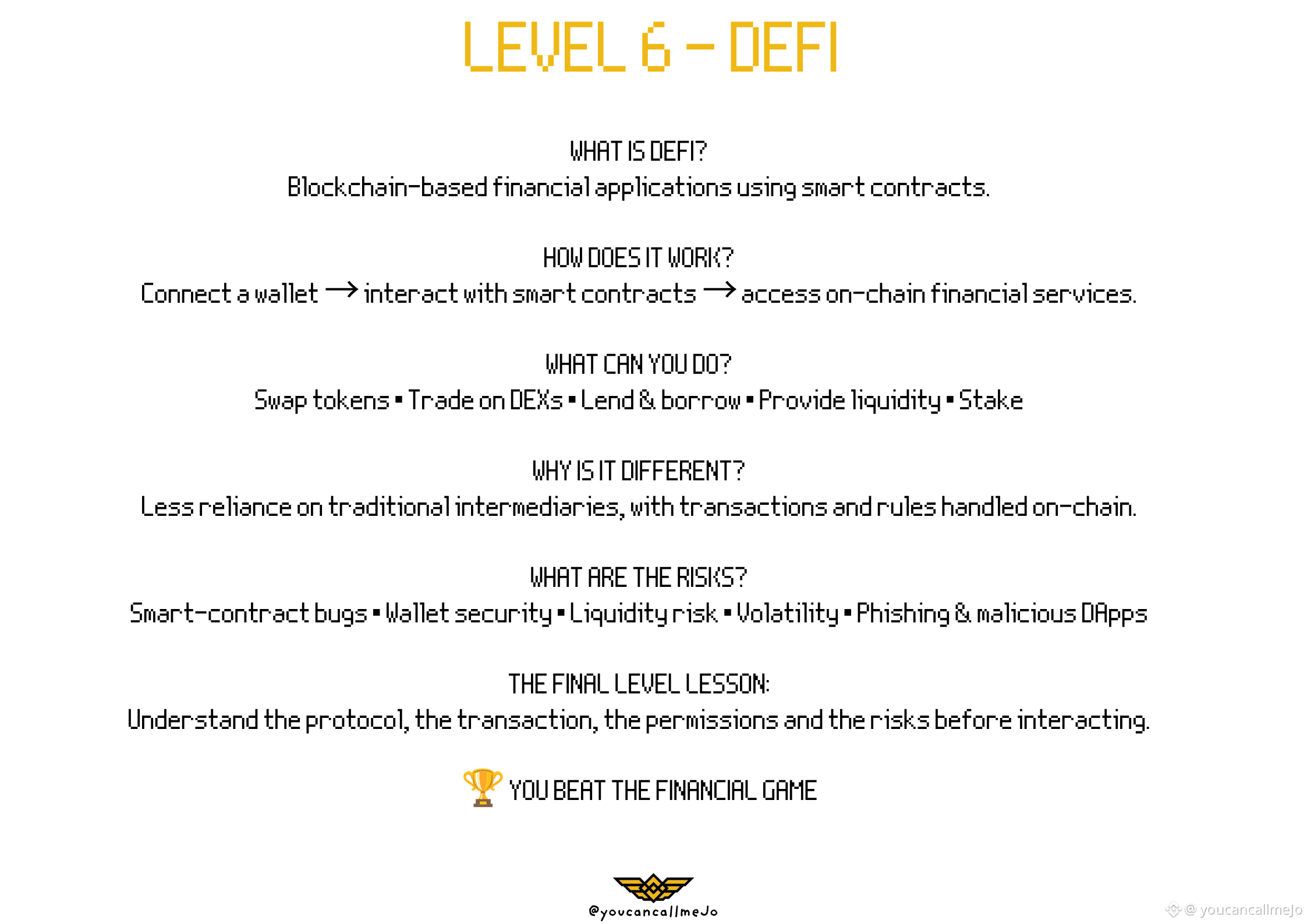
🎮 LEVEL 6 — DeFi: Enter the On-Chain Financial World
🏦 WHAT IS DeFi?
DeFi is an ecosystem of financial applications built on blockchain networks, where users can interact with financial services through wallets, smart contracts and decentralized applications (DApps) rather than relying entirely on traditional intermediaries.
Think of it as moving from: “Go through the institution.” to: “Connect your wallet to the protocol.”
🔗 HOW DOES IT WORK?
Smart contracts are programs on a blockchain that execute predefined rules. Instead of a bank employee processing a transaction manually, the smart contract can handle the agreed logic automatically once its conditions are met.
This enables services such as:
• Decentralized exchanges (DEXs)
• Lending & borrowing
• Liquidity pools
• Staking
• Token swaps
• Other on-chain financial applications
For example, on a DEX, users can connect a compatible wallet and trade through blockchain-based smart contracts rather than depositing assets with a centralized exchange.
💡 THE BIG DIFFERENCE
In traditional finance, an institution often sits between you and the financial service. In DeFi, the interaction can happen directly between your wallet and a blockchain-based protocol. But that doesn't mean every DeFi system is completely decentralized or automatically safe. Different protocols have different levels of decentralization, governance and control.
⚠️ AND HERE COMES THE RISK
DeFi changes the way financial services operate, but it also changes the risks you need to understand.
Smart-contract vulnerabilities, phishing, malicious DApps, private-key security, network fees, liquidity risks and token price volatility can all matter. And unlike a traditional financial platform, an on-chain transaction may not have an easy “undo” button. Binance specifically recommends verifying DApps and understanding permissions before approving transactions.
🏆 YOU BEAT THE FINANCIAL LEVEL.
#Binance #learnwithbinance #defi #Web3 #DEX
🎮 LEVEL 6 — DeFi: Enter the On-Chain Financial World
🏦 WHAT IS DeFi?
DeFi is an ecosystem of financial applications built on blockchain networks, where users can interact with financial services through wallets, smart contracts and decentralized applications (DApps) rather than relying entirely on traditional intermediaries.
Think of it as moving from: “Go through the institution.” to: “Connect your wallet to the protocol.”
🔗 HOW DOES IT WORK?
Smart contracts are programs on a blockchain that execute predefined rules. Instead of a bank employee processing a transaction manually, the smart contract can handle the agreed logic automatically once its conditions are met.
This enables services such as:
• Decentralized exchanges (DEXs)
• Lending & borrowing
• Liquidity pools
• Staking
• Token swaps
• Other on-chain financial applications
For example, on a DEX, users can connect a compatible wallet and trade through blockchain-based smart contracts rather than depositing assets with a centralized exchange.
💡 THE BIG DIFFERENCE
In traditional finance, an institution often sits between you and the financial service. In DeFi, the interaction can happen directly between your wallet and a blockchain-based protocol. But that doesn't mean every DeFi system is completely decentralized or automatically safe. Different protocols have different levels of decentralization, governance and control.
⚠️ AND HERE COMES THE RISK
DeFi changes the way financial services operate, but it also changes the risks you need to understand.
Smart-contract vulnerabilities, phishing, malicious DApps, private-key security, network fees, liquidity risks and token price volatility can all matter. And unlike a traditional financial platform, an on-chain transaction may not have an easy “undo” button. Binance specifically recommends verifying DApps and understanding permissions before approving transactions.
🏆 YOU BEAT THE FINANCIAL LEVEL.
#Binance #learnwithbinance #defi #Web3 #DEX
🏦 WHAT IS DeFi?
DeFi is an ecosystem of financial applications built on blockchain networks, where users can interact with financial services through wallets, smart contracts and decentralized applications (DApps) rather than relying entirely on traditional intermediaries.
Think of it as moving from: “Go through the institution.” to: “Connect your wallet to the protocol.”
🔗 HOW DOES IT WORK?
Smart contracts are programs on a blockchain that execute predefined rules. Instead of a bank employee processing a transaction manually, the smart contract can handle the agreed logic automatically once its conditions are met.
This enables services such as:
• Decentralized exchanges (DEXs)
• Lending & borrowing
• Liquidity pools
• Staking
• Token swaps
• Other on-chain financial applications
For example, on a DEX, users can connect a compatible wallet and trade through blockchain-based smart contracts rather than depositing assets with a centralized exchange.
💡 THE BIG DIFFERENCE
In traditional finance, an institution often sits between you and the financial service. In DeFi, the interaction can happen directly between your wallet and a blockchain-based protocol. But that doesn't mean every DeFi system is completely decentralized or automatically safe. Different protocols have different levels of decentralization, governance and control.
⚠️ AND HERE COMES THE RISK
DeFi changes the way financial services operate, but it also changes the risks you need to understand.
Smart-contract vulnerabilities, phishing, malicious DApps, private-key security, network fees, liquidity risks and token price volatility can all matter. And unlike a traditional financial platform, an on-chain transaction may not have an easy “undo” button. Binance specifically recommends verifying DApps and understanding permissions before approving transactions.
🏆 YOU BEAT THE FINANCIAL LEVEL.
#Binance #learnwithbinance #defi #Web3 #DEX
1
3
30
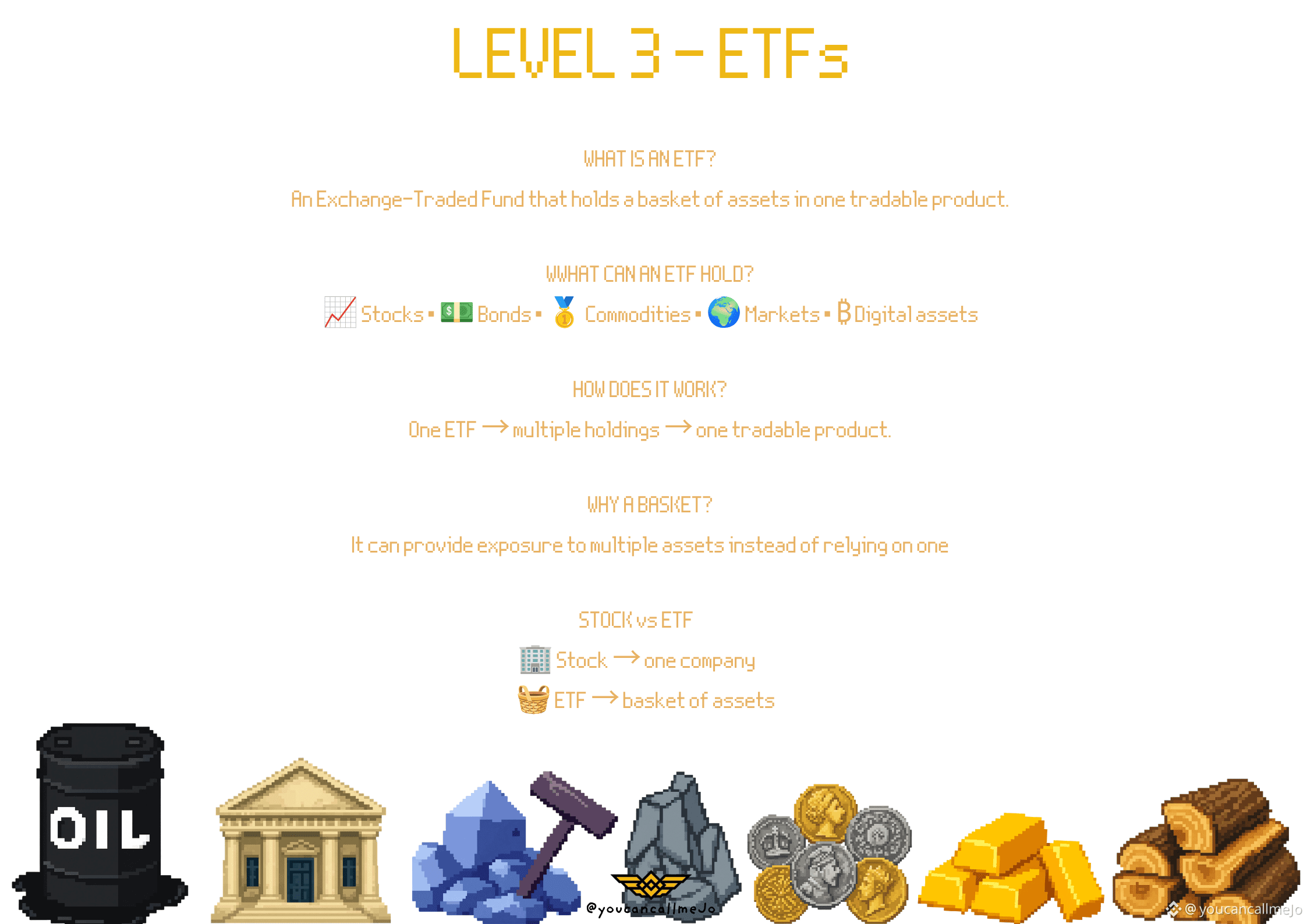
🎮 LEVEL 3 — ETFs: The Basket Level
You cleared Level 2.
You learned that buying a stock can mean gaining exposure to one company.
But what if you don't want to choose just one?
Welcome to Level 3: ETFs. 🧩
🧺 WHAT IS AN ETF?
ETF stands for Exchange-Traded Fund.
Think of it as a basket containing multiple assets, packaged into one tradable product.
Instead of buying every asset separately, one ETF can give you exposure to a group of them.
For example, an ETF may track:
📈 A stock index
🏭 A specific industry
🌍 A country or region
🥇 A commodity
💵 Bonds
₿ Digital assets
📊 HOW DOES IT WORK?
Many ETFs are designed to track an index, sector, commodity, or other asset class.
The ETF itself trades on an exchange throughout the trading day, similar to a stock.
So instead of:
Stock A + Stock B + Stock C + Stock D...
You can have:
🧺 One ETF → exposure to a basket
🎯 WHY USE A BASKET?
One major concept is diversification.
If an ETF holds many different companies, your exposure isn't concentrated in just one company.
But diversification doesn't eliminate risk. The value of an ETF can still fall, depending on what it holds and how that market performs.
🆚 STOCK vs ETF
🏢 Stock → exposure to one company
🧺 ETF → exposure to a collection of assets
And here's an important detail:
Buying an ETF does not mean you personally own every underlying stock in your own name. You own shares of the fund.
🔍 NOT ALL ETFs ARE THE SAME
Two ETFs can both track markets but have very different structures.
Some follow broad indexes.
Others focus on specific sectors, commodities, bonds, or crypto.
Some ETFs hold the underlying assets directly, while others use derivatives.
So don't stop at the name.
Look inside the basket.
🎮 LEVEL 3 LESSON
The question isn't only:
“What's inside the ETF?”
It's also:
“How is this ETF designed to give me that exposure?”
You completed Level 3.
🔓 NEXT LEVEL → COMMODITIES 🥇
#Binance #binancequare #learnwithbinance #ETFs #TradFi
🎮 LEVEL 3 — ETFs: The Basket Level
You cleared Level 2.
You learned that buying a stock can mean gaining exposure to one company.
But what if you don't want to choose just one?
Welcome to Level 3: ETFs. 🧩
🧺 WHAT IS AN ETF?
ETF stands for Exchange-Traded Fund.
Think of it as a basket containing multiple assets, packaged into one tradable product.
Instead of buying every asset separately, one ETF can give you exposure to a group of them.
For example, an ETF may track:
📈 A stock index
🏭 A specific industry
🌍 A country or region
🥇 A commodity
💵 Bonds
₿ Digital assets
📊 HOW DOES IT WORK?
Many ETFs are designed to track an index, sector, commodity, or other asset class.
The ETF itself trades on an exchange throughout the trading day, similar to a stock.
So instead of:
Stock A + Stock B + Stock C + Stock D...
You can have:
🧺 One ETF → exposure to a basket
🎯 WHY USE A BASKET?
One major concept is diversification.
If an ETF holds many different companies, your exposure isn't concentrated in just one company.
But diversification doesn't eliminate risk. The value of an ETF can still fall, depending on what it holds and how that market performs.
🆚 STOCK vs ETF
🏢 Stock → exposure to one company
🧺 ETF → exposure to a collection of assets
And here's an important detail:
Buying an ETF does not mean you personally own every underlying stock in your own name. You own shares of the fund.
🔍 NOT ALL ETFs ARE THE SAME
Two ETFs can both track markets but have very different structures.
Some follow broad indexes.
Others focus on specific sectors, commodities, bonds, or crypto.
Some ETFs hold the underlying assets directly, while others use derivatives.
So don't stop at the name.
Look inside the basket.
🎮 LEVEL 3 LESSON
The question isn't only:
“What's inside the ETF?”
It's also:
“How is this ETF designed to give me that exposure?”
You completed Level 3.
🔓 NEXT LEVEL → COMMODITIES 🥇
#Binance #binancequare #learnwithbinance #ETFs #TradFi
You cleared Level 2.
You learned that buying a stock can mean gaining exposure to one company.
But what if you don't want to choose just one?
Welcome to Level 3: ETFs. 🧩
🧺 WHAT IS AN ETF?
ETF stands for Exchange-Traded Fund.
Think of it as a basket containing multiple assets, packaged into one tradable product.
Instead of buying every asset separately, one ETF can give you exposure to a group of them.
For example, an ETF may track:
📈 A stock index
🏭 A specific industry
🌍 A country or region
🥇 A commodity
💵 Bonds
₿ Digital assets
📊 HOW DOES IT WORK?
Many ETFs are designed to track an index, sector, commodity, or other asset class.
The ETF itself trades on an exchange throughout the trading day, similar to a stock.
So instead of:
Stock A + Stock B + Stock C + Stock D...
You can have:
🧺 One ETF → exposure to a basket
🎯 WHY USE A BASKET?
One major concept is diversification.
If an ETF holds many different companies, your exposure isn't concentrated in just one company.
But diversification doesn't eliminate risk. The value of an ETF can still fall, depending on what it holds and how that market performs.
🆚 STOCK vs ETF
🏢 Stock → exposure to one company
🧺 ETF → exposure to a collection of assets
And here's an important detail:
Buying an ETF does not mean you personally own every underlying stock in your own name. You own shares of the fund.
🔍 NOT ALL ETFs ARE THE SAME
Two ETFs can both track markets but have very different structures.
Some follow broad indexes.
Others focus on specific sectors, commodities, bonds, or crypto.
Some ETFs hold the underlying assets directly, while others use derivatives.
So don't stop at the name.
Look inside the basket.
🎮 LEVEL 3 LESSON
The question isn't only:
“What's inside the ETF?”
It's also:
“How is this ETF designed to give me that exposure?”
You completed Level 3.
🔓 NEXT LEVEL → COMMODITIES 🥇
#Binance #binancequare #learnwithbinance #ETFs #TradFi
3
243

·
--
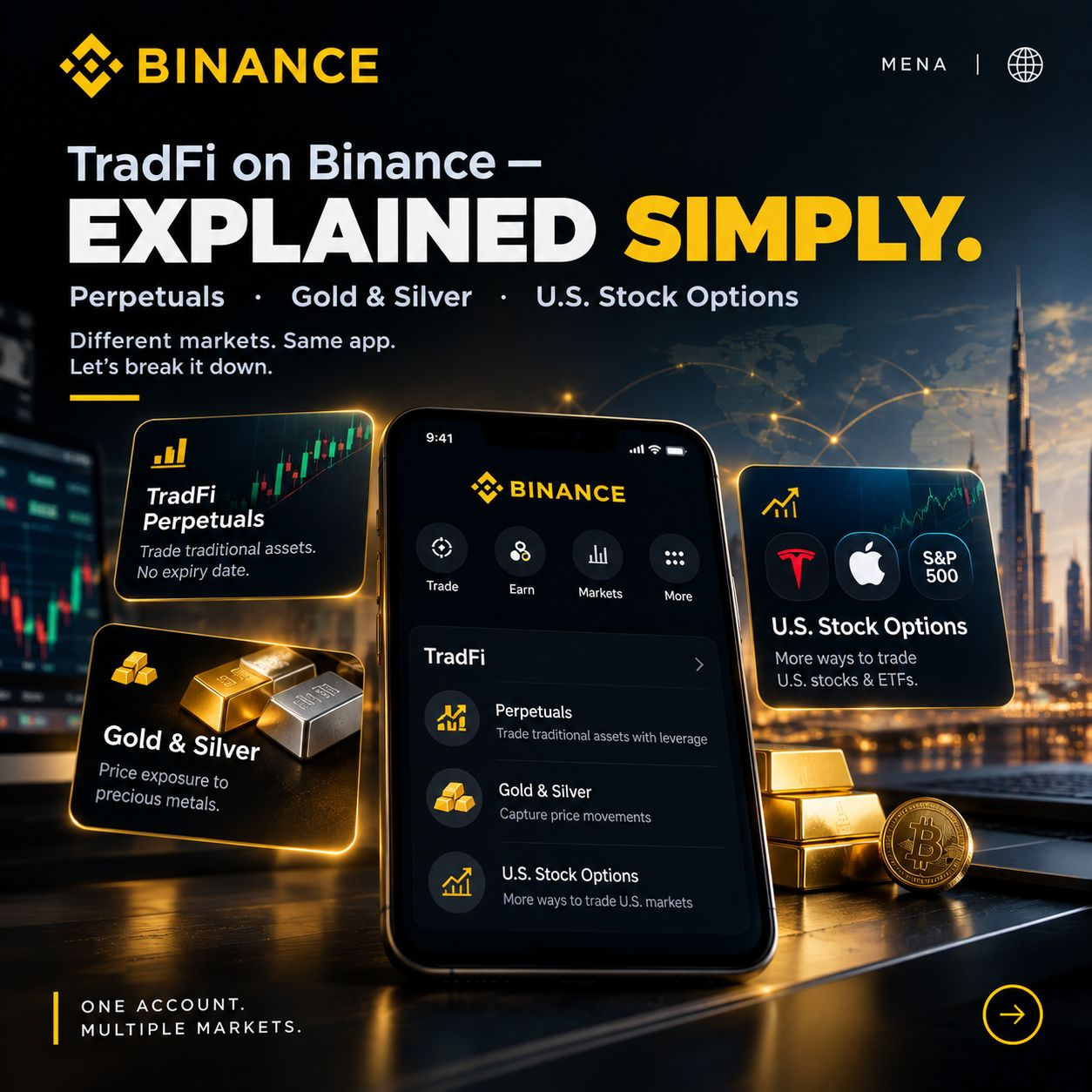
📊 TradFi on Binance - explained simply
You’ve probably heard about TradFi Perpetuals, Gold & Silver products, and U.S. Stock Options.
But what do they actually mean? 👀
📈 TradFi Perpetuals
Perpetual contracts linked to the price of selected traditional assets, with no expiry date. They provide price exposure — not ownership of the underlying asset.
🥇 Gold & Silver
Binance offers products linked to precious-metal prices. Depending on the product, this can include perpetual contracts and options.
📊 U.S. Stock Options
Options are contracts based on an underlying stock or ETF.
🔵 Call → right to buy
🔴 Put → right to sell
Different products, different mechanics, and different risks.
⚠️ Availability depends on your country, eligibility, and regulatory requirements. Derivatives such as perpetuals and options can involve significant risk, so make sure you understand how they work before using them.
Which one would you like to understand better? 👇
📊 TradFi Perpetuals
🥇 Gold & Silver
📈 U.S. Stock Options
Educational content only. Not financial advice. DYOR.
#Binance #TradFi #Crypto #BinanceMENA #learnwithbinance
📊 TradFi on Binance - explained simply
You’ve probably heard about TradFi Perpetuals, Gold & Silver products, and U.S. Stock Options.
But what do they actually mean? 👀
📈 TradFi Perpetuals
Perpetual contracts linked to the price of selected traditional assets, with no expiry date. They provide price exposure — not ownership of the underlying asset.
🥇 Gold & Silver
Binance offers products linked to precious-metal prices. Depending on the product, this can include perpetual contracts and options.
📊 U.S. Stock Options
Options are contracts based on an underlying stock or ETF.
🔵 Call → right to buy
🔴 Put → right to sell
Different products, different mechanics, and different risks.
⚠️ Availability depends on your country, eligibility, and regulatory requirements. Derivatives such as perpetuals and options can involve significant risk, so make sure you understand how they work before using them.
Which one would you like to understand better? 👇
📊 TradFi Perpetuals
🥇 Gold & Silver
📈 U.S. Stock Options
Educational content only. Not financial advice. DYOR.
#Binance #TradFi #Crypto #BinanceMENA #learnwithbinance
You’ve probably heard about TradFi Perpetuals, Gold & Silver products, and U.S. Stock Options.
But what do they actually mean? 👀
📈 TradFi Perpetuals
Perpetual contracts linked to the price of selected traditional assets, with no expiry date. They provide price exposure — not ownership of the underlying asset.
🥇 Gold & Silver
Binance offers products linked to precious-metal prices. Depending on the product, this can include perpetual contracts and options.
📊 U.S. Stock Options
Options are contracts based on an underlying stock or ETF.
🔵 Call → right to buy
🔴 Put → right to sell
Different products, different mechanics, and different risks.
⚠️ Availability depends on your country, eligibility, and regulatory requirements. Derivatives such as perpetuals and options can involve significant risk, so make sure you understand how they work before using them.
Which one would you like to understand better? 👇
📊 TradFi Perpetuals
🥇 Gold & Silver
📈 U.S. Stock Options
Educational content only. Not financial advice. DYOR.
#Binance #TradFi #Crypto #BinanceMENA #learnwithbinance
3
255

·
--
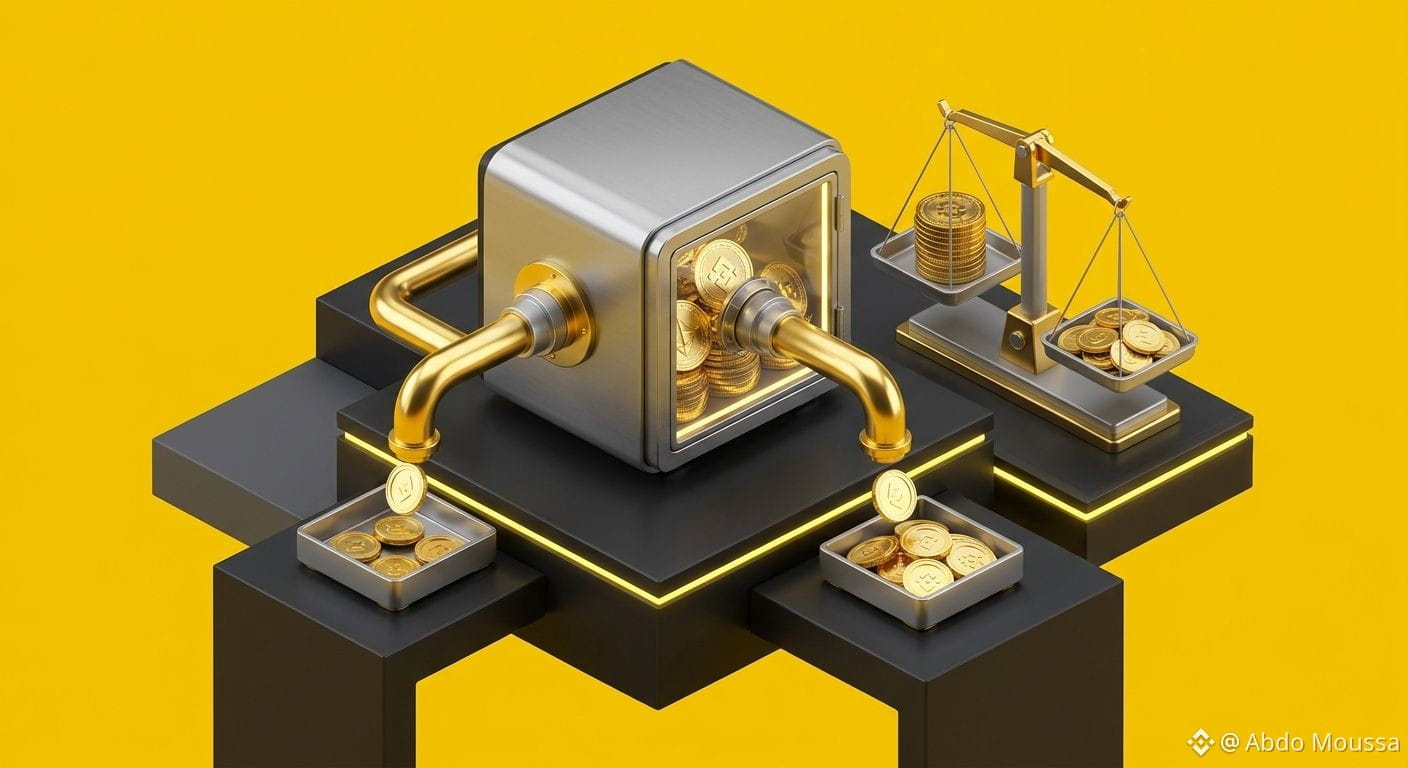
🏦 Liquidity Management: Understanding Binance Loans
Unlocking liquidity without liquidating core cryptocurrency holdings is a vital component of long-term asset management, Binance Loans enables users to borrow stablecoins or alternative digital assets using their existing holdings as collateral.
💡 Operational Loan Structures
Flexible Loans: Offers open-ended borrowing terms with hourly interest accrual and full flexibility to repay at any time without early settlement penalties.
Fixed-Term Loans: Secures a fixed interest rate over specified durations (e.g., 7, 14, or 30 days) for structured cash flow predictability.
Loan-to-Value (LTV) Monitoring: Tracks collateral values dynamically, alerting users to add collateral if market declines approach liquidation thresholds.
Zero Processing Fees: Credits loan proceeds instantly to the user's account upon collateral lock-up without hidden administrative charges.
🔑 Strategic Financial Uses
Borrowing against crypto assets allows users to access working capital for real-world expenses or participate in market opportunities while maintaining long-term price exposure to their pledged collateral.
⚠️ Educational Disclaimer
Failure to maintain required LTV ratios during market drawdowns can result in automatic liquidation of pledged collateral.
This content is provided strictly for educational and informational purposes.
Explore crypto collateral mechanisms on Binance Academy.
[https://www.binance.com/en/academy/articles/a-beginner-s-guide-to-binance-loans](https://www.binance.com/en/academy/articles/a-beginner-s-guide-to-binance-loans)
Manage LTV thresholds responsibly, protect your assets, and always DYOR (Do Your Own Research) 💡
#Binance #BinanceAcademy #BinanceLoans #dyor #LearnWithBinance
🏦 Liquidity Management: Understanding Binance Loans
Unlocking liquidity without liquidating core cryptocurrency holdings is a vital component of long-term asset management, Binance Loans enables users to borrow stablecoins or alternative digital assets using their existing holdings as collateral.
💡 Operational Loan Structures
Flexible Loans: Offers open-ended borrowing terms with hourly interest accrual and full flexibility to repay at any time without early settlement penalties.
Fixed-Term Loans: Secures a fixed interest rate over specified durations (e.g., 7, 14, or 30 days) for structured cash flow predictability.
Loan-to-Value (LTV) Monitoring: Tracks collateral values dynamically, alerting users to add collateral if market declines approach liquidation thresholds.
Zero Processing Fees: Credits loan proceeds instantly to the user's account upon collateral lock-up without hidden administrative charges.
🔑 Strategic Financial Uses
Borrowing against crypto assets allows users to access working capital for real-world expenses or participate in market opportunities while maintaining long-term price exposure to their pledged collateral.
⚠️ Educational Disclaimer
Failure to maintain required LTV ratios during market drawdowns can result in automatic liquidation of pledged collateral.
This content is provided strictly for educational and informational purposes.
Explore crypto collateral mechanisms on Binance Academy.
https://www.binance.com/en/academy/articles/a-beginner-s-guide-to-binance-loans
Manage LTV thresholds responsibly, protect your assets, and always DYOR (Do Your Own Research) 💡
#Binance #BinanceAcademy #BinanceLoans #dyor #LearnWithBinance
Unlocking liquidity without liquidating core cryptocurrency holdings is a vital component of long-term asset management, Binance Loans enables users to borrow stablecoins or alternative digital assets using their existing holdings as collateral.
💡 Operational Loan Structures
Flexible Loans: Offers open-ended borrowing terms with hourly interest accrual and full flexibility to repay at any time without early settlement penalties.
Fixed-Term Loans: Secures a fixed interest rate over specified durations (e.g., 7, 14, or 30 days) for structured cash flow predictability.
Loan-to-Value (LTV) Monitoring: Tracks collateral values dynamically, alerting users to add collateral if market declines approach liquidation thresholds.
Zero Processing Fees: Credits loan proceeds instantly to the user's account upon collateral lock-up without hidden administrative charges.
🔑 Strategic Financial Uses
Borrowing against crypto assets allows users to access working capital for real-world expenses or participate in market opportunities while maintaining long-term price exposure to their pledged collateral.
⚠️ Educational Disclaimer
Failure to maintain required LTV ratios during market drawdowns can result in automatic liquidation of pledged collateral.
This content is provided strictly for educational and informational purposes.
Explore crypto collateral mechanisms on Binance Academy.
https://www.binance.com/en/academy/articles/a-beginner-s-guide-to-binance-loans
Manage LTV thresholds responsibly, protect your assets, and always DYOR (Do Your Own Research) 💡
#Binance #BinanceAcademy #BinanceLoans #dyor #LearnWithBinance
4
51


·
--
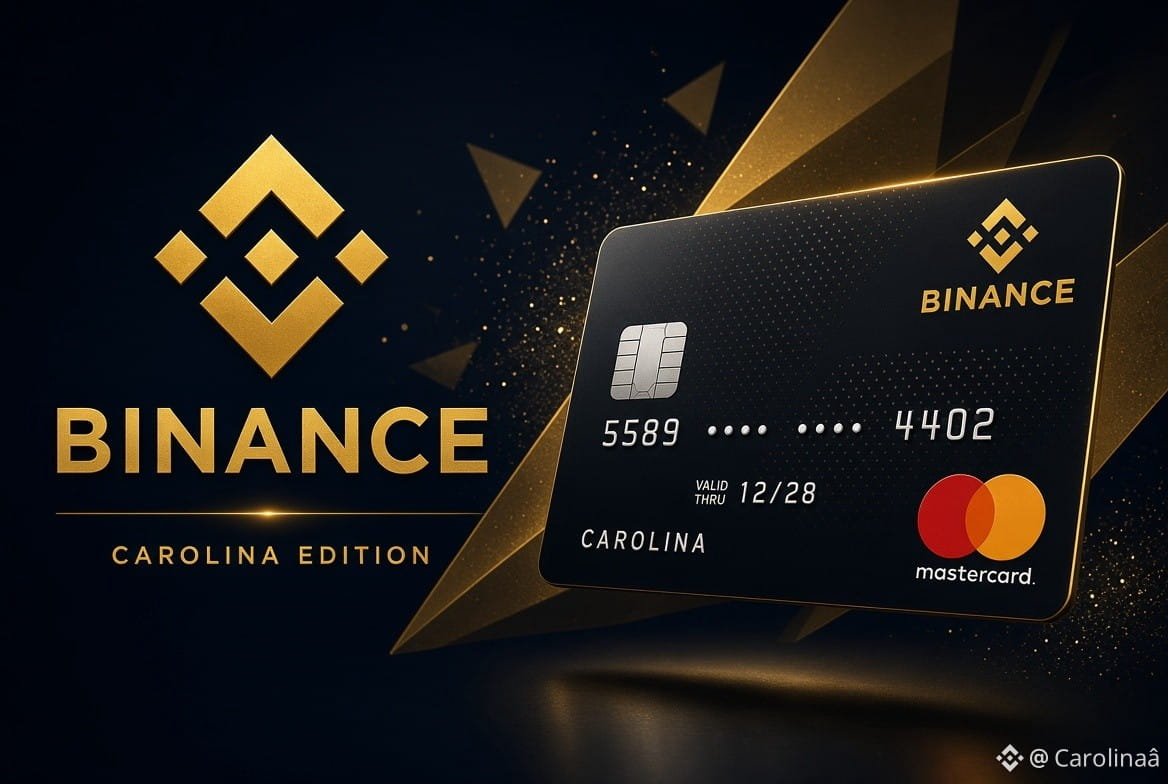
I got my Binance Card have you checked yours yet? 👀
Confused about where to start?
Don’t worry, I’ll guide you through the basics step by step
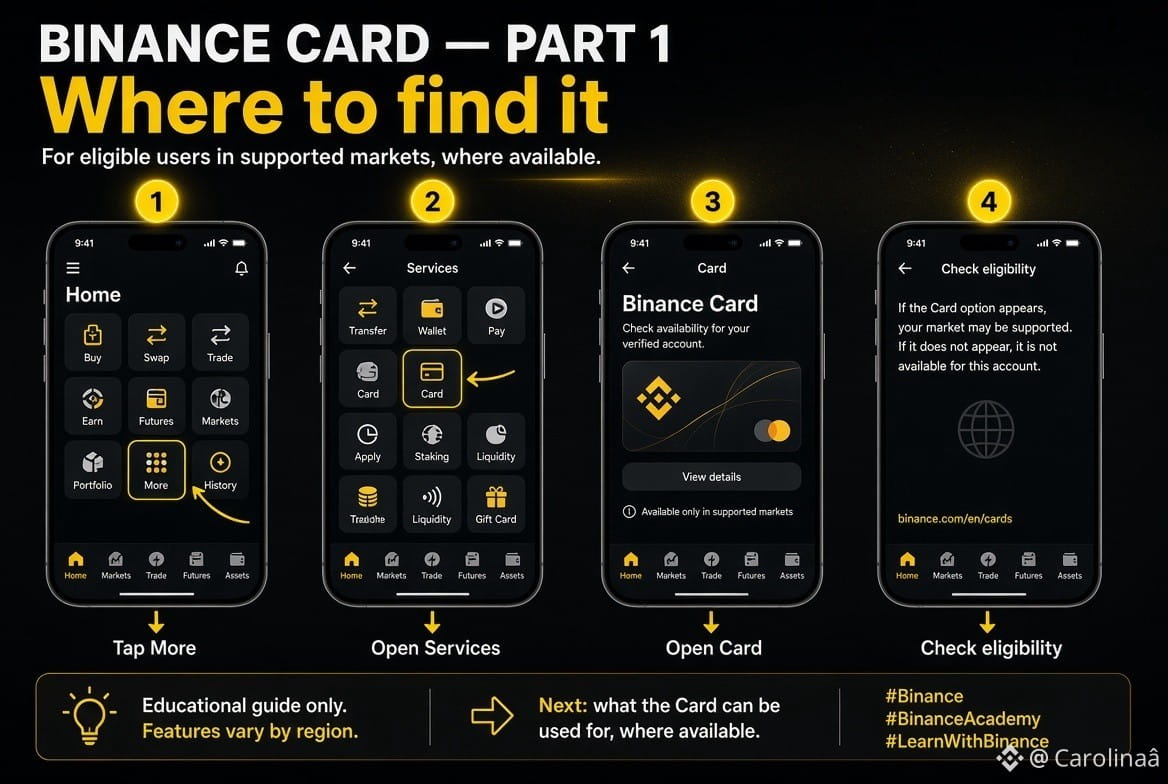
Where is Binance Card, and Why not always see it?
Today is only about setup: where eligible users in supported markets can find the Card option, and how basic eligibility works
In the app, look under Services or More, then open Card
➭That screen usually shows if the option is available for your verified account
➭You can also check on the official Binance Card page
➭ It is only for eligible users in supported markets, and only where it is available
➭ Your ID check normally needs to match a supported country
➭ If it is not available for you, the apply option often will not appear
➭ I will not cover how people use the Card yet
Next post ↝ what Binance Card can actually be used for, where it is available
#Binance #BinanceAcademy #LearnWithBinance
I got my Binance Card have you checked yours yet? 👀
Confused about where to start?
Don’t worry, I’ll guide you through the basics step by step
Where is Binance Card, and Why not always see it?
Today is only about setup: where eligible users in supported markets can find the Card option, and how basic eligibility works
In the app, look under Services or More, then open Card
➭That screen usually shows if the option is available for your verified account
➭You can also check on the official Binance Card page
➭ It is only for eligible users in supported markets, and only where it is available
➭ Your ID check normally needs to match a supported country
➭ If it is not available for you, the apply option often will not appear
➭ I will not cover how people use the Card yet
Next post ↝ what Binance Card can actually be used for, where it is available
#Binance #BinanceAcademy #LearnWithBinance
Confused about where to start?
Don’t worry, I’ll guide you through the basics step by step
Where is Binance Card, and Why not always see it?
Today is only about setup: where eligible users in supported markets can find the Card option, and how basic eligibility works
In the app, look under Services or More, then open Card
➭That screen usually shows if the option is available for your verified account
➭You can also check on the official Binance Card page
➭ It is only for eligible users in supported markets, and only where it is available
➭ Your ID check normally needs to match a supported country
➭ If it is not available for you, the apply option often will not appear
➭ I will not cover how people use the Card yet
Next post ↝ what Binance Card can actually be used for, where it is available
#Binance #BinanceAcademy #LearnWithBinance
Mohsin 7777:
How are you😊I like and share all of your posts. So please like and share my posts too. 😉🥰 Shar please 🫡🫡
1
8
1.2k
·
--
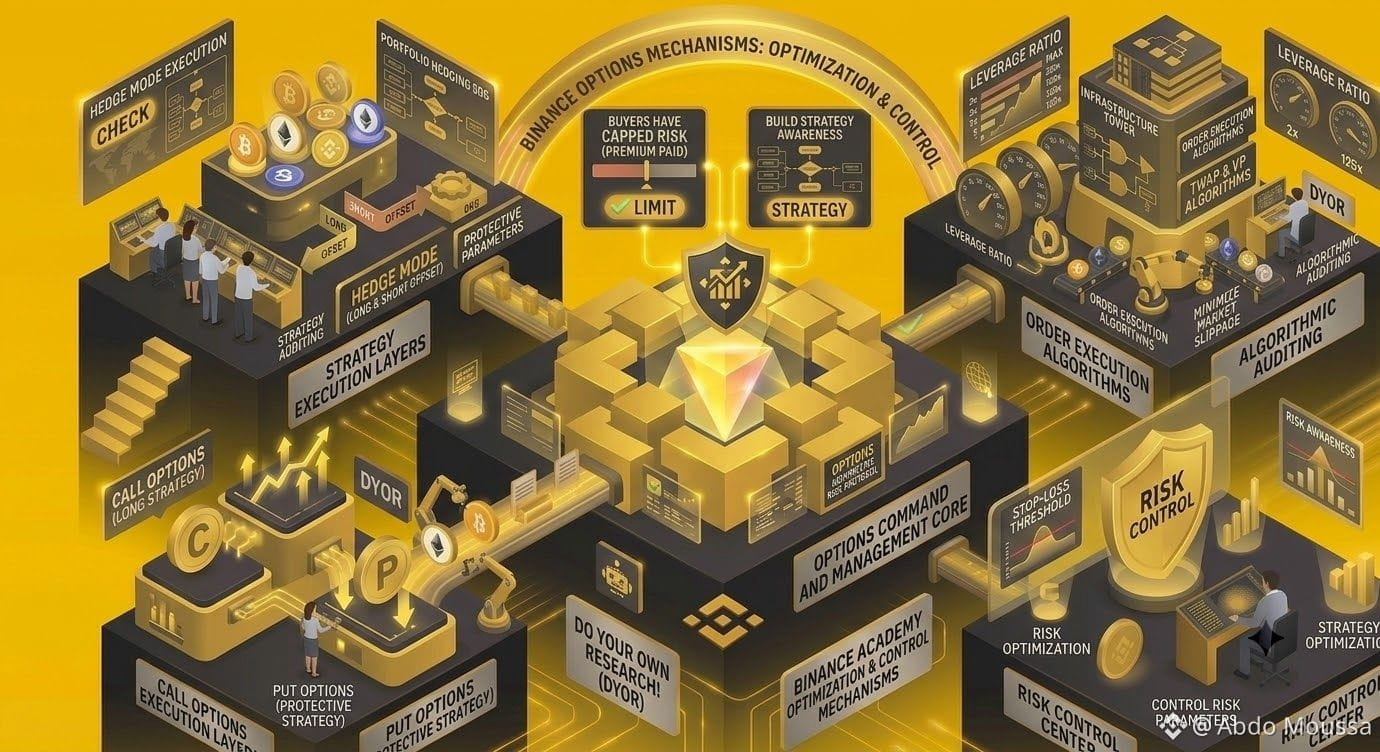
⚖️ Asymmetric Risk Management: Exploring Binance Options
Navigating sharp market volatility often requires instruments with predefined risk boundaries, Binance Options provides traders with option contracts to hedge existing portfolios or execute strategic directional positions.
💡 Core Operational Mechanics
Capped Risk Profile for Buyers: Option buyers limit their potential downside strictly to the premium paid, eliminating direct liquidation risks faced in standard margin products.
Call & Put Contracts: Enables long strategies (Call Options) to capitalize on upside potential or protective strategies (Put Options) to hedge against downward price drops.
Streamlined Order Execution: Features an intuitive interface tailored for quick order placement, strike price selection, and expiration date tracking.
Competitive Liquidity & Settlement: Cash-settled contracts backed by Binance liquidity pools for tight bid-ask spreads.
🔑 Strategic Portfolio Hedging
Options allow institutional and retail traders to construct sophisticated strategies, such as protective puts or covered calls, to balance risk and return in unpredictable markets.
⚠️ Educational Disclaimer
Options trading involves specific mechanisms, including time decay (Theta) and volatility metrics, which require thorough understanding prior to execution.
This content is provided strictly for educational and informational purposes.
Explore advanced financial instruments on Binance Academy.
[https://www.binance.com/en/academy/articles/what-is-options-trading](https://www.binance.com/en/academy/articles/what-is-options-trading)
Build strategic discipline, trade responsibly, and always DYOR (Do Your Own Research)💡
#Binance #BinanceAcademy #BinanceOptions #dyor #learnwithbinance
⚖️ Asymmetric Risk Management: Exploring Binance Options
Navigating sharp market volatility often requires instruments with predefined risk boundaries, Binance Options provides traders with option contracts to hedge existing portfolios or execute strategic directional positions.
💡 Core Operational Mechanics
Capped Risk Profile for Buyers: Option buyers limit their potential downside strictly to the premium paid, eliminating direct liquidation risks faced in standard margin products.
Call & Put Contracts: Enables long strategies (Call Options) to capitalize on upside potential or protective strategies (Put Options) to hedge against downward price drops.
Streamlined Order Execution: Features an intuitive interface tailored for quick order placement, strike price selection, and expiration date tracking.
Competitive Liquidity & Settlement: Cash-settled contracts backed by Binance liquidity pools for tight bid-ask spreads.
🔑 Strategic Portfolio Hedging
Options allow institutional and retail traders to construct sophisticated strategies, such as protective puts or covered calls, to balance risk and return in unpredictable markets.
⚠️ Educational Disclaimer
Options trading involves specific mechanisms, including time decay (Theta) and volatility metrics, which require thorough understanding prior to execution.
This content is provided strictly for educational and informational purposes.
Explore advanced financial instruments on Binance Academy.
https://www.binance.com/en/academy/articles/what-is-options-trading
Build strategic discipline, trade responsibly, and always DYOR (Do Your Own Research)💡
#Binance #BinanceAcademy #BinanceOptions #dyor #learnwithbinance
Navigating sharp market volatility often requires instruments with predefined risk boundaries, Binance Options provides traders with option contracts to hedge existing portfolios or execute strategic directional positions.
💡 Core Operational Mechanics
Capped Risk Profile for Buyers: Option buyers limit their potential downside strictly to the premium paid, eliminating direct liquidation risks faced in standard margin products.
Call & Put Contracts: Enables long strategies (Call Options) to capitalize on upside potential or protective strategies (Put Options) to hedge against downward price drops.
Streamlined Order Execution: Features an intuitive interface tailored for quick order placement, strike price selection, and expiration date tracking.
Competitive Liquidity & Settlement: Cash-settled contracts backed by Binance liquidity pools for tight bid-ask spreads.
🔑 Strategic Portfolio Hedging
Options allow institutional and retail traders to construct sophisticated strategies, such as protective puts or covered calls, to balance risk and return in unpredictable markets.
⚠️ Educational Disclaimer
Options trading involves specific mechanisms, including time decay (Theta) and volatility metrics, which require thorough understanding prior to execution.
This content is provided strictly for educational and informational purposes.
Explore advanced financial instruments on Binance Academy.
https://www.binance.com/en/academy/articles/what-is-options-trading
Build strategic discipline, trade responsibly, and always DYOR (Do Your Own Research)💡
#Binance #BinanceAcademy #BinanceOptions #dyor #learnwithbinance
4
38
·
--
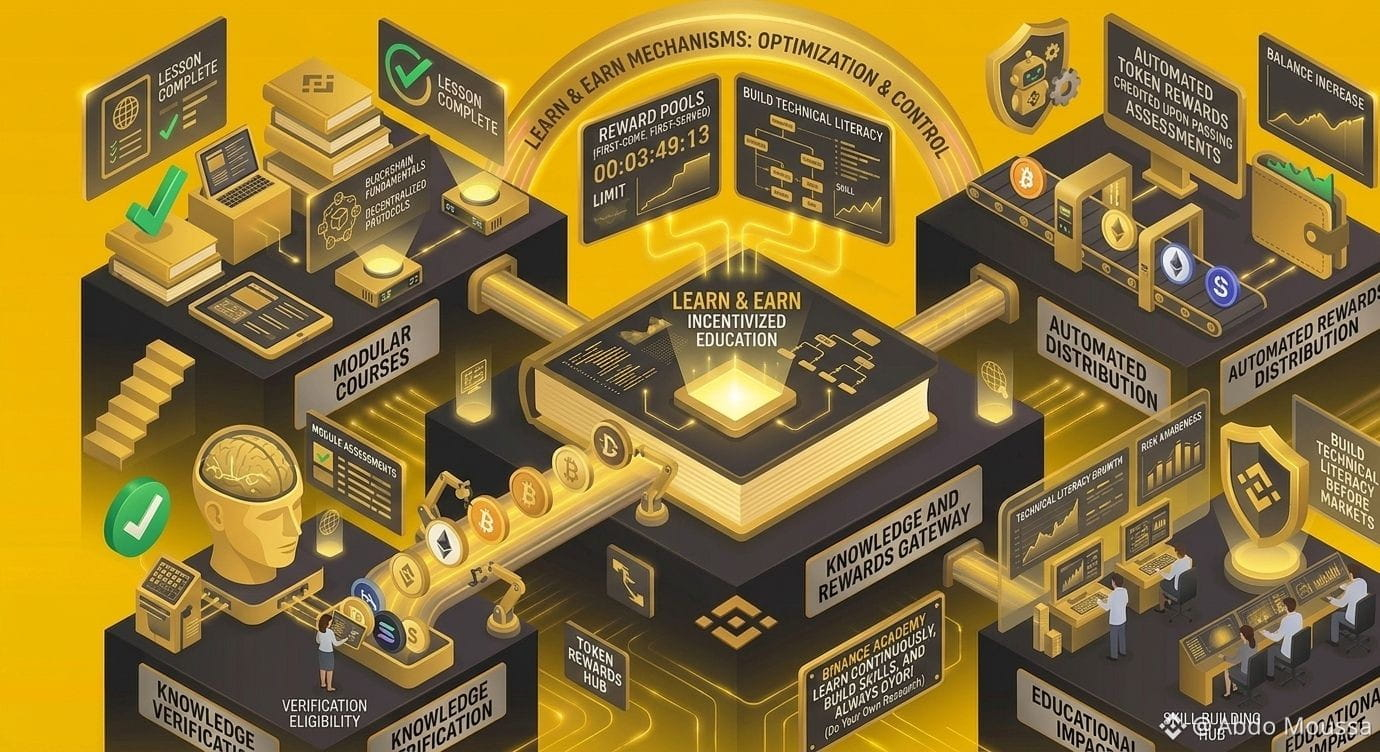
🎓 Incentivized Education: Exploring Binance Learn & Earn
Fostering Web3 adoption requires accessible, structured educational frameworks, Binance Learn & Earn incentivizes financial literacy by rewarding users with digital assets upon completing targeted learning modules.
💡 Program Architecture & User Journey
Modular Courses: Provides educational materials, videos, and articles explaining blockchain fundamentals, decentralized protocols, and specific token ecosystems.
Knowledge Verification: Requires participants to complete short comprehension quizzes at the end of each module to demonstrate mastery.
Automated Token Rewards: Credits successful participants with project tokens directly to their Rewards Hub upon passing module assessments.
🔑 Educational Impact
By pairing foundational knowledge with token incentives, the platform helps users build technical literacy before interacting directly with active markets.
⚠️ Educational Disclaimer
Reward pools are distributed on a first-come, first-served basis and are subject to verification eligibility and regional availability.
This content is provided strictly for educational and informational purposes.
Expand your Web3 knowledge on Binance Academy.
[https://www.binance.com/en/support/faq/detail/f755f76dbfe641e19ea3b14c516b0e2c](https://www.binance.com/en/support/faq/detail/f755f76dbfe641e19ea3b14c516b0e2c)
Learn continuously, build skills, and always DYOR (Do Your Own Research)💡
#Binance #BinanceAcademy #learnAndEarn #dyor #learnwithbinance
🎓 Incentivized Education: Exploring Binance Learn & Earn
Fostering Web3 adoption requires accessible, structured educational frameworks, Binance Learn & Earn incentivizes financial literacy by rewarding users with digital assets upon completing targeted learning modules.
💡 Program Architecture & User Journey
Modular Courses: Provides educational materials, videos, and articles explaining blockchain fundamentals, decentralized protocols, and specific token ecosystems.
Knowledge Verification: Requires participants to complete short comprehension quizzes at the end of each module to demonstrate mastery.
Automated Token Rewards: Credits successful participants with project tokens directly to their Rewards Hub upon passing module assessments.
🔑 Educational Impact
By pairing foundational knowledge with token incentives, the platform helps users build technical literacy before interacting directly with active markets.
⚠️ Educational Disclaimer
Reward pools are distributed on a first-come, first-served basis and are subject to verification eligibility and regional availability.
This content is provided strictly for educational and informational purposes.
Expand your Web3 knowledge on Binance Academy.
https://www.binance.com/en/support/faq/detail/f755f76dbfe641e19ea3b14c516b0e2c
Learn continuously, build skills, and always DYOR (Do Your Own Research)💡
#Binance #BinanceAcademy #learnAndEarn #dyor #learnwithbinance
Fostering Web3 adoption requires accessible, structured educational frameworks, Binance Learn & Earn incentivizes financial literacy by rewarding users with digital assets upon completing targeted learning modules.
💡 Program Architecture & User Journey
Modular Courses: Provides educational materials, videos, and articles explaining blockchain fundamentals, decentralized protocols, and specific token ecosystems.
Knowledge Verification: Requires participants to complete short comprehension quizzes at the end of each module to demonstrate mastery.
Automated Token Rewards: Credits successful participants with project tokens directly to their Rewards Hub upon passing module assessments.
🔑 Educational Impact
By pairing foundational knowledge with token incentives, the platform helps users build technical literacy before interacting directly with active markets.
⚠️ Educational Disclaimer
Reward pools are distributed on a first-come, first-served basis and are subject to verification eligibility and regional availability.
This content is provided strictly for educational and informational purposes.
Expand your Web3 knowledge on Binance Academy.
https://www.binance.com/en/support/faq/detail/f755f76dbfe641e19ea3b14c516b0e2c
Learn continuously, build skills, and always DYOR (Do Your Own Research)💡
#Binance #BinanceAcademy #learnAndEarn #dyor #learnwithbinance
4
51
·
--
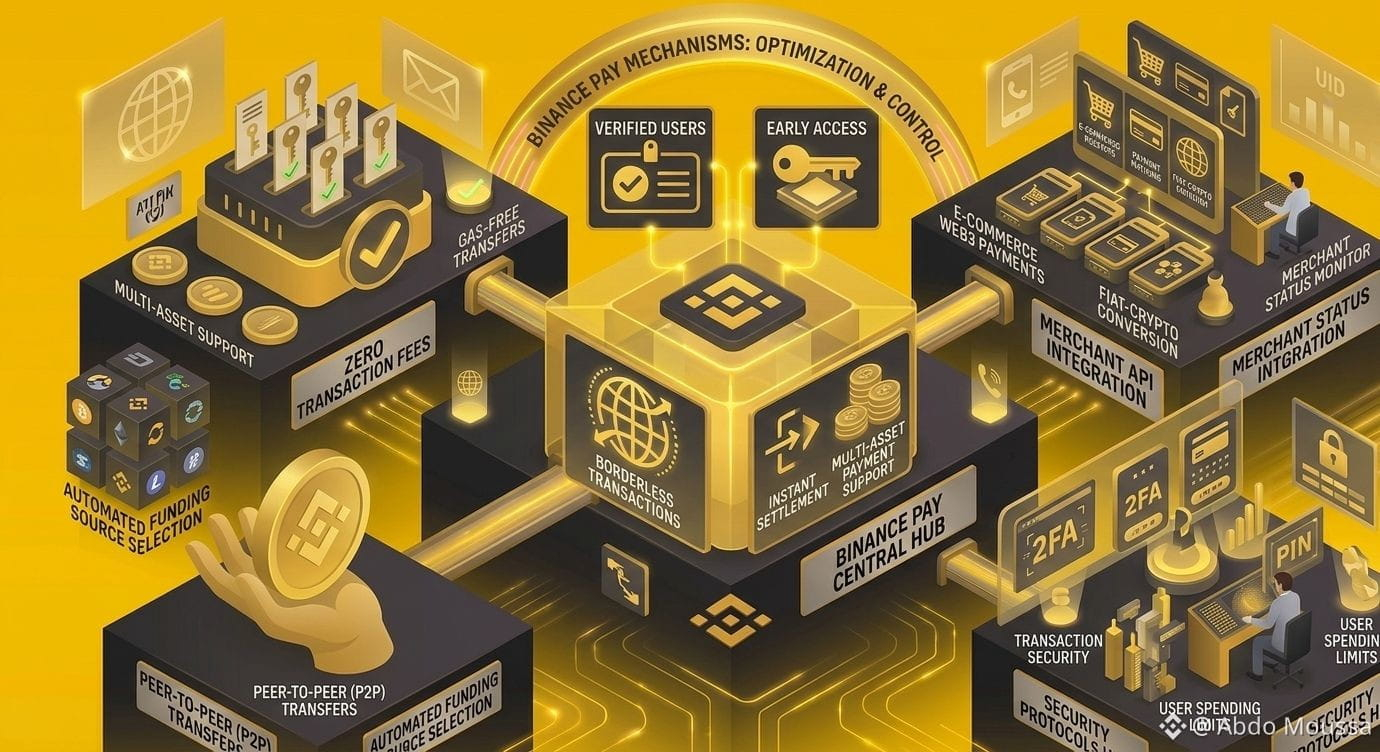
💳 Gas-Free Borderless Transactions: Inside Binance Pay
Integrating crypto into daily commerce requires fast settlement and minimal transaction friction, Binance Pay serves as a borderless, contactless payment technology designed for instant crypto transfers between users and merchants.
💡 Core Value Drivers & Functionality
Zero Transaction Fees: Enables peer-to-peer (P2P) transfers and merchant payments without network gas fees.
Instant Global Settlement: Executes cross-border transfers in real time using a User ID (UID), Pay ID, email, or phone number.
Multi-Asset Payment Support: Allows users to set custom asset preference hierarchies to automate funding source selection during checkout.
Merchant API Integration: Enables e-commerce platforms to accept Web3 payments directly with automated fiat-crypto conversion tools.
🔑 Security Protocols
Transactions processed through Binance Pay are backed by two-factor authentication (2FA), payment PIN authorization, and user-defined spending limits to ensure user security.
⚠️ Educational Disclaimer
Transaction limits and merchant service availability vary based on regional regulatory approvals and user verification tiers.
This article is prepared strictly for educational purposes and does not constitute financial or legal advice.
Explore Web3 payment ecosystems on Binance Academy.
[https://www.binance.com/en/academy/articles/what-is-binance-pay-and-how-to-use-it](https://www.binance.com/en/academy/articles/what-is-binance-pay-and-how-to-use-it)
Build technical literacy, transact securely, and always DYOR (Do Your Own Research)💡
#Binance #BinanceAcademy #BinancePay #dyor #learnwithbinance
💳 Gas-Free Borderless Transactions: Inside Binance Pay
Integrating crypto into daily commerce requires fast settlement and minimal transaction friction, Binance Pay serves as a borderless, contactless payment technology designed for instant crypto transfers between users and merchants.
💡 Core Value Drivers & Functionality
Zero Transaction Fees: Enables peer-to-peer (P2P) transfers and merchant payments without network gas fees.
Instant Global Settlement: Executes cross-border transfers in real time using a User ID (UID), Pay ID, email, or phone number.
Multi-Asset Payment Support: Allows users to set custom asset preference hierarchies to automate funding source selection during checkout.
Merchant API Integration: Enables e-commerce platforms to accept Web3 payments directly with automated fiat-crypto conversion tools.
🔑 Security Protocols
Transactions processed through Binance Pay are backed by two-factor authentication (2FA), payment PIN authorization, and user-defined spending limits to ensure user security.
⚠️ Educational Disclaimer
Transaction limits and merchant service availability vary based on regional regulatory approvals and user verification tiers.
This article is prepared strictly for educational purposes and does not constitute financial or legal advice.
Explore Web3 payment ecosystems on Binance Academy.
https://www.binance.com/en/academy/articles/what-is-binance-pay-and-how-to-use-it
Build technical literacy, transact securely, and always DYOR (Do Your Own Research)💡
#Binance #BinanceAcademy #BinancePay #dyor #learnwithbinance
Integrating crypto into daily commerce requires fast settlement and minimal transaction friction, Binance Pay serves as a borderless, contactless payment technology designed for instant crypto transfers between users and merchants.
💡 Core Value Drivers & Functionality
Zero Transaction Fees: Enables peer-to-peer (P2P) transfers and merchant payments without network gas fees.
Instant Global Settlement: Executes cross-border transfers in real time using a User ID (UID), Pay ID, email, or phone number.
Multi-Asset Payment Support: Allows users to set custom asset preference hierarchies to automate funding source selection during checkout.
Merchant API Integration: Enables e-commerce platforms to accept Web3 payments directly with automated fiat-crypto conversion tools.
🔑 Security Protocols
Transactions processed through Binance Pay are backed by two-factor authentication (2FA), payment PIN authorization, and user-defined spending limits to ensure user security.
⚠️ Educational Disclaimer
Transaction limits and merchant service availability vary based on regional regulatory approvals and user verification tiers.
This article is prepared strictly for educational purposes and does not constitute financial or legal advice.
Explore Web3 payment ecosystems on Binance Academy.
https://www.binance.com/en/academy/articles/what-is-binance-pay-and-how-to-use-it
Build technical literacy, transact securely, and always DYOR (Do Your Own Research)💡
#Binance #BinanceAcademy #BinancePay #dyor #learnwithbinance
4
58
·
--
My Journey on Binance: 3 Security Tips I Follow Every Day 🔒
As a content creator, I have learned that security is more important than profit.
Here are 3 things I do daily:
1. Never share my OTP or Email code with anyone.
2. Always check the official Binance announcement page for news.
3. Patience is the key in this market. No hurry, no FOMO.
What is your number 1 security tip? Share in comments 👇
#Binance #CryptoSecurity #learnwithbinance #CryptoPakistan
My Journey on Binance: 3 Security Tips I Follow Every Day 🔒
As a content creator, I have learned that security is more important than profit.
Here are 3 things I do daily:
1. Never share my OTP or Email code with anyone.
2. Always check the official Binance announcement page for news.
3. Patience is the key in this market. No hurry, no FOMO.
What is your number 1 security tip? Share in comments 👇
#Binance #CryptoSecurity #learnwithbinance #CryptoPakistan
As a content creator, I have learned that security is more important than profit.
Here are 3 things I do daily:
1. Never share my OTP or Email code with anyone.
2. Always check the official Binance announcement page for news.
3. Patience is the key in this market. No hurry, no FOMO.
What is your number 1 security tip? Share in comments 👇
#Binance #CryptoSecurity #learnwithbinance #CryptoPakistan
2
4
283

·
--
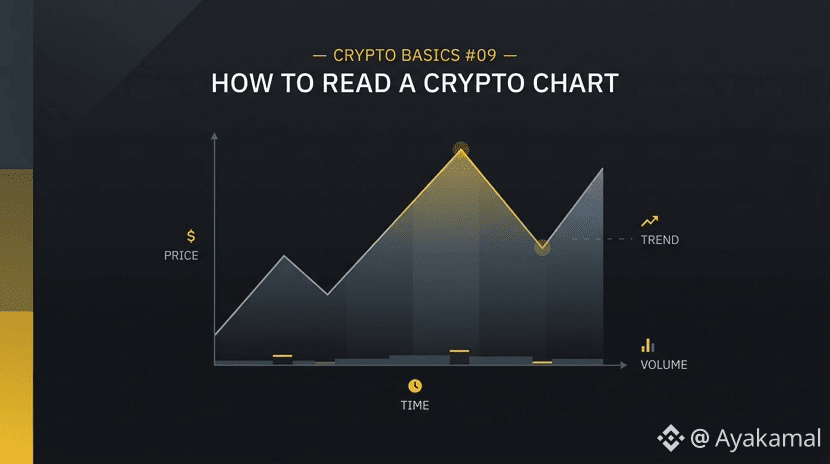
Can You Read a Crypto Chart? Start Here. 📊
A crypto chart can look complicated when you first open it.
Candles, numbers, lines, timeframes…
But you don’t need to understand everything at once.
Start with these 4 things
1️⃣ Price
The vertical axis shows the asset’s price.
It tells you how much the asset was trading for at different points in time.
2️⃣ Time
The horizontal axis shows when those price movements happened.
You can view different timeframes, from very short periods to much longer ones.
A shorter timeframe gives you a closer look at short-term movements, while a longer timeframe gives you a broader view.
3️⃣ Trend
Now step back and look at the bigger picture.
📈 Uptrend → price generally moves higher.
📉 Downtrend → price generally moves lower.
↔️ Sideways → price moves within a relatively defined range.
A trend describes what price has been doing — it does not guarantee what happens next.
4️⃣ Volume
Below the price chart, you’ll often see Volume.
It measures the amount of trading activity during a specific period.
Looking at volume alongside price can provide additional context about a market move.
The easiest way to start reading a chart:
Price → Timeframe → Trend → Volume
You don’t need 10 indicators to understand the basics.
Start with the chart itself.
📚 Keep learning with Binance Academy.
Educational content only, not financial advice. DYOR and use official Binance sources.
What was the first thing that confused you when you opened a crypto chart? 👇
#Binance #BinanceAcademy #learnwithbinance #CryptoEducation
Can You Read a Crypto Chart? Start Here. 📊
A crypto chart can look complicated when you first open it.
Candles, numbers, lines, timeframes…
But you don’t need to understand everything at once.
Start with these 4 things
1️⃣ Price
The vertical axis shows the asset’s price.
It tells you how much the asset was trading for at different points in time.
2️⃣ Time
The horizontal axis shows when those price movements happened.
You can view different timeframes, from very short periods to much longer ones.
A shorter timeframe gives you a closer look at short-term movements, while a longer timeframe gives you a broader view.
3️⃣ Trend
Now step back and look at the bigger picture.
📈 Uptrend → price generally moves higher.
📉 Downtrend → price generally moves lower.
↔️ Sideways → price moves within a relatively defined range.
A trend describes what price has been doing — it does not guarantee what happens next.
4️⃣ Volume
Below the price chart, you’ll often see Volume.
It measures the amount of trading activity during a specific period.
Looking at volume alongside price can provide additional context about a market move.
The easiest way to start reading a chart:
Price → Timeframe → Trend → Volume
You don’t need 10 indicators to understand the basics.
Start with the chart itself.
📚 Keep learning with Binance Academy.
Educational content only, not financial advice. DYOR and use official Binance sources.
What was the first thing that confused you when you opened a crypto chart? 👇
#Binance #BinanceAcademy #learnwithbinance #CryptoEducation
A crypto chart can look complicated when you first open it.
Candles, numbers, lines, timeframes…
But you don’t need to understand everything at once.
Start with these 4 things
1️⃣ Price
The vertical axis shows the asset’s price.
It tells you how much the asset was trading for at different points in time.
2️⃣ Time
The horizontal axis shows when those price movements happened.
You can view different timeframes, from very short periods to much longer ones.
A shorter timeframe gives you a closer look at short-term movements, while a longer timeframe gives you a broader view.
3️⃣ Trend
Now step back and look at the bigger picture.
📈 Uptrend → price generally moves higher.
📉 Downtrend → price generally moves lower.
↔️ Sideways → price moves within a relatively defined range.
A trend describes what price has been doing — it does not guarantee what happens next.
4️⃣ Volume
Below the price chart, you’ll often see Volume.
It measures the amount of trading activity during a specific period.
Looking at volume alongside price can provide additional context about a market move.
The easiest way to start reading a chart:
Price → Timeframe → Trend → Volume
You don’t need 10 indicators to understand the basics.
Start with the chart itself.
📚 Keep learning with Binance Academy.
Educational content only, not financial advice. DYOR and use official Binance sources.
What was the first thing that confused you when you opened a crypto chart? 👇
#Binance #BinanceAcademy #learnwithbinance #CryptoEducation
4
96
·
--
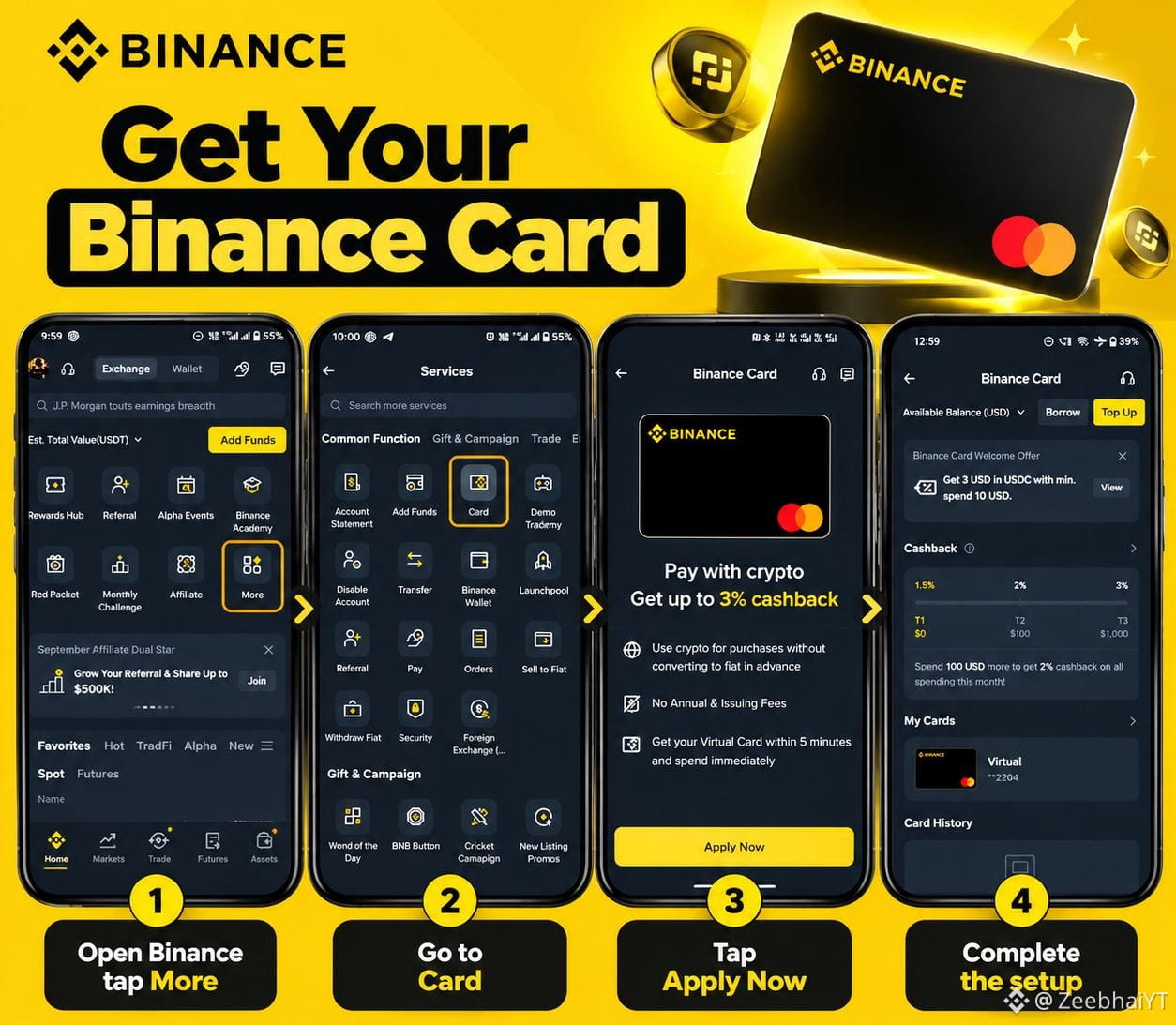
Your crypto can do more than just sit in your wallet 👀
Here’s how Binance Card turns crypto into everyday spending
➜ Step 1
Open the Binance app
Tap More
➜ Step 2
Find and select Card from the available services
➜ Step 3
If the Binance Card is available and you are eligible in your market
Review the Card information and applicable terms
➜ Step 4
Follow the required setup process shown in the Binance app
That is the basic flow 👇
Open Binance → More → Card → Review eligibility → Complete the setup
The important part is that Binance Card availability and eligibility can vary by market
So this should not be understood as a guarantee that everyone can access the Card
Also check the applicable Card terms and fee information before using the service
If available in your market
The Card can be used for eligible everyday spending online and offline
Some eligible users may also have access to features such as tap to pay where available
Simple setup
Real world utility
Always check the latest official information
DYOR and understand the terms before using any crypto related product
Educational only
Not financial advice
#Binance #BinanceAcademy #learnwithbinance #binanceCard
Your crypto can do more than just sit in your wallet 👀
Here’s how Binance Card turns crypto into everyday spending
➜ Step 1
Open the Binance app
Tap More
➜ Step 2
Find and select Card from the available services
➜ Step 3
If the Binance Card is available and you are eligible in your market
Review the Card information and applicable terms
➜ Step 4
Follow the required setup process shown in the Binance app
That is the basic flow 👇
Open Binance → More → Card → Review eligibility → Complete the setup
The important part is that Binance Card availability and eligibility can vary by market
So this should not be understood as a guarantee that everyone can access the Card
Also check the applicable Card terms and fee information before using the service
If available in your market
The Card can be used for eligible everyday spending online and offline
Some eligible users may also have access to features such as tap to pay where available
Simple setup
Real world utility
Always check the latest official information
DYOR and understand the terms before using any crypto related product
Educational only
Not financial advice
#Binance #BinanceAcademy #learnwithbinance #binanceCard
Here’s how Binance Card turns crypto into everyday spending
➜ Step 1
Open the Binance app
Tap More
➜ Step 2
Find and select Card from the available services
➜ Step 3
If the Binance Card is available and you are eligible in your market
Review the Card information and applicable terms
➜ Step 4
Follow the required setup process shown in the Binance app
That is the basic flow 👇
Open Binance → More → Card → Review eligibility → Complete the setup
The important part is that Binance Card availability and eligibility can vary by market
So this should not be understood as a guarantee that everyone can access the Card
Also check the applicable Card terms and fee information before using the service
If available in your market
The Card can be used for eligible everyday spending online and offline
Some eligible users may also have access to features such as tap to pay where available
Simple setup
Real world utility
Always check the latest official information
DYOR and understand the terms before using any crypto related product
Educational only
Not financial advice
#Binance #BinanceAcademy #learnwithbinance #binanceCard
2
194
·
--
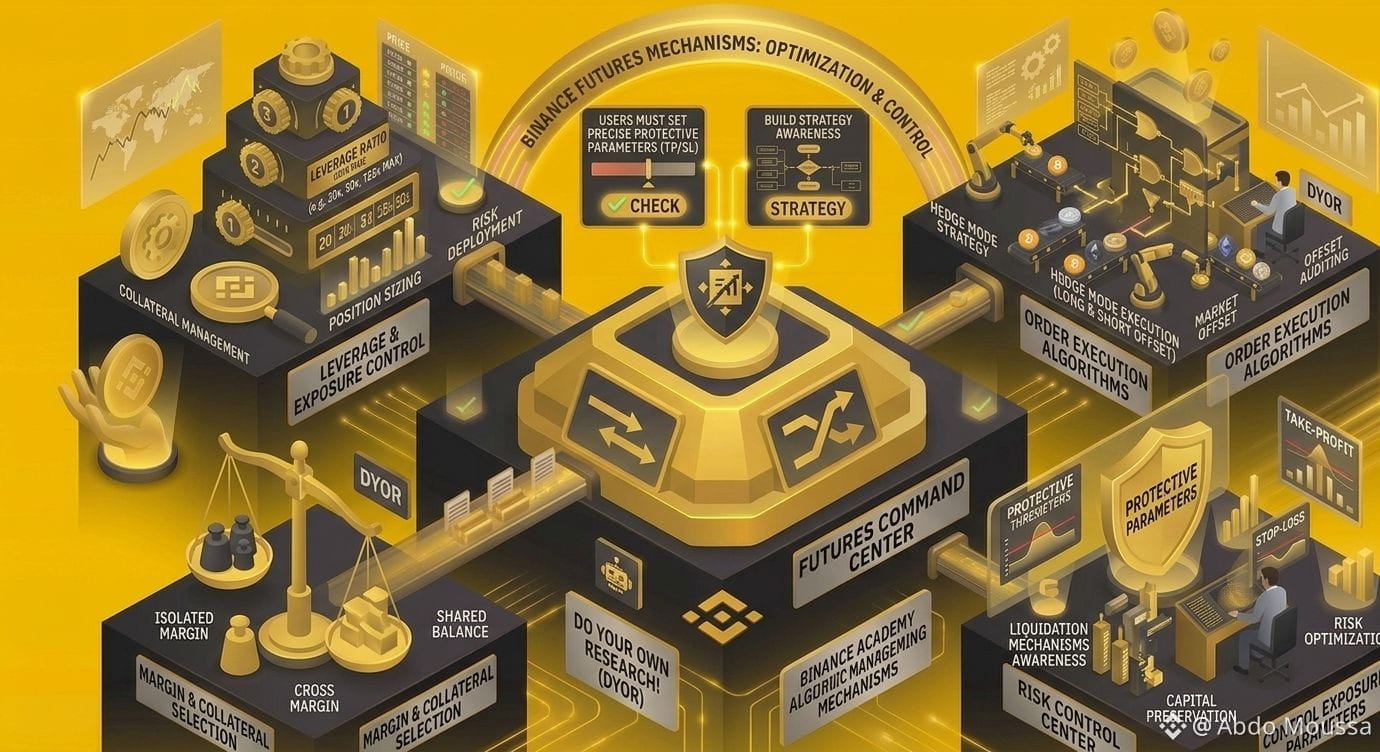
📈 Managing Volatility: Introduction to Binance Futures
Derivatives instruments allow sophisticated traders to manage portfolio risk and hedge against market movements, Binance Futures offers liquid contract markets paired with execution tools designed for risk mitigation.
💡 Fundamental Operational Tools
Margin Modes (Isolated vs. Cross): Isolated Margin restricts risk to the collateral allocated to a single position, whereas Cross Margin shares risk across the entire futures account balance.
Take-Profit & Stop-Loss (TP/SL): Programmatically closes positions when specific price targets are met to preserve capital and capture realized gains.
Hedge Mode Strategy: Permits traders to hold simultaneous long and short positions on the same contract to offset market exposure during volatile conditions.
Leverage Controls: Adjustable leverage ratios to manage exposure relative to available margin.
🔑 Responsible Trading Practices
Derivatives trading requires strict capital management, disciplined position sizing, and a comprehensive understanding of liquidation mechanisms to navigate market shifts successfully.
⚠️ Educational Disclaimer
Futures trading involves significant financial risk and is not suitable for all investors due to leverage dynamics.
This content is provided strictly for educational and informational purposes.
Master derivatives risk management on Binance Academy.
[https://www.binance.com/en/support/faq/detail/360039304272](https://www.binance.com/en/support/faq/detail/360039304272)
Trade responsibly, set protective parameters, and always DYOR (Do Your Own Research)💡
#Binance #BinanceAcademy #BinanceFutures #dyor #learnwithbinance
📈 Managing Volatility: Introduction to Binance Futures
Derivatives instruments allow sophisticated traders to manage portfolio risk and hedge against market movements, Binance Futures offers liquid contract markets paired with execution tools designed for risk mitigation.
💡 Fundamental Operational Tools
Margin Modes (Isolated vs. Cross): Isolated Margin restricts risk to the collateral allocated to a single position, whereas Cross Margin shares risk across the entire futures account balance.
Take-Profit & Stop-Loss (TP/SL): Programmatically closes positions when specific price targets are met to preserve capital and capture realized gains.
Hedge Mode Strategy: Permits traders to hold simultaneous long and short positions on the same contract to offset market exposure during volatile conditions.
Leverage Controls: Adjustable leverage ratios to manage exposure relative to available margin.
🔑 Responsible Trading Practices
Derivatives trading requires strict capital management, disciplined position sizing, and a comprehensive understanding of liquidation mechanisms to navigate market shifts successfully.
⚠️ Educational Disclaimer
Futures trading involves significant financial risk and is not suitable for all investors due to leverage dynamics.
This content is provided strictly for educational and informational purposes.
Master derivatives risk management on Binance Academy.
https://www.binance.com/en/support/faq/detail/360039304272
Trade responsibly, set protective parameters, and always DYOR (Do Your Own Research)💡
#Binance #BinanceAcademy #BinanceFutures #dyor #learnwithbinance
Derivatives instruments allow sophisticated traders to manage portfolio risk and hedge against market movements, Binance Futures offers liquid contract markets paired with execution tools designed for risk mitigation.
💡 Fundamental Operational Tools
Margin Modes (Isolated vs. Cross): Isolated Margin restricts risk to the collateral allocated to a single position, whereas Cross Margin shares risk across the entire futures account balance.
Take-Profit & Stop-Loss (TP/SL): Programmatically closes positions when specific price targets are met to preserve capital and capture realized gains.
Hedge Mode Strategy: Permits traders to hold simultaneous long and short positions on the same contract to offset market exposure during volatile conditions.
Leverage Controls: Adjustable leverage ratios to manage exposure relative to available margin.
🔑 Responsible Trading Practices
Derivatives trading requires strict capital management, disciplined position sizing, and a comprehensive understanding of liquidation mechanisms to navigate market shifts successfully.
⚠️ Educational Disclaimer
Futures trading involves significant financial risk and is not suitable for all investors due to leverage dynamics.
This content is provided strictly for educational and informational purposes.
Master derivatives risk management on Binance Academy.
https://www.binance.com/en/support/faq/detail/360039304272
Trade responsibly, set protective parameters, and always DYOR (Do Your Own Research)💡
#Binance #BinanceAcademy #BinanceFutures #dyor #learnwithbinance
4
70
·
--
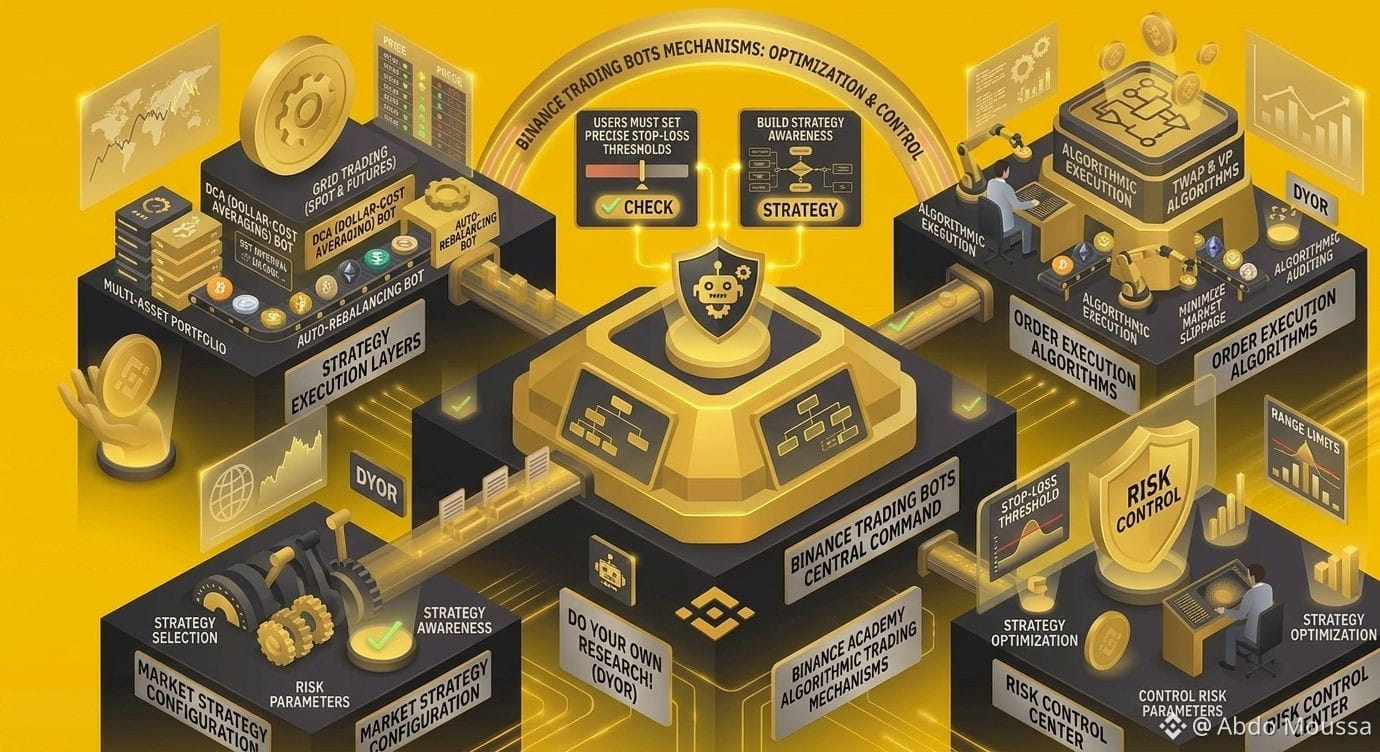
🤖 Automated Trading Strategies: Inside Binance Trading Bots
Executing discipline in volatile market conditions requires structured execution systems, Binance Trading Bots provide users with algorithmic tools designed to automate repetitive trading strategies across various market cycles.
💡 Core Bot Types & Market Use Cases
Grid Trading (Spot & Futures): Places a ladder of buy and sell orders within a user-defined price range to capture small price swings during sideways consolidation.
Dollar-Cost Averaging (DCA) Bot: Programmatically executes recurring purchases at set intervals to optimize entry prices over time.
Auto-Rebalancing Bot: Automatically adjusts the allocation weights of a multi-asset portfolio when token market values drift from target percentages.
TWAP & VP Algorithms: Facilitates large order execution over specific time or volume parameters to minimize market slippage.
🔑 Strategic Risk Management
Algorithmic trading eliminates emotional biases from execution, However, users must set precise stop-loss thresholds and range limits to manage risk effectively during strong directional market breakouts.
⚠️ Educational Disclaimer
Automated trading bots operate strictly within user-configured settings and carry inherent market risks.
This article is prepared strictly for educational purposes and does not constitute financial or investment advice.
Master algorithmic trading mechanisms on Binance Academy.
[https://www.binance.com/en/academy/articles/your-guide-to-binance-trading-bots](https://www.binance.com/en/academy/articles/your-guide-to-binance-trading-bots)
Build strategy awareness, control risk parameters, and always DYOR (Do Your Own Research)💡
#Binance #BinanceAcademy #TradingBots #dyor #learnwithbinance
🤖 Automated Trading Strategies: Inside Binance Trading Bots
Executing discipline in volatile market conditions requires structured execution systems, Binance Trading Bots provide users with algorithmic tools designed to automate repetitive trading strategies across various market cycles.
💡 Core Bot Types & Market Use Cases
Grid Trading (Spot & Futures): Places a ladder of buy and sell orders within a user-defined price range to capture small price swings during sideways consolidation.
Dollar-Cost Averaging (DCA) Bot: Programmatically executes recurring purchases at set intervals to optimize entry prices over time.
Auto-Rebalancing Bot: Automatically adjusts the allocation weights of a multi-asset portfolio when token market values drift from target percentages.
TWAP & VP Algorithms: Facilitates large order execution over specific time or volume parameters to minimize market slippage.
🔑 Strategic Risk Management
Algorithmic trading eliminates emotional biases from execution, However, users must set precise stop-loss thresholds and range limits to manage risk effectively during strong directional market breakouts.
⚠️ Educational Disclaimer
Automated trading bots operate strictly within user-configured settings and carry inherent market risks.
This article is prepared strictly for educational purposes and does not constitute financial or investment advice.
Master algorithmic trading mechanisms on Binance Academy.
https://www.binance.com/en/academy/articles/your-guide-to-binance-trading-bots
Build strategy awareness, control risk parameters, and always DYOR (Do Your Own Research)💡
#Binance #BinanceAcademy #TradingBots #dyor #learnwithbinance
Executing discipline in volatile market conditions requires structured execution systems, Binance Trading Bots provide users with algorithmic tools designed to automate repetitive trading strategies across various market cycles.
💡 Core Bot Types & Market Use Cases
Grid Trading (Spot & Futures): Places a ladder of buy and sell orders within a user-defined price range to capture small price swings during sideways consolidation.
Dollar-Cost Averaging (DCA) Bot: Programmatically executes recurring purchases at set intervals to optimize entry prices over time.
Auto-Rebalancing Bot: Automatically adjusts the allocation weights of a multi-asset portfolio when token market values drift from target percentages.
TWAP & VP Algorithms: Facilitates large order execution over specific time or volume parameters to minimize market slippage.
🔑 Strategic Risk Management
Algorithmic trading eliminates emotional biases from execution, However, users must set precise stop-loss thresholds and range limits to manage risk effectively during strong directional market breakouts.
⚠️ Educational Disclaimer
Automated trading bots operate strictly within user-configured settings and carry inherent market risks.
This article is prepared strictly for educational purposes and does not constitute financial or investment advice.
Master algorithmic trading mechanisms on Binance Academy.
https://www.binance.com/en/academy/articles/your-guide-to-binance-trading-bots
Build strategy awareness, control risk parameters, and always DYOR (Do Your Own Research)💡
#Binance #BinanceAcademy #TradingBots #dyor #learnwithbinance
3
73
·
--
Article
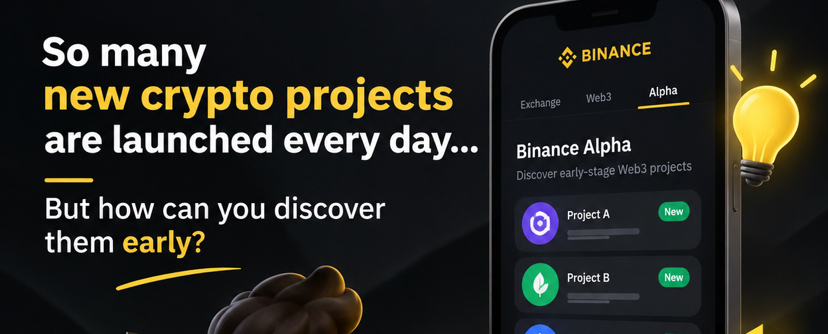
Why Your Binance Alpha Points Keep Changing 👀Ever wondered why your Binance Alpha Points can be different from someone else’s?
It’s not just about trading volume.
Your Alpha Points are calculated from different types of eligible activity, and there’s one important detail many users overlook:
The system uses a rolling 15-day window.
That means the points included in your total can change as older points expire and new ones are added.
🎯 What Are Alpha Points?
Alpha Points are a scoring system used to evaluate eligible activity within Binance Alpha and Binance Wallet.
They can determine your eligibility for certain Alpha events, including:
🔹 Alpha token airdrops
🔹 Token Generation Events (TGEs)
Your total is based on eligible points accumulated over the previous 15 days.
💰 Where Do Your Points Come From?
Your daily points mainly come from two sources:
1️⃣ Balance Points
Based on the value of your eligible assets.
2️⃣ Volume Points
Based on your eligible purchase volume of Alpha Tokens.
These daily points are then accumulated within the rolling 15-day period.
💰 Balance Points
The amount of Balance Points you can receive each day depends on your eligible asset balance:
$100 – less than $1,000 → 1 point/day
$1,000 – less than $10,000 → 2 points/day
$10,000 – less than $100,000 → 3 points/day
$100,000 or more → 4 points/day
The daily balance snapshot is taken at 23:59:59 UTC.
📈 Volume Points
Volume Points are based on eligible purchases of Alpha Tokens through Binance Exchange and Binance Wallet (Keyless).
The current structure starts like this:
$2 → 1 point
$4 → 2 points
$8 → 3 points
$16 → 4 points
$32 → 5 points
And every additional doubling of the eligible purchase volume adds another point.
For example:
$64 → 6 points
$128 → 7 points
Only eligible purchases count toward Volume Points. Selling Alpha Tokens does not reduce the purchase volume that has already been counted.
⚠️ One Rule You Shouldn’t Miss
There’s an important condition behind the points system.
If your daily Balance Points are zero, your Volume Points and Task Points won’t count toward your Alpha Points accumulation until your eligible balance reaches at least $100 equivalent.
So simply having trading activity isn’t enough.
⏳ Why Do Your Points Change?
This is one of the most important things to understand.
Alpha Points use a rolling 15-day window.
Each point expires 15 days after its snapshot date.
So as new points are added, older points can expire.
That’s why your total Alpha Points today may not be the same as your total later — even if your recent activity hasn’t changed much.
🎁 What Can You Do With Alpha Points?
Alpha Points can be used to participate in eligible Alpha events.
Depending on the event, this can include:
🔹 Alpha Airdrops
🔹 Token Generation Events
🔹 Other eligible Alpha campaigns
When you confirm participation in an event, the required points are spent immediately, with the change reflected in your total on the following day.
Participation is optional, and the exact requirements can vary from one event to another.
🪂 How Do Alpha Airdrops Work?
Some Alpha airdrops can use a two-phase distribution system.
In the first phase, users who meet the initial points threshold can participate during the specified period.
If rewards remain available, the threshold may then be lowered, allowing additional eligible users to participate on a first-come, first-served basis.
The exact threshold, timing, and distribution rules can vary by event.
So always check the event page before participating.
📦 And What About Alpha Box?
Alpha Box is another type of Alpha airdrop event.
Instead of receiving a reward from one specific project, an Alpha Box can include multiple participating projects.
If you qualify, you receive tokens from one of the participating projects — you don’t choose which project you receive.
Eligibility and requirements can vary by event, and users generally need to complete KYC and meet the required Alpha Points threshold.
🔐 A Few Details Worth Knowing
There are also a few rules that are easy to overlook:
Wallet type matters.
Only eligible activity through Binance Exchange and Binance Wallet (Keyless) counts toward Alpha Volume. Imported or exported wallets don’t count.
Sub-accounts don’t multiply your points.
Sub-account balances are merged into the master account’s score.
Spot listings can change what counts.
If an Alpha Token becomes listed for Spot trading, transactions made after the Spot listing are no longer counted toward Alpha Volume.
🧠 The Easy Way to Remember Alpha Points
Think of the system like this:
💰 Eligible balance
→ Balance Points
📈 Eligible Alpha purchases
→ Volume Points
⏳ Rolling 15 days
→ Points can expire
🎁 Alpha Events
→ Where eligible points may be used
And remember:
More points don’t mean guaranteed rewards or profits.
They can simply determine eligibility for specific Alpha events.
Final Takeaway
Alpha Points might look like just another number on Binance.
But once you understand where they come from, how the 15-day window works, and when they can be used, the whole system becomes much easier to follow.
And Binance can update the rules, thresholds, and eligibility requirements over time.
So before participating in any Alpha event:
Check the official event details.
Do your own research.
And always make sure you understand the rules first.
Educational content only, not financial advice.
#Binance #BinanceAcademy #learnwithbinance
Why Your Binance Alpha Points Keep Changing 👀
Ever wondered why your Binance Alpha Points can be different from someone else’s?
It’s not just about trading volume.
Your Alpha Points are calculated from different types of eligible activity, and there’s one important detail many users overlook:
The system uses a rolling 15-day window.
That means the points included in your total can change as older points expire and new ones are added.
🎯 What Are Alpha Points?
Alpha Points are a scoring system used to evaluate eligible activity within Binance Alpha and Binance Wallet.
They can determine your eligibility for certain Alpha events, including:
🔹 Alpha token airdrops
🔹 Token Generation Events (TGEs)
Your total is based on eligible points accumulated over the previous 15 days.
💰 Where Do Your Points Come From?
Your daily points mainly come from two sources:
1️⃣ Balance Points
Based on the value of your eligible assets.
2️⃣ Volume Points
Based on your eligible purchase volume of Alpha Tokens.
These daily points are then accumulated within the rolling 15-day period.
💰 Balance Points
The amount of Balance Points you can receive each day depends on your eligible asset balance:
$100 – less than $1,000 → 1 point/day
$1,000 – less than $10,000 → 2 points/day
$10,000 – less than $100,000 → 3 points/day
$100,000 or more → 4 points/day
The daily balance snapshot is taken at 23:59:59 UTC.
📈 Volume Points
Volume Points are based on eligible purchases of Alpha Tokens through Binance Exchange and Binance Wallet (Keyless).
The current structure starts like this:
$2 → 1 point
$4 → 2 points
$8 → 3 points
$16 → 4 points
$32 → 5 points
And every additional doubling of the eligible purchase volume adds another point.
For example:
$64 → 6 points
$128 → 7 points
Only eligible purchases count toward Volume Points. Selling Alpha Tokens does not reduce the purchase volume that has already been counted.
⚠️ One Rule You Shouldn’t Miss
There’s an important condition behind the points system.
If your daily Balance Points are zero, your Volume Points and Task Points won’t count toward your Alpha Points accumulation until your eligible balance reaches at least $100 equivalent.
So simply having trading activity isn’t enough.
⏳ Why Do Your Points Change?
This is one of the most important things to understand.
Alpha Points use a rolling 15-day window.
Each point expires 15 days after its snapshot date.
So as new points are added, older points can expire.
That’s why your total Alpha Points today may not be the same as your total later — even if your recent activity hasn’t changed much.
🎁 What Can You Do With Alpha Points?
Alpha Points can be used to participate in eligible Alpha events.
Depending on the event, this can include:
🔹 Alpha Airdrops
🔹 Token Generation Events
🔹 Other eligible Alpha campaigns
When you confirm participation in an event, the required points are spent immediately, with the change reflected in your total on the following day.
Participation is optional, and the exact requirements can vary from one event to another.
🪂 How Do Alpha Airdrops Work?
Some Alpha airdrops can use a two-phase distribution system.
In the first phase, users who meet the initial points threshold can participate during the specified period.
If rewards remain available, the threshold may then be lowered, allowing additional eligible users to participate on a first-come, first-served basis.
The exact threshold, timing, and distribution rules can vary by event.
So always check the event page before participating.
📦 And What About Alpha Box?
Alpha Box is another type of Alpha airdrop event.
Instead of receiving a reward from one specific project, an Alpha Box can include multiple participating projects.
If you qualify, you receive tokens from one of the participating projects — you don’t choose which project you receive.
Eligibility and requirements can vary by event, and users generally need to complete KYC and meet the required Alpha Points threshold.
🔐 A Few Details Worth Knowing
There are also a few rules that are easy to overlook:
Wallet type matters.
Only eligible activity through Binance Exchange and Binance Wallet (Keyless) counts toward Alpha Volume. Imported or exported wallets don’t count.
Sub-accounts don’t multiply your points.
Sub-account balances are merged into the master account’s score.
Spot listings can change what counts.
If an Alpha Token becomes listed for Spot trading, transactions made after the Spot listing are no longer counted toward Alpha Volume.
🧠 The Easy Way to Remember Alpha Points
Think of the system like this:
💰 Eligible balance
→ Balance Points
📈 Eligible Alpha purchases
→ Volume Points
⏳ Rolling 15 days
→ Points can expire
🎁 Alpha Events
→ Where eligible points may be used
And remember:
More points don’t mean guaranteed rewards or profits.
They can simply determine eligibility for specific Alpha events.
Final Takeaway
Alpha Points might look like just another number on Binance.
But once you understand where they come from, how the 15-day window works, and when they can be used, the whole system becomes much easier to follow.
And Binance can update the rules, thresholds, and eligibility requirements over time.
So before participating in any Alpha event:
Check the official event details.
Do your own research.
And always make sure you understand the rules first.
Educational content only, not financial advice.
#Binance #BinanceAcademy #learnwithbinance
It’s not just about trading volume.
Your Alpha Points are calculated from different types of eligible activity, and there’s one important detail many users overlook:
The system uses a rolling 15-day window.
That means the points included in your total can change as older points expire and new ones are added.
🎯 What Are Alpha Points?
Alpha Points are a scoring system used to evaluate eligible activity within Binance Alpha and Binance Wallet.
They can determine your eligibility for certain Alpha events, including:
🔹 Alpha token airdrops
🔹 Token Generation Events (TGEs)
Your total is based on eligible points accumulated over the previous 15 days.
💰 Where Do Your Points Come From?
Your daily points mainly come from two sources:
1️⃣ Balance Points
Based on the value of your eligible assets.
2️⃣ Volume Points
Based on your eligible purchase volume of Alpha Tokens.
These daily points are then accumulated within the rolling 15-day period.
💰 Balance Points
The amount of Balance Points you can receive each day depends on your eligible asset balance:
$100 – less than $1,000 → 1 point/day
$1,000 – less than $10,000 → 2 points/day
$10,000 – less than $100,000 → 3 points/day
$100,000 or more → 4 points/day
The daily balance snapshot is taken at 23:59:59 UTC.
📈 Volume Points
Volume Points are based on eligible purchases of Alpha Tokens through Binance Exchange and Binance Wallet (Keyless).
The current structure starts like this:
$2 → 1 point
$4 → 2 points
$8 → 3 points
$16 → 4 points
$32 → 5 points
And every additional doubling of the eligible purchase volume adds another point.
For example:
$64 → 6 points
$128 → 7 points
Only eligible purchases count toward Volume Points. Selling Alpha Tokens does not reduce the purchase volume that has already been counted.
⚠️ One Rule You Shouldn’t Miss
There’s an important condition behind the points system.
If your daily Balance Points are zero, your Volume Points and Task Points won’t count toward your Alpha Points accumulation until your eligible balance reaches at least $100 equivalent.
So simply having trading activity isn’t enough.
⏳ Why Do Your Points Change?
This is one of the most important things to understand.
Alpha Points use a rolling 15-day window.
Each point expires 15 days after its snapshot date.
So as new points are added, older points can expire.
That’s why your total Alpha Points today may not be the same as your total later — even if your recent activity hasn’t changed much.
🎁 What Can You Do With Alpha Points?
Alpha Points can be used to participate in eligible Alpha events.
Depending on the event, this can include:
🔹 Alpha Airdrops
🔹 Token Generation Events
🔹 Other eligible Alpha campaigns
When you confirm participation in an event, the required points are spent immediately, with the change reflected in your total on the following day.
Participation is optional, and the exact requirements can vary from one event to another.
🪂 How Do Alpha Airdrops Work?
Some Alpha airdrops can use a two-phase distribution system.
In the first phase, users who meet the initial points threshold can participate during the specified period.
If rewards remain available, the threshold may then be lowered, allowing additional eligible users to participate on a first-come, first-served basis.
The exact threshold, timing, and distribution rules can vary by event.
So always check the event page before participating.
📦 And What About Alpha Box?
Alpha Box is another type of Alpha airdrop event.
Instead of receiving a reward from one specific project, an Alpha Box can include multiple participating projects.
If you qualify, you receive tokens from one of the participating projects — you don’t choose which project you receive.
Eligibility and requirements can vary by event, and users generally need to complete KYC and meet the required Alpha Points threshold.
🔐 A Few Details Worth Knowing
There are also a few rules that are easy to overlook:
Wallet type matters.
Only eligible activity through Binance Exchange and Binance Wallet (Keyless) counts toward Alpha Volume. Imported or exported wallets don’t count.
Sub-accounts don’t multiply your points.
Sub-account balances are merged into the master account’s score.
Spot listings can change what counts.
If an Alpha Token becomes listed for Spot trading, transactions made after the Spot listing are no longer counted toward Alpha Volume.
🧠 The Easy Way to Remember Alpha Points
Think of the system like this:
💰 Eligible balance
→ Balance Points
📈 Eligible Alpha purchases
→ Volume Points
⏳ Rolling 15 days
→ Points can expire
🎁 Alpha Events
→ Where eligible points may be used
And remember:
More points don’t mean guaranteed rewards or profits.
They can simply determine eligibility for specific Alpha events.
Final Takeaway
Alpha Points might look like just another number on Binance.
But once you understand where they come from, how the 15-day window works, and when they can be used, the whole system becomes much easier to follow.
And Binance can update the rules, thresholds, and eligibility requirements over time.
So before participating in any Alpha event:
Check the official event details.
Do your own research.
And always make sure you understand the rules first.
Educational content only, not financial advice.
#Binance #BinanceAcademy #learnwithbinance
5
89
·
--
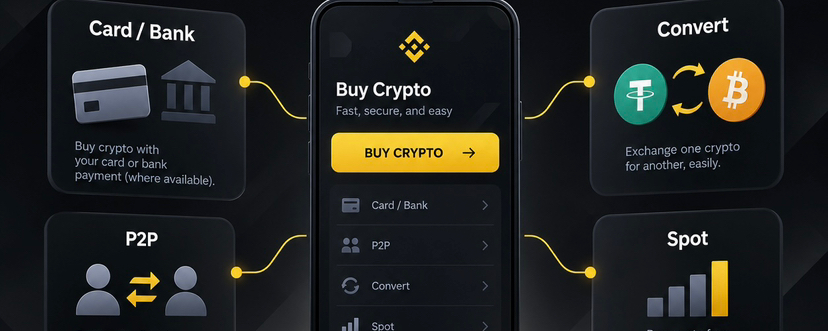
Article
🔥 How to Buy Crypto on Binance? 4 Ways Beginners Should KnowWant to buy crypto on Binance but don’t know where to start?
You don’t have to use just one method.
Depending on your region and available payment options, there are several ways to buy or acquire crypto on Binance. Here’s the simple breakdown 👇
1️⃣ Card / Bank
In some regions, you can buy crypto directly using a supported card or available bank payment methods.
Simple and direct — but availability and fees vary.
2️⃣ P2P
Want to buy crypto directly from another user?
Binance P2P lets you choose from available offers and compare things like:
💰 Price
💳 Payment method
📏 Order limits
⭐ Merchant information & ratings
Don’t choose an offer based on price alone.
3️⃣ Convert
Already hold crypto?
You can use Convert to exchange one crypto asset for another through a simple interface.
4️⃣ Spot
You can also buy crypto through the Spot Market.
Here, you’re buying or selling the asset itself using your available funds.
You can choose different order types depending on how you want your trade to be executed.
🧠 The part beginners often miss
There’s no single “best” way to buy crypto.
The right option depends on:
→ Your region
→ Available payment methods
→ The type of transaction you want
→ Fees and transaction conditions
So before you click Buy, understand how the transaction works first.
📚 Keep learning with Binance Academy.
Educational content only, not financial advice. Availability, eligibility, payment methods, and regulations vary by region. DYOR and use official Binance sources.
Which method did you use when you bought crypto for the first time? 👇
#Binance #BinanceAcademy #learnwithbinance #cryptoeducation
🔥 How to Buy Crypto on Binance? 4 Ways Beginners Should Know
Want to buy crypto on Binance but don’t know where to start?
You don’t have to use just one method.
Depending on your region and available payment options, there are several ways to buy or acquire crypto on Binance. Here’s the simple breakdown 👇
1️⃣ Card / Bank
In some regions, you can buy crypto directly using a supported card or available bank payment methods.
Simple and direct — but availability and fees vary.
2️⃣ P2P
Want to buy crypto directly from another user?
Binance P2P lets you choose from available offers and compare things like:
💰 Price
💳 Payment method
📏 Order limits
⭐ Merchant information & ratings
Don’t choose an offer based on price alone.
3️⃣ Convert
Already hold crypto?
You can use Convert to exchange one crypto asset for another through a simple interface.
4️⃣ Spot
You can also buy crypto through the Spot Market.
Here, you’re buying or selling the asset itself using your available funds.
You can choose different order types depending on how you want your trade to be executed.
🧠 The part beginners often miss
There’s no single “best” way to buy crypto.
The right option depends on:
→ Your region
→ Available payment methods
→ The type of transaction you want
→ Fees and transaction conditions
So before you click Buy, understand how the transaction works first.
📚 Keep learning with Binance Academy.
Educational content only, not financial advice. Availability, eligibility, payment methods, and regulations vary by region. DYOR and use official Binance sources.
Which method did you use when you bought crypto for the first time? 👇
#Binance #BinanceAcademy #learnwithbinance #cryptoeducation
You don’t have to use just one method.
Depending on your region and available payment options, there are several ways to buy or acquire crypto on Binance. Here’s the simple breakdown 👇
1️⃣ Card / Bank
In some regions, you can buy crypto directly using a supported card or available bank payment methods.
Simple and direct — but availability and fees vary.
2️⃣ P2P
Want to buy crypto directly from another user?
Binance P2P lets you choose from available offers and compare things like:
💰 Price
💳 Payment method
📏 Order limits
⭐ Merchant information & ratings
Don’t choose an offer based on price alone.
3️⃣ Convert
Already hold crypto?
You can use Convert to exchange one crypto asset for another through a simple interface.
4️⃣ Spot
You can also buy crypto through the Spot Market.
Here, you’re buying or selling the asset itself using your available funds.
You can choose different order types depending on how you want your trade to be executed.
🧠 The part beginners often miss
There’s no single “best” way to buy crypto.
The right option depends on:
→ Your region
→ Available payment methods
→ The type of transaction you want
→ Fees and transaction conditions
So before you click Buy, understand how the transaction works first.
📚 Keep learning with Binance Academy.
Educational content only, not financial advice. Availability, eligibility, payment methods, and regulations vary by region. DYOR and use official Binance sources.
Which method did you use when you bought crypto for the first time? 👇
#Binance #BinanceAcademy #learnwithbinance #cryptoeducation
5
88
·
--
You Bought Crypto. But What Exactly Did You Buy?
When you buy crypto, you might hear the term “Spot Trading.”
But what does “Spot” actually mean?
In simple terms, Spot trading means buying or selling a crypto asset directly, using your available funds.
So what happens in a Spot trade?
Imagine you have USDT and want to buy BTC.
You place a Spot order:
$USDT → $BTC
Once the order is filled, you have bought the BTC itself.
That’s different from trading a derivative contract whose value is linked to an underlying asset.
Spot vs. Futures: What’s the difference?
The easiest way to think about it:
Spot → You buy or sell the asset itself.
Futures → You trade a contract linked to the asset.
Futures can also involve leverage, while Spot trading does not involve borrowed funds or leverage by default.
What can you do in the Spot Market?
On Binance Spot, you can use different order types, including:
* Market Orders
* Limit Orders
* Stop-Limit Orders
* OCO Orders
Each order type determines different conditions for how your trade can be executed.
That’s why understanding Spot Trading is a useful starting point before moving into different order types.
The key takeaway
Spot trading = buying or selling the crypto asset itself with your available funds.
Simple concept, but an important one to understand before diving deeper into crypto trading.
📚 Keep learning with Binance Academy.
Educational content only, not financial advice. Availability, eligibility, and regulations vary by region. DYOR and use official Binance sources.
#Binance #BinanceAcademy #LearnWithBinance
You Bought Crypto. But What Exactly Did You Buy?
When you buy crypto, you might hear the term “Spot Trading.”
But what does “Spot” actually mean?
In simple terms, Spot trading means buying or selling a crypto asset directly, using your available funds.
So what happens in a Spot trade?
Imagine you have USDT and want to buy BTC.
You place a Spot order:
$USDT → $BTC
Once the order is filled, you have bought the BTC itself.
That’s different from trading a derivative contract whose value is linked to an underlying asset.
Spot vs. Futures: What’s the difference?
The easiest way to think about it:
Spot → You buy or sell the asset itself.
Futures → You trade a contract linked to the asset.
Futures can also involve leverage, while Spot trading does not involve borrowed funds or leverage by default.
What can you do in the Spot Market?
On Binance Spot, you can use different order types, including:
* Market Orders
* Limit Orders
* Stop-Limit Orders
* OCO Orders
Each order type determines different conditions for how your trade can be executed.
That’s why understanding Spot Trading is a useful starting point before moving into different order types.
The key takeaway
Spot trading = buying or selling the crypto asset itself with your available funds.
Simple concept, but an important one to understand before diving deeper into crypto trading.
📚 Keep learning with Binance Academy.
Educational content only, not financial advice. Availability, eligibility, and regulations vary by region. DYOR and use official Binance sources.
#Binance #BinanceAcademy #LearnWithBinance
When you buy crypto, you might hear the term “Spot Trading.”
But what does “Spot” actually mean?
In simple terms, Spot trading means buying or selling a crypto asset directly, using your available funds.
So what happens in a Spot trade?
Imagine you have USDT and want to buy BTC.
You place a Spot order:
$USDT → $BTC
Once the order is filled, you have bought the BTC itself.
That’s different from trading a derivative contract whose value is linked to an underlying asset.
Spot vs. Futures: What’s the difference?
The easiest way to think about it:
Spot → You buy or sell the asset itself.
Futures → You trade a contract linked to the asset.
Futures can also involve leverage, while Spot trading does not involve borrowed funds or leverage by default.
What can you do in the Spot Market?
On Binance Spot, you can use different order types, including:
* Market Orders
* Limit Orders
* Stop-Limit Orders
* OCO Orders
Each order type determines different conditions for how your trade can be executed.
That’s why understanding Spot Trading is a useful starting point before moving into different order types.
The key takeaway
Spot trading = buying or selling the crypto asset itself with your available funds.
Simple concept, but an important one to understand before diving deeper into crypto trading.
📚 Keep learning with Binance Academy.
Educational content only, not financial advice. Availability, eligibility, and regulations vary by region. DYOR and use official Binance sources.
#Binance #BinanceAcademy #LearnWithBinance
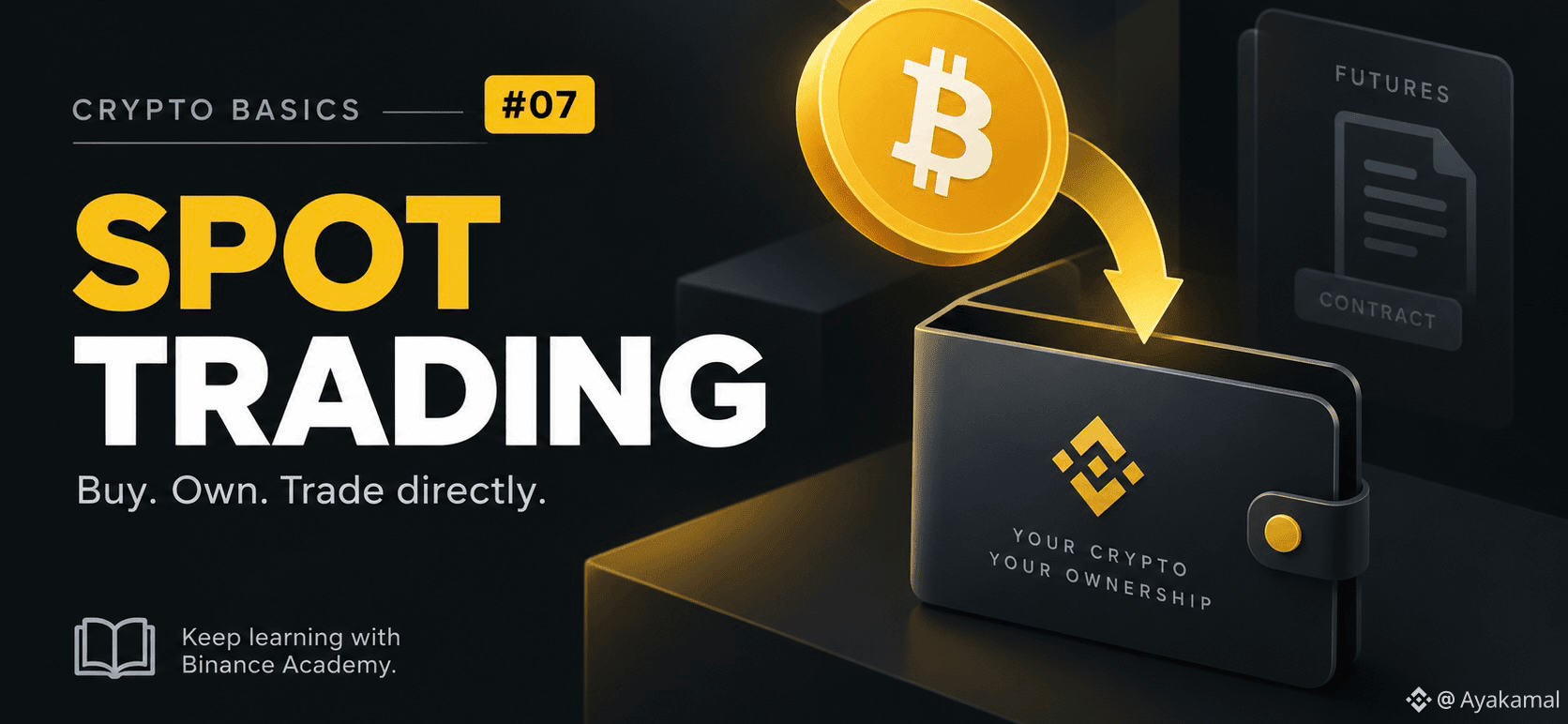
5
65
·
--
🔵 What Is Volume?
You’ve probably seen 24h Volume next to a cryptocurrency.
But what does that number actually tell you?
What is Trading Volume?
Trading volume is the total amount of an asset that has been traded during a specific period.
So when you see 24h Volume, it refers to trading activity over the previous 24 hours.
Why does Volume matter?
Volume gives you context about how much trading activity is happening around an asset.
Higher volume generally means more trading activity during the measured period.
Lower volume means less trading activity.
But there’s an important point:
Volume doesn’t tell you whether the price will go up or down.
It tells you about the level of trading activity—not the direction of the next price move.
Price vs. Volume
Think of it this way:
Price → What is the asset trading at?
Volume → How much trading activity is taking place?
Looking at both can give you more context when studying a crypto market.
The takeaway
Don’t look at a crypto asset’s price in isolation.
Understanding price + volume can help you read market activity with more context.
📚 Keep learning with Binance Academy and build your knowledge one concept at a time.
💬 When you look at a crypto asset, do you usually check its 24h Volume?
Educational content only, not financial advice. Availability, eligibility, and regulations may vary by region. DYOR and use official #Binance sources.
#BinanceAcademy #learnwithbinance #CryptoEducation
🔵 What Is Volume?
You’ve probably seen 24h Volume next to a cryptocurrency.
But what does that number actually tell you?
What is Trading Volume?
Trading volume is the total amount of an asset that has been traded during a specific period.
So when you see 24h Volume, it refers to trading activity over the previous 24 hours.
Why does Volume matter?
Volume gives you context about how much trading activity is happening around an asset.
Higher volume generally means more trading activity during the measured period.
Lower volume means less trading activity.
But there’s an important point:
Volume doesn’t tell you whether the price will go up or down.
It tells you about the level of trading activity—not the direction of the next price move.
Price vs. Volume
Think of it this way:
Price → What is the asset trading at?
Volume → How much trading activity is taking place?
Looking at both can give you more context when studying a crypto market.
The takeaway
Don’t look at a crypto asset’s price in isolation.
Understanding price + volume can help you read market activity with more context.
📚 Keep learning with Binance Academy and build your knowledge one concept at a time.
💬 When you look at a crypto asset, do you usually check its 24h Volume?
Educational content only, not financial advice. Availability, eligibility, and regulations may vary by region. DYOR and use official #Binance sources.
#BinanceAcademy #learnwithbinance #CryptoEducation
You’ve probably seen 24h Volume next to a cryptocurrency.
But what does that number actually tell you?
What is Trading Volume?
Trading volume is the total amount of an asset that has been traded during a specific period.
So when you see 24h Volume, it refers to trading activity over the previous 24 hours.
Why does Volume matter?
Volume gives you context about how much trading activity is happening around an asset.
Higher volume generally means more trading activity during the measured period.
Lower volume means less trading activity.
But there’s an important point:
Volume doesn’t tell you whether the price will go up or down.
It tells you about the level of trading activity—not the direction of the next price move.
Price vs. Volume
Think of it this way:
Price → What is the asset trading at?
Volume → How much trading activity is taking place?
Looking at both can give you more context when studying a crypto market.
The takeaway
Don’t look at a crypto asset’s price in isolation.
Understanding price + volume can help you read market activity with more context.
📚 Keep learning with Binance Academy and build your knowledge one concept at a time.
💬 When you look at a crypto asset, do you usually check its 24h Volume?
Educational content only, not financial advice. Availability, eligibility, and regulations may vary by region. DYOR and use official #Binance sources.
#BinanceAcademy #learnwithbinance #CryptoEducation
5
71
·
--
🚀 Understanding Binance Alpha: Early Access to Web3 Assets
Discovering high-potential tokens at an early stage requires integrated discovery tools, Binance Alpha acts as a pre-listing showcase pool designed to give users early visibility into emerging Web3 projects.
💡 Core Components & Ecosystem Features
Early-Stage Token Discovery: Highlights vetted digital assets operating in early development phases before any potential central exchange evaluation.
Quick Buy Mechanics: Streamlines token acquisitions with automated network selection, dynamic slippage handling, and Anti-MEV protection to reduce execution risks.
Alpha Box Airdrop Pool: Allows users to spend accumulated Binance Alpha Points to redeem token rewards from participating projects.
Alpha Earn Hub Integration: Enables users to deploy liquidity directly into PancakeSwap V3 pools without leaving the Binance Wallet interface.
🔄 Binance Alpha vs. Binance Alpha 2.0
While the standard Binance Alpha platform operates within the self-custodial Binance Web3 Wallet, Binance Alpha 2.0 embeds decentralized exchange (DEX) trading functionality directly inside the core Binance platform, enabling Spot and Funding account usage without an external wallet.
⚠️ Educational Disclaimer
Featured placement on Binance Alpha does not guarantee future listing on the Binance Exchange and carries inherent early-stage asset volatility.
This article is prepared strictly for educational purposes and does not constitute financial or investment advice.
Master Web3 asset evaluation on Binance Academy.
[https://www.binance.com/en/academy/articles/what-is-binance-alpha](https://www.binance.com/en/academy/articles/what-is-binance-alpha)
Build technical literacy, trade responsibly, and always DYOR (Do Your Own Research)💡
#Binance #BinanceAcademy #BinanceAlpha #DYOR #learnwithbinance
🚀 Understanding Binance Alpha: Early Access to Web3 Assets
Discovering high-potential tokens at an early stage requires integrated discovery tools, Binance Alpha acts as a pre-listing showcase pool designed to give users early visibility into emerging Web3 projects.
💡 Core Components & Ecosystem Features
Early-Stage Token Discovery: Highlights vetted digital assets operating in early development phases before any potential central exchange evaluation.
Quick Buy Mechanics: Streamlines token acquisitions with automated network selection, dynamic slippage handling, and Anti-MEV protection to reduce execution risks.
Alpha Box Airdrop Pool: Allows users to spend accumulated Binance Alpha Points to redeem token rewards from participating projects.
Alpha Earn Hub Integration: Enables users to deploy liquidity directly into PancakeSwap V3 pools without leaving the Binance Wallet interface.
🔄 Binance Alpha vs. Binance Alpha 2.0
While the standard Binance Alpha platform operates within the self-custodial Binance Web3 Wallet, Binance Alpha 2.0 embeds decentralized exchange (DEX) trading functionality directly inside the core Binance platform, enabling Spot and Funding account usage without an external wallet.
⚠️ Educational Disclaimer
Featured placement on Binance Alpha does not guarantee future listing on the Binance Exchange and carries inherent early-stage asset volatility.
This article is prepared strictly for educational purposes and does not constitute financial or investment advice.
Master Web3 asset evaluation on Binance Academy.
https://www.binance.com/en/academy/articles/what-is-binance-alpha
Build technical literacy, trade responsibly, and always DYOR (Do Your Own Research)💡
#Binance #BinanceAcademy #BinanceAlpha #DYOR #learnwithbinance
Discovering high-potential tokens at an early stage requires integrated discovery tools, Binance Alpha acts as a pre-listing showcase pool designed to give users early visibility into emerging Web3 projects.
💡 Core Components & Ecosystem Features
Early-Stage Token Discovery: Highlights vetted digital assets operating in early development phases before any potential central exchange evaluation.
Quick Buy Mechanics: Streamlines token acquisitions with automated network selection, dynamic slippage handling, and Anti-MEV protection to reduce execution risks.
Alpha Box Airdrop Pool: Allows users to spend accumulated Binance Alpha Points to redeem token rewards from participating projects.
Alpha Earn Hub Integration: Enables users to deploy liquidity directly into PancakeSwap V3 pools without leaving the Binance Wallet interface.
🔄 Binance Alpha vs. Binance Alpha 2.0
While the standard Binance Alpha platform operates within the self-custodial Binance Web3 Wallet, Binance Alpha 2.0 embeds decentralized exchange (DEX) trading functionality directly inside the core Binance platform, enabling Spot and Funding account usage without an external wallet.
⚠️ Educational Disclaimer
Featured placement on Binance Alpha does not guarantee future listing on the Binance Exchange and carries inherent early-stage asset volatility.
This article is prepared strictly for educational purposes and does not constitute financial or investment advice.
Master Web3 asset evaluation on Binance Academy.
https://www.binance.com/en/academy/articles/what-is-binance-alpha
Build technical literacy, trade responsibly, and always DYOR (Do Your Own Research)💡
#Binance #BinanceAcademy #BinanceAlpha #DYOR #learnwithbinance
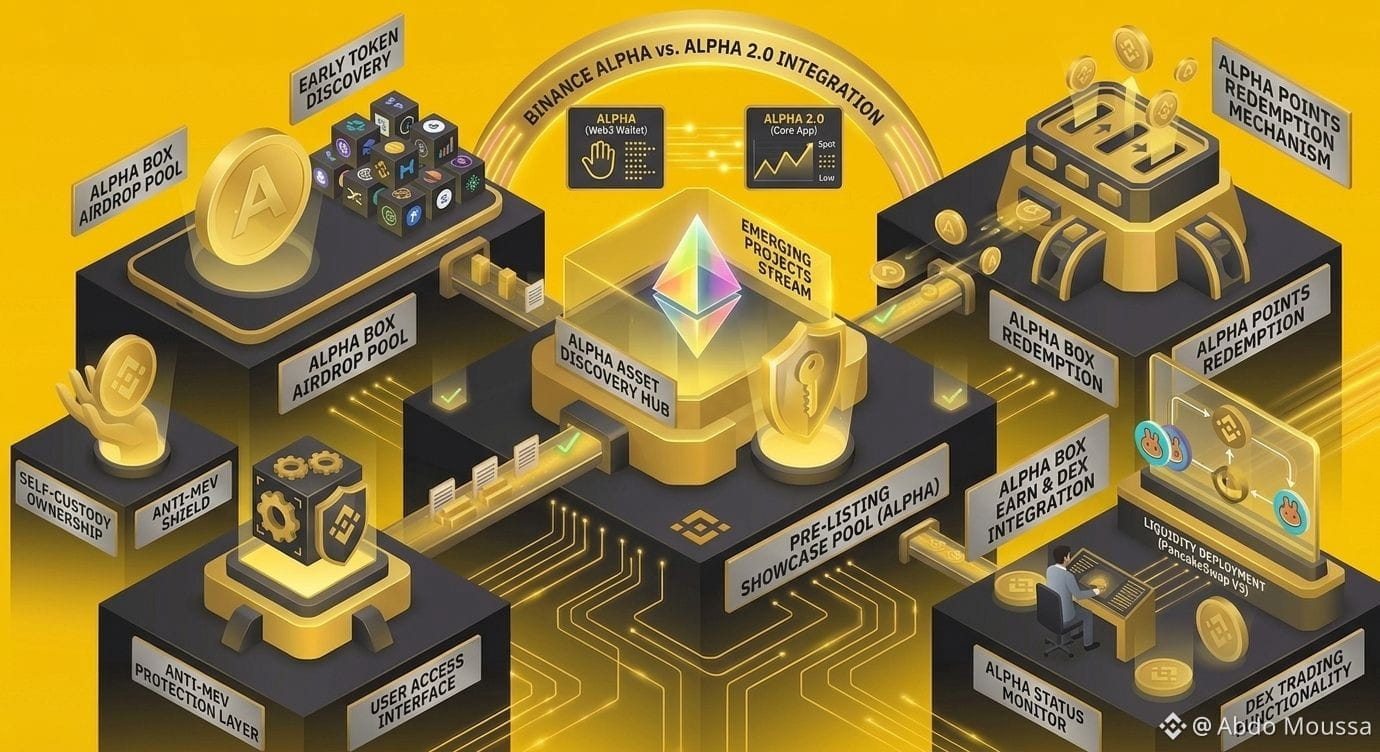
5
53
·
--
🛡️ MPC Architecture: Eliminating Seed Phrase Vulnerabilities in Web3 Wallets
Managing seed phrases represents a primary operational challenge for self-custody adoption, The Binance Web3 Wallet addresses this friction by integrating Multi-Party Computation (MPC) technology to implement a keyless security architecture.
💡 Understanding Keyless MPC Technology
MPC eliminates the need for a single, plaintext seed phrase, During wallet creation, the private key is mathematically generated and split into three separate encrypted key-shares:
Share 1: Stored locally on the user's mobile device.
Share 2: Encrypted and saved to the user's personal cloud backup (protected by a user-defined password).
Share 3: Maintained securely within Binance infrastructure.
🔑 Systemic Advantages
Elimination of Single Point of Failure: Accessing the wallet or executing a transaction requires a minimum threshold of 2 out of 3 key-shares.
Self-Custody Ownership: Binance holds only a single key-share, preventing unauthorized fund transfers without user approval.
Resilient Key Recovery: If a user loses their mobile device, access can be restored using the cloud backup share and the infrastructure share combined with the recovery password.
⚠️ Educational Disclaimer
Users must maintain strict backup practices for their cloud credentials and recovery passwords, as forgetting the password compromises wallet restoration.
This article is prepared strictly for educational purposes and does not constitute technical or security guarantees.
Explore Web3 self-custody infrastructure on Binance Academy.
[https://www.binance.com/en/academy/articles/what-are-multi-party-computation-mpc-wallets](https://www.binance.com/en/academy/articles/what-are-multi-party-computation-mpc-wallets)
Build technical literacy, protect your credentials, and always DYOR (Do Your Own Research)💡
#Binance #BinanceAcademy #Web3Wallet #dyor #LearnWithBinance
🛡️ MPC Architecture: Eliminating Seed Phrase Vulnerabilities in Web3 Wallets
Managing seed phrases represents a primary operational challenge for self-custody adoption, The Binance Web3 Wallet addresses this friction by integrating Multi-Party Computation (MPC) technology to implement a keyless security architecture.
💡 Understanding Keyless MPC Technology
MPC eliminates the need for a single, plaintext seed phrase, During wallet creation, the private key is mathematically generated and split into three separate encrypted key-shares:
Share 1: Stored locally on the user's mobile device.
Share 2: Encrypted and saved to the user's personal cloud backup (protected by a user-defined password).
Share 3: Maintained securely within Binance infrastructure.
🔑 Systemic Advantages
Elimination of Single Point of Failure: Accessing the wallet or executing a transaction requires a minimum threshold of 2 out of 3 key-shares.
Self-Custody Ownership: Binance holds only a single key-share, preventing unauthorized fund transfers without user approval.
Resilient Key Recovery: If a user loses their mobile device, access can be restored using the cloud backup share and the infrastructure share combined with the recovery password.
⚠️ Educational Disclaimer
Users must maintain strict backup practices for their cloud credentials and recovery passwords, as forgetting the password compromises wallet restoration.
This article is prepared strictly for educational purposes and does not constitute technical or security guarantees.
Explore Web3 self-custody infrastructure on Binance Academy.
https://www.binance.com/en/academy/articles/what-are-multi-party-computation-mpc-wallets
Build technical literacy, protect your credentials, and always DYOR (Do Your Own Research)💡
#Binance #BinanceAcademy #Web3Wallet #dyor #LearnWithBinance
Managing seed phrases represents a primary operational challenge for self-custody adoption, The Binance Web3 Wallet addresses this friction by integrating Multi-Party Computation (MPC) technology to implement a keyless security architecture.
💡 Understanding Keyless MPC Technology
MPC eliminates the need for a single, plaintext seed phrase, During wallet creation, the private key is mathematically generated and split into three separate encrypted key-shares:
Share 1: Stored locally on the user's mobile device.
Share 2: Encrypted and saved to the user's personal cloud backup (protected by a user-defined password).
Share 3: Maintained securely within Binance infrastructure.
🔑 Systemic Advantages
Elimination of Single Point of Failure: Accessing the wallet or executing a transaction requires a minimum threshold of 2 out of 3 key-shares.
Self-Custody Ownership: Binance holds only a single key-share, preventing unauthorized fund transfers without user approval.
Resilient Key Recovery: If a user loses their mobile device, access can be restored using the cloud backup share and the infrastructure share combined with the recovery password.
⚠️ Educational Disclaimer
Users must maintain strict backup practices for their cloud credentials and recovery passwords, as forgetting the password compromises wallet restoration.
This article is prepared strictly for educational purposes and does not constitute technical or security guarantees.
Explore Web3 self-custody infrastructure on Binance Academy.
https://www.binance.com/en/academy/articles/what-are-multi-party-computation-mpc-wallets
Build technical literacy, protect your credentials, and always DYOR (Do Your Own Research)💡
#Binance #BinanceAcademy #Web3Wallet #dyor #LearnWithBinance
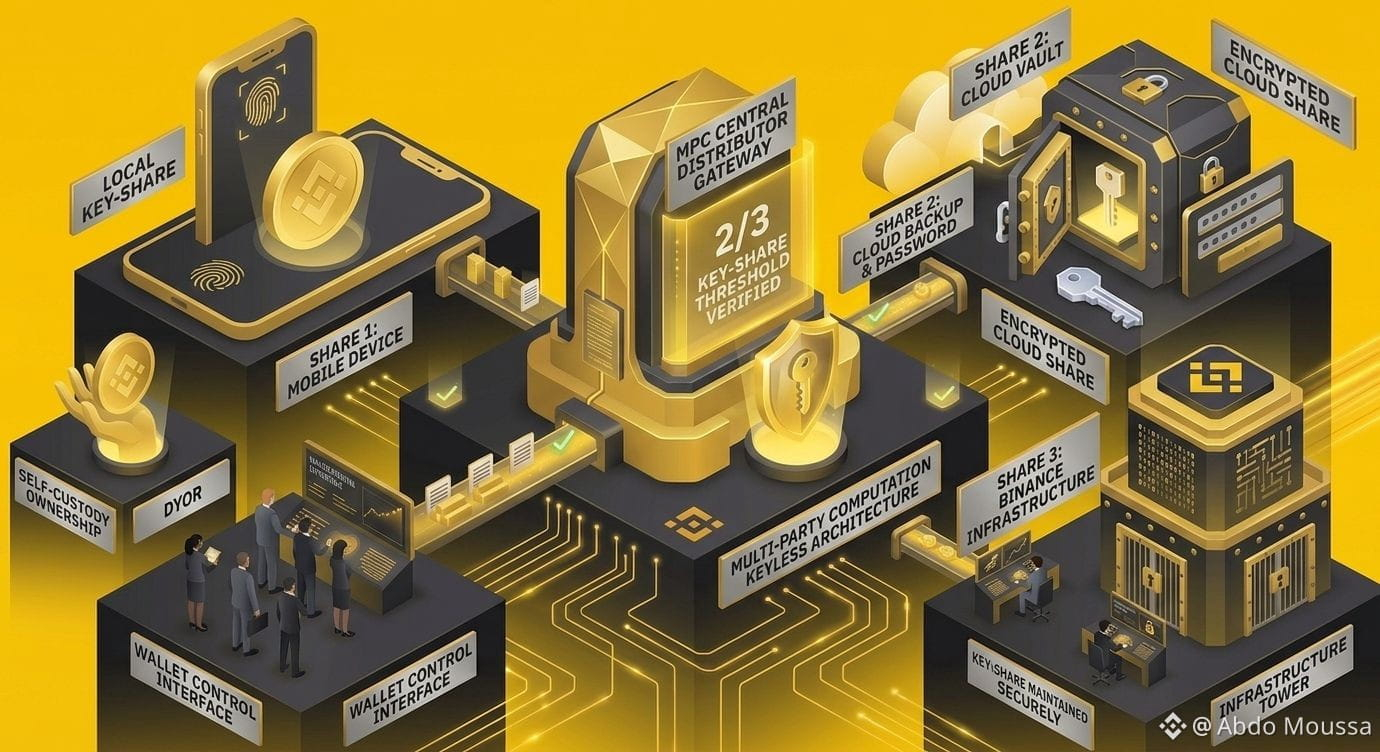
4
78
Log in to explore more content
Join global crypto users on Binance Square
⚡️ Get latest and useful information about crypto.
💬 Trusted by the world’s largest crypto exchange.
👍 Discover real insights from verified creators.
Email / Phone number
Trending Topics
1
#AnthropicIPOProspectusCouldValueItOver$2T
36 views
20 Discussing
2
#HackersDrainOver12.4MXRPFromDCENTWallets
339 views
31 Discussing
3
#SECSaysDecentralizedTokenBuybacksNotInvestmentContracts
1 views
1 Discussing
4
#UKFCAWinsCourtOrderToRecover851400Pounds
50,583 views
955 Discussing
5
#ChainlinkLaunchesCCIP2WithEnterpriseVerification
60,742 views
1,094 Discussing
6
#GoldFallsTo$4144
20,602 views
175 Discussing
7
#QNTFallsOver40%FromMorningHigh
109,614 views
1,475 Discussing
8
#USDTAdds845900HoldersInPast7Days
28,879 views
526 Discussing
9
#KospiFalls2.7%SamsungSKHynixDropOver5%
40,733 views
656 Discussing
10
#BitgetCEOConfirms$388MStolenInHack
6,006 views
45 Discussing