

#koreanwonweakestsince2009
koreanwonweakestsince2009
107,687 views
1,042 Discussing
Hot
Latest

·
--
#KoreanWonWeakestSince2009
🇰🇷 The Korean Won has fallen to its weakest level since 2009, highlighting growing pressure from global economic uncertainty and currency market volatility.
A weaker Won could impact imports, inflation, and investor sentiment across Asian markets.
Currency movements like this often influence capital flows into stocks, commodities, and even crypto assets.
Traders are closely watching central bank actions and macroeconomic data for signs of stabilization.
In volatile markets, staying informed and managing risk remains the smartest strategy.
#KoreanWonWeakestSince2009
🇰🇷 The Korean Won has fallen to its weakest level since 2009, highlighting growing pressure from global economic uncertainty and currency market volatility.
A weaker Won could impact imports, inflation, and investor sentiment across Asian markets.
Currency movements like this often influence capital flows into stocks, commodities, and even crypto assets.
Traders are closely watching central bank actions and macroeconomic data for signs of stabilization.
In volatile markets, staying informed and managing risk remains the smartest strategy.
🇰🇷 The Korean Won has fallen to its weakest level since 2009, highlighting growing pressure from global economic uncertainty and currency market volatility.
A weaker Won could impact imports, inflation, and investor sentiment across Asian markets.
Currency movements like this often influence capital flows into stocks, commodities, and even crypto assets.
Traders are closely watching central bank actions and macroeconomic data for signs of stabilization.
In volatile markets, staying informed and managing risk remains the smartest strategy.

50

·
--
#KoreanWonWeakestSince2009
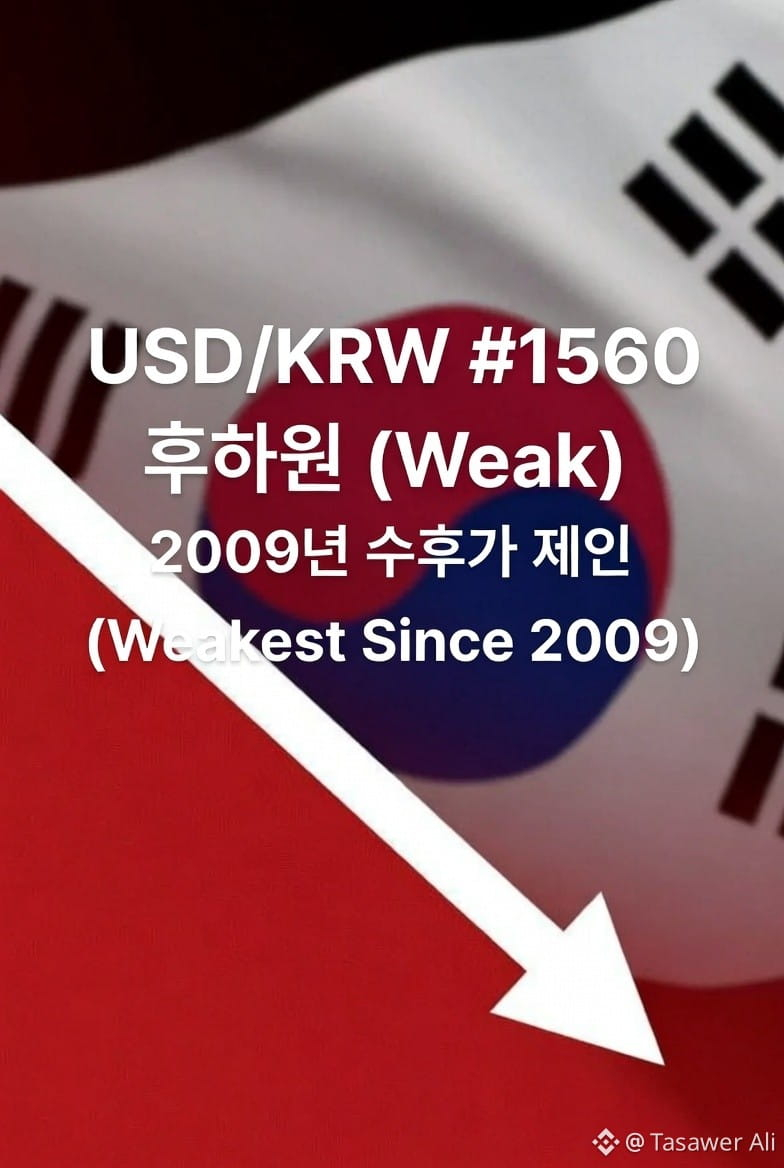
The Korean Won is now the weakest it’s been since 2009!
1 US Dollar now buys around 1,555~1,560 Korean Won.
This is the lowest in 17 years.
Foreign investors are selling Korean stocks and the US Dollar is becoming strong.
Korea’s government is trying to stop it from falling more.
What do you think will happen next?
#KoreanWonWeakestSince2009 #KRW
#KoreanWonWeakestSince2009
The Korean Won is now the weakest it’s been since 2009!
1 US Dollar now buys around 1,555~1,560 Korean Won.
This is the lowest in 17 years.
Foreign investors are selling Korean stocks and the US Dollar is becoming strong.
Korea’s government is trying to stop it from falling more.
What do you think will happen next?
#KoreanWonWeakestSince2009 #KRW
The Korean Won is now the weakest it’s been since 2009!
1 US Dollar now buys around 1,555~1,560 Korean Won.
This is the lowest in 17 years.
Foreign investors are selling Korean stocks and the US Dollar is becoming strong.
Korea’s government is trying to stop it from falling more.
What do you think will happen next?
#KoreanWonWeakestSince2009 #KRW
104

·
--
Verified
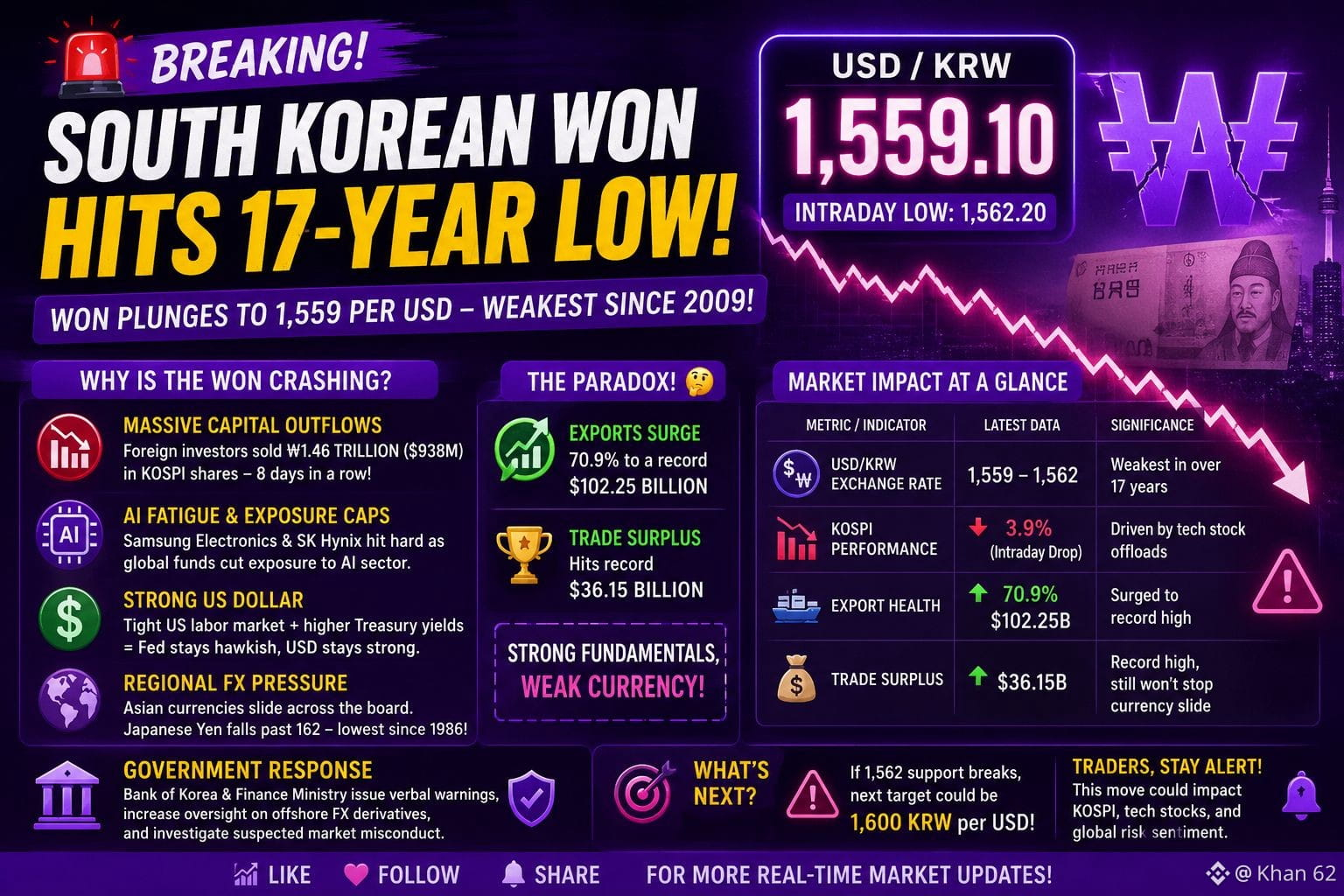
#koreanwonweakestsince2009 🚨 South Koreas won just hit its level since the 2008 financial crisis!
The Korean won has dropped to around 1,559 per US dollar briefly touching 1,562. That is its level since March 2009. This is not about the currency. It could be another sign that global money is moving into safe assets.
📉 Why is the won crashing?
* Foreign investors are pulling out fast. Global funds have sold 1.46 trillion won ($938M) worth of stocks. This is 8 days of net selling.
The AI trade is losing steam. Big companies like **Samsung Electronics and SK Hynix are under pressure**. Investors are reducing their exposure to AI-related stocks after months of gains.
* The US dollar is getting stronger. A strong US economy and expectations that the Federal Reserve will keep interest rates high are driving money into the dollar and out of emerging markets.
🌏 It's not just Korea. Asian currencies are under pressure. The Japanese yen is also trading near low levels.
📊 The strange part...
* South Koreas exports jumped 70.9% to a record high.
* The country had a record trade surplus.
Normally these are signs for a currency.. Global money flows are currently stronger than strong economic fundamentals.
👀 What traders should watch
⚠️ If the 1,562 level breaks analysts warn the next target could be 1,600 won per US dollar.
A weaker won could have implications, for:
KOSPI Index. Continued foreign selling could pressure Korean stocks.
Samsung Electronics. SK Hynix. AI-related stocks remain vulnerable.
US Dollar Index (DXY). A stronger dollar continues to weigh on currencies.
🔥 Currency markets often move before stocks. Is this temporary volatility or the start of a move?
👇 What's your view? Will the Bank of Korea stabilize the won. Are we heading to 1,600/USD? #AI #KOSPI #Khan62 #SouthKorea $KORU $SAMSUNG $SKHYNIX
{future}(SKHYNIXUSDT)
{future}(SAMSUNGUSDT)
{future}(KORUUSDT)
#koreanwonweakestsince2009 🚨 South Koreas won just hit its level since the 2008 financial crisis!
The Korean won has dropped to around 1,559 per US dollar briefly touching 1,562. That is its level since March 2009. This is not about the currency. It could be another sign that global money is moving into safe assets.
📉 Why is the won crashing?
* Foreign investors are pulling out fast. Global funds have sold 1.46 trillion won ($938M) worth of stocks. This is 8 days of net selling.
The AI trade is losing steam. Big companies like **Samsung Electronics and SK Hynix are under pressure**. Investors are reducing their exposure to AI-related stocks after months of gains.
* The US dollar is getting stronger. A strong US economy and expectations that the Federal Reserve will keep interest rates high are driving money into the dollar and out of emerging markets.
🌏 It's not just Korea. Asian currencies are under pressure. The Japanese yen is also trading near low levels.
📊 The strange part...
* South Koreas exports jumped 70.9% to a record high.
* The country had a record trade surplus.
Normally these are signs for a currency.. Global money flows are currently stronger than strong economic fundamentals.
👀 What traders should watch
⚠️ If the 1,562 level breaks analysts warn the next target could be 1,600 won per US dollar.
A weaker won could have implications, for:
KOSPI Index. Continued foreign selling could pressure Korean stocks.
Samsung Electronics. SK Hynix. AI-related stocks remain vulnerable.
US Dollar Index (DXY). A stronger dollar continues to weigh on currencies.
🔥 Currency markets often move before stocks. Is this temporary volatility or the start of a move?
👇 What's your view? Will the Bank of Korea stabilize the won. Are we heading to 1,600/USD? #AI #KOSPI #Khan62 #SouthKorea $KORU $SAMSUNG $SKHYNIX
The Korean won has dropped to around 1,559 per US dollar briefly touching 1,562. That is its level since March 2009. This is not about the currency. It could be another sign that global money is moving into safe assets.
📉 Why is the won crashing?
* Foreign investors are pulling out fast. Global funds have sold 1.46 trillion won ($938M) worth of stocks. This is 8 days of net selling.
The AI trade is losing steam. Big companies like **Samsung Electronics and SK Hynix are under pressure**. Investors are reducing their exposure to AI-related stocks after months of gains.
* The US dollar is getting stronger. A strong US economy and expectations that the Federal Reserve will keep interest rates high are driving money into the dollar and out of emerging markets.
🌏 It's not just Korea. Asian currencies are under pressure. The Japanese yen is also trading near low levels.
📊 The strange part...
* South Koreas exports jumped 70.9% to a record high.
* The country had a record trade surplus.
Normally these are signs for a currency.. Global money flows are currently stronger than strong economic fundamentals.
👀 What traders should watch
⚠️ If the 1,562 level breaks analysts warn the next target could be 1,600 won per US dollar.
A weaker won could have implications, for:
KOSPI Index. Continued foreign selling could pressure Korean stocks.
Samsung Electronics. SK Hynix. AI-related stocks remain vulnerable.
US Dollar Index (DXY). A stronger dollar continues to weigh on currencies.
🔥 Currency markets often move before stocks. Is this temporary volatility or the start of a move?
👇 What's your view? Will the Bank of Korea stabilize the won. Are we heading to 1,600/USD? #AI #KOSPI #Khan62 #SouthKorea $KORU $SAMSUNG $SKHYNIX
9
11
12.7k

Verified
Article
SOUTH KOREAN WON PLUNGES TO 17-YEAR LOW!#koreanwonweakestsince2009
🚨 🚨
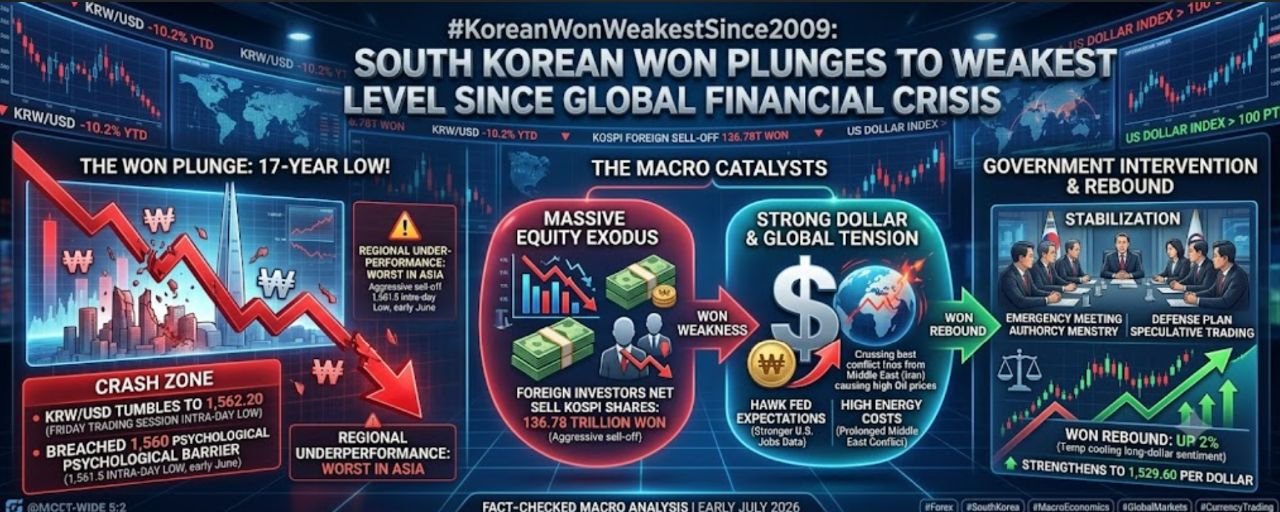
If you are tracking global forex markets, the South Korean Won (KRW) just experienced historic volatility, dropping to levels unseen since the 2009 global financial crisis.
Here is a full macro breakdown of what drove this massive currency plunge and how South Korean authorities are responding:
📉 The Historic Plunge
The Bottom: In early June 2026, the won breached the psychologically important 1,560-per-dollar mark, sinking to an intraday low of 1,561.5.Maximum Weakness: The currency tumbled as low as 1,562.20 against the greenback during a Friday trading session, officially marking its weakest level since March 2009.Regional Underperformance: The won has dropped more than 10% over the past year, making it one of the worst-performing currencies in Asia.
⚙️ The Macro Catalysts
Massive Equity Sell-Off: A primary driver of the won's severe weakness has been an aggressive sell-off of South Korean equities by foreign investors. Offshore investors have sold a net 136.78 trillion won worth of KOSPI shares.Geopolitical Strain: Prolonged conflict and instability in the Middle East have heightened energy costs, putting significant downward pressure on the currency.The Surging Dollar: Stronger-than-expected U.S. jobs data reinforced market expectations that the Federal Reserve will keep benchmark interest rates elevated for a longer duration. This hawkish outlook pushed the US Dollar Index above the 100-point threshold for the first time in two months, squeezing emerging market assets.
🛡️ Government Intervention & The Rebound
Emergency Response: Following the rapid slide, the Bank of Korea and the finance ministry held an emergency meeting and pledged to take tougher action against speculative trading, market misconduct, and out-of-line one-way positioning.The Bounce: The announcement of this currency defense plan temporarily cooled long-dollar sentiment, allowing the won to rebound by up to 2% and strengthen back to 1,529.60 per dollar.
#forex #SouthKorea #macroeconomic #GlobalMarkets
$NFP
{future}(NFPUSDT)
$GRASS
{future}(GRASSUSDT)
$EPIC
{future}(EPICUSDT)
SOUTH KOREAN WON PLUNGES TO 17-YEAR LOW!
#koreanwonweakestsince2009
🚨 🚨
If you are tracking global forex markets, the South Korean Won (KRW) just experienced historic volatility, dropping to levels unseen since the 2009 global financial crisis.
Here is a full macro breakdown of what drove this massive currency plunge and how South Korean authorities are responding:
📉 The Historic Plunge
The Bottom: In early June 2026, the won breached the psychologically important 1,560-per-dollar mark, sinking to an intraday low of 1,561.5.Maximum Weakness: The currency tumbled as low as 1,562.20 against the greenback during a Friday trading session, officially marking its weakest level since March 2009.Regional Underperformance: The won has dropped more than 10% over the past year, making it one of the worst-performing currencies in Asia.
⚙️ The Macro Catalysts
Massive Equity Sell-Off: A primary driver of the won's severe weakness has been an aggressive sell-off of South Korean equities by foreign investors. Offshore investors have sold a net 136.78 trillion won worth of KOSPI shares.Geopolitical Strain: Prolonged conflict and instability in the Middle East have heightened energy costs, putting significant downward pressure on the currency.The Surging Dollar: Stronger-than-expected U.S. jobs data reinforced market expectations that the Federal Reserve will keep benchmark interest rates elevated for a longer duration. This hawkish outlook pushed the US Dollar Index above the 100-point threshold for the first time in two months, squeezing emerging market assets.
🛡️ Government Intervention & The Rebound
Emergency Response: Following the rapid slide, the Bank of Korea and the finance ministry held an emergency meeting and pledged to take tougher action against speculative trading, market misconduct, and out-of-line one-way positioning.The Bounce: The announcement of this currency defense plan temporarily cooled long-dollar sentiment, allowing the won to rebound by up to 2% and strengthen back to 1,529.60 per dollar.
#forex #SouthKorea #macroeconomic #GlobalMarkets
$NFP
$GRASS
$EPIC
🚨 🚨
If you are tracking global forex markets, the South Korean Won (KRW) just experienced historic volatility, dropping to levels unseen since the 2009 global financial crisis.
Here is a full macro breakdown of what drove this massive currency plunge and how South Korean authorities are responding:
📉 The Historic Plunge
The Bottom: In early June 2026, the won breached the psychologically important 1,560-per-dollar mark, sinking to an intraday low of 1,561.5.Maximum Weakness: The currency tumbled as low as 1,562.20 against the greenback during a Friday trading session, officially marking its weakest level since March 2009.Regional Underperformance: The won has dropped more than 10% over the past year, making it one of the worst-performing currencies in Asia.
⚙️ The Macro Catalysts
Massive Equity Sell-Off: A primary driver of the won's severe weakness has been an aggressive sell-off of South Korean equities by foreign investors. Offshore investors have sold a net 136.78 trillion won worth of KOSPI shares.Geopolitical Strain: Prolonged conflict and instability in the Middle East have heightened energy costs, putting significant downward pressure on the currency.The Surging Dollar: Stronger-than-expected U.S. jobs data reinforced market expectations that the Federal Reserve will keep benchmark interest rates elevated for a longer duration. This hawkish outlook pushed the US Dollar Index above the 100-point threshold for the first time in two months, squeezing emerging market assets.
🛡️ Government Intervention & The Rebound
Emergency Response: Following the rapid slide, the Bank of Korea and the finance ministry held an emergency meeting and pledged to take tougher action against speculative trading, market misconduct, and out-of-line one-way positioning.The Bounce: The announcement of this currency defense plan temporarily cooled long-dollar sentiment, allowing the won to rebound by up to 2% and strengthen back to 1,529.60 per dollar.
#forex #SouthKorea #macroeconomic #GlobalMarkets
$NFP
$GRASS
$EPIC
11
10
8.6k
·
--
Korean Won Weakest Since 2009 🇰🇷📉
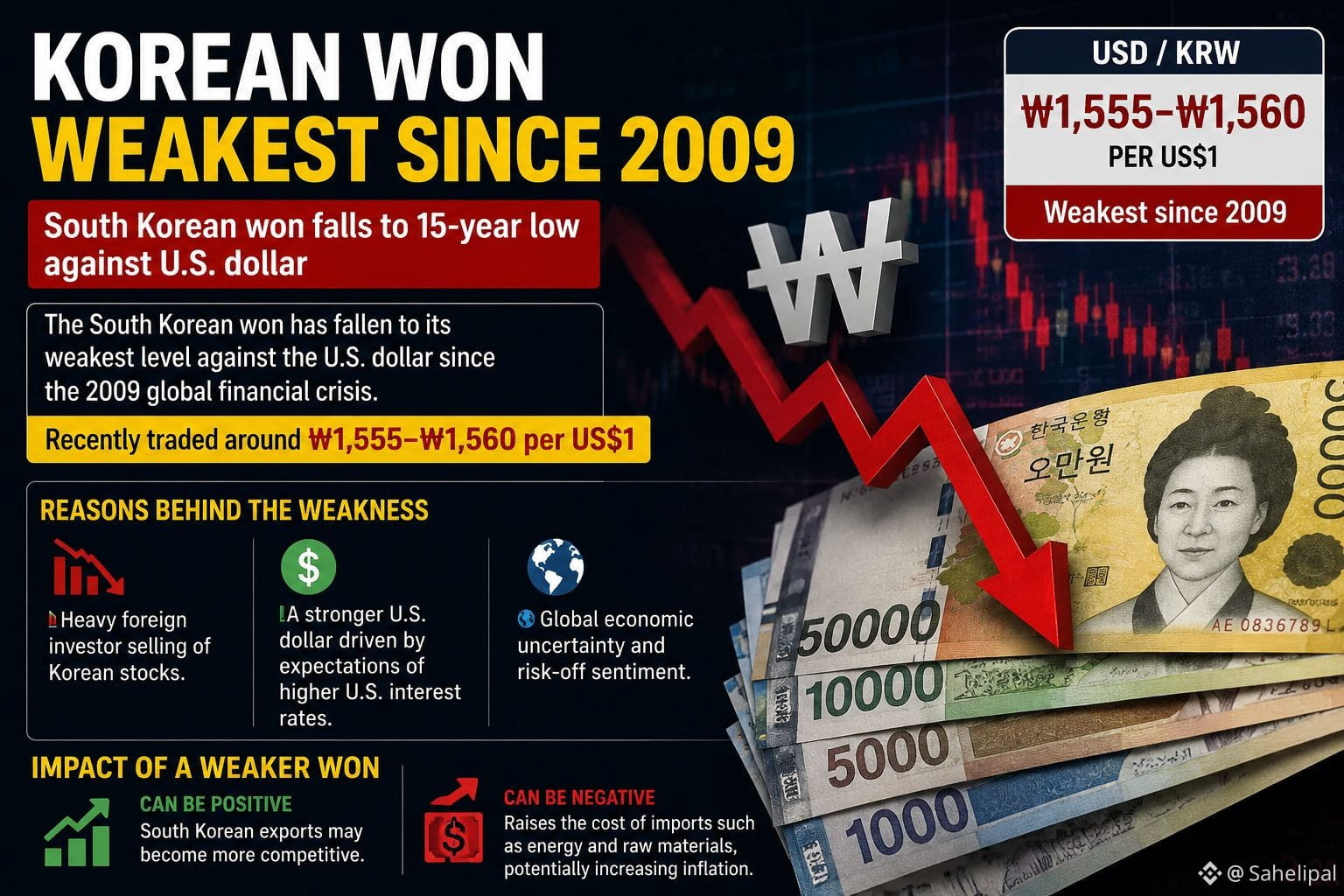
The South Korean won has fallen to its weakest level against the U.S. dollar since the 2009 global financial crisis. The currency recently traded around ₩1,555–₩1,560 per US$1, pressured by:
📉 Heavy foreign investor selling of Korean stocks.
💵 A stronger U.S. dollar driven by expectations of higher U.S. interest rates.
🌍 Global economic uncertainty and risk-off sentiment.
A weaker won can make South Korean exports more competitive, but it also raises the cost of imports such as energy and raw materials, potentially increasing inflation.
#KoreanWonWeakestSince2009
Korean Won Weakest Since 2009 🇰🇷📉
The South Korean won has fallen to its weakest level against the U.S. dollar since the 2009 global financial crisis. The currency recently traded around ₩1,555–₩1,560 per US$1, pressured by:
📉 Heavy foreign investor selling of Korean stocks.
💵 A stronger U.S. dollar driven by expectations of higher U.S. interest rates.
🌍 Global economic uncertainty and risk-off sentiment.
A weaker won can make South Korean exports more competitive, but it also raises the cost of imports such as energy and raw materials, potentially increasing inflation.
#KoreanWonWeakestSince2009
The South Korean won has fallen to its weakest level against the U.S. dollar since the 2009 global financial crisis. The currency recently traded around ₩1,555–₩1,560 per US$1, pressured by:
📉 Heavy foreign investor selling of Korean stocks.
💵 A stronger U.S. dollar driven by expectations of higher U.S. interest rates.
🌍 Global economic uncertainty and risk-off sentiment.
A weaker won can make South Korean exports more competitive, but it also raises the cost of imports such as energy and raw materials, potentially increasing inflation.
#KoreanWonWeakestSince2009
82

·
--
#KoreanWonWeakestSince2009
🇰🇷📉_Korean Won hits 17-year low vs USD today
What’s happening today
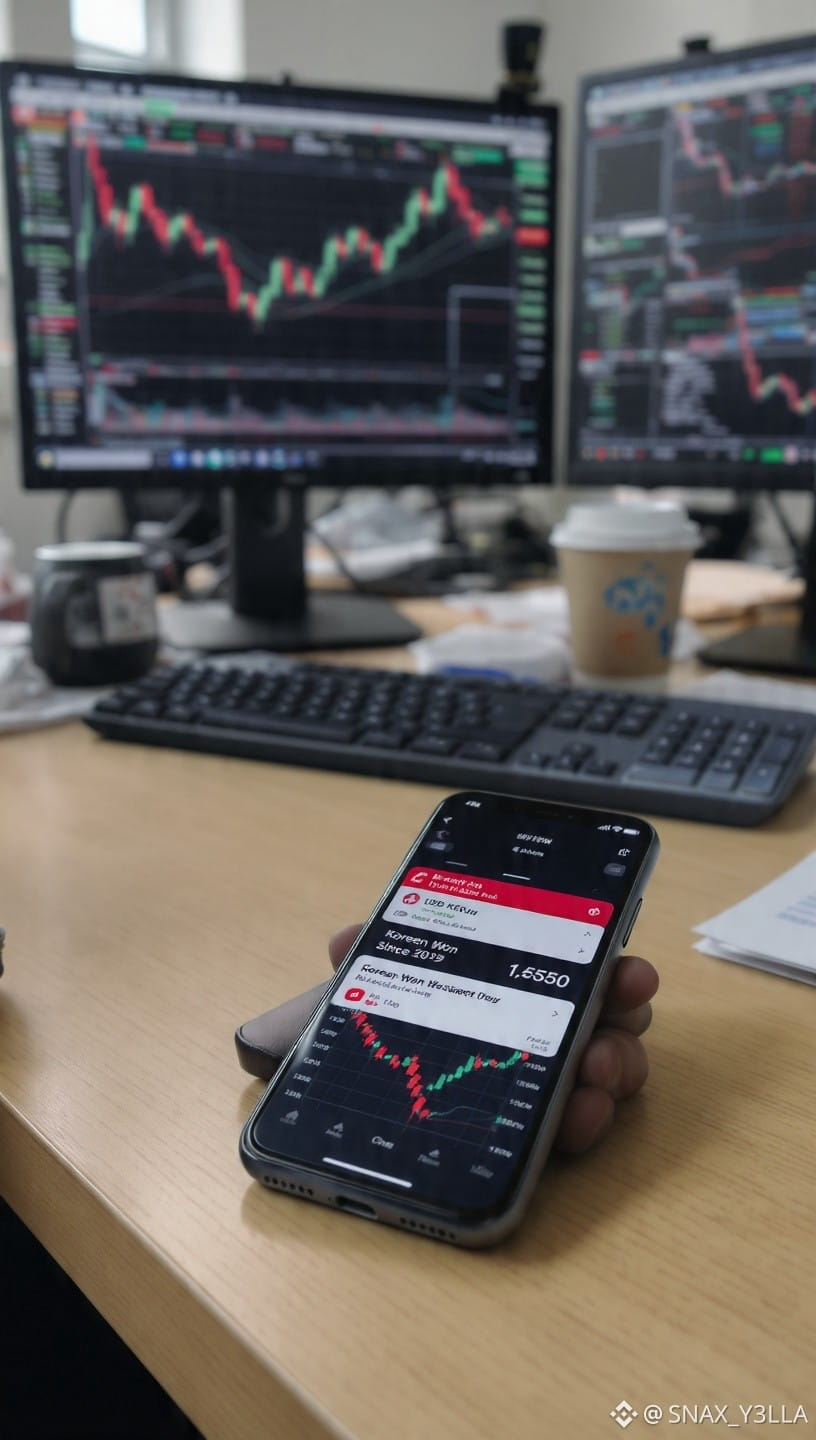
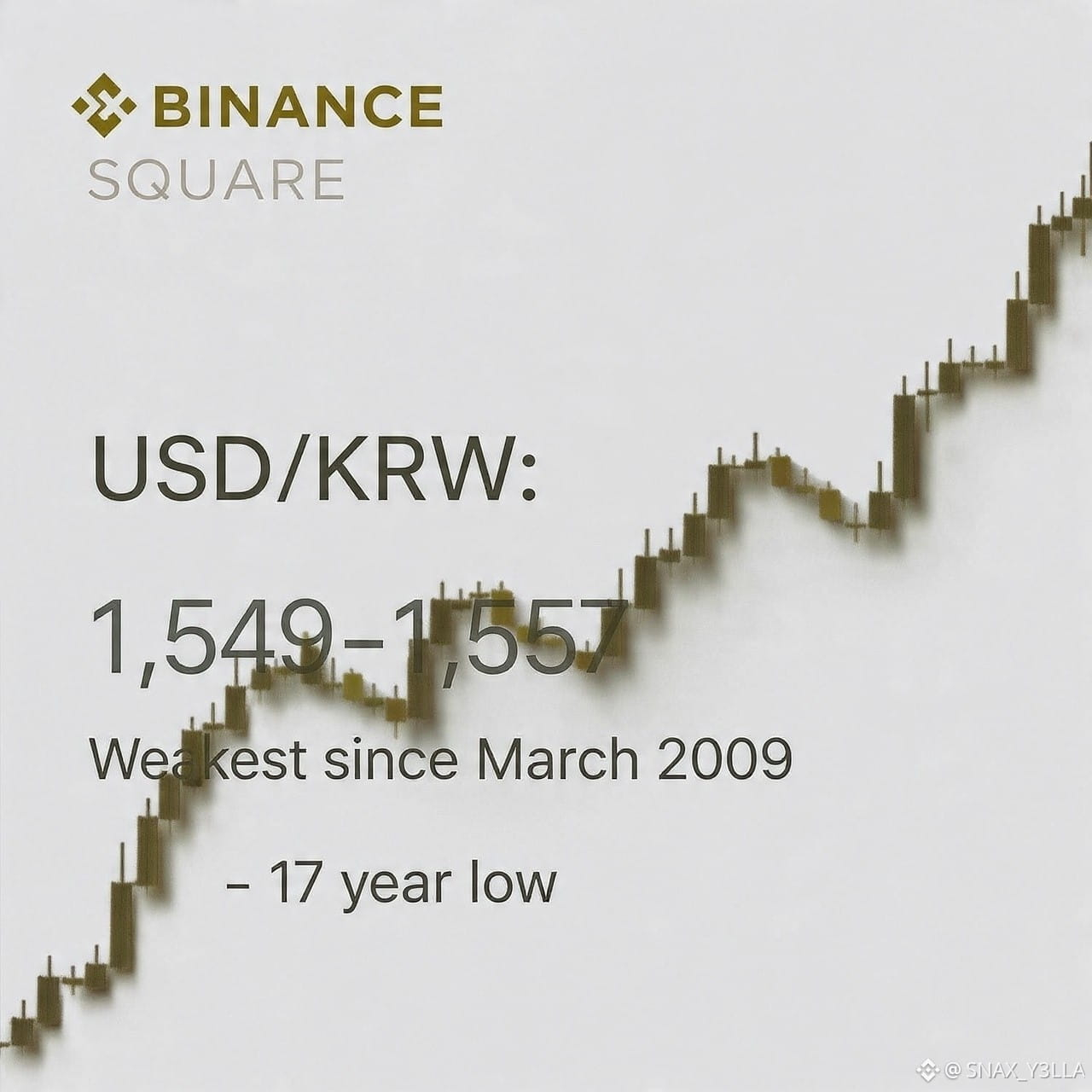
USD/KRW: ∼1,549 - 1,557
The won opened at 1,549.8 won per dollar, extending losses into the late 1550s
That’s the weakest level since March 6, 2009 at 1,550 won during the global financial crisis.
Why the won is sliding:
1. Strong dollar + hawkish Fed outlook — Rate hike expectations are keeping USD bid
2. Yen linkage — KRW is tracking JPY weakness. Yen hit 162.7 vs USD, a 40-year low
3. Foreign outflows— Foreign investors sold a net 7.7T won [$4.9B] in local stocks in one session.
Market take:
The won is now the worst performer among Asian peers. Authorities have flagged "excessive volatility" and are probing suspected speculative trading.
Despite a record current account surplus, KRW remains stubbornly weak above 1,500.
Crypto angle:
Weak fiat often pushes retail toward USD-stablecoins + BTC/ETH hedges.
With KRW at crisis-era levels, watch for higher onshore premiums on Binance P2P and increased “Ants” flow into leveraged ETFs.
#KoreanWon #KRW #USDTfree #FX
$NVDAB $ARB $APT
#KoreanWonWeakestSince2009
🇰🇷📉_Korean Won hits 17-year low vs USD today
What’s happening today
USD/KRW: ∼1,549 - 1,557
The won opened at 1,549.8 won per dollar, extending losses into the late 1550s
That’s the weakest level since March 6, 2009 at 1,550 won during the global financial crisis.
Why the won is sliding:
1. Strong dollar + hawkish Fed outlook — Rate hike expectations are keeping USD bid
2. Yen linkage — KRW is tracking JPY weakness. Yen hit 162.7 vs USD, a 40-year low
3. Foreign outflows— Foreign investors sold a net 7.7T won [$4.9B] in local stocks in one session.
Market take:
The won is now the worst performer among Asian peers. Authorities have flagged "excessive volatility" and are probing suspected speculative trading.
Despite a record current account surplus, KRW remains stubbornly weak above 1,500.
Crypto angle:
Weak fiat often pushes retail toward USD-stablecoins + BTC/ETH hedges.
With KRW at crisis-era levels, watch for higher onshore premiums on Binance P2P and increased “Ants” flow into leveraged ETFs.
#KoreanWon #KRW #USDTfree #FX
$NVDAB $ARB $APT
🇰🇷📉_Korean Won hits 17-year low vs USD today
What’s happening today
USD/KRW: ∼1,549 - 1,557
The won opened at 1,549.8 won per dollar, extending losses into the late 1550s
That’s the weakest level since March 6, 2009 at 1,550 won during the global financial crisis.
Why the won is sliding:
1. Strong dollar + hawkish Fed outlook — Rate hike expectations are keeping USD bid
2. Yen linkage — KRW is tracking JPY weakness. Yen hit 162.7 vs USD, a 40-year low
3. Foreign outflows— Foreign investors sold a net 7.7T won [$4.9B] in local stocks in one session.
Market take:
The won is now the worst performer among Asian peers. Authorities have flagged "excessive volatility" and are probing suspected speculative trading.
Despite a record current account surplus, KRW remains stubbornly weak above 1,500.
Crypto angle:
Weak fiat often pushes retail toward USD-stablecoins + BTC/ETH hedges.
With KRW at crisis-era levels, watch for higher onshore premiums on Binance P2P and increased “Ants” flow into leveraged ETFs.
#KoreanWon #KRW #USDTfree #FX
$NVDAB $ARB $APT
1
137

#KoreanWonWeakestSince2009 #KoreanWonWeakestSince2009 means the South Korean won (KRW) has fallen to its lowest value against the U.S. dollar since 2009.
In simple terms:
The Korean won has weakened significantly.
It now takes more won to buy one U.S. dollar, making imports more expensive for South Korea.
Possible reasons:
A stronger U.S. dollar.
Capital flowing out of emerging markets.
Concerns about South Korea's economic growth or exports.
Global trade uncertainty and geopolitical risks.
Potential market impact:
📉 South Korean stocks: May face pressure, especially companies reliant on imported materials.
📈 Exporters: Some exporters may benefit because their products become cheaper for overseas buyers.
💵 U.S. Dollar: Typically strengthens against the won.
🌏 Asian markets: A sharply weaker won can weigh on regional market sentiment and increase currency volatility.
#KoreanWonWeakestSince2009 #KoreanWonWeakestSince2009 means the South Korean won (KRW) has fallen to its lowest value against the U.S. dollar since 2009.
In simple terms:
The Korean won has weakened significantly.
It now takes more won to buy one U.S. dollar, making imports more expensive for South Korea.
Possible reasons:
A stronger U.S. dollar.
Capital flowing out of emerging markets.
Concerns about South Korea's economic growth or exports.
Global trade uncertainty and geopolitical risks.
Potential market impact:
📉 South Korean stocks: May face pressure, especially companies reliant on imported materials.
📈 Exporters: Some exporters may benefit because their products become cheaper for overseas buyers.
💵 U.S. Dollar: Typically strengthens against the won.
🌏 Asian markets: A sharply weaker won can weigh on regional market sentiment and increase currency volatility.
In simple terms:
The Korean won has weakened significantly.
It now takes more won to buy one U.S. dollar, making imports more expensive for South Korea.
Possible reasons:
A stronger U.S. dollar.
Capital flowing out of emerging markets.
Concerns about South Korea's economic growth or exports.
Global trade uncertainty and geopolitical risks.
Potential market impact:
📉 South Korean stocks: May face pressure, especially companies reliant on imported materials.
📈 Exporters: Some exporters may benefit because their products become cheaper for overseas buyers.
💵 U.S. Dollar: Typically strengthens against the won.
🌏 Asian markets: A sharply weaker won can weigh on regional market sentiment and increase currency volatility.
24

#KoreanWonWeakestSince2009
The South Korean won has fallen to its weakest level against the US dollar since 2009, reflecting strong demand for the dollar, foreign investor outflows, and concerns over global economic uncertainty. The currency recently closed near 1,549 won per US dollar, a level not seen since the aftermath of the 2008 global financial crisis.
A weaker won makes imports such as oil and raw materials more expensive, increasing inflationary pressure. However, it can also make South Korean exports - such as semiconductors, cars, and electronics - more competitive in global markets. Continued weakness may increase volatility across Asian markets, including crypto, as investors often move toward safer assets like the US dollar.
#KoreanWonWeakestSince2009
The South Korean won has fallen to its weakest level against the US dollar since 2009, reflecting strong demand for the dollar, foreign investor outflows, and concerns over global economic uncertainty. The currency recently closed near 1,549 won per US dollar, a level not seen since the aftermath of the 2008 global financial crisis.
A weaker won makes imports such as oil and raw materials more expensive, increasing inflationary pressure. However, it can also make South Korean exports - such as semiconductors, cars, and electronics - more competitive in global markets. Continued weakness may increase volatility across Asian markets, including crypto, as investors often move toward safer assets like the US dollar.
The South Korean won has fallen to its weakest level against the US dollar since 2009, reflecting strong demand for the dollar, foreign investor outflows, and concerns over global economic uncertainty. The currency recently closed near 1,549 won per US dollar, a level not seen since the aftermath of the 2008 global financial crisis.
A weaker won makes imports such as oil and raw materials more expensive, increasing inflationary pressure. However, it can also make South Korean exports - such as semiconductors, cars, and electronics - more competitive in global markets. Continued weakness may increase volatility across Asian markets, including crypto, as investors often move toward safer assets like the US dollar.

🇰🇷 South Korea
From Digital Mahanadi
1
2
199

·
--
#KoreanWonWeakestSince2009
This news, guys, is very concerning for the Asian market, especially the Korean market, and it’s that Won is back under considerable pressure. And these moves usually indicate fear, capital flight, and risk aversion in the market.
What’s happening, guys? When a currency breaks a long-term support line like this one, traders 👤👤👤 don’t just look at the forex market—they also look at the impact on stocks, cryptocurrencies, and the market’s overall confidence.
So STAY ALERT 👀👀👀🕵🏼♂️, guys, because this event could bring us an opportunity that we should take advantage of. $NVDAB
{spot}(NVDABUSDT)
#KoreanWonWeakestSince2009
This news, guys, is very concerning for the Asian market, especially the Korean market, and it’s that Won is back under considerable pressure. And these moves usually indicate fear, capital flight, and risk aversion in the market.
What’s happening, guys? When a currency breaks a long-term support line like this one, traders 👤👤👤 don’t just look at the forex market—they also look at the impact on stocks, cryptocurrencies, and the market’s overall confidence.
So STAY ALERT 👀👀👀🕵🏼♂️, guys, because this event could bring us an opportunity that we should take advantage of. $NVDAB
This news, guys, is very concerning for the Asian market, especially the Korean market, and it’s that Won is back under considerable pressure. And these moves usually indicate fear, capital flight, and risk aversion in the market.
What’s happening, guys? When a currency breaks a long-term support line like this one, traders 👤👤👤 don’t just look at the forex market—they also look at the impact on stocks, cryptocurrencies, and the market’s overall confidence.
So STAY ALERT 👀👀👀🕵🏼♂️, guys, because this event could bring us an opportunity that we should take advantage of. $NVDAB
1
1
69

·
--
Bullish
#koreanwonweakestsince2009
🚨 Korean Won Hits Weakest Level Since 2009
The KRW is under heavy pressure and has fallen to its lowest point in over 16 years.
This sharp decline is raising alarms about:
• Rising import costs
• Higher inflation risks
• Impact on South Korean companies and markets
A weaker won can boost exports in the short term, but it also signals broader economic worries in Asia.
Is this a buying opportunity for Korean assets or a red flag for the region?
What’s your view on KRW and Asian markets right now? 👇
#KoreanWon #KRW #Economy
#koreanwonweakestsince2009
🚨 Korean Won Hits Weakest Level Since 2009
The KRW is under heavy pressure and has fallen to its lowest point in over 16 years.
This sharp decline is raising alarms about:
• Rising import costs
• Higher inflation risks
• Impact on South Korean companies and markets
A weaker won can boost exports in the short term, but it also signals broader economic worries in Asia.
Is this a buying opportunity for Korean assets or a red flag for the region?
What’s your view on KRW and Asian markets right now? 👇
#KoreanWon #KRW #Economy
🚨 Korean Won Hits Weakest Level Since 2009
The KRW is under heavy pressure and has fallen to its lowest point in over 16 years.
This sharp decline is raising alarms about:
• Rising import costs
• Higher inflation risks
• Impact on South Korean companies and markets
A weaker won can boost exports in the short term, but it also signals broader economic worries in Asia.
Is this a buying opportunity for Korean assets or a red flag for the region?
What’s your view on KRW and Asian markets right now? 👇
#KoreanWon #KRW #Economy
61

·
--
#KoreanWonWeakestSince2009 South Korean Won (KRW) currency has slumped to its weakest level against the US Dollar (USD) since March 2009, triggered by large-scale selling by foreign investors in the domestic stock market as well as a massive strengthening trend of the US Dollar at the global level.
#KoreanWonWeakestSince2009 South Korean Won (KRW) currency has slumped to its weakest level against the US Dollar (USD) since March 2009, triggered by large-scale selling by foreign investors in the domestic stock market as well as a massive strengthening trend of the US Dollar at the global level.
77

#KoreanWonWeakestSince2009 🚨🇰🇷
Something BIG is happening in Asia...
South Korea's won just crashed to its weakest level since 2009, briefly hitting 1,562 per US dollar.
This isn't just a currency move—it could be a warning that global capital is running for safety.
⚠️ What's causing the panic?
💸 Foreign investors have dumped ₩1.46 trillion ($938M) in Korean stocks in just 8 trading sessions.
🤖 The AI trade is losing momentum as traders take profits in giants like Samsung Electronics and SK Hynix.
💵 The US dollar keeps getting stronger, pulling money out of Asian markets and into safer assets.
Here's the shocking part...
📈 South Korea's exports just hit record highs.
📊 The country also posted a record trade surplus.
Normally, that should strengthen the currency.
Not this time.
Global money flows are overpowering strong economic fundamentals—and that's a major red flag.
👀 Watch 1,562 carefully.
If that level fails, 1,600 KRW per USD could be the next stop.
Markets that could feel the impact:
📉 KOSPI
🤖 AI chip stocks
💵 US Dollar Index (DXY)
🪙 Global risk assets, including crypto
🔥 Smart money usually moves in currencies before the stock market reacts.
Is this just another dip... or the first warning of a much bigger market shift?
👇 Drop your prediction below.
#SouthKorea #KRW #KOSPI #Forex #AI #Crypto #Binance #Markets
$KORU
{future}(KORUUSDT)
$SAMSUNG
{future}(SAMSUNGUSDT)
$SKHYNIX
{future}(SKHYNIXUSDT)
#KoreanWonWeakestSince2009 🚨🇰🇷
Something BIG is happening in Asia...
South Korea's won just crashed to its weakest level since 2009, briefly hitting 1,562 per US dollar.
This isn't just a currency move—it could be a warning that global capital is running for safety.
⚠️ What's causing the panic?
💸 Foreign investors have dumped ₩1.46 trillion ($938M) in Korean stocks in just 8 trading sessions.
🤖 The AI trade is losing momentum as traders take profits in giants like Samsung Electronics and SK Hynix.
💵 The US dollar keeps getting stronger, pulling money out of Asian markets and into safer assets.
Here's the shocking part...
📈 South Korea's exports just hit record highs.
📊 The country also posted a record trade surplus.
Normally, that should strengthen the currency.
Not this time.
Global money flows are overpowering strong economic fundamentals—and that's a major red flag.
👀 Watch 1,562 carefully.
If that level fails, 1,600 KRW per USD could be the next stop.
Markets that could feel the impact:
📉 KOSPI
🤖 AI chip stocks
💵 US Dollar Index (DXY)
🪙 Global risk assets, including crypto
🔥 Smart money usually moves in currencies before the stock market reacts.
Is this just another dip... or the first warning of a much bigger market shift?
👇 Drop your prediction below.
#SouthKorea #KRW #KOSPI #Forex #AI #Crypto #Binance #Markets
$KORU
$SAMSUNG
$SKHYNIX
Something BIG is happening in Asia...
South Korea's won just crashed to its weakest level since 2009, briefly hitting 1,562 per US dollar.
This isn't just a currency move—it could be a warning that global capital is running for safety.
⚠️ What's causing the panic?
💸 Foreign investors have dumped ₩1.46 trillion ($938M) in Korean stocks in just 8 trading sessions.
🤖 The AI trade is losing momentum as traders take profits in giants like Samsung Electronics and SK Hynix.
💵 The US dollar keeps getting stronger, pulling money out of Asian markets and into safer assets.
Here's the shocking part...
📈 South Korea's exports just hit record highs.
📊 The country also posted a record trade surplus.
Normally, that should strengthen the currency.
Not this time.
Global money flows are overpowering strong economic fundamentals—and that's a major red flag.
👀 Watch 1,562 carefully.
If that level fails, 1,600 KRW per USD could be the next stop.
Markets that could feel the impact:
📉 KOSPI
🤖 AI chip stocks
💵 US Dollar Index (DXY)
🪙 Global risk assets, including crypto
🔥 Smart money usually moves in currencies before the stock market reacts.
Is this just another dip... or the first warning of a much bigger market shift?
👇 Drop your prediction below.
#SouthKorea #KRW #KOSPI #Forex #AI #Crypto #Binance #Markets
$KORU
$SAMSUNG
$SKHYNIX

748

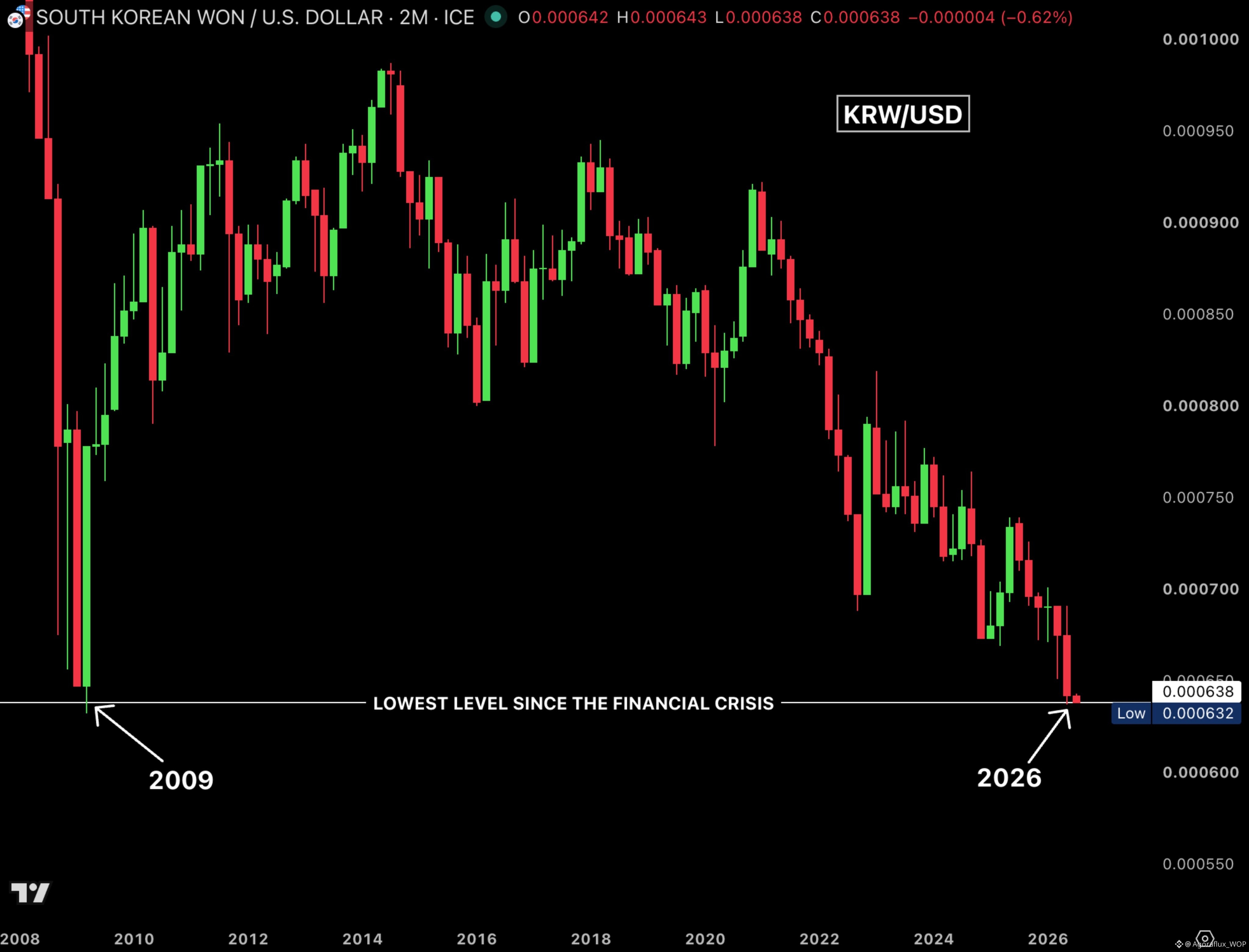
BREAKING: The South Korean WON just hit its weakest level against US dollar since 2008 financial crisis.
KRW/USD is down 7.5% in the last 2 months alone.
Global investors have been pulling capital out of Korean markets as concerns around AI valuations and chip sector growth build.
When foreign investors sell Korean stocks, they convert won back into their local currency, and that selling pressure is showing up directly in the currency.
#KoreanWonWeakestSince2009
BREAKING: The South Korean WON just hit its weakest level against US dollar since 2008 financial crisis.
KRW/USD is down 7.5% in the last 2 months alone.
Global investors have been pulling capital out of Korean markets as concerns around AI valuations and chip sector growth build.
When foreign investors sell Korean stocks, they convert won back into their local currency, and that selling pressure is showing up directly in the currency.
#KoreanWonWeakestSince2009
KRW/USD is down 7.5% in the last 2 months alone.
Global investors have been pulling capital out of Korean markets as concerns around AI valuations and chip sector growth build.
When foreign investors sell Korean stocks, they convert won back into their local currency, and that selling pressure is showing up directly in the currency.
#KoreanWonWeakestSince2009
112
#koreanwonweakestsince2009
BREAKING: KOREAN WON JUST HIT ITS WEAKEST ZONE SINCE 2009!
The won is under heavy pressure again, and this kind of move usually screams fear, capital outflow, and risk-off sentiment across markets.
When a currency starts breaking long-term support like this, traders don’t just watch FX — they watch for spillover into stocks, crypto, and overall market confidence.
This is the kind of move that can trigger panic on one side and opportunity on the other. Are you buying the fear, or do you think this is only the beginning of a bigger slide? Follow and like for more fast market updates
#TrendingTopic #CryptoNews #KRW
#koreanwonweakestsince2009
BREAKING: KOREAN WON JUST HIT ITS WEAKEST ZONE SINCE 2009!
The won is under heavy pressure again, and this kind of move usually screams fear, capital outflow, and risk-off sentiment across markets.
When a currency starts breaking long-term support like this, traders don’t just watch FX — they watch for spillover into stocks, crypto, and overall market confidence.
This is the kind of move that can trigger panic on one side and opportunity on the other. Are you buying the fear, or do you think this is only the beginning of a bigger slide? Follow and like for more fast market updates
#TrendingTopic #CryptoNews #KRW
BREAKING: KOREAN WON JUST HIT ITS WEAKEST ZONE SINCE 2009!
The won is under heavy pressure again, and this kind of move usually screams fear, capital outflow, and risk-off sentiment across markets.
When a currency starts breaking long-term support like this, traders don’t just watch FX — they watch for spillover into stocks, crypto, and overall market confidence.
This is the kind of move that can trigger panic on one side and opportunity on the other. Are you buying the fear, or do you think this is only the beginning of a bigger slide? Follow and like for more fast market updates
#TrendingTopic #CryptoNews #KRW
59
·
--
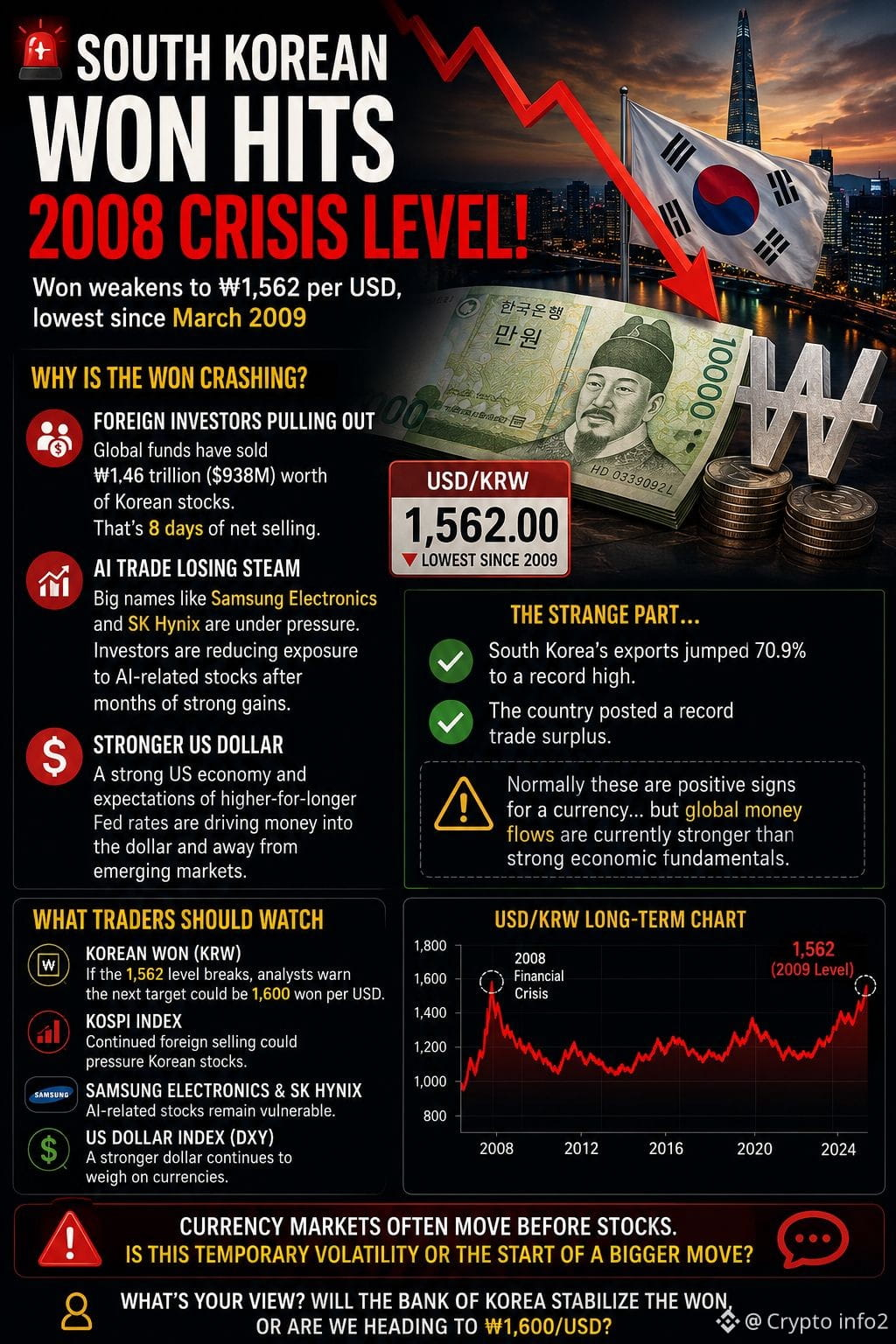
#KoreanWonWeakestSince2009 🚨 South Korean Won Hits Its Weakest Level Since the Global Financial Crisis.$KORU
The Korean won briefly plunged to around ₩1,562 per US dollar, its weakest level since 2009, raising concerns that global capital is shifting toward safe-haven assets.$SKHYNIX
📉 What's driving the sell-off? • Foreign investors have sold over ₩1.46 trillion ($938M) in Korean stocks across eight straight sessions. • AI-related stocks, including Samsung Electronics and SK Hynix, are facing heavy pressure as investors take profits. • A stronger US dollar and expectations of higher-for-longer Fed interest rates continue to weigh on Asian currencies.$SAMSUNG
📊 The surprising part Despite the currency weakness: ✅ South Korea's exports surged to a record high. ✅ The country posted a record trade surplus.
This suggests that global capital flows are currently having a bigger impact than strong economic fundamentals.
👀 Markets to watch 🔸 Korean won (KRW) 🔸 KOSPI Index 🔸 Samsung Electronics & SK Hynix 🔸 US Dollar Index (DXY)
⚠️ If the ₩1,562 level fails to hold, some analysts see ₩1,600/USD as the next major psychological level.
🔥 Currency markets often move before equities. Is this just short-term volatility, or an early warning of broader market stress?
💬 What's your outlook? Will the Bank of Korea stabilize the won, or is ₩1,600/USD next?
#SouthKorea #KRW #Forex #DXY
{future}(KORUUSDT)
{future}(SKHYNIXUSDT)
{future}(SAMSUNGUSDT)
#KoreanWonWeakestSince2009 🚨 South Korean Won Hits Its Weakest Level Since the Global Financial Crisis.$KORU
The Korean won briefly plunged to around ₩1,562 per US dollar, its weakest level since 2009, raising concerns that global capital is shifting toward safe-haven assets.$SKHYNIX
📉 What's driving the sell-off? • Foreign investors have sold over ₩1.46 trillion ($938M) in Korean stocks across eight straight sessions. • AI-related stocks, including Samsung Electronics and SK Hynix, are facing heavy pressure as investors take profits. • A stronger US dollar and expectations of higher-for-longer Fed interest rates continue to weigh on Asian currencies.$SAMSUNG
📊 The surprising part Despite the currency weakness: ✅ South Korea's exports surged to a record high. ✅ The country posted a record trade surplus.
This suggests that global capital flows are currently having a bigger impact than strong economic fundamentals.
👀 Markets to watch 🔸 Korean won (KRW) 🔸 KOSPI Index 🔸 Samsung Electronics & SK Hynix 🔸 US Dollar Index (DXY)
⚠️ If the ₩1,562 level fails to hold, some analysts see ₩1,600/USD as the next major psychological level.
🔥 Currency markets often move before equities. Is this just short-term volatility, or an early warning of broader market stress?
💬 What's your outlook? Will the Bank of Korea stabilize the won, or is ₩1,600/USD next?
#SouthKorea #KRW #Forex #DXY
The Korean won briefly plunged to around ₩1,562 per US dollar, its weakest level since 2009, raising concerns that global capital is shifting toward safe-haven assets.$SKHYNIX
📉 What's driving the sell-off? • Foreign investors have sold over ₩1.46 trillion ($938M) in Korean stocks across eight straight sessions. • AI-related stocks, including Samsung Electronics and SK Hynix, are facing heavy pressure as investors take profits. • A stronger US dollar and expectations of higher-for-longer Fed interest rates continue to weigh on Asian currencies.$SAMSUNG
📊 The surprising part Despite the currency weakness: ✅ South Korea's exports surged to a record high. ✅ The country posted a record trade surplus.
This suggests that global capital flows are currently having a bigger impact than strong economic fundamentals.
👀 Markets to watch 🔸 Korean won (KRW) 🔸 KOSPI Index 🔸 Samsung Electronics & SK Hynix 🔸 US Dollar Index (DXY)
⚠️ If the ₩1,562 level fails to hold, some analysts see ₩1,600/USD as the next major psychological level.
🔥 Currency markets often move before equities. Is this just short-term volatility, or an early warning of broader market stress?
💬 What's your outlook? Will the Bank of Korea stabilize the won, or is ₩1,600/USD next?
#SouthKorea #KRW #Forex #DXY
47

·
--
Article
🦘 🤔#KoreanWonWeakestSince2009
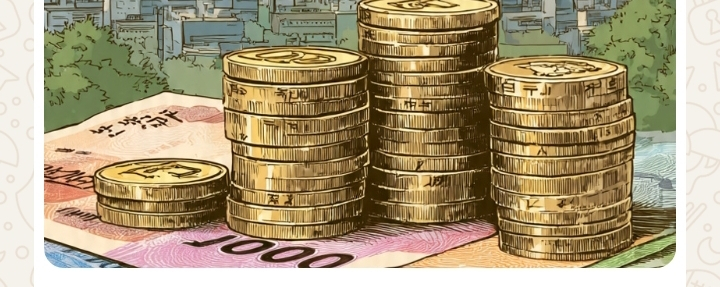
*The visual*: KRW notes + USD/KRW chart breaking higher.
*What’s Happening*
The *Korean Won [KRW]* has weakened to levels not seen *since 2009*, during the Global Financial Crisis.
USD/KRW has pushed toward 1,400+ territory, meaning it takes 1,400+ Won to buy $1. For context, KRW was ∼1,200 just months ago.
*1. Why The Won Is Collapsing Now*
**Driver** **Explanation**
**1. Dollar Strength [DXY]** The Fed holding rates higher-for-longer + safe-haven flows = broad USD rally. KRW, as a high-beta EM currency, gets hit hardest.
**2. BoK vs Fed Divergence** Bank of Korea is more dovish than the Fed. Rate differentials make USD assets more attractive vs KRW.
**3. Export Slowdown Fears** Korea is a trade-heavy economy. Weaker China demand + tech cycle concerns hurt the trade balance and KRW sentiment.
**4. Risk-Off Sentiment** Geopolitics, Middle East, and growth worries drive “carry unwinds.” Investors exit KRW-funded trades for USD.
**5. Thin Liquidity** EM FX moves fast when liquidity drops. A few large USD buyers can spike USD/KRW.
### *2. 2009 vs 2025: Is This The Same?*
*2009*: Lehman collapse, global credit freeze, Korean corporates with USD debt. KRW fell ∼50% in months.
*2025*: No credit freeze, but: strong USD, AI/tech export uncertainty, and Korea’s household debt load. FX reserves are much stronger now at ∼$420B+.
So: *Same FX level, different underlying risk.*
3. Who Wins, Who Loses From A Weak Won*
*Winners*
1. *Exporters*: Samsung, SK Hynix, Hyundai, shipbuilders. A weaker KRW makes K-pop, chips, cars, and ships cheaper abroad. Margins in USD terms rise.
2. *Tourism*: Korea becomes cheaper for foreign visitors.
*Losers*
1. *Importers & Consumers*: Oil, LNG, and food are priced in USD. KRW weakness = higher inflation at the pump and grocery store.
2. *Koreans Abroad / Students*: Studying or traveling in the U.S. just got ∼15% more expensive.
3. *Companies with USD Debt*: Debt servicing costs more in KRW terms.
*4. What The Bank of Korea Can Do*
1. *FX Intervention*: Sell USD reserves, buy KRW. BOK has done “smoothing operations” already.
2. *Rate Hikes / Hold*: Raising rates supports KRW, but hurts domestic growth and housing.
3. *Swap Lines*: Coordinate with the Fed for USD liquidity if stress spikes.
4. *Verbal Intervention*: Warn speculators. It worked in 2022 when USD/KRW neared 1,440.
Markets are watching for BOK action near 1,450 — the 2009 high.
*5. Crypto & Market Angle*
1. *Kimchi Premium*: A weak KRW often widens the BTC/KRW vs BTC/USD premium as locals seek dollar exposure.
2. *KOSPI Pressure*: Import cost inflation + higher rates = headwinds for Korean equities.
3. *Carry Trade Unwind*: KRW was used to fund risk trades. A weaker KRW forces liquidations elsewhere.
#KoreanWonWeakestSince2009 is not a 2009-style crisis yet. It’s a *USD strength story* hitting a trade-exposed, rate-sensitive EM currency.
Short term = BOK intervention risk, higher import inflation, exporter relief.
Long term = If USD keeps rallying or China slows, 1,500 USD/KRW is on the table. If the Fed cuts, KRW rebounds fast.
*For traders*: Watch USD/KRW 1,450 as the line in the sand. A break + hold above it, and BOK likely steps in hard.
_Not financial advice. EM FX is volatile and policy-driven._
What’s Happening
The Korean Won [KRW] has weakened to levels not seen since 2009, during the Global Financial Crisis.
USD/KRW has pushed toward 1,400+ territory, meaning it takes 1,400+ Won to buy $1. For context, KRW was ∼1,200 just months ago.
1. Why The Won Is Collapsing Now
Explanation
1. Dollar Strength [DXY] The Fed holding rates higher-for-longer + safe-haven flows = broad USD rally. KRW, as a high-beta EM currency, gets hit hardest.
2. BoK vs Fed Divergence Bank of Korea is more dovish than the Fed. Rate differentials make USD assets more attractive vs KRW.
3. Export Slowdown Fears Korea is a trade-heavy economy. Weaker China demand + tech cycle concerns hurt the trade balance and KRW sentiment.
4. Risk-Off Sentiment Geopolitics, Middle East, and growth worries drive “carry unwinds.” Investors exit KRW-funded trades for USD.
5. Thin Liquidity EM FX moves fast when liquidity drops. A few large USD buyers can spike USD/KRW.
2. 2009 vs 2025: Is This The Same?
2009: Lehman collapse, global credit freeze, Korean corporates with USD debt. KRW fell ∼50% in months.
2025: No credit freeze, but: strong USD, AI/tech export uncertainty, and Korea’s household debt load. FX reserves are much stronger now at ∼$420B+.
So: Same FX level, different underlying risk.
3. Who Wins, Who Loses From A Weak Won
Winners
1. Exporters: Samsung, SK Hynix, Hyundai, shipbuilders. A weaker KRW makes K-pop, chips, cars, and ships cheaper abroad. Margins in USD terms rise.
2. Tourism: Korea becomes cheaper for foreign visitors.
Losers
1. Importers & Consumers: Oil, LNG, and food are priced in USD. KRW weakness = higher inflation at the pump and grocery store.
2. Koreans Abroad / Students: Studying or traveling in the U.S. just got ∼15% more expensive.
3. Companies with USD Debt: Debt servicing costs more in KRW terms.
4. What The Bank of Korea Can Do
1. FX Intervention: Sell USD reserves, buy KRW. BOK has done “smoothing operations” already.
2. Rate Hikes / Hold: Raising rates supports KRW, but hurts domestic growth and housing.
3. Swap Lines: Coordinate with the Fed for USD liquidity if stress spikes.
4. Verbal Intervention: Warn speculators. It worked in 2022 when USD/KRW neared 1,440.
Markets are watching for BOK action near 1,450 — the 2009 high.
5. Crypto & Market Angle
1. Kimchi Premium: A weak KRW often widens the BTC/KRW vs BTC/USD premium as locals seek dollar exposure.
2. KOSPI Pressure: Import cost inflation + higher rates = headwinds for Korean equities.
3. Carry Trade Unwind: KRW was used to fund risk trades. A weaker KRW forces liquidations elsewhere.
#KoreanWonWeakestSince2009 is not a 2009-style crisis yet. It’s a USD strength story hitting a trade-exposed, rate-sensitive EM currency.
Short term = BOK intervention risk, higher import inflation, exporter relief.
Long term = If USD keeps rallying or China slows, 1,500 USD/KRW is on the table. If the Fed cuts, KRW rebounds fast.
For traders: Watch USD/KRW 1,450 as the line in the sand. A break + hold above it, and BOK likely steps in hard.
Not financial advice. EM FX is volatile and policy-driven.
{spot}(MUBUSDT)
{spot}(QQQBUSDT)
🦘 🤔
#KoreanWonWeakestSince2009
*The visual*: KRW notes + USD/KRW chart breaking higher.
*What’s Happening*
The *Korean Won [KRW]* has weakened to levels not seen *since 2009*, during the Global Financial Crisis.
USD/KRW has pushed toward 1,400+ territory, meaning it takes 1,400+ Won to buy $1. For context, KRW was ∼1,200 just months ago.
*1. Why The Won Is Collapsing Now*
**Driver** **Explanation**
**1. Dollar Strength [DXY]** The Fed holding rates higher-for-longer + safe-haven flows = broad USD rally. KRW, as a high-beta EM currency, gets hit hardest.
**2. BoK vs Fed Divergence** Bank of Korea is more dovish than the Fed. Rate differentials make USD assets more attractive vs KRW.
**3. Export Slowdown Fears** Korea is a trade-heavy economy. Weaker China demand + tech cycle concerns hurt the trade balance and KRW sentiment.
**4. Risk-Off Sentiment** Geopolitics, Middle East, and growth worries drive “carry unwinds.” Investors exit KRW-funded trades for USD.
**5. Thin Liquidity** EM FX moves fast when liquidity drops. A few large USD buyers can spike USD/KRW.
### *2. 2009 vs 2025: Is This The Same?*
*2009*: Lehman collapse, global credit freeze, Korean corporates with USD debt. KRW fell ∼50% in months.
*2025*: No credit freeze, but: strong USD, AI/tech export uncertainty, and Korea’s household debt load. FX reserves are much stronger now at ∼$420B+.
So: *Same FX level, different underlying risk.*
3. Who Wins, Who Loses From A Weak Won*
*Winners*
1. *Exporters*: Samsung, SK Hynix, Hyundai, shipbuilders. A weaker KRW makes K-pop, chips, cars, and ships cheaper abroad. Margins in USD terms rise.
2. *Tourism*: Korea becomes cheaper for foreign visitors.
*Losers*
1. *Importers & Consumers*: Oil, LNG, and food are priced in USD. KRW weakness = higher inflation at the pump and grocery store.
2. *Koreans Abroad / Students*: Studying or traveling in the U.S. just got ∼15% more expensive.
3. *Companies with USD Debt*: Debt servicing costs more in KRW terms.
*4. What The Bank of Korea Can Do*
1. *FX Intervention*: Sell USD reserves, buy KRW. BOK has done “smoothing operations” already.
2. *Rate Hikes / Hold*: Raising rates supports KRW, but hurts domestic growth and housing.
3. *Swap Lines*: Coordinate with the Fed for USD liquidity if stress spikes.
4. *Verbal Intervention*: Warn speculators. It worked in 2022 when USD/KRW neared 1,440.
Markets are watching for BOK action near 1,450 — the 2009 high.
*5. Crypto & Market Angle*
1. *Kimchi Premium*: A weak KRW often widens the BTC/KRW vs BTC/USD premium as locals seek dollar exposure.
2. *KOSPI Pressure*: Import cost inflation + higher rates = headwinds for Korean equities.
3. *Carry Trade Unwind*: KRW was used to fund risk trades. A weaker KRW forces liquidations elsewhere.
#KoreanWonWeakestSince2009 is not a 2009-style crisis yet. It’s a *USD strength story* hitting a trade-exposed, rate-sensitive EM currency.
Short term = BOK intervention risk, higher import inflation, exporter relief.
Long term = If USD keeps rallying or China slows, 1,500 USD/KRW is on the table. If the Fed cuts, KRW rebounds fast.
*For traders*: Watch USD/KRW 1,450 as the line in the sand. A break + hold above it, and BOK likely steps in hard.
_Not financial advice. EM FX is volatile and policy-driven._
What’s Happening
The Korean Won [KRW] has weakened to levels not seen since 2009, during the Global Financial Crisis.
USD/KRW has pushed toward 1,400+ territory, meaning it takes 1,400+ Won to buy $1. For context, KRW was ∼1,200 just months ago.
1. Why The Won Is Collapsing Now
Explanation
1. Dollar Strength [DXY] The Fed holding rates higher-for-longer + safe-haven flows = broad USD rally. KRW, as a high-beta EM currency, gets hit hardest.
2. BoK vs Fed Divergence Bank of Korea is more dovish than the Fed. Rate differentials make USD assets more attractive vs KRW.
3. Export Slowdown Fears Korea is a trade-heavy economy. Weaker China demand + tech cycle concerns hurt the trade balance and KRW sentiment.
4. Risk-Off Sentiment Geopolitics, Middle East, and growth worries drive “carry unwinds.” Investors exit KRW-funded trades for USD.
5. Thin Liquidity EM FX moves fast when liquidity drops. A few large USD buyers can spike USD/KRW.
2. 2009 vs 2025: Is This The Same?
2009: Lehman collapse, global credit freeze, Korean corporates with USD debt. KRW fell ∼50% in months.
2025: No credit freeze, but: strong USD, AI/tech export uncertainty, and Korea’s household debt load. FX reserves are much stronger now at ∼$420B+.
So: Same FX level, different underlying risk.
3. Who Wins, Who Loses From A Weak Won
Winners
1. Exporters: Samsung, SK Hynix, Hyundai, shipbuilders. A weaker KRW makes K-pop, chips, cars, and ships cheaper abroad. Margins in USD terms rise.
2. Tourism: Korea becomes cheaper for foreign visitors.
Losers
1. Importers & Consumers: Oil, LNG, and food are priced in USD. KRW weakness = higher inflation at the pump and grocery store.
2. Koreans Abroad / Students: Studying or traveling in the U.S. just got ∼15% more expensive.
3. Companies with USD Debt: Debt servicing costs more in KRW terms.
4. What The Bank of Korea Can Do
1. FX Intervention: Sell USD reserves, buy KRW. BOK has done “smoothing operations” already.
2. Rate Hikes / Hold: Raising rates supports KRW, but hurts domestic growth and housing.
3. Swap Lines: Coordinate with the Fed for USD liquidity if stress spikes.
4. Verbal Intervention: Warn speculators. It worked in 2022 when USD/KRW neared 1,440.
Markets are watching for BOK action near 1,450 — the 2009 high.
5. Crypto & Market Angle
1. Kimchi Premium: A weak KRW often widens the BTC/KRW vs BTC/USD premium as locals seek dollar exposure.
2. KOSPI Pressure: Import cost inflation + higher rates = headwinds for Korean equities.
3. Carry Trade Unwind: KRW was used to fund risk trades. A weaker KRW forces liquidations elsewhere.
#KoreanWonWeakestSince2009 is not a 2009-style crisis yet. It’s a USD strength story hitting a trade-exposed, rate-sensitive EM currency.
Short term = BOK intervention risk, higher import inflation, exporter relief.
Long term = If USD keeps rallying or China slows, 1,500 USD/KRW is on the table. If the Fed cuts, KRW rebounds fast.
For traders: Watch USD/KRW 1,450 as the line in the sand. A break + hold above it, and BOK likely steps in hard.
Not financial advice. EM FX is volatile and policy-driven.
*The visual*: KRW notes + USD/KRW chart breaking higher.
*What’s Happening*
The *Korean Won [KRW]* has weakened to levels not seen *since 2009*, during the Global Financial Crisis.
USD/KRW has pushed toward 1,400+ territory, meaning it takes 1,400+ Won to buy $1. For context, KRW was ∼1,200 just months ago.
*1. Why The Won Is Collapsing Now*
**Driver** **Explanation**
**1. Dollar Strength [DXY]** The Fed holding rates higher-for-longer + safe-haven flows = broad USD rally. KRW, as a high-beta EM currency, gets hit hardest.
**2. BoK vs Fed Divergence** Bank of Korea is more dovish than the Fed. Rate differentials make USD assets more attractive vs KRW.
**3. Export Slowdown Fears** Korea is a trade-heavy economy. Weaker China demand + tech cycle concerns hurt the trade balance and KRW sentiment.
**4. Risk-Off Sentiment** Geopolitics, Middle East, and growth worries drive “carry unwinds.” Investors exit KRW-funded trades for USD.
**5. Thin Liquidity** EM FX moves fast when liquidity drops. A few large USD buyers can spike USD/KRW.
### *2. 2009 vs 2025: Is This The Same?*
*2009*: Lehman collapse, global credit freeze, Korean corporates with USD debt. KRW fell ∼50% in months.
*2025*: No credit freeze, but: strong USD, AI/tech export uncertainty, and Korea’s household debt load. FX reserves are much stronger now at ∼$420B+.
So: *Same FX level, different underlying risk.*
3. Who Wins, Who Loses From A Weak Won*
*Winners*
1. *Exporters*: Samsung, SK Hynix, Hyundai, shipbuilders. A weaker KRW makes K-pop, chips, cars, and ships cheaper abroad. Margins in USD terms rise.
2. *Tourism*: Korea becomes cheaper for foreign visitors.
*Losers*
1. *Importers & Consumers*: Oil, LNG, and food are priced in USD. KRW weakness = higher inflation at the pump and grocery store.
2. *Koreans Abroad / Students*: Studying or traveling in the U.S. just got ∼15% more expensive.
3. *Companies with USD Debt*: Debt servicing costs more in KRW terms.
*4. What The Bank of Korea Can Do*
1. *FX Intervention*: Sell USD reserves, buy KRW. BOK has done “smoothing operations” already.
2. *Rate Hikes / Hold*: Raising rates supports KRW, but hurts domestic growth and housing.
3. *Swap Lines*: Coordinate with the Fed for USD liquidity if stress spikes.
4. *Verbal Intervention*: Warn speculators. It worked in 2022 when USD/KRW neared 1,440.
Markets are watching for BOK action near 1,450 — the 2009 high.
*5. Crypto & Market Angle*
1. *Kimchi Premium*: A weak KRW often widens the BTC/KRW vs BTC/USD premium as locals seek dollar exposure.
2. *KOSPI Pressure*: Import cost inflation + higher rates = headwinds for Korean equities.
3. *Carry Trade Unwind*: KRW was used to fund risk trades. A weaker KRW forces liquidations elsewhere.
#KoreanWonWeakestSince2009 is not a 2009-style crisis yet. It’s a *USD strength story* hitting a trade-exposed, rate-sensitive EM currency.
Short term = BOK intervention risk, higher import inflation, exporter relief.
Long term = If USD keeps rallying or China slows, 1,500 USD/KRW is on the table. If the Fed cuts, KRW rebounds fast.
*For traders*: Watch USD/KRW 1,450 as the line in the sand. A break + hold above it, and BOK likely steps in hard.
_Not financial advice. EM FX is volatile and policy-driven._
What’s Happening
The Korean Won [KRW] has weakened to levels not seen since 2009, during the Global Financial Crisis.
USD/KRW has pushed toward 1,400+ territory, meaning it takes 1,400+ Won to buy $1. For context, KRW was ∼1,200 just months ago.
1. Why The Won Is Collapsing Now
Explanation
1. Dollar Strength [DXY] The Fed holding rates higher-for-longer + safe-haven flows = broad USD rally. KRW, as a high-beta EM currency, gets hit hardest.
2. BoK vs Fed Divergence Bank of Korea is more dovish than the Fed. Rate differentials make USD assets more attractive vs KRW.
3. Export Slowdown Fears Korea is a trade-heavy economy. Weaker China demand + tech cycle concerns hurt the trade balance and KRW sentiment.
4. Risk-Off Sentiment Geopolitics, Middle East, and growth worries drive “carry unwinds.” Investors exit KRW-funded trades for USD.
5. Thin Liquidity EM FX moves fast when liquidity drops. A few large USD buyers can spike USD/KRW.
2. 2009 vs 2025: Is This The Same?
2009: Lehman collapse, global credit freeze, Korean corporates with USD debt. KRW fell ∼50% in months.
2025: No credit freeze, but: strong USD, AI/tech export uncertainty, and Korea’s household debt load. FX reserves are much stronger now at ∼$420B+.
So: Same FX level, different underlying risk.
3. Who Wins, Who Loses From A Weak Won
Winners
1. Exporters: Samsung, SK Hynix, Hyundai, shipbuilders. A weaker KRW makes K-pop, chips, cars, and ships cheaper abroad. Margins in USD terms rise.
2. Tourism: Korea becomes cheaper for foreign visitors.
Losers
1. Importers & Consumers: Oil, LNG, and food are priced in USD. KRW weakness = higher inflation at the pump and grocery store.
2. Koreans Abroad / Students: Studying or traveling in the U.S. just got ∼15% more expensive.
3. Companies with USD Debt: Debt servicing costs more in KRW terms.
4. What The Bank of Korea Can Do
1. FX Intervention: Sell USD reserves, buy KRW. BOK has done “smoothing operations” already.
2. Rate Hikes / Hold: Raising rates supports KRW, but hurts domestic growth and housing.
3. Swap Lines: Coordinate with the Fed for USD liquidity if stress spikes.
4. Verbal Intervention: Warn speculators. It worked in 2022 when USD/KRW neared 1,440.
Markets are watching for BOK action near 1,450 — the 2009 high.
5. Crypto & Market Angle
1. Kimchi Premium: A weak KRW often widens the BTC/KRW vs BTC/USD premium as locals seek dollar exposure.
2. KOSPI Pressure: Import cost inflation + higher rates = headwinds for Korean equities.
3. Carry Trade Unwind: KRW was used to fund risk trades. A weaker KRW forces liquidations elsewhere.
#KoreanWonWeakestSince2009 is not a 2009-style crisis yet. It’s a USD strength story hitting a trade-exposed, rate-sensitive EM currency.
Short term = BOK intervention risk, higher import inflation, exporter relief.
Long term = If USD keeps rallying or China slows, 1,500 USD/KRW is on the table. If the Fed cuts, KRW rebounds fast.
For traders: Watch USD/KRW 1,450 as the line in the sand. A break + hold above it, and BOK likely steps in hard.
Not financial advice. EM FX is volatile and policy-driven.
180

Verified
#koreanwonweakestsince2009 $NVDAB 💰
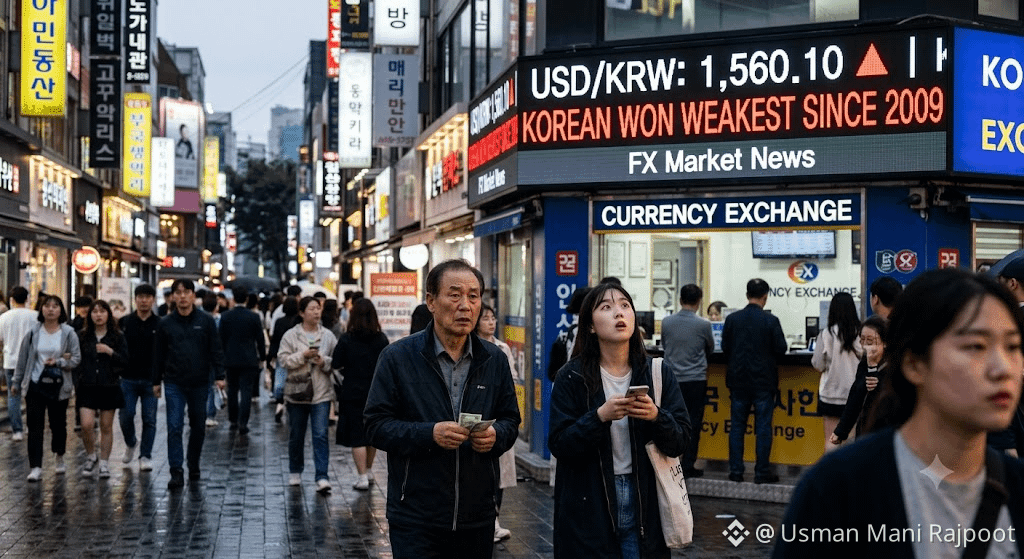
The South Korean won has fallen to its weakest level against the U.S.
dollar since the 2009 global financial crisis, highlighting mounting pressure on one of Asia’s major economies. The currency has come under heavy selling as foreign investors continue to reduce their exposure to South Korean equities, while a stronger U.S. dollar and expectations of higher U.S. interest rates have fueled capital outflows. Recent geopolitical uncertainty has also encouraged investors to seek safe-haven assets, adding further pressure on the won.
Market analysts note that the won briefly traded near 1,560 per dollar, a level not seen in more than 17 years. Despite South Korea’s strong semiconductor exports and solid trade performance, persistent foreign selling of local stocks has outweighed positive economic fundamentals. The disconnect between the country’s robust export sector and its weak currency has become a growing concern for policymakers and investors alike.
The Bank of Korea and financial authorities are closely monitoring currency movements and stand ready to respond if volatility intensifies. Meanwhile, South Korea is moving ahead with reforms such as extending foreign exchange trading hours to improve market liquidity and attract more international participation. However, analysts believe the won’s near-term direction will largely depend on the strength of the U.S. dollar, global investor sentiment, and the pace of foreign capital returning to Korean financial markets. Until those factors improve, the won is likely to remain under pressure despite the country’s resilient economic fundamentals.
#KoreanWonWeakestSince2009 $NVDAB 💰
#koreanwonweakestsince2009 $NVDAB 💰
The South Korean won has fallen to its weakest level against the U.S.
dollar since the 2009 global financial crisis, highlighting mounting pressure on one of Asia’s major economies. The currency has come under heavy selling as foreign investors continue to reduce their exposure to South Korean equities, while a stronger U.S. dollar and expectations of higher U.S. interest rates have fueled capital outflows. Recent geopolitical uncertainty has also encouraged investors to seek safe-haven assets, adding further pressure on the won.
Market analysts note that the won briefly traded near 1,560 per dollar, a level not seen in more than 17 years. Despite South Korea’s strong semiconductor exports and solid trade performance, persistent foreign selling of local stocks has outweighed positive economic fundamentals. The disconnect between the country’s robust export sector and its weak currency has become a growing concern for policymakers and investors alike.
The Bank of Korea and financial authorities are closely monitoring currency movements and stand ready to respond if volatility intensifies. Meanwhile, South Korea is moving ahead with reforms such as extending foreign exchange trading hours to improve market liquidity and attract more international participation. However, analysts believe the won’s near-term direction will largely depend on the strength of the U.S. dollar, global investor sentiment, and the pace of foreign capital returning to Korean financial markets. Until those factors improve, the won is likely to remain under pressure despite the country’s resilient economic fundamentals.
#KoreanWonWeakestSince2009 $NVDAB 💰
The South Korean won has fallen to its weakest level against the U.S.
dollar since the 2009 global financial crisis, highlighting mounting pressure on one of Asia’s major economies. The currency has come under heavy selling as foreign investors continue to reduce their exposure to South Korean equities, while a stronger U.S. dollar and expectations of higher U.S. interest rates have fueled capital outflows. Recent geopolitical uncertainty has also encouraged investors to seek safe-haven assets, adding further pressure on the won.
Market analysts note that the won briefly traded near 1,560 per dollar, a level not seen in more than 17 years. Despite South Korea’s strong semiconductor exports and solid trade performance, persistent foreign selling of local stocks has outweighed positive economic fundamentals. The disconnect between the country’s robust export sector and its weak currency has become a growing concern for policymakers and investors alike.
The Bank of Korea and financial authorities are closely monitoring currency movements and stand ready to respond if volatility intensifies. Meanwhile, South Korea is moving ahead with reforms such as extending foreign exchange trading hours to improve market liquidity and attract more international participation. However, analysts believe the won’s near-term direction will largely depend on the strength of the U.S. dollar, global investor sentiment, and the pace of foreign capital returning to Korean financial markets. Until those factors improve, the won is likely to remain under pressure despite the country’s resilient economic fundamentals.
#KoreanWonWeakestSince2009 $NVDAB 💰
2
6
3.7k

·
--
Bullish
#KoreanWonWeakestSince2009 $ETH
{spot}(ETHUSDT)
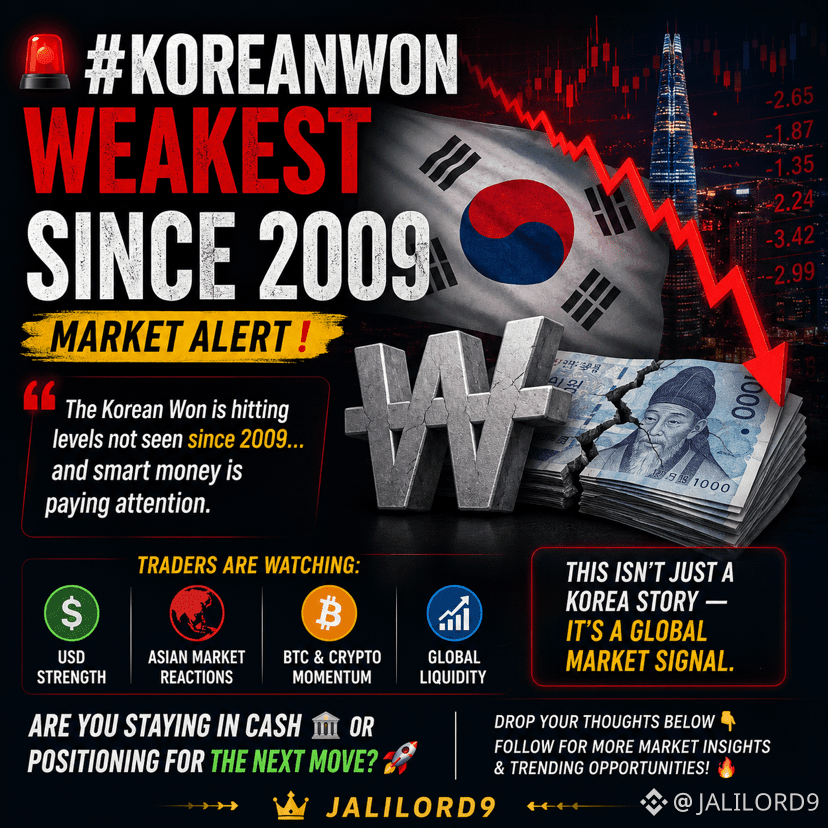
Here’s a ready-to-post Binance Square style content designed to spark engagement and bring attention to JALILORD9:
🇰🇷📉 #KoreanWonWeakestSince2009 — Market Alert 🔥
The Korean Won is hitting levels not seen since 2009… and smart money is paying attention 👀
Whenever major currencies show weakness, markets start asking bigger questions:
💭 Risk-on or risk-off?
💭 Will capital rotate into stronger assets?
💭 Could crypto become the next destination?
History shows that periods of currency pressure often push investors to rethink where they store value.
⚡ Traders are watching:
✅ USD strength
✅ Asian market reactions
✅ BTC & crypto momentum
✅ Global liquidity signals
This isn’t just a Korea story — it’s a global market signal.
Are you staying in cash 🏦 or positioning for the next move? 🚀
Drop your thoughts below 👇
Follow for more market insights & trending opportunities 🔥
#KoreanWonWeakestSince2009 #Crypto #Bitcoin #BinanceSquare #Trading #Markets #BTC #Investing #JALILORD9
#KoreanWonWeakestSince2009 $ETH
Here’s a ready-to-post Binance Square style content designed to spark engagement and bring attention to JALILORD9:
🇰🇷📉 #KoreanWonWeakestSince2009 — Market Alert 🔥
The Korean Won is hitting levels not seen since 2009… and smart money is paying attention 👀
Whenever major currencies show weakness, markets start asking bigger questions:
💭 Risk-on or risk-off?
💭 Will capital rotate into stronger assets?
💭 Could crypto become the next destination?
History shows that periods of currency pressure often push investors to rethink where they store value.
⚡ Traders are watching:
✅ USD strength
✅ Asian market reactions
✅ BTC & crypto momentum
✅ Global liquidity signals
This isn’t just a Korea story — it’s a global market signal.
Are you staying in cash 🏦 or positioning for the next move? 🚀
Drop your thoughts below 👇
Follow for more market insights & trending opportunities 🔥
#KoreanWonWeakestSince2009 #Crypto #Bitcoin #BinanceSquare #Trading #Markets #BTC #Investing #JALILORD9
Here’s a ready-to-post Binance Square style content designed to spark engagement and bring attention to JALILORD9:
🇰🇷📉 #KoreanWonWeakestSince2009 — Market Alert 🔥
The Korean Won is hitting levels not seen since 2009… and smart money is paying attention 👀
Whenever major currencies show weakness, markets start asking bigger questions:
💭 Risk-on or risk-off?
💭 Will capital rotate into stronger assets?
💭 Could crypto become the next destination?
History shows that periods of currency pressure often push investors to rethink where they store value.
⚡ Traders are watching:
✅ USD strength
✅ Asian market reactions
✅ BTC & crypto momentum
✅ Global liquidity signals
This isn’t just a Korea story — it’s a global market signal.
Are you staying in cash 🏦 or positioning for the next move? 🚀
Drop your thoughts below 👇
Follow for more market insights & trending opportunities 🔥
#KoreanWonWeakestSince2009 #Crypto #Bitcoin #BinanceSquare #Trading #Markets #BTC #Investing #JALILORD9
1
27

·
--
#koreanwonweakestsince2009
The Fiat Fracture: What the South Korean Won's Crash to a 17-Year Low Means for Crypto Liquidity! 👇
The South Korean Won ($KRW) has collapsed past 1,549 per dollar, its weakest level since the 2009 financial crisis. While equity analysts panic over regional stock dumps, elite crypto researchers recognize a massive structural flight into un-debasable digital collateral layers.
The Reality Behind the Currency Devaluation:
Institutional Outflows:
Foreign funds have aggressively unloaded over 118 trillion won in domestic equities this year, triggering a mechanical demand loop for U.S. dollars.
Macro Divergence:
Renewed maritime tensions paired with "higher-for-longer" U.S. interest rate expectations have supercharged the greenback, crushing vulnerable sovereign fiat corridors.
The Premium Arbitrage Loop:
Extreme domestic fiat weakness forces capital migration. Local investors rotate out of deteriorating cash into highly liquid digital native assets to protect long-term purchasing power.
Technical Analysis & Tactical Opportunities:
The Forex Risk Spillover:
Monitor the 4-hour horizontal accumulation clusters across premier crypto baselines. A visible spike in spot order-book depth during traditional market FX interventions signals clean, risk-off capital absorption as fiat stability distorts.
3 Primary Primitives to Watch Closely Today:
$BTC
{spot}(BTCUSDT)
The ultimate global safe-haven destination for sovereign risk mitigation and absolute wealth preservation.
$BNB
{spot}(BNBUSDT)
Capturing massive regional trading and gateway transactional velocity as capital leaves local banking rails.
$SOL
{spot}(SOLUSDT)
Absorbing high-beta liquidity as active capital structures search for rapid, on-chain execution yield.
Trade on cold data over market headlines, manage your capital parameters flawlessly, and let the charts confirm the trend!
#solana #MacroEconomics #TechnicalAnalysis
#koreanwonweakestsince2009
The Fiat Fracture: What the South Korean Won's Crash to a 17-Year Low Means for Crypto Liquidity! 👇
The South Korean Won ($KRW) has collapsed past 1,549 per dollar, its weakest level since the 2009 financial crisis. While equity analysts panic over regional stock dumps, elite crypto researchers recognize a massive structural flight into un-debasable digital collateral layers.
The Reality Behind the Currency Devaluation:
Institutional Outflows:
Foreign funds have aggressively unloaded over 118 trillion won in domestic equities this year, triggering a mechanical demand loop for U.S. dollars.
Macro Divergence:
Renewed maritime tensions paired with "higher-for-longer" U.S. interest rate expectations have supercharged the greenback, crushing vulnerable sovereign fiat corridors.
The Premium Arbitrage Loop:
Extreme domestic fiat weakness forces capital migration. Local investors rotate out of deteriorating cash into highly liquid digital native assets to protect long-term purchasing power.
Technical Analysis & Tactical Opportunities:
The Forex Risk Spillover:
Monitor the 4-hour horizontal accumulation clusters across premier crypto baselines. A visible spike in spot order-book depth during traditional market FX interventions signals clean, risk-off capital absorption as fiat stability distorts.
3 Primary Primitives to Watch Closely Today:
$BTC
The ultimate global safe-haven destination for sovereign risk mitigation and absolute wealth preservation.
$BNB
Capturing massive regional trading and gateway transactional velocity as capital leaves local banking rails.
$SOL
Absorbing high-beta liquidity as active capital structures search for rapid, on-chain execution yield.
Trade on cold data over market headlines, manage your capital parameters flawlessly, and let the charts confirm the trend!
#solana #MacroEconomics #TechnicalAnalysis
The Fiat Fracture: What the South Korean Won's Crash to a 17-Year Low Means for Crypto Liquidity! 👇
The South Korean Won ($KRW) has collapsed past 1,549 per dollar, its weakest level since the 2009 financial crisis. While equity analysts panic over regional stock dumps, elite crypto researchers recognize a massive structural flight into un-debasable digital collateral layers.
The Reality Behind the Currency Devaluation:
Institutional Outflows:
Foreign funds have aggressively unloaded over 118 trillion won in domestic equities this year, triggering a mechanical demand loop for U.S. dollars.
Macro Divergence:
Renewed maritime tensions paired with "higher-for-longer" U.S. interest rate expectations have supercharged the greenback, crushing vulnerable sovereign fiat corridors.
The Premium Arbitrage Loop:
Extreme domestic fiat weakness forces capital migration. Local investors rotate out of deteriorating cash into highly liquid digital native assets to protect long-term purchasing power.
Technical Analysis & Tactical Opportunities:
The Forex Risk Spillover:
Monitor the 4-hour horizontal accumulation clusters across premier crypto baselines. A visible spike in spot order-book depth during traditional market FX interventions signals clean, risk-off capital absorption as fiat stability distorts.
3 Primary Primitives to Watch Closely Today:
$BTC
The ultimate global safe-haven destination for sovereign risk mitigation and absolute wealth preservation.
$BNB
Capturing massive regional trading and gateway transactional velocity as capital leaves local banking rails.
$SOL
Absorbing high-beta liquidity as active capital structures search for rapid, on-chain execution yield.
Trade on cold data over market headlines, manage your capital parameters flawlessly, and let the charts confirm the trend!
#solana #MacroEconomics #TechnicalAnalysis

48

The Korean won hit its weakest level since 2009, and the crypto market feels it. South Korea is one of the most active trading hubs in the world: when its currency plunges, local selling pressure increases (reverse arbitrage, capital outflows) and volume on Korean exchanges (Upbit, Bithumb) gets distorted.
Historically, liquidity crises in the won have coincided with sharp drops in BTC and alts, because Korean traders often trade with high leverage and when the fiat currency collapses, margins get liquidated on-chain. The Kimchi premium (the difference between the BTC price in KRW vs USD) flips: instead of trading more expensively in Korea, BTC trades cheaper—an indication of desperate selling.
This isn’t an isolated catalyst: it adds to extreme fear (index at 11), the $1.79B in ETF outflows, and the multi-timeframe bearish bias in Bitcoin. If the Bank of Korea doesn’t step in soon to stabilize the won, we could see more selling pressure from Asia in the coming sessions.
Do you track the Kimchi premium as a leading indicator? Do you think the won’s weakness could drag BTC further, or is it just short-term noise? Share your take in the comments.
#KoreanWonWeakestSince2009
The Korean won hit its weakest level since 2009, and the crypto market feels it. South Korea is one of the most active trading hubs in the world: when its currency plunges, local selling pressure increases (reverse arbitrage, capital outflows) and volume on Korean exchanges (Upbit, Bithumb) gets distorted.
Historically, liquidity crises in the won have coincided with sharp drops in BTC and alts, because Korean traders often trade with high leverage and when the fiat currency collapses, margins get liquidated on-chain. The Kimchi premium (the difference between the BTC price in KRW vs USD) flips: instead of trading more expensively in Korea, BTC trades cheaper—an indication of desperate selling.
This isn’t an isolated catalyst: it adds to extreme fear (index at 11), the $1.79B in ETF outflows, and the multi-timeframe bearish bias in Bitcoin. If the Bank of Korea doesn’t step in soon to stabilize the won, we could see more selling pressure from Asia in the coming sessions.
Do you track the Kimchi premium as a leading indicator? Do you think the won’s weakness could drag BTC further, or is it just short-term noise? Share your take in the comments.
#KoreanWonWeakestSince2009
Historically, liquidity crises in the won have coincided with sharp drops in BTC and alts, because Korean traders often trade with high leverage and when the fiat currency collapses, margins get liquidated on-chain. The Kimchi premium (the difference between the BTC price in KRW vs USD) flips: instead of trading more expensively in Korea, BTC trades cheaper—an indication of desperate selling.
This isn’t an isolated catalyst: it adds to extreme fear (index at 11), the $1.79B in ETF outflows, and the multi-timeframe bearish bias in Bitcoin. If the Bank of Korea doesn’t step in soon to stabilize the won, we could see more selling pressure from Asia in the coming sessions.
Do you track the Kimchi premium as a leading indicator? Do you think the won’s weakness could drag BTC further, or is it just short-term noise? Share your take in the comments.
#KoreanWonWeakestSince2009
100
Log in to explore more content
Join global crypto users on Binance Square
⚡️ Get latest and useful information about crypto.
💬 Trusted by the world’s largest crypto exchange.
👍 Discover real insights from verified creators.
Email / Phone number
Trending Topics
1
#BitcoinSpotETFsDraw$6.34BInflowsInQ3
7,151 views
106 Discussing
2
#EthereumValidatorExitQueueJumps392%
128,696 views
1,070 Discussing
3
#IMFApprovesElSalvador$138MWithBitcoinWaiver
14,973 views
71 Discussing
4
#SECHaltsCryptoETFReviewsAmidFundingLapse
280,844 views
1,906 Discussing
5
#ZcashETFPostsFirstWeeklyOutflow$93.6M
98,226 views
257 Discussing
6
#GreekPoliceBustCryptoScamRingArrest17
397,064 views
2,532 Discussing
7
#BitcoinRejectedAt$87K
229,400 views
324 Discussing
8
#FedOctoberRateHikeOddsFallTo17%
410,125 views
2,650 Discussing
9
#NvidiaHitsRecordHighUp2.4%
236,368 views
1,481 Discussing
10
#CanaryFilesAmendedS1ForPEPEETF
77,382 views
899 Discussing