
#kospi
kospi
316,627 views
1,333 Discussing
Hot
Latest

·
--
🚨 $KOSPI CLIMBS TO 7017 AS ASIAN MARKETS ABSORB SELLER OVERHANG! 📈
📌 Macro liquidity is quietly building a floor as South Korea's $KOSPI index grinds higher to close at 7017.91, securing a 0.15% gain. 📊 Institutional capital is treating this tight consolidation as a classic quiet accumulation phase ahead of the next volatility window.
⚡ Equities holding key benchmark levels often serves as an early sentiment barometer for global risk-on momentum. 💡 When legacy order books stabilize cleanly, capital flows historically rotatate right back into liquid crypto pairs.
💬 Are you tracking Asian equity indices for macro direction or trading pure price action on the crypto charts? 👇
⚠️ Not financial advice. Always manage your risk. 🛡️
🏷️ #KOSPI #Macro #TradFi #Markets #Liquidity
⚡ 📈
🚨 $KOSPI CLIMBS TO 7017 AS ASIAN MARKETS ABSORB SELLER OVERHANG! 📈
📌 Macro liquidity is quietly building a floor as South Korea's $KOSPI index grinds higher to close at 7017.91, securing a 0.15% gain. 📊 Institutional capital is treating this tight consolidation as a classic quiet accumulation phase ahead of the next volatility window.
⚡ Equities holding key benchmark levels often serves as an early sentiment barometer for global risk-on momentum. 💡 When legacy order books stabilize cleanly, capital flows historically rotatate right back into liquid crypto pairs.
💬 Are you tracking Asian equity indices for macro direction or trading pure price action on the crypto charts? 👇
⚠️ Not financial advice. Always manage your risk. 🛡️
🏷️ #KOSPI #Macro #TradFi #Markets #Liquidity
⚡ 📈
📌 Macro liquidity is quietly building a floor as South Korea's $KOSPI index grinds higher to close at 7017.91, securing a 0.15% gain. 📊 Institutional capital is treating this tight consolidation as a classic quiet accumulation phase ahead of the next volatility window.
⚡ Equities holding key benchmark levels often serves as an early sentiment barometer for global risk-on momentum. 💡 When legacy order books stabilize cleanly, capital flows historically rotatate right back into liquid crypto pairs.
💬 Are you tracking Asian equity indices for macro direction or trading pure price action on the crypto charts? 👇
⚠️ Not financial advice. Always manage your risk. 🛡️
🏷️ #KOSPI #Macro #TradFi #Markets #Liquidity
⚡ 📈
4

·
--
📊 $KOSPI CONSOLIDATES NEAR 7017.91 AS INSTITUTIONAL ORDER FLOW STABILIZES GLOBAL LIQUIDITY! 🔍
South Korea's $KOSPI index posted a modest 10.19-point expansion to close at 7017.91 (+0.15%), signaling quiet structural absorption at upper range boundaries. 📊 Institutional capital appears to be building a tight value area rather than chasing aggressive momentum, reflecting a classic low-volatility accumulation phase.
When macro benchmarks exhibit compressed price action like this, order flow often sweeps local liquidity before defining the next directional leg. 🔍 Watch how global equity sentiment radiates into broader risk assets as smart money maintains firm positioning around this key pivot. 💬 How are you hedging your portfolio during this tight structural consolidation? 👇
⚠️ Not financial advice. Always manage your risk. 🛡️
🏷️ #KOSPI #Macro #GlobalMarkets #Liquidity #MarketStructure
⚖️ 🔍
📊 $KOSPI CONSOLIDATES NEAR 7017.91 AS INSTITUTIONAL ORDER FLOW STABILIZES GLOBAL LIQUIDITY! 🔍
South Korea's $KOSPI index posted a modest 10.19-point expansion to close at 7017.91 (+0.15%), signaling quiet structural absorption at upper range boundaries. 📊 Institutional capital appears to be building a tight value area rather than chasing aggressive momentum, reflecting a classic low-volatility accumulation phase.
When macro benchmarks exhibit compressed price action like this, order flow often sweeps local liquidity before defining the next directional leg. 🔍 Watch how global equity sentiment radiates into broader risk assets as smart money maintains firm positioning around this key pivot. 💬 How are you hedging your portfolio during this tight structural consolidation? 👇
⚠️ Not financial advice. Always manage your risk. 🛡️
🏷️ #KOSPI #Macro #GlobalMarkets #Liquidity #MarketStructure
⚖️ 🔍
South Korea's $KOSPI index posted a modest 10.19-point expansion to close at 7017.91 (+0.15%), signaling quiet structural absorption at upper range boundaries. 📊 Institutional capital appears to be building a tight value area rather than chasing aggressive momentum, reflecting a classic low-volatility accumulation phase.
When macro benchmarks exhibit compressed price action like this, order flow often sweeps local liquidity before defining the next directional leg. 🔍 Watch how global equity sentiment radiates into broader risk assets as smart money maintains firm positioning around this key pivot. 💬 How are you hedging your portfolio during this tight structural consolidation? 👇
⚠️ Not financial advice. Always manage your risk. 🛡️
🏷️ #KOSPI #Macro #GlobalMarkets #Liquidity #MarketStructure
⚖️ 🔍
10

🟢 SOUTH KOREAN MARKETS SURGE AT OPEN AS TECH GIANTS RALLY $KOSPI ⚡
⚡ Asian markets are flashing aggressive risk-on signals right out of the gate, with the $KOSPI surging 2.20% in early trading. 📊 Semiconductor heavyweights are driving the momentum, as Samsung Electronics bids up 3% and SK Hynix adds 2% in a clear display of institutional buyer urgency.
💡 Strong opening strength across major Asian tech equities often signals broader risk appetite expanding into global liquid markets. 🌊 When semiconductor order flow turns this green early in the session, macro capital positioning tends to spill over quickly across asset classes. 💬 Do you expect this Asian equity rally to fuel a broader risk-on leg today? 👇
⚠️ Not financial advice. Always manage your risk. 🛡️
🏷️ #KOSPI #Equities #Macro #RiskOn #Trading
🔥 ⚡
🟢 SOUTH KOREAN MARKETS SURGE AT OPEN AS TECH GIANTS RALLY $KOSPI ⚡
⚡ Asian markets are flashing aggressive risk-on signals right out of the gate, with the $KOSPI surging 2.20% in early trading. 📊 Semiconductor heavyweights are driving the momentum, as Samsung Electronics bids up 3% and SK Hynix adds 2% in a clear display of institutional buyer urgency.
💡 Strong opening strength across major Asian tech equities often signals broader risk appetite expanding into global liquid markets. 🌊 When semiconductor order flow turns this green early in the session, macro capital positioning tends to spill over quickly across asset classes. 💬 Do you expect this Asian equity rally to fuel a broader risk-on leg today? 👇
⚠️ Not financial advice. Always manage your risk. 🛡️
🏷️ #KOSPI #Equities #Macro #RiskOn #Trading
🔥 ⚡
⚡ Asian markets are flashing aggressive risk-on signals right out of the gate, with the $KOSPI surging 2.20% in early trading. 📊 Semiconductor heavyweights are driving the momentum, as Samsung Electronics bids up 3% and SK Hynix adds 2% in a clear display of institutional buyer urgency.
💡 Strong opening strength across major Asian tech equities often signals broader risk appetite expanding into global liquid markets. 🌊 When semiconductor order flow turns this green early in the session, macro capital positioning tends to spill over quickly across asset classes. 💬 Do you expect this Asian equity rally to fuel a broader risk-on leg today? 👇
⚠️ Not financial advice. Always manage your risk. 🛡️
🏷️ #KOSPI #Equities #Macro #RiskOn #Trading
🔥 ⚡
110
📈 $KOSPI SURGES 2.20% AS INSTITUTIONAL DEMAND FUELS SOUTH KOREAN TECH RALLY! ⚡
Early Asian session order flow signals aggressive capital deployment as the $KOSPI gaps up 2.20% right at the open. 📊 Heavy institutional accumulation in key semiconductor leaders saw Samsung gaining 3% alongside SK Hynix climbing 2%.
This bid across tech heavyweights reflects expanding liquidity and strong market structure reclaims after recent consolidation. 💡 When major chipmakers lead the impulse move, global risk sentiment typically experiences a positive knock-on effect across correlated asset classes.
💬 Is this semiconductor expansion signal enough to trigger a broader risk-on rally across crypto markets today? 👇
⚠️ Not financial advice. Always manage your risk. 🛡️
🏷️ #KOSPI #Macro #TechRally #StockMarket #MarketStructure
🎯 🦈
📈 $KOSPI SURGES 2.20% AS INSTITUTIONAL DEMAND FUELS SOUTH KOREAN TECH RALLY! ⚡
Early Asian session order flow signals aggressive capital deployment as the $KOSPI gaps up 2.20% right at the open. 📊 Heavy institutional accumulation in key semiconductor leaders saw Samsung gaining 3% alongside SK Hynix climbing 2%.
This bid across tech heavyweights reflects expanding liquidity and strong market structure reclaims after recent consolidation. 💡 When major chipmakers lead the impulse move, global risk sentiment typically experiences a positive knock-on effect across correlated asset classes.
💬 Is this semiconductor expansion signal enough to trigger a broader risk-on rally across crypto markets today? 👇
⚠️ Not financial advice. Always manage your risk. 🛡️
🏷️ #KOSPI #Macro #TechRally #StockMarket #MarketStructure
🎯 🦈
Early Asian session order flow signals aggressive capital deployment as the $KOSPI gaps up 2.20% right at the open. 📊 Heavy institutional accumulation in key semiconductor leaders saw Samsung gaining 3% alongside SK Hynix climbing 2%.
This bid across tech heavyweights reflects expanding liquidity and strong market structure reclaims after recent consolidation. 💡 When major chipmakers lead the impulse move, global risk sentiment typically experiences a positive knock-on effect across correlated asset classes.
💬 Is this semiconductor expansion signal enough to trigger a broader risk-on rally across crypto markets today? 👇
⚠️ Not financial advice. Always manage your risk. 🛡️
🏷️ #KOSPI #Macro #TechRally #StockMarket #MarketStructure
🎯 🦈
472
📈 TECH GIANTS RALLY AS $KOSPI BREAKS SURGE LEVELS TO CLOSE ABOVE 7,000! 🚀
South Korea's KOSPI index ripped up 1.65% to close at 7,007.72 points today, propelled by massive buy pressure across core tech heavyweights. 📊 Heavyweight Samsung Electronics spearheaded the charge with a sharp 5% surge, while SK Hynix tacked on another 0.59% to lock in bullish momentum.
💡 Smart capital is aggressively front-running semiconductor strength, flipping macro sentiment back into a firm risk-on posture. ⚡ When major Asian tech equities print green candles of this velocity, liquidity spillover into broader markets usually follows.
💬 Will this tech equity surge trigger the next wave of global risk-on buying tonight? 👇
⚠️ Not financial advice. Always manage your risk. 🛡️
🏷️ #KOSPI #Macro #TechRally #Semiconductors #MarketUpdate
🔥 ⚡
📈 TECH GIANTS RALLY AS $KOSPI BREAKS SURGE LEVELS TO CLOSE ABOVE 7,000! 🚀
South Korea's KOSPI index ripped up 1.65% to close at 7,007.72 points today, propelled by massive buy pressure across core tech heavyweights. 📊 Heavyweight Samsung Electronics spearheaded the charge with a sharp 5% surge, while SK Hynix tacked on another 0.59% to lock in bullish momentum.
💡 Smart capital is aggressively front-running semiconductor strength, flipping macro sentiment back into a firm risk-on posture. ⚡ When major Asian tech equities print green candles of this velocity, liquidity spillover into broader markets usually follows.
💬 Will this tech equity surge trigger the next wave of global risk-on buying tonight? 👇
⚠️ Not financial advice. Always manage your risk. 🛡️
🏷️ #KOSPI #Macro #TechRally #Semiconductors #MarketUpdate
🔥 ⚡
South Korea's KOSPI index ripped up 1.65% to close at 7,007.72 points today, propelled by massive buy pressure across core tech heavyweights. 📊 Heavyweight Samsung Electronics spearheaded the charge with a sharp 5% surge, while SK Hynix tacked on another 0.59% to lock in bullish momentum.
💡 Smart capital is aggressively front-running semiconductor strength, flipping macro sentiment back into a firm risk-on posture. ⚡ When major Asian tech equities print green candles of this velocity, liquidity spillover into broader markets usually follows.
💬 Will this tech equity surge trigger the next wave of global risk-on buying tonight? 👇
⚠️ Not financial advice. Always manage your risk. 🛡️
🏷️ #KOSPI #Macro #TechRally #Semiconductors #MarketUpdate
🔥 ⚡
7

·
--
⚡ $KOSPI RECLAIMS 7,000 AS INSTITUTIONAL BID DRIVES MACRO EXPANSION! 📈
Smart money accumulation is spilling into Asia-Pacific macro equity markets as $KOSPI reclaims the critical 7,000 psychological barrier, closing up 1.65% at 7,007.72 points. 📊 The expansion was driven by institutional bid liquidity hitting tech heavyweights, with Samsung Electronics surging nearly 5% and SK Hynix advancing 0.59%.
This deliberate capital rotation into semiconductor supply chains indicates robust risk-on appetite clearing overhead inefficiencies. 💡 When key index heavyweights absorb selling pressure at structured discount zones, macro liquidity usually signals broader market strength across global risk assets. 💬 Do you expect this macro tech expansion to spill over into crypto risk assets this week? 👇
⚠️ Not financial advice. Always manage your risk. 🛡️
🏷️ #KOSPI #Macro #Tech #Semiconductors #MarketUpdate
📈 💎
⚡ $KOSPI RECLAIMS 7,000 AS INSTITUTIONAL BID DRIVES MACRO EXPANSION! 📈
Smart money accumulation is spilling into Asia-Pacific macro equity markets as $KOSPI reclaims the critical 7,000 psychological barrier, closing up 1.65% at 7,007.72 points. 📊 The expansion was driven by institutional bid liquidity hitting tech heavyweights, with Samsung Electronics surging nearly 5% and SK Hynix advancing 0.59%.
This deliberate capital rotation into semiconductor supply chains indicates robust risk-on appetite clearing overhead inefficiencies. 💡 When key index heavyweights absorb selling pressure at structured discount zones, macro liquidity usually signals broader market strength across global risk assets. 💬 Do you expect this macro tech expansion to spill over into crypto risk assets this week? 👇
⚠️ Not financial advice. Always manage your risk. 🛡️
🏷️ #KOSPI #Macro #Tech #Semiconductors #MarketUpdate
📈 💎
Smart money accumulation is spilling into Asia-Pacific macro equity markets as $KOSPI reclaims the critical 7,000 psychological barrier, closing up 1.65% at 7,007.72 points. 📊 The expansion was driven by institutional bid liquidity hitting tech heavyweights, with Samsung Electronics surging nearly 5% and SK Hynix advancing 0.59%.
This deliberate capital rotation into semiconductor supply chains indicates robust risk-on appetite clearing overhead inefficiencies. 💡 When key index heavyweights absorb selling pressure at structured discount zones, macro liquidity usually signals broader market strength across global risk assets. 💬 Do you expect this macro tech expansion to spill over into crypto risk assets this week? 👇
⚠️ Not financial advice. Always manage your risk. 🛡️
🏷️ #KOSPI #Macro #Tech #Semiconductors #MarketUpdate
📈 💎
2

·
--
🚨 $KOSPI CROSSES 7000 AS TECH GIANTS DRIVE INSTITUTIONAL INFLOWS 📈
Institutional bidding is accelerating across major tech equities, pushing South Korea's $KOSPI past the 7,000 milestone with a 1.57% intraday surge. 📊 Capital is aggressively filling order blocks in heavyweights like Samsung (+3%) and SK Hynix (+1.4%), signaling strong risk-on appetite across key tech sectors.
💡 When major equity indices sweep resistance and confirm structural expansion, macro liquidity typically spills into digital asset markets. 📌 Smart money tracks these cross-market correlations closely to position before broader liquidity moves unfold. 💬 How do you think this macro tech strength will impact institutional crypto allocations this week? 👇
⚠️ Not financial advice. Always manage your risk. 🛡️
🏷️ #KOSPI #Macro #TechRally #MarketStructure #Crypto
📊 ⚡
🚨 $KOSPI CROSSES 7000 AS TECH GIANTS DRIVE INSTITUTIONAL INFLOWS 📈
Institutional bidding is accelerating across major tech equities, pushing South Korea's $KOSPI past the 7,000 milestone with a 1.57% intraday surge. 📊 Capital is aggressively filling order blocks in heavyweights like Samsung (+3%) and SK Hynix (+1.4%), signaling strong risk-on appetite across key tech sectors.
💡 When major equity indices sweep resistance and confirm structural expansion, macro liquidity typically spills into digital asset markets. 📌 Smart money tracks these cross-market correlations closely to position before broader liquidity moves unfold. 💬 How do you think this macro tech strength will impact institutional crypto allocations this week? 👇
⚠️ Not financial advice. Always manage your risk. 🛡️
🏷️ #KOSPI #Macro #TechRally #MarketStructure #Crypto
📊 ⚡
Institutional bidding is accelerating across major tech equities, pushing South Korea's $KOSPI past the 7,000 milestone with a 1.57% intraday surge. 📊 Capital is aggressively filling order blocks in heavyweights like Samsung (+3%) and SK Hynix (+1.4%), signaling strong risk-on appetite across key tech sectors.
💡 When major equity indices sweep resistance and confirm structural expansion, macro liquidity typically spills into digital asset markets. 📌 Smart money tracks these cross-market correlations closely to position before broader liquidity moves unfold. 💬 How do you think this macro tech strength will impact institutional crypto allocations this week? 👇
⚠️ Not financial advice. Always manage your risk. 🛡️
🏷️ #KOSPI #Macro #TechRally #MarketStructure #Crypto
📊 ⚡
19

⚡ $KOSPI SMASHES THROUGH 7,000 AS SOUTH KOREAN TECH GIANTS IGNITE ASIAN MOMENTUM! 🚀
📌 Global risk appetite is surging as South Korea's benchmark $KOSPI reclaims the critical 7,000 milestone with a sharp 1.57% intraday rip. 📊 Heavy institutional capital is pouring straight into the semiconductor backbone, pushing tech titans Samsung up 3% and SK Hynix up 1.4% in a clear display of buyer aggression.
💡 When smart money aggressively bids up Asian tech heavyweights, liquidity inevitably spills over into broader global risk assets. 💬 Do you expect this equity momentum to trigger a fresh crypto breakout, or will sellers cap the rally here? 👇
⚠️ Not financial advice. Always manage your risk. 🛡️
🏷️ #KOSPI #Macro #TechRally #Equities #Crypto
🔥 💎
⚡ $KOSPI SMASHES THROUGH 7,000 AS SOUTH KOREAN TECH GIANTS IGNITE ASIAN MOMENTUM! 🚀
📌 Global risk appetite is surging as South Korea's benchmark $KOSPI reclaims the critical 7,000 milestone with a sharp 1.57% intraday rip. 📊 Heavy institutional capital is pouring straight into the semiconductor backbone, pushing tech titans Samsung up 3% and SK Hynix up 1.4% in a clear display of buyer aggression.
💡 When smart money aggressively bids up Asian tech heavyweights, liquidity inevitably spills over into broader global risk assets. 💬 Do you expect this equity momentum to trigger a fresh crypto breakout, or will sellers cap the rally here? 👇
⚠️ Not financial advice. Always manage your risk. 🛡️
🏷️ #KOSPI #Macro #TechRally #Equities #Crypto
🔥 💎
📌 Global risk appetite is surging as South Korea's benchmark $KOSPI reclaims the critical 7,000 milestone with a sharp 1.57% intraday rip. 📊 Heavy institutional capital is pouring straight into the semiconductor backbone, pushing tech titans Samsung up 3% and SK Hynix up 1.4% in a clear display of buyer aggression.
💡 When smart money aggressively bids up Asian tech heavyweights, liquidity inevitably spills over into broader global risk assets. 💬 Do you expect this equity momentum to trigger a fresh crypto breakout, or will sellers cap the rally here? 👇
⚠️ Not financial advice. Always manage your risk. 🛡️
🏷️ #KOSPI #Macro #TechRally #Equities #Crypto
🔥 💎
21
·
--
🚨 $KOSPI SURGES 2.54% AT OPENING AS SEMICONDUCTOR GIANTS RECLAIM BULLISH MOMENTUM! 🟢
Institutional risk appetite is flashing bright green across Asian equities as $KOSPI gap-opens up 2.54%. Semiconductor heavyweight SK Hynix advanced 3.6% alongside Samsung Electronics climbing nearly 3%, signalling aggressive smart money accumulation in memory and hardware supply chains. 📊
When semiconductor order flow leads macro momentum with this kind of open-bell impulse, institutional capital typically sweeps higher liquidity pools across global risk assets. 🌊 This gap higher reflects strong bid density and structural strength across core Asian tech benchmarks. 💡
💬 Will this semiconductor-led surge trigger a broader risk-on rotation across crypto markets today? 👇
⚠️ Not financial advice. Always manage your risk. 🛡️
🏷️ #KOSPI #Macro #Semiconductors #Liquidity #Crypto
🎯 🦈
🚨 $KOSPI SURGES 2.54% AT OPENING AS SEMICONDUCTOR GIANTS RECLAIM BULLISH MOMENTUM! 🟢
Institutional risk appetite is flashing bright green across Asian equities as $KOSPI gap-opens up 2.54%. Semiconductor heavyweight SK Hynix advanced 3.6% alongside Samsung Electronics climbing nearly 3%, signalling aggressive smart money accumulation in memory and hardware supply chains. 📊
When semiconductor order flow leads macro momentum with this kind of open-bell impulse, institutional capital typically sweeps higher liquidity pools across global risk assets. 🌊 This gap higher reflects strong bid density and structural strength across core Asian tech benchmarks. 💡
💬 Will this semiconductor-led surge trigger a broader risk-on rotation across crypto markets today? 👇
⚠️ Not financial advice. Always manage your risk. 🛡️
🏷️ #KOSPI #Macro #Semiconductors #Liquidity #Crypto
🎯 🦈
Institutional risk appetite is flashing bright green across Asian equities as $KOSPI gap-opens up 2.54%. Semiconductor heavyweight SK Hynix advanced 3.6% alongside Samsung Electronics climbing nearly 3%, signalling aggressive smart money accumulation in memory and hardware supply chains. 📊
When semiconductor order flow leads macro momentum with this kind of open-bell impulse, institutional capital typically sweeps higher liquidity pools across global risk assets. 🌊 This gap higher reflects strong bid density and structural strength across core Asian tech benchmarks. 💡
💬 Will this semiconductor-led surge trigger a broader risk-on rotation across crypto markets today? 👇
⚠️ Not financial advice. Always manage your risk. 🛡️
🏷️ #KOSPI #Macro #Semiconductors #Liquidity #Crypto
🎯 🦈
7
·
--
$KOSPI LIQUIDITY DRAIN SIGNALS AI FEVER COOLING BEFORE 7000 📉
📊 South Korean equity liquidity is drying up, with KOSPI September turnover falling to 20.6 trillion won, less than half the May-June peak. That tells me the AI-driven bid is fading, not just pausing.
🦈 The failure to sustain 7,000 is the structural tell: buyers are no longer defending higher prices with conviction. A range-bound market now favors patience over chasing.
💬 Is 7,000 becoming a ceiling for $KOSPI , or just another consolidation before the next move?
⚠️ Not financial advice. Always manage your risk. 🛡️
🏷️ #KOSPI #MarketStructure #Liquidity #Macro #Crypto
🎯
$KOSPI LIQUIDITY DRAIN SIGNALS AI FEVER COOLING BEFORE 7000 📉
📊 South Korean equity liquidity is drying up, with KOSPI September turnover falling to 20.6 trillion won, less than half the May-June peak. That tells me the AI-driven bid is fading, not just pausing.
🦈 The failure to sustain 7,000 is the structural tell: buyers are no longer defending higher prices with conviction. A range-bound market now favors patience over chasing.
💬 Is 7,000 becoming a ceiling for $KOSPI , or just another consolidation before the next move?
⚠️ Not financial advice. Always manage your risk. 🛡️
🏷️ #KOSPI #MarketStructure #Liquidity #Macro #Crypto
🎯
📊 South Korean equity liquidity is drying up, with KOSPI September turnover falling to 20.6 trillion won, less than half the May-June peak. That tells me the AI-driven bid is fading, not just pausing.
🦈 The failure to sustain 7,000 is the structural tell: buyers are no longer defending higher prices with conviction. A range-bound market now favors patience over chasing.
💬 Is 7,000 becoming a ceiling for $KOSPI , or just another consolidation before the next move?
⚠️ Not financial advice. Always manage your risk. 🛡️
🏷️ #KOSPI #MarketStructure #Liquidity #Macro #Crypto
🎯
13

South Korea's benchmark KOSPI index declined for a fourth consecutive session today, sliding to a two-week low amid mounting macro pressures. Analyst Lee Kyoung-min from Daishin Securities noted that a dual surge in bond yields and crude oil prices has severely dampened buying momentum, while Finance Minister nominee Lee Hyoung-il emphasized that authorities are closely monitoring the bond market with readiness to intervene if volatility escalates.
This broad sell-off reflects growing nervousness across Asian equities ahead of upcoming Federal Reserve monetary policy decisions. Rising Treasury yields, paired with elevated energy costs, are reviving inflation concerns and forcing traders to recalibrate expectations around prolonged higher interest rates, leaving global risk assets vulnerable to negative catalysts.
In traditional finance, surging sovereign yields typically drain liquidity from emerging markets while strengthening the US dollar. As capital rotates away from riskier regional equities into defensive yield-bearing instruments, equity benchmarks across Asia are facing persistent downward pressure.
For the crypto market, this risk-off posture suggests tighter liquidity conditions in the short term. High yields and a resilient dollar often restrict capital flows into $BTC and altcoins, meaning digital assets may consolidate or face localized pullbacks until macroeconomic clarity returns.
#KOSPI #BondYields #MacroEconomics
South Korea's benchmark KOSPI index declined for a fourth consecutive session today, sliding to a two-week low amid mounting macro pressures. Analyst Lee Kyoung-min from Daishin Securities noted that a dual surge in bond yields and crude oil prices has severely dampened buying momentum, while Finance Minister nominee Lee Hyoung-il emphasized that authorities are closely monitoring the bond market with readiness to intervene if volatility escalates.
This broad sell-off reflects growing nervousness across Asian equities ahead of upcoming Federal Reserve monetary policy decisions. Rising Treasury yields, paired with elevated energy costs, are reviving inflation concerns and forcing traders to recalibrate expectations around prolonged higher interest rates, leaving global risk assets vulnerable to negative catalysts.
In traditional finance, surging sovereign yields typically drain liquidity from emerging markets while strengthening the US dollar. As capital rotates away from riskier regional equities into defensive yield-bearing instruments, equity benchmarks across Asia are facing persistent downward pressure.
For the crypto market, this risk-off posture suggests tighter liquidity conditions in the short term. High yields and a resilient dollar often restrict capital flows into $BTC and altcoins, meaning digital assets may consolidate or face localized pullbacks until macroeconomic clarity returns.
#KOSPI #BondYields #MacroEconomics
This broad sell-off reflects growing nervousness across Asian equities ahead of upcoming Federal Reserve monetary policy decisions. Rising Treasury yields, paired with elevated energy costs, are reviving inflation concerns and forcing traders to recalibrate expectations around prolonged higher interest rates, leaving global risk assets vulnerable to negative catalysts.
In traditional finance, surging sovereign yields typically drain liquidity from emerging markets while strengthening the US dollar. As capital rotates away from riskier regional equities into defensive yield-bearing instruments, equity benchmarks across Asia are facing persistent downward pressure.
For the crypto market, this risk-off posture suggests tighter liquidity conditions in the short term. High yields and a resilient dollar often restrict capital flows into $BTC and altcoins, meaning digital assets may consolidate or face localized pullbacks until macroeconomic clarity returns.
#KOSPI #BondYields #MacroEconomics
2

·
--
South Korea’s stock market has recently suffered a downturn over four consecutive trading days, with the Composite Index (KOSPI) dropping directly to its lowest level in two weeks. Lee Kyoung-min, an analyst at Daishin Securities, said that rising U.S. Treasury yields combined with higher international oil prices have clearly weakened the willingness of on-market capital to buy. At the same time, South Korea’s nominee for the Ministry of Economy and Finance, Lee Hyeong-il (Lee Hyeong-il), also stated that the authorities are closely monitoring developments in the bond market and will step in to stabilize the situation if necessary.
This pullback across major Asian markets is worth paying attention to primarily because of repeated fluctuations in macro expectations. The market had initially held some easing expectations regarding the external environment, but the renewed rise in U.S. Treasury yields has revived concerns about further interest-rate hikes. Investors’ risk-avoidance sentiment has grown, and overall risk appetite has been clearly suppressed.
Looking at traditional financial markets, stronger U.S. Treasury yields and oil-price rebounds often strengthen the U.S. dollar, which in turn diverts liquidity away from equities and other high-risk assets. The pressured performance in the Asia-Pacific market also reflects that global capital is more inclined to stand by when faced with uncertainty around interest rates, leading to overall tighter liquidity.
For the crypto market, major assets such as $BTC remain closely linked to macro liquidity. When traditional markets come under pressure due to interest-rate expectations, crypto-related capital flows in the short term are also likely to be affected. Overall sentiment is likely to trend toward neutral consolidation. How the market will evolve next still depends on ongoing monitoring of the Federal Reserve’s policy direction and the marginal changes in global macro liquidity.
#KOSPI #InterestRates #GlobalMacro
South Korea’s stock market has recently suffered a downturn over four consecutive trading days, with the Composite Index (KOSPI) dropping directly to its lowest level in two weeks. Lee Kyoung-min, an analyst at Daishin Securities, said that rising U.S. Treasury yields combined with higher international oil prices have clearly weakened the willingness of on-market capital to buy. At the same time, South Korea’s nominee for the Ministry of Economy and Finance, Lee Hyeong-il (Lee Hyeong-il), also stated that the authorities are closely monitoring developments in the bond market and will step in to stabilize the situation if necessary.
This pullback across major Asian markets is worth paying attention to primarily because of repeated fluctuations in macro expectations. The market had initially held some easing expectations regarding the external environment, but the renewed rise in U.S. Treasury yields has revived concerns about further interest-rate hikes. Investors’ risk-avoidance sentiment has grown, and overall risk appetite has been clearly suppressed.
Looking at traditional financial markets, stronger U.S. Treasury yields and oil-price rebounds often strengthen the U.S. dollar, which in turn diverts liquidity away from equities and other high-risk assets. The pressured performance in the Asia-Pacific market also reflects that global capital is more inclined to stand by when faced with uncertainty around interest rates, leading to overall tighter liquidity.
For the crypto market, major assets such as $BTC remain closely linked to macro liquidity. When traditional markets come under pressure due to interest-rate expectations, crypto-related capital flows in the short term are also likely to be affected. Overall sentiment is likely to trend toward neutral consolidation. How the market will evolve next still depends on ongoing monitoring of the Federal Reserve’s policy direction and the marginal changes in global macro liquidity.
#KOSPI #InterestRates #GlobalMacro
This pullback across major Asian markets is worth paying attention to primarily because of repeated fluctuations in macro expectations. The market had initially held some easing expectations regarding the external environment, but the renewed rise in U.S. Treasury yields has revived concerns about further interest-rate hikes. Investors’ risk-avoidance sentiment has grown, and overall risk appetite has been clearly suppressed.
Looking at traditional financial markets, stronger U.S. Treasury yields and oil-price rebounds often strengthen the U.S. dollar, which in turn diverts liquidity away from equities and other high-risk assets. The pressured performance in the Asia-Pacific market also reflects that global capital is more inclined to stand by when faced with uncertainty around interest rates, leading to overall tighter liquidity.
For the crypto market, major assets such as $BTC remain closely linked to macro liquidity. When traditional markets come under pressure due to interest-rate expectations, crypto-related capital flows in the short term are also likely to be affected. Overall sentiment is likely to trend toward neutral consolidation. How the market will evolve next still depends on ongoing monitoring of the Federal Reserve’s policy direction and the marginal changes in global macro liquidity.
#KOSPI #InterestRates #GlobalMacro
64

After four consecutive days of declines, South Korea’s composite stock price index (KOSPI) touched its lowest level in nearly two weeks today. Lee Kyoung-min, an analyst at Daishin Securities, said that recent increases in bond yields—along with higher crude oil prices—have greatly suppressed buying momentum. Meanwhile, Lee Hyoung-il, the incoming South Korean deputy finance minister in charge of planning, publicly stated that the government is closely monitoring the bond market and will take stabilizing measures if necessary.
From both a technical and a macro game-theory perspective, the KOSPI pullback largely reflects the market’s advance pricing of expectations for further rate hikes by the Federal Reserve at its upcoming policy meeting. The market is highly sensitive to rising bond yields, but these multi-day, consecutive sell-offs often represent a phase in which short-seller momentum is concentrated and released. As the government’s regulator signals that it will intervene to stabilize the bond market, the downside space is likely to narrow around technical support levels, showing technical characteristics of an oversold bounce.
Looking at broader financial-market linkages, the pulse-like rise in bond yields typically lifts the U.S. dollar index in the short term and suppresses the valuations of global risk assets. However, historical data show that once bond yields hit the resistance area of a range, risk assets often see a swift rebound. This creates an opportunity for macro liquidity to find a new foothold.
For the crypto asset market, short-term liquidity stress in the traditional equity market has not broken the overall bottoming structure. Instead, after mainstream assets complete a short-seller cleanup, capital is more inclined to flow into crypto segments with independent narratives and high liquidity. As long as the key technical moving-average structure remains intact, mainstream assets such as $BTC are expected to lead the rebound when risk appetite recovers.📈
#KOSPI #InterestRates #GlobalMarkets
After four consecutive days of declines, South Korea’s composite stock price index (KOSPI) touched its lowest level in nearly two weeks today. Lee Kyoung-min, an analyst at Daishin Securities, said that recent increases in bond yields—along with higher crude oil prices—have greatly suppressed buying momentum. Meanwhile, Lee Hyoung-il, the incoming South Korean deputy finance minister in charge of planning, publicly stated that the government is closely monitoring the bond market and will take stabilizing measures if necessary.
From both a technical and a macro game-theory perspective, the KOSPI pullback largely reflects the market’s advance pricing of expectations for further rate hikes by the Federal Reserve at its upcoming policy meeting. The market is highly sensitive to rising bond yields, but these multi-day, consecutive sell-offs often represent a phase in which short-seller momentum is concentrated and released. As the government’s regulator signals that it will intervene to stabilize the bond market, the downside space is likely to narrow around technical support levels, showing technical characteristics of an oversold bounce.
Looking at broader financial-market linkages, the pulse-like rise in bond yields typically lifts the U.S. dollar index in the short term and suppresses the valuations of global risk assets. However, historical data show that once bond yields hit the resistance area of a range, risk assets often see a swift rebound. This creates an opportunity for macro liquidity to find a new foothold.
For the crypto asset market, short-term liquidity stress in the traditional equity market has not broken the overall bottoming structure. Instead, after mainstream assets complete a short-seller cleanup, capital is more inclined to flow into crypto segments with independent narratives and high liquidity. As long as the key technical moving-average structure remains intact, mainstream assets such as $BTC are expected to lead the rebound when risk appetite recovers.📈
#KOSPI #InterestRates #GlobalMarkets
From both a technical and a macro game-theory perspective, the KOSPI pullback largely reflects the market’s advance pricing of expectations for further rate hikes by the Federal Reserve at its upcoming policy meeting. The market is highly sensitive to rising bond yields, but these multi-day, consecutive sell-offs often represent a phase in which short-seller momentum is concentrated and released. As the government’s regulator signals that it will intervene to stabilize the bond market, the downside space is likely to narrow around technical support levels, showing technical characteristics of an oversold bounce.
Looking at broader financial-market linkages, the pulse-like rise in bond yields typically lifts the U.S. dollar index in the short term and suppresses the valuations of global risk assets. However, historical data show that once bond yields hit the resistance area of a range, risk assets often see a swift rebound. This creates an opportunity for macro liquidity to find a new foothold.
For the crypto asset market, short-term liquidity stress in the traditional equity market has not broken the overall bottoming structure. Instead, after mainstream assets complete a short-seller cleanup, capital is more inclined to flow into crypto segments with independent narratives and high liquidity. As long as the key technical moving-average structure remains intact, mainstream assets such as $BTC are expected to lead the rebound when risk appetite recovers.📈
#KOSPI #InterestRates #GlobalMarkets
72
·
--
🚨 $KOSPI DROPS 3.26% AS INSTITUTIONAL TECH DE-RISKING ACCELERATES ACROSS ASIAN MARKETS 🔻
South Korean benchmark $KOSPI swept through key structural demand, closing down 225.53 points at 6684.38 as institutional capital aggressively unloaded risk positions. Tech titans led the distribution phase, with SK Hynix plunging 6.34% and Samsung Electronics falling 4.04% in a sharp single-session breakdown. 📊
This heavy institutional order flow out of core tech equities highlights a broader macro liquidity shift. 🔍 When key semiconductor order blocks fail to absorb sell pressure, systemic volatility typically ripples across correlated risk assets. 📉
💬 Is this sell-off a brief liquidity hunt before a reclaim, or the start of deeper macro distribution? 👇
⚠️ Not financial advice. Always manage your risk. 🛡️
🏷️ #KOSPI #Macro #TradFi #MarketUpdate #RiskOff
🐻 📊
🚨 $KOSPI DROPS 3.26% AS INSTITUTIONAL TECH DE-RISKING ACCELERATES ACROSS ASIAN MARKETS 🔻
South Korean benchmark $KOSPI swept through key structural demand, closing down 225.53 points at 6684.38 as institutional capital aggressively unloaded risk positions. Tech titans led the distribution phase, with SK Hynix plunging 6.34% and Samsung Electronics falling 4.04% in a sharp single-session breakdown. 📊
This heavy institutional order flow out of core tech equities highlights a broader macro liquidity shift. 🔍 When key semiconductor order blocks fail to absorb sell pressure, systemic volatility typically ripples across correlated risk assets. 📉
💬 Is this sell-off a brief liquidity hunt before a reclaim, or the start of deeper macro distribution? 👇
⚠️ Not financial advice. Always manage your risk. 🛡️
🏷️ #KOSPI #Macro #TradFi #MarketUpdate #RiskOff
🐻 📊
South Korean benchmark $KOSPI swept through key structural demand, closing down 225.53 points at 6684.38 as institutional capital aggressively unloaded risk positions. Tech titans led the distribution phase, with SK Hynix plunging 6.34% and Samsung Electronics falling 4.04% in a sharp single-session breakdown. 📊
This heavy institutional order flow out of core tech equities highlights a broader macro liquidity shift. 🔍 When key semiconductor order blocks fail to absorb sell pressure, systemic volatility typically ripples across correlated risk assets. 📉
💬 Is this sell-off a brief liquidity hunt before a reclaim, or the start of deeper macro distribution? 👇
⚠️ Not financial advice. Always manage your risk. 🛡️
🏷️ #KOSPI #Macro #TradFi #MarketUpdate #RiskOff
🐻 📊
8
·
--
During the Asia-Pacific trading session on September 14, major stock indexes in Japan and South Korea both saw fairly notable pullbacks. Japan’s Nikkei 225 closed down 518.35 points, a decline of 0.81%, at 63,492.99. The Korea Composite Stock Price Index (KOSPI) was even weaker, falling 225.53 points for the full day, down 3.26%, to close at 6,684.38. Semiconductor bellwethers came under clear pressure: SK Hynix fell 6.34%, and Samsung Electronics fell 4.04%.
The broad decline in Asia-Pacific core markets—especially tech-heavy stocks—directly reflects regional investors’ demand for rebalancing in the short term in response to valuation changes and shifts in the external macro environment. The sharp drop of South Korea’s two leading semiconductor names also sparked more discussion about whether consumer electronics and the AI industry chain can continue to sustain a high-growth pace recently. Overall, risk appetite cooled in the short term.
From the perspective of traditional financial markets, pullbacks in Asia-Pacific tech stocks often boost safe-haven sentiment in FX and bond markets, causing funds to reassess the allocation between traditional safe-haven assets such as the U.S. dollar and the Japanese yen, and risk assets. If volatility in equities continues to expand, the global liquidity’s near-term allocation logic will also face renewed scrutiny.
For the crypto market, the risk-asset adjustment in the Asia-Pacific session somewhat constrains short-term sentiment for major coins such as $BTC . With market caution rising, it remains to be seen whether investors will reduce risk exposure in line with traditional stock markets, or redirect some overflow liquidity to on-chain assets. Further observation of the actual subsequent flow of funds is still needed.
#Nikkei225 #KOSPI #CryptoMarket
During the Asia-Pacific trading session on September 14, major stock indexes in Japan and South Korea both saw fairly notable pullbacks. Japan’s Nikkei 225 closed down 518.35 points, a decline of 0.81%, at 63,492.99. The Korea Composite Stock Price Index (KOSPI) was even weaker, falling 225.53 points for the full day, down 3.26%, to close at 6,684.38. Semiconductor bellwethers came under clear pressure: SK Hynix fell 6.34%, and Samsung Electronics fell 4.04%.
The broad decline in Asia-Pacific core markets—especially tech-heavy stocks—directly reflects regional investors’ demand for rebalancing in the short term in response to valuation changes and shifts in the external macro environment. The sharp drop of South Korea’s two leading semiconductor names also sparked more discussion about whether consumer electronics and the AI industry chain can continue to sustain a high-growth pace recently. Overall, risk appetite cooled in the short term.
From the perspective of traditional financial markets, pullbacks in Asia-Pacific tech stocks often boost safe-haven sentiment in FX and bond markets, causing funds to reassess the allocation between traditional safe-haven assets such as the U.S. dollar and the Japanese yen, and risk assets. If volatility in equities continues to expand, the global liquidity’s near-term allocation logic will also face renewed scrutiny.
For the crypto market, the risk-asset adjustment in the Asia-Pacific session somewhat constrains short-term sentiment for major coins such as $BTC . With market caution rising, it remains to be seen whether investors will reduce risk exposure in line with traditional stock markets, or redirect some overflow liquidity to on-chain assets. Further observation of the actual subsequent flow of funds is still needed.
#Nikkei225 #KOSPI #CryptoMarket
The broad decline in Asia-Pacific core markets—especially tech-heavy stocks—directly reflects regional investors’ demand for rebalancing in the short term in response to valuation changes and shifts in the external macro environment. The sharp drop of South Korea’s two leading semiconductor names also sparked more discussion about whether consumer electronics and the AI industry chain can continue to sustain a high-growth pace recently. Overall, risk appetite cooled in the short term.
From the perspective of traditional financial markets, pullbacks in Asia-Pacific tech stocks often boost safe-haven sentiment in FX and bond markets, causing funds to reassess the allocation between traditional safe-haven assets such as the U.S. dollar and the Japanese yen, and risk assets. If volatility in equities continues to expand, the global liquidity’s near-term allocation logic will also face renewed scrutiny.
For the crypto market, the risk-asset adjustment in the Asia-Pacific session somewhat constrains short-term sentiment for major coins such as $BTC . With market caution rising, it remains to be seen whether investors will reduce risk exposure in line with traditional stock markets, or redirect some overflow liquidity to on-chain assets. Further observation of the actual subsequent flow of funds is still needed.
#Nikkei225 #KOSPI #CryptoMarket
2

During today’s Asia-Pacific early trading session, the South Korean composite stock price index (KOSPI) suffered a sharp selloff right at the open, with the decline rapidly widening to 3.14%. Technology heavyweights came under broad pressure: the semiconductor giant SK Hynix plunged 5% at the open, while Samsung Electronics also fell by 3.6%, indicating a rapid surge in risk-averse sentiment.
As a key barometer for the global semiconductor and technology supply chain, the dramatic pullback by Korea’s chip champions is not an isolated event. It reflects intensifying concerns that global tech hardware valuations have become too high, AI capital expenditures are slowing, and the semiconductor cycle may have topped out. The optimism previously driven by AI narratives is now facing a harsh interrogation from the real macro environment, and investors are beginning to reassess the risk premium of tech stocks.
From the perspective of the broader financial markets, a steep drop in Asia’s core tech stocks often triggers spillover effects across asset classes. This is typically accompanied by expectations of tighter liquidity, prompting capital to retreat from high-beta risk assets, increasing demand for safe-haven assets such as the U.S. dollar, and potentially worsening the downward pressure facing U.S. markets even before the open—ultimately further denting global risk appetite.
For the cryptocurrency market, this kind of systemic tech-stock pullback is by no means a positive signal. Crypto assets—especially $BTC —are highly correlated with the Nasdaq and global tech stocks. When traditional tech giants get hit by valuation-driven selloffs, the global liquidity environment tends to become more conservative; institutional investors typically reduce crypto positions first to control overall portfolio risk. In the short term, the crypto market may face sustained downside and volatility pressure.
#KOSPI #TechSelloff #GlobalMarkets
During today’s Asia-Pacific early trading session, the South Korean composite stock price index (KOSPI) suffered a sharp selloff right at the open, with the decline rapidly widening to 3.14%. Technology heavyweights came under broad pressure: the semiconductor giant SK Hynix plunged 5% at the open, while Samsung Electronics also fell by 3.6%, indicating a rapid surge in risk-averse sentiment.
As a key barometer for the global semiconductor and technology supply chain, the dramatic pullback by Korea’s chip champions is not an isolated event. It reflects intensifying concerns that global tech hardware valuations have become too high, AI capital expenditures are slowing, and the semiconductor cycle may have topped out. The optimism previously driven by AI narratives is now facing a harsh interrogation from the real macro environment, and investors are beginning to reassess the risk premium of tech stocks.
From the perspective of the broader financial markets, a steep drop in Asia’s core tech stocks often triggers spillover effects across asset classes. This is typically accompanied by expectations of tighter liquidity, prompting capital to retreat from high-beta risk assets, increasing demand for safe-haven assets such as the U.S. dollar, and potentially worsening the downward pressure facing U.S. markets even before the open—ultimately further denting global risk appetite.
For the cryptocurrency market, this kind of systemic tech-stock pullback is by no means a positive signal. Crypto assets—especially $BTC —are highly correlated with the Nasdaq and global tech stocks. When traditional tech giants get hit by valuation-driven selloffs, the global liquidity environment tends to become more conservative; institutional investors typically reduce crypto positions first to control overall portfolio risk. In the short term, the crypto market may face sustained downside and volatility pressure.
#KOSPI #TechSelloff #GlobalMarkets
As a key barometer for the global semiconductor and technology supply chain, the dramatic pullback by Korea’s chip champions is not an isolated event. It reflects intensifying concerns that global tech hardware valuations have become too high, AI capital expenditures are slowing, and the semiconductor cycle may have topped out. The optimism previously driven by AI narratives is now facing a harsh interrogation from the real macro environment, and investors are beginning to reassess the risk premium of tech stocks.
From the perspective of the broader financial markets, a steep drop in Asia’s core tech stocks often triggers spillover effects across asset classes. This is typically accompanied by expectations of tighter liquidity, prompting capital to retreat from high-beta risk assets, increasing demand for safe-haven assets such as the U.S. dollar, and potentially worsening the downward pressure facing U.S. markets even before the open—ultimately further denting global risk appetite.
For the cryptocurrency market, this kind of systemic tech-stock pullback is by no means a positive signal. Crypto assets—especially $BTC —are highly correlated with the Nasdaq and global tech stocks. When traditional tech giants get hit by valuation-driven selloffs, the global liquidity environment tends to become more conservative; institutional investors typically reduce crypto positions first to control overall portfolio risk. In the short term, the crypto market may face sustained downside and volatility pressure.
#KOSPI #TechSelloff #GlobalMarkets
73
·
--
Today, the Korea Exchange (Seoul) opened and was immediately hit with a heavy blow. The composite stock price index (KOSPI) opened sharply lower by 3.14%. On the trading floor, heavy-weight tech giants led the decline. In particular, storage-chip maker SK Hynix fell 5%, and Samsung Electronics also dropped 3.6%. The tech-stock sentiment during the Asian morning instantly turned somewhat tense.
This large gap down mainly reflects adjustment pressure in the global tech sector overnight, as well as the market re-pricing semiconductor-cycle volatility in the short term. As Samsung and Hynix are key bellwethers for global memory chips, their sharp fluctuations often anticipate global institutional capital’s sensitive reactions to the tech supply chain and macro liquidity. Therefore, the significant selloff at the open naturally drew widespread attention across the Asia-Pacific market.
From a broader financial-market perspective, major Asia-Pacific stock indexes opened under pressure, indicating that funds continue to weigh the trade-off between risk aversion and growth assets. Moves in the U.S. dollar index and U.S. Treasury yields kept pressure on high-valuation segments, while the decline led by Asia’s core semiconductor targets also, to some extent, curtailed intraday risk appetite in Japan, South Korea, and surrounding markets.
For the crypto market, macro tech stocks and key assets such as $BTC still show some linkage from a liquidity standpoint. At present, overall sentiment among crypto investors is in a wait-and-see mode. The sharp volatility in external tech sectors may make short-term follow-on funds more cautious. Next, it will be important to monitor whether major tokens can carve out an independent trading trend.
#KOSPI #StockMarket #CryptoMarket
Today, the Korea Exchange (Seoul) opened and was immediately hit with a heavy blow. The composite stock price index (KOSPI) opened sharply lower by 3.14%. On the trading floor, heavy-weight tech giants led the decline. In particular, storage-chip maker SK Hynix fell 5%, and Samsung Electronics also dropped 3.6%. The tech-stock sentiment during the Asian morning instantly turned somewhat tense.
This large gap down mainly reflects adjustment pressure in the global tech sector overnight, as well as the market re-pricing semiconductor-cycle volatility in the short term. As Samsung and Hynix are key bellwethers for global memory chips, their sharp fluctuations often anticipate global institutional capital’s sensitive reactions to the tech supply chain and macro liquidity. Therefore, the significant selloff at the open naturally drew widespread attention across the Asia-Pacific market.
From a broader financial-market perspective, major Asia-Pacific stock indexes opened under pressure, indicating that funds continue to weigh the trade-off between risk aversion and growth assets. Moves in the U.S. dollar index and U.S. Treasury yields kept pressure on high-valuation segments, while the decline led by Asia’s core semiconductor targets also, to some extent, curtailed intraday risk appetite in Japan, South Korea, and surrounding markets.
For the crypto market, macro tech stocks and key assets such as $BTC still show some linkage from a liquidity standpoint. At present, overall sentiment among crypto investors is in a wait-and-see mode. The sharp volatility in external tech sectors may make short-term follow-on funds more cautious. Next, it will be important to monitor whether major tokens can carve out an independent trading trend.
#KOSPI #StockMarket #CryptoMarket
This large gap down mainly reflects adjustment pressure in the global tech sector overnight, as well as the market re-pricing semiconductor-cycle volatility in the short term. As Samsung and Hynix are key bellwethers for global memory chips, their sharp fluctuations often anticipate global institutional capital’s sensitive reactions to the tech supply chain and macro liquidity. Therefore, the significant selloff at the open naturally drew widespread attention across the Asia-Pacific market.
From a broader financial-market perspective, major Asia-Pacific stock indexes opened under pressure, indicating that funds continue to weigh the trade-off between risk aversion and growth assets. Moves in the U.S. dollar index and U.S. Treasury yields kept pressure on high-valuation segments, while the decline led by Asia’s core semiconductor targets also, to some extent, curtailed intraday risk appetite in Japan, South Korea, and surrounding markets.
For the crypto market, macro tech stocks and key assets such as $BTC still show some linkage from a liquidity standpoint. At present, overall sentiment among crypto investors is in a wait-and-see mode. The sharp volatility in external tech sectors may make short-term follow-on funds more cautious. Next, it will be important to monitor whether major tokens can carve out an independent trading trend.
#KOSPI #StockMarket #CryptoMarket
73

·
--
Bearish
Verified
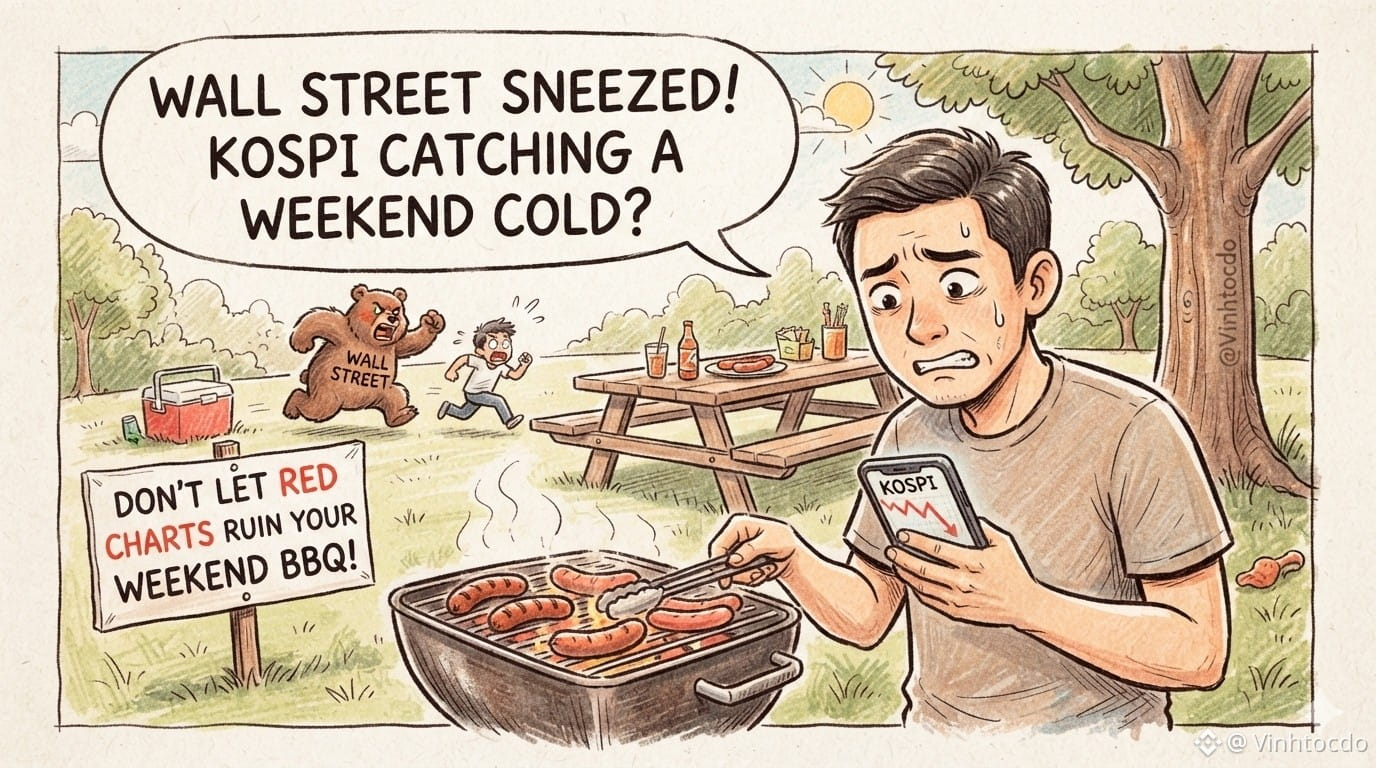
Wall Street drops for the 4th straight day! 🐻 With oil hitting $105/bbl and bond yields spiking, the Fed has everyone sweating. So, what’s next for KOSPI this weekend? 📉 Usually, when US markets sneeze, Asian markets catch a cold—so expect KOSPI to face some bumpy weekend gravity!
What should traders do?
1️⃣ Don't let the red charts ruin your weekend barbecue.
2️⃣ Watch the macro trends, but keep your emotions locked in a safe.
3️⃣ Upgrade your trading setup! New users can score solid discounts by using my code VINHTOCDO or clicking here: [https://www.binance.com/register?ref=VINHTOCDO](https://www.binance.com/register?ref=VINHTOCDO)
⚠️ This is not financial advice.
Click trade below to support me:
$SKHYNIX
{future}(SKHYNIXUSDT)
$HYUNDAI
{future}(HYUNDAIUSDT)
$SAMSUNG
{future}(SAMSUNGUSDT)
#WallStreet #NASDAQ #KOSPI #MarketTrends #VINHTOCDO
Wall Street drops for the 4th straight day! 🐻 With oil hitting $105/bbl and bond yields spiking, the Fed has everyone sweating. So, what’s next for KOSPI this weekend? 📉 Usually, when US markets sneeze, Asian markets catch a cold—so expect KOSPI to face some bumpy weekend gravity!
What should traders do?
1️⃣ Don't let the red charts ruin your weekend barbecue.
2️⃣ Watch the macro trends, but keep your emotions locked in a safe.
3️⃣ Upgrade your trading setup! New users can score solid discounts by using my code VINHTOCDO or clicking here: https://www.binance.com/register?ref=VINHTOCDO
⚠️ This is not financial advice.
Click trade below to support me:
$SKHYNIX
$HYUNDAI
$SAMSUNG
#WallStreet #NASDAQ #KOSPI #MarketTrends #VINHTOCDO
What should traders do?
1️⃣ Don't let the red charts ruin your weekend barbecue.
2️⃣ Watch the macro trends, but keep your emotions locked in a safe.
3️⃣ Upgrade your trading setup! New users can score solid discounts by using my code VINHTOCDO or clicking here: https://www.binance.com/register?ref=VINHTOCDO
⚠️ This is not financial advice.
Click trade below to support me:
$SKHYNIX
$HYUNDAI
$SAMSUNG
#WallStreet #NASDAQ #KOSPI #MarketTrends #VINHTOCDO
2
3
638
·
--
Bullish
KOSPI pumps while Tokyo slumps! 🚀🇰🇷 #KOSPI #NASDAQ #WallStreet
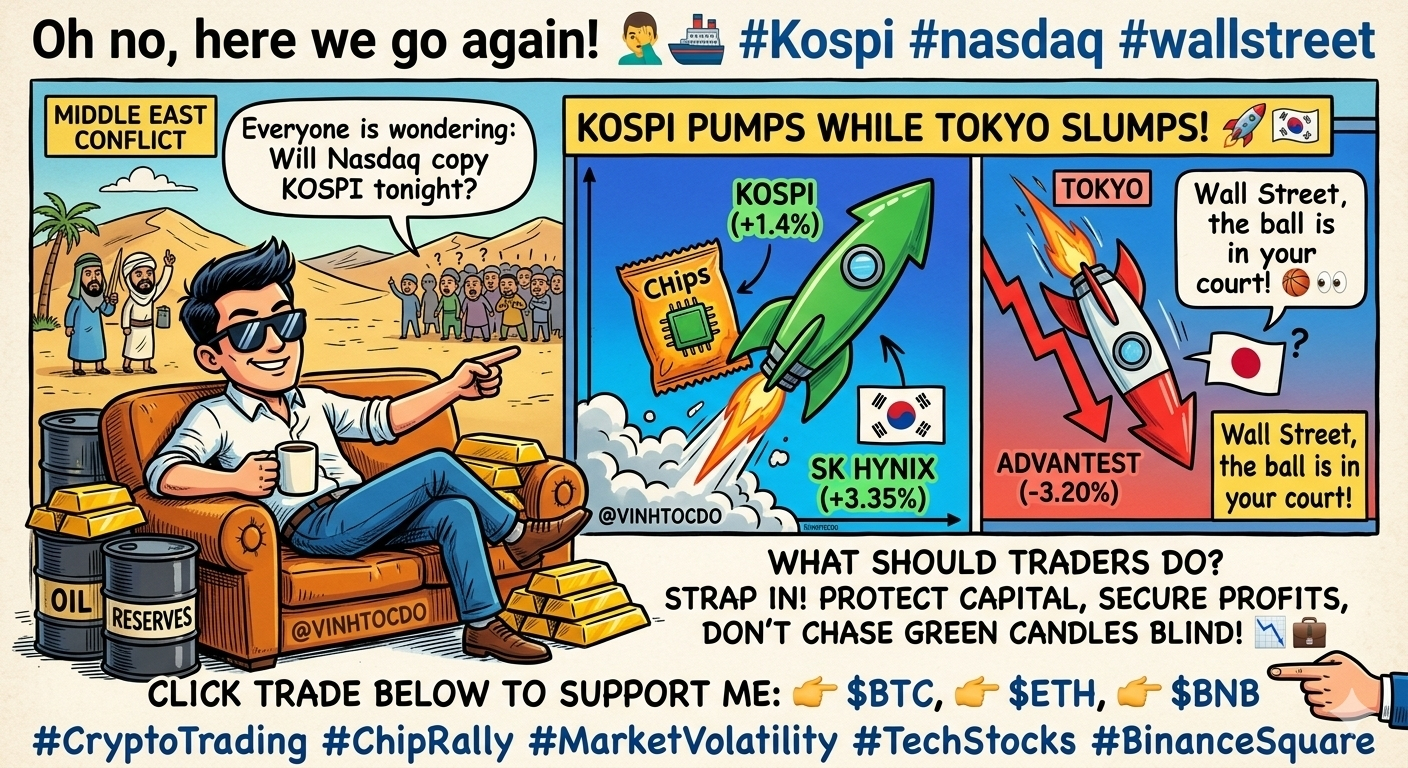
South Korea's KOSPI jumped +1.4% to 7,051.63, powered by a massive memory chip rally (SK Hynix +3.35%). Meanwhile, Tokyo dipped as chip equipment stock Advantest dumped -3.20%. Will Nasdaq copy KOSPI's green energy tonight or just go its own way? Wall Street, the ball is in your court! 🏀👀
What should traders do? When chip stocks fight back, tech markets get interesting. Secure your profits, stay calm, and watch the charts closely. Don't chase the green candles blind! 📉💼
⚠️ This is not financial advice (NFA).
Support me by using code VINHTOCDO or link: [https://www.binance.com/register?ref=VINHTOCDO](https://www.binance.com/register?ref=VINHTOCDO)
Click trade below to support me:
👉 $MU
{future}(MUUSDT)
👉 $AAPL
{future}(AAPLUSDT)
👉 $GOOGL
{future}(GOOGLUSDT)
#ChipRally #VINHTOCDO
KOSPI pumps while Tokyo slumps! 🚀🇰🇷 #KOSPI #NASDAQ #WallStreet
South Korea's KOSPI jumped +1.4% to 7,051.63, powered by a massive memory chip rally (SK Hynix +3.35%). Meanwhile, Tokyo dipped as chip equipment stock Advantest dumped -3.20%. Will Nasdaq copy KOSPI's green energy tonight or just go its own way? Wall Street, the ball is in your court! 🏀👀
What should traders do? When chip stocks fight back, tech markets get interesting. Secure your profits, stay calm, and watch the charts closely. Don't chase the green candles blind! 📉💼
⚠️ This is not financial advice (NFA).
Support me by using code VINHTOCDO or link: https://www.binance.com/register?ref=VINHTOCDO
Click trade below to support me:
👉 $MU
👉 $AAPL
👉 $GOOGL
#ChipRally #VINHTOCDO
South Korea's KOSPI jumped +1.4% to 7,051.63, powered by a massive memory chip rally (SK Hynix +3.35%). Meanwhile, Tokyo dipped as chip equipment stock Advantest dumped -3.20%. Will Nasdaq copy KOSPI's green energy tonight or just go its own way? Wall Street, the ball is in your court! 🏀👀
What should traders do? When chip stocks fight back, tech markets get interesting. Secure your profits, stay calm, and watch the charts closely. Don't chase the green candles blind! 📉💼
⚠️ This is not financial advice (NFA).
Support me by using code VINHTOCDO or link: https://www.binance.com/register?ref=VINHTOCDO
Click trade below to support me:
👉 $MU
👉 $AAPL
👉 $GOOGL
#ChipRally #VINHTOCDO
2
410

·
--
📰 This time, South Korea’s exchange isn’t just making minor tweaks: starting September 14, the KRX will add an “after-hours market” from 4:00 PM to 8:00 PM, covering both the KOSPI and KOSDAQ markets.
More importantly, the universe of tradable instruments will expand directly to all 2,651 listed stocks. Previously, the alternative exchange Nextrade supported up to 800 stocks, so this expansion is clearly much broader—after-hours trading is no longer just a time slot reserved for a handful of popular names.
🔥 Honestly, the most practical issue with after-hours trading is liquidity. If nobody is trading, even longer opening hours are just for show. So this time, the Korean exchange is introducing a market maker program for the first time, with the goal of improving trading activity for stocks with relatively low liquidity.
💡 But the rules aren’t completely open-ended either. To protect investors, the after-hours market will cancel market orders and allow only limit orders, best-limit orders, and most-favorable limit orders. In some cases, IOC and FOK conditional orders are also permitted. In short: if you want to trade after hours, you can’t just think “get it filled first”—price control has to come first.
👀 This is a bit like extending traditional stock market trading hours while also adding market-maker support for low-liquidity stocks. For South Korea’s market, the change isn’t just about adding four more hours—it’s also about expanding both the coverage of after-hours trading and how participants can take part. Do you think this model will make more markets consider extending trading sessions?
#韩国股市 #盘后交易 #KOSPI #KOSDAQ
📰 This time, South Korea’s exchange isn’t just making minor tweaks: starting September 14, the KRX will add an “after-hours market” from 4:00 PM to 8:00 PM, covering both the KOSPI and KOSDAQ markets.
More importantly, the universe of tradable instruments will expand directly to all 2,651 listed stocks. Previously, the alternative exchange Nextrade supported up to 800 stocks, so this expansion is clearly much broader—after-hours trading is no longer just a time slot reserved for a handful of popular names.
🔥 Honestly, the most practical issue with after-hours trading is liquidity. If nobody is trading, even longer opening hours are just for show. So this time, the Korean exchange is introducing a market maker program for the first time, with the goal of improving trading activity for stocks with relatively low liquidity.
💡 But the rules aren’t completely open-ended either. To protect investors, the after-hours market will cancel market orders and allow only limit orders, best-limit orders, and most-favorable limit orders. In some cases, IOC and FOK conditional orders are also permitted. In short: if you want to trade after hours, you can’t just think “get it filled first”—price control has to come first.
👀 This is a bit like extending traditional stock market trading hours while also adding market-maker support for low-liquidity stocks. For South Korea’s market, the change isn’t just about adding four more hours—it’s also about expanding both the coverage of after-hours trading and how participants can take part. Do you think this model will make more markets consider extending trading sessions?
#韩国股市 #盘后交易 #KOSPI #KOSDAQ
More importantly, the universe of tradable instruments will expand directly to all 2,651 listed stocks. Previously, the alternative exchange Nextrade supported up to 800 stocks, so this expansion is clearly much broader—after-hours trading is no longer just a time slot reserved for a handful of popular names.
🔥 Honestly, the most practical issue with after-hours trading is liquidity. If nobody is trading, even longer opening hours are just for show. So this time, the Korean exchange is introducing a market maker program for the first time, with the goal of improving trading activity for stocks with relatively low liquidity.
💡 But the rules aren’t completely open-ended either. To protect investors, the after-hours market will cancel market orders and allow only limit orders, best-limit orders, and most-favorable limit orders. In some cases, IOC and FOK conditional orders are also permitted. In short: if you want to trade after hours, you can’t just think “get it filled first”—price control has to come first.
👀 This is a bit like extending traditional stock market trading hours while also adding market-maker support for low-liquidity stocks. For South Korea’s market, the change isn’t just about adding four more hours—it’s also about expanding both the coverage of after-hours trading and how participants can take part. Do you think this model will make more markets consider extending trading sessions?
#韩国股市 #盘后交易 #KOSPI #KOSDAQ

25
Log in to explore more content
Join global crypto users on Binance Square
⚡️ Get latest and useful information about crypto.
💬 Trusted by the world’s largest crypto exchange.
👍 Discover real insights from verified creators.
Email / Phone number
Trending Topics
1
#AIStocksWhatNext
406,757 views
3,162 Discussing
2
#BitwiseNEARStakingETPAssetsTop$100M
1,019 views
26 Discussing
3
#MUBARAKRisesOver66%In24Hours
174 views
17 Discussing
4
#BitcoinBreaksAboveMayHighNears$86K
17,661 views
210 Discussing
5
#DogecoinRises15%
56,272 views
1,060 Discussing
6
#$14BBitcoinOptionsExpireFriday
4,718 views
96 Discussing
7
#BNBMarketCapPassesBNYMellon
35,127 views
770 Discussing
8
#CryptoMarketCapReclaims$3Trillion
6,306 views
86 Discussing
9
#MuseOvertakesChatGPTAsTopFreeIOSApp
20,245 views
568 Discussing
10
#TokenizedStockPlatformsCouldLaunchNextQuarter
31,786 views
623 Discussing