
#bitcoinslidesto
bitcoinslidesto
760 views
52 Discussing
Hot
Latest

·
--
#BitcoinSlidesTo $76000
🚨 BITCOIN CORRECTION IN FOCUS!
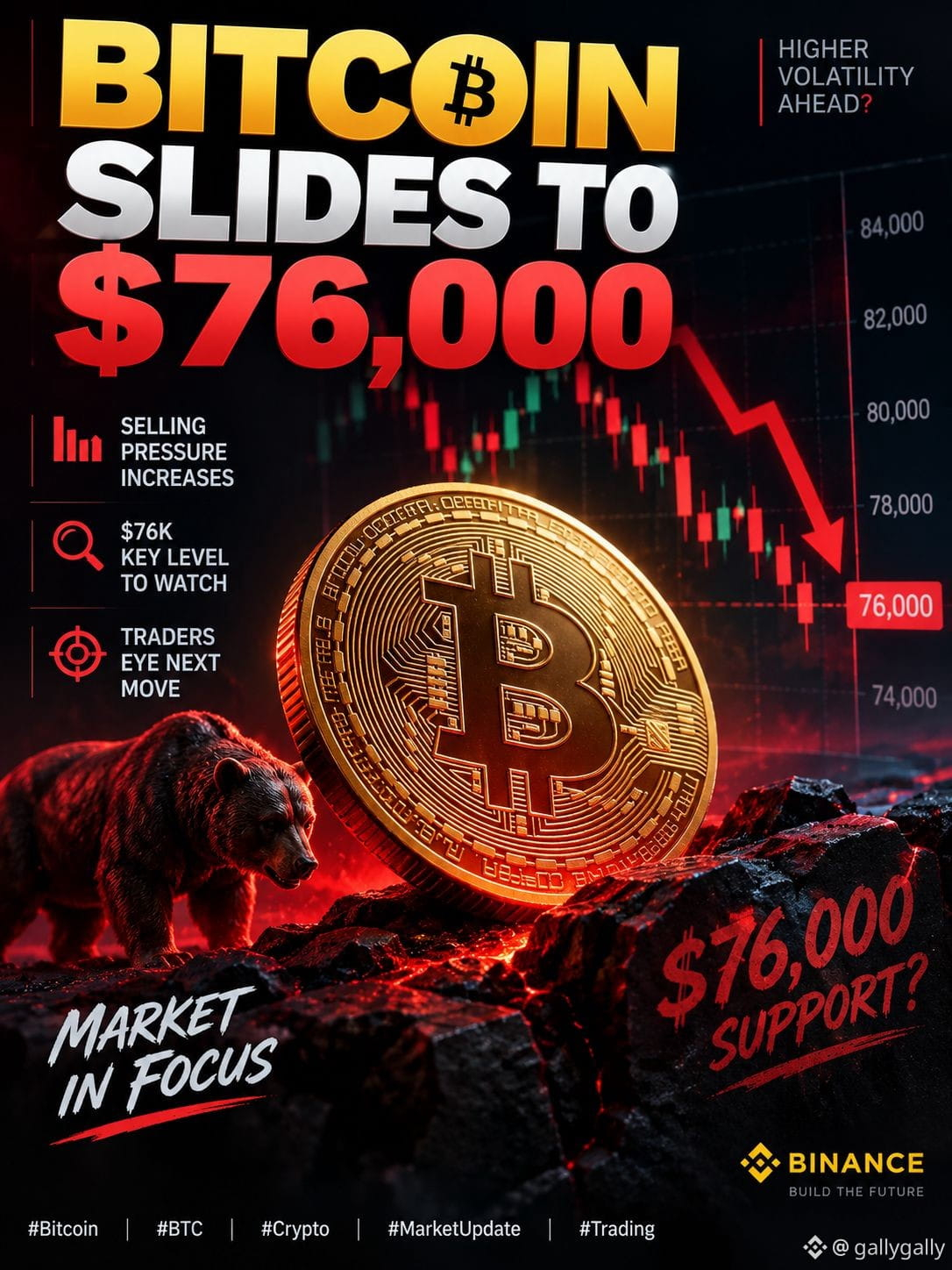
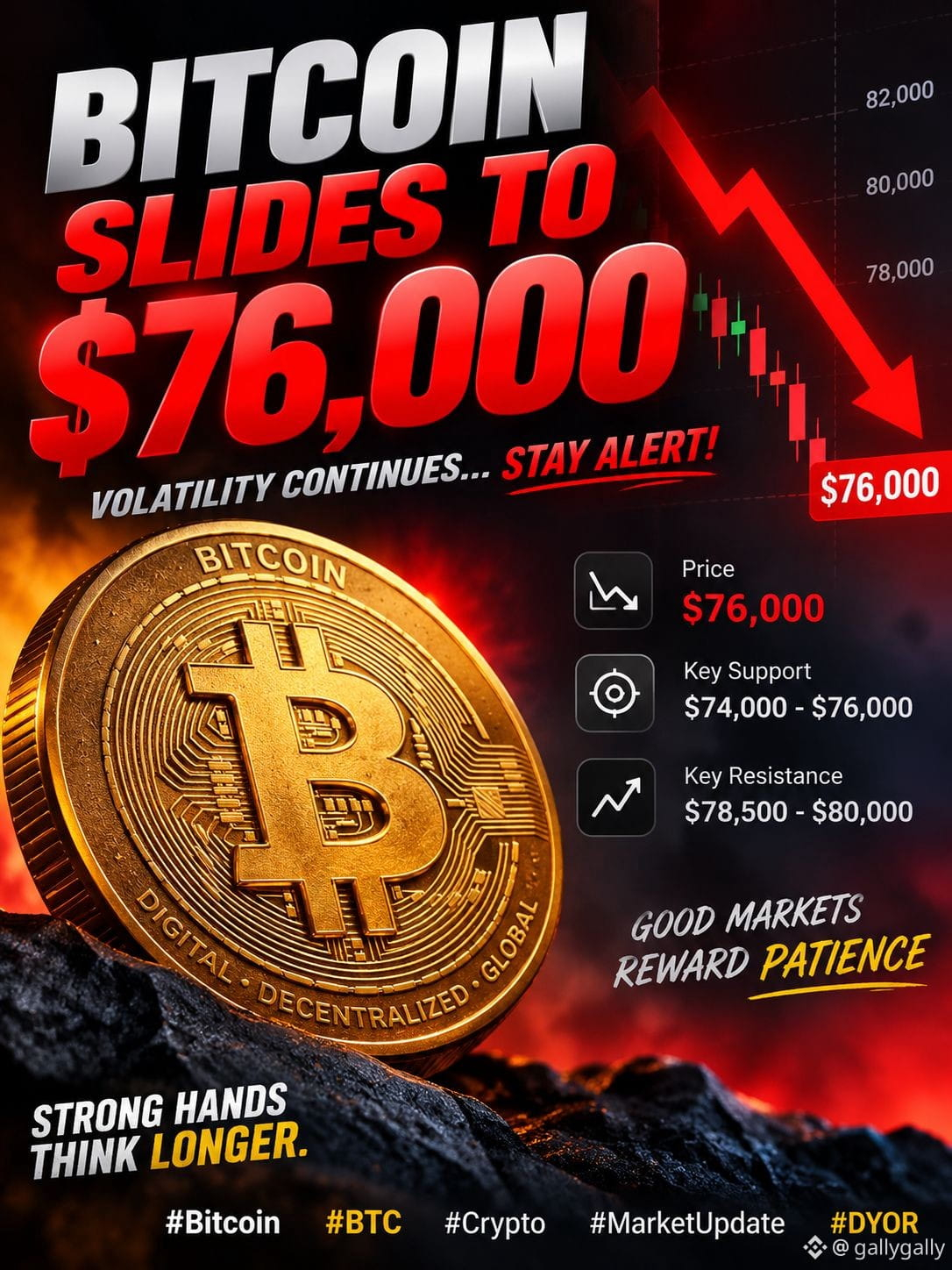
$BTC has moved down toward $76,000, showing that sellers are still active after the recent rally. The key question now is whether Bitcoin can stabilize and attract fresh buying.
$76K is a level worth watching closely. 📉📈
#BTC #Bitcoin #CryptoNews #BitcoinPrice #MarketAnalysis
#BitcoinSlidesTo $76000
🚨 BITCOIN CORRECTION IN FOCUS!
$BTC has moved down toward $76,000, showing that sellers are still active after the recent rally. The key question now is whether Bitcoin can stabilize and attract fresh buying.
$76K is a level worth watching closely. 📉📈
#BTC #Bitcoin #CryptoNews #BitcoinPrice #MarketAnalysis
🚨 BITCOIN CORRECTION IN FOCUS!
$BTC has moved down toward $76,000, showing that sellers are still active after the recent rally. The key question now is whether Bitcoin can stabilize and attract fresh buying.
$76K is a level worth watching closely. 📉📈
#BTC #Bitcoin #CryptoNews #BitcoinPrice #MarketAnalysis
79

Fed Rate Hike Incoming: Bitcoin, Bonds & even Trump Caught in the Crossfire!
Alright folks, buckle up! The big news is that almost every major Wall Street bank is now betting on the Fed hiking interest rates for the first time in three years. While the market seems to have largely shrugged this off, anticipating the move, the real drama might just be kicking off.
Honestly, this feels like a classic case of 'buy the rumor, sell the news' potentially playing out. We've seen this dance before where markets bake in expectations, and then the actual event causes a ripple effect we didn't quite see coming. What's really got my attention is the 'political fallout' part. A rate hike isn't just an economic number; it's a political statement, and the knock-on effects could be way bigger than just a single percentage point. I'm watching closely to see how this impacts not just traditional assets like bonds, but also how it shakes out for crypto like $BTC. And Trump? Well, let's just say anything involving Fed policy and the former president is bound to be… interesting.
This is not financial advice.
#FedRateWatch #BitcoinSlidesTo$76000
Fed Rate Hike Incoming: Bitcoin, Bonds & even Trump Caught in the Crossfire!
Alright folks, buckle up! The big news is that almost every major Wall Street bank is now betting on the Fed hiking interest rates for the first time in three years. While the market seems to have largely shrugged this off, anticipating the move, the real drama might just be kicking off.
Honestly, this feels like a classic case of 'buy the rumor, sell the news' potentially playing out. We've seen this dance before where markets bake in expectations, and then the actual event causes a ripple effect we didn't quite see coming. What's really got my attention is the 'political fallout' part. A rate hike isn't just an economic number; it's a political statement, and the knock-on effects could be way bigger than just a single percentage point. I'm watching closely to see how this impacts not just traditional assets like bonds, but also how it shakes out for crypto like $BTC . And Trump? Well, let's just say anything involving Fed policy and the former president is bound to be… interesting.
This is not financial advice.
#FedRateWatch #BitcoinSlidesTo$76000
Alright folks, buckle up! The big news is that almost every major Wall Street bank is now betting on the Fed hiking interest rates for the first time in three years. While the market seems to have largely shrugged this off, anticipating the move, the real drama might just be kicking off.
Honestly, this feels like a classic case of 'buy the rumor, sell the news' potentially playing out. We've seen this dance before where markets bake in expectations, and then the actual event causes a ripple effect we didn't quite see coming. What's really got my attention is the 'political fallout' part. A rate hike isn't just an economic number; it's a political statement, and the knock-on effects could be way bigger than just a single percentage point. I'm watching closely to see how this impacts not just traditional assets like bonds, but also how it shakes out for crypto like $BTC . And Trump? Well, let's just say anything involving Fed policy and the former president is bound to be… interesting.
This is not financial advice.
#FedRateWatch #BitcoinSlidesTo$76000
90

·
--
The ADP miss is not bullish until BTC proves it after NFP$BTC bounced 1.994% to 59,742, but the ADP miss is not a clean risk-on signal yet.
The misread: weak ADP means easier Fed, so crypto should rally.
The useful read: NFP is due at 12:30 UTC with payrolls forecast 114K, unemployment 4.3%, and claims 219K. That is the event, not the meme.
My line: if BTC holds the 58,326 1h floor and reclaims the 60,024 4h close area after the print, the bounce has acceptance. If it loses 58,326, the ADP trend was just a liquidity trap.
Watch reaction, not the headline.
#USADP98KMiss #BitcoinSlidesTo$59250 #OilPriceFalls
The ADP miss is not bullish until BTC proves it after NFP
$BTC bounced 1.994% to 59,742, but the ADP miss is not a clean risk-on signal yet.
The misread: weak ADP means easier Fed, so crypto should rally.
The useful read: NFP is due at 12:30 UTC with payrolls forecast 114K, unemployment 4.3%, and claims 219K. That is the event, not the meme.
My line: if BTC holds the 58,326 1h floor and reclaims the 60,024 4h close area after the print, the bounce has acceptance. If it loses 58,326, the ADP trend was just a liquidity trap.
Watch reaction, not the headline.
#USADP98KMiss #BitcoinSlidesTo$59250 #OilPriceFalls
The misread: weak ADP means easier Fed, so crypto should rally.
The useful read: NFP is due at 12:30 UTC with payrolls forecast 114K, unemployment 4.3%, and claims 219K. That is the event, not the meme.
My line: if BTC holds the 58,326 1h floor and reclaims the 60,024 4h close area after the print, the bounce has acceptance. If it loses 58,326, the ADP trend was just a liquidity trap.
Watch reaction, not the headline.
#USADP98KMiss #BitcoinSlidesTo$59250 #OilPriceFalls
110

·
--

Article
Stop Trading Macro Headlines Without ContextIf you're still trading macro headlines without context, stop now.
A lot of traders see a number like the #USADP98KMiss and immediately smash buy or sell, only to watch the market reverse an hour later. In this kind of environment,Fear & Greed sitting deep in extreme fear,one bad interpretation can mean buying the top of a relief bounce or panic-selling the bottom.
The ADP jobs miss is fueling the “Fed will pivot sooner” narrative. On one side, bulls argue weaker labor data could mean softer rate policy ahead, which historically pushes risk assets higher. That’s why you’re seeing renewed chatter around assets like $SOL and $ARB as traders start positioning for liquidity returning to crypto.
But the other side of the argument is just as real. A weak jobs print can also signal economic slowdown, and when that fear spreads, liquidity usually flows to safety first,often straight into $USDT rather than back into altcoins. We’ve seen this pattern before: macro weakness triggers volatility, not instant rallies.
So here’s the real debate: is the ADP miss the first crack in the Fed’s tightening story, or just another data point before markets slide further?
What’s your read on this move after the #USADP98KMiss,early risk-on signal for crypto, or a fakeout before the next leg down? #BitcoinSlidesTo #Binance1B
Stop Trading Macro Headlines Without Context
If you're still trading macro headlines without context, stop now.
A lot of traders see a number like the #USADP98KMiss and immediately smash buy or sell, only to watch the market reverse an hour later. In this kind of environment,Fear & Greed sitting deep in extreme fear,one bad interpretation can mean buying the top of a relief bounce or panic-selling the bottom.
The ADP jobs miss is fueling the “Fed will pivot sooner” narrative. On one side, bulls argue weaker labor data could mean softer rate policy ahead, which historically pushes risk assets higher. That’s why you’re seeing renewed chatter around assets like $SOL and $ARB as traders start positioning for liquidity returning to crypto.
But the other side of the argument is just as real. A weak jobs print can also signal economic slowdown, and when that fear spreads, liquidity usually flows to safety first,often straight into $USDT rather than back into altcoins. We’ve seen this pattern before: macro weakness triggers volatility, not instant rallies.
So here’s the real debate: is the ADP miss the first crack in the Fed’s tightening story, or just another data point before markets slide further?
What’s your read on this move after the #USADP98KMiss,early risk-on signal for crypto, or a fakeout before the next leg down? #BitcoinSlidesTo #Binance1B
A lot of traders see a number like the #USADP98KMiss and immediately smash buy or sell, only to watch the market reverse an hour later. In this kind of environment,Fear & Greed sitting deep in extreme fear,one bad interpretation can mean buying the top of a relief bounce or panic-selling the bottom.
The ADP jobs miss is fueling the “Fed will pivot sooner” narrative. On one side, bulls argue weaker labor data could mean softer rate policy ahead, which historically pushes risk assets higher. That’s why you’re seeing renewed chatter around assets like $SOL and $ARB as traders start positioning for liquidity returning to crypto.
But the other side of the argument is just as real. A weak jobs print can also signal economic slowdown, and when that fear spreads, liquidity usually flows to safety first,often straight into $USDT rather than back into altcoins. We’ve seen this pattern before: macro weakness triggers volatility, not instant rallies.
So here’s the real debate: is the ADP miss the first crack in the Fed’s tightening story, or just another data point before markets slide further?
What’s your read on this move after the #USADP98KMiss,early risk-on signal for crypto, or a fakeout before the next leg down? #BitcoinSlidesTo #Binance1B
1
101

·
--

Article
Why Falling Oil Is a Trap for CryptoOil dropping fast usually sounds like good news for the economy, but in crypto it often shows up right when liquidity is getting shaky.
A lot of traders assume cheaper energy = bullish markets, then wonder why their alt positions bleed anyway. The real pain comes when macro signals look “positive” but risk assets quietly lose demand underneath.
When oil slides quickly, it’s often a sign that global growth expectations are weakening. Funds start rotating into safety, cash levels rise, and speculative markets feel it first. In crypto that usually means people park capital in stablecoins like $USDT instead of rotating into riskier plays such as $ARB or even large caps like $SOL. It’s less about oil itself and more about what it signals: slowing demand and tighter liquidity.
You can see the pattern during fear phases. With sentiment already deep in extreme fear territory, a macro trigger like falling energy prices can amplify caution. Traders reduce leverage, market makers widen spreads, and altcoins tend to bleed while BTC volatility spikes. The mistake many make is assuming macro news that sounds “good” will immediately translate into bullish price action.
So the real question isn’t whether oil falling is good or bad. It’s whether global liquidity is expanding or contracting while it happens.
Are you seeing this macro pressure show up in crypto order books yet, or does this dip feel more like a temporary shakeout? #OilPriceFalls #BitcoinSlidesTo #KoreanWonWeakestSince2009
Why Falling Oil Is a Trap for Crypto
Oil dropping fast usually sounds like good news for the economy, but in crypto it often shows up right when liquidity is getting shaky.
A lot of traders assume cheaper energy = bullish markets, then wonder why their alt positions bleed anyway. The real pain comes when macro signals look “positive” but risk assets quietly lose demand underneath.
When oil slides quickly, it’s often a sign that global growth expectations are weakening. Funds start rotating into safety, cash levels rise, and speculative markets feel it first. In crypto that usually means people park capital in stablecoins like $USDT instead of rotating into riskier plays such as $ARB or even large caps like $SOL . It’s less about oil itself and more about what it signals: slowing demand and tighter liquidity.
You can see the pattern during fear phases. With sentiment already deep in extreme fear territory, a macro trigger like falling energy prices can amplify caution. Traders reduce leverage, market makers widen spreads, and altcoins tend to bleed while BTC volatility spikes. The mistake many make is assuming macro news that sounds “good” will immediately translate into bullish price action.
So the real question isn’t whether oil falling is good or bad. It’s whether global liquidity is expanding or contracting while it happens.
Are you seeing this macro pressure show up in crypto order books yet, or does this dip feel more like a temporary shakeout? #OilPriceFalls #BitcoinSlidesTo #KoreanWonWeakestSince2009
A lot of traders assume cheaper energy = bullish markets, then wonder why their alt positions bleed anyway. The real pain comes when macro signals look “positive” but risk assets quietly lose demand underneath.
When oil slides quickly, it’s often a sign that global growth expectations are weakening. Funds start rotating into safety, cash levels rise, and speculative markets feel it first. In crypto that usually means people park capital in stablecoins like $USDT instead of rotating into riskier plays such as $ARB or even large caps like $SOL . It’s less about oil itself and more about what it signals: slowing demand and tighter liquidity.
You can see the pattern during fear phases. With sentiment already deep in extreme fear territory, a macro trigger like falling energy prices can amplify caution. Traders reduce leverage, market makers widen spreads, and altcoins tend to bleed while BTC volatility spikes. The mistake many make is assuming macro news that sounds “good” will immediately translate into bullish price action.
So the real question isn’t whether oil falling is good or bad. It’s whether global liquidity is expanding or contracting while it happens.
Are you seeing this macro pressure show up in crypto order books yet, or does this dip feel more like a temporary shakeout? #OilPriceFalls #BitcoinSlidesTo #KoreanWonWeakestSince2009
49
📊 Ethereum (ETH) Market Analysis and Trading Strategy (2026-09-16 08:01)
1. Current Market Overview
Ethereum’s current price is $2,398.60. Over the past 24 hours, the percentage change is -4.64%, and the 24-hour trading volume is $1.08B. From the overall market perspective, ETH has shown a weak downward trend over the last 24 hours, with bearish forces clearly in control. Market panic sentiment has also increased. The 24-hour high reached $2,520.00, while the low dipped to $2,358.88. The intraday range is approximately 6.7%.
2. Technical Analysis
Moving averages: Currently, MA7 is $2,398.60, MA25 is $2,398.60, and MA99 is $2,398.60. The moving averages are interwoven, making the moving average system quite chaotic; the trend direction is not yet clear.
Bollinger Bands: Upper band $2,520.00, middle band $2,398.60, lower band $2,358.88. The current price is trading below the middle band, remaining under the Bollinger middle band overall, indicating a bearish-leaning zone.
MACD: A death cross is in operation. The MACD histogram value is 0.0000, and bearish momentum dominates. The fast line MACD value is 0.0000, the slow line signal is 0.0000, and the histogram is 0.0000.
RSI: RSI6 is currently 50.0, which is in the neutral zone. Direction is pending; it’s recommended to wait for a breakout confirmation. Short-term volatility is relatively high, with larger short-term fluctuations—so risk management is necessary.
3. Market Sentiment and Fund Flows
Based on Binance Square community poll data, the current long bias for ETH is 47.9%, short bias is 52.1%, and neutral is 0.0%. Judging by community discussion heat, ETH has attracted high attention over the past 24 hours, with intense battles between bulls and bears. Regarding fund flows, it’s recommended to closely monitor the moves of major funds and changes in contract open interest.
4. Trading Strategy Suggestions
Short-term strategy: It’s recommended to wait for the price to stabilize in the $2,315 to $2,363 range before entering a low-position long trade. Set the stop-loss below $2,279. The rebound targets are $2,471 to $2,543.
Medium-term strategy: Focus on support levels at $2,327 and $2,255, and resistance levels at $2,471 and $2,543. If resistance is broken effectively, consider following up with a long trade. If support is breached, reduce positions promptly to manage risk.
5. Risk Warnings
1. Current market volatility is high. Keep each trade’s position size within 5% of total capital to avoid excessive leverage.
2. Closely monitor the release of macroeconomic data and changes in global regulatory policies, as these factors may have a major impact on the crypto market.
3. Market sentiment can change instantly. Never chase pumps or sell-offs. Strictly follow stop-loss rules—protecting capital safety is the top priority.
---
🔥 Recently Popular Tokens:
1. BTC
2. BNB
3. SOL
#FedRateWatch #BitcoinSlidesTo$76000 #BitcoinReboundsTo$79K
📊 Ethereum (ETH) Market Analysis and Trading Strategy (2026-09-16 08:01)
1. Current Market Overview
Ethereum’s current price is $2,398.60. Over the past 24 hours, the percentage change is -4.64%, and the 24-hour trading volume is $1.08B. From the overall market perspective, ETH has shown a weak downward trend over the last 24 hours, with bearish forces clearly in control. Market panic sentiment has also increased. The 24-hour high reached $2,520.00, while the low dipped to $2,358.88. The intraday range is approximately 6.7%.
2. Technical Analysis
Moving averages: Currently, MA7 is $2,398.60, MA25 is $2,398.60, and MA99 is $2,398.60. The moving averages are interwoven, making the moving average system quite chaotic; the trend direction is not yet clear.
Bollinger Bands: Upper band $2,520.00, middle band $2,398.60, lower band $2,358.88. The current price is trading below the middle band, remaining under the Bollinger middle band overall, indicating a bearish-leaning zone.
MACD: A death cross is in operation. The MACD histogram value is 0.0000, and bearish momentum dominates. The fast line MACD value is 0.0000, the slow line signal is 0.0000, and the histogram is 0.0000.
RSI: RSI6 is currently 50.0, which is in the neutral zone. Direction is pending; it’s recommended to wait for a breakout confirmation. Short-term volatility is relatively high, with larger short-term fluctuations—so risk management is necessary.
3. Market Sentiment and Fund Flows
Based on Binance Square community poll data, the current long bias for ETH is 47.9%, short bias is 52.1%, and neutral is 0.0%. Judging by community discussion heat, ETH has attracted high attention over the past 24 hours, with intense battles between bulls and bears. Regarding fund flows, it’s recommended to closely monitor the moves of major funds and changes in contract open interest.
4. Trading Strategy Suggestions
Short-term strategy: It’s recommended to wait for the price to stabilize in the $2,315 to $2,363 range before entering a low-position long trade. Set the stop-loss below $2,279. The rebound targets are $2,471 to $2,543.
Medium-term strategy: Focus on support levels at $2,327 and $2,255, and resistance levels at $2,471 and $2,543. If resistance is broken effectively, consider following up with a long trade. If support is breached, reduce positions promptly to manage risk.
5. Risk Warnings
1. Current market volatility is high. Keep each trade’s position size within 5% of total capital to avoid excessive leverage.
2. Closely monitor the release of macroeconomic data and changes in global regulatory policies, as these factors may have a major impact on the crypto market.
3. Market sentiment can change instantly. Never chase pumps or sell-offs. Strictly follow stop-loss rules—protecting capital safety is the top priority.
---
🔥 Recently Popular Tokens:
1. BTC
2. BNB
3. SOL
#FedRateWatch #BitcoinSlidesTo$76000 #BitcoinReboundsTo$79K
1. Current Market Overview
Ethereum’s current price is $2,398.60. Over the past 24 hours, the percentage change is -4.64%, and the 24-hour trading volume is $1.08B. From the overall market perspective, ETH has shown a weak downward trend over the last 24 hours, with bearish forces clearly in control. Market panic sentiment has also increased. The 24-hour high reached $2,520.00, while the low dipped to $2,358.88. The intraday range is approximately 6.7%.
2. Technical Analysis
Moving averages: Currently, MA7 is $2,398.60, MA25 is $2,398.60, and MA99 is $2,398.60. The moving averages are interwoven, making the moving average system quite chaotic; the trend direction is not yet clear.
Bollinger Bands: Upper band $2,520.00, middle band $2,398.60, lower band $2,358.88. The current price is trading below the middle band, remaining under the Bollinger middle band overall, indicating a bearish-leaning zone.
MACD: A death cross is in operation. The MACD histogram value is 0.0000, and bearish momentum dominates. The fast line MACD value is 0.0000, the slow line signal is 0.0000, and the histogram is 0.0000.
RSI: RSI6 is currently 50.0, which is in the neutral zone. Direction is pending; it’s recommended to wait for a breakout confirmation. Short-term volatility is relatively high, with larger short-term fluctuations—so risk management is necessary.
3. Market Sentiment and Fund Flows
Based on Binance Square community poll data, the current long bias for ETH is 47.9%, short bias is 52.1%, and neutral is 0.0%. Judging by community discussion heat, ETH has attracted high attention over the past 24 hours, with intense battles between bulls and bears. Regarding fund flows, it’s recommended to closely monitor the moves of major funds and changes in contract open interest.
4. Trading Strategy Suggestions
Short-term strategy: It’s recommended to wait for the price to stabilize in the $2,315 to $2,363 range before entering a low-position long trade. Set the stop-loss below $2,279. The rebound targets are $2,471 to $2,543.
Medium-term strategy: Focus on support levels at $2,327 and $2,255, and resistance levels at $2,471 and $2,543. If resistance is broken effectively, consider following up with a long trade. If support is breached, reduce positions promptly to manage risk.
5. Risk Warnings
1. Current market volatility is high. Keep each trade’s position size within 5% of total capital to avoid excessive leverage.
2. Closely monitor the release of macroeconomic data and changes in global regulatory policies, as these factors may have a major impact on the crypto market.
3. Market sentiment can change instantly. Never chase pumps or sell-offs. Strictly follow stop-loss rules—protecting capital safety is the top priority.
---
🔥 Recently Popular Tokens:
1. BTC
2. BNB
3. SOL
#FedRateWatch #BitcoinSlidesTo$76000 #BitcoinReboundsTo$79K
70
📰 Daily US Stock Market News Briefing (2026-09-16 08:14)
I. Summary of Today’s News
1. 【CNBC】Stocks post back-to-back losses as oil surges, 10-year yield hits 19-year high: Live updates - CNBC — Stocks post back-to-back losses as oil surges, 10-year yield hits 19-year high:
2. 【Bloomberg.com】Stocks Fall as AI Slowdown Worries Hit Chipmakers: Markets Wrap - Bloomberg.com — Stocks Fall as AI Slowdown Worries Hit Chipmakers: Markets Wrap Bloomberg.com
3. 【Yahoo Finance】Stock market today: Dow, S&P 500, Nasdaq slip as chip stocks fall on AI warning - Yahoo Finance — Stock market today: Dow, S&P 500, Nasdaq slip as chip stocks fall on AI warning
II. Related Stock Market Performance
- SPY: $757.39 (📉-1.12%)
- QQQ: $704.54 (📉-1.92%)
- AAPL: $331.34 (📈+4.78%)
- TSLA: $356.58 (📉-3.15%)
III. Industry Analysis
Based on recent market performance, US stocks have been choppy, driven by both macroeconomic data and corporate earnings. Investors should closely monitor how shifts in Federal Reserve policy, changes in inflation data, and geopolitical risks affect market sentiment. From a technical perspective, major indexes are trading between key support and resistance levels. The relative strength of the Dow Jones, the S&P 500, and the Nasdaq reflects sector rotation characteristics. Technology stocks remain the focus, especially artificial intelligence-related shares that continue to attract capital. From the perspective of fund flows, institutional positioning suggests a divergence in sentiment toward growth stocks versus value stocks. Investors should allocate assets rationally according to their own risk appetite.
IV. Linkage with the Crypto Market
As a bellwether for the crypto market, Bitcoin is currently quoted at $75,710.45, with a 24-hour gain/loss of -3.10%. The linkage between US stocks and the crypto market has strengthened, and volatility in traditional financial markets can also influence the direction of digital assets.
V. Investment Strategy and Risk Warnings
1. The current US stock market is at a crucial stage of development. It is recommended to focus on industry leaders and sub-segment leaders with core competitive advantages.
2. Changes in the macroeconomic environment may affect investors’ risk appetite. Investors should pay attention to macro factors such as interest-rate policy and inflation data.
3. Geopolitical risks and supply-chain changes could have a major impact on industries. It is recommended to diversify investments and control position-size risk.
4. Short-term market volatility is normal. Long-term investors should stick to value-investing principles and avoid chasing spikes or panic-selling.
5. Continue to monitor industry technological progress and policy changes, and adjust portfolio allocation in a timely manner.
---
🔥 Popular Tokens Recently:
1. SOL
2. XRP
3. DOGE
#FedRateWatch #BitcoinSlidesTo$76000 #BitcoinReboundsTo$79K
From a global macro perspective, the US stock market is facing multiple opportunities and challenges. Technological innovation continues to drive industry development, while new application scenarios and business models keep emerging. At the same time, tighter regulation, intensifying market competition, and rising costs also introduce uncertainty to the industry’s outlook. Governments in different countries are continually adjusting policy support and regulatory intensity in this space, so investors should closely watch policy developments. From China’s market perspective, domestic companies are increasing investment in the US stock market space, and an emerging pattern of coordinated development across upstream and downstream segments in the industry chain has taken shape. International competitiveness is steadily improving.
📰 Daily US Stock Market News Briefing (2026-09-16 08:14)
I. Summary of Today’s News
1. 【CNBC】Stocks post back-to-back losses as oil surges, 10-year yield hits 19-year high: Live updates - CNBC — Stocks post back-to-back losses as oil surges, 10-year yield hits 19-year high:
2. 【Bloomberg.com】Stocks Fall as AI Slowdown Worries Hit Chipmakers: Markets Wrap - Bloomberg.com — Stocks Fall as AI Slowdown Worries Hit Chipmakers: Markets Wrap Bloomberg.com
3. 【Yahoo Finance】Stock market today: Dow, S&P 500, Nasdaq slip as chip stocks fall on AI warning - Yahoo Finance — Stock market today: Dow, S&P 500, Nasdaq slip as chip stocks fall on AI warning
II. Related Stock Market Performance
- SPY: $757.39 (📉-1.12%)
- QQQ: $704.54 (📉-1.92%)
- AAPL: $331.34 (📈+4.78%)
- TSLA: $356.58 (📉-3.15%)
III. Industry Analysis
Based on recent market performance, US stocks have been choppy, driven by both macroeconomic data and corporate earnings. Investors should closely monitor how shifts in Federal Reserve policy, changes in inflation data, and geopolitical risks affect market sentiment. From a technical perspective, major indexes are trading between key support and resistance levels. The relative strength of the Dow Jones, the S&P 500, and the Nasdaq reflects sector rotation characteristics. Technology stocks remain the focus, especially artificial intelligence-related shares that continue to attract capital. From the perspective of fund flows, institutional positioning suggests a divergence in sentiment toward growth stocks versus value stocks. Investors should allocate assets rationally according to their own risk appetite.
IV. Linkage with the Crypto Market
As a bellwether for the crypto market, Bitcoin is currently quoted at $75,710.45, with a 24-hour gain/loss of -3.10%. The linkage between US stocks and the crypto market has strengthened, and volatility in traditional financial markets can also influence the direction of digital assets.
V. Investment Strategy and Risk Warnings
1. The current US stock market is at a crucial stage of development. It is recommended to focus on industry leaders and sub-segment leaders with core competitive advantages.
2. Changes in the macroeconomic environment may affect investors’ risk appetite. Investors should pay attention to macro factors such as interest-rate policy and inflation data.
3. Geopolitical risks and supply-chain changes could have a major impact on industries. It is recommended to diversify investments and control position-size risk.
4. Short-term market volatility is normal. Long-term investors should stick to value-investing principles and avoid chasing spikes or panic-selling.
5. Continue to monitor industry technological progress and policy changes, and adjust portfolio allocation in a timely manner.
---
🔥 Popular Tokens Recently:
1. SOL
2. XRP
3. DOGE
#FedRateWatch #BitcoinSlidesTo$76000 #BitcoinReboundsTo$79K
From a global macro perspective, the US stock market is facing multiple opportunities and challenges. Technological innovation continues to drive industry development, while new application scenarios and business models keep emerging. At the same time, tighter regulation, intensifying market competition, and rising costs also introduce uncertainty to the industry’s outlook. Governments in different countries are continually adjusting policy support and regulatory intensity in this space, so investors should closely watch policy developments. From China’s market perspective, domestic companies are increasing investment in the US stock market space, and an emerging pattern of coordinated development across upstream and downstream segments in the industry chain has taken shape. International competitiveness is steadily improving.
I. Summary of Today’s News
1. 【CNBC】Stocks post back-to-back losses as oil surges, 10-year yield hits 19-year high: Live updates - CNBC — Stocks post back-to-back losses as oil surges, 10-year yield hits 19-year high:
2. 【Bloomberg.com】Stocks Fall as AI Slowdown Worries Hit Chipmakers: Markets Wrap - Bloomberg.com — Stocks Fall as AI Slowdown Worries Hit Chipmakers: Markets Wrap Bloomberg.com
3. 【Yahoo Finance】Stock market today: Dow, S&P 500, Nasdaq slip as chip stocks fall on AI warning - Yahoo Finance — Stock market today: Dow, S&P 500, Nasdaq slip as chip stocks fall on AI warning
II. Related Stock Market Performance
- SPY: $757.39 (📉-1.12%)
- QQQ: $704.54 (📉-1.92%)
- AAPL: $331.34 (📈+4.78%)
- TSLA: $356.58 (📉-3.15%)
III. Industry Analysis
Based on recent market performance, US stocks have been choppy, driven by both macroeconomic data and corporate earnings. Investors should closely monitor how shifts in Federal Reserve policy, changes in inflation data, and geopolitical risks affect market sentiment. From a technical perspective, major indexes are trading between key support and resistance levels. The relative strength of the Dow Jones, the S&P 500, and the Nasdaq reflects sector rotation characteristics. Technology stocks remain the focus, especially artificial intelligence-related shares that continue to attract capital. From the perspective of fund flows, institutional positioning suggests a divergence in sentiment toward growth stocks versus value stocks. Investors should allocate assets rationally according to their own risk appetite.
IV. Linkage with the Crypto Market
As a bellwether for the crypto market, Bitcoin is currently quoted at $75,710.45, with a 24-hour gain/loss of -3.10%. The linkage between US stocks and the crypto market has strengthened, and volatility in traditional financial markets can also influence the direction of digital assets.
V. Investment Strategy and Risk Warnings
1. The current US stock market is at a crucial stage of development. It is recommended to focus on industry leaders and sub-segment leaders with core competitive advantages.
2. Changes in the macroeconomic environment may affect investors’ risk appetite. Investors should pay attention to macro factors such as interest-rate policy and inflation data.
3. Geopolitical risks and supply-chain changes could have a major impact on industries. It is recommended to diversify investments and control position-size risk.
4. Short-term market volatility is normal. Long-term investors should stick to value-investing principles and avoid chasing spikes or panic-selling.
5. Continue to monitor industry technological progress and policy changes, and adjust portfolio allocation in a timely manner.
---
🔥 Popular Tokens Recently:
1. SOL
2. XRP
3. DOGE
#FedRateWatch #BitcoinSlidesTo$76000 #BitcoinReboundsTo$79K
From a global macro perspective, the US stock market is facing multiple opportunities and challenges. Technological innovation continues to drive industry development, while new application scenarios and business models keep emerging. At the same time, tighter regulation, intensifying market competition, and rising costs also introduce uncertainty to the industry’s outlook. Governments in different countries are continually adjusting policy support and regulatory intensity in this space, so investors should closely watch policy developments. From China’s market perspective, domestic companies are increasing investment in the US stock market space, and an emerging pattern of coordinated development across upstream and downstream segments in the industry chain has taken shape. International competitiveness is steadily improving.
166
·
--

Article
Where you park your crypto matters mosteveryone thinks the biggest risk in crypto is picking the wrong coin, but actually it’s parking your funds in the wrong place.
most traders obsess over entries on $SOL or $ARB, then leave their stack sitting in random protocols chasing a few extra percent. next thing you know there’s another hack headline and suddenly that “safe yield” is gone. in extreme fear markets like this, one mistake hurts way more.
look at the pattern behind the recent q2 hack losses. it’s rarely the majors themselves getting hit. it’s bridges, small defi tools, or new yield farms holding piles of $USDT liquidity with rushed audits. the exploit happens fast, liquidity drains, and everyone rushes to exit at once. by the time traders check their wallet, the peg pools are empty and the token price is nuked.
what’s wild is how predictable some of these setups are. huge tvl spikes, brand new contracts, aggressive apy promos. when the market is scared, teams push incentives harder to attract liquidity, but that also paints a target. degens chase yield, attackers follow the money. same script every cycle.
so real question ser: when you’re holding stables or trading perps, do you actually check where your funds sit… or are you trusting the apy dashboard and hoping for the best?
#Q2CryptoHackLosses #BitcoinSlidesTo #JDVanceDisclosesBTCHoldings
Where you park your crypto matters most
everyone thinks the biggest risk in crypto is picking the wrong coin, but actually it’s parking your funds in the wrong place.
most traders obsess over entries on $SOL or $ARB , then leave their stack sitting in random protocols chasing a few extra percent. next thing you know there’s another hack headline and suddenly that “safe yield” is gone. in extreme fear markets like this, one mistake hurts way more.
look at the pattern behind the recent q2 hack losses. it’s rarely the majors themselves getting hit. it’s bridges, small defi tools, or new yield farms holding piles of $USDT liquidity with rushed audits. the exploit happens fast, liquidity drains, and everyone rushes to exit at once. by the time traders check their wallet, the peg pools are empty and the token price is nuked.
what’s wild is how predictable some of these setups are. huge tvl spikes, brand new contracts, aggressive apy promos. when the market is scared, teams push incentives harder to attract liquidity, but that also paints a target. degens chase yield, attackers follow the money. same script every cycle.
so real question ser: when you’re holding stables or trading perps, do you actually check where your funds sit… or are you trusting the apy dashboard and hoping for the best?
#Q2CryptoHackLosses #BitcoinSlidesTo #JDVanceDisclosesBTCHoldings
most traders obsess over entries on $SOL or $ARB , then leave their stack sitting in random protocols chasing a few extra percent. next thing you know there’s another hack headline and suddenly that “safe yield” is gone. in extreme fear markets like this, one mistake hurts way more.
look at the pattern behind the recent q2 hack losses. it’s rarely the majors themselves getting hit. it’s bridges, small defi tools, or new yield farms holding piles of $USDT liquidity with rushed audits. the exploit happens fast, liquidity drains, and everyone rushes to exit at once. by the time traders check their wallet, the peg pools are empty and the token price is nuked.
what’s wild is how predictable some of these setups are. huge tvl spikes, brand new contracts, aggressive apy promos. when the market is scared, teams push incentives harder to attract liquidity, but that also paints a target. degens chase yield, attackers follow the money. same script every cycle.
so real question ser: when you’re holding stables or trading perps, do you actually check where your funds sit… or are you trusting the apy dashboard and hoping for the best?
#Q2CryptoHackLosses #BitcoinSlidesTo #JDVanceDisclosesBTCHoldings
29
·
--

Article
Why Circle’s Russell Exit Suddenly MattersLast week a friend texted me asking why a “boring stablecoin company” like Circle suddenly started trending after being removed from the Russell Growth Indexes.
The confusion is familiar. In crypto, traders often watch token charts but miss the quiet signals coming from traditional finance. By the time headlines hit, the market narrative has already shifted and people are left wondering whether they’re early, late, or reacting to noise.
Here’s what actually happened. During the latest Russell index rebalancing, Circle was dropped from the Russell Growth Index, which tracks companies expected to deliver strong future growth. Index removals like this usually force passive funds to sell their exposure. That doesn’t automatically mean the business is failing, but it does change who is holding the stock and how much institutional demand exists around the story.
We’ve seen versions of this before. When Coinbase lost momentum in certain equity indexes after the 2022 crypto downturn, it didn’t kill the company, but it did shift the narrative from “hyper-growth crypto infrastructure” to “cyclical trading platform.” Circle now faces a similar perception test. The difference is that its core product, USDC, sits in a very competitive stablecoin arena where $USDT still dominates liquidity and trading pairs across the market.
And here’s where the crypto angle matters. Stablecoin dominance often reflects trust and usage more than corporate headlines. Even if Circle’s equity story wobbles in traditional markets, the real scoreboard is on-chain adoption. If traders continue defaulting to $USDT for liquidity while DeFi ecosystems on chains like $SOL or $ARB expand with other stablecoin options, the competitive pressure on USDC quietly grows.
So the case study isn’t really about one index removal. It’s about how traditional finance sentiment and on-chain adoption sometimes move on completely different timelines.
Do you think institutional perception of Circle actually matters for stablecoin dominance, or will the market keep choosing liquidity over narrative?
#CircleRemovedFromRussellGrowthIndexes #BitcoinSlidesTo #Q2CryptoHackLosses
Why Circle’s Russell Exit Suddenly Matters
Last week a friend texted me asking why a “boring stablecoin company” like Circle suddenly started trending after being removed from the Russell Growth Indexes.
The confusion is familiar. In crypto, traders often watch token charts but miss the quiet signals coming from traditional finance. By the time headlines hit, the market narrative has already shifted and people are left wondering whether they’re early, late, or reacting to noise.
Here’s what actually happened. During the latest Russell index rebalancing, Circle was dropped from the Russell Growth Index, which tracks companies expected to deliver strong future growth. Index removals like this usually force passive funds to sell their exposure. That doesn’t automatically mean the business is failing, but it does change who is holding the stock and how much institutional demand exists around the story.
We’ve seen versions of this before. When Coinbase lost momentum in certain equity indexes after the 2022 crypto downturn, it didn’t kill the company, but it did shift the narrative from “hyper-growth crypto infrastructure” to “cyclical trading platform.” Circle now faces a similar perception test. The difference is that its core product, USDC, sits in a very competitive stablecoin arena where $USDT still dominates liquidity and trading pairs across the market.
And here’s where the crypto angle matters. Stablecoin dominance often reflects trust and usage more than corporate headlines. Even if Circle’s equity story wobbles in traditional markets, the real scoreboard is on-chain adoption. If traders continue defaulting to $USDT for liquidity while DeFi ecosystems on chains like $SOL or $ARB expand with other stablecoin options, the competitive pressure on USDC quietly grows.
So the case study isn’t really about one index removal. It’s about how traditional finance sentiment and on-chain adoption sometimes move on completely different timelines.
Do you think institutional perception of Circle actually matters for stablecoin dominance, or will the market keep choosing liquidity over narrative?
#CircleRemovedFromRussellGrowthIndexes #BitcoinSlidesTo #Q2CryptoHackLosses
The confusion is familiar. In crypto, traders often watch token charts but miss the quiet signals coming from traditional finance. By the time headlines hit, the market narrative has already shifted and people are left wondering whether they’re early, late, or reacting to noise.
Here’s what actually happened. During the latest Russell index rebalancing, Circle was dropped from the Russell Growth Index, which tracks companies expected to deliver strong future growth. Index removals like this usually force passive funds to sell their exposure. That doesn’t automatically mean the business is failing, but it does change who is holding the stock and how much institutional demand exists around the story.
We’ve seen versions of this before. When Coinbase lost momentum in certain equity indexes after the 2022 crypto downturn, it didn’t kill the company, but it did shift the narrative from “hyper-growth crypto infrastructure” to “cyclical trading platform.” Circle now faces a similar perception test. The difference is that its core product, USDC, sits in a very competitive stablecoin arena where $USDT still dominates liquidity and trading pairs across the market.
And here’s where the crypto angle matters. Stablecoin dominance often reflects trust and usage more than corporate headlines. Even if Circle’s equity story wobbles in traditional markets, the real scoreboard is on-chain adoption. If traders continue defaulting to $USDT for liquidity while DeFi ecosystems on chains like $SOL or $ARB expand with other stablecoin options, the competitive pressure on USDC quietly grows.
So the case study isn’t really about one index removal. It’s about how traditional finance sentiment and on-chain adoption sometimes move on completely different timelines.
Do you think institutional perception of Circle actually matters for stablecoin dominance, or will the market keep choosing liquidity over narrative?
#CircleRemovedFromRussellGrowthIndexes #BitcoinSlidesTo #Q2CryptoHackLosses
CRCL-4.08%
CRCLUS-1.38%
168
·
--

Article
The Biggest Crypto Rallies Start in Extreme FearSome of the biggest crypto rallies I’ve traded started when the market was terrified of headlines that later became bullish for risk assets.
Right now Fear & Greed is sitting deep in extreme fear, and traders are so focused on red candles they’re missing what policy shifts around AI could mean for capital flows into tech and crypto. I’ve seen this movie before. In past cycles, when governments loosened restrictions around innovation, liquidity eventually found its way into speculative markets again.
The news around the US lifting export controls on certain AI models matters because AI infrastructure, stablecoin liquidity, and high-speed chains are becoming part of the same conversation. Projects tied to scalable networks like $SOL and newer ecosystem plays like $SEI tend to react early when sentiment rotates from defense back into growth. Meanwhile, a lot of sidelined capital is still hiding in $USDT waiting for confirmation that the panic phase is ending.
Most traders lose money because they wait for “certainty.” By the time the chart looks safe, the easy entries are gone. I learned that the hard way during earlier cycles when fear dominated headlines right before momentum flipped.
Are people underestimating how closely AI policy and crypto liquidity are becoming connected? #USLiftsExportControlsOnAnthropicModels #BitcoinSlidesTo #Q2CryptoHackLosses
The Biggest Crypto Rallies Start in Extreme Fear
Some of the biggest crypto rallies I’ve traded started when the market was terrified of headlines that later became bullish for risk assets.
Right now Fear & Greed is sitting deep in extreme fear, and traders are so focused on red candles they’re missing what policy shifts around AI could mean for capital flows into tech and crypto. I’ve seen this movie before. In past cycles, when governments loosened restrictions around innovation, liquidity eventually found its way into speculative markets again.
The news around the US lifting export controls on certain AI models matters because AI infrastructure, stablecoin liquidity, and high-speed chains are becoming part of the same conversation. Projects tied to scalable networks like $SOL and newer ecosystem plays like $SEI tend to react early when sentiment rotates from defense back into growth. Meanwhile, a lot of sidelined capital is still hiding in $USDT waiting for confirmation that the panic phase is ending.
Most traders lose money because they wait for “certainty.” By the time the chart looks safe, the easy entries are gone. I learned that the hard way during earlier cycles when fear dominated headlines right before momentum flipped.
Are people underestimating how closely AI policy and crypto liquidity are becoming connected? #USLiftsExportControlsOnAnthropicModels #BitcoinSlidesTo #Q2CryptoHackLosses
Right now Fear & Greed is sitting deep in extreme fear, and traders are so focused on red candles they’re missing what policy shifts around AI could mean for capital flows into tech and crypto. I’ve seen this movie before. In past cycles, when governments loosened restrictions around innovation, liquidity eventually found its way into speculative markets again.
The news around the US lifting export controls on certain AI models matters because AI infrastructure, stablecoin liquidity, and high-speed chains are becoming part of the same conversation. Projects tied to scalable networks like $SOL and newer ecosystem plays like $SEI tend to react early when sentiment rotates from defense back into growth. Meanwhile, a lot of sidelined capital is still hiding in $USDT waiting for confirmation that the panic phase is ending.
Most traders lose money because they wait for “certainty.” By the time the chart looks safe, the easy entries are gone. I learned that the hard way during earlier cycles when fear dominated headlines right before momentum flipped.
Are people underestimating how closely AI policy and crypto liquidity are becoming connected? #USLiftsExportControlsOnAnthropicModels #BitcoinSlidesTo #Q2CryptoHackLosses
77
·
--

Article
Stop Ignoring Fiat Weakness When Trading CryptoIf you're still ignoring currency weakness when trading crypto, stop now.
A lot of traders focus only on charts and forget that local currencies can quietly change the entire flow of money into crypto. When a currency slides hard, people don’t just watch their purchasing power evaporate. They look for exits. Miss that shift and you’re late to the move.
The Korean won hitting its weakest level since 2009 has me thinking about previous cycles when Korean traders flooded into crypto. Back in 2017 the “Kimchi premium” pushed $BTC and other majors noticeably higher on Korean exchanges as people scrambled to hedge against currency pressure. When fiat confidence wobbles, stablecoins like $USDT and liquid majors suddenly become financial lifeboats.
But this cycle is different too. Liquidity is tighter, regulations are stricter, and global traders can front‑run regional flows faster than ever. If the won keeps weakening, it could quietly boost demand not just for $BTC but for high‑beta assets like $SOL as local traders rotate into risk to preserve value.
So here’s the question: if the Korean won keeps sliding, do you think we see another regional crypto demand spike like past cycles, or has the market matured past that dynamic? #KoreanWonWeakestSince2009 #BitcoinSlidesTo #OilPriceFalls
Stop Ignoring Fiat Weakness When Trading Crypto
If you're still ignoring currency weakness when trading crypto, stop now.
A lot of traders focus only on charts and forget that local currencies can quietly change the entire flow of money into crypto. When a currency slides hard, people don’t just watch their purchasing power evaporate. They look for exits. Miss that shift and you’re late to the move.
The Korean won hitting its weakest level since 2009 has me thinking about previous cycles when Korean traders flooded into crypto. Back in 2017 the “Kimchi premium” pushed $BTC and other majors noticeably higher on Korean exchanges as people scrambled to hedge against currency pressure. When fiat confidence wobbles, stablecoins like $USDT and liquid majors suddenly become financial lifeboats.
But this cycle is different too. Liquidity is tighter, regulations are stricter, and global traders can front‑run regional flows faster than ever. If the won keeps weakening, it could quietly boost demand not just for $BTC but for high‑beta assets like $SOL as local traders rotate into risk to preserve value.
So here’s the question: if the Korean won keeps sliding, do you think we see another regional crypto demand spike like past cycles, or has the market matured past that dynamic? #KoreanWonWeakestSince2009 #BitcoinSlidesTo #OilPriceFalls
A lot of traders focus only on charts and forget that local currencies can quietly change the entire flow of money into crypto. When a currency slides hard, people don’t just watch their purchasing power evaporate. They look for exits. Miss that shift and you’re late to the move.
The Korean won hitting its weakest level since 2009 has me thinking about previous cycles when Korean traders flooded into crypto. Back in 2017 the “Kimchi premium” pushed $BTC and other majors noticeably higher on Korean exchanges as people scrambled to hedge against currency pressure. When fiat confidence wobbles, stablecoins like $USDT and liquid majors suddenly become financial lifeboats.
But this cycle is different too. Liquidity is tighter, regulations are stricter, and global traders can front‑run regional flows faster than ever. If the won keeps weakening, it could quietly boost demand not just for $BTC but for high‑beta assets like $SOL as local traders rotate into risk to preserve value.
So here’s the question: if the Korean won keeps sliding, do you think we see another regional crypto demand spike like past cycles, or has the market matured past that dynamic? #KoreanWonWeakestSince2009 #BitcoinSlidesTo #OilPriceFalls
101
·
--

Article
Why Safe Pullbacks Destroy More Portfolios Than CrashesMost people lose more money during “safe” pullbacks than during actual crashes because fear makes them sell quality too late and buy narratives too early.
When the Fear & Greed Index sits deep in extreme fear like it is now, traders start convincing themselves every red candle is the end. I’ve watched this happen with $BTC in 2018, again in 2022, and now with newer traders rotating desperately between $SOL, $ARB, and stablecoins trying to avoid another leg down.
Here’s the hard lesson the market teaches every cycle: panic usually peaks right when risk starts improving. That doesn’t mean blindly buying dips. It means understanding where liquidity flows when confidence disappears. In weak markets, capital first hides in USDT, then slowly rotates back into majors like $BTC and strong ecosystems that survive stress. The projects that recover first are usually the ones people were too scared to touch near the bottom.
A lot of traders think survival is about catching exact tops and bottoms. It’s not. Survival is position sizing, patience, and avoiding emotional decisions when timelines are screaming disaster. Bear phases punish greed early, but they punish fear even harder later.
Do you think this extreme fear is setting up another accumulation phase, or is the market warning us about something bigger ahead? #BitcoinSlidesTo #Q2CryptoHackLosses #OilPriceFalls
Why Safe Pullbacks Destroy More Portfolios Than Crashes
Most people lose more money during “safe” pullbacks than during actual crashes because fear makes them sell quality too late and buy narratives too early.
When the Fear & Greed Index sits deep in extreme fear like it is now, traders start convincing themselves every red candle is the end. I’ve watched this happen with $BTC in 2018, again in 2022, and now with newer traders rotating desperately between $SOL , $ARB , and stablecoins trying to avoid another leg down.
Here’s the hard lesson the market teaches every cycle: panic usually peaks right when risk starts improving. That doesn’t mean blindly buying dips. It means understanding where liquidity flows when confidence disappears. In weak markets, capital first hides in USDT, then slowly rotates back into majors like $BTC and strong ecosystems that survive stress. The projects that recover first are usually the ones people were too scared to touch near the bottom.
A lot of traders think survival is about catching exact tops and bottoms. It’s not. Survival is position sizing, patience, and avoiding emotional decisions when timelines are screaming disaster. Bear phases punish greed early, but they punish fear even harder later.
Do you think this extreme fear is setting up another accumulation phase, or is the market warning us about something bigger ahead? #BitcoinSlidesTo #Q2CryptoHackLosses #OilPriceFalls
When the Fear & Greed Index sits deep in extreme fear like it is now, traders start convincing themselves every red candle is the end. I’ve watched this happen with $BTC in 2018, again in 2022, and now with newer traders rotating desperately between $SOL , $ARB , and stablecoins trying to avoid another leg down.
Here’s the hard lesson the market teaches every cycle: panic usually peaks right when risk starts improving. That doesn’t mean blindly buying dips. It means understanding where liquidity flows when confidence disappears. In weak markets, capital first hides in USDT, then slowly rotates back into majors like $BTC and strong ecosystems that survive stress. The projects that recover first are usually the ones people were too scared to touch near the bottom.
A lot of traders think survival is about catching exact tops and bottoms. It’s not. Survival is position sizing, patience, and avoiding emotional decisions when timelines are screaming disaster. Bear phases punish greed early, but they punish fear even harder later.
Do you think this extreme fear is setting up another accumulation phase, or is the market warning us about something bigger ahead? #BitcoinSlidesTo #Q2CryptoHackLosses #OilPriceFalls
61
·
--

Article
The Stock Photo Merger Crashing Your AI BagsA lot of crypto traders ignore this, but a broken merger between two stock-photo companies can quietly shake sentiment across the entire AI and digital asset narrative.
Most people in crypto only notice the chart after the damage is done. You wake up, your AI‑related bags are down, and suddenly everyone is arguing about “macro” and “narratives” instead of the project itself.
Here’s what’s going on. When news like the Getty,Shutterstock merger falling apart hits traditional markets, it’s not just about stock photos. Those companies sit right in the middle of the AI training data economy. If that business model looks unstable, investors start questioning the value chain behind AI content licensing. That uncertainty can ripple into crypto narratives tied to AI infrastructure, data marketplaces, and creator economies.
In risk-off environments like now, where the Fear & Greed Index is deep in fear, capital rotates out of narrative-heavy bets first. You’ll often see traders trimming positions in ecosystems like $ARB or $SEI while sticking to higher-liquidity majors like $SOL. Not because the tech suddenly changed, but because narrative confidence cracked for a moment.
The lesson: when off-chain industries that feed crypto narratives wobble, on-chain tokens tied to those stories can move faster than fundamentals justify. Traders who only watch token charts miss half the signal.
Curious if anyone else tracks these cross-market narrative shocks, or do you mostly stick to on-chain data when trading?
#ShutterstockFallsAfterGettyEndsMerger #BitcoinSlidesTo #Q2CryptoHackLosses
The Stock Photo Merger Crashing Your AI Bags
A lot of crypto traders ignore this, but a broken merger between two stock-photo companies can quietly shake sentiment across the entire AI and digital asset narrative.
Most people in crypto only notice the chart after the damage is done. You wake up, your AI‑related bags are down, and suddenly everyone is arguing about “macro” and “narratives” instead of the project itself.
Here’s what’s going on. When news like the Getty,Shutterstock merger falling apart hits traditional markets, it’s not just about stock photos. Those companies sit right in the middle of the AI training data economy. If that business model looks unstable, investors start questioning the value chain behind AI content licensing. That uncertainty can ripple into crypto narratives tied to AI infrastructure, data marketplaces, and creator economies.
In risk-off environments like now, where the Fear & Greed Index is deep in fear, capital rotates out of narrative-heavy bets first. You’ll often see traders trimming positions in ecosystems like $ARB or $SEI while sticking to higher-liquidity majors like $SOL . Not because the tech suddenly changed, but because narrative confidence cracked for a moment.
The lesson: when off-chain industries that feed crypto narratives wobble, on-chain tokens tied to those stories can move faster than fundamentals justify. Traders who only watch token charts miss half the signal.
Curious if anyone else tracks these cross-market narrative shocks, or do you mostly stick to on-chain data when trading?
#ShutterstockFallsAfterGettyEndsMerger #BitcoinSlidesTo #Q2CryptoHackLosses
Most people in crypto only notice the chart after the damage is done. You wake up, your AI‑related bags are down, and suddenly everyone is arguing about “macro” and “narratives” instead of the project itself.
Here’s what’s going on. When news like the Getty,Shutterstock merger falling apart hits traditional markets, it’s not just about stock photos. Those companies sit right in the middle of the AI training data economy. If that business model looks unstable, investors start questioning the value chain behind AI content licensing. That uncertainty can ripple into crypto narratives tied to AI infrastructure, data marketplaces, and creator economies.
In risk-off environments like now, where the Fear & Greed Index is deep in fear, capital rotates out of narrative-heavy bets first. You’ll often see traders trimming positions in ecosystems like $ARB or $SEI while sticking to higher-liquidity majors like $SOL . Not because the tech suddenly changed, but because narrative confidence cracked for a moment.
The lesson: when off-chain industries that feed crypto narratives wobble, on-chain tokens tied to those stories can move faster than fundamentals justify. Traders who only watch token charts miss half the signal.
Curious if anyone else tracks these cross-market narrative shocks, or do you mostly stick to on-chain data when trading?
#ShutterstockFallsAfterGettyEndsMerger #BitcoinSlidesTo #Q2CryptoHackLosses
75
·
--
BTC reclaimed the ADP flush before the real jobs print$BTC already erased the ADP panic before NFP.
The useful read is not "bullish jobs miss". BTC flushed to 58,326, reclaimed 59,500, tagged 61,334 and now sits near 60,694, up 2.322% in 24h.
NFP lands at 12:30 UTC with 114K expected and unemployment seen at 4.3%. Until then, I treat 60,000 as the control line and 61,334 as the proof line.
What would change my mind: a 1H close back below 59,500 after the print.
#USADP98KMiss #BitcoinSlidesTo$59250 #OilPriceFalls
BTC reclaimed the ADP flush before the real jobs print
$BTC already erased the ADP panic before NFP.
The useful read is not "bullish jobs miss". BTC flushed to 58,326, reclaimed 59,500, tagged 61,334 and now sits near 60,694, up 2.322% in 24h.
NFP lands at 12:30 UTC with 114K expected and unemployment seen at 4.3%. Until then, I treat 60,000 as the control line and 61,334 as the proof line.
What would change my mind: a 1H close back below 59,500 after the print.
#USADP98KMiss #BitcoinSlidesTo$59250 #OilPriceFalls
The useful read is not "bullish jobs miss". BTC flushed to 58,326, reclaimed 59,500, tagged 61,334 and now sits near 60,694, up 2.322% in 24h.
NFP lands at 12:30 UTC with 114K expected and unemployment seen at 4.3%. Until then, I treat 60,000 as the control line and 61,334 as the proof line.
What would change my mind: a 1H close back below 59,500 after the print.
#USADP98KMiss #BitcoinSlidesTo$59250 #OilPriceFalls
79

·
--
🚨NOW - Correios hit a loss of R$ 3.1 billion just in Q1 of this year, nearly double compared to the same period in 2025, racking up 14 consecutive negative results
#BitcoinSlidesTo $BTC 🇧🇷
🚨NOW - Correios hit a loss of R$ 3.1 billion just in Q1 of this year, nearly double compared to the same period in 2025, racking up 14 consecutive negative results
#BitcoinSlidesTo $BTC 🇧🇷
#BitcoinSlidesTo $BTC 🇧🇷

247
·
--
Article
The stablecoin trap keeping crypto traders brokeHave you noticed how every time #BitcoinSlidesTo a new local low, the market suddenly pretends stablecoins are the safest “investment” in crypto?
Most traders aren’t losing money because they picked bad coins. They’re losing because fear forces them to rotate into $USDT after the dump instead of before it, then they sit frozen while stronger assets recover without them. That cycle keeps repeating in every panic phase.
This current selloff is a perfect case study. Fear & Greed is deep in extreme fear territory, yet people are still treating volatility as the problem instead of liquidity positioning. Look at how $SOL and even beaten-down ecosystem plays like $ARB react during heavy panic. They flush hard, sentiment collapses, influencers call for lower targets, and then bids quietly return while retail waits for “confirmation” that never feels safe enough.
The mainstream narrative says survival means avoiding risk completely during market stress. I think that’s backwards. In crypto, survival usually comes from managing exposure early, keeping dry powder in $USDT, and recognizing when panic becomes overextended. Extreme fear rarely feels like opportunity in real time. That’s why most people miss it.
Anyone else seeing this shift from emotional trading to liquidity-first positioning? #BitcoinSlidesTo #Q2CryptoHackLosses #JDVanceDisclosesBTCHoldings
The stablecoin trap keeping crypto traders broke
Have you noticed how every time #BitcoinSlidesTo a new local low, the market suddenly pretends stablecoins are the safest “investment” in crypto?
Most traders aren’t losing money because they picked bad coins. They’re losing because fear forces them to rotate into $USDT after the dump instead of before it, then they sit frozen while stronger assets recover without them. That cycle keeps repeating in every panic phase.
This current selloff is a perfect case study. Fear & Greed is deep in extreme fear territory, yet people are still treating volatility as the problem instead of liquidity positioning. Look at how $SOL and even beaten-down ecosystem plays like $ARB react during heavy panic. They flush hard, sentiment collapses, influencers call for lower targets, and then bids quietly return while retail waits for “confirmation” that never feels safe enough.
The mainstream narrative says survival means avoiding risk completely during market stress. I think that’s backwards. In crypto, survival usually comes from managing exposure early, keeping dry powder in $USDT, and recognizing when panic becomes overextended. Extreme fear rarely feels like opportunity in real time. That’s why most people miss it.
Anyone else seeing this shift from emotional trading to liquidity-first positioning? #BitcoinSlidesTo #Q2CryptoHackLosses #JDVanceDisclosesBTCHoldings
Most traders aren’t losing money because they picked bad coins. They’re losing because fear forces them to rotate into $USDT after the dump instead of before it, then they sit frozen while stronger assets recover without them. That cycle keeps repeating in every panic phase.
This current selloff is a perfect case study. Fear & Greed is deep in extreme fear territory, yet people are still treating volatility as the problem instead of liquidity positioning. Look at how $SOL and even beaten-down ecosystem plays like $ARB react during heavy panic. They flush hard, sentiment collapses, influencers call for lower targets, and then bids quietly return while retail waits for “confirmation” that never feels safe enough.
The mainstream narrative says survival means avoiding risk completely during market stress. I think that’s backwards. In crypto, survival usually comes from managing exposure early, keeping dry powder in $USDT, and recognizing when panic becomes overextended. Extreme fear rarely feels like opportunity in real time. That’s why most people miss it.
Anyone else seeing this shift from emotional trading to liquidity-first positioning? #BitcoinSlidesTo #Q2CryptoHackLosses #JDVanceDisclosesBTCHoldings
45
·
--

Article
Why Traders Blindly Buy Crypto Funding NewsLast week I watched a small project suddenly trend because of one headline: ITG raises fresh funding while the market is deep in fear.
For a lot of traders, headlines like that trigger the same reflex. You see “raises capital,” you assume smart money knows something, and suddenly people are buying tokens connected to the narrative before they even understand what actually changed.
Here’s the part most people missed. The raise itself didn’t mean immediate value for token holders. It meant dilution risk, longer runway for the team, and often a new round of investors who entered at very different terms. In past cycles we’ve seen similar setups where funding news brought short‑term hype, but weeks later liquidity rotated out while retail was still holding. During fear phases like now, when capital is already defensive and many traders are parking in $USDT instead of rotating into assets like $ARB or $SOL, these announcements can create temporary narrative pumps rather than real adoption.
The case study is simple: funding headlines are not the same as product traction. A raise tells you the project convinced investors, not that the market will reward the token tomorrow. In extreme fear conditions, liquidity is thin and narratives move fast, which also means they unwind just as quickly.
So when you see a tag like ITG raises trending, the real question isn’t “should I buy?” but “who benefits first from that funding structure?” What do you think happens next when these raises hit a market this cautious?
#ITGRaises #BitcoinSlidesTo #Q2CryptoHackLosses
Why Traders Blindly Buy Crypto Funding News
Last week I watched a small project suddenly trend because of one headline: ITG raises fresh funding while the market is deep in fear.
For a lot of traders, headlines like that trigger the same reflex. You see “raises capital,” you assume smart money knows something, and suddenly people are buying tokens connected to the narrative before they even understand what actually changed.
Here’s the part most people missed. The raise itself didn’t mean immediate value for token holders. It meant dilution risk, longer runway for the team, and often a new round of investors who entered at very different terms. In past cycles we’ve seen similar setups where funding news brought short‑term hype, but weeks later liquidity rotated out while retail was still holding. During fear phases like now, when capital is already defensive and many traders are parking in $USDT instead of rotating into assets like $ARB or $SOL , these announcements can create temporary narrative pumps rather than real adoption.
The case study is simple: funding headlines are not the same as product traction. A raise tells you the project convinced investors, not that the market will reward the token tomorrow. In extreme fear conditions, liquidity is thin and narratives move fast, which also means they unwind just as quickly.
So when you see a tag like ITG raises trending, the real question isn’t “should I buy?” but “who benefits first from that funding structure?” What do you think happens next when these raises hit a market this cautious?
#ITGRaises #BitcoinSlidesTo #Q2CryptoHackLosses
For a lot of traders, headlines like that trigger the same reflex. You see “raises capital,” you assume smart money knows something, and suddenly people are buying tokens connected to the narrative before they even understand what actually changed.
Here’s the part most people missed. The raise itself didn’t mean immediate value for token holders. It meant dilution risk, longer runway for the team, and often a new round of investors who entered at very different terms. In past cycles we’ve seen similar setups where funding news brought short‑term hype, but weeks later liquidity rotated out while retail was still holding. During fear phases like now, when capital is already defensive and many traders are parking in $USDT instead of rotating into assets like $ARB or $SOL , these announcements can create temporary narrative pumps rather than real adoption.
The case study is simple: funding headlines are not the same as product traction. A raise tells you the project convinced investors, not that the market will reward the token tomorrow. In extreme fear conditions, liquidity is thin and narratives move fast, which also means they unwind just as quickly.
So when you see a tag like ITG raises trending, the real question isn’t “should I buy?” but “who benefits first from that funding structure?” What do you think happens next when these raises hit a market this cautious?
#ITGRaises #BitcoinSlidesTo #Q2CryptoHackLosses
42
·
--

Article
JD Vance Bitcoin Buzz Traps Retail TradersIf you're still trading headlines without looking at who benefits from them, stop now.
A lot of traders get trapped buying momentum the second a political name gets attached to crypto. By the time retail reacts, volatility spikes, weak hands get shaken out, and people end up panic-selling $BTC into fear instead of following the bigger trend.
JD Vance disclosing Bitcoin holdings is getting attention for a reason. One side says politicians holding $BTC is bullish because it pushes crypto further into mainstream policy conversations and makes anti-crypto regulation harder to sell. The other side argues it turns Bitcoin into another political football, where every election cycle creates noise traders mistake for long-term adoption.
I lean bullish here. Not because a politician owns Bitcoin, but because public disclosures normalize the idea that digital assets are no longer fringe. In a market where fear is still elevated and traders are hiding in stablecoins like $USDT while watching names like $SOL for strength, sentiment shifts matter more than people think.
Do you see political figures openly holding crypto as a real adoption signal, or just another short-term narrative traders will overplay? #JDVanceDisclosesBTCHoldings #BitcoinSlidesTo #KoreanWonWeakestSince2009
JD Vance Bitcoin Buzz Traps Retail Traders
If you're still trading headlines without looking at who benefits from them, stop now.
A lot of traders get trapped buying momentum the second a political name gets attached to crypto. By the time retail reacts, volatility spikes, weak hands get shaken out, and people end up panic-selling $BTC into fear instead of following the bigger trend.
JD Vance disclosing Bitcoin holdings is getting attention for a reason. One side says politicians holding $BTC is bullish because it pushes crypto further into mainstream policy conversations and makes anti-crypto regulation harder to sell. The other side argues it turns Bitcoin into another political football, where every election cycle creates noise traders mistake for long-term adoption.
I lean bullish here. Not because a politician owns Bitcoin, but because public disclosures normalize the idea that digital assets are no longer fringe. In a market where fear is still elevated and traders are hiding in stablecoins like $USDT while watching names like $SOL for strength, sentiment shifts matter more than people think.
Do you see political figures openly holding crypto as a real adoption signal, or just another short-term narrative traders will overplay? #JDVanceDisclosesBTCHoldings #BitcoinSlidesTo #KoreanWonWeakestSince2009
A lot of traders get trapped buying momentum the second a political name gets attached to crypto. By the time retail reacts, volatility spikes, weak hands get shaken out, and people end up panic-selling $BTC into fear instead of following the bigger trend.
JD Vance disclosing Bitcoin holdings is getting attention for a reason. One side says politicians holding $BTC is bullish because it pushes crypto further into mainstream policy conversations and makes anti-crypto regulation harder to sell. The other side argues it turns Bitcoin into another political football, where every election cycle creates noise traders mistake for long-term adoption.
I lean bullish here. Not because a politician owns Bitcoin, but because public disclosures normalize the idea that digital assets are no longer fringe. In a market where fear is still elevated and traders are hiding in stablecoins like $USDT while watching names like $SOL for strength, sentiment shifts matter more than people think.
Do you see political figures openly holding crypto as a real adoption signal, or just another short-term narrative traders will overplay? #JDVanceDisclosesBTCHoldings #BitcoinSlidesTo #KoreanWonWeakestSince2009
60
·
--
Article
Why panic buying crypto during currency drops backfiresEveryone thinks a weakening currency automatically means “buy crypto immediately,” but actually that reflex is where many traders lose money.
When local currencies slide, people rush to convert savings into crypto to escape the drop. The problem is that panic entries often happen at the worst prices, especially when liquidity tightens and stablecoin demand spikes.
Right now the Korean won hitting its weakest level since 2009 has many traders scrambling into dollar‑pegged assets like $USDT or rotating into majors like $SOL and $ARB. That reaction is understandable, but the market often punishes rushed decisions. Think of it like buying umbrellas after the rain has already started,prices are already higher because everyone else had the same idea.
Three mistakes show up again and again in these moments: 1) chasing stablecoins at a premium instead of checking the spread and on‑chain liquidity, 2) panic‑swapping into large caps without a plan for re‑entry or exit, and 3) assuming currency weakness automatically means crypto goes straight up. Sometimes capital flows first into $USDT for safety before moving anywhere else, and that delay catches impatient traders off guard.
Currency stress can create opportunity, but only if you slow down enough to see where liquidity is actually moving. Are people really buying crypto, or just parking value temporarily in stablecoins?
Anyone else watching how capital flows are shifting as the won weakens? #KoreanWonWeakestSince2009 #BitcoinSlidesTo #OilPriceFalls
Why panic buying crypto during currency drops backfires
Everyone thinks a weakening currency automatically means “buy crypto immediately,” but actually that reflex is where many traders lose money.
When local currencies slide, people rush to convert savings into crypto to escape the drop. The problem is that panic entries often happen at the worst prices, especially when liquidity tightens and stablecoin demand spikes.
Right now the Korean won hitting its weakest level since 2009 has many traders scrambling into dollar‑pegged assets like $USDT or rotating into majors like $SOL and $ARB . That reaction is understandable, but the market often punishes rushed decisions. Think of it like buying umbrellas after the rain has already started,prices are already higher because everyone else had the same idea.
Three mistakes show up again and again in these moments: 1) chasing stablecoins at a premium instead of checking the spread and on‑chain liquidity, 2) panic‑swapping into large caps without a plan for re‑entry or exit, and 3) assuming currency weakness automatically means crypto goes straight up. Sometimes capital flows first into $USDT for safety before moving anywhere else, and that delay catches impatient traders off guard.
Currency stress can create opportunity, but only if you slow down enough to see where liquidity is actually moving. Are people really buying crypto, or just parking value temporarily in stablecoins?
Anyone else watching how capital flows are shifting as the won weakens? #KoreanWonWeakestSince2009 #BitcoinSlidesTo #OilPriceFalls
When local currencies slide, people rush to convert savings into crypto to escape the drop. The problem is that panic entries often happen at the worst prices, especially when liquidity tightens and stablecoin demand spikes.
Right now the Korean won hitting its weakest level since 2009 has many traders scrambling into dollar‑pegged assets like $USDT or rotating into majors like $SOL and $ARB . That reaction is understandable, but the market often punishes rushed decisions. Think of it like buying umbrellas after the rain has already started,prices are already higher because everyone else had the same idea.
Three mistakes show up again and again in these moments: 1) chasing stablecoins at a premium instead of checking the spread and on‑chain liquidity, 2) panic‑swapping into large caps without a plan for re‑entry or exit, and 3) assuming currency weakness automatically means crypto goes straight up. Sometimes capital flows first into $USDT for safety before moving anywhere else, and that delay catches impatient traders off guard.
Currency stress can create opportunity, but only if you slow down enough to see where liquidity is actually moving. Are people really buying crypto, or just parking value temporarily in stablecoins?
Anyone else watching how capital flows are shifting as the won weakens? #KoreanWonWeakestSince2009 #BitcoinSlidesTo #OilPriceFalls
1
81
·
--
Article
The Silver Signal Crypto Traders Are IgnoringWhy is nobody talking about what rising silver might be quietly signaling for crypto?
Most traders only look at the crypto chart in front of them. Then they wonder why they keep buying local tops or panic-selling during phases like today, when the Fear & Greed Index is stuck in extreme fear and the market feels directionless.
Silver trending higher while risk assets wobble isn’t random. It often means liquidity is moving into perceived “hard” assets while traders reduce exposure to volatile markets. When that happens, crypto usually enters a patience phase before the next real move. You can see it in the behavior of majors like $SOL and $ARB right now: volatility compresses, narratives cool off, and retail attention drifts.
Instead of forcing trades, the smarter move is tactical positioning. First, keep a portion in stable liquidity like $USDT so you’re not emotionally trapped in bad entries. Second, track macro signals like commodities and dollar strength alongside crypto charts. Third, start building watchlists rather than chasing momentum. When fear dominates and attention shifts elsewhere, that’s often when the next cycle quietly sets up.
So if silver keeps climbing while crypto sentiment stays this low, are we actually watching the early stage of the next accumulation phase?
#SpotSilverRises3 #BitcoinSlidesTo #OilPriceFalls
The Silver Signal Crypto Traders Are Ignoring
Why is nobody talking about what rising silver might be quietly signaling for crypto?
Most traders only look at the crypto chart in front of them. Then they wonder why they keep buying local tops or panic-selling during phases like today, when the Fear & Greed Index is stuck in extreme fear and the market feels directionless.
Silver trending higher while risk assets wobble isn’t random. It often means liquidity is moving into perceived “hard” assets while traders reduce exposure to volatile markets. When that happens, crypto usually enters a patience phase before the next real move. You can see it in the behavior of majors like $SOL and $ARB right now: volatility compresses, narratives cool off, and retail attention drifts.
Instead of forcing trades, the smarter move is tactical positioning. First, keep a portion in stable liquidity like $USDT so you’re not emotionally trapped in bad entries. Second, track macro signals like commodities and dollar strength alongside crypto charts. Third, start building watchlists rather than chasing momentum. When fear dominates and attention shifts elsewhere, that’s often when the next cycle quietly sets up.
So if silver keeps climbing while crypto sentiment stays this low, are we actually watching the early stage of the next accumulation phase?
#SpotSilverRises3 #BitcoinSlidesTo #OilPriceFalls
Most traders only look at the crypto chart in front of them. Then they wonder why they keep buying local tops or panic-selling during phases like today, when the Fear & Greed Index is stuck in extreme fear and the market feels directionless.
Silver trending higher while risk assets wobble isn’t random. It often means liquidity is moving into perceived “hard” assets while traders reduce exposure to volatile markets. When that happens, crypto usually enters a patience phase before the next real move. You can see it in the behavior of majors like $SOL and $ARB right now: volatility compresses, narratives cool off, and retail attention drifts.
Instead of forcing trades, the smarter move is tactical positioning. First, keep a portion in stable liquidity like $USDT so you’re not emotionally trapped in bad entries. Second, track macro signals like commodities and dollar strength alongside crypto charts. Third, start building watchlists rather than chasing momentum. When fear dominates and attention shifts elsewhere, that’s often when the next cycle quietly sets up.
So if silver keeps climbing while crypto sentiment stays this low, are we actually watching the early stage of the next accumulation phase?
#SpotSilverRises3 #BitcoinSlidesTo #OilPriceFalls
34
Log in to explore more content
Join global crypto users on Binance Square
⚡️ Get latest and useful information about crypto.
💬 Trusted by the world’s largest crypto exchange.
👍 Discover real insights from verified creators.
Email / Phone number
Trending Topics
1
#AIStocksWhatNext
685,829 views
5,097 Discussing
2
#21SharesLaunchesEuropesFirstZcashETP
16,198 views
554 Discussing
3
#CardanoJoinsX402PaymentStandard
11,569 views
421 Discussing
4
#BitcoinTops$87KAtEightMonthHigh
8,478 views
93 Discussing
5
#ZECBreaksAbove$1600AtRecordHigh
4,787 views
75 Discussing
6
#BitwiseNEARStakingETPAssetsTop$100M
31,772 views
86 Discussing
7
#BitcoinBreaksAboveMayHighNears$86K
28,979 views
265 Discussing
8
#DogecoinRises15%
109,736 views
1,829 Discussing
9
#$14BBitcoinOptionsExpireFriday
8,152 views
110 Discussing
10
#BNBMarketCapPassesBNYMellon
70,218 views
1,503 Discussing