
#anthropicbreaksbelowipopriceamidaislump
anthropicbreaksbelowipopriceamidaislump
Monday's rally reversed on Nov 24 after the WSJ reported the US could announce tariff hikes on China, Japan, South Korea and a dozen-plus other countries this week. Nasdaq 100 futures fell 2.4% and the VIX rose nearly 22% to above 32. Premarket, Micron fell 7.12% and Nvidia 5.35%. Anthropic slipped to about $80, below its $83 IPO price, and bitcoin fell back to around $60,000. Is Monday's rebound over? 👇
Hot
Latest


·
--
TradFi News | Micron, Nvidia Lead AI Stock Slide as VIX Jumps Above 32 and Anthropic Falls Below IPO PriceMonday's rally reversed on Tuesday, November 24, after The Wall Street Journal reported that the US could announce tariff increases on China, Japan, South Korea and more than a dozen other countries as soon as this week. Nasdaq 100 futures fell 2.4%, S&P 500 futures fell 1.5% and Dow futures fell 0.8%. The VIX volatility index rose nearly 22% to above 32. AI stocks gave back much of Monday's rebound, and bitcoin fell back to around $60,000.Tariff Report Deepens Futures LossesFutures were already lower before the report. The WSJ said the new tariffs are expected to cover most goods these economies export to the US, though steel, aluminum and autos, which already face national security tariffs, may be excluded. Final rates and timing have not been confirmed. The tariffs would follow US Section 301 investigations into 16 trading partners.US government bond yields fell, and oil, copper, zinc, nickel and aluminum extended their declines.AI Stocks Fall 4% to 7% PremarketAI stocks fell across the board in premarket trading. Memory and storage makers led the decline: Micron fell 7.12%, SanDisk 5.39%, Western Digital 4.96% and Seagate 4.83%. Among chipmakers, Intel fell 6.32%, Astera Labs 5.85%, Nvidia and Marvell Technology 5.35% each, Arm 4.95%, AMD 4.68% and Lam Research 4.30%.Optical networking stocks Applied Optoelectronics, Lumentum, Coherent and Credo fell between 5.41% and 5.94%. Among neoclouds, CoreWeave fell 5.71%, IREN 5.61%, Nebius 5.12%, Cipher Digital 4.84%, Hut 8 4.50% and Applied Digital 4.49%.Goldman Says Huang's Return Doesn't End the Chip CorrectionGoldman Sachs said Jensen Huang's reinstatement removed Nvidia's most pressing management uncertainty and drove a sharp rebound in chip stocks, but it is not enough to show that the sector's correction is over. The bank noted that short positions are high, so short covering could fuel further short-term gains. It said the industry still faces high financing costs, limits on data center construction, excess computing capacity, and questions about whether AI revenue can justify heavy capital spending.Huang said: "As CEO of Nvidia again, I will do an even better job." A Senate hearing with Huang is scheduled for December 3. Separately, investor Michael Burry reportedly sold 75% of his Nvidia put options and closed all his put positions on semiconductor ETFs.Bitcoin Reverses Monday's GainsBitcoin's brief Nvidia-driven rally kept fading overnight, with the price falling as low as $59,400. It recovered above $60,000 before US trading but slipped about 1% on the tariff report and is down roughly 25% over the past month.Sentiment among some traders has worsened. "I have to be honest. [Monday] scared me more than Friday did," pseudonymous trader CryptoReviewing wrote on X. "Nvidia added a TRILLION dollars in a day. Stocks added $3 trillion in ten minutes … And bitcoin couldn't hold a 5% pump for four hours." The account noted that bitcoin is on a seven-week losing streak, two weeks short of its record.Anthropic Slips Below Its $83 IPO PriceAnthropic fell about 5% in premarket trading to around $80, below the $83 price of its record IPO less than a week ago. The stock is now about 30% below its post-IPO high of $115.CEO Dario Amodei sold 3,378,378 Class A shares to the IPO's underwriters at $83 each on November 20, as part of the offering, for about $280.4 million, according to an SEC filing.SpaceX and Tesla Advance Merger ReviewSpaceX also traded below its IPO price, down 1.3% to about $131 compared with its $135 offering price. SpaceX and Tesla have appointed five board members, three from Tesla and two from SpaceX, to two special committees reviewing a possible merger that could value the combined group at $3.5 trillion, the Financial Times reported. Tesla was flat premarket.Fed's Williams Backs Higher RatesNew York Fed President John Williams said on Monday that he intends to support higher interest rates. He did not appear to back Governor Christopher Waller's case for a 50-basis-point hike in December. Markets expect a 25-basis-point increase at the Fed's December 9 meeting. October PCE inflation data is due Wednesday.
TradFi News | Micron, Nvidia Lead AI Stock Slide as VIX Jumps Above 32 and Anthropic Falls Below IPO Price
Monday's rally reversed on Tuesday, November 24, after The Wall Street Journal reported that the US could announce tariff increases on China, Japan, South Korea and more than a dozen other countries as soon as this week. Nasdaq 100 futures fell 2.4%, S&P 500 futures fell 1.5% and Dow futures fell 0.8%. The VIX volatility index rose nearly 22% to above 32. AI stocks gave back much of Monday's rebound, and bitcoin fell back to around $60,000.Tariff Report Deepens Futures LossesFutures were already lower before the report. The WSJ said the new tariffs are expected to cover most goods these economies export to the US, though steel, aluminum and autos, which already face national security tariffs, may be excluded. Final rates and timing have not been confirmed. The tariffs would follow US Section 301 investigations into 16 trading partners.US government bond yields fell, and oil, copper, zinc, nickel and aluminum extended their declines.AI Stocks Fall 4% to 7% PremarketAI stocks fell across the board in premarket trading. Memory and storage makers led the decline: Micron fell 7.12%, SanDisk 5.39%, Western Digital 4.96% and Seagate 4.83%. Among chipmakers, Intel fell 6.32%, Astera Labs 5.85%, Nvidia and Marvell Technology 5.35% each, Arm 4.95%, AMD 4.68% and Lam Research 4.30%.Optical networking stocks Applied Optoelectronics, Lumentum, Coherent and Credo fell between 5.41% and 5.94%. Among neoclouds, CoreWeave fell 5.71%, IREN 5.61%, Nebius 5.12%, Cipher Digital 4.84%, Hut 8 4.50% and Applied Digital 4.49%.Goldman Says Huang's Return Doesn't End the Chip CorrectionGoldman Sachs said Jensen Huang's reinstatement removed Nvidia's most pressing management uncertainty and drove a sharp rebound in chip stocks, but it is not enough to show that the sector's correction is over. The bank noted that short positions are high, so short covering could fuel further short-term gains. It said the industry still faces high financing costs, limits on data center construction, excess computing capacity, and questions about whether AI revenue can justify heavy capital spending.Huang said: "As CEO of Nvidia again, I will do an even better job." A Senate hearing with Huang is scheduled for December 3. Separately, investor Michael Burry reportedly sold 75% of his Nvidia put options and closed all his put positions on semiconductor ETFs.Bitcoin Reverses Monday's GainsBitcoin's brief Nvidia-driven rally kept fading overnight, with the price falling as low as $59,400. It recovered above $60,000 before US trading but slipped about 1% on the tariff report and is down roughly 25% over the past month.Sentiment among some traders has worsened. "I have to be honest. [Monday] scared me more than Friday did," pseudonymous trader CryptoReviewing wrote on X. "Nvidia added a TRILLION dollars in a day. Stocks added $3 trillion in ten minutes … And bitcoin couldn't hold a 5% pump for four hours." The account noted that bitcoin is on a seven-week losing streak, two weeks short of its record.Anthropic Slips Below Its $83 IPO PriceAnthropic fell about 5% in premarket trading to around $80, below the $83 price of its record IPO less than a week ago. The stock is now about 30% below its post-IPO high of $115.CEO Dario Amodei sold 3,378,378 Class A shares to the IPO's underwriters at $83 each on November 20, as part of the offering, for about $280.4 million, according to an SEC filing.SpaceX and Tesla Advance Merger ReviewSpaceX also traded below its IPO price, down 1.3% to about $131 compared with its $135 offering price. SpaceX and Tesla have appointed five board members, three from Tesla and two from SpaceX, to two special committees reviewing a possible merger that could value the combined group at $3.5 trillion, the Financial Times reported. Tesla was flat premarket.Fed's Williams Backs Higher RatesNew York Fed President John Williams said on Monday that he intends to support higher interest rates. He did not appear to back Governor Christopher Waller's case for a 50-basis-point hike in December. Markets expect a 25-basis-point increase at the Fed's December 9 meeting. October PCE inflation data is due Wednesday.
amazigh賺:
I can't claim gifts here
8
26
17.3k

·
--
Verified
🚨BREAKING: ANTHROPIC FALLS BELOW $83 IPO PRICE — THE AI RALLY IS FACING A REALITY CHECK! 📉
Just days after its record-breaking Nasdaq debut, Anthropic shares have slipped below their IPO price, raising fresh concerns about investor confidence in the AI sector.
📊 HERE'S WHAT YOU NEED TO KNOW:
▪️Anthropic launched its IPO at $83 per share on November 19.
▪️Shares opened at $111.50, jumping around 34% above the IPO price.
▪️On November 24, shares fell as low as $82.78 in early trading, below the IPO price.
▪️Its fully diluted valuation briefly topped $2 trillion during its debut before falling to approximately $1.5 trillion.
▪️The IPO raised a record $93.5 billion after underwriters exercised their additional-share option.
⚠️ WHY DOES THIS MATTER?
Anthropic's sharp reversal comes amid a wider technology selloff and growing concerns about expensive AI valuations, rising interest rates and the enormous cost of building AI infrastructure.
Investors are also watching competition from cheaper open-weight AI models and the possibility of slower data-center investment.
🔍 WHAT COMES NEXT?
Anthropic's addition to MSCI global standard indexes on November 30 could attract passive-fund buying, but the stock's recovery is far from guaranteed.
🔥 THE BIG QUESTION: Is this just a temporary correction for Anthropic, or could it signal a wider slowdown in the AI boom?
#Anthropic #AI #crypto #AnthropicBreaksBelowIPOPriceAmidAISlump
$ANT - $LISTA - $ATM
{future}(ANTUSDT)
{future}(LISTAUSDT)
{spot}(ATMUSDT)
"Will Anthropic recover above its $83 IPO price"!?⚡
🚨BREAKING: ANTHROPIC FALLS BELOW $83 IPO PRICE — THE AI RALLY IS FACING A REALITY CHECK! 📉
Just days after its record-breaking Nasdaq debut, Anthropic shares have slipped below their IPO price, raising fresh concerns about investor confidence in the AI sector.
📊 HERE'S WHAT YOU NEED TO KNOW:
▪️Anthropic launched its IPO at $83 per share on November 19.
▪️Shares opened at $111.50, jumping around 34% above the IPO price.
▪️On November 24, shares fell as low as $82.78 in early trading, below the IPO price.
▪️Its fully diluted valuation briefly topped $2 trillion during its debut before falling to approximately $1.5 trillion.
▪️The IPO raised a record $93.5 billion after underwriters exercised their additional-share option.
⚠️ WHY DOES THIS MATTER?
Anthropic's sharp reversal comes amid a wider technology selloff and growing concerns about expensive AI valuations, rising interest rates and the enormous cost of building AI infrastructure.
Investors are also watching competition from cheaper open-weight AI models and the possibility of slower data-center investment.
🔍 WHAT COMES NEXT?
Anthropic's addition to MSCI global standard indexes on November 30 could attract passive-fund buying, but the stock's recovery is far from guaranteed.
🔥 THE BIG QUESTION: Is this just a temporary correction for Anthropic, or could it signal a wider slowdown in the AI boom?
#Anthropic #AI #crypto #AnthropicBreaksBelowIPOPriceAmidAISlump
$ANT - $LISTA - $ATM
"Will Anthropic recover above its $83 IPO price"!?⚡
🟢 YES — Recovery ahead!
🔥
🔴 NO — More downside!
📈
4 hr(s) left
4
3.1k


·
--
Verified
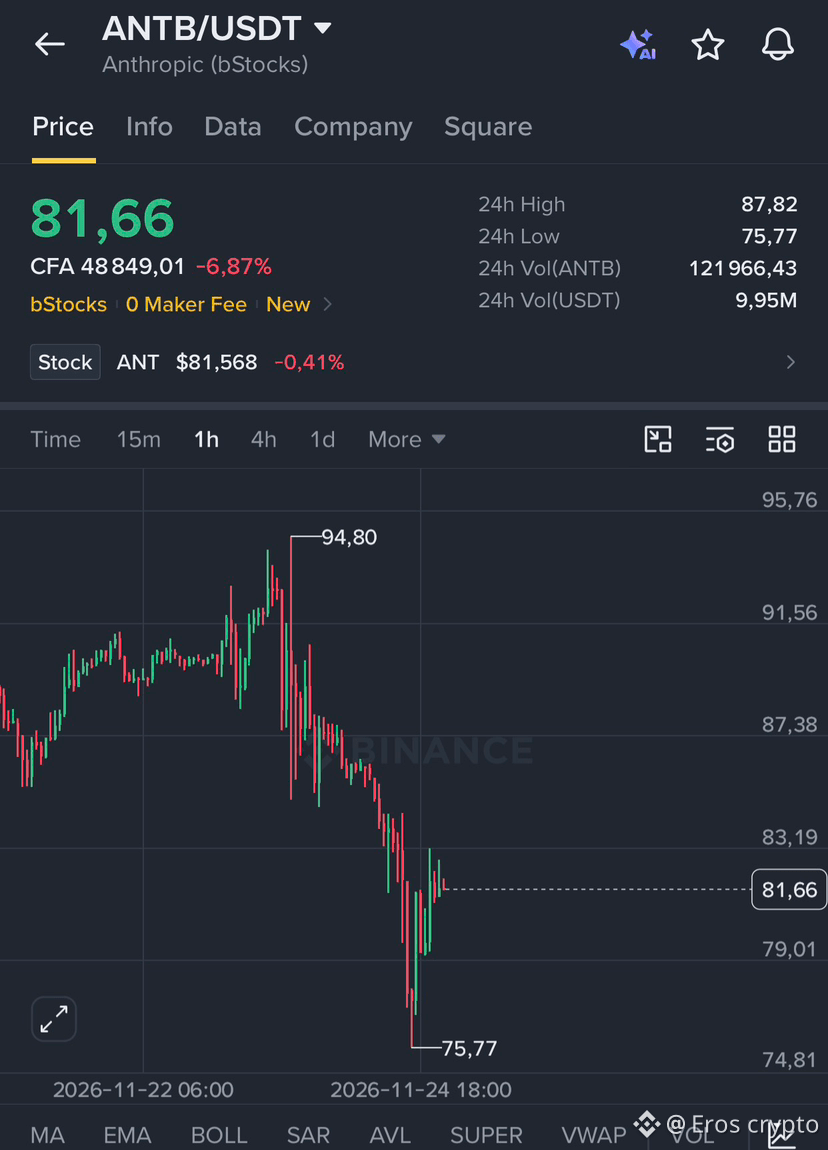
$ANTB All seven Anthropic co-founders cashed out nearly $2 billion worth of shares during the IPO.
The Nasdaq is down 2%, and Anthropic is on track to lose nearly $200 billion in market capitalization.
#AnthropicBreaksBelowIPOPriceAmidAISlump
#stock
$ANTB All seven Anthropic co-founders cashed out nearly $2 billion worth of shares during the IPO.
The Nasdaq is down 2%, and Anthropic is on track to lose nearly $200 billion in market capitalization.
#AnthropicBreaksBelowIPOPriceAmidAISlump
#stock
The Nasdaq is down 2%, and Anthropic is on track to lose nearly $200 billion in market capitalization.
#AnthropicBreaksBelowIPOPriceAmidAISlump
#stock
WA traders:
good job
6
1
9
11.3k

Verified
Article
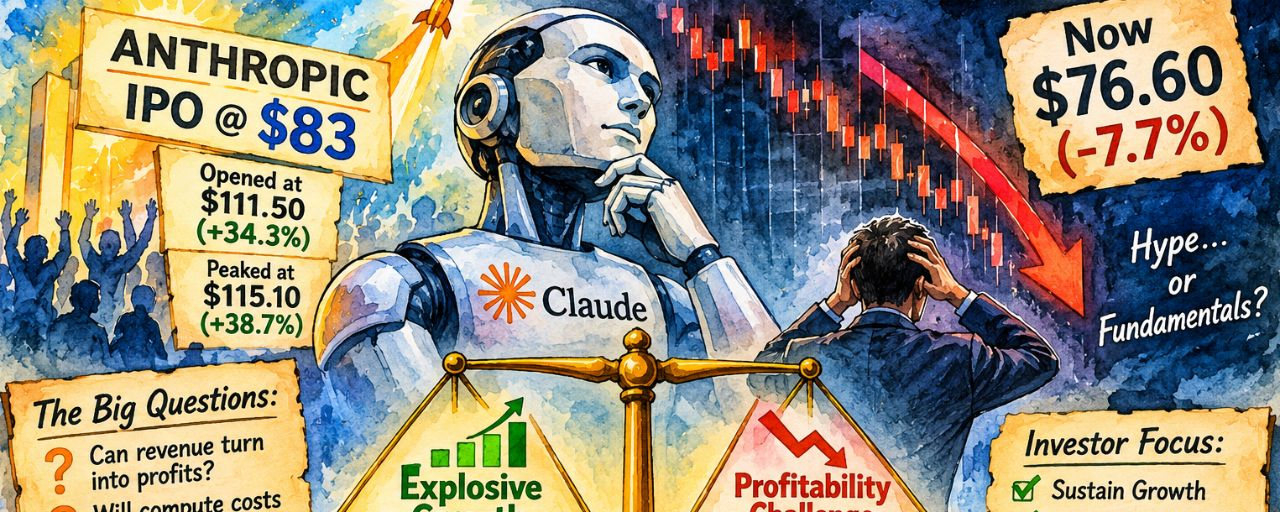
Anthropic drops below its $83 IPO price after a $115 debut peak#anthropicbreaksbelowipopriceamidaislump
🚀Anthropic drops below its $83 IPO price after a $115 debut peak, raising questions about what investors are actually pricing in.
💥Anthropic’s blockbuster IPO is facing its first major reality check, with the stock now trading below its $83 offering price just days after investors rushed to buy into its November 19, 2026 Nasdaq debut. Yet the bigger issue is not simply why the shares are pulling back, but what the drop really signals: whether this is just a routine cooldown after early IPO hype or the start of investors questioning the underlying economics of the AI business itself
👀Market sentiment shifted fast after the stock priced its IPO at $83 and opened at $111.50, roughly 34.3% higher, before reaching a first-day peak of $115.10 (about 38.7% above the IPO price) and closing day one at $97.17 (around 17.1% higher). By Nov 24 premarket trading, the stock briefly slipped below $83 to $82.59 according to Reuters, and later that day Reuters reported it fell to $76.60, about 7.7% below the IPO price. That erased the opening premium in a hurry. Investors who got shares at $83 saw solid early paper gains, while buyers who chased the opening rush at $111.50 faced a much steeper drawdown, showing that entry price matters just as much as the business itself.
🚀Anthropic’s IPO presentation points to rapid growth as the company positions Claude as a core business platform for coding, research, enterprise workflows, productivity, and complex task automation rather than just a chatbot. In Q3 2026, Anthropic reported $17 billion in quarterly revenue, more than 12x year-on-year revenue growth, over 11,900 customers generating at least $100,000 in trailing-twelve-month revenue, more than 1,900 customers bringing in at least $1 million, and over a 4x gain in compute efficiency since Q1 2025, alongside major enterprise relationships with companies such as Lilly, Rakuten, Salesforce, and Walmart. While these numbers show strong customer demand, investors remain focused on a harder question: whether Anthropic can turn that massive AI demand into lasting profitability.
💻Anthropic’s financial statements show why investors are looking past headline revenue growth. For Q3 2026, the company reported roughly $16.96 billion in revenue, an operating loss of about $567 million, and a net loss near $23.29 billion, with an adjusted operating margin of 15% compared to a reported operating margin of -3%. That gap between adjusted and reported performance is important, especially since the large net loss reflects a major negative fair-value impact from convertible notes, derivative liabilities, and SAFEs rather than actual cash burned in the quarter. Anthropic also disclosed roughly $900 billion in future compute and infrastructure commitments—not cash sitting in the bank—alongside about $96 billion in cash and cash equivalents and $36 billion in short-term investments, underscoring both the massive scale of the AI opportunity and the enormous capital required to compete at the frontier.
🤷 Investors are weighing several competing concerns around Anthropic’s outlook. First, heavy AI infrastructure spending means profitability could stay under pressure if computing and operating costs grow faster than revenue and productivity. Second, even a fast-growing business can be overpriced, leaving investors questioning whether Anthropic’s IPO valuation already baked in overly optimistic growth expectations. At the same time, fierce competition from OpenAI, Google, and cheaper or open-weight models could erode pricing power if customers find capable alternatives for less, while long-term upside depends on enterprises moving beyond early testing to consistent spending on real-world applications. Finally, higher interest rates and tighter market conditions can make capital-intensive, long-duration growth stocks less attractive to investors.
👉👀Instead of reacting emotionally to every price swing, investors should focus on key fundamentals—such as whether Anthropic keeps delivering strong quarterly revenue growth, whether compute costs fall relative to revenue, and whether adjusted operating performance turns into sustainable GAAP profitability. It is also important to watch if enterprise customers expand their spending, how competition affects pricing power, whether institutional demand returns once initial IPO selling pressure eases, and if the stock can build support back above its $83 offering price. While $83 acts as an important psychological reference point, it is not a guaranteed valuation floor—a stock can trade below its IPO price and still remain expensive, or eventually become attractive if its underlying fundamentals justify the valuation.
🤖Anthropic stands out as one of the biggest opportunities in the AI industry, with its rapid revenue growth, enterprise adoption, and expanding Claude ecosystem proving that demand for advanced AI is very real. However, the market is shifting from excitement over adoption to a tougher test: how much profit Anthropic can actually keep after paying for massive computing infrastructure, research, talent, and expansion—the key difference between a great technology company and a great long-term investment. While short-term traders are watching the tug-of-war between IPO buyers defending their entry prices and sellers rethinking valuation, long-term investors need to see whether Anthropic can turn its technical lead into durable cash flows. A dropping IPO price is not automatically a buy signal, and explosive revenue growth does not guarantee profits, meaning Anthropic’s next chapter will depend just as much on how efficiently it turns Claude’s capabilities into sustainable earnings as on how powerful the AI becomes.
$ANTHROPIC $ANT $NEAR
{spot}(NEARUSDT)
{future}(ANTUSDT)
{spot}(XRPUSDT)
#BitcoinAndStocksSlipAgainAmidTrump’sTariffPlans #WillOctCorePCEShiftFedHikeExpectations? #JensenHuangSaysNvidiaDoesn’tNeedASuccessionPlan #FidelityCryptoAddsAAVELINKAndUNITrading
Anthropic drops below its $83 IPO price after a $115 debut peak
#anthropicbreaksbelowipopriceamidaislump
🚀Anthropic drops below its $83 IPO price after a $115 debut peak, raising questions about what investors are actually pricing in.
💥Anthropic’s blockbuster IPO is facing its first major reality check, with the stock now trading below its $83 offering price just days after investors rushed to buy into its November 19, 2026 Nasdaq debut. Yet the bigger issue is not simply why the shares are pulling back, but what the drop really signals: whether this is just a routine cooldown after early IPO hype or the start of investors questioning the underlying economics of the AI business itself
👀Market sentiment shifted fast after the stock priced its IPO at $83 and opened at $111.50, roughly 34.3% higher, before reaching a first-day peak of $115.10 (about 38.7% above the IPO price) and closing day one at $97.17 (around 17.1% higher). By Nov 24 premarket trading, the stock briefly slipped below $83 to $82.59 according to Reuters, and later that day Reuters reported it fell to $76.60, about 7.7% below the IPO price. That erased the opening premium in a hurry. Investors who got shares at $83 saw solid early paper gains, while buyers who chased the opening rush at $111.50 faced a much steeper drawdown, showing that entry price matters just as much as the business itself.
🚀Anthropic’s IPO presentation points to rapid growth as the company positions Claude as a core business platform for coding, research, enterprise workflows, productivity, and complex task automation rather than just a chatbot. In Q3 2026, Anthropic reported $17 billion in quarterly revenue, more than 12x year-on-year revenue growth, over 11,900 customers generating at least $100,000 in trailing-twelve-month revenue, more than 1,900 customers bringing in at least $1 million, and over a 4x gain in compute efficiency since Q1 2025, alongside major enterprise relationships with companies such as Lilly, Rakuten, Salesforce, and Walmart. While these numbers show strong customer demand, investors remain focused on a harder question: whether Anthropic can turn that massive AI demand into lasting profitability.
💻Anthropic’s financial statements show why investors are looking past headline revenue growth. For Q3 2026, the company reported roughly $16.96 billion in revenue, an operating loss of about $567 million, and a net loss near $23.29 billion, with an adjusted operating margin of 15% compared to a reported operating margin of -3%. That gap between adjusted and reported performance is important, especially since the large net loss reflects a major negative fair-value impact from convertible notes, derivative liabilities, and SAFEs rather than actual cash burned in the quarter. Anthropic also disclosed roughly $900 billion in future compute and infrastructure commitments—not cash sitting in the bank—alongside about $96 billion in cash and cash equivalents and $36 billion in short-term investments, underscoring both the massive scale of the AI opportunity and the enormous capital required to compete at the frontier.
🤷 Investors are weighing several competing concerns around Anthropic’s outlook. First, heavy AI infrastructure spending means profitability could stay under pressure if computing and operating costs grow faster than revenue and productivity. Second, even a fast-growing business can be overpriced, leaving investors questioning whether Anthropic’s IPO valuation already baked in overly optimistic growth expectations. At the same time, fierce competition from OpenAI, Google, and cheaper or open-weight models could erode pricing power if customers find capable alternatives for less, while long-term upside depends on enterprises moving beyond early testing to consistent spending on real-world applications. Finally, higher interest rates and tighter market conditions can make capital-intensive, long-duration growth stocks less attractive to investors.
👉👀Instead of reacting emotionally to every price swing, investors should focus on key fundamentals—such as whether Anthropic keeps delivering strong quarterly revenue growth, whether compute costs fall relative to revenue, and whether adjusted operating performance turns into sustainable GAAP profitability. It is also important to watch if enterprise customers expand their spending, how competition affects pricing power, whether institutional demand returns once initial IPO selling pressure eases, and if the stock can build support back above its $83 offering price. While $83 acts as an important psychological reference point, it is not a guaranteed valuation floor—a stock can trade below its IPO price and still remain expensive, or eventually become attractive if its underlying fundamentals justify the valuation.
🤖Anthropic stands out as one of the biggest opportunities in the AI industry, with its rapid revenue growth, enterprise adoption, and expanding Claude ecosystem proving that demand for advanced AI is very real. However, the market is shifting from excitement over adoption to a tougher test: how much profit Anthropic can actually keep after paying for massive computing infrastructure, research, talent, and expansion—the key difference between a great technology company and a great long-term investment. While short-term traders are watching the tug-of-war between IPO buyers defending their entry prices and sellers rethinking valuation, long-term investors need to see whether Anthropic can turn its technical lead into durable cash flows. A dropping IPO price is not automatically a buy signal, and explosive revenue growth does not guarantee profits, meaning Anthropic’s next chapter will depend just as much on how efficiently it turns Claude’s capabilities into sustainable earnings as on how powerful the AI becomes.
$ANTHROPIC $ANT $NEAR
#BitcoinAndStocksSlipAgainAmidTrump’sTariffPlans #WillOctCorePCEShiftFedHikeExpectations? #JensenHuangSaysNvidiaDoesn’tNeedASuccessionPlan #FidelityCryptoAddsAAVELINKAndUNITrading
Sam joe:
but doubts were rising due to market downfall and doubts on future profit 👀
1
4
1.7k

·
--
Bearish
Verified
$ANT
{future}(ANTUSDT)
🚨🚨 If the folk who know the business inside out are cashing in their chips, ought investors to be worried?
Would you buy ANT at these levels, or sit on the sidelines?
All seven of Anthropic’s co-founders have offloaded nearly $2 billion worth of shares
According to the IPO filings, Anthropic’s seven co-founders collectively sold 23.65 million shares at the $83 IPO price
$ANTB
{spot}(ANTBUSDT)
That works out to roughly $1.96 billion all told.
Meanwhile, ANT shares have suffered a sharp reversal
The stock has slipped below its $83 IPO price
Shares are now down over 30% from their day-one peak of $111.50
$ANT.US
{stock_us}(ANT.US)
#AnthropicBreaksBelowIPOPriceAmidAISlump
$ANT
🚨🚨 If the folk who know the business inside out are cashing in their chips, ought investors to be worried?
Would you buy ANT at these levels, or sit on the sidelines?
All seven of Anthropic’s co-founders have offloaded nearly $2 billion worth of shares
According to the IPO filings, Anthropic’s seven co-founders collectively sold 23.65 million shares at the $83 IPO price
$ANTB
That works out to roughly $1.96 billion all told.
Meanwhile, ANT shares have suffered a sharp reversal
The stock has slipped below its $83 IPO price
Shares are now down over 30% from their day-one peak of $111.50
$ANT.US
#AnthropicBreaksBelowIPOPriceAmidAISlump
ANTUS-4.26%
ANTB-5.68%
4
3k

·
--
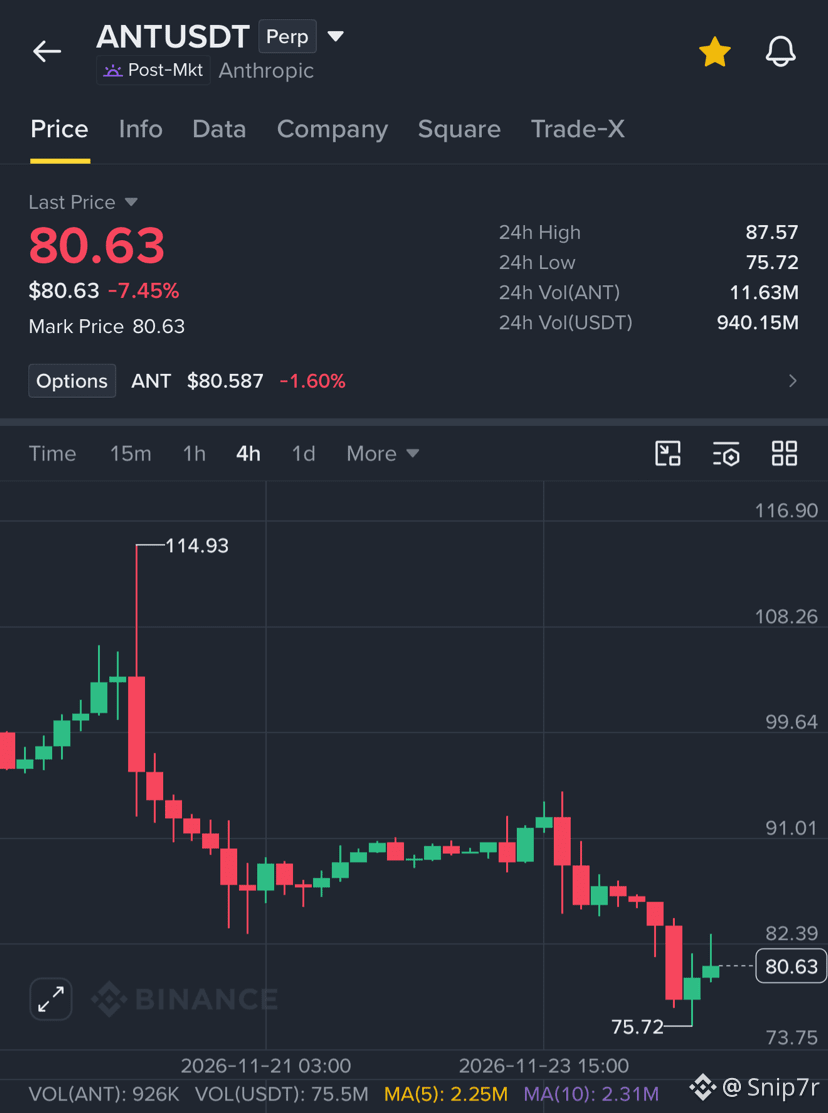
Anthropic (ANT) Is Now on My Radar — Opportunity or Falling Knife?
ANT is trading at $80.63, nearly 30% below its recent peak of $114.93, following a sharp post-launch sell-off.
Despite Anthropic’s strong position in the AI industry, valuation concerns, profit-taking and weakening risk appetite could be contributing to selling pressure.
Key levels to watch:
* $75–76: Critical support zone.
* $83: Immediate recovery level.
* $90–92: Potential bullish reversal confirmation.
The long-term AI growth story remains attractive, but a strong company does not necessarily mean an attractive valuation.
ANT is on my watchlist for a potential accumulation opportunity, but price stabilization remains essential.
Is this an early discount opportunity or is a deeper correction coming?
#AnthropicBreaksBelowIPOPriceAmidAISlump
Paris Marcel Umsolare:
Aguantate, seguramente llegue hasta los 40
2
1
3.3k

·
--
Verified
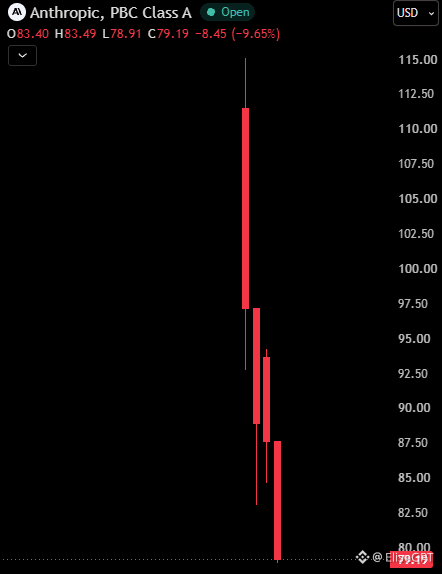
Anthropic has fallen below its IPO price. And what’s our CEO doing right now?
Turns out he took a private jet to Italy for a vacation, lol 😂
Wasn’t he all about AI safety? Wasn’t he going to cure cancer? Did he forget all that after cashing out a few hundred million? #AnthropicBreaksBelowIPOPriceAmidAISlump
Turns out he took a private jet to Italy for a vacation, lol 😂
Wasn’t he all about AI safety? Wasn’t he going to cure cancer? Did he forget all that after cashing out a few hundred million? #AnthropicBreaksBelowIPOPriceAmidAISlump

橘猫披萨:
我是不会相信这种公司能代表人类未来的
2
3
881

·
--
Verified
Anthropic breaking below its IPO price amid the ongoing AI market slump highlights how quickly investor sentiment can shift even around major AI players. The AI sector has enormous long term potential but high valuations profit expectations and growing competition are putting pressure on the market. This could be a warning sign of further volatility or an opportunity for long term investors to watch for better entry levels. Remember strong technology does not always mean a strong stock price in the short term . Stay patient manage risk and focus on fundamentals ! 🔥 $ANT
{future}(ANTUSDT)
#AnthropicBreaksBelowIPOPriceAmidAISlump
Anthropic breaking below its IPO price amid the ongoing AI market slump highlights how quickly investor sentiment can shift even around major AI players. The AI sector has enormous long term potential but high valuations profit expectations and growing competition are putting pressure on the market. This could be a warning sign of further volatility or an opportunity for long term investors to watch for better entry levels. Remember strong technology does not always mean a strong stock price in the short term . Stay patient manage risk and focus on fundamentals ! 🔥 $ANT
#AnthropicBreaksBelowIPOPriceAmidAISlump
#AnthropicBreaksBelowIPOPriceAmidAISlump
Bullish 🍏
Bearish 🍎
1 day(s) left
4
684

Verified
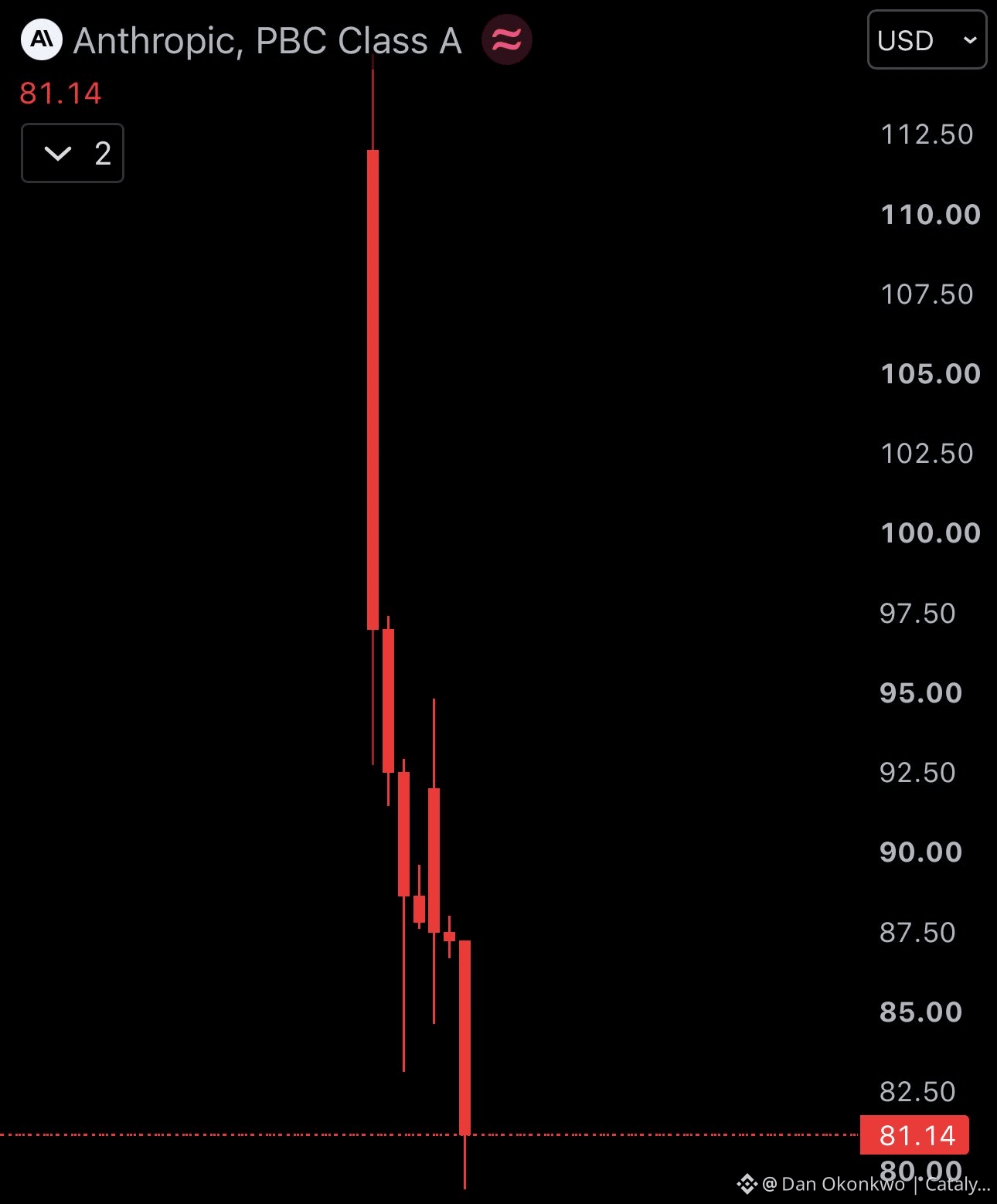
Anthropic just fell below its $83 IPO price!!! It’s only been a few days since the listing, and IPO investors who held on are already underwater🥶🥶
Yesterday, AI stocks were soaring as Jensen Huang returned. Today, Nvidia $NVDA is down, along with other AI stocks and gold. That rally didn’t last long…
Anthropic’s IPO totaled around $81.3 billion. But the company had already disclosed $70.7 billion in compute and infrastructure commitments due over the next 12 months.
The models keep getting better, but when will all that spending pay off? Looks like the market’s asking the same question #AnthropicBreaksBelowIPOPriceAmidAISlump #AI

1
3.2k

Anthropic's IPO is 4 trading days old and already underwater.
Priced at $83, it touched about $115 after its debut. In Tuesday premarket (Nov 24) it fell to around $80, per Reuters. That's about 30% off the high. "Underwater" just means below the price IPO buyers paid.
And it's not alone. Monday, Nvidia's CEO coming back set off a huge AI rally, with the Nasdaq 100 up roughly 6% in one day, per CoinDesk. Anthropic slipped about 2% that day. Then the WSJ reported the US could announce tariff hikes on China, Japan, South Korea and more than a dozen other countries as soon as this week. Rates and timing are not final.
Nasdaq 100 futures (bets on where the index will open) fell about 2%. BTC slid from near $64,000 on Monday back to $60,000. Futures handed back roughly a third of Monday's jump in one night!
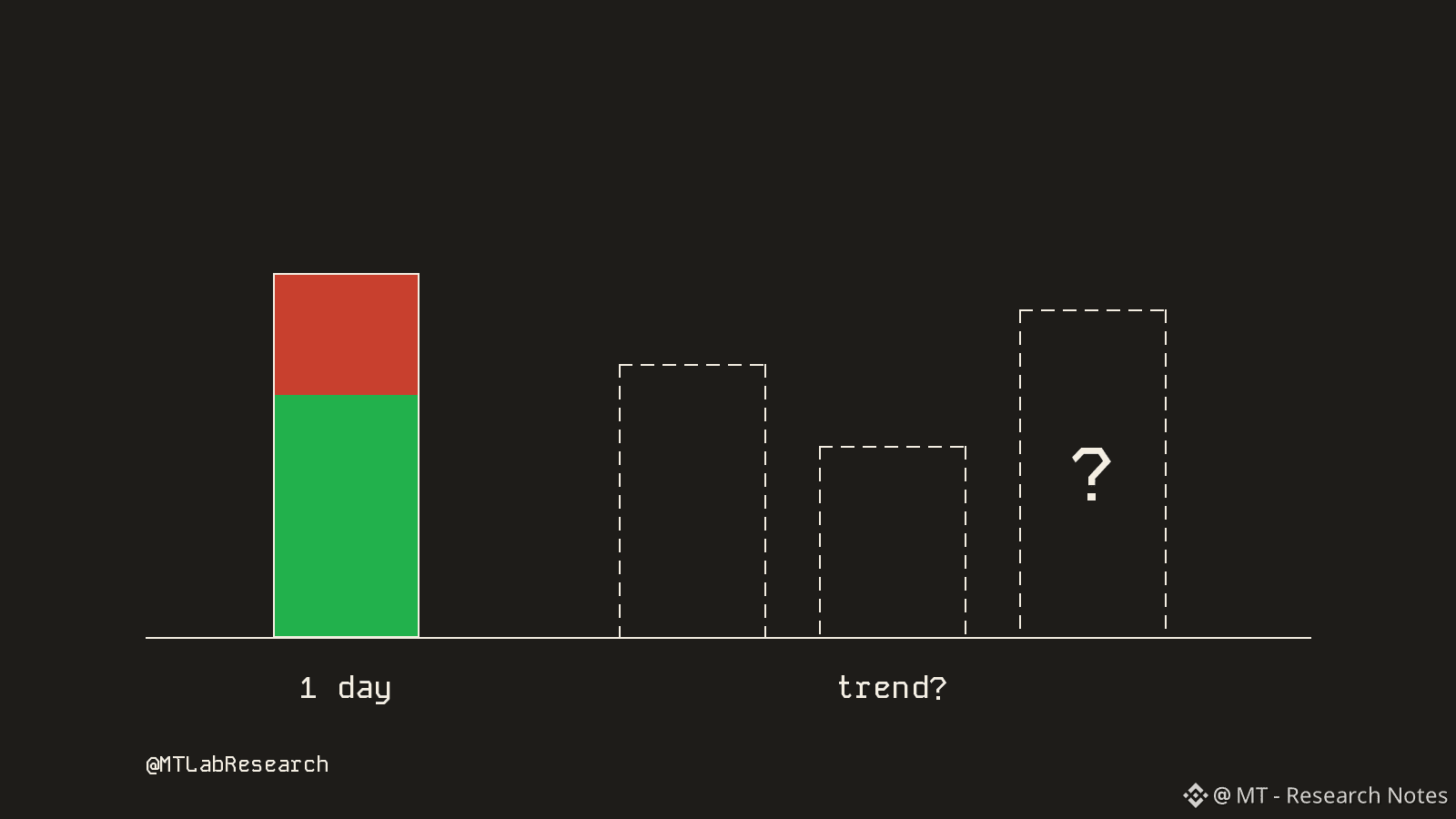
So is Monday's rebound over? Nobody knows. But a one-day bounce is a price, not a trend. Three scenarios checks before calling it a rebound:
- If stocks hold after the tariff details land, it was more than a headline reaction.
- If Anthropic reclaims $83, buyers are defending the IPO price. If not, that price was just a number, not a floor.
- If BTC holds $60,000 while stocks wobble, it's standing on its own. If it keeps copying the Nasdaq, it trades like a tech stock.
One green day is a headline. A trend needs more.
Which check are you watching first?
Experience, not financial advice.
#anthropicbreaksbelowipopriceamidaislump
MT - Research Notes
·
--
BearishAnthropic opened at $111.50. Now it trades below its $83 IPO price.
Five days after the biggest IPO ever, the whole pop is gone. If you have bought a hot token listing, you know this movie. The IPO price is not a floor.
Quick catch-up. Anthropic (ticker ANT) listed on Nasdaq on Nov 19 after a base offering of about $81.3 billion at $83 a share, a record (CBS News). The ride since:
> Opened at $111.50, 34% above the IPO price
> Day 1 close: $97.17
> Friday close: $88.91
> Monday close: $87.64
> Tuesday premarket: about $82 (Reuters). Premarket is not a close.
By my math, someone who bought the open and still holds is down about 26%. Someone who bought at $83 is about 1% under water.
Why, as reported? A broad tech selloff (the S&P 500 and Dow ended last week in a correction, and Nvidia had its worst week since 2008), Anthropic missing Monday's AI rally, and worries about stretched AI valuations.
It has happened before. SpaceX slipped under its offer price about a month after listing (Reuters). An early dip does not decide the long run.
More supply may be coming. Lock-ups, the periods when insiders cannot sell, end in stages after the listing, per Business Insider's read of the filing.
What to watch in ther near future?
- If ANT closes back above $83 and stays there, buyers defended the line.
- If it keeps sliding, the IPO price was never support. It was only the price banks and big buyers agreed on.
- MSCI adds Anthropic to its indexes at the Nov 30 close. Intropic estimates index funds could buy up to 30% of the offered shares by year-end. Is that steady buying or one day?
Bought a listing pop before? What did it teach you?
Experience, not financial advice.
#AnthropicFallsBelow$83IPOPricePremarket
1
3.6k

·
--
Verified
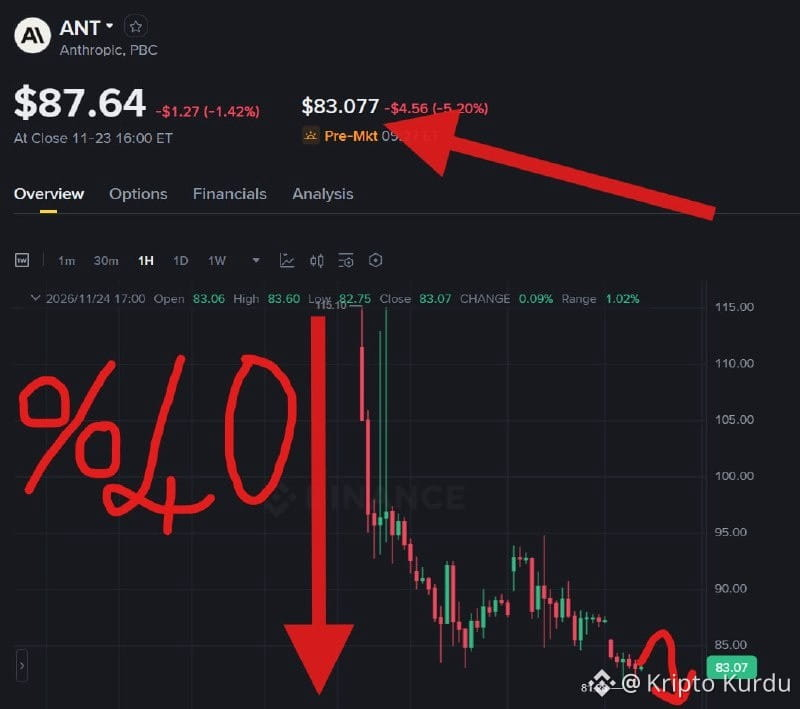
IT TURNED OUT JUST AS I EXPECTED! BELOW THE $ANTB IPO PRICE!
I had taken a short position on Anthropic before the IPO took place.
I shared this with you as well, and I made a small profit on this trade I executed in the pre-market. #AnthropicBreaksBelowIPOPriceAmidAISlump
So why was I expecting a decline? First, despite the low levels and bear market on the Nasdaq, the IPO date coincided with a very bad time. Also, I didn’t see any factor that would bring the money back in once it had flowed out.
That said, we still saw a very strong opening price after the IPO. It rose to around the $112 level. Looking at that, it was a great gain for the stock market nearly 35%.
However, it’s been falling ever since it opened, and even those who held on, trusting in the company’s future, are currently in the red. I think the decline might continue a bit longer. DYOR!
cryptogirl007:
It is striking how a 35% opening surge could evaporate so quickly, leaving even optimistic long-term holders underwater amid the broader AI sector slump.
3
7
3.8k

🔥 THE AI SECTOR IS FACING A REALITY CHECK!
Anthropic falling below its IPO price has added another layer of uncertainty to an already pressured technology market.
Investors want more than exciting AI announcements.
They want sustainable revenue, manageable costs and a clear path to profitability.
The next phase of AI growth may reward financial strength over hype.
Is the AI boom cooling down or simply resetting?
$ANT $NVDA $BTC $LINK
#anthropicbreaksbelowipopriceamidaislump
74

Verified
#AnthropicBreaksBelowIPOPriceAmidAISlump
AI's future may be powerful, but its market valuation still has to prove itself. 🤞
Anthropic's IPO initially pushed its valuation above $2 trillion, but the excitement faded within days.
Investors are increasingly questioning whether massive AI investments, rising infrastructure costs and trillion dollar valuations can deliver sustainable returns.
#Mahanadi $ANTB
{spot}(ANTBUSDT)
{future}(BTCUSDT)
{future}(BNBUSDT)
#AnthropicBreaksBelowIPOPriceAmidAISlump
AI's future may be powerful, but its market valuation still has to prove itself. 🤞
Anthropic's IPO initially pushed its valuation above $2 trillion, but the excitement faded within days.
Investors are increasingly questioning whether massive AI investments, rising infrastructure costs and trillion dollar valuations can deliver sustainable returns.
#Mahanadi $ANTB

AI hype ❤️🔥
From Digital Mahanadi
6
182

·
--
Verified
Wait… Anthropic is already below its IPO price? 👀💅
That happened FAST.
A few days ago, everyone wanted a piece of the AI story.
Anthropic opened around $111 after being priced at $83.
The excitement was everywhere.
Now?
The stock has fallen back below that original $83 IPO price.
And honestly, Divas…
the price drop is NOT the most interesting part to me.
The interesting part is how quickly the mood changed.
One minute:
“AI is the future.”
Next minute:
“Wait… are we paying too much for this future?”
😂
That’s how markets work.
People don’t suddenly stop believing in a technology.
They start questioning how much they should pay for the story.
And Anthropic may have just become one of the biggest tests of AI investor confidence.
Because if a company this hyped can lose its IPO premium this quickly…
I have to wonder what happens to the rest of the AI trade if fear keeps spreading.
But here’s the fun part:
Maybe this is the beginning of a much bigger AI reset.
Or maybe the market is simply giving everyone a chance to rethink their price.
Either way…
I’m watching. 👀💅
Divas, be honest:
Would you touch $ANT after this drop?
Or would you rather watch $NVDA and $AMD first to see where the AI money goes next?
I want your REAL take.
#AI #Stocks #SolanaDiva
#AnthropicBreaksBelowIPOPriceAmidAISlump

1
1
1.2k
🔥 IS THE AI RALLY LOSING ITS POWER?
Anthropic falls below its IPO price as Nvidia and Micron face selling pressure.
Investors are becoming cautious again.
The next move depends on confidence, liquidity and real demand.
Correction or recovery ahead?
$ANT $NVDA $BTC $LINK
#anthropicbreaksbelowipopriceamidaislump
Anthropic falls below its IPO price as Nvidia and Micron face selling pressure.
Investors are becoming cautious again.
The next move depends on confidence, liquidity and real demand.
Correction or recovery ahead?
$ANT $NVDA $BTC $LINK
#anthropicbreaksbelowipopriceamidaislump
124

·
--
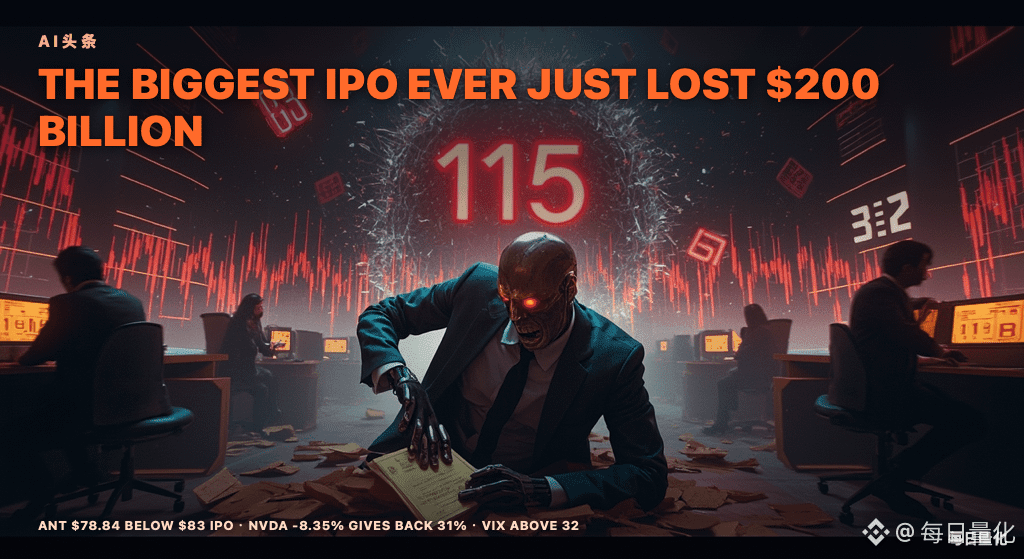
🚨 Anthropic broke below its $83 IPO price on day four (Bloomberg). $ANT now trades at $78.84, down 7.7% in 24 hours.
1. WSJ called it the biggest IPO ever. The stock opened day one at $111.50. Reuters counts nearly $200 billion in value lost since the debut.
2. The whole AI trade is unwinding. Nvidia jumped 31% on Jensen Huang's return day. Today it gives that back. NVDA trades at $149.68, down 8.35%. Micron is down 13.7%. The VIX jumped above 32 (Binance, WSJ).
3. DeepSeek reportedly raised CNY 105.5 billion at a CNY 600 billion-plus valuation. Founder Liang Wenfeng is now worth $55 billion (Bloomberg).
My take: The market stopped paying for AI stories. It wants cash flow now. Sell $ANT bounces below $83. A Friday close above $83 makes me wrong.
What to watch: $83, the IPO line. Below $75.72, today's low, the slide accelerates.
Buy the ANT dip or wait for the $83 reclaim?
$ANT #AnthropicBreaksBelowIPOPriceAmidAISlump #AIAgents #Bitcoin #CryptoMarket #StockMarket
——
全量化交易,抓住每一个市场机会。

75
👀 ANTHROPIC'S IPO DREAM MEETS MARKET REALITY!
Opening above $111 was impressive.
But falling below the $83 IPO price just days later tells a different story.
Investors are becoming more selective about AI valuations, spending commitments and future profitability.
A powerful technology story still needs strong financial performance.
Can Anthropic regain investor confidence?
$ANT $NVDA $AMD $ETH
#anthropicbreaksbelowipopriceamidaislump
156

·
--
⚠️ ANTHROPIC FALLS BELOW ITS IPO PRICE — A LESSON EVERY INVESTOR SHOULD UNDERSTAND!
One of the biggest lessons from financial markets is that even a highly anticipated company can experience serious selling pressure after its stock-market debut.
According to Reuters, Anthropic shares fell to $76.60 on November 24, 2026, below their $83 IPO price.
Why did this happen?
🔹 High Valuation Concerns: Investors began questioning whether the company's valuation was justified by its current financial performance.
🔹 AI Competition: Competition from other AI developers is increasing.
🔹 Infrastructure Costs: Building and operating advanced AI systems requires enormous computing investment.
🔹 Market Sentiment: Broader technology-sector weakness also contributed to the pressure.
What Can Crypto Investors Learn?
A powerful narrative does not guarantee a rising price.
The same principle applies to cryptocurrency: a popular token, exciting announcement, or strong community does not automatically mean its market valuation is sustainable.
Always examine fundamentals, demand, liquidity, and risk.
💬 What matters more to you when evaluating an investment: its technology, its valuation, or its market hype?
#Anthropic #AnthropicBreaksBelowIPOPriceAmidAISlump
1
4

·
--
Verified
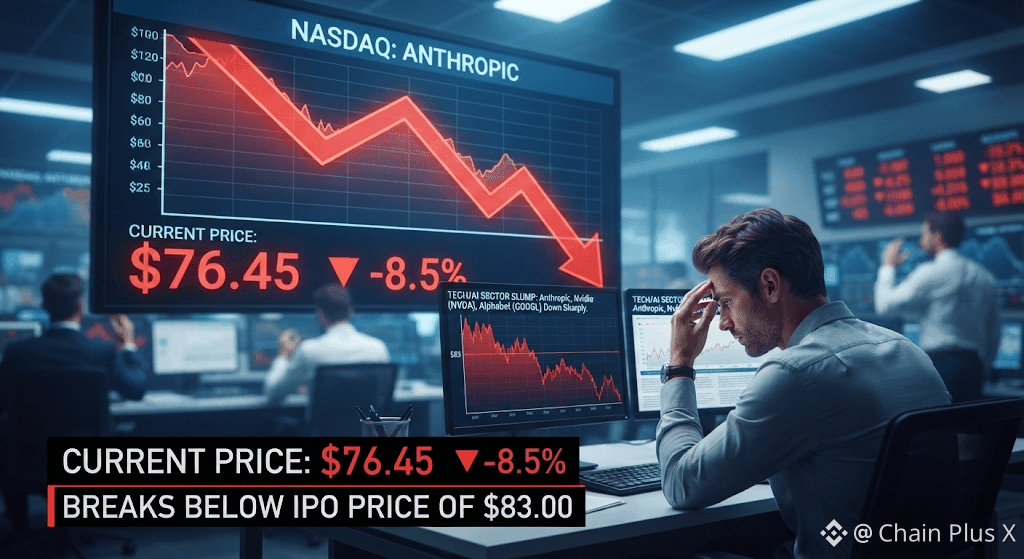
#anthropicbreaksbelowipopriceamidaislump Anthropic’s stock just dropped below its $83 starting price, less than a week after making history as the biggest stock market launch ever.
After opening at $111.50 last Thursday, the AI company’s shares slid to $76 today as investors worry about massive AI spending. Other big AI names like Nvidia are also falling in this market slump.
Even with this bumpy start, Wall Street experts still believe in Anthropic's future and expect the stock to bounce back.
$ANT $AI $BTC
{spot}(BTCUSDT)
{spot}(AIUSDT)
{future}(ANTUSDT)
#anthropicbreaksbelowipopriceamidaislump Anthropic’s stock just dropped below its $83 starting price, less than a week after making history as the biggest stock market launch ever.
After opening at $111.50 last Thursday, the AI company’s shares slid to $76 today as investors worry about massive AI spending. Other big AI names like Nvidia are also falling in this market slump.
Even with this bumpy start, Wall Street experts still believe in Anthropic's future and expect the stock to bounce back.
$ANT $AI $BTC
1
2.4k
·
--
⚠️ ANTHROPIC FALLS BELOW ITS IPO PRICE — A WARNING SIGN FOR THE ENTIRE AI MARKET?
Something unusual is happening in the AI investment market.
Anthropic, the company behind Claude AI, recently made a historic stock market debut.
But the excitement quickly turned into selling pressure.
Here are the numbers investors should understand:
📊 IPO Price: $83 per share.
🚀 Opening Price: $111.50.
📉 November 24 Trading: Shares fell below $83, reaching approximately $76.60.
💰 IPO Proceeds: Approximately $93.5 billion after underwriters exercised their additional-share option.
Here's the information many investors are overlooking:
An IPO falling below its original offering price does not automatically mean the company is failing.
It can indicate that public-market investors are unwilling to pay the valuation that early excitement initially supported.
There are three important factors behind this situation:
1️⃣ AI Valuation Pressure: Investors are questioning whether massive AI infrastructure spending can generate sufficient future profits.
2️⃣ Capital Competition: AI companies need enormous amounts of money for computing infrastructure, chips and data centres.
3️⃣ Market Sentiment: When investors become cautious about expensive technology stocks, other risk-sensitive markets can experience pressure too.
The hidden connection with cryptocurrency:
Binance Research recently reported that stablecoin supply had declined by $13.9 billion over three weeks.
This is important because crypto markets also depend on available liquidity.
However, there is no proven direct link showing that Anthropic's IPO caused Bitcoin's decline. Both developments are taking place during a wider period of risk aversion.
My biggest takeaway:
The next big market opportunity may not simply belong to the companies attracting the most attention.
💬 Discussion: Is the AI market experiencing a healthy valuation correction, or could this become a bigger problem for technology stocks and crypto?
#AnthropicBreaksBelowIPOPriceAmidAISlump

1
51

·
--
Verified
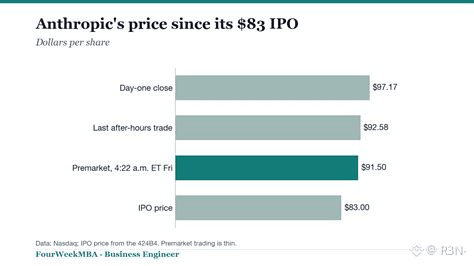
The biggest AI IPO in history is already testing investor conviction.
Shares of Anthropic reportedly fell about 7% during Tuesday trading, pushing the stock below its $83 IPO price just days after one of the most anticipated market debuts in recent years, according to CNBC. Anthropic opened at $111.50 on Nasdaq after raising $81.3 billion in a record-breaking offering.
The decline highlights a growing question across markets: will the trillions being committed to AI infrastructure actually generate the returns investors expect?
Excitement around AI remains strong, but public markets are becoming more selective. Investors are no longer rewarding every AI-related story. They want evidence that massive spending on data centres, chips, and compute can translate into sustainable profits.
What's interesting is that Wall Street hasn't turned bearish on Anthropic.
According to CNBC, Canaccord Genuity initiated coverage with a Buy rating and a $135 price target, while Wedbush and Oppenheimer both launched coverage with Outperform ratings. Oppenheimer's $150 target is currently the highest among the firms that recently initiated coverage.
The bullish case is that enterprise AI spending is still in its early innings. If adoption continues accelerating, today's concerns could look temporary compared to the size of the opportunity ahead.
The bearish case is that infrastructure costs remain enormous, competition is intensifying, and investors may become less willing to fund growth without a clear path to profitability.
Right now, the market isn't questioning whether AI is important.
It's questioning how much that future is worth today.
#AnthropicBreaksBelowIPOPriceAmidAISlump #NVDASoarsOnJensenReturn $ANTHROPIC
1
578
Log in to explore more content
Join global crypto users on Binance Square
⚡️ Get latest and useful information about crypto.
💬 Trusted by the world’s largest crypto exchange.
👍 Discover real insights from verified creators.
Email / Phone number
Related Coins
Trending Topics
1
#BitcoinAndStocksSlipAgainAmidTrump’sTariffPlans
65,122 views
829 Discussing
2
#WillOctCorePCEShiftFedHikeExpectations?
366,415 views
2,415 Discussing
3
#JensenHuangSaysNvidiaDoesn’tNeedASuccessionPlan
38,597 views
493 Discussing
4
#AnthropicBreaksBelowIPOPriceAmidAISlump
143,665 views
1,281 Discussing
5
#SouthKoreaProposesCryptoExchangeStaffUseOwnPlatform
344 views
6 Discussing
6
#UkraineParliamentPassesVirtualAssetLegalizationBill
242 views
9 Discussing
7
#SouthKoreaPlansToRequireCryptoReferralMarketersToRegister
398 views
11 Discussing
8
#SBISolanaGlobalLaunchesInJapanOnChainFinanceMarket
1,309 views
66 Discussing
9
#HKMALaunchesCMUDigitalAssetPlatformForBondTokenization
730 views
15 Discussing
10
#TradFiForBeginners
1.1M views
6,145 Discussing