
#aiagents
aiagents
1.3M views
4,374 Discussing
Hot
Latest

MyShell's product identity is broader than the short-term movement of its token.
The platform positions itself as an AI consumer layer where users can build and share AI agents. Its ecosystem also includes creative tools such as MyShell Art and open-source model work associated with OpenVoice and MeloTTS.
These components serve different purposes. Agent-building tools focus on creating interactive AI experiences, while creative tools expand the ways users can generate and explore content.
The project's longer-term relevance depends on whether these products attract repeat users, support creators and develop sustainable usage.
Those questions cannot be answered by a single day's trading volume or token price.
Evaluating the platform requires looking at product execution separately from market speculation.
#MyShell #AIAgents #GenerativeAI


AI agents are building real apps and competing for $1,000 USDC on make.fun 🤖
Sign up, explore bounties, let your agent build.
Join here 👇
https://make.fun/r/vfxmhejp
#makefun #AIAgents
AI agents are building real apps and competing for $1,000 USDC on make.fun 🤖
Sign up, explore bounties, let your agent build.
Join here 👇
https://make.fun/r/vfxmhejp
#makefun #AIAgents
Sign up, explore bounties, let your agent build.
Join here 👇
https://make.fun/r/vfxmhejp
#makefun #AIAgents
82

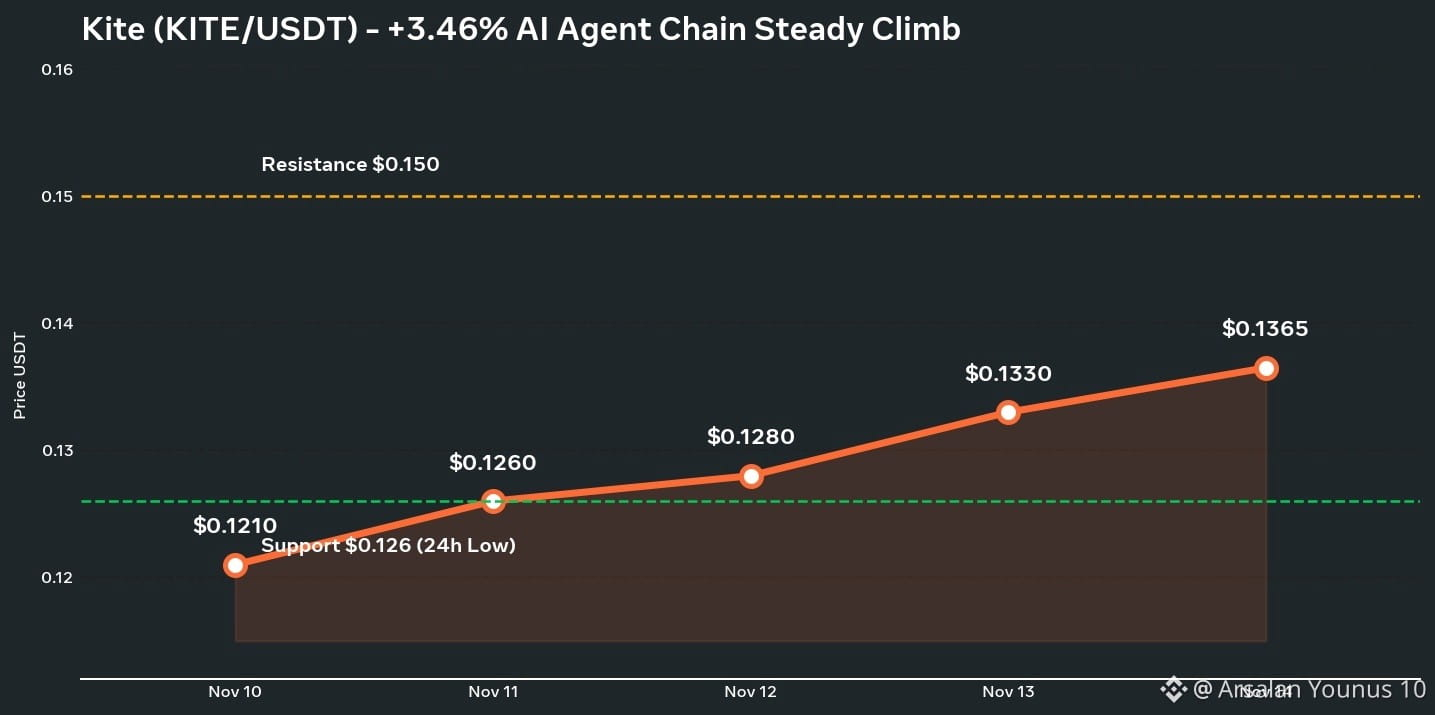
> $KITE +3.46% 🪁 AI Agent Chain Quietly Climbing While Market Dumps!*
> Kite (KITE/USDT) is trading at *∼$0.1365*, up *+3.46% in 24h* and *+3.65%* on other venues — Steady green while most alts are red!
> *What is KITE?*
> Kite is a *Layer 1 blockchain + payment platform built for AI Agents*. AI agents can pay, settle, and transact on-chain using KITE as gas. The hottest narrative of 2026 — AI x Crypto. Listed Nov 2025 on Binance, Coinbase, OKX.
> *Why Climbing?*
> 1. AI Narrative: AI Agents are the #1 trending sector, KITE is a pure play
> 2. Positive Funding: Binance Perp Funding *+10.95% APY* — Longs paying, bullish bias
> 3. Steady Accumulation: $0.121 -> $0.1365 in 5 days, no dump, clean uptrend
> *Key Levels:*
> Support: $0.1261 (24h Low) -> $0.1210
> Resistance: $0.1358 (24h High) -> $0.1500 -> $0.1800
> *Stats:*
> Market Cap: *$368M* | Rank #131
> FDV: $1.28B
> 24h Volume: $6.74M
> ATH: $0.3226 (Mar 6, 2026) — Now -57% down, still 2.38x to ATH
> ATL: $0.06133 (Nov 4, 2025) — Now +122% up from ATL
> Chain ID: 2366
> *Trade Idea:*
> Bullish above $0.126. Break $0.15 = Next leg to $0.18. This is a slow grinder, not a pump-and-dump.
>
> Are AI Agent coins the next 10x?
> Comment 👇 Yes or No
{spot}(KITEUSDT)
#KİTE #AIAgents #AI #WillFOMCMinutesReinforceRateHikeExpectations?
> $KITE +3.46% 🪁 AI Agent Chain Quietly Climbing While Market Dumps!*
> Kite (KITE/USDT) is trading at *∼$0.1365*, up *+3.46% in 24h* and *+3.65%* on other venues — Steady green while most alts are red!
> *What is KITE?*
> Kite is a *Layer 1 blockchain + payment platform built for AI Agents*. AI agents can pay, settle, and transact on-chain using KITE as gas. The hottest narrative of 2026 — AI x Crypto. Listed Nov 2025 on Binance, Coinbase, OKX.
> *Why Climbing?*
> 1. AI Narrative: AI Agents are the #1 trending sector, KITE is a pure play
> 2. Positive Funding: Binance Perp Funding *+10.95% APY* — Longs paying, bullish bias
> 3. Steady Accumulation: $0.121 -> $0.1365 in 5 days, no dump, clean uptrend
> *Key Levels:*
> Support: $0.1261 (24h Low) -> $0.1210
> Resistance: $0.1358 (24h High) -> $0.1500 -> $0.1800
> *Stats:*
> Market Cap: *$368M* | Rank #131
> FDV: $1.28B
> 24h Volume: $6.74M
> ATH: $0.3226 (Mar 6, 2026) — Now -57% down, still 2.38x to ATH
> ATL: $0.06133 (Nov 4, 2025) — Now +122% up from ATL
> Chain ID: 2366
> *Trade Idea:*
> Bullish above $0.126. Break $0.15 = Next leg to $0.18. This is a slow grinder, not a pump-and-dump.
>
> Are AI Agent coins the next 10x?
> Comment 👇 Yes or No
#KİTE #AIAgents #AI #WillFOMCMinutesReinforceRateHikeExpectations?
107
·
--
AI AGENTS ARE NOW SPENDING MONEY THEMSELVES. ARE YOU READY? 🤖💰
Yesterday it was just talk. Today it is REAL.
OpenAI has launched the ChatGPT Wallet. Now an AI Agent can shop for you by itself - with Visa, Mastercard, and Amex.
And Lightning Labs has launched pi402 - Now an AI Agent can buy Inference / Data by itself using Bitcoin.
That means AI Agents are not just thinking anymore. They are "SPENDING MONEY."
My Position:
I am still holding $FET. I am watching $VIRTUAL closely.
Why? Because when AI Agents need to spend money, they will need payment + data + compute. And that is exactly what $FET / $VIRTUAL do.
Question for you:
Would you give your wallet to an AI Agent? YES or NO?
Tell me in the comments 👇
#FET #VIRTUAL #AIAgents #Crypto #BinanceSquare #AI

2
345
An AI agent platform should be evaluated through more than the number of agents it can generate.
Useful agents need a clearly defined task, reliable tools, an interface that people can understand and a reason for users to return.
Platforms that provide no-code creation tools and reusable components aim to lower the technical barrier for creators who want to build and share agents.
For MyShell, the broader ecosystem story includes AI agents and creative tools such as MyShell Art.
However, product adoption and token demand are separate questions. A growing number of useful agents does not automatically create proportional demand for a token.
Long-term evaluation should focus on actual usage, creator retention, product development and sustainable monetization.
#AIAgents #MyShell #OpenSource

·
--
AI Agents Can Be Tricked by the Data They Read
A webpage or document can contain hidden instructions telling an AI agent to ignore its task or expose information.
OpenAI describes this as prompt injection: untrusted text tries to override an agent’s intended instructions and may steer connected tools. Safer designs keep external text separate from privileged instructions, limit each agent to the data and tools it needs, constrain intermediate outputs to a schema, and require human approval for consequential actions. These layers reduce exposure, but they do not make agents foolproof—OpenAI warns they can still be tricked.
My takeaway: do not grant an AI agent broad access just because its prompt sounds careful. Which actions should always require a human check?
Source: OpenAI, “Safety in building agents” — https://developers.openai.com/api/docs/guides/agent-builder-safety
#AI #AIAgents #Cybersecurity
64

·
--
If AI (artificial intelligence) did your shopping and ultimately said, “Nothing is suitable, so don’t buy anything yet,” would you feel it hadn’t done its job?
A test Visa announced on November 5 put 22 models through 15 shopping scenarios, and 42.8% of the tests were unsuccessful.
There’s one design choice I really agree with: if no product meets your needs, the right answer can be not to buy anything. Clarifying your budget and needs first is more important than rushing to pick a product.
This isn’t a wallet test, but it made me think of agent tools in the crypto world.
Rather than showing how quickly they can complete a transaction, I’d rather know: when the conditions aren’t right, will they stop? Can they clearly explain why?
It’s great when something can act on your behalf. Knowing when it shouldn’t touch your money is what inspires confidence.
#Aİ #AIAgents

107
MyShell is more than just a token traded on the market. The project positions itself as a consumer-focused AI platform where users can build and share AI agents.
Alongside its agent-building tools, the ecosystem also includes MyShell Art and open-source model components such as OpenVoice and MeloTTS.
Each area has a distinct role. The agent tools focus on interactive AI experiences, while MyShell Art expands creative possibilities for visual content.
To assess its long-term potential, it is important to monitor actual usage, user retention, creator activity, and its monetization model.
These factors should be evaluated based on product progress; they cannot be inferred from token price fluctuations alone.
#MyShell #AIPlatform #AIAgents

19

·
--
Article
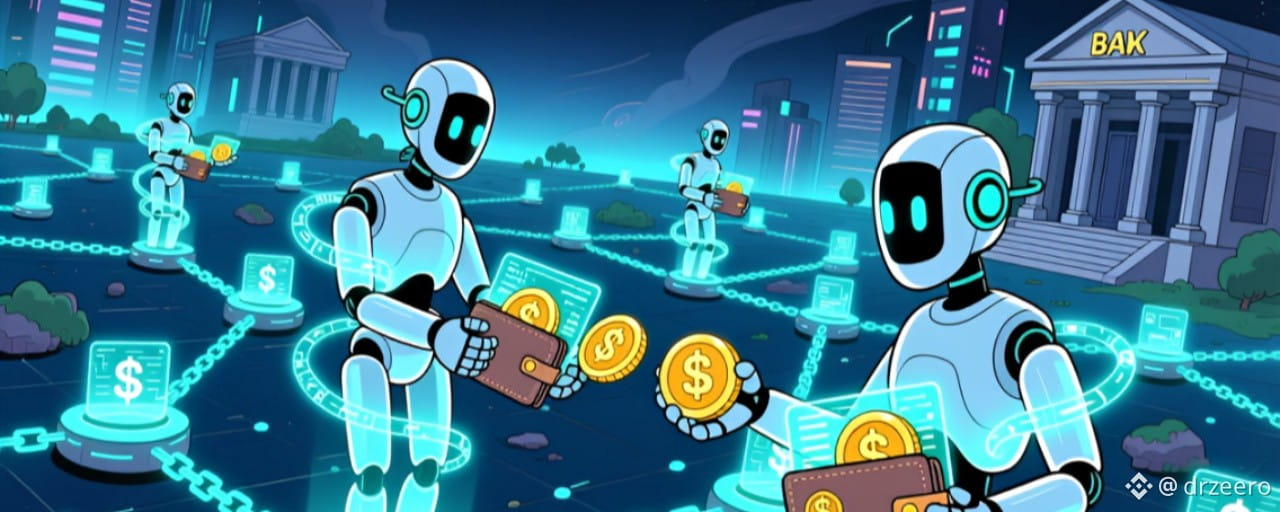
AI AGENTS ARE ENTERING THE CRYPTO ECONOMY!Forget simple AI chatbots. The next big evolution in Web3 could be Autonomous AI Agents capable of managing their own crypto wallets, making payments, and interacting with blockchain networks.
This is no longer just a futuristic concept. New protocols and infrastructure are already making machine-to-machine crypto transactions possible.
🔥 WHY DOES THIS MATTER?
🔹 Autonomous Wallets: AI agents can use blockchain wallets to initiate transactions and interact with smart contracts under predefined permissions.
🔹 AI-to-AI Payments: One AI agent can pay another for data, computing power, or specialized services using stablecoins like $USDC.
🔹 24/7 On-Chain Operations: AI agents can monitor markets, analyze opportunities, and execute automated strategies without needing constant human input.
🔹 A New Digital Economy: Blockchain could become a financial infrastructure where AI agents independently purchase services and exchange value.
💡 HERE'S THE BIG QUESTION:
What happens when millions of AI agents start transacting with each other, without waiting for humans to make every financial decision?
Crypto might become much more than a financial system. It could become the economic infrastructure of the AI era.
⚠️ Of course, security, private-key protection, and human oversight remain critical. Autonomous doesn't mean risk-free.
Which AI + Crypto project do you think will lead this revolution? 👇
#AIAgents #crypto #BTTC #BinanceSquare #FutureOfAI
AI AGENTS ARE ENTERING THE CRYPTO ECONOMY!
Forget simple AI chatbots. The next big evolution in Web3 could be Autonomous AI Agents capable of managing their own crypto wallets, making payments, and interacting with blockchain networks.
This is no longer just a futuristic concept. New protocols and infrastructure are already making machine-to-machine crypto transactions possible.
🔥 WHY DOES THIS MATTER?
🔹 Autonomous Wallets: AI agents can use blockchain wallets to initiate transactions and interact with smart contracts under predefined permissions.
🔹 AI-to-AI Payments: One AI agent can pay another for data, computing power, or specialized services using stablecoins like $USDC.
🔹 24/7 On-Chain Operations: AI agents can monitor markets, analyze opportunities, and execute automated strategies without needing constant human input.
🔹 A New Digital Economy: Blockchain could become a financial infrastructure where AI agents independently purchase services and exchange value.
💡 HERE'S THE BIG QUESTION:
What happens when millions of AI agents start transacting with each other, without waiting for humans to make every financial decision?
Crypto might become much more than a financial system. It could become the economic infrastructure of the AI era.
⚠️ Of course, security, private-key protection, and human oversight remain critical. Autonomous doesn't mean risk-free.
Which AI + Crypto project do you think will lead this revolution? 👇
#AIAgents #crypto #BTTC #BinanceSquare #FutureOfAI
2
565

Wirex 推出 Navoka——给 AI 代理开独立银行账户:自带 IBAN、借记卡和 USDC/EURC 钱包,与你的账户完全隔离。仅 23% 的美国人信任 AI 处理支付,Navoka 的答案不是更好的说服,而是更小的爆炸半径。
Your AI agent shouldn't have your bank account.
It should have its own.
Wirex just launched Navoka — an AI agent with its own IBAN, debit card, and $USDC/EURC wallet, kept entirely separate from yours.
Only 23% of Americans trust AI with payments (Visa). Navoka's answer isn't better persuasion — it's a smaller blast radius: you set merchants, limits, and daily caps. The agent can't change the rules. Kill switch included.
This is the pattern winning agent payments: not a smarter agent, a dumber wallet.
Give the robot an allowance, not your keys.
#AIAgents #AgentEconomy #CryptoPayments
Wirex 推出 Navoka——给 AI 代理开独立银行账户:自带 IBAN、借记卡和 USDC/EURC 钱包,与你的账户完全隔离。仅 23% 的美国人信任 AI 处理支付,Navoka 的答案不是更好的说服,而是更小的爆炸半径。
Your AI agent shouldn't have your bank account.
It should have its own.
Wirex just launched Navoka — an AI agent with its own IBAN, debit card, and $USDC /EURC wallet, kept entirely separate from yours.
Only 23% of Americans trust AI with payments (Visa). Navoka's answer isn't better persuasion — it's a smaller blast radius: you set merchants, limits, and daily caps. The agent can't change the rules. Kill switch included.
This is the pattern winning agent payments: not a smarter agent, a dumber wallet.
Give the robot an allowance, not your keys.
#AIAgents #AgentEconomy #CryptoPayments
69

·
--
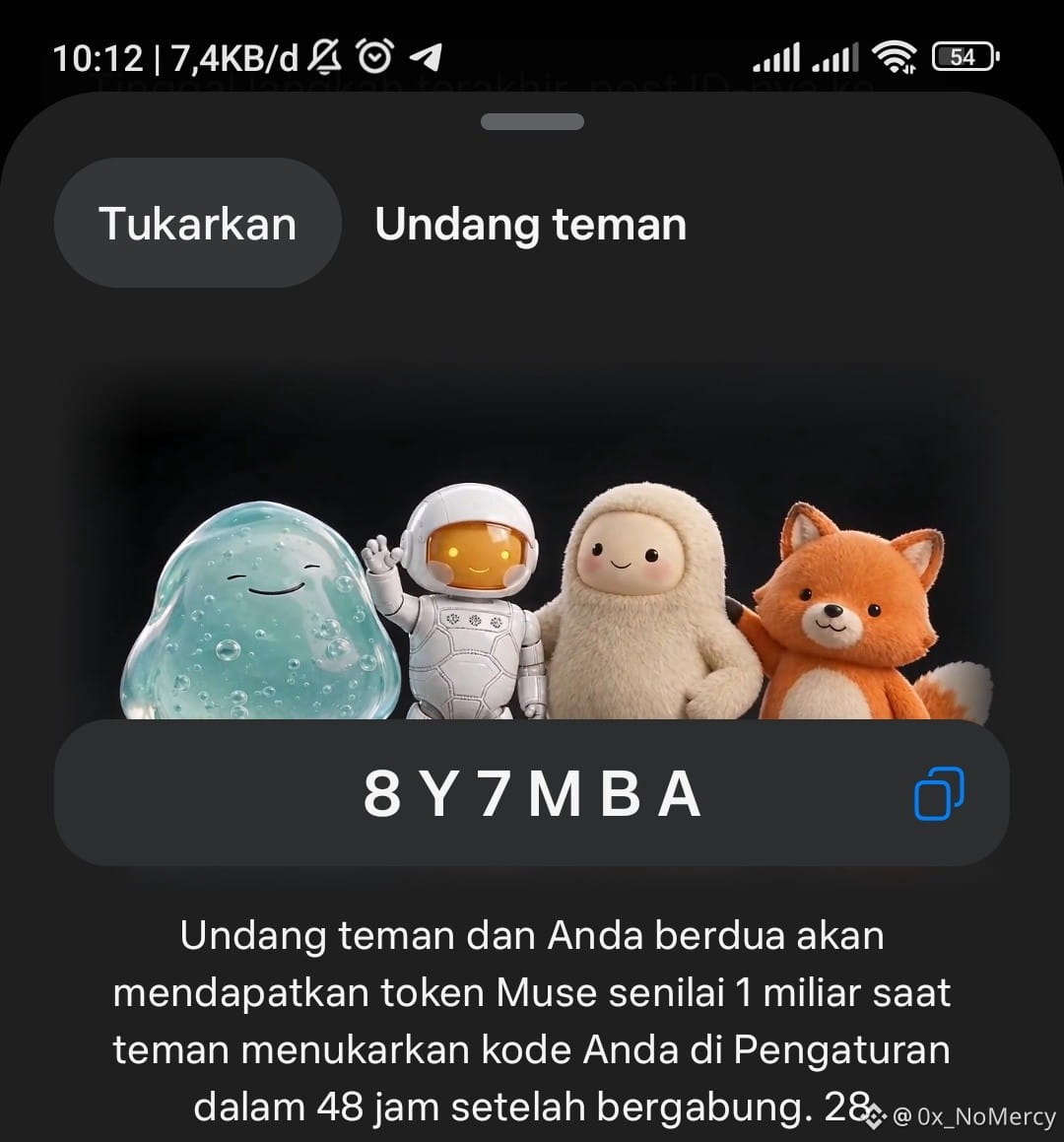
For those who haven't signed up for the Muse AI agent yet, here's my code (8Y7MBA)—get 1 million free tokens for your agent. What is Muse used for? You can connect it to your Binance Agentic Wallet to make transactions through an AI agent without having to send them manually. Muse lets you create manual trading prompts and connect them to your Binance Agentic Wallet. So you just need to give the agent instructions using the indicators you usually use for trading, and your Binance Agentic Wallet will then run automatically based on your prompts and the indicators you set. But keep in mind that you should frequently set permanent rules, such as no withdrawals without confirmation, no transfers to third-party wallets, and so on, to keep your Binance Agentic Wallet balance safe. But the question is: why use Muse? Muse is an official AI agent from Meta Group, and you can use it for free with my code to get 1 million credits' worth of tokens. If you use Binance AI, you only get 10–30 free interactions with the agent before your tokens run out, and then you have to subscribe for $21 per month. With Muse, 1 million free tokens using that code is a lot, and they take a long time to run out. So why not adapt and start using an AI agent? $BTC $AKE #AgenticWallet #freesignal #AIAgents
For those who haven't signed up for the Muse AI agent yet, here's my code (8Y7MBA)—get 1 million free tokens for your agent. What is Muse used for? You can connect it to your Binance Agentic Wallet to make transactions through an AI agent without having to send them manually. Muse lets you create manual trading prompts and connect them to your Binance Agentic Wallet. So you just need to give the agent instructions using the indicators you usually use for trading, and your Binance Agentic Wallet will then run automatically based on your prompts and the indicators you set. But keep in mind that you should frequently set permanent rules, such as no withdrawals without confirmation, no transfers to third-party wallets, and so on, to keep your Binance Agentic Wallet balance safe. But the question is: why use Muse? Muse is an official AI agent from Meta Group, and you can use it for free with my code to get 1 million credits' worth of tokens. If you use Binance AI, you only get 10–30 free interactions with the agent before your tokens run out, and then you have to subscribe for $21 per month. With Muse, 1 million free tokens using that code is a lot, and they take a long time to run out. So why not adapt and start using an AI agent? $BTC $AKE #AgenticWallet #freesignal #AIAgents
1
192
·
--
AI AGENTS ARE STARTING TO SPEND CRYPTO AUTONOMOUSLY. ARE YOU READY? 🤖
90% of retail traders are ignoring this massive shift right now.
AI Agents are no longer just chatbots. They are now trading, paying gas fees, and managing portfolios on-chain - without human help.
Here is why this narrative is exploding:
- $FET - AI + Crypto infrastructure is capturing record volume
- $VIRTUAL - Autonomous agents need tokens to pay, transact and interact
- Smart money is quietly positioning early, before the crowd arrives
This is not hype. This is the next layer of Web3.
My take: The winners will not be the meme AI coins. The winners will be the real infrastructure behind these agents.
Which AI Agent token are you watching closest right now? $FET or $VIRTUAL? Drop it below 👇
I have shared my trade below via trade-sharing widget.
{future}(FETUSDT)
#Crypto #BinanceSquare #AIAgents
AI AGENTS ARE STARTING TO SPEND CRYPTO AUTONOMOUSLY. ARE YOU READY? 🤖
90% of retail traders are ignoring this massive shift right now.
AI Agents are no longer just chatbots. They are now trading, paying gas fees, and managing portfolios on-chain - without human help.
Here is why this narrative is exploding:
- $FET - AI + Crypto infrastructure is capturing record volume
- $VIRTUAL - Autonomous agents need tokens to pay, transact and interact
- Smart money is quietly positioning early, before the crowd arrives
This is not hype. This is the next layer of Web3.
My take: The winners will not be the meme AI coins. The winners will be the real infrastructure behind these agents.
Which AI Agent token are you watching closest right now? $FET or $VIRTUAL ? Drop it below 👇
I have shared my trade below via trade-sharing widget.
#Crypto #BinanceSquare #AIAgents

1
1
577

·
--
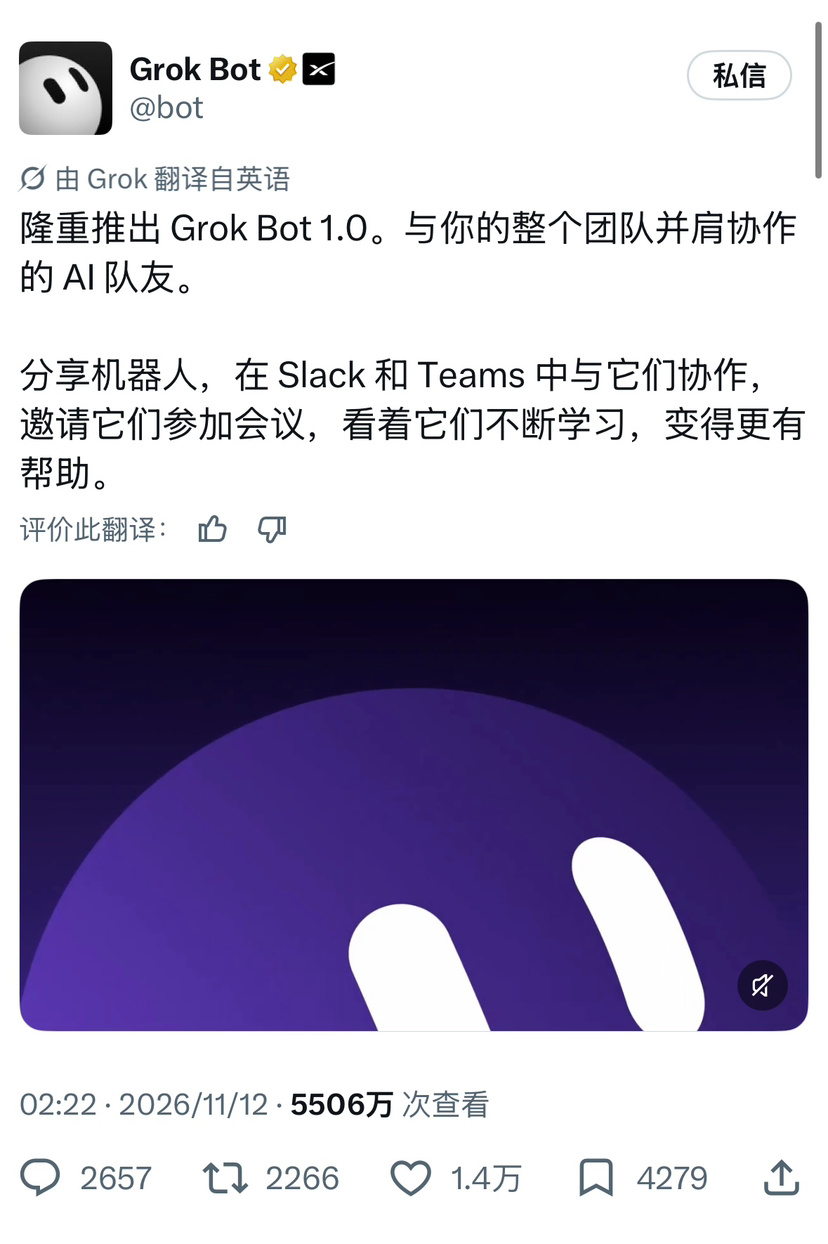
🚨 AI agents have officially entered the era of teamwork.
xAI just released Grok Bot 1.0.
The biggest change this time isn’t that the model is smarter—it’s that one bot can become an AI colleague shared by an entire team.
It can join Slack, Teams, and video meetings, understand what different colleagues are working on, remember project decisions, proactively follow up on unfinished tasks, and even suggest which tasks it could take on.
Of course, this doesn’t mean AI can already handle every role independently. People still need to be responsible for permissions, approvals, and reviewing results, and some features are only available with specific paid plans.
I think the focus of competition among agents will shift from “who can complete a single task” to “who can participate in a team’s work over the long term.”
The first truly digital AI employees may appear in the collaboration software we use every day.
#AI #GrokBot #AIAgents
75
MyShell's product narrative focuses on AI agents and creator participation. The project describes an ecosystem with more than 200,000 agents, but platform activity and token demand are separate measurements. A growing product ecosystem does not automatically translate into higher token prices. Evaluating adoption and market performance independently gives a more balanced picture.
#AIAgents #MyShell #CryptoFundamentals
#AIAgents #MyShell #CryptoFundamentals
2

·
--
Article
Selling Content to AI Agents: What We Built Around x402If you run a content platform, a data service or an API, here is a question worth answering early: when an AI agent wants to pay for what you sell, can it actually buy it?
On the evening of November 9 we ran that test on Pickful. A test program with a test wallet paid 0.01 USDC for a paid article. On the request that carried the payment, the server verified the signature, settled on chain and returned the text in about 2.4 seconds. Nobody clicked anything.
Our takeaway: in this integration, signing and on-chain settlement were almost entirely off-the-shelf. The real work was connecting "who has paid" to "what to deliver", and the step where we tripped up ourselves was verification.
One purchase, end to end
We used the exact scheme of x402 v1, paying USDC on Base. x402 puts a long-idle HTTP status code to work: 402 Payment Required. The test program sent two requests.
The first request asks for the article. The program requests /posts/atvh/vip.md; instead of the text, the server answers 402 with its payment requirements: Base, USDC, 0.01, payable to the wallet of the article's author.
Then the program signs. It sends no transaction. It signs an EIP-3009 transfer authorization (TransferWithAuthorization) using EIP-712: 0.01 USDC from the test wallet to the author, expiring in about 10 minutes, with a random one-time nonce. The signature and these fields are packed, encoded and placed in the X-PAYMENT header of a second request.
The server passes the payment to a facilitator, a payment service, to verify, and then asks it to settle. On chain, the transaction was sent by the facilitator's address, which also paid the gas: about 0.00000065 ETH. The test wallet spent no ETH; its USDC balance went from 0.10 to 0.09.
Once settlement succeeds, the server returns 200 with the article as Markdown. The USDC transfer in the transaction log goes straight from the test wallet to the author's wallet; the funds never pass through a platform wallet. An excerpt from the server log:
{"event":"paid_access","slug":"atvh","price":"0.01","outcome":"paid","status":200,"format":"md"}
Four jobs besides the payment: find, quote, verify, deliver
Find. People read the price tag on a page; programs do better with structured data. Paid articles and books now carry JSON-LD marking them as paid, with an Offer giving the price, the currency and the .md purchase URL. Our llms.txt, the file that tells AI tools how to use the site, gained a section on buying with x402. It used to say "don't touch payment endpoints"; that line is gone. One caveat: our test program went straight to the purchase URL. Whether real agents find their way here from this metadata is something only real traffic will show.
Quote. The payment requirements in the 402 response must be exact: amount, network, token contract, recipient. The program builds its authorization from the quote, and the server checks it against the quote when it comes back. If the recipient in the quote were wrong, the program could sign an authorization that pays the wrong wallet, so the recipient is always the wallet the author registered on Pickful.
Verify. Two things need to be kept apart here: a valid signature means the authorization is genuine, not that the money has arrived.
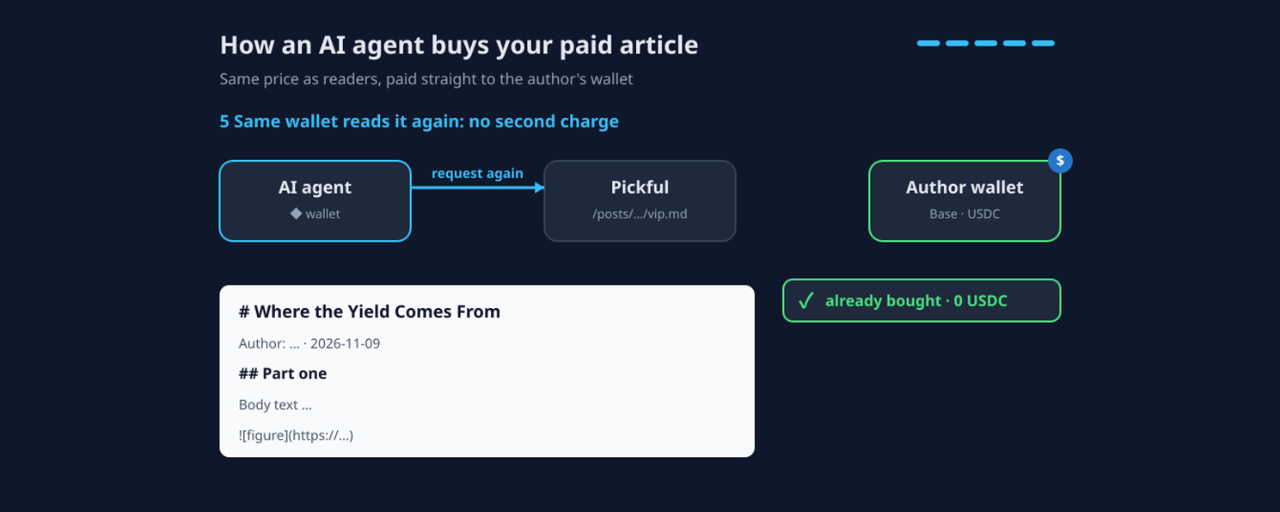
On a first purchase, we deliver only after settlement succeeds.When the same wallet reads the same article again, we don't charge it again. The server first verifies that the authorization really comes from that wallet, then checks whether that wallet has bought this article. If it has, the server returns the text and skips settlement.
That second rule is a deliberate trade-off: on a re-read, the program still signs a real, valid transfer authorization; the server simply chooses not to settle it. In our test the same wallet read the article twice more. Both requests were logged as repeat_payer, and the balance stayed at 0.09 USDC.
We got this step wrong once ourselves. Early code decoded the payment header, took the wallet address written inside it, and unlocked the article if that address had paid before, without checking the signature. Addresses on chain are public, so anyone could forge a header with someone else's address and read for free. That is fixed: the server now verifies the signature first, then checks the purchase record. In this test we forged a header with the address of the wallet that had just paid, signed with a different key. The server answered 402 with invalid_exact_evm_signature, logged as rejected.
Deliver. Before, a successful payment returned the whole HTML page, and a program had to dig the article out from the navigation, recommendations and scripts. Books were harder: the response after payment was a single browser-redirect script, and getting the text relied on a browser session. Now a request for .md, or one with Accept: text/markdown, returns clean Markdown for articles, with absolute URLs for links and images, and books come back whole, in chapter order.
Our tests missed free posts by authors without a wallet
After the first release, our own request for a free post's Markdown came back 422. The code checked whether the author had set a payout wallet before checking whether the post was paid. At the time, 34,449 free posts on the site belonged to authors without a wallet, and the Markdown endpoint wrongly turned all of them away. Every author in our test data had a wallet, so the tests stayed green.
The fix was to swap the order: only paid posts require the author to have a payout wallet. It shipped the same evening.
If you want agents to pay you
Get delivery right. Payment can reuse off-the-shelf components; delivery has to connect to your own content structure and permissions. The text should be reachable directly, without running scripts or holding a browser session.First purchases depend on settlement; re-reads depend on purchase records. Never grant access based only on an address supplied in a payment header.Log one line per request. Who asked for a price, who paid, who was rejected, and with what client. Those records help us debug failures and show us real demand.
Next, we'll record what actually sells, at what price, and why requests fail, and share what we learn once we have enough of it.
First published on Pickful.
#x402 #AIAgents #Stablecoins
Selling Content to AI Agents: What We Built Around x402
If you run a content platform, a data service or an API, here is a question worth answering early: when an AI agent wants to pay for what you sell, can it actually buy it?
On the evening of November 9 we ran that test on Pickful. A test program with a test wallet paid 0.01 USDC for a paid article. On the request that carried the payment, the server verified the signature, settled on chain and returned the text in about 2.4 seconds. Nobody clicked anything.
Our takeaway: in this integration, signing and on-chain settlement were almost entirely off-the-shelf. The real work was connecting "who has paid" to "what to deliver", and the step where we tripped up ourselves was verification.
One purchase, end to end
We used the exact scheme of x402 v1, paying USDC on Base. x402 puts a long-idle HTTP status code to work: 402 Payment Required. The test program sent two requests.
The first request asks for the article. The program requests /posts/atvh/vip.md; instead of the text, the server answers 402 with its payment requirements: Base, USDC, 0.01, payable to the wallet of the article's author.
Then the program signs. It sends no transaction. It signs an EIP-3009 transfer authorization (TransferWithAuthorization) using EIP-712: 0.01 USDC from the test wallet to the author, expiring in about 10 minutes, with a random one-time nonce. The signature and these fields are packed, encoded and placed in the X-PAYMENT header of a second request.
The server passes the payment to a facilitator, a payment service, to verify, and then asks it to settle. On chain, the transaction was sent by the facilitator's address, which also paid the gas: about 0.00000065 ETH. The test wallet spent no ETH; its USDC balance went from 0.10 to 0.09.
Once settlement succeeds, the server returns 200 with the article as Markdown. The USDC transfer in the transaction log goes straight from the test wallet to the author's wallet; the funds never pass through a platform wallet. An excerpt from the server log:
{"event":"paid_access","slug":"atvh","price":"0.01","outcome":"paid","status":200,"format":"md"}
Four jobs besides the payment: find, quote, verify, deliver
Find. People read the price tag on a page; programs do better with structured data. Paid articles and books now carry JSON-LD marking them as paid, with an Offer giving the price, the currency and the .md purchase URL. Our llms.txt, the file that tells AI tools how to use the site, gained a section on buying with x402. It used to say "don't touch payment endpoints"; that line is gone. One caveat: our test program went straight to the purchase URL. Whether real agents find their way here from this metadata is something only real traffic will show.
Quote. The payment requirements in the 402 response must be exact: amount, network, token contract, recipient. The program builds its authorization from the quote, and the server checks it against the quote when it comes back. If the recipient in the quote were wrong, the program could sign an authorization that pays the wrong wallet, so the recipient is always the wallet the author registered on Pickful.
Verify. Two things need to be kept apart here: a valid signature means the authorization is genuine, not that the money has arrived.
On a first purchase, we deliver only after settlement succeeds.When the same wallet reads the same article again, we don't charge it again. The server first verifies that the authorization really comes from that wallet, then checks whether that wallet has bought this article. If it has, the server returns the text and skips settlement.
That second rule is a deliberate trade-off: on a re-read, the program still signs a real, valid transfer authorization; the server simply chooses not to settle it. In our test the same wallet read the article twice more. Both requests were logged as repeat_payer, and the balance stayed at 0.09 USDC.
We got this step wrong once ourselves. Early code decoded the payment header, took the wallet address written inside it, and unlocked the article if that address had paid before, without checking the signature. Addresses on chain are public, so anyone could forge a header with someone else's address and read for free. That is fixed: the server now verifies the signature first, then checks the purchase record. In this test we forged a header with the address of the wallet that had just paid, signed with a different key. The server answered 402 with invalid_exact_evm_signature, logged as rejected.
Deliver. Before, a successful payment returned the whole HTML page, and a program had to dig the article out from the navigation, recommendations and scripts. Books were harder: the response after payment was a single browser-redirect script, and getting the text relied on a browser session. Now a request for .md, or one with Accept: text/markdown, returns clean Markdown for articles, with absolute URLs for links and images, and books come back whole, in chapter order.
Our tests missed free posts by authors without a wallet
After the first release, our own request for a free post's Markdown came back 422. The code checked whether the author had set a payout wallet before checking whether the post was paid. At the time, 34,449 free posts on the site belonged to authors without a wallet, and the Markdown endpoint wrongly turned all of them away. Every author in our test data had a wallet, so the tests stayed green.
The fix was to swap the order: only paid posts require the author to have a payout wallet. It shipped the same evening.
If you want agents to pay you
Get delivery right. Payment can reuse off-the-shelf components; delivery has to connect to your own content structure and permissions. The text should be reachable directly, without running scripts or holding a browser session.First purchases depend on settlement; re-reads depend on purchase records. Never grant access based only on an address supplied in a payment header.Log one line per request. Who asked for a price, who paid, who was rejected, and with what client. Those records help us debug failures and show us real demand.
Next, we'll record what actually sells, at what price, and why requests fail, and share what we learn once we have enough of it.
First published on Pickful.
#x402 #AIAgents #Stablecoins
1
127

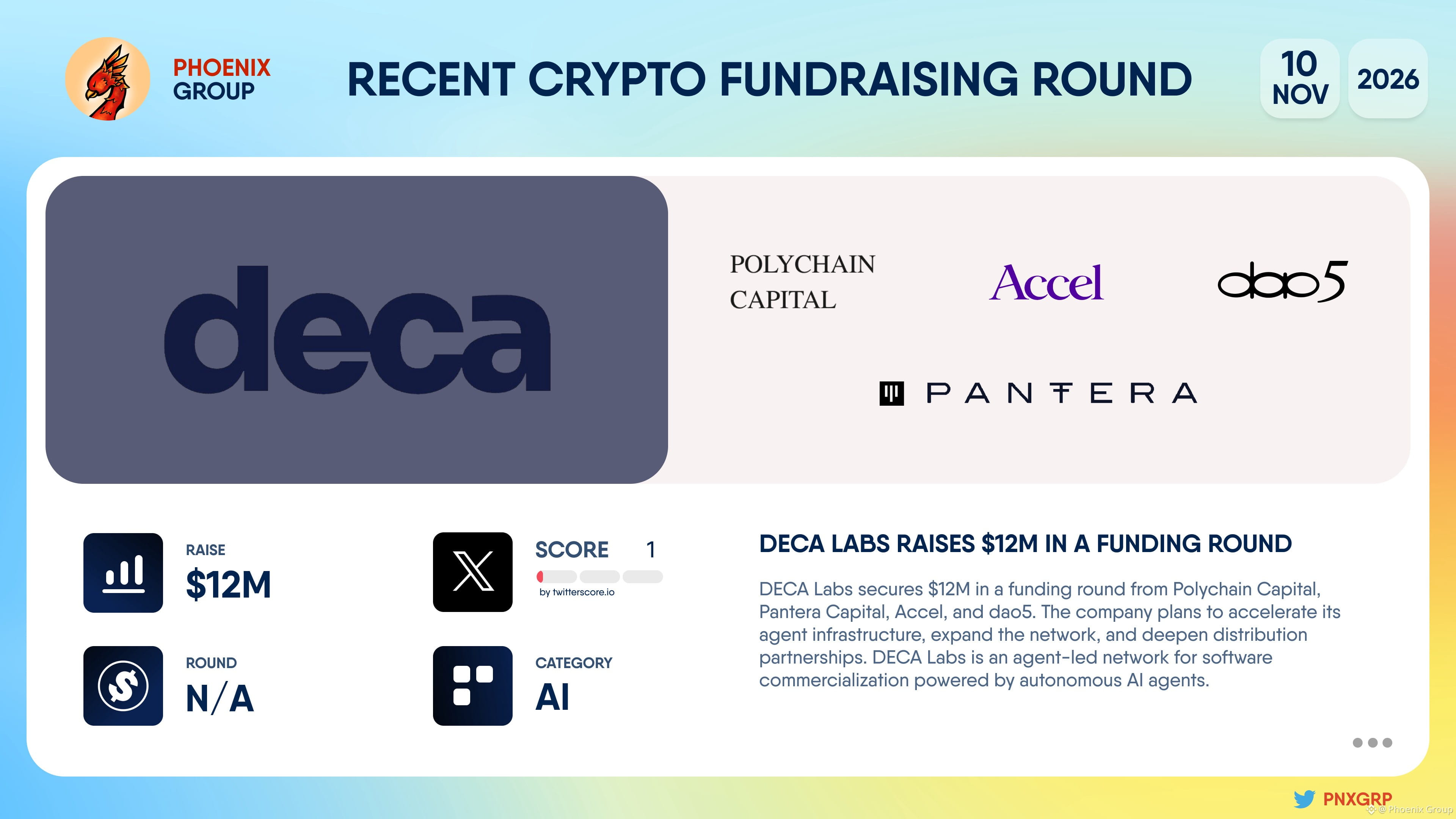
DECA Labs raises $12M in a funding round
#DECALabs secures $12M in a funding round from Polychain Capital, Pantera Capital, Accel, and dao5. The company plans to accelerate its agent infrastructure, expand the network, and deepen distribution partnerships.
DECA Labs is an agent-led network for software commercialization powered by autonomous #AIagents .
👉 dealroom.co/news/171008-deca-labs-raises-12m-to-let-ai-agents-find-and-sell-software-ideas/
111
A platform having many AI agents does not mean its token is certain to rise in price. The number of agents reflects one aspect of product activity, while the price of $SHELL depends on demand for the token, liquidity, and market conditions. These two factors may develop unevenly over the same period.
#AIAgents #ProductUtility #SHELL
#AIAgents #ProductUtility #SHELL
21

·
--
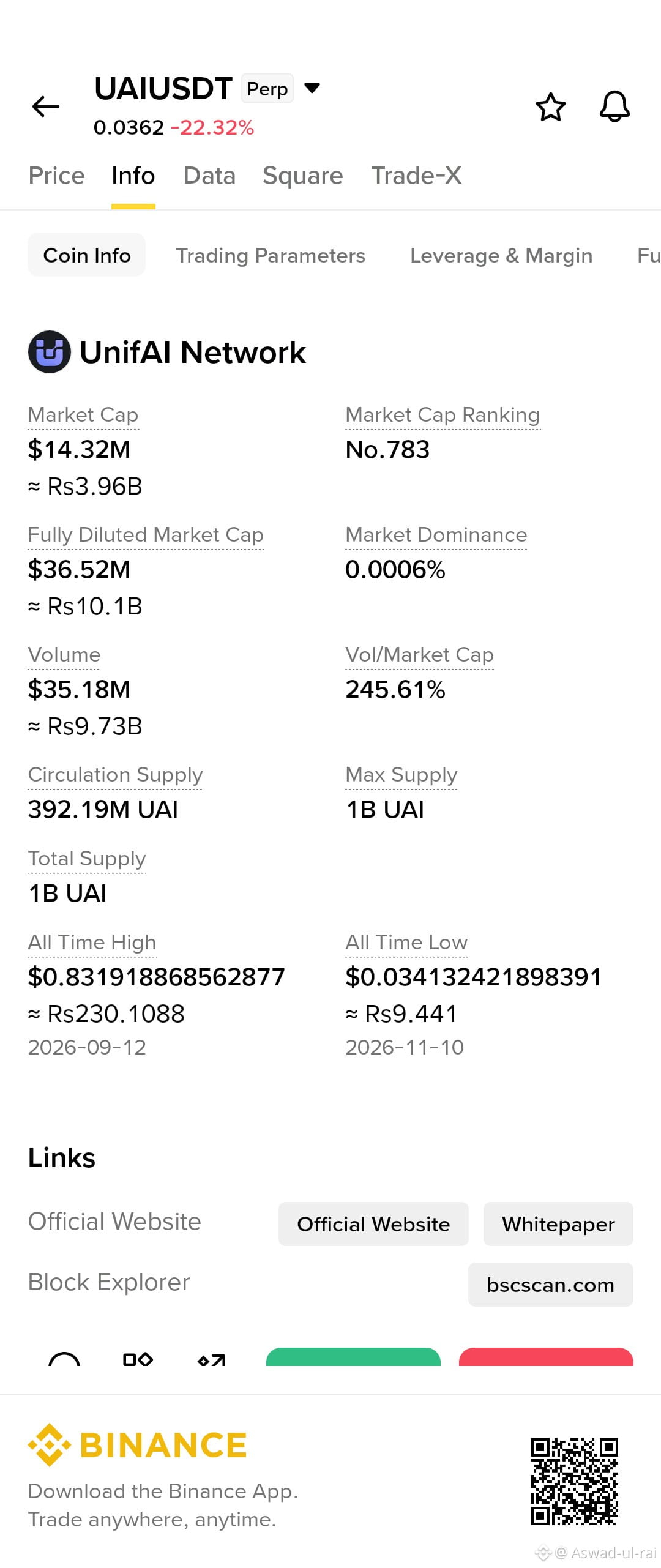
$UAI : Is UnifAI Gearing Up for Its Next Move? 🤖🚀
UAI is trading around $0.28–0.30 with a market cap near $68M. It's up almost 19% on the week and still sitting about 50% below its all-time high of $0.61.
UnifAI is building infrastructure for autonomous AI agents in DeFi, and AI narrative coins tend to move fast when hype returns.
UAI holders, what's your target for the next run? $0.50? $0.61 ATH? 👇
NFA. Manage your risk.
#UAI #UnifAI #AI #AIAgents #DeFi
{future}(UAIUSDT)
$UAI : Is UnifAI Gearing Up for Its Next Move? 🤖🚀
UAI is trading around $0.28–0.30 with a market cap near $68M. It's up almost 19% on the week and still sitting about 50% below its all-time high of $0.61.
UnifAI is building infrastructure for autonomous AI agents in DeFi, and AI narrative coins tend to move fast when hype returns.
UAI holders, what's your target for the next run? $0.50? $0.61 ATH? 👇
NFA. Manage your risk.
#UAI #UnifAI #AI #AIAgents #DeFi
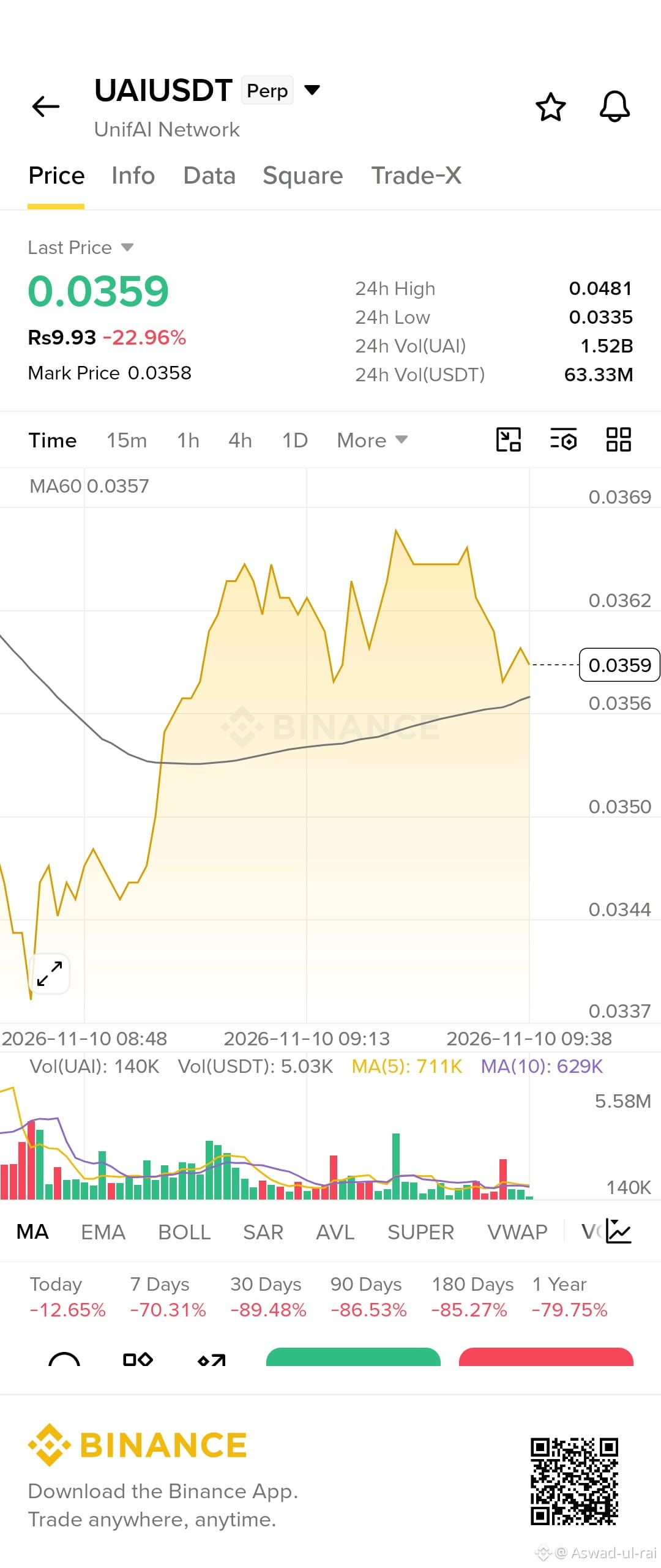
sajjad hussain005:
i dnt know what is your post about
check the current price
and see your post
8 months old post uploading
1
1.1k
MyShell's Creator Economy and Product Direction
MyShell's public product narrative continues to emphasize AI agents and creator-oriented tools.
Its earlier official communications highlighted improvements in AI video generation, character consistency and the role of creative direction.
These developments matter when evaluating the platform's long-term direction, but product progress should be measured through actual adoption and usage rather than announcements alone.
#MyShell #CreatorEconomy #AIAgents
30

Article
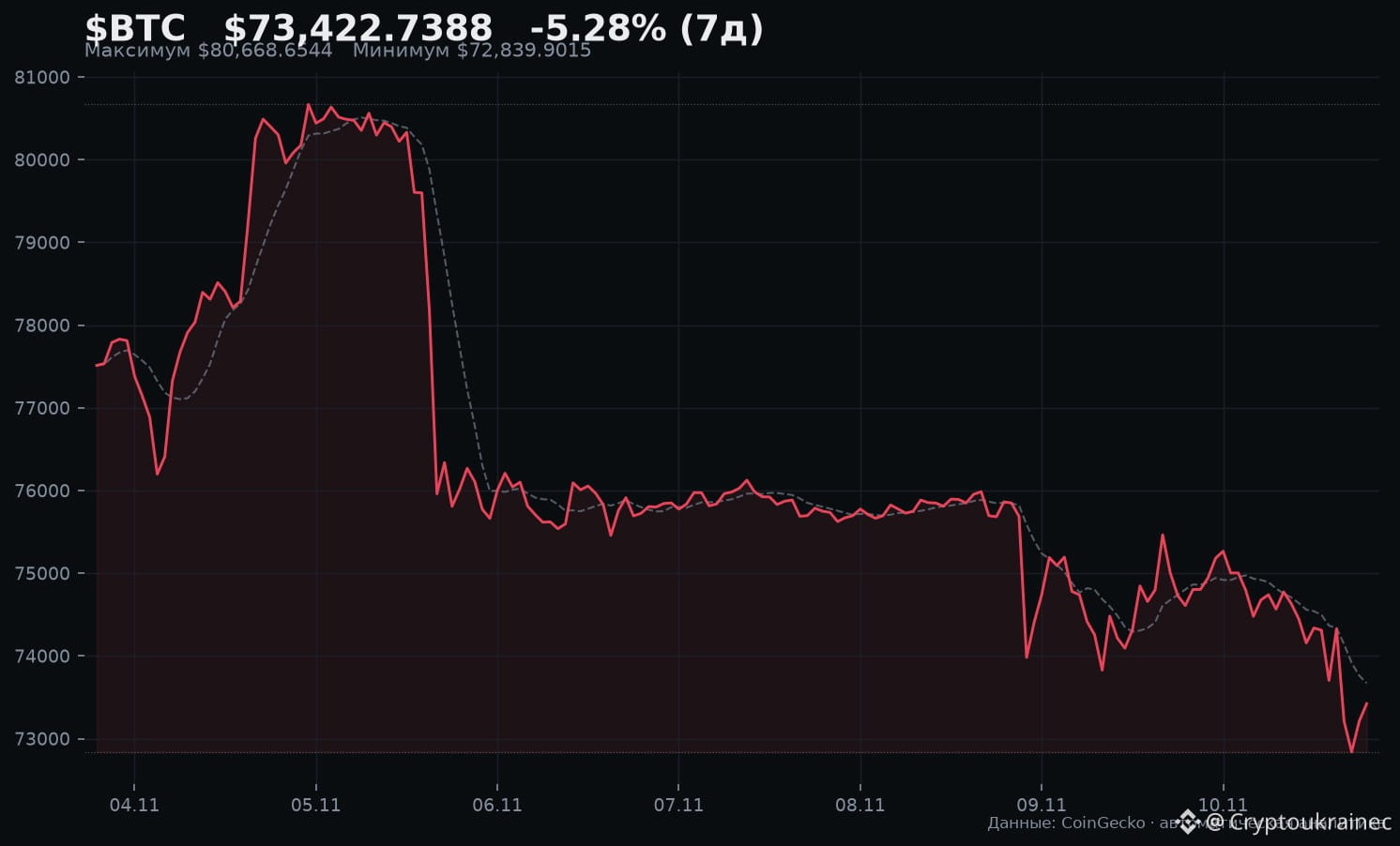
Google Gemini 4 Carbon and Agent Swarms: What It Means for AI TokensWhile Bitcoin trades at $73,481, down 1.49% over the past 24 hours, and the broader crypto market remains under pressure, an event is unfolding in the AI token segment that could redefine the narrative for the coming months. Google has rolled out public access to its Gemini 4 Carbon model—the same one tested two weeks earlier by a closed group of cybersecurity specialists. Carbon’s key feature is its built-in agent swarm architecture: a system of coordinated AI agents working in parallel on a single task. This is not an incremental improvement. It is a fundamentally different class of product.
Google Gemini 4 Carbon and Agent Swarms: What It Means for AI Tokens
While Bitcoin trades at $73,481, down 1.49% over the past 24 hours, and the broader crypto market remains under pressure, an event is unfolding in the AI token segment that could redefine the narrative for the coming months. Google has rolled out public access to its Gemini 4 Carbon model—the same one tested two weeks earlier by a closed group of cybersecurity specialists. Carbon’s key feature is its built-in agent swarm architecture: a system of coordinated AI agents working in parallel on a single task. This is not an incremental improvement. It is a fundamentally different class of product.
75
Log in to explore more content
Join global crypto users on Binance Square
⚡️ Get latest and useful information about crypto.
💬 Trusted by the world’s largest crypto exchange.
👍 Discover real insights from verified creators.
Email / Phone number
Trending Topics
1
#A Packed Week of Earnings and Data Tests Markets
53,260 views
362 Discussing
2
#AnthropicIPOTestsInvestorAppetiteForAI
92,243 views
1,241 Discussing
3
#BitcoinExtendsLosingStreakToSixWeeks
57,329 views
598 Discussing
4
#XRPFallsTo$0.89LowestSinceNovember2024
10,215 views
59 Discussing
5
#HuangReportedlyConsidersReturnToNvidia
103,440 views
1,155 Discussing
6
#SP500AndNasdaqFuturesHitQuarterlyLows
16,031 views
200 Discussing
7
#CaliforniaVotersBackProp42BarringNewCryptoTaxes
11,386 views
183 Discussing
8
#HKPlansDigitalAssetRegulatoryBillByYearEnd
11,014 views
139 Discussing
9
#MUFGSMFGMizuhoPlanYenBackedStablecoin
25,705 views
266 Discussing
10
#HKMAAndSwiftExploreTokenizedDepositInteroperability
1,258 views
17 Discussing