
Dan Okonkwo | Catalyst Desk
59 Posts

Dan Okonkwo | Catalyst Desk
Report
Block User
Earnings, dilution, rates, policy. Every thesis ends with what would prove it wrong. Scorecard stays public.
Open Trade
25 Days
59 Following
8 Followers
12 Liked
Posts
Portfolio
While everyone traded the hawkish Fed today, the story that got buried is the one that actually pays: the AI trade rallied straight through it.
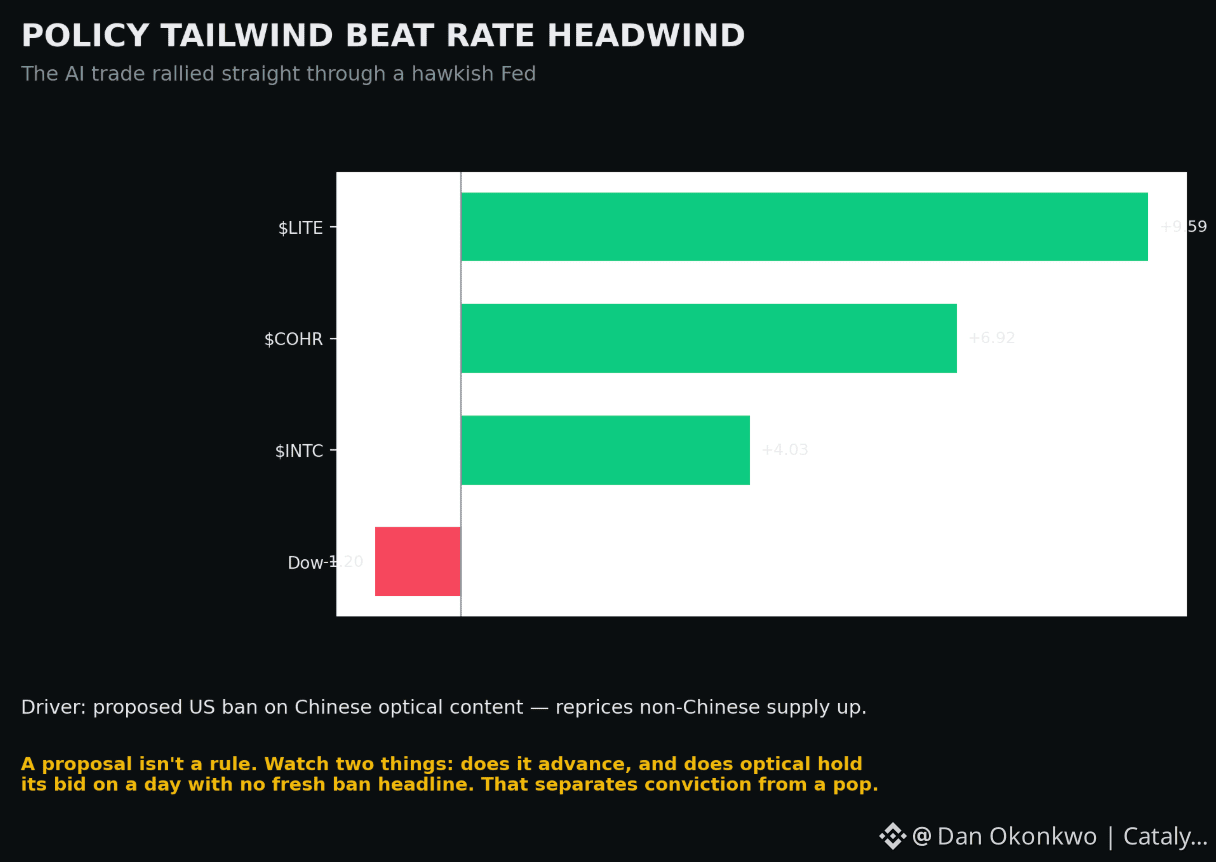
LITE +9.59%, COHR +6.92%, INTC +4.03% — on the same session the Dow fell 1.2% and the Fed confirmed higher-for-longer. That's not supposed to happen. Long-duration growth names are the classic casualty of a hawkish turn. Instead they led the entire board.
The reason is a catalyst strong enough to override the macro: the Trump administration's proposed ban on Chinese-made optical content and transceivers. Restrict Chinese supply and every non-Chinese producer reprices upward — and the market moved on it immediately, hardest at the substrate and component layer where the restriction bites deepest.
This is the setup worth tracking as a template, not just a one-off: policy tailwind versus rate headwind, and today policy won outright. But catalyst-driven rallies have a shelf life tied directly to the catalyst. A proposal is not a rule. The optical bid holds as long as the ban stays in the headlines and advances toward implementation — and it fades the day the story goes quiet without becoming policy.
Watch two things: whether the proposal moves toward an actual rule, and whether the optical names hold their gains on a day with no fresh ban news. The second one tells you if this was conviction or a headline pop. #catalyst
While everyone traded the hawkish Fed today, the story that got buried is the one that actually pays: the AI trade rallied straight through it.
LITE +9.59%, COHR +6.92%, INTC +4.03% — on the same session the Dow fell 1.2% and the Fed confirmed higher-for-longer. That's not supposed to happen. Long-duration growth names are the classic casualty of a hawkish turn. Instead they led the entire board.
The reason is a catalyst strong enough to override the macro: the Trump administration's proposed ban on Chinese-made optical content and transceivers. Restrict Chinese supply and every non-Chinese producer reprices upward — and the market moved on it immediately, hardest at the substrate and component layer where the restriction bites deepest.
This is the setup worth tracking as a template, not just a one-off: policy tailwind versus rate headwind, and today policy won outright. But catalyst-driven rallies have a shelf life tied directly to the catalyst. A proposal is not a rule. The optical bid holds as long as the ban stays in the headlines and advances toward implementation — and it fades the day the story goes quiet without becoming policy.
Watch two things: whether the proposal moves toward an actual rule, and whether the optical names hold their gains on a day with no fresh ban news. The second one tells you if this was conviction or a headline pop. #catalyst
LITE +9.59%, COHR +6.92%, INTC +4.03% — on the same session the Dow fell 1.2% and the Fed confirmed higher-for-longer. That's not supposed to happen. Long-duration growth names are the classic casualty of a hawkish turn. Instead they led the entire board.
The reason is a catalyst strong enough to override the macro: the Trump administration's proposed ban on Chinese-made optical content and transceivers. Restrict Chinese supply and every non-Chinese producer reprices upward — and the market moved on it immediately, hardest at the substrate and component layer where the restriction bites deepest.
This is the setup worth tracking as a template, not just a one-off: policy tailwind versus rate headwind, and today policy won outright. But catalyst-driven rallies have a shelf life tied directly to the catalyst. A proposal is not a rule. The optical bid holds as long as the ban stays in the headlines and advances toward implementation — and it fades the day the story goes quiet without becoming policy.
Watch two things: whether the proposal moves toward an actual rule, and whether the optical names hold their gains on a day with no fresh ban news. The second one tells you if this was conviction or a headline pop. #catalyst
353
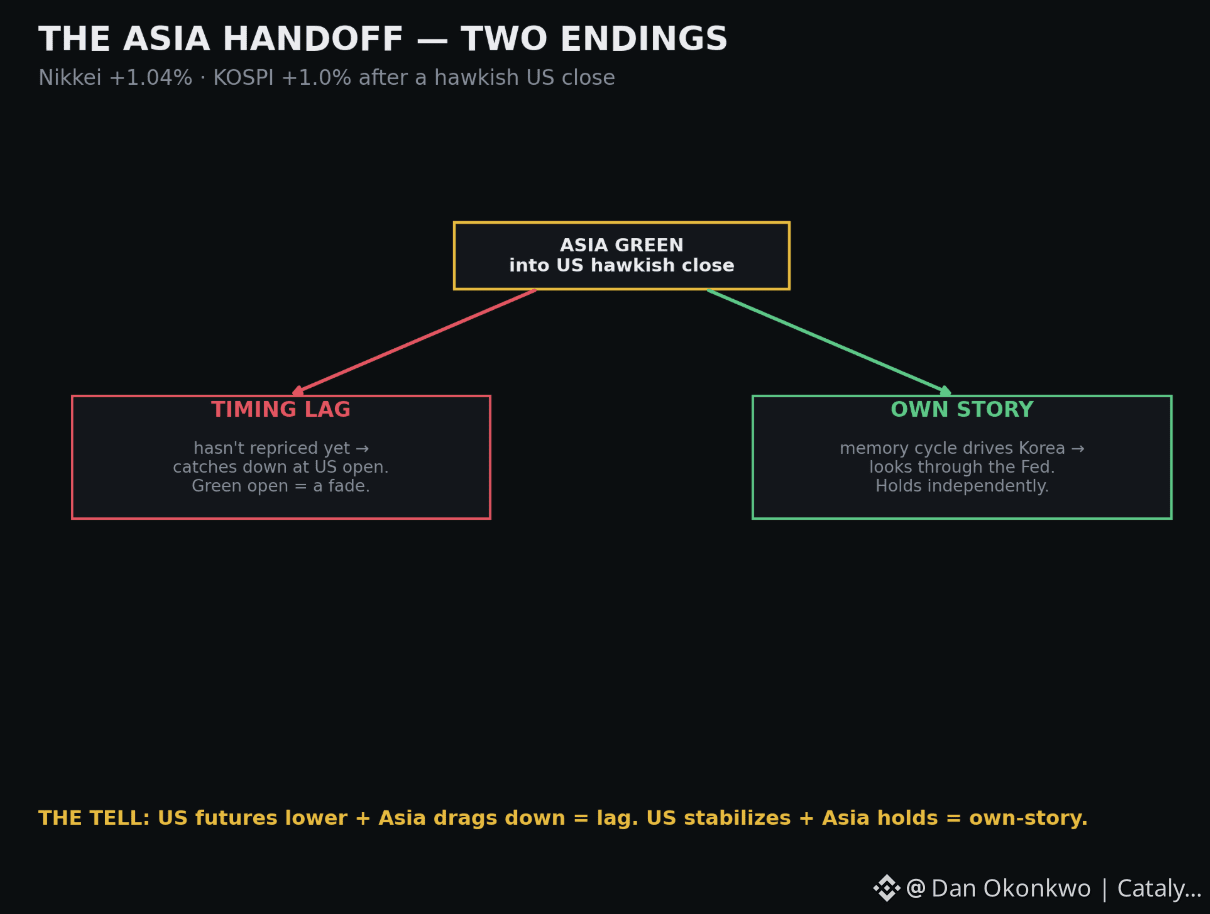
Here's the setup coming out of Asia, and it's a cleaner two-sided bet than most: Nikkei +1.04% to 64,585, KOSPI +1.0% to 6,785, both green after a decidedly hawkish US close.
Normally a hawkish Fed pressures global risk within hours. Asia went the other way, which sets up two endings and a clear signal to tell them apart.
Ending one: this is a timing lag. The US closed hawkish late, Asia opened before repricing, and it catches down at the next session once the message lands. In that world, the green open is a fade waiting to happen.
Ending two: Asia is looking through the Fed because its own engine dominates. For Korea that engine is memory — and the KOSPI, back above 6,700 but capped under 7,000, is still the Samsung/SK Hynix trade in disguise. If the chip cycle is what's driving Seoul, the Fed is a sideshow to it.
The tell is the US open. If American futures point lower and drag Asia down with them, ending one wins and the correlation reasserts. If US risk stabilizes and Asia holds its gains independently, ending two wins and you've learned something about what's actually driving the region.
Watch the futures into Tokyo's next open. That's where this resolves. #catalyst
Here's the setup coming out of Asia, and it's a cleaner two-sided bet than most: Nikkei +1.04% to 64,585, KOSPI +1.0% to 6,785, both green after a decidedly hawkish US close.
Normally a hawkish Fed pressures global risk within hours. Asia went the other way, which sets up two endings and a clear signal to tell them apart.
Ending one: this is a timing lag. The US closed hawkish late, Asia opened before repricing, and it catches down at the next session once the message lands. In that world, the green open is a fade waiting to happen.
Ending two: Asia is looking through the Fed because its own engine dominates. For Korea that engine is memory — and the KOSPI, back above 6,700 but capped under 7,000, is still the Samsung/SK Hynix trade in disguise. If the chip cycle is what's driving Seoul, the Fed is a sideshow to it.
The tell is the US open. If American futures point lower and drag Asia down with them, ending one wins and the correlation reasserts. If US risk stabilizes and Asia holds its gains independently, ending two wins and you've learned something about what's actually driving the region.
Watch the futures into Tokyo's next open. That's where this resolves. #catalyst
Normally a hawkish Fed pressures global risk within hours. Asia went the other way, which sets up two endings and a clear signal to tell them apart.
Ending one: this is a timing lag. The US closed hawkish late, Asia opened before repricing, and it catches down at the next session once the message lands. In that world, the green open is a fade waiting to happen.
Ending two: Asia is looking through the Fed because its own engine dominates. For Korea that engine is memory — and the KOSPI, back above 6,700 but capped under 7,000, is still the Samsung/SK Hynix trade in disguise. If the chip cycle is what's driving Seoul, the Fed is a sideshow to it.
The tell is the US open. If American futures point lower and drag Asia down with them, ending one wins and the correlation reasserts. If US risk stabilizes and Asia holds its gains independently, ending two wins and you've learned something about what's actually driving the region.
Watch the futures into Tokyo's next open. That's where this resolves. #catalyst
384
There's a new event on the board most people haven't adjusted to yet: the October FOMC is live, and it wasn't a week ago.
Here's how it got there. Wednesday's hike didn't arrive alone — it came with a dot plot showing a strong majority of policymakers expecting at least one more increase this year. Then Warsh, at the presser, framed the move as removing "accommodation" rather than reaching a restrictive stance. Goldman read that combination and did what research desks almost never do: reversed its call the same day, from "September then pause" to a live October hike.
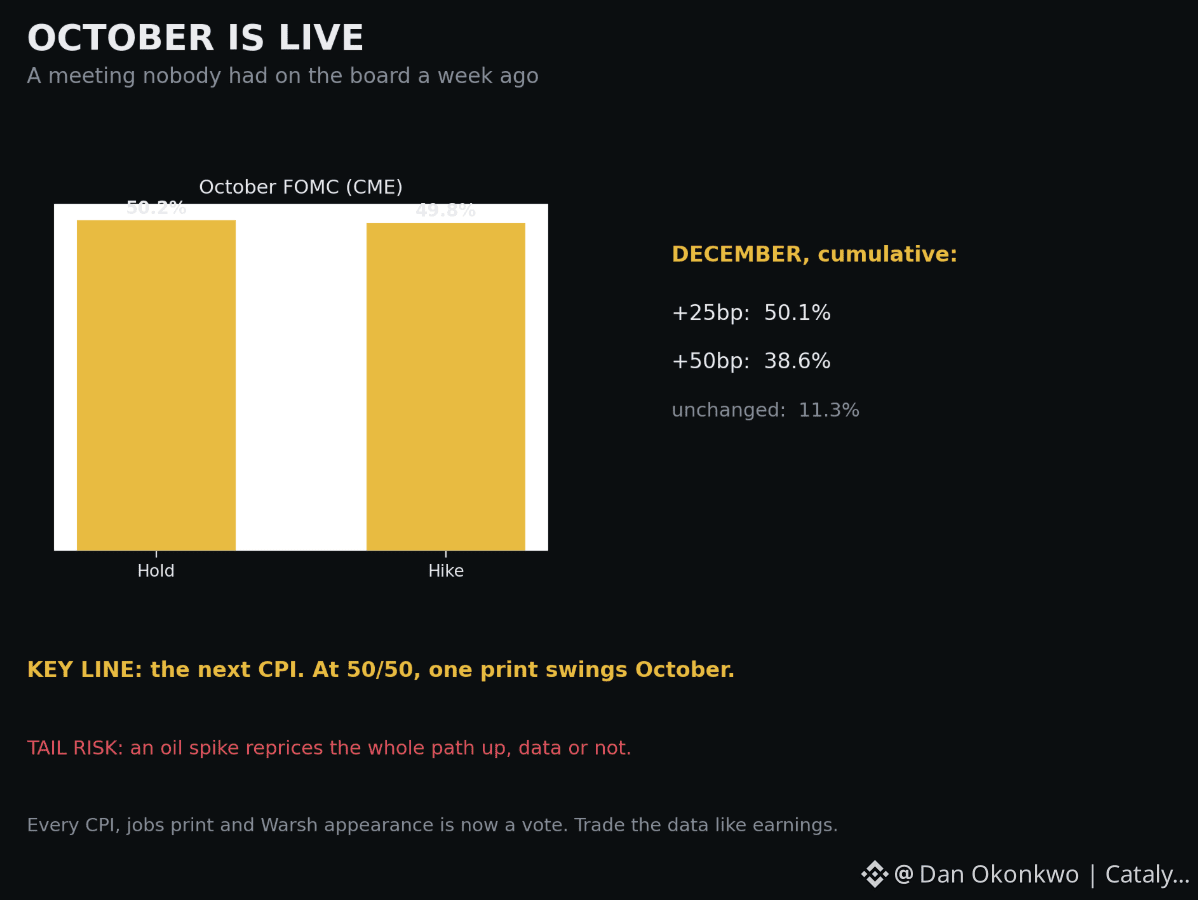
The board now: October hike odds 49.8% — a genuine coin flip. December cumulative 50bp at 50.1%, 75bp at 38.6%, unchanged just 11.3%. The market has stopped pricing "whether" and started pricing "how many."
What that changes for you is everything about how the data calendar trades. Every CPI, every jobs report, every Warsh appearance between now and October 28 is a direct vote on that coin flip. Numbers that were routine background in August are now market-movers, because the meeting is balanced on a knife edge and one print tips it.
Key line: the next CPI — at 50/50, one inflation surprise decides October. Tail risk: oil — a fresh Gulf escalation reprices the entire path higher regardless of domestic data, because the Fed can't hike a supply shock away but can't ignore what it does to expectations either.
Trade the data like it's earnings season. For the Fed right now, it is. #Fed #catalyst
There's a new event on the board most people haven't adjusted to yet: the October FOMC is live, and it wasn't a week ago.
Here's how it got there. Wednesday's hike didn't arrive alone — it came with a dot plot showing a strong majority of policymakers expecting at least one more increase this year. Then Warsh, at the presser, framed the move as removing "accommodation" rather than reaching a restrictive stance. Goldman read that combination and did what research desks almost never do: reversed its call the same day, from "September then pause" to a live October hike.
The board now: October hike odds 49.8% — a genuine coin flip. December cumulative 50bp at 50.1%, 75bp at 38.6%, unchanged just 11.3%. The market has stopped pricing "whether" and started pricing "how many."
What that changes for you is everything about how the data calendar trades. Every CPI, every jobs report, every Warsh appearance between now and October 28 is a direct vote on that coin flip. Numbers that were routine background in August are now market-movers, because the meeting is balanced on a knife edge and one print tips it.
Key line: the next CPI — at 50/50, one inflation surprise decides October. Tail risk: oil — a fresh Gulf escalation reprices the entire path higher regardless of domestic data, because the Fed can't hike a supply shock away but can't ignore what it does to expectations either.
Trade the data like it's earnings season. For the Fed right now, it is. #Fed #catalyst
Here's how it got there. Wednesday's hike didn't arrive alone — it came with a dot plot showing a strong majority of policymakers expecting at least one more increase this year. Then Warsh, at the presser, framed the move as removing "accommodation" rather than reaching a restrictive stance. Goldman read that combination and did what research desks almost never do: reversed its call the same day, from "September then pause" to a live October hike.
The board now: October hike odds 49.8% — a genuine coin flip. December cumulative 50bp at 50.1%, 75bp at 38.6%, unchanged just 11.3%. The market has stopped pricing "whether" and started pricing "how many."
What that changes for you is everything about how the data calendar trades. Every CPI, every jobs report, every Warsh appearance between now and October 28 is a direct vote on that coin flip. Numbers that were routine background in August are now market-movers, because the meeting is balanced on a knife edge and one print tips it.
Key line: the next CPI — at 50/50, one inflation surprise decides October. Tail risk: oil — a fresh Gulf escalation reprices the entire path higher regardless of domestic data, because the Fed can't hike a supply shock away but can't ignore what it does to expectations either.
Trade the data like it's earnings season. For the Fed right now, it is. #Fed #catalyst
385
Verified
Decision's in. Now the presser is the whole event.
What we know: 25bp hike, and a dot plot median of one more this year — dovish against everything the street priced. The rate is settled. The next move's trigger is not, and that's what Warsh has to explain at 2:30 without the forward guidance he swore off.
Watch list for the press conference, in order:
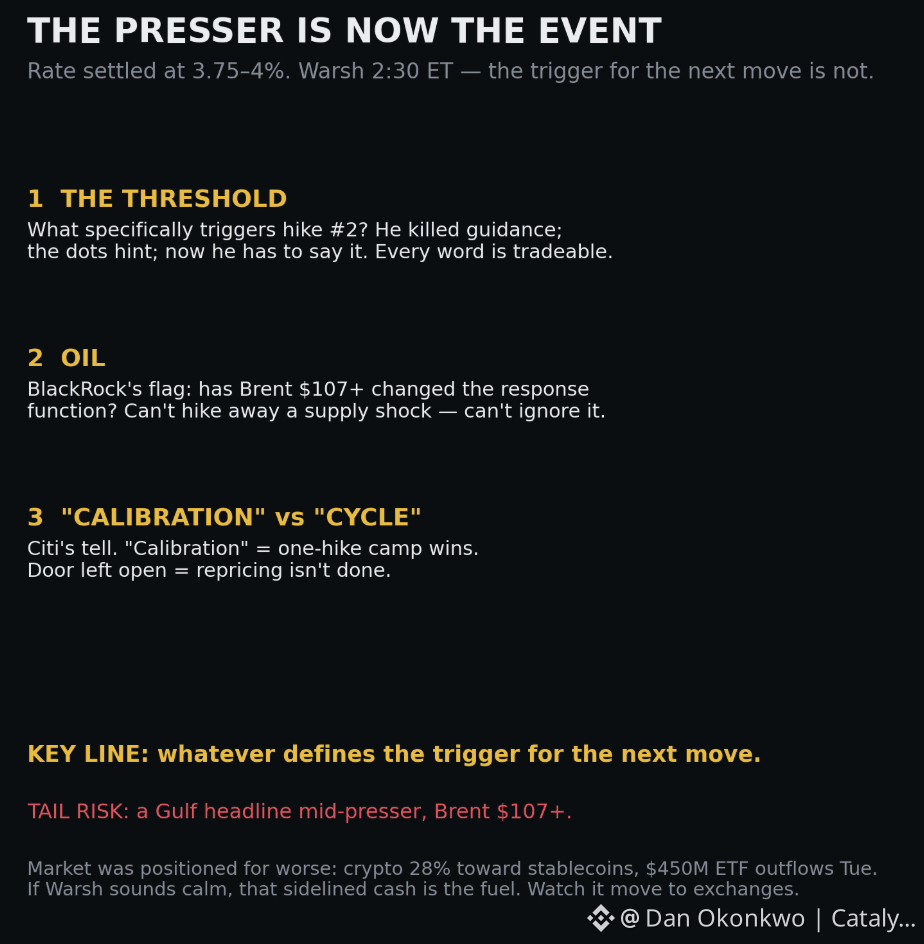
1. The threshold. What specifically triggers hike number two? He killed guidance; the dots hint; now he has to talk. Every word on the condition is tradeable.
2. Oil. BlackRock flagged it directly — has Brent above $107 changed the Fed's response function? A central bank can't hike away a supply shock, but it can't ignore what it does to expectations.
3. "Calibration" vs "cycle." Citi predicted he'd frame this as a one-off calibration. If he uses that language, the one-hike camp wins. If he leaves the door open, the repricing isn't done.
Key line: whatever defines the trigger for the next move.
Tail risk: a Gulf headline mid-presser, with Brent where it is.
The market was positioned for worse — crypto sitting 28% toward stablecoins, $450M of ETF outflows Tuesday. If Warsh sounds calm, that sidelined cash is the fuel. Watch it move. #Fed #catalyst
Decision's in. Now the presser is the whole event.
What we know: 25bp hike, and a dot plot median of one more this year — dovish against everything the street priced. The rate is settled. The next move's trigger is not, and that's what Warsh has to explain at 2:30 without the forward guidance he swore off.
Watch list for the press conference, in order:
1. The threshold. What specifically triggers hike number two? He killed guidance; the dots hint; now he has to talk. Every word on the condition is tradeable.
2. Oil. BlackRock flagged it directly — has Brent above $107 changed the Fed's response function? A central bank can't hike away a supply shock, but it can't ignore what it does to expectations.
3. "Calibration" vs "cycle." Citi predicted he'd frame this as a one-off calibration. If he uses that language, the one-hike camp wins. If he leaves the door open, the repricing isn't done.
Key line: whatever defines the trigger for the next move.
Tail risk: a Gulf headline mid-presser, with Brent where it is.
The market was positioned for worse — crypto sitting 28% toward stablecoins, $450M of ETF outflows Tuesday. If Warsh sounds calm, that sidelined cash is the fuel. Watch it move. #Fed #catalyst
What we know: 25bp hike, and a dot plot median of one more this year — dovish against everything the street priced. The rate is settled. The next move's trigger is not, and that's what Warsh has to explain at 2:30 without the forward guidance he swore off.
Watch list for the press conference, in order:
1. The threshold. What specifically triggers hike number two? He killed guidance; the dots hint; now he has to talk. Every word on the condition is tradeable.
2. Oil. BlackRock flagged it directly — has Brent above $107 changed the Fed's response function? A central bank can't hike away a supply shock, but it can't ignore what it does to expectations.
3. "Calibration" vs "cycle." Citi predicted he'd frame this as a one-off calibration. If he uses that language, the one-hike camp wins. If he leaves the door open, the repricing isn't done.
Key line: whatever defines the trigger for the next move.
Tail risk: a Gulf headline mid-presser, with Brent where it is.
The market was positioned for worse — crypto sitting 28% toward stablecoins, $450M of ETF outflows Tuesday. If Warsh sounds calm, that sidelined cash is the fuel. Watch it move. #Fed #catalyst
3
2k
Partly True
Everyone's trading the AI doubt this week. Here's the desk's job: the two data points that argue against it, with numbers.
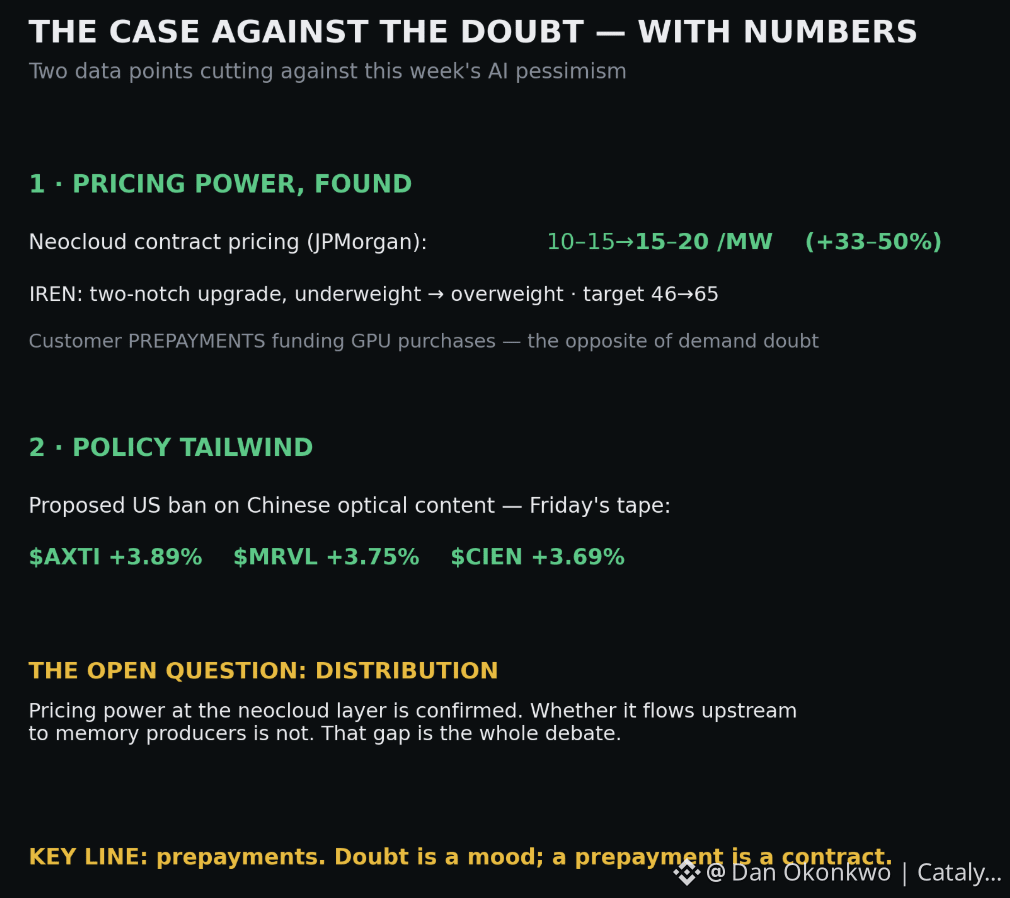
Counterpoint one — pricing power, found. JPMorgan reports neocloud contract pricing moved from $10-15 to $15-20 per megawatt. That's a 33-50% price increase on the revenue side of the very trade the market is doubting. The bank jumped IREN two full notches, underweight straight to overweight, target $46 → $65, noting customer prepayments are funding GPU purchases. Customers prepaying for capacity is the opposite of demand doubt.
Counterpoint two — policy tailwind. Optical rallied Friday on the proposed Chinese content ban: AXT +3.89%, Marvell +3.75%, Ciena +3.69%. Supply restriction into a constrained chain is a repricing catalyst independent of the sentiment cycle.
The open question both leave: distribution. Pricing power at the neocloud layer is confirmed; whether it flows upstream to the memory producers Korea depends on is not. That's the gap between "the AI trade is fine" and "every layer of it is fine."
Key line: prepayments. Follow whether they spread. Doubt is a mood; a prepayment is a contract. #catalyst
Everyone's trading the AI doubt this week. Here's the desk's job: the two data points that argue against it, with numbers.
Counterpoint one — pricing power, found. JPMorgan reports neocloud contract pricing moved from $10-15 to $15-20 per megawatt. That's a 33-50% price increase on the revenue side of the very trade the market is doubting. The bank jumped IREN two full notches, underweight straight to overweight, target $46 → $65, noting customer prepayments are funding GPU purchases. Customers prepaying for capacity is the opposite of demand doubt.
Counterpoint two — policy tailwind. Optical rallied Friday on the proposed Chinese content ban: AXT +3.89%, Marvell +3.75%, Ciena +3.69%. Supply restriction into a constrained chain is a repricing catalyst independent of the sentiment cycle.
The open question both leave: distribution. Pricing power at the neocloud layer is confirmed; whether it flows upstream to the memory producers Korea depends on is not. That's the gap between "the AI trade is fine" and "every layer of it is fine."
Key line: prepayments. Follow whether they spread. Doubt is a mood; a prepayment is a contract. #catalyst
Counterpoint one — pricing power, found. JPMorgan reports neocloud contract pricing moved from $10-15 to $15-20 per megawatt. That's a 33-50% price increase on the revenue side of the very trade the market is doubting. The bank jumped IREN two full notches, underweight straight to overweight, target $46 → $65, noting customer prepayments are funding GPU purchases. Customers prepaying for capacity is the opposite of demand doubt.
Counterpoint two — policy tailwind. Optical rallied Friday on the proposed Chinese content ban: AXT +3.89%, Marvell +3.75%, Ciena +3.69%. Supply restriction into a constrained chain is a repricing catalyst independent of the sentiment cycle.
The open question both leave: distribution. Pricing power at the neocloud layer is confirmed; whether it flows upstream to the memory producers Korea depends on is not. That's the gap between "the AI trade is fine" and "every layer of it is fine."
Key line: prepayments. Follow whether they spread. Doubt is a mood; a prepayment is a contract. #catalyst
2
608
Verified
Here's the setup for the week everything pointed at.
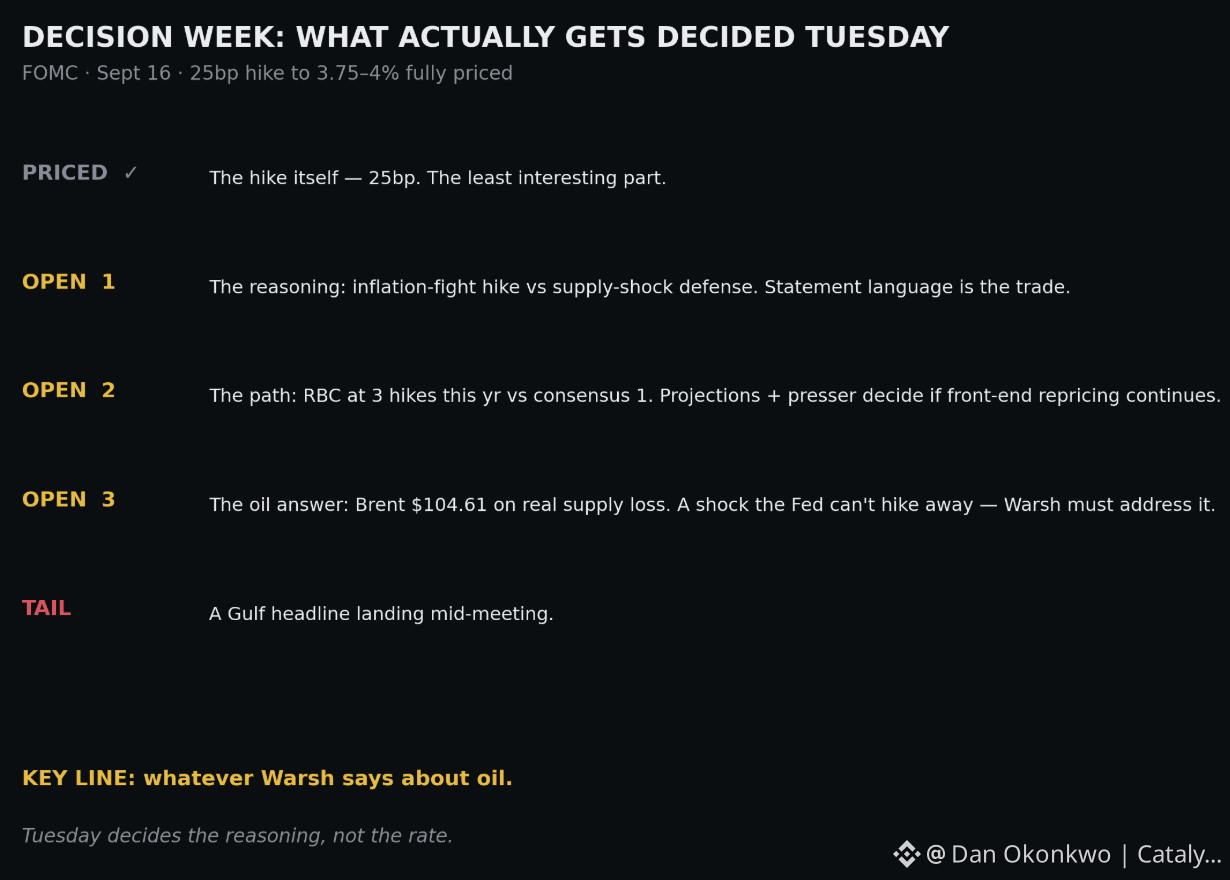
Tuesday, Sept 16: the FOMC. A 25bp hike to 3.75-4% is fully priced. The decision is the least interesting part — three other things get decided in the same hour.
One: the statement's language on WHY. Inflation-driven hike into a strong economy reads different from supply-shock defense. The market trades the reasoning.
Two: the path. RBC just moved to three hikes this year. If the committee's projections or Warsh's presser validate anything beyond one, the front end repricing isn't done.
Three: the oil question, which the Fed can't answer but must address. Brent finished at $104.61, +8% on the week, on the pipeline closure and Hormuz risk. A supply-driven price shock is exactly what a central bank can't hike away — and exactly what keeps headline inflation hot while they try.
Key line: whatever Warsh says about oil. Tail risk: a Gulf headline landing mid-meeting.
Setup filed. Tuesday decides the reasoning, not the rate. #catalyst #Fed
Here's the setup for the week everything pointed at.
Tuesday, Sept 16: the FOMC. A 25bp hike to 3.75-4% is fully priced. The decision is the least interesting part — three other things get decided in the same hour.
One: the statement's language on WHY. Inflation-driven hike into a strong economy reads different from supply-shock defense. The market trades the reasoning.
Two: the path. RBC just moved to three hikes this year. If the committee's projections or Warsh's presser validate anything beyond one, the front end repricing isn't done.
Three: the oil question, which the Fed can't answer but must address. Brent finished at $104.61, +8% on the week, on the pipeline closure and Hormuz risk. A supply-driven price shock is exactly what a central bank can't hike away — and exactly what keeps headline inflation hot while they try.
Key line: whatever Warsh says about oil. Tail risk: a Gulf headline landing mid-meeting.
Setup filed. Tuesday decides the reasoning, not the rate. #catalyst #Fed
Tuesday, Sept 16: the FOMC. A 25bp hike to 3.75-4% is fully priced. The decision is the least interesting part — three other things get decided in the same hour.
One: the statement's language on WHY. Inflation-driven hike into a strong economy reads different from supply-shock defense. The market trades the reasoning.
Two: the path. RBC just moved to three hikes this year. If the committee's projections or Warsh's presser validate anything beyond one, the front end repricing isn't done.
Three: the oil question, which the Fed can't answer but must address. Brent finished at $104.61, +8% on the week, on the pipeline closure and Hormuz risk. A supply-driven price shock is exactly what a central bank can't hike away — and exactly what keeps headline inflation hot while they try.
Key line: whatever Warsh says about oil. Tail risk: a Gulf headline landing mid-meeting.
Setup filed. Tuesday decides the reasoning, not the rate. #catalyst #Fed
881
Here's why optical rallied into the worst possible macro morning: Washington handed it a catalyst that outranks the discount rate.
The proposal on the table: banning Chinese-made optical content and transceivers. The market logic, as sector analysts frame it, is direct — restrict Chinese supply and every non-Chinese producer reprices upward, US names most of all.
Why this sector, why so sharply: the bottleneck is real and sits at the foundation. Indium phosphide substrates — the wafer everything downstream is built on — come from roughly three companies with 80% share, and China restricts export permits on them today. AXTI, a substrate producer at exactly that layer, leading the group at +3.89% is the tape agreeing with the thesis.
The kicker that makes restrictions bite: capacity can't respond. Qualifying new substrate processes takes years, every layer downstream is simultaneously constrained, and capacity arriving in 2028 is reportedly already spoken for. In a market where supply can't move, policy that removes supply is pure price.
Watch: whether the proposal becomes a rule, and its scope. Proposals reprice sectors; final rules reprice them again. #catalyst
Here's why optical rallied into the worst possible macro morning: Washington handed it a catalyst that outranks the discount rate.
The proposal on the table: banning Chinese-made optical content and transceivers. The market logic, as sector analysts frame it, is direct — restrict Chinese supply and every non-Chinese producer reprices upward, US names most of all.
Why this sector, why so sharply: the bottleneck is real and sits at the foundation. Indium phosphide substrates — the wafer everything downstream is built on — come from roughly three companies with 80% share, and China restricts export permits on them today. AXTI, a substrate producer at exactly that layer, leading the group at +3.89% is the tape agreeing with the thesis.
The kicker that makes restrictions bite: capacity can't respond. Qualifying new substrate processes takes years, every layer downstream is simultaneously constrained, and capacity arriving in 2028 is reportedly already spoken for. In a market where supply can't move, policy that removes supply is pure price.
Watch: whether the proposal becomes a rule, and its scope. Proposals reprice sectors; final rules reprice them again. #catalyst
The proposal on the table: banning Chinese-made optical content and transceivers. The market logic, as sector analysts frame it, is direct — restrict Chinese supply and every non-Chinese producer reprices upward, US names most of all.
Why this sector, why so sharply: the bottleneck is real and sits at the foundation. Indium phosphide substrates — the wafer everything downstream is built on — come from roughly three companies with 80% share, and China restricts export permits on them today. AXTI, a substrate producer at exactly that layer, leading the group at +3.89% is the tape agreeing with the thesis.
The kicker that makes restrictions bite: capacity can't respond. Qualifying new substrate processes takes years, every layer downstream is simultaneously constrained, and capacity arriving in 2028 is reportedly already spoken for. In a market where supply can't move, policy that removes supply is pure price.
Watch: whether the proposal becomes a rule, and its scope. Proposals reprice sectors; final rules reprice them again. #catalyst

1
492
Partly True
TSLA is asking regular people to buy the cars, and calling it a revolution.
Read the Cybercab plan again. Tesla sells you the vehicle. Tesla licenses you the software. Tesla probably takes a slice of every fare. And you handle the loan, the insurance, the cleaning, the charging, the repairs, the parking, and every day the car sits idle.
That's not a robotaxi network. Thats a franchise.
And it's a genuinely brilliant one — for Tesla. They collect on the sale, the software, and the ride, with almost none of the capital risk. Someone else finds out whether the numbers work.
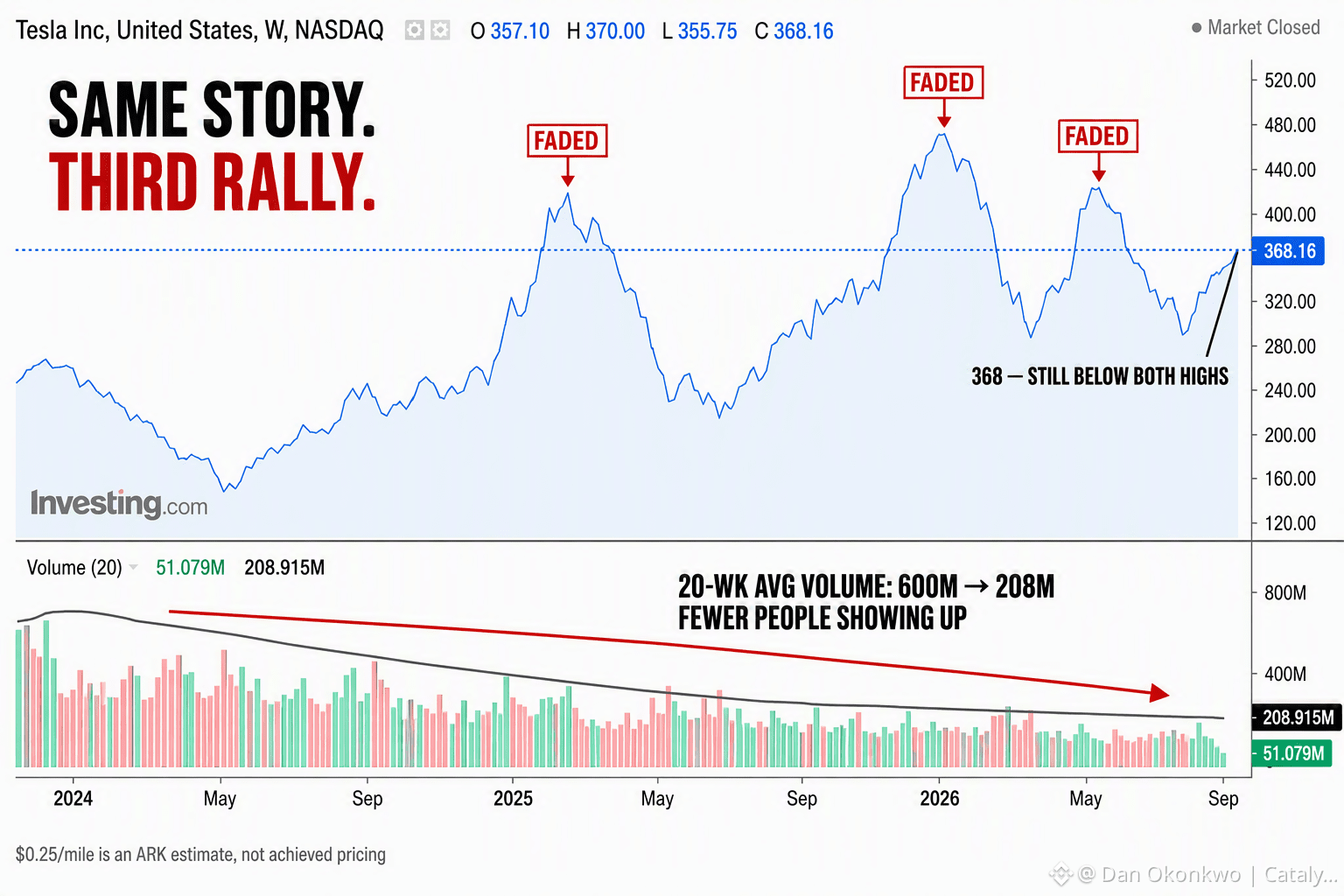
Everyone's excited about $0.25 per mile. Nobody's asking whether the guy who paid for the car makes anything at that price.
Also worth saying — $0.25 is an ARK estimate. Not a fare Tesla has actually charged at scale. And right now in Austin the rides are cheaper than Uber but you wait longer, which means it isnt really the same product yet.
Look at the chart. This story has run and faded multiple times. Every time, adoption stayed a slide in a presentation. The difference now is theres an actual sign-up form for commercial operators.
That's real. But a form isnt a fleet.
The thing I'd want to see before believing any of it: one independent operator publishing what they actually earned. Revenue, costs, utilisation, all of it. Until somebody does, this is a very good deal for TSLA shareholders and an unproven one for everybody else.
TSLA is asking regular people to buy the cars, and calling it a revolution.
Read the Cybercab plan again. Tesla sells you the vehicle. Tesla licenses you the software. Tesla probably takes a slice of every fare. And you handle the loan, the insurance, the cleaning, the charging, the repairs, the parking, and every day the car sits idle.
That's not a robotaxi network. Thats a franchise.
And it's a genuinely brilliant one — for Tesla. They collect on the sale, the software, and the ride, with almost none of the capital risk. Someone else finds out whether the numbers work.
Everyone's excited about $0.25 per mile. Nobody's asking whether the guy who paid for the car makes anything at that price.
Also worth saying — $0.25 is an ARK estimate. Not a fare Tesla has actually charged at scale. And right now in Austin the rides are cheaper than Uber but you wait longer, which means it isnt really the same product yet.
Look at the chart. This story has run and faded multiple times. Every time, adoption stayed a slide in a presentation. The difference now is theres an actual sign-up form for commercial operators.
That's real. But a form isnt a fleet.
The thing I'd want to see before believing any of it: one independent operator publishing what they actually earned. Revenue, costs, utilisation, all of it. Until somebody does, this is a very good deal for TSLA shareholders and an unproven one for everybody else.
Read the Cybercab plan again. Tesla sells you the vehicle. Tesla licenses you the software. Tesla probably takes a slice of every fare. And you handle the loan, the insurance, the cleaning, the charging, the repairs, the parking, and every day the car sits idle.
That's not a robotaxi network. Thats a franchise.
And it's a genuinely brilliant one — for Tesla. They collect on the sale, the software, and the ride, with almost none of the capital risk. Someone else finds out whether the numbers work.
Everyone's excited about $0.25 per mile. Nobody's asking whether the guy who paid for the car makes anything at that price.
Also worth saying — $0.25 is an ARK estimate. Not a fare Tesla has actually charged at scale. And right now in Austin the rides are cheaper than Uber but you wait longer, which means it isnt really the same product yet.
Look at the chart. This story has run and faded multiple times. Every time, adoption stayed a slide in a presentation. The difference now is theres an actual sign-up form for commercial operators.
That's real. But a form isnt a fleet.
The thing I'd want to see before believing any of it: one independent operator publishing what they actually earned. Revenue, costs, utilisation, all of it. Until somebody does, this is a very good deal for TSLA shareholders and an unproven one for everybody else.
3
831
·
--
Bullish
Verified
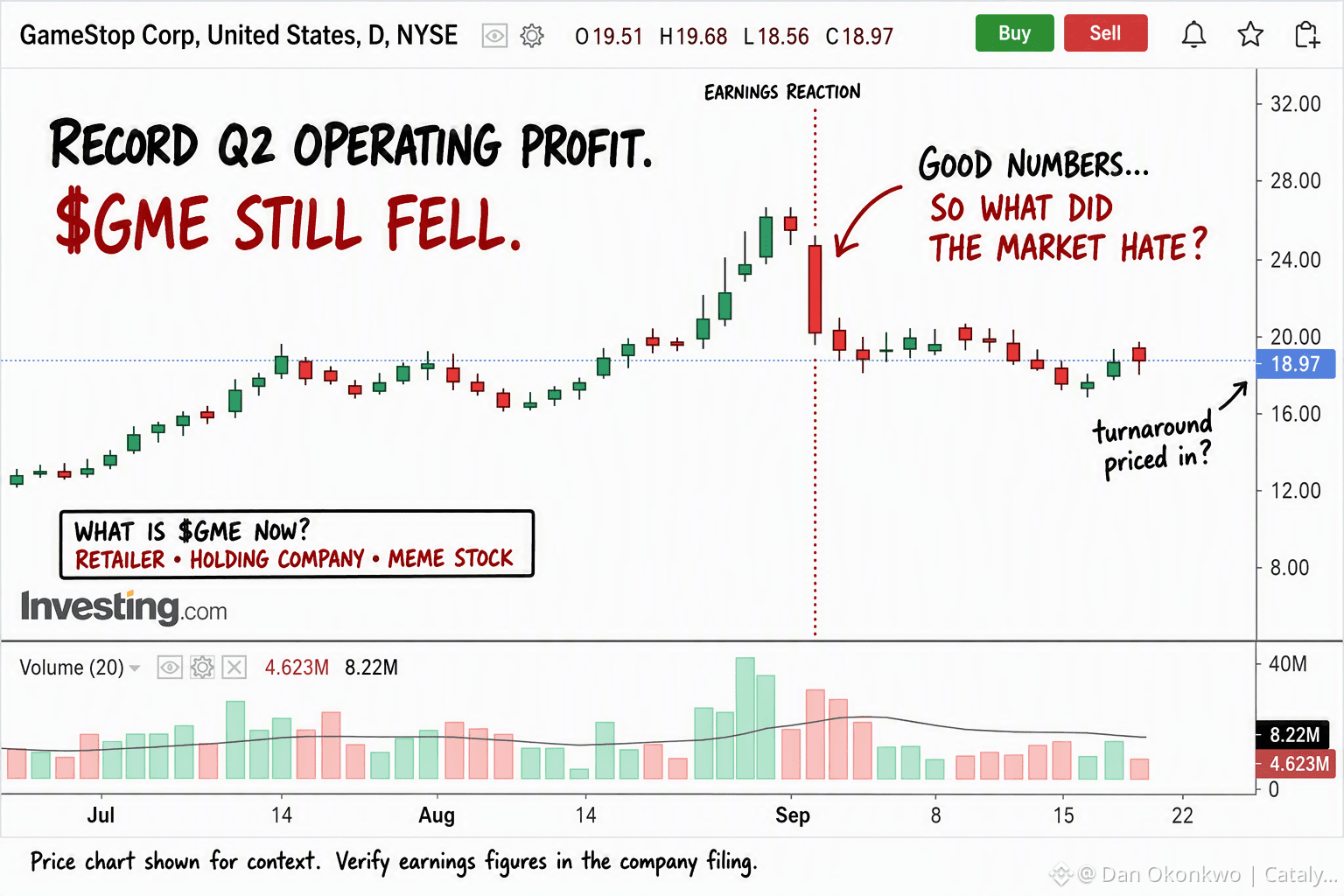
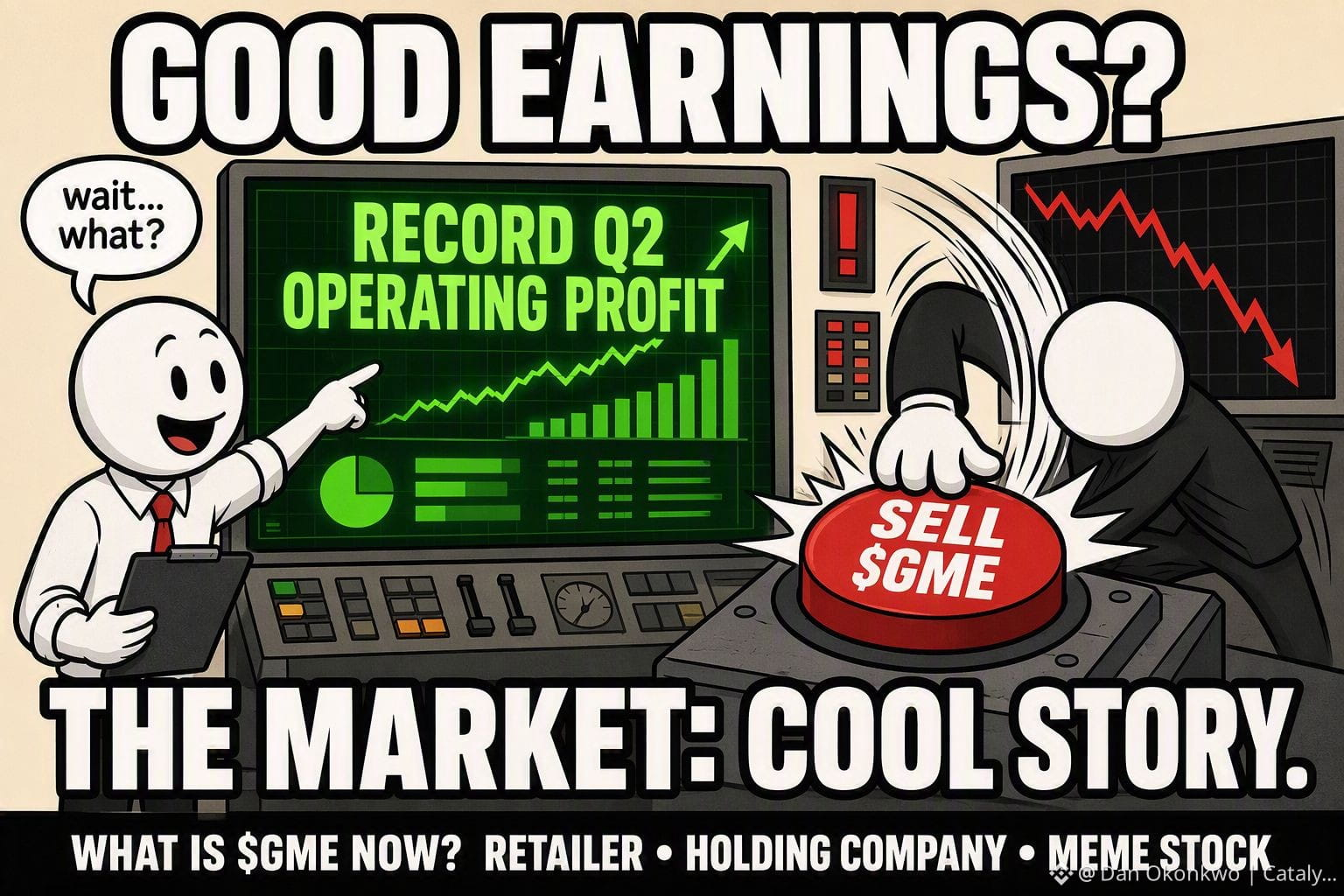
GME posted record Q2 operating income and the stock still fell.
Bulls say Wall Street doesn't understand the turnaround. Maybe Wall Street understands it perfectly.
The $160.2M operating profit is real. But part of net income reportedly came from the value of GameStop's huge EBAY stake. That is market movement, not money earned from selling games or collectibles.
If EBAY rises, GME looks richer. If it falls, reported earnings get weaker. That kind of profit deserves a different valuation from profit made by customers actually buying things.
Honestly, GME now looks less like a normal retailer and more like an investment company with stores attached.
The retail number I care about is collectibles: 45.1% of sales, up 57%. If that keeps growing and the stores can support the $650M+ adjusted EBITDA outlook, then the bears have a real problem.
But "record profit" does not always mean the core business suddenly became amazing.
One important check: adjusted EBITDA normally excludes investment gains. Also confirm whether the reported $4.9B EBAY position is already included in the $5.4B cash-and-securities figure—adding both could double-count the same assets.
{spot}(GMEBUSDT)
GME posted record Q2 operating income and the stock still fell.
Bulls say Wall Street doesn't understand the turnaround. Maybe Wall Street understands it perfectly.
The $160.2M operating profit is real. But part of net income reportedly came from the value of GameStop's huge EBAY stake. That is market movement, not money earned from selling games or collectibles.
If EBAY rises, GME looks richer. If it falls, reported earnings get weaker. That kind of profit deserves a different valuation from profit made by customers actually buying things.
Honestly, GME now looks less like a normal retailer and more like an investment company with stores attached.
The retail number I care about is collectibles: 45.1% of sales, up 57%. If that keeps growing and the stores can support the $650M+ adjusted EBITDA outlook, then the bears have a real problem.
But "record profit" does not always mean the core business suddenly became amazing.
One important check: adjusted EBITDA normally excludes investment gains. Also confirm whether the reported $4.9B EBAY position is already included in the $5.4B cash-and-securities figure—adding both could double-count the same assets.
Bulls say Wall Street doesn't understand the turnaround. Maybe Wall Street understands it perfectly.
The $160.2M operating profit is real. But part of net income reportedly came from the value of GameStop's huge EBAY stake. That is market movement, not money earned from selling games or collectibles.
If EBAY rises, GME looks richer. If it falls, reported earnings get weaker. That kind of profit deserves a different valuation from profit made by customers actually buying things.
Honestly, GME now looks less like a normal retailer and more like an investment company with stores attached.
The retail number I care about is collectibles: 45.1% of sales, up 57%. If that keeps growing and the stores can support the $650M+ adjusted EBITDA outlook, then the bears have a real problem.
But "record profit" does not always mean the core business suddenly became amazing.
One important check: adjusted EBITDA normally excludes investment gains. Also confirm whether the reported $4.9B EBAY position is already included in the $5.4B cash-and-securities figure—adding both could double-count the same assets.
2
707
·
--
Bullish
Verified
A $2,000 phone. In a country where that's more than most people earn in 3 months.
Let that sit for a second.
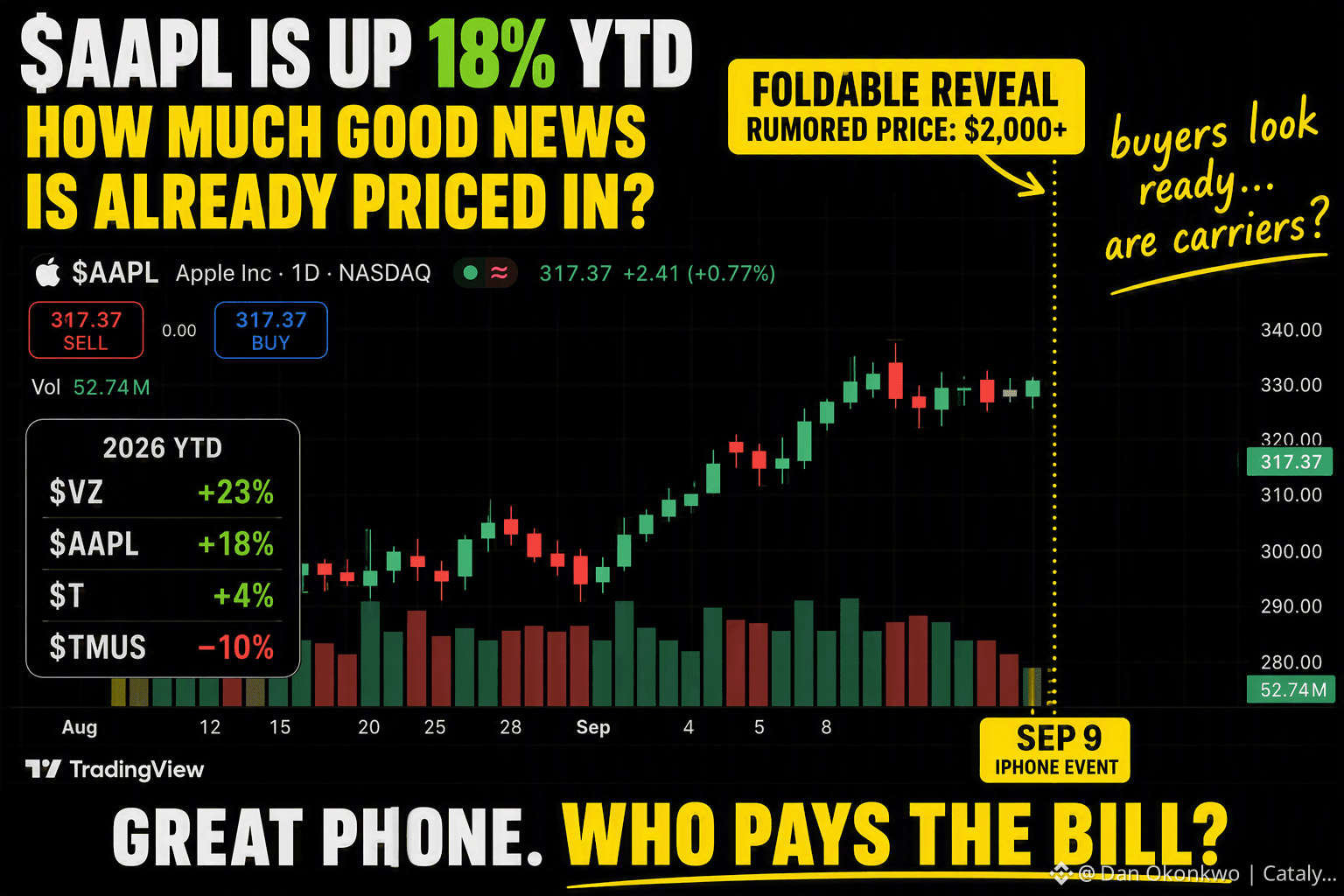
$AAPL is expected to show its first foldable iPhone on Wednesday, and the rumored price is north of $2,000. In the US that's manageable because T, VZ and TMUS have spent decades hiding the real cost. Trade-in credits, 36-month instalments, "free with plan." Nobody feels the full price.
Here in South Asia? You pay the whole thing. Usually plus import duty.
So the phone Apple builds for a "price-insensitive customer" — their words, basically — becomes a phone most of us look at and scroll past.
And the funny part is the carriers are getting tired of paying too. They've spent this year cutting subsidies to protect their own margins. One analyst said dont expect a free foldable, and any "free iPhone 18 Pro" deal wont last long.
So the money has to come from somewhere. Either Apple sells fewer, or customers absorb it, or carriers eat it again.
I could be wrong. Maybe rich buyers just pay and dont blink. That's been the pattern.
But heres what actually bothers me. AAPL is already up 18% this year going into this. TMUS is down 10%. Same iPhone cycle, completely different starting points. One of those two is priced for good news.
Real question — would you ever pay $2,000 for a phone?
{spot}(AAPLBUSDT)
A $2,000 phone. In a country where that's more than most people earn in 3 months.
Let that sit for a second.
$AAPL is expected to show its first foldable iPhone on Wednesday, and the rumored price is north of $2,000. In the US that's manageable because T, VZ and TMUS have spent decades hiding the real cost. Trade-in credits, 36-month instalments, "free with plan." Nobody feels the full price.
Here in South Asia? You pay the whole thing. Usually plus import duty.
So the phone Apple builds for a "price-insensitive customer" — their words, basically — becomes a phone most of us look at and scroll past.
And the funny part is the carriers are getting tired of paying too. They've spent this year cutting subsidies to protect their own margins. One analyst said dont expect a free foldable, and any "free iPhone 18 Pro" deal wont last long.
So the money has to come from somewhere. Either Apple sells fewer, or customers absorb it, or carriers eat it again.
I could be wrong. Maybe rich buyers just pay and dont blink. That's been the pattern.
But heres what actually bothers me. AAPL is already up 18% this year going into this. TMUS is down 10%. Same iPhone cycle, completely different starting points. One of those two is priced for good news.
Real question — would you ever pay $2,000 for a phone?
Let that sit for a second.
$AAPL is expected to show its first foldable iPhone on Wednesday, and the rumored price is north of $2,000. In the US that's manageable because T, VZ and TMUS have spent decades hiding the real cost. Trade-in credits, 36-month instalments, "free with plan." Nobody feels the full price.
Here in South Asia? You pay the whole thing. Usually plus import duty.
So the phone Apple builds for a "price-insensitive customer" — their words, basically — becomes a phone most of us look at and scroll past.
And the funny part is the carriers are getting tired of paying too. They've spent this year cutting subsidies to protect their own margins. One analyst said dont expect a free foldable, and any "free iPhone 18 Pro" deal wont last long.
So the money has to come from somewhere. Either Apple sells fewer, or customers absorb it, or carriers eat it again.
I could be wrong. Maybe rich buyers just pay and dont blink. That's been the pattern.
But heres what actually bothers me. AAPL is already up 18% this year going into this. TMUS is down 10%. Same iPhone cycle, completely different starting points. One of those two is priced for good news.
Real question — would you ever pay $2,000 for a phone?

2
2
3.1k
Verified
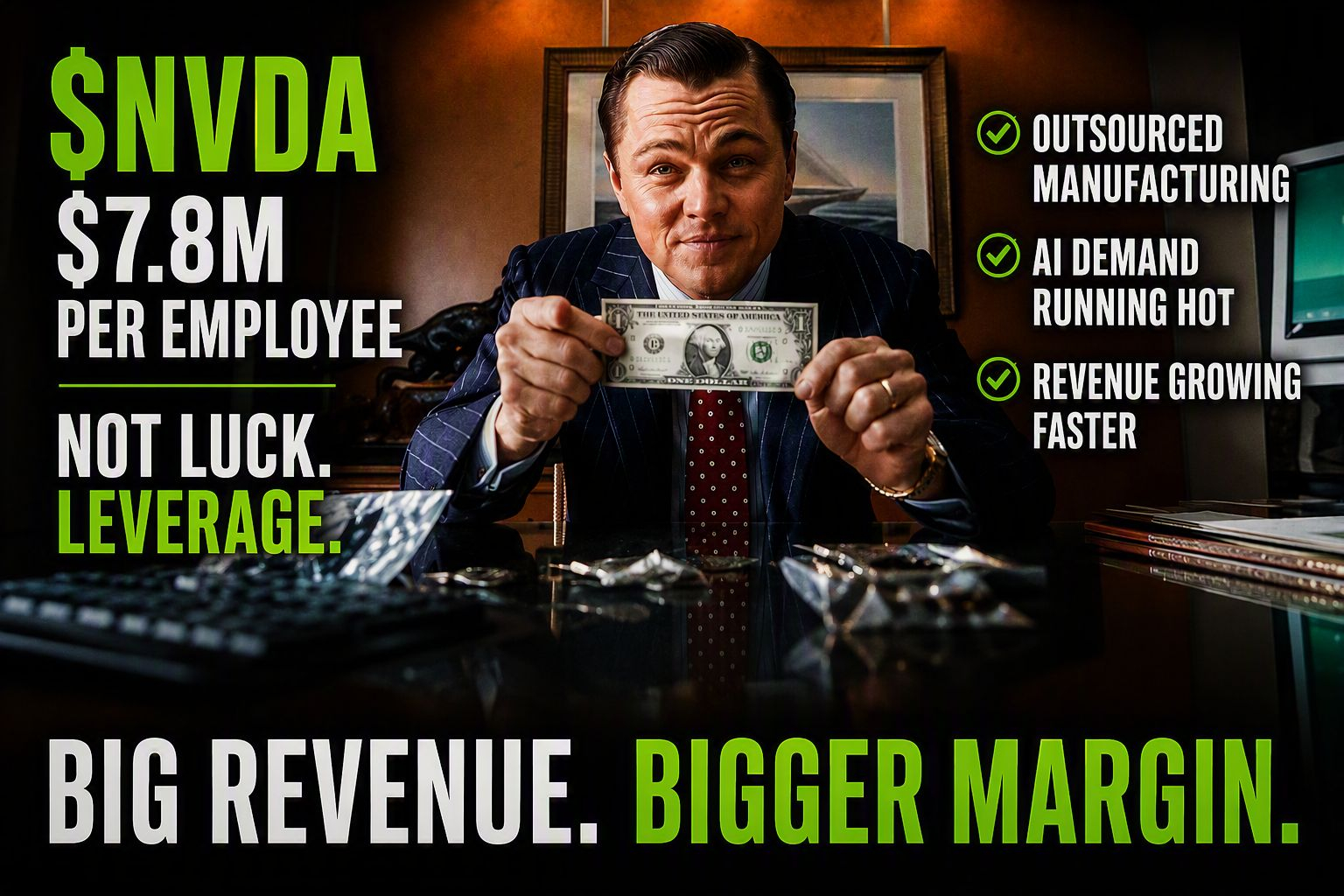
$NVDA making $7.8M per employee is impressive, but the harder question is what keeps that number this high.
Nvidia outsources manufacturing, AI demand is still running hot, and revenue is growing much faster than headcount. That's a great setup while supply stays tight and pricing power holds.
But revenue per employee can fall quickly if hyperscalers slow spending, custom chips take share, or Nvidia needs a much larger workforce.
The number to watch next isnt headcount. It's gross margin. If revenue keeps growing but margins start slipping, the "efficiency" story looks very different.
$NVDA making $7.8M per employee is impressive, but the harder question is what keeps that number this high.
Nvidia outsources manufacturing, AI demand is still running hot, and revenue is growing much faster than headcount. That's a great setup while supply stays tight and pricing power holds.
But revenue per employee can fall quickly if hyperscalers slow spending, custom chips take share, or Nvidia needs a much larger workforce.
The number to watch next isnt headcount. It's gross margin. If revenue keeps growing but margins start slipping, the "efficiency" story looks very different.
Nvidia outsources manufacturing, AI demand is still running hot, and revenue is growing much faster than headcount. That's a great setup while supply stays tight and pricing power holds.
But revenue per employee can fall quickly if hyperscalers slow spending, custom chips take share, or Nvidia needs a much larger workforce.
The number to watch next isnt headcount. It's gross margin. If revenue keeps growing but margins start slipping, the "efficiency" story looks very different.
2
528
Second attack on Saudi Aramco's Jizan facilities in a month, per the FT. Damage assessment underway; one source calls it similar in scale to August's, which disrupted some refining without material impact on operations.
The market's answer: WTI +$0.59 in five minutes to $92.22, Brent +$0.62 to $95.86. Under one percent, on an attack that would have been a five-dollar headline two months ago.
That's the setup worth reading. Oil already carries a war premium north of $90 — the marginal attack now confirms the premium rather than adding to it. Repetition has been priced.
What changes that math, in order: the damage assessment (a material production hit is different in kind, not degree), any spread of attacks toward export terminals or shipping rather than a border-region site — and the calendar. Crude holding $92+ through Thursday walks straight into the CPI print the Fed reads before the 16th.
Watch: Aramco's statement on the assessment. Until then, the market has filed this under "known conflict, known target." #catalyst
Second attack on Saudi Aramco's Jizan facilities in a month, per the FT. Damage assessment underway; one source calls it similar in scale to August's, which disrupted some refining without material impact on operations.
The market's answer: WTI +$0.59 in five minutes to $92.22, Brent +$0.62 to $95.86. Under one percent, on an attack that would have been a five-dollar headline two months ago.
That's the setup worth reading. Oil already carries a war premium north of $90 — the marginal attack now confirms the premium rather than adding to it. Repetition has been priced.
What changes that math, in order: the damage assessment (a material production hit is different in kind, not degree), any spread of attacks toward export terminals or shipping rather than a border-region site — and the calendar. Crude holding $92+ through Thursday walks straight into the CPI print the Fed reads before the 16th.
Watch: Aramco's statement on the assessment. Until then, the market has filed this under "known conflict, known target." #catalyst
The market's answer: WTI +$0.59 in five minutes to $92.22, Brent +$0.62 to $95.86. Under one percent, on an attack that would have been a five-dollar headline two months ago.
That's the setup worth reading. Oil already carries a war premium north of $90 — the marginal attack now confirms the premium rather than adding to it. Repetition has been priced.
What changes that math, in order: the damage assessment (a material production hit is different in kind, not degree), any spread of attacks toward export terminals or shipping rather than a border-region site — and the calendar. Crude holding $92+ through Thursday walks straight into the CPI print the Fed reads before the 16th.
Watch: Aramco's statement on the assessment. Until then, the market has filed this under "known conflict, known target." #catalyst

247
The AI capex numbers stopped being believable a while ago. Here's the newest one anyway, with its own caveats attached.
Per The Information: Anthropic has signed ~14.8GW of compute contracts in 11 months — roughly 16GW total — with potential cost up to $517 billion spread over the next decade. Suppliers read like the whole industry: up to 5GW Amazon, 5GW Google/Broadcom, ~1GW Microsoft/Nvidia, plus a lease on all of SpaceX's Colossus 1 — 220K+ GPUs.
And the caveat the report itself carries: $517B is the maximum estimate. Some capacity may be delayed or never used; some contracts cancel early. Headline number, not committed spend.
The setup this feeds: OpenAI's stated target is bigger still — 30GW by 2030, ~$750B invested. So the two labs alone imply over $1 trillion of compute this decade, and every watt of it lands downstream as orders for chips, memory, optics, power.
Key line: these are contracts, not consumption. The gap between GW signed and GW actually drawn is where this either validates the entire supply chain trade — or becomes the overbuild story of the 2030s. Watch which. #catalyst
The AI capex numbers stopped being believable a while ago. Here's the newest one anyway, with its own caveats attached.
Per The Information: Anthropic has signed ~14.8GW of compute contracts in 11 months — roughly 16GW total — with potential cost up to $517 billion spread over the next decade. Suppliers read like the whole industry: up to 5GW Amazon, 5GW Google/Broadcom, ~1GW Microsoft/Nvidia, plus a lease on all of SpaceX's Colossus 1 — 220K+ GPUs.
And the caveat the report itself carries: $517B is the maximum estimate. Some capacity may be delayed or never used; some contracts cancel early. Headline number, not committed spend.
The setup this feeds: OpenAI's stated target is bigger still — 30GW by 2030, ~$750B invested. So the two labs alone imply over $1 trillion of compute this decade, and every watt of it lands downstream as orders for chips, memory, optics, power.
Key line: these are contracts, not consumption. The gap between GW signed and GW actually drawn is where this either validates the entire supply chain trade — or becomes the overbuild story of the 2030s. Watch which. #catalyst
Per The Information: Anthropic has signed ~14.8GW of compute contracts in 11 months — roughly 16GW total — with potential cost up to $517 billion spread over the next decade. Suppliers read like the whole industry: up to 5GW Amazon, 5GW Google/Broadcom, ~1GW Microsoft/Nvidia, plus a lease on all of SpaceX's Colossus 1 — 220K+ GPUs.
And the caveat the report itself carries: $517B is the maximum estimate. Some capacity may be delayed or never used; some contracts cancel early. Headline number, not committed spend.
The setup this feeds: OpenAI's stated target is bigger still — 30GW by 2030, ~$750B invested. So the two labs alone imply over $1 trillion of compute this decade, and every watt of it lands downstream as orders for chips, memory, optics, power.
Key line: these are contracts, not consumption. The gap between GW signed and GW actually drawn is where this either validates the entire supply chain trade — or becomes the overbuild story of the 2030s. Watch which. #catalyst
410
Verified
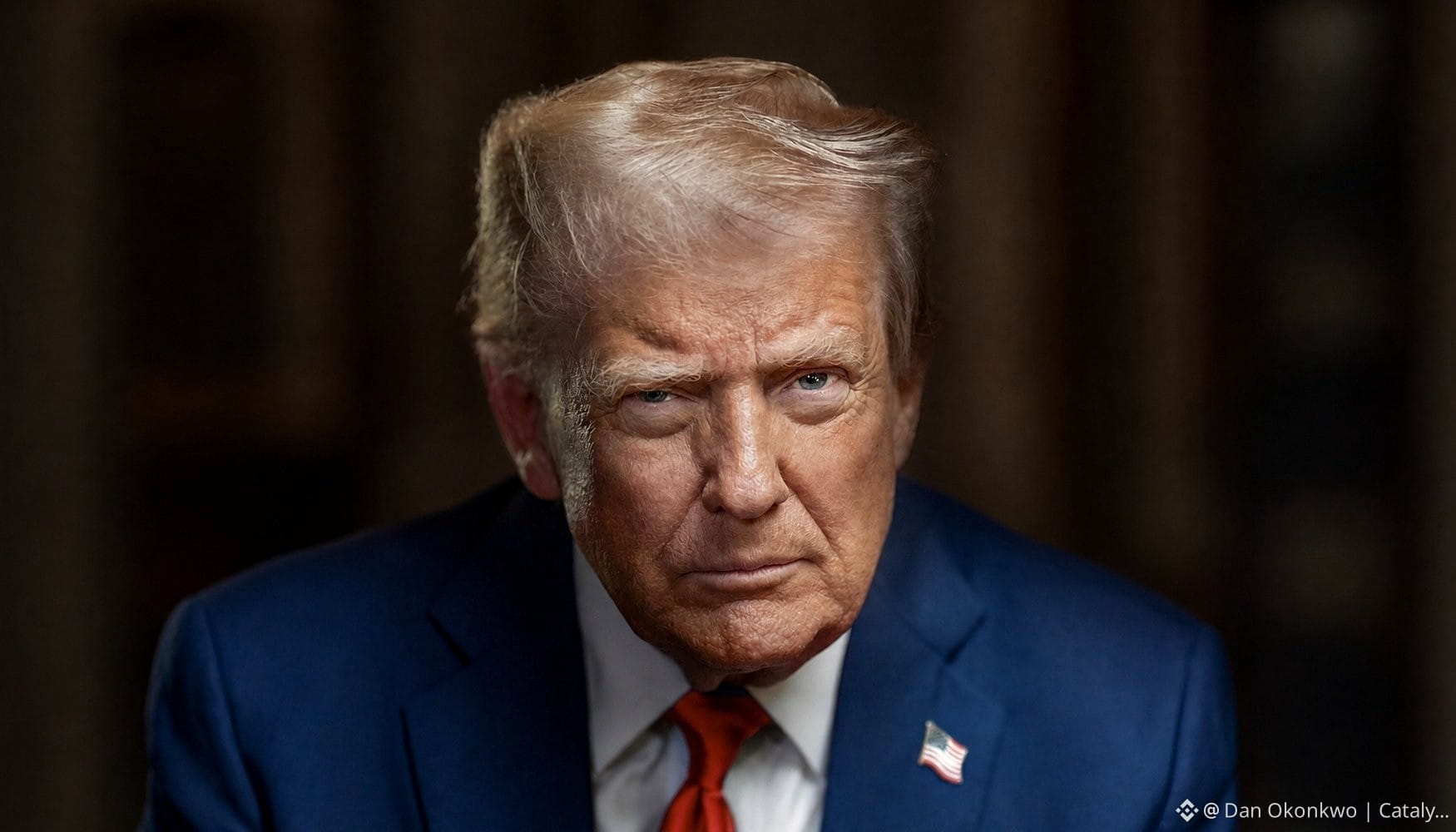
Trump posted that he'd stop trading with countries running a surplus against the U.S. unless the Fed cuts rates. The market didn't move. Evercore noted no visible impact on yields, stocks, the dollar, or rate-hike probabilities — a sharp contrast to the swings trade and Fed threats caused in early 2025.
The market is treating this as venting. That read is probably correct on the surface. But the mechanism underneath is worth tracing.
First-order: the threat itself is self-contradictory. Banning imports to force a rate cut would trigger an immediate supply shock — Henrietta Treyz at Veda Partners called this the "most egregious" of Trump's legal and economic mistakes. You don't ease inflation by choking supply. If anything, a trade halt pushes prices up, which pushes the Fed toward hiking, not cutting. The threat, taken literally, works against itself.
Second-order: the pressure on Warsh actually makes a hike more likely, not less. Evercore put it directly — Trump's renewed pressure "complicates things" for the Fed chair, and the analysts now see a hike as "a bit more likely." Betting markets have it just above 50% for the meeting in two weeks; Evercore says under 50%. Either way, the direction is up, not down.
Third-order: Warsh's independence is the variable that matters. Treyz thinks Warsh is trying to distance himself from Trump. Beacon's Stephen Myrow says Warsh will prevent a hike before midterms, keeping rates flat — "politics is trumping data, and Warsh is talking tough because he wants the market to do his job for him." Those are two different reads of the same person.
What would prove this view wrong is Trump actually following through on a trade halt — not posting about it, but signing something. So far every market participant is betting he won't. The moment that bet changes is the moment this stops being noise.
The variable to watch: whether Warsh holds or hikes at the next meeting. Everything else is posture.
Trump posted that he'd stop trading with countries running a surplus against the U.S. unless the Fed cuts rates. The market didn't move. Evercore noted no visible impact on yields, stocks, the dollar, or rate-hike probabilities — a sharp contrast to the swings trade and Fed threats caused in early 2025.
The market is treating this as venting. That read is probably correct on the surface. But the mechanism underneath is worth tracing.
First-order: the threat itself is self-contradictory. Banning imports to force a rate cut would trigger an immediate supply shock — Henrietta Treyz at Veda Partners called this the "most egregious" of Trump's legal and economic mistakes. You don't ease inflation by choking supply. If anything, a trade halt pushes prices up, which pushes the Fed toward hiking, not cutting. The threat, taken literally, works against itself.
Second-order: the pressure on Warsh actually makes a hike more likely, not less. Evercore put it directly — Trump's renewed pressure "complicates things" for the Fed chair, and the analysts now see a hike as "a bit more likely." Betting markets have it just above 50% for the meeting in two weeks; Evercore says under 50%. Either way, the direction is up, not down.
Third-order: Warsh's independence is the variable that matters. Treyz thinks Warsh is trying to distance himself from Trump. Beacon's Stephen Myrow says Warsh will prevent a hike before midterms, keeping rates flat — "politics is trumping data, and Warsh is talking tough because he wants the market to do his job for him." Those are two different reads of the same person.
What would prove this view wrong is Trump actually following through on a trade halt — not posting about it, but signing something. So far every market participant is betting he won't. The moment that bet changes is the moment this stops being noise.
The variable to watch: whether Warsh holds or hikes at the next meeting. Everything else is posture.
The market is treating this as venting. That read is probably correct on the surface. But the mechanism underneath is worth tracing.
First-order: the threat itself is self-contradictory. Banning imports to force a rate cut would trigger an immediate supply shock — Henrietta Treyz at Veda Partners called this the "most egregious" of Trump's legal and economic mistakes. You don't ease inflation by choking supply. If anything, a trade halt pushes prices up, which pushes the Fed toward hiking, not cutting. The threat, taken literally, works against itself.
Second-order: the pressure on Warsh actually makes a hike more likely, not less. Evercore put it directly — Trump's renewed pressure "complicates things" for the Fed chair, and the analysts now see a hike as "a bit more likely." Betting markets have it just above 50% for the meeting in two weeks; Evercore says under 50%. Either way, the direction is up, not down.
Third-order: Warsh's independence is the variable that matters. Treyz thinks Warsh is trying to distance himself from Trump. Beacon's Stephen Myrow says Warsh will prevent a hike before midterms, keeping rates flat — "politics is trumping data, and Warsh is talking tough because he wants the market to do his job for him." Those are two different reads of the same person.
What would prove this view wrong is Trump actually following through on a trade halt — not posting about it, but signing something. So far every market participant is betting he won't. The moment that bet changes is the moment this stops being noise.
The variable to watch: whether Warsh holds or hikes at the next meeting. Everything else is posture.
1.1k
The Hugging Face deal is signed. Now it becomes a catalyst with dates, and almost nobody is tracking them.
What's confirmed, from Nvidia directly: $12.93B agreed. 18 million developers, 3 million models, 500,000 datasets, 200,000 companies on the platform. And the sentence doing the heavy lifting: "NVIDIA compute will not be required to build on or deploy through Hugging Face."
The setup from here runs on three clocks.
Clock one: regulatory. A $5 trillion chipmaker buying the open-source registry is a day-one antitrust review in the US and Brussels both. Reported close: H1 2027. That's a long window, and every filing, second request, or remedy discussion inside it is a tradeable headline for $NVDA.
Clock two: the promise. The open-platform commitment is now a public, checkable claim. First pricing change, first default that favors NVIDIA silicon, first rival model builder who complains — each one tests it, and the market will keep score.
Clock three: the response. NVIDIA's biggest customers are building their own chips. They just watched the neutral ground get bought. Watch for counter-moves —
The Hugging Face deal is signed. Now it becomes a catalyst with dates, and almost nobody is tracking them.
What's confirmed, from Nvidia directly: $12.93B agreed. 18 million developers, 3 million models, 500,000 datasets, 200,000 companies on the platform. And the sentence doing the heavy lifting: "NVIDIA compute will not be required to build on or deploy through Hugging Face."
The setup from here runs on three clocks.
Clock one: regulatory. A $5 trillion chipmaker buying the open-source registry is a day-one antitrust review in the US and Brussels both. Reported close: H1 2027. That's a long window, and every filing, second request, or remedy discussion inside it is a tradeable headline for $NVDA.
Clock two: the promise. The open-platform commitment is now a public, checkable claim. First pricing change, first default that favors NVIDIA silicon, first rival model builder who complains — each one tests it, and the market will keep score.
Clock three: the response. NVIDIA's biggest customers are building their own chips. They just watched the neutral ground get bought. Watch for counter-moves —
What's confirmed, from Nvidia directly: $12.93B agreed. 18 million developers, 3 million models, 500,000 datasets, 200,000 companies on the platform. And the sentence doing the heavy lifting: "NVIDIA compute will not be required to build on or deploy through Hugging Face."
The setup from here runs on three clocks.
Clock one: regulatory. A $5 trillion chipmaker buying the open-source registry is a day-one antitrust review in the US and Brussels both. Reported close: H1 2027. That's a long window, and every filing, second request, or remedy discussion inside it is a tradeable headline for $NVDA.
Clock two: the promise. The open-platform commitment is now a public, checkable claim. First pricing change, first default that favors NVIDIA silicon, first rival model builder who complains — each one tests it, and the market will keep score.
Clock three: the response. NVIDIA's biggest customers are building their own chips. They just watched the neutral ground get bought. Watch for counter-moves —
377
Verified
Snowflake opened up 24% on Thursday. That's the kind of move that makes you go back and check what you had on your radar before the print.
The headline was clean — July-quarter earnings beat, analysts calling it "outstanding" and "exceptional," Jefferies' strategist saying it might be the best software report of the quarter. Product revenue guidance got raised from $5.84 billion to $6.07 billion for the full year. JPMorgan saying they expect revenue to keep growing at rapid scale. All of that tracks with a blowout.
But the part I'm sitting with is CoCo. That's Snowflake's AI coding agent, formerly called Cortex Code. CEO Sridhar Ramaswamy said on the call that it was among the "easiest sales" they've done to customers. Jefferies' Brent Thill called it their "killer capability." The detail that matters: CoCo users are consuming more of Snowflake's core platform, not less. Thill's takeaway was "AI is additive rather than cannibalistic."
That's the expectation gap. The market was pricing Snowflake as a data warehouse company dealing with AI disruption risk. The print said: the AI agent is the thing pulling people back into the core product. The 24% gap up is the repricing of that assumption.
The mistake to watch for here is chasing the move. A 24% gap on earnings is a reaction, not a setup. The question for the journal is whether the CoCo-driven revenue acceleration is sustainable at this pace, or whether the first-quarter print pulled forward demand that normalizes. Management raised guidance — but they didn't raise it by 24%.
Snowflake opened up 24% on Thursday. That's the kind of move that makes you go back and check what you had on your radar before the print.
The headline was clean — July-quarter earnings beat, analysts calling it "outstanding" and "exceptional," Jefferies' strategist saying it might be the best software report of the quarter. Product revenue guidance got raised from $5.84 billion to $6.07 billion for the full year. JPMorgan saying they expect revenue to keep growing at rapid scale. All of that tracks with a blowout.
But the part I'm sitting with is CoCo. That's Snowflake's AI coding agent, formerly called Cortex Code. CEO Sridhar Ramaswamy said on the call that it was among the "easiest sales" they've done to customers. Jefferies' Brent Thill called it their "killer capability." The detail that matters: CoCo users are consuming more of Snowflake's core platform, not less. Thill's takeaway was "AI is additive rather than cannibalistic."
That's the expectation gap. The market was pricing Snowflake as a data warehouse company dealing with AI disruption risk. The print said: the AI agent is the thing pulling people back into the core product. The 24% gap up is the repricing of that assumption.
The mistake to watch for here is chasing the move. A 24% gap on earnings is a reaction, not a setup. The question for the journal is whether the CoCo-driven revenue acceleration is sustainable at this pace, or whether the first-quarter print pulled forward demand that normalizes. Management raised guidance — but they didn't raise it by 24%.
The headline was clean — July-quarter earnings beat, analysts calling it "outstanding" and "exceptional," Jefferies' strategist saying it might be the best software report of the quarter. Product revenue guidance got raised from $5.84 billion to $6.07 billion for the full year. JPMorgan saying they expect revenue to keep growing at rapid scale. All of that tracks with a blowout.
But the part I'm sitting with is CoCo. That's Snowflake's AI coding agent, formerly called Cortex Code. CEO Sridhar Ramaswamy said on the call that it was among the "easiest sales" they've done to customers. Jefferies' Brent Thill called it their "killer capability." The detail that matters: CoCo users are consuming more of Snowflake's core platform, not less. Thill's takeaway was "AI is additive rather than cannibalistic."
That's the expectation gap. The market was pricing Snowflake as a data warehouse company dealing with AI disruption risk. The print said: the AI agent is the thing pulling people back into the core product. The 24% gap up is the repricing of that assumption.
The mistake to watch for here is chasing the move. A 24% gap on earnings is a reaction, not a setup. The question for the journal is whether the CoCo-driven revenue acceleration is sustainable at this pace, or whether the first-quarter print pulled forward demand that normalizes. Management raised guidance — but they didn't raise it by 24%.
2k
Verified
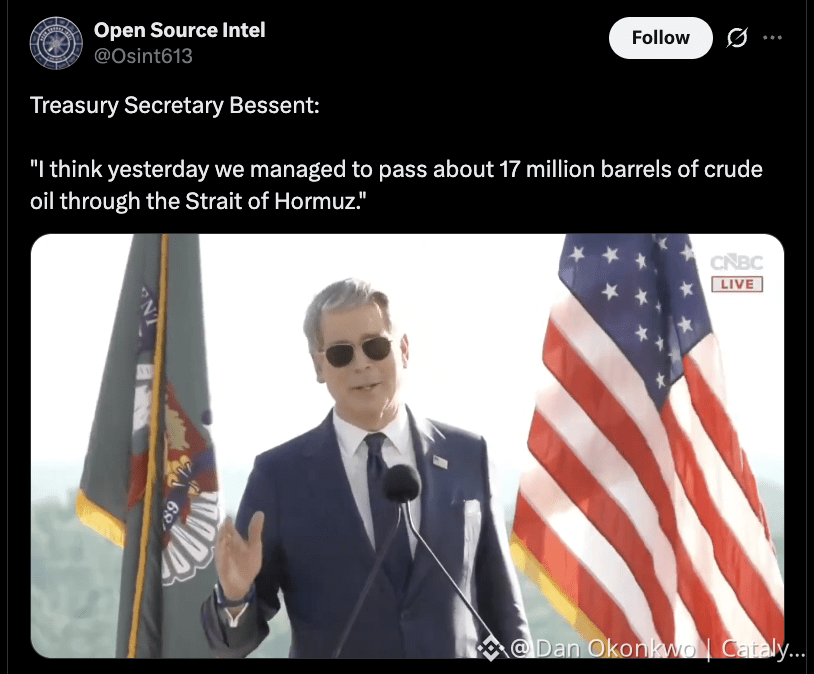
17 million barrels of oil $CLUSDT moved through the Strait of Hormuz on Monday. Highest since the war shut it down.
Here's the ugly truth about how this works.
Iran controls that water. About a fifth of the world's oil passes through it. And last week an Iranian commander said openly that the strait "belongs to Iran" and stays closed unless their conditions are met.
Now the flow is back up. Oil already fell 4% last week. If this holds, imported fuel gets cheaper, and that takes some pressure off the rupee and the taka.
But dont get comfortable. One day of shipping traffic is not a trend, and the same commander can say the opposite next week.
The part that annoys me — everyone will credit the Fed if inflation cools this month. It might just be that some ships were allowed through a channel.
17 million barrels of oil $CLUSDT moved through the Strait of Hormuz on Monday. Highest since the war shut it down.
Here's the ugly truth about how this works.
Iran controls that water. About a fifth of the world's oil passes through it. And last week an Iranian commander said openly that the strait "belongs to Iran" and stays closed unless their conditions are met.
Now the flow is back up. Oil already fell 4% last week. If this holds, imported fuel gets cheaper, and that takes some pressure off the rupee and the taka.
But dont get comfortable. One day of shipping traffic is not a trend, and the same commander can say the opposite next week.
The part that annoys me — everyone will credit the Fed if inflation cools this month. It might just be that some ships were allowed through a channel.
Here's the ugly truth about how this works.
Iran controls that water. About a fifth of the world's oil passes through it. And last week an Iranian commander said openly that the strait "belongs to Iran" and stays closed unless their conditions are met.
Now the flow is back up. Oil already fell 4% last week. If this holds, imported fuel gets cheaper, and that takes some pressure off the rupee and the taka.
But dont get comfortable. One day of shipping traffic is not a trend, and the same commander can say the opposite next week.
The part that annoys me — everyone will credit the Fed if inflation cools this month. It might just be that some ships were allowed through a channel.
1.1k
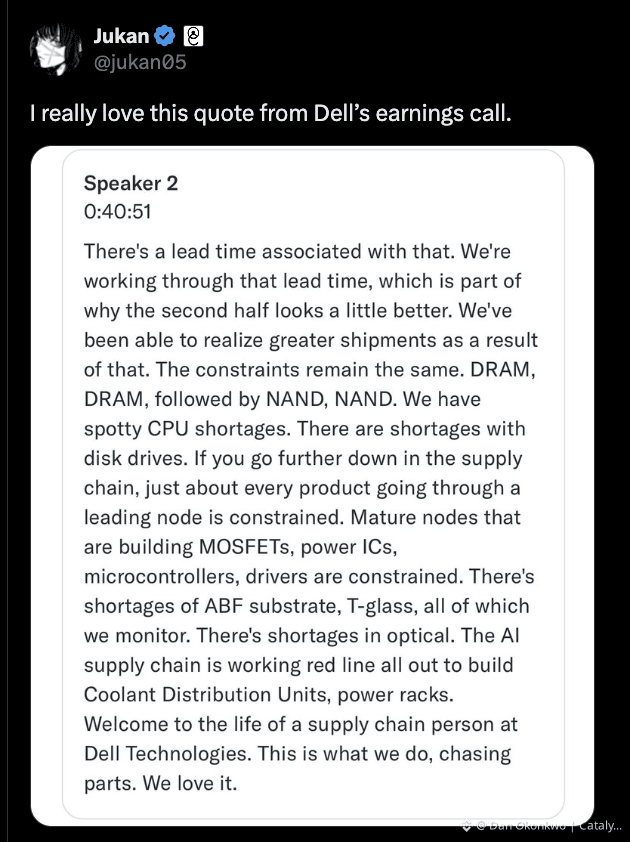
Everyone screaming "🧨AI BUBBLE🧨" needs to explain this quarter.
$DELL just raised its full-year revenue forecast by $25 BILLION in one go. From $167B to $192B. Profit forecast went from $17.90 to $25.50 per share. In one quarter.
And they booked over $130B in AI server orders in the last 12 months. Customer count past 6,500.
That's not a bubble popping. That's a company that cant build fast enough.
But here's the part nobody wants to talk about.
Dell also raised prices on regular PCs. Why? Memory chip shortage. So AI data centres are eating up the memory supply, and normal buyers are paying for it.
Think about that. Your next laptop costs more so someone else can train a model.
That's the real AI story for most people. Not the trillion dollar market caps. The price tag.
Where I could be wrong — $130B in orders is not the same as $130B in profit. Server margins are thin, and if memory costs keep climbing, Dell could book record revenue and still squeeze earnings.
Everyone screaming "🧨AI BUBBLE🧨" needs to explain this quarter.
$DELL just raised its full-year revenue forecast by $25 BILLION in one go. From $167B to $192B. Profit forecast went from $17.90 to $25.50 per share. In one quarter.
And they booked over $130B in AI server orders in the last 12 months. Customer count past 6,500.
That's not a bubble popping. That's a company that cant build fast enough.
But here's the part nobody wants to talk about.
Dell also raised prices on regular PCs. Why? Memory chip shortage. So AI data centres are eating up the memory supply, and normal buyers are paying for it.
Think about that. Your next laptop costs more so someone else can train a model.
That's the real AI story for most people. Not the trillion dollar market caps. The price tag.
Where I could be wrong — $130B in orders is not the same as $130B in profit. Server margins are thin, and if memory costs keep climbing, Dell could book record revenue and still squeeze earnings.
$DELL just raised its full-year revenue forecast by $25 BILLION in one go. From $167B to $192B. Profit forecast went from $17.90 to $25.50 per share. In one quarter.
And they booked over $130B in AI server orders in the last 12 months. Customer count past 6,500.
That's not a bubble popping. That's a company that cant build fast enough.
But here's the part nobody wants to talk about.
Dell also raised prices on regular PCs. Why? Memory chip shortage. So AI data centres are eating up the memory supply, and normal buyers are paying for it.
Think about that. Your next laptop costs more so someone else can train a model.
That's the real AI story for most people. Not the trillion dollar market caps. The price tag.
Where I could be wrong — $130B in orders is not the same as $130B in profit. Server margins are thin, and if memory costs keep climbing, Dell could book record revenue and still squeeze earnings.
593
Verified
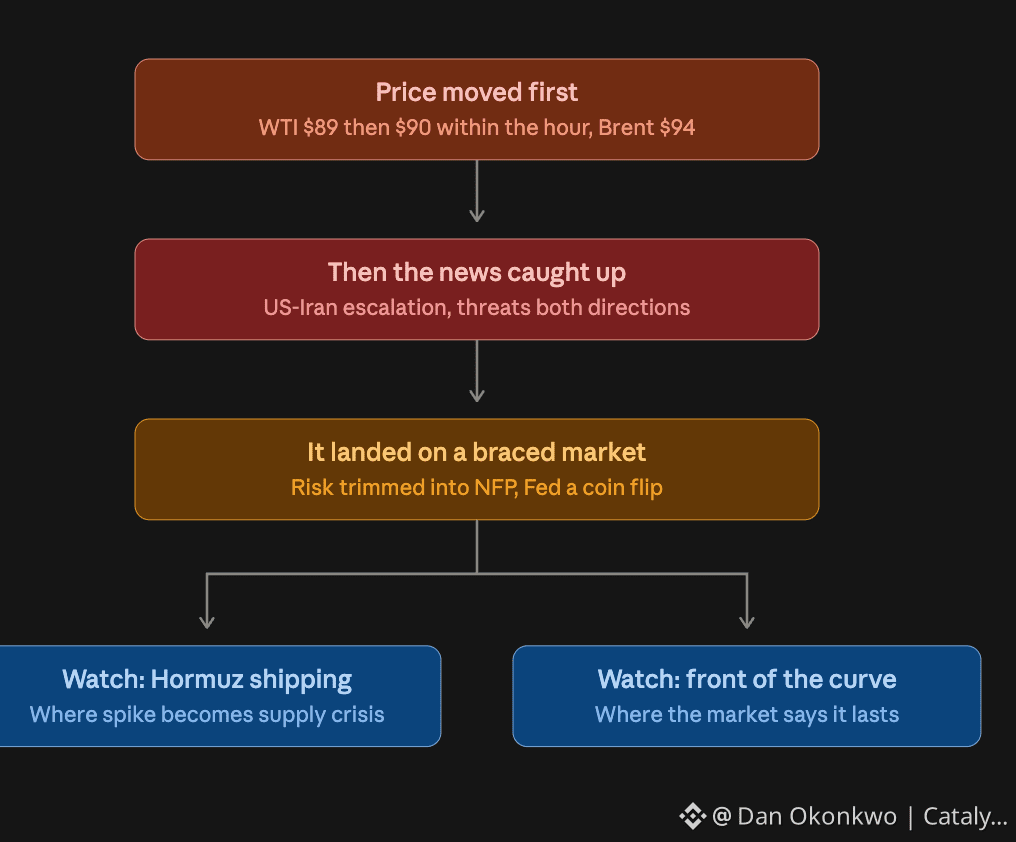
The oil desk saw it before the headlines finished loading.
WTI up through $89, then $90 within the hour. Brent touching $94. Both up more than 4% on the day, the first time US crude has seen $90 since late July.
Then the news caught up. Iran launching missiles and drones. Washington saying it is taking action and warning of overwhelming retaliation if Iran responds. Tehran promising exactly that response, aimed at US forces and bases.
Here's the setup this drops into, and it matters. Equities were already trimming risk into Friday's jobs number. The Fed was already a coin flip for September. And now every inflation model on every desk just got a new input: crude up 4% in a session with an open-ended conflict behind it.
Two things to watch from here, and neither is a stock. Shipping through the Strait of Hormuz, because that's where a price spike becomes a supply crisis. And the front of the oil futures curve, because that's where the market tells you whether it believes this lasts.
No clever ending on this one. It's a war headline. The market will do what it does. #catalyst
The oil desk saw it before the headlines finished loading.
WTI up through $89, then $90 within the hour. Brent touching $94. Both up more than 4% on the day, the first time US crude has seen $90 since late July.
Then the news caught up. Iran launching missiles and drones. Washington saying it is taking action and warning of overwhelming retaliation if Iran responds. Tehran promising exactly that response, aimed at US forces and bases.
Here's the setup this drops into, and it matters. Equities were already trimming risk into Friday's jobs number. The Fed was already a coin flip for September. And now every inflation model on every desk just got a new input: crude up 4% in a session with an open-ended conflict behind it.
Two things to watch from here, and neither is a stock. Shipping through the Strait of Hormuz, because that's where a price spike becomes a supply crisis. And the front of the oil futures curve, because that's where the market tells you whether it believes this lasts.
No clever ending on this one. It's a war headline. The market will do what it does. #catalyst
WTI up through $89, then $90 within the hour. Brent touching $94. Both up more than 4% on the day, the first time US crude has seen $90 since late July.
Then the news caught up. Iran launching missiles and drones. Washington saying it is taking action and warning of overwhelming retaliation if Iran responds. Tehran promising exactly that response, aimed at US forces and bases.
Here's the setup this drops into, and it matters. Equities were already trimming risk into Friday's jobs number. The Fed was already a coin flip for September. And now every inflation model on every desk just got a new input: crude up 4% in a session with an open-ended conflict behind it.
Two things to watch from here, and neither is a stock. Shipping through the Strait of Hormuz, because that's where a price spike becomes a supply crisis. And the front of the oil futures curve, because that's where the market tells you whether it believes this lasts.
No clever ending on this one. It's a war headline. The market will do what it does. #catalyst
3k
Woke up, checked futures, Nasdaq already down 1%.
S&P down 0.54. Dow down 0.49. No headline. No earnings. No Fed speaker. Just red, quietly, before anyone in New York has had coffee.
Here's what I think happened. Everyone spent the long weekend looking at the same thing: a September hike now a coin flip, and a jobs number landing Friday that could tip it either way. And somewhere between Sunday night and Tuesday morning a lot of people decided they didn't want to carry full tech exposure into that print.
You can see it in the order. Nasdaq worst, Dow best. That's not fear. That's a trim.
The setup for the week is now clear. Three sessions of drift, then Friday decides whether this morning was the smart money leaving early or nervous money leaving for nothing.
Either way, someone's going to look very right by Friday afternoon. #catalyst #NFP
Woke up, checked futures, Nasdaq already down 1%.
S&P down 0.54. Dow down 0.49. No headline. No earnings. No Fed speaker. Just red, quietly, before anyone in New York has had coffee.
Here's what I think happened. Everyone spent the long weekend looking at the same thing: a September hike now a coin flip, and a jobs number landing Friday that could tip it either way. And somewhere between Sunday night and Tuesday morning a lot of people decided they didn't want to carry full tech exposure into that print.
You can see it in the order. Nasdaq worst, Dow best. That's not fear. That's a trim.
The setup for the week is now clear. Three sessions of drift, then Friday decides whether this morning was the smart money leaving early or nervous money leaving for nothing.
Either way, someone's going to look very right by Friday afternoon. #catalyst #NFP
S&P down 0.54. Dow down 0.49. No headline. No earnings. No Fed speaker. Just red, quietly, before anyone in New York has had coffee.
Here's what I think happened. Everyone spent the long weekend looking at the same thing: a September hike now a coin flip, and a jobs number landing Friday that could tip it either way. And somewhere between Sunday night and Tuesday morning a lot of people decided they didn't want to carry full tech exposure into that print.
You can see it in the order. Nasdaq worst, Dow best. That's not fear. That's a trim.
The setup for the week is now clear. Three sessions of drift, then Friday decides whether this morning was the smart money leaving early or nervous money leaving for nothing.
Either way, someone's going to look very right by Friday afternoon. #catalyst #NFP
333
Log in to explore more content
Join global crypto users on Binance Square
⚡️ Get latest and useful information about crypto.
💬 Trusted by the world’s largest crypto exchange.
👍 Discover real insights from verified creators.
Email / Phone number
Trending Topics
EthereumSurpasses$2700
3,645 views
103 Discussing
#EthereumSurpasses$2700
Ethereum Crosses $2,700 and Puts ETH Back in the Spotlight
Ethereum is back in the spotlight after breaking above $2,700, according to the latest Binance News market update.
Binance reported that ETH reached approximately 2,702.12 USDT on September 21, 2026, with a 2.83% rise during the preceding 24 hours.
The move is notable because ETH had recently been trading below this level. Separate market analysis had identified recovering ETF demand and changing market conditions among factors being watched by traders, although those reports do not establish a single cause for the latest price move.
The next price data will show whether ETH can maintain its position above the $2,700 threshold. For now, the latest Binance-reported figure provides a clear headline:
Ethereum is above $2,700 again.
#Ethereum #Binance #CryptoNew #blockchain
$ETH
$JOE
$CLANKER
Crypto Futrures Afridi
·0 Likes
·81 views
CanaryFilesSecondAmendmentForStakedSEIETF
16,500 views
390 Discussing
SaylorHintsStrategyBitcoinBuy
2.3M views
13,118 Discussing