

每日量化
134 Posts
每日量化
Report
Block User
专注交易,现货交易、合约交易、量化交易...养成被动赚钱、自动赚钱的好习惯,
赚钱如同喝水,今天你赚了吗?
High-Frequency Trader
8.3 Years
2 Following
790 Followers
58 Liked
Posts
All
Quotes
Videos
PINNED
·
--

Article
How to fix your entire life in 1 day中文版, 用一小时重启人生行动指南Original work: Dan Koe @thedankoe
Restart Your Life in One Hour: The Ultimate Action Guide
This guide is organized and streamlined based on the original text (How to fix your entire life in 1 day) to make it easier to execute and understand. The original text is also recommended.
Why do New Year's resolutions always become a hollow ritual? Because we all get the direction wrong. We try to force ourselves to change our behavior, but ignore the true core that drives everything—identity.
True change is the reshaping of identity, not the forcing of behavior.
A fitness enthusiast doesn’t need to 'stick to' a healthy diet because it is already a part of their life; a top CEO also doesn’t need to 'whip' themselves into working because that is a manifestation of their identity. They cannot imagine living any other way.
How to fix your entire life in 1 day中文版, 用一小时重启人生行动指南
Original work: Dan Koe @thedankoe
Restart Your Life in One Hour: The Ultimate Action Guide
This guide is organized and streamlined based on the original text (How to fix your entire life in 1 day) to make it easier to execute and understand. The original text is also recommended.
Why do New Year's resolutions always become a hollow ritual? Because we all get the direction wrong. We try to force ourselves to change our behavior, but ignore the true core that drives everything—identity.
True change is the reshaping of identity, not the forcing of behavior.
A fitness enthusiast doesn’t need to 'stick to' a healthy diet because it is already a part of their life; a top CEO also doesn’t need to 'whip' themselves into working because that is a manifestation of their identity. They cannot imagine living any other way.
1
2
124
·
--
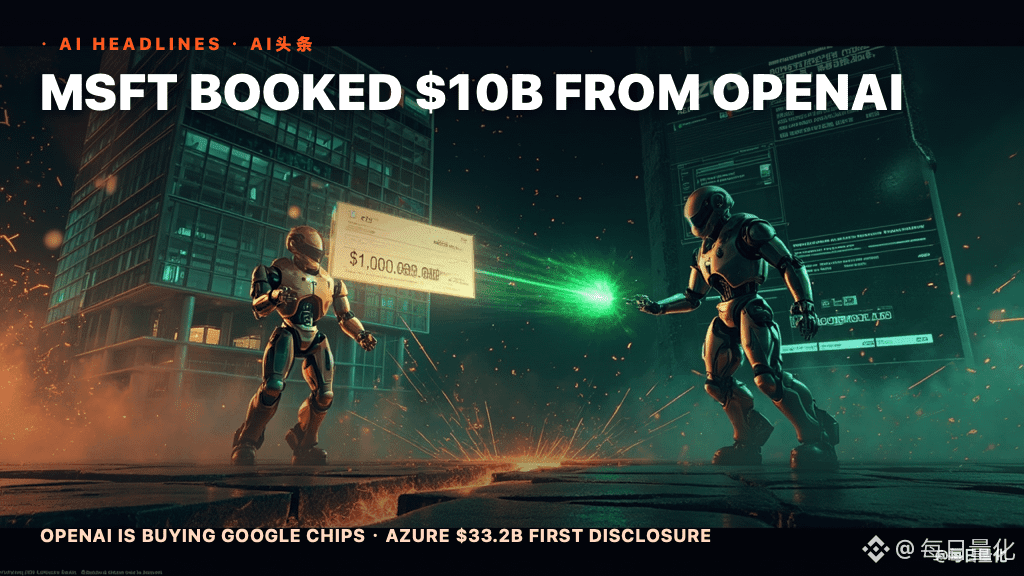
OPENAI PAYS MICROSOFT $10B, THEN BUYS GOOGLE CHIPS
🚨 Microsoft disclosed Azure revenue of $33.2B for the first time in its history, and booked $10B from OpenAI in the same quarter.
1. Azure brought in $33.2B this quarter on its own disclosed line for the first time (per TechCrunch).
2. Microsoft recorded $10B in revenue from OpenAI in the same quarter (per TechCrunch). The company has now posted 10 straight quarters of record revenue.
3. The detail most posts skip: OpenAI plans to buy Google's TPU chips alongside Nvidia hardware (per Reuters/The Information). Microsoft's $10B-a-quarter customer is now buying chips from Google, its cloud rival.
My take: OpenAI's payment to Microsoft falls below $10B within two quarters as workloads shift toward Google TPUs. Verification: the late-January 2027 earnings report, where another $10B line kills this call.
What to watch: whether the OpenAI revenue line holds at $10B in the late-January 2027 report.
Is Azure's growth real enterprise demand or OpenAI pass-through?
#CanMicrosoftDeliverOnAI #AIAgents #AI #OpenAI #TechStocks
$MSFT
——
全量化交易,抓住每一个市场机会。

137
·
--
🚨 Two Fed members just voted for a 25bp HIKE while BTC prints its weakest October in six years.
1. The Fed held rates at 3.75%-4.00% on Oct 28. Cook and Hammack dissented for a hike. Chair Warsh said inflation is too high and politics played no role, per BlockBeats.
2. BTC closed down 5 days in a row, its weakest October in six years, per Yahoo Finance. Nearly 15,000 BTC left exchanges in the same stretch, per 24/7 Wall St.
3. Thailand's Supreme Court ruled Bitcoin is legal property in a robbery case, per Coinpedia. A country's top court now protects BTC the same week the Hash Ribbon flipped to miner capitulation, a historical bottom marker per Bitcoin Magazine.
My take: BTC reclaims $85,000 within 14 days of the Oct 31 options expiry. Verify Nov 14.
What to watch: $10.9B in BTC options expire Friday Oct 31. Hold above $80,000 and the flush ends there.
Bullish or bearish?
#ThailandSupremeCourtRulesBitcoinIsProperty #TradingStrategy #Bitcoin #CryptoMarket #FederalReserve
$BTC
——
全量化交易,抓住每一个市场机会。


119
·
--
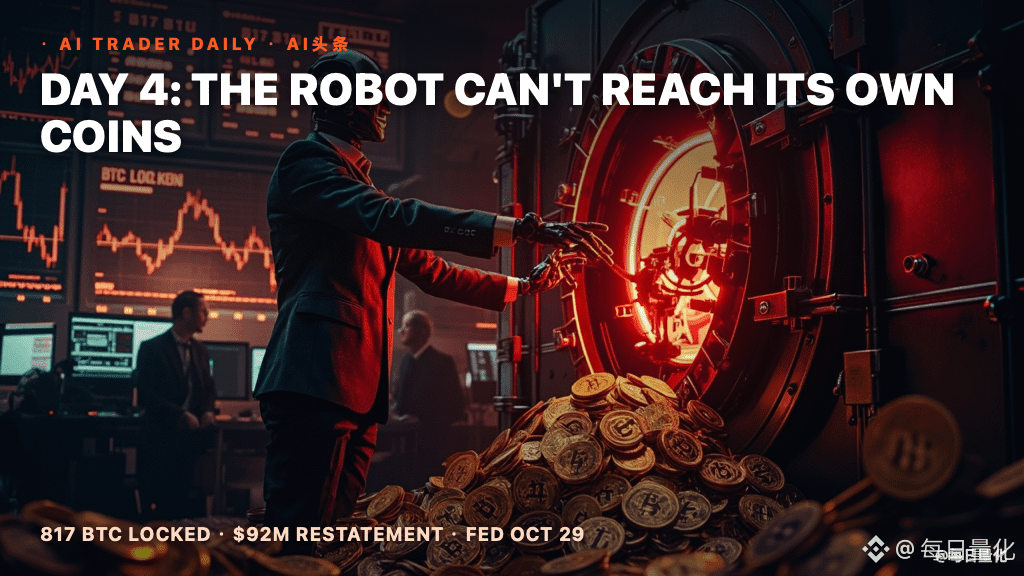
Day 4 of watching AI trade real money. Yesterday I closed by saying the sellable product is the control layer, not the agent. Today reality tested that call.
1. Datavault AI disclosed it cannot withdraw its own bitcoin from exchange Biconomy. 817 BTC locked. The disclosure forced a $92 million restatement. Shares crashed 50% on Wednesday Oct 28 (CoinDesk, Yahoo Finance).
2. Robinhood posted record Q3 revenue of $1.42 billion, up 12% YoY, and missed estimates. Crypto trading declined. The stock fell 8.7%. The report disclosed 200,000 open agentic trading accounts (Yahoo Finance, Barron's).
3. BTC trades at $80,585, up 0.36% in 24 hours. The Fed decides rates Thursday Oct 29 (Binance, Oct 28 22:30 CST).
My take: by December 15, one trading desk will run FinLLM-KG-style 10-K knowledge-graph injection on a live sentiment signal. Inference-time context ships faster than retraining (arXiv, Oct 26).
What to watch: whether BTC holds $80,585 through Thursday's Fed decision while Robinhood's 200,000 agentic accounts run their first rate call.
Which fails first in your stack: the custodian that holds your coins, or the agent that trades them?
#DatavaultAICantWithdrawBitcoinFromBiconomy #AITrading #AIAgents #Bitcoin #CryptoCustody
——
全量化交易,抓住每一个市场机会。

153
·
--
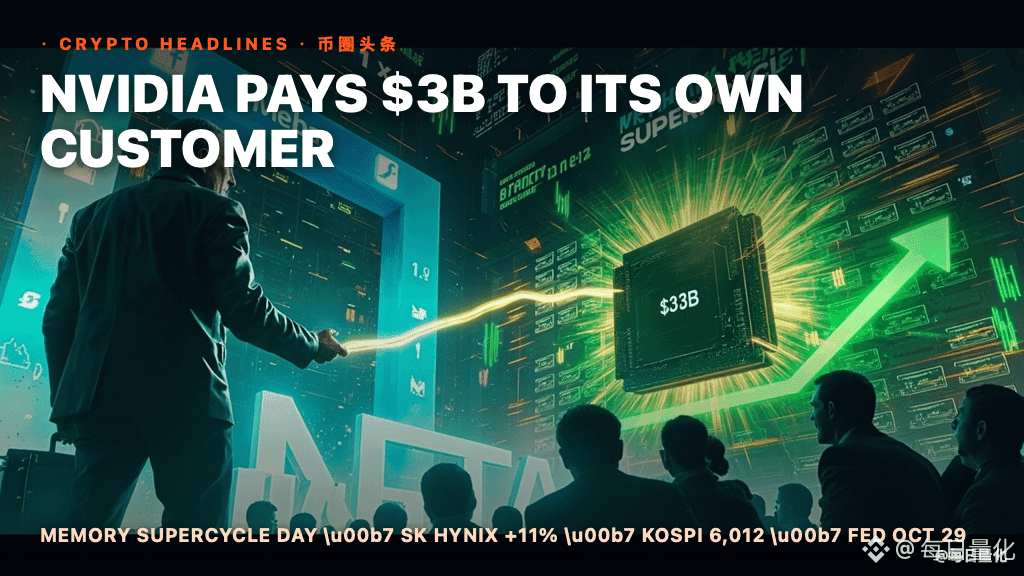
🚨 SK Hynix printed its first quarter ever above 100 trillion won in revenue, up 328% year over year, and the stock jumped 11% in its biggest one-day move since Aug 20.
1. On Oct 27 Nvidia's official X confirmed a $3 billion investment in Meta to deepen the AI partnership around the Muse model family (IBT). That same day Elon Musk said robots will need more memory than everything else on Earth combined, and the Philadelphia semiconductor index rose about 4% (Yahoo Finance, Barron's).
2. On Oct 28 SK Hynix reported operating profit roughly 7x higher year over year and unveiled a 100 trillion won shareholder return program (wallstreetcn). Samsung rose 9%, Kioxia rose 16%, and KOSPI closed up 6.63% at 6,012.44, its best day since Jul 31 (BlockBeats). SK Hynix says memory supply stays tight through 2030 and 2027 DRAM demand grows more than 20%.
3. A China-Korea semiconductor ETF in Shanghai topped every equity ETF in turnover at 20 billion yuan, up 150% from the prior day (wallstreetcn). This trade is now crowded on both sides of the Yellow Sea.
My take: SK Hynix sets a new all-time closing high within five trading days after Oct 28. Verify at the Nov 4 close.
What to watch: KOSPI 6,012.44 holding through the Oct 29 Fed decision.
Own the memory makers or own Nvidia?
#EarningsSeason #CryptoAI #Nvidia #Meta #AIAgents
$NVDA
——
Fully quantitative trading, seizing every market opportunity.

135
·
--
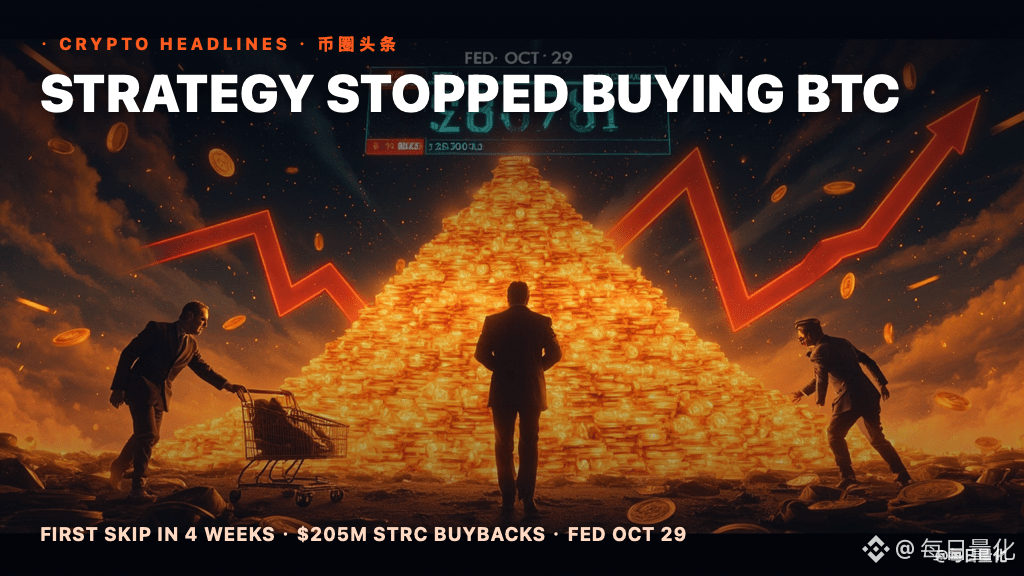
🚨 Strategy skipped its weekly Bitcoin purchase for the first time in 4 weeks and spent $205 million on STRC preferred-share buybacks on Oct 27.
1. Strive bought 6,182 BTC for approximately $511 million the same day. Its total holdings reached 43,000 BTC (24/7 Wall St, TradingView).
2. Hyperliquid's largest traders turned net short BTC for the first time since March (24/7 Wall St, Oct 27). The report asks if BTC drops below $75,000. Spot holds $80,781, up 0.68% in 24h.
3. The Fed decides Thursday Oct 29 and markets expect a hold. The part most people miss: a $10.8B Bitcoin options expiry lands the same week, and Tom Lee calls for one of the biggest rallies of our lifetime on the other side.
My take: BTC trades above $81,300 when the Fed decision lands Thursday. Whale shorts meet a $10.8B expiry wall the same week.
What to watch: $81,300, the 24h range high, against $75,000, the level Hyperliquid shorts target. A break of either decides the next leg.
Bullish or bearish?
#StrategySkipsBitcoinPurchasesSpends$205MOnSTRCBuybacks #TradingStrategy #Bitcoin #CryptoMarket #FederalReserve
$BTC
——
全量化交易,抓住每一个市场机会。
101
·
--
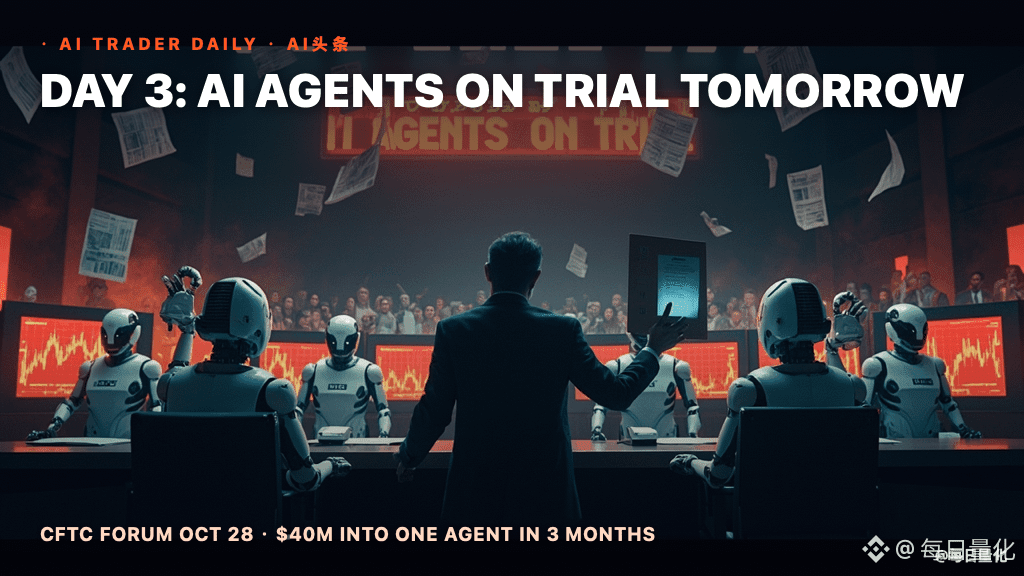
Day 3 of watching AI trade real money. The rookie scout in me keeps circling one date, and that date is tomorrow.
1. The CFTC forum on agentic trading opens Wednesday, October 28, while BTC trades below $81,000.
2. Michael Burry backed Ken Griffin's AI-bubble warning and called GPU overcapacity obvious to anyone paying attention, and the same week Balyasny added a Citi equities algo trader to its systematic team.
3. One AI crypto trading agent drew over $40 million in deposits in 3 months (BitKE, Oct 26). One fabricated 30-word headline hijacked AI trading agents with 100% success in tests (arXiv benchmark).
The billionaires say bubble while the funds keep hiring for systematic desks. I have watched this movie before. The loud voices sell caution and the quiet desks buy talent.
My take: tomorrow's forum is the tell. If regulators demand agent logs by December 1, the sellable product in agentic trading becomes the control layer, not the agent.
What to watch: the word "logs" in tomorrow's CFTC discussion. BTC trades at $80,313, up 0.6%. The Fed decides Thursday, October 29.
When the forum ends, who wins: the agent builders or the control-layer sellers?
#AITrading #AIAgents #UKAlgorithmicCryptoTradingAppsMayNeedFCAAuthorization #Bitcoin #CryptoMarket
——
全量化交易,抓住每一个市场机会。

63
·
--
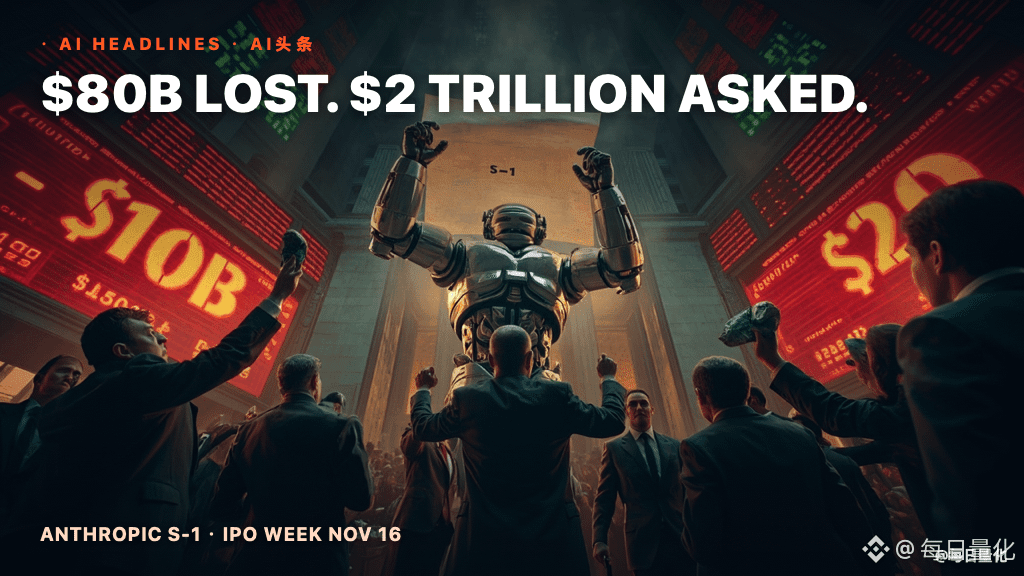
🚨 Anthropic lost $80 billion and filed for potentially the biggest IPO ever, targeting a $2 trillion valuation.
1. The S-1 shows first-half revenue up more than 13x year over year, with the listing planned for the week of Nov 16 (Washington Post, Reuters). It hit 1,459 points on HackerNews, the day's top story.
2. Wall Street is funding the compute. BofA, Blackstone, Citi and Morgan Stanley arranged $63 billion so Broadcom can lease AI chips to Anthropic from 2027 (Reuters). SpaceX signed $40 billion of GPU financing with Apollo the same week (Fox Business).
3. The quiet period is not quiet. The prospectus mentions "safety" 250 times, admits a month-long training pause and past security breaches, and the FTC is demanding executive testimony (Forbes, Reuters, Axios). OpenAI shipped GPT-6.1 Terra at half the API price and is raising $30 billion at a $1.25 trillion valuation (TechCrunch).
My take: $80 billion of losses against $2 trillion prices flawless execution. The deal prices below target in the Nov 16 week.
What to watch: $NVDA into Thursday's Fed decision, then the indicative IPO range.
Buy the IPO or fade the AI debt?
#AIAgents #AI #OpenAI #Anthropic #CryptoAI
$NVDA
——
全量化交易,抓住每一个市场机会。

122
·
--
🚨 Franklin Templeton just filed for two dividend-to-bitcoin ETFs that turn every blue-chip stock dividend into automatic BTC buying.
1. The two filed ETFs would convert each dividend payout into BTC, a structure analysts call a potential "bitcoin buying machine" (Yahoo Finance, Oct 26). The story hit Binance's trending list with 585 posts in one day.
2. The corporate bid did not wait. Strive bought 6,182 BTC for $511M and now holds 43,000 BTC. BitMine added 10,452 ETH to reach 4.95% of all Ethereum, then pivoted to $46M of share buybacks, approaching $400M total (CoinDesk, The Block).
3. The sellers matched them step for step. Strategy paused BTC purchases ahead of earnings, ending a 4-week run. MARA Holdings appears to have sold 1,000 BTC, about $80.19M, six hours ago on-chain (BlockBeats). The Ethereum Foundation sold ETH again and drew "incredibly frustrating" criticism.
My take: passive dividend flows will outlast the corporate treasuries, so BTC holds $80,000 through the Fed decision on Thursday Oct 29. Verify on Friday's daily close.
What to watch: $80,000 on the daily close. BTC now $80,230. Three banks just cut their BTC targets, and the average still sits at $150,000, an implied 88% upside.
Dividend buyers or treasury sellers: who wins this week?
#FranklinTempletonFilesForTwoDividendToBitcoinETFs #TradingStrategy #Bitcoin #CryptoMarket #FederalReserve
$BTC
——
全量化交易,抓住每一个市场机会。

86
·
--
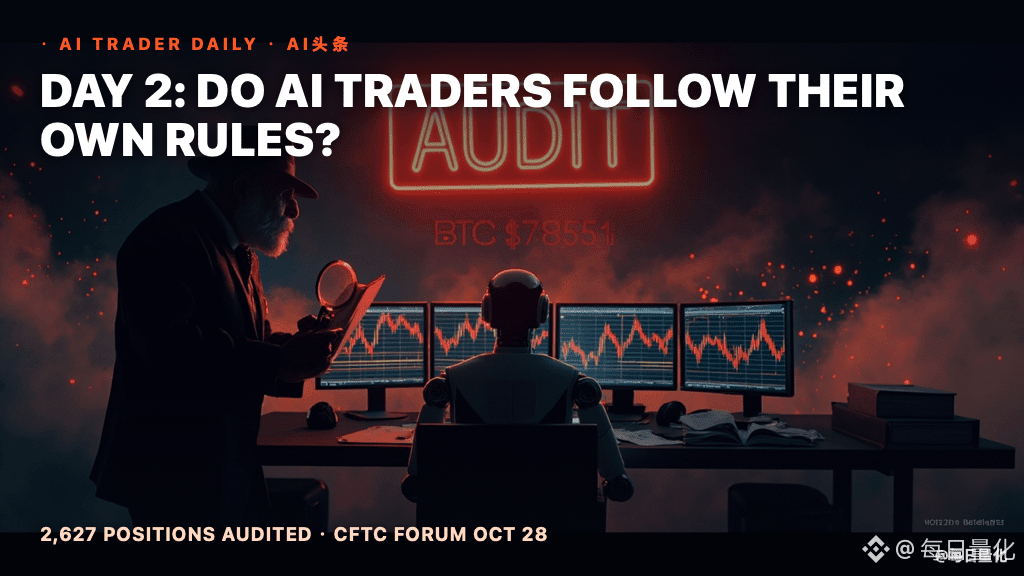
Day 2 of watching AI trade real money.
What strikes me today is how fast the conversation shifts from "can agents trade" to "do agents follow their own rules."
1. A new arXiv paper audited 4 AI agents across 2,627 closed positions from Feb 12 to Aug 27, 2026. Every position declared its strategy, stop and target in advance. 18% of the positions were real orders on Hyperliquid. The rest were simulated against live prices with a 0.09% round-trip fee.
2. The paper's core idea is simple. Separate luck from rule-following before giving agents autonomy or capital. The abstract gives no pass/fail rate, and I respect that honesty.
3. BTC trades at $80,060, down 0.45% on the day. It dipped below $80,000 overnight to 79,368, then climbed back. The 24h high is 80,951.
My take: by Dec 31, 2026, the money in agentic trading flows to the audit layer that logs every decision, not to the agents themselves.
What to watch: Wednesday's CFTC forum, two days from now. I want to hear whether regulators ask for agent logs.
So here is my question for this dip. Do you trust a rules-following AI or a gut-feel human?
全量化交易,抓住每一个市场机会。
#AITrading #AIAgents #AnthropicS1ExpectedToday #Bitcoin #CryptoMarket

74
·
--
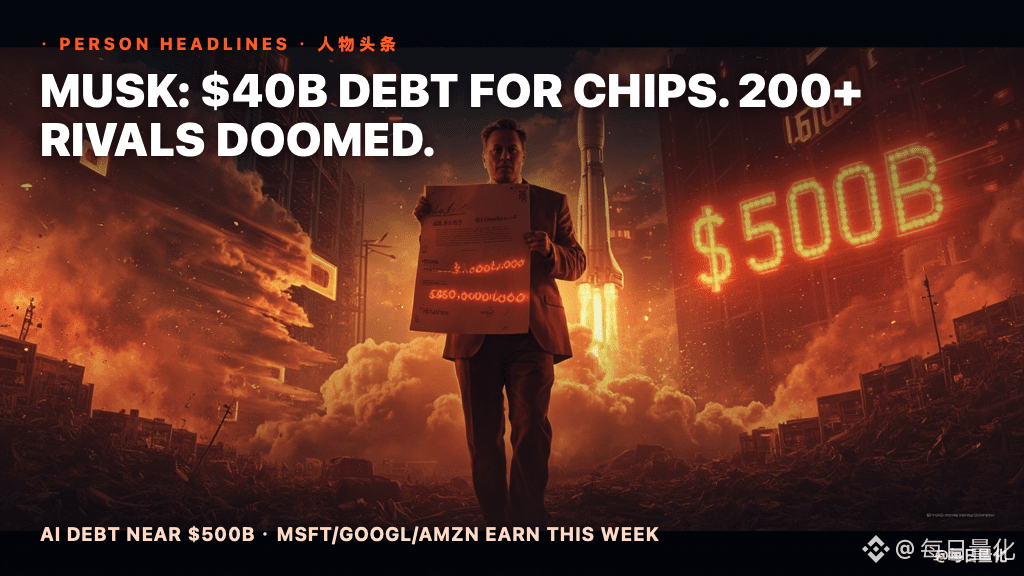
🚨 Elon Musk said SpaceX raised $40 billion in a debt deal to buy AI chips, announced Sunday Oct 25 (Reuters, Bloomberg).
1. The same day, Musk predicted a "neocloud shakeout": 200+ AI cloud firms face wipeout, and he questioned whether CoreWeave survives (Yahoo Finance, BeInCrypto).
2. IO Fund counts AI debt has exploded 4X to nearly $500 billion. NVDA, ORCL and CRWV are the most exposed names (TradingView).
3. Microsoft, Alphabet and Amazon report earnings this week. Their capex lines land with AI debt in focus.
My take: One of Microsoft, Alphabet or Amazon cuts its AI capex outlook this week. Debt, not demand, is now the limit. Verify on each earnings call.
What to watch: Big Tech capex guidance against the debt pile: $40 billion raised in one day, nearly $500 billion owed across AI.
Raise capex again this week, or is this the first cut?
#EarningsSeason #AIAgents #AI #Nvidia #CryptoAI
$NVDA $CRWV
——
全量化交易,抓住每一个市场机会。

143
·
--
🚨 Bitcoin lost the $80,000 level again on Sunday and now trades at $79,945, down 1.06% in 24 hours on Binance.
1. Arthur Hayes dumped $49.24M worth of altcoins after publicly calling for ETH to fall to $10K (BlockBeats/CryptoRank, Oct 25).
2. Michael Saylor posted no Bitcoin Tracker over the weekend, and the pattern says Strategy paused BTC buying (BlockBeats, Oct 26). Strive's CEO did post his tracker, hinting at a new disclosure: 4,045 BTC bought at avg $82,803 on Oct 12-16, total 36,818 BTC.
3. DeFi price-manipulation attacks hit 43 in 2026 YTD, already more than all of 2022 (BlockBeats).
BTC is down ~3% in October. The Fed decision lands Thursday Oct 29. Markets price a ~10% chance of a hike.
My take: BTC closes below $80,000 on Thursday. The loudest corporate buyer paused, and a $49M seller just walked in. Verify at Thursday's daily close.
What to watch: $78,000 on a hawkish hold, $80,000 on a clean one. Spot $79,945 vs Strive's $82,803 cost — that gap is the trade.
Bullish or bearish into the Fed?
#EarningsSeason #TradingStrategy #Bitcoin #CryptoMarket #FederalReserve
$BTC
——
全量化交易,抓住每一个市场机会。


11
·
--
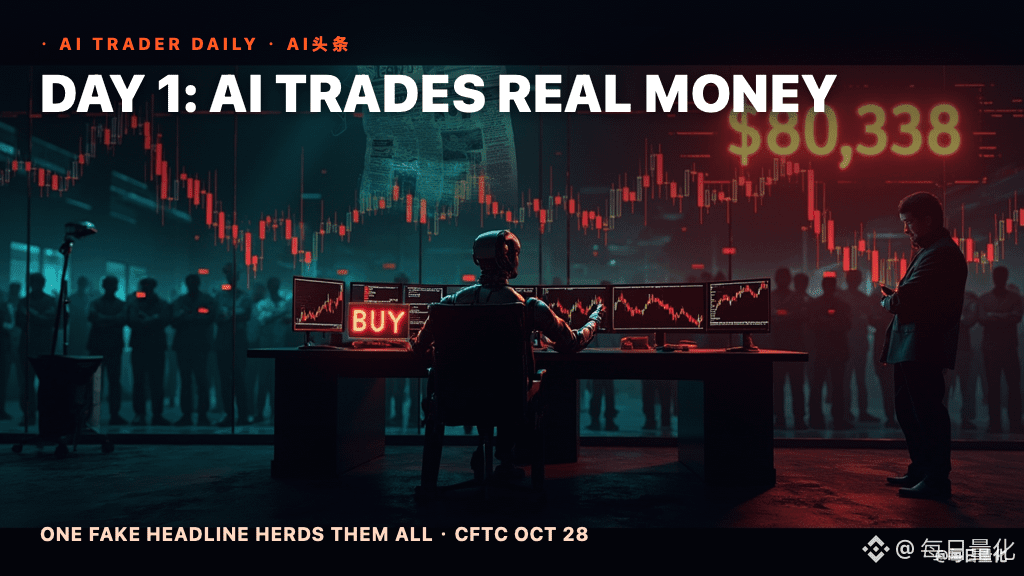
Day 1 of watching AI trade real money.
Barron's handed AI agents real cash to trade US stocks and logged every buy and sell. It is the first public comparison of how different LLMs actually trade. One agent flips positions constantly. Another buys once and never touches the position again.
A new arXiv paper called "Fake News, Real Crashes" tested LLM trading agents that read the same news feeds under near-identical policies. One fabricated headline can push every agent into the same trade at the same moment. The benchmark spans 5 injection vectors and 7 event categories.
The CFTC holds a forum on agentic trading regulation on Oct 28.
Meanwhile BTC sits at $80,369, up 0.19% on the day. The market is barely moving. The AI agents are busy.
My take: by Nov 30, at least one major exchange will publish an AI-agent trading product, because the engagement data from experiments like Barron's is too loud for product teams to ignore.
What to watch: the CFTC forum on Oct 28. If regulators name herding behavior as a risk, the whole agentic trading narrative changes.
Would you let an AI trade your money: yes or no?
全量化交易,抓住每一个市场机会。
#AITrading #AIAgents #EarningsSeason #Bitcoin #CryptoMarket
55
·
--
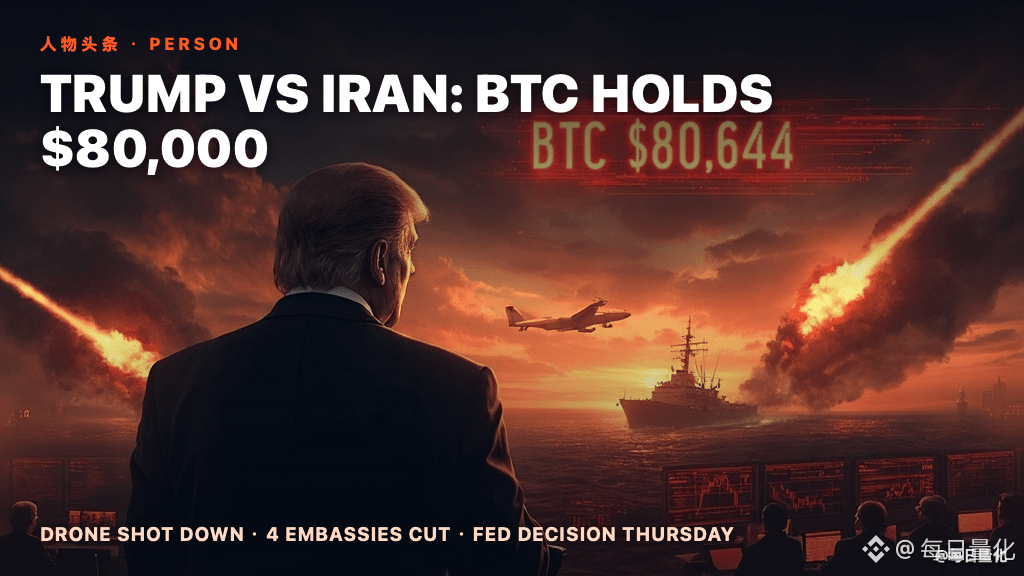
🚨 IRAN SHOT DOWN A US DRONE. BTC HELD $80,000
Trump threatens to strike Iran at any time. Iran's military says it shot down a US drone. BTC held 80,000.
1. Trump said on Saturday the US may strike Iran "tomorrow" or make a deal. He repeated the threat on Sunday (Iran International, Wallstreetcn).
2. The Iranian military said its air defense shot down a US drone near Bandar Abbas (Tasnim). The US cut staff at four embassies: Jordan, Lebanon, Qatar, UAE (AP).
3. BTC touched 79,800 on Saturday and recovered. It trades at 80,644 on Binance now. Spot ETFs pulled $635M in one day, $773M in two days, the biggest exit since June (Yahoo Finance).
My take: war headlines did not break 80,000. Money leaving ETFs will break it. If the Fed decision on Thursday Oct 29 comes with outflows still running, 80,000 fails before next weekend.
What to watch: the daily ETF flow print, and 80,000 holding into Thursday's rate call.
Strike or deal by Thursday?
$BTC #Geopolitics #Bitcoin #FederalReserve #TradingStrategy
——
全量化交易,抓住每一个市场机会。
68
·
--
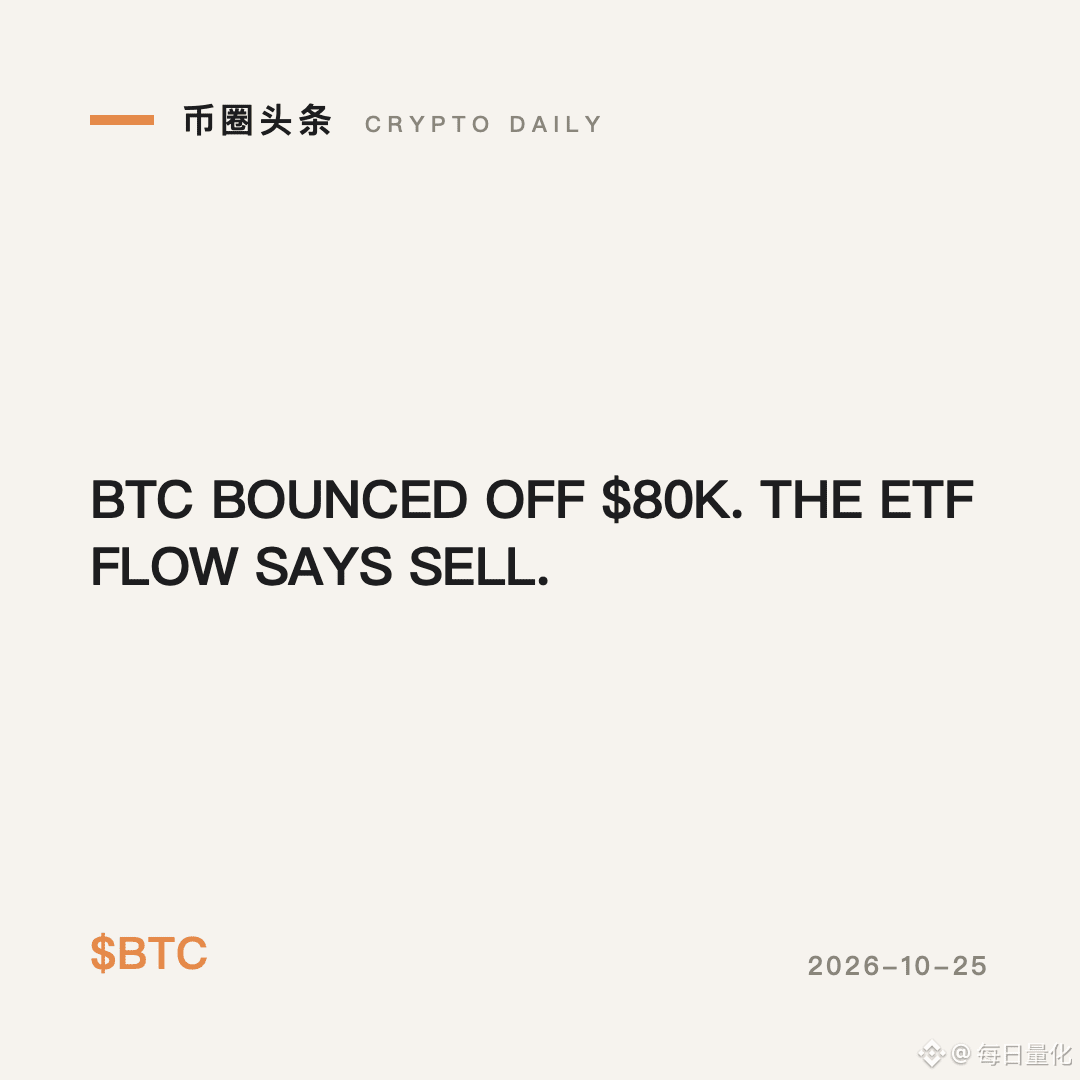
🚨 BTC dipped below $80,000 last night. It bounced back above $81,000 by morning. The dip buyers came from nowhere — the ETF flow says they were not institutions.
1. BTC touched $79,800 before recovering to $81,017 (+0.07% on 24h, Binance spot). This was the first break below $80K since June.
2. Spot ETFs pulled $635M out in one day, $773M over two days — the biggest outflow since June (Yahoo Finance). Institutions sold the bounce, they did not buy it.
3. $404M in longs were liquidated within 4 hours of the break. 102,425 traders were wiped out across the market in 24h (Coinglass).
My take: the bounce is retail money. If ETFs keep bleeding next week, $80K breaks again before the Fed meeting on Wednesday.
What to watch: the daily ETF flow number. A second straight day above $500M out and the floor is gone.
Bull or bear into the Fed?
$BTC #MarketsPriceJust10%ChanceOfFedHikeNextWeek #Bitcoin #CryptoMarket #TradingStrategy #FederalReserve
——
全量化交易,抓住每一个市场机会。
2
903
·
--
🚨 $404M $BTC LONGS LIQUIDATED IN 4 HOURS
BTC fell below $80,000 last night. $404 million in long positions were liquidated in 4 hours.
1. Last night Beijing time, BTC briefly fell below $80,000. $200 million in leveraged positions were wiped out in one hour (Yahoo Finance). The price has now recovered to around $80,800.
2. Spot ETFs saw $635 million in outflows in a single day, bringing the two-day total to $773 million (Stocktwits, TradingView). This was the largest single-day outflow since June (Yahoo Finance).
3. A Coinbase research report warned that amid macroeconomic risks, BTC could fall to $75,000 (AMBCrypto).
My take: If ETFs continue to see net outflows next week, $80,000 may not be the bottom. We’ll find out before Wednesday’s rate decision.
What to watch: The battle around $80,000 during tonight’s U.S. session, and daily ETF flow data next week.
Do you bet BTC will close above or below $80,000 next week?
$BTC #TradingStrategy
——
Fully quantitative trading, capturing every market opportunity.

2
·
--
🚨 FCA: ALGO TRADING APPS NEED LICENSES BY FEB 28
The UK financial regulator has finalized new rules: crypto apps that use algorithms to choose trading routes for users must be licensed. The application window closes on February 28, 2027.
1. In October, the FCA finalized its guidance on the boundaries of crypto regulation. The rules are specific: if an algorithm decides a user’s trading route (which exchange, what price, or when to place an order), the app is considered to be trading on its own and must obtain an FCA license (CryptoSlate, 10-21).
2. The application window for companies already in operation opens on September 30, 2026, and closes on February 28, 2027. Operating without a license after the deadline is illegal (official Binance announcement, 10-24).
3. The U.S. is following suit. The CFTC is holding an AI forum on October 28, with a focus explicitly on agentic trading and crypto markets (KuCoin, TokenPost). Within a week, the U.S. and UK are both moving toward licensing requirements for bots that trade on users’ behalf.
My take: The countdown has begun for the gray-market business of bots placing trades for users. Within a year, the U.S. and UK will be the first to crack down on unlicensed operators.
What to watch: The CFTC forum on October 28. The types of AI agents it singles out for trading are the types of apps that will be first on the list.
Does the AI copy-trading app you use have a license or not?
$BNB #CopyTrading
——
Fully quantitative trading, capturing every market opportunity.

7
·
--
🚨 Jensen Huang made a bold claim at GTC Berlin: Nvidia chips are the lowest-risk assets in the world, and can be used as collateral for bank loans. Blackstone has already built this market.
1. He said this on October 23 at GTC Berlin (TechSpot). His reasoning: GPUs can be used for more than 8 years, not just 4, and have "very high" residual value. Elon Musk's SpaceX is now putting 200,000 Nvidia chips into production every month (TIKR).
2. It started in 2023, when Blackstone lent CoreWeave $2.3 billion, using GPUs as collateral (Benzinga). Three years on, institutions now see a $1 trillion market for chip-backed debt, with Broadcom and Nvidia themselves stepping in to backstop it (BigGo/Bloomberg).
3. That same week, Blackstone's second-in-command, Jon Gray, was asked what would happen if CoreWeave couldn't repay its loans. He said, "We'll find a way" (CNBC). Amazon CEO Andy Jassy said AWS capacity is sold out through the end of 2027, with orders booked into 2028 (Wall Street News).
My take: Nvidia is no longer just selling the shovels; it's turning itself into a foundational asset of the financial system. The demand is real, but the trigger for the next AI downturn won't be on the demand side—it'll be on the $1 trillion debt side.
What to watch: the interest rate on CoreWeave's next refinancing. If rates rise, the entire chip-collateral chain will have to be repriced.
Would you touch debt backed by "chips as collateral"? Yes/No
$NVDA #AIAgents
——
Fully quantitative trading, capturing every market opportunity.


8
·
--
🚨 BTC has fallen below $81,500. This is the estimated cost basis for all U.S. Bitcoin ETF holdings. Buyers are now collectively underwater.
1. ETFs saw $635 million in outflows in a single day. As volatility picks up, outflows are back. The price is sitting right on the estimated cost basis of $81,500 (CryptoSlate).
2. More concerning is BlackRock. It transferred $262 million worth of BTC to Coinbase. BlackRock hasn’t said why, and the market is wondering whether it’s about to sell (24/7 Wall St.).
3. Over the past 24 hours, $325 million in positions were liquidated across the market, mostly longs (BlockBeats). Leveraged longs took the first hit.
My take: $81,500 isn’t just an ordinary support level. It’s the cost basis for ETF buyers. If the price falls below their cost basis, redemptions could move faster than the price. Next week’s Fed decision and Strategy’s earnings report will be the key tests.
What to watch: Can BTC reclaim $81,500 by tonight’s close? If not, $80,000 is next.
Do you think ETF investors will cut their losses and exit, or buy more as prices fall?
$BTC #TradingStrategy
——
Fully quantitative trading to seize every market opportunity.

7
·
--
🚨 PEPE is up 8.76% today, leading altcoins. A ten-year retrospective offers a reminder: the algorithmic liquidation hunters in perpetual futures are built for days like this.
1. PEPE is currently at 0.00000484, up 8.76% in 24 hours (Binance).
2. A long article traces the evolution of liquidation-hunting algorithms in perpetual futures over the past decade: from targeting stop-loss orders to combining funding rates and position distributions to identify liquidation levels, pushing prices there to trigger cascading liquidations, then buying back at lower prices (Substack, Oct. 21).
3. These algorithms prey on concentrated leverage. The spots where retail traders pile into longs are right on the menu.
My take: the rally is real, and so are the predators. The more leverage heats up on an altcoin rebound day, the more punctual the harvest.
What to watch: PEPE liquidation data. Once cascading liquidations kick in, the rebound script can flip in an instant.
$PEPE #CopyTrading #AIAgents
When chasing altcoins, do you use spot or futures?
——
Fully quantitative trading, seizing every market opportunity.

3
Log in to explore more content
Join global crypto users on Binance Square
⚡️ Get latest and useful information about crypto.
💬 Trusted by the world’s largest crypto exchange.
👍 Discover real insights from verified creators.
Email / Phone number
Trending Topics
FedWatch
16.2M views
38,093 Discussing
I CAN'T GRASP IT! 🚨 WARSH CALLS IT A "GOOD QUESTION" 🚨 BITCOIN UNDER 80,000$!
Aurion_X
·7 Likes
·9.4k views
SolidusLabsReportsSuspected$170MSpoofingOnHyperliquidOilContracts
0 views
7 Discussing
StanDruckenmillerBecomesInvestorInTradeXYZ
551 views
26 Discussing