

#vitalik
vitalik
1.2M views
1,238 Discussing
Hot
Latest

·
--
Ethereum's 2030 master plan isn't about remaining a regular blockchain at all. Vitalik wants it to fade into the background as the settlement layer for everything, which sounds efficient until you see how easily that vision could stall or backfire.
Plenty of $ETH holders keep stacking through every dip assuming the roadmap guarantees long-term dominance, but the real pain hits when delays pile up, fees spike again, and you either miss better entries on faster chains or watch your position get eaten by congestion you thought was already solved.
The core idea is to offload almost all activity onto rollups so Ethereum L1 just handles security and data availability, aiming for around 100,000 TPS while adding stateless clients to keep nodes light. Right now L1 still crawls at 15-30 TPS and even the bigger L2s like $ARB and $OP combined aren't anywhere close. We've already watched this play out in gas wars where a simple swap cost $50-plus and people who mistimed their exit got wrecked. If sequencers stay centralized or data availability lags, the same attack surface that drained hundreds of millions from bridges in the past could reappear at much larger scale.
The bigger risk is that Ethereum ends up depending on a handful of operators, turning the "decentralized" promise into something more fragile than advertised. Competitors that ship faster keep eating market share in the meantime.
Where do you think this 2030 vision actually lands for holders if the technical pieces slip?
#Ethereum #Vitalik #L2Risks
Ethereum's 2030 master plan isn't about remaining a regular blockchain at all. Vitalik wants it to fade into the background as the settlement layer for everything, which sounds efficient until you see how easily that vision could stall or backfire.
Plenty of $ETH holders keep stacking through every dip assuming the roadmap guarantees long-term dominance, but the real pain hits when delays pile up, fees spike again, and you either miss better entries on faster chains or watch your position get eaten by congestion you thought was already solved.
The core idea is to offload almost all activity onto rollups so Ethereum L1 just handles security and data availability, aiming for around 100,000 TPS while adding stateless clients to keep nodes light. Right now L1 still crawls at 15-30 TPS and even the bigger L2s like $ARB and $OP combined aren't anywhere close. We've already watched this play out in gas wars where a simple swap cost $50-plus and people who mistimed their exit got wrecked. If sequencers stay centralized or data availability lags, the same attack surface that drained hundreds of millions from bridges in the past could reappear at much larger scale.
The bigger risk is that Ethereum ends up depending on a handful of operators, turning the "decentralized" promise into something more fragile than advertised. Competitors that ship faster keep eating market share in the meantime.
Where do you think this 2030 vision actually lands for holders if the technical pieces slip?
#Ethereum #Vitalik #L2Risks
Plenty of $ETH holders keep stacking through every dip assuming the roadmap guarantees long-term dominance, but the real pain hits when delays pile up, fees spike again, and you either miss better entries on faster chains or watch your position get eaten by congestion you thought was already solved.
The core idea is to offload almost all activity onto rollups so Ethereum L1 just handles security and data availability, aiming for around 100,000 TPS while adding stateless clients to keep nodes light. Right now L1 still crawls at 15-30 TPS and even the bigger L2s like $ARB and $OP combined aren't anywhere close. We've already watched this play out in gas wars where a simple swap cost $50-plus and people who mistimed their exit got wrecked. If sequencers stay centralized or data availability lags, the same attack surface that drained hundreds of millions from bridges in the past could reappear at much larger scale.
The bigger risk is that Ethereum ends up depending on a handful of operators, turning the "decentralized" promise into something more fragile than advertised. Competitors that ship faster keep eating market share in the meantime.
Where do you think this 2030 vision actually lands for holders if the technical pieces slip?
#Ethereum #Vitalik #L2Risks
411

⚡ VITALIK DROPS SCI-FI NOVEL SNOWMOON AS $ETH NARRATIVE AND INNOVATION COLLIDE! 💡
Ethereum architect Vitalik Buterin just finished his 32-chapter sci-fi masterpiece, Snowmoon, open-sourcing the entire work under GPL v3. 🔍 Beyond pure fiction, the novel weaves real-world cryptographic primitives like ZK-proofs, privacy tools, and quadratic voting into a blueprint for digital sovereignty.
💡 Markets trade on narrative energy just as much as order flow, and Vitalik embedding mechanism design into pop culture keeps the vision laser-focused. 📊 With derivative works enabled and open pipelines required, this ecosystem movement is already sparking fresh creative momentum across the space. 💬 Does fundamental narrative expansion like this strengthen your long-term spot conviction on $ETH ? 👇
⚠️ Not financial advice. Always manage your risk. 🛡️
🏷️ #ETH #Ethereum #Vitalik #Crypto
⚡ 💎
⚡ VITALIK DROPS SCI-FI NOVEL SNOWMOON AS $ETH NARRATIVE AND INNOVATION COLLIDE! 💡
Ethereum architect Vitalik Buterin just finished his 32-chapter sci-fi masterpiece, Snowmoon, open-sourcing the entire work under GPL v3. 🔍 Beyond pure fiction, the novel weaves real-world cryptographic primitives like ZK-proofs, privacy tools, and quadratic voting into a blueprint for digital sovereignty.
💡 Markets trade on narrative energy just as much as order flow, and Vitalik embedding mechanism design into pop culture keeps the vision laser-focused. 📊 With derivative works enabled and open pipelines required, this ecosystem movement is already sparking fresh creative momentum across the space. 💬 Does fundamental narrative expansion like this strengthen your long-term spot conviction on $ETH ? 👇
⚠️ Not financial advice. Always manage your risk. 🛡️
🏷️ #ETH #Ethereum #Vitalik #Crypto
⚡ 💎
Ethereum architect Vitalik Buterin just finished his 32-chapter sci-fi masterpiece, Snowmoon, open-sourcing the entire work under GPL v3. 🔍 Beyond pure fiction, the novel weaves real-world cryptographic primitives like ZK-proofs, privacy tools, and quadratic voting into a blueprint for digital sovereignty.
💡 Markets trade on narrative energy just as much as order flow, and Vitalik embedding mechanism design into pop culture keeps the vision laser-focused. 📊 With derivative works enabled and open pipelines required, this ecosystem movement is already sparking fresh creative momentum across the space. 💬 Does fundamental narrative expansion like this strengthen your long-term spot conviction on $ETH ? 👇
⚠️ Not financial advice. Always manage your risk. 🛡️
🏷️ #ETH #Ethereum #Vitalik #Crypto
⚡ 💎
22

·
--
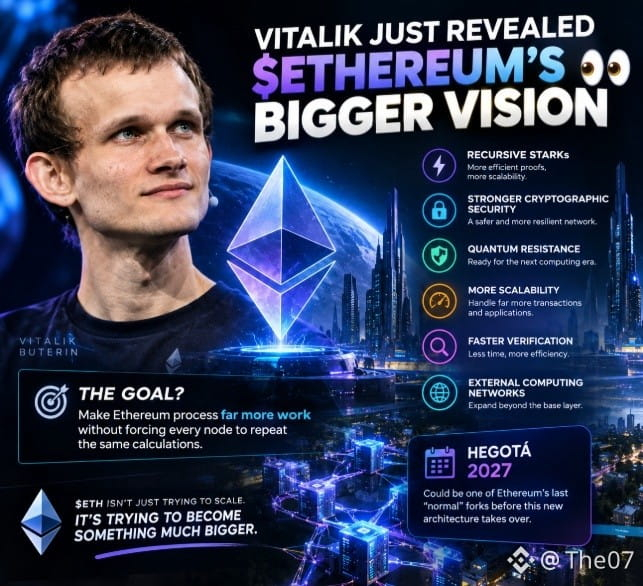
🚨 VITALIK JUST REVEALED $ETHEREUM’S BIGGER VISION 👀
Ethereum may look VERY different by 2030.
Vitalik Buterin outlined a roadmap built around:
⚡ Recursive STARKs
🔐 Stronger cryptographic security
🛡️ Quantum resistance
🚀 More scalability
🔎 Faster verification
🌐 External computing networks
The goal?
Make Ethereum process far more work without forcing every node to repeat the same calculations.
And Hegotá, planned for 2027, could be one of Ethereum’s last “normal” forks before this new architecture takes over.
$ETH isn’t just trying to scale.
It’s trying to become something much bigger. 👀
#Ethereum #ETH #crypto #Vitalik
🚨 VITALIK JUST REVEALED $ETHEREUM’S BIGGER VISION 👀
Ethereum may look VERY different by 2030.
Vitalik Buterin outlined a roadmap built around:
⚡ Recursive STARKs
🔐 Stronger cryptographic security
🛡️ Quantum resistance
🚀 More scalability
🔎 Faster verification
🌐 External computing networks
The goal?
Make Ethereum process far more work without forcing every node to repeat the same calculations.
And Hegotá, planned for 2027, could be one of Ethereum’s last “normal” forks before this new architecture takes over.
$ETH isn’t just trying to scale.
It’s trying to become something much bigger. 👀
#Ethereum #ETH #crypto #Vitalik
Ethereum may look VERY different by 2030.
Vitalik Buterin outlined a roadmap built around:
⚡ Recursive STARKs
🔐 Stronger cryptographic security
🛡️ Quantum resistance
🚀 More scalability
🔎 Faster verification
🌐 External computing networks
The goal?
Make Ethereum process far more work without forcing every node to repeat the same calculations.
And Hegotá, planned for 2027, could be one of Ethereum’s last “normal” forks before this new architecture takes over.
$ETH isn’t just trying to scale.
It’s trying to become something much bigger. 👀
#Ethereum #ETH #crypto #Vitalik
7

Vitalik’s latest major announcement: Ethereum 2030 is no longer just a blockchain! Next year, Hegota will be the last traditional hard fork, and after that it will fully transition to ZK-STARKs + a post-quantum resilient architecture. Target: block slots of 4–8 seconds, with finality of 8–32 seconds. Decentralization is actually faster now! Ethereum is turning into a Web3 high-speed execution engine—what do you think? Leave a comment. #Ethereum #ETH #Vitalik
Vitalik’s latest major announcement: Ethereum 2030 is no longer just a blockchain! Next year, Hegota will be the last traditional hard fork, and after that it will fully transition to ZK-STARKs + a post-quantum resilient architecture. Target: block slots of 4–8 seconds, with finality of 8–32 seconds. Decentralization is actually faster now! Ethereum is turning into a Web3 high-speed execution engine—what do you think? Leave a comment. #Ethereum #ETH #Vitalik
233

·
--
Verified
Vitalik: After Hegota, $ETH is more like a “cryptographic world computer”This isn’t another empty roadmap. Vitalik’s 9/27 long post directly renamed it: for post-Lean $ETH, “blockchain” is mostly historical inertia—at its core it’s a hybrid of chain-based consensus and modern cryptography; he calls it a cryptographic world computer.
Highlight a few hard points:
1️⃣ Hegota (the one next year) is likely to be the last fork of “something normal people can understand”; after that, the mainline will be recursive STARKs, formal verification, highly optimized consensus, and full quantum security.
2️⃣ Verification will move from “full re-download and re-run” to PeerDAS sampling + SNARK verification; PeerDAS has already been deployed in Fusaka, and it will be extended to complete block contents next.
Vitalik: After Hegota, $ETH is more like a “cryptographic world computer”
This isn’t another empty roadmap. Vitalik’s 9/27 long post directly renamed it: for post-Lean $ETH , “blockchain” is mostly historical inertia—at its core it’s a hybrid of chain-based consensus and modern cryptography; he calls it a cryptographic world computer.
Highlight a few hard points:
1️⃣ Hegota (the one next year) is likely to be the last fork of “something normal people can understand”; after that, the mainline will be recursive STARKs, formal verification, highly optimized consensus, and full quantum security.
2️⃣ Verification will move from “full re-download and re-run” to PeerDAS sampling + SNARK verification; PeerDAS has already been deployed in Fusaka, and it will be extended to complete block contents next.
Highlight a few hard points:
1️⃣ Hegota (the one next year) is likely to be the last fork of “something normal people can understand”; after that, the mainline will be recursive STARKs, formal verification, highly optimized consensus, and full quantum security.
2️⃣ Verification will move from “full re-download and re-run” to PeerDAS sampling + SNARK verification; PeerDAS has already been deployed in Fusaka, and it will be extended to complete block contents next.
风中浪客:
Vitalik 这叙事包装确实高级,但 $ETH 能不能兑现还得看生态和真实需求,不是改个名就起飞。老韭菜先不急着上头。
2
1
1.1k


·
--
Verified
Vitalik, in his own words: Ethereum must “kill” the blockchain
Ethereum has spent a decade proving that blockchains are useful, and now Vitalik says: the next step is to make the very concept of “blockchain” obsolete.
On September 27, in a new article titled “The cryptographic world computer,” he dropped a major bombshell: in the future, Ethereum will no longer be a traditional blockchain, but a cryptographic world computer—fundamentally different from today’s Ethereum at the architectural level.
🔧 The puzzle is complete—only the final soldering remains
Vitalik’s confidence comes from the fact that Ethereum is actually not just a simple chain anymore: general-purpose computation, PoS, zero-knowledge proofs, L2 scalability—key capabilities are already in place. Next is to truly melt these components into the foundation: a configurable computing architecture, multi-party collaborative block construction, extremely optimized PoS, and zero-knowledge proofs that deeply mature at the base layer.
🎯 What will Ethereum in 2030 look like?
▪️ Verification revolution: say goodbye to the clumsy way of “downloading the entire chain and re-running everything,” with SNARK verification + PeerDAS taking care of it all
▪️ Consensus finality: PoW becomes a thing of the past, and PoS evolves into a highly optimized form
▪️ Power decentralization: blocks are no longer determined by a single entity; multiple parties jointly construct them
More importantly, Vitalik pushes the imagination of decentralization to a new height: it’s not only about security and censorship resistance—it can also make the network both fast and efficient through parallel storage, parallel computation, and privacy protection.
🔚 An era-ending period
He also planted a deeply suggestive hint: Hegota may be Ethereum’s last “traditional” hard fork. After that, recursive STARKs, automated formal verification, and post-quantum technologies will take over as the main storyline.
From ledger to world computer to cryptographic world computer—every time Ethereum turns, it’s redefining itself. This time, Vitalik may be aiming at the endgame of the entire industry.
#Vitalik #ETH
Vitalik, in his own words: Ethereum must “kill” the blockchain
Ethereum has spent a decade proving that blockchains are useful, and now Vitalik says: the next step is to make the very concept of “blockchain” obsolete.
On September 27, in a new article titled “The cryptographic world computer,” he dropped a major bombshell: in the future, Ethereum will no longer be a traditional blockchain, but a cryptographic world computer—fundamentally different from today’s Ethereum at the architectural level.
🔧 The puzzle is complete—only the final soldering remains
Vitalik’s confidence comes from the fact that Ethereum is actually not just a simple chain anymore: general-purpose computation, PoS, zero-knowledge proofs, L2 scalability—key capabilities are already in place. Next is to truly melt these components into the foundation: a configurable computing architecture, multi-party collaborative block construction, extremely optimized PoS, and zero-knowledge proofs that deeply mature at the base layer.
🎯 What will Ethereum in 2030 look like?
▪️ Verification revolution: say goodbye to the clumsy way of “downloading the entire chain and re-running everything,” with SNARK verification + PeerDAS taking care of it all
▪️ Consensus finality: PoW becomes a thing of the past, and PoS evolves into a highly optimized form
▪️ Power decentralization: blocks are no longer determined by a single entity; multiple parties jointly construct them
More importantly, Vitalik pushes the imagination of decentralization to a new height: it’s not only about security and censorship resistance—it can also make the network both fast and efficient through parallel storage, parallel computation, and privacy protection.
🔚 An era-ending period
He also planted a deeply suggestive hint: Hegota may be Ethereum’s last “traditional” hard fork. After that, recursive STARKs, automated formal verification, and post-quantum technologies will take over as the main storyline.
From ledger to world computer to cryptographic world computer—every time Ethereum turns, it’s redefining itself. This time, Vitalik may be aiming at the endgame of the entire industry.
#Vitalik #ETH
Ethereum has spent a decade proving that blockchains are useful, and now Vitalik says: the next step is to make the very concept of “blockchain” obsolete.
On September 27, in a new article titled “The cryptographic world computer,” he dropped a major bombshell: in the future, Ethereum will no longer be a traditional blockchain, but a cryptographic world computer—fundamentally different from today’s Ethereum at the architectural level.
🔧 The puzzle is complete—only the final soldering remains
Vitalik’s confidence comes from the fact that Ethereum is actually not just a simple chain anymore: general-purpose computation, PoS, zero-knowledge proofs, L2 scalability—key capabilities are already in place. Next is to truly melt these components into the foundation: a configurable computing architecture, multi-party collaborative block construction, extremely optimized PoS, and zero-knowledge proofs that deeply mature at the base layer.
🎯 What will Ethereum in 2030 look like?
▪️ Verification revolution: say goodbye to the clumsy way of “downloading the entire chain and re-running everything,” with SNARK verification + PeerDAS taking care of it all
▪️ Consensus finality: PoW becomes a thing of the past, and PoS evolves into a highly optimized form
▪️ Power decentralization: blocks are no longer determined by a single entity; multiple parties jointly construct them
More importantly, Vitalik pushes the imagination of decentralization to a new height: it’s not only about security and censorship resistance—it can also make the network both fast and efficient through parallel storage, parallel computation, and privacy protection.
🔚 An era-ending period
He also planted a deeply suggestive hint: Hegota may be Ethereum’s last “traditional” hard fork. After that, recursive STARKs, automated formal verification, and post-quantum technologies will take over as the main storyline.
From ledger to world computer to cryptographic world computer—every time Ethereum turns, it’s redefining itself. This time, Vitalik may be aiming at the endgame of the entire industry.
#Vitalik #ETH
风中浪客:
Vitalik 又开始给 $ETH 换叙事壳了,链还是那条链,先把 L2 碎片化和 gas 体验整明白再谈“杀死区块链”吧。
1
9
18.8k

·
--
Verified
🚨 Is ETH more than just a blockchain?
A major article by Vitalik is revealed—Ethereum’s next phase could be completely transformed!🔥
Group: [点击进入玖玖短线策略群](https://app.binance.com/uni-qr/MrCvb95Z)
ETH is currently trading around $2,650, oscillating with a 24-hour drop of about 2.3%. But this time, what the market should truly pay attention to may not be short-term candlesticks, but rather a bolder direction proposed by Vitalik Buterin:
In the future, Ethereum may no longer be simply called a “blockchain.”
🔥 On September 27, Vitalik published “The Cryptography World Computer,” in which he re-described Ethereum’s future roadmap. In his vision, after Hegotá, Ethereum will gradually enter a stage that relies more heavily on cryptographic proofs, automated verification, and post-quantum resistance.
One of the core changes is that:
Nodes no longer need to re-execute every single transaction—instead, they can verify results through succinct cryptographic proofs.
In simple terms, Ethereum’s future isn’t about “everyone redoing all the calculations,” but rather “someone completes the computation, and others quickly verify the proof.”
📌 And this direction is already beginning to take shape.
PeerDAS is enabling verifiers to handle Blob data via sampling, rather than simply downloading all the data. According to Vitalik’s plan, by 2030 Ethereum’s Slot time could be shortened to 4–8 seconds, and final confirmation time could be reduced further to 8–32 seconds.
This means Ethereum’s future competition may not be just about TPS or transaction fees.
Instead, it will be about the network’s verification methods, efficiency, and security architecture.
💰 Back to the ETH price.
Currently, ETH is near $2,650. It previously surged to $2,786, but then pulled back.
There are now a few key levels on the short-term market:
📌 Around $2,600 is an important support zone;
📌 Around $2,580 and $2,560 are further defense levels;
📌 Above $2,800–$2,820 is the crucial area that bulls need to break through.
If the daily chart can effectively hold above $2,820, the market may turn its attention toward $3,000. But if it falls below $2,564, the short-term structure could face significant pressure.
Click the avatar to join the Jiujiu chat group for daily strategies 🚀
#ETH #Vitalik #区块链
🚨 Is ETH more than just a blockchain?
A major article by Vitalik is revealed—Ethereum’s next phase could be completely transformed!🔥
Group: 点击进入玖玖短线策略群
ETH is currently trading around $2,650, oscillating with a 24-hour drop of about 2.3%. But this time, what the market should truly pay attention to may not be short-term candlesticks, but rather a bolder direction proposed by Vitalik Buterin:
In the future, Ethereum may no longer be simply called a “blockchain.”
🔥 On September 27, Vitalik published “The Cryptography World Computer,” in which he re-described Ethereum’s future roadmap. In his vision, after Hegotá, Ethereum will gradually enter a stage that relies more heavily on cryptographic proofs, automated verification, and post-quantum resistance.
One of the core changes is that:
Nodes no longer need to re-execute every single transaction—instead, they can verify results through succinct cryptographic proofs.
In simple terms, Ethereum’s future isn’t about “everyone redoing all the calculations,” but rather “someone completes the computation, and others quickly verify the proof.”
📌 And this direction is already beginning to take shape.
PeerDAS is enabling verifiers to handle Blob data via sampling, rather than simply downloading all the data. According to Vitalik’s plan, by 2030 Ethereum’s Slot time could be shortened to 4–8 seconds, and final confirmation time could be reduced further to 8–32 seconds.
This means Ethereum’s future competition may not be just about TPS or transaction fees.
Instead, it will be about the network’s verification methods, efficiency, and security architecture.
💰 Back to the ETH price.
Currently, ETH is near $2,650. It previously surged to $2,786, but then pulled back.
There are now a few key levels on the short-term market:
📌 Around $2,600 is an important support zone;
📌 Around $2,580 and $2,560 are further defense levels;
📌 Above $2,800–$2,820 is the crucial area that bulls need to break through.
If the daily chart can effectively hold above $2,820, the market may turn its attention toward $3,000. But if it falls below $2,564, the short-term structure could face significant pressure.
Click the avatar to join the Jiujiu chat group for daily strategies 🚀
#ETH #Vitalik #区块链
A major article by Vitalik is revealed—Ethereum’s next phase could be completely transformed!🔥
Group: 点击进入玖玖短线策略群
ETH is currently trading around $2,650, oscillating with a 24-hour drop of about 2.3%. But this time, what the market should truly pay attention to may not be short-term candlesticks, but rather a bolder direction proposed by Vitalik Buterin:
In the future, Ethereum may no longer be simply called a “blockchain.”
🔥 On September 27, Vitalik published “The Cryptography World Computer,” in which he re-described Ethereum’s future roadmap. In his vision, after Hegotá, Ethereum will gradually enter a stage that relies more heavily on cryptographic proofs, automated verification, and post-quantum resistance.
One of the core changes is that:
Nodes no longer need to re-execute every single transaction—instead, they can verify results through succinct cryptographic proofs.
In simple terms, Ethereum’s future isn’t about “everyone redoing all the calculations,” but rather “someone completes the computation, and others quickly verify the proof.”
📌 And this direction is already beginning to take shape.
PeerDAS is enabling verifiers to handle Blob data via sampling, rather than simply downloading all the data. According to Vitalik’s plan, by 2030 Ethereum’s Slot time could be shortened to 4–8 seconds, and final confirmation time could be reduced further to 8–32 seconds.
This means Ethereum’s future competition may not be just about TPS or transaction fees.
Instead, it will be about the network’s verification methods, efficiency, and security architecture.
💰 Back to the ETH price.
Currently, ETH is near $2,650. It previously surged to $2,786, but then pulled back.
There are now a few key levels on the short-term market:
📌 Around $2,600 is an important support zone;
📌 Around $2,580 and $2,560 are further defense levels;
📌 Above $2,800–$2,820 is the crucial area that bulls need to break through.
If the daily chart can effectively hold above $2,820, the market may turn its attention toward $3,000. But if it falls below $2,564, the short-term structure could face significant pressure.
Click the avatar to join the Jiujiu chat group for daily strategies 🚀
#ETH #Vitalik #区块链
247

·
--
📰 Vitalik put it very directly this time: modern Ethereum continues to be called a “blockchain,” largely just because of historical naming conventions. It’s evolving from a traditional ledger into a “world computer” powered by cryptography.
🔥 Change has already happened. In 2022, Ethereum transitioned from PoW to PoS. In the future, it also plans to reshape the old model—where a single participant proposes blocks, all nodes download them, and everyone re-executes them—through PeerDAS sampling, SNARK verification, and FOCIL multi-party block construction.
💡 For developers, the focus has also shifted. Pushing a lot of computation into a single serialized transaction that’s hard to break apart may cost more. Data that can be processed in parallel, handled earlier, and aggregated should be processed before it enters the final block, so that only the necessary state changes and execution order are put on-chain.
👀 Privacy is equally critical. Public-key anonymity can’t stop modern data analytics. ZK-SNARKs, FOCIL, and EIP-8288 target privacy issues in the transaction, broadcasting, and querying processes. To be honest, this is much more concrete than just calling for scaling.
🤔 If in the future nodes only need to sample a small amount of data and use proofs to confirm computation results, what do you care about more: real transaction fees dropping, or the ability for ordinary devices to participate in verification?
#以太坊 #Vitalik #零知识证明 #blockchain technology
📰 Vitalik put it very directly this time: modern Ethereum continues to be called a “blockchain,” largely just because of historical naming conventions. It’s evolving from a traditional ledger into a “world computer” powered by cryptography.
🔥 Change has already happened. In 2022, Ethereum transitioned from PoW to PoS. In the future, it also plans to reshape the old model—where a single participant proposes blocks, all nodes download them, and everyone re-executes them—through PeerDAS sampling, SNARK verification, and FOCIL multi-party block construction.
💡 For developers, the focus has also shifted. Pushing a lot of computation into a single serialized transaction that’s hard to break apart may cost more. Data that can be processed in parallel, handled earlier, and aggregated should be processed before it enters the final block, so that only the necessary state changes and execution order are put on-chain.
👀 Privacy is equally critical. Public-key anonymity can’t stop modern data analytics. ZK-SNARKs, FOCIL, and EIP-8288 target privacy issues in the transaction, broadcasting, and querying processes. To be honest, this is much more concrete than just calling for scaling.
🤔 If in the future nodes only need to sample a small amount of data and use proofs to confirm computation results, what do you care about more: real transaction fees dropping, or the ability for ordinary devices to participate in verification?
#以太坊 #Vitalik #零知识证明 #blockchain technology
🔥 Change has already happened. In 2022, Ethereum transitioned from PoW to PoS. In the future, it also plans to reshape the old model—where a single participant proposes blocks, all nodes download them, and everyone re-executes them—through PeerDAS sampling, SNARK verification, and FOCIL multi-party block construction.
💡 For developers, the focus has also shifted. Pushing a lot of computation into a single serialized transaction that’s hard to break apart may cost more. Data that can be processed in parallel, handled earlier, and aggregated should be processed before it enters the final block, so that only the necessary state changes and execution order are put on-chain.
👀 Privacy is equally critical. Public-key anonymity can’t stop modern data analytics. ZK-SNARKs, FOCIL, and EIP-8288 target privacy issues in the transaction, broadcasting, and querying processes. To be honest, this is much more concrete than just calling for scaling.
🤔 If in the future nodes only need to sample a small amount of data and use proofs to confirm computation results, what do you care about more: real transaction fees dropping, or the ability for ordinary devices to participate in verification?
#以太坊 #Vitalik #零知识证明 #blockchain technology
72

·
--
$ETH $BTC
{future}(ETHUSDT)
*🇨🇳 Chinese translation:*
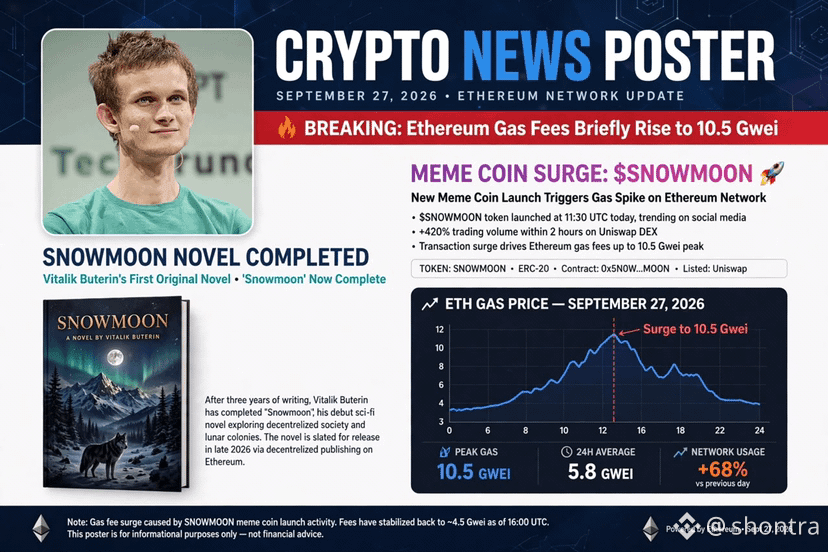
Ethereum Gas fees briefly surged to 10.5 Gwei
According to Etherscan data, Ethereum gas fees briefly rose to 10.5 Gwei. As reported by Odaily, Vitalik said his first original novel, *Snowmoon*, has been completed. Related concept Meme coins appeared on the Ethereum network, causing gas fees to briefly spike.
⚠️ Sorry, the poster generation service is temporarily unavailable. Please try again later; the translation has been completed for you.
*Forum post copy:*
⛽ *ETH Gas rockets to 10.5 Gwei! All because of Vitalik’s novel?*
V God’s first novel *Snowmoon* is finished; concept Meme coins are instantly pumped, and Gas spikes in the short term!
Another V God concept taking off?
#ETH #Gas #Vitalik $ETH
$ETH $BTC
*🇨🇳 Chinese translation:*
Ethereum Gas fees briefly surged to 10.5 Gwei
According to Etherscan data, Ethereum gas fees briefly rose to 10.5 Gwei. As reported by Odaily, Vitalik said his first original novel, *Snowmoon*, has been completed. Related concept Meme coins appeared on the Ethereum network, causing gas fees to briefly spike.
⚠️ Sorry, the poster generation service is temporarily unavailable. Please try again later; the translation has been completed for you.
*Forum post copy:*
⛽ *ETH Gas rockets to 10.5 Gwei! All because of Vitalik’s novel?*
V God’s first novel *Snowmoon* is finished; concept Meme coins are instantly pumped, and Gas spikes in the short term!
Another V God concept taking off?
#ETH #Gas #Vitalik $ETH
*🇨🇳 Chinese translation:*
Ethereum Gas fees briefly surged to 10.5 Gwei
According to Etherscan data, Ethereum gas fees briefly rose to 10.5 Gwei. As reported by Odaily, Vitalik said his first original novel, *Snowmoon*, has been completed. Related concept Meme coins appeared on the Ethereum network, causing gas fees to briefly spike.
⚠️ Sorry, the poster generation service is temporarily unavailable. Please try again later; the translation has been completed for you.
*Forum post copy:*
⛽ *ETH Gas rockets to 10.5 Gwei! All because of Vitalik’s novel?*
V God’s first novel *Snowmoon* is finished; concept Meme coins are instantly pumped, and Gas spikes in the short term!
Another V God concept taking off?
#ETH #Gas #Vitalik $ETH
183

·
--
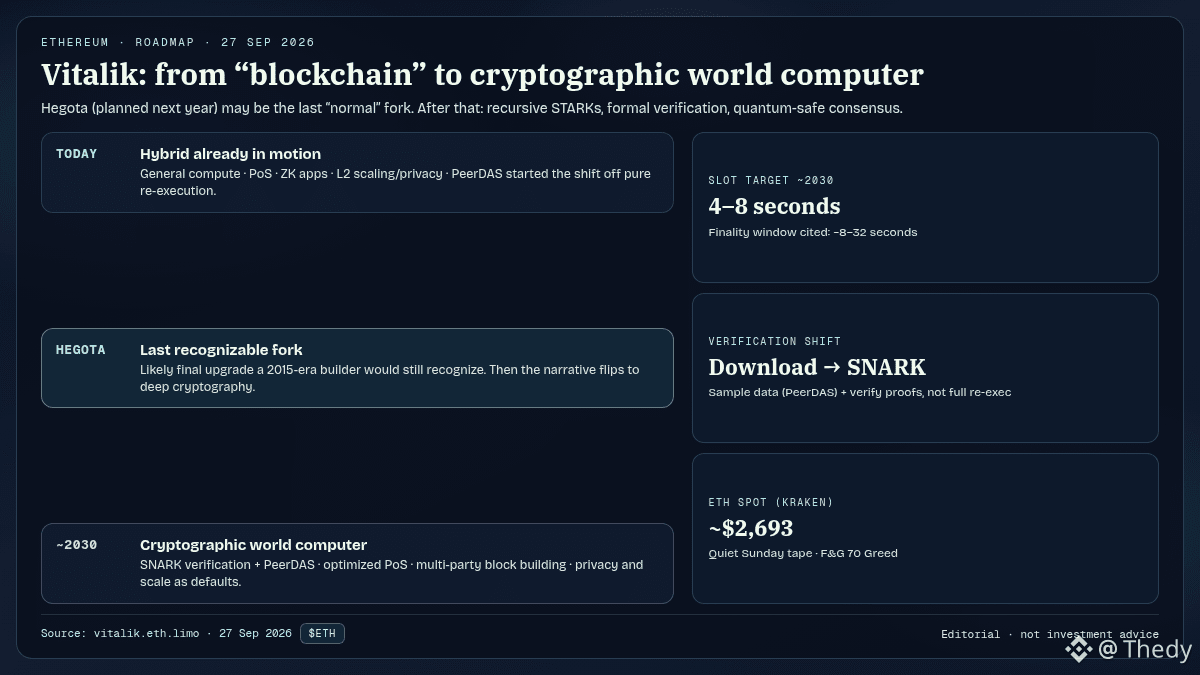
Vitalik has just put a name to what becomes $ETH : a “cryptographic world computer,” not just a blockchain.
In an essay published today (27/09), he explains that Hegota (fork planned for next year) will probably be the last “normal” upgrade, recognizable to someone from 2015. Then the narrative shifts: recursive STARKs, formal verification, quantum-safe consensus.
What changes concretely for the user (according to his text):
• verification: download + re-execute → PeerDAS + SNARK
• slots cited up to 2030: ~4–8 s, finality ~8–32 s
• multi-part block construction, privacy and scale more integrated
This is not a code release. It’s a roadmap thesis. Spot Kraken $ETH ~2 693 $, calm tape (F&G 70 Greed).
Source: vitalik.eth.limo (27/09/2026).
In your opinion, does Hegota really mark the end of the “classic fork” era, or is marketing moving faster than the code?
#Ethereum #Vitalik $ETH
Vitalik has just put a name to what becomes $ETH : a “cryptographic world computer,” not just a blockchain.
In an essay published today (27/09), he explains that Hegota (fork planned for next year) will probably be the last “normal” upgrade, recognizable to someone from 2015. Then the narrative shifts: recursive STARKs, formal verification, quantum-safe consensus.
What changes concretely for the user (according to his text):
• verification: download + re-execute → PeerDAS + SNARK
• slots cited up to 2030: ~4–8 s, finality ~8–32 s
• multi-part block construction, privacy and scale more integrated
This is not a code release. It’s a roadmap thesis. Spot Kraken $ETH ~2 693 $, calm tape (F&G 70 Greed).
Source: vitalik.eth.limo (27/09/2026).
In your opinion, does Hegota really mark the end of the “classic fork” era, or is marketing moving faster than the code?
#Ethereum #Vitalik $ETH
In an essay published today (27/09), he explains that Hegota (fork planned for next year) will probably be the last “normal” upgrade, recognizable to someone from 2015. Then the narrative shifts: recursive STARKs, formal verification, quantum-safe consensus.
What changes concretely for the user (according to his text):
• verification: download + re-execute → PeerDAS + SNARK
• slots cited up to 2030: ~4–8 s, finality ~8–32 s
• multi-part block construction, privacy and scale more integrated
This is not a code release. It’s a roadmap thesis. Spot Kraken $ETH ~2 693 $, calm tape (F&G 70 Greed).
Source: vitalik.eth.limo (27/09/2026).
In your opinion, does Hegota really mark the end of the “classic fork” era, or is marketing moving faster than the code?
#Ethereum #Vitalik $ETH
78
·
--
📰 What Vitalik talked about in Shanghai is no longer just whether “blockchains can continue to scale.” Instead, over the next 15 years, blockchains may enter a phase of “blockchain + cryptography.”
15 years ago, Bitcoin mainly focused on asset transfer and public verification; later, Ethereum added smart contracts and shifted to proof-of-stake in 2022. Now, the question is starting to move from “who can send what” to “who can see what.” Honestly, this change is more crucial than simply increasing transaction throughput.
🔥 Zero-knowledge proofs are moving from roadmap to real-world applications. SNARKs and STARKs allow one party to complete the computation first, then have others verify the result—without needing to disclose all the computation details. Vitalik mentioned that over the next two years, more plans will likely revolve around STARKs, and AI may also play a role.
💡 Another change is that there are more cryptographic tools available. Fully homomorphic encryption, obfuscation techniques, and IO technologies—what once sounded like distant directions—now have faster, more deployable versions. On-chain, it doesn’t necessarily have to process all data repeatedly; much computation can be done off-chain, and then only the proof is submitted on-chain.
👀 FOCIL is also interesting: in the future, block construction might involve 16 participants working together, and then the final block builder completes the block. The goal is to improve assurances that transactions are included in the next time slot in a timely manner, reducing the room for delays caused by a single participant.
In fact, the costs that blockchains have to pay are also quite clear: latency, scalability, and highly general-purpose computing capability. Vitalik believes that over the next 5 years, local user computation, mempools, proof aggregation, and on-chain recording will work together more closely. Do you think this will first change privacy, or first change Ethereum’s performance?
#Vitalik #以太坊 #零知识证明 #blockchain technology
📰 What Vitalik talked about in Shanghai is no longer just whether “blockchains can continue to scale.” Instead, over the next 15 years, blockchains may enter a phase of “blockchain + cryptography.”
15 years ago, Bitcoin mainly focused on asset transfer and public verification; later, Ethereum added smart contracts and shifted to proof-of-stake in 2022. Now, the question is starting to move from “who can send what” to “who can see what.” Honestly, this change is more crucial than simply increasing transaction throughput.
🔥 Zero-knowledge proofs are moving from roadmap to real-world applications. SNARKs and STARKs allow one party to complete the computation first, then have others verify the result—without needing to disclose all the computation details. Vitalik mentioned that over the next two years, more plans will likely revolve around STARKs, and AI may also play a role.
💡 Another change is that there are more cryptographic tools available. Fully homomorphic encryption, obfuscation techniques, and IO technologies—what once sounded like distant directions—now have faster, more deployable versions. On-chain, it doesn’t necessarily have to process all data repeatedly; much computation can be done off-chain, and then only the proof is submitted on-chain.
👀 FOCIL is also interesting: in the future, block construction might involve 16 participants working together, and then the final block builder completes the block. The goal is to improve assurances that transactions are included in the next time slot in a timely manner, reducing the room for delays caused by a single participant.
In fact, the costs that blockchains have to pay are also quite clear: latency, scalability, and highly general-purpose computing capability. Vitalik believes that over the next 5 years, local user computation, mempools, proof aggregation, and on-chain recording will work together more closely. Do you think this will first change privacy, or first change Ethereum’s performance?
#Vitalik #以太坊 #零知识证明 #blockchain technology
15 years ago, Bitcoin mainly focused on asset transfer and public verification; later, Ethereum added smart contracts and shifted to proof-of-stake in 2022. Now, the question is starting to move from “who can send what” to “who can see what.” Honestly, this change is more crucial than simply increasing transaction throughput.
🔥 Zero-knowledge proofs are moving from roadmap to real-world applications. SNARKs and STARKs allow one party to complete the computation first, then have others verify the result—without needing to disclose all the computation details. Vitalik mentioned that over the next two years, more plans will likely revolve around STARKs, and AI may also play a role.
💡 Another change is that there are more cryptographic tools available. Fully homomorphic encryption, obfuscation techniques, and IO technologies—what once sounded like distant directions—now have faster, more deployable versions. On-chain, it doesn’t necessarily have to process all data repeatedly; much computation can be done off-chain, and then only the proof is submitted on-chain.
👀 FOCIL is also interesting: in the future, block construction might involve 16 participants working together, and then the final block builder completes the block. The goal is to improve assurances that transactions are included in the next time slot in a timely manner, reducing the room for delays caused by a single participant.
In fact, the costs that blockchains have to pay are also quite clear: latency, scalability, and highly general-purpose computing capability. Vitalik believes that over the next 5 years, local user computation, mempools, proof aggregation, and on-chain recording will work together more closely. Do you think this will first change privacy, or first change Ethereum’s performance?
#Vitalik #以太坊 #零知识证明 #blockchain technology
153

·
--
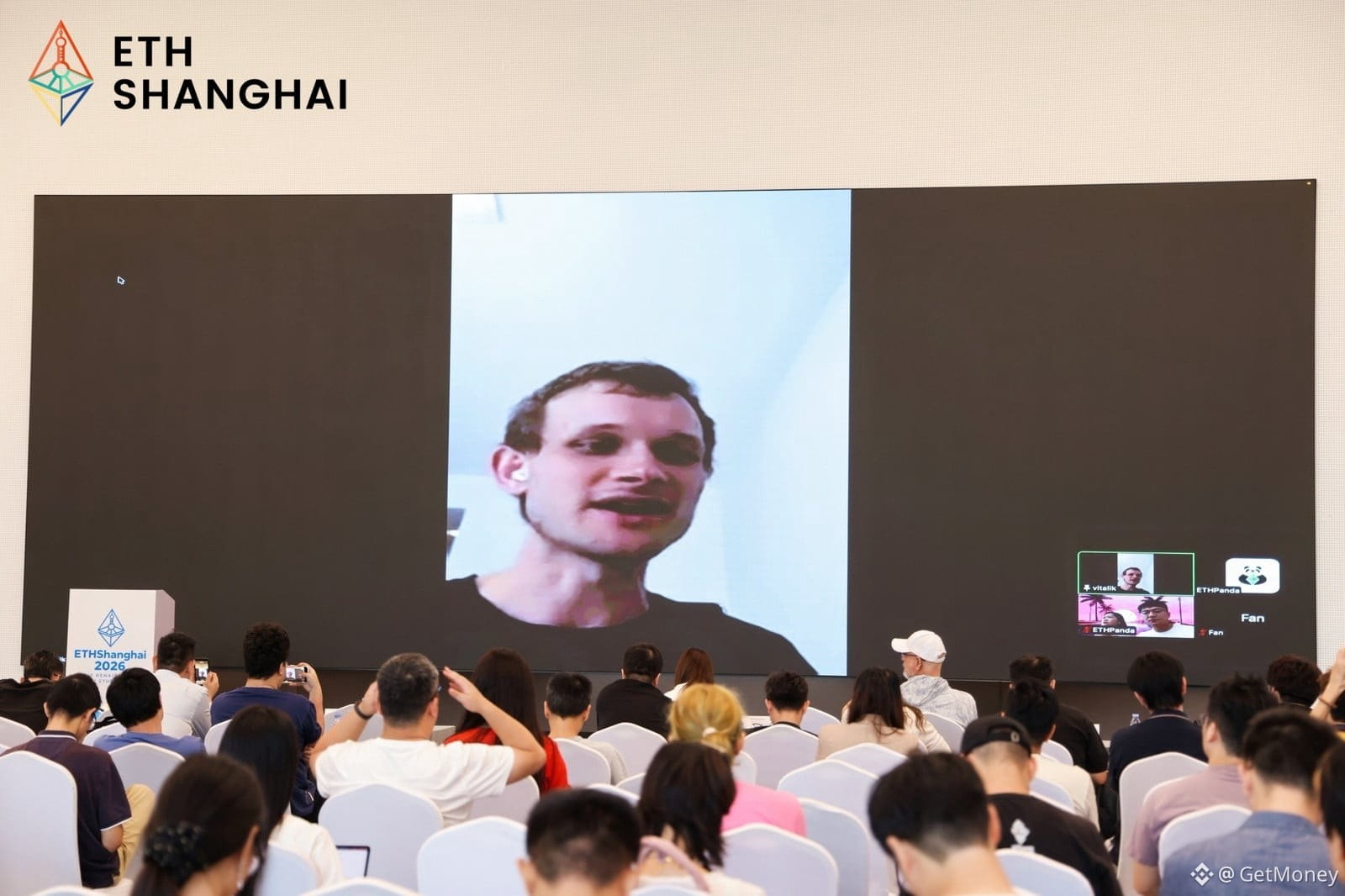
At ETHShanghai 2026, Ethereum co-founder Vitalik Buterin proposed a concept to redesign the mempool using recursive STARKs. The goal is to address post-quantum signatures, privacy protection, and network scalability all at once. The numbers he gave are quite straightforward: verifying post-quantum signatures alone could consume anywhere from 100,000 to 300,000 gas, while privacy-related transactions could reach several hundred thousand gas, even exceeding 1,000,000 gas. The more users there are, the more unsustainable the verification burden becomes.
The key to this idea lies in compressing validation work through layers. The value of recursive STARKs is not to make each individual transaction cheaper, but to fold a large number of repetitive proofs into a single smaller proof, so that nodes do not have to bear the full cost for every transaction. In the past, the two directions—post-quantum security and privacy—were often treated as separate issues. But at the gas-cost level, they point to the same contradiction: both security and anonymity come with a price, and block space is limited.
Also on-site, Xiao Feng, vice chairman of Yunfeng Holding, said Ethereum does not need a “revival.” He argued that as a market-leading blockchain infrastructure, it still has value and applications, and he stated that the integration of AI and crypto goes far beyond payments. Such remarks are more of an industry perspective and do not indicate that a technical roadmap has already been implemented. Recursive STARKs are still in the proposal stage.
What is worth watching is the extent to which the cost trade-offs among post-quantum signatures, private transactions, and scalability will affect Ethereum’s route priorities. Observable variables to look for next include whether the proposal enters formal EIP discussions, and whether client teams provide measured real-world data on the overhead of recursive proofs.
#Vitalik #以太坊 #人工智能 $ETH
At ETHShanghai 2026, Ethereum co-founder Vitalik Buterin proposed a concept to redesign the mempool using recursive STARKs. The goal is to address post-quantum signatures, privacy protection, and network scalability all at once. The numbers he gave are quite straightforward: verifying post-quantum signatures alone could consume anywhere from 100,000 to 300,000 gas, while privacy-related transactions could reach several hundred thousand gas, even exceeding 1,000,000 gas. The more users there are, the more unsustainable the verification burden becomes.
The key to this idea lies in compressing validation work through layers. The value of recursive STARKs is not to make each individual transaction cheaper, but to fold a large number of repetitive proofs into a single smaller proof, so that nodes do not have to bear the full cost for every transaction. In the past, the two directions—post-quantum security and privacy—were often treated as separate issues. But at the gas-cost level, they point to the same contradiction: both security and anonymity come with a price, and block space is limited.
Also on-site, Xiao Feng, vice chairman of Yunfeng Holding, said Ethereum does not need a “revival.” He argued that as a market-leading blockchain infrastructure, it still has value and applications, and he stated that the integration of AI and crypto goes far beyond payments. Such remarks are more of an industry perspective and do not indicate that a technical roadmap has already been implemented. Recursive STARKs are still in the proposal stage.
What is worth watching is the extent to which the cost trade-offs among post-quantum signatures, private transactions, and scalability will affect Ethereum’s route priorities. Observable variables to look for next include whether the proposal enters formal EIP discussions, and whether client teams provide measured real-world data on the overhead of recursive proofs.
#Vitalik #以太坊 #人工智能 $ETH
The key to this idea lies in compressing validation work through layers. The value of recursive STARKs is not to make each individual transaction cheaper, but to fold a large number of repetitive proofs into a single smaller proof, so that nodes do not have to bear the full cost for every transaction. In the past, the two directions—post-quantum security and privacy—were often treated as separate issues. But at the gas-cost level, they point to the same contradiction: both security and anonymity come with a price, and block space is limited.
Also on-site, Xiao Feng, vice chairman of Yunfeng Holding, said Ethereum does not need a “revival.” He argued that as a market-leading blockchain infrastructure, it still has value and applications, and he stated that the integration of AI and crypto goes far beyond payments. Such remarks are more of an industry perspective and do not indicate that a technical roadmap has already been implemented. Recursive STARKs are still in the proposal stage.
What is worth watching is the extent to which the cost trade-offs among post-quantum signatures, private transactions, and scalability will affect Ethereum’s route priorities. Observable variables to look for next include whether the proposal enters formal EIP discussions, and whether client teams provide measured real-world data on the overhead of recursive proofs.
#Vitalik #以太坊 #人工智能 $ETH
83
·
--
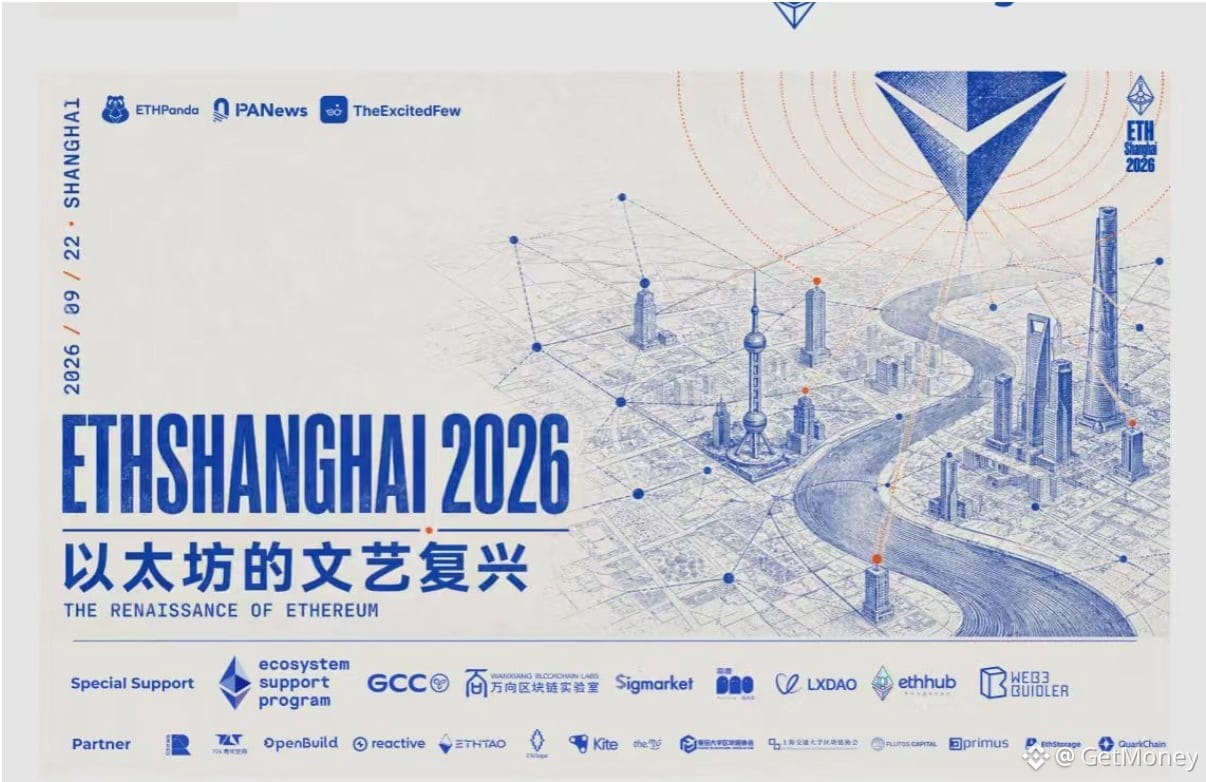
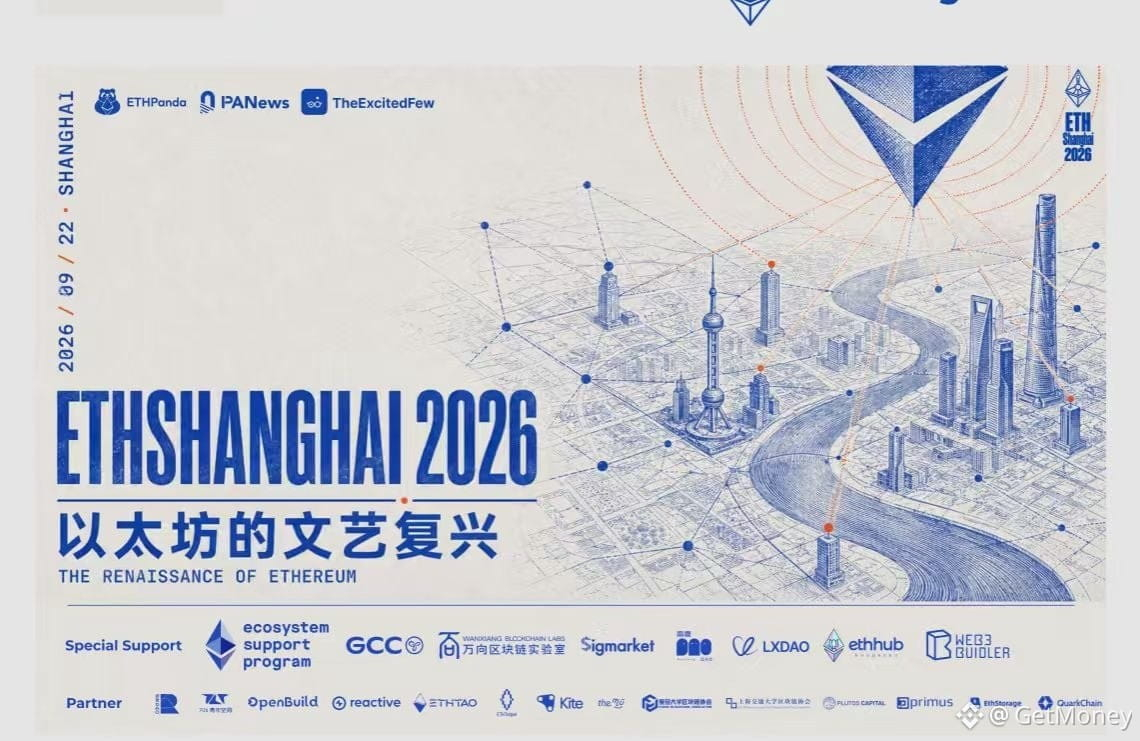
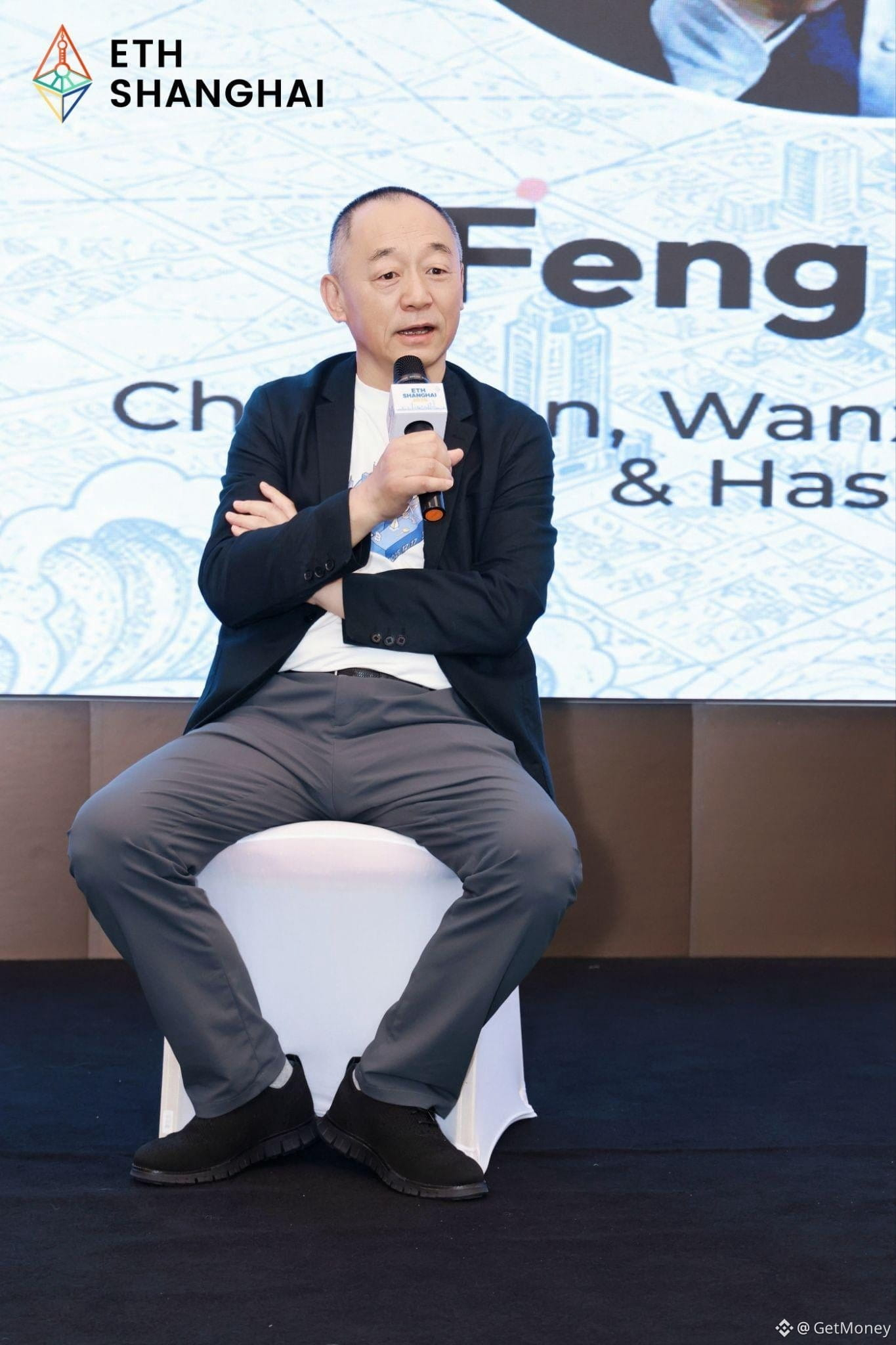
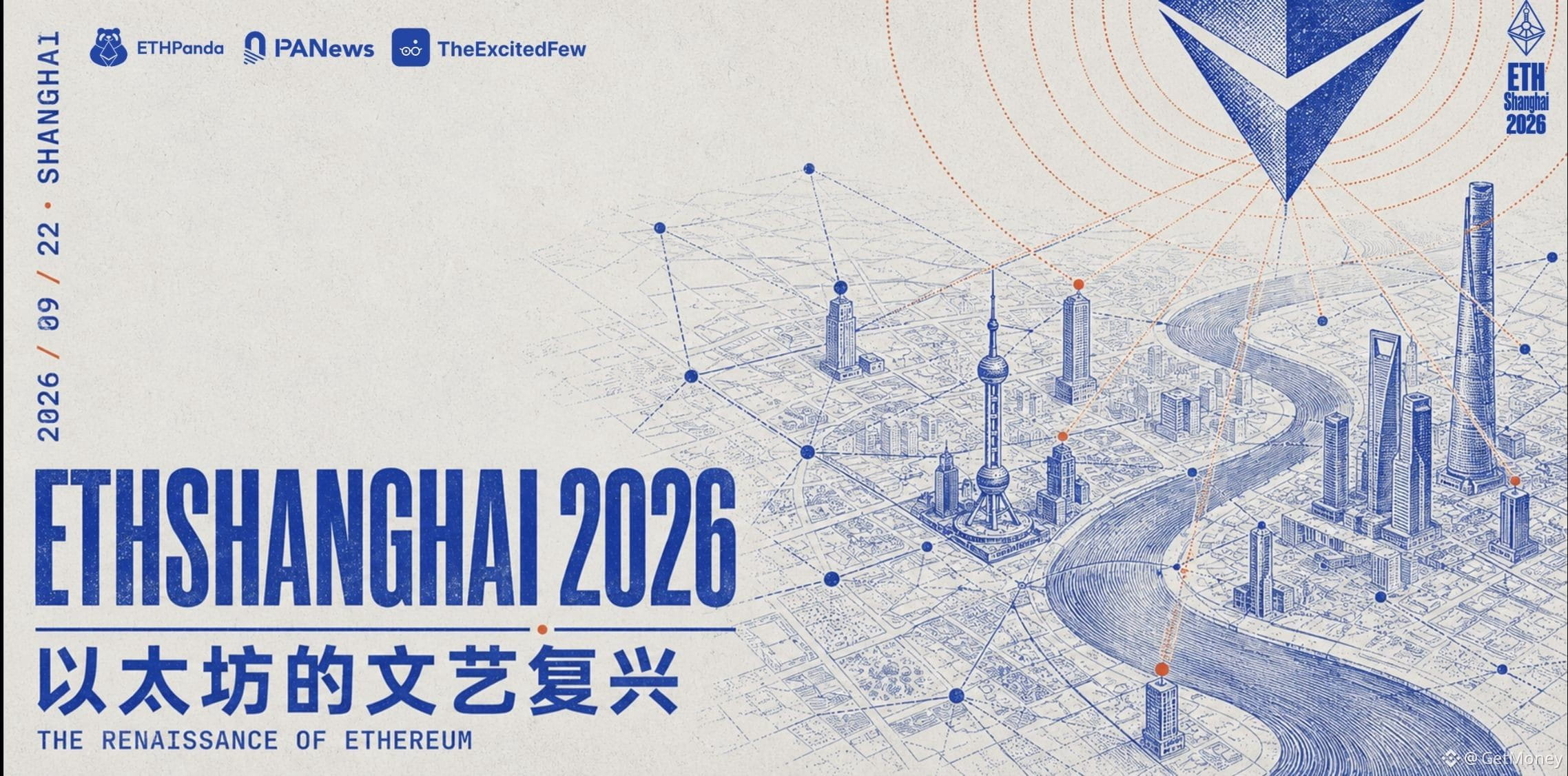
📰 ETHShanghai 2026 opens in Shanghai, with the theme “The Renaissance of Ethereum.” This discussion wasn’t just focused on prices—it put privacy, open source, public goods, AI, cryptography, and future networks on the same table.
🔥 EIP-8288 mentioned by Vitalik focuses on exploring a recursive STARK memory pool. With quantum-resistant signature verification potentially costing 100,000 to 300,000 Gas, privacy transactions could even reach tens of thousands to millions of Gas. The proposal aims for memory-pool nodes to first collect, aggregate signatures and proofs, and then hand them to the main chain for verification—reducing the pressure of the main chain having to process each item one by one.
💡 If this direction moves forward, it could help lower verification costs for quantum-resistant transactions, privacy transactions, and Layer2 state proofs. The interval for Layer2 submitting proofs could also be further shortened—from minutes to every minute or even less. However, it’s still in the proposal, simulation, and testing phase, and there’s still a way to go before real deployment.
👀 Xiao Feng’s view is also quite straightforward: Ethereum is more like an application-oriented infrastructure. Once it truly matures, users may not need to feel it so often. The combination of AI and cryptography may instead land in concrete scenarios like stablecoin payments, smart agent transactions, and compute-power price management.
Honestly, the industry isn’t at the stage where a small team can quickly iterate and test things within a few months anymore—technical, funding, and regulatory barriers are all getting higher. But the crypto industry still leaves room for open participation. What do you think Ethereum’s next phase should prioritize first: privacy and scalability, or AI application deployment?
#ETHShanghai2026 #以太坊 #Vitalik #AI與加密
📰 ETHShanghai 2026 opens in Shanghai, with the theme “The Renaissance of Ethereum.” This discussion wasn’t just focused on prices—it put privacy, open source, public goods, AI, cryptography, and future networks on the same table.
🔥 EIP-8288 mentioned by Vitalik focuses on exploring a recursive STARK memory pool. With quantum-resistant signature verification potentially costing 100,000 to 300,000 Gas, privacy transactions could even reach tens of thousands to millions of Gas. The proposal aims for memory-pool nodes to first collect, aggregate signatures and proofs, and then hand them to the main chain for verification—reducing the pressure of the main chain having to process each item one by one.
💡 If this direction moves forward, it could help lower verification costs for quantum-resistant transactions, privacy transactions, and Layer2 state proofs. The interval for Layer2 submitting proofs could also be further shortened—from minutes to every minute or even less. However, it’s still in the proposal, simulation, and testing phase, and there’s still a way to go before real deployment.
👀 Xiao Feng’s view is also quite straightforward: Ethereum is more like an application-oriented infrastructure. Once it truly matures, users may not need to feel it so often. The combination of AI and cryptography may instead land in concrete scenarios like stablecoin payments, smart agent transactions, and compute-power price management.
Honestly, the industry isn’t at the stage where a small team can quickly iterate and test things within a few months anymore—technical, funding, and regulatory barriers are all getting higher. But the crypto industry still leaves room for open participation. What do you think Ethereum’s next phase should prioritize first: privacy and scalability, or AI application deployment?
#ETHShanghai2026 #以太坊 #Vitalik #AI與加密
🔥 EIP-8288 mentioned by Vitalik focuses on exploring a recursive STARK memory pool. With quantum-resistant signature verification potentially costing 100,000 to 300,000 Gas, privacy transactions could even reach tens of thousands to millions of Gas. The proposal aims for memory-pool nodes to first collect, aggregate signatures and proofs, and then hand them to the main chain for verification—reducing the pressure of the main chain having to process each item one by one.
💡 If this direction moves forward, it could help lower verification costs for quantum-resistant transactions, privacy transactions, and Layer2 state proofs. The interval for Layer2 submitting proofs could also be further shortened—from minutes to every minute or even less. However, it’s still in the proposal, simulation, and testing phase, and there’s still a way to go before real deployment.
👀 Xiao Feng’s view is also quite straightforward: Ethereum is more like an application-oriented infrastructure. Once it truly matures, users may not need to feel it so often. The combination of AI and cryptography may instead land in concrete scenarios like stablecoin payments, smart agent transactions, and compute-power price management.
Honestly, the industry isn’t at the stage where a small team can quickly iterate and test things within a few months anymore—technical, funding, and regulatory barriers are all getting higher. But the crypto industry still leaves room for open participation. What do you think Ethereum’s next phase should prioritize first: privacy and scalability, or AI application deployment?
#ETHShanghai2026 #以太坊 #Vitalik #AI與加密
110
·
--
📰 At ETHShanghai 2026, Vitalik detailed EIP-8288. The core idea isn’t to build yet another more complex on-chain verification system, but to keep a large number of signatures and proofs in the mempool for aggregation first—then write only a single aggregated proof into the block.
🔥 Now, a typical Ethereum transaction consumes about 21,000 gas, while verifying a single ECDSA signature alone requires around 4,000 gas. With quantum-safe signatures, costs could rise to 100,000–300,000 gas. For privacy protocols, ZK operations usually cost at least 350,000 gas, and in complex cases even up to 1,000,000 gas.
Even more extreme: if you pursue both quantum safety and privacy at the same time, STARK proofs can consume roughly 8 million gas. Based on the estimates in the talk, Ethereum’s throughput could drop from about 25 TPS to around 0.25 TPS—the stronger the security and privacy, the harder transactions become to run.
💡 EIP-8288’s approach is to have mempool nodes collect transactions along with their signatures and proofs, perform aggregation before the transactions enter the block. The chain no longer stores these huge original objects; in the end, it only verifies one STARK proof that covers the entire batch of transactions. Each dependency’s data takes up about 96 bytes, and some are even as small as 65 bytes.
This design builds on EIP-8141 native account abstraction. Transactions can clearly declare their signature schemes and verification algorithms. Vitalik likened it to a kind of “specialized sharding”: split out the heaviest verification work, handle it in parallel off-chain by nodes, while the consensus layer only needs to manage the data volume—kept to roughly 100–300 KB per block.
🤔 Of course, having a clear technical path doesn’t mean all problems will automatically disappear after deployment. The real key is whether the aggregation process can run reliably, and whether nodes are willing to take on this off-chain computation. Do you think EIP-8288 will first drive privacy applications, or quantum-safe wallets?
#以太坊 #EIP8288 #Vitalik #区块链技术
📰 At ETHShanghai 2026, Vitalik detailed EIP-8288. The core idea isn’t to build yet another more complex on-chain verification system, but to keep a large number of signatures and proofs in the mempool for aggregation first—then write only a single aggregated proof into the block.
🔥 Now, a typical Ethereum transaction consumes about 21,000 gas, while verifying a single ECDSA signature alone requires around 4,000 gas. With quantum-safe signatures, costs could rise to 100,000–300,000 gas. For privacy protocols, ZK operations usually cost at least 350,000 gas, and in complex cases even up to 1,000,000 gas.
Even more extreme: if you pursue both quantum safety and privacy at the same time, STARK proofs can consume roughly 8 million gas. Based on the estimates in the talk, Ethereum’s throughput could drop from about 25 TPS to around 0.25 TPS—the stronger the security and privacy, the harder transactions become to run.
💡 EIP-8288’s approach is to have mempool nodes collect transactions along with their signatures and proofs, perform aggregation before the transactions enter the block. The chain no longer stores these huge original objects; in the end, it only verifies one STARK proof that covers the entire batch of transactions. Each dependency’s data takes up about 96 bytes, and some are even as small as 65 bytes.
This design builds on EIP-8141 native account abstraction. Transactions can clearly declare their signature schemes and verification algorithms. Vitalik likened it to a kind of “specialized sharding”: split out the heaviest verification work, handle it in parallel off-chain by nodes, while the consensus layer only needs to manage the data volume—kept to roughly 100–300 KB per block.
🤔 Of course, having a clear technical path doesn’t mean all problems will automatically disappear after deployment. The real key is whether the aggregation process can run reliably, and whether nodes are willing to take on this off-chain computation. Do you think EIP-8288 will first drive privacy applications, or quantum-safe wallets?
#以太坊 #EIP8288 #Vitalik #区块链技术
🔥 Now, a typical Ethereum transaction consumes about 21,000 gas, while verifying a single ECDSA signature alone requires around 4,000 gas. With quantum-safe signatures, costs could rise to 100,000–300,000 gas. For privacy protocols, ZK operations usually cost at least 350,000 gas, and in complex cases even up to 1,000,000 gas.
Even more extreme: if you pursue both quantum safety and privacy at the same time, STARK proofs can consume roughly 8 million gas. Based on the estimates in the talk, Ethereum’s throughput could drop from about 25 TPS to around 0.25 TPS—the stronger the security and privacy, the harder transactions become to run.
💡 EIP-8288’s approach is to have mempool nodes collect transactions along with their signatures and proofs, perform aggregation before the transactions enter the block. The chain no longer stores these huge original objects; in the end, it only verifies one STARK proof that covers the entire batch of transactions. Each dependency’s data takes up about 96 bytes, and some are even as small as 65 bytes.
This design builds on EIP-8141 native account abstraction. Transactions can clearly declare their signature schemes and verification algorithms. Vitalik likened it to a kind of “specialized sharding”: split out the heaviest verification work, handle it in parallel off-chain by nodes, while the consensus layer only needs to manage the data volume—kept to roughly 100–300 KB per block.
🤔 Of course, having a clear technical path doesn’t mean all problems will automatically disappear after deployment. The real key is whether the aggregation process can run reliably, and whether nodes are willing to take on this off-chain computation. Do you think EIP-8288 will first drive privacy applications, or quantum-safe wallets?
#以太坊 #EIP8288 #Vitalik #区块链技术

87

·
--
A single tweet pulled two cents’ worth of TRUE up to nearly 15 cents within an hour, with a peak rise of more than 7x. But on the product side, the migration still hasn’t even landed—its liquidity pool is so thin that you can poke a hole in it.
The tweet from Vitalik wasn’t saying “yet another project is on fire.” He was saying, “who should actually arbitrate wins and losses in prediction markets?” The fact that Trueo moved from Base to Ethereum—one ordinary migration announcement—got elevated into a route-and-philosophy battle between decentralized arbitration and centralized arbitration. Fifteen five-star-grade big-name V accounts jumped on to hype it up, making the topic blow up even more.
Data is the truth timeline: at 21:00 on September 21 (UTC), TRUE surged from $0.0207 to $0.0904, topping out intraday at $0.1487. The 24-hour trading volume was about $4.0 million, while liquidity in the pool was only $540k—volume was more than 7x the pool’s liquidity. With a setup like this, even a little money moving in and out makes the price ride a roller coaster.
Total token supply is 100 million. Team advisors, prediction-market incentives, and liquidity incentives all take up a significant share. Next, both unlock schedules and sell pressure are still up in the air—this isn’t me speculating; it’s clearly spelled out in the official documentation.
For this round, I’m not going long. One tweet can ignite emotions, but it doesn’t create real user retention and trading depth. If you really want me to change my mind, there’s only one scenario: the migration truly goes live, the arbitration for the disputed market becomes open, transparent, and able to withstand scrutiny, and liquidity can still hold up without shrinking. Only then does the story of “decentralized arbitration” actually stand. Right now, this is textbook attention arbitrage.
$TRUE #Ethereum #Vitalik
A single tweet pulled two cents’ worth of TRUE up to nearly 15 cents within an hour, with a peak rise of more than 7x. But on the product side, the migration still hasn’t even landed—its liquidity pool is so thin that you can poke a hole in it.
The tweet from Vitalik wasn’t saying “yet another project is on fire.” He was saying, “who should actually arbitrate wins and losses in prediction markets?” The fact that Trueo moved from Base to Ethereum—one ordinary migration announcement—got elevated into a route-and-philosophy battle between decentralized arbitration and centralized arbitration. Fifteen five-star-grade big-name V accounts jumped on to hype it up, making the topic blow up even more.
Data is the truth timeline: at 21:00 on September 21 (UTC), TRUE surged from $0.0207 to $0.0904, topping out intraday at $0.1487. The 24-hour trading volume was about $4.0 million, while liquidity in the pool was only $540k—volume was more than 7x the pool’s liquidity. With a setup like this, even a little money moving in and out makes the price ride a roller coaster.
Total token supply is 100 million. Team advisors, prediction-market incentives, and liquidity incentives all take up a significant share. Next, both unlock schedules and sell pressure are still up in the air—this isn’t me speculating; it’s clearly spelled out in the official documentation.
For this round, I’m not going long. One tweet can ignite emotions, but it doesn’t create real user retention and trading depth. If you really want me to change my mind, there’s only one scenario: the migration truly goes live, the arbitration for the disputed market becomes open, transparent, and able to withstand scrutiny, and liquidity can still hold up without shrinking. Only then does the story of “decentralized arbitration” actually stand. Right now, this is textbook attention arbitrage.
$TRUE #Ethereum #Vitalik
The tweet from Vitalik wasn’t saying “yet another project is on fire.” He was saying, “who should actually arbitrate wins and losses in prediction markets?” The fact that Trueo moved from Base to Ethereum—one ordinary migration announcement—got elevated into a route-and-philosophy battle between decentralized arbitration and centralized arbitration. Fifteen five-star-grade big-name V accounts jumped on to hype it up, making the topic blow up even more.
Data is the truth timeline: at 21:00 on September 21 (UTC), TRUE surged from $0.0207 to $0.0904, topping out intraday at $0.1487. The 24-hour trading volume was about $4.0 million, while liquidity in the pool was only $540k—volume was more than 7x the pool’s liquidity. With a setup like this, even a little money moving in and out makes the price ride a roller coaster.
Total token supply is 100 million. Team advisors, prediction-market incentives, and liquidity incentives all take up a significant share. Next, both unlock schedules and sell pressure are still up in the air—this isn’t me speculating; it’s clearly spelled out in the official documentation.
For this round, I’m not going long. One tweet can ignite emotions, but it doesn’t create real user retention and trading depth. If you really want me to change my mind, there’s only one scenario: the migration truly goes live, the arbitration for the disputed market becomes open, transparent, and able to withstand scrutiny, and liquidity can still hold up without shrinking. Only then does the story of “decentralized arbitration” actually stand. Right now, this is textbook attention arbitrage.
$TRUE #Ethereum #Vitalik
77

·
--
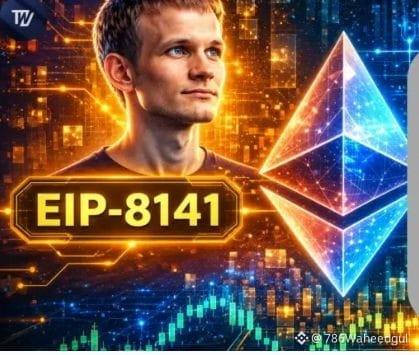
🚨 Ethereum could be entering a new phase of transaction design with EIP-8141.
Vitalik Buterin and Ethereum developers are pushing a new “Frame Transaction” model aimed at making transactions more flexible, efficient, and scalable.
The proposal separates transaction validation, gas payment, and execution into programmable frames, opening the door to features like account abstraction, gas sponsorship, key rotation, batching, and even stronger post-quantum security.
The bigger idea is to make Ethereum process transaction dependencies more efficiently, potentially allowing more verification work to happen in parallel.
If successfully implemented, EIP-8141 could become an important building block for Ethereum’s long-term scaling roadmap.
$ETH
{spot}(ETHUSDT)
isn’t just evolving at the asset level — its underlying transaction architecture is evolving too. 🔥
#Ethereum #ETH #EIP8141 #Crypto #Vitalik
🚨 Ethereum could be entering a new phase of transaction design with EIP-8141.
Vitalik Buterin and Ethereum developers are pushing a new “Frame Transaction” model aimed at making transactions more flexible, efficient, and scalable.
The proposal separates transaction validation, gas payment, and execution into programmable frames, opening the door to features like account abstraction, gas sponsorship, key rotation, batching, and even stronger post-quantum security.
The bigger idea is to make Ethereum process transaction dependencies more efficiently, potentially allowing more verification work to happen in parallel.
If successfully implemented, EIP-8141 could become an important building block for Ethereum’s long-term scaling roadmap.
$ETH
isn’t just evolving at the asset level — its underlying transaction architecture is evolving too. 🔥
#Ethereum #ETH #EIP8141 #Crypto #Vitalik
Vitalik Buterin and Ethereum developers are pushing a new “Frame Transaction” model aimed at making transactions more flexible, efficient, and scalable.
The proposal separates transaction validation, gas payment, and execution into programmable frames, opening the door to features like account abstraction, gas sponsorship, key rotation, batching, and even stronger post-quantum security.
The bigger idea is to make Ethereum process transaction dependencies more efficiently, potentially allowing more verification work to happen in parallel.
If successfully implemented, EIP-8141 could become an important building block for Ethereum’s long-term scaling roadmap.
$ETH
isn’t just evolving at the asset level — its underlying transaction architecture is evolving too. 🔥
#Ethereum #ETH #EIP8141 #Crypto #Vitalik
15
·
--
📰 A debate about whether “AI will cause Bitcoin to be cut in half within the next two years” was directly taken up by Vitalik Buterin.
Silicon Valley investor and podcast host of Doom Debates, Liron Shapira, said he has a 50% chance of believing that Bitcoin could fall by more than 50% over the next two years, because AI may weaken investors’ expectations of network security.
🔥 Vitalik’s view is completely the opposite. He believes AI won’t truly threaten Bitcoin’s security—and he added that he has about 90% of his net worth in crypto assets, basically betting real money in the opposite direction.
💡 He breaks the risks into two types: one is network-layer attacks that AI might enable—problems like this can be addressed by upgrading client software and infrastructure; the other is the complete compromise of Bitcoin’s hash algorithm or proof-of-work, which he believes is extremely unlikely.
Honestly, the crux of the debate isn’t just whether “AI will be powerful,” but whether it can directly undermine Bitcoin’s security mechanisms. The former is more like the system needing ongoing patching; only the latter would truly change the rules of the game.
🤔 Do you think AI is more likely to create pressure from network attacks first, or that it will ultimately be difficult to reach Bitcoin’s core security mechanisms?
#BTC #比特币 #AI #Vitalik
📰 A debate about whether “AI will cause Bitcoin to be cut in half within the next two years” was directly taken up by Vitalik Buterin.
Silicon Valley investor and podcast host of Doom Debates, Liron Shapira, said he has a 50% chance of believing that Bitcoin could fall by more than 50% over the next two years, because AI may weaken investors’ expectations of network security.
🔥 Vitalik’s view is completely the opposite. He believes AI won’t truly threaten Bitcoin’s security—and he added that he has about 90% of his net worth in crypto assets, basically betting real money in the opposite direction.
💡 He breaks the risks into two types: one is network-layer attacks that AI might enable—problems like this can be addressed by upgrading client software and infrastructure; the other is the complete compromise of Bitcoin’s hash algorithm or proof-of-work, which he believes is extremely unlikely.
Honestly, the crux of the debate isn’t just whether “AI will be powerful,” but whether it can directly undermine Bitcoin’s security mechanisms. The former is more like the system needing ongoing patching; only the latter would truly change the rules of the game.
🤔 Do you think AI is more likely to create pressure from network attacks first, or that it will ultimately be difficult to reach Bitcoin’s core security mechanisms?
#BTC #比特币 #AI #Vitalik
Silicon Valley investor and podcast host of Doom Debates, Liron Shapira, said he has a 50% chance of believing that Bitcoin could fall by more than 50% over the next two years, because AI may weaken investors’ expectations of network security.
🔥 Vitalik’s view is completely the opposite. He believes AI won’t truly threaten Bitcoin’s security—and he added that he has about 90% of his net worth in crypto assets, basically betting real money in the opposite direction.
💡 He breaks the risks into two types: one is network-layer attacks that AI might enable—problems like this can be addressed by upgrading client software and infrastructure; the other is the complete compromise of Bitcoin’s hash algorithm or proof-of-work, which he believes is extremely unlikely.
Honestly, the crux of the debate isn’t just whether “AI will be powerful,” but whether it can directly undermine Bitcoin’s security mechanisms. The former is more like the system needing ongoing patching; only the latter would truly change the rules of the game.
🤔 Do you think AI is more likely to create pressure from network attacks first, or that it will ultimately be difficult to reach Bitcoin’s core security mechanisms?
#BTC #比特币 #AI #Vitalik

12
·
--
Vitalik pushes back: doesn’t believe AI will cut $BTC in halfLet’s get straight to the sharp point: this is not a price prediction post, but a public wager on “security narrative vs. transition-period reality.”
Silicon Valley investor Liron Shapira (@liron) said on September 6: he is 50% confident that within two years $BTC will be shaken by AI, undermining the supposedly solid security/robustness narrative, and will drop by more than 50%.
Vitalik (@VitalikButerin) is standing directly on the opposite side. His point, in essence, is: long term, he is relatively optimistic about network security; the real challenge is the transition period. $BTC At the very least, it can handle problems that do not require social consensus—things like client and mining pool upgrades—without turning them into full-network political battles.
Vitalik pushes back: doesn’t believe AI will cut $BTC in half
Let’s get straight to the sharp point: this is not a price prediction post, but a public wager on “security narrative vs. transition-period reality.”
Silicon Valley investor Liron Shapira (@liron) said on September 6: he is 50% confident that within two years $BTC will be shaken by AI, undermining the supposedly solid security/robustness narrative, and will drop by more than 50%.
Vitalik (@VitalikButerin) is standing directly on the opposite side. His point, in essence, is: long term, he is relatively optimistic about network security; the real challenge is the transition period. $BTC At the very least, it can handle problems that do not require social consensus—things like client and mining pool upgrades—without turning them into full-network political battles.
Silicon Valley investor Liron Shapira (@liron) said on September 6: he is 50% confident that within two years $BTC will be shaken by AI, undermining the supposedly solid security/robustness narrative, and will drop by more than 50%.
Vitalik (@VitalikButerin) is standing directly on the opposite side. His point, in essence, is: long term, he is relatively optimistic about network security; the real challenge is the transition period. $BTC At the very least, it can handle problems that do not require social consensus—things like client and mining pool upgrades—without turning them into full-network political battles.
99

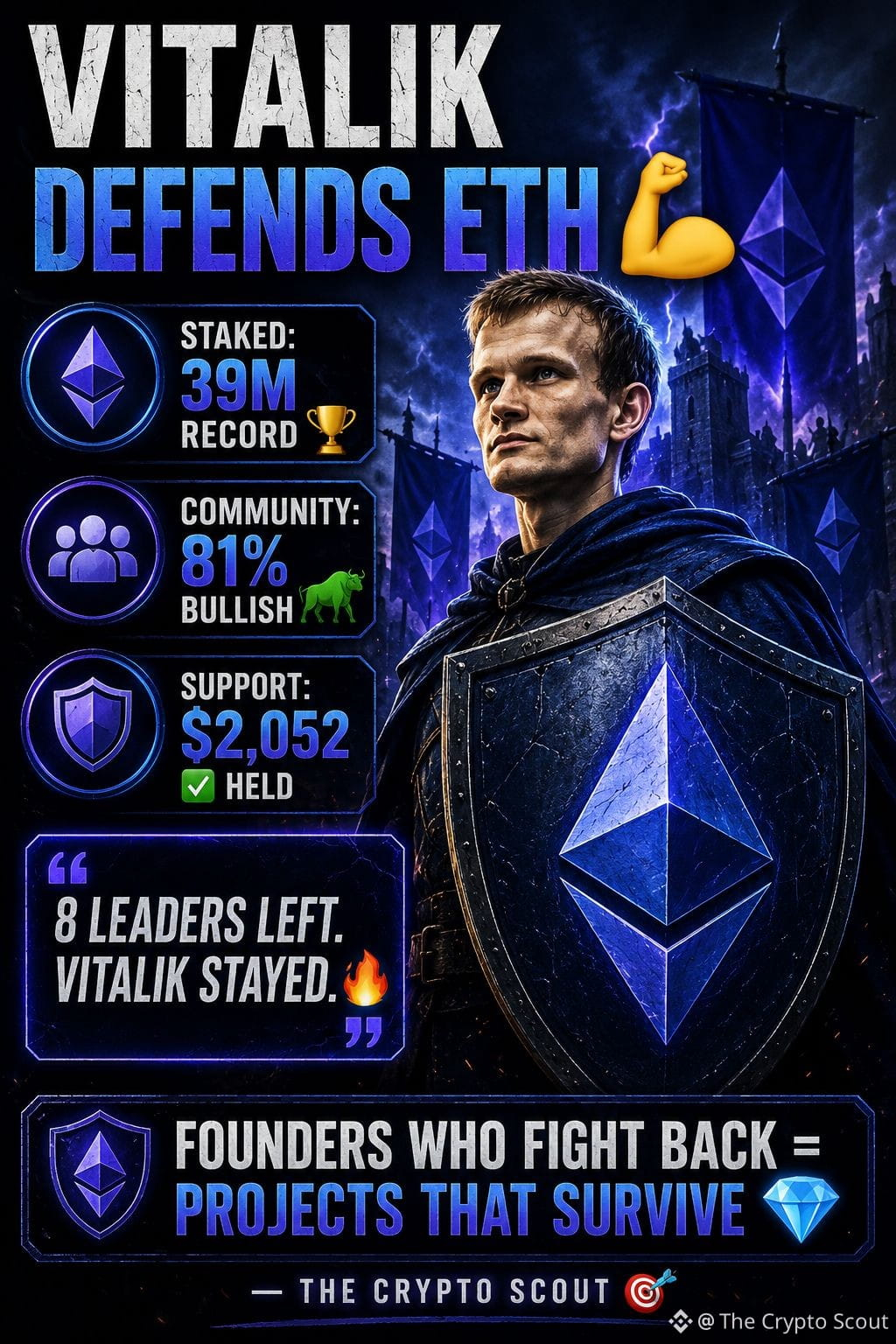
💡 Vitalik just stepped up
to defend Ethereum...
8 Ethereum Foundation leaders
just left 😱
But Vitalik responded:
"ETH's fundamentals are stronger
than ever" 💪
And the data agrees:
📊 ETH chart bounced from $2,052
📊 Community: 81% still bullish
📊 ETH staked supply: 39M record
📊 AI tokens rallying on ETH network
When a founder defends his project
this publicly — it means:
They are NOT giving up.
They are DOUBLING DOWN. 🔥
$2,000 ETH support =
The floor that must hold 💎
Watching this closely 👀
— The Crypto Scout 🎯
#Ethereum #ETH #Vitalik #crypto
💡 Vitalik just stepped up
to defend Ethereum...
8 Ethereum Foundation leaders
just left 😱
But Vitalik responded:
"ETH's fundamentals are stronger
than ever" 💪
And the data agrees:
📊 ETH chart bounced from $2,052
📊 Community: 81% still bullish
📊 ETH staked supply: 39M record
📊 AI tokens rallying on ETH network
When a founder defends his project
this publicly — it means:
They are NOT giving up.
They are DOUBLING DOWN. 🔥
$2,000 ETH support =
The floor that must hold 💎
Watching this closely 👀
— The Crypto Scout 🎯
#Ethereum #ETH #Vitalik #crypto
to defend Ethereum...
8 Ethereum Foundation leaders
just left 😱
But Vitalik responded:
"ETH's fundamentals are stronger
than ever" 💪
And the data agrees:
📊 ETH chart bounced from $2,052
📊 Community: 81% still bullish
📊 ETH staked supply: 39M record
📊 AI tokens rallying on ETH network
When a founder defends his project
this publicly — it means:
They are NOT giving up.
They are DOUBLING DOWN. 🔥
$2,000 ETH support =
The floor that must hold 💎
Watching this closely 👀
— The Crypto Scout 🎯
#Ethereum #ETH #Vitalik #crypto

1
182

·
--
🚀 Vitalik speaks up! Vitalik promises to streamline the EF organization and reduce ETH sell-offs, is the community stable now?
For a long time, the Ethereum Foundation (EF) has been regularly dumping ETH to raise operational funds, which always makes the community shout "market crash". But this time, Vitalik Buterin stepped in to give everyone a sense of security!
Vitalik clearly committed to fully streamline the Ethereum Foundation (EF) organization to improve the efficiency of fund usage. More importantly, he stated that the frequency and scale of EF's ETH sell-offs will be significantly reduced, shifting towards more diverse and sustainable ecological funding models.
Key point: EF's role is as an ecological "igniter", not a "long-term cash cow".
This statement undoubtedly boosted market confidence. Streamlining the organization means Ethereum is moving towards a more decentralized and efficient direction; reducing sell-offs directly alleviates the selling pressure in the secondary market.
#以太坊 #ETH #Vitalik
#vitalik承诺精简ef减售eth
🚀 Vitalik speaks up! Vitalik promises to streamline the EF organization and reduce ETH sell-offs, is the community stable now?
For a long time, the Ethereum Foundation (EF) has been regularly dumping ETH to raise operational funds, which always makes the community shout "market crash". But this time, Vitalik Buterin stepped in to give everyone a sense of security!
Vitalik clearly committed to fully streamline the Ethereum Foundation (EF) organization to improve the efficiency of fund usage. More importantly, he stated that the frequency and scale of EF's ETH sell-offs will be significantly reduced, shifting towards more diverse and sustainable ecological funding models.
Key point: EF's role is as an ecological "igniter", not a "long-term cash cow".
This statement undoubtedly boosted market confidence. Streamlining the organization means Ethereum is moving towards a more decentralized and efficient direction; reducing sell-offs directly alleviates the selling pressure in the secondary market.
#以太坊 #ETH #Vitalik
#vitalik承诺精简ef减售eth
For a long time, the Ethereum Foundation (EF) has been regularly dumping ETH to raise operational funds, which always makes the community shout "market crash". But this time, Vitalik Buterin stepped in to give everyone a sense of security!
Vitalik clearly committed to fully streamline the Ethereum Foundation (EF) organization to improve the efficiency of fund usage. More importantly, he stated that the frequency and scale of EF's ETH sell-offs will be significantly reduced, shifting towards more diverse and sustainable ecological funding models.
Key point: EF's role is as an ecological "igniter", not a "long-term cash cow".
This statement undoubtedly boosted market confidence. Streamlining the organization means Ethereum is moving towards a more decentralized and efficient direction; reducing sell-offs directly alleviates the selling pressure in the secondary market.
#以太坊 #ETH #Vitalik
#vitalik承诺精简ef减售eth
1
129
Log in to explore more content
Join global crypto users on Binance Square
⚡️ Get latest and useful information about crypto.
💬 Trusted by the world’s largest crypto exchange.
👍 Discover real insights from verified creators.
Email / Phone number
Trending Topics
1
#EarningsSeason
37,752 views
339 Discussing
2
#JapanFSABacksFourthStablecoinTradeSettlementPilot
68 views
17 Discussing
3
#BitgetHackerFailsToMoveStolenFunds
3,727 views
161 Discussing
4
#BitMineETHHoldingsTop6Million
6,775 views
323 Discussing
5
#StrategyAdds1666BTCHoldingsReach847666
6,222 views
250 Discussing
6
#NvidiaApproves$150BBuyback
2,868 views
58 Discussing
7
#OpenAIDelaysGPT6.1OverSafetyIssues
18,332 views
558 Discussing
8
#AMDToAcquireWorldLabsFor$8.2B
1,453 views
50 Discussing
9
#AnthropicIPOProspectusCouldValueItOver$2T
4,862 views
74 Discussing
10
#HackersDrainOver12.4MXRPFromDCENTWallets
34,093 views
649 Discussing