
#usdebt
usdebt
376,614 views
527 Discussing
Hot
Latest

·
--
📊 US Treasury Interest Costs Reach $1.267T
US Treasury gross interest on its debt reached $1.267 trillion in the first 11 months of FY2026.
August alone reportedly accounted for $97.77B in gross interest — more than $3.15B per day.
At the current pace, full-year interest costs could exceed $1.3T.
Meanwhile, markets were pricing a 53% chance of another Fed rate hike in October.
#Bitcoin #Crypto #Fed #InterestRates #USDebt
📊 US Treasury Interest Costs Reach $1.267T
US Treasury gross interest on its debt reached $1.267 trillion in the first 11 months of FY2026.
August alone reportedly accounted for $97.77B in gross interest — more than $3.15B per day.
At the current pace, full-year interest costs could exceed $1.3T.
Meanwhile, markets were pricing a 53% chance of another Fed rate hike in October.
#Bitcoin #Crypto #Fed #InterestRates #USDebt
US Treasury gross interest on its debt reached $1.267 trillion in the first 11 months of FY2026.
August alone reportedly accounted for $97.77B in gross interest — more than $3.15B per day.
At the current pace, full-year interest costs could exceed $1.3T.
Meanwhile, markets were pricing a 53% chance of another Fed rate hike in October.
#Bitcoin #Crypto #Fed #InterestRates #USDebt
1
31

·
--
A new report released by the U.S. Department of the Treasury on international capital flows for July shows that China and Japan—two of the largest holders of U.S. Treasuries—both chose to reduce their holdings, while the United Kingdom increased its holdings against the trend. Specifically, the data indicate that in July, Japan’s holdings of U.S. Treasuries fell by $13.0 billion to $1.104 trillion, while China reduced them by $15.0 billion to $618.0 billion. In contrast, the UK’s U.S. Treasury position rose sharply by $58.0 billion to $998.0 billion.
The continued adjustments made by China and Japan in their U.S. Treasury holdings reflect considerations related to diversified allocation and their respective exchange-rate policies—especially Japan’s prior demand for intervention in the foreign exchange market—as well as the ongoing momentum of the global de-dollarization narrative. As for the UK’s significant increase, it largely reflects offshore funds and European capital’s arbitrage and risk-hedging demand tied to the currently high yields on U.S. Treasuries, with a clear divergence in positioning between long and short forces in the sovereign debt market.
From the perspective of traditional financial markets, the two major buyers’ reduction in holdings has kept the U.S. Treasury yield curve at relatively high levels, while also making the U.S. dollar index’s trajectory more complex. Although capital entering the market—such as from the UK—helped fill some liquidity gaps, fluctuations in overall official overseas demand have further increased the market’s sensitivity to the Federal Reserve’s subsequent policy path and the Treasury’s debt-issuance pressures.
For the crypto market, changes in sovereign-asset allocation are also worth tracking. As global capital reshuffles between fiat-currency assets, the liquidity of some parties searching for non-sovereign value-storing instruments continues to draw attention to the underlying logic of $BTC . However, in the short term, macro liquidity still dominates risk appetite, and the entire crypto market remains in a period of consolidation and range trading, awaiting clearer macro-cycle signals.
#USDebt #TreasuryYields #MacroEconomy
A new report released by the U.S. Department of the Treasury on international capital flows for July shows that China and Japan—two of the largest holders of U.S. Treasuries—both chose to reduce their holdings, while the United Kingdom increased its holdings against the trend. Specifically, the data indicate that in July, Japan’s holdings of U.S. Treasuries fell by $13.0 billion to $1.104 trillion, while China reduced them by $15.0 billion to $618.0 billion. In contrast, the UK’s U.S. Treasury position rose sharply by $58.0 billion to $998.0 billion.
The continued adjustments made by China and Japan in their U.S. Treasury holdings reflect considerations related to diversified allocation and their respective exchange-rate policies—especially Japan’s prior demand for intervention in the foreign exchange market—as well as the ongoing momentum of the global de-dollarization narrative. As for the UK’s significant increase, it largely reflects offshore funds and European capital’s arbitrage and risk-hedging demand tied to the currently high yields on U.S. Treasuries, with a clear divergence in positioning between long and short forces in the sovereign debt market.
From the perspective of traditional financial markets, the two major buyers’ reduction in holdings has kept the U.S. Treasury yield curve at relatively high levels, while also making the U.S. dollar index’s trajectory more complex. Although capital entering the market—such as from the UK—helped fill some liquidity gaps, fluctuations in overall official overseas demand have further increased the market’s sensitivity to the Federal Reserve’s subsequent policy path and the Treasury’s debt-issuance pressures.
For the crypto market, changes in sovereign-asset allocation are also worth tracking. As global capital reshuffles between fiat-currency assets, the liquidity of some parties searching for non-sovereign value-storing instruments continues to draw attention to the underlying logic of $BTC . However, in the short term, macro liquidity still dominates risk appetite, and the entire crypto market remains in a period of consolidation and range trading, awaiting clearer macro-cycle signals.
#USDebt #TreasuryYields #MacroEconomy
The continued adjustments made by China and Japan in their U.S. Treasury holdings reflect considerations related to diversified allocation and their respective exchange-rate policies—especially Japan’s prior demand for intervention in the foreign exchange market—as well as the ongoing momentum of the global de-dollarization narrative. As for the UK’s significant increase, it largely reflects offshore funds and European capital’s arbitrage and risk-hedging demand tied to the currently high yields on U.S. Treasuries, with a clear divergence in positioning between long and short forces in the sovereign debt market.
From the perspective of traditional financial markets, the two major buyers’ reduction in holdings has kept the U.S. Treasury yield curve at relatively high levels, while also making the U.S. dollar index’s trajectory more complex. Although capital entering the market—such as from the UK—helped fill some liquidity gaps, fluctuations in overall official overseas demand have further increased the market’s sensitivity to the Federal Reserve’s subsequent policy path and the Treasury’s debt-issuance pressures.
For the crypto market, changes in sovereign-asset allocation are also worth tracking. As global capital reshuffles between fiat-currency assets, the liquidity of some parties searching for non-sovereign value-storing instruments continues to draw attention to the underlying logic of $BTC . However, in the short term, macro liquidity still dominates risk appetite, and the entire crypto market remains in a period of consolidation and range trading, awaiting clearer macro-cycle signals.
#USDebt #TreasuryYields #MacroEconomy
1
·
--
U.S. House Speaker Johnson recently told Fox News that core executives from several AI companies are expected to travel to the White House for talks next week. Meanwhile, U.S. Treasury Secretary Janet Yellen has also spoken publicly, reaffirming that the Treasury Department will do everything possible to maintain stability and deep liquidity in the U.S. Treasury market.
From a macro perspective, direct dialogue between tech giants and policymakers suggests regulators are accelerating the formulation of AI industry standards and compliance frameworks, which directly affects global technology-sector risk appetite. Yellen’s comments on liquidity in the Treasury market are intended to allay market concerns about the size of recent debt issuance and fluctuations in interest rates, ensuring that liquidity at the underlying level does not experience any breaks.
For traditional financial markets, the Treasury’s commitment to steady conditions can help curb extreme volatility in U.S. Treasury yields, giving room for respite to equities and high-risk assets. If the White House meeting with AI executives signals supportive measures, technology stocks may see a new round of sentiment lift, which could, in turn, help overall market risk appetite recover.
As for the crypto market, $BTC and mainstream assets remain highly sensitive to the liquidity environment. Stabilization in the Treasury market can help ease pressure from macro liquidity tightening, while rising attention on AI and regulation may also provide local sentiment catalysts for AI-related sectors. Overall, investors are still waiting to see details of policy implementation, and the market in the near term may continue to experience choppy, back-and-forth trading.
#USDebt #ArtificialIntelligence #Treasury
U.S. House Speaker Johnson recently told Fox News that core executives from several AI companies are expected to travel to the White House for talks next week. Meanwhile, U.S. Treasury Secretary Janet Yellen has also spoken publicly, reaffirming that the Treasury Department will do everything possible to maintain stability and deep liquidity in the U.S. Treasury market.
From a macro perspective, direct dialogue between tech giants and policymakers suggests regulators are accelerating the formulation of AI industry standards and compliance frameworks, which directly affects global technology-sector risk appetite. Yellen’s comments on liquidity in the Treasury market are intended to allay market concerns about the size of recent debt issuance and fluctuations in interest rates, ensuring that liquidity at the underlying level does not experience any breaks.
For traditional financial markets, the Treasury’s commitment to steady conditions can help curb extreme volatility in U.S. Treasury yields, giving room for respite to equities and high-risk assets. If the White House meeting with AI executives signals supportive measures, technology stocks may see a new round of sentiment lift, which could, in turn, help overall market risk appetite recover.
As for the crypto market, $BTC and mainstream assets remain highly sensitive to the liquidity environment. Stabilization in the Treasury market can help ease pressure from macro liquidity tightening, while rising attention on AI and regulation may also provide local sentiment catalysts for AI-related sectors. Overall, investors are still waiting to see details of policy implementation, and the market in the near term may continue to experience choppy, back-and-forth trading.
#USDebt #ArtificialIntelligence #Treasury
From a macro perspective, direct dialogue between tech giants and policymakers suggests regulators are accelerating the formulation of AI industry standards and compliance frameworks, which directly affects global technology-sector risk appetite. Yellen’s comments on liquidity in the Treasury market are intended to allay market concerns about the size of recent debt issuance and fluctuations in interest rates, ensuring that liquidity at the underlying level does not experience any breaks.
For traditional financial markets, the Treasury’s commitment to steady conditions can help curb extreme volatility in U.S. Treasury yields, giving room for respite to equities and high-risk assets. If the White House meeting with AI executives signals supportive measures, technology stocks may see a new round of sentiment lift, which could, in turn, help overall market risk appetite recover.
As for the crypto market, $BTC and mainstream assets remain highly sensitive to the liquidity environment. Stabilization in the Treasury market can help ease pressure from macro liquidity tightening, while rising attention on AI and regulation may also provide local sentiment catalysts for AI-related sectors. Overall, investors are still waiting to see details of policy implementation, and the market in the near term may continue to experience choppy, back-and-forth trading.
#USDebt #ArtificialIntelligence #Treasury
12

U.S. Treasury Secretary Janet Yellen recently issued a public statement in which she explicitly pledged that the Treasury Department will do everything in its power to maintain the stability and market depth of the U.S. Treasury market. Meanwhile, U.S. House Speaker Mike Johnson told the media that executives from several leading core artificial intelligence companies are expected to be invited to the White House next week for high-level talks on cutting-edge policies and industry development.
Yellen’s remarks about the Treasury market are by no means unusual diplomatic phrasing—they directly reflect concerns over liquidity pressure faced by the current U.S. government in an environment where large-scale debt issuance coincides with high interest rates. As the cornerstone of global risk-free assets, any sign that Treasury market depth is insufficient or volatility is increasing suggests that the system-wide liquidity premium may rise. The White House’s intensive intervention in the AI sector also indicates that the technology industry is confronting more complex regulatory and policy games.
From the perspective of macro financial markets, the Treasury Department’s emphasis on liquidity in Treasuries is, in essence, a defensive intervention to prevent long-term yields from getting out of control. If Treasury market depth requires official messaging to support it, that implies that actual carry-through capacity in both the primary and secondary markets is already somewhat tight. As a result, U.S. Treasury yields and the U.S. dollar index are likely to remain resilient in the near term, continuing to weigh on the valuations of broader risk assets.
For the cryptocurrency market, tighter macro liquidity means that the threshold for capital to enter remains relatively high. Under macro headwinds marked by sovereign debt pressure and elevated real interest rates, mainstream assets such as $BTC are unlikely to break out into independent trends driven solely by sentiment. Investors should be alert to the potential valuation pullback risk that may result from a global liquidity rebalancing.
#USDebt #Treasury #MacroEconomy
U.S. Treasury Secretary Janet Yellen recently issued a public statement in which she explicitly pledged that the Treasury Department will do everything in its power to maintain the stability and market depth of the U.S. Treasury market. Meanwhile, U.S. House Speaker Mike Johnson told the media that executives from several leading core artificial intelligence companies are expected to be invited to the White House next week for high-level talks on cutting-edge policies and industry development.
Yellen’s remarks about the Treasury market are by no means unusual diplomatic phrasing—they directly reflect concerns over liquidity pressure faced by the current U.S. government in an environment where large-scale debt issuance coincides with high interest rates. As the cornerstone of global risk-free assets, any sign that Treasury market depth is insufficient or volatility is increasing suggests that the system-wide liquidity premium may rise. The White House’s intensive intervention in the AI sector also indicates that the technology industry is confronting more complex regulatory and policy games.
From the perspective of macro financial markets, the Treasury Department’s emphasis on liquidity in Treasuries is, in essence, a defensive intervention to prevent long-term yields from getting out of control. If Treasury market depth requires official messaging to support it, that implies that actual carry-through capacity in both the primary and secondary markets is already somewhat tight. As a result, U.S. Treasury yields and the U.S. dollar index are likely to remain resilient in the near term, continuing to weigh on the valuations of broader risk assets.
For the cryptocurrency market, tighter macro liquidity means that the threshold for capital to enter remains relatively high. Under macro headwinds marked by sovereign debt pressure and elevated real interest rates, mainstream assets such as $BTC are unlikely to break out into independent trends driven solely by sentiment. Investors should be alert to the potential valuation pullback risk that may result from a global liquidity rebalancing.
#USDebt #Treasury #MacroEconomy
Yellen’s remarks about the Treasury market are by no means unusual diplomatic phrasing—they directly reflect concerns over liquidity pressure faced by the current U.S. government in an environment where large-scale debt issuance coincides with high interest rates. As the cornerstone of global risk-free assets, any sign that Treasury market depth is insufficient or volatility is increasing suggests that the system-wide liquidity premium may rise. The White House’s intensive intervention in the AI sector also indicates that the technology industry is confronting more complex regulatory and policy games.
From the perspective of macro financial markets, the Treasury Department’s emphasis on liquidity in Treasuries is, in essence, a defensive intervention to prevent long-term yields from getting out of control. If Treasury market depth requires official messaging to support it, that implies that actual carry-through capacity in both the primary and secondary markets is already somewhat tight. As a result, U.S. Treasury yields and the U.S. dollar index are likely to remain resilient in the near term, continuing to weigh on the valuations of broader risk assets.
For the cryptocurrency market, tighter macro liquidity means that the threshold for capital to enter remains relatively high. Under macro headwinds marked by sovereign debt pressure and elevated real interest rates, mainstream assets such as $BTC are unlikely to break out into independent trends driven solely by sentiment. Investors should be alert to the potential valuation pullback risk that may result from a global liquidity rebalancing.
#USDebt #Treasury #MacroEconomy
102

U.S. Treasury Secretary Janet Yellen recently issued a public statement, pledging to do everything possible to maintain the stability and deep liquidity of the U.S. Treasury market. Meanwhile, U.S. House Speaker John Johnson revealed through the media that executives from several top artificial intelligence companies are expected to visit the White House next week to take part in an important policy meeting.
From the perspective of macro liquidity structure, the Treasury’s endorsement of the depth and stability of U.S. Treasuries is crucial. As the current high-interest-rate cycle comes to an end, liquidity backstopping in the Treasury market effectively prevents disorderly yield spikes and abnormal volatility, greatly easing the deleveraging pressure on the financial system. The White House’s proactive engagement with the AI industry further strengthens market expectations for the narrative of advanced productivity and the expansion of technology capital expenditures, providing strong fundamental support for the repair of risk appetite.
For traditional financial markets, stabilizing U.S. Treasury yields increases resistance to upside moves in the U.S. dollar index. The global asset-pricing anchor is becoming more steady, and cross-asset volatility indicators (such as the MOVE index) are expected to remain within a safe range. Solid Treasury liquidity lays a firm valuation floor for Nasdaq and technology growth sectors, encouraging institutional capital to gradually return to more aggressive allocation. Overall, the macro environment is evolving in a direction favorable to Risk-on.
For the cryptocurrency market, stability in the risk-free rate and rising expectations of technological innovation create an excellent liquidity resonance. As pressure from liquidity premia in U.S. Treasuries eases, on-chain capital accumulation and institutional allocation intent are set to rebound significantly. With $BTC and major crypto assets likely to form a new leg of bullish structure above key moving-average support levels, funds are accelerating into high-volatility assets by leveraging a window of macro stabilization.
#USDebt #Treasury #MacroEconomics
U.S. Treasury Secretary Janet Yellen recently issued a public statement, pledging to do everything possible to maintain the stability and deep liquidity of the U.S. Treasury market. Meanwhile, U.S. House Speaker John Johnson revealed through the media that executives from several top artificial intelligence companies are expected to visit the White House next week to take part in an important policy meeting.
From the perspective of macro liquidity structure, the Treasury’s endorsement of the depth and stability of U.S. Treasuries is crucial. As the current high-interest-rate cycle comes to an end, liquidity backstopping in the Treasury market effectively prevents disorderly yield spikes and abnormal volatility, greatly easing the deleveraging pressure on the financial system. The White House’s proactive engagement with the AI industry further strengthens market expectations for the narrative of advanced productivity and the expansion of technology capital expenditures, providing strong fundamental support for the repair of risk appetite.
For traditional financial markets, stabilizing U.S. Treasury yields increases resistance to upside moves in the U.S. dollar index. The global asset-pricing anchor is becoming more steady, and cross-asset volatility indicators (such as the MOVE index) are expected to remain within a safe range. Solid Treasury liquidity lays a firm valuation floor for Nasdaq and technology growth sectors, encouraging institutional capital to gradually return to more aggressive allocation. Overall, the macro environment is evolving in a direction favorable to Risk-on.
For the cryptocurrency market, stability in the risk-free rate and rising expectations of technological innovation create an excellent liquidity resonance. As pressure from liquidity premia in U.S. Treasuries eases, on-chain capital accumulation and institutional allocation intent are set to rebound significantly. With $BTC and major crypto assets likely to form a new leg of bullish structure above key moving-average support levels, funds are accelerating into high-volatility assets by leveraging a window of macro stabilization.
#USDebt #Treasury #MacroEconomics
From the perspective of macro liquidity structure, the Treasury’s endorsement of the depth and stability of U.S. Treasuries is crucial. As the current high-interest-rate cycle comes to an end, liquidity backstopping in the Treasury market effectively prevents disorderly yield spikes and abnormal volatility, greatly easing the deleveraging pressure on the financial system. The White House’s proactive engagement with the AI industry further strengthens market expectations for the narrative of advanced productivity and the expansion of technology capital expenditures, providing strong fundamental support for the repair of risk appetite.
For traditional financial markets, stabilizing U.S. Treasury yields increases resistance to upside moves in the U.S. dollar index. The global asset-pricing anchor is becoming more steady, and cross-asset volatility indicators (such as the MOVE index) are expected to remain within a safe range. Solid Treasury liquidity lays a firm valuation floor for Nasdaq and technology growth sectors, encouraging institutional capital to gradually return to more aggressive allocation. Overall, the macro environment is evolving in a direction favorable to Risk-on.
For the cryptocurrency market, stability in the risk-free rate and rising expectations of technological innovation create an excellent liquidity resonance. As pressure from liquidity premia in U.S. Treasuries eases, on-chain capital accumulation and institutional allocation intent are set to rebound significantly. With $BTC and major crypto assets likely to form a new leg of bullish structure above key moving-average support levels, funds are accelerating into high-volatility assets by leveraging a window of macro stabilization.
#USDebt #Treasury #MacroEconomics
126

Treasury Yields Are Rising — But What Does It Mean for Bitcoin?U.S. Treasury yields are moving higher again.
The 10-year Treasury yield has climbed to around 4.86%, while the 30-year yield has pushed above 5.3%. This is happening even after the U.S. Treasury announced a $6 billion buyback of long-term government debt.
Normally, higher Treasury yields are bad news for Bitcoin because investors can earn attractive returns from relatively safe government bonds.
But this situation looks a little different.
The bigger issue is U.S. government debt and spending. Treasury buybacks may improve liquidity, but they don't solve the underlying problem of rising government borrowing and the need for more debt issuance.
That could keep pressure on long-term yields.
For Bitcoin, this creates an interesting setup. Higher yields can hurt risk assets in the short term, but growing concerns around government debt and fiscal spending can also strengthen the long-term argument for scarce assets like $BTC
So I'm watching two things closely:
Treasury yields 📈
U.S. debt 📈
Bitcoin reaction 👀
If yields continue rising, BitCoin could remain volatile. But if concerns about government debt become the bigger story, the narrative could shift back in BTC's favor.
$BTC
{spot}(BTCUSDT)
#Bitcoin #USDebt #Crypto #Macro
Treasury Yields Are Rising — But What Does It Mean for Bitcoin?
U.S. Treasury yields are moving higher again.
The 10-year Treasury yield has climbed to around 4.86%, while the 30-year yield has pushed above 5.3%. This is happening even after the U.S. Treasury announced a $6 billion buyback of long-term government debt.
Normally, higher Treasury yields are bad news for Bitcoin because investors can earn attractive returns from relatively safe government bonds.
But this situation looks a little different.
The bigger issue is U.S. government debt and spending. Treasury buybacks may improve liquidity, but they don't solve the underlying problem of rising government borrowing and the need for more debt issuance.
That could keep pressure on long-term yields.
For Bitcoin, this creates an interesting setup. Higher yields can hurt risk assets in the short term, but growing concerns around government debt and fiscal spending can also strengthen the long-term argument for scarce assets like $BTC
So I'm watching two things closely:
Treasury yields 📈
U.S. debt 📈
Bitcoin reaction 👀
If yields continue rising, BitCoin could remain volatile. But if concerns about government debt become the bigger story, the narrative could shift back in BTC's favor.
$BTC
#Bitcoin #USDebt #Crypto #Macro
The 10-year Treasury yield has climbed to around 4.86%, while the 30-year yield has pushed above 5.3%. This is happening even after the U.S. Treasury announced a $6 billion buyback of long-term government debt.
Normally, higher Treasury yields are bad news for Bitcoin because investors can earn attractive returns from relatively safe government bonds.
But this situation looks a little different.
The bigger issue is U.S. government debt and spending. Treasury buybacks may improve liquidity, but they don't solve the underlying problem of rising government borrowing and the need for more debt issuance.
That could keep pressure on long-term yields.
For Bitcoin, this creates an interesting setup. Higher yields can hurt risk assets in the short term, but growing concerns around government debt and fiscal spending can also strengthen the long-term argument for scarce assets like $BTC
So I'm watching two things closely:
Treasury yields 📈
U.S. debt 📈
Bitcoin reaction 👀
If yields continue rising, BitCoin could remain volatile. But if concerns about government debt become the bigger story, the narrative could shift back in BTC's favor.
$BTC
#Bitcoin #USDebt #Crypto #Macro
72

·
--
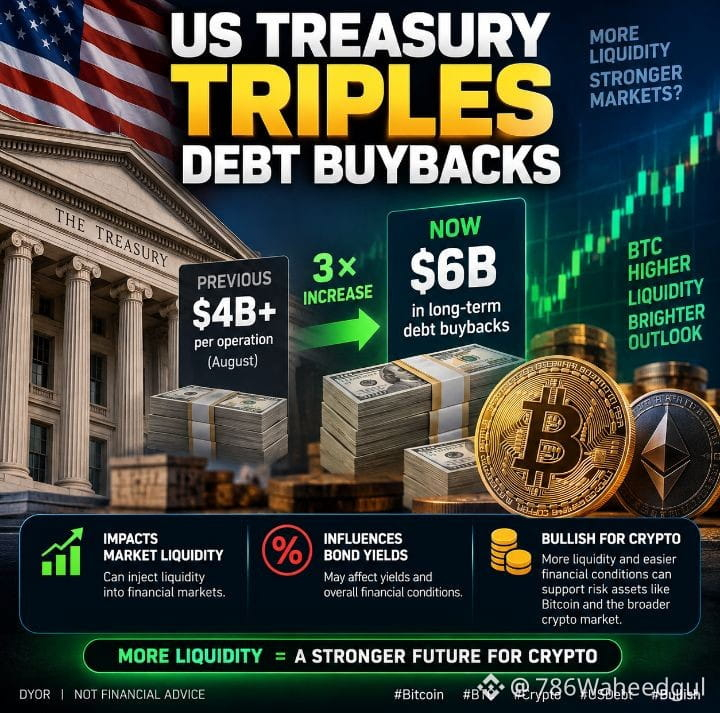
🇺🇸 US TREASURY TRIPLES DEBT BUYBACKS
The US Treasury is now buying back $6B in long-term debt, up from at least $4B per operation announced in August.
📈 Buybacks have surged to roughly 3× previous levels.
Why crypto traders care: Treasury debt buybacks can impact market liquidity, yields, and financial conditions — all of which can influence the flow of capital into risk assets like Bitcoin and crypto.
💰 More liquidity + easier financial conditions could become a tailwind for BTC and the broader crypto market.$BTC
{spot}(BTCUSDT)
#BTC #Crypto #Liquidity #USDebt #Bullish
🇺🇸 US TREASURY TRIPLES DEBT BUYBACKS
The US Treasury is now buying back $6B in long-term debt, up from at least $4B per operation announced in August.
📈 Buybacks have surged to roughly 3× previous levels.
Why crypto traders care: Treasury debt buybacks can impact market liquidity, yields, and financial conditions — all of which can influence the flow of capital into risk assets like Bitcoin and crypto.
💰 More liquidity + easier financial conditions could become a tailwind for BTC and the broader crypto market.$BTC
#BTC #Crypto #Liquidity #USDebt #Bullish
The US Treasury is now buying back $6B in long-term debt, up from at least $4B per operation announced in August.
📈 Buybacks have surged to roughly 3× previous levels.
Why crypto traders care: Treasury debt buybacks can impact market liquidity, yields, and financial conditions — all of which can influence the flow of capital into risk assets like Bitcoin and crypto.
💰 More liquidity + easier financial conditions could become a tailwind for BTC and the broader crypto market.$BTC
#BTC #Crypto #Liquidity #USDebt #Bullish
74

·
--
Bullish
🇺🇸 JUST IN: U.S. TREASURY
The U.S. Treasury is set to buy back up to $6 BILLION in longer-term debt tomorrow. 💵
📊 A notable liquidity/debt-market move that traders will be watching closely.
🔥 Watch the markets for increased volatility.
#USTreasury #USDebt
🇺🇸 JUST IN: U.S. TREASURY
The U.S. Treasury is set to buy back up to $6 BILLION in longer-term debt tomorrow. 💵
📊 A notable liquidity/debt-market move that traders will be watching closely.
🔥 Watch the markets for increased volatility.
#USTreasury #USDebt
The U.S. Treasury is set to buy back up to $6 BILLION in longer-term debt tomorrow. 💵
📊 A notable liquidity/debt-market move that traders will be watching closely.
🔥 Watch the markets for increased volatility.
#USTreasury #USDebt


4

🚨 Ray Dalio: Investors Should Own “A Bit of Bitcoin”
Ray Dalio, founder of Bridgewater Associates, says investors should consider holding some Bitcoin as concerns over rising U.S. government debt continue to grow.
According to Dalio, increasing debt could eventually weaken the U.S. dollar and make traditional bonds less attractive.
He points to several recent developments, including Japan reducing some of its U.S. Treasury holdings, rising long-term U.S. bond yields, a weaker dollar, and increased U.S. government bond buybacks.
Meanwhile, Bitcoin recently rallied from around $63,500 to above $78,000, with roughly $4 billion in bearish positions liquidated along the way.
💡 Dalio’s message is simple:
As confidence in traditional debt and currencies faces pressure, having a small allocation to Bitcoin could provide diversification.
Bitcoin isn’t risk-free — but more major investors are starting to see it as part of a diversified portfolio. ₿
#Bitcoin #BTC #Crypto #RayDalio #Binance #Investing #USDebt
$GOOGL.US
🚨 Ray Dalio: Investors Should Own “A Bit of Bitcoin”
Ray Dalio, founder of Bridgewater Associates, says investors should consider holding some Bitcoin as concerns over rising U.S. government debt continue to grow.
According to Dalio, increasing debt could eventually weaken the U.S. dollar and make traditional bonds less attractive.
He points to several recent developments, including Japan reducing some of its U.S. Treasury holdings, rising long-term U.S. bond yields, a weaker dollar, and increased U.S. government bond buybacks.
Meanwhile, Bitcoin recently rallied from around $63,500 to above $78,000, with roughly $4 billion in bearish positions liquidated along the way.
💡 Dalio’s message is simple:
As confidence in traditional debt and currencies faces pressure, having a small allocation to Bitcoin could provide diversification.
Bitcoin isn’t risk-free — but more major investors are starting to see it as part of a diversified portfolio. ₿
#Bitcoin #BTC #Crypto #RayDalio #Binance #Investing #USDebt
$GOOGL.US
Ray Dalio, founder of Bridgewater Associates, says investors should consider holding some Bitcoin as concerns over rising U.S. government debt continue to grow.
According to Dalio, increasing debt could eventually weaken the U.S. dollar and make traditional bonds less attractive.
He points to several recent developments, including Japan reducing some of its U.S. Treasury holdings, rising long-term U.S. bond yields, a weaker dollar, and increased U.S. government bond buybacks.
Meanwhile, Bitcoin recently rallied from around $63,500 to above $78,000, with roughly $4 billion in bearish positions liquidated along the way.
💡 Dalio’s message is simple:
As confidence in traditional debt and currencies faces pressure, having a small allocation to Bitcoin could provide diversification.
Bitcoin isn’t risk-free — but more major investors are starting to see it as part of a diversified portfolio. ₿
#Bitcoin #BTC #Crypto #RayDalio #Binance #Investing #USDebt
$GOOGL.US
2
77

🇺🇸 BREAKING: BESSENT SIGNALS BIGGER U.S. TREASURY BUYBACKS! 💰
U.S. Treasury Secretary Scott #BESSENT says Treasury buybacks will continue routinely and could exceed $4 BILLION per issue, with the move partly aimed at sending a strong signal to markets.
🔥 KEY TAKEAWAYS: 1️⃣ Treasury buybacks will become a routine tool. 2️⃣ Individual buybacks could exceed $4B. 3️⃣ Bessent is expected to push harder on deficit reduction. 4️⃣ He says the $40T debt level is not a “magic number” and the U.S. can grow its way out of the debt burden. 5️⃣ Treasury has already expanded buybacks for longer-term debt to at least $4B per operation. 6️⃣ Higher oil prices remain an inflation risk, while markets continue watching core inflation. 7️⃣ The Treasury is signaling that it has more tools available to manage pressure in the bond market.
⚠️ MARKET IMPACT: Bigger Treasury buybacks could influence bond yields, the dollar, gold and risk assets as investors assess the U.S. fiscal outlook.
📈 WATCH: $PEOPLE
{future}(PEOPLEUSDT)
$ENA
{future}(ENAUSDT)
$XPL
{future}(XPLUSDT)
#Bitcoin #Crypto #Treasury #ScottBessent #USDebt
🇺🇸 BREAKING: BESSENT SIGNALS BIGGER U.S. TREASURY BUYBACKS! 💰
U.S. Treasury Secretary Scott #BESSENT says Treasury buybacks will continue routinely and could exceed $4 BILLION per issue, with the move partly aimed at sending a strong signal to markets.
🔥 KEY TAKEAWAYS: 1️⃣ Treasury buybacks will become a routine tool. 2️⃣ Individual buybacks could exceed $4B. 3️⃣ Bessent is expected to push harder on deficit reduction. 4️⃣ He says the $40T debt level is not a “magic number” and the U.S. can grow its way out of the debt burden. 5️⃣ Treasury has already expanded buybacks for longer-term debt to at least $4B per operation. 6️⃣ Higher oil prices remain an inflation risk, while markets continue watching core inflation. 7️⃣ The Treasury is signaling that it has more tools available to manage pressure in the bond market.
⚠️ MARKET IMPACT: Bigger Treasury buybacks could influence bond yields, the dollar, gold and risk assets as investors assess the U.S. fiscal outlook.
📈 WATCH: $PEOPLE
$ENA
$XPL
#Bitcoin #Crypto #Treasury #ScottBessent #USDebt
U.S. Treasury Secretary Scott #BESSENT says Treasury buybacks will continue routinely and could exceed $4 BILLION per issue, with the move partly aimed at sending a strong signal to markets.
🔥 KEY TAKEAWAYS: 1️⃣ Treasury buybacks will become a routine tool. 2️⃣ Individual buybacks could exceed $4B. 3️⃣ Bessent is expected to push harder on deficit reduction. 4️⃣ He says the $40T debt level is not a “magic number” and the U.S. can grow its way out of the debt burden. 5️⃣ Treasury has already expanded buybacks for longer-term debt to at least $4B per operation. 6️⃣ Higher oil prices remain an inflation risk, while markets continue watching core inflation. 7️⃣ The Treasury is signaling that it has more tools available to manage pressure in the bond market.
⚠️ MARKET IMPACT: Bigger Treasury buybacks could influence bond yields, the dollar, gold and risk assets as investors assess the U.S. fiscal outlook.
📈 WATCH: $PEOPLE
$ENA
$XPL
#Bitcoin #Crypto #Treasury #ScottBessent #USDebt

112


TreasuryBuybacksCouldExceed$4BPerIssue
🏦💰 Treasury buybacks could exceed $4 billion per issue! 🚨
The U.S. Treasury market may be on the verge of another major wave of repurchases, where individual transactions could top $4 billion per issue. 📈
Broad-scale buybacks can play an important role in managing the Treasury market, improving liquidity, and influencing the supply of outstanding government debt. But for traders, the biggest question is what it might mean for bond yields, the dollar, and broader risk assets. 👀
If repurchase activity continues at high levels, markets may see stronger concentration on Treasury buy orders and liquidity conditions.
$4 billion+ per issue? Those are figures the market can’t ignore. 🔥
👑 Please follow
#Treasury #USDebt #Bonds #USTreasury
$BTC
$ETH
$BNB
TreasuryBuybacksCouldExceed$4BPerIssue
🏦💰 Treasury buybacks could exceed $4 billion per issue! 🚨
The U.S. Treasury market may be on the verge of another major wave of repurchases, where individual transactions could top $4 billion per issue. 📈
Broad-scale buybacks can play an important role in managing the Treasury market, improving liquidity, and influencing the supply of outstanding government debt. But for traders, the biggest question is what it might mean for bond yields, the dollar, and broader risk assets. 👀
If repurchase activity continues at high levels, markets may see stronger concentration on Treasury buy orders and liquidity conditions.
$4 billion+ per issue? Those are figures the market can’t ignore. 🔥
👑 Please follow
#Treasury #USDebt #Bonds #USTreasury
$BTC
$ETH
$BNB
🏦💰 Treasury buybacks could exceed $4 billion per issue! 🚨
The U.S. Treasury market may be on the verge of another major wave of repurchases, where individual transactions could top $4 billion per issue. 📈
Broad-scale buybacks can play an important role in managing the Treasury market, improving liquidity, and influencing the supply of outstanding government debt. But for traders, the biggest question is what it might mean for bond yields, the dollar, and broader risk assets. 👀
If repurchase activity continues at high levels, markets may see stronger concentration on Treasury buy orders and liquidity conditions.
$4 billion+ per issue? Those are figures the market can’t ignore. 🔥
👑 Please follow
#Treasury #USDebt #Bonds #USTreasury
$BTC
$ETH
$BNB

1
101


·
--
🚨 JUST IN: 🇺🇸 Treasury Secretary Scott Bessent says U.S. debt buybacks could exceed the previously announced $4 BILLION per operation.
The Treasury already doubled long-term bond buybacks as the 30-year yield hit its highest level since 2007.
Now Bessent is signaling MORE firepower may be coming.
🇺🇸 Debt > $40T
📈 Borrowing costs rising
💵 Treasury stepping into the bond market
🔥 More buybacks could mean more liquidity support
But,
Buybacks can calm the bond market they don’t make the $40T debt disappear.
Markets are watching Bessent closely. 👀
#Bitcoin #Crypto #Fed #Treasury #USDebt #Bonds #InterestRates #Inflation #Liquidity
🚨 JUST IN: 🇺🇸 Treasury Secretary Scott Bessent says U.S. debt buybacks could exceed the previously announced $4 BILLION per operation.
The Treasury already doubled long-term bond buybacks as the 30-year yield hit its highest level since 2007.
Now Bessent is signaling MORE firepower may be coming.
🇺🇸 Debt > $40T
📈 Borrowing costs rising
💵 Treasury stepping into the bond market
🔥 More buybacks could mean more liquidity support
But,
Buybacks can calm the bond market they don’t make the $40T debt disappear.
Markets are watching Bessent closely. 👀
#Bitcoin #Crypto #Fed #Treasury #USDebt #Bonds #InterestRates #Inflation #Liquidity
The Treasury already doubled long-term bond buybacks as the 30-year yield hit its highest level since 2007.
Now Bessent is signaling MORE firepower may be coming.
🇺🇸 Debt > $40T
📈 Borrowing costs rising
💵 Treasury stepping into the bond market
🔥 More buybacks could mean more liquidity support
But,
Buybacks can calm the bond market they don’t make the $40T debt disappear.
Markets are watching Bessent closely. 👀
#Bitcoin #Crypto #Fed #Treasury #USDebt #Bonds #InterestRates #Inflation #Liquidity
92

·
--
Bullish
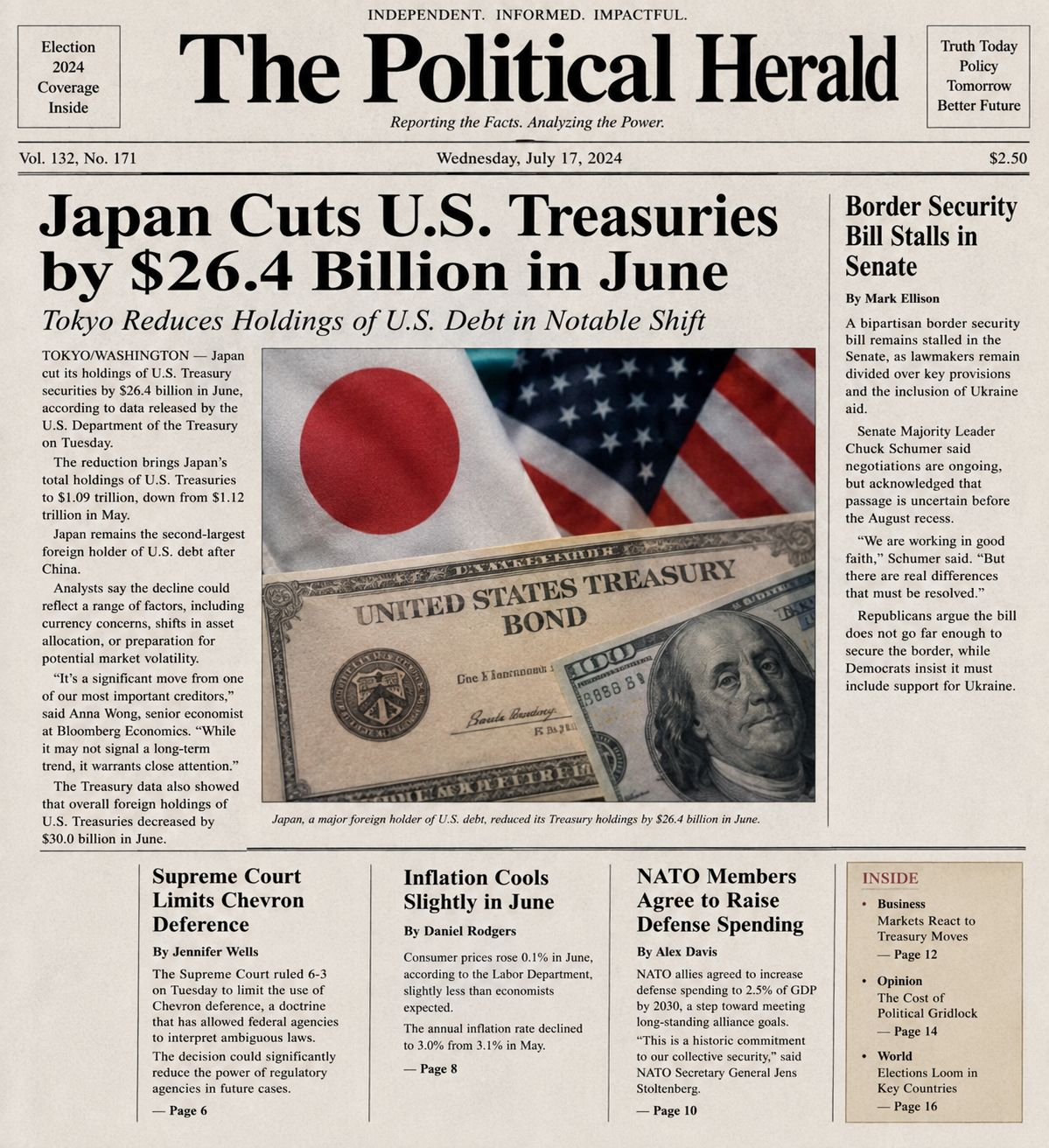
🇯🇵💰 Japan Cuts U.S. Treasuries by $26.4B in June
Japan reduced its holdings of U.S. Treasury securities by $26.4 billion in June. 📉🇺🇸
That’s a notable move from one of the biggest foreign holders of U.S. debt. Could this signal a shift in Japan’s asset allocation—or simply portfolio rebalancing?
👀 Traders will be watching whether the selling continues in the coming months.
#Japan #USTreasuries #USDebt #Bonds
$BTC
$ETH
$BNB
{spot}(BNBUSDT)
{spot}(ETHUSDT)
{spot}(BTCUSDT)
🇯🇵💰 Japan Cuts U.S. Treasuries by $26.4B in June
Japan reduced its holdings of U.S. Treasury securities by $26.4 billion in June. 📉🇺🇸
That’s a notable move from one of the biggest foreign holders of U.S. debt. Could this signal a shift in Japan’s asset allocation—or simply portfolio rebalancing?
👀 Traders will be watching whether the selling continues in the coming months.
#Japan #USTreasuries #USDebt #Bonds
$BTC
$ETH
$BNB
Japan reduced its holdings of U.S. Treasury securities by $26.4 billion in June. 📉🇺🇸
That’s a notable move from one of the biggest foreign holders of U.S. debt. Could this signal a shift in Japan’s asset allocation—or simply portfolio rebalancing?
👀 Traders will be watching whether the selling continues in the coming months.
#Japan #USTreasuries #USDebt #Bonds
$BTC
$ETH
$BNB
1
78

#USDebtMayTop$40Trillion
🚨 $40 TRILLION U.S. DEBT?
America’s national debt is heading toward a shocking $40 trillion. 🇺🇸💰
More debt means:
📈 Higher interest costs
💵 More borrowing
🌎 More pressure on global markets
And for crypto? 👀
A growing debt problem could make Bitcoin’s scarcity narrative even stronger.
$40T isn’t just a big number — it could be a warning. 🚨
#USDebt #Bitcoin #Crypto #BTC
$BTC
{spot}(BTCUSDT)
$ETH
{spot}(ETHUSDT)
#USDebtMayTop$40Trillion
🚨 $40 TRILLION U.S. DEBT?
America’s national debt is heading toward a shocking $40 trillion. 🇺🇸💰
More debt means:
📈 Higher interest costs
💵 More borrowing
🌎 More pressure on global markets
And for crypto? 👀
A growing debt problem could make Bitcoin’s scarcity narrative even stronger.
$40T isn’t just a big number — it could be a warning. 🚨
#USDebt #Bitcoin #Crypto #BTC
$BTC
$ETH
🚨 $40 TRILLION U.S. DEBT?
America’s national debt is heading toward a shocking $40 trillion. 🇺🇸💰
More debt means:
📈 Higher interest costs
💵 More borrowing
🌎 More pressure on global markets
And for crypto? 👀
A growing debt problem could make Bitcoin’s scarcity narrative even stronger.
$40T isn’t just a big number — it could be a warning. 🚨
#USDebt #Bitcoin #Crypto #BTC
$BTC
$ETH
70

·
--
#USDebtMayTop$40Trillion
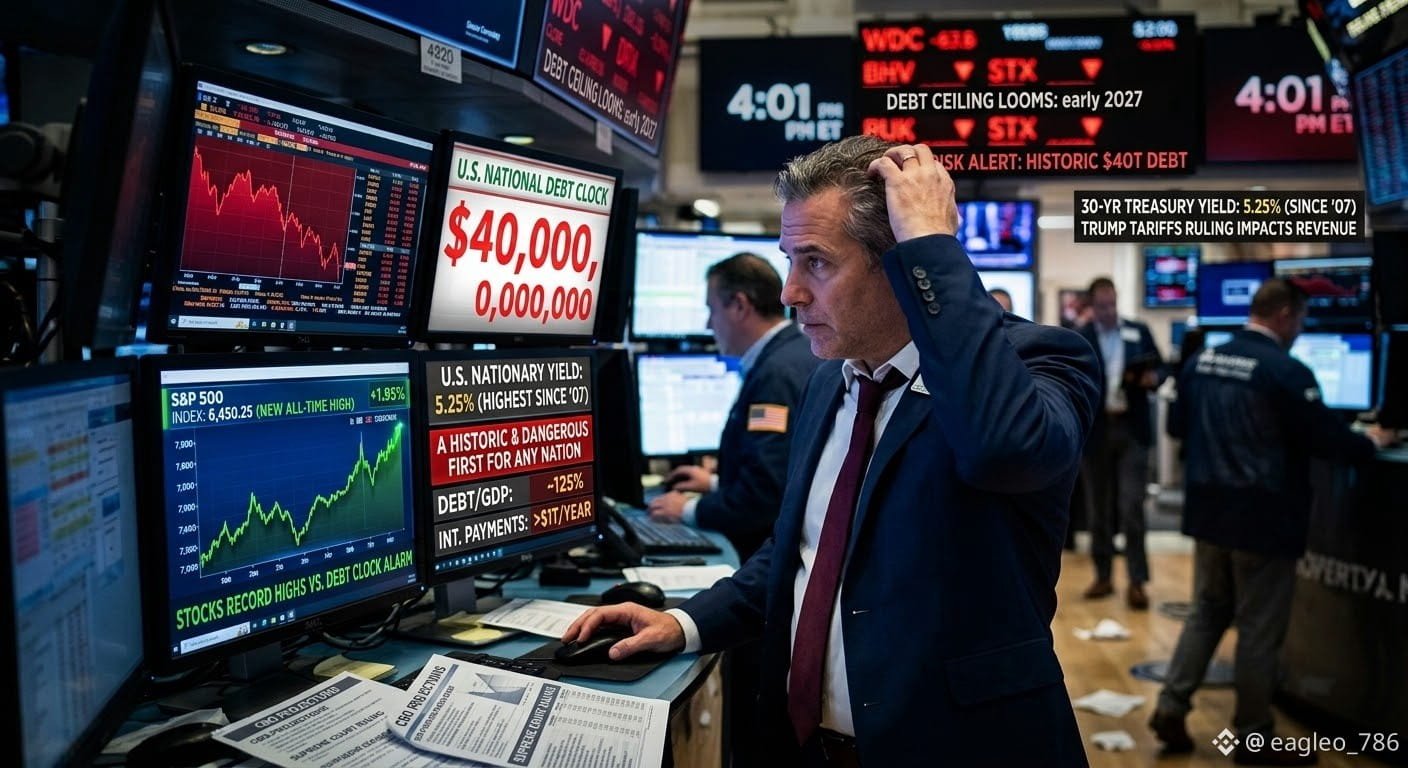
The US just quietly crossed a line no country has ever crossed before. 🇺🇸
National debt is now sitting around $40 trillion, hitting the mark days or weeks earlier than the CBO had originally projected. Part of the reason: a Supreme Court ruling struck down Trump's tariffs, wiping out an estimated $250 billion in expected revenue, so the Treasury has had to borrow even harder to cover the gap.
A few numbers that put this in perspective:
• It took 192 years to rack up the first trillion. The last trillion took about 5 months.
• Interest payments alone are running past $1 trillion a year — more than the entire defense budget, more than Medicare. Only Social Security costs more.
• Debt is now roughly 125% of GDP.
• The debt ceiling, set at $41.1 trillion just last year, could be hit again as soon as early 2027.
And here's the part that should make you pause: while this is happening, the S&P 500 is sitting near record highs. Stocks and the debt clock are both climbing at the same time, which isn't normal, it's just where we are.
Meanwhile Treasury yields are backing this up in real time — the 30-year just hit its highest level since 2007, north of 5.2%, as investors demand more to keep lending Uncle Sam money. That's not a coincidence. That's the market pricing in the risk.
$40T isn't the finish line either. Some strategists are already talking about $50T by the end of the decade.
Worth remembering next time someone tells you macro doesn't matter for crypto. 👀
#USDebt #Macro #Treasury #Economy
#USDebtMayTop$40Trillion
The US just quietly crossed a line no country has ever crossed before. 🇺🇸
National debt is now sitting around $40 trillion, hitting the mark days or weeks earlier than the CBO had originally projected. Part of the reason: a Supreme Court ruling struck down Trump's tariffs, wiping out an estimated $250 billion in expected revenue, so the Treasury has had to borrow even harder to cover the gap.
A few numbers that put this in perspective:
• It took 192 years to rack up the first trillion. The last trillion took about 5 months.
• Interest payments alone are running past $1 trillion a year — more than the entire defense budget, more than Medicare. Only Social Security costs more.
• Debt is now roughly 125% of GDP.
• The debt ceiling, set at $41.1 trillion just last year, could be hit again as soon as early 2027.
And here's the part that should make you pause: while this is happening, the S&P 500 is sitting near record highs. Stocks and the debt clock are both climbing at the same time, which isn't normal, it's just where we are.
Meanwhile Treasury yields are backing this up in real time — the 30-year just hit its highest level since 2007, north of 5.2%, as investors demand more to keep lending Uncle Sam money. That's not a coincidence. That's the market pricing in the risk.
$40T isn't the finish line either. Some strategists are already talking about $50T by the end of the decade.
Worth remembering next time someone tells you macro doesn't matter for crypto. 👀
#USDebt #Macro #Treasury #Economy
The US just quietly crossed a line no country has ever crossed before. 🇺🇸
National debt is now sitting around $40 trillion, hitting the mark days or weeks earlier than the CBO had originally projected. Part of the reason: a Supreme Court ruling struck down Trump's tariffs, wiping out an estimated $250 billion in expected revenue, so the Treasury has had to borrow even harder to cover the gap.
A few numbers that put this in perspective:
• It took 192 years to rack up the first trillion. The last trillion took about 5 months.
• Interest payments alone are running past $1 trillion a year — more than the entire defense budget, more than Medicare. Only Social Security costs more.
• Debt is now roughly 125% of GDP.
• The debt ceiling, set at $41.1 trillion just last year, could be hit again as soon as early 2027.
And here's the part that should make you pause: while this is happening, the S&P 500 is sitting near record highs. Stocks and the debt clock are both climbing at the same time, which isn't normal, it's just where we are.
Meanwhile Treasury yields are backing this up in real time — the 30-year just hit its highest level since 2007, north of 5.2%, as investors demand more to keep lending Uncle Sam money. That's not a coincidence. That's the market pricing in the risk.
$40T isn't the finish line either. Some strategists are already talking about $50T by the end of the decade.
Worth remembering next time someone tells you macro doesn't matter for crypto. 👀
#USDebt #Macro #Treasury #Economy
75

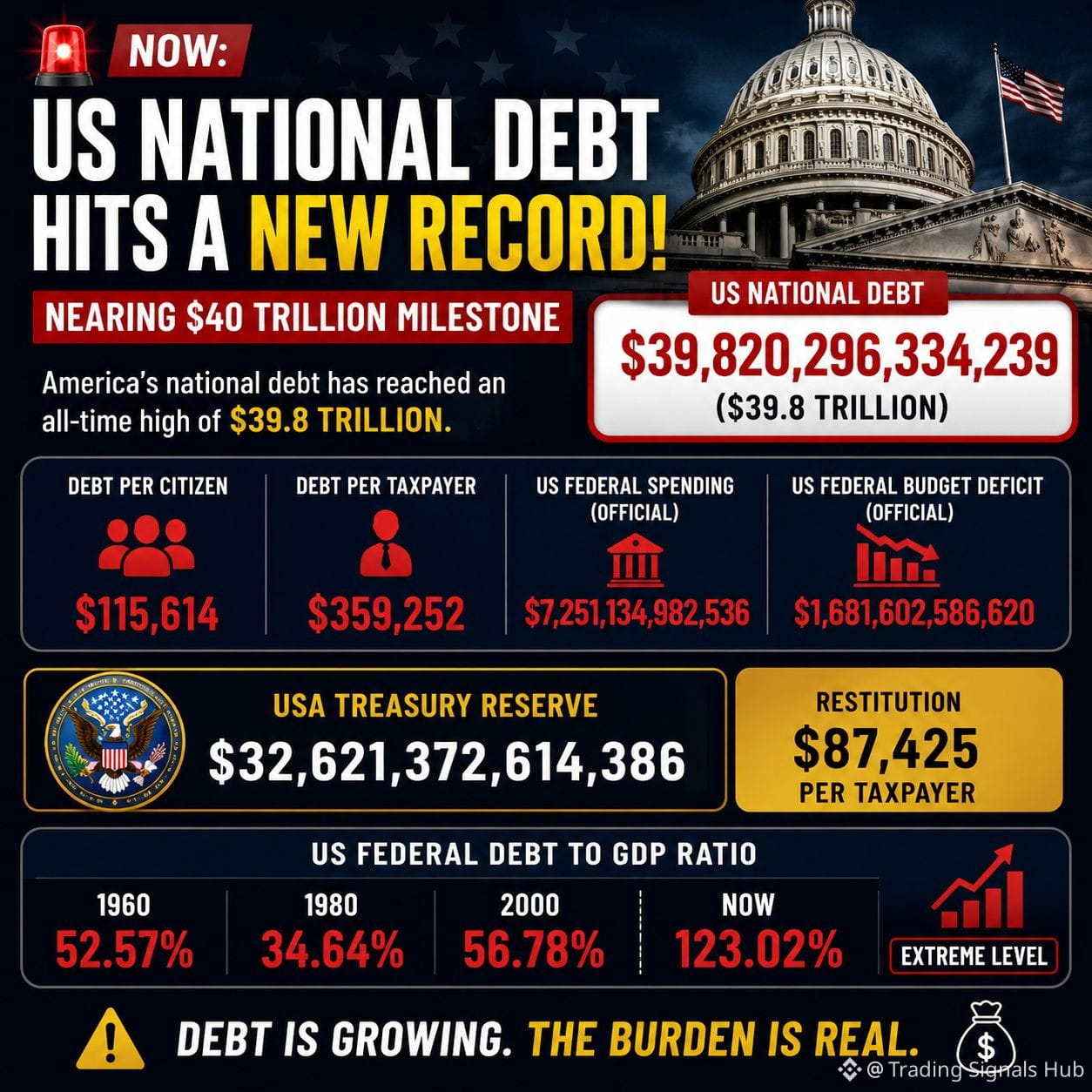
🚨 US National Debt Nears $40 Trillion
🇺🇸 America’s national debt has climbed to a record $39.8 trillion, pushing closer to the massive $40T milestone.
📊 The US debt-to-GDP ratio now stands at around 123%, highlighting the growing scale of America’s debt burden.
#USDebt #NationalDebt #USEconomy
🚨 US National Debt Nears $40 Trillion
🇺🇸 America’s national debt has climbed to a record $39.8 trillion, pushing closer to the massive $40T milestone.
📊 The US debt-to-GDP ratio now stands at around 123%, highlighting the growing scale of America’s debt burden.
#USDebt #NationalDebt #USEconomy
🇺🇸 America’s national debt has climbed to a record $39.8 trillion, pushing closer to the massive $40T milestone.
📊 The US debt-to-GDP ratio now stands at around 123%, highlighting the growing scale of America’s debt burden.
#USDebt #NationalDebt #USEconomy
106

⚠️ The US national debt records a new record: potential repercussions for the markets!
The US national debt has reached an unprecedented level of $34.5 trillion, with analysts warning that the situation could worsen further. Interest payments on federal debt are now $24 billion per week, raising concerns about global financial and economic stability.
━━━━━━━━━━━━━━
📊 Impact: 🔥 Very high
🏷️ OTHER
#USDebt #Economy #FinancialStability #GlobalMarkets #InterestRates
🔗 Source: https://dailyhodl.com/2026/07/18/us-national-debt-hits-record-34500000000000-as-analysts-urge-immediate-action-warn-outlook-projected-to-deteriorate-further/
⚠️ The US national debt records a new record: potential repercussions for the markets!
The US national debt has reached an unprecedented level of $34.5 trillion, with analysts warning that the situation could worsen further. Interest payments on federal debt are now $24 billion per week, raising concerns about global financial and economic stability.
━━━━━━━━━━━━━━
📊 Impact: 🔥 Very high
🏷️ OTHER
#USDebt #Economy #FinancialStability #GlobalMarkets #InterestRates
🔗 Source: https://dailyhodl.com/2026/07/18/us-national-debt-hits-record-34500000000000-as-analysts-urge-immediate-action-warn-outlook-projected-to-deteriorate-further/
The US national debt has reached an unprecedented level of $34.5 trillion, with analysts warning that the situation could worsen further. Interest payments on federal debt are now $24 billion per week, raising concerns about global financial and economic stability.
━━━━━━━━━━━━━━
📊 Impact: 🔥 Very high
🏷️ OTHER
#USDebt #Economy #FinancialStability #GlobalMarkets #InterestRates
🔗 Source: https://dailyhodl.com/2026/07/18/us-national-debt-hits-record-34500000000000-as-analysts-urge-immediate-action-warn-outlook-projected-to-deteriorate-further/
16

·
--
🌍📉 Global Bond Market Pressure — Sovereign Capital Rotation ⚠️💰
🚨 Global pressure on US Treasury holdings is gradually increasing 📉🌍
Recent market reports suggest that some countries have been adjusting their exposure to US Treasuries as global financial conditions continue to shift 💵⚖️
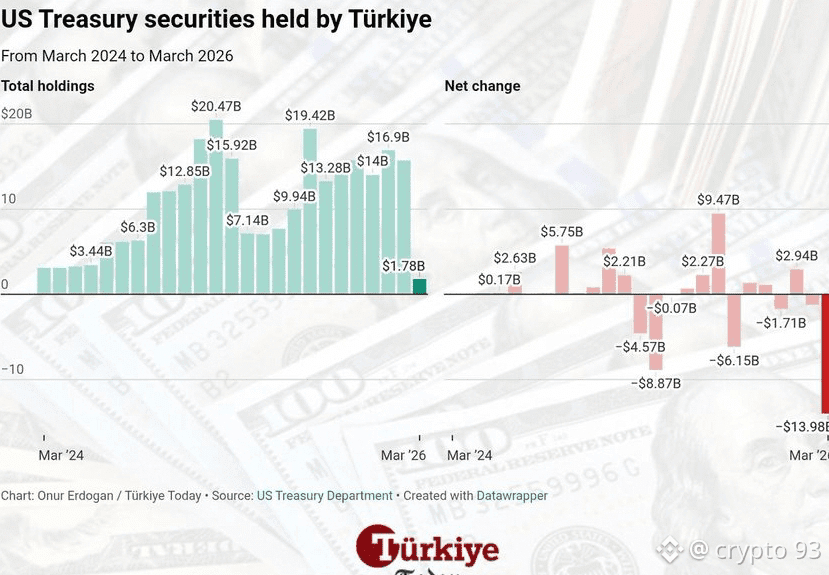
🇹🇷 Turkey has reportedly reduced part of its holdings, alongside broader positioning changes seen across several economies 📊
Other major holders, including China 🇨🇳 and Japan 🇯🇵, have also shown long-term adjustments in their exposure over time.
📉 This reflects a broader global pattern: Sovereign investors are reassessing debt allocations amid changing interest rates, inflation trends, and evolving currency strategies 💡🌐
💰 US Treasuries remain a core global asset, but participation patterns are gradually evolving rather than disappearing 🔄$BTC
{spot}(BTCUSDT)
$ETH
{future}(ETHUSDT)
$XRP
{spot}(XRPUSDT)
📊 Crypto Market Snapshot: ETHUSDT ➝ 2,140.5 📈
XRPUSDT ➝ 1.3806 📈
BTCUSDT ➝ 77,771.2 📈
⚠️ Overall, this appears to be part of a global macro rebalancing cycle — a shift in capital distribution rather than a systemic exit from US debt markets 🔄🌍
#Turkey #MacroEconomy #USDebt #Crypto #Markets 📊🔥
🌍📉 Global Bond Market Pressure — Sovereign Capital Rotation ⚠️💰
🚨 Global pressure on US Treasury holdings is gradually increasing 📉🌍
Recent market reports suggest that some countries have been adjusting their exposure to US Treasuries as global financial conditions continue to shift 💵⚖️
🇹🇷 Turkey has reportedly reduced part of its holdings, alongside broader positioning changes seen across several economies 📊
Other major holders, including China 🇨🇳 and Japan 🇯🇵, have also shown long-term adjustments in their exposure over time.
📉 This reflects a broader global pattern: Sovereign investors are reassessing debt allocations amid changing interest rates, inflation trends, and evolving currency strategies 💡🌐
💰 US Treasuries remain a core global asset, but participation patterns are gradually evolving rather than disappearing 🔄$BTC
$ETH
$XRP
📊 Crypto Market Snapshot: ETHUSDT ➝ 2,140.5 📈
XRPUSDT ➝ 1.3806 📈
BTCUSDT ➝ 77,771.2 📈
⚠️ Overall, this appears to be part of a global macro rebalancing cycle — a shift in capital distribution rather than a systemic exit from US debt markets 🔄🌍
#Turkey #MacroEconomy #USDebt #Crypto #Markets 📊🔥
🚨 Global pressure on US Treasury holdings is gradually increasing 📉🌍
Recent market reports suggest that some countries have been adjusting their exposure to US Treasuries as global financial conditions continue to shift 💵⚖️
🇹🇷 Turkey has reportedly reduced part of its holdings, alongside broader positioning changes seen across several economies 📊
Other major holders, including China 🇨🇳 and Japan 🇯🇵, have also shown long-term adjustments in their exposure over time.
📉 This reflects a broader global pattern: Sovereign investors are reassessing debt allocations amid changing interest rates, inflation trends, and evolving currency strategies 💡🌐
💰 US Treasuries remain a core global asset, but participation patterns are gradually evolving rather than disappearing 🔄$BTC
$ETH
$XRP
📊 Crypto Market Snapshot: ETHUSDT ➝ 2,140.5 📈
XRPUSDT ➝ 1.3806 📈
BTCUSDT ➝ 77,771.2 📈
⚠️ Overall, this appears to be part of a global macro rebalancing cycle — a shift in capital distribution rather than a systemic exit from US debt markets 🔄🌍
#Turkey #MacroEconomy #USDebt #Crypto #Markets 📊🔥
145

·
--
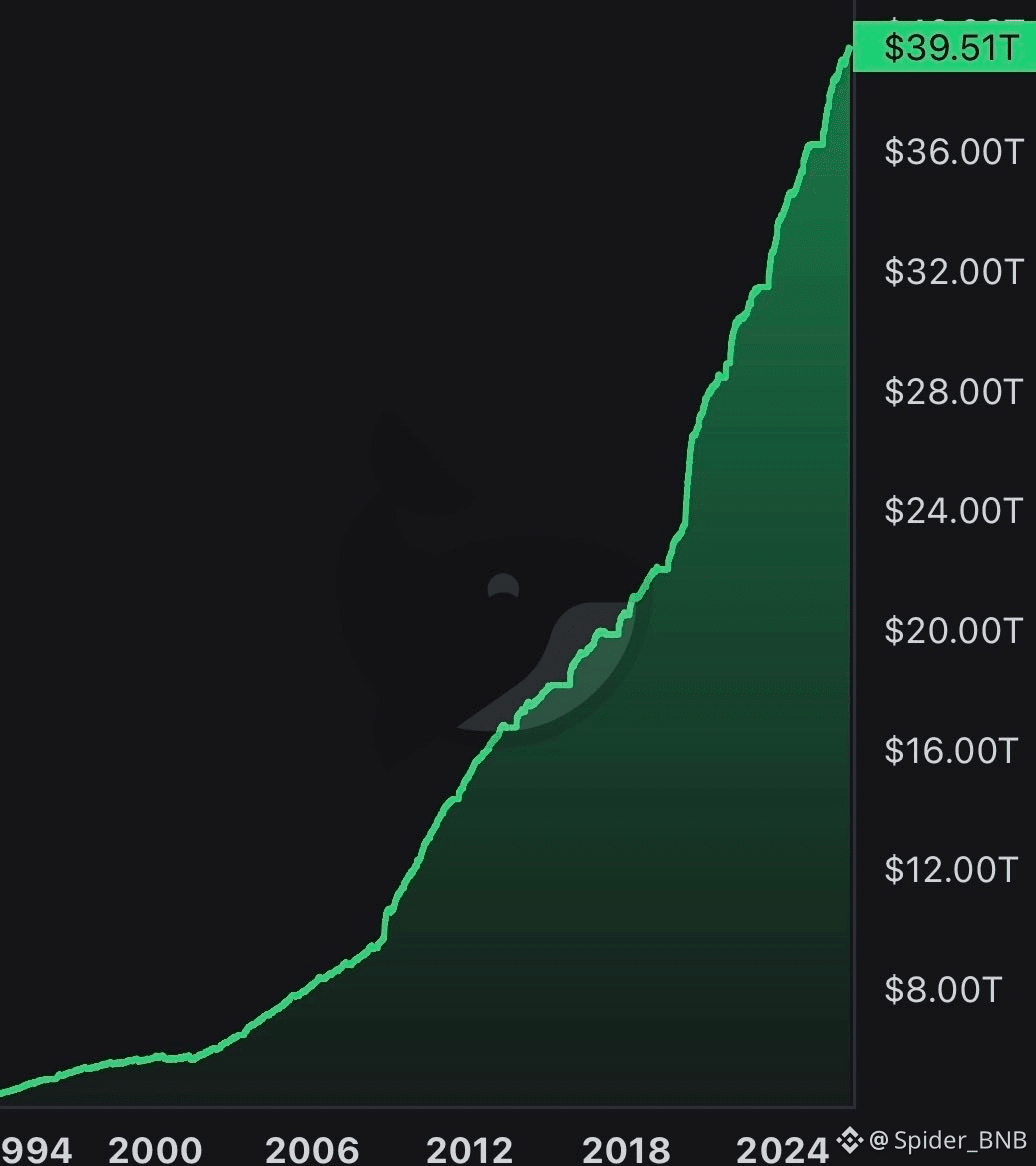
### 📉 US Federal Debt Explodes: Reaching an Unprecedented $39.51 Trillion
The macroeconomic clock is ticking faster than ever. Newly released Treasury data highlights a staggering vertical spike in the **United States Gross National Debt**, officially hitting a jaw-dropping **$39.51 Trillion**
. The velocity of this expansion is unprecedented, marking a massive multibillion-dollar daily push into unchartered fiscal territory.
### 📊 The Macro Timeline
* **1994 – 2006:** A period of steady, linear escalation.
* **2008 – 2020:** Accelerated growth triggered by the Great Recession, followed by the massive monetary expansion of the COVID-19 pandemic.
* **2020 – 2026:** The curve goes completely vertical, adding roughly **$3.2 Trillion over the last 12 months alone** as inflation, deficits, and compounding interest costs completely dominate the balance sheet.
### 🔍 Hard-Hitting Takeaways
* **⚡ Compounding Interest Trap:** With the national debt rapidly approaching the psychological **$40 Trillion** milestone, interest payments are increasingly squeezing out other federal spending sectors.
* **💸 The Currency Dilution Engine:** When debt increases at this velocity, it acts as a structural engine for long-term currency devaluation, continuously feeding inflationary pressures into the everyday economy.
* **🛡️ The Case for Hard Assets:** This aggressive upward chart trajectory is precisely why institutional capital is steadily rotating into hard, decentralized assets. When sovereign fiat debt behaves like a parabolic speculative token, fixed-supply assets like **Bitcoin** and gold transition from optional hedges to macro necessities.
**Tags:** #USDebt #SPIDER_BNB
### 📉 US Federal Debt Explodes: Reaching an Unprecedented $39.51 Trillion
The macroeconomic clock is ticking faster than ever. Newly released Treasury data highlights a staggering vertical spike in the **United States Gross National Debt**, officially hitting a jaw-dropping **$39.51 Trillion**
. The velocity of this expansion is unprecedented, marking a massive multibillion-dollar daily push into unchartered fiscal territory.
### 📊 The Macro Timeline
* **1994 – 2006:** A period of steady, linear escalation.
* **2008 – 2020:** Accelerated growth triggered by the Great Recession, followed by the massive monetary expansion of the COVID-19 pandemic.
* **2020 – 2026:** The curve goes completely vertical, adding roughly **$3.2 Trillion over the last 12 months alone** as inflation, deficits, and compounding interest costs completely dominate the balance sheet.
### 🔍 Hard-Hitting Takeaways
* **⚡ Compounding Interest Trap:** With the national debt rapidly approaching the psychological **$40 Trillion** milestone, interest payments are increasingly squeezing out other federal spending sectors.
* **💸 The Currency Dilution Engine:** When debt increases at this velocity, it acts as a structural engine for long-term currency devaluation, continuously feeding inflationary pressures into the everyday economy.
* **🛡️ The Case for Hard Assets:** This aggressive upward chart trajectory is precisely why institutional capital is steadily rotating into hard, decentralized assets. When sovereign fiat debt behaves like a parabolic speculative token, fixed-supply assets like **Bitcoin** and gold transition from optional hedges to macro necessities.
**Tags:** #USDebt #SPIDER_BNB
The macroeconomic clock is ticking faster than ever. Newly released Treasury data highlights a staggering vertical spike in the **United States Gross National Debt**, officially hitting a jaw-dropping **$39.51 Trillion**
. The velocity of this expansion is unprecedented, marking a massive multibillion-dollar daily push into unchartered fiscal territory.
### 📊 The Macro Timeline
* **1994 – 2006:** A period of steady, linear escalation.
* **2008 – 2020:** Accelerated growth triggered by the Great Recession, followed by the massive monetary expansion of the COVID-19 pandemic.
* **2020 – 2026:** The curve goes completely vertical, adding roughly **$3.2 Trillion over the last 12 months alone** as inflation, deficits, and compounding interest costs completely dominate the balance sheet.
### 🔍 Hard-Hitting Takeaways
* **⚡ Compounding Interest Trap:** With the national debt rapidly approaching the psychological **$40 Trillion** milestone, interest payments are increasingly squeezing out other federal spending sectors.
* **💸 The Currency Dilution Engine:** When debt increases at this velocity, it acts as a structural engine for long-term currency devaluation, continuously feeding inflationary pressures into the everyday economy.
* **🛡️ The Case for Hard Assets:** This aggressive upward chart trajectory is precisely why institutional capital is steadily rotating into hard, decentralized assets. When sovereign fiat debt behaves like a parabolic speculative token, fixed-supply assets like **Bitcoin** and gold transition from optional hedges to macro necessities.
**Tags:** #USDebt #SPIDER_BNB
2
269
Log in to explore more content
Join global crypto users on Binance Square
⚡️ Get latest and useful information about crypto.
💬 Trusted by the world’s largest crypto exchange.
👍 Discover real insights from verified creators.
Email / Phone number
Trending Topics
1
#SaylorHintsStrategyBitcoinBuy
2.3M views
12,565 Discussing
2
#BOJRaisesRatesTo31YearHigh
268,131 views
3,352 Discussing
3
#BuffettStepsDownAsBerkshireChairman
131,702 views
1,818 Discussing
4
#XRPExchangeReservesHitSevenYearLow
144,028 views
1,591 Discussing
5
#HKCompletesFirstHKDStablecoinUseCase
161,536 views
1,954 Discussing
6
#VietnamPlansFirstCryptoLicensesIn2026
101,873 views
1,323 Discussing
7
#BTCBreaks80K
552,579 views
5,838 Discussing
8
#BitcoinMarketCapTopsTesla
137,623 views
1,433 Discussing
9
#SOLJumpsAbout10%
137,506 views
1,285 Discussing
10
#EthereumReclaims$2600
12,791 views
142 Discussing