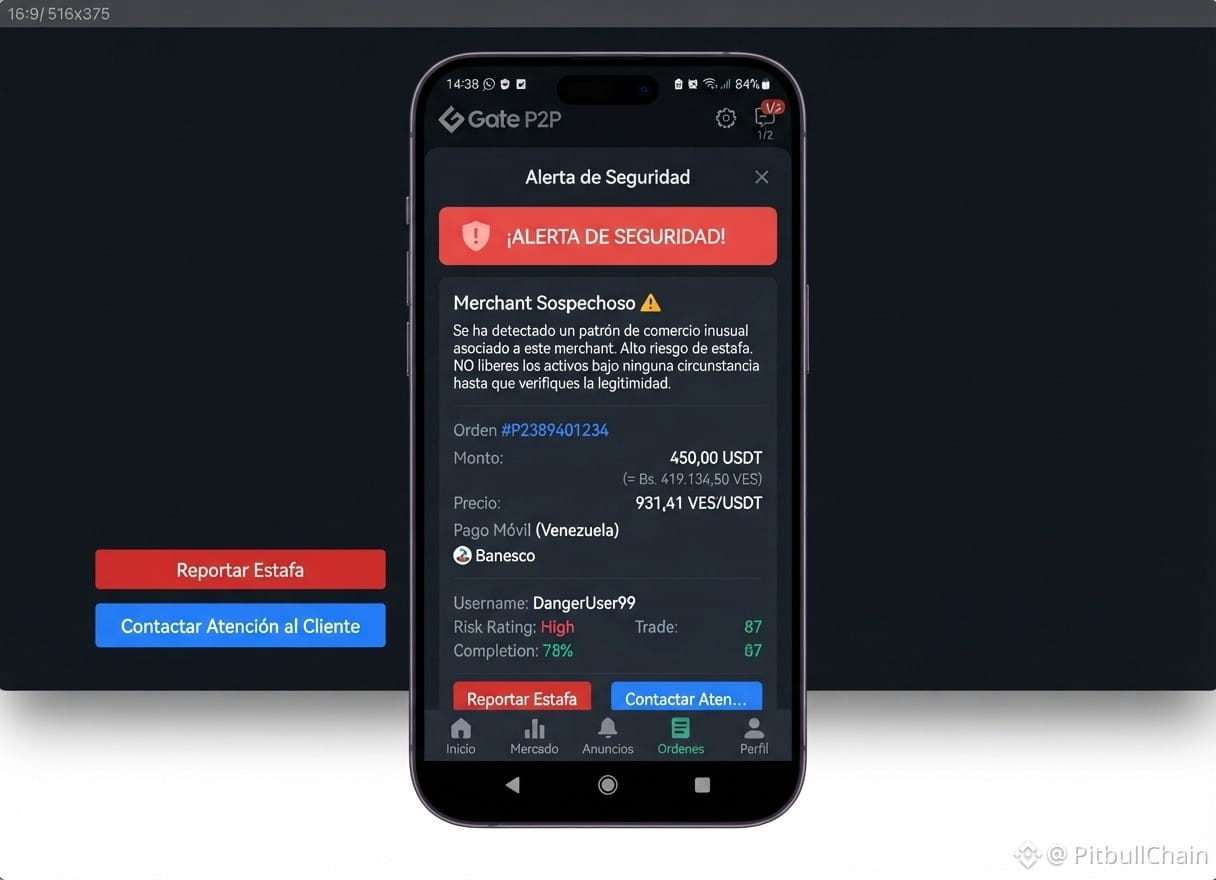
Binance Square
#seguridadcripto

seguridadcripto

322,439 views
363 Discussing
HadesCripto
·
--
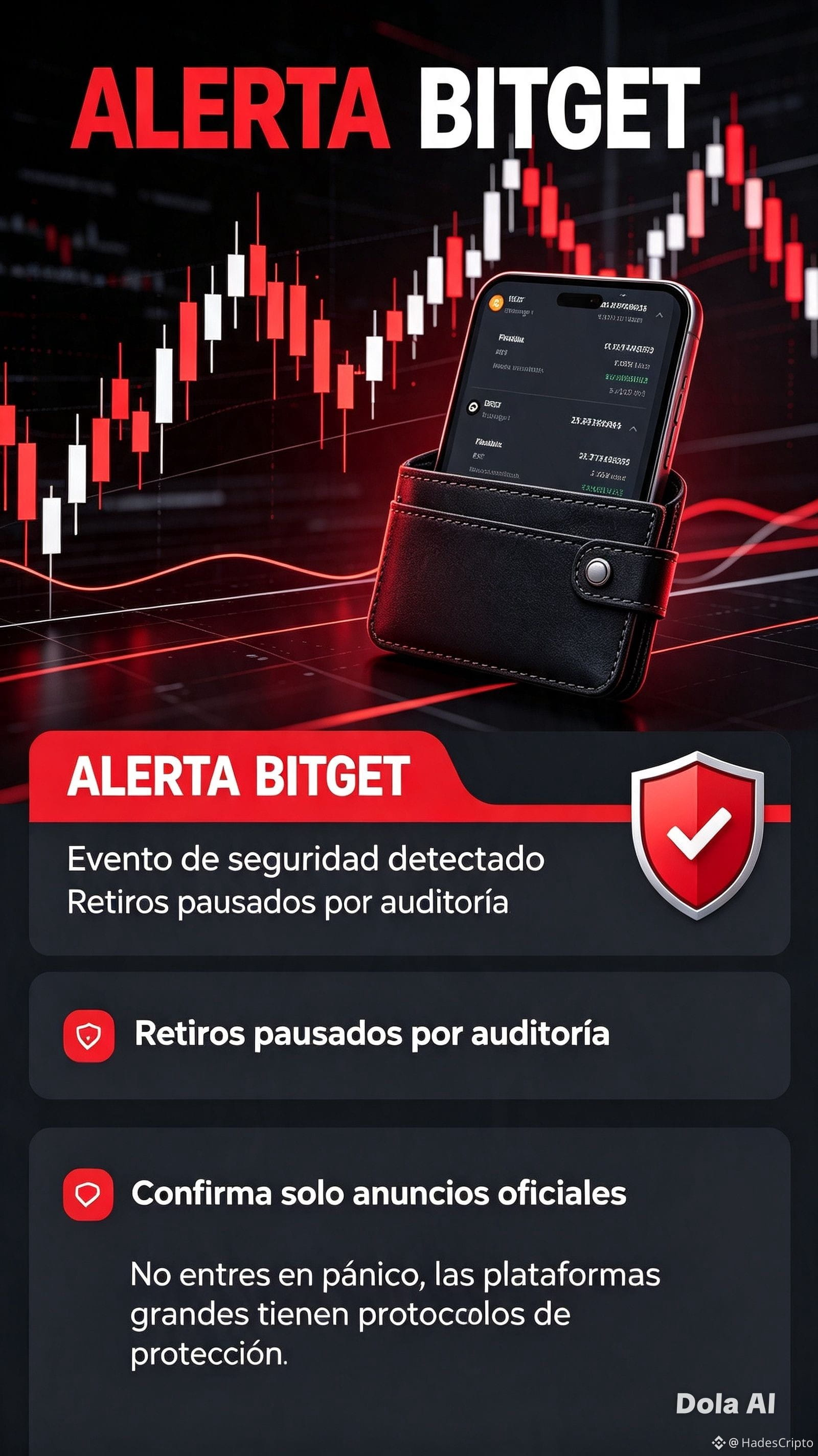
🚨 BITGET SECURITY ALERT — HOT WALLET EVENT 🐦‍🔥🔥 📌 Source: Bitget official announcement · Own analysis — HadesCripto 📅 September 25, 2026 🔹 THE INCIDENT: Bitget reported this early morning a security event in its hot wallets 🔥. As an immediate protective measure, they temporarily suspended withdrawals from the platform to audit and secure all funds 🔒 🔹 WHAT IS KNOWN SO FAR: - ✅ The withdrawal suspension is preventive while they review the situation ​ - ✅ The security team is working on the recovery and verification of funds ​ - ✅ Withdrawals are expected to resume once the security audit is completed ​ - ⏱️ They did not give an exact time for reactivation → we recommend staying alert to official announcements 🔹 WHAT YOU SHOULD DO: - 🚫 Do not try to withdraw funds right now → the system is suspended ​ - ✅ Stay calm → this type of security pause is standard to protect users’ assets ​ - ✅ Only trust Bitget official announcements → avoid links or third-party information 🛡️ ​ - ✅ If you have funds there, don’t panic → the platform typically covers affected funds with its user protection fund 💡 Big platforms have security protocols for these cases. The key point: don’t share keys, don’t click strange links, and wait for the official withdrawal resumption announcement. 📢 Do you have funds on Bitget? What do you think about this kind of preventive measures? Comment 👇 🐦‍🔥 HadesCripto — Your safety first #SeguridadCripto #MarketNews #HadesCripto
🚨 BITGET SECURITY ALERT — HOT WALLET EVENT 🐦‍🔥🔥

📌 Source: Bitget official announcement · Own analysis — HadesCripto
📅 September 25, 2026

🔹 THE INCIDENT: Bitget reported this early morning a security event in its hot wallets 🔥. As an immediate protective measure, they temporarily suspended withdrawals from the platform to audit and secure all funds 🔒

🔹 WHAT IS KNOWN SO FAR:

- ✅ The withdrawal suspension is preventive while they review the situation
​
- ✅ The security team is working on the recovery and verification of funds
​
- ✅ Withdrawals are expected to resume once the security audit is completed
​
- ⏱️ They did not give an exact time for reactivation → we recommend staying alert to official announcements

🔹 WHAT YOU SHOULD DO:

- 🚫 Do not try to withdraw funds right now → the system is suspended
​
- ✅ Stay calm → this type of security pause is standard to protect users’ assets
​
- ✅ Only trust Bitget official announcements → avoid links or third-party information 🛡️
​
- ✅ If you have funds there, don’t panic → the platform typically covers affected funds with its user protection fund

💡 Big platforms have security protocols for these cases. The key point: don’t share keys, don’t click strange links, and wait for the official withdrawal resumption announcement.

📢 Do you have funds on Bitget? What do you think about this kind of preventive measures? Comment 👇

🐦‍🔥 HadesCripto — Your safety first

#SeguridadCripto #MarketNews #HadesCripto
·
--
⚠️ 3 Typical Mistakes When Starting in Crypto Currencies (Avoid Them!) 🛑 If you’re just starting on Binance, memorize this so you don’t lose your money: 1️⃣ FOMO (Fear of Missing Out): Buying a cryptocurrency just because it’s rising fast and everyone is talking about it on social media. Almost always it ends in a loss. Buy with a strategy, not with emotion. 2️⃣ The “Get Rich Tomorrow” story: Falling for scams that promise fixed profits or doubling your crypto. Binance will never ask for your keys privately. If it sounds too good to be true, it’s a scam. ❌ 3️⃣ Not using basic security: Having a weak password and not enabling 2FA (Two-Factor Authentication) or a Passkey. Protect your account as if it were your bank account. 💡 Golden tip: Invest only what you’re willing to lose and study before buying. 💬 Which of these mistakes have you made, or which one are you most afraid of making? Leave it in the comments! 👇 #EducacionCripto #Principiante #SeguridadCripto $BNB {spot}(BNBUSDT)
⚠️ 3 Typical Mistakes When Starting in Crypto Currencies (Avoid Them!) 🛑

If you’re just starting on Binance, memorize this so you don’t lose your money:

1️⃣ FOMO (Fear of Missing Out): Buying a cryptocurrency just because it’s rising fast and everyone is talking about it on social media. Almost always it ends in a loss. Buy with a strategy, not with emotion.

2️⃣ The “Get Rich Tomorrow” story: Falling for scams that promise fixed profits or doubling your crypto. Binance will never ask for your keys privately. If it sounds too good to be true, it’s a scam. ❌

3️⃣ Not using basic security: Having a weak password and not enabling 2FA (Two-Factor Authentication) or a Passkey. Protect your account as if it were your bank account.

💡 Golden tip: Invest only what you’re willing to lose and study before buying.

💬 Which of these mistakes have you made, or which one are you most afraid of making? Leave it in the comments! 👇
#EducacionCripto #Principiante #SeguridadCripto $BNB
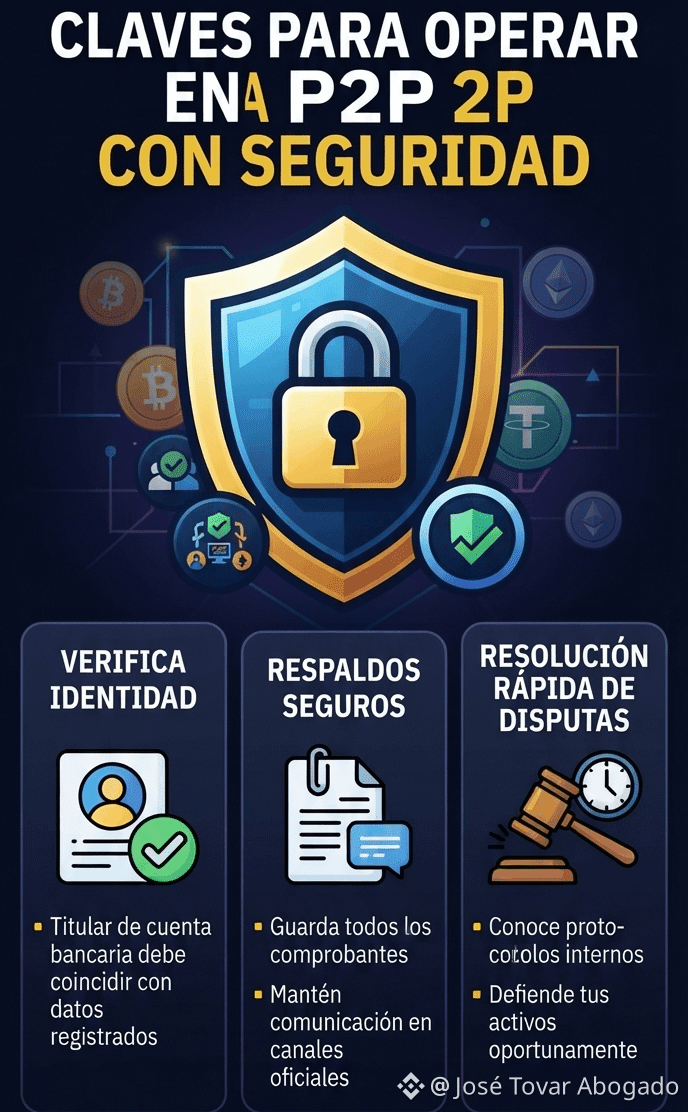
Keys to operate in P2P safely and avoid headaches P2P trading is a key tool in the digital economy, but operating without the necessary precautions can expose us to blocks or unwanted holds. To protect your funds when buying or selling, keep these points in mind: Always verify identity: Make sure that the account holder matches exactly the data registered on the platform. Keep records: Save each receipt and keep communication within the official exchange channels. Act quickly in disputes: Know the internal protocols and resolution mechanisms to defend your assets in a timely manner. Financial and legal education is our best shield in the crypto ecosystem. #P2P #BinanceSquare #SeguridadCripto 💬 Has anything similar happened to you in P2P? Leave your comment, share it with other traders, and forward this note so more people stay alert. 📲 Follow me on X as @TovarReporta for more analysis on security and digital law.
Keys to operate in P2P safely and avoid headaches

P2P trading is a key tool in the digital economy, but operating without the necessary precautions can expose us to blocks or unwanted holds.
To protect your funds when buying or selling, keep these points in mind:
Always verify identity: Make sure that the account holder matches exactly the data registered on the platform.
Keep records: Save each receipt and keep communication within the official exchange channels.
Act quickly in disputes: Know the internal protocols and resolution mechanisms to defend your assets in a timely manner.
Financial and legal education is our best shield in the crypto ecosystem.
#P2P #BinanceSquare #SeguridadCripto
💬 Has anything similar happened to you in P2P? Leave your comment, share it with other traders, and forward this note so more people stay alert.
📲 Follow me on X as @TovarReporta for more analysis on security and digital law.
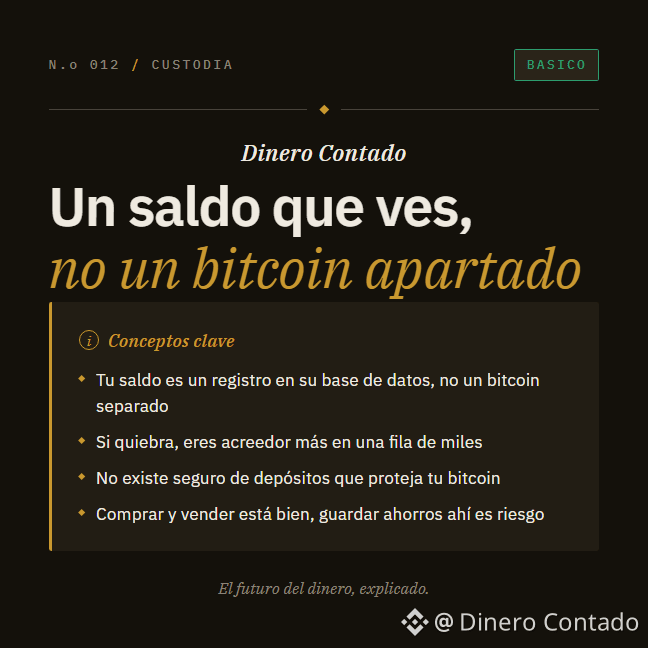
When you see 0.1 $BTC in your exchange balance, you assume that bitcoin is already yours. It isn’t. Not yet. That number lives in the platform’s database, not in a blockchain address that only you control. Most exchanges pool money from thousands of users into a few big wallets. Your balance is an accounting entry. Not a bitcoin set aside with your name on it. You deposit 0.1 $BTC. The platform records 0.1 in your account, mixed in with other users’ deposits. But if that company goes bankrupt, you don’t claim “my bitcoin”: that bitcoin no longer exists as a separate asset that is yours. You’re just one more creditor, in line with thousands of others. And whoever decides how what’s left gets distributed is a judge—not you. That’s what custodial balances are: someone else holds the asset, and you trust their word. KEY CONCEPTS - An exchange isn’t a bank. There’s no deposit insurance that will return your bitcoin if the platform fails or gets hacked. - Not all exchanges operate the same way. Some centralize orders in a central order book and hold your funds during the transaction. Others connect buyers directly with sellers. - Just because a platform is large or has been around for years doesn’t make it secure by default. Crypto history has seen exchanges that looked solid and ended up being hacked. - Having bitcoin “on the exchange” means having a claim against a company—not the asset itself. Buying and selling there makes sense. Keeping your savings there for years means giving someone else the final say over something that belongs to you. Transparency: Binance may pay us a commission if you trade after clicking an asset symbol or a price link from this post. #Custodia #Autocustodia #ExchangesCripto #SeguridadCripto
When you see 0.1 $BTC in your exchange balance, you assume that bitcoin is already yours.

It isn’t. Not yet.

That number lives in the platform’s database, not in a blockchain address that only you control. Most exchanges pool money from thousands of users into a few big wallets. Your balance is an accounting entry. Not a bitcoin set aside with your name on it.

You deposit 0.1 $BTC . The platform records 0.1 in your account, mixed in with other users’ deposits. But if that company goes bankrupt, you don’t claim “my bitcoin”: that bitcoin no longer exists as a separate asset that is yours. You’re just one more creditor, in line with thousands of others. And whoever decides how what’s left gets distributed is a judge—not you.

That’s what custodial balances are: someone else holds the asset, and you trust their word.

KEY CONCEPTS
- An exchange isn’t a bank. There’s no deposit insurance that will return your bitcoin if the platform fails or gets hacked.
- Not all exchanges operate the same way. Some centralize orders in a central order book and hold your funds during the transaction. Others connect buyers directly with sellers.
- Just because a platform is large or has been around for years doesn’t make it secure by default. Crypto history has seen exchanges that looked solid and ended up being hacked.
- Having bitcoin “on the exchange” means having a claim against a company—not the asset itself.

Buying and selling there makes sense. Keeping your savings there for years means giving someone else the final say over something that belongs to you.

Transparency: Binance may pay us a commission if you trade after clicking an asset symbol or a price link from this post.

#Custodia #Autocustodia #ExchangesCripto #SeguridadCripto
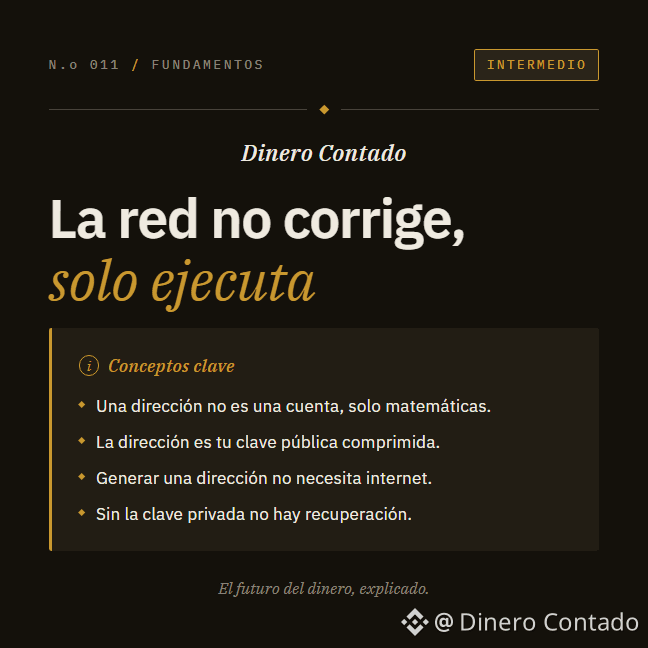
Binance can pay us a commission if you trade from this post. One wrong character and the $BTC ends up at an address that isn’t yours. No going back. Not because someone intercepts it. But because the network reads exactly what you sent it. If the string is incorrect, that’s the destination. There’s no one to validate whether the recipient was the person you intended. An address is a string of between 26 and 35 characters, case-sensitive. It’s not an account. It has no owner and no contract behind it. It’s the result of compressing your public key, which in turn is generated from a secret number that never leaves your wallet. That secret number is the private key. Whoever has it can authorize a transfer of funds. They do so by producing a mathematical proof that the network verifies without seeing the secret. That’s called a digital signature. KEY CONCEPTS - An address is not an account: it has no registered owner, just mathematics. - The address and the public key are not the same: the address is the compressed version of the public key. - Generating an address doesn’t require an internet connection: the process happens inside your wallet. - Losing the private key means losing the funds: there’s no recovery without that number. The network can’t tell the difference between a typo and an intentional transfer. It reads the string and executes. Transparency: Binance may pay us a commission if you trade after clicking an asset symbol or a price link from this post. #DireccionCripto #ClavesDigitales #SeguridadCripto #FundamentosBitcoin
Binance can pay us a commission if you trade from this post.

One wrong character and the $BTC ends up at an address that isn’t yours. No going back.

Not because someone intercepts it. But because the network reads exactly what you sent it. If the string is incorrect, that’s the destination. There’s no one to validate whether the recipient was the person you intended.

An address is a string of between 26 and 35 characters, case-sensitive. It’s not an account. It has no owner and no contract behind it. It’s the result of compressing your public key, which in turn is generated from a secret number that never leaves your wallet.

That secret number is the private key. Whoever has it can authorize a transfer of funds. They do so by producing a mathematical proof that the network verifies without seeing the secret. That’s called a digital signature.

KEY CONCEPTS
- An address is not an account: it has no registered owner, just mathematics.
- The address and the public key are not the same: the address is the compressed version of the public key.
- Generating an address doesn’t require an internet connection: the process happens inside your wallet.
- Losing the private key means losing the funds: there’s no recovery without that number.

The network can’t tell the difference between a typo and an intentional transfer. It reads the string and executes.

Transparency: Binance may pay us a commission if you trade after clicking an asset symbol or a price link from this post.

#DireccionCripto #ClavesDigitales #SeguridadCripto #FundamentosBitcoin
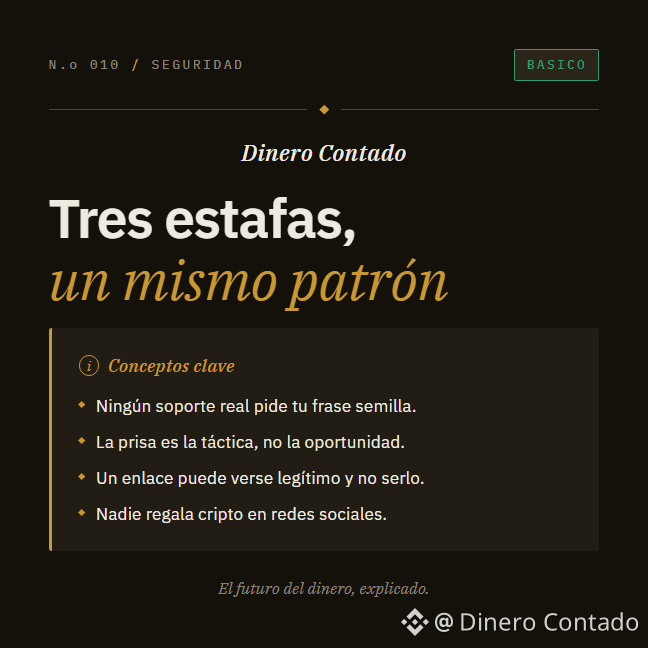
Binance may pay us a commission if you trade from this post. Three crypto scams wipe out wallets every day. And all three work the same way: they rush you and ask for a key. The first arrives by email or message. It looks like an official notice from a platform. There’s a problem with your account, they say. You have to click right now. The link takes you to a fake page that steals your password. This is called phishing. The second is someone who pretends to be technical support. They tell you they detected suspicious activity. To "protect you," they need your seed phrase. No legitimate support team ever asks for that. The third promises free crypto. A celebrity recommends it, or a giveaway says they’ll double the $BTC you send. If you send anything, it disappears. The “gift” was the bait. KEY CONCEPTS - No real platform asks you for your seed phrase via message. If someone asks for it, it’s a scam, no matter how convincing it sounds. - Urgency is a tactic. Scammers create urgency because it overwhelms good judgment. - A link can look legitimate and still lead to a fake page. Before entering any information, check the full site address. - Celebrities don’t hand out free crypto on social media. Those posts are always fake. If something rushes you and asks for a key, close the window. You don’t need any further signs. Transparency: Binance may pay us a commission if you trade after clicking an asset symbol or a price link in this post. #Estafas #Phishing #FraseSemilla #CryptoSecurity
Binance may pay us a commission if you trade from this post.

Three crypto scams wipe out wallets every day. And all three work the same way: they rush you and ask for a key.

The first arrives by email or message. It looks like an official notice from a platform. There’s a problem with your account, they say. You have to click right now. The link takes you to a fake page that steals your password. This is called phishing.

The second is someone who pretends to be technical support. They tell you they detected suspicious activity. To "protect you," they need your seed phrase. No legitimate support team ever asks for that.

The third promises free crypto. A celebrity recommends it, or a giveaway says they’ll double the $BTC you send. If you send anything, it disappears. The “gift” was the bait.

KEY CONCEPTS

- No real platform asks you for your seed phrase via message. If someone asks for it, it’s a scam, no matter how convincing it sounds.
- Urgency is a tactic. Scammers create urgency because it overwhelms good judgment.
- A link can look legitimate and still lead to a fake page. Before entering any information, check the full site address.
- Celebrities don’t hand out free crypto on social media. Those posts are always fake.

If something rushes you and asks for a key, close the window. You don’t need any further signs.

Transparency: Binance may pay us a commission if you trade after clicking an asset symbol or a price link in this post.

#Estafas #Phishing #FraseSemilla #CryptoSecurity
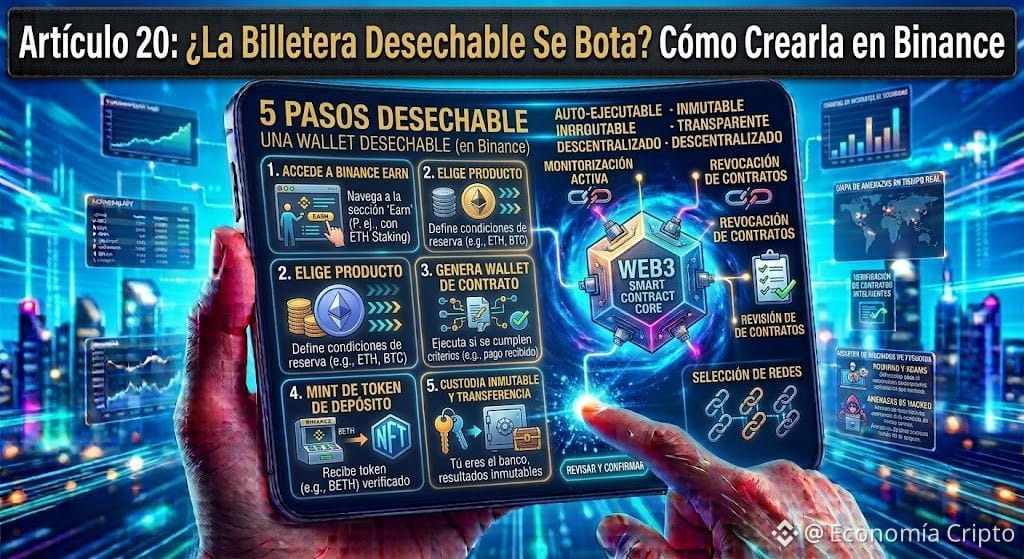
Article 20: Should You “Throw Away” a Burner Wallet? How to Create One on Binance After the previous article, many users asked us: “Do I have to create and delete a new wallet every time I trade?” The short answer is NO. You don’t need to destroy the wallet or lose your keys. The term “burner” wallet is just an operating strategy: it means you use it as a “step-through shield,” keeping in it only the minimum balance you’re going to spend at that moment. How does it work in practice? Your wallet app or browser extension can manage multiple addresses under the same app. You can have an address called “Savings” (which you never connect to web pages) and another called “Tests/Burner.” You don’t have to delete the test wallet after using it; you simply leave it empty (or with a few cents in $BNB for gas) until the next time you want to interact with a dApp, buy an NFT, or test a new protocol. How to Create Your Burner Wallet Using Binance With Binance’s Web3 Wallet, it’s super easy and you don’t need to install any third-party apps: Open the Binance App: Go to the “Web3” tab at the top of your screen. Create a Secondary Wallet: Go to your wallet settings (profile icon or wallet management) and select “Add wallet” or create a new address within your same account. Assign it a Name: Name it “Test Wallet” or “Burner.” Give it only what’s necessary: When you’re going to interact with an external site, transfer from your Binance Spot wallet only the exact amount in $BNB or USDT you need for the transaction. The Ultimate Advantage By working with this setup, if by mistake you authorize a malicious site using your test wallet, your main balance on Binance and your savings stored in other addresses stay 100% intact. It’s the smartest way to explore Web3 with zero stress. #SeguridadCripto #BinanceWeb3 #Web3Security #AprendeCripto $BNB {spot}(BTCUSDT) {spot}(BNBUSDT)
Article 20: Should You “Throw Away” a Burner Wallet? How to Create One on Binance

After the previous article, many users asked us: “Do I have to create and delete a new wallet every time I trade?” The short answer is NO.

You don’t need to destroy the wallet or lose your keys. The term “burner” wallet is just an operating strategy: it means you use it as a “step-through shield,” keeping in it only the minimum balance you’re going to spend at that moment.

How does it work in practice?
Your wallet app or browser extension can manage multiple addresses under the same app. You can have an address called “Savings” (which you never connect to web pages) and another called “Tests/Burner.”

You don’t have to delete the test wallet after using it; you simply leave it empty (or with a few cents in $BNB for gas) until the next time you want to interact with a dApp, buy an NFT, or test a new protocol.

How to Create Your Burner Wallet Using Binance
With Binance’s Web3 Wallet, it’s super easy and you don’t need to install any third-party apps:

Open the Binance App: Go to the “Web3” tab at the top of your screen.

Create a Secondary Wallet: Go to your wallet settings (profile icon or wallet management) and select “Add wallet” or create a new address within your same account.

Assign it a Name: Name it “Test Wallet” or “Burner.”

Give it only what’s necessary: When you’re going to interact with an external site, transfer from your Binance Spot wallet only the exact amount in $BNB or USDT you need for the transaction.

The Ultimate Advantage
By working with this setup, if by mistake you authorize a malicious site using your test wallet, your main balance on Binance and your savings stored in other addresses stay 100% intact. It’s the smartest way to explore Web3 with zero stress.

#SeguridadCripto #BinanceWeb3 #Web3Security #AprendeCripto $BNB
·
--
Security in multichain infrastructure is back under scrutiny after an exploit on GalaChain that allowed an attacker to steal $3 million. 🚨 After 55 days of failed transactions, the attack vector exposed critical flaws in the validation of signed intentions before interacting with asset bridges. This incident highlights the urgent need for more stringent audits and automated controls in the SDKs to prevent similar breaches. Do you see enough evolution in today’s security protocols, or does systemic risk remain high? Follow me for more technical and market analysis. 🛡️💻 #GalaChain #SeguridadCripto #DeFi
Deadline today: a protocol offers a hacker 20% of what they stole… in exchange for the rest On Thursday, September 11 at 04:28 UTC, an attacker exploited a vulnerability in Symbiosis’s Bitcoin Bridge, forcing the team to pause that specific route while the rest of its bridges continued operating normally. The team managed to recover about 15 BTC and offered the attacker a reward of 20% as a “white-hat hacker” — in exchange for returning the rest. That offer expires today, September 13. This is a direct contrast to the Blockstream case we saw this week: there, the company flatly refused to negotiate. Symbiosis, instead, chose the reward route — an increasingly common DeFi practice for quickly recovering funds, though it leaves an ethical question open: does negotiating with someone who stole from you encourage them to try again next time? Would you negotiate with the attacker to recover the 80%, or would you stand firm like Blockstream did even if it means losing everything? 👇 #SymbiosisFinance #defi #SeguridadCripto $BTC {future}(BTCUSDT)
Deadline today: a protocol offers a hacker 20% of what they stole… in exchange for the rest

On Thursday, September 11 at 04:28 UTC, an attacker exploited a vulnerability in Symbiosis’s Bitcoin Bridge, forcing the team to pause that specific route while the rest of its bridges continued operating normally. The team managed to recover about 15 BTC and offered the attacker a reward of 20% as a “white-hat hacker” — in exchange for returning the rest. That offer expires today, September 13.

This is a direct contrast to the Blockstream case we saw this week: there, the company flatly refused to negotiate. Symbiosis, instead, chose the reward route — an increasingly common DeFi practice for quickly recovering funds, though it leaves an ethical question open: does negotiating with someone who stole from you encourage them to try again next time?

Would you negotiate with the attacker to recover the 80%, or would you stand firm like Blockstream did even if it means losing everything? 👇

#SymbiosisFinance #defi #SeguridadCripto $BTC
·
--
💡 How do you use your cryptocurrencies in everyday life? Virtual cards and digital security Many users think that cryptocurrencies are only for trading or waiting for the price to rise on the chart. However, the ecosystem has evolved so much that today it is extremely simple to use them to pay for daily expenses or make online purchases directly from your digital funds. If you are already using tools like crypto virtual cards or you plan to enable one soon, here are two fundamental pillars you should consider to keep your capital safe: 💳 1. The convenience of virtual payments Quick integration: Linking your virtual card with digital wallets like Apple Wallet lets you pay at physical stores or on web platforms in seconds, automatically converting your stablecoins (like $USDC o $USDT ) at the time of purchase. Spending control: You can transfer only the exact amount you plan to spend from your funds wallet, keeping the rest of your portfolio protected. 🔒 2. Fortified security: Your number one priority Convenience should never compromise security. If you make operational changes or frequent transactions, make sure to enable these protection layers on your account: Two-Factor Authentication (2FA): Use apps like Google Authenticator or physical access keys, avoiding reliance solely on SMS. Instant activity alerts: Always check Binance notification emails. If you detect a login or a password change from an unknown IP address, block access to your account immediately via the security link. #seguridadcripto #TradingSeguro
💡 How do you use your cryptocurrencies in everyday life? Virtual cards and digital security

Many users think that cryptocurrencies are only for trading or waiting for the price to rise on the chart. However, the ecosystem has evolved so much that today it is extremely simple to use them to pay for daily expenses or make online purchases directly from your digital funds.
If you are already using tools like crypto virtual cards or you plan to enable one soon, here are two fundamental pillars you should consider to keep your capital safe:

💳 1. The convenience of virtual payments

Quick integration: Linking your virtual card with digital wallets like Apple Wallet lets you pay at physical stores or on web platforms in seconds, automatically converting your stablecoins (like $USDC o $USDT ) at the time of purchase.
Spending control: You can transfer only the exact amount you plan to spend from your funds wallet, keeping the rest of your portfolio protected.

🔒 2. Fortified security: Your number one priority

Convenience should never compromise security. If you make operational changes or frequent transactions, make sure to enable these protection layers on your account:

Two-Factor Authentication (2FA): Use apps like Google Authenticator or physical access keys, avoiding reliance solely on SMS.

Instant activity alerts: Always check Binance notification emails. If you detect a login or a password change from an unknown IP address, block access to your account immediately via the security link.

#seguridadcripto #TradingSeguro
5 crypto scam warning signs 🚨 Security is one of the most important skills in crypto. Here are five red flags: They promise guaranteed profits or “no risk”. They pressure you to send funds quickly. They ask for your recovery phrase, password, or 2FA code. They send suspicious links or profiles that impersonate official accounts. They offer to double your money if you deposit first. Basic rule: no legitimate person needs your recovery phrase or your security codes. If something seems too good to be true, it deserves extra scrutiny. Always verify official channels, enable two-factor authentication, and avoid sharing sensitive information. Which warning sign have you seen the most on social media? #SeguridadCripto #CryptoSafety #blockchain #BinanceSquare
5 crypto scam warning signs 🚨
Security is one of the most important skills in crypto. Here are five red flags:
They promise guaranteed profits or “no risk”.
They pressure you to send funds quickly.
They ask for your recovery phrase, password, or 2FA code.
They send suspicious links or profiles that impersonate official accounts.
They offer to double your money if you deposit first.
Basic rule: no legitimate person needs your recovery phrase or your security codes. If something seems too good to be true, it deserves extra scrutiny.
Always verify official channels, enable two-factor authentication, and avoid sharing sensitive information.
Which warning sign have you seen the most on social media?
#SeguridadCripto #CryptoSafety #blockchain #BinanceSquare
Article
3 Fatal Mistakes When Selling USDT on a Sunday in P2PBe careful with this on a Sunday! With more than 260 active offers and massive daily volume in the country, the weekend is the scammers’ favorite time to catch people off guard in P2P. Here are the 3 golden security rules you should never break when swapping your $USDT: 1. A capture is not money in the account: It seems basic, but it still happens. Never release crypto based on a receipt in chat or an SMS. Go directly into your bank app and confirm that the balance is AVAILABLE (not pending or blocked).

3 Fatal Mistakes When Selling USDT on a Sunday in P2P

Be careful with this on a Sunday! With more than 260 active offers and massive daily volume in the country, the weekend is the scammers’ favorite time to catch people off guard in P2P.
Here are the 3 golden security rules you should never break when swapping your $USDT:
1. A capture is not money in the account: It seems basic, but it still happens. Never release crypto based on a receipt in chat or an SMS. Go directly into your bank app and confirm that the balance is AVAILABLE (not pending or blocked).
⚠️ Data Leak at Trezor: Physical Attack Vector and OpSec A security failure at logistics provider ShipMonk has exposed the personally identifiable information (PII) of more than 80,000 Trezor customers. Although the private key and seed phrases remain 100% intact on the blockchain, the leak includes full names, phone numbers, and physical addresses. Technical analysis: The risk of exploitation shifts from the on-chain plane to advanced social engineering (spear phishing, SIM swapping) and physical threat vectors ($5 wrench attack). In self-custody, the privacy of off-chain metadata is a defense layer as critical as the wallet’s cryptographic encryption itself. What OpSec protocols do you apply when acquiring hardware wallets: do you use neutral lockers/P.O. Boxes, or do you add extra layers such as hidden passphrases to mitigate the risk of physical extortion? $BTC {future}(BTCUSDT) $ETH {future}(ETHUSDT) $SOL {future}(SOLUSDT) #Trezor #ciberseguridad #OPSEC #SeguridadCripto
⚠️ Data Leak at Trezor: Physical Attack Vector and OpSec
A security failure at logistics provider ShipMonk has exposed the personally identifiable information (PII) of more than 80,000 Trezor customers. Although the private key and seed phrases remain 100% intact on the blockchain, the leak includes full names, phone numbers, and physical addresses.
Technical analysis: The risk of exploitation shifts from the on-chain plane to advanced social engineering (spear phishing, SIM swapping) and physical threat vectors ($5 wrench attack). In self-custody, the privacy of off-chain metadata is a defense layer as critical as the wallet’s cryptographic encryption itself.
What OpSec protocols do you apply when acquiring hardware wallets: do you use neutral lockers/P.O. Boxes, or do you add extra layers such as hidden passphrases to mitigate the risk of physical extortion?
$BTC
$ETH
$SOL

#Trezor #ciberseguridad #OPSEC #SeguridadCripto
Article
3 filters to avoid traps in Binance P2PDid you know that most P2P headaches happen because of urgency, not because of platform failures? With more than 260 active offers and the $USDT market moving fast in bolívares, scammers take advantage of the rush to use old tricks that still claim victims: 1. No third-party payments: If the account holder’s name does not match exactly the name verified on Binance, do not accept the payment or release funds. Accepting it can freeze your bank account if those funds come from an outside scam.

3 filters to avoid traps in Binance P2P

Did you know that most P2P headaches happen because of urgency, not because of platform failures?
With more than 260 active offers and the $USDT market moving fast in bolívares, scammers take advantage of the rush to use old tricks that still claim victims:
1. No third-party payments: If the account holder’s name does not match exactly the name verified on Binance, do not accept the payment or release funds. Accepting it can freeze your bank account if those funds come from an outside scam.
🔐 5 signs that a "crypto project" is a scam Every week I see people losing money using the same tricks. Save this: 🚩 They promise fixed and guaranteed returns (e.g. "2% daily with no risk") 🚩 They pressure you to invest "before the quota runs out" 🚩 The team has no name, face, or verifiable track record 🚩 You can only withdraw if you "recruit" more people 🚩 The website is new (less than 3 months) and has no security audit Golden rule: if something sounds too good to be true, it is. Invest only what you’re willing to lose, and always use regulated and verified platforms. I prefer to keep a close eye on $BNB and $BTC because they have a track record, a public team, and transparency — that doesn’t guarantee profits, but it does reduce the risk of a scam. Have you already seen any of these happen or fallen for one? Tell me 👇 #BinanceSquare #CryptoEducacion {spot}(NVDABUSDT) 😎 #SeguridadCripto
🔐 5 signs that a "crypto project" is a scam
Every week I see people losing money using the same tricks. Save this:
🚩 They promise fixed and guaranteed returns (e.g. "2% daily with no risk")
🚩 They pressure you to invest "before the quota runs out"
🚩 The team has no name, face, or verifiable track record
🚩 You can only withdraw if you "recruit" more people
🚩 The website is new (less than 3 months) and has no security audit
Golden rule: if something sounds too good to be true, it is. Invest only what you’re willing to lose, and always use regulated and verified platforms.
I prefer to keep a close eye on $BNB and $BTC because they have a track record, a public team, and transparency — that doesn’t guarantee profits, but it does reduce the risk of a scam.
Have you already seen any of these happen or fallen for one? Tell me 👇
#BinanceSquare #CryptoEducacion
😎 #SeguridadCripto
Bitcoin Up or Down on September 3?

Bitcoin Up or Down on September 3?

99%Up1%Down
Volume $143,592.58
Article 19: The "Disposable Wallet" Strategy: The Defensive Wall in Crypto When you start exploring the Web3 ecosystem, interacting with new websites, claiming airdrops, or testing games and DeFi platforms can be a bit scary. What if you accidentally connect to a malicious site? To navigate without stress, experienced investors use an infallible method: the Step Wallet or Disposable Wallet (Burner Wallet). What does this strategy involve? The golden rule is to separate your savings from your day-to-day operations. To do this, you don’t use just one wallet—you split your funds into three levels: The Cold Wallet / Main Wallet (The Bank): Store your long-term savings here (Bitcoin, $BNB, etc.). This wallet NEVER connects to websites or dApps; it only sends/receives funds. The Central Wallet on Binance (The Safe Platform): This acts as your control center, where you do Spot trading, use Binance Earn, and maintain liquidity backed by the exchange’s security. The Disposable Wallet (The Impact Shield): This is a secondary Web3 wallet (created in the app or extension) that you use exclusively to connect to external platforms, buy new NFTs, or make transactions on sites you’re testing for the first time. How do you use a Disposable Wallet? Step 1: When you want to buy an NFT or test a DeFi protocol, transfer from Binance only the exact amount you’re going to spend (for example, $20 worth of $BNB to pay for the asset and gas). Step 2: Connect your disposable wallet to the website and complete the transaction. Step 3: Once you’ve obtained the NFT or token, if you want to keep it long-term, send it immediately to your main wallet or your Binance account. Why does this technique save you? With a disposable wallet, if you fall into a digital trap, you’ll only lose pennies. Your main savings are safe because you’re not exposing your real keys. Using this technique lets you explore the crypto world with complete security. #SeguridadCripto
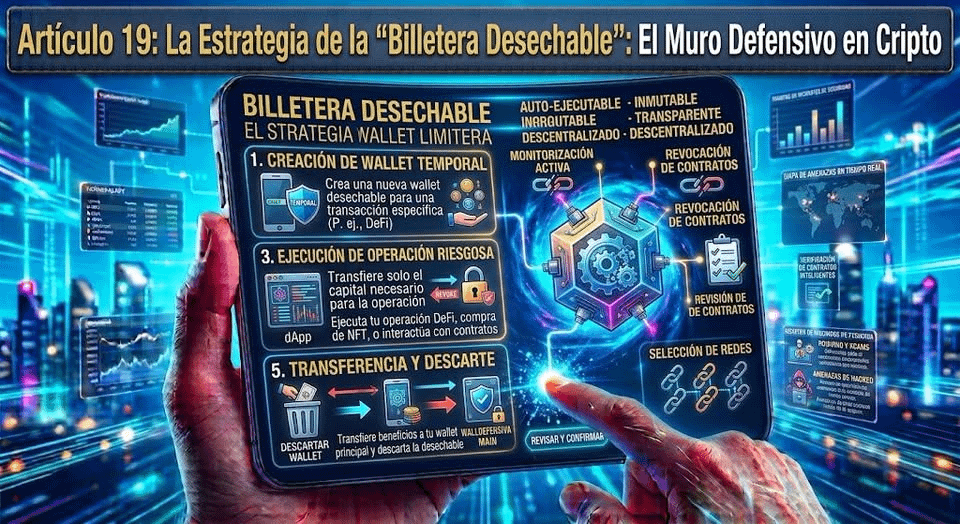
Article 19: The "Disposable Wallet" Strategy: The Defensive Wall in Crypto
When you start exploring the Web3 ecosystem, interacting with new websites, claiming airdrops, or testing games and DeFi platforms can be a bit scary. What if you accidentally connect to a malicious site?

To navigate without stress, experienced investors use an infallible method: the Step Wallet or Disposable Wallet (Burner Wallet).

What does this strategy involve?
The golden rule is to separate your savings from your day-to-day operations. To do this, you don’t use just one wallet—you split your funds into three levels:

The Cold Wallet / Main Wallet (The Bank): Store your long-term savings here (Bitcoin, $BNB, etc.). This wallet NEVER connects to websites or dApps; it only sends/receives funds.

The Central Wallet on Binance (The Safe Platform): This acts as your control center, where you do Spot trading, use Binance Earn, and maintain liquidity backed by the exchange’s security.

The Disposable Wallet (The Impact Shield): This is a secondary Web3 wallet (created in the app or extension) that you use exclusively to connect to external platforms, buy new NFTs, or make transactions on sites you’re testing for the first time.

How do you use a Disposable Wallet?
Step 1: When you want to buy an NFT or test a DeFi protocol, transfer from Binance only the exact amount you’re going to spend (for example, $20 worth of $BNB to pay for the asset and gas).

Step 2: Connect your disposable wallet to the website and complete the transaction.

Step 3: Once you’ve obtained the NFT or token, if you want to keep it long-term, send it immediately to your main wallet or your Binance account.

Why does this technique save you?
With a disposable wallet, if you fall into a digital trap, you’ll only lose pennies. Your main savings are safe because you’re not exposing your real keys. Using this technique lets you explore the crypto world with complete security.

#SeguridadCripto
Trading USDT for Bs. 997? Watch out for the rush when confirming your orders. Today we recorded more than 212 active listings on Binance P2P with buys at Bs. 997.61 and sells at Bs. 943.01. In days with so much volume and movement, scammers try to catch you off guard with fake payment proofs. To safeguard your trades today: 1. Go straight to your bank and confirm your available balance (not scheduled/deferred). 2. Never release funds based only on SMS or screenshots in the chat. 3. Make sure the account holder on your bank account matches 100% the verified user on Binance. Your security is your best strategy. 📊 Live rates and analysis on pitbullchain.com #BinanceP2P #SeguridadCripto #VenezuelaCrypto #BinanceSquare
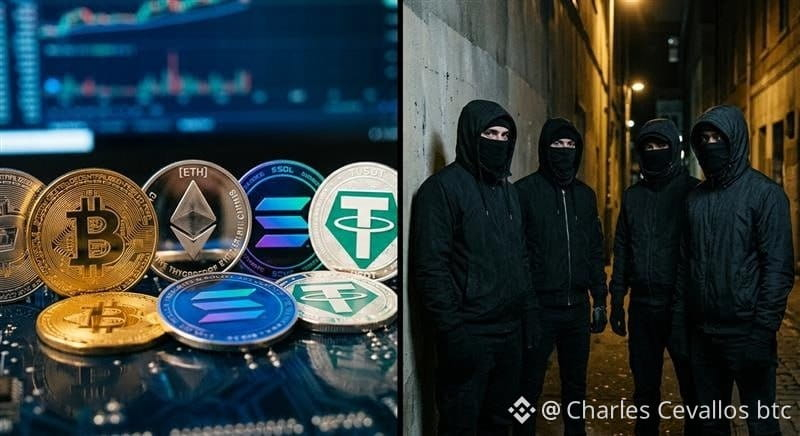
Trading USDT for Bs. 997? Watch out for the rush when confirming your orders.

Today we recorded more than 212 active listings on Binance P2P with buys at Bs. 997.61 and sells at Bs. 943.01. In days with so much volume and movement, scammers try to catch you off guard with fake payment proofs.

To safeguard your trades today:
1. Go straight to your bank and confirm your available balance (not scheduled/deferred).
2. Never release funds based only on SMS or screenshots in the chat.
3. Make sure the account holder on your bank account matches 100% the verified user on Binance.

Your security is your best strategy.
📊 Live rates and analysis on pitbullchain.com

#BinanceP2P #SeguridadCripto #VenezuelaCrypto #BinanceSquare
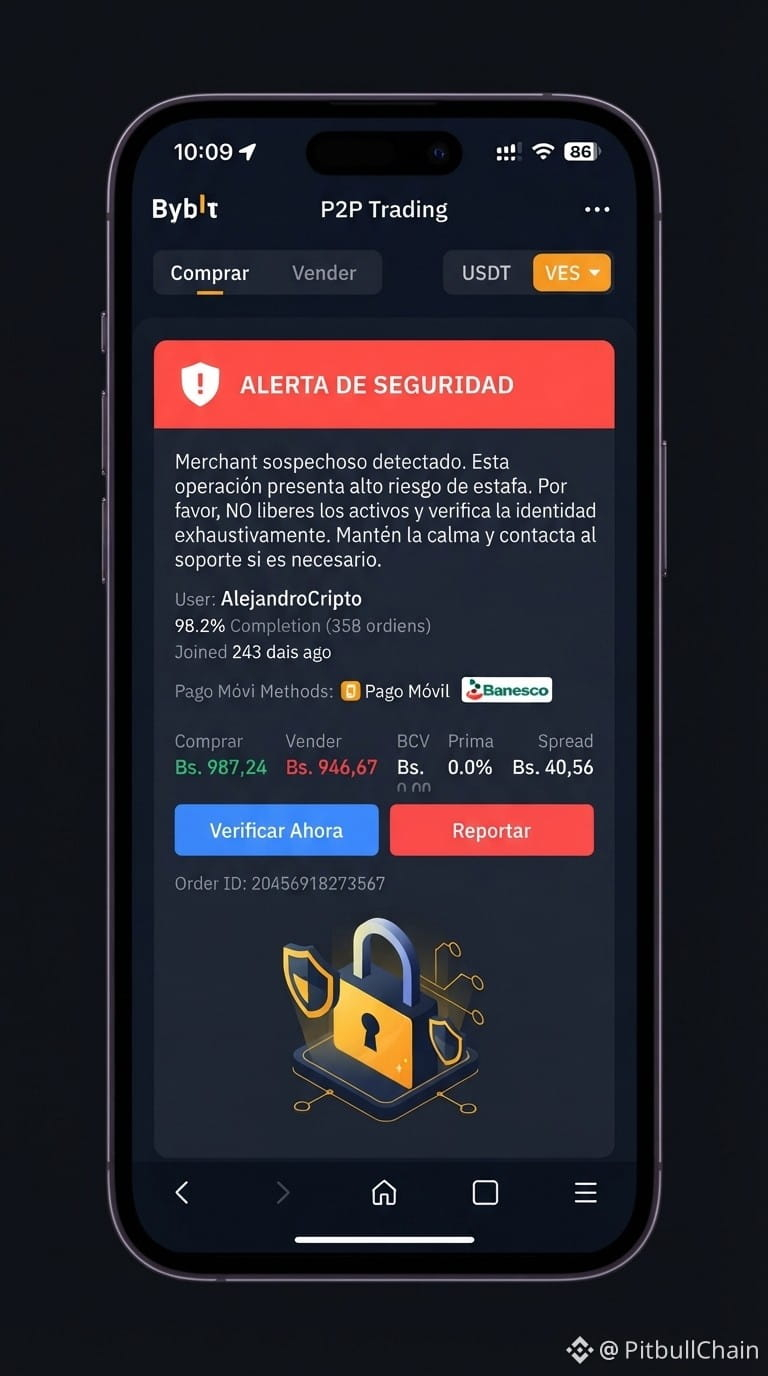
Did you receive the payment screenshot but don’t see the bolívares in your account? Pay attention! With more than 200 active orders and a P2P premium against the BCV (Bs. 785.07) that marks 22.72%, things are really heating up and the “live” ones are trying to fish in troubled waters. If you’re trading USDT on Binance P2P with rates between Bs. 881.32 and Bs. 963.43, never release anything relying on an SMS or an image. Go straight to your online bank, confirm your available balance, and verify that the account holder matches exactly the user registered. No third-party accounts—no exceptions. 📊 Live rates and analysis at pitbullchain.com #BinanceP2P #SeguridadCripto #VenezuelaCrypto #BinanceSquare

Did you receive the payment screenshot but don’t see the bolívares in your account? Pay attention!

With more than 200 active orders and a P2P premium against the BCV (Bs. 785.07) that marks 22.72%, things are really heating up and the “live” ones are trying to fish in troubled waters.

If you’re trading USDT on Binance P2P with rates between Bs. 881.32 and Bs. 963.43, never release anything relying on an SMS or an image. Go straight to your online bank, confirm your available balance, and verify that the account holder matches exactly the user registered. No third-party accounts—no exceptions.

📊 Live rates and analysis at pitbullchain.com

#BinanceP2P #SeguridadCripto #VenezuelaCrypto #BinanceSquare
With a spread of Bs. 92.73 (10.57%) and the USDT touching Bs. 970.40 on buy, the gullible hunters get activated. In days with almost 200 open orders and a premium of 23.61% versus the BCV (Bs. 785.07), the rush can end up costing you. Bro, review the basic rules before clicking: 1. Never release crypto based on screenshots; open your banking app and confirm the real balance. 2. Zero payments to third parties, with no exceptions. 3. If the counterparty pressures you through chat, report it and open an appeal. Trade with a cool head and protect your capital in every transaction. 📊 Live rates and analysis at pitbullchain.com #BinanceP2P #SeguridadCripto #Venezuela #CriptoVenezuela #BinanceSquare
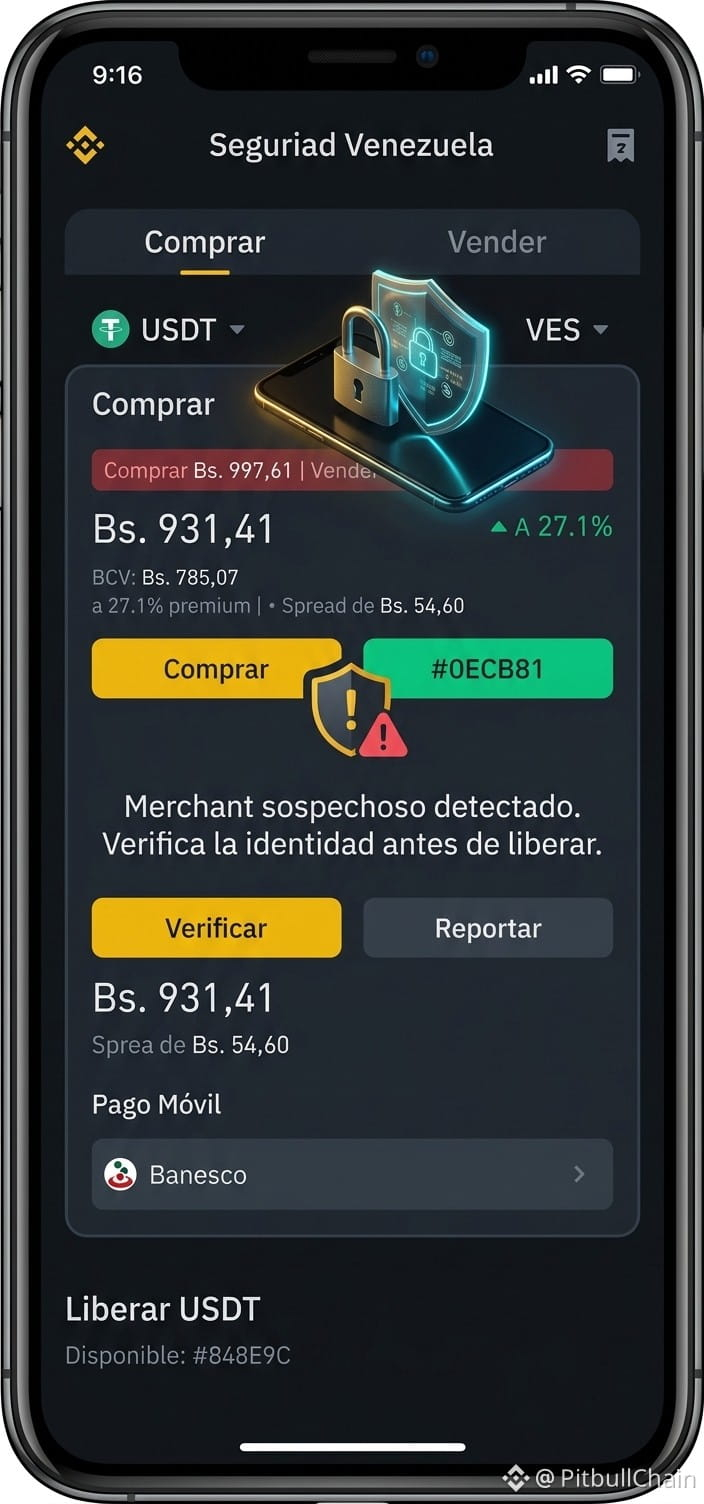
With a spread of Bs. 92.73 (10.57%) and the USDT touching Bs. 970.40 on buy, the gullible hunters get activated. In days with almost 200 open orders and a premium of 23.61% versus the BCV (Bs. 785.07), the rush can end up costing you.

Bro, review the basic rules before clicking:
1. Never release crypto based on screenshots; open your banking app and confirm the real balance.
2. Zero payments to third parties, with no exceptions.
3. If the counterparty pressures you through chat, report it and open an appeal.

Trade with a cool head and protect your capital in every transaction.

📊 Live rates and analysis at pitbullchain.com

#BinanceP2P #SeguridadCripto #Venezuela #CriptoVenezuela #BinanceSquare
Are you seeing buy offers at Bs. 937.90 with a 13.10% premium over the BCV (Bs. 784.66)? Be careful not to bite the hook. With a wide spread of Bs. 50.45 (5.68%) and more than 250 active orders, the risk of triangulation and third-party payments increases. The typical move: they pay you from an account that isn’t in the account holder’s name, claiming it’s “the partner’s” or “a relative’s.” Unbreakable rule on Binance P2P: never release funds if the bank account holder’s name does not match 100% with the buyer’s verified data. Check your balance directly in your banking app—never rely only on screenshots. Does your counterparty insist on using an external account? Don’t give in and open an appeal. #BinanceP2P #SeguridadCripto #VenezuelaCrypto #BinanceSquare
Are you seeing buy offers at Bs. 937.90 with a 13.10% premium over the BCV (Bs. 784.66)? Be careful not to bite the hook.

With a wide spread of Bs. 50.45 (5.68%) and more than 250 active orders, the risk of triangulation and third-party payments increases. The typical move: they pay you from an account that isn’t in the account holder’s name, claiming it’s “the partner’s” or “a relative’s.”

Unbreakable rule on Binance P2P: never release funds if the bank account holder’s name does not match 100% with the buyer’s verified data. Check your balance directly in your banking app—never rely only on screenshots.

Does your counterparty insist on using an external account? Don’t give in and open an appeal.

#BinanceP2P #SeguridadCripto #VenezuelaCrypto #BinanceSquare
Log in to explore more content
Join global crypto users on Binance Square
⚡️ Get latest and useful information about crypto.
💬 Trusted by the world’s largest crypto exchange.
👍 Discover real insights from verified creators.
Email / Phone number