
Dinero Contado
123 Posts

Dinero Contado
Report
Block User
Ideas que construyen tu mañana financiero.
35 Following
69 Followers
78 Liked
Posts
All
Videos
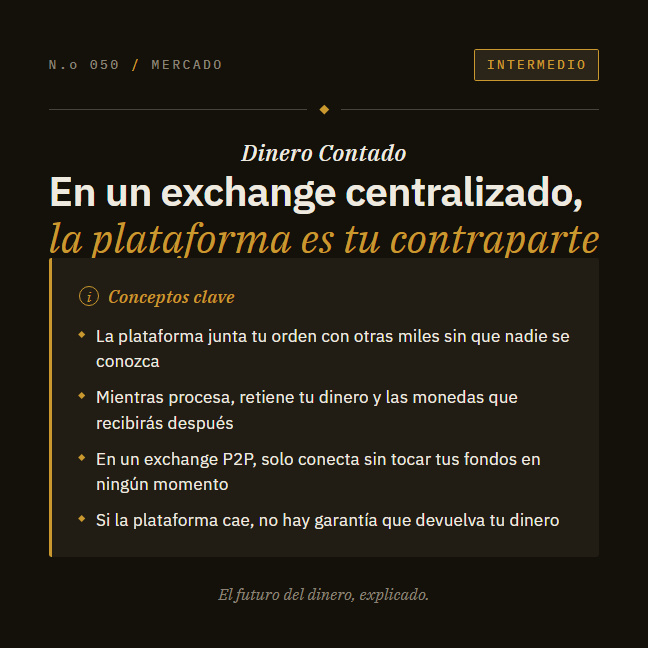
When you buy crypto on a large exchange, your actual counterparty is the platform, not the person who sold those coins.
You place a buy order. The platform puts it in a huge queue, alongside thousands of other buy and sell orders, and looks for one that matches yours in price. Who sold? The platform won’t tell you, and nobody cares to know. It brings both sides together, holds the coins and the money while the transaction is processed, and delivers them at the end. Imagine you want to buy 10 $SOL: someone, somewhere, placed a sell order for that same amount at a price that works for you. The system matches the orders. Neither of you knows who the other is, and neither needs to, because the platform is responsible for both sides. You never spoke to a person. You spoke to a system.
This model, where the platform matches orders through a central order book and holds the funds in between, is called a centralized exchange. The kind that connects you directly with another person without touching your money is called a P2P, or peer-to-peer, exchange.
KEY CONCEPTS
- Not all exchanges handle your money the same way: some hold it while the transaction is underway, while others never touch it.
- Leaving your coins in an exchange for years is not the same as keeping them in an insured bank, because if the platform goes down, nobody will give your money back.
- Not all platforms have the same level of security or follow the same rules, so one platform’s reputation says nothing about whether it protects your funds well.
The platform that holds your money is the same one that can fail you, just like any bank you’ve known your whole life. The difference is that here, if it fails, there’s nobody behind it to give you a cent back.
Transparency: Binance may pay us a commission if you trade after clicking an asset symbol or a price link in this post.
#ExchangeCentralizado #P2P #CustodiaDeFondos #CryptoSecurity
When you buy crypto on a large exchange, your actual counterparty is the platform, not the person who sold those coins.
You place a buy order. The platform puts it in a huge queue, alongside thousands of other buy and sell orders, and looks for one that matches yours in price. Who sold? The platform won’t tell you, and nobody cares to know. It brings both sides together, holds the coins and the money while the transaction is processed, and delivers them at the end. Imagine you want to buy 10 $SOL : someone, somewhere, placed a sell order for that same amount at a price that works for you. The system matches the orders. Neither of you knows who the other is, and neither needs to, because the platform is responsible for both sides. You never spoke to a person. You spoke to a system.
This model, where the platform matches orders through a central order book and holds the funds in between, is called a centralized exchange. The kind that connects you directly with another person without touching your money is called a P2P, or peer-to-peer, exchange.
KEY CONCEPTS
- Not all exchanges handle your money the same way: some hold it while the transaction is underway, while others never touch it.
- Leaving your coins in an exchange for years is not the same as keeping them in an insured bank, because if the platform goes down, nobody will give your money back.
- Not all platforms have the same level of security or follow the same rules, so one platform’s reputation says nothing about whether it protects your funds well.
The platform that holds your money is the same one that can fail you, just like any bank you’ve known your whole life. The difference is that here, if it fails, there’s nobody behind it to give you a cent back.
Transparency: Binance may pay us a commission if you trade after clicking an asset symbol or a price link in this post.
#ExchangeCentralizado #P2P #CustodiaDeFondos #CryptoSecurity
1
954
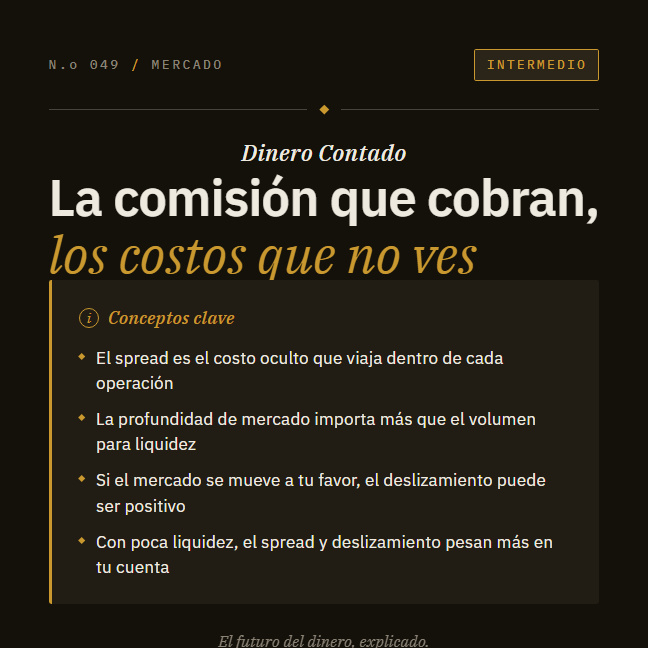
Two platforms can charge the same fee and yet one can still cost you more.
The number you see on the screen isn’t what you actually end up paying. There’s a gap between the price someone wants to buy at and the price someone else wants to sell at. And you cover that gap, not the exchange. It doesn’t show up as a separate line on your bill. It’s simply built into the transaction, silently.
That gap between the buying price and the selling price is called the spread, and it’s the invisible cost that doesn’t appear in any fee table.
KEY CONCEPTS
- High trading volume doesn’t guarantee a deep market: what matters is how many actual orders are near the current price, not how much trading took place during the day.
- Slippage—the difference between the price you expected and the one you actually got—doesn’t always work against you. If the market moves in your favor between when you place the order and when it’s executed, you end up paying less or receiving more than expected.
- A limit order protects you from the spread by setting the maximum or minimum price you’re willing to accept, but it doesn’t guarantee that the trade will be completed if the market never reaches that level.
The fee charged by the exchange is only the visible part of the bill. The spread and slippage are hidden in every trade, and they weigh most heavily on the assets where you can least afford them: those with low liquidity.
Transparency: Binance may pay us a commission if you trade after clicking an asset symbol or a price link in this post.
#Liquidez #Diferencial #Deslizamiento #CryptoTrading
1
1
374
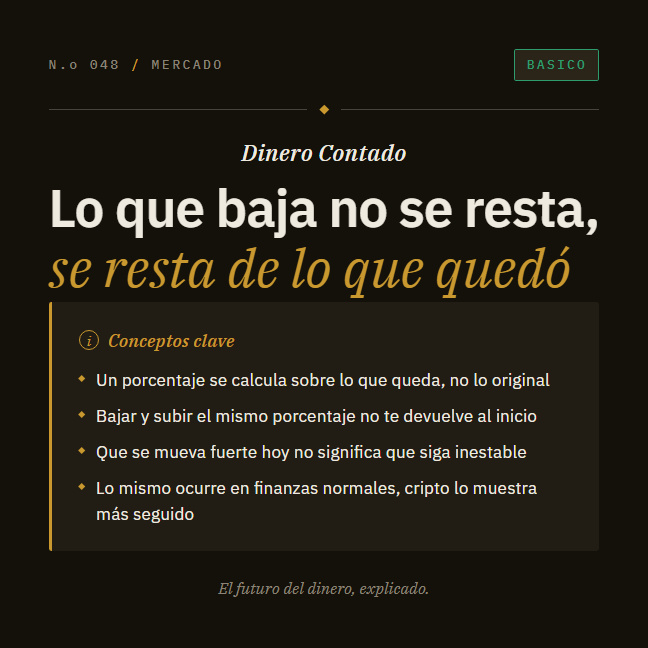
Losing 10 percent three days in a row doesn’t leave you with a 30 percent loss; it leaves you with almost 27 percent.
Imagine you put 100 dollars into something that moves a lot. On the first day, it drops 10 percent: you’re left with 90. On the second day, it drops another 10 percent, but that 10 percent is no longer calculated on the original 100; it’s calculated on the 90 you have left. So you’re left with 81. The same thing happens on the third day, and you end up with 72.9. You lost almost 27 percent, not 30. That difference isn’t a rounding error. It’s how percentages compound on what remains, not on what you had at the start.
The size of a price movement, measured as a percentage and accumulated day after day, has a name in the market: volatility.
KEY CONCEPTS
- A 10 percent drop isn’t subtracted from the initial total; it’s subtracted from what remains after the previous drop. That’s why three 10 percent drops don’t add up to a 30 percent loss.
- Going up and down by the same percentage doesn’t bring you back to where you started: you end up a little lower, and that difference grows the larger each move is.
- Just because an asset moves sharply one day doesn’t mean it will remain unstable forever; the same arithmetic that explains a drop also explains a recovery.
The same thing happens with any traditional savings or investment when returns vary from one period to another: percentages compound on the actual balance, not on the amount you started with. Crypto just illustrates it with bigger, more frequent moves.
Transparency: Binance may pay us a commission if you trade after clicking an asset symbol or a price link in this post.
#Volatilidad #Criptomonedas #MercadoCripto #TradFiForBeginners #FinancialEducation
1
252
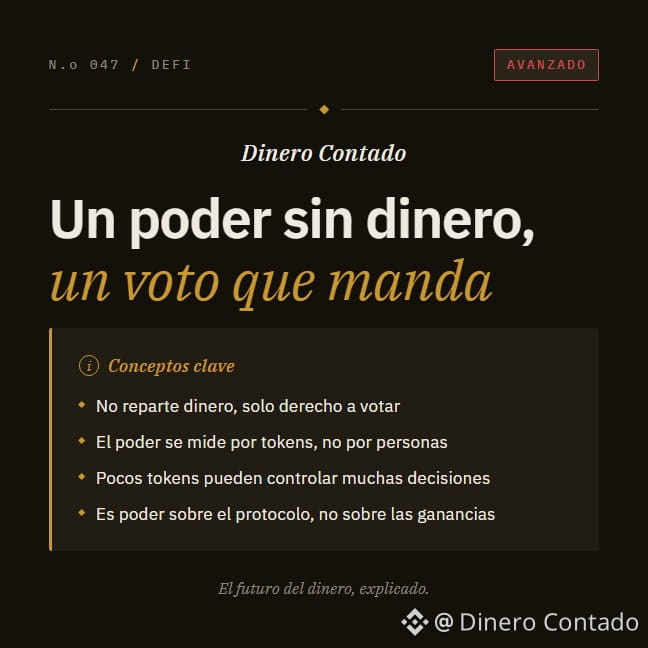
A governance token doesn’t pay you anything: it gives you a vote.
A DAO has no boss. It has rules written into a smart contract, and those rules decide who can propose a change and who can approve it. Participation isn’t measured by person; it’s measured by the number of tokens in a wallet. Imagine a DAO with one million governance tokens in circulation. The rule says a proposal needs a quorum of four percent—that is, forty thousand tokens voting. If only forty-five thousand tokens participate in total, and a single wallet controls twenty-three thousand of them, that wallet already has a majority in the vote. It controls just 2.3 percent of all tokens issued, but it decides the entire outcome. That’s how simple it is. That’s how harsh it is.
That’s what they call a governance token: a token that doesn’t distribute profits, but rather grants shares of power to make decisions about the protocol.
KEY CONCEPTS
- Holding a governance token doesn’t guarantee income or profit distributions: it only gives you the ability to vote on changes to the protocol.
- A governance token is not the same as a utility token or a security token: each follows a different logic and different rules.
- Voting power in a DAO is measured by the tokens in a wallet, not by the number of people: whoever holds more tokens has more decision-making power.
Buying a governance token is more like buying a share that gives you voting rights at a shareholders’ meeting than buying a ticket with a promise of payment. The power is there. The profits, not necessarily.
Transparency: Binance may pay us a commission if you trade after clicking an asset symbol or a price link in this post.
#Gobernanza #DAO #TokenDeGobernanza #DecentralizedFinance
1
202
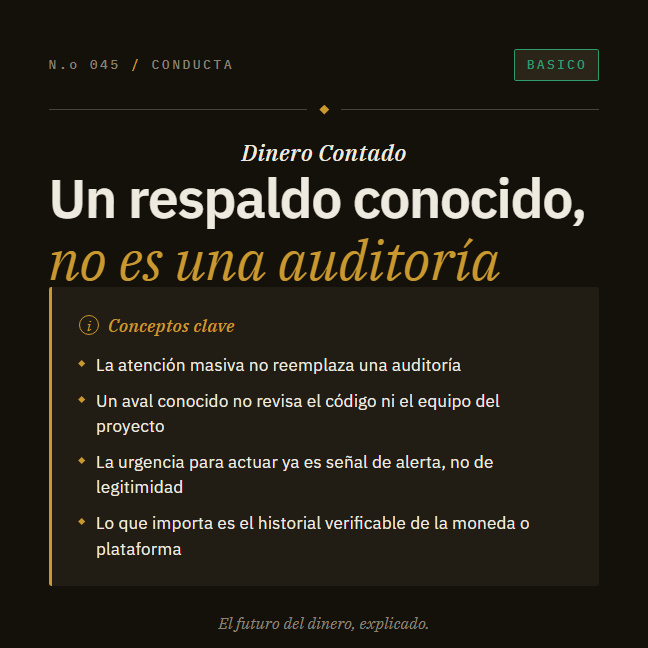
A familiar face backing a coin does not reduce the risk of losing your money one bit.
The belief is simple. If a well-known account mentions a coin, or if suddenly everyone is talking about it at the same time, many people assume someone has already checked that it’s safe. This happens often with $BNB and any other asset that becomes the talk of the day: mass attention is mistaken for real endorsement. But they’re not the same thing. The U.S. Federal Trade Commission has spent years documenting the opposite pattern in investment scams: promises of high returns with zero risk, wrapped in borrowed credibility. That credibility doesn’t belong to the project. It belongs to the message.
This mental shortcut—copying a decision just because many people have already made it—is called social proof.
KEY CONCEPTS
- A well-known endorsement or viral mention is not an audit of the project: it doesn’t review the team, the code, or where the money actually goes.
- The reputation that matters when making a decision comes from a verifiable track record, not the number of followers or comments.
- Pressure to act immediately, without thinking, is the most common red flag in investment scams and phishing—not proof of legitimacy.
The next time something goes viral, what matters isn’t who shares it, but the track record that coin or platform leaves behind. Check that track record before putting your money in, not afterward.
Transparency: Binance may pay us a commission if you trade after clicking an asset symbol or a price link in this post.
#EstafasCripto #PruebaSocial #SeguridadCripto #BinanceReopensWithdrawalsForMoreAssets #EducacionFinanciera
1
372
In a decentralized exchange, no person sets the price: it is calculated by a formula hidden in the contract.
In a traditional exchange, someone sells and someone buys, and the price comes from matching those two sides. There is an entire order book full of orders waiting their turn. In a DEX there is none of that. There is no book. There is no queue. There is nobody waiting for the other side to appear. What there is, is a contract with two piles of money stored inside, one of each asset, ready to be exchanged with whoever comes, at any time.
This system that sets the price solely from the ratio of what is stored in the contract, without anyone writing a buy or sell order, is called an automated market maker, or AMM for its acronym in English.
KEY CONCEPTS
- Trading on a DEX is not something designed only for people who do not have access to a bank. It is equally useful for someone with a bank account who simply prefers to manage their own keys.
- If the pool is managed by a DAO, that does not mean nobody is accountable for anything. Every change goes through a token vote, and a contract executes only what that vote won.
- The absence of a bank behind it does not make the system less secure by definition. Security depends on whether the contract is well written and how many people validated those rules, not on whether there is a central office.
Anyone who already understood that in an order book the price comes from matching what people offer against what people ask for only has to move the question one step further. Here, that crossing is not done by people: it is done by the ratio that remains stored in the contract after each operation.
Transparency: Binance may pay us a commission if you trade after tapping an asset symbol or a price link in this post.
#IntercambiosDescentralizados #CreadoresDeMercado #FinanzasDescentralizadas #Criptomonedas

1
509
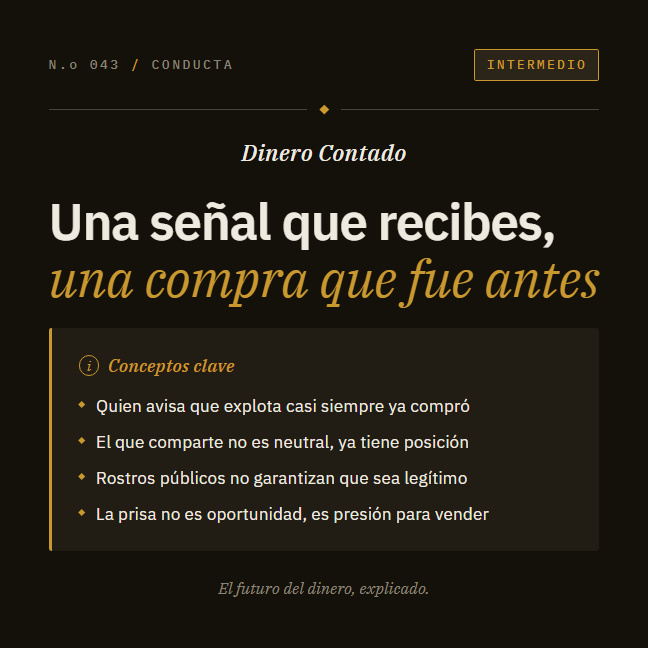
The person who tells you a token is about to explode has almost always bought before you.
Before the public sees any alert, a small group has already bought the token at a low price. They wait. When the price starts moving because of that very buying, someone in the group spreads the signal to outside accounts and channels that have no idea who set up the scheme. The person who seems generous for sharing the tip is almost always the same person who needs you to buy so they can sell before the price drops.
This tactic of inflating a price with false hype and then suddenly selling before anyone catches on is called price manipulation. In the crypto world, it’s more commonly known as a pump-and-dump scheme.
KEY CONCEPTS
- Just because someone shares a tip with you privately doesn’t make it trustworthy: the source is almost never neutral, because they already have a position in the token.
- An endorsement from a familiar face is no guarantee, either. Many of these schemes use public figures simply to attract new buyers.
- Not every opportunity promising quick profits is legitimate, even if it comes with charts and figures that look serious.
Urgency in a signal doesn’t measure the opportunity: it measures how many people the sender needs to get out first. You’ve seen this in other financial scams, even if the packaging is different this time: the more they rush you, the less time they give you to think.
Transparency: Binance may pay us a commission if you trade after clicking an asset symbol or a price link in this post.
#InflarYSoltar #ManipulacionDePrecios #EstafasCripto #CryptoEducation
1
544
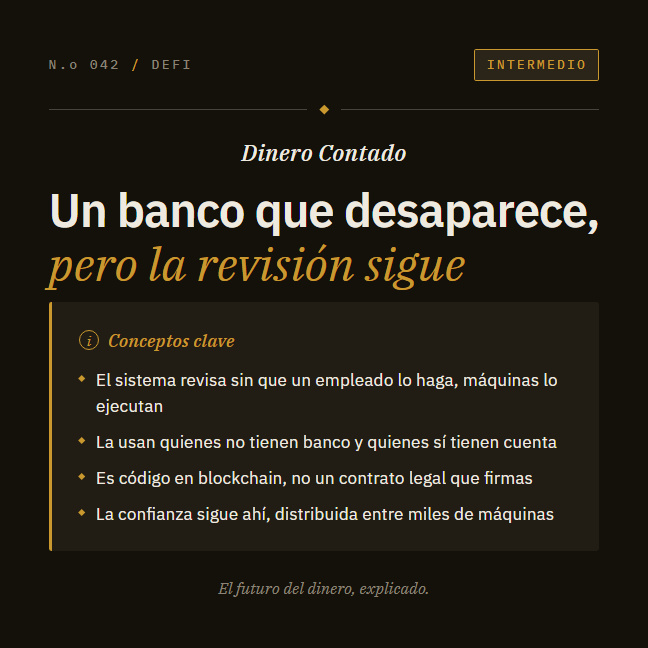
When you take out a loan without going through a bank, someone still checks that you pay on time.
The bank disappears from the picture, but the review doesn’t. Before, an employee approved your loan by reviewing paperwork and your history. Now, that review is done by code running on thousands of computers connected to one another. This code is called a smart contract, and it does something simple: it executes the rules only when they’re met, without anyone having to manually say yes. If you lend 100 and the contract charges a 2 fee, the borrower receives 98. Nobody negotiates that number in an office. It was already written into the code.
This whole system, where money moves and is validated without asking a bank or any other intermediary for permission, is what’s known as decentralized finance.
KEY CONCEPTS
- Thinking that decentralized finance means nobody checks anything is a mistake: the review still exists; it’s just carried out by a network of computers following code instead of a bank employee.
- It’s not a system just for people without access to traditional banking: people with regular bank accounts also use it to move money faster or pay lower fees.
- A smart contract isn’t a legal contract like the ones you sign with a lawyer: it’s code that runs on a blockchain, and what it does is limited to what that code says—nothing more.
This isn’t magic, nor is it the end of trust. It’s the same trust as always, distributed among thousands of computers instead of locked away in a single bank’s vault.
Transparency: Binance may pay us a commission if you trade after clicking an asset symbol or a price link in this post.
#FinanzasDescentralizadas #ContratosInteligentes #Blockchain #Cryptocurrencies
1
298
Many people buy a hardware wallet and consider the security issue settled.
It makes sense to think that way. The device’s chip stores the key and never connects to the internet; signing happens inside it, without exposing the key. That blocks remote theft, because no virus on your computer can copy something that never leaves the device. But blocking that threat doesn’t block all the others.
Here’s what almost nobody checks. You visit a fake exchange site and authorize a contract to move your funds. Your computer shows 0.05 $ETH, but the information sent to the device is different: unlimited permission to access your wallet. The device displays it character by character on its own screen. If you confirm without reading, it signs exactly that. The chip didn’t fail. The decision did.
The device’s passphrase protects against someone who steals it, not against what you yourself approve by mistake: access is one thing, judgment is another. Confusing the two explains much of today’s crypto phishing. A paper wallet teaches the same lesson: taking a key offline protects it from one type of threat, not all of them. Paper gets wet, burns, or gets lost, and nobody notices until it’s too late. Being offline isn’t the same as being safe.
A hardware wallet protects the key; signing is still a human decision, and that’s where its real limitation lies.
KEY CONCEPTS
- The offline chip prevents remote theft of the key, but it doesn’t verify whether the transaction you’re signing is legitimate.
- The passphrase protects the device from physical theft, not from transactions you yourself authorize by mistake.
- No wallet, hardware or paper, replaces the habit of reading the screen before confirming.
The device keeps the key away from the internet. Reading every signature before confirming is your job, not any chip’s.
Transparency: Binance may pay us a commission if you trade after clicking an asset symbol or a price link in this post.
#Custodia #Autocustodia #SeguridadCripto #HardwareWallet
Many people buy a hardware wallet and consider the security issue settled.
It makes sense to think that way. The device’s chip stores the key and never connects to the internet; signing happens inside it, without exposing the key. That blocks remote theft, because no virus on your computer can copy something that never leaves the device. But blocking that threat doesn’t block all the others.
Here’s what almost nobody checks. You visit a fake exchange site and authorize a contract to move your funds. Your computer shows 0.05 $ETH , but the information sent to the device is different: unlimited permission to access your wallet. The device displays it character by character on its own screen. If you confirm without reading, it signs exactly that. The chip didn’t fail. The decision did.
The device’s passphrase protects against someone who steals it, not against what you yourself approve by mistake: access is one thing, judgment is another. Confusing the two explains much of today’s crypto phishing. A paper wallet teaches the same lesson: taking a key offline protects it from one type of threat, not all of them. Paper gets wet, burns, or gets lost, and nobody notices until it’s too late. Being offline isn’t the same as being safe.
A hardware wallet protects the key; signing is still a human decision, and that’s where its real limitation lies.
KEY CONCEPTS
- The offline chip prevents remote theft of the key, but it doesn’t verify whether the transaction you’re signing is legitimate.
- The passphrase protects the device from physical theft, not from transactions you yourself authorize by mistake.
- No wallet, hardware or paper, replaces the habit of reading the screen before confirming.
The device keeps the key away from the internet. Reading every signature before confirming is your job, not any chip’s.
Transparency: Binance may pay us a commission if you trade after clicking an asset symbol or a price link in this post.
#Custodia #Autocustodia #SeguridadCripto #HardwareWallet

1
150
Some digital currencies never leave their original network, even when you use them on a completely different network.
If you have bitcoin and want to use it on Ethereum, you can’t just move it over. Bitcoin lives on its own chain, with its own rules. It doesn’t cross over on its own. What you can do is get a version of that bitcoin that circulates on Ethereum, while the original is kept somewhere else. Still. Without leaving its network.
The mechanism is simple. Someone gives 1 bitcoin to a custodian, who locks it away and issues 1 $WBTC on Ethereum. One for one. The bitcoin never leaves the vault. What you buy and sell is the receipt. And that receipt is worth something only as long as the custodian still holds the bitcoin.
The real risk isn’t in the network where the copy circulates, or in a coding error in the contract. It’s with the custodian. Whether it remains solvent, whether it still holds the bitcoin, whether it’s still willing to return it. This is called counterparty risk. And if the custodian goes bankrupt or stops responding, the copy is left without backing. Even if the network works perfectly.
That copy that lives on another network, backed by someone holding the original, is called a wrapped token.
KEY CONCEPTS
- A wrapped token isn’t the original. It’s a copy, and it’s worth what it’s worth because an external party holds the original and promises to return it.
- The backing depends on the custodian’s solvency, not on the protocol where the wrapped token circulates.
- A network running without issues doesn’t tell you whether the asset backing the wrapped token still exists.
It’s the same logic as a certificate of deposit. The paper represents the gold held in the vault, and is worth something only as long as that gold is still there.
Transparency: Binance may pay us a commission if you trade after clicking an asset symbol or price link in this post.
#TokensEnvueltos #Custodia #RiesgoContraparte #CriptoActivos

1
367
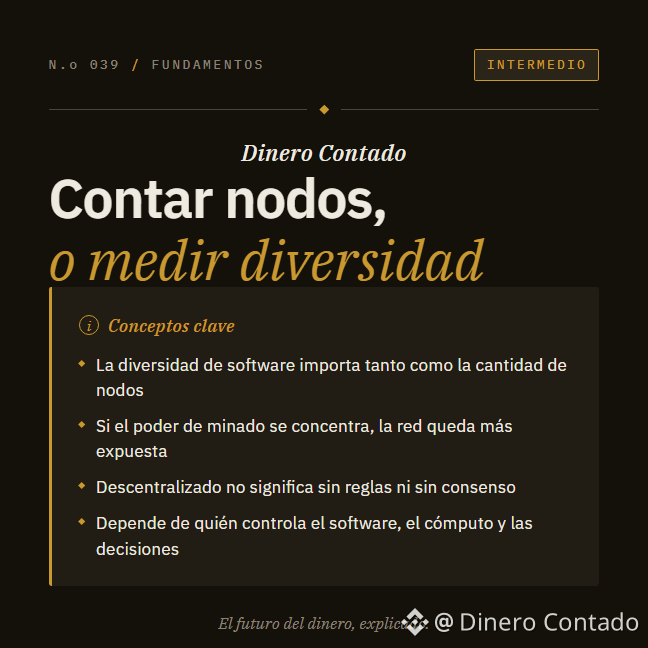
More nodes doesn’t mean more decentralization, and decentralized doesn’t mean without rules.
That’s the belief almost everyone repeats, and both halves fall apart as soon as you examine them.
First, the nodes. Imagine a network with ten nodes, but seven of them run the same software. A bug in that software affects seven out of the ten at the same time. That’s why software diversity matters just as much as the number of nodes.
With $BTC , something similar happens with mining power. Thousands of computers validate transactions, but if that power is concentrated among a few operators, the network is more exposed.
And the second half doesn’t hold up either. The fact that no one controls the network doesn’t mean there are no rules. There’s a consensus mechanism that requires everyone to share the same version of the history. And there’s social consensus: the community discusses and agrees on the protocol’s direction.
That’s what decentralization measures. It isn’t a fixed number. It’s a spectrum that depends on who controls the software, who controls the computing power, and who participates in decisions.
KEY CONCEPTS
- Counting nodes without looking at the software isn’t enough: if almost all of them run the same program, they share the same point of failure.
- A high hash rate doesn’t tell you anything on its own. What matters is whether that power is distributed among many miners or concentrated among a few.
- Decentralized doesn’t mean without rules. Technical consensus and social consensus govern the network.
- Decentralization isn’t a switch. It’s a spectrum that shifts over time.
What separates a decentralized network from one that only appears to be decentralized is whether its nodes think differently from one another, not how many there are.
Transparency: Binance may pay us a commission if you trade after clicking an asset symbol or a price link in this post.
#Descentralizacion #Blockchain #Criptomonedas #FedWatch #EducacionCripto
1
103
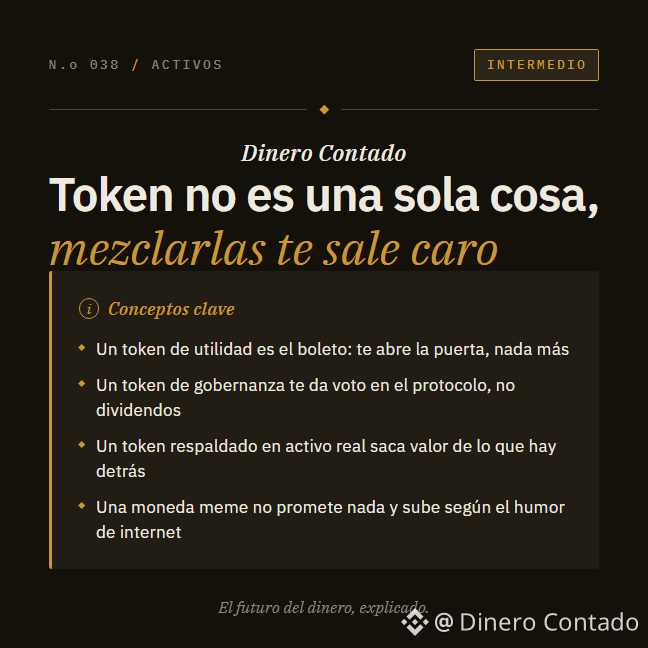
A token isn’t just one thing. Treating all four categories as if they were the same will cost you sooner or later.
Imagine four tokens stored in the same wallet. The first lets you use an app, like a movie ticket. The second gives you a vote in a protocol, like a share that lets you have a say at a shareholders’ meeting. The third is worth what it is because it’s backed by real gold: that’s how $PAXG works. And the fourth backs nothing. It exists only because a community decided to laugh at something on the internet and then bought it.
Those four categories are the types of tokens you’ll encounter in crypto, and each follows different rules.
KEY CONCEPTS
- A utility token isn’t money. It gives you access to a service, but on its own, it’s worthless outside that platform.
- A governance token gives you a vote, not a profit. Having a say in a protocol’s future isn’t the same as earning dividends.
- An asset-backed token, such as $PAXG, gets its value from what backs it, not from a promise. That’s why it usually comes with more rules than the others.
- A meme coin promises nothing. Its price rises and falls with the mood on the internet, not based on any real product or service behind it.
If you already know the difference between a share, a movie ticket, and a bar bet, you’ve got the basic idea for distinguishing these four types of tokens.
Transparency: Binance may pay us a commission if you trade after clicking an asset ticker or price link in this post.
#TiposDeToken #Criptomonedas #ActivosDigitales #CryptoEducation
A token isn’t just one thing. Treating all four categories as if they were the same will cost you sooner or later.
Imagine four tokens stored in the same wallet. The first lets you use an app, like a movie ticket. The second gives you a vote in a protocol, like a share that lets you have a say at a shareholders’ meeting. The third is worth what it is because it’s backed by real gold: that’s how $PAXG works. And the fourth backs nothing. It exists only because a community decided to laugh at something on the internet and then bought it.
Those four categories are the types of tokens you’ll encounter in crypto, and each follows different rules.
KEY CONCEPTS
- A utility token isn’t money. It gives you access to a service, but on its own, it’s worthless outside that platform.
- A governance token gives you a vote, not a profit. Having a say in a protocol’s future isn’t the same as earning dividends.
- An asset-backed token, such as $PAXG , gets its value from what backs it, not from a promise. That’s why it usually comes with more rules than the others.
- A meme coin promises nothing. Its price rises and falls with the mood on the internet, not based on any real product or service behind it.
If you already know the difference between a share, a movie ticket, and a bar bet, you’ve got the basic idea for distinguishing these four types of tokens.
Transparency: Binance may pay us a commission if you trade after clicking an asset ticker or price link in this post.
#TiposDeToken #Criptomonedas #ActivosDigitales #CryptoEducation
1
120
A token that promises to be worth one dollar only keeps that promise if someone holds real dollars somewhere. It’s not magic. It’s accounting.
For every 100 tokens in circulation, there must be 100 dollars held in reserve. That makes it possible to exchange the token for real money at any time. It isn’t backed by an algorithm; it’s backed by a vault.
As of October 27, 2026, at 11:45 UTC, USDC was trading at 1.00 USDT, up 0.02% over the past 24 hours. That’s how $USDC moves when its backing is disclosed: hardly at all.
This type of token is called a stablecoin. Its stability doesn’t come from code. It comes from whatever is backing it.
But there are different levels. A regulated version reports its reserves to a supervisory body and undergoes audits. That builds confidence, but it’s not a guarantee. A quarterly audit only confirms what was there on that day.
The dollar backing it isn’t solid in itself, either. It has value because a government backs it and people believe in it. If that government prints too much money, the token can still show 1.00 and lose real value all the same.
That’s how each type can fail. A fiat-backed token fails if its reserve isn’t complete. A regulated one fails more slowly, but depends on the auditor doing their job properly.
KEY CONCEPTS
- A stablecoin isn’t immune to risk. It simply shifts the risk from the token’s price to the strength of its reserves.
- The dollar behind a fiat token isn’t inherently safe. It has value because people trust a government, not because it’s a physical asset.
- An audit reduces uncertainty; it doesn’t eliminate it. It confirms the past, not the present.
The number on the screen is the easy part to believe. The backing is what you need to check.
Transparency: Binance may pay us a commission if you trade after clicking an asset symbol or a price link in this post.
#MonedaEstable #Criptomonedas #RespaldoFinanciero #DigitalAssets

1
1
339
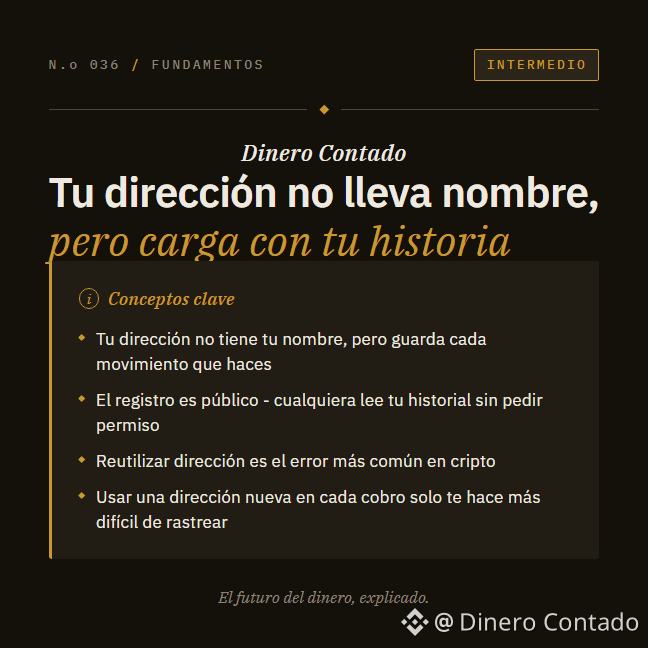
Almost everyone thinks cryptocurrencies are anonymous. That’s a lie.
What you have is pseudonymity, not anonymity. Your name doesn’t appear on the blockchain. But your address does. And that address has a memory.
The network runs on a public ledger. Anyone can open it and see every transaction, without asking permission. There’s no lock on the door. Total transparency, hidden identity. Until someone connects the dots.
Here’s an example. You receive 1 $USDC at an address. You pay 0.6 $USDC to a store, and the 0.4 $USDC in change goes back to a new address. So far, nobody knows those two addresses are yours. But if you use that change address to receive another payment, anyone checking the ledger can link the two transactions. That’s when the disguise falls apart.
It has a name: address reuse. It’s the most common mistake in crypto, and the one that has exposed the most complete transaction histories.
KEY CONCEPTS
- It’s not anonymity, it’s pseudonymity. Your address doesn’t carry your name, but it does carry your entire transaction history.
- The ledger isn’t hidden anywhere. Anyone can read it without asking permission.
- Reusing an address doesn’t expose you instantly, but it gives away the clue that links your payments.
- Using a new address for every payment doesn’t make you invisible. It just makes you harder to track.
Your wallet isn’t a room with the door closed. It’s a display case with crystal-clear glass.
Transparency: Binance may pay us a commission if you trade after clicking an asset symbol or a price link in this post.
#Anonimato #Blockchain #Criptomonedas #BinancePick #Traceability
1
114
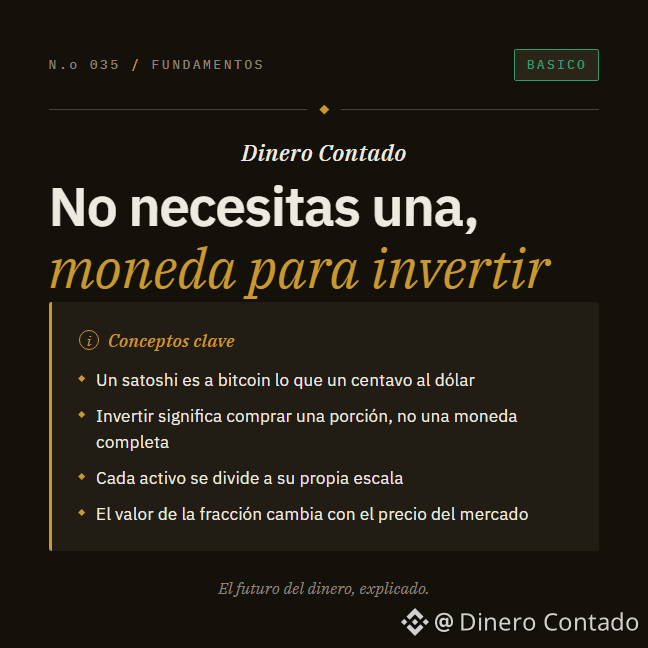
You don’t need to buy a whole bitcoin to start investing in crypto.
Each coin can be divided into tiny pieces, just as a dollar can be divided into cents. One bitcoin is divided into one hundred million parts. If someone puts in ten dollars, they aren’t buying a coin; they’re buying a tiny fraction of those one hundred million parts. And that fraction is worth whatever the market says it’s worth that day, no more and no less. It’s not magic, just division.
That smallest unit has a name: satoshi.
KEY CONCEPTS
- A satoshi is the smallest unit of bitcoin, just as a cent is the smallest unit of a dollar. It’s not a marketing gimmick; it’s how any amount smaller than a whole coin is counted.
- Buying crypto never means buying a whole coin. It means buying a portion, large or small, and that applies to any amount you put in.
- Each asset has its own scale of divisibility. $SOL can also be divided into smaller amounts for trading; you don’t need to own a whole SOL to get started.
- But having a few satoshis doesn’t mean they’ll always be worth little. The price of that fraction changes with the market, just like the price of a whole coin.
Thinking about a wallet this way changes the question you ask yourself. It’s no longer about how many coins you have, but how much the fraction you do have is worth.
Transparency: Binance may pay us a commission if you trade after clicking an asset symbol or a price link in this post.
#Satoshis #Divisibilidad #Criptomonedas #CryptoEducation
1
1
326
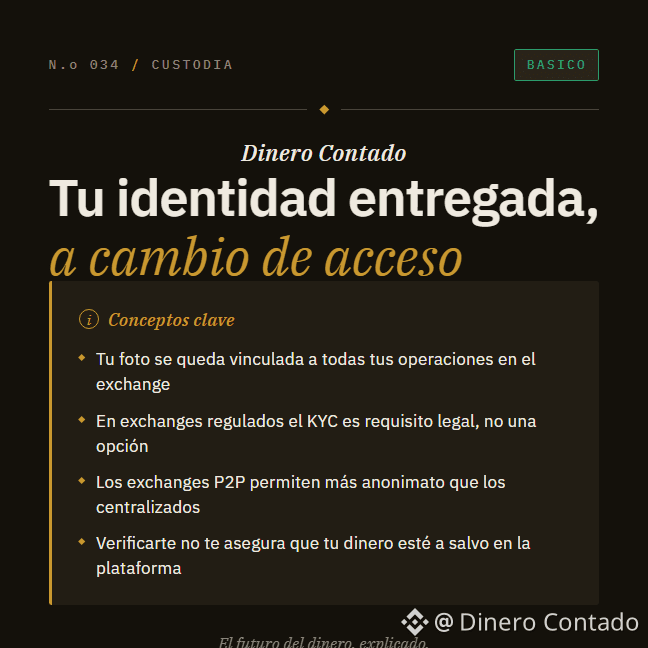
You upload your ID to an exchange and think the process ends there. It doesn’t: that photo stays attached to every transaction you make from that account.
The platform asks for those details to confirm that you are who you say you are before letting you trade: your phone number, a photo of your ID, and sometimes proof of address. The system checks that the photo is clear and the details match; if anything is blurry, verification gets held up and your account is put on pause. The same applies whether you’re buying bitcoin or buying $BNB on a centralized exchange.
That identity check has a name: KYC verification, short for “know your customer.”
KEY TAKEAWAYS
- KYC isn’t a whim of the platform. On regulated exchanges, it’s a legal requirement, not a step you can skip.
- Not just any document will do. A blurry photo or a mismatched detail can make the exchange reject your verification and leave you waiting.
- Not all exchanges handle your identity the same way: peer-to-peer exchanges connect buyers and sellers directly without holding your money, which allows for more anonymity; centralized exchanges pool orders in an order book and also require KYC.
- Verification doesn’t make it safe to leave your coins there forever: an exchange can be hacked, and unlike with a bank, there’s no insurance to get your money back.
You handed over your identity in exchange for access. It’s that simple. It’s the same trade-off you already make with your bank, except here, the gatekeeper is a cryptocurrency platform.
Transparency: Binance may pay us a commission if you trade after clicking an asset symbol or a price link in this post.
#VerificacionKYC #Custodia #Exchanges #Cryptocurrencies
1
122
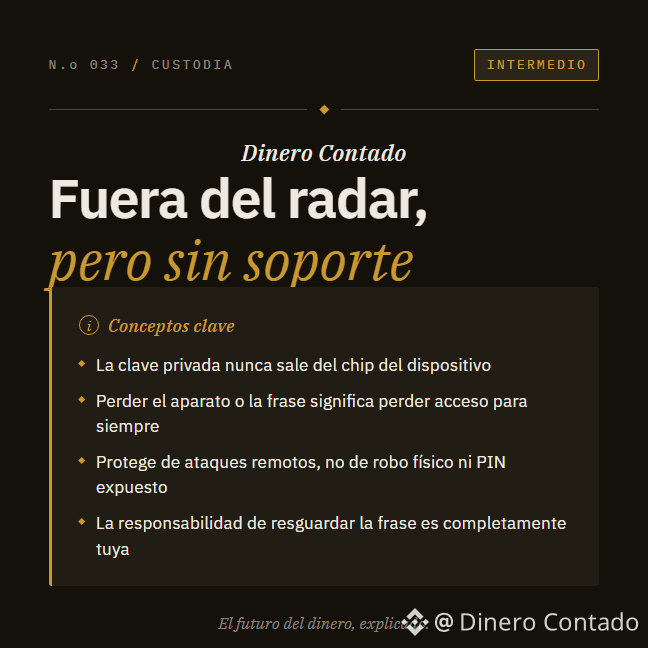
Keeping your keys offline takes you off hackers’ radar, but it also means you’re on your own if something goes wrong.
Imagine storing 2 $ETH in a device that never connects to the internet. As long as that device is switched off and put away, no one can steal those 2 $ETH remotely. But if you lose it and didn’t write down your recovery phrase, those same 2 $ETH are out of your reach forever. There’s no technical support service that can restore your access.
Here’s how it works: the private key—the piece of information that authorizes funds to be moved—never leaves the device’s chip. To spend, you connect it to a computer just for that moment, sign the transaction inside the device, and then disconnect it again. The rest of the time, that key has no open connection to the internet.
That’s what’s known as cold storage.
KEY CONCEPTS
- Not everything needs to be connected to be useful: a cold wallet works precisely because it stays disconnected most of the time.
- It’s not zero-maintenance: losing the device or recovery phrase means losing access, and no one can restore it for you.
- It’s not invulnerable to everything: it blocks remote attacks, but it won’t stop someone from seeing your PIN or stealing the physical device.
- Keeping your key offline isn’t insurance: if the device is lost, you bear the risk, not a platform.
What you gain from being disconnected is peace of mind from hackers. What you lose is any backup network if you make a mistake yourself.
Transparency: Binance may pay us a commission if you trade after clicking an asset symbol or price link in this post.
#AlmacenamientoEnFrio #Custodia #SeguridadCripto #AustraliaProposesCryptoTransactionReportingLaw #CryptoEducation
1
106
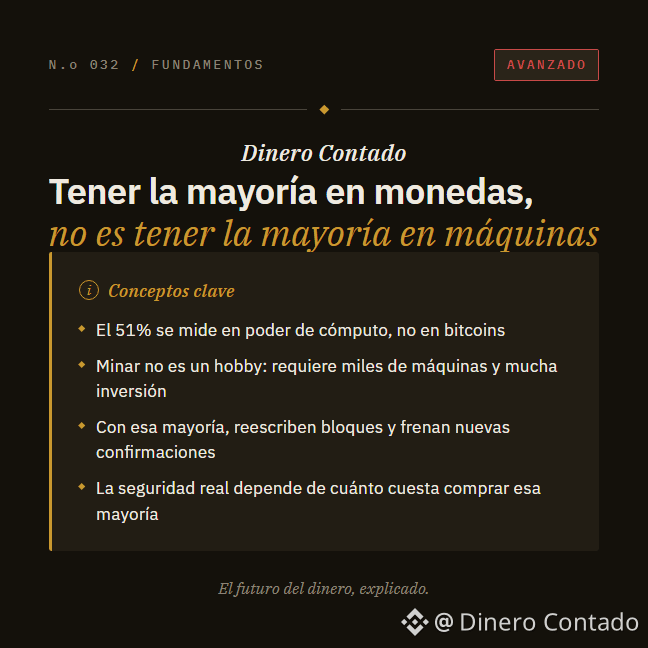
No one breaks $BTC by buying coins. You have to buy computing power, and that costs a fortune in machines and electricity.
Think of the network as a continuous vote among thousands of miners, each with a fraction of the computing power that validates blocks. If the total is 100 parts, someone needs to gather 51 to take control. Not half of the bitcoins in circulation, but half of the muscle processing the transactions. That means building or renting more mining capacity than the rest of the planet combined.
But with that majority in hand, an attacker can rewrite the most recent blocks and stop other miners from confirming new transactions. It breaks the shared agreement that lets everyone see the same ledger. This is called a 51 percent attack.
KEY CONCEPTS
- Having 51% of the coins is not the same as having 51% of the computing power. The latter opens the door to rewriting history; confusing the two is the most common mistake.
- Mining isn't a hobby you can do with an old laptop. It requires thousands of specialized machines and an investment that competes with the entire industry, not just some random rival.
- Having the majority doesn't create coins out of thin air or empty other people's wallets. It only allows an attacker to rewrite recent blocks and stop new confirmations, within the rules of the protocol.
- The risk isn't unique to Bitcoin. Any network whose consensus depends on computing power faces the same cost calculation, though each handles it differently.
A network's security doesn't depend on promises or pretty code. It depends on how much money it would take to buy a majority, and that figure is the real barrier.
Transparency: Binance may pay us a commission if you trade after clicking an asset symbol or a price link in this post.
#Blockchain #MineriaBitcoin #SeguridadCripto #BTCFallsBelow$81K #Decentralization
1
141
Mining $BTC solo today is like playing the lottery while paying the electricity bill, waiting for a prize that almost never comes.
The network adjusts the difficulty based on the total connected computing power, so your chance of finding a block depends on your share of that power. And if your share is small compared with the total, years can go by without a payout, even though the electricity bill comes every month.
Imagine a group with 100 units of computing power. You contribute 5, or 5% of the total. When the group wins a block, you get that 5%, no matter who solved the calculation. No giant, random prize: you receive small, steady payouts based on your actual contribution.
A group that pools computing power and distributes the reward according to each member’s contribution is called a mining pool.
The hardware is still spread across thousands of people. But decision-making power is concentrated in the operator: they assemble the block, choose which transactions go in first, and decide which version to follow if the chain forks. Joining a pool doesn’t take away your machine, but it does mean following someone else’s rules.
KEY CONCEPTS
- A pool doesn’t guarantee profits: it reduces variance, but you’re still exposed to market risk.
- Not all pools pay the same way: the method, such as pay-per-share or pay-per-last-shares, affects how much you receive.
- Solo mining isn’t illegal or impossible; it just stopped being practical without an industrial-scale operation.
- Joining a pool doesn’t mean handing over your funds: the pool pays out rewards, but your keys remain yours.
The $BTC network is still the sum of thousands of machines spread around the world. What’s changed is that almost no one competes alone against the odds anymore: now they compete as a team and share control too.
Transparency: Binance may pay us a commission if you trade after clicking an asset symbol or a price link in this post.
#MineriaCripto #PoolDeMineria #PotenciaDeComputo #BTCDominanceBackAt60% #SharedRisk

1
1
382
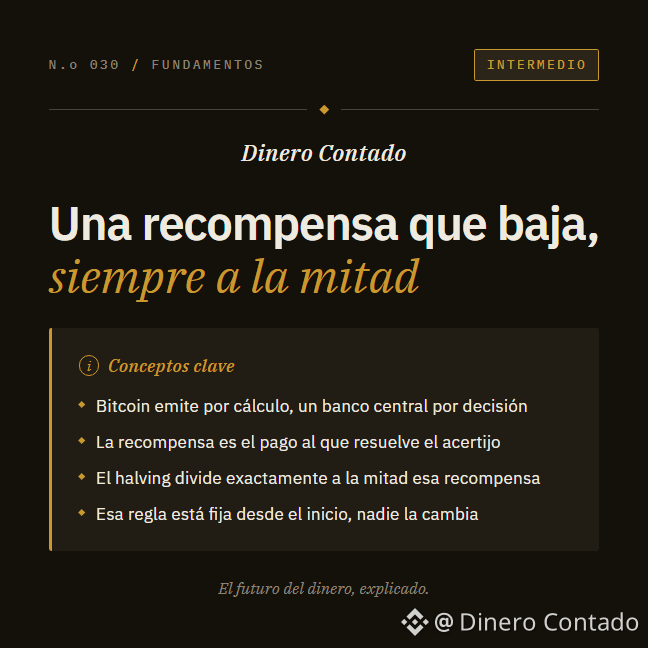
Every $BTC new coin comes from a calculation, not a printing press.
Someone turns on a powerful computer and competes against thousands of others to solve a mathematical puzzle. The first to solve it adds the next block of transactions to the chain. And the network pays them for it—with coins that didn’t exist a second earlier.
That payment has a built-in limit. The protocol has a written rule: after a certain number of blocks, the payment is cut exactly in half. It doesn’t grow or change at anyone’s discretion; it’s simply cut. Again and again, always in half from the previous amount, approaching zero without ever quite reaching it.
The payment earned by whoever mines is called the block reward. And the cut that divides it in two is called a halving.
KEY CONCEPTS
- The reward isn’t fixed forever: it decreases according to a rule in the code, not anyone’s decision.
- Mining isn’t guaranteed profit: electricity, hardware, and competition all come into play.
- Halving isn’t exclusive to Bitcoin: other networks that use mining have similar adjustments.
- You can’t mine with just any laptop anymore: today it requires specialized equipment and a lot of computing power.
Just as a central bank decides how much money to print, the code of $BTC decides how much to issue. But that rule is set from the start, and no one can change it midway.
Transparency: Binance may pay us a commission if you trade after clicking an asset symbol or a price link in this post.
#Mineria #Halving #Criptomonedas #LedgerConfirmsUnauthorizedHardwareImplantInUserDevice #Blockchain
1
122
Log in to explore more content
Join global crypto users on Binance Square
⚡️ Get latest and useful information about crypto.
💬 Trusted by the world’s largest crypto exchange.
👍 Discover real insights from verified creators.
Email / Phone number
Trending Topics
A Packed Week of Earnings and Data Tests Markets
52,773 views
360 Discussing
🚨🇺🇸 BIG WEEK AHEAD FOR THE MARKETS!
Markets are pricing in a Fed rate hike in December and $BTC could see some big moves next week.
Here's what's coming:
• Monday: Fed Chair Warsh speaks
• Tuesday: US Retail Sales + $NVDA earnings
• Wednesday: FOMC Minutes
• Thursday: Jobless Claims + Philly Fed Index
• Friday: Consumer Sentiment + Fed speeches
All eyes on $BTC as another important week begins.
#bitcoin
Mookie
·14 Likes
·6.1k views
AnthropicIPOTestsInvestorAppetiteForAI
91,046 views
1,231 Discussing
BitcoinExtendsLosingStreakToSixWeeks
54,324 views
587 Discussing