
#msci
msci
85,527 views
403 Discussing
Hot
Latest

·
--
Strategy is only a few percent above its Bitcoin cost basis, and MSCI decides on index treatment on November 11.
Saxo notes Strategy fell about 8% on Friday, while spot Bitcoin funds shed about $643M, their largest outflow since June. $BTC sits near $78K.
My take: the treasury-company trade is now tied closely to the coin's price and to index decisions. If $BTC slipped lower, that link would get tested fast.
Do you think an MSCI decision matters more for $BTC than ETF flows do? Why?
#Bitcoin #Strategy #MSCI #ETFs
Not financial advice.

·
--
On November 11, MSCI could deal Strategy a nasty blow ⚠️
📌 On October 15, MSCI approved a new rule: “non-operating companies” will be removed from global indexes. It takes effect at the November 30 close, and the final list will be announced on November 11.
📌 The potential list includes five companies, including Strategy and Metaplanet.
📌 Strategy’s own estimate: index funds affected hold about 13 million MSTR shares, or roughly 3.1% of the shares outstanding.
📌 Note: Current index constituents must fail to qualify for two consecutive annual reporting periods before being removed. It has not yet been confirmed that Strategy will be dropped.
📉 Last Friday, MSTR closed at $130.49, down 7.86% for the day. On the same day, spot BTC ETFs saw $643 million in outflows—the largest single-day outflow since June 25 (CoinDesk/SoSoValue).
👉 BTC is now around $77,000, and the Fear & Greed Index is at 37.
My take: Selling pressure from passive funds is a short-term sentiment shock. The real risk is that once MSTR’s premium shrinks, its “flywheel” of issuing shares to buy bitcoin may stop turning. Three things to watch next week: the U.S. midterm elections on 11/3, nonfarm payrolls on 11/6, and the MSCI list on 11/11.
Do you think Strategy will stay in the index, or is it bound to be dropped on November 11? Let’s discuss in the comments 👇
$BTC $ETH #Strategy #MSCI #Bitcoin
Personal opinion only; not investment advice

16
·
--
🚨 On November 11, Strategy (MSTR) could be removed from the MSCI Global Index, while Saylor is hinting that he’ll buy BTC again.
📌 Facts:
• MSCI’s new rules take effect on 10/15; the final list will be announced on 11/11 and take effect after the market closes on 11/30
• The potential list includes five companies, such as Strategy and Metaplanet
• JPMorgan estimates that removal could trigger up to approximately $2.8 billion in passive selling (via TechFlow)
• Strategy estimates that index funds hold approximately 13 million of its shares, or 3.1%
• The company most recently disclosed that it holds 848,517 BTC
🧠 My take: Being removed doesn’t mean the company has to sell its coins. The impact would hit MSTR’s share price first, then affect its ability to raise funds to buy BTC. BTC is currently around $77.8K, the Fear & Greed Index is at 34, and ETFs saw $643 million in outflows on 10/30—the market was already fragile.
⚠️ Key dates: 11/3 Binance reserve report, 11/6 nonfarm payrolls, 11/11 MSCI.
Do you think MSCI will ultimately remove Strategy? Vote in the comments 👇
$BTC $ETH
#Strategy #MSCI #Bitcoin
Personal opinion only; not investment advice

259

Strategy’s MSCI risk: Watch before 11/11
- MSCI will announce the companies affected on 11/11.
- Strategy faces the risk of being removed from the index.
- Watch for developments before 11/11.
#BinanceSquare #CryptoNews #MSCI
$btc $eth
#vlikevn #Titanbot
Source: DL News
Strategy’s MSCI risk: Watch before 11/11
- MSCI will announce the companies affected on 11/11.
- Strategy faces the risk of being removed from the index.
- Watch for developments before 11/11.
#BinanceSquare #CryptoNews #MSCI
$btc $eth
#vlikevn #Titanbot
Source: DL News
- MSCI will announce the companies affected on 11/11.
- Strategy faces the risk of being removed from the index.
- Watch for developments before 11/11.
#BinanceSquare #CryptoNews #MSCI
$btc $eth
#vlikevn #Titanbot
Source: DL News
124

·
--
Saylor’s treasury company is caught up in MSCI’s new index rules. The company, known for raising money by issuing shares to buy crypto, currently holds 848,517 $BTC—about 4% of the total supply. MSCI classifies these crypto-holding treasury companies as non-operating entities. The final list will be announced on November 11, and the new rules take effect after the market closes on November 30. The company is also due to report earnings on Thursday. If its index eligibility changes, the engine of issuing shares to raise funds for buying bitcoin could stall. $BTC #Saylor #MSCI #Macro
Saylor’s treasury company is caught up in MSCI’s new index rules. The company, known for raising money by issuing shares to buy crypto, currently holds 848,517 $BTC —about 4% of the total supply. MSCI classifies these crypto-holding treasury companies as non-operating entities. The final list will be announced on November 11, and the new rules take effect after the market closes on November 30. The company is also due to report earnings on Thursday. If its index eligibility changes, the engine of issuing shares to raise funds for buying bitcoin could stall. $BTC #Saylor #MSCI #Macro

161

🏛️ New MSCI Rule Takes Effect: Could Strategy Be Removed from Global Indexes?
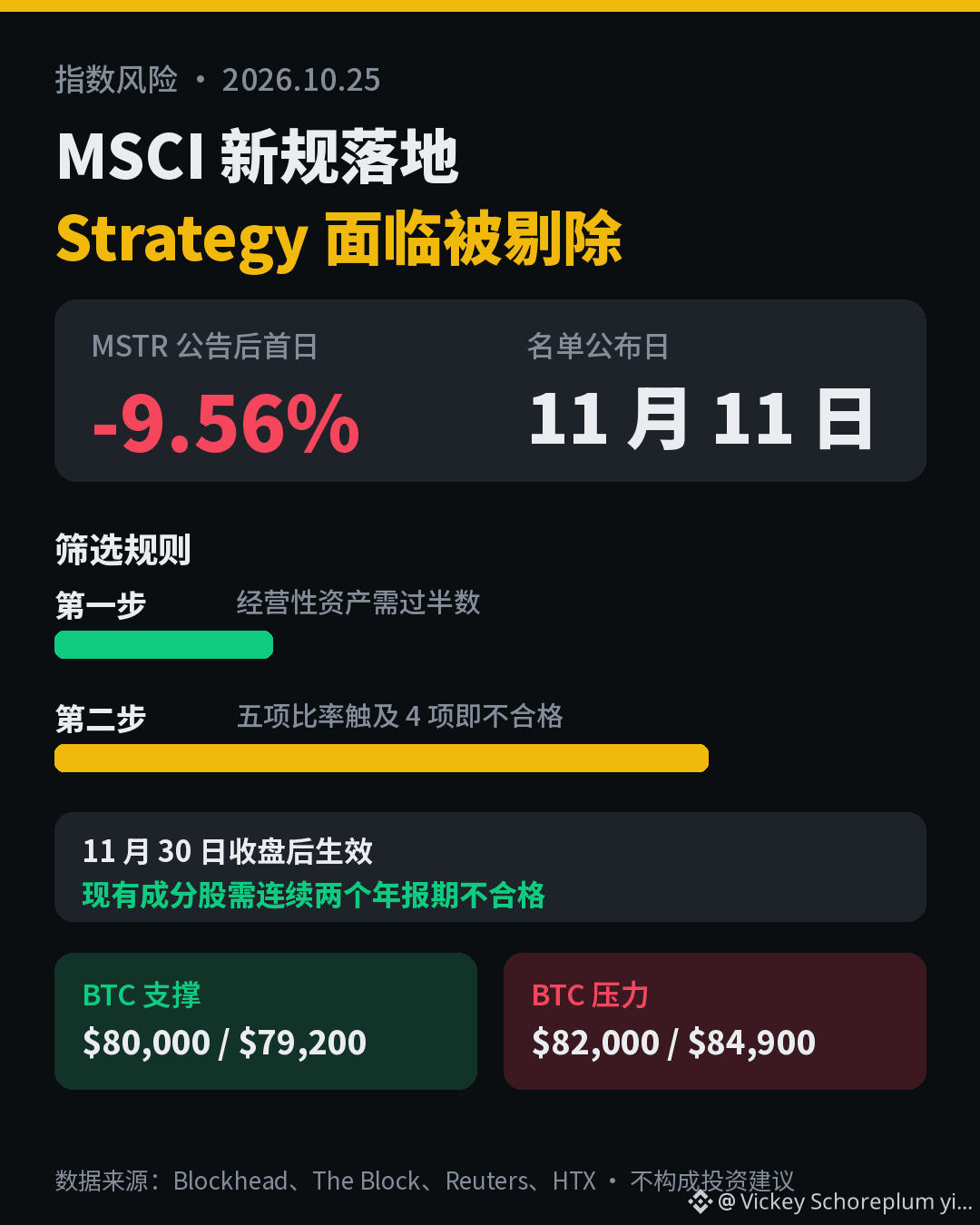
MSCI has officially adopted a new rule for “non-operating companies”: these companies will no longer qualify for its Global Investable Market Indexes. The rule takes effect after the market close on November 30, and the list of affected companies will be announced on November 11. On the first trading day after the announcement, Strategy shares closed down 9.56% at $136.83 (reported by Blockhead).
📌 Key details
• The screening process has two steps: first, it checks whether operating assets account for more than half of total assets. If not, the company is assessed against five financial ratios; failing four or more means it is ineligible.
• Existing index constituents will be removed only if they fail to qualify in both of the two most recent annual reporting periods; removal is not automatic across the board.
• The rule does not directly name crypto assets. Strategy, Metaplanet, and others were identified as potential candidates in earlier simulations, but whether they will ultimately be removed has not been confirmed.
• Analysts estimate that removal could trigger potential passive fund outflows of up to approximately $2.8 billion (cited by HTX).
💡 Market impact
For BTC, this is more of a risk to sentiment and fund flows. Strategy is the largest corporate holder of BTC, and pressure on its share price could affect expectations around buying by “treasury companies.” But passive fund rebalancing does not mean the company will sell its coins. The list on November 11 is the key date.
📊 BTC reference levels (daily chart over the past two weeks; current price around $80,850)
• Support: $80,000 / $79,200
• Resistance: $82,000 / $84,900
🤔 Do you think Strategy will ultimately be removed? Would this be a short-term negative for BTC, or has the market already priced it in? Join the discussion in the comments 👇
👉 Trade BTC: https://www.binance.com/zh-CN/trade/BTC_USDT
#MSCI敲定新规Strategy面临被剔除风险 #BTC #Strategy #MSCI
⚠️ This is not investment advice. Please be aware of the risks.
171

·
--
Verified
MSCI drops the hammer: takes effect November 30; “non-operating companies” will be removed from index eligibility.
Strategy has been named as a candidate for removal, with Metaplanet also on the candidate list and SharpLink on the watchlist.
MSCI will announce the final list on November 11, at which point passive index funds will have to sell.
Strategy itself warned last year that being dropped from the index could trigger $2.8 billion in passive selling.
An 8-K filed the same week is even more interesting.
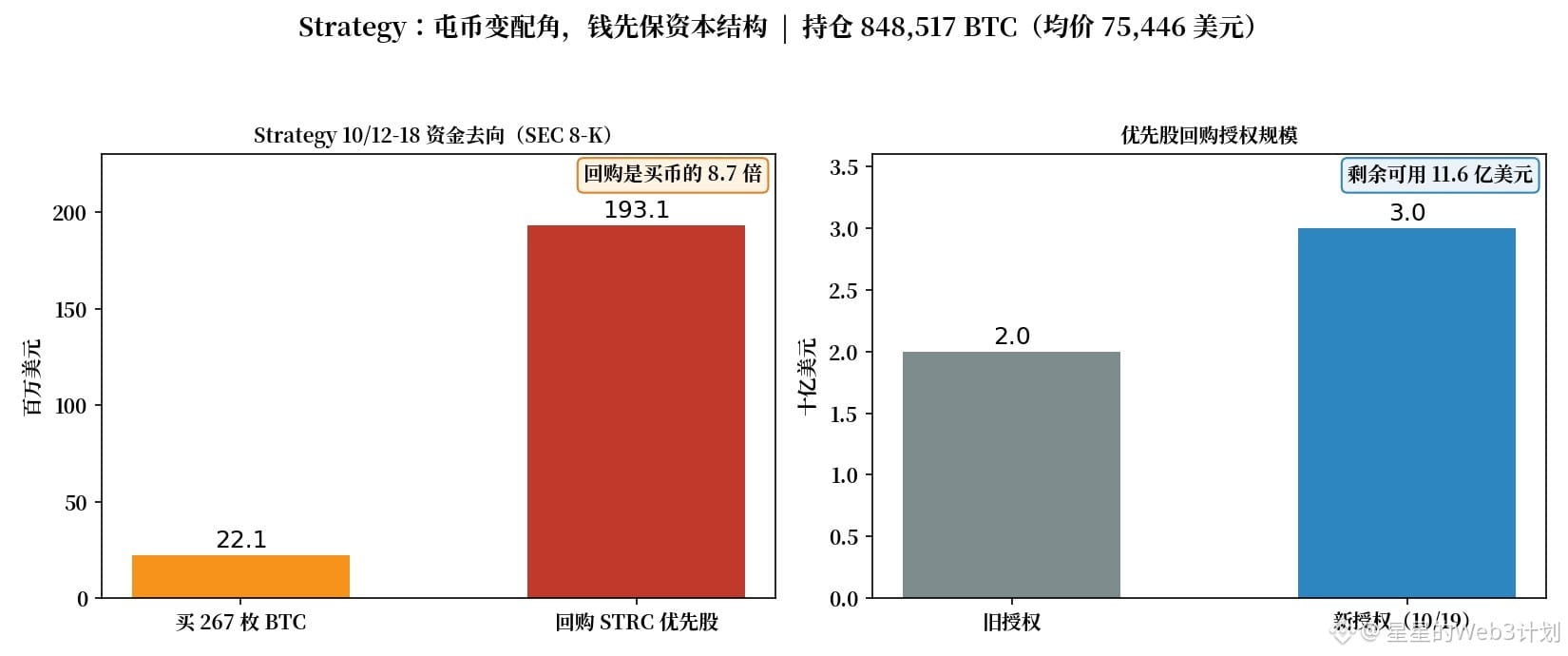
From October 12–18, Strategy bought just 267 bitcoins, spending $22.1 million.
Over the same period, it spent $193.1 million buying back STRC preferred shares—nearly nine times as much as it spent on Bitcoin.
The board also raised the buyback authorization from $2 billion to $3 billion. Saylor is prioritizing the capital structure.
Total holdings now stand at 848,517 bitcoins, with an average cost of $75,400—still above the safety line on paper.
I think this is the real Achilles’ heel of the Bitcoin-hoarding empire: it bet right on the price of Bitcoin, but it can’t beat the index rules. The $2.8 billion in passive selling is a visible sword hanging overhead.
Invalidation: If Strategy isn’t on the November 11 list, or MSCI changes course and grants a grace period, this thesis is void.
Which scenario do you favor: will the November list be a “sell the news” event, with the overhang finally gone, or will passive selling trigger a cascading decline?
$MSTR $BTC $STRC
#比特币 #MSCI
This is not investment advice. DYOR; trading involves risk.
409

·
--
Verified
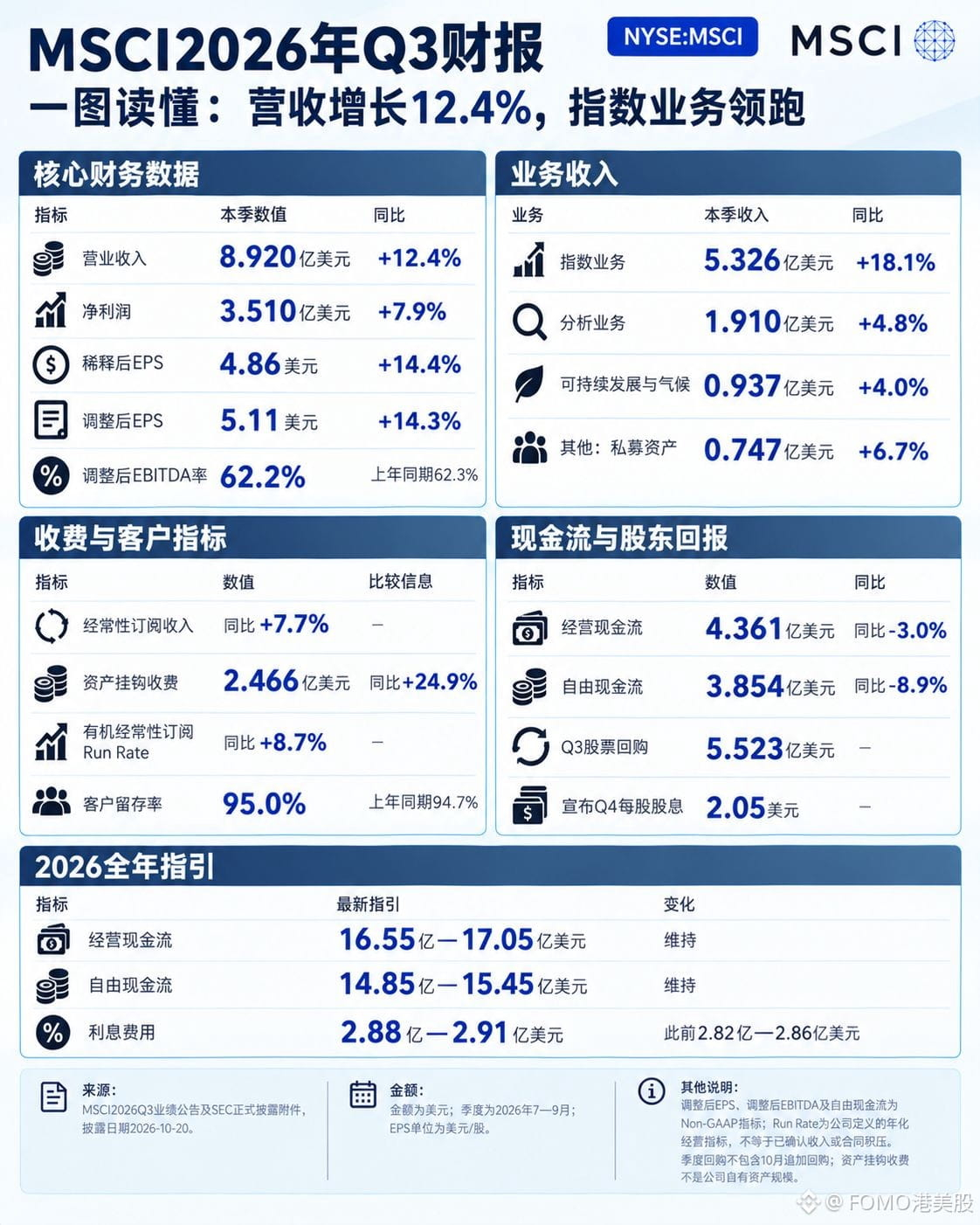
$MSCI.US Q3 revenue was 892 million, and adjusted EPS was 5.11; both edged past expectations, and the stock rose 5.01%.
Revenue grew 12.4%, driven by the index business: index revenue of 532.6 million rose 18.1%, while asset-linked revenue of 246.6 million climbed 24.9%. Subscriptions grew just 11.1%, trailing by 13.8 percentage points. The former tracks the scale of the indexes; the latter reflects customer renewals.
The core business was unchanged. Operating margin was 56.3%, versus 56.4% last year, but net margin fell from 41.0% to 39.4%. The gap came below operating income: the company raised its full-year interest expense guidance from 282–286 million to 288–291 million. It also repurchased 552.3 million of shares during the quarter—43% more than its 385.4 million in free cash flow—with the shortfall funded by debt.
Adjusted EPS grew 14.3%, while net income rose just 7.9%. The 6.5-point gap came from a 5.68% reduction in share count. Interest rates are the real variable: leverage is still within range at 3.2x, but another rate hike would expose the weakness in per-share growth.
#MSCI #BStocks #股票财报季
MSCIUS+1.77%
2.8k

·
--
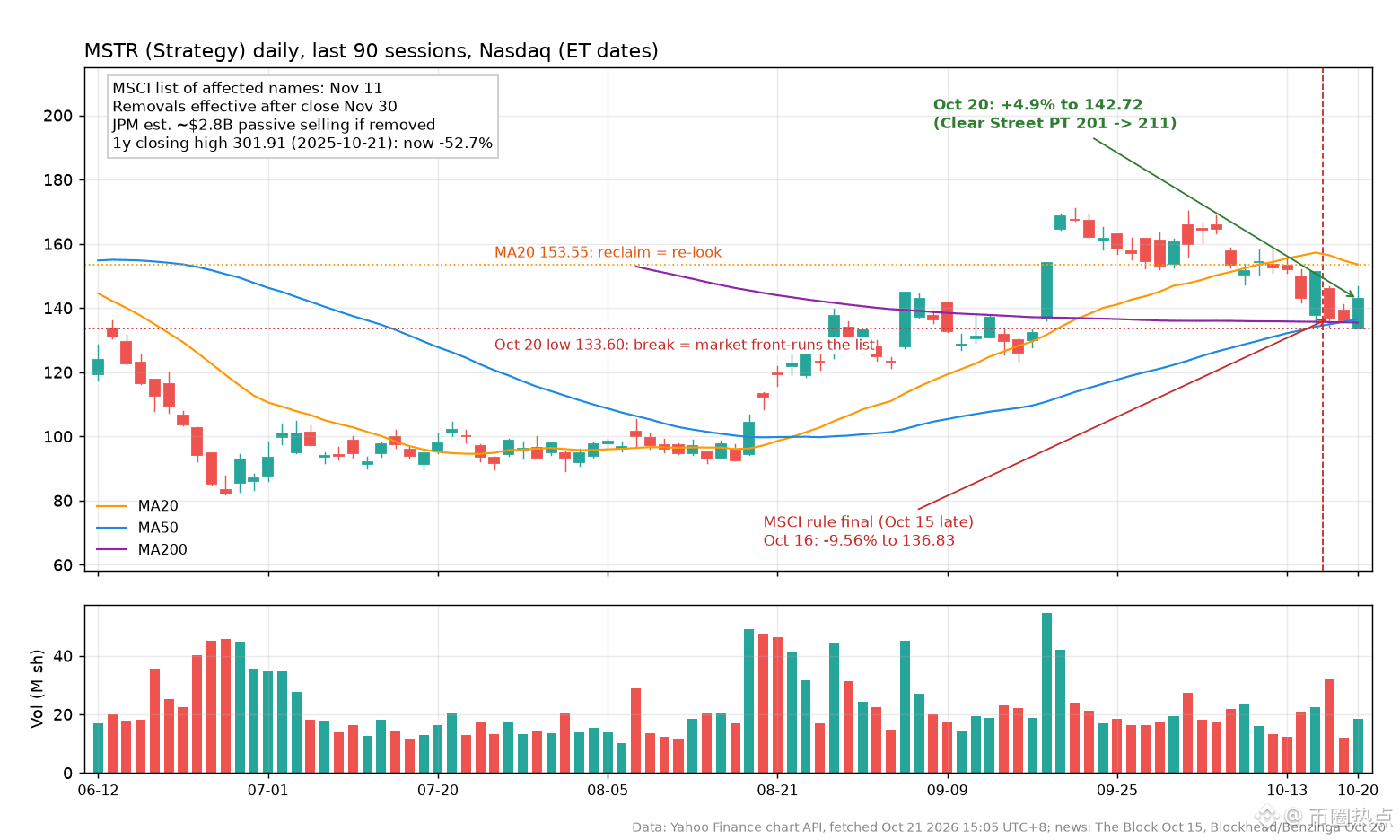
MicroStrategy rebounded 4.9% Tuesday to 142.72, but the MSCI removal list won’t be announced until November 11. I’m not buying the dip.
Here’s what I saw: On October 15, MSCI set a new rule: “non-operating companies” can’t remain in its indexes. It takes effect after the market close on November 30.
The day after the news broke, MSTR fell 9.56% to close at 136.83. On Tuesday, Clear Street raised its price target from 201 to 211, helping the stock rebound to 142.72.
JPMorgan previously estimated that a removal could trigger about $2.8 billion in selling. BitMine, which also holds a lot of crypto, is still 57% below its one-year high.
I don’t think one price-target increase can offset the index risk. Until the list comes out, it’s all a gamble.
What I’m doing: MSTR is still below its 20-day moving average of 153.55, and it’s down more than half from its closing high of 301.91 a year ago. I’m not buying the dip.
I’ll take another look if it gets back above 153.55. If it falls below Tuesday’s low of 133.6, I’ll take that as the market handing in its verdict early.
Before November 11, would you hold MicroStrategy and bet on the list—or stay out?
$MSTR $BMNR
#微策略 #MSCI
161

·
--
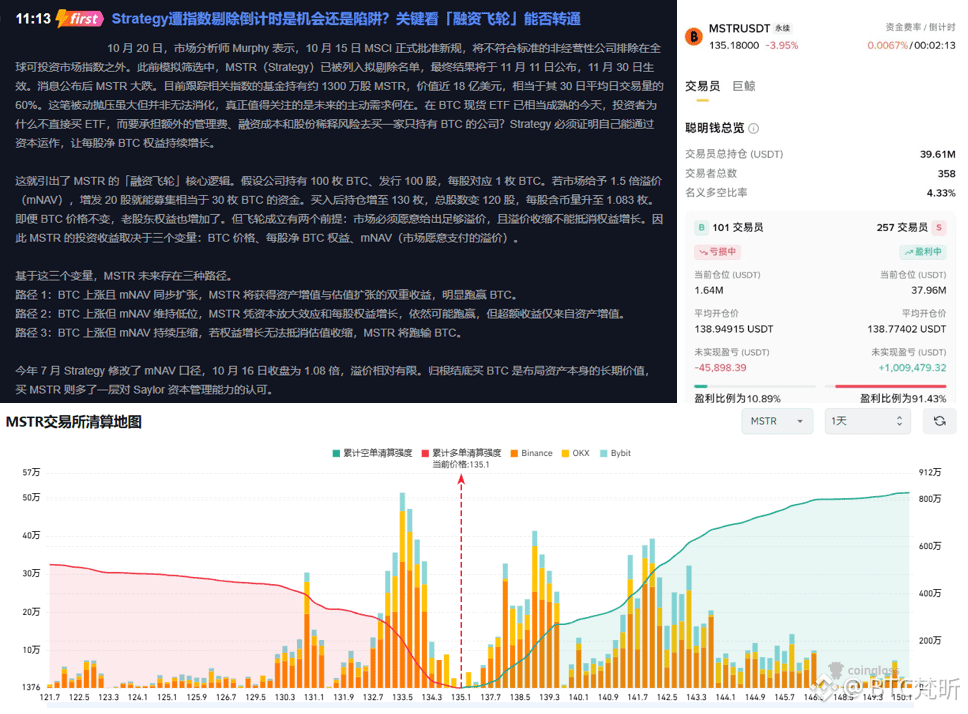
$MSTR Long positions buried alive? Holding on isn’t a conviction—if you don’t get out now, your position could go to zero!
Countdown to MSCI exclusion: $1.8 billion in selling pressure could hit at any moment!
Those who chased MSTR at 141.1—feeling queasy at the current price?
Look at the smart money: the long/short ratio is only 4.33%. Shorts have raked in 1 million U—an utterly one-sided slaughter!
The 1-hour chart is weak and choppy, and the liquidation map shows a long-liquidation zone all the way down at 133!
Fan Xin has 3 strategies to help you protect yourself:
Sell into a rebound: Around 138–139, cut your position in half immediately to limit losses and stay safe.
Hedge with the trend: Near the current price of 135, don’t add to your long. Open a short hedge with the trend, targeting around 133.
Don’t stubbornly hold on: If the price falls below 133, absolutely do not add to your position. Wait for it to stabilize, then reduce your cost basis gradually through swing trades.
Institutions are dumping aggressively—the next few hours could decide everything! If you don’t want your principal to go up in smoke, Fan Xin can create a personalized plan to help you get out of your losing position!
#MSCI #MSCI敲定新规Strategy面临被剔除风险
18
·
--
A new MSCI rule could see Saylor’s Strategy kicked out of global indexes ⚠️ But the real killer isn’t passive selling pressure.
📌 The facts
• On October 15, MSCI approved a new rule: “non-operating companies” will no longer be included in global indexes starting at the close on November 30. The final list will be announced on November 11.
• In a preliminary screening, MSTR was on the proposed removal list. The stock plunged at one point on Friday (CNA: -4.2%; other reports put the drop at nearly 10%).
• Funds tracking MSCI hold about 13 million MSTR shares, worth roughly $1.8 billion—less than a day’s trading volume.
• JPMorgan estimated last year that removal from MSCI alone could trigger about $2.8 billion in passive selling; that could reach $8.8 billion if other indexes follow suit.
🧠 My take
Passive selling pressure can be absorbed. What really matters is mNAV (the premium). At the October 16 close, it was about 1.08x. The thinner the premium, the harder it is for the “issue shares to buy Bitcoin” flywheel to keep turning. With spot BTC ETFs now so well established, why would the market pay an extra premium for MSTR?
👀 Key dates: November 11, list announced; November 30, rule takes effect.
U.S. spot Bitcoin ETFs saw net inflows of $527 million yesterday (Farside). Institutional demand is still there, but corporate buying is cooling.
Do you think Strategy will be removed on November 11? A) Removed, triggering a sell-off B) The bad news is already priced in 👇
$BTC $ETH #Strategy #MSCI #Bitcoin
Personal opinion only; not investment advice.

20


·
--
Verified
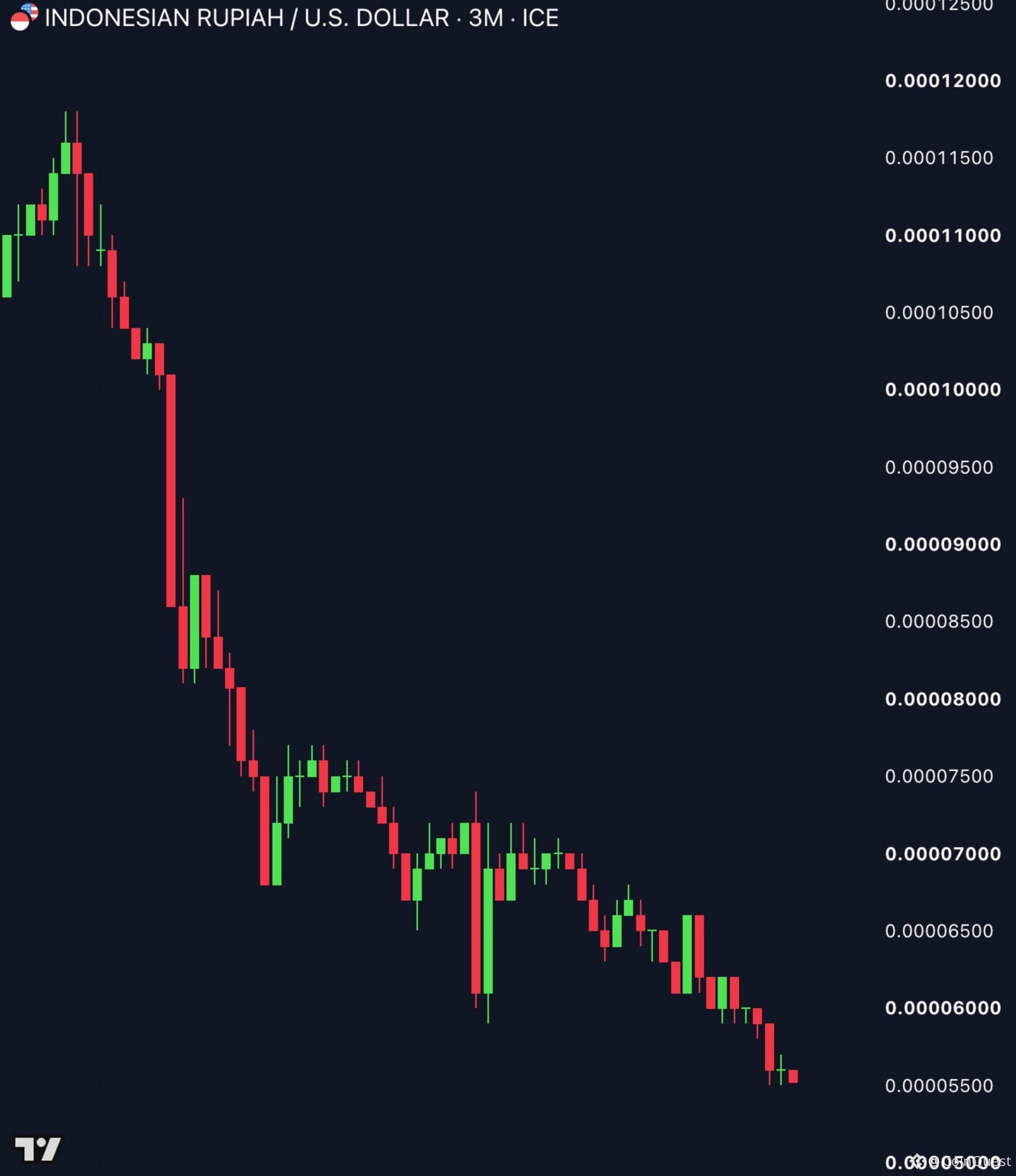
😱 Indonesia’s Stock Market Is Under Pressure 🩸
The Jakarta Composite Index suffered a sharp sell-off as concerns grow over MSCI’s proposal to downgrade Indonesia’s market status
📉 MSCI raised concerns about market transparency and trading practices
💰 Goldman Sachs estimates a potential $5.6 billion in passive outflows if Indonesia is removed from MSCI indexes
🇮🇩 Officials are working to address MSCI’s concerns, with a final decision expected by June 30, 2027
My take: This could create opportunities, but investors should watch for signs of stability before jumping in
Do you think Indonesia can regain investor confidence?
#IndonesiaCrypto #MSCI #stockmarket #CryptoNews

1
9
4.5k

🌍 $MSCI.US : A Name to Watch in Global Markets! 📊
MSCI is widely known for its global market indexes and investment analytics, helping investors track markets across countries and asset classes.
🔎 What Investors Should Watch:
📈 Global Indexes: Market performance and benchmark changes
🏦 Institutional Investing: How funds respond to index adjustments
🌐 Market Trends: Shifts in global investor sentiment
⚡ Volatility: Economic data, interest rates, and geopolitical events
💬 Your Take: Do global market indexes influence your crypto and stock investment decisions? 👇
⚠️ Educational content only, not financial advice. Always DYOR.
#MSCI
{stock_us}(MSCI.US)
🌍 $MSCI.US : A Name to Watch in Global Markets! 📊
MSCI is widely known for its global market indexes and investment analytics, helping investors track markets across countries and asset classes.
🔎 What Investors Should Watch:
📈 Global Indexes: Market performance and benchmark changes
🏦 Institutional Investing: How funds respond to index adjustments
🌐 Market Trends: Shifts in global investor sentiment
⚡ Volatility: Economic data, interest rates, and geopolitical events
💬 Your Take: Do global market indexes influence your crypto and stock investment decisions? 👇
⚠️ Educational content only, not financial advice. Always DYOR.
#MSCI
MSCIUS+1.77%
99

·
--
#StrategySharesFall9%OnFriday
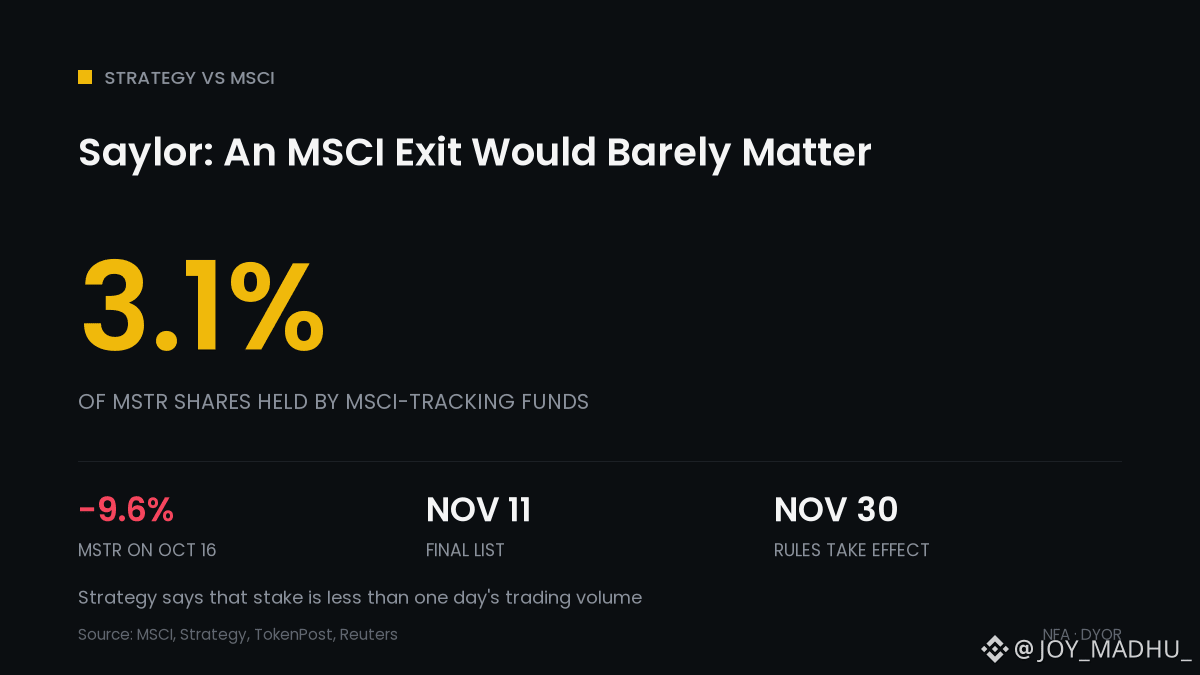
🎙️ Saylor: An MSCI Exit Would Barely Matter
📉 Oct 16: $MSTR fell 9.6% after MSCI adopted its "non-operating company" rule
🗣️ Oct 18: Saylor said the money tracking MSCI indexes is too small to hurt Strategy much
📊 Index funds hold about 13M shares (3.1%), less than one day's volume, per Strategy
⚠️ Last year Strategy warned an exclusion could force about $2.8B of its stock to be sold
🌍 Metaplanet is also on MSCI's possible-deletion list
📅 Nov 11: final list | Nov 30: rules take effect
🟠 $BTC trades near $82.2K, Strategy holds 848,250 BTC
What it means for crypto: any forced selling would hit the stock, not the coins. The bigger question is whether index exits make it harder for treasury firms to raise money for more BTC.
Is Saylor right that Bitcoin should count as operating capital? 👇
$BTC
#CryptoNews #Bitcoin #MSCI #StrategySharesFall9%OnFriday
29

🚨 $BTC : MSCI CHANGES ITS RULES AND STRATEGY COULD BE REMOVED FROM ITS INDEXES
An official decision on October 15 creates a new risk for companies accumulating Bitcoin.
📌 WHAT HAPPENED?
MSCI, whose indexes serve as benchmarks for major investment funds, approved new rules to exclude companies considered «non-operating».
Strategy ($MSTR), one of the largest companies holding $BTC, is among those potentially affected.
⚠️ Important: Strategy has NOT been excluded yet. Its final status will be announced in November.
📅 TWO KEY DATES
• 11/11: MSCI will publish the final list of affected companies.
• 30/11: The changes will take effect at the close of the trading day.
🔎 WHY DOES THIS MATTER FOR BITCOIN?
Many funds buy stocks to track stock market indexes.
If Strategy is excluded, some funds could be forced to sell their shares.
But there’s a fundamental difference: selling Strategy shares does NOT mean the company has to sell its bitcoins.
The potential impact on $BTC would be indirect and would depend on the market’s reaction.
📊 IS THIS A SIGNAL TO BUY OR SELL?
Not on its own. There is a concrete risk, but there is still no definitive exclusion or sufficient trading signal.
🎯 WHAT TO WATCH
The November 11 list, Strategy’s response, and price movements accompanied by trading volume.
📚 Source: MSCI’s official announcement dated 10/15/2026.
💬 Do you think this decision could put pressure on Bitcoin, or has the market already priced in the risk?
#bitcoin #MSCI
🚨 $BTC : MSCI CHANGES ITS RULES AND STRATEGY COULD BE REMOVED FROM ITS INDEXES
An official decision on October 15 creates a new risk for companies accumulating Bitcoin.
📌 WHAT HAPPENED?
MSCI, whose indexes serve as benchmarks for major investment funds, approved new rules to exclude companies considered «non-operating».
Strategy ($MSTR), one of the largest companies holding $BTC , is among those potentially affected.
⚠️ Important: Strategy has NOT been excluded yet. Its final status will be announced in November.
📅 TWO KEY DATES
• 11/11: MSCI will publish the final list of affected companies.
• 30/11: The changes will take effect at the close of the trading day.
🔎 WHY DOES THIS MATTER FOR BITCOIN?
Many funds buy stocks to track stock market indexes.
If Strategy is excluded, some funds could be forced to sell their shares.
But there’s a fundamental difference: selling Strategy shares does NOT mean the company has to sell its bitcoins.
The potential impact on $BTC would be indirect and would depend on the market’s reaction.
📊 IS THIS A SIGNAL TO BUY OR SELL?
Not on its own. There is a concrete risk, but there is still no definitive exclusion or sufficient trading signal.
🎯 WHAT TO WATCH
The November 11 list, Strategy’s response, and price movements accompanied by trading volume.
📚 Source: MSCI’s official announcement dated 10/15/2026.
💬 Do you think this decision could put pressure on Bitcoin, or has the market already priced in the risk?
#bitcoin #MSCI
117

IS STRATEGY’S BITCOIN TREASURY FACING NEW RISKS? ₿🚨📉 #StrategySharesFall9%OnFriday
Strategy ($MSTR), one of the world’s largest publicly traded corporate Bitcoin holders, suffered a sharp sell-off on Friday, October 16, as new MSCI index rules raised concerns about its future eligibility.
But here’s the key point: MSTR and Bitcoin are not the same investment. 👀
📊 WHAT HAPPENED?
🔻 MSTR fell approximately 9.56% on Friday, closing at $136.83.
⚖️ MSCI changed its index methodology: The new framework could affect companies considered non-operating businesses, potentially putting Strategy at risk of exclusion from major global equity indexes.
📅 November 11 is the next key date: MSCI is expected to publish the list of potentially affected companies, with index changes taking effect after November 30.
🏦 Potential selling pressure: Strategy estimates MSCI-linked funds hold around 13 million MSTR shares, equal to approximately 3.1% of its basic shares outstanding. Actual selling would depend on the final decision and index-tracking funds’ actions.
🔥 WHY $BTC INVESTORS SHOULD CARE
₿ Bitcoin exposure: Strategy’s stock provides indirect exposure to Bitcoin through a corporate structure—but its price can move differently from BTC.
📉 Extra volatility: MSTR is also influenced by financing decisions, share issuance, investor sentiment, and the market premium or discount assigned to its Bitcoin holdings.
⚠️ Index risk: Potential forced selling could pressure MSTR even if Bitcoin itself remains relatively stable. However, index exclusion is not yet confirmed.
🔍 THREE THINGS TO WATCH
1️⃣ $BTC price action: Is Bitcoin holding its key support levels?
2️⃣ MSTR vs. BTC performance: Is Strategy falling faster than Bitcoin, suggesting additional stock-specific pressure?
3️⃣ MSCI’s November decision: Will Strategy remain eligible, or face index-related selling pressure?
🧠 MY TAKE: This situation highlights the difference between owning Bitcoin directly and investing in a company that holds Bitcoin. Corporate treasury strategies can amplify opportunities—but they also introduce risks that BTC holders do not face in the same way.
💬 Your choice: Would you rather hold BTC directly or buy $MSTR shares for long-term Bitcoin exposure? Tell us why below! 👇
$GTC
#Bitcoin #CryptoMarket #GrowWithSAC #StrategySharesFall9%OnFriday #MSTR #MSCI I#BitcoinTreasury #CryptoNews
⚠️ Disclaimer: Educational content only, not financial advice. MSCI eligibility and potential index-related selling remain subject to the final review. Always do your own research and manage risk.
{spot}(BTCUSDT)
{spot}(GTCUSDT)
IS STRATEGY’S BITCOIN TREASURY FACING NEW RISKS? ₿
🚨📉 #StrategySharesFall9%OnFriday
Strategy ($MSTR), one of the world’s largest publicly traded corporate Bitcoin holders, suffered a sharp sell-off on Friday, October 16, as new MSCI index rules raised concerns about its future eligibility.
But here’s the key point: MSTR and Bitcoin are not the same investment. 👀
📊 WHAT HAPPENED?
🔻 MSTR fell approximately 9.56% on Friday, closing at $136.83.
⚖️ MSCI changed its index methodology: The new framework could affect companies considered non-operating businesses, potentially putting Strategy at risk of exclusion from major global equity indexes.
📅 November 11 is the next key date: MSCI is expected to publish the list of potentially affected companies, with index changes taking effect after November 30.
🏦 Potential selling pressure: Strategy estimates MSCI-linked funds hold around 13 million MSTR shares, equal to approximately 3.1% of its basic shares outstanding. Actual selling would depend on the final decision and index-tracking funds’ actions.
🔥 WHY $BTC INVESTORS SHOULD CARE
₿ Bitcoin exposure: Strategy’s stock provides indirect exposure to Bitcoin through a corporate structure—but its price can move differently from BTC.
📉 Extra volatility: MSTR is also influenced by financing decisions, share issuance, investor sentiment, and the market premium or discount assigned to its Bitcoin holdings.
⚠️ Index risk: Potential forced selling could pressure MSTR even if Bitcoin itself remains relatively stable. However, index exclusion is not yet confirmed.
🔍 THREE THINGS TO WATCH
1️⃣ $BTC price action: Is Bitcoin holding its key support levels?
2️⃣ MSTR vs. BTC performance: Is Strategy falling faster than Bitcoin, suggesting additional stock-specific pressure?
3️⃣ MSCI’s November decision: Will Strategy remain eligible, or face index-related selling pressure?
🧠 MY TAKE: This situation highlights the difference between owning Bitcoin directly and investing in a company that holds Bitcoin. Corporate treasury strategies can amplify opportunities—but they also introduce risks that BTC holders do not face in the same way.
💬 Your choice: Would you rather hold BTC directly or buy $MSTR shares for long-term Bitcoin exposure? Tell us why below! 👇
$GTC
#Bitcoin #CryptoMarket #GrowWithSAC #StrategySharesFall9%OnFriday #MSTR #MSCI I#BitcoinTreasury #CryptoNews
⚠️ Disclaimer: Educational content only, not financial advice. MSCI eligibility and potential index-related selling remain subject to the final review. Always do your own research and manage risk.
173

·
--
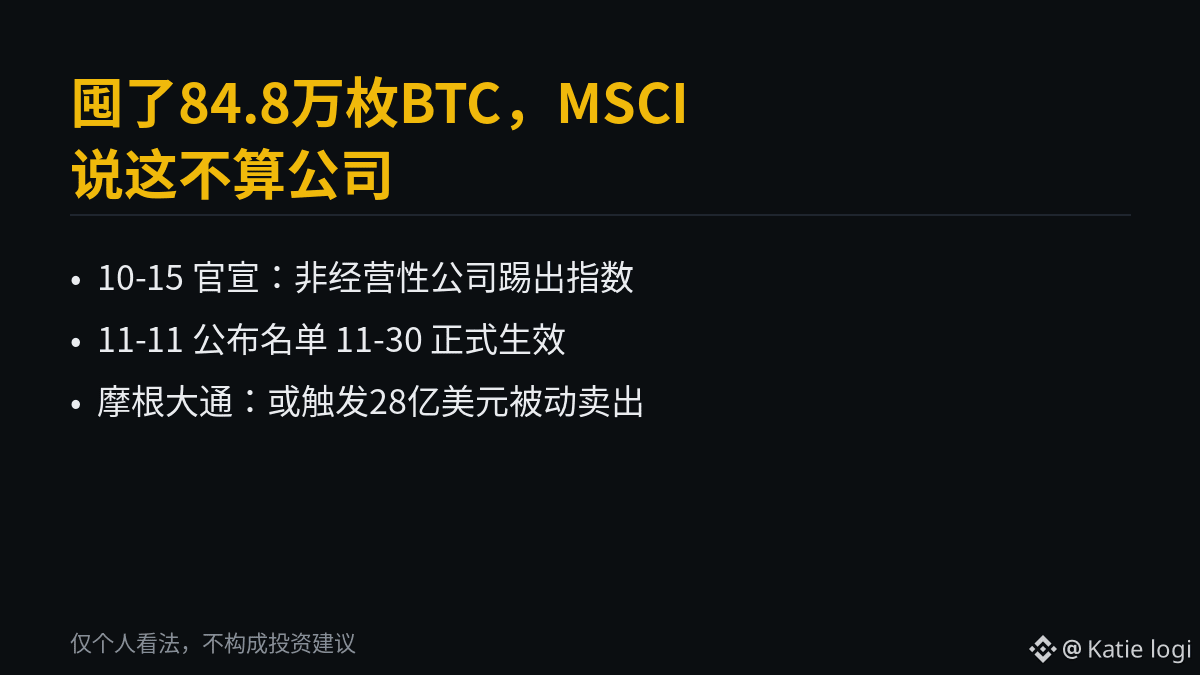
Saylor has amassed 848,000 BTC, but MSCI says that doesn’t make him a company
October 15
MSCI, the world’s largest index provider, has made its decision: “non-operating companies” will be removed from its global investable indexes.
The change takes effect at market close on November 30, with the final list to be announced on November 11.
Put simply:
Companies whose balance sheets are all coins, with no real business,
are all out.
Strategy is first in the firing line, with Metaplanet likely to follow.
Even Ethereum treasury company SharpLink has landed on the watchlist.
How big is Strategy?
As of October 11, it held 848,250 BTC.
Its purchase cost was $64 billion, at an average price of $75,444.
It was still buying that week, adding 250 BTC from October 5 to 11.
JPMorgan ran the numbers:
If it’s actually removed, index funds would have to passively sell about $2.8 billion worth of MSTR.
After the news broke, MSTR fell 4.3% after hours.
The previous day, it had climbed to $151.29 in regular trading.
Saylor said on Bloomberg on October 13:
MSCI was disappointing and unfair to digital assets.
His September letter to MSCI was even more direct:
He called the rule “discriminatory.”
It would have no material impact on the company’s business,
but would damage MSCI’s own reputation for neutrality.
The interesting thing is,
on the day the axe fell, BTC dropped only about 0.5%,
holding near $82,000 (news.bitcoin.com, October 16 data).
The coin is fine; what’s in trouble is the “crypto-hoarding stock” story.
For the first time, Wall Street used rules to vote on the crypto-hoarding business.
And it voted no.
Once the list is announced on November 11, the story will be settled.
Just my personal opinion; this is not investment advice.
#MSCI $BTC
---
Sources: Decrypt (2026-10-15), The Block (2026-10-15), news.bitcoin.com (10-16), coinscreamer (10-16, recounting Saylor’s October 13 Bloomberg interview), holder.io (2026-10-17). On October 15, MSCI announced that “non-operating companies” would no longer qualify for the MSCI Global Investable Market Indexes. The change takes effect at market close on November 30, and the final list of affected companies will be announced on November 11. Strategy (with 848,250 BTC as of October 11, at a cost of about $64 billion and an average price of about $75,444) and Metaplanet are included; SharpLink (SBET) is on the watchlist. JPMorgan estimates that removal would trigger about $2.8 billion in passive MSTR selling. MSTR fell 4.3% after hours; its regular-session closing price was $151.29 (the previous trading day’s close was $143.24). $BTC is a fallback tag.
18

·
--
📰 MSCI’s new index rules could exclude MSTR. Michael Saylor’s response was direct: it wouldn’t matter much to Strategy because the funds involved are relatively small, but he is very disappointed with MSCI’s current position.
🔥 What he’s really unhappy about is how the rules define “capital.” Oil, natural gas, land, and machinery all count, but Bitcoin doesn’t. In Saylor’s view, this isn’t just an ordinary difference in classification—it’s a value judgment that discriminates against digital assets and could set a bad precedent for the entire industry.
💡 As for whether Strategy has actual operating businesses, he compared it to banks and insurance companies: banks sell credit, insurance companies sell policies, and Strategy uses Bitcoin to back digital credit products. So it should also be treated as an operating company.
Honestly, this controversy is no longer just about whether MSTR can remain in the index; it’s about who gets to define a company that holds a large amount of Bitcoin. Saylor hopes MSCI will reconsider and believes that dropping the proposal to exclude Strategy would be better for the industry.
🤔 If index providers insist on not treating Bitcoin as capital, do you think Strategy should keep pushing to be recognized as a traditional financial company, or accept a separate classification from the market?
#Strategy #MSTR #比特币 #MSCI

49

·
--
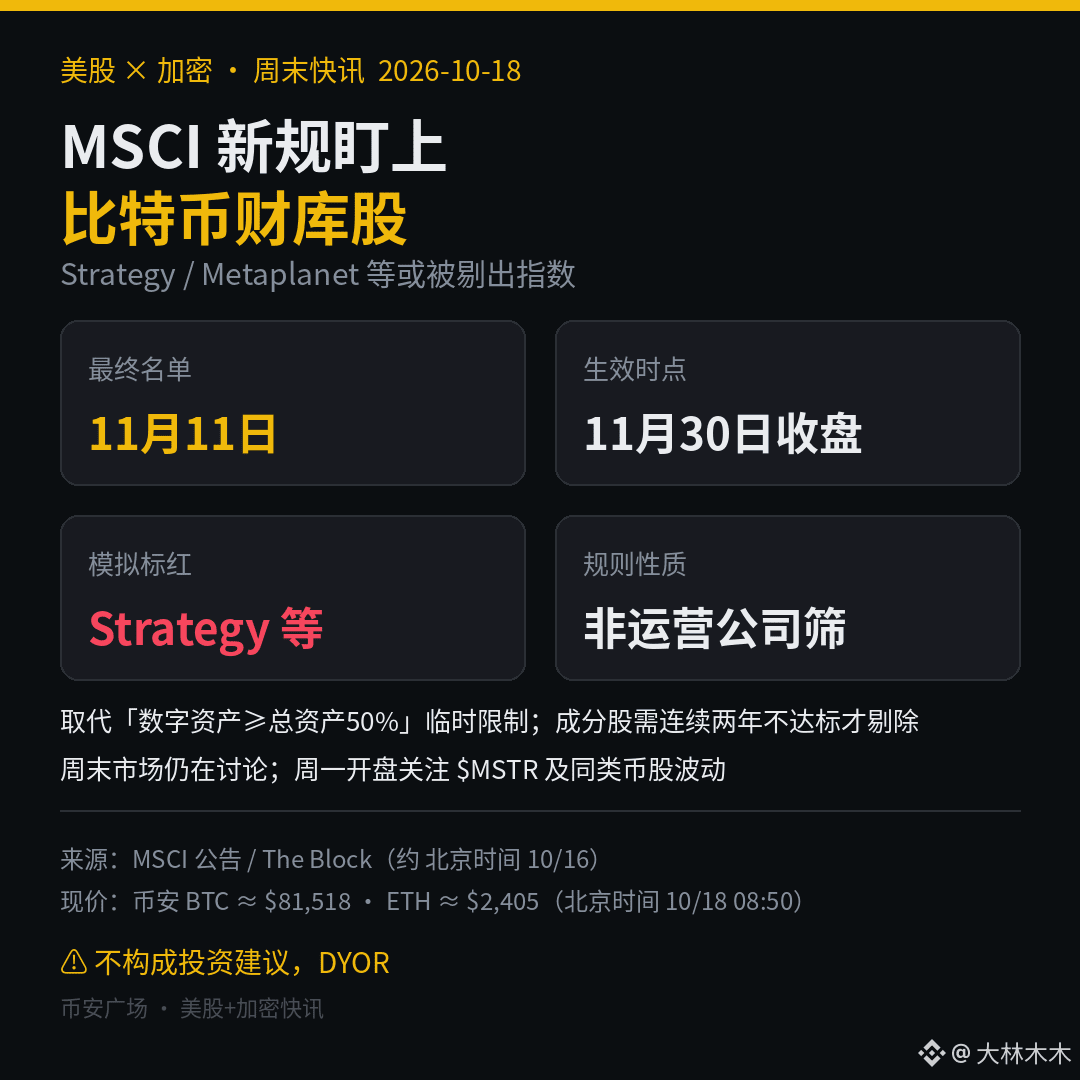
📋 Monday pre-market checklist: MSCI’s new rules put Bitcoin treasury stocks in the spotlight
MSCI has finalized its index rules for “non-operating companies” (The Block / MSCI announcement, around 10/16 Beijing time):
① Replaces the previous temporary restriction of “digital assets ≥ 50% of total assets” with an operating-assets screen and five financial ratios
② Existing constituents must fail to meet the criteria for two consecutive fiscal years before being removed
③ In the May simulation, Strategy, Metaplanet, and Yellow Cake were flagged; Ethereum treasury company SharpLink could also be affected
④ The final list of affected companies will be announced on 11/11, with changes taking effect at the 11/30 close
Markets continued discussing over the weekend the impact of potential selling by passive index funds. In the short term, this could weigh on $MSTR and similar crypto stocks, while the impact on $BTC spot would be more indirect.
Binance spot (Beijing time, 10/18 08:51): BTC $81,518 (24h -0.02%), ETH $2,406 (24h -0.58%).
My take: The rules are set, but the list isn’t. Watching the 11/11 list is more useful than guessing whether the market will rise or fall at Monday’s open.
$BTC $MSTR #比特币 #币股 #MSCI #U.S. stocks
⚠️ Not investment advice. DYOR.
406
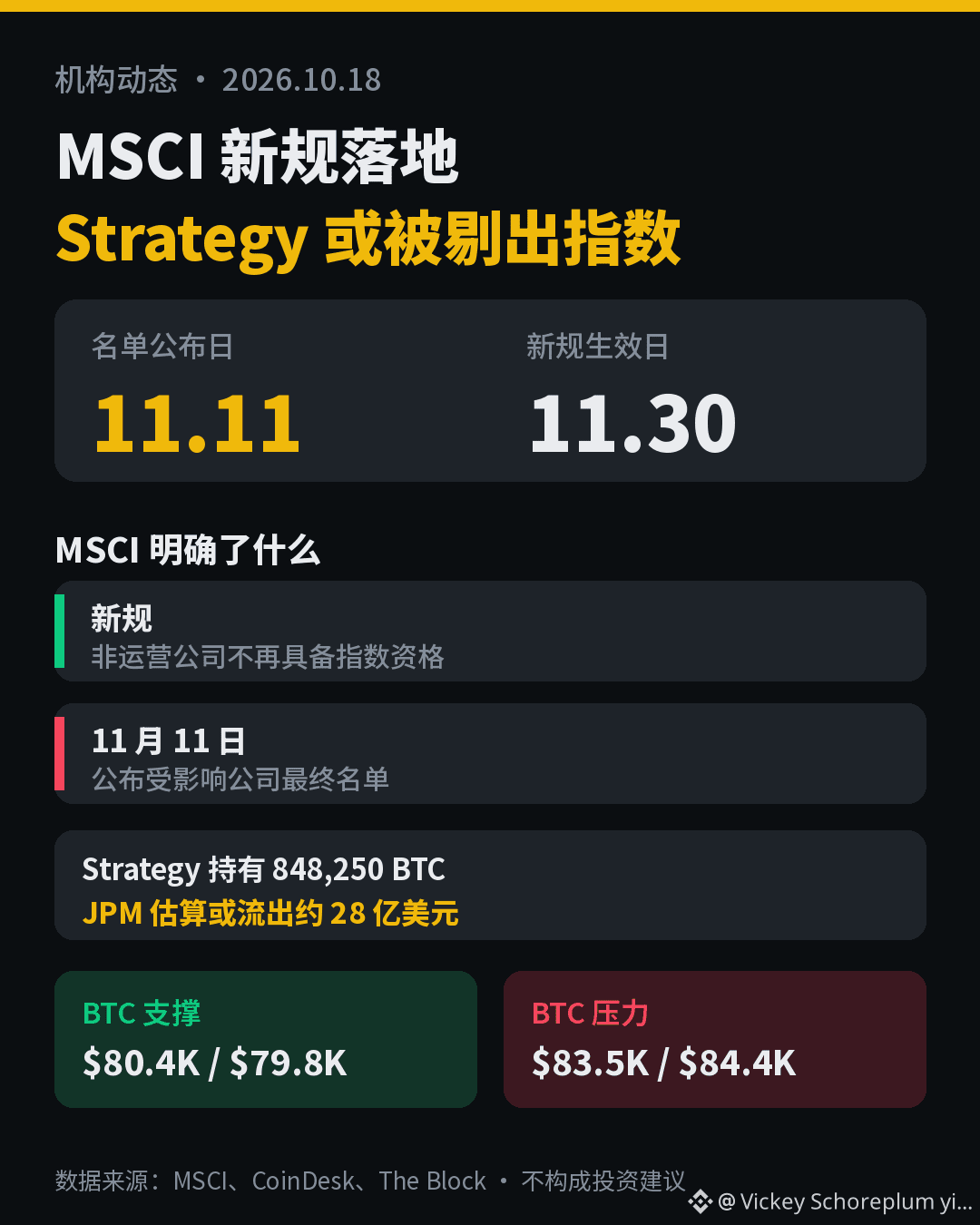
📉 New MSCI rules take effect: Could Strategy be dropped from global indexes?
On October 15, MSCI announced that it would officially adopt new rules for “non-operating companies.” These companies will no longer be eligible for the MSCI Global Investable Market Indexes. The new rules will be applied during the November index review and take effect at market close on November 30. The final list of affected companies will be announced on November 11.
📋 Key points
• The new rules replace the previous temporary restriction—under which digital assets could not account for 50% or more of total assets—with an “operating asset screen + five financial ratios” test
• In previous simulations, Strategy and Metaplanet were identified as potential deletions, while SharpLink could also be affected
• Existing constituents will only be removed if they fail the screen in two consecutive annual reporting periods, providing a buffer
• Strategy holds 848,250 BTC, calls the new rules “discriminatory” against digital asset treasury companies, and has urged MSCI to withdraw them; its share price fell sharply on Friday
• JPMorgan estimates that if Strategy is removed, it could face approximately $2.8 billion in stock outflows
🌍 Market impact
• This is an index rules issue: passive fund rebalancing affects the company’s stock and does not mean Strategy has to sell its Bitcoin
• However, if it becomes harder for digital asset treasury companies to raise capital, this could affect the institutional buying narrative over the long term
• Uncertainty remains until the final list is announced
🎯 Key BTC levels (based on daily data from the past 14 days)
• Support: $80,400 / $79,800
• Resistance: $83,500 / $84,350
The current price is around $81,500, near the middle of the range.
What do you think is the biggest risk for Strategy: Bitcoin price volatility or changes to traditional index rules? Share your thoughts in the comments 👇
👉 Trade BTC: https://www.binance.com/zh-CN/trade/BTC_USDT
#MSCI敲定新规Strategy面临被剔除风险 #BTC #Strategy #MSCI
⚠️ The above does not constitute investment advice. Please be aware of the risks.
112
Log in to explore more content
Join global crypto users on Binance Square
⚡️ Get latest and useful information about crypto.
💬 Trusted by the world’s largest crypto exchange.
👍 Discover real insights from verified creators.
Email / Phone number
Trending Topics
1
#USMidterms-WhatAreMarketsExpecting?
152,821 views
1,131 Discussing
2
#USOctoberNFP-AreRateCutsStillPossible
284,085 views
2,188 Discussing
3
#CircleQ3Revenue865M
2,492 views
129 Discussing
4
#AMDBeatsExpectations-AINarrativeContinues
38,122 views
430 Discussing
5
#BinanceIncidentReport
314,878 views
1,613 Discussing
6
#AnthropicIPOPricedDownasInvestorsEye$1.5T
23,049 views
117 Discussing
7
#BoundlessToLaunchTokenizedAIInferencePlan
0 views
5 Discussing
8
#HongKongPassesCryptoAssetReportingFrameworkAmendment
118 views
8 Discussing
9
#37thQuarterlyBNBBurnRemoves1.64MillionBNB
4,214 views
96 Discussing
10
#BinanceReopensWithdrawalsForMoreAssets
408,548 views
2,491 Discussing