
CoinQuest
25.7k Posts

CoinQuest
 Square Verified+
Report
Block User
X(Twitter):@CQuestOfficial_

#BinanceTurns7

Top Voices
High-Frequency Trader
3.6 Years
417 Following
125.8K+ Followers
228.8K+ Liked
2 Badges
Posts
All
Quotes
Videos
Live
·
--
Bullish
$ZEC is getting ready for something big....
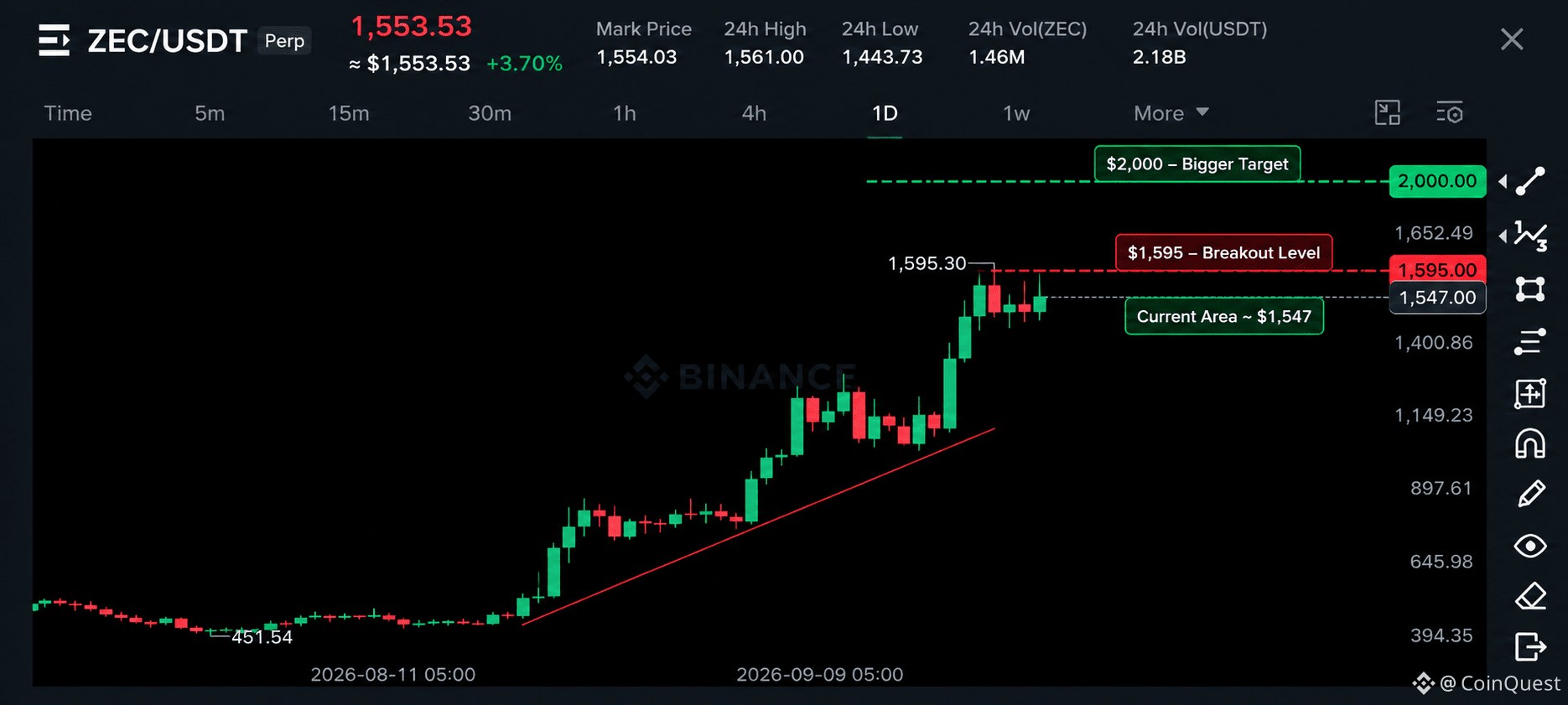
Every time sellers get a chance to push this lower, buyers are absorbing it pretty quick. Price pushed from around $1.1K to $1.6K & even after the $1,595 rejection, we haven't seen that deep pullback yet
That's why I'm keeping $2K on the radar now. First I wanna see $1,595 break & hold, because once that level goes there isn't much structure between here & the $2K area
I'm not saying it goes straight there tho 😅
if buyers keep absorbing dips like this, $2K starts looking less crazy
#ZECUSDT
$ZEC is getting ready for something big....
Every time sellers get a chance to push this lower, buyers are absorbing it pretty quick. Price pushed from around $1.1K to $1.6K & even after the $1,595 rejection, we haven't seen that deep pullback yet
That's why I'm keeping $2K on the radar now. First I wanna see $1,595 break & hold, because once that level goes there isn't much structure between here & the $2K area
I'm not saying it goes straight there tho 😅
if buyers keep absorbing dips like this, $2K starts looking less crazy
#ZECUSDT
Every time sellers get a chance to push this lower, buyers are absorbing it pretty quick. Price pushed from around $1.1K to $1.6K & even after the $1,595 rejection, we haven't seen that deep pullback yet
That's why I'm keeping $2K on the radar now. First I wanna see $1,595 break & hold, because once that level goes there isn't much structure between here & the $2K area
I'm not saying it goes straight there tho 😅
if buyers keep absorbing dips like this, $2K starts looking less crazy
#ZECUSDT
460
·
--
Bullish
$SNXX / $SNXXB made the move... now 18–$18.5 decides if buyers are still in control😮
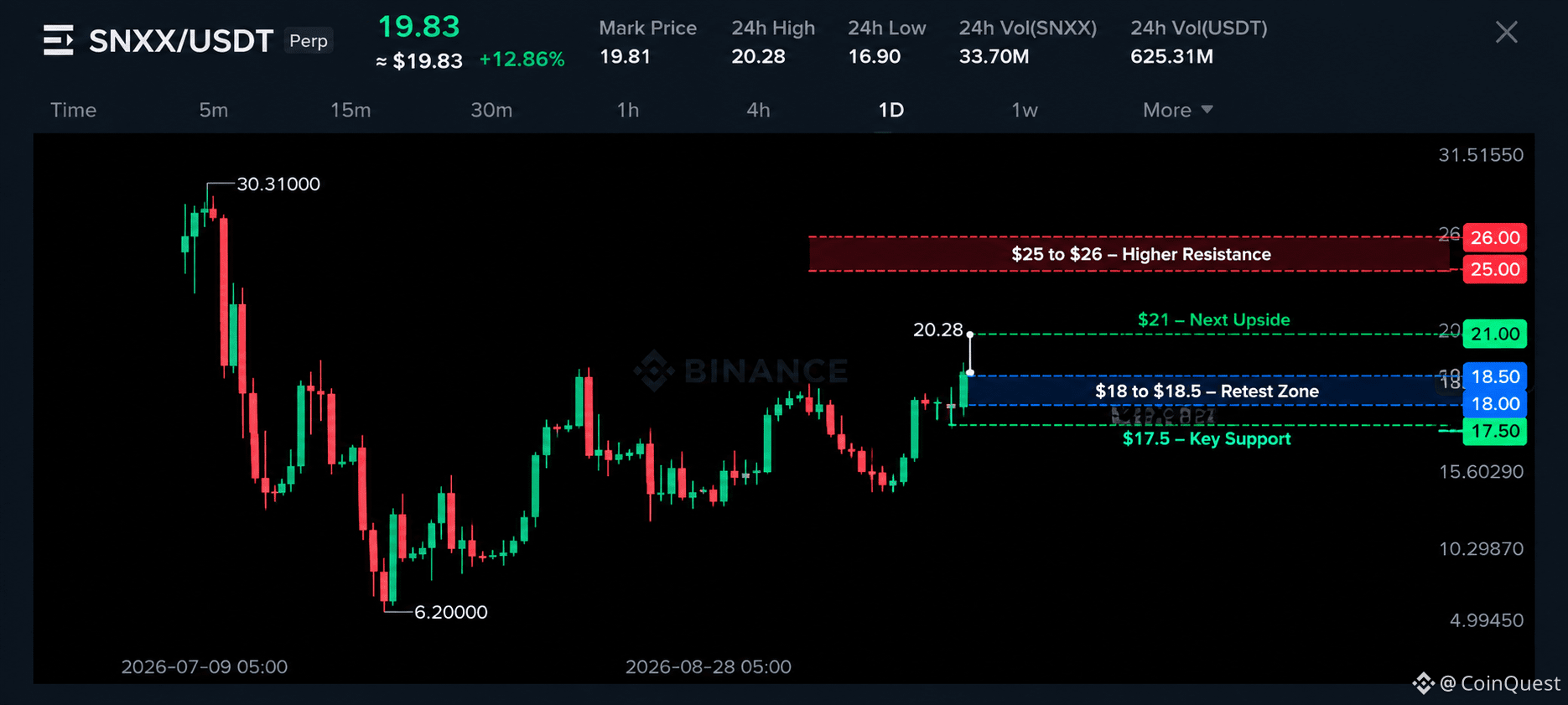
But now its getting close to $20.28 high & this is where I don't wanna chase it. A lot of traders will be watching that high now, some waiting for breakout & some probably looking to sell into it 😅
I'd rather see what happens if price comes back around $18 to $18.5. If buyers defend that area, then $20.28 can come back into play & above that $21 looks interesting. If $17.5 breaks with weakness, I'm leaving this one
The move already happened... now I wanna see if buyers can actually defend it...
#SNXX #SNXXB
$SNXX / $SNXXB made the move... now 18–$18.5 decides if buyers are still in control😮
But now its getting close to $20.28 high & this is where I don't wanna chase it. A lot of traders will be watching that high now, some waiting for breakout & some probably looking to sell into it 😅
I'd rather see what happens if price comes back around $18 to $18.5. If buyers defend that area, then $20.28 can come back into play & above that $21 looks interesting. If $17.5 breaks with weakness, I'm leaving this one
The move already happened... now I wanna see if buyers can actually defend it...
#SNXX #SNXXB
But now its getting close to $20.28 high & this is where I don't wanna chase it. A lot of traders will be watching that high now, some waiting for breakout & some probably looking to sell into it 😅
I'd rather see what happens if price comes back around $18 to $18.5. If buyers defend that area, then $20.28 can come back into play & above that $21 looks interesting. If $17.5 breaks with weakness, I'm leaving this one
The move already happened... now I wanna see if buyers can actually defend it...
#SNXX #SNXXB
247
·
--
Bullish
Long $VVV 4.8 USDT
Yesterday I shared 4 setups & here’s the real update from the positions...
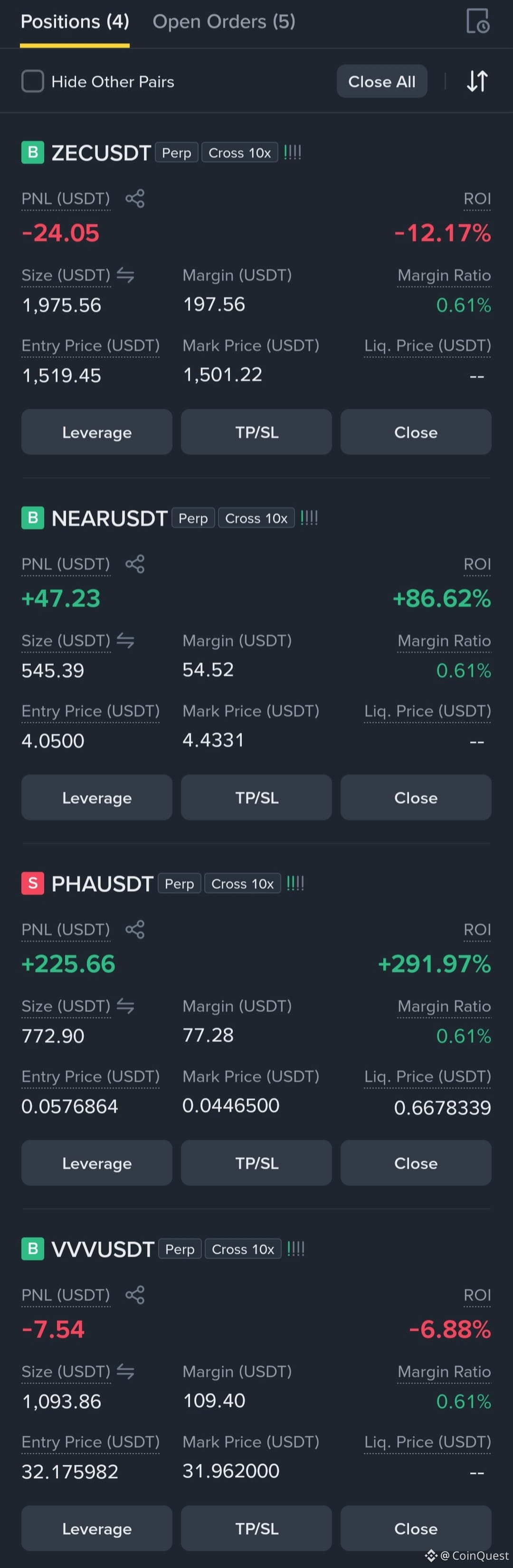
$ZEC is currently slightly red at around $1501 from a $1519 entry, while $NEAR is doing the opposite sitting around $4.43 from $4.05. $PHA is the biggest mover so far, around $0.04465 against a $0.0577 entry & $VVV is almost flat compared with the entry around $31.96.
Across these 4 positions the current unrealized PNL is around +$241.30. But these are still OPEN positions, so I’m not calling this a final profit recap.
I’ll keep tracking them instead of pretending every setup is a winner from the first candle 😭
#TradingSignals
Yesterday I shared 4 setups & here’s the real update from the positions...
$ZEC is currently slightly red at around $1501 from a $1519 entry, while $NEAR is doing the opposite sitting around $4.43 from $4.05. $PHA is the biggest mover so far, around $0.04465 against a $0.0577 entry & $VVV is almost flat compared with the entry around $31.96.
Across these 4 positions the current unrealized PNL is around +$241.30. But these are still OPEN positions, so I’m not calling this a final profit recap.
I’ll keep tracking them instead of pretending every setup is a winner from the first candle 😭
#TradingSignals
$ZEC is currently slightly red at around $1501 from a $1519 entry, while $NEAR is doing the opposite sitting around $4.43 from $4.05. $PHA is the biggest mover so far, around $0.04465 against a $0.0577 entry & $VVV is almost flat compared with the entry around $31.96.
Across these 4 positions the current unrealized PNL is around +$241.30. But these are still OPEN positions, so I’m not calling this a final profit recap.
I’ll keep tracking them instead of pretending every setup is a winner from the first candle 😭
#TradingSignals
2
963
·
--
Bullish
$BTC has moved way too fast. Next target could be 92K ?
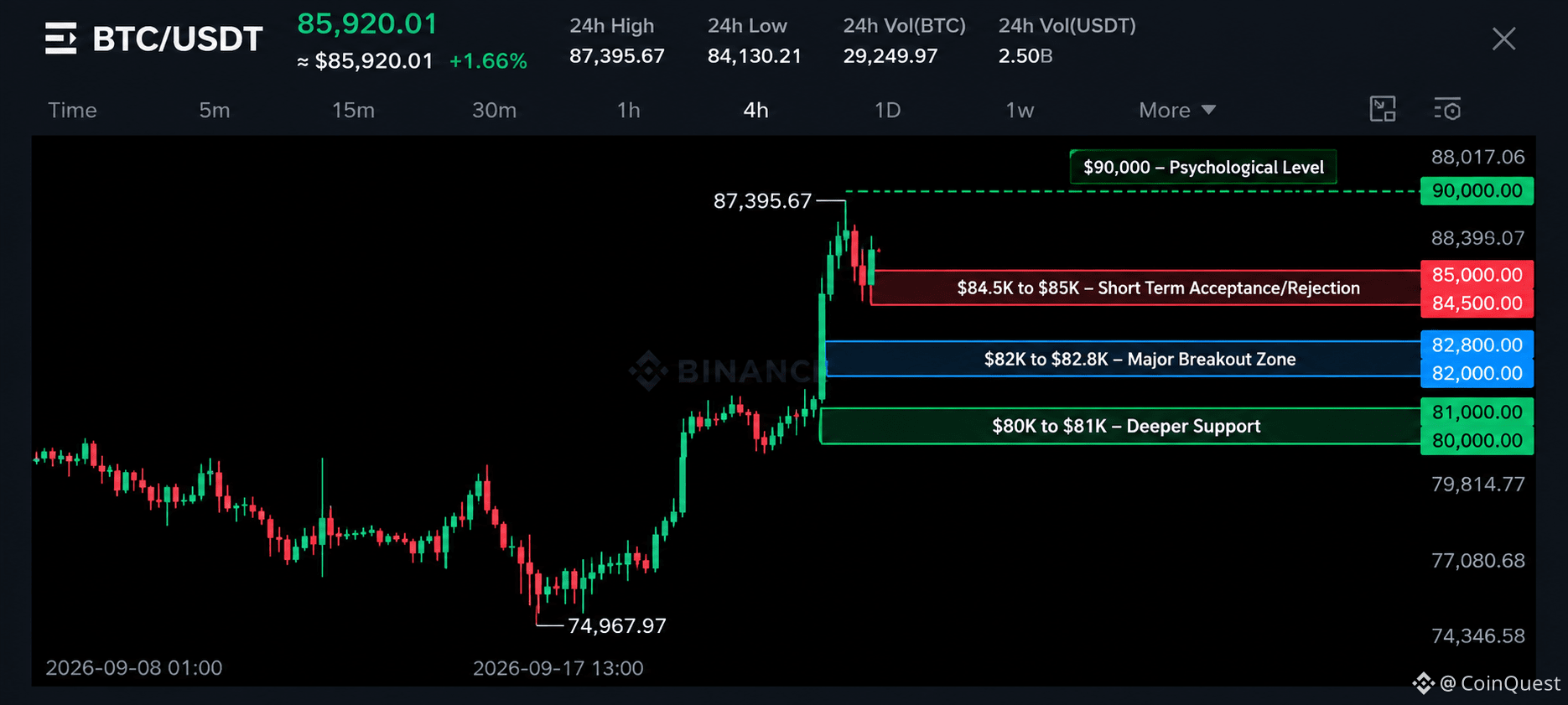
We went from around $75K to $87.4K, broke the $82K area that had been holding price back and now everyone is watching the same thing... can BTC actually hold the breakout or was the move mostly driven by short covering and momentum?
This is where having a lot of traders watching the same levels gets interesting. $87.4K is the current high. If BTC breaks it& actually accepts above, I don't want to fight the move and I'll be watching $90K next. But if $87K keeps rejecting and BTC loses $84.5K to $85K, I'll start watching the old $82K breakout zone again.
I'm not trying to guess the next candle here 😅 I want to see which side gets trapped first.
Plan > Losing Money
{future}(BTCUSDT)
#BTC
$BTC has moved way too fast. Next target could be 92K ?
We went from around $75K to $87.4K, broke the $82K area that had been holding price back and now everyone is watching the same thing... can BTC actually hold the breakout or was the move mostly driven by short covering and momentum?
This is where having a lot of traders watching the same levels gets interesting. $87.4K is the current high. If BTC breaks it& actually accepts above, I don't want to fight the move and I'll be watching $90K next. But if $87K keeps rejecting and BTC loses $84.5K to $85K, I'll start watching the old $82K breakout zone again.
I'm not trying to guess the next candle here 😅 I want to see which side gets trapped first.
Plan > Losing Money
#BTC
We went from around $75K to $87.4K, broke the $82K area that had been holding price back and now everyone is watching the same thing... can BTC actually hold the breakout or was the move mostly driven by short covering and momentum?
This is where having a lot of traders watching the same levels gets interesting. $87.4K is the current high. If BTC breaks it& actually accepts above, I don't want to fight the move and I'll be watching $90K next. But if $87K keeps rejecting and BTC loses $84.5K to $85K, I'll start watching the old $82K breakout zone again.
I'm not trying to guess the next candle here 😅 I want to see which side gets trapped first.
Plan > Losing Money
#BTC
3
424
·
--
Bullish
Verified
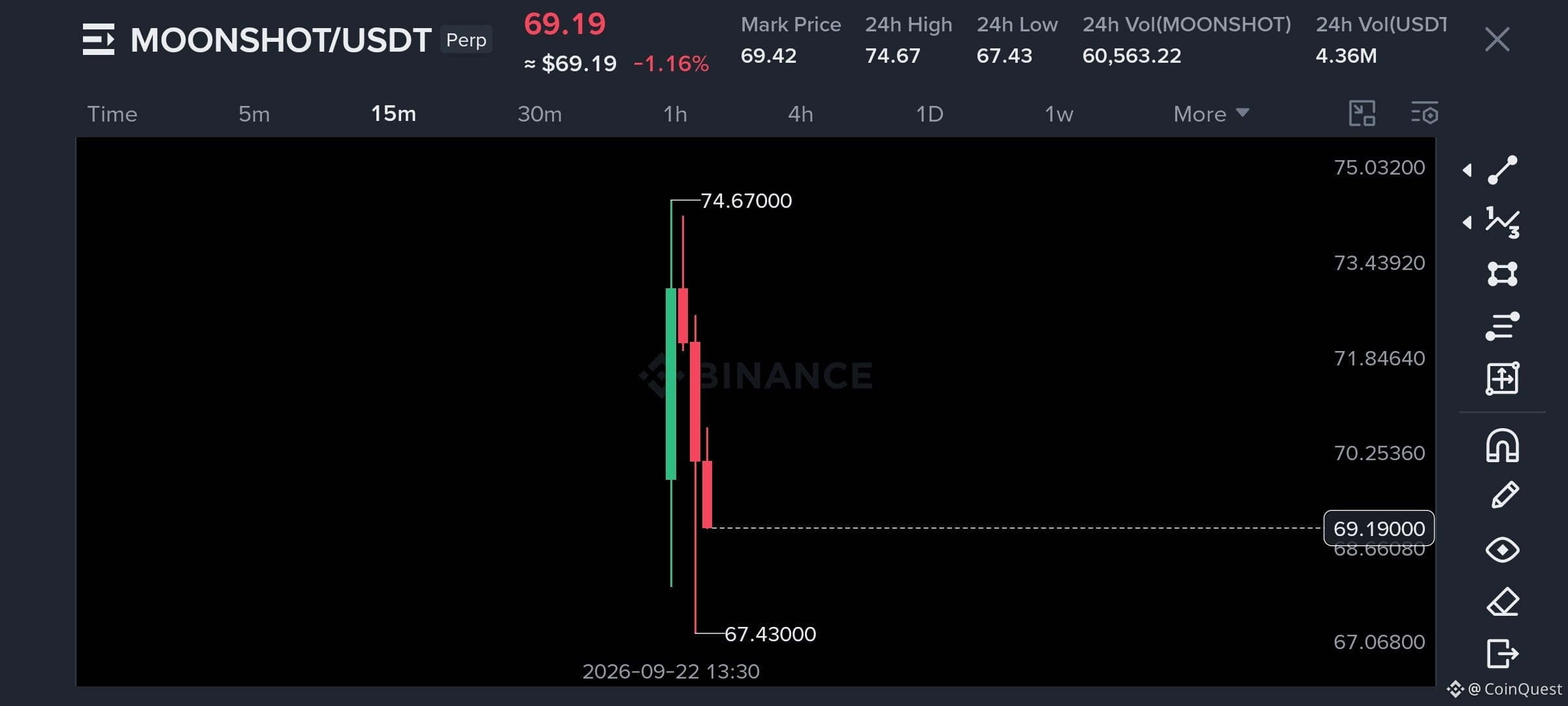
$MOONSHOT just started trading on Binance and this isn't actually a normal new coin listing
It's a Pre IPO perpetual for Moonshot AI, the company behind Kimi. Binance estimates 1B shares for the contract, which means the current price around $70 would mechanically imply roughly a $70B valuation if you used that estimate. But Binance itself says that shouldn't be treated as the actual company valuation because the share count and eventual IPO pricing can change
Here's what caught my attention tho
Reuters reported Moonshot was being valued around $50B in a recent funding round. Now the Binance contract has already traded from $67.43 to $74.67 on day one. So we're basically watching the market discover what people are willing to pay for exposure to a company that hasn't even completed its IPO yet
And the company itself is pretty serious. Moonshot's Kimi K3 is a 2.8T parameter open weight model and the company raised $3.5B in July. There's also a reported Hong Kong IPO coming, with the company reportedly targeting around $3B
For now I'm not touching the first move 😭 there isn't enough chart history and the first candles are already moving like crazy. I want to see where the first proper range forms before treating this like a normal setup
This one is worth watching tho 👀
{future}(MOONSHOTUSDT)
#moonshot
$MOONSHOT just started trading on Binance and this isn't actually a normal new coin listing
It's a Pre IPO perpetual for Moonshot AI, the company behind Kimi. Binance estimates 1B shares for the contract, which means the current price around $70 would mechanically imply roughly a $70B valuation if you used that estimate. But Binance itself says that shouldn't be treated as the actual company valuation because the share count and eventual IPO pricing can change
Here's what caught my attention tho
Reuters reported Moonshot was being valued around $50B in a recent funding round. Now the Binance contract has already traded from $67.43 to $74.67 on day one. So we're basically watching the market discover what people are willing to pay for exposure to a company that hasn't even completed its IPO yet
And the company itself is pretty serious. Moonshot's Kimi K3 is a 2.8T parameter open weight model and the company raised $3.5B in July. There's also a reported Hong Kong IPO coming, with the company reportedly targeting around $3B
For now I'm not touching the first move 😭 there isn't enough chart history and the first candles are already moving like crazy. I want to see where the first proper range forms before treating this like a normal setup
This one is worth watching tho 👀
#moonshot
It's a Pre IPO perpetual for Moonshot AI, the company behind Kimi. Binance estimates 1B shares for the contract, which means the current price around $70 would mechanically imply roughly a $70B valuation if you used that estimate. But Binance itself says that shouldn't be treated as the actual company valuation because the share count and eventual IPO pricing can change
Here's what caught my attention tho
Reuters reported Moonshot was being valued around $50B in a recent funding round. Now the Binance contract has already traded from $67.43 to $74.67 on day one. So we're basically watching the market discover what people are willing to pay for exposure to a company that hasn't even completed its IPO yet
And the company itself is pretty serious. Moonshot's Kimi K3 is a 2.8T parameter open weight model and the company raised $3.5B in July. There's also a reported Hong Kong IPO coming, with the company reportedly targeting around $3B
For now I'm not touching the first move 😭 there isn't enough chart history and the first candles are already moving like crazy. I want to see where the first proper range forms before treating this like a normal setup
This one is worth watching tho 👀
#moonshot
3
2
628
·
--
Verified
AI stocks are running hard but the real test is coming 🤖
Chips data centers cloud and AI software are still seeing strong demand and the numbers are starting to reflect that
Nvidia for example reported $89B in Data Center revenue for its latest quarter up 117% YoY while Gartner expects global AI spending to grow nearly 50% in 2026
So I’m still constructive on the bigger AI trend....
But after such a strong run I wouldn’t treat every AI stock the same
The names I’d pay more attention to are the ones showing real revenue growth strong cash flow & aactual demand for their products
The AI story looks real......
The bigger question now is how much of that growth is already priced in🙄
#AIStocksWhatNext
AI stocks are running hard but the real test is coming 🤖
Chips data centers cloud and AI software are still seeing strong demand and the numbers are starting to reflect that
Nvidia for example reported $89B in Data Center revenue for its latest quarter up 117% YoY while Gartner expects global AI spending to grow nearly 50% in 2026
So I’m still constructive on the bigger AI trend....
But after such a strong run I wouldn’t treat every AI stock the same
The names I’d pay more attention to are the ones showing real revenue growth strong cash flow & aactual demand for their products
The AI story looks real......
The bigger question now is how much of that growth is already priced in🙄
#AIStocksWhatNext
Chips data centers cloud and AI software are still seeing strong demand and the numbers are starting to reflect that
Nvidia for example reported $89B in Data Center revenue for its latest quarter up 117% YoY while Gartner expects global AI spending to grow nearly 50% in 2026
So I’m still constructive on the bigger AI trend....
But after such a strong run I wouldn’t treat every AI stock the same
The names I’d pay more attention to are the ones showing real revenue growth strong cash flow & aactual demand for their products
The AI story looks real......
The bigger question now is how much of that growth is already priced in🙄
#AIStocksWhatNext

1
644
·
--
Bearish
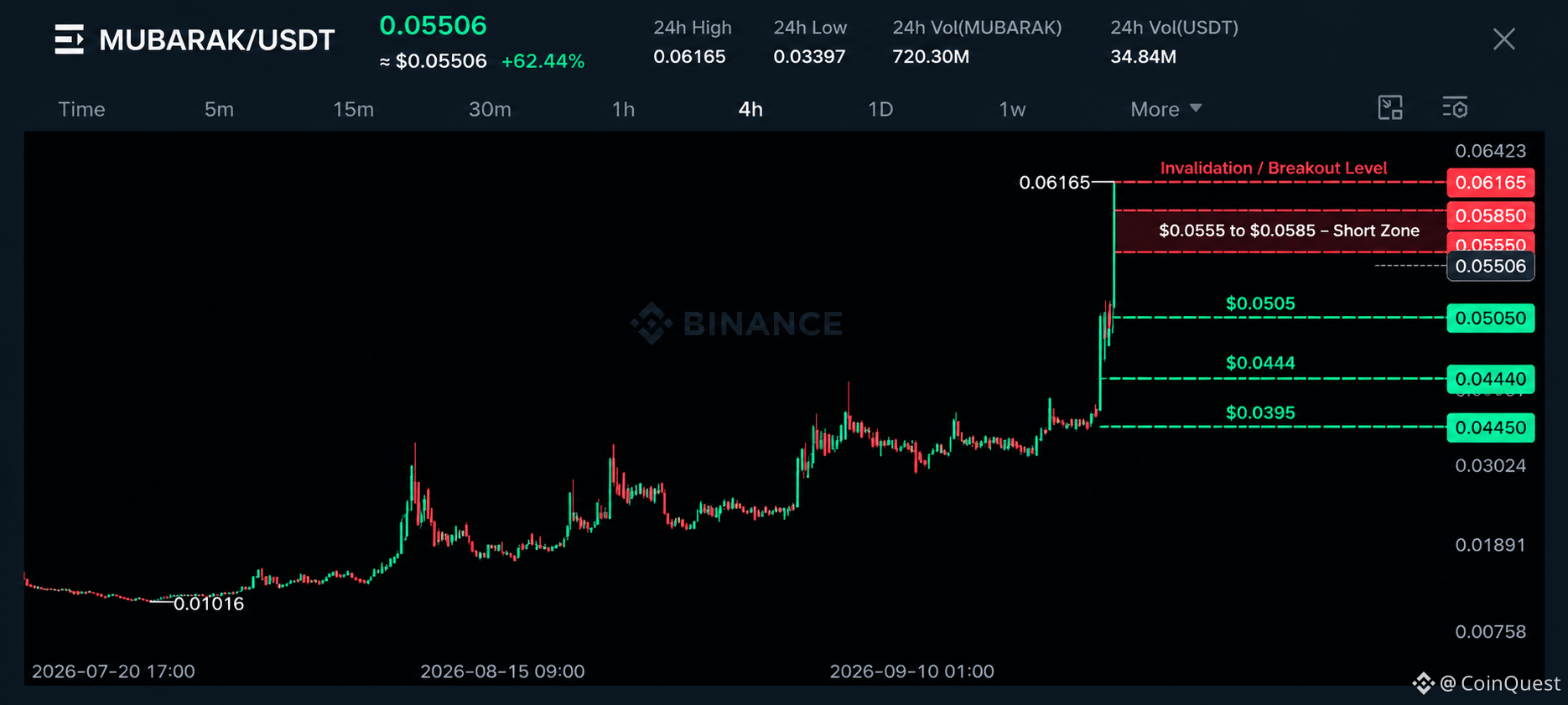
Quick update on yesterday's $MUBARAK setup because the market definitely didn't give us the entry 😂
We were looking for $0.0395 to $0.0415 but price never came back there and instead kept pushing higher, eventually printing $0.06165. So I'm not counting this as a winning trade or anything like that... no entry means no trade.
Now I'm looking at it differently. MUBARAK has pushed straight into the monthly resistance area around $0.0555 to $0.0585 and we've already seen a rejection from $0.06165. If price comes back into that resistance and sellers show some strength again, I'll look for a short toward $0.0505, $0.0444 and potentially $0.0395. Stop Loss around $0.0630.
But if it starts holding above $0.06165, I'm leaving the short alone. After a move this aggressive I don't want to be the guy forcing a trade just because the chart looks overextended 😭
{future}(MUBARAKUSDT)
#MUBARAK
Quick update on yesterday's $MUBARAK setup because the market definitely didn't give us the entry 😂
We were looking for $0.0395 to $0.0415 but price never came back there and instead kept pushing higher, eventually printing $0.06165. So I'm not counting this as a winning trade or anything like that... no entry means no trade.
Now I'm looking at it differently. MUBARAK has pushed straight into the monthly resistance area around $0.0555 to $0.0585 and we've already seen a rejection from $0.06165. If price comes back into that resistance and sellers show some strength again, I'll look for a short toward $0.0505, $0.0444 and potentially $0.0395. Stop Loss around $0.0630.
But if it starts holding above $0.06165, I'm leaving the short alone. After a move this aggressive I don't want to be the guy forcing a trade just because the chart looks overextended 😭
#MUBARAK
We were looking for $0.0395 to $0.0415 but price never came back there and instead kept pushing higher, eventually printing $0.06165. So I'm not counting this as a winning trade or anything like that... no entry means no trade.
Now I'm looking at it differently. MUBARAK has pushed straight into the monthly resistance area around $0.0555 to $0.0585 and we've already seen a rejection from $0.06165. If price comes back into that resistance and sellers show some strength again, I'll look for a short toward $0.0505, $0.0444 and potentially $0.0395. Stop Loss around $0.0630.
But if it starts holding above $0.06165, I'm leaving the short alone. After a move this aggressive I don't want to be the guy forcing a trade just because the chart looks overextended 😭
#MUBARAK
CoinQuest
·
--
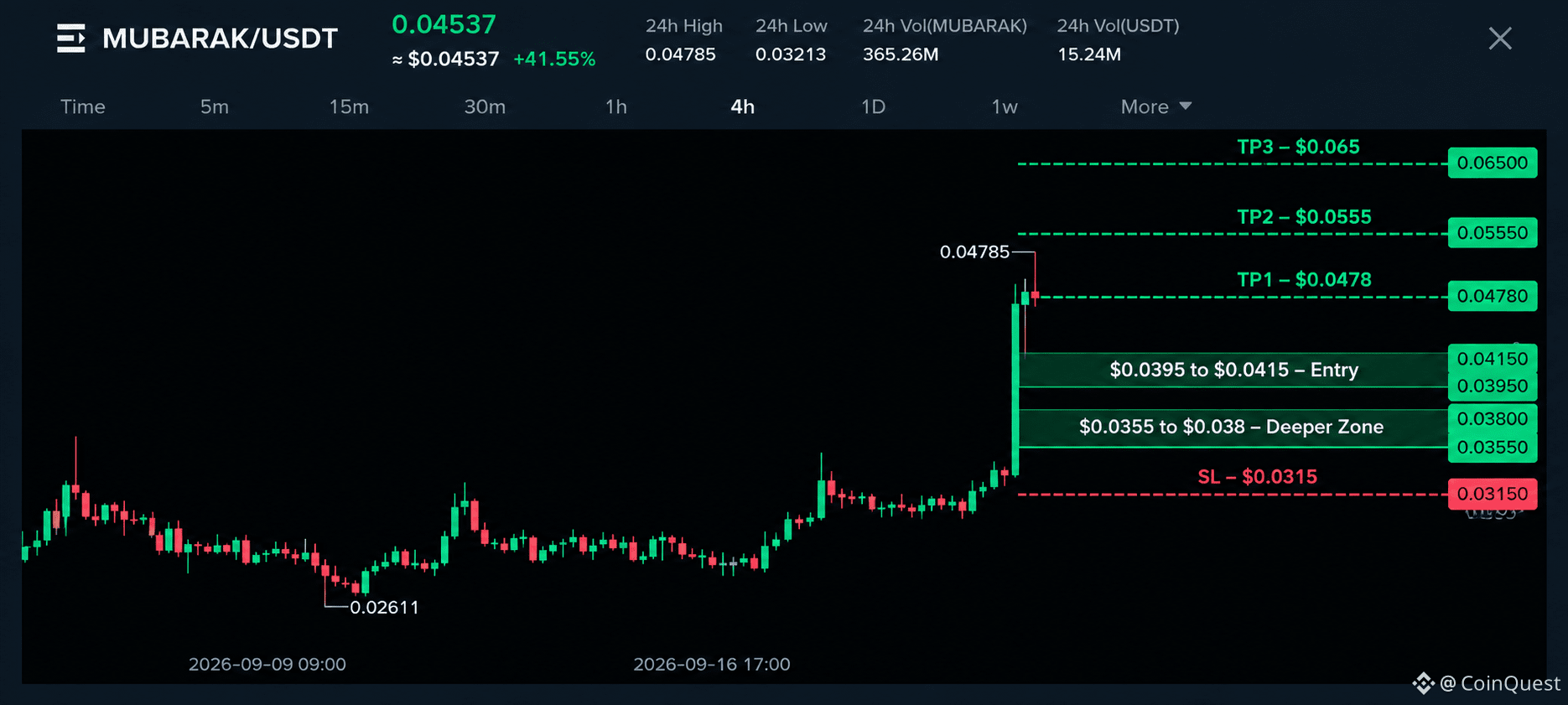
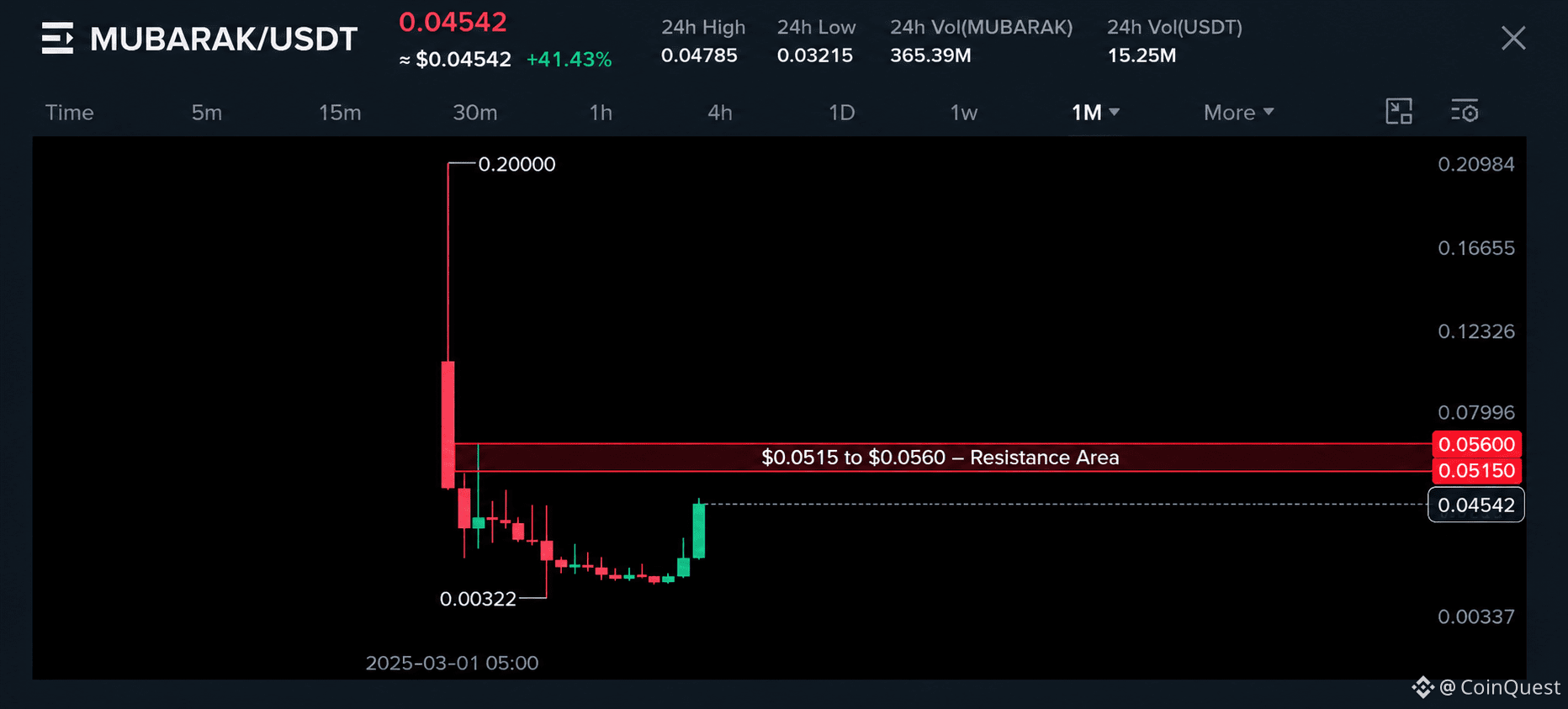
$MUBARAK just ripped from around $0.03 to $0.0478 and I'm not chasing this candle right now until it give a pullback
My first plan is still a pullback long around $0.0395 to $0.0415. If buyers defend that area I'll look for $0.0478 first then $0.0555 and $0.065
But there's another level I don't want to ignore
The monthly chart has resistance around $0.0555 to $0.056. So if MUBARAK never gives the long entry and instead runs straight into that area, I'll watch for a rejection there for a short with Targets 0.045,0.04 & below 0.035.
Long SL $0.0315
Short SL $0.0605
No blind short at resistance though 😅 I need sellers to actually show up first... Watch candles closing...
Let's see which setup the market gives us & how much we can make from this gem...
#MUBARAK
My first plan is still a pullback long around $0.0395 to $0.0415. If buyers defend that area I'll look for $0.0478 first then $0.0555 and $0.065
But there's another level I don't want to ignore
The monthly chart has resistance around $0.0555 to $0.056. So if MUBARAK never gives the long entry and instead runs straight into that area, I'll watch for a rejection there for a short with Targets 0.045,0.04 & below 0.035.
Long SL $0.0315
Short SL $0.0605
No blind short at resistance though 😅 I need sellers to actually show up first... Watch candles closing...
Let's see which setup the market gives us & how much we can make from this gem...
#MUBARAK
1
821
·
--
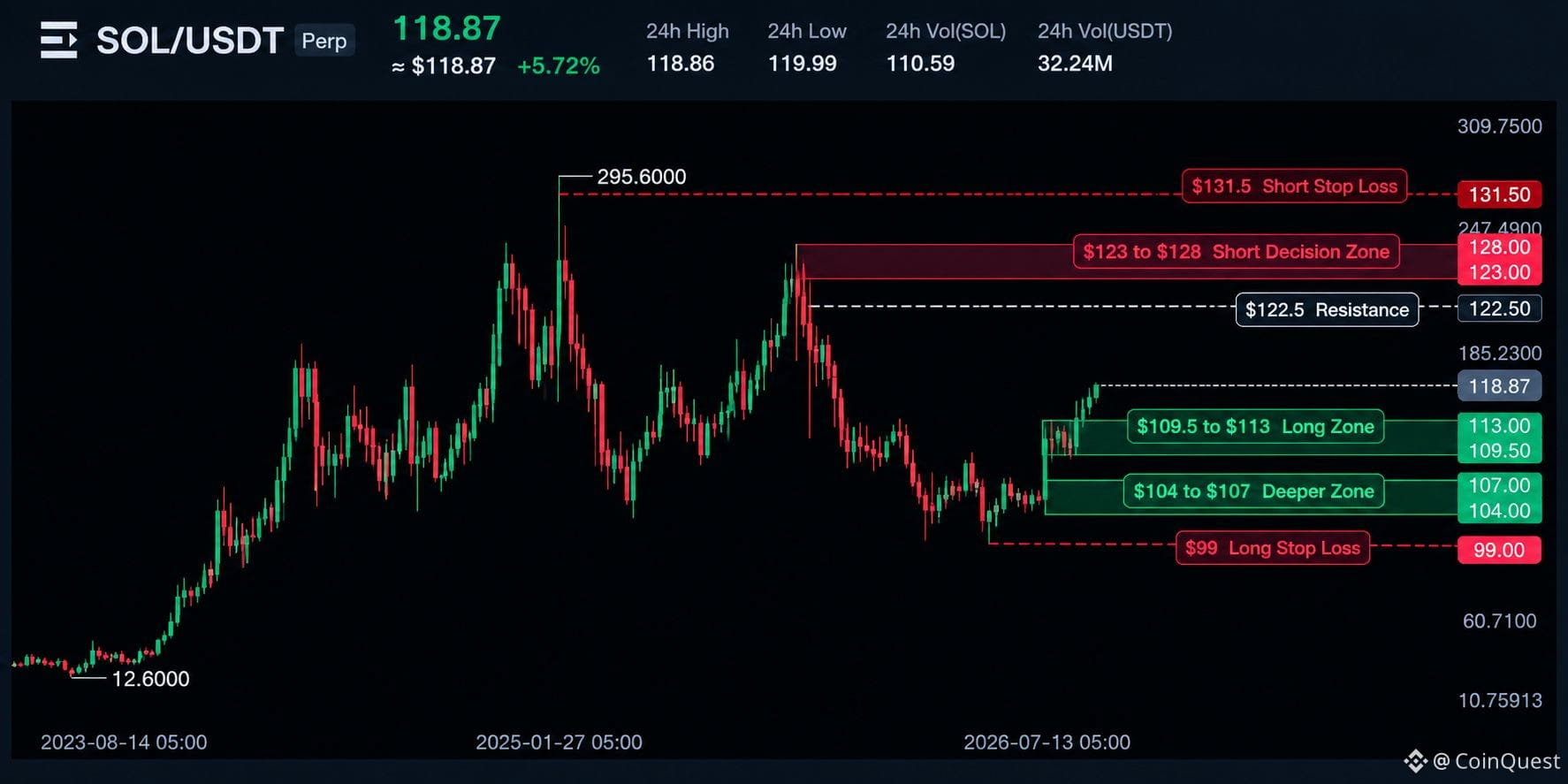
$SOL is back at $119 & this is actually a critical area for both Shorts & Longs
SOL has already made a strong move from the $70s and now it's sitting around a major weekly and monthly resistance zone. BTC also pushed through the old $82K area and is now above $86K so I don't want to fight the market blindly here
My long plan is a pullback into $109.5 to $113. If that holds I'll watch $122.5 first then $128 and $137
But if SOL never gives the pullback and runs straight into $123 to $128, I'll watch that area for a rejection and possible short
No blind short at resistance tho 😭 if SOL breaks $128 and actually holds above it, I'm dropping the short idea completely & getting along with trend . Iykyk😄
The actual trade I'd prioritize
LONG on pullback > SHORT at resistance
But the short becomes interesting if SOL runs directly into $123 to $128 and gives us the rejection.
So basically:
$109.5 to $113 → long zone
$104 to $107 → deeper long zone
$122.5 → first resistance
$123 to $128 → decision zone
Above $128 with acceptance → no short
{future}(SOLUSDT)
Follow For More Interesting Updates & Setups...
#solana
$SOL is back at $119 & this is actually a critical area for both Shorts & Longs
SOL has already made a strong move from the $70s and now it's sitting around a major weekly and monthly resistance zone. BTC also pushed through the old $82K area and is now above $86K so I don't want to fight the market blindly here
My long plan is a pullback into $109.5 to $113. If that holds I'll watch $122.5 first then $128 and $137
But if SOL never gives the pullback and runs straight into $123 to $128, I'll watch that area for a rejection and possible short
No blind short at resistance tho 😭 if SOL breaks $128 and actually holds above it, I'm dropping the short idea completely & getting along with trend . Iykyk😄
The actual trade I'd prioritize
LONG on pullback > SHORT at resistance
But the short becomes interesting if SOL runs directly into $123 to $128 and gives us the rejection.
So basically:
$109.5 to $113 → long zone
$104 to $107 → deeper long zone
$122.5 → first resistance
$123 to $128 → decision zone
Above $128 with acceptance → no short
Follow For More Interesting Updates & Setups...
#solana
SOL has already made a strong move from the $70s and now it's sitting around a major weekly and monthly resistance zone. BTC also pushed through the old $82K area and is now above $86K so I don't want to fight the market blindly here
My long plan is a pullback into $109.5 to $113. If that holds I'll watch $122.5 first then $128 and $137
But if SOL never gives the pullback and runs straight into $123 to $128, I'll watch that area for a rejection and possible short
No blind short at resistance tho 😭 if SOL breaks $128 and actually holds above it, I'm dropping the short idea completely & getting along with trend . Iykyk😄
The actual trade I'd prioritize
LONG on pullback > SHORT at resistance
But the short becomes interesting if SOL runs directly into $123 to $128 and gives us the rejection.
So basically:
$109.5 to $113 → long zone
$104 to $107 → deeper long zone
$122.5 → first resistance
$123 to $128 → decision zone
Above $128 with acceptance → no short
Follow For More Interesting Updates & Setups...
#solana
2
1.1k
·
--
Crypto market performance since the CLARITY Act failed to pass the Senate:
$BTC : +14%
$ETH : +16%
$XRP : +18%
$SOL : +22%
$ADA : +27%
$LINK : +22%
$AVAX : +59%
Fundamentals = Bearish ,yet the market is pumping...
Is it start of Bull Trap? Share your opinions down here ...
Crypto market performance since the CLARITY Act failed to pass the Senate:
$BTC : +14%
$ETH : +16%
$XRP : +18%
$SOL : +22%
$ADA : +27%
$LINK : +22%
$AVAX : +59%
Fundamentals = Bearish ,yet the market is pumping...
Is it start of Bull Trap? Share your opinions down here ...
$BTC : +14%
$ETH : +16%
$XRP : +18%
$SOL : +22%
$ADA : +27%
$LINK : +22%
$AVAX : +59%
Fundamentals = Bearish ,yet the market is pumping...
Is it start of Bull Trap? Share your opinions down here ...
1
1
444
·
--
30D trade $MUBARAK 9.9 USDT
$MUBARAK just ripped from around $0.03 to $0.0478 and I'm not chasing this candle right now until it give a pullback
My first plan is still a pullback long around $0.0395 to $0.0415. If buyers defend that area I'll look for $0.0478 first then $0.0555 and $0.065
But there's another level I don't want to ignore
The monthly chart has resistance around $0.0555 to $0.056. So if MUBARAK never gives the long entry and instead runs straight into that area, I'll watch for a rejection there for a short with Targets 0.045,0.04 & below 0.035.
Long SL $0.0315
Short SL $0.0605
No blind short at resistance though 😅 I need sellers to actually show up first... Watch candles closing...
Let's see which setup the market gives us & how much we can make from this gem...
{future}(MUBARAKUSDT)
#MUBARAK
$MUBARAK just ripped from around $0.03 to $0.0478 and I'm not chasing this candle right now until it give a pullback
My first plan is still a pullback long around $0.0395 to $0.0415. If buyers defend that area I'll look for $0.0478 first then $0.0555 and $0.065
But there's another level I don't want to ignore
The monthly chart has resistance around $0.0555 to $0.056. So if MUBARAK never gives the long entry and instead runs straight into that area, I'll watch for a rejection there for a short with Targets 0.045,0.04 & below 0.035.
Long SL $0.0315
Short SL $0.0605
No blind short at resistance though 😅 I need sellers to actually show up first... Watch candles closing...
Let's see which setup the market gives us & how much we can make from this gem...
#MUBARAK
My first plan is still a pullback long around $0.0395 to $0.0415. If buyers defend that area I'll look for $0.0478 first then $0.0555 and $0.065
But there's another level I don't want to ignore
The monthly chart has resistance around $0.0555 to $0.056. So if MUBARAK never gives the long entry and instead runs straight into that area, I'll watch for a rejection there for a short with Targets 0.045,0.04 & below 0.035.
Long SL $0.0315
Short SL $0.0605
No blind short at resistance though 😅 I need sellers to actually show up first... Watch candles closing...
Let's see which setup the market gives us & how much we can make from this gem...
#MUBARAK
1
1
2
821
·
--
Bullish
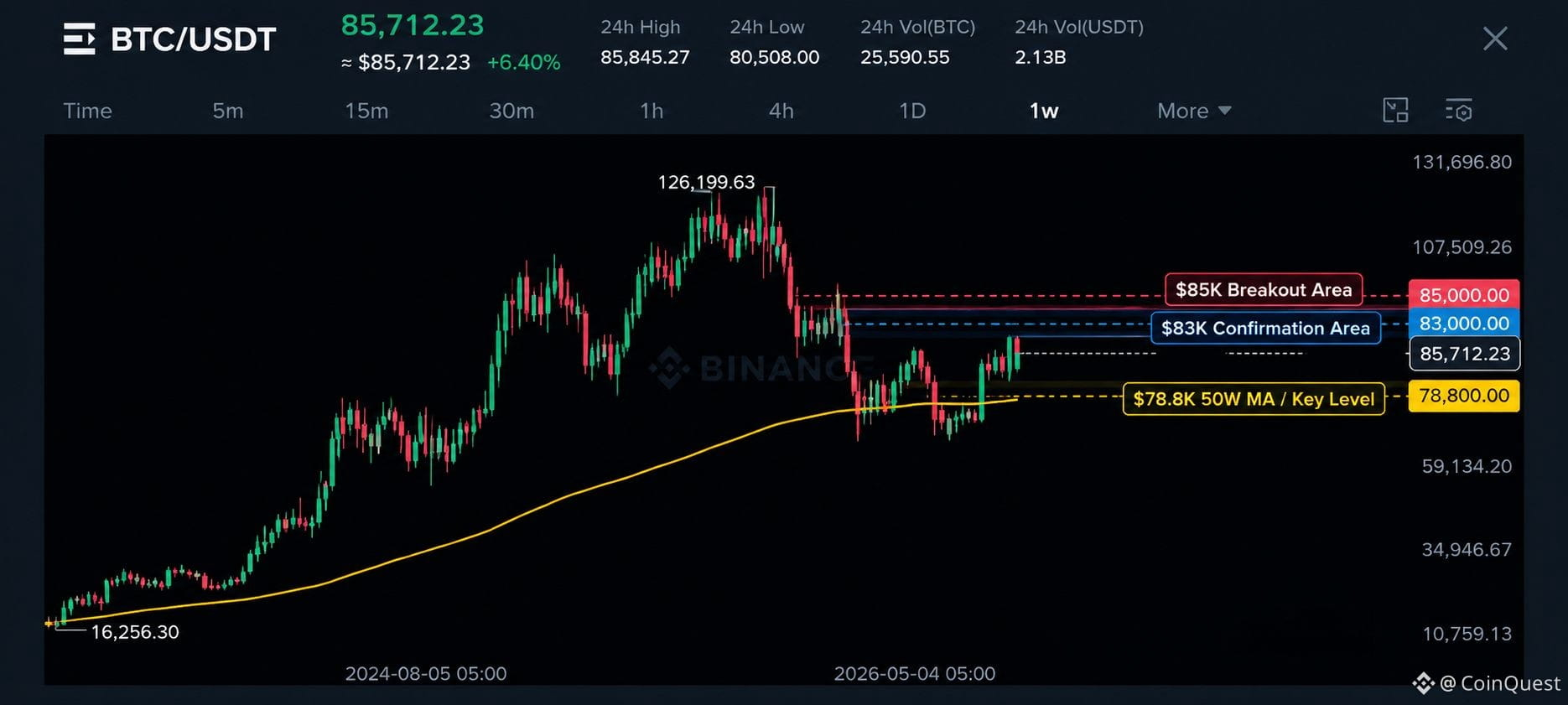
$BTC finally closed above the 50 week moving average
The weekly close came around $81,159 while the 50W MA was near $78,788. That's the first weekly close above it in 45 weeks
And this isn't just another moving average cross. Galaxy's historical study found that out of 13 similar weekly reclaims during major Bitcoin bear markets, only 2 were followed by another major low
Still not calling the bottom yet 😅
For me the important part starts now
$78.8K is the level I want to see defended. Above that, $83K and then $85K become the areas where BTC needs to prove this breakout has real strength
If BTC keeps building higher lows above the 50W MA, the market structure starts looking very different
The signal happened
Now let's see if price can actually confirm it 👀
{future}(BTCUSDT)
#BTC
$BTC finally closed above the 50 week moving average
The weekly close came around $81,159 while the 50W MA was near $78,788. That's the first weekly close above it in 45 weeks
And this isn't just another moving average cross. Galaxy's historical study found that out of 13 similar weekly reclaims during major Bitcoin bear markets, only 2 were followed by another major low
Still not calling the bottom yet 😅
For me the important part starts now
$78.8K is the level I want to see defended. Above that, $83K and then $85K become the areas where BTC needs to prove this breakout has real strength
If BTC keeps building higher lows above the 50W MA, the market structure starts looking very different
The signal happened
Now let's see if price can actually confirm it 👀
#BTC
The weekly close came around $81,159 while the 50W MA was near $78,788. That's the first weekly close above it in 45 weeks
And this isn't just another moving average cross. Galaxy's historical study found that out of 13 similar weekly reclaims during major Bitcoin bear markets, only 2 were followed by another major low
Still not calling the bottom yet 😅
For me the important part starts now
$78.8K is the level I want to see defended. Above that, $83K and then $85K become the areas where BTC needs to prove this breakout has real strength
If BTC keeps building higher lows above the 50W MA, the market structure starts looking very different
The signal happened
Now let's see if price can actually confirm it 👀
#BTC
2
1k
·
--
Bullish
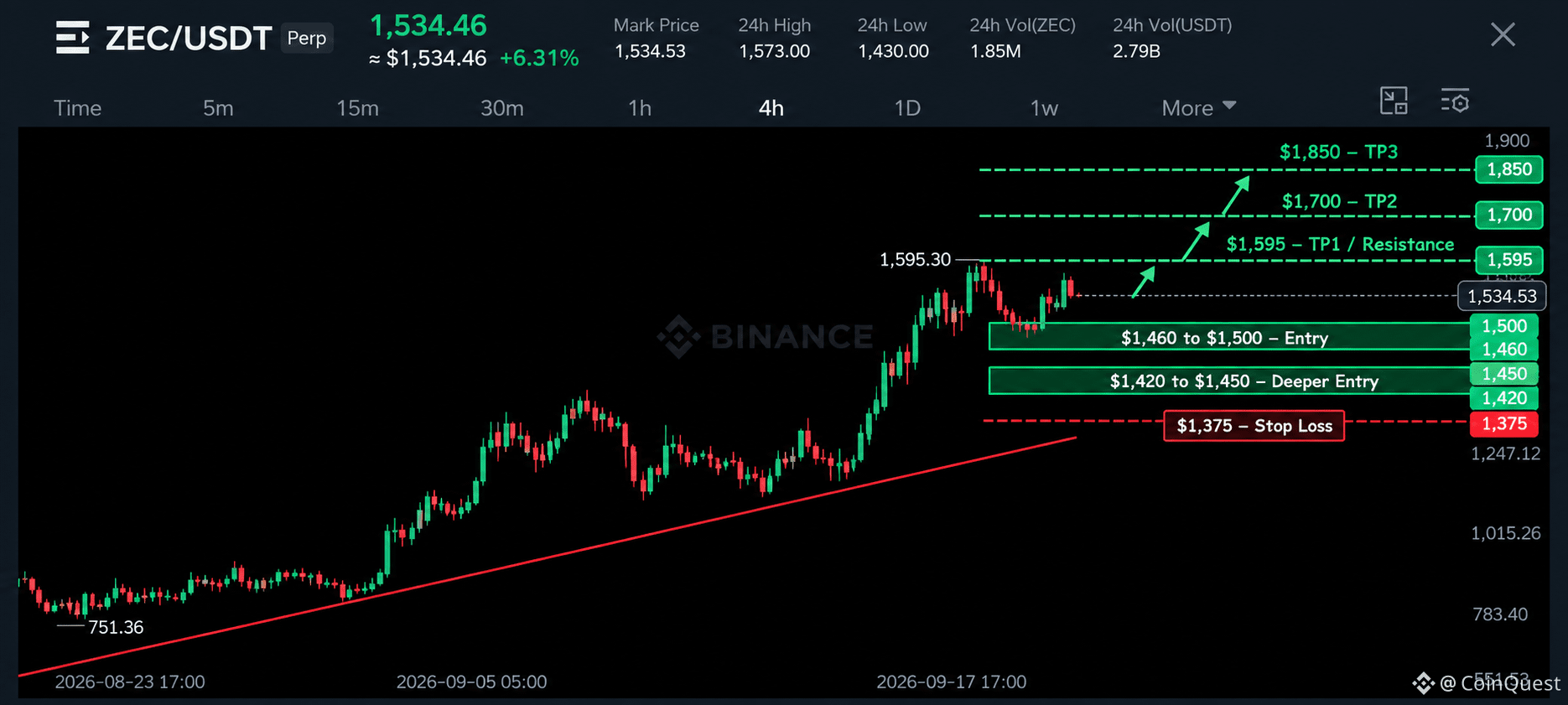
$ZEC is sitting just below $1,595 and I'm not interested in chasing it here 😭
The bigger trend is still strong across the higher timeframes and the last pullback already showed buyers stepping back in around $1,430 to $1,460
So my plan is simple
I'm watching $1,460 to $1,500 for a long. If we get a deeper sweep into $1,420 to $1,450 and buyers defend it, that's the only area I'd consider adding
TP1 $1,595
TP2 $1,700
TP3 $1,850
Stop Loss $1,375
If ZEC breaks $1,595 and actually holds above it, I don't want to be the guy shorting a breakout 😅
{future}(ZECUSDT)
#zec
$ZEC is sitting just below $1,595 and I'm not interested in chasing it here 😭
The bigger trend is still strong across the higher timeframes and the last pullback already showed buyers stepping back in around $1,430 to $1,460
So my plan is simple
I'm watching $1,460 to $1,500 for a long. If we get a deeper sweep into $1,420 to $1,450 and buyers defend it, that's the only area I'd consider adding
TP1 $1,595
TP2 $1,700
TP3 $1,850
Stop Loss $1,375
If ZEC breaks $1,595 and actually holds above it, I don't want to be the guy shorting a breakout 😅
#zec
The bigger trend is still strong across the higher timeframes and the last pullback already showed buyers stepping back in around $1,430 to $1,460
So my plan is simple
I'm watching $1,460 to $1,500 for a long. If we get a deeper sweep into $1,420 to $1,450 and buyers defend it, that's the only area I'd consider adding
TP1 $1,595
TP2 $1,700
TP3 $1,850
Stop Loss $1,375
If ZEC breaks $1,595 and actually holds above it, I don't want to be the guy shorting a breakout 😅
#zec
2
914
·
--
Bearish
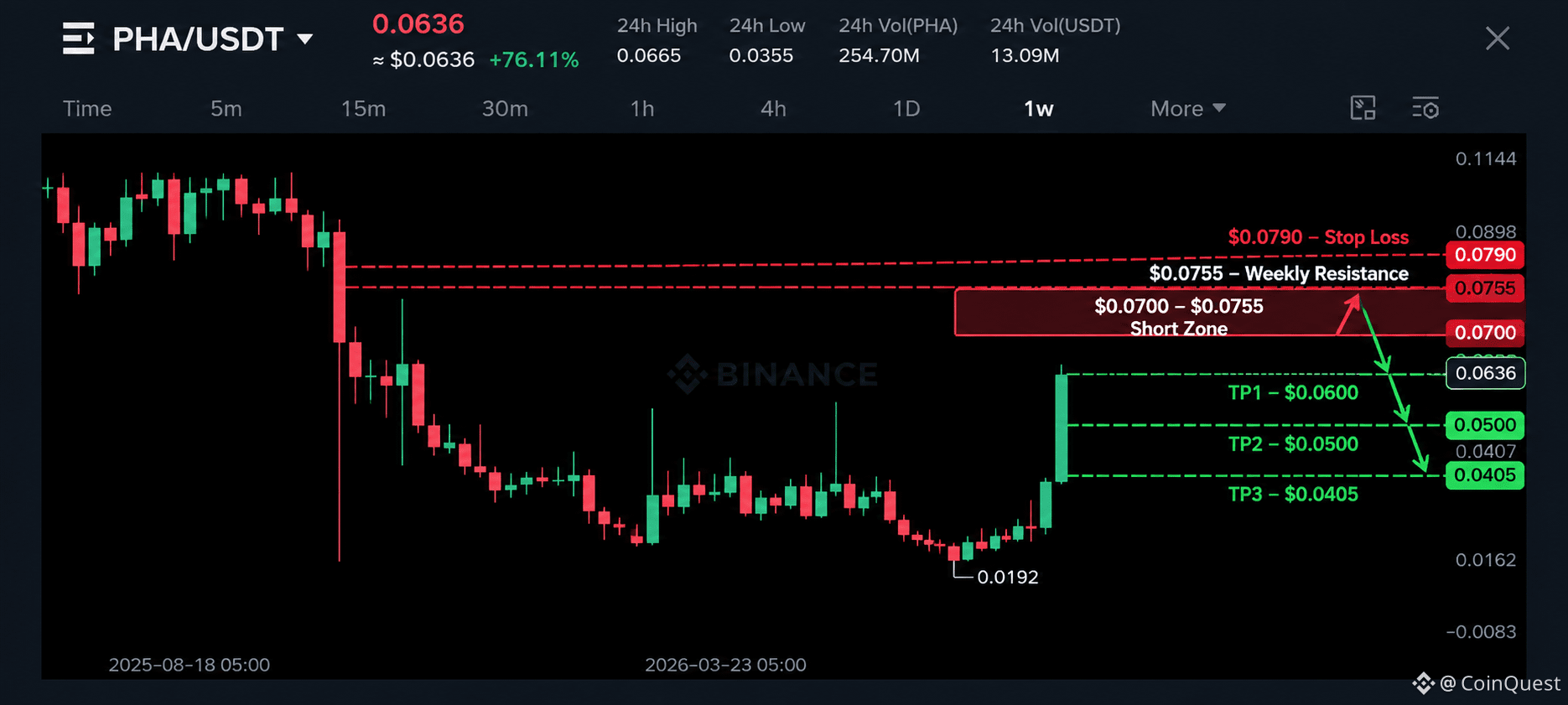
$PHA just made a crazy move from $0.019 to $0.066 and now it's approaching a level I don't want to ignore
The 3D breakout looks strong but the weekly chart is telling a different story. PHA is still below the big weekly resistance around $0.0755 and price is getting there after a near vertical pump
I'm not shorting just because it went up 😭 I want to see a proper rejection first
If sellers show up around $0.0700 to $0.0755 I'll watch the short toward $0.060 then $0.050 and potentially $0.0405
Stop Loss $0.0790
If PHA breaks above the weekly resistance and holds it I'm dropping the short idea
Would you short the rejection or wait for the breakout? 👀
{future}(PHAUSDT)
$PHA just made a crazy move from $0.019 to $0.066 and now it's approaching a level I don't want to ignore
The 3D breakout looks strong but the weekly chart is telling a different story. PHA is still below the big weekly resistance around $0.0755 and price is getting there after a near vertical pump
I'm not shorting just because it went up 😭 I want to see a proper rejection first
If sellers show up around $0.0700 to $0.0755 I'll watch the short toward $0.060 then $0.050 and potentially $0.0405
Stop Loss $0.0790
If PHA breaks above the weekly resistance and holds it I'm dropping the short idea
Would you short the rejection or wait for the breakout? 👀
The 3D breakout looks strong but the weekly chart is telling a different story. PHA is still below the big weekly resistance around $0.0755 and price is getting there after a near vertical pump
I'm not shorting just because it went up 😭 I want to see a proper rejection first
If sellers show up around $0.0700 to $0.0755 I'll watch the short toward $0.060 then $0.050 and potentially $0.0405
Stop Loss $0.0790
If PHA breaks above the weekly resistance and holds it I'm dropping the short idea
Would you short the rejection or wait for the breakout? 👀
3
680
·
--
Bullish
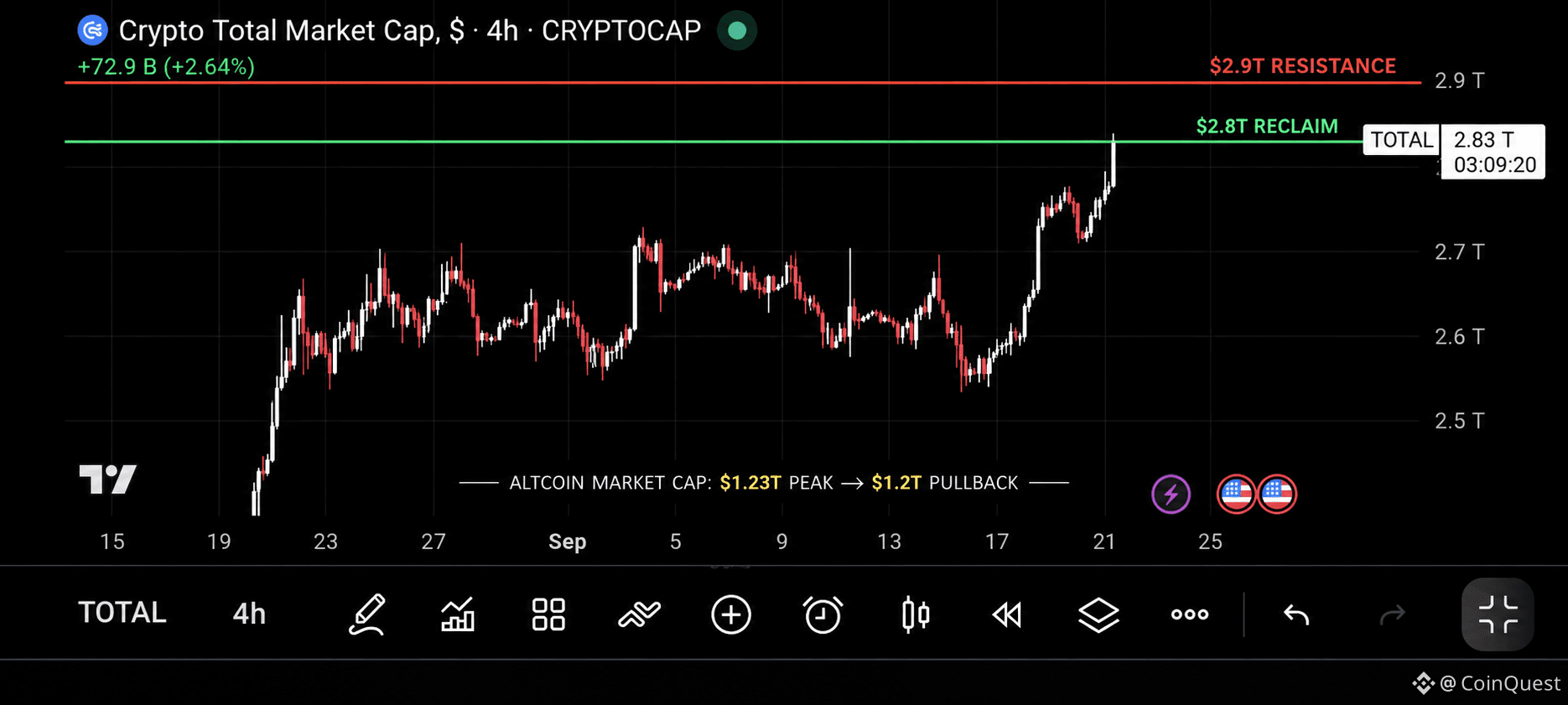
Crypto just reclaimed $2.8T and came close to $2.9T
$BTC pushed back above $82K but what caught my attention is what's happening underneath it. Altcoin market cap went from around $1.17T to $1.23T before slipping back under $1.2T
HYPE crossed $20B market cap, ZEC got close to $25B and coins like NEAR AVAX ETH and XRP also joined the rebound
So now I'm watching one thing
Can alts keep adding to the market cap or does capital start rotating back into BTC again?
That's probably more important to me than chasing whatever coin is pumping today 😅
Which side are you watching?
Crypto just reclaimed $2.8T and came close to $2.9T
$BTC pushed back above $82K but what caught my attention is what's happening underneath it. Altcoin market cap went from around $1.17T to $1.23T before slipping back under $1.2T
HYPE crossed $20B market cap, ZEC got close to $25B and coins like NEAR AVAX ETH and XRP also joined the rebound
So now I'm watching one thing
Can alts keep adding to the market cap or does capital start rotating back into BTC again?
That's probably more important to me than chasing whatever coin is pumping today 😅
Which side are you watching?
$BTC pushed back above $82K but what caught my attention is what's happening underneath it. Altcoin market cap went from around $1.17T to $1.23T before slipping back under $1.2T
HYPE crossed $20B market cap, ZEC got close to $25B and coins like NEAR AVAX ETH and XRP also joined the rebound
So now I'm watching one thing
Can alts keep adding to the market cap or does capital start rotating back into BTC again?
That's probably more important to me than chasing whatever coin is pumping today 😅
Which side are you watching?
1
4.1k
·
--
Bullish
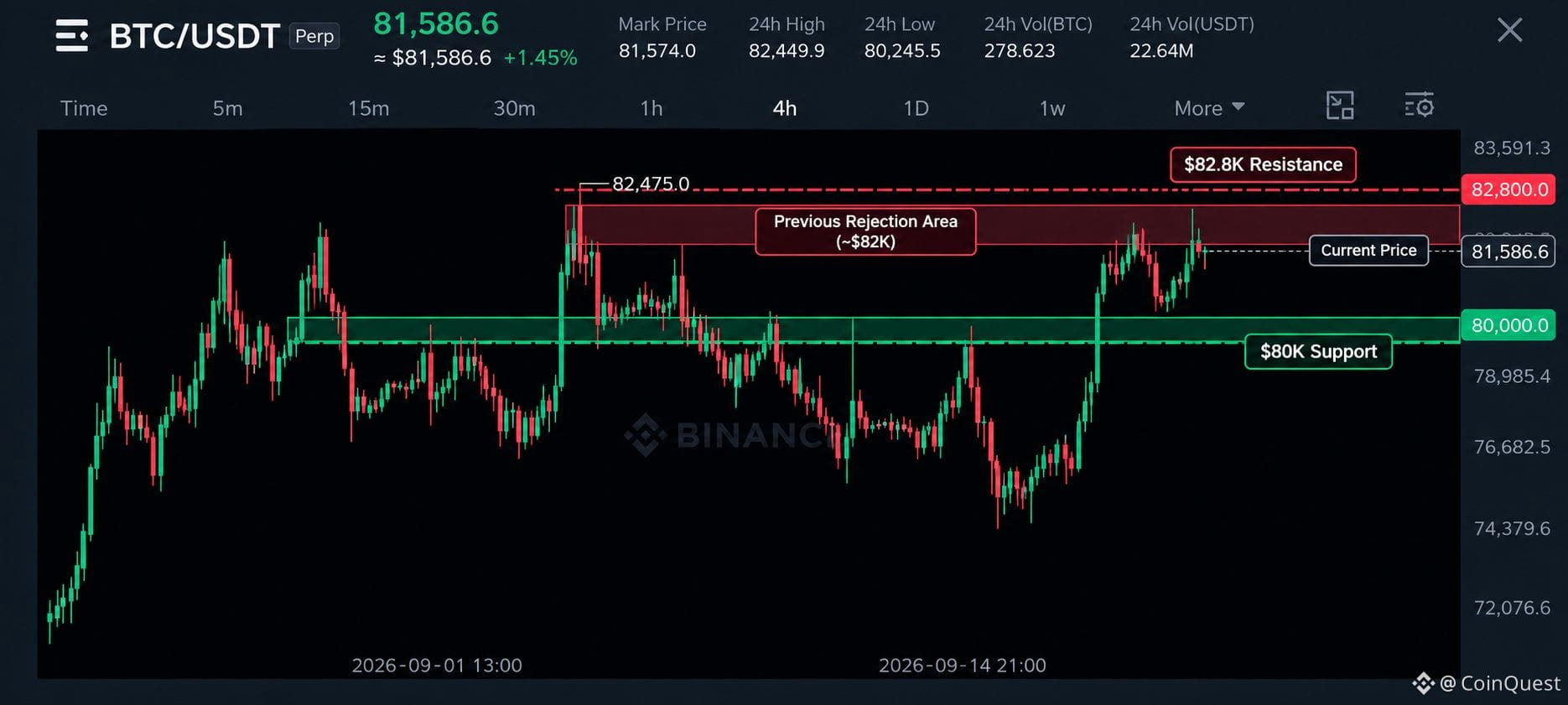
$BTC is back at the $82K area again😬
Price has recovered hard from the $76K zone and now it's knocking on the same resistance that stopped the previous move. $82.8K is the level I'm watching closely here
If BTC breaks and holds above it, I want to see whether that old resistance turns into support. If it gets rejected again, I’ll be watching how price reacts around $80K
Not chasing either side here 😅 I want the chart to show the next move first
What are you watching around $82.8K?
{future}(BTCUSDT)
#BTC走势分析
$BTC is back at the $82K area again😬
Price has recovered hard from the $76K zone and now it's knocking on the same resistance that stopped the previous move. $82.8K is the level I'm watching closely here
If BTC breaks and holds above it, I want to see whether that old resistance turns into support. If it gets rejected again, I’ll be watching how price reacts around $80K
Not chasing either side here 😅 I want the chart to show the next move first
What are you watching around $82.8K?
#BTC走势分析
Price has recovered hard from the $76K zone and now it's knocking on the same resistance that stopped the previous move. $82.8K is the level I'm watching closely here
If BTC breaks and holds above it, I want to see whether that old resistance turns into support. If it gets rejected again, I’ll be watching how price reacts around $80K
Not chasing either side here 😅 I want the chart to show the next move first
What are you watching around $82.8K?
#BTC走势分析
473
·
--
Bullish
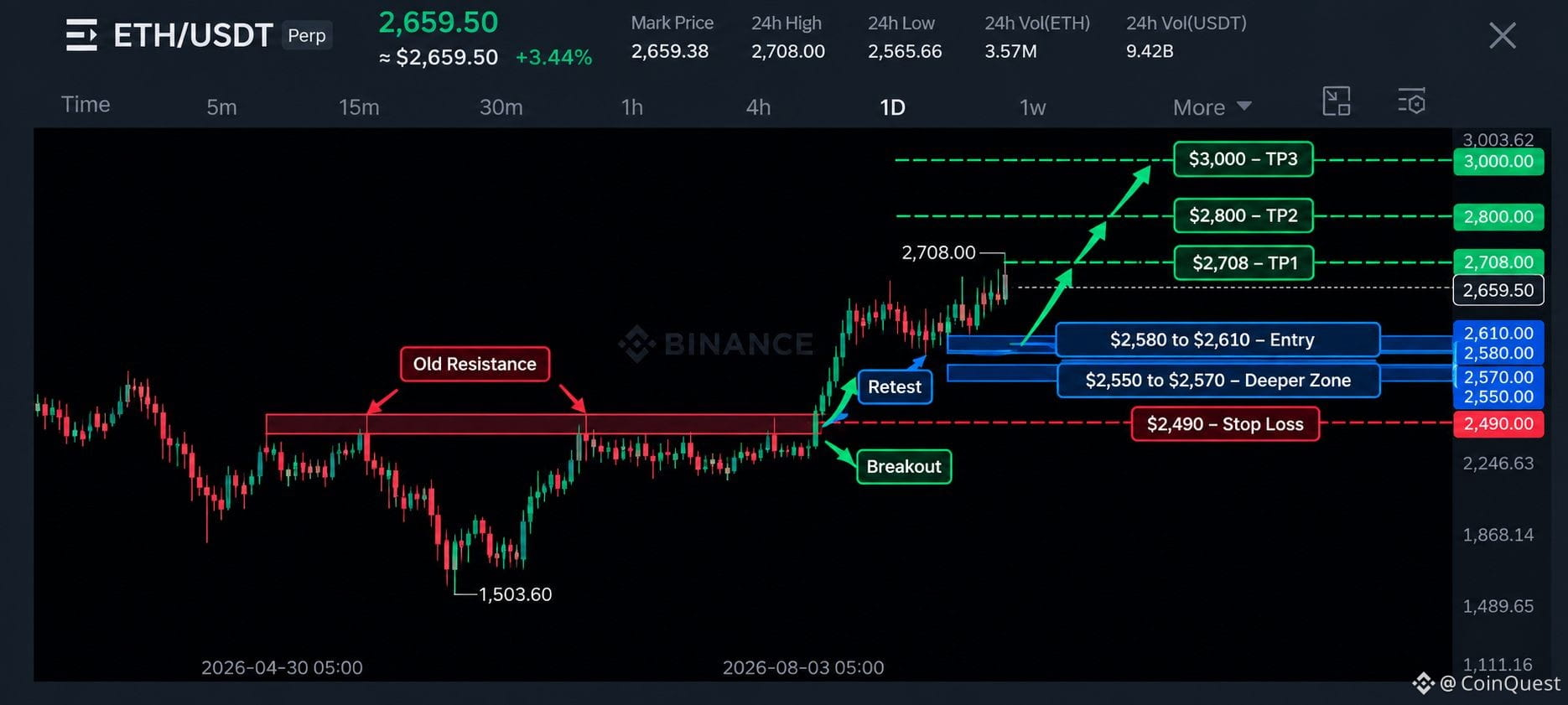
$ETH just did something we all have been waiting for🫣
The $2,550 area was resistance for a while and now ETH has pushed above it and is holding up there. Price already tested $2,708 so I'm not interested in chasing at $2,658 😭
My long zone is $2,580 to $2,610 on a clean pullback. If it gets deeper, $2,550 to $2,570 is the area I'd watch for buyers to defend
Targets $2,708 then $2,800 and $3,000
Stop Loss $2,490
If ETH gives the retest I'll take the setup, if not then no chase 🤝
{future}(ETHUSDT)
#ETH
$ETH just did something we all have been waiting for🫣
The $2,550 area was resistance for a while and now ETH has pushed above it and is holding up there. Price already tested $2,708 so I'm not interested in chasing at $2,658 😭
My long zone is $2,580 to $2,610 on a clean pullback. If it gets deeper, $2,550 to $2,570 is the area I'd watch for buyers to defend
Targets $2,708 then $2,800 and $3,000
Stop Loss $2,490
If ETH gives the retest I'll take the setup, if not then no chase 🤝
#ETH
The $2,550 area was resistance for a while and now ETH has pushed above it and is holding up there. Price already tested $2,708 so I'm not interested in chasing at $2,658 😭
My long zone is $2,580 to $2,610 on a clean pullback. If it gets deeper, $2,550 to $2,570 is the area I'd watch for buyers to defend
Targets $2,708 then $2,800 and $3,000
Stop Loss $2,490
If ETH gives the retest I'll take the setup, if not then no chase 🤝
#ETH
500
·
--
Bullish
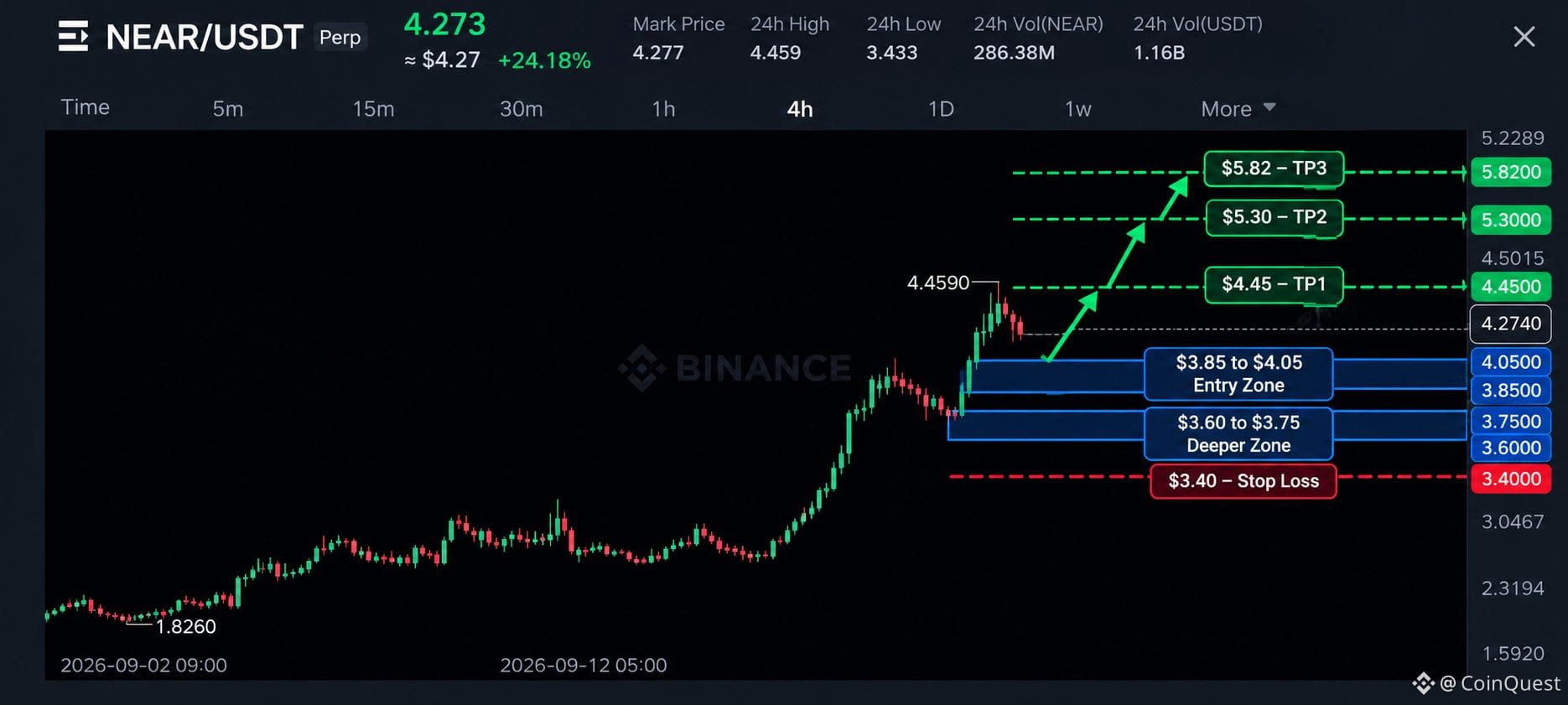
$NEAR just changed the whole look of the chart ....Let's Discuss
It pushed from the old range to $4.45 and buyers came back after the first pullback. That's why I'm still looking long here but I'm not chasing $4.24 after a move like this 😭
My entry zone is $3.85 to $4.05. If buyers defend that area I'll look for $4.45 first then $5.30 and $5.82
A deeper pullback into $3.60 to $3.75 can be added only if the structure still holds
Stop Loss $3.40
If you're trading NEAR too let me know your entry 👀
Follow me for more setups and real market thoughts❤️
{future}(NEARUSDT)
#Near
$NEAR just changed the whole look of the chart ....Let's Discuss
It pushed from the old range to $4.45 and buyers came back after the first pullback. That's why I'm still looking long here but I'm not chasing $4.24 after a move like this 😭
My entry zone is $3.85 to $4.05. If buyers defend that area I'll look for $4.45 first then $5.30 and $5.82
A deeper pullback into $3.60 to $3.75 can be added only if the structure still holds
Stop Loss $3.40
If you're trading NEAR too let me know your entry 👀
Follow me for more setups and real market thoughts❤️
#Near
It pushed from the old range to $4.45 and buyers came back after the first pullback. That's why I'm still looking long here but I'm not chasing $4.24 after a move like this 😭
My entry zone is $3.85 to $4.05. If buyers defend that area I'll look for $4.45 first then $5.30 and $5.82
A deeper pullback into $3.60 to $3.75 can be added only if the structure still holds
Stop Loss $3.40
If you're trading NEAR too let me know your entry 👀
Follow me for more setups and real market thoughts❤️
#Near
1
541
·
--
I'm currently watching $AVAX , $NEAR and $VVV for long opportunities
But I'm not entering just because they look bullish 😅 I want the setup first and the entry after that
For $BTC and $ETH I'm watching for bullish acceptance or a clean rejection around the important levels
No plan = no entry ( Losing Money )
Let them give us an opportunity .
Follow & Stay Tuned❤️😘
#market
I'm currently watching $AVAX , $NEAR and $VVV for long opportunities
But I'm not entering just because they look bullish 😅 I want the setup first and the entry after that
For $BTC and $ETH I'm watching for bullish acceptance or a clean rejection around the important levels
No plan = no entry ( Losing Money )
Let them give us an opportunity .
Follow & Stay Tuned❤️😘
#market
But I'm not entering just because they look bullish 😅 I want the setup first and the entry after that
For $BTC and $ETH I'm watching for bullish acceptance or a clean rejection around the important levels
No plan = no entry ( Losing Money )
Let them give us an opportunity .
Follow & Stay Tuned❤️😘
#market
1
4
657
·
--
Bullish
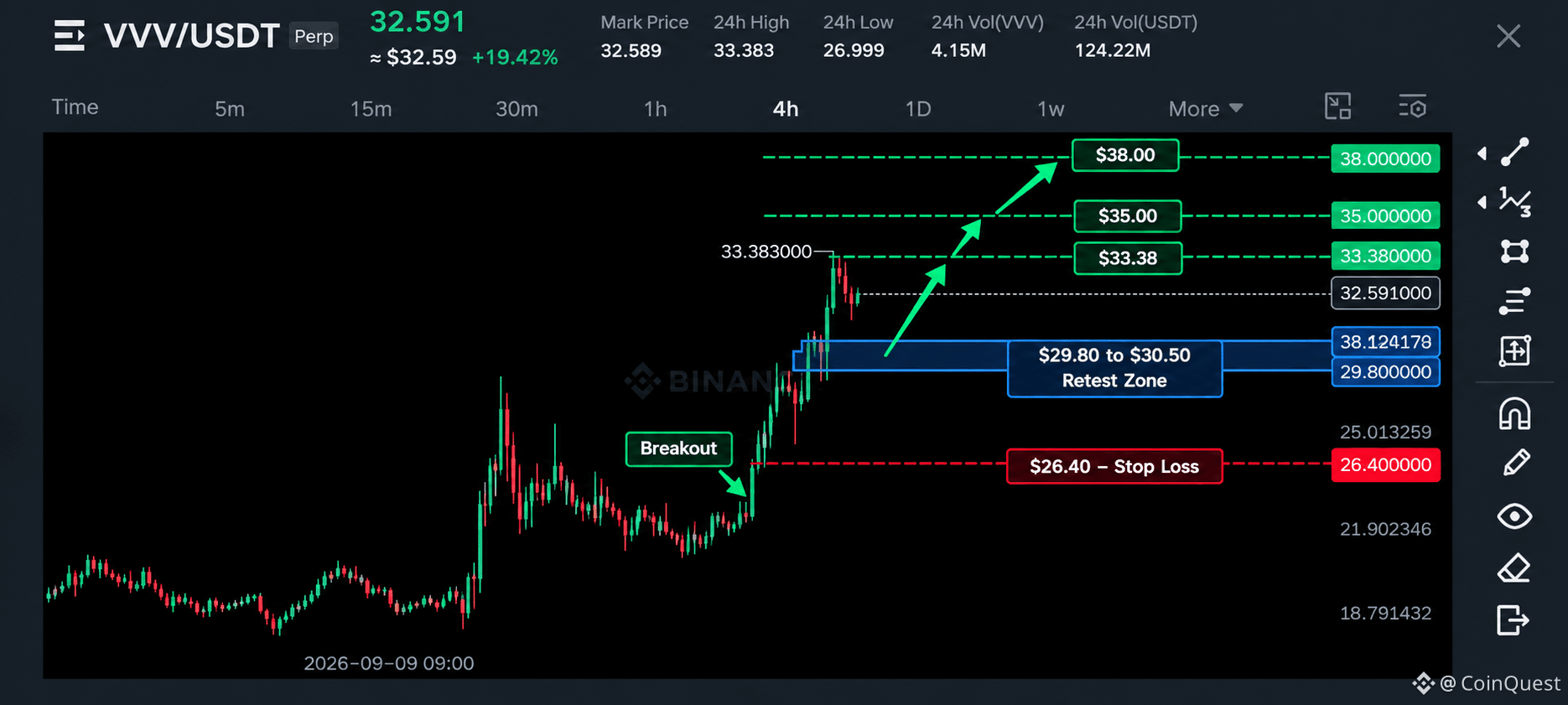
$VVV is moving too fast for me to chase this candle...
This thing has gone almost vertical and just pushed into $33.38, so yeah I'm bullish but buying here feels like asking for a nasty pullback 😭
I'm watching $29.80 to $30.50 for the breakout retest. If buyers defend that area I want $33.38 first then $35 and $38
If it dips deeper, $28.20 to $29.20 is the only area I'd consider adding if buyers actually step in
Stop Loss $26.40
If VVV never comes back and keeps flying then we missed it 😂 no need to chase...
{future}(VVVUSDT)
#VVV
$VVV is moving too fast for me to chase this candle...
This thing has gone almost vertical and just pushed into $33.38, so yeah I'm bullish but buying here feels like asking for a nasty pullback 😭
I'm watching $29.80 to $30.50 for the breakout retest. If buyers defend that area I want $33.38 first then $35 and $38
If it dips deeper, $28.20 to $29.20 is the only area I'd consider adding if buyers actually step in
Stop Loss $26.40
If VVV never comes back and keeps flying then we missed it 😂 no need to chase...
#VVV
This thing has gone almost vertical and just pushed into $33.38, so yeah I'm bullish but buying here feels like asking for a nasty pullback 😭
I'm watching $29.80 to $30.50 for the breakout retest. If buyers defend that area I want $33.38 first then $35 and $38
If it dips deeper, $28.20 to $29.20 is the only area I'd consider adding if buyers actually step in
Stop Loss $26.40
If VVV never comes back and keeps flying then we missed it 😂 no need to chase...
#VVV
1
929
·
--
What if you throw $10 into $PEPE and just forget about it for a while ...
At around $0.000004 right now, $10 gets you roughly 2.5M PEPE
Now the fun part 😂
$0.0001 = ~$250
$0.001 = ~$2,500
$0.01 = ~$25,000
$0.10 = ~$250,000
Sounds crazy but the math is not the easy part 😭 the real question is whether PEPE could ever reach those prices because the supply is massive and every higher price would require a much bigger market cap
I'm not saying PEPE is going there
Just showing what a small $10 position would look like at different prices
Would you actually hold 2.5M PEPE for years or would you sell the first time it pumps? 🐸
What if you throw $10 into $PEPE and just forget about it for a while ...
At around $0.000004 right now, $10 gets you roughly 2.5M PEPE
Now the fun part 😂
$0.0001 = ~$250
$0.001 = ~$2,500
$0.01 = ~$25,000
$0.10 = ~$250,000
Sounds crazy but the math is not the easy part 😭 the real question is whether PEPE could ever reach those prices because the supply is massive and every higher price would require a much bigger market cap
I'm not saying PEPE is going there
Just showing what a small $10 position would look like at different prices
Would you actually hold 2.5M PEPE for years or would you sell the first time it pumps? 🐸
At around $0.000004 right now, $10 gets you roughly 2.5M PEPE
Now the fun part 😂
$0.0001 = ~$250
$0.001 = ~$2,500
$0.01 = ~$25,000
$0.10 = ~$250,000
Sounds crazy but the math is not the easy part 😭 the real question is whether PEPE could ever reach those prices because the supply is massive and every higher price would require a much bigger market cap
I'm not saying PEPE is going there
Just showing what a small $10 position would look like at different prices
Would you actually hold 2.5M PEPE for years or would you sell the first time it pumps? 🐸

15
2
46
22.2k
Log in to explore more content
Join global crypto users on Binance Square
⚡️ Get latest and useful information about crypto.
💬 Trusted by the world’s largest crypto exchange.
👍 Discover real insights from verified creators.
Email / Phone number
Trending Topics
AIStocksWhatNext
217,376 views
2,327 Discussing
Share & Win Traffic Reward in our Trending Hashtag Campaign
✨Topic: What Other Investment Opportunities Remain as AI Stocks Keep Rising?
👉How to Join:
Publish a short post or article with hashtag #AIStocksWhatNext
Share whether you’re bullish or bearish, and post your AI stock holdings or trade — using the trade widget may improve your eligibility.
You can also strengthen your post by sharing data or charts, and avoiding AI-generated images.
✍️Create content based on the below angles:
- Nvidia says chip sales will double next year, and top AI companies keep hitting record revenue, the compute spend behind it is just as staggering. Is AI demand really taking off? And how long can it last? AI stocks are up across the board. Is this a real breakout, or just a short-term bounce?
- Industry leaders are calling to slow down AI development, while Trump plans to build an “AI Force”, claiming AI could account for 25% of U.S. GDP in the future. Whose side are you on? Will state-level backing be a long-term win for AI stocks?
- Are you buying AI stocks? Share your AI-related trade/holdings with our trade sharing widget.
⏰Campaign Period:
- 2026-09-22 7:00 - 2026-09-24 4:00 UTC
🎁Reward:
- Qualified posts that comply with the above guidelines and contain more than 100 words will be reviewed and may receive a random traffic boost of 500 to 3,000 views. You will receive a notification from your feed secretary if your post is selected.
- Get a chance to have your article featured on Binance Square Official
Need ideas for your post? Visit the topic page #AIStocksWhatNext or the Square Guide on How to Post for Better Reach.
Binance Square Official
·303 Likes
·653.3k views
BitcoinBreaksAboveMayHighNears$86K
7,684 views
129 Discussing
DogecoinRises15%
19,313 views
688 Discussing