
#mstr
mstr
954,598 views
5,592 Discussing
Hot
Latest

·
--
🚨 INSTITUTIONAL ACCUMULATION SPREADS AS $MSTR AND CRYPTO EQUITIES POST MASSIVE RALLY! 🚀
US cryptocurrency-related equities experienced strong bullish momentum across the board, led by $MSTR rising 9.68% and $COIN gaining 6.02%. 📊 Institutional order flow reflects aggressive accumulation in crypto proxy assets, sweeping liquidity higher as risk appetite accelerates across equity venues.
With secondary names like $HOOD jumping 4.11% alongside solid gains across treasury-heavy entities, smart money isn't just targeting spot assets — it is positioning upstream. 💡 When institutional equity proxies expand with this velocity, crypto market structure typically follows with elevated momentum.
💬 Are you tracking crypto equity momentum as a leading indicator for spot structural breakouts, or relying purely on chart setups? 👇
⚠️ Not financial advice. Always manage your risk. 🛡️
🏷️ #MSTR #COIN #CryptoEquities #MarketStructure #Institutional
🎯 🦈
🚨 INSTITUTIONAL ACCUMULATION SPREADS AS $MSTR AND CRYPTO EQUITIES POST MASSIVE RALLY! 🚀
US cryptocurrency-related equities experienced strong bullish momentum across the board, led by $MSTR rising 9.68% and $COIN gaining 6.02%. 📊 Institutional order flow reflects aggressive accumulation in crypto proxy assets, sweeping liquidity higher as risk appetite accelerates across equity venues.
With secondary names like $HOOD jumping 4.11% alongside solid gains across treasury-heavy entities, smart money isn't just targeting spot assets — it is positioning upstream. 💡 When institutional equity proxies expand with this velocity, crypto market structure typically follows with elevated momentum.
💬 Are you tracking crypto equity momentum as a leading indicator for spot structural breakouts, or relying purely on chart setups? 👇
⚠️ Not financial advice. Always manage your risk. 🛡️
🏷️ #MSTR #COIN #CryptoEquities #MarketStructure #Institutional
🎯 🦈
US cryptocurrency-related equities experienced strong bullish momentum across the board, led by $MSTR rising 9.68% and $COIN gaining 6.02%. 📊 Institutional order flow reflects aggressive accumulation in crypto proxy assets, sweeping liquidity higher as risk appetite accelerates across equity venues.
With secondary names like $HOOD jumping 4.11% alongside solid gains across treasury-heavy entities, smart money isn't just targeting spot assets — it is positioning upstream. 💡 When institutional equity proxies expand with this velocity, crypto market structure typically follows with elevated momentum.
💬 Are you tracking crypto equity momentum as a leading indicator for spot structural breakouts, or relying purely on chart setups? 👇
⚠️ Not financial advice. Always manage your risk. 🛡️
🏷️ #MSTR #COIN #CryptoEquities #MarketStructure #Institutional
🎯 🦈
55

·
--
🚀 INSTITUTIONAL CAPITAL FLOODS TRADFI CRYPTO PROXIES AS $MSTR AND $COIN IGNITE! 📈
📌 TradFi is sending an unmistakable signal as crypto-linked equities print aggressive green candles across the board. Heavy institutional bids pushed $MSTR up 9.68% with $COIN following closely at 6.02%, showing deep-pocketed buyers are positioning early. 📊
💡 When equity proxies break out with this velocity, spot crypto markets rarely stay quiet for long. Wall Street liquidity is building its bridge before the next major momentum leg unfolds. 💬 Are you front-running this capital flow into spot or watching from the sidelines? 👇
⚠️ Not financial advice. Always manage your risk. 🛡️
🏷️ #MSTR #COIN #CryptoStocks #TradFi #MarketUpdate
🎯 🦈
🚀 INSTITUTIONAL CAPITAL FLOODS TRADFI CRYPTO PROXIES AS $MSTR AND $COIN IGNITE! 📈
📌 TradFi is sending an unmistakable signal as crypto-linked equities print aggressive green candles across the board. Heavy institutional bids pushed $MSTR up 9.68% with $COIN following closely at 6.02%, showing deep-pocketed buyers are positioning early. 📊
💡 When equity proxies break out with this velocity, spot crypto markets rarely stay quiet for long. Wall Street liquidity is building its bridge before the next major momentum leg unfolds. 💬 Are you front-running this capital flow into spot or watching from the sidelines? 👇
⚠️ Not financial advice. Always manage your risk. 🛡️
🏷️ #MSTR #COIN #CryptoStocks #TradFi #MarketUpdate
🎯 🦈
📌 TradFi is sending an unmistakable signal as crypto-linked equities print aggressive green candles across the board. Heavy institutional bids pushed $MSTR up 9.68% with $COIN following closely at 6.02%, showing deep-pocketed buyers are positioning early. 📊
💡 When equity proxies break out with this velocity, spot crypto markets rarely stay quiet for long. Wall Street liquidity is building its bridge before the next major momentum leg unfolds. 💬 Are you front-running this capital flow into spot or watching from the sidelines? 👇
⚠️ Not financial advice. Always manage your risk. 🛡️
🏷️ #MSTR #COIN #CryptoStocks #TradFi #MarketUpdate
🎯 🦈
40


> MSTR BUYS 950 BITCOIN FOR $75.7M AT $79,670 AVG AND REPURCHASES $174.0M OF STRC STOCK: SEC FILING
> STRATEGY HOLDS 846,000 BITCOIN AND $5.04B USD RESERVE AND $1.05B USD CASH AS OF SEP. 20: SEC FILING
> $MSTR
#MSTR
> MSTR BUYS 950 BITCOIN FOR $75.7M AT $79,670 AVG AND REPURCHASES $174.0M OF STRC STOCK: SEC FILING
> STRATEGY HOLDS 846,000 BITCOIN AND $5.04B USD RESERVE AND $1.05B USD CASH AS OF SEP. 20: SEC FILING
> $MSTR
#MSTR
> STRATEGY HOLDS 846,000 BITCOIN AND $5.04B USD RESERVE AND $1.05B USD CASH AS OF SEP. 20: SEC FILING
> $MSTR
#MSTR
296

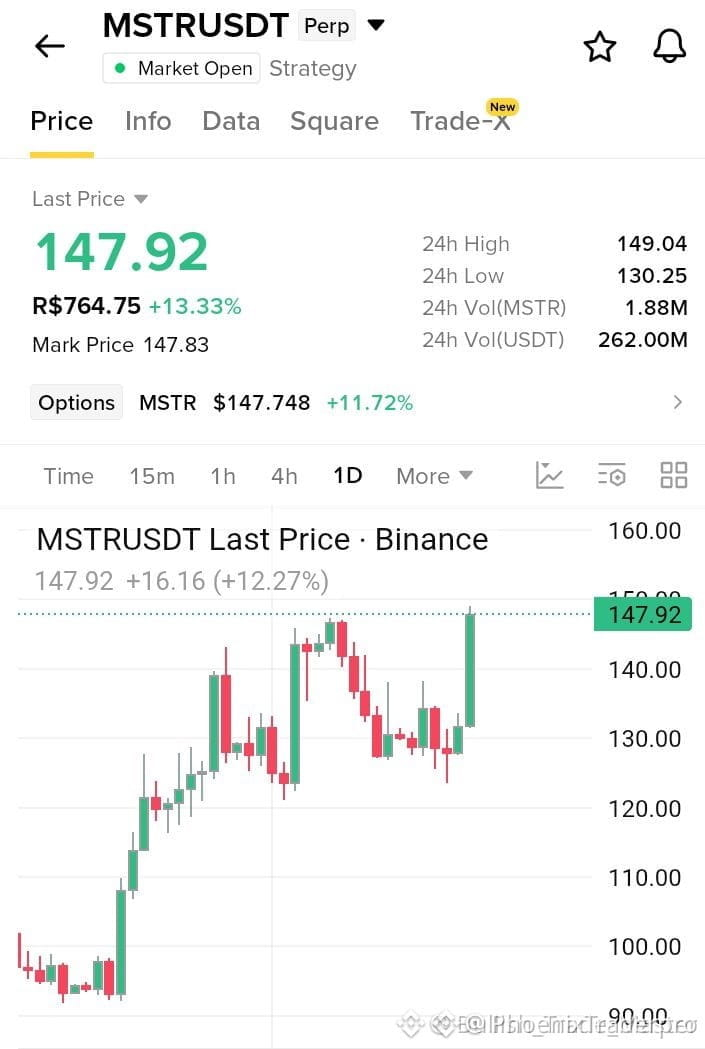
🚀 $MSTR IGNITES UNSTOPPABLE MOMENTUM AS BULLS TAKE FULL CONTROL! 💥
Order flow on $MSTR is screaming strength as aggressive market buys swallow selling pressure across lower timeframes. ⚡ The chart is coiling into a clean momentum expansion while $MYX and $F display similar high-conviction bid activity across the board.
📌 Capital is clearly rotating into active setups with high breakout velocity, signaling that sellers are losing control of key order blocks. 📊 Watching for volume acceleration to confirm the next impulse leg upward. 💬 Are you taking the bid on this momentum flip or waiting for a structural pullback? 👇
⚠️ Not financial advice. Always manage your risk. 🛡️
🏷️ #MSTR #MYX #F #Momentum #Breakout
⚡ 🐂
🚀 $MSTR IGNITES UNSTOPPABLE MOMENTUM AS BULLS TAKE FULL CONTROL! 💥
Order flow on $MSTR is screaming strength as aggressive market buys swallow selling pressure across lower timeframes. ⚡ The chart is coiling into a clean momentum expansion while $MYX and $F display similar high-conviction bid activity across the board.
📌 Capital is clearly rotating into active setups with high breakout velocity, signaling that sellers are losing control of key order blocks. 📊 Watching for volume acceleration to confirm the next impulse leg upward. 💬 Are you taking the bid on this momentum flip or waiting for a structural pullback? 👇
⚠️ Not financial advice. Always manage your risk. 🛡️
🏷️ #MSTR #MYX #F #Momentum #Breakout
⚡ 🐂
Order flow on $MSTR is screaming strength as aggressive market buys swallow selling pressure across lower timeframes. ⚡ The chart is coiling into a clean momentum expansion while $MYX and $F display similar high-conviction bid activity across the board.
📌 Capital is clearly rotating into active setups with high breakout velocity, signaling that sellers are losing control of key order blocks. 📊 Watching for volume acceleration to confirm the next impulse leg upward. 💬 Are you taking the bid on this momentum flip or waiting for a structural pullback? 👇
⚠️ Not financial advice. Always manage your risk. 🛡️
🏷️ #MSTR #MYX #F #Momentum #Breakout
⚡ 🐂
32

🟠 Saylor Drops "A Little More Orange": Is Strategy Buying More Bitcoin?
#SaylorHintsStrategyBitcoinBuy
What happened
On Sunday, Sept 20, Michael Saylor posted Strategy's Bitcoin acquisition chart on X with the caption "A little more orange."
These orange-dot posts have often been followed by a purchase disclosure on Monday, so the hashtag now has 2.2M views and 12K+ people discussing it.
Where Strategy stands
Holdings: 845,050 BTC (over 4% of the 21M supply)
Total cost: about $63.7B, at an average of about $75,412 per BTC
Last confirmed buy: 4,603 BTC (about $369.7M) at about $80,318, on Aug 31
Holdings were unchanged in the most recent weekly filing (Sept 14)
The position is back in profit, roughly $4B unrealized gain, after sitting underwater earlier this year
The macro backdrop
The hint came in the same week as a Fed rate hike and a setback for crypto legislation in Congress. Neither seems to have changed Strategy's signaling pattern.
Hint ≠ confirmation ⚠️
A post is not a purchase. The only confirmation is Strategy's official disclosure (8-K filing). Until then, treat it as speculation.
What to watch after the filing
Size: is it a large buy or a small top-up?
Price paid, compared with the $75.4K average cost
Funding: cash, share sales, or preferred stock (STRC)? Financing matters as much as the headline
MSTR and BTC reaction: does the market still react, or is accumulation now "priced in"?
Community takes
🐂 Bullish: it signals continued institutional conviction
🧊 Skeptical: routine reposts are noise until the on-chain and filing data show up
❓ Long-term: how long can one company keep buying at this scale, and could selling ever become part of the strategy?
Saylor's orange dots create attention, but the filings tell the real story. Wait for the official announcement before trading on the headline.
Do you think the market still reacts to Strategy's buys, or is it routine now? 👇
⚠️ Not financial advice. Do your own research.
#MichaelSaylor #MSTR #BinanceSquare $BTC
#SaylorHintsStrategyBitcoinBuy
🟠 Saylor Drops "A Little More Orange": Is Strategy Buying More Bitcoin?
#SaylorHintsStrategyBitcoinBuy
What happened
On Sunday, Sept 20, Michael Saylor posted Strategy's Bitcoin acquisition chart on X with the caption "A little more orange."
These orange-dot posts have often been followed by a purchase disclosure on Monday, so the hashtag now has 2.2M views and 12K+ people discussing it.
Where Strategy stands
Holdings: 845,050 BTC (over 4% of the 21M supply)
Total cost: about $63.7B, at an average of about $75,412 per BTC
Last confirmed buy: 4,603 BTC (about $369.7M) at about $80,318, on Aug 31
Holdings were unchanged in the most recent weekly filing (Sept 14)
The position is back in profit, roughly $4B unrealized gain, after sitting underwater earlier this year
The macro backdrop
The hint came in the same week as a Fed rate hike and a setback for crypto legislation in Congress. Neither seems to have changed Strategy's signaling pattern.
Hint ≠ confirmation ⚠️
A post is not a purchase. The only confirmation is Strategy's official disclosure (8-K filing). Until then, treat it as speculation.
What to watch after the filing
Size: is it a large buy or a small top-up?
Price paid, compared with the $75.4K average cost
Funding: cash, share sales, or preferred stock (STRC)? Financing matters as much as the headline
MSTR and BTC reaction: does the market still react, or is accumulation now "priced in"?
Community takes
🐂 Bullish: it signals continued institutional conviction
🧊 Skeptical: routine reposts are noise until the on-chain and filing data show up
❓ Long-term: how long can one company keep buying at this scale, and could selling ever become part of the strategy?
Saylor's orange dots create attention, but the filings tell the real story. Wait for the official announcement before trading on the headline.
Do you think the market still reacts to Strategy's buys, or is it routine now? 👇
⚠️ Not financial advice. Do your own research.
#MichaelSaylor #MSTR #BinanceSquare $BTC
#SaylorHintsStrategyBitcoinBuy
#SaylorHintsStrategyBitcoinBuy
What happened
On Sunday, Sept 20, Michael Saylor posted Strategy's Bitcoin acquisition chart on X with the caption "A little more orange."
These orange-dot posts have often been followed by a purchase disclosure on Monday, so the hashtag now has 2.2M views and 12K+ people discussing it.
Where Strategy stands
Holdings: 845,050 BTC (over 4% of the 21M supply)
Total cost: about $63.7B, at an average of about $75,412 per BTC
Last confirmed buy: 4,603 BTC (about $369.7M) at about $80,318, on Aug 31
Holdings were unchanged in the most recent weekly filing (Sept 14)
The position is back in profit, roughly $4B unrealized gain, after sitting underwater earlier this year
The macro backdrop
The hint came in the same week as a Fed rate hike and a setback for crypto legislation in Congress. Neither seems to have changed Strategy's signaling pattern.
Hint ≠ confirmation ⚠️
A post is not a purchase. The only confirmation is Strategy's official disclosure (8-K filing). Until then, treat it as speculation.
What to watch after the filing
Size: is it a large buy or a small top-up?
Price paid, compared with the $75.4K average cost
Funding: cash, share sales, or preferred stock (STRC)? Financing matters as much as the headline
MSTR and BTC reaction: does the market still react, or is accumulation now "priced in"?
Community takes
🐂 Bullish: it signals continued institutional conviction
🧊 Skeptical: routine reposts are noise until the on-chain and filing data show up
❓ Long-term: how long can one company keep buying at this scale, and could selling ever become part of the strategy?
Saylor's orange dots create attention, but the filings tell the real story. Wait for the official announcement before trading on the headline.
Do you think the market still reacts to Strategy's buys, or is it routine now? 👇
⚠️ Not financial advice. Do your own research.
#MichaelSaylor #MSTR #BinanceSquare $BTC
#SaylorHintsStrategyBitcoinBuy


133

·
--
$BTC $MSTR
🚨 SAYLOR DROPS ANOTHER BITCOIN HINT 👀🟠
Michael Saylor is back with another Bitcoin chart featuring those familiar orange dots — and the crypto community is watching closely.
Historically, similar posts have appeared around periods when Strategy disclosed new BTC purchases. But this time, there’s an important distinction:
⚠️ A Saylor post is NOT confirmation of a new Bitcoin purchase.
The real confirmation will come from Strategy’s official disclosure.
📌 Why traders are watching:
• Strategy remains one of the largest corporate Bitcoin holders
• Saylor continues to publicly signal his long-term Bitcoin focus
• Another purchase could attract fresh market attention
• The key question is whether Strategy has resumed regular accumulation
Strategy currently holds 845,050 BTC, according to its latest reported holdings, while recent reports say the company has paused new BTC purchases for two consecutive weeks.
👀 Now the market waits for the official announcement.
If Strategy announces another major BTC purchase, will traders react strongly — or has Saylor’s accumulation strategy become too familiar to create the same impact?
#BTC #Bitcoin #MichaelSaylor #Strategy #MSTR #Crypto #BitcoinNews #CryptoNews
$BTC $MSTR
$BTC $MSTR
🚨 SAYLOR DROPS ANOTHER BITCOIN HINT 👀🟠
Michael Saylor is back with another Bitcoin chart featuring those familiar orange dots — and the crypto community is watching closely.
Historically, similar posts have appeared around periods when Strategy disclosed new BTC purchases. But this time, there’s an important distinction:
⚠️ A Saylor post is NOT confirmation of a new Bitcoin purchase.
The real confirmation will come from Strategy’s official disclosure.
📌 Why traders are watching:
• Strategy remains one of the largest corporate Bitcoin holders
• Saylor continues to publicly signal his long-term Bitcoin focus
• Another purchase could attract fresh market attention
• The key question is whether Strategy has resumed regular accumulation
Strategy currently holds 845,050 BTC, according to its latest reported holdings, while recent reports say the company has paused new BTC purchases for two consecutive weeks.
👀 Now the market waits for the official announcement.
If Strategy announces another major BTC purchase, will traders react strongly — or has Saylor’s accumulation strategy become too familiar to create the same impact?
#BTC #Bitcoin #MichaelSaylor #Strategy #MSTR #Crypto #BitcoinNews #CryptoNews
$BTC $MSTR
🚨 SAYLOR DROPS ANOTHER BITCOIN HINT 👀🟠
Michael Saylor is back with another Bitcoin chart featuring those familiar orange dots — and the crypto community is watching closely.
Historically, similar posts have appeared around periods when Strategy disclosed new BTC purchases. But this time, there’s an important distinction:
⚠️ A Saylor post is NOT confirmation of a new Bitcoin purchase.
The real confirmation will come from Strategy’s official disclosure.
📌 Why traders are watching:
• Strategy remains one of the largest corporate Bitcoin holders
• Saylor continues to publicly signal his long-term Bitcoin focus
• Another purchase could attract fresh market attention
• The key question is whether Strategy has resumed regular accumulation
Strategy currently holds 845,050 BTC, according to its latest reported holdings, while recent reports say the company has paused new BTC purchases for two consecutive weeks.
👀 Now the market waits for the official announcement.
If Strategy announces another major BTC purchase, will traders react strongly — or has Saylor’s accumulation strategy become too familiar to create the same impact?
#BTC #Bitcoin #MichaelSaylor #Strategy #MSTR #Crypto #BitcoinNews #CryptoNews
$BTC $MSTR

152

·
--
📊 $MSTR OUTPERFORMS THE ENTIRE NASDAQ 100 WITH A STAGGERING 48% MONTHLY SURGE! ⚡
$MSTR has officially secured the top performance spot across the Nasdaq 100, posting an impressive 48% gain over the past month. 🦈 Institutional capital is clearly prioritizing treasury-backed equity leverage, leaving tech heavyweights like Meta (+21.9%) and AMD (+20%) trailing significantly behind in relative strength.
This massive structural divergence highlights how smart money is utilizing strategic equity vehicles to absorb liquidity ahead of broader market expansion. 💡 As traditional indices digest gains, order flow indicates sustained institutional demand for balance sheet treasury strategies. 💬 Is this aggressive surge driven by passive index rebalancing or long-term structural accumulation? 👇
⚠️ Not financial advice. Always manage your risk. 🛡️
🏷️ #MSTR #Bitcoin #Macro #Stocks #MarketStructure
🦈 ⚡
📊 $MSTR OUTPERFORMS THE ENTIRE NASDAQ 100 WITH A STAGGERING 48% MONTHLY SURGE! ⚡
$MSTR has officially secured the top performance spot across the Nasdaq 100, posting an impressive 48% gain over the past month. 🦈 Institutional capital is clearly prioritizing treasury-backed equity leverage, leaving tech heavyweights like Meta (+21.9%) and AMD (+20%) trailing significantly behind in relative strength.
This massive structural divergence highlights how smart money is utilizing strategic equity vehicles to absorb liquidity ahead of broader market expansion. 💡 As traditional indices digest gains, order flow indicates sustained institutional demand for balance sheet treasury strategies. 💬 Is this aggressive surge driven by passive index rebalancing or long-term structural accumulation? 👇
⚠️ Not financial advice. Always manage your risk. 🛡️
🏷️ #MSTR #Bitcoin #Macro #Stocks #MarketStructure
🦈 ⚡
$MSTR has officially secured the top performance spot across the Nasdaq 100, posting an impressive 48% gain over the past month. 🦈 Institutional capital is clearly prioritizing treasury-backed equity leverage, leaving tech heavyweights like Meta (+21.9%) and AMD (+20%) trailing significantly behind in relative strength.
This massive structural divergence highlights how smart money is utilizing strategic equity vehicles to absorb liquidity ahead of broader market expansion. 💡 As traditional indices digest gains, order flow indicates sustained institutional demand for balance sheet treasury strategies. 💬 Is this aggressive surge driven by passive index rebalancing or long-term structural accumulation? 👇
⚠️ Not financial advice. Always manage your risk. 🛡️
🏷️ #MSTR #Bitcoin #Macro #Stocks #MarketStructure
🦈 ⚡
70

🚀 $MSTR OUTPERFORMS THE ENTIRE NASDAQ 100 WITH A MASSIVE 48% MONTHLY SURGE! 💥
📊 Traditional tech is getting completely outpaced by institutional treasury strategy. $MSTR just clocked a staggering 48% rally over the past month, snatching the top performance spot across the entire Nasdaq 100 index.
💡 Heavyweight giants like Meta (+21.9%), AMD (+20%), CrowdStrike (+17.9%), and Intel (+17%) trailed far behind as traditional capital bids up corporate crypto exposure. 🌊 When institutional order flow seeks high-beta momentum, this vehicle remains the primary liquidity magnet on Wall Street.
💬 Will traditional tech bridge this performance gap, or does corporate treasury demand keep driving this trend? 👇
⚠️ Not financial advice. Always manage your risk. 🛡️
🏷️ #MSTR #BTC #Nasdaq #Crypto #Trading
⚡ 💎
🚀 $MSTR OUTPERFORMS THE ENTIRE NASDAQ 100 WITH A MASSIVE 48% MONTHLY SURGE! 💥
📊 Traditional tech is getting completely outpaced by institutional treasury strategy. $MSTR just clocked a staggering 48% rally over the past month, snatching the top performance spot across the entire Nasdaq 100 index.
💡 Heavyweight giants like Meta (+21.9%), AMD (+20%), CrowdStrike (+17.9%), and Intel (+17%) trailed far behind as traditional capital bids up corporate crypto exposure. 🌊 When institutional order flow seeks high-beta momentum, this vehicle remains the primary liquidity magnet on Wall Street.
💬 Will traditional tech bridge this performance gap, or does corporate treasury demand keep driving this trend? 👇
⚠️ Not financial advice. Always manage your risk. 🛡️
🏷️ #MSTR #BTC #Nasdaq #Crypto #Trading
⚡ 💎
📊 Traditional tech is getting completely outpaced by institutional treasury strategy. $MSTR just clocked a staggering 48% rally over the past month, snatching the top performance spot across the entire Nasdaq 100 index.
💡 Heavyweight giants like Meta (+21.9%), AMD (+20%), CrowdStrike (+17.9%), and Intel (+17%) trailed far behind as traditional capital bids up corporate crypto exposure. 🌊 When institutional order flow seeks high-beta momentum, this vehicle remains the primary liquidity magnet on Wall Street.
💬 Will traditional tech bridge this performance gap, or does corporate treasury demand keep driving this trend? 👇
⚠️ Not financial advice. Always manage your risk. 🛡️
🏷️ #MSTR #BTC #Nasdaq #Crypto #Trading
⚡ 💎
62

·
--
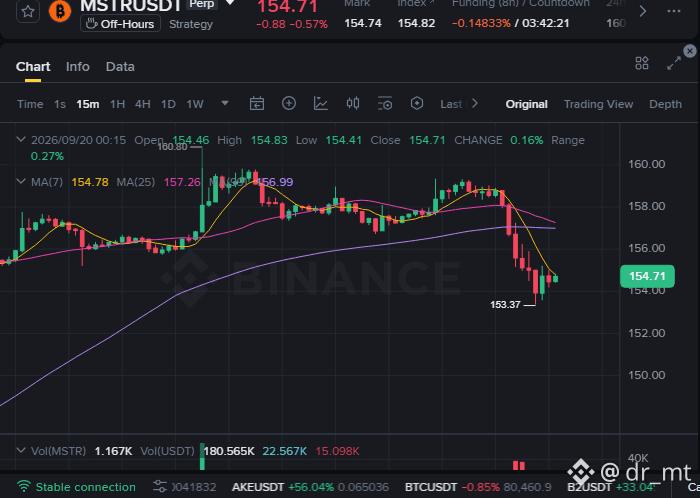
$MSTR is getting hit… but the first bounce is starting to show 👀
That kind of flush into 153.37 changes the game a bit.
We’re not chasing strength here — we’re leaning into an oversold snapback while price tries to stabilize on the 15M.
Entry: 154.8100
If buyers can defend this zone, the rebound map is clean:
TP1: 156.3581
TP2: 157.9062
TP3: 159.4543
TP1 is where I’d expect the first reaction.
TP2 and TP3 only matter if momentum keeps rebuilding and the rebound actually follows through.
If price slips back and loses 151.7138, the long thesis is dead. Simple.
RSI is stretched, so this is a tactical trade — not a marriage.
Take profits into strength. Protect capital ⚠️
$MSTR watching for a real reclaim here... are you taking the bounce or waiting for more confirmation? 👇
#MSTR #CryptoTrading #BinanceSquare #Altcoins
$MSTR is getting hit… but the first bounce is starting to show 👀
That kind of flush into 153.37 changes the game a bit.
We’re not chasing strength here — we’re leaning into an oversold snapback while price tries to stabilize on the 15M.
Entry: 154.8100
If buyers can defend this zone, the rebound map is clean:
TP1: 156.3581
TP2: 157.9062
TP3: 159.4543
TP1 is where I’d expect the first reaction.
TP2 and TP3 only matter if momentum keeps rebuilding and the rebound actually follows through.
If price slips back and loses 151.7138, the long thesis is dead. Simple.
RSI is stretched, so this is a tactical trade — not a marriage.
Take profits into strength. Protect capital ⚠️
$MSTR watching for a real reclaim here... are you taking the bounce or waiting for more confirmation? 👇
#MSTR #CryptoTrading #BinanceSquare #Altcoins
That kind of flush into 153.37 changes the game a bit.
We’re not chasing strength here — we’re leaning into an oversold snapback while price tries to stabilize on the 15M.
Entry: 154.8100
If buyers can defend this zone, the rebound map is clean:
TP1: 156.3581
TP2: 157.9062
TP3: 159.4543
TP1 is where I’d expect the first reaction.
TP2 and TP3 only matter if momentum keeps rebuilding and the rebound actually follows through.
If price slips back and loses 151.7138, the long thesis is dead. Simple.
RSI is stretched, so this is a tactical trade — not a marriage.
Take profits into strength. Protect capital ⚠️
$MSTR watching for a real reclaim here... are you taking the bounce or waiting for more confirmation? 👇
#MSTR #CryptoTrading #BinanceSquare #Altcoins
50

·
--
Just triggered a long position on $MSTR. Sticking strictly to my plan with the exact levels detailed below.
⚡ $MSTR — LONG SETUP
📍 Entry: 153.7 – 154.63
🎯 TP1: 156.49
🎯 TP2: 157.73
🎯 TP3: 159.6
🛑 Stop Loss: 152.77
Trade here 👇
📌 Trade management rules: see pinned post.
Are you taking this setup on $MSTR or watching from the sidelines? Follow along for more trade executions.
#MSTR
Just triggered a long position on $MSTR . Sticking strictly to my plan with the exact levels detailed below.
⚡ $MSTR — LONG SETUP
📍 Entry: 153.7 – 154.63
🎯 TP1: 156.49
🎯 TP2: 157.73
🎯 TP3: 159.6
🛑 Stop Loss: 152.77
Trade here 👇
📌 Trade management rules: see pinned post.
Are you taking this setup on $MSTR or watching from the sidelines? Follow along for more trade executions.
#MSTR
⚡ $MSTR — LONG SETUP
📍 Entry: 153.7 – 154.63
🎯 TP1: 156.49
🎯 TP2: 157.73
🎯 TP3: 159.6
🛑 Stop Loss: 152.77
Trade here 👇
📌 Trade management rules: see pinned post.
Are you taking this setup on $MSTR or watching from the sidelines? Follow along for more trade executions.
#MSTR
91

·
--
⚡ $MSTR OUTPERFORMS THE ENTIRE NASDAQ 100 WITH A MASSIVE 48% MONTHLY SURGE! 📈
$MSTR is showing pure violence on the charts, crushing traditional tech heavyweights with an incredible 48% rally over the past 30 days. 📊 Institutional order flow is treating this asset as a high-beta engine, aggressively front-running the broader market expansion.
When a single treasury play outpaces every constituent in the Nasdaq 100, smart money is sending a loud message. ⚡ Deep-pocketed buyers continue to absorb supply at every level, signaling immense underlying momentum across the board.
💡 Capital movement does not lie, and macro strength like this usually signals a major structural shift. 💬 Is $MSTR setting the stage for an explosive Q4 breakout, or is this momentum due for a retest? 👇
⚠️ Not financial advice. Always manage your risk. 🛡️
🏷️ #MSTR #Stocks #Bitcoin #Momentum #Crypto
💥 🐂
⚡ $MSTR OUTPERFORMS THE ENTIRE NASDAQ 100 WITH A MASSIVE 48% MONTHLY SURGE! 📈
$MSTR is showing pure violence on the charts, crushing traditional tech heavyweights with an incredible 48% rally over the past 30 days. 📊 Institutional order flow is treating this asset as a high-beta engine, aggressively front-running the broader market expansion.
When a single treasury play outpaces every constituent in the Nasdaq 100, smart money is sending a loud message. ⚡ Deep-pocketed buyers continue to absorb supply at every level, signaling immense underlying momentum across the board.
💡 Capital movement does not lie, and macro strength like this usually signals a major structural shift. 💬 Is $MSTR setting the stage for an explosive Q4 breakout, or is this momentum due for a retest? 👇
⚠️ Not financial advice. Always manage your risk. 🛡️
🏷️ #MSTR #Stocks #Bitcoin #Momentum #Crypto
💥 🐂
$MSTR is showing pure violence on the charts, crushing traditional tech heavyweights with an incredible 48% rally over the past 30 days. 📊 Institutional order flow is treating this asset as a high-beta engine, aggressively front-running the broader market expansion.
When a single treasury play outpaces every constituent in the Nasdaq 100, smart money is sending a loud message. ⚡ Deep-pocketed buyers continue to absorb supply at every level, signaling immense underlying momentum across the board.
💡 Capital movement does not lie, and macro strength like this usually signals a major structural shift. 💬 Is $MSTR setting the stage for an explosive Q4 breakout, or is this momentum due for a retest? 👇
⚠️ Not financial advice. Always manage your risk. 🛡️
🏷️ #MSTR #Stocks #Bitcoin #Momentum #Crypto
💥 🐂
70

·
--
📊 $MSTR OUTPERFORMS THE NASDAQ 100 WITH A RECENT 48% INSTITUTIONAL SURGE! ⚡
Smart money momentum is taking center stage as $MSTR posts a 48% rally over the past month, outstripping all Nasdaq 100 index constituents. 📊 Institutional order flow has aggressively expanded structural premium, signaling sustained accumulation across higher-timeframe order blocks rather than speculative retail volume.
When macro market constituents lag, institutional capital tends to seek refined asymmetric exposure. 💡 This persistent upside push reflects deep structural efficiency fills and continuous buy-side liquidity absorption. 💬 How are you positioning around this high-timeframe structural outperformance? 👇
⚠️ Not financial advice. Always manage your risk. 🛡️
🏷️ #MSTR #MarketStructure #Institutional #Crypto #Trading
🎯 🦈
📊 $MSTR OUTPERFORMS THE NASDAQ 100 WITH A RECENT 48% INSTITUTIONAL SURGE! ⚡
Smart money momentum is taking center stage as $MSTR posts a 48% rally over the past month, outstripping all Nasdaq 100 index constituents. 📊 Institutional order flow has aggressively expanded structural premium, signaling sustained accumulation across higher-timeframe order blocks rather than speculative retail volume.
When macro market constituents lag, institutional capital tends to seek refined asymmetric exposure. 💡 This persistent upside push reflects deep structural efficiency fills and continuous buy-side liquidity absorption. 💬 How are you positioning around this high-timeframe structural outperformance? 👇
⚠️ Not financial advice. Always manage your risk. 🛡️
🏷️ #MSTR #MarketStructure #Institutional #Crypto #Trading
🎯 🦈
Smart money momentum is taking center stage as $MSTR posts a 48% rally over the past month, outstripping all Nasdaq 100 index constituents. 📊 Institutional order flow has aggressively expanded structural premium, signaling sustained accumulation across higher-timeframe order blocks rather than speculative retail volume.
When macro market constituents lag, institutional capital tends to seek refined asymmetric exposure. 💡 This persistent upside push reflects deep structural efficiency fills and continuous buy-side liquidity absorption. 💬 How are you positioning around this high-timeframe structural outperformance? 👇
⚠️ Not financial advice. Always manage your risk. 🛡️
🏷️ #MSTR #MarketStructure #Institutional #Crypto #Trading
🎯 🦈
53

·
--
Bullish
booommm $MSTR
{future}(MSTRUSDT)
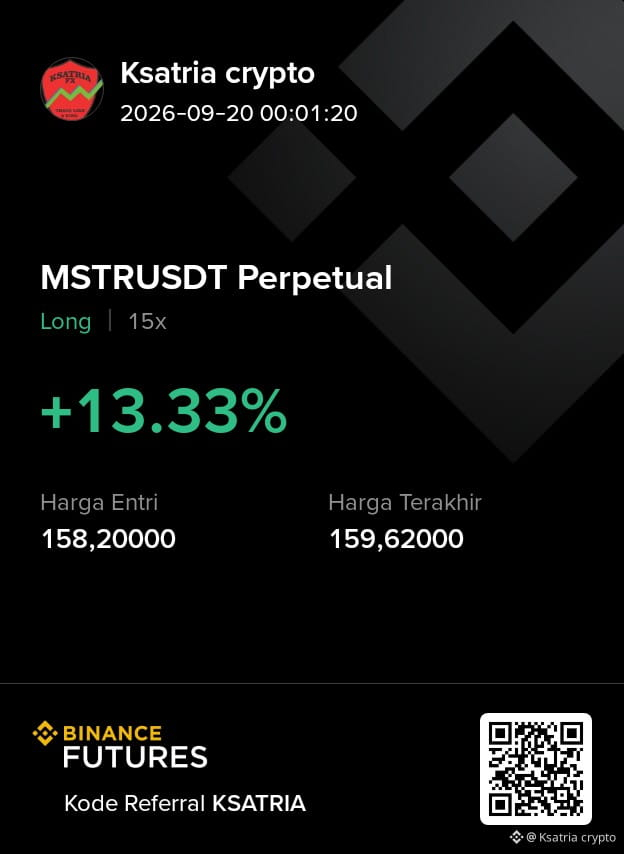
day trading signals closed with profit almost 20% 🔥🔥🔥🙏🙏🙏🎇🎇🚀🚀🚀
2 hours ago i was shared day trading signals to take long position at this coin $MSTR more you can check our retweet . 🎇🎇🚀🚀🔥🔥.
congrats for our follower who followed our signals to take long position at this coin $MSTR .
any more transparent than us always share signals before and after ???
#Write2Earrn #MSTR #MSTRUSDT #MSTR资本运作 #signaladvisor
booommm $MSTR
day trading signals closed with profit almost 20% 🔥🔥🔥🙏🙏🙏🎇🎇🚀🚀🚀
2 hours ago i was shared day trading signals to take long position at this coin $MSTR more you can check our retweet . 🎇🎇🚀🚀🔥🔥.
congrats for our follower who followed our signals to take long position at this coin $MSTR .
any more transparent than us always share signals before and after ???
#Write2Earrn #MSTR #MSTRUSDT #MSTR资本运作 #signaladvisor
day trading signals closed with profit almost 20% 🔥🔥🔥🙏🙏🙏🎇🎇🚀🚀🚀
2 hours ago i was shared day trading signals to take long position at this coin $MSTR more you can check our retweet . 🎇🎇🚀🚀🔥🔥.
congrats for our follower who followed our signals to take long position at this coin $MSTR .
any more transparent than us always share signals before and after ???
#Write2Earrn #MSTR #MSTRUSDT #MSTR资本运作 #signaladvisor
Ksatria crypto
·
--
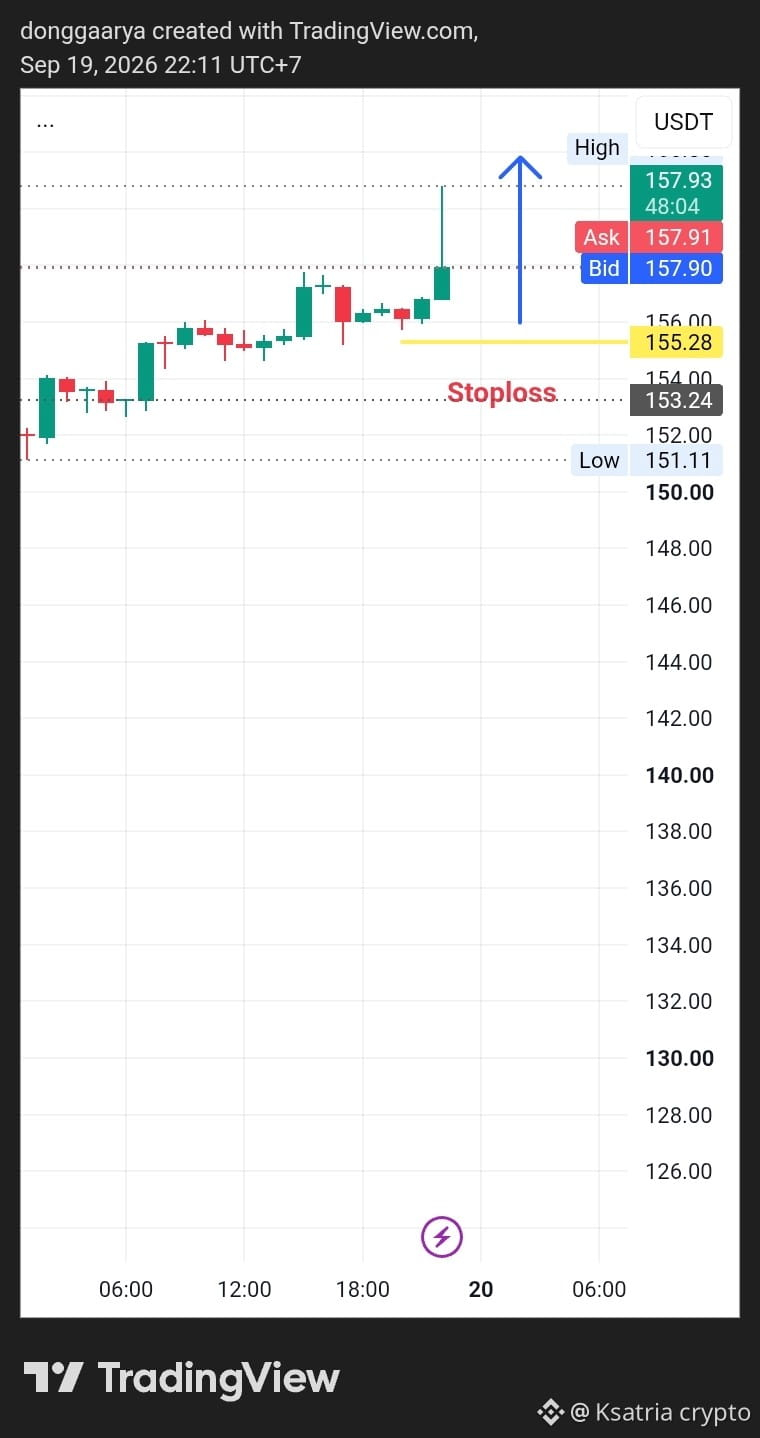
Bullish$MSTR TAKE LONG position now
SL 155,28 ( day trading )
$MSTR take long position now after show continuation bullish pump moments and potential for breakout break our next resistance target at range level 157,93.
Based our macroeconomics fundamental analysist this coin show positif open interest ( OI) ITS means capital inflow more than capital outflow $MSTR
#Write2Earn #MSTR #MSTRUSDT #signaladvisor #Signal🚥.
SL 155,28 ( day trading )
$MSTR take long position now after show continuation bullish pump moments and potential for breakout break our next resistance target at range level 157,93.
Based our macroeconomics fundamental analysist this coin show positif open interest ( OI) ITS means capital inflow more than capital outflow $MSTR
#Write2Earn #MSTR #MSTRUSDT #signaladvisor #Signal🚥.
96
·
--
Bullish
$MSTR TAKE LONG position now
SL 155,28 ( day trading )
$MSTR take long position now after show continuation bullish pump moments and potential for breakout break our next resistance target at range level 157,93.
Based our macroeconomics fundamental analysist this coin show positif open interest ( OI) ITS means capital inflow more than capital outflow $MSTR
#Write2Earn #MSTR #MSTRUSDT #signaladvisor #Signal🚥.
{future}(MSTRUSDT)
$MSTR TAKE LONG position now
SL 155,28 ( day trading )
$MSTR take long position now after show continuation bullish pump moments and potential for breakout break our next resistance target at range level 157,93.
Based our macroeconomics fundamental analysist this coin show positif open interest ( OI) ITS means capital inflow more than capital outflow $MSTR
#Write2Earn #MSTR #MSTRUSDT #signaladvisor #Signal🚥.
SL 155,28 ( day trading )
$MSTR take long position now after show continuation bullish pump moments and potential for breakout break our next resistance target at range level 157,93.
Based our macroeconomics fundamental analysist this coin show positif open interest ( OI) ITS means capital inflow more than capital outflow $MSTR
#Write2Earn #MSTR #MSTRUSDT #signaladvisor #Signal🚥.
1
1
315
·
--
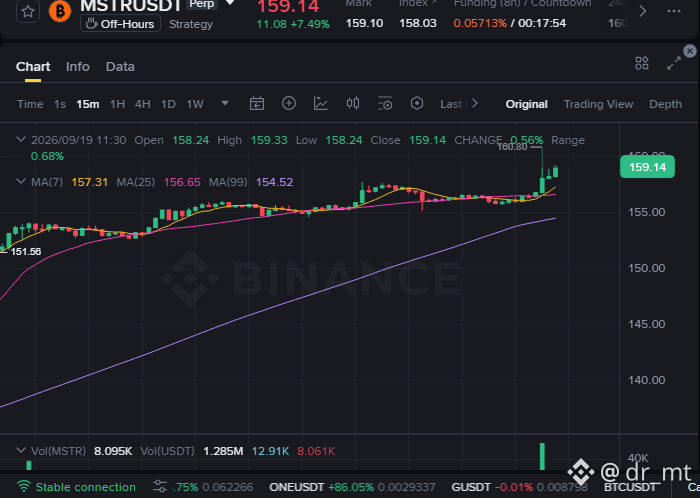
$MSTR TP1 hit ✅
Breakout entry: 158.2600
First target: 158.9882 reached
Current price: 158.9900
Nice first push... now protect the trade.
If you’re in from the breakout, this is where discipline matters:
- lock some profit
- move stops
- let the rest work if momentum continues
Next levels still on deck:
TP2 159.7163
TP3 160.4445
No need to get greedy... let the chart do the work.
Follow for the next update and drop a comment if you booked TP1.
#MSTR #CryptoTrading #BreakoutTrade
$MSTR TP1 hit ✅
Breakout entry: 158.2600
First target: 158.9882 reached
Current price: 158.9900
Nice first push... now protect the trade.
If you’re in from the breakout, this is where discipline matters:
- lock some profit
- move stops
- let the rest work if momentum continues
Next levels still on deck:
TP2 159.7163
TP3 160.4445
No need to get greedy... let the chart do the work.
Follow for the next update and drop a comment if you booked TP1.
#MSTR #CryptoTrading #BreakoutTrade
Breakout entry: 158.2600
First target: 158.9882 reached
Current price: 158.9900
Nice first push... now protect the trade.
If you’re in from the breakout, this is where discipline matters:
- lock some profit
- move stops
- let the rest work if momentum continues
Next levels still on deck:
TP2 159.7163
TP3 160.4445
No need to get greedy... let the chart do the work.
Follow for the next update and drop a comment if you booked TP1.
#MSTR #CryptoTrading #BreakoutTrade
ChartScout:
Nice execution TP1 hit, and protecting the position here makes sense after MSTR’s strong 16% session. Letting the chart work toward TP2/TP3 is better than forcing the next entry ChartScout can help track the continuation and pullback levels.
1
1
131
·
--
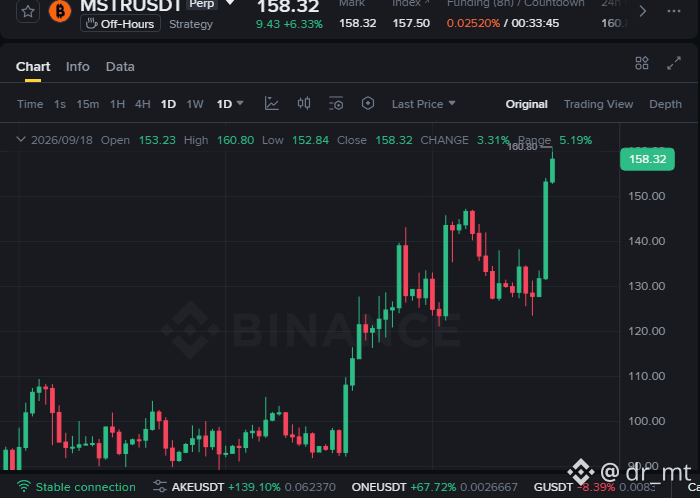
$MSTR is not creeping higher — it’s breaking out with intent 🚀
That last push is the kind of candle bulls want to see:
clean expansion, strong follow-through, and price holding above the reclaimed structure.
The breakout level at 157.3200 is now the line the market has already respected, and the confirmed close at 158.0800 keeps the long thesis alive.
Entry: 158.2600
From here, I’m watching:
TP1: 158.9882
TP2: 159.7163
TP3: 160.4445
If momentum stays intact, those are the next logical reaction zones.
If price loses 155.0948, the setup is broken and the long idea is done.
Risk reminder: don’t chase size into a fresh breakout — let the market prove continuation first.
$MSTR looks like it wants more... are you taking the move or waiting for a retest? 👇
#MSTR #CryptoTrading #Breakout #BinanceSquare
$MSTR is not creeping higher — it’s breaking out with intent 🚀
That last push is the kind of candle bulls want to see:
clean expansion, strong follow-through, and price holding above the reclaimed structure.
The breakout level at 157.3200 is now the line the market has already respected, and the confirmed close at 158.0800 keeps the long thesis alive.
Entry: 158.2600
From here, I’m watching:
TP1: 158.9882
TP2: 159.7163
TP3: 160.4445
If momentum stays intact, those are the next logical reaction zones.
If price loses 155.0948, the setup is broken and the long idea is done.
Risk reminder: don’t chase size into a fresh breakout — let the market prove continuation first.
$MSTR looks like it wants more... are you taking the move or waiting for a retest? 👇
#MSTR #CryptoTrading #Breakout #BinanceSquare
That last push is the kind of candle bulls want to see:
clean expansion, strong follow-through, and price holding above the reclaimed structure.
The breakout level at 157.3200 is now the line the market has already respected, and the confirmed close at 158.0800 keeps the long thesis alive.
Entry: 158.2600
From here, I’m watching:
TP1: 158.9882
TP2: 159.7163
TP3: 160.4445
If momentum stays intact, those are the next logical reaction zones.
If price loses 155.0948, the setup is broken and the long idea is done.
Risk reminder: don’t chase size into a fresh breakout — let the market prove continuation first.
$MSTR looks like it wants more... are you taking the move or waiting for a retest? 👇
#MSTR #CryptoTrading #Breakout #BinanceSquare
101
·
--
$MSTR
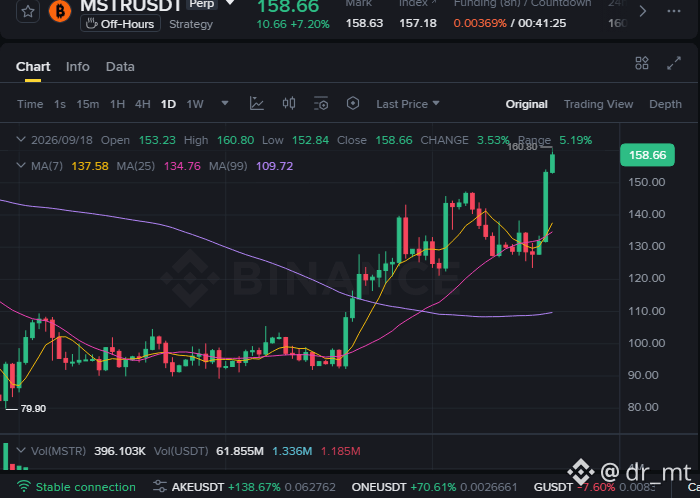
TP2 hit ✅
Stronger follow-through than expected... and the market delivered.
Entry: 155.5800
TP1: 157.1358 ✅
TP2: 158.6916 ✅
Current price: 158.7800
That’s exactly the kind of move you want after a bullish 4H setup.
Next area still watching: TP3 at 160.2474
Stop remains at 152.4684
Let it work. No need to chase every candle.
If you’re tracking this trade, drop a comment or follow for the next update.
#MSTR #CryptoTrading #PriceAction
$MSTR
TP2 hit ✅
Stronger follow-through than expected... and the market delivered.
Entry: 155.5800
TP1: 157.1358 ✅
TP2: 158.6916 ✅
Current price: 158.7800
That’s exactly the kind of move you want after a bullish 4H setup.
Next area still watching: TP3 at 160.2474
Stop remains at 152.4684
Let it work. No need to chase every candle.
If you’re tracking this trade, drop a comment or follow for the next update.
#MSTR #CryptoTrading #PriceAction
TP2 hit ✅
Stronger follow-through than expected... and the market delivered.
Entry: 155.5800
TP1: 157.1358 ✅
TP2: 158.6916 ✅
Current price: 158.7800
That’s exactly the kind of move you want after a bullish 4H setup.
Next area still watching: TP3 at 160.2474
Stop remains at 152.4684
Let it work. No need to chase every candle.
If you’re tracking this trade, drop a comment or follow for the next update.
#MSTR #CryptoTrading #PriceAction
131
·
--
Are you looking to hedge $MSTR today? Just finalized this short setup.
⚡ $MSTR — SHORT SETUP
📍 Entry: 158.75 – 159.7
🎯 TP1: 156.86
🎯 TP2: 155.59
🎯 TP3: 153.69
🛑 Stop Loss: 160.65
Trade here 👇
📌 Trade management rules: see pinned post.
Are you leaning bullish or bearish on $MSTR? Drop your bias below and hit follow for more updates.
#MSTR
Are you looking to hedge $MSTR today? Just finalized this short setup.
⚡ $MSTR — SHORT SETUP
📍 Entry: 158.75 – 159.7
🎯 TP1: 156.86
🎯 TP2: 155.59
🎯 TP3: 153.69
🛑 Stop Loss: 160.65
Trade here 👇
📌 Trade management rules: see pinned post.
Are you leaning bullish or bearish on $MSTR ? Drop your bias below and hit follow for more updates.
#MSTR
⚡ $MSTR — SHORT SETUP
📍 Entry: 158.75 – 159.7
🎯 TP1: 156.86
🎯 TP2: 155.59
🎯 TP3: 153.69
🛑 Stop Loss: 160.65
Trade here 👇
📌 Trade management rules: see pinned post.
Are you leaning bullish or bearish on $MSTR ? Drop your bias below and hit follow for more updates.
#MSTR
1
88
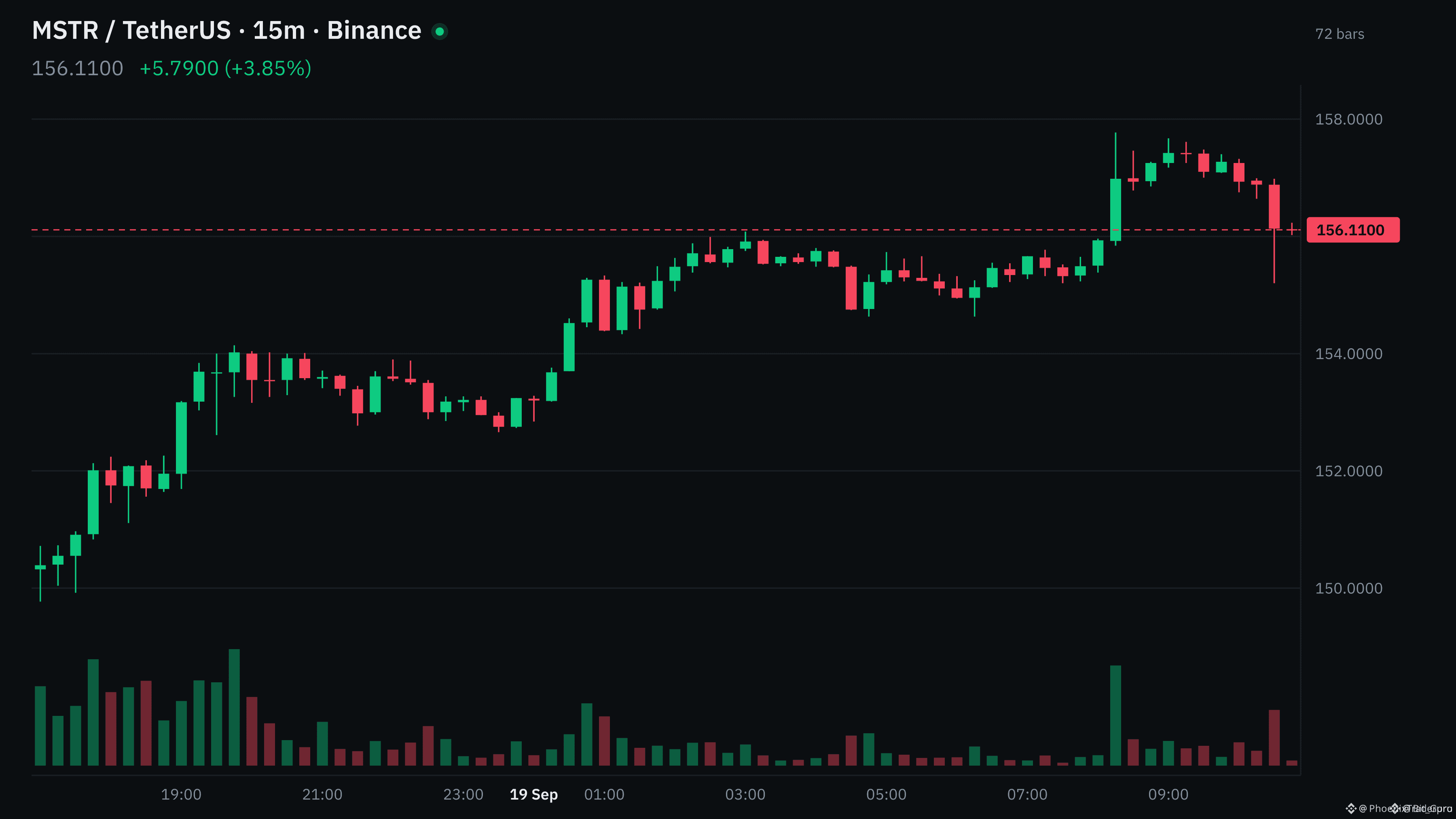
📉 HEAVY SELLING VOLUME ON $MSTR AS BEARS SMASH CRITICAL SUPPORT! 🔴
Entry: 156.168 - 156.324 🔴
Target: 153.739 🎯
Stop Loss: 157.102 ⚠️
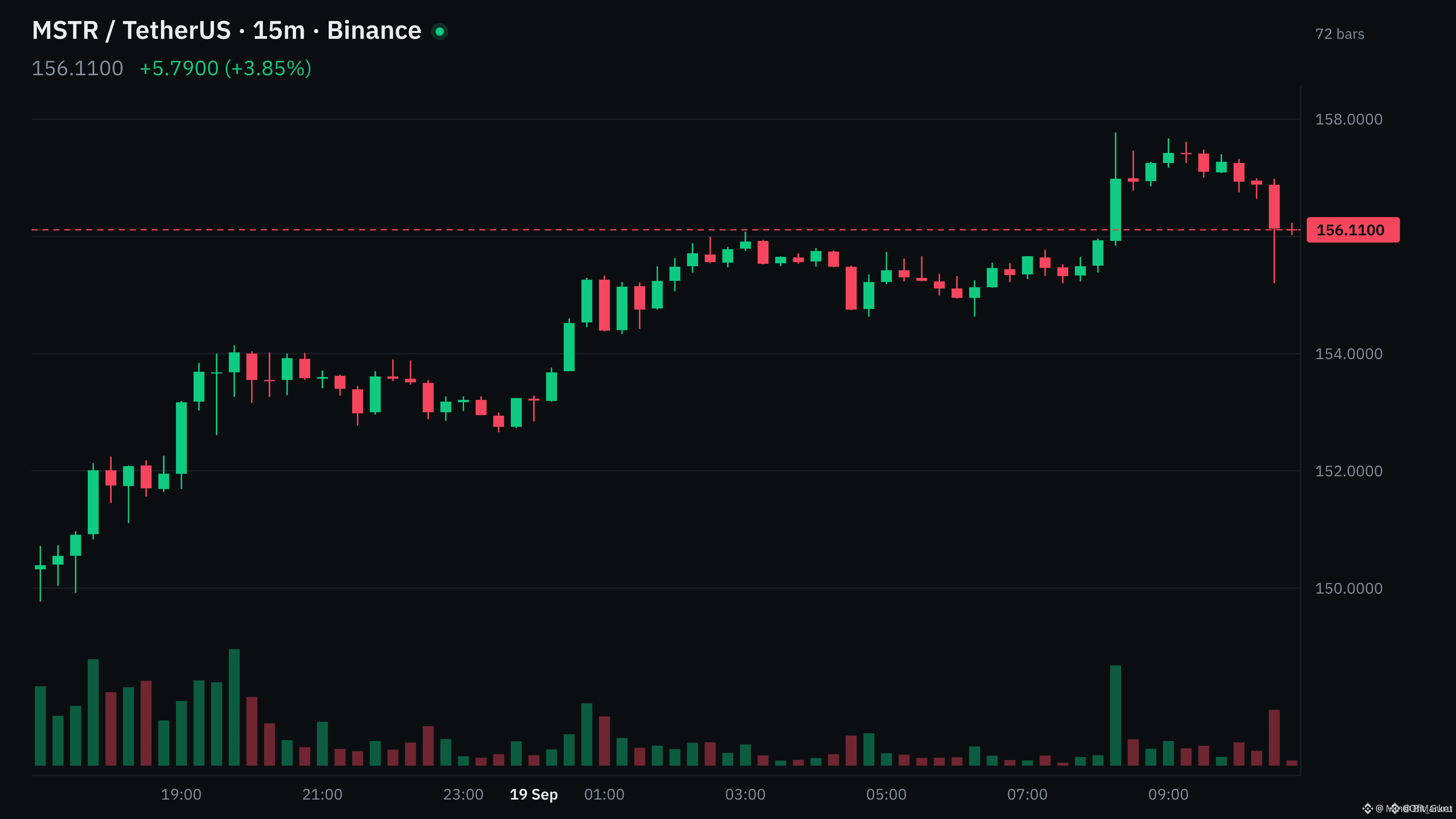
Aggressive sellers just slammed $MSTR with a 3.4x volume surge on the 15-minute chart, signaling heavy seller control. 📊 This downward flush breaks immediate buyer momentum and sets up a clean continuation leg.
Order flow heavily favors the short side as bids get swallowed up with minimal resistance. 🔻 Targeting lower liquidity pockets down toward 153.739 offers a disciplined, quick-execution trade structure. 💬 Are you riding this downside wave or waiting to see if buyers defend lower levels? 👇
⚠️ Not financial advice. Always manage your risk. 🛡️
🏷️ #MSTR #ShortSetup #Bearish #Trading #Crypto
📉 🐻
📉 HEAVY SELLING VOLUME ON $MSTR AS BEARS SMASH CRITICAL SUPPORT! 🔴
Entry: 156.168 - 156.324 🔴
Target: 153.739 🎯
Stop Loss: 157.102 ⚠️
Aggressive sellers just slammed $MSTR with a 3.4x volume surge on the 15-minute chart, signaling heavy seller control. 📊 This downward flush breaks immediate buyer momentum and sets up a clean continuation leg.
Order flow heavily favors the short side as bids get swallowed up with minimal resistance. 🔻 Targeting lower liquidity pockets down toward 153.739 offers a disciplined, quick-execution trade structure. 💬 Are you riding this downside wave or waiting to see if buyers defend lower levels? 👇
⚠️ Not financial advice. Always manage your risk. 🛡️
🏷️ #MSTR #ShortSetup #Bearish #Trading #Crypto
📉 🐻
Entry: 156.168 - 156.324 🔴
Target: 153.739 🎯
Stop Loss: 157.102 ⚠️
Aggressive sellers just slammed $MSTR with a 3.4x volume surge on the 15-minute chart, signaling heavy seller control. 📊 This downward flush breaks immediate buyer momentum and sets up a clean continuation leg.
Order flow heavily favors the short side as bids get swallowed up with minimal resistance. 🔻 Targeting lower liquidity pockets down toward 153.739 offers a disciplined, quick-execution trade structure. 💬 Are you riding this downside wave or waiting to see if buyers defend lower levels? 👇
⚠️ Not financial advice. Always manage your risk. 🛡️
🏷️ #MSTR #ShortSetup #Bearish #Trading #Crypto
📉 🐻
31
·
--
🚨 HEAVY INSTITUTIONAL SELLING PRESSURES $MSTR AS VOLUME SPIKES 3.4X AT RESISTANCE! 📉
Entry: 156.168 - 156.324 ⚡
Target: 155.234 / 154.486 / 153.739 🎯
Stop Loss: 157.102 ⚠️
📌 A sharp 15-minute distribution candle just expanded 0.5% downward on 3.4x average volume, signaling an aggressive push from institutional supply. 🔍 The structural imbalance reflects clear order flow dominance by short-side sellers, absorbing buyer interest at current intraday levels.
💡 With immediate supply defending the 156.32 zone, this downside displacement favors tactical continuation toward lower liquidity pools. 💬 Are you trading this order flow breakdown or waiting for a fair value gap retest? 👇
⚠️ Not financial advice. Always manage your risk. 🛡️
🏷️ #MSTR #ShortSetup #MarketStructure #OrderFlow
🐻 📉
🚨 HEAVY INSTITUTIONAL SELLING PRESSURES $MSTR AS VOLUME SPIKES 3.4X AT RESISTANCE! 📉
Entry: 156.168 - 156.324 ⚡
Target: 155.234 / 154.486 / 153.739 🎯
Stop Loss: 157.102 ⚠️
📌 A sharp 15-minute distribution candle just expanded 0.5% downward on 3.4x average volume, signaling an aggressive push from institutional supply. 🔍 The structural imbalance reflects clear order flow dominance by short-side sellers, absorbing buyer interest at current intraday levels.
💡 With immediate supply defending the 156.32 zone, this downside displacement favors tactical continuation toward lower liquidity pools. 💬 Are you trading this order flow breakdown or waiting for a fair value gap retest? 👇
⚠️ Not financial advice. Always manage your risk. 🛡️
🏷️ #MSTR #ShortSetup #MarketStructure #OrderFlow
🐻 📉
Entry: 156.168 - 156.324 ⚡
Target: 155.234 / 154.486 / 153.739 🎯
Stop Loss: 157.102 ⚠️
📌 A sharp 15-minute distribution candle just expanded 0.5% downward on 3.4x average volume, signaling an aggressive push from institutional supply. 🔍 The structural imbalance reflects clear order flow dominance by short-side sellers, absorbing buyer interest at current intraday levels.
💡 With immediate supply defending the 156.32 zone, this downside displacement favors tactical continuation toward lower liquidity pools. 💬 Are you trading this order flow breakdown or waiting for a fair value gap retest? 👇
⚠️ Not financial advice. Always manage your risk. 🛡️
🏷️ #MSTR #ShortSetup #MarketStructure #OrderFlow
🐻 📉
31
Log in to explore more content
Join global crypto users on Binance Square
⚡️ Get latest and useful information about crypto.
💬 Trusted by the world’s largest crypto exchange.
👍 Discover real insights from verified creators.
Email / Phone number
Trending Topics
1
#MultiversXPlansHardForkRecovery
0 views
18 Discussing
2
#CircleLaunchesInstitutionalBTCBackedBorrowing
884 views
182 Discussing
3
#BitcoinHits$85K
4,123 views
171 Discussing
4
#ZetaChainVotesToMigrateZETAToSolana
862 views
132 Discussing
5
#ECBStartsBlockchainEuroSettlement
7,774 views
420 Discussing
6
#SouthAfricaProposesCryptoExchangeControls
18,506 views
606 Discussing
7
#SolanaCutsTargetSlotTimeTo250ms
21,239 views
518 Discussing
8
#EthereumSurpasses$2700
17,558 views
212 Discussing
9
#CanaryFilesSecondAmendmentForStakedSEIETF
39,981 views
862 Discussing
10
#SaylorHintsStrategyBitcoinBuy
2.4M views
13,820 Discussing