

Aasim Majeed AMC
14.2k Posts

Aasim Majeed AMC
 Square Verified+
Report
Block User
Analyst | Trader | Web3 Expert| Youtuber | Founder AMC | KOL | Investor | https://x.com/AasimKhCrypto
Frequent Trader
2.7 Years
39 Following
53.2K+ Followers
24.0K+ Liked
Posts
All
Quotes
Videos
Live
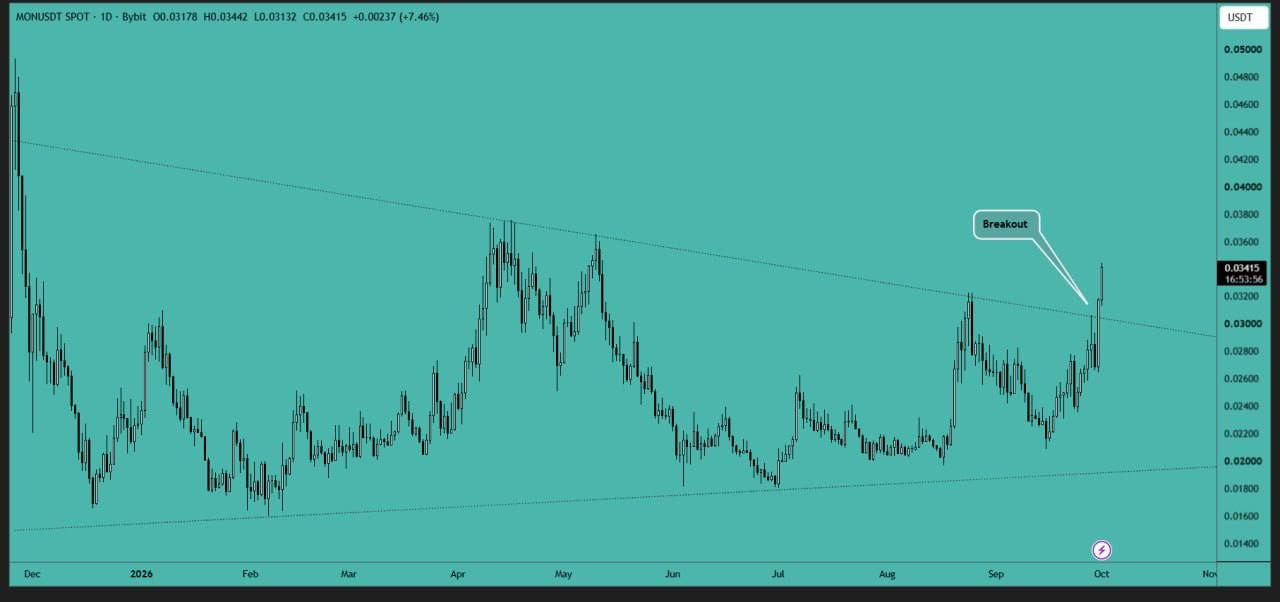
$MON analysis:
Price is breaking out of the triangle pattern, which is a good sign. You can open long positions during the retest in the $0.030-$0.032 range. I am expecting a strong upward rally in the coming days
#KoreaProposesTokenizingStocksAndBonds #MetaMaskExitsLidoValidatorsAfterSecurityIncident #MicronBeatsEarningsLiftsGuidance #CFTCSubmitsTwoEventContractRulesToWhiteHouse #AltcoinSeasonIndexHoldsAbove60For5Days
{future}(MONUSDT)
$MON analysis:
Price is breaking out of the triangle pattern, which is a good sign. You can open long positions during the retest in the $0.030-$0.032 range. I am expecting a strong upward rally in the coming days
#KoreaProposesTokenizingStocksAndBonds #MetaMaskExitsLidoValidatorsAfterSecurityIncident #MicronBeatsEarningsLiftsGuidance #CFTCSubmitsTwoEventContractRulesToWhiteHouse #AltcoinSeasonIndexHoldsAbove60For5Days
Price is breaking out of the triangle pattern, which is a good sign. You can open long positions during the retest in the $0.030-$0.032 range. I am expecting a strong upward rally in the coming days
#KoreaProposesTokenizingStocksAndBonds #MetaMaskExitsLidoValidatorsAfterSecurityIncident #MicronBeatsEarningsLiftsGuidance #CFTCSubmitsTwoEventContractRulesToWhiteHouse #AltcoinSeasonIndexHoldsAbove60For5Days
93
Article
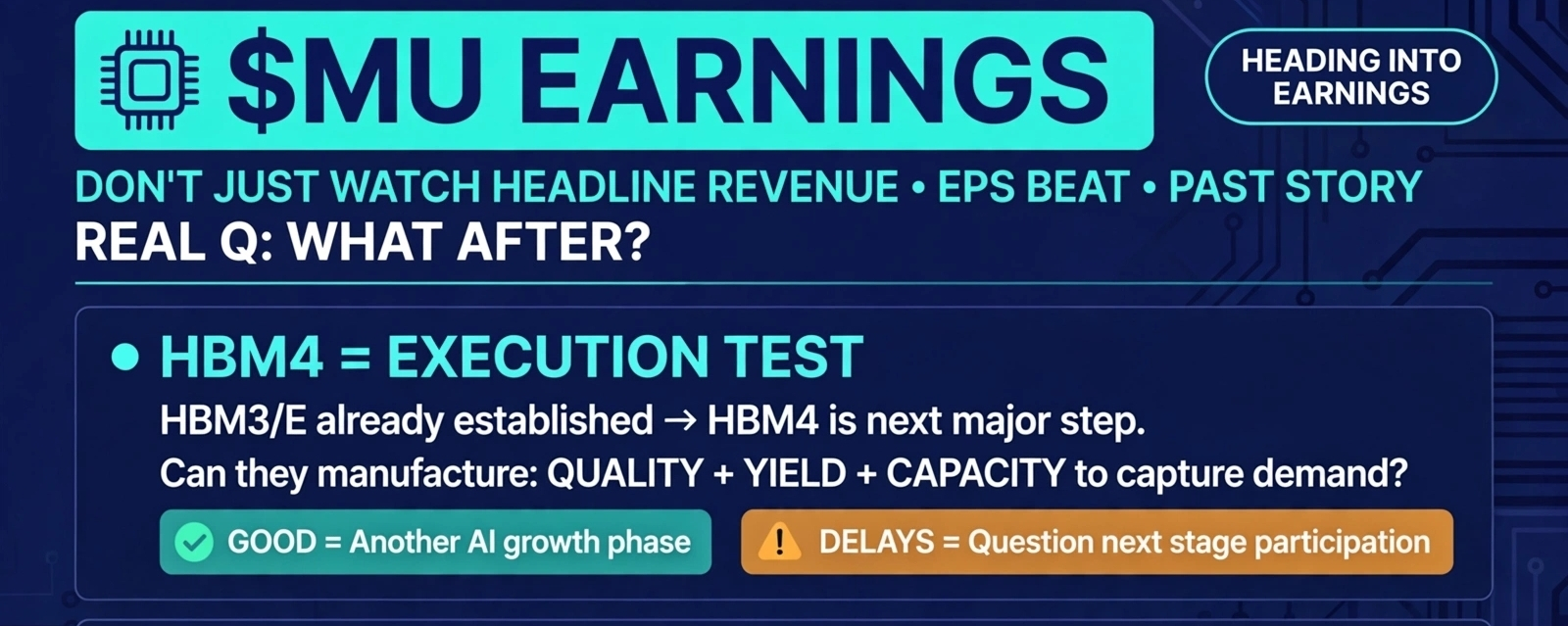
Micron stock Earnings$MUB is heading into earnings, and I think the biggest mistake would be to look at this report only through the headline numbers.
Revenue, EPS and whether Micron beats estimates will obviously matter, but those figures are mostly about what has already happened.
What I really want to know is what happens after this quarter.
Micron has become one of the clearest beneficiaries of the AI infrastructure buildout because every new generation of AI data centers needs more advanced memory. But the market is now asking a harder question: how much further can this growth actually run?
That is why HBM4 is the first thing I will be watching.
HBM3 and HBM3E have already established the importance of high-bandwidth memory in AI accelerators. HBM4 is the next major step, and this is where execution becomes critical.
It is one thing to have strong customer demand.
It is another thing to manufacture enough HBM4 at the required quality and yield to actually capture that demand.
If Micron gives investors confidence that HBM4 production is progressing well, yields are improving and meaningful capacity can come online as planned, that would strengthen the argument that the company still has another phase of AI-driven growth ahead.
But if management talks about production delays, weaker yields or limited capacity, the market could start questioning whether Micron can fully participate in the next stage of the AI memory cycle.
And that leads directly to the second thing I care about:
2027.
I think this is where the earnings call could become much more important than the earnings release itself.
The current quarter tells us how strong demand has been.
Management's 2027 commentary will tell us how sustainable they believe that demand is.
Are AI customers still aggressively securing memory capacity? Does Micron expect HBM demand to remain constrained by supply? Can pricing and margins remain strong as additional capacity comes online?
These are the questions that can change the market's perception of $MU.
A strong quarter with cautious 2027 guidance could create a very different reaction from a strong quarter accompanied by confident long-term commentary.
That is something investors sometimes forget during earnings season.
The market doesn't pay you for yesterday's numbers. It prices expectations for tomorrow.
There is another interesting part of this setup: options pricing is implying roughly 8–10% post-earnings volatility.
That doesn't tell us whether Micron will go up or down. It simply shows that the market expects the new information to matter.
And I think that makes sense.
Micron is sitting at an important intersection between the AI boom and the traditional memory cycle.
AI has created a much stronger structural demand story for high-bandwidth memory, but memory is still a business where supply, pricing, capacity and margins can change the picture very quickly.
That's why I don't think one earnings beat would automatically mean the stock's next move is higher.
The more interesting scenario would be:
Strong results.
Strong HBM4 execution.
Healthy capacity expansion.
And constructive 2027 guidance.
If those pieces come together, the market gets another reason to believe that Micron's AI opportunity is still expanding.
But if the numbers are good while HBM4 execution or the 2027 outlook disappoints, investors may start asking whether expectations have simply moved too far ahead of the underlying cycle.
For me, that's the real dividing line.
I'm not trying to predict whether $MU will pump or dump immediately after earnings.
I want to see whether Micron can turn today's AI demand into sustainable memory growth over the next several years.
Because the biggest opportunity in this cycle isn't simply selling more memory during a shortage.
It's proving that AI has fundamentally changed the demand structure enough to support stronger utilization, pricing and margins for longer than a normal memory cycle.
That's the part management needs to convince the market of.
So tonight, I'll be listening less to the headline number and more to the details.
HBM4 tells me how well Micron is executing.
2027 guidance tells me how management sees the road ahead.
Margins tell me how much of that demand is actually translating into economics.
The AI memory story is still very much alive, but this earnings report could tell us whether Micron is entering another leg of growth or whether the market needs to become more selective about what comes next.
No need to guess before the information arrives.
Let the report come out. Listen to management. Then reassess.
DYOR.
#EarningsSeason
Micron stock Earnings
$MUB is heading into earnings, and I think the biggest mistake would be to look at this report only through the headline numbers.
Revenue, EPS and whether Micron beats estimates will obviously matter, but those figures are mostly about what has already happened.
What I really want to know is what happens after this quarter.
Micron has become one of the clearest beneficiaries of the AI infrastructure buildout because every new generation of AI data centers needs more advanced memory. But the market is now asking a harder question: how much further can this growth actually run?
That is why HBM4 is the first thing I will be watching.
HBM3 and HBM3E have already established the importance of high-bandwidth memory in AI accelerators. HBM4 is the next major step, and this is where execution becomes critical.
It is one thing to have strong customer demand.
It is another thing to manufacture enough HBM4 at the required quality and yield to actually capture that demand.
If Micron gives investors confidence that HBM4 production is progressing well, yields are improving and meaningful capacity can come online as planned, that would strengthen the argument that the company still has another phase of AI-driven growth ahead.
But if management talks about production delays, weaker yields or limited capacity, the market could start questioning whether Micron can fully participate in the next stage of the AI memory cycle.
And that leads directly to the second thing I care about:
2027.
I think this is where the earnings call could become much more important than the earnings release itself.
The current quarter tells us how strong demand has been.
Management's 2027 commentary will tell us how sustainable they believe that demand is.
Are AI customers still aggressively securing memory capacity? Does Micron expect HBM demand to remain constrained by supply? Can pricing and margins remain strong as additional capacity comes online?
These are the questions that can change the market's perception of $MU.
A strong quarter with cautious 2027 guidance could create a very different reaction from a strong quarter accompanied by confident long-term commentary.
That is something investors sometimes forget during earnings season.
The market doesn't pay you for yesterday's numbers. It prices expectations for tomorrow.
There is another interesting part of this setup: options pricing is implying roughly 8–10% post-earnings volatility.
That doesn't tell us whether Micron will go up or down. It simply shows that the market expects the new information to matter.
And I think that makes sense.
Micron is sitting at an important intersection between the AI boom and the traditional memory cycle.
AI has created a much stronger structural demand story for high-bandwidth memory, but memory is still a business where supply, pricing, capacity and margins can change the picture very quickly.
That's why I don't think one earnings beat would automatically mean the stock's next move is higher.
The more interesting scenario would be:
Strong results.
Strong HBM4 execution.
Healthy capacity expansion.
And constructive 2027 guidance.
If those pieces come together, the market gets another reason to believe that Micron's AI opportunity is still expanding.
But if the numbers are good while HBM4 execution or the 2027 outlook disappoints, investors may start asking whether expectations have simply moved too far ahead of the underlying cycle.
For me, that's the real dividing line.
I'm not trying to predict whether $MU will pump or dump immediately after earnings.
I want to see whether Micron can turn today's AI demand into sustainable memory growth over the next several years.
Because the biggest opportunity in this cycle isn't simply selling more memory during a shortage.
It's proving that AI has fundamentally changed the demand structure enough to support stronger utilization, pricing and margins for longer than a normal memory cycle.
That's the part management needs to convince the market of.
So tonight, I'll be listening less to the headline number and more to the details.
HBM4 tells me how well Micron is executing.
2027 guidance tells me how management sees the road ahead.
Margins tell me how much of that demand is actually translating into economics.
The AI memory story is still very much alive, but this earnings report could tell us whether Micron is entering another leg of growth or whether the market needs to become more selective about what comes next.
No need to guess before the information arrives.
Let the report come out. Listen to management. Then reassess.
DYOR.
#EarningsSeason
Revenue, EPS and whether Micron beats estimates will obviously matter, but those figures are mostly about what has already happened.
What I really want to know is what happens after this quarter.
Micron has become one of the clearest beneficiaries of the AI infrastructure buildout because every new generation of AI data centers needs more advanced memory. But the market is now asking a harder question: how much further can this growth actually run?
That is why HBM4 is the first thing I will be watching.
HBM3 and HBM3E have already established the importance of high-bandwidth memory in AI accelerators. HBM4 is the next major step, and this is where execution becomes critical.
It is one thing to have strong customer demand.
It is another thing to manufacture enough HBM4 at the required quality and yield to actually capture that demand.
If Micron gives investors confidence that HBM4 production is progressing well, yields are improving and meaningful capacity can come online as planned, that would strengthen the argument that the company still has another phase of AI-driven growth ahead.
But if management talks about production delays, weaker yields or limited capacity, the market could start questioning whether Micron can fully participate in the next stage of the AI memory cycle.
And that leads directly to the second thing I care about:
2027.
I think this is where the earnings call could become much more important than the earnings release itself.
The current quarter tells us how strong demand has been.
Management's 2027 commentary will tell us how sustainable they believe that demand is.
Are AI customers still aggressively securing memory capacity? Does Micron expect HBM demand to remain constrained by supply? Can pricing and margins remain strong as additional capacity comes online?
These are the questions that can change the market's perception of $MU.
A strong quarter with cautious 2027 guidance could create a very different reaction from a strong quarter accompanied by confident long-term commentary.
That is something investors sometimes forget during earnings season.
The market doesn't pay you for yesterday's numbers. It prices expectations for tomorrow.
There is another interesting part of this setup: options pricing is implying roughly 8–10% post-earnings volatility.
That doesn't tell us whether Micron will go up or down. It simply shows that the market expects the new information to matter.
And I think that makes sense.
Micron is sitting at an important intersection between the AI boom and the traditional memory cycle.
AI has created a much stronger structural demand story for high-bandwidth memory, but memory is still a business where supply, pricing, capacity and margins can change the picture very quickly.
That's why I don't think one earnings beat would automatically mean the stock's next move is higher.
The more interesting scenario would be:
Strong results.
Strong HBM4 execution.
Healthy capacity expansion.
And constructive 2027 guidance.
If those pieces come together, the market gets another reason to believe that Micron's AI opportunity is still expanding.
But if the numbers are good while HBM4 execution or the 2027 outlook disappoints, investors may start asking whether expectations have simply moved too far ahead of the underlying cycle.
For me, that's the real dividing line.
I'm not trying to predict whether $MU will pump or dump immediately after earnings.
I want to see whether Micron can turn today's AI demand into sustainable memory growth over the next several years.
Because the biggest opportunity in this cycle isn't simply selling more memory during a shortage.
It's proving that AI has fundamentally changed the demand structure enough to support stronger utilization, pricing and margins for longer than a normal memory cycle.
That's the part management needs to convince the market of.
So tonight, I'll be listening less to the headline number and more to the details.
HBM4 tells me how well Micron is executing.
2027 guidance tells me how management sees the road ahead.
Margins tell me how much of that demand is actually translating into economics.
The AI memory story is still very much alive, but this earnings report could tell us whether Micron is entering another leg of growth or whether the market needs to become more selective about what comes next.
No need to guess before the information arrives.
Let the report come out. Listen to management. Then reassess.
DYOR.
#EarningsSeason
101
Micron stcoksMicron is about to disclose its fourth-quarter results. To be honest, I’m not particularly concerned about the numbers themselves, because that’s not where the key lies.
What will really determine the subsequent direction are two things:
1. HBM4 mass-production progress This is the dividing line for whether Micron can continue benefiting from the AI data center boom. HBM3 is already in production, but capacity is limited. HBM4 is the next generation, with both bandwidth and density set to jump to a new level.
If the earnings report reveals that HBM4 yields are underwhelming, mass production is delayed, or capacity is insufficient, that would mean Micron’s growth could slow over the next two quarters. Capital would flow toward competitors such as SK hynix, which have already begun mass-producing HBM4. Conversely, if it says “HBM4 progress is ahead of expectations, with substantial capacity available next year,” $MU would have new upward momentum.
2. 2027 outlook This is what the market cares about most. What kind of guidance will Micron’s management provide? Will it say “memory demand remains strong,” or “it may slow in the second half of the year”?
If the guidance is pessimistic, the stock could plunge even if the Q4 figures look good.
And vice versa. Based on options-market pricing, post-earnings volatility is set at 8–10%.
This range is not particularly large, suggesting that market expectations for Micron are relatively stable. But it also means that, in either direction, there are clear triggers for an 8% rise or a 10% decline.
Micron’s story is definitely not over, but the inflection point has arrived.
This earnings report will determine whether it remains “a beneficiary of the AI supercycle” or has “already peaked and is starting to lose steam,” whether HBM capacity can keep up with market demand, and whether it can continue benefiting from high margins next year.
If the earnings report beats expectations + HBM4 progress is strong + the 2027 guidance is optimistic, $MU could have a chance to make another move.
If any one of these fails to meet expectations, it would be wise to prepare for an adjustment.
This is not to say that $MU is going to collapse, but rather that the direction will shift from “rising blindly” to “selective positioning.”
The key now is not to rush to buy the dip or sell the top. Wait for the earnings results, see what management says, and then decide on the next position. Short-term volatility of 8–10% is possible, but the long-term thesis will still depend on HBM4 and the 2027 guidance.
This earnings night will determine the dividing line between Micron as an “AI beneficiary stock” and a “cyclical memory stock.” DYOR, as risks in memory chips remain.
#EarningsSeason $NVDA
Micron stcoks
Micron is about to disclose its fourth-quarter results. To be honest, I’m not particularly concerned about the numbers themselves, because that’s not where the key lies.
What will really determine the subsequent direction are two things:
1. HBM4 mass-production progress This is the dividing line for whether Micron can continue benefiting from the AI data center boom. HBM3 is already in production, but capacity is limited. HBM4 is the next generation, with both bandwidth and density set to jump to a new level.
If the earnings report reveals that HBM4 yields are underwhelming, mass production is delayed, or capacity is insufficient, that would mean Micron’s growth could slow over the next two quarters. Capital would flow toward competitors such as SK hynix, which have already begun mass-producing HBM4. Conversely, if it says “HBM4 progress is ahead of expectations, with substantial capacity available next year,” $MU would have new upward momentum.
2. 2027 outlook This is what the market cares about most. What kind of guidance will Micron’s management provide? Will it say “memory demand remains strong,” or “it may slow in the second half of the year”?
If the guidance is pessimistic, the stock could plunge even if the Q4 figures look good.
And vice versa. Based on options-market pricing, post-earnings volatility is set at 8–10%.
This range is not particularly large, suggesting that market expectations for Micron are relatively stable. But it also means that, in either direction, there are clear triggers for an 8% rise or a 10% decline.
Micron’s story is definitely not over, but the inflection point has arrived.
This earnings report will determine whether it remains “a beneficiary of the AI supercycle” or has “already peaked and is starting to lose steam,” whether HBM capacity can keep up with market demand, and whether it can continue benefiting from high margins next year.
If the earnings report beats expectations + HBM4 progress is strong + the 2027 guidance is optimistic, $MU could have a chance to make another move.
If any one of these fails to meet expectations, it would be wise to prepare for an adjustment.
This is not to say that $MU is going to collapse, but rather that the direction will shift from “rising blindly” to “selective positioning.”
The key now is not to rush to buy the dip or sell the top. Wait for the earnings results, see what management says, and then decide on the next position. Short-term volatility of 8–10% is possible, but the long-term thesis will still depend on HBM4 and the 2027 guidance.
This earnings night will determine the dividing line between Micron as an “AI beneficiary stock” and a “cyclical memory stock.” DYOR, as risks in memory chips remain.
#EarningsSeason $NVDA
What will really determine the subsequent direction are two things:
1. HBM4 mass-production progress This is the dividing line for whether Micron can continue benefiting from the AI data center boom. HBM3 is already in production, but capacity is limited. HBM4 is the next generation, with both bandwidth and density set to jump to a new level.
If the earnings report reveals that HBM4 yields are underwhelming, mass production is delayed, or capacity is insufficient, that would mean Micron’s growth could slow over the next two quarters. Capital would flow toward competitors such as SK hynix, which have already begun mass-producing HBM4. Conversely, if it says “HBM4 progress is ahead of expectations, with substantial capacity available next year,” $MU would have new upward momentum.
2. 2027 outlook This is what the market cares about most. What kind of guidance will Micron’s management provide? Will it say “memory demand remains strong,” or “it may slow in the second half of the year”?
If the guidance is pessimistic, the stock could plunge even if the Q4 figures look good.
And vice versa. Based on options-market pricing, post-earnings volatility is set at 8–10%.
This range is not particularly large, suggesting that market expectations for Micron are relatively stable. But it also means that, in either direction, there are clear triggers for an 8% rise or a 10% decline.
Micron’s story is definitely not over, but the inflection point has arrived.
This earnings report will determine whether it remains “a beneficiary of the AI supercycle” or has “already peaked and is starting to lose steam,” whether HBM capacity can keep up with market demand, and whether it can continue benefiting from high margins next year.
If the earnings report beats expectations + HBM4 progress is strong + the 2027 guidance is optimistic, $MU could have a chance to make another move.
If any one of these fails to meet expectations, it would be wise to prepare for an adjustment.
This is not to say that $MU is going to collapse, but rather that the direction will shift from “rising blindly” to “selective positioning.”
The key now is not to rush to buy the dip or sell the top. Wait for the earnings results, see what management says, and then decide on the next position. Short-term volatility of 8–10% is possible, but the long-term thesis will still depend on HBM4 and the 2027 guidance.
This earnings night will determine the dividing line between Micron as an “AI beneficiary stock” and a “cyclical memory stock.” DYOR, as risks in memory chips remain.
#EarningsSeason $NVDA
129
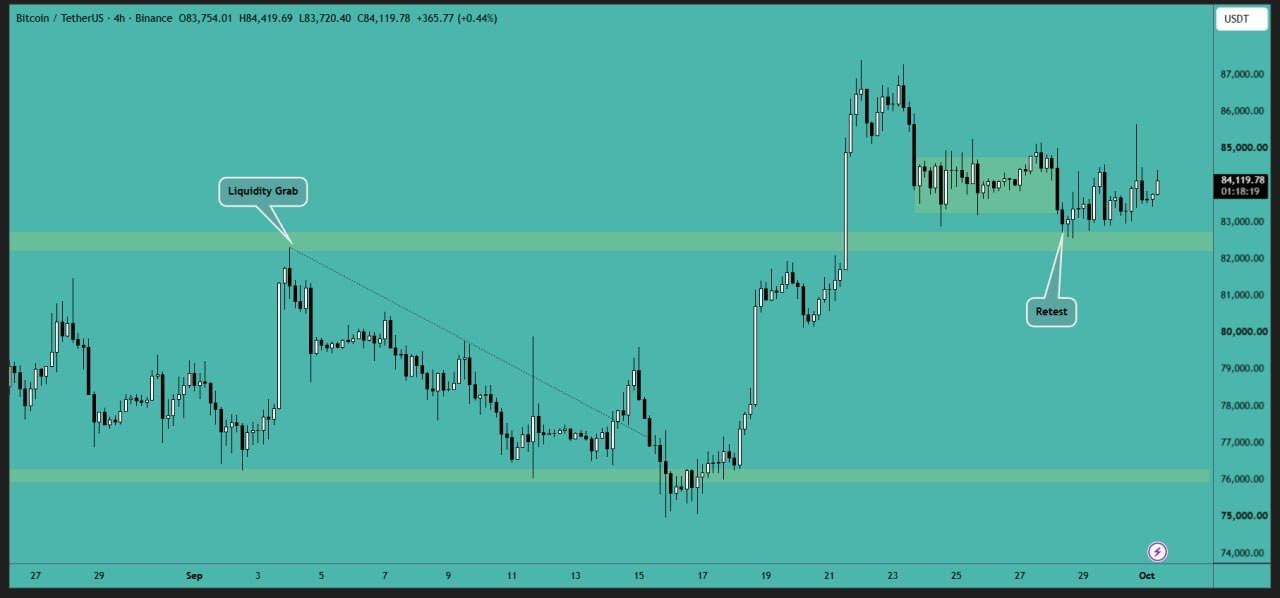
Bitcoin is currently moving sideways as the market remains unchanged. The price is holding steady at the support line, and a break above the $85,000 level could lead to further upward movement.$BTC
#KoreaProposesTokenizingStocksAndBonds #MetaMaskExitsLidoValidatorsAfterSecurityIncident #MicronBeatsEarningsLiftsGuidance #CFTCSubmitsTwoEventContractRulesToWhiteHouse #AltcoinSeasonIndexHoldsAbove60For5Days
{future}(BTCUSDT)
Bitcoin is currently moving sideways as the market remains unchanged. The price is holding steady at the support line, and a break above the $85,000 level could lead to further upward movement.$BTC
#KoreaProposesTokenizingStocksAndBonds #MetaMaskExitsLidoValidatorsAfterSecurityIncident #MicronBeatsEarningsLiftsGuidance #CFTCSubmitsTwoEventContractRulesToWhiteHouse #AltcoinSeasonIndexHoldsAbove60For5Days
#KoreaProposesTokenizingStocksAndBonds #MetaMaskExitsLidoValidatorsAfterSecurityIncident #MicronBeatsEarningsLiftsGuidance #CFTCSubmitsTwoEventContractRulesToWhiteHouse #AltcoinSeasonIndexHoldsAbove60For5Days
80
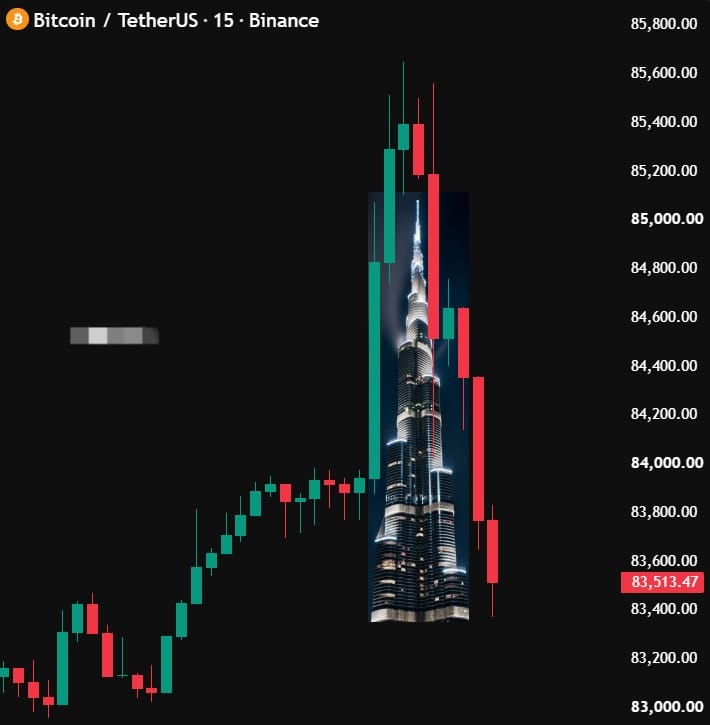
DAY 2 TRADING PSYCHOLOGY: INSTANT GRATIFICATION
Instant gratification means wanting results RIGHT NOW.
In trading, this can be dangerous.
You see an opportunity → enter without confirmation → SL gets hit → immediately enter again to recover the loss → another loss → revenge trading begins.
Before you know it, your entire account can be destroyed.
The problem isn't always the market.
Sometimes the problem is our inability to wait.
Trading rewards patience, not haste.
Wait for your setup.
Wait for confirmation.
Wait for the right entry.
Most importantly, after a loss, DON'T rush to recover it.
The market isn't going anywhere.
Slow and steady is the game.
You don't become a successful trader by making money quickly.
You become successful by surviving long enough to stay in the game.
DAY 2 LESSON:
CONTROL YOUR URGE FOR INSTANT RESULTS.
BE PATIENT.
WAIT FOR YOUR SETUP.
In trading, patience is a skill not a weakness
$BTC $XAU $QNT
#QNTRises287% #AltcoinSeasonIndexHoldsAbove60For5Days #USADPAdds90000JobsInSeptember #USCorePCEEasesTo3%InAugust
DAY 2 TRADING PSYCHOLOGY: INSTANT GRATIFICATION
Instant gratification means wanting results RIGHT NOW.
In trading, this can be dangerous.
You see an opportunity → enter without confirmation → SL gets hit → immediately enter again to recover the loss → another loss → revenge trading begins.
Before you know it, your entire account can be destroyed.
The problem isn't always the market.
Sometimes the problem is our inability to wait.
Trading rewards patience, not haste.
Wait for your setup.
Wait for confirmation.
Wait for the right entry.
Most importantly, after a loss, DON'T rush to recover it.
The market isn't going anywhere.
Slow and steady is the game.
You don't become a successful trader by making money quickly.
You become successful by surviving long enough to stay in the game.
DAY 2 LESSON:
CONTROL YOUR URGE FOR INSTANT RESULTS.
BE PATIENT.
WAIT FOR YOUR SETUP.
In trading, patience is a skill not a weakness
$BTC $XAU $QNT
#QNTRises287% #AltcoinSeasonIndexHoldsAbove60For5Days #USADPAdds90000JobsInSeptember #USCorePCEEasesTo3%InAugust
Instant gratification means wanting results RIGHT NOW.
In trading, this can be dangerous.
You see an opportunity → enter without confirmation → SL gets hit → immediately enter again to recover the loss → another loss → revenge trading begins.
Before you know it, your entire account can be destroyed.
The problem isn't always the market.
Sometimes the problem is our inability to wait.
Trading rewards patience, not haste.
Wait for your setup.
Wait for confirmation.
Wait for the right entry.
Most importantly, after a loss, DON'T rush to recover it.
The market isn't going anywhere.
Slow and steady is the game.
You don't become a successful trader by making money quickly.
You become successful by surviving long enough to stay in the game.
DAY 2 LESSON:
CONTROL YOUR URGE FOR INSTANT RESULTS.
BE PATIENT.
WAIT FOR YOUR SETUP.
In trading, patience is a skill not a weakness
$BTC $XAU $QNT
#QNTRises287% #AltcoinSeasonIndexHoldsAbove60For5Days #USADPAdds90000JobsInSeptember #USCorePCEEasesTo3%InAugust


1
94
DAY 2: CONTROL YOUR URGE FOR INSTANT RESULTS
$BTC $XAU $MU
#EarningsSeason #BitcoinClears$85200 #AltcoinSeasonIndexHoldsAbove60For5Days #USADPAdds90000JobsInSeptember #USCorePCEEasesTo3%InAugust
DAY 2: CONTROL YOUR URGE FOR INSTANT RESULTS
$BTC $XAU $MU
#EarningsSeason #BitcoinClears$85200 #AltcoinSeasonIndexHoldsAbove60For5Days #USADPAdds90000JobsInSeptember #USCorePCEEasesTo3%InAugust
$BTC $XAU $MU
#EarningsSeason #BitcoinClears$85200 #AltcoinSeasonIndexHoldsAbove60For5Days #USADPAdds90000JobsInSeptember #USCorePCEEasesTo3%InAugust
1
247
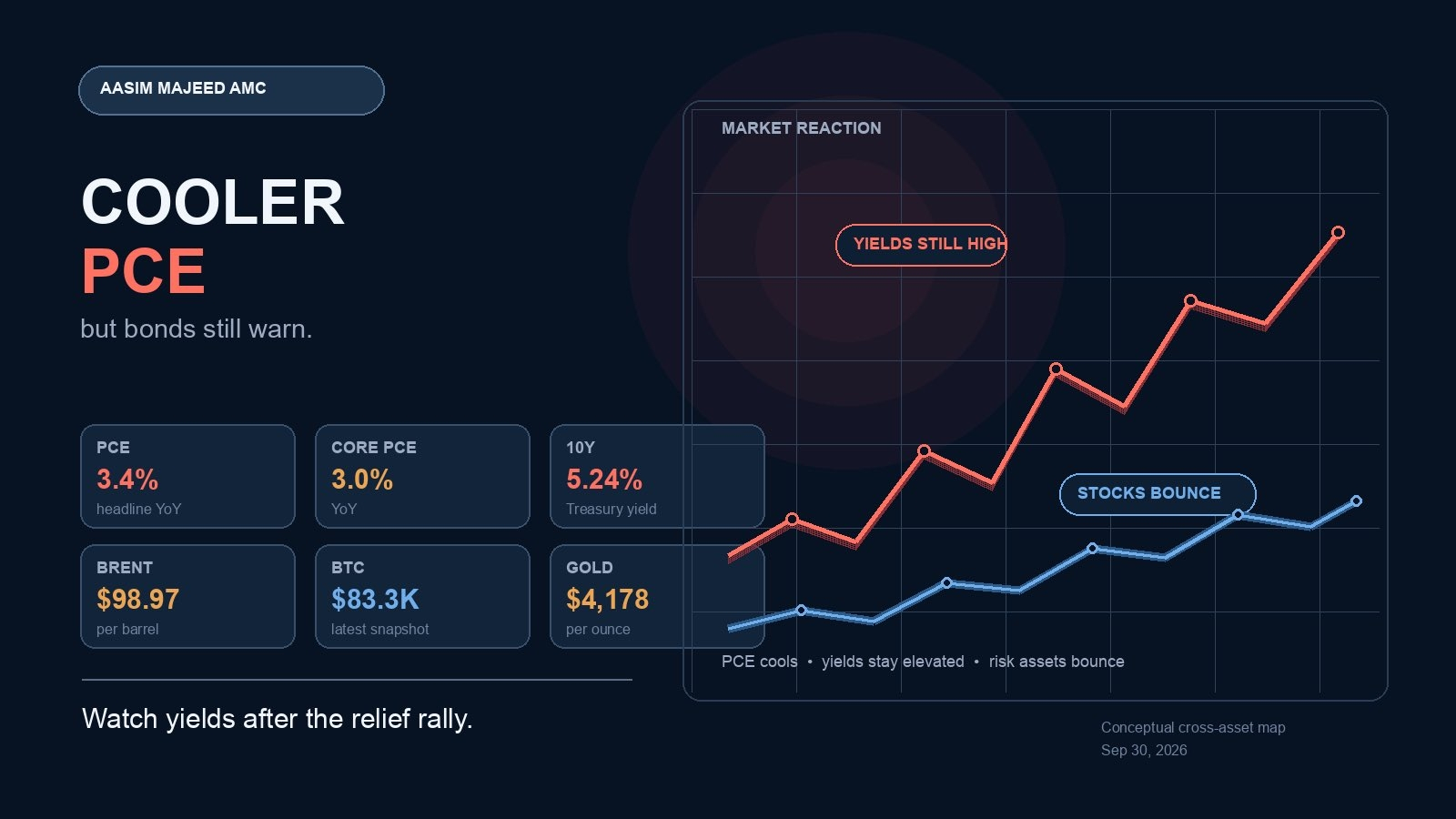
🚨 COOLER INFLATION, BUT THE BOND MARKET IS NOT CONVINCED
The biggest story today is not just stocks bouncing.
The real question is whether this is a genuine relief rally—or just a temporary reaction to softer inflation data.
US PCE inflation came in below expectations:
Headline PCE: 3.4% YoY
Core PCE: 3.0% YoY
Both were cooler than economists expected.
Markets reacted positively:
Nasdaq: +0.92%
S&P 500: +0.53%
Dow Jones: +0.08%
But the bond market is still sending a warning.
The US 10Y Treasury yield remains around 5.24%.
Brent crude is near $99, while Bitcoin is trading around $83.3K and gold is near $4,178.
This creates a complicated market setup.
Cooler inflation supports hopes for easier monetary policy.
But elevated Treasury yields, strong energy prices and a firm US dollar are keeping financial conditions tight.
If oil remains elevated, inflation could become sticky again.
That means stocks can rally on soft data today—and still face pressure if yields move higher tomorrow.
Watch these markets closely:
10Y Treasury yield
30Y Treasury yield
Brent crude
US Dollar
Nasdaq
Bitcoin near the $82K–$83K zone
Gold
The inflation data is cooling.
But the risk premium is not.
Do not trade the headline alone.
Watch the yield reaction after the relief rally.
$BTC $XAU $AAPL.US
#Inflation #US10Y #NASDAQ #Bitcoin #Gold
🚨 COOLER INFLATION, BUT THE BOND MARKET IS NOT CONVINCED
The biggest story today is not just stocks bouncing.
The real question is whether this is a genuine relief rally—or just a temporary reaction to softer inflation data.
US PCE inflation came in below expectations:
Headline PCE: 3.4% YoY
Core PCE: 3.0% YoY
Both were cooler than economists expected.
Markets reacted positively:
Nasdaq: +0.92%
S&P 500: +0.53%
Dow Jones: +0.08%
But the bond market is still sending a warning.
The US 10Y Treasury yield remains around 5.24%.
Brent crude is near $99, while Bitcoin is trading around $83.3K and gold is near $4,178.
This creates a complicated market setup.
Cooler inflation supports hopes for easier monetary policy.
But elevated Treasury yields, strong energy prices and a firm US dollar are keeping financial conditions tight.
If oil remains elevated, inflation could become sticky again.
That means stocks can rally on soft data today—and still face pressure if yields move higher tomorrow.
Watch these markets closely:
10Y Treasury yield
30Y Treasury yield
Brent crude
US Dollar
Nasdaq
Bitcoin near the $82K–$83K zone
Gold
The inflation data is cooling.
But the risk premium is not.
Do not trade the headline alone.
Watch the yield reaction after the relief rally.
$BTC $XAU $AAPL.US
#Inflation #US10Y #NASDAQ #Bitcoin #Gold
The biggest story today is not just stocks bouncing.
The real question is whether this is a genuine relief rally—or just a temporary reaction to softer inflation data.
US PCE inflation came in below expectations:
Headline PCE: 3.4% YoY
Core PCE: 3.0% YoY
Both were cooler than economists expected.
Markets reacted positively:
Nasdaq: +0.92%
S&P 500: +0.53%
Dow Jones: +0.08%
But the bond market is still sending a warning.
The US 10Y Treasury yield remains around 5.24%.
Brent crude is near $99, while Bitcoin is trading around $83.3K and gold is near $4,178.
This creates a complicated market setup.
Cooler inflation supports hopes for easier monetary policy.
But elevated Treasury yields, strong energy prices and a firm US dollar are keeping financial conditions tight.
If oil remains elevated, inflation could become sticky again.
That means stocks can rally on soft data today—and still face pressure if yields move higher tomorrow.
Watch these markets closely:
10Y Treasury yield
30Y Treasury yield
Brent crude
US Dollar
Nasdaq
Bitcoin near the $82K–$83K zone
Gold
The inflation data is cooling.
But the risk premium is not.
Do not trade the headline alone.
Watch the yield reaction after the relief rally.
$BTC $XAU $AAPL.US
#Inflation #US10Y #NASDAQ #Bitcoin #Gold
144
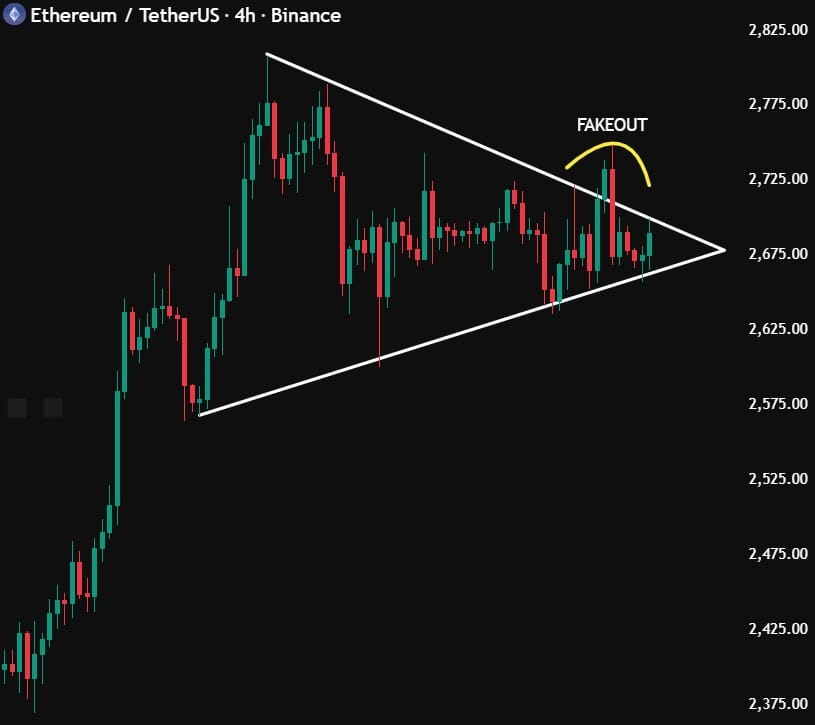
$ETH is still in this bullish pennant.
Yesterday, there was a breakout attempt, but it turned out to be a fakeout.
Now, Ethereum needs a strong close above $2.7K with decent spot demand for a breakout confirmation#BitcoinClears$85200 #AltcoinSeasonIndexHoldsAbove60For5Days #USADPAdds90000JobsInSeptember #KospiPostsWorstQuarterSince2020
$ETH is still in this bullish pennant.
Yesterday, there was a breakout attempt, but it turned out to be a fakeout.
Now, Ethereum needs a strong close above $2.7K with decent spot demand for a breakout confirmation#BitcoinClears$85200 #AltcoinSeasonIndexHoldsAbove60For5Days #USADPAdds90000JobsInSeptember #KospiPostsWorstQuarterSince2020
Yesterday, there was a breakout attempt, but it turned out to be a fakeout.
Now, Ethereum needs a strong close above $2.7K with decent spot demand for a breakout confirmation#BitcoinClears$85200 #AltcoinSeasonIndexHoldsAbove60For5Days #USADPAdds90000JobsInSeptember #KospiPostsWorstQuarterSince2020
1
91
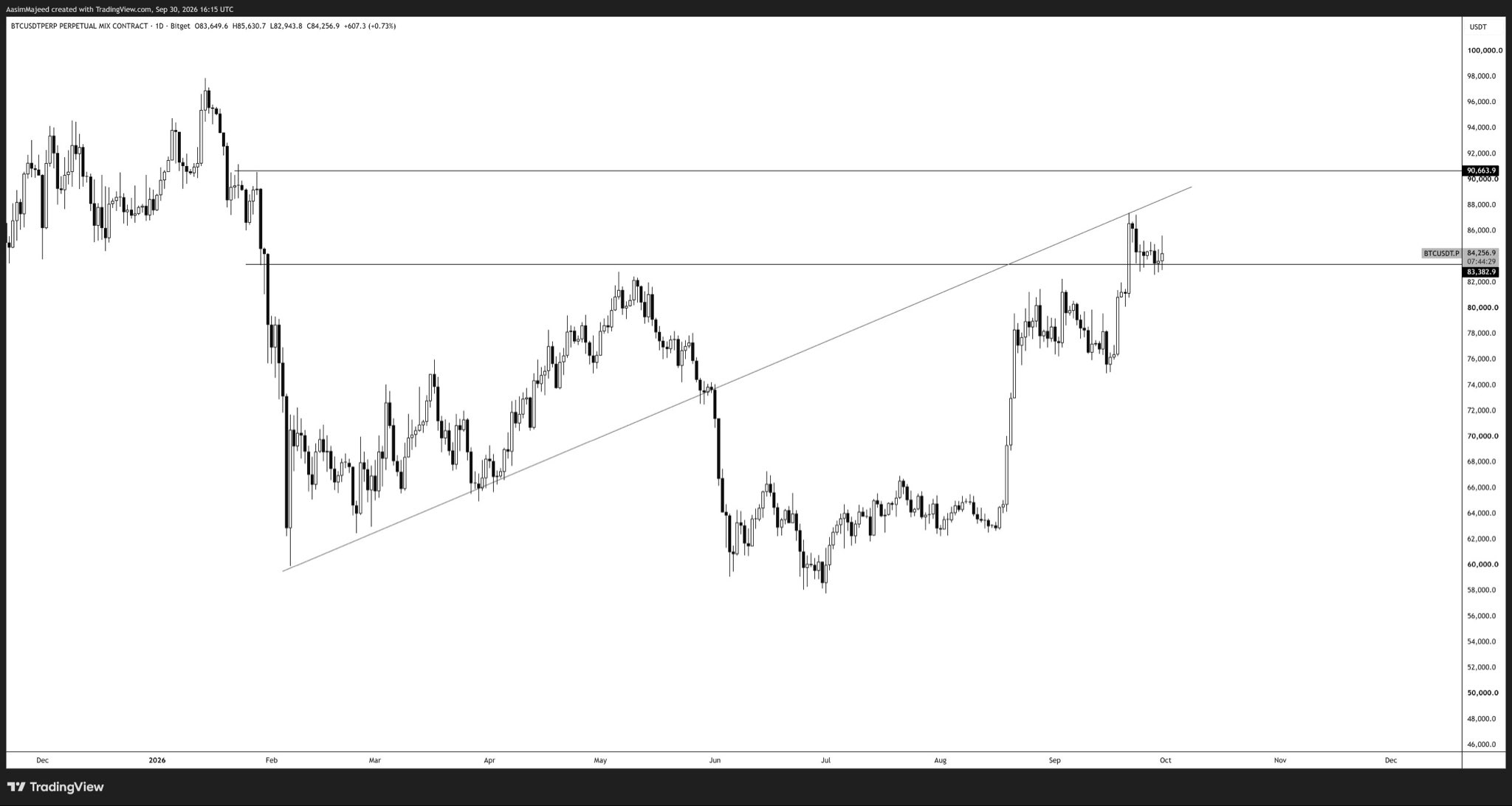
🚨 BITCOIN IS SITTING ON A KEY DECISION LEVEL
Bitcoin is trading around $84.2K after reclaiming the $83.3K area.
This level is now the key line in the sand.
As long as BTC holds above $83.3K, the short-term structure remains constructive.
A clean move above $86K could open the door toward the major resistance near $90.6K.
But the chart is not fully bullish yet.
Bitcoin is still trading below the major resistance zone, and the recent rally has already faced rejection from higher levels.
What the chart shows:
• Strong recovery from the $76K area
• Consolidation around $84K
• Immediate support near $83.3K
• Major resistance near $90.6K
• Buyers still need a confirmed breakout
Bullish scenario:
BTC holds $83.3K and breaks above $86K.
This could bring the $90.6K resistance back into focus.
Bearish scenario:
BTC loses $83.3K on a daily closing basis.
That would weaken momentum and increase the risk of a deeper pullback.
The next major move may be decided by the daily close—not the intraday wick.
Do not chase the candle.
Watch the level.
Structure first.
Emotions later.
$BTC
{future}(BTCUSDT)
#Bitcoin #BTC #Crypto #TechnicalAnalysis #trading
This is chart analysis, not financial advice
🚨 BITCOIN IS SITTING ON A KEY DECISION LEVEL
Bitcoin is trading around $84.2K after reclaiming the $83.3K area.
This level is now the key line in the sand.
As long as BTC holds above $83.3K, the short-term structure remains constructive.
A clean move above $86K could open the door toward the major resistance near $90.6K.
But the chart is not fully bullish yet.
Bitcoin is still trading below the major resistance zone, and the recent rally has already faced rejection from higher levels.
What the chart shows:
• Strong recovery from the $76K area
• Consolidation around $84K
• Immediate support near $83.3K
• Major resistance near $90.6K
• Buyers still need a confirmed breakout
Bullish scenario:
BTC holds $83.3K and breaks above $86K.
This could bring the $90.6K resistance back into focus.
Bearish scenario:
BTC loses $83.3K on a daily closing basis.
That would weaken momentum and increase the risk of a deeper pullback.
The next major move may be decided by the daily close—not the intraday wick.
Do not chase the candle.
Watch the level.
Structure first.
Emotions later.
$BTC
#Bitcoin #BTC #Crypto #TechnicalAnalysis #trading
This is chart analysis, not financial advice
Bitcoin is trading around $84.2K after reclaiming the $83.3K area.
This level is now the key line in the sand.
As long as BTC holds above $83.3K, the short-term structure remains constructive.
A clean move above $86K could open the door toward the major resistance near $90.6K.
But the chart is not fully bullish yet.
Bitcoin is still trading below the major resistance zone, and the recent rally has already faced rejection from higher levels.
What the chart shows:
• Strong recovery from the $76K area
• Consolidation around $84K
• Immediate support near $83.3K
• Major resistance near $90.6K
• Buyers still need a confirmed breakout
Bullish scenario:
BTC holds $83.3K and breaks above $86K.
This could bring the $90.6K resistance back into focus.
Bearish scenario:
BTC loses $83.3K on a daily closing basis.
That would weaken momentum and increase the risk of a deeper pullback.
The next major move may be decided by the daily close—not the intraday wick.
Do not chase the candle.
Watch the level.
Structure first.
Emotions later.
$BTC
#Bitcoin #BTC #Crypto #TechnicalAnalysis #trading
This is chart analysis, not financial advice
79
STRAIGHT TO TP2//90pips✅
Let’s CLOSE our trade now and set breakeven if you wish to hold now‼️
Nonstop smashing TP
#EarningsSeason
$XAU
STRAIGHT TO TP2//90pips✅
Let’s CLOSE our trade now and set breakeven if you wish to hold now‼️
Nonstop smashing TP
#EarningsSeason
$XAU
Let’s CLOSE our trade now and set breakeven if you wish to hold now‼️
Nonstop smashing TP
#EarningsSeason
$XAU
1
83
Round 2 STRAIGHT TO TP1//50pips✅
Let’s CLOSE our trade now and set breakeven if you wish to hold now‼️
What a great way to start our day🔥
$XAU
Round 2 STRAIGHT TO TP1//50pips✅
Let’s CLOSE our trade now and set breakeven if you wish to hold now‼️
What a great way to start our day🔥
$XAU
Let’s CLOSE our trade now and set breakeven if you wish to hold now‼️
What a great way to start our day🔥
$XAU
Aasim Majeed AMC
·
--
Buy Gold : 4190-4185
Sl :4178
Tp1: 4195
Tp2: 4200
Tp3: 4205
Tp4: Open
Enter Slowly-Layer with proper money management
Do not rush your entries
$XAU
#EarningsSeason #GOLD
Sl :4178
Tp1: 4195
Tp2: 4200
Tp3: 4205
Tp4: Open
Enter Slowly-Layer with proper money management
Do not rush your entries
$XAU
#EarningsSeason #GOLD
51
Buy Gold : 4190-4185
Sl :4178
Tp1: 4195
Tp2: 4200
Tp3: 4205
Tp4: Open
Enter Slowly-Layer with proper money management
Do not rush your entries
$XAU
#EarningsSeason #GOLD
Buy Gold : 4190-4185
Sl :4178
Tp1: 4195
Tp2: 4200
Tp3: 4205
Tp4: Open
Enter Slowly-Layer with proper money management
Do not rush your entries
$XAU
#EarningsSeason #GOLD
Sl :4178
Tp1: 4195
Tp2: 4200
Tp3: 4205
Tp4: Open
Enter Slowly-Layer with proper money management
Do not rush your entries
$XAU
#EarningsSeason #GOLD
1
108
STRAIGHT TO TP2//90pips✅
Let’s CLOSE our trade now and set breakeven if you wish to hold now‼️
Nonstop smashing TP with #AasimmajeedAMC
$XAU
#GOLD #EarningsSeason
STRAIGHT TO TP2//90pips✅
Let’s CLOSE our trade now and set breakeven if you wish to hold now‼️
Nonstop smashing TP with #AasimmajeedAMC
$XAU
#GOLD #EarningsSeason
Let’s CLOSE our trade now and set breakeven if you wish to hold now‼️
Nonstop smashing TP with #AasimmajeedAMC
$XAU
#GOLD #EarningsSeason
1
147
Round 1 STRAIGHT TO TP1//50pips✅
Let’s CLOSE our trade now and set breakeven if you wish to hold now‼️
What a great way to start our day🔥
$XAU
#GOLD #EarningsSeason
Round 1 STRAIGHT TO TP1//50pips✅
Let’s CLOSE our trade now and set breakeven if you wish to hold now‼️
What a great way to start our day🔥
$XAU
#GOLD #EarningsSeason
Let’s CLOSE our trade now and set breakeven if you wish to hold now‼️
What a great way to start our day🔥
$XAU
#GOLD #EarningsSeason
Aasim Majeed AMC
·
--
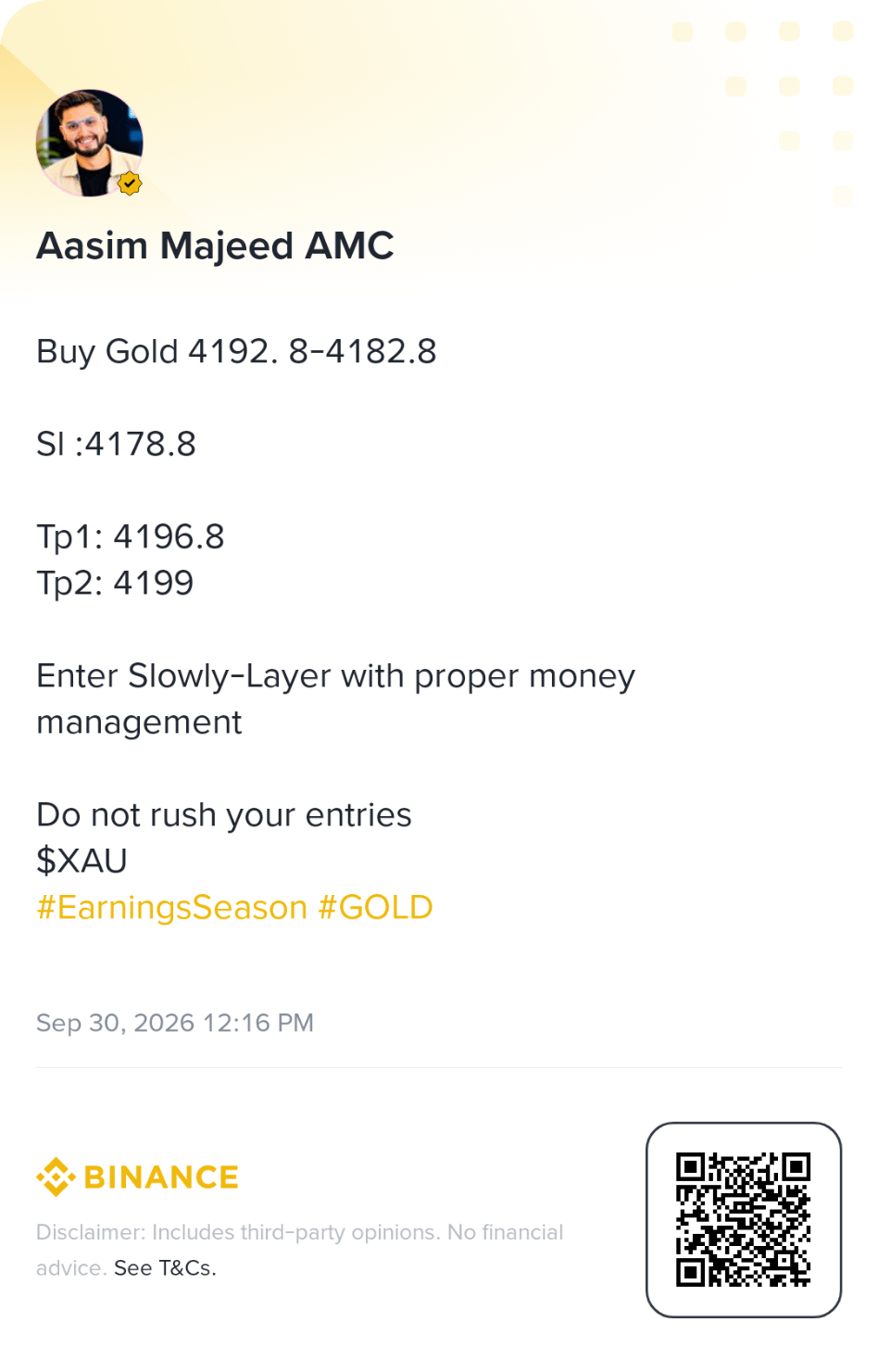
Buy Gold 4192. 8-4182.8
Sl :4178.8
Tp1: 4196.8
Tp2: 4199
Enter Slowly-Layer with proper money management
Do not rush your entries
$XAU
#EarningsSeason #GOLD
Sl :4178.8
Tp1: 4196.8
Tp2: 4199
Enter Slowly-Layer with proper money management
Do not rush your entries
$XAU
#EarningsSeason #GOLD
38
Buy Gold 4192. 8-4182.8
Sl :4178.8
Tp1: 4196.8
Tp2: 4199
Enter Slowly-Layer with proper money management
Do not rush your entries
$XAU
#EarningsSeason #GOLD
Buy Gold 4192. 8-4182.8
Sl :4178.8
Tp1: 4196.8
Tp2: 4199
Enter Slowly-Layer with proper money management
Do not rush your entries
$XAU
#EarningsSeason #GOLD
Sl :4178.8
Tp1: 4196.8
Tp2: 4199
Enter Slowly-Layer with proper money management
Do not rush your entries
$XAU
#EarningsSeason #GOLD
1
1
103
Good Morning traders
Have a profitable day
Good Morning traders
Have a profitable day
Have a profitable day
1
3
40

Article
Support Levels & Resistance Levels — The Foundation of Trading
Many traders want to learn complex trading concepts right from the start:
SMC, ICT, liquidity, market structure, indicators…
But before all of that, there’s one most basic—and very important—concept:
🔥 Support & Resistance
🟢 What is a support level?
Support is the zone where buyers show up multiple times and cause an upward reaction.
I prefer to understand support as a “zone,” not a precise line.
The market doesn’t necessarily react precisely at one specific price point. Real buying and selling power may exist within a price range.
Many traders want to learn complex trading concepts right from the start:
SMC, ICT, liquidity, market structure, indicators…
But before all of that, there’s one most basic—and very important—concept:
🔥 Support & Resistance
🟢 What is a support level?
Support is the zone where buyers show up multiple times and cause an upward reaction.
I prefer to understand support as a “zone,” not a precise line.
The market doesn’t necessarily react precisely at one specific price point. Real buying and selling power may exist within a price range.
Support Levels & Resistance Levels — The Foundation of Trading
Many traders want to learn complex trading concepts right from the start:
SMC, ICT, liquidity, market structure, indicators…
But before all of that, there’s one most basic—and very important—concept:
🔥 Support & Resistance
🟢 What is a support level?
Support is the zone where buyers show up multiple times and cause an upward reaction.
I prefer to understand support as a “zone,” not a precise line.
The market doesn’t necessarily react precisely at one specific price point. Real buying and selling power may exist within a price range.
2
124

Article
Support & Resistance The Foundation of TradingMost traders want to learn complicated concepts first:
SMC. ICT. Liquidity. Market Structure. Indicators.
But before all of that, you need to understand one basic concept:
🔥 SUPPORT & RESISTANCE
🟢 SUPPORT
Support is an area where price repeatedly finds buying interest and reacts upward.
Instead of looking at support as only one exact line, I prefer to identify it as a ZONE.
Why?
Because the market doesn't always respect one exact price. The reaction can happen across an entire area.
🔴 RESISTANCE
Resistance is the opposite.
It's an area where price repeatedly struggles to move higher and reacts downward.
Simple:
Support = buyers' area 🟢
Resistance = sellers' area 🔴
But the real concept becomes interesting when these levels BREAK.
🔄 SUPPORT → RESISTANCE
When support breaks, that previous support can become resistance when price comes back to RETEST it.
Likewise, a broken resistance can potentially become support.
This is where trading opportunities can start developing.
🔥 RULE OF 2
Finding a zone does NOT automatically mean entering a trade.
I wait for confirmation.
For a BUY:
Zone → 2 bullish candles → Entry → SL → TP
For a SELL:
Zone → 2 bearish candles → Entry → SL → TP
The idea is simple:
DON'T ENTER JUST BECAUSE PRICE TOUCHED YOUR ZONE.
Let the market show you its direction first.
🛑 STOP-LOSS
This is one of the most important parts.
If your setup becomes invalid, ACCEPT THE LOSS.
Don't keep moving your Stop-Loss just because you don't want to be wrong.
Remember:
A TRADER CAN BE WRONG.
THE MARKET IS NOT WRONG.
If the market breaks your level and moves in the opposite direction, don't fight it.
Book the loss.
Accept the invalidation.
Follow the market's direction.
One small planned loss is better than allowing one losing trade to become an account-damaging position.
⏱️ MULTI-TIMEFRAME EXECUTION
My approach also uses different timeframes for identifying the zone and executing the trade.
15M zone → 5M execution
4H zone → 15M execution
5M zone → 1M execution
Higher timeframe = Identify the important zone.
Lower timeframe = Look for the actual entry.
🎯 RISK/REWARD
After confirmation, define the target before entering.
1:1 can be available.
1:2 or 1:3 can appear when the setup provides the opportunity.
You won't get an A+ setup every time.
You don't need to.
Consistency comes from following your process.
🧠 THE BIGGEST LESSON
Technical analysis isn't just about drawing lines.
It's about understanding WHY price reacts around certain areas.
Support & Resistance can become the foundation for understanding:
• Liquidity
• Retests
• Trend Lines
• Swapping
• Sweeping
• Market Direction
• Trade Execution
Don't learn 20 strategies without understanding the foundation.
Learn ONE concept deeply.
Study the charts.
Investigate your setups.
Wait for confirmation.
Respect your Stop-Loss.
And NEVER fight the market.
The market doesn't owe us a trade.
Our job is to wait for the right setup. 📊🧠
Educational content only. DYOR & always manage your risk
$BTC $XAU $CL
#supportandresistance #RuleOf2 #TradingPsychology #BinanceSquare #AasimmajeedAMC
Support & Resistance The Foundation of Trading
Most traders want to learn complicated concepts first:
SMC. ICT. Liquidity. Market Structure. Indicators.
But before all of that, you need to understand one basic concept:
🔥 SUPPORT & RESISTANCE
🟢 SUPPORT
Support is an area where price repeatedly finds buying interest and reacts upward.
Instead of looking at support as only one exact line, I prefer to identify it as a ZONE.
Why?
Because the market doesn't always respect one exact price. The reaction can happen across an entire area.
🔴 RESISTANCE
Resistance is the opposite.
It's an area where price repeatedly struggles to move higher and reacts downward.
Simple:
Support = buyers' area 🟢
Resistance = sellers' area 🔴
But the real concept becomes interesting when these levels BREAK.
🔄 SUPPORT → RESISTANCE
When support breaks, that previous support can become resistance when price comes back to RETEST it.
Likewise, a broken resistance can potentially become support.
This is where trading opportunities can start developing.
🔥 RULE OF 2
Finding a zone does NOT automatically mean entering a trade.
I wait for confirmation.
For a BUY:
Zone → 2 bullish candles → Entry → SL → TP
For a SELL:
Zone → 2 bearish candles → Entry → SL → TP
The idea is simple:
DON'T ENTER JUST BECAUSE PRICE TOUCHED YOUR ZONE.
Let the market show you its direction first.
🛑 STOP-LOSS
This is one of the most important parts.
If your setup becomes invalid, ACCEPT THE LOSS.
Don't keep moving your Stop-Loss just because you don't want to be wrong.
Remember:
A TRADER CAN BE WRONG.
THE MARKET IS NOT WRONG.
If the market breaks your level and moves in the opposite direction, don't fight it.
Book the loss.
Accept the invalidation.
Follow the market's direction.
One small planned loss is better than allowing one losing trade to become an account-damaging position.
⏱️ MULTI-TIMEFRAME EXECUTION
My approach also uses different timeframes for identifying the zone and executing the trade.
15M zone → 5M execution
4H zone → 15M execution
5M zone → 1M execution
Higher timeframe = Identify the important zone.
Lower timeframe = Look for the actual entry.
🎯 RISK/REWARD
After confirmation, define the target before entering.
1:1 can be available.
1:2 or 1:3 can appear when the setup provides the opportunity.
You won't get an A+ setup every time.
You don't need to.
Consistency comes from following your process.
🧠 THE BIGGEST LESSON
Technical analysis isn't just about drawing lines.
It's about understanding WHY price reacts around certain areas.
Support & Resistance can become the foundation for understanding:
• Liquidity
• Retests
• Trend Lines
• Swapping
• Sweeping
• Market Direction
• Trade Execution
Don't learn 20 strategies without understanding the foundation.
Learn ONE concept deeply.
Study the charts.
Investigate your setups.
Wait for confirmation.
Respect your Stop-Loss.
And NEVER fight the market.
The market doesn't owe us a trade.
Our job is to wait for the right setup. 📊🧠
Educational content only. DYOR & always manage your risk
$BTC $XAU $CL
#supportandresistance #RuleOf2 #TradingPsychology #BinanceSquare #AasimmajeedAMC
SMC. ICT. Liquidity. Market Structure. Indicators.
But before all of that, you need to understand one basic concept:
🔥 SUPPORT & RESISTANCE
🟢 SUPPORT
Support is an area where price repeatedly finds buying interest and reacts upward.
Instead of looking at support as only one exact line, I prefer to identify it as a ZONE.
Why?
Because the market doesn't always respect one exact price. The reaction can happen across an entire area.
🔴 RESISTANCE
Resistance is the opposite.
It's an area where price repeatedly struggles to move higher and reacts downward.
Simple:
Support = buyers' area 🟢
Resistance = sellers' area 🔴
But the real concept becomes interesting when these levels BREAK.
🔄 SUPPORT → RESISTANCE
When support breaks, that previous support can become resistance when price comes back to RETEST it.
Likewise, a broken resistance can potentially become support.
This is where trading opportunities can start developing.
🔥 RULE OF 2
Finding a zone does NOT automatically mean entering a trade.
I wait for confirmation.
For a BUY:
Zone → 2 bullish candles → Entry → SL → TP
For a SELL:
Zone → 2 bearish candles → Entry → SL → TP
The idea is simple:
DON'T ENTER JUST BECAUSE PRICE TOUCHED YOUR ZONE.
Let the market show you its direction first.
🛑 STOP-LOSS
This is one of the most important parts.
If your setup becomes invalid, ACCEPT THE LOSS.
Don't keep moving your Stop-Loss just because you don't want to be wrong.
Remember:
A TRADER CAN BE WRONG.
THE MARKET IS NOT WRONG.
If the market breaks your level and moves in the opposite direction, don't fight it.
Book the loss.
Accept the invalidation.
Follow the market's direction.
One small planned loss is better than allowing one losing trade to become an account-damaging position.
⏱️ MULTI-TIMEFRAME EXECUTION
My approach also uses different timeframes for identifying the zone and executing the trade.
15M zone → 5M execution
4H zone → 15M execution
5M zone → 1M execution
Higher timeframe = Identify the important zone.
Lower timeframe = Look for the actual entry.
🎯 RISK/REWARD
After confirmation, define the target before entering.
1:1 can be available.
1:2 or 1:3 can appear when the setup provides the opportunity.
You won't get an A+ setup every time.
You don't need to.
Consistency comes from following your process.
🧠 THE BIGGEST LESSON
Technical analysis isn't just about drawing lines.
It's about understanding WHY price reacts around certain areas.
Support & Resistance can become the foundation for understanding:
• Liquidity
• Retests
• Trend Lines
• Swapping
• Sweeping
• Market Direction
• Trade Execution
Don't learn 20 strategies without understanding the foundation.
Learn ONE concept deeply.
Study the charts.
Investigate your setups.
Wait for confirmation.
Respect your Stop-Loss.
And NEVER fight the market.
The market doesn't owe us a trade.
Our job is to wait for the right setup. 📊🧠
Educational content only. DYOR & always manage your risk
$BTC $XAU $CL
#supportandresistance #RuleOf2 #TradingPsychology #BinanceSquare #AasimmajeedAMC
106
Round 4 55pips NOW✅
Let’s CLOSE our trade now and set breakeven if you wish to hold now‼️
We focus on scalping traders🔥🔥🔥
$XAU
#GOLD #AasimmajeedAMC
Round 4 55pips NOW✅
Let’s CLOSE our trade now and set breakeven if you wish to hold now‼️
We focus on scalping traders🔥🔥🔥
$XAU
#GOLD #AasimmajeedAMC
Let’s CLOSE our trade now and set breakeven if you wish to hold now‼️
We focus on scalping traders🔥🔥🔥
$XAU
#GOLD #AasimmajeedAMC
57
Log in to explore more content
Join global crypto users on Binance Square
⚡️ Get latest and useful information about crypto.
💬 Trusted by the world’s largest crypto exchange.
👍 Discover real insights from verified creators.
Email / Phone number
Trending Topics
KoreaProposesTokenizingStocksAndBonds
8,683 views
203 Discussing
#koreaproposestokenizingstocksandbonds 🇰🇷 South Korea Proposes Roadmap to Tokenize Stocks and Bonds by 2027
Traditional finance is meeting blockchain at a national level. South Korea has unveiled a comprehensive regulatory framework to bring traditional securities on-chain.
📌 Core News:
• The FSC announced a 3-phase plan to expand tokenized securities to include stocks, bonds, and investment funds.
• The legal framework is officially set to take effect on February 4, 2027.
• Phase 1 focuses on private funds, corporate bonds, and unlisted equities before expanding to public markets.
• For investor protection, retail participants face an annual net purchase limit of 100 million KRW (~$74K) per OTC platform.
📊 Market Impact:
• RWA Validation: This provides regulatory clarity for the Real-World Asset (RWA) narrative, proving institutional appetite for efficient on-chain settlement.
• Infrastructure Growth: Expect accelerated development in compliant blockchain infrastructure, digital custody, and identity verification solutions.
• Stablecoin Utility: Phase 3 explicitly mentions integrating on-chain payment systems, which could significantly boost the real-world utility of regulated stablecoins.
💬 Join the Discussion:
Do you think tokenized traditional securities will be the main catalyst for the next wave of institutional crypto adoption? Let’s discuss below! 👇
#RWA #Tokenization #SouthKorea #CryptoRegulation #Blockchain This is for educational purposes only. Not Financial Advice (NFA). Always Do Your Own Research (DYOR).
$NOM $MOVR $NIGHT
珍妮丝 kgf
·1 Likes
·354 views
MetaMaskExitsLidoValidatorsAfterSecurityIncident
73,483 views
944 Discussing
MicronBeatsEarningsLiftsGuidance
43,671 views
718 Discussing