

NoDiligence
17 Posts

NoDiligence
rates. chips. compute.

TradFi KOL
7 Following
106 Followers
46 Liked
1 Badges
Posts
All
Quotes
Verified
NoDiligence
·
--
Micron's memory upturn is far from over
My Thesis
Micron is keeping more of every sales dollar than NVIDIA right now, while spending a smaller share of revenue on new capacity than it has at any point in the last decade. I’m bullish on Micron going into tonight. The stock is still under 7x next year’s expected earnings, which feels way too cheap if this memory cycle still has a while to run.
Memory has become the scarcest part of the AI buildout. Supply isn’t catching up quickly either. Micron is spending a smaller share of revenue on new fabs than it has at any point in the last decade, while customers have already handed over about $18bn in cash to lock in five years of supply. You don’t give a supplier that much free money for that long if you expect prices to collapse.
HBM is also still earning less per wafer than ordinary DRAM, so those prices probably still have to move higher. Then the buyback starts in December.
Even if this cycle eventually rolls over, my bad-year number is still around 6x what Micron earned in fiscal 2025. That’s why I don’t think the current multiple is pricing the business properly.
#EarningsSeason
Read my thesis below.
The money in AI has moved to memory
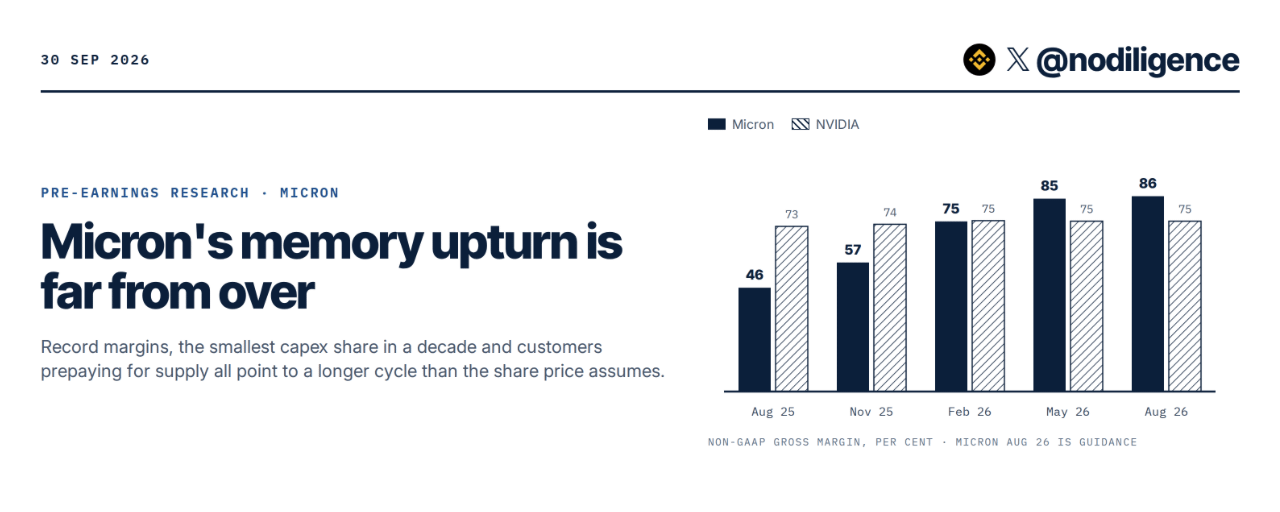
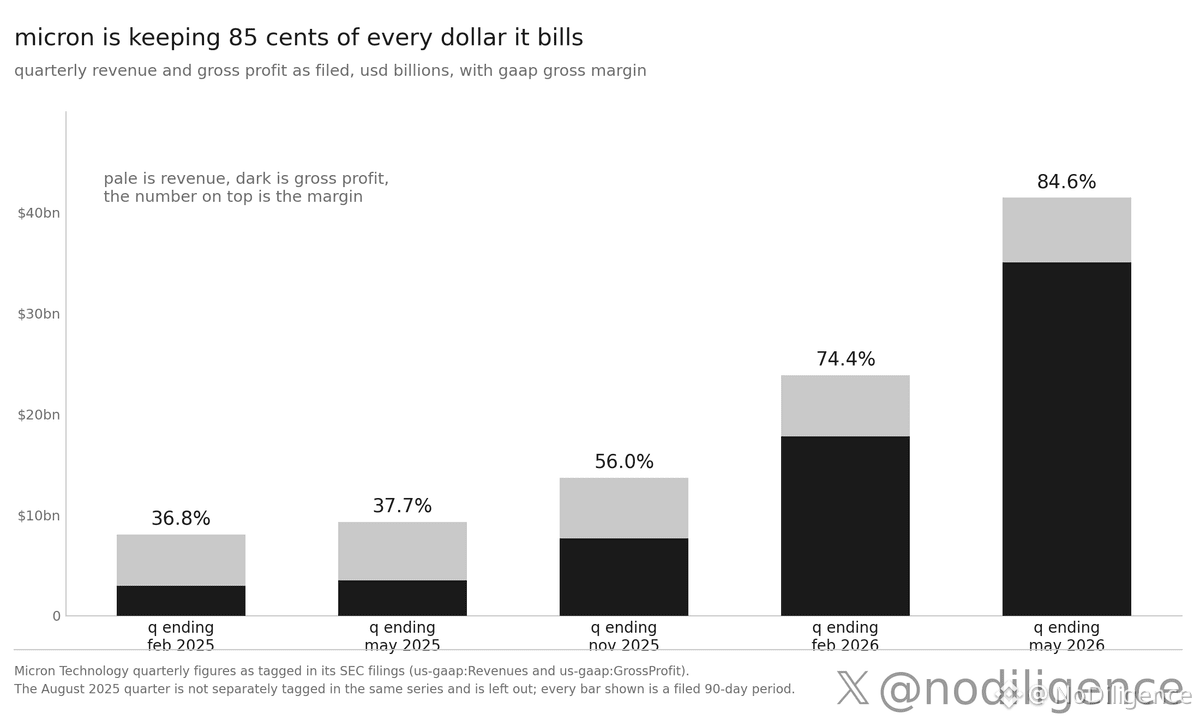
For most of this build, GPUs were the obvious bottleneck, and NVIDIA's mid-70s gross margin made that easy to see. Micron is now keeping more of each sales dollar than NVIDIA. Its non-GAAP gross margin was 84.9% in the quarter to May and it has guided about 86% for tonight, while NVIDIA made 75.0% in the quarter to July and has guided about 74% for the next one.
WSTS expects memory sales of more than $800bn in a $1.51tn chip market this year. That is more than half the whole semiconductor market. On my back-calculation, memory was about 29% of 2025's $792bn of chip sales. The profit pool has moved pretty hard toward memory as supply tightened.
Using the shares Micron discloses in its 10-Q filings, its largest customer, almost certainly NVIDIA, was about 17% of revenue in November and about 7% by May. That customer's spending grew about 30%. The rest of Micron's customers grew 3.4x over the same period, so the extra money is coming from cloud, PC and phone customers too.
Micron is building less than it could afford to
Memory cycles usually break after the industry gets rich and starts building too much. Micron spent 27% of its sales on capex at the 2018 peak, then raised spending to $9.1bn in fiscal 2019 while revenue fell 23%. For the next six years capex never fell below 32% of sales, and in the loss year of 2023 it was 45%.
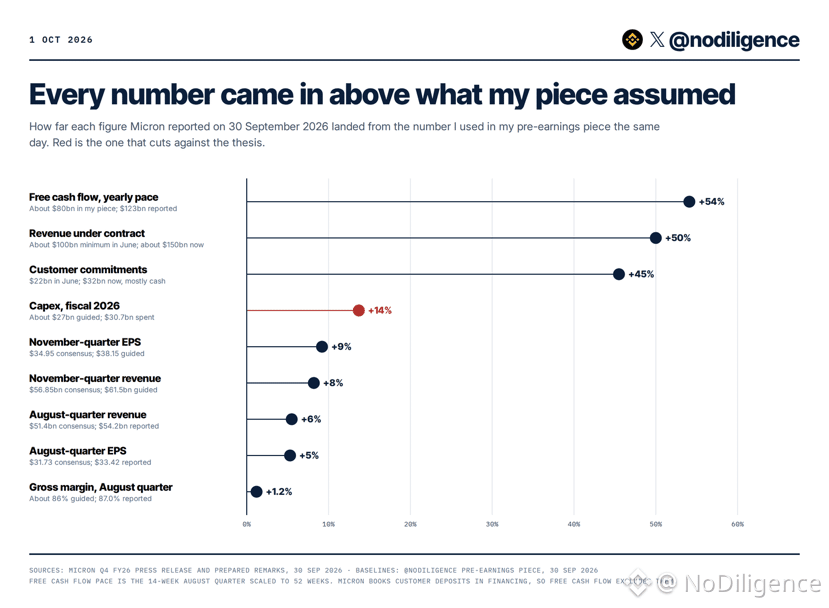
Micron guided about $27bn of capex for fiscal 2026, roughly 21% of about $130bn of revenue. Even if fiscal 2027 capex gets to the roughly $50bn the Street expects and sales never grow past the November quarter, capex is still only about 22% of revenue. The dollars are huge, but as a share of what Micron is earning this is still the least it has spent in a decade.
Cleanroom space is already limiting what the memory makers can add.
Samsung has said supply growth in 2026 and 2027 is limited by cleanroom space, SK hynix's next big fab starts running in mid-2027 and Samsung's in 2028, and HBM uses about three times the wafer area of DDR5 for the same capacity.
So even a lot of new wafer spending does not automatically turn into ordinary DRAM supply.
Customers are paying up front to lock in supply
In June Micron announced 16 multi-year agreements covering about 20% of its DRAM volume and a third of its NAND. They're take-or-pay with binding volumes. Customers are putting up about $22bn of deposits and commitments, around $18bn of it in cash, and that cash earns them nothing. At 5%, they are giving up about $900m a year of interest just to know the memory will be there. Micron's CEO has said customers want about 50% more supply than Micron can commit to.
The largest contracts cap prices near where the market was in April to June. Those customers prepaid against a ceiling that the market moved through almost immediately. TrendForce had contract prices about 15% above that level in the September quarter and is heading for about 30% above by December.
UBS carries that gap out much longer. It has the open-market price rising from $16.30 to $23.4 a gigabyte and staying above $20 until mid-2028, while the contract price sits at $10.50. On that model the shortage does not really clear for close to another two years.
Micron has also left roughly three quarters of its DRAM at market prices. In my model, taking contract coverage from 23% to 50% costs about $6.4 of yearly EPS at today's prices and about $15 if prices rise another 20%. It only helps if prices fall by more than about half. Management could have locked more volume and chose not to.
A bad year for Micron is now a profitable one
Micron lost $4.45 a share in fiscal 2023. The contracts make a repeat much harder. Management says floor pricing still gives margins well above any past peak, which was about 62%, and three different ways of backing into the floor, the margin language, the $100bn contract minimum and the covered volume, put it around half of today's price. That is roughly where the market was in February, when Micron earned $12.20 a share in the quarter.
On my numbers, that puts a bad year around $47 to $49 a share, close to six times the $8.29 Micron earned in fiscal 2025. The floor-priced contracts themselves only lock in about $11 of that. The take-or-pay volume does more work because 2023 was not just a pricing problem. Micron was carrying idle fabs and writing down inventory. Take-or-pay means fewer idle fabs if spot demand collapses.
HBM prices have to rise from here
HBM still carries the premium label, but Micron currently makes more money per wafer on ordinary DRAM. TrendForce said HBM3E used to sell for four to five times server DDR5 per bit, narrowing to one to two times by the end of 2026, while HBM still takes about three times the wafer area. Put those together and the revenue from an HBM wafer has gone from about 1.5x a DDR5 wafer to about 0.5x.
UBS has Micron at about 89% gross margin on ordinary DRAM in May and 65% on HBM. If that stays there, Micron has a pretty obvious reason to keep wafers in DDR5 until HBM pricing catches up.
TrendForce already expects HBM contract prices to rise sharply in 2027. HBM4 and HBM4E sit outside the price ceiling in Micron's agreements.
If HBM is roughly a $100bn market in 2027 and Micron keeps a little over a fifth of it, getting HBM back to parity with DDR5 per wafer adds something like $16 a share a year on my math. If fewer HBM stacks get used per chip instead, wafers go back into server DRAM just as TrendForce raised its fourth-quarter price outlook on cloud demand. Micron is currently making more margin there anyway.
Tonight's quarter has an extra week in it
Micron's fiscal 2026 has 53 weeks, and the extra one is in the August quarter. August has 14 weeks; May and November have 13. Consensus has August at about $51.4bn of revenue and $31.73 a share, then November at $56.85bn and $34.95. As reported, revenue growth looks like it slows from 24% to 11%. Divide by weeks and it goes from about 15% to about 19%. EPS per week goes from about 17% to about 19% too.
TrendForce had contract prices up 90% to 95% in the March quarter and 58% to 63% in June, then 13% to 18% in September, and it expects 10% to 15% for December. 10% or 15% sounds a lot smaller than ninety. It is also being applied to a price level about 3.6x where December started.
Options are pricing a move of about 8% either way. If the stock drops because the November guide only looks like 10% growth, I will check the per week number before I assess anything into it.
The cash goes back to shareholders from 9 December
Micron guided free cash flow above $30bn for August, up from $18.3bn in May, even with capex rising from $7.1bn to about $10bn. A lot of that jump is customer money arriving early. Sell-side estimates put about $10bn of deposits in the quarter, and the extra week helps too.
Even if I strip the deposits out, Micron is still running at something like $80bn a year of free cash flow, about 7% of its $1.22tn market value. Include them and it is closer to 10%. From 9 December the CHIPS Act buyback restriction expires, and management has said it'll return 100% of excess cash over time. UBS models $623bn of buybacks from fiscal 2027 to 2030. On its numbers, the share count falls by about a third and fiscal 2028 EPS gets about $31 higher.
From 9 December Micron can start buying stock back, and some of the cash behind that program is coming from customers paying early for memory.
What $1,065 pays for
At the 29 September close of $1,065, Micron is worth about $1.22tn and trades at under seven times fiscal 2027 consensus of $159 a share. Put 10x on that number and you get about $1,590, 49% above the close.
I would rather value a memory company on something close to mid-cycle earnings than on the best year. With a bad year around $48 a share and a good one around $140 to $159, I get a middle around $95 to $105. At 12 to 15 times that, the range is about $1,130 to $1,560 before I give any credit to buybacks.
The sell-side numbers are all over the place on fiscal 2028 EPS, from about $151 to $275 across four notes this month. The targets are much closer together, and all of them sit 31% to 53% above the 29 September close.
I'm focusing more on capex and Taiwan
If this breaks, capex is probably where I see it first. A return above about 30% of sales, which means well over $65bn on fiscal 2027 revenue, would start to look like the old cycle again. I would also get nervous if contract price increases fall into low single digits before HBM reprices, or if customers start trying to renegotiate the deposits.
Taiwan is the other one. Two unions at Taoyuan and Taichung represent about 10,000 of Micron's 15,000 staff there, where most of Micron's DRAM was made in 2025. They want 15% of operating profit paid out quarterly. Mediation broke down on 21 September and a strike vote is planned for early October. Samsung settled in May at 10.5% of its chip division's operating profit for ten years, and SK hynix pays 10%.
If Micron settles around the Korean numbers, I get roughly 10% off EPS, about $16 a share on fiscal 2027 consensus. Micron can absorb that. A strike is much worse because it would hit the fabs making most of its DRAM while the company is signing more take-or-pay volume with customers.
Tonight I'm reading the November guide per week, then the contracted revenue in the 10-K and how much of it is on new products, how much of the cash flow came from deposits, fiscal 2027 capex against the roughly $50bn expectation, and whatever management says about Taiwan.
#EarningsSeason
DISCLAIMER
I am doing this independently and sharing it as part of my own research and thinking. The views here are my own and are based on the information available to me at the time. This should not be treated as investment advice or a recommendation to buy, sell, or invest in anything mentioned. Please do your own research, my analysis is my own.
Micron is keeping more of every sales dollar than NVIDIA right now, while spending a smaller share of revenue on new capacity than it has at any point in the last decade. I’m bullish on Micron going into tonight. The stock is still under 7x next year’s expected earnings, which feels way too cheap if this memory cycle still has a while to run.
Memory has become the scarcest part of the AI buildout. Supply isn’t catching up quickly either. Micron is spending a smaller share of revenue on new fabs than it has at any point in the last decade, while customers have already handed over about $18bn in cash to lock in five years of supply. You don’t give a supplier that much free money for that long if you expect prices to collapse.
HBM is also still earning less per wafer than ordinary DRAM, so those prices probably still have to move higher. Then the buyback starts in December.
Even if this cycle eventually rolls over, my bad-year number is still around 6x what Micron earned in fiscal 2025. That’s why I don’t think the current multiple is pricing the business properly.
#EarningsSeason
Read my thesis below.
The money in AI has moved to memory
For most of this build, GPUs were the obvious bottleneck, and NVIDIA's mid-70s gross margin made that easy to see. Micron is now keeping more of each sales dollar than NVIDIA. Its non-GAAP gross margin was 84.9% in the quarter to May and it has guided about 86% for tonight, while NVIDIA made 75.0% in the quarter to July and has guided about 74% for the next one.
WSTS expects memory sales of more than $800bn in a $1.51tn chip market this year. That is more than half the whole semiconductor market. On my back-calculation, memory was about 29% of 2025's $792bn of chip sales. The profit pool has moved pretty hard toward memory as supply tightened.
Using the shares Micron discloses in its 10-Q filings, its largest customer, almost certainly NVIDIA, was about 17% of revenue in November and about 7% by May. That customer's spending grew about 30%. The rest of Micron's customers grew 3.4x over the same period, so the extra money is coming from cloud, PC and phone customers too.
Micron is building less than it could afford to
Memory cycles usually break after the industry gets rich and starts building too much. Micron spent 27% of its sales on capex at the 2018 peak, then raised spending to $9.1bn in fiscal 2019 while revenue fell 23%. For the next six years capex never fell below 32% of sales, and in the loss year of 2023 it was 45%.
Micron guided about $27bn of capex for fiscal 2026, roughly 21% of about $130bn of revenue. Even if fiscal 2027 capex gets to the roughly $50bn the Street expects and sales never grow past the November quarter, capex is still only about 22% of revenue. The dollars are huge, but as a share of what Micron is earning this is still the least it has spent in a decade.
Cleanroom space is already limiting what the memory makers can add.
Samsung has said supply growth in 2026 and 2027 is limited by cleanroom space, SK hynix's next big fab starts running in mid-2027 and Samsung's in 2028, and HBM uses about three times the wafer area of DDR5 for the same capacity.
So even a lot of new wafer spending does not automatically turn into ordinary DRAM supply.
Customers are paying up front to lock in supply
In June Micron announced 16 multi-year agreements covering about 20% of its DRAM volume and a third of its NAND. They're take-or-pay with binding volumes. Customers are putting up about $22bn of deposits and commitments, around $18bn of it in cash, and that cash earns them nothing. At 5%, they are giving up about $900m a year of interest just to know the memory will be there. Micron's CEO has said customers want about 50% more supply than Micron can commit to.
The largest contracts cap prices near where the market was in April to June. Those customers prepaid against a ceiling that the market moved through almost immediately. TrendForce had contract prices about 15% above that level in the September quarter and is heading for about 30% above by December.
UBS carries that gap out much longer. It has the open-market price rising from $16.30 to $23.4 a gigabyte and staying above $20 until mid-2028, while the contract price sits at $10.50. On that model the shortage does not really clear for close to another two years.
Micron has also left roughly three quarters of its DRAM at market prices. In my model, taking contract coverage from 23% to 50% costs about $6.4 of yearly EPS at today's prices and about $15 if prices rise another 20%. It only helps if prices fall by more than about half. Management could have locked more volume and chose not to.
A bad year for Micron is now a profitable one
Micron lost $4.45 a share in fiscal 2023. The contracts make a repeat much harder. Management says floor pricing still gives margins well above any past peak, which was about 62%, and three different ways of backing into the floor, the margin language, the $100bn contract minimum and the covered volume, put it around half of today's price. That is roughly where the market was in February, when Micron earned $12.20 a share in the quarter.
On my numbers, that puts a bad year around $47 to $49 a share, close to six times the $8.29 Micron earned in fiscal 2025. The floor-priced contracts themselves only lock in about $11 of that. The take-or-pay volume does more work because 2023 was not just a pricing problem. Micron was carrying idle fabs and writing down inventory. Take-or-pay means fewer idle fabs if spot demand collapses.
HBM prices have to rise from here
HBM still carries the premium label, but Micron currently makes more money per wafer on ordinary DRAM. TrendForce said HBM3E used to sell for four to five times server DDR5 per bit, narrowing to one to two times by the end of 2026, while HBM still takes about three times the wafer area. Put those together and the revenue from an HBM wafer has gone from about 1.5x a DDR5 wafer to about 0.5x.
UBS has Micron at about 89% gross margin on ordinary DRAM in May and 65% on HBM. If that stays there, Micron has a pretty obvious reason to keep wafers in DDR5 until HBM pricing catches up.
TrendForce already expects HBM contract prices to rise sharply in 2027. HBM4 and HBM4E sit outside the price ceiling in Micron's agreements.
If HBM is roughly a $100bn market in 2027 and Micron keeps a little over a fifth of it, getting HBM back to parity with DDR5 per wafer adds something like $16 a share a year on my math. If fewer HBM stacks get used per chip instead, wafers go back into server DRAM just as TrendForce raised its fourth-quarter price outlook on cloud demand. Micron is currently making more margin there anyway.
Tonight's quarter has an extra week in it
Micron's fiscal 2026 has 53 weeks, and the extra one is in the August quarter. August has 14 weeks; May and November have 13. Consensus has August at about $51.4bn of revenue and $31.73 a share, then November at $56.85bn and $34.95. As reported, revenue growth looks like it slows from 24% to 11%. Divide by weeks and it goes from about 15% to about 19%. EPS per week goes from about 17% to about 19% too.
TrendForce had contract prices up 90% to 95% in the March quarter and 58% to 63% in June, then 13% to 18% in September, and it expects 10% to 15% for December. 10% or 15% sounds a lot smaller than ninety. It is also being applied to a price level about 3.6x where December started.
Options are pricing a move of about 8% either way. If the stock drops because the November guide only looks like 10% growth, I will check the per week number before I assess anything into it.
The cash goes back to shareholders from 9 December
Micron guided free cash flow above $30bn for August, up from $18.3bn in May, even with capex rising from $7.1bn to about $10bn. A lot of that jump is customer money arriving early. Sell-side estimates put about $10bn of deposits in the quarter, and the extra week helps too.
Even if I strip the deposits out, Micron is still running at something like $80bn a year of free cash flow, about 7% of its $1.22tn market value. Include them and it is closer to 10%. From 9 December the CHIPS Act buyback restriction expires, and management has said it'll return 100% of excess cash over time. UBS models $623bn of buybacks from fiscal 2027 to 2030. On its numbers, the share count falls by about a third and fiscal 2028 EPS gets about $31 higher.
From 9 December Micron can start buying stock back, and some of the cash behind that program is coming from customers paying early for memory.
What $1,065 pays for
At the 29 September close of $1,065, Micron is worth about $1.22tn and trades at under seven times fiscal 2027 consensus of $159 a share. Put 10x on that number and you get about $1,590, 49% above the close.
I would rather value a memory company on something close to mid-cycle earnings than on the best year. With a bad year around $48 a share and a good one around $140 to $159, I get a middle around $95 to $105. At 12 to 15 times that, the range is about $1,130 to $1,560 before I give any credit to buybacks.
The sell-side numbers are all over the place on fiscal 2028 EPS, from about $151 to $275 across four notes this month. The targets are much closer together, and all of them sit 31% to 53% above the 29 September close.
I'm focusing more on capex and Taiwan
If this breaks, capex is probably where I see it first. A return above about 30% of sales, which means well over $65bn on fiscal 2027 revenue, would start to look like the old cycle again. I would also get nervous if contract price increases fall into low single digits before HBM reprices, or if customers start trying to renegotiate the deposits.
Taiwan is the other one. Two unions at Taoyuan and Taichung represent about 10,000 of Micron's 15,000 staff there, where most of Micron's DRAM was made in 2025. They want 15% of operating profit paid out quarterly. Mediation broke down on 21 September and a strike vote is planned for early October. Samsung settled in May at 10.5% of its chip division's operating profit for ten years, and SK hynix pays 10%.
If Micron settles around the Korean numbers, I get roughly 10% off EPS, about $16 a share on fiscal 2027 consensus. Micron can absorb that. A strike is much worse because it would hit the fabs making most of its DRAM while the company is signing more take-or-pay volume with customers.
Tonight I'm reading the November guide per week, then the contracted revenue in the 10-K and how much of it is on new products, how much of the cash flow came from deposits, fiscal 2027 capex against the roughly $50bn expectation, and whatever management says about Taiwan.
#EarningsSeason
DISCLAIMER
I am doing this independently and sharing it as part of my own research and thinking. The views here are my own and are based on the information available to me at the time. This should not be treated as investment advice or a recommendation to buy, sell, or invest in anything mentioned. Please do your own research, my analysis is my own.
Verified
NoDiligence
·
--
Micron's memory upturn is far from over
My Thesis
Micron is keeping more of every sales dollar than NVIDIA right now, while spending a smaller share of revenue on new capacity than it has at any point in the last decade. I’m bullish on Micron going into tonight. The stock is still under 7x next year’s expected earnings, which feels way too cheap if this memory cycle still has a while to run.
Memory has become the scarcest part of the AI buildout. Supply isn’t catching up quickly either. Micron is spending a smaller share of revenue on new fabs than it has at any point in the last decade, while customers have already handed over about $18bn in cash to lock in five years of supply. You don’t give a supplier that much free money for that long if you expect prices to collapse.
HBM is also still earning less per wafer than ordinary DRAM, so those prices probably still have to move higher. Then the buyback starts in December.
Even if this cycle eventually rolls over, my bad-year number is still around 6x what Micron earned in fiscal 2025. That’s why I don’t think the current multiple is pricing the business properly.
#EarningsSeason
Read my thesis below.
The money in AI has moved to memory
For most of this build, GPUs were the obvious bottleneck, and NVIDIA's mid-70s gross margin made that easy to see. Micron is now keeping more of each sales dollar than NVIDIA. Its non-GAAP gross margin was 84.9% in the quarter to May and it has guided about 86% for tonight, while NVIDIA made 75.0% in the quarter to July and has guided about 74% for the next one.
WSTS expects memory sales of more than $800bn in a $1.51tn chip market this year. That is more than half the whole semiconductor market. On my back-calculation, memory was about 29% of 2025's $792bn of chip sales. The profit pool has moved pretty hard toward memory as supply tightened.
Using the shares Micron discloses in its 10-Q filings, its largest customer, almost certainly NVIDIA, was about 17% of revenue in November and about 7% by May. That customer's spending grew about 30%. The rest of Micron's customers grew 3.4x over the same period, so the extra money is coming from cloud, PC and phone customers too.
Micron is building less than it could afford to
Memory cycles usually break after the industry gets rich and starts building too much. Micron spent 27% of its sales on capex at the 2018 peak, then raised spending to $9.1bn in fiscal 2019 while revenue fell 23%. For the next six years capex never fell below 32% of sales, and in the loss year of 2023 it was 45%.
Micron guided about $27bn of capex for fiscal 2026, roughly 21% of about $130bn of revenue. Even if fiscal 2027 capex gets to the roughly $50bn the Street expects and sales never grow past the November quarter, capex is still only about 22% of revenue. The dollars are huge, but as a share of what Micron is earning this is still the least it has spent in a decade.
Cleanroom space is already limiting what the memory makers can add.
Samsung has said supply growth in 2026 and 2027 is limited by cleanroom space, SK hynix's next big fab starts running in mid-2027 and Samsung's in 2028, and HBM uses about three times the wafer area of DDR5 for the same capacity.
So even a lot of new wafer spending does not automatically turn into ordinary DRAM supply.
Customers are paying up front to lock in supply
In June Micron announced 16 multi-year agreements covering about 20% of its DRAM volume and a third of its NAND. They're take-or-pay with binding volumes. Customers are putting up about $22bn of deposits and commitments, around $18bn of it in cash, and that cash earns them nothing. At 5%, they are giving up about $900m a year of interest just to know the memory will be there. Micron's CEO has said customers want about 50% more supply than Micron can commit to.
The largest contracts cap prices near where the market was in April to June. Those customers prepaid against a ceiling that the market moved through almost immediately. TrendForce had contract prices about 15% above that level in the September quarter and is heading for about 30% above by December.
UBS carries that gap out much longer. It has the open-market price rising from $16.30 to $23.4 a gigabyte and staying above $20 until mid-2028, while the contract price sits at $10.50. On that model the shortage does not really clear for close to another two years.
Micron has also left roughly three quarters of its DRAM at market prices. In my model, taking contract coverage from 23% to 50% costs about $6.4 of yearly EPS at today's prices and about $15 if prices rise another 20%. It only helps if prices fall by more than about half. Management could have locked more volume and chose not to.
A bad year for Micron is now a profitable one
Micron lost $4.45 a share in fiscal 2023. The contracts make a repeat much harder. Management says floor pricing still gives margins well above any past peak, which was about 62%, and three different ways of backing into the floor, the margin language, the $100bn contract minimum and the covered volume, put it around half of today's price. That is roughly where the market was in February, when Micron earned $12.20 a share in the quarter.
On my numbers, that puts a bad year around $47 to $49 a share, close to six times the $8.29 Micron earned in fiscal 2025. The floor-priced contracts themselves only lock in about $11 of that. The take-or-pay volume does more work because 2023 was not just a pricing problem. Micron was carrying idle fabs and writing down inventory. Take-or-pay means fewer idle fabs if spot demand collapses.
HBM prices have to rise from here
HBM still carries the premium label, but Micron currently makes more money per wafer on ordinary DRAM. TrendForce said HBM3E used to sell for four to five times server DDR5 per bit, narrowing to one to two times by the end of 2026, while HBM still takes about three times the wafer area. Put those together and the revenue from an HBM wafer has gone from about 1.5x a DDR5 wafer to about 0.5x.
UBS has Micron at about 89% gross margin on ordinary DRAM in May and 65% on HBM. If that stays there, Micron has a pretty obvious reason to keep wafers in DDR5 until HBM pricing catches up.
TrendForce already expects HBM contract prices to rise sharply in 2027. HBM4 and HBM4E sit outside the price ceiling in Micron's agreements.
If HBM is roughly a $100bn market in 2027 and Micron keeps a little over a fifth of it, getting HBM back to parity with DDR5 per wafer adds something like $16 a share a year on my math. If fewer HBM stacks get used per chip instead, wafers go back into server DRAM just as TrendForce raised its fourth-quarter price outlook on cloud demand. Micron is currently making more margin there anyway.
Tonight's quarter has an extra week in it
Micron's fiscal 2026 has 53 weeks, and the extra one is in the August quarter. August has 14 weeks; May and November have 13. Consensus has August at about $51.4bn of revenue and $31.73 a share, then November at $56.85bn and $34.95. As reported, revenue growth looks like it slows from 24% to 11%. Divide by weeks and it goes from about 15% to about 19%. EPS per week goes from about 17% to about 19% too.
TrendForce had contract prices up 90% to 95% in the March quarter and 58% to 63% in June, then 13% to 18% in September, and it expects 10% to 15% for December. 10% or 15% sounds a lot smaller than ninety. It is also being applied to a price level about 3.6x where December started.
Options are pricing a move of about 8% either way. If the stock drops because the November guide only looks like 10% growth, I will check the per week number before I assess anything into it.
The cash goes back to shareholders from 9 December
Micron guided free cash flow above $30bn for August, up from $18.3bn in May, even with capex rising from $7.1bn to about $10bn. A lot of that jump is customer money arriving early. Sell-side estimates put about $10bn of deposits in the quarter, and the extra week helps too.
Even if I strip the deposits out, Micron is still running at something like $80bn a year of free cash flow, about 7% of its $1.22tn market value. Include them and it is closer to 10%. From 9 December the CHIPS Act buyback restriction expires, and management has said it'll return 100% of excess cash over time. UBS models $623bn of buybacks from fiscal 2027 to 2030. On its numbers, the share count falls by about a third and fiscal 2028 EPS gets about $31 higher.
From 9 December Micron can start buying stock back, and some of the cash behind that program is coming from customers paying early for memory.
What $1,065 pays for
At the 29 September close of $1,065, Micron is worth about $1.22tn and trades at under seven times fiscal 2027 consensus of $159 a share. Put 10x on that number and you get about $1,590, 49% above the close.
I would rather value a memory company on something close to mid-cycle earnings than on the best year. With a bad year around $48 a share and a good one around $140 to $159, I get a middle around $95 to $105. At 12 to 15 times that, the range is about $1,130 to $1,560 before I give any credit to buybacks.
The sell-side numbers are all over the place on fiscal 2028 EPS, from about $151 to $275 across four notes this month. The targets are much closer together, and all of them sit 31% to 53% above the 29 September close.
I'm focusing more on capex and Taiwan
If this breaks, capex is probably where I see it first. A return above about 30% of sales, which means well over $65bn on fiscal 2027 revenue, would start to look like the old cycle again. I would also get nervous if contract price increases fall into low single digits before HBM reprices, or if customers start trying to renegotiate the deposits.
Taiwan is the other one. Two unions at Taoyuan and Taichung represent about 10,000 of Micron's 15,000 staff there, where most of Micron's DRAM was made in 2025. They want 15% of operating profit paid out quarterly. Mediation broke down on 21 September and a strike vote is planned for early October. Samsung settled in May at 10.5% of its chip division's operating profit for ten years, and SK hynix pays 10%.
If Micron settles around the Korean numbers, I get roughly 10% off EPS, about $16 a share on fiscal 2027 consensus. Micron can absorb that. A strike is much worse because it would hit the fabs making most of its DRAM while the company is signing more take-or-pay volume with customers.
Tonight I'm reading the November guide per week, then the contracted revenue in the 10-K and how much of it is on new products, how much of the cash flow came from deposits, fiscal 2027 capex against the roughly $50bn expectation, and whatever management says about Taiwan.
#EarningsSeason
DISCLAIMER
I am doing this independently and sharing it as part of my own research and thinking. The views here are my own and are based on the information available to me at the time. This should not be treated as investment advice or a recommendation to buy, sell, or invest in anything mentioned. Please do your own research, my analysis is my own.
Micron is keeping more of every sales dollar than NVIDIA right now, while spending a smaller share of revenue on new capacity than it has at any point in the last decade. I’m bullish on Micron going into tonight. The stock is still under 7x next year’s expected earnings, which feels way too cheap if this memory cycle still has a while to run.
Memory has become the scarcest part of the AI buildout. Supply isn’t catching up quickly either. Micron is spending a smaller share of revenue on new fabs than it has at any point in the last decade, while customers have already handed over about $18bn in cash to lock in five years of supply. You don’t give a supplier that much free money for that long if you expect prices to collapse.
HBM is also still earning less per wafer than ordinary DRAM, so those prices probably still have to move higher. Then the buyback starts in December.
Even if this cycle eventually rolls over, my bad-year number is still around 6x what Micron earned in fiscal 2025. That’s why I don’t think the current multiple is pricing the business properly.
#EarningsSeason
Read my thesis below.
The money in AI has moved to memory
For most of this build, GPUs were the obvious bottleneck, and NVIDIA's mid-70s gross margin made that easy to see. Micron is now keeping more of each sales dollar than NVIDIA. Its non-GAAP gross margin was 84.9% in the quarter to May and it has guided about 86% for tonight, while NVIDIA made 75.0% in the quarter to July and has guided about 74% for the next one.
WSTS expects memory sales of more than $800bn in a $1.51tn chip market this year. That is more than half the whole semiconductor market. On my back-calculation, memory was about 29% of 2025's $792bn of chip sales. The profit pool has moved pretty hard toward memory as supply tightened.
Using the shares Micron discloses in its 10-Q filings, its largest customer, almost certainly NVIDIA, was about 17% of revenue in November and about 7% by May. That customer's spending grew about 30%. The rest of Micron's customers grew 3.4x over the same period, so the extra money is coming from cloud, PC and phone customers too.
Micron is building less than it could afford to
Memory cycles usually break after the industry gets rich and starts building too much. Micron spent 27% of its sales on capex at the 2018 peak, then raised spending to $9.1bn in fiscal 2019 while revenue fell 23%. For the next six years capex never fell below 32% of sales, and in the loss year of 2023 it was 45%.
Micron guided about $27bn of capex for fiscal 2026, roughly 21% of about $130bn of revenue. Even if fiscal 2027 capex gets to the roughly $50bn the Street expects and sales never grow past the November quarter, capex is still only about 22% of revenue. The dollars are huge, but as a share of what Micron is earning this is still the least it has spent in a decade.
Cleanroom space is already limiting what the memory makers can add.
Samsung has said supply growth in 2026 and 2027 is limited by cleanroom space, SK hynix's next big fab starts running in mid-2027 and Samsung's in 2028, and HBM uses about three times the wafer area of DDR5 for the same capacity.
So even a lot of new wafer spending does not automatically turn into ordinary DRAM supply.
Customers are paying up front to lock in supply
In June Micron announced 16 multi-year agreements covering about 20% of its DRAM volume and a third of its NAND. They're take-or-pay with binding volumes. Customers are putting up about $22bn of deposits and commitments, around $18bn of it in cash, and that cash earns them nothing. At 5%, they are giving up about $900m a year of interest just to know the memory will be there. Micron's CEO has said customers want about 50% more supply than Micron can commit to.
The largest contracts cap prices near where the market was in April to June. Those customers prepaid against a ceiling that the market moved through almost immediately. TrendForce had contract prices about 15% above that level in the September quarter and is heading for about 30% above by December.
UBS carries that gap out much longer. It has the open-market price rising from $16.30 to $23.4 a gigabyte and staying above $20 until mid-2028, while the contract price sits at $10.50. On that model the shortage does not really clear for close to another two years.
Micron has also left roughly three quarters of its DRAM at market prices. In my model, taking contract coverage from 23% to 50% costs about $6.4 of yearly EPS at today's prices and about $15 if prices rise another 20%. It only helps if prices fall by more than about half. Management could have locked more volume and chose not to.
A bad year for Micron is now a profitable one
Micron lost $4.45 a share in fiscal 2023. The contracts make a repeat much harder. Management says floor pricing still gives margins well above any past peak, which was about 62%, and three different ways of backing into the floor, the margin language, the $100bn contract minimum and the covered volume, put it around half of today's price. That is roughly where the market was in February, when Micron earned $12.20 a share in the quarter.
On my numbers, that puts a bad year around $47 to $49 a share, close to six times the $8.29 Micron earned in fiscal 2025. The floor-priced contracts themselves only lock in about $11 of that. The take-or-pay volume does more work because 2023 was not just a pricing problem. Micron was carrying idle fabs and writing down inventory. Take-or-pay means fewer idle fabs if spot demand collapses.
HBM prices have to rise from here
HBM still carries the premium label, but Micron currently makes more money per wafer on ordinary DRAM. TrendForce said HBM3E used to sell for four to five times server DDR5 per bit, narrowing to one to two times by the end of 2026, while HBM still takes about three times the wafer area. Put those together and the revenue from an HBM wafer has gone from about 1.5x a DDR5 wafer to about 0.5x.
UBS has Micron at about 89% gross margin on ordinary DRAM in May and 65% on HBM. If that stays there, Micron has a pretty obvious reason to keep wafers in DDR5 until HBM pricing catches up.
TrendForce already expects HBM contract prices to rise sharply in 2027. HBM4 and HBM4E sit outside the price ceiling in Micron's agreements.
If HBM is roughly a $100bn market in 2027 and Micron keeps a little over a fifth of it, getting HBM back to parity with DDR5 per wafer adds something like $16 a share a year on my math. If fewer HBM stacks get used per chip instead, wafers go back into server DRAM just as TrendForce raised its fourth-quarter price outlook on cloud demand. Micron is currently making more margin there anyway.
Tonight's quarter has an extra week in it
Micron's fiscal 2026 has 53 weeks, and the extra one is in the August quarter. August has 14 weeks; May and November have 13. Consensus has August at about $51.4bn of revenue and $31.73 a share, then November at $56.85bn and $34.95. As reported, revenue growth looks like it slows from 24% to 11%. Divide by weeks and it goes from about 15% to about 19%. EPS per week goes from about 17% to about 19% too.
TrendForce had contract prices up 90% to 95% in the March quarter and 58% to 63% in June, then 13% to 18% in September, and it expects 10% to 15% for December. 10% or 15% sounds a lot smaller than ninety. It is also being applied to a price level about 3.6x where December started.
Options are pricing a move of about 8% either way. If the stock drops because the November guide only looks like 10% growth, I will check the per week number before I assess anything into it.
The cash goes back to shareholders from 9 December
Micron guided free cash flow above $30bn for August, up from $18.3bn in May, even with capex rising from $7.1bn to about $10bn. A lot of that jump is customer money arriving early. Sell-side estimates put about $10bn of deposits in the quarter, and the extra week helps too.
Even if I strip the deposits out, Micron is still running at something like $80bn a year of free cash flow, about 7% of its $1.22tn market value. Include them and it is closer to 10%. From 9 December the CHIPS Act buyback restriction expires, and management has said it'll return 100% of excess cash over time. UBS models $623bn of buybacks from fiscal 2027 to 2030. On its numbers, the share count falls by about a third and fiscal 2028 EPS gets about $31 higher.
From 9 December Micron can start buying stock back, and some of the cash behind that program is coming from customers paying early for memory.
What $1,065 pays for
At the 29 September close of $1,065, Micron is worth about $1.22tn and trades at under seven times fiscal 2027 consensus of $159 a share. Put 10x on that number and you get about $1,590, 49% above the close.
I would rather value a memory company on something close to mid-cycle earnings than on the best year. With a bad year around $48 a share and a good one around $140 to $159, I get a middle around $95 to $105. At 12 to 15 times that, the range is about $1,130 to $1,560 before I give any credit to buybacks.
The sell-side numbers are all over the place on fiscal 2028 EPS, from about $151 to $275 across four notes this month. The targets are much closer together, and all of them sit 31% to 53% above the 29 September close.
I'm focusing more on capex and Taiwan
If this breaks, capex is probably where I see it first. A return above about 30% of sales, which means well over $65bn on fiscal 2027 revenue, would start to look like the old cycle again. I would also get nervous if contract price increases fall into low single digits before HBM reprices, or if customers start trying to renegotiate the deposits.
Taiwan is the other one. Two unions at Taoyuan and Taichung represent about 10,000 of Micron's 15,000 staff there, where most of Micron's DRAM was made in 2025. They want 15% of operating profit paid out quarterly. Mediation broke down on 21 September and a strike vote is planned for early October. Samsung settled in May at 10.5% of its chip division's operating profit for ten years, and SK hynix pays 10%.
If Micron settles around the Korean numbers, I get roughly 10% off EPS, about $16 a share on fiscal 2027 consensus. Micron can absorb that. A strike is much worse because it would hit the fabs making most of its DRAM while the company is signing more take-or-pay volume with customers.
Tonight I'm reading the November guide per week, then the contracted revenue in the 10-K and how much of it is on new products, how much of the cash flow came from deposits, fiscal 2027 capex against the roughly $50bn expectation, and whatever management says about Taiwan.
#EarningsSeason
DISCLAIMER
I am doing this independently and sharing it as part of my own research and thinking. The views here are my own and are based on the information available to me at the time. This should not be treated as investment advice or a recommendation to buy, sell, or invest in anything mentioned. Please do your own research, my analysis is my own.
Partly True
NoDiligence
·
--
Micron's memory upturn is far from over
My Thesis
Micron is keeping more of every sales dollar than NVIDIA right now, while spending a smaller share of revenue on new capacity than it has at any point in the last decade. I’m bullish on Micron going into tonight. The stock is still under 7x next year’s expected earnings, which feels way too cheap if this memory cycle still has a while to run.
Memory has become the scarcest part of the AI buildout. Supply isn’t catching up quickly either. Micron is spending a smaller share of revenue on new fabs than it has at any point in the last decade, while customers have already handed over about $18bn in cash to lock in five years of supply. You don’t give a supplier that much free money for that long if you expect prices to collapse.
HBM is also still earning less per wafer than ordinary DRAM, so those prices probably still have to move higher. Then the buyback starts in December.
Even if this cycle eventually rolls over, my bad-year number is still around 6x what Micron earned in fiscal 2025. That’s why I don’t think the current multiple is pricing the business properly.
#EarningsSeason
Read my thesis below.
The money in AI has moved to memory
For most of this build, GPUs were the obvious bottleneck, and NVIDIA's mid-70s gross margin made that easy to see. Micron is now keeping more of each sales dollar than NVIDIA. Its non-GAAP gross margin was 84.9% in the quarter to May and it has guided about 86% for tonight, while NVIDIA made 75.0% in the quarter to July and has guided about 74% for the next one.
WSTS expects memory sales of more than $800bn in a $1.51tn chip market this year. That is more than half the whole semiconductor market. On my back-calculation, memory was about 29% of 2025's $792bn of chip sales. The profit pool has moved pretty hard toward memory as supply tightened.
Using the shares Micron discloses in its 10-Q filings, its largest customer, almost certainly NVIDIA, was about 17% of revenue in November and about 7% by May. That customer's spending grew about 30%. The rest of Micron's customers grew 3.4x over the same period, so the extra money is coming from cloud, PC and phone customers too.
Micron is building less than it could afford to
Memory cycles usually break after the industry gets rich and starts building too much. Micron spent 27% of its sales on capex at the 2018 peak, then raised spending to $9.1bn in fiscal 2019 while revenue fell 23%. For the next six years capex never fell below 32% of sales, and in the loss year of 2023 it was 45%.
Micron guided about $27bn of capex for fiscal 2026, roughly 21% of about $130bn of revenue. Even if fiscal 2027 capex gets to the roughly $50bn the Street expects and sales never grow past the November quarter, capex is still only about 22% of revenue. The dollars are huge, but as a share of what Micron is earning this is still the least it has spent in a decade.
Cleanroom space is already limiting what the memory makers can add.
Samsung has said supply growth in 2026 and 2027 is limited by cleanroom space, SK hynix's next big fab starts running in mid-2027 and Samsung's in 2028, and HBM uses about three times the wafer area of DDR5 for the same capacity.
So even a lot of new wafer spending does not automatically turn into ordinary DRAM supply.
Customers are paying up front to lock in supply
In June Micron announced 16 multi-year agreements covering about 20% of its DRAM volume and a third of its NAND. They're take-or-pay with binding volumes. Customers are putting up about $22bn of deposits and commitments, around $18bn of it in cash, and that cash earns them nothing. At 5%, they are giving up about $900m a year of interest just to know the memory will be there. Micron's CEO has said customers want about 50% more supply than Micron can commit to.
The largest contracts cap prices near where the market was in April to June. Those customers prepaid against a ceiling that the market moved through almost immediately. TrendForce had contract prices about 15% above that level in the September quarter and is heading for about 30% above by December.
UBS carries that gap out much longer. It has the open-market price rising from $16.30 to $23.4 a gigabyte and staying above $20 until mid-2028, while the contract price sits at $10.50. On that model the shortage does not really clear for close to another two years.
Micron has also left roughly three quarters of its DRAM at market prices. In my model, taking contract coverage from 23% to 50% costs about $6.4 of yearly EPS at today's prices and about $15 if prices rise another 20%. It only helps if prices fall by more than about half. Management could have locked more volume and chose not to.
A bad year for Micron is now a profitable one
Micron lost $4.45 a share in fiscal 2023. The contracts make a repeat much harder. Management says floor pricing still gives margins well above any past peak, which was about 62%, and three different ways of backing into the floor, the margin language, the $100bn contract minimum and the covered volume, put it around half of today's price. That is roughly where the market was in February, when Micron earned $12.20 a share in the quarter.
On my numbers, that puts a bad year around $47 to $49 a share, close to six times the $8.29 Micron earned in fiscal 2025. The floor-priced contracts themselves only lock in about $11 of that. The take-or-pay volume does more work because 2023 was not just a pricing problem. Micron was carrying idle fabs and writing down inventory. Take-or-pay means fewer idle fabs if spot demand collapses.
HBM prices have to rise from here
HBM still carries the premium label, but Micron currently makes more money per wafer on ordinary DRAM. TrendForce said HBM3E used to sell for four to five times server DDR5 per bit, narrowing to one to two times by the end of 2026, while HBM still takes about three times the wafer area. Put those together and the revenue from an HBM wafer has gone from about 1.5x a DDR5 wafer to about 0.5x.
UBS has Micron at about 89% gross margin on ordinary DRAM in May and 65% on HBM. If that stays there, Micron has a pretty obvious reason to keep wafers in DDR5 until HBM pricing catches up.
TrendForce already expects HBM contract prices to rise sharply in 2027. HBM4 and HBM4E sit outside the price ceiling in Micron's agreements.
If HBM is roughly a $100bn market in 2027 and Micron keeps a little over a fifth of it, getting HBM back to parity with DDR5 per wafer adds something like $16 a share a year on my math. If fewer HBM stacks get used per chip instead, wafers go back into server DRAM just as TrendForce raised its fourth-quarter price outlook on cloud demand. Micron is currently making more margin there anyway.
Tonight's quarter has an extra week in it
Micron's fiscal 2026 has 53 weeks, and the extra one is in the August quarter. August has 14 weeks; May and November have 13. Consensus has August at about $51.4bn of revenue and $31.73 a share, then November at $56.85bn and $34.95. As reported, revenue growth looks like it slows from 24% to 11%. Divide by weeks and it goes from about 15% to about 19%. EPS per week goes from about 17% to about 19% too.
TrendForce had contract prices up 90% to 95% in the March quarter and 58% to 63% in June, then 13% to 18% in September, and it expects 10% to 15% for December. 10% or 15% sounds a lot smaller than ninety. It is also being applied to a price level about 3.6x where December started.
Options are pricing a move of about 8% either way. If the stock drops because the November guide only looks like 10% growth, I will check the per week number before I assess anything into it.
The cash goes back to shareholders from 9 December
Micron guided free cash flow above $30bn for August, up from $18.3bn in May, even with capex rising from $7.1bn to about $10bn. A lot of that jump is customer money arriving early. Sell-side estimates put about $10bn of deposits in the quarter, and the extra week helps too.
Even if I strip the deposits out, Micron is still running at something like $80bn a year of free cash flow, about 7% of its $1.22tn market value. Include them and it is closer to 10%. From 9 December the CHIPS Act buyback restriction expires, and management has said it'll return 100% of excess cash over time. UBS models $623bn of buybacks from fiscal 2027 to 2030. On its numbers, the share count falls by about a third and fiscal 2028 EPS gets about $31 higher.
From 9 December Micron can start buying stock back, and some of the cash behind that program is coming from customers paying early for memory.
What $1,065 pays for
At the 29 September close of $1,065, Micron is worth about $1.22tn and trades at under seven times fiscal 2027 consensus of $159 a share. Put 10x on that number and you get about $1,590, 49% above the close.
I would rather value a memory company on something close to mid-cycle earnings than on the best year. With a bad year around $48 a share and a good one around $140 to $159, I get a middle around $95 to $105. At 12 to 15 times that, the range is about $1,130 to $1,560 before I give any credit to buybacks.
The sell-side numbers are all over the place on fiscal 2028 EPS, from about $151 to $275 across four notes this month. The targets are much closer together, and all of them sit 31% to 53% above the 29 September close.
I'm focusing more on capex and Taiwan
If this breaks, capex is probably where I see it first. A return above about 30% of sales, which means well over $65bn on fiscal 2027 revenue, would start to look like the old cycle again. I would also get nervous if contract price increases fall into low single digits before HBM reprices, or if customers start trying to renegotiate the deposits.
Taiwan is the other one. Two unions at Taoyuan and Taichung represent about 10,000 of Micron's 15,000 staff there, where most of Micron's DRAM was made in 2025. They want 15% of operating profit paid out quarterly. Mediation broke down on 21 September and a strike vote is planned for early October. Samsung settled in May at 10.5% of its chip division's operating profit for ten years, and SK hynix pays 10%.
If Micron settles around the Korean numbers, I get roughly 10% off EPS, about $16 a share on fiscal 2027 consensus. Micron can absorb that. A strike is much worse because it would hit the fabs making most of its DRAM while the company is signing more take-or-pay volume with customers.
Tonight I'm reading the November guide per week, then the contracted revenue in the 10-K and how much of it is on new products, how much of the cash flow came from deposits, fiscal 2027 capex against the roughly $50bn expectation, and whatever management says about Taiwan.
#EarningsSeason
DISCLAIMER
I am doing this independently and sharing it as part of my own research and thinking. The views here are my own and are based on the information available to me at the time. This should not be treated as investment advice or a recommendation to buy, sell, or invest in anything mentioned. Please do your own research, my analysis is my own.
Micron is keeping more of every sales dollar than NVIDIA right now, while spending a smaller share of revenue on new capacity than it has at any point in the last decade. I’m bullish on Micron going into tonight. The stock is still under 7x next year’s expected earnings, which feels way too cheap if this memory cycle still has a while to run.
Memory has become the scarcest part of the AI buildout. Supply isn’t catching up quickly either. Micron is spending a smaller share of revenue on new fabs than it has at any point in the last decade, while customers have already handed over about $18bn in cash to lock in five years of supply. You don’t give a supplier that much free money for that long if you expect prices to collapse.
HBM is also still earning less per wafer than ordinary DRAM, so those prices probably still have to move higher. Then the buyback starts in December.
Even if this cycle eventually rolls over, my bad-year number is still around 6x what Micron earned in fiscal 2025. That’s why I don’t think the current multiple is pricing the business properly.
#EarningsSeason
Read my thesis below.
The money in AI has moved to memory
For most of this build, GPUs were the obvious bottleneck, and NVIDIA's mid-70s gross margin made that easy to see. Micron is now keeping more of each sales dollar than NVIDIA. Its non-GAAP gross margin was 84.9% in the quarter to May and it has guided about 86% for tonight, while NVIDIA made 75.0% in the quarter to July and has guided about 74% for the next one.
WSTS expects memory sales of more than $800bn in a $1.51tn chip market this year. That is more than half the whole semiconductor market. On my back-calculation, memory was about 29% of 2025's $792bn of chip sales. The profit pool has moved pretty hard toward memory as supply tightened.
Using the shares Micron discloses in its 10-Q filings, its largest customer, almost certainly NVIDIA, was about 17% of revenue in November and about 7% by May. That customer's spending grew about 30%. The rest of Micron's customers grew 3.4x over the same period, so the extra money is coming from cloud, PC and phone customers too.
Micron is building less than it could afford to
Memory cycles usually break after the industry gets rich and starts building too much. Micron spent 27% of its sales on capex at the 2018 peak, then raised spending to $9.1bn in fiscal 2019 while revenue fell 23%. For the next six years capex never fell below 32% of sales, and in the loss year of 2023 it was 45%.
Micron guided about $27bn of capex for fiscal 2026, roughly 21% of about $130bn of revenue. Even if fiscal 2027 capex gets to the roughly $50bn the Street expects and sales never grow past the November quarter, capex is still only about 22% of revenue. The dollars are huge, but as a share of what Micron is earning this is still the least it has spent in a decade.
Cleanroom space is already limiting what the memory makers can add.
Samsung has said supply growth in 2026 and 2027 is limited by cleanroom space, SK hynix's next big fab starts running in mid-2027 and Samsung's in 2028, and HBM uses about three times the wafer area of DDR5 for the same capacity.
So even a lot of new wafer spending does not automatically turn into ordinary DRAM supply.
Customers are paying up front to lock in supply
In June Micron announced 16 multi-year agreements covering about 20% of its DRAM volume and a third of its NAND. They're take-or-pay with binding volumes. Customers are putting up about $22bn of deposits and commitments, around $18bn of it in cash, and that cash earns them nothing. At 5%, they are giving up about $900m a year of interest just to know the memory will be there. Micron's CEO has said customers want about 50% more supply than Micron can commit to.
The largest contracts cap prices near where the market was in April to June. Those customers prepaid against a ceiling that the market moved through almost immediately. TrendForce had contract prices about 15% above that level in the September quarter and is heading for about 30% above by December.
UBS carries that gap out much longer. It has the open-market price rising from $16.30 to $23.4 a gigabyte and staying above $20 until mid-2028, while the contract price sits at $10.50. On that model the shortage does not really clear for close to another two years.
Micron has also left roughly three quarters of its DRAM at market prices. In my model, taking contract coverage from 23% to 50% costs about $6.4 of yearly EPS at today's prices and about $15 if prices rise another 20%. It only helps if prices fall by more than about half. Management could have locked more volume and chose not to.
A bad year for Micron is now a profitable one
Micron lost $4.45 a share in fiscal 2023. The contracts make a repeat much harder. Management says floor pricing still gives margins well above any past peak, which was about 62%, and three different ways of backing into the floor, the margin language, the $100bn contract minimum and the covered volume, put it around half of today's price. That is roughly where the market was in February, when Micron earned $12.20 a share in the quarter.
On my numbers, that puts a bad year around $47 to $49 a share, close to six times the $8.29 Micron earned in fiscal 2025. The floor-priced contracts themselves only lock in about $11 of that. The take-or-pay volume does more work because 2023 was not just a pricing problem. Micron was carrying idle fabs and writing down inventory. Take-or-pay means fewer idle fabs if spot demand collapses.
HBM prices have to rise from here
HBM still carries the premium label, but Micron currently makes more money per wafer on ordinary DRAM. TrendForce said HBM3E used to sell for four to five times server DDR5 per bit, narrowing to one to two times by the end of 2026, while HBM still takes about three times the wafer area. Put those together and the revenue from an HBM wafer has gone from about 1.5x a DDR5 wafer to about 0.5x.
UBS has Micron at about 89% gross margin on ordinary DRAM in May and 65% on HBM. If that stays there, Micron has a pretty obvious reason to keep wafers in DDR5 until HBM pricing catches up.
TrendForce already expects HBM contract prices to rise sharply in 2027. HBM4 and HBM4E sit outside the price ceiling in Micron's agreements.
If HBM is roughly a $100bn market in 2027 and Micron keeps a little over a fifth of it, getting HBM back to parity with DDR5 per wafer adds something like $16 a share a year on my math. If fewer HBM stacks get used per chip instead, wafers go back into server DRAM just as TrendForce raised its fourth-quarter price outlook on cloud demand. Micron is currently making more margin there anyway.
Tonight's quarter has an extra week in it
Micron's fiscal 2026 has 53 weeks, and the extra one is in the August quarter. August has 14 weeks; May and November have 13. Consensus has August at about $51.4bn of revenue and $31.73 a share, then November at $56.85bn and $34.95. As reported, revenue growth looks like it slows from 24% to 11%. Divide by weeks and it goes from about 15% to about 19%. EPS per week goes from about 17% to about 19% too.
TrendForce had contract prices up 90% to 95% in the March quarter and 58% to 63% in June, then 13% to 18% in September, and it expects 10% to 15% for December. 10% or 15% sounds a lot smaller than ninety. It is also being applied to a price level about 3.6x where December started.
Options are pricing a move of about 8% either way. If the stock drops because the November guide only looks like 10% growth, I will check the per week number before I assess anything into it.
The cash goes back to shareholders from 9 December
Micron guided free cash flow above $30bn for August, up from $18.3bn in May, even with capex rising from $7.1bn to about $10bn. A lot of that jump is customer money arriving early. Sell-side estimates put about $10bn of deposits in the quarter, and the extra week helps too.
Even if I strip the deposits out, Micron is still running at something like $80bn a year of free cash flow, about 7% of its $1.22tn market value. Include them and it is closer to 10%. From 9 December the CHIPS Act buyback restriction expires, and management has said it'll return 100% of excess cash over time. UBS models $623bn of buybacks from fiscal 2027 to 2030. On its numbers, the share count falls by about a third and fiscal 2028 EPS gets about $31 higher.
From 9 December Micron can start buying stock back, and some of the cash behind that program is coming from customers paying early for memory.
What $1,065 pays for
At the 29 September close of $1,065, Micron is worth about $1.22tn and trades at under seven times fiscal 2027 consensus of $159 a share. Put 10x on that number and you get about $1,590, 49% above the close.
I would rather value a memory company on something close to mid-cycle earnings than on the best year. With a bad year around $48 a share and a good one around $140 to $159, I get a middle around $95 to $105. At 12 to 15 times that, the range is about $1,130 to $1,560 before I give any credit to buybacks.
The sell-side numbers are all over the place on fiscal 2028 EPS, from about $151 to $275 across four notes this month. The targets are much closer together, and all of them sit 31% to 53% above the 29 September close.
I'm focusing more on capex and Taiwan
If this breaks, capex is probably where I see it first. A return above about 30% of sales, which means well over $65bn on fiscal 2027 revenue, would start to look like the old cycle again. I would also get nervous if contract price increases fall into low single digits before HBM reprices, or if customers start trying to renegotiate the deposits.
Taiwan is the other one. Two unions at Taoyuan and Taichung represent about 10,000 of Micron's 15,000 staff there, where most of Micron's DRAM was made in 2025. They want 15% of operating profit paid out quarterly. Mediation broke down on 21 September and a strike vote is planned for early October. Samsung settled in May at 10.5% of its chip division's operating profit for ten years, and SK hynix pays 10%.
If Micron settles around the Korean numbers, I get roughly 10% off EPS, about $16 a share on fiscal 2027 consensus. Micron can absorb that. A strike is much worse because it would hit the fabs making most of its DRAM while the company is signing more take-or-pay volume with customers.
Tonight I'm reading the November guide per week, then the contracted revenue in the 10-K and how much of it is on new products, how much of the cash flow came from deposits, fiscal 2027 capex against the roughly $50bn expectation, and whatever management says about Taiwan.
#EarningsSeason
DISCLAIMER
I am doing this independently and sharing it as part of my own research and thinking. The views here are my own and are based on the information available to me at the time. This should not be treated as investment advice or a recommendation to buy, sell, or invest in anything mentioned. Please do your own research, my analysis is my own.
NoDiligence
·
--
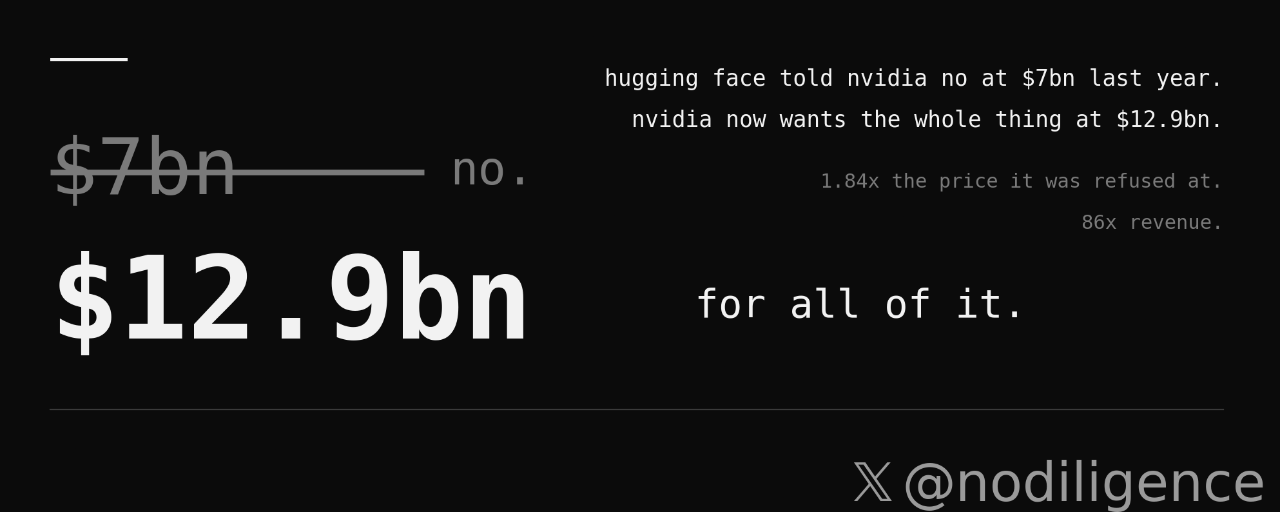
hugging face told nvidia no at $7bn last year. nvidia now wants the whole thing at $12.9bn.
NVIDIA went into the 2023 round with google, amazon, amd, intel, qualcomm, ibm and salesforce.
since then it put train on dgx cloud on the site, then its nim inference containers, then training cluster as a service on top of the lepton marketplace it bought in april 2025.
by mid 2025 nvidia owned the compute under hugging face and the containers on it. it didn't own hugging face.
hugging face is doing about $150m a year now, so at $12.9bn nvidia is paying 86x revenue.
-- the 2023 round was 129x revenue when the estimates were ~$35m for that year.
-- if they were near $100m when they said no, nvidia offered 70x revenue for a minority stake and is now paying 86x for the whole company.
-- so it's paying 23% more per dollar to own it outright than it offered for a stake with no say.
i don't think anyone else was bidding.
hugging face runs a router called inference providers.
-- every request goes to one of 18 partners, and by default it goes to whoever is fastest, meaning most tokens per second.
-- cerebras, groq and sambanova are on that list and none of them run nvidia chips, so when one of them is fastest for a model, that's where the request goes.
-- hugging face also writes optimum-amd and optimum-neuron, so the same models run on amd and trainium without cuda, and amd and amazon are on the cap table.
-- hugging face calls that zero vendor lock-in, and a $500m minority holder (what nvidia offered in late 2025) can't change a routing default.
chinese models were 41% of downloads on hugging face last year, more than american ones. there are more than 113,000 models built off qwen on the site, and qwen had passed a billion downloads by march. nvidia can't sell its top chips into china.
revenue went from about $100m a year in june to $150m in august and that's paid compute, storage and subscriptions.
i'd watch whether AMD, Amazon & Google take their 3x and leave, and whether the fastest default is still there once the deal goes through.
and whether qwen and deepseek keep releasing on a site owned by the company whose top chips they can't buy.
since then it put train on dgx cloud on the site, then its nim inference containers, then training cluster as a service on top of the lepton marketplace it bought in april 2025.
by mid 2025 nvidia owned the compute under hugging face and the containers on it. it didn't own hugging face.
hugging face is doing about $150m a year now, so at $12.9bn nvidia is paying 86x revenue.
-- the 2023 round was 129x revenue when the estimates were ~$35m for that year.
-- if they were near $100m when they said no, nvidia offered 70x revenue for a minority stake and is now paying 86x for the whole company.
-- so it's paying 23% more per dollar to own it outright than it offered for a stake with no say.
i don't think anyone else was bidding.
hugging face runs a router called inference providers.
-- every request goes to one of 18 partners, and by default it goes to whoever is fastest, meaning most tokens per second.
-- cerebras, groq and sambanova are on that list and none of them run nvidia chips, so when one of them is fastest for a model, that's where the request goes.
-- hugging face also writes optimum-amd and optimum-neuron, so the same models run on amd and trainium without cuda, and amd and amazon are on the cap table.
-- hugging face calls that zero vendor lock-in, and a $500m minority holder (what nvidia offered in late 2025) can't change a routing default.
chinese models were 41% of downloads on hugging face last year, more than american ones. there are more than 113,000 models built off qwen on the site, and qwen had passed a billion downloads by march. nvidia can't sell its top chips into china.
revenue went from about $100m a year in june to $150m in august and that's paid compute, storage and subscriptions.
i'd watch whether AMD, Amazon & Google take their 3x and leave, and whether the fastest default is still there once the deal goes through.
and whether qwen and deepseek keep releasing on a site owned by the company whose top chips they can't buy.
Log in to explore more content