
DevRajCrypto
697 Posts

DevRajCrypto
Report
Block User
🚀 Crypto Educator | Market Intelligence & On-Chain Insights |
📊 BTC • Altcoins • Crypto Trends | Making the market easier to understand |
Open Trade
Occasional Trader
3.5 Years
20 Following
4.7K+ Followers
5.0K+ Liked
Posts
Portfolio
All
Quotes
Videos
PINNED
·
--
Verified
#binancelaunchesbinanceintelligence
Binance just made one shift that I think traders should pay attention to. 👀
I’ve spent a lot of time watching how people trade on Binance. The biggest problem for most retail traders usually isn’t a lack of charts. It’s the gap between information, interpretation and action.
That’s why Binance Intelligence is interesting to me.
Binance has now brought Binance AI, AI Pro and Agent OS under one AI layer. Binance AI is designed to personalize market information, while AI Pro can turn plain-language ideas into visual trading workflows. Agent OS takes it further by giving developers infrastructure to build agents around Binance capabilities.
But here’s my bigger takeaway:
The real competition may no longer be between exchanges. It may be between trading interfaces.
Today, traders open charts → search for information → form a thesis → build a strategy → monitor it.
Tomorrow, the interface could become:
Idea → AI → strategy → execution → monitoring.
That is a much bigger shift than simply putting a chatbot inside an exchange.
And there’s already a signal worth watching: Binance says Agent OS has surpassed 280,000 daily calls since its August launch.
But I’m not automatically bullish on $BNB because of this.
The real test is adoption.
If millions of users start using AI to research, build and monitor trades, Binance could potentially capture much more activity inside its ecosystem.
If AI simply becomes another unused feature, the narrative means very little.
My question: will AI become the new trading interface, or will experienced traders still prefer to make the final call themselves? 👇
$BNB #BinanceIntelligence #AI #crypto #BinanceSquare

9
2
44
45.1k
·
--
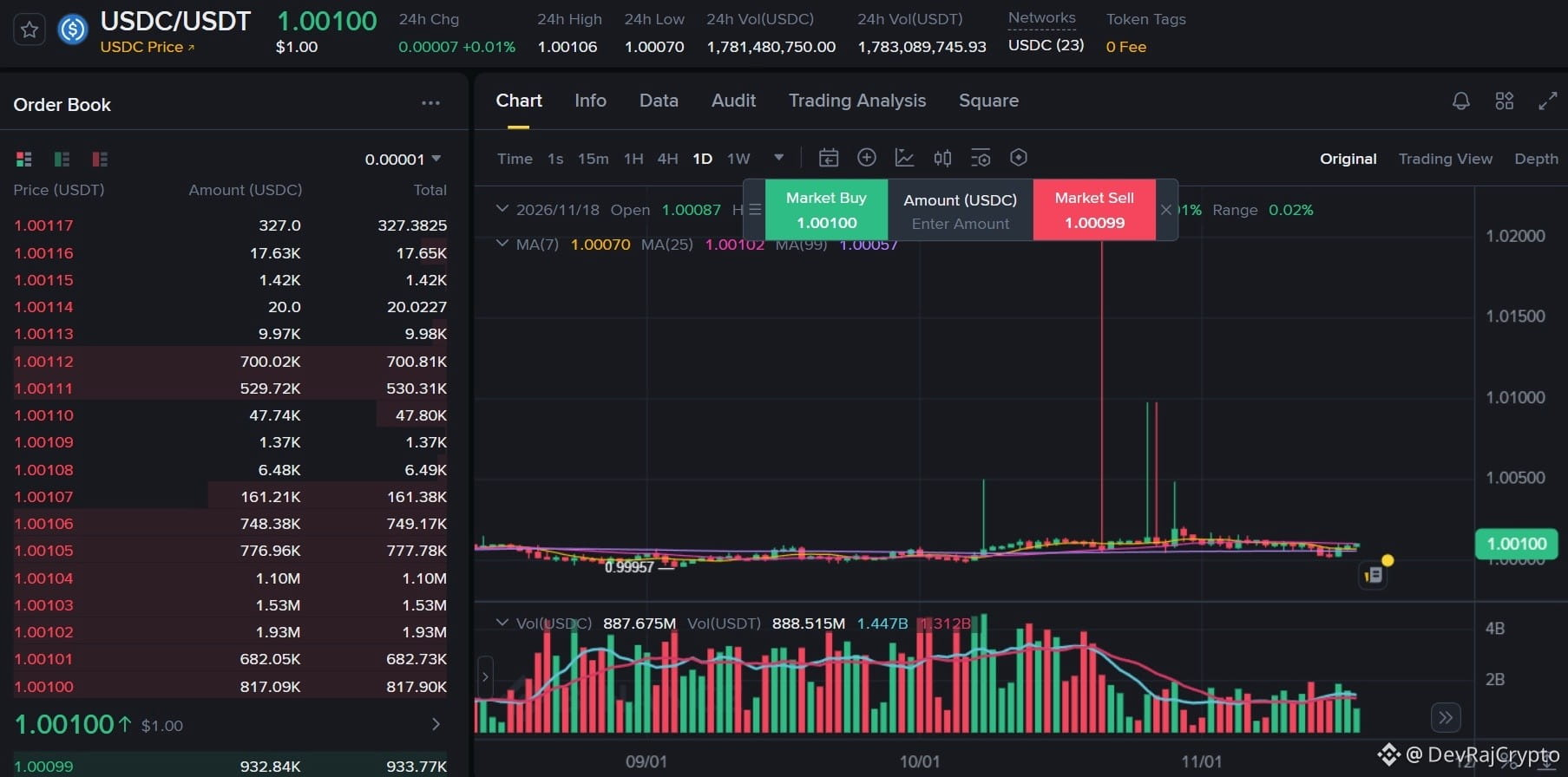
USDC holds 27% of stablecoin supply but generates 79% of transaction volume.
That difference caught my attention.
Circle's Q3 2026 data shows:
• Average circulation: $73.3B, up 8% YoY.
• On-chain volume: $13.9T, up 49%.
• Quarterly turnover: approximately 190x.
The interesting part isn't just the growth. It's how much activity USDC generates relative to its circulating supply.
While analyzing crypto trends for Binance Square, I've learned not to judge an asset by headline numbers alone. Market capitalization shows how much capital is held. Transaction volume shows how frequently value moves. Neither automatically proves real-world adoption.
USDC's volume also includes trading, arbitrage and DeFi transfers, not just payments.
My view: the next stablecoin race will be about turning on-chain activity into reliable financial use cases.
Holding dollars creates liquidity. Moving them efficiently creates utility. Earning trust creates lasting infrastructure.
That's the real test for USDC.
$USDC #Stablecoins #crypto
2
67
·
--
#nvidiaboardnotconsideringhuang’sreturnasceo
NVIDIA’s AI growth is extraordinary. But can the infrastructure keep up?
Q3 FY2027 results:
• Revenue: $115.8B, up 103% YoY.
• Data Centre: $107.6B, up 110%.
• AI Clouds, Industrial & Enterprise: $47.5B, up 195%.
• Q4 revenue guidance: $130B ±3%.
Yet three challenges could shape its next growth phase.
1. Supply: Commitments rose from $279B to $390B, largely reflecting multi-year memory procurement. These are commitments, not guaranteed future sales.
2. Infrastructure: Chips need electricity, land, cooling, networking and financing. Computing demand means little without capacity to deploy it.
3. Customer returns: Q3 non-GAAP gross margin was 74.9%, with Q4 guidance of 71–72%. Ultimately, customers must generate measurable economic value from AI investments.
My view: NVIDIA's next chapter depends not just on selling more chips, but on making AI infrastructure economically productive.
What becomes the biggest constraint: memory, electricity, financing or customer returns?
$NVDA #NVIDIA #Aİ
2
145
·
--
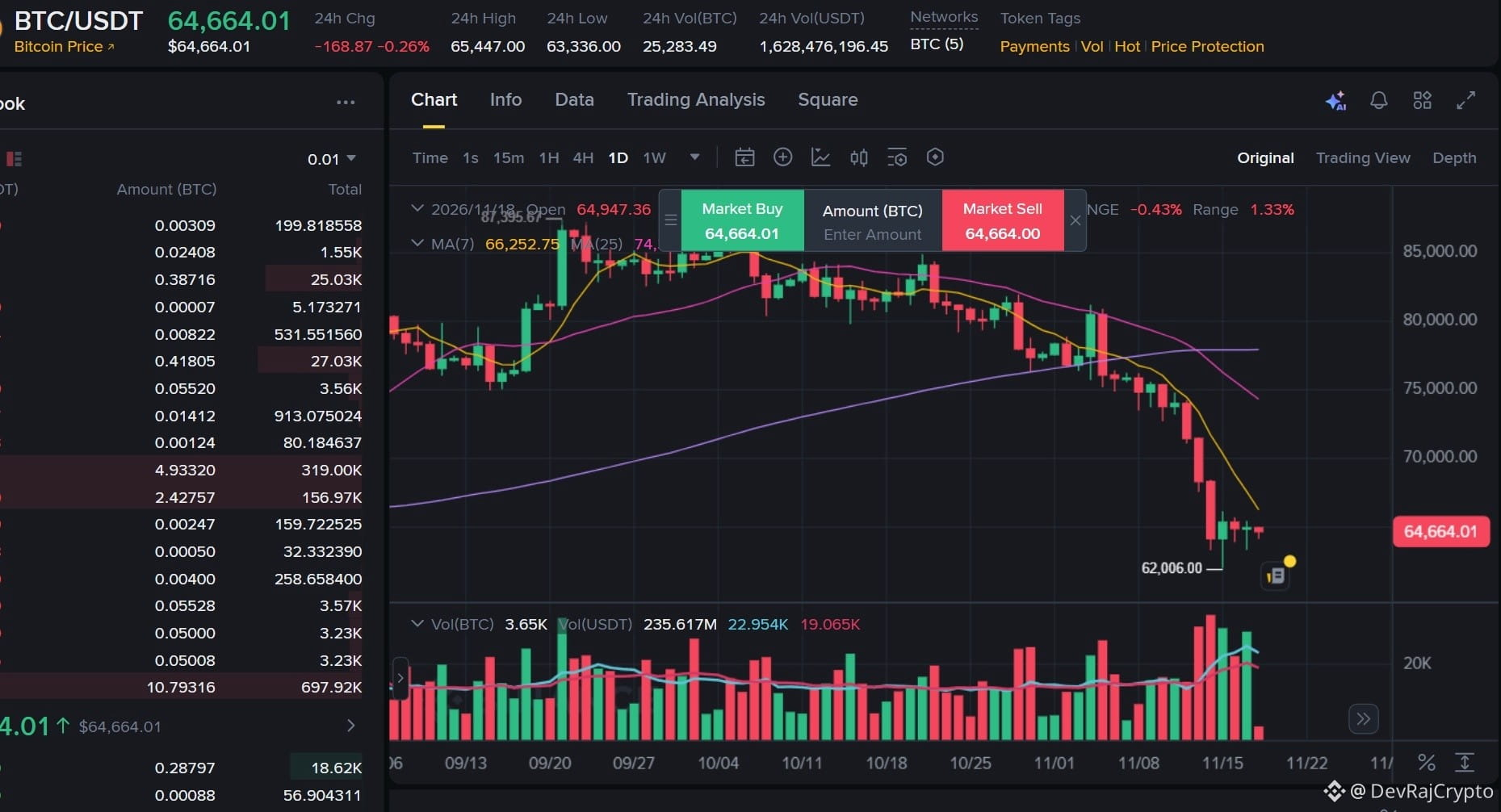
Bitcoin is bouncing. But are buyers actually back, or is this just temporary relief?
The November 18 chart shows BTC recovering from $62,006 to $64,664. However, price remains below its 7-day moving average ($66,253) and 200-week moving average (approximately $68,039).
Institutional demand raises another concern. US spot Bitcoin ETFs recorded approximately $1.91 billion in outflows across seven consecutive sessions. November 16 brought just $7.9 million in inflows.
Meanwhile, the US Dollar Index reached 103.65, with markets pricing in a 95.7% probability of a December rate hike.
From following crypto markets, I've noticed traders often mistake relief rallies for trend reversals. But price recovery and demand recovery are two different things.
Here's what I'm watching:
• $62,000: Key support.
• $66,253: First recovery test.
• $68,039: Longer-term resistance.
My view: Sustained buying, improving ETF flows and reclaimed moving averages are needed to confirm a recovery.
A bounce shows sellers weakening. Sustained demand shows buyers taking control.
Will BTC reclaim $68K or revisit $62K first?
$BTC #bitcoin #BitcoinAnalysis
2
89
·
--
#nvidiaboardnotconsideringhuang’sreturnasceo
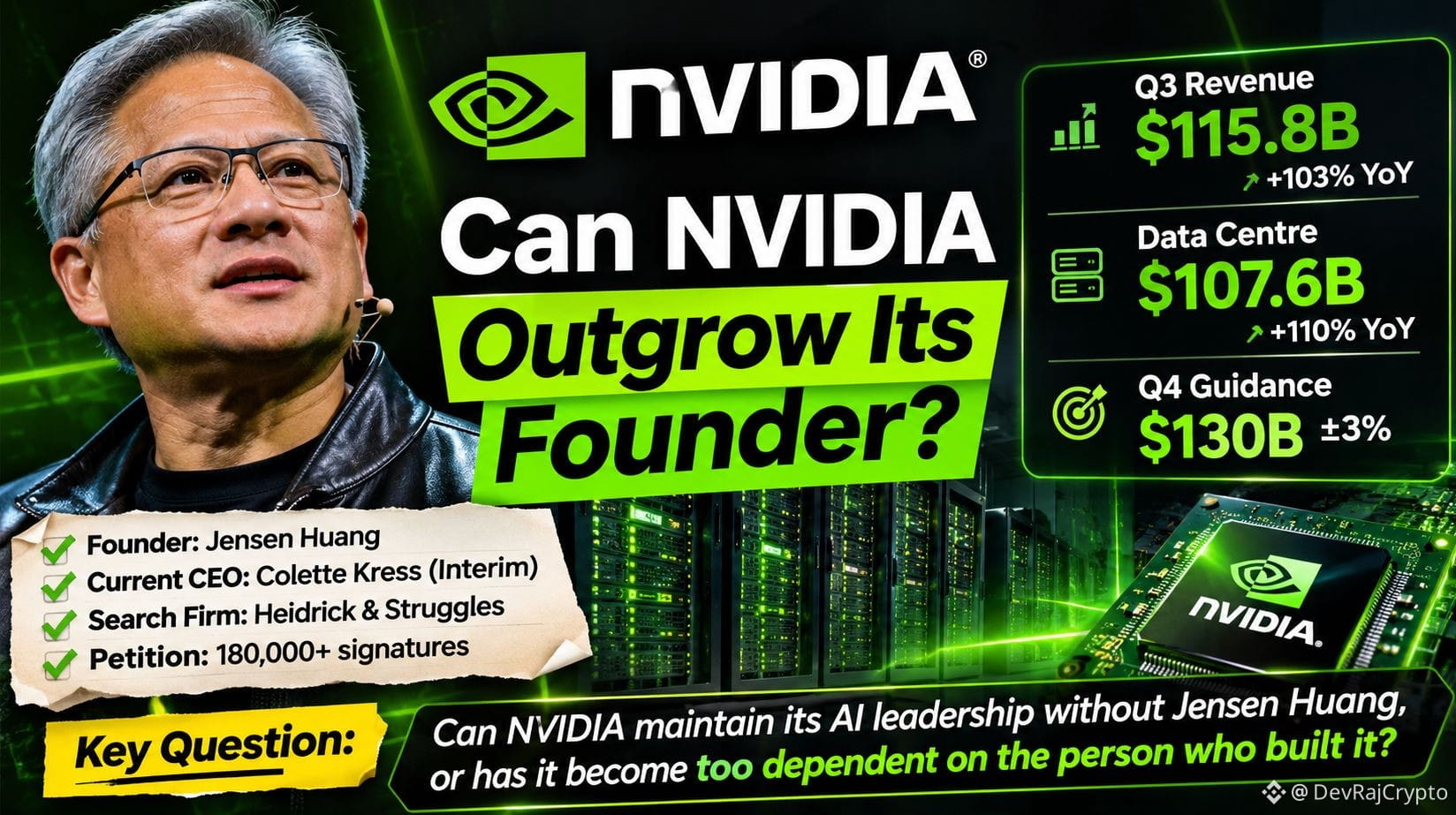
NVIDIA just reported $115.8 billion in quarterly revenue. Yet its biggest test may be proving it can remain exceptional without Jensen Huang.
On November 17, board chairman Harvey Jones confirmed that NVIDIA does not intend to reinstate Huang as CEO. CFO Colette Kress is serving as interim CEO while Heidrick & Struggles leads the search for a permanent successor, considering internal and external candidates.
Huang, meanwhile, has said he would be honoured to return if the board believes it is in the company's best interests.
Despite a petition reportedly exceeding 180,000 signatures, public support does not determine corporate leadership. That responsibility rests with the board.
Meanwhile, NVIDIA's business remains strong:
• Quarterly revenue: $115.8 billion, up 103% year-on-year.
• Data Centre revenue: $107.6 billion, up 110%.
• Q4 revenue guidance: $130 billion, plus or minus 3%.
Data Centre now accounts for approximately 93% of quarterly revenue. This highlights where NVIDIA's growth engine lies: sustained demand for AI infrastructure.
From following crypto and technology markets, I've noticed how quickly investors turn leadership headlines into broader market narratives. But uncertainty around a CEO is not automatically a deterioration in business fundamentals.
Equally, strong earnings do not eliminate succession risk.
Huang built more than a chip business. He helped create an ecosystem of developers, software, infrastructure partners and customers. The next CEO must preserve that advantage while maintaining innovation and execution.
My view: investors should watch three things: product roadmap continuity, customer confidence and sustained AI infrastructure demand.
A founder can build an extraordinary company. Its institutional strength is tested when that founder is no longer leading it.
Can NVIDIA maintain its AI leadership without Jensen Huang, or has the company become too dependent on the person who built it?
$NVDA #NVIDIA #Aİ #CryptoMarket
2
9
12.6k
·
--
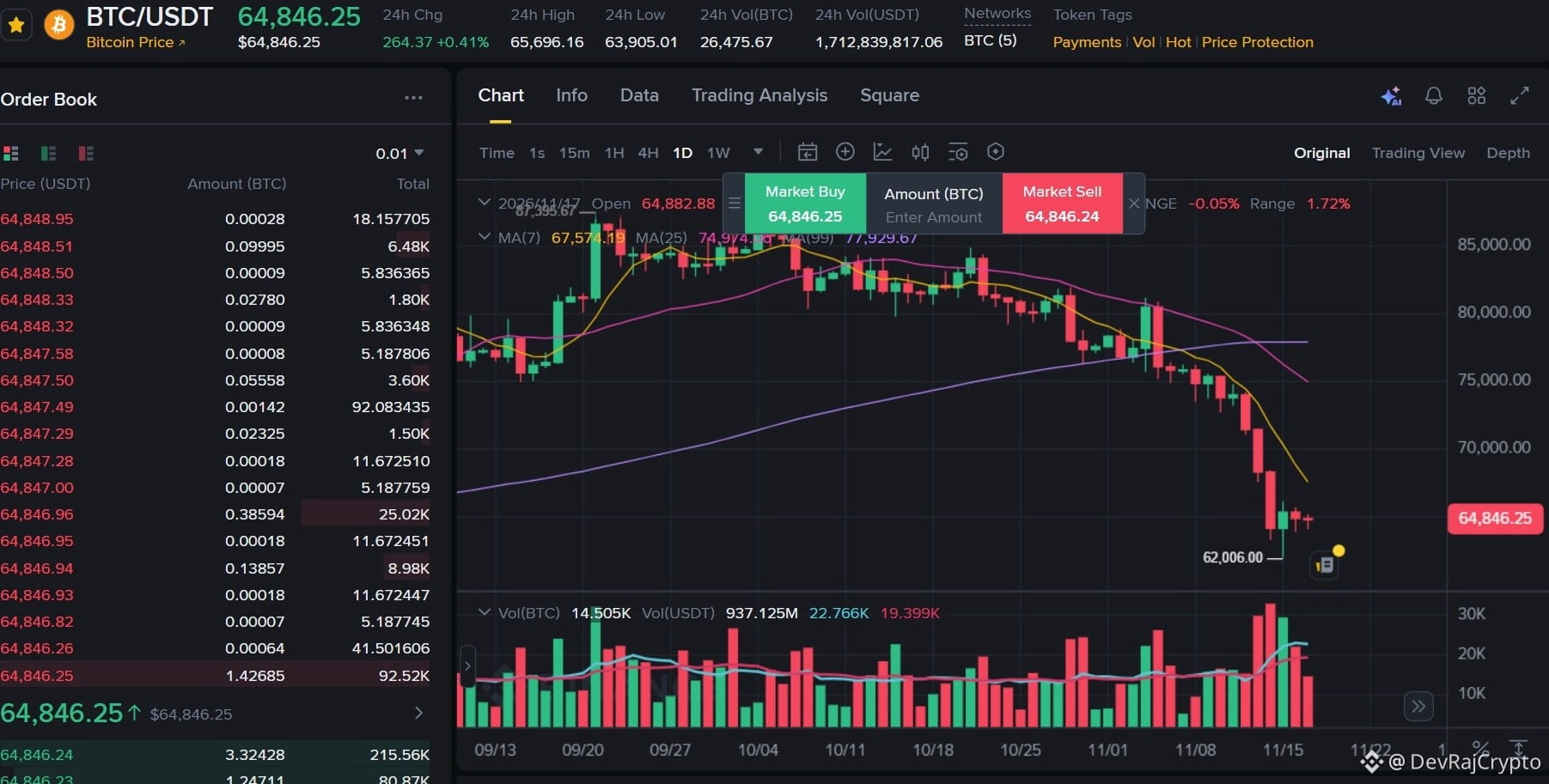
Bitcoin has recovered nearly $2,800 from its recent low, but I am not convinced the worst of the selling is behind us.
There is something interesting in the BTC/USDT daily chart.
The decline towards $62,006 came with a noticeable expansion in trading volume. Bitcoin then bounced, but the recovery has so far struggled to build sustained upward momentum.
At around $64,846, price remains below all three moving averages:
• 7-day MA: $67,574
• 25-day MA: $74,924
• 99-day MA: $77,930
What does this tell me?
The immediate selling pressure has eased, but the market has not repaired the technical damage caused by the decline.
I am particularly interested in what happens around $65,700 and $67,574.
The first is the recent 24-hour high. The second is the 7-day moving average. Reclaiming both would be a meaningful improvement in short-term structure. But I would also want to see stronger buying participation rather than a brief price spike.
My reading is that Bitcoin is at a point where the next few daily candles matter more than the initial rebound.
If buyers establish higher lows and push through $67,574, I would become more constructive about a recovery. If the price loses momentum and revisits $62,006, the recent bounce will look increasingly fragile.
I am not treating this rebound as a confirmed bottom. I want the market to demonstrate that demand can sustain higher prices.
What is your reading: is Bitcoin beginning to build a base around $62,000, or is this just a pause before another leg down?
$BTC #bitcoin #BTCUSDT #CryptoMarket
2
85
·
--
Anthropic's IPO is testing more than investor appetite for AI. It is testing whether AI's economics can justify the enormous capital being committed to it.
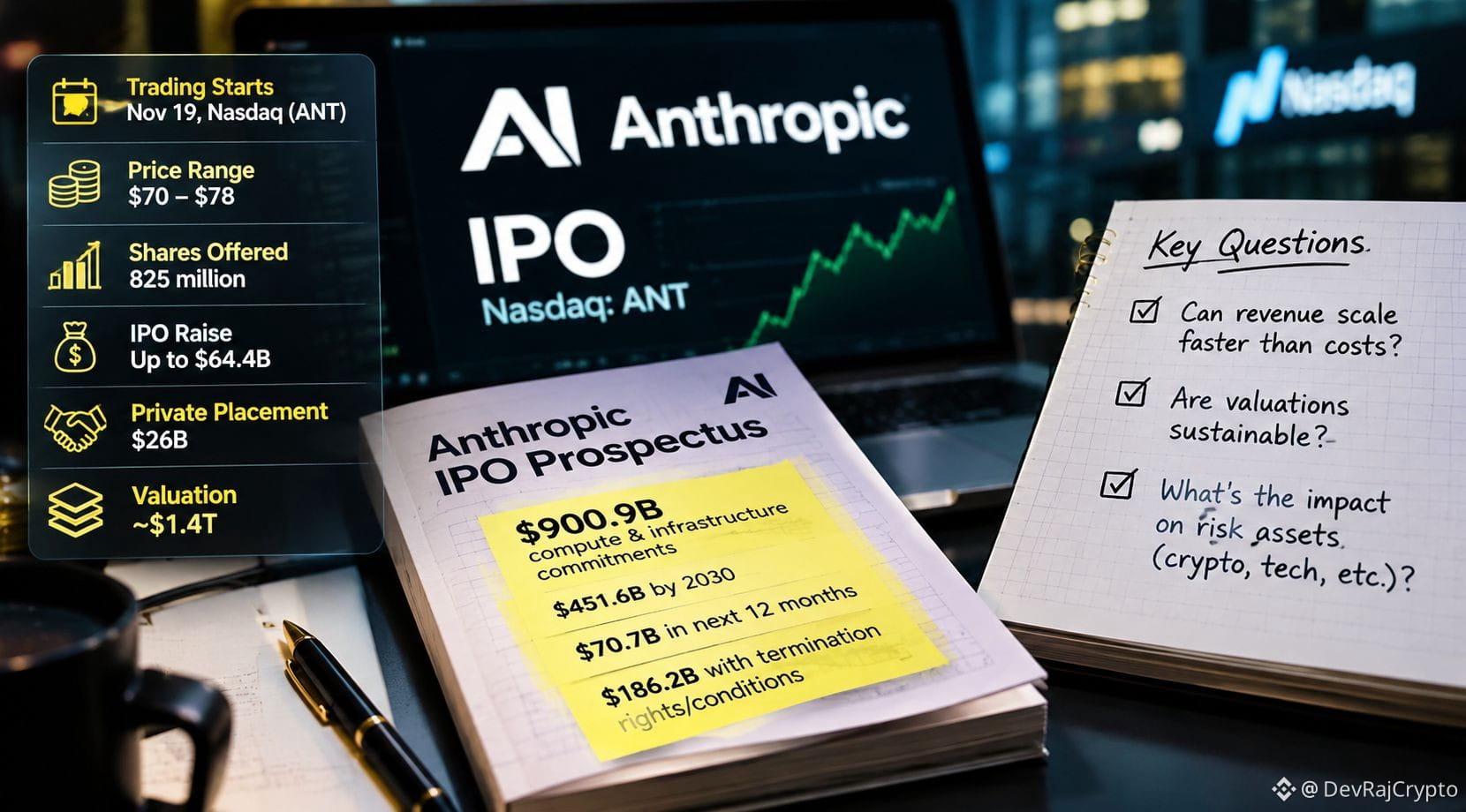
The company behind Claude is preparing for its Nasdaq debut on November 19 under ticker ANT.
Key figures:
• 825 million shares at an indicative $70–$78.
• Up to $64.4B from the IPO, plus a separate $26B private placement.
• Potential valuation of approximately $1.4T.
• Reportedly six-times oversubscribed.
But one number deserves more attention: $900.9 billion.
Anthropic's prospectus reports this amount in aggregate compute and infrastructure commitments. Around $451.6B is expected before the end of 2030, with $70.7B due within the following 12 months.
This is not an immediate debt bill. Approximately $186.2B involves termination rights or conditions that must be met before the arrangements begin.
The financial picture is equally important: Anthropic reported $33.2B in revenue during the first nine months of 2026, alongside an operating loss of approximately $1.26B.
My observation: AI demand is growing rapidly, but revenue growth alone doesn't prove a sustainable business model. The real test is whether revenue can outpace infrastructure and development costs.
Also, six-times oversubscription measures demand at the proposed offering terms, not whether the valuation is justified.
For crypto, the connection is broader risk appetite. A shift away from expensive growth valuations could pressure speculative assets, too. However, there is no verified evidence that Bitcoin is being sold specifically to fund this IPO.
My prediction: The debut may generate excitement, but sustained investor confidence will depend on whether AI growth translates into stronger financial performance.
The AI investment story is moving from proving demand to proving economics.
Can AI companies grow into these valuations, or will infrastructure costs eventually force a major reset?
$BTC $NVDA $ANT #CryptoMarket
1
43
·
--
Bitcoin has bounced from the $62,000 area, but I am not convinced the selling pressure is over.
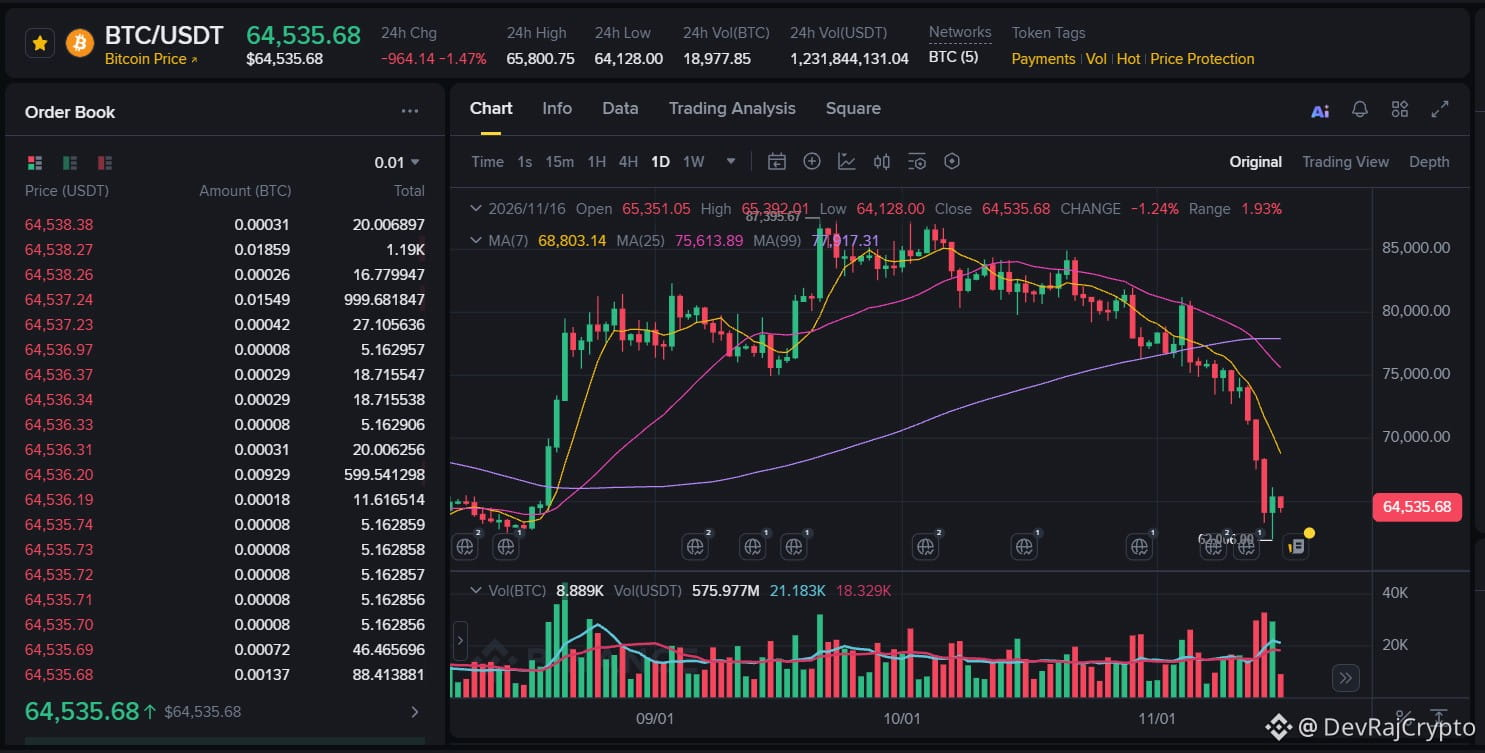
My biggest observation from the BTC/USDT daily chart: price remains significantly below all three moving averages.
At the time of the snapshot, BTC was trading around $64,535.
Here are the levels I'm watching:
• $62,000: Weekend low and key downside support.
• $64,128: Immediate level to defend.
• $68,803: 7-day moving average and first recovery hurdle.
• $75,614 and $77,917: 25-day and 99-day moving averages, marking stronger overhead resistance.
Broader risk aversion and institutional ETF outflows add to the pressure.
But here's what I find important: a sharp bounce after heavy selling does not mean buyers have regained control.
I watch what happens after the rebound. Does buying volume sustain? Can Bitcoin reclaim key moving averages? Do buyers establish higher lows?
My prediction: BTC could attempt a move towards $68,800. Failure to reclaim that level would leave the market vulnerable to another test of $62,000. A sustained move above $68,800 would be an encouraging first signal, not confirmation of a trend reversal.
I'd rather wait for confirmation than mistake a relief bounce for a new uptrend.
**What's your prediction: $68,800 next, or another test of $62,000?**
$BTC #bitcoin #CryptoMarket #BTCUSDT
105
·
--
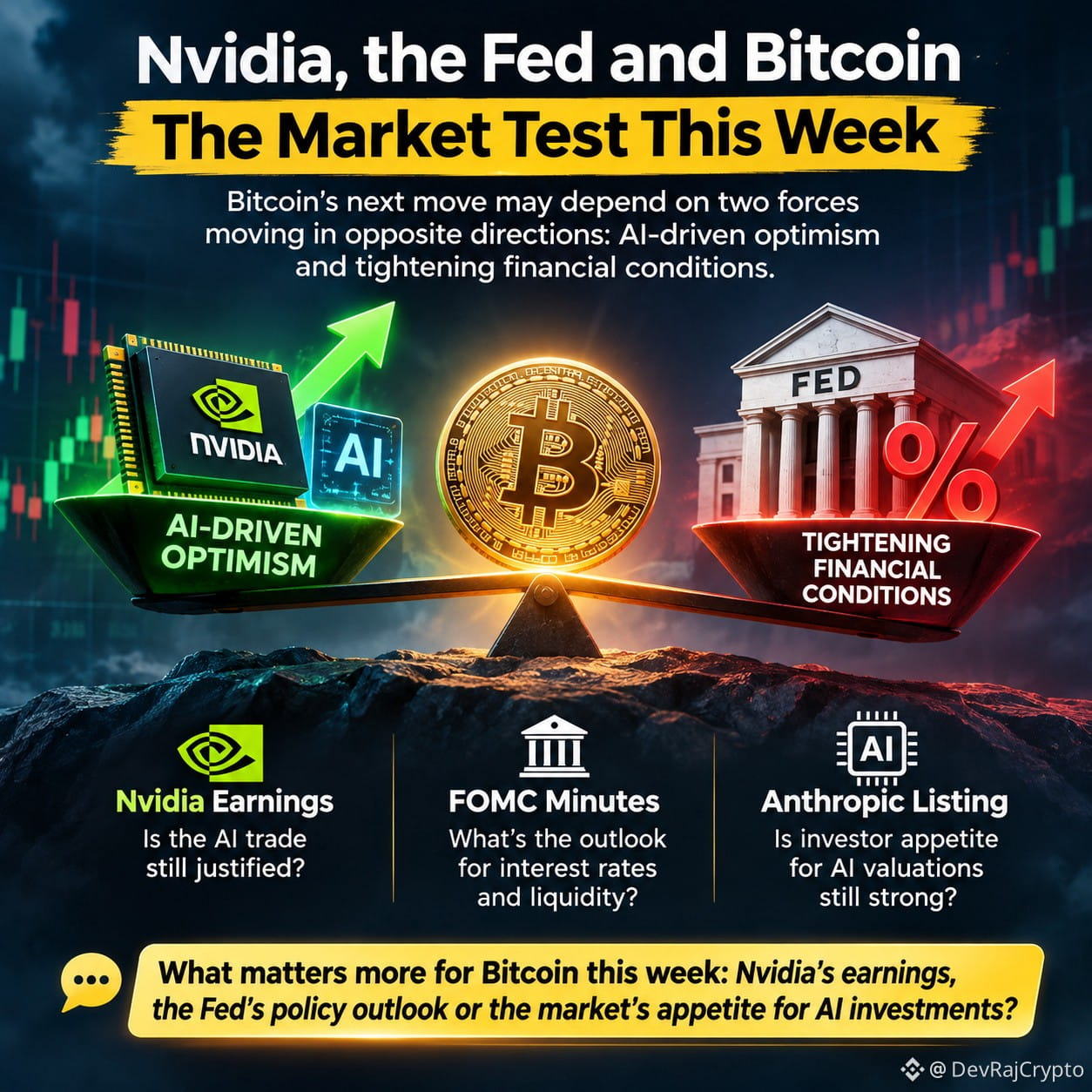
Bitcoin's next move may depend on two forces moving in opposite directions: AI-driven optimism and tightening financial conditions.
This week brings an important test for both.
Three developments deserve particular attention.
1. Nvidia earnings: Is the AI trade still justified?
Nvidia's results on November 17 will offer fresh evidence of demand for AI infrastructure.
But revenue growth alone won't tell the whole story. Investors will be looking closely at forward guidance, margins and whether spending by major technology companies can sustain its current pace.
If results disappoint, pressure could spread across technology stocks and weaken broader risk appetite.
2. FOMC minutes: What happens to liquidity expectations?
The Federal Reserve releases minutes from its October meeting on November 18.
The important question is how policymakers assess persistent inflation, economic resilience and the outlook for interest rates.
Higher-for-longer rates can make investors less willing to hold speculative assets. Bitcoin is not immune to that shift.
3. Anthropic's expected listing: Is AI enthusiasm broadening?
The expected Nasdaq listing on November 19 adds another dimension.
Investor demand will offer a useful indication of appetite for AI businesses and their valuations, particularly when markets are already questioning how much future growth is priced in.
My broader observation:
Strong corporate earnings and a Bitcoin recovery are two different things.
Nvidia could deliver impressive numbers while higher interest-rate expectations continue to weigh on risk assets. Equally, weaker economic data might increase expectations of monetary easing but raise concerns about growth.
For Bitcoin, sustained buying demand, improving institutional flows and stronger price structure would provide more convincing evidence of recovery than a short-lived bounce.
What matters more for Bitcoin this week: Nvidia's earnings, the Fed's policy outlook or the market's appetite for AI investments?
$BTC $NVDA $ETH #bitcoin #CryptoMarket #NVIDIA
1
553
·
--
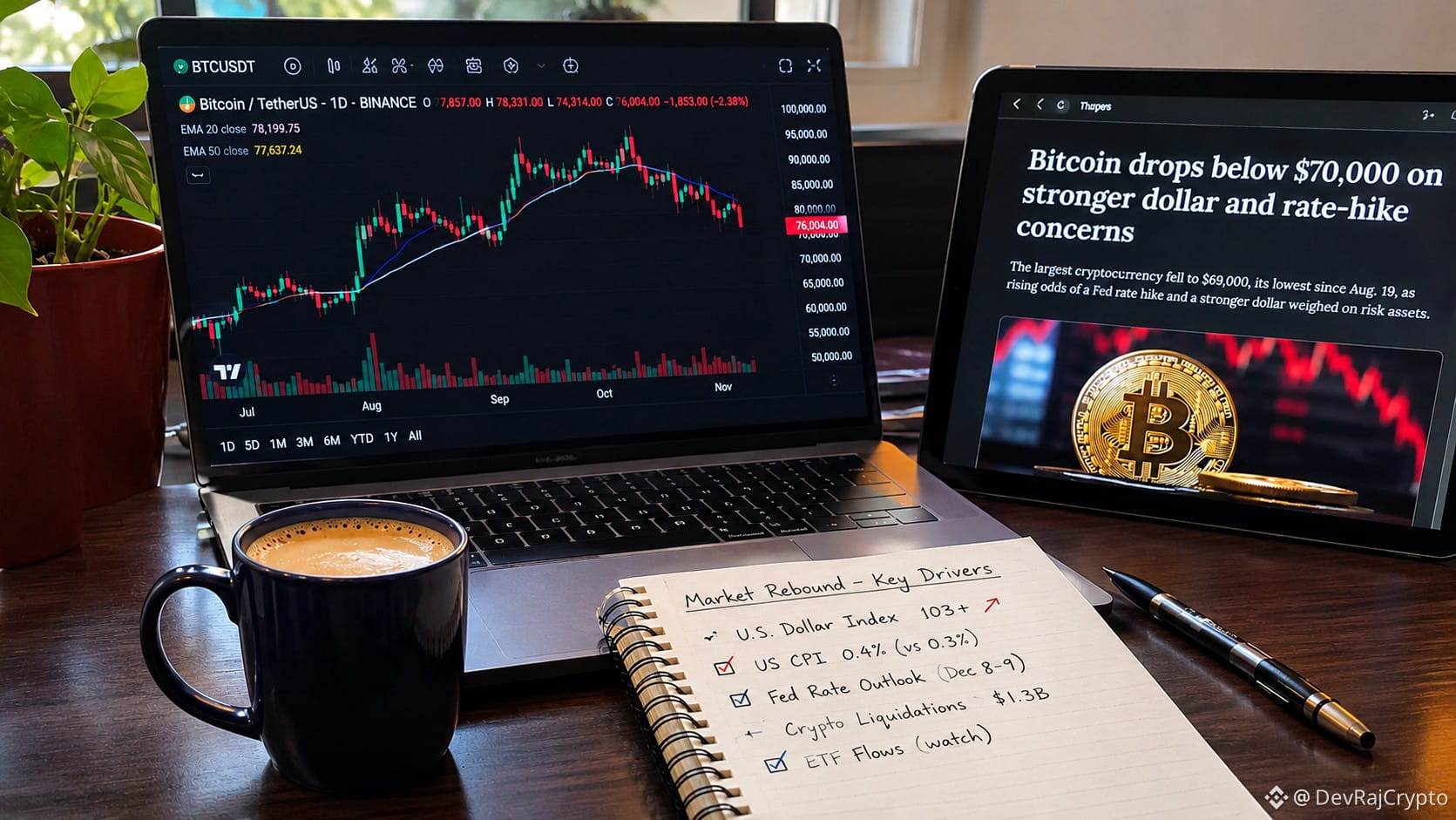
#whatwilldrivecryptoandstocks’nextrebound?
The next crypto rebound may depend less on Bitcoin's price and more on what happens to global liquidity.
Bitcoin has fallen below $70,000, while pressure across technology stocks and other risk assets is increasing. I believe three forces are interacting: macroeconomic uncertainty, weaker institutional demand and leveraged selling.
Here's what I'm watching:
• Stronger dollar: The US Dollar Index reached 103.17, near a 19-month high, potentially putting additional pressure on risk assets.
• Inflation and interest rates: October US CPI rose 0.4%, above the 0.3% forecast, increasing concerns about the Federal Reserve's rate outlook.
• Leveraged liquidations: More than $1.3 billion in crypto positions were reportedly liquidated within 24 hours, accelerating market volatility.
My biggest observation comes from that last point.
Liquidations can remove excessive leverage, but they don't create fresh buyers. I've learned from following crypto markets that a sharp decline followed by a quick bounce isn't enough to establish a recovery. I look for sustained buying volume, improving ETF flows and stronger price structure.
That's why I'm watching four potential catalysts: a weaker dollar, cooler inflation, renewed institutional demand and improving Bitcoin ETF inflows.
My view is cautious: the market needs evidence of fresh demand, not simply exhaustion among sellers.
What's your prediction? Which will drive the next recovery: Federal Reserve policy, institutional buying, ETF inflows or a weaker dollar?
And will Bitcoin recover before technology stocks, or do both need the same macroeconomic shift?
$BTC #bitcoin #CryptoMarket #stockmarket
5
3
2.5k
·
--
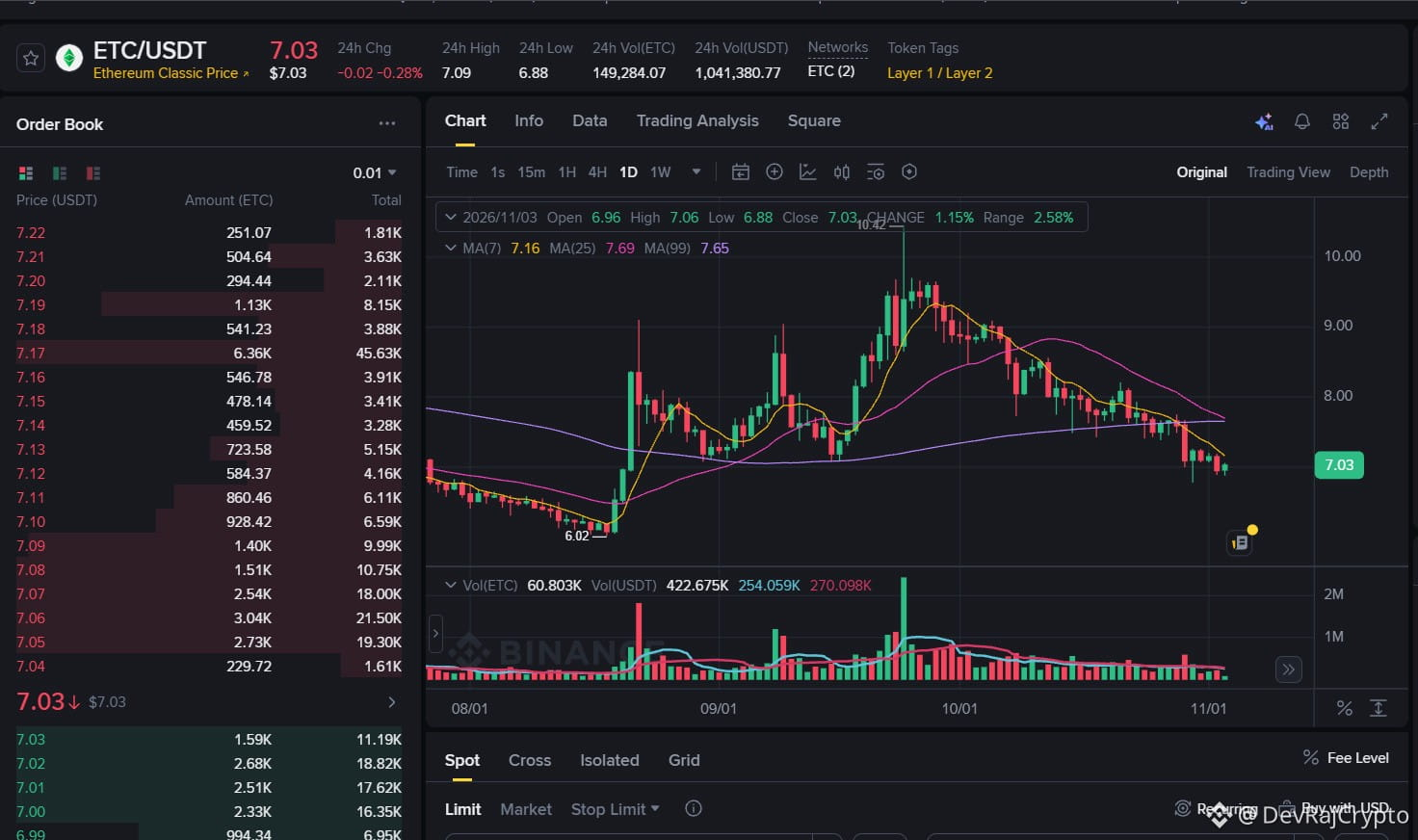
Ethereum Classic is trading near $7.03, and I believe the $7.65-$7.70 region is more important than the next short-term bounce.
ETC has declined considerably from its September high near $10.42. The daily chart suggests sellers still have control, and buyers haven't demonstrated a convincing trend reversal.
Three indicators explain why I'm cautious:
• Current price: $7.03
• 7-day moving average: $7.16
• 25-day moving average: $7.69
• 99-day moving average: $7.65
• Recent daily low: $6.88
Here's what catches my attention.
The 25-day and 99-day moving averages are converging around $7.65-$7.69. Both sit above the current price, creating an important resistance zone to watch.
This matters because a price recovery alone doesn't establish a trend reversal. Buyers need to reclaim these averages and demonstrate that they can hold above them.
In my approach to reading crypto charts, I pay more attention to how price behaves around key levels than to isolated green candles. A temporary bounce can attract attention, but sustained buying pressure is what changes the market structure.
For ETC, I'm watching three developments:
1. Can buyers reclaim $7.16, the 7-day average?
2. Can price eventually break and hold above $7.65-$7.70?
3. Will $6.88 hold as immediate support, or will sellers push price lower?
A sustained break below $6.88 would weaken the current setup further. Conversely, reclaiming the moving-average cluster would improve the recovery outlook.
My position is cautious: I wouldn't call this accumulation simply because ETC is trading near $7.
The market doesn't confirm a recovery because an asset looks cheaper. It confirms one when buyers demonstrate control.
What's your view on $ETC? Is this a potential base, or is another leg down still possible?
#ETC #EthereumClassic #CryptoAnalysis #BinanceSquare
Technical analysis based on the Binance ETC/USDT daily chart, November 3, 2026. Not financial advice.
1
326
·
--
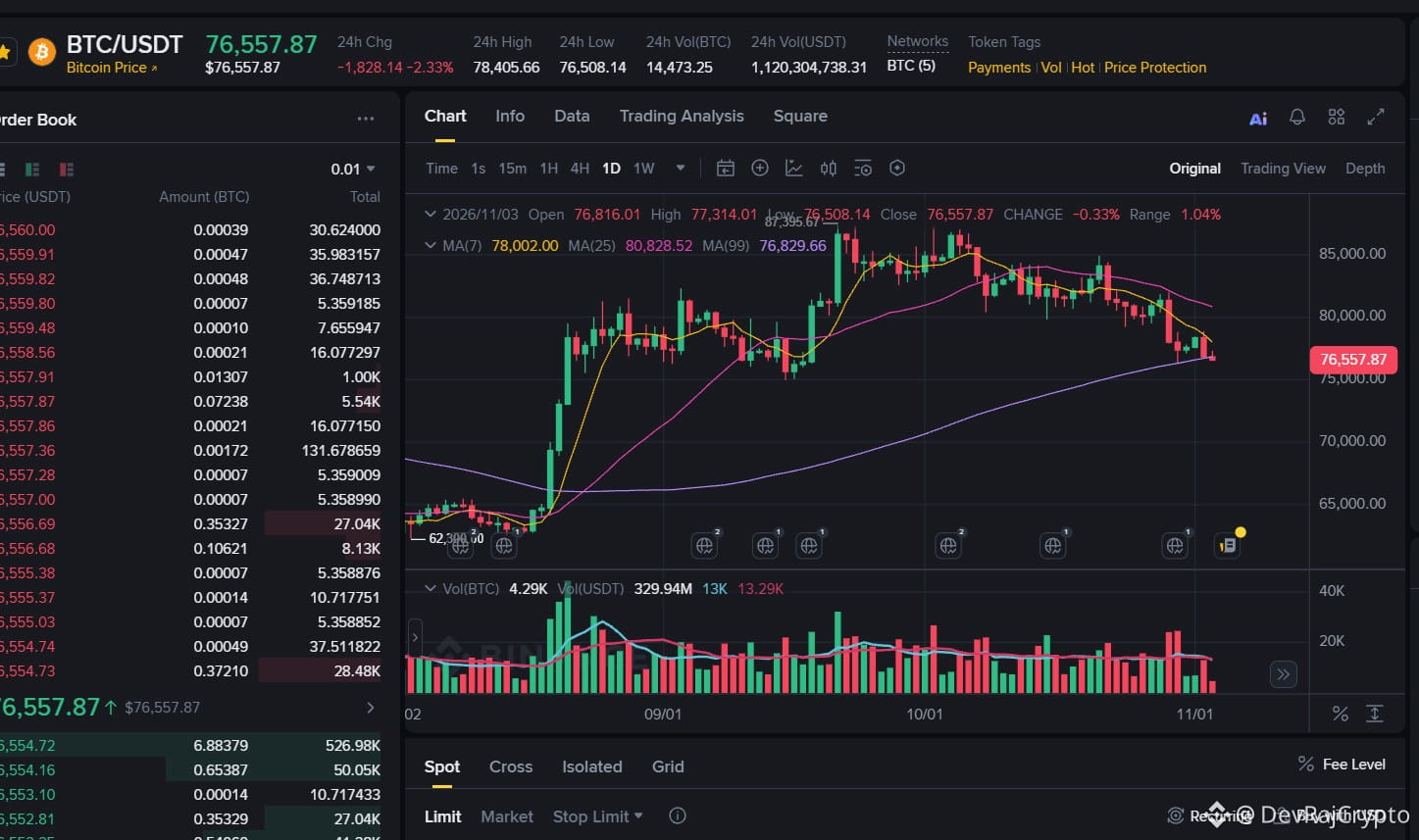
Bitcoin is testing an important level. And the next move could tell us more than today's price decline.
BTC is trading around $76,557, down 2.33% over 24 hours in the November 3 Binance market snapshot.
But look beyond the red percentage. Three moving averages reveal a more interesting picture.
📊 What the daily chart is telling us:
• MA(7): $78,002
• MA(25): $80,828
• MA(99): $76,829
Bitcoin is trading below all three averages. More importantly, price has slipped slightly below the 99-day moving average, an area that previously represented a broader trend reference.
Here's what I'm watching:
🔴 The immediate support zone is around $76,500. A sustained breakdown could bring the $75,000 region into focus.
🟢 For recovery, BTC first needs to reclaim $76,830, followed by the $78,000 area. A stronger improvement would require buyers to challenge the $80,800 region.
My biggest observation?
When price falls below its shorter-term averages, it signals weakening momentum. When it also loses the longer-term average, the market faces a more important test.
But one daily candle below the 99-day average doesn't confirm a long-term trend reversal.
I want to see whether buyers reclaim that level or whether it starts acting as resistance.
I'm watching the reaction around $76K more closely than the daily percentage change.
Because in markets, the quality of a recovery matters more than the speed of a bounce.
What's your view? Is Bitcoin preparing to reclaim $78K, or could $75K be the next area buyers need to defend?
$BTC #bitcoin #CryptoAnalysis #BinanceSquare
Technical analysis based on the Binance BTC/USDT daily chart dated November 3, 2026. Moving averages and price levels are observations, not guaranteed support or resistance. Not financial advice.
1
128
·
--
Article
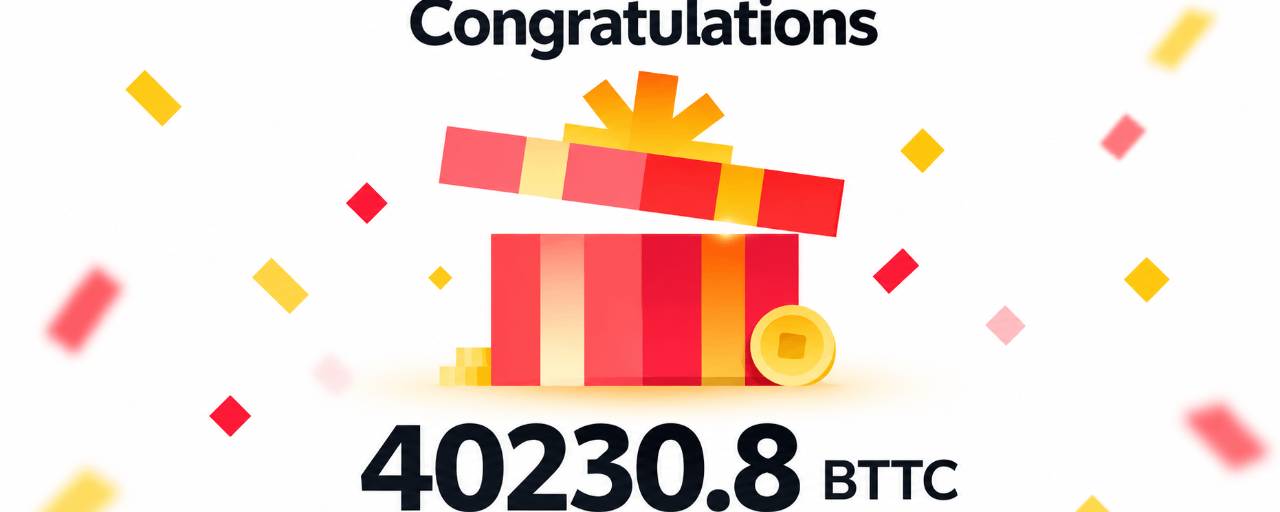
I Received 40,230.8 BTTC from a Friend on Binance. Here's How Red Packets WorkLast night, I received an unexpected surprise from a friend on Binance.
It was a Red Packet containing 40,230.8 BTTC.
For someone who spends considerable time exploring crypto markets, researching digital assets and creating content on Binance Square, moments like this offer a different perspective on the crypto ecosystem.
We often associate cryptocurrency with trading, investing, price movements and market speculation.
But there's another side worth exploring: sharing digital assets with people around you.
That's exactly what Binance Red Packets make possible.
I've received different cryptocurrencies through Red Packets, including PEPE and BTTC. I've also sent Red Packets to friends, and some of them have received crypto rewards through this feature.
Over time, I've realised that one of the interesting things about this feature isn't simply receiving tokens. It's how easily it allows people to introduce one another to digital assets.
Let me explain how it works.
## What Are Binance Red Packets?
Red Packets are a feature of Binance Pay that allows users to send cryptocurrency as digital gifts.
You can create a packet containing a fixed or randomly distributed amount of supported cryptocurrency and share its code or link with friends.
Recipients can claim their portion through Binance.
Think of it as sending someone a digital gift, except the gift is cryptocurrency.
The important distinction is that receiving a Red Packet doesn't require you to purchase the gifted cryptocurrency. Someone else has funded the gift.
## How to Receive Crypto Through Binance Red Packets
If someone sends you a Red Packet, here's how you can claim it.
Step 1: Open your Binance app and log in to your account.
Step 2: Find the Red Packet code or link shared by your friend.
Step 3: Open the Binance app and use its search bar to enter the Red Packet code. Alternatively, navigate to Pay → Red Packet → Receive.
Step 4: Enter the code and tap Claim.
Step 5: Tap Open to reveal your reward.
Step 6: Once successfully claimed, the cryptocurrency will be credited to your Binance Funding Account.
That's it. You have received a crypto gift without purchasing the token yourself.
Remember, Red Packets can run out of available gifts, so a code may no longer work if the packet has already been fully claimed or expired.
## How to Send Crypto Red Packets to Your Friends
This is the other side of the experience, and something I've enjoyed doing myself.
Here's how you can share cryptocurrency with friends.
Step 1: Open Binance and navigate to Pay → Red Packet.
Step 2: Select Send and tap Create.
Step 3: Choose your distribution method:
• Random: The total amount is distributed randomly among recipients.
• Fixed: Each recipient receives the amount you specify.
Step 4: Select the cryptocurrency, enter the total amount or individual gift amount, and specify the number of recipients.
Step 5: Add a personal message for your friends.
Step 6: Review the payment details and confirm the transaction using your passkey or two-factor authentication.
Step 7: Binance generates a Red Packet code or sharing link. Copy it and send it privately to your intended recipients.
Your friends can then claim their cryptocurrency.
One important detail: sending a Red Packet requires you to fund it with your own cryptocurrency. Only send an amount you are comfortable gifting.
## 5 Lessons I've Learned From Using Red Packets
Beyond the mechanics, I think this feature offers some interesting lessons about how people can experience cryptocurrency.
1. Crypto doesn't always have to begin with buying.
Many beginners assume that their first interaction with cryptocurrency must involve depositing money and purchasing a token.
Red Packets offer another entry point. You can receive a crypto gift from someone who already holds the asset.
2. Small experiences can make unfamiliar technology easier to understand.
Reading about cryptocurrency is one thing. Actually receiving a token, seeing it in your Funding Account and understanding how it moves through a platform creates a different learning experience.
3. Sharing creates participation.
When I send a Red Packet to a friend, I'm not simply transferring cryptocurrency. I'm giving them an opportunity to experience a feature they might not have explored before.
4. Community is an important part of crypto adoption.
Markets often focus on institutional investment, liquidity and technological developments. But everyday interactions between users also contribute to how people discover and understand digital assets.
5. Receiving tokens doesn't mean receiving guaranteed profits.
This is perhaps the most important lesson. A token received for free still has a market value that can fluctuate. Its price may rise or fall, and receiving a particular cryptocurrency doesn't make it a good investment automatically.
The experience of receiving a gift and the decision to invest in an asset are two entirely different things.
## Important Things Beginners Should Know
Before using Red Packets, keep these points in mind:
• You need a Binance account to claim a Red Packet.
• Each Red Packet has a limited number of available claims.
• Random and Fixed Red Packets generally remain valid for 24 hours.
• Unclaimed amounts are returned to the sender according to the applicable expiry rules.
• Share your Red Packet codes privately. Anyone who obtains a valid code may be able to claim the reward.
• Never share your Binance password, verification codes or account credentials with anyone.
Feature availability and supported assets may vary depending on your account and region.
For complete instructions, refer to Binance's official guide:
https://www.binance.com/en-IN/support/faq/detail/6202e6d8dd5b4119801e0e2ecea22790
## My Final Thought
Last night's 40,230.8 BTTC Red Packet was a small but interesting reminder that cryptocurrency has a social side too.
I've received PEPE, BTTC and other crypto gifts through friends. I've also shared Red Packets myself.
These experiences have shown me that exploring crypto doesn't always have to begin with a trading strategy or an investment decision.
Sometimes, it begins with a friend sending you a digital gift.
And perhaps that's one of the simplest ways to introduce someone to a new part of the crypto ecosystem.
Have you ever received or sent a Binance Red Packet? Which cryptocurrency did you receive, and what was your experience?
Share your experience in the comments. I'd be interested to hear your stories.
#Binance #BinancePay #redpacket #BTTC #CryptoForBeginners #BinanceSquare
Disclaimer: This article shares my personal experience and explains Binance's Red Packet feature. Receiving cryptocurrency does not guarantee profits. Digital asset prices are volatile, and rewards depend on the amount gifted and applicable platform conditions. This is not financial advice.
I Received 40,230.8 BTTC from a Friend on Binance. Here's How Red Packets Work
Last night, I received an unexpected surprise from a friend on Binance.
It was a Red Packet containing 40,230.8 BTTC.
For someone who spends considerable time exploring crypto markets, researching digital assets and creating content on Binance Square, moments like this offer a different perspective on the crypto ecosystem.
We often associate cryptocurrency with trading, investing, price movements and market speculation.
But there's another side worth exploring: sharing digital assets with people around you.
That's exactly what Binance Red Packets make possible.
I've received different cryptocurrencies through Red Packets, including PEPE and BTTC. I've also sent Red Packets to friends, and some of them have received crypto rewards through this feature.
Over time, I've realised that one of the interesting things about this feature isn't simply receiving tokens. It's how easily it allows people to introduce one another to digital assets.
Let me explain how it works.
## What Are Binance Red Packets?
Red Packets are a feature of Binance Pay that allows users to send cryptocurrency as digital gifts.
You can create a packet containing a fixed or randomly distributed amount of supported cryptocurrency and share its code or link with friends.
Recipients can claim their portion through Binance.
Think of it as sending someone a digital gift, except the gift is cryptocurrency.
The important distinction is that receiving a Red Packet doesn't require you to purchase the gifted cryptocurrency. Someone else has funded the gift.
## How to Receive Crypto Through Binance Red Packets
If someone sends you a Red Packet, here's how you can claim it.
Step 1: Open your Binance app and log in to your account.
Step 2: Find the Red Packet code or link shared by your friend.
Step 3: Open the Binance app and use its search bar to enter the Red Packet code. Alternatively, navigate to Pay → Red Packet → Receive.
Step 4: Enter the code and tap Claim.
Step 5: Tap Open to reveal your reward.
Step 6: Once successfully claimed, the cryptocurrency will be credited to your Binance Funding Account.
That's it. You have received a crypto gift without purchasing the token yourself.
Remember, Red Packets can run out of available gifts, so a code may no longer work if the packet has already been fully claimed or expired.
## How to Send Crypto Red Packets to Your Friends
This is the other side of the experience, and something I've enjoyed doing myself.
Here's how you can share cryptocurrency with friends.
Step 1: Open Binance and navigate to Pay → Red Packet.
Step 2: Select Send and tap Create.
Step 3: Choose your distribution method:
• Random: The total amount is distributed randomly among recipients.
• Fixed: Each recipient receives the amount you specify.
Step 4: Select the cryptocurrency, enter the total amount or individual gift amount, and specify the number of recipients.
Step 5: Add a personal message for your friends.
Step 6: Review the payment details and confirm the transaction using your passkey or two-factor authentication.
Step 7: Binance generates a Red Packet code or sharing link. Copy it and send it privately to your intended recipients.
Your friends can then claim their cryptocurrency.
One important detail: sending a Red Packet requires you to fund it with your own cryptocurrency. Only send an amount you are comfortable gifting.
## 5 Lessons I've Learned From Using Red Packets
Beyond the mechanics, I think this feature offers some interesting lessons about how people can experience cryptocurrency.
1. Crypto doesn't always have to begin with buying.
Many beginners assume that their first interaction with cryptocurrency must involve depositing money and purchasing a token.
Red Packets offer another entry point. You can receive a crypto gift from someone who already holds the asset.
2. Small experiences can make unfamiliar technology easier to understand.
Reading about cryptocurrency is one thing. Actually receiving a token, seeing it in your Funding Account and understanding how it moves through a platform creates a different learning experience.
3. Sharing creates participation.
When I send a Red Packet to a friend, I'm not simply transferring cryptocurrency. I'm giving them an opportunity to experience a feature they might not have explored before.
4. Community is an important part of crypto adoption.
Markets often focus on institutional investment, liquidity and technological developments. But everyday interactions between users also contribute to how people discover and understand digital assets.
5. Receiving tokens doesn't mean receiving guaranteed profits.
This is perhaps the most important lesson. A token received for free still has a market value that can fluctuate. Its price may rise or fall, and receiving a particular cryptocurrency doesn't make it a good investment automatically.
The experience of receiving a gift and the decision to invest in an asset are two entirely different things.
## Important Things Beginners Should Know
Before using Red Packets, keep these points in mind:
• You need a Binance account to claim a Red Packet.
• Each Red Packet has a limited number of available claims.
• Random and Fixed Red Packets generally remain valid for 24 hours.
• Unclaimed amounts are returned to the sender according to the applicable expiry rules.
• Share your Red Packet codes privately. Anyone who obtains a valid code may be able to claim the reward.
• Never share your Binance password, verification codes or account credentials with anyone.
Feature availability and supported assets may vary depending on your account and region.
For complete instructions, refer to Binance's official guide:
https://www.binance.com/en-IN/support/faq/detail/6202e6d8dd5b4119801e0e2ecea22790
## My Final Thought
Last night's 40,230.8 BTTC Red Packet was a small but interesting reminder that cryptocurrency has a social side too.
I've received PEPE, BTTC and other crypto gifts through friends. I've also shared Red Packets myself.
These experiences have shown me that exploring crypto doesn't always have to begin with a trading strategy or an investment decision.
Sometimes, it begins with a friend sending you a digital gift.
And perhaps that's one of the simplest ways to introduce someone to a new part of the crypto ecosystem.
Have you ever received or sent a Binance Red Packet? Which cryptocurrency did you receive, and what was your experience?
Share your experience in the comments. I'd be interested to hear your stories.
#Binance #BinancePay #redpacket #BTTC #CryptoForBeginners #BinanceSquare
Disclaimer: This article shares my personal experience and explains Binance's Red Packet feature. Receiving cryptocurrency does not guarantee profits. Digital asset prices are volatile, and rewards depend on the amount gifted and applicable platform conditions. This is not financial advice.
1
2
99
·
--
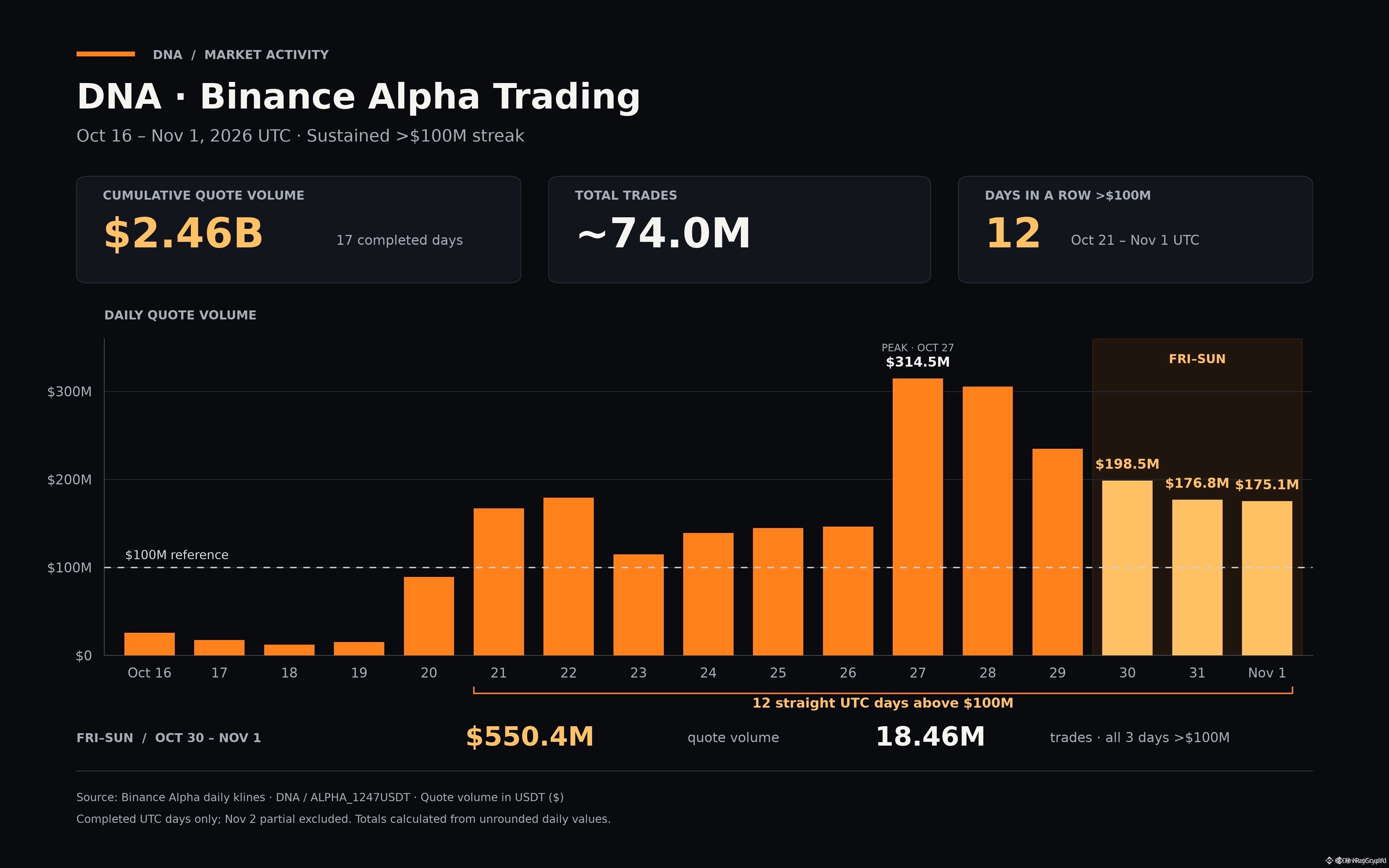
$2.46 BILLION in trading volume. Approximately 74 million trades. And 12 consecutive days above $100 million.
NeoSoul ($DNA) has recorded remarkable trading activity on Binance Alpha since October 16.
But one detail caught my attention: the activity remained elevated well beyond the initial listing days.
According to the Binance Alpha daily-volume data for October 16 to November 1:
📊 $2.46B cumulative quote volume across 17 completed UTC days.
📈 Approximately 74 million trades.
🔥 12 consecutive days above $100M, from October 21 to November 1.
🚀 October 27 recorded the highest daily volume at $314.5M.
Even more interesting, October 30 to November 1 generated $550.4M in volume across 18.46 million trades. All three days remained above $100M.
But there's another side to this story.
Binance launched a DNA trading competition on October 20, featuring rewards and early-trading volume multipliers. These incentives may have contributed to the elevated activity.
My biggest question isn't how much volume DNA can generate during a competition.
It's how much activity will remain when those incentives disappear.
Because trading volume measures activity, not necessarily organic adoption or long-term demand.
The next important signal will be whether DNA can maintain meaningful trading activity without competition-driven incentives.
What do you think? Is DNA building sustainable market interest, or are trading incentives driving much of the current momentum?
$DNA #BinanceAlpha #BNBChain #NeoSoul
$2.46 BILLION in trading volume. Approximately 74 million trades. And 12 consecutive days above $100 million.
NeoSoul ($DNA ) has recorded remarkable trading activity on Binance Alpha since October 16.
But one detail caught my attention: the activity remained elevated well beyond the initial listing days.
According to the Binance Alpha daily-volume data for October 16 to November 1:
📊 $2.46B cumulative quote volume across 17 completed UTC days.
📈 Approximately 74 million trades.
🔥 12 consecutive days above $100M, from October 21 to November 1.
🚀 October 27 recorded the highest daily volume at $314.5M.
Even more interesting, October 30 to November 1 generated $550.4M in volume across 18.46 million trades. All three days remained above $100M.
But there's another side to this story.
Binance launched a DNA trading competition on October 20, featuring rewards and early-trading volume multipliers. These incentives may have contributed to the elevated activity.
My biggest question isn't how much volume DNA can generate during a competition.
It's how much activity will remain when those incentives disappear.
Because trading volume measures activity, not necessarily organic adoption or long-term demand.
The next important signal will be whether DNA can maintain meaningful trading activity without competition-driven incentives.
What do you think? Is DNA building sustainable market interest, or are trading incentives driving much of the current momentum?
$DNA #BinanceAlpha #BNBChain #NeoSoul
1
428
·
--
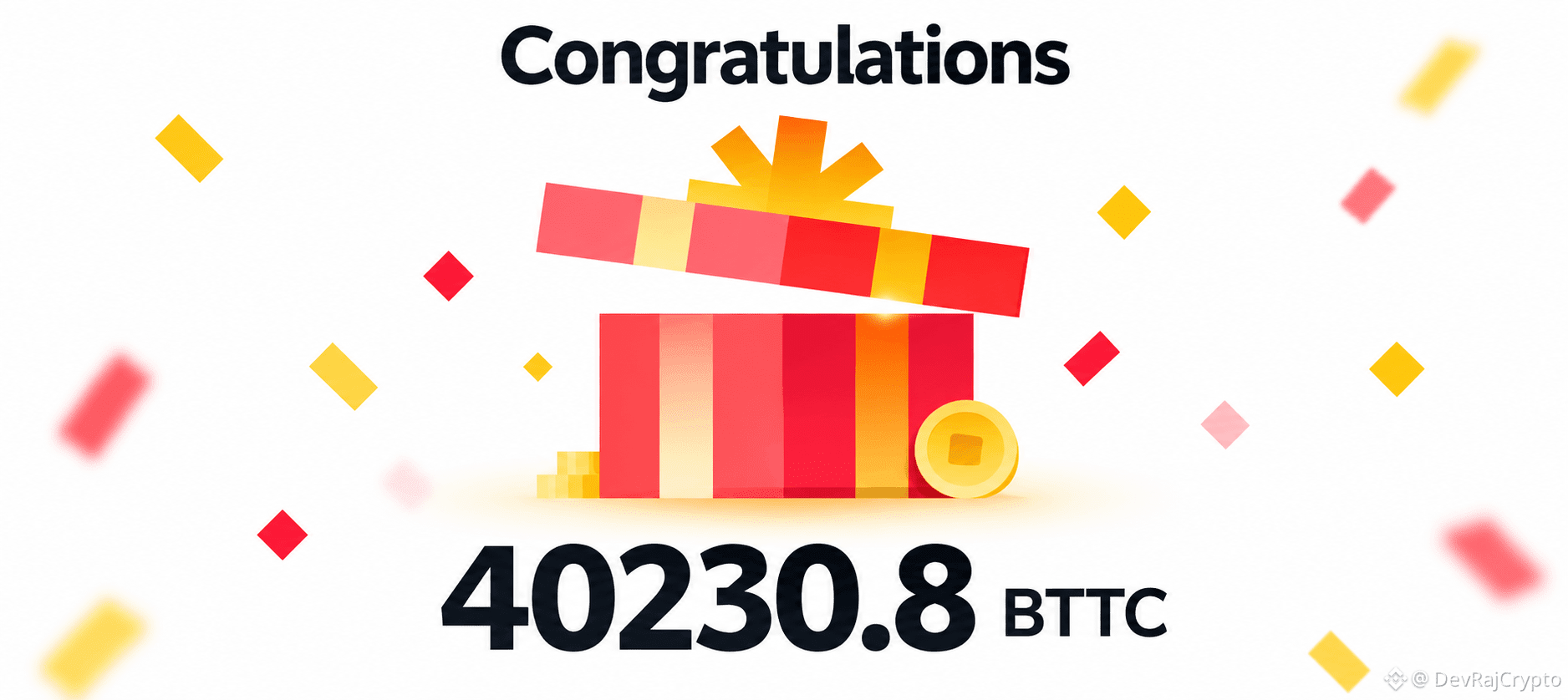
Last night, a friend surprised me with a Binance Red Packet. 🧧
And this time, I received 40,230.8 BTTC!
I've received different cryptocurrencies through Red Packets, and I've also sent them to my friends. It's become one of my favourite Binance features because it makes sharing and discovering crypto more interactive.
Want to receive crypto through Red Packets? Here's how:
📥 How to claim a Red Packet:
1. Open your Binance app.
2. Go to Pay → Red Packet.
3. Select Receive.
4. Enter the Red Packet code shared by your friend.
5. Tap Claim and then Open.
6. Your claimed crypto reward will be credited to your Funding Account.
🎁 How to get your first Red Packet:
• Connect with friends who use Binance.
• Ask them to share an available Red Packet code or link.
• Claim it before it expires or reaches its claiming limit.
• Check your Funding Account to see your reward.
What I enjoy most is that you don't need to purchase the gifted token just to receive it. You can discover different cryptocurrencies through rewards shared by friends.
Sometimes, the best part isn't the value of the reward. It's the unexpected surprise of receiving something from a friend.
Have you ever received or sent a Binance Red Packet? Which cryptocurrency did you receive?
🧧 #Binance #BinanceSquare #RedPacket #BTTC
Note: Red Packet rewards depend on availability, eligibility and remaining claims. Token values can fluctuate. Receiving rewards is not guaranteed.
3
111
·
--
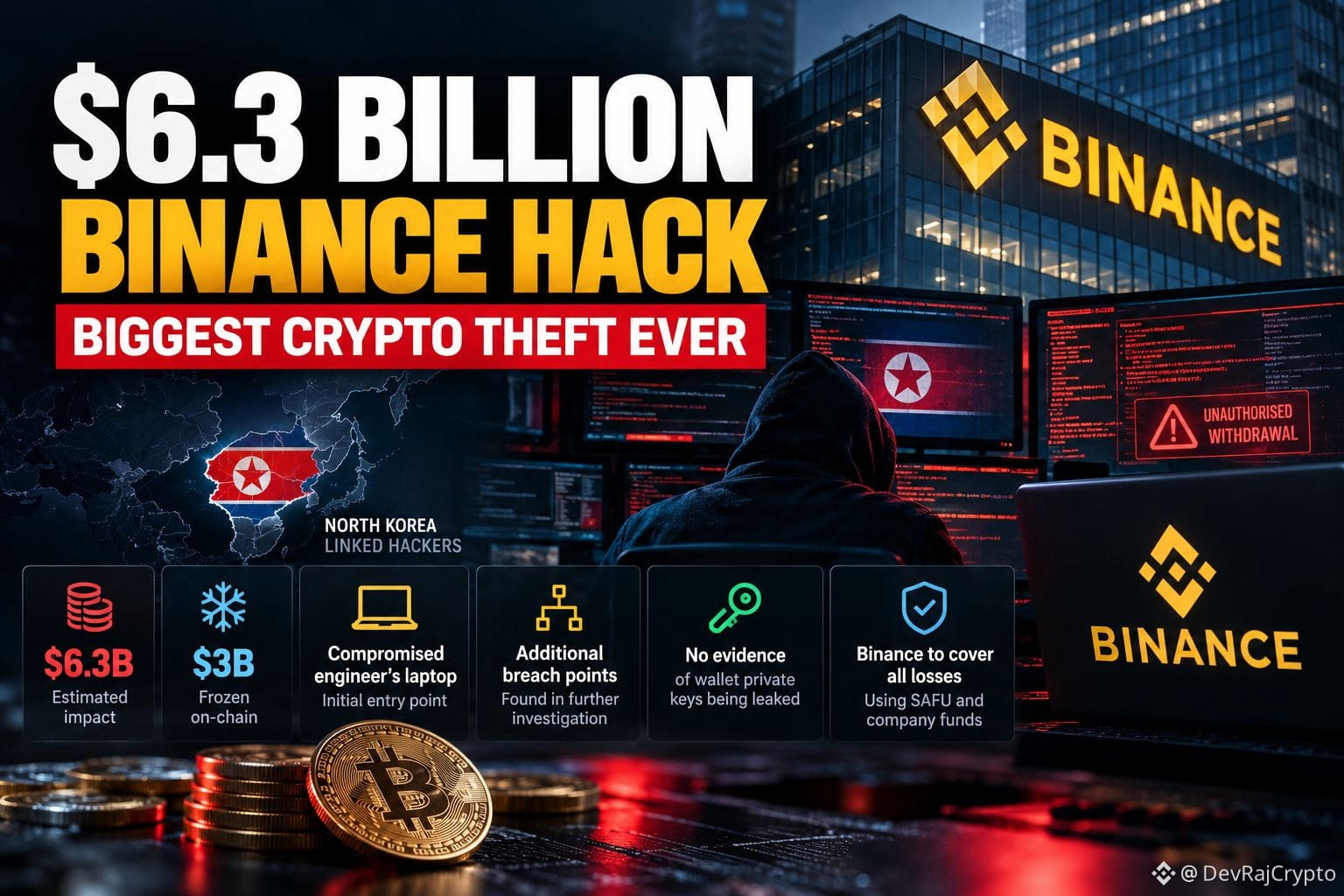
$6.3 BILLION.
The reported Binance security incident should make the entire crypto industry stop and think. But one detail deserves more attention than the headline: how did attackers gain access to the infrastructure that could authorise unauthorised withdrawals?
Here's what we know so far:
• Estimated financial impact: approximately $6.3 billion.
• Around $3 billion in affected assets frozen on-chain.
• Binance's initial investigation identified a potentially compromised DevOps engineer's laptop.
• Subsequent investigation uncovered additional points of breach.
• Binance says it found no evidence of wallet private keys being leaked.
• The company has committed to covering all losses using SAFU and company funds.
The technical details matter. Binance's initial explanation pointed to a compromised laptop that may have provided access to a service container. However, the company later clarified that this was a complex, multi-stage attack, not simply one engineer's permissions being exploited in a single action. A full technical post-mortem is still pending.
My biggest concern isn't just the amount involved. It's the security architecture that allowed unauthorised withdrawal transactions to happen. Crypto exchanges need more than secure wallets. They need strong internal access controls, transaction authorisation safeguards, continuous monitoring and independently verifiable security processes.
There's an important distinction here: freezing stolen assets is incident response. Covering financial losses is accountability. Preventing the next attack is security.
The industry needs all three.
Binance now needs to demonstrate transparency, provide independent verification and show measurable improvements to its security infrastructure. Its commitment to cover losses is important, but the full technical investigation and updated Proof of Reserves will matter just as much.
Trust isn't restored by a statement. It's rebuilt through evidence.
#Binance #CryptoSecurity #bitcoin
111
·
--
🧧 1. Red Packets: My Favourite Way to Receive Crypto Gifts
One Binance feature I've genuinely enjoyed using is Red Packets.
I've received 300 PEPE through a Red Packet from my friend, and I've also sent Red Packets to friends. Some of them have received crypto rewards through this feature too.
What makes it interesting is that you can receive and share different crypto rewards without purchasing those tokens yourself.
In my experience, it's one of the most enjoyable ways to explore crypto gifts on Binance.
Here's how you can use it:
📥 How to receive crypto:
1. Open your Binance app.
2. Go to Pay → Red Packet.
3. Select Receive.
4. Enter the Red Packet code shared by your friend.
5. Tap Claim and then Open.
6. Your claimed crypto will be credited to your Funding Account.
📤 How to send crypto to friends:
1. Open Binance and go to Pay → Red Packet.
2. Select Send → Create.
3. Choose Random or Fixed distribution.
4. Select the cryptocurrency and enter the amount and number of recipients.
5. Add a message and confirm the payment.
6. Complete the required security verification.
7. Copy the generated code or link and share it with your friends.
That's it! Your friends can claim their crypto using the code.
My favourite part? It's not just about receiving coins. You can also share crypto with friends and let them experience it themselves.
💡 Receiving a Red Packet doesn't require you to purchase the gifted token, but sending one requires you to fund it. Token values can also change.
#Binance #PEPE $PEPE

2
3
64
·
--
How can beginners aim to earn their first $10 on Binance without investing?
My experience taught me that you don't always need to start with trading to explore crypto rewards.
I've received Red Packets, sent crypto rewards to friends and earned through creating content on Binance Square. These experiences made me explore opportunities beyond trading.
Here are 7 worth checking out. 👇
📚 1. Learn & Earn
Explore Binance Academy campaigns, complete eligible quizzes and earn crypto rewards when available.
✍️ 2. Binance Square Write to Earn
I've personally earned through creating content on Binance Square. Eligible creators can earn commissions from qualifying reader trades and engagement bonuses. The published programme offers a 20% base commission, with eligible bonuses potentially increasing it to 50%. Posting alone doesn't guarantee earnings.
🚀 3. CreatorPad
Explore creator campaigns involving content creation, engagement tasks and leaderboard competitions.
🎁 4. Rewards Hub
Check for eligible vouchers, bonuses and promotional rewards. Conditions and expiry dates apply.
🔗 5. Referral Programme
Share your referral link with people genuinely interested in Binance. Rewards depend on qualifying actions.
🪂 6. Limited-Time Campaigns
Follow official Binance announcements for promotional campaigns, token rewards and new opportunities.
💰 7. Simple Earn, Launchpool & HODLer Airdrops
Explore additional reward opportunities, but remember these generally require eligible crypto holdings and involve financial risk.
🎯 Can you earn your first $10?
It's possible, but not guaranteed or necessarily achievable in one day.
If I were starting from zero, I'd first explore Learn & Earn, Rewards Hub and Write to Earn before considering anything that requires investment.
💬 Which would you try first: Learn & Earn, Write to Earn or CreatorPad?
#Binance #BinanceSquare #learnAndEarn
⚠️ Rewards depend on availability, eligibility and campaign terms. Some opportunities require crypto holdings or qualifying activity. Earnings are not guaranteed.
3
79
·
--
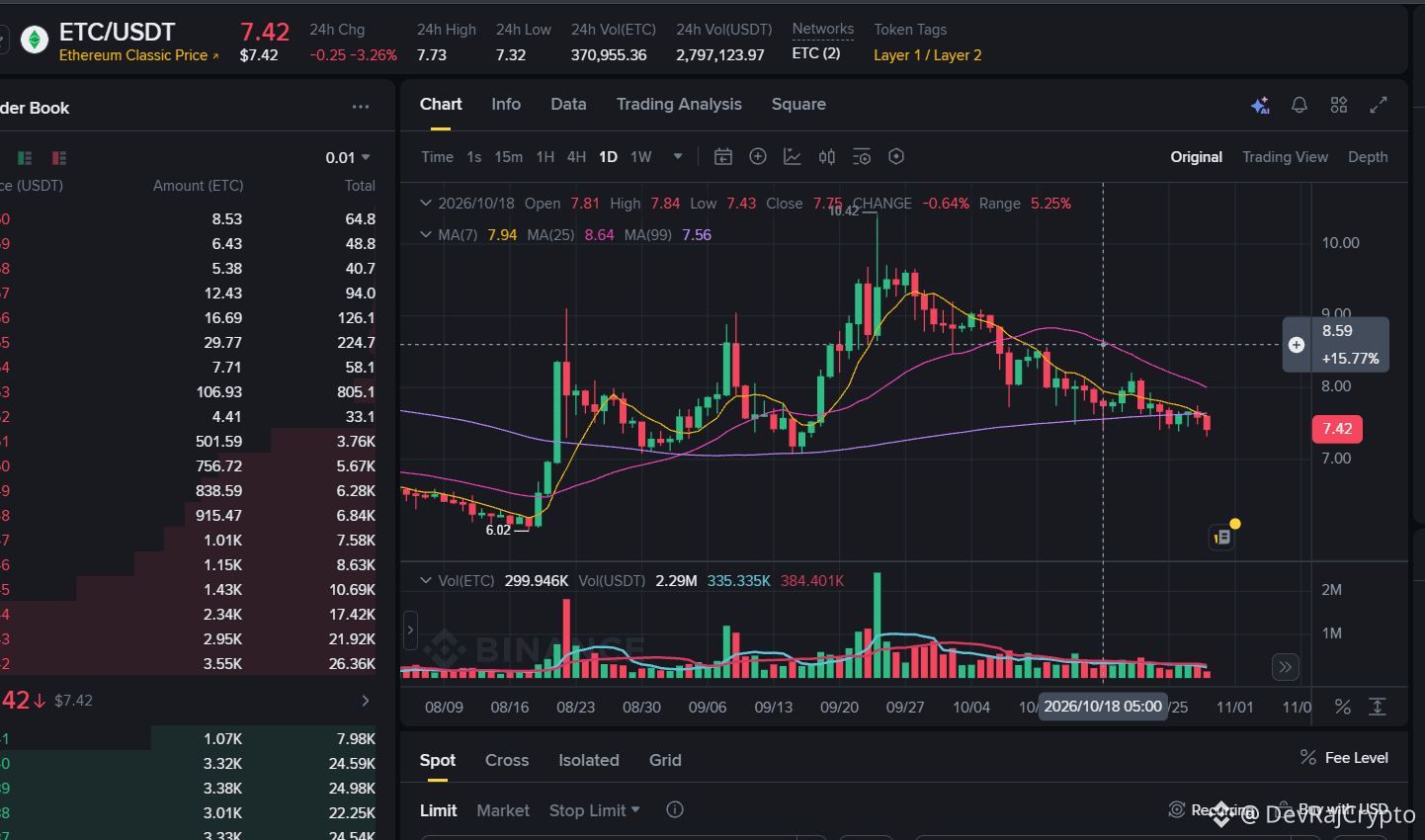
Ethereum Classic is trading near $7.42. The more important question is whether buyers can stop the trend of lower prices.
ETC has given back a significant portion of its September rally. The daily chart now shows a clear shift from aggressive buying to persistent selling pressure.
Here's what stands out to me.
📉 1. The trend has changed.
After reaching above $10 in September, ETC entered a sustained decline. Recent rebounds have struggled to regain the ground lost, suggesting buyers have yet to establish control.
📊 2. The $7.30 area is the immediate level to watch.
ETC's reported 24-hour low is $7.32. If buyers defend this zone, the market could attempt a short-term recovery.
But if price breaks below it decisively, the next area to watch is around $7.00, a previous chart region where price consolidated.
🟢 3. Recovery needs confirmation.
The $7.70 to $8.00 region is the first resistance zone I'm watching. Reclaiming it would be an initial improvement, but one green candle wouldn't confirm a trend reversal.
My biggest observation?
A falling price doesn't automatically make an asset undervalued.
ETC needs more than a bounce. Buyers need to demonstrate sustained demand, stronger price structure and the ability to reclaim resistance.
Until that happens, I would treat any recovery as a potential relief rally rather than assume a new uptrend has begun.
The levels that matter next:
• Support: $7.30, then around $7.00
• Resistance: $7.70 to $8.00
• Current price in the screenshot: $7.42
These are chart-based reference zones, not guaranteed turning points.
What's your view on $ETC? Is this a potential accumulation zone, or does the chart suggest more downside before a durable recovery?
#EthereumClassic #CryptoAnalysis #BinanceSquare
Technical analysis based on the Binance ETC/USDT chart screenshot dated October 29, 2026. Price levels can change quickly. This is market commentary, not financial advice.
$ETC
{spot}(ETCUSDT)
Ethereum Classic is trading near $7.42. The more important question is whether buyers can stop the trend of lower prices.
ETC has given back a significant portion of its September rally. The daily chart now shows a clear shift from aggressive buying to persistent selling pressure.
Here's what stands out to me.
📉 1. The trend has changed.
After reaching above $10 in September, ETC entered a sustained decline. Recent rebounds have struggled to regain the ground lost, suggesting buyers have yet to establish control.
📊 2. The $7.30 area is the immediate level to watch.
ETC's reported 24-hour low is $7.32. If buyers defend this zone, the market could attempt a short-term recovery.
But if price breaks below it decisively, the next area to watch is around $7.00, a previous chart region where price consolidated.
🟢 3. Recovery needs confirmation.
The $7.70 to $8.00 region is the first resistance zone I'm watching. Reclaiming it would be an initial improvement, but one green candle wouldn't confirm a trend reversal.
My biggest observation?
A falling price doesn't automatically make an asset undervalued.
ETC needs more than a bounce. Buyers need to demonstrate sustained demand, stronger price structure and the ability to reclaim resistance.
Until that happens, I would treat any recovery as a potential relief rally rather than assume a new uptrend has begun.
The levels that matter next:
• Support: $7.30, then around $7.00
• Resistance: $7.70 to $8.00
• Current price in the screenshot: $7.42
These are chart-based reference zones, not guaranteed turning points.
What's your view on $ETC ? Is this a potential accumulation zone, or does the chart suggest more downside before a durable recovery?
#EthereumClassic #CryptoAnalysis #BinanceSquare
Technical analysis based on the Binance ETC/USDT chart screenshot dated October 29, 2026. Price levels can change quickly. This is market commentary, not financial advice.
$ETC
1
144
·
--
Verified
#cangoogledefinditscore
Google's biggest AI risk may not be losing users. It may be changing how those users generate advertising revenue.
Ahead of Google's earnings, this is the question I find most interesting.
Google Cloud revenue surged 82% year over year to $24.8 billion in Q2 2026. That shows how important AI and cloud infrastructure have become to Alphabet's growth story.
But Search is a different challenge.
When users ask AI for a complete answer instead of clicking through multiple websites, the traditional search experience changes.
Fewer clicks could mean fewer opportunities to monetize certain queries. But AI-powered search could also create new commercial interactions and advertising opportunities.
The real question is which effect wins.
Here's what I'll be watching in Google's earnings:
1. Search advertising growth: Is Google's core business still resilient?
2. Google Cloud: Can AI demand translate into sustained revenue growth?
3. Capital expenditure: Is the company generating enough returns to justify its massive AI infrastructure investments?
My view: I'm cautiously bullish on Google's ability to compete in AI, but I wouldn't assume that strong Cloud growth automatically protects Search advertising.
Google's long-term advantage isn't simply owning a popular search engine. It's connecting user intent with commercially valuable outcomes.
If AI changes how people express that intent, Google must prove it can preserve that economic advantage.
What do you think: will AI strengthen Google's search business, or gradually weaken its advertising model?
$GOOGL #CanGoogleDefindItsCore #EarningsSeason #BinancePick
Source: Binance Square's October 26, 2026, Alphabet and Microsoft earnings preview. Google Cloud's Q2 growth figure is based on reported results.
This is my analysis, not a guarantee of earnings results or stock-price direction.

2
274
Log in to explore more content
Join global crypto users on Binance Square
⚡️ Get latest and useful information about crypto.
💬 Trusted by the world’s largest crypto exchange.
👍 Discover real insights from verified creators.
Email / Phone number
Trending Topics
BTCRemainsUnderPressureAfterHawkishFOMCMinutes
3,925 views
107 Discussing
FOMC Minutes | Fed Minutes Show Almost All Officials Expect More Rate Hikes, With Some Open to a Larger December Move
Binance News
·32 Likes
·45.3k views
AnthropicToDebutAfter$83IPOPricing
2,447 views
12 Discussing
SouthKoreaPlansToLet3500ListedFirmsBuyBitcoin
302 views
29 Discussing