
#chinadata
chinadata
5,414 views
8 Discussing
Hot
Latest

·
--
Earlier today, Saudi civil defense authorities issued an emergency alert in Yanbu, while China’s National Bureau of Statistics is also about to release key macroeconomic data for August, including industrial value-added for industries above a designated size and total retail sales of consumer goods. The two sets of developments appearing within the same time window have attracted close attention from many traders in the market.
As Yanbu in Saudi Arabia is a key industrial and energy port hub along the Red Sea, any sudden safety alert is likely to set off the sensitive nerves of the energy supply chain; meanwhile, China’s upcoming industrial and consumption data are an important reference for global investors to assess the pace of recovery in Asia’s major economies and demand for commodities. Together, they affect macro fundamentals from different angles.
In traditional financial markets, crude oil futures and related commodities sectors typically remain relatively cautious before and after the news is released, with funds waiting for the specific data to land and for the situation to become clearer. The U.S. Dollar Index and global bond yields also see modest fluctuations in line with slight adjustments in overall risk appetite, as the contest between safe-haven assets and risk assets stays in balance.
For the cryptocurrency market, $BTC and mainstream altcoins maintain range-bound consolidation amid a backdrop where macro signals for bullish and bearish positions intertwine. Some in-market capital, facing macro uncertainty, tends to wait and see, looking for clearer directional guidance from external economic data; in the near term, market sentiment remains relatively neutral.
#MacroEconomics #ChinaData #SaudiArabia
Earlier today, Saudi civil defense authorities issued an emergency alert in Yanbu, while China’s National Bureau of Statistics is also about to release key macroeconomic data for August, including industrial value-added for industries above a designated size and total retail sales of consumer goods. The two sets of developments appearing within the same time window have attracted close attention from many traders in the market.
As Yanbu in Saudi Arabia is a key industrial and energy port hub along the Red Sea, any sudden safety alert is likely to set off the sensitive nerves of the energy supply chain; meanwhile, China’s upcoming industrial and consumption data are an important reference for global investors to assess the pace of recovery in Asia’s major economies and demand for commodities. Together, they affect macro fundamentals from different angles.
In traditional financial markets, crude oil futures and related commodities sectors typically remain relatively cautious before and after the news is released, with funds waiting for the specific data to land and for the situation to become clearer. The U.S. Dollar Index and global bond yields also see modest fluctuations in line with slight adjustments in overall risk appetite, as the contest between safe-haven assets and risk assets stays in balance.
For the cryptocurrency market, $BTC and mainstream altcoins maintain range-bound consolidation amid a backdrop where macro signals for bullish and bearish positions intertwine. Some in-market capital, facing macro uncertainty, tends to wait and see, looking for clearer directional guidance from external economic data; in the near term, market sentiment remains relatively neutral.
#MacroEconomics #ChinaData #SaudiArabia
As Yanbu in Saudi Arabia is a key industrial and energy port hub along the Red Sea, any sudden safety alert is likely to set off the sensitive nerves of the energy supply chain; meanwhile, China’s upcoming industrial and consumption data are an important reference for global investors to assess the pace of recovery in Asia’s major economies and demand for commodities. Together, they affect macro fundamentals from different angles.
In traditional financial markets, crude oil futures and related commodities sectors typically remain relatively cautious before and after the news is released, with funds waiting for the specific data to land and for the situation to become clearer. The U.S. Dollar Index and global bond yields also see modest fluctuations in line with slight adjustments in overall risk appetite, as the contest between safe-haven assets and risk assets stays in balance.
For the cryptocurrency market, $BTC and mainstream altcoins maintain range-bound consolidation amid a backdrop where macro signals for bullish and bearish positions intertwine. Some in-market capital, facing macro uncertainty, tends to wait and see, looking for clearer directional guidance from external economic data; in the near term, market sentiment remains relatively neutral.
#MacroEconomics #ChinaData #SaudiArabia
54

China’s National Bureau of Statistics is about to release key macroeconomic data for August, including industrial value added and total retail sales of consumer goods. As a core indicator for measuring the production-side momentum of the world’s second-largest economy and the resilience of domestic consumption, markets are highly focused on how this data will perform in order to assess the actual pace of the current economic recovery.
Against the macro backdrop, several leading indicators have recently shown some pressure. Market expectations are generally cautious regarding the sustainability of consumption rebound and the strength of expansion in manufacturing output. If August industrial output and growth in social retail sales fail to effectively exceed expectations—or even show signs of further weakening—this would again confirm the real headwinds facing recovery on the demand side, and would further intensify concerns about deflation pressure and insufficient growth momentum.
In traditional financial markets, fluctuations in macro data will directly affect the direction of commodities and exchange rates. If the data comes in flat or below expectations, it may not only put pressure on the RMB exchange rate and major Asian stock indexes, but also further reinforce a wait-and-see sentiment in the commodities market, while prompting capital to move toward traditional safe-haven assets such as the US dollar and US Treasuries to hedge the risk of global growth slowing.
For crypto assets, a slowdown in growth momentum across major global economies often does not provide direct incremental liquidity support. In the absence of an unexpectedly accommodative policy being implemented, cautious sentiment at the macro level is likely to transmit to risk assets, suppressing the short-term upside potential of mainstream assets such as $BTC . Investors still need, under the current macro environment, to guard against pullback risks caused by tight liquidity and a contraction in sentiment.
#MacroEconomy #ChinaData #GlobalMarkets
China’s National Bureau of Statistics is about to release key macroeconomic data for August, including industrial value added and total retail sales of consumer goods. As a core indicator for measuring the production-side momentum of the world’s second-largest economy and the resilience of domestic consumption, markets are highly focused on how this data will perform in order to assess the actual pace of the current economic recovery.
Against the macro backdrop, several leading indicators have recently shown some pressure. Market expectations are generally cautious regarding the sustainability of consumption rebound and the strength of expansion in manufacturing output. If August industrial output and growth in social retail sales fail to effectively exceed expectations—or even show signs of further weakening—this would again confirm the real headwinds facing recovery on the demand side, and would further intensify concerns about deflation pressure and insufficient growth momentum.
In traditional financial markets, fluctuations in macro data will directly affect the direction of commodities and exchange rates. If the data comes in flat or below expectations, it may not only put pressure on the RMB exchange rate and major Asian stock indexes, but also further reinforce a wait-and-see sentiment in the commodities market, while prompting capital to move toward traditional safe-haven assets such as the US dollar and US Treasuries to hedge the risk of global growth slowing.
For crypto assets, a slowdown in growth momentum across major global economies often does not provide direct incremental liquidity support. In the absence of an unexpectedly accommodative policy being implemented, cautious sentiment at the macro level is likely to transmit to risk assets, suppressing the short-term upside potential of mainstream assets such as $BTC . Investors still need, under the current macro environment, to guard against pullback risks caused by tight liquidity and a contraction in sentiment.
#MacroEconomy #ChinaData #GlobalMarkets
Against the macro backdrop, several leading indicators have recently shown some pressure. Market expectations are generally cautious regarding the sustainability of consumption rebound and the strength of expansion in manufacturing output. If August industrial output and growth in social retail sales fail to effectively exceed expectations—or even show signs of further weakening—this would again confirm the real headwinds facing recovery on the demand side, and would further intensify concerns about deflation pressure and insufficient growth momentum.
In traditional financial markets, fluctuations in macro data will directly affect the direction of commodities and exchange rates. If the data comes in flat or below expectations, it may not only put pressure on the RMB exchange rate and major Asian stock indexes, but also further reinforce a wait-and-see sentiment in the commodities market, while prompting capital to move toward traditional safe-haven assets such as the US dollar and US Treasuries to hedge the risk of global growth slowing.
For crypto assets, a slowdown in growth momentum across major global economies often does not provide direct incremental liquidity support. In the absence of an unexpectedly accommodative policy being implemented, cautious sentiment at the macro level is likely to transmit to risk assets, suppressing the short-term upside potential of mainstream assets such as $BTC . Investors still need, under the current macro environment, to guard against pullback risks caused by tight liquidity and a contraction in sentiment.
#MacroEconomy #ChinaData #GlobalMarkets
68

·
--
Verified
#chinajulyoutputretailinvestmentallmiss China's latest data makes the “clean recovery” story harder to defend.
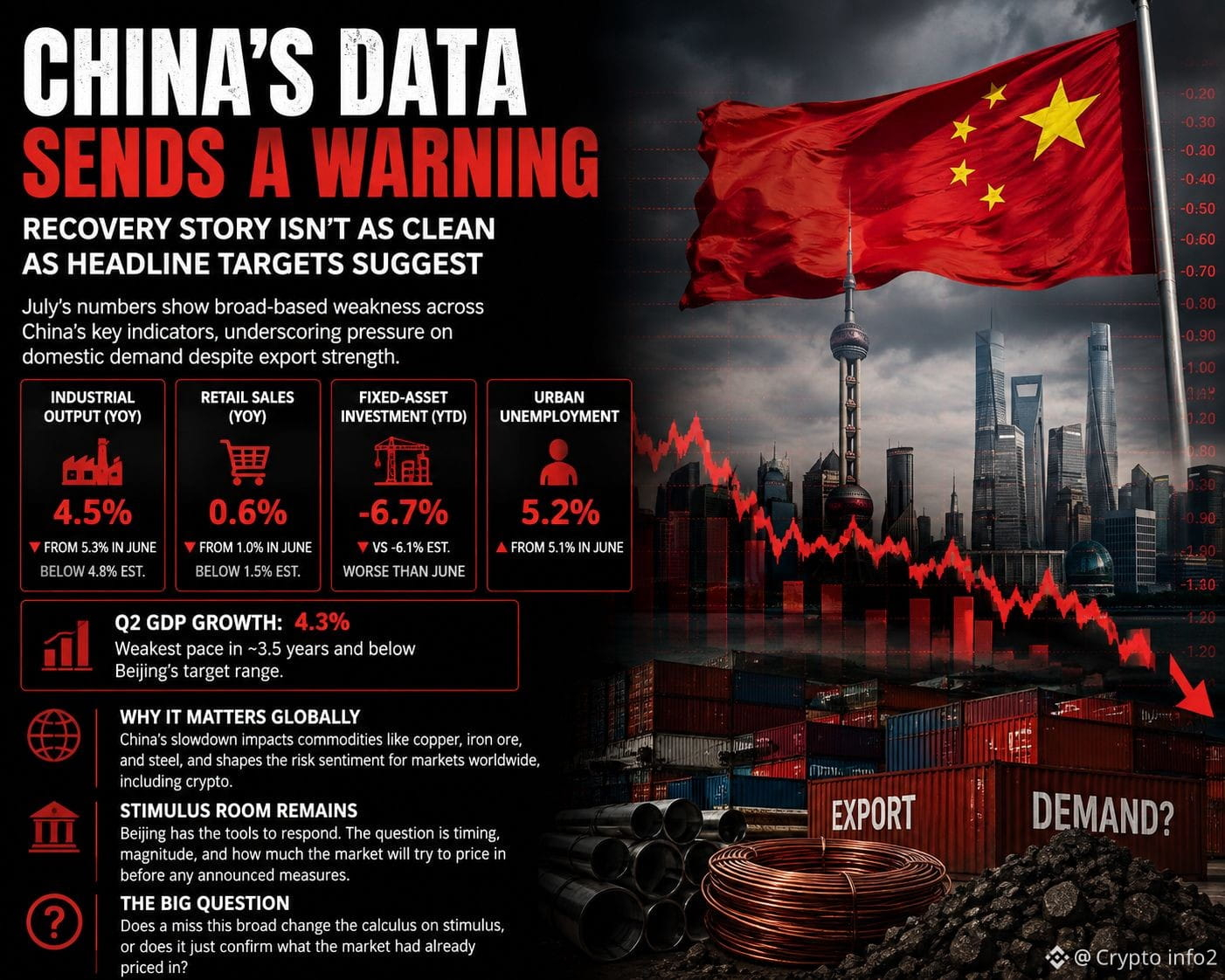
July industrial output slowed to 4.5%, retail sales crawled up just 0.6%, fixed-asset investment fell 6.7% through July, and urban unemployment ticked up to 5.2%.
Add Q2 GDP at 4.3% and the pattern is getting harder to dismiss: domestic demand still isn't filling the hole left by the property downturn.
That matters well beyond China. Copper, iron ore and steel face fresh demand questions, while global risk assets — crypto included — are watching for the next move from Beijing.
The key question isn't whether China can stimulate.
It's whether Beijing moves soon enough — and whether markets price the stimulus in before it actually arrives.
Is this a new stimulus signal, or simply confirmation of what markets already knew?
#ChinaEconomy #ChinaGDP #ChinaData #EconomicGrowth
CLICK TO BELOW TRADE👇
$STAR $TUT $GPS
{future}(GPSUSDT)
{future}(TUTUSDT)
{future}(STARUSDT)
#chinajulyoutputretailinvestmentallmiss China's latest data makes the “clean recovery” story harder to defend.
July industrial output slowed to 4.5%, retail sales crawled up just 0.6%, fixed-asset investment fell 6.7% through July, and urban unemployment ticked up to 5.2%.
Add Q2 GDP at 4.3% and the pattern is getting harder to dismiss: domestic demand still isn't filling the hole left by the property downturn.
That matters well beyond China. Copper, iron ore and steel face fresh demand questions, while global risk assets — crypto included — are watching for the next move from Beijing.
The key question isn't whether China can stimulate.
It's whether Beijing moves soon enough — and whether markets price the stimulus in before it actually arrives.
Is this a new stimulus signal, or simply confirmation of what markets already knew?
#ChinaEconomy #ChinaGDP #ChinaData #EconomicGrowth
CLICK TO BELOW TRADE👇
$STAR $TUT $GPS
July industrial output slowed to 4.5%, retail sales crawled up just 0.6%, fixed-asset investment fell 6.7% through July, and urban unemployment ticked up to 5.2%.
Add Q2 GDP at 4.3% and the pattern is getting harder to dismiss: domestic demand still isn't filling the hole left by the property downturn.
That matters well beyond China. Copper, iron ore and steel face fresh demand questions, while global risk assets — crypto included — are watching for the next move from Beijing.
The key question isn't whether China can stimulate.
It's whether Beijing moves soon enough — and whether markets price the stimulus in before it actually arrives.
Is this a new stimulus signal, or simply confirmation of what markets already knew?
#ChinaEconomy #ChinaGDP #ChinaData #EconomicGrowth
CLICK TO BELOW TRADE👇
$STAR $TUT $GPS
3
4.2k
Log in to explore more content
Join global crypto users on Binance Square
⚡️ Get latest and useful information about crypto.
💬 Trusted by the world’s largest crypto exchange.
👍 Discover real insights from verified creators.
Email / Phone number
Trending Topics
1
#NEARRisesNearly80%InAWeek
38,653 views
886 Discussing
2
#MultiversXPlansHardForkRecovery
33,093 views
670 Discussing
3
#CircleLaunchesInstitutionalBTCBackedBorrowing
31,754 views
757 Discussing
4
#BitcoinHits$85K
42,114 views
300 Discussing
5
#ZetaChainVotesToMigrateZETAToSolana
22,573 views
488 Discussing
6
#ECBStartsBlockchainEuroSettlement
47,043 views
771 Discussing
7
#SouthAfricaProposesCryptoExchangeControls
59,298 views
930 Discussing
8
#SolanaCutsTargetSlotTimeTo250ms
64,338 views
869 Discussing
9
#EthereumSurpasses$2700
35,991 views
234 Discussing
10
#CanaryFilesSecondAmendmentForStakedSEIETF
72,915 views
1,155 Discussing