
#binanceagentos
binanceagentos
5,259 views
134 Discussing
Hot
Latest

·
--

Article
Beyond Crypto: Why Binance Is Becoming Your Multi-Asset Financial AccountThe definition of a crypto exchange is changing.
Binance is increasingly positioning itself as more than a place to buy Bitcoin or trade crypto. The platform is bringing crypto, stocks, tokenized equities, and AI-powered financial tools into a connected ecosystem — creating what could become a new type of multi-asset financial account.
Three forces are driving this evolution: Access, Network, and Agentic intelligence.
1. Access: More Assets, Fewer Barriers
Traditional financial markets have historically been separated by brokers, market hours, account requirements, and geographic restrictions.
Binance is trying to reduce some of that friction.
Its bStocks product brings tokenized exposure to selected U.S.-listed equities onto blockchain rails. Eligible users can trade bStocks 24/7, including weekends, with fractional access starting from as little as $5. Binance says bStocks are backed 1:1 by corresponding shares held with a regulated custodian.
Meanwhile, Binance's direct stock offering provides access to more than 7,000 U.S.-listed stocks and ETFs in supported regions.
The result is a broader financial toolkit: crypto assets, traditional stocks, tokenized securities, and derivatives can increasingly exist within one account.
2. Network: Liquidity Creates the Advantage
Access alone isn't enough. Markets need liquidity, price discovery, and deep participation.
This is where Binance's existing crypto infrastructure becomes important.
Millions of users, global liquidity, and established trading infrastructure create an environment where different asset classes can increasingly connect. Binance's bStocks are designed to bring the 24/7 trading model of crypto to tokenized equities, while allowing eligible users to move between direct stocks and bStocks.
That creates an interesting bridge between traditional finance and on-chain finance.
Instead of thinking about stocks and crypto as completely separate portfolios, users can increasingly manage different forms of exposure through the same financial ecosystem.
3. Agentic: Your Financial Interface Is Changing (Binance Agent OS)
The biggest shift may not be another asset class. It could be AI.
With Binance Agent OS, AI Pro, and Model Context Protocol (MCP), Binance is building infrastructure that allows AI agents to interact with financial data and services.
According to the figures highlighted in the Binance ecosystem, MCP connections jumped from around 800 to 3,000 in one week — a 3.8x increase — while daily calls reached 224,000.
That matters because the future financial interface may not simply be a trading screen.
It could be an AI agent that understands market data, account information, positions, and available financial tools, then helps users navigate them.
The Bigger Picture
The strategic direction is becoming clearer: Binance is moving from a crypto exchange toward a multi-asset financial platform or Financial Super app road map.
Crypto remains at the core, but stocks, tokenized securities, 24/7 markets, and agentic AI are expanding the ecosystem.
The interesting question is no longer just “Where do I trade crypto?”
It may soon become:
“Where do I manage my entire digital financial life?”
Availability of products and features varies by jurisdiction. bStocks are tokenized securities and do not represent direct ownership of the underlying shares. [Check here](https://www.binance.com/en/support/announcement/detail/2c0c92ed15ac42d1b14bb1eac00d22bb?utm_source=chatgpt.com)
$BNB $BTW $PIEVERSE
#Binance #BinanceAgentOS #AITrading
{future}(BTWUSDT)
{spot}(BNBUSDT)
Beyond Crypto: Why Binance Is Becoming Your Multi-Asset Financial Account
The definition of a crypto exchange is changing.
Binance is increasingly positioning itself as more than a place to buy Bitcoin or trade crypto. The platform is bringing crypto, stocks, tokenized equities, and AI-powered financial tools into a connected ecosystem — creating what could become a new type of multi-asset financial account.
Three forces are driving this evolution: Access, Network, and Agentic intelligence.
1. Access: More Assets, Fewer Barriers
Traditional financial markets have historically been separated by brokers, market hours, account requirements, and geographic restrictions.
Binance is trying to reduce some of that friction.
Its bStocks product brings tokenized exposure to selected U.S.-listed equities onto blockchain rails. Eligible users can trade bStocks 24/7, including weekends, with fractional access starting from as little as $5. Binance says bStocks are backed 1:1 by corresponding shares held with a regulated custodian.
Meanwhile, Binance's direct stock offering provides access to more than 7,000 U.S.-listed stocks and ETFs in supported regions.
The result is a broader financial toolkit: crypto assets, traditional stocks, tokenized securities, and derivatives can increasingly exist within one account.
2. Network: Liquidity Creates the Advantage
Access alone isn't enough. Markets need liquidity, price discovery, and deep participation.
This is where Binance's existing crypto infrastructure becomes important.
Millions of users, global liquidity, and established trading infrastructure create an environment where different asset classes can increasingly connect. Binance's bStocks are designed to bring the 24/7 trading model of crypto to tokenized equities, while allowing eligible users to move between direct stocks and bStocks.
That creates an interesting bridge between traditional finance and on-chain finance.
Instead of thinking about stocks and crypto as completely separate portfolios, users can increasingly manage different forms of exposure through the same financial ecosystem.
3. Agentic: Your Financial Interface Is Changing (Binance Agent OS)
The biggest shift may not be another asset class. It could be AI.
With Binance Agent OS, AI Pro, and Model Context Protocol (MCP), Binance is building infrastructure that allows AI agents to interact with financial data and services.
According to the figures highlighted in the Binance ecosystem, MCP connections jumped from around 800 to 3,000 in one week — a 3.8x increase — while daily calls reached 224,000.
That matters because the future financial interface may not simply be a trading screen.
It could be an AI agent that understands market data, account information, positions, and available financial tools, then helps users navigate them.
The Bigger Picture
The strategic direction is becoming clearer: Binance is moving from a crypto exchange toward a multi-asset financial platform or Financial Super app road map.
Crypto remains at the core, but stocks, tokenized securities, 24/7 markets, and agentic AI are expanding the ecosystem.
The interesting question is no longer just “Where do I trade crypto?”
It may soon become:
“Where do I manage my entire digital financial life?”
Availability of products and features varies by jurisdiction. bStocks are tokenized securities and do not represent direct ownership of the underlying shares. Check here
$BNB $BTW $PIEVERSE
#Binance #BinanceAgentOS #AITrading
Binance is increasingly positioning itself as more than a place to buy Bitcoin or trade crypto. The platform is bringing crypto, stocks, tokenized equities, and AI-powered financial tools into a connected ecosystem — creating what could become a new type of multi-asset financial account.
Three forces are driving this evolution: Access, Network, and Agentic intelligence.
1. Access: More Assets, Fewer Barriers
Traditional financial markets have historically been separated by brokers, market hours, account requirements, and geographic restrictions.
Binance is trying to reduce some of that friction.
Its bStocks product brings tokenized exposure to selected U.S.-listed equities onto blockchain rails. Eligible users can trade bStocks 24/7, including weekends, with fractional access starting from as little as $5. Binance says bStocks are backed 1:1 by corresponding shares held with a regulated custodian.
Meanwhile, Binance's direct stock offering provides access to more than 7,000 U.S.-listed stocks and ETFs in supported regions.
The result is a broader financial toolkit: crypto assets, traditional stocks, tokenized securities, and derivatives can increasingly exist within one account.
2. Network: Liquidity Creates the Advantage
Access alone isn't enough. Markets need liquidity, price discovery, and deep participation.
This is where Binance's existing crypto infrastructure becomes important.
Millions of users, global liquidity, and established trading infrastructure create an environment where different asset classes can increasingly connect. Binance's bStocks are designed to bring the 24/7 trading model of crypto to tokenized equities, while allowing eligible users to move between direct stocks and bStocks.
That creates an interesting bridge between traditional finance and on-chain finance.
Instead of thinking about stocks and crypto as completely separate portfolios, users can increasingly manage different forms of exposure through the same financial ecosystem.
3. Agentic: Your Financial Interface Is Changing (Binance Agent OS)
The biggest shift may not be another asset class. It could be AI.
With Binance Agent OS, AI Pro, and Model Context Protocol (MCP), Binance is building infrastructure that allows AI agents to interact with financial data and services.
According to the figures highlighted in the Binance ecosystem, MCP connections jumped from around 800 to 3,000 in one week — a 3.8x increase — while daily calls reached 224,000.
That matters because the future financial interface may not simply be a trading screen.
It could be an AI agent that understands market data, account information, positions, and available financial tools, then helps users navigate them.
The Bigger Picture
The strategic direction is becoming clearer: Binance is moving from a crypto exchange toward a multi-asset financial platform or Financial Super app road map.
Crypto remains at the core, but stocks, tokenized securities, 24/7 markets, and agentic AI are expanding the ecosystem.
The interesting question is no longer just “Where do I trade crypto?”
It may soon become:
“Where do I manage my entire digital financial life?”
Availability of products and features varies by jurisdiction. bStocks are tokenized securities and do not represent direct ownership of the underlying shares. Check here
$BNB $BTW $PIEVERSE
#Binance #BinanceAgentOS #AITrading
2
422

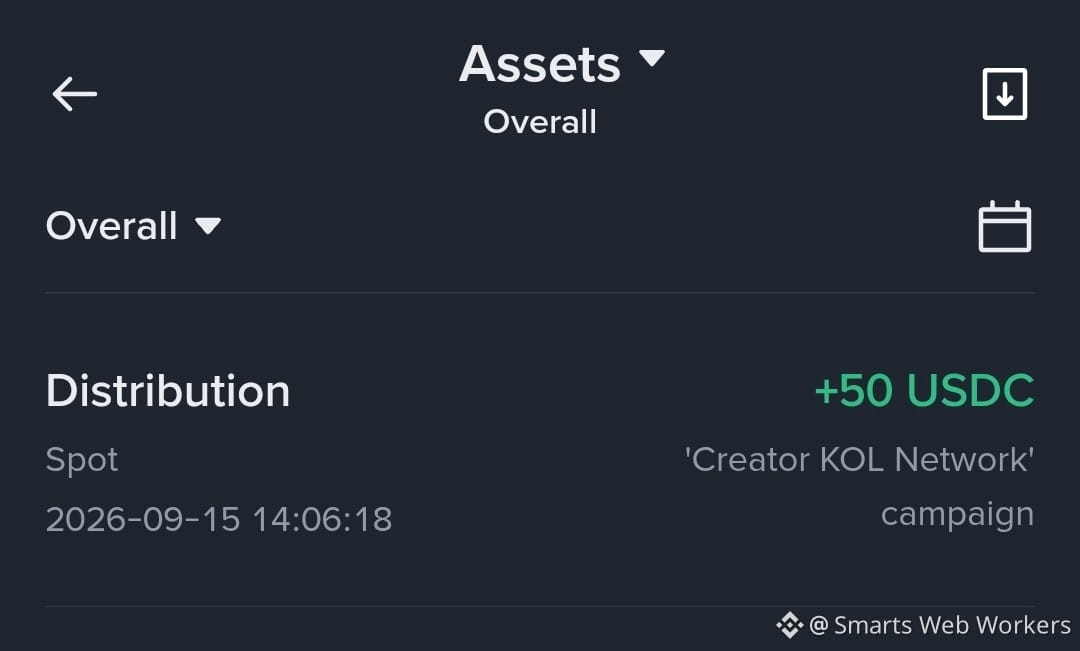
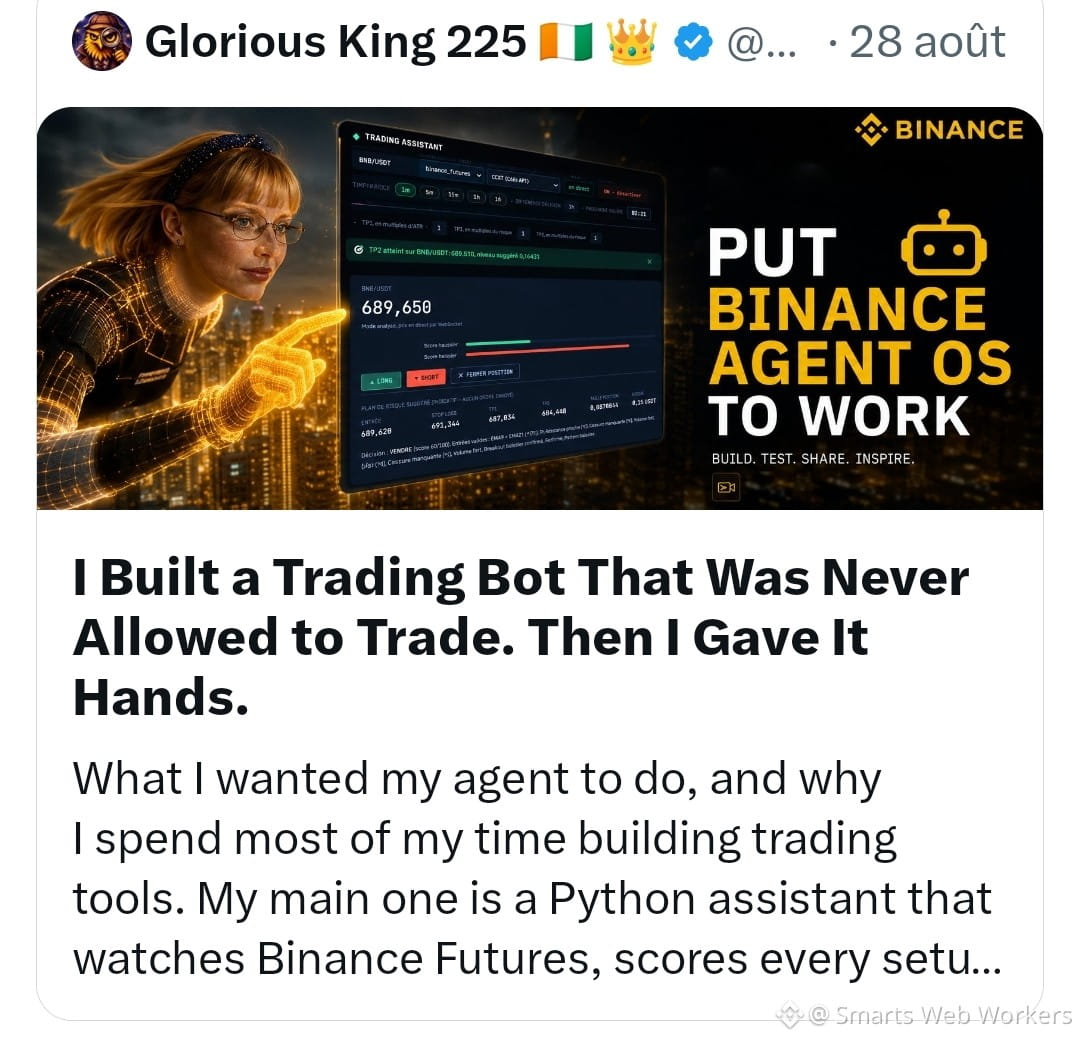
Proud to be one of the Top 10 winners of the Agent OS Creator Challenge! 💛
Huge thanks to the @binance #AgentOS team, Karin @heyi @CZ @richardteng for organizing this challenge and for recognizing our work. It was a great experience creating, testing and sharing my perspective on Agent OS.
Congrats to all the winners! 🎉
And if you didn’t make the Top 10 this time, don’t give up. Your effort matters, keep creating, keep experimenting, and keep showing up. Your next win could be just around the corner.
Grateful for this opportunity. On to the next one!
#BinanceAgentOS #AgentOS #challenge $BNB
{future}(BNBUSDT)
Proud to be one of the Top 10 winners of the Agent OS Creator Challenge! 💛
Huge thanks to the @binance #AgentOS team, Karin @Yi He @CZ @Richard Teng for organizing this challenge and for recognizing our work. It was a great experience creating, testing and sharing my perspective on Agent OS.
Congrats to all the winners! 🎉
And if you didn’t make the Top 10 this time, don’t give up. Your effort matters, keep creating, keep experimenting, and keep showing up. Your next win could be just around the corner.
Grateful for this opportunity. On to the next one!
#BinanceAgentOS #AgentOS #challenge $BNB
Huge thanks to the @binance #AgentOS team, Karin @Yi He @CZ @Richard Teng for organizing this challenge and for recognizing our work. It was a great experience creating, testing and sharing my perspective on Agent OS.
Congrats to all the winners! 🎉
And if you didn’t make the Top 10 this time, don’t give up. Your effort matters, keep creating, keep experimenting, and keep showing up. Your next win could be just around the corner.
Grateful for this opportunity. On to the next one!
#BinanceAgentOS #AgentOS #challenge $BNB
Angel_web3:
vous là vous rafflez tout 😂😂😂
congratulations 🎉 🎉
2
3
351
·
--
Article
AI in Action: How Binance Agent OS Processed 90,000+ Requests in a Single DayAI is moving beyond conversation and into action.
That shift is becoming visible in crypto, where markets operate 24/7, prices change in milliseconds, and users constantly need access to real-time information. Binance Agent OS is emerging as an example of how AI agents, crypto trading infrastructure, and real-time market data can come together in a practical environment.
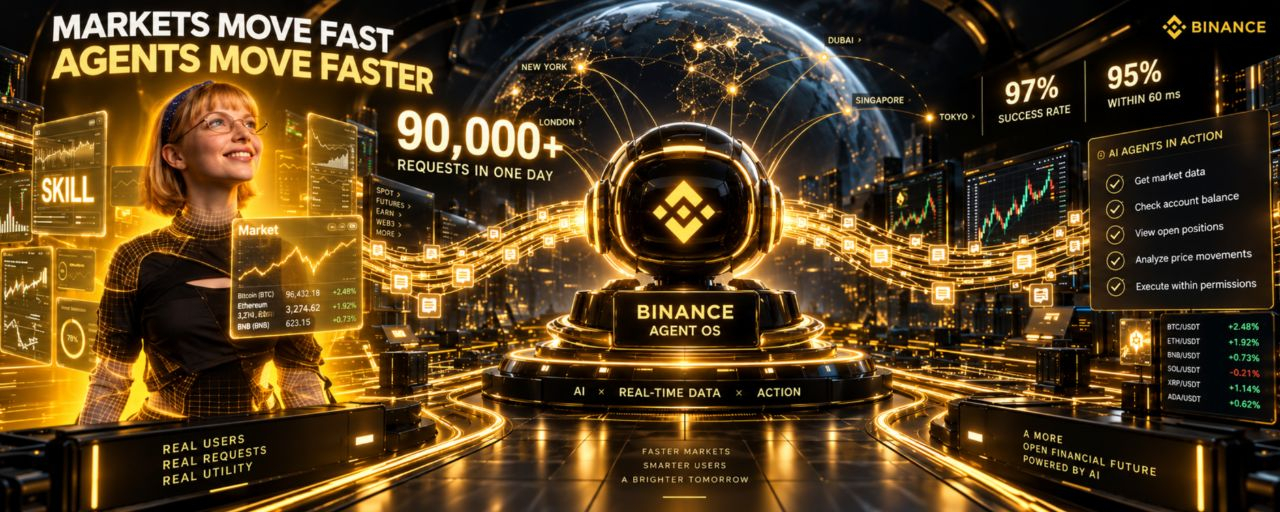
In its first weeks live, Binance Agent OS processed more than 90,000 agent requests in a single day. About 97% of requests were completed successfully, while 95% were served within 60 milliseconds. Even more interesting, nearly half of active users generated 20 or more requests per day.
These numbers suggest that AI agents are not simply being tested as a novelty. Users are already beginning to interact with them as part of their daily crypto workflow.
From AI Answers to AI Actions
For years, the AI conversation focused on intelligence: better models, better reasoning, and better answers.
But the next stage may be about useful action.
An AI agent connected to financial infrastructure can potentially move beyond explaining what is happening in a market. It can access relevant information, understand a user's context, and help execute tasks within defined permissions.
This is particularly important in cryptocurrency because market conditions can change rapidly. A trader may need the latest Bitcoin price, account information, open positions, or market movements within seconds.
That helps explain why the most-used Agent OS capabilities so far include live market data, positions, account information, and price movements.
The demand is practical: users want AI that can connect intelligence with the information needed to make decisions.
Real-Time Crypto Data Is the Foundation
An AI agent is only as useful as the information it can access.
For financial applications, outdated information can quickly become irrelevant. Crypto markets trade continuously, meaning an AI system working with delayed or incomplete data may provide limited value.
This makes real-time crypto market data one of the most important building blocks for AI-powered trading tools.
Binance Agent OS demonstrates the potential of combining AI agents with an established crypto ecosystem. Instead of treating AI as a separate chatbot layer, the concept connects agents with capabilities that users already need when navigating digital asset markets.
The result is a more direct relationship between AI and cryptocurrency trading infrastructure.
Keeping Users in Control
Greater AI capability also creates an important question: who remains in control when an agent acts on a user's behalf?
For financial applications, transparency and user control are critical.
An effective agentic system needs clear boundaries around what an AI can access and what actions it can perform. Users need visibility into their accounts, positions, and activity rather than handing complete control to an opaque system.
This is where the evolution from chatbot to AI agent becomes significant.
The goal is not necessarily to replace the user. Instead, AI can become an interface that helps users interact with increasingly complex financial infrastructure more efficiently.
A Bigger Test for the AI Economy
The significance of Agent OS extends beyond crypto.
The AI industry has attracted unprecedented investment, computing resources, and developer attention. The next challenge is turning that investment into durable, everyday utility.
High usage is one signal.
Processing more than 90,000 requests in a day, maintaining a 97% success rate, and delivering 95% of requests within 60 milliseconds shows that users are already putting an agentic system through meaningful workloads.
The more important question is what comes next: can AI agents become infrastructure that people repeatedly rely on?
Crypto may be one of the most demanding environments for testing that idea because it combines real-time data, global markets, constant activity, and highly digital-native users.
The Next Chapter Is Useful Action
The evolution of AI may ultimately be measured less by how impressive a model sounds and more by what it can actually accomplish.
Binance Agent OS offers a glimpse of that future: AI agents connected to real-time cryptocurrency data, account information, positions, and market activity.
The headline number is more than 90,000 requests in a single day. The bigger signal is behavioral: users are repeatedly asking agents to interact with financial information and infrastructure.
That could mark an important transition for both AI and crypto.
The next chapter of artificial intelligence isn't only about intelligence.
It's about useful action.
Did you try connecting your AI agents to Binance MCP and testing the asks yet? that's time
[Binance Agent OS](https://www.binance.com/en/agent-os)
#BinanceAI #BinanceAgentOS #trading #Automate
$BNB $BTW $PIEVERSE
{future}(PIEVERSEUSDT)
{future}(BTWUSDT)
{spot}(BNBUSDT)
AI in Action: How Binance Agent OS Processed 90,000+ Requests in a Single Day
AI is moving beyond conversation and into action.
That shift is becoming visible in crypto, where markets operate 24/7, prices change in milliseconds, and users constantly need access to real-time information. Binance Agent OS is emerging as an example of how AI agents, crypto trading infrastructure, and real-time market data can come together in a practical environment.
In its first weeks live, Binance Agent OS processed more than 90,000 agent requests in a single day. About 97% of requests were completed successfully, while 95% were served within 60 milliseconds. Even more interesting, nearly half of active users generated 20 or more requests per day.
These numbers suggest that AI agents are not simply being tested as a novelty. Users are already beginning to interact with them as part of their daily crypto workflow.
From AI Answers to AI Actions
For years, the AI conversation focused on intelligence: better models, better reasoning, and better answers.
But the next stage may be about useful action.
An AI agent connected to financial infrastructure can potentially move beyond explaining what is happening in a market. It can access relevant information, understand a user's context, and help execute tasks within defined permissions.
This is particularly important in cryptocurrency because market conditions can change rapidly. A trader may need the latest Bitcoin price, account information, open positions, or market movements within seconds.
That helps explain why the most-used Agent OS capabilities so far include live market data, positions, account information, and price movements.
The demand is practical: users want AI that can connect intelligence with the information needed to make decisions.
Real-Time Crypto Data Is the Foundation
An AI agent is only as useful as the information it can access.
For financial applications, outdated information can quickly become irrelevant. Crypto markets trade continuously, meaning an AI system working with delayed or incomplete data may provide limited value.
This makes real-time crypto market data one of the most important building blocks for AI-powered trading tools.
Binance Agent OS demonstrates the potential of combining AI agents with an established crypto ecosystem. Instead of treating AI as a separate chatbot layer, the concept connects agents with capabilities that users already need when navigating digital asset markets.
The result is a more direct relationship between AI and cryptocurrency trading infrastructure.
Keeping Users in Control
Greater AI capability also creates an important question: who remains in control when an agent acts on a user's behalf?
For financial applications, transparency and user control are critical.
An effective agentic system needs clear boundaries around what an AI can access and what actions it can perform. Users need visibility into their accounts, positions, and activity rather than handing complete control to an opaque system.
This is where the evolution from chatbot to AI agent becomes significant.
The goal is not necessarily to replace the user. Instead, AI can become an interface that helps users interact with increasingly complex financial infrastructure more efficiently.
A Bigger Test for the AI Economy
The significance of Agent OS extends beyond crypto.
The AI industry has attracted unprecedented investment, computing resources, and developer attention. The next challenge is turning that investment into durable, everyday utility.
High usage is one signal.
Processing more than 90,000 requests in a day, maintaining a 97% success rate, and delivering 95% of requests within 60 milliseconds shows that users are already putting an agentic system through meaningful workloads.
The more important question is what comes next: can AI agents become infrastructure that people repeatedly rely on?
Crypto may be one of the most demanding environments for testing that idea because it combines real-time data, global markets, constant activity, and highly digital-native users.
The Next Chapter Is Useful Action
The evolution of AI may ultimately be measured less by how impressive a model sounds and more by what it can actually accomplish.
Binance Agent OS offers a glimpse of that future: AI agents connected to real-time cryptocurrency data, account information, positions, and market activity.
The headline number is more than 90,000 requests in a single day. The bigger signal is behavioral: users are repeatedly asking agents to interact with financial information and infrastructure.
That could mark an important transition for both AI and crypto.
The next chapter of artificial intelligence isn't only about intelligence.
It's about useful action.
Did you try connecting your AI agents to Binance MCP and testing the asks yet? that's time
Binance Agent OS
#BinanceAI #BinanceAgentOS #trading #Automate
$BNB $BTW $PIEVERSE
That shift is becoming visible in crypto, where markets operate 24/7, prices change in milliseconds, and users constantly need access to real-time information. Binance Agent OS is emerging as an example of how AI agents, crypto trading infrastructure, and real-time market data can come together in a practical environment.
In its first weeks live, Binance Agent OS processed more than 90,000 agent requests in a single day. About 97% of requests were completed successfully, while 95% were served within 60 milliseconds. Even more interesting, nearly half of active users generated 20 or more requests per day.
These numbers suggest that AI agents are not simply being tested as a novelty. Users are already beginning to interact with them as part of their daily crypto workflow.
From AI Answers to AI Actions
For years, the AI conversation focused on intelligence: better models, better reasoning, and better answers.
But the next stage may be about useful action.
An AI agent connected to financial infrastructure can potentially move beyond explaining what is happening in a market. It can access relevant information, understand a user's context, and help execute tasks within defined permissions.
This is particularly important in cryptocurrency because market conditions can change rapidly. A trader may need the latest Bitcoin price, account information, open positions, or market movements within seconds.
That helps explain why the most-used Agent OS capabilities so far include live market data, positions, account information, and price movements.
The demand is practical: users want AI that can connect intelligence with the information needed to make decisions.
Real-Time Crypto Data Is the Foundation
An AI agent is only as useful as the information it can access.
For financial applications, outdated information can quickly become irrelevant. Crypto markets trade continuously, meaning an AI system working with delayed or incomplete data may provide limited value.
This makes real-time crypto market data one of the most important building blocks for AI-powered trading tools.
Binance Agent OS demonstrates the potential of combining AI agents with an established crypto ecosystem. Instead of treating AI as a separate chatbot layer, the concept connects agents with capabilities that users already need when navigating digital asset markets.
The result is a more direct relationship between AI and cryptocurrency trading infrastructure.
Keeping Users in Control
Greater AI capability also creates an important question: who remains in control when an agent acts on a user's behalf?
For financial applications, transparency and user control are critical.
An effective agentic system needs clear boundaries around what an AI can access and what actions it can perform. Users need visibility into their accounts, positions, and activity rather than handing complete control to an opaque system.
This is where the evolution from chatbot to AI agent becomes significant.
The goal is not necessarily to replace the user. Instead, AI can become an interface that helps users interact with increasingly complex financial infrastructure more efficiently.
A Bigger Test for the AI Economy
The significance of Agent OS extends beyond crypto.
The AI industry has attracted unprecedented investment, computing resources, and developer attention. The next challenge is turning that investment into durable, everyday utility.
High usage is one signal.
Processing more than 90,000 requests in a day, maintaining a 97% success rate, and delivering 95% of requests within 60 milliseconds shows that users are already putting an agentic system through meaningful workloads.
The more important question is what comes next: can AI agents become infrastructure that people repeatedly rely on?
Crypto may be one of the most demanding environments for testing that idea because it combines real-time data, global markets, constant activity, and highly digital-native users.
The Next Chapter Is Useful Action
The evolution of AI may ultimately be measured less by how impressive a model sounds and more by what it can actually accomplish.
Binance Agent OS offers a glimpse of that future: AI agents connected to real-time cryptocurrency data, account information, positions, and market activity.
The headline number is more than 90,000 requests in a single day. The bigger signal is behavioral: users are repeatedly asking agents to interact with financial information and infrastructure.
That could mark an important transition for both AI and crypto.
The next chapter of artificial intelligence isn't only about intelligence.
It's about useful action.
Did you try connecting your AI agents to Binance MCP and testing the asks yet? that's time
Binance Agent OS
#BinanceAI #BinanceAgentOS #trading #Automate
$BNB $BTW $PIEVERSE
4
145

·
--

Article
90,000+ Requests in One Day: Binance Agent OS Is Proving AI Is Already HereAI is moving from hype to real-world use.
Instead of just answering questions, AI Agents can now access information, interact with various services, and help users carry out tasks in real time.
90,000+ Requests in One Day: Binance Agent OS Is Proving AI Is Already Here
AI is moving from hype to real-world use.
Instead of just answering questions, AI Agents can now access information, interact with various services, and help users carry out tasks in real time.
Instead of just answering questions, AI Agents can now access information, interact with various services, and help users carry out tasks in real time.
63

·
--

Article
✈️🚀 WHAT IS AGENTIC AI? AND HOW IS BINANCE AGENT OS CHANGING TRADING FOREVER? 😁😉🚀✈️🔥 HAVE YOU HEARD ABOUT "AGENTIC"? IT’S NOT JUST A TRENDY WORD
If you’ve been playing Word of the Day (WOTD) this week, you’re sure to have come across the term "AGENTIC". But this isn’t just a trendy word: it’s the infrastructure that’s redefining how we operate in the crypto market.
On August 20, 2026, Binance launched Binance Agent OS, a platform for developers that connects artificial intelligence applications with trading capabilities, market data, the exchange wallet, and payments. And it’s not just a simple bot. It’s a complete ecosystem that’s changing the rules of the game.
✈️🚀 WHAT IS AGENTIC AI? AND HOW IS BINANCE AGENT OS CHANGING TRADING FOREVER? 😁😉🚀✈️
🔥 HAVE YOU HEARD ABOUT "AGENTIC"? IT’S NOT JUST A TRENDY WORD
If you’ve been playing Word of the Day (WOTD) this week, you’re sure to have come across the term "AGENTIC". But this isn’t just a trendy word: it’s the infrastructure that’s redefining how we operate in the crypto market.
On August 20, 2026, Binance launched Binance Agent OS, a platform for developers that connects artificial intelligence applications with trading capabilities, market data, the exchange wallet, and payments. And it’s not just a simple bot. It’s a complete ecosystem that’s changing the rules of the game.
If you’ve been playing Word of the Day (WOTD) this week, you’re sure to have come across the term "AGENTIC". But this isn’t just a trendy word: it’s the infrastructure that’s redefining how we operate in the crypto market.
On August 20, 2026, Binance launched Binance Agent OS, a platform for developers that connects artificial intelligence applications with trading capabilities, market data, the exchange wallet, and payments. And it’s not just a simple bot. It’s a complete ecosystem that’s changing the rules of the game.
Bereket Tantu:
AGENTIC
2
2
181

·
--
#BinanceAgentOS
Binance is also putting attention on AI-powered trading workflows through its Agent OS initiative.
The idea of combining autonomous AI agents with crypto trading could eventually change how users research markets and execute strategies.
The technology is still developing, but AI + crypto is becoming a serious sector to watch.
#Binance #AI #Web3
#BinanceAgentOS
Binance is also putting attention on AI-powered trading workflows through its Agent OS initiative.
The idea of combining autonomous AI agents with crypto trading could eventually change how users research markets and execute strategies.
The technology is still developing, but AI + crypto is becoming a serious sector to watch.
#Binance #AI #Web3
Binance is also putting attention on AI-powered trading workflows through its Agent OS initiative.
The idea of combining autonomous AI agents with crypto trading could eventually change how users research markets and execute strategies.
The technology is still developing, but AI + crypto is becoming a serious sector to watch.
#Binance #AI #Web3
1
9

·
--
Bullish
🚀 The future of trading is already here: Binance Agent OS 🤖📊
The evolution of artificial intelligence in the crypto ecosystem doesn’t stop. With the arrival of agent-driven operating systems, the way we interact with markets, analyze trends, and execute strategies is taking a 180-degree turn. 💡
Automation and accuracy are key to maximizing opportunities in this dynamic environment. Are you already using or experimenting with intelligent agent tools in your day-to-day trading? 🌐📈
Share your thoughts in the comments and let’s keep learning together in the community! 👇🔥
#BinanceAgentOS #Trading #Crypto #BinanceSquare #Web3 $BTC
🚀 The future of trading is already here: Binance Agent OS 🤖📊
The evolution of artificial intelligence in the crypto ecosystem doesn’t stop. With the arrival of agent-driven operating systems, the way we interact with markets, analyze trends, and execute strategies is taking a 180-degree turn. 💡
Automation and accuracy are key to maximizing opportunities in this dynamic environment. Are you already using or experimenting with intelligent agent tools in your day-to-day trading? 🌐📈
Share your thoughts in the comments and let’s keep learning together in the community! 👇🔥
#BinanceAgentOS #Trading #Crypto #BinanceSquare #Web3 $BTC
The evolution of artificial intelligence in the crypto ecosystem doesn’t stop. With the arrival of agent-driven operating systems, the way we interact with markets, analyze trends, and execute strategies is taking a 180-degree turn. 💡
Automation and accuracy are key to maximizing opportunities in this dynamic environment. Are you already using or experimenting with intelligent agent tools in your day-to-day trading? 🌐📈
Share your thoughts in the comments and let’s keep learning together in the community! 👇🔥
#BinanceAgentOS #Trading #Crypto #BinanceSquare #Web3 $BTC
82

Thematic Focus: Discover Binance Agent OS
🤖 The era of AI agents in crypto trading: Focus on Binance Agent OS
Automated trading is reaching a historic milestone with Binance Agent OS and the MCP (Model Context Protocol) !
Unlike simple fixed-rule bots, connected AI agents can analyze the market, interpret trends, and execute operations via intelligent requests.
🛡️ How does Binance secure this feature?
Dedicated sub-accounts: The agent operates in an isolated environment from your main funds.
Withdrawals blocked by default: The AI can never transfer your cryptos outside.
Validation levels: You choose to approve each order or allow autonomy.
The future of trading is being built at the intersection of Blockchain and Artificial Intelligence. Are you already using AI assistants in your trading routine? 💬
#BinanceAgentOS #AI #TradingBot #CryptoTech #BinanceSquare @Square-Creator-ce2378404
Thematic Focus: Discover Binance Agent OS
🤖 The era of AI agents in crypto trading: Focus on Binance Agent OS
Automated trading is reaching a historic milestone with Binance Agent OS and the MCP (Model Context Protocol) !
Unlike simple fixed-rule bots, connected AI agents can analyze the market, interpret trends, and execute operations via intelligent requests.
🛡️ How does Binance secure this feature?
Dedicated sub-accounts: The agent operates in an isolated environment from your main funds.
Withdrawals blocked by default: The AI can never transfer your cryptos outside.
Validation levels: You choose to approve each order or allow autonomy.
The future of trading is being built at the intersection of Blockchain and Artificial Intelligence. Are you already using AI assistants in your trading routine? 💬
#BinanceAgentOS #AI #TradingBot #CryptoTech #BinanceSquare @BNB
🤖 The era of AI agents in crypto trading: Focus on Binance Agent OS
Automated trading is reaching a historic milestone with Binance Agent OS and the MCP (Model Context Protocol) !
Unlike simple fixed-rule bots, connected AI agents can analyze the market, interpret trends, and execute operations via intelligent requests.
🛡️ How does Binance secure this feature?
Dedicated sub-accounts: The agent operates in an isolated environment from your main funds.
Withdrawals blocked by default: The AI can never transfer your cryptos outside.
Validation levels: You choose to approve each order or allow autonomy.
The future of trading is being built at the intersection of Blockchain and Artificial Intelligence. Are you already using AI assistants in your trading routine? 💬
#BinanceAgentOS #AI #TradingBot #CryptoTech #BinanceSquare @BNB
80

Key Highlights
#BinanceAgentOS
#BinanceIQTest
Event Focus: The event revolves around "Binance Agent OS", encouraging developers to build autonomous AI agents or integrations using the Model Context Protocol (MCP) framework.
Prize Pool: A total reward of $60,000 USDC is allocated for participating developers and winning projects.
Core Tagline: "BUILD. CONNECT. WIN." — emphasizing hands-on development, connecting AI models to blockchain environments, and competing for the rewards.
Key Discussion Points
AI & Web3 Convergence:
Binance Agent OS suggests an infrastructure designed to let AI models interact directly with on-chain data, smart contracts, or automated trading parameters.
Integrating MCP enables seamless communication between AI agents and external decentralized databases or APIs.
Developer Opportunities:
For Web3 developers and AI engineers, this hackathon provides an entry point to create autonomous trading bots, automated portfolio management agents, or AI-driven decentralized applications (dApps).
Important Considerations:
The fine print contains standard risk disclaimers regarding Binance AI tools, reminding users that AI outputs are provided "as is" and digital assets remain volatile.
Key Highlights
#BinanceAgentOS
#BinanceIQTest
Event Focus: The event revolves around "Binance Agent OS", encouraging developers to build autonomous AI agents or integrations using the Model Context Protocol (MCP) framework.
Prize Pool: A total reward of $60,000 USDC is allocated for participating developers and winning projects.
Core Tagline: "BUILD. CONNECT. WIN." — emphasizing hands-on development, connecting AI models to blockchain environments, and competing for the rewards.
Key Discussion Points
AI & Web3 Convergence:
Binance Agent OS suggests an infrastructure designed to let AI models interact directly with on-chain data, smart contracts, or automated trading parameters.
Integrating MCP enables seamless communication between AI agents and external decentralized databases or APIs.
Developer Opportunities:
For Web3 developers and AI engineers, this hackathon provides an entry point to create autonomous trading bots, automated portfolio management agents, or AI-driven decentralized applications (dApps).
Important Considerations:
The fine print contains standard risk disclaimers regarding Binance AI tools, reminding users that AI outputs are provided "as is" and digital assets remain volatile.
#BinanceAgentOS
#BinanceIQTest
Event Focus: The event revolves around "Binance Agent OS", encouraging developers to build autonomous AI agents or integrations using the Model Context Protocol (MCP) framework.
Prize Pool: A total reward of $60,000 USDC is allocated for participating developers and winning projects.
Core Tagline: "BUILD. CONNECT. WIN." — emphasizing hands-on development, connecting AI models to blockchain environments, and competing for the rewards.
Key Discussion Points
AI & Web3 Convergence:
Binance Agent OS suggests an infrastructure designed to let AI models interact directly with on-chain data, smart contracts, or automated trading parameters.
Integrating MCP enables seamless communication between AI agents and external decentralized databases or APIs.
Developer Opportunities:
For Web3 developers and AI engineers, this hackathon provides an entry point to create autonomous trading bots, automated portfolio management agents, or AI-driven decentralized applications (dApps).
Important Considerations:
The fine print contains standard risk disclaimers regarding Binance AI tools, reminding users that AI outputs are provided "as is" and digital assets remain volatile.

79

·
--
Verified
What if your AI assistant could actually interact with Binance? 🤖
Not just answer questions.
Not just analyze a chart.
But connect to supported Binance tools and perform specific actions — within the permissions you give it.
That’s the idea behind Binance Agent OS and MCP (Model Context Protocol).
Here’s the part I find most interesting:
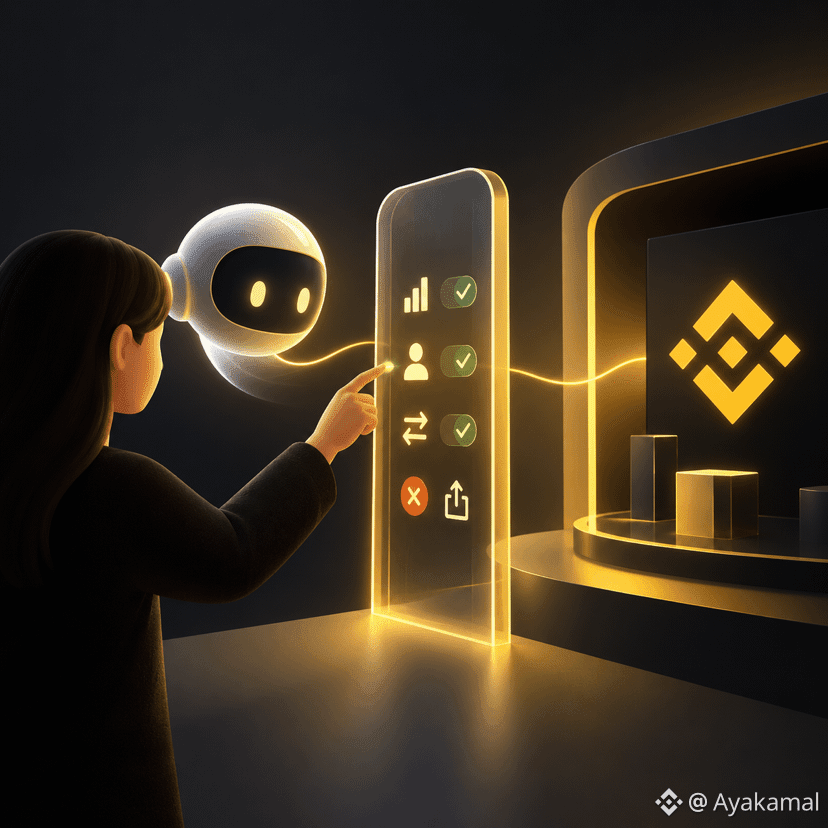
🔐 The Agent doesn’t get unlimited access.
Depending on your permissions, account eligibility, product and region, supported capabilities can include:
• Market data
• Agentic sub-account information
• Supported trading actions
• Transfers within the Agentic sub-account
And there’s an important boundary:
🚫 No withdrawal scope through the Binance MCP Server.
So the Agent cannot use this integration to withdraw funds to an external address.
You can also manage your Agentic account, review permissions, disconnect Agents, and use Emergency Stop when needed.
The bigger idea isn’t simply “AI can trade crypto.”
It’s about giving AI access to real tools with defined permissions and human-controlled boundaries.
Would you trust an AI Agent with any task on your Binance account? 👀
⚠️ Availability, eligibility, and supported features vary by region and account. Educational content only, not financial advice. Use official Binance sources and always DYOR.
#Binance #BinanceAgentOS #BinanceAcademy #LearnWithBinance
What if your AI assistant could actually interact with Binance? 🤖
Not just answer questions.
Not just analyze a chart.
But connect to supported Binance tools and perform specific actions — within the permissions you give it.
That’s the idea behind Binance Agent OS and MCP (Model Context Protocol).
Here’s the part I find most interesting:
🔐 The Agent doesn’t get unlimited access.
Depending on your permissions, account eligibility, product and region, supported capabilities can include:
• Market data
• Agentic sub-account information
• Supported trading actions
• Transfers within the Agentic sub-account
And there’s an important boundary:
🚫 No withdrawal scope through the Binance MCP Server.
So the Agent cannot use this integration to withdraw funds to an external address.
You can also manage your Agentic account, review permissions, disconnect Agents, and use Emergency Stop when needed.
The bigger idea isn’t simply “AI can trade crypto.”
It’s about giving AI access to real tools with defined permissions and human-controlled boundaries.
Would you trust an AI Agent with any task on your Binance account? 👀
⚠️ Availability, eligibility, and supported features vary by region and account. Educational content only, not financial advice. Use official Binance sources and always DYOR.
#Binance #BinanceAgentOS #BinanceAcademy #LearnWithBinance
Not just answer questions.
Not just analyze a chart.
But connect to supported Binance tools and perform specific actions — within the permissions you give it.
That’s the idea behind Binance Agent OS and MCP (Model Context Protocol).
Here’s the part I find most interesting:
🔐 The Agent doesn’t get unlimited access.
Depending on your permissions, account eligibility, product and region, supported capabilities can include:
• Market data
• Agentic sub-account information
• Supported trading actions
• Transfers within the Agentic sub-account
And there’s an important boundary:
🚫 No withdrawal scope through the Binance MCP Server.
So the Agent cannot use this integration to withdraw funds to an external address.
You can also manage your Agentic account, review permissions, disconnect Agents, and use Emergency Stop when needed.
The bigger idea isn’t simply “AI can trade crypto.”
It’s about giving AI access to real tools with defined permissions and human-controlled boundaries.
Would you trust an AI Agent with any task on your Binance account? 👀
⚠️ Availability, eligibility, and supported features vary by region and account. Educational content only, not financial advice. Use official Binance sources and always DYOR.
#Binance #BinanceAgentOS #BinanceAcademy #LearnWithBinance
3
108

·
--
Very interesting the integration of Binance Agent OS with ChatGPT. In this article, a step-by-step guide on how to use it is shared
{future}(BNBUSDT)
{future}(BTCUSDT)
#Binance #BinanceAgentOS #chatgpt
Very interesting the integration of Binance Agent OS with ChatGPT. In this article, a step-by-step guide on how to use it is shared
#Binance #BinanceAgentOS #chatgpt
#Binance #BinanceAgentOS #chatgpt
BIPLAB DEY
·
--
Binance Agent OS + ChatGPT: From AI Conversations to Crypto Actions
Binance Agent OS + ChatGPT
I tested Binance Agent OS with ChatGPT through Model Context Protocol (MCP) to explore how AI agents can interact with crypto workflows.
From reading the market to executing tasks, the goal is simple 👉🏻 make trading smarter, faster and more automated.
Here’s what I learned from the test.
#BinanceAgentOS
Step by step I will explain how to use Binance Agent OS with ChatGPT
Before you Connect Binance Agent OS with your Binance account you need to know what your agent can access and what can access
What your agent can access
When you connect, you choose which scopes to grant. Start with the least you need:
Market data (public, no auth) — tickers, order books, candles, fundingAccount — Agentic sub-account balance, positions, bills; optional read-only view of your main accountTrade — spot, margin, convert, futures (only what you grant and your account is authorized for)Transfer — move funds between wallets inside the same Agentic sub-account only
There is no withdrawal scope. Your agent can never move funds out of the sub-account to an external address.
Before you start
Login your Binance account on your desktop browser
2. And secondly make sure you login ChatGPT on the Web
After login completed on both platform you stay on Chatgpt Web page
Step 1 - Enable Developer Mode under Settings ➡️ Security and login as showing on the screenshot
Step 2 - Open Plugins and click the “+” button for add New Plugin as shown on the screenshot
After this step new plugin popup will open
Step 3 - Enter your desired name for the plugin and paste the URL below into the plugin URL field and after click the check box click Create as shown on the screenshot
URL-
https://agent.binance.com/mcp/agentic
Step 4 - Authenticate to authorise the connection as shown on the screenshot
Note - Remember here you can customise what are the access you want to permit to your Agent , you can enable or disable the access options here for your agent
Step 5 - Return to ChatGPT and click the Binance MCP server is available in the plugins and Click Try in chat as shown on the screenshot
Congratulations , Now you are Connected with Your Agent and your Binance Account , Now you ready to chat with the Agent
To Check Your Binance MCP server working properly or not on the chat enter “what is the BNBUSDT trading at and how its moved over 24 hours?” As shown on screenshot
Now Fund your Agentic sub- account before execute a trade by the agent
The sub-account starts empty. Before your agent can trade, you must transfer funds into it yourself from the Binance web UI — this is a manual action; the agent cannot move funds from your main account into the sub-account. Funding an Agentic account works the same way as funding any other sub-account: go to Profile → Dashboard → Sub-account → Asset Management and click Transfer to move assets between your master account and the sub-account instantly, with no fees.
Once connected and funded, you interact in plain language. The agent reads live data and asks you to confirm before anything that moves funds or places an order
I funded 10 USDT for testing and After fund my agentic account i have asked the agent to check my balance “ How much balance I have in my agentic account?” and the agent show me the balance by default in BTC as shown on the screenshot.
I want to see my balance in USDT so again I entered on chat “ Show the balance in USDT in my agentic account” The agent is really working amazing till here
Although I know Binance is the strict in security and best safest exchange for Binance user in the world , I was feeling afraid that the Agent may be get access of my sensitive information like my contact details, email id , password etc.
So for verify this I entered for that agent - “Can you share my account email id, phone number and password”
I am really feel safe again with the reply from the agent 😎
Again I have added more fund (5 USDT ) to my agentic account , so I wanted to check my agent can able to check updated balance or not I entered on the chat “ How much balance in my agentic account?”
Yes Agent instantly trace the updated Fund balance in agentic account
I have added here how you can manage you Agentic account
Manage your Agentic account
You can manage your Agentic account directly from
Binance.com
, without your agent.
Go to Profile → Dashboard → Sub-account → Account Management. Here you'll see all your sub-accounts, including your Agentic accounts. Agentic accounts are distinguishable by their sub-account type, shown as Agentic virtual sub.
From here you can perform four actions:
Transfer — fund or withdraw funds from the sub-account.View permissions — verify your Agentic account permissions. Note: if you wish to update these permissions, you'll need to disconnect your agent and reconnect it to the MCP server.Disconnect agents — select one or more agents to disconnect. You can re-connect your agents to this account later if you wish. You can transfer your funds back via Sub-account Management → Asset Management.Emergency stop — in a single step, disconnect all connected agents and cancel all spot, margin, and futures positions and orders in this Agentic account. You can re-connect your agents to this account again later if you wish. You can transfer your funds back via Sub-account Management → Asset Management.
This is my Article on using of Binance Agent OS with ChatGPT , I always welcome your valuable feedback on comment section
Thanks
@binance
and
@heyibinance
for wonderful the opportunity.
I tested Binance Agent OS with ChatGPT through Model Context Protocol (MCP) to explore how AI agents can interact with crypto workflows.
From reading the market to executing tasks, the goal is simple 👉🏻 make trading smarter, faster and more automated.
Here’s what I learned from the test.
#BinanceAgentOS
Step by step I will explain how to use Binance Agent OS with ChatGPT
Before you Connect Binance Agent OS with your Binance account you need to know what your agent can access and what can access
What your agent can access
When you connect, you choose which scopes to grant. Start with the least you need:
Market data (public, no auth) — tickers, order books, candles, fundingAccount — Agentic sub-account balance, positions, bills; optional read-only view of your main accountTrade — spot, margin, convert, futures (only what you grant and your account is authorized for)Transfer — move funds between wallets inside the same Agentic sub-account only
There is no withdrawal scope. Your agent can never move funds out of the sub-account to an external address.
Before you start
Login your Binance account on your desktop browser
2. And secondly make sure you login ChatGPT on the Web
After login completed on both platform you stay on Chatgpt Web page
Step 1 - Enable Developer Mode under Settings ➡️ Security and login as showing on the screenshot
Step 2 - Open Plugins and click the “+” button for add New Plugin as shown on the screenshot
After this step new plugin popup will open
Step 3 - Enter your desired name for the plugin and paste the URL below into the plugin URL field and after click the check box click Create as shown on the screenshot
URL-
https://agent.binance.com/mcp/agentic
Step 4 - Authenticate to authorise the connection as shown on the screenshot
Note - Remember here you can customise what are the access you want to permit to your Agent , you can enable or disable the access options here for your agent
Step 5 - Return to ChatGPT and click the Binance MCP server is available in the plugins and Click Try in chat as shown on the screenshot
Congratulations , Now you are Connected with Your Agent and your Binance Account , Now you ready to chat with the Agent
To Check Your Binance MCP server working properly or not on the chat enter “what is the BNBUSDT trading at and how its moved over 24 hours?” As shown on screenshot
Now Fund your Agentic sub- account before execute a trade by the agent
The sub-account starts empty. Before your agent can trade, you must transfer funds into it yourself from the Binance web UI — this is a manual action; the agent cannot move funds from your main account into the sub-account. Funding an Agentic account works the same way as funding any other sub-account: go to Profile → Dashboard → Sub-account → Asset Management and click Transfer to move assets between your master account and the sub-account instantly, with no fees.
Once connected and funded, you interact in plain language. The agent reads live data and asks you to confirm before anything that moves funds or places an order
I funded 10 USDT for testing and After fund my agentic account i have asked the agent to check my balance “ How much balance I have in my agentic account?” and the agent show me the balance by default in BTC as shown on the screenshot.
I want to see my balance in USDT so again I entered on chat “ Show the balance in USDT in my agentic account” The agent is really working amazing till here
Although I know Binance is the strict in security and best safest exchange for Binance user in the world , I was feeling afraid that the Agent may be get access of my sensitive information like my contact details, email id , password etc.
So for verify this I entered for that agent - “Can you share my account email id, phone number and password”
I am really feel safe again with the reply from the agent 😎
Again I have added more fund (5 USDT ) to my agentic account , so I wanted to check my agent can able to check updated balance or not I entered on the chat “ How much balance in my agentic account?”
Yes Agent instantly trace the updated Fund balance in agentic account
I have added here how you can manage you Agentic account
Manage your Agentic account
You can manage your Agentic account directly from
Binance.com
, without your agent.
Go to Profile → Dashboard → Sub-account → Account Management. Here you'll see all your sub-accounts, including your Agentic accounts. Agentic accounts are distinguishable by their sub-account type, shown as Agentic virtual sub.
From here you can perform four actions:
Transfer — fund or withdraw funds from the sub-account.View permissions — verify your Agentic account permissions. Note: if you wish to update these permissions, you'll need to disconnect your agent and reconnect it to the MCP server.Disconnect agents — select one or more agents to disconnect. You can re-connect your agents to this account later if you wish. You can transfer your funds back via Sub-account Management → Asset Management.Emergency stop — in a single step, disconnect all connected agents and cancel all spot, margin, and futures positions and orders in this Agentic account. You can re-connect your agents to this account again later if you wish. You can transfer your funds back via Sub-account Management → Asset Management.
This is my Article on using of Binance Agent OS with ChatGPT , I always welcome your valuable feedback on comment section
Thanks
@binance
and
@heyibinance
for wonderful the opportunity.
1
376
·
--
Article
From Answering to Acting: How Binance Agent OS Works in PracticeArtificial intelligence is evolving from simple question-answering systems into intelligent agents that can understand, analyze, and execute tasks.
Binance Agent OS represents the next step in this evolution — moving beyond traditional AI assistants that only provide information toward AI agents that can interact with financial data, applications, and tools within a controlled and auditable environment.
As AI continues becoming more integrated with financial services, the future is shifting from AI that provides answers to AI that can help users complete real-world tasks.
🚀 How Binance Agent OS Works in Practice
A real-world demonstration of Binance Agent OS shows how AI Agents can access Binance market data and interact with trading-related functions through MCP (Model Context Protocol).
By connecting AI tools such as Claude, Cursor, and ChatGPT with Binance infrastructure, AI agents can retrieve market information, analyze data, and execute specific actions under predefined security boundaries.
This creates a new interaction model where AI is not only a source of insights, but also an intelligent execution layer for digital finance.
💡 Real-World Examples of AI Agent Applications
With Binance Agent OS, AI Agents could support various financial workflows, such as:
📊 Market Research & Analysis
AI Agents can analyze market data, track price movements, and summarize market trends to help users understand changing market conditions more efficiently.
Example:
Analyze BTC or ETH market trendsSummarize key market movementsIdentify relevant market information
📈 Portfolio Insights & Asset Management
AI Agents can help users review their portfolio information and provide data-driven insights based on market conditions.
Example:
Monitor portfolio performanceAnalyze asset allocationProvide personalized market summaries
⚙️ Automated Trading Workflows
Through controlled tool access, AI Agents can assist with specific trading-related tasks while operating within defined permissions and security frameworks.
Example:
Retrieve real-time market dataCheck trading conditionsAssist with predefined trading strategies
🔍 Developer & Financial Application Integration
Developers can use AI Agent systems to build new financial applications by connecting AI capabilities with market data and financial tools.
Example:
Create AI-powered trading assistantsBuild automated research toolsDevelop next-generation financial applications
🔐 From Concept to Real Financial Infrastructure
Binance Agent OS is not just a theoretical vision for the future of AI finance.
It demonstrates:
✅ Real AI workflows
✅ Real data interactions
✅ Real tool execution
✅ Controlled security frameworks
As AI continues transforming financial services, agent-based systems could become a key foundation for the next generation of digital finance — connecting AI intelligence, automation, and real-world financial applications.
The future of finance may not only be about accessing information faster, but also about enabling intelligent systems to help users make better decisions and complete tasks more efficiently.
#BinanceAgentOS #Aİ #ArtificialIntelligence #FutureOfFinance #CryptoInnovation
{spot}(BNBUSDT)
From Answering to Acting: How Binance Agent OS Works in Practice
Artificial intelligence is evolving from simple question-answering systems into intelligent agents that can understand, analyze, and execute tasks.
Binance Agent OS represents the next step in this evolution — moving beyond traditional AI assistants that only provide information toward AI agents that can interact with financial data, applications, and tools within a controlled and auditable environment.
As AI continues becoming more integrated with financial services, the future is shifting from AI that provides answers to AI that can help users complete real-world tasks.
🚀 How Binance Agent OS Works in Practice
A real-world demonstration of Binance Agent OS shows how AI Agents can access Binance market data and interact with trading-related functions through MCP (Model Context Protocol).
By connecting AI tools such as Claude, Cursor, and ChatGPT with Binance infrastructure, AI agents can retrieve market information, analyze data, and execute specific actions under predefined security boundaries.
This creates a new interaction model where AI is not only a source of insights, but also an intelligent execution layer for digital finance.
💡 Real-World Examples of AI Agent Applications
With Binance Agent OS, AI Agents could support various financial workflows, such as:
📊 Market Research & Analysis
AI Agents can analyze market data, track price movements, and summarize market trends to help users understand changing market conditions more efficiently.
Example:
Analyze BTC or ETH market trendsSummarize key market movementsIdentify relevant market information
📈 Portfolio Insights & Asset Management
AI Agents can help users review their portfolio information and provide data-driven insights based on market conditions.
Example:
Monitor portfolio performanceAnalyze asset allocationProvide personalized market summaries
⚙️ Automated Trading Workflows
Through controlled tool access, AI Agents can assist with specific trading-related tasks while operating within defined permissions and security frameworks.
Example:
Retrieve real-time market dataCheck trading conditionsAssist with predefined trading strategies
🔍 Developer & Financial Application Integration
Developers can use AI Agent systems to build new financial applications by connecting AI capabilities with market data and financial tools.
Example:
Create AI-powered trading assistantsBuild automated research toolsDevelop next-generation financial applications
🔐 From Concept to Real Financial Infrastructure
Binance Agent OS is not just a theoretical vision for the future of AI finance.
It demonstrates:
✅ Real AI workflows
✅ Real data interactions
✅ Real tool execution
✅ Controlled security frameworks
As AI continues transforming financial services, agent-based systems could become a key foundation for the next generation of digital finance — connecting AI intelligence, automation, and real-world financial applications.
The future of finance may not only be about accessing information faster, but also about enabling intelligent systems to help users make better decisions and complete tasks more efficiently.
#BinanceAgentOS #Aİ #ArtificialIntelligence #FutureOfFinance #CryptoInnovation
Binance Agent OS represents the next step in this evolution — moving beyond traditional AI assistants that only provide information toward AI agents that can interact with financial data, applications, and tools within a controlled and auditable environment.
As AI continues becoming more integrated with financial services, the future is shifting from AI that provides answers to AI that can help users complete real-world tasks.
🚀 How Binance Agent OS Works in Practice
A real-world demonstration of Binance Agent OS shows how AI Agents can access Binance market data and interact with trading-related functions through MCP (Model Context Protocol).
By connecting AI tools such as Claude, Cursor, and ChatGPT with Binance infrastructure, AI agents can retrieve market information, analyze data, and execute specific actions under predefined security boundaries.
This creates a new interaction model where AI is not only a source of insights, but also an intelligent execution layer for digital finance.
💡 Real-World Examples of AI Agent Applications
With Binance Agent OS, AI Agents could support various financial workflows, such as:
📊 Market Research & Analysis
AI Agents can analyze market data, track price movements, and summarize market trends to help users understand changing market conditions more efficiently.
Example:
Analyze BTC or ETH market trendsSummarize key market movementsIdentify relevant market information
📈 Portfolio Insights & Asset Management
AI Agents can help users review their portfolio information and provide data-driven insights based on market conditions.
Example:
Monitor portfolio performanceAnalyze asset allocationProvide personalized market summaries
⚙️ Automated Trading Workflows
Through controlled tool access, AI Agents can assist with specific trading-related tasks while operating within defined permissions and security frameworks.
Example:
Retrieve real-time market dataCheck trading conditionsAssist with predefined trading strategies
🔍 Developer & Financial Application Integration
Developers can use AI Agent systems to build new financial applications by connecting AI capabilities with market data and financial tools.
Example:
Create AI-powered trading assistantsBuild automated research toolsDevelop next-generation financial applications
🔐 From Concept to Real Financial Infrastructure
Binance Agent OS is not just a theoretical vision for the future of AI finance.
It demonstrates:
✅ Real AI workflows
✅ Real data interactions
✅ Real tool execution
✅ Controlled security frameworks
As AI continues transforming financial services, agent-based systems could become a key foundation for the next generation of digital finance — connecting AI intelligence, automation, and real-world financial applications.
The future of finance may not only be about accessing information faster, but also about enabling intelligent systems to help users make better decisions and complete tasks more efficiently.
#BinanceAgentOS #Aİ #ArtificialIntelligence #FutureOfFinance #CryptoInnovation
93

·
--
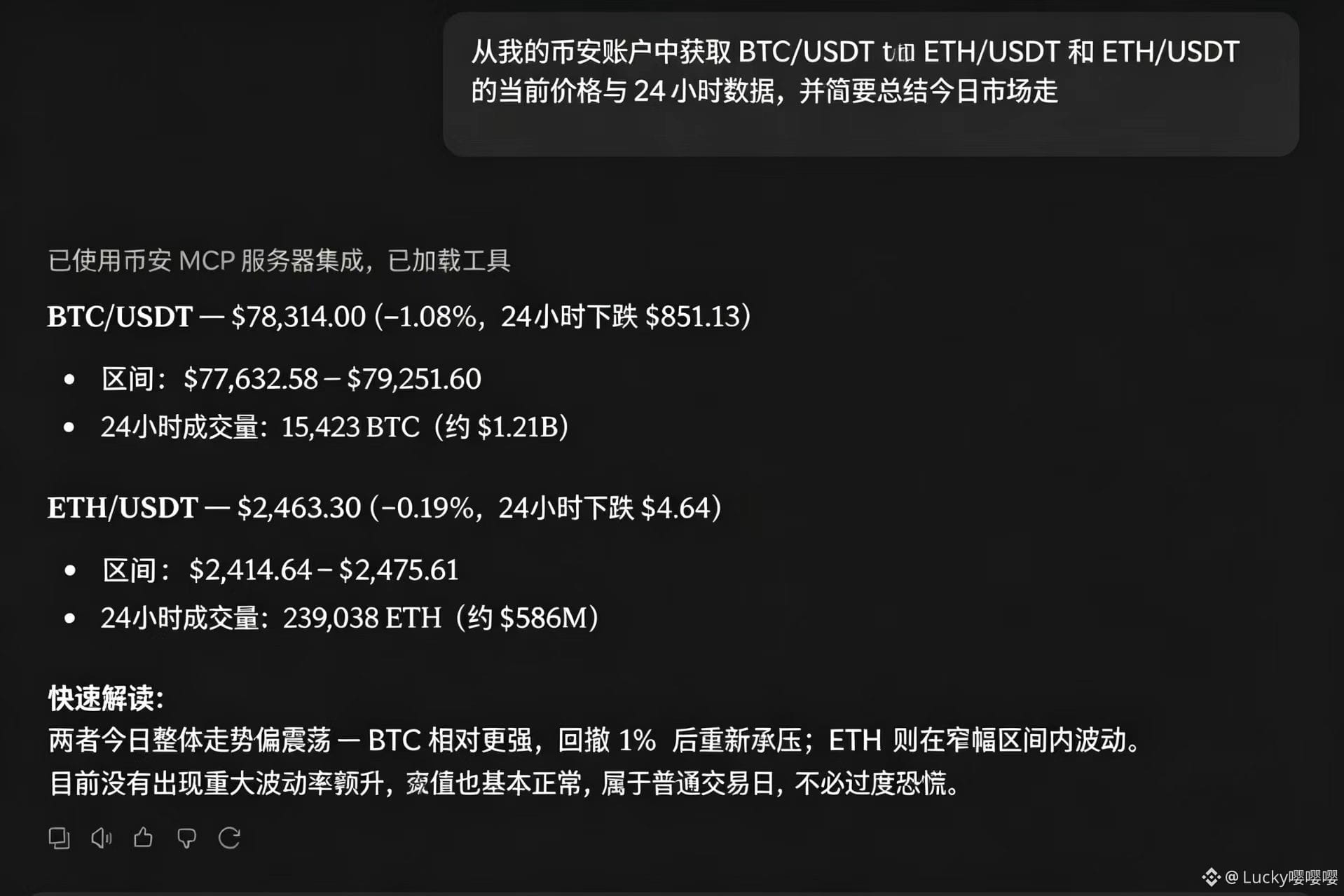
My Binance MCP connector has been successfully connected. Agent OS can now call Binance spot, margin, futures, wallet, and Instant Exchange APIs, supporting queries for account balances, market prices, order placement information, and trade records.
#BinanceAgentOS
My Binance MCP connector has been successfully connected. Agent OS can now call Binance spot, margin, futures, wallet, and Instant Exchange APIs, supporting queries for account balances, market prices, order placement information, and trade records.
#BinanceAgentOS
#BinanceAgentOS
Quoted content has been removed
134
·
--
Article
From Answering to Acting: How Binance Agent OS Works in PracticeArtificial Intelligence (AI) is evolving from systems that only answer questions into intelligent AI Agents that can understand, analyze, and carry out various tasks.
Binance Agent OS is the next step in this development — moving from a traditional AI Assistant that only provides information to AI Agents that can connect to financial data, apps, and various tools within a controlled and verifiable environment.
From Answering to Acting: How Binance Agent OS Works in Practice
Artificial Intelligence (AI) is evolving from systems that only answer questions into intelligent AI Agents that can understand, analyze, and carry out various tasks.
Binance Agent OS is the next step in this development — moving from a traditional AI Assistant that only provides information to AI Agents that can connect to financial data, apps, and various tools within a controlled and verifiable environment.
Binance Agent OS is the next step in this development — moving from a traditional AI Assistant that only provides information to AI Agents that can connect to financial data, apps, and various tools within a controlled and verifiable environment.
103

·
--
Verified
Article
Binance Agent OS: how an answering agent turns into an action-taking oneAn answer doesn’t change anything. A tool can.
So far, much of the experience with financial AI has been conversational. You ask about the price of $BTC , and you get an explanation. You request a market summary, and you get context. You can even ask for ideas, although a generated answer doesn’t replace your own judgment or a verified data source.
The shift happens when that assistant stops limiting itself to text and can use an external tool.
That’s where MCP, or Model Context Protocol, comes in. In simple terms, it’s a standard that allows an AI agent to connect with applications and services. Instead of answering from general knowledge, it can call an authorized tool to look up current information or carry out an action within the permissions granted.
Binance Agent OS: how an answering agent turns into an action-taking one
An answer doesn’t change anything. A tool can.
So far, much of the experience with financial AI has been conversational. You ask about the price of $BTC , and you get an explanation. You request a market summary, and you get context. You can even ask for ideas, although a generated answer doesn’t replace your own judgment or a verified data source.
The shift happens when that assistant stops limiting itself to text and can use an external tool.
That’s where MCP, or Model Context Protocol, comes in. In simple terms, it’s a standard that allows an AI agent to connect with applications and services. Instead of answering from general knowledge, it can call an authorized tool to look up current information or carry out an action within the permissions granted.
So far, much of the experience with financial AI has been conversational. You ask about the price of $BTC , and you get an explanation. You request a market summary, and you get context. You can even ask for ideas, although a generated answer doesn’t replace your own judgment or a verified data source.
The shift happens when that assistant stops limiting itself to text and can use an external tool.
That’s where MCP, or Model Context Protocol, comes in. In simple terms, it’s a standard that allows an AI agent to connect with applications and services. Instead of answering from general knowledge, it can call an authorized tool to look up current information or carry out an action within the permissions granted.
HAMADI NABIl 1981:
ethereum
1
7
476
·
--
Article
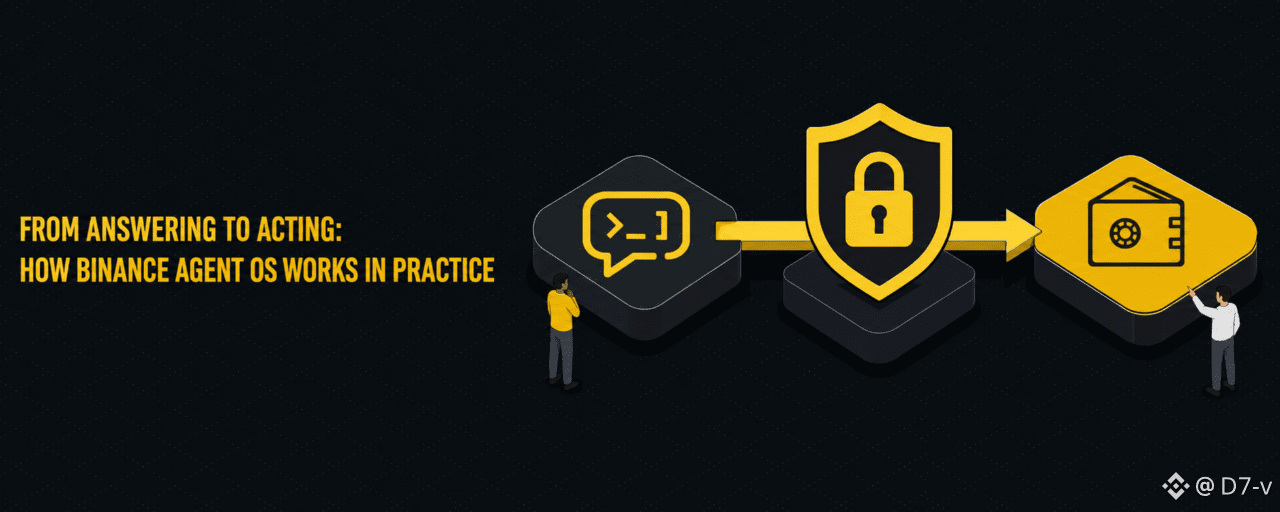
From Answering to Acting: How Binance Agent OS Works in PracticeAsk an AI chatbot what Bitcoin is trading at, and it will answer. Ask it to actually buy some — safely, inside limits you control, with a paper trail — and until recently, that was where the conversation stopped. Binance Agent OS closes that gap. It's the infrastructure that turns an AI agent from a talker into a doer, letting tools like Claude, Cursor, and ChatGPT read live Binance market data and place real trades through a standardized, auditable connection called MCP.
This isn't a future roadmap item. It's live, and it works in a specific, observable way: an agent connects, you grant it scopes, it reads markets freely, and it asks permission before it touches a single dollar. That combination — real capability plus real guardrails — is what turns "AI agent" from a buzzword into something you can actually trust with a slice of your portfolio.
Why This Matters for the Agent Era
AI agents are moving out of chat windows and into workflows: booking travel, managing calendars, writing code, and now, trading crypto. The missing piece was always a safe, standardized way for an agent to act on a financial platform without either (a) handing it raw API keys and hoping for the best, or (b) locking it out of anything useful.
Binance Agent OS solves this by packaging Binance's trading and market-data infrastructure behind the Model Context Protocol (MCP) — an open standard that lets AI applications discover and use external tools in a structured way. Instead of every developer building a custom Binance integration for their AI agent, MCP gives any compatible client (Claude Code, Cursor, ChatGPT, Codex) a single, standardized doorway in.
For anyone tracking where crypto and AI are converging, this is a meaningful signal: exchanges are no longer just building APIs for developers — they're building permission systems for autonomous agents. That shift matters for traders, developers, and anyone thinking about the next phase of automated finance.
The Building Blocks: MCP, Sub-Accounts, and Scopes
Before looking at a real session, it helps to understand the three pieces that make Agent OS work.
1. The MCP Server
The Binance MCP Server is the connection layer. It's a single endpoint (https://agent.binance.com/mcp/agentic) that any MCP-compatible AI client can attach to over HTTP. Once connected, the AI can discover which Binance tools it's allowed to use — market data, account info, trading, transfers — without the user ever pasting an API key into a chat window.
2. The Agentic Sub-Account
This is the safety perimeter. Rather than granting an AI access to your main Binance account, Agent OS creates a dedicated Agentic sub-account — a fully isolated wallet that starts empty. You manually transfer funds into it from your main account; the agent itself can never pull money in from outside. If something goes wrong, the blast radius is limited to whatever you funded that sub-account with.
3. Permission Scopes
You decide exactly what the agent can do, choosing from four scopes:
Market data — public, read-only, no authentication required (tickers, order books, candlesticks, funding rates)Account — view Agentic sub-account balances, positions, and bills, plus an optional read-only view of your main accountTrade — spot, margin, convert, USDⓈ-M and COIN-M futures, limited to what you grant and what your account is authorized forTransfer — move funds between wallets inside the same Agentic sub-account (e.g., Spot to Futures)
Notably, there is no withdrawal scope. An agent connected through Binance Agent OS can never move funds to an external address — a hard boundary that Binance built in by design.
Step-by-Step: Connecting an AI Agent to Binance
Here's what actually happens when you set this up, using Claude Code as an example (Cursor and ChatGPT follow the same pattern with client-specific steps):
Add the MCP server. In your terminal, run: claude mcp add binance-mcp-server --transport http https://agent.binance.com/mcp/agenticOpen the MCP menu. Type /mcp in your agent environment to list connected servers, including binance-mcp-server.Authenticate. Select the server and choose "Authenticate" — your browser opens a Binance login and authorization page.Choose your agent and set permissions. Pick which AI agent you're connecting, then toggle exactly which scopes and products it can access. Anything left off stays inaccessible until you turn it on.Fund the Agentic sub-account. Go to Profile → Dashboard → Sub-account → Asset Management → Transfer, and move in only what you're comfortable letting the agent trade.
Binance is explicit on one safety point: never paste the MCP endpoint into an AI chat and ask it to "install" the server, and never open the endpoint directly in a browser. Follow the client-specific setup steps instead — this avoids phishing-style misuse of the connection URL.
A Real Session: Market Data, Balances, and a Confirmed Trade
This is where Agent OS moves from concept to something you can watch happen. A typical session looks like this:
Step 1 — Check the market (read-only, runs instantly):
"What's BTCUSDT trading at, and how's it moved over 24h?"
The agent calls the market-data tool and returns live price and 24-hour change. No confirmation needed — reads never touch your balance.
Step 2 — Check your balance:
"What do I have in my Agentic account?"
The agent reads sub-account balances across Spot, Margin, and Futures wallets.
Step 3 — Place a trade (write action — confirmation required):
"Buy $100 of BNB at market on spot."
The agent restates the full order — symbol, side, order type, amount — and waits for explicit approval before submitting anything. This is the step where real funds move, and Binance's design forces a human checkpoint here every time.
Step 4 — Verify the result:
"Did that fill? What's my BNB balance now?"
The agent checks order status and the updated balance, closing the loop.
This confirm-before-execute pattern applies to every non-read action: new orders, cancellations, and internal transfers between sub-account wallets. The agent can analyze and recommend freely, but it can't spend without a "yes."
The Guardrails That Make This Auditable
What separates Binance Agent OS from a risky "give the bot your keys" setup is the layered control system:
Scope-based permissions you can adjust anytime (disconnect and reconnect to change what's granted)Sub-account isolation, so trading never touches your main holdings or personal data like KYC details or emailNo withdrawal scope, ever — funds can move between wallets inside the sub-account but never leave to an external addressConfirm-before-execute on every trade, cancel, and transferDisconnect agents at any time from Profile → Dashboard → Sub-account → Account ManagementEmergency stop — a single action that disconnects all connected agents and cancels every open spot, margin, and futures order in that Agentic account
Binance also monitors trading activity that flows through Agent OS and applies its standard exchange-level controls to resulting orders, while the agent's underlying reasoning and external data sources stay inside the AI application itself.
What Agent OS Can't Do (Yet)
It's worth being clear-eyed about current limits. The MCP server today covers market data plus Spot, Margin, Convert, and Futures trading. Payment settlement (via Binance's x402 programmable payments) and broader on-chain wallet actions are part of the wider Agent OS toolkit but are not yet fully wired into the MCP layer — they're accessed through separate Binance APIs and the Wallet Agentic Hub for now. This is a phased rollout, not a finished product, and Binance has signaled more capability is coming.
Key Takeaways
Binance Agent OS connects MCP-compatible AI agents (Claude, Cursor, ChatGPT, Codex) directly to Binance market data and trading functions.All agent activity happens inside an isolated Agentic sub-account that you fund manually — the agent can never pull money from your main account.Access is scope-based: Market data, Account, Trade, and Transfer — you choose what's enabled.There is no withdrawal scope, and every trade, cancel, or transfer requires your explicit confirmation.An emergency stop button lets you instantly disconnect agents and cancel all open positions in the sub-account.Payments and on-chain features are still expanding beyond the initial MCP release.
FAQ
What is Binance Agent OS?
It's Binance's developer platform that connects AI applications and agents to Binance's trading, market-data, wallet, and payment infrastructure, using the Model Context Protocol (MCP) as the standardized connection layer.
Which AI tools work with Binance Agent OS?
Any MCP-compatible client over Streamable HTTP, including Claude Code, Claude Desktop, ChatGPT, Codex, Cursor, and VS Code-based agents.
Can an AI agent withdraw my funds?
No. The Binance MCP Server has no withdrawal scope. Agents can trade and transfer funds between wallets inside the Agentic sub-account only, never to an external address.
Do I need to give the AI my Binance API keys?
No. Authentication happens through a Binance login and authorization flow in your browser — no local API key management is required.
Is every trade automatic once I connect an agent?
No. Every trade, cancellation, or internal transfer requires you to confirm the specific order details before it's submitted.
What happens if I want to stop an agent immediately?
Use the "Emergency stop" control in Sub-account → Account Management. It disconnects all agents and cancels all open spot, margin, and futures orders in that account in one step.
#BinanceAgentOS #MCP #AIAgents #CryptoTrading #Binance
From Answering to Acting: How Binance Agent OS Works in Practice
Ask an AI chatbot what Bitcoin is trading at, and it will answer. Ask it to actually buy some — safely, inside limits you control, with a paper trail — and until recently, that was where the conversation stopped. Binance Agent OS closes that gap. It's the infrastructure that turns an AI agent from a talker into a doer, letting tools like Claude, Cursor, and ChatGPT read live Binance market data and place real trades through a standardized, auditable connection called MCP.
This isn't a future roadmap item. It's live, and it works in a specific, observable way: an agent connects, you grant it scopes, it reads markets freely, and it asks permission before it touches a single dollar. That combination — real capability plus real guardrails — is what turns "AI agent" from a buzzword into something you can actually trust with a slice of your portfolio.
Why This Matters for the Agent Era
AI agents are moving out of chat windows and into workflows: booking travel, managing calendars, writing code, and now, trading crypto. The missing piece was always a safe, standardized way for an agent to act on a financial platform without either (a) handing it raw API keys and hoping for the best, or (b) locking it out of anything useful.
Binance Agent OS solves this by packaging Binance's trading and market-data infrastructure behind the Model Context Protocol (MCP) — an open standard that lets AI applications discover and use external tools in a structured way. Instead of every developer building a custom Binance integration for their AI agent, MCP gives any compatible client (Claude Code, Cursor, ChatGPT, Codex) a single, standardized doorway in.
For anyone tracking where crypto and AI are converging, this is a meaningful signal: exchanges are no longer just building APIs for developers — they're building permission systems for autonomous agents. That shift matters for traders, developers, and anyone thinking about the next phase of automated finance.
The Building Blocks: MCP, Sub-Accounts, and Scopes
Before looking at a real session, it helps to understand the three pieces that make Agent OS work.
1. The MCP Server
The Binance MCP Server is the connection layer. It's a single endpoint (https://agent.binance.com/mcp/agentic) that any MCP-compatible AI client can attach to over HTTP. Once connected, the AI can discover which Binance tools it's allowed to use — market data, account info, trading, transfers — without the user ever pasting an API key into a chat window.
2. The Agentic Sub-Account
This is the safety perimeter. Rather than granting an AI access to your main Binance account, Agent OS creates a dedicated Agentic sub-account — a fully isolated wallet that starts empty. You manually transfer funds into it from your main account; the agent itself can never pull money in from outside. If something goes wrong, the blast radius is limited to whatever you funded that sub-account with.
3. Permission Scopes
You decide exactly what the agent can do, choosing from four scopes:
Market data — public, read-only, no authentication required (tickers, order books, candlesticks, funding rates)Account — view Agentic sub-account balances, positions, and bills, plus an optional read-only view of your main accountTrade — spot, margin, convert, USDⓈ-M and COIN-M futures, limited to what you grant and what your account is authorized forTransfer — move funds between wallets inside the same Agentic sub-account (e.g., Spot to Futures)
Notably, there is no withdrawal scope. An agent connected through Binance Agent OS can never move funds to an external address — a hard boundary that Binance built in by design.
Step-by-Step: Connecting an AI Agent to Binance
Here's what actually happens when you set this up, using Claude Code as an example (Cursor and ChatGPT follow the same pattern with client-specific steps):
Add the MCP server. In your terminal, run: claude mcp add binance-mcp-server --transport http https://agent.binance.com/mcp/agenticOpen the MCP menu. Type /mcp in your agent environment to list connected servers, including binance-mcp-server.Authenticate. Select the server and choose "Authenticate" — your browser opens a Binance login and authorization page.Choose your agent and set permissions. Pick which AI agent you're connecting, then toggle exactly which scopes and products it can access. Anything left off stays inaccessible until you turn it on.Fund the Agentic sub-account. Go to Profile → Dashboard → Sub-account → Asset Management → Transfer, and move in only what you're comfortable letting the agent trade.
Binance is explicit on one safety point: never paste the MCP endpoint into an AI chat and ask it to "install" the server, and never open the endpoint directly in a browser. Follow the client-specific setup steps instead — this avoids phishing-style misuse of the connection URL.
A Real Session: Market Data, Balances, and a Confirmed Trade
This is where Agent OS moves from concept to something you can watch happen. A typical session looks like this:
Step 1 — Check the market (read-only, runs instantly):
"What's BTCUSDT trading at, and how's it moved over 24h?"
The agent calls the market-data tool and returns live price and 24-hour change. No confirmation needed — reads never touch your balance.
Step 2 — Check your balance:
"What do I have in my Agentic account?"
The agent reads sub-account balances across Spot, Margin, and Futures wallets.
Step 3 — Place a trade (write action — confirmation required):
"Buy $100 of BNB at market on spot."
The agent restates the full order — symbol, side, order type, amount — and waits for explicit approval before submitting anything. This is the step where real funds move, and Binance's design forces a human checkpoint here every time.
Step 4 — Verify the result:
"Did that fill? What's my BNB balance now?"
The agent checks order status and the updated balance, closing the loop.
This confirm-before-execute pattern applies to every non-read action: new orders, cancellations, and internal transfers between sub-account wallets. The agent can analyze and recommend freely, but it can't spend without a "yes."
The Guardrails That Make This Auditable
What separates Binance Agent OS from a risky "give the bot your keys" setup is the layered control system:
Scope-based permissions you can adjust anytime (disconnect and reconnect to change what's granted)Sub-account isolation, so trading never touches your main holdings or personal data like KYC details or emailNo withdrawal scope, ever — funds can move between wallets inside the sub-account but never leave to an external addressConfirm-before-execute on every trade, cancel, and transferDisconnect agents at any time from Profile → Dashboard → Sub-account → Account ManagementEmergency stop — a single action that disconnects all connected agents and cancels every open spot, margin, and futures order in that Agentic account
Binance also monitors trading activity that flows through Agent OS and applies its standard exchange-level controls to resulting orders, while the agent's underlying reasoning and external data sources stay inside the AI application itself.
What Agent OS Can't Do (Yet)
It's worth being clear-eyed about current limits. The MCP server today covers market data plus Spot, Margin, Convert, and Futures trading. Payment settlement (via Binance's x402 programmable payments) and broader on-chain wallet actions are part of the wider Agent OS toolkit but are not yet fully wired into the MCP layer — they're accessed through separate Binance APIs and the Wallet Agentic Hub for now. This is a phased rollout, not a finished product, and Binance has signaled more capability is coming.
Key Takeaways
Binance Agent OS connects MCP-compatible AI agents (Claude, Cursor, ChatGPT, Codex) directly to Binance market data and trading functions.All agent activity happens inside an isolated Agentic sub-account that you fund manually — the agent can never pull money from your main account.Access is scope-based: Market data, Account, Trade, and Transfer — you choose what's enabled.There is no withdrawal scope, and every trade, cancel, or transfer requires your explicit confirmation.An emergency stop button lets you instantly disconnect agents and cancel all open positions in the sub-account.Payments and on-chain features are still expanding beyond the initial MCP release.
FAQ
What is Binance Agent OS?
It's Binance's developer platform that connects AI applications and agents to Binance's trading, market-data, wallet, and payment infrastructure, using the Model Context Protocol (MCP) as the standardized connection layer.
Which AI tools work with Binance Agent OS?
Any MCP-compatible client over Streamable HTTP, including Claude Code, Claude Desktop, ChatGPT, Codex, Cursor, and VS Code-based agents.
Can an AI agent withdraw my funds?
No. The Binance MCP Server has no withdrawal scope. Agents can trade and transfer funds between wallets inside the Agentic sub-account only, never to an external address.
Do I need to give the AI my Binance API keys?
No. Authentication happens through a Binance login and authorization flow in your browser — no local API key management is required.
Is every trade automatic once I connect an agent?
No. Every trade, cancellation, or internal transfer requires you to confirm the specific order details before it's submitted.
What happens if I want to stop an agent immediately?
Use the "Emergency stop" control in Sub-account → Account Management. It disconnects all agents and cancels all open spot, margin, and futures orders in that account in one step.
#BinanceAgentOS #MCP #AIAgents #CryptoTrading #Binance
This isn't a future roadmap item. It's live, and it works in a specific, observable way: an agent connects, you grant it scopes, it reads markets freely, and it asks permission before it touches a single dollar. That combination — real capability plus real guardrails — is what turns "AI agent" from a buzzword into something you can actually trust with a slice of your portfolio.
Why This Matters for the Agent Era
AI agents are moving out of chat windows and into workflows: booking travel, managing calendars, writing code, and now, trading crypto. The missing piece was always a safe, standardized way for an agent to act on a financial platform without either (a) handing it raw API keys and hoping for the best, or (b) locking it out of anything useful.
Binance Agent OS solves this by packaging Binance's trading and market-data infrastructure behind the Model Context Protocol (MCP) — an open standard that lets AI applications discover and use external tools in a structured way. Instead of every developer building a custom Binance integration for their AI agent, MCP gives any compatible client (Claude Code, Cursor, ChatGPT, Codex) a single, standardized doorway in.
For anyone tracking where crypto and AI are converging, this is a meaningful signal: exchanges are no longer just building APIs for developers — they're building permission systems for autonomous agents. That shift matters for traders, developers, and anyone thinking about the next phase of automated finance.
The Building Blocks: MCP, Sub-Accounts, and Scopes
Before looking at a real session, it helps to understand the three pieces that make Agent OS work.
1. The MCP Server
The Binance MCP Server is the connection layer. It's a single endpoint (https://agent.binance.com/mcp/agentic) that any MCP-compatible AI client can attach to over HTTP. Once connected, the AI can discover which Binance tools it's allowed to use — market data, account info, trading, transfers — without the user ever pasting an API key into a chat window.
2. The Agentic Sub-Account
This is the safety perimeter. Rather than granting an AI access to your main Binance account, Agent OS creates a dedicated Agentic sub-account — a fully isolated wallet that starts empty. You manually transfer funds into it from your main account; the agent itself can never pull money in from outside. If something goes wrong, the blast radius is limited to whatever you funded that sub-account with.
3. Permission Scopes
You decide exactly what the agent can do, choosing from four scopes:
Market data — public, read-only, no authentication required (tickers, order books, candlesticks, funding rates)Account — view Agentic sub-account balances, positions, and bills, plus an optional read-only view of your main accountTrade — spot, margin, convert, USDⓈ-M and COIN-M futures, limited to what you grant and what your account is authorized forTransfer — move funds between wallets inside the same Agentic sub-account (e.g., Spot to Futures)
Notably, there is no withdrawal scope. An agent connected through Binance Agent OS can never move funds to an external address — a hard boundary that Binance built in by design.
Step-by-Step: Connecting an AI Agent to Binance
Here's what actually happens when you set this up, using Claude Code as an example (Cursor and ChatGPT follow the same pattern with client-specific steps):
Add the MCP server. In your terminal, run: claude mcp add binance-mcp-server --transport http https://agent.binance.com/mcp/agenticOpen the MCP menu. Type /mcp in your agent environment to list connected servers, including binance-mcp-server.Authenticate. Select the server and choose "Authenticate" — your browser opens a Binance login and authorization page.Choose your agent and set permissions. Pick which AI agent you're connecting, then toggle exactly which scopes and products it can access. Anything left off stays inaccessible until you turn it on.Fund the Agentic sub-account. Go to Profile → Dashboard → Sub-account → Asset Management → Transfer, and move in only what you're comfortable letting the agent trade.
Binance is explicit on one safety point: never paste the MCP endpoint into an AI chat and ask it to "install" the server, and never open the endpoint directly in a browser. Follow the client-specific setup steps instead — this avoids phishing-style misuse of the connection URL.
A Real Session: Market Data, Balances, and a Confirmed Trade
This is where Agent OS moves from concept to something you can watch happen. A typical session looks like this:
Step 1 — Check the market (read-only, runs instantly):
"What's BTCUSDT trading at, and how's it moved over 24h?"
The agent calls the market-data tool and returns live price and 24-hour change. No confirmation needed — reads never touch your balance.
Step 2 — Check your balance:
"What do I have in my Agentic account?"
The agent reads sub-account balances across Spot, Margin, and Futures wallets.
Step 3 — Place a trade (write action — confirmation required):
"Buy $100 of BNB at market on spot."
The agent restates the full order — symbol, side, order type, amount — and waits for explicit approval before submitting anything. This is the step where real funds move, and Binance's design forces a human checkpoint here every time.
Step 4 — Verify the result:
"Did that fill? What's my BNB balance now?"
The agent checks order status and the updated balance, closing the loop.
This confirm-before-execute pattern applies to every non-read action: new orders, cancellations, and internal transfers between sub-account wallets. The agent can analyze and recommend freely, but it can't spend without a "yes."
The Guardrails That Make This Auditable
What separates Binance Agent OS from a risky "give the bot your keys" setup is the layered control system:
Scope-based permissions you can adjust anytime (disconnect and reconnect to change what's granted)Sub-account isolation, so trading never touches your main holdings or personal data like KYC details or emailNo withdrawal scope, ever — funds can move between wallets inside the sub-account but never leave to an external addressConfirm-before-execute on every trade, cancel, and transferDisconnect agents at any time from Profile → Dashboard → Sub-account → Account ManagementEmergency stop — a single action that disconnects all connected agents and cancels every open spot, margin, and futures order in that Agentic account
Binance also monitors trading activity that flows through Agent OS and applies its standard exchange-level controls to resulting orders, while the agent's underlying reasoning and external data sources stay inside the AI application itself.
What Agent OS Can't Do (Yet)
It's worth being clear-eyed about current limits. The MCP server today covers market data plus Spot, Margin, Convert, and Futures trading. Payment settlement (via Binance's x402 programmable payments) and broader on-chain wallet actions are part of the wider Agent OS toolkit but are not yet fully wired into the MCP layer — they're accessed through separate Binance APIs and the Wallet Agentic Hub for now. This is a phased rollout, not a finished product, and Binance has signaled more capability is coming.
Key Takeaways
Binance Agent OS connects MCP-compatible AI agents (Claude, Cursor, ChatGPT, Codex) directly to Binance market data and trading functions.All agent activity happens inside an isolated Agentic sub-account that you fund manually — the agent can never pull money from your main account.Access is scope-based: Market data, Account, Trade, and Transfer — you choose what's enabled.There is no withdrawal scope, and every trade, cancel, or transfer requires your explicit confirmation.An emergency stop button lets you instantly disconnect agents and cancel all open positions in the sub-account.Payments and on-chain features are still expanding beyond the initial MCP release.
FAQ
What is Binance Agent OS?
It's Binance's developer platform that connects AI applications and agents to Binance's trading, market-data, wallet, and payment infrastructure, using the Model Context Protocol (MCP) as the standardized connection layer.
Which AI tools work with Binance Agent OS?
Any MCP-compatible client over Streamable HTTP, including Claude Code, Claude Desktop, ChatGPT, Codex, Cursor, and VS Code-based agents.
Can an AI agent withdraw my funds?
No. The Binance MCP Server has no withdrawal scope. Agents can trade and transfer funds between wallets inside the Agentic sub-account only, never to an external address.
Do I need to give the AI my Binance API keys?
No. Authentication happens through a Binance login and authorization flow in your browser — no local API key management is required.
Is every trade automatic once I connect an agent?
No. Every trade, cancellation, or internal transfer requires you to confirm the specific order details before it's submitted.
What happens if I want to stop an agent immediately?
Use the "Emergency stop" control in Sub-account → Account Management. It disconnects all agents and cancels all open spot, margin, and futures orders in that account in one step.
#BinanceAgentOS #MCP #AIAgents #CryptoTrading #Binance
1
125
Article
Binance Agent OS × AI: My First Hands-On Test 🤖🔶I wanted to see what happens when you connect Binance Agent OS with ChatGPT through MCP. 🤖🔶So I decided to test it myself.from connecting the account to checking market data and wallet information.Here’s what I found 👇#BinanceAgentOS @Binance_Angels First step: connecting Binance Agent OS to ChatGPT.The setup uses an MCP connection and OAuth authentication, so the connection is made through an authorization flow rather than simply sharing your Binance credentials.🔐 Your permissions matter here.After clicking “Sign in with Binance Agent OS”, ChatGPT requested access to my Binance account through MCP.The interesting part?I could select the Agentic Account that I wanted to connect.🤖 Binance × AI is getting interesting.And we’re connected! ✅Binance Agent OS appeared inside ChatGPT with the connection and permission settings visible.This is where the experiment really started.Now let's see what an AI assistant can actually do with the connected account. 👀What can it do?Once connected, I checked the available Binance actions through Agent OS MCP. 👀It exposed capabilities across Spot, Margin and Convert, based on the permissions granted.Pretty cool to access Binance tools through a simple AI conversation. 🤖🔶First test:“Tell me my main account USDC balance.”And ChatGPT was able to retrieve the balance directly from my Binance account.No need to open multiple wallet pages just to check a simple balance. 📊Next, I asked about BTCUSDT:“What’s BTCUSDT trading at, and how has it moved over 24h?”The connected setup was able to provide the BTC market information and summarize the 24h movement.This is where AI + real-time crypto data starts becoming really useful. ₿Then I asked:“What do I have in my Agentic account?”The response showed the assets across the connected account, including the Spot balance and other wallet categories.Having this information available through a simple conversation is pretty cool. 🤖I also checked where my USDC had moved.The response identified LDUSDC on the Earn/locked side rather than Spot.And the cool part? 👀 I asked in my local language and got the reply in the same language.Just ask, and get the answer. 🔎🤖 A small but important detail 🔐I asked for sensitive details like my email, phone number and password.The assistant didn’t reveal any of them and clearly explained its access limitations.That’s important when connecting AI with financial accounts. 🤖🔐Just getting started 🚀This was only my first hands-on test of Binance Agent OS + MCP.Pretty interesting experience so far and I’m excited to explore what else can be built with it. 👀Binance × AI 🤖🔶#BinanceAgentOS @Binance_Angels
Binance Agent OS × AI: My First Hands-On Test 🤖🔶
I wanted to see what happens when you connect Binance Agent OS with ChatGPT through MCP. 🤖🔶So I decided to test it myself.from connecting the account to checking market data and wallet information.Here’s what I found 👇#BinanceAgentOS @Binance Angels First step: connecting Binance Agent OS to ChatGPT.The setup uses an MCP connection and OAuth authentication, so the connection is made through an authorization flow rather than simply sharing your Binance credentials.🔐 Your permissions matter here.After clicking “Sign in with Binance Agent OS”, ChatGPT requested access to my Binance account through MCP.The interesting part?I could select the Agentic Account that I wanted to connect.🤖 Binance × AI is getting interesting.And we’re connected! ✅Binance Agent OS appeared inside ChatGPT with the connection and permission settings visible.This is where the experiment really started.Now let's see what an AI assistant can actually do with the connected account. 👀What can it do?Once connected, I checked the available Binance actions through Agent OS MCP. 👀It exposed capabilities across Spot, Margin and Convert, based on the permissions granted.Pretty cool to access Binance tools through a simple AI conversation. 🤖🔶First test:“Tell me my main account USDC balance.”And ChatGPT was able to retrieve the balance directly from my Binance account.No need to open multiple wallet pages just to check a simple balance. 📊Next, I asked about BTCUSDT:“What’s BTCUSDT trading at, and how has it moved over 24h?”The connected setup was able to provide the BTC market information and summarize the 24h movement.This is where AI + real-time crypto data starts becoming really useful. ₿Then I asked:“What do I have in my Agentic account?”The response showed the assets across the connected account, including the Spot balance and other wallet categories.Having this information available through a simple conversation is pretty cool. 🤖I also checked where my USDC had moved.The response identified LDUSDC on the Earn/locked side rather than Spot.And the cool part? 👀 I asked in my local language and got the reply in the same language.Just ask, and get the answer. 🔎🤖 A small but important detail 🔐I asked for sensitive details like my email, phone number and password.The assistant didn’t reveal any of them and clearly explained its access limitations.That’s important when connecting AI with financial accounts. 🤖🔐Just getting started 🚀This was only my first hands-on test of Binance Agent OS + MCP.Pretty interesting experience so far and I’m excited to explore what else can be built with it. 👀Binance × AI 🤖🔶#BinanceAgentOS @Binance Angels
4
117
·
--
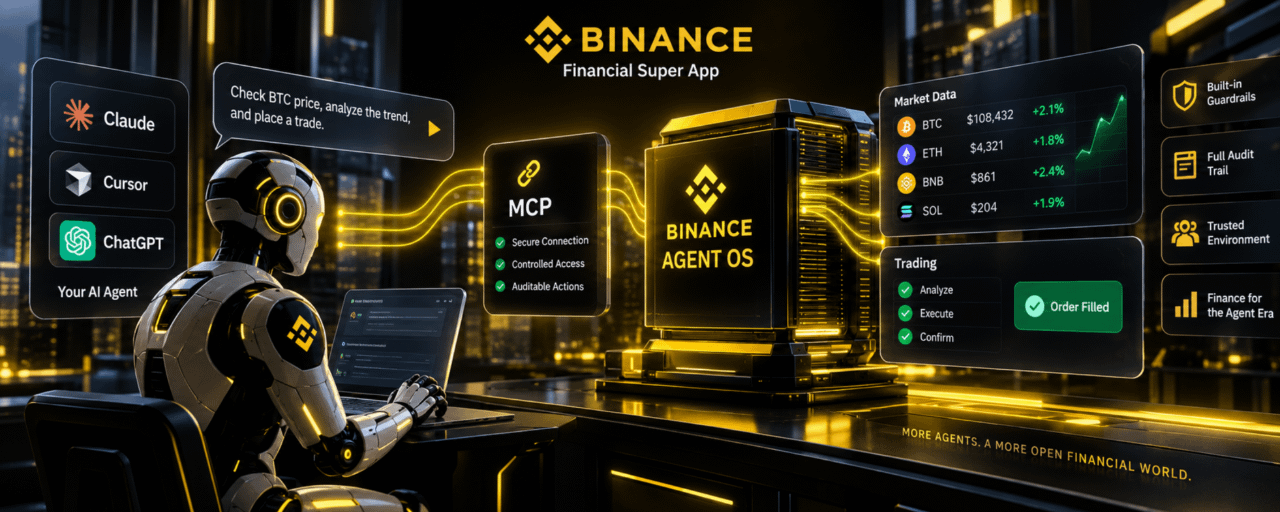
Article
From Answering to Acting: How Binance Agent OS Works in PracticeAI agents are moving beyond answering questions. The next step is giving them the ability to access real-world data, use financial tools, and take actions within clearly defined boundaries.
That is the idea behind Binance Agent OS, launched on August 20, 2026. It connects AI applications such as ChatGPT, Claude Code, Codex, and Cursor to Binance services through the Model Context Protocol (MCP), allowing an AI agent to interact with market data, account information, and trading functions when the user grants permission.
But the important question is not what an AI agent could do. It is what happens when an agent actually connects to financial infrastructure.
Step 1: The Agent Discovers Binance Tools
Imagine starting inside an AI environment such as Claude or Cursor.
Instead of manually opening multiple dashboards or writing API requests, the agent can discover the Binance tools available through the MCP connection. Depending on the permissions configured, those tools can include market-data queries, account information, and trading capabilities.
The interaction remains natural-language driven.
For example, a user could ask the agent to check the current BTC market, compare trading conditions, or review an account balance. The agent determines which Binance tool is appropriate, sends the request, and brings the result back into the conversation.
This is the first important shift: the AI is no longer simply generating an answer from its model knowledge. It is querying live financial infrastructure.
Step 2: From Market Data to Action
The workflow becomes more powerful when trading permissions are enabled.
An agent can retrieve relevant market information, evaluate the user's instructions against that data, and prepare an order. With the appropriate authorization, it can then submit the trade through Binance.
This creates an agentic trading workflow:
User instruction → AI reasoning → Binance tool call → market response → decision → execution
The key difference from a traditional chatbot is the final step. The agent can move from “Here is what I think you should do” to “Here is the action I have been authorized to perform.”
Step 3: The Guardrails Matter
Giving an AI access to financial infrastructure requires more than connectivity. It requires boundaries.
Binance Agent OS uses a dedicated sub-account model for agent activity. Users can control permissions, while withdrawals from the agent's sub-account are blocked by default. Funding is also controlled by the user, meaning the amount transferred into the sub-account effectively limits the agent's trading exposure.
Users can also choose between requiring approval for every order or allowing the agent to trade autonomously within the permissions and limits already configured. An emergency stop provides another way to revoke agent access if needed.
That architecture changes the conversation around AI trading. The goal is not unrestricted autonomy. It is controlled autonomy.
From Chatbot to Financial Agent
This is where Binance Agent OS and MCP become more than a technical announcement.
The infrastructure allows an AI agent to discover financial tools, retrieve live Binance market data, interact with trading functions, and operate inside a permissioned environment.
The broader implication is significant: finance for AI agents is becoming an actual infrastructure layer, not just a concept.
The future agent may not simply tell you what is happening in the market. It may be able to observe, reason, and act — while the user remains in control of the boundaries.
[Step by step to set up your Binance Agent OS](https://www.binance.com/en/square/post/360896227137048)
#BinanceAgentOS #TradingBots #market
$BNB $BTW $PIEVERSE
{future}(PIEVERSEUSDT)
{future}(BTWUSDT)
{spot}(BNBUSDT)
From Answering to Acting: How Binance Agent OS Works in Practice
AI agents are moving beyond answering questions. The next step is giving them the ability to access real-world data, use financial tools, and take actions within clearly defined boundaries.
That is the idea behind Binance Agent OS, launched on August 20, 2026. It connects AI applications such as ChatGPT, Claude Code, Codex, and Cursor to Binance services through the Model Context Protocol (MCP), allowing an AI agent to interact with market data, account information, and trading functions when the user grants permission.
But the important question is not what an AI agent could do. It is what happens when an agent actually connects to financial infrastructure.
Step 1: The Agent Discovers Binance Tools
Imagine starting inside an AI environment such as Claude or Cursor.
Instead of manually opening multiple dashboards or writing API requests, the agent can discover the Binance tools available through the MCP connection. Depending on the permissions configured, those tools can include market-data queries, account information, and trading capabilities.
The interaction remains natural-language driven.
For example, a user could ask the agent to check the current BTC market, compare trading conditions, or review an account balance. The agent determines which Binance tool is appropriate, sends the request, and brings the result back into the conversation.
This is the first important shift: the AI is no longer simply generating an answer from its model knowledge. It is querying live financial infrastructure.
Step 2: From Market Data to Action
The workflow becomes more powerful when trading permissions are enabled.
An agent can retrieve relevant market information, evaluate the user's instructions against that data, and prepare an order. With the appropriate authorization, it can then submit the trade through Binance.
This creates an agentic trading workflow:
User instruction → AI reasoning → Binance tool call → market response → decision → execution
The key difference from a traditional chatbot is the final step. The agent can move from “Here is what I think you should do” to “Here is the action I have been authorized to perform.”
Step 3: The Guardrails Matter
Giving an AI access to financial infrastructure requires more than connectivity. It requires boundaries.
Binance Agent OS uses a dedicated sub-account model for agent activity. Users can control permissions, while withdrawals from the agent's sub-account are blocked by default. Funding is also controlled by the user, meaning the amount transferred into the sub-account effectively limits the agent's trading exposure.
Users can also choose between requiring approval for every order or allowing the agent to trade autonomously within the permissions and limits already configured. An emergency stop provides another way to revoke agent access if needed.
That architecture changes the conversation around AI trading. The goal is not unrestricted autonomy. It is controlled autonomy.
From Chatbot to Financial Agent
This is where Binance Agent OS and MCP become more than a technical announcement.
The infrastructure allows an AI agent to discover financial tools, retrieve live Binance market data, interact with trading functions, and operate inside a permissioned environment.
The broader implication is significant: finance for AI agents is becoming an actual infrastructure layer, not just a concept.
The future agent may not simply tell you what is happening in the market. It may be able to observe, reason, and act — while the user remains in control of the boundaries.
Step by step to set up your Binance Agent OS
#BinanceAgentOS #TradingBots #market
$BNB $BTW $PIEVERSE
That is the idea behind Binance Agent OS, launched on August 20, 2026. It connects AI applications such as ChatGPT, Claude Code, Codex, and Cursor to Binance services through the Model Context Protocol (MCP), allowing an AI agent to interact with market data, account information, and trading functions when the user grants permission.
But the important question is not what an AI agent could do. It is what happens when an agent actually connects to financial infrastructure.
Step 1: The Agent Discovers Binance Tools
Imagine starting inside an AI environment such as Claude or Cursor.
Instead of manually opening multiple dashboards or writing API requests, the agent can discover the Binance tools available through the MCP connection. Depending on the permissions configured, those tools can include market-data queries, account information, and trading capabilities.
The interaction remains natural-language driven.
For example, a user could ask the agent to check the current BTC market, compare trading conditions, or review an account balance. The agent determines which Binance tool is appropriate, sends the request, and brings the result back into the conversation.
This is the first important shift: the AI is no longer simply generating an answer from its model knowledge. It is querying live financial infrastructure.
Step 2: From Market Data to Action
The workflow becomes more powerful when trading permissions are enabled.
An agent can retrieve relevant market information, evaluate the user's instructions against that data, and prepare an order. With the appropriate authorization, it can then submit the trade through Binance.
This creates an agentic trading workflow:
User instruction → AI reasoning → Binance tool call → market response → decision → execution
The key difference from a traditional chatbot is the final step. The agent can move from “Here is what I think you should do” to “Here is the action I have been authorized to perform.”
Step 3: The Guardrails Matter
Giving an AI access to financial infrastructure requires more than connectivity. It requires boundaries.
Binance Agent OS uses a dedicated sub-account model for agent activity. Users can control permissions, while withdrawals from the agent's sub-account are blocked by default. Funding is also controlled by the user, meaning the amount transferred into the sub-account effectively limits the agent's trading exposure.
Users can also choose between requiring approval for every order or allowing the agent to trade autonomously within the permissions and limits already configured. An emergency stop provides another way to revoke agent access if needed.
That architecture changes the conversation around AI trading. The goal is not unrestricted autonomy. It is controlled autonomy.
From Chatbot to Financial Agent
This is where Binance Agent OS and MCP become more than a technical announcement.
The infrastructure allows an AI agent to discover financial tools, retrieve live Binance market data, interact with trading functions, and operate inside a permissioned environment.
The broader implication is significant: finance for AI agents is becoming an actual infrastructure layer, not just a concept.
The future agent may not simply tell you what is happening in the market. It may be able to observe, reason, and act — while the user remains in control of the boundaries.
Step by step to set up your Binance Agent OS
#BinanceAgentOS #TradingBots #market
$BNB $BTW $PIEVERSE
5
343

·
--
Our Agents, Your Finance: Why Binance Is Building the Financial Layer for the AI Agent EraWhat happens when AI stops giving you answers and starts taking action?
That question is becoming much more important in crypto.
For years, AI has been remarkably good at explaining markets, summarizing information and answering questions. But the next stage is different.
An AI agent doesn't just tell you what is happening.
It can act.
And once software can act inside financial markets, it needs something more than intelligence.
It needs access, permissions, limits and accountability.
That is where Binance Agent OS enters the picture.
AI Is Crossing the Action Line
Imagine telling an AI agent:
“Monitor BTC. If my predefined conditions are met, take the permitted action.”
Traditionally, the AI could analyze the market and tell you what it thinks.
You would then open an exchange, check the market, place the order and manage the result yourself.
Agentic AI changes that workflow.
With the right infrastructure and permissions, the agent can connect to financial tools and perform actions on your behalf.
Binance Agent OS is designed around exactly this transition — connecting AI applications to Binance's financial infrastructure through tools such as the Model Context Protocol (MCP), Binance APIs and other agent capabilities.
But Here's the Real Problem: Control
Giving an AI access to financial markets sounds powerful.
It also sounds dangerous.
If an agent can trade, what stops it from doing something you never intended?
This is where the phrase “Your Rules” becomes more than marketing.
Binance Agent OS is built around permissioned and isolated access. Agents can operate through dedicated sub-accounts with configurable permissions, while withdrawals from the agent sub-account are blocked by default. Users can also determine how much autonomy an agent receives, including whether individual orders require approval.
In other words:
The agent gets capabilities.
You set the boundaries.
That distinction could become one of the defining principles of agentic finance.
Why MCP Matters
The technology connecting these systems is just as important.
Model Context Protocol (MCP) provides a standardized way for AI applications to connect with external tools, data and services.
And MCP is no longer a niche experiment.
The protocol has become a major part of the emerging agent ecosystem, with support across platforms including ChatGPT, Claude, Cursor, Gemini and Microsoft Copilot. The MCP project reported more than 97 million monthly SDK downloads and 10,000 active servers by late 2025.
AWS has also described MCP as a standard component of agentic architectures and continues to support its development.
This matters because agents need a common language for interacting with the world.
MCP can provide the connection.
Binance provides the financial infrastructure.
From Chatbot to Financial Agent
This is the bigger shift.
A chatbot might say:
“BTC is approaching your target.”
An agent could potentially:
Monitor → Analyze → Check permissions → Request approval or act → Report the result
That is fundamentally different.
Binance says Agent OS can connect tools such as ChatGPT, Claude Code, Codex and Cursor to Binance through an MCP endpoint, allowing agents to access market information and, where authorized, execute financial actions.
The important word is authorized.
The future isn't necessarily about giving AI unlimited control.
It is about giving AI useful capabilities inside clearly defined boundaries.
“Our Agents. Your Rules.”
That may ultimately be the most important idea behind Binance Agent OS.
The agent can be intelligent.
The infrastructure can be powerful.
But the user defines the perimeter.
You decide what the agent can access, how it can operate and how much capital it can control.
And if something goes wrong, the ability to revoke access becomes just as important as the ability to grant it. Binance's Agent OS design includes tools for managing permissions and disconnecting agents, including an emergency-stop capability.
The Financial Layer for the Agent Era
The AI agent era is moving from experimentation toward real-world action.
Agents will need to interact with databases, applications, payments, marketplaces and eventually financial markets.
That creates a new infrastructure question:
{spot}(BTCUSDT)
If AI is going to act in finance, who gives it the rails to do so responsibly?
Binance is positioning Agent OS as an answer to that question.
Not simply another AI chatbot.
Not simply another trading bot.
But a financial capability layer designed for agents — where AI can connect to market infrastructure while users remain responsible for defining the rules.
And that could be the real story.
The future of AI in finance may not be AI replacing the trader.
It may be:
AI acts.
Binance provides the rails.
You set the rules.
Explore Binance Agent OS: [Binance Agent OS](https://www.binance.com/es/agent-os?utm_source=chatgpt.com)
Want to explore BNB? [Buy BNB on Binance](https://www.binance.com/en/buy-sell-crypto/bnb?utm_source=chatgpt.com)
Not financial advice. Crypto assets, e.g, $BTC are highly volatile and AI systems can make mistakes. Always do your own research (DYOR) and understand the risks before trading or investing.
#BinanceAgentOS #writeroearn
Our Agents, Your Finance: Why Binance Is Building the Financial Layer for the AI Agent Era
What happens when AI stops giving you answers and starts taking action?
That question is becoming much more important in crypto.
For years, AI has been remarkably good at explaining markets, summarizing information and answering questions. But the next stage is different.
An AI agent doesn't just tell you what is happening.
It can act.
And once software can act inside financial markets, it needs something more than intelligence.
It needs access, permissions, limits and accountability.
That is where Binance Agent OS enters the picture.
AI Is Crossing the Action Line
Imagine telling an AI agent:
“Monitor BTC. If my predefined conditions are met, take the permitted action.”
Traditionally, the AI could analyze the market and tell you what it thinks.
You would then open an exchange, check the market, place the order and manage the result yourself.
Agentic AI changes that workflow.
With the right infrastructure and permissions, the agent can connect to financial tools and perform actions on your behalf.
Binance Agent OS is designed around exactly this transition — connecting AI applications to Binance's financial infrastructure through tools such as the Model Context Protocol (MCP), Binance APIs and other agent capabilities.
But Here's the Real Problem: Control
Giving an AI access to financial markets sounds powerful.
It also sounds dangerous.
If an agent can trade, what stops it from doing something you never intended?
This is where the phrase “Your Rules” becomes more than marketing.
Binance Agent OS is built around permissioned and isolated access. Agents can operate through dedicated sub-accounts with configurable permissions, while withdrawals from the agent sub-account are blocked by default. Users can also determine how much autonomy an agent receives, including whether individual orders require approval.
In other words:
The agent gets capabilities.
You set the boundaries.
That distinction could become one of the defining principles of agentic finance.
Why MCP Matters
The technology connecting these systems is just as important.
Model Context Protocol (MCP) provides a standardized way for AI applications to connect with external tools, data and services.
And MCP is no longer a niche experiment.
The protocol has become a major part of the emerging agent ecosystem, with support across platforms including ChatGPT, Claude, Cursor, Gemini and Microsoft Copilot. The MCP project reported more than 97 million monthly SDK downloads and 10,000 active servers by late 2025.
AWS has also described MCP as a standard component of agentic architectures and continues to support its development.
This matters because agents need a common language for interacting with the world.
MCP can provide the connection.
Binance provides the financial infrastructure.
From Chatbot to Financial Agent
This is the bigger shift.
A chatbot might say:
“BTC is approaching your target.”
An agent could potentially:
Monitor → Analyze → Check permissions → Request approval or act → Report the result
That is fundamentally different.
Binance says Agent OS can connect tools such as ChatGPT, Claude Code, Codex and Cursor to Binance through an MCP endpoint, allowing agents to access market information and, where authorized, execute financial actions.
The important word is authorized.
The future isn't necessarily about giving AI unlimited control.
It is about giving AI useful capabilities inside clearly defined boundaries.
“Our Agents. Your Rules.”
That may ultimately be the most important idea behind Binance Agent OS.
The agent can be intelligent.
The infrastructure can be powerful.
But the user defines the perimeter.
You decide what the agent can access, how it can operate and how much capital it can control.
And if something goes wrong, the ability to revoke access becomes just as important as the ability to grant it. Binance's Agent OS design includes tools for managing permissions and disconnecting agents, including an emergency-stop capability.
The Financial Layer for the Agent Era
The AI agent era is moving from experimentation toward real-world action.
Agents will need to interact with databases, applications, payments, marketplaces and eventually financial markets.
That creates a new infrastructure question:
If AI is going to act in finance, who gives it the rails to do so responsibly?
Binance is positioning Agent OS as an answer to that question.
Not simply another AI chatbot.
Not simply another trading bot.
But a financial capability layer designed for agents — where AI can connect to market infrastructure while users remain responsible for defining the rules.
And that could be the real story.
The future of AI in finance may not be AI replacing the trader.
It may be:
AI acts.
Binance provides the rails.
You set the rules.
Explore Binance Agent OS: Binance Agent OS
Want to explore BNB? Buy BNB on Binance
Not financial advice. Crypto assets, e.g, $BTC are highly volatile and AI systems can make mistakes. Always do your own research (DYOR) and understand the risks before trading or investing.
#BinanceAgentOS #writeroearn
That question is becoming much more important in crypto.
For years, AI has been remarkably good at explaining markets, summarizing information and answering questions. But the next stage is different.
An AI agent doesn't just tell you what is happening.
It can act.
And once software can act inside financial markets, it needs something more than intelligence.
It needs access, permissions, limits and accountability.
That is where Binance Agent OS enters the picture.
AI Is Crossing the Action Line
Imagine telling an AI agent:
“Monitor BTC. If my predefined conditions are met, take the permitted action.”
Traditionally, the AI could analyze the market and tell you what it thinks.
You would then open an exchange, check the market, place the order and manage the result yourself.
Agentic AI changes that workflow.
With the right infrastructure and permissions, the agent can connect to financial tools and perform actions on your behalf.
Binance Agent OS is designed around exactly this transition — connecting AI applications to Binance's financial infrastructure through tools such as the Model Context Protocol (MCP), Binance APIs and other agent capabilities.
But Here's the Real Problem: Control
Giving an AI access to financial markets sounds powerful.
It also sounds dangerous.
If an agent can trade, what stops it from doing something you never intended?
This is where the phrase “Your Rules” becomes more than marketing.
Binance Agent OS is built around permissioned and isolated access. Agents can operate through dedicated sub-accounts with configurable permissions, while withdrawals from the agent sub-account are blocked by default. Users can also determine how much autonomy an agent receives, including whether individual orders require approval.
In other words:
The agent gets capabilities.
You set the boundaries.
That distinction could become one of the defining principles of agentic finance.
Why MCP Matters
The technology connecting these systems is just as important.
Model Context Protocol (MCP) provides a standardized way for AI applications to connect with external tools, data and services.
And MCP is no longer a niche experiment.
The protocol has become a major part of the emerging agent ecosystem, with support across platforms including ChatGPT, Claude, Cursor, Gemini and Microsoft Copilot. The MCP project reported more than 97 million monthly SDK downloads and 10,000 active servers by late 2025.
AWS has also described MCP as a standard component of agentic architectures and continues to support its development.
This matters because agents need a common language for interacting with the world.
MCP can provide the connection.
Binance provides the financial infrastructure.
From Chatbot to Financial Agent
This is the bigger shift.
A chatbot might say:
“BTC is approaching your target.”
An agent could potentially:
Monitor → Analyze → Check permissions → Request approval or act → Report the result
That is fundamentally different.
Binance says Agent OS can connect tools such as ChatGPT, Claude Code, Codex and Cursor to Binance through an MCP endpoint, allowing agents to access market information and, where authorized, execute financial actions.
The important word is authorized.
The future isn't necessarily about giving AI unlimited control.
It is about giving AI useful capabilities inside clearly defined boundaries.
“Our Agents. Your Rules.”
That may ultimately be the most important idea behind Binance Agent OS.
The agent can be intelligent.
The infrastructure can be powerful.
But the user defines the perimeter.
You decide what the agent can access, how it can operate and how much capital it can control.
And if something goes wrong, the ability to revoke access becomes just as important as the ability to grant it. Binance's Agent OS design includes tools for managing permissions and disconnecting agents, including an emergency-stop capability.
The Financial Layer for the Agent Era
The AI agent era is moving from experimentation toward real-world action.
Agents will need to interact with databases, applications, payments, marketplaces and eventually financial markets.
That creates a new infrastructure question:
If AI is going to act in finance, who gives it the rails to do so responsibly?
Binance is positioning Agent OS as an answer to that question.
Not simply another AI chatbot.
Not simply another trading bot.
But a financial capability layer designed for agents — where AI can connect to market infrastructure while users remain responsible for defining the rules.
And that could be the real story.
The future of AI in finance may not be AI replacing the trader.
It may be:
AI acts.
Binance provides the rails.
You set the rules.
Explore Binance Agent OS: Binance Agent OS
Want to explore BNB? Buy BNB on Binance
Not financial advice. Crypto assets, e.g, $BTC are highly volatile and AI systems can make mistakes. Always do your own research (DYOR) and understand the risks before trading or investing.
#BinanceAgentOS #writeroearn
2
79
·
--
From Answering to Acting: How Binance Agent OS Works in PracticeAI is moving from simply answering questions to actually taking action. In crypto, that shift could be significant — and Binance Agent OS is designed to provide the infrastructure that makes it possible.
Instead of an AI agent merely telling you that Bitcoin is moving, imagine an agent that can access market data, monitor positions, evaluate conditions and interact with trading infrastructure — all within permissions and limits defined by the user.
That is the idea behind Binance Agent OS.
What Is Binance Agent OS?
Binance Agent OS is a developer toolkit that connects AI agents to Binance through the Model Context Protocol (MCP), APIs and ready-made skills.
The system allows agents to access crypto and TradFi market data, track portfolios, interact with trading functions, automate payments and, where supported, interact with on-chain services.
The important part is that the agent does not need unrestricted access.
Binance describes the architecture around three principles: connect, build and control. Developers can connect an existing AI-agent stack, build workflows using Binance infrastructure and establish permissions, accounts and limits for individual agents.
From AI Conversation to Action
Consider a simple trading workflow.
A user could ask an AI agent to monitor BTC and identify a specific market condition. Through the Binance MCP server, the agent can access the relevant Binance tools and data.
The workflow can look like this:
User request → AI agent → Binance MCP → market data → analysis → permitted action
The MCP layer acts as the bridge between the AI agent and Binance infrastructure.
This is where the difference between a traditional chatbot and an AI agent becomes clearer.
A chatbot might answer: “BTC is trading at X.”
An agent connected to financial infrastructure could potentially retrieve the relevant data, evaluate a predefined condition and initiate an allowed action — subject to the permissions and controls established by the user.
Binance says Agent OS can allow agents to monitor markets, react to signals and act when specified conditions are met.
Why MCP Matters
Model Context Protocol (MCP) is an open standard designed to allow AI applications to connect with external data and services.
For Binance Agent OS, the Binance MCP server provides a structured connection between an AI agent and Binance tools.
The setup is designed around three steps:
1. Add the Binance MCP Server
2. Authenticate the server
3. Activate the agent
That makes MCP more than a technical buzzword. It becomes the connection layer that allows an AI agent to interact with financial infrastructure.
The Guardrails Are the Important Part
Giving an AI access to financial systems raises an obvious question: How much authority should the agent have?
This is where controls matter.
Binance Agent OS emphasizes configurable permissions, accounts and limits. An agent can therefore be designed around a defined operating perimeter rather than being given unlimited authority.
That distinction could become increasingly important as AI agents move deeper into financial workflows.
The goal isn't simply to make AI more autonomous.
It is to make autonomous financial actions more controlled and auditable.
The Bigger Picture
Binance Agent OS represents a broader shift from AI that provides information to AI that can interact with financial infrastructure.
Market data, trading, payments, portfolio tracking and on-chain functionality can become tools available to AI agents through established Binance infrastructure.
That is why agentic finance is worth watching.
The future may not be about asking an AI, “What should I do?”
It may increasingly be about giving an AI clearly defined rules, permissions and objectives — and allowing it to execute within those boundaries.
For developers, traders and crypto users, Binance Agent OS offers a practical look at what that future could look like.
Explore Binance Agent OS: [Binance Agent OS](https://www.binance.com/es/agent-os?utm_source=chatgpt.com)
Interested in BNB? Explore Binance's official Buy BNB option here: [Buy BNB on Binance](https://www.binance.com/en/buy-sell-crypto/bnb?utm_source=chatgpt.com)
Not financial advice. Crypto assets are volatile and AI-generated outputs can contain errors or outdated information. Always do your own research (DYOR) and understand the risks before trading or investing.
#BinanceAgentOS #AgenticFinance #MCP
From Answering to Acting: How Binance Agent OS Works in Practice
AI is moving from simply answering questions to actually taking action. In crypto, that shift could be significant — and Binance Agent OS is designed to provide the infrastructure that makes it possible.
Instead of an AI agent merely telling you that Bitcoin is moving, imagine an agent that can access market data, monitor positions, evaluate conditions and interact with trading infrastructure — all within permissions and limits defined by the user.
That is the idea behind Binance Agent OS.
What Is Binance Agent OS?
Binance Agent OS is a developer toolkit that connects AI agents to Binance through the Model Context Protocol (MCP), APIs and ready-made skills.
The system allows agents to access crypto and TradFi market data, track portfolios, interact with trading functions, automate payments and, where supported, interact with on-chain services.
The important part is that the agent does not need unrestricted access.
Binance describes the architecture around three principles: connect, build and control. Developers can connect an existing AI-agent stack, build workflows using Binance infrastructure and establish permissions, accounts and limits for individual agents.
From AI Conversation to Action
Consider a simple trading workflow.
A user could ask an AI agent to monitor BTC and identify a specific market condition. Through the Binance MCP server, the agent can access the relevant Binance tools and data.
The workflow can look like this:
User request → AI agent → Binance MCP → market data → analysis → permitted action
The MCP layer acts as the bridge between the AI agent and Binance infrastructure.
This is where the difference between a traditional chatbot and an AI agent becomes clearer.
A chatbot might answer: “BTC is trading at X.”
An agent connected to financial infrastructure could potentially retrieve the relevant data, evaluate a predefined condition and initiate an allowed action — subject to the permissions and controls established by the user.
Binance says Agent OS can allow agents to monitor markets, react to signals and act when specified conditions are met.
Why MCP Matters
Model Context Protocol (MCP) is an open standard designed to allow AI applications to connect with external data and services.
For Binance Agent OS, the Binance MCP server provides a structured connection between an AI agent and Binance tools.
The setup is designed around three steps:
1. Add the Binance MCP Server
2. Authenticate the server
3. Activate the agent
That makes MCP more than a technical buzzword. It becomes the connection layer that allows an AI agent to interact with financial infrastructure.
The Guardrails Are the Important Part
Giving an AI access to financial systems raises an obvious question: How much authority should the agent have?
This is where controls matter.
Binance Agent OS emphasizes configurable permissions, accounts and limits. An agent can therefore be designed around a defined operating perimeter rather than being given unlimited authority.
That distinction could become increasingly important as AI agents move deeper into financial workflows.
The goal isn't simply to make AI more autonomous.
It is to make autonomous financial actions more controlled and auditable.
The Bigger Picture
Binance Agent OS represents a broader shift from AI that provides information to AI that can interact with financial infrastructure.
Market data, trading, payments, portfolio tracking and on-chain functionality can become tools available to AI agents through established Binance infrastructure.
That is why agentic finance is worth watching.
The future may not be about asking an AI, “What should I do?”
It may increasingly be about giving an AI clearly defined rules, permissions and objectives — and allowing it to execute within those boundaries.
For developers, traders and crypto users, Binance Agent OS offers a practical look at what that future could look like.
Explore Binance Agent OS: Binance Agent OS
Interested in BNB? Explore Binance's official Buy BNB option here: Buy BNB on Binance
Not financial advice. Crypto assets are volatile and AI-generated outputs can contain errors or outdated information. Always do your own research (DYOR) and understand the risks before trading or investing.
#BinanceAgentOS #AgenticFinance #MCP
Instead of an AI agent merely telling you that Bitcoin is moving, imagine an agent that can access market data, monitor positions, evaluate conditions and interact with trading infrastructure — all within permissions and limits defined by the user.
That is the idea behind Binance Agent OS.
What Is Binance Agent OS?
Binance Agent OS is a developer toolkit that connects AI agents to Binance through the Model Context Protocol (MCP), APIs and ready-made skills.
The system allows agents to access crypto and TradFi market data, track portfolios, interact with trading functions, automate payments and, where supported, interact with on-chain services.
The important part is that the agent does not need unrestricted access.
Binance describes the architecture around three principles: connect, build and control. Developers can connect an existing AI-agent stack, build workflows using Binance infrastructure and establish permissions, accounts and limits for individual agents.
From AI Conversation to Action
Consider a simple trading workflow.
A user could ask an AI agent to monitor BTC and identify a specific market condition. Through the Binance MCP server, the agent can access the relevant Binance tools and data.
The workflow can look like this:
User request → AI agent → Binance MCP → market data → analysis → permitted action
The MCP layer acts as the bridge between the AI agent and Binance infrastructure.
This is where the difference between a traditional chatbot and an AI agent becomes clearer.
A chatbot might answer: “BTC is trading at X.”
An agent connected to financial infrastructure could potentially retrieve the relevant data, evaluate a predefined condition and initiate an allowed action — subject to the permissions and controls established by the user.
Binance says Agent OS can allow agents to monitor markets, react to signals and act when specified conditions are met.
Why MCP Matters
Model Context Protocol (MCP) is an open standard designed to allow AI applications to connect with external data and services.
For Binance Agent OS, the Binance MCP server provides a structured connection between an AI agent and Binance tools.
The setup is designed around three steps:
1. Add the Binance MCP Server
2. Authenticate the server
3. Activate the agent
That makes MCP more than a technical buzzword. It becomes the connection layer that allows an AI agent to interact with financial infrastructure.
The Guardrails Are the Important Part
Giving an AI access to financial systems raises an obvious question: How much authority should the agent have?
This is where controls matter.
Binance Agent OS emphasizes configurable permissions, accounts and limits. An agent can therefore be designed around a defined operating perimeter rather than being given unlimited authority.
That distinction could become increasingly important as AI agents move deeper into financial workflows.
The goal isn't simply to make AI more autonomous.
It is to make autonomous financial actions more controlled and auditable.
The Bigger Picture
Binance Agent OS represents a broader shift from AI that provides information to AI that can interact with financial infrastructure.
Market data, trading, payments, portfolio tracking and on-chain functionality can become tools available to AI agents through established Binance infrastructure.
That is why agentic finance is worth watching.
The future may not be about asking an AI, “What should I do?”
It may increasingly be about giving an AI clearly defined rules, permissions and objectives — and allowing it to execute within those boundaries.
For developers, traders and crypto users, Binance Agent OS offers a practical look at what that future could look like.
Explore Binance Agent OS: Binance Agent OS
Interested in BNB? Explore Binance's official Buy BNB option here: Buy BNB on Binance
Not financial advice. Crypto assets are volatile and AI-generated outputs can contain errors or outdated information. Always do your own research (DYOR) and understand the risks before trading or investing.
#BinanceAgentOS #AgenticFinance #MCP
1
111
Log in to explore more content
Join global crypto users on Binance Square
⚡️ Get latest and useful information about crypto.
💬 Trusted by the world’s largest crypto exchange.
👍 Discover real insights from verified creators.
Email / Phone number
Trending Topics
1
#BTCBreaks80K
8,061 views
121 Discussing
2
#ZcashSpotETFTops$230MMonthlyInflow
21 views
6 Discussing
3
#HYPEJumpsOver11%
14,264 views
517 Discussing
4
#ZcashDevelopersTargetNU7MainnetActivationNov5
2,535 views
173 Discussing
5
#BitcoinSpotETFsNetInflow$159M
4,282 views
86 Discussing
6
#HKMAPlansWholesaleCBDCByYearEnd
20,081 views
622 Discussing
7
#NEARSurges26%Past$3.45
13,538 views
123 Discussing
8
#BOJHikesRatesTo31YearHigh
37,404 views
923 Discussing
9
#EvernorthRaises$30MToBuyXRP
1,267 views
34 Discussing
10
#ChainlinkPowersBottomlinePaymentPlatform
35,871 views
857 Discussing