
#agentos
agentos
13,419 views
104 Discussing
Hot
Latest

Proud to be one of the Top 10 winners of the Agent OS Creator Challenge! 💛
Huge thanks to the @binance #AgentOS team, Karin @heyi @CZ @richardteng for organizing this challenge and for recognizing our work. It was a great experience creating, testing and sharing my perspective on Agent OS.
Congrats to all the winners! 🎉
And if you didn’t make the Top 10 this time, don’t give up. Your effort matters, keep creating, keep experimenting, and keep showing up. Your next win could be just around the corner.
Grateful for this opportunity. On to the next one!
#BinanceAgentOS #AgentOS #challenge $BNB
{future}(BNBUSDT)
Proud to be one of the Top 10 winners of the Agent OS Creator Challenge! 💛
Huge thanks to the @binance #AgentOS team, Karin @Yi He @CZ @Richard Teng for organizing this challenge and for recognizing our work. It was a great experience creating, testing and sharing my perspective on Agent OS.
Congrats to all the winners! 🎉
And if you didn’t make the Top 10 this time, don’t give up. Your effort matters, keep creating, keep experimenting, and keep showing up. Your next win could be just around the corner.
Grateful for this opportunity. On to the next one!
#BinanceAgentOS #AgentOS #challenge $BNB
Huge thanks to the @binance #AgentOS team, Karin @Yi He @CZ @Richard Teng for organizing this challenge and for recognizing our work. It was a great experience creating, testing and sharing my perspective on Agent OS.
Congrats to all the winners! 🎉
And if you didn’t make the Top 10 this time, don’t give up. Your effort matters, keep creating, keep experimenting, and keep showing up. Your next win could be just around the corner.
Grateful for this opportunity. On to the next one!
#BinanceAgentOS #AgentOS #challenge $BNB
Angel_web3:
vous là vous rafflez tout 😂😂😂
congratulations 🎉 🎉
2
3
366

·
--
AI in Action: How Binance Agent OS Processed 90,000+ Requests in a Single DayAI in Action: How Binance Agent OS Processed 90,000+ Requests in a Single Day
AI has spent years promising to change how we interact with technology. The more interesting question now is whether people are actually using it to do useful work.
Early usage data from Binance Agent OS suggests that shift is already happening.
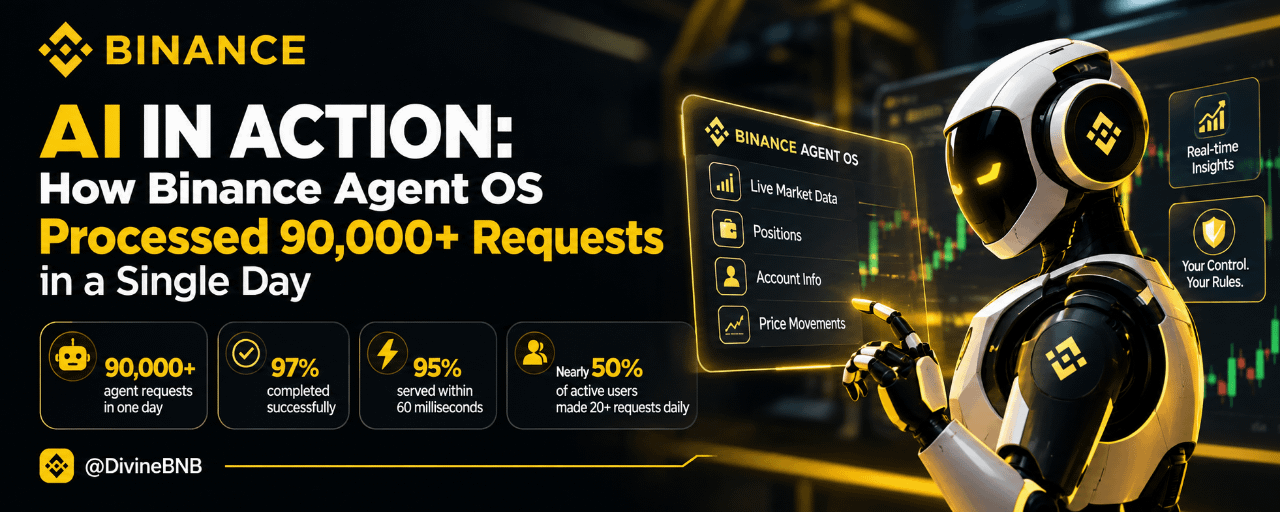
In its first weeks live, Agent OS processed more than 90,000 agent requests in a single day. Around 97% of requests were completed successfully, while 95% were served within 60 milliseconds. Nearly half of active users were generating 20 or more requests per day.
More importantly, the most-used capabilities were practical: live market data, positions, account information and price movements.
That tells us something about where AI agents may be heading — away from simply answering questions and toward interacting with real-time financial infrastructure.
From Answers to Actions
A traditional chatbot largely operates through conversation.
You ask a question, it generates an answer.
An AI agent can go further. It can retrieve information from connected systems, process that information and, where the appropriate permissions exist, carry out defined actions.
That difference becomes particularly important in financial markets.
A model may know what Bitcoin is or understand how futures work. But knowing the current BTC price, checking an account position or retrieving live market information requires access to current data.
Agent OS is designed around this connection between AI applications and Binance infrastructure, including market data and other supported functions.
The result is a different workflow:
User intent → Agent → Relevant data/tools → Useful result or permitted action
The intelligence is only one part of the equation. Access, reliability and permissions become equally important.
90,000 Requests Does Not Mean 90,000 Trades
The 90,000+ figure deserves some context.
An agent request is not necessarily a trade.
One request could involve checking a price. Another could retrieve an account position. An agent may also make multiple underlying calls while completing a single user instruction.
That means the figure is better understood as a measure of agent infrastructure activity, rather than trading volume.
This distinction matters because it shows where early adoption is actually occurring: users are experimenting with AI to access and process financial information.
That may ultimately prove more significant than the headline number itself.
Why Latency Matters
The reported 95% response rate within 60 milliseconds is another interesting part of the data.
Speed matters differently depending on the task.
A few seconds may not matter when asking an AI to explain a concept. But financial markets operate continuously, and information can change rapidly.
For an agent working with market data, responsiveness becomes part of the user experience.
The combination of successful execution and low latency therefore points to an important requirement for agentic finance: AI needs infrastructure that can keep up with the environment in which it operates.
Control Becomes More Important as AI Becomes More Capable
There is another question that matters even more than speed:
How much should an agent actually be allowed to do?
An AI can potentially operate at several levels.
At the first level, it can simply provide information and analysis.
At the next, it can prepare an action for the user to review.
At a higher level of autonomy, it may execute permitted actions according to predefined instructions.
Each step increases the importance of permissions, account separation and user oversight.
This is why the development of agentic finance cannot be judged by intelligence alone. A powerful agent without appropriate boundaries creates a very different risk profile from an agent operating within clearly defined permissions.
The Bigger AI Economy
The significance of Agent OS extends beyond crypto trading.
If AI agents increasingly become interfaces for financial services, they may eventually monitor portfolios, retrieve market information, automate predefined workflows, interact with blockchain applications and facilitate programmable payments.
That creates the foundations for a broader agent economy, where software does not simply assist humans but interacts with financial systems and potentially other software on their behalf.
But adoption will depend on more than technical capability.
Security, transparency, reliability, permissions and accountability will determine whether users are comfortable allowing agents to perform increasingly meaningful tasks.
The Real Test Starts Now
90,000+ requests in a single day is an interesting early signal.
But the bigger question is what happens next.
Will users continue using agents after the initial novelty fades? Will developers build applications that solve genuine problems? Can agent infrastructure remain reliable as usage grows? And how much autonomy will users ultimately be comfortable giving their agents?
Those questions will matter more than any single usage statistic.
The next phase of AI may therefore not be defined simply by how intelligent models become.
It may be defined by how effectively they can access information, use tools, operate within boundaries and turn user intent into useful action.
AI is moving from answering to acting.
And the real test of that transition is only beginning.
$BNB
{spot}(BNBUSDT)
#AgentOS #BinanceSquareTG #AI #writetoearn
AI in Action: How Binance Agent OS Processed 90,000+ Requests in a Single Day
AI in Action: How Binance Agent OS Processed 90,000+ Requests in a Single Day
AI has spent years promising to change how we interact with technology. The more interesting question now is whether people are actually using it to do useful work.
Early usage data from Binance Agent OS suggests that shift is already happening.
In its first weeks live, Agent OS processed more than 90,000 agent requests in a single day. Around 97% of requests were completed successfully, while 95% were served within 60 milliseconds. Nearly half of active users were generating 20 or more requests per day.
More importantly, the most-used capabilities were practical: live market data, positions, account information and price movements.
That tells us something about where AI agents may be heading — away from simply answering questions and toward interacting with real-time financial infrastructure.
From Answers to Actions
A traditional chatbot largely operates through conversation.
You ask a question, it generates an answer.
An AI agent can go further. It can retrieve information from connected systems, process that information and, where the appropriate permissions exist, carry out defined actions.
That difference becomes particularly important in financial markets.
A model may know what Bitcoin is or understand how futures work. But knowing the current BTC price, checking an account position or retrieving live market information requires access to current data.
Agent OS is designed around this connection between AI applications and Binance infrastructure, including market data and other supported functions.
The result is a different workflow:
User intent → Agent → Relevant data/tools → Useful result or permitted action
The intelligence is only one part of the equation. Access, reliability and permissions become equally important.
90,000 Requests Does Not Mean 90,000 Trades
The 90,000+ figure deserves some context.
An agent request is not necessarily a trade.
One request could involve checking a price. Another could retrieve an account position. An agent may also make multiple underlying calls while completing a single user instruction.
That means the figure is better understood as a measure of agent infrastructure activity, rather than trading volume.
This distinction matters because it shows where early adoption is actually occurring: users are experimenting with AI to access and process financial information.
That may ultimately prove more significant than the headline number itself.
Why Latency Matters
The reported 95% response rate within 60 milliseconds is another interesting part of the data.
Speed matters differently depending on the task.
A few seconds may not matter when asking an AI to explain a concept. But financial markets operate continuously, and information can change rapidly.
For an agent working with market data, responsiveness becomes part of the user experience.
The combination of successful execution and low latency therefore points to an important requirement for agentic finance: AI needs infrastructure that can keep up with the environment in which it operates.
Control Becomes More Important as AI Becomes More Capable
There is another question that matters even more than speed:
How much should an agent actually be allowed to do?
An AI can potentially operate at several levels.
At the first level, it can simply provide information and analysis.
At the next, it can prepare an action for the user to review.
At a higher level of autonomy, it may execute permitted actions according to predefined instructions.
Each step increases the importance of permissions, account separation and user oversight.
This is why the development of agentic finance cannot be judged by intelligence alone. A powerful agent without appropriate boundaries creates a very different risk profile from an agent operating within clearly defined permissions.
The Bigger AI Economy
The significance of Agent OS extends beyond crypto trading.
If AI agents increasingly become interfaces for financial services, they may eventually monitor portfolios, retrieve market information, automate predefined workflows, interact with blockchain applications and facilitate programmable payments.
That creates the foundations for a broader agent economy, where software does not simply assist humans but interacts with financial systems and potentially other software on their behalf.
But adoption will depend on more than technical capability.
Security, transparency, reliability, permissions and accountability will determine whether users are comfortable allowing agents to perform increasingly meaningful tasks.
The Real Test Starts Now
90,000+ requests in a single day is an interesting early signal.
But the bigger question is what happens next.
Will users continue using agents after the initial novelty fades? Will developers build applications that solve genuine problems? Can agent infrastructure remain reliable as usage grows? And how much autonomy will users ultimately be comfortable giving their agents?
Those questions will matter more than any single usage statistic.
The next phase of AI may therefore not be defined simply by how intelligent models become.
It may be defined by how effectively they can access information, use tools, operate within boundaries and turn user intent into useful action.
AI is moving from answering to acting.
And the real test of that transition is only beginning.
$BNB
#AgentOS #BinanceSquareTG #AI #writetoearn
AI has spent years promising to change how we interact with technology. The more interesting question now is whether people are actually using it to do useful work.
Early usage data from Binance Agent OS suggests that shift is already happening.
In its first weeks live, Agent OS processed more than 90,000 agent requests in a single day. Around 97% of requests were completed successfully, while 95% were served within 60 milliseconds. Nearly half of active users were generating 20 or more requests per day.
More importantly, the most-used capabilities were practical: live market data, positions, account information and price movements.
That tells us something about where AI agents may be heading — away from simply answering questions and toward interacting with real-time financial infrastructure.
From Answers to Actions
A traditional chatbot largely operates through conversation.
You ask a question, it generates an answer.
An AI agent can go further. It can retrieve information from connected systems, process that information and, where the appropriate permissions exist, carry out defined actions.
That difference becomes particularly important in financial markets.
A model may know what Bitcoin is or understand how futures work. But knowing the current BTC price, checking an account position or retrieving live market information requires access to current data.
Agent OS is designed around this connection between AI applications and Binance infrastructure, including market data and other supported functions.
The result is a different workflow:
User intent → Agent → Relevant data/tools → Useful result or permitted action
The intelligence is only one part of the equation. Access, reliability and permissions become equally important.
90,000 Requests Does Not Mean 90,000 Trades
The 90,000+ figure deserves some context.
An agent request is not necessarily a trade.
One request could involve checking a price. Another could retrieve an account position. An agent may also make multiple underlying calls while completing a single user instruction.
That means the figure is better understood as a measure of agent infrastructure activity, rather than trading volume.
This distinction matters because it shows where early adoption is actually occurring: users are experimenting with AI to access and process financial information.
That may ultimately prove more significant than the headline number itself.
Why Latency Matters
The reported 95% response rate within 60 milliseconds is another interesting part of the data.
Speed matters differently depending on the task.
A few seconds may not matter when asking an AI to explain a concept. But financial markets operate continuously, and information can change rapidly.
For an agent working with market data, responsiveness becomes part of the user experience.
The combination of successful execution and low latency therefore points to an important requirement for agentic finance: AI needs infrastructure that can keep up with the environment in which it operates.
Control Becomes More Important as AI Becomes More Capable
There is another question that matters even more than speed:
How much should an agent actually be allowed to do?
An AI can potentially operate at several levels.
At the first level, it can simply provide information and analysis.
At the next, it can prepare an action for the user to review.
At a higher level of autonomy, it may execute permitted actions according to predefined instructions.
Each step increases the importance of permissions, account separation and user oversight.
This is why the development of agentic finance cannot be judged by intelligence alone. A powerful agent without appropriate boundaries creates a very different risk profile from an agent operating within clearly defined permissions.
The Bigger AI Economy
The significance of Agent OS extends beyond crypto trading.
If AI agents increasingly become interfaces for financial services, they may eventually monitor portfolios, retrieve market information, automate predefined workflows, interact with blockchain applications and facilitate programmable payments.
That creates the foundations for a broader agent economy, where software does not simply assist humans but interacts with financial systems and potentially other software on their behalf.
But adoption will depend on more than technical capability.
Security, transparency, reliability, permissions and accountability will determine whether users are comfortable allowing agents to perform increasingly meaningful tasks.
The Real Test Starts Now
90,000+ requests in a single day is an interesting early signal.
But the bigger question is what happens next.
Will users continue using agents after the initial novelty fades? Will developers build applications that solve genuine problems? Can agent infrastructure remain reliable as usage grows? And how much autonomy will users ultimately be comfortable giving their agents?
Those questions will matter more than any single usage statistic.
The next phase of AI may therefore not be defined simply by how intelligent models become.
It may be defined by how effectively they can access information, use tools, operate within boundaries and turn user intent into useful action.
AI is moving from answering to acting.
And the real test of that transition is only beginning.
$BNB
#AgentOS #BinanceSquareTG #AI #writetoearn
2
63


·
--
Bullish
In our latest blog, we break down how Binance Agent OS is helping simplify the crypto experience by connecting AI agents with Binance’s ecosystem, tools and infrastructure. [read more here](https://www.binance.com/en/blog/innovation/8111029668491407760) How Binance Agent OS Is Making Crypto Easier to Navigate #AgentOS
$BNB
{spot}(BNBUSDT)
In our latest blog, we break down how Binance Agent OS is helping simplify the crypto experience by connecting AI agents with Binance’s ecosystem, tools and infrastructure. read more here How Binance Agent OS Is Making Crypto Easier to Navigate #AgentOS
$BNB
$BNB
Live: 14:00 Sep 24
مستشار العملات الرقمية Cryptocurrency Advisor:
مبروك 🫡
6
1
22
3.5k

·
--
Article
AI in Action: How Binance Agent OS Processed 90,000+ Requests in a Single DayBinance Agent OS processed more than 90,000 agent requests in a single day, showing how AI is quickly moving from simply answering questions to taking useful action in real-time financial markets.
The numbers from its first weeks live are a strong signal of where AI-powered finance could be heading. Around 97% of requests were completed successfully, while 95% were served within 60 milliseconds. Even more interesting, nearly half of active users generated 20 or more requests per day.
This isn't just about impressive AI performance. It shows that users are already finding practical ways to work with agents.
From AI Answers to Real-Time Market Action
Financial markets move quickly, and useful AI needs access to information that is just as fast.
The most-used Agent OS capabilities include live market data, positions, account information and price movements. These are exactly the types of data traders and investors need when making decisions.
Instead of switching between multiple screens, users can increasingly rely on AI agents to retrieve relevant information and help turn it into actionable insights.
That connection between AI and live financial data could become one of the most important pieces of the next generation of trading tools.
{spot}(BNBUSDT)
Keeping Users in Control
When AI moves from answering to acting, control becomes just as important as intelligence.
[Binance Agent OS](https://www.binance.com/en/agent-os) is designed around a controlled environment where agents can interact with Binance capabilities while users maintain visibility over what is happening.
This matters because financial AI cannot simply be about automation. Users need to understand what their agents are doing, what information they are accessing and where human control remains in the loop.
The goal is not to hand everything over to an AI. It is to make AI more useful while keeping the user in charge.
What 90,000+ Requests Really Means
The bigger story may be adoption.
Processing more than 90,000 requests in one day suggests that AI agents are beginning to become part of real financial workflows rather than remaining a futuristic concept.
The broader AI economy is attracting unprecedented investment, but the real test will be whether that investment creates products people repeatedly use because they solve genuine problems.
Agent OS provides an interesting example of that transition: from AI that can understand, to AI that can connect, respond and participate.
{spot}(SPCXBUSDT)
The Next Chapter of AI Is Useful Action
The AI race is no longer only about building smarter models.
It is increasingly about what those models can actually do.
With fast access to market information, account data and other financial capabilities, Binance Agent OS offers a glimpse of an ecosystem where AI agents can become practical interfaces between users and financial markets.
The next chapter of AI may not be defined by how intelligent an agent sounds.
It may be defined by how useful its actions are.
FAQs
What is Binance Agent OS?
[Binance Agent OS](https://www.binance.com/en/agent-os) is an AI-agent infrastructure that allows compatible agents to interact with Binance capabilities and financial data in a controlled way.
How many requests did Binance Agent OS process in one day?
It processed more than 90,000 agent requests in a single day during its first weeks live.
What are the most-used Agent OS capabilities?
The most-used capabilities include live market data, positions, account information and price movements.
Why does speed matter for AI-powered finance?
Financial markets can change rapidly, so fast access to current information is important when AI agents are helping users analyze markets or manage financial workflows.
#AgentOS | @Binance_Angels | @Binance_Square_Official
AI in Action: How Binance Agent OS Processed 90,000+ Requests in a Single Day
Binance Agent OS processed more than 90,000 agent requests in a single day, showing how AI is quickly moving from simply answering questions to taking useful action in real-time financial markets.
The numbers from its first weeks live are a strong signal of where AI-powered finance could be heading. Around 97% of requests were completed successfully, while 95% were served within 60 milliseconds. Even more interesting, nearly half of active users generated 20 or more requests per day.
This isn't just about impressive AI performance. It shows that users are already finding practical ways to work with agents.
From AI Answers to Real-Time Market Action
Financial markets move quickly, and useful AI needs access to information that is just as fast.
The most-used Agent OS capabilities include live market data, positions, account information and price movements. These are exactly the types of data traders and investors need when making decisions.
Instead of switching between multiple screens, users can increasingly rely on AI agents to retrieve relevant information and help turn it into actionable insights.
That connection between AI and live financial data could become one of the most important pieces of the next generation of trading tools.
Keeping Users in Control
When AI moves from answering to acting, control becomes just as important as intelligence.
Binance Agent OS is designed around a controlled environment where agents can interact with Binance capabilities while users maintain visibility over what is happening.
This matters because financial AI cannot simply be about automation. Users need to understand what their agents are doing, what information they are accessing and where human control remains in the loop.
The goal is not to hand everything over to an AI. It is to make AI more useful while keeping the user in charge.
What 90,000+ Requests Really Means
The bigger story may be adoption.
Processing more than 90,000 requests in one day suggests that AI agents are beginning to become part of real financial workflows rather than remaining a futuristic concept.
The broader AI economy is attracting unprecedented investment, but the real test will be whether that investment creates products people repeatedly use because they solve genuine problems.
Agent OS provides an interesting example of that transition: from AI that can understand, to AI that can connect, respond and participate.
The Next Chapter of AI Is Useful Action
The AI race is no longer only about building smarter models.
It is increasingly about what those models can actually do.
With fast access to market information, account data and other financial capabilities, Binance Agent OS offers a glimpse of an ecosystem where AI agents can become practical interfaces between users and financial markets.
The next chapter of AI may not be defined by how intelligent an agent sounds.
It may be defined by how useful its actions are.
FAQs
What is Binance Agent OS?
Binance Agent OS is an AI-agent infrastructure that allows compatible agents to interact with Binance capabilities and financial data in a controlled way.
How many requests did Binance Agent OS process in one day?
It processed more than 90,000 agent requests in a single day during its first weeks live.
What are the most-used Agent OS capabilities?
The most-used capabilities include live market data, positions, account information and price movements.
Why does speed matter for AI-powered finance?
Financial markets can change rapidly, so fast access to current information is important when AI agents are helping users analyze markets or manage financial workflows.
#AgentOS | @Binance Angels | @Binance Square Official
The numbers from its first weeks live are a strong signal of where AI-powered finance could be heading. Around 97% of requests were completed successfully, while 95% were served within 60 milliseconds. Even more interesting, nearly half of active users generated 20 or more requests per day.
This isn't just about impressive AI performance. It shows that users are already finding practical ways to work with agents.
From AI Answers to Real-Time Market Action
Financial markets move quickly, and useful AI needs access to information that is just as fast.
The most-used Agent OS capabilities include live market data, positions, account information and price movements. These are exactly the types of data traders and investors need when making decisions.
Instead of switching between multiple screens, users can increasingly rely on AI agents to retrieve relevant information and help turn it into actionable insights.
That connection between AI and live financial data could become one of the most important pieces of the next generation of trading tools.
Keeping Users in Control
When AI moves from answering to acting, control becomes just as important as intelligence.
Binance Agent OS is designed around a controlled environment where agents can interact with Binance capabilities while users maintain visibility over what is happening.
This matters because financial AI cannot simply be about automation. Users need to understand what their agents are doing, what information they are accessing and where human control remains in the loop.
The goal is not to hand everything over to an AI. It is to make AI more useful while keeping the user in charge.
What 90,000+ Requests Really Means
The bigger story may be adoption.
Processing more than 90,000 requests in one day suggests that AI agents are beginning to become part of real financial workflows rather than remaining a futuristic concept.
The broader AI economy is attracting unprecedented investment, but the real test will be whether that investment creates products people repeatedly use because they solve genuine problems.
Agent OS provides an interesting example of that transition: from AI that can understand, to AI that can connect, respond and participate.
The Next Chapter of AI Is Useful Action
The AI race is no longer only about building smarter models.
It is increasingly about what those models can actually do.
With fast access to market information, account data and other financial capabilities, Binance Agent OS offers a glimpse of an ecosystem where AI agents can become practical interfaces between users and financial markets.
The next chapter of AI may not be defined by how intelligent an agent sounds.
It may be defined by how useful its actions are.
FAQs
What is Binance Agent OS?
Binance Agent OS is an AI-agent infrastructure that allows compatible agents to interact with Binance capabilities and financial data in a controlled way.
How many requests did Binance Agent OS process in one day?
It processed more than 90,000 agent requests in a single day during its first weeks live.
What are the most-used Agent OS capabilities?
The most-used capabilities include live market data, positions, account information and price movements.
Why does speed matter for AI-powered finance?
Financial markets can change rapidly, so fast access to current information is important when AI agents are helping users analyze markets or manage financial workflows.
#AgentOS | @Binance Angels | @Binance Square Official
4
334

·
--
Bullish
Built for what comes next. 🤖⚡
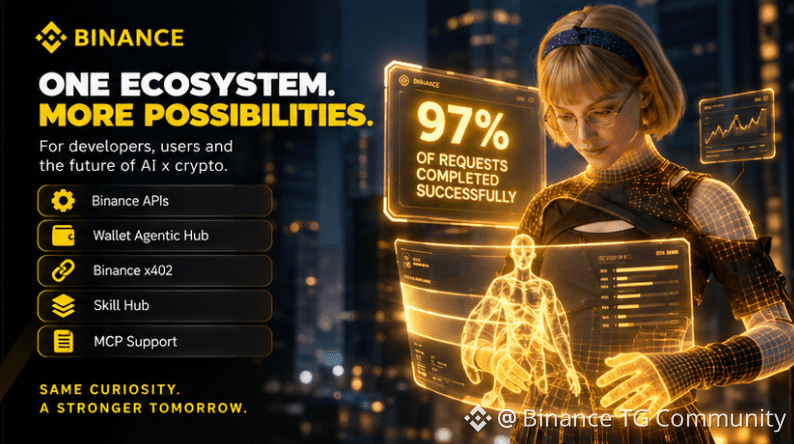
From APIs to agentic wallets, Binance Agent OS brings the tools together to turn AI x crypto ideas into action.
97% successful requests. One connected ecosystem. Endless possibilities. 🟡 #AgentOS #BinanceSquareTG $BNB
{spot}(BNBUSDT)
Built for what comes next. 🤖⚡
From APIs to agentic wallets, Binance Agent OS brings the tools together to turn AI x crypto ideas into action.
97% successful requests. One connected ecosystem. Endless possibilities. 🟡 #AgentOS #BinanceSquareTG $BNB
From APIs to agentic wallets, Binance Agent OS brings the tools together to turn AI x crypto ideas into action.
97% successful requests. One connected ecosystem. Endless possibilities. 🟡 #AgentOS #BinanceSquareTG $BNB
2
16
1.4k

·
--
Binance Launches Agent OS!
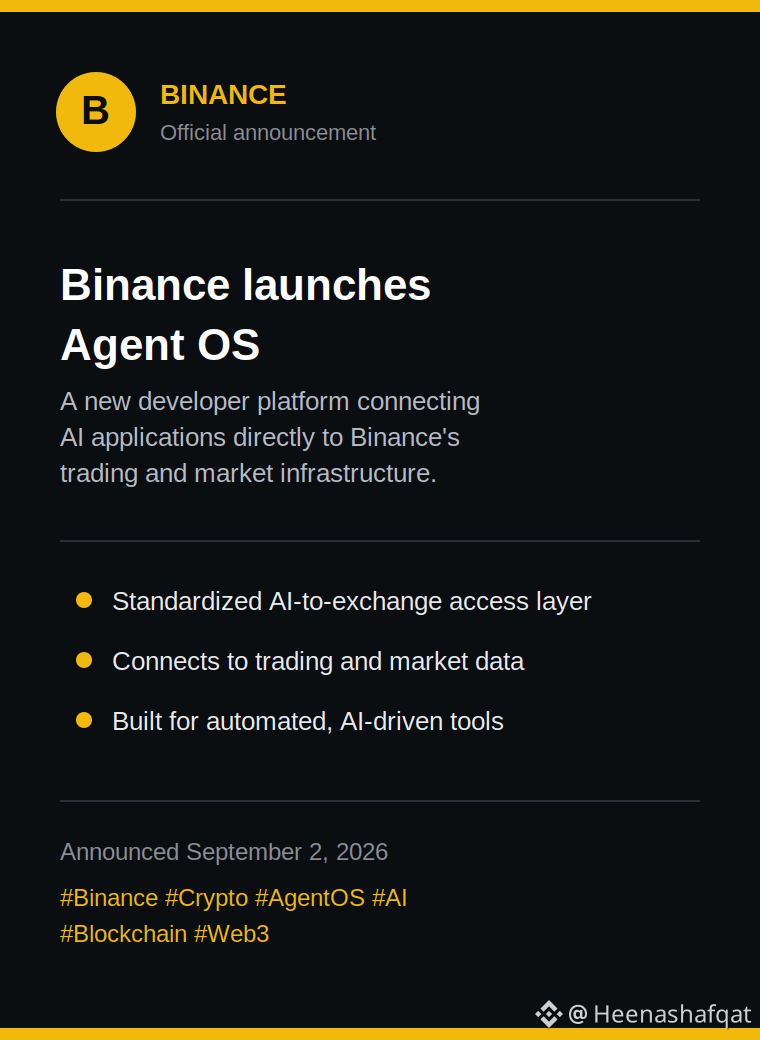
Binance ne apna naya developer platform "Agent OS" official taur pe launch kar diya hai — yeh ek standardized access layer hai jo AI applications ko seedha Binance ki trading, market data aur financial infrastructure se connect karta hai.
Ab AI-powered tools aur trading bots pehle se zyada seamlessly Binance ke ecosystem mein integrate ho sakenge — yeh crypto + AI ka naya milestone hai! 🤖⚡
📅 Official announcement: September 2, 2026
#Binance #Crypto #AgentOS #Aİ
Binance Launches Agent OS!
Binance ne apna naya developer platform "Agent OS" official taur pe launch kar diya hai — yeh ek standardized access layer hai jo AI applications ko seedha Binance ki trading, market data aur financial infrastructure se connect karta hai.
Ab AI-powered tools aur trading bots pehle se zyada seamlessly Binance ke ecosystem mein integrate ho sakenge — yeh crypto + AI ka naya milestone hai! 🤖⚡
📅 Official announcement: September 2, 2026
#Binance #Crypto #AgentOS #Aİ
Binance ne apna naya developer platform "Agent OS" official taur pe launch kar diya hai — yeh ek standardized access layer hai jo AI applications ko seedha Binance ki trading, market data aur financial infrastructure se connect karta hai.
Ab AI-powered tools aur trading bots pehle se zyada seamlessly Binance ke ecosystem mein integrate ho sakenge — yeh crypto + AI ka naya milestone hai! 🤖⚡
📅 Official announcement: September 2, 2026
#Binance #Crypto #AgentOS #Aİ
3
427

·
--
Bullish
# Agent OS Workflow — Explained Simply 🤖
AI coding tools often act like a confused intern — messy code, forgotten rules, 5 tries to get it right. *Agent OS (free, open-source, by Brian Casel) fixes this by giving your AI agent clear specs and standards, so it builds correctly the first time. Works with any tool: Claude Code, Cursor, Codex, Gemini, Windsurf.
## 3 Layers
1. Standards — your coding rules & tech preferences
2. product — mission, roadmap, tech stack
3. Specs — details for one feature you're building
## The 6-Step Workflow
1. Plan Product (once per project)* — `/plan-product`
Creates mission.md, roadmap.md, tech-stack.md. Like writing the company handbook first.
2. Shape Spec** — `/shape-spec`
Turns a rough idea into clear requirements by asking you questions. Skip if already clear.
3. Write Spec** — `/write-spec`
Converts requirements into a formal spec.md — the blueprint.
4. Create Tasks** — `/create-tasks`
Breaks the spec into an ordered checklist (database, backend, frontend, testing).
5. Implement Tasks — `/implement-tasks`
The agent writes the code, task by task — tests first, then code.
6. Orchestrate Tasks (optional, for big features)* — `/orchestrate-tasks`
Splits work across multiple specialized sub-agents for speed and accuracy.
## Why It Matters
- Less AI "drift" mid-task
- Works with any tool, language, or codebase
- Use all steps or just what you need
- Predictable, review-friendly output
## Analogy
Hand a new dev your rules, roadmap, spec, and task list — they build it right the first time. That's what Agent OS gives your AI agent.
## Get Started
Free on GitHub: search "buildermethods agent-os". Works best with Claude Code (native slash commands).
*Credit: Created by Brian Casel, Builder Methods.
#BinanceSquareTalks #squarecommunity #AgentOS
@GhostWriter @Binance_Square_Official @CZ
$ETH $ZEC $SOL
# Agent OS Workflow — Explained Simply 🤖
AI coding tools often act like a confused intern — messy code, forgotten rules, 5 tries to get it right. *Agent OS (free, open-source, by Brian Casel) fixes this by giving your AI agent clear specs and standards, so it builds correctly the first time. Works with any tool: Claude Code, Cursor, Codex, Gemini, Windsurf.
## 3 Layers
1. Standards — your coding rules & tech preferences
2. product — mission, roadmap, tech stack
3. Specs — details for one feature you're building
## The 6-Step Workflow
1. Plan Product (once per project)* — `/plan-product`
Creates mission.md, roadmap.md, tech-stack.md. Like writing the company handbook first.
2. Shape Spec** — `/shape-spec`
Turns a rough idea into clear requirements by asking you questions. Skip if already clear.
3. Write Spec** — `/write-spec`
Converts requirements into a formal spec.md — the blueprint.
4. Create Tasks** — `/create-tasks`
Breaks the spec into an ordered checklist (database, backend, frontend, testing).
5. Implement Tasks — `/implement-tasks`
The agent writes the code, task by task — tests first, then code.
6. Orchestrate Tasks (optional, for big features)* — `/orchestrate-tasks`
Splits work across multiple specialized sub-agents for speed and accuracy.
## Why It Matters
- Less AI "drift" mid-task
- Works with any tool, language, or codebase
- Use all steps or just what you need
- Predictable, review-friendly output
## Analogy
Hand a new dev your rules, roadmap, spec, and task list — they build it right the first time. That's what Agent OS gives your AI agent.
## Get Started
Free on GitHub: search "buildermethods agent-os". Works best with Claude Code (native slash commands).
*Credit: Created by Brian Casel, Builder Methods.
#BinanceSquareTalks #squarecommunity #AgentOS
@Ghost Writer @Binance Square Official @CZ
$ETH $ZEC $SOL
AI coding tools often act like a confused intern — messy code, forgotten rules, 5 tries to get it right. *Agent OS (free, open-source, by Brian Casel) fixes this by giving your AI agent clear specs and standards, so it builds correctly the first time. Works with any tool: Claude Code, Cursor, Codex, Gemini, Windsurf.
## 3 Layers
1. Standards — your coding rules & tech preferences
2. product — mission, roadmap, tech stack
3. Specs — details for one feature you're building
## The 6-Step Workflow
1. Plan Product (once per project)* — `/plan-product`
Creates mission.md, roadmap.md, tech-stack.md. Like writing the company handbook first.
2. Shape Spec** — `/shape-spec`
Turns a rough idea into clear requirements by asking you questions. Skip if already clear.
3. Write Spec** — `/write-spec`
Converts requirements into a formal spec.md — the blueprint.
4. Create Tasks** — `/create-tasks`
Breaks the spec into an ordered checklist (database, backend, frontend, testing).
5. Implement Tasks — `/implement-tasks`
The agent writes the code, task by task — tests first, then code.
6. Orchestrate Tasks (optional, for big features)* — `/orchestrate-tasks`
Splits work across multiple specialized sub-agents for speed and accuracy.
## Why It Matters
- Less AI "drift" mid-task
- Works with any tool, language, or codebase
- Use all steps or just what you need
- Predictable, review-friendly output
## Analogy
Hand a new dev your rules, roadmap, spec, and task list — they build it right the first time. That's what Agent OS gives your AI agent.
## Get Started
Free on GitHub: search "buildermethods agent-os". Works best with Claude Code (native slash commands).
*Credit: Created by Brian Casel, Builder Methods.
#BinanceSquareTalks #squarecommunity #AgentOS
@Ghost Writer @Binance Square Official @CZ
$ETH $ZEC $SOL
181

·
--
[Haz Click Aquí](https://www.binance.com/activity/word-of-the-day/Binance-Agent-OS-Trading?ref=CPA_00LRK0OHT4)
🚀 Advancing steadily in this week's Binance WOTD!
We’re solving the words about Binance Agent OS Trading to take a share of the 10,000 $USDC 💰
Do you still need your second attempt today? Click my link to support me and drop yours in the comments to get in 👇
#WOTD #BinanceSquare #AgentOS #CryptoTrading
Haz Click Aquí
🚀 Advancing steadily in this week's Binance WOTD!
We’re solving the words about Binance Agent OS Trading to take a share of the 10,000 $USDC 💰
Do you still need your second attempt today? Click my link to support me and drop yours in the comments to get in 👇
#WOTD #BinanceSquare #AgentOS #CryptoTrading
🚀 Advancing steadily in this week's Binance WOTD!
We’re solving the words about Binance Agent OS Trading to take a share of the 10,000 $USDC 💰
Do you still need your second attempt today? Click my link to support me and drop yours in the comments to get in 👇
#WOTD #BinanceSquare #AgentOS #CryptoTrading
3
1.2k
·
--
Bullish
Built for Builders who want to give their AI agents an edge.
Bring Binance market data, trading capabilities, and financial infrastructure into your own AI agents or existing workflows.
Build with Agent OS → cf-workers-proxy-cyt.pages.dev/agent-os #AgentOS #BinanceSquareTG $AAPLB
{spot}(AAPLBUSDT)
Built for Builders who want to give their AI agents an edge.
Bring Binance market data, trading capabilities, and financial infrastructure into your own AI agents or existing workflows.
Build with Agent OS → cf-workers-proxy-cyt.pages.dev/agent-os #AgentOS #BinanceSquareTG $AAPLB
Bring Binance market data, trading capabilities, and financial infrastructure into your own AI agents or existing workflows.
Build with Agent OS → cf-workers-proxy-cyt.pages.dev/agent-os #AgentOS #BinanceSquareTG $AAPLB
1
1
16
553
·
--
[Haz Click Aquí](https://www.binance.com/activity/word-of-the-day/Binance-Agent-OS-Trading?ref=CPA_00LRK0OHT4)
⚡ We keep adding to the Binance WOTD of this week!
The topic is Binance Agent OS Trading and the prize pool to be shared is 10,000 $USDC 💰
Help me unlock my next attempt of the day by signing in with my activity link. Leave your link in the comments so we can support each other 👇
#WOTD #BinanceSquare #AgentOS #Crypto
Haz Click Aquí
⚡ We keep adding to the Binance WOTD of this week!
The topic is Binance Agent OS Trading and the prize pool to be shared is 10,000 $USDC 💰
Help me unlock my next attempt of the day by signing in with my activity link. Leave your link in the comments so we can support each other 👇
#WOTD #BinanceSquare #AgentOS #Crypto
⚡ We keep adding to the Binance WOTD of this week!
The topic is Binance Agent OS Trading and the prize pool to be shared is 10,000 $USDC 💰
Help me unlock my next attempt of the day by signing in with my activity link. Leave your link in the comments so we can support each other 👇
#WOTD #BinanceSquare #AgentOS #Crypto

2
3
534

·
--
AI that answers you is useful.
AI that can actually take action is different.
That’s the key idea behind AI Agents.
A traditional AI assistant may help you find information, summarize something, or answer a question.
An AI Agent can be designed to go further:
→ Understand a goal
→ Plan the steps
→ Use connected tools
→ Take actions
→ Work toward completing the task
This distinction becomes especially interesting in crypto, where wallets, market data, blockchain networks and financial services are already digital and programmable.
Binance Agent OS is exploring this direction by connecting AI agents with Binance services and capabilities.
The important shift isn't simply:
AI + Crypto.
It's:
AI that can understand → connect → act.
The technology is evolving quickly, so understanding what an agent can actually do — and what permissions it has — matters.
DYOR.
Educational content only — not financial advice.
#Binance #AIAgents #AgentOS
AI that answers you is useful.
AI that can actually take action is different.
That’s the key idea behind AI Agents.
A traditional AI assistant may help you find information, summarize something, or answer a question.
An AI Agent can be designed to go further:
→ Understand a goal
→ Plan the steps
→ Use connected tools
→ Take actions
→ Work toward completing the task
This distinction becomes especially interesting in crypto, where wallets, market data, blockchain networks and financial services are already digital and programmable.
Binance Agent OS is exploring this direction by connecting AI agents with Binance services and capabilities.
The important shift isn't simply:
AI + Crypto.
It's:
AI that can understand → connect → act.
The technology is evolving quickly, so understanding what an agent can actually do — and what permissions it has — matters.
DYOR.
Educational content only — not financial advice.
#Binance #AIAgents #AgentOS
AI that can actually take action is different.
That’s the key idea behind AI Agents.
A traditional AI assistant may help you find information, summarize something, or answer a question.
An AI Agent can be designed to go further:
→ Understand a goal
→ Plan the steps
→ Use connected tools
→ Take actions
→ Work toward completing the task
This distinction becomes especially interesting in crypto, where wallets, market data, blockchain networks and financial services are already digital and programmable.
Binance Agent OS is exploring this direction by connecting AI agents with Binance services and capabilities.
The important shift isn't simply:
AI + Crypto.
It's:
AI that can understand → connect → act.
The technology is evolving quickly, so understanding what an agent can actually do — and what permissions it has — matters.
DYOR.
Educational content only — not financial advice.
#Binance #AIAgents #AgentOS

3
90

·
--
Binance is no longer just an exchange. It is the infrastructure layer the market actually runs on.
Deepest liquidity and price discovery across hundreds of pairs
576 assets, 169 networks, and 1,100+ deposit/withdrawal routes
Custody, fiat rails, and settlement that institutions and retail both use
BNB Chain processing a large share of global stablecoin activity
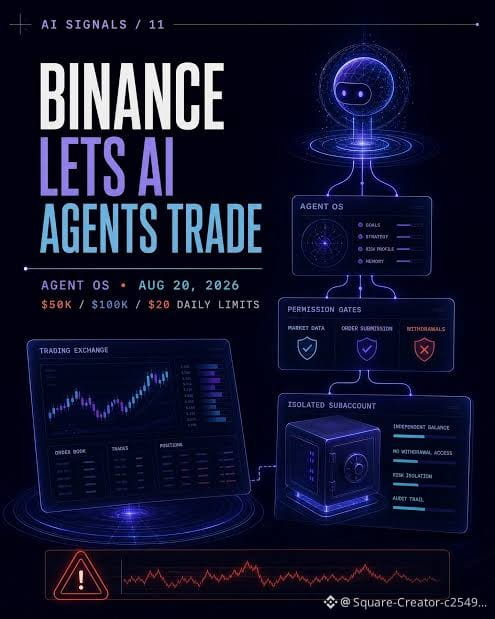
The next layer is already live: Agent OS. AI agents can now read markets, manage a dedicated sub-account, and trade under user-set permissions — without withdrawal rights and without touching the main wallet. Same rails, new interface.
Infrastructure is what stays up when narratives change. That is the job.
#Binance #Infrastructure #AgentOS #BNBChain
Binance is no longer just an exchange. It is the infrastructure layer the market actually runs on.
Deepest liquidity and price discovery across hundreds of pairs
576 assets, 169 networks, and 1,100+ deposit/withdrawal routes
Custody, fiat rails, and settlement that institutions and retail both use
BNB Chain processing a large share of global stablecoin activity
The next layer is already live: Agent OS. AI agents can now read markets, manage a dedicated sub-account, and trade under user-set permissions — without withdrawal rights and without touching the main wallet. Same rails, new interface.
Infrastructure is what stays up when narratives change. That is the job.
#Binance #Infrastructure #AgentOS #BNBChain
Deepest liquidity and price discovery across hundreds of pairs
576 assets, 169 networks, and 1,100+ deposit/withdrawal routes
Custody, fiat rails, and settlement that institutions and retail both use
BNB Chain processing a large share of global stablecoin activity
The next layer is already live: Agent OS. AI agents can now read markets, manage a dedicated sub-account, and trade under user-set permissions — without withdrawal rights and without touching the main wallet. Same rails, new interface.
Infrastructure is what stays up when narratives change. That is the job.
#Binance #Infrastructure #AgentOS #BNBChain
66

·
--
Article
I Gave Claude One Job: Read the Order Book Like an InstitutionThe five-tab problem every serious trader knows
Before I size a position, I run the same routine every time. Binance for the order book and open interest. A second tab for funding rate history. A third for long/short positioning. A fourth for ETF flow data, because that never lives on an exchange. A fifth if a filing from a company like Strategy dropped that week and moved the tape.
None of this is complicated. It is just scattered. And scattered means slow, sizing a position on a five-minute-old picture instead of a live one.
Binance Agent OS made a specific claim: connect an AI agent directly to Binance's trading and market data, under permissions you control, from inside the tools you already use. I wanted to know if it could actually collapse my five-tab routine into one conversation, with no loss of precision on the numbers that decide position size.
I tested it live, on my own account, this week. What I found is the closest thing to a genuine unlock I have seen in this space in a while — and I think most traders reading this should be setting it up today, not eventually.
Setup took less time than my coffee
The documentation points you toward Claude Code. I tried that first and hit a wall, no active paid setup configured, and I was not going to spin one up just to test a data connection.
The real path was faster than the documented one. Claude.ai supports custom connectors on the free plan, no terminal required. Settings → Connectors → Add custom connector, paste Binance's MCP endpoint into the URL field, authenticate through Binance's own OAuth screen. Two minutes, from a browser tab, done.
Two things on Binance's side, separate from the Claude connection: I opened and manually funded the Agentic sub-account (Profile → Dashboard → Sub-account → Asset Management → Transfer. The agent cannot pull funds there by itself), then set permissions deliberately conservative for the first run: market data plus account read, no trade execution yet. I wanted to see what it could show me before I let it touch anything.
If you have ever configured an API key manually, this is dramatically less friction than that.
What happened when I actually asked it something
Close to the literal prompt I ran:
"Pull the BTCUSDT order book, current open interest and its trend over the last six hours, recent funding rate history, and long/short account ratio. Then check my account balance so I can see live exposure alongside the market read."
The order book came back live, not delayed: a bid of $78,411.10 with 14.464 BTC sitting right at the top of the book, ask at $78,411.20, a genuinely tight spread with real size resting at the touch. That alone replaced a tab I open a dozen times a day.
Open interest sat at 107,141 BTC, roughly $8.4B notional. Pulling the trailing six-hour series showed it actually declining, from about 108,987 BTC down to 107,362, while funding rate over the same window climbed modestly, from roughly 0.00003 to 0.00009, and the long/short account ratio held at 1.28–1.32, around 56–57% net long.
That is a more precise read than the headline "everyone is long" story: leverage building modestly on funding while some positions were quietly closing on the open interest side. I would not have caught that nuance glancing at one number. The agent pulled the full set in one pass.
Then I asked it to check my balance. It came back empty. My first thought was that something had broken. It had not, the Agentic sub-account starts genuinely isolated, no access to my main holdings, until I move funds in myself. The agent cannot see or touch capital I have not explicitly placed within its reach.
That is the detail that sold me on the security model. Not the permissions page copy, watching it actually enforced, in real time, on my own account.
Where it already earns its place - and where it is about to get even better
Binance's MCP server currently covers trading and market data, which is exactly the half of my routine that used to eat the most clicks. For the macro side, I ran a live search alongside it: U.S. spot Bitcoin ETFs had just logged +$986.9M for the week, BlackRock's IBIT leading with roughly $691.5M, September 3 alone bringing in $730.9M, the strongest single day since mid-January. Strategy had just ended a ten-week pause with a $370M purchase in late August.
Laid next to the live exchange data, the picture sharpens fast: fresh institutional demand arriving through ETFs while exchange-side leverage stayed comparatively restrained. Two data sets, one conversation, a few seconds apart.
Binance has already flagged on-chain and payment capabilities as next on the MCP roadmap. If institutional flow data lands on that same roadmap, this stops being "one strong half of my workflow" and becomes the whole thing, in one place. I would rather be early to that than catch up later.
Why I am recommending this today, not eventually
Here is my honest verdict after actually running it: the exchange-side leg, order book, open interest, funding, long/short, is faster and more precise than clicking through Binance's own UI for the same four numbers, live and under your own permissions, set up in less time than it takes to make coffee. The sub-account isolation is real security, not a marketing line, and I watched it work against my own account before I trusted it.
If you trade on Binance and you are still checking these numbers one tab at a time, you are working harder than you need to. This is the first AI integration I have tested this year that actually removed steps from my routine instead of adding a new dashboard to check.
Set it up, connect your own account, and go find your own use case, this is exactly the kind of product that gets better the more people push on it in public.
Access Binance Agent OS: [https://www.binance.com/en/agent-os](https://www.binance.com/en/agent-os)
#Binance #AgentOS
I Gave Claude One Job: Read the Order Book Like an Institution
The five-tab problem every serious trader knows
Before I size a position, I run the same routine every time. Binance for the order book and open interest. A second tab for funding rate history. A third for long/short positioning. A fourth for ETF flow data, because that never lives on an exchange. A fifth if a filing from a company like Strategy dropped that week and moved the tape.
None of this is complicated. It is just scattered. And scattered means slow, sizing a position on a five-minute-old picture instead of a live one.
Binance Agent OS made a specific claim: connect an AI agent directly to Binance's trading and market data, under permissions you control, from inside the tools you already use. I wanted to know if it could actually collapse my five-tab routine into one conversation, with no loss of precision on the numbers that decide position size.
I tested it live, on my own account, this week. What I found is the closest thing to a genuine unlock I have seen in this space in a while — and I think most traders reading this should be setting it up today, not eventually.
Setup took less time than my coffee
The documentation points you toward Claude Code. I tried that first and hit a wall, no active paid setup configured, and I was not going to spin one up just to test a data connection.
The real path was faster than the documented one. Claude.ai supports custom connectors on the free plan, no terminal required. Settings → Connectors → Add custom connector, paste Binance's MCP endpoint into the URL field, authenticate through Binance's own OAuth screen. Two minutes, from a browser tab, done.
Two things on Binance's side, separate from the Claude connection: I opened and manually funded the Agentic sub-account (Profile → Dashboard → Sub-account → Asset Management → Transfer. The agent cannot pull funds there by itself), then set permissions deliberately conservative for the first run: market data plus account read, no trade execution yet. I wanted to see what it could show me before I let it touch anything.
If you have ever configured an API key manually, this is dramatically less friction than that.
What happened when I actually asked it something
Close to the literal prompt I ran:
"Pull the BTCUSDT order book, current open interest and its trend over the last six hours, recent funding rate history, and long/short account ratio. Then check my account balance so I can see live exposure alongside the market read."
The order book came back live, not delayed: a bid of $78,411.10 with 14.464 BTC sitting right at the top of the book, ask at $78,411.20, a genuinely tight spread with real size resting at the touch. That alone replaced a tab I open a dozen times a day.
Open interest sat at 107,141 BTC, roughly $8.4B notional. Pulling the trailing six-hour series showed it actually declining, from about 108,987 BTC down to 107,362, while funding rate over the same window climbed modestly, from roughly 0.00003 to 0.00009, and the long/short account ratio held at 1.28–1.32, around 56–57% net long.
That is a more precise read than the headline "everyone is long" story: leverage building modestly on funding while some positions were quietly closing on the open interest side. I would not have caught that nuance glancing at one number. The agent pulled the full set in one pass.
Then I asked it to check my balance. It came back empty. My first thought was that something had broken. It had not, the Agentic sub-account starts genuinely isolated, no access to my main holdings, until I move funds in myself. The agent cannot see or touch capital I have not explicitly placed within its reach.
That is the detail that sold me on the security model. Not the permissions page copy, watching it actually enforced, in real time, on my own account.
Where it already earns its place - and where it is about to get even better
Binance's MCP server currently covers trading and market data, which is exactly the half of my routine that used to eat the most clicks. For the macro side, I ran a live search alongside it: U.S. spot Bitcoin ETFs had just logged +$986.9M for the week, BlackRock's IBIT leading with roughly $691.5M, September 3 alone bringing in $730.9M, the strongest single day since mid-January. Strategy had just ended a ten-week pause with a $370M purchase in late August.
Laid next to the live exchange data, the picture sharpens fast: fresh institutional demand arriving through ETFs while exchange-side leverage stayed comparatively restrained. Two data sets, one conversation, a few seconds apart.
Binance has already flagged on-chain and payment capabilities as next on the MCP roadmap. If institutional flow data lands on that same roadmap, this stops being "one strong half of my workflow" and becomes the whole thing, in one place. I would rather be early to that than catch up later.
Why I am recommending this today, not eventually
Here is my honest verdict after actually running it: the exchange-side leg, order book, open interest, funding, long/short, is faster and more precise than clicking through Binance's own UI for the same four numbers, live and under your own permissions, set up in less time than it takes to make coffee. The sub-account isolation is real security, not a marketing line, and I watched it work against my own account before I trusted it.
If you trade on Binance and you are still checking these numbers one tab at a time, you are working harder than you need to. This is the first AI integration I have tested this year that actually removed steps from my routine instead of adding a new dashboard to check.
Set it up, connect your own account, and go find your own use case, this is exactly the kind of product that gets better the more people push on it in public.
Access Binance Agent OS: https://www.binance.com/en/agent-os
#Binance #AgentOS
Before I size a position, I run the same routine every time. Binance for the order book and open interest. A second tab for funding rate history. A third for long/short positioning. A fourth for ETF flow data, because that never lives on an exchange. A fifth if a filing from a company like Strategy dropped that week and moved the tape.
None of this is complicated. It is just scattered. And scattered means slow, sizing a position on a five-minute-old picture instead of a live one.
Binance Agent OS made a specific claim: connect an AI agent directly to Binance's trading and market data, under permissions you control, from inside the tools you already use. I wanted to know if it could actually collapse my five-tab routine into one conversation, with no loss of precision on the numbers that decide position size.
I tested it live, on my own account, this week. What I found is the closest thing to a genuine unlock I have seen in this space in a while — and I think most traders reading this should be setting it up today, not eventually.
Setup took less time than my coffee
The documentation points you toward Claude Code. I tried that first and hit a wall, no active paid setup configured, and I was not going to spin one up just to test a data connection.
The real path was faster than the documented one. Claude.ai supports custom connectors on the free plan, no terminal required. Settings → Connectors → Add custom connector, paste Binance's MCP endpoint into the URL field, authenticate through Binance's own OAuth screen. Two minutes, from a browser tab, done.
Two things on Binance's side, separate from the Claude connection: I opened and manually funded the Agentic sub-account (Profile → Dashboard → Sub-account → Asset Management → Transfer. The agent cannot pull funds there by itself), then set permissions deliberately conservative for the first run: market data plus account read, no trade execution yet. I wanted to see what it could show me before I let it touch anything.
If you have ever configured an API key manually, this is dramatically less friction than that.
What happened when I actually asked it something
Close to the literal prompt I ran:
"Pull the BTCUSDT order book, current open interest and its trend over the last six hours, recent funding rate history, and long/short account ratio. Then check my account balance so I can see live exposure alongside the market read."
The order book came back live, not delayed: a bid of $78,411.10 with 14.464 BTC sitting right at the top of the book, ask at $78,411.20, a genuinely tight spread with real size resting at the touch. That alone replaced a tab I open a dozen times a day.
Open interest sat at 107,141 BTC, roughly $8.4B notional. Pulling the trailing six-hour series showed it actually declining, from about 108,987 BTC down to 107,362, while funding rate over the same window climbed modestly, from roughly 0.00003 to 0.00009, and the long/short account ratio held at 1.28–1.32, around 56–57% net long.
That is a more precise read than the headline "everyone is long" story: leverage building modestly on funding while some positions were quietly closing on the open interest side. I would not have caught that nuance glancing at one number. The agent pulled the full set in one pass.
Then I asked it to check my balance. It came back empty. My first thought was that something had broken. It had not, the Agentic sub-account starts genuinely isolated, no access to my main holdings, until I move funds in myself. The agent cannot see or touch capital I have not explicitly placed within its reach.
That is the detail that sold me on the security model. Not the permissions page copy, watching it actually enforced, in real time, on my own account.
Where it already earns its place - and where it is about to get even better
Binance's MCP server currently covers trading and market data, which is exactly the half of my routine that used to eat the most clicks. For the macro side, I ran a live search alongside it: U.S. spot Bitcoin ETFs had just logged +$986.9M for the week, BlackRock's IBIT leading with roughly $691.5M, September 3 alone bringing in $730.9M, the strongest single day since mid-January. Strategy had just ended a ten-week pause with a $370M purchase in late August.
Laid next to the live exchange data, the picture sharpens fast: fresh institutional demand arriving through ETFs while exchange-side leverage stayed comparatively restrained. Two data sets, one conversation, a few seconds apart.
Binance has already flagged on-chain and payment capabilities as next on the MCP roadmap. If institutional flow data lands on that same roadmap, this stops being "one strong half of my workflow" and becomes the whole thing, in one place. I would rather be early to that than catch up later.
Why I am recommending this today, not eventually
Here is my honest verdict after actually running it: the exchange-side leg, order book, open interest, funding, long/short, is faster and more precise than clicking through Binance's own UI for the same four numbers, live and under your own permissions, set up in less time than it takes to make coffee. The sub-account isolation is real security, not a marketing line, and I watched it work against my own account before I trusted it.
If you trade on Binance and you are still checking these numbers one tab at a time, you are working harder than you need to. This is the first AI integration I have tested this year that actually removed steps from my routine instead of adding a new dashboard to check.
Set it up, connect your own account, and go find your own use case, this is exactly the kind of product that gets better the more people push on it in public.
Access Binance Agent OS: https://www.binance.com/en/agent-os
#Binance #AgentOS
BTC-0.09%
IBITETF+6.15%
1
200

🤖 The Future of Smart Trading: What Is Binance Agent OS? | The Future of Crypto: Binance Agent OS Trading!
Have you heard about the upcoming revolution in the trading world? 🚀 Binance is taking smart trading to a whole new level with Binance Agent OS Trading!
💡 What makes it special?
1️⃣ Fully automated trading: Use artificial intelligence (AI agents) to execute strategies with precision.
2️⃣ Instant analysis: Read market movement and news in fractions of a second.
3️⃣ Risk reduction: Manage trades using advanced algorithms that protect capital.
The current “Word of the Day” contest is all about this exciting topic! Share your thoughts in the comments—what do you expect from AI in improving your daily trading profits? 👇✨
---
🌐 English Version:
Artificial Intelligence is officially reshaping how we trade! Binance Agent OS Trading is bringing next-level automation to the crypto world. 📈🤖
🔥 Why it matters:
• Smart Execution: AI-driven agents managing trades 24/7.
• Data-Driven: Instantly analyzes market trends and sentiment.
• Efficiency: Minimizes human emotional errors.
Have you tried using AI tools or trading bots yet? Let me know your thoughts or strategy in the comments! 👇
#BinanceSquare #Crypto2026 #TradingBots #AIAlts #Web3 #Binance #AgentOS
🤖 The Future of Smart Trading: What Is Binance Agent OS? | The Future of Crypto: Binance Agent OS Trading!
Have you heard about the upcoming revolution in the trading world? 🚀 Binance is taking smart trading to a whole new level with Binance Agent OS Trading!
💡 What makes it special?
1️⃣ Fully automated trading: Use artificial intelligence (AI agents) to execute strategies with precision.
2️⃣ Instant analysis: Read market movement and news in fractions of a second.
3️⃣ Risk reduction: Manage trades using advanced algorithms that protect capital.
The current “Word of the Day” contest is all about this exciting topic! Share your thoughts in the comments—what do you expect from AI in improving your daily trading profits? 👇✨
---
🌐 English Version:
Artificial Intelligence is officially reshaping how we trade! Binance Agent OS Trading is bringing next-level automation to the crypto world. 📈🤖
🔥 Why it matters:
• Smart Execution: AI-driven agents managing trades 24/7.
• Data-Driven: Instantly analyzes market trends and sentiment.
• Efficiency: Minimizes human emotional errors.
Have you tried using AI tools or trading bots yet? Let me know your thoughts or strategy in the comments! 👇
#BinanceSquare #Crypto2026 #TradingBots #AIAlts #Web3 #Binance #AgentOS
Have you heard about the upcoming revolution in the trading world? 🚀 Binance is taking smart trading to a whole new level with Binance Agent OS Trading!
💡 What makes it special?
1️⃣ Fully automated trading: Use artificial intelligence (AI agents) to execute strategies with precision.
2️⃣ Instant analysis: Read market movement and news in fractions of a second.
3️⃣ Risk reduction: Manage trades using advanced algorithms that protect capital.
The current “Word of the Day” contest is all about this exciting topic! Share your thoughts in the comments—what do you expect from AI in improving your daily trading profits? 👇✨
---
🌐 English Version:
Artificial Intelligence is officially reshaping how we trade! Binance Agent OS Trading is bringing next-level automation to the crypto world. 📈🤖
🔥 Why it matters:
• Smart Execution: AI-driven agents managing trades 24/7.
• Data-Driven: Instantly analyzes market trends and sentiment.
• Efficiency: Minimizes human emotional errors.
Have you tried using AI tools or trading bots yet? Let me know your thoughts or strategy in the comments! 👇
#BinanceSquare #Crypto2026 #TradingBots #AIAlts #Web3 #Binance #AgentOS
64
·
--

Article
BNB Chain Infrastructure Update: Fast, Cheap & Ready for AI AgentsThe network is doing what infrastructure is supposed to do: stay cheap, stay fast, stay up.
BSC is producing blocks around 450ms with gas still near 0.05 Gwei. Pasteur is already live on mainnet — more transactions per block without changing the interval, plus stronger verification on bridges and validators.
On top of that stack, Binance Agent OS gives AI agents a direct path into market data, trading, wallets, and on-chain tools.
That’s the point of this infrastructure:
not a slogan — a chain people can actually run volume on.
Still early. Still building.
#BNBChain #AgentOS #Binance
BNB Chain Infrastructure Update: Fast, Cheap & Ready for AI Agents
The network is doing what infrastructure is supposed to do: stay cheap, stay fast, stay up.
BSC is producing blocks around 450ms with gas still near 0.05 Gwei. Pasteur is already live on mainnet — more transactions per block without changing the interval, plus stronger verification on bridges and validators.
On top of that stack, Binance Agent OS gives AI agents a direct path into market data, trading, wallets, and on-chain tools.
That’s the point of this infrastructure:
not a slogan — a chain people can actually run volume on.
Still early. Still building.
#BNBChain #AgentOS #Binance
BSC is producing blocks around 450ms with gas still near 0.05 Gwei. Pasteur is already live on mainnet — more transactions per block without changing the interval, plus stronger verification on bridges and validators.
On top of that stack, Binance Agent OS gives AI agents a direct path into market data, trading, wallets, and on-chain tools.
That’s the point of this infrastructure:
not a slogan — a chain people can actually run volume on.
Still early. Still building.
#BNBChain #AgentOS #Binance
92

·
--

Article
I Gave Claude Access to Binance. It Caught the Nvidia's Price Move While I Was AsleepBuilding a TradFi analysis skill with Binance Agent OS - by a guy who had never written a trading bot.
THE PROBLEM I ACTUALLY HAVE
I am a 9-5 Business Analyst at a securities firm in Hanoi. I understand markets from the business side, not the trading side.
Here is my problem. Vietnam Securities market closes at 14:45. The US market opens at 21:30 my time, and the interesting moves happen around 03:00, when I am asleep. Every morning I open four tabs and manually reconstruct what happened.
I wanted an agent to do that for me. Not one that trades - one that tells me what moved and by how much, in numbers I can check.
WHAT I BUILT
A skill called tradfi-trading-skill. One job: every morning, pull the overnight tape for the instruments I care about, compute real volatility, and tell me what was unusual.
The thing I did not expect is that Binance carries TradFi perpetuals - $NVDA , $TSLA and others - trading 24/7. So I can watch US equity moves through the same connection as crypto, at 3am, without a US broker.
SETUP: 15 MINUTES, NO CODE
Step 1 - Connect Agent OS.
In Claude, add the Binance MCP server and authenticate. Then the part that matters: set permissions to market-data read-only. My skill never places an order, so I did not grant trade access. If it cannot trade, it cannot mis-trade.
Step 2 - Test with something trivial.
What is the current XAUUSDT price and 24h change on Binance?
It returned 4,626.26, up 0.23%. Connection confirmed. Do this before you build anything.
Step 3 - Ask for the real thing
Using the Binance MCP, pull the last 10 daily candles for the NVDA TradFi perpetual. Compute the average daily range, then tell me which day was unusual and why. Show me the raw numbers.
Step 4 - Ask the AI to package the analysis into a skill/skillset
THE RESULT
After I called tradfi-trading-skill on NVDA, claude response with this:
● NVDA perp last 220.74; average daily range about 2.94% of price
● One candle stood out - open 213.75, high 220.45, low 203.80, close 219.46
● That is a 7.79% range, over 2.5x a normal day
● Volume 2,861,367 against a 425,031 baseline - 6.7x
● And it closed having recovered 94% of the day range
That was the earnings reaction. A sharp drawdown almost entirely bought back within the session. I got the whole shape of it in one answer, from data I can re-pull and verify myself.
Then I asked it to compare against BTC and got something I did not expect:
BTC is only about 1.1x more volatile per day than an NVDA perp right now. As someone who designs risk warnings for a living, that reframed something. But look at the trade count - 5 million against 37 thousand. Similar volatility, completely different liquidity. Those two things need different interfaces, and I had never seen it stated in numbers before.
FOUR MISTAKES THAT I MADE WHILE BUILDING ON AGENT OS
1. I assumed the MCP had news. It does not.
There is a tool called analysis.getTokenAiReport. It returns success: true and null. I built a whole plan around it before testing it. Test your tools before you design around them.
2. I trusted an article over the order book.
An article dated that same day said BTC was trading near $60,000. The Binance ticker said $78,444. The article was $18,000 wrong. Auto-generated market content is everywhere now. The exchange is the source of truth.
3. I thought the MCP could post to Binance Square. It cannot.
Publishing is a separate skill with a separate key. That is good design - the posting key cannot touch funds - but I lost an hour assuming otherwise.
4. I called a tool before it was loaded.
Tools load on demand. If you get a "not loaded" error, that is not a permissions problem. Ask Claude to find the tool first.
WHAT IT CANNOT DO
● It will not trade for you. Every consequential action needs your confirmation, by design.
● It has no news feed. Pair it with web search.
● The most recent candle is always incomplete, so its volume looks artificially low.
● It reports what happened. It does not know what happens next, and neither do us.
FINAL
I did not build a trading bot. I built something that removes twenty minutes of manual tab-checking each morning and replaces it with numbers I can verify.
What changed my mind was not the automation. It was that checking became cheap. When verifying a claim costs one sentence instead of ten minutes, you start verifying claims you would previously have just believed. For someone who designs financial interfaces, that is the more useful habit.
I am a business analyst, not a developer. If I could build this in an afternoon, so can you.
@CZ @heyi @Binance_Square_Official @Binance_Blog @Binance_Academy
Not financial advice. All figures pulled live from the Binance API and reproducible with the prompts above.
#AI #AgentOS
I Gave Claude Access to Binance. It Caught the Nvidia's Price Move While I Was Asleep
Building a TradFi analysis skill with Binance Agent OS - by a guy who had never written a trading bot.
THE PROBLEM I ACTUALLY HAVE
I am a 9-5 Business Analyst at a securities firm in Hanoi. I understand markets from the business side, not the trading side.
Here is my problem. Vietnam Securities market closes at 14:45. The US market opens at 21:30 my time, and the interesting moves happen around 03:00, when I am asleep. Every morning I open four tabs and manually reconstruct what happened.
I wanted an agent to do that for me. Not one that trades - one that tells me what moved and by how much, in numbers I can check.
WHAT I BUILT
A skill called tradfi-trading-skill. One job: every morning, pull the overnight tape for the instruments I care about, compute real volatility, and tell me what was unusual.
The thing I did not expect is that Binance carries TradFi perpetuals - $NVDA , $TSLA and others - trading 24/7. So I can watch US equity moves through the same connection as crypto, at 3am, without a US broker.
SETUP: 15 MINUTES, NO CODE
Step 1 - Connect Agent OS.
In Claude, add the Binance MCP server and authenticate. Then the part that matters: set permissions to market-data read-only. My skill never places an order, so I did not grant trade access. If it cannot trade, it cannot mis-trade.
Step 2 - Test with something trivial.
What is the current XAUUSDT price and 24h change on Binance?
It returned 4,626.26, up 0.23%. Connection confirmed. Do this before you build anything.
Step 3 - Ask for the real thing
Using the Binance MCP, pull the last 10 daily candles for the NVDA TradFi perpetual. Compute the average daily range, then tell me which day was unusual and why. Show me the raw numbers.
Step 4 - Ask the AI to package the analysis into a skill/skillset
THE RESULT
After I called tradfi-trading-skill on NVDA, claude response with this:
● NVDA perp last 220.74; average daily range about 2.94% of price
● One candle stood out - open 213.75, high 220.45, low 203.80, close 219.46
● That is a 7.79% range, over 2.5x a normal day
● Volume 2,861,367 against a 425,031 baseline - 6.7x
● And it closed having recovered 94% of the day range
That was the earnings reaction. A sharp drawdown almost entirely bought back within the session. I got the whole shape of it in one answer, from data I can re-pull and verify myself.
Then I asked it to compare against BTC and got something I did not expect:
BTC is only about 1.1x more volatile per day than an NVDA perp right now. As someone who designs risk warnings for a living, that reframed something. But look at the trade count - 5 million against 37 thousand. Similar volatility, completely different liquidity. Those two things need different interfaces, and I had never seen it stated in numbers before.
FOUR MISTAKES THAT I MADE WHILE BUILDING ON AGENT OS
1. I assumed the MCP had news. It does not.
There is a tool called analysis.getTokenAiReport. It returns success: true and null. I built a whole plan around it before testing it. Test your tools before you design around them.
2. I trusted an article over the order book.
An article dated that same day said BTC was trading near $60,000. The Binance ticker said $78,444. The article was $18,000 wrong. Auto-generated market content is everywhere now. The exchange is the source of truth.
3. I thought the MCP could post to Binance Square. It cannot.
Publishing is a separate skill with a separate key. That is good design - the posting key cannot touch funds - but I lost an hour assuming otherwise.
4. I called a tool before it was loaded.
Tools load on demand. If you get a "not loaded" error, that is not a permissions problem. Ask Claude to find the tool first.
WHAT IT CANNOT DO
● It will not trade for you. Every consequential action needs your confirmation, by design.
● It has no news feed. Pair it with web search.
● The most recent candle is always incomplete, so its volume looks artificially low.
● It reports what happened. It does not know what happens next, and neither do us.
FINAL
I did not build a trading bot. I built something that removes twenty minutes of manual tab-checking each morning and replaces it with numbers I can verify.
What changed my mind was not the automation. It was that checking became cheap. When verifying a claim costs one sentence instead of ten minutes, you start verifying claims you would previously have just believed. For someone who designs financial interfaces, that is the more useful habit.
I am a business analyst, not a developer. If I could build this in an afternoon, so can you.
@CZ @Yi He @Binance Square Official @Binance Blog @Binance Academy
Not financial advice. All figures pulled live from the Binance API and reproducible with the prompts above.
#AI #AgentOS
THE PROBLEM I ACTUALLY HAVE
I am a 9-5 Business Analyst at a securities firm in Hanoi. I understand markets from the business side, not the trading side.
Here is my problem. Vietnam Securities market closes at 14:45. The US market opens at 21:30 my time, and the interesting moves happen around 03:00, when I am asleep. Every morning I open four tabs and manually reconstruct what happened.
I wanted an agent to do that for me. Not one that trades - one that tells me what moved and by how much, in numbers I can check.
WHAT I BUILT
A skill called tradfi-trading-skill. One job: every morning, pull the overnight tape for the instruments I care about, compute real volatility, and tell me what was unusual.
The thing I did not expect is that Binance carries TradFi perpetuals - $NVDA , $TSLA and others - trading 24/7. So I can watch US equity moves through the same connection as crypto, at 3am, without a US broker.
SETUP: 15 MINUTES, NO CODE
Step 1 - Connect Agent OS.
In Claude, add the Binance MCP server and authenticate. Then the part that matters: set permissions to market-data read-only. My skill never places an order, so I did not grant trade access. If it cannot trade, it cannot mis-trade.
Step 2 - Test with something trivial.
What is the current XAUUSDT price and 24h change on Binance?
It returned 4,626.26, up 0.23%. Connection confirmed. Do this before you build anything.
Step 3 - Ask for the real thing
Using the Binance MCP, pull the last 10 daily candles for the NVDA TradFi perpetual. Compute the average daily range, then tell me which day was unusual and why. Show me the raw numbers.
Step 4 - Ask the AI to package the analysis into a skill/skillset
THE RESULT
After I called tradfi-trading-skill on NVDA, claude response with this:
● NVDA perp last 220.74; average daily range about 2.94% of price
● One candle stood out - open 213.75, high 220.45, low 203.80, close 219.46
● That is a 7.79% range, over 2.5x a normal day
● Volume 2,861,367 against a 425,031 baseline - 6.7x
● And it closed having recovered 94% of the day range
That was the earnings reaction. A sharp drawdown almost entirely bought back within the session. I got the whole shape of it in one answer, from data I can re-pull and verify myself.
Then I asked it to compare against BTC and got something I did not expect:
BTC is only about 1.1x more volatile per day than an NVDA perp right now. As someone who designs risk warnings for a living, that reframed something. But look at the trade count - 5 million against 37 thousand. Similar volatility, completely different liquidity. Those two things need different interfaces, and I had never seen it stated in numbers before.
FOUR MISTAKES THAT I MADE WHILE BUILDING ON AGENT OS
1. I assumed the MCP had news. It does not.
There is a tool called analysis.getTokenAiReport. It returns success: true and null. I built a whole plan around it before testing it. Test your tools before you design around them.
2. I trusted an article over the order book.
An article dated that same day said BTC was trading near $60,000. The Binance ticker said $78,444. The article was $18,000 wrong. Auto-generated market content is everywhere now. The exchange is the source of truth.
3. I thought the MCP could post to Binance Square. It cannot.
Publishing is a separate skill with a separate key. That is good design - the posting key cannot touch funds - but I lost an hour assuming otherwise.
4. I called a tool before it was loaded.
Tools load on demand. If you get a "not loaded" error, that is not a permissions problem. Ask Claude to find the tool first.
WHAT IT CANNOT DO
● It will not trade for you. Every consequential action needs your confirmation, by design.
● It has no news feed. Pair it with web search.
● The most recent candle is always incomplete, so its volume looks artificially low.
● It reports what happened. It does not know what happens next, and neither do us.
FINAL
I did not build a trading bot. I built something that removes twenty minutes of manual tab-checking each morning and replaces it with numbers I can verify.
What changed my mind was not the automation. It was that checking became cheap. When verifying a claim costs one sentence instead of ten minutes, you start verifying claims you would previously have just believed. For someone who designs financial interfaces, that is the more useful habit.
I am a business analyst, not a developer. If I could build this in an afternoon, so can you.
@CZ @Yi He @Binance Square Official @Binance Blog @Binance Academy
Not financial advice. All figures pulled live from the Binance API and reproducible with the prompts above.
#AI #AgentOS
2
2
7.3k

·
--
How are AI assistants evolving to bridge data analysis and Web3 infrastructure? Meet Binance Agent OS 🌐🤖
Binance Agent OS provides a developer-centric framework designed to safely connect autonomous AI applications with digital asset capabilities.
💡 What Is Binance Agent OS?
It is an infrastructure layer that enables AI models (such as ChatGPT, Claude, or custom AI agents) to parse market metrics and interact with platform features through user-controlled permissions.
🔑 Core Security & Operational Highlights:
1️⃣ Isolated Sub-Accounts:
AI agents operate within designated sub-accounts, strictly segregated from primary user funds to ensure complete risk isolation.
2️⃣ Automated Safety Controls:
Users and developers can establish hard parameters, such as maximum operational limits and restricted asset scopes.
3️⃣ Developer Protocol Support:
Integrates Model Context Protocol (MCP) and Wallet Agentic Hub infrastructure to provide seamless data flows for Web3 builders.
💡 Educational Takeaway:
AI agents serve as powerful analytical companions, simplifying complex data workflows while keeping security and user sovereignty at the center.
⚠️ Compliance Disclaimer:
AI integration features and developer tool availability vary based on regional eligibility and local regulatory frameworks, This content is strictly for educational purposes and does not constitute financial or software development advice.
Learn more about Web3 technology and developer frameworks on #BinanceAcademy
[https://www.binance.com/en/academy/articles/how-binance-agent-os-is-changing-crypto-trading](https://www.binance.com/en/academy/articles/how-binance-agent-os-is-changing-crypto-trading)
Explore the tech, build responsibly, and always #dyor 💡
#Binance #LearnWithBinance #AgentOS
How are AI assistants evolving to bridge data analysis and Web3 infrastructure? Meet Binance Agent OS 🌐🤖
Binance Agent OS provides a developer-centric framework designed to safely connect autonomous AI applications with digital asset capabilities.
💡 What Is Binance Agent OS?
It is an infrastructure layer that enables AI models (such as ChatGPT, Claude, or custom AI agents) to parse market metrics and interact with platform features through user-controlled permissions.
🔑 Core Security & Operational Highlights:
1️⃣ Isolated Sub-Accounts:
AI agents operate within designated sub-accounts, strictly segregated from primary user funds to ensure complete risk isolation.
2️⃣ Automated Safety Controls:
Users and developers can establish hard parameters, such as maximum operational limits and restricted asset scopes.
3️⃣ Developer Protocol Support:
Integrates Model Context Protocol (MCP) and Wallet Agentic Hub infrastructure to provide seamless data flows for Web3 builders.
💡 Educational Takeaway:
AI agents serve as powerful analytical companions, simplifying complex data workflows while keeping security and user sovereignty at the center.
⚠️ Compliance Disclaimer:
AI integration features and developer tool availability vary based on regional eligibility and local regulatory frameworks, This content is strictly for educational purposes and does not constitute financial or software development advice.
Learn more about Web3 technology and developer frameworks on #BinanceAcademy
https://www.binance.com/en/academy/articles/how-binance-agent-os-is-changing-crypto-trading
Explore the tech, build responsibly, and always #dyor 💡
#Binance #LearnWithBinance #AgentOS
Binance Agent OS provides a developer-centric framework designed to safely connect autonomous AI applications with digital asset capabilities.
💡 What Is Binance Agent OS?
It is an infrastructure layer that enables AI models (such as ChatGPT, Claude, or custom AI agents) to parse market metrics and interact with platform features through user-controlled permissions.
🔑 Core Security & Operational Highlights:
1️⃣ Isolated Sub-Accounts:
AI agents operate within designated sub-accounts, strictly segregated from primary user funds to ensure complete risk isolation.
2️⃣ Automated Safety Controls:
Users and developers can establish hard parameters, such as maximum operational limits and restricted asset scopes.
3️⃣ Developer Protocol Support:
Integrates Model Context Protocol (MCP) and Wallet Agentic Hub infrastructure to provide seamless data flows for Web3 builders.
💡 Educational Takeaway:
AI agents serve as powerful analytical companions, simplifying complex data workflows while keeping security and user sovereignty at the center.
⚠️ Compliance Disclaimer:
AI integration features and developer tool availability vary based on regional eligibility and local regulatory frameworks, This content is strictly for educational purposes and does not constitute financial or software development advice.
Learn more about Web3 technology and developer frameworks on #BinanceAcademy
https://www.binance.com/en/academy/articles/how-binance-agent-os-is-changing-crypto-trading
Explore the tech, build responsibly, and always #dyor 💡
#Binance #LearnWithBinance #AgentOS

6
94

It’s no longer just a chat bot… Today it trades instead of you! 🤖📈
Binance has officially launched the Binance Agent OS feature in collaboration with ChatGPT—moving us from the era of “traditional trading bots” to the era of “isolated smart agents.”
How does this feature work, briefly? 🤔
Based on simple text commands you write in Arabic or English, AI can read real-time market data, analyze coin performance, and execute buy and sell operations on your behalf.
But what about security? (This is where the genius really shines) 👇
1️⃣ Isolated sub-account (Sandbox): The system creates a completely separate environment for the bot, away from your assets and main account.
2️⃣ Automatic withdrawals blocked: The sub-account is programmed to prevent any withdrawals of funds to external wallets. Even if the bot makes a mistake, your money inside the platform is 100% safe.
3️⃣ Permission control: You precisely decide whether the bot has read-only access, trades Spot, or prepares the trade and waits for your manual approval.
The future of Web3 is being run by smart code, and the tools are evolving in a terrifying way! 🔥
A question for investors: Do you have the courage to rely on AI to manage parts of your digital portfolio, or do you prefer traditional manual trading? Share your thoughts in the comments!
👇 Visit my account for more explanations
#cryptotrading
#AgentOS
#chatgpt
#AIAgents
It’s no longer just a chat bot… Today it trades instead of you! 🤖📈
Binance has officially launched the Binance Agent OS feature in collaboration with ChatGPT—moving us from the era of “traditional trading bots” to the era of “isolated smart agents.”
How does this feature work, briefly? 🤔
Based on simple text commands you write in Arabic or English, AI can read real-time market data, analyze coin performance, and execute buy and sell operations on your behalf.
But what about security? (This is where the genius really shines) 👇
1️⃣ Isolated sub-account (Sandbox): The system creates a completely separate environment for the bot, away from your assets and main account.
2️⃣ Automatic withdrawals blocked: The sub-account is programmed to prevent any withdrawals of funds to external wallets. Even if the bot makes a mistake, your money inside the platform is 100% safe.
3️⃣ Permission control: You precisely decide whether the bot has read-only access, trades Spot, or prepares the trade and waits for your manual approval.
The future of Web3 is being run by smart code, and the tools are evolving in a terrifying way! 🔥
A question for investors: Do you have the courage to rely on AI to manage parts of your digital portfolio, or do you prefer traditional manual trading? Share your thoughts in the comments!
👇 Visit my account for more explanations
#cryptotrading
#AgentOS
#chatgpt
#AIAgents
Binance has officially launched the Binance Agent OS feature in collaboration with ChatGPT—moving us from the era of “traditional trading bots” to the era of “isolated smart agents.”
How does this feature work, briefly? 🤔
Based on simple text commands you write in Arabic or English, AI can read real-time market data, analyze coin performance, and execute buy and sell operations on your behalf.
But what about security? (This is where the genius really shines) 👇
1️⃣ Isolated sub-account (Sandbox): The system creates a completely separate environment for the bot, away from your assets and main account.
2️⃣ Automatic withdrawals blocked: The sub-account is programmed to prevent any withdrawals of funds to external wallets. Even if the bot makes a mistake, your money inside the platform is 100% safe.
3️⃣ Permission control: You precisely decide whether the bot has read-only access, trades Spot, or prepares the trade and waits for your manual approval.
The future of Web3 is being run by smart code, and the tools are evolving in a terrifying way! 🔥
A question for investors: Do you have the courage to rely on AI to manage parts of your digital portfolio, or do you prefer traditional manual trading? Share your thoughts in the comments!
👇 Visit my account for more explanations
#cryptotrading
#AgentOS
#chatgpt
#AIAgents
1
1
28

·
--
Verified
Agent OS connects AI into your account, adding a “watch-dog assistant” to the BNB ecosystem
Binance has launched Agent OS: it standardizes trading, market data, wallet, and payment interfaces—once authorized, tools like ChatGPT, Claude, and Cursor can read market data, check balances, and place orders within their permitted scope. Funds flow through a separate agentic sub-account. In the official documentation, there’s no mention of withdrawal privileges—which is the biggest difference from “handing API keys straight to a robot.”
In the future, it may be you who sets the rules, while AI watches signals for $BTC, $BNB , and bStocks. The practical value is that permissions must be configured by you. It’s recommended to enable only read-only market data plus a small sub-account; set per-transaction and daily limits in advance, and don’t put your main account assets in there. Conversions, derivatives, and on-chain operations each have their own quota limits—your confirmation button is still human. This is infrastructure, not a guaranteed-profit strategy, and it doesn’t replace risk management. Treat it as a tool first, then decide whether to let the model touch real money.
#BNB #AgentOS #Aİ
{spot}(BNBUSDT)
Agent OS connects AI into your account, adding a “watch-dog assistant” to the BNB ecosystem
Binance has launched Agent OS: it standardizes trading, market data, wallet, and payment interfaces—once authorized, tools like ChatGPT, Claude, and Cursor can read market data, check balances, and place orders within their permitted scope. Funds flow through a separate agentic sub-account. In the official documentation, there’s no mention of withdrawal privileges—which is the biggest difference from “handing API keys straight to a robot.”
In the future, it may be you who sets the rules, while AI watches signals for $BTC, $BNB , and bStocks. The practical value is that permissions must be configured by you. It’s recommended to enable only read-only market data plus a small sub-account; set per-transaction and daily limits in advance, and don’t put your main account assets in there. Conversions, derivatives, and on-chain operations each have their own quota limits—your confirmation button is still human. This is infrastructure, not a guaranteed-profit strategy, and it doesn’t replace risk management. Treat it as a tool first, then decide whether to let the model touch real money.
#BNB #AgentOS #Aİ
Binance has launched Agent OS: it standardizes trading, market data, wallet, and payment interfaces—once authorized, tools like ChatGPT, Claude, and Cursor can read market data, check balances, and place orders within their permitted scope. Funds flow through a separate agentic sub-account. In the official documentation, there’s no mention of withdrawal privileges—which is the biggest difference from “handing API keys straight to a robot.”
In the future, it may be you who sets the rules, while AI watches signals for $BTC, $BNB , and bStocks. The practical value is that permissions must be configured by you. It’s recommended to enable only read-only market data plus a small sub-account; set per-transaction and daily limits in advance, and don’t put your main account assets in there. Conversions, derivatives, and on-chain operations each have their own quota limits—your confirmation button is still human. This is infrastructure, not a guaranteed-profit strategy, and it doesn’t replace risk management. Treat it as a tool first, then decide whether to let the model touch real money.
#BNB #AgentOS #Aİ
2
2.4k
·
--
Binance officially announced Agent OS, bringing AI applications to trading, market data, wallets, payments, and on-chain capabilities.
Tools like ChatGPT, Claude Code, Codex, and Cursor can authorize Agents to: check market data, view accounts (subject to permission limits), and place orders. You can also create separate sub-accounts for each Agent, with permissions revocable at any time.
The underlying stack is API + Wallet Agentic Hub + x402 + Skill Hub + MCP. AI is no longer just about chatting about coins—it can truly interact with fund flows.
$BNB The ecosystem has one more AI entry point; it’s worth watching how developers will use it.
#币安 #AgentOS #Aİ
Binance officially announced Agent OS, bringing AI applications to trading, market data, wallets, payments, and on-chain capabilities.
Tools like ChatGPT, Claude Code, Codex, and Cursor can authorize Agents to: check market data, view accounts (subject to permission limits), and place orders. You can also create separate sub-accounts for each Agent, with permissions revocable at any time.
The underlying stack is API + Wallet Agentic Hub + x402 + Skill Hub + MCP. AI is no longer just about chatting about coins—it can truly interact with fund flows.
$BNB The ecosystem has one more AI entry point; it’s worth watching how developers will use it.
#币安 #AgentOS #Aİ
Tools like ChatGPT, Claude Code, Codex, and Cursor can authorize Agents to: check market data, view accounts (subject to permission limits), and place orders. You can also create separate sub-accounts for each Agent, with permissions revocable at any time.
The underlying stack is API + Wallet Agentic Hub + x402 + Skill Hub + MCP. AI is no longer just about chatting about coins—it can truly interact with fund flows.
$BNB The ecosystem has one more AI entry point; it’s worth watching how developers will use it.
#币安 #AgentOS #Aİ
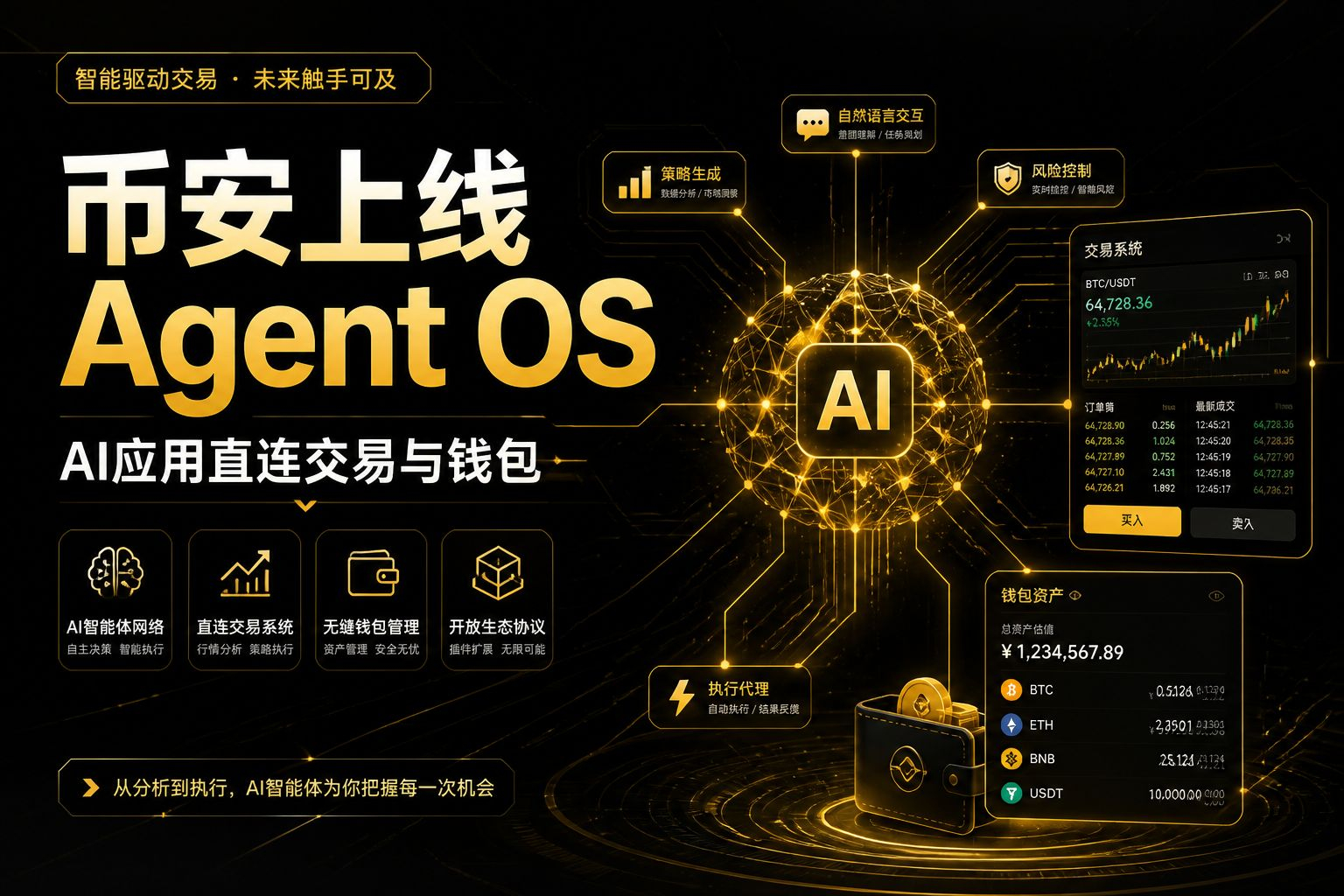
109
Log in to explore more content
Join global crypto users on Binance Square
⚡️ Get latest and useful information about crypto.
💬 Trusted by the world’s largest crypto exchange.
👍 Discover real insights from verified creators.
Email / Phone number
Trending Topics
1
#SaylorHintsStrategyBitcoinBuy
2.2M views
12,012 Discussing
2
#BOJRaisesRatesTo31YearHigh
216,472 views
3,030 Discussing
3
#BuffettStepsDownAsBerkshireChairman
104,447 views
1,609 Discussing
4
#XRPExchangeReservesHitSevenYearLow
112,615 views
1,410 Discussing
5
#HKCompletesFirstHKDStablecoinUseCase
140,088 views
1,795 Discussing
6
#VietnamPlansFirstCryptoLicensesIn2026
87,734 views
1,208 Discussing
7
#BTCBreaks80K
504,364 views
5,597 Discussing
8
#BitcoinMarketCapTopsTesla
121,725 views
1,362 Discussing
9
#SOLJumpsAbout10%
122,423 views
1,237 Discussing
10
#EthereumReclaims$2600
10,912 views
138 Discussing