

C R Y P UP
288 Posts

C R Y P UP
Report
Block User
Crypto and Global Markets Analyst. BTC, ETH, Altcoins, DeFi. RSI and EMA Analysis. Daily Briefs. Bilingual AR and EN. Educational Only. DYOR
Open Trade
Occasional Trader
2.1 Years
523 Following
231 Followers
337 Liked
Posts
Portfolio
All
Quotes
PINNED
·
--
📌 Who am I and why are you following me?
My name is E, a financial and crypto market analyst.
I've been tracking the market daily for over a year and a half.
What you'll find here:
📊 Daily macro analysis related to crypto
🌍 The impact of geopolitical events on Bitcoin
⚖️ Coverage of regulatory decisions as they come out
💡 Simplified explanations of complex concepts
No recommendations. No promises. Just reliable analysis.
Whether you're a newbie or a pro, this page is for you.
👇 Hit follow and share your thoughts in the comments
#BTC #كريبتو #تحليل_سوق #Financial_Education
📌 Who am I and why are you following me?
My name is E, a financial and crypto market analyst.
I've been tracking the market daily for over a year and a half.
What you'll find here:
📊 Daily macro analysis related to crypto
🌍 The impact of geopolitical events on Bitcoin
⚖️ Coverage of regulatory decisions as they come out
💡 Simplified explanations of complex concepts
No recommendations. No promises. Just reliable analysis.
Whether you're a newbie or a pro, this page is for you.
👇 Hit follow and share your thoughts in the comments
#BTC #كريبتو #تحليل_سوق #Financial_Education
My name is E, a financial and crypto market analyst.
I've been tracking the market daily for over a year and a half.
What you'll find here:
📊 Daily macro analysis related to crypto
🌍 The impact of geopolitical events on Bitcoin
⚖️ Coverage of regulatory decisions as they come out
💡 Simplified explanations of complex concepts
No recommendations. No promises. Just reliable analysis.
Whether you're a newbie or a pro, this page is for you.
👇 Hit follow and share your thoughts in the comments
#BTC #كريبتو #تحليل_سوق #Financial_Education
1
99
PINNED
·
--
📌 Who Am I & Why Follow C R Y P UP?
I'm 🇪 a crypto and global markets analyst covering the intersection of macro, geopolitics, and digital assets.
What you'll find here every week:
📊 Daily macro briefs connecting Fed policy to crypto
🌍 Geopolitical event analysis with immediate market impact
⚖️ Regulatory developments as they happen
💡 A Beginner's Corner in every deep dive
No price predictions. No hype.
Just verified, sourced analysis bilingual in Arabic and English.
Whether you're a beginner or a seasoned trader, this feed is built for you.
👇 Hit Follow and drop a comment what's the one crypto topic you want me to cover next?
#BTC #bitcoin #CryptoAnalysis #MacroCrypto #Binance
📌 Who Am I & Why Follow C R Y P UP?
I'm 🇪 a crypto and global markets analyst covering the intersection of macro, geopolitics, and digital assets.
What you'll find here every week:
📊 Daily macro briefs connecting Fed policy to crypto
🌍 Geopolitical event analysis with immediate market impact
⚖️ Regulatory developments as they happen
💡 A Beginner's Corner in every deep dive
No price predictions. No hype.
Just verified, sourced analysis bilingual in Arabic and English.
Whether you're a beginner or a seasoned trader, this feed is built for you.
👇 Hit Follow and drop a comment what's the one crypto topic you want me to cover next?
#BTC #bitcoin #CryptoAnalysis #MacroCrypto #Binance
I'm 🇪 a crypto and global markets analyst covering the intersection of macro, geopolitics, and digital assets.
What you'll find here every week:
📊 Daily macro briefs connecting Fed policy to crypto
🌍 Geopolitical event analysis with immediate market impact
⚖️ Regulatory developments as they happen
💡 A Beginner's Corner in every deep dive
No price predictions. No hype.
Just verified, sourced analysis bilingual in Arabic and English.
Whether you're a beginner or a seasoned trader, this feed is built for you.
👇 Hit Follow and drop a comment what's the one crypto topic you want me to cover next?
#BTC #bitcoin #CryptoAnalysis #MacroCrypto #Binance
93
·
--

Article
📋 Here's what's happening in the market now and what I'm keeping an eye onBTC has dropped more than 50% from its all-time high in October 2025 at $126,200.
The reason isn't just one piece of news; five factors hit all at once.
1. Massive institutional exit
Bitcoin ETF funds recorded outflows of $3.4 billion in just one week.
It's the biggest since the launch of these funds in 2024.
BlackRock's IBIT and Fidelity's FBTC are leading the sellers.
2. Strategy sold BTC for the first time in 4 years.
📋 Here's what's happening in the market now and what I'm keeping an eye on
BTC has dropped more than 50% from its all-time high in October 2025 at $126,200.
The reason isn't just one piece of news; five factors hit all at once.
1. Massive institutional exit
Bitcoin ETF funds recorded outflows of $3.4 billion in just one week.
It's the biggest since the launch of these funds in 2024.
BlackRock's IBIT and Fidelity's FBTC are leading the sellers.
2. Strategy sold BTC for the first time in 4 years.
The reason isn't just one piece of news; five factors hit all at once.
1. Massive institutional exit
Bitcoin ETF funds recorded outflows of $3.4 billion in just one week.
It's the biggest since the launch of these funds in 2024.
BlackRock's IBIT and Fidelity's FBTC are leading the sellers.
2. Strategy sold BTC for the first time in 4 years.
156
·
--
Arthur Hayes Dumped HYPE at $59K — Is the Top-10 DeFi King Done?
The only crypto up +180% YTD just got hit by its biggest whale, a regulator, and a market crash all in 72 hours.
◈
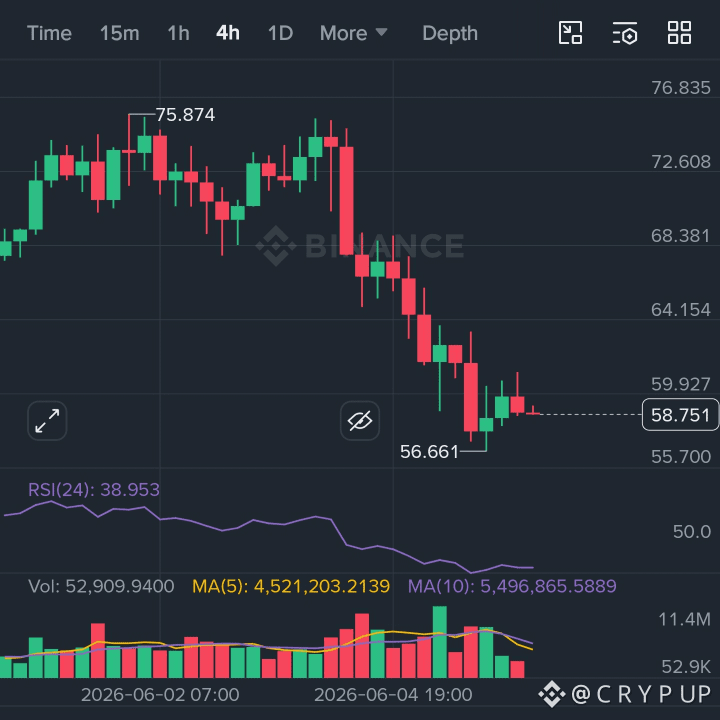
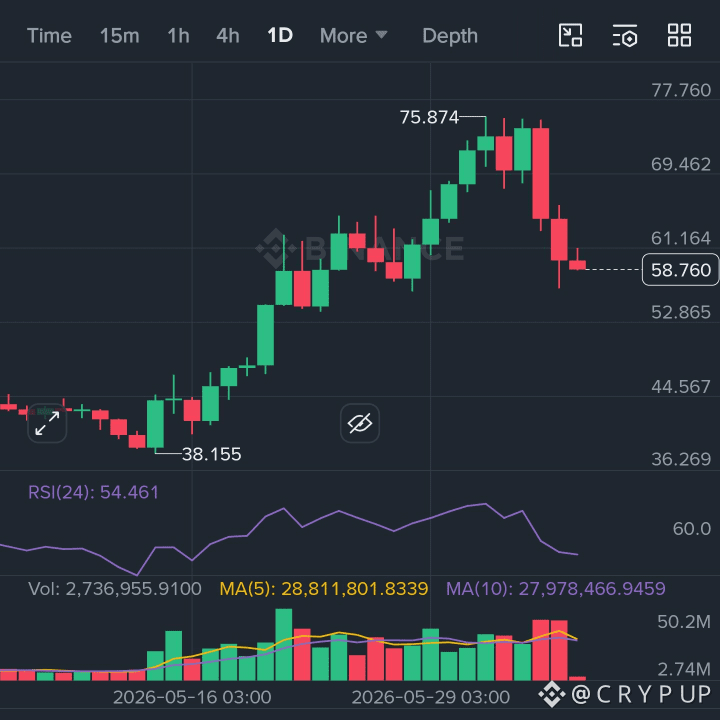
$HYPE: $59,420 | 24h: -6.0% | 7d: -9.0%
◈
Volume: 1.5B above average
◈
RSI(14): 42 Approaching Oversold
◈
Support: $57,000 · Resistance: $68,000
◈
Market Mood: Extreme Fear (12/100)
WHAT'S HAPPENING
Grayscale launched a HYPE staking ETF on June 3, pushing HYPE to an all-time high of $75.52 on June 2. Then Arthur Hayes liquidated his entire position on June 5, and the UK FCA flagged Hyperliquid as an unauthorized firm both hits landed while the broader market was already bleeding.
BTC collapsed below $63K, triggering cascading liquidations across the board. HYPE held its structure better than most, but the Hayes exit spooked retail and open interest on HYPE perps surged to $1.3B signaling aggressive repositioning, not panic abandonment.
Here's what most traders are missing: HYPE is the ONLY top-10 crypto posting +180% YTD in a broad 2026 bear market. It flipped DOGE for the #10 spot on June 1 while BTC bled. Capital is quietly rotating from blue-chips into real yield DeFi infrastructure not meme coins. Most traders are still shorting the macro and missing this structural shift entirely.
---
THE SETUP
Entry: $57,500–$59,000
Stop: $55,800
TP1: $68,000
TP2: $74,000
R/R: 3.2:1
Timeframe: 10–14 days
Conviction: High
---
HYPE just survived an Arthur Hayes exit, an FCA warning, and a market-wide liquidation cascade does it reclaim $75 before July, or does the regulatory overhang finally crack the only DeFi coin in the top 10? 👇
---
⚠️ Analysis only. Not financial advice. Always DYOR.
$HYPE
{future}(HYPEUSDT)
$BTC
{spot}(BTCUSDT)
#BinanceSquare #CryptoAnalysis #Hyperliquid #writetoearn
Arthur Hayes Dumped HYPE at $59K — Is the Top-10 DeFi King Done?
The only crypto up +180% YTD just got hit by its biggest whale, a regulator, and a market crash all in 72 hours.
◈
$HYPE : $59,420 | 24h: -6.0% | 7d: -9.0%
◈
Volume: 1.5B above average
◈
RSI(14): 42 Approaching Oversold
◈
Support: $57,000 · Resistance: $68,000
◈
Market Mood: Extreme Fear (12/100)
WHAT'S HAPPENING
Grayscale launched a HYPE staking ETF on June 3, pushing HYPE to an all-time high of $75.52 on June 2. Then Arthur Hayes liquidated his entire position on June 5, and the UK FCA flagged Hyperliquid as an unauthorized firm both hits landed while the broader market was already bleeding.
BTC collapsed below $63K, triggering cascading liquidations across the board. HYPE held its structure better than most, but the Hayes exit spooked retail and open interest on HYPE perps surged to $1.3B signaling aggressive repositioning, not panic abandonment.
Here's what most traders are missing: HYPE is the ONLY top-10 crypto posting +180% YTD in a broad 2026 bear market. It flipped DOGE for the #10 spot on June 1 while BTC bled. Capital is quietly rotating from blue-chips into real yield DeFi infrastructure not meme coins. Most traders are still shorting the macro and missing this structural shift entirely.
---
THE SETUP
Entry: $57,500–$59,000
Stop: $55,800
TP1: $68,000
TP2: $74,000
R/R: 3.2:1
Timeframe: 10–14 days
Conviction: High
---
HYPE just survived an Arthur Hayes exit, an FCA warning, and a market-wide liquidation cascade does it reclaim $75 before July, or does the regulatory overhang finally crack the only DeFi coin in the top 10? 👇
---
⚠️ Analysis only. Not financial advice. Always DYOR.
$HYPE
$BTC
#BinanceSquare #CryptoAnalysis #Hyperliquid #writetoearn
The only crypto up +180% YTD just got hit by its biggest whale, a regulator, and a market crash all in 72 hours.
◈
$HYPE : $59,420 | 24h: -6.0% | 7d: -9.0%
◈
Volume: 1.5B above average
◈
RSI(14): 42 Approaching Oversold
◈
Support: $57,000 · Resistance: $68,000
◈
Market Mood: Extreme Fear (12/100)
WHAT'S HAPPENING
Grayscale launched a HYPE staking ETF on June 3, pushing HYPE to an all-time high of $75.52 on June 2. Then Arthur Hayes liquidated his entire position on June 5, and the UK FCA flagged Hyperliquid as an unauthorized firm both hits landed while the broader market was already bleeding.
BTC collapsed below $63K, triggering cascading liquidations across the board. HYPE held its structure better than most, but the Hayes exit spooked retail and open interest on HYPE perps surged to $1.3B signaling aggressive repositioning, not panic abandonment.
Here's what most traders are missing: HYPE is the ONLY top-10 crypto posting +180% YTD in a broad 2026 bear market. It flipped DOGE for the #10 spot on June 1 while BTC bled. Capital is quietly rotating from blue-chips into real yield DeFi infrastructure not meme coins. Most traders are still shorting the macro and missing this structural shift entirely.
---
THE SETUP
Entry: $57,500–$59,000
Stop: $55,800
TP1: $68,000
TP2: $74,000
R/R: 3.2:1
Timeframe: 10–14 days
Conviction: High
---
HYPE just survived an Arthur Hayes exit, an FCA warning, and a market-wide liquidation cascade does it reclaim $75 before July, or does the regulatory overhang finally crack the only DeFi coin in the top 10? 👇
---
⚠️ Analysis only. Not financial advice. Always DYOR.
$HYPE
$BTC
#BinanceSquare #CryptoAnalysis #Hyperliquid #writetoearn
190
·
--

Article
📋 Fed Beige Book: 10 of 12 Districts Growing But Inflation Is Outrunning the EconomyThe Federal Reserve's June 3, 2026 Beige Book prepared by the Kansas City Fed based on information collected through May 27 showed ten of twelve Federal Reserve districts reporting slight to moderate economic growth, while one district posted a slight decline and one reported no change.
The picture is one of an economy still moving, but struggling under the weight of persistent inflation and geopolitical pressure.
📊 Three patterns define the report:
First, a Kshaped consumer split: premium goods and services demand remained strong, while middle- and lower-income households were described as squeezing more life out of every dollar before deciding to spend it.
Second, war driven inflation: contacts in multiple districts highlighted rapidly rising costs for energy, shipping, and raw materials including steel and chemicals specifically tied to Middle East conflict supply chain disruptions, with several manufacturers confirming they are successfully passing higher costs onto customers.
Third, a labor market in wait and see mode: eleven of twelve districts reported little change in employment levels, with a temporary employment agency noting that demand was up precisely because companies hesitated to make long term hires.
📌 What this signals for crypto and monetary policy:
Banking conditions tightened modestly across districts, with residential mortgages, consumer, and agricultural loan delinquencies rising in several districts a leading indicator of tightening real economy liquidity. Atlanta Fed contacts flagged growing financial stress specifically among middle income households who do not qualify for public assistance, with retail following a two track trend: strong for premium, constrained for discretionary the consumption pattern of a late cycle economy, not an expansionary one.
💡 Beginner's Corner Why Does the Beige Book Matter for Crypto Traders?
The Beige Book is a qualitative economic survey prepared before every Federal Reserve policy meeting, compiled from thousands of business contacts, economists, and market participants across all 12 Fed districts providing real economy signal that official statistics often lag by weeks or months.
When the report simultaneously describes slight growth and rapid price increases in the same sentence as the Chicago district does in this edition it maps the contours of stagflation: the policy environment where both rate cuts and rate hikes carry unacceptable risks, leaving the Fed in a structurally difficult holding pattern.
💬 With 10 of 12 Fed districts showing only slight growth while inflation runs moderate to rapid on war-driven energy costs does the Beige Book point toward a Fed that holds rates higher for longer in 2026, or does the widening Kshaped economic split eventually force a growth protective cut before year end?
#FedBeigeBookSlightGrowth #FederalReserve #MacroCrypto #Inflation #BTC
DYOR | Educational content only | Not financial advice
#FedBeigeBookSlightGrowth
📋 Fed Beige Book: 10 of 12 Districts Growing But Inflation Is Outrunning the Economy
The Federal Reserve's June 3, 2026 Beige Book prepared by the Kansas City Fed based on information collected through May 27 showed ten of twelve Federal Reserve districts reporting slight to moderate economic growth, while one district posted a slight decline and one reported no change.
The picture is one of an economy still moving, but struggling under the weight of persistent inflation and geopolitical pressure.
📊 Three patterns define the report:
First, a Kshaped consumer split: premium goods and services demand remained strong, while middle- and lower-income households were described as squeezing more life out of every dollar before deciding to spend it.
Second, war driven inflation: contacts in multiple districts highlighted rapidly rising costs for energy, shipping, and raw materials including steel and chemicals specifically tied to Middle East conflict supply chain disruptions, with several manufacturers confirming they are successfully passing higher costs onto customers.
Third, a labor market in wait and see mode: eleven of twelve districts reported little change in employment levels, with a temporary employment agency noting that demand was up precisely because companies hesitated to make long term hires.
📌 What this signals for crypto and monetary policy:
Banking conditions tightened modestly across districts, with residential mortgages, consumer, and agricultural loan delinquencies rising in several districts a leading indicator of tightening real economy liquidity. Atlanta Fed contacts flagged growing financial stress specifically among middle income households who do not qualify for public assistance, with retail following a two track trend: strong for premium, constrained for discretionary the consumption pattern of a late cycle economy, not an expansionary one.
💡 Beginner's Corner Why Does the Beige Book Matter for Crypto Traders?
The Beige Book is a qualitative economic survey prepared before every Federal Reserve policy meeting, compiled from thousands of business contacts, economists, and market participants across all 12 Fed districts providing real economy signal that official statistics often lag by weeks or months.
When the report simultaneously describes slight growth and rapid price increases in the same sentence as the Chicago district does in this edition it maps the contours of stagflation: the policy environment where both rate cuts and rate hikes carry unacceptable risks, leaving the Fed in a structurally difficult holding pattern.
💬 With 10 of 12 Fed districts showing only slight growth while inflation runs moderate to rapid on war-driven energy costs does the Beige Book point toward a Fed that holds rates higher for longer in 2026, or does the widening Kshaped economic split eventually force a growth protective cut before year end?
#FedBeigeBookSlightGrowth #FederalReserve #MacroCrypto #Inflation #BTC
DYOR | Educational content only | Not financial advice
#FedBeigeBookSlightGrowth
The picture is one of an economy still moving, but struggling under the weight of persistent inflation and geopolitical pressure.
📊 Three patterns define the report:
First, a Kshaped consumer split: premium goods and services demand remained strong, while middle- and lower-income households were described as squeezing more life out of every dollar before deciding to spend it.
Second, war driven inflation: contacts in multiple districts highlighted rapidly rising costs for energy, shipping, and raw materials including steel and chemicals specifically tied to Middle East conflict supply chain disruptions, with several manufacturers confirming they are successfully passing higher costs onto customers.
Third, a labor market in wait and see mode: eleven of twelve districts reported little change in employment levels, with a temporary employment agency noting that demand was up precisely because companies hesitated to make long term hires.
📌 What this signals for crypto and monetary policy:
Banking conditions tightened modestly across districts, with residential mortgages, consumer, and agricultural loan delinquencies rising in several districts a leading indicator of tightening real economy liquidity. Atlanta Fed contacts flagged growing financial stress specifically among middle income households who do not qualify for public assistance, with retail following a two track trend: strong for premium, constrained for discretionary the consumption pattern of a late cycle economy, not an expansionary one.
💡 Beginner's Corner Why Does the Beige Book Matter for Crypto Traders?
The Beige Book is a qualitative economic survey prepared before every Federal Reserve policy meeting, compiled from thousands of business contacts, economists, and market participants across all 12 Fed districts providing real economy signal that official statistics often lag by weeks or months.
When the report simultaneously describes slight growth and rapid price increases in the same sentence as the Chicago district does in this edition it maps the contours of stagflation: the policy environment where both rate cuts and rate hikes carry unacceptable risks, leaving the Fed in a structurally difficult holding pattern.
💬 With 10 of 12 Fed districts showing only slight growth while inflation runs moderate to rapid on war-driven energy costs does the Beige Book point toward a Fed that holds rates higher for longer in 2026, or does the widening Kshaped economic split eventually force a growth protective cut before year end?
#FedBeigeBookSlightGrowth #FederalReserve #MacroCrypto #Inflation #BTC
DYOR | Educational content only | Not financial advice
#FedBeigeBookSlightGrowth
116
·
--

Article
💵 Dollar Firms on Hawkish Fed Signals Crypto Caught in the Macro CrossfireA sharp macro headwind is crystallizing for digital assets. U.S. inflation hit 3.3% in March 2026, driven by a 12.5% surge in energy costs tied to the Iran conflict pushing the Federal Reserve's internal debate from when to cut to whether to hike.
The dollar is firming in response, and crypto is feeling it.
📊 The numbers that define the environment:
Core PCE reached 3.3% and is rising, while headline PCE hit 3.8% both well above the Fed's 2% mandate. Rate hikes are back on the table, said David Russell of TradeStation. Policymakers think the labor market is stable, and a vast majority see more inflation risk.
They're worried about tariffs and embedded price pressures. The Fed held its target range at 3.50%–3.75% at the April 29 meeting, reaffirming its commitment to 2% inflation. The dot plot median currently projects just one cut for all of 2026 far fewer than markets had hoped at the start of the year.
The 10 year real interest rate stood at 1.63% in May a level that makes Treasury linked assets meaningfully more competitive with Bitcoin in institutional portfolio allocations.
📌 The split market paradox:
As Fed rhetoric turned hawkish and rate cut bets evaporated, U.S. equities paradoxically pushed to new highs the S&P 500 closed at a 52-week high of 7,230 on May 1, with the Nasdaq up 14.79% over one month, driven by tech earnings and AI capital expenditure.
The dollar enters June with a firmer tone, supported by sticky inflation, Fed caution, and renewed geopolitical risk from the Iran conflict with the dollar further boosted by safe haven flows whenever military escalation spikes. Crypto has absorbed the asymmetric pressure: Bitcoin dropped to 6 week lows while equities held.
💡 Beginner's Corner Why Does a Strong Dollar Hurt Bitcoin More Than Stocks?
There is a well documented inverse relationship between the U.S. Dollar Index (DXY) and Bitcoin: when the Fed takes a hawkish stance, the dollar strengthens, risk free yields rise, and capital rotates away from volatile assets toward safer, dollar-denominated instruments.
Inflation is a double edged macro force for crypto: it supports the long-term Bitcoin debasement narrative but creates short term headwinds when it pushes the Fed toward tighter policy and higher real yields which directly reduce the relative attractiveness of zero yield assets like BTC.
💬 With core PCE at 3.3%, rates at 3.5%, a hawkish new Fed chair, and the dollar firming is crypto in a "patience phase" before a 2027 liquidity driven rally, or does the structural correlation with tech equities make Bitcoin more exposed than its digital gold narrative suggests?
#USDollarUpOnInflationFedHawk #FederalReserve #DXY #bitcoin #MacroCrypto
DYOR | Educational content only | Not financial advice
#USDollarUpOnInflationFedHawk
$BTC
{spot}(BTCUSDT)
💵 Dollar Firms on Hawkish Fed Signals Crypto Caught in the Macro Crossfire
A sharp macro headwind is crystallizing for digital assets. U.S. inflation hit 3.3% in March 2026, driven by a 12.5% surge in energy costs tied to the Iran conflict pushing the Federal Reserve's internal debate from when to cut to whether to hike.
The dollar is firming in response, and crypto is feeling it.
📊 The numbers that define the environment:
Core PCE reached 3.3% and is rising, while headline PCE hit 3.8% both well above the Fed's 2% mandate. Rate hikes are back on the table, said David Russell of TradeStation. Policymakers think the labor market is stable, and a vast majority see more inflation risk.
They're worried about tariffs and embedded price pressures. The Fed held its target range at 3.50%–3.75% at the April 29 meeting, reaffirming its commitment to 2% inflation. The dot plot median currently projects just one cut for all of 2026 far fewer than markets had hoped at the start of the year.
The 10 year real interest rate stood at 1.63% in May a level that makes Treasury linked assets meaningfully more competitive with Bitcoin in institutional portfolio allocations.
📌 The split market paradox:
As Fed rhetoric turned hawkish and rate cut bets evaporated, U.S. equities paradoxically pushed to new highs the S&P 500 closed at a 52-week high of 7,230 on May 1, with the Nasdaq up 14.79% over one month, driven by tech earnings and AI capital expenditure.
The dollar enters June with a firmer tone, supported by sticky inflation, Fed caution, and renewed geopolitical risk from the Iran conflict with the dollar further boosted by safe haven flows whenever military escalation spikes. Crypto has absorbed the asymmetric pressure: Bitcoin dropped to 6 week lows while equities held.
💡 Beginner's Corner Why Does a Strong Dollar Hurt Bitcoin More Than Stocks?
There is a well documented inverse relationship between the U.S. Dollar Index (DXY) and Bitcoin: when the Fed takes a hawkish stance, the dollar strengthens, risk free yields rise, and capital rotates away from volatile assets toward safer, dollar-denominated instruments.
Inflation is a double edged macro force for crypto: it supports the long-term Bitcoin debasement narrative but creates short term headwinds when it pushes the Fed toward tighter policy and higher real yields which directly reduce the relative attractiveness of zero yield assets like BTC.
💬 With core PCE at 3.3%, rates at 3.5%, a hawkish new Fed chair, and the dollar firming is crypto in a "patience phase" before a 2027 liquidity driven rally, or does the structural correlation with tech equities make Bitcoin more exposed than its digital gold narrative suggests?
#USDollarUpOnInflationFedHawk #FederalReserve #DXY #bitcoin #MacroCrypto
DYOR | Educational content only | Not financial advice
#USDollarUpOnInflationFedHawk
$BTC
The dollar is firming in response, and crypto is feeling it.
📊 The numbers that define the environment:
Core PCE reached 3.3% and is rising, while headline PCE hit 3.8% both well above the Fed's 2% mandate. Rate hikes are back on the table, said David Russell of TradeStation. Policymakers think the labor market is stable, and a vast majority see more inflation risk.
They're worried about tariffs and embedded price pressures. The Fed held its target range at 3.50%–3.75% at the April 29 meeting, reaffirming its commitment to 2% inflation. The dot plot median currently projects just one cut for all of 2026 far fewer than markets had hoped at the start of the year.
The 10 year real interest rate stood at 1.63% in May a level that makes Treasury linked assets meaningfully more competitive with Bitcoin in institutional portfolio allocations.
📌 The split market paradox:
As Fed rhetoric turned hawkish and rate cut bets evaporated, U.S. equities paradoxically pushed to new highs the S&P 500 closed at a 52-week high of 7,230 on May 1, with the Nasdaq up 14.79% over one month, driven by tech earnings and AI capital expenditure.
The dollar enters June with a firmer tone, supported by sticky inflation, Fed caution, and renewed geopolitical risk from the Iran conflict with the dollar further boosted by safe haven flows whenever military escalation spikes. Crypto has absorbed the asymmetric pressure: Bitcoin dropped to 6 week lows while equities held.
💡 Beginner's Corner Why Does a Strong Dollar Hurt Bitcoin More Than Stocks?
There is a well documented inverse relationship between the U.S. Dollar Index (DXY) and Bitcoin: when the Fed takes a hawkish stance, the dollar strengthens, risk free yields rise, and capital rotates away from volatile assets toward safer, dollar-denominated instruments.
Inflation is a double edged macro force for crypto: it supports the long-term Bitcoin debasement narrative but creates short term headwinds when it pushes the Fed toward tighter policy and higher real yields which directly reduce the relative attractiveness of zero yield assets like BTC.
💬 With core PCE at 3.3%, rates at 3.5%, a hawkish new Fed chair, and the dollar firming is crypto in a "patience phase" before a 2027 liquidity driven rally, or does the structural correlation with tech equities make Bitcoin more exposed than its digital gold narrative suggests?
#USDollarUpOnInflationFedHawk #FederalReserve #DXY #bitcoin #MacroCrypto
DYOR | Educational content only | Not financial advice
#USDollarUpOnInflationFedHawk
$BTC
177
·
--
Article
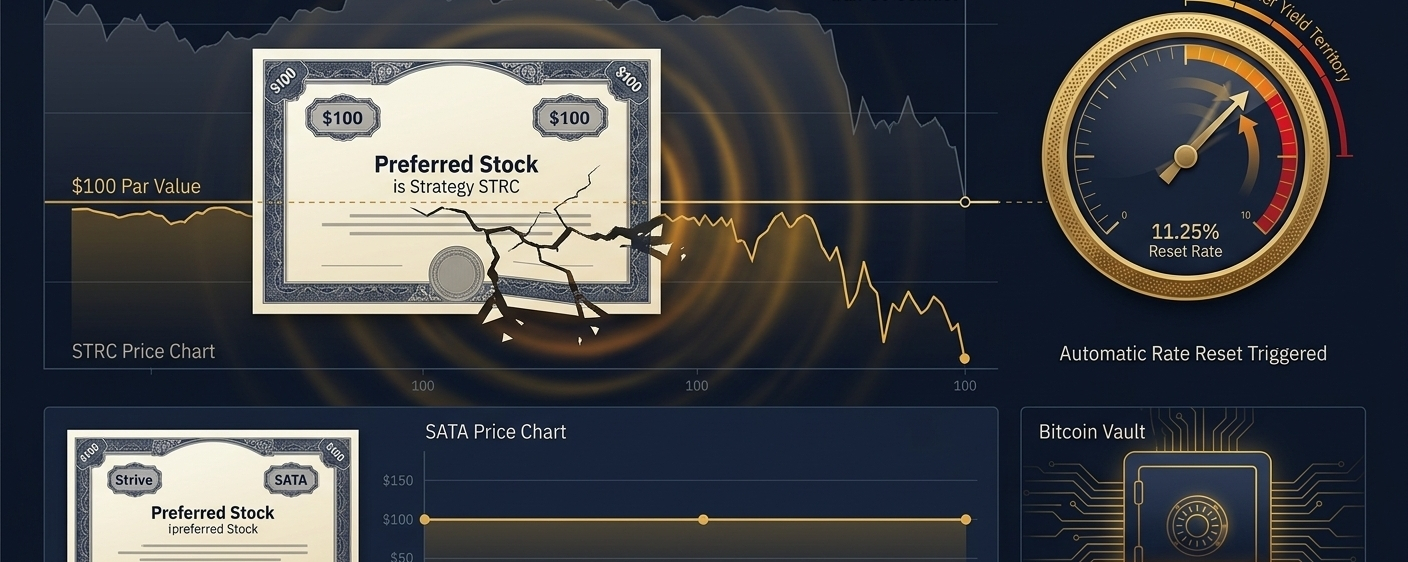
⚠️ Strategy's STRC Breaks Below $100 Par And an Automatic Mechanism Just Triggered a Dividend HikeOn May 28, 2026, Strategy's flagship preferred stock STRC the Variable Rate Series A Perpetual Stretch Preferred Stock closed below its $100 stated par value for the first time since launch. In pre-market trading the following morning it recovered part of the drop but failed to reclaim the $100 threshold.
📊 The mechanism that now kicks in:
Strategy's own SEC filings make the response formula explicit: if STRC's monthly VWAP falls in the $95.00–$98.99 range, management is directed to recommend a dividend rate increase of at least 25 basis points for the following period. Below $95.00, the recommended increase rises to 50 basis points or more.
The immediate catalyst was Bitcoin's sharp drop amid the escalating U.S.-Iran conflict that same day, pulling Strategy's core asset lower and dragging STRC with it.
📌 Competitive pressure compounds the problem:
Strive's competing SATA preferred shares, launched in November 2025 at a 12% initial yield versus STRC's 9%, were still trading near $100 on the same day STRC broke below par putting direct competitive pressure on Strategy to raise its dividend rate to retain investors.
Critically, STRC carries no collateralization from Strategy's Bitcoin holdings it is an unsecured preferred equity instrument with no government insurance, no FDIC protection, and no 1940 Act safeguards.
Its 11.25% annualized variable yield as of April 2026 is paid monthly and subject to reset making it structurally different from a fixed income instrument despite its income-oriented positioning.
💡 Beginner's Corner What Does Below Par Actually Mean for STRC Holders?
STRC was explicitly designed to trade near $100 through a variable dividend mechanism that adjusts monthly to incentivize the market back toward that price making it structurally more like a floating rate note than a traditional preferred stock.
When the par peg breaks, it signals that market participants are pricing in risks whether from Bitcoin volatility, competitive yield alternatives, or dividend sustainability concerns that exceed what the floating rate adjustment alone can compensate for in the short term.
💬 Does STRC breaking par under geopolitical pressure expose a structural vulnerability in Strategy's Bitcoin treasury financing model or does the automatic dividend adjustment mechanism make this a self correcting event that long term holders should treat as a non issue?
#MSTR #strc #BitcoinTreasury #PreferredStock
DYOR | Educational content only | Not financial advice
#StrategySTRCFallsBelowParValue
$BTC
{spot}(BTCUSDT)
⚠️ Strategy's STRC Breaks Below $100 Par And an Automatic Mechanism Just Triggered a Dividend Hike
On May 28, 2026, Strategy's flagship preferred stock STRC the Variable Rate Series A Perpetual Stretch Preferred Stock closed below its $100 stated par value for the first time since launch. In pre-market trading the following morning it recovered part of the drop but failed to reclaim the $100 threshold.
📊 The mechanism that now kicks in:
Strategy's own SEC filings make the response formula explicit: if STRC's monthly VWAP falls in the $95.00–$98.99 range, management is directed to recommend a dividend rate increase of at least 25 basis points for the following period. Below $95.00, the recommended increase rises to 50 basis points or more.
The immediate catalyst was Bitcoin's sharp drop amid the escalating U.S.-Iran conflict that same day, pulling Strategy's core asset lower and dragging STRC with it.
📌 Competitive pressure compounds the problem:
Strive's competing SATA preferred shares, launched in November 2025 at a 12% initial yield versus STRC's 9%, were still trading near $100 on the same day STRC broke below par putting direct competitive pressure on Strategy to raise its dividend rate to retain investors.
Critically, STRC carries no collateralization from Strategy's Bitcoin holdings it is an unsecured preferred equity instrument with no government insurance, no FDIC protection, and no 1940 Act safeguards.
Its 11.25% annualized variable yield as of April 2026 is paid monthly and subject to reset making it structurally different from a fixed income instrument despite its income-oriented positioning.
💡 Beginner's Corner What Does Below Par Actually Mean for STRC Holders?
STRC was explicitly designed to trade near $100 through a variable dividend mechanism that adjusts monthly to incentivize the market back toward that price making it structurally more like a floating rate note than a traditional preferred stock.
When the par peg breaks, it signals that market participants are pricing in risks whether from Bitcoin volatility, competitive yield alternatives, or dividend sustainability concerns that exceed what the floating rate adjustment alone can compensate for in the short term.
💬 Does STRC breaking par under geopolitical pressure expose a structural vulnerability in Strategy's Bitcoin treasury financing model or does the automatic dividend adjustment mechanism make this a self correcting event that long term holders should treat as a non issue?
#MSTR #strc #BitcoinTreasury #PreferredStock
DYOR | Educational content only | Not financial advice
#StrategySTRCFallsBelowParValue
$BTC
📊 The mechanism that now kicks in:
Strategy's own SEC filings make the response formula explicit: if STRC's monthly VWAP falls in the $95.00–$98.99 range, management is directed to recommend a dividend rate increase of at least 25 basis points for the following period. Below $95.00, the recommended increase rises to 50 basis points or more.
The immediate catalyst was Bitcoin's sharp drop amid the escalating U.S.-Iran conflict that same day, pulling Strategy's core asset lower and dragging STRC with it.
📌 Competitive pressure compounds the problem:
Strive's competing SATA preferred shares, launched in November 2025 at a 12% initial yield versus STRC's 9%, were still trading near $100 on the same day STRC broke below par putting direct competitive pressure on Strategy to raise its dividend rate to retain investors.
Critically, STRC carries no collateralization from Strategy's Bitcoin holdings it is an unsecured preferred equity instrument with no government insurance, no FDIC protection, and no 1940 Act safeguards.
Its 11.25% annualized variable yield as of April 2026 is paid monthly and subject to reset making it structurally different from a fixed income instrument despite its income-oriented positioning.
💡 Beginner's Corner What Does Below Par Actually Mean for STRC Holders?
STRC was explicitly designed to trade near $100 through a variable dividend mechanism that adjusts monthly to incentivize the market back toward that price making it structurally more like a floating rate note than a traditional preferred stock.
When the par peg breaks, it signals that market participants are pricing in risks whether from Bitcoin volatility, competitive yield alternatives, or dividend sustainability concerns that exceed what the floating rate adjustment alone can compensate for in the short term.
💬 Does STRC breaking par under geopolitical pressure expose a structural vulnerability in Strategy's Bitcoin treasury financing model or does the automatic dividend adjustment mechanism make this a self correcting event that long term holders should treat as a non issue?
#MSTR #strc #BitcoinTreasury #PreferredStock
DYOR | Educational content only | Not financial advice
#StrategySTRCFallsBelowParValue
$BTC
120
·
--
🚨 Iran Strikes US Airbase: Escalation Rocks the Middle East!
📊 Reports indicate Iran launched missiles at the Al Udeid Air Base in Qatar on May 26, 2026.
This comes amidst an ongoing conflict with the United States, with both sides making strategic moves.
The Institute for the Study of War (ISW) and the Critical Threats Project (CTP) have provided daily updates on the conflict
Such escalations in the Middle East typically lead to increased geopolitical risks, impacting global oil prices and potentially causing volatility in financial markets, including cryptocurrencies, as investors seek safe haven assets.
💡 Geopolitical tensions, especially in oil rich regions, can significantly influence global financial markets. Understanding these dynamics is crucial for anticipating market shifts beyond traditional economic indicators.
💬 Will this escalation lead to broader regional instability, or can diplomatic efforts deescalate the situation?
Share your thoughts below! 👇
#Geopolitics #middleeastconflict #OilPrices #MarketImpact
⚠️ DYOR | Educational Only | Not Financial Advice
#IranAttacksUSAirbase
🚨 Iran Strikes US Airbase: Escalation Rocks the Middle East!
📊 Reports indicate Iran launched missiles at the Al Udeid Air Base in Qatar on May 26, 2026.
This comes amidst an ongoing conflict with the United States, with both sides making strategic moves.
The Institute for the Study of War (ISW) and the Critical Threats Project (CTP) have provided daily updates on the conflict
Such escalations in the Middle East typically lead to increased geopolitical risks, impacting global oil prices and potentially causing volatility in financial markets, including cryptocurrencies, as investors seek safe haven assets.
💡 Geopolitical tensions, especially in oil rich regions, can significantly influence global financial markets. Understanding these dynamics is crucial for anticipating market shifts beyond traditional economic indicators.
💬 Will this escalation lead to broader regional instability, or can diplomatic efforts deescalate the situation?
Share your thoughts below! 👇
#Geopolitics #middleeastconflict #OilPrices #MarketImpact
⚠️ DYOR | Educational Only | Not Financial Advice
#IranAttacksUSAirbase
📊 Reports indicate Iran launched missiles at the Al Udeid Air Base in Qatar on May 26, 2026.
This comes amidst an ongoing conflict with the United States, with both sides making strategic moves.
The Institute for the Study of War (ISW) and the Critical Threats Project (CTP) have provided daily updates on the conflict
Such escalations in the Middle East typically lead to increased geopolitical risks, impacting global oil prices and potentially causing volatility in financial markets, including cryptocurrencies, as investors seek safe haven assets.
💡 Geopolitical tensions, especially in oil rich regions, can significantly influence global financial markets. Understanding these dynamics is crucial for anticipating market shifts beyond traditional economic indicators.
💬 Will this escalation lead to broader regional instability, or can diplomatic efforts deescalate the situation?
Share your thoughts below! 👇
#Geopolitics #middleeastconflict #OilPrices #MarketImpact
⚠️ DYOR | Educational Only | Not Financial Advice
#IranAttacksUSAirbase

463
·
--
Article
🚨 StablR Exploited Licensed Euro Stablecoin Crashes 22% in Minutes#StablRDepegsAfterAttack
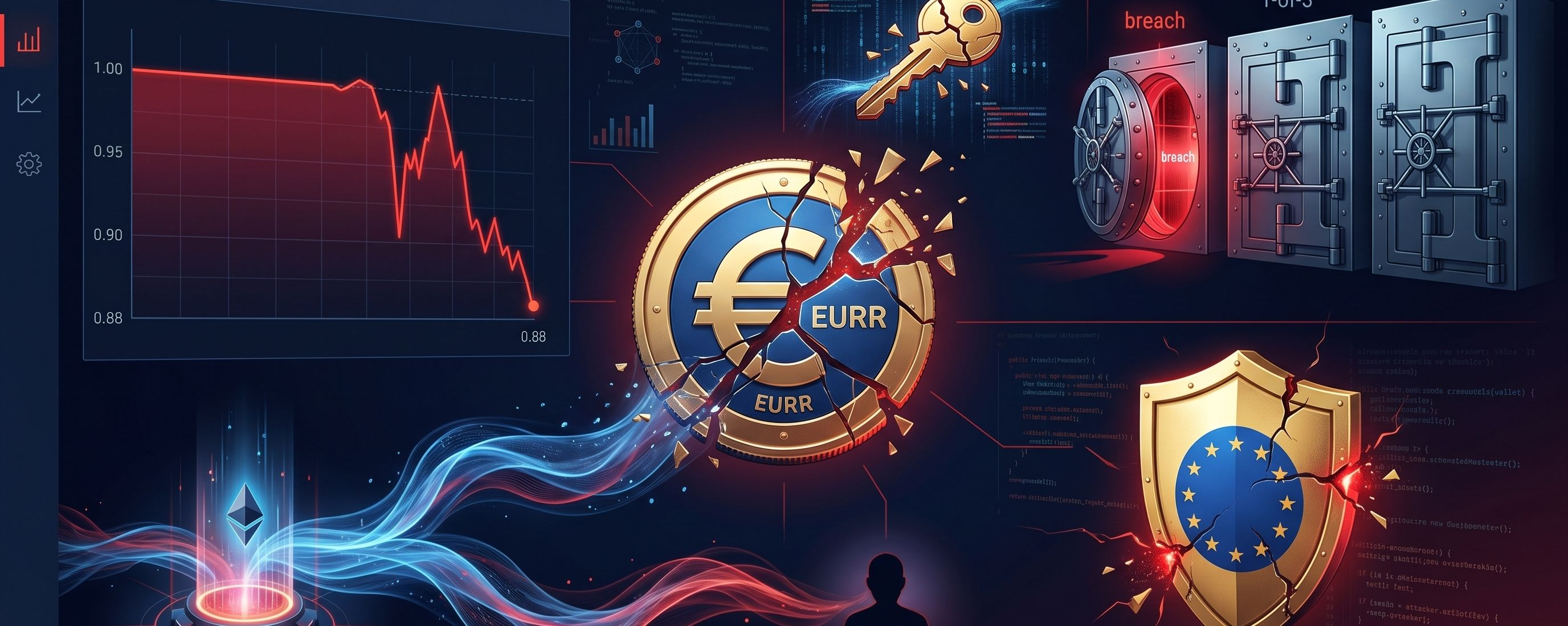
On May 24, 2026, blockchain security firm Blockaid detected an active exploit targeting StablR's issuance system, tracing the breach to a private key compromise on a minting multisig that operated with a dangerously weak 1-of-3 signature threshold.
📊 The damage in numbers:
The attacker added their own address as an owner, expelled the two legitimate signers, and proceeded to mint 8.35 million USDR and 4.5 million EURR a combined face value of approximately $10.4 million at peg.
The attacker swapped those freshly minted tokens on decentralized exchanges for just 1,115 ETH roughly $2.8 million because thin liquidity absorbed most of the slippage, meaning the attacker minted $10.4M in theoretical value but extracted only $2.8M in real losses to the protocol. (BeInCrypto) EURR collapsed to approximately $0.88 and USDR fell to around $0.70 firmly into depeg territory within minutes of the unauthorized minting.
📌 The pattern this fits:
Compromised private keys have become the defining attack vector of 2026's DeFi exploit wave Volo Vault, Wasabi Perps, Echo Bridge, and Polymarket were all hit with admin key exploits over the past two months.
What makes StablR distinctive is its regulatory standing: the company holds an Electronic Money Institution (EMI) license from Malta's financial regulator and operates under the EU's MiCA framework creating an uncomfortable precedent where a fully regulated stablecoin issuer depeg due to an operational security failure, not a regulatory gap.
💡 Beginner's Corner Why Does a 1-of-3 Multisig Make a Stablecoin Catastrophically Vulnerable?
A 1-of-3 multisig threshold means a single compromised private key grants complete, unilateral control over minting requiring no consensus from the other two authorized signers to issue unlimited tokens with zero collateral.
Blockaid was explicit:
This is not a smart contract bug it's a key management and governance failure." That distinction matters because code bugs can be patched in hours, while governance culture and key management practices take far longer to genuinely reform across an organization.
💬 If a MiCA-licensed stablecoin can depeg due to a 1-of-3 multisig failure should EU regulators mandate minimum multisig thresholds, hardware security modules, and mandatory key rotation schedules as technical licensing requirements, or is operational security best left to the issuer's discretion?
#StablRDepegsAfterAttack #StablecoinSecurity #Ethereum #MiCA #CryptoSecurity
DYOR | Educational content only | Not financial advice
$ETH
🚨 StablR Exploited Licensed Euro Stablecoin Crashes 22% in Minutes
#StablRDepegsAfterAttack
On May 24, 2026, blockchain security firm Blockaid detected an active exploit targeting StablR's issuance system, tracing the breach to a private key compromise on a minting multisig that operated with a dangerously weak 1-of-3 signature threshold.
📊 The damage in numbers:
The attacker added their own address as an owner, expelled the two legitimate signers, and proceeded to mint 8.35 million USDR and 4.5 million EURR a combined face value of approximately $10.4 million at peg.
The attacker swapped those freshly minted tokens on decentralized exchanges for just 1,115 ETH roughly $2.8 million because thin liquidity absorbed most of the slippage, meaning the attacker minted $10.4M in theoretical value but extracted only $2.8M in real losses to the protocol. (BeInCrypto) EURR collapsed to approximately $0.88 and USDR fell to around $0.70 firmly into depeg territory within minutes of the unauthorized minting.
📌 The pattern this fits:
Compromised private keys have become the defining attack vector of 2026's DeFi exploit wave Volo Vault, Wasabi Perps, Echo Bridge, and Polymarket were all hit with admin key exploits over the past two months.
What makes StablR distinctive is its regulatory standing: the company holds an Electronic Money Institution (EMI) license from Malta's financial regulator and operates under the EU's MiCA framework creating an uncomfortable precedent where a fully regulated stablecoin issuer depeg due to an operational security failure, not a regulatory gap.
💡 Beginner's Corner Why Does a 1-of-3 Multisig Make a Stablecoin Catastrophically Vulnerable?
A 1-of-3 multisig threshold means a single compromised private key grants complete, unilateral control over minting requiring no consensus from the other two authorized signers to issue unlimited tokens with zero collateral.
Blockaid was explicit:
This is not a smart contract bug it's a key management and governance failure." That distinction matters because code bugs can be patched in hours, while governance culture and key management practices take far longer to genuinely reform across an organization.
💬 If a MiCA-licensed stablecoin can depeg due to a 1-of-3 multisig failure should EU regulators mandate minimum multisig thresholds, hardware security modules, and mandatory key rotation schedules as technical licensing requirements, or is operational security best left to the issuer's discretion?
#StablRDepegsAfterAttack #StablecoinSecurity #Ethereum #MiCA #CryptoSecurity
DYOR | Educational content only | Not financial advice
$ETH
On May 24, 2026, blockchain security firm Blockaid detected an active exploit targeting StablR's issuance system, tracing the breach to a private key compromise on a minting multisig that operated with a dangerously weak 1-of-3 signature threshold.
📊 The damage in numbers:
The attacker added their own address as an owner, expelled the two legitimate signers, and proceeded to mint 8.35 million USDR and 4.5 million EURR a combined face value of approximately $10.4 million at peg.
The attacker swapped those freshly minted tokens on decentralized exchanges for just 1,115 ETH roughly $2.8 million because thin liquidity absorbed most of the slippage, meaning the attacker minted $10.4M in theoretical value but extracted only $2.8M in real losses to the protocol. (BeInCrypto) EURR collapsed to approximately $0.88 and USDR fell to around $0.70 firmly into depeg territory within minutes of the unauthorized minting.
📌 The pattern this fits:
Compromised private keys have become the defining attack vector of 2026's DeFi exploit wave Volo Vault, Wasabi Perps, Echo Bridge, and Polymarket were all hit with admin key exploits over the past two months.
What makes StablR distinctive is its regulatory standing: the company holds an Electronic Money Institution (EMI) license from Malta's financial regulator and operates under the EU's MiCA framework creating an uncomfortable precedent where a fully regulated stablecoin issuer depeg due to an operational security failure, not a regulatory gap.
💡 Beginner's Corner Why Does a 1-of-3 Multisig Make a Stablecoin Catastrophically Vulnerable?
A 1-of-3 multisig threshold means a single compromised private key grants complete, unilateral control over minting requiring no consensus from the other two authorized signers to issue unlimited tokens with zero collateral.
Blockaid was explicit:
This is not a smart contract bug it's a key management and governance failure." That distinction matters because code bugs can be patched in hours, while governance culture and key management practices take far longer to genuinely reform across an organization.
💬 If a MiCA-licensed stablecoin can depeg due to a 1-of-3 multisig failure should EU regulators mandate minimum multisig thresholds, hardware security modules, and mandatory key rotation schedules as technical licensing requirements, or is operational security best left to the issuer's discretion?
#StablRDepegsAfterAttack #StablecoinSecurity #Ethereum #MiCA #CryptoSecurity
DYOR | Educational content only | Not financial advice
$ETH
95
·
--
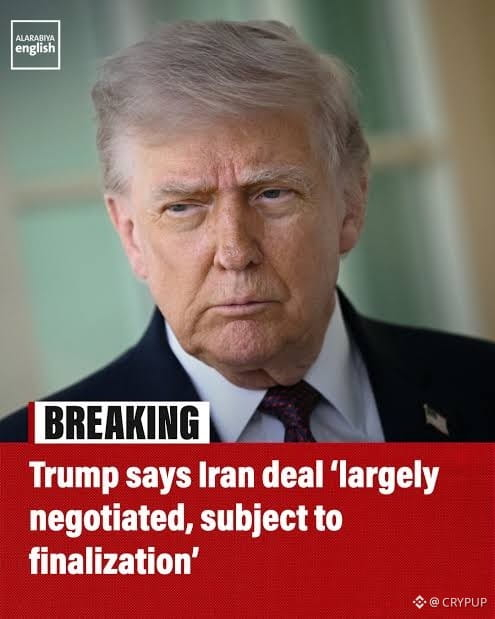
#TrumpSaysIranDealLargelyNegotiated
🔥 Trump Says Iran Deal Largely Negotiated
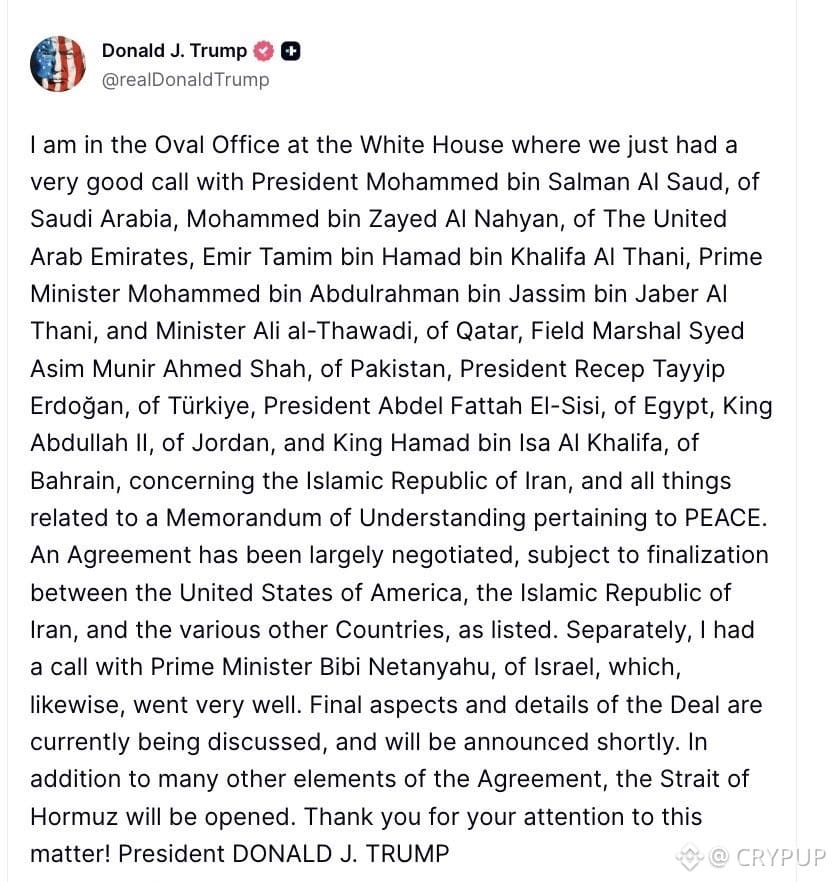
📊 Donald Trump said a framework agreement with Iran is now largely negotiated, with the proposed reopening of the Strait of Hormuz becoming the market’s central focus.
Reuters reported the talks may include a 60 day ceasefire extension and limited sanctions relief in exchange for restrictions tied to Iran’s nuclear activities.
📉 Energy markets reacted cautiously as the Strait of Hormuz remains one of the world’s most critical oil transit chokepoints.
However, conflicting signals from Iranian officials regarding the status of the agreement kept volatility elevated across commodities and broader macro markets.
💡 The Strait of Hormuz matters far beyond oil. When geopolitical risk spikes there, investors often rotate into defensive assets, impacting liquidity, inflation expectations, and crypto market sentiment simultaneously.
💬 Is the market pricing in peace too early or is the real volatility still ahead?
#usa #iran #oil #Macro
⚠️ DYOR | Educational only | Not financial advice
#TrumpSaysIranDealLargelyNegotiated
🔥 Trump Says Iran Deal Largely Negotiated
📊 Donald Trump said a framework agreement with Iran is now largely negotiated, with the proposed reopening of the Strait of Hormuz becoming the market’s central focus.
Reuters reported the talks may include a 60 day ceasefire extension and limited sanctions relief in exchange for restrictions tied to Iran’s nuclear activities.
📉 Energy markets reacted cautiously as the Strait of Hormuz remains one of the world’s most critical oil transit chokepoints.
However, conflicting signals from Iranian officials regarding the status of the agreement kept volatility elevated across commodities and broader macro markets.
💡 The Strait of Hormuz matters far beyond oil. When geopolitical risk spikes there, investors often rotate into defensive assets, impacting liquidity, inflation expectations, and crypto market sentiment simultaneously.
💬 Is the market pricing in peace too early or is the real volatility still ahead?
#usa #iran #oil #Macro
⚠️ DYOR | Educational only | Not financial advice
🔥 Trump Says Iran Deal Largely Negotiated
📊 Donald Trump said a framework agreement with Iran is now largely negotiated, with the proposed reopening of the Strait of Hormuz becoming the market’s central focus.
Reuters reported the talks may include a 60 day ceasefire extension and limited sanctions relief in exchange for restrictions tied to Iran’s nuclear activities.
📉 Energy markets reacted cautiously as the Strait of Hormuz remains one of the world’s most critical oil transit chokepoints.
However, conflicting signals from Iranian officials regarding the status of the agreement kept volatility elevated across commodities and broader macro markets.
💡 The Strait of Hormuz matters far beyond oil. When geopolitical risk spikes there, investors often rotate into defensive assets, impacting liquidity, inflation expectations, and crypto market sentiment simultaneously.
💬 Is the market pricing in peace too early or is the real volatility still ahead?
#usa #iran #oil #Macro
⚠️ DYOR | Educational only | Not financial advice
1
424
·
--
Article
🔴 Warsh Sworn In as Fed Chair Bitcoin Breaks $75K the Same Hour#BitcoinBreaksBelow75KAsWarshTakesFedHelm
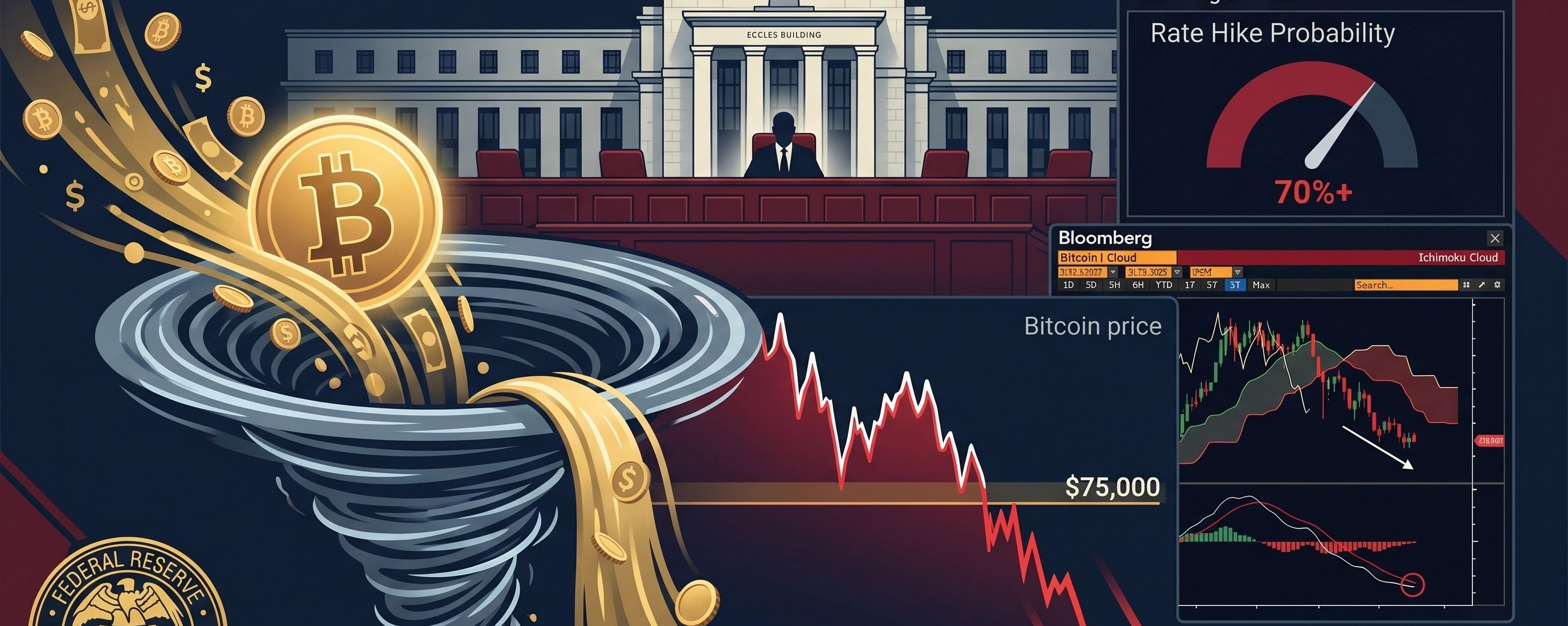
Kevin Warsh was sworn in as Federal Reserve Chairman in a White House ceremony Friday afternoon the first such event at 1600 Pennsylvania Avenue since the late 1980s and within hours Bitcoin confirmed a clean technical breakdown.
📊 The technical damage:
BTC lost the Ichimoku Cloud bottom at $76,556 that had held all week, with the perpetuals low reaching $75,123 slicing into the $75,042 floor analysts had flagged as the last line of defense before $74,265. The MACD bearish cross is confirmed, with RSI printing 40.07 still far above the 28–30 oversold zone that would flag capitulation.
Santiment flagged $1.26 billion in ETF outflows over five days as a contrarian buy signal, while Seyffart noted cumulative ETF inflows remain near their $60 billion all time high a divergence between short term retail flows and institutional conviction.
📌 Why Warsh unnerves the market:
Rate traders are now pricing a greater than 70% chance of one or more rate hikes by end-2026, driven by stubborn inflation and oil price shocks from the ongoing Iran conflict the polar opposite of the rate cut environment Bitcoin rallied in during 2025.
Analysts flagged that the real concern isn't Warsh's personality but his view on the Fed's balance sheet he has previously stated it is too large and hinted at quantitative tightening, which has historically pressured risk-on assets including crypto more severely than rate hikes alone.
Warsh inherits a 3.50% rate with just one cut projected for the rest of 2026 a tighter starting point than any of his recent predecessors.
📌 Historical pattern:
Bitcoin has sold off during every Fed chair transition since 2014: -86% under Yellen's appointment, -73.56% under Powell's first term, -60.72% under Powell's second confirmation. Whether the pattern repeats or breaks under Warsh is the defining macro question for crypto in the second half of 2026.
💡 Beginner's Corner Quantitative Tightening (QT) vs. Rate Hikes: Which Hits Crypto Harder?
Quantitative tightening means the Fed actively reduces its balance sheet by allowing bonds to mature without reinvestment, draining liquidity from the financial system a process that historically compresses risk asset valuations more persistently than rate hikes, because it reduces the total pool of investable capital.
For Bitcoin specifically, QT removes the excess liquidity environment that drove the 2020–2021 and 2024–2025 bull runs making it structurally more significant than a single rate decision.
💬 With Warsh inheriting 3.50% rates, potential QT, and a stagflation backdrop from the Iran conflict is Bitcoin's break below $75K the beginning of a prolonged macro driven correction, or does the historical pattern of buy the transition dip still hold?
#BitcoinBreaksBelow75KAsWarshTakesFedHelm #BTC #FederalReserve #bitcoin #MacroCrypto
DYOR | Educational content only | Not financial advice
$BTC
{spot}(BTCUSDT)
🔴 Warsh Sworn In as Fed Chair Bitcoin Breaks $75K the Same Hour
#BitcoinBreaksBelow75KAsWarshTakesFedHelm
Kevin Warsh was sworn in as Federal Reserve Chairman in a White House ceremony Friday afternoon the first such event at 1600 Pennsylvania Avenue since the late 1980s and within hours Bitcoin confirmed a clean technical breakdown.
📊 The technical damage:
BTC lost the Ichimoku Cloud bottom at $76,556 that had held all week, with the perpetuals low reaching $75,123 slicing into the $75,042 floor analysts had flagged as the last line of defense before $74,265. The MACD bearish cross is confirmed, with RSI printing 40.07 still far above the 28–30 oversold zone that would flag capitulation.
Santiment flagged $1.26 billion in ETF outflows over five days as a contrarian buy signal, while Seyffart noted cumulative ETF inflows remain near their $60 billion all time high a divergence between short term retail flows and institutional conviction.
📌 Why Warsh unnerves the market:
Rate traders are now pricing a greater than 70% chance of one or more rate hikes by end-2026, driven by stubborn inflation and oil price shocks from the ongoing Iran conflict the polar opposite of the rate cut environment Bitcoin rallied in during 2025.
Analysts flagged that the real concern isn't Warsh's personality but his view on the Fed's balance sheet he has previously stated it is too large and hinted at quantitative tightening, which has historically pressured risk-on assets including crypto more severely than rate hikes alone.
Warsh inherits a 3.50% rate with just one cut projected for the rest of 2026 a tighter starting point than any of his recent predecessors.
📌 Historical pattern:
Bitcoin has sold off during every Fed chair transition since 2014: -86% under Yellen's appointment, -73.56% under Powell's first term, -60.72% under Powell's second confirmation. Whether the pattern repeats or breaks under Warsh is the defining macro question for crypto in the second half of 2026.
💡 Beginner's Corner Quantitative Tightening (QT) vs. Rate Hikes: Which Hits Crypto Harder?
Quantitative tightening means the Fed actively reduces its balance sheet by allowing bonds to mature without reinvestment, draining liquidity from the financial system a process that historically compresses risk asset valuations more persistently than rate hikes, because it reduces the total pool of investable capital.
For Bitcoin specifically, QT removes the excess liquidity environment that drove the 2020–2021 and 2024–2025 bull runs making it structurally more significant than a single rate decision.
💬 With Warsh inheriting 3.50% rates, potential QT, and a stagflation backdrop from the Iran conflict is Bitcoin's break below $75K the beginning of a prolonged macro driven correction, or does the historical pattern of buy the transition dip still hold?
#BitcoinBreaksBelow75KAsWarshTakesFedHelm #BTC #FederalReserve #bitcoin #MacroCrypto
DYOR | Educational content only | Not financial advice
$BTC
Kevin Warsh was sworn in as Federal Reserve Chairman in a White House ceremony Friday afternoon the first such event at 1600 Pennsylvania Avenue since the late 1980s and within hours Bitcoin confirmed a clean technical breakdown.
📊 The technical damage:
BTC lost the Ichimoku Cloud bottom at $76,556 that had held all week, with the perpetuals low reaching $75,123 slicing into the $75,042 floor analysts had flagged as the last line of defense before $74,265. The MACD bearish cross is confirmed, with RSI printing 40.07 still far above the 28–30 oversold zone that would flag capitulation.
Santiment flagged $1.26 billion in ETF outflows over five days as a contrarian buy signal, while Seyffart noted cumulative ETF inflows remain near their $60 billion all time high a divergence between short term retail flows and institutional conviction.
📌 Why Warsh unnerves the market:
Rate traders are now pricing a greater than 70% chance of one or more rate hikes by end-2026, driven by stubborn inflation and oil price shocks from the ongoing Iran conflict the polar opposite of the rate cut environment Bitcoin rallied in during 2025.
Analysts flagged that the real concern isn't Warsh's personality but his view on the Fed's balance sheet he has previously stated it is too large and hinted at quantitative tightening, which has historically pressured risk-on assets including crypto more severely than rate hikes alone.
Warsh inherits a 3.50% rate with just one cut projected for the rest of 2026 a tighter starting point than any of his recent predecessors.
📌 Historical pattern:
Bitcoin has sold off during every Fed chair transition since 2014: -86% under Yellen's appointment, -73.56% under Powell's first term, -60.72% under Powell's second confirmation. Whether the pattern repeats or breaks under Warsh is the defining macro question for crypto in the second half of 2026.
💡 Beginner's Corner Quantitative Tightening (QT) vs. Rate Hikes: Which Hits Crypto Harder?
Quantitative tightening means the Fed actively reduces its balance sheet by allowing bonds to mature without reinvestment, draining liquidity from the financial system a process that historically compresses risk asset valuations more persistently than rate hikes, because it reduces the total pool of investable capital.
For Bitcoin specifically, QT removes the excess liquidity environment that drove the 2020–2021 and 2024–2025 bull runs making it structurally more significant than a single rate decision.
💬 With Warsh inheriting 3.50% rates, potential QT, and a stagflation backdrop from the Iran conflict is Bitcoin's break below $75K the beginning of a prolonged macro driven correction, or does the historical pattern of buy the transition dip still hold?
#BitcoinBreaksBelow75KAsWarshTakesFedHelm #BTC #FederalReserve #bitcoin #MacroCrypto
DYOR | Educational content only | Not financial advice
$BTC
257
·
--

Article
⚖️ FTX's Law Firm Pays $54M The Crypto Fraud Bill Is Now Landing on the Advisers#FenwickWestSettlesFTXFor54M
Fenwick & West, the Silicon Valley law firm that served as FTX's lead outside counsel before the exchange's November 2022 collapse, agreed on May 22, 2026 to pay $54 million to settle claims from FTX customers who alleged the firm helped enable one of the largest financial frauds in U.S. history.
The preliminary settlement was filed in Miami federal court and still requires judicial approval.
📊 What the numbers actually tell us:
Plaintiffs alleged Fenwick assisted in creating "shadowy entities" specifically designed to facilitate misappropriation of customer assets and evade regulatory oversight going far beyond routine legal counsel.
This $54 million agreement, however, resolves only one set of claims. A separate group of 20 plaintiffs has filed a $525 million lawsuit in Washington D.C. federal court targeting Fenwick as an institution and several of its individual partners personally meaning Fenwick's total FTX related legal exposure could ultimately approach $580 million.
Fenwick denied wrongdoing, stating it "was not aware of the fraud at FTX, stands by the integrity of its legal work, and disputes wrongdoing of any kind."
📌 The wider precedent this sets:
Fenwick did not run FTX. It did not hold customer deposits. It was not the public face of the exchange.
That is precisely why its $54 million settlement matters the legal fallout from FTX is no longer limited to Sam Bankman Fried and his inner circle. It is now reaching the professional firms that helped the company look credible while risk was building underneath.
The bankruptcy estate has since distributed over $5 billion to creditors, completed a third repayment round in September 2025, and the Fenwick deal is part of what lawyers are calling the second wave of FTX litigation settlements.
💡 Beginner's Corner What Is Aiding and Abetting Fraud in a Legal Context?
The lawsuit alleged Fenwick helped construct the corporate architecture that allowed customer funds to be siphoned off and regulatory oversight to be dodged a legal theory that shifts blame from the fraudsters to those who built the structural scaffolding around them.
The gap between Fenwick's $54 million settlement and Prager Metis's (FTX's auditor) earlier $1.95 million SEC settlement illustrates a key legal principle: structuring-focused advisers carry far greater liability exposure than auditors in complex fraud cases, because their work shapes the underlying entity design itself.
💬 Does the Fenwick settlement signal that law firms, auditors, and consultants advising crypto platforms will now face the same level of legal scrutiny as the founders they serve or will we didn't know remain a viable defense in the next wave of crypto litigation?
#FenwickWestSettlesFTXFor54M #FTXCollapse #CryptoLegal #SBF #CryptoRegulation
DYOR | Educational content only | Not financial advice
⚖️ FTX's Law Firm Pays $54M The Crypto Fraud Bill Is Now Landing on the Advisers
#FenwickWestSettlesFTXFor54M
Fenwick & West, the Silicon Valley law firm that served as FTX's lead outside counsel before the exchange's November 2022 collapse, agreed on May 22, 2026 to pay $54 million to settle claims from FTX customers who alleged the firm helped enable one of the largest financial frauds in U.S. history.
The preliminary settlement was filed in Miami federal court and still requires judicial approval.
📊 What the numbers actually tell us:
Plaintiffs alleged Fenwick assisted in creating "shadowy entities" specifically designed to facilitate misappropriation of customer assets and evade regulatory oversight going far beyond routine legal counsel.
This $54 million agreement, however, resolves only one set of claims. A separate group of 20 plaintiffs has filed a $525 million lawsuit in Washington D.C. federal court targeting Fenwick as an institution and several of its individual partners personally meaning Fenwick's total FTX related legal exposure could ultimately approach $580 million.
Fenwick denied wrongdoing, stating it "was not aware of the fraud at FTX, stands by the integrity of its legal work, and disputes wrongdoing of any kind."
📌 The wider precedent this sets:
Fenwick did not run FTX. It did not hold customer deposits. It was not the public face of the exchange.
That is precisely why its $54 million settlement matters the legal fallout from FTX is no longer limited to Sam Bankman Fried and his inner circle. It is now reaching the professional firms that helped the company look credible while risk was building underneath.
The bankruptcy estate has since distributed over $5 billion to creditors, completed a third repayment round in September 2025, and the Fenwick deal is part of what lawyers are calling the second wave of FTX litigation settlements.
💡 Beginner's Corner What Is Aiding and Abetting Fraud in a Legal Context?
The lawsuit alleged Fenwick helped construct the corporate architecture that allowed customer funds to be siphoned off and regulatory oversight to be dodged a legal theory that shifts blame from the fraudsters to those who built the structural scaffolding around them.
The gap between Fenwick's $54 million settlement and Prager Metis's (FTX's auditor) earlier $1.95 million SEC settlement illustrates a key legal principle: structuring-focused advisers carry far greater liability exposure than auditors in complex fraud cases, because their work shapes the underlying entity design itself.
💬 Does the Fenwick settlement signal that law firms, auditors, and consultants advising crypto platforms will now face the same level of legal scrutiny as the founders they serve or will we didn't know remain a viable defense in the next wave of crypto litigation?
#FenwickWestSettlesFTXFor54M #FTXCollapse #CryptoLegal #SBF #CryptoRegulation
DYOR | Educational content only | Not financial advice
Fenwick & West, the Silicon Valley law firm that served as FTX's lead outside counsel before the exchange's November 2022 collapse, agreed on May 22, 2026 to pay $54 million to settle claims from FTX customers who alleged the firm helped enable one of the largest financial frauds in U.S. history.
The preliminary settlement was filed in Miami federal court and still requires judicial approval.
📊 What the numbers actually tell us:
Plaintiffs alleged Fenwick assisted in creating "shadowy entities" specifically designed to facilitate misappropriation of customer assets and evade regulatory oversight going far beyond routine legal counsel.
This $54 million agreement, however, resolves only one set of claims. A separate group of 20 plaintiffs has filed a $525 million lawsuit in Washington D.C. federal court targeting Fenwick as an institution and several of its individual partners personally meaning Fenwick's total FTX related legal exposure could ultimately approach $580 million.
Fenwick denied wrongdoing, stating it "was not aware of the fraud at FTX, stands by the integrity of its legal work, and disputes wrongdoing of any kind."
📌 The wider precedent this sets:
Fenwick did not run FTX. It did not hold customer deposits. It was not the public face of the exchange.
That is precisely why its $54 million settlement matters the legal fallout from FTX is no longer limited to Sam Bankman Fried and his inner circle. It is now reaching the professional firms that helped the company look credible while risk was building underneath.
The bankruptcy estate has since distributed over $5 billion to creditors, completed a third repayment round in September 2025, and the Fenwick deal is part of what lawyers are calling the second wave of FTX litigation settlements.
💡 Beginner's Corner What Is Aiding and Abetting Fraud in a Legal Context?
The lawsuit alleged Fenwick helped construct the corporate architecture that allowed customer funds to be siphoned off and regulatory oversight to be dodged a legal theory that shifts blame from the fraudsters to those who built the structural scaffolding around them.
The gap between Fenwick's $54 million settlement and Prager Metis's (FTX's auditor) earlier $1.95 million SEC settlement illustrates a key legal principle: structuring-focused advisers carry far greater liability exposure than auditors in complex fraud cases, because their work shapes the underlying entity design itself.
💬 Does the Fenwick settlement signal that law firms, auditors, and consultants advising crypto platforms will now face the same level of legal scrutiny as the founders they serve or will we didn't know remain a viable defense in the next wave of crypto litigation?
#FenwickWestSettlesFTXFor54M #FTXCollapse #CryptoLegal #SBF #CryptoRegulation
DYOR | Educational content only | Not financial advice
228
·
--

Article
🏛️ Congress Moves to Lock 1 Million Bitcoin for 20 Years America Bets on BTC as Sovereign Reserve#ARMABillIntroducedWith20YrLockup
On May 21, 2026, Representatives Nick Begich (R-AK) and Jared Golden (D-ME) formally introduced the American Reserve Modernization Act of 2026 (ARMA), backed immediately by a bipartisan coalition of more than 16 cosponsors making it the broadest congressional Bitcoin reserve push in U.S. history.
📊 The core provisions:
ARMA would require all Bitcoin deposited into the Strategic Reserve to remain there for a minimum of 20 years, explicitly barring the government from "selling, swapping, auctioning, encumbering, or otherwise disposing of" the assets for any reason.
The bill targets acquisition of roughly 1 million BTC 5% of total issuable supply over five years through budget neutral mechanisms that avoid direct taxpayer costs, with the sole exception being sales to reduce a national debt that now exceeds $39 trillion.
Transparency is built in: quarterly proof of reserve reports, third party audits, and full congressional oversight are all mandated, alongside a complete accounting of all federal digital asset holdings across agencies.
📌 White House weight:
Patrick Witt of the President's Council of Advisors for Digital Assets called ARMA Version 2 of the BITCOIN Act, noting the White House has spent considerable time examining the legal implications of a formal Bitcoin reserve structure.
Unlike earlier BITCOIN Act proposals that set a precise 1 million BTC acquisition target, the ARMA draft gives no exact figure and instead directs Treasury and Commerce to study whether additional acquisitions could be executed through budget neutral mechanisms.
💡 Beginner's Corner Strategic Reserve vs. Digital Asset Stockpile: What's the Difference?
ARMA creates two distinct structures: a Strategic Bitcoin Reserve with a 20 year mandatory lockup, and a separate Digital Asset Stockpile for non-Bitcoin federal holdings like ETH and USDT each governed under different rules reflecting different perceived strategic values.
The distinction matters:
Bitcoin is treated as a generational sovereign asset to be held across political cycles, while other seized crypto assets remain under more flexible management a tacit legislative acknowledgment that not all digital assets carry equal strategic weight in Washington's calculus.
💬 Does locking 1 million BTC in a 20 year U.S. government reserve represent the ultimate institutional validation of Bitcoin as digital gold or is it a taxpayer risk disguised as strategic policy, given BTC's volatility and an uncertain two-decade horizon?
#ARMABillIntroducedWith20YrLockup #StrategicBitcoinReserve #BTC #CryptoRegulation #USCrypto
DYOR | Educational content only | Not financial advice
$BTC
{spot}(BTCUSDT)
$ETH
{spot}(ETHUSDT)
$USDC
{spot}(USDCUSDT)
🏛️ Congress Moves to Lock 1 Million Bitcoin for 20 Years America Bets on BTC as Sovereign Reserve
#ARMABillIntroducedWith20YrLockup
On May 21, 2026, Representatives Nick Begich (R-AK) and Jared Golden (D-ME) formally introduced the American Reserve Modernization Act of 2026 (ARMA), backed immediately by a bipartisan coalition of more than 16 cosponsors making it the broadest congressional Bitcoin reserve push in U.S. history.
📊 The core provisions:
ARMA would require all Bitcoin deposited into the Strategic Reserve to remain there for a minimum of 20 years, explicitly barring the government from "selling, swapping, auctioning, encumbering, or otherwise disposing of" the assets for any reason.
The bill targets acquisition of roughly 1 million BTC 5% of total issuable supply over five years through budget neutral mechanisms that avoid direct taxpayer costs, with the sole exception being sales to reduce a national debt that now exceeds $39 trillion.
Transparency is built in: quarterly proof of reserve reports, third party audits, and full congressional oversight are all mandated, alongside a complete accounting of all federal digital asset holdings across agencies.
📌 White House weight:
Patrick Witt of the President's Council of Advisors for Digital Assets called ARMA Version 2 of the BITCOIN Act, noting the White House has spent considerable time examining the legal implications of a formal Bitcoin reserve structure.
Unlike earlier BITCOIN Act proposals that set a precise 1 million BTC acquisition target, the ARMA draft gives no exact figure and instead directs Treasury and Commerce to study whether additional acquisitions could be executed through budget neutral mechanisms.
💡 Beginner's Corner Strategic Reserve vs. Digital Asset Stockpile: What's the Difference?
ARMA creates two distinct structures: a Strategic Bitcoin Reserve with a 20 year mandatory lockup, and a separate Digital Asset Stockpile for non-Bitcoin federal holdings like ETH and USDT each governed under different rules reflecting different perceived strategic values.
The distinction matters:
Bitcoin is treated as a generational sovereign asset to be held across political cycles, while other seized crypto assets remain under more flexible management a tacit legislative acknowledgment that not all digital assets carry equal strategic weight in Washington's calculus.
💬 Does locking 1 million BTC in a 20 year U.S. government reserve represent the ultimate institutional validation of Bitcoin as digital gold or is it a taxpayer risk disguised as strategic policy, given BTC's volatility and an uncertain two-decade horizon?
#ARMABillIntroducedWith20YrLockup #StrategicBitcoinReserve #BTC #CryptoRegulation #USCrypto
DYOR | Educational content only | Not financial advice
$BTC
$ETH
$USDC
On May 21, 2026, Representatives Nick Begich (R-AK) and Jared Golden (D-ME) formally introduced the American Reserve Modernization Act of 2026 (ARMA), backed immediately by a bipartisan coalition of more than 16 cosponsors making it the broadest congressional Bitcoin reserve push in U.S. history.
📊 The core provisions:
ARMA would require all Bitcoin deposited into the Strategic Reserve to remain there for a minimum of 20 years, explicitly barring the government from "selling, swapping, auctioning, encumbering, or otherwise disposing of" the assets for any reason.
The bill targets acquisition of roughly 1 million BTC 5% of total issuable supply over five years through budget neutral mechanisms that avoid direct taxpayer costs, with the sole exception being sales to reduce a national debt that now exceeds $39 trillion.
Transparency is built in: quarterly proof of reserve reports, third party audits, and full congressional oversight are all mandated, alongside a complete accounting of all federal digital asset holdings across agencies.
📌 White House weight:
Patrick Witt of the President's Council of Advisors for Digital Assets called ARMA Version 2 of the BITCOIN Act, noting the White House has spent considerable time examining the legal implications of a formal Bitcoin reserve structure.
Unlike earlier BITCOIN Act proposals that set a precise 1 million BTC acquisition target, the ARMA draft gives no exact figure and instead directs Treasury and Commerce to study whether additional acquisitions could be executed through budget neutral mechanisms.
💡 Beginner's Corner Strategic Reserve vs. Digital Asset Stockpile: What's the Difference?
ARMA creates two distinct structures: a Strategic Bitcoin Reserve with a 20 year mandatory lockup, and a separate Digital Asset Stockpile for non-Bitcoin federal holdings like ETH and USDT each governed under different rules reflecting different perceived strategic values.
The distinction matters:
Bitcoin is treated as a generational sovereign asset to be held across political cycles, while other seized crypto assets remain under more flexible management a tacit legislative acknowledgment that not all digital assets carry equal strategic weight in Washington's calculus.
💬 Does locking 1 million BTC in a 20 year U.S. government reserve represent the ultimate institutional validation of Bitcoin as digital gold or is it a taxpayer risk disguised as strategic policy, given BTC's volatility and an uncertain two-decade horizon?
#ARMABillIntroducedWith20YrLockup #StrategicBitcoinReserve #BTC #CryptoRegulation #USCrypto
DYOR | Educational content only | Not financial advice
$BTC
$ETH
$USDC
1
1
179
·
--
🚨 ECB Delivers Strong Warning Against Euro Stablecoin Expansion!
#ECBOpposesEuroStablecoinExpansion
📊 In a decisive move, the European Central Bank (ECB) has cautioned that reliance on private stablecoins could jeopardize Europe's monetary sovereignty.
According to Executive Board member Piero Cipollone, the proliferation of these currencies risks drawing deposits away from banks and weakening their lending capacity.
This comes as the dollar stablecoin market surpasses $300 billion, while European banks aim to launch euro stablecoins by 2026 under MiCA regulations.
💡 The Digital Euro is proposed by the ECB as the safe anchor for payments, countering the reliance on private assets that carry credit risk.
💬 Do you believe the Digital Euro will successfully compete with private stablecoins, or will market forces prevail? Share your thoughts below! 👇
🏷️ #ECBOpposesEuroStablecoinExpansion #digitaleuro #MiCAR #CryptoRegulation
⚠️ DYOR | Educational Only | Not Financial Advice
🚨 ECB Delivers Strong Warning Against Euro Stablecoin Expansion!
#ECBOpposesEuroStablecoinExpansion
📊 In a decisive move, the European Central Bank (ECB) has cautioned that reliance on private stablecoins could jeopardize Europe's monetary sovereignty.
According to Executive Board member Piero Cipollone, the proliferation of these currencies risks drawing deposits away from banks and weakening their lending capacity.
This comes as the dollar stablecoin market surpasses $300 billion, while European banks aim to launch euro stablecoins by 2026 under MiCA regulations.
💡 The Digital Euro is proposed by the ECB as the safe anchor for payments, countering the reliance on private assets that carry credit risk.
💬 Do you believe the Digital Euro will successfully compete with private stablecoins, or will market forces prevail? Share your thoughts below! 👇
🏷️ #ECBOpposesEuroStablecoinExpansion #digitaleuro #MiCAR #CryptoRegulation
⚠️ DYOR | Educational Only | Not Financial Advice
#ECBOpposesEuroStablecoinExpansion
📊 In a decisive move, the European Central Bank (ECB) has cautioned that reliance on private stablecoins could jeopardize Europe's monetary sovereignty.
According to Executive Board member Piero Cipollone, the proliferation of these currencies risks drawing deposits away from banks and weakening their lending capacity.
This comes as the dollar stablecoin market surpasses $300 billion, while European banks aim to launch euro stablecoins by 2026 under MiCA regulations.
💡 The Digital Euro is proposed by the ECB as the safe anchor for payments, countering the reliance on private assets that carry credit risk.
💬 Do you believe the Digital Euro will successfully compete with private stablecoins, or will market forces prevail? Share your thoughts below! 👇
🏷️ #ECBOpposesEuroStablecoinExpansion #digitaleuro #MiCAR #CryptoRegulation
⚠️ DYOR | Educational Only | Not Financial Advice

1
93
·
--

Article
⚠️ Saylor Breaks Never Sell Strategy Signals Possible BTC Sale by Year End#SaylorConsidersBTCYearEndSale
During Strategy's Q1 2026 earnings call, Michael Saylor openly stated for the first time that the company would consider selling a portion of its Bitcoin holdings to fund dividend obligations breaking a commitment he had repeated in dozens of interviews since January 2022.
Saylor said:
We will probably sell some bitcoin to pay a dividend just to inoculate the market and send the message that we did it framing the potential sale as a deliberate signaling exercise, not a distressed liquidation.
The stock fell 4.33% in after-hours trading immediately following the call.
The financial backdrop explains the shift: Strategy recorded a $12.54 billion net loss in Q1 2026, with $14.46 billion stemming from unrealized Bitcoin losses after BTC fell 23% during the quarter from $87,500 to $67,700 under FASB fair value accounting rules adopted in January 2025.
The company holds 818,869 BTC acquired for roughly $61.86 billion at an average cost of $75,540 per coin, with annual dividend obligations exceeding $982 million.
Polymarket currently assigns a 42–48% probability to Strategy actually selling Bitcoin before year end.
Days after the call, Strategy purchased an additional 535 BTC for $43 million and Saylor walked back his remarks in a podcast, saying the company would remain a net accumulator:
For every bitcoin sold, the company would buy 10 to 20 more.
You want to end every year with more bitcoin than you started.
CEO Phong Le added the clearest constraint: any Bitcoin sale would need to be accretive to Bitcoin per share preserving the core thesis that common equity holders' indirect BTC exposure only increases over time.
💡 Beginner's Corner What Is Bitcoin Per Share and Why Does It Drive Every Strategy Decision?
Strategy's primary KPI is not revenue, earnings, or stock price it is Bitcoin per share: the amount of BTC owned by the company divided by total diluted shares outstanding.
Every capital market action equity issuance, convertible debt, or potential Bitcoin sales is evaluated against whether it increases or decreases this ratio.
This framework means a Bitcoin sale is not necessarily bearish for the thesis: if proceeds are used to retire high cost debt or repurchase shares, the remaining shareholders could end up with higher per share Bitcoin exposure even after the sale.
💬 Does Saylor's openness to selling Bitcoin even under strict accretive to BTC per share conditions mark the end of the pure accumulation narrative for institutional treasury companies, or is it a sophisticated evolution that actually strengthens the long term thesis?
#SaylorConsidersBTCYearEndSale #MSTR #bitcoin #BTC走势分析 #InstitutionalBitcoinInvestment
DYOR | Educational content only | Not financial advice
$BTC
{spot}(BTCUSDT)
⚠️ Saylor Breaks Never Sell Strategy Signals Possible BTC Sale by Year End
#SaylorConsidersBTCYearEndSale
During Strategy's Q1 2026 earnings call, Michael Saylor openly stated for the first time that the company would consider selling a portion of its Bitcoin holdings to fund dividend obligations breaking a commitment he had repeated in dozens of interviews since January 2022.
Saylor said:
We will probably sell some bitcoin to pay a dividend just to inoculate the market and send the message that we did it framing the potential sale as a deliberate signaling exercise, not a distressed liquidation.
The stock fell 4.33% in after-hours trading immediately following the call.
The financial backdrop explains the shift: Strategy recorded a $12.54 billion net loss in Q1 2026, with $14.46 billion stemming from unrealized Bitcoin losses after BTC fell 23% during the quarter from $87,500 to $67,700 under FASB fair value accounting rules adopted in January 2025.
The company holds 818,869 BTC acquired for roughly $61.86 billion at an average cost of $75,540 per coin, with annual dividend obligations exceeding $982 million.
Polymarket currently assigns a 42–48% probability to Strategy actually selling Bitcoin before year end.
Days after the call, Strategy purchased an additional 535 BTC for $43 million and Saylor walked back his remarks in a podcast, saying the company would remain a net accumulator:
For every bitcoin sold, the company would buy 10 to 20 more.
You want to end every year with more bitcoin than you started.
CEO Phong Le added the clearest constraint: any Bitcoin sale would need to be accretive to Bitcoin per share preserving the core thesis that common equity holders' indirect BTC exposure only increases over time.
💡 Beginner's Corner What Is Bitcoin Per Share and Why Does It Drive Every Strategy Decision?
Strategy's primary KPI is not revenue, earnings, or stock price it is Bitcoin per share: the amount of BTC owned by the company divided by total diluted shares outstanding.
Every capital market action equity issuance, convertible debt, or potential Bitcoin sales is evaluated against whether it increases or decreases this ratio.
This framework means a Bitcoin sale is not necessarily bearish for the thesis: if proceeds are used to retire high cost debt or repurchase shares, the remaining shareholders could end up with higher per share Bitcoin exposure even after the sale.
💬 Does Saylor's openness to selling Bitcoin even under strict accretive to BTC per share conditions mark the end of the pure accumulation narrative for institutional treasury companies, or is it a sophisticated evolution that actually strengthens the long term thesis?
#SaylorConsidersBTCYearEndSale #MSTR #bitcoin #BTC走势分析 #InstitutionalBitcoinInvestment
DYOR | Educational content only | Not financial advice
$BTC
During Strategy's Q1 2026 earnings call, Michael Saylor openly stated for the first time that the company would consider selling a portion of its Bitcoin holdings to fund dividend obligations breaking a commitment he had repeated in dozens of interviews since January 2022.
Saylor said:
We will probably sell some bitcoin to pay a dividend just to inoculate the market and send the message that we did it framing the potential sale as a deliberate signaling exercise, not a distressed liquidation.
The stock fell 4.33% in after-hours trading immediately following the call.
The financial backdrop explains the shift: Strategy recorded a $12.54 billion net loss in Q1 2026, with $14.46 billion stemming from unrealized Bitcoin losses after BTC fell 23% during the quarter from $87,500 to $67,700 under FASB fair value accounting rules adopted in January 2025.
The company holds 818,869 BTC acquired for roughly $61.86 billion at an average cost of $75,540 per coin, with annual dividend obligations exceeding $982 million.
Polymarket currently assigns a 42–48% probability to Strategy actually selling Bitcoin before year end.
Days after the call, Strategy purchased an additional 535 BTC for $43 million and Saylor walked back his remarks in a podcast, saying the company would remain a net accumulator:
For every bitcoin sold, the company would buy 10 to 20 more.
You want to end every year with more bitcoin than you started.
CEO Phong Le added the clearest constraint: any Bitcoin sale would need to be accretive to Bitcoin per share preserving the core thesis that common equity holders' indirect BTC exposure only increases over time.
💡 Beginner's Corner What Is Bitcoin Per Share and Why Does It Drive Every Strategy Decision?
Strategy's primary KPI is not revenue, earnings, or stock price it is Bitcoin per share: the amount of BTC owned by the company divided by total diluted shares outstanding.
Every capital market action equity issuance, convertible debt, or potential Bitcoin sales is evaluated against whether it increases or decreases this ratio.
This framework means a Bitcoin sale is not necessarily bearish for the thesis: if proceeds are used to retire high cost debt or repurchase shares, the remaining shareholders could end up with higher per share Bitcoin exposure even after the sale.
💬 Does Saylor's openness to selling Bitcoin even under strict accretive to BTC per share conditions mark the end of the pure accumulation narrative for institutional treasury companies, or is it a sophisticated evolution that actually strengthens the long term thesis?
#SaylorConsidersBTCYearEndSale #MSTR #bitcoin #BTC走势分析 #InstitutionalBitcoinInvestment
DYOR | Educational content only | Not financial advice
$BTC
85
·
--
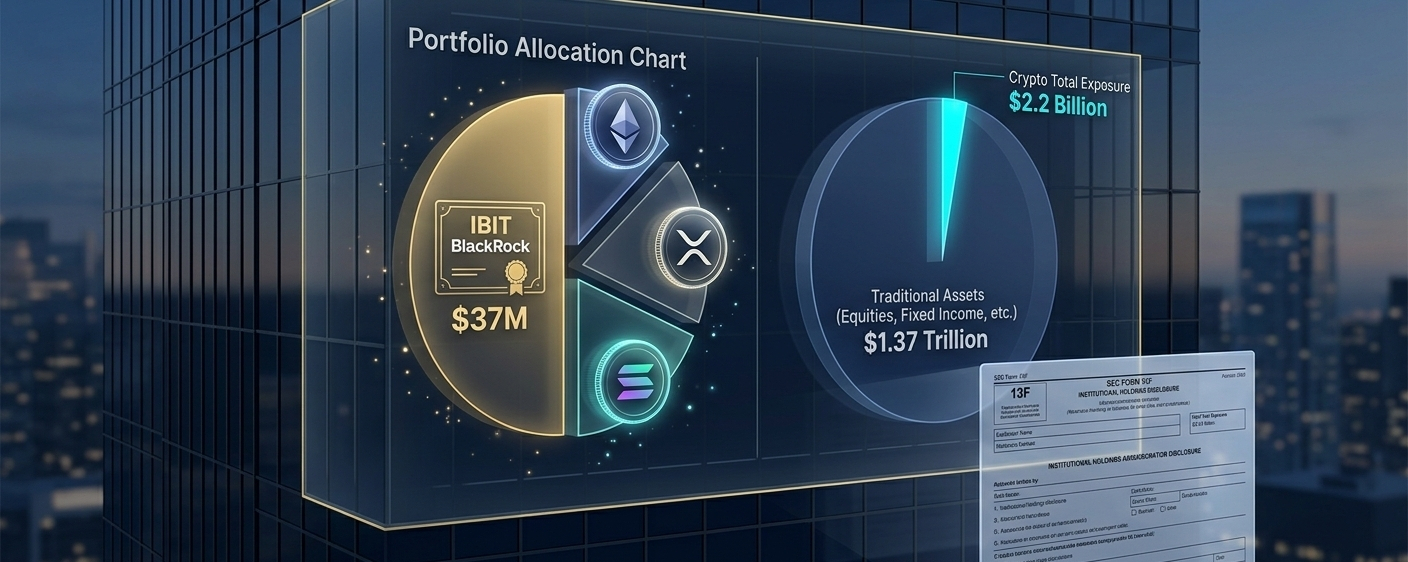
Article
🏦 BofA's 13F Drop: $2.2 Billion in Crypto Exposure Wall Street Is No Longer Testing the Waters#BankOfAmericaDiscloses53MCryptoETF
Bank of America's latest Form 13F filing, submitted to the SEC on May 15 and widely available as of May 19, 2026, disclosed total crypto related holdings exceeding $2.2 billion as of March 31 spanning spot crypto ETFs and equity stakes in companies with significant cryptocurrency operations, against an overall 13F portfolio of approximately $1.37 trillion.
The ETF layer totals nearly $53 million. BofA's largest crypto ETF position is BlackRock's iShares Bitcoin Trust (IBIT) at approximately $37 million a position the bank actively expanded, increasing holdings from 719,008 to 972,590 shares quarter over-quarter. Additional Bitcoin ETF exposure includes approximately $7.98 million in Bitwise's BITB, $3.32 million in Grayscale's Bitcoin Mini Trust, and $1.71 million in Fidelity's FBTC.
Altcoin ETF exposure was considerably smaller: roughly $1.06 million in BlackRock's Ethereum ETF (ETHA), an unchanged position of 13,000 shares in the Volatility Shares XRP ETF, and 10,296 shares in the Volatility Shares Solana ETF.
The crypto equity layer tells a larger story. BofA disclosed 3.96 million shares of Strategy (MSTR) worth approximately $660 million, alongside 903,346 shares of Bitmine Immersion (BMNR), 85,508 shares of American Bitcoin Corp (ABTC), and 238,082 shares of Hyperliquid Strategies (PURR) (Protos) collectively forming a diversified crypto equity basket spanning Bitcoin treasury, Ethereum treasury, and DeFi infrastructure. In January 2026, BofA began allowing thousands of its wealth advisors to suggest Bitcoin ETF allocations of 1% to 4% for suitable clients signaling a gradual normalization of crypto products within its advisory offerings.
💡 Beginner's Corner What Is a Form 13F and Why Does It Matter for Crypto?
SEC rules require institutional investment managers with at least $100 million in qualifying securities to disclose their holdings quarterly via Form 13F making the filings a public window into what the world's largest banks and funds actually own.
A 13F does not explain why a position is held BofA's crypto ETF holdings may reflect client driven demand from wealth advisory accounts rather than proprietary balance sheet conviction but the disclosure confirms that regulated crypto products are now part of mainstream institutional portfolio infrastructure at America's second largest bank.
💬 With BofA holding $2.2 billion in crypto related exposure via ETFs and equities and advising clients on Bitcoin ETF allocationshow far away are we from major U.S. banks holding Bitcoin and Ethereum directly on their balance sheets rather than through indirect wrappers?
#BankOfAmericaDiscloses53MCryptoETF #solana #Ethereum #bitcoin #CryptoRegulation
DYOR | Educational content only | Not financial advice
$BTC
{spot}(BTCUSDT)
{spot}(ETHUSDT)
{spot}(SOLUSDT)
$XRP
$MSTR
🏦 BofA's 13F Drop: $2.2 Billion in Crypto Exposure Wall Street Is No Longer Testing the Waters
#BankOfAmericaDiscloses53MCryptoETF
Bank of America's latest Form 13F filing, submitted to the SEC on May 15 and widely available as of May 19, 2026, disclosed total crypto related holdings exceeding $2.2 billion as of March 31 spanning spot crypto ETFs and equity stakes in companies with significant cryptocurrency operations, against an overall 13F portfolio of approximately $1.37 trillion.
The ETF layer totals nearly $53 million. BofA's largest crypto ETF position is BlackRock's iShares Bitcoin Trust (IBIT) at approximately $37 million a position the bank actively expanded, increasing holdings from 719,008 to 972,590 shares quarter over-quarter. Additional Bitcoin ETF exposure includes approximately $7.98 million in Bitwise's BITB, $3.32 million in Grayscale's Bitcoin Mini Trust, and $1.71 million in Fidelity's FBTC.
Altcoin ETF exposure was considerably smaller: roughly $1.06 million in BlackRock's Ethereum ETF (ETHA), an unchanged position of 13,000 shares in the Volatility Shares XRP ETF, and 10,296 shares in the Volatility Shares Solana ETF.
The crypto equity layer tells a larger story. BofA disclosed 3.96 million shares of Strategy (MSTR) worth approximately $660 million, alongside 903,346 shares of Bitmine Immersion (BMNR), 85,508 shares of American Bitcoin Corp (ABTC), and 238,082 shares of Hyperliquid Strategies (PURR) (Protos) collectively forming a diversified crypto equity basket spanning Bitcoin treasury, Ethereum treasury, and DeFi infrastructure. In January 2026, BofA began allowing thousands of its wealth advisors to suggest Bitcoin ETF allocations of 1% to 4% for suitable clients signaling a gradual normalization of crypto products within its advisory offerings.
💡 Beginner's Corner What Is a Form 13F and Why Does It Matter for Crypto?
SEC rules require institutional investment managers with at least $100 million in qualifying securities to disclose their holdings quarterly via Form 13F making the filings a public window into what the world's largest banks and funds actually own.
A 13F does not explain why a position is held BofA's crypto ETF holdings may reflect client driven demand from wealth advisory accounts rather than proprietary balance sheet conviction but the disclosure confirms that regulated crypto products are now part of mainstream institutional portfolio infrastructure at America's second largest bank.
💬 With BofA holding $2.2 billion in crypto related exposure via ETFs and equities and advising clients on Bitcoin ETF allocationshow far away are we from major U.S. banks holding Bitcoin and Ethereum directly on their balance sheets rather than through indirect wrappers?
#BankOfAmericaDiscloses53MCryptoETF #solana #Ethereum #bitcoin #CryptoRegulation
DYOR | Educational content only | Not financial advice
$BTC
$XRP
$MSTR
Bank of America's latest Form 13F filing, submitted to the SEC on May 15 and widely available as of May 19, 2026, disclosed total crypto related holdings exceeding $2.2 billion as of March 31 spanning spot crypto ETFs and equity stakes in companies with significant cryptocurrency operations, against an overall 13F portfolio of approximately $1.37 trillion.
The ETF layer totals nearly $53 million. BofA's largest crypto ETF position is BlackRock's iShares Bitcoin Trust (IBIT) at approximately $37 million a position the bank actively expanded, increasing holdings from 719,008 to 972,590 shares quarter over-quarter. Additional Bitcoin ETF exposure includes approximately $7.98 million in Bitwise's BITB, $3.32 million in Grayscale's Bitcoin Mini Trust, and $1.71 million in Fidelity's FBTC.
Altcoin ETF exposure was considerably smaller: roughly $1.06 million in BlackRock's Ethereum ETF (ETHA), an unchanged position of 13,000 shares in the Volatility Shares XRP ETF, and 10,296 shares in the Volatility Shares Solana ETF.
The crypto equity layer tells a larger story. BofA disclosed 3.96 million shares of Strategy (MSTR) worth approximately $660 million, alongside 903,346 shares of Bitmine Immersion (BMNR), 85,508 shares of American Bitcoin Corp (ABTC), and 238,082 shares of Hyperliquid Strategies (PURR) (Protos) collectively forming a diversified crypto equity basket spanning Bitcoin treasury, Ethereum treasury, and DeFi infrastructure. In January 2026, BofA began allowing thousands of its wealth advisors to suggest Bitcoin ETF allocations of 1% to 4% for suitable clients signaling a gradual normalization of crypto products within its advisory offerings.
💡 Beginner's Corner What Is a Form 13F and Why Does It Matter for Crypto?
SEC rules require institutional investment managers with at least $100 million in qualifying securities to disclose their holdings quarterly via Form 13F making the filings a public window into what the world's largest banks and funds actually own.
A 13F does not explain why a position is held BofA's crypto ETF holdings may reflect client driven demand from wealth advisory accounts rather than proprietary balance sheet conviction but the disclosure confirms that regulated crypto products are now part of mainstream institutional portfolio infrastructure at America's second largest bank.
💬 With BofA holding $2.2 billion in crypto related exposure via ETFs and equities and advising clients on Bitcoin ETF allocationshow far away are we from major U.S. banks holding Bitcoin and Ethereum directly on their balance sheets rather than through indirect wrappers?
#BankOfAmericaDiscloses53MCryptoETF #solana #Ethereum #bitcoin #CryptoRegulation
DYOR | Educational content only | Not financial advice
$BTC
$XRP
$MSTR
1
217
·
--

Article
📊 Bitmine Eyes Russell 3000 The World's Largest ETH Treasury Approaches Index Fund Territory#BitmineIncludedInRussell3000
Crypto treasury heavyweight Bitmine Immersion Technologies (NYSE: BMNR) is positioned for potential inclusion in the Russell 3000 Index during the June 2026 annual reconstitution [VERIFY preliminary membership lists begin publishing May 29, 2026].
Bitmine completed its uplisting to the New York Stock Exchange on April 9, 2026 under ticker BMNR, with NYSE Group Chief Development Officer Chris Taylor welcoming it as a strong addition to the NYSE community a move that directly establishes the eligibility criteria required for Russell index consideration.
As of May 17, 2026, the company holds 5,278,462 ETH valued at approximately $12.6 billion, alongside 202 Bitcoin, a $200 million stake in Beast Industries, $83 million in Eightco Holdings, and $685 million in total cash making it the largest Ethereum treasury in the world by a wide margin.
Bitmine ranks among the top 100 most-traded U.S. stocks with approximately $987 million in average daily volume, placing it ahead of major household names in liquidity metrics a signal of institutional readiness. FTSE Russell's 2026 annual reconstitution schedule places preliminary membership lists on May 29, June 5, June 12, and June 18, with lock down of final membership beginning June 8 .
If included, Bitmine would become the first major Ethereum treasury company to enter a broad U.S. equity index a structural parallel to MicroStrategy's inclusion that preceded a surge in institutional awareness of Bitcoin treasury strategies.
💡 Beginner's Corner Why Does Russell 3000 Inclusion Matter for a Crypto Company?
Inclusion in the Russell 3000 Index requires passive index funds tracking it managing more than $10 trillion in assets to automatically purchase shares of the added company to match the index composition, creating structural buying pressure independent of investor sentiment.
For a crypto treasury company, this means institutional capital that would never directly buy ETH can gain indirect exposure through equity ownership potentially making index funds among the largest indirect Ethereum holders in the world.
💬 If Bitmine's Russell 3000 inclusion is confirmed, does it represent the moment when Ethereum treasury strategies go from crypto native niche to mainstream index fund investing or is the concentration risk of a single asset treasury too high for conservative institutional benchmarks?
#BitmineIncludedInRussell3000 #BMNR #EthereumTreasury #Ethereum #ETH
DYOR | Educational content only | Not financial advice
$ETH
{spot}(ETHUSDT)
$BMNRon
{alpha}(560x52ad57a7ea642e99a892afc79e937b383f1b59e9)
📊 Bitmine Eyes Russell 3000 The World's Largest ETH Treasury Approaches Index Fund Territory
#BitmineIncludedInRussell3000
Crypto treasury heavyweight Bitmine Immersion Technologies (NYSE: BMNR) is positioned for potential inclusion in the Russell 3000 Index during the June 2026 annual reconstitution [VERIFY preliminary membership lists begin publishing May 29, 2026].
Bitmine completed its uplisting to the New York Stock Exchange on April 9, 2026 under ticker BMNR, with NYSE Group Chief Development Officer Chris Taylor welcoming it as a strong addition to the NYSE community a move that directly establishes the eligibility criteria required for Russell index consideration.
As of May 17, 2026, the company holds 5,278,462 ETH valued at approximately $12.6 billion, alongside 202 Bitcoin, a $200 million stake in Beast Industries, $83 million in Eightco Holdings, and $685 million in total cash making it the largest Ethereum treasury in the world by a wide margin.
Bitmine ranks among the top 100 most-traded U.S. stocks with approximately $987 million in average daily volume, placing it ahead of major household names in liquidity metrics a signal of institutional readiness. FTSE Russell's 2026 annual reconstitution schedule places preliminary membership lists on May 29, June 5, June 12, and June 18, with lock down of final membership beginning June 8 .
If included, Bitmine would become the first major Ethereum treasury company to enter a broad U.S. equity index a structural parallel to MicroStrategy's inclusion that preceded a surge in institutional awareness of Bitcoin treasury strategies.
💡 Beginner's Corner Why Does Russell 3000 Inclusion Matter for a Crypto Company?
Inclusion in the Russell 3000 Index requires passive index funds tracking it managing more than $10 trillion in assets to automatically purchase shares of the added company to match the index composition, creating structural buying pressure independent of investor sentiment.
For a crypto treasury company, this means institutional capital that would never directly buy ETH can gain indirect exposure through equity ownership potentially making index funds among the largest indirect Ethereum holders in the world.
💬 If Bitmine's Russell 3000 inclusion is confirmed, does it represent the moment when Ethereum treasury strategies go from crypto native niche to mainstream index fund investing or is the concentration risk of a single asset treasury too high for conservative institutional benchmarks?
#BitmineIncludedInRussell3000 #BMNR #EthereumTreasury #Ethereum #ETH
DYOR | Educational content only | Not financial advice
$ETH
$BMNRon
Crypto treasury heavyweight Bitmine Immersion Technologies (NYSE: BMNR) is positioned for potential inclusion in the Russell 3000 Index during the June 2026 annual reconstitution [VERIFY preliminary membership lists begin publishing May 29, 2026].
Bitmine completed its uplisting to the New York Stock Exchange on April 9, 2026 under ticker BMNR, with NYSE Group Chief Development Officer Chris Taylor welcoming it as a strong addition to the NYSE community a move that directly establishes the eligibility criteria required for Russell index consideration.
As of May 17, 2026, the company holds 5,278,462 ETH valued at approximately $12.6 billion, alongside 202 Bitcoin, a $200 million stake in Beast Industries, $83 million in Eightco Holdings, and $685 million in total cash making it the largest Ethereum treasury in the world by a wide margin.
Bitmine ranks among the top 100 most-traded U.S. stocks with approximately $987 million in average daily volume, placing it ahead of major household names in liquidity metrics a signal of institutional readiness. FTSE Russell's 2026 annual reconstitution schedule places preliminary membership lists on May 29, June 5, June 12, and June 18, with lock down of final membership beginning June 8 .
If included, Bitmine would become the first major Ethereum treasury company to enter a broad U.S. equity index a structural parallel to MicroStrategy's inclusion that preceded a surge in institutional awareness of Bitcoin treasury strategies.
💡 Beginner's Corner Why Does Russell 3000 Inclusion Matter for a Crypto Company?
Inclusion in the Russell 3000 Index requires passive index funds tracking it managing more than $10 trillion in assets to automatically purchase shares of the added company to match the index composition, creating structural buying pressure independent of investor sentiment.
For a crypto treasury company, this means institutional capital that would never directly buy ETH can gain indirect exposure through equity ownership potentially making index funds among the largest indirect Ethereum holders in the world.
💬 If Bitmine's Russell 3000 inclusion is confirmed, does it represent the moment when Ethereum treasury strategies go from crypto native niche to mainstream index fund investing or is the concentration risk of a single asset treasury too high for conservative institutional benchmarks?
#BitmineIncludedInRussell3000 #BMNR #EthereumTreasury #Ethereum #ETH
DYOR | Educational content only | Not financial advice
$ETH
$BMNRon
1
99
·
--

Article
🇯🇵 Japan's Only Licensed Stablecoin Just Crossed $30M in Series B And Traditional Banks AreBacking It
#JPYCRaises31.4MSeriesBYenStablecoin
JPYC, Japan's sole domestically licensed yen pegged stablecoin, has raised more than $30 million across its Series B round following a second close, with total funding reaching approximately 4.6 billion yen.
The second close attracted a notably broad investor base including Bitcoin treasury firm Metaplanet, NCB Venture Capital, TechMira Holdings, Canal Ventures, SUMISEI INNOVATION FUND, inest capital, NTVP, Hokuyo Bank, and Yokohama Capital a roster that blends crypto native capital with Japan's traditional banking sector in a single financing round.
JPYC launched in October 2025 as the first stablecoin issued under Japan's regulatory framework for fund transfer businesses, and remains the only onshore regulated stablecoin in the country.
The first Series B close, completed in February 2026, was led by Asteria Corporation with the majority of backers drawn from corporate Japan rather than the digital asset industry including vehicles linked to Meiji Yasuda Life Insurance and West Japan Railway.
The stablecoin is live on Avalanche, Ethereum, and Polygon, targeting B2B cross border payment flows and DeFi liquidity that traditional banking cannot serve cost effectively.
JPYC's regulated status positions it as a natural participant in Japan's government backed Project Pax, an emerging cross border stablecoin network built on Cosmos and IBC, designed to interoperate across Asia's trade finance corridors.
💡 Beginner's Corner What Makes a Regulated Stablecoin Different From a Private One?
JPYC operates under a formal license from Japan's Financial Services Agency (FSA) as a fund transfer business meaning it is subject to periodic regulatory audits, reserve requirements, and compliance standards that most private stablecoins globally are not required to meet.
This regulatory positioning makes JPYC suited for institutional B2B payments and banking settlement use cases, rather than purely retail crypto trading a distinction that explains why Japan's traditional banks and insurers are willing to invest in a stablecoin issuer.
💬 As Japan builds a regulated stablecoin ecosystem with JPYC at the center, do you think government licensed private stablecoins will eventually outcompete CBDCs by offering the same regulatory trust with superior programmability and DeFi composability?
#JPYCRaises31.4MSeriesBYenStablecoin #USDC #stablecoin #Japan #Web3Payments
DYOR | Educational content only | Not financial advice
$USDC
{spot}(USDCUSDT)
$ATOM
$BTC
{spot}(BTCUSDT)
🇯🇵 Japan's Only Licensed Stablecoin Just Crossed $30M in Series B And Traditional Banks Are
Backing It
#JPYCRaises31.4MSeriesBYenStablecoin
JPYC, Japan's sole domestically licensed yen pegged stablecoin, has raised more than $30 million across its Series B round following a second close, with total funding reaching approximately 4.6 billion yen.
The second close attracted a notably broad investor base including Bitcoin treasury firm Metaplanet, NCB Venture Capital, TechMira Holdings, Canal Ventures, SUMISEI INNOVATION FUND, inest capital, NTVP, Hokuyo Bank, and Yokohama Capital a roster that blends crypto native capital with Japan's traditional banking sector in a single financing round.
JPYC launched in October 2025 as the first stablecoin issued under Japan's regulatory framework for fund transfer businesses, and remains the only onshore regulated stablecoin in the country.
The first Series B close, completed in February 2026, was led by Asteria Corporation with the majority of backers drawn from corporate Japan rather than the digital asset industry including vehicles linked to Meiji Yasuda Life Insurance and West Japan Railway.
The stablecoin is live on Avalanche, Ethereum, and Polygon, targeting B2B cross border payment flows and DeFi liquidity that traditional banking cannot serve cost effectively.
JPYC's regulated status positions it as a natural participant in Japan's government backed Project Pax, an emerging cross border stablecoin network built on Cosmos and IBC, designed to interoperate across Asia's trade finance corridors.
💡 Beginner's Corner What Makes a Regulated Stablecoin Different From a Private One?
JPYC operates under a formal license from Japan's Financial Services Agency (FSA) as a fund transfer business meaning it is subject to periodic regulatory audits, reserve requirements, and compliance standards that most private stablecoins globally are not required to meet.
This regulatory positioning makes JPYC suited for institutional B2B payments and banking settlement use cases, rather than purely retail crypto trading a distinction that explains why Japan's traditional banks and insurers are willing to invest in a stablecoin issuer.
💬 As Japan builds a regulated stablecoin ecosystem with JPYC at the center, do you think government licensed private stablecoins will eventually outcompete CBDCs by offering the same regulatory trust with superior programmability and DeFi composability?
#JPYCRaises31.4MSeriesBYenStablecoin #USDC #stablecoin #Japan #Web3Payments
DYOR | Educational content only | Not financial advice
$USDC
$ATOM
$BTC
#JPYCRaises31.4MSeriesBYenStablecoin
JPYC, Japan's sole domestically licensed yen pegged stablecoin, has raised more than $30 million across its Series B round following a second close, with total funding reaching approximately 4.6 billion yen.
The second close attracted a notably broad investor base including Bitcoin treasury firm Metaplanet, NCB Venture Capital, TechMira Holdings, Canal Ventures, SUMISEI INNOVATION FUND, inest capital, NTVP, Hokuyo Bank, and Yokohama Capital a roster that blends crypto native capital with Japan's traditional banking sector in a single financing round.
JPYC launched in October 2025 as the first stablecoin issued under Japan's regulatory framework for fund transfer businesses, and remains the only onshore regulated stablecoin in the country.
The first Series B close, completed in February 2026, was led by Asteria Corporation with the majority of backers drawn from corporate Japan rather than the digital asset industry including vehicles linked to Meiji Yasuda Life Insurance and West Japan Railway.
The stablecoin is live on Avalanche, Ethereum, and Polygon, targeting B2B cross border payment flows and DeFi liquidity that traditional banking cannot serve cost effectively.
JPYC's regulated status positions it as a natural participant in Japan's government backed Project Pax, an emerging cross border stablecoin network built on Cosmos and IBC, designed to interoperate across Asia's trade finance corridors.
💡 Beginner's Corner What Makes a Regulated Stablecoin Different From a Private One?
JPYC operates under a formal license from Japan's Financial Services Agency (FSA) as a fund transfer business meaning it is subject to periodic regulatory audits, reserve requirements, and compliance standards that most private stablecoins globally are not required to meet.
This regulatory positioning makes JPYC suited for institutional B2B payments and banking settlement use cases, rather than purely retail crypto trading a distinction that explains why Japan's traditional banks and insurers are willing to invest in a stablecoin issuer.
💬 As Japan builds a regulated stablecoin ecosystem with JPYC at the center, do you think government licensed private stablecoins will eventually outcompete CBDCs by offering the same regulatory trust with superior programmability and DeFi composability?
#JPYCRaises31.4MSeriesBYenStablecoin #USDC #stablecoin #Japan #Web3Payments
DYOR | Educational content only | Not financial advice
$USDC
$ATOM
$BTC
133
·
--

Article
📈 SEC Greenlights Nasdaq Bitcoin Index Options Wall Street's Derivatives Arsenal Just WentCrypto Native
#SECApprovesBitcoinIndexOptionsNasdaq
The Securities and Exchange Commission gave the go ahead for Nasdaq to list index options based on the price of Bitcoin on May 22, 2026 the latest milestone in Wall Street's accelerating integration with digital assets.
The approval was issued via SEC Release No. 34 105549 and formally titled an Order Granting Accelerated Approval directly from SEC.gov.
These instruments give U.S. equities traders an alternative way to gain exposure to Bitcoin's price movement beyond existing options on the iShares Bitcoin Trust ETF and similar products.
The Nasdaq Bitcoin Index Options will track the CME CF Bitcoin Real Time Index, developed by CF Benchmarks to track Bitcoin futures and options contracts available on the CME Group exchange the same benchmark underpinning existing institutional Bitcoin derivatives.
The structural significance goes beyond a product launch. Options are listed derivatives that give the holder the right to buy or sell an asset at a predetermined price by a set date offering traders a cost effective way to amplify positioning while giving institutional investors a tool for precise risk hedging.
Matt Hougan of Bitwise described Bitcoin index options as missing a part of the liquidity picture a gap that now closes for U.S. equity market participants.
The approval followed a filing by Nasdaq PHLX LLC in September 2025, with the SEC designating an accelerated approval process after a December 2025 deadline extension , ultimately resolving a multi month review in Bitcoin's favor.
💡 Beginner's Corner Index Options vs. ETF Options: What's the Difference?
Index options are based on a calculated benchmark number rather than a physical asset or fund allowing investors to gain broader exposure to Bitcoin's price direction without directly holding ETF shares or crypto tokens.
For institutional risk managers, this is the critical missing instrument: a standardized, exchange regulated derivatives tool that fits cleanly into existing portfolio hedging frameworks without requiring crypto custody infrastructure.
💬 With Bitcoin index options now live on Nasdaq, does this mark the point where Bitcoin derivatives become as institutionally normalized as equity options or will BTC's volatility keep these instruments in the speculative trading lane rather than mainstream risk management?
#SECApprovesBitcoinIndexOptionsNasdaq #BitcoinOptions #bitcoin #CryptoDerivatives #InstitutionalBitcoinInvestment
DYOR | Educational content only | Not financial advice
$BTC
{spot}(BTCUSDT)
📈 SEC Greenlights Nasdaq Bitcoin Index Options Wall Street's Derivatives Arsenal Just Went
Crypto Native
#SECApprovesBitcoinIndexOptionsNasdaq
The Securities and Exchange Commission gave the go ahead for Nasdaq to list index options based on the price of Bitcoin on May 22, 2026 the latest milestone in Wall Street's accelerating integration with digital assets.
The approval was issued via SEC Release No. 34 105549 and formally titled an Order Granting Accelerated Approval directly from SEC.gov.
These instruments give U.S. equities traders an alternative way to gain exposure to Bitcoin's price movement beyond existing options on the iShares Bitcoin Trust ETF and similar products.
The Nasdaq Bitcoin Index Options will track the CME CF Bitcoin Real Time Index, developed by CF Benchmarks to track Bitcoin futures and options contracts available on the CME Group exchange the same benchmark underpinning existing institutional Bitcoin derivatives.
The structural significance goes beyond a product launch. Options are listed derivatives that give the holder the right to buy or sell an asset at a predetermined price by a set date offering traders a cost effective way to amplify positioning while giving institutional investors a tool for precise risk hedging.
Matt Hougan of Bitwise described Bitcoin index options as missing a part of the liquidity picture a gap that now closes for U.S. equity market participants.
The approval followed a filing by Nasdaq PHLX LLC in September 2025, with the SEC designating an accelerated approval process after a December 2025 deadline extension , ultimately resolving a multi month review in Bitcoin's favor.
💡 Beginner's Corner Index Options vs. ETF Options: What's the Difference?
Index options are based on a calculated benchmark number rather than a physical asset or fund allowing investors to gain broader exposure to Bitcoin's price direction without directly holding ETF shares or crypto tokens.
For institutional risk managers, this is the critical missing instrument: a standardized, exchange regulated derivatives tool that fits cleanly into existing portfolio hedging frameworks without requiring crypto custody infrastructure.
💬 With Bitcoin index options now live on Nasdaq, does this mark the point where Bitcoin derivatives become as institutionally normalized as equity options or will BTC's volatility keep these instruments in the speculative trading lane rather than mainstream risk management?
#SECApprovesBitcoinIndexOptionsNasdaq #BitcoinOptions #bitcoin #CryptoDerivatives #InstitutionalBitcoinInvestment
DYOR | Educational content only | Not financial advice
$BTC
#SECApprovesBitcoinIndexOptionsNasdaq
The Securities and Exchange Commission gave the go ahead for Nasdaq to list index options based on the price of Bitcoin on May 22, 2026 the latest milestone in Wall Street's accelerating integration with digital assets.
The approval was issued via SEC Release No. 34 105549 and formally titled an Order Granting Accelerated Approval directly from SEC.gov.
These instruments give U.S. equities traders an alternative way to gain exposure to Bitcoin's price movement beyond existing options on the iShares Bitcoin Trust ETF and similar products.
The Nasdaq Bitcoin Index Options will track the CME CF Bitcoin Real Time Index, developed by CF Benchmarks to track Bitcoin futures and options contracts available on the CME Group exchange the same benchmark underpinning existing institutional Bitcoin derivatives.
The structural significance goes beyond a product launch. Options are listed derivatives that give the holder the right to buy or sell an asset at a predetermined price by a set date offering traders a cost effective way to amplify positioning while giving institutional investors a tool for precise risk hedging.
Matt Hougan of Bitwise described Bitcoin index options as missing a part of the liquidity picture a gap that now closes for U.S. equity market participants.
The approval followed a filing by Nasdaq PHLX LLC in September 2025, with the SEC designating an accelerated approval process after a December 2025 deadline extension , ultimately resolving a multi month review in Bitcoin's favor.
💡 Beginner's Corner Index Options vs. ETF Options: What's the Difference?
Index options are based on a calculated benchmark number rather than a physical asset or fund allowing investors to gain broader exposure to Bitcoin's price direction without directly holding ETF shares or crypto tokens.
For institutional risk managers, this is the critical missing instrument: a standardized, exchange regulated derivatives tool that fits cleanly into existing portfolio hedging frameworks without requiring crypto custody infrastructure.
💬 With Bitcoin index options now live on Nasdaq, does this mark the point where Bitcoin derivatives become as institutionally normalized as equity options or will BTC's volatility keep these instruments in the speculative trading lane rather than mainstream risk management?
#SECApprovesBitcoinIndexOptionsNasdaq #BitcoinOptions #bitcoin #CryptoDerivatives #InstitutionalBitcoinInvestment
DYOR | Educational content only | Not financial advice
$BTC
106
·
--
Article
⚖️ Ninth Circuit Denies Kalshi & Polymarket Stay State Gambling Laws Now Have the Upper Hand#USCourtDeniesKalshiPolymarketPause
The U.S. Court of Appeals for the Ninth Circuit denied stays for both Kalshi and Polymarket on May 22, 2026, allowing state level gambling enforcement actions in Nevada and Washington to proceed rejecting both platforms' claims that they would suffer irreparable harm if the cases moved forward, and finding neither demonstrated a strong likelihood of success on their federal preemption arguments.
The ruling exposes a structural fault line in U.S. financial regulation. The Ninth Circuit held that federal derivatives oversight through the CFTC does not shield prediction market firms from state gaming enforcement and that raising a federal preemption defense does not, by itself, transfer a case to federal jurisdiction.
The panel was equally unpersuaded by Polymarket's argument that it was effectively acting under federal direction by complying with CFTC requirements, writing that Polymarket's actions merely demonstrate its own compliance with federal law, which cannot alone show that it is acting under a federal officer.
The regulatory landscape is deteriorating rapidly for prediction markets. Nevada filed a civil enforcement action against Kalshi in February 2026 over its lack of a state gaming license, while Washington's Attorney General filed suit against Kalshi in late March 2026 alleging illegal gambling products tied to sports contracts.
At least nine other U.S. states have issued cease and desist letters or filed lawsuits against one or both platforms, with Arizona taking the most aggressive stance by pursuing criminal charges.
Notably, a New Jersey appeals court earlier sided with Kalshi and upheld an injunction blocking state action there creating a growing judicial split across circuits on whether sports-event contracts are federally regulated swaps or illegal gambling products.
💡 Beginner's Corner Federal vs. State Jurisdiction in U.S. Crypto Regulation:
Prediction markets like Kalshi and Polymarket classify their products as federally regulated financial instruments under CFTC oversight while states view the same products as gambling services requiring a state license under gaming laws.
This jurisdictional collision is not a technicality it reflects a foundational gap in U.S. regulatory architecture where financial innovation has outpaced the legal frameworks designed decades before on chain, event linked contracts existed.
💬 With the Ninth Circuit siding with states, is the future of U.S. prediction markets a patchwork of state by state licensing or does the industry need a federal framework that explicitly supersedes state gambling laws to survive at scale?
#USCourtDeniesKalshiPolymarketPause #PredictionMarkets #Kalshi #Polymarket #CryptoRegulation
DYOR | Educational content only | Not financial advice
⚖️ Ninth Circuit Denies Kalshi & Polymarket Stay State Gambling Laws Now Have the Upper Hand
#USCourtDeniesKalshiPolymarketPause
The U.S. Court of Appeals for the Ninth Circuit denied stays for both Kalshi and Polymarket on May 22, 2026, allowing state level gambling enforcement actions in Nevada and Washington to proceed rejecting both platforms' claims that they would suffer irreparable harm if the cases moved forward, and finding neither demonstrated a strong likelihood of success on their federal preemption arguments.
The ruling exposes a structural fault line in U.S. financial regulation. The Ninth Circuit held that federal derivatives oversight through the CFTC does not shield prediction market firms from state gaming enforcement and that raising a federal preemption defense does not, by itself, transfer a case to federal jurisdiction.
The panel was equally unpersuaded by Polymarket's argument that it was effectively acting under federal direction by complying with CFTC requirements, writing that Polymarket's actions merely demonstrate its own compliance with federal law, which cannot alone show that it is acting under a federal officer.
The regulatory landscape is deteriorating rapidly for prediction markets. Nevada filed a civil enforcement action against Kalshi in February 2026 over its lack of a state gaming license, while Washington's Attorney General filed suit against Kalshi in late March 2026 alleging illegal gambling products tied to sports contracts.
At least nine other U.S. states have issued cease and desist letters or filed lawsuits against one or both platforms, with Arizona taking the most aggressive stance by pursuing criminal charges.
Notably, a New Jersey appeals court earlier sided with Kalshi and upheld an injunction blocking state action there creating a growing judicial split across circuits on whether sports-event contracts are federally regulated swaps or illegal gambling products.
💡 Beginner's Corner Federal vs. State Jurisdiction in U.S. Crypto Regulation:
Prediction markets like Kalshi and Polymarket classify their products as federally regulated financial instruments under CFTC oversight while states view the same products as gambling services requiring a state license under gaming laws.
This jurisdictional collision is not a technicality it reflects a foundational gap in U.S. regulatory architecture where financial innovation has outpaced the legal frameworks designed decades before on chain, event linked contracts existed.
💬 With the Ninth Circuit siding with states, is the future of U.S. prediction markets a patchwork of state by state licensing or does the industry need a federal framework that explicitly supersedes state gambling laws to survive at scale?
#USCourtDeniesKalshiPolymarketPause #PredictionMarkets #Kalshi #Polymarket #CryptoRegulation
DYOR | Educational content only | Not financial advice
The U.S. Court of Appeals for the Ninth Circuit denied stays for both Kalshi and Polymarket on May 22, 2026, allowing state level gambling enforcement actions in Nevada and Washington to proceed rejecting both platforms' claims that they would suffer irreparable harm if the cases moved forward, and finding neither demonstrated a strong likelihood of success on their federal preemption arguments.
The ruling exposes a structural fault line in U.S. financial regulation. The Ninth Circuit held that federal derivatives oversight through the CFTC does not shield prediction market firms from state gaming enforcement and that raising a federal preemption defense does not, by itself, transfer a case to federal jurisdiction.
The panel was equally unpersuaded by Polymarket's argument that it was effectively acting under federal direction by complying with CFTC requirements, writing that Polymarket's actions merely demonstrate its own compliance with federal law, which cannot alone show that it is acting under a federal officer.
The regulatory landscape is deteriorating rapidly for prediction markets. Nevada filed a civil enforcement action against Kalshi in February 2026 over its lack of a state gaming license, while Washington's Attorney General filed suit against Kalshi in late March 2026 alleging illegal gambling products tied to sports contracts.
At least nine other U.S. states have issued cease and desist letters or filed lawsuits against one or both platforms, with Arizona taking the most aggressive stance by pursuing criminal charges.
Notably, a New Jersey appeals court earlier sided with Kalshi and upheld an injunction blocking state action there creating a growing judicial split across circuits on whether sports-event contracts are federally regulated swaps or illegal gambling products.
💡 Beginner's Corner Federal vs. State Jurisdiction in U.S. Crypto Regulation:
Prediction markets like Kalshi and Polymarket classify their products as federally regulated financial instruments under CFTC oversight while states view the same products as gambling services requiring a state license under gaming laws.
This jurisdictional collision is not a technicality it reflects a foundational gap in U.S. regulatory architecture where financial innovation has outpaced the legal frameworks designed decades before on chain, event linked contracts existed.
💬 With the Ninth Circuit siding with states, is the future of U.S. prediction markets a patchwork of state by state licensing or does the industry need a federal framework that explicitly supersedes state gambling laws to survive at scale?
#USCourtDeniesKalshiPolymarketPause #PredictionMarkets #Kalshi #Polymarket #CryptoRegulation
DYOR | Educational content only | Not financial advice
200
Log in to explore more content
Join global crypto users on Binance Square
⚡️ Get latest and useful information about crypto.
💬 Trusted by the world’s largest crypto exchange.
👍 Discover real insights from verified creators.
Email / Phone number