

#dex
dex
18.3M views
111,133 Discussing
Hot
Latest

·
--
Bullish
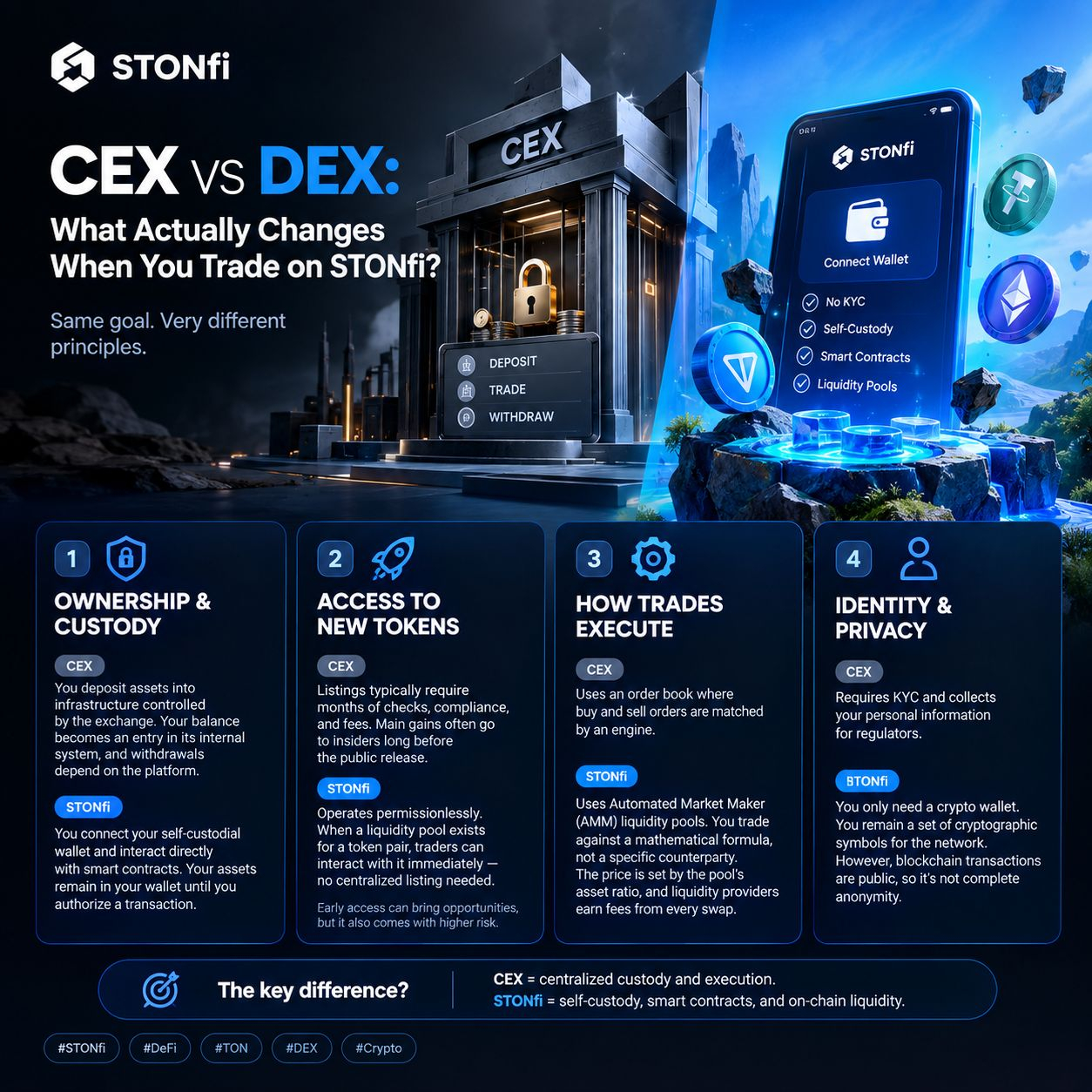
CEX vs DEX: What Really Changes When You Trade on STONfi?
At a glance, both platforms let you swap tokens.
The difference shows up in what happens behind the interface. 👇
🔐 1. OWNERSHIP & CUSTODY
On a CEX, you deposit assets with the exchange, which then tracks them through its own internal systems.
With STONfi, you connect a self-custodial wallet and interact directly with smart contracts.
Your tokens stay in your wallet until you approve a transaction. That part feels pretty different.
🌐 2. ACCESS TO NEW TOKENS
CEX listings typically depend on centralized reviews and listing decisions.
STONfi works permissionlessly at the protocol level.
Once a liquidity pool is available, traders can use it without waiting for a centralized exchange to approve and list the token.
That earlier access can be useful, but honestly, it can also bring more risk.
⚙️ 3. HOW TRADES EXECUTE
CEXs generally rely on order books, matching buyers with sellers.
STONfi uses an Automated Market Maker (AMM).
Rather than trading with one specific counterparty, your swap uses a liquidity pool and follows the protocol's pricing mechanism.
Liquidity providers may earn fees from eligible swaps.
🛡️ 4. IDENTITY & PRIVACY
CEXs commonly require KYC and collect information about their users.
A self-custodial DEX interaction begins with a crypto wallet, not an exchange account.
Still, wallet-based trading does not mean complete anonymity. Blockchain transactions remain publicly visible.
The core distinction is simple:
CEX → centralized custody and trade execution
STONfi → self-custody, smart contracts, and on-chain liquidity
That difference matters because it shows what you're actually placing your trust in when you trade. Honestly, it feels like a small detail until you look at who controls the funds and how each trade is processed.
{spot}(BTCUSDT)
#STONfi #DeFi #TON #DEX #crypto
$BTC $GRAM
CEX vs DEX: What Really Changes When You Trade on STONfi?
At a glance, both platforms let you swap tokens.
The difference shows up in what happens behind the interface. 👇
🔐 1. OWNERSHIP & CUSTODY
On a CEX, you deposit assets with the exchange, which then tracks them through its own internal systems.
With STONfi, you connect a self-custodial wallet and interact directly with smart contracts.
Your tokens stay in your wallet until you approve a transaction. That part feels pretty different.
🌐 2. ACCESS TO NEW TOKENS
CEX listings typically depend on centralized reviews and listing decisions.
STONfi works permissionlessly at the protocol level.
Once a liquidity pool is available, traders can use it without waiting for a centralized exchange to approve and list the token.
That earlier access can be useful, but honestly, it can also bring more risk.
⚙️ 3. HOW TRADES EXECUTE
CEXs generally rely on order books, matching buyers with sellers.
STONfi uses an Automated Market Maker (AMM).
Rather than trading with one specific counterparty, your swap uses a liquidity pool and follows the protocol's pricing mechanism.
Liquidity providers may earn fees from eligible swaps.
🛡️ 4. IDENTITY & PRIVACY
CEXs commonly require KYC and collect information about their users.
A self-custodial DEX interaction begins with a crypto wallet, not an exchange account.
Still, wallet-based trading does not mean complete anonymity. Blockchain transactions remain publicly visible.
The core distinction is simple:
CEX → centralized custody and trade execution
STONfi → self-custody, smart contracts, and on-chain liquidity
That difference matters because it shows what you're actually placing your trust in when you trade. Honestly, it feels like a small detail until you look at who controls the funds and how each trade is processed.
#STONfi #DeFi #TON #DEX #crypto
$BTC $GRAM
At a glance, both platforms let you swap tokens.
The difference shows up in what happens behind the interface. 👇
🔐 1. OWNERSHIP & CUSTODY
On a CEX, you deposit assets with the exchange, which then tracks them through its own internal systems.
With STONfi, you connect a self-custodial wallet and interact directly with smart contracts.
Your tokens stay in your wallet until you approve a transaction. That part feels pretty different.
🌐 2. ACCESS TO NEW TOKENS
CEX listings typically depend on centralized reviews and listing decisions.
STONfi works permissionlessly at the protocol level.
Once a liquidity pool is available, traders can use it without waiting for a centralized exchange to approve and list the token.
That earlier access can be useful, but honestly, it can also bring more risk.
⚙️ 3. HOW TRADES EXECUTE
CEXs generally rely on order books, matching buyers with sellers.
STONfi uses an Automated Market Maker (AMM).
Rather than trading with one specific counterparty, your swap uses a liquidity pool and follows the protocol's pricing mechanism.
Liquidity providers may earn fees from eligible swaps.
🛡️ 4. IDENTITY & PRIVACY
CEXs commonly require KYC and collect information about their users.
A self-custodial DEX interaction begins with a crypto wallet, not an exchange account.
Still, wallet-based trading does not mean complete anonymity. Blockchain transactions remain publicly visible.
The core distinction is simple:
CEX → centralized custody and trade execution
STONfi → self-custody, smart contracts, and on-chain liquidity
That difference matters because it shows what you're actually placing your trust in when you trade. Honestly, it feels like a small detail until you look at who controls the funds and how each trade is processed.
#STONfi #DeFi #TON #DEX #crypto
$BTC $GRAM
2
466

·
--
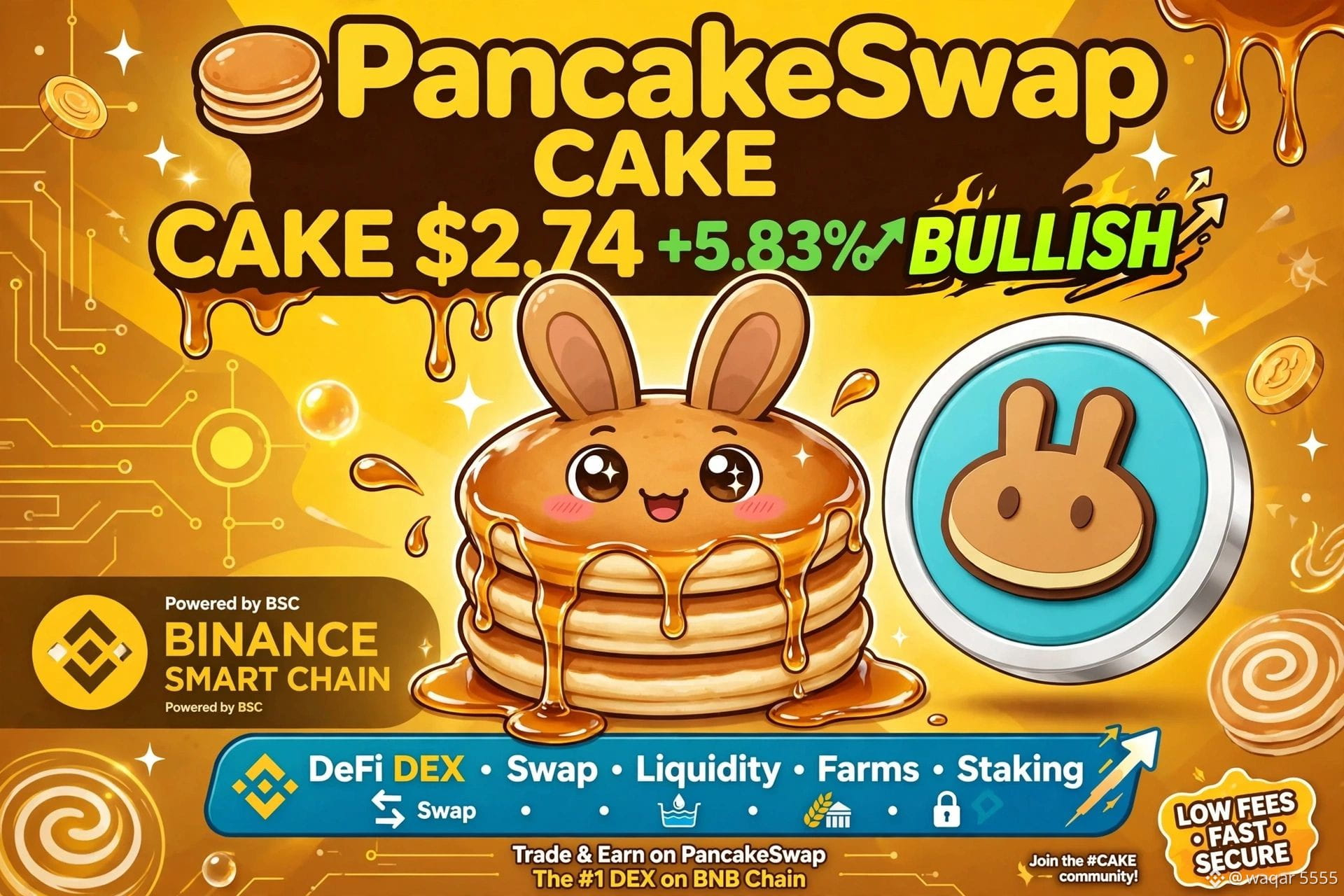
🥞 PancakeSwap $CAKE $2.74 +5.83% BULLISH! 🚀
CAKE is cooking! 🔥
PancakeSwap is the #1 DEX on BNB Chain:
✅ Swap - Low fees
✅ Liquidity Farms
✅ Staking Rewards
✅ Lottery & NFTs
Price pumping +5.83% in 24h! Next target $3.00? 🎯
Hold CAKE or flip it? 👇
$CAKE #PancakeSwap #CAKE #BNB #defi #DEX #Binance
🥞 PancakeSwap $CAKE $2.74 +5.83% BULLISH! 🚀
CAKE is cooking! 🔥
PancakeSwap is the #1 DEX on BNB Chain:
✅ Swap - Low fees
✅ Liquidity Farms
✅ Staking Rewards
✅ Lottery & NFTs
Price pumping +5.83% in 24h! Next target $3.00? 🎯
Hold CAKE or flip it? 👇
$CAKE #PancakeSwap #CAKE #BNB #defi #DEX #Binance
CAKE is cooking! 🔥
PancakeSwap is the #1 DEX on BNB Chain:
✅ Swap - Low fees
✅ Liquidity Farms
✅ Staking Rewards
✅ Lottery & NFTs
Price pumping +5.83% in 24h! Next target $3.00? 🎯
Hold CAKE or flip it? 👇
$CAKE #PancakeSwap #CAKE #BNB #defi #DEX #Binance
2
319

·
--
Decentralized Exchanges (DEX) vs. CEX Centralized exchanges provide unmatched execution speed and deep order-book liquidity, while DEXs offer permissionless access and non-custodial asset control. A mature crypto strategy uses both: CEX for high-frequency execution and fiat on-ramps; DEX for direct smart contract interactions and early liquidity pools. Where do you execute the majority of your trades? 🌐 #DEX #DeFi #CEX #CryptoInfrastructure
Decentralized Exchanges (DEX) vs. CEX Centralized exchanges provide unmatched execution speed and deep order-book liquidity, while DEXs offer permissionless access and non-custodial asset control. A mature crypto strategy uses both: CEX for high-frequency execution and fiat on-ramps; DEX for direct smart contract interactions and early liquidity pools. Where do you execute the majority of your trades? 🌐 #DEX #DeFi #CEX #CryptoInfrastructure

57

·
--
Bullish
The Uniswap V4 platform dominates trading volume among decentralized trading platforms amid the growth of tokenized stocks and regulatory clarity. Uniswap V4 captures 50% of trading volume on decentralized exchanges on the Ethereum network, driven by tokenized stocks and a Robinhood series. Positive guidance from the U.S. Securities and Exchange Commission regarding stock buybacks and the adoption of PROOF for the V4 issuance points to strong ecosystem growth.
#uniswap #UNI #DEX #ALPHA
$UNI
{future}(UNIUSDT)
The Uniswap V4 platform dominates trading volume among decentralized trading platforms amid the growth of tokenized stocks and regulatory clarity. Uniswap V4 captures 50% of trading volume on decentralized exchanges on the Ethereum network, driven by tokenized stocks and a Robinhood series. Positive guidance from the U.S. Securities and Exchange Commission regarding stock buybacks and the adoption of PROOF for the V4 issuance points to strong ecosystem growth.
#uniswap #UNI #DEX #ALPHA
$UNI
#uniswap #UNI #DEX #ALPHA
$UNI
1
40

·
--
#DEX today saw on X (Twitter) a whole bunch of KOLs pushing arcus registration.
Claiming it’s Robinhood’s first DeXperp, with a background in dYdX, and urging everyone to farm the air drop.
Does the market really need so many DEXs right now?
{future}(HYPEUSDT)
{future}(LITUSDT)
{future}(GRVTUSDT)
#DEX today saw on X (Twitter) a whole bunch of KOLs pushing arcus registration.
Claiming it’s Robinhood’s first DeXperp, with a background in dYdX, and urging everyone to farm the air drop.
Does the market really need so many DEXs right now?
Claiming it’s Robinhood’s first DeXperp, with a background in dYdX, and urging everyone to farm the air drop.
Does the market really need so many DEXs right now?
需要
不需要
1 day(s) left
331

·
--
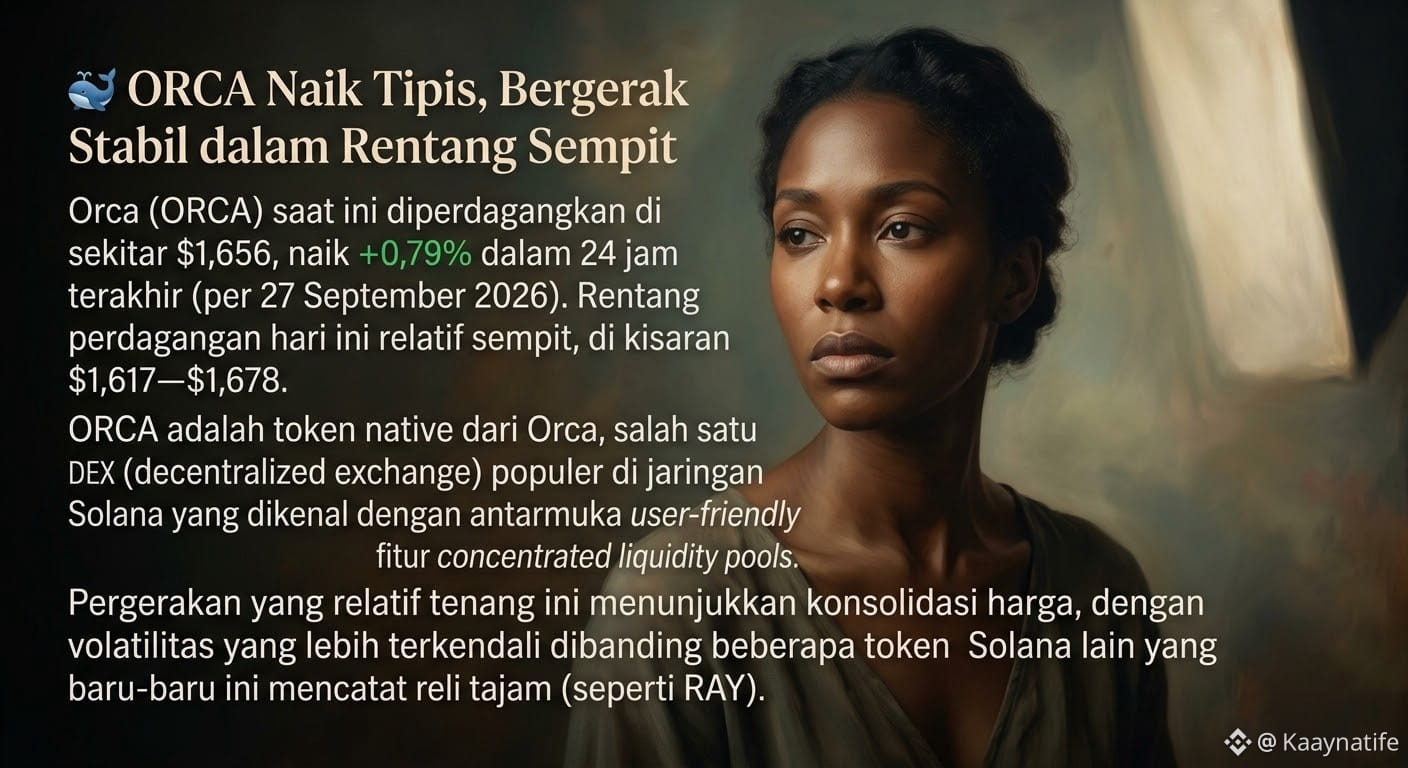
🐋 ORCA Thin Rise, Moves Steadily in a Narrow Range
Orca (ORCA) is currently trading around $1,656, up +0.79% over the last 24 hours (as of 27 September 2026). Today’s trading range is relatively narrow, in the $1,617–$1,678 area.
ORCA is the native token of Orca, one of the popular DEX (decentralized exchange) on the Solana network, known for its user-friendly interface and concentrated liquidity pool features.
This relatively calm movement suggests price consolidation, with volatility that’s more controlled than some other Solana tokens that have recently recorded sharp rallies (such as RAY).
$ORCA
{spot}(ORCAUSDT)
$RAY
{spot}(RAYUSDT)
$$SOL
{spot}(SOLUSDT)
#ORCA #PolymarketBankFailureBetsDrawFDICConcern #DEX
🐋 ORCA Thin Rise, Moves Steadily in a Narrow Range
Orca (ORCA) is currently trading around $1,656, up +0.79% over the last 24 hours (as of 27 September 2026). Today’s trading range is relatively narrow, in the $1,617–$1,678 area.
ORCA is the native token of Orca, one of the popular DEX (decentralized exchange) on the Solana network, known for its user-friendly interface and concentrated liquidity pool features.
This relatively calm movement suggests price consolidation, with volatility that’s more controlled than some other Solana tokens that have recently recorded sharp rallies (such as RAY).
$ORCA
$RAY
$$SOL
#ORCA #PolymarketBankFailureBetsDrawFDICConcern #DEX
Orca (ORCA) is currently trading around $1,656, up +0.79% over the last 24 hours (as of 27 September 2026). Today’s trading range is relatively narrow, in the $1,617–$1,678 area.
ORCA is the native token of Orca, one of the popular DEX (decentralized exchange) on the Solana network, known for its user-friendly interface and concentrated liquidity pool features.
This relatively calm movement suggests price consolidation, with volatility that’s more controlled than some other Solana tokens that have recently recorded sharp rallies (such as RAY).
$ORCA
$RAY
$$SOL
#ORCA #PolymarketBankFailureBetsDrawFDICConcern #DEX
222

·
--
Optimized for direct publication:
CZ’s latest statement: I don’t oppose Hyperliquid. I welcome more DEXs to participate in the competition.
The more intense the competition among decentralized exchanges, the better it is for users and the industry.
#CZ #Hyperliquid #DEX #DeFi
Optimized for direct publication:
CZ’s latest statement: I don’t oppose Hyperliquid. I welcome more DEXs to participate in the competition.
The more intense the competition among decentralized exchanges, the better it is for users and the industry.
#CZ #Hyperliquid #DEX #DeFi
CZ’s latest statement: I don’t oppose Hyperliquid. I welcome more DEXs to participate in the competition.
The more intense the competition among decentralized exchanges, the better it is for users and the industry.
#CZ #Hyperliquid #DEX #DeFi
65

·
--
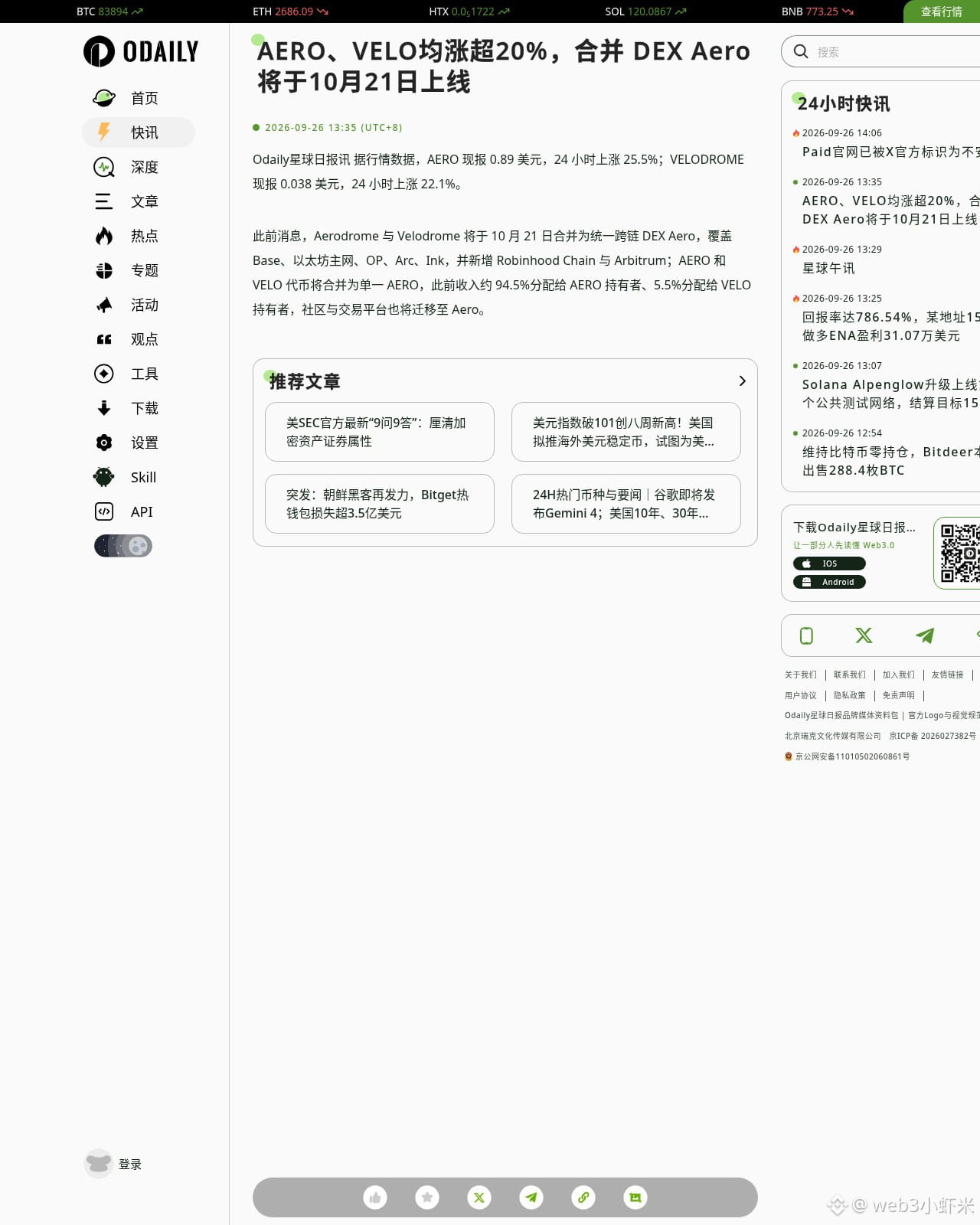
Found Odaily: Aerodrome and Velodrome are merging—Aero, a unified cross-chain DEX, will launch on October 21. After the news broke, both AERO and VELO jumped more than 20%.
AERO is currently around $0.89 (24h +25.5%), while VELODROME is about $0.038 (+22.1%). After the merger, it will cover Base, the Ethereum mainnet, OP, Arc, and Ink, and will also add Robinhood Chain and Arbitrum. AERO and VELO will become a single AERO. Previously, about 94.5% of revenue went to AERO holders and 5.5% to VELO holders; the community and trading entry points will also move to Aero.
A top cross-chain DEX merger in the Base ecosystem—basically tightening the liquidity narrative into one. The date is set quite specifically, so it isn’t strange that the market got a lift first.
$AERO $VELO #DEX #Base
Found Odaily: Aerodrome and Velodrome are merging—Aero, a unified cross-chain DEX, will launch on October 21. After the news broke, both AERO and VELO jumped more than 20%.
AERO is currently around $0.89 (24h +25.5%), while VELODROME is about $0.038 (+22.1%). After the merger, it will cover Base, the Ethereum mainnet, OP, Arc, and Ink, and will also add Robinhood Chain and Arbitrum. AERO and VELO will become a single AERO. Previously, about 94.5% of revenue went to AERO holders and 5.5% to VELO holders; the community and trading entry points will also move to Aero.
A top cross-chain DEX merger in the Base ecosystem—basically tightening the liquidity narrative into one. The date is set quite specifically, so it isn’t strange that the market got a lift first.
$AERO $VELO #DEX #Base
AERO is currently around $0.89 (24h +25.5%), while VELODROME is about $0.038 (+22.1%). After the merger, it will cover Base, the Ethereum mainnet, OP, Arc, and Ink, and will also add Robinhood Chain and Arbitrum. AERO and VELO will become a single AERO. Previously, about 94.5% of revenue went to AERO holders and 5.5% to VELO holders; the community and trading entry points will also move to Aero.
A top cross-chain DEX merger in the Base ecosystem—basically tightening the liquidity narrative into one. The date is set quite specifically, so it isn’t strange that the market got a lift first.
$AERO $VELO #DEX #Base
10

·
--
🎯 Base chain DEX leader AERO has surged to the top of the trending list
📰 Aerodrome is up 21% in a day and 68% in 30 days; market cap reaches $840 million to take the top spot; BTC is hovering around 83.7K and bleeding slowly—no one cares
💬 Funds haven’t left the market; they’re just switching arenas. The overall market lacks volume—hot money has been pooling into Base-based pools like this one with an ecosystem story. It has high upside potential, but when it falls, it drops hard too
🏷️ #AERO #Base #DEX #altcoin turbulence
🎯 Base chain DEX leader AERO has surged to the top of the trending list
📰 Aerodrome is up 21% in a day and 68% in 30 days; market cap reaches $840 million to take the top spot; BTC is hovering around 83.7K and bleeding slowly—no one cares
💬 Funds haven’t left the market; they’re just switching arenas. The overall market lacks volume—hot money has been pooling into Base-based pools like this one with an ecosystem story. It has high upside potential, but when it falls, it drops hard too
🏷️ #AERO #Base #DEX #altcoin turbulence
📰 Aerodrome is up 21% in a day and 68% in 30 days; market cap reaches $840 million to take the top spot; BTC is hovering around 83.7K and bleeding slowly—no one cares
💬 Funds haven’t left the market; they’re just switching arenas. The overall market lacks volume—hot money has been pooling into Base-based pools like this one with an ecosystem story. It has high upside potential, but when it falls, it drops hard too
🏷️ #AERO #Base #DEX #altcoin turbulence
127

·
--
Chinese version:
Behind the massive spike in Solana's DEX trading volume lies some shady business! Investigations show that large numbers of bots are carrying out circular trades—buying and selling to themselves—to artificially inflate trading data. It's just like fake sales numbers: it looks lively, but the actual depth is nowhere near enough. #DEX #VolumeManipulation $SOL $DEX
English:
Solana's DEX volume spike is hiding dirty laundry! Bots are running circular trades, buying and selling to themselves to artificially inflate volume numbers. It's like fake sales data - looks impressive on paper but doesn't reflect real market depth. #DEX #VolumeManipulation $SOL $DEX
Chinese version:
Behind the massive spike in Solana's DEX trading volume lies some shady business! Investigations show that large numbers of bots are carrying out circular trades—buying and selling to themselves—to artificially inflate trading data. It's just like fake sales numbers: it looks lively, but the actual depth is nowhere near enough. #DEX #VolumeManipulation $SOL $DEX
English:
Solana's DEX volume spike is hiding dirty laundry! Bots are running circular trades, buying and selling to themselves to artificially inflate volume numbers. It's like fake sales data - looks impressive on paper but doesn't reflect real market depth. #DEX #VolumeManipulation $SOL $DEX
Behind the massive spike in Solana's DEX trading volume lies some shady business! Investigations show that large numbers of bots are carrying out circular trades—buying and selling to themselves—to artificially inflate trading data. It's just like fake sales numbers: it looks lively, but the actual depth is nowhere near enough. #DEX #VolumeManipulation $SOL $DEX
English:
Solana's DEX volume spike is hiding dirty laundry! Bots are running circular trades, buying and selling to themselves to artificially inflate volume numbers. It's like fake sales data - looks impressive on paper but doesn't reflect real market depth. #DEX #VolumeManipulation $SOL $DEX
175

·
--
Article
What Is a DEX? A Beginner’s Guide to Decentralized ExchangesIf you are learning about DeFi, one term you will come across repeatedly is DEX.
DEX stands for Decentralized Exchange.
But what makes an exchange decentralized, and how is it different from a traditional centralized exchange?
Let’s break it down.
What Is a DEX?
A decentralized exchange is a blockchain-based platform that allows users to trade crypto assets directly through smart contracts.
Instead of depositing your assets into an exchange-controlled account, you generally connect your own crypto wallet and interact with the DEX through a blockchain transaction.
This introduces a different model of trading:
Wallet → Smart Contract → Blockchain
The exchange logic is handled by blockchain-based smart contracts rather than relying entirely on a centralized company to execute and custody trades.
DEX vs CEX
The easiest way to understand a DEX is to compare it with a centralized exchange, or CEX.
A centralized exchange typically operates through a company that manages the trading platform and, depending on the service, may hold users’ assets.
DEX is designed around smart contracts and self-custody.
With a DEX, the user generally keeps control of their wallet and authorizes transactions themselves.
This difference is important because custody and execution work differently in the two models.
How Does a DEX Work?
Most modern DEXs use smart contracts to facilitate trading.
A simplified process looks like this:
1. Connect Your Wallet
You connect a compatible crypto wallet to the DEX.
Your assets remain in your wallet until you approve a transaction.
2. Choose Your Trading Pair
You select the asset you want to trade and the asset you want to receive.
For example:
Token A → Token B
3. Check the Trade
Before confirming, the interface may show information such as:
- Exchange rate
- Network fee
- Price impact
- Slippage
- Minimum amount received
4. Approve the Transaction
You authorize the transaction from your wallet.
The blockchain then processes the interaction with the DEX's smart contract.
5. Receive the Asset
If the transaction executes successfully, the swapped asset arrives in your wallet.
The entire process can happen without creating a traditional exchange account.
Where Does the Liquidity Come From?
This is one of the most important concepts in DeFi.
Many DEXs use liquidity pools.
A liquidity pool contains crypto assets supplied by users known as liquidity providers.
For example, a pool could contain two assets that traders can swap between.
When someone makes a trade, the smart contract interacts with the available liquidity in the pool.
Liquidity providers may receive a portion of trading fees according to the rules of the protocol.
This creates an ecosystem where:
Traders use liquidity → Liquidity providers supply liquidity → The protocol facilitates the swap
We will explore liquidity pools and liquidity providers in more detail later in this series.
What Is an AMM?
Many DEXs use a mechanism called an Automated Market Maker, or AMM.
An AMM uses mathematical rules and liquidity pools to determine how trades are executed instead of relying on a traditional order book.
This is one of the major innovations behind modern decentralized trading.
Rather than waiting for a specific buyer and seller to match, users can trade against available liquidity.
But AMMs also introduce concepts such as price impact, slippage, and impermanent loss.
These are important topics for anyone using DeFi.
Advantages of DEXs
DEXs can provide several important features.
Self-Custody
Users can generally maintain control of their assets through their own wallets.
On-Chain Transparency
Transactions and smart-contract activity can often be verified on the blockchain.
Open Access
Depending on the blockchain and protocol, users may be able to interact with a DEX without opening a traditional exchange account.
DeFi Integration
DEXs can interact with other decentralized applications and smart contracts, making them an important part of the broader DeFi ecosystem.
What Are the Risks?
Decentralized does not mean risk-free.
Users should understand several risks before trading on a DEX.
Smart Contract Risk
A vulnerability in a smart contract can potentially lead to loss of funds.
Slippage
The final execution price may differ from the expected price, especially when liquidity is limited or markets move quickly.
Price Impact
Large trades can move the price within a liquidity pool.
Network Fees
Every blockchain transaction may require a network fee.
Irreversible Transactions
Blockchain transactions are generally difficult or impossible to reverse once confirmed.
Fake Tokens and Malicious Contracts
Users must verify token addresses and interact with legitimate protocols. A DEX does not automatically make every token or contract safe.
Why DEXs Matter
DEXs represent a major shift in how digital assets can be exchanged.
Instead of relying entirely on a centralized intermediary, decentralized exchanges use:
Wallets + Smart Contracts + Blockchain + Liquidity
This model is one of the foundations of decentralized finance.
But understanding what a DEX is only gives us the starting point.
The next question is even more important:
How does a DEX actually determine the price of a token and execute a swap?
That takes us to the next topic in this series:
What Is an AMM? — Understanding Automated Market Makers
Stay tuned as we continue breaking down DeFi, one concept at a time.
#CryptoEducation #DeFi #DEX #Blockchain
What Is a DEX? A Beginner’s Guide to Decentralized Exchanges
If you are learning about DeFi, one term you will come across repeatedly is DEX.
DEX stands for Decentralized Exchange.
But what makes an exchange decentralized, and how is it different from a traditional centralized exchange?
Let’s break it down.
What Is a DEX?
A decentralized exchange is a blockchain-based platform that allows users to trade crypto assets directly through smart contracts.
Instead of depositing your assets into an exchange-controlled account, you generally connect your own crypto wallet and interact with the DEX through a blockchain transaction.
This introduces a different model of trading:
Wallet → Smart Contract → Blockchain
The exchange logic is handled by blockchain-based smart contracts rather than relying entirely on a centralized company to execute and custody trades.
DEX vs CEX
The easiest way to understand a DEX is to compare it with a centralized exchange, or CEX.
A centralized exchange typically operates through a company that manages the trading platform and, depending on the service, may hold users’ assets.
DEX is designed around smart contracts and self-custody.
With a DEX, the user generally keeps control of their wallet and authorizes transactions themselves.
This difference is important because custody and execution work differently in the two models.
How Does a DEX Work?
Most modern DEXs use smart contracts to facilitate trading.
A simplified process looks like this:
1. Connect Your Wallet
You connect a compatible crypto wallet to the DEX.
Your assets remain in your wallet until you approve a transaction.
2. Choose Your Trading Pair
You select the asset you want to trade and the asset you want to receive.
For example:
Token A → Token B
3. Check the Trade
Before confirming, the interface may show information such as:
- Exchange rate
- Network fee
- Price impact
- Slippage
- Minimum amount received
4. Approve the Transaction
You authorize the transaction from your wallet.
The blockchain then processes the interaction with the DEX's smart contract.
5. Receive the Asset
If the transaction executes successfully, the swapped asset arrives in your wallet.
The entire process can happen without creating a traditional exchange account.
Where Does the Liquidity Come From?
This is one of the most important concepts in DeFi.
Many DEXs use liquidity pools.
A liquidity pool contains crypto assets supplied by users known as liquidity providers.
For example, a pool could contain two assets that traders can swap between.
When someone makes a trade, the smart contract interacts with the available liquidity in the pool.
Liquidity providers may receive a portion of trading fees according to the rules of the protocol.
This creates an ecosystem where:
Traders use liquidity → Liquidity providers supply liquidity → The protocol facilitates the swap
We will explore liquidity pools and liquidity providers in more detail later in this series.
What Is an AMM?
Many DEXs use a mechanism called an Automated Market Maker, or AMM.
An AMM uses mathematical rules and liquidity pools to determine how trades are executed instead of relying on a traditional order book.
This is one of the major innovations behind modern decentralized trading.
Rather than waiting for a specific buyer and seller to match, users can trade against available liquidity.
But AMMs also introduce concepts such as price impact, slippage, and impermanent loss.
These are important topics for anyone using DeFi.
Advantages of DEXs
DEXs can provide several important features.
Self-Custody
Users can generally maintain control of their assets through their own wallets.
On-Chain Transparency
Transactions and smart-contract activity can often be verified on the blockchain.
Open Access
Depending on the blockchain and protocol, users may be able to interact with a DEX without opening a traditional exchange account.
DeFi Integration
DEXs can interact with other decentralized applications and smart contracts, making them an important part of the broader DeFi ecosystem.
What Are the Risks?
Decentralized does not mean risk-free.
Users should understand several risks before trading on a DEX.
Smart Contract Risk
A vulnerability in a smart contract can potentially lead to loss of funds.
Slippage
The final execution price may differ from the expected price, especially when liquidity is limited or markets move quickly.
Price Impact
Large trades can move the price within a liquidity pool.
Network Fees
Every blockchain transaction may require a network fee.
Irreversible Transactions
Blockchain transactions are generally difficult or impossible to reverse once confirmed.
Fake Tokens and Malicious Contracts
Users must verify token addresses and interact with legitimate protocols. A DEX does not automatically make every token or contract safe.
Why DEXs Matter
DEXs represent a major shift in how digital assets can be exchanged.
Instead of relying entirely on a centralized intermediary, decentralized exchanges use:
Wallets + Smart Contracts + Blockchain + Liquidity
This model is one of the foundations of decentralized finance.
But understanding what a DEX is only gives us the starting point.
The next question is even more important:
How does a DEX actually determine the price of a token and execute a swap?
That takes us to the next topic in this series:
What Is an AMM? — Understanding Automated Market Makers
Stay tuned as we continue breaking down DeFi, one concept at a time.
#CryptoEducation #DeFi #DEX #Blockchain
DEX stands for Decentralized Exchange.
But what makes an exchange decentralized, and how is it different from a traditional centralized exchange?
Let’s break it down.
What Is a DEX?
A decentralized exchange is a blockchain-based platform that allows users to trade crypto assets directly through smart contracts.
Instead of depositing your assets into an exchange-controlled account, you generally connect your own crypto wallet and interact with the DEX through a blockchain transaction.
This introduces a different model of trading:
Wallet → Smart Contract → Blockchain
The exchange logic is handled by blockchain-based smart contracts rather than relying entirely on a centralized company to execute and custody trades.
DEX vs CEX
The easiest way to understand a DEX is to compare it with a centralized exchange, or CEX.
A centralized exchange typically operates through a company that manages the trading platform and, depending on the service, may hold users’ assets.
DEX is designed around smart contracts and self-custody.
With a DEX, the user generally keeps control of their wallet and authorizes transactions themselves.
This difference is important because custody and execution work differently in the two models.
How Does a DEX Work?
Most modern DEXs use smart contracts to facilitate trading.
A simplified process looks like this:
1. Connect Your Wallet
You connect a compatible crypto wallet to the DEX.
Your assets remain in your wallet until you approve a transaction.
2. Choose Your Trading Pair
You select the asset you want to trade and the asset you want to receive.
For example:
Token A → Token B
3. Check the Trade
Before confirming, the interface may show information such as:
- Exchange rate
- Network fee
- Price impact
- Slippage
- Minimum amount received
4. Approve the Transaction
You authorize the transaction from your wallet.
The blockchain then processes the interaction with the DEX's smart contract.
5. Receive the Asset
If the transaction executes successfully, the swapped asset arrives in your wallet.
The entire process can happen without creating a traditional exchange account.
Where Does the Liquidity Come From?
This is one of the most important concepts in DeFi.
Many DEXs use liquidity pools.
A liquidity pool contains crypto assets supplied by users known as liquidity providers.
For example, a pool could contain two assets that traders can swap between.
When someone makes a trade, the smart contract interacts with the available liquidity in the pool.
Liquidity providers may receive a portion of trading fees according to the rules of the protocol.
This creates an ecosystem where:
Traders use liquidity → Liquidity providers supply liquidity → The protocol facilitates the swap
We will explore liquidity pools and liquidity providers in more detail later in this series.
What Is an AMM?
Many DEXs use a mechanism called an Automated Market Maker, or AMM.
An AMM uses mathematical rules and liquidity pools to determine how trades are executed instead of relying on a traditional order book.
This is one of the major innovations behind modern decentralized trading.
Rather than waiting for a specific buyer and seller to match, users can trade against available liquidity.
But AMMs also introduce concepts such as price impact, slippage, and impermanent loss.
These are important topics for anyone using DeFi.
Advantages of DEXs
DEXs can provide several important features.
Self-Custody
Users can generally maintain control of their assets through their own wallets.
On-Chain Transparency
Transactions and smart-contract activity can often be verified on the blockchain.
Open Access
Depending on the blockchain and protocol, users may be able to interact with a DEX without opening a traditional exchange account.
DeFi Integration
DEXs can interact with other decentralized applications and smart contracts, making them an important part of the broader DeFi ecosystem.
What Are the Risks?
Decentralized does not mean risk-free.
Users should understand several risks before trading on a DEX.
Smart Contract Risk
A vulnerability in a smart contract can potentially lead to loss of funds.
Slippage
The final execution price may differ from the expected price, especially when liquidity is limited or markets move quickly.
Price Impact
Large trades can move the price within a liquidity pool.
Network Fees
Every blockchain transaction may require a network fee.
Irreversible Transactions
Blockchain transactions are generally difficult or impossible to reverse once confirmed.
Fake Tokens and Malicious Contracts
Users must verify token addresses and interact with legitimate protocols. A DEX does not automatically make every token or contract safe.
Why DEXs Matter
DEXs represent a major shift in how digital assets can be exchanged.
Instead of relying entirely on a centralized intermediary, decentralized exchanges use:
Wallets + Smart Contracts + Blockchain + Liquidity
This model is one of the foundations of decentralized finance.
But understanding what a DEX is only gives us the starting point.
The next question is even more important:
How does a DEX actually determine the price of a token and execute a swap?
That takes us to the next topic in this series:
What Is an AMM? — Understanding Automated Market Makers
Stay tuned as we continue breaking down DeFi, one concept at a time.
#CryptoEducation #DeFi #DEX #Blockchain
2
92

·
--
UNI once stood above $10 for a night; the shorts were wiped out for $3.81 million, and the Binance Square instantly went viral—everyone was shouting, "DeFi blue-chip awakening." But has the protocol really started distributing profits?
Let’s look at the numbers first: discussion volume surged to 122,500 entries, 2.26 times the 5-day average; spot trading volume hit $590 million; total liquidation volume was 5.59 million, with shorts accounting for $3.81 million—nearly 70%.
This move was price-led. $10 is a clean psychological level—once the shorts were forced to cover, buy orders followed through. Fee-switch narratives, Arc stablecoin expansion, v4 dynamic fee rates—those storylines were already on the table, and nobody cared. When the price rose, all the old stories were suddenly dug up and used as reasons for why it "should have gone up."
Flip it around: if the protocol truly had begun charging for real money and sharing revenues, then this rally would deserve the label "valuation reappraisal." But what about now? The fee switch hasn’t truly been turned on. Whether UNI can actually capture the protocol’s cash flow is still just talk.
I’m not buying into the bullish case here—this $10 move propped up by shorts getting squeezed is one thing, and the protocol distributing real cash is another. If you want me to change my mind, there’s only one possibility: $10 holds on increasing volume, not propped up by short-covering. That’s when it would mean real money is actually flowing in—not just short-term sentiment.
$UNI #DeFi #Uniswap #DEX
UNI once stood above $10 for a night; the shorts were wiped out for $3.81 million, and the Binance Square instantly went viral—everyone was shouting, "DeFi blue-chip awakening." But has the protocol really started distributing profits?
Let’s look at the numbers first: discussion volume surged to 122,500 entries, 2.26 times the 5-day average; spot trading volume hit $590 million; total liquidation volume was 5.59 million, with shorts accounting for $3.81 million—nearly 70%.
This move was price-led. $10 is a clean psychological level—once the shorts were forced to cover, buy orders followed through. Fee-switch narratives, Arc stablecoin expansion, v4 dynamic fee rates—those storylines were already on the table, and nobody cared. When the price rose, all the old stories were suddenly dug up and used as reasons for why it "should have gone up."
Flip it around: if the protocol truly had begun charging for real money and sharing revenues, then this rally would deserve the label "valuation reappraisal." But what about now? The fee switch hasn’t truly been turned on. Whether UNI can actually capture the protocol’s cash flow is still just talk.
I’m not buying into the bullish case here—this $10 move propped up by shorts getting squeezed is one thing, and the protocol distributing real cash is another. If you want me to change my mind, there’s only one possibility: $10 holds on increasing volume, not propped up by short-covering. That’s when it would mean real money is actually flowing in—not just short-term sentiment.
$UNI #DeFi #Uniswap #DEX
Let’s look at the numbers first: discussion volume surged to 122,500 entries, 2.26 times the 5-day average; spot trading volume hit $590 million; total liquidation volume was 5.59 million, with shorts accounting for $3.81 million—nearly 70%.
This move was price-led. $10 is a clean psychological level—once the shorts were forced to cover, buy orders followed through. Fee-switch narratives, Arc stablecoin expansion, v4 dynamic fee rates—those storylines were already on the table, and nobody cared. When the price rose, all the old stories were suddenly dug up and used as reasons for why it "should have gone up."
Flip it around: if the protocol truly had begun charging for real money and sharing revenues, then this rally would deserve the label "valuation reappraisal." But what about now? The fee switch hasn’t truly been turned on. Whether UNI can actually capture the protocol’s cash flow is still just talk.
I’m not buying into the bullish case here—this $10 move propped up by shorts getting squeezed is one thing, and the protocol distributing real cash is another. If you want me to change my mind, there’s only one possibility: $10 holds on increasing volume, not propped up by short-covering. That’s when it would mean real money is actually flowing in—not just short-term sentiment.
$UNI #DeFi #Uniswap #DEX
236

·
--
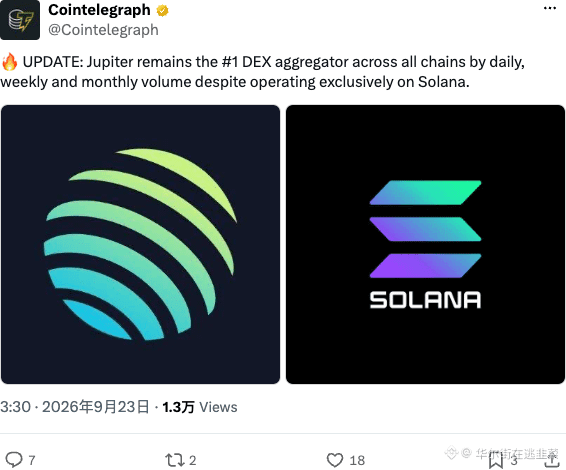
A single Solana chain is powering the leading full-chain DEX aggregator, and Jupiter’s daily/weekly/monthly trading volumes have all topped the charts. Solana’s current meme rotation turnover and deep long-tail liquidity are indeed impressive; the aggregator’s head-of-market effect is even more pronounced. The fundamentals can’t really be criticized, but whether the aggregator’s fees go to JUP depends on the mechanism. Trading volume is the face, but token capture is the substance.
$JUP #Jupiter #Solana #DEX #Aggregator
A single Solana chain is powering the leading full-chain DEX aggregator, and Jupiter’s daily/weekly/monthly trading volumes have all topped the charts. Solana’s current meme rotation turnover and deep long-tail liquidity are indeed impressive; the aggregator’s head-of-market effect is even more pronounced. The fundamentals can’t really be criticized, but whether the aggregator’s fees go to JUP depends on the mechanism. Trading volume is the face, but token capture is the substance.
$JUP #Jupiter #Solana #DEX #Aggregator
$JUP #Jupiter #Solana #DEX #Aggregator
170

·
--
Bullish
A token having a price doesn’t mean you can actually trade it properly.
When I check a new TON token, I look beyond the chart.
First, I verify the contract.
Then I check if there’s an actual liquidity pool and look at its TVL, volume and pool balance.
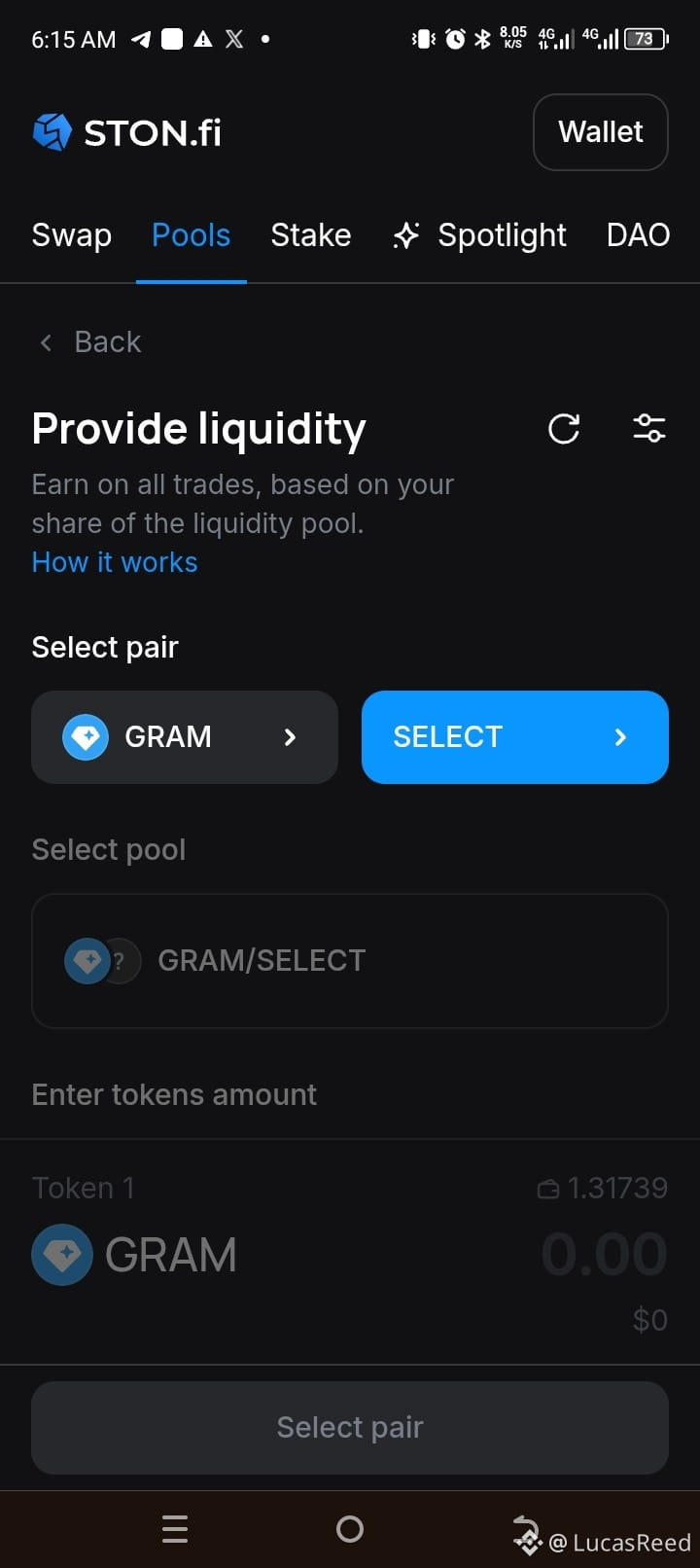
After that, I enter the amount I’m considering on @ston_fi and check the quote and Price Impact.
That last part matters.
A small pool can make even a normal-sized swap move the price significantly. STON.fi shows the expected output and price impact before you confirm.
I also check for token warnings. Fake and Honeypot tokens, for example, can be restricted in the STON.fi interface.
So my checklist is simple:
Contract → Pool → Liquidity → Quote → Price Impact → Warnings
Having a token on-chain is one thing.
Having a usable market is another.
🌐 STON.fi: app.ston.fi
📝 STON.fi Blog: blog.ston.fi
#STONfi #TON #DeFi #DEX
$TRUMP $HYPE $BNB
A token having a price doesn’t mean you can actually trade it properly.
When I check a new TON token, I look beyond the chart.
First, I verify the contract.
Then I check if there’s an actual liquidity pool and look at its TVL, volume and pool balance.
After that, I enter the amount I’m considering on @ston_fi and check the quote and Price Impact.
That last part matters.
A small pool can make even a normal-sized swap move the price significantly. STON.fi shows the expected output and price impact before you confirm.
I also check for token warnings. Fake and Honeypot tokens, for example, can be restricted in the STON.fi interface.
So my checklist is simple:
Contract → Pool → Liquidity → Quote → Price Impact → Warnings
Having a token on-chain is one thing.
Having a usable market is another.
🌐 STON.fi: app.ston.fi
📝 STON.fi Blog: blog.ston.fi
#STONfi #TON #DeFi #DEX
$TRUMP $HYPE $BNB
When I check a new TON token, I look beyond the chart.
First, I verify the contract.
Then I check if there’s an actual liquidity pool and look at its TVL, volume and pool balance.
After that, I enter the amount I’m considering on @ston_fi and check the quote and Price Impact.
That last part matters.
A small pool can make even a normal-sized swap move the price significantly. STON.fi shows the expected output and price impact before you confirm.
I also check for token warnings. Fake and Honeypot tokens, for example, can be restricted in the STON.fi interface.
So my checklist is simple:
Contract → Pool → Liquidity → Quote → Price Impact → Warnings
Having a token on-chain is one thing.
Having a usable market is another.
🌐 STON.fi: app.ston.fi
📝 STON.fi Blog: blog.ston.fi
#STONfi #TON #DeFi #DEX
$TRUMP $HYPE $BNB
268

This surge isn’t driven purely by sentiment; it’s fundamentals being catalyzed and rolling out in quick succession.
1) SEC’s new rules for tokenized stocks are advancing—compliant channels are opening, and leading DEXs stand to benefit first;
2) V4’s TVL is rapidly climbing on Robinhood Chain and Arc Chain, and multi-chain expansion is starting to materialize;
3) Protocol fee revenue over the past ~30 days is about $195 million—real cash flow;
4) A brand domain dispute has been settled, removing lingering uncertainties at the tail.
At the current price of around $8.72, with nearly $1 billion in trading volume over 24 hours and a market cap of about $5.4 billion. When regulation, expansion, revenue, and negative news clearance all resonate at the same time—that’s the core logic behind the market’s confidence repair.
Near-term volatility is inevitable, but a protocol that can consistently generate fees ultimately has valuation support in the long run. Next, the key focus is whether V4’s multi-chain TVL data can continue its momentum.
$UNI #Uniswap #DEX
This surge isn’t driven purely by sentiment; it’s fundamentals being catalyzed and rolling out in quick succession.
1) SEC’s new rules for tokenized stocks are advancing—compliant channels are opening, and leading DEXs stand to benefit first;
2) V4’s TVL is rapidly climbing on Robinhood Chain and Arc Chain, and multi-chain expansion is starting to materialize;
3) Protocol fee revenue over the past ~30 days is about $195 million—real cash flow;
4) A brand domain dispute has been settled, removing lingering uncertainties at the tail.
At the current price of around $8.72, with nearly $1 billion in trading volume over 24 hours and a market cap of about $5.4 billion. When regulation, expansion, revenue, and negative news clearance all resonate at the same time—that’s the core logic behind the market’s confidence repair.
Near-term volatility is inevitable, but a protocol that can consistently generate fees ultimately has valuation support in the long run. Next, the key focus is whether V4’s multi-chain TVL data can continue its momentum.
$UNI #Uniswap #DEX
1) SEC’s new rules for tokenized stocks are advancing—compliant channels are opening, and leading DEXs stand to benefit first;
2) V4’s TVL is rapidly climbing on Robinhood Chain and Arc Chain, and multi-chain expansion is starting to materialize;
3) Protocol fee revenue over the past ~30 days is about $195 million—real cash flow;
4) A brand domain dispute has been settled, removing lingering uncertainties at the tail.
At the current price of around $8.72, with nearly $1 billion in trading volume over 24 hours and a market cap of about $5.4 billion. When regulation, expansion, revenue, and negative news clearance all resonate at the same time—that’s the core logic behind the market’s confidence repair.
Near-term volatility is inevitable, but a protocol that can consistently generate fees ultimately has valuation support in the long run. Next, the key focus is whether V4’s multi-chain TVL data can continue its momentum.
$UNI #Uniswap #DEX
21
·
--
🎯 On-chain trades evaporate one-quarter in a day
📰 Total global DEX 24h trading volume is $9.2B, down 25% back to low-volume conditions; the stablecoin supply, however, is $311.3B and actually increased net by $870M—money really didn’t leave
💬 It’s not that funds ran off; they were moved from the gambling table to the parking lot. Trading volume shrank, yet ammunition rose—this often appears at the end of a consolidation range and before a regime change, so you need to keep a close watch
🏷️ #链上数据 #稳定币 #DEX # Fund Flow
🎯 On-chain trades evaporate one-quarter in a day
📰 Total global DEX 24h trading volume is $9.2B, down 25% back to low-volume conditions; the stablecoin supply, however, is $311.3B and actually increased net by $870M—money really didn’t leave
💬 It’s not that funds ran off; they were moved from the gambling table to the parking lot. Trading volume shrank, yet ammunition rose—this often appears at the end of a consolidation range and before a regime change, so you need to keep a close watch
🏷️ #链上数据 #稳定币 #DEX # Fund Flow
📰 Total global DEX 24h trading volume is $9.2B, down 25% back to low-volume conditions; the stablecoin supply, however, is $311.3B and actually increased net by $870M—money really didn’t leave
💬 It’s not that funds ran off; they were moved from the gambling table to the parking lot. Trading volume shrank, yet ammunition rose—this often appears at the end of a consolidation range and before a regime change, so you need to keep a close watch
🏷️ #链上数据 #稳定币 #DEX # Fund Flow
8

·
--
Bullish
Aster Is Becoming One of the Most Interesting Onchain Trading Bets
The next battle in #defi is not only about liquidity.
It is about where traders actually want to trade.
That is where Aster becomes interesting.
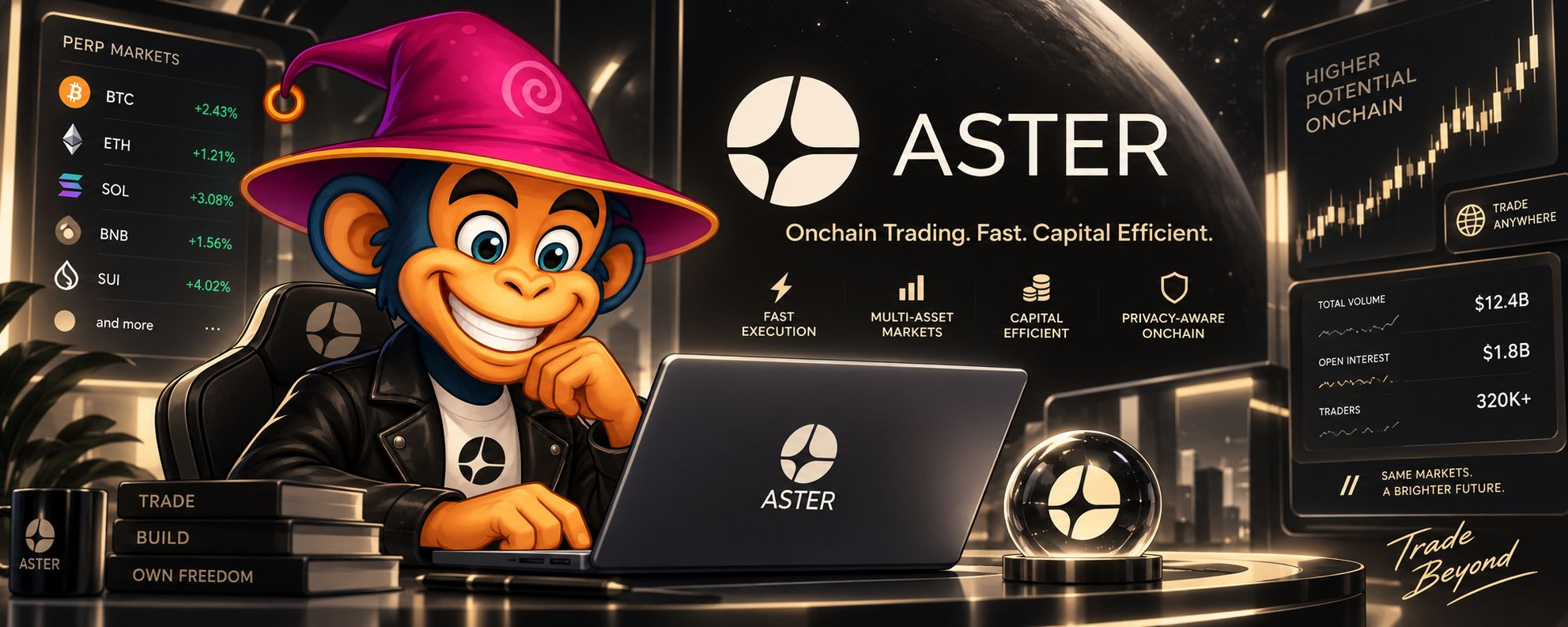
Aster combines perpetuals with access to crypto, stocks, forex, commodities and prediction markets, while also focusing on capital efficiency and privacy.
$ASTER sits directly inside the growing onchain trading economy.
The thesis is simple.
Traders want deep markets.
They want fast execution.
They want capital that keeps working.
And they increasingly want more control over their strategies and data.
Of course, competition between perp #DEX s is brutal and liquidity can move quickly.
But if trading continues migrating onchain, platforms that can deliver a CEX-like experience while keeping crypto-native advantages could capture serious activity.
Aster is one of the names worth watching in that race.
Aster Is Becoming One of the Most Interesting Onchain Trading Bets
The next battle in #defi is not only about liquidity.
It is about where traders actually want to trade.
That is where Aster becomes interesting.
Aster combines perpetuals with access to crypto, stocks, forex, commodities and prediction markets, while also focusing on capital efficiency and privacy.
$ASTER sits directly inside the growing onchain trading economy.
The thesis is simple.
Traders want deep markets.
They want fast execution.
They want capital that keeps working.
And they increasingly want more control over their strategies and data.
Of course, competition between perp #DEX s is brutal and liquidity can move quickly.
But if trading continues migrating onchain, platforms that can deliver a CEX-like experience while keeping crypto-native advantages could capture serious activity.
Aster is one of the names worth watching in that race.
The next battle in #defi is not only about liquidity.
It is about where traders actually want to trade.
That is where Aster becomes interesting.
Aster combines perpetuals with access to crypto, stocks, forex, commodities and prediction markets, while also focusing on capital efficiency and privacy.
$ASTER sits directly inside the growing onchain trading economy.
The thesis is simple.
Traders want deep markets.
They want fast execution.
They want capital that keeps working.
And they increasingly want more control over their strategies and data.
Of course, competition between perp #DEX s is brutal and liquidity can move quickly.
But if trading continues migrating onchain, platforms that can deliver a CEX-like experience while keeping crypto-native advantages could capture serious activity.
Aster is one of the names worth watching in that race.
2
921
·
--
Bullish
Uniswap dominates the launch of Arc and captures 86% of trading volume on decentralized exchanges (DEX) and the fees from major applications.. Uniswap captured 86% of trading volume across decentralized exchanges (DEX) on the mainnet of Circle’s Arc protocol, and it also reaped nearly all application fees on the first day, totaling approximately $450,000. This strong demand is an indicator of the platform’s potential for significant growth.
#UNI #Uniswp #DEX #ARC
$UNI
{spot}(UNIUSDT)
Uniswap dominates the launch of Arc and captures 86% of trading volume on decentralized exchanges (DEX) and the fees from major applications.. Uniswap captured 86% of trading volume across decentralized exchanges (DEX) on the mainnet of Circle’s Arc protocol, and it also reaped nearly all application fees on the first day, totaling approximately $450,000. This strong demand is an indicator of the platform’s potential for significant growth.
#UNI #Uniswp #DEX #ARC
$UNI
#UNI #Uniswp #DEX #ARC
$UNI
1
118


·
--
The Importance of Liquidity Depth
A token can have a strong community and an active market, but without enough liquidity, trading can still be difficult.
Liquidity depth affects how easily users can buy or sell an asset without significantly moving its price.
This is why STON.fi's liquidity pools are an important part of the TON DeFi ecosystem.
When liquidity is available:
🔹 Traders can execute swaps
🔹 Projects have more accessible markets
🔹 Users can enter or exit positions more easily
🔹 DeFi applications can build on existing markets
But liquidity isn't simply about having a large number on a dashboard.
Its distribution across pools and trading pairs also matters.
A pool with limited liquidity can experience greater price impact when a relatively large trade enters it.
The bigger lesson:
DeFi growth isn't only about launching more tokens.
It also requires the infrastructure and liquidity that allow those tokens to actually be traded efficiently.
That's why I look beyond the token itself and pay attention to the markets supporting it.
A healthy DeFi ecosystem needs both assets people want to trade and liquidity that lets them trade them.
#STONfi #TON #DeFi #Liquidity #DEX $TON @stonfi
The Importance of Liquidity Depth
A token can have a strong community and an active market, but without enough liquidity, trading can still be difficult.
Liquidity depth affects how easily users can buy or sell an asset without significantly moving its price.
This is why STON.fi's liquidity pools are an important part of the TON DeFi ecosystem.
When liquidity is available:
🔹 Traders can execute swaps
🔹 Projects have more accessible markets
🔹 Users can enter or exit positions more easily
🔹 DeFi applications can build on existing markets
But liquidity isn't simply about having a large number on a dashboard.
Its distribution across pools and trading pairs also matters.
A pool with limited liquidity can experience greater price impact when a relatively large trade enters it.
The bigger lesson:
DeFi growth isn't only about launching more tokens.
It also requires the infrastructure and liquidity that allow those tokens to actually be traded efficiently.
That's why I look beyond the token itself and pay attention to the markets supporting it.
A healthy DeFi ecosystem needs both assets people want to trade and liquidity that lets them trade them.
#STONfi #TON #DeFi #Liquidity #DEX $TON @STONfi DEX
A token can have a strong community and an active market, but without enough liquidity, trading can still be difficult.
Liquidity depth affects how easily users can buy or sell an asset without significantly moving its price.
This is why STON.fi's liquidity pools are an important part of the TON DeFi ecosystem.
When liquidity is available:
🔹 Traders can execute swaps
🔹 Projects have more accessible markets
🔹 Users can enter or exit positions more easily
🔹 DeFi applications can build on existing markets
But liquidity isn't simply about having a large number on a dashboard.
Its distribution across pools and trading pairs also matters.
A pool with limited liquidity can experience greater price impact when a relatively large trade enters it.
The bigger lesson:
DeFi growth isn't only about launching more tokens.
It also requires the infrastructure and liquidity that allow those tokens to actually be traded efficiently.
That's why I look beyond the token itself and pay attention to the markets supporting it.
A healthy DeFi ecosystem needs both assets people want to trade and liquidity that lets them trade them.
#STONfi #TON #DeFi #Liquidity #DEX $TON @STONfi DEX
90

·
--
$SEI : Built from the ground up for high-speed DEX trading ⚡🏎️
With sub-second finality and twin-turbo consensus, Sei was specifically engineered to give decentralized exchanges the speed and feel of a centralized order book.
Fast settlement + low slippage = the dream combo for on-chain day traders.
Have you used DEXs on $SEI yet? How does the speed compare to Solana? Drop your review! 💬
#SEINetwork #DEX #CryptoSpeed
$SEI : Built from the ground up for high-speed DEX trading ⚡🏎️
With sub-second finality and twin-turbo consensus, Sei was specifically engineered to give decentralized exchanges the speed and feel of a centralized order book.
Fast settlement + low slippage = the dream combo for on-chain day traders.
Have you used DEXs on $SEI yet? How does the speed compare to Solana? Drop your review! 💬
#SEINetwork #DEX #CryptoSpeed
With sub-second finality and twin-turbo consensus, Sei was specifically engineered to give decentralized exchanges the speed and feel of a centralized order book.
Fast settlement + low slippage = the dream combo for on-chain day traders.
Have you used DEXs on $SEI yet? How does the speed compare to Solana? Drop your review! 💬
#SEINetwork #DEX #CryptoSpeed
78
Log in to explore more content
Join global crypto users on Binance Square
⚡️ Get latest and useful information about crypto.
💬 Trusted by the world’s largest crypto exchange.
👍 Discover real insights from verified creators.
Email / Phone number
Trending Topics
1
#BitgetHackerMoves$83MStolenXRP
372 views
23 Discussing
2
#SOLSpotETFWeeklyInflow$188M
322 views
35 Discussing
3
#StrategyStriveAdd2305BitcoinThisWeek
30,261 views
890 Discussing
4
#TrumpRejectsIranHormuzReopening
32,771 views
716 Discussing
5
#CircleTetherFreezeBitgetHackerWallet
49,291 views
773 Discussing
6
#SECSaysTokenBuybacksNotAutoSecurities
23,904 views
418 Discussing
7
#ChinaUSAgreeOn$30BTariffCut
1,150 views
30 Discussing
8
#CoinMarketCapCompletesCoinglassAcquisition
41,043 views
560 Discussing
9
#CircleMints500MUSDCOnSolana
219,507 views
3,175 Discussing
10
#PolymarketBankFailureBetsDrawFDICConcern
187,386 views
2,409 Discussing